
A English
Moment of Inertia and Radius of gyration Questions in English
Class 11 Physics · System of Particles and Rotational Motion · Moment of Inertia and Radius of gyration
371+
Questions
English
Language
100%
With Solutions
Showing 50 of 371 questions in English
51
EasyMCQ
The moment of inertia of a circular wire of mass $M$ and radius $R$ about its diameter is .......
A
$MR^2/2$
B
$MR^2$
C
$2MR^2$
D
$MR^2/4$
Solution
(A) The moment of inertia of a circular wire (ring) about an axis passing through its center and perpendicular to its plane is $I_z = MR^2$.
By the perpendicular axis theorem,$I_z = I_x + I_y$,where $I_x$ and $I_y$ are the moments of inertia about the diameters.
Since the ring is symmetric,$I_x = I_y = I_{diameter}$.
Therefore,$I_z = 2I_{diameter}$.
Substituting the value of $I_z$,we get $MR^2 = 2I_{diameter}$.
Thus,the moment of inertia about the diameter is $I_{diameter} = \frac{1}{2}MR^2$.
By the perpendicular axis theorem,$I_z = I_x + I_y$,where $I_x$ and $I_y$ are the moments of inertia about the diameters.
Since the ring is symmetric,$I_x = I_y = I_{diameter}$.
Therefore,$I_z = 2I_{diameter}$.
Substituting the value of $I_z$,we get $MR^2 = 2I_{diameter}$.
Thus,the moment of inertia about the diameter is $I_{diameter} = \frac{1}{2}MR^2$.
0 likes
View Solution52
EasyMCQ
Two rods each of mass $m$ and length $\ell$ are joined at their centers to form a cross. What is the moment of inertia of the cross about an axis passing through the common center and perpendicular to the plane formed by them?
A
$\frac{m\ell^2}{12}$
B
$\frac{m\ell^2}{6}$
C
$\frac{m\ell^2}{3}$
D
$\frac{m\ell^2}{2}$
Solution
(B) The moment of inertia of a single rod of mass $m$ and length $\ell$ about an axis passing through its center and perpendicular to its length is $I = \frac{m\ell^2}{12}$.
Since the two rods are joined at their centers and are perpendicular to each other,the total moment of inertia about the axis passing through the common center and perpendicular to the plane is the sum of the moments of inertia of both rods.
$I_{total} = I_1 + I_2 = \frac{m\ell^2}{12} + \frac{m\ell^2}{12}$.
$I_{total} = \frac{2m\ell^2}{12} = \frac{m\ell^2}{6}$.
Since the two rods are joined at their centers and are perpendicular to each other,the total moment of inertia about the axis passing through the common center and perpendicular to the plane is the sum of the moments of inertia of both rods.
$I_{total} = I_1 + I_2 = \frac{m\ell^2}{12} + \frac{m\ell^2}{12}$.
$I_{total} = \frac{2m\ell^2}{12} = \frac{m\ell^2}{6}$.
0 likes
View Solution53
MediumMCQ
The ratio of the moments of inertia of two uniform rings of radii $R$ and $nR$ about an axis passing through their centers and perpendicular to their planes is $1 : 8$. What is the value of $n$?
A
$3$
B
$2\sqrt{2}$
C
$2$
D
$\frac{1}{2}$
Solution
(C) The moment of inertia of a uniform ring of mass $M$ and radius $r$ about an axis passing through its center and perpendicular to its plane is given by $I = Mr^2$.
Assuming the rings are made of the same material and have the same thickness,the mass $M$ is proportional to the circumference,so $M \propto R$.
Let $M_1$ be the mass of the first ring with radius $R_1 = R$,and $M_2$ be the mass of the second ring with radius $R_2 = nR$.
Then $M_1 = kR$ and $M_2 = k(nR) = nkR$,where $k$ is a constant.
The ratio of the moments of inertia is given by:
$\frac{I_1}{I_2} = \frac{M_1 R_1^2}{M_2 R_2^2} = \frac{(kR)(R^2)}{(nkR)(nR)^2} = \frac{kR^3}{n^3 k R^3} = \frac{1}{n^3}$.
Given that $\frac{I_1}{I_2} = \frac{1}{8}$,we have $\frac{1}{n^3} = \frac{1}{8}$.
Therefore,$n^3 = 8$,which implies $n = 2$.
Assuming the rings are made of the same material and have the same thickness,the mass $M$ is proportional to the circumference,so $M \propto R$.
Let $M_1$ be the mass of the first ring with radius $R_1 = R$,and $M_2$ be the mass of the second ring with radius $R_2 = nR$.
Then $M_1 = kR$ and $M_2 = k(nR) = nkR$,where $k$ is a constant.
The ratio of the moments of inertia is given by:
$\frac{I_1}{I_2} = \frac{M_1 R_1^2}{M_2 R_2^2} = \frac{(kR)(R^2)}{(nkR)(nR)^2} = \frac{kR^3}{n^3 k R^3} = \frac{1}{n^3}$.
Given that $\frac{I_1}{I_2} = \frac{1}{8}$,we have $\frac{1}{n^3} = \frac{1}{8}$.
Therefore,$n^3 = 8$,which implies $n = 2$.
0 likes
View Solution54
DifficultMCQ
$A$ quarter of a uniform circular disc of radius $R$ is cut off. The mass of the cut-off part is $M$. It rotates about an axis passing through the center of the original disc and perpendicular to the plane of the disc. What will be its moment of inertia about the axis of rotation?

A
$\frac{1}{2} M R^2$
B
$\frac{1}{4} M R^2$
C
$\frac{1}{8} M R^2$
D
$\sqrt{2} M R^2$
Solution
(A) The moment of inertia of a complete uniform circular disc of mass $M_{total}$ and radius $R$ about an axis passing through its center and perpendicular to its plane is $I = \frac{1}{2} M_{total} R^2$.
Since the disc is uniform,the mass is proportional to the area. $A$ quarter of the disc has an area equal to one-fourth of the total area.
Therefore,the mass of the full disc would be $M_{total} = 4M$.
The moment of inertia of the full disc about the given axis is $I_{full} = \frac{1}{2} (4M) R^2 = 2 M R^2$.
Since the moment of inertia is an additive property for parts of a rigid body,the moment of inertia of the quarter disc $(I_{quarter})$ is one-fourth of the moment of inertia of the full disc about the same axis.
$I_{quarter} = \frac{1}{4} I_{full} = \frac{1}{4} (2 M R^2) = \frac{1}{2} M R^2$.
Since the disc is uniform,the mass is proportional to the area. $A$ quarter of the disc has an area equal to one-fourth of the total area.
Therefore,the mass of the full disc would be $M_{total} = 4M$.
The moment of inertia of the full disc about the given axis is $I_{full} = \frac{1}{2} (4M) R^2 = 2 M R^2$.
Since the moment of inertia is an additive property for parts of a rigid body,the moment of inertia of the quarter disc $(I_{quarter})$ is one-fourth of the moment of inertia of the full disc about the same axis.
$I_{quarter} = \frac{1}{4} I_{full} = \frac{1}{4} (2 M R^2) = \frac{1}{2} M R^2$.
0 likes
View Solution55
MediumMCQ
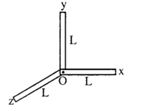
Three thin uniform rods,each of mass $M$ and length $L$,are placed along the three Cartesian axes such that one end of each rod is at the origin. Find the moment of inertia of this system about the $z$-axis.
A
$\frac{ML^2}{3}$
B
$\frac{2ML^2}{3}$
C
$\frac{ML^2}{6}$
D
$ML^2$
Solution
(B) The moment of inertia of a thin uniform rod of mass $M$ and length $L$ about an axis passing through one of its ends and perpendicular to its length is $I = \frac{ML^2}{3}$.
For the given system:
$1$. The rod along the $x$-axis lies in the $xz$-plane. Its moment of inertia about the $z$-axis is $I_x = \frac{ML^2}{3}$.
$2$. The rod along the $y$-axis lies in the $yz$-plane. Its moment of inertia about the $z$-axis is $I_y = \frac{ML^2}{3}$.
$3$. The rod along the $z$-axis lies along the axis of rotation itself. Since the rod is thin,the distance of every mass element from the $z$-axis is zero. Therefore,its moment of inertia about the $z$-axis is $I_z = 0$.
The total moment of inertia of the system about the $z$-axis is $I_{total} = I_x + I_y + I_z = \frac{ML^2}{3} + \frac{ML^2}{3} + 0 = \frac{2ML^2}{3}$.
For the given system:
$1$. The rod along the $x$-axis lies in the $xz$-plane. Its moment of inertia about the $z$-axis is $I_x = \frac{ML^2}{3}$.
$2$. The rod along the $y$-axis lies in the $yz$-plane. Its moment of inertia about the $z$-axis is $I_y = \frac{ML^2}{3}$.
$3$. The rod along the $z$-axis lies along the axis of rotation itself. Since the rod is thin,the distance of every mass element from the $z$-axis is zero. Therefore,its moment of inertia about the $z$-axis is $I_z = 0$.
The total moment of inertia of the system about the $z$-axis is $I_{total} = I_x + I_y + I_z = \frac{ML^2}{3} + \frac{ML^2}{3} + 0 = \frac{2ML^2}{3}$.
0 likes
View Solution56
MediumMCQ
The moment of inertia of a solid cylinder of mass $20 \ kg$,length $1 \ m$,and radius $0.2 \ m$ about its geometric axis is (in $kg \cdot m^2$):
A
$0.8$
B
$0.4$
C
$0.2$
D
$20.2$
Solution
(B) The moment of inertia $(I)$ of a solid cylinder about its geometric axis (longitudinal axis) is given by the formula:
$I = \frac{1}{2} M R^2$
Given:
Mass $(M)$ = $20 \ kg$
Radius $(R)$ = $0.2 \ m$
Length $(L)$ = $1 \ m$ (Note: The moment of inertia about the geometric axis is independent of the length).
Substituting the values:
$I = \frac{1}{2} \times 20 \times (0.2)^2$
$I = 10 \times 0.04$
$I = 0.4 \ kg \cdot m^2$
$I = \frac{1}{2} M R^2$
Given:
Mass $(M)$ = $20 \ kg$
Radius $(R)$ = $0.2 \ m$
Length $(L)$ = $1 \ m$ (Note: The moment of inertia about the geometric axis is independent of the length).
Substituting the values:
$I = \frac{1}{2} \times 20 \times (0.2)^2$
$I = 10 \times 0.04$
$I = 0.4 \ kg \cdot m^2$
0 likes
View Solution57
DifficultMCQ
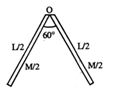
The moment of inertia of a uniform rod of mass $M$ and length $L$ about an axis passing through its center and perpendicular to it is $\frac{1}{12} ML^2$. The rod is bent at the center such that the two halves make an angle of $60^\circ$ with each other. Find the moment of inertia of the bent rod about the same axis passing through the center of the rod (the point of bending) and perpendicular to the plane containing the two halves.
A
$\frac{1}{48} ML^2$
B
$\frac{1}{12} ML^2$
C
$\frac{1}{24} ML^2$
D
$\frac{ML^2}{8\sqrt{3}}$
Solution
(B) The rod is bent at the center,so each half has mass $m = M/2$ and length $l = L/2$.
The axis of rotation passes through the point of bending $O$ and is perpendicular to the plane of the bent rod.
For a rod of mass $m$ and length $l$ rotating about an axis passing through one of its ends,the moment of inertia is $I = \frac{1}{3} ml^2$.
Here,we have two such rods,each of mass $M/2$ and length $L/2$,rotating about the common end $O$.
The total moment of inertia $I_{total}$ is the sum of the moments of inertia of the two halves:
$I_{total} = I_1 + I_2 = \frac{1}{3} (M/2) (L/2)^2 + \frac{1}{3} (M/2) (L/2)^2$
$I_{total} = 2 \times \left[ \frac{1}{3} \cdot \frac{M}{2} \cdot \frac{L^2}{4} \right]$
$I_{total} = 2 \times \left[ \frac{ML^2}{24} \right] = \frac{ML^2}{12}$.
The axis of rotation passes through the point of bending $O$ and is perpendicular to the plane of the bent rod.
For a rod of mass $m$ and length $l$ rotating about an axis passing through one of its ends,the moment of inertia is $I = \frac{1}{3} ml^2$.
Here,we have two such rods,each of mass $M/2$ and length $L/2$,rotating about the common end $O$.
The total moment of inertia $I_{total}$ is the sum of the moments of inertia of the two halves:
$I_{total} = I_1 + I_2 = \frac{1}{3} (M/2) (L/2)^2 + \frac{1}{3} (M/2) (L/2)^2$
$I_{total} = 2 \times \left[ \frac{1}{3} \cdot \frac{M}{2} \cdot \frac{L^2}{4} \right]$
$I_{total} = 2 \times \left[ \frac{ML^2}{24} \right] = \frac{ML^2}{12}$.
0 likes
View Solution58
DifficultMCQ
$A$ quarter part is cut from a uniform circular disc of radius $R$. The mass of this cut part is $M$. It rotates about an axis passing through the center of the original disc and perpendicular to the plane of the disc. What will be its moment of inertia about the axis of rotation?

A
$\frac{1}{2} M R^2$
B
$\frac{1}{4} M R^2$
C
$\frac{1}{8} M R^2$
D
$\sqrt{2} M R^2$
Solution
(A) The moment of inertia of a uniform circular disc of mass $M_{total}$ and radius $R$ about an axis passing through its center and perpendicular to its plane is $I = \frac{1}{2} M_{total} R^2$.
For a uniform disc,the mass is proportional to the area. $A$ quarter disc has an area equal to $1/4$ of the full disc. If the mass of the quarter disc is $M$,then the mass of the full disc would be $4M$.
The moment of inertia of the quarter disc about the same axis is the sum of the moments of inertia of its constituent particles. Since the axis of rotation passes through the center of the original disc,the distance of every mass element $dm$ of the quarter disc from the axis is the same as it would be in the full disc.
Thus,the moment of inertia $I$ of the quarter disc is given by $I = \int r^2 dm$. Since the quarter disc is a part of the full disc,its moment of inertia is simply $1/4$ of the moment of inertia of the full disc of mass $4M$.
$I = \frac{1}{4} \times (\frac{1}{2} \times (4M) \times R^2) = \frac{1}{2} M R^2$.
For a uniform disc,the mass is proportional to the area. $A$ quarter disc has an area equal to $1/4$ of the full disc. If the mass of the quarter disc is $M$,then the mass of the full disc would be $4M$.
The moment of inertia of the quarter disc about the same axis is the sum of the moments of inertia of its constituent particles. Since the axis of rotation passes through the center of the original disc,the distance of every mass element $dm$ of the quarter disc from the axis is the same as it would be in the full disc.
Thus,the moment of inertia $I$ of the quarter disc is given by $I = \int r^2 dm$. Since the quarter disc is a part of the full disc,its moment of inertia is simply $1/4$ of the moment of inertia of the full disc of mass $4M$.
$I = \frac{1}{4} \times (\frac{1}{2} \times (4M) \times R^2) = \frac{1}{2} M R^2$.
0 likes
View Solution59
MediumMCQ
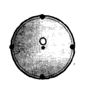
Four identical point masses (each of mass $m$) are placed on the circumference of a disc. The disc has mass $M$ and radius $R$. What will be the moment of inertia about an axis passing through the center $O$ and perpendicular to the plane of the disc?
A
$MR^2 + 4mR^2$
B
$\frac{1}{2}MR^2 + 4mR^2$
C
$MR^2 + \frac{8}{5}mR^2$
D
None of these
Solution
(B) The moment of inertia of the disc about an axis passing through its center and perpendicular to its plane is $I_{disc} = \frac{1}{2}MR^2$.
Since the four point masses $m$ are placed on the circumference,each is at a distance $R$ from the axis of rotation.
The moment of inertia of each point mass is $I_{point} = mR^2$.
Since there are four such point masses,their total moment of inertia is $I_{total\,points} = 4 \times mR^2 = 4mR^2$.
The total moment of inertia of the system is the sum of the moment of inertia of the disc and the four point masses:
$I = I_{disc} + I_{total\,points} = \frac{1}{2}MR^2 + 4mR^2$.
Since the four point masses $m$ are placed on the circumference,each is at a distance $R$ from the axis of rotation.
The moment of inertia of each point mass is $I_{point} = mR^2$.
Since there are four such point masses,their total moment of inertia is $I_{total\,points} = 4 \times mR^2 = 4mR^2$.
The total moment of inertia of the system is the sum of the moment of inertia of the disc and the four point masses:
$I = I_{disc} + I_{total\,points} = \frac{1}{2}MR^2 + 4mR^2$.
0 likes
View Solution60
DifficultMCQ
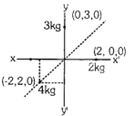
Point masses $1, 2, 3$ and $4 \text{ kg}$ are located at the points $(0,0,0), (2,0,0), (0,3,0)$ and $(-2,-2,0)$ respectively. The moment of inertia of this system about the $x$-axis will be: (in $\text{ kg m}^2$)
A
$43$
B
$34$
C
$27$
D
$72$
Solution
(A) The moment of inertia $I$ of a system of point masses about an axis is given by $I = \sum m_i r_i^2$,where $r_i$ is the perpendicular distance of the $i$-th mass from the axis.
For the $x$-axis,the perpendicular distance of a point $(x, y, z)$ is $r = \sqrt{y^2 + z^2}$.
$1$. For mass $m_1 = 1 \text{ kg}$ at $(0,0,0)$: $r_1 = \sqrt{0^2 + 0^2} = 0$. So,$I_1 = 1(0)^2 = 0$.
$2$. For mass $m_2 = 2 \text{ kg}$ at $(2,0,0)$: $r_2 = \sqrt{0^2 + 0^2} = 0$. So,$I_2 = 2(0)^2 = 0$.
$3$. For mass $m_3 = 3 \text{ kg}$ at $(0,3,0)$: $r_3 = \sqrt{3^2 + 0^2} = 3$. So,$I_3 = 3(3)^2 = 27$.
$4$. For mass $m_4 = 4 \text{ kg}$ at $(-2,-2,0)$: $r_4 = \sqrt{(-2)^2 + 0^2} = 2$. So,$I_4 = 4(2)^2 = 16$.
The total moment of inertia $I = I_1 + I_2 + I_3 + I_4 = 0 + 0 + 27 + 16 = 43 \text{ kg m}^2$.
For the $x$-axis,the perpendicular distance of a point $(x, y, z)$ is $r = \sqrt{y^2 + z^2}$.
$1$. For mass $m_1 = 1 \text{ kg}$ at $(0,0,0)$: $r_1 = \sqrt{0^2 + 0^2} = 0$. So,$I_1 = 1(0)^2 = 0$.
$2$. For mass $m_2 = 2 \text{ kg}$ at $(2,0,0)$: $r_2 = \sqrt{0^2 + 0^2} = 0$. So,$I_2 = 2(0)^2 = 0$.
$3$. For mass $m_3 = 3 \text{ kg}$ at $(0,3,0)$: $r_3 = \sqrt{3^2 + 0^2} = 3$. So,$I_3 = 3(3)^2 = 27$.
$4$. For mass $m_4 = 4 \text{ kg}$ at $(-2,-2,0)$: $r_4 = \sqrt{(-2)^2 + 0^2} = 2$. So,$I_4 = 4(2)^2 = 16$.
The total moment of inertia $I = I_1 + I_2 + I_3 + I_4 = 0 + 0 + 27 + 16 = 43 \text{ kg m}^2$.
0 likes
View Solution61
DifficultMCQ
$A$ thin rod of mass $M$ and length $L$ is bent at its midpoint $A$ such that it forms an angle of $60^{\circ}$. What is the moment of inertia about an axis passing through the midpoint $A$ and perpendicular to the plane of the rod?

A
$\frac{ML^2}{6}$
B
$\frac{ML^2}{12}$
C
$\frac{ML^2}{24}$
D
$\frac{ML^2}{4}$
Solution
(B) The rod is bent at its midpoint $A$ into two segments,each of length $L/2$ and mass $M/2$.
Each segment acts as a rod of length $l = L/2$ and mass $m = M/2$ rotating about one of its ends.
The moment of inertia of a rod of mass $m$ and length $l$ about an axis passing through one end and perpendicular to its length is given by $I = \frac{ml^2}{3}$.
Here,for each segment,$m = M/2$ and $l = L/2$.
So,the moment of inertia for one segment is $I_1 = \frac{(M/2)(L/2)^2}{3} = \frac{(M/2)(L^2/4)}{3} = \frac{ML^2}{24}$.
Since there are two such segments,the total moment of inertia about the axis passing through $A$ is $I_A = I_1 + I_1 = 2 \times \frac{ML^2}{24} = \frac{ML^2}{12}$.
Each segment acts as a rod of length $l = L/2$ and mass $m = M/2$ rotating about one of its ends.
The moment of inertia of a rod of mass $m$ and length $l$ about an axis passing through one end and perpendicular to its length is given by $I = \frac{ml^2}{3}$.
Here,for each segment,$m = M/2$ and $l = L/2$.
So,the moment of inertia for one segment is $I_1 = \frac{(M/2)(L/2)^2}{3} = \frac{(M/2)(L^2/4)}{3} = \frac{ML^2}{24}$.
Since there are two such segments,the total moment of inertia about the axis passing through $A$ is $I_A = I_1 + I_1 = 2 \times \frac{ML^2}{24} = \frac{ML^2}{12}$.
0 likes
View Solution62
DifficultMCQ
Three particles of mass $m$ each are placed at the vertices of an equilateral triangle $ABC$ of side length $\ell$. What is the moment of inertia of the system about the axis $AX$ passing through vertex $A$ and perpendicular to side $AB$ in the plane of the triangle?
A
$2m\ell^2$
B
$\frac{5}{4}m\ell^2$
C
$\frac{3}{2}m\ell^2$
D
$\frac{3}{4}m\ell^2$
Solution
(B) The moment of inertia of the system about axis $AX$ is the sum of the moments of inertia of individual particles about the same axis.
$I_{AX} = I_A + I_B + I_C$
Particle $A$ is on the axis,so its distance $r_A = 0$,hence $I_A = m(0)^2 = 0$.
Particle $B$ is at a distance $\ell$ from the axis,so $I_B = m\ell^2$.
Particle $C$ is at a perpendicular distance of $\ell/2$ from the axis $AX$,so $I_C = m(\ell/2)^2 = m\ell^2/4$.
Therefore,$I_{AX} = 0 + m\ell^2 + m\ell^2/4 = \frac{5}{4}m\ell^2$.
$I_{AX} = I_A + I_B + I_C$
Particle $A$ is on the axis,so its distance $r_A = 0$,hence $I_A = m(0)^2 = 0$.
Particle $B$ is at a distance $\ell$ from the axis,so $I_B = m\ell^2$.
Particle $C$ is at a perpendicular distance of $\ell/2$ from the axis $AX$,so $I_C = m(\ell/2)^2 = m\ell^2/4$.
Therefore,$I_{AX} = 0 + m\ell^2 + m\ell^2/4 = \frac{5}{4}m\ell^2$.
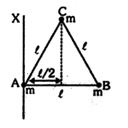
0 likes
View Solution63
DifficultMCQ
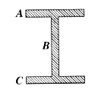
The three rods $A$,$B$,and $C$ shown in the figure have the same length $L$ and the same mass $M$. If the system rotates such that rod $B$ acts as the axis of rotation,what will be the moment of inertia of the system?
A
$\frac{M L^2}{6}$
B
$\frac{4}{3} M L^2$
C
$\frac{M L^2}{3}$
D
$\frac{2}{3} M L^2$
Solution
(A) The system consists of three rods $A$,$B$,and $C$. Rod $B$ acts as the axis of rotation.
$1$. For rod $B$: Since the axis of rotation passes through its longitudinal center,the moment of inertia of rod $B$ about this axis is $I_B = 0$ (assuming the rod is a thin line).
$2$. For rods $A$ and $C$: The axis of rotation passes through the center of rod $B$. Since rods $A$ and $C$ are perpendicular to rod $B$ and attached at its ends,the axis of rotation passes through the center of rods $A$ and $C$ perpendicular to their length.
The moment of inertia of a rod of mass $M$ and length $L$ about an axis passing through its center and perpendicular to its length is $I = \frac{M L^2}{12}$.
Since there are two such rods ($A$ and $C$),the total moment of inertia of the system is:
$I_{total} = I_A + I_B + I_C$
$I_{total} = \frac{M L^2}{12} + 0 + \frac{M L^2}{12}$
$I_{total} = \frac{2 M L^2}{12} = \frac{M L^2}{6}$
$1$. For rod $B$: Since the axis of rotation passes through its longitudinal center,the moment of inertia of rod $B$ about this axis is $I_B = 0$ (assuming the rod is a thin line).
$2$. For rods $A$ and $C$: The axis of rotation passes through the center of rod $B$. Since rods $A$ and $C$ are perpendicular to rod $B$ and attached at its ends,the axis of rotation passes through the center of rods $A$ and $C$ perpendicular to their length.
The moment of inertia of a rod of mass $M$ and length $L$ about an axis passing through its center and perpendicular to its length is $I = \frac{M L^2}{12}$.
Since there are two such rods ($A$ and $C$),the total moment of inertia of the system is:
$I_{total} = I_A + I_B + I_C$
$I_{total} = \frac{M L^2}{12} + 0 + \frac{M L^2}{12}$
$I_{total} = \frac{2 M L^2}{12} = \frac{M L^2}{6}$
0 likes
View Solution64
MediumMCQ
Two spheres $A$ and $B$,each of mass $5 \ kg$,are attached to the ends of a light rod of length $1 \ m$. Treating the spheres as point masses,find the ratio of the moment of inertia of the system about an axis passing through $A$ to that about an axis passing through the center of the rod,both axes being perpendicular to the rod.
A
$1 : 1$
B
$1 : 4$
C
$1 : 2$
D
$2 : 1$
Solution
(D) Let the mass of each sphere be $m = 5 \ kg$ and the length of the rod be $L = 1 \ m$.
Case $1$: Axis passing through $A$ and perpendicular to the rod.
The moment of inertia $I_1$ is given by:
$I_1 = m_A \cdot (0)^2 + m_B \cdot (L)^2 = 0 + m \cdot (1)^2 = m$
Case $2$: Axis passing through the center of the rod and perpendicular to it.
The moment of inertia $I_2$ is given by:
$I_2 = m_A \cdot (L/2)^2 + m_B \cdot (L/2)^2 = m \cdot (0.5)^2 + m \cdot (0.5)^2 = 0.25m + 0.25m = 0.5m = m/2$
Ratio of moments of inertia:
$I_1 / I_2 = m / (m/2) = 2 / 1$
Thus,the ratio is $2 : 1$.
Case $1$: Axis passing through $A$ and perpendicular to the rod.
The moment of inertia $I_1$ is given by:
$I_1 = m_A \cdot (0)^2 + m_B \cdot (L)^2 = 0 + m \cdot (1)^2 = m$
Case $2$: Axis passing through the center of the rod and perpendicular to it.
The moment of inertia $I_2$ is given by:
$I_2 = m_A \cdot (L/2)^2 + m_B \cdot (L/2)^2 = m \cdot (0.5)^2 + m \cdot (0.5)^2 = 0.25m + 0.25m = 0.5m = m/2$
Ratio of moments of inertia:
$I_1 / I_2 = m / (m/2) = 2 / 1$
Thus,the ratio is $2 : 1$.

0 likes
View Solution65
MediumMCQ
$A$ semi-circular disc has mass $M$ and radius $r$. The moment of inertia about an axis passing through its center and perpendicular to the plane of the disc is:
A
$Mr^2$
B
$\frac{1}{2}Mr^2$
C
$\frac{1}{4}Mr^2$
D
$\frac{2}{5}Mr^2$
Solution
(A) For a complete circular disc of mass $M'$ and radius $r$,the moment of inertia about an axis passing through its center and perpendicular to its plane is $I = \frac{1}{2}M'r^2$.
Since the semi-circular disc is half of the complete disc,its mass is $M = \frac{M'}{2}$,which implies $M' = 2M$.
Substituting $M' = 2M$ into the formula for the moment of inertia:
$I = \frac{1}{2}(2M)r^2 = Mr^2$.
Therefore,the moment of inertia of the semi-circular disc is $Mr^2$.
Since the semi-circular disc is half of the complete disc,its mass is $M = \frac{M'}{2}$,which implies $M' = 2M$.
Substituting $M' = 2M$ into the formula for the moment of inertia:
$I = \frac{1}{2}(2M)r^2 = Mr^2$.
Therefore,the moment of inertia of the semi-circular disc is $Mr^2$.
0 likes
View Solution66
EasyMCQ
Two rings have their masses in ratio $1 : 2$ and their diameters are in the ratio $2 : 1$. The ratio of their moments of inertia is
A
$1 : 4$
B
$2 : 1$
C
$4 : 1$
D
$\sqrt{2} : 1$
Solution
(B) The moment of inertia of a ring about its central axis is given by $I = MR^2$.
Given the ratio of masses $M_1 : M_2 = 1 : 2$ and the ratio of diameters $D_1 : D_2 = 2 : 1$.
Since the ratio of radii $R_1 : R_2$ is the same as the ratio of diameters,we have $R_1 : R_2 = 2 : 1$.
The ratio of moments of inertia is $\frac{I_1}{I_2} = \frac{M_1 R_1^2}{M_2 R_2^2} = \left( \frac{M_1}{M_2} \right) \left( \frac{R_1}{R_2} \right)^2$.
Substituting the given values: $\frac{I_1}{I_2} = \left( \frac{1}{2} \right) \times (2)^2 = \frac{1}{2} \times 4 = 2$.
Thus,the ratio is $2 : 1$.
Given the ratio of masses $M_1 : M_2 = 1 : 2$ and the ratio of diameters $D_1 : D_2 = 2 : 1$.
Since the ratio of radii $R_1 : R_2$ is the same as the ratio of diameters,we have $R_1 : R_2 = 2 : 1$.
The ratio of moments of inertia is $\frac{I_1}{I_2} = \frac{M_1 R_1^2}{M_2 R_2^2} = \left( \frac{M_1}{M_2} \right) \left( \frac{R_1}{R_2} \right)^2$.
Substituting the given values: $\frac{I_1}{I_2} = \left( \frac{1}{2} \right) \times (2)^2 = \frac{1}{2} \times 4 = 2$.
Thus,the ratio is $2 : 1$.
0 likes
View Solution67
MediumMCQ
What is the moment of inertia of a cylinder of diameter $D$ and length $L$ about an axis passing through its center of gravity and perpendicular to its length?
A
$M \left[ \frac{D^2}{4} + \frac{L^2}{12} \right]$
B
$M \left[ \frac{D^2}{16} + \frac{L^2}{12} \right]$
C
$M \left[ \frac{D^2}{8} + \frac{L^2}{16} \right]$
D
$M \left[ \frac{D^2}{4} + \frac{L^2}{6} \right]$
Solution
(B) The moment of inertia of a cylinder of mass $M$,radius $R$,and length $L$ about an axis passing through its center of mass and perpendicular to its length is given by the formula:
$I = M \left( \frac{L^2}{12} + \frac{R^2}{4} \right)$
Given that the diameter is $D$,the radius $R = \frac{D}{2}$.
Substituting $R$ into the formula:
$I = M \left[ \frac{L^2}{12} + \frac{(D/2)^2}{4} \right]$
$I = M \left[ \frac{L^2}{12} + \frac{D^2/4}{4} \right]$
$I = M \left[ \frac{L^2}{12} + \frac{D^2}{16} \right]$
$I = M \left( \frac{L^2}{12} + \frac{R^2}{4} \right)$
Given that the diameter is $D$,the radius $R = \frac{D}{2}$.
Substituting $R$ into the formula:
$I = M \left[ \frac{L^2}{12} + \frac{(D/2)^2}{4} \right]$
$I = M \left[ \frac{L^2}{12} + \frac{D^2/4}{4} \right]$
$I = M \left[ \frac{L^2}{12} + \frac{D^2}{16} \right]$
0 likes
View Solution68
MediumMCQ
Two rings have their moments of inertia in the ratio $4 : 1$ and their diameters are in the ratio $4 : 1$. The ratio of their masses is
A
$\frac{3}{4}$
B
$4$
C
$\frac{1}{4}$
D
$\frac{5}{3}$
Solution
(C) The moment of inertia $I$ of a ring about its central axis is given by $I = MR^2$,where $M$ is the mass and $R$ is the radius.
Given the ratio of moments of inertia $\frac{I_1}{I_2} = \frac{4}{1}$ and the ratio of diameters $\frac{D_1}{D_2} = \frac{4}{1}$.
Since the ratio of diameters is equal to the ratio of radii,$\frac{R_1}{R_2} = \frac{4}{1}$.
Using the formula $\frac{I_1}{I_2} = \frac{M_1 R_1^2}{M_2 R_2^2}$,we can write $\frac{M_1}{M_2} = \frac{I_1}{I_2} \times \left( \frac{R_2}{R_1} \right)^2$.
Substituting the given values: $\frac{M_1}{M_2} = \frac{4}{1} \times \left( \frac{1}{4} \right)^2 = 4 \times \frac{1}{16} = \frac{1}{4}$.
Given the ratio of moments of inertia $\frac{I_1}{I_2} = \frac{4}{1}$ and the ratio of diameters $\frac{D_1}{D_2} = \frac{4}{1}$.
Since the ratio of diameters is equal to the ratio of radii,$\frac{R_1}{R_2} = \frac{4}{1}$.
Using the formula $\frac{I_1}{I_2} = \frac{M_1 R_1^2}{M_2 R_2^2}$,we can write $\frac{M_1}{M_2} = \frac{I_1}{I_2} \times \left( \frac{R_2}{R_1} \right)^2$.
Substituting the given values: $\frac{M_1}{M_2} = \frac{4}{1} \times \left( \frac{1}{4} \right)^2 = 4 \times \frac{1}{16} = \frac{1}{4}$.
0 likes
View Solution69
DifficultMCQ
Four point masses (each of mass $m$) are arranged in the $X-Y$ plane at coordinates $(a, 0)$,$(0, a)$,$(-a, 0)$,and $(0, 2a)$. What is the moment of inertia of this system about the $Y$-axis?
A
$ma^2$
B
$2ma^2$
C
$4ma^2$
D
$6ma^2$
Solution
(B) The moment of inertia $I$ of a system of particles about an axis is given by $I = \sum m_i r_i^2$,where $r_i$ is the perpendicular distance of the $i$-th particle from the axis of rotation.
For the $Y$-axis,the perpendicular distance of a point $(x, y)$ is $|x|$.
The coordinates of the four masses are $(a, 0)$,$(0, a)$,$(-a, 0)$,and $(0, 2a)$.
The perpendicular distances from the $Y$-axis are $x_1 = a$,$x_2 = 0$,$x_3 = -a$,and $x_4 = 0$.
Thus,$I_y = m(a)^2 + m(0)^2 + m(-a)^2 + m(0)^2$.
$I_y = ma^2 + 0 + ma^2 + 0 = 2ma^2$.
For the $Y$-axis,the perpendicular distance of a point $(x, y)$ is $|x|$.
The coordinates of the four masses are $(a, 0)$,$(0, a)$,$(-a, 0)$,and $(0, 2a)$.
The perpendicular distances from the $Y$-axis are $x_1 = a$,$x_2 = 0$,$x_3 = -a$,and $x_4 = 0$.
Thus,$I_y = m(a)^2 + m(0)^2 + m(-a)^2 + m(0)^2$.
$I_y = ma^2 + 0 + ma^2 + 0 = 2ma^2$.
0 likes
View Solution70
MediumMCQ
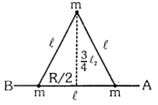
Three point masses $m$ are placed at the corners of an equilateral triangle of side length $\ell$. What is the moment of inertia of the system about an axis passing through one side of the triangle?
A
$3m\ell^2$
B
$m\ell^2$
C
$\frac{3}{4}m\ell^2$
D
$\frac{3}{2}m\ell^2$
Solution
(C) Let the equilateral triangle have vertices at $A, B,$ and $C$. Let the axis of rotation pass through the side $AB$.
The moment of inertia $I$ of a system of particles is given by $I = \sum m_i r_i^2$,where $r_i$ is the perpendicular distance of the $i$-th mass from the axis.
$1$. The two masses at vertices $A$ and $B$ lie on the axis of rotation,so their perpendicular distances are $r_1 = 0$ and $r_2 = 0$.
$2$. The third mass at vertex $C$ is at a perpendicular distance $h$ from the side $AB$. In an equilateral triangle of side $\ell$,the height $h$ is given by $h = \ell \sin(60^\circ) = \frac{\sqrt{3}}{2}\ell$.
$3$. The moment of inertia of the system is $I = m(0)^2 + m(0)^2 + m(h)^2 = m\left(\frac{\sqrt{3}}{2}\ell\right)^2 = m\left(\frac{3}{4}\ell^2\right) = \frac{3}{4}m\ell^2$.
The moment of inertia $I$ of a system of particles is given by $I = \sum m_i r_i^2$,where $r_i$ is the perpendicular distance of the $i$-th mass from the axis.
$1$. The two masses at vertices $A$ and $B$ lie on the axis of rotation,so their perpendicular distances are $r_1 = 0$ and $r_2 = 0$.
$2$. The third mass at vertex $C$ is at a perpendicular distance $h$ from the side $AB$. In an equilateral triangle of side $\ell$,the height $h$ is given by $h = \ell \sin(60^\circ) = \frac{\sqrt{3}}{2}\ell$.
$3$. The moment of inertia of the system is $I = m(0)^2 + m(0)^2 + m(h)^2 = m\left(\frac{\sqrt{3}}{2}\ell\right)^2 = m\left(\frac{3}{4}\ell^2\right) = \frac{3}{4}m\ell^2$.
0 likes
View Solution71
MediumMCQ
$A$ solid sphere $A$ and a hollow sphere $B$ have the same mass and the same external radius. If their moments of inertia about their diameters are $I_A$ and $I_B$ respectively,then which of the following is true?
A
$I_A = I_B$
B
$I_A > I_B$
C
$I_A < I_B$
D
$\frac{I_A}{I_B} = \frac{d_A}{d_B}$
Solution
(C) The moment of inertia of a solid sphere about its diameter is given by $I_A = \frac{2}{5} MR^2$.
The moment of inertia of a hollow sphere about its diameter is given by $I_B = \frac{2}{3} MR^2$.
Since the mass $M$ and radius $R$ are the same for both spheres,we compare the coefficients:
$\frac{I_A}{I_B} = \frac{\frac{2}{5} MR^2}{\frac{2}{3} MR^2} = \frac{3}{5} = 0.6$.
Since $0.6 < 1$,it follows that $I_A < I_B$.
The moment of inertia of a hollow sphere about its diameter is given by $I_B = \frac{2}{3} MR^2$.
Since the mass $M$ and radius $R$ are the same for both spheres,we compare the coefficients:
$\frac{I_A}{I_B} = \frac{\frac{2}{5} MR^2}{\frac{2}{3} MR^2} = \frac{3}{5} = 0.6$.
Since $0.6 < 1$,it follows that $I_A < I_B$.
0 likes
View Solution72
DifficultMCQ
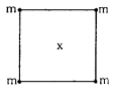
Four particles of mass $m$ each are placed at the four corners of a square of side length $\ell$. The radius of gyration of the system about an axis passing through its center and perpendicular to the plane of the square is .........
A
$\frac{\ell}{\sqrt{2}}$
B
$\frac{\ell}{2}$
C
$\ell$
D
$\ell\sqrt{2}$
Solution
(A) The distance of each particle of mass $m$ from the center of the square is $r = \frac{\text{diagonal}}{2} = \frac{\ell\sqrt{2}}{2} = \frac{\ell}{\sqrt{2}}$.
The moment of inertia $I$ of the system about an axis passing through the center and perpendicular to the plane is given by $I = \sum mr^2 = 4 \times m \times \left(\frac{\ell}{\sqrt{2}}\right)^2$.
$I = 4 \times m \times \frac{\ell^2}{2} = 2m\ell^2$.
The radius of gyration $K$ is defined by $I = MK^2$, where $M$ is the total mass of the system $(M = 4m)$.
$4mK^2 = 2m\ell^2$.
$K^2 = \frac{2m\ell^2}{4m} = \frac{\ell^2}{2}$.
$K = \frac{\ell}{\sqrt{2}}$.
The moment of inertia $I$ of the system about an axis passing through the center and perpendicular to the plane is given by $I = \sum mr^2 = 4 \times m \times \left(\frac{\ell}{\sqrt{2}}\right)^2$.
$I = 4 \times m \times \frac{\ell^2}{2} = 2m\ell^2$.
The radius of gyration $K$ is defined by $I = MK^2$, where $M$ is the total mass of the system $(M = 4m)$.
$4mK^2 = 2m\ell^2$.
$K^2 = \frac{2m\ell^2}{4m} = \frac{\ell^2}{2}$.
$K = \frac{\ell}{\sqrt{2}}$.
0 likes
View Solution73
DifficultMCQ
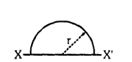
$A$ wire of length $\ell$ and mass $M$ is bent into a semicircle of radius $r$ as shown in the figure. Calculate the moment of inertia about the axis $XX'$.
A
$\frac{M\ell}{2\pi^2}$
B
$\frac{M\ell^2}{2\pi^2}$
C
$\frac{M\ell^2}{2\pi}$
D
$\frac{M\ell}{\pi}$
Solution
(B) The length of the wire is $\ell = \pi r$,which implies $r = \frac{\ell}{\pi}$.
The moment of inertia of a semicircular wire about the axis passing through its diameter $(XX')$ is given by $I = Mr^2$.
Substituting the value of $r$ into the formula:
$I_{XX'} = M \left( \frac{\ell}{\pi} \right)^2 = \frac{M\ell^2}{\pi^2}$.
Wait,let's re-evaluate the moment of inertia of a semicircular wire about its diameter. For a thin ring of mass $M$ and radius $r$,the moment of inertia about a diameter is $\frac{1}{2}Mr^2$. Since a semicircle is half of a ring,the moment of inertia of the semicircular wire about the diameter $XX'$ is also $\frac{1}{2}Mr^2$.
Therefore,$I_{XX'} = \frac{1}{2} M \left( \frac{\ell}{\pi} \right)^2 = \frac{M\ell^2}{2\pi^2}$.
The moment of inertia of a semicircular wire about the axis passing through its diameter $(XX')$ is given by $I = Mr^2$.
Substituting the value of $r$ into the formula:
$I_{XX'} = M \left( \frac{\ell}{\pi} \right)^2 = \frac{M\ell^2}{\pi^2}$.
Wait,let's re-evaluate the moment of inertia of a semicircular wire about its diameter. For a thin ring of mass $M$ and radius $r$,the moment of inertia about a diameter is $\frac{1}{2}Mr^2$. Since a semicircle is half of a ring,the moment of inertia of the semicircular wire about the diameter $XX'$ is also $\frac{1}{2}Mr^2$.
Therefore,$I_{XX'} = \frac{1}{2} M \left( \frac{\ell}{\pi} \right)^2 = \frac{M\ell^2}{2\pi^2}$.
0 likes
View Solution74
MediumMCQ
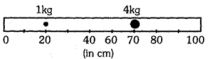
Weights of $1 \ kg$ and $4 \ kg$ are placed at the $20 \ cm$ and $70 \ cm$ marks of a light meter scale,respectively. What is the moment of inertia in $kg \ m^2$ about an axis perpendicular to the scale and passing through the $100 \ cm$ mark?
A
$1$
B
$2$
C
$3$
D
$4$
Solution
(A) The moment of inertia $I$ of a system of particles about an axis is given by $I = \sum m_i r_i^2$,where $r_i$ is the perpendicular distance of the $i$-th particle from the axis.
Here,the axis passes through the $100 \ cm$ mark.
The distance of the $1 \ kg$ mass (at $20 \ cm$) from the $100 \ cm$ mark is $r_1 = |100 \ cm - 20 \ cm| = 80 \ cm = 0.8 \ m$.
The distance of the $4 \ kg$ mass (at $70 \ cm$) from the $100 \ cm$ mark is $r_2 = |100 \ cm - 70 \ cm| = 30 \ cm = 0.3 \ m$.
Therefore,the total moment of inertia is:
$I = m_1 r_1^2 + m_2 r_2^2$
$I = 1 \ kg \times (0.8 \ m)^2 + 4 \ kg \times (0.3 \ m)^2$
$I = 1 \times 0.64 + 4 \times 0.09$
$I = 0.64 + 0.36 = 1 \ kg \ m^2$.
Here,the axis passes through the $100 \ cm$ mark.
The distance of the $1 \ kg$ mass (at $20 \ cm$) from the $100 \ cm$ mark is $r_1 = |100 \ cm - 20 \ cm| = 80 \ cm = 0.8 \ m$.
The distance of the $4 \ kg$ mass (at $70 \ cm$) from the $100 \ cm$ mark is $r_2 = |100 \ cm - 70 \ cm| = 30 \ cm = 0.3 \ m$.
Therefore,the total moment of inertia is:
$I = m_1 r_1^2 + m_2 r_2^2$
$I = 1 \ kg \times (0.8 \ m)^2 + 4 \ kg \times (0.3 \ m)^2$
$I = 1 \times 0.64 + 4 \times 0.09$
$I = 0.64 + 0.36 = 1 \ kg \ m^2$.
0 likes
View Solution75
DifficultMCQ
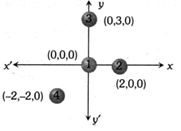
Point masses of $1, 2, 3,$ and $4 \ kg$ are placed at $(0, 0, 0), (2, 0, 0), (0, 3, 0),$ and $(-2, -2, 0)$ respectively. What is the moment of inertia of this system about the $x$-axis in $kg-m^2$?
A
$43$
B
$34$
C
$27$
D
$72$
Solution
(A) The moment of inertia $I$ of a system of particles about an axis is given by $I = \sum m_i r_i^2$,where $r_i$ is the perpendicular distance of the $i$-th particle from the axis.
For the $x$-axis,the perpendicular distance $r$ of a point $(x, y, z)$ is given by $r = \sqrt{y^2 + z^2}$.
$1$. For mass $m_1 = 1 \ kg$ at $(0, 0, 0)$: $r_1 = \sqrt{0^2 + 0^2} = 0$. So,$I_1 = 1 \times 0^2 = 0 \ kg-m^2$.
$2$. For mass $m_2 = 2 \ kg$ at $(2, 0, 0)$: $r_2 = \sqrt{0^2 + 0^2} = 0$. So,$I_2 = 2 \times 0^2 = 0 \ kg-m^2$.
$3$. For mass $m_3 = 3 \ kg$ at $(0, 3, 0)$: $r_3 = \sqrt{3^2 + 0^2} = 3 \ m$. So,$I_3 = 3 \times (3)^2 = 27 \ kg-m^2$.
$4$. For mass $m_4 = 4 \ kg$ at $(-2, -2, 0)$: $r_4 = \sqrt{(-2)^2 + 0^2} = 2 \ m$. So,$I_4 = 4 \times (-2)^2 = 4 \times 4 = 16 \ kg-m^2$.
The total moment of inertia about the $x$-axis is $I = I_1 + I_2 + I_3 + I_4 = 0 + 0 + 27 + 16 = 43 \ kg-m^2$.
For the $x$-axis,the perpendicular distance $r$ of a point $(x, y, z)$ is given by $r = \sqrt{y^2 + z^2}$.
$1$. For mass $m_1 = 1 \ kg$ at $(0, 0, 0)$: $r_1 = \sqrt{0^2 + 0^2} = 0$. So,$I_1 = 1 \times 0^2 = 0 \ kg-m^2$.
$2$. For mass $m_2 = 2 \ kg$ at $(2, 0, 0)$: $r_2 = \sqrt{0^2 + 0^2} = 0$. So,$I_2 = 2 \times 0^2 = 0 \ kg-m^2$.
$3$. For mass $m_3 = 3 \ kg$ at $(0, 3, 0)$: $r_3 = \sqrt{3^2 + 0^2} = 3 \ m$. So,$I_3 = 3 \times (3)^2 = 27 \ kg-m^2$.
$4$. For mass $m_4 = 4 \ kg$ at $(-2, -2, 0)$: $r_4 = \sqrt{(-2)^2 + 0^2} = 2 \ m$. So,$I_4 = 4 \times (-2)^2 = 4 \times 4 = 16 \ kg-m^2$.
The total moment of inertia about the $x$-axis is $I = I_1 + I_2 + I_3 + I_4 = 0 + 0 + 27 + 16 = 43 \ kg-m^2$.
0 likes
View Solution76
DifficultMCQ
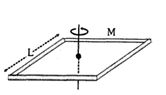
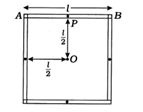
Four rods are arranged in the form of a square. Calculate the moment of inertia about an axis passing through the center and perpendicular to the plane. (Mass $M$ and length $L$ for each rod)
A
$M{L^2}$
B
$\frac{7}{3}M{L^2}$
C
$\frac{4}{3}M{L^2}$
D
$\frac{M{L^2}}{2}$
Solution
(C) The moment of inertia of a single rod $AB$ about an axis passing through its center $P$ and perpendicular to its length is $I_C = \frac{1}{12}ML^2$.
Using the parallel axis theorem,the moment of inertia of rod $AB$ about an axis passing through the center $O$ of the square is:
$I = I_C + Md^2 = \frac{1}{12}ML^2 + M\left(\frac{L}{2}\right)^2 = \frac{1}{12}ML^2 + \frac{1}{4}ML^2 = \frac{1+3}{12}ML^2 = \frac{4}{12}ML^2 = \frac{1}{3}ML^2$.
Since there are four such rods,the total moment of inertia $I'$ about the axis passing through the center $O$ and perpendicular to the plane is:
$I' = 4 \times I = 4 \times \left(\frac{1}{3}ML^2\right) = \frac{4}{3}ML^2$.
Using the parallel axis theorem,the moment of inertia of rod $AB$ about an axis passing through the center $O$ of the square is:
$I = I_C + Md^2 = \frac{1}{12}ML^2 + M\left(\frac{L}{2}\right)^2 = \frac{1}{12}ML^2 + \frac{1}{4}ML^2 = \frac{1+3}{12}ML^2 = \frac{4}{12}ML^2 = \frac{1}{3}ML^2$.
Since there are four such rods,the total moment of inertia $I'$ about the axis passing through the center $O$ and perpendicular to the plane is:
$I' = 4 \times I = 4 \times \left(\frac{1}{3}ML^2\right) = \frac{4}{3}ML^2$.
0 likes
View Solution77
DifficultMCQ
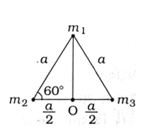
Three point masses $m_1, m_2$,and $m_3$ are placed at the vertices of an equilateral triangle of side $a$. Find the moment of inertia of this system about the altitude passing through $m_1$.
A
$(m_2 + m_3) \frac{a^2}{4}$
B
$(m_1 + m_2 + m_3) a^2$
C
$(m_1 + m_2) \frac{a^2}{2}$
D
$(m_2 + m_3) a^2$
Solution
(A) The moment of inertia $I$ of a system of particles about an axis is given by $I = \sum m_i r_i^2$,where $r_i$ is the perpendicular distance of the $i$-th particle from the axis.
The axis of rotation is the altitude passing through $m_1$.
$1$. For mass $m_1$: The particle lies on the axis,so its perpendicular distance $r_1 = 0$.
$2$. For mass $m_2$: The perpendicular distance from the axis is $r_2 = a \cos(60^\circ) = \frac{a}{2}$.
$3$. For mass $m_3$: The perpendicular distance from the axis is $r_3 = a \cos(60^\circ) = \frac{a}{2}$.
Now,calculating the total moment of inertia:
$I = m_1(0)^2 + m_2 \left( \frac{a}{2} \right)^2 + m_3 \left( \frac{a}{2} \right)^2$
$I = 0 + m_2 \frac{a^2}{4} + m_3 \frac{a^2}{4}$
$I = (m_2 + m_3) \frac{a^2}{4}$
The axis of rotation is the altitude passing through $m_1$.
$1$. For mass $m_1$: The particle lies on the axis,so its perpendicular distance $r_1 = 0$.
$2$. For mass $m_2$: The perpendicular distance from the axis is $r_2 = a \cos(60^\circ) = \frac{a}{2}$.
$3$. For mass $m_3$: The perpendicular distance from the axis is $r_3 = a \cos(60^\circ) = \frac{a}{2}$.
Now,calculating the total moment of inertia:
$I = m_1(0)^2 + m_2 \left( \frac{a}{2} \right)^2 + m_3 \left( \frac{a}{2} \right)^2$
$I = 0 + m_2 \frac{a^2}{4} + m_3 \frac{a^2}{4}$
$I = (m_2 + m_3) \frac{a^2}{4}$
0 likes
View Solution78
DifficultMCQ
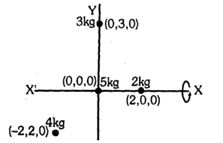
Four particles of masses $5 \ kg, 2 \ kg, 3 \ kg$,and $4 \ kg$ are placed at $(0, 0, 0), (2, 0, 0), (0, 3, 0)$,and $(-2, -2, 0)$ respectively. The moments of inertia about the $x$-axis,$y$-axis,and $z$-axis respectively are:
A
$50, 24, 47$ units
B
$43, 24, 67$ units
C
$76, 26, 61$ units
D
$70, 35, 90$ units
Solution
(B) The moment of inertia $I$ of a system of particles is given by $I = \sum m_i r_i^2$,where $r_i$ is the perpendicular distance of the $i$-th particle from the axis of rotation.
For the $x$-axis,the distance $r_x = \sqrt{y^2 + z^2}$.
$I_x = 5(0^2+0^2) + 2(0^2+0^2) + 3(3^2+0^2) + 4((-2)^2+0^2) = 0 + 0 + 27 + 16 = 43$ units.
For the $y$-axis,the distance $r_y = \sqrt{x^2 + z^2}$.
$I_y = 5(0^2+0^2) + 2(2^2+0^2) + 3(0^2+0^2) + 4((-2)^2+0^2) = 0 + 8 + 0 + 16 = 24$ units.
For the $z$-axis,the distance $r_z = \sqrt{x^2 + y^2}$.
$I_z = 5(0^2+0^2) + 2(2^2+0^2) + 3(0^2+3^2) + 4((-2)^2+(-2)^2) = 0 + 8 + 27 + 4(4+4) = 35 + 32 = 67$ units.
Thus,the moments of inertia are $43, 24, 67$ units.
For the $x$-axis,the distance $r_x = \sqrt{y^2 + z^2}$.
$I_x = 5(0^2+0^2) + 2(0^2+0^2) + 3(3^2+0^2) + 4((-2)^2+0^2) = 0 + 0 + 27 + 16 = 43$ units.
For the $y$-axis,the distance $r_y = \sqrt{x^2 + z^2}$.
$I_y = 5(0^2+0^2) + 2(2^2+0^2) + 3(0^2+0^2) + 4((-2)^2+0^2) = 0 + 8 + 0 + 16 = 24$ units.
For the $z$-axis,the distance $r_z = \sqrt{x^2 + y^2}$.
$I_z = 5(0^2+0^2) + 2(2^2+0^2) + 3(0^2+3^2) + 4((-2)^2+(-2)^2) = 0 + 8 + 27 + 4(4+4) = 35 + 32 = 67$ units.
Thus,the moments of inertia are $43, 24, 67$ units.
0 likes
View Solution79
DifficultMCQ
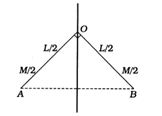
$A$ thin rod of length $L$ and mass $M$ is bent at its midpoint $O$ at an angle of $90^{\circ}$. The moment of inertia of the bent rod about an axis passing through the point $O$ and perpendicular to the plane of the bent rod is:
A
$\frac{ML^2}{6}$
B
$\frac{\sqrt{2} ML^2}{24}$
C
$\frac{ML^2}{24}$
D
$\frac{ML^2}{12}$
Solution
(D) The rod is bent at the midpoint $O$ at an angle of $90^{\circ}$. This divides the rod into two segments,$OA$ and $OB$,each of length $l = L/2$ and mass $m = M/2$.
The axis of rotation passes through point $O$ and is perpendicular to the plane of the bent rod. For a rod of length $l$ and mass $m$ rotating about an axis passing through one of its ends,the moment of inertia is $I = \frac{1}{3} ml^2$.
For segment $OA$,the moment of inertia about the axis through $O$ is:
$I_A = \frac{1}{3} \left( \frac{M}{2} \right) \left( \frac{L}{2} \right)^2 = \frac{1}{3} \left( \frac{M}{2} \right) \left( \frac{L^2}{4} \right) = \frac{ML^2}{24}$.
Similarly,for segment $OB$,the moment of inertia about the axis through $O$ is:
$I_B = \frac{1}{3} \left( \frac{M}{2} \right) \left( \frac{L}{2} \right)^2 = \frac{ML^2}{24}$.
The total moment of inertia of the system is the sum of the moments of inertia of the two segments:
$I = I_A + I_B = \frac{ML^2}{24} + \frac{ML^2}{24} = \frac{2ML^2}{24} = \frac{ML^2}{12}$.
The axis of rotation passes through point $O$ and is perpendicular to the plane of the bent rod. For a rod of length $l$ and mass $m$ rotating about an axis passing through one of its ends,the moment of inertia is $I = \frac{1}{3} ml^2$.
For segment $OA$,the moment of inertia about the axis through $O$ is:
$I_A = \frac{1}{3} \left( \frac{M}{2} \right) \left( \frac{L}{2} \right)^2 = \frac{1}{3} \left( \frac{M}{2} \right) \left( \frac{L^2}{4} \right) = \frac{ML^2}{24}$.
Similarly,for segment $OB$,the moment of inertia about the axis through $O$ is:
$I_B = \frac{1}{3} \left( \frac{M}{2} \right) \left( \frac{L}{2} \right)^2 = \frac{ML^2}{24}$.
The total moment of inertia of the system is the sum of the moments of inertia of the two segments:
$I = I_A + I_B = \frac{ML^2}{24} + \frac{ML^2}{24} = \frac{2ML^2}{24} = \frac{ML^2}{12}$.
0 likes
View Solution80
DifficultMCQ
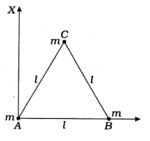
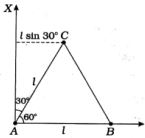
Three particles,each of mass $m$,are placed at the vertices of an equilateral triangle $ABC$ of side length $l$. What is the moment of inertia of the system about the axis $AX$ in the plane of $ABC$,as shown in the figure?
A
$\frac{3}{4}ml^2$
B
$2ml^2$
C
$\frac{5}{4}ml^2$
D
$\frac{3}{2}ml^2$
Solution
(C) From the figure,the perpendicular distances of the three particles from the axis of rotation $AX$ are:
$r_A = 0$
$r_B = l$
$r_C = l \sin 30^\circ = \frac{l}{2}$
Therefore,the moment of inertia $I$ of the system about the axis $AX$ is given by:
$I = m r_A^2 + m r_B^2 + m r_C^2$
$I = m(0)^2 + m(l)^2 + m\left(\frac{l}{2}\right)^2$
$I = 0 + ml^2 + \frac{ml^2}{4}$
$I = \frac{5}{4}ml^2$
$r_A = 0$
$r_B = l$
$r_C = l \sin 30^\circ = \frac{l}{2}$
Therefore,the moment of inertia $I$ of the system about the axis $AX$ is given by:
$I = m r_A^2 + m r_B^2 + m r_C^2$
$I = m(0)^2 + m(l)^2 + m\left(\frac{l}{2}\right)^2$
$I = 0 + ml^2 + \frac{ml^2}{4}$
$I = \frac{5}{4}ml^2$
0 likes
View Solution81
DifficultMCQ
An iron circular disc $X$ has radius $R$ and thickness $t$. Another iron circular disc $Y$ has radius $4R$ and thickness $t/4$. The relationship between the moments of inertia $I_X$ and $I_Y$ of these two discs is .......
A
$I_Y = 32I_X$
B
$I_Y = 16I_X$
C
$I_Y = I_X$
D
$I_Y = 64I_X$
Solution
(D) The mass of disc $X$ is $M_X = (\pi R^2 t) \rho$,where $\rho$ is the density of iron.
The mass of disc $Y$ is $M_Y = (\pi (4R)^2 (t/4)) \rho = (4 \pi R^2 t) \rho = 4 M_X$.
The moment of inertia of a circular disc about its central axis is $I = \frac{1}{2} M R^2$.
For disc $X$: $I_X = \frac{1}{2} M_X R^2$.
For disc $Y$: $I_Y = \frac{1}{2} M_Y (4R)^2 = \frac{1}{2} (4 M_X) (16 R^2) = 64 (\frac{1}{2} M_X R^2) = 64 I_X$.
Therefore,$I_Y = 64 I_X$.
The mass of disc $Y$ is $M_Y = (\pi (4R)^2 (t/4)) \rho = (4 \pi R^2 t) \rho = 4 M_X$.
The moment of inertia of a circular disc about its central axis is $I = \frac{1}{2} M R^2$.
For disc $X$: $I_X = \frac{1}{2} M_X R^2$.
For disc $Y$: $I_Y = \frac{1}{2} M_Y (4R)^2 = \frac{1}{2} (4 M_X) (16 R^2) = 64 (\frac{1}{2} M_X R^2) = 64 I_X$.
Therefore,$I_Y = 64 I_X$.
0 likes
View Solution82
MediumMCQ
The ratio of the radius of gyration of a circular disc about an axis in its plane and tangent to it,to the radius of gyration of a circular ring about an axis in its plane and tangent to it is .........
A
$2:1$
B
$\sqrt{5}:\sqrt{6}$
C
$2:3$
D
$1:\sqrt{2}$
Solution
(B) For a circular disc of mass $M$ and radius $R$,the moment of inertia about an axis in its plane and tangent to it is $I_1 = \frac{5}{4}MR^2$.
Since $I = MK^2$,the radius of gyration $K_1 = \sqrt{\frac{I_1}{M}} = \sqrt{\frac{5}{4}}R = \frac{\sqrt{5}}{2}R$.
For a circular ring of mass $M$ and radius $R$,the moment of inertia about an axis in its plane and tangent to it is $I_2 = \frac{3}{2}MR^2$.
The radius of gyration $K_2 = \sqrt{\frac{I_2}{M}} = \sqrt{\frac{3}{2}}R$.
The ratio of the radii of gyration is $\frac{K_1}{K_2} = \frac{\sqrt{5}/2}{\sqrt{3/2}} = \sqrt{\frac{5}{4} \times \frac{2}{3}} = \sqrt{\frac{5}{6}} = \frac{\sqrt{5}}{\sqrt{6}}$.
Since $I = MK^2$,the radius of gyration $K_1 = \sqrt{\frac{I_1}{M}} = \sqrt{\frac{5}{4}}R = \frac{\sqrt{5}}{2}R$.
For a circular ring of mass $M$ and radius $R$,the moment of inertia about an axis in its plane and tangent to it is $I_2 = \frac{3}{2}MR^2$.
The radius of gyration $K_2 = \sqrt{\frac{I_2}{M}} = \sqrt{\frac{3}{2}}R$.
The ratio of the radii of gyration is $\frac{K_1}{K_2} = \frac{\sqrt{5}/2}{\sqrt{3/2}} = \sqrt{\frac{5}{4} \times \frac{2}{3}} = \sqrt{\frac{5}{6}} = \frac{\sqrt{5}}{\sqrt{6}}$.
0 likes
View Solution83
DifficultMCQ
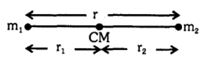
Two masses $m_1$ and $m_2$ are placed at a distance $r$ from each other. Find the moment of inertia of the system about an axis passing through the center of mass and perpendicular to the line joining the masses.
A
$\left( \frac{m_1 m_2}{m_1 + m_2} \right) r^2$
B
$\frac{m_1 r}{m_1 + m_2}$
C
$\frac{m_2 r}{m_1 + m_2}$
D
$\left( \frac{m_1 m_2}{m_1 - m_2} \right) r$
Solution
(A) Let $r_1$ and $r_2$ be the distances of masses $m_1$ and $m_2$ from the center of mass $(CM)$ respectively.
By the definition of the center of mass,$m_1 r_1 = m_2 r_2$ and $r_1 + r_2 = r$.
Solving these equations,we get $r_1 = \frac{m_2 r}{m_1 + m_2}$ and $r_2 = \frac{m_1 r}{m_1 + m_2}$.
The moment of inertia $I$ about an axis passing through the center of mass is given by $I = m_1 r_1^2 + m_2 r_2^2$.
Substituting the values of $r_1$ and $r_2$:
$I = m_1 \left( \frac{m_2 r}{m_1 + m_2} \right)^2 + m_2 \left( \frac{m_1 r}{m_1 + m_2} \right)^2$
$I = m_1 \frac{m_2^2 r^2}{(m_1 + m_2)^2} + m_2 \frac{m_1^2 r^2}{(m_1 + m_2)^2}$
$I = \frac{m_1 m_2 r^2 (m_2 + m_1)}{(m_1 + m_2)^2}$
$I = \left( \frac{m_1 m_2}{m_1 + m_2} \right) r^2$.
By the definition of the center of mass,$m_1 r_1 = m_2 r_2$ and $r_1 + r_2 = r$.
Solving these equations,we get $r_1 = \frac{m_2 r}{m_1 + m_2}$ and $r_2 = \frac{m_1 r}{m_1 + m_2}$.
The moment of inertia $I$ about an axis passing through the center of mass is given by $I = m_1 r_1^2 + m_2 r_2^2$.
Substituting the values of $r_1$ and $r_2$:
$I = m_1 \left( \frac{m_2 r}{m_1 + m_2} \right)^2 + m_2 \left( \frac{m_1 r}{m_1 + m_2} \right)^2$
$I = m_1 \frac{m_2^2 r^2}{(m_1 + m_2)^2} + m_2 \frac{m_1^2 r^2}{(m_1 + m_2)^2}$
$I = \frac{m_1 m_2 r^2 (m_2 + m_1)}{(m_1 + m_2)^2}$
$I = \left( \frac{m_1 m_2}{m_1 + m_2} \right) r^2$.
0 likes
View Solution84
DifficultMCQ
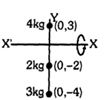
Calculate the moment of inertia of the system of particles shown in the figure about the axis of rotation $XX'$.
A
$92 \ kg \cdot m^2$
B
$85 \ kg \cdot m^2$
C
$101 \ kg \cdot m^2$
D
$76 \ kg \cdot m^2$
Solution
(A) The moment of inertia $I$ of a system of particles about an axis is given by $I = \sum m_i r_i^2$,where $r_i$ is the perpendicular distance of the $i$-th particle from the axis of rotation.
In this case,the axis of rotation is the $XX'$ axis (the $x$-axis).
The perpendicular distance of a point $(x, y)$ from the $x$-axis is $|y|$.
$1$. For the $4 \ kg$ mass at $(0, 3)$,the distance $r_1 = |3| = 3 \ m$.
$I_1 = 4 \times (3)^2 = 4 \times 9 = 36 \ kg \cdot m^2$.
$2$. For the $2 \ kg$ mass at $(0, -2)$,the distance $r_2 = |-2| = 2 \ m$.
$I_2 = 2 \times (2)^2 = 2 \times 4 = 8 \ kg \cdot m^2$.
$3$. For the $3 \ kg$ mass at $(0, -4)$,the distance $r_3 = |-4| = 4 \ m$.
$I_3 = 3 \times (4)^2 = 3 \times 16 = 48 \ kg \cdot m^2$.
The total moment of inertia is $I = I_1 + I_2 + I_3 = 36 + 8 + 48 = 92 \ kg \cdot m^2$.
In this case,the axis of rotation is the $XX'$ axis (the $x$-axis).
The perpendicular distance of a point $(x, y)$ from the $x$-axis is $|y|$.
$1$. For the $4 \ kg$ mass at $(0, 3)$,the distance $r_1 = |3| = 3 \ m$.
$I_1 = 4 \times (3)^2 = 4 \times 9 = 36 \ kg \cdot m^2$.
$2$. For the $2 \ kg$ mass at $(0, -2)$,the distance $r_2 = |-2| = 2 \ m$.
$I_2 = 2 \times (2)^2 = 2 \times 4 = 8 \ kg \cdot m^2$.
$3$. For the $3 \ kg$ mass at $(0, -4)$,the distance $r_3 = |-4| = 4 \ m$.
$I_3 = 3 \times (4)^2 = 3 \times 16 = 48 \ kg \cdot m^2$.
The total moment of inertia is $I = I_1 + I_2 + I_3 = 36 + 8 + 48 = 92 \ kg \cdot m^2$.
0 likes
View Solution85
DifficultMCQ
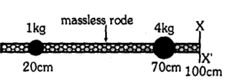
Calculate the moment of inertia of the system shown in the figure about the axis of rotation $XX'$.
A
$7$
B
$1$
C
$2$
D
$4$
Solution
(B) The axis of rotation $XX'$ is at $100 \ cm$ $(1 \ m)$.
The position of the $4 \ kg$ mass is at $70 \ cm$ $(0.7 \ m)$. The distance from the axis is $r_1 = 100 \ cm - 70 \ cm = 30 \ cm = 0.3 \ m$.
The position of the $1 \ kg$ mass is at $20 \ cm$ $(0.2 \ m)$. The distance from the axis is $r_2 = 100 \ cm - 20 \ cm = 80 \ cm = 0.8 \ m$.
The moment of inertia $I$ is given by $I = \sum m_i r_i^2$.
$I = (4 \ kg) \times (0.3 \ m)^2 + (1 \ kg) \times (0.8 \ m)^2$.
$I = 4 \times 0.09 + 1 \times 0.64$.
$I = 0.36 + 0.64 = 1 \ kg \cdot m^2$.
The position of the $4 \ kg$ mass is at $70 \ cm$ $(0.7 \ m)$. The distance from the axis is $r_1 = 100 \ cm - 70 \ cm = 30 \ cm = 0.3 \ m$.
The position of the $1 \ kg$ mass is at $20 \ cm$ $(0.2 \ m)$. The distance from the axis is $r_2 = 100 \ cm - 20 \ cm = 80 \ cm = 0.8 \ m$.
The moment of inertia $I$ is given by $I = \sum m_i r_i^2$.
$I = (4 \ kg) \times (0.3 \ m)^2 + (1 \ kg) \times (0.8 \ m)^2$.
$I = 4 \times 0.09 + 1 \times 0.64$.
$I = 0.36 + 0.64 = 1 \ kg \cdot m^2$.
0 likes
View Solution86
DifficultMCQ
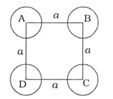
Four solid spheres,each of mass $M$ and radius $R$,are placed at the four corners of a square of side length $a$. Find the moment of inertia of the system about an axis coinciding with one of the sides of the square.
A
${I_{AD}} = 2\left[ {\frac{2}{5}M{R^2} + M{a^2}} \right]$
B
${I_{AD}} = 2\left[ {\frac{2}{5}M{R^2} + M{a^2}} \right]$
C
${I_{AD}} = 2\left[ {\frac{2}{5}M{R^2} + M{a^2}} \right]$
D
${I_{AD}} = 2\left[ {\frac{4}{5}M{R^2} + M{a^2}} \right]$
Solution
(D) Let the four spheres be placed at corners $A, B, C,$ and $D$ of a square of side $a$. We want to find the moment of inertia about the side $AD$.
For spheres at $A$ and $D$,the axis $AD$ passes through their centers. The moment of inertia of a solid sphere about its diameter is $I_{cm} = \frac{2}{5}MR^2$.
Thus,$I_A = I_D = \frac{2}{5}MR^2$.
For spheres at $B$ and $C$,the distance of their centers from the axis $AD$ is $a$. Using the parallel axis theorem,$I = I_{cm} + Md^2$,we get:
$I_B = I_C = \frac{2}{5}MR^2 + Ma^2$.
The total moment of inertia of the system about axis $AD$ is:
$I_{AD} = I_A + I_D + I_B + I_C$
$I_{AD} = \frac{2}{5}MR^2 + \frac{2}{5}MR^2 + (\frac{2}{5}MR^2 + Ma^2) + (\frac{2}{5}MR^2 + Ma^2)$
$I_{AD} = 4(\frac{2}{5}MR^2) + 2Ma^2$
$I_{AD} = \frac{8}{5}MR^2 + 2Ma^2 = 2[\frac{4}{5}MR^2 + Ma^2]$.
For spheres at $A$ and $D$,the axis $AD$ passes through their centers. The moment of inertia of a solid sphere about its diameter is $I_{cm} = \frac{2}{5}MR^2$.
Thus,$I_A = I_D = \frac{2}{5}MR^2$.
For spheres at $B$ and $C$,the distance of their centers from the axis $AD$ is $a$. Using the parallel axis theorem,$I = I_{cm} + Md^2$,we get:
$I_B = I_C = \frac{2}{5}MR^2 + Ma^2$.
The total moment of inertia of the system about axis $AD$ is:
$I_{AD} = I_A + I_D + I_B + I_C$
$I_{AD} = \frac{2}{5}MR^2 + \frac{2}{5}MR^2 + (\frac{2}{5}MR^2 + Ma^2) + (\frac{2}{5}MR^2 + Ma^2)$
$I_{AD} = 4(\frac{2}{5}MR^2) + 2Ma^2$
$I_{AD} = \frac{8}{5}MR^2 + 2Ma^2 = 2[\frac{4}{5}MR^2 + Ma^2]$.
0 likes
View Solution87
MediumMCQ
$A$ circular disc of radius $10 \ cm$ and thickness $5 \ mm$ has a uniform density of $8 \ g/cc$. Find the moment of inertia of the disc about an axis passing through its center and perpendicular to its plane.
A
$6.28 \times 10^4 \ g \ cm^2$
B
$3.14 \times 10^4 \ g \ cm^2$
C
$6.28 \times 10^6 \ g \ cm^2$
D
$3.14 \times 10^6 \ g \ cm^2$
Solution
(A) Given: Radius $R = 10 \ cm$,Thickness $x = 5 \ mm = 0.5 \ cm$,Density $\rho = 8 \ g/cc$.
The mass $M$ of the disc is given by: $M = \text{Volume} \times \text{Density} = (\pi R^2 x) \rho$.
Substituting the values: $M = \pi \times (10)^2 \times 0.5 \times 8 = \pi \times 100 \times 4 = 400\pi \ g$.
Using $\pi \approx 3.14$,$M = 400 \times 3.14 = 1256 \ g$.
The moment of inertia $I$ of a circular disc about an axis passing through its center and perpendicular to its plane is $I = \frac{1}{2} M R^2$.
$I = \frac{1}{2} \times (400\pi) \times (10)^2 = 200\pi \times 100 = 20000\pi \ g \ cm^2$.
$I = 20000 \times 3.14 = 62800 \ g \ cm^2 = 6.28 \times 10^4 \ g \ cm^2$.
The mass $M$ of the disc is given by: $M = \text{Volume} \times \text{Density} = (\pi R^2 x) \rho$.
Substituting the values: $M = \pi \times (10)^2 \times 0.5 \times 8 = \pi \times 100 \times 4 = 400\pi \ g$.
Using $\pi \approx 3.14$,$M = 400 \times 3.14 = 1256 \ g$.
The moment of inertia $I$ of a circular disc about an axis passing through its center and perpendicular to its plane is $I = \frac{1}{2} M R^2$.
$I = \frac{1}{2} \times (400\pi) \times (10)^2 = 200\pi \times 100 = 20000\pi \ g \ cm^2$.
$I = 20000 \times 3.14 = 62800 \ g \ cm^2 = 6.28 \times 10^4 \ g \ cm^2$.
0 likes
View Solution88
MediumMCQ
Two discs have densities $d_1 = 7.2 \ g/cm^3$ and $d_2 = 8.9 \ g/cm^3$. Both discs have the same mass and the same thickness. Find the ratio of their moments of inertia.
A
$8.9 / 7.2$
B
$7.2 / 8.9$
C
$(8.9 / 7.2) : 1$
D
$1 : (8.9 / 7.2)$
Solution
(A) The moment of inertia of a disc about its central axis is $I = \frac{1}{2}MR^2$.
Since the mass $M$ and thickness $t$ are the same for both discs,we have $M = \rho V = \rho (\pi R^2 t)$.
Since $M$ and $t$ are constant,$\rho R^2 = \text{constant}$,which implies $R^2 \propto \frac{1}{\rho}$.
Therefore,the ratio of the radii squared is $\frac{R_1^2}{R_2^2} = \frac{d_2}{d_1}$.
The ratio of the moments of inertia is $\frac{I_1}{I_2} = \frac{\frac{1}{2} M R_1^2}{\frac{1}{2} M R_2^2} = \frac{R_1^2}{R_2^2}$.
Substituting the density relationship,we get $\frac{I_1}{I_2} = \frac{d_2}{d_1} = \frac{8.9}{7.2}$.
Since the mass $M$ and thickness $t$ are the same for both discs,we have $M = \rho V = \rho (\pi R^2 t)$.
Since $M$ and $t$ are constant,$\rho R^2 = \text{constant}$,which implies $R^2 \propto \frac{1}{\rho}$.
Therefore,the ratio of the radii squared is $\frac{R_1^2}{R_2^2} = \frac{d_2}{d_1}$.
The ratio of the moments of inertia is $\frac{I_1}{I_2} = \frac{\frac{1}{2} M R_1^2}{\frac{1}{2} M R_2^2} = \frac{R_1^2}{R_2^2}$.
Substituting the density relationship,we get $\frac{I_1}{I_2} = \frac{d_2}{d_1} = \frac{8.9}{7.2}$.
0 likes
View Solution89
EasyMCQ
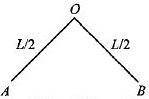
$A$ thin rod of length $L$ and mass $M$ is bent at its midpoint into two halves so that the angle between them is $90^o$. The moment of inertia of the bent rod about an axis passing through the bending point and perpendicular to the plane defined by the two halves of the rod is
A
$\frac{ML^2}{6}$
B
$\frac{\sqrt{2}ML^2}{24}$
C
$\frac{ML^2}{24}$
D
$\frac{ML^2}{12}$
Solution
(D) The rod is bent at its midpoint into two halves,each of length $l = L/2$ and mass $m = M/2$.
Each half acts as a thin rod of length $L/2$ and mass $M/2$ rotating about an axis passing through one of its ends.
The moment of inertia of a thin rod of mass $m$ and length $l$ about an axis passing through one end and perpendicular to its length is given by $I = \frac{1}{3}ml^2$.
Here,$m = M/2$ and $l = L/2$.
So,the moment of inertia of one half about the bending point $O$ is $I_{half} = \frac{1}{3} \times (M/2) \times (L/2)^2 = \frac{1}{3} \times \frac{M}{2} \times \frac{L^2}{4} = \frac{ML^2}{24}$.
Since the two halves are identical and rotate about the same axis passing through $O$,the total moment of inertia is $I_{total} = I_{half} + I_{half} = 2 \times \frac{ML^2}{24} = \frac{ML^2}{12}$.
Each half acts as a thin rod of length $L/2$ and mass $M/2$ rotating about an axis passing through one of its ends.
The moment of inertia of a thin rod of mass $m$ and length $l$ about an axis passing through one end and perpendicular to its length is given by $I = \frac{1}{3}ml^2$.
Here,$m = M/2$ and $l = L/2$.
So,the moment of inertia of one half about the bending point $O$ is $I_{half} = \frac{1}{3} \times (M/2) \times (L/2)^2 = \frac{1}{3} \times \frac{M}{2} \times \frac{L^2}{4} = \frac{ML^2}{24}$.
Since the two halves are identical and rotate about the same axis passing through $O$,the total moment of inertia is $I_{total} = I_{half} + I_{half} = 2 \times \frac{ML^2}{24} = \frac{ML^2}{12}$.
0 likes
View Solution90
MediumMCQ
The ratio of the radii of gyration of a circular disc to that of a circular ring,each of same mass and radius,around their respective axes is
A
$1 : \sqrt{2}$
B
$\sqrt{2} : 1$
C
$\sqrt{2} : \sqrt{3}$
D
$\sqrt{3} : \sqrt{2}$
Solution
(A) The moment of inertia $(I)$ of a circular disc about its central axis is $I_{disc} = \frac{1}{2}MR^2$. The radius of gyration $(k)$ is defined by $I = Mk^2$. Thus,$k_{disc} = \sqrt{\frac{I}{M}} = \sqrt{\frac{R^2}{2}} = \frac{R}{\sqrt{2}}$.
The moment of inertia $(I)$ of a circular ring about its central axis is $I_{ring} = MR^2$. Thus,$k_{ring} = \sqrt{\frac{I}{M}} = \sqrt{R^2} = R$.
The ratio of the radius of gyration of the disc to that of the ring is $\frac{k_{disc}}{k_{ring}} = \frac{R/\sqrt{2}}{R} = \frac{1}{\sqrt{2}}$.
Therefore,the ratio is $1 : \sqrt{2}$.
The moment of inertia $(I)$ of a circular ring about its central axis is $I_{ring} = MR^2$. Thus,$k_{ring} = \sqrt{\frac{I}{M}} = \sqrt{R^2} = R$.
The ratio of the radius of gyration of the disc to that of the ring is $\frac{k_{disc}}{k_{ring}} = \frac{R/\sqrt{2}}{R} = \frac{1}{\sqrt{2}}$.
Therefore,the ratio is $1 : \sqrt{2}$.
0 likes
View Solution91
MediumMCQ
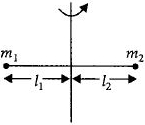
$A$ light rod of length $l$ has two masses $m_1$ and $m_2$ attached to its two ends. The moment of inertia of the system about an axis perpendicular to the rod and passing through the centre of mass is
A
$(m_1+m_2)l^2$
B
$\sqrt{m_1 m_2} l^2$
C
$\frac{m_1 m_2}{m_1 + m_2} l^2$
D
$\frac{m_1 + m_2}{m_1 m_2} l^2$
Solution
(C) Let the distances of masses $m_1$ and $m_2$ from the center of mass be $l_1$ and $l_2$ respectively.
Given that the total length of the rod is $l$,so $l_1 + l_2 = l$.
By the definition of the center of mass,$m_1 l_1 = m_2 l_2$.
Substituting $l_2 = l - l_1$,we get $m_1 l_1 = m_2 (l - l_1)$,which simplifies to $l_1 = \frac{m_2 l}{m_1 + m_2}$.
Similarly,$l_2 = \frac{m_1 l}{m_1 + m_2}$.
The moment of inertia $I$ about an axis passing through the center of mass is given by $I = m_1 l_1^2 + m_2 l_2^2$.
Substituting the values of $l_1$ and $l_2$:
$I = m_1 \left( \frac{m_2 l}{m_1 + m_2} \right)^2 + m_2 \left( \frac{m_1 l}{m_1 + m_2} \right)^2$
$I = \frac{m_1 m_2^2 l^2 + m_2 m_1^2 l^2}{(m_1 + m_2)^2}$
$I = \frac{m_1 m_2 l^2 (m_2 + m_1)}{(m_1 + m_2)^2}$
$I = \frac{m_1 m_2}{m_1 + m_2} l^2$.
Given that the total length of the rod is $l$,so $l_1 + l_2 = l$.
By the definition of the center of mass,$m_1 l_1 = m_2 l_2$.
Substituting $l_2 = l - l_1$,we get $m_1 l_1 = m_2 (l - l_1)$,which simplifies to $l_1 = \frac{m_2 l}{m_1 + m_2}$.
Similarly,$l_2 = \frac{m_1 l}{m_1 + m_2}$.
The moment of inertia $I$ about an axis passing through the center of mass is given by $I = m_1 l_1^2 + m_2 l_2^2$.
Substituting the values of $l_1$ and $l_2$:
$I = m_1 \left( \frac{m_2 l}{m_1 + m_2} \right)^2 + m_2 \left( \frac{m_1 l}{m_1 + m_2} \right)^2$
$I = \frac{m_1 m_2^2 l^2 + m_2 m_1^2 l^2}{(m_1 + m_2)^2}$
$I = \frac{m_1 m_2 l^2 (m_2 + m_1)}{(m_1 + m_2)^2}$
$I = \frac{m_1 m_2}{m_1 + m_2} l^2$.
0 likes
View Solution92
DifficultMCQ
$5$ particles,each of mass $2 \ kg$,are attached to the rim of a circular disc of radius $0.1 \ m$ and negligible mass. The moment of inertia of this system about an axis passing through the center and perpendicular to its plane is ........... $kg \cdot m^{2}$.
A
$1$
B
$0.1$
C
$2$
D
$0.2$
Solution
(B) Since the mass of the disc is negligible,the moment of inertia of the system is determined solely by the five particles attached to the rim.
Each particle has a mass $m = 2 \ kg$ and is at a distance $r = 0.1 \ m$ from the axis of rotation.
The moment of inertia $I$ for a system of particles is given by $I = \sum m_i r_i^2$.
Since all $5$ particles are at the same distance $r$ from the center,$I = 5 \times m \times r^2$.
Substituting the values: $I = 5 \times 2 \times (0.1)^2 = 10 \times 0.01 = 0.1 \ kg \cdot m^2$.
Each particle has a mass $m = 2 \ kg$ and is at a distance $r = 0.1 \ m$ from the axis of rotation.
The moment of inertia $I$ for a system of particles is given by $I = \sum m_i r_i^2$.
Since all $5$ particles are at the same distance $r$ from the center,$I = 5 \times m \times r^2$.
Substituting the values: $I = 5 \times 2 \times (0.1)^2 = 10 \times 0.01 = 0.1 \ kg \cdot m^2$.
0 likes
View Solution93
DifficultMCQ
Two rings made of the same material and having the same thickness have radii of $0.2 \ m$ and $0.6 \ m$. The ratio of their moments of inertia is:
A
$1:81$
B
$1:27$
C
$1:9$
D
$1:3$
Solution
(B) The moment of inertia $I$ of a ring about its central axis is given by $I = MR^2$.
Since the rings are made of the same material with the same thickness $t$,the mass $M$ can be expressed as $M = \text{Volume} \times \text{Density} = (2\pi R \cdot A) \cdot \rho$,where $A$ is the cross-sectional area and $\rho$ is the density. Given the thickness is the same,$M \propto R$.
Thus,$I = MR^2 \propto (R)R^2 = R^3$ is incorrect for a ring; for a ring,$M = \text{Area} \times \text{Circumference} \times \rho = (t^2) \times (2\pi R) \times \rho$. So $M \propto R$.
Therefore,$I = MR^2 \propto R \cdot R^2 = R^3$.
Wait,if the thickness $t$ is the cross-sectional radius,$M = \pi t^2 (2\pi R) \rho \propto R$.
Then $\frac{I_1}{I_2} = \frac{R_1^3}{R_2^3} = (\frac{0.2}{0.6})^3 = (\frac{1}{3})^3 = \frac{1}{27}$.
However,if the rings are thin hoops where $M$ is proportional to the circumference $(M \propto R)$,then $I = MR^2 \propto R^3$. If the question implies the rings have the same cross-sectional area,$M \propto R$,then $I \propto R^3$. If the question implies the rings have the same mass,$I \propto R^2$. Given the standard interpretation of such problems where $M \propto R$,the ratio is $1:27$.
Since the rings are made of the same material with the same thickness $t$,the mass $M$ can be expressed as $M = \text{Volume} \times \text{Density} = (2\pi R \cdot A) \cdot \rho$,where $A$ is the cross-sectional area and $\rho$ is the density. Given the thickness is the same,$M \propto R$.
Thus,$I = MR^2 \propto (R)R^2 = R^3$ is incorrect for a ring; for a ring,$M = \text{Area} \times \text{Circumference} \times \rho = (t^2) \times (2\pi R) \times \rho$. So $M \propto R$.
Therefore,$I = MR^2 \propto R \cdot R^2 = R^3$.
Wait,if the thickness $t$ is the cross-sectional radius,$M = \pi t^2 (2\pi R) \rho \propto R$.
Then $\frac{I_1}{I_2} = \frac{R_1^3}{R_2^3} = (\frac{0.2}{0.6})^3 = (\frac{1}{3})^3 = \frac{1}{27}$.
However,if the rings are thin hoops where $M$ is proportional to the circumference $(M \propto R)$,then $I = MR^2 \propto R^3$. If the question implies the rings have the same cross-sectional area,$M \propto R$,then $I \propto R^3$. If the question implies the rings have the same mass,$I \propto R^2$. Given the standard interpretation of such problems where $M \propto R$,the ratio is $1:27$.
0 likes
View Solution94
EasyMCQ
The moment of inertia of a ring about a diameter is
A
$\frac{3}{2}MR^2$
B
$\frac{1}{2}MR^2$
C
$MR^2$
D
$2MR^2$
Solution
(B) The moment of inertia of a ring of mass $M$ and radius $R$ about an axis passing through its center and perpendicular to its plane is $I_{cm} = MR^2$.
According to the perpendicular axis theorem,$I_z = I_x + I_y$.
Since the ring is symmetric,the moment of inertia about any diameter is the same,so $I_x = I_y = I_d$.
Thus,$I_z = 2I_d$,which implies $MR^2 = 2I_d$.
Therefore,the moment of inertia about a diameter is $I_d = \frac{1}{2}MR^2$.
According to the perpendicular axis theorem,$I_z = I_x + I_y$.
Since the ring is symmetric,the moment of inertia about any diameter is the same,so $I_x = I_y = I_d$.
Thus,$I_z = 2I_d$,which implies $MR^2 = 2I_d$.
Therefore,the moment of inertia about a diameter is $I_d = \frac{1}{2}MR^2$.
0 likes
View Solution95
MediumMCQ
The moment of inertia of a semicircular ring of mass $M$ and radius $R$ about an axis passing through its center and perpendicular to its plane is:
A
$MR^2$
B
$\frac{MR^2}{2}$
C
$\frac{MR^2}{4}$
D
None of the above
Solution
(A) complete circular ring of mass $M$ and radius $R$ has a moment of inertia $I = MR^2$ about an axis passing through its center and perpendicular to its plane.
Since a semicircular ring is just half of a full ring,we can consider it as a system of particles where each particle is at a distance $R$ from the center.
The moment of inertia is defined as $I = \sum m_i r_i^2$.
For a semicircular ring,every mass element $dm$ is at a distance $R$ from the center.
Therefore,$I = \int r^2 dm = \int R^2 dm = R^2 \int dm = MR^2$.
Thus,the moment of inertia of a semicircular ring about an axis passing through its center and perpendicular to its plane is $MR^2$.
Since a semicircular ring is just half of a full ring,we can consider it as a system of particles where each particle is at a distance $R$ from the center.
The moment of inertia is defined as $I = \sum m_i r_i^2$.
For a semicircular ring,every mass element $dm$ is at a distance $R$ from the center.
Therefore,$I = \int r^2 dm = \int R^2 dm = R^2 \int dm = MR^2$.
Thus,the moment of inertia of a semicircular ring about an axis passing through its center and perpendicular to its plane is $MR^2$.
0 likes
View Solution96
DifficultMCQ
$A$ circular disc is made using iron and aluminum such that its moment of inertia about its geometric axis is maximum. For this to happen:
A
The layers of iron and aluminum should be in alternating order.
B
The inner part should be made of aluminum and the outer part of iron.
C
The inner part should be made of iron and the outer part of aluminum.
D
$A$ or $C$.
Solution
(B) The moment of inertia $I$ of a body about an axis is given by $I = \int r^2 dm$. To maximize the moment of inertia for a fixed total mass, the mass should be distributed as far as possible from the axis of rotation. Since the density of iron $(\rho \approx 7870 \ kg/m^3)$ is significantly higher than that of aluminum $(\rho \approx 2700 \ kg/m^3)$, placing the denser material (iron) at the outer rim increases the moment of inertia compared to placing it at the center. Therefore, the inner part should be aluminum and the outer part should be iron.
0 likes
View Solution97
MediumMCQ
The moment of inertia depends on:
A
Distribution of particles
B
Mass
C
Radius of the axis of rotation
D
All of the above
Solution
(D) The moment of inertia $(I)$ of a rigid body is defined as $I = \sum m_i r_i^2$,where $m_i$ is the mass of the $i$-th particle and $r_i$ is its perpendicular distance from the axis of rotation.
$1$. It depends on the mass of the body $(m)$.
$2$. It depends on the distribution of mass relative to the axis of rotation $(r_i)$.
$3$. It depends on the position and orientation of the axis of rotation.
Since all the given factors influence the moment of inertia,the correct option is $(D)$.
$1$. It depends on the mass of the body $(m)$.
$2$. It depends on the distribution of mass relative to the axis of rotation $(r_i)$.
$3$. It depends on the position and orientation of the axis of rotation.
Since all the given factors influence the moment of inertia,the correct option is $(D)$.
0 likes
View Solution98
MediumMCQ
On which of the following does the moment of inertia of an object $NOT$ depend?
A
Angular velocity of the object
B
Mass of the object
C
Distribution of mass in the object
D
Axis of rotation of the object
Solution
(A) The moment of inertia $(I)$ of a rigid body is defined as $I = \sum m_i r_i^2$,where $m_i$ is the mass of the $i$-th particle and $r_i$ is its perpendicular distance from the axis of rotation.
From this definition,it is clear that the moment of inertia depends on the mass of the object,the distribution of mass relative to the axis,and the position/orientation of the axis of rotation.
It does not depend on the state of motion of the object,such as its angular velocity $(ω)$ or angular acceleration $(α)$.
Therefore,the correct option is $A$.
From this definition,it is clear that the moment of inertia depends on the mass of the object,the distribution of mass relative to the axis,and the position/orientation of the axis of rotation.
It does not depend on the state of motion of the object,such as its angular velocity $(ω)$ or angular acceleration $(α)$.
Therefore,the correct option is $A$.
0 likes
View Solution99
EasyMCQ
The moment of inertia of a straight thin rod of mass $M$ and length $l$ about an axis perpendicular to its length and passing through its one end,is
A
$Ml^2/12$
B
$Ml^2/3$
C
$Ml^2/2$
D
$Ml^2$
Solution
(B) The moment of inertia of a thin rod of mass $M$ and length $l$ about an axis passing through its center of mass and perpendicular to its length is given by $I_{cm} = Ml^2/12$.
Using the parallel axis theorem,$I = I_{cm} + Md^2$,where $d$ is the distance between the center of mass and the axis of rotation.
For an axis passing through one end,the distance $d = l/2$.
Substituting these values,we get $I = Ml^2/12 + M(l/2)^2$.
$I = Ml^2/12 + Ml^2/4$.
$I = (Ml^2 + 3Ml^2)/12 = 4Ml^2/12 = Ml^2/3$.
Therefore,the correct option is $B$.
Using the parallel axis theorem,$I = I_{cm} + Md^2$,where $d$ is the distance between the center of mass and the axis of rotation.
For an axis passing through one end,the distance $d = l/2$.
Substituting these values,we get $I = Ml^2/12 + M(l/2)^2$.
$I = Ml^2/12 + Ml^2/4$.
$I = (Ml^2 + 3Ml^2)/12 = 4Ml^2/12 = Ml^2/3$.
Therefore,the correct option is $B$.
0 likes
View Solution100
MediumMCQ
$A$ wheel of mass $10 \ kg$ has a moment of inertia of $160 \ kg \ m^2$ about its axis. Its radius of gyration is ...... $m$.
A
$10$
B
$8$
C
$6$
D
$4$
Solution
(D) The moment of inertia $I$ of a body is given by the formula $I = MK^2$,where $M$ is the mass and $K$ is the radius of gyration.
Given: $M = 10 \ kg$ and $I = 160 \ kg \ m^2$.
Substituting the values into the formula:
$160 = 10 \times K^2$
$K^2 = \frac{160}{10} = 16$
$K = \sqrt{16} = 4 \ m$.
Therefore,the radius of gyration is $4 \ m$.
Given: $M = 10 \ kg$ and $I = 160 \ kg \ m^2$.
Substituting the values into the formula:
$160 = 10 \times K^2$
$K^2 = \frac{160}{10} = 16$
$K = \sqrt{16} = 4 \ m$.
Therefore,the radius of gyration is $4 \ m$.
0 likes
View SolutionSystem of Particles and Rotational Motion — Moment of Inertia and Radius of gyration · Frequently Asked Questions
1Are these System of Particles and Rotational Motion questions useful for JEE and NEET?
Yes. All questions in this section are mapped to JEE Main and NEET exam patterns. Previous year questions from JEE Main, NEET, GUJCET and state-level exams are included with full solutions.
2Can I switch to Hindi or Gujarati for these questions?
Yes. Use the language tabs in the hero section or the sidebar to view the same questions and solutions in English, Hindi or Gujarati.
3How do I generate a question paper from this subtopic?
Use the Vedclass Exam Paper Generator — select the chapter and subtopic, set difficulty, and generate Sets A, B, C, D automatically. First 3 chapters of every subject are free.
Vedclass Products
For Students
Vedclass Test Series
Mock tests in real JEE/NEET style with performance analysis. 5-day free trial.
Start Free TrialFor Teachers
Exam Paper Generator
Generate Set A/B/C/D papers from this chapter in 2 minutes. 3 chapters free.
Try FreeFor Institutes
Online Exam Module
Live online exams with unlimited students, 360° analytics & white-label branding.
See DemoFor Teachers & Institutes
Generate a System of Particles and Rotational Motion Exam Paper in 2 Minutes
Select subtopic & difficulty — Sets A, B, C, D auto-generated with No Repeat logic.
First 3 chapters of every subject are free — no payment required.