
A English
Acceleration and Force of Simple Harmonic Motion Questions in English
Class 11 Physics · Oscillations · Acceleration and Force of Simple Harmonic Motion
108+
Questions
English
Language
100%
With Solutions
Showing 48 of 108 questions in English
51
EasyMCQ
$Assertion :$ In $SHM$,acceleration is always directed towards the mean position.
$Reason :$ In $SHM$,the body has to stop momentarily at the extreme position and move back to the mean position.
$Reason :$ In $SHM$,the body has to stop momentarily at the extreme position and move back to the mean position.
A
If both Assertion and Reason are correct and the Reason is a correct explanation of the Assertion.
B
If both Assertion and Reason are correct but Reason is not a correct explanation of the Assertion.
C
If the Assertion is correct but Reason is incorrect.
D
If both the Assertion and Reason are incorrect.
Solution
(A) $SHM$ is defined as a to-and-fro motion about a mean position. The restoring force,and consequently the acceleration,is always directed towards the mean position to bring the body back. The acceleration in $SHM$ is given by $a = -\omega^2 x$,where $x$ is the displacement from the mean position. Since the negative sign indicates that the acceleration is always opposite to the direction of displacement,it is always directed towards the mean position. The reason provided correctly explains that the body must stop at the extreme position and return to the mean position due to this acceleration. Therefore,both statements are correct and the reason explains the assertion.
0 likes
View Solution52
Medium
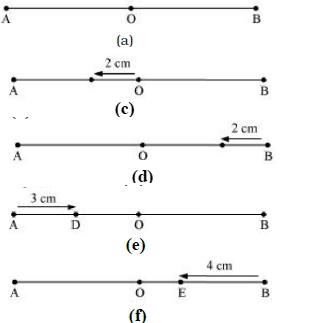
$A$ particle is in linear simple harmonic motion between two points,$A$ and $B$,$10 \; cm$ apart. Take the direction from $A$ to $B$ as the positive direction and give the signs of velocity,acceleration,and force on the particle when it is:
$(a)$ at the end $A$.
$(b)$ at the end $B$.
$(c)$ at the mid-point of $AB$ going towards $A$.
$(d)$ at $2 \; cm$ away from $B$ going towards $A$.
$(e)$ at $3 \; cm$ away from $A$ going towards $B$.
$(f)$ at $4 \; cm$ away from $B$ going towards $A$.
$(a)$ at the end $A$.
$(b)$ at the end $B$.
$(c)$ at the mid-point of $AB$ going towards $A$.
$(d)$ at $2 \; cm$ away from $B$ going towards $A$.
$(e)$ at $3 \; cm$ away from $A$ going towards $B$.
$(f)$ at $4 \; cm$ away from $B$ going towards $A$.
Solution
(N/A) The mean position $O$ is the midpoint of $AB$. $A$ is at $x = -5 \; cm$ and $B$ is at $x = +5 \; cm$. The positive direction is $A \to B$. In $SHM$,acceleration $a = -\omega^2 x$ and force $F = ma = -m\omega^2 x$.
$(a)$ At $A$ $(x = -5 \; cm)$: Velocity $v = 0$ (extreme point). Acceleration $a = -\omega^2(-5) > 0$ (positive). Force $F$ is positive.
$(b)$ At $B$ $(x = +5 \; cm)$: Velocity $v = 0$ (extreme point). Acceleration $a = -\omega^2(+5) < 0$ (negative). Force $F$ is negative.
$(c)$ At $O$ $(x = 0)$ going towards $A$: Velocity $v < 0$ (moving left). Acceleration $a = 0$. Force $F = 0$.
$(d)$ At $2 \; cm$ from $B$ towards $A$ $(x = +3 \; cm)$: Velocity $v < 0$ (moving left). Acceleration $a = -\omega^2(+3) < 0$ (negative). Force $F$ is negative.
$(e)$ At $3 \; cm$ from $A$ towards $B$ $(x = -2 \; cm)$: Velocity $v > 0$ (moving right). Acceleration $a = -\omega^2(-2) > 0$ (positive). Force $F$ is positive.
$(f)$ At $4 \; cm$ from $B$ towards $A$ $(x = +1 \; cm)$: Velocity $v < 0$ (moving left). Acceleration $a = -\omega^2(+1) < 0$ (negative). Force $F$ is negative.
$(a)$ At $A$ $(x = -5 \; cm)$: Velocity $v = 0$ (extreme point). Acceleration $a = -\omega^2(-5) > 0$ (positive). Force $F$ is positive.
$(b)$ At $B$ $(x = +5 \; cm)$: Velocity $v = 0$ (extreme point). Acceleration $a = -\omega^2(+5) < 0$ (negative). Force $F$ is negative.
$(c)$ At $O$ $(x = 0)$ going towards $A$: Velocity $v < 0$ (moving left). Acceleration $a = 0$. Force $F = 0$.
$(d)$ At $2 \; cm$ from $B$ towards $A$ $(x = +3 \; cm)$: Velocity $v < 0$ (moving left). Acceleration $a = -\omega^2(+3) < 0$ (negative). Force $F$ is negative.
$(e)$ At $3 \; cm$ from $A$ towards $B$ $(x = -2 \; cm)$: Velocity $v > 0$ (moving right). Acceleration $a = -\omega^2(-2) > 0$ (positive). Force $F$ is positive.
$(f)$ At $4 \; cm$ from $B$ towards $A$ $(x = +1 \; cm)$: Velocity $v < 0$ (moving left). Acceleration $a = -\omega^2(+1) < 0$ (negative). Force $F$ is negative.
0 likes
View Solution53
Medium
Obtain instantaneous acceleration of a $SHM$ particle with the help of reference circle.
Solution
(N/A) $1$. Consider a particle $P$ moving in a circle of radius $A$ with constant angular velocity $\omega$. The projection of this motion on the diameter (say $x$-axis) represents $SHM$.
$2$. The position of the particle at any time $t$ is given by $x = A \cos(\omega t + \phi)$.
$3$. The velocity of the particle is $v = \frac{dx}{dt} = -A\omega \sin(\omega t + \phi)$.
$4$. The instantaneous acceleration $a$ is the derivative of velocity with respect to time: $a = \frac{dv}{dt} = \frac{d}{dt}(-A\omega \sin(\omega t + \phi))$.
$5$. Differentiating,we get $a = -A\omega^2 \cos(\omega t + \phi)$.
$6$. Since $x = A \cos(\omega t + \phi)$,we can substitute this into the acceleration equation to get $a = -\omega^2 x$.
$2$. The position of the particle at any time $t$ is given by $x = A \cos(\omega t + \phi)$.
$3$. The velocity of the particle is $v = \frac{dx}{dt} = -A\omega \sin(\omega t + \phi)$.
$4$. The instantaneous acceleration $a$ is the derivative of velocity with respect to time: $a = \frac{dv}{dt} = \frac{d}{dt}(-A\omega \sin(\omega t + \phi))$.
$5$. Differentiating,we get $a = -A\omega^2 \cos(\omega t + \phi)$.
$6$. Since $x = A \cos(\omega t + \phi)$,we can substitute this into the acceleration equation to get $a = -\omega^2 x$.
0 likes
View Solution54
Medium
Obtain the formula for the acceleration of a particle from the formula of displacement of $SHM$.
Solution
(N/A) The acceleration of an $SHM$ particle is the second derivative of displacement with respect to time.
The displacement of an $SHM$ particle at time $t$ is given by:
$x(t) = A \cos(\omega t + \phi)$
Differentiating with respect to time $t$ to find velocity $v(t)$:
$v(t) = \frac{dx}{dt} = -A \omega \sin(\omega t + \phi)$
Differentiating again with respect to time $t$ to find acceleration $a(t)$:
$a(t) = \frac{dv}{dt} = -A \omega^2 \cos(\omega t + \phi)$
Since $x(t) = A \cos(\omega t + \phi)$,we can substitute this into the acceleration equation:
$a(t) = -\omega^2 x(t)$
Generally,$a = -\omega^2 x$.
Special cases:
$(1)$ At the mean position,$x = 0$,so $a = -\omega^2(0) = 0$. Acceleration is zero and velocity is maximum.
$(2)$ At extreme points,$x = \pm A$,so $a = \mp \omega^2 A$. The magnitude of acceleration is maximum,$a_{\max} = A \omega^2$.
The displacement of an $SHM$ particle at time $t$ is given by:
$x(t) = A \cos(\omega t + \phi)$
Differentiating with respect to time $t$ to find velocity $v(t)$:
$v(t) = \frac{dx}{dt} = -A \omega \sin(\omega t + \phi)$
Differentiating again with respect to time $t$ to find acceleration $a(t)$:
$a(t) = \frac{dv}{dt} = -A \omega^2 \cos(\omega t + \phi)$
Since $x(t) = A \cos(\omega t + \phi)$,we can substitute this into the acceleration equation:
$a(t) = -\omega^2 x(t)$
Generally,$a = -\omega^2 x$.
Special cases:
$(1)$ At the mean position,$x = 0$,so $a = -\omega^2(0) = 0$. Acceleration is zero and velocity is maximum.
$(2)$ At extreme points,$x = \pm A$,so $a = \mp \omega^2 A$. The magnitude of acceleration is maximum,$a_{\max} = A \omega^2$.
0 likes
View Solution55
EasyMCQ
Where is maximum acceleration and zero velocity of a particle executing $SHM$?
A
At the mean position
B
At the extreme positions
C
At the midpoint between mean and extreme positions
D
Nowhere
Solution
(B) For a particle executing $SHM$,the displacement is given by $x = A \sin(\omega t + \phi)$.
The velocity is $v = \frac{dx}{dt} = A\omega \cos(\omega t + \phi)$.
The acceleration is $a = \frac{dv}{dt} = -A\omega^2 \sin(\omega t + \phi) = -\omega^2 x$.
At the extreme positions,the displacement $x = \pm A$.
Therefore,the velocity $v = \pm A\omega \cos(\pm \pi/2) = 0$.
The acceleration $a = -\omega^2(\pm A) = \mp A\omega^2$,which is the maximum magnitude of acceleration.
Thus,both conditions are satisfied at the extreme positions.
The velocity is $v = \frac{dx}{dt} = A\omega \cos(\omega t + \phi)$.
The acceleration is $a = \frac{dv}{dt} = -A\omega^2 \sin(\omega t + \phi) = -\omega^2 x$.
At the extreme positions,the displacement $x = \pm A$.
Therefore,the velocity $v = \pm A\omega \cos(\pm \pi/2) = 0$.
The acceleration $a = -\omega^2(\pm A) = \mp A\omega^2$,which is the maximum magnitude of acceleration.
Thus,both conditions are satisfied at the extreme positions.
0 likes
View Solution56
Easy
Write the formula of instantaneous acceleration of $SHM$ particle along $X$-axis.
Solution
(N/A) For a particle executing $SHM$ along the $X$-axis,the displacement $x$ at any time $t$ is given by $x(t) = A \sin(\omega t + \phi)$.
The velocity $v$ is the first derivative of displacement with respect to time: $v = \frac{dx}{dt} = A\omega \cos(\omega t + \phi)$.
The instantaneous acceleration $a$ is the second derivative of displacement with respect to time:
$a = \frac{dv}{dt} = \frac{d^2x}{dt^2} = -A\omega^2 \sin(\omega t + \phi)$.
Since $x = A \sin(\omega t + \phi)$,we can substitute this into the expression for acceleration:
$a = -\omega^2 x$.
Thus,the formula for instantaneous acceleration is $a = -\omega^2 x$.
The velocity $v$ is the first derivative of displacement with respect to time: $v = \frac{dx}{dt} = A\omega \cos(\omega t + \phi)$.
The instantaneous acceleration $a$ is the second derivative of displacement with respect to time:
$a = \frac{dv}{dt} = \frac{d^2x}{dt^2} = -A\omega^2 \sin(\omega t + \phi)$.
Since $x = A \sin(\omega t + \phi)$,we can substitute this into the expression for acceleration:
$a = -\omega^2 x$.
Thus,the formula for instantaneous acceleration is $a = -\omega^2 x$.
0 likes
View Solution57
EasyMCQ
Where is maximum acceleration and zero acceleration of a particle executing $SHM$?
A
Maximum at mean position,zero at extreme positions
B
Maximum at extreme positions,zero at mean position
C
Maximum at both mean and extreme positions,zero nowhere
D
Zero at both mean and extreme positions,maximum nowhere
Solution
(B) For a particle executing $SHM$,the acceleration $a$ is given by the formula $a = -\omega^2 x$,where $\omega$ is the angular frequency and $x$ is the displacement from the mean position.
At the mean position,$x = 0$,so the acceleration $a = -\omega^2(0) = 0$. Thus,acceleration is zero at the mean position.
At the extreme positions,the displacement $x$ is equal to the amplitude $A$ (i.e.,$x = \pm A$). The magnitude of acceleration is $|a| = |-\omega^2(\pm A)| = \omega^2 A$,which is the maximum value.
Therefore,acceleration is maximum at the extreme positions and zero at the mean position.
At the mean position,$x = 0$,so the acceleration $a = -\omega^2(0) = 0$. Thus,acceleration is zero at the mean position.
At the extreme positions,the displacement $x$ is equal to the amplitude $A$ (i.e.,$x = \pm A$). The magnitude of acceleration is $|a| = |-\omega^2(\pm A)| = \omega^2 A$,which is the maximum value.
Therefore,acceleration is maximum at the extreme positions and zero at the mean position.
0 likes
View Solution58
EasyMCQ
Give the direction of velocity and acceleration of an $SHM$ particle.
A
Velocity is always towards the mean position,acceleration is always towards the mean position.
B
Velocity is along the direction of motion,acceleration is always towards the mean position.
C
Velocity is always towards the mean position,acceleration is along the direction of motion.
D
Velocity is along the direction of motion,acceleration is along the direction of motion.
Solution
(B) In $SHM$ (Simple Harmonic Motion),the particle moves back and forth about a mean position.
$1$. Velocity: The velocity of the particle is always directed along the instantaneous direction of its motion.
$2$. Acceleration: The acceleration in $SHM$ is given by $a = -\omega^2 x$,where $x$ is the displacement from the mean position. The negative sign indicates that the acceleration is always directed towards the mean position,regardless of the direction of motion or displacement.
$1$. Velocity: The velocity of the particle is always directed along the instantaneous direction of its motion.
$2$. Acceleration: The acceleration in $SHM$ is given by $a = -\omega^2 x$,where $x$ is the displacement from the mean position. The negative sign indicates that the acceleration is always directed towards the mean position,regardless of the direction of motion or displacement.
0 likes
View Solution59
Medium
Obtain the force law for $SHM$ from the displacement of $SHM$ particle.
Solution
(D) Displacement of $SHM$ particle at time $t$ is given by:
$x(t) = A \cos (\omega t + \phi)$
where $A$ is the amplitude,$\omega$ is the angular frequency,and $\phi$ is the initial phase.
Differentiating the displacement equation with respect to time $t$ to find velocity:
$v(t) = \frac{d}{dt} [A \cos (\omega t + \phi)] = -A\omega \sin (\omega t + \phi)$
Differentiating the velocity equation with respect to time $t$ to find acceleration:
$a(t) = \frac{d}{dt} [-A\omega \sin (\omega t + \phi)] = -A\omega^2 \cos (\omega t + \phi)$
Since $x(t) = A \cos (\omega t + \phi)$,we can substitute this into the acceleration equation:
$a(t) = -\omega^2 x(t)$
According to Newton's second law,$F = ma$. Multiplying both sides by mass $m$:
$F = m a(t) = -m\omega^2 x(t)$
Defining the force constant $k = m\omega^2$,we get:
$F = -kx(t)$
This shows that the restoring force is directly proportional to the negative displacement,which is the force law for $SHM$.
$x(t) = A \cos (\omega t + \phi)$
where $A$ is the amplitude,$\omega$ is the angular frequency,and $\phi$ is the initial phase.
Differentiating the displacement equation with respect to time $t$ to find velocity:
$v(t) = \frac{d}{dt} [A \cos (\omega t + \phi)] = -A\omega \sin (\omega t + \phi)$
Differentiating the velocity equation with respect to time $t$ to find acceleration:
$a(t) = \frac{d}{dt} [-A\omega \sin (\omega t + \phi)] = -A\omega^2 \cos (\omega t + \phi)$
Since $x(t) = A \cos (\omega t + \phi)$,we can substitute this into the acceleration equation:
$a(t) = -\omega^2 x(t)$
According to Newton's second law,$F = ma$. Multiplying both sides by mass $m$:
$F = m a(t) = -m\omega^2 x(t)$
Defining the force constant $k = m\omega^2$,we get:
$F = -kx(t)$
This shows that the restoring force is directly proportional to the negative displacement,which is the force law for $SHM$.
0 likes
View Solution60
Easy
Write the force law for $SHM$.
Solution
(N/A) In Simple Harmonic Motion $(SHM)$,the restoring force $F$ acting on a particle is directly proportional to its displacement $x$ from the equilibrium position and is always directed towards the equilibrium position.
Mathematically,this is expressed as:
$F = -kx$
Where:
$F$ is the restoring force.
$k$ is the force constant (or spring constant),which is a positive constant.
$x$ is the displacement from the mean position.
The negative sign indicates that the force is always in the direction opposite to the displacement.
Mathematically,this is expressed as:
$F = -kx$
Where:
$F$ is the restoring force.
$k$ is the force constant (or spring constant),which is a positive constant.
$x$ is the displacement from the mean position.
The negative sign indicates that the force is always in the direction opposite to the displacement.
0 likes
View Solution61
EasyMCQ
What is the force constant of a particle executing $SHM$?
A
$k = m\omega^2$
B
$k = m\omega$
C
$k = \frac{m}{\omega^2}$
D
$k = \frac{m}{\omega}$
Solution
(A) For a particle of mass $m$ executing Simple Harmonic Motion $(SHM)$,the restoring force is given by $F = -kx$,where $k$ is the force constant and $x$ is the displacement.
From the equation of motion for $SHM$,we have $F = ma = m\frac{d^2x}{dt^2}$.
Since $a = -\omega^2x$,we can write $F = m(-\omega^2x) = -(m\omega^2)x$.
Comparing $F = -kx$ with $F = -(m\omega^2)x$,we get $k = m\omega^2$.
From the equation of motion for $SHM$,we have $F = ma = m\frac{d^2x}{dt^2}$.
Since $a = -\omega^2x$,we can write $F = m(-\omega^2x) = -(m\omega^2)x$.
Comparing $F = -kx$ with $F = -(m\omega^2)x$,we get $k = m\omega^2$.
0 likes
View Solution62
Easy
What is restoring force?
Solution
(N/A) restoring force is a force that acts to bring a body to its equilibrium position whenever it is displaced from that position.
Mathematically,for a linear system like a spring,it is given by Hooke's Law: $F = -kx$,where $F$ is the restoring force,$k$ is the force constant,and $x$ is the displacement from the equilibrium position.
The negative sign indicates that the force is always directed opposite to the direction of displacement.
Mathematically,for a linear system like a spring,it is given by Hooke's Law: $F = -kx$,where $F$ is the restoring force,$k$ is the force constant,and $x$ is the displacement from the equilibrium position.
The negative sign indicates that the force is always directed opposite to the direction of displacement.
0 likes
View Solution63
MediumMCQ
What is the phase difference between the velocity and acceleration of a particle executing $SHM$ (in $^{\circ}$)?
A
$0$
B
$90$
C
$180$
D
$270$
Solution
(B) Let the displacement of a particle executing $SHM$ be $x = A \sin(\omega t + \phi)$.
The velocity $v$ is given by $v = \frac{dx}{dt} = A \omega \cos(\omega t + \phi) = A \omega \sin(\omega t + \phi + \frac{\pi}{2})$.
The acceleration $a$ is given by $a = \frac{dv}{dt} = -A \omega^2 \sin(\omega t + \phi) = A \omega^2 \sin(\omega t + \phi + \pi)$.
The phase of velocity is $(\omega t + \phi + \frac{\pi}{2})$ and the phase of acceleration is $(\omega t + \phi + \pi)$.
The phase difference is $(\omega t + \phi + \pi) - (\omega t + \phi + \frac{\pi}{2}) = \frac{\pi}{2}$ radians or $90^{\circ}$.
The velocity $v$ is given by $v = \frac{dx}{dt} = A \omega \cos(\omega t + \phi) = A \omega \sin(\omega t + \phi + \frac{\pi}{2})$.
The acceleration $a$ is given by $a = \frac{dv}{dt} = -A \omega^2 \sin(\omega t + \phi) = A \omega^2 \sin(\omega t + \phi + \pi)$.
The phase of velocity is $(\omega t + \phi + \frac{\pi}{2})$ and the phase of acceleration is $(\omega t + \phi + \pi)$.
The phase difference is $(\omega t + \phi + \pi) - (\omega t + \phi + \frac{\pi}{2}) = \frac{\pi}{2}$ radians or $90^{\circ}$.
0 likes
View Solution64
EasyMCQ
What is the phase difference between the displacement and acceleration of a particle executing $SHM$?
A
$0$
B
$90^{\circ}$
C
$180^{\circ}$
D
$270^{\circ}$
Solution
(C) For a particle executing $SHM$,the displacement $y$ is given by $y = A \sin(\omega t + \phi)$.
The acceleration $a$ is the second derivative of displacement with respect to time: $a = \frac{d^2y}{dt^2} = -\omega^2 A \sin(\omega t + \phi)$.
We can rewrite this as $a = \omega^2 A \sin(\omega t + \phi + \pi)$.
Comparing the arguments of the sine functions,the phase of displacement is $(\omega t + \phi)$ and the phase of acceleration is $(\omega t + \phi + \pi)$.
The phase difference is $(\omega t + \phi + \pi) - (\omega t + \phi) = \pi \text{ radians}$ or $180^{\circ}$.
The acceleration $a$ is the second derivative of displacement with respect to time: $a = \frac{d^2y}{dt^2} = -\omega^2 A \sin(\omega t + \phi)$.
We can rewrite this as $a = \omega^2 A \sin(\omega t + \phi + \pi)$.
Comparing the arguments of the sine functions,the phase of displacement is $(\omega t + \phi)$ and the phase of acceleration is $(\omega t + \phi + \pi)$.
The phase difference is $(\omega t + \phi + \pi) - (\omega t + \phi) = \pi \text{ radians}$ or $180^{\circ}$.
0 likes
View Solution65
EasyMCQ
The amplitude of a particle executing $SHM$ is $2 \, cm$ and the force acting at the extreme position on the particle is $4 \, N$. What is the force at the midway point between the mean position and the extreme point (in $, N$)?
A
$1$
B
$2$
C
$3$
D
$4$
Solution
(B) The restoring force in $SHM$ is given by $F = -kx$,where $k$ is the force constant and $x$ is the displacement from the mean position.
At the extreme position,the displacement $x = A = 2 \, cm = 0.02 \, m$.
The force at the extreme position is $F_{ext} = kA = 4 \, N$.
Therefore,$k = \frac{4}{0.02} = 200 \, N/m$.
At the midway point between the mean position $(x = 0)$ and the extreme point $(x = A)$,the displacement is $x = \frac{A}{2} = \frac{2 \, cm}{2} = 1 \, cm = 0.01 \, m$.
The force at this point is $F = kx = 200 \times 0.01 = 2 \, N$.
At the extreme position,the displacement $x = A = 2 \, cm = 0.02 \, m$.
The force at the extreme position is $F_{ext} = kA = 4 \, N$.
Therefore,$k = \frac{4}{0.02} = 200 \, N/m$.
At the midway point between the mean position $(x = 0)$ and the extreme point $(x = A)$,the displacement is $x = \frac{A}{2} = \frac{2 \, cm}{2} = 1 \, cm = 0.01 \, m$.
The force at this point is $F = kx = 200 \times 0.01 = 2 \, N$.
0 likes
View Solution66
MediumMCQ
Give the formula of force acting on a particle executing simple harmonic motion.
A
$F = kx$
B
$F = -kx$
C
$F = -kx^{2}$
D
$F = kx^{2}$
Solution
(B) In simple harmonic motion $(SHM)$, the restoring force acting on a particle is directly proportional to its displacement from the equilibrium position and is directed towards the equilibrium position.
Mathematically, this is expressed as $F = -kx$, where $F$ is the restoring force, $x$ is the displacement from the mean position, and $k$ is the force constant (or spring constant).
Mathematically, this is expressed as $F = -kx$, where $F$ is the restoring force, $x$ is the displacement from the mean position, and $k$ is the force constant (or spring constant).
0 likes
View Solution67
EasyMCQ
The phase difference between displacement and acceleration of a particle in a simple harmonic motion is
A
Zero
B
$\pi \; rad$
C
$\frac{3 \pi}{2} \; rad$
D
$\frac{\pi}{2} \; rad$
Solution
(B) The displacement $(x)$ of a particle in $SHM$ is given by $x = A \sin(\omega t + \phi)$.
The velocity $(v)$ is the first derivative of displacement: $v = \frac{dx}{dt} = A \omega \cos(\omega t + \phi)$.
The acceleration $(a)$ is the second derivative of displacement: $a = \frac{d^2x}{dt^2} = -A \omega^2 \sin(\omega t + \phi)$.
Using the trigonometric identity $-\sin(\theta) = \sin(\theta + \pi)$,we can rewrite the acceleration as $a = A \omega^2 \sin(\omega t + \phi + \pi)$.
Comparing the phase of displacement $(\omega t + \phi)$ and acceleration $(\omega t + \phi + \pi)$,the phase difference is $\pi \; rad$.
The velocity $(v)$ is the first derivative of displacement: $v = \frac{dx}{dt} = A \omega \cos(\omega t + \phi)$.
The acceleration $(a)$ is the second derivative of displacement: $a = \frac{d^2x}{dt^2} = -A \omega^2 \sin(\omega t + \phi)$.
Using the trigonometric identity $-\sin(\theta) = \sin(\theta + \pi)$,we can rewrite the acceleration as $a = A \omega^2 \sin(\omega t + \phi + \pi)$.
Comparing the phase of displacement $(\omega t + \phi)$ and acceleration $(\omega t + \phi + \pi)$,the phase difference is $\pi \; rad$.
0 likes
View Solution68
MediumMCQ
$A$ body oscillates with a simple harmonic motion having amplitude $0.05 \, m$. At a certain instant,its displacement is $0.01 \, m$ and acceleration is $1.0 \, m/s^2$. The period of oscillation is
A
$0.1 \, s$
B
$0.2 \, s$
C
$\frac{\pi}{10} \, s$
D
$\frac{\pi}{5} \, s$
Solution
(D) The magnitude of acceleration in simple harmonic motion is given by the formula $|a| = \omega^2 y$,where $a$ is acceleration,$\omega$ is angular frequency,and $y$ is displacement.
Given $a = 1.0 \, m/s^2$ and $y = 0.01 \, m$,we have:
$1.0 = \omega^2 \times 0.01$
$\omega^2 = \frac{1.0}{0.01} = 100$
$\omega = 10 \, rad/s$
The time period $T$ is related to angular frequency by $T = \frac{2\pi}{\omega}$.
Substituting the value of $\omega$:
$T = \frac{2\pi}{10} = \frac{\pi}{5} \, s$.
Given $a = 1.0 \, m/s^2$ and $y = 0.01 \, m$,we have:
$1.0 = \omega^2 \times 0.01$
$\omega^2 = \frac{1.0}{0.01} = 100$
$\omega = 10 \, rad/s$
The time period $T$ is related to angular frequency by $T = \frac{2\pi}{\omega}$.
Substituting the value of $\omega$:
$T = \frac{2\pi}{10} = \frac{\pi}{5} \, s$.
0 likes
View Solution69
MediumMCQ
$A$ book is resting on a shelf that is undergoing vertical simple harmonic oscillations with an amplitude of $2.5 \,cm$. What is the minimum frequency of oscillation of the shelf for which the book will lose contact with the shelf (in $,Hz$)? (Assume that $g = 10 \,m/s^2$)
A
$20$
B
$3.18$
C
$125.6$
D
$10$
Solution
(B) The book will lose contact with the shelf when the downward acceleration of the shelf exceeds the acceleration due to gravity $g$.
The condition for losing contact is $a_{\max} \geq g$.
Since the shelf undergoes simple harmonic motion,the maximum acceleration is given by $a_{\max} = \omega^2 A$,where $\omega$ is the angular frequency and $A$ is the amplitude.
Setting $a_{\max} = g$,we get $\omega^2 A = g$,which implies $\omega = \sqrt{\frac{g}{A}}$.
Given $A = 2.5 \,cm = 0.025 \,m$ and $g = 10 \,m/s^2$,we have $\omega = \sqrt{\frac{10}{0.025}} = \sqrt{400} = 20 \,rad/s$.
The frequency $f$ is given by $f = \frac{\omega}{2\pi} = \frac{20}{2\pi} = \frac{10}{\pi} \approx 3.18 \,Hz$.
The condition for losing contact is $a_{\max} \geq g$.
Since the shelf undergoes simple harmonic motion,the maximum acceleration is given by $a_{\max} = \omega^2 A$,where $\omega$ is the angular frequency and $A$ is the amplitude.
Setting $a_{\max} = g$,we get $\omega^2 A = g$,which implies $\omega = \sqrt{\frac{g}{A}}$.
Given $A = 2.5 \,cm = 0.025 \,m$ and $g = 10 \,m/s^2$,we have $\omega = \sqrt{\frac{10}{0.025}} = \sqrt{400} = 20 \,rad/s$.
The frequency $f$ is given by $f = \frac{\omega}{2\pi} = \frac{20}{2\pi} = \frac{10}{\pi} \approx 3.18 \,Hz$.
0 likes
View Solution70
EasyMCQ
If a particle is executing simple harmonic motion,then the acceleration of the particle:
A
Is uniform
B
Varies linearly with time
C
Is non-uniform
D
Both $(b)$ and $(c)$
Solution
(C) For a particle executing simple harmonic motion $(S.H.M.)$,the acceleration $a$ is given by the relation:
$a = -\omega^2 x$
where $\omega$ is the angular frequency and $x$ is the displacement from the mean position.
Since the acceleration $a$ is directly proportional to the displacement $x$,it changes as the particle moves.
Therefore,the acceleration is non-uniform because it depends on the position $x$ of the particle,not directly on time in a linear fashion (it varies sinusoidally with time).
Thus,the correct option is $(c)$.
$a = -\omega^2 x$
where $\omega$ is the angular frequency and $x$ is the displacement from the mean position.
Since the acceleration $a$ is directly proportional to the displacement $x$,it changes as the particle moves.
Therefore,the acceleration is non-uniform because it depends on the position $x$ of the particle,not directly on time in a linear fashion (it varies sinusoidally with time).
Thus,the correct option is $(c)$.
0 likes
View Solution71
EasyMCQ
$A$ particle of mass $10 \,g$ is undergoing $S.H.M.$ with an amplitude of $10 \,cm$ and a period of $0.1 \,s$. The maximum value of the force on the particle is about ............ $N$.
A
$5.6$
B
$2.75$
C
$3.5$
D
$4$
Solution
(D) Given: Mass $m = 10 \,g = 0.01 \,kg$,Amplitude $A = 10 \,cm = 0.1 \,m$,Period $T = 0.1 \,s$.
The angular frequency $\omega$ is given by $\omega = \frac{2\pi}{T} = \frac{2\pi}{0.1} = 20\pi \,rad/s$.
The maximum acceleration in $S.H.M.$ is $a_{\text{max}} = \omega^2 A$.
The maximum force is $F_{\text{max}} = m \cdot a_{\text{max}} = m \omega^2 A$.
Substituting the values: $F_{\text{max}} = 0.01 \times (20\pi)^2 \times 0.1$.
$F_{\text{max}} = 0.001 \times 400 \pi^2 = 0.4 \pi^2$.
Using $\pi^2 \approx 9.87$,$F_{\text{max}} \approx 0.4 \times 9.87 = 3.948 \,N$.
Rounding to the nearest integer,$F_{\text{max}} \approx 4 \,N$.
The angular frequency $\omega$ is given by $\omega = \frac{2\pi}{T} = \frac{2\pi}{0.1} = 20\pi \,rad/s$.
The maximum acceleration in $S.H.M.$ is $a_{\text{max}} = \omega^2 A$.
The maximum force is $F_{\text{max}} = m \cdot a_{\text{max}} = m \omega^2 A$.
Substituting the values: $F_{\text{max}} = 0.01 \times (20\pi)^2 \times 0.1$.
$F_{\text{max}} = 0.001 \times 400 \pi^2 = 0.4 \pi^2$.
Using $\pi^2 \approx 9.87$,$F_{\text{max}} \approx 0.4 \times 9.87 = 3.948 \,N$.
Rounding to the nearest integer,$F_{\text{max}} \approx 4 \,N$.
0 likes
View Solution72
MediumMCQ
$A$ body oscillates with $S.H.M.$ according to the equation $x = (5.0 \, m) \cos [(2 \pi \, rad \, s^{-1}) t + \pi / 4]$. At $t = 1.5 \, s$,its acceleration is ....... $m / s^2$.
A
$-139.56$
B
$139.56$
C
$69.78$
D
$-69.78$
Solution
(B) The equation of motion is $x = A \cos(\omega t + \phi)$,where $A = 5.0 \, m$ and $\omega = 2 \pi \, rad \, s^{-1}$.
The acceleration $a$ in $S.H.M.$ is given by $a = -\omega^2 x$.
First,find the displacement $x$ at $t = 1.5 \, s$:
$x = 5 \cos(2 \pi \times 1.5 + \pi / 4) = 5 \cos(3 \pi + \pi / 4)$.
Since $\cos(3 \pi + \theta) = -\cos(\theta)$:
$x = -5 \cos(\pi / 4) = -5 / \sqrt{2} \, m$.
Now,calculate the acceleration:
$a = -\omega^2 x = -(2 \pi)^2 \times (-5 / \sqrt{2})$.
$a = 4 \pi^2 \times (5 / \sqrt{2}) = 4 \times 9.8696 \times 3.5355 \approx 139.56 \, m / s^2$.
The acceleration $a$ in $S.H.M.$ is given by $a = -\omega^2 x$.
First,find the displacement $x$ at $t = 1.5 \, s$:
$x = 5 \cos(2 \pi \times 1.5 + \pi / 4) = 5 \cos(3 \pi + \pi / 4)$.
Since $\cos(3 \pi + \theta) = -\cos(\theta)$:
$x = -5 \cos(\pi / 4) = -5 / \sqrt{2} \, m$.
Now,calculate the acceleration:
$a = -\omega^2 x = -(2 \pi)^2 \times (-5 / \sqrt{2})$.
$a = 4 \pi^2 \times (5 / \sqrt{2}) = 4 \times 9.8696 \times 3.5355 \approx 139.56 \, m / s^2$.
0 likes
View Solution73
MediumMCQ
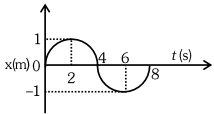
The $x-t$ graph of a particle performing simple harmonic motion is shown in the figure. The acceleration of the particle at $t=2 \ s$ is:
A
$-\frac{\pi^2}{16} \ m/s^2$
B
$\frac{\pi^2}{8} \ m/s^2$
C
$-\frac{\pi^2}{8} \ m/s^2$
D
$\frac{\pi^2}{16} \ m/s^2$
Solution
(A) From the graph,the amplitude $A = 1 \ m$ and the time period $T = 8 \ s$.
The angular frequency $\omega = \frac{2\pi}{T} = \frac{2\pi}{8} = \frac{\pi}{4} \ rad/s$.
The equation of motion is $x(t) = A \sin(\omega t) = 1 \sin\left(\frac{\pi}{4} t\right)$.
The acceleration $a(t)$ is given by $a = \frac{d^2x}{dt^2} = -\omega^2 x = -\omega^2 A \sin(\omega t)$.
Substituting the values at $t = 2 \ s$:
$a = -\left(\frac{\pi}{4}\right)^2 \times 1 \times \sin\left(\frac{\pi}{4} \times 2\right)$
$a = -\frac{\pi^2}{16} \times \sin\left(\frac{\pi}{2}\right)$
Since $\sin\left(\frac{\pi}{2}\right) = 1$,we get:
$a = -\frac{\pi^2}{16} \ m/s^2$.
The angular frequency $\omega = \frac{2\pi}{T} = \frac{2\pi}{8} = \frac{\pi}{4} \ rad/s$.
The equation of motion is $x(t) = A \sin(\omega t) = 1 \sin\left(\frac{\pi}{4} t\right)$.
The acceleration $a(t)$ is given by $a = \frac{d^2x}{dt^2} = -\omega^2 x = -\omega^2 A \sin(\omega t)$.
Substituting the values at $t = 2 \ s$:
$a = -\left(\frac{\pi}{4}\right)^2 \times 1 \times \sin\left(\frac{\pi}{4} \times 2\right)$
$a = -\frac{\pi^2}{16} \times \sin\left(\frac{\pi}{2}\right)$
Since $\sin\left(\frac{\pi}{2}\right) = 1$,we get:
$a = -\frac{\pi^2}{16} \ m/s^2$.
0 likes
View Solution74
MediumMCQ
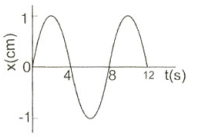
The $x-t$ graph of a particle undergoing simple harmonic motion is shown below. The acceleration of the particle at $t = 4/3 \,s$ is
A
$\frac{\sqrt{3}}{32} \pi^2 \,cm/s^2$
B
$-\frac{\pi^2}{32} \,cm/s^2$
C
$\frac{\pi^2}{32} \,cm/s^2$
D
$-\frac{\sqrt{3}}{32} \pi^2 \,cm/s^2$
Solution
(D) The correct option is $D$.
From the $x-t$ graph, at $t = 0$, the particle is at $x = 0$.
Hence, the particle starts its simple harmonic motion $(SHM)$ from the mean position.
The general equation for $SHM$ is $x = A \sin(\omega t)$.
From the graph, the time period $T = 8 \,s$ and the amplitude $A = 1 \,cm$.
The angular frequency is $\omega = \frac{2\pi}{T} = \frac{2\pi}{8} = \frac{\pi}{4} \,rad/s$.
Thus, the equation of motion is $x = 1 \sin\left(\frac{\pi t}{4}\right)$.
At $t = 4/3 \,s$, the displacement is $x = \sin\left(\frac{\pi}{4} \times \frac{4}{3}\right) = \sin\left(\frac{\pi}{3}\right) = \frac{\sqrt{3}}{2} \,cm$.
The acceleration $a$ is given by $a = -\omega^2 x$.
Substituting the values, $a = -\left(\frac{\pi}{4}\right)^2 \times \frac{\sqrt{3}}{2} = -\frac{\pi^2}{16} \times \frac{\sqrt{3}}{2} = -\frac{\sqrt{3}\pi^2}{32} \,cm/s^2$.
From the $x-t$ graph, at $t = 0$, the particle is at $x = 0$.
Hence, the particle starts its simple harmonic motion $(SHM)$ from the mean position.
The general equation for $SHM$ is $x = A \sin(\omega t)$.
From the graph, the time period $T = 8 \,s$ and the amplitude $A = 1 \,cm$.
The angular frequency is $\omega = \frac{2\pi}{T} = \frac{2\pi}{8} = \frac{\pi}{4} \,rad/s$.
Thus, the equation of motion is $x = 1 \sin\left(\frac{\pi t}{4}\right)$.
At $t = 4/3 \,s$, the displacement is $x = \sin\left(\frac{\pi}{4} \times \frac{4}{3}\right) = \sin\left(\frac{\pi}{3}\right) = \frac{\sqrt{3}}{2} \,cm$.
The acceleration $a$ is given by $a = -\omega^2 x$.
Substituting the values, $a = -\left(\frac{\pi}{4}\right)^2 \times \frac{\sqrt{3}}{2} = -\frac{\pi^2}{16} \times \frac{\sqrt{3}}{2} = -\frac{\sqrt{3}\pi^2}{32} \,cm/s^2$.
0 likes
View Solution75
MediumMCQ
$A$ body is executing $S.H.M.$ under the action of a force having a maximum magnitude of $50 \,N$. When its energy is half kinetic and half potential, the magnitude of the force acting on the particle is:
A
$\frac{25}{\sqrt{2}} \,N$
B
$50 \,N$
C
$25 \,N$
D
$25 \sqrt{2} \,N$
Solution
(D) The total energy $E$ in $S.H.M.$ is given by $E = \frac{1}{2} k A^2$, where $k = m \omega^2$ is the force constant and $A$ is the amplitude.
Given that the kinetic energy $K$ and potential energy $U$ are equal, $K = U = \frac{E}{2}$.
The potential energy at displacement $x$ is $U = \frac{1}{2} k x^2$.
Thus, $\frac{1}{2} k x^2 = \frac{1}{2} (\frac{1}{2} k A^2) \implies x^2 = \frac{A^2}{2} \implies x = \frac{A}{\sqrt{2}}$.
The force acting on the particle at displacement $x$ is $F = -kx = -m \omega^2 x$.
The maximum force is $F_m = k A = 50 \,N$.
The magnitude of the force at displacement $x$ is $F' = kx = k (\frac{A}{\sqrt{2}}) = \frac{F_m}{\sqrt{2}}$.
Substituting $F_m = 50 \,N$, we get $F' = \frac{50}{\sqrt{2}} = 25 \sqrt{2} \,N$.
Given that the kinetic energy $K$ and potential energy $U$ are equal, $K = U = \frac{E}{2}$.
The potential energy at displacement $x$ is $U = \frac{1}{2} k x^2$.
Thus, $\frac{1}{2} k x^2 = \frac{1}{2} (\frac{1}{2} k A^2) \implies x^2 = \frac{A^2}{2} \implies x = \frac{A}{\sqrt{2}}$.
The force acting on the particle at displacement $x$ is $F = -kx = -m \omega^2 x$.
The maximum force is $F_m = k A = 50 \,N$.
The magnitude of the force at displacement $x$ is $F' = kx = k (\frac{A}{\sqrt{2}}) = \frac{F_m}{\sqrt{2}}$.
Substituting $F_m = 50 \,N$, we get $F' = \frac{50}{\sqrt{2}} = 25 \sqrt{2} \,N$.
0 likes
View Solution76
MediumMCQ
$A$ particle performing $S$.$H$.$M$. when displacement is '$x$',the potential energy and restoring force acting on it are denoted by '$E$' and '$F$' respectively. The relation between $x, E$ and $F$ is
A
$\frac{2 E}{F}-x^2=0$
B
$\frac{2 E}{F}+x^2=0$
C
$\frac{2 E}{F}+x=0$
D
$\frac{2 E}{F}-x=0$
Solution
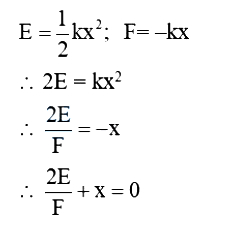
(C) For a particle performing Simple Harmonic Motion ($S$.$H$.$M$.),the potential energy $E$ at displacement $x$ is given by $E = \frac{1}{2} k x^2$,where $k$ is the force constant.
The restoring force $F$ acting on the particle at displacement $x$ is given by $F = -k x$.
From the expression for potential energy,we have $2 E = k x^2$.
Dividing this equation by the expression for force $F = -k x$,we get:
$\frac{2 E}{F} = \frac{k x^2}{-k x}$
Simplifying the expression,we get:
$\frac{2 E}{F} = -x$
Rearranging the terms,we obtain:
$\frac{2 E}{F} + x = 0$
Thus,the correct relation is $\frac{2 E}{F} + x = 0$.
The restoring force $F$ acting on the particle at displacement $x$ is given by $F = -k x$.
From the expression for potential energy,we have $2 E = k x^2$.
Dividing this equation by the expression for force $F = -k x$,we get:
$\frac{2 E}{F} = \frac{k x^2}{-k x}$
Simplifying the expression,we get:
$\frac{2 E}{F} = -x$
Rearranging the terms,we obtain:
$\frac{2 E}{F} + x = 0$
Thus,the correct relation is $\frac{2 E}{F} + x = 0$.
0 likes
View Solution77
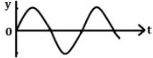
MediumMCQ
For a particle performing $S.H.M.$, the displacement-time graph is shown. For that particle, the force-time graph is correctly represented by which of the following?
A
a
B
b
C
c
D
d
Solution
(A) In $S.H.M.$, the displacement is given by $y = A \sin(\omega t)$.
The force acting on the particle is $F = -ky = -k A \sin(\omega t)$, where $k$ is the force constant.
This equation shows that the force is $180^{\circ}$ (or $\pi$ radians) out of phase with the displacement.
If the displacement graph is a sine wave starting from the origin, the force graph must be an inverted sine wave (a negative sine wave) starting from the origin.
Therefore, the force-time graph will be the mirror image of the displacement-time graph about the time axis.
The force acting on the particle is $F = -ky = -k A \sin(\omega t)$, where $k$ is the force constant.
This equation shows that the force is $180^{\circ}$ (or $\pi$ radians) out of phase with the displacement.
If the displacement graph is a sine wave starting from the origin, the force graph must be an inverted sine wave (a negative sine wave) starting from the origin.
Therefore, the force-time graph will be the mirror image of the displacement-time graph about the time axis.
0 likes
View Solution78
EasyMCQ
Two simple harmonic motions of angular frequency $300 \ rad/s$ and $3000 \ rad/s$ have the same amplitude. The ratio of their maximum accelerations is
A
$1: 10$
B
$1: 10^2$
C
$1: 10^3$
D
$1: 10^4$
Solution
(B) The maximum acceleration $a_{max}$ of a particle executing simple harmonic motion is given by the formula $a_{max} = \omega^2 A$,where $\omega$ is the angular frequency and $A$ is the amplitude.
Given that the amplitudes $A_1$ and $A_2$ are equal $(A_1 = A_2 = A)$,the ratio of the maximum accelerations is:
$\frac{a_{max,1}}{a_{max,2}} = \frac{\omega_1^2 A}{\omega_2^2 A} = \left( \frac{\omega_1}{\omega_2} \right)^2$
Substituting the given values $\omega_1 = 300 \ rad/s$ and $\omega_2 = 3000 \ rad/s$:
$\frac{a_{max,1}}{a_{max,2}} = \left( \frac{300}{3000} \right)^2 = \left( \frac{1}{10} \right)^2 = \frac{1}{100} = 1: 10^2$
Therefore,the correct option is $B$.
Given that the amplitudes $A_1$ and $A_2$ are equal $(A_1 = A_2 = A)$,the ratio of the maximum accelerations is:
$\frac{a_{max,1}}{a_{max,2}} = \frac{\omega_1^2 A}{\omega_2^2 A} = \left( \frac{\omega_1}{\omega_2} \right)^2$
Substituting the given values $\omega_1 = 300 \ rad/s$ and $\omega_2 = 3000 \ rad/s$:
$\frac{a_{max,1}}{a_{max,2}} = \left( \frac{300}{3000} \right)^2 = \left( \frac{1}{10} \right)^2 = \frac{1}{100} = 1: 10^2$
Therefore,the correct option is $B$.
0 likes
View Solution79
EasyMCQ
$A$ particle is performing $S.H.M.$ starting from the extreme position. The graphical representation shows that between displacement and acceleration,there is a phase difference of:
A
$\pi \ rad$
B
$\frac{\pi}{2} \ rad$
C
$\frac{\pi}{4} \ rad$
D
$0 \ rad$
Solution
(A) In $S.H.M.$,the displacement of a particle is given by $x(t) = A \cos(\omega t + \phi)$.
Since the particle starts from the extreme position,at $t = 0$,$x = A$,which implies $\phi = 0$. Thus,$x(t) = A \cos(\omega t)$.
The acceleration $a(t)$ is given by the second derivative of displacement: $a(t) = \frac{d^2x}{dt^2} = -\omega^2 A \cos(\omega t)$.
We can rewrite the acceleration as $a(t) = \omega^2 A \cos(\omega t + \pi)$.
Comparing the phase of displacement $(\omega t)$ and acceleration $(\omega t + \pi)$,the phase difference is $\pi \ rad$.
Since the particle starts from the extreme position,at $t = 0$,$x = A$,which implies $\phi = 0$. Thus,$x(t) = A \cos(\omega t)$.
The acceleration $a(t)$ is given by the second derivative of displacement: $a(t) = \frac{d^2x}{dt^2} = -\omega^2 A \cos(\omega t)$.
We can rewrite the acceleration as $a(t) = \omega^2 A \cos(\omega t + \pi)$.
Comparing the phase of displacement $(\omega t)$ and acceleration $(\omega t + \pi)$,the phase difference is $\pi \ rad$.
0 likes
View Solution80
MediumMCQ
If '$v$' is velocity and '$a$' is acceleration of a particle executing linear simple harmonic motion,which one of the following statements is correct?
A
when '$a$' is maximum,'$v$' is maximum
B
when '$a$' is maximum,'$v$' is zero
C
when '$a$' is zero,'$v$' is zero
D
'$a$' is zero for any value of '$v$'
Solution
(B) The correct option is $(B)$.
Concept: For $SHM$,the acceleration is given by $a = -\omega^2 x$.
The displacement is $x = A \sin(\omega t + \phi)$.
Velocity is the first derivative of displacement: $v = \frac{dx}{dt} = A\omega \cos(\omega t + \phi)$.
Acceleration is the derivative of velocity: $a = \frac{dv}{dt} = -A\omega^2 \sin(\omega t + \phi)$.
At the extreme positions,displacement $x = \pm A$,so acceleration $a = \mp A\omega^2$ is maximum (in magnitude),and velocity $v = 0$.
At the mean position,displacement $x = 0$,so acceleration $a = 0$,and velocity $v = \pm A\omega$ is maximum.
Therefore,when '$a$' is maximum,'$v$' is zero.
Concept: For $SHM$,the acceleration is given by $a = -\omega^2 x$.
The displacement is $x = A \sin(\omega t + \phi)$.
Velocity is the first derivative of displacement: $v = \frac{dx}{dt} = A\omega \cos(\omega t + \phi)$.
Acceleration is the derivative of velocity: $a = \frac{dv}{dt} = -A\omega^2 \sin(\omega t + \phi)$.
At the extreme positions,displacement $x = \pm A$,so acceleration $a = \mp A\omega^2$ is maximum (in magnitude),and velocity $v = 0$.
At the mean position,displacement $x = 0$,so acceleration $a = 0$,and velocity $v = \pm A\omega$ is maximum.
Therefore,when '$a$' is maximum,'$v$' is zero.
0 likes
View Solution81
DifficultMCQ
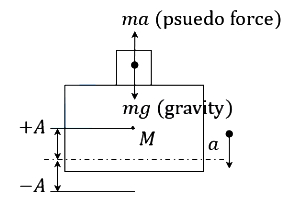
$A$ small wooden cube is placed on a plank. The plank performs a vertical $S$.$H$.$M$. of frequency $\frac{3}{\pi} \text{ Hz}$. The maximum amplitude of the plank so that the wooden block does not leave the plank is [take $g = 10 \text{ m/s}^2$].
A
$\frac{7}{12} \text{ m}$
B
$\frac{5}{2} \text{ m}$
C
$\frac{5}{18} \text{ m}$
D
$\frac{11}{18} \text{ m}$
Solution
(C) Concept: The wooden cube will leave the plank at the top extreme position if the downward acceleration of the plank exceeds the acceleration due to gravity.
For the block not to leave the plank,the normal force $N$ must be greater than or equal to zero.
From the free body diagram of the block,the equation of motion is: $mg - N = ma$.
For the block to remain in contact,$N \geq 0$,which implies $mg \geq ma$,or $a \leq g$.
In $S$.$H$.$M$.,the maximum acceleration is given by $a_{max} = \omega^2 A$.
Therefore,the condition for the block not to leave the plank is $\omega^2 A \leq g$,or $A \leq \frac{g}{\omega^2}$.
Given frequency $f = \frac{3}{\pi} \text{ Hz}$.
Angular frequency $\omega = 2\pi f = 2\pi \left( \frac{3}{\pi} \right) = 6 \text{ rad/s}$.
Substituting the values: $A \leq \frac{10}{6^2} = \frac{10}{36} = \frac{5}{18} \text{ m}$.
Thus,the maximum amplitude is $\frac{5}{18} \text{ m}$.
For the block not to leave the plank,the normal force $N$ must be greater than or equal to zero.
From the free body diagram of the block,the equation of motion is: $mg - N = ma$.
For the block to remain in contact,$N \geq 0$,which implies $mg \geq ma$,or $a \leq g$.
In $S$.$H$.$M$.,the maximum acceleration is given by $a_{max} = \omega^2 A$.
Therefore,the condition for the block not to leave the plank is $\omega^2 A \leq g$,or $A \leq \frac{g}{\omega^2}$.
Given frequency $f = \frac{3}{\pi} \text{ Hz}$.
Angular frequency $\omega = 2\pi f = 2\pi \left( \frac{3}{\pi} \right) = 6 \text{ rad/s}$.
Substituting the values: $A \leq \frac{10}{6^2} = \frac{10}{36} = \frac{5}{18} \text{ m}$.
Thus,the maximum amplitude is $\frac{5}{18} \text{ m}$.
0 likes
View Solution82
EasyMCQ
$A$ particle of mass $5 \,g$ is executing $S.H.M.$ with an amplitude $0.3 \,m$ and period $\frac{\pi}{5} \,s$. The maximum value of the force acting on the particle is (in $\,N$)
A
$0.15$
B
$4$
C
$5$
D
$0.3$
Solution
(A) Given: Mass $m = 5 \,g = 5 \times 10^{-3} \,kg$,Amplitude $A = 0.3 \,m$,Time period $T = \frac{\pi}{5} \,s$.
Angular frequency $\omega = \frac{2\pi}{T} = \frac{2\pi}{\pi/5} = 10 \,rad/s$.
The maximum force acting on a particle in $S.H.M.$ is given by $F_{max} = m\omega^2A$.
Substituting the values: $F_{max} = (5 \times 10^{-3} \,kg) \times (10 \,rad/s)^2 \times (0.3 \,m)$.
$F_{max} = 5 \times 10^{-3} \times 100 \times 0.3 = 5 \times 10^{-1} \times 0.3 = 0.5 \times 0.3 = 0.15 \,N$.
Angular frequency $\omega = \frac{2\pi}{T} = \frac{2\pi}{\pi/5} = 10 \,rad/s$.
The maximum force acting on a particle in $S.H.M.$ is given by $F_{max} = m\omega^2A$.
Substituting the values: $F_{max} = (5 \times 10^{-3} \,kg) \times (10 \,rad/s)^2 \times (0.3 \,m)$.
$F_{max} = 5 \times 10^{-3} \times 100 \times 0.3 = 5 \times 10^{-1} \times 0.3 = 0.5 \times 0.3 = 0.15 \,N$.
0 likes
View Solution83
EasyMCQ
The displacement of a particle performing $S.H.M.$ is given by $x=5 \sin (3 t+3)$,where $x$ is in $cm$ and $t$ is in $s$. The maximum acceleration of the particle will be (in $cm \ s^{-2}$)
A
$15$
B
$30$
C
$45$
D
$90$
Solution
(C) The given equation for displacement is $x = 5 \sin (3t + 3)$.
Comparing this with the standard equation of $S.H.M.$,$x = A \sin (\omega t + \phi)$,we get:
Amplitude $A = 5 \ cm$
Angular frequency $\omega = 3 \ rad/s$
The formula for the maximum acceleration of a particle in $S.H.M.$ is $a_{max} = A \omega^2$.
Substituting the values,we get $a_{max} = 5 \times (3)^2$.
$a_{max} = 5 \times 9 = 45 \ cm \ s^{-2}$.
Comparing this with the standard equation of $S.H.M.$,$x = A \sin (\omega t + \phi)$,we get:
Amplitude $A = 5 \ cm$
Angular frequency $\omega = 3 \ rad/s$
The formula for the maximum acceleration of a particle in $S.H.M.$ is $a_{max} = A \omega^2$.
Substituting the values,we get $a_{max} = 5 \times (3)^2$.
$a_{max} = 5 \times 9 = 45 \ cm \ s^{-2}$.
0 likes
View Solution84
EasyMCQ
The weight suspended from a spring oscillates up and down. The acceleration of the weight will be zero at
A
mean position.
B
highest position.
C
half of the amplitude.
D
lowest position.
Solution
(A) In simple harmonic motion,the acceleration $a$ is given by the formula $a = -\omega^2 x$,where $\omega$ is the angular frequency and $x$ is the displacement from the mean position.
At the mean position,the displacement $x = 0$.
Substituting $x = 0$ into the formula,we get $a = -\omega^2 (0) = 0$.
Therefore,the acceleration of the weight is zero at the mean position.
At the mean position,the displacement $x = 0$.
Substituting $x = 0$ into the formula,we get $a = -\omega^2 (0) = 0$.
Therefore,the acceleration of the weight is zero at the mean position.
0 likes
View Solution85
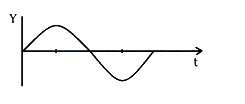
EasyMCQ
For a particle performing Simple Harmonic Motion $(S.H.M.)$,the displacement-time graph is as shown. For that particle,the force-time graph is correctly represented by which of the following graphs?
A
$(A)$
B
$(B)$
C
$(C)$
D
$(D)$
Solution
(A) For a particle performing $S.H.M.$,the displacement $x$ as a function of time $t$ is given by $x = A \sin(\omega t)$,where $A$ is the amplitude and $\omega$ is the angular frequency.
According to Hooke's Law for $S.H.M.$,the restoring force $F$ is given by $F = -kx$,where $k$ is the force constant.
Substituting the expression for $x$,we get $F = -k(A \sin(\omega t)) = -kA \sin(\omega t)$.
This equation shows that the force $F$ is proportional to the negative of the displacement $x$.
Therefore,the force-time graph will be an inverted version of the displacement-time graph. If the displacement graph starts from the origin and goes positive,the force graph must start from the origin and go negative.
According to Hooke's Law for $S.H.M.$,the restoring force $F$ is given by $F = -kx$,where $k$ is the force constant.
Substituting the expression for $x$,we get $F = -k(A \sin(\omega t)) = -kA \sin(\omega t)$.
This equation shows that the force $F$ is proportional to the negative of the displacement $x$.
Therefore,the force-time graph will be an inverted version of the displacement-time graph. If the displacement graph starts from the origin and goes positive,the force graph must start from the origin and go negative.
0 likes
View Solution86
EasyMCQ
$A$ man of mass $M$ is standing on a platform. The platform is executing $S.H.M.$ of frequency $f$ in the vertical direction. The span of oscillation is $L$. What is the acceleration of the platform at the top of the oscillation?
A
$4 \pi^{2} f^{2} L$
B
$\frac{2 \pi^{2} f^{2} L}{M}$
C
$\frac{4 \pi^{2} f^{2} L}{M}$
D
$2 \pi^{2} f^{2} L$
Solution
(D) The span of oscillation $L$ is the total distance between the extreme positions,which is equal to $2A$,where $A$ is the amplitude of oscillation.
Therefore,$A = \frac{L}{2}$.
The angular frequency $\omega$ is given by $\omega = 2 \pi f$.
The acceleration $a$ of a particle in $S.H.M.$ is given by $a = -\omega^{2} x$.
At the top of the oscillation (extreme position),the displacement $x = A = \frac{L}{2}$.
Substituting the values,the magnitude of acceleration is $|a| = \omega^{2} A = (2 \pi f)^{2} \times \frac{L}{2}$.
$|a| = 4 \pi^{2} f^{2} \times \frac{L}{2} = 2 \pi^{2} f^{2} L$.
Thus,the correct option is $D$.
Therefore,$A = \frac{L}{2}$.
The angular frequency $\omega$ is given by $\omega = 2 \pi f$.
The acceleration $a$ of a particle in $S.H.M.$ is given by $a = -\omega^{2} x$.
At the top of the oscillation (extreme position),the displacement $x = A = \frac{L}{2}$.
Substituting the values,the magnitude of acceleration is $|a| = \omega^{2} A = (2 \pi f)^{2} \times \frac{L}{2}$.
$|a| = 4 \pi^{2} f^{2} \times \frac{L}{2} = 2 \pi^{2} f^{2} L$.
Thus,the correct option is $D$.
0 likes
View Solution87
MediumMCQ
$A$ particle of mass $1 \ kg$ is moving in $SHM$ with a path length of $0.01 \ m$ and frequency of $50 \ Hz$. The maximum force in newton,acting on the particle is (in $\pi^2$)
A
$150$
B
$200$
C
$100$
D
$50$
Solution
(D) The path length of $SHM$ is equal to $2A$,where $A$ is the amplitude.
Given path length $= 0.01 \ m$,so $2A = 0.01 \ m$,which implies $A = 0.005 \ m$.
The frequency $f = 50 \ Hz$.
The maximum force $F_{max}$ acting on a particle in $SHM$ is given by $F_{max} = m \omega^2 A$.
Since $\omega = 2 \pi f$,we have $F_{max} = m (2 \pi f)^2 A = m (4 \pi^2 f^2) A$.
Substituting the values: $F_{max} = 1 \times 4 \times \pi^2 \times (50)^2 \times 0.005$.
$F_{max} = 4 \times \pi^2 \times 2500 \times 0.005$.
$F_{max} = 10000 \times \pi^2 \times 0.005 = 50 \pi^2 \ N$.
Given path length $= 0.01 \ m$,so $2A = 0.01 \ m$,which implies $A = 0.005 \ m$.
The frequency $f = 50 \ Hz$.
The maximum force $F_{max}$ acting on a particle in $SHM$ is given by $F_{max} = m \omega^2 A$.
Since $\omega = 2 \pi f$,we have $F_{max} = m (2 \pi f)^2 A = m (4 \pi^2 f^2) A$.
Substituting the values: $F_{max} = 1 \times 4 \times \pi^2 \times (50)^2 \times 0.005$.
$F_{max} = 4 \times \pi^2 \times 2500 \times 0.005$.
$F_{max} = 10000 \times \pi^2 \times 0.005 = 50 \pi^2 \ N$.
0 likes
View Solution88
EasyMCQ
The average acceleration of a particle performing $SHM$ over one complete oscillation is:
A
$\frac{\omega^{2} A}{2}$
B
$\frac{\omega^{2} A}{\sqrt{2}}$
C
zero
D
$A \omega^{2}$
Solution
(C) The acceleration of a particle performing $SHM$ is given by $a = -\omega^{2} x$,where $x = A \sin(\omega t + \phi)$.
To find the average acceleration over one complete oscillation (time period $T$),we integrate the acceleration over the interval $[0, T]$ and divide by $T$.
$\text{Average acceleration} = \frac{1}{T} \int_{0}^{T} a(t) dt = \frac{1}{T} \int_{0}^{T} -\omega^{2} A \sin(\omega t + \phi) dt$.
Since the integral of a sine function over one full period is zero,the average acceleration is $0$.
To find the average acceleration over one complete oscillation (time period $T$),we integrate the acceleration over the interval $[0, T]$ and divide by $T$.
$\text{Average acceleration} = \frac{1}{T} \int_{0}^{T} a(t) dt = \frac{1}{T} \int_{0}^{T} -\omega^{2} A \sin(\omega t + \phi) dt$.
Since the integral of a sine function over one full period is zero,the average acceleration is $0$.
0 likes
View Solution89
EasyMCQ
For a particle in $SHM$,if the amplitude of the displacement is $a$ and the amplitude of velocity is $v$,the amplitude of acceleration is
A
$v a$
B
$\frac{v^{2}}{a}$
C
$\frac{v^{2}}{2 a}$
D
$\frac{v}{a}$
Solution
(B) The maximum velocity of a particle in $SHM$ is given by $v = a \omega$,where $a$ is the amplitude of displacement and $\omega$ is the angular frequency.
From this,we can find the angular frequency: $\omega = \frac{v}{a}$.
The maximum acceleration (amplitude of acceleration) is given by $A_{max} = \omega^2 a$.
Substituting the value of $\omega$ into the acceleration formula:
$A_{max} = \left(\frac{v}{a}\right)^2 \times a = \frac{v^2}{a^2} \times a = \frac{v^2}{a}$.
From this,we can find the angular frequency: $\omega = \frac{v}{a}$.
The maximum acceleration (amplitude of acceleration) is given by $A_{max} = \omega^2 a$.
Substituting the value of $\omega$ into the acceleration formula:
$A_{max} = \left(\frac{v}{a}\right)^2 \times a = \frac{v^2}{a^2} \times a = \frac{v^2}{a}$.
0 likes
View Solution90
MediumMCQ
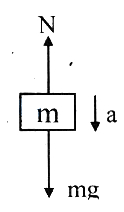
$A$ horizontal platform with a small object placed on it executes a linear $S.H.M.$ in the vertical direction. The amplitude of oscillation is $40 \text{ cm}$. What should be the least period of these oscillations, so that the object is not detached from the platform (in $\pi \text{ s}$)? [Take $g = 10 \text{ m/s}^2$]
A
$0.2$
B
$0.3$
C
$0.4$
D
$0.5$
Solution
(C) For the object to remain on the platform, the normal force $N$ must be greater than or equal to zero. The equation of motion for the object of mass $m$ is given by $mg - N = ma$, where $a$ is the acceleration of the platform.
For the object to just lose contact with the surface, the normal force $N$ becomes $0$.
Thus, $mg = ma$, which implies $a = g$.
The acceleration of a particle in $S.H.M.$ is given by $a = A\omega^2$, where $A$ is the amplitude and $\omega$ is the angular frequency.
To avoid detachment, the maximum downward acceleration of the platform must not exceed $g$.
Therefore, $A\omega^2 \leq g$.
Substituting the given values, $A = 40 \text{ cm} = 0.4 \text{ m}$ and $g = 10 \text{ m/s}^2$:
$0.4 \omega^2 = 10$
$\omega^2 = \frac{10}{0.4} = 25$
$\omega = 5 \text{ rad/s}$.
Since $\omega = \frac{2\pi}{T}$, we have:
$T = \frac{2\pi}{\omega} = \frac{2\pi}{5} = 0.4\pi \text{ s}$.
Thus, the least period of oscillation is $0.4\pi \text{ s}$.
For the object to just lose contact with the surface, the normal force $N$ becomes $0$.
Thus, $mg = ma$, which implies $a = g$.
The acceleration of a particle in $S.H.M.$ is given by $a = A\omega^2$, where $A$ is the amplitude and $\omega$ is the angular frequency.
To avoid detachment, the maximum downward acceleration of the platform must not exceed $g$.
Therefore, $A\omega^2 \leq g$.
Substituting the given values, $A = 40 \text{ cm} = 0.4 \text{ m}$ and $g = 10 \text{ m/s}^2$:
$0.4 \omega^2 = 10$
$\omega^2 = \frac{10}{0.4} = 25$
$\omega = 5 \text{ rad/s}$.
Since $\omega = \frac{2\pi}{T}$, we have:
$T = \frac{2\pi}{\omega} = \frac{2\pi}{5} = 0.4\pi \text{ s}$.
Thus, the least period of oscillation is $0.4\pi \text{ s}$.
0 likes
View Solution91
EasyMCQ
$A$ piston is performing $S.H.M.$ in the vertical direction with a frequency of $0.5 \,Hz$. $A$ block of $10 \,kg$ is placed on the piston. The maximum amplitude of the system such that the block remains in contact with the piston is: (in $\,m$)
A
$1.5$
B
$1$
C
$0.1$
D
$0.5$
Solution
(B) Given frequency $f = 0.5 \,Hz$.
Angular frequency $\omega = 2 \pi f = 2 \pi (0.5) = \pi \,rad/s$.
For the block to remain in contact with the piston, the downward acceleration of the piston at the extreme position must not exceed the acceleration due to gravity $g$.
The condition for the block to just lose contact is $a_{max} = g$.
Since $a_{max} = \omega^2 A$, we have $\omega^2 A = g$.
Substituting the values, $\pi^2 A = 10$.
Taking $\pi^2 \approx 10$, we get $10 A = 10$.
Therefore, $A = 1 \,m$.
Angular frequency $\omega = 2 \pi f = 2 \pi (0.5) = \pi \,rad/s$.
For the block to remain in contact with the piston, the downward acceleration of the piston at the extreme position must not exceed the acceleration due to gravity $g$.
The condition for the block to just lose contact is $a_{max} = g$.
Since $a_{max} = \omega^2 A$, we have $\omega^2 A = g$.
Substituting the values, $\pi^2 A = 10$.
Taking $\pi^2 \approx 10$, we get $10 A = 10$.
Therefore, $A = 1 \,m$.
0 likes
View Solution92
EasyMCQ
Under the action of a force $F = -75 y$, where $F$ is in Newton and $y$ is in meters, an object of mass $3 \,kg$ executes simple harmonic motion. If the velocity of the object at the mean position is $2.5 \,ms^{-1}$, the maximum acceleration of the object is (in $\,ms^{-2}$)
A
$5$
B
$7.5$
C
$10$
D
$12.5$
Solution
(D) Given the force equation $F = -75 y$. Comparing this with the standard $SHM$ force equation $F = -ky$, we get the force constant $k = 75 \,N/m$.
Given mass $m = 3 \,kg$, the angular frequency $\omega$ is given by $\omega = \sqrt{\frac{k}{m}} = \sqrt{\frac{75}{3}} = \sqrt{25} = 5 \,rad/s$.
The velocity at the mean position is the maximum velocity $V_{\max} = 2.5 \,m/s$.
Since $V_{\max} = A\omega$, the amplitude $A = \frac{V_{\max}}{\omega} = \frac{2.5}{5} = 0.5 \,m$.
The maximum acceleration is given by $a_{\max} = \omega^2 A$.
Substituting the values, $a_{\max} = (5)^2 \times 0.5 = 25 \times 0.5 = 12.5 \,m/s^2$.
Given mass $m = 3 \,kg$, the angular frequency $\omega$ is given by $\omega = \sqrt{\frac{k}{m}} = \sqrt{\frac{75}{3}} = \sqrt{25} = 5 \,rad/s$.
The velocity at the mean position is the maximum velocity $V_{\max} = 2.5 \,m/s$.
Since $V_{\max} = A\omega$, the amplitude $A = \frac{V_{\max}}{\omega} = \frac{2.5}{5} = 0.5 \,m$.
The maximum acceleration is given by $a_{\max} = \omega^2 A$.
Substituting the values, $a_{\max} = (5)^2 \times 0.5 = 25 \times 0.5 = 12.5 \,m/s^2$.
0 likes
View Solution93
DifficultMCQ
$A$ point mass oscillates along the $x$-axis according to $x = x_0 \sin \left(\omega t - \frac{\pi}{6}\right)$. If the acceleration of the point mass is written as $a = A \sin (\omega t + \delta)$,then:
A
$A = x_0, \delta = -\frac{\pi}{6}$
B
$A = x_0 \omega^2, \delta = -\frac{\pi}{6}$
C
$A = x_0 \omega^2, \delta = \frac{\pi}{6}$
D
$A = x_0 \omega^2, \delta = \frac{5\pi}{6}$
Solution
(D) The displacement of the particle is given by $x = x_0 \sin \left(\omega t - \frac{\pi}{6}\right)$.
Acceleration $a$ is given by $a = \frac{d^2x}{dt^2} = -\omega^2 x$.
Substituting the expression for $x$:
$a = -\omega^2 x_0 \sin \left(\omega t - \frac{\pi}{6}\right)$.
Using the trigonometric identity $-\sin(\theta) = \sin(\theta + \pi)$:
$a = \omega^2 x_0 \sin \left(\omega t - \frac{\pi}{6} + \pi\right)$.
$a = \omega^2 x_0 \sin \left(\omega t + \frac{5\pi}{6}\right)$.
Comparing this with $a = A \sin(\omega t + \delta)$,we get $A = x_0 \omega^2$ and $\delta = \frac{5\pi}{6}$.
Acceleration $a$ is given by $a = \frac{d^2x}{dt^2} = -\omega^2 x$.
Substituting the expression for $x$:
$a = -\omega^2 x_0 \sin \left(\omega t - \frac{\pi}{6}\right)$.
Using the trigonometric identity $-\sin(\theta) = \sin(\theta + \pi)$:
$a = \omega^2 x_0 \sin \left(\omega t - \frac{\pi}{6} + \pi\right)$.
$a = \omega^2 x_0 \sin \left(\omega t + \frac{5\pi}{6}\right)$.
Comparing this with $a = A \sin(\omega t + \delta)$,we get $A = x_0 \omega^2$ and $\delta = \frac{5\pi}{6}$.
0 likes
View Solution94
MediumMCQ
The maximum force acting on a particle executing simple harmonic motion is $10 \,N$. The force on the particle when it is midway between mean and extreme positions will be
A
$10 \,N$
B
$12 \,N$
C
$5 \,N$
D
zero
Solution
(C) The maximum force on a particle performing simple harmonic motion $(SHM)$ is given by $F_{\max} = m \omega^2 a = 10 \,N$, where $m$ is the mass, $\omega$ is the angular frequency, and $a$ is the amplitude.
At the mean position, the displacement $y = 0$. At the extreme position, the displacement $y = a$.
The force on the particle at any displacement $y$ is given by $F = m \omega^2 y$.
When the particle is midway between the mean and extreme positions, the displacement is $y = \frac{a}{2}$.
Substituting this value into the force equation:
$F = m \omega^2 \left(\frac{a}{2}\right) = \frac{1}{2} (m \omega^2 a)$.
Since $m \omega^2 a = 10 \,N$, we get:
$F = \frac{1}{2} \times 10 \,N = 5 \,N$.
At the mean position, the displacement $y = 0$. At the extreme position, the displacement $y = a$.
The force on the particle at any displacement $y$ is given by $F = m \omega^2 y$.
When the particle is midway between the mean and extreme positions, the displacement is $y = \frac{a}{2}$.
Substituting this value into the force equation:
$F = m \omega^2 \left(\frac{a}{2}\right) = \frac{1}{2} (m \omega^2 a)$.
Since $m \omega^2 a = 10 \,N$, we get:
$F = \frac{1}{2} \times 10 \,N = 5 \,N$.
0 likes
View Solution95
EasyMCQ
The acceleration of a particle executing $SHM$ is
A
always zero
B
always constant
C
maximum at the extreme position
D
maximum at the equilibrium position
Solution
(C) The acceleration of a particle executing $SHM$ is given by the formula:
$\alpha = -\omega^2 y$
where $\alpha$ is the acceleration,$\omega$ is the angular frequency,and $y$ is the displacement from the mean position.
From the relation $\alpha \propto y$,it is clear that the magnitude of acceleration is directly proportional to the displacement from the equilibrium position.
The maximum displacement of the particle from the mean position is equal to the amplitude $A$.
Therefore,the acceleration is maximum when the displacement $y$ is maximum (i.e.,at the extreme positions where $y = \pm A$).
$\alpha = -\omega^2 y$
where $\alpha$ is the acceleration,$\omega$ is the angular frequency,and $y$ is the displacement from the mean position.
From the relation $\alpha \propto y$,it is clear that the magnitude of acceleration is directly proportional to the displacement from the equilibrium position.
The maximum displacement of the particle from the mean position is equal to the amplitude $A$.
Therefore,the acceleration is maximum when the displacement $y$ is maximum (i.e.,at the extreme positions where $y = \pm A$).
0 likes
View Solution96
EasyMCQ
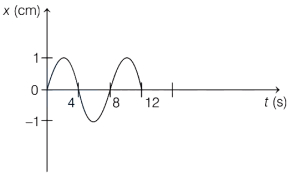
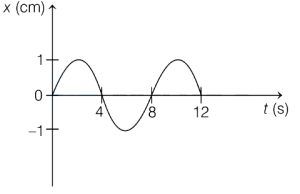
For a particle executing simple harmonic motion, the displacement-time $(x-t)$ graph is as shown in the figure. The acceleration of the particle at $t=\frac{4}{3} \,s$ is
A
$-\frac{\sqrt{3}}{32} \pi^2 \,cm \,s^{-2}$
B
$\frac{32}{\sqrt{3}} \pi^2 \,cm \,s^{-2}$
C
$+\frac{\sqrt{3}}{32} \pi cm s^{-2}$
D
$+\frac{32}{\sqrt{3}} \pi cm s^{-2}$
Solution
(A) The displacement-time graph shown in the figure is a sine wave, so the equation of displacement is $x = A \sin(\omega t)$.
From the graph, the amplitude $A = 1 \,cm$ and the time period $T = 8 \,s$.
Therefore, the angular frequency $\omega = \frac{2 \pi}{T} = \frac{2 \pi}{8} = \frac{\pi}{4} \,rad/s$.
The equation for displacement is $x = 1 \sin\left(\frac{\pi}{4} t\right)$.
The acceleration $a$ in simple harmonic motion is given by $a = -\omega^2 x = -\omega^2 A \sin(\omega t)$.
Substituting the values at $t = \frac{4}{3} \,s$:
$a = -\left(\frac{\pi}{4}\right)^2 \times 1 \times \sin\left(\frac{\pi}{4} \times \frac{4}{3}\right)$
$a = -\frac{\pi^2}{16} \times \sin\left(\frac{\pi}{3}\right)$
$a = -\frac{\pi^2}{16} \times \frac{\sqrt{3}}{2} = -\frac{\sqrt{3}}{32} \pi^2 \,cm \,s^{-2}$.
Thus, the correct option is $A$.
From the graph, the amplitude $A = 1 \,cm$ and the time period $T = 8 \,s$.
Therefore, the angular frequency $\omega = \frac{2 \pi}{T} = \frac{2 \pi}{8} = \frac{\pi}{4} \,rad/s$.
The equation for displacement is $x = 1 \sin\left(\frac{\pi}{4} t\right)$.
The acceleration $a$ in simple harmonic motion is given by $a = -\omega^2 x = -\omega^2 A \sin(\omega t)$.
Substituting the values at $t = \frac{4}{3} \,s$:
$a = -\left(\frac{\pi}{4}\right)^2 \times 1 \times \sin\left(\frac{\pi}{4} \times \frac{4}{3}\right)$
$a = -\frac{\pi^2}{16} \times \sin\left(\frac{\pi}{3}\right)$
$a = -\frac{\pi^2}{16} \times \frac{\sqrt{3}}{2} = -\frac{\sqrt{3}}{32} \pi^2 \,cm \,s^{-2}$.
Thus, the correct option is $A$.
0 likes
View Solution97
DifficultMCQ
$A$ simple harmonic oscillator has an amplitude of $0.5 \ m$ and a time period of $2 \ s$. What is the magnitude of acceleration when it is displaced from the mean position by $0.25 \ m$?
A
$\pi^{2} \ m \ s^{-2}$
B
$\frac{\pi^2}{2} \ m \ s^{-2}$
C
$\frac{\pi^2}{4} \ m \ s^{-2}$
D
$\frac{\pi^2}{8} \ m \ s^{-2}$
Solution
(C) The magnitude of acceleration $a$ for a simple harmonic oscillator at a displacement $x$ from the mean position is given by the formula $a = \omega^2 x$.
Here,$\omega$ is the angular frequency,defined as $\omega = \frac{2 \pi}{T}$.
Given: Time period $T = 2 \ s$,displacement $x = 0.25 \ m$.
First,calculate the angular frequency: $\omega = \frac{2 \pi}{2} = \pi \ rad/s$.
Now,substitute the values into the acceleration formula: $a = (\pi)^2 \times 0.25$.
Since $0.25 = \frac{1}{4}$,we get $a = \pi^2 \times \frac{1}{4} = \frac{\pi^2}{4} \ m \ s^{-2}$.
Here,$\omega$ is the angular frequency,defined as $\omega = \frac{2 \pi}{T}$.
Given: Time period $T = 2 \ s$,displacement $x = 0.25 \ m$.
First,calculate the angular frequency: $\omega = \frac{2 \pi}{2} = \pi \ rad/s$.
Now,substitute the values into the acceleration formula: $a = (\pi)^2 \times 0.25$.
Since $0.25 = \frac{1}{4}$,we get $a = \pi^2 \times \frac{1}{4} = \frac{\pi^2}{4} \ m \ s^{-2}$.
0 likes
View Solution98
MediumMCQ
For a particle executing $SHM$,determine the ratio of the average acceleration of the particle between the extreme position and the equilibrium position with respect to the maximum acceleration.
A
$\frac{4}{\pi}$
B
$\frac{2}{\pi}$
C
$\frac{1}{\pi}$
D
$\frac{1}{2 \pi}$
Solution
(B) The acceleration of a particle in $SHM$ is given by $a(t) = -\omega^2 x = -\omega^2 A \cos(\omega t)$.
At the extreme position,$x = A$ $(t = 0)$,and at the equilibrium position,$x = 0$ $(t = \frac{\pi}{2\omega})$.
The average acceleration $A_{\text{avg}}$ is defined as $\frac{1}{\Delta t} \int_{0}^{\Delta t} a(t) dt$.
Here,$\Delta t = \frac{\pi}{2\omega}$.
$A_{\text{avg}} = \frac{1}{\pi / 2\omega} \int_{0}^{\pi / 2\omega} \omega^2 A \cos(\omega t) dt = \frac{2\omega}{\pi} [A \sin(\omega t)]_{0}^{\pi / 2\omega} = \frac{2\omega A}{\pi} (1 - 0) = \frac{2\omega^2 A}{\pi}$.
Since the maximum acceleration $A_{\max} = \omega^2 A$,the ratio is $\frac{A_{\text{avg}}}{A_{\max}} = \frac{2\omega^2 A / \pi}{\omega^2 A} = \frac{2}{\pi}$.
At the extreme position,$x = A$ $(t = 0)$,and at the equilibrium position,$x = 0$ $(t = \frac{\pi}{2\omega})$.
The average acceleration $A_{\text{avg}}$ is defined as $\frac{1}{\Delta t} \int_{0}^{\Delta t} a(t) dt$.
Here,$\Delta t = \frac{\pi}{2\omega}$.
$A_{\text{avg}} = \frac{1}{\pi / 2\omega} \int_{0}^{\pi / 2\omega} \omega^2 A \cos(\omega t) dt = \frac{2\omega}{\pi} [A \sin(\omega t)]_{0}^{\pi / 2\omega} = \frac{2\omega A}{\pi} (1 - 0) = \frac{2\omega^2 A}{\pi}$.
Since the maximum acceleration $A_{\max} = \omega^2 A$,the ratio is $\frac{A_{\text{avg}}}{A_{\max}} = \frac{2\omega^2 A / \pi}{\omega^2 A} = \frac{2}{\pi}$.
0 likes
View SolutionOscillations — Acceleration and Force of Simple Harmonic Motion · Frequently Asked Questions
1Are these Oscillations questions useful for JEE and NEET?
Yes. All questions in this section are mapped to JEE Main and NEET exam patterns. Previous year questions from JEE Main, NEET, GUJCET and state-level exams are included with full solutions.
2Can I switch to Hindi or Gujarati for these questions?
Yes. Use the language tabs in the hero section or the sidebar to view the same questions and solutions in English, Hindi or Gujarati.
3How do I generate a question paper from this subtopic?
Use the Vedclass Exam Paper Generator — select the chapter and subtopic, set difficulty, and generate Sets A, B, C, D automatically. First 3 chapters of every subject are free.
Vedclass Products
For Students
Vedclass Test Series
Mock tests in real JEE/NEET style with performance analysis. 5-day free trial.
Start Free TrialFor Teachers
Exam Paper Generator
Generate Set A/B/C/D papers from this chapter in 2 minutes. 3 chapters free.
Try FreeFor Institutes
Online Exam Module
Live online exams with unlimited students, 360° analytics & white-label branding.
See DemoFor Teachers & Institutes
Generate a Oscillations Exam Paper in 2 Minutes
Select subtopic & difficulty — Sets A, B, C, D auto-generated with No Repeat logic.
First 3 chapters of every subject are free — no payment required.