
A English
Acceleration and Force of Simple Harmonic Motion Questions in English
Class 11 Physics · Oscillations · Acceleration and Force of Simple Harmonic Motion
108+
Questions
English
Language
100%
With Solutions
Showing 7 of 108 questions in English
101
EasyMCQ
$A$ point mass oscillates along the $X$-axis according to the law $x=x_0 \cos \left(\omega t-\frac{\pi}{4}\right)$. If the acceleration of the particle is written as $a=A \cos (\omega t-\delta)$,then
A
$A=x_0 \omega^2, \delta=-\frac{3 \pi}{4}$
B
$A=x_0, \delta=-\frac{\pi}{4}$
C
$A=x_0 \omega^2, \delta=\frac{\pi}{4}$
D
$A=x_0 \omega^2, \delta=\frac{3 \pi}{4}$
Solution
(A) The displacement of the particle is given by $x=x_0 \cos \left(\omega t-\frac{\pi}{4}\right)$.
Velocity $v$ is the first derivative of displacement with respect to time: $v = \frac{dx}{dt} = -x_0 \omega \sin \left(\omega t-\frac{\pi}{4}\right)$.
Acceleration $a$ is the derivative of velocity with respect to time: $a = \frac{dv}{dt} = -x_0 \omega^2 \cos \left(\omega t-\frac{\pi}{4}\right)$.
Using the trigonometric identity $\cos(\theta + \pi) = -\cos(\theta)$,we can rewrite the acceleration as:
$a = x_0 \omega^2 \cos \left(\omega t - \frac{\pi}{4} + \pi\right) = x_0 \omega^2 \cos \left(\omega t + \frac{3\pi}{4}\right)$.
To match the form $a = A \cos(\omega t - \delta)$,we write the phase as $\omega t - (-\frac{3\pi}{4})$.
Thus,$A = x_0 \omega^2$ and $\delta = -\frac{3\pi}{4}$.
Velocity $v$ is the first derivative of displacement with respect to time: $v = \frac{dx}{dt} = -x_0 \omega \sin \left(\omega t-\frac{\pi}{4}\right)$.
Acceleration $a$ is the derivative of velocity with respect to time: $a = \frac{dv}{dt} = -x_0 \omega^2 \cos \left(\omega t-\frac{\pi}{4}\right)$.
Using the trigonometric identity $\cos(\theta + \pi) = -\cos(\theta)$,we can rewrite the acceleration as:
$a = x_0 \omega^2 \cos \left(\omega t - \frac{\pi}{4} + \pi\right) = x_0 \omega^2 \cos \left(\omega t + \frac{3\pi}{4}\right)$.
To match the form $a = A \cos(\omega t - \delta)$,we write the phase as $\omega t - (-\frac{3\pi}{4})$.
Thus,$A = x_0 \omega^2$ and $\delta = -\frac{3\pi}{4}$.
0 likes
View Solution102
EasyMCQ
$A$ body is oscillating in simple harmonic motion according to the equation $x = 6 \cos \left(2 \pi t + \frac{\pi}{3}\right) \ m$. The magnitude of the acceleration (in $m/s^2$) of the body at $t = 1 \ s$ is:
A
$12 \pi^2$
B
$12 \pi$
C
$4 \pi^2$
D
$4 \pi$
Solution
(A) The displacement equation for simple harmonic motion is given as $x = 6 \cos \left(2 \pi t + \frac{\pi}{3}\right)$.
The velocity $v$ is the first derivative of displacement with respect to time:
$v = \frac{dx}{dt} = \frac{d}{dt} \left[6 \cos \left(2 \pi t + \frac{\pi}{3}\right)\right] = -6 \sin \left(2 \pi t + \frac{\pi}{3}\right) \times 2 \pi = -12 \pi \sin \left(2 \pi t + \frac{\pi}{3}\right)$.
The acceleration $a$ is the derivative of velocity with respect to time:
$a = \frac{dv}{dt} = \frac{d}{dt} \left[-12 \pi \sin \left(2 \pi t + \frac{\pi}{3}\right)\right] = -12 \pi \cos \left(2 \pi t + \frac{\pi}{3}\right) \times 2 \pi = -24 \pi^2 \cos \left(2 \pi t + \frac{\pi}{3}\right)$.
At $t = 1 \ s$,the acceleration is:
$a = -24 \pi^2 \cos \left(2 \pi(1) + \frac{\pi}{3}\right) = -24 \pi^2 \cos \left(2 \pi + \frac{\pi}{3}\right)$.
Since $\cos(2 \pi + \theta) = \cos \theta$,we have $\cos \left(2 \pi + \frac{\pi}{3}\right) = \cos \frac{\pi}{3} = \frac{1}{2}$.
Therefore,$a = -24 \pi^2 \times \frac{1}{2} = -12 \pi^2 \ m/s^2$.
The magnitude of acceleration is $|a| = 12 \pi^2 \ m/s^2$.
The velocity $v$ is the first derivative of displacement with respect to time:
$v = \frac{dx}{dt} = \frac{d}{dt} \left[6 \cos \left(2 \pi t + \frac{\pi}{3}\right)\right] = -6 \sin \left(2 \pi t + \frac{\pi}{3}\right) \times 2 \pi = -12 \pi \sin \left(2 \pi t + \frac{\pi}{3}\right)$.
The acceleration $a$ is the derivative of velocity with respect to time:
$a = \frac{dv}{dt} = \frac{d}{dt} \left[-12 \pi \sin \left(2 \pi t + \frac{\pi}{3}\right)\right] = -12 \pi \cos \left(2 \pi t + \frac{\pi}{3}\right) \times 2 \pi = -24 \pi^2 \cos \left(2 \pi t + \frac{\pi}{3}\right)$.
At $t = 1 \ s$,the acceleration is:
$a = -24 \pi^2 \cos \left(2 \pi(1) + \frac{\pi}{3}\right) = -24 \pi^2 \cos \left(2 \pi + \frac{\pi}{3}\right)$.
Since $\cos(2 \pi + \theta) = \cos \theta$,we have $\cos \left(2 \pi + \frac{\pi}{3}\right) = \cos \frac{\pi}{3} = \frac{1}{2}$.
Therefore,$a = -24 \pi^2 \times \frac{1}{2} = -12 \pi^2 \ m/s^2$.
The magnitude of acceleration is $|a| = 12 \pi^2 \ m/s^2$.
0 likes
View Solution103
EasyMCQ
If the displacement of a body is given by $x = 3 \cos \left( 2 \pi t + \frac{\pi}{4} \right) \text{ m}$,then the acceleration of the body at $t = 2 \text{ s}$ is
A
$0$
B
$-6 \sqrt{2} \pi^2 \text{ m/s}^2$
C
$-10 \pi^2 \text{ m/s}^2$
D
$-12 \sqrt{2} \pi^2 \text{ m/s}^2$
Solution
(B) The displacement of the body is given by $x = 3 \cos \left( 2 \pi t + \frac{\pi}{4} \right)$.
Velocity $v$ is the first derivative of displacement with respect to time: $v = \frac{dx}{dt} = -3 \sin \left( 2 \pi t + \frac{\pi}{4} \right) \cdot (2 \pi) = -6 \pi \sin \left( 2 \pi t + \frac{\pi}{4} \right)$.
Acceleration $a$ is the derivative of velocity with respect to time: $a = \frac{dv}{dt} = -6 \pi \cos \left( 2 \pi t + \frac{\pi}{4} \right) \cdot (2 \pi) = -12 \pi^2 \cos \left( 2 \pi t + \frac{\pi}{4} \right)$.
At $t = 2 \text{ s}$,the acceleration is $a = -12 \pi^2 \cos \left( 2 \pi (2) + \frac{\pi}{4} \right) = -12 \pi^2 \cos \left( 4 \pi + \frac{\pi}{4} \right)$.
Since $\cos(4 \pi + \theta) = \cos \theta$,we have $a = -12 \pi^2 \cos \left( \frac{\pi}{4} \right) = -12 \pi^2 \cdot \frac{1}{\sqrt{2}} = -6 \sqrt{2} \pi^2 \text{ m/s}^2$.
Velocity $v$ is the first derivative of displacement with respect to time: $v = \frac{dx}{dt} = -3 \sin \left( 2 \pi t + \frac{\pi}{4} \right) \cdot (2 \pi) = -6 \pi \sin \left( 2 \pi t + \frac{\pi}{4} \right)$.
Acceleration $a$ is the derivative of velocity with respect to time: $a = \frac{dv}{dt} = -6 \pi \cos \left( 2 \pi t + \frac{\pi}{4} \right) \cdot (2 \pi) = -12 \pi^2 \cos \left( 2 \pi t + \frac{\pi}{4} \right)$.
At $t = 2 \text{ s}$,the acceleration is $a = -12 \pi^2 \cos \left( 2 \pi (2) + \frac{\pi}{4} \right) = -12 \pi^2 \cos \left( 4 \pi + \frac{\pi}{4} \right)$.
Since $\cos(4 \pi + \theta) = \cos \theta$,we have $a = -12 \pi^2 \cos \left( \frac{\pi}{4} \right) = -12 \pi^2 \cdot \frac{1}{\sqrt{2}} = -6 \sqrt{2} \pi^2 \text{ m/s}^2$.
0 likes
View Solution104
MediumMCQ
The magnitude of maximum acceleration is $\pi$ times that of maximum velocity of a simple harmonic oscillator. The time period of the oscillator in seconds is
A
$4$
B
$2$
C
$1$
D
$0.5$
Solution
(B) The maximum acceleration of a simple harmonic oscillator is given by $a_{max} = \omega^2 A$,where $\omega$ is the angular frequency and $A$ is the amplitude.
The maximum velocity is given by $v_{max} = \omega A$.
According to the problem,the magnitude of maximum acceleration is $\pi$ times the maximum velocity:
$a_{max} = \pi \cdot v_{max}$
Substituting the expressions:
$\omega^2 A = \pi \cdot \omega A$
Dividing both sides by $\omega A$ (assuming $\omega, A \neq 0$):
$\omega = \pi$
We know that the angular frequency $\omega$ is related to the time period $T$ by the formula $\omega = \frac{2\pi}{T}$.
Substituting $\omega = \pi$:
$\pi = \frac{2\pi}{T}$
$T = 2 \text{ s}$.
The maximum velocity is given by $v_{max} = \omega A$.
According to the problem,the magnitude of maximum acceleration is $\pi$ times the maximum velocity:
$a_{max} = \pi \cdot v_{max}$
Substituting the expressions:
$\omega^2 A = \pi \cdot \omega A$
Dividing both sides by $\omega A$ (assuming $\omega, A \neq 0$):
$\omega = \pi$
We know that the angular frequency $\omega$ is related to the time period $T$ by the formula $\omega = \frac{2\pi}{T}$.
Substituting $\omega = \pi$:
$\pi = \frac{2\pi}{T}$
$T = 2 \text{ s}$.
0 likes
View Solution105
EasyMCQ
The variation of displacement with time of a simple harmonic motion $(SHM)$ for a particle of mass $m$ is represented by $y = 2 \sin \left(\frac{\pi t}{2} + \phi\right) \text{ cm}$. The maximum acceleration of the particle is
A
$\frac{\pi}{2} \text{ cm/s}^2$
B
$\frac{\pi}{2m} \text{ cm/s}^2$
C
$\frac{\pi^2}{2m} \text{ cm/s}^2$
D
$\frac{\pi^2}{2} \text{ cm/s}^2$
Solution
(D) The given displacement equation for $SHM$ is $y = 2 \sin \left(\frac{\pi t}{2} + \phi\right) \text{ cm}$.
Comparing this with the standard $SHM$ equation $y = A \sin(\omega t + \phi)$,we get the amplitude $A = 2 \text{ cm}$ and angular frequency $\omega = \frac{\pi}{2} \text{ rad/s}$.
The formula for maximum acceleration in $SHM$ is $a_{\max} = \omega^2 A$.
Substituting the values,we get $a_{\max} = \left(\frac{\pi}{2}\right)^2 \times 2$.
$a_{\max} = \frac{\pi^2}{4} \times 2 = \frac{\pi^2}{2} \text{ cm/s}^2$.
Comparing this with the standard $SHM$ equation $y = A \sin(\omega t + \phi)$,we get the amplitude $A = 2 \text{ cm}$ and angular frequency $\omega = \frac{\pi}{2} \text{ rad/s}$.
The formula for maximum acceleration in $SHM$ is $a_{\max} = \omega^2 A$.
Substituting the values,we get $a_{\max} = \left(\frac{\pi}{2}\right)^2 \times 2$.
$a_{\max} = \frac{\pi^2}{4} \times 2 = \frac{\pi^2}{2} \text{ cm/s}^2$.
0 likes
View Solution106
EasyMCQ
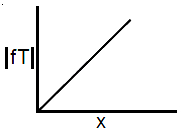
In a simple harmonic motion,let $f$ be the acceleration and $T$ be the time period. If $x$ denotes the displacement,then the $|fT|$ vs. $x$ graph will look like,
A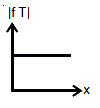
B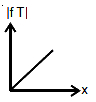
C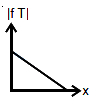
D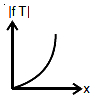
Solution
(A) In simple harmonic motion,the acceleration $f$ is given by $f = -\omega^2 x$,where $\omega$ is the angular frequency and $x$ is the displacement.
Taking the magnitude,we have $|f| = \omega^2 |x|$.
The time period $T$ is given by $T = \frac{2\pi}{\omega}$.
Therefore,the product $|fT|$ is:
$|fT| = |f| \cdot T = (\omega^2 |x|) \cdot \left(\frac{2\pi}{\omega}\right) = 2\pi\omega |x|$.
Since $2\pi\omega$ is a constant,the relationship $|fT| = (2\pi\omega) |x|$ represents a linear equation of the form $y = mx$,where $y = |fT|$ and $x$ is the displacement.
Thus,the graph of $|fT|$ versus $x$ is a straight line passing through the origin.
Taking the magnitude,we have $|f| = \omega^2 |x|$.
The time period $T$ is given by $T = \frac{2\pi}{\omega}$.
Therefore,the product $|fT|$ is:
$|fT| = |f| \cdot T = (\omega^2 |x|) \cdot \left(\frac{2\pi}{\omega}\right) = 2\pi\omega |x|$.
Since $2\pi\omega$ is a constant,the relationship $|fT| = (2\pi\omega) |x|$ represents a linear equation of the form $y = mx$,where $y = |fT|$ and $x$ is the displacement.
Thus,the graph of $|fT|$ versus $x$ is a straight line passing through the origin.
0 likes
View Solution107
MediumMCQ
$A$ particle vibrating simple harmonically has an acceleration of $16 \ cm/s^2$ when it is at a distance of $4 \ cm$ from the mean position. Its time period is: (in $s$)
A
$1$
B
$2.572$
C
$3.142$
D
$6.028$
Solution
(C) In Simple Harmonic Motion $(SHM)$,the acceleration $a$ of a vibrating particle is given by the relation $a = \omega^2 x$,where $\omega$ is the angular frequency and $x$ is the displacement from the mean position.
Given: Acceleration $a = 16 \ cm/s^2$ and displacement $x = 4 \ cm$.
Substituting these values into the formula:
$16 = \omega^2 \times 4$
$\omega^2 = \frac{16}{4} = 4$
$\omega = 2 \ rad/s$
The time period $T$ is related to angular frequency by the formula $T = \frac{2\pi}{\omega}$.
$T = \frac{2\pi}{2} = \pi \ s$
Using $\pi \approx 3.142$,we get $T = 3.142 \ s$.
Given: Acceleration $a = 16 \ cm/s^2$ and displacement $x = 4 \ cm$.
Substituting these values into the formula:
$16 = \omega^2 \times 4$
$\omega^2 = \frac{16}{4} = 4$
$\omega = 2 \ rad/s$
The time period $T$ is related to angular frequency by the formula $T = \frac{2\pi}{\omega}$.
$T = \frac{2\pi}{2} = \pi \ s$
Using $\pi \approx 3.142$,we get $T = 3.142 \ s$.
0 likes
View SolutionOscillations — Acceleration and Force of Simple Harmonic Motion · Frequently Asked Questions
1Are these Oscillations questions useful for JEE and NEET?
Yes. All questions in this section are mapped to JEE Main and NEET exam patterns. Previous year questions from JEE Main, NEET, GUJCET and state-level exams are included with full solutions.
2Can I switch to Hindi or Gujarati for these questions?
Yes. Use the language tabs in the hero section or the sidebar to view the same questions and solutions in English, Hindi or Gujarati.
3How do I generate a question paper from this subtopic?
Use the Vedclass Exam Paper Generator — select the chapter and subtopic, set difficulty, and generate Sets A, B, C, D automatically. First 3 chapters of every subject are free.
Vedclass Products
For Students
Vedclass Test Series
Mock tests in real JEE/NEET style with performance analysis. 5-day free trial.
Start Free TrialFor Teachers
Exam Paper Generator
Generate Set A/B/C/D papers from this chapter in 2 minutes. 3 chapters free.
Try FreeFor Institutes
Online Exam Module
Live online exams with unlimited students, 360° analytics & white-label branding.
See DemoFor Teachers & Institutes
Generate a Oscillations Exam Paper in 2 Minutes
Select subtopic & difficulty — Sets A, B, C, D auto-generated with No Repeat logic.
First 3 chapters of every subject are free — no payment required.