
A English
Tension Force and Pulley Block System Questions in English
Class 11 Physics · Newton's Laws of Motion and Friction · Tension Force and Pulley Block System
157+
Questions
English
Language
100%
With Solutions
Showing 49 of 157 questions in English
101
MediumMCQ
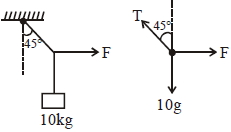
$A$ mass of $10 \; kg$ is suspended by a rope of length $4 \; m$ from the ceiling. $A$ force $F$ is applied horizontally at the mid-point of the rope such that the top half of the rope makes an angle of $45^{\circ}$ with the vertical. Then $F$ equals ........... $N$ (Take $g = 10 \; ms^{-2}$ and the rope to be massless).
A
$100$
B
$90$
C
$75$
D
$70$
Solution
(A) Let $T$ be the tension in the upper half of the rope. The lower half of the rope is vertical and supports the mass of $10 \; kg$,so the tension in the lower half is $T_{lower} = mg = 10 \times 10 = 100 \; N$.
At the mid-point where force $F$ is applied,we consider the equilibrium of forces.
The horizontal component of the tension $T$ in the upper rope must balance the applied force $F$: $T \sin 45^{\circ} = F$.
The vertical component of the tension $T$ in the upper rope must balance the downward tension from the lower rope: $T \cos 45^{\circ} = T_{lower} = 100 \; N$.
Dividing the two equations: $\frac{T \sin 45^{\circ}}{T \cos 45^{\circ}} = \frac{F}{100}$.
$\tan 45^{\circ} = \frac{F}{100}$.
Since $\tan 45^{\circ} = 1$,we get $1 = \frac{F}{100}$,which implies $F = 100 \; N$.
At the mid-point where force $F$ is applied,we consider the equilibrium of forces.
The horizontal component of the tension $T$ in the upper rope must balance the applied force $F$: $T \sin 45^{\circ} = F$.
The vertical component of the tension $T$ in the upper rope must balance the downward tension from the lower rope: $T \cos 45^{\circ} = T_{lower} = 100 \; N$.
Dividing the two equations: $\frac{T \sin 45^{\circ}}{T \cos 45^{\circ}} = \frac{F}{100}$.
$\tan 45^{\circ} = \frac{F}{100}$.
Since $\tan 45^{\circ} = 1$,we get $1 = \frac{F}{100}$,which implies $F = 100 \; N$.
0 likes
View Solution102
MediumMCQ
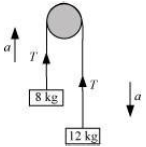
Two masses $8\; kg$ and $12\; kg$ are connected at the two ends of a light inextensible string that goes over a frictionless pulley. Find the acceleration of the masses and the tension in the string when the masses are released.
A
$2\; m/s^2$ and $72\; N$
B
$3\; m/s^2$ and $108\; N$
C
$4\; m/s^2$ and $96\; N$
D
$2\; m/s^2$ and $96\; N$
Solution
(D) Let the masses be $m_1 = 8\; kg$ and $m_2 = 12\; kg$. The system is connected by a light inextensible string over a frictionless pulley.
Since $m_2 > m_1$,the mass $m_2$ moves downward with acceleration $a$,and $m_1$ moves upward with the same acceleration $a$.
Applying Newton's second law of motion:
For mass $m_1$: $T - m_1 g = m_1 a$ --- $(i)$
For mass $m_2$: $m_2 g - T = m_2 a$ --- $(ii)$
Adding equations $(i)$ and $(ii)$:
$(m_2 - m_1) g = (m_1 + m_2) a$
$a = \left( \frac{m_2 - m_1}{m_1 + m_2} \right) g = \left( \frac{12 - 8}{12 + 8} \right) \times 10 = \frac{4}{20} \times 10 = 2\; m/s^2$
Now,substitute $a$ into equation $(ii)$ to find tension $T$:
$T = m_2(g - a) = 12(10 - 2) = 12 \times 8 = 96\; N$
Thus,the acceleration is $2\; m/s^2$ and the tension is $96\; N$.
Since $m_2 > m_1$,the mass $m_2$ moves downward with acceleration $a$,and $m_1$ moves upward with the same acceleration $a$.
Applying Newton's second law of motion:
For mass $m_1$: $T - m_1 g = m_1 a$ --- $(i)$
For mass $m_2$: $m_2 g - T = m_2 a$ --- $(ii)$
Adding equations $(i)$ and $(ii)$:
$(m_2 - m_1) g = (m_1 + m_2) a$
$a = \left( \frac{m_2 - m_1}{m_1 + m_2} \right) g = \left( \frac{12 - 8}{12 + 8} \right) \times 10 = \frac{4}{20} \times 10 = 2\; m/s^2$
Now,substitute $a$ into equation $(ii)$ to find tension $T$:
$T = m_2(g - a) = 12(10 - 2) = 12 \times 8 = 96\; N$
Thus,the acceleration is $2\; m/s^2$ and the tension is $96\; N$.
0 likes
View Solution103
Medium
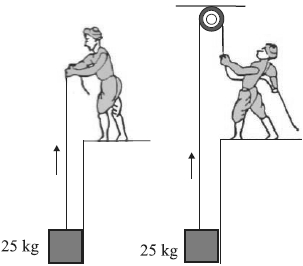
$A$ block of mass $25 \; kg$ is raised by a $50 \; kg$ man in two different ways as shown in the figure. What is the action on the floor by the man in the two cases? If the floor yields to a normal force of $700 \; N$,which mode should the man adopt to lift the block without the floor yielding?
Solution
(B) Mass of the block,$m = 25 \; kg$
Mass of the man,$M = 50 \; kg$
Acceleration due to gravity,$g = 10 \; m/s^2$
Force required to lift the block,$F = mg = 25 \times 10 = 250 \; N$
Weight of the man,$W = Mg = 50 \times 10 = 500 \; N$
Case $(a)$: When the man lifts the block directly,he pulls the rope upwards. By Newton's third law,the rope pulls the man downwards with a force $F = 250 \; N$. The total downward force on the floor is the sum of the man's weight and the reaction force from the rope.
Action on the floor $= W + F = 500 + 250 = 750 \; N$.
Case $(b)$: When the man lifts the block using a pulley,he pulls the rope downwards. By Newton's third law,the rope pulls the man upwards with a force $F = 250 \; N$. The net downward force on the floor is the man's weight minus the upward reaction force from the rope.
Action on the floor $= W - F = 500 - 250 = 250 \; N$.
Conclusion: Since the floor yields at $700 \; N$,the man should adopt method $(b)$ to lift the block,as the force exerted on the floor $(250 \; N)$ is less than the limit of $700 \; N$.
Mass of the man,$M = 50 \; kg$
Acceleration due to gravity,$g = 10 \; m/s^2$
Force required to lift the block,$F = mg = 25 \times 10 = 250 \; N$
Weight of the man,$W = Mg = 50 \times 10 = 500 \; N$
Case $(a)$: When the man lifts the block directly,he pulls the rope upwards. By Newton's third law,the rope pulls the man downwards with a force $F = 250 \; N$. The total downward force on the floor is the sum of the man's weight and the reaction force from the rope.
Action on the floor $= W + F = 500 + 250 = 750 \; N$.
Case $(b)$: When the man lifts the block using a pulley,he pulls the rope downwards. By Newton's third law,the rope pulls the man upwards with a force $F = 250 \; N$. The net downward force on the floor is the man's weight minus the upward reaction force from the rope.
Action on the floor $= W - F = 500 - 250 = 250 \; N$.
Conclusion: Since the floor yields at $700 \; N$,the man should adopt method $(b)$ to lift the block,as the force exerted on the floor $(250 \; N)$ is less than the limit of $700 \; N$.
1 likes
View Solution104
MediumMCQ
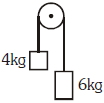
Two bodies of mass $4 \, kg$ and $6 \, kg$ are tied to the ends of a massless string. The string passes over a pulley which is frictionless (see figure). The acceleration of the system in terms of acceleration due to gravity $(g)$ is
A
$\frac{g}{10}$
B
$g$
C
$\frac{g}{2}$
D
$\frac{g}{5}$
Solution
(D) For a system of two masses $m_1$ and $m_2$ connected by a string over a frictionless pulley,the acceleration $a$ is given by the formula:
$a = \frac{(m_2 - m_1)g}{m_1 + m_2}$
Here,$m_1 = 4 \, kg$ and $m_2 = 6 \, kg$.
Substituting the values into the formula:
$a = \frac{(6 - 4)g}{6 + 4}$
$a = \frac{2g}{10}$
$a = \frac{g}{5}$
Thus,the acceleration of the system is $\frac{g}{5}$.
$a = \frac{(m_2 - m_1)g}{m_1 + m_2}$
Here,$m_1 = 4 \, kg$ and $m_2 = 6 \, kg$.
Substituting the values into the formula:
$a = \frac{(6 - 4)g}{6 + 4}$
$a = \frac{2g}{10}$
$a = \frac{g}{5}$
Thus,the acceleration of the system is $\frac{g}{5}$.
1 likes
View Solution105
DifficultMCQ
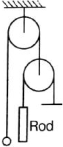
In the figure,the mass of a ball is $\frac{9}{5}$ times the mass of the rod. The length of the rod is $1 \, m$. The initial level of the ball is the same as the lower end of the rod. Find the time taken by the ball to reach the upper end of the rod. (in $s$)
A
$1.4$
B
$2.45$
C
$3.25$
D
$5$
Solution
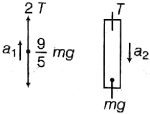
(A) Let $a_{1}$ and $a_{2}$ be the accelerations of the ball (upward) and the rod (downward),respectively.
From the constraint relation,$2 a_{1} = a_{2} \dots (i)$
For the ball,the equation of motion is: $2T - \frac{9}{5}mg = \frac{9}{5}ma_{1} \dots (ii)$
For the rod,the equation of motion is: $mg - T = ma_{2} \dots (iii)$
Substituting $T = mg - ma_{2}$ from $(iii)$ into $(ii)$:
$2(mg - ma_{2}) - \frac{9}{5}mg = \frac{9}{5}ma_{1}$
$2mg - 2ma_{2} - 1.8mg = 1.8ma_{1}$
$0.2g - 2a_{2} = 1.8a_{1}$
Using $a_{2} = 2a_{1}$ from $(i)$:
$0.2g - 2(2a_{1}) = 1.8a_{1}$
$0.2g = 5.8a_{1} \implies a_{1} = \frac{0.2g}{5.8} = \frac{g}{29} \, m/s^2$ (upward)
Then $a_{2} = 2a_{1} = \frac{2g}{29} \, m/s^2$ (downward)
The relative acceleration of the ball with respect to the rod is $a_{rel} = a_{1} + a_{2} = \frac{g}{29} + \frac{2g}{29} = \frac{3g}{29}$.
Using the equation of motion $s = ut + \frac{1}{2}a_{rel}t^2$ with $u=0$ and $s=1 \, m$:
$1 = 0 + \frac{1}{2} \left(\frac{3 \times 10}{29}\right) t^2$
$1 = \frac{15}{29} t^2 \implies t^2 = \frac{29}{15} \approx 1.933$
$t = \sqrt{1.933} \approx 1.39 \, s \approx 1.4 \, s$.
From the constraint relation,$2 a_{1} = a_{2} \dots (i)$
For the ball,the equation of motion is: $2T - \frac{9}{5}mg = \frac{9}{5}ma_{1} \dots (ii)$
For the rod,the equation of motion is: $mg - T = ma_{2} \dots (iii)$
Substituting $T = mg - ma_{2}$ from $(iii)$ into $(ii)$:
$2(mg - ma_{2}) - \frac{9}{5}mg = \frac{9}{5}ma_{1}$
$2mg - 2ma_{2} - 1.8mg = 1.8ma_{1}$
$0.2g - 2a_{2} = 1.8a_{1}$
Using $a_{2} = 2a_{1}$ from $(i)$:
$0.2g - 2(2a_{1}) = 1.8a_{1}$
$0.2g = 5.8a_{1} \implies a_{1} = \frac{0.2g}{5.8} = \frac{g}{29} \, m/s^2$ (upward)
Then $a_{2} = 2a_{1} = \frac{2g}{29} \, m/s^2$ (downward)
The relative acceleration of the ball with respect to the rod is $a_{rel} = a_{1} + a_{2} = \frac{g}{29} + \frac{2g}{29} = \frac{3g}{29}$.
Using the equation of motion $s = ut + \frac{1}{2}a_{rel}t^2$ with $u=0$ and $s=1 \, m$:
$1 = 0 + \frac{1}{2} \left(\frac{3 \times 10}{29}\right) t^2$
$1 = \frac{15}{29} t^2 \implies t^2 = \frac{29}{15} \approx 1.933$
$t = \sqrt{1.933} \approx 1.39 \, s \approx 1.4 \, s$.
0 likes
View Solution106
MediumMCQ
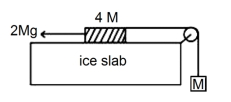
$A$ hanging mass $M$ is connected to a four times larger mass $(4M)$ by using a string-pulley arrangement as shown in the figure. The larger mass is placed on a horizontal ice slab and is being pulled by a $2Mg$ force. In this situation,the tension in the string is $\frac{x}{5}Mg$. Find the value of $x$. Neglect the mass of the string and the friction between the block (larger mass) and the ice slab. (Given $g$ = acceleration due to gravity)
A
$2$
B
$7$
C
$6$
D
$8$
Solution
(C) Let the acceleration of the system be $a$ towards the left.
For the mass $4M$ on the ice slab,the forces acting are the pulling force $2Mg$ to the left and the tension $T$ to the right. Applying Newton's second law: $2Mg - T = 4Ma$ (Equation $1$).
For the hanging mass $M$,the forces acting are the tension $T$ upwards and its weight $Mg$ downwards. Since the system accelerates towards the left,the mass $M$ moves upwards. Applying Newton's second law: $T - Mg = Ma$ (Equation $2$).
Adding Equation $1$ and Equation $2$: $(2Mg - T) + (T - Mg) = 4Ma + Ma$.
$Mg = 5Ma$,which gives $a = \frac{g}{5}$.
Substituting the value of $a$ in Equation $2$: $T = Mg + M(\frac{g}{5}) = Mg + \frac{Mg}{5} = \frac{6Mg}{5}$.
Comparing this with the given expression $\frac{x}{5}Mg$,we get $x = 6$.
For the mass $4M$ on the ice slab,the forces acting are the pulling force $2Mg$ to the left and the tension $T$ to the right. Applying Newton's second law: $2Mg - T = 4Ma$ (Equation $1$).
For the hanging mass $M$,the forces acting are the tension $T$ upwards and its weight $Mg$ downwards. Since the system accelerates towards the left,the mass $M$ moves upwards. Applying Newton's second law: $T - Mg = Ma$ (Equation $2$).
Adding Equation $1$ and Equation $2$: $(2Mg - T) + (T - Mg) = 4Ma + Ma$.
$Mg = 5Ma$,which gives $a = \frac{g}{5}$.
Substituting the value of $a$ in Equation $2$: $T = Mg + M(\frac{g}{5}) = Mg + \frac{Mg}{5} = \frac{6Mg}{5}$.
Comparing this with the given expression $\frac{x}{5}Mg$,we get $x = 6$.
1 likes
View Solution107
MediumMCQ
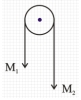
Two masses $M_{1}$ and $M_{2}$ are tied together at the two ends of a light inextensible string that passes over a frictionless pulley. When the mass $M_{2}$ is twice that of $M_{1}$,the acceleration of the system is $a_{1}$. When the mass $M_{2}$ is thrice that of $M_{1}$,the acceleration of the system is $a_{2}$. The ratio $\frac{a_{1}}{a_{2}}$ will be:
A
$\frac{1}{3}$
B
$\frac{2}{3}$
C
$\frac{3}{2}$
D
$\frac{1}{2}$
Solution
(B) The acceleration of a system of two masses $M_{1}$ and $M_{2}$ connected by a string over a frictionless pulley is given by the formula:
$a = \frac{|M_{2} - M_{1}|}{M_{1} + M_{2}} g$
Case $1$: Given $M_{2} = 2M_{1}$.
$a_{1} = \frac{|2M_{1} - M_{1}|}{M_{1} + 2M_{1}} g = \frac{M_{1}}{3M_{1}} g = \frac{g}{3}$
Case $2$: Given $M_{2} = 3M_{1}$.
$a_{2} = \frac{|3M_{1} - M_{1}|}{M_{1} + 3M_{1}} g = \frac{2M_{1}}{4M_{1}} g = \frac{g}{2}$
Now,calculating the ratio $\frac{a_{1}}{a_{2}}$:
$\frac{a_{1}}{a_{2}} = \frac{g/3}{g/2} = \frac{2}{3}$
Therefore,the correct option is $B$.
$a = \frac{|M_{2} - M_{1}|}{M_{1} + M_{2}} g$
Case $1$: Given $M_{2} = 2M_{1}$.
$a_{1} = \frac{|2M_{1} - M_{1}|}{M_{1} + 2M_{1}} g = \frac{M_{1}}{3M_{1}} g = \frac{g}{3}$
Case $2$: Given $M_{2} = 3M_{1}$.
$a_{2} = \frac{|3M_{1} - M_{1}|}{M_{1} + 3M_{1}} g = \frac{2M_{1}}{4M_{1}} g = \frac{g}{2}$
Now,calculating the ratio $\frac{a_{1}}{a_{2}}$:
$\frac{a_{1}}{a_{2}} = \frac{g/3}{g/2} = \frac{2}{3}$
Therefore,the correct option is $B$.
0 likes
View Solution108
MediumMCQ
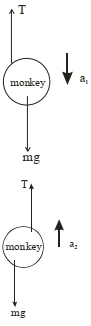
$A$ monkey of mass $50\,kg$ climbs on a rope which can withstand the tension $(T)$ of $350\,N$. If the monkey initially climbs down with an acceleration of $4\,m/s^2$ and then climbs up with an acceleration of $5\,m/s^2$,choose the correct option $(g = 10\,m/s^2)$.
A
$T = 700\,N$ while climbing upward.
B
$T = 350\,N$ while going downward.
C
Rope will break while climbing upward.
D
Rope will break while going downward.
Solution
(C) Free Body Diagram ($F$.$B$.$D$) of the monkey while moving downward:
Using Newton's second law: $mg - T = ma_1$
$500 - T = 50 \times 4 \Rightarrow T = 300\,N$.
Free Body Diagram ($F$.$B$.$D$) of the monkey while moving upward:
Using Newton's second law of motion: $T - mg = ma_2$
$T - 500 = 50 \times 5 \Rightarrow T = 750\,N$.
Breaking strength of the string is $350\,N$.
Since $750\,N > 350\,N$,the string will break while the monkey is moving upward.
Using Newton's second law: $mg - T = ma_1$
$500 - T = 50 \times 4 \Rightarrow T = 300\,N$.
Free Body Diagram ($F$.$B$.$D$) of the monkey while moving upward:
Using Newton's second law of motion: $T - mg = ma_2$
$T - 500 = 50 \times 5 \Rightarrow T = 750\,N$.
Breaking strength of the string is $350\,N$.
Since $750\,N > 350\,N$,the string will break while the monkey is moving upward.
0 likes
View Solution109
DifficultMCQ
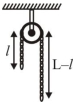
$A$ uniform metal chain of mass $m$ and length $L$ passes over a massless and frictionless pulley. It is released from rest with a part of its length $l$ hanging on one side and the rest of its length $L - l$ hanging on the other side of the pulley. At a certain point in time,when $l = \frac{L}{x}$,the acceleration of the chain is $\frac{g}{2}$. The value of $x$ is ........
A
$6$
B
$2$
C
$1.5$
D
$4$
Solution
(D) Let $\lambda$ be the linear mass density of the chain,so $\lambda = \frac{m}{L}$.
The mass of the chain on one side is $m_1 = \lambda l$ and on the other side is $m_2 = \lambda (L - l)$.
The net force on the chain is $F_{net} = (m_2 - m_1)g = \lambda(L - l - l)g = \lambda(L - 2l)g$.
The total mass of the chain is $m = \lambda L$.
The acceleration $a$ of the chain is given by $a = \frac{F_{net}}{m} = \frac{\lambda(L - 2l)g}{\lambda L} = \frac{(L - 2l)g}{L}$.
Given that $a = \frac{g}{2}$ when $l = \frac{L}{x}$,we substitute these values:
$\frac{g}{2} = \frac{(L - 2(\frac{L}{x}))g}{L}$
$\frac{1}{2} = 1 - \frac{2}{x}$
$\frac{2}{x} = 1 - \frac{1}{2} = \frac{1}{2}$
$x = 4$.
The mass of the chain on one side is $m_1 = \lambda l$ and on the other side is $m_2 = \lambda (L - l)$.
The net force on the chain is $F_{net} = (m_2 - m_1)g = \lambda(L - l - l)g = \lambda(L - 2l)g$.
The total mass of the chain is $m = \lambda L$.
The acceleration $a$ of the chain is given by $a = \frac{F_{net}}{m} = \frac{\lambda(L - 2l)g}{\lambda L} = \frac{(L - 2l)g}{L}$.
Given that $a = \frac{g}{2}$ when $l = \frac{L}{x}$,we substitute these values:
$\frac{g}{2} = \frac{(L - 2(\frac{L}{x}))g}{L}$
$\frac{1}{2} = 1 - \frac{2}{x}$
$\frac{2}{x} = 1 - \frac{1}{2} = \frac{1}{2}$
$x = 4$.

0 likes
View Solution110
AdvancedMCQ
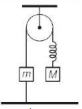
An arrangement of a spring,strings,a pulley,and masses is shown in the figure below. The pulley and the strings are massless and $M > m$. The spring is light with spring constant $k$. If the string connecting $m$ to the ground is detached,then immediately after detachment,
A
the magnitude of the acceleration of $m$ is zero and that of $M$ is $g$
B
the magnitude of the acceleration of $m$ is $(M-m)g/m$ and that of $M$ is zero
C
the accelerations of both masses are same
D
the elongation in the spring is $(M-m)g/k$
Solution
(B) Initially,the system is in equilibrium. For mass $M$,the spring force $F_s = Mg$. Since the pulley is massless and the string is continuous,the tension $T$ in the string is equal to the spring force,so $T = Mg$.
For mass $m$,the forces are tension $T$ upwards and gravity $mg$ downwards. Since it is in equilibrium,$T = mg$,which implies $Mg = mg$. However,the problem states $M > m$,which implies the initial setup must have been held in equilibrium by the string connected to the ground.
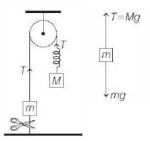
Immediately after the string connected to $m$ is detached,the tension $T$ in the string becomes zero. The spring force $F_s$ cannot change instantaneously,so $F_s = Mg$ remains acting on $M$ upwards.
For mass $M$,the forces are $Mg$ downwards and $F_s = Mg$ upwards. Thus,the net force on $M$ is zero,and its acceleration is $0$.
For mass $m$,the only force acting is gravity $mg$ downwards. Thus,its acceleration is $g$ downwards. Wait,let's re-evaluate: The tension $T$ was supporting $m$. If the string to the ground is cut,the tension $T$ in the string connected to the pulley becomes $Mg$. The forces on $m$ are $T = Mg$ upwards and $mg$ downwards. The net force is $Mg - mg$ upwards. Therefore,the acceleration of $m$ is $a_m = (Mg - mg)/m = (M-m)g/m$ upwards. The acceleration of $M$ is zero because the spring force $Mg$ balances its weight $Mg$.
For mass $m$,the forces are tension $T$ upwards and gravity $mg$ downwards. Since it is in equilibrium,$T = mg$,which implies $Mg = mg$. However,the problem states $M > m$,which implies the initial setup must have been held in equilibrium by the string connected to the ground.
Immediately after the string connected to $m$ is detached,the tension $T$ in the string becomes zero. The spring force $F_s$ cannot change instantaneously,so $F_s = Mg$ remains acting on $M$ upwards.
For mass $M$,the forces are $Mg$ downwards and $F_s = Mg$ upwards. Thus,the net force on $M$ is zero,and its acceleration is $0$.
For mass $m$,the only force acting is gravity $mg$ downwards. Thus,its acceleration is $g$ downwards. Wait,let's re-evaluate: The tension $T$ was supporting $m$. If the string to the ground is cut,the tension $T$ in the string connected to the pulley becomes $Mg$. The forces on $m$ are $T = Mg$ upwards and $mg$ downwards. The net force is $Mg - mg$ upwards. Therefore,the acceleration of $m$ is $a_m = (Mg - mg)/m = (M-m)g/m$ upwards. The acceleration of $M$ is zero because the spring force $Mg$ balances its weight $Mg$.
0 likes
View Solution111
MediumMCQ
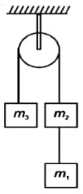
Three blocks of masses $m_1=4 \, kg$, $m_2=2 \, kg$, and $m_3=4 \, kg$ are connected with ideal strings passing over a smooth, massless pulley as shown in the figure. The acceleration of the blocks will be ......... $m/s^2$ $(g=10 \, m/s^2)$.
A
$2$
B
$4$
C
$3$
D
$5$
Solution
(A) The system consists of two sides connected by a pulley. On one side, we have mass $m_3 = 4 \, kg$. On the other side, we have masses $m_1$ and $m_2$ connected in series, so the total mass on that side is $M_{right} = m_1 + m_2 = 4 \, kg + 2 \, kg = 6 \, kg$.
The net force $F_{net}$ acting on the system is the difference between the weights on both sides:
$F_{net} = (M_{right} \cdot g) - (m_3 \cdot g) = (6 \, kg \cdot 10 \, m/s^2) - (4 \, kg \cdot 10 \, m/s^2) = 60 \, N - 40 \, N = 20 \, N$.
The total mass of the system is $M_{total} = m_1 + m_2 + m_3 = 4 \, kg + 2 \, kg + 4 \, kg = 10 \, kg$.
Using Newton's second law, $a = \frac{F_{net}}{M_{total}} = \frac{20 \, N}{10 \, kg} = 2 \, m/s^2$.
Therefore, the acceleration of the blocks is $2 \, m/s^2$.
The net force $F_{net}$ acting on the system is the difference between the weights on both sides:
$F_{net} = (M_{right} \cdot g) - (m_3 \cdot g) = (6 \, kg \cdot 10 \, m/s^2) - (4 \, kg \cdot 10 \, m/s^2) = 60 \, N - 40 \, N = 20 \, N$.
The total mass of the system is $M_{total} = m_1 + m_2 + m_3 = 4 \, kg + 2 \, kg + 4 \, kg = 10 \, kg$.
Using Newton's second law, $a = \frac{F_{net}}{M_{total}} = \frac{20 \, N}{10 \, kg} = 2 \, m/s^2$.
Therefore, the acceleration of the blocks is $2 \, m/s^2$.
0 likes
View Solution112
MediumMCQ
The tension in the string connected between the two blocks is ......... $N$.

A
$\frac{80}{3}$
B
$\frac{40}{3}$
C
$\frac{50}{7}$
D
$26$
Solution
(B) Given:
$F_1 = 20 \, N$ (force on $4 \, kg$ block to the right)
$F_2 = 10 \, N$ (force on $2 \, kg$ block to the left)
$m_1 = 2 \, kg$,$m_2 = 4 \, kg$
Let $T$ be the tension in the string.
Since $F_1 > F_2$,the system accelerates towards the right.
The net force on the system is $F_{net} = F_1 - F_2 = 20 - 10 = 10 \, N$.
The total mass of the system is $M = m_1 + m_2 = 2 + 4 = 6 \, kg$.
The acceleration of the system is $a = \frac{F_{net}}{M} = \frac{10}{6} = \frac{5}{3} \, m/s^2$.
Now,consider the free body diagram of the $2 \, kg$ block:
The forces acting on it are $T$ (to the right) and $F_2$ (to the left).
$T - F_2 = m_1 a$
$T - 10 = 2 \times \frac{5}{3}$
$T = 10 + \frac{10}{3} = \frac{30 + 10}{3} = \frac{40}{3} \, N$.
$F_1 = 20 \, N$ (force on $4 \, kg$ block to the right)
$F_2 = 10 \, N$ (force on $2 \, kg$ block to the left)
$m_1 = 2 \, kg$,$m_2 = 4 \, kg$
Let $T$ be the tension in the string.
Since $F_1 > F_2$,the system accelerates towards the right.
The net force on the system is $F_{net} = F_1 - F_2 = 20 - 10 = 10 \, N$.
The total mass of the system is $M = m_1 + m_2 = 2 + 4 = 6 \, kg$.
The acceleration of the system is $a = \frac{F_{net}}{M} = \frac{10}{6} = \frac{5}{3} \, m/s^2$.
Now,consider the free body diagram of the $2 \, kg$ block:
The forces acting on it are $T$ (to the right) and $F_2$ (to the left).
$T - F_2 = m_1 a$
$T - 10 = 2 \times \frac{5}{3}$
$T = 10 + \frac{10}{3} = \frac{30 + 10}{3} = \frac{40}{3} \, N$.
0 likes
View Solution113
MediumMCQ
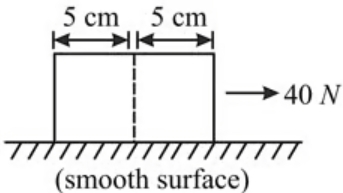
$A$ block of mass $m$ is pulled by a force of $40 \, N$ on a smooth horizontal surface as shown in the figure. The tension at the middle of the block is ........... $N$.
A
$10$
B
$20$
C
$25$
D
$30$
Solution
(B) Let the total mass of the block be $m$. The force applied is $F = 40 \, N$.
According to Newton's second law,the acceleration $a$ of the block is given by $a = \frac{F}{m} = \frac{40}{m}$.
Now,consider the block to be divided into two equal halves,each of mass $\frac{m}{2}$.
Let $T$ be the tension at the middle of the block. This tension $T$ acts as the force pulling the rear half of the block.
Applying Newton's second law to the rear half of the block:
$T = (\text{mass of rear half}) \times a$
$T = \left(\frac{m}{2}\right) \times \left(\frac{40}{m}\right)$
$T = \frac{40}{2} = 20 \, N$.
Therefore,the tension at the middle of the block is $20 \, N$.
According to Newton's second law,the acceleration $a$ of the block is given by $a = \frac{F}{m} = \frac{40}{m}$.
Now,consider the block to be divided into two equal halves,each of mass $\frac{m}{2}$.
Let $T$ be the tension at the middle of the block. This tension $T$ acts as the force pulling the rear half of the block.
Applying Newton's second law to the rear half of the block:
$T = (\text{mass of rear half}) \times a$
$T = \left(\frac{m}{2}\right) \times \left(\frac{40}{m}\right)$
$T = \frac{40}{2} = 20 \, N$.
Therefore,the tension at the middle of the block is $20 \, N$.
0 likes
View Solution114
MediumMCQ
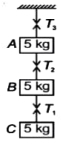
Three blocks of mass $5 \ kg$ each are suspended from a ceiling as shown in the figure. The value of $\frac{T_3}{T_1}$ is .............
A
$1$
B
$2$
C
$3$
D
$\frac{3}{2}$
Solution
(C) The system is in equilibrium,so the acceleration $a = 0$.
For block $C$ (mass $m = 5 \ kg$): The tension $T_1$ supports the weight of block $C$.
$T_1 = mg = 5 \times 10 = 50 \ N$.
For block $B$ (mass $m = 5 \ kg$): The tension $T_2$ supports the weight of block $B$ and block $C$.
$T_2 = (m + m)g = 10 \times 10 = 100 \ N$.
For block $A$ (mass $m = 5 \ kg$): The tension $T_3$ supports the weight of blocks $A$,$B$,and $C$.
$T_3 = (m + m + m)g = 15 \times 10 = 150 \ N$.
Therefore,the ratio is:
$\frac{T_3}{T_1} = \frac{150}{50} = 3$.
For block $C$ (mass $m = 5 \ kg$): The tension $T_1$ supports the weight of block $C$.
$T_1 = mg = 5 \times 10 = 50 \ N$.
For block $B$ (mass $m = 5 \ kg$): The tension $T_2$ supports the weight of block $B$ and block $C$.
$T_2 = (m + m)g = 10 \times 10 = 100 \ N$.
For block $A$ (mass $m = 5 \ kg$): The tension $T_3$ supports the weight of blocks $A$,$B$,and $C$.
$T_3 = (m + m + m)g = 15 \times 10 = 150 \ N$.
Therefore,the ratio is:
$\frac{T_3}{T_1} = \frac{150}{50} = 3$.
0 likes
View Solution115
DifficultMCQ
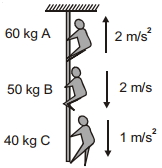
Tension in the rope at the rigid support is ............ $N$ $\left(g=10 \,m / s ^2\right)$
A
$760$
B
$1360$
C
$1580$
D
$1620$
Solution
(C) The total tension $T$ at the rigid support is the sum of the tensions exerted by each man on the rope.
For man $A$ $(m_A = 60 \, kg)$ ascending with acceleration $a_A = 2 \, m/s^2$:
$T_A - m_A g = m_A a_A$
$T_A = m_A(g + a_A) = 60(10 + 2) = 60 \times 12 = 720 \, N$
For man $B$ $(m_B = 50 \, kg)$ descending with constant velocity $(a_B = 0)$:
$T_B = m_B g = 50 \times 10 = 500 \, N$
For man $C$ $(m_C = 40 \, kg)$ descending with acceleration $a_C = 1 \, m/s^2$:
$m_C g - T_C = m_C a_C$
$T_C = m_C(g - a_C) = 40(10 - 1) = 40 \times 9 = 360 \, N$
The total tension at the rigid support is $T = T_A + T_B + T_C = 720 + 500 + 360 = 1580 \, N$.
For man $A$ $(m_A = 60 \, kg)$ ascending with acceleration $a_A = 2 \, m/s^2$:
$T_A - m_A g = m_A a_A$
$T_A = m_A(g + a_A) = 60(10 + 2) = 60 \times 12 = 720 \, N$
For man $B$ $(m_B = 50 \, kg)$ descending with constant velocity $(a_B = 0)$:
$T_B = m_B g = 50 \times 10 = 500 \, N$
For man $C$ $(m_C = 40 \, kg)$ descending with acceleration $a_C = 1 \, m/s^2$:
$m_C g - T_C = m_C a_C$
$T_C = m_C(g - a_C) = 40(10 - 1) = 40 \times 9 = 360 \, N$
The total tension at the rigid support is $T = T_A + T_B + T_C = 720 + 500 + 360 = 1580 \, N$.
0 likes
View Solution116
EasyMCQ
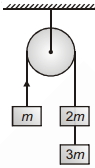
In the figure given below,with what acceleration will the block of mass $m$ move? (Pulley and strings are massless and frictionless)
A
$\frac{g}{3}$
B
$\frac{2 g}{5}$
C
$\frac{2 g}{3}$
D
$\frac{g}{2}$
Solution
(C) The system consists of a pulley with a mass $m$ on one side and a combined mass of $2m + 3m = 5m$ on the other side.
For an Atwood machine with masses $M_1$ and $M_2$,the acceleration $a$ is given by $a = \left( \frac{M_1 - M_2}{M_1 + M_2} \right) g$.
Here,$M_1 = 5m$ and $M_2 = m$.
Substituting these values into the formula:
$a = \left( \frac{5m - m}{5m + m} \right) g$
$a = \left( \frac{4m}{6m} \right) g$
$a = \frac{2}{3} g$
Therefore,the block of mass $m$ will move upward with an acceleration of $\frac{2g}{3}$.
For an Atwood machine with masses $M_1$ and $M_2$,the acceleration $a$ is given by $a = \left( \frac{M_1 - M_2}{M_1 + M_2} \right) g$.
Here,$M_1 = 5m$ and $M_2 = m$.
Substituting these values into the formula:
$a = \left( \frac{5m - m}{5m + m} \right) g$
$a = \left( \frac{4m}{6m} \right) g$
$a = \frac{2}{3} g$
Therefore,the block of mass $m$ will move upward with an acceleration of $\frac{2g}{3}$.
0 likes
View Solution117
MediumMCQ
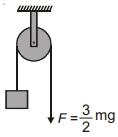
In the arrangement shown,the mass $m$ will ascend with an acceleration (Pulley and rope are massless).
A
Zero
B
$\frac{g}{2}$
C
$g$
D
$2 g$
Solution
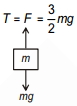
(B) The tension $T$ in the rope is equal to the applied force $F$,so $T = F = \frac{3}{2} mg$.
Applying Newton's second law to the mass $m$:
$F_{\text{net}} = ma$
Here,the upward force is tension $T$ and the downward force is the weight $mg$:
$T - mg = ma$
Substituting the value of $T$:
$\frac{3}{2} mg - mg = ma$
$\frac{1}{2} mg = ma$
$a = \frac{g}{2}$
Applying Newton's second law to the mass $m$:
$F_{\text{net}} = ma$
Here,the upward force is tension $T$ and the downward force is the weight $mg$:
$T - mg = ma$
Substituting the value of $T$:
$\frac{3}{2} mg - mg = ma$
$\frac{1}{2} mg = ma$
$a = \frac{g}{2}$
0 likes
View Solution118
EasyMCQ
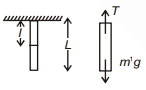
$A$ uniform rope of mass $M$ and length $L$ is fixed at its upper end vertically from a rigid support. The tension in the rope at a distance $l$ from the rigid support is:
A
$M g \frac{L}{L+l}$
B
$\frac{M g}{L}(L-l)$
C
$M g$
D
$\frac{1}{L} M g$
Solution
(B) The mass per unit length of the rope is $\mu = \frac{M}{L}$.
Consider a point at a distance $l$ from the rigid support. The length of the rope below this point is $(L-l)$.
The mass of this lower portion of the rope is $m' = \mu \times (L-l) = \frac{M}{L}(L-l)$.
Since the rope is in equilibrium,the tension $T$ at distance $l$ must support the weight of the lower portion of the rope.
Applying Newton's second law for the lower portion,$\sum F_y = m' a_y$. Since the system is at rest,$a_y = 0$.
Therefore,$T - m'g = 0$,which gives $T = m'g$.
Substituting the value of $m'$,we get $T = \frac{M}{L}(L-l)g$.
Consider a point at a distance $l$ from the rigid support. The length of the rope below this point is $(L-l)$.
The mass of this lower portion of the rope is $m' = \mu \times (L-l) = \frac{M}{L}(L-l)$.
Since the rope is in equilibrium,the tension $T$ at distance $l$ must support the weight of the lower portion of the rope.
Applying Newton's second law for the lower portion,$\sum F_y = m' a_y$. Since the system is at rest,$a_y = 0$.
Therefore,$T - m'g = 0$,which gives $T = m'g$.
Substituting the value of $m'$,we get $T = \frac{M}{L}(L-l)g$.
0 likes
View Solution119
MediumMCQ
$A$ body of mass $m$ is allowed to fall with the help of a string with downward acceleration $\frac{g}{6}$ to a distance $x$. The work done by the string is .............
A
$\frac{m g x}{6}$
B
$-\frac{m g x}{6}$
C
$-\frac{5 m g x}{6}$
D
$\frac{5 m g x}{6}$
Solution
(C) Let $T$ be the tension in the string.
According to Newton's second law of motion for the downward motion of the body:
$mg - T = ma$
Given that the acceleration $a = \frac{g}{6}$,we substitute this into the equation:
$mg - T = m(\frac{g}{6})$
$T = mg - \frac{mg}{6} = \frac{5mg}{6}$
The tension $T$ acts upwards while the displacement $x$ is downwards. Therefore,the angle between the force (tension) and the displacement is $180^{\circ}$.
The work done by the string is given by:
$W = T \cdot x \cdot \cos(180^{\circ})$
$W = (\frac{5mg}{6}) \cdot x \cdot (-1)$
$W = -\frac{5mgx}{6}$
According to Newton's second law of motion for the downward motion of the body:
$mg - T = ma$
Given that the acceleration $a = \frac{g}{6}$,we substitute this into the equation:
$mg - T = m(\frac{g}{6})$
$T = mg - \frac{mg}{6} = \frac{5mg}{6}$
The tension $T$ acts upwards while the displacement $x$ is downwards. Therefore,the angle between the force (tension) and the displacement is $180^{\circ}$.
The work done by the string is given by:
$W = T \cdot x \cdot \cos(180^{\circ})$
$W = (\frac{5mg}{6}) \cdot x \cdot (-1)$
$W = -\frac{5mgx}{6}$
0 likes
View Solution120
MediumMCQ
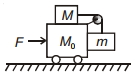
Two blocks of mass $M$ and $m$ are kept on a trolley of mass $M_0$ as shown in the figure. All surfaces are smooth. Select the correct statement.
A
If $F=0$,the blocks cannot remain stationary.
B
For one unique value of $F$,the blocks will be stationary relative to the trolley.
C
The blocks cannot be stationary for any value of $F$ because all surfaces are smooth.
D
Both $(a)$ and $(b)$ are correct.
Solution
(D) The system consists of a trolley of mass $M_0$ and two blocks of mass $M$ and $m$ connected by a string over a pulley. All surfaces are smooth.
If $F=0$,the system is not accelerating,but the block $m$ will experience a gravitational force pulling it downwards,causing it to move. Thus,the blocks cannot remain stationary.
If the trolley accelerates with acceleration $a = F / (M + m + M_0)$,a pseudo force acts on the blocks in the frame of the trolley. For the blocks to be stationary relative to the trolley,the forces acting on them must balance. Specifically,for block $m$,the pseudo force $ma$ must balance the tension $T$,and for block $M$,the tension $T$ must balance the pseudo force $Ma$. This requires $ma = T$ and $T = Ma$,which implies $m=M$. If $M=m$,there exists a unique value of $F$ that makes the system stationary relative to the trolley. Since the question implies a general case where such a condition can be met,both statements $(a)$ and $(b)$ are correct.
If $F=0$,the system is not accelerating,but the block $m$ will experience a gravitational force pulling it downwards,causing it to move. Thus,the blocks cannot remain stationary.
If the trolley accelerates with acceleration $a = F / (M + m + M_0)$,a pseudo force acts on the blocks in the frame of the trolley. For the blocks to be stationary relative to the trolley,the forces acting on them must balance. Specifically,for block $m$,the pseudo force $ma$ must balance the tension $T$,and for block $M$,the tension $T$ must balance the pseudo force $Ma$. This requires $ma = T$ and $T = Ma$,which implies $m=M$. If $M=m$,there exists a unique value of $F$ that makes the system stationary relative to the trolley. Since the question implies a general case where such a condition can be met,both statements $(a)$ and $(b)$ are correct.
0 likes
View Solution121
DifficultMCQ
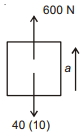
$A$ monkey of mass $40 \,kg$ climbs up a rope,of breaking load $600 \,N$ hanging from a ceiling. If it climbs up the rope with the maximum possible acceleration,then the time taken by the monkey to climb up is .........$s$ [Length of rope is $10 \,m$]
A
$2$
B
$1$
C
$4$
D
$3$
Solution
(A) The maximum tension the rope can withstand is $T_{max} = 600 \,N$.
The weight of the monkey is $W = mg = 40 \times 10 = 400 \,N$.
Applying Newton's second law for the monkey climbing up with maximum acceleration $a$:
$T_{max} - mg = ma$
$600 - 400 = 40a$
$200 = 40a$
$a = 5 \,m/s^2$
Using the equation of motion $S = ut + \frac{1}{2}at^2$,where initial velocity $u = 0$,distance $S = 10 \,m$,and $a = 5 \,m/s^2$:
$10 = 0 + \frac{1}{2} \times 5 \times t^2$
$10 = 2.5 t^2$
$t^2 = 4$
$t = 2 \,s$
Thus,the time taken is $2 \,s$.
The weight of the monkey is $W = mg = 40 \times 10 = 400 \,N$.
Applying Newton's second law for the monkey climbing up with maximum acceleration $a$:
$T_{max} - mg = ma$
$600 - 400 = 40a$
$200 = 40a$
$a = 5 \,m/s^2$
Using the equation of motion $S = ut + \frac{1}{2}at^2$,where initial velocity $u = 0$,distance $S = 10 \,m$,and $a = 5 \,m/s^2$:
$10 = 0 + \frac{1}{2} \times 5 \times t^2$
$10 = 2.5 t^2$
$t^2 = 4$
$t = 2 \,s$
Thus,the time taken is $2 \,s$.
0 likes
View Solution122
MediumMCQ
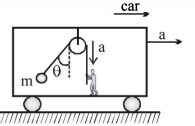
$A$ bob of mass $m$ is hanging from a pulley inside a car by a string. The other end of the string is held by a person standing in the car. The car is moving with a constant horizontal acceleration '$a$' as shown in the figure. The other end of the string is pulled with a constant acceleration '$a$' vertically downward. The tension in the string is equal to-
A
$m \sqrt{g^2+a^2}$
B
$m \sqrt{g^2+a^2}-ma$
C
$m \sqrt{g^2+a^2}+ma$
D
$m(g+a)$
Solution
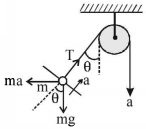
(C) To find the tension in the string,we analyze the forces acting on the bob of mass $m$ in the non-inertial frame of the car.
In the car's frame,the bob experiences a gravitational force $mg$ downwards and a pseudo force $ma$ horizontally backwards.
The effective acceleration due to gravity in this frame is $g_{eff} = \sqrt{g^2+a^2}$.
The component of the effective weight acting along the string is $m g_{eff} = m \sqrt{g^2+a^2}$.
Since the string is being pulled with an acceleration '$a$' vertically,the bob also experiences an upward acceleration '$a$' relative to the car.
Applying Newton's second law along the direction of the string:
$T - m \sqrt{g^2+a^2} = ma$
Therefore,the tension in the string is $T = m \sqrt{g^2+a^2} + ma$.
In the car's frame,the bob experiences a gravitational force $mg$ downwards and a pseudo force $ma$ horizontally backwards.
The effective acceleration due to gravity in this frame is $g_{eff} = \sqrt{g^2+a^2}$.
The component of the effective weight acting along the string is $m g_{eff} = m \sqrt{g^2+a^2}$.
Since the string is being pulled with an acceleration '$a$' vertically,the bob also experiences an upward acceleration '$a$' relative to the car.
Applying Newton's second law along the direction of the string:
$T - m \sqrt{g^2+a^2} = ma$
Therefore,the tension in the string is $T = m \sqrt{g^2+a^2} + ma$.
0 likes
View Solution123
MediumMCQ
$A$ block of mass $M$ is pulled along a horizontal frictionless surface by a rope of mass $M/2$. If a force $2Mg$ is applied at one end of the rope,the force which the rope exerts on the block is -
A
$\frac{2Mg}{3}$
B
$2Mg$
C
$\frac{4Mg}{3}$
D
$0$
Solution
(C) The total mass of the system is $M_{total} = M + M/2 = 3M/2$.
Given the applied force $F = 2Mg$,the acceleration $a$ of the entire system is given by $a = F / M_{total} = (2Mg) / (3M/2) = 4g/3$.
The force exerted by the rope on the block is the tension $T$ at the point of contact between the rope and the block. This force is responsible for accelerating the block of mass $M$.
Using Newton's second law for the block: $T = M \times a$.
Substituting the value of $a$: $T = M \times (4g/3) = 4Mg/3$.
Given the applied force $F = 2Mg$,the acceleration $a$ of the entire system is given by $a = F / M_{total} = (2Mg) / (3M/2) = 4g/3$.
The force exerted by the rope on the block is the tension $T$ at the point of contact between the rope and the block. This force is responsible for accelerating the block of mass $M$.
Using Newton's second law for the block: $T = M \times a$.
Substituting the value of $a$: $T = M \times (4g/3) = 4Mg/3$.
0 likes
View Solution124
DifficultMCQ
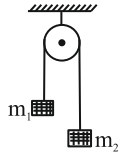
$A$ light string passing over a smooth light fixed pulley connects two blocks of masses $m_1$ and $m_2$. If the acceleration of the system is $g / 8$,then the ratio of masses is
A
$\frac{9}{7}$
B
$\frac{8}{1}$
C
$\frac{4}{3}$
D
$\frac{5}{3}$
Solution
(A) For a system of two masses $m_1$ and $m_2$ connected by a light string over a smooth fixed pulley,the magnitude of acceleration $a$ is given by the formula:
$a = \frac{|m_1 - m_2| g}{m_1 + m_2}$
Given that the acceleration $a = g / 8$,we have:
$\frac{|m_1 - m_2| g}{m_1 + m_2} = \frac{g}{8}$
Assuming $m_1 > m_2$,we get:
$\frac{m_1 - m_2}{m_1 + m_2} = \frac{1}{8}$
Cross-multiplying gives:
$8(m_1 - m_2) = m_1 + m_2$
$8m_1 - 8m_2 = m_1 + m_2$
$7m_1 = 9m_2$
Therefore,the ratio of the masses is:
$\frac{m_1}{m_2} = \frac{9}{7}$
$a = \frac{|m_1 - m_2| g}{m_1 + m_2}$
Given that the acceleration $a = g / 8$,we have:
$\frac{|m_1 - m_2| g}{m_1 + m_2} = \frac{g}{8}$
Assuming $m_1 > m_2$,we get:
$\frac{m_1 - m_2}{m_1 + m_2} = \frac{1}{8}$
Cross-multiplying gives:
$8(m_1 - m_2) = m_1 + m_2$
$8m_1 - 8m_2 = m_1 + m_2$
$7m_1 = 9m_2$
Therefore,the ratio of the masses is:
$\frac{m_1}{m_2} = \frac{9}{7}$
0 likes
View Solution125
DifficultMCQ
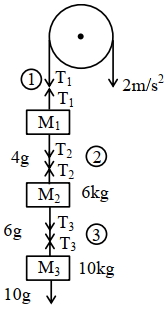
Three blocks $M_1, M_2, M_3$ having masses $4 \ kg, 6 \ kg$ and $10 \ kg$ respectively are hanging from a smooth pulley using ropes $1, 2$ and $3$ as shown in the figure. The tension in the rope $1, T_1$,when they are moving upward with an acceleration of $2 \ m/s^2$ is ............... $N$ (if $g = 10 \ m/s^2$).
A
$210$
B
$220$
C
$230$
D
$240$
Solution
(D) Let the total mass of the system be $M = M_1 + M_2 + M_3 = 4 \ kg + 6 \ kg + 10 \ kg = 20 \ kg$.
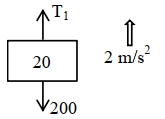
The total downward force due to gravity is $W = Mg = 20 \ kg \times 10 \ m/s^2 = 200 \ N$.
The system is moving upward with an acceleration $a = 2 \ m/s^2$.
Applying Newton's second law for the entire system: $T_1 - Mg = Ma$.
Substituting the values: $T_1 - 200 = 20 \times 2$.
$T_1 - 200 = 40$.
$T_1 = 240 \ N$.
The total downward force due to gravity is $W = Mg = 20 \ kg \times 10 \ m/s^2 = 200 \ N$.
The system is moving upward with an acceleration $a = 2 \ m/s^2$.
Applying Newton's second law for the entire system: $T_1 - Mg = Ma$.
Substituting the values: $T_1 - 200 = 20 \times 2$.
$T_1 - 200 = 40$.
$T_1 = 240 \ N$.
0 likes
View Solution126
DifficultMCQ
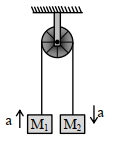
$A$ light string passing over a smooth light pulley connects two blocks of masses $m_1$ and $m_2$ (where $m_2 > m_1$). If the acceleration of the system is $\frac{g}{\sqrt{2}}$,then the ratio of the masses $\frac{m_1}{m_2}$ is:
A
$\frac{\sqrt{2}-1}{\sqrt{2}+1}$
B
$\frac{1+\sqrt{5}}{\sqrt{5}-1}$
C
$\frac{1+\sqrt{5}}{\sqrt{2}-1}$
D
$\frac{\sqrt{3}+1}{\sqrt{2}-1}$
Solution
(A) For an Atwood machine with masses $m_1$ and $m_2$ $(m_2 > m_1)$,the acceleration $a$ is given by:
$a = \left( \frac{m_2 - m_1}{m_1 + m_2} \right) g$
Given $a = \frac{g}{\sqrt{2}}$,we substitute this into the equation:
$\frac{g}{\sqrt{2}} = \left( \frac{m_2 - m_1}{m_1 + m_2} \right) g$
$\frac{1}{\sqrt{2}} = \frac{m_2 - m_1}{m_1 + m_2}$
$m_1 + m_2 = \sqrt{2} m_2 - \sqrt{2} m_1$
$m_1 + \sqrt{2} m_1 = \sqrt{2} m_2 - m_2$
$m_1(1 + \sqrt{2}) = m_2(\sqrt{2} - 1)$
$\frac{m_1}{m_2} = \frac{\sqrt{2} - 1}{\sqrt{2} + 1}$
$a = \left( \frac{m_2 - m_1}{m_1 + m_2} \right) g$
Given $a = \frac{g}{\sqrt{2}}$,we substitute this into the equation:
$\frac{g}{\sqrt{2}} = \left( \frac{m_2 - m_1}{m_1 + m_2} \right) g$
$\frac{1}{\sqrt{2}} = \frac{m_2 - m_1}{m_1 + m_2}$
$m_1 + m_2 = \sqrt{2} m_2 - \sqrt{2} m_1$
$m_1 + \sqrt{2} m_1 = \sqrt{2} m_2 - m_2$
$m_1(1 + \sqrt{2}) = m_2(\sqrt{2} - 1)$
$\frac{m_1}{m_2} = \frac{\sqrt{2} - 1}{\sqrt{2} + 1}$
0 likes
View Solution127
DifficultMCQ
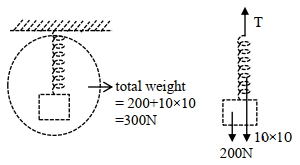
$A$ body of weight $200 \,N$ is suspended from a tree branch through a chain of mass $10 \,kg$. The branch pulls the chain by a force equal to (if $g=10 \,m/s^2$): (in $\,N$)
A
$150$
B
$300$
C
$200$
D
$100$
Solution
(B) The system consisting of the body and the chain is in equilibrium.
The total downward force acting on the branch is the sum of the weight of the body and the weight of the chain.
Weight of the body,$W_b = 200 \,N$.
Weight of the chain,$W_c = m \times g = 10 \,kg \times 10 \,m/s^2 = 100 \,N$.
Since the system is in equilibrium,the tension $T$ in the chain at the point where it is attached to the branch must balance the total weight.
$T = W_b + W_c = 200 \,N + 100 \,N = 300 \,N$.
Therefore,the branch pulls the chain with a force of $300 \,N$.
The total downward force acting on the branch is the sum of the weight of the body and the weight of the chain.
Weight of the body,$W_b = 200 \,N$.
Weight of the chain,$W_c = m \times g = 10 \,kg \times 10 \,m/s^2 = 100 \,N$.
Since the system is in equilibrium,the tension $T$ in the chain at the point where it is attached to the branch must balance the total weight.
$T = W_b + W_c = 200 \,N + 100 \,N = 300 \,N$.
Therefore,the branch pulls the chain with a force of $300 \,N$.
0 likes
View Solution128
DifficultMCQ
$A$ light unstretchable string passing over a smooth light pulley connects two blocks of masses $m_1$ and $m_2$. If the acceleration of the system is $\frac{g}{8}$,then the ratio of the masses $\frac{m_2}{m_1}$ is:
A
$9: 7$
B
$4: 3$
C
$5: 3$
D
$8: 1$
Solution
(A) For an Atwood machine with masses $m_1$ and $m_2$ (where $m_2 > m_1$),the acceleration $a$ of the system is given by the formula: $a = \left( \frac{m_2 - m_1}{m_1 + m_2} \right) g$.
Given that the acceleration $a = \frac{g}{8}$,we equate the two expressions: $\frac{g}{8} = \left( \frac{m_2 - m_1}{m_1 + m_2} \right) g$.
Canceling $g$ from both sides,we get: $\frac{1}{8} = \frac{m_2 - m_1}{m_1 + m_2}$.
Cross-multiplying gives: $m_1 + m_2 = 8(m_2 - m_1)$.
Expanding the equation: $m_1 + m_2 = 8m_2 - 8m_1$.
Rearranging the terms to group $m_1$ and $m_2$: $m_1 + 8m_1 = 8m_2 - m_2$.
This simplifies to: $9m_1 = 7m_2$.
Therefore,the ratio $\frac{m_2}{m_1} = \frac{9}{7}$.
Given that the acceleration $a = \frac{g}{8}$,we equate the two expressions: $\frac{g}{8} = \left( \frac{m_2 - m_1}{m_1 + m_2} \right) g$.
Canceling $g$ from both sides,we get: $\frac{1}{8} = \frac{m_2 - m_1}{m_1 + m_2}$.
Cross-multiplying gives: $m_1 + m_2 = 8(m_2 - m_1)$.
Expanding the equation: $m_1 + m_2 = 8m_2 - 8m_1$.
Rearranging the terms to group $m_1$ and $m_2$: $m_1 + 8m_1 = 8m_2 - m_2$.
This simplifies to: $9m_1 = 7m_2$.
Therefore,the ratio $\frac{m_2}{m_1} = \frac{9}{7}$.
0 likes
View Solution129
DifficultMCQ
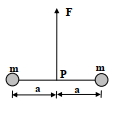
Two particles of mass $m$ each are tied at the ends of a light string of length $2a$. The whole system is kept on a frictionless horizontal surface with the string held tight so that each mass is at a distance $a$ from the center $P$ (as shown in the figure). Now,the mid-point of the string is pulled vertically upwards with a small but constant force $F$. As a result,the particles move towards each other on the surface. The magnitude of acceleration,when the separation between them becomes $2x$ is
A
$\frac{F}{2m} \frac{a}{\sqrt{a^2-x^2}}$
B
$\frac{F}{2m} \frac{x}{\sqrt{a^2-x^2}}$
C
$\frac{F}{2m} \frac{x}{a}$
D
$\frac{F}{2m} \frac{\sqrt{a^2-x^2}}{x}$
Solution
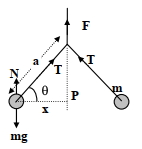
(B) Let the angle made by the string with the horizontal be $\theta$. The length of each half of the string is $a$. When the separation between the particles is $2x$,the horizontal distance of each particle from the center $P$ is $x$.
From the geometry,$\cos \theta = \frac{x}{a}$ and $\sin \theta = \frac{\sqrt{a^2-x^2}}{a}$.
Considering the vertical equilibrium of the midpoint of the string: $2T \sin \theta = F$,so $T = \frac{F}{2 \sin \theta}$.
The horizontal force on each particle is $T \cos \theta = ma$,where $a$ is the acceleration of the particle.
Substituting $T$: $ma = \left( \frac{F}{2 \sin \theta} \right) \cos \theta = \frac{F}{2} \cot \theta$.
Since $\cot \theta = \frac{\cos \theta}{\sin \theta} = \frac{x/a}{\sqrt{a^2-x^2}/a} = \frac{x}{\sqrt{a^2-x^2}}$,
we get $ma = \frac{F}{2} \left( \frac{x}{\sqrt{a^2-x^2}} \right)$,
which gives the acceleration $a = \frac{F}{2m} \left( \frac{x}{\sqrt{a^2-x^2}} \right)$.
From the geometry,$\cos \theta = \frac{x}{a}$ and $\sin \theta = \frac{\sqrt{a^2-x^2}}{a}$.
Considering the vertical equilibrium of the midpoint of the string: $2T \sin \theta = F$,so $T = \frac{F}{2 \sin \theta}$.
The horizontal force on each particle is $T \cos \theta = ma$,where $a$ is the acceleration of the particle.
Substituting $T$: $ma = \left( \frac{F}{2 \sin \theta} \right) \cos \theta = \frac{F}{2} \cot \theta$.
Since $\cot \theta = \frac{\cos \theta}{\sin \theta} = \frac{x/a}{\sqrt{a^2-x^2}/a} = \frac{x}{\sqrt{a^2-x^2}}$,
we get $ma = \frac{F}{2} \left( \frac{x}{\sqrt{a^2-x^2}} \right)$,
which gives the acceleration $a = \frac{F}{2m} \left( \frac{x}{\sqrt{a^2-x^2}} \right)$.
0 likes
View Solution130
EasyMCQ
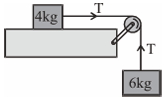
Two bodies of mass $6 \ kg$ and $4 \ kg$ are tied to a string as shown in the adjoining figure. If the table and pulley are frictionless,then the acceleration of the $6 \ kg$ mass will be $........ \ ms^{-2}$ $\left(g=10 \ ms^{-2}\right)$.
A
$60$
B
$40$
C
$6$
D
$4$
Solution
(C) Let the acceleration of the system be $a$ and the tension in the string be $T$.
For the $6 \ kg$ mass hanging vertically,the equation of motion is: $6g - T = 6a \quad \dots(i)$
For the $4 \ kg$ mass on the frictionless table,the equation of motion is: $T = 4a \quad \dots(ii)$
Adding equations $(i)$ and $(ii)$,we get:
$6g - T + T = 6a + 4a$
$6g = 10a$
Substituting $g = 10 \ ms^{-2}$:
$6 \times 10 = 10a$
$60 = 10a$
$a = 6 \ ms^{-2}$
Thus,the acceleration of the $6 \ kg$ mass is $6 \ ms^{-2}$.
For the $6 \ kg$ mass hanging vertically,the equation of motion is: $6g - T = 6a \quad \dots(i)$
For the $4 \ kg$ mass on the frictionless table,the equation of motion is: $T = 4a \quad \dots(ii)$
Adding equations $(i)$ and $(ii)$,we get:
$6g - T + T = 6a + 4a$
$6g = 10a$
Substituting $g = 10 \ ms^{-2}$:
$6 \times 10 = 10a$
$60 = 10a$
$a = 6 \ ms^{-2}$
Thus,the acceleration of the $6 \ kg$ mass is $6 \ ms^{-2}$.
0 likes
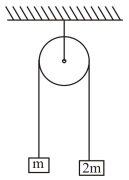
View Solution131
MediumMCQ
Two blocks of masses $m$ and $2m$ are connected by a metal wire of negligible mass and having cross-sectional area $A$,passing over a smooth fixed pulley as shown in the figure. If the masses are released from rest,then the stress produced in the wire is:
A
$\frac{mg}{4A}$
B
$\frac{2mg}{3A}$
C
$\frac{3mg}{4A}$
D
$\frac{4mg}{3A}$
Solution
(D) The system consists of two masses $m$ and $2m$ connected by a string over a pulley. The acceleration $a$ of the system is given by $a = \frac{(m_2 - m_1)g}{m_1 + m_2}$.
Substituting the values,$a = \frac{(2m - m)g}{2m + m} = \frac{mg}{3m} = \frac{g}{3}$.
The tension $T$ in the wire can be found using the equation of motion for mass $m$: $T - mg = ma$,so $T = m(g + a)$.
Substituting $a = \frac{g}{3}$,we get $T = m(g + \frac{g}{3}) = m(\frac{4g}{3}) = \frac{4mg}{3}$.
Stress is defined as force per unit area,so $\text{Stress} = \frac{T}{A} = \frac{4mg}{3A}$.
Substituting the values,$a = \frac{(2m - m)g}{2m + m} = \frac{mg}{3m} = \frac{g}{3}$.
The tension $T$ in the wire can be found using the equation of motion for mass $m$: $T - mg = ma$,so $T = m(g + a)$.
Substituting $a = \frac{g}{3}$,we get $T = m(g + \frac{g}{3}) = m(\frac{4g}{3}) = \frac{4mg}{3}$.
Stress is defined as force per unit area,so $\text{Stress} = \frac{T}{A} = \frac{4mg}{3A}$.
0 likes
View Solution132
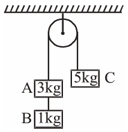
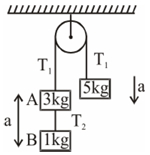
MediumMCQ
In the adjoining figure,the tension in the string connecting blocks $A$ and $B$ is:
A
$g$
B
$\frac{g}{9}$
C
$\frac{8g}{9}$
D
$\frac{10g}{9}$
Solution
(D) Let the acceleration of the system be $a$. The total mass of the system is $M = 5 \text{ kg} + 3 \text{ kg} + 1 \text{ kg} = 9 \text{ kg}$.
The net driving force is the difference in weights: $F_{\text{net}} = (5g) - (3g + 1g) = 5g - 4g = g$.
Using Newton's second law,$F_{\text{net}} = Ma$,so $g = 9a$,which gives $a = \frac{g}{9}$.
Now,consider the free body diagram of block $B$ ($1 \text{ kg}$ mass). The forces acting on it are its weight $(1g)$ downwards and the tension $T_2$ upwards. Since the system accelerates such that block $B$ moves upwards,we have:
$T_2 - 1g = 1a$
$T_2 = g + a = g + \frac{g}{9} = \frac{10g}{9}$.
Thus,the tension in the string connecting $A$ and $B$ is $\frac{10g}{9}$.
The net driving force is the difference in weights: $F_{\text{net}} = (5g) - (3g + 1g) = 5g - 4g = g$.
Using Newton's second law,$F_{\text{net}} = Ma$,so $g = 9a$,which gives $a = \frac{g}{9}$.
Now,consider the free body diagram of block $B$ ($1 \text{ kg}$ mass). The forces acting on it are its weight $(1g)$ downwards and the tension $T_2$ upwards. Since the system accelerates such that block $B$ moves upwards,we have:
$T_2 - 1g = 1a$
$T_2 = g + a = g + \frac{g}{9} = \frac{10g}{9}$.
Thus,the tension in the string connecting $A$ and $B$ is $\frac{10g}{9}$.
0 likes
View Solution133
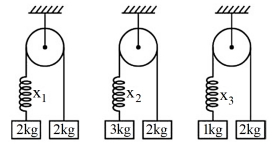
DifficultMCQ
The same spring is attached to $2 \ kg, 3 \ kg$ and $1 \ kg$ blocks in three different cases as shown in the figure. If $x_1, x_2$ and $x_3$ are the extensions in the spring in these cases,respectively,find the correct relation between them.
A
$x_1=0, x_3 > x_2$
B
$x_2 > x_1 > x_3$
C
$x_3 > x_1 > x_2$
D
$x_1 > x_2 > x_3$
Solution
(B) In an Atwood machine,the tension $T$ in the string is given by $T = \frac{2 m_1 m_2 g}{m_1 + m_2}$. The extension $x$ in the spring is proportional to the tension $T$ $(x = T/k)$.
Case $1$: $m_1 = 2 \ kg, m_2 = 2 \ kg$. Tension $T_1 = \frac{2 \times 2 \times 2 \times g}{2 + 2} = 2g$.
Case $2$: $m_1 = 3 \ kg, m_2 = 2 \ kg$. Tension $T_2 = \frac{2 \times 3 \times 2 \times g}{3 + 2} = 2.4g$.
Case $3$: $m_1 = 1 \ kg, m_2 = 2 \ kg$. Tension $T_3 = \frac{2 \times 1 \times 2 \times g}{1 + 2} = 1.33g$.
Comparing the tensions,we get $T_2 > T_1 > T_3$.
Since $x \propto T$,the extensions follow the same order: $x_2 > x_1 > x_3$.
Case $1$: $m_1 = 2 \ kg, m_2 = 2 \ kg$. Tension $T_1 = \frac{2 \times 2 \times 2 \times g}{2 + 2} = 2g$.
Case $2$: $m_1 = 3 \ kg, m_2 = 2 \ kg$. Tension $T_2 = \frac{2 \times 3 \times 2 \times g}{3 + 2} = 2.4g$.
Case $3$: $m_1 = 1 \ kg, m_2 = 2 \ kg$. Tension $T_3 = \frac{2 \times 1 \times 2 \times g}{1 + 2} = 1.33g$.
Comparing the tensions,we get $T_2 > T_1 > T_3$.
Since $x \propto T$,the extensions follow the same order: $x_2 > x_1 > x_3$.
0 likes
View Solution134
MediumMCQ
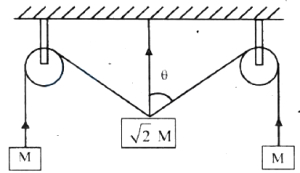
The pulleys and strings shown in the figure are smooth and of negligible mass. For the system to remain in equilibrium,the angle $\theta$ should be:
A
$\cos ^{-1}(1)$
B
$\cos ^{-1}\left(\frac{\sqrt{3}}{2}\right)$
C
$\cos ^{-1}\left(\frac{1}{2}\right)$
D
$\cos ^{-1}\left(\frac{1}{\sqrt{2}}\right)$
Solution
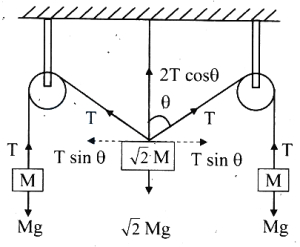
(D) Let the tension in the strings be $T$. Since the pulleys are smooth and massless,the tension $T$ in the string is equal to the weight of the hanging masses $M$,so $T = Mg$.
For the central mass $\sqrt{2}M$ to be in equilibrium,the vertical components of the tension forces must balance its weight.
The vertical component of the tension in each of the two strings is $T \cos \theta$.
Therefore,the total upward force is $2T \cos \theta$.
Equating this to the weight of the central mass:
$2T \cos \theta = (\sqrt{2}M)g$
Since $T = Mg$,we substitute this into the equation:
$2(Mg) \cos \theta = \sqrt{2}Mg$
$2 \cos \theta = \sqrt{2}$
$\cos \theta = \frac{\sqrt{2}}{2} = \frac{1}{\sqrt{2}}$
$\theta = \cos ^{-1}\left(\frac{1}{\sqrt{2}}\right)$
For the central mass $\sqrt{2}M$ to be in equilibrium,the vertical components of the tension forces must balance its weight.
The vertical component of the tension in each of the two strings is $T \cos \theta$.
Therefore,the total upward force is $2T \cos \theta$.
Equating this to the weight of the central mass:
$2T \cos \theta = (\sqrt{2}M)g$
Since $T = Mg$,we substitute this into the equation:
$2(Mg) \cos \theta = \sqrt{2}Mg$
$2 \cos \theta = \sqrt{2}$
$\cos \theta = \frac{\sqrt{2}}{2} = \frac{1}{\sqrt{2}}$
$\theta = \cos ^{-1}\left(\frac{1}{\sqrt{2}}\right)$
0 likes
View Solution135
MediumMCQ
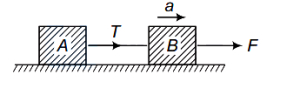
Two blocks $A$ and $B$, each of mass $20 \,kg$, lying on a frictionless table, are connected by a light string. The system is pulled horizontally with an acceleration of $2 \,ms^{-2}$ by a force $F$ applied on block $B$. The tension in the string will be: (in $\,N$)
A
$10$
B
$40$
C
$100$
D
$120$
Solution
(B) The system consists of two blocks $A$ and $B$ connected by a string. Since the table is frictionless and the system is pulled with an acceleration $a = 2 \,ms^{-2}$, we can analyze the motion of block $A$ separately.
Block $A$ is being pulled by the tension $T$ in the string. According to Newton's second law of motion, the force acting on block $A$ is given by:
$T = M_A \times a$
Given:
$M_A = 20 \,kg$
$a = 2 \,ms^{-2}$
Substituting the values:
$T = 20 \,kg \times 2 \,ms^{-2} = 40 \,N$
Therefore, the tension in the string is $40 \,N$.
Block $A$ is being pulled by the tension $T$ in the string. According to Newton's second law of motion, the force acting on block $A$ is given by:
$T = M_A \times a$
Given:
$M_A = 20 \,kg$
$a = 2 \,ms^{-2}$
Substituting the values:
$T = 20 \,kg \times 2 \,ms^{-2} = 40 \,N$
Therefore, the tension in the string is $40 \,N$.
0 likes
View Solution136
MediumMCQ
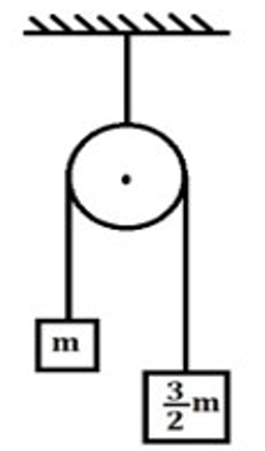
In the arrangement shown in the figure,the mass '$m$' will ascend with an acceleration (consider pulley and rope are massless) ($g=$ acceleration due to gravity).
A
zero
B
$\frac{g}{5}$
C
$g$
D
$2g$
Solution
(B) Let the tension in the string be $T$ and the acceleration of the system be $a$.
For the mass $m$ (moving upwards): $T - mg = ma$ --- $(1)$
For the mass $\frac{3}{2}m$ (moving downwards): $\frac{3}{2}mg - T = \frac{3}{2}ma$ --- $(2)$
Adding equation $(1)$ and $(2)$:
$(T - mg) + (\frac{3}{2}mg - T) = ma + \frac{3}{2}ma$
$\frac{1}{2}mg = \frac{5}{2}ma$
$a = \frac{g}{5}$
Thus,the mass $m$ ascends with an acceleration of $\frac{g}{5}$.
For the mass $m$ (moving upwards): $T - mg = ma$ --- $(1)$
For the mass $\frac{3}{2}m$ (moving downwards): $\frac{3}{2}mg - T = \frac{3}{2}ma$ --- $(2)$
Adding equation $(1)$ and $(2)$:
$(T - mg) + (\frac{3}{2}mg - T) = ma + \frac{3}{2}ma$
$\frac{1}{2}mg = \frac{5}{2}ma$
$a = \frac{g}{5}$
Thus,the mass $m$ ascends with an acceleration of $\frac{g}{5}$.
0 likes
View Solution137
MediumMCQ
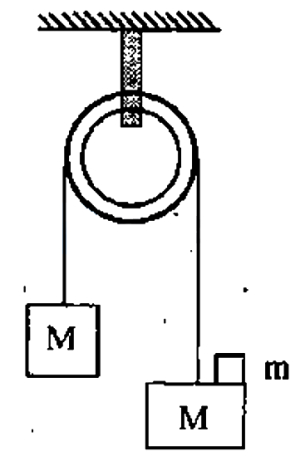
Two identical blocks each of mass $M$ are attached to the ends of a massless inextensible string which passes over a pulley with a fixed axis as shown below. $A$ small mass $m$ is now placed on block $B$ (the right block). The acceleration with which the two blocks move together is ($g =$ gravitational acceleration).
A
$\frac{mg}{2M+m}$
B
$\frac{Mg}{M+2m}$
C
$\frac{Mg}{2M+m}$
D
$\frac{mg}{M+2m}$
Solution
(A) Let the acceleration of the system be $a$ and the tension in the string be $T$.
For the block with mass $(M+m)$ (moving downwards):
$(M+m)g - T = (M+m)a$ --- $(1)$
For the block with mass $M$ (moving upwards):
$T - Mg = Ma$ --- $(2)$
Adding equations $(1)$ and $(2)$:
$(M+m)g - Mg = (M+m+M)a$
$mg = (2M+m)a$
$a = \frac{mg}{2M+m}$
For the block with mass $(M+m)$ (moving downwards):
$(M+m)g - T = (M+m)a$ --- $(1)$
For the block with mass $M$ (moving upwards):
$T - Mg = Ma$ --- $(2)$
Adding equations $(1)$ and $(2)$:
$(M+m)g - Mg = (M+m+M)a$
$mg = (2M+m)a$
$a = \frac{mg}{2M+m}$
0 likes
View Solution138
DifficultMCQ
$A$ lift is tied with thick iron ropes having mass $M$. The maximum acceleration of the lift is $a \ m/s^2$ and the maximum safe stress is $S \ N/m^2$. The minimum diameter of the rope is
A
$[\frac{6 M(g+a)}{\pi S}]^{\frac{1}{2}}$
B
$[\frac{4 M(g+a)}{\pi S}]^{\frac{1}{2}}$
C
$[\frac{M(g+a)}{\pi S}]^{\frac{1}{2}}$
D
$[\frac{M(g-a)}{\pi S}]^{\frac{1}{2}}$
Solution
(B) The tension $T$ in the rope when the lift accelerates upwards with acceleration $a$ is given by $T = M(g + a)$.
The stress $\sigma$ is defined as the force per unit area,so $\sigma = \frac{T}{A}$,where $A = \pi r^2 = \pi (\frac{d}{2})^2 = \frac{\pi d^2}{4}$.
Given the maximum safe stress is $S$,we have $S = \frac{M(g + a)}{\frac{\pi d^2}{4}}$.
Rearranging for the diameter $d$,we get $d^2 = \frac{4 M(g + a)}{\pi S}$.
Therefore,the minimum diameter is $d = [\frac{4 M(g + a)}{\pi S}]^{\frac{1}{2}}$.
The stress $\sigma$ is defined as the force per unit area,so $\sigma = \frac{T}{A}$,where $A = \pi r^2 = \pi (\frac{d}{2})^2 = \frac{\pi d^2}{4}$.
Given the maximum safe stress is $S$,we have $S = \frac{M(g + a)}{\frac{\pi d^2}{4}}$.
Rearranging for the diameter $d$,we get $d^2 = \frac{4 M(g + a)}{\pi S}$.
Therefore,the minimum diameter is $d = [\frac{4 M(g + a)}{\pi S}]^{\frac{1}{2}}$.
0 likes
View Solution139
EasyMCQ
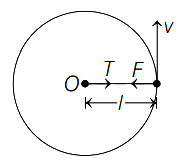
One end of a string of length $l$ is connected to a particle of mass $m$ and the other to a small peg on a smooth horizontal table. If the particle moves in a circle with speed $v$,the net force on the particle (directed towards the centre) is ($T$ is the tension in the string).
A
$T$
B
$T - \frac{m v^{2}}{l}$
C
$T + \frac{m v^{2}}{l}$
D
zero
Solution
(A) The particle is moving in a uniform circular motion on a smooth horizontal table.
In this motion,the only horizontal force acting on the particle towards the center of the circle is the tension $T$ in the string.
According to Newton's second law of motion,the net force acting on a body in circular motion must be equal to the centripetal force required for that motion.
The centripetal force $F_c$ is given by the formula $F_c = \frac{m v^{2}}{l}$.
Since the tension $T$ is the only force providing this centripetal force,we have:
Net force (directed towards the centre) $= T = \frac{m v^{2}}{l}$.
Therefore,the net force on the particle directed towards the centre is $T$.
In this motion,the only horizontal force acting on the particle towards the center of the circle is the tension $T$ in the string.
According to Newton's second law of motion,the net force acting on a body in circular motion must be equal to the centripetal force required for that motion.
The centripetal force $F_c$ is given by the formula $F_c = \frac{m v^{2}}{l}$.
Since the tension $T$ is the only force providing this centripetal force,we have:
Net force (directed towards the centre) $= T = \frac{m v^{2}}{l}$.
Therefore,the net force on the particle directed towards the centre is $T$.
0 likes
View Solution140
EasyMCQ
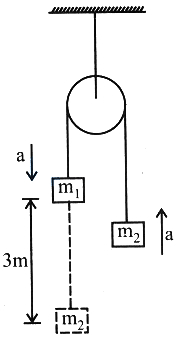
Two masses $m_1$ and $m_2$ are connected by a light string passing over a smooth pulley. When set free,$m_1$ moves downwards by $3 \ m$ in $3 \ s$. The ratio of $\frac{m_1}{m_2}$ is $(g = 10 \ ms^{-2})$.
A
$\frac{9}{7}$
B
$\frac{8}{7}$
C
$\frac{10}{7}$
D
$\frac{15}{13}$
Solution
(B) The acceleration $a$ of the system is given by $a = \left(\frac{m_1 - m_2}{m_1 + m_2}\right) g$.
Using the equation of motion $S = ut + \frac{1}{2}at^2$,where $S = 3 \ m$,$u = 0$,and $t = 3 \ s$:
$3 = 0 + \frac{1}{2} \times a \times (3)^2$
$3 = \frac{1}{2} \times a \times 9$
$a = \frac{6}{9} = \frac{2}{3} \ ms^{-2}$.
Now,substitute $a$ into the acceleration formula:
$\frac{2}{3} = \left(\frac{m_1 - m_2}{m_1 + m_2}\right) \times 10$
$\frac{2}{30} = \frac{m_1 - m_2}{m_1 + m_2}$
$\frac{1}{15} = \frac{m_1 - m_2}{m_1 + m_2}$
$m_1 + m_2 = 15m_1 - 15m_2$
$16m_2 = 14m_1$
$\frac{m_1}{m_2} = \frac{16}{14} = \frac{8}{7}$.
Using the equation of motion $S = ut + \frac{1}{2}at^2$,where $S = 3 \ m$,$u = 0$,and $t = 3 \ s$:
$3 = 0 + \frac{1}{2} \times a \times (3)^2$
$3 = \frac{1}{2} \times a \times 9$
$a = \frac{6}{9} = \frac{2}{3} \ ms^{-2}$.
Now,substitute $a$ into the acceleration formula:
$\frac{2}{3} = \left(\frac{m_1 - m_2}{m_1 + m_2}\right) \times 10$
$\frac{2}{30} = \frac{m_1 - m_2}{m_1 + m_2}$
$\frac{1}{15} = \frac{m_1 - m_2}{m_1 + m_2}$
$m_1 + m_2 = 15m_1 - 15m_2$
$16m_2 = 14m_1$
$\frac{m_1}{m_2} = \frac{16}{14} = \frac{8}{7}$.
0 likes
View Solution141
MediumMCQ
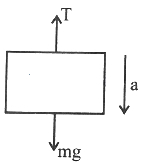
The maximum acceleration with which a body of mass $200 \, kg$ is lowered into a well using a rope having a breaking force of $50 \, kg$-wt is (Acceleration due to gravity $= 10 \, ms^{-2}$) (in $ \, ms^{-2}$)
A
$7.5$
B
$5$
C
$3$
D
$2.5$
Solution
(A) Given:
Mass of the body,$m = 200 \, kg$
Breaking force of the rope,$T = 50 \, kg\text{-wt} = 50 \times 10 \, N = 500 \, N$
Acceleration due to gravity,$g = 10 \, ms^{-2}$
When the body is lowered with an acceleration $a$,the equation of motion is:
$mg - T = ma$
Substituting the values:
$(200 \times 10) - 500 = 200a$
$2000 - 500 = 200a$
$1500 = 200a$
$a = \frac{1500}{200} = 7.5 \, ms^{-2}$
Thus,the maximum acceleration is $7.5 \, ms^{-2}$.
Mass of the body,$m = 200 \, kg$
Breaking force of the rope,$T = 50 \, kg\text{-wt} = 50 \times 10 \, N = 500 \, N$
Acceleration due to gravity,$g = 10 \, ms^{-2}$
When the body is lowered with an acceleration $a$,the equation of motion is:
$mg - T = ma$
Substituting the values:
$(200 \times 10) - 500 = 200a$
$2000 - 500 = 200a$
$1500 = 200a$
$a = \frac{1500}{200} = 7.5 \, ms^{-2}$
Thus,the maximum acceleration is $7.5 \, ms^{-2}$.
0 likes
View Solution142
DifficultMCQ
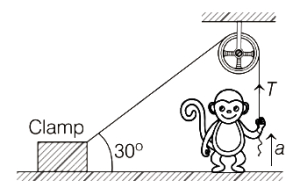
One end of a light string is fixed to a clamp on the ground and the other end passes over a fixed frictionless pulley as shown in the figure. It makes an angle of $30^{\circ}$ with the ground. The clamp can tolerate a vertical force of $40 \,N$. If a monkey of mass $5 \,kg$ were to climb up the rope,then the maximum acceleration in the upward direction with which it can climb safely is $\left(g=10 \,ms^{-2}\right)$ (in $\,ms^{-2}$)
A
$2$
B
$4$
C
$6$
D
$8$
Solution
(C) Let $T$ be the tension in the string.
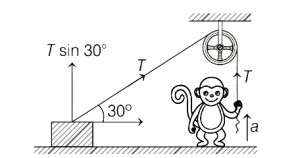
The maximum vertical force on the clamp is given by $T \sin 30^{\circ} = 40 \,N$.
Substituting the value of $\sin 30^{\circ} = 1/2$:
$T \cdot (1/2) = 40$
$T = 80 \,N$
Now,consider the free-body diagram of the monkey of mass $m = 5 \,kg$ climbing with acceleration $a$.
The forces acting on the monkey are tension $T$ upwards and weight $mg$ downwards.
According to Newton's second law: $T - mg = ma$
$a = (T - mg) / m$
Substituting the values $T = 80 \,N$,$m = 5 \,kg$,and $g = 10 \,ms^{-2}$:
$a = (80 - 5 \times 10) / 5$
$a = (80 - 50) / 5$
$a = 30 / 5 = 6 \,ms^{-2}$
Thus,the maximum acceleration is $6 \,ms^{-2}$.
The maximum vertical force on the clamp is given by $T \sin 30^{\circ} = 40 \,N$.
Substituting the value of $\sin 30^{\circ} = 1/2$:
$T \cdot (1/2) = 40$
$T = 80 \,N$
Now,consider the free-body diagram of the monkey of mass $m = 5 \,kg$ climbing with acceleration $a$.
The forces acting on the monkey are tension $T$ upwards and weight $mg$ downwards.
According to Newton's second law: $T - mg = ma$
$a = (T - mg) / m$
Substituting the values $T = 80 \,N$,$m = 5 \,kg$,and $g = 10 \,ms^{-2}$:
$a = (80 - 5 \times 10) / 5$
$a = (80 - 50) / 5$
$a = 30 / 5 = 6 \,ms^{-2}$
Thus,the maximum acceleration is $6 \,ms^{-2}$.
0 likes
View Solution143
EasyMCQ
Two weights $2 \,N$ and $3 \,N$ are suspended from the ends of an inextensible string passing over a fixed frictionless pulley. If the pulley is pulled up with an acceleration equal to the acceleration due to gravity $(g)$, then the tension in the string is: (in $\,N$)
A
$2.4$
B
$5.0$
C
$4.8$
D
$6.0$
Solution
(C) Let the weights be $W_1 = 2 \,N$ and $W_2 = 3 \,N$. The masses are $m_1 = W_1/g$ and $m_2 = W_2/g$.
The pulley is accelerated upwards with $a = g$.
In the frame of the pulley, each mass experiences a pseudo-force $F_p = ma$ acting downwards.
Thus, the effective acceleration due to gravity for each mass becomes $g_{eff} = g + a = g + g = 2g$.
The effective weights are $W_1' = m_1(2g) = 2W_1 = 4 \,N$ and $W_2' = m_2(2g) = 2W_2 = 6 \,N$.
The tension $T$ in a string over a pulley with masses $m_1$ and $m_2$ is given by $T = \frac{2m_1m_2}{m_1+m_2} g_{eff}$.
Substituting the effective weights: $T = \frac{2 W_1' W_2'}{W_1' + W_2'} = \frac{2 \times 4 \times 6}{4 + 6} = \frac{48}{10} = 4.8 \,N$.
The pulley is accelerated upwards with $a = g$.
In the frame of the pulley, each mass experiences a pseudo-force $F_p = ma$ acting downwards.
Thus, the effective acceleration due to gravity for each mass becomes $g_{eff} = g + a = g + g = 2g$.
The effective weights are $W_1' = m_1(2g) = 2W_1 = 4 \,N$ and $W_2' = m_2(2g) = 2W_2 = 6 \,N$.
The tension $T$ in a string over a pulley with masses $m_1$ and $m_2$ is given by $T = \frac{2m_1m_2}{m_1+m_2} g_{eff}$.
Substituting the effective weights: $T = \frac{2 W_1' W_2'}{W_1' + W_2'} = \frac{2 \times 4 \times 6}{4 + 6} = \frac{48}{10} = 4.8 \,N$.
0 likes
View Solution144
EasyMCQ
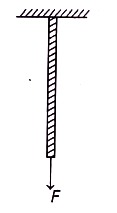
In the case of a wire having negligible mass,suspended from a ceiling and stretched under the action of a weight $F$ suspended from its other end,the tension at any cross-section of the wire is
A
Zero
B
$2 F$
C
$0.5 F$
D
$F$
Solution
(D) Consider a wire of negligible mass suspended from a ceiling. $A$ force $F$ is applied at the lower end of the wire.
Since the wire is massless,the net force on any segment of the wire must be zero for it to be in equilibrium.
If we take any cross-section of the wire and consider the lower part of the wire below that section,the only forces acting on this part are the tension $T$ acting upwards at the cross-section and the weight $F$ acting downwards at the end.
Applying Newton's second law,$T - F = ma$. Since the mass $m$ of the wire is zero,$T - F = 0$,which gives $T = F$.
Therefore,the tension at any cross-section of the wire is $F$.
Since the wire is massless,the net force on any segment of the wire must be zero for it to be in equilibrium.
If we take any cross-section of the wire and consider the lower part of the wire below that section,the only forces acting on this part are the tension $T$ acting upwards at the cross-section and the weight $F$ acting downwards at the end.
Applying Newton's second law,$T - F = ma$. Since the mass $m$ of the wire is zero,$T - F = 0$,which gives $T = F$.
Therefore,the tension at any cross-section of the wire is $F$.
0 likes
View Solution145
DifficultMCQ
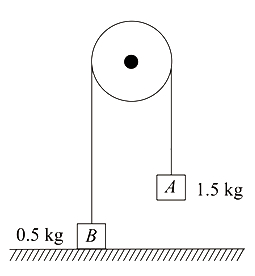
Two blocks $A$ and $B$ of masses $1.5 \ kg$ and $0.5 \ kg$ respectively are connected by a massless inextensible string passing over a frictionless pulley as shown in the figure. Block $A$ is lifted until block $B$ touches the ground and then block $A$ is released. The initial height of block $A$ is $80 \ cm$ when block $B$ just touches the ground. The maximum height reached by block $B$ from the ground after the block $A$ falls on the ground is (in $cm$)
A
$80$
B
$120$
C
$140$
D
$160$
Solution
(B) The common acceleration of the system is given by:
$a = \left( \frac{m_A - m_B}{m_A + m_B} \right) g = \left( \frac{1.5 - 0.5}{1.5 + 0.5} \right) g = \frac{1}{2} g = 5 \ m/s^2$.
When block $A$ is released from a height of $80 \ cm$ $(0.8 \ m)$,it moves downwards with acceleration $a = 5 \ m/s^2$. The velocity $v$ of the blocks when block $A$ hits the ground is given by $v^2 = u^2 + 2as$:
$v^2 = 0 + 2(5)(0.8) = 8 \ (m/s)^2$.
At this instant,block $B$ is at a height of $80 \ cm$ from the ground and has an upward velocity $v = \sqrt{8} \ m/s$.
After block $A$ hits the ground,the string becomes slack,and block $B$ moves under gravity with deceleration $g = 10 \ m/s^2$.
Using the third equation of motion for block $B$ to find the additional height $h$ it rises:
$v_f^2 = v^2 - 2gh$
$0 = 8 - 2(10)h$
$h = \frac{8}{20} = 0.4 \ m = 40 \ cm$.
The maximum height reached by block $B$ from the ground is the initial height plus the additional height:
$H_{max} = 80 \ cm + 40 \ cm = 120 \ cm$.
$a = \left( \frac{m_A - m_B}{m_A + m_B} \right) g = \left( \frac{1.5 - 0.5}{1.5 + 0.5} \right) g = \frac{1}{2} g = 5 \ m/s^2$.
When block $A$ is released from a height of $80 \ cm$ $(0.8 \ m)$,it moves downwards with acceleration $a = 5 \ m/s^2$. The velocity $v$ of the blocks when block $A$ hits the ground is given by $v^2 = u^2 + 2as$:
$v^2 = 0 + 2(5)(0.8) = 8 \ (m/s)^2$.
At this instant,block $B$ is at a height of $80 \ cm$ from the ground and has an upward velocity $v = \sqrt{8} \ m/s$.
After block $A$ hits the ground,the string becomes slack,and block $B$ moves under gravity with deceleration $g = 10 \ m/s^2$.
Using the third equation of motion for block $B$ to find the additional height $h$ it rises:
$v_f^2 = v^2 - 2gh$
$0 = 8 - 2(10)h$
$h = \frac{8}{20} = 0.4 \ m = 40 \ cm$.
The maximum height reached by block $B$ from the ground is the initial height plus the additional height:
$H_{max} = 80 \ cm + 40 \ cm = 120 \ cm$.
0 likes
View Solution146
DifficultMCQ
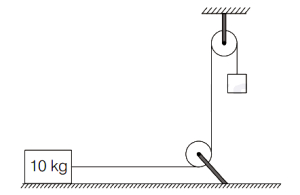
$A$ block of mass $10 \ kg$ is placed on a horizontal frictionless surface and is attached to a cord which passes over two light frictionless pulleys as shown in the figure. The hanging block tied to the other end of the cord is initially at rest $2 \ m$ above the horizontal floor. If the hanging block strikes the floor $2 \ s$ after the system is released,then the weight of the hanging block is ....... $(g=10 \ ms^{-2})$ (in $N$)
A
$22.22$
B
$11.11$
C
$1.11$
D
$2.22$
Solution
(B) Let $M = 10 \ kg$ be the mass on the horizontal surface and $m$ be the mass of the hanging block.
Since the system is released from rest,the initial velocity $u = 0$.
The distance covered by the hanging block is $s = 2 \ m$ in time $t = 2 \ s$.
Using the equation of motion $s = ut + \frac{1}{2}at^2$:
$2 = 0 + \frac{1}{2} \times a \times (2)^2$
$2 = 2a \Rightarrow a = 1 \ ms^{-2}$.
Now,applying Newton's second law to the system:
For the hanging block: $mg - T = ma$
For the block on the surface: $T = Ma$
Adding these two equations: $mg = (M + m)a$
$m(g - a) = Ma$
$m(10 - 1) = 10 \times 1$
$9m = 10 \Rightarrow m = \frac{10}{9} \ kg \approx 1.11 \ kg$.
The weight of the hanging block is $W = mg = \frac{10}{9} \times 10 = \frac{100}{9} \ N \approx 11.11 \ N$.
Since the system is released from rest,the initial velocity $u = 0$.
The distance covered by the hanging block is $s = 2 \ m$ in time $t = 2 \ s$.
Using the equation of motion $s = ut + \frac{1}{2}at^2$:
$2 = 0 + \frac{1}{2} \times a \times (2)^2$
$2 = 2a \Rightarrow a = 1 \ ms^{-2}$.
Now,applying Newton's second law to the system:
For the hanging block: $mg - T = ma$
For the block on the surface: $T = Ma$
Adding these two equations: $mg = (M + m)a$
$m(g - a) = Ma$
$m(10 - 1) = 10 \times 1$
$9m = 10 \Rightarrow m = \frac{10}{9} \ kg \approx 1.11 \ kg$.
The weight of the hanging block is $W = mg = \frac{10}{9} \times 10 = \frac{100}{9} \ N \approx 11.11 \ N$.
0 likes
View Solution147
DifficultMCQ
As shown in the figure,two particles,each of mass '$m$',tied at the ends of a light string of length $2a$ are kept on a frictionless horizontal surface. When the midpoint $(P)$ of the string is pulled vertically upwards with a small but constant force $F$,the particles move towards each other on the surface. The magnitude of the acceleration of each particle,when the separation between them becomes $2x$,is
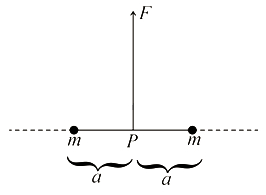
A
$\frac{F}{2m} \frac{a}{\sqrt{a^2-x^2}}$
B
$\frac{F}{2m} \frac{x}{\sqrt{a^2-x^2}}$
C
$\frac{F}{2m} \frac{x}{a}$
D
$\frac{F}{2m} \frac{\sqrt{a^2-x^2}}{x}$
Solution
(B) Let the string form a triangle with the horizontal surface when pulled. The length of each half of the string is $a$. Let the horizontal distance of each particle from the midpoint be $x$. The vertical height of the midpoint $P$ is $y = \sqrt{a^2 - x^2}$.
Let $\theta$ be the angle the string makes with the horizontal surface. Then $\cos \theta = \frac{x}{a}$ and $\sin \theta = \frac{y}{a} = \frac{\sqrt{a^2 - x^2}}{a}$.
For the midpoint $P$,the vertical force balance is $2T \sin \theta = F$,so $T = \frac{F}{2 \sin \theta}$.
For each particle of mass $m$,the horizontal force is $T \cos \theta = ma_{p}$,where $a_{p}$ is the acceleration of the particle.
Substituting $T$,we get $a_{p} = \frac{T \cos \theta}{m} = \frac{F \cos \theta}{2m \sin \theta} = \frac{F}{2m} \cot \theta$.
Since $\cot \theta = \frac{\cos \theta}{\sin \theta} = \frac{x/a}{\sqrt{a^2 - x^2}/a} = \frac{x}{\sqrt{a^2 - x^2}}$,the acceleration is $a_{p} = \frac{F}{2m} \frac{x}{\sqrt{a^2 - x^2}}$.
Let $\theta$ be the angle the string makes with the horizontal surface. Then $\cos \theta = \frac{x}{a}$ and $\sin \theta = \frac{y}{a} = \frac{\sqrt{a^2 - x^2}}{a}$.
For the midpoint $P$,the vertical force balance is $2T \sin \theta = F$,so $T = \frac{F}{2 \sin \theta}$.
For each particle of mass $m$,the horizontal force is $T \cos \theta = ma_{p}$,where $a_{p}$ is the acceleration of the particle.
Substituting $T$,we get $a_{p} = \frac{T \cos \theta}{m} = \frac{F \cos \theta}{2m \sin \theta} = \frac{F}{2m} \cot \theta$.
Since $\cot \theta = \frac{\cos \theta}{\sin \theta} = \frac{x/a}{\sqrt{a^2 - x^2}/a} = \frac{x}{\sqrt{a^2 - x^2}}$,the acceleration is $a_{p} = \frac{F}{2m} \frac{x}{\sqrt{a^2 - x^2}}$.
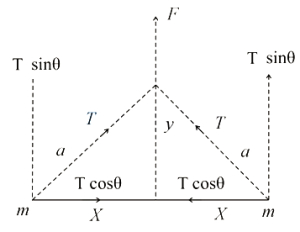
0 likes
View Solution148
EasyMCQ
$A$ $4 \text{ kg}$ mass is suspended as shown in the figure. All pulleys are frictionless and the spring constant $K$ is $8 \times 10^3 \text{ Nm}^{-1}$. The extension in the spring is $\left(g=10 \text{ ms}^{-2}\right)$.
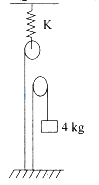
A
$2 \text{ mm}$
B
$2 \text{ cm}$
C
$4 \text{ cm}$
D
$4 \text{ mm}$
Solution
(B) Given: Mass $m = 4 \text{ kg}$,Spring constant $K = 8 \times 10^3 \text{ Nm}^{-1}$,$g = 10 \text{ ms}^{-2}$.
From the free body diagram of the lower pulley,the tension $T$ in the string supporting the $4 \text{ kg}$ mass is $T = mg = 4 \times 10 = 40 \text{ N}$.
The lower pulley is supported by two segments of the string,each with tension $T$. Thus,the force exerted by the lower pulley on the upper pulley is $2T = 2 \times 40 = 80 \text{ N}$.
The upper pulley is supported by the spring and the string fixed to the ground. The total downward force on the upper pulley is the sum of the tension from the string fixed to the ground $(2T)$ and the force from the lower pulley $(2T)$.
Therefore,the total force $F$ in the spring is $F = 2T + 2T = 4T = 4 \times 40 = 160 \text{ N}$.
Using Hooke's Law,the extension $x$ in the spring is $x = \frac{F}{K} = \frac{160}{8 \times 10^3} = 20 \times 10^{-3} \text{ m} = 2 \times 10^{-2} \text{ m} = 2 \text{ cm}$.
From the free body diagram of the lower pulley,the tension $T$ in the string supporting the $4 \text{ kg}$ mass is $T = mg = 4 \times 10 = 40 \text{ N}$.
The lower pulley is supported by two segments of the string,each with tension $T$. Thus,the force exerted by the lower pulley on the upper pulley is $2T = 2 \times 40 = 80 \text{ N}$.
The upper pulley is supported by the spring and the string fixed to the ground. The total downward force on the upper pulley is the sum of the tension from the string fixed to the ground $(2T)$ and the force from the lower pulley $(2T)$.
Therefore,the total force $F$ in the spring is $F = 2T + 2T = 4T = 4 \times 40 = 160 \text{ N}$.
Using Hooke's Law,the extension $x$ in the spring is $x = \frac{F}{K} = \frac{160}{8 \times 10^3} = 20 \times 10^{-3} \text{ m} = 2 \times 10^{-2} \text{ m} = 2 \text{ cm}$.
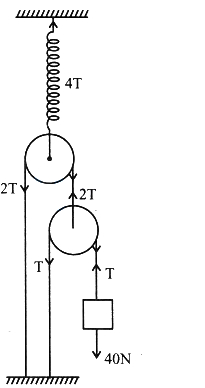
0 likes
View Solution149
DifficultMCQ
In the arrangement shown in the figure, the work done by the string on the block of mass $0.36 \,kg$ during the first second after the blocks are released from a state of rest is: (Ignore friction and the mass of the string.)
(Acceleration due to gravity, $g = 10 \,m/s^2$) (in $\,J$)
(Acceleration due to gravity, $g = 10 \,m/s^2$) (in $\,J$)
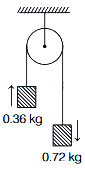
A
$8$
B
$4$
C
$12$
D
$2$
Solution
(A) Given:
Mass of block $1$, $m_1 = 0.36 \,kg$
Mass of block $2$, $m_2 = 0.72 \,kg$
Acceleration due to gravity, $g = 10 \,m/s^2$
Time, $t = 1 \,s$
The acceleration $a$ of the system is given by:
$a = \frac{(m_2 - m_1)g}{m_1 + m_2} = \frac{(0.72 - 0.36) \times 10}{0.72 + 0.36} = \frac{0.36 \times 10}{1.08} = \frac{3.6}{1.08} = \frac{10}{3} \,m/s^2$
The tension $T$ in the string is:
$T = m_1(g + a) = 0.36 \times (10 + \frac{10}{3}) = 0.36 \times \frac{40}{3} = 0.12 \times 40 = 4.8 \,N$
The displacement $s$ of the block $m_1$ in $t = 1 \,s$ is:
$s = ut + \frac{1}{2}at^2 = 0 + \frac{1}{2} \times \frac{10}{3} \times (1)^2 = \frac{5}{3} \,m$
The work done by the string on block $m_1$ is:
$W = T \times s \times \cos(0^\circ) = 4.8 \times \frac{5}{3} = 1.6 \times 5 = 8 \,J$
Mass of block $1$, $m_1 = 0.36 \,kg$
Mass of block $2$, $m_2 = 0.72 \,kg$
Acceleration due to gravity, $g = 10 \,m/s^2$
Time, $t = 1 \,s$
The acceleration $a$ of the system is given by:
$a = \frac{(m_2 - m_1)g}{m_1 + m_2} = \frac{(0.72 - 0.36) \times 10}{0.72 + 0.36} = \frac{0.36 \times 10}{1.08} = \frac{3.6}{1.08} = \frac{10}{3} \,m/s^2$
The tension $T$ in the string is:
$T = m_1(g + a) = 0.36 \times (10 + \frac{10}{3}) = 0.36 \times \frac{40}{3} = 0.12 \times 40 = 4.8 \,N$
The displacement $s$ of the block $m_1$ in $t = 1 \,s$ is:
$s = ut + \frac{1}{2}at^2 = 0 + \frac{1}{2} \times \frac{10}{3} \times (1)^2 = \frac{5}{3} \,m$
The work done by the string on block $m_1$ is:
$W = T \times s \times \cos(0^\circ) = 4.8 \times \frac{5}{3} = 1.6 \times 5 = 8 \,J$
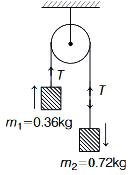
0 likes
View SolutionNewton's Laws of Motion and Friction — Tension Force and Pulley Block System · Frequently Asked Questions
1Are these Newton's Laws of Motion and Friction questions useful for JEE and NEET?
Yes. All questions in this section are mapped to JEE Main and NEET exam patterns. Previous year questions from JEE Main, NEET, GUJCET and state-level exams are included with full solutions.
2Can I switch to Hindi or Gujarati for these questions?
Yes. Use the language tabs in the hero section or the sidebar to view the same questions and solutions in English, Hindi or Gujarati.
3How do I generate a question paper from this subtopic?
Use the Vedclass Exam Paper Generator — select the chapter and subtopic, set difficulty, and generate Sets A, B, C, D automatically. First 3 chapters of every subject are free.
Vedclass Products
For Students
Vedclass Test Series
Mock tests in real JEE/NEET style with performance analysis. 5-day free trial.
Start Free TrialFor Teachers
Exam Paper Generator
Generate Set A/B/C/D papers from this chapter in 2 minutes. 3 chapters free.
Try FreeFor Institutes
Online Exam Module
Live online exams with unlimited students, 360° analytics & white-label branding.
See DemoFor Teachers & Institutes
Generate a Newton's Laws of Motion and Friction Exam Paper in 2 Minutes
Select subtopic & difficulty — Sets A, B, C, D auto-generated with No Repeat logic.
First 3 chapters of every subject are free — no payment required.