
A English
Motion of Body (or Connected Bodies in horizontal or vertical) (by String or Contact) Questions in English
Class 11 Physics · Newton's Laws of Motion and Friction · Motion of Body (or Connected Bodies in horizontal or vertical) (by String or Contact)
146+
Questions
English
Language
100%
With Solutions
Showing 45 of 146 questions in English
101
DifficultMCQ
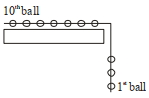
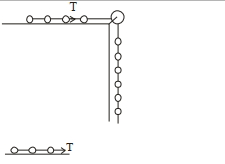
$A$ system of $10$ balls,each of mass $m = 2 \; kg$,is connected via a massless and unstretchable string. The system is allowed to slip over the edge of a smooth table as shown in the figure. Find the tension $T$ in the string between the $7^{th}$ and $8^{th}$ ball when the $6^{th}$ ball just leaves the table. (in $; N$)
A
$36$
B
$37$
C
$38$
D
$39$
Solution
(A) When the $6^{th}$ ball just leaves the table,$6$ balls are hanging vertically and $4$ balls are on the horizontal table.
The total mass of the system is $M = 10m$.
The driving force is the weight of the $6$ hanging balls,which is $F = 6mg$.
The acceleration $a$ of the system is given by $a = \frac{F}{M} = \frac{6mg}{10m} = \frac{3g}{5}$.
To find the tension $T$ between the $7^{th}$ and $8^{th}$ ball,we consider the system of the $3$ balls $(8^{th}, 9^{th}, 10^{th})$ remaining on the table.
The only horizontal force acting on this system is the tension $T$.
Applying Newton's second law to these $3$ balls: $T = (3m)a$.
Substituting the value of $a$: $T = 3m \times \frac{3g}{5} = \frac{9mg}{5}$.
Given $m = 2 \; kg$ and taking $g = 10 \; m/s^2$:
$T = \frac{9 \times 2 \times 10}{5} = \frac{180}{5} = 36 \; N$.
The total mass of the system is $M = 10m$.
The driving force is the weight of the $6$ hanging balls,which is $F = 6mg$.
The acceleration $a$ of the system is given by $a = \frac{F}{M} = \frac{6mg}{10m} = \frac{3g}{5}$.
To find the tension $T$ between the $7^{th}$ and $8^{th}$ ball,we consider the system of the $3$ balls $(8^{th}, 9^{th}, 10^{th})$ remaining on the table.
The only horizontal force acting on this system is the tension $T$.
Applying Newton's second law to these $3$ balls: $T = (3m)a$.
Substituting the value of $a$: $T = 3m \times \frac{3g}{5} = \frac{9mg}{5}$.
Given $m = 2 \; kg$ and taking $g = 10 \; m/s^2$:
$T = \frac{9 \times 2 \times 10}{5} = \frac{180}{5} = 36 \; N$.
1 likes
View Solution102
MediumMCQ
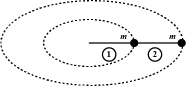
Two particles each of mass $m$ are moving in horizontal circles with the same angular speed $\omega$. If both strings are of the same length $l$,find the ratio of tension in the strings $\frac{T_1}{T_2}$.
A
$\frac{3}{2}$
B
$3$
C
$2$
D
$\frac{1}{3}$
Solution
(A) Let the mass of each particle be $m$,the angular speed be $\omega$,and the length of each string be $l$.
For the outer particle (mass $m$ at distance $2l$ from the center),the tension $T_2$ provides the necessary centripetal force:
$T_2 = m(2l)\omega^2 = 2ml\omega^2 \quad \dots (1)$
For the inner particle (mass $m$ at distance $l$ from the center),the net force is the difference between the tensions $T_1$ and $T_2$,which provides the centripetal force:
$T_1 - T_2 = m(l)\omega^2 = ml\omega^2 \quad \dots (2)$
Dividing equation $(2)$ by equation $(1)$:
$\frac{T_1 - T_2}{T_2} = \frac{ml\omega^2}{2ml\omega^2} = \frac{1}{2}$
$2(T_1 - T_2) = T_2$
$2T_1 - 2T_2 = T_2$
$2T_1 = 3T_2$
$\frac{T_1}{T_2} = \frac{3}{2}$
For the outer particle (mass $m$ at distance $2l$ from the center),the tension $T_2$ provides the necessary centripetal force:
$T_2 = m(2l)\omega^2 = 2ml\omega^2 \quad \dots (1)$
For the inner particle (mass $m$ at distance $l$ from the center),the net force is the difference between the tensions $T_1$ and $T_2$,which provides the centripetal force:
$T_1 - T_2 = m(l)\omega^2 = ml\omega^2 \quad \dots (2)$
Dividing equation $(2)$ by equation $(1)$:
$\frac{T_1 - T_2}{T_2} = \frac{ml\omega^2}{2ml\omega^2} = \frac{1}{2}$
$2(T_1 - T_2) = T_2$
$2T_1 - 2T_2 = T_2$
$2T_1 = 3T_2$
$\frac{T_1}{T_2} = \frac{3}{2}$
1 likes
View Solution103
MediumMCQ
$A$ string tied to a roof can bear a maximum tension of $50 \,kg$ wt. The minimum acceleration with which a man of $98 \,kg$ can descend is ...... $m/s^2$ [Take $g = 9.8 \,m/s^2$].
A
$9.8$
B
$4.9$
C
$4.8$
D
$5$
Solution
(C) The maximum tension the string can bear is $T_{\text{max}} = 50 \,kg \times g = 50 \times 9.8 \,N = 490 \,N$.
Let the mass of the man be $M = 98 \,kg$ and his downward acceleration be $a$.
The forces acting on the man are his weight $Mg$ downwards and the tension $T$ upwards.
According to Newton's second law,$Mg - T = Ma$.
To find the minimum acceleration $a$ for the man to descend without breaking the string,we set $T = T_{\text{max}} = 50 \,g$.
Substituting the values: $98 \,g - 50 \,g = 98 \,a$.
$48 \,g = 98 \,a$.
$a = \frac{48 \times 9.8}{98} = \frac{48}{10} = 4.8 \,m/s^2$.
Let the mass of the man be $M = 98 \,kg$ and his downward acceleration be $a$.
The forces acting on the man are his weight $Mg$ downwards and the tension $T$ upwards.
According to Newton's second law,$Mg - T = Ma$.
To find the minimum acceleration $a$ for the man to descend without breaking the string,we set $T = T_{\text{max}} = 50 \,g$.
Substituting the values: $98 \,g - 50 \,g = 98 \,a$.
$48 \,g = 98 \,a$.
$a = \frac{48 \times 9.8}{98} = \frac{48}{10} = 4.8 \,m/s^2$.
1 likes
View Solution104
MediumMCQ
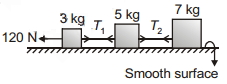
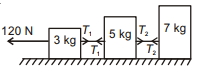
$T_1$ and $T_2$ in the given figure are
A
$28\; N, 48\; N$
B
$48\; N, 28\; N$
C
$96\; N, 56\; N$
D
$56\; N, 96\; N$
Solution
(C) The total mass of the system is $M_{\text{total}} = 3\; kg + 5\; kg + 7\; kg = 15\; kg$.
The external force applied is $F = 120\; N$.
The acceleration of the system is $a = \frac{F}{M_{\text{total}}} = \frac{120}{15} = 8\; m/s^2$.
For the $7\; kg$ mass,the only horizontal force acting is the tension $T_2$. Thus,$T_2 = m_3 \cdot a = 7 \times 8 = 56\; N$.
For the $5\; kg$ mass,the forces acting are $T_1$ (pulling forward) and $T_2$ (pulling backward). Thus,$T_1 - T_2 = m_2 \cdot a$.
$T_1 - 56 = 5 \times 8 = 40$.
$T_1 = 40 + 56 = 96\; N$.
Therefore,$T_1 = 96\; N$ and $T_2 = 56\; N$.
The external force applied is $F = 120\; N$.
The acceleration of the system is $a = \frac{F}{M_{\text{total}}} = \frac{120}{15} = 8\; m/s^2$.
For the $7\; kg$ mass,the only horizontal force acting is the tension $T_2$. Thus,$T_2 = m_3 \cdot a = 7 \times 8 = 56\; N$.
For the $5\; kg$ mass,the forces acting are $T_1$ (pulling forward) and $T_2$ (pulling backward). Thus,$T_1 - T_2 = m_2 \cdot a$.
$T_1 - 56 = 5 \times 8 = 40$.
$T_1 = 40 + 56 = 96\; N$.
Therefore,$T_1 = 96\; N$ and $T_2 = 56\; N$.
0 likes
View Solution105
MediumMCQ
$A$ man slides down a light rope whose breaking strength is $\eta$ times the weight of the man $(\eta < 1)$. What is the maximum acceleration of the man so that the rope does not break?
A
$g(1-\eta)$
B
$g(1+\eta)$
C
$g\eta$
D
$\frac{g}{\eta}$
Solution
(A) Let the mass of the man be $m$ and his weight be $w = mg$.
The breaking strength of the rope is given as $T_{\max} = \eta w = \eta mg$.
When the man slides down with an acceleration $a$,the equation of motion is given by Newton's Second Law:
$mg - T = ma$
To prevent the rope from breaking,the tension $T$ must be less than or equal to $T_{\max}$. For the limiting case where the rope is just about to break,we set $T = T_{\max} = \eta mg$.
Substituting this into the equation of motion:
$mg - \eta mg = ma$
Dividing both sides by $m$:
$g(1 - \eta) = a$
Thus,the maximum acceleration the man can have without breaking the rope is $a = g(1 - \eta)$.
The breaking strength of the rope is given as $T_{\max} = \eta w = \eta mg$.
When the man slides down with an acceleration $a$,the equation of motion is given by Newton's Second Law:
$mg - T = ma$
To prevent the rope from breaking,the tension $T$ must be less than or equal to $T_{\max}$. For the limiting case where the rope is just about to break,we set $T = T_{\max} = \eta mg$.
Substituting this into the equation of motion:
$mg - \eta mg = ma$
Dividing both sides by $m$:
$g(1 - \eta) = a$
Thus,the maximum acceleration the man can have without breaking the rope is $a = g(1 - \eta)$.
0 likes
View Solution106
MediumMCQ
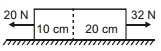
The figure shows a uniform rod of length $30 \,cm$ having a mass of $3.0 \,kg$. The rod is pulled by constant forces of $20 \,N$ and $32 \,N$ as shown. Find the force exerted by the $20 \,cm$ part of the rod on the $10 \,cm$ part (all surfaces are smooth).
A
$36$
B
$12$
C
$64$
D
$24$
Solution
(D) The total mass of the rod is $M = 3.0 \,kg$ and total length is $L = 30 \,cm$.
The linear mass density is $\lambda = \frac{M}{L} = \frac{3.0 \,kg}{30 \,cm} = 0.1 \,kg/cm$.
Mass of the $10 \,cm$ part is $m_1 = 0.1 \times 10 = 1.0 \,kg$.
Mass of the $20 \,cm$ part is $m_2 = 0.1 \times 20 = 2.0 \,kg$.
The net force on the system is $F_{\text{net}} = 32 \,N - 20 \,N = 12 \,N$.
The acceleration of the system is $a = \frac{F_{\text{net}}}{M} = \frac{12 \,N}{3.0 \,kg} = 4 \,m/s^2$.
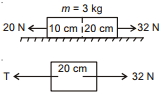
Let $T$ be the force exerted by the $20 \,cm$ part on the $10 \,cm$ part. Considering the $10 \,cm$ part,the forces acting on it are $20 \,N$ (left) and $T$ (right).
Applying Newton's second law: $T - 20 = m_1 a$.
$T - 20 = 1.0 \times 4$.
$T = 20 + 4 = 24 \,N$.
The linear mass density is $\lambda = \frac{M}{L} = \frac{3.0 \,kg}{30 \,cm} = 0.1 \,kg/cm$.
Mass of the $10 \,cm$ part is $m_1 = 0.1 \times 10 = 1.0 \,kg$.
Mass of the $20 \,cm$ part is $m_2 = 0.1 \times 20 = 2.0 \,kg$.
The net force on the system is $F_{\text{net}} = 32 \,N - 20 \,N = 12 \,N$.
The acceleration of the system is $a = \frac{F_{\text{net}}}{M} = \frac{12 \,N}{3.0 \,kg} = 4 \,m/s^2$.
Let $T$ be the force exerted by the $20 \,cm$ part on the $10 \,cm$ part. Considering the $10 \,cm$ part,the forces acting on it are $20 \,N$ (left) and $T$ (right).
Applying Newton's second law: $T - 20 = m_1 a$.
$T - 20 = 1.0 \times 4$.
$T = 20 + 4 = 24 \,N$.
0 likes
View Solution107
MediumMCQ
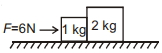
The arrangement of a two-block system is as shown. Assuming the surfaces to be frictionless,the net force acting on the $1 \, kg$ and $2 \, kg$ blocks are,respectively:
A
$4 \, N, 8 \, N$
B
$1 \, N, 2 \, N$
C
$2 \, N, 4 \, N$
D
$3 \, N, 6 \, N$
Solution
(C) The total mass of the system is $M = 1 \, kg + 2 \, kg = 3 \, kg$.
The external force applied is $F = 6 \, N$.
The acceleration of the system is given by $a = \frac{F}{M} = \frac{6 \, N}{3 \, kg} = 2 \, m/s^2$.
For the $2 \, kg$ block,the only horizontal force acting on it is the normal contact force $N$ exerted by the $1 \, kg$ block. Thus,the net force on the $2 \, kg$ block is $F_{\text{net}, 2kg} = m_2 \cdot a = 2 \, kg \times 2 \, m/s^2 = 4 \, N$.
For the $1 \, kg$ block,the forces acting on it are the applied force $F = 6 \, N$ in the forward direction and the reaction force $N = 4 \, N$ from the $2 \, kg$ block in the backward direction. Thus,the net force on the $1 \, kg$ block is $F_{\text{net}, 1kg} = F - N = 6 \, N - 4 \, N = 2 \, N$.
Therefore,the net forces acting on the $1 \, kg$ and $2 \, kg$ blocks are $2 \, N$ and $4 \, N$,respectively.
The external force applied is $F = 6 \, N$.
The acceleration of the system is given by $a = \frac{F}{M} = \frac{6 \, N}{3 \, kg} = 2 \, m/s^2$.
For the $2 \, kg$ block,the only horizontal force acting on it is the normal contact force $N$ exerted by the $1 \, kg$ block. Thus,the net force on the $2 \, kg$ block is $F_{\text{net}, 2kg} = m_2 \cdot a = 2 \, kg \times 2 \, m/s^2 = 4 \, N$.
For the $1 \, kg$ block,the forces acting on it are the applied force $F = 6 \, N$ in the forward direction and the reaction force $N = 4 \, N$ from the $2 \, kg$ block in the backward direction. Thus,the net force on the $1 \, kg$ block is $F_{\text{net}, 1kg} = F - N = 6 \, N - 4 \, N = 2 \, N$.
Therefore,the net forces acting on the $1 \, kg$ and $2 \, kg$ blocks are $2 \, N$ and $4 \, N$,respectively.

0 likes
View Solution108
MediumMCQ
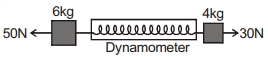
$A$ dynamometer $D$ is attached to two blocks of masses $6 \, kg$ and $4 \, kg$ as shown in the figure. The reading of the dynamometer is ............ $N$.
A
$18$
B
$28$
C
$38$
D
$48$
Solution
(C) The reading of the dynamometer is equal to the tension $T$ in the spring.
First,calculate the acceleration $a$ of the system by applying Newton's second law to the combined system of two blocks:
$F_{\text{net}} = M_{\text{total}} a$
$50 \, N - 30 \, N = (6 \, kg + 4 \, kg) a$
$20 \, N = 10 \, kg \times a$
$a = 2 \, m/s^2$ (directed towards the $6 \, kg$ block).
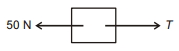
Now,consider the $4 \, kg$ block. The forces acting on it are the tension $T$ (pulling towards the $6 \, kg$ block) and the $30 \, N$ force (pulling to the right). Since the system accelerates to the left:
$T - 30 \, N = 4 \, kg \times 2 \, m/s^2$
$T - 30 \, N = 8 \, N$
$T = 38 \, N$.
Alternatively,considering the $6 \, kg$ block:
$50 \, N - T = 6 \, kg \times 2 \, m/s^2$
$50 \, N - T = 12 \, N$
$T = 38 \, N$.
Thus,the reading of the dynamometer is $38 \, N$.
First,calculate the acceleration $a$ of the system by applying Newton's second law to the combined system of two blocks:
$F_{\text{net}} = M_{\text{total}} a$
$50 \, N - 30 \, N = (6 \, kg + 4 \, kg) a$
$20 \, N = 10 \, kg \times a$
$a = 2 \, m/s^2$ (directed towards the $6 \, kg$ block).
Now,consider the $4 \, kg$ block. The forces acting on it are the tension $T$ (pulling towards the $6 \, kg$ block) and the $30 \, N$ force (pulling to the right). Since the system accelerates to the left:
$T - 30 \, N = 4 \, kg \times 2 \, m/s^2$
$T - 30 \, N = 8 \, N$
$T = 38 \, N$.
Alternatively,considering the $6 \, kg$ block:
$50 \, N - T = 6 \, kg \times 2 \, m/s^2$
$50 \, N - T = 12 \, N$
$T = 38 \, N$.
Thus,the reading of the dynamometer is $38 \, N$.
0 likes
View Solution109
MediumMCQ
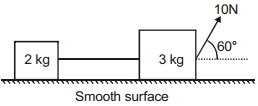
The figure shows two blocks connected by a light inextensible string. $A$ force of $10 \,N$ is applied on the bigger block at $60^{\circ}$ with the horizontal. The tension in the string connecting the two masses is ....... $N$.
A
$5$
B
$2$
C
$1$
D
$3$
Solution
(B) The system consists of two blocks of masses $m_1 = 2 \,kg$ and $m_2 = 3 \,kg$ connected by a string on a smooth horizontal surface.
First,calculate the acceleration of the system. The horizontal component of the applied force $F = 10 \,N$ is $F_x = F \cos 60^{\circ} = 10 \times 0.5 = 5 \,N$.
The total mass of the system is $M = m_1 + m_2 = 2 \,kg + 3 \,kg = 5 \,kg$.
Using Newton's second law,$F_x = M a$,we get $5 = 5 \times a$,which gives $a = 1 \,m/s^2$.
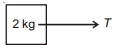
Now,consider the free body diagram of the $2 \,kg$ block. The only horizontal force acting on it is the tension $T$ in the string.
Applying Newton's second law to the $2 \,kg$ block: $T = m_1 a = 2 \,kg \times 1 \,m/s^2 = 2 \,N$.
Thus,the tension in the string is $2 \,N$.
First,calculate the acceleration of the system. The horizontal component of the applied force $F = 10 \,N$ is $F_x = F \cos 60^{\circ} = 10 \times 0.5 = 5 \,N$.
The total mass of the system is $M = m_1 + m_2 = 2 \,kg + 3 \,kg = 5 \,kg$.
Using Newton's second law,$F_x = M a$,we get $5 = 5 \times a$,which gives $a = 1 \,m/s^2$.
Now,consider the free body diagram of the $2 \,kg$ block. The only horizontal force acting on it is the tension $T$ in the string.
Applying Newton's second law to the $2 \,kg$ block: $T = m_1 a = 2 \,kg \times 1 \,m/s^2 = 2 \,N$.
Thus,the tension in the string is $2 \,N$.
0 likes
View Solution110
MediumMCQ
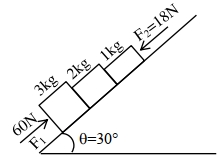
In the diagram shown,the normal reaction force between the $2\,kg$ and $1\,kg$ blocks is (Consider the surface to be smooth) $.........N$ (Given $g = 10\,ms^{-2}$)
A
$25$
B
$39$
C
$6$
D
$10$
Solution
(A) First,calculate the acceleration of the system. The total mass is $M = 3 + 2 + 1 = 6\,kg$.
The forces acting along the incline are $F_1 = 60\,N$ (upwards) and $F_2 = 18\,N$ (downwards).
The component of gravity acting downwards for all blocks is $Mg \sin 30^{\circ} = 6 \times 10 \times 0.5 = 30\,N$.
The net force is $F_{\text{net}} = 60 - 18 - 30 = 12\,N$.
The acceleration is $a = \frac{F_{\text{net}}}{M} = \frac{12}{6} = 2\,ms^{-2}$ (upwards).
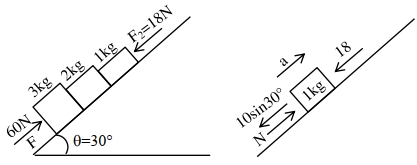
Now,consider the $1\,kg$ block. Let $N$ be the normal reaction force between the $2\,kg$ and $1\,kg$ blocks.
The forces on the $1\,kg$ block are $N$ (upwards),$F_2 = 18\,N$ (downwards),and $mg \sin 30^{\circ} = 1 \times 10 \times 0.5 = 5\,N$ (downwards).
Applying Newton's second law: $N - 18 - 5 = m \times a \implies N - 23 = 1 \times 2 \implies N = 25\,N$.
The forces acting along the incline are $F_1 = 60\,N$ (upwards) and $F_2 = 18\,N$ (downwards).
The component of gravity acting downwards for all blocks is $Mg \sin 30^{\circ} = 6 \times 10 \times 0.5 = 30\,N$.
The net force is $F_{\text{net}} = 60 - 18 - 30 = 12\,N$.
The acceleration is $a = \frac{F_{\text{net}}}{M} = \frac{12}{6} = 2\,ms^{-2}$ (upwards).
Now,consider the $1\,kg$ block. Let $N$ be the normal reaction force between the $2\,kg$ and $1\,kg$ blocks.
The forces on the $1\,kg$ block are $N$ (upwards),$F_2 = 18\,N$ (downwards),and $mg \sin 30^{\circ} = 1 \times 10 \times 0.5 = 5\,N$ (downwards).
Applying Newton's second law: $N - 18 - 5 = m \times a \implies N - 23 = 1 \times 2 \implies N = 25\,N$.
0 likes
View Solution111
DifficultMCQ
Three blocks $A$,$B$,and $C$ of masses $5 \text{ kg}$,$3 \text{ kg}$,and $2 \text{ kg}$ respectively are pulled on a horizontal smooth surface by a force of $80 \text{ N}$ as shown in the figure. The tensions $T_1$ and $T_2$ in the strings are respectively:

A
$40 \text{ N}, 64 \text{ N}$
B
$60 \text{ N}, 80 \text{ N}$
C
$88 \text{ N}, 96 \text{ N}$
D
$80 \text{ N}, 100 \text{ N}$
Solution
(A) The total mass of the system is $M = m_A + m_B + m_C = 5 \text{ kg} + 3 \text{ kg} + 2 \text{ kg} = 10 \text{ kg}$.
Since the surface is smooth,the acceleration $a$ of the system is given by $a = \frac{F}{M} = \frac{80 \text{ N}}{10 \text{ kg}} = 8 \text{ m/s}^2$.
For block $A$ $(5 \text{ kg})$,the only horizontal force acting is the tension $T_1$. Therefore,$T_1 = m_A \times a = 5 \text{ kg} \times 8 \text{ m/s}^2 = 40 \text{ N}$.
For block $B$ $(3 \text{ kg})$,the forces acting are $T_2$ (pulling forward) and $T_1$ (pulling backward). Therefore,$T_2 - T_1 = m_B \times a$.
Substituting the values,$T_2 - 40 \text{ N} = 3 \text{ kg} \times 8 \text{ m/s}^2 = 24 \text{ N}$.
Thus,$T_2 = 40 \text{ N} + 24 \text{ N} = 64 \text{ N}$.
Therefore,the tensions $T_1$ and $T_2$ are $40 \text{ N}$ and $64 \text{ N}$ respectively.
Since the surface is smooth,the acceleration $a$ of the system is given by $a = \frac{F}{M} = \frac{80 \text{ N}}{10 \text{ kg}} = 8 \text{ m/s}^2$.
For block $A$ $(5 \text{ kg})$,the only horizontal force acting is the tension $T_1$. Therefore,$T_1 = m_A \times a = 5 \text{ kg} \times 8 \text{ m/s}^2 = 40 \text{ N}$.
For block $B$ $(3 \text{ kg})$,the forces acting are $T_2$ (pulling forward) and $T_1$ (pulling backward). Therefore,$T_2 - T_1 = m_B \times a$.
Substituting the values,$T_2 - 40 \text{ N} = 3 \text{ kg} \times 8 \text{ m/s}^2 = 24 \text{ N}$.
Thus,$T_2 = 40 \text{ N} + 24 \text{ N} = 64 \text{ N}$.
Therefore,the tensions $T_1$ and $T_2$ are $40 \text{ N}$ and $64 \text{ N}$ respectively.
0 likes
View Solution112
MediumMCQ
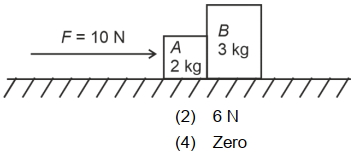
$A$ horizontal force of $10 \,N$ is applied to a block $A$ as shown in the figure. The masses of blocks $A$ and $B$ are $2 \,kg$ and $3 \,kg$ respectively. The blocks slide over a frictionless surface. The force exerted by block $A$ on block $B$ is:
A
$4 \,N$
B
$6 \,N$
C
$10 \,N$
D
Zero
Solution
(B) Given: Force $F = 10 \,N$, mass of block $A$ $(m_A) = 2 \,kg$, mass of block $B$ $(m_B) = 3 \,kg$.
Since the blocks are in contact and moving together, the acceleration $(a)$ of the system is given by Newton's second law:
$F = (m_A + m_B) a$
$10 = (2 + 3) a$
$10 = 5a$
$a = 2 \,m/s^2$
Now, consider the free body diagram of block $B$. The only horizontal force acting on block $B$ is the force exerted by block $A$ $(F_{AB})$, which causes it to accelerate at $2 \,m/s^2$:
$F_{AB} = m_B \times a$
$F_{AB} = 3 \,kg \times 2 \,m/s^2 = 6 \,N$
Therefore, the force exerted by block $A$ on block $B$ is $6 \,N$.
Since the blocks are in contact and moving together, the acceleration $(a)$ of the system is given by Newton's second law:
$F = (m_A + m_B) a$
$10 = (2 + 3) a$
$10 = 5a$
$a = 2 \,m/s^2$
Now, consider the free body diagram of block $B$. The only horizontal force acting on block $B$ is the force exerted by block $A$ $(F_{AB})$, which causes it to accelerate at $2 \,m/s^2$:
$F_{AB} = m_B \times a$
$F_{AB} = 3 \,kg \times 2 \,m/s^2 = 6 \,N$
Therefore, the force exerted by block $A$ on block $B$ is $6 \,N$.
0 likes
View Solution113
MediumMCQ
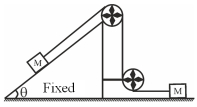
Two blocks,each of mass $M$,are initially at rest on frictionless surfaces as shown in the figure. If the pulleys are light and frictionless,and the block of mass $M$ on the incline is allowed to move down,then the tension in the string will be$-$
A
$\frac{2}{3} Mg \sin \theta$
B
$\frac{3}{2} Mg \sin \theta$
C
$\frac{Mg \sin \theta}{2}$
D
$2 Mg \sin \theta$
Solution
(C) Let the acceleration of the system be $a$.
For the block on the incline,the equation of motion is: $Mg \sin \theta - T = Ma$
For the block on the horizontal surface,the equation of motion is: $T = Ma$
Adding both equations: $Mg \sin \theta = 2Ma$
Solving for acceleration: $a = \frac{g \sin \theta}{2}$
Substituting $a$ into the second equation: $T = M \left( \frac{g \sin \theta}{2} \right) = \frac{Mg \sin \theta}{2}$
For the block on the incline,the equation of motion is: $Mg \sin \theta - T = Ma$
For the block on the horizontal surface,the equation of motion is: $T = Ma$
Adding both equations: $Mg \sin \theta = 2Ma$
Solving for acceleration: $a = \frac{g \sin \theta}{2}$
Substituting $a$ into the second equation: $T = M \left( \frac{g \sin \theta}{2} \right) = \frac{Mg \sin \theta}{2}$
0 likes
View Solution114
EasyMCQ
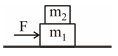
If all surfaces are smooth,then the acceleration of mass $m_2$ will be $-$
A
$\frac{F}{m_1+m_2}$
B
$\frac{F}{m_1}$
C
$\frac{F}{m_2}$
D
Zero
Solution
(D) Since all surfaces are smooth,there is no friction between the two blocks $m_1$ and $m_2$.
When a horizontal force $F$ is applied to the lower block $m_1$,it will move with an acceleration $a = \frac{F}{m_1}$.
Because there is no friction between the surfaces,no horizontal force is transferred to the upper block $m_2$.
Therefore,the net horizontal force acting on $m_2$ is zero,and its horizontal acceleration is zero.
When a horizontal force $F$ is applied to the lower block $m_1$,it will move with an acceleration $a = \frac{F}{m_1}$.
Because there is no friction between the surfaces,no horizontal force is transferred to the upper block $m_2$.
Therefore,the net horizontal force acting on $m_2$ is zero,and its horizontal acceleration is zero.
0 likes
View Solution115
MediumMCQ
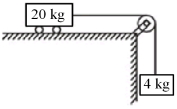
$A$ trolley of mass $20 \ kg$ is attached to a block of mass $4 \ kg$ by a massless string passing over a frictionless pulley as shown in the figure. If the coefficient of kinetic friction between the trolley and the surface is $0.02$,then the acceleration of the trolley and block system is (take $g=10 \ ms^{-2}$):- (in $ms^{-2}$)
A
$1$
B
$2$
C
$1.5$
D
$2.5$
Solution
(C) Let $M = 20 \ kg$ be the mass of the trolley and $m = 4 \ kg$ be the mass of the hanging block.
The driving force is the weight of the hanging block,$F_{drive} = mg = 4 \times 10 = 40 \ N$.
The normal force on the trolley is $N = Mg = 20 \times 10 = 200 \ N$.
The kinetic friction force acting on the trolley is $f_k = \mu_k N = 0.02 \times 200 = 4 \ N$.
The net force on the system is $F_{net} = F_{drive} - f_k = 40 - 4 = 36 \ N$.
The total mass of the system is $M_{total} = M + m = 20 + 4 = 24 \ kg$.
Using Newton's second law,$a = \frac{F_{net}}{M_{total}} = \frac{36}{24} = 1.5 \ ms^{-2}$.
The driving force is the weight of the hanging block,$F_{drive} = mg = 4 \times 10 = 40 \ N$.
The normal force on the trolley is $N = Mg = 20 \times 10 = 200 \ N$.
The kinetic friction force acting on the trolley is $f_k = \mu_k N = 0.02 \times 200 = 4 \ N$.
The net force on the system is $F_{net} = F_{drive} - f_k = 40 - 4 = 36 \ N$.
The total mass of the system is $M_{total} = M + m = 20 + 4 = 24 \ kg$.
Using Newton's second law,$a = \frac{F_{net}}{M_{total}} = \frac{36}{24} = 1.5 \ ms^{-2}$.
0 likes
View Solution116
EasyMCQ
The mass of the lift is $200 \ kg$. When it ascends with an acceleration of $4 \ m/s^2$,the tension in the cable supporting the lift will be [Given: Acceleration due to gravity $g = 10 \ m/s^2$]. (in $N$)
A
$800$
B
$2800$
C
$4200$
D
$2000$
Solution
(B) The forces acting on the lift are the tension $T$ in the cable (upward) and the weight $mg$ (downward).
According to Newton's second law of motion,the net force is $F_{net} = ma$.
For an upward acceleration $a$,the equation of motion is $T - mg = ma$.
Rearranging for tension: $T = m(g + a)$.
Substituting the given values: $m = 200 \ kg$,$g = 10 \ m/s^2$,and $a = 4 \ m/s^2$.
$T = 200 \times (10 + 4)$.
$T = 200 \times 14$.
$T = 2800 \ N$.
According to Newton's second law of motion,the net force is $F_{net} = ma$.
For an upward acceleration $a$,the equation of motion is $T - mg = ma$.
Rearranging for tension: $T = m(g + a)$.
Substituting the given values: $m = 200 \ kg$,$g = 10 \ m/s^2$,and $a = 4 \ m/s^2$.
$T = 200 \times (10 + 4)$.
$T = 200 \times 14$.
$T = 2800 \ N$.
0 likes
View Solution117
MediumMCQ
The minimum acceleration with which a fireman can slide down a rope of breaking strength two-third of his weight is
A
zero
B
$\frac{g}{3}$
C
$3g$
D
$g$
Solution
(B) Let the mass of the fireman be $m$ and his acceleration be $a$. The weight of the fireman is $mg$.
The breaking strength of the rope is given as $\frac{2}{3}mg$.
When the fireman slides down with acceleration $a$,the tension $T$ in the rope is given by $T = m(g - a)$.
For the rope not to break,the tension $T$ must be less than or equal to the breaking strength.
To find the minimum acceleration $a$,we set the tension equal to the breaking strength:
$m(g - a) = \frac{2}{3}mg$
Dividing both sides by $m$:
$g - a = \frac{2}{3}g$
$a = g - \frac{2}{3}g = \frac{g}{3}$
Therefore,the minimum acceleration is $\frac{g}{3}$.
The breaking strength of the rope is given as $\frac{2}{3}mg$.
When the fireman slides down with acceleration $a$,the tension $T$ in the rope is given by $T = m(g - a)$.
For the rope not to break,the tension $T$ must be less than or equal to the breaking strength.
To find the minimum acceleration $a$,we set the tension equal to the breaking strength:
$m(g - a) = \frac{2}{3}mg$
Dividing both sides by $m$:
$g - a = \frac{2}{3}g$
$a = g - \frac{2}{3}g = \frac{g}{3}$
Therefore,the minimum acceleration is $\frac{g}{3}$.
0 likes
View Solution118
EasyMCQ
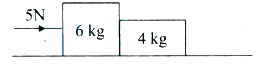
Two blocks of masses $6 \ kg$ and $4 \ kg$ are placed in contact with each other on a smooth surface as shown. If a force of $5 \ N$ is applied on the heavier block,the force on the lighter block is (in $N$)
A
$5$
B
$4$
C
$2$
D
$1$
Solution
(C) Given: $m_1 = 6 \ kg$,$m_2 = 4 \ kg$,and $F = 5 \ N$.
Since the blocks are in contact and moving together,they share the same acceleration $a$.
The total mass of the system is $M = m_1 + m_2 = 6 \ kg + 4 \ kg = 10 \ kg$.
Using Newton's second law for the whole system: $F = M \times a$.
$5 \ N = 10 \ kg \times a \implies a = \frac{5}{10} = 0.5 \ m/s^2$.
The force exerted on the lighter block $(m_2)$ is the contact force $F_{12}$ exerted by the $6 \ kg$ block on the $4 \ kg$ block.
Applying Newton's second law to the $4 \ kg$ block: $F_{12} = m_2 \times a$.
$F_{12} = 4 \ kg \times 0.5 \ m/s^2 = 2 \ N$.
Since the blocks are in contact and moving together,they share the same acceleration $a$.
The total mass of the system is $M = m_1 + m_2 = 6 \ kg + 4 \ kg = 10 \ kg$.
Using Newton's second law for the whole system: $F = M \times a$.
$5 \ N = 10 \ kg \times a \implies a = \frac{5}{10} = 0.5 \ m/s^2$.
The force exerted on the lighter block $(m_2)$ is the contact force $F_{12}$ exerted by the $6 \ kg$ block on the $4 \ kg$ block.
Applying Newton's second law to the $4 \ kg$ block: $F_{12} = m_2 \times a$.
$F_{12} = 4 \ kg \times 0.5 \ m/s^2 = 2 \ N$.
0 likes
View Solution119
MediumMCQ
An elevator of mass $m$ is connected to a rope which pulls the elevator up with a maximum acceleration equal to $a$. If the maximum bearable tension in the rope is $T$,then for a safe journey the minimum diameter of the rope is $[g=$ acceleration due to gravity$]$
A
$[\frac{2 m(g+a)}{\pi T}]^{1/2}$
B
$[\frac{4 m(g+a)}{\pi T}]^{1/2}$
C
$[\frac{m(g+a)}{\pi T}]^{1/2}$
D
$[\frac{m(g+a)}{2 \pi T}]^{1/2}$
Solution
(B) The force equation for the elevator moving upward with acceleration $a$ is given by $T_{actual} = m(g+a)$.
For a safe journey,the maximum tension $T$ that the rope can bear must be at least equal to the actual tension,so $T = m(g+a)$.
The stress in the rope is defined as $\sigma = \frac{T}{A}$,where $A$ is the cross-sectional area of the rope.
Assuming the rope is cylindrical with diameter $d$,the area $A = \pi r^2 = \pi (d/2)^2 = \frac{\pi d^2}{4}$.
Substituting this into the tension equation: $T = \frac{m(g+a)}{\pi d^2 / 4} = \frac{4 m(g+a)}{\pi d^2}$.
Rearranging for $d^2$,we get $d^2 = \frac{4 m(g+a)}{\pi T}$.
Taking the square root of both sides,the minimum diameter is $d = [\frac{4 m(g+a)}{\pi T}]^{1/2}$.
For a safe journey,the maximum tension $T$ that the rope can bear must be at least equal to the actual tension,so $T = m(g+a)$.
The stress in the rope is defined as $\sigma = \frac{T}{A}$,where $A$ is the cross-sectional area of the rope.
Assuming the rope is cylindrical with diameter $d$,the area $A = \pi r^2 = \pi (d/2)^2 = \frac{\pi d^2}{4}$.
Substituting this into the tension equation: $T = \frac{m(g+a)}{\pi d^2 / 4} = \frac{4 m(g+a)}{\pi d^2}$.
Rearranging for $d^2$,we get $d^2 = \frac{4 m(g+a)}{\pi T}$.
Taking the square root of both sides,the minimum diameter is $d = [\frac{4 m(g+a)}{\pi T}]^{1/2}$.
0 likes
View Solution120
MediumMCQ
If a ship of mass $4 \times 10^{7} \,kg$ initially at rest is pulled by a force of $5 \times 10^{4} \,N$ through a distance of $4 \,m$, then the speed of the ship will be (resistance due to water is negligible). (in $\,ms^{-1}$)
A
$5$
B
$1.5$
C
$60$
D
$0.1$
Solution
(D) Given: Mass $m = 4 \times 10^{7} \,kg$, Force $F = 5 \times 10^{4} \,N$, Initial velocity $u = 0$, Distance $s = 4 \,m$.
Using Newton's second law, $F = ma$:
$5 \times 10^{4} = 4 \times 10^{7} \times a$
$a = \frac{5 \times 10^{4}}{4 \times 10^{7}} = 1.25 \times 10^{-3} \,ms^{-2}$.
Using the kinematic equation $v^{2} = u^{2} + 2as$:
$v^{2} = 0^{2} + 2 \times (1.25 \times 10^{-3}) \times 4$
$v^{2} = 2 \times 1.25 \times 4 \times 10^{-3} = 10 \times 10^{-3} = 10^{-2} \,m^{2}s^{-2}$.
$v = \sqrt{10^{-2}} = 0.1 \,ms^{-1}$.
Using Newton's second law, $F = ma$:
$5 \times 10^{4} = 4 \times 10^{7} \times a$
$a = \frac{5 \times 10^{4}}{4 \times 10^{7}} = 1.25 \times 10^{-3} \,ms^{-2}$.
Using the kinematic equation $v^{2} = u^{2} + 2as$:
$v^{2} = 0^{2} + 2 \times (1.25 \times 10^{-3}) \times 4$
$v^{2} = 2 \times 1.25 \times 4 \times 10^{-3} = 10 \times 10^{-3} = 10^{-2} \,m^{2}s^{-2}$.
$v = \sqrt{10^{-2}} = 0.1 \,ms^{-1}$.
0 likes
View Solution121
EasyMCQ
$A$ lift of mass $m$ is ascending with an acceleration $a$ $(a < g)$. The tension in the cable of the lift is $(g = \text{acceleration due to gravity})$
A
$m(g-a)$
B
$m(g+a)$
C
$m(2g+a)$
D
$m(a-g)$
Solution
(B) When a lift of mass $m$ is ascending with an upward acceleration $a$, the forces acting on the lift are:
$1$. The tension $T$ in the cable acting upwards.
$2$. The weight $mg$ of the lift acting downwards.
According to Newton's second law of motion, the net force $F_{\text{net}}$ is equal to the product of mass and acceleration $(F_{\text{net}} = ma)$.
Since the lift is moving upwards, the tension $T$ must be greater than the weight $mg$.
Therefore, $T - mg = ma$.
Rearranging the equation, we get $T = mg + ma = m(g+a)$.
$1$. The tension $T$ in the cable acting upwards.
$2$. The weight $mg$ of the lift acting downwards.
According to Newton's second law of motion, the net force $F_{\text{net}}$ is equal to the product of mass and acceleration $(F_{\text{net}} = ma)$.
Since the lift is moving upwards, the tension $T$ must be greater than the weight $mg$.
Therefore, $T - mg = ma$.
Rearranging the equation, we get $T = mg + ma = m(g+a)$.
0 likes
View Solution122
EasyMCQ
$A$ block of mass $M$ is pulled along a smooth horizontal surface with a rope of mass $m$ by a force $F$. The acceleration of the block will be
A
$\frac{F}{(M-m)}$
B
$\frac{F}{(M+m)}$
C
$\frac{F}{m}$
D
$\frac{F}{M}$
Solution
(B) The system consists of a block of mass $M$ and a rope of mass $m$ being pulled together as a single unit.
Since the surface is smooth,there is no friction.
The total mass of the system is $(M + m)$.
According to Newton's second law of motion,the force $F$ applied to the system is equal to the product of the total mass and the acceleration $a$.
$F = (M + m) a$
Therefore,the acceleration $a$ is given by:
$a = \frac{F}{M + m}$
Since the surface is smooth,there is no friction.
The total mass of the system is $(M + m)$.
According to Newton's second law of motion,the force $F$ applied to the system is equal to the product of the total mass and the acceleration $a$.
$F = (M + m) a$
Therefore,the acceleration $a$ is given by:
$a = \frac{F}{M + m}$
0 likes
View Solution123
MediumMCQ
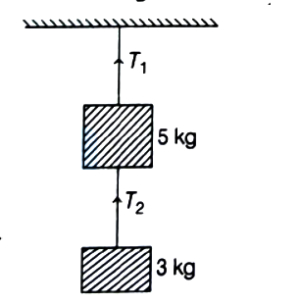
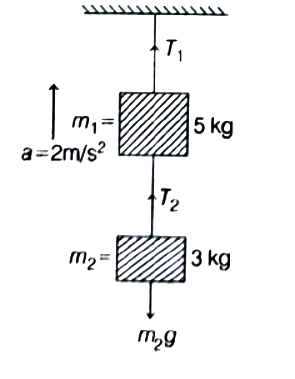
Two masses of $5 \,kg$ and $3 \,kg$ are suspended with the help of massless inextensible strings as shown in the figure below. When the whole system is moving upwards with an acceleration of $2 \,m/s^2$, the value of $T_1$ is (use $g = 9.8 \,m/s^2$): (in $\,N$)
A
$35.4$
B
$23.6$
C
$59$
D
$94.4$
Solution
(D) Let $m_1 = 5 \,kg$ and $m_2 = 3 \,kg$. The system is accelerating upwards with $a = 2 \,m/s^2$.
For the lower mass $m_2$ $(3 \,kg)$:
The forces acting are tension $T_2$ upwards and weight $m_2 g$ downwards.
The equation of motion is: $T_2 - m_2 g = m_2 a$
$T_2 - 3 \times 9.8 = 3 \times 2$
$T_2 - 29.4 = 6$
$T_2 = 35.4 \,N$
For the upper mass $m_1$ $(5 \,kg)$:
The forces acting are tension $T_1$ upwards, and tension $T_2$ and weight $m_1 g$ downwards.
The equation of motion is: $T_1 - T_2 - m_1 g = m_1 a$
$T_1 - 35.4 - 5 \times 9.8 = 5 \times 2$
$T_1 - 35.4 - 49 = 10$
$T_1 - 84.4 = 10$
$T_1 = 94.4 \,N$
For the lower mass $m_2$ $(3 \,kg)$:
The forces acting are tension $T_2$ upwards and weight $m_2 g$ downwards.
The equation of motion is: $T_2 - m_2 g = m_2 a$
$T_2 - 3 \times 9.8 = 3 \times 2$
$T_2 - 29.4 = 6$
$T_2 = 35.4 \,N$
For the upper mass $m_1$ $(5 \,kg)$:
The forces acting are tension $T_1$ upwards, and tension $T_2$ and weight $m_1 g$ downwards.
The equation of motion is: $T_1 - T_2 - m_1 g = m_1 a$
$T_1 - 35.4 - 5 \times 9.8 = 5 \times 2$
$T_1 - 35.4 - 49 = 10$
$T_1 - 84.4 = 10$
$T_1 = 94.4 \,N$
0 likes
View Solution124
EasyMCQ
$A$ freely falling body has attained a velocity of $2 \,m/s$. If the weight of the body is now opposed by a constant upward air resistance force equal to its weight, what is the total distance travelled by the body before it comes to rest (in $\,m$)?
A
$0.2$
B
$0.4$
C
$0.8$
D
$1.0$
Solution
(A) Let the mass of the body be $m$. The initial velocity $u = 2 \,m/s$.
When the body is falling freely, it has velocity $v = 2 \,m/s$.
Now, an upward air resistance force $F_{air} = mg$ acts on the body.
The net force on the body is $F_{net} = F_{air} - mg = mg - mg = 0$.
However, if the air resistance is constant and opposes the motion, we must consider the deceleration. If the air resistance is $F = mg$, the net force is $F_{net} = mg - mg = 0$ (terminal velocity).
Assuming the question implies the air resistance is $2mg$ (net upward force $mg$), the deceleration $a = F_{net}/m = (2mg - mg)/m = g = 10 \,m/s^2$.
Using $v^2 = u^2 + 2as$, where $v = 0$, $u = 2 \,m/s$, and $a = -10 \,m/s^2$:
$0 = (2)^2 + 2(-10)s$
$20s = 4$
$s = 4/20 = 0.2 \,m$.
When the body is falling freely, it has velocity $v = 2 \,m/s$.
Now, an upward air resistance force $F_{air} = mg$ acts on the body.
The net force on the body is $F_{net} = F_{air} - mg = mg - mg = 0$.
However, if the air resistance is constant and opposes the motion, we must consider the deceleration. If the air resistance is $F = mg$, the net force is $F_{net} = mg - mg = 0$ (terminal velocity).
Assuming the question implies the air resistance is $2mg$ (net upward force $mg$), the deceleration $a = F_{net}/m = (2mg - mg)/m = g = 10 \,m/s^2$.
Using $v^2 = u^2 + 2as$, where $v = 0$, $u = 2 \,m/s$, and $a = -10 \,m/s^2$:
$0 = (2)^2 + 2(-10)s$
$20s = 4$
$s = 4/20 = 0.2 \,m$.
0 likes
View Solution125
EasyMCQ
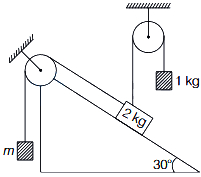
$A$ system containing masses and pulleys connected on an inclined plane is shown in the figure. If the system is in equilibrium, then the value of $m$ is (in $\,kg$)
A
$1$
B
$0.5$
C
$0.75$
D
$0.25$
Solution
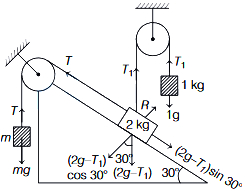
(B) According to the question, the system is in equilibrium. Let $T$ be the tension in the string connected to mass $m$, and $T_1$ be the tension in the string connected to the $1 \,kg$ mass.
For the $1 \,kg$ mass, the tension $T_1 = 1g$.
For the $2 \,kg$ mass on the inclined plane, the forces acting along the incline are the component of its weight $2g \sin 30^{\circ}$ and the tension $T_1$ acting upwards. The net force along the incline is $(2g - T_1) \sin 30^{\circ}$ (assuming the $2 \,kg$ mass is pulled by the tension $T$ up the incline).
For the system to be in equilibrium, the tension $T$ must balance the net force along the incline:
$T = (2g - T_1) \sin 30^{\circ}$
Substituting $T_1 = 1g$:
$T = (2g - 1g) \sin 30^{\circ} = g \sin 30^{\circ} = g \times 0.5 = 0.5g$
For the mass $m$, the tension $T$ must balance its weight:
$T = mg$
Equating the two expressions for $T$:
$mg = 0.5g$
$m = 0.5 \,kg$
For the $1 \,kg$ mass, the tension $T_1 = 1g$.
For the $2 \,kg$ mass on the inclined plane, the forces acting along the incline are the component of its weight $2g \sin 30^{\circ}$ and the tension $T_1$ acting upwards. The net force along the incline is $(2g - T_1) \sin 30^{\circ}$ (assuming the $2 \,kg$ mass is pulled by the tension $T$ up the incline).
For the system to be in equilibrium, the tension $T$ must balance the net force along the incline:
$T = (2g - T_1) \sin 30^{\circ}$
Substituting $T_1 = 1g$:
$T = (2g - 1g) \sin 30^{\circ} = g \sin 30^{\circ} = g \times 0.5 = 0.5g$
For the mass $m$, the tension $T$ must balance its weight:
$T = mg$
Equating the two expressions for $T$:
$mg = 0.5g$
$m = 0.5 \,kg$
0 likes
View Solution126
DifficultMCQ
Two blocks of masses $m$ and $2m$ kept on a frictionless horizontal surface are connected by a massless string. Two horizontal forces $F_1 = (4.2t) \text{ N}$ and $F_2 = (7.5t) \text{ N}$,where '$t$' is time in seconds,are acting on the system as shown in the figure. The time at which the tension in the string between the two blocks becomes $10.6 \text{ N}$ is $t$ seconds.

A
$4$
B
$3$
C
$2$
D
$6$
Solution
(C) Let the acceleration of the system be $a$. The net force acting on the system is $F_{net} = F_2 - F_1 = 7.5t - 4.2t = 3.3t \text{ N}$.
The total mass of the system is $M = m + 2m = 3m$.
Using Newton's second law,$F_{net} = Ma$,we get $3.3t = (3m)a$,so $a = \frac{1.1t}{m}$.
Now,consider the block of mass $2m$. The forces acting on it are $F_2$ in the forward direction and tension $T$ in the backward direction.
Applying Newton's second law to this block: $F_2 - T = (2m)a$.
Substituting the values: $7.5t - T = 2m \left( \frac{1.1t}{m} \right) = 2.2t$.
Thus,$T = 7.5t - 2.2t = 5.3t$.
Given that the tension $T = 10.6 \text{ N}$,we have $5.3t = 10.6$.
Solving for $t$,we get $t = \frac{10.6}{5.3} = 2 \text{ s}$.
The total mass of the system is $M = m + 2m = 3m$.
Using Newton's second law,$F_{net} = Ma$,we get $3.3t = (3m)a$,so $a = \frac{1.1t}{m}$.
Now,consider the block of mass $2m$. The forces acting on it are $F_2$ in the forward direction and tension $T$ in the backward direction.
Applying Newton's second law to this block: $F_2 - T = (2m)a$.
Substituting the values: $7.5t - T = 2m \left( \frac{1.1t}{m} \right) = 2.2t$.
Thus,$T = 7.5t - 2.2t = 5.3t$.
Given that the tension $T = 10.6 \text{ N}$,we have $5.3t = 10.6$.
Solving for $t$,we get $t = \frac{10.6}{5.3} = 2 \text{ s}$.
0 likes
View Solution127
MediumMCQ
If the breaking strength of a rope is $\frac{4}{3}$ times the weight of a person,then the maximum acceleration with which the person can safely climb up the rope is ($g$ = acceleration due to gravity).
A
$\frac{g}{2}$
B
$g$
C
$\frac{g}{3}$
D
$\frac{2g}{3}$
Solution
(C) Let $m$ be the mass of the person and $T$ be the tension in the rope.
The breaking strength of the rope is given as $T_{max} = \frac{4}{3} mg$.
When the person climbs up with an acceleration $a$,the equation of motion is $T - mg = ma$.
For safe climbing,the tension $T$ must not exceed the breaking strength $T_{max}$.
So,$T_{max} - mg = ma_{max}$.
Substituting $T_{max} = \frac{4}{3} mg$ into the equation:
$\frac{4}{3} mg - mg = ma_{max}$.
$\frac{1}{3} mg = ma_{max}$.
Therefore,$a_{max} = \frac{g}{3}$.
The breaking strength of the rope is given as $T_{max} = \frac{4}{3} mg$.
When the person climbs up with an acceleration $a$,the equation of motion is $T - mg = ma$.
For safe climbing,the tension $T$ must not exceed the breaking strength $T_{max}$.
So,$T_{max} - mg = ma_{max}$.
Substituting $T_{max} = \frac{4}{3} mg$ into the equation:
$\frac{4}{3} mg - mg = ma_{max}$.
$\frac{1}{3} mg = ma_{max}$.
Therefore,$a_{max} = \frac{g}{3}$.
0 likes
View Solution128
MediumMCQ
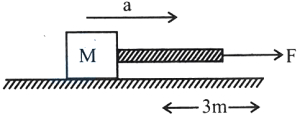
$A$ block of mass $18.5 \ kg$ kept on a smooth horizontal surface is pulled by a rope of $3 \ m$ length by a horizontal force of $40 \ N$ applied to the other end of the rope. If the linear density of the rope is $0.5 \ kg \ m^{-1}$ and initially the block is at rest,the time in which the block moves a distance of $9 \ m$ is: (in $s$)
A
$3$
B
$5$
C
$7$
D
$9$
Solution
(A) Given:
Mass of block $M = 18.5 \ kg$
Force $F = 40 \ N$
Length of rope $L = 3 \ m$
Linear density of rope $\mu = 0.5 \ kg \ m^{-1}$
Distance $s = 9 \ m$
Mass of the rope $m_r = \mu \times L = 0.5 \times 3 = 1.5 \ kg$
Total mass of the system $M_{total} = M + m_r = 18.5 + 1.5 = 20 \ kg$
Acceleration of the system $a = \frac{F}{M_{total}} = \frac{40}{20} = 2 \ m \ s^{-2}$
Using the equation of motion $s = ut + \frac{1}{2}at^2$,where initial velocity $u = 0$:
$9 = 0 + \frac{1}{2} \times 2 \times t^2$
$9 = t^2$
$t = 3 \ s$
Mass of block $M = 18.5 \ kg$
Force $F = 40 \ N$
Length of rope $L = 3 \ m$
Linear density of rope $\mu = 0.5 \ kg \ m^{-1}$
Distance $s = 9 \ m$
Mass of the rope $m_r = \mu \times L = 0.5 \times 3 = 1.5 \ kg$
Total mass of the system $M_{total} = M + m_r = 18.5 + 1.5 = 20 \ kg$
Acceleration of the system $a = \frac{F}{M_{total}} = \frac{40}{20} = 2 \ m \ s^{-2}$
Using the equation of motion $s = ut + \frac{1}{2}at^2$,where initial velocity $u = 0$:
$9 = 0 + \frac{1}{2} \times 2 \times t^2$
$9 = t^2$
$t = 3 \ s$
0 likes
View Solution129
EasyMCQ
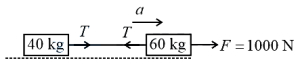
Two rectangular blocks of masses $40 \ kg$ and $60 \ kg$ are connected by a string and kept on a frictionless horizontal table. If a force of $1000 \ N$ is applied on the $60 \ kg$ block away from the $40 \ kg$ block,then the tension in the string is: (in $N$)
A
$450$
B
$400$
C
$350$
D
$500$
Solution
(B) The total mass of the system is $M = 40 \ kg + 60 \ kg = 100 \ kg$.
Applying Newton's second law to the entire system,the acceleration $a$ is given by:
$a = \frac{F}{M} = \frac{1000 \ N}{100 \ kg} = 10 \ m/s^2$.
Now,consider the $40 \ kg$ block. The only horizontal force acting on it is the tension $T$ in the string.
Applying Newton's second law to the $40 \ kg$ block:
$T = m_1 \times a$
$T = 40 \ kg \times 10 \ m/s^2 = 400 \ N$.
Applying Newton's second law to the entire system,the acceleration $a$ is given by:
$a = \frac{F}{M} = \frac{1000 \ N}{100 \ kg} = 10 \ m/s^2$.
Now,consider the $40 \ kg$ block. The only horizontal force acting on it is the tension $T$ in the string.
Applying Newton's second law to the $40 \ kg$ block:
$T = m_1 \times a$
$T = 40 \ kg \times 10 \ m/s^2 = 400 \ N$.
0 likes
View Solution130
MediumMCQ
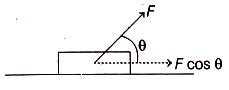
$A$ bar of mass $m$ resting on a smooth horizontal plane starts moving due to a constant force $F$. In the process of its rectilinear motion,the angle $\theta$ between the direction of this force and the horizontal varies as $\theta = k x$,where $k$ is a constant and $x$ is the distance traversed by the bar from its initial position. The velocity $(v)$ of the bar as a function of the angle $\theta$ is
A
$v = \sqrt{\frac{2 F \sin \theta}{m k}}$
B
$v = \sqrt{\frac{2 F}{m k \sin \theta}}$
C
$v = \frac{2 F \sin \theta}{m k}$
D
$v = \frac{2 F}{m k \sin \theta}$
Solution
(A) The component of the force responsible for horizontal motion is $F \cos \theta$.
So,the acceleration of the bar is $a = \frac{F \cos \theta}{m}$.
Since acceleration $a = v \frac{d v}{d x}$,we have:
$v \frac{d v}{d x} = \frac{F \cos \theta}{m}$
Given $\theta = k x$,we have $d \theta = k d x$,or $d x = \frac{d \theta}{k}$.
Substituting these into the equation:
$v d v = \frac{F \cos \theta}{m} \cdot \frac{d \theta}{k}$
Integrating both sides with initial conditions $v = 0$ at $\theta = 0$:
$\int_{0}^{v} v d v = \frac{F}{m k} \int_{0}^{\theta} \cos \theta d \theta$
$\frac{v^2}{2} = \frac{F}{m k} [\sin \theta]_{0}^{\theta}$
$\frac{v^2}{2} = \frac{F \sin \theta}{m k}$
$v^2 = \frac{2 F \sin \theta}{m k}$
$v = \sqrt{\frac{2 F \sin \theta}{m k}}$
So,the acceleration of the bar is $a = \frac{F \cos \theta}{m}$.
Since acceleration $a = v \frac{d v}{d x}$,we have:
$v \frac{d v}{d x} = \frac{F \cos \theta}{m}$
Given $\theta = k x$,we have $d \theta = k d x$,or $d x = \frac{d \theta}{k}$.
Substituting these into the equation:
$v d v = \frac{F \cos \theta}{m} \cdot \frac{d \theta}{k}$
Integrating both sides with initial conditions $v = 0$ at $\theta = 0$:
$\int_{0}^{v} v d v = \frac{F}{m k} \int_{0}^{\theta} \cos \theta d \theta$
$\frac{v^2}{2} = \frac{F}{m k} [\sin \theta]_{0}^{\theta}$
$\frac{v^2}{2} = \frac{F \sin \theta}{m k}$
$v^2 = \frac{2 F \sin \theta}{m k}$
$v = \sqrt{\frac{2 F \sin \theta}{m k}}$
0 likes
View Solution131
MediumMCQ
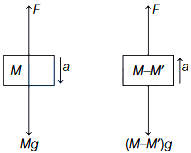
$A$ balloon of mass $M$ descends with an acceleration $a (< g)$. What mass needs to be removed from the balloon so that it starts ascending with acceleration $a$?
A
$\frac{2 M}{(a+g)}$
B
$\frac{2 M a}{(a+g)}$
C
$\frac{2 M a}{(a-g)}$
D
$\frac{2 M a}{(g-a)}$
Solution
(B) Let $F$ be the upward buoyant force acting on the balloon.
In the first case,the balloon of mass $M$ descends with acceleration $a$. According to Newton's second law:
$M g - F = M a \Rightarrow F = M g - M a$ ...$(i)$
In the second case,a mass $M^{\prime}$ is removed,so the new mass is $(M - M^{\prime})$. The balloon now ascends with acceleration $a$. According to Newton's second law:
$F - (M - M^{\prime}) g = (M - M^{\prime}) a$
Substituting $F$ from Eq. $(i)$:
$(M g - M a) - (M - M^{\prime}) g = (M - M^{\prime}) a$
$M g - M a - M g + M^{\prime} g = M a - M^{\prime} a$
$M^{\prime} g + M^{\prime} a = M a + M a$
$M^{\prime} (g + a) = 2 M a$
$M^{\prime} = \frac{2 M a}{g + a}$
In the first case,the balloon of mass $M$ descends with acceleration $a$. According to Newton's second law:
$M g - F = M a \Rightarrow F = M g - M a$ ...$(i)$
In the second case,a mass $M^{\prime}$ is removed,so the new mass is $(M - M^{\prime})$. The balloon now ascends with acceleration $a$. According to Newton's second law:
$F - (M - M^{\prime}) g = (M - M^{\prime}) a$
Substituting $F$ from Eq. $(i)$:
$(M g - M a) - (M - M^{\prime}) g = (M - M^{\prime}) a$
$M g - M a - M g + M^{\prime} g = M a - M^{\prime} a$
$M^{\prime} g + M^{\prime} a = M a + M a$
$M^{\prime} (g + a) = 2 M a$
$M^{\prime} = \frac{2 M a}{g + a}$
0 likes
View Solution132
MediumMCQ
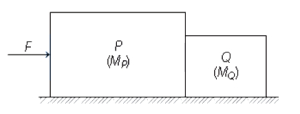
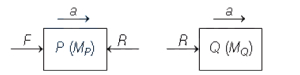
$A$ block $P$ of mass $M_P$ is in contact with another block $Q$ of mass $M_Q$ as shown in the figure and they are placed on a smooth floor. Find the force on block $Q$.
A
$\frac{M_P}{M_P+M_Q}$
B
$\frac{M_Q F}{M_P+M_Q}$
C
$\frac{M_P F}{M_Q}$
D
$\frac{M_Q F}{M_P}$
Solution
(B) Let $a$ be the common acceleration of the system of blocks when a force $F$ is applied.
According to Newton's second law for the whole system:
$F = (M_P + M_Q) a$
$\Rightarrow a = \frac{F}{M_P + M_Q}$
Now,consider the free body diagram of block $Q$. The only horizontal force acting on block $Q$ is the contact force $R$ exerted by block $P$.
Applying Newton's second law to block $Q$:
$R = M_Q a$
Substituting the value of $a$:
$R = M_Q \left( \frac{F}{M_P + M_Q} \right)$
$R = \frac{M_Q F}{M_P + M_Q}$
According to Newton's second law for the whole system:
$F = (M_P + M_Q) a$
$\Rightarrow a = \frac{F}{M_P + M_Q}$
Now,consider the free body diagram of block $Q$. The only horizontal force acting on block $Q$ is the contact force $R$ exerted by block $P$.
Applying Newton's second law to block $Q$:
$R = M_Q a$
Substituting the value of $a$:
$R = M_Q \left( \frac{F}{M_P + M_Q} \right)$
$R = \frac{M_Q F}{M_P + M_Q}$
0 likes
View Solution133
MediumMCQ
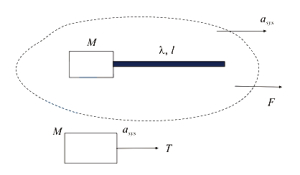
$A$ block of mass $48 \ kg$ kept on a smooth horizontal surface is pulled by a rope of length $4 \ m$ by a horizontal force of $25 \ N$ applied to the other end. If the linear density of the rope is $0.5 \ kg \ m^{-1}$,the force acting on the block is (in $N$)
A
$24$
B
$25$
C
$12$
D
$13$
Solution
(A) Given:
Mass of block $(M) = 48 \ kg$
Linear density of string $(\lambda) = 0.5 \ kg \ m^{-1}$
Length of string $(l) = 4 \ m$
Force applied $(F) = 25 \ N$
Mass of the string $(m_s) = \lambda \times l = 0.5 \times 4 = 2 \ kg$
Total mass of the system $(m_{total}) = M + m_s = 48 + 2 = 50 \ kg$
Net acceleration of the system $(a_{sys}) = \frac{F}{m_{total}} = \frac{25}{50} = 0.5 \ m \ s^{-2}$
Let the tension at the point connecting the end of the string with the block be $T$.
From the Free Body Diagram $(FBD)$ of the block:
$T = M \times a_{sys} = 48 \times 0.5 = 24 \ N$
Hence,the force acting on the block is $24 \ N$.
Mass of block $(M) = 48 \ kg$
Linear density of string $(\lambda) = 0.5 \ kg \ m^{-1}$
Length of string $(l) = 4 \ m$
Force applied $(F) = 25 \ N$
Mass of the string $(m_s) = \lambda \times l = 0.5 \times 4 = 2 \ kg$
Total mass of the system $(m_{total}) = M + m_s = 48 + 2 = 50 \ kg$
Net acceleration of the system $(a_{sys}) = \frac{F}{m_{total}} = \frac{25}{50} = 0.5 \ m \ s^{-2}$
Let the tension at the point connecting the end of the string with the block be $T$.
From the Free Body Diagram $(FBD)$ of the block:
$T = M \times a_{sys} = 48 \times 0.5 = 24 \ N$
Hence,the force acting on the block is $24 \ N$.
0 likes
View Solution134
DifficultMCQ
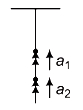
The maximum tension a rope can withstand is $60 \,kg$-wt. The ratio of maximum acceleration with which two boys of masses $20 \,kg$ and $30 \,kg$ can climb up the rope at the same time is
A
$1$ : $2$
B
$2$ : $1$
C
$4$ : $3$
D
$3$ : $2$
Solution
(B) Let the maximum accelerations of the two boys be $a_1$ and $a_2$ respectively.
The total tension $T$ in the rope must not exceed $60 \,kg$-wt.
The equation of motion for the two boys climbing up is:
$T = m_1(g + a_1) + m_2(g + a_2)$
Given $T = 60 \,kg$-wt,$m_1 = 20 \,kg$,and $m_2 = 30 \,kg$:
$60g = 20(g + a_1) + 30(g + a_2)$
$60g = 20g + 20a_1 + 30g + 30a_2$
$60g = 50g + 20a_1 + 30a_2$
$10g = 20a_1 + 30a_2$
Dividing by $10$:
$g = 2a_1 + 3a_2$
To find the ratio of maximum accelerations,we consider the individual limits for each boy. If only one boy were climbing,the maximum acceleration would be $a = (T/m) - g$. For boy $1$: $a_{1,max} = (60/20)g - g = 2g$. For boy $2$: $a_{2,max} = (60/30)g - g = g$.
However,the question asks for the ratio of accelerations when they climb together. Assuming they climb with the same acceleration $a$ to find the limit,$g = 2a + 3a = 5a \Rightarrow a = g/5$. If we look for the ratio of their individual maximum possible accelerations,it is $2g : g = 2 : 1$. Given the options,the intended ratio is $a_1 : a_2 = 2 : 1$.
The total tension $T$ in the rope must not exceed $60 \,kg$-wt.
The equation of motion for the two boys climbing up is:
$T = m_1(g + a_1) + m_2(g + a_2)$
Given $T = 60 \,kg$-wt,$m_1 = 20 \,kg$,and $m_2 = 30 \,kg$:
$60g = 20(g + a_1) + 30(g + a_2)$
$60g = 20g + 20a_1 + 30g + 30a_2$
$60g = 50g + 20a_1 + 30a_2$
$10g = 20a_1 + 30a_2$
Dividing by $10$:
$g = 2a_1 + 3a_2$
To find the ratio of maximum accelerations,we consider the individual limits for each boy. If only one boy were climbing,the maximum acceleration would be $a = (T/m) - g$. For boy $1$: $a_{1,max} = (60/20)g - g = 2g$. For boy $2$: $a_{2,max} = (60/30)g - g = g$.
However,the question asks for the ratio of accelerations when they climb together. Assuming they climb with the same acceleration $a$ to find the limit,$g = 2a + 3a = 5a \Rightarrow a = g/5$. If we look for the ratio of their individual maximum possible accelerations,it is $2g : g = 2 : 1$. Given the options,the intended ratio is $a_1 : a_2 = 2 : 1$.
0 likes
View Solution135
DifficultMCQ
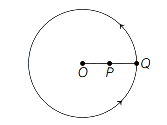
Two spheres $P$ and $Q$,each of mass $200 \text{ g}$,are attached to a string of length $1 \text{ m}$ as shown in the figure. The string and the spheres are then whirled in a horizontal circle about $O$ at a constant angular speed. The ratio of the tension in the string between $P$ and $Q$ to that between $P$ and $O$ is (where $P$ is at the mid-point of the line joining $O$ and $Q$).
A
$\frac{1}{2}$
B
$\frac{2}{3}$
C
$\frac{3}{2}$
D
$\frac{2}{1}$
Solution
(B) Let $m = 200 \text{ g} = 0.2 \text{ kg}$ be the mass of each sphere.
Let $L = 1 \text{ m}$ be the total length of the string.
Since $P$ is the mid-point,the distance $OP = 0.5 \text{ m}$ and $PQ = 0.5 \text{ m}$.
Let $\omega$ be the constant angular speed.
$1$. Tension $T_1$ in the string between $P$ and $Q$ provides the centripetal force for sphere $Q$:
$T_1 = m \cdot r_Q \cdot \omega^2 = m \cdot L \cdot \omega^2 = 0.2 \cdot 1 \cdot \omega^2 = 0.2 \omega^2$.
$2$. Tension $T_2$ in the string between $O$ and $P$ provides the centripetal force for both spheres $P$ and $Q$:
$T_2 = m \cdot r_P \cdot \omega^2 + T_1 = m \cdot (0.5) \cdot \omega^2 + 0.2 \omega^2 = 0.2 \cdot 0.5 \cdot \omega^2 + 0.2 \omega^2 = 0.1 \omega^2 + 0.2 \omega^2 = 0.3 \omega^2$.
$3$. The ratio of the tension between $P$ and $Q$ to that between $P$ and $O$ is:
$\frac{T_1}{T_2} = \frac{0.2 \omega^2}{0.3 \omega^2} = \frac{2}{3}$.
Let $L = 1 \text{ m}$ be the total length of the string.
Since $P$ is the mid-point,the distance $OP = 0.5 \text{ m}$ and $PQ = 0.5 \text{ m}$.
Let $\omega$ be the constant angular speed.
$1$. Tension $T_1$ in the string between $P$ and $Q$ provides the centripetal force for sphere $Q$:
$T_1 = m \cdot r_Q \cdot \omega^2 = m \cdot L \cdot \omega^2 = 0.2 \cdot 1 \cdot \omega^2 = 0.2 \omega^2$.
$2$. Tension $T_2$ in the string between $O$ and $P$ provides the centripetal force for both spheres $P$ and $Q$:
$T_2 = m \cdot r_P \cdot \omega^2 + T_1 = m \cdot (0.5) \cdot \omega^2 + 0.2 \omega^2 = 0.2 \cdot 0.5 \cdot \omega^2 + 0.2 \omega^2 = 0.1 \omega^2 + 0.2 \omega^2 = 0.3 \omega^2$.
$3$. The ratio of the tension between $P$ and $Q$ to that between $P$ and $O$ is:
$\frac{T_1}{T_2} = \frac{0.2 \omega^2}{0.3 \omega^2} = \frac{2}{3}$.
0 likes
View Solution136
MediumMCQ
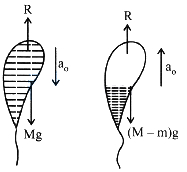
$A$ balloon carrying some sand of mass $M$ is moving down with a constant acceleration $a_0$. The mass $m$ of sand to be removed so that the balloon moves up with double the acceleration $2a_0$ is:
A
$m=\frac{2 M a_0}{a_0+g}$
B
$m=\frac{2 M a_0}{a_0-g}$
C
$m=\frac{3 M a_0}{g+2 a_0}$
D
$m=\frac{3 M a_0}{g-2 a_0}$
Solution
(C) Let $R$ be the upward buoyant force acting on the balloon.
Case $1$: The balloon is moving down with acceleration $a_0$.
The equation of motion is: $Mg - R = Ma_0$ ....$(i)$
Case $2$: After removing mass $m$,the balloon moves up with acceleration $2a_0$.
The equation of motion is: $R - (M - m)g = (M - m)(2a_0)$ ....(ii)
Adding equations $(i)$ and (ii):
$(Mg - R) + (R - (M - m)g) = Ma_0 + (M - m)(2a_0)$
$Mg - Mg + mg = Ma_0 + 2Ma_0 - 2ma_0$
$mg = 3Ma_0 - 2ma_0$
$mg + 2ma_0 = 3Ma_0$
$m(g + 2a_0) = 3Ma_0$
$m = \frac{3Ma_0}{g + 2a_0}$
Case $1$: The balloon is moving down with acceleration $a_0$.
The equation of motion is: $Mg - R = Ma_0$ ....$(i)$
Case $2$: After removing mass $m$,the balloon moves up with acceleration $2a_0$.
The equation of motion is: $R - (M - m)g = (M - m)(2a_0)$ ....(ii)
Adding equations $(i)$ and (ii):
$(Mg - R) + (R - (M - m)g) = Ma_0 + (M - m)(2a_0)$
$Mg - Mg + mg = Ma_0 + 2Ma_0 - 2ma_0$
$mg = 3Ma_0 - 2ma_0$
$mg + 2ma_0 = 3Ma_0$
$m(g + 2a_0) = 3Ma_0$
$m = \frac{3Ma_0}{g + 2a_0}$
0 likes
View Solution137
EasyMCQ
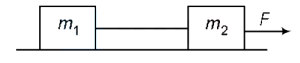
Two masses $m_1$ and $m_2$ are placed on a smooth horizontal surface and are connected by a string of negligible mass. $A$ horizontal force $F$ is applied on the mass $m_2$ as shown in the figure. The tension in the string is
A
$\left(\frac{m_1}{m_1+m_2}\right) F$
B
$\frac{m_2 F}{m_1+m_2}$
C
$\left(\frac{m_1}{m_2}\right) F$
D
$\frac{m_2 F}{m_1}$
Solution
(A) First,consider the system as a whole. The total mass of the system is $(m_1 + m_2)$.
Since the surface is smooth,the acceleration $(a)$ of the system is given by Newton's second law: $a = \frac{F}{m_1 + m_2}$.
Now,consider the free body diagram of mass $m_1$. The only horizontal force acting on $m_1$ is the tension $(T)$ in the string.
Applying Newton's second law to mass $m_1$: $T = m_1 \times a$.
Substituting the value of acceleration $(a)$: $T = m_1 \times \left(\frac{F}{m_1 + m_2}\right)$.
Therefore,the tension in the string is $T = \left(\frac{m_1}{m_1 + m_2}\right) F$.
Since the surface is smooth,the acceleration $(a)$ of the system is given by Newton's second law: $a = \frac{F}{m_1 + m_2}$.
Now,consider the free body diagram of mass $m_1$. The only horizontal force acting on $m_1$ is the tension $(T)$ in the string.
Applying Newton's second law to mass $m_1$: $T = m_1 \times a$.
Substituting the value of acceleration $(a)$: $T = m_1 \times \left(\frac{F}{m_1 + m_2}\right)$.
Therefore,the tension in the string is $T = \left(\frac{m_1}{m_1 + m_2}\right) F$.
0 likes
View Solution138
EasyMCQ
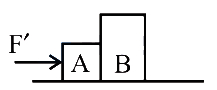
$A$ constant horizontal force $\overrightarrow{F}$ of magnitude $10 \,N$ is applied to a block $A$ and this produces an acceleration of magnitude $20 \,m/s^2$. If this block $A$ is then kept against another block $B$ of mass $1.5 \,kg$ as shown in the figure and a force $F^{\prime}$ of $20 \,N$ is applied,find the force on the block $B$. Neglect friction. (in $N$)
A
$15$
B
$10$
C
$20$
D
$5$
Solution
(A) First,calculate the mass of block $A$ using Newton's second law: $F = m_A a \Rightarrow 10 = m_A \times 20 \Rightarrow m_A = 0.5 \,kg$.
When block $A$ is placed against block $B$ and a force $F^{\prime} = 20 \,N$ is applied,both blocks move together with a common acceleration $a$.
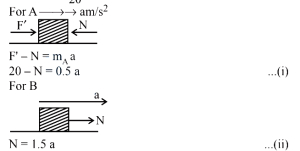
The equation of motion for block $A$ is: $F^{\prime} - N = m_A a \Rightarrow 20 - N = 0.5 a$ $(i)$.
The equation of motion for block $B$ is: $N = m_B a \Rightarrow N = 1.5 a$ $(ii)$.
Adding equations $(i)$ and $(ii)$: $20 = 2 a \Rightarrow a = 10 \,m/s^2$.
Substituting $a$ into equation $(ii)$: $N = 1.5 \times 10 = 15 \,N$.
Thus,the force on block $B$ is $15 \,N$.
When block $A$ is placed against block $B$ and a force $F^{\prime} = 20 \,N$ is applied,both blocks move together with a common acceleration $a$.
The equation of motion for block $A$ is: $F^{\prime} - N = m_A a \Rightarrow 20 - N = 0.5 a$ $(i)$.
The equation of motion for block $B$ is: $N = m_B a \Rightarrow N = 1.5 a$ $(ii)$.
Adding equations $(i)$ and $(ii)$: $20 = 2 a \Rightarrow a = 10 \,m/s^2$.
Substituting $a$ into equation $(ii)$: $N = 1.5 \times 10 = 15 \,N$.
Thus,the force on block $B$ is $15 \,N$.
0 likes
View Solution139
EasyMCQ
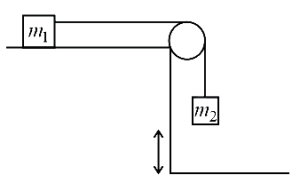
Consider two masses $m_1$ and $m_2$ connected through a pulley as shown in the figure. Mass $m_2$ starts from rest at height $h$ and falls down. With what speed does it hit the ground? (Assume no friction and massless strings and pulleys.)
A
$\sqrt{\left(\frac{m_2}{m_1+m_2}\right) g h}$
B
$\sqrt{2 g h}$
C
$\sqrt{\left(\frac{m_2}{m_1+m_2}\right) 2 g h}$
D
$\sqrt{\left(\frac{m_1}{m_1+m_2}\right) 2 g h}$
Solution
(C) For the given system,let $a$ be the acceleration of the blocks and $T$ be the tension in the string.
For mass $m_1$ moving horizontally: $T = m_1 a$
For mass $m_2$ moving vertically downwards: $m_2 g - T = m_2 a$
Adding these two equations: $m_2 g = (m_1 + m_2) a$
Therefore,the acceleration of the system is $a = \frac{m_2 g}{m_1 + m_2}$.
Using the kinematic equation $v^2 = u^2 + 2ah$,where initial velocity $u = 0$ and displacement is $h$:
$v^2 = 0 + 2 \left( \frac{m_2 g}{m_1 + m_2} \right) h$
$v = \sqrt{\left( \frac{m_2}{m_1 + m_2} \right) 2 g h}$.
For mass $m_1$ moving horizontally: $T = m_1 a$
For mass $m_2$ moving vertically downwards: $m_2 g - T = m_2 a$
Adding these two equations: $m_2 g = (m_1 + m_2) a$
Therefore,the acceleration of the system is $a = \frac{m_2 g}{m_1 + m_2}$.
Using the kinematic equation $v^2 = u^2 + 2ah$,where initial velocity $u = 0$ and displacement is $h$:
$v^2 = 0 + 2 \left( \frac{m_2 g}{m_1 + m_2} \right) h$
$v = \sqrt{\left( \frac{m_2}{m_1 + m_2} \right) 2 g h}$.
0 likes
View Solution140
EasyMCQ
An elevator of mass $500 \,kg$ is ascending upwards with a constant acceleration $a=2 \,m/s^2$. What is the work done by the tension in the elevator cable during its climb by $12 \,m$ (in $\,kJ$)? (Take $g=10 \,m/s^2$)
A
$36$
B
$48$
C
$72$
D
$100$
Solution
(C) Mass of the elevator,$m = 500 \,kg$.
Acceleration of the elevator,$a = 2 \,m/s^2$ (upward).
When the elevator is moving upward,the tension $T$ in the cable is given by the equation of motion: $T - mg = ma$.
Therefore,$T = m(g + a) = 500(10 + 2) = 500(12) = 6000 \,N$.
The work done by the tension force $W$ is given by $W = T \times s$,where $s = 12 \,m$ is the displacement.
$W = 6000 \,N \times 12 \,m = 72000 \,J$.
Converting to kilojoules,$W = 72 \,kJ$.
Acceleration of the elevator,$a = 2 \,m/s^2$ (upward).
When the elevator is moving upward,the tension $T$ in the cable is given by the equation of motion: $T - mg = ma$.
Therefore,$T = m(g + a) = 500(10 + 2) = 500(12) = 6000 \,N$.
The work done by the tension force $W$ is given by $W = T \times s$,where $s = 12 \,m$ is the displacement.
$W = 6000 \,N \times 12 \,m = 72000 \,J$.
Converting to kilojoules,$W = 72 \,kJ$.
0 likes
View Solution141
MediumMCQ
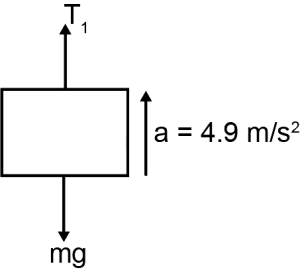
$A$ mass of $1 \ kg$ is suspended by means of a thread. The system is
$(i)$ lifted up with an acceleration of $4.9 \ ms^{-2}$
(ii) lowered with an acceleration of $4.9 \ ms^{-2}$.
The ratio of tension in the first and second case is
$(i)$ lifted up with an acceleration of $4.9 \ ms^{-2}$
(ii) lowered with an acceleration of $4.9 \ ms^{-2}$.
The ratio of tension in the first and second case is
A
$3$: $1$
B
$1$: $2$
C
$1$: $3$
D
$2$: $1$
Solution
(A) Given: Mass $m = 1 \ kg$,acceleration $a = 4.9 \ ms^{-2}$,acceleration due to gravity $g \approx 9.8 \ ms^{-2}$.
$(i)$ When the body is lifted up with acceleration $a$,the equation of motion is:
$T_1 - mg = ma$
$T_1 = m(g + a) = 1 \times (9.8 + 4.9) = 14.7 \ N$
(ii) When the body is lowered with acceleration $a$,the equation of motion is:
$mg - T_2 = ma$
$T_2 = m(g - a) = 1 \times (9.8 - 4.9) = 4.9 \ N$
The ratio of tension in the first and second case is:
$\frac{T_1}{T_2} = \frac{14.7}{4.9} = \frac{3}{1} = 3:1$
$(i)$ When the body is lifted up with acceleration $a$,the equation of motion is:
$T_1 - mg = ma$
$T_1 = m(g + a) = 1 \times (9.8 + 4.9) = 14.7 \ N$
(ii) When the body is lowered with acceleration $a$,the equation of motion is:
$mg - T_2 = ma$
$T_2 = m(g - a) = 1 \times (9.8 - 4.9) = 4.9 \ N$
The ratio of tension in the first and second case is:
$\frac{T_1}{T_2} = \frac{14.7}{4.9} = \frac{3}{1} = 3:1$
0 likes
View Solution142
EasyMCQ
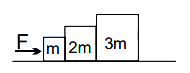
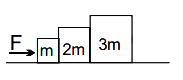
Three blocks of masses $m$,$2m$,and $3m$ are pushed with a force $F$ across a frictionless table as shown in the figure. Let $N_{1}$ be the contact force between the left two blocks ($m$ and $2m$) and $N_{2}$ be the contact force between the right two blocks ($2m$ and $3m$). Then:
A
$F > N_{1} > N_{2}$
B
$F > N_{2} > N_{1}$
C
$F > N_{1} = N_{2}$
D
$F = N_{1} = N_{2}$
Solution
(A) The total mass of the system is $M = m + 2m + 3m = 6m$.
The acceleration of the system is $a = \frac{F}{6m}$.
To find $N_{1}$,consider the motion of the blocks $2m$ and $3m$ together. The force $N_{1}$ pushes these two blocks:
$N_{1} = (2m + 3m)a = 5m \times \frac{F}{6m} = \frac{5}{6}F$.
To find $N_{2}$,consider the motion of the block $3m$ alone. The force $N_{2}$ pushes this block:
$N_{2} = (3m)a = 3m \times \frac{F}{6m} = \frac{3}{6}F = \frac{1}{2}F$.
Comparing the values,we have $F = \frac{6}{6}F$,$N_{1} = \frac{5}{6}F$,and $N_{2} = \frac{3}{6}F$.
Therefore,$F > N_{1} > N_{2}$.
The acceleration of the system is $a = \frac{F}{6m}$.
To find $N_{1}$,consider the motion of the blocks $2m$ and $3m$ together. The force $N_{1}$ pushes these two blocks:
$N_{1} = (2m + 3m)a = 5m \times \frac{F}{6m} = \frac{5}{6}F$.
To find $N_{2}$,consider the motion of the block $3m$ alone. The force $N_{2}$ pushes this block:
$N_{2} = (3m)a = 3m \times \frac{F}{6m} = \frac{3}{6}F = \frac{1}{2}F$.
Comparing the values,we have $F = \frac{6}{6}F$,$N_{1} = \frac{5}{6}F$,and $N_{2} = \frac{3}{6}F$.
Therefore,$F > N_{1} > N_{2}$.
0 likes
View Solution143
MediumMCQ
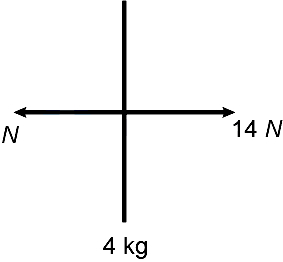
Three blocks of masses $4 \ kg$,$2 \ kg$,and $1 \ kg$ respectively are in contact on a frictionless table as shown in the figure. If a force of $14 \ N$ is applied on the $4 \ kg$ block,the contact force between the $4 \ kg$ and the $2 \ kg$ block will be: (in $N$)

A
$2$
B
$6$
C
$8$
D
$14$
Solution
(B) The total mass of the system is $M = 4 \ kg + 2 \ kg + 1 \ kg = 7 \ kg$.
Since the surface is frictionless,the acceleration $a$ of the system is given by $a = \frac{F}{M} = \frac{14 \ N}{7 \ kg} = 2 \ m/s^2$.
To find the contact force $N$ between the $4 \ kg$ and $2 \ kg$ blocks,we consider the motion of the combined $2 \ kg$ and $1 \ kg$ blocks (total mass $m' = 3 \ kg$).
The force $N$ is the only horizontal force acting on this combined system of $3 \ kg$ that causes it to accelerate at $2 \ m/s^2$.
Therefore,$N = m' \times a = 3 \ kg \times 2 \ m/s^2 = 6 \ N$.
Since the surface is frictionless,the acceleration $a$ of the system is given by $a = \frac{F}{M} = \frac{14 \ N}{7 \ kg} = 2 \ m/s^2$.
To find the contact force $N$ between the $4 \ kg$ and $2 \ kg$ blocks,we consider the motion of the combined $2 \ kg$ and $1 \ kg$ blocks (total mass $m' = 3 \ kg$).
The force $N$ is the only horizontal force acting on this combined system of $3 \ kg$ that causes it to accelerate at $2 \ m/s^2$.
Therefore,$N = m' \times a = 3 \ kg \times 2 \ m/s^2 = 6 \ N$.
0 likes
View Solution144
MediumMCQ
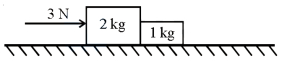
Two blocks of $2 \,kg$ and $1 \,kg$ are in contact on a frictionless table. If a force of $3 \,N$ is applied on the $2 \,kg$ block, then the force of contact between the two blocks will be: (in $\,N$)
A
$0$
B
$1$
C
$2$
D
$3$
Solution
(B) Step $1$: Calculate the common acceleration of the system.
The total mass of the system is $M = 2 \,kg + 1 \,kg = 3 \,kg$.
The applied force is $F = 3 \,N$.
Using Newton's second law, $F = Ma$, we get:
$a = \frac{F}{M} = \frac{3 \,N}{3 \,kg} = 1 \,m/s^2$.
Step $2$: Calculate the contact force between the blocks.
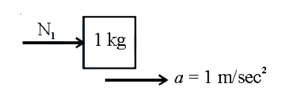
Consider the $1 \,kg$ block. The only horizontal force acting on it is the contact force $N_1$ exerted by the $2 \,kg$ block.
Applying Newton's second law to the $1 \,kg$ block:
$N_1 = m_2 \times a = 1 \,kg \times 1 \,m/s^2 = 1 \,N$.
Therefore, the contact force between the two blocks is $1 \,N$.
The total mass of the system is $M = 2 \,kg + 1 \,kg = 3 \,kg$.
The applied force is $F = 3 \,N$.
Using Newton's second law, $F = Ma$, we get:
$a = \frac{F}{M} = \frac{3 \,N}{3 \,kg} = 1 \,m/s^2$.
Step $2$: Calculate the contact force between the blocks.
Consider the $1 \,kg$ block. The only horizontal force acting on it is the contact force $N_1$ exerted by the $2 \,kg$ block.
Applying Newton's second law to the $1 \,kg$ block:
$N_1 = m_2 \times a = 1 \,kg \times 1 \,m/s^2 = 1 \,N$.
Therefore, the contact force between the two blocks is $1 \,N$.
0 likes
View Solution145
DifficultMCQ
At $t = 0$,a body of mass $100 \text{ g}$ starts moving under the influence of a force $(5\hat{i} + 10\hat{j}) \text{ N}$. After $2 \text{ s}$,its position is $(2x\hat{i} + 5y\hat{j}) \text{ m}$. The ratio $x : y$ is . . . . . . .
A
$1 : 2$
B
$2 : 5$
C
$5 : 2$
D
$5 : 4$
Solution
(D) Given: Mass $m = 100 \text{ g} = 0.1 \text{ kg}$,Force $\vec{F} = (5\hat{i} + 10\hat{j}) \text{ N}$,Time $t = 2 \text{ s}$,Initial velocity $\vec{u} = 0$.
Acceleration $\vec{a} = \frac{\vec{F}}{m} = \frac{5\hat{i} + 10\hat{j}}{0.1} = (50\hat{i} + 100\hat{j}) \text{ m/s}^2$.
Using the equation of motion $\vec{r} = \vec{u}t + \frac{1}{2}\vec{a}t^2$:
$\vec{r} = 0 + \frac{1}{2}(50\hat{i} + 100\hat{j})(2)^2 = \frac{1}{2}(50\hat{i} + 100\hat{j})(4) = 2(50\hat{i} + 100\hat{j}) = (100\hat{i} + 200\hat{j}) \text{ m}$.
Comparing this with the given position $(2x\hat{i} + 5y\hat{j}) \text{ m}$:
$2x = 100 \Rightarrow x = 50$.
$5y = 200 \Rightarrow y = 40$.
Therefore,the ratio $x : y = 50 : 40 = 5 : 4$.
Acceleration $\vec{a} = \frac{\vec{F}}{m} = \frac{5\hat{i} + 10\hat{j}}{0.1} = (50\hat{i} + 100\hat{j}) \text{ m/s}^2$.
Using the equation of motion $\vec{r} = \vec{u}t + \frac{1}{2}\vec{a}t^2$:
$\vec{r} = 0 + \frac{1}{2}(50\hat{i} + 100\hat{j})(2)^2 = \frac{1}{2}(50\hat{i} + 100\hat{j})(4) = 2(50\hat{i} + 100\hat{j}) = (100\hat{i} + 200\hat{j}) \text{ m}$.
Comparing this with the given position $(2x\hat{i} + 5y\hat{j}) \text{ m}$:
$2x = 100 \Rightarrow x = 50$.
$5y = 200 \Rightarrow y = 40$.
Therefore,the ratio $x : y = 50 : 40 = 5 : 4$.
0 likes
View SolutionNewton's Laws of Motion and Friction — Motion of Body (or Connected Bodies in horizontal or vertical) (by String or Contact) · Frequently Asked Questions
1Are these Newton's Laws of Motion and Friction questions useful for JEE and NEET?
Yes. All questions in this section are mapped to JEE Main and NEET exam patterns. Previous year questions from JEE Main, NEET, GUJCET and state-level exams are included with full solutions.
2Can I switch to Hindi or Gujarati for these questions?
Yes. Use the language tabs in the hero section or the sidebar to view the same questions and solutions in English, Hindi or Gujarati.
3How do I generate a question paper from this subtopic?
Use the Vedclass Exam Paper Generator — select the chapter and subtopic, set difficulty, and generate Sets A, B, C, D automatically. First 3 chapters of every subject are free.
Vedclass Products
For Students
Vedclass Test Series
Mock tests in real JEE/NEET style with performance analysis. 5-day free trial.
Start Free TrialFor Teachers
Exam Paper Generator
Generate Set A/B/C/D papers from this chapter in 2 minutes. 3 chapters free.
Try FreeFor Institutes
Online Exam Module
Live online exams with unlimited students, 360° analytics & white-label branding.
See DemoFor Teachers & Institutes
Generate a Newton's Laws of Motion and Friction Exam Paper in 2 Minutes
Select subtopic & difficulty — Sets A, B, C, D auto-generated with No Repeat logic.
First 3 chapters of every subject are free — no payment required.