
A English
Kinetic Friction and Motion on Rough Horizontal Surface Questions in English
Class 11 Physics · Newton's Laws of Motion and Friction · Kinetic Friction and Motion on Rough Horizontal Surface
154+
Questions
English
Language
100%
With Solutions
Showing 4 of 154 questions in English
151
EasyMCQ
When the engine is switched off,a vehicle of mass $M$ is moving on a rough horizontal road with momentum $p$. If the coefficient of friction between the road and the tyres of the vehicle is $\mu_k$,what is the distance travelled by the vehicle before it comes to rest?
A
$\frac{p^2}{2 \mu_k M^2 g}$
B
$\frac{2 \mu_k M^2 g}{p^2}$
C
$\frac{p^2}{2 \mu_k g}$
D
$\frac{p^2 M^2}{2 \mu_k g}$
Solution
(A) The initial kinetic energy of the vehicle is given by $K = \frac{p^2}{2M}$.
When the engine is switched off,the only force acting to stop the vehicle is the kinetic friction force $f_k = \mu_k M g$.
The work done by the friction force in stopping the vehicle over a distance $s$ is equal to the change in kinetic energy.
$|W| = f_k \cdot s = \mu_k M g s$.
According to the work-energy theorem,the work done by friction equals the initial kinetic energy:
$\mu_k M g s = \frac{p^2}{2M}$.
Solving for $s$,we get:
$s = \frac{p^2}{2 M^2 \mu_k g}$.
When the engine is switched off,the only force acting to stop the vehicle is the kinetic friction force $f_k = \mu_k M g$.
The work done by the friction force in stopping the vehicle over a distance $s$ is equal to the change in kinetic energy.
$|W| = f_k \cdot s = \mu_k M g s$.
According to the work-energy theorem,the work done by friction equals the initial kinetic energy:
$\mu_k M g s = \frac{p^2}{2M}$.
Solving for $s$,we get:
$s = \frac{p^2}{2 M^2 \mu_k g}$.
0 likes
View Solution152
MediumMCQ
$A$ block of mass $m$ placed on a rough horizontal plane is pulled by a constant power $P$. The coefficient of friction between the block and the surface is $\mu$. The maximum velocity of the block will be
A
$\frac{\mu P}{m g}$
B
$\frac{\mu m g}{P}$
C
$\mu m g P$
D
$\frac{P}{\mu m g}$
Solution
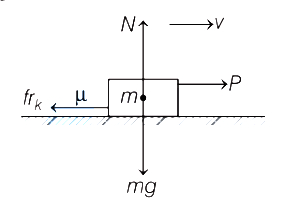
(D) The block is moving on a rough horizontal surface. The forces acting on the block are the normal force $N$,gravitational force $mg$,the pulling force $F$,and the kinetic frictional force $fr_k$.
For vertical equilibrium,the normal force is $N = mg$.
The kinetic frictional force is given by $fr_k = \mu N = \mu mg$.
Power $P$ is defined as the product of the applied force $F$ and the velocity $v$ in the direction of motion: $P = F v$.
For the block to move at a constant velocity (which is its maximum velocity),the net force on the block must be zero.
Therefore,the pulling force $F$ must be equal to the kinetic frictional force $fr_k$:
$F = fr_k = \mu mg$.
Substituting this into the power equation:
$P = F v_{\max} = (\mu mg) v_{\max}$.
Solving for $v_{\max}$:
$v_{\max} = \frac{P}{\mu mg}$.
For vertical equilibrium,the normal force is $N = mg$.
The kinetic frictional force is given by $fr_k = \mu N = \mu mg$.
Power $P$ is defined as the product of the applied force $F$ and the velocity $v$ in the direction of motion: $P = F v$.
For the block to move at a constant velocity (which is its maximum velocity),the net force on the block must be zero.
Therefore,the pulling force $F$ must be equal to the kinetic frictional force $fr_k$:
$F = fr_k = \mu mg$.
Substituting this into the power equation:
$P = F v_{\max} = (\mu mg) v_{\max}$.
Solving for $v_{\max}$:
$v_{\max} = \frac{P}{\mu mg}$.
0 likes
View Solution153
EasyMCQ
$A$ small body of mass $500 \,g$ moves on a rough horizontal surface before finally stopping. The initial velocity of the body is $2 \,m/s$ and the coefficient of friction is $0.3$. Find the absolute value of the average power developed by the frictional force during the time of motion. (Take $g = 10 \,m/s^2$) (in $\,W$)
A
$1$
B
$1.5$
C
$2$
D
$2.5$
Solution
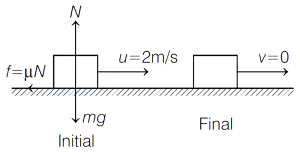
(B) Since the retardation is constant,the average velocity is given by:
$v_{av} = \frac{u + v}{2} = \frac{2 + 0}{2} = 1 \,m/s$
The frictional force $f$ is given by:
$f = \mu N = \mu mg$
Given:
Coefficient of friction,$\mu = 0.3$
Mass of body,$m = 500 \,g = 0.5 \,kg$
Acceleration due to gravity,$g = 10 \,m/s^2$
Substituting the values:
$f = 0.3 \times 0.5 \times 10 = 1.5 \,N$
The average power $P_{av}$ developed by the frictional force is:
$P_{av} = f \times v_{av}$
$P_{av} = 1.5 \,N \times 1 \,m/s = 1.5 \,W$
Thus,the absolute value of the average power is $1.5 \,W$.
$v_{av} = \frac{u + v}{2} = \frac{2 + 0}{2} = 1 \,m/s$
The frictional force $f$ is given by:
$f = \mu N = \mu mg$
Given:
Coefficient of friction,$\mu = 0.3$
Mass of body,$m = 500 \,g = 0.5 \,kg$
Acceleration due to gravity,$g = 10 \,m/s^2$
Substituting the values:
$f = 0.3 \times 0.5 \times 10 = 1.5 \,N$
The average power $P_{av}$ developed by the frictional force is:
$P_{av} = f \times v_{av}$
$P_{av} = 1.5 \,N \times 1 \,m/s = 1.5 \,W$
Thus,the absolute value of the average power is $1.5 \,W$.
0 likes
View Solution154
EasyMCQ
$A$ boy of mass $40 \,kg$ is climbing a vertical pole at a constant speed. If the coefficient of friction between his palms and the pole is $0.8$ and $g = 10 \,m/s^2$, the horizontal force that he is applying on the pole is: (in $\,N$)
A
$300$
B
$400$
C
$500$
D
$600$
Solution
(C) The boy is climbing the pole at a constant speed, which means his acceleration is $0$. Therefore, the net force acting on him in the vertical direction is $0$.
The forces acting on the boy in the vertical direction are his weight $(mg)$ acting downwards and the frictional force $(f)$ acting upwards.
For equilibrium, $f = mg$.
Given that the frictional force $f = \mu N$, where $\mu$ is the coefficient of friction and $N$ is the normal force (the horizontal force applied by the boy on the pole).
So, $\mu N = mg$.
Substituting the given values: $0.8 \times N = 40 \,kg \times 10 \,m/s^2$.
$0.8 \times N = 400 \,N$.
$N = \frac{400}{0.8} = 500 \,N$.
Thus, the horizontal force applied by the boy is $500 \,N$.
The forces acting on the boy in the vertical direction are his weight $(mg)$ acting downwards and the frictional force $(f)$ acting upwards.
For equilibrium, $f = mg$.
Given that the frictional force $f = \mu N$, where $\mu$ is the coefficient of friction and $N$ is the normal force (the horizontal force applied by the boy on the pole).
So, $\mu N = mg$.
Substituting the given values: $0.8 \times N = 40 \,kg \times 10 \,m/s^2$.
$0.8 \times N = 400 \,N$.
$N = \frac{400}{0.8} = 500 \,N$.
Thus, the horizontal force applied by the boy is $500 \,N$.
0 likes
View SolutionNewton's Laws of Motion and Friction — Kinetic Friction and Motion on Rough Horizontal Surface · Frequently Asked Questions
1Are these Newton's Laws of Motion and Friction questions useful for JEE and NEET?
Yes. All questions in this section are mapped to JEE Main and NEET exam patterns. Previous year questions from JEE Main, NEET, GUJCET and state-level exams are included with full solutions.
2Can I switch to Hindi or Gujarati for these questions?
Yes. Use the language tabs in the hero section or the sidebar to view the same questions and solutions in English, Hindi or Gujarati.
3How do I generate a question paper from this subtopic?
Use the Vedclass Exam Paper Generator — select the chapter and subtopic, set difficulty, and generate Sets A, B, C, D automatically. First 3 chapters of every subject are free.
Vedclass Products
For Students
Vedclass Test Series
Mock tests in real JEE/NEET style with performance analysis. 5-day free trial.
Start Free TrialFor Teachers
Exam Paper Generator
Generate Set A/B/C/D papers from this chapter in 2 minutes. 3 chapters free.
Try FreeFor Institutes
Online Exam Module
Live online exams with unlimited students, 360° analytics & white-label branding.
See DemoFor Teachers & Institutes
Generate a Newton's Laws of Motion and Friction Exam Paper in 2 Minutes
Select subtopic & difficulty — Sets A, B, C, D auto-generated with No Repeat logic.
First 3 chapters of every subject are free — no payment required.