
A English
Kinetic Friction and Motion on Rough Horizontal Surface Questions in English
Class 11 Physics · Newton's Laws of Motion and Friction · Kinetic Friction and Motion on Rough Horizontal Surface
154+
Questions
English
Language
100%
With Solutions
Showing 50 of 154 questions in English
51
DifficultMCQ
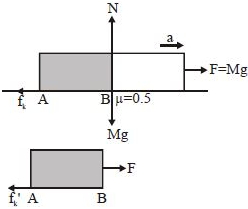
$A$ rope of length $L$ and mass $M$ is being pulled on a rough horizontal floor by a constant horizontal force $F = Mg$. The force is acting at one end of the rope in the same direction as the length of the rope. The coefficient of kinetic friction between the rope and the floor is $1/2$. Then,the tension at the midpoint of the rope is
A
$\frac{Mg}{4}$
B
$\frac{2Mg}{5}$
C
$\frac{Mg}{8}$
D
$\frac{Mg}{2}$
Solution
(D) $1$. First,calculate the acceleration of the entire rope. The net force acting on the rope is $F_{net} = F - f_k$,where $f_k = \mu N = \mu Mg = (1/2)Mg$.
$2$. Thus,$F_{net} = Mg - 0.5Mg = 0.5Mg$.
$3$. The acceleration $a$ is given by $a = F_{net} / M = 0.5Mg / M = g/2$.
$4$. Now,consider the rear half of the rope (mass $M/2$). The forces acting on this half are the tension $T$ at the midpoint pulling it forward and the kinetic friction $f_k'$ pulling it backward.
$5$. The friction on the rear half is $f_k' = \mu (M/2)g = (1/2)(M/2)g = Mg/4$.
$6$. Applying Newton's second law to the rear half: $T - f_k' = (M/2)a$.
$7$. Substituting the values: $T - Mg/4 = (M/2)(g/2) = Mg/4$.
$8$. Therefore,$T = Mg/4 + Mg/4 = Mg/2$.
$2$. Thus,$F_{net} = Mg - 0.5Mg = 0.5Mg$.
$3$. The acceleration $a$ is given by $a = F_{net} / M = 0.5Mg / M = g/2$.
$4$. Now,consider the rear half of the rope (mass $M/2$). The forces acting on this half are the tension $T$ at the midpoint pulling it forward and the kinetic friction $f_k'$ pulling it backward.
$5$. The friction on the rear half is $f_k' = \mu (M/2)g = (1/2)(M/2)g = Mg/4$.
$6$. Applying Newton's second law to the rear half: $T - f_k' = (M/2)a$.
$7$. Substituting the values: $T - Mg/4 = (M/2)(g/2) = Mg/4$.
$8$. Therefore,$T = Mg/4 + Mg/4 = Mg/2$.
0 likes
View Solution52
DifficultMCQ
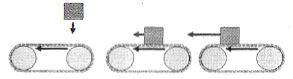
$A$ $300 \ kg$ crate is dropped vertically onto a conveyor belt that is moving at $1.20 \ m/s$. $A$ motor maintains the belt's constant speed. The belt initially slides under the crate,with a coefficient of friction of $0.400$. After a short time,the crate is moving at the speed of the belt. During the period in which the crate is being accelerated,find the work done by the motor which drives the belt.
A
$432$
B
$216$
C
$108$
D
$54$
Solution
(A) $1$. The crate is dropped vertically,so its initial horizontal velocity is $0$. The belt moves at a constant velocity $v = 1.20 \ m/s$.
$2$. The force of friction acting on the crate is $f = \mu mg = 0.400 \times 300 \times 9.8 = 1176 \ N$.
$3$. The acceleration of the crate is $a = f/m = \mu g = 0.400 \times 9.8 = 3.92 \ m/s^2$.
$4$. The time taken for the crate to reach the belt's speed is $t = v/a = 1.20 / 3.92 \approx 0.306 \ s$.
$5$. The distance moved by the belt during this time is $d_{belt} = v \times t = 1.20 \times (1.20 / 3.92) = 1.44 / 3.92 \approx 0.367 \ m$.
$6$. The motor must exert a force equal to the friction force to maintain constant speed,so $F_{motor} = f = 1176 \ N$.
$7$. The work done by the motor is $W = F_{motor} \times d_{belt} = 1176 \times (1.44 / 3.92) = 432 \ J$.
$2$. The force of friction acting on the crate is $f = \mu mg = 0.400 \times 300 \times 9.8 = 1176 \ N$.
$3$. The acceleration of the crate is $a = f/m = \mu g = 0.400 \times 9.8 = 3.92 \ m/s^2$.
$4$. The time taken for the crate to reach the belt's speed is $t = v/a = 1.20 / 3.92 \approx 0.306 \ s$.
$5$. The distance moved by the belt during this time is $d_{belt} = v \times t = 1.20 \times (1.20 / 3.92) = 1.44 / 3.92 \approx 0.367 \ m$.
$6$. The motor must exert a force equal to the friction force to maintain constant speed,so $F_{motor} = f = 1176 \ N$.
$7$. The work done by the motor is $W = F_{motor} \times d_{belt} = 1176 \times (1.44 / 3.92) = 432 \ J$.
0 likes
View Solution53
DifficultMCQ
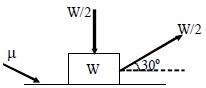
$A$ block of weight $W$ is kept on a rough horizontal surface (friction coefficient $\mu$). Two forces of magnitude $W/2$ each are applied as shown in the figure. Choose the $\text{CORRECT}$ statement:
A
For $\mu > \frac{\sqrt{3}}{5}$, the block will move.
B
For $\mu > \frac{\sqrt{3}}{5}$, the work done by the friction force is zero (in the ground frame).
C
For $\mu > \frac{\sqrt{3}}{5}$, the friction force will do positive work (in the ground frame).
D
For $\mu < \frac{\sqrt{3}}{5}$, the block will move.
Solution
(D) First, analyze the forces acting on the block in the vertical direction to find the normal force $N$:
$N = W + \frac{W}{2} - \frac{W}{2} \sin(30^\circ) = W + \frac{W}{2} - \frac{W}{4} = \frac{5}{4} W$.
Next, analyze the forces in the horizontal direction. The driving force is $F_x = \frac{W}{2} \cos(30^\circ) = \frac{W}{2} \cdot \frac{\sqrt{3}}{2} = \frac{\sqrt{3} W}{4}$.
The limiting friction force is $f_L = \mu N = \mu \cdot \frac{5}{4} W$.
The block will move if the driving force is greater than the limiting friction force, i.e., $F_x > f_L$.
$\frac{\sqrt{3} W}{4} > \mu \cdot \frac{5}{4} W \Rightarrow \mu < \frac{\sqrt{3}}{5}$.
Therefore, if $\mu < \frac{\sqrt{3}}{5}$, the block will move. If the block does not move, the work done by static friction is zero. Thus, option $D$ is correct.
$N = W + \frac{W}{2} - \frac{W}{2} \sin(30^\circ) = W + \frac{W}{2} - \frac{W}{4} = \frac{5}{4} W$.
Next, analyze the forces in the horizontal direction. The driving force is $F_x = \frac{W}{2} \cos(30^\circ) = \frac{W}{2} \cdot \frac{\sqrt{3}}{2} = \frac{\sqrt{3} W}{4}$.
The limiting friction force is $f_L = \mu N = \mu \cdot \frac{5}{4} W$.
The block will move if the driving force is greater than the limiting friction force, i.e., $F_x > f_L$.
$\frac{\sqrt{3} W}{4} > \mu \cdot \frac{5}{4} W \Rightarrow \mu < \frac{\sqrt{3}}{5}$.
Therefore, if $\mu < \frac{\sqrt{3}}{5}$, the block will move. If the block does not move, the work done by static friction is zero. Thus, option $D$ is correct.
0 likes
View Solution54
MediumMCQ
$A$ block of mass $10\, kg$ moving at $10\, m/s$ is released to slide on a rough surface having a coefficient of friction $0.2$. It will stop after travelling a distance of ........ $m$.
A
$20$
B
$25$
C
$30$
D
$35$
Solution
(B) Given: Mass $m = 10\, kg$,initial velocity $u = 10\, m/s$,final velocity $v = 0\, m/s$,coefficient of friction $\mu = 0.2$,and acceleration due to gravity $g = 10\, m/s^2$.
According to Newton's second law,the frictional force is $f = \mu N = \mu mg$.
The retardation $a$ produced by this force is $a = \frac{f}{m} = \mu g$.
Substituting the values: $a = 0.2 \times 10 = 2\, m/s^2$.
Using the third equation of motion $v^2 = u^2 - 2as$:
$0^2 = 10^2 - 2 \times 2 \times s$
$0 = 100 - 4s$
$4s = 100$
$s = 25\, m$.
Therefore,the block will stop after travelling a distance of $25\, m$.
According to Newton's second law,the frictional force is $f = \mu N = \mu mg$.
The retardation $a$ produced by this force is $a = \frac{f}{m} = \mu g$.
Substituting the values: $a = 0.2 \times 10 = 2\, m/s^2$.
Using the third equation of motion $v^2 = u^2 - 2as$:
$0^2 = 10^2 - 2 \times 2 \times s$
$0 = 100 - 4s$
$4s = 100$
$s = 25\, m$.
Therefore,the block will stop after travelling a distance of $25\, m$.
0 likes
View Solution55
MediumMCQ
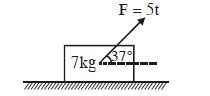
$A$ block of $7\,kg$ is placed on a rough horizontal surface and is pulled by a variable force $F$ (in $N$) $= 5t$,where $t$ is time in seconds,at an angle of $37^{\circ}$ with the horizontal as shown in the figure. The coefficient of static friction between the block and the surface is $\mu = 1$. If the force starts acting at $t = 0\,s$,find the time at which the block starts to slide. (Take $g = 10\,m/s^2$)
A
$5$
B
$7$
C
$10$
D
$12$
Solution
(C) The forces acting on the block are the applied force $F$,gravity $mg$,normal force $N$,and friction $f$.
Resolving the force $F$ into components:
Horizontal component: $F_x = F \cos 37^{\circ} = 5t \times \frac{4}{5} = 4t$
Vertical component: $F_y = F \sin 37^{\circ} = 5t \times \frac{3}{5} = 3t$
For vertical equilibrium:
$N + F_y = mg$
$N = mg - F_y = 70 - 3t$
The block starts to slide when the horizontal force $F_x$ equals the limiting friction $f_L = \mu N$:
$F_x = \mu N$
$4t = 1 \times (70 - 3t)$
$4t = 70 - 3t$
$7t = 70$
$t = 10\,s$
Resolving the force $F$ into components:
Horizontal component: $F_x = F \cos 37^{\circ} = 5t \times \frac{4}{5} = 4t$
Vertical component: $F_y = F \sin 37^{\circ} = 5t \times \frac{3}{5} = 3t$
For vertical equilibrium:
$N + F_y = mg$
$N = mg - F_y = 70 - 3t$
The block starts to slide when the horizontal force $F_x$ equals the limiting friction $f_L = \mu N$:
$F_x = \mu N$
$4t = 1 \times (70 - 3t)$
$4t = 70 - 3t$
$7t = 70$
$t = 10\,s$
0 likes
View Solution56
DifficultMCQ
In the given figure,the acceleration of the block of mass $M = \frac{10}{3} \, kg$ is (given $g = 10 \, ms^{-2}$,$\mu = \frac{1}{3}$,$F = 50 \, N$,and $\theta = \sin^{-1}(\frac{3}{5})$):
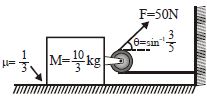
A
$\frac{20}{3} \, ms^{-2}$
B
$17 \, ms^{-2}$
C
$\frac{80}{3} \, ms^{-2}$
D
None of these
Solution
(D) Given: $M = \frac{10}{3} \, kg$,$F = 50 \, N$,$\mu = \frac{1}{3}$,$\theta = \sin^{-1}(\frac{3}{5})$.
From $\sin \theta = \frac{3}{5}$,we get $\cos \theta = \frac{4}{5}$.
The vertical forces on the block are the normal force $N$,the weight $Mg$,and the vertical component of the applied force $F \sin \theta$ (acting upwards).
$N + F \sin \theta = Mg \Rightarrow N = Mg - F \sin \theta$.
$N = (\frac{10}{3} \times 10) - (50 \times \frac{3}{5}) = \frac{100}{3} - 30 = \frac{100 - 90}{3} = \frac{10}{3} \, N$.
The horizontal forces are the horizontal component of the applied force $F \cos \theta$ and the friction force $f = \mu N$.
The equation of motion is $F \cos \theta - \mu N = Ma$.
$50 \times \frac{4}{5} - \frac{1}{3} \times \frac{10}{3} = \frac{10}{3} a$.
$40 - \frac{10}{9} = \frac{10}{3} a$.
$\frac{360 - 10}{9} = \frac{10}{3} a \Rightarrow \frac{350}{9} = \frac{10}{3} a$.
$a = \frac{350}{9} \times \frac{3}{10} = \frac{35}{3} \, ms^{-2}$.
From $\sin \theta = \frac{3}{5}$,we get $\cos \theta = \frac{4}{5}$.
The vertical forces on the block are the normal force $N$,the weight $Mg$,and the vertical component of the applied force $F \sin \theta$ (acting upwards).
$N + F \sin \theta = Mg \Rightarrow N = Mg - F \sin \theta$.
$N = (\frac{10}{3} \times 10) - (50 \times \frac{3}{5}) = \frac{100}{3} - 30 = \frac{100 - 90}{3} = \frac{10}{3} \, N$.
The horizontal forces are the horizontal component of the applied force $F \cos \theta$ and the friction force $f = \mu N$.
The equation of motion is $F \cos \theta - \mu N = Ma$.
$50 \times \frac{4}{5} - \frac{1}{3} \times \frac{10}{3} = \frac{10}{3} a$.
$40 - \frac{10}{9} = \frac{10}{3} a$.
$\frac{360 - 10}{9} = \frac{10}{3} a \Rightarrow \frac{350}{9} = \frac{10}{3} a$.
$a = \frac{350}{9} \times \frac{3}{10} = \frac{35}{3} \, ms^{-2}$.
0 likes
View Solution57
DifficultMCQ
$A$ block of mass $m$ is pulled along a horizontal surface by applying a force at an angle $\theta$ with the horizontal. The friction coefficient between the block and the surface is $\mu$. If the block travels at a uniform velocity,then the work done during its displacement $d$ is:
A
$\frac{\mu mgd}{\sin \theta}$
B
$\frac{\mu mgd}{\cos \theta}$
C
$\frac{\mu mgd}{\cos \theta - \mu \sin \theta}$
D
$\frac{\mu mgd}{\cos \theta + \mu \sin \theta}$
Solution
(D) For a block moving at a uniform velocity,the net force acting on it must be zero.
Let $F$ be the applied force. The vertical forces are the normal force $N$,the vertical component of the applied force $F \sin \theta$,and the weight $mg$. Thus,$N + F \sin \theta = mg$,which gives $N = mg - F \sin \theta$.
The horizontal forces are the horizontal component of the applied force $F \cos \theta$ and the kinetic friction $f_k = \mu N$. For uniform velocity,$F \cos \theta = f_k = \mu(mg - F \sin \theta)$.
Solving for $F$: $F \cos \theta = \mu mg - \mu F \sin \theta \implies F(\cos \theta + \mu \sin \theta) = \mu mg \implies F = \frac{\mu mg}{\cos \theta + \mu \sin \theta}$.
The work done $W$ during displacement $d$ is $W = (F \cos \theta) \times d$. However,since the work done by the applied force is requested,$W = F \cdot d \cdot \cos \theta$ is not the standard interpretation here; usually,it refers to the work done by the applied force $F$ in the direction of displacement. Given the options,the work done by the applied force is $W = F \cdot d = \frac{\mu mgd}{\cos \theta + \mu \sin \theta}$.
Let $F$ be the applied force. The vertical forces are the normal force $N$,the vertical component of the applied force $F \sin \theta$,and the weight $mg$. Thus,$N + F \sin \theta = mg$,which gives $N = mg - F \sin \theta$.
The horizontal forces are the horizontal component of the applied force $F \cos \theta$ and the kinetic friction $f_k = \mu N$. For uniform velocity,$F \cos \theta = f_k = \mu(mg - F \sin \theta)$.
Solving for $F$: $F \cos \theta = \mu mg - \mu F \sin \theta \implies F(\cos \theta + \mu \sin \theta) = \mu mg \implies F = \frac{\mu mg}{\cos \theta + \mu \sin \theta}$.
The work done $W$ during displacement $d$ is $W = (F \cos \theta) \times d$. However,since the work done by the applied force is requested,$W = F \cdot d \cdot \cos \theta$ is not the standard interpretation here; usually,it refers to the work done by the applied force $F$ in the direction of displacement. Given the options,the work done by the applied force is $W = F \cdot d = \frac{\mu mgd}{\cos \theta + \mu \sin \theta}$.
0 likes
View Solution58
DifficultMCQ
$A$ block of mass $m$ is pressed against a vertical wall by a horizontal force of magnitude $mg$. An upward force of magnitude $\frac{mg}{2}$ is also applied to the block. If the block is in equilibrium,the minimum coefficient of friction $\mu$ between the block and the wall is:
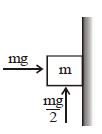
A
$0.4$
B
$0.2$
C
$0.5$
D
None of these
Solution
(C) For the block to be in equilibrium,the net force acting on it must be zero.
$1$. The horizontal force pressing the block against the wall is $F_h = mg$. This force provides the normal reaction $N = mg$.
$2$. The maximum static friction force available is $f_{max} = \mu N = \mu (mg)$.
$3$. Considering the vertical forces,the weight of the block $mg$ acts downwards,and an upward force of $\frac{mg}{2}$ is applied. Let $f$ be the friction force acting on the block.
$4$. For equilibrium in the vertical direction: $f + \frac{mg}{2} = mg$,which gives $f = mg - \frac{mg}{2} = \frac{mg}{2}$.
$5$. For the block to remain in equilibrium,the required friction force must be less than or equal to the maximum static friction: $f \le f_{max}$.
$6$. Therefore,$\frac{mg}{2} \le \mu (mg)$.
$7$. Solving for $\mu$,we get $\mu \ge \frac{1}{2}$,or $\mu \ge 0.5$. The minimum coefficient of friction is $0.5$.
$1$. The horizontal force pressing the block against the wall is $F_h = mg$. This force provides the normal reaction $N = mg$.
$2$. The maximum static friction force available is $f_{max} = \mu N = \mu (mg)$.
$3$. Considering the vertical forces,the weight of the block $mg$ acts downwards,and an upward force of $\frac{mg}{2}$ is applied. Let $f$ be the friction force acting on the block.
$4$. For equilibrium in the vertical direction: $f + \frac{mg}{2} = mg$,which gives $f = mg - \frac{mg}{2} = \frac{mg}{2}$.
$5$. For the block to remain in equilibrium,the required friction force must be less than or equal to the maximum static friction: $f \le f_{max}$.
$6$. Therefore,$\frac{mg}{2} \le \mu (mg)$.
$7$. Solving for $\mu$,we get $\mu \ge \frac{1}{2}$,or $\mu \ge 0.5$. The minimum coefficient of friction is $0.5$.
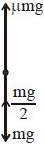
0 likes
View Solution59
MediumMCQ
You are holding a vertical cylindrical rod of mass $1 \, kg$ by pressing it (with a force of $12 \, N$) with two fingers. The coefficient of friction between the rod and the fingers is $\mu = 0.5$. The force of friction on the rod will be ........ $N$.
A
$6$
B
$12$
C
$10$
D
$5$
Solution
(C) The mass of the rod is $m = 1 \, kg$,so the gravitational force acting downwards is $W = mg = 1 \times 10 = 10 \, N$.
For the rod to remain in equilibrium,the total upward frictional force $F_f$ must balance the weight: $F_f = mg = 10 \, N$.
Each finger exerts a normal force $N = 12 \, N$. Since there are two fingers,the total maximum static friction available is $f_{s,max} = 2 \times \mu \times N = 2 \times 0.5 \times 12 = 12 \, N$.
Since the required frictional force $(10 \, N)$ is less than the maximum available static friction $(12 \, N)$,the rod does not slip.
Therefore,the actual frictional force acting on the rod is equal to the weight,which is $10 \, N$.
For the rod to remain in equilibrium,the total upward frictional force $F_f$ must balance the weight: $F_f = mg = 10 \, N$.
Each finger exerts a normal force $N = 12 \, N$. Since there are two fingers,the total maximum static friction available is $f_{s,max} = 2 \times \mu \times N = 2 \times 0.5 \times 12 = 12 \, N$.
Since the required frictional force $(10 \, N)$ is less than the maximum available static friction $(12 \, N)$,the rod does not slip.
Therefore,the actual frictional force acting on the rod is equal to the weight,which is $10 \, N$.
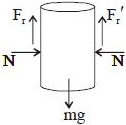
0 likes
View Solution60
DifficultMCQ
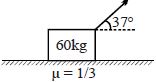
$A$ force $F$ pulls a block of mass $60 \ kg$ at a constant speed across the floor. The coefficient of friction is $\mu = 1/3$. What is the magnitude of the force $F$ (in $N$)?
A
$100$
B
$200$
C
$300$
D
None of these
Solution
(B) Given: mass $m = 60 \ kg$,angle $\theta = 37^{\circ}$,coefficient of friction $\mu = 1/3$,$g = 10 \ m/s^2$.
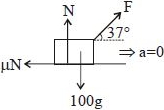
Since the block moves at a constant speed,the net force is zero $(a = 0)$.
Resolving the force $F$ into horizontal and vertical components:
Horizontal direction: $F \cos 37^{\circ} = \mu N$ --- $(1)$
Vertical direction: $N + F \sin 37^{\circ} = mg$ --- $(2)$
From $(2)$,$N = mg - F \sin 37^{\circ}$.
Substitute $N$ into $(1)$:
$F \cos 37^{\circ} = \mu (mg - F \sin 37^{\circ})$
$F \cos 37^{\circ} = \mu mg - \mu F \sin 37^{\circ}$
$F (\cos 37^{\circ} + \mu \sin 37^{\circ}) = \mu mg$
$F = \frac{\mu mg}{\cos 37^{\circ} + \mu \sin 37^{\circ}}$
Using $\cos 37^{\circ} = 4/5$ and $\sin 37^{\circ} = 3/5$:
$F = \frac{(1/3) \times 60 \times 10}{(4/5) + (1/3) \times (3/5)} = \frac{200}{(4/5) + (1/5)} = \frac{200}{1} = 200 \ N$.
Since the block moves at a constant speed,the net force is zero $(a = 0)$.
Resolving the force $F$ into horizontal and vertical components:
Horizontal direction: $F \cos 37^{\circ} = \mu N$ --- $(1)$
Vertical direction: $N + F \sin 37^{\circ} = mg$ --- $(2)$
From $(2)$,$N = mg - F \sin 37^{\circ}$.
Substitute $N$ into $(1)$:
$F \cos 37^{\circ} = \mu (mg - F \sin 37^{\circ})$
$F \cos 37^{\circ} = \mu mg - \mu F \sin 37^{\circ}$
$F (\cos 37^{\circ} + \mu \sin 37^{\circ}) = \mu mg$
$F = \frac{\mu mg}{\cos 37^{\circ} + \mu \sin 37^{\circ}}$
Using $\cos 37^{\circ} = 4/5$ and $\sin 37^{\circ} = 3/5$:
$F = \frac{(1/3) \times 60 \times 10}{(4/5) + (1/3) \times (3/5)} = \frac{200}{(4/5) + (1/5)} = \frac{200}{1} = 200 \ N$.
0 likes
View Solution61
MediumMCQ
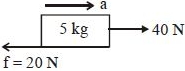
$A$ horizontal force of $40\,N$ is applied to a $5\,kg$ block which is at rest on a horizontal surface. If the coefficient of kinetic friction is $0.4$,then the acceleration of the block is ........ $m/s^2$ $(g = 10\,m/s^2)$.
A
$4$
B
$8$
C
$12$
D
$16$
Solution
(A) Given:
Mass of the block,$m = 5\,kg$
Applied horizontal force,$F = 40\,N$
Coefficient of kinetic friction,$\mu_k = 0.4$
Acceleration due to gravity,$g = 10\,m/s^2$
Step $1$: Calculate the kinetic frictional force $(f_k)$:
The normal force on the horizontal surface is $N = mg = 5 \times 10 = 50\,N$.
The kinetic frictional force is given by $f_k = \mu_k N = 0.4 \times 50 = 20\,N$.
Step $2$: Calculate the net force $(F_{net})$:
The net force acting on the block is $F_{net} = F - f_k = 40\,N - 20\,N = 20\,N$.
Step $3$: Calculate the acceleration $(a)$:
Using Newton's second law,$F_{net} = ma$.
$a = \frac{F_{net}}{m} = \frac{20\,N}{5\,kg} = 4\,m/s^2$.
Therefore,the acceleration of the block is $4\,m/s^2$.
Mass of the block,$m = 5\,kg$
Applied horizontal force,$F = 40\,N$
Coefficient of kinetic friction,$\mu_k = 0.4$
Acceleration due to gravity,$g = 10\,m/s^2$
Step $1$: Calculate the kinetic frictional force $(f_k)$:
The normal force on the horizontal surface is $N = mg = 5 \times 10 = 50\,N$.
The kinetic frictional force is given by $f_k = \mu_k N = 0.4 \times 50 = 20\,N$.
Step $2$: Calculate the net force $(F_{net})$:
The net force acting on the block is $F_{net} = F - f_k = 40\,N - 20\,N = 20\,N$.
Step $3$: Calculate the acceleration $(a)$:
Using Newton's second law,$F_{net} = ma$.
$a = \frac{F_{net}}{m} = \frac{20\,N}{5\,kg} = 4\,m/s^2$.
Therefore,the acceleration of the block is $4\,m/s^2$.
0 likes
View Solution62
MediumMCQ
$A$ horizontal force of $4\,N$ is needed to keep a block of mass $0.5\,kg$ sliding on a horizontal surface with a constant speed. The coefficient of sliding friction must be: $[g = 10\,m/s^2]$
A
$0.25$
B
$0.5$
C
$0.8$
D
$0.6$
Solution
(C) Since the block is moving with a constant speed,the net force acting on it is zero.
Therefore,the applied horizontal force must be equal to the force of kinetic friction.
$F_{ext} = F_{k}$
We know that the kinetic friction force is given by $F_{k} = \mu_{k} N$,where $N$ is the normal force.
For a block on a horizontal surface,$N = mg$.
Thus,$F_{ext} = \mu_{k} mg$.
Given: $F_{ext} = 4\,N$,$m = 0.5\,kg$,and $g = 10\,m/s^2$.
Substituting the values: $4 = \mu_{k} \times 0.5 \times 10$.
$4 = \mu_{k} \times 5$.
$\mu_{k} = \frac{4}{5} = 0.8$.
Therefore,the applied horizontal force must be equal to the force of kinetic friction.
$F_{ext} = F_{k}$
We know that the kinetic friction force is given by $F_{k} = \mu_{k} N$,where $N$ is the normal force.
For a block on a horizontal surface,$N = mg$.
Thus,$F_{ext} = \mu_{k} mg$.
Given: $F_{ext} = 4\,N$,$m = 0.5\,kg$,and $g = 10\,m/s^2$.
Substituting the values: $4 = \mu_{k} \times 0.5 \times 10$.
$4 = \mu_{k} \times 5$.
$\mu_{k} = \frac{4}{5} = 0.8$.
0 likes
View Solution63
MediumMCQ
$A$ car is moving on a straight horizontal road with a speed $v.$ If the coefficient of friction between the tyres and the road is $\mu ,$ the shortest distance in which the car can be stopped is
A
$\frac{v^2}{2\mu g}$
B
$\frac{v^2}{\mu g}$
C
$\left( \frac{v}{\mu g} \right)^2$
D
$\frac{v^2}{\mu}$
Solution
(A) The initial kinetic energy of the car is $K = \frac{1}{2} mv^2.$
The force of friction acting on the car is $f = \mu N = \mu mg.$
According to the work-energy theorem,the work done by the frictional force is equal to the change in kinetic energy of the car.
$W = \Delta K$
$-f \cdot s = 0 - \frac{1}{2} mv^2$
$\mu mg s = \frac{1}{2} mv^2$
Solving for the stopping distance $s$:
$s = \frac{v^2}{2\mu g}.$
The force of friction acting on the car is $f = \mu N = \mu mg.$
According to the work-energy theorem,the work done by the frictional force is equal to the change in kinetic energy of the car.
$W = \Delta K$
$-f \cdot s = 0 - \frac{1}{2} mv^2$
$\mu mg s = \frac{1}{2} mv^2$
Solving for the stopping distance $s$:
$s = \frac{v^2}{2\mu g}.$
0 likes
View Solution64
MediumMCQ
$A$ $1\,kg$ block is being pushed against a wall by a force $F = 75\,N$ as shown in the Figure. The coefficient of friction is $0.25.$ The magnitude of acceleration of the block is ........ $m/s^2$. (Take $g = 10\,m/s^2$)

A
$10$
B
$20$
C
$5$
D
none
Solution
(B) The force $F = 75\,N$ is applied at an angle of $37^{\circ}$ to the horizontal.
Resolving the force into components:
Horizontal component $N = F \cos 37^{\circ} = 75 \times 0.8 = 60\,N$. This is the normal force exerted by the wall on the block.
Vertical component $F_y = F \sin 37^{\circ} = 75 \times 0.6 = 45\,N$ (acting upwards).
The weight of the block is $mg = 1 \times 10 = 10\,N$ (acting downwards).
The force of kinetic friction is $f_k = \mu N = 0.25 \times 60 = 15\,N$. Since the vertical component of the applied force $(45\,N)$ is greater than the weight $(10\,N)$,the block moves upwards.
The friction force acts downwards to oppose the motion.
Applying Newton's second law in the vertical direction:
$F_y - mg - f_k = ma$
$45 - 10 - 15 = 1 \times a$
$20 = a$
Therefore,the acceleration $a = 20\,m/s^2$.
Resolving the force into components:
Horizontal component $N = F \cos 37^{\circ} = 75 \times 0.8 = 60\,N$. This is the normal force exerted by the wall on the block.
Vertical component $F_y = F \sin 37^{\circ} = 75 \times 0.6 = 45\,N$ (acting upwards).
The weight of the block is $mg = 1 \times 10 = 10\,N$ (acting downwards).
The force of kinetic friction is $f_k = \mu N = 0.25 \times 60 = 15\,N$. Since the vertical component of the applied force $(45\,N)$ is greater than the weight $(10\,N)$,the block moves upwards.
The friction force acts downwards to oppose the motion.
Applying Newton's second law in the vertical direction:
$F_y - mg - f_k = ma$
$45 - 10 - 15 = 1 \times a$
$20 = a$
Therefore,the acceleration $a = 20\,m/s^2$.
0 likes
View Solution65
EasyMCQ
The magnitude of acceleration of a block moving with a speed of $10\,m/s$ on a rough surface is $.........\,m/s^2$,if the coefficient of friction is $0.2$.
A
$2$
B
$0.2$
C
$0.1$
D
$1$
Solution
(A) When a block moves on a rough horizontal surface,the only horizontal force acting on it is the kinetic frictional force,$f_k = \mu_k N$.
Since the surface is horizontal,the normal force $N = mg$.
Therefore,the frictional force is $f_k = \mu_k mg$.
According to Newton's second law,the magnitude of acceleration $a$ is given by $F = ma$,so $ma = \mu_k mg$.
This simplifies to $a = \mu_k g$.
Given $\mu_k = 0.2$ and taking $g = 10\,m/s^2$,we get:
$a = 0.2 \times 10 = 2\,m/s^2$.
Since the surface is horizontal,the normal force $N = mg$.
Therefore,the frictional force is $f_k = \mu_k mg$.
According to Newton's second law,the magnitude of acceleration $a$ is given by $F = ma$,so $ma = \mu_k mg$.
This simplifies to $a = \mu_k g$.
Given $\mu_k = 0.2$ and taking $g = 10\,m/s^2$,we get:
$a = 0.2 \times 10 = 2\,m/s^2$.
0 likes
View Solution66
MediumMCQ
$A$ block of mass $4\,kg$ is placed on a rough horizontal plane. $A$ time-dependent force $F = kt^2$ acts on the block,where $k = 2\,N/s^2$. The coefficient of friction is $\mu = 0.8$. The force of friction between the block and the plane at $t = 2\,s$ is ....... $N$.
A
$8$
B
$4$
C
$2$
D
$32$
Solution
(A) The maximum static friction force is given by $f_{max} = \mu mg$.
Given $m = 4\,kg$,$g = 10\,m/s^2$,and $\mu = 0.8$,we have $f_{max} = 0.8 \times 4 \times 10 = 32\,N$.
The applied force at $t = 2\,s$ is $F = kt^2 = 2 \times (2)^2 = 8\,N$.
Since the applied force $F = 8\,N$ is less than the maximum static friction $f_{max} = 32\,N$,the block remains at rest.
According to the laws of static friction,the frictional force equals the applied force when the object is in equilibrium.
Therefore,the force of friction is $8\,N$.
Given $m = 4\,kg$,$g = 10\,m/s^2$,and $\mu = 0.8$,we have $f_{max} = 0.8 \times 4 \times 10 = 32\,N$.
The applied force at $t = 2\,s$ is $F = kt^2 = 2 \times (2)^2 = 8\,N$.
Since the applied force $F = 8\,N$ is less than the maximum static friction $f_{max} = 32\,N$,the block remains at rest.
According to the laws of static friction,the frictional force equals the applied force when the object is in equilibrium.
Therefore,the force of friction is $8\,N$.
0 likes
View Solution67
MediumMCQ
$A$ body is moving with a uniform velocity of $2 \, m/s$ on a rough level surface. The frictional force on it is $10 \, N$. If the body moves with a velocity of $4 \, m/s$,the force of friction will be ........ $N$.
A
$2.5$
B
$5$
C
$10$
D
$20$
Solution
(C) The frictional force acting on a body moving on a rough surface is kinetic friction.
Kinetic friction is given by the formula $f_k = \mu_k N$,where $\mu_k$ is the coefficient of kinetic friction and $N$ is the normal force.
Since the surface is level and the body is not accelerating vertically,the normal force $N$ is equal to the weight of the body $(mg)$.
Kinetic friction is independent of the velocity of the body as long as the surface properties and the normal force remain unchanged.
Therefore,even if the velocity increases from $2 \, m/s$ to $4 \, m/s$,the frictional force remains constant at $10 \, N$.
Kinetic friction is given by the formula $f_k = \mu_k N$,where $\mu_k$ is the coefficient of kinetic friction and $N$ is the normal force.
Since the surface is level and the body is not accelerating vertically,the normal force $N$ is equal to the weight of the body $(mg)$.
Kinetic friction is independent of the velocity of the body as long as the surface properties and the normal force remain unchanged.
Therefore,even if the velocity increases from $2 \, m/s$ to $4 \, m/s$,the frictional force remains constant at $10 \, N$.
0 likes
View Solution68
DifficultMCQ
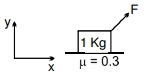
$A$ force $\vec{F}=\hat{i}+4 \hat{j}$ acts on the block shown in the figure. The force of friction acting on the block is (take $g=10 \, m/s^2$)
A
$-\hat{i}$
B
$-1.8 \hat{i}$
C
$-2.4 \hat{i}$
D
$-3 \hat{i}$
Solution
(A) The block has a mass $m=1 \, kg$. The forces acting on it are gravity ($mg=10 \, N$ downwards),the normal force ($N$ upwards),and the applied force $\vec{F}=\hat{i}+4 \hat{j}$.
Resolving forces in the vertical $(y)$ direction:
$N + F_y = mg$
$N + 4 = 10$
$N = 6 \, N$
The maximum static friction force is given by $f_{\max} = \mu N = 0.3 \times 6 = 1.8 \, N$.
The horizontal component of the applied force is $F_x = 1 \, N$.
Since the required horizontal force to move the block $(1 \, N)$ is less than the maximum static friction $(1.8 \, N)$,the block remains at rest.
Therefore,the static friction force will exactly balance the applied horizontal force to keep the block in equilibrium.
Thus,the friction force is $f = -F_x \hat{i} = -1 \hat{i} = -\hat{i}$.
Resolving forces in the vertical $(y)$ direction:
$N + F_y = mg$
$N + 4 = 10$
$N = 6 \, N$
The maximum static friction force is given by $f_{\max} = \mu N = 0.3 \times 6 = 1.8 \, N$.
The horizontal component of the applied force is $F_x = 1 \, N$.
Since the required horizontal force to move the block $(1 \, N)$ is less than the maximum static friction $(1.8 \, N)$,the block remains at rest.
Therefore,the static friction force will exactly balance the applied horizontal force to keep the block in equilibrium.
Thus,the friction force is $f = -F_x \hat{i} = -1 \hat{i} = -\hat{i}$.
0 likes
View Solution69
DifficultMCQ
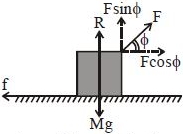
$A$ wooden block of mass $M$ resting on a rough horizontal surface is pulled with a force $F$ at an angle $\phi$ with the horizontal. If $\mu$ is the coefficient of kinetic friction between the block and the surface,then the acceleration of the block is:
A
$\frac{F}{M}(\cos \phi + \mu \sin \phi) - \mu g$
B
$F \sin \phi / M$
C
$\mu F \cos \phi$
D
$\mu F \sin \phi$
Solution
(A) $1$. Resolve the applied force $F$ into horizontal and vertical components: $F \cos \phi$ (horizontal) and $F \sin \phi$ (vertical).
$2$. The vertical forces acting on the block are the normal reaction $R$ (upwards),the vertical component of the applied force $F \sin \phi$ (upwards),and the weight $Mg$ (downwards). For vertical equilibrium: $R + F \sin \phi = Mg$,so $R = Mg - F \sin \phi$.
$3$. The horizontal force causing motion is $F \cos \phi$. The kinetic friction force $f$ opposing the motion is given by $f = \mu R = \mu(Mg - F \sin \phi)$.
$4$. Applying Newton's second law in the horizontal direction: $F \cos \phi - f = Ma$.
$5$. Substituting the expression for $f$: $F \cos \phi - \mu(Mg - F \sin \phi) = Ma$.
$6$. Solving for acceleration $a$: $Ma = F \cos \phi - \mu Mg + \mu F \sin \phi$.
$7$. Dividing by $M$: $a = \frac{F}{M}(\cos \phi + \mu \sin \phi) - \mu g$.
$2$. The vertical forces acting on the block are the normal reaction $R$ (upwards),the vertical component of the applied force $F \sin \phi$ (upwards),and the weight $Mg$ (downwards). For vertical equilibrium: $R + F \sin \phi = Mg$,so $R = Mg - F \sin \phi$.
$3$. The horizontal force causing motion is $F \cos \phi$. The kinetic friction force $f$ opposing the motion is given by $f = \mu R = \mu(Mg - F \sin \phi)$.
$4$. Applying Newton's second law in the horizontal direction: $F \cos \phi - f = Ma$.
$5$. Substituting the expression for $f$: $F \cos \phi - \mu(Mg - F \sin \phi) = Ma$.
$6$. Solving for acceleration $a$: $Ma = F \cos \phi - \mu Mg + \mu F \sin \phi$.
$7$. Dividing by $M$: $a = \frac{F}{M}(\cos \phi + \mu \sin \phi) - \mu g$.
0 likes
View Solution70
DifficultMCQ
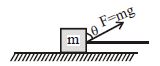
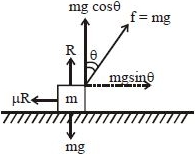
$A$ block of mass $m$ rests on a rough horizontal surface as shown in the figure. The coefficient of friction between the block and the surface is $\mu$. $A$ force $F = mg$ acting at an angle $\theta$ with the vertical side of the block pulls it. In which of the following cases can the block be pulled along the surface?
A
$\tan \theta \geq \mu$
B
$\cot \theta \geq \mu$
C
$\tan \frac{\theta}{2} \geq \mu$
D
$\cot \frac{\theta}{2} \geq \mu$
Solution
(D) The forces acting on the block are its weight $mg$ downwards,the normal reaction $R$ upwards,and the applied force $F = mg$ at an angle $\theta$ with the vertical.
Resolving the force $F$ into components:
Horizontal component $= F \sin \theta = mg \sin \theta$
Vertical component $= F \cos \theta = mg \cos \theta$
For vertical equilibrium:
$R + F \cos \theta = mg$
$R = mg - mg \cos \theta = mg(1 - \cos \theta)$
The frictional force $f_r$ is given by:
$f_r = \mu R = \mu mg(1 - \cos \theta)$
The block will be pulled if the horizontal component of the force is greater than or equal to the frictional force:
$mg \sin \theta \geq \mu mg(1 - \cos \theta)$
$\sin \theta \geq \mu(1 - \cos \theta)$
Using trigonometric identities $\sin \theta = 2 \sin \frac{\theta}{2} \cos \frac{\theta}{2}$ and $1 - \cos \theta = 2 \sin^2 \frac{\theta}{2}$:
$2 \sin \frac{\theta}{2} \cos \frac{\theta}{2} \geq \mu (2 \sin^2 \frac{\theta}{2})$
$\cos \frac{\theta}{2} \geq \mu \sin \frac{\theta}{2}$
$\cot \frac{\theta}{2} \geq \mu$
Resolving the force $F$ into components:
Horizontal component $= F \sin \theta = mg \sin \theta$
Vertical component $= F \cos \theta = mg \cos \theta$
For vertical equilibrium:
$R + F \cos \theta = mg$
$R = mg - mg \cos \theta = mg(1 - \cos \theta)$
The frictional force $f_r$ is given by:
$f_r = \mu R = \mu mg(1 - \cos \theta)$
The block will be pulled if the horizontal component of the force is greater than or equal to the frictional force:
$mg \sin \theta \geq \mu mg(1 - \cos \theta)$
$\sin \theta \geq \mu(1 - \cos \theta)$
Using trigonometric identities $\sin \theta = 2 \sin \frac{\theta}{2} \cos \frac{\theta}{2}$ and $1 - \cos \theta = 2 \sin^2 \frac{\theta}{2}$:
$2 \sin \frac{\theta}{2} \cos \frac{\theta}{2} \geq \mu (2 \sin^2 \frac{\theta}{2})$
$\cos \frac{\theta}{2} \geq \mu \sin \frac{\theta}{2}$
$\cot \frac{\theta}{2} \geq \mu$
0 likes
View Solution71
DifficultMCQ
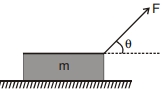
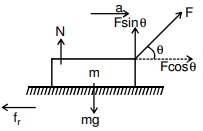
$A$ wooden block of mass $m$ resting on a rough surface (coefficient of friction $\mu$) is pulled by a force $F$ at an angle $\theta$ with the horizontal,as shown in the figure. The acceleration of the block moving horizontally is:
A
$\frac{F}{m}(\cos \theta + \mu \sin \theta) - \mu g$
B
$\frac{F \cos \theta}{m}$
C
$\frac{\mu F \sin \theta}{m}$
D
$\frac{F}{m}(\cos \theta - \mu \sin \theta) - \mu g$
Solution
(A) $1$. Resolve the applied force $F$ into two components: horizontal component $F \cos \theta$ and vertical component $F \sin \theta$.
$2$. The vertical forces acting on the block are the normal force $N$ (upward),the vertical component of the applied force $F \sin \theta$ (upward),and the weight $mg$ (downward). Since there is no vertical motion,$N + F \sin \theta = mg$,which gives $N = mg - F \sin \theta$.
$3$. The frictional force $f_r$ is given by $f_r = \mu N = \mu(mg - F \sin \theta)$.
$4$. The net horizontal force acting on the block is $F \cos \theta - f_r$. According to Newton's second law,$F \cos \theta - f_r = ma$.
$5$. Substituting the value of $f_r$: $F \cos \theta - \mu(mg - F \sin \theta) = ma$.
$6$. Solving for acceleration $a$: $a = \frac{F \cos \theta - \mu mg + \mu F \sin \theta}{m} = \frac{F}{m}(\cos \theta + \mu \sin \theta) - \mu g$.
$2$. The vertical forces acting on the block are the normal force $N$ (upward),the vertical component of the applied force $F \sin \theta$ (upward),and the weight $mg$ (downward). Since there is no vertical motion,$N + F \sin \theta = mg$,which gives $N = mg - F \sin \theta$.
$3$. The frictional force $f_r$ is given by $f_r = \mu N = \mu(mg - F \sin \theta)$.
$4$. The net horizontal force acting on the block is $F \cos \theta - f_r$. According to Newton's second law,$F \cos \theta - f_r = ma$.
$5$. Substituting the value of $f_r$: $F \cos \theta - \mu(mg - F \sin \theta) = ma$.
$6$. Solving for acceleration $a$: $a = \frac{F \cos \theta - \mu mg + \mu F \sin \theta}{m} = \frac{F}{m}(\cos \theta + \mu \sin \theta) - \mu g$.
0 likes
View Solution72
DifficultMCQ
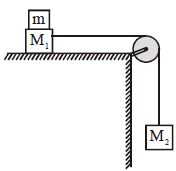
Two blocks of masses $M_1$ and $M_2$ are connected with a string passing over a pulley as shown in the figure. The block $M_1$ lies on a horizontal surface. The coefficient of friction between the block $M_1$ and the horizontal surface is $\mu$. What additional mass $m$ should be placed on the block $M_1$ so that the system does not accelerate?
A
$\frac{M_2 - M_1}{\mu}$
B
$\frac{M_2}{\mu} - M_1$
C
$M_2 - \frac{M_1}{\mu}$
D
$(M_2 - M_1)\mu$
Solution
(B) For the system to be in equilibrium:
For the block of mass $M_1$ with additional mass $m$ on it:
The normal force $N = (M_1 + m)g$.
The limiting frictional force $f = \mu N = \mu(M_1 + m)g$.
For equilibrium,the tension $T$ in the string must be equal to the frictional force:
$T = \mu(M_1 + m)g$.
For the block of mass $M_2$ hanging vertically:
For equilibrium,the tension $T$ must be equal to the weight of the block:
$T = M_2 g$.
Equating the two expressions for tension:
$\mu(M_1 + m)g = M_2 g$.
Dividing both sides by $\mu g$:
$M_1 + m = \frac{M_2}{\mu}$.
Therefore,the additional mass $m$ required is:
$m = \frac{M_2}{\mu} - M_1$.
For the block of mass $M_1$ with additional mass $m$ on it:
The normal force $N = (M_1 + m)g$.
The limiting frictional force $f = \mu N = \mu(M_1 + m)g$.
For equilibrium,the tension $T$ in the string must be equal to the frictional force:
$T = \mu(M_1 + m)g$.
For the block of mass $M_2$ hanging vertically:
For equilibrium,the tension $T$ must be equal to the weight of the block:
$T = M_2 g$.
Equating the two expressions for tension:
$\mu(M_1 + m)g = M_2 g$.
Dividing both sides by $\mu g$:
$M_1 + m = \frac{M_2}{\mu}$.
Therefore,the additional mass $m$ required is:
$m = \frac{M_2}{\mu} - M_1$.
0 likes
View Solution73
MediumMCQ
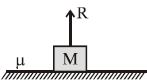
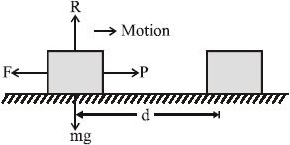
If the normal reaction is $R$ and the coefficient of friction is $\mu$,what is the work done against friction in moving a body by a distance $d$ slowly?
A
$\frac{\mu Rd}{4}$
B
$2\mu Rd$
C
$\mu Rd$
D
$\frac{\mu Rd}{2}$
Solution
(C) The force of kinetic friction $f$ acting on the body is given by $f = \mu R$.
To move the body slowly (without acceleration),an external force $P$ must be applied such that it exactly balances the frictional force.
Therefore,$P = f = \mu R$.
The work done $W$ against friction in moving the body by a distance $d$ is given by the product of the applied force and the displacement:
$W = P \times d = (\mu R) \times d = \mu Rd$.
To move the body slowly (without acceleration),an external force $P$ must be applied such that it exactly balances the frictional force.
Therefore,$P = f = \mu R$.
The work done $W$ against friction in moving the body by a distance $d$ is given by the product of the applied force and the displacement:
$W = P \times d = (\mu R) \times d = \mu Rd$.
0 likes
View Solution74
DifficultMCQ
$A$ conveyor belt is moving at a constant speed of $2\, ms^{-1}$. $A$ box is gently dropped on it. The coefficient of friction between them is $\mu = 0.5$. The distance that the box will move relative to the belt before coming to rest on it,(taking $g = 10\, ms^{-2}$) is ........ $m$.
A
$0.4$
B
$1.2$
C
$0.6$
D
$0$
Solution
(A) The box is dropped on the moving belt,so its initial velocity relative to the belt is $u_{rel} = 2\, ms^{-1}$.
The force of friction acting on the box is $f = \mu mg$.
According to Newton's second law,the acceleration of the box relative to the belt is $a = \frac{f}{m} = \mu g$.
Substituting the given values,$a = 0.5 \times 10 = 5\, ms^{-2}$.
We use the kinematic equation $v^2 - u^2 = 2aS$ to find the distance $S$ covered by the box relative to the belt until it stops sliding.
Here,the final relative velocity $v = 0\, ms^{-1}$ and the initial relative velocity $u = 2\, ms^{-1}$.
Substituting these into the equation: $0^2 - 2^2 = 2(-5)S$.
$-4 = -10S$.
$S = \frac{4}{10} = 0.4\, m$.
The force of friction acting on the box is $f = \mu mg$.
According to Newton's second law,the acceleration of the box relative to the belt is $a = \frac{f}{m} = \mu g$.
Substituting the given values,$a = 0.5 \times 10 = 5\, ms^{-2}$.
We use the kinematic equation $v^2 - u^2 = 2aS$ to find the distance $S$ covered by the box relative to the belt until it stops sliding.
Here,the final relative velocity $v = 0\, ms^{-1}$ and the initial relative velocity $u = 2\, ms^{-1}$.
Substituting these into the equation: $0^2 - 2^2 = 2(-5)S$.
$-4 = -10S$.
$S = \frac{4}{10} = 0.4\, m$.
0 likes
View Solution75
MediumMCQ
$A$ body of mass $m$ moves with a velocity $v$ on a surface whose friction coefficient is $\mu$. If the body covers a distance $s$ before coming to rest,what is the initial velocity $v$?
A
$\sqrt{\mu g s}$
B
$\sqrt{\mu g s / 2}$
C
$\sqrt{2 \mu g s}$
D
$\sqrt{3 \mu g s}$
Solution
(C) The frictional force acting on the body is $f = \mu N = \mu mg$.
According to Newton's second law,the retardation $a$ is given by $ma = f = \mu mg$,which simplifies to $a = \mu g$.
Using the third equation of motion,$v_f^2 - v_i^2 = 2as$,where $v_f = 0$ (final velocity) and $v_i = v$ (initial velocity).
Substituting the values: $0^2 - v^2 = 2(-\mu g)s$.
This gives $-v^2 = -2\mu gs$.
Therefore,the initial velocity is $v = \sqrt{2\mu gs}$.
According to Newton's second law,the retardation $a$ is given by $ma = f = \mu mg$,which simplifies to $a = \mu g$.
Using the third equation of motion,$v_f^2 - v_i^2 = 2as$,where $v_f = 0$ (final velocity) and $v_i = v$ (initial velocity).
Substituting the values: $0^2 - v^2 = 2(-\mu g)s$.
This gives $-v^2 = -2\mu gs$.
Therefore,the initial velocity is $v = \sqrt{2\mu gs}$.
0 likes
View Solution76
MediumMCQ
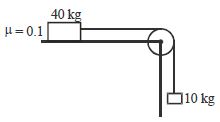
For the given figure,find the acceleration of the $40\, kg$ block in $m/s^2$. (Take $g = 10\, m/s^2$)
A
$0$
B
$2$
C
$1.2$
D
$2.4$
Solution
(C) Let $m_1 = 40\, kg$ be the mass on the table and $m_2 = 10\, kg$ be the hanging mass.
The limiting friction force acting on the $40\, kg$ block is $f_L = \mu m_1 g = 0.1 \times 40 \times 10 = 40\, N$.
The driving force due to the hanging mass is $F_d = m_2 g = 10 \times 10 = 100\, N$.
Since the driving force $(100\, N)$ is greater than the limiting friction $(40\, N)$,the system will accelerate.
Applying Newton's second law to the system: $m_2 g - f_L = (m_1 + m_2) a$.
$100 - 40 = (40 + 10) a$.
$60 = 50 a$.
$a = \frac{60}{50} = 1.2\, m/s^2$.
The limiting friction force acting on the $40\, kg$ block is $f_L = \mu m_1 g = 0.1 \times 40 \times 10 = 40\, N$.
The driving force due to the hanging mass is $F_d = m_2 g = 10 \times 10 = 100\, N$.
Since the driving force $(100\, N)$ is greater than the limiting friction $(40\, N)$,the system will accelerate.
Applying Newton's second law to the system: $m_2 g - f_L = (m_1 + m_2) a$.
$100 - 40 = (40 + 10) a$.
$60 = 50 a$.
$a = \frac{60}{50} = 1.2\, m/s^2$.
0 likes
View Solution77
DifficultMCQ
$A$ body is pulled along a rough horizontal surface with a velocity $6\,m/s$. If the body comes to rest after travelling $9\,m$,then the coefficient of sliding friction is- (Take $g = 10\,m/s^2$)
A
$0.2$
B
$0.4$
C
$0.5$
D
$0.6$
Solution
(A) Given: Initial velocity $u = 6\,m/s$,final velocity $v = 0\,m/s$,distance $s = 9\,m$,and acceleration due to gravity $g = 10\,m/s^2$.
Using the work-energy theorem,the work done by friction equals the change in kinetic energy: $W = \Delta K$.
$-f_k \cdot s = 0 - \frac{1}{2} m u^2$.
Since $f_k = \mu_k N = \mu_k m g$,we have $-\mu_k m g s = -\frac{1}{2} m u^2$.
Simplifying,$\mu_k = \frac{u^2}{2 g s}$.
Substituting the values: $\mu_k = \frac{6^2}{2 \times 10 \times 9} = \frac{36}{180} = 0.2$.
Using the work-energy theorem,the work done by friction equals the change in kinetic energy: $W = \Delta K$.
$-f_k \cdot s = 0 - \frac{1}{2} m u^2$.
Since $f_k = \mu_k N = \mu_k m g$,we have $-\mu_k m g s = -\frac{1}{2} m u^2$.
Simplifying,$\mu_k = \frac{u^2}{2 g s}$.
Substituting the values: $\mu_k = \frac{6^2}{2 \times 10 \times 9} = \frac{36}{180} = 0.2$.
0 likes
View Solution78
MediumMCQ
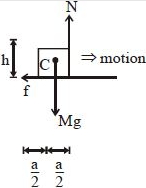
$A$ rectangular block has a square base measuring $a \times a$ and its height is $h$. It moves on a horizontal surface in a direction perpendicular to one of the edges. The coefficient of friction is $\mu$. It will topple if
A
$\mu > \frac{h}{a}$
B
$\mu > \frac{a}{h}$
C
$\mu > \frac{2a}{h}$
D
$\mu > \frac{a}{2h}$
Solution
(D) Let $C$ be the center of mass of the block. The height of the center of mass from the base is $h/2$.
For the block to topple,the torque due to the frictional force $f$ about the edge of the base must be greater than the torque due to the normal force $N$ about the same edge.
Taking torque about the front edge of the base:
$\tau_{f} = f \times h$
$\tau_{N} = N \times \frac{a}{2}$
For toppling,$\tau_{f} > \tau_{N} \implies f \times h > N \times \frac{a}{2}$.
Since the block is moving,$f = \mu N$.
Substituting this,$\mu N h > N \frac{a}{2}$.
$\mu h > \frac{a}{2} \implies \mu > \frac{a}{2h}$.
Thus,the block will topple if $\mu > \frac{a}{2h}$.
For the block to topple,the torque due to the frictional force $f$ about the edge of the base must be greater than the torque due to the normal force $N$ about the same edge.
Taking torque about the front edge of the base:
$\tau_{f} = f \times h$
$\tau_{N} = N \times \frac{a}{2}$
For toppling,$\tau_{f} > \tau_{N} \implies f \times h > N \times \frac{a}{2}$.
Since the block is moving,$f = \mu N$.
Substituting this,$\mu N h > N \frac{a}{2}$.
$\mu h > \frac{a}{2} \implies \mu > \frac{a}{2h}$.
Thus,the block will topple if $\mu > \frac{a}{2h}$.
0 likes
View Solution79
MediumMCQ
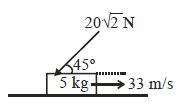
$A$ block of mass $5\, kg$ is kept on a rough horizontal floor. It is given a velocity $33\, m/s$ towards the right. $A$ force of $20\sqrt{2}\, N$ continuously acts on the block as shown in the figure. If the coefficient of friction between the block and the floor is $0.5$, the velocity of the block after $3\, seconds$ is ........ $m/s$ $(g = 10\, m/s^2)$.
A
$2$
B
$0$
C
$33/12$
D
None of the above
Solution
(B) The block is moving to the right. The force $F = 20\sqrt{2}\, N$ acts at an angle of $45^{\circ}$ downwards, pushing the block into the floor.
Vertical forces: The normal reaction $N$ is given by $N = mg + F \sin 45^{\circ} = 5 \times 10 + 20\sqrt{2} \times (1/\sqrt{2}) = 50 + 20 = 70\, N$.
Frictional force: $f_k = \mu N = 0.5 \times 70 = 35\, N$.
Horizontal forces: The horizontal component of the applied force is $F_x = F \cos 45^{\circ} = 20\sqrt{2} \times (1/\sqrt{2}) = 20\, N$ (acting to the left).
The total retarding force is $F_{net} = f_k + F_x = 35 + 20 = 55\, N$.
Retardation $a = F_{net} / m = 55 / 5 = 11\, m/s^2$.
Using $v = u - at$, where $u = 33\, m/s$, $a = 11\, m/s^2$, and $t = 3\, s$:
$v = 33 - (11 \times 3) = 33 - 33 = 0\, m/s$.
Vertical forces: The normal reaction $N$ is given by $N = mg + F \sin 45^{\circ} = 5 \times 10 + 20\sqrt{2} \times (1/\sqrt{2}) = 50 + 20 = 70\, N$.
Frictional force: $f_k = \mu N = 0.5 \times 70 = 35\, N$.
Horizontal forces: The horizontal component of the applied force is $F_x = F \cos 45^{\circ} = 20\sqrt{2} \times (1/\sqrt{2}) = 20\, N$ (acting to the left).
The total retarding force is $F_{net} = f_k + F_x = 35 + 20 = 55\, N$.
Retardation $a = F_{net} / m = 55 / 5 = 11\, m/s^2$.
Using $v = u - at$, where $u = 33\, m/s$, $a = 11\, m/s^2$, and $t = 3\, s$:
$v = 33 - (11 \times 3) = 33 - 33 = 0\, m/s$.
0 likes
View Solution80
MediumMCQ
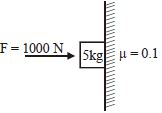
For the given figure,if the block remains in an equilibrium position,then find the frictional force between the block and the wall in $N$.
A
$100$
B
$50$
C
$200$
D
None
Solution
(B) Given: Mass of the block $m = 5 \ kg$,Applied force $F = 1000 \ N$,Coefficient of friction $\mu = 0.1$,Acceleration due to gravity $g = 10 \ m/s^2$.
$1$. The block is pressed against the wall by a horizontal force $F = 1000 \ N$. This force acts as the normal force $N$ exerted by the wall on the block,so $N = F = 1000 \ N$.
$2$. The maximum static frictional force $f_{max}$ that can act is given by $f_{max} = \mu N = 0.1 \times 1000 = 100 \ N$.
$3$. The gravitational force acting downwards on the block is $W = mg = 5 \times 10 = 50 \ N$.
$4$. Since the block is in equilibrium,the upward frictional force $f$ must balance the downward gravitational force $W$. Therefore,$f = W = 50 \ N$.
$5$. Since $f = 50 \ N$ is less than $f_{max} = 100 \ N$,the block will remain in equilibrium. Thus,the frictional force is $50 \ N$.
$1$. The block is pressed against the wall by a horizontal force $F = 1000 \ N$. This force acts as the normal force $N$ exerted by the wall on the block,so $N = F = 1000 \ N$.
$2$. The maximum static frictional force $f_{max}$ that can act is given by $f_{max} = \mu N = 0.1 \times 1000 = 100 \ N$.
$3$. The gravitational force acting downwards on the block is $W = mg = 5 \times 10 = 50 \ N$.
$4$. Since the block is in equilibrium,the upward frictional force $f$ must balance the downward gravitational force $W$. Therefore,$f = W = 50 \ N$.
$5$. Since $f = 50 \ N$ is less than $f_{max} = 100 \ N$,the block will remain in equilibrium. Thus,the frictional force is $50 \ N$.
0 likes
View Solution81
MediumMCQ
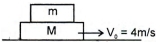
$A$ stationary body of mass $m$ is slowly lowered onto a massive platform of mass $M$ $(M \gg m)$ moving at a speed $V_p = 4 \, m/s$ as shown in the figure. How far will the body slide along the platform (in $, m$)? (Given: $\mu = 0.2$ and $g = 10 \, m/s^2$)
A
$4$
B
$6$
C
$12$
D
$8$
Solution
(A) The frictional force acting on the body of mass $m$ is $f = \mu N = \mu mg$.
Since the platform is massive $(M \gg m)$,its velocity remains constant at $V_p = 4 \, m/s$.
The acceleration of the body $m$ is $a = \frac{f}{m} = \frac{\mu mg}{m} = \mu g$.
Substituting the values,$a = 0.2 \times 10 = 2 \, m/s^2$.
The body starts from rest $(u = 0)$ and accelerates until its velocity reaches the velocity of the platform $(v = V_p = 4 \, m/s)$.
Using the equation $v = u + at$,we get $4 = 0 + 2t$,which gives $t = 2 \, s$.
The distance traveled by the body in the ground frame is $S_b = ut + \frac{1}{2}at^2 = 0 + \frac{1}{2} \times 2 \times (2)^2 = 4 \, m$.
The distance traveled by the platform in the same time is $S_p = V_p \times t = 4 \times 2 = 8 \, m$.
The sliding distance of the body relative to the platform is $S_{rel} = S_p - S_b = 8 - 4 = 4 \, m$.
Since the platform is massive $(M \gg m)$,its velocity remains constant at $V_p = 4 \, m/s$.
The acceleration of the body $m$ is $a = \frac{f}{m} = \frac{\mu mg}{m} = \mu g$.
Substituting the values,$a = 0.2 \times 10 = 2 \, m/s^2$.
The body starts from rest $(u = 0)$ and accelerates until its velocity reaches the velocity of the platform $(v = V_p = 4 \, m/s)$.
Using the equation $v = u + at$,we get $4 = 0 + 2t$,which gives $t = 2 \, s$.
The distance traveled by the body in the ground frame is $S_b = ut + \frac{1}{2}at^2 = 0 + \frac{1}{2} \times 2 \times (2)^2 = 4 \, m$.
The distance traveled by the platform in the same time is $S_p = V_p \times t = 4 \times 2 = 8 \, m$.
The sliding distance of the body relative to the platform is $S_{rel} = S_p - S_b = 8 - 4 = 4 \, m$.
0 likes
View Solution82
MediumMCQ
The retarding acceleration of $7.35\, ms^{-2}$ due to frictional force stops a car of mass $400\, kg$ travelling on a road. The coefficient of friction between the tyre of the car and the road is
A
$0.55$
B
$0.75$
C
$6.70$
D
$0.65$
Solution
(B) The frictional force $F$ provides the retarding acceleration $a$ to the car of mass $m$.
According to Newton's second law,$F = ma$.
The frictional force is also given by $F = \mu N$,where $\mu$ is the coefficient of friction and $N$ is the normal reaction.
For a car on a horizontal road,$N = mg$.
Equating the two expressions for $F$:
$ma = \mu mg$
$a = \mu g$
$\mu = \frac{a}{g}$
Given $a = 7.35\, ms^{-2}$ and taking $g = 9.8\, ms^{-2}$:
$\mu = \frac{7.35}{9.8} = 0.75$.
According to Newton's second law,$F = ma$.
The frictional force is also given by $F = \mu N$,where $\mu$ is the coefficient of friction and $N$ is the normal reaction.
For a car on a horizontal road,$N = mg$.
Equating the two expressions for $F$:
$ma = \mu mg$
$a = \mu g$
$\mu = \frac{a}{g}$
Given $a = 7.35\, ms^{-2}$ and taking $g = 9.8\, ms^{-2}$:
$\mu = \frac{7.35}{9.8} = 0.75$.
0 likes
View Solution83
EasyMCQ
Determine the maximum acceleration in $m/s^2$ of the train in which a box lying on its floor will remain stationary,given that the coefficient of static friction between the box and the train's floor is $0.15$.
A
$3$
B
$1$
C
$1.5$
D
$2.5$
Solution
(C) The box remains stationary relative to the train floor due to the static frictional force acting on it.
Let $m$ be the mass of the box,$a$ be the acceleration of the train,and $\mu_s$ be the coefficient of static friction.
The force providing the acceleration to the box is the static friction $f_s$.
According to Newton's second law,$f_s = m a$.
For the box to remain stationary,the static friction must satisfy $f_s \leq \mu_s N$,where $N = m g$ is the normal force.
Thus,$m a \leq \mu_s m g$,which simplifies to $a \leq \mu_s g$.
The maximum acceleration $a_{\max}$ is given by $a_{\max} = \mu_s g$.
Substituting the given values,$a_{\max} = 0.15 \times 10 \ m/s^2 = 1.5 \ m/s^2$.
Let $m$ be the mass of the box,$a$ be the acceleration of the train,and $\mu_s$ be the coefficient of static friction.
The force providing the acceleration to the box is the static friction $f_s$.
According to Newton's second law,$f_s = m a$.
For the box to remain stationary,the static friction must satisfy $f_s \leq \mu_s N$,where $N = m g$ is the normal force.
Thus,$m a \leq \mu_s m g$,which simplifies to $a \leq \mu_s g$.
The maximum acceleration $a_{\max}$ is given by $a_{\max} = \mu_s g$.
Substituting the given values,$a_{\max} = 0.15 \times 10 \ m/s^2 = 1.5 \ m/s^2$.
0 likes
View Solution84
Medium
Explain kinetic friction. Write the laws of kinetic friction. Define the coefficient of kinetic friction.
Solution
(N/A) When the magnitude of the force acting on an object lying on a surface exceeds the maximum static friction,the object will start moving in the direction of the external force. Hence,the value of the frictional force reduces to a value less than the maximum static frictional force.
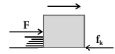
The frictional force which opposes relative motion between surfaces in contact is called kinetic friction. It is denoted by $f_{k}$.
Laws of kinetic friction:
$(1)$ Kinetic friction does not depend on the area of contact between the surfaces.
$(2)$ Kinetic friction force does not depend on the relative velocity of the object in motion.
$(3)$ Kinetic friction force is proportional to the normal force.
$\therefore f_{k} \propto N$
$\therefore f_{k} = \mu_{k} N$
where $\mu_{k} = \text{coefficient of kinetic friction}$,$\mu_{k} = \frac{f_{k}}{N}$.
Coefficient of kinetic friction: The ratio of the kinetic friction force to the normal force is called the coefficient of kinetic friction.
Since $f_{s} > f_{k}$,it follows that $\mu_{s} > \mu_{k}$. Once relative motion starts,by Newton's second law of motion,the acceleration of the object is $a = \frac{F - f_{k}}{m}$.
If the object moves with constant velocity,then $F = f_{k}$.
If the external force applied is reduced to zero,then the acceleration of the object will be $-\frac{f_{k}}{m}$. Hence,it will stop after covering some distance.
The frictional force which opposes relative motion between surfaces in contact is called kinetic friction. It is denoted by $f_{k}$.
Laws of kinetic friction:
$(1)$ Kinetic friction does not depend on the area of contact between the surfaces.
$(2)$ Kinetic friction force does not depend on the relative velocity of the object in motion.
$(3)$ Kinetic friction force is proportional to the normal force.
$\therefore f_{k} \propto N$
$\therefore f_{k} = \mu_{k} N$
where $\mu_{k} = \text{coefficient of kinetic friction}$,$\mu_{k} = \frac{f_{k}}{N}$.
Coefficient of kinetic friction: The ratio of the kinetic friction force to the normal force is called the coefficient of kinetic friction.
Since $f_{s} > f_{k}$,it follows that $\mu_{s} > \mu_{k}$. Once relative motion starts,by Newton's second law of motion,the acceleration of the object is $a = \frac{F - f_{k}}{m}$.
If the object moves with constant velocity,then $F = f_{k}$.
If the external force applied is reduced to zero,then the acceleration of the object will be $-\frac{f_{k}}{m}$. Hence,it will stop after covering some distance.
0 likes
View Solution85
Difficult
What is rolling friction? Write the laws of rolling friction. Define the coefficient of rolling friction.
Solution
(A) Rolling friction is the resistive force that opposes the motion of a body when it rolls over a surface without sliding. It is denoted by $f_{r}$.
Laws of rolling friction:
$(1)$ The magnitude of rolling friction is independent of the area of contact.
$(2)$ The magnitude of rolling friction is directly proportional to the normal force $(N)$: $f_{r} \propto N$,which implies $f_{r} = \mu_{r} N$.
Coefficient of rolling friction $(\mu_{r})$:
It is defined as the ratio of the rolling friction force to the normal force,given by $\mu_{r} = \frac{f_{r}}{N}$. It is a dimensionless quantity.
Explanation:
When a rigid body rolls over a surface,the surfaces in contact undergo momentary deformation. This deformation prevents the body from moving with constant velocity,as there is a resistive component of the contact force parallel to the surface. Rolling friction is significantly smaller than static or kinetic friction (typically $\frac{1}{100}$ to $\frac{1}{1000}$ times),which is why wheels are efficient. The relationship between coefficients is $\mu_{r} < \mu_{k} < \mu_{s}$.
Laws of rolling friction:
$(1)$ The magnitude of rolling friction is independent of the area of contact.
$(2)$ The magnitude of rolling friction is directly proportional to the normal force $(N)$: $f_{r} \propto N$,which implies $f_{r} = \mu_{r} N$.
Coefficient of rolling friction $(\mu_{r})$:
It is defined as the ratio of the rolling friction force to the normal force,given by $\mu_{r} = \frac{f_{r}}{N}$. It is a dimensionless quantity.
Explanation:
When a rigid body rolls over a surface,the surfaces in contact undergo momentary deformation. This deformation prevents the body from moving with constant velocity,as there is a resistive component of the contact force parallel to the surface. Rolling friction is significantly smaller than static or kinetic friction (typically $\frac{1}{100}$ to $\frac{1}{1000}$ times),which is why wheels are efficient. The relationship between coefficients is $\mu_{r} < \mu_{k} < \mu_{s}$.
0 likes
View Solution86
Medium
What is kinetic friction? What is rolling friction?
Solution
(N/A) Kinetic friction is the resistive force that opposes the relative motion between two surfaces in contact when one surface is sliding over the other. It acts in the direction opposite to the direction of motion.
Rolling friction is the resistive force that opposes the motion of a body (like a wheel or sphere) when it rolls over a surface. It is generally much smaller than kinetic (sliding) friction because the area of contact is significantly reduced.
Rolling friction is the resistive force that opposes the motion of a body (like a wheel or sphere) when it rolls over a surface. It is generally much smaller than kinetic (sliding) friction because the area of contact is significantly reduced.
0 likes
View Solution87
EasyMCQ
What is the angle between the instantaneous velocity and the friction force of an object moving on a rough surface (in $^{\circ}$)?
A
$0$
B
$45$
C
$90$
D
$180$
Solution
(D) The friction force always acts in the direction opposite to the relative motion or the tendency of motion of the object.
Since the instantaneous velocity represents the direction of motion,the friction force acts in the direction exactly opposite to the velocity vector.
Therefore,the angle between the instantaneous velocity and the friction force is $180^{\circ}$.
Since the instantaneous velocity represents the direction of motion,the friction force acts in the direction exactly opposite to the velocity vector.
Therefore,the angle between the instantaneous velocity and the friction force is $180^{\circ}$.
0 likes
View Solution88
DifficultMCQ
Why are rubber tires preferred over steel tires for vehicle wheels?
A
Rubber provides better grip due to a higher coefficient of friction.
B
Rubber is cheaper than steel.
C
Steel tires are too heavy.
D
Rubber tires are more durable.
Solution
(A) The coefficient of friction between rubber and the road surface is significantly higher than that between steel and the road surface.
This higher coefficient of friction allows for better traction,which is essential for accelerating,braking,and turning the vehicle safely.
Steel tires would result in very low friction,causing the vehicle to skid easily.
This higher coefficient of friction allows for better traction,which is essential for accelerating,braking,and turning the vehicle safely.
Steel tires would result in very low friction,causing the vehicle to skid easily.
0 likes
View Solution89
Easy
"When a man walks on a rough surface,the frictional force acts in the direction opposite to his motion." Is this statement correct? Give reasons.
Solution
(B) No,this statement is incorrect. When a man walks,he pushes the ground backward with his feet. According to Newton's third law,the ground exerts an equal and opposite force on his feet in the forward direction. This forward frictional force is what allows the man to move forward.
0 likes
View Solution90
DifficultMCQ
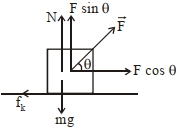
$A$ block of mass $m$ slides along a floor while a force of magnitude $F$ is applied to it at an angle $\theta$ as shown in the figure. The coefficient of kinetic friction is $\mu_{K}$. Then,the block's acceleration $a$ is given by: ($g$ is acceleration due to gravity)

A
$-\frac{F}{m} \cos \theta - \mu_{K}(g - \frac{F}{m} \sin \theta)$
B
$\frac{F}{m} \cos \theta - \mu_{K}(g - \frac{F}{m} \sin \theta)$
C
$\frac{F}{m} \cos \theta - \mu_{K}(g + \frac{F}{m} \sin \theta)$
D
$\frac{F}{m} \cos \theta + \mu_{K}(g - \frac{F}{m} \sin \theta)$
Solution
(B) $1$. Resolve the applied force $F$ into horizontal and vertical components: $F_{x} = F \cos \theta$ and $F_{y} = F \sin \theta$.
$2$. The vertical forces acting on the block are the normal force $N$ (upwards),the vertical component of the applied force $F \sin \theta$ (upwards),and the weight $mg$ (downwards). Since there is no vertical motion,the net vertical force is zero: $N + F \sin \theta = mg$,which gives $N = mg - F \sin \theta$.
$3$. The kinetic friction force $f_{k}$ is given by $f_{k} = \mu_{K} N = \mu_{K}(mg - F \sin \theta)$.
$4$. The net horizontal force acting on the block is the horizontal component of the applied force minus the friction force: $F_{net} = F \cos \theta - f_{k} = F \cos \theta - \mu_{K}(mg - F \sin \theta)$.
$5$. Using Newton's second law,$F_{net} = ma$,we get $ma = F \cos \theta - \mu_{K}(mg - F \sin \theta)$.
$6$. Dividing by mass $m$,the acceleration is $a = \frac{F}{m} \cos \theta - \mu_{K}(g - \frac{F}{m} \sin \theta)$.
$2$. The vertical forces acting on the block are the normal force $N$ (upwards),the vertical component of the applied force $F \sin \theta$ (upwards),and the weight $mg$ (downwards). Since there is no vertical motion,the net vertical force is zero: $N + F \sin \theta = mg$,which gives $N = mg - F \sin \theta$.
$3$. The kinetic friction force $f_{k}$ is given by $f_{k} = \mu_{K} N = \mu_{K}(mg - F \sin \theta)$.
$4$. The net horizontal force acting on the block is the horizontal component of the applied force minus the friction force: $F_{net} = F \cos \theta - f_{k} = F \cos \theta - \mu_{K}(mg - F \sin \theta)$.
$5$. Using Newton's second law,$F_{net} = ma$,we get $ma = F \cos \theta - \mu_{K}(mg - F \sin \theta)$.
$6$. Dividing by mass $m$,the acceleration is $a = \frac{F}{m} \cos \theta - \mu_{K}(g - \frac{F}{m} \sin \theta)$.
0 likes
View Solution91
MediumMCQ
$A$ block of mass $10\, kg$ starts sliding on a surface with an initial velocity of $9.8\, m/s$. The coefficient of friction between the surface and the block is $0.5$. The distance covered by the block before coming to rest is: [use $g = 9.8\, m/s^2$].........$m$
A
$4.9$
B
$9.8$
C
$12.5$
D
$19.6$
Solution
(B) The frictional force acting on the block is $f = \mu N = \mu mg$.
Using Newton's second law,the retardation $a$ is given by $ma = -\mu mg$,so $a = -\mu g$.
Given $\mu = 0.5$ and $g = 9.8\, m/s^2$,the acceleration is $a = -0.5 \times 9.8 = -4.9\, m/s^2$.
Using the kinematic equation $v^2 = u^2 + 2as$,where final velocity $v = 0$ and initial velocity $u = 9.8\, m/s$:
$0 = (9.8)^2 + 2(-4.9)s$
$9.8s = 9.8 \times 9.8$
$s = 9.8\, m$.
Using Newton's second law,the retardation $a$ is given by $ma = -\mu mg$,so $a = -\mu g$.
Given $\mu = 0.5$ and $g = 9.8\, m/s^2$,the acceleration is $a = -0.5 \times 9.8 = -4.9\, m/s^2$.
Using the kinematic equation $v^2 = u^2 + 2as$,where final velocity $v = 0$ and initial velocity $u = 9.8\, m/s$:
$0 = (9.8)^2 + 2(-4.9)s$
$9.8s = 9.8 \times 9.8$
$s = 9.8\, m$.
0 likes
View Solution92
MediumMCQ
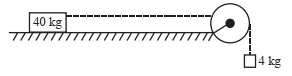
$A$ block of mass $40 \,kg$ slides over a surface,when a mass of $4 \,kg$ is suspended through an inextensible massless string passing over a frictionless pulley as shown below. The coefficient of kinetic friction between the surface and the block is $0.02$. The acceleration of the block is ............ $m/s^2$. (Given $g = 10 \,m/s^2$.)
A
$1$
B
$1/5$
C
$4/5$
D
$8/11$
Solution
(D) Let $M = 40 \,kg$ be the mass of the block on the surface and $m = 4 \,kg$ be the suspended mass. Let $a$ be the acceleration of the system and $T$ be the tension in the string.
For the suspended mass $m$,the equation of motion is:
$mg - T = ma$
$4(10) - T = 4a \implies 40 - T = 4a$ --- $(1)$
For the block $M$ on the surface,the kinetic friction force is $f_k = \mu_k N = \mu_k Mg = 0.02 \times 40 \times 10 = 8 \,N$.
The equation of motion for the block is:
$T - f_k = Ma$
$T - 8 = 40a$ --- $(2)$
Adding equations $(1)$ and $(2)$:
$(40 - T) + (T - 8) = 4a + 40a$
$32 = 44a$
$a = \frac{32}{44} = \frac{8}{11} \,m/s^2$.
For the suspended mass $m$,the equation of motion is:
$mg - T = ma$
$4(10) - T = 4a \implies 40 - T = 4a$ --- $(1)$
For the block $M$ on the surface,the kinetic friction force is $f_k = \mu_k N = \mu_k Mg = 0.02 \times 40 \times 10 = 8 \,N$.
The equation of motion for the block is:
$T - f_k = Ma$
$T - 8 = 40a$ --- $(2)$
Adding equations $(1)$ and $(2)$:
$(40 - T) + (T - 8) = 4a + 40a$
$32 = 44a$
$a = \frac{32}{44} = \frac{8}{11} \,m/s^2$.
0 likes
View Solution93
MediumMCQ
$A$ bag is gently dropped on a conveyor belt moving at a speed of $2\,m/s$. The coefficient of friction between the conveyor belt and the bag is $0.4$. Initially,the bag slips on the belt before it stops slipping due to friction. The distance travelled by the bag on the belt during the slipping motion is $.....m$. [Take $g=10\,m/s^{-2}$]
A
$2$
B
$0.5$
C
$3.2$
D
$0.8$
Solution
(B) When the bag is dropped on the belt,it experiences a kinetic frictional force $f_k = \mu N = \mu mg$.
This force provides an acceleration $a = f_k / m = \mu g$ to the bag in the direction of the belt's motion.
Given $\mu = 0.4$ and $g = 10\,m/s^2$,the acceleration is $a = 0.4 \times 10 = 4\,m/s^2$.
In the frame of the belt,the initial velocity of the bag is $u = 2\,m/s$ (relative to the belt) and the final velocity is $v = 0$ (when it stops slipping).
Using the equation of motion $v^2 = u^2 - 2as$ (where $s$ is the distance relative to the belt):
$0^2 = 2^2 - 2(4)s$
$0 = 4 - 8s$
$8s = 4$
$s = 0.5\,m$.
This force provides an acceleration $a = f_k / m = \mu g$ to the bag in the direction of the belt's motion.
Given $\mu = 0.4$ and $g = 10\,m/s^2$,the acceleration is $a = 0.4 \times 10 = 4\,m/s^2$.
In the frame of the belt,the initial velocity of the bag is $u = 2\,m/s$ (relative to the belt) and the final velocity is $v = 0$ (when it stops slipping).
Using the equation of motion $v^2 = u^2 - 2as$ (where $s$ is the distance relative to the belt):
$0^2 = 2^2 - 2(4)s$
$0 = 4 - 8s$
$8s = 4$
$s = 0.5\,m$.
0 likes
View Solution94
MediumMCQ
Meena applies the front brakes while riding her bicycle along a flat road. The force that slows her bicycle is provided by the
A
front tyre
B
road
C
rear tyre
D
brakes
Solution
(B) The correct answer is $B$.
When Meena applies the brakes,the brake pads press against the wheel rim,preventing the wheel from rotating. However,the bicycle continues to move forward due to inertia. This causes the tyre to slide against the road surface. The road exerts a frictional force on the tyre in the direction opposite to the motion of the bicycle. This external frictional force is responsible for slowing down the bicycle.
When Meena applies the brakes,the brake pads press against the wheel rim,preventing the wheel from rotating. However,the bicycle continues to move forward due to inertia. This causes the tyre to slide against the road surface. The road exerts a frictional force on the tyre in the direction opposite to the motion of the bicycle. This external frictional force is responsible for slowing down the bicycle.
0 likes
View Solution95
DifficultMCQ
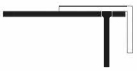
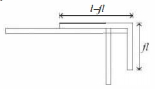
$A$ uniform rope of total length $l$ is at rest on a table with a fraction $f$ of its length hanging (see figure). If the coefficient of friction between the table and the rope is $\mu$,then:
A
$f=\mu$
B
$f=1/(1+\mu)$
C
$f=1/(1+1/\mu)$
D
$f=1/(\mu+1/\mu)$
Solution
(C) Let the mass per unit length of the rope be $\lambda$.
The length of the rope hanging is $f l$,and the length of the rope on the table is $(1-f)l$.
The weight of the hanging part of the rope,which acts as the pulling force $F$,is:
$F = (f l) \lambda g$
The normal reaction $N$ exerted by the table on the part of the rope lying on the table is:
$N = ((1-f)l) \lambda g$
The maximum static friction force $f_s$ acting on the rope is:
$f_s = \mu N = \mu (1-f) l \lambda g$
For the rope to be at rest (in equilibrium),the pulling force must be equal to the limiting friction:
$F = f_s$
$f l \lambda g = \mu (1-f) l \lambda g$
Dividing both sides by $l \lambda g$:
$f = \mu (1-f)$
$f = \mu - \mu f$
$f + \mu f = \mu$
$f(1+\mu) = \mu$
$f = \frac{\mu}{1+\mu}$
To match the given options,we can rewrite this as:
$f = \frac{1}{\frac{1+\mu}{\mu}} = \frac{1}{\frac{1}{\mu} + 1} = \frac{1}{1 + \frac{1}{\mu}}$
Thus,the correct option is $(c)$.
The length of the rope hanging is $f l$,and the length of the rope on the table is $(1-f)l$.
The weight of the hanging part of the rope,which acts as the pulling force $F$,is:
$F = (f l) \lambda g$
The normal reaction $N$ exerted by the table on the part of the rope lying on the table is:
$N = ((1-f)l) \lambda g$
The maximum static friction force $f_s$ acting on the rope is:
$f_s = \mu N = \mu (1-f) l \lambda g$
For the rope to be at rest (in equilibrium),the pulling force must be equal to the limiting friction:
$F = f_s$
$f l \lambda g = \mu (1-f) l \lambda g$
Dividing both sides by $l \lambda g$:
$f = \mu (1-f)$
$f = \mu - \mu f$
$f + \mu f = \mu$
$f(1+\mu) = \mu$
$f = \frac{\mu}{1+\mu}$
To match the given options,we can rewrite this as:
$f = \frac{1}{\frac{1+\mu}{\mu}} = \frac{1}{\frac{1}{\mu} + 1} = \frac{1}{1 + \frac{1}{\mu}}$
Thus,the correct option is $(c)$.
0 likes
View Solution96
AdvancedMCQ
$A$ small box resting on one edge of the table is struck in such a way that it slides up to the other edge,$1 \, m$ away,after $2 \, s$. The coefficient of kinetic friction between the box and the table
A
must be less than $0.05$
B
must be exactly zero
C
must be more than $0.05$
D
must be exactly $0.05$
Solution
(A) For the block,the final velocity $v = 0$,time $t = 2 \, s$,and displacement $s = 1 \, m$.
Using the equation of motion $v = u + at$,we get:
$0 = u + a \times 2 \Rightarrow a = -u/2$.
Using the equation $v^2 - u^2 = 2as$,we get:
$0 - u^2 = 2 \times (-u/2) \times 1 \Rightarrow -u^2 = -u \Rightarrow u(u - 1) = 0$.
Since $u \neq 0$,the initial velocity is $u = 1 \, m/s$.
The acceleration is $a = -u/2 = -0.5 \, m/s^2$.
The force of kinetic friction is $f_k = \mu_k mg = m|a|$.
Thus,$\mu_k g = |a| \Rightarrow \mu_k = 0.5 / 10 = 0.05$.
In this calculation,we have ignored air resistance and other dissipative forces. In a real-world scenario,these additional forces would contribute to the deceleration,meaning the friction force required to stop the box in $2 \, s$ would be less than the value calculated solely based on kinetic friction. Therefore,$\mu_k$ must be less than $0.05$.
Using the equation of motion $v = u + at$,we get:
$0 = u + a \times 2 \Rightarrow a = -u/2$.
Using the equation $v^2 - u^2 = 2as$,we get:
$0 - u^2 = 2 \times (-u/2) \times 1 \Rightarrow -u^2 = -u \Rightarrow u(u - 1) = 0$.
Since $u \neq 0$,the initial velocity is $u = 1 \, m/s$.
The acceleration is $a = -u/2 = -0.5 \, m/s^2$.
The force of kinetic friction is $f_k = \mu_k mg = m|a|$.
Thus,$\mu_k g = |a| \Rightarrow \mu_k = 0.5 / 10 = 0.05$.
In this calculation,we have ignored air resistance and other dissipative forces. In a real-world scenario,these additional forces would contribute to the deceleration,meaning the friction force required to stop the box in $2 \, s$ would be less than the value calculated solely based on kinetic friction. Therefore,$\mu_k$ must be less than $0.05$.
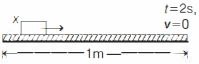
0 likes
View Solution97
MediumMCQ
$A$ block of mass $10 \ kg$ is moving on a rough surface with a velocity $v = 4 \ m/s$ to the left. An external force $F = 20 \ N$ is applied to the right as shown in the figure. The coefficient of kinetic friction is $\mu = 0.6$. The frictional force acting on the block is ...... $N$.
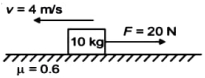
A
$60$
B
$20$
C
$40$
D
$80$
Solution
(A) The block is already in motion with a velocity $v = 4 \ m/s$ to the left.
Since the block is moving,the friction acting on it is kinetic friction.
The formula for kinetic friction is $f_k = \mu_k N$,where $N$ is the normal force.
For a block on a horizontal surface,$N = mg$.
Given $m = 10 \ kg$,$g = 10 \ m/s^2$,and $\mu_k = 0.6$:
$f_k = 0.6 \times 10 \times 10 = 60 \ N$.
The direction of kinetic friction is always opposite to the direction of motion.
Since the block is moving to the left,the kinetic frictional force acts to the right with a magnitude of $60 \ N$.
Since the block is moving,the friction acting on it is kinetic friction.
The formula for kinetic friction is $f_k = \mu_k N$,where $N$ is the normal force.
For a block on a horizontal surface,$N = mg$.
Given $m = 10 \ kg$,$g = 10 \ m/s^2$,and $\mu_k = 0.6$:
$f_k = 0.6 \times 10 \times 10 = 60 \ N$.
The direction of kinetic friction is always opposite to the direction of motion.
Since the block is moving to the left,the kinetic frictional force acts to the right with a magnitude of $60 \ N$.
0 likes
View Solution98
MediumMCQ
The blocks shown in the figure move with a constant velocity of $10 \, m/s$ towards the right. All surfaces in contact are rough. The friction force applied by the ground on block $B$ is ........ $N$.
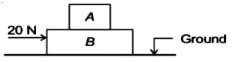
A
$0$
B
$20$
C
$10$
D
Insufficient data
Solution
(B) The system of blocks $A$ and $B$ is moving with a constant velocity of $10 \, m/s$.
Since the velocity is constant,the acceleration of the system is $a = 0 \, m/s^2$.
According to Newton's second law of motion,the net external force acting on the system in the horizontal direction must be zero.
Let $F_{ext} = 20 \, N$ be the applied force on block $B$ in the rightward direction.
Let $f_g$ be the friction force applied by the ground on block $B$ acting in the leftward direction.
For the system to be in equilibrium (constant velocity),the net force in the horizontal direction must be zero:
$F_{ext} - f_g = 0$
$20 \, N - f_g = 0$
$f_g = 20 \, N$.
Therefore,the friction force applied by the ground on block $B$ is $20 \, N$.
Since the velocity is constant,the acceleration of the system is $a = 0 \, m/s^2$.
According to Newton's second law of motion,the net external force acting on the system in the horizontal direction must be zero.
Let $F_{ext} = 20 \, N$ be the applied force on block $B$ in the rightward direction.
Let $f_g$ be the friction force applied by the ground on block $B$ acting in the leftward direction.
For the system to be in equilibrium (constant velocity),the net force in the horizontal direction must be zero:
$F_{ext} - f_g = 0$
$20 \, N - f_g = 0$
$f_g = 20 \, N$.
Therefore,the friction force applied by the ground on block $B$ is $20 \, N$.
0 likes
View Solution99
MediumMCQ
$A$ block of mass $10 \, kg$ moving with an acceleration of $2 \, m/s^2$ on a horizontal rough surface is shown in the figure. The value of the coefficient of kinetic friction is ...........
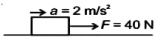
A
$0.2$
B
$0.4$
C
$0.5$
D
$0.1$
Solution
(A) Given:
Mass of the block,$m = 10 \, kg$
Acceleration,$a = 2 \, m/s^2$
Applied force,$F = 40 \, N$
Acceleration due to gravity,$g = 10 \, m/s^2$ (taking $g = 10 \, m/s^2$ for standard calculation)
The normal force $N$ acting on the block is $N = mg = 10 \times 10 = 100 \, N$.
The kinetic friction force is given by $f_k = \mu_k N = \mu_k \times 100$.
According to Newton's second law of motion,the net force acting on the block is:
$F - f_k = ma$
$40 - 100 \mu_k = 10 \times 2$
$40 - 100 \mu_k = 20$
$100 \mu_k = 40 - 20$
$100 \mu_k = 20$
$\mu_k = \frac{20}{100} = 0.2$
Thus,the coefficient of kinetic friction is $0.2$.
Mass of the block,$m = 10 \, kg$
Acceleration,$a = 2 \, m/s^2$
Applied force,$F = 40 \, N$
Acceleration due to gravity,$g = 10 \, m/s^2$ (taking $g = 10 \, m/s^2$ for standard calculation)
The normal force $N$ acting on the block is $N = mg = 10 \times 10 = 100 \, N$.
The kinetic friction force is given by $f_k = \mu_k N = \mu_k \times 100$.
According to Newton's second law of motion,the net force acting on the block is:
$F - f_k = ma$
$40 - 100 \mu_k = 10 \times 2$
$40 - 100 \mu_k = 20$
$100 \mu_k = 40 - 20$
$100 \mu_k = 20$
$\mu_k = \frac{20}{100} = 0.2$
Thus,the coefficient of kinetic friction is $0.2$.
0 likes
View Solution100
EasyMCQ
It is difficult to move a cycle with brakes on because
A
Rolling friction opposes motion on road
B
Sliding friction opposes motion on road
C
Rolling friction is more than sliding friction
D
Sliding friction is more than the rolling friction
Solution
(D) When the brakes are applied,the wheels of the cycle stop rotating and start sliding over the road surface.
In this state,the friction acting between the tires and the road is sliding friction.
Under normal conditions,the cycle moves by rolling,where rolling friction acts.
Since sliding friction is significantly greater than rolling friction,it becomes difficult to move the cycle when the brakes are applied.
Therefore,the correct option is $D$.
In this state,the friction acting between the tires and the road is sliding friction.
Under normal conditions,the cycle moves by rolling,where rolling friction acts.
Since sliding friction is significantly greater than rolling friction,it becomes difficult to move the cycle when the brakes are applied.
Therefore,the correct option is $D$.
0 likes
View SolutionNewton's Laws of Motion and Friction — Kinetic Friction and Motion on Rough Horizontal Surface · Frequently Asked Questions
1Are these Newton's Laws of Motion and Friction questions useful for JEE and NEET?
Yes. All questions in this section are mapped to JEE Main and NEET exam patterns. Previous year questions from JEE Main, NEET, GUJCET and state-level exams are included with full solutions.
2Can I switch to Hindi or Gujarati for these questions?
Yes. Use the language tabs in the hero section or the sidebar to view the same questions and solutions in English, Hindi or Gujarati.
3How do I generate a question paper from this subtopic?
Use the Vedclass Exam Paper Generator — select the chapter and subtopic, set difficulty, and generate Sets A, B, C, D automatically. First 3 chapters of every subject are free.
Vedclass Products
For Students
Vedclass Test Series
Mock tests in real JEE/NEET style with performance analysis. 5-day free trial.
Start Free TrialFor Teachers
Exam Paper Generator
Generate Set A/B/C/D papers from this chapter in 2 minutes. 3 chapters free.
Try FreeFor Institutes
Online Exam Module
Live online exams with unlimited students, 360° analytics & white-label branding.
See DemoFor Teachers & Institutes
Generate a Newton's Laws of Motion and Friction Exam Paper in 2 Minutes
Select subtopic & difficulty — Sets A, B, C, D auto-generated with No Repeat logic.
First 3 chapters of every subject are free — no payment required.