
A English
Kinetic Friction and Motion on Rough Horizontal Surface Questions in English
Class 11 Physics · Newton's Laws of Motion and Friction · Kinetic Friction and Motion on Rough Horizontal Surface
154+
Questions
English
Language
100%
With Solutions
Showing 47 of 154 questions in English
101
EasyMCQ
$A$ child weighing $25 \,kg$ slides down a rope hanging from a branch of a tall tree. If the force of friction acting against him is $200 \,N$,the acceleration of the child is ........... $m/s^2$ $\left(g=10 \,m/s^2\right)$.
A
$22.5$
B
$8$
C
$5$
D
$2$
Solution
(D) The child is sliding down the rope,so the gravitational force acts downwards and the frictional force acts upwards.
Given:
Mass of the child,$m = 25 \,kg$
Frictional force,$f_s = 200 \,N$
Acceleration due to gravity,$g = 10 \,m/s^2$
According to Newton's second law of motion:
$mg - f_s = ma$
Substituting the values:
$(25 \times 10) - 200 = 25 \times a$
$250 - 200 = 25a$
$50 = 25a$
$a = 2 \,m/s^2$
Thus,the acceleration of the child is $2 \,m/s^2$.
Given:
Mass of the child,$m = 25 \,kg$
Frictional force,$f_s = 200 \,N$
Acceleration due to gravity,$g = 10 \,m/s^2$
According to Newton's second law of motion:
$mg - f_s = ma$
Substituting the values:
$(25 \times 10) - 200 = 25 \times a$
$250 - 200 = 25a$
$50 = 25a$
$a = 2 \,m/s^2$
Thus,the acceleration of the child is $2 \,m/s^2$.

0 likes
View Solution102
EasyMCQ
An object of mass $1 \,kg$ moving on a horizontal surface with initial velocity $8 \,m/s$ comes to rest after $10 \,s$. If one wants to keep the object moving on the same surface with velocity $8 \,m/s$,the force required is ...... $N$.
A
$0.4$
B
$0.8$
C
$1.2$
D
Zero
Solution
(B) Given: Mass $m = 1 \,kg$,initial velocity $u = 8 \,m/s$,final velocity $v = 0 \,m/s$,time $t = 10 \,s$.
First,we calculate the retardation (deceleration) $a$ using the equation of motion: $v = u + at$.
$0 = 8 + a(10) \implies a = -0.8 \,m/s^2$.
The frictional force $f$ acting on the object is $f = ma = 1 \times 0.8 = 0.8 \,N$.
To keep the object moving at a constant velocity of $8 \,m/s$,the applied force $F$ must exactly balance the frictional force $f$.
Therefore,$F = f = 0.8 \,N$.
First,we calculate the retardation (deceleration) $a$ using the equation of motion: $v = u + at$.
$0 = 8 + a(10) \implies a = -0.8 \,m/s^2$.
The frictional force $f$ acting on the object is $f = ma = 1 \times 0.8 = 0.8 \,N$.
To keep the object moving at a constant velocity of $8 \,m/s$,the applied force $F$ must exactly balance the frictional force $f$.
Therefore,$F = f = 0.8 \,N$.
0 likes
View Solution103
EasyMCQ
$A$ heavy box is pushed across a rough floor with an initial speed of $4 \, m/s$. It stops moving after $8 \, s$. If the average resisting force of friction is $10 \, N$,the mass of the box (in $kg$) is:
A
$40$
B
$20$
C
$5$
D
$2.5$
Solution
(B) Given:
Initial velocity $u = 4 \, m/s$
Final velocity $v = 0 \, m/s$
Time $t = 8 \, s$
Frictional force $f = 10 \, N$
First,calculate the acceleration (deceleration) using the equation of motion $v = u + at$:
$0 = 4 + a(8)$
$8a = -4$
$a = -0.5 \, m/s^2$
The magnitude of acceleration is $0.5 \, m/s^2$.
Using Newton's Second Law,$f = ma$:
$10 = m \times 0.5$
$m = \frac{10}{0.5}$
$m = 20 \, kg$
Therefore,the mass of the box is $20 \, kg$.
Initial velocity $u = 4 \, m/s$
Final velocity $v = 0 \, m/s$
Time $t = 8 \, s$
Frictional force $f = 10 \, N$
First,calculate the acceleration (deceleration) using the equation of motion $v = u + at$:
$0 = 4 + a(8)$
$8a = -4$
$a = -0.5 \, m/s^2$
The magnitude of acceleration is $0.5 \, m/s^2$.
Using Newton's Second Law,$f = ma$:
$10 = m \times 0.5$
$m = \frac{10}{0.5}$
$m = 20 \, kg$
Therefore,the mass of the box is $20 \, kg$.
1 likes
View Solution104
EasyMCQ
$A$ car accelerates on a horizontal road due to the force exerted by:
A
The engine of the car
B
The driver of the car
C
The earth as weight of the car
D
The road
Solution
(D) The correct answer is $D$.
When the engine of the car rotates the wheels,the wheels exert a backward force on the road.
According to Newton's $3^{rd}$ law of motion,the road exerts an equal and opposite forward force on the wheels.
This forward frictional force provided by the road is the external force that causes the car to accelerate on the horizontal surface.
When the engine of the car rotates the wheels,the wheels exert a backward force on the road.
According to Newton's $3^{rd}$ law of motion,the road exerts an equal and opposite forward force on the wheels.
This forward frictional force provided by the road is the external force that causes the car to accelerate on the horizontal surface.
0 likes
View Solution105
DifficultMCQ
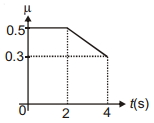
$A$ block is projected with speed $20 \,m/s$ on a rough horizontal surface. The coefficient of friction $(\mu)$ between the surfaces varies with time $(t)$ as shown in the figure. The speed of the body at the end of $4 \,s$ will be ............ $m/s$ $(g = 10 \,m/s^2)$.
A
$2$
B
$5$
C
$7.2$
D
$9.5$
Solution
(A) The retardation $a$ of the block is given by $a = \frac{dv}{dt} = -\mu g$.
Integrating this expression,we get $\Delta v = v_f - v_i = -g \int_{0}^{4} \mu \,dt$.
The term $\int_{0}^{4} \mu \,dt$ represents the area under the $\mu-t$ curve from $t = 0$ to $t = 4 \,s$.
The area consists of a rectangle from $t = 0$ to $2 \,s$ and a trapezoid from $t = 2$ to $4 \,s$.
Area $= (2 \times 0.5) + \frac{1}{2} \times (0.5 + 0.3) \times (4 - 2) = 1 + 0.8 = 1.8$.
Now,substituting the values into the velocity equation:
$v_f - 20 = -10 \times (1.8) = -18$.
$v_f = 20 - 18 = 2 \,m/s$.
Integrating this expression,we get $\Delta v = v_f - v_i = -g \int_{0}^{4} \mu \,dt$.
The term $\int_{0}^{4} \mu \,dt$ represents the area under the $\mu-t$ curve from $t = 0$ to $t = 4 \,s$.
The area consists of a rectangle from $t = 0$ to $2 \,s$ and a trapezoid from $t = 2$ to $4 \,s$.
Area $= (2 \times 0.5) + \frac{1}{2} \times (0.5 + 0.3) \times (4 - 2) = 1 + 0.8 = 1.8$.
Now,substituting the values into the velocity equation:
$v_f - 20 = -10 \times (1.8) = -18$.
$v_f = 20 - 18 = 2 \,m/s$.
0 likes
View Solution106
DifficultMCQ
$A$ body of mass $40\,kg$ resting on a rough horizontal surface is subjected to a force $P$ which is just enough to start the motion of the body. If $\mu_{s} = 0.5$,$\mu_{k} = 0.4$,$g = 10\,m/s^2$,and the force $P$ is continuously applied on the body,then the acceleration of the body is $.........\,m/s^2$.
A
$0$
B
$1$
C
$2$
D
$2.4$
Solution
(B) Given: Mass $m = 40\,kg$,coefficient of static friction $\mu_{s} = 0.5$,coefficient of kinetic friction $\mu_{k} = 0.4$,and acceleration due to gravity $g = 10\,m/s^2$.
The force $P$ is just enough to start the motion,so it must be equal to the limiting friction:
$P = f_{s,max} = \mu_{s} N = \mu_{s} mg$.
Once the body starts moving,the kinetic friction $f_{k}$ acts on it:
$f_{k} = \mu_{k} N = \mu_{k} mg$.
The net force $F_{net}$ acting on the body is:
$F_{net} = P - f_{k} = \mu_{s} mg - \mu_{k} mg = m(\mu_{s} - \mu_{k})g$.
Using Newton's second law,$F_{net} = ma$:
$ma = m(\mu_{s} - \mu_{k})g$.
Therefore,the acceleration $a$ is:
$a = (\mu_{s} - \mu_{k})g$.
Substituting the values:
$a = (0.5 - 0.4) \times 10 = 0.1 \times 10 = 1\,m/s^2$.
The force $P$ is just enough to start the motion,so it must be equal to the limiting friction:
$P = f_{s,max} = \mu_{s} N = \mu_{s} mg$.
Once the body starts moving,the kinetic friction $f_{k}$ acts on it:
$f_{k} = \mu_{k} N = \mu_{k} mg$.
The net force $F_{net}$ acting on the body is:
$F_{net} = P - f_{k} = \mu_{s} mg - \mu_{k} mg = m(\mu_{s} - \mu_{k})g$.
Using Newton's second law,$F_{net} = ma$:
$ma = m(\mu_{s} - \mu_{k})g$.
Therefore,the acceleration $a$ is:
$a = (\mu_{s} - \mu_{k})g$.
Substituting the values:
$a = (0.5 - 0.4) \times 10 = 0.1 \times 10 = 1\,m/s^2$.
0 likes
View Solution107
MediumMCQ
$A$ body of mass $10\,kg$ is moving with an initial speed of $20\,m/s$. The body stops after $5\,s$ due to friction between the body and the floor. The value of the coefficient of friction is (Take acceleration due to gravity $g = 10\,m/s^2$)
A
$0.2$
B
$0.3$
C
$0.5$
D
$0.4$
Solution
(D) Given: Mass $m = 10\,kg$,initial velocity $u = 20\,m/s$,final velocity $v = 0\,m/s$,time $t = 5\,s$,and $g = 10\,m/s^2$.
Using the first equation of motion,$v = u + at$,we find the acceleration $a$:
$0 = 20 + a(5) \implies 5a = -20 \implies a = -4\,m/s^2$.
The retarding force is provided by friction,so $F_f = ma = -\mu mg$.
Thus,$-\mu g = a$.
$-\mu(10) = -4$.
$\mu = \frac{4}{10} = 0.4$.
Using the first equation of motion,$v = u + at$,we find the acceleration $a$:
$0 = 20 + a(5) \implies 5a = -20 \implies a = -4\,m/s^2$.
The retarding force is provided by friction,so $F_f = ma = -\mu mg$.
Thus,$-\mu g = a$.
$-\mu(10) = -4$.
$\mu = \frac{4}{10} = 0.4$.
0 likes
View Solution108
MediumMCQ
$A$ block of mass $5\,kg$ is placed at rest on a table with a rough surface. If a force of $30\,N$ is applied parallel to the surface of the table,the block slides through a distance of $50\,m$ in $10\,s$. Calculate the coefficient of kinetic friction. (Given: $g = 10\,m/s^2$)
A
$0.60$
B
$0.75$
C
$0.50$
D
$0.25$
Solution
(C) Using the equation of motion $S = ut + \frac{1}{2}at^2$,where $S = 50\,m$,$u = 0\,m/s$,and $t = 10\,s$:
$50 = 0 + \frac{1}{2} \times a \times (10)^2$
$50 = 50a$
$a = 1\,m/s^2$
Now,applying Newton's second law,the net force is $F - f_k = ma$,where $f_k = \mu_k N = \mu_k mg$:
$30 - \mu_k \times 5 \times 10 = 5 \times 1$
$30 - 50\mu_k = 5$
$50\mu_k = 25$
$\mu_k = \frac{25}{50} = 0.50$
$50 = 0 + \frac{1}{2} \times a \times (10)^2$
$50 = 50a$
$a = 1\,m/s^2$
Now,applying Newton's second law,the net force is $F - f_k = ma$,where $f_k = \mu_k N = \mu_k mg$:
$30 - \mu_k \times 5 \times 10 = 5 \times 1$
$30 - 50\mu_k = 5$
$50\mu_k = 25$
$\mu_k = \frac{25}{50} = 0.50$
0 likes
View Solution109
DifficultMCQ
$A$ block of mass $100 \ kg$ slides over a distance of $10 \ m$ on a horizontal surface. If the coefficient of friction between the surfaces is $0.4$,then the work done against friction (in $J$) is:
A
$4200$
B
$3900$
C
$4000$
D
$4500$
Solution
(C) Given:
Mass $m = 100 \ kg$
Distance $s = 10 \ m$
Coefficient of friction $\mu = 0.4$
Acceleration due to gravity $g = 10 \ m/s^2$ (assuming standard value).
The frictional force $f$ is given by the formula:
$f = \mu N = \mu mg$
$f = 0.4 \times 100 \times 10 = 400 \ N$
The work done against friction $W$ is given by:
$W = f \times s$
$W = 400 \times 10 = 4000 \ J$
Therefore,the work done against friction is $4000 \ J$.
Mass $m = 100 \ kg$
Distance $s = 10 \ m$
Coefficient of friction $\mu = 0.4$
Acceleration due to gravity $g = 10 \ m/s^2$ (assuming standard value).
The frictional force $f$ is given by the formula:
$f = \mu N = \mu mg$
$f = 0.4 \times 100 \times 10 = 400 \ N$
The work done against friction $W$ is given by:
$W = f \times s$
$W = 400 \times 10 = 4000 \ J$
Therefore,the work done against friction is $4000 \ J$.
0 likes
View Solution110
MediumMCQ
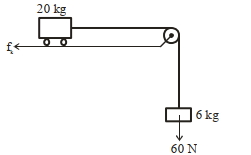
Consider a block and trolley system as shown in the figure. If the coefficient of kinetic friction between the trolley and the surface is $0.04$,the acceleration of the system in $m/s^2$ is (Consider that the string is massless and unstretchable and the pulley is also massless and frictionless):
A
$3$
B
$4$
C
$2$
D
$1.2$
Solution
(C) The mass of the trolley is $m_1 = 20 \text{ kg}$ and the mass of the hanging block is $m_2 = 6 \text{ kg}$.
The normal force on the trolley is $N = m_1 g = 20 \times 10 = 200 \text{ N}$.
The kinetic friction force is $f_k = \mu_k N = 0.04 \times 200 = 8 \text{ N}$.
The driving force is the weight of the hanging block,$F = m_2 g = 6 \times 10 = 60 \text{ N}$.
Applying Newton's second law to the system: $F - f_k = (m_1 + m_2) a$.
$60 - 8 = (20 + 6) a$.
$52 = 26 a$.
$a = \frac{52}{26} = 2 \text{ m/s}^2$.
The normal force on the trolley is $N = m_1 g = 20 \times 10 = 200 \text{ N}$.
The kinetic friction force is $f_k = \mu_k N = 0.04 \times 200 = 8 \text{ N}$.
The driving force is the weight of the hanging block,$F = m_2 g = 6 \times 10 = 60 \text{ N}$.
Applying Newton's second law to the system: $F - f_k = (m_1 + m_2) a$.
$60 - 8 = (20 + 6) a$.
$52 = 26 a$.
$a = \frac{52}{26} = 2 \text{ m/s}^2$.
0 likes
View Solution111
EasyMCQ
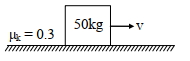
$A$ heavy box of mass $50 \,kg$ is moving on a horizontal surface. If the coefficient of kinetic friction between the box and the horizontal surface is $0.3$, then the force of kinetic friction is: (in $\,N$)
A
$14.7$
B
$147$
C
$1.47$
D
$1470$
Solution
(B) The force of kinetic friction $f_k$ is given by the formula:
$f_k = \mu_k N$
where $\mu_k$ is the coefficient of kinetic friction and $N$ is the normal force.
For a box on a horizontal surface, the normal force $N$ is equal to the weight of the box, $mg$.
Given:
Mass $m = 50 \,kg$
Coefficient of kinetic friction $\mu_k = 0.3$
Acceleration due to gravity $g = 9.8 \,m/s^2$
Calculating the normal force:
$N = mg = 50 \times 9.8 = 490 \,N$
Calculating the kinetic friction force:
$f_k = 0.3 \times 490 = 147 \,N$
$f_k = \mu_k N$
where $\mu_k$ is the coefficient of kinetic friction and $N$ is the normal force.
For a box on a horizontal surface, the normal force $N$ is equal to the weight of the box, $mg$.
Given:
Mass $m = 50 \,kg$
Coefficient of kinetic friction $\mu_k = 0.3$
Acceleration due to gravity $g = 9.8 \,m/s^2$
Calculating the normal force:
$N = mg = 50 \times 9.8 = 490 \,N$
Calculating the kinetic friction force:
$f_k = 0.3 \times 490 = 147 \,N$
0 likes
View Solution112
MediumMCQ
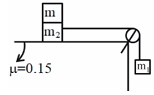
Two masses $m_1 = 10 \text{ kg}$ and $m_2 = 20 \text{ kg}$ are connected by an inextensible string over a frictionless pulley,as shown in the figure. The coefficient of friction of the horizontal surface is $\mu = 0.15$. The minimum mass $m$ that should be placed on top of $m_2$ to stop the motion is:
A
$\frac{260}{3} \text{ kg}$
B
$\frac{140}{3} \text{ kg}$
C
$\frac{100}{3} \text{ kg}$
D
$100 \text{ kg}$
Solution
(B) For the system to be in equilibrium (motion stopped),the forces must be balanced.
For mass $m_1$ hanging vertically: $T = m_1 g = 10 \times 10 = 100 \text{ N}$.
For the combined mass $(m + m_2)$ on the horizontal surface,the limiting friction $f_L$ must balance the tension $T$:
$f_L = T$
$\mu N = T$
$\mu (m + m_2) g = 100$
$0.15 \times (m + 20) \times 10 = 100$
$1.5 (m + 20) = 100$
$m + 20 = \frac{100}{1.5} = \frac{1000}{15} = \frac{200}{3}$
$m = \frac{200}{3} - 20 = \frac{200 - 60}{3} = \frac{140}{3} \text{ kg}$.
For mass $m_1$ hanging vertically: $T = m_1 g = 10 \times 10 = 100 \text{ N}$.
For the combined mass $(m + m_2)$ on the horizontal surface,the limiting friction $f_L$ must balance the tension $T$:
$f_L = T$
$\mu N = T$
$\mu (m + m_2) g = 100$
$0.15 \times (m + 20) \times 10 = 100$
$1.5 (m + 20) = 100$
$m + 20 = \frac{100}{1.5} = \frac{1000}{15} = \frac{200}{3}$
$m = \frac{200}{3} - 20 = \frac{200 - 60}{3} = \frac{140}{3} \text{ kg}$.
0 likes
View Solution113
DifficultMCQ
$A$ fireman of mass $60 \ kg$ slides down a pole. He is pressing the pole with a force of $600 \ N$. The coefficient of friction between the hands and the pole is $0.5$. With what acceleration (in $m/s^2$) will the fireman slide down? (Take $g = 10 \ m/s^2$)
A
$1$
B
$2.5$
C
$10$
D
$5$
Solution
(D) The forces acting on the fireman are his weight $W = mg$ acting downwards and the frictional force $f = \mu R$ acting upwards,where $R$ is the normal force exerted by the fireman on the pole.
Given:
Mass $m = 60 \ kg$
Normal force $R = 600 \ N$
Coefficient of friction $\mu = 0.5$
Acceleration due to gravity $g = 10 \ m/s^2$
The net force $F_{\text{net}}$ acting downwards is given by:
$F_{\text{net}} = mg - f = mg - \mu R$
Using Newton's second law,$F_{\text{net}} = ma$:
$ma = mg - \mu R$
$a = \frac{mg - \mu R}{m}$
Substituting the values:
$a = \frac{60 \times 10 - 0.5 \times 600}{60}$
$a = \frac{600 - 300}{60}$
$a = \frac{300}{60} = 5 \ m/s^2$
Thus,the fireman slides down with an acceleration of $5 \ m/s^2$.
Given:
Mass $m = 60 \ kg$
Normal force $R = 600 \ N$
Coefficient of friction $\mu = 0.5$
Acceleration due to gravity $g = 10 \ m/s^2$
The net force $F_{\text{net}}$ acting downwards is given by:
$F_{\text{net}} = mg - f = mg - \mu R$
Using Newton's second law,$F_{\text{net}} = ma$:
$ma = mg - \mu R$
$a = \frac{mg - \mu R}{m}$
Substituting the values:
$a = \frac{60 \times 10 - 0.5 \times 600}{60}$
$a = \frac{600 - 300}{60}$
$a = \frac{300}{60} = 5 \ m/s^2$
Thus,the fireman slides down with an acceleration of $5 \ m/s^2$.
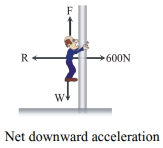
0 likes
View Solution114
MediumMCQ
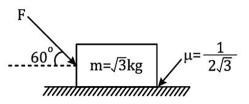
What is the maximum value of the force $F$ such that the block shown in the arrangement does not move? (in $N$)
A
$20$
B
$10$
C
$12$
D
$15$
Solution
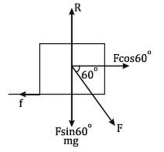
(A) Let $F$ be the maximum value of the force applied such that the block of mass $m = \sqrt{3} \ kg$ does not move on the rough surface.
$R$ is the normal reaction force exerted by the surface on the block.
Resolving the forces vertically:
$R = F \sin 60^{\circ} + mg$
Resolving the forces horizontally,the limiting friction $f = \mu R$ must balance the horizontal component of the applied force $F \cos 60^{\circ}$:
$f = F \cos 60^{\circ}$
$\mu R = F \cos 60^{\circ}$
Substituting the expression for $R$:
$\mu (F \sin 60^{\circ} + mg) = F \cos 60^{\circ}$
$\mu F \sin 60^{\circ} + \mu mg = F \cos 60^{\circ}$
$F (\cos 60^{\circ} - \mu \sin 60^{\circ}) = \mu mg$
$F = \frac{\mu mg}{\cos 60^{\circ} - \mu \sin 60^{\circ}}$
Given $\mu = \frac{1}{2 \sqrt{3}}$,$m = \sqrt{3} \ kg$,and $g = 10 \ m/s^2$:
$F = \frac{(\frac{1}{2 \sqrt{3}}) \times \sqrt{3} \times 10}{\cos 60^{\circ} - (\frac{1}{2 \sqrt{3}}) \sin 60^{\circ}}$
$F = \frac{5}{\frac{1}{2} - (\frac{1}{2 \sqrt{3}} \times \frac{\sqrt{3}}{2})} = \frac{5}{\frac{1}{2} - \frac{1}{4}} = \frac{5}{\frac{1}{4}} = 20 \ N$
Therefore,the maximum value of the force is $20 \ N$.
$R$ is the normal reaction force exerted by the surface on the block.
Resolving the forces vertically:
$R = F \sin 60^{\circ} + mg$
Resolving the forces horizontally,the limiting friction $f = \mu R$ must balance the horizontal component of the applied force $F \cos 60^{\circ}$:
$f = F \cos 60^{\circ}$
$\mu R = F \cos 60^{\circ}$
Substituting the expression for $R$:
$\mu (F \sin 60^{\circ} + mg) = F \cos 60^{\circ}$
$\mu F \sin 60^{\circ} + \mu mg = F \cos 60^{\circ}$
$F (\cos 60^{\circ} - \mu \sin 60^{\circ}) = \mu mg$
$F = \frac{\mu mg}{\cos 60^{\circ} - \mu \sin 60^{\circ}}$
Given $\mu = \frac{1}{2 \sqrt{3}}$,$m = \sqrt{3} \ kg$,and $g = 10 \ m/s^2$:
$F = \frac{(\frac{1}{2 \sqrt{3}}) \times \sqrt{3} \times 10}{\cos 60^{\circ} - (\frac{1}{2 \sqrt{3}}) \sin 60^{\circ}}$
$F = \frac{5}{\frac{1}{2} - (\frac{1}{2 \sqrt{3}} \times \frac{\sqrt{3}}{2})} = \frac{5}{\frac{1}{2} - \frac{1}{4}} = \frac{5}{\frac{1}{4}} = 20 \ N$
Therefore,the maximum value of the force is $20 \ N$.
0 likes
View Solution115
MediumMCQ
$A$ block of mass $m$ is moving on a rough horizontal surface. The coefficient of kinetic friction between the block and the surface is $\mu_{k}$. The net force exerted by the surface on the block is (where $g$ is the acceleration due to gravity).
A
$mg(1+\mu_{k}^{2})^{1/2}$
B
$[mg(1+\mu_{k})]^{1/2}$
C
$mg(1+\mu_{k}^{2})$
D
$mg(1+\mu_{k})^{1/2}$
Solution
(A) The surface exerts two forces on the block: the normal force $(N)$ acting vertically upwards and the kinetic frictional force $(f_{k})$ acting horizontally opposite to the direction of motion.
$1$. The normal force is $N = mg$.
$2$. The kinetic frictional force is $f_{k} = \mu_{k} N = \mu_{k} mg$.
$3$. The net force $(F_{net})$ exerted by the surface is the vector sum of the normal force and the frictional force:
$F_{net} = \sqrt{N^{2} + f_{k}^{2}}$
$F_{net} = \sqrt{(mg)^{2} + (\mu_{k} mg)^{2}}$
$F_{net} = \sqrt{(mg)^{2} (1 + \mu_{k}^{2})}$
$F_{net} = mg \sqrt{1 + \mu_{k}^{2}}$
$F_{net} = mg(1 + \mu_{k}^{2})^{1/2}$
Therefore,option $A$ is correct.
$1$. The normal force is $N = mg$.
$2$. The kinetic frictional force is $f_{k} = \mu_{k} N = \mu_{k} mg$.
$3$. The net force $(F_{net})$ exerted by the surface is the vector sum of the normal force and the frictional force:
$F_{net} = \sqrt{N^{2} + f_{k}^{2}}$
$F_{net} = \sqrt{(mg)^{2} + (\mu_{k} mg)^{2}}$
$F_{net} = \sqrt{(mg)^{2} (1 + \mu_{k}^{2})}$
$F_{net} = mg \sqrt{1 + \mu_{k}^{2}}$
$F_{net} = mg(1 + \mu_{k}^{2})^{1/2}$
Therefore,option $A$ is correct.
0 likes
View Solution116
MediumMCQ
$A$ block of mass $M$ is moving on a rough horizontal surface with momentum $P$. The coefficient of friction between the block and the surface is $\mu$. The distance covered by the block before it stops is $[g = \text{acceleration due to gravity}]$.
A
$\frac{2 \mu Mg}{P}$
B
$\frac{P}{2 \mu Mg}$
C
$\frac{P^{2}}{2 \mu M^{2} g}$
D
$\frac{2 \mu M^{2} g}{P^{2}}$
Solution
(C) The initial momentum of the block is $P = Mu$,where $u$ is the initial velocity. Thus,$u = \frac{P}{M}$.
Since the surface is rough,the frictional force $f = \mu N = \mu Mg$ acts on the block.
The retardation (deceleration) $a$ is given by $a = \frac{f}{M} = \frac{\mu Mg}{M} = \mu g$.
Using the kinematic equation $v^{2} = u^{2} - 2as$,where $v = 0$ (final velocity when it stops):
$0 = u^{2} - 2as$
$2as = u^{2}$
$s = \frac{u^{2}}{2a}$
Substituting $u = \frac{P}{M}$ and $a = \mu g$:
$s = \frac{(\frac{P}{M})^{2}}{2 \mu g} = \frac{P^{2}}{M^{2} \cdot 2 \mu g} = \frac{P^{2}}{2 \mu M^{2} g}$.
Since the surface is rough,the frictional force $f = \mu N = \mu Mg$ acts on the block.
The retardation (deceleration) $a$ is given by $a = \frac{f}{M} = \frac{\mu Mg}{M} = \mu g$.
Using the kinematic equation $v^{2} = u^{2} - 2as$,where $v = 0$ (final velocity when it stops):
$0 = u^{2} - 2as$
$2as = u^{2}$
$s = \frac{u^{2}}{2a}$
Substituting $u = \frac{P}{M}$ and $a = \mu g$:
$s = \frac{(\frac{P}{M})^{2}}{2 \mu g} = \frac{P^{2}}{M^{2} \cdot 2 \mu g} = \frac{P^{2}}{2 \mu M^{2} g}$.
0 likes
View Solution117
EasyMCQ
$A$ body is moving along a horizontal surface with a velocity of $4 \,m/s$. If the coefficient of kinetic friction is $0.2$, the distance travelled by the body before coming to rest is $(g = 10 \,m/s^2)$. (in $\,m$)
A
$8$
B
$16$
C
$4$
D
$6$
Solution
(C) Given: Initial velocity $u = 4 \,m/s$, final velocity $v = 0 \,m/s$, coefficient of kinetic friction $\mu = 0.2$, and acceleration due to gravity $g = 10 \,m/s^2$.
The frictional force $f$ acting on the body is $f = \mu N = \mu mg$.
According to Newton's second law, the retardation $a$ is given by $a = -f/m = -\mu g$.
Substituting the values: $a = -(0.2) \times 10 = -2 \,m/s^2$.
Using the kinematic equation $v^2 = u^2 + 2as$:
$0^2 = (4)^2 + 2(-2)s$
$0 = 16 - 4s$
$4s = 16$
$s = 4 \,m$.
Therefore, the distance travelled by the body before coming to rest is $4 \,m$.
The frictional force $f$ acting on the body is $f = \mu N = \mu mg$.
According to Newton's second law, the retardation $a$ is given by $a = -f/m = -\mu g$.
Substituting the values: $a = -(0.2) \times 10 = -2 \,m/s^2$.
Using the kinematic equation $v^2 = u^2 + 2as$:
$0^2 = (4)^2 + 2(-2)s$
$0 = 16 - 4s$
$4s = 16$
$s = 4 \,m$.
Therefore, the distance travelled by the body before coming to rest is $4 \,m$.
0 likes
View Solution118
EasyMCQ
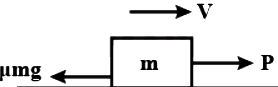
$A$ vehicle of mass $M$ is moving with momentum $P$ on a rough horizontal road. The coefficient of friction between the tyres and the horizontal road is $\mu$. The stopping distance is ($g$ $=$ acceleration due to gravity).
A
$\frac{P^{2}}{2 \mu g M^{2}}$
B
$\frac{P^{2}}{2 \mu g M}$
C
$\frac{P^{2}}{\mu g M^{2}}$
D
$\frac{P^{2}}{2 \mu M}$
Solution
(A) The initial momentum of the vehicle is $P = Mv$,so the initial velocity is $u = \frac{P}{M}$.
The final velocity $v = 0$ as the vehicle comes to a stop.
The frictional force acting on the vehicle is $f = \mu N = \mu Mg$,where $N = Mg$ is the normal reaction.
Using Newton's second law,the retardation $a$ is given by $a = -\frac{f}{M} = -\frac{\mu Mg}{M} = -\mu g$.
Using the kinematic equation $v^{2} - u^{2} = 2as$,where $s$ is the stopping distance:
$0^{2} - (\frac{P}{M})^{2} = 2(-\mu g)s$
$-\frac{P^{2}}{M^{2}} = -2\mu gs$
$s = \frac{P^{2}}{2\mu g M^{2}}$.
The final velocity $v = 0$ as the vehicle comes to a stop.
The frictional force acting on the vehicle is $f = \mu N = \mu Mg$,where $N = Mg$ is the normal reaction.
Using Newton's second law,the retardation $a$ is given by $a = -\frac{f}{M} = -\frac{\mu Mg}{M} = -\mu g$.
Using the kinematic equation $v^{2} - u^{2} = 2as$,where $s$ is the stopping distance:
$0^{2} - (\frac{P}{M})^{2} = 2(-\mu g)s$
$-\frac{P^{2}}{M^{2}} = -2\mu gs$
$s = \frac{P^{2}}{2\mu g M^{2}}$.
0 likes
View Solution119
MediumMCQ
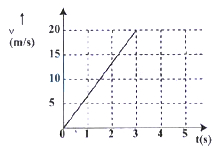
$A$ block of a certain mass is placed on a rough floor. The coefficients of static and kinetic friction between the block and the floor are $0.4$ and $0.25$ respectively. $A$ constant horizontal force $F = 20 \text{ N}$ acts on it so that the velocity of the block varies with time according to the following graph. The mass of the block is nearly (Take $g = 10 \text{ m/s}^2$): (in $\text{ kg}$)
A
$4.4$
B
$1.2$
C
$1.0$
D
$2.2$
Solution
(D) From the velocity-time graph,the acceleration $a$ of the block is the slope of the line:
$a = \frac{v - u}{t} = \frac{20 - 0}{3} = \frac{20}{3} \text{ m/s}^2$
Since the block is moving,the friction acting on it is kinetic friction,$f_k = \mu_k N = \mu_k mg$.
Given $\mu_k = 0.25$ and $g = 10 \text{ m/s}^2$,the kinetic friction is $f_k = 0.25 \times m \times 10 = 2.5m$.
Applying Newton's second law of motion,$F - f_k = ma$:
$20 - 2.5m = m \times \frac{20}{3}$
$20 = m \left( \frac{20}{3} + 2.5 \right)$
$20 = m \left( \frac{20 + 7.5}{3} \right) = m \left( \frac{27.5}{3} \right)$
$m = \frac{20 \times 3}{27.5} = \frac{60}{27.5} \approx 2.18 \text{ kg}$.
Rounding to the nearest value,the mass is $2.2 \text{ kg}$.
$a = \frac{v - u}{t} = \frac{20 - 0}{3} = \frac{20}{3} \text{ m/s}^2$
Since the block is moving,the friction acting on it is kinetic friction,$f_k = \mu_k N = \mu_k mg$.
Given $\mu_k = 0.25$ and $g = 10 \text{ m/s}^2$,the kinetic friction is $f_k = 0.25 \times m \times 10 = 2.5m$.
Applying Newton's second law of motion,$F - f_k = ma$:
$20 - 2.5m = m \times \frac{20}{3}$
$20 = m \left( \frac{20}{3} + 2.5 \right)$
$20 = m \left( \frac{20 + 7.5}{3} \right) = m \left( \frac{27.5}{3} \right)$
$m = \frac{20 \times 3}{27.5} = \frac{60}{27.5} \approx 2.18 \text{ kg}$.
Rounding to the nearest value,the mass is $2.2 \text{ kg}$.
0 likes
View Solution120
MediumMCQ
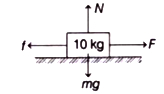
$A$ body of mass $10 \,kg$ is kept on a horizontal surface. The coefficient of kinetic friction between the body and the surface is $0.5$. $A$ horizontal force of $60 \,N$ is applied on the body. The resulting acceleration of the body is about
A
$1 \,m/s^2$
B
$5 \,m/s^2$
C
$6 \,m/s^2$
D
zero
Solution
$(A)$ Given: Mass of the body,$m = 10 \,kg$. Coefficient of kinetic friction,$\mu_k = 0.5$. Applied horizontal force,$F = 60 \,N$. Acceleration due to gravity,$g = 10 \,m/s^2$.
The normal force $N$ acting on the body is $N = mg = 10 \times 10 = 100 \,N$.
The kinetic frictional force $f_k$ is given by $f_k = \mu_k N = 0.5 \times 100 = 50 \,N$.
According to Newton's second law,the net force $F_{net}$ acting on the body is $F_{net} = F - f_k = 60 \,N - 50 \,N = 10 \,N$.
The acceleration $a$ of the body is $a = F_{net} / m = 10 \,N / 10 \,kg = 1 \,m/s^2$.
The normal force $N$ acting on the body is $N = mg = 10 \times 10 = 100 \,N$.
The kinetic frictional force $f_k$ is given by $f_k = \mu_k N = 0.5 \times 100 = 50 \,N$.
According to Newton's second law,the net force $F_{net}$ acting on the body is $F_{net} = F - f_k = 60 \,N - 50 \,N = 10 \,N$.
The acceleration $a$ of the body is $a = F_{net} / m = 10 \,N / 10 \,kg = 1 \,m/s^2$.
0 likes
View Solution121
MediumMCQ
$A$ conveyor belt is moving horizontally with a velocity of $2 \,m \,s^{-1}$. If a body of mass $10 \,kg$ is kept on it, then the distance travelled by the body before coming to rest relative to the belt is (The coefficient of kinetic friction between the belt and the body is $0.2$ and acceleration due to gravity is $10 \,m \,s^{-2}$) (in $\,m$)
A
$4$
B
$0$
C
$1$
D
$2$
Solution
(C) The body is placed on a moving belt. Initially, the body is at rest relative to the ground, but it has a velocity relative to the belt. The kinetic friction force $f_k$ acts on the body to oppose this relative motion.
$f_k = \mu_k N = \mu_k mg$
Using Newton's second law, the deceleration $a$ of the body relative to the belt is:
$ma = \mu_k mg$
$a = \mu_k g = 0.2 \times 10 = 2 \,m \,s^{-2}$
The initial velocity of the body relative to the belt is $u = 2 \,m \,s^{-1}$. The body comes to rest relative to the belt when its final velocity $v = 0$.
Using the equation of motion $v^2 = u^2 - 2as$:
$0^2 = (2)^2 - 2(2)s$
$4 = 4s$
$s = 1 \,m$
Thus, the distance travelled by the body before coming to rest relative to the belt is $1 \,m$.
$f_k = \mu_k N = \mu_k mg$
Using Newton's second law, the deceleration $a$ of the body relative to the belt is:
$ma = \mu_k mg$
$a = \mu_k g = 0.2 \times 10 = 2 \,m \,s^{-2}$
The initial velocity of the body relative to the belt is $u = 2 \,m \,s^{-1}$. The body comes to rest relative to the belt when its final velocity $v = 0$.
Using the equation of motion $v^2 = u^2 - 2as$:
$0^2 = (2)^2 - 2(2)s$
$4 = 4s$
$s = 1 \,m$
Thus, the distance travelled by the body before coming to rest relative to the belt is $1 \,m$.
0 likes
View Solution122
MediumMCQ
$A$ block of mass $2 \ kg$ is placed on a rough horizontal surface. If a horizontal force of $20 \ N$ acting on the block produces an acceleration of $7 \ m \ s^{-2}$ in it,then the coefficient of kinetic friction between the block and the surface is $(g = 10 \ m \ s^{-2})$.
A
$0.2$
B
$0.3$
C
$0.4$
D
$0.5$
Solution
(B) Given: Mass $m = 2 \ kg$,Applied force $F = 20 \ N$,Acceleration $a = 7 \ m \ s^{-2}$,Acceleration due to gravity $g = 10 \ m \ s^{-2}$.
According to Newton's second law of motion,the net force acting on the block is $F_{net} = F - f_k = ma$,where $f_k$ is the kinetic frictional force.
The kinetic frictional force is given by $f_k = \mu_k N$,where $N$ is the normal reaction force. On a horizontal surface,$N = mg = 2 \ kg \times 10 \ m \ s^{-2} = 20 \ N$.
Substituting the values into the equation $F - f_k = ma$:
$20 - f_k = 2 \times 7$
$20 - f_k = 14$
$f_k = 20 - 14 = 6 \ N$.
Now,using $f_k = \mu_k N$:
$6 = \mu_k \times 20$
$\mu_k = 6 / 20 = 0.3$.
Therefore,the coefficient of kinetic friction is $0.3$.
According to Newton's second law of motion,the net force acting on the block is $F_{net} = F - f_k = ma$,where $f_k$ is the kinetic frictional force.
The kinetic frictional force is given by $f_k = \mu_k N$,where $N$ is the normal reaction force. On a horizontal surface,$N = mg = 2 \ kg \times 10 \ m \ s^{-2} = 20 \ N$.
Substituting the values into the equation $F - f_k = ma$:
$20 - f_k = 2 \times 7$
$20 - f_k = 14$
$f_k = 20 - 14 = 6 \ N$.
Now,using $f_k = \mu_k N$:
$6 = \mu_k \times 20$
$\mu_k = 6 / 20 = 0.3$.
Therefore,the coefficient of kinetic friction is $0.3$.
0 likes
View Solution123
EasyMCQ
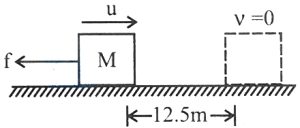
$A$ block of mass $1.5 \ kg$ kept on a rough horizontal surface is given a horizontal velocity of $10 \ ms^{-1}$. If the block comes to rest after travelling a distance of $12.5 \ m$,the coefficient of kinetic friction between the surface and the block is (Acceleration due to gravity $= 10 \ ms^{-2}$)
A
$0.2$
B
$0.4$
C
$0.8$
D
$0.6$
Solution
(B) Given: Initial velocity $u = 10 \ ms^{-1}$,Final velocity $v = 0 \ ms^{-1}$,Distance $S = 12.5 \ m$,Acceleration due to gravity $g = 10 \ ms^{-2}$.
The frictional force $f$ acting on the block is $f = \mu N = \mu mg$,where $\mu$ is the coefficient of kinetic friction.
The retardation $a$ produced by this frictional force is $a = \frac{f}{m} = \frac{\mu mg}{m} = \mu g$.
Using the equation of motion $v^2 = u^2 - 2aS$,where $v = 0$:
$0 = u^2 - 2aS$
$u^2 = 2aS$
$S = \frac{u^2}{2a} = \frac{u^2}{2 \mu g}$.
Substituting the given values:
$12.5 = \frac{(10)^2}{2 \times \mu \times 10}$
$12.5 = \frac{100}{20 \mu}$
$12.5 = \frac{5}{\mu}$
$\mu = \frac{5}{12.5} = \frac{50}{125} = 0.4$.
Therefore,the coefficient of kinetic friction is $0.4$.
The frictional force $f$ acting on the block is $f = \mu N = \mu mg$,where $\mu$ is the coefficient of kinetic friction.
The retardation $a$ produced by this frictional force is $a = \frac{f}{m} = \frac{\mu mg}{m} = \mu g$.
Using the equation of motion $v^2 = u^2 - 2aS$,where $v = 0$:
$0 = u^2 - 2aS$
$u^2 = 2aS$
$S = \frac{u^2}{2a} = \frac{u^2}{2 \mu g}$.
Substituting the given values:
$12.5 = \frac{(10)^2}{2 \times \mu \times 10}$
$12.5 = \frac{100}{20 \mu}$
$12.5 = \frac{5}{\mu}$
$\mu = \frac{5}{12.5} = \frac{50}{125} = 0.4$.
Therefore,the coefficient of kinetic friction is $0.4$.
0 likes
View Solution124
EasyMCQ
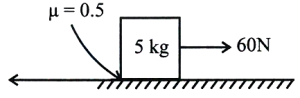
$A$ block of mass $5 \ kg$ is placed on a rough horizontal surface having a coefficient of friction $0.5$. If a horizontal force of $60 \ N$ is acting on it,then the acceleration of the block is (Acceleration due to gravity,$g = 10 \ ms^{-2}$). (in $ms^{-2}$)
A
$7$
B
$5$
C
$10$
D
$15$
Solution
(A) Given: Mass $m = 5 \ kg$,coefficient of friction $\mu = 0.5$,applied force $F = 60 \ N$,and $g = 10 \ ms^{-2}$.
First,calculate the limiting frictional force $f_l$ acting on the block:
$f_l = \mu N = \mu mg = 0.5 \times 5 \times 10 = 25 \ N$.
Since the applied force $F = 60 \ N$ is greater than the limiting frictional force $f_l = 25 \ N$,the block will move.
The net force acting on the block is $F_{net} = F - f_l = 60 - 25 = 35 \ N$.
Using Newton's second law,$F_{net} = ma$,the acceleration $a$ is:
$a = \frac{F_{net}}{m} = \frac{35}{5} = 7 \ ms^{-2}$.
First,calculate the limiting frictional force $f_l$ acting on the block:
$f_l = \mu N = \mu mg = 0.5 \times 5 \times 10 = 25 \ N$.
Since the applied force $F = 60 \ N$ is greater than the limiting frictional force $f_l = 25 \ N$,the block will move.
The net force acting on the block is $F_{net} = F - f_l = 60 - 25 = 35 \ N$.
Using Newton's second law,$F_{net} = ma$,the acceleration $a$ is:
$a = \frac{F_{net}}{m} = \frac{35}{5} = 7 \ ms^{-2}$.
0 likes
View Solution125
MediumMCQ
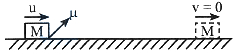
$A$ particle of mass '$m$' at rest on a rough horizontal surface with a coefficient of friction '$\mu$' is given a velocity '$u$'. The average power imparted by friction before it stops is:
A
Zero
B
$\frac{1}{2} \mu m g u$
C
$\mu m g u$
D
$2 \mu m g u$
Solution
(B) The frictional force acting on the particle is $f_r = \mu m g$.
Since the particle is moving,the acceleration is $a = \frac{-f_r}{m} = \frac{-\mu m g}{m} = -\mu g$.
The time taken to stop is given by $v = u + at$. Setting $v = 0$,we get $0 = u - \mu g t$,so $t = \frac{u}{\mu g}$.
The work done by friction is equal to the change in kinetic energy: $W_f = \Delta K = 0 - \frac{1}{2} m u^2 = -\frac{1}{2} m u^2$.
The average power imparted by friction is $P_{av} = \frac{|W_f|}{t} = \frac{\frac{1}{2} m u^2}{\frac{u}{\mu g}} = \frac{1}{2} \mu m g u$.
Since the particle is moving,the acceleration is $a = \frac{-f_r}{m} = \frac{-\mu m g}{m} = -\mu g$.
The time taken to stop is given by $v = u + at$. Setting $v = 0$,we get $0 = u - \mu g t$,so $t = \frac{u}{\mu g}$.
The work done by friction is equal to the change in kinetic energy: $W_f = \Delta K = 0 - \frac{1}{2} m u^2 = -\frac{1}{2} m u^2$.
The average power imparted by friction is $P_{av} = \frac{|W_f|}{t} = \frac{\frac{1}{2} m u^2}{\frac{u}{\mu g}} = \frac{1}{2} \mu m g u$.
0 likes
View Solution126
EasyMCQ
$A$ block of mass $5 \,kg$ moving on a rough surface with a velocity of $4 \,ms^{-1}$ is stopped by friction in $2 \,s$. The coefficient of friction between the contact surfaces is (Acceleration due to gravity $g = 10 \,ms^{-2}$)
A
$0.4$
B
$0.3$
C
$0.5$
D
$0.2$
Solution
(D) Given: Mass $m = 5 \,kg$, initial velocity $u = 4 \,ms^{-1}$, final velocity $v = 0 \,ms^{-1}$, time $t = 2 \,s$, and $g = 10 \,ms^{-2}$.
First, calculate the retardation $a$ using the equation of motion $v = u + at$:
$0 = 4 + a(2) \Rightarrow 2a = -4 \Rightarrow a = -2 \,ms^{-2}$.
The magnitude of retardation is $|a| = 2 \,ms^{-2}$.
The frictional force $f$ provides this retardation, so $f = ma$.
Also, the frictional force is given by $f = \mu N = \mu mg$.
Equating the two expressions for $f$:
$ma = \mu mg \Rightarrow \mu = \frac{a}{g}$.
Substituting the values:
$\mu = \frac{2}{10} = 0.2$.
First, calculate the retardation $a$ using the equation of motion $v = u + at$:
$0 = 4 + a(2) \Rightarrow 2a = -4 \Rightarrow a = -2 \,ms^{-2}$.
The magnitude of retardation is $|a| = 2 \,ms^{-2}$.
The frictional force $f$ provides this retardation, so $f = ma$.
Also, the frictional force is given by $f = \mu N = \mu mg$.
Equating the two expressions for $f$:
$ma = \mu mg \Rightarrow \mu = \frac{a}{g}$.
Substituting the values:
$\mu = \frac{2}{10} = 0.2$.
0 likes
View Solution127
MediumMCQ
$A$ body of mass $1 \,kg$ is moving with a velocity $10 \,ms^{-1}$ on a horizontal rough surface having a coefficient of kinetic friction $0.4$. If the constant force is removed, the body comes to rest in a time (Acceleration due to gravity $g = 10 \,ms^{-2}$). (in $\,s$)
A
$2.5$
B
$4$
C
$0.4$
D
$0.25$
Solution
(A) Given: Mass $m = 1 \,kg$, initial velocity $u = 10 \,ms^{-1}$, final velocity $v = 0 \,ms^{-1}$, coefficient of kinetic friction $\mu = 0.4$, and $g = 10 \,ms^{-2}$.
When the force is removed, the only horizontal force acting on the body is the kinetic frictional force $f_k = \mu N = \mu mg$.
According to Newton's second law, the retardation $a$ is given by $a = \frac{f_k}{m} = \frac{\mu mg}{m} = \mu g$.
Substituting the values: $a = 0.4 \times 10 = 4 \,ms^{-2}$.
Using the first equation of motion $v = u - at$ (where $a$ is retardation):
$0 = 10 - 4t$
$4t = 10$
$t = \frac{10}{4} = 2.5 \,s$.
Thus, the body comes to rest in $2.5 \,s$.
When the force is removed, the only horizontal force acting on the body is the kinetic frictional force $f_k = \mu N = \mu mg$.
According to Newton's second law, the retardation $a$ is given by $a = \frac{f_k}{m} = \frac{\mu mg}{m} = \mu g$.
Substituting the values: $a = 0.4 \times 10 = 4 \,ms^{-2}$.
Using the first equation of motion $v = u - at$ (where $a$ is retardation):
$0 = 10 - 4t$
$4t = 10$
$t = \frac{10}{4} = 2.5 \,s$.
Thus, the body comes to rest in $2.5 \,s$.
0 likes
View Solution128
EasyMCQ
$A$ body of mass $10 \,kg$ is kept on a rough horizontal surface with a coefficient of friction of $0.3$. If a horizontal force of $50 \,N$ is applied to the body, then the acceleration of the body is (Acceleration due to gravity $= 10 \,ms^{-2}$) (in $\,ms^{-2}$)
A
$5$
B
$2$
C
$3$
D
$1$
Solution
(B) Given: Mass $m = 10 \,kg$, Coefficient of friction $\mu = 0.3$, Applied force $F = 50 \,N$, Acceleration due to gravity $g = 10 \,ms^{-2}$.
First, calculate the limiting frictional force $f_l = \mu mg = 0.3 \times 10 \times 10 = 30 \,N$.
Since the applied force $F = 50 \,N$ is greater than the limiting frictional force $f_l = 30 \,N$, the body will move.
The net force acting on the body is $F_{net} = F - f_l = 50 \,N - 30 \,N = 20 \,N$.
Using Newton's second law, $F_{net} = ma$, we get $20 = 10 \times a$.
Therefore, the acceleration $a = 2 \,ms^{-2}$.
First, calculate the limiting frictional force $f_l = \mu mg = 0.3 \times 10 \times 10 = 30 \,N$.
Since the applied force $F = 50 \,N$ is greater than the limiting frictional force $f_l = 30 \,N$, the body will move.
The net force acting on the body is $F_{net} = F - f_l = 50 \,N - 30 \,N = 20 \,N$.
Using Newton's second law, $F_{net} = ma$, we get $20 = 10 \times a$.
Therefore, the acceleration $a = 2 \,ms^{-2}$.
0 likes
View Solution129
EasyMCQ
$A$ body is travelling with $10 \,ms^{-1}$ on a rough horizontal surface. Its velocity after $2 \,s$ is $4 \,ms^{-1}$. The coefficient of kinetic friction between the block and the plane is (acceleration due to gravity $= 10 \,ms^{-2}$)
A
$0.4$
B
$0.3$
C
$0.5$
D
$0.2$
Solution
(B) Initial speed of the body on the horizontal rough surface,$u = 10 \,ms^{-1}$.
Final velocity,$v = 4 \,ms^{-1}$ and time,$t = 2 \,s$.
If $a$ is the retardation due to friction,then by using the equation of motion:
$v = u - at$
$4 = 10 - a \times 2$
$2a = 6 \Rightarrow a = 3 \,ms^{-2}$.
According to Newton's second law,the frictional force is given by $f_k = ma$.
Since $f_k = \mu_k N = \mu_k mg$,we have:
$\mu_k mg = ma$
$\mu_k = \frac{a}{g} = \frac{3}{10} = 0.3$.
Final velocity,$v = 4 \,ms^{-1}$ and time,$t = 2 \,s$.
If $a$ is the retardation due to friction,then by using the equation of motion:
$v = u - at$
$4 = 10 - a \times 2$
$2a = 6 \Rightarrow a = 3 \,ms^{-2}$.
According to Newton's second law,the frictional force is given by $f_k = ma$.
Since $f_k = \mu_k N = \mu_k mg$,we have:
$\mu_k mg = ma$
$\mu_k = \frac{a}{g} = \frac{3}{10} = 0.3$.
0 likes
View Solution130
MediumMCQ
$A$ cylinder of mass $12 \,kg$ is sliding on a plane with an initial velocity $20 \,ms^{-1}$. If the coefficient of friction between the surface and the cylinder is $0.5$, what is the distance the cylinder travels before stopping (in $\,m$)?
A
$40$
B
$5$
C
$20$
D
$10$
Solution
(A) Given: Mass of the cylinder, $m = 12 \,kg$. Initial velocity, $u = 20 \,m/s$. Coefficient of kinetic friction, $\mu = 0.5$. Acceleration due to gravity, $g = 10 \,m/s^2$.
The frictional force acting on the cylinder is $f = \mu N = \mu mg$.
According to Newton's second law, $f = ma$, so $ma = \mu mg$, which gives the retardation $a = -\mu g$.
Substituting the values, $a = -0.5 \times 10 = -5 \,m/s^2$.
Using the third equation of motion, $v^2 = u^2 + 2as$, where $v = 0$ (final velocity at rest):
$0 = (20)^2 + 2(-5)s$
$0 = 400 - 10s$
$10s = 400$
$s = 40 \,m$.
Therefore, the cylinder travels a distance of $40 \,m$ before stopping.
The frictional force acting on the cylinder is $f = \mu N = \mu mg$.
According to Newton's second law, $f = ma$, so $ma = \mu mg$, which gives the retardation $a = -\mu g$.
Substituting the values, $a = -0.5 \times 10 = -5 \,m/s^2$.
Using the third equation of motion, $v^2 = u^2 + 2as$, where $v = 0$ (final velocity at rest):
$0 = (20)^2 + 2(-5)s$
$0 = 400 - 10s$
$10s = 400$
$s = 40 \,m$.
Therefore, the cylinder travels a distance of $40 \,m$ before stopping.
0 likes
View Solution131
DifficultMCQ
$A$ body of weight $64 \ N$ is pushed with just enough force to start it moving across a horizontal floor and the same force continues to act afterwards. If the coefficients of static and dynamic friction are $0.8$ and $0.6$ respectively,then the acceleration of the body will be
A
$0.2 \ g$
B
$\frac{g}{32}$
C
$0.64 \ g$
D
$\frac{g}{6.4}$
Solution
(A) Given: Weight of the body,$W = 64 \ N$.
Coefficient of static friction,$\mu_s = 0.8$.
Coefficient of dynamic (kinetic) friction,$\mu_d = 0.6$.
The force $F$ required to just start the motion is equal to the limiting friction: $F = \mu_s \times W = 0.8 \times 64 \ N$.
Once the body starts moving,the kinetic friction acting on it is $f_k = \mu_d \times W = 0.6 \times 64 \ N$.
The net force acting on the body is $F_{net} = F - f_k = (0.8 \times 64) - (0.6 \times 64) = 64(0.8 - 0.6) = 64 \times 0.2 \ N$.
Using Newton's second law,$F_{net} = m \times a$,where mass $m = \frac{W}{g} = \frac{64}{g}$.
Substituting the values: $\frac{64}{g} \times a = 64 \times 0.2$.
Therefore,$a = 0.2 \ g$.
Coefficient of static friction,$\mu_s = 0.8$.
Coefficient of dynamic (kinetic) friction,$\mu_d = 0.6$.
The force $F$ required to just start the motion is equal to the limiting friction: $F = \mu_s \times W = 0.8 \times 64 \ N$.
Once the body starts moving,the kinetic friction acting on it is $f_k = \mu_d \times W = 0.6 \times 64 \ N$.
The net force acting on the body is $F_{net} = F - f_k = (0.8 \times 64) - (0.6 \times 64) = 64(0.8 - 0.6) = 64 \times 0.2 \ N$.
Using Newton's second law,$F_{net} = m \times a$,where mass $m = \frac{W}{g} = \frac{64}{g}$.
Substituting the values: $\frac{64}{g} \times a = 64 \times 0.2$.
Therefore,$a = 0.2 \ g$.
0 likes
View Solution132
EasyMCQ
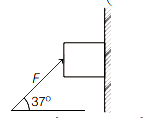
$A$ block of mass $2 \,kg$ is being pushed against a wall by a force $F=90 \,N$ as shown in the figure. If the coefficient of friction is $0.25$, then the magnitude of acceleration of the block is (Take $g=10 \,ms^{-2}$, $\sin 37^{\circ}=\frac{3}{5}$). (in $\,ms^{-2}$)
A
$16$
B
$8$
C
$38$
D
$54$
Solution
(B) The weight of the block acts downwards: $w = mg = 2 \times 10 = 20 \,N$.
The applied force $F = 90 \,N$ is at an angle of $37^{\circ}$ to the horizontal.
The vertical component of the force is $F_V = F \sin 37^{\circ} = 90 \times \frac{3}{5} = 54 \,N$ (upwards).
The horizontal component of the force is $F_H = F \cos 37^{\circ} = 90 \times \frac{4}{5} = 72 \,N$ (towards the wall).
This horizontal component acts as the normal force $N$ exerted by the wall on the block: $N = 72 \,N$.
The maximum frictional force is $f_k = \mu N = 0.25 \times 72 = 18 \,N$.
Since the block is moving upwards, the friction acts downwards.
The net force in the vertical direction is $F_{\text{net}} = F_V - w - f_k = 54 - 20 - 18 = 16 \,N$.
Using Newton's second law, $F_{\text{net}} = ma$, we get $16 = 2 \times a$.
Therefore, $a = 8 \,ms^{-2}$.
The applied force $F = 90 \,N$ is at an angle of $37^{\circ}$ to the horizontal.
The vertical component of the force is $F_V = F \sin 37^{\circ} = 90 \times \frac{3}{5} = 54 \,N$ (upwards).
The horizontal component of the force is $F_H = F \cos 37^{\circ} = 90 \times \frac{4}{5} = 72 \,N$ (towards the wall).
This horizontal component acts as the normal force $N$ exerted by the wall on the block: $N = 72 \,N$.
The maximum frictional force is $f_k = \mu N = 0.25 \times 72 = 18 \,N$.
Since the block is moving upwards, the friction acts downwards.
The net force in the vertical direction is $F_{\text{net}} = F_V - w - f_k = 54 - 20 - 18 = 16 \,N$.
Using Newton's second law, $F_{\text{net}} = ma$, we get $16 = 2 \times a$.
Therefore, $a = 8 \,ms^{-2}$.
0 likes
View Solution133
DifficultMCQ
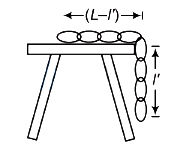
$A$ uniform chain of length $L$ is lying on a horizontal table. If the coefficient of friction between the chain and the table top is $\mu$,what is the maximum length of the chain that can hang over the edge of the table without disturbing the rest of the chain on the table?
A
$\frac{L}{(1+\mu)}$
B
$\frac{\mu L}{(1+\mu)}$
C
$\frac{L}{(1-\mu)}$
D
$\frac{\mu L}{(1-\mu)}$
Solution
(B) Let $\lambda$ be the linear mass density of the chain. The total length of the chain is $L$. Let $l^{\prime}$ be the length of the chain hanging over the edge.
Then,the length of the chain remaining on the table is $(L - l^{\prime})$.
The mass of the hanging part is $m_h = \lambda l^{\prime}$,and the mass of the part on the table is $m_t = \lambda (L - l^{\prime})$.
The force pulling the chain down is the weight of the hanging part: $F_g = m_h g = \lambda l^{\prime} g$.
The maximum static frictional force acting on the part on the table is $f_{max} = \mu N = \mu m_t g = \mu \lambda (L - l^{\prime}) g$.
For the chain to be in equilibrium,the pulling force must be equal to the maximum frictional force:
$\lambda l^{\prime} g = \mu \lambda (L - l^{\prime}) g$
$l^{\prime} = \mu (L - l^{\prime})$
$l^{\prime} = \mu L - \mu l^{\prime}$
$l^{\prime} (1 + \mu) = \mu L$
$l^{\prime} = \frac{\mu L}{(1 + \mu)}$
Then,the length of the chain remaining on the table is $(L - l^{\prime})$.
The mass of the hanging part is $m_h = \lambda l^{\prime}$,and the mass of the part on the table is $m_t = \lambda (L - l^{\prime})$.
The force pulling the chain down is the weight of the hanging part: $F_g = m_h g = \lambda l^{\prime} g$.
The maximum static frictional force acting on the part on the table is $f_{max} = \mu N = \mu m_t g = \mu \lambda (L - l^{\prime}) g$.
For the chain to be in equilibrium,the pulling force must be equal to the maximum frictional force:
$\lambda l^{\prime} g = \mu \lambda (L - l^{\prime}) g$
$l^{\prime} = \mu (L - l^{\prime})$
$l^{\prime} = \mu L - \mu l^{\prime}$
$l^{\prime} (1 + \mu) = \mu L$
$l^{\prime} = \frac{\mu L}{(1 + \mu)}$
0 likes
View Solution134
DifficultMCQ
$A$ body of weight $64 \,N$ is pushed with just enough force to start it moving across a horizontal floor and the same force continues to act afterwards. If the coefficients of static and dynamic friction are $0.6$ and $0.4$ respectively, the acceleration of the body is (Acceleration due to gravity $= g$)
A
$\frac{g}{6.4}$
B
$0.64 g$
C
$\frac{g}{32}$
D
$0.2 \,g$
Solution
(D) Given: Weight $W = 64 \,N$, coefficient of static friction $\mu_s = 0.6$, coefficient of kinetic (dynamic) friction $\mu_k = 0.4$.
The force applied to start the motion is equal to the limiting friction: $F = f_{s,max} = \mu_s N = \mu_s W$.
Since $W = mg$, we have $F = 0.6 \times mg$.
Once the body starts moving, the kinetic friction acting on it is $f_k = \mu_k N = \mu_k mg = 0.4 \times mg$.
The net force acting on the body is $F_{net} = F - f_k = 0.6 mg - 0.4 mg = 0.2 mg$.
According to Newton's second law, $F_{net} = ma$.
Therefore, $ma = 0.2 mg$, which gives $a = 0.2 g$.
The force applied to start the motion is equal to the limiting friction: $F = f_{s,max} = \mu_s N = \mu_s W$.
Since $W = mg$, we have $F = 0.6 \times mg$.
Once the body starts moving, the kinetic friction acting on it is $f_k = \mu_k N = \mu_k mg = 0.4 \times mg$.
The net force acting on the body is $F_{net} = F - f_k = 0.6 mg - 0.4 mg = 0.2 mg$.
According to Newton's second law, $F_{net} = ma$.
Therefore, $ma = 0.2 mg$, which gives $a = 0.2 g$.
0 likes
View Solution135
MediumMCQ
Two blocks $A$ and $B$ of masses $2 \ kg$ and $4 \ kg$ respectively are kept on a rough horizontal surface. If the same force of $20 \ N$ is applied on each block,then the ratio of the accelerations of the blocks $A$ and $B$ is (Coefficient of kinetic friction between the surface and the blocks is $0.3$ and acceleration due to gravity $= 10 \ m \ s^{-2}$).
A
$1: 1$
B
$7: 2$
C
$1: 2$
D
$4: 3$
Solution
(B) The force of kinetic friction acting on a block is given by $f_k = \mu_k N = \mu_k mg$.
For block $A$: Mass $m_A = 2 \ kg$,Force $F = 20 \ N$. Friction $f_A = 0.3 \times 2 \times 10 = 6 \ N$. Net force $F_{net,A} = F - f_A = 20 - 6 = 14 \ N$. Acceleration $a_A = F_{net,A} / m_A = 14 / 2 = 7 \ m \ s^{-2}$.
For block $B$: Mass $m_B = 4 \ kg$,Force $F = 20 \ N$. Friction $f_B = 0.3 \times 4 \times 10 = 12 \ N$. Net force $F_{net,B} = F - f_B = 20 - 12 = 8 \ N$. Acceleration $a_B = F_{net,B} / m_B = 8 / 4 = 2 \ m \ s^{-2}$.
The ratio of accelerations is $a_A : a_B = 7 : 2$.
For block $A$: Mass $m_A = 2 \ kg$,Force $F = 20 \ N$. Friction $f_A = 0.3 \times 2 \times 10 = 6 \ N$. Net force $F_{net,A} = F - f_A = 20 - 6 = 14 \ N$. Acceleration $a_A = F_{net,A} / m_A = 14 / 2 = 7 \ m \ s^{-2}$.
For block $B$: Mass $m_B = 4 \ kg$,Force $F = 20 \ N$. Friction $f_B = 0.3 \times 4 \times 10 = 12 \ N$. Net force $F_{net,B} = F - f_B = 20 - 12 = 8 \ N$. Acceleration $a_B = F_{net,B} / m_B = 8 / 4 = 2 \ m \ s^{-2}$.
The ratio of accelerations is $a_A : a_B = 7 : 2$.
0 likes
View Solution136
MediumMCQ
$A$ boat of mass $700 \,kg$ is travelling at a speed of $24 \,ms^{-1}$ when its engine is shut off. The magnitude of frictional force $f$ between the boat and water is given by $f = 35v$, where $v$ is the speed in $ms^{-1}$ and $f$ is in newton. Find the time taken for the speed of the boat to become $6 \,ms^{-1}$. (in $\,s$)
A
$18$
B
$36$
C
$34$
D
$28$
Solution
(D) Given: Mass of the boat, $m = 700 \,kg$. Initial speed, $v_1 = 24 \,ms^{-1}$. Final speed, $v_2 = 6 \,ms^{-1}$. Frictional force, $f = 35v$.
According to Newton's second law, the retarding force is $f = -m \frac{dv}{dt}$.
Substituting the given values: $35v = -700 \frac{dv}{dt}$.
Rearranging the terms: $\frac{dv}{v} = -\frac{35}{700} dt = -\frac{1}{20} dt$.
Integrating both sides from $v_1$ to $v_2$ and $0$ to $t$: $\int_{24}^{6} \frac{dv}{v} = -\int_{0}^{t} \frac{1}{20} dt$.
$\ln(\frac{6}{24}) = -\frac{t}{20}$.
$\ln(\frac{1}{4}) = -\frac{t}{20}$.
$-\ln(4) = -\frac{t}{20} \Rightarrow t = 20 \ln(4) = 20 \ln(2^2) = 40 \ln(2)$.
Using $\ln(2) \approx 0.693$, $t = 40 \times 0.693 = 27.72 \,s$.
Rounding to the nearest integer, $t \approx 28 \,s$.
According to Newton's second law, the retarding force is $f = -m \frac{dv}{dt}$.
Substituting the given values: $35v = -700 \frac{dv}{dt}$.
Rearranging the terms: $\frac{dv}{v} = -\frac{35}{700} dt = -\frac{1}{20} dt$.
Integrating both sides from $v_1$ to $v_2$ and $0$ to $t$: $\int_{24}^{6} \frac{dv}{v} = -\int_{0}^{t} \frac{1}{20} dt$.
$\ln(\frac{6}{24}) = -\frac{t}{20}$.
$\ln(\frac{1}{4}) = -\frac{t}{20}$.
$-\ln(4) = -\frac{t}{20} \Rightarrow t = 20 \ln(4) = 20 \ln(2^2) = 40 \ln(2)$.
Using $\ln(2) \approx 0.693$, $t = 40 \times 0.693 = 27.72 \,s$.
Rounding to the nearest integer, $t \approx 28 \,s$.
0 likes
View Solution137
MediumMCQ
The power required for an engine to maintain a constant speed of $50 \,m \,s^{-1}$ for a train of mass $3 \times 10^6 \,kg$ on rough rails is (The coefficient of kinetic friction between the rails and wheels of the train is $0.05$ and acceleration due to gravity $= 10 \,m \,s^{-2}$).
A
$75 \,MW$
B
$40 \,MW$
C
$75 \,kW$
D
$65 \,MW$
Solution
(A) To maintain a constant speed, the engine must exert a force equal to the frictional force acting on the train.
The frictional force $F_f$ is given by $F_f = \mu N$, where $\mu$ is the coefficient of kinetic friction and $N$ is the normal force.
Since the train is on a horizontal track, $N = mg$.
Given: $m = 3 \times 10^6 \,kg$, $\mu = 0.05$, $g = 10 \,m \,s^{-2}$, and velocity $v = 50 \,m \,s^{-1}$.
$F_f = 0.05 \times (3 \times 10^6 \,kg) \times (10 \,m \,s^{-2}) = 0.05 \times 3 \times 10^7 \,N = 1.5 \times 10^6 \,N$.
The power $P$ required is given by $P = F_f \times v$.
$P = (1.5 \times 10^6 \,N) \times (50 \,m \,s^{-1}) = 75 \times 10^6 \,W = 75 \,MW$.
The frictional force $F_f$ is given by $F_f = \mu N$, where $\mu$ is the coefficient of kinetic friction and $N$ is the normal force.
Since the train is on a horizontal track, $N = mg$.
Given: $m = 3 \times 10^6 \,kg$, $\mu = 0.05$, $g = 10 \,m \,s^{-2}$, and velocity $v = 50 \,m \,s^{-1}$.
$F_f = 0.05 \times (3 \times 10^6 \,kg) \times (10 \,m \,s^{-2}) = 0.05 \times 3 \times 10^7 \,N = 1.5 \times 10^6 \,N$.
The power $P$ required is given by $P = F_f \times v$.
$P = (1.5 \times 10^6 \,N) \times (50 \,m \,s^{-1}) = 75 \times 10^6 \,W = 75 \,MW$.
0 likes
View Solution138
DifficultMCQ
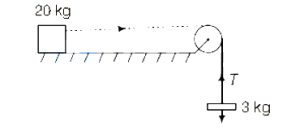
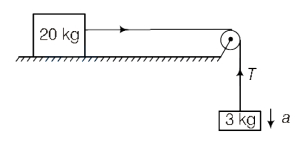
$A$ body of mass $20 \,kg$ is moving on a rough horizontal plane. $A$ block of mass $3 \,kg$ is connected to the $20 \,kg$ mass by a string of negligible mass through a smooth pulley as shown in the figure. The tension in the string is $27 \,N$. The coefficient of kinetic friction between the heavier mass and the surface is $\left(g=10 \,m/s^2\right)$.
A
$0.025$
B
$0.035$
C
$0.35$
D
$0.25$
Solution
(B) Given,tension in the string $(T) = 27 \,N$.
Mass of the hanging block $(m) = 3 \,kg$.
Let the acceleration of the system be $a$.
For the hanging block of mass $3 \,kg$,the equation of motion is:
$m g - T = m a$
$3 \times 10 - 27 = 3 a$
$30 - 27 = 3 a$
$3 = 3 a$
$a = 1 \,m/s^2$.
For the body of mass $M = 20 \,kg$ moving on the horizontal surface,the equation of motion is:
$T - f_k = M a$
where $f_k = \mu M g$ is the kinetic friction force.
$27 - \mu \times 20 \times 10 = 20 \times 1$
$27 - 200 \mu = 20$
$200 \mu = 27 - 20$
$200 \mu = 7$
$\mu = \frac{7}{200} = 0.035$.
Therefore,the coefficient of kinetic friction is $0.035$.
Mass of the hanging block $(m) = 3 \,kg$.
Let the acceleration of the system be $a$.
For the hanging block of mass $3 \,kg$,the equation of motion is:
$m g - T = m a$
$3 \times 10 - 27 = 3 a$
$30 - 27 = 3 a$
$3 = 3 a$
$a = 1 \,m/s^2$.
For the body of mass $M = 20 \,kg$ moving on the horizontal surface,the equation of motion is:
$T - f_k = M a$
where $f_k = \mu M g$ is the kinetic friction force.
$27 - \mu \times 20 \times 10 = 20 \times 1$
$27 - 200 \mu = 20$
$200 \mu = 27 - 20$
$200 \mu = 7$
$\mu = \frac{7}{200} = 0.035$.
Therefore,the coefficient of kinetic friction is $0.035$.
0 likes
View Solution139
DifficultMCQ
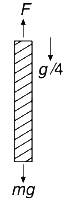
$A$ man slides down a telegraphic pole with an acceleration equal to one-fourth of the acceleration due to gravity. The frictional force between the man and the pole is equal to which of the following in terms of the man's weight $w$?
A
$\frac{w}{4}$
B
$\frac{w}{2}$
C
$\frac{3w}{4}$
D
$w$
Solution
(C) Let the mass of the man be $m$. The weight of the man is $w = mg$. The forces acting on the man are his weight $mg$ acting downwards and the frictional force $F$ acting upwards.
Since the man is sliding down with an acceleration $a = g/4$,according to Newton's second law of motion:
$mg - F = ma$
Substituting $a = g/4$:
$mg - F = m(g/4)$
$mg - F = mg/4$
$F = mg - mg/4$
$F = 3mg/4$
Since $w = mg$,we get:
$F = 3w/4$
Since the man is sliding down with an acceleration $a = g/4$,according to Newton's second law of motion:
$mg - F = ma$
Substituting $a = g/4$:
$mg - F = m(g/4)$
$mg - F = mg/4$
$F = mg - mg/4$
$F = 3mg/4$
Since $w = mg$,we get:
$F = 3w/4$
0 likes
View Solution140
MediumMCQ
$A$ block of mass $\sqrt{2} \,kg$ is placed on a rough horizontal surface. $A$ force $F$ acting upwards at an angle of $45^{\circ}$ with the horizontal causes the block to start motion. If the coefficient of static friction between the surface and the block is $0.25$, the magnitude of the force $F$ is (Acceleration due to gravity $= 10 \,ms^{-2}$) (in $\,N$)
A
$0.5$
B
$2$
C
$4$
D
$8$
Solution
(C) The block is on a horizontal surface. The forces acting on the block are:
$1$. Weight $mg$ acting downwards.
$2$. Normal reaction $N$ acting upwards.
$3$. Applied force $F$ at $45^{\circ}$ to the horizontal.
Resolving $F$ into components: $F_x = F \cos 45^{\circ}$ and $F_y = F \sin 45^{\circ}$.
For vertical equilibrium: $N + F \sin 45^{\circ} = mg$.
So, $N = mg - F \sin 45^{\circ} = \sqrt{2} \times 10 - F \times \frac{1}{\sqrt{2}} = 10\sqrt{2} - \frac{F}{\sqrt{2}}$.
The block starts to move when the horizontal component of the force equals the limiting friction: $F \cos 45^{\circ} = \mu N$.
Substituting the values: $F \times \frac{1}{\sqrt{2}} = 0.25 \times (10\sqrt{2} - \frac{F}{\sqrt{2}})$.
Multiply by $\sqrt{2}$: $F = 0.25 \times (10 \times 2 - F) = 0.25 \times (20 - F)$.
$F = 5 - 0.25F$.
$1.25F = 5$.
$F = \frac{5}{1.25} = 4 \,N$.
$1$. Weight $mg$ acting downwards.
$2$. Normal reaction $N$ acting upwards.
$3$. Applied force $F$ at $45^{\circ}$ to the horizontal.
Resolving $F$ into components: $F_x = F \cos 45^{\circ}$ and $F_y = F \sin 45^{\circ}$.
For vertical equilibrium: $N + F \sin 45^{\circ} = mg$.
So, $N = mg - F \sin 45^{\circ} = \sqrt{2} \times 10 - F \times \frac{1}{\sqrt{2}} = 10\sqrt{2} - \frac{F}{\sqrt{2}}$.
The block starts to move when the horizontal component of the force equals the limiting friction: $F \cos 45^{\circ} = \mu N$.
Substituting the values: $F \times \frac{1}{\sqrt{2}} = 0.25 \times (10\sqrt{2} - \frac{F}{\sqrt{2}})$.
Multiply by $\sqrt{2}$: $F = 0.25 \times (10 \times 2 - F) = 0.25 \times (20 - F)$.
$F = 5 - 0.25F$.
$1.25F = 5$.
$F = \frac{5}{1.25} = 4 \,N$.
0 likes
View Solution141
EasyMCQ
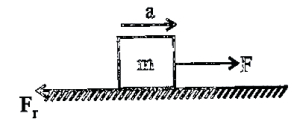
$A$ block is kept on a rough horizontal surface. The acceleration of the block increases from $6 \ m/s^2$ to $11 \ m/s^2$ when the horizontal force acting on it increases from $20 \ N$ to $30 \ N$. The coefficient of kinetic friction between the block and the surface is (Acceleration due to gravity $g = 10 \ m/s^2$):
A
$0.2$
B
$0.3$
C
$0.4$
D
$0.5$
Solution
(C) The net force acting on the block is given by $F_{net} = F - f_k = ma$,where $f_k = \mu_k mg$ is the kinetic friction force.
Thus,the acceleration is $a = \frac{F - \mu_k mg}{m}$.
For the first case: $6 = \frac{20 - \mu_k mg}{m} \implies 6m = 20 - \mu_k mg$ --- $(i)$
For the second case: $11 = \frac{30 - \mu_k mg}{m} \implies 11m = 30 - \mu_k mg$ --- (ii)
Subtracting equation $(i)$ from equation (ii):
$(11m - 6m) = (30 - \mu_k mg) - (20 - \mu_k mg)$
$5m = 10 \implies m = 2 \ kg$.
Substitute $m = 2 \ kg$ into equation $(i)$:
$6(2) = 20 - \mu_k (2)(10)$
$12 = 20 - 20\mu_k$
$20\mu_k = 8$
$\mu_k = \frac{8}{20} = 0.4$.
Thus,the acceleration is $a = \frac{F - \mu_k mg}{m}$.
For the first case: $6 = \frac{20 - \mu_k mg}{m} \implies 6m = 20 - \mu_k mg$ --- $(i)$
For the second case: $11 = \frac{30 - \mu_k mg}{m} \implies 11m = 30 - \mu_k mg$ --- (ii)
Subtracting equation $(i)$ from equation (ii):
$(11m - 6m) = (30 - \mu_k mg) - (20 - \mu_k mg)$
$5m = 10 \implies m = 2 \ kg$.
Substitute $m = 2 \ kg$ into equation $(i)$:
$6(2) = 20 - \mu_k (2)(10)$
$12 = 20 - 20\mu_k$
$20\mu_k = 8$
$\mu_k = \frac{8}{20} = 0.4$.
0 likes
View Solution142
EasyMCQ
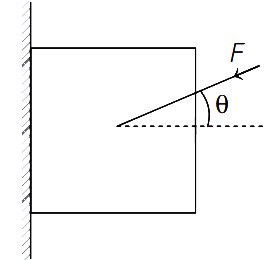
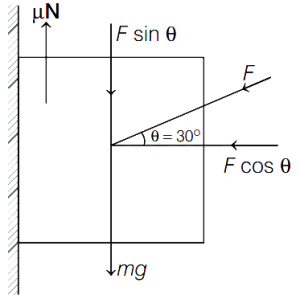
$A$ block of mass $3 \,kg$ is pressed against a vertical wall by applying a force $F$ at an angle $30^{\circ}$ to the horizontal as shown in the figure. As a result, the block is prevented from falling down. If the coefficient of static friction between the block and wall is $\mu = \sqrt{3}$, then the value of $F$ is (use $g=10 \,m/s^2$):
A
$30 \,N$
B
$15 \sqrt{3} \,N$
C
$60 \sqrt{3} \,N$
D
$60 \,N$
Solution
(A) The forces acting on the block are as follows:
$1$. The normal reaction $N$ exerted by the wall is $N = F \cos 30^{\circ} = F \frac{\sqrt{3}}{2}$.
$2$. The maximum static friction force is $f_{max} = \mu N = \sqrt{3} \times (F \frac{\sqrt{3}}{2}) = \frac{3}{2} F$.
$3$. The vertical forces acting on the block are the weight $mg$ acting downwards and the vertical component of the applied force $F \sin 30^{\circ}$ acting downwards.
$4$. For the block to be in equilibrium and prevented from falling, the upward friction force must balance the total downward force:
$f = mg + F \sin 30^{\circ}$
$\frac{3}{2} F = (3 \times 10) + F \times \frac{1}{2}$
$\frac{3}{2} F - \frac{1}{2} F = 30$
$F = 30 \,N$.
$1$. The normal reaction $N$ exerted by the wall is $N = F \cos 30^{\circ} = F \frac{\sqrt{3}}{2}$.
$2$. The maximum static friction force is $f_{max} = \mu N = \sqrt{3} \times (F \frac{\sqrt{3}}{2}) = \frac{3}{2} F$.
$3$. The vertical forces acting on the block are the weight $mg$ acting downwards and the vertical component of the applied force $F \sin 30^{\circ}$ acting downwards.
$4$. For the block to be in equilibrium and prevented from falling, the upward friction force must balance the total downward force:
$f = mg + F \sin 30^{\circ}$
$\frac{3}{2} F = (3 \times 10) + F \times \frac{1}{2}$
$\frac{3}{2} F - \frac{1}{2} F = 30$
$F = 30 \,N$.
0 likes
View Solution143
MediumMCQ
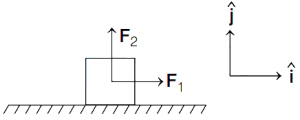
$A$ block of mass $m=2 \ kg$ is initially at rest on a horizontal surface. $A$ horizontal force $F_1=(6 \ N) \hat{i}$ and a vertical force $F_2=(10 \ N) \hat{j}$ are then applied to the block. The coefficients of static friction and kinetic friction for the block and the surface are $0.4$ and $0.25$,respectively. The magnitude of the frictional force acting on the block is (assume $g=10 \ m/s^2$): (in $N$)
A
$2.5$
B
$4.0$
C
$3.3$
D
$3.0$
Solution
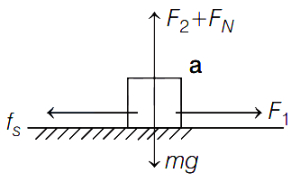
(A) $1$. First,we determine the normal force $F_N$ acting on the block. The forces in the vertical direction are the upward force $F_2$,the normal force $F_N$,and the downward gravitational force $mg$. Since the block is not moving vertically,the net vertical force is zero:
$F_2 + F_N - mg = 0$
$10 \ N + F_N - (2 \ kg)(10 \ m/s^2) = 0$
$10 \ N + F_N - 20 \ N = 0$
$F_N = 10 \ N$
$2$. Next,we calculate the limiting static friction force $f_{s,max}$:
$f_{s,max} = \mu_s F_N = 0.4 \times 10 \ N = 4.0 \ N$
$3$. The applied horizontal force is $F_1 = 6 \ N$. Since the applied horizontal force $F_1$ is greater than the limiting static friction force $f_{s,max}$ $(6 \ N > 4.0 \ N)$,the block will start to move.
$4$. Once the block is in motion,the frictional force acting on it is the kinetic friction force $f_k$:
$f_k = \mu_k F_N = 0.25 \times 10 \ N = 2.5 \ N$
Therefore,the magnitude of the frictional force acting on the block is $2.5 \ N$.
$F_2 + F_N - mg = 0$
$10 \ N + F_N - (2 \ kg)(10 \ m/s^2) = 0$
$10 \ N + F_N - 20 \ N = 0$
$F_N = 10 \ N$
$2$. Next,we calculate the limiting static friction force $f_{s,max}$:
$f_{s,max} = \mu_s F_N = 0.4 \times 10 \ N = 4.0 \ N$
$3$. The applied horizontal force is $F_1 = 6 \ N$. Since the applied horizontal force $F_1$ is greater than the limiting static friction force $f_{s,max}$ $(6 \ N > 4.0 \ N)$,the block will start to move.
$4$. Once the block is in motion,the frictional force acting on it is the kinetic friction force $f_k$:
$f_k = \mu_k F_N = 0.25 \times 10 \ N = 2.5 \ N$
Therefore,the magnitude of the frictional force acting on the block is $2.5 \ N$.
0 likes
View Solution144
DifficultMCQ
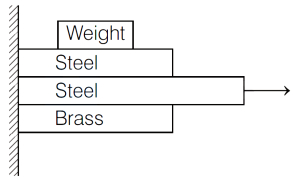
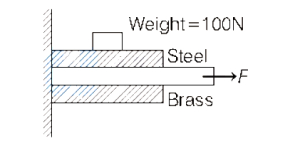
$A$ movable steel plate is placed between fixed steel and brass plates and the stack of plates is subjected to a weight of $100 \ N$ as shown in the figure. The coefficient of kinetic friction for steel on steel is $0.57$ and for steel on brass is $0.44$. Assuming that the entire weight comes onto the stack and that the weight of the plates is negligible in comparison to the applied weight,the force required to move the middle plate (in $N$) is
A
$13$
B
$101$
C
$440$
D
$570$
Solution
(B) To move the middle steel plate,the applied force $F$ must overcome the kinetic friction forces acting on both its top and bottom surfaces.
$1$. The normal force $R$ acting on the surfaces is equal to the applied weight,$R = 100 \ N$.
$2$. The friction force on the top surface (between steel and steel) is $f_{SS} = \mu_{SS} \times R = 0.57 \times 100 = 57 \ N$.
$3$. The friction force on the bottom surface (between steel and brass) is $f_{SB} = \mu_{SB} \times R = 0.44 \times 100 = 44 \ N$.
$4$. The total force $F$ required to move the plate is the sum of these two friction forces:
$F = f_{SS} + f_{SB} = 57 \ N + 44 \ N = 101 \ N$.
$1$. The normal force $R$ acting on the surfaces is equal to the applied weight,$R = 100 \ N$.
$2$. The friction force on the top surface (between steel and steel) is $f_{SS} = \mu_{SS} \times R = 0.57 \times 100 = 57 \ N$.
$3$. The friction force on the bottom surface (between steel and brass) is $f_{SB} = \mu_{SB} \times R = 0.44 \times 100 = 44 \ N$.
$4$. The total force $F$ required to move the plate is the sum of these two friction forces:
$F = f_{SS} + f_{SB} = 57 \ N + 44 \ N = 101 \ N$.
0 likes
View Solution145
EasyMCQ
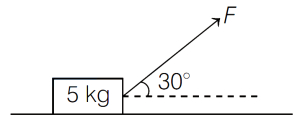
$A$ block of mass $5 \,kg$ is pulled by a force $F$ as shown in the figure. If the coefficient of friction is $0.1$, then the force needed to accelerate the block to $3 \,m/s^2$ to the right is close to (in $\,N$)
A
$12$
B
$22$
C
$32$
D
$42$
Solution
(B) The forces acting on the block are the applied force $F$ at an angle of $30^{\circ}$ with the horizontal, the weight $mg$ acting downwards, the normal reaction $N$ acting upwards, and the kinetic friction $f_k$ acting to the left.
Resolving the force $F$ into horizontal and vertical components: $F_x = F \cos 30^{\circ}$ and $F_y = F \sin 30^{\circ}$.
For vertical equilibrium: $N + F \sin 30^{\circ} = mg \Rightarrow N = mg - F \sin 30^{\circ}$.
Given $m = 5 \,kg$, $g = 9.8 \,m/s^2$, and $\mu = 0.1$, we have $N = (5 \times 9.8) - F \sin 30^{\circ} = 49 - 0.5F$.
The kinetic friction is $f_k = \mu N = 0.1(49 - 0.5F) = 4.9 - 0.05F$.
The net force in the horizontal direction is $F_{\text{net}} = F \cos 30^{\circ} - f_k = ma$.
Substituting the values: $F(\frac{\sqrt{3}}{2}) - (4.9 - 0.05F) = 5 \times 3$.
$0.866F - 4.9 + 0.05F = 15$.
$0.916F = 19.9$.
$F = \frac{19.9}{0.916} \approx 21.73 \,N$.
This value is closest to $22 \,N$.
Resolving the force $F$ into horizontal and vertical components: $F_x = F \cos 30^{\circ}$ and $F_y = F \sin 30^{\circ}$.
For vertical equilibrium: $N + F \sin 30^{\circ} = mg \Rightarrow N = mg - F \sin 30^{\circ}$.
Given $m = 5 \,kg$, $g = 9.8 \,m/s^2$, and $\mu = 0.1$, we have $N = (5 \times 9.8) - F \sin 30^{\circ} = 49 - 0.5F$.
The kinetic friction is $f_k = \mu N = 0.1(49 - 0.5F) = 4.9 - 0.05F$.
The net force in the horizontal direction is $F_{\text{net}} = F \cos 30^{\circ} - f_k = ma$.
Substituting the values: $F(\frac{\sqrt{3}}{2}) - (4.9 - 0.05F) = 5 \times 3$.
$0.866F - 4.9 + 0.05F = 15$.
$0.916F = 19.9$.
$F = \frac{19.9}{0.916} \approx 21.73 \,N$.
This value is closest to $22 \,N$.
0 likes
View Solution146
MediumMCQ
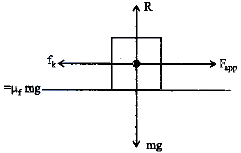
$A$ block of mass $0.5 \ kg$ is at rest on a horizontal table. The coefficient of kinetic friction between the table and the block is $0.2$. If a horizontal force of $5 \ N$ is applied on the block,the kinetic energy of the block in a time of $4 \ s$ is (Acceleration due to gravity $= 10 \ m/s^2$). (in $J$)
A
$64$
B
$128$
C
$256$
D
$512$
Solution
(C) Given: Applied force $F_{\text{app}} = 5 \ N$,mass $m = 0.5 \ kg$,coefficient of kinetic friction $\mu_k = 0.2$,time $t = 4 \ s$,initial velocity $u = 0$,acceleration due to gravity $g = 10 \ m/s^2$.
The kinetic frictional force is given by $f_k = \mu_k N = \mu_k mg$.
$f_k = 0.2 \times 0.5 \times 10 = 1 \ N$.
The net force acting on the block is $F_{\text{net}} = F_{\text{app}} - f_k = 5 - 1 = 4 \ N$.
The acceleration of the block is $a = \frac{F_{\text{net}}}{m} = \frac{4}{0.5} = 8 \ m/s^2$.
The velocity of the block after $4 \ s$ is $v = u + at = 0 + (8 \times 4) = 32 \ m/s$.
The kinetic energy of the block is $K.E. = \frac{1}{2} mv^2 = \frac{1}{2} \times 0.5 \times (32)^2 = 0.25 \times 1024 = 256 \ J$.
The kinetic frictional force is given by $f_k = \mu_k N = \mu_k mg$.
$f_k = 0.2 \times 0.5 \times 10 = 1 \ N$.
The net force acting on the block is $F_{\text{net}} = F_{\text{app}} - f_k = 5 - 1 = 4 \ N$.
The acceleration of the block is $a = \frac{F_{\text{net}}}{m} = \frac{4}{0.5} = 8 \ m/s^2$.
The velocity of the block after $4 \ s$ is $v = u + at = 0 + (8 \times 4) = 32 \ m/s$.
The kinetic energy of the block is $K.E. = \frac{1}{2} mv^2 = \frac{1}{2} \times 0.5 \times (32)^2 = 0.25 \times 1024 = 256 \ J$.
0 likes
View Solution147
EasyMCQ
When the engine is switched off,a vehicle of mass $M$ is moving on a rough horizontal road with momentum $p$. If the coefficient of friction between the road and the tyres of the vehicle is $\mu_k$,what is the distance travelled by the vehicle before it comes to rest?
A
$\frac{p^2}{2 \mu_k M^2 g}$
B
$\frac{2 \mu_k M^2 g}{p^2}$
C
$\frac{p^2}{2 \mu_k g}$
D
$\frac{p^2 M^2}{2 \mu_k g}$
Solution
(A) The initial kinetic energy of the vehicle is given by $K = \frac{p^2}{2M}$.
When the engine is switched off,the only force acting to stop the vehicle is the kinetic friction force $f_k = \mu_k M g$.
The work done by the friction force in stopping the vehicle over a distance $s$ is equal to the change in kinetic energy.
$|W| = f_k \cdot s = \mu_k M g s$.
According to the work-energy theorem,the work done by friction equals the initial kinetic energy:
$\mu_k M g s = \frac{p^2}{2M}$.
Solving for $s$,we get:
$s = \frac{p^2}{2 M^2 \mu_k g}$.
When the engine is switched off,the only force acting to stop the vehicle is the kinetic friction force $f_k = \mu_k M g$.
The work done by the friction force in stopping the vehicle over a distance $s$ is equal to the change in kinetic energy.
$|W| = f_k \cdot s = \mu_k M g s$.
According to the work-energy theorem,the work done by friction equals the initial kinetic energy:
$\mu_k M g s = \frac{p^2}{2M}$.
Solving for $s$,we get:
$s = \frac{p^2}{2 M^2 \mu_k g}$.
0 likes
View SolutionNewton's Laws of Motion and Friction — Kinetic Friction and Motion on Rough Horizontal Surface · Frequently Asked Questions
1Are these Newton's Laws of Motion and Friction questions useful for JEE and NEET?
Yes. All questions in this section are mapped to JEE Main and NEET exam patterns. Previous year questions from JEE Main, NEET, GUJCET and state-level exams are included with full solutions.
2Can I switch to Hindi or Gujarati for these questions?
Yes. Use the language tabs in the hero section or the sidebar to view the same questions and solutions in English, Hindi or Gujarati.
3How do I generate a question paper from this subtopic?
Use the Vedclass Exam Paper Generator — select the chapter and subtopic, set difficulty, and generate Sets A, B, C, D automatically. First 3 chapters of every subject are free.
Vedclass Products
For Students
Vedclass Test Series
Mock tests in real JEE/NEET style with performance analysis. 5-day free trial.
Start Free TrialFor Teachers
Exam Paper Generator
Generate Set A/B/C/D papers from this chapter in 2 minutes. 3 chapters free.
Try FreeFor Institutes
Online Exam Module
Live online exams with unlimited students, 360° analytics & white-label branding.
See DemoFor Teachers & Institutes
Generate a Newton's Laws of Motion and Friction Exam Paper in 2 Minutes
Select subtopic & difficulty — Sets A, B, C, D auto-generated with No Repeat logic.
First 3 chapters of every subject are free — no payment required.