
A English
Block on Block System, psudo force and Constrained Motion In Friction Questions in English
Class 11 Physics · Newton's Laws of Motion and Friction · Block on Block System, psudo force and Constrained Motion In Friction
66+
Questions
English
Language
100%
With Solutions
Showing 16 of 66 questions in English
51
DifficultMCQ
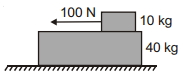
$A$ $40 \,kg$ slab rests on a frictionless floor. $A$ $10 \,kg$ block rests on top of the slab. The coefficient of friction between the block and the slab is $0.40$. The $10 \,kg$ block is acted upon by a horizontal force of $100 \,N$. If $g=10 \,m/s^2$,the resulting acceleration of the slab will be ............. $m/s^2$.
A
$1.0$
B
$1.47$
C
$1.52$
D
$6.1$
Solution
(A) The maximum static friction force between the block and the slab is given by $f_{\text{max}} = \mu N = \mu m_1 g$,where $m_1 = 10 \,kg$ and $\mu = 0.40$.
$f_{\text{max}} = 0.40 \times 10 \times 10 = 40 \,N$.
This friction force acts on the $40 \,kg$ slab in the direction of the applied force.
The acceleration of the slab is caused by this friction force.
Using Newton's second law for the slab $(m_2 = 40 \,kg)$:
$F_{\text{friction}} = m_2 a_{\text{slab}}$
$40 \,N = 40 \,kg \times a_{\text{slab}}$
$a_{\text{slab}} = 1.0 \,m/s^2$.
$f_{\text{max}} = 0.40 \times 10 \times 10 = 40 \,N$.
This friction force acts on the $40 \,kg$ slab in the direction of the applied force.
The acceleration of the slab is caused by this friction force.
Using Newton's second law for the slab $(m_2 = 40 \,kg)$:
$F_{\text{friction}} = m_2 a_{\text{slab}}$
$40 \,N = 40 \,kg \times a_{\text{slab}}$
$a_{\text{slab}} = 1.0 \,m/s^2$.
0 likes
View Solution52
MediumMCQ
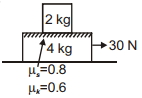
The figure shows a two-block system. $A$ $4 \,kg$ block rests on a smooth horizontal surface,and the upper surface of the $4 \,kg$ block is rough. $A$ block of mass $2 \,kg$ is placed on its upper surface. Given $\mu_s = 0.8$ and $\mu_k = 0.6$ between the two blocks. The acceleration of the upper block with respect to the earth when the $4 \,kg$ mass is pulled by a force of $30 \,N$ is ......... $m/s^2$.
A
$6$
B
$5$
C
$8$
D
$2$
Solution
(B) $1$. Assume both blocks move together with a common acceleration $a$. The total mass of the system is $M = 4 \,kg + 2 \,kg = 6 \,kg$.
$2$. The external force applied is $F = 30 \,N$. The common acceleration is $a = F / M = 30 / 6 = 5 \,m/s^2$.
$3$. To check if they move together,we calculate the required frictional force $f$ on the $2 \,kg$ block: $f = m \cdot a = 2 \,kg \times 5 \,m/s^2 = 10 \,N$.
$4$. The limiting friction $f_L$ between the blocks is $f_L = \mu_s \cdot N = \mu_s \cdot (m \cdot g) = 0.8 \times 2 \times 10 = 16 \,N$.
$5$. Since the required frictional force $(10 \,N)$ is less than the limiting friction $(16 \,N)$,the blocks will move together with an acceleration of $5 \,m/s^2$.
$2$. The external force applied is $F = 30 \,N$. The common acceleration is $a = F / M = 30 / 6 = 5 \,m/s^2$.
$3$. To check if they move together,we calculate the required frictional force $f$ on the $2 \,kg$ block: $f = m \cdot a = 2 \,kg \times 5 \,m/s^2 = 10 \,N$.
$4$. The limiting friction $f_L$ between the blocks is $f_L = \mu_s \cdot N = \mu_s \cdot (m \cdot g) = 0.8 \times 2 \times 10 = 16 \,N$.
$5$. Since the required frictional force $(10 \,N)$ is less than the limiting friction $(16 \,N)$,the blocks will move together with an acceleration of $5 \,m/s^2$.
0 likes
View Solution53
DifficultMCQ
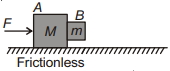
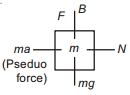
The coefficient of friction between blocks $A$ and $B$ is $\mu$. The minimum force $F$ with which $A$ must be pushed such that $B$ will not slip down is
A
$\frac{M g}{\mu}$
B
$\frac{m g}{\mu}$
C
$\frac{(M+m) g}{\mu}$
D
$\frac{(M-m) g}{\mu}$
Solution
(C) Let $a$ be the common acceleration of the system consisting of blocks $A$ and $B$.
The total force applied is $F$,and the total mass is $(M+m)$.
Using Newton's second law for the whole system: $F = (M+m)a$,which gives $a = \frac{F}{M+m}$.
Now,consider the free body diagram of block $B$ of mass $m$.
For block $B$ not to slip down,the upward frictional force $f$ must balance the downward gravitational force $mg$.
So,$f = mg$.
The frictional force is given by $f = \mu N$,where $N$ is the normal force exerted by block $A$ on block $B$.
The normal force $N$ provides the acceleration $a$ to block $B$,so $N = ma$.
Substituting $a$: $N = m \left( \frac{F}{M+m} \right)$.
Now,equate the frictional force to the weight: $\mu N = mg$.
$\mu \left( m \frac{F}{M+m} \right) = mg$.
Solving for $F$: $F = \frac{(M+m)g}{\mu}$.
Thus,the correct option is $C$.
The total force applied is $F$,and the total mass is $(M+m)$.
Using Newton's second law for the whole system: $F = (M+m)a$,which gives $a = \frac{F}{M+m}$.
Now,consider the free body diagram of block $B$ of mass $m$.
For block $B$ not to slip down,the upward frictional force $f$ must balance the downward gravitational force $mg$.
So,$f = mg$.
The frictional force is given by $f = \mu N$,where $N$ is the normal force exerted by block $A$ on block $B$.
The normal force $N$ provides the acceleration $a$ to block $B$,so $N = ma$.
Substituting $a$: $N = m \left( \frac{F}{M+m} \right)$.
Now,equate the frictional force to the weight: $\mu N = mg$.
$\mu \left( m \frac{F}{M+m} \right) = mg$.
Solving for $F$: $F = \frac{(M+m)g}{\mu}$.
Thus,the correct option is $C$.
0 likes
View Solution54
MediumMCQ
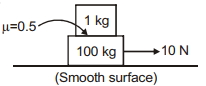
The frictional force acting on the $1 \,kg$ block is .................. $N$.
A
$0.1$
B
$2$
C
$0.5$
D
$5$
Solution
(A) Assume both blocks move together with a common acceleration $a$. The total mass of the system is $M = 1 \,kg + 100 \,kg = 101 \,kg$. The external force applied is $F = 10 \,N$.
Using Newton's second law,$F = Ma$,we get $10 = 101 \times a$,so $a = \frac{10}{101} \approx 0.099 \,m/s^2 \approx 0.1 \,m/s^2$.
The frictional force $f$ acting on the $1 \,kg$ block provides the acceleration to it. Thus,$f = m \times a = 1 \,kg \times 0.1 \,m/s^2 = 0.1 \,N$.
The maximum limiting friction is $f_L = \mu N = 0.5 \times 1 \,kg \times 10 \,m/s^2 = 5 \,N$.
Since the required frictional force $(0.1 \,N)$ is less than the limiting friction $(5 \,N)$,the blocks will move together,and the frictional force acting on the $1 \,kg$ block is $0.1 \,N$.
Using Newton's second law,$F = Ma$,we get $10 = 101 \times a$,so $a = \frac{10}{101} \approx 0.099 \,m/s^2 \approx 0.1 \,m/s^2$.
The frictional force $f$ acting on the $1 \,kg$ block provides the acceleration to it. Thus,$f = m \times a = 1 \,kg \times 0.1 \,m/s^2 = 0.1 \,N$.
The maximum limiting friction is $f_L = \mu N = 0.5 \times 1 \,kg \times 10 \,m/s^2 = 5 \,N$.
Since the required frictional force $(0.1 \,N)$ is less than the limiting friction $(5 \,N)$,the blocks will move together,and the frictional force acting on the $1 \,kg$ block is $0.1 \,N$.
0 likes
View Solution55
DifficultMCQ
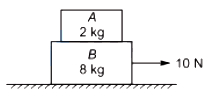
Block $A$ of mass $2 \, kg$ is placed over block $B$ of mass $8 \, kg$. The combination is placed over a rough horizontal surface. The coefficient of friction between block $B$ and the floor is $0.5$. The coefficient of friction between blocks $A$ and $B$ is $0.4$. A horizontal force of $10 \, N$ is applied on block $B$. Find the force of friction between blocks $A$ and $B$. (Take $g = 10 \, ms^{-2}$)
A
$100 \, N$
B
$40 \, N$
C
$50 \, N$
D
Zero
Solution
(D) $1$. Total mass of the system $(A + B) = 2 \, kg + 8 \, kg = 10 \, kg$.
$2$. The maximum static friction (limiting friction) between block $B$ and the horizontal floor is given by $f_{max} = \mu_s N$, where $N$ is the normal reaction force from the floor.
$3$. The normal reaction $N = (m_A + m_B)g = 10 \, kg \times 10 \, ms^{-2} = 100 \, N$.
$4$. Therefore, $f_{max} = 0.5 \times 100 \, N = 50 \, N$.
$5$. The applied horizontal force on block $B$ is $F_{app} = 10 \, N$.
$6$. Since $F_{app} < f_{max}$ $(10 \, N < 50 \, N)$, the entire system remains at rest.
$7$. Because the system is at rest and no external force is acting on block $A$ to cause relative motion between $A$ and $B$, the static friction force between blocks $A$ and $B$ is zero.
$2$. The maximum static friction (limiting friction) between block $B$ and the horizontal floor is given by $f_{max} = \mu_s N$, where $N$ is the normal reaction force from the floor.
$3$. The normal reaction $N = (m_A + m_B)g = 10 \, kg \times 10 \, ms^{-2} = 100 \, N$.
$4$. Therefore, $f_{max} = 0.5 \times 100 \, N = 50 \, N$.
$5$. The applied horizontal force on block $B$ is $F_{app} = 10 \, N$.
$6$. Since $F_{app} < f_{max}$ $(10 \, N < 50 \, N)$, the entire system remains at rest.
$7$. Because the system is at rest and no external force is acting on block $A$ to cause relative motion between $A$ and $B$, the static friction force between blocks $A$ and $B$ is zero.
0 likes
View Solution56
DifficultMCQ
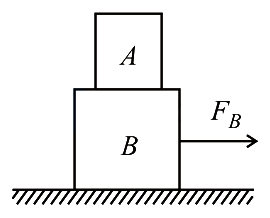
Two blocks $A$ and $B$ of masses $4 \ kg$ and $6 \ kg$ are as shown in the figure. $A$ horizontal force of $12 \ N$ is required to make $A$ slip over $B$. Find the maximum horizontal force $F_B$ that can be applied on $B$ so that both $A$ and $B$ move together. (Take $g=10 \ m \ s^{-2}$) (in $N$)
A
$30$
B
$27$
C
$32$
D
$25$
Solution
(A) The force required to make block $A$ slip over block $B$ is the limiting friction force $f_{max} = 12 \ N$.
For block $A$ to move with block $B$ without slipping,the maximum acceleration $a_{max}$ of the system is determined by the maximum friction force acting on $A$:
$f_{max} = m_A \cdot a_{max}$
$12 \ N = 4 \ kg \cdot a_{max}$
$a_{max} = 3 \ m \ s^{-2}$
Now,consider the system of both blocks $A$ and $B$ moving together with acceleration $a_{max}$. The total mass of the system is $M = m_A + m_B = 4 \ kg + 6 \ kg = 10 \ kg$.
The maximum horizontal force $F_B$ that can be applied on $B$ is:
$F_B = M \cdot a_{max}$
$F_B = 10 \ kg \cdot 3 \ m \ s^{-2} = 30 \ N$.
For block $A$ to move with block $B$ without slipping,the maximum acceleration $a_{max}$ of the system is determined by the maximum friction force acting on $A$:
$f_{max} = m_A \cdot a_{max}$
$12 \ N = 4 \ kg \cdot a_{max}$
$a_{max} = 3 \ m \ s^{-2}$
Now,consider the system of both blocks $A$ and $B$ moving together with acceleration $a_{max}$. The total mass of the system is $M = m_A + m_B = 4 \ kg + 6 \ kg = 10 \ kg$.
The maximum horizontal force $F_B$ that can be applied on $B$ is:
$F_B = M \cdot a_{max}$
$F_B = 10 \ kg \cdot 3 \ m \ s^{-2} = 30 \ N$.
0 likes
View Solution57
DifficultMCQ
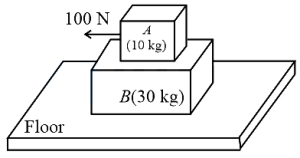
$A$ $30 \ kg$ slab $B$ rests on a frictionless floor as shown in the figure. $A$ $10 \ kg$ block $A$ rests on top of the slab $B$. The coefficients of static and kinetic friction between the block $A$ and the slab $B$ are $0.60$ and $0.40$ respectively. When block $A$ is acted upon by a horizontal force of $100 \ N$ as shown,find the resulting acceleration of the slab $B$. $(g = 9.8 \ m \ s^{-2})$ (in $m \ s^{-2}$)
A
$0.98$
B
$1.47$
C
$1.52$
D
$1.31$
Solution
(D) $1$. Calculate the maximum static frictional force between block $A$ and slab $B$: $f_{s,max} = \mu_s N = \mu_s m_A g = 0.60 \times 10 \times 9.8 = 58 \ N$.
$2$. Since the applied force $(100 \ N)$ is greater than the maximum static friction $(58 \ N)$,block $A$ will slide over slab $B$.
$3$. Once sliding occurs,the kinetic friction force acts between the surfaces: $f_k = \mu_k N = \mu_k m_A g = 0.40 \times 10 \times 9.8 = 39.2 \ N$.
$4$. This kinetic friction force $f_k$ is the only horizontal force acting on slab $B$ (since the floor is frictionless).
$5$. Using Newton's second law for slab $B$: $F_{net} = M_B a_B \Rightarrow f_k = M_B a_B$.
$6$. $39.2 = 30 \times a_B \Rightarrow a_B = \frac{39.2}{30} \approx 1.31 \ m \ s^{-2}$.
$2$. Since the applied force $(100 \ N)$ is greater than the maximum static friction $(58 \ N)$,block $A$ will slide over slab $B$.
$3$. Once sliding occurs,the kinetic friction force acts between the surfaces: $f_k = \mu_k N = \mu_k m_A g = 0.40 \times 10 \times 9.8 = 39.2 \ N$.
$4$. This kinetic friction force $f_k$ is the only horizontal force acting on slab $B$ (since the floor is frictionless).
$5$. Using Newton's second law for slab $B$: $F_{net} = M_B a_B \Rightarrow f_k = M_B a_B$.
$6$. $39.2 = 30 \times a_B \Rightarrow a_B = \frac{39.2}{30} \approx 1.31 \ m \ s^{-2}$.
0 likes
View Solution58
DifficultMCQ
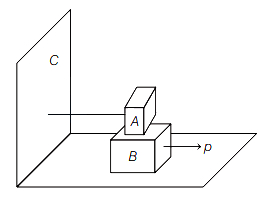
Block $A$ of mass $100 \ kg$ is kept above another block $B$ of mass $300 \ kg$. Block $A$ is tied to the wall $C$ with a horizontal string. The coefficient of friction between $A$ and $B$ is $0.35$ and that between $B$ and the horizontal surface is $0.5$. Find the horizontal force $P$ necessary to move the block $B$. (in $N$)
A
$1150$
B
$1250$
C
$2350$
D
$1420$
Solution
(C) Given:
Mass of block $A$,$m_A = 100 \ kg$
Mass of block $B$,$m_B = 300 \ kg$
Coefficient of friction between $A$ and $B$,$\mu_1 = 0.35$
Coefficient of friction between $B$ and the surface,$\mu_2 = 0.5$
Acceleration due to gravity,$g = 9.8 \ m/s^2$
When block $B$ is pulled with force $P$,block $A$ remains stationary due to the string attached to the wall. Thus,kinetic friction acts at both interfaces.
$1$. Frictional force between $A$ and $B$ $(f_1)$:
$f_1 = \mu_1 N_1 = \mu_1 m_A g$
$f_1 = 0.35 \times 100 \times 9.8 = 343 \ N$
$2$. Frictional force between $B$ and the surface $(f_2)$:
The normal force on the surface is the weight of both blocks: $N_2 = (m_A + m_B)g$
$f_2 = \mu_2 N_2 = 0.5 \times (100 + 300) \times 9.8$
$f_2 = 0.5 \times 400 \times 9.8 = 1960 \ N$
$3$. Total force $P$ required to move block $B$:
$P = f_1 + f_2$
$P = 343 + 1960 = 2303 \ N$
Comparing with the given options,the nearest value is $2350 \ N$. Therefore,option $(C)$ is the correct choice.
Mass of block $A$,$m_A = 100 \ kg$
Mass of block $B$,$m_B = 300 \ kg$
Coefficient of friction between $A$ and $B$,$\mu_1 = 0.35$
Coefficient of friction between $B$ and the surface,$\mu_2 = 0.5$
Acceleration due to gravity,$g = 9.8 \ m/s^2$
When block $B$ is pulled with force $P$,block $A$ remains stationary due to the string attached to the wall. Thus,kinetic friction acts at both interfaces.
$1$. Frictional force between $A$ and $B$ $(f_1)$:
$f_1 = \mu_1 N_1 = \mu_1 m_A g$
$f_1 = 0.35 \times 100 \times 9.8 = 343 \ N$
$2$. Frictional force between $B$ and the surface $(f_2)$:
The normal force on the surface is the weight of both blocks: $N_2 = (m_A + m_B)g$
$f_2 = \mu_2 N_2 = 0.5 \times (100 + 300) \times 9.8$
$f_2 = 0.5 \times 400 \times 9.8 = 1960 \ N$
$3$. Total force $P$ required to move block $B$:
$P = f_1 + f_2$
$P = 343 + 1960 = 2303 \ N$
Comparing with the given options,the nearest value is $2350 \ N$. Therefore,option $(C)$ is the correct choice.
0 likes
View Solution59
MediumMCQ
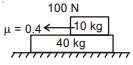
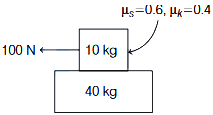
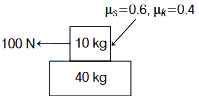
If $100 \,N$ force is applied to $10 \,kg$ block as shown in the diagram,the acceleration of $40 \,kg$ slab is (in $\,ms^{-2}$)
A
$1.65$
B
$0.98$
C
$0.5$
D
$0.25$
Solution
(B) The static friction force between the $10 \,kg$ and $40 \,kg$ block is given by:
$F_s = \mu_s R = 0.6 \times (10 \,kg) \times (9.8 \,ms^{-2}) = 58.8 \,N$
Since the applied force $(F = 100 \,N)$ is greater than the maximum static friction force $(58.8 \,N)$,the $10 \,kg$ block will move relative to the $40 \,kg$ slab.
Due to this relative motion,the kinetic friction force acting on the $40 \,kg$ slab is:
$f_k = \mu_k R = 0.4 \times (10 \,kg) \times (9.8 \,ms^{-2}) = 39.2 \,N$
This kinetic friction force $f_k$ is the only horizontal force acting on the $40 \,kg$ slab.
Therefore,the acceleration $a$ of the $40 \,kg$ slab is:
$a = \frac{f_k}{m_{slab}} = \frac{39.2 \,N}{40 \,kg} = 0.98 \,ms^{-2}$
$F_s = \mu_s R = 0.6 \times (10 \,kg) \times (9.8 \,ms^{-2}) = 58.8 \,N$
Since the applied force $(F = 100 \,N)$ is greater than the maximum static friction force $(58.8 \,N)$,the $10 \,kg$ block will move relative to the $40 \,kg$ slab.
Due to this relative motion,the kinetic friction force acting on the $40 \,kg$ slab is:
$f_k = \mu_k R = 0.4 \times (10 \,kg) \times (9.8 \,ms^{-2}) = 39.2 \,N$
This kinetic friction force $f_k$ is the only horizontal force acting on the $40 \,kg$ slab.
Therefore,the acceleration $a$ of the $40 \,kg$ slab is:
$a = \frac{f_k}{m_{slab}} = \frac{39.2 \,N}{40 \,kg} = 0.98 \,ms^{-2}$
0 likes
View Solution60
MediumMCQ
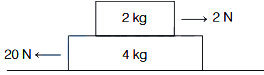
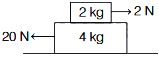
In the arrangement shown in the figure,the coefficient of friction between the two blocks is $0.5$. The force of friction between the two blocks is (Assume that the $4 \,kg$ block is placed on a smooth horizontal surface.) (Acceleration due to gravity $= 10 \,ms^{-2}$.) (in $\,N$)
A
$8$
B
$10$
C
$6$
D
$4$
Solution
(D) Let the mass of the upper block be $m_1 = 2 \,kg$ and the lower block be $m_2 = 4 \,kg$. The coefficient of friction between the blocks is $\mu = 0.5$.
First,calculate the limiting friction force $f_L$ between the two blocks:
$f_L = \mu N = \mu m_1 g = 0.5 \times 2 \,kg \times 10 \,ms^{-2} = 10 \,N$.
Now,consider the forces acting on the $2 \,kg$ block. $A$ horizontal force of $2 \,N$ is applied to it. Since the applied force $(2 \,N)$ is less than the limiting friction $(10 \,N)$,the $2 \,kg$ block will not slide relative to the $4 \,kg$ block.
In this state of static equilibrium,the friction force $f$ acting on the $2 \,kg$ block must exactly balance the applied external force to keep it stationary relative to the $4 \,kg$ block.
Therefore,$f = 2 \,N$.
First,calculate the limiting friction force $f_L$ between the two blocks:
$f_L = \mu N = \mu m_1 g = 0.5 \times 2 \,kg \times 10 \,ms^{-2} = 10 \,N$.
Now,consider the forces acting on the $2 \,kg$ block. $A$ horizontal force of $2 \,N$ is applied to it. Since the applied force $(2 \,N)$ is less than the limiting friction $(10 \,N)$,the $2 \,kg$ block will not slide relative to the $4 \,kg$ block.
In this state of static equilibrium,the friction force $f$ acting on the $2 \,kg$ block must exactly balance the applied external force to keep it stationary relative to the $4 \,kg$ block.
Therefore,$f = 2 \,N$.
0 likes
View Solution61
EasyMCQ
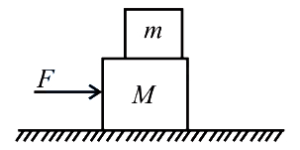
Two blocks of masses $M$ and $m$ are placed on one another on a smooth horizontal surface as shown in the figure. The force $F$ is acting on the mass $M$ horizontally during time interval $t$. Assuming no relative sliding between the blocks,the work done by friction on the blocks is .......... .
A
$\frac{F t}{2(M+m)}$
B
$\frac{M+m}{m t^2}$
C
$\frac{m F^2 t^2}{2(M+m)^2}$
D
$\frac{F^2 t^2}{(M+m)}$
Solution
(C) Since the blocks move together with no relative sliding,the acceleration $a$ of the system is given by Newton's second law: $a = \frac{F}{M+m}$.
The friction force $f$ acting on the upper block of mass $m$ provides the necessary acceleration for it to move with the lower block. Thus,$f = ma = m \left( \frac{F}{M+m} \right) = \frac{mF}{M+m}$.
The distance $s$ covered by the blocks in time $t$ starting from rest is $s = \frac{1}{2} a t^2 = \frac{1}{2} \left( \frac{F}{M+m} \right) t^2$.
The work done by friction on the upper block is $W = f \times s = \left( \frac{mF}{M+m} \right) \times \left( \frac{1}{2} \frac{F t^2}{M+m} \right) = \frac{m F^2 t^2}{2(M+m)^2}$.
Note: The work done by friction on the lower block is equal in magnitude but opposite in sign $(-W)$,so the net work done by friction on the system is zero. The question asks for the work done by friction on the blocks (implying the upper block),which is $\frac{m F^2 t^2}{2(M+m)^2}$.
The friction force $f$ acting on the upper block of mass $m$ provides the necessary acceleration for it to move with the lower block. Thus,$f = ma = m \left( \frac{F}{M+m} \right) = \frac{mF}{M+m}$.
The distance $s$ covered by the blocks in time $t$ starting from rest is $s = \frac{1}{2} a t^2 = \frac{1}{2} \left( \frac{F}{M+m} \right) t^2$.
The work done by friction on the upper block is $W = f \times s = \left( \frac{mF}{M+m} \right) \times \left( \frac{1}{2} \frac{F t^2}{M+m} \right) = \frac{m F^2 t^2}{2(M+m)^2}$.
Note: The work done by friction on the lower block is equal in magnitude but opposite in sign $(-W)$,so the net work done by friction on the system is zero. The question asks for the work done by friction on the blocks (implying the upper block),which is $\frac{m F^2 t^2}{2(M+m)^2}$.
0 likes
View Solution62
EasyMCQ
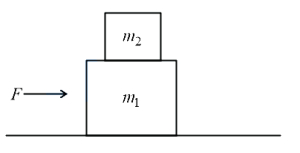
What is the maximum force $F$ that can be applied on block $m_1$,so that both $m_1$ and $m_2$ will move together? There is no friction between $m_1$ and the horizontal table. The coefficient of friction between $m_1$ and $m_2$ is $\mu$.
A
$\mu m_2 g$
B
$\mu(m_1+m_2) g$
C
$\mu \frac{m_1 m_2}{(m_1+m_2)} g$
D
$\mu m_1 g$
Solution
(B) For both blocks to move together,the block $m_2$ must move with the same acceleration $a$ as $m_1$. The only force causing $m_2$ to accelerate is the static friction force $f$ acting between $m_1$ and $m_2$.
The maximum static friction force is $f_{\max} = \mu N = \mu m_2 g$.
Applying Newton's second law to block $m_2$:
$f_{\max} = m_2 a \implies \mu m_2 g = m_2 a \implies a = \mu g$.
Now,applying Newton's second law to the system of both blocks $(m_1 + m_2)$:
$F_{\max} = (m_1 + m_2) a$.
Substituting the value of $a$:
$F_{\max} = (m_1 + m_2) \mu g = \mu(m_1 + m_2) g$.
The maximum static friction force is $f_{\max} = \mu N = \mu m_2 g$.
Applying Newton's second law to block $m_2$:
$f_{\max} = m_2 a \implies \mu m_2 g = m_2 a \implies a = \mu g$.
Now,applying Newton's second law to the system of both blocks $(m_1 + m_2)$:
$F_{\max} = (m_1 + m_2) a$.
Substituting the value of $a$:
$F_{\max} = (m_1 + m_2) \mu g = \mu(m_1 + m_2) g$.
0 likes
View Solution63
MediumMCQ
$A$ truck of mass $8 \text{ ton}$ is carrying a block of mass $2 \text{ ton}$. If a breaking force of $25 \text{ kN}$ is applied on the truck, then the frictional force acting on the block is (Coefficient of static friction between the block and the truck is $0.3$) (in $\text{ N}$)
A
$6250$
B
$6000$
C
$5000$
D
$1000$
Solution
(C) Total mass of the system $M = 8 \text{ ton} + 2 \text{ ton} = 10 \text{ ton} = 10000 \text{ kg}$.
Breaking force $F = 25000 \text{ N}$.
Deceleration of the truck $a = F / M = 25000 / 10000 = 2.5 \text{ m/s}^2$.
The block of mass $m = 2000 \text{ kg}$ experiences a pseudo force $F_p = m \times a = 2000 \times 2.5 = 5000 \text{ N}$ in the forward direction.
The maximum static frictional force available is $f_{max} = \mu \times m \times g = 0.3 \times 2000 \times 10 = 6000 \text{ N}$.
Since the required force to keep the block stationary $(5000 \text{ N})$ is less than the maximum static friction $(6000 \text{ N})$, the block will not slide.
Therefore, the frictional force acting on the block is equal to the pseudo force, which is $5000 \text{ N}$.
Breaking force $F = 25000 \text{ N}$.
Deceleration of the truck $a = F / M = 25000 / 10000 = 2.5 \text{ m/s}^2$.
The block of mass $m = 2000 \text{ kg}$ experiences a pseudo force $F_p = m \times a = 2000 \times 2.5 = 5000 \text{ N}$ in the forward direction.
The maximum static frictional force available is $f_{max} = \mu \times m \times g = 0.3 \times 2000 \times 10 = 6000 \text{ N}$.
Since the required force to keep the block stationary $(5000 \text{ N})$ is less than the maximum static friction $(6000 \text{ N})$, the block will not slide.
Therefore, the frictional force acting on the block is equal to the pseudo force, which is $5000 \text{ N}$.
0 likes
View Solution64
MediumMCQ
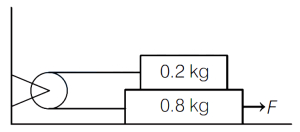
Consider a system of two masses and a pulley shown in the figure. The coefficient of friction between the two blocks and also between the bottom block and the table is $\mu = 0.1$. Find the force $F$ that must be applied to the $0.8 \text{ kg}$ block such that it attains an acceleration of $5 \text{ m/s}^2$. (Assume acceleration due to gravity, $g = 10 \text{ m/s}^2$.) (in $\text{ N}$)
A
$6.4$
B
$7.1$
C
$6.0$
D
$7.8$
Solution
(A) Let $m_1 = 0.8 \text{ kg}$ and $m_2 = 0.2 \text{ kg}$. The acceleration is $a = 5 \text{ m/s}^2$. The coefficient of friction is $\mu = 0.1$.
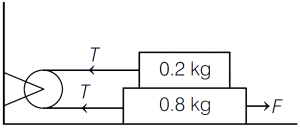
For the $0.2 \text{ kg}$ block, the tension $T$ pulls it towards the pulley, and the friction force $f_2$ from the $0.8 \text{ kg}$ block opposes this motion. The normal force on the $0.2 \text{ kg}$ block is $N_2 = m_2 g = 0.2 \times 10 = 2 \text{ N}$.
Equation of motion for $m_2$: $T - \mu N_2 = m_2 a \implies T - 0.1 \times 2 = 0.2 \times 5 \implies T - 0.2 = 1.0 \implies T = 1.2 \text{ N}$.
For the $0.8 \text{ kg}$ block, the applied force $F$ acts to the right. The tension $T$ acts to the left. The friction force $f_1$ from the table acts to the left, and the friction force $f_2$ from the $0.2 \text{ kg}$ block also acts to the left. The normal force from the table is $N_1 = (m_1 + m_2)g = (0.8 + 0.2) \times 10 = 10 \text{ N}$.
Equation of motion for $m_1$: $F - T - \mu N_1 - \mu N_2 = m_1 a \implies F - 1.2 - 0.1 \times 10 - 0.1 \times 2 = 0.8 \times 5 \implies F - 1.2 - 1 - 0.2 = 4 \implies F - 2.4 = 4 \implies F = 6.4 \text{ N}$.
For the $0.2 \text{ kg}$ block, the tension $T$ pulls it towards the pulley, and the friction force $f_2$ from the $0.8 \text{ kg}$ block opposes this motion. The normal force on the $0.2 \text{ kg}$ block is $N_2 = m_2 g = 0.2 \times 10 = 2 \text{ N}$.
Equation of motion for $m_2$: $T - \mu N_2 = m_2 a \implies T - 0.1 \times 2 = 0.2 \times 5 \implies T - 0.2 = 1.0 \implies T = 1.2 \text{ N}$.
For the $0.8 \text{ kg}$ block, the applied force $F$ acts to the right. The tension $T$ acts to the left. The friction force $f_1$ from the table acts to the left, and the friction force $f_2$ from the $0.2 \text{ kg}$ block also acts to the left. The normal force from the table is $N_1 = (m_1 + m_2)g = (0.8 + 0.2) \times 10 = 10 \text{ N}$.
Equation of motion for $m_1$: $F - T - \mu N_1 - \mu N_2 = m_1 a \implies F - 1.2 - 0.1 \times 10 - 0.1 \times 2 = 0.8 \times 5 \implies F - 1.2 - 1 - 0.2 = 4 \implies F - 2.4 = 4 \implies F = 6.4 \text{ N}$.
0 likes
View Solution65
MediumMCQ
Block $A$ of mass $3 \ kg$ rests on another block $B$ of mass $7 \ kg$. The coefficient of friction between $A$ and $B$ is $0.4$,while the coefficient of friction between $B$ and the horizontal floor on which $B$ rests is $0.55$. Find the force of friction between $A$ and $B$ when a horizontal force of $50 \ N$ is applied on block $B$. (Use $g = 10 \ m/s^2$) (in $N$)
A
$0$
B
$5$
C
$4$
D
$1.2$
Solution
(A) Let $m_A = 3 \ kg$ and $m_B = 7 \ kg$. The applied force $F = 50 \ N$ acts on block $B$.
First,we check if the system moves. The maximum static friction force between block $B$ and the floor is $f_{max, floor} = \mu_{floor} (m_A + m_B) g$.
$f_{max, floor} = 0.55 \times (3 + 7) \times 10 = 0.55 \times 100 = 55 \ N$.
Since the applied force $F = 50 \ N$ is less than the maximum static friction force $f_{max, floor} = 55 \ N$,the system remains at rest.
Because block $B$ does not move and there is no external force acting on block $A$ to cause it to slide relative to block $B$,the static friction force between $A$ and $B$ must be zero to maintain equilibrium.
Therefore,the force of friction between $A$ and $B$ is $0 \ N$.
First,we check if the system moves. The maximum static friction force between block $B$ and the floor is $f_{max, floor} = \mu_{floor} (m_A + m_B) g$.
$f_{max, floor} = 0.55 \times (3 + 7) \times 10 = 0.55 \times 100 = 55 \ N$.
Since the applied force $F = 50 \ N$ is less than the maximum static friction force $f_{max, floor} = 55 \ N$,the system remains at rest.
Because block $B$ does not move and there is no external force acting on block $A$ to cause it to slide relative to block $B$,the static friction force between $A$ and $B$ must be zero to maintain equilibrium.
Therefore,the force of friction between $A$ and $B$ is $0 \ N$.
0 likes
View Solution66
MediumMCQ
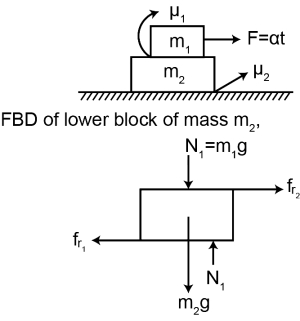
$A$ block of mass $m_{2}$ is placed on a horizontal table and another block of mass $m_{1}$ is placed on top of it. An increasing horizontal force $F=\alpha t$ is exerted on the upper block,but the lower block never moves as a result. If the coefficient of friction between the blocks is $\mu_{1}$ and that between the lower block and the table is $\mu_{2}$,then what is the maximum possible value of $\mu_{1} / \mu_{2}$?
A
$\frac{m_{2}}{m_{1}}$
B
$1+\frac{m_{2}}{m_{1}}$
C
$\frac{m_{1}}{m_{2}}$
D
$1+\frac{m_{1}}{m_{2}}$
Solution
(B) Let $N_{1}$ be the normal force between the two blocks and $N_{2}$ be the normal force between the lower block and the table.
For the upper block of mass $m_{1}$,the normal force is $N_{1} = m_{1}g$.
For the lower block of mass $m_{2}$,the total downward force is $N_{2} = m_{2}g + N_{1} = (m_{1} + m_{2})g$.
The horizontal force $F$ on the upper block creates a frictional force $f_{1}$ on the lower block,where $f_{1} \leq \mu_{1}N_{1} = \mu_{1}m_{1}g$.
For the lower block to never move,the maximum static frictional force from the table must be greater than or equal to the maximum possible frictional force exerted by the upper block on the lower block.
Thus,$\mu_{2}N_{2} \geq \mu_{1}N_{1}$.
Substituting the values,$\mu_{2}(m_{1} + m_{2})g \geq \mu_{1}m_{1}g$.
Dividing both sides by $\mu_{2}m_{1}g$,we get $\frac{m_{1} + m_{2}}{m_{1}} \geq \frac{\mu_{1}}{\mu_{2}}$.
Therefore,$\frac{\mu_{1}}{\mu_{2}} \leq 1 + \frac{m_{2}}{m_{1}}$.
The maximum possible value is $1 + \frac{m_{2}}{m_{1}}$.
For the upper block of mass $m_{1}$,the normal force is $N_{1} = m_{1}g$.
For the lower block of mass $m_{2}$,the total downward force is $N_{2} = m_{2}g + N_{1} = (m_{1} + m_{2})g$.
The horizontal force $F$ on the upper block creates a frictional force $f_{1}$ on the lower block,where $f_{1} \leq \mu_{1}N_{1} = \mu_{1}m_{1}g$.
For the lower block to never move,the maximum static frictional force from the table must be greater than or equal to the maximum possible frictional force exerted by the upper block on the lower block.
Thus,$\mu_{2}N_{2} \geq \mu_{1}N_{1}$.
Substituting the values,$\mu_{2}(m_{1} + m_{2})g \geq \mu_{1}m_{1}g$.
Dividing both sides by $\mu_{2}m_{1}g$,we get $\frac{m_{1} + m_{2}}{m_{1}} \geq \frac{\mu_{1}}{\mu_{2}}$.
Therefore,$\frac{\mu_{1}}{\mu_{2}} \leq 1 + \frac{m_{2}}{m_{1}}$.
The maximum possible value is $1 + \frac{m_{2}}{m_{1}}$.
0 likes
View SolutionNewton's Laws of Motion and Friction — Block on Block System, psudo force and Constrained Motion In Friction · Frequently Asked Questions
1Are these Newton's Laws of Motion and Friction questions useful for JEE and NEET?
Yes. All questions in this section are mapped to JEE Main and NEET exam patterns. Previous year questions from JEE Main, NEET, GUJCET and state-level exams are included with full solutions.
2Can I switch to Hindi or Gujarati for these questions?
Yes. Use the language tabs in the hero section or the sidebar to view the same questions and solutions in English, Hindi or Gujarati.
3How do I generate a question paper from this subtopic?
Use the Vedclass Exam Paper Generator — select the chapter and subtopic, set difficulty, and generate Sets A, B, C, D automatically. First 3 chapters of every subject are free.
Vedclass Products
For Students
Vedclass Test Series
Mock tests in real JEE/NEET style with performance analysis. 5-day free trial.
Start Free TrialFor Teachers
Exam Paper Generator
Generate Set A/B/C/D papers from this chapter in 2 minutes. 3 chapters free.
Try FreeFor Institutes
Online Exam Module
Live online exams with unlimited students, 360° analytics & white-label branding.
See DemoFor Teachers & Institutes
Generate a Newton's Laws of Motion and Friction Exam Paper in 2 Minutes
Select subtopic & difficulty — Sets A, B, C, D auto-generated with No Repeat logic.
First 3 chapters of every subject are free — no payment required.