
A English
Apparent weight and Pseudo Force Questions in English
Class 11 Physics · Newton's Laws of Motion and Friction · Apparent weight and Pseudo Force
157+
Questions
English
Language
100%
With Solutions
Showing 50 of 157 questions in English
51
EasyMCQ
$A$ weight is suspended from the ceiling of a lift by a spring balance. When the lift is stationary,the spring balance reads $W$. If the lift suddenly falls freely under gravity,the reading on the spring balance will be
A
$W$
B
$2 W$
C
$W/2$
D
$0$
Solution
(D) The reading of a spring balance in a lift is given by the apparent weight $R = m(g - a)$,where $m$ is the mass of the object,$g$ is the acceleration due to gravity,and $a$ is the acceleration of the lift.
When the lift is stationary,$a = 0$,so the reading $R = mg = W$.
If the lift falls freely under gravity,the acceleration of the lift $a = g$.
Substituting this into the formula,we get $R = m(g - g) = m(0) = 0$.
Therefore,the reading on the spring balance will be $0$.
When the lift is stationary,$a = 0$,so the reading $R = mg = W$.
If the lift falls freely under gravity,the acceleration of the lift $a = g$.
Substituting this into the formula,we get $R = m(g - g) = m(0) = 0$.
Therefore,the reading on the spring balance will be $0$.
0 likes
View Solution52
DifficultMCQ
$A$ metallic rod of length $L$ and mass $M$ is moving under the action of two unequal forces $F_1$ and $F_2$ (directed opposite to each other) acting at its ends along its length. Ignore gravity and any external magnetic field. If the specific charge of electrons is $(e/m)$,then the potential difference between the ends of the rod in steady state must be:
A
$|F_1 - F_2| mL / eM$
B
$(F_1 - F_2) mL / eM$
C
$[mL / eM] \ln [F_1 / F_2]$
D
None
Solution
(B) The acceleration $a$ of the rod is given by $a = (F_1 - F_2) / M$.
In the steady state,the electrons inside the rod experience a pseudo-force $F_p = m a$ in the direction opposite to the acceleration,which causes charge separation and creates an internal electric field $E$.
For an electron of mass $m$ and charge $-e$,the force due to the electric field is $F_e = e E$.
In steady state,the net force on the electrons is zero,so $e E = m a$.
Substituting $a = (F_1 - F_2) / M$,we get $e E = m (F_1 - F_2) / M$,which implies $E = m (F_1 - F_2) / (M e)$.
The potential difference $V$ between the ends of the rod is $V = E L = \frac{m (F_1 - F_2) L}{M e}$.
In the steady state,the electrons inside the rod experience a pseudo-force $F_p = m a$ in the direction opposite to the acceleration,which causes charge separation and creates an internal electric field $E$.
For an electron of mass $m$ and charge $-e$,the force due to the electric field is $F_e = e E$.
In steady state,the net force on the electrons is zero,so $e E = m a$.
Substituting $a = (F_1 - F_2) / M$,we get $e E = m (F_1 - F_2) / M$,which implies $E = m (F_1 - F_2) / (M e)$.
The potential difference $V$ between the ends of the rod is $V = E L = \frac{m (F_1 - F_2) L}{M e}$.

0 likes
View Solution53
MediumMCQ
$A$ body is thrown up in a lift with a velocity $u$ relative to the lift,and the time of flight is found to be $t$. The acceleration with which the lift is moving up is:
A
$\frac{2u - gt}{t}$
B
$\frac{2u + gt}{t}$
C
$\frac{u - gt}{t}$
D
$\frac{u + gt}{t}$
Solution
(A) Let the acceleration of the lift moving upwards be $a$.
The acceleration of the body relative to the lift is $a_{rel} = g_{eff} = g + a$ (downwards).
The initial velocity of the body relative to the lift is $u$.
The time of flight $t$ is given by the formula $t = \frac{2u}{a_{rel}}$.
Substituting $a_{rel} = g + a$,we get $t = \frac{2u}{g + a}$.
Rearranging for $a$:
$t(g + a) = 2u$
$gt + at = 2u$
$at = 2u - gt$
$a = \frac{2u - gt}{t}$.
The acceleration of the body relative to the lift is $a_{rel} = g_{eff} = g + a$ (downwards).
The initial velocity of the body relative to the lift is $u$.
The time of flight $t$ is given by the formula $t = \frac{2u}{a_{rel}}$.
Substituting $a_{rel} = g + a$,we get $t = \frac{2u}{g + a}$.
Rearranging for $a$:
$t(g + a) = 2u$
$gt + at = 2u$
$at = 2u - gt$
$a = \frac{2u - gt}{t}$.
0 likes
View Solution54
MediumMCQ
$A$ stunt man jumps his car over a crater as shown (neglect air resistance).
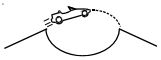
A
During the whole flight,the driver experiences weightlessness.
B
During the whole flight,the driver never experiences weightlessness.
C
During the whole flight,the driver experiences weightlessness only at the highest point.
D
The apparent weight increases during the upward journey.
Solution
(A) When the car is in the air,it is in a state of free fall under the influence of gravity alone.
In this state,the acceleration of the car and the driver is $a = g$ (downwards).
If we analyze the motion from the frame of reference of the driver,we apply a pseudo force $F_p = m g$ acting in the upward direction.
The actual weight of the driver is $W = m g$ acting in the downward direction.
The net force on the driver in their own frame is $F_{net} = F_p - W = m g - m g = 0$.
Since the net force acting on the driver is zero,they experience a state of weightlessness throughout the entire duration of the flight.
In this state,the acceleration of the car and the driver is $a = g$ (downwards).
If we analyze the motion from the frame of reference of the driver,we apply a pseudo force $F_p = m g$ acting in the upward direction.
The actual weight of the driver is $W = m g$ acting in the downward direction.
The net force on the driver in their own frame is $F_{net} = F_p - W = m g - m g = 0$.
Since the net force acting on the driver is zero,they experience a state of weightlessness throughout the entire duration of the flight.
0 likes
View Solution55
MediumMCQ
$A$ block of mass $m$ moving with a velocity $v_0$ on a smooth horizontal surface strikes and compresses a spring of stiffness $k$ until the mass comes to rest,as shown in the figure. This phenomenon is observed by two observers:
$A$: standing on the horizontal surface
$B$: standing on the block
To an observer $B$,when the block is compressing the spring:
$A$: standing on the horizontal surface
$B$: standing on the block
To an observer $B$,when the block is compressing the spring:

A
velocity of the block is decreasing
B
retardation of the block is increasing
C
kinetic energy of the block is zero
D
all the above
Solution
(C) Observer $B$ is standing on the block,which means observer $B$ is in a non-inertial frame of reference.
In the frame of the block,the block itself is always at rest. Therefore,the velocity of the block with respect to observer $B$ is always zero.
Since the velocity is zero,the kinetic energy of the block with respect to observer $B$ is also zero $(K.E. = \frac{1}{2} m v_{rel}^2 = 0)$.
Thus,options $A$ and $B$ are incorrect because they describe motion relative to the ground,not relative to the block. Option $C$ is correct because the block is stationary in the frame of reference of observer $B$.
In the frame of the block,the block itself is always at rest. Therefore,the velocity of the block with respect to observer $B$ is always zero.
Since the velocity is zero,the kinetic energy of the block with respect to observer $B$ is also zero $(K.E. = \frac{1}{2} m v_{rel}^2 = 0)$.
Thus,options $A$ and $B$ are incorrect because they describe motion relative to the ground,not relative to the block. Option $C$ is correct because the block is stationary in the frame of reference of observer $B$.
0 likes
View Solution56
MediumMCQ
$A$ block of mass $m$ is kept in an elevator which starts moving downward with an acceleration $a$ as shown in the figure. The block is observed by two observers $A$ and $B$ for a time interval $t_0$. The observer $B$ is on the ground (inertial frame). What is the work done by the pseudo force on the block as observed by observer $B$?

A
$0$
B
$-ma^2t_0$
C
$+ma^2t_0$
D
$-mgat_0$
Solution
(A) The pseudo force is a fictitious force that appears only in non-inertial frames of reference.
Observer $B$ is on the ground,which is an inertial frame of reference.
In an inertial frame,the pseudo force does not exist.
Therefore,the work done by the pseudo force as observed by observer $B$ is $0$.
Observer $B$ is on the ground,which is an inertial frame of reference.
In an inertial frame,the pseudo force does not exist.
Therefore,the work done by the pseudo force as observed by observer $B$ is $0$.
0 likes
View Solution57
DifficultMCQ
$A$ block of mass $m$ is kept in an elevator which starts moving downward with an acceleration $a$ as shown in the figure. The block is observed by two observers $A$ and $B$ for a time interval $t_0$. According to the observer $A$,which of the following is true?
A
the work done by gravity is zero
B
the work done by normal reaction is zero
C
the work done by pseudo force is zero
D
all the above
Solution
(D) Observer $A$ is inside the elevator,which is an accelerating frame of reference.
In the frame of reference of $A$,the block is at rest because it moves with the same acceleration as the elevator.
Since the block is at rest relative to observer $A$,its displacement $d$ is zero $(d = 0)$.
Work done is defined as $W = F \cdot d \cdot \cos(\theta)$.
Since the displacement $d$ is zero for observer $A$,the work done by any force (gravity,normal reaction,or pseudo force) acting on the block is zero.
Therefore,all the given statements are correct.
In the frame of reference of $A$,the block is at rest because it moves with the same acceleration as the elevator.
Since the block is at rest relative to observer $A$,its displacement $d$ is zero $(d = 0)$.
Work done is defined as $W = F \cdot d \cdot \cos(\theta)$.
Since the displacement $d$ is zero for observer $A$,the work done by any force (gravity,normal reaction,or pseudo force) acting on the block is zero.
Therefore,all the given statements are correct.
0 likes
View Solution58
DifficultMCQ
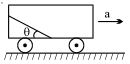
$A$ smooth rod of length $l$ is kept inside a trolley at an angle $\theta$ as shown in the figure. What should be the acceleration $a$ of the trolley so that the rod remains in equilibrium with respect to it?
A
$g \tan \theta$
B
$g \cos \theta$
C
$g \sin \theta$
D
$g \cot \theta$
Solution
(D) To keep the rod in equilibrium with respect to the trolley,we analyze the forces in the non-inertial frame of the trolley.
Let the rod have mass $m$ and length $l$. The forces acting on the rod in the trolley's frame are:
$1$. Gravitational force $mg$ acting downwards at the center of mass.
$2$. Pseudo force $ma$ acting horizontally backwards at the center of mass.
$3$. Normal reactions $N_1$ and $N_2$ at the ends of the rod,perpendicular to the rod's surface.
For rotational equilibrium about the center of mass,the torques due to the forces must balance. The center of mass is at a distance $l/2$ from both ends.
The torque due to the pseudo force $ma$ about the center of mass is $\tau_{pseudo} = (ma) \cdot (l/2) \sin \theta$.
The torque due to the gravitational force $mg$ about the center of mass is $\tau_{gravity} = (mg) \cdot (l/2) \cos \theta$.
For the rod to be in equilibrium,the net torque about the center of mass must be zero:
$(ma) \cdot (l/2) \sin \theta = (mg) \cdot (l/2) \cos \theta$
Canceling $(l/2)$ from both sides:
$ma \sin \theta = mg \cos \theta$
Solving for $a$:
$a = g \frac{\cos \theta}{\sin \theta} = g \cot \theta$
Let the rod have mass $m$ and length $l$. The forces acting on the rod in the trolley's frame are:
$1$. Gravitational force $mg$ acting downwards at the center of mass.
$2$. Pseudo force $ma$ acting horizontally backwards at the center of mass.
$3$. Normal reactions $N_1$ and $N_2$ at the ends of the rod,perpendicular to the rod's surface.
For rotational equilibrium about the center of mass,the torques due to the forces must balance. The center of mass is at a distance $l/2$ from both ends.
The torque due to the pseudo force $ma$ about the center of mass is $\tau_{pseudo} = (ma) \cdot (l/2) \sin \theta$.
The torque due to the gravitational force $mg$ about the center of mass is $\tau_{gravity} = (mg) \cdot (l/2) \cos \theta$.
For the rod to be in equilibrium,the net torque about the center of mass must be zero:
$(ma) \cdot (l/2) \sin \theta = (mg) \cdot (l/2) \cos \theta$
Canceling $(l/2)$ from both sides:
$ma \sin \theta = mg \cos \theta$
Solving for $a$:
$a = g \frac{\cos \theta}{\sin \theta} = g \cot \theta$
0 likes
View Solution59
DifficultMCQ
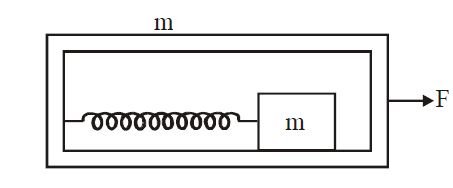
$A$ container of mass $m$ is pulled by a constant force $F$. Inside the container,a second block of the same mass $m$ is placed,connected to the wall by a massless spring of constant $k$. Initially,the spring is at its natural length. Find the velocity of the container at the instant the compression in the spring is maximum for the first time.
A
$\pi F \sqrt{\frac{1}{2km}}$
B
$\frac{\pi F}{2} \sqrt{\frac{1}{2km}}$
C
$\pi F \sqrt{\frac{1}{km}}$
D
$\frac{\pi F}{2} \sqrt{\frac{1}{km}}$
Solution
(D) Let the acceleration of the container be $a_c = F/m$. In the frame of the container,the block experiences a pseudo-force $F_p = ma_c = F$ acting towards the left.
This is equivalent to a spring-mass system starting from its natural length with a constant force $F$ applied to the mass $m$. The effective spring constant is $k$.
The angular frequency is $\omega = \sqrt{k/m}$.
The time taken to reach maximum compression is half the time period of the oscillation,$t = T/2 = \pi / \omega = \pi \sqrt{m/k}$.
During this time,the impulse equation for the system (container + block) in the horizontal direction is $\int F dt = \Delta P = (m+m)v_f - (m+m)v_i$.
Since $v_i = 0$,we have $F \cdot t = 2mv_f$.
Substituting $t = \pi \sqrt{m/k}$,we get $F \pi \sqrt{m/k} = 2mv_f$.
Thus,$v_f = \frac{F \pi}{2} \sqrt{\frac{m}{k}} \cdot \frac{1}{m} = \frac{\pi F}{2} \sqrt{\frac{1}{km}}$.
This is equivalent to a spring-mass system starting from its natural length with a constant force $F$ applied to the mass $m$. The effective spring constant is $k$.
The angular frequency is $\omega = \sqrt{k/m}$.
The time taken to reach maximum compression is half the time period of the oscillation,$t = T/2 = \pi / \omega = \pi \sqrt{m/k}$.
During this time,the impulse equation for the system (container + block) in the horizontal direction is $\int F dt = \Delta P = (m+m)v_f - (m+m)v_i$.
Since $v_i = 0$,we have $F \cdot t = 2mv_f$.
Substituting $t = \pi \sqrt{m/k}$,we get $F \pi \sqrt{m/k} = 2mv_f$.
Thus,$v_f = \frac{F \pi}{2} \sqrt{\frac{m}{k}} \cdot \frac{1}{m} = \frac{\pi F}{2} \sqrt{\frac{1}{km}}$.
0 likes
View Solution60
MediumMCQ
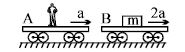
Two trolleys $A$ and $B$ are moving with accelerations $a$ and $2a$ respectively in the same direction. To an observer in trolley $A$,the magnitude of the pseudo force acting on a block of mass $m$ on trolley $B$ is
A
zero
B
$ma$
C
$2ma$
D
None
Solution
(B) The observer is in trolley $A$,which is moving with an acceleration $a$. Therefore,the frame of reference of the observer is non-inertial with an acceleration $a_{frame} = a$.
To calculate the pseudo force acting on an object of mass $m$ in this frame,we use the formula:
$F_{pseudo} = -m \cdot a_{frame}$
The magnitude of the pseudo force is $|F_{pseudo}| = m \cdot |a_{frame}| = m \cdot a$.
Thus,the magnitude of the pseudo force acting on the block of mass $m$ is $ma$.
To calculate the pseudo force acting on an object of mass $m$ in this frame,we use the formula:
$F_{pseudo} = -m \cdot a_{frame}$
The magnitude of the pseudo force is $|F_{pseudo}| = m \cdot |a_{frame}| = m \cdot a$.
Thus,the magnitude of the pseudo force acting on the block of mass $m$ is $ma$.
0 likes
View Solution61
DifficultMCQ
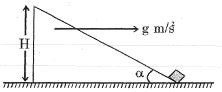
$A$ wedge of height $H$ (fixed) and inclination $\alpha$ (variable) is moving on a smooth horizontal surface with constant acceleration $g \ m/s^2$. $A$ small block is placed at the bottom of the incline as shown in the figure, and it slips on the smooth surface of the incline. Choose the $CORRECT$ statement about the time taken by the block to reach the top of the incline.
A
Time taken increases with $\alpha$ for $0 < \alpha < \frac{\pi}{4}$.
B
Time taken first increases then decreases with $\alpha$ for $0 < \alpha < \frac{\pi}{4}$.
C
Time taken first decreases then increases with $\alpha$ for $0 < \alpha < \frac{\pi}{4}$.
D
Time taken decreases with $\alpha$ for $0 < \alpha < \frac{\pi}{4}$.
Solution
(D) Let the wedge move with acceleration $g$ to the right. In the frame of the wedge, a pseudo force $F_p = mg$ acts on the block to the left.
The components of forces along the incline are:
$1$. Component of gravity: $mg \sin \alpha$ (downwards along the incline).
$2$. Component of pseudo force: $mg \cos \alpha$ (upwards along the incline).
The net acceleration $a$ of the block up the incline is given by:
$a = g \cos \alpha - g \sin \alpha = g(\cos \alpha - \sin \alpha)$.
The length of the incline is $L = \frac{H}{\sin \alpha}$.
Using the equation of motion $s = ut + \frac{1}{2}at^2$ with initial velocity $u = 0$:
$\frac{H}{\sin \alpha} = \frac{1}{2} g(\cos \alpha - \sin \alpha) t^2$.
$t^2 = \frac{2H}{g \sin \alpha (\cos \alpha - \sin \alpha)} = \frac{2H}{g (\sin \alpha \cos \alpha - \sin^2 \alpha)}$.
Using $2 \sin \alpha \cos \alpha = \sin 2\alpha$ and $2 \sin^2 \alpha = 1 - \cos 2\alpha$:
$t^2 = \frac{4H}{g (\sin 2\alpha - (1 - \cos 2\alpha))} = \frac{4H}{g (\sin 2\alpha + \cos 2\alpha - 1)}$.
For $0 < \alpha < \frac{\pi}{4}$, the denominator $f(\alpha) = \sin 2\alpha + \cos 2\alpha - 1$ increases from $0$ to $(\sqrt{2}-1)$.
Since the denominator increases, $t^2$ decreases, and thus the time $t$ decreases with $\alpha$.
The components of forces along the incline are:
$1$. Component of gravity: $mg \sin \alpha$ (downwards along the incline).
$2$. Component of pseudo force: $mg \cos \alpha$ (upwards along the incline).
The net acceleration $a$ of the block up the incline is given by:
$a = g \cos \alpha - g \sin \alpha = g(\cos \alpha - \sin \alpha)$.
The length of the incline is $L = \frac{H}{\sin \alpha}$.
Using the equation of motion $s = ut + \frac{1}{2}at^2$ with initial velocity $u = 0$:
$\frac{H}{\sin \alpha} = \frac{1}{2} g(\cos \alpha - \sin \alpha) t^2$.
$t^2 = \frac{2H}{g \sin \alpha (\cos \alpha - \sin \alpha)} = \frac{2H}{g (\sin \alpha \cos \alpha - \sin^2 \alpha)}$.
Using $2 \sin \alpha \cos \alpha = \sin 2\alpha$ and $2 \sin^2 \alpha = 1 - \cos 2\alpha$:
$t^2 = \frac{4H}{g (\sin 2\alpha - (1 - \cos 2\alpha))} = \frac{4H}{g (\sin 2\alpha + \cos 2\alpha - 1)}$.
For $0 < \alpha < \frac{\pi}{4}$, the denominator $f(\alpha) = \sin 2\alpha + \cos 2\alpha - 1$ increases from $0$ to $(\sqrt{2}-1)$.
Since the denominator increases, $t^2$ decreases, and thus the time $t$ decreases with $\alpha$.
0 likes
View Solution62
MediumMCQ
$A$ man of mass $80\ kg$ is standing inside a lift moving upward with a uniform velocity of $4\ m/s$. Then,the apparent weight of the person will be:
A
$112\ kg$
B
$112\ N$
C
$80\ kg$
D
$800\ N$
Solution
(D) The apparent weight of a person in a lift is given by the formula $W_{app} = m(g + a)$,where $m$ is the mass of the person,$g$ is the acceleration due to gravity,and $a$ is the acceleration of the lift.
In this problem,the lift is moving with a uniform velocity of $4\ m/s$.
Since the velocity is uniform,the acceleration $a$ of the lift is $0\ m/s^2$.
Therefore,the apparent weight $W_{app} = m(g + 0) = mg$.
Given $m = 80\ kg$ and taking $g = 10\ m/s^2$,we get $W_{app} = 80 \times 10 = 800\ N$.
Thus,the apparent weight is $800\ N$.
In this problem,the lift is moving with a uniform velocity of $4\ m/s$.
Since the velocity is uniform,the acceleration $a$ of the lift is $0\ m/s^2$.
Therefore,the apparent weight $W_{app} = m(g + 0) = mg$.
Given $m = 80\ kg$ and taking $g = 10\ m/s^2$,we get $W_{app} = 80 \times 10 = 800\ N$.
Thus,the apparent weight is $800\ N$.
0 likes
View Solution63
DifficultMCQ
$A$ ball is suspended on a thread from the ceiling of a car. The brakes are applied and the speed of the car changes from $5\, m/s$ to $\frac{5}{3}\, m/s$ during the time interval of $3\, s$. The angle that the thread will deviate from the vertical in the new equilibrium position is:
A
$\theta = \tan^{-1}\left(\frac{1}{9}\right)$
B
$\theta = \tan^{-1}\left(\frac{8}{9}\right)$
C
$\theta = \sin^{-1}\left(\frac{1}{9}\right)$
D
$\theta = \cos^{-1}\left(\frac{1}{9}\right)$
Solution
(A) The car is decelerating,so it experiences an acceleration (retardation) in the direction opposite to its motion.
Initial velocity $u = 5\, m/s$,final velocity $v = \frac{5}{3}\, m/s$,and time $t = 3\, s$.
The magnitude of acceleration $a$ is given by $a = \frac{|v - u|}{t} = \frac{|5/3 - 5|}{3} = \frac{|-10/3|}{3} = \frac{10}{9}\, m/s^2$.
In the non-inertial frame of the car,the ball experiences a pseudo-force $F_p = ma$ acting horizontally.
The forces acting on the ball are tension $T$,weight $mg$,and pseudo-force $ma$.
In the new equilibrium position,$\tan \theta = \frac{F_p}{mg} = \frac{ma}{mg} = \frac{a}{g}$.
Taking $g = 10\, m/s^2$,we get $\tan \theta = \frac{10/9}{10} = \frac{1}{9}$.
Therefore,$\theta = \tan^{-1}\left(\frac{1}{9}\right)$.
Initial velocity $u = 5\, m/s$,final velocity $v = \frac{5}{3}\, m/s$,and time $t = 3\, s$.
The magnitude of acceleration $a$ is given by $a = \frac{|v - u|}{t} = \frac{|5/3 - 5|}{3} = \frac{|-10/3|}{3} = \frac{10}{9}\, m/s^2$.
In the non-inertial frame of the car,the ball experiences a pseudo-force $F_p = ma$ acting horizontally.
The forces acting on the ball are tension $T$,weight $mg$,and pseudo-force $ma$.
In the new equilibrium position,$\tan \theta = \frac{F_p}{mg} = \frac{ma}{mg} = \frac{a}{g}$.
Taking $g = 10\, m/s^2$,we get $\tan \theta = \frac{10/9}{10} = \frac{1}{9}$.
Therefore,$\theta = \tan^{-1}\left(\frac{1}{9}\right)$.
0 likes
View Solution64
MediumMCQ
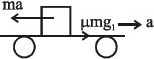
$A$ box of mass $m \, kg$ is placed on the rear side of an open truck accelerating at $4 \, m/s^2$. The coefficient of friction between the box and the surface below it is $0.4$. The net acceleration of the box with respect to the truck is zero. The value of $m$ is :- $[g = 10 \, m/s^2]$
A
$4 \, kg$
B
$8 \, kg$
C
$9.78 \, kg$
D
It could be any value
Solution
(D) To find the net acceleration of the box with respect to the truck,we analyze the forces acting on the box in the non-inertial frame of the truck.
$1$. The truck is accelerating forward with $a = 4 \, m/s^2$.
$2$. $A$ pseudo force $F_p = ma$ acts on the box in the backward direction.
$3$. The frictional force $f$ acts in the forward direction to oppose the motion,where $f = \mu N = \mu mg$.
$4$. For the box to have zero acceleration with respect to the truck,the pseudo force must be balanced by the frictional force:
$ma = \mu mg$
$a = \mu g$
$5$. Substituting the given values:
$4 = 0.4 \times 10$
$4 = 4$
Since the mass $m$ cancels out from both sides of the equation,the condition for zero relative acceleration is independent of the mass of the box.
Therefore,the box will remain stationary with respect to the truck for any value of $m$.
$1$. The truck is accelerating forward with $a = 4 \, m/s^2$.
$2$. $A$ pseudo force $F_p = ma$ acts on the box in the backward direction.
$3$. The frictional force $f$ acts in the forward direction to oppose the motion,where $f = \mu N = \mu mg$.
$4$. For the box to have zero acceleration with respect to the truck,the pseudo force must be balanced by the frictional force:
$ma = \mu mg$
$a = \mu g$
$5$. Substituting the given values:
$4 = 0.4 \times 10$
$4 = 4$
Since the mass $m$ cancels out from both sides of the equation,the condition for zero relative acceleration is independent of the mass of the box.
Therefore,the box will remain stationary with respect to the truck for any value of $m$.
0 likes
View Solution65
MediumMCQ
The weight of a man in a lift moving with the same acceleration upwards is $608 \ N$,while the weight of the same man in the lift moving downwards with the same acceleration is $368 \ N$. His normal weight is ............ $N$.
A
$480$
B
$488$
C
$588$
D
$240$
Solution
(B) When the lift accelerates upwards with acceleration $a$,the apparent weight is given by $W_1 = m(g + a) = 608 \ N$ ...$(1)$
When the lift accelerates downwards with the same acceleration $a$,the apparent weight is given by $W_2 = m(g - a) = 368 \ N$ ...$(2)$
Adding equation $(1)$ and equation $(2)$:
$m(g + a) + m(g - a) = 608 + 368$
$mg + ma + mg - ma = 976$
$2mg = 976$
$mg = \frac{976}{2} = 488 \ N$
Thus,the normal weight of the man is $488 \ N$.
When the lift accelerates downwards with the same acceleration $a$,the apparent weight is given by $W_2 = m(g - a) = 368 \ N$ ...$(2)$
Adding equation $(1)$ and equation $(2)$:
$m(g + a) + m(g - a) = 608 + 368$
$mg + ma + mg - ma = 976$
$2mg = 976$
$mg = \frac{976}{2} = 488 \ N$
Thus,the normal weight of the man is $488 \ N$.
0 likes
View Solution66
MediumMCQ
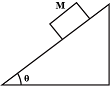
$A$ mass $M$ is placed on a smooth wedge of angle $\theta$ resting on a frictionless surface. To keep the mass $M$ at rest relative to the wedge,the wedge must be given a horizontal acceleration $a$ equal to:
A
$a$ is applied to the right and $a=g \tan \theta$
B
$a$ is applied to the left and $a=g \sin \theta$
C
$a$ is applied to the left and $a=g \cos \theta$
D
$a$ is applied to the left and $a=g \tan \theta$
Solution
(D) To keep the mass $M$ at rest relative to the wedge,we analyze the forces in the non-inertial frame of the wedge.
When the wedge accelerates to the left with acceleration $a$,a pseudo force $F_p = Ma$ acts on the mass $M$ towards the right.
The forces acting on the mass $M$ along the incline are:
$1$. The component of pseudo force $Ma \cos \theta$ acting up the incline.
$2$. The component of gravitational force $Mg \sin \theta$ acting down the incline.
For the mass to remain at rest relative to the wedge,these two forces must balance:
$Ma \cos \theta = Mg \sin \theta$
$a \cos \theta = g \sin \theta$
$a = g \frac{\sin \theta}{\cos \theta}$
$a = g \tan \theta$
Thus,an acceleration $a = g \tan \theta$ must be applied to the wedge towards the left.
When the wedge accelerates to the left with acceleration $a$,a pseudo force $F_p = Ma$ acts on the mass $M$ towards the right.
The forces acting on the mass $M$ along the incline are:
$1$. The component of pseudo force $Ma \cos \theta$ acting up the incline.
$2$. The component of gravitational force $Mg \sin \theta$ acting down the incline.
For the mass to remain at rest relative to the wedge,these two forces must balance:
$Ma \cos \theta = Mg \sin \theta$
$a \cos \theta = g \sin \theta$
$a = g \frac{\sin \theta}{\cos \theta}$
$a = g \tan \theta$
Thus,an acceleration $a = g \tan \theta$ must be applied to the wedge towards the left.
0 likes
View Solution67
MediumMCQ
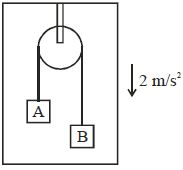
Blocks $A$ and $B$ of mass $2\,kg$ and $4\,kg$ are suspended through a string using a pulley,inside an elevator moving downward with a constant acceleration of $2\,m/s^2$. Find the tension in the string connecting the two blocks.
A
$\frac{64}{3}\,N$
B
$\frac{32}{3}\,N$
C
$\frac{8}{3}\,N$
D
$\frac{16}{3}\,N$
Solution
(A) The elevator is moving downward with an acceleration $a = 2\,m/s^2$.
In the frame of the elevator,the effective acceleration due to gravity is $g_{eff} = g - a$.
Taking $g = 10\,m/s^2$,we get $g_{eff} = 10 - 2 = 8\,m/s^2$.
The tension $T$ in a string connecting two masses $m_1$ and $m_2$ over a pulley is given by the formula $T = \frac{2 m_1 m_2}{m_1 + m_2} g_{eff}$.
Substituting the given values $m_1 = 2\,kg$,$m_2 = 4\,kg$,and $g_{eff} = 8\,m/s^2$:
$T = \frac{2 \times 2 \times 4}{2 + 4} \times 8 = \frac{16}{6} \times 8 = \frac{8}{3} \times 8 = \frac{64}{3}\,N$.
In the frame of the elevator,the effective acceleration due to gravity is $g_{eff} = g - a$.
Taking $g = 10\,m/s^2$,we get $g_{eff} = 10 - 2 = 8\,m/s^2$.
The tension $T$ in a string connecting two masses $m_1$ and $m_2$ over a pulley is given by the formula $T = \frac{2 m_1 m_2}{m_1 + m_2} g_{eff}$.
Substituting the given values $m_1 = 2\,kg$,$m_2 = 4\,kg$,and $g_{eff} = 8\,m/s^2$:
$T = \frac{2 \times 2 \times 4}{2 + 4} \times 8 = \frac{16}{6} \times 8 = \frac{8}{3} \times 8 = \frac{64}{3}\,N$.
0 likes
View Solution68
EasyMCQ
You stand on a spring scale on the floor of an elevator. Of the following,the scale shows the highest reading when the elevator
A
moves downward with increasing speed
B
moves upward with increasing speed
C
remains stationary
D
moves upward with decreasing speed
Solution
(B) The reading on a spring scale represents the normal force $(N)$ exerted by the floor on the person. According to Newton's second law,$N - mg = ma$,where $m$ is the mass of the person,$g$ is the acceleration due to gravity,and $a$ is the acceleration of the elevator. Thus,$N = m(g + a)$. The reading is highest when the upward acceleration $(a)$ is positive and maximum. When the elevator moves upward with increasing speed,it has a positive upward acceleration $(a > 0)$,resulting in $N = m(g + a) > mg$. In other cases,the acceleration is either zero or negative (downward),leading to a lower reading.
0 likes
View Solution69
MediumMCQ
$A$ man of weight $W$ is standing on a lift which is moving downward with an acceleration $a$. The apparent weight of the man is
A
$W(1 + \frac{a}{g})$
B
$W$
C
$W(1 - \frac{a}{g})$
D
$W(1 - \frac{a^2}{g^2})$
Solution
(C) When a lift moves downward with an acceleration $a$,the pseudo force acts on the man in the upward direction.
Let $m$ be the mass of the man,so $W = mg$.
The forces acting on the man are his weight $mg$ (downward) and the pseudo force $ma$ (upward).
The apparent weight $W_{app}$ is the normal reaction force exerted by the floor of the lift.
Applying Newton's second law: $mg - W_{app} = ma$.
Therefore,$W_{app} = mg - ma$.
$W_{app} = mg(1 - \frac{a}{g})$.
Since $W = mg$,we get $W_{app} = W(1 - \frac{a}{g})$.
Let $m$ be the mass of the man,so $W = mg$.
The forces acting on the man are his weight $mg$ (downward) and the pseudo force $ma$ (upward).
The apparent weight $W_{app}$ is the normal reaction force exerted by the floor of the lift.
Applying Newton's second law: $mg - W_{app} = ma$.
Therefore,$W_{app} = mg - ma$.
$W_{app} = mg(1 - \frac{a}{g})$.
Since $W = mg$,we get $W_{app} = W(1 - \frac{a}{g})$.
0 likes
View Solution70
DifficultMCQ
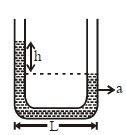
In a $U$-tube,the liquid level stands at the same level when it is at rest. When the $U$-tube is accelerated towards the right with acceleration $a$,as shown in the figure,the difference $h$ between the levels of the two arms is:
A
$\frac{aL}{2g}$
B
$\frac{gL}{2a}$
C
$\frac{gL}{a}$
D
$\frac{aL}{g}$
Solution
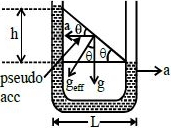
(D) When the $U$-tube is accelerated horizontally with acceleration $a$,a pseudo force acts on the liquid in the opposite direction of acceleration.
The effective acceleration $g_{\text{eff}}$ is the vector sum of the acceleration due to gravity $g$ (acting downwards) and the pseudo acceleration $a$ (acting towards the left).
The free surface of the liquid becomes perpendicular to the effective gravity vector $g_{\text{eff}}$.
The angle $\theta$ that the free surface makes with the horizontal is given by $\tan \theta = \frac{a}{g}$.
From the geometry of the $U$-tube,the slope of the liquid surface is also $\tan \theta = \frac{h}{L}$,where $h$ is the height difference and $L$ is the horizontal distance between the two arms.
Equating the two expressions for $\tan \theta$,we get $\frac{a}{g} = \frac{h}{L}$.
Therefore,the height difference is $h = \frac{aL}{g}$.
The effective acceleration $g_{\text{eff}}$ is the vector sum of the acceleration due to gravity $g$ (acting downwards) and the pseudo acceleration $a$ (acting towards the left).
The free surface of the liquid becomes perpendicular to the effective gravity vector $g_{\text{eff}}$.
The angle $\theta$ that the free surface makes with the horizontal is given by $\tan \theta = \frac{a}{g}$.
From the geometry of the $U$-tube,the slope of the liquid surface is also $\tan \theta = \frac{h}{L}$,where $h$ is the height difference and $L$ is the horizontal distance between the two arms.
Equating the two expressions for $\tan \theta$,we get $\frac{a}{g} = \frac{h}{L}$.
Therefore,the height difference is $h = \frac{aL}{g}$.
0 likes
View Solution71
MediumMCQ
$A$ person in an elevator accelerating upwards with an acceleration of $2\,ms^{-2}$,tosses a coin vertically upwards with a speed of $20\,ms^{-1}$. After how much time will the coin fall back into his hand? (Take $g = 10\,ms^{-2}$)
A
$\frac{5}{3}\,s$
B
$\frac{3}{10}\,s$
C
$\frac{10}{3}\,s$
D
$\frac{3}{5}\,s$
Solution
(C) In the frame of the elevator,the coin experiences an effective acceleration due to gravity $(g_{eff})$. Since the elevator is accelerating upwards with $a = 2\,ms^{-2}$,the pseudo force acts downwards on the coin.
The effective acceleration is $g_{eff} = g + a = 10\,ms^{-2} + 2\,ms^{-2} = 12\,ms^{-2}$.
The time taken for the coin to return to the hand is the time of flight in this accelerated frame,given by $t = \frac{2u}{g_{eff}}$,where $u = 20\,ms^{-1}$ is the initial velocity of the coin relative to the elevator.
Substituting the values: $t = \frac{2 \times 20\,ms^{-1}}{12\,ms^{-2}} = \frac{40}{12}\,s = \frac{10}{3}\,s$.
The effective acceleration is $g_{eff} = g + a = 10\,ms^{-2} + 2\,ms^{-2} = 12\,ms^{-2}$.
The time taken for the coin to return to the hand is the time of flight in this accelerated frame,given by $t = \frac{2u}{g_{eff}}$,where $u = 20\,ms^{-1}$ is the initial velocity of the coin relative to the elevator.
Substituting the values: $t = \frac{2 \times 20\,ms^{-1}}{12\,ms^{-2}} = \frac{40}{12}\,s = \frac{10}{3}\,s$.
0 likes
View Solution72
MediumMCQ
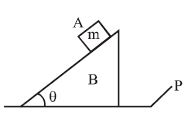
In the figure shown,$P$ is a plate on which a wedge $B$ is placed,and on $B$ a block $A$ of mass $m$ is placed. The plate is suddenly removed and the system of $B$ and $A$ is allowed to fall under gravity. Neglecting any force due to air on $A$ and $B$,the normal force on $A$ due to $B$ is
A
$\frac{mg}{\cos \theta}$
B
$mg \cos \theta$
C
zero
D
$\frac{2mg}{\cos \theta}$
Solution
(C) When the plate $P$ is removed,both the wedge $B$ and the block $A$ fall freely under gravity.
Both $A$ and $B$ experience an acceleration equal to the acceleration due to gravity,$g$,in the downward direction.
Consider the block $A$ in the frame of reference of the wedge $B$.
Since both are accelerating downwards at $g$,the pseudo-acceleration of block $A$ with respect to wedge $B$ is $g$ upwards.
Therefore,the effective acceleration of block $A$ relative to wedge $B$ is $g - g = 0$.
Since there is no relative acceleration between the block $A$ and the wedge $B$,the block $A$ does not press against the surface of the wedge $B$.
Thus,the normal force $N$ exerted by the wedge $B$ on the block $A$ is zero.
Both $A$ and $B$ experience an acceleration equal to the acceleration due to gravity,$g$,in the downward direction.
Consider the block $A$ in the frame of reference of the wedge $B$.
Since both are accelerating downwards at $g$,the pseudo-acceleration of block $A$ with respect to wedge $B$ is $g$ upwards.
Therefore,the effective acceleration of block $A$ relative to wedge $B$ is $g - g = 0$.
Since there is no relative acceleration between the block $A$ and the wedge $B$,the block $A$ does not press against the surface of the wedge $B$.
Thus,the normal force $N$ exerted by the wedge $B$ on the block $A$ is zero.
0 likes
View Solution73
MediumMCQ
$A$ ball is suspended on a thread from the ceiling of a car. The brakes are applied and the speed of the car changes from $5 \, m/s$ to $5/3 \, m/s$ during a time interval of $3 \, s$. Find the angle $\theta$ that the thread will deviate from the vertical.
A
$\theta = \tan^{-1} \left( \frac{1}{9} \right)$
B
$\theta = \tan^{-1} \left( \frac{8}{9} \right)$
C
$\theta = \sin^{-1} \left( \frac{1}{9} \right)$
D
$\theta = \cos^{-1} \left( \frac{1}{9} \right)$
Solution
(A) The car is decelerating,so it experiences a pseudo force in the forward direction. The deceleration $a$ is given by the change in velocity divided by time.
$a = \frac{v_f - v_i}{t} = \frac{5/3 - 5}{3} = \frac{-10/3}{3} = -\frac{10}{9} \, m/s^2$.
The magnitude of deceleration is $|a| = \frac{10}{9} \, m/s^2$.
In the frame of the car,the ball experiences a pseudo force $F_p = ma$ acting forward and gravity $mg$ acting downward.
The angle $\theta$ with the vertical is given by $\tan \theta = \frac{F_p}{mg} = \frac{ma}{mg} = \frac{a}{g}$.
Taking $g = 10 \, m/s^2$,we get $\tan \theta = \frac{10/9}{10} = \frac{1}{9}$.
Therefore,$\theta = \tan^{-1} \left( \frac{1}{9} \right)$.
$a = \frac{v_f - v_i}{t} = \frac{5/3 - 5}{3} = \frac{-10/3}{3} = -\frac{10}{9} \, m/s^2$.
The magnitude of deceleration is $|a| = \frac{10}{9} \, m/s^2$.
In the frame of the car,the ball experiences a pseudo force $F_p = ma$ acting forward and gravity $mg$ acting downward.
The angle $\theta$ with the vertical is given by $\tan \theta = \frac{F_p}{mg} = \frac{ma}{mg} = \frac{a}{g}$.
Taking $g = 10 \, m/s^2$,we get $\tan \theta = \frac{10/9}{10} = \frac{1}{9}$.
Therefore,$\theta = \tan^{-1} \left( \frac{1}{9} \right)$.
0 likes
View Solution74
MediumMCQ
$A$ box of mass $m \, kg$ is placed on the rear side of an open truck accelerating at $4 \, m/s^2$. The coefficient of friction between the box and the surface below it is $0.4$. The net acceleration of the box with respect to the truck is zero. The value of $m$ is $[g = 10 \, m/s^2]$.
A
$4 \, kg$
B
$8 \, kg$
C
$9.78 \, kg$
D
It could be any value
Solution
(D) To find the acceleration of the box with respect to the truck,we analyze the forces acting on the box in the non-inertial frame of reference of the truck.
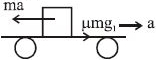
$1$. The truck is accelerating forward with $a = 4 \, m/s^2$. Therefore,a pseudo force $F_p = ma$ acts on the box in the backward direction.
$2$. The frictional force $f$ acts in the forward direction to oppose the tendency of motion relative to the truck. The maximum static friction is $f_{max} = \mu N = \mu mg$.
$3$. For the box to remain at rest with respect to the truck,the pseudo force must be balanced by the frictional force:
$ma = \mu mg$
$4$. Dividing both sides by $m$ (assuming $m \neq 0$):
$a = \mu g$
$5$. Substituting the given values:
$4 = 0.4 \times 10$
$4 = 4$
Since the equation $a = \mu g$ is independent of the mass $m$,the condition for the box to remain stationary with respect to the truck is satisfied for any value of $m$,provided the static friction is sufficient to balance the pseudo force.
$1$. The truck is accelerating forward with $a = 4 \, m/s^2$. Therefore,a pseudo force $F_p = ma$ acts on the box in the backward direction.
$2$. The frictional force $f$ acts in the forward direction to oppose the tendency of motion relative to the truck. The maximum static friction is $f_{max} = \mu N = \mu mg$.
$3$. For the box to remain at rest with respect to the truck,the pseudo force must be balanced by the frictional force:
$ma = \mu mg$
$4$. Dividing both sides by $m$ (assuming $m \neq 0$):
$a = \mu g$
$5$. Substituting the given values:
$4 = 0.4 \times 10$
$4 = 4$
Since the equation $a = \mu g$ is independent of the mass $m$,the condition for the box to remain stationary with respect to the truck is satisfied for any value of $m$,provided the static friction is sufficient to balance the pseudo force.
0 likes
View Solution75
MediumMCQ
The readings shown in two extended spring balances,$S_1$ and $S_2$,are $60\,kg$ and $30\,kg$ respectively. The lift is accelerating upward with an acceleration of $10\,m/s^2$. The mass $m$ is stationary with respect to the lift. Then the mass of the block will be ......... $kg$. (Take $g = 10\,m/s^2$)
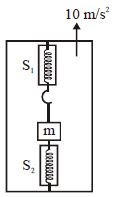
A
$45$
B
$30$
C
$60$
D
$15$
Solution
(D) Let the tension in spring $S_1$ be $T_1$ and in spring $S_2$ be $T_2$.
Given readings are in $kg$,so the forces are $T_1 = 60 \times g = 600\,N$ and $T_2 = 30 \times g = 300\,N$.
The block of mass $m$ is inside the lift accelerating upward with $a = 10\,m/s^2$.
Applying Newton's second law to the block $m$:
$T_1 - T_2 - mg = ma$
$600 - 300 = m(10 + 10)$
$300 = m(20)$
$m = \frac{300}{20} = 15\,kg$.
Given readings are in $kg$,so the forces are $T_1 = 60 \times g = 600\,N$ and $T_2 = 30 \times g = 300\,N$.
The block of mass $m$ is inside the lift accelerating upward with $a = 10\,m/s^2$.
Applying Newton's second law to the block $m$:
$T_1 - T_2 - mg = ma$
$600 - 300 = m(10 + 10)$
$300 = m(20)$
$m = \frac{300}{20} = 15\,kg$.
0 likes
View Solution76
MediumMCQ
An object of mass $2 \, kg$ is placed at rest in a frame $S_1$ moving with velocity $10 \hat{i} + 5 \hat{j} \, m/s$ and having acceleration $5 \hat{i} + 10 \hat{j} \, m/s^2$. The object is also seen by an observer standing in a frame $S_2$ moving with velocity $5 \hat{i} + 10 \hat{j} \, m/s$. Calculate the pseudo force acting on the object. Which frame is responsible for this force?
A
$F = -10 \hat{i} - 30 \hat{j}$ due to acceleration of frame $S_1$
B
$F = -10 \hat{i} - 20 \hat{j}$ due to acceleration of frame $S_1$
C
$F = -20 \hat{i} - 20 \hat{j}$ due to acceleration of frame $S_1$
D
none of these
Solution
(B) pseudo force is a fictitious force that appears to act on an object when it is observed from a non-inertial (accelerating) frame of reference.
Frame $S_1$ has an acceleration of $\vec{a}_{S_1} = 5 \hat{i} + 10 \hat{j} \, m/s^2$,which makes it a non-inertial frame.
The pseudo force $\vec{F}_p$ acting on an object of mass $m$ in an accelerating frame is given by $\vec{F}_p = -m \vec{a}_{frame}$.
Given $m = 2 \, kg$ and $\vec{a}_{S_1} = 5 \hat{i} + 10 \hat{j} \, m/s^2$,the pseudo force is:
$\vec{F}_p = -2 \times (5 \hat{i} + 10 \hat{j}) = -10 \hat{i} - 20 \hat{j} \, N$.
Therefore,the pseudo force is $-10 \hat{i} - 20 \hat{j} \, N$ and it is due to the acceleration of frame $S_1$.
Frame $S_1$ has an acceleration of $\vec{a}_{S_1} = 5 \hat{i} + 10 \hat{j} \, m/s^2$,which makes it a non-inertial frame.
The pseudo force $\vec{F}_p$ acting on an object of mass $m$ in an accelerating frame is given by $\vec{F}_p = -m \vec{a}_{frame}$.
Given $m = 2 \, kg$ and $\vec{a}_{S_1} = 5 \hat{i} + 10 \hat{j} \, m/s^2$,the pseudo force is:
$\vec{F}_p = -2 \times (5 \hat{i} + 10 \hat{j}) = -10 \hat{i} - 20 \hat{j} \, N$.
Therefore,the pseudo force is $-10 \hat{i} - 20 \hat{j} \, N$ and it is due to the acceleration of frame $S_1$.
0 likes
View Solution77
MediumMCQ
An object of mass $2 \, kg$ is placed at rest in a frame $S_1$ moving with velocity $10 \hat{i} + 5 \hat{j} \, m/s$ and having acceleration $5 \hat{i} + 10 \hat{j} \, m/s^2$. The object is also seen by an observer standing in a frame $S_2$ moving with velocity $5 \hat{i} + 10 \hat{j} \, m/s$. Calculate the net force acting on the object with respect to the $S_2$ frame.
A
$F = 20 \hat{i} + 20 \hat{j}$
B
$F = 5 \hat{i} + 20 \hat{j}$
C
$F = 10 \hat{i} + 5 \hat{j}$
D
$F = 10 \hat{i} + 20 \hat{j}$
Solution
(D) The frame $S_2$ is moving with a constant velocity $(5 \hat{i} + 10 \hat{j} \, m/s)$,which implies that its acceleration is zero. Therefore,$S_2$ is an inertial frame of reference.
In an inertial frame,the net force acting on an object is given by Newton's second law: $F = ma$.
The object is at rest in frame $S_1$,which has an acceleration $a = 5 \hat{i} + 10 \hat{j} \, m/s^2$.
Since the object is at rest relative to $S_1$,it shares the same acceleration as $S_1$ with respect to an inertial observer.
Given mass $m = 2 \, kg$ and acceleration $a = 5 \hat{i} + 10 \hat{j} \, m/s^2$,the net force is:
$F = 2 \times (5 \hat{i} + 10 \hat{j}) = 10 \hat{i} + 20 \hat{j} \, N$.
In an inertial frame,the net force acting on an object is given by Newton's second law: $F = ma$.
The object is at rest in frame $S_1$,which has an acceleration $a = 5 \hat{i} + 10 \hat{j} \, m/s^2$.
Since the object is at rest relative to $S_1$,it shares the same acceleration as $S_1$ with respect to an inertial observer.
Given mass $m = 2 \, kg$ and acceleration $a = 5 \hat{i} + 10 \hat{j} \, m/s^2$,the net force is:
$F = 2 \times (5 \hat{i} + 10 \hat{j}) = 10 \hat{i} + 20 \hat{j} \, N$.
0 likes
View Solution78
MediumMCQ
An object of mass $5\, kg$ is attached to the hook of a spring balance and the balance is suspended vertically from the roof of a lift. The reading of the spring balance when the lift is going up with an acceleration of $0.25\, m/s^2$ is ......... $N$ $(g = 10\, m/s^2)$
A
$51.25$
B
$48.75$
C
$52.75$
D
$47.25$
Solution
(A) When a lift moves upward with an acceleration $a$,the apparent weight $W$ of an object of mass $m$ is given by the formula: $W = m(g + a)$.
Given:
Mass $m = 5\, kg$
Acceleration of lift $a = 0.25\, m/s^2$
Acceleration due to gravity $g = 10\, m/s^2$
Substituting these values into the formula:
$W = 5(10 + 0.25)$
$W = 5(10.25)$
$W = 51.25\, N$
Therefore,the reading of the spring balance is $51.25\, N$.
Given:
Mass $m = 5\, kg$
Acceleration of lift $a = 0.25\, m/s^2$
Acceleration due to gravity $g = 10\, m/s^2$
Substituting these values into the formula:
$W = 5(10 + 0.25)$
$W = 5(10.25)$
$W = 51.25\, N$
Therefore,the reading of the spring balance is $51.25\, N$.
0 likes
View Solution79
DifficultMCQ
$A$ trolley is accelerating down an incline of angle $\theta$ with acceleration $g \sin \theta$. Which of the following is correct? ($\alpha$ is the constant angle made by the string with the vertical.)
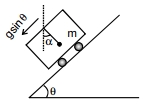
A
$\alpha = 0^\circ$
B
$\alpha = \theta$
C
Tension in the string,$T = mg$
D
Tension in the string,$T = mg \sec \theta$
Solution
(B) Consider the frame of reference of the trolley. The trolley is accelerating down the incline with acceleration $a = g \sin \theta$.
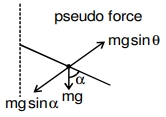
To analyze the forces on the bob of mass $m$ inside the trolley,we apply a pseudo force $F_p = ma = mg \sin \theta$ acting up the incline.
The forces acting on the bob are:
$1$. Gravitational force $mg$ acting vertically downwards.
$2$. Pseudo force $mg \sin \theta$ acting parallel to the incline upwards.
$3$. Tension $T$ in the string.
In the equilibrium position relative to the trolley,the net force on the bob is zero.
Resolving forces perpendicular to the string,we have the component of gravitational force $mg \sin \alpha$ balancing the component of the pseudo force $mg \sin \theta \cos \alpha$. However,a simpler way is to resolve forces along the direction perpendicular to the string: $mg \sin \alpha = (mg \sin \theta) \cos \alpha$ is incorrect.
Let's resolve forces along the direction perpendicular to the string: The component of $mg$ perpendicular to the string is $mg \sin \alpha$ and the component of the pseudo force $mg \sin \theta$ perpendicular to the string is $(mg \sin \theta) \cos \alpha$.
Equating these,$mg \sin \alpha = mg \sin \theta \cos \alpha \implies \tan \alpha = \sin \theta$. This is not matching the options.
Re-evaluating: The effective acceleration is the vector sum of $g$ (downwards) and $a$ (up the incline). The string aligns with the effective gravity. The angle $\alpha$ with the vertical is given by $\tan \alpha = \frac{a \cos \theta}{g - a \sin \theta}$. Substituting $a = g \sin \theta$,we get $\tan \alpha = \frac{g \sin \theta \cos \theta}{g - g \sin^2 \theta} = \frac{g \sin \theta \cos \theta}{g \cos^2 \theta} = \tan \theta$. Thus,$\alpha = \theta$.
To analyze the forces on the bob of mass $m$ inside the trolley,we apply a pseudo force $F_p = ma = mg \sin \theta$ acting up the incline.
The forces acting on the bob are:
$1$. Gravitational force $mg$ acting vertically downwards.
$2$. Pseudo force $mg \sin \theta$ acting parallel to the incline upwards.
$3$. Tension $T$ in the string.
In the equilibrium position relative to the trolley,the net force on the bob is zero.
Resolving forces perpendicular to the string,we have the component of gravitational force $mg \sin \alpha$ balancing the component of the pseudo force $mg \sin \theta \cos \alpha$. However,a simpler way is to resolve forces along the direction perpendicular to the string: $mg \sin \alpha = (mg \sin \theta) \cos \alpha$ is incorrect.
Let's resolve forces along the direction perpendicular to the string: The component of $mg$ perpendicular to the string is $mg \sin \alpha$ and the component of the pseudo force $mg \sin \theta$ perpendicular to the string is $(mg \sin \theta) \cos \alpha$.
Equating these,$mg \sin \alpha = mg \sin \theta \cos \alpha \implies \tan \alpha = \sin \theta$. This is not matching the options.
Re-evaluating: The effective acceleration is the vector sum of $g$ (downwards) and $a$ (up the incline). The string aligns with the effective gravity. The angle $\alpha$ with the vertical is given by $\tan \alpha = \frac{a \cos \theta}{g - a \sin \theta}$. Substituting $a = g \sin \theta$,we get $\tan \alpha = \frac{g \sin \theta \cos \theta}{g - g \sin^2 \theta} = \frac{g \sin \theta \cos \theta}{g \cos^2 \theta} = \tan \theta$. Thus,$\alpha = \theta$.
0 likes
View Solution80
MediumMCQ
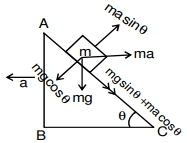
$A$ block of mass $m$ is resting on a wedge of angle $\theta$ as shown in the figure. The wedge is given a horizontal acceleration $a$. What is the minimum value of $a$ so that the mass $m$ falls freely?
A
$g \cot \theta$
B
$g$
C
$g \cos \theta$
D
$g \tan \theta$
Solution
(A) For the mass $m$ to fall freely,it must lose contact with the wedge,meaning the normal force $N$ exerted by the wedge on the block must be zero.
Consider the frame of reference of the wedge. The block experiences a pseudo force $ma$ in the direction opposite to the acceleration $a$ of the wedge.
The forces acting on the block perpendicular to the inclined surface are the component of gravity $mg \cos \theta$ acting inwards and the component of the pseudo force $ma \sin \theta$ acting outwards.
For the block to lose contact,the normal force $N$ must be zero:
$N = mg \cos \theta - ma \sin \theta = 0$
$mg \cos \theta = ma \sin \theta$
$a = g \frac{\cos \theta}{\sin \theta}$
$a = g \cot \theta$
Consider the frame of reference of the wedge. The block experiences a pseudo force $ma$ in the direction opposite to the acceleration $a$ of the wedge.
The forces acting on the block perpendicular to the inclined surface are the component of gravity $mg \cos \theta$ acting inwards and the component of the pseudo force $ma \sin \theta$ acting outwards.
For the block to lose contact,the normal force $N$ must be zero:
$N = mg \cos \theta - ma \sin \theta = 0$
$mg \cos \theta = ma \sin \theta$
$a = g \frac{\cos \theta}{\sin \theta}$
$a = g \cot \theta$
0 likes
View Solution81
EasyMCQ
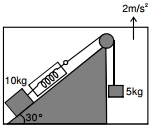
In the figure,the reading of the spring balance will be $......\,N$ $\left[ g = 10\,m/s^2 \right]$.
A
$60$
B
$50$
C
$40$
D
$70$
Solution
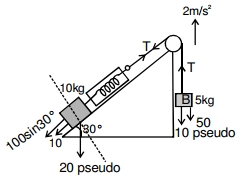
(A) The system is accelerating upwards with $a = 2\,m/s^2$. We use a pseudo-force approach in the frame of the wedge.
For the $5\,kg$ block hanging vertically:
The forces are tension $T$ (upwards),weight $mg = 5 \times 10 = 50\,N$ (downwards),and pseudo-force $ma = 5 \times 2 = 10\,N$ (downwards).
Equation of motion: $T - 50 - 10 = 0 \implies T = 60\,N$.
The spring balance measures the tension in the string,which is $60\,N$.
For the $5\,kg$ block hanging vertically:
The forces are tension $T$ (upwards),weight $mg = 5 \times 10 = 50\,N$ (downwards),and pseudo-force $ma = 5 \times 2 = 10\,N$ (downwards).
Equation of motion: $T - 50 - 10 = 0 \implies T = 60\,N$.
The spring balance measures the tension in the string,which is $60\,N$.
0 likes
View Solution82
DifficultMCQ
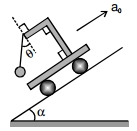
$A$ pendulum of mass $m$ hangs from a support fixed to a trolley. The direction of the string when the trolley rolls up an inclined plane of inclination $\alpha$ with acceleration $a_0$ is (the string and bob remain fixed with respect to the trolley):
A
$\theta=\tan ^{-1} \alpha$
B
$\theta=\tan ^{-1}\left(\frac{a_0}{g}\right)$
C
$\theta=\tan ^{-1}\left(\frac{g}{a_0}\right)$
D
$\theta=\tan ^{-1}\left(\frac{a_0+g \sin \alpha}{g \cos \alpha}\right)$
Solution
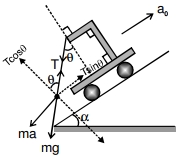
(D) To find the angle $\theta$ of the pendulum string,we analyze the forces acting on the bob in the non-inertial frame of the trolley.
$1$. The forces acting on the bob are tension $T$,gravity $mg$,and the pseudo force $ma_0$ acting in the direction opposite to the acceleration of the trolley.
$2$. Resolve the forces into components parallel and perpendicular to the string.
$3$. The effective acceleration vector $\vec{g}_{eff}$ is the vector sum of gravity $\vec{g}$ and the pseudo acceleration $-\vec{a}_0$. The string aligns itself with the direction of $\vec{g}_{eff}$.
$4$. The components of gravity are $mg \cos \alpha$ (perpendicular to the incline) and $mg \sin \alpha$ (parallel to the incline).
$5$. The pseudo force $ma_0$ acts parallel to the incline,directed downwards along the slope.
$6$. Balancing forces perpendicular to the string:
$T = mg \cos \alpha \cos \theta + (mg \sin \alpha + ma_0) \sin \theta$
$7$. Balancing forces parallel to the string:
$mg \cos \alpha \sin \theta = (mg \sin \alpha + ma_0) \cos \theta$
$8$. Rearranging the equation:
$\tan \theta = \frac{ma_0 + mg \sin \alpha}{mg \cos \alpha} = \frac{a_0 + g \sin \alpha}{g \cos \alpha}$
Therefore,$\theta = \tan^{-1} \left( \frac{a_0 + g \sin \alpha}{g \cos \alpha} \right)$.
$1$. The forces acting on the bob are tension $T$,gravity $mg$,and the pseudo force $ma_0$ acting in the direction opposite to the acceleration of the trolley.
$2$. Resolve the forces into components parallel and perpendicular to the string.
$3$. The effective acceleration vector $\vec{g}_{eff}$ is the vector sum of gravity $\vec{g}$ and the pseudo acceleration $-\vec{a}_0$. The string aligns itself with the direction of $\vec{g}_{eff}$.
$4$. The components of gravity are $mg \cos \alpha$ (perpendicular to the incline) and $mg \sin \alpha$ (parallel to the incline).
$5$. The pseudo force $ma_0$ acts parallel to the incline,directed downwards along the slope.
$6$. Balancing forces perpendicular to the string:
$T = mg \cos \alpha \cos \theta + (mg \sin \alpha + ma_0) \sin \theta$
$7$. Balancing forces parallel to the string:
$mg \cos \alpha \sin \theta = (mg \sin \alpha + ma_0) \cos \theta$
$8$. Rearranging the equation:
$\tan \theta = \frac{ma_0 + mg \sin \alpha}{mg \cos \alpha} = \frac{a_0 + g \sin \alpha}{g \cos \alpha}$
Therefore,$\theta = \tan^{-1} \left( \frac{a_0 + g \sin \alpha}{g \cos \alpha} \right)$.
0 likes
View Solution83
MediumMCQ
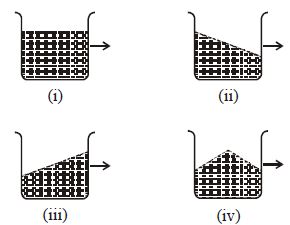
$A$ vessel containing water is moving with a constant speed towards the right along a straight horizontal path. If the vessel is given a constant retardation towards the right along a straight line,which of the following diagrams represents the surface of the liquid?
A
$(i)$
B
$(ii)$
C
$(iii)$
D
$(iv)$
Solution
(C) When a vessel containing a liquid is subjected to a horizontal acceleration $a$,the free surface of the liquid tilts such that the angle $\theta$ with the horizontal is given by $\tan \theta = \frac{a}{g}$.
In this problem,the vessel is moving towards the right and is given a constant retardation towards the right. Retardation towards the right is equivalent to an acceleration towards the left.
Therefore,the effective acceleration $a$ is directed towards the left.
Due to this pseudo-force acting on the liquid particles towards the right,the liquid level rises on the right side and falls on the left side.
This results in the liquid surface sloping upwards towards the right,as shown in diagram $(iii)$.
In this problem,the vessel is moving towards the right and is given a constant retardation towards the right. Retardation towards the right is equivalent to an acceleration towards the left.
Therefore,the effective acceleration $a$ is directed towards the left.
Due to this pseudo-force acting on the liquid particles towards the right,the liquid level rises on the right side and falls on the left side.
This results in the liquid surface sloping upwards towards the right,as shown in diagram $(iii)$.
0 likes
View Solution84
DifficultMCQ
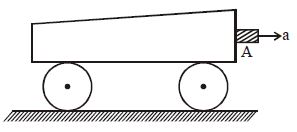
The minimum acceleration that must be imparted to the cart in the figure so that the block $A$ will not fall (given $\mu$ is the coefficient of friction between the surfaces of the block and the cart) is given by
A
$\mu g$
B
$g/\mu$
C
$g/\sqrt{\mu}$
D
$\mu/g$
Solution
(B) Let $m$ be the mass of block $A$ and $a$ be the acceleration of the cart.
When the cart accelerates with $a$,a pseudo force $F_p = ma$ acts on the block $A$ in the direction opposite to the acceleration of the cart.
This pseudo force acts as the normal force $N$ pressing the block against the vertical surface of the cart,so $N = ma$.
The maximum static frictional force that can act on the block is $f_{max} = \mu N = \mu ma$.
For the block $A$ not to fall,the upward frictional force must balance the downward gravitational force $mg$.
Thus,$f \geq mg$,which implies $\mu ma \geq mg$.
Solving for $a$,we get $a \geq g/\mu$.
Therefore,the minimum acceleration required is $a_{\min} = g/\mu$.
When the cart accelerates with $a$,a pseudo force $F_p = ma$ acts on the block $A$ in the direction opposite to the acceleration of the cart.
This pseudo force acts as the normal force $N$ pressing the block against the vertical surface of the cart,so $N = ma$.
The maximum static frictional force that can act on the block is $f_{max} = \mu N = \mu ma$.
For the block $A$ not to fall,the upward frictional force must balance the downward gravitational force $mg$.
Thus,$f \geq mg$,which implies $\mu ma \geq mg$.
Solving for $a$,we get $a \geq g/\mu$.
Therefore,the minimum acceleration required is $a_{\min} = g/\mu$.
0 likes
View Solution85
DifficultMCQ
$A$ very broad elevator is going up vertically with a constant acceleration of $2\,m/s^2$. At the instant when its velocity is $4\,m/s$,a ball is projected from the floor of the lift with a speed of $4\,m/s$ relative to the floor at an elevation of $30^{\circ}$. The time taken by the ball to return to the floor is $..............\,s$ $(g=10\,m/s^2)$.
A
$1/2$
B
$1/3$
C
$1/4$
D
$1$
Solution
(B) To find the time taken by the ball to return to the floor,we analyze the motion relative to the elevator.
Let the upward direction be positive.
The acceleration of the elevator is $a_e = +2\,m/s^2$.
The acceleration of the ball relative to the ground is $a_b = -g = -10\,m/s^2$.
The relative acceleration of the ball with respect to the elevator is $a_r = a_b - a_e = -10 - 2 = -12\,m/s^2$.
The vertical component of the initial velocity of the ball relative to the floor is $u_y = u \sin \theta = 4 \sin 30^{\circ} = 4 \times 0.5 = 2\,m/s$.
Using the equation of motion for displacement $s = u_y t + \frac{1}{2} a_r t^2$,for the ball to return to the floor,the displacement $s$ relative to the elevator must be $0$.
$0 = 2t + \frac{1}{2}(-12)t^2$
$0 = 2t - 6t^2$
$6t^2 = 2t$
Since $t \neq 0$,we have $t = \frac{2}{6} = \frac{1}{3}\,s$.
Let the upward direction be positive.
The acceleration of the elevator is $a_e = +2\,m/s^2$.
The acceleration of the ball relative to the ground is $a_b = -g = -10\,m/s^2$.
The relative acceleration of the ball with respect to the elevator is $a_r = a_b - a_e = -10 - 2 = -12\,m/s^2$.
The vertical component of the initial velocity of the ball relative to the floor is $u_y = u \sin \theta = 4 \sin 30^{\circ} = 4 \times 0.5 = 2\,m/s$.
Using the equation of motion for displacement $s = u_y t + \frac{1}{2} a_r t^2$,for the ball to return to the floor,the displacement $s$ relative to the elevator must be $0$.
$0 = 2t + \frac{1}{2}(-12)t^2$
$0 = 2t - 6t^2$
$6t^2 = 2t$
Since $t \neq 0$,we have $t = \frac{2}{6} = \frac{1}{3}\,s$.
0 likes
View Solution86
MediumMCQ
The weight of a man in a lift moving upward is $608 \ N$,while the weight of the same man in the lift moving downward with the same acceleration is $368 \ N$. His normal weight is ............ $N$.
A
$480$
B
$488$
C
$588$
D
$240$
Solution
(B) Let $m$ be the mass of the man and $a$ be the acceleration of the lift.
When the lift moves upward with acceleration $a$,the apparent weight is given by $W_{up} = m(g + a) = 608 \ N$ $...(i)$
When the lift moves downward with the same acceleration $a$,the apparent weight is given by $W_{down} = m(g - a) = 368 \ N$ $...(ii)$
Adding equations $(i)$ and $(ii)$:
$m(g + a) + m(g - a) = 608 + 368$
$2mg = 976$
$mg = 488 \ N$
Thus,the normal weight of the man is $488 \ N$.
When the lift moves upward with acceleration $a$,the apparent weight is given by $W_{up} = m(g + a) = 608 \ N$ $...(i)$
When the lift moves downward with the same acceleration $a$,the apparent weight is given by $W_{down} = m(g - a) = 368 \ N$ $...(ii)$
Adding equations $(i)$ and $(ii)$:
$m(g + a) + m(g - a) = 608 + 368$
$2mg = 976$
$mg = 488 \ N$
Thus,the normal weight of the man is $488 \ N$.
0 likes
View Solution87
EasyMCQ
$A$ passenger inside a bus moving with uniform speed suddenly finds that a ball at rest starts moving towards his left. It means that the bus now is
A
Accelerating
B
Stopping
C
Turning left
D
Turning right
Solution
(D) When a bus turns to the right,the passenger and objects inside the bus experience a pseudo force (centrifugal force) directed towards the left due to the change in the direction of the bus's velocity.
Since the ball is at rest and the bus turns to the right,the ball appears to move towards the left relative to the bus frame of reference.
Since the ball is at rest and the bus turns to the right,the ball appears to move towards the left relative to the bus frame of reference.
0 likes
View Solution88
MediumMCQ
$A$ coin is dropped in a lift. It takes time $t_1$ to reach the floor when the lift is stationary. It takes time $t_2$ when the lift is moving up with constant acceleration $a$. Then:
A
$t_1 = t_2$
B
$t_1 < t_2$
C
$t_2 < t_1$
D
$t_1 > t_2$ is incorrect,$t_2 > t_1$
Solution
(C) The time taken by a coin to reach the floor is given by the kinematic equation $h = \frac{1}{2} gt^2$ (since initial velocity $u = 0$).
Thus,$t = \sqrt{\frac{2h}{g}}$.
In a stationary lift,the effective acceleration is $g$,so $t_1 = \sqrt{\frac{2h}{g}}$.
In a lift moving upward with constant acceleration $a$,the effective acceleration experienced by the coin is $g' = g + a$.
Therefore,$t_2 = \sqrt{\frac{2h}{g+a}}$.
Since $g' = g + a > g$,it follows that the denominator in the expression for $t_2$ is larger than that for $t_1$.
Thus,$t_2 < t_1$.
Thus,$t = \sqrt{\frac{2h}{g}}$.
In a stationary lift,the effective acceleration is $g$,so $t_1 = \sqrt{\frac{2h}{g}}$.
In a lift moving upward with constant acceleration $a$,the effective acceleration experienced by the coin is $g' = g + a$.
Therefore,$t_2 = \sqrt{\frac{2h}{g+a}}$.
Since $g' = g + a > g$,it follows that the denominator in the expression for $t_2$ is larger than that for $t_1$.
Thus,$t_2 < t_1$.
0 likes
View Solution89
MediumMCQ
$A$ man is standing in a lift which goes up and comes down with the same constant acceleration. If the ratio of the apparent weights in the two cases is $2 : 1$,then the acceleration of the lift is ......... $m/s^2$.
A
$3.33$
B
$2.50$
C
$2.00$
D
$1.67$
Solution
(A) Let the mass of the man be $m$ and the constant acceleration of the lift be $a$. The acceleration due to gravity is $g = 9.8 \, m/s^2$.
When the lift moves upward with acceleration $a$,the apparent weight is $W_1 = m(g + a)$.
When the lift moves downward with acceleration $a$,the apparent weight is $W_2 = m(g - a)$.
Given the ratio of apparent weights is $W_1 / W_2 = 2 / 1$,we have:
$\frac{m(g + a)}{m(g - a)} = \frac{2}{1}$
$g + a = 2(g - a)$
$g + a = 2g - 2a$
$3a = g$
$a = g / 3 = 9.8 / 3 \approx 3.266 \approx 3.33 \, m/s^2$ (using $g = 10 \, m/s^2$ gives $a = 10/3 = 3.33 \, m/s^2$).
When the lift moves upward with acceleration $a$,the apparent weight is $W_1 = m(g + a)$.
When the lift moves downward with acceleration $a$,the apparent weight is $W_2 = m(g - a)$.
Given the ratio of apparent weights is $W_1 / W_2 = 2 / 1$,we have:
$\frac{m(g + a)}{m(g - a)} = \frac{2}{1}$
$g + a = 2(g - a)$
$g + a = 2g - 2a$
$3a = g$
$a = g / 3 = 9.8 / 3 \approx 3.266 \approx 3.33 \, m/s^2$ (using $g = 10 \, m/s^2$ gives $a = 10/3 = 3.33 \, m/s^2$).
0 likes
View Solution90
MediumMCQ
An elevator car whose floor-to-ceiling distance is $2.7\,m$ starts ascending with a constant acceleration of $1.2\,m/s^2$. After $2\,s$ of the start,a bolt falls from the ceiling of the car. The free fall time of the bolt is $(g=9.8\,m/s^2)$.
A
$\sqrt{\frac{2.7}{9.8}}\,s$
B
$\sqrt{\frac{5.4}{9.8}}\,s$
C
$\sqrt{\frac{5.4}{8.6}}\,s$
D
$\sqrt{\frac{5.4}{11}}\,s$
Solution
(D) To find the time taken by the bolt to reach the floor,we analyze the motion relative to the elevator.
$1$. The acceleration of the elevator is $a_e = 1.2\,m/s^2$ (upwards).
$2$. The acceleration of the bolt due to gravity is $g = 9.8\,m/s^2$ (downwards).
$3$. The relative acceleration of the bolt with respect to the elevator is $a_r = a_{bolt} - a_e = (-9.8) - (1.2) = -11\,m/s^2$. The magnitude is $11\,m/s^2$ downwards.
$4$. The initial velocity of the bolt relative to the elevator is $u_r = 0$ because the bolt was at rest relative to the ceiling.
$5$. The distance to be covered by the bolt relative to the elevator is $s_r = 2.7\,m$.
$6$. Using the equation of motion $s_r = u_r t + \frac{1}{2} a_r t^2$:
$2.7 = 0 \times t + \frac{1}{2} \times 11 \times t^2$
$2.7 = 5.5 \times t^2$
$t^2 = \frac{2.7}{5.5} = \frac{5.4}{11}$
$t = \sqrt{\frac{5.4}{11}}\,s$.
$1$. The acceleration of the elevator is $a_e = 1.2\,m/s^2$ (upwards).
$2$. The acceleration of the bolt due to gravity is $g = 9.8\,m/s^2$ (downwards).
$3$. The relative acceleration of the bolt with respect to the elevator is $a_r = a_{bolt} - a_e = (-9.8) - (1.2) = -11\,m/s^2$. The magnitude is $11\,m/s^2$ downwards.
$4$. The initial velocity of the bolt relative to the elevator is $u_r = 0$ because the bolt was at rest relative to the ceiling.
$5$. The distance to be covered by the bolt relative to the elevator is $s_r = 2.7\,m$.
$6$. Using the equation of motion $s_r = u_r t + \frac{1}{2} a_r t^2$:
$2.7 = 0 \times t + \frac{1}{2} \times 11 \times t^2$
$2.7 = 5.5 \times t^2$
$t^2 = \frac{2.7}{5.5} = \frac{5.4}{11}$
$t = \sqrt{\frac{5.4}{11}}\,s$.
0 likes
View Solution91
DifficultMCQ
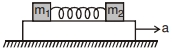
Two blocks of masses $m_1$ and $m_2$ are connected with a massless unstretched spring and placed over a plank moving with an acceleration '$a$' as shown in the figure. The coefficient of friction between the blocks and the platform is $\mu$.
A
spring will be stretched if $a > \mu g$
B
spring will be in its natural length under all conditions.
C
spring will neither be compressed nor be stretched for $a \leq \mu g$
D
spring will be compressed if $a \leq \mu g$
Solution
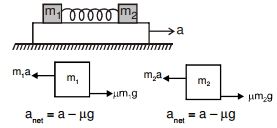
(B) Consider the blocks in the frame of the accelerating plank. $A$ pseudo force $F_p = m \cdot a$ acts on each block in the direction opposite to the acceleration of the plank.
For block $m_1$,the forces acting are the pseudo force $m_1 a$ (leftward) and the frictional force $f_1 = \mu m_1 g$ (rightward).
The net acceleration of block $m_1$ relative to the plank is $a_{net,1} = a - \mu g$.
Similarly,for block $m_2$,the net acceleration relative to the plank is $a_{net,2} = a - \mu g$.
Since both blocks experience the same net acceleration relative to the plank,they do not move relative to each other.
Therefore,the spring remains in its natural length under all conditions,and its extension $x = 0$.
For block $m_1$,the forces acting are the pseudo force $m_1 a$ (leftward) and the frictional force $f_1 = \mu m_1 g$ (rightward).
The net acceleration of block $m_1$ relative to the plank is $a_{net,1} = a - \mu g$.
Similarly,for block $m_2$,the net acceleration relative to the plank is $a_{net,2} = a - \mu g$.
Since both blocks experience the same net acceleration relative to the plank,they do not move relative to each other.
Therefore,the spring remains in its natural length under all conditions,and its extension $x = 0$.
0 likes
View Solution92
EasyMCQ
$A$ monkey is sitting on the pan of a spring balance which is placed on an elevator. The maximum reading of the spring balance will be when
A
The elevator is stationary
B
The string of the elevator breaks and it drops freely towards the earth.
C
The elevator is accelerated downwards
D
The elevator is accelerated upwards
Solution
(D) Let $m$ be the mass of the monkey and $g$ be the acceleration due to gravity.
The reading of the spring balance corresponds to the normal force $N$ exerted by the pan on the monkey.
When the elevator is accelerated upwards with an acceleration $a$,the equation of motion for the monkey is $N - mg = ma$.
Thus,$N = m(g + a)$.
When the elevator is stationary,$N = mg$.
When the elevator is accelerated downwards with acceleration $a$,$N = m(g - a)$.
When the elevator falls freely,$a = g$,so $N = m(g - g) = 0$.
Comparing these cases,the reading $N$ is maximum when the elevator is accelerated upwards.
The reading of the spring balance corresponds to the normal force $N$ exerted by the pan on the monkey.
When the elevator is accelerated upwards with an acceleration $a$,the equation of motion for the monkey is $N - mg = ma$.
Thus,$N = m(g + a)$.
When the elevator is stationary,$N = mg$.
When the elevator is accelerated downwards with acceleration $a$,$N = m(g - a)$.
When the elevator falls freely,$a = g$,so $N = m(g - g) = 0$.
Comparing these cases,the reading $N$ is maximum when the elevator is accelerated upwards.
0 likes
View Solution93
EasyMCQ
$A$ man of mass $60\, kg$ records his weight on a weighing machine placed inside a lift. The ratio of weights of the man recorded when the lift is ascending with a uniform speed of $2\, m/s$ to when it is descending with a uniform speed of $4\, m/s$ will be:
A
$0.5$
B
$1$
C
$2$
D
None of these
Solution
(B) When a lift moves with a uniform speed (either upwards or downwards),its acceleration $a$ is $0$.
According to Newton's second law,the apparent weight $W$ recorded by the weighing machine is given by $W = m(g + a)$.
Since the lift is moving with a uniform speed,$a = 0$,so the apparent weight $W = mg$ in both cases.
Weight while ascending $(W_1)$ = $60 \times g$.
Weight while descending $(W_2)$ = $60 \times g$.
The ratio $W_1 / W_2 = (60g) / (60g) = 1$.
According to Newton's second law,the apparent weight $W$ recorded by the weighing machine is given by $W = m(g + a)$.
Since the lift is moving with a uniform speed,$a = 0$,so the apparent weight $W = mg$ in both cases.
Weight while ascending $(W_1)$ = $60 \times g$.
Weight while descending $(W_2)$ = $60 \times g$.
The ratio $W_1 / W_2 = (60g) / (60g) = 1$.
0 likes
View Solution94
EasyMCQ
$A$ mass is hanging on a spring balance which is kept in a lift. The lift ascends with an acceleration. The spring balance will show in its readings:
A
an increase
B
a decrease
C
no change
D
a change depending on its velocity
Solution
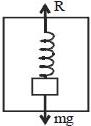
(A) Let the mass be $m$ and the acceleration of the lift be $a$ in the upward direction.
The forces acting on the mass are the tension $R$ in the spring (which is the reading of the spring balance) acting upwards and the gravitational force $mg$ acting downwards.
According to Newton's second law of motion,the net force is equal to the product of mass and acceleration:
$R - mg = ma$
Rearranging the equation,we get:
$R = m(g + a)$
Since $a > 0$,the reading $R$ is greater than the actual weight $mg$.
Therefore,the spring balance will show an increase in its reading.
The forces acting on the mass are the tension $R$ in the spring (which is the reading of the spring balance) acting upwards and the gravitational force $mg$ acting downwards.
According to Newton's second law of motion,the net force is equal to the product of mass and acceleration:
$R - mg = ma$
Rearranging the equation,we get:
$R = m(g + a)$
Since $a > 0$,the reading $R$ is greater than the actual weight $mg$.
Therefore,the spring balance will show an increase in its reading.
0 likes
View Solution95
MediumMCQ
$A$ truck is stationary and has a bob suspended by a light string in a frame attached to the truck. The truck suddenly moves to the right with an acceleration of $a$. The pendulum will tilt:
A
to the left and the angle of inclination of the pendulum with the vertical is $\sin^{-1}\left(\frac{g}{a}\right)$
B
to the left and the angle of inclination of the pendulum with the vertical is $\tan^{-1}\left(\frac{a}{g}\right)$
C
to the left and the angle of inclination of the pendulum with the vertical is $\sin^{-1}\left(\frac{a}{g}\right)$
D
to the left and the angle of inclination of the pendulum with the vertical is $\tan^{-1}\left(\frac{g}{a}\right)$
Solution
(B) When the truck accelerates to the right with acceleration $a$,a pseudo force $F_{\text{pseudo}} = ma$ acts on the bob in the opposite direction (i.e.,to the left) in the frame of the truck.
Let $\theta$ be the angle the string makes with the vertical.
In the equilibrium position of the bob in the truck's frame,the forces acting on the bob are the tension $T$,the gravitational force $mg$ acting downwards,and the pseudo force $ma$ acting to the left.
Resolving the forces,we get:
$T \sin \theta = ma$
$T \cos \theta = mg$
Dividing the two equations,we get:
$\tan \theta = \frac{ma}{mg} = \frac{a}{g}$
Therefore,$\theta = \tan^{-1}\left(\frac{a}{g}\right)$.
Since the pseudo force acts to the left,the pendulum tilts to the left.
Let $\theta$ be the angle the string makes with the vertical.
In the equilibrium position of the bob in the truck's frame,the forces acting on the bob are the tension $T$,the gravitational force $mg$ acting downwards,and the pseudo force $ma$ acting to the left.
Resolving the forces,we get:
$T \sin \theta = ma$
$T \cos \theta = mg$
Dividing the two equations,we get:
$\tan \theta = \frac{ma}{mg} = \frac{a}{g}$
Therefore,$\theta = \tan^{-1}\left(\frac{a}{g}\right)$.
Since the pseudo force acts to the left,the pendulum tilts to the left.
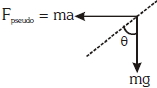
0 likes
View Solution96
Medium
$A$ man of mass $70 \; kg$ stands on a weighing scale in a lift which is moving:
$(a)$ Upwards with a uniform speed of $10 \; m s^{-1}$.
$(b)$ Downwards with a uniform acceleration of $5 \; m s^{-2}$.
$(c)$ Upwards with a uniform acceleration of $5 \; m s^{-2}$.
What would be the readings on the scale in each case?
$(d)$ What would be the reading if the lift mechanism failed and it hurtled down freely under gravity?
$(a)$ Upwards with a uniform speed of $10 \; m s^{-1}$.
$(b)$ Downwards with a uniform acceleration of $5 \; m s^{-2}$.
$(c)$ Upwards with a uniform acceleration of $5 \; m s^{-2}$.
What would be the readings on the scale in each case?
$(d)$ What would be the reading if the lift mechanism failed and it hurtled down freely under gravity?
Solution
(N/A) Given: Mass of the man,$m = 70 \; kg$,Acceleration due to gravity,$g = 10 \; m s^{-2}$.
$(a)$ When the lift moves upwards with a uniform speed,acceleration $a = 0$. The equation of motion is $R - mg = ma$. Since $a = 0$,$R = mg = 70 \times 10 = 700 \; N$. The reading on the scale is $700/10 = 70 \; kg$.
$(b)$ When the lift moves downwards with acceleration $a = 5 \; m s^{-2}$,the equation of motion is $mg - R = ma$,so $R = m(g - a) = 70(10 - 5) = 70 \times 5 = 350 \; N$. The reading on the scale is $350/10 = 35 \; kg$.
$(c)$ When the lift moves upwards with acceleration $a = 5 \; m s^{-2}$,the equation of motion is $R - mg = ma$,so $R = m(g + a) = 70(10 + 5) = 70 \times 15 = 1050 \; N$. The reading on the scale is $1050/10 = 105 \; kg$.
$(d)$ When the lift falls freely,$a = g$. The equation of motion is $R = m(g - g) = 0 \; N$. The reading on the scale is $0 \; kg$. The man experiences weightlessness.
$(a)$ When the lift moves upwards with a uniform speed,acceleration $a = 0$. The equation of motion is $R - mg = ma$. Since $a = 0$,$R = mg = 70 \times 10 = 700 \; N$. The reading on the scale is $700/10 = 70 \; kg$.
$(b)$ When the lift moves downwards with acceleration $a = 5 \; m s^{-2}$,the equation of motion is $mg - R = ma$,so $R = m(g - a) = 70(10 - 5) = 70 \times 5 = 350 \; N$. The reading on the scale is $350/10 = 35 \; kg$.
$(c)$ When the lift moves upwards with acceleration $a = 5 \; m s^{-2}$,the equation of motion is $R - mg = ma$,so $R = m(g + a) = 70(10 + 5) = 70 \times 15 = 1050 \; N$. The reading on the scale is $1050/10 = 105 \; kg$.
$(d)$ When the lift falls freely,$a = g$. The equation of motion is $R = m(g - g) = 0 \; N$. The reading on the scale is $0 \; kg$. The man experiences weightlessness.
0 likes
View Solution97
Easy
What is weightlessness? Explain with examples.
Solution
(N/A) Weightlessness is a state in which the apparent weight of a body becomes zero. This occurs when a body is in a state of free fall,meaning the only force acting on it is gravity,and there is no normal reaction force from any surface.
Examples:
$(i)$ Free-falling lift: When a lift falls freely under gravity,its acceleration $a = g$. The apparent weight $W$ of a person of mass $m$ inside the lift is given by $W = m(g - a)$. Substituting $a = g$,we get $W = m(g - g) = 0$. Thus,the person experiences weightlessness.
$(ii)$ Satellites: An orbiting satellite is in a state of continuous free fall towards the Earth. The centripetal acceleration required for its orbit is provided by gravity $(a_c = g')$. Since the satellite and everything inside it are accelerating at the same rate towards the center of the Earth,there is no normal force between the objects and the floor of the satellite,leading to a state of weightlessness.
Examples:
$(i)$ Free-falling lift: When a lift falls freely under gravity,its acceleration $a = g$. The apparent weight $W$ of a person of mass $m$ inside the lift is given by $W = m(g - a)$. Substituting $a = g$,we get $W = m(g - g) = 0$. Thus,the person experiences weightlessness.
$(ii)$ Satellites: An orbiting satellite is in a state of continuous free fall towards the Earth. The centripetal acceleration required for its orbit is provided by gravity $(a_c = g')$. Since the satellite and everything inside it are accelerating at the same rate towards the center of the Earth,there is no normal force between the objects and the floor of the satellite,leading to a state of weightlessness.
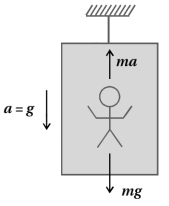
0 likes
View Solution98
MediumMCQ
$A$ person of mass $50 \, kg$ stands on a weighing scale in a lift. If the lift is descending with a downward acceleration of $9 \, m/s^2$,what would be the reading of the weighing scale (in $, kg$)? (Take $g = 10 \, m/s^2$)
A
$5$
B
$50$
C
$45$
D
$10$
Solution
(A) Given:
Mass of the person,$m = 50 \, kg$
Acceleration of the lift,$a = 9 \, m/s^2$ (downwards)
Acceleration due to gravity,$g = 10 \, m/s^2$
When a lift descends with an acceleration $a$,the apparent weight $R$ of a person of mass $m$ is given by:
$R = m(g - a)$
Substituting the given values:
$R = 50 \times (10 - 9)$
$R = 50 \times 1 = 50 \, N$
The reading of the weighing scale is usually calibrated in kilograms,which represents the apparent mass $m_{app} = R/g$.
$m_{app} = \frac{50 \, N}{10 \, m/s^2} = 5 \, kg$
Therefore,the reading of the weighing scale is $5 \, kg$.
Mass of the person,$m = 50 \, kg$
Acceleration of the lift,$a = 9 \, m/s^2$ (downwards)
Acceleration due to gravity,$g = 10 \, m/s^2$
When a lift descends with an acceleration $a$,the apparent weight $R$ of a person of mass $m$ is given by:
$R = m(g - a)$
Substituting the given values:
$R = 50 \times (10 - 9)$
$R = 50 \times 1 = 50 \, N$
The reading of the weighing scale is usually calibrated in kilograms,which represents the apparent mass $m_{app} = R/g$.
$m_{app} = \frac{50 \, N}{10 \, m/s^2} = 5 \, kg$
Therefore,the reading of the weighing scale is $5 \, kg$.
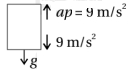
0 likes
View Solution99
MediumMCQ
$A$ person in an elevator accelerating upwards with an acceleration of $2 \, m/s^2$ tosses a coin vertically upwards with a speed of $20 \, m/s$. After how much time will the coin fall back into his hand (in $, s$)? $(g = 10 \, m/s^2)$
A
$1.67$
B
$2.5$
C
$1.33$
D
$2.0$
Solution
(C) Let the frame of reference be the elevator. Since the elevator is accelerating upwards with $a = 2 \, m/s^2$,a pseudo force acts on the coin in the downward direction.
The effective acceleration of the coin in the elevator's frame is $g_{eff} = g + a = 10 + 2 = 12 \, m/s^2$ (downwards).
The initial velocity of the coin relative to the elevator is $u = 20 \, m/s$ (upwards).
The coin falls back into the hand when its displacement relative to the elevator is $s = 0$.
Using the equation of motion $s = ut + \frac{1}{2}at^2$:
$0 = 20t - \frac{1}{2}(12)t^2$
$0 = 20t - 6t^2$
$6t^2 = 20t$
$t = \frac{20}{6} = \frac{10}{3} \approx 3.33 \, s$.
Wait,re-evaluating the options provided. If the question implies the coin is tossed relative to the ground,the time of flight is $T = \frac{2u}{g} = \frac{2 \times 20}{10} = 4 \, s$. If the elevator is accelerating,the relative acceleration is $12 \, m/s^2$. The time taken is $t = \frac{2u}{g_{eff}} = \frac{2 \times 20}{12} = \frac{40}{12} = 3.33 \, s$. Given the options,there might be a typo in the question's provided options or parameters. Assuming the standard calculation,$3.33 \, s$ is the correct result.
The effective acceleration of the coin in the elevator's frame is $g_{eff} = g + a = 10 + 2 = 12 \, m/s^2$ (downwards).
The initial velocity of the coin relative to the elevator is $u = 20 \, m/s$ (upwards).
The coin falls back into the hand when its displacement relative to the elevator is $s = 0$.
Using the equation of motion $s = ut + \frac{1}{2}at^2$:
$0 = 20t - \frac{1}{2}(12)t^2$
$0 = 20t - 6t^2$
$6t^2 = 20t$
$t = \frac{20}{6} = \frac{10}{3} \approx 3.33 \, s$.
Wait,re-evaluating the options provided. If the question implies the coin is tossed relative to the ground,the time of flight is $T = \frac{2u}{g} = \frac{2 \times 20}{10} = 4 \, s$. If the elevator is accelerating,the relative acceleration is $12 \, m/s^2$. The time taken is $t = \frac{2u}{g_{eff}} = \frac{2 \times 20}{12} = \frac{40}{12} = 3.33 \, s$. Given the options,there might be a typo in the question's provided options or parameters. Assuming the standard calculation,$3.33 \, s$ is the correct result.
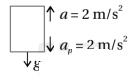
0 likes
View Solution100
MediumMCQ
Why do we feel dizzy when riding a giant wheel (Ferris wheel) rotating in a vertical plane?
A
Due to the change in apparent weight.
B
Due to constant velocity.
C
Due to the absence of gravity.
D
Due to uniform circular motion.
Solution
(A) When a person rides a giant wheel rotating in a vertical plane,their apparent weight changes continuously.
At the highest point,the apparent weight is $W_{app} = m(g - a)$,which is less than the actual weight.
At the lowest point,the apparent weight is $W_{app} = m(g + a)$,which is greater than the actual weight.
This rapid fluctuation in the normal force exerted by the seat on the body affects the blood circulation and the vestibular system in the inner ear,leading to the sensation of dizziness.
At the highest point,the apparent weight is $W_{app} = m(g - a)$,which is less than the actual weight.
At the lowest point,the apparent weight is $W_{app} = m(g + a)$,which is greater than the actual weight.
This rapid fluctuation in the normal force exerted by the seat on the body affects the blood circulation and the vestibular system in the inner ear,leading to the sensation of dizziness.
0 likes
View SolutionNewton's Laws of Motion and Friction — Apparent weight and Pseudo Force · Frequently Asked Questions
1Are these Newton's Laws of Motion and Friction questions useful for JEE and NEET?
Yes. All questions in this section are mapped to JEE Main and NEET exam patterns. Previous year questions from JEE Main, NEET, GUJCET and state-level exams are included with full solutions.
2Can I switch to Hindi or Gujarati for these questions?
Yes. Use the language tabs in the hero section or the sidebar to view the same questions and solutions in English, Hindi or Gujarati.
3How do I generate a question paper from this subtopic?
Use the Vedclass Exam Paper Generator — select the chapter and subtopic, set difficulty, and generate Sets A, B, C, D automatically. First 3 chapters of every subject are free.
Vedclass Products
For Students
Vedclass Test Series
Mock tests in real JEE/NEET style with performance analysis. 5-day free trial.
Start Free TrialFor Teachers
Exam Paper Generator
Generate Set A/B/C/D papers from this chapter in 2 minutes. 3 chapters free.
Try FreeFor Institutes
Online Exam Module
Live online exams with unlimited students, 360° analytics & white-label branding.
See DemoFor Teachers & Institutes
Generate a Newton's Laws of Motion and Friction Exam Paper in 2 Minutes
Select subtopic & difficulty — Sets A, B, C, D auto-generated with No Repeat logic.
First 3 chapters of every subject are free — no payment required.