
A English
Uniformly Accelerated Motion Questions in English
Class 11 Physics · Motion in Straight Line · Uniformly Accelerated Motion
304+
Questions
English
Language
100%
With Solutions
Showing 50 of 304 questions in English
101
DifficultMCQ
The deceleration experienced by a moving motor boat,after its engine is cut-off,is given by $\frac{dv}{dt} = -kv^3$,where $k$ is a constant. If $v_0$ is the magnitude of the velocity at cut-off,the magnitude of the velocity at a time $t$ after the cut-off is:
A
$\frac{v_0}{2}$
B
$v_0$
C
$v_0 e^{-kt}$
D
$\frac{v_0}{\sqrt{2v_0^2kt + 1}}$
Solution
(D) Given the deceleration equation: $\frac{dv}{dt} = -kv^3$.
Rearranging the terms to integrate: $\frac{dv}{v^3} = -k dt$.
Integrating both sides with limits from $v_0$ to $v$ for velocity and $0$ to $t$ for time:
$\int_{v_0}^{v} v^{-3} dv = \int_{0}^{t} -k dt$.
Evaluating the integrals:
$\left[ \frac{v^{-2}}{-2} \right]_{v_0}^{v} = -kt$.
$-\frac{1}{2} \left( \frac{1}{v^2} - \frac{1}{v_0^2} \right) = -kt$.
$\frac{1}{v^2} - \frac{1}{v_0^2} = 2kt$.
$\frac{1}{v^2} = \frac{1}{v_0^2} + 2kt = \frac{1 + 2v_0^2kt}{v_0^2}$.
Taking the reciprocal and square root:
$v^2 = \frac{v_0^2}{1 + 2v_0^2kt}$.
$v = \frac{v_0}{\sqrt{1 + 2v_0^2kt}}$.
Rearranging the terms to integrate: $\frac{dv}{v^3} = -k dt$.
Integrating both sides with limits from $v_0$ to $v$ for velocity and $0$ to $t$ for time:
$\int_{v_0}^{v} v^{-3} dv = \int_{0}^{t} -k dt$.
Evaluating the integrals:
$\left[ \frac{v^{-2}}{-2} \right]_{v_0}^{v} = -kt$.
$-\frac{1}{2} \left( \frac{1}{v^2} - \frac{1}{v_0^2} \right) = -kt$.
$\frac{1}{v^2} - \frac{1}{v_0^2} = 2kt$.
$\frac{1}{v^2} = \frac{1}{v_0^2} + 2kt = \frac{1 + 2v_0^2kt}{v_0^2}$.
Taking the reciprocal and square root:
$v^2 = \frac{v_0^2}{1 + 2v_0^2kt}$.
$v = \frac{v_0}{\sqrt{1 + 2v_0^2kt}}$.
0 likes
View Solution102
DifficultMCQ
$A$ rifle bullet loses $1/20^{th}$ of its velocity in passing through a wooden plank. The least number of planks required to stop the bullet is :-
A
$5$
B
$10$
C
$11$
D
$20$
Solution
(C) Let the initial velocity of the bullet be $u$ and the thickness of one plank be $s$. The velocity after passing through one plank is $v = u - u/20 = 19u/20$.
Using the equation of motion $v^2 = u^2 + 2as$,where $a$ is the constant retardation:
$(19u/20)^2 = u^2 + 2as \implies 2as = (19/20)^2 u^2 - u^2 = u^2 (361/400 - 1) = -39u^2/400$.
Let $n$ be the number of planks required to stop the bullet. For the final velocity to be $0$ after passing through $n$ planks of total thickness $ns$:
$0^2 = u^2 + 2a(ns) = u^2 + n(2as)$.
Substituting $2as = -39u^2/400$:
$0 = u^2 + n(-39u^2/400) \implies 1 = n(39/400) \implies n = 400/39 \approx 10.25$.
Since the number of planks must be an integer,we need at least $11$ planks to stop the bullet.
Using the equation of motion $v^2 = u^2 + 2as$,where $a$ is the constant retardation:
$(19u/20)^2 = u^2 + 2as \implies 2as = (19/20)^2 u^2 - u^2 = u^2 (361/400 - 1) = -39u^2/400$.
Let $n$ be the number of planks required to stop the bullet. For the final velocity to be $0$ after passing through $n$ planks of total thickness $ns$:
$0^2 = u^2 + 2a(ns) = u^2 + n(2as)$.
Substituting $2as = -39u^2/400$:
$0 = u^2 + n(-39u^2/400) \implies 1 = n(39/400) \implies n = 400/39 \approx 10.25$.
Since the number of planks must be an integer,we need at least $11$ planks to stop the bullet.
0 likes
View Solution103
EasyMCQ
$A$ particle starting from rest moves with a uniform acceleration and covers $x$ meters in the first $5 \ s$. The same particle will cover the following distance in the next $5 \ s$:
A
$x \ m$
B
$2x \ m$
C
$3x \ m$
D
$4x \ m$
Solution
(C) Let the uniform acceleration of the particle be $a$ and initial velocity $u = 0 \ m/s$.
Using the equation of motion $s = ut + \frac{1}{2}at^2$,the distance covered in the first $5 \ s$ is:
$x = 0(5) + \frac{1}{2}a(5)^2 = 12.5a \implies a = \frac{x}{12.5} = 0.08x \ m/s^2$.
Now,the distance covered in the first $10 \ s$ (total time) is:
$s_{10} = 0(10) + \frac{1}{2}a(10)^2 = 50a$.
Substituting $a = 0.08x$:
$s_{10} = 50(0.08x) = 4x \ m$.
The distance covered in the next $5 \ s$ is the difference between the distance covered in $10 \ s$ and the distance covered in $5 \ s$:
$\text{Distance} = s_{10} - x = 4x - x = 3x \ m$.
Using the equation of motion $s = ut + \frac{1}{2}at^2$,the distance covered in the first $5 \ s$ is:
$x = 0(5) + \frac{1}{2}a(5)^2 = 12.5a \implies a = \frac{x}{12.5} = 0.08x \ m/s^2$.
Now,the distance covered in the first $10 \ s$ (total time) is:
$s_{10} = 0(10) + \frac{1}{2}a(10)^2 = 50a$.
Substituting $a = 0.08x$:
$s_{10} = 50(0.08x) = 4x \ m$.
The distance covered in the next $5 \ s$ is the difference between the distance covered in $10 \ s$ and the distance covered in $5 \ s$:
$\text{Distance} = s_{10} - x = 4x - x = 3x \ m$.
0 likes
View Solution104
MediumMCQ
$A$ motorist starting a car from rest accelerates uniformly to a speed of $v \ m/s$ in $9 \ s$. He maintains this speed for another $50 \ s$ and then applies the brakes and decelerates uniformly to rest. His deceleration is numerically equal to three times his previous acceleration. Then the time during which the deceleration takes place is .......... $s$ :-
A
$3$
B
$9$
C
$27$
D
$6$
Solution
(A) Let the initial acceleration be $a_1$. Since the car starts from rest,$u = 0$. After $t_1 = 9 \ s$,the velocity becomes $v = a_1 t_1 = 9a_1$. Thus,$a_1 = v/9$.
Next,the motorist maintains the speed $v$ for $t_2 = 50 \ s$.
Finally,the motorist decelerates to rest. Let the deceleration be $a_2$. We are given $a_2 = 3a_1 = 3(v/9) = v/3$.
Using the equation of motion $v_f = u_f - a_2 t_3$,where $v_f = 0$ (final rest),$u_f = v$ (initial speed for this phase),and $t_3$ is the time taken to stop:
$0 = v - (v/3) t_3$
$v = (v/3) t_3$
$t_3 = 3 \ s$.
Next,the motorist maintains the speed $v$ for $t_2 = 50 \ s$.
Finally,the motorist decelerates to rest. Let the deceleration be $a_2$. We are given $a_2 = 3a_1 = 3(v/9) = v/3$.
Using the equation of motion $v_f = u_f - a_2 t_3$,where $v_f = 0$ (final rest),$u_f = v$ (initial speed for this phase),and $t_3$ is the time taken to stop:
$0 = v - (v/3) t_3$
$v = (v/3) t_3$
$t_3 = 3 \ s$.
0 likes
View Solution105
DifficultMCQ
$A$ particle experiences a constant acceleration for $20\, s$ after starting from rest. If it travels a distance $s_1$ in the first $10\, s$ and a distance $s_2$ in the next $10\, s$,then:
A
$s_2 = s_1$
B
$s_2 = 2s_1$
C
$s_2 = 3s_1$
D
$s_2 = 4s_1$
Solution
(C) Given that the particle starts from rest,initial velocity $u = 0$. The acceleration $a$ is constant.
For the first $10\, s$ $(t_1 = 10\, s)$:
$s_1 = ut_1 + \frac{1}{2}at_1^2 = 0(10) + \frac{1}{2}a(10)^2 = 50a$.
For the total time of $20\, s$ $(t_{total} = 20\, s)$:
$s_{total} = s_1 + s_2 = u(t_{total}) + \frac{1}{2}a(t_{total})^2 = 0(20) + \frac{1}{2}a(20)^2 = 200a$.
Substituting $s_1 = 50a$ into the total distance equation:
$50a + s_2 = 200a$.
Therefore,$s_2 = 200a - 50a = 150a$.
Comparing $s_1$ and $s_2$:
$\frac{s_2}{s_1} = \frac{150a}{50a} = 3$.
Thus,$s_2 = 3s_1$.
For the first $10\, s$ $(t_1 = 10\, s)$:
$s_1 = ut_1 + \frac{1}{2}at_1^2 = 0(10) + \frac{1}{2}a(10)^2 = 50a$.
For the total time of $20\, s$ $(t_{total} = 20\, s)$:
$s_{total} = s_1 + s_2 = u(t_{total}) + \frac{1}{2}a(t_{total})^2 = 0(20) + \frac{1}{2}a(20)^2 = 200a$.
Substituting $s_1 = 50a$ into the total distance equation:
$50a + s_2 = 200a$.
Therefore,$s_2 = 200a - 50a = 150a$.
Comparing $s_1$ and $s_2$:
$\frac{s_2}{s_1} = \frac{150a}{50a} = 3$.
Thus,$s_2 = 3s_1$.
0 likes
View Solution106
EasyMCQ
Brakes are applied in a car moving with a speed of $20\ m/s$,which produces a retardation of $5\ m/s^2$. The distance travelled by the car until it stops is ........ $m$.
A
$20$
B
$30$
C
$40$
D
$50$
Solution
(C) Given: Initial velocity $u = 20\ m/s$,final velocity $v = 0\ m/s$,and retardation $a = -5\ m/s^2$.
Using the third equation of motion: $v^2 = u^2 + 2as$.
Substituting the values: $0^2 = (20)^2 + 2(-5)s$.
$0 = 400 - 10s$.
$10s = 400$.
$s = 40\ m$.
Therefore,the distance travelled by the car until it stops is $40\ m$.
Using the third equation of motion: $v^2 = u^2 + 2as$.
Substituting the values: $0^2 = (20)^2 + 2(-5)s$.
$0 = 400 - 10s$.
$10s = 400$.
$s = 40\ m$.
Therefore,the distance travelled by the car until it stops is $40\ m$.
0 likes
View Solution107
MediumMCQ
$A$ particle moving with a uniform acceleration travels $24 \ m$ and $64 \ m$ in the first two consecutive intervals of $4 \ sec$ each. Its initial velocity is......$m/sec$.
A
$1$
B
$10$
C
$5$
D
$2$
Solution
(A) Let the initial velocity be $u$ and the uniform acceleration be $a$.
For the first interval of $t = 4 \ sec$,the distance covered is $s_1 = 24 \ m$.
Using the equation $s = ut + \frac{1}{2}at^2$:
$24 = u(4) + \frac{1}{2}a(4)^2$
$24 = 4u + 8a$
Dividing by $4$,we get: $6 = u + 2a$ --- $(1)$
For the total time of $t = 8 \ sec$,the total distance covered is $s_{total} = 24 + 64 = 88 \ m$.
Using the equation $s = ut + \frac{1}{2}at^2$:
$88 = u(8) + \frac{1}{2}a(8)^2$
$88 = 8u + 32a$
Dividing by $8$,we get: $11 = u + 4a$ --- $(2)$
Subtracting equation $(1)$ from equation $(2)$:
$(u + 4a) - (u + 2a) = 11 - 6$
$2a = 5 \Rightarrow a = 2.5 \ m/s^2$
Substituting $a = 2.5$ into equation $(1)$:
$6 = u + 2(2.5)$
$6 = u + 5$
$u = 1 \ m/s$.
For the first interval of $t = 4 \ sec$,the distance covered is $s_1 = 24 \ m$.
Using the equation $s = ut + \frac{1}{2}at^2$:
$24 = u(4) + \frac{1}{2}a(4)^2$
$24 = 4u + 8a$
Dividing by $4$,we get: $6 = u + 2a$ --- $(1)$
For the total time of $t = 8 \ sec$,the total distance covered is $s_{total} = 24 + 64 = 88 \ m$.
Using the equation $s = ut + \frac{1}{2}at^2$:
$88 = u(8) + \frac{1}{2}a(8)^2$
$88 = 8u + 32a$
Dividing by $8$,we get: $11 = u + 4a$ --- $(2)$
Subtracting equation $(1)$ from equation $(2)$:
$(u + 4a) - (u + 2a) = 11 - 6$
$2a = 5 \Rightarrow a = 2.5 \ m/s^2$
Substituting $a = 2.5$ into equation $(1)$:
$6 = u + 2(2.5)$
$6 = u + 5$
$u = 1 \ m/s$.
0 likes
View Solution108
DifficultMCQ
$A$ particle is projected with velocity $v_0$ along the $x-$axis,and its deceleration is given by $a = -\alpha x^2$. The distance at which the particle stops is
A
$\sqrt{\frac{3v_0}{2\alpha}}$
B
$(\frac{3v_0}{2\alpha})^{1/3}$
C
$\sqrt{\frac{3v_0^2}{2\alpha}}$
D
$(\frac{3v_0^2}{2\alpha})^{1/3}$
Solution
(D) Given acceleration $a = v \frac{dv}{dx} = -\alpha x^2$.
Separating the variables,we get $v dv = -\alpha x^2 dx$.
Integrating both sides from the initial state $(x=0, v=v_0)$ to the final state $(x=d, v=0)$:
$\int_{v_0}^{0} v dv = \int_{0}^{d} -\alpha x^2 dx$.
Evaluating the integrals:
$[\frac{v^2}{2}]_{v_0}^{0} = -\alpha [\frac{x^3}{3}]_{0}^{d}$.
$0 - \frac{v_0^2}{2} = -\alpha (\frac{d^3}{3})$.
$\frac{v_0^2}{2} = \frac{\alpha d^3}{3}$.
Solving for $d$:
$d^3 = \frac{3v_0^2}{2\alpha}$.
$d = (\frac{3v_0^2}{2\alpha})^{1/3}$.
Separating the variables,we get $v dv = -\alpha x^2 dx$.
Integrating both sides from the initial state $(x=0, v=v_0)$ to the final state $(x=d, v=0)$:
$\int_{v_0}^{0} v dv = \int_{0}^{d} -\alpha x^2 dx$.
Evaluating the integrals:
$[\frac{v^2}{2}]_{v_0}^{0} = -\alpha [\frac{x^3}{3}]_{0}^{d}$.
$0 - \frac{v_0^2}{2} = -\alpha (\frac{d^3}{3})$.
$\frac{v_0^2}{2} = \frac{\alpha d^3}{3}$.
Solving for $d$:
$d^3 = \frac{3v_0^2}{2\alpha}$.
$d = (\frac{3v_0^2}{2\alpha})^{1/3}$.
0 likes
View Solution109
DifficultMCQ
$A$ particle moves with constant acceleration. Let $v_1, v_2, v_3$ be the average velocities in successive time intervals $t_1, t_2$ and $t_3$. Then:
A
$\frac{v_1 - v_2}{v_2 - v_3} = \frac{t_1 + t_2}{t_2 + t_3}$
B
$\frac{v_1 - v_2}{v_2 - v_3} = \frac{t_1 - t_2}{t_2 - t_3}$
C
$\frac{v_1 - v_2}{v_2 - v_3} = \frac{t_1 + t_2}{t_1 + t_3}$
D
$\frac{v_1 - v_2}{v_2 - v_3} = \frac{t_2 + t_3}{t_1 + t_2}$
Solution
(A) Let $u_1, u_2, u_3, u_4$ be the velocities at $t=0, t_1, (t_1+t_2)$ and $(t_1+t_2+t_3)$ respectively. Let $a$ be the constant acceleration.
The average velocity in an interval is the arithmetic mean of initial and final velocities:
$v_1 = \frac{u_1 + u_2}{2}$,$v_2 = \frac{u_2 + u_3}{2}$,$v_3 = \frac{u_3 + u_4}{2}$.
Using $v = u + at$:
$u_2 = u_1 + at_1$
$u_3 = u_2 + at_2 = u_1 + a(t_1 + t_2)$
$u_4 = u_3 + at_3 = u_1 + a(t_1 + t_2 + t_3)$
Now,$v_1 - v_2 = \frac{u_1 + u_2}{2} - \frac{u_2 + u_3}{2} = \frac{u_1 - u_3}{2} = \frac{u_1 - (u_1 + a(t_1 + t_2))}{2} = -\frac{a(t_1 + t_2)}{2}$.
Similarly,$v_2 - v_3 = \frac{u_2 + u_3}{2} - \frac{u_3 + u_4}{2} = \frac{u_2 - u_4}{2} = \frac{(u_1 + at_1) - (u_1 + a(t_1 + t_2 + t_3))}{2} = -\frac{a(t_2 + t_3)}{2}$.
Dividing the two expressions:
$\frac{v_1 - v_2}{v_2 - v_3} = \frac{t_1 + t_2}{t_2 + t_3}$.
The average velocity in an interval is the arithmetic mean of initial and final velocities:
$v_1 = \frac{u_1 + u_2}{2}$,$v_2 = \frac{u_2 + u_3}{2}$,$v_3 = \frac{u_3 + u_4}{2}$.
Using $v = u + at$:
$u_2 = u_1 + at_1$
$u_3 = u_2 + at_2 = u_1 + a(t_1 + t_2)$
$u_4 = u_3 + at_3 = u_1 + a(t_1 + t_2 + t_3)$
Now,$v_1 - v_2 = \frac{u_1 + u_2}{2} - \frac{u_2 + u_3}{2} = \frac{u_1 - u_3}{2} = \frac{u_1 - (u_1 + a(t_1 + t_2))}{2} = -\frac{a(t_1 + t_2)}{2}$.
Similarly,$v_2 - v_3 = \frac{u_2 + u_3}{2} - \frac{u_3 + u_4}{2} = \frac{u_2 - u_4}{2} = \frac{(u_1 + at_1) - (u_1 + a(t_1 + t_2 + t_3))}{2} = -\frac{a(t_2 + t_3)}{2}$.
Dividing the two expressions:
$\frac{v_1 - v_2}{v_2 - v_3} = \frac{t_1 + t_2}{t_2 + t_3}$.
0 likes
View Solution110
EasyMCQ
If a body starts from rest and travels $120 \, cm$ in the $6^{th}$ second,then the acceleration of the body is:
A
$\frac{240}{11} \, m/s^2$
B
$\frac{120}{11} \, m/s^2$
C
$11 \, cm/s^2$
D
$21.8 \, cm/s^2$
Solution
(D) The formula for distance traveled in the $n^{th}$ second is given by $S_n = u + \frac{a}{2}(2n - 1)$.
Given that the body starts from rest,the initial velocity $u = 0 \, m/s$.
The distance traveled in the $6^{th}$ second is $S_6 = 120 \, cm = 1.2 \, m$.
Substituting the values into the formula:
$1.2 = 0 + \frac{a}{2}(2 \times 6 - 1)$
$1.2 = \frac{a}{2}(11)$
$a = \frac{1.2 \times 2}{11} = \frac{2.4}{11} \, m/s^2 \approx 0.218 \, m/s^2$.
Converting back to $cm/s^2$:
$a = 0.218 \times 100 \, cm/s^2 = 21.8 \, cm/s^2$.
Given that the body starts from rest,the initial velocity $u = 0 \, m/s$.
The distance traveled in the $6^{th}$ second is $S_6 = 120 \, cm = 1.2 \, m$.
Substituting the values into the formula:
$1.2 = 0 + \frac{a}{2}(2 \times 6 - 1)$
$1.2 = \frac{a}{2}(11)$
$a = \frac{1.2 \times 2}{11} = \frac{2.4}{11} \, m/s^2 \approx 0.218 \, m/s^2$.
Converting back to $cm/s^2$:
$a = 0.218 \times 100 \, cm/s^2 = 21.8 \, cm/s^2$.
0 likes
View Solution111
MediumMCQ
The position $x$ of a particle at any instant is related to its velocity $v$ by the equation $v = \sqrt{2x + 9}$. The particle starts from the origin. What are the initial acceleration and initial velocity of the particle?
A
$1\, \text{unit}, 3\, \text{unit}$
B
$2\, \text{unit}, 3\, \text{unit}$
C
$4\, \text{unit}, 81\, \text{unit}$
D
$9\, \text{unit}, 3\, \text{unit}$
Solution
(A) Given the velocity equation: $v = \sqrt{2x + 9}$.
Squaring both sides,we get: $v^2 = 2x + 9$.
Comparing this with the kinematic equation $v^2 = u^2 + 2ax$,where $u$ is the initial velocity and $a$ is the acceleration:
At the origin,$x = 0$. Substituting $x = 0$ into the velocity equation: $v = \sqrt{2(0) + 9} = \sqrt{9} = 3\, \text{unit}$. Thus,the initial velocity $u = 3\, \text{unit}$.
Comparing $v^2 = 2x + 9$ with $v^2 = u^2 + 2ax$,we identify $2a = 2$,which gives $a = 1\, \text{unit}$.
Therefore,the initial acceleration is $1\, \text{unit}$ and the initial velocity is $3\, \text{unit}$.
Squaring both sides,we get: $v^2 = 2x + 9$.
Comparing this with the kinematic equation $v^2 = u^2 + 2ax$,where $u$ is the initial velocity and $a$ is the acceleration:
At the origin,$x = 0$. Substituting $x = 0$ into the velocity equation: $v = \sqrt{2(0) + 9} = \sqrt{9} = 3\, \text{unit}$. Thus,the initial velocity $u = 3\, \text{unit}$.
Comparing $v^2 = 2x + 9$ with $v^2 = u^2 + 2ax$,we identify $2a = 2$,which gives $a = 1\, \text{unit}$.
Therefore,the initial acceleration is $1\, \text{unit}$ and the initial velocity is $3\, \text{unit}$.
0 likes
View Solution112
MediumMCQ
$A$ particle of mass $1\,kg$ is moving along the $x-$axis,where its velocity depends on the $x-$coordinate as $v = 2\sqrt{x}\,m/s$. Find the net force acting on the particle $2\,s$ after the start of motion.
A
$1$
B
$2$
C
$4$
D
$1.5$
Solution
(B) Given,$v = 2\sqrt{x}$.
Acceleration $a = v \frac{dv}{dx}$.
First,find $\frac{dv}{dx}$:
$\frac{dv}{dx} = \frac{d}{dx}(2x^{1/2}) = 2 \cdot \frac{1}{2} x^{-1/2} = \frac{1}{\sqrt{x}}$.
Now,calculate acceleration:
$a = (2\sqrt{x}) \cdot \left(\frac{1}{\sqrt{x}}\right) = 2\,m/s^2$.
Since the acceleration is constant and independent of time and position,the net force $F$ acting on the particle is given by Newton's second law:
$F = m \cdot a = 1\,kg \cdot 2\,m/s^2 = 2\,N$.
Thus,the net force at any instant,including at $t = 2\,s$,is $2\,N$.
Acceleration $a = v \frac{dv}{dx}$.
First,find $\frac{dv}{dx}$:
$\frac{dv}{dx} = \frac{d}{dx}(2x^{1/2}) = 2 \cdot \frac{1}{2} x^{-1/2} = \frac{1}{\sqrt{x}}$.
Now,calculate acceleration:
$a = (2\sqrt{x}) \cdot \left(\frac{1}{\sqrt{x}}\right) = 2\,m/s^2$.
Since the acceleration is constant and independent of time and position,the net force $F$ acting on the particle is given by Newton's second law:
$F = m \cdot a = 1\,kg \cdot 2\,m/s^2 = 2\,N$.
Thus,the net force at any instant,including at $t = 2\,s$,is $2\,N$.
0 likes
View Solution113
MediumMCQ
$A$ car is moving along a straight road with uniform acceleration. It passes through two points $P$ and $Q$ separated by a distance $s$ with velocities $30\; km/h$ and $40\; km/h$ respectively. Find the velocity of the car midway between $P$ and $Q$.
A
$33.3\; km/h$
B
$25\sqrt{2}\; km/h$
C
$20\sqrt{2}\; km/h$
D
$35\; km/h$
Solution
(B) Let the acceleration of the car be $a$ and the distance between $P$ and $Q$ be $s$.
Using the equation of motion $v^2 = u^2 + 2as$ for the path $PQ$:
$40^2 = 30^2 + 2as$
$1600 = 900 + 2as$
$2as = 700$
$as = 350$
Let $V$ be the velocity at the midpoint of $PQ$. The distance from $P$ to the midpoint is $s/2$.
Using the equation of motion $V^2 = u^2 + 2a(s/2)$:
$V^2 = 30^2 + as$
$V^2 = 900 + 350$
$V^2 = 1250$
$V = \sqrt{1250} = \sqrt{625 \times 2} = 25\sqrt{2}\; km/h$.
Alternatively,for uniform acceleration,the velocity at the midpoint $V_{mid}$ is given by:
$V_{mid} = \sqrt{\frac{v_P^2 + v_Q^2}{2}}$
$V_{mid} = \sqrt{\frac{30^2 + 40^2}{2}} = \sqrt{\frac{900 + 1600}{2}} = \sqrt{\frac{2500}{2}} = \sqrt{1250} = 25\sqrt{2}\; km/h$.
Using the equation of motion $v^2 = u^2 + 2as$ for the path $PQ$:
$40^2 = 30^2 + 2as$
$1600 = 900 + 2as$
$2as = 700$
$as = 350$
Let $V$ be the velocity at the midpoint of $PQ$. The distance from $P$ to the midpoint is $s/2$.
Using the equation of motion $V^2 = u^2 + 2a(s/2)$:
$V^2 = 30^2 + as$
$V^2 = 900 + 350$
$V^2 = 1250$
$V = \sqrt{1250} = \sqrt{625 \times 2} = 25\sqrt{2}\; km/h$.
Alternatively,for uniform acceleration,the velocity at the midpoint $V_{mid}$ is given by:
$V_{mid} = \sqrt{\frac{v_P^2 + v_Q^2}{2}}$
$V_{mid} = \sqrt{\frac{30^2 + 40^2}{2}} = \sqrt{\frac{900 + 1600}{2}} = \sqrt{\frac{2500}{2}} = \sqrt{1250} = 25\sqrt{2}\; km/h$.
0 likes
View Solution114
DifficultMCQ
$A$ bullet fired into a fixed target loses half of its velocity after penetrating $3\,cm$. How much further will it penetrate before coming to rest,assuming that it faces constant resistance to motion?.......$cm$
A
$4$
B
$1$
C
$3$
D
$2$
Solution
(B) Let the initial velocity be $v$ and the constant retardation be $a$.
After penetrating $s_1 = 3\,cm$,the velocity becomes $v/2$.
Using the equation of motion $v_f^2 = v_i^2 + 2as$:
$(v/2)^2 = v^2 - 2a(3) \implies v^2/4 = v^2 - 6a \implies 6a = 3v^2/4 \implies a = v^2/8$.
Now,let the total distance penetrated be $s_2$ until the final velocity becomes $0$.
$0^2 = v^2 - 2a(s_2) \implies v^2 = 2(v^2/8)s_2 \implies v^2 = (v^2/4)s_2 \implies s_2 = 4\,cm$.
The additional distance covered is $s_2 - s_1 = 4\,cm - 3\,cm = 1\,cm$.
After penetrating $s_1 = 3\,cm$,the velocity becomes $v/2$.
Using the equation of motion $v_f^2 = v_i^2 + 2as$:
$(v/2)^2 = v^2 - 2a(3) \implies v^2/4 = v^2 - 6a \implies 6a = 3v^2/4 \implies a = v^2/8$.
Now,let the total distance penetrated be $s_2$ until the final velocity becomes $0$.
$0^2 = v^2 - 2a(s_2) \implies v^2 = 2(v^2/8)s_2 \implies v^2 = (v^2/4)s_2 \implies s_2 = 4\,cm$.
The additional distance covered is $s_2 - s_1 = 4\,cm - 3\,cm = 1\,cm$.
0 likes
View Solution115
DifficultMCQ
The ratio of displacement in $n$ seconds and in the $n^{th}$ second for a particle moving in a straight line under constant acceleration starting from rest is:
A
$\frac{2n - 1}{n^2}$
B
$\frac{1}{n}$
C
$\frac{n^2}{n - 1}$
D
$\frac{n^2}{2n - 1}$
Solution
(D) For a particle starting from rest $(u = 0)$ under constant acceleration $(a)$:
The displacement in $n$ seconds is given by the kinematic equation:
$s_n = ut + \frac{1}{2}an^2 = 0 + \frac{1}{2}an^2 = \frac{1}{2}an^2$
The displacement in the $n^{th}$ second is given by:
$s_{nth} = u + \frac{a}{2}(2n - 1) = 0 + \frac{a}{2}(2n - 1) = \frac{a}{2}(2n - 1)$
Taking the ratio of displacement in $n$ seconds to the displacement in the $n^{th}$ second:
$\frac{s_n}{s_{nth}} = \frac{\frac{1}{2}an^2}{\frac{a}{2}(2n - 1)} = \frac{n^2}{2n - 1}$
Thus,the correct option is $D$.
The displacement in $n$ seconds is given by the kinematic equation:
$s_n = ut + \frac{1}{2}an^2 = 0 + \frac{1}{2}an^2 = \frac{1}{2}an^2$
The displacement in the $n^{th}$ second is given by:
$s_{nth} = u + \frac{a}{2}(2n - 1) = 0 + \frac{a}{2}(2n - 1) = \frac{a}{2}(2n - 1)$
Taking the ratio of displacement in $n$ seconds to the displacement in the $n^{th}$ second:
$\frac{s_n}{s_{nth}} = \frac{\frac{1}{2}an^2}{\frac{a}{2}(2n - 1)} = \frac{n^2}{2n - 1}$
Thus,the correct option is $D$.
0 likes
View Solution116
DifficultMCQ
$A$ car,starting from rest,accelerates at the rate $\alpha$ through a distance $d$,then continues at a constant speed for time $t$ and then decelerates at the rate of $\alpha/2$ to come to rest. If the total distance traveled is $15\, d$,then $d=$
A
$d = \frac{1}{2}\, \alpha \, t^2$
B
$d = \frac{1}{4}\, \alpha \, t^2$
C
$d = \frac{1}{72}\, \alpha \, t^2$
D
$d = \frac{1}{6}\, \alpha \, t^2$
Solution
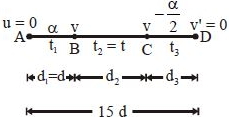
(C) Let the motion be divided into three parts: $A$ to $B$,$B$ to $C$,and $C$ to $D$.
For part $A$ to $B$: Initial velocity $u = 0$,acceleration $a = \alpha$,distance $d_1 = d$. Using $v^2 = u^2 + 2ad$,we get $v^2 = 2\alpha d$.
For part $C$ to $D$: Final velocity $v' = 0$,acceleration $a = -\alpha/2$,distance $d_3$. Using $v'^2 = v^2 + 2ad_3$,we get $0 = v^2 - 2(\alpha/2)d_3$,which implies $v^2 = \alpha d_3$. Since $v^2 = 2\alpha d$,we have $2\alpha d = \alpha d_3$,so $d_3 = 2d$.
Given total distance $d_1 + d_2 + d_3 = 15d$. Substituting $d_1 = d$ and $d_3 = 2d$,we get $d + d_2 + 2d = 15d$,which gives $d_2 = 12d$.
For part $B$ to $C$: The car moves with constant speed $v$ for time $t$. So,$d_2 = v \cdot t$,which means $12d = vt$,or $v = 12d/t$.
Substituting $v$ into the equation $v^2 = 2\alpha d$: $(12d/t)^2 = 2\alpha d$.
$144d^2 / t^2 = 2\alpha d$.
$d = (2\alpha t^2) / 144 = \frac{1}{72} \alpha t^2$.
For part $A$ to $B$: Initial velocity $u = 0$,acceleration $a = \alpha$,distance $d_1 = d$. Using $v^2 = u^2 + 2ad$,we get $v^2 = 2\alpha d$.
For part $C$ to $D$: Final velocity $v' = 0$,acceleration $a = -\alpha/2$,distance $d_3$. Using $v'^2 = v^2 + 2ad_3$,we get $0 = v^2 - 2(\alpha/2)d_3$,which implies $v^2 = \alpha d_3$. Since $v^2 = 2\alpha d$,we have $2\alpha d = \alpha d_3$,so $d_3 = 2d$.
Given total distance $d_1 + d_2 + d_3 = 15d$. Substituting $d_1 = d$ and $d_3 = 2d$,we get $d + d_2 + 2d = 15d$,which gives $d_2 = 12d$.
For part $B$ to $C$: The car moves with constant speed $v$ for time $t$. So,$d_2 = v \cdot t$,which means $12d = vt$,or $v = 12d/t$.
Substituting $v$ into the equation $v^2 = 2\alpha d$: $(12d/t)^2 = 2\alpha d$.
$144d^2 / t^2 = 2\alpha d$.
$d = (2\alpha t^2) / 144 = \frac{1}{72} \alpha t^2$.
0 likes
View Solution117
MediumMCQ
$A$ particle moves for $8 \, s$. It first accelerates from rest and then retards to rest. If the retardation is $3 \, times$ the acceleration, then the time for which it accelerates is: (in $s$)
A
$2$
B
$3$
C
$4$
D
$6$
Solution
(D) Let the acceleration be $\alpha$ and the retardation be $\beta$. Given $\beta = 3\alpha$.
Let $t_1$ be the time of acceleration and $t_2$ be the time of retardation.
The total time is $t_1 + t_2 = 8 \, s$.
Since the particle starts from rest and comes to rest, the maximum velocity $v$ reached is $v = \alpha t_1 = \beta t_2$.
Substituting $\beta = 3\alpha$, we get $\alpha t_1 = 3\alpha t_2$, which implies $t_1 = 3t_2$.
Substituting $t_1 = 3t_2$ into the total time equation: $3t_2 + t_2 = 8 \, s$.
$4t_2 = 8 \, s$, so $t_2 = 2 \, s$.
Therefore, the time of acceleration $t_1 = 3 \times 2 = 6 \, s$.
Let $t_1$ be the time of acceleration and $t_2$ be the time of retardation.
The total time is $t_1 + t_2 = 8 \, s$.
Since the particle starts from rest and comes to rest, the maximum velocity $v$ reached is $v = \alpha t_1 = \beta t_2$.
Substituting $\beta = 3\alpha$, we get $\alpha t_1 = 3\alpha t_2$, which implies $t_1 = 3t_2$.
Substituting $t_1 = 3t_2$ into the total time equation: $3t_2 + t_2 = 8 \, s$.
$4t_2 = 8 \, s$, so $t_2 = 2 \, s$.
Therefore, the time of acceleration $t_1 = 3 \times 2 = 6 \, s$.
0 likes
View Solution118
MediumMCQ
$A$ train moves from rest with a uniform acceleration $a$. After attaining a maximum speed $v$,it starts moving with uniform retardation $a$. Assuming $s$ is the total distance covered in the unidirectional motion of the train,find its total time of journey and maximum speed.
A
$\sqrt{\frac{s}{a}}, \sqrt{as}$
B
$2\sqrt{\frac{s}{a}}, \sqrt{as}$
C
$\sqrt{\frac{2s}{a}}, \sqrt{as}$
D
$\frac{1}{2}\sqrt{\frac{s}{a}}, \sqrt{\frac{as}{2}}$
Solution
(B) Let $t_1$ be the time taken to accelerate to maximum speed $v$ and $t_2$ be the time taken to retard to rest.
Using $v = u + at$,we get $v = 0 + at_1 \implies t_1 = \frac{v}{a}$.
For retardation,$0 = v - at_2 \implies t_2 = \frac{v}{a}$.
Total time $T = t_1 + t_2 = \frac{2v}{a}$.
Distance covered during acceleration $s_1 = \frac{1}{2}at_1^2 = \frac{1}{2}a(\frac{v}{a})^2 = \frac{v^2}{2a}$.
Distance covered during retardation $s_2 = \frac{v^2}{2a}$.
Total distance $s = s_1 + s_2 = \frac{v^2}{a} \implies v^2 = as \implies v = \sqrt{as}$.
Substituting $v$ in $T = \frac{2v}{a}$,we get $T = \frac{2\sqrt{as}}{a} = 2\sqrt{\frac{s}{a}}$.
Thus,the total time is $2\sqrt{\frac{s}{a}}$ and maximum speed is $\sqrt{as}$.
Using $v = u + at$,we get $v = 0 + at_1 \implies t_1 = \frac{v}{a}$.
For retardation,$0 = v - at_2 \implies t_2 = \frac{v}{a}$.
Total time $T = t_1 + t_2 = \frac{2v}{a}$.
Distance covered during acceleration $s_1 = \frac{1}{2}at_1^2 = \frac{1}{2}a(\frac{v}{a})^2 = \frac{v^2}{2a}$.
Distance covered during retardation $s_2 = \frac{v^2}{2a}$.
Total distance $s = s_1 + s_2 = \frac{v^2}{a} \implies v^2 = as \implies v = \sqrt{as}$.
Substituting $v$ in $T = \frac{2v}{a}$,we get $T = \frac{2\sqrt{as}}{a} = 2\sqrt{\frac{s}{a}}$.
Thus,the total time is $2\sqrt{\frac{s}{a}}$ and maximum speed is $\sqrt{as}$.
0 likes
View Solution119
MediumMCQ
$A$ particle is moving along a straight line with constant acceleration. At the end of the $10^{th}$ second,its velocity becomes $20 \, m/s$,and in the $10^{th}$ second,it travels a distance of $10 \, m$. Then the acceleration of the particle will be ........ $m/s^2$.
A
$10$
B
$20$
C
$0.2$
D
$3.8$
Solution
(B) Let $u$ be the initial velocity and $a$ be the constant acceleration.
Using the first equation of motion,$v = u + at$,at $t = 10 \, s$,$v = 20 \, m/s$:
$20 = u + 10a \quad \dots(i)$
Using the formula for distance traveled in the $n^{th}$ second,$s_n = u + \frac{a}{2}(2n - 1)$,for $n = 10$ and $s_{10} = 10 \, m$:
$10 = u + \frac{a}{2}(2 \times 10 - 1)$
$10 = u + \frac{19a}{2} \quad \dots(ii)$
Subtracting equation $(ii)$ from equation $(i)$:
$(20 - 10) = (u - u) + (10a - 9.5a)$
$10 = 0.5a$
$a = \frac{10}{0.5} = 20 \, m/s^2$.
Using the first equation of motion,$v = u + at$,at $t = 10 \, s$,$v = 20 \, m/s$:
$20 = u + 10a \quad \dots(i)$
Using the formula for distance traveled in the $n^{th}$ second,$s_n = u + \frac{a}{2}(2n - 1)$,for $n = 10$ and $s_{10} = 10 \, m$:
$10 = u + \frac{a}{2}(2 \times 10 - 1)$
$10 = u + \frac{19a}{2} \quad \dots(ii)$
Subtracting equation $(ii)$ from equation $(i)$:
$(20 - 10) = (u - u) + (10a - 9.5a)$
$10 = 0.5a$
$a = \frac{10}{0.5} = 20 \, m/s^2$.
0 likes
View Solution120
DifficultMCQ
Two cars leave one after the other and travel with an acceleration of $0.4\, m/s^2$. Two minutes after the departure of the first,the distance between the cars becomes $1.9\, km$. The time interval between the departures of the cars is ........$s$.
A
$190$
B
$50$
C
$80$
D
$60$
Solution
(B) Let the time interval between the departures of the two cars be $\Delta t$ seconds.
Let the first car travel for $t_1 = 120\, s$ ($2$ minutes).
The distance covered by the first car is $S_1 = \frac{1}{2} a t_1^2 = \frac{1}{2} \times 0.4 \times (120)^2 = 0.2 \times 14400 = 2880\, m$.
The second car starts $\Delta t$ seconds later,so its travel time is $t_2 = (120 - \Delta t)\, s$.
The distance covered by the second car is $S_2 = \frac{1}{2} a t_2^2 = \frac{1}{2} \times 0.4 \times (120 - \Delta t)^2 = 0.2(120 - \Delta t)^2$.
The distance between the cars is $S_1 - S_2 = 1.9\, km = 1900\, m$.
Substituting the values: $2880 - 0.2(120 - \Delta t)^2 = 1900$.
$0.2(120 - \Delta t)^2 = 2880 - 1900 = 980$.
$(120 - \Delta t)^2 = \frac{980}{0.2} = 4900$.
Taking the square root: $120 - \Delta t = 70$.
$\Delta t = 120 - 70 = 50\, s$.
Let the first car travel for $t_1 = 120\, s$ ($2$ minutes).
The distance covered by the first car is $S_1 = \frac{1}{2} a t_1^2 = \frac{1}{2} \times 0.4 \times (120)^2 = 0.2 \times 14400 = 2880\, m$.
The second car starts $\Delta t$ seconds later,so its travel time is $t_2 = (120 - \Delta t)\, s$.
The distance covered by the second car is $S_2 = \frac{1}{2} a t_2^2 = \frac{1}{2} \times 0.4 \times (120 - \Delta t)^2 = 0.2(120 - \Delta t)^2$.
The distance between the cars is $S_1 - S_2 = 1.9\, km = 1900\, m$.
Substituting the values: $2880 - 0.2(120 - \Delta t)^2 = 1900$.
$0.2(120 - \Delta t)^2 = 2880 - 1900 = 980$.
$(120 - \Delta t)^2 = \frac{980}{0.2} = 4900$.
Taking the square root: $120 - \Delta t = 70$.
$\Delta t = 120 - 70 = 50\, s$.
0 likes
View Solution121
MediumMCQ
$A$ body initially at rest is moving with uniform acceleration $a$. Its velocity after $n$ seconds is $v$. The displacement of the body in the last $2 \ s$ is
A
$\frac{2v(n - 1)}{n}$
B
$\frac{v(n - 1)}{n}$
C
$\frac{v(n + 1)}{n}$
D
$\frac{2v(n + 1)}{n}$
Solution
(A) Given that the body starts from rest,initial velocity $u = 0$.
After $n$ seconds,the velocity is $v$.
Using the first equation of motion,$v = u + an$,we get $v = 0 + an$,which implies $a = \frac{v}{n}$.
The displacement in the last $2 \ s$ is the difference between the total displacement in $n$ seconds and the displacement in $(n - 2)$ seconds.
$S_{last 2s} = S_n - S_{n-2} = \frac{1}{2}an^2 - \frac{1}{2}a(n-2)^2$.
$S_{last 2s} = \frac{1}{2}a [n^2 - (n^2 - 4n + 4)] = \frac{1}{2}a [4n - 4] = 2a(n - 1)$.
Substituting $a = \frac{v}{n}$,we get $S_{last 2s} = 2(\frac{v}{n})(n - 1) = \frac{2v(n - 1)}{n}$.
After $n$ seconds,the velocity is $v$.
Using the first equation of motion,$v = u + an$,we get $v = 0 + an$,which implies $a = \frac{v}{n}$.
The displacement in the last $2 \ s$ is the difference between the total displacement in $n$ seconds and the displacement in $(n - 2)$ seconds.
$S_{last 2s} = S_n - S_{n-2} = \frac{1}{2}an^2 - \frac{1}{2}a(n-2)^2$.
$S_{last 2s} = \frac{1}{2}a [n^2 - (n^2 - 4n + 4)] = \frac{1}{2}a [4n - 4] = 2a(n - 1)$.
Substituting $a = \frac{v}{n}$,we get $S_{last 2s} = 2(\frac{v}{n})(n - 1) = \frac{2v(n - 1)}{n}$.
0 likes
View Solution122
AdvancedMCQ
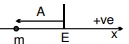
$A$ particle of mass $m$ is constrained to move on the $x$-axis. $A$ force $F$ acts on the particle. $F$ always points toward the position labeled $E$. For example,when the particle is to the left of $E$,$F$ points to the right. The magnitude of $F$ is constant except at point $E$ where it is zero. The system is horizontal. $F$ is the net force acting on the particle. The particle is displaced a distance $A$ towards the left from the equilibrium position $E$ and released from rest at $t=0$. Find the minimum time it will take to reach from $x=-A/2$ to $x=0$.
A
$\frac{3}{2} \sqrt{\frac{m A}{F}}(\sqrt{2}-1)$
B
$0$
C
$2 \sqrt{\frac{ m A }{ F }}(\sqrt{2}-1)$
D
$\sqrt{\frac{ m A }{ F }}(\sqrt{2}-1)$
Solution
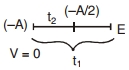
(D) The particle starts from rest at $x=-A$. The acceleration is $a = F/m$ towards the right.
Let $t_1$ be the time taken to travel from $x=-A$ to $x=0$. Using $s = ut + \frac{1}{2}at^2$ with $u=0$ and $s=A$:
$A = 0 + \frac{1}{2} (F/m) t_1^2 \implies t_1 = \sqrt{\frac{2mA}{F}}$.
Let $t_2$ be the time taken to travel from $x=-A$ to $x=-A/2$. Using $s = A/2$:
$A/2 = 0 + \frac{1}{2} (F/m) t_2^2 \implies t_2 = \sqrt{\frac{mA}{F}}$.
The time taken to travel from $x=-A/2$ to $x=0$ is $\Delta t = t_1 - t_2$.
$\Delta t = \sqrt{\frac{2mA}{F}} - \sqrt{\frac{mA}{F}} = \sqrt{\frac{mA}{F}}(\sqrt{2}-1)$.
Let $t_1$ be the time taken to travel from $x=-A$ to $x=0$. Using $s = ut + \frac{1}{2}at^2$ with $u=0$ and $s=A$:
$A = 0 + \frac{1}{2} (F/m) t_1^2 \implies t_1 = \sqrt{\frac{2mA}{F}}$.
Let $t_2$ be the time taken to travel from $x=-A$ to $x=-A/2$. Using $s = A/2$:
$A/2 = 0 + \frac{1}{2} (F/m) t_2^2 \implies t_2 = \sqrt{\frac{mA}{F}}$.
The time taken to travel from $x=-A/2$ to $x=0$ is $\Delta t = t_1 - t_2$.
$\Delta t = \sqrt{\frac{2mA}{F}} - \sqrt{\frac{mA}{F}} = \sqrt{\frac{mA}{F}}(\sqrt{2}-1)$.
0 likes
View Solution123
MediumMCQ
The velocity $v$ of a particle as a function of its position $x$ is expressed as $v = \sqrt{c_1 - c_2 x}$,where $c_1$ and $c_2$ are positive constants. The acceleration of the particle is
A
$c_2$
B
$-\frac{c_2}{2}$
C
$c_1 - c_2$
D
$\frac{c_1 + c_2}{2}$
Solution
(B) Given the velocity function: $v = \sqrt{c_1 - c_2 x}$.
Squaring both sides,we get: $v^2 = c_1 - c_2 x$.
Differentiating both sides with respect to time $t$:
$\frac{d}{dt}(v^2) = \frac{d}{dt}(c_1 - c_2 x)$.
Using the chain rule: $2v \frac{dv}{dt} = -c_2 \frac{dx}{dt}$.
Since acceleration $a = \frac{dv}{dt}$ and velocity $v = \frac{dx}{dt}$,we have:
$2v a = -c_2 v$.
Assuming $v \neq 0$,we divide both sides by $2v$:
$a = -\frac{c_2}{2}$.
Thus,the acceleration of the particle is constant and equal to $-\frac{c_2}{2}$.
Squaring both sides,we get: $v^2 = c_1 - c_2 x$.
Differentiating both sides with respect to time $t$:
$\frac{d}{dt}(v^2) = \frac{d}{dt}(c_1 - c_2 x)$.
Using the chain rule: $2v \frac{dv}{dt} = -c_2 \frac{dx}{dt}$.
Since acceleration $a = \frac{dv}{dt}$ and velocity $v = \frac{dx}{dt}$,we have:
$2v a = -c_2 v$.
Assuming $v \neq 0$,we divide both sides by $2v$:
$a = -\frac{c_2}{2}$.
Thus,the acceleration of the particle is constant and equal to $-\frac{c_2}{2}$.
0 likes
View Solution124
EasyMCQ
The displacement of a body in $8\,s$ starting from rest with an acceleration of $20\,cm/s^2$ is:
A
$64\,m$
B
$64\,cm$
C
$640\,cm$
D
$0.064\,m$
Solution
(C) Given:
Initial velocity $u = 0\,m/s$ (starting from rest).
Time $t = 8\,s$.
Acceleration $a = 20\,cm/s^2 = 0.2\,m/s^2$.
Using the equation of motion $s = ut + \frac{1}{2}at^2$:
$s = (0)(8) + \frac{1}{2} \times (0.2) \times (8)^2$
$s = 0 + 0.1 \times 64$
$s = 6.4\,m$
Since $1\,m = 100\,cm$,then $s = 6.4 \times 100 = 640\,cm$.
Therefore,the correct option is $C$.
Initial velocity $u = 0\,m/s$ (starting from rest).
Time $t = 8\,s$.
Acceleration $a = 20\,cm/s^2 = 0.2\,m/s^2$.
Using the equation of motion $s = ut + \frac{1}{2}at^2$:
$s = (0)(8) + \frac{1}{2} \times (0.2) \times (8)^2$
$s = 0 + 0.1 \times 64$
$s = 6.4\,m$
Since $1\,m = 100\,cm$,then $s = 6.4 \times 100 = 640\,cm$.
Therefore,the correct option is $C$.
0 likes
View Solution125
MediumMCQ
An automobile,travelling at $40\, km/h$,can be stopped at a distance of $40\, m$ by applying brakes. If the same automobile is travelling at $80\, km/h$,the minimum stopping distance,in metres,is (assume no skidding)..........$m$
A
$75$
B
$160$
C
$100$
D
$150$
Solution
(B) Using the equation of motion $v^2 - u^2 = 2as$,where $v$ is the final velocity,$u$ is the initial velocity,$a$ is the acceleration (deceleration),and $s$ is the stopping distance.
For the first case: $u_1 = 40\, km/h$,$v_1 = 0$,$s_1 = 40\, m$.
$0^2 - u_1^2 = 2a(40) \implies a = -u_1^2 / 80$.
Since the deceleration $a$ is constant for the same braking force,we have $s \propto u^2$.
Therefore,$s_2 / s_1 = (u_2 / u_1)^2$.
Given $u_2 = 80\, km/h$,$u_1 = 40\, km/h$,and $s_1 = 40\, m$.
$s_2 = 40 \times (80 / 40)^2 = 40 \times 2^2 = 40 \times 4 = 160\, m$.
The minimum stopping distance is $160\, m$.
For the first case: $u_1 = 40\, km/h$,$v_1 = 0$,$s_1 = 40\, m$.
$0^2 - u_1^2 = 2a(40) \implies a = -u_1^2 / 80$.
Since the deceleration $a$ is constant for the same braking force,we have $s \propto u^2$.
Therefore,$s_2 / s_1 = (u_2 / u_1)^2$.
Given $u_2 = 80\, km/h$,$u_1 = 40\, km/h$,and $s_1 = 40\, m$.
$s_2 = 40 \times (80 / 40)^2 = 40 \times 2^2 = 40 \times 4 = 160\, m$.
The minimum stopping distance is $160\, m$.
0 likes
View Solution126
MediumMCQ
$A$ goods train accelerating uniformly on a straight railway track approaches an electric pole standing on the side of the track. Its engine passes the pole with velocity $u$ and the guard's room passes with velocity $v$. The middle wagon of the train passes the pole with a velocity of:
A
$\frac{u + v}{2}$
B
$\frac{1}{2}\sqrt{u^2 + v^2}$
C
$\sqrt{uv}$
D
$\sqrt{\frac{u^2 + v^2}{2}}$
Solution
(D) Let $S$ be the total length of the train and $a$ be the uniform acceleration.
Using the equation of motion $v^2 - u^2 = 2aS$,we have:
$v^2 - u^2 = 2aS \implies aS = \frac{v^2 - u^2}{2}$.
Let $V_c$ be the velocity of the middle wagon as it passes the pole. The distance covered by the train from the engine to the middle wagon is $S/2$.
Applying the equation of motion for this distance:
$V_c^2 - u^2 = 2a(S/2) = aS$.
Substituting the value of $aS$:
$V_c^2 - u^2 = \frac{v^2 - u^2}{2}$.
$V_c^2 = u^2 + \frac{v^2 - u^2}{2} = \frac{2u^2 + v^2 - u^2}{2} = \frac{u^2 + v^2}{2}$.
Therefore,$V_c = \sqrt{\frac{u^2 + v^2}{2}}$.
Using the equation of motion $v^2 - u^2 = 2aS$,we have:
$v^2 - u^2 = 2aS \implies aS = \frac{v^2 - u^2}{2}$.
Let $V_c$ be the velocity of the middle wagon as it passes the pole. The distance covered by the train from the engine to the middle wagon is $S/2$.
Applying the equation of motion for this distance:
$V_c^2 - u^2 = 2a(S/2) = aS$.
Substituting the value of $aS$:
$V_c^2 - u^2 = \frac{v^2 - u^2}{2}$.
$V_c^2 = u^2 + \frac{v^2 - u^2}{2} = \frac{2u^2 + v^2 - u^2}{2} = \frac{u^2 + v^2}{2}$.
Therefore,$V_c = \sqrt{\frac{u^2 + v^2}{2}}$.
0 likes
View Solution127
DifficultMCQ
In a car race on a straight road,car $A$ takes a time $t$ less than car $B$ at the finish and passes the finishing point with a speed $v$ more than that of car $B$. Both the cars start from rest and travel with constant acceleration $a_1$ and $a_2$ respectively. Then $v$ is equal to
A
$\frac{2a_1a_2}{a_1 + a_2}t$
B
$\sqrt{2a_1a_2}t$
C
$\sqrt{a_1a_2}t$
D
$\frac{a_1 + a_2}{2}t$
Solution
(C) Let the distance of the race be $L$. For car $A$,$L = \frac{1}{2}a_1 t_1^2$,so $t_1 = \sqrt{\frac{2L}{a_1}}$.
For car $B$,$L = \frac{1}{2}a_2 t_2^2$,so $t_2 = \sqrt{\frac{2L}{a_2}}$.
Given $t_2 - t_1 = t$,so $\sqrt{2L} \left( \frac{1}{\sqrt{a_2}} - \frac{1}{\sqrt{a_1}} \right) = t \Rightarrow \sqrt{2L} \left( \frac{\sqrt{a_1} - \sqrt{a_2}}{\sqrt{a_1 a_2}} \right) = t$.
Final speeds are $v_A = a_1 t_1 = a_1 \sqrt{\frac{2L}{a_1}} = \sqrt{2a_1 L}$ and $v_B = a_2 t_2 = a_2 \sqrt{\frac{2L}{a_2}} = \sqrt{2a_2 L}$.
Given $v_A - v_B = v$,so $\sqrt{2L} (\sqrt{a_1} - \sqrt{a_2}) = v$.
Dividing the two equations: $\frac{v}{t} = \frac{\sqrt{2L}(\sqrt{a_1} - \sqrt{a_2})}{\sqrt{2L} \frac{(\sqrt{a_1} - \sqrt{a_2})}{\sqrt{a_1 a_2}}} = \sqrt{a_1 a_2}$.
Therefore,$v = \sqrt{a_1 a_2} t$.
For car $B$,$L = \frac{1}{2}a_2 t_2^2$,so $t_2 = \sqrt{\frac{2L}{a_2}}$.
Given $t_2 - t_1 = t$,so $\sqrt{2L} \left( \frac{1}{\sqrt{a_2}} - \frac{1}{\sqrt{a_1}} \right) = t \Rightarrow \sqrt{2L} \left( \frac{\sqrt{a_1} - \sqrt{a_2}}{\sqrt{a_1 a_2}} \right) = t$.
Final speeds are $v_A = a_1 t_1 = a_1 \sqrt{\frac{2L}{a_1}} = \sqrt{2a_1 L}$ and $v_B = a_2 t_2 = a_2 \sqrt{\frac{2L}{a_2}} = \sqrt{2a_2 L}$.
Given $v_A - v_B = v$,so $\sqrt{2L} (\sqrt{a_1} - \sqrt{a_2}) = v$.
Dividing the two equations: $\frac{v}{t} = \frac{\sqrt{2L}(\sqrt{a_1} - \sqrt{a_2})}{\sqrt{2L} \frac{(\sqrt{a_1} - \sqrt{a_2})}{\sqrt{a_1 a_2}}} = \sqrt{a_1 a_2}$.
Therefore,$v = \sqrt{a_1 a_2} t$.
0 likes
View Solution128
DifficultMCQ
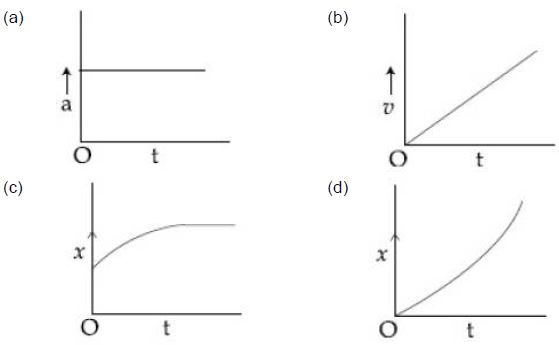
$A$ particle starts from origin $O$ from rest and moves with a uniform acceleration along the positive $x$-axis. Identify all figures that correctly represent the motion qualitatively. ($a =$ acceleration,$v =$ velocity,$x =$ displacement,$t =$ time)
A
$a, b, c$
B
$a$
C
$b, c$
D
$a, b, d$
Solution
(D) Given that the particle starts from rest,the initial velocity $u = 0$.
Since the particle moves with uniform acceleration,the acceleration $a$ is constant over time.
$1$. For acceleration-time graph: Since $a$ is constant,the graph $(a)$ is a horizontal line parallel to the $t$-axis,which is correct.
$2$. For velocity-time graph: Using the equation $v = u + at$,we get $v = 0 + at = at$. This represents a straight line passing through the origin,so graph $(b)$ is correct.
$3$. For displacement-time graph: Using the equation $x = ut + \frac{1}{2}at^2$,we get $x = 0(t) + \frac{1}{2}at^2 = \frac{1}{2}at^2$. This represents a parabola opening upwards starting from the origin,so graph $(d)$ is correct.
Therefore,the figures $(a)$,$(b)$,and $(d)$ correctly represent the motion.
Since the particle moves with uniform acceleration,the acceleration $a$ is constant over time.
$1$. For acceleration-time graph: Since $a$ is constant,the graph $(a)$ is a horizontal line parallel to the $t$-axis,which is correct.
$2$. For velocity-time graph: Using the equation $v = u + at$,we get $v = 0 + at = at$. This represents a straight line passing through the origin,so graph $(b)$ is correct.
$3$. For displacement-time graph: Using the equation $x = ut + \frac{1}{2}at^2$,we get $x = 0(t) + \frac{1}{2}at^2 = \frac{1}{2}at^2$. This represents a parabola opening upwards starting from the origin,so graph $(d)$ is correct.
Therefore,the figures $(a)$,$(b)$,and $(d)$ correctly represent the motion.
0 likes
View Solution129
DifficultMCQ
The position of a particle as a function of time $t$ is given by $x(t) = at + bt^2 - ct^3$,where $a, b,$ and $c$ are constants. When the particle attains zero acceleration,its velocity will be:
A
$a + \frac{b^2}{4c}$
B
$a + \frac{b^2}{c}$
C
$a + \frac{b^2}{2c}$
D
$a + \frac{b^2}{3c}$
Solution
(D) Given the position function: $x(t) = at + bt^2 - ct^3$.
The velocity $v(t)$ is the first derivative of position with respect to time:
$v(t) = \frac{dx}{dt} = a + 2bt - 3ct^2$.
The acceleration $a(t)$ is the derivative of velocity with respect to time:
$a(t) = \frac{dv}{dt} = 2b - 6ct$.
Set the acceleration to zero to find the time $t$ when this occurs:
$0 = 2b - 6ct \implies 6ct = 2b \implies t = \frac{b}{3c}$.
Now,substitute $t = \frac{b}{3c}$ into the velocity equation:
$v = a + 2b\left(\frac{b}{3c}\right) - 3c\left(\frac{b}{3c}\right)^2$
$v = a + \frac{2b^2}{3c} - 3c\left(\frac{b^2}{9c^2}\right)$
$v = a + \frac{2b^2}{3c} - \frac{b^2}{3c}$
$v = a + \frac{b^2}{3c}$.
The velocity $v(t)$ is the first derivative of position with respect to time:
$v(t) = \frac{dx}{dt} = a + 2bt - 3ct^2$.
The acceleration $a(t)$ is the derivative of velocity with respect to time:
$a(t) = \frac{dv}{dt} = 2b - 6ct$.
Set the acceleration to zero to find the time $t$ when this occurs:
$0 = 2b - 6ct \implies 6ct = 2b \implies t = \frac{b}{3c}$.
Now,substitute $t = \frac{b}{3c}$ into the velocity equation:
$v = a + 2b\left(\frac{b}{3c}\right) - 3c\left(\frac{b}{3c}\right)^2$
$v = a + \frac{2b^2}{3c} - 3c\left(\frac{b^2}{9c^2}\right)$
$v = a + \frac{2b^2}{3c} - \frac{b^2}{3c}$
$v = a + \frac{b^2}{3c}$.
0 likes
View Solution130
DifficultMCQ
$A$ particle is moving with speed $v = b\sqrt{x}$ along the positive $x$-axis. Calculate the speed of the particle at time $t = \tau$ (assume that the particle is at the origin at $t = 0$).
A
$b^2\tau$
B
$\frac{b^2\tau}{2}$
C
$\frac{b^2\tau}{\sqrt{2}}$
D
$\frac{b^2\tau}{4}$
Solution
(B) Given the speed $v = b\sqrt{x}$.
We know that $v = \frac{dx}{dt}$,so $\frac{dx}{dt} = b\sqrt{x}$.
Separating the variables,we get $\frac{dx}{\sqrt{x}} = b dt$.
Integrating both sides from $t = 0$ (where $x = 0$) to $t = \tau$ (where $x = x$):
$\int_{0}^{x} x^{-1/2} dx = \int_{0}^{\tau} b dt$
$[2\sqrt{x}]_{0}^{x} = b\tau$
$2\sqrt{x} = b\tau$,which implies $\sqrt{x} = \frac{b\tau}{2}$.
Substituting this into the expression for speed $v = b\sqrt{x}$:
$v = b \left( \frac{b\tau}{2} \right) = \frac{b^2\tau}{2}$.
We know that $v = \frac{dx}{dt}$,so $\frac{dx}{dt} = b\sqrt{x}$.
Separating the variables,we get $\frac{dx}{\sqrt{x}} = b dt$.
Integrating both sides from $t = 0$ (where $x = 0$) to $t = \tau$ (where $x = x$):
$\int_{0}^{x} x^{-1/2} dx = \int_{0}^{\tau} b dt$
$[2\sqrt{x}]_{0}^{x} = b\tau$
$2\sqrt{x} = b\tau$,which implies $\sqrt{x} = \frac{b\tau}{2}$.
Substituting this into the expression for speed $v = b\sqrt{x}$:
$v = b \left( \frac{b\tau}{2} \right) = \frac{b^2\tau}{2}$.
1 likes
View Solution131
MediumMCQ
$A$ body is moving with a uniform acceleration covers $40\,m$ in the first $4\,s$ and $120\,m$ in next $4\,s.$ Its initial velocity and acceleration are
A
$0, 5\,m/s^2$
B
$2\,m/s, 5\,m/s^2$
C
$4\,m/s, 10\,m/s^2$
D
$4\,m/s, 5\,m/s^2$
Solution
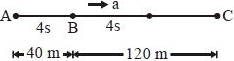
(A) Let the initial velocity be $u$ and acceleration be $a$.
For the first $4\,s$ (from $A$ to $B$):
Using the equation of motion $s = ut + \frac{1}{2}at^2$,we have:
$40 = u(4) + \frac{1}{2}a(4)^2$
$40 = 4u + 8a$
Dividing by $4$,we get: $u + 2a = 10$ --- $(i)$
For the total time of $8\,s$ (from $A$ to $C$):
The total distance covered is $40\,m + 120\,m = 160\,m$.
$160 = u(8) + \frac{1}{2}a(8)^2$
$160 = 8u + 32a$
Dividing by $8$,we get: $u + 4a = 20$ --- $(ii)$
Subtracting equation $(i)$ from $(ii)$:
$(u + 4a) - (u + 2a) = 20 - 10$
$2a = 10 \implies a = 5\,m/s^2$
Substituting $a = 5$ in equation $(i)$:
$u + 2(5) = 10$
$u + 10 = 10 \implies u = 0\,m/s$
Thus,the initial velocity is $0\,m/s$ and acceleration is $5\,m/s^2$.
For the first $4\,s$ (from $A$ to $B$):
Using the equation of motion $s = ut + \frac{1}{2}at^2$,we have:
$40 = u(4) + \frac{1}{2}a(4)^2$
$40 = 4u + 8a$
Dividing by $4$,we get: $u + 2a = 10$ --- $(i)$
For the total time of $8\,s$ (from $A$ to $C$):
The total distance covered is $40\,m + 120\,m = 160\,m$.
$160 = u(8) + \frac{1}{2}a(8)^2$
$160 = 8u + 32a$
Dividing by $8$,we get: $u + 4a = 20$ --- $(ii)$
Subtracting equation $(i)$ from $(ii)$:
$(u + 4a) - (u + 2a) = 20 - 10$
$2a = 10 \implies a = 5\,m/s^2$
Substituting $a = 5$ in equation $(i)$:
$u + 2(5) = 10$
$u + 10 = 10 \implies u = 0\,m/s$
Thus,the initial velocity is $0\,m/s$ and acceleration is $5\,m/s^2$.
0 likes
View Solution132
MediumMCQ
The velocity of a particle moving in the positive direction of the $x$-axis varies as $v = 5 \sqrt{x}$. Assuming that at $t = 0$,the particle was at $x = 0$,what is the acceleration of the particle in $m/s^2$?
A
$12.5$
B
$7.5$
C
$5$
D
$2.5$
Solution
(A) Given the velocity $v = 5 \sqrt{x}$.
We know that acceleration $a = \frac{dv}{dt} = \frac{dv}{dx} \cdot \frac{dx}{dt} = v \frac{dv}{dx}$.
First,find $\frac{dv}{dx}$ by differentiating $v = 5x^{1/2}$ with respect to $x$:
$\frac{dv}{dx} = 5 \cdot \frac{1}{2} x^{-1/2} = \frac{2.5}{\sqrt{x}}$.
Now,substitute $v$ and $\frac{dv}{dx}$ into the acceleration formula:
$a = (5 \sqrt{x}) \cdot \left( \frac{2.5}{\sqrt{x}} \right) = 5 \cdot 2.5 = 12.5 \, m/s^2$.
Thus,the acceleration of the particle is $12.5 \, m/s^2$.
We know that acceleration $a = \frac{dv}{dt} = \frac{dv}{dx} \cdot \frac{dx}{dt} = v \frac{dv}{dx}$.
First,find $\frac{dv}{dx}$ by differentiating $v = 5x^{1/2}$ with respect to $x$:
$\frac{dv}{dx} = 5 \cdot \frac{1}{2} x^{-1/2} = \frac{2.5}{\sqrt{x}}$.
Now,substitute $v$ and $\frac{dv}{dx}$ into the acceleration formula:
$a = (5 \sqrt{x}) \cdot \left( \frac{2.5}{\sqrt{x}} \right) = 5 \cdot 2.5 = 12.5 \, m/s^2$.
Thus,the acceleration of the particle is $12.5 \, m/s^2$.
1 likes
View Solution133
MediumMCQ
$A$ particle returns to the starting point after $10\,s$. If the rate of change of velocity during the motion is constant,then its location after $7\,s$ will be same as that after $...........\,s$.
A
$1$
B
$2$
C
$3$
D
$4$
Solution
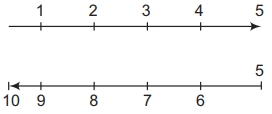
(C) The particle undergoes uniformly accelerated motion. Let the starting point be $x = 0$ at $t = 0$. The position of the particle at any time $t$ is given by $x(t) = ut + \frac{1}{2}at^2$.
Since the particle returns to the starting point at $t = 10\,s$,we have $x(10) = 0$.
$10u + \frac{1}{2}a(10)^2 = 0 \implies 10u + 50a = 0 \implies u = -5a$.
Now,the position at time $t$ is $x(t) = (-5a)t + \frac{1}{2}at^2 = a(\frac{t^2}{2} - 5t)$.
We want to find $t'$ such that $x(7) = x(t')$.
$x(7) = a(\frac{49}{2} - 35) = a(24.5 - 35) = -10.5a$.
Setting $x(t') = -10.5a$,we get $a(\frac{t'^2}{2} - 5t') = -10.5a$.
$\frac{t'^2}{2} - 5t' + 10.5 = 0 \implies t'^2 - 10t' + 21 = 0$.
Solving the quadratic equation: $(t' - 7)(t' - 3) = 0$.
Thus,$t' = 7\,s$ or $t' = 3\,s$.
Since we are looking for a time other than $7\,s$,the location is the same at $3\,s$.
Since the particle returns to the starting point at $t = 10\,s$,we have $x(10) = 0$.
$10u + \frac{1}{2}a(10)^2 = 0 \implies 10u + 50a = 0 \implies u = -5a$.
Now,the position at time $t$ is $x(t) = (-5a)t + \frac{1}{2}at^2 = a(\frac{t^2}{2} - 5t)$.
We want to find $t'$ such that $x(7) = x(t')$.
$x(7) = a(\frac{49}{2} - 35) = a(24.5 - 35) = -10.5a$.
Setting $x(t') = -10.5a$,we get $a(\frac{t'^2}{2} - 5t') = -10.5a$.
$\frac{t'^2}{2} - 5t' + 10.5 = 0 \implies t'^2 - 10t' + 21 = 0$.
Solving the quadratic equation: $(t' - 7)(t' - 3) = 0$.
Thus,$t' = 7\,s$ or $t' = 3\,s$.
Since we are looking for a time other than $7\,s$,the location is the same at $3\,s$.
0 likes
View Solution134
MediumMCQ
$A$ body is moving with a uniform velocity of $8\,m/s$. When the body just crosses another body,the second body starts from rest and moves with a uniform acceleration of $4\,m/s^2$. The time after which the two bodies meet will be $...........\,s$.
A
$2$
B
$4$
C
$6$
D
$8$
Solution
(B) Let the time after which the two bodies meet be $t$ seconds.
For the first body moving with uniform velocity $v = 8\,m/s$,the displacement $s_1$ in time $t$ is given by $s_1 = v \times t = 8t$.
For the second body starting from rest $(u = 0)$ with uniform acceleration $a = 4\,m/s^2$,the displacement $s_2$ in time $t$ is given by $s_2 = ut + \frac{1}{2}at^2 = 0 + \frac{1}{2} \times 4 \times t^2 = 2t^2$.
Since the two bodies meet,their displacements must be equal: $s_1 = s_2$.
Therefore,$8t = 2t^2$.
Rearranging the equation: $2t^2 - 8t = 0$,which gives $2t(t - 4) = 0$.
Since $t$ cannot be $0$ (as they meet after starting),we have $t = 4\,s$.
For the first body moving with uniform velocity $v = 8\,m/s$,the displacement $s_1$ in time $t$ is given by $s_1 = v \times t = 8t$.
For the second body starting from rest $(u = 0)$ with uniform acceleration $a = 4\,m/s^2$,the displacement $s_2$ in time $t$ is given by $s_2 = ut + \frac{1}{2}at^2 = 0 + \frac{1}{2} \times 4 \times t^2 = 2t^2$.
Since the two bodies meet,their displacements must be equal: $s_1 = s_2$.
Therefore,$8t = 2t^2$.
Rearranging the equation: $2t^2 - 8t = 0$,which gives $2t(t - 4) = 0$.
Since $t$ cannot be $0$ (as they meet after starting),we have $t = 4\,s$.
0 likes
View Solution135
MediumMCQ
The same retarding force is applied to stop a train. The train stops after $80 \ m$. If the speed is doubled,then the stopping distance will be
A
The same
B
Doubled
C
Halved
D
Four times
Solution
(D) Using the equation of motion $v^{2} = u^{2} + 2as$,where $v$ is the final velocity,$u$ is the initial velocity,$a$ is the acceleration (retardation),and $s$ is the stopping distance.
Since the train stops,$v = 0$,so $0 = u^{2} - 2as$,which gives $s = \frac{u^{2}}{2a}$.
Since the retarding force $F = ma$ is constant,the retardation $a$ is constant.
Therefore,$s \propto u^{2}$.
Given $s_{1} = 80 \ m$ for initial speed $u_{1} = u$.
If the speed is doubled,$u_{2} = 2u$.
Then,$\frac{s_{2}}{s_{1}} = \left(\frac{u_{2}}{u_{1}}\right)^{2} = \left(\frac{2u}{u}\right)^{2} = 4$.
$s_{2} = 4 \times s_{1} = 4 \times 80 \ m = 320 \ m$.
Thus,the stopping distance becomes four times the original distance.
Since the train stops,$v = 0$,so $0 = u^{2} - 2as$,which gives $s = \frac{u^{2}}{2a}$.
Since the retarding force $F = ma$ is constant,the retardation $a$ is constant.
Therefore,$s \propto u^{2}$.
Given $s_{1} = 80 \ m$ for initial speed $u_{1} = u$.
If the speed is doubled,$u_{2} = 2u$.
Then,$\frac{s_{2}}{s_{1}} = \left(\frac{u_{2}}{u_{1}}\right)^{2} = \left(\frac{2u}{u}\right)^{2} = 4$.
$s_{2} = 4 \times s_{1} = 4 \times 80 \ m = 320 \ m$.
Thus,the stopping distance becomes four times the original distance.
0 likes
View Solution136
MediumMCQ
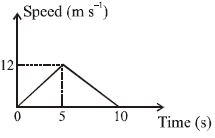
Two bodies $A$ and $B$ start from rest from the same point with a uniform acceleration of $2\,m/s^2$. If $B$ starts one second later,then the two bodies are separated,at the end of the next second,by $.............\,m$.
A
$1$
B
$2$
C
$3$
D
$4$
Solution
(C) Given:
Acceleration $a = 2\,m/s^2$.
Body $A$ starts at $t = 0$ and travels for $t_A = 2\,s$ (one second after $B$ starts,which is $1+1=2\,s$ total).
Body $B$ starts at $t = 1\,s$ and travels for $t_B = 1\,s$ (at the end of the next second).
Using the equation of motion $s = ut + \frac{1}{2}at^2$,where $u = 0$:
Distance traveled by $A$ in $2\,s$ is $s_A = \frac{1}{2} \times 2 \times (2)^2 = 4\,m$.
Distance traveled by $B$ in $1\,s$ is $s_B = \frac{1}{2} \times 2 \times (1)^2 = 1\,m$.
The separation between the two bodies is $s_A - s_B = 4\,m - 1\,m = 3\,m$.
Acceleration $a = 2\,m/s^2$.
Body $A$ starts at $t = 0$ and travels for $t_A = 2\,s$ (one second after $B$ starts,which is $1+1=2\,s$ total).
Body $B$ starts at $t = 1\,s$ and travels for $t_B = 1\,s$ (at the end of the next second).
Using the equation of motion $s = ut + \frac{1}{2}at^2$,where $u = 0$:
Distance traveled by $A$ in $2\,s$ is $s_A = \frac{1}{2} \times 2 \times (2)^2 = 4\,m$.
Distance traveled by $B$ in $1\,s$ is $s_B = \frac{1}{2} \times 2 \times (1)^2 = 1\,m$.
The separation between the two bodies is $s_A - s_B = 4\,m - 1\,m = 3\,m$.
0 likes
View Solution137
MediumMCQ
Velocity of a body moving along a straight line with uniform acceleration $a$ reduces by $\frac{3}{4}$ of its initial velocity in time $t_0$. The total time of motion of the body till its velocity becomes zero is
A
$\frac{4}{3} t_0$
B
$\frac{3}{2} t_0$
C
$\frac{5}{3} t_0$
D
$\frac{8}{3} t_0$
Solution
(A) Let the initial velocity be $u$. The velocity reduces by $\frac{3}{4}u$ in time $t_0$,so the final velocity $v$ at time $t_0$ is $v = u - \frac{3}{4}u = \frac{1}{4}u$.
Using the first equation of motion,$v = u + at$,where acceleration is negative (retardation),we have $\frac{1}{4}u = u - at_0$.
Rearranging gives $at_0 = u - \frac{1}{4}u = \frac{3}{4}u$,which implies $a = \frac{3u}{4t_0}$.
Let $T$ be the total time taken for the velocity to become zero. Using $v = u - aT$ with $v = 0$,we get $0 = u - aT$,so $T = \frac{u}{a}$.
Substituting the value of $a$,we get $T = \frac{u}{(3u / 4t_0)} = \frac{4}{3}t_0$.
Using the first equation of motion,$v = u + at$,where acceleration is negative (retardation),we have $\frac{1}{4}u = u - at_0$.
Rearranging gives $at_0 = u - \frac{1}{4}u = \frac{3}{4}u$,which implies $a = \frac{3u}{4t_0}$.
Let $T$ be the total time taken for the velocity to become zero. Using $v = u - aT$ with $v = 0$,we get $0 = u - aT$,so $T = \frac{u}{a}$.
Substituting the value of $a$,we get $T = \frac{u}{(3u / 4t_0)} = \frac{4}{3}t_0$.
0 likes
View Solution138
EasyMCQ
$A$ particle moves along the $x$-axis as $x = 4(t-2) + a(t-2)^2$. Which of the following statements is true?
A
The initial velocity of the particle is $4$.
B
The acceleration of the particle is $2a$.
C
The particle is at the origin at $t=0$.
D
None of the above.
Solution
(B) Given the position equation: $x = 4(t-2) + a(t-2)^2$.
To find the velocity $v$,we differentiate $x$ with respect to time $t$:
$v = \frac{dx}{dt} = \frac{d}{dt}[4(t-2) + a(t-2)^2] = 4 + 2a(t-2)$.
To find the acceleration $a_{acc}$,we differentiate the velocity $v$ with respect to time $t$:
$a_{acc} = \frac{dv}{dt} = \frac{d}{dt}[4 + 2a(t-2)] = 2a$.
Checking the options:
$(a)$ Initial velocity at $t=0$ is $v = 4 + 2a(0-2) = 4 - 4a$. This is not $4$ unless $a=0$.
$(b)$ The acceleration is $2a$,which matches our derivation.
$(c)$ At $t=0$,$x = 4(0-2) + a(0-2)^2 = -8 + 4a$. This is not $0$ unless $a=2$.
Therefore,the correct statement is that the acceleration of the particle is $2a$.
To find the velocity $v$,we differentiate $x$ with respect to time $t$:
$v = \frac{dx}{dt} = \frac{d}{dt}[4(t-2) + a(t-2)^2] = 4 + 2a(t-2)$.
To find the acceleration $a_{acc}$,we differentiate the velocity $v$ with respect to time $t$:
$a_{acc} = \frac{dv}{dt} = \frac{d}{dt}[4 + 2a(t-2)] = 2a$.
Checking the options:
$(a)$ Initial velocity at $t=0$ is $v = 4 + 2a(0-2) = 4 - 4a$. This is not $4$ unless $a=0$.
$(b)$ The acceleration is $2a$,which matches our derivation.
$(c)$ At $t=0$,$x = 4(0-2) + a(0-2)^2 = -8 + 4a$. This is not $0$ unless $a=2$.
Therefore,the correct statement is that the acceleration of the particle is $2a$.
0 likes
View Solution139
MediumMCQ
Which of the following represents uniformly accelerated motion?
A
$x = \sqrt{\frac{t+a}{b}}$
B
$x = \frac{t+a}{b}$
C
$t = \sqrt{\frac{x+a}{b}}$
D
$x = \sqrt{t+a}$
Solution
(C) For uniformly accelerated motion,the position $x$ must be a quadratic function of time $t$,i.e.,$x = x_0 + u t + \frac{1}{2} a t^2$.
Given option $(C)$: $t = \sqrt{\frac{x+a}{b}}$
Squaring both sides:
$t^2 = \frac{x+a}{b}$
$b t^2 = x + a$
$x = b t^2 - a$
Comparing this with the standard kinematic equation $x = x_0 + u t + \frac{1}{2} a t^2$,we see that the acceleration is constant $(a_{accel} = 2b)$ and initial velocity is zero. Thus,this represents uniformly accelerated motion.
Given option $(C)$: $t = \sqrt{\frac{x+a}{b}}$
Squaring both sides:
$t^2 = \frac{x+a}{b}$
$b t^2 = x + a$
$x = b t^2 - a$
Comparing this with the standard kinematic equation $x = x_0 + u t + \frac{1}{2} a t^2$,we see that the acceleration is constant $(a_{accel} = 2b)$ and initial velocity is zero. Thus,this represents uniformly accelerated motion.
0 likes
View Solution140
MediumMCQ
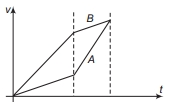
Two particles $A$ and $B$ start from rest and move for equal time on a straight line. Particle $A$ has an acceleration of $2\,m/s^2$ for the first half of the total time and $4\,m/s^2$ for the second half. The particle $B$ has acceleration $4\,m/s^2$ for the first half and $2\,m/s^2$ for the second half. Which particle has covered a larger distance?
A
$A$
B
$B$
C
Both have covered the same distance
D
Data insufficient
Solution
(B) Let the total time be $T$. The first half time is $t = T/2$.
For particle $A$:
Velocity at $t = T/2$ is $v_A = 0 + 2(T/2) = T$.
Distance in first half $s_{A1} = 0 + 1/2(2)(T/2)^2 = T^2/4$.
Distance in second half $s_{A2} = v_A(T/2) + 1/2(4)(T/2)^2 = T(T/2) + 2(T^2/4) = T^2/2 + T^2/2 = T^2$.
Total distance $S_A = T^2/4 + T^2 = 5T^2/4$.
For particle $B$:
Velocity at $t = T/2$ is $v_B = 0 + 4(T/2) = 2T$.
Distance in first half $s_{B1} = 0 + 1/2(4)(T/2)^2 = T^2/2$.
Distance in second half $s_{B2} = v_B(T/2) + 1/2(2)(T/2)^2 = 2T(T/2) + 1(T^2/4) = T^2 + T^2/4 = 5T^2/4$.
Wait,let's re-evaluate the graph. The area under the $v-t$ graph represents displacement. Since both particles start from rest and reach the same final velocity at time $T$ $(v_{final} = a_1(T/2) + a_2(T/2) = (2+4)(T/2) = 3T)$,the area under the curve for $B$ is clearly larger because it gains velocity faster in the first half.
Thus,particle $B$ covers a larger distance.
For particle $A$:
Velocity at $t = T/2$ is $v_A = 0 + 2(T/2) = T$.
Distance in first half $s_{A1} = 0 + 1/2(2)(T/2)^2 = T^2/4$.
Distance in second half $s_{A2} = v_A(T/2) + 1/2(4)(T/2)^2 = T(T/2) + 2(T^2/4) = T^2/2 + T^2/2 = T^2$.
Total distance $S_A = T^2/4 + T^2 = 5T^2/4$.
For particle $B$:
Velocity at $t = T/2$ is $v_B = 0 + 4(T/2) = 2T$.
Distance in first half $s_{B1} = 0 + 1/2(4)(T/2)^2 = T^2/2$.
Distance in second half $s_{B2} = v_B(T/2) + 1/2(2)(T/2)^2 = 2T(T/2) + 1(T^2/4) = T^2 + T^2/4 = 5T^2/4$.
Wait,let's re-evaluate the graph. The area under the $v-t$ graph represents displacement. Since both particles start from rest and reach the same final velocity at time $T$ $(v_{final} = a_1(T/2) + a_2(T/2) = (2+4)(T/2) = 3T)$,the area under the curve for $B$ is clearly larger because it gains velocity faster in the first half.
Thus,particle $B$ covers a larger distance.
0 likes
View Solution141
DifficultMCQ
$A$ particle located at $x = 0$ at time $t = 0$ starts moving along the positive $X$-direction with a velocity $v$ that varies as $v = \alpha \sqrt{x}$. The displacement of the particle with time is proportional to
A
$t^3$
B
$t^2$
C
$t$
D
$t^{1/2}$
Solution
(B) Given the velocity $v = \frac{dx}{dt} = \alpha \sqrt{x}$.
Separating the variables,we get $\frac{dx}{\sqrt{x}} = \alpha dt$.
Integrating both sides,$\int_{0}^{x} x^{-1/2} dx = \int_{0}^{t} \alpha dt$.
This yields $[2x^{1/2}]_{0}^{x} = \alpha t$.
So,$2\sqrt{x} = \alpha t$,which implies $\sqrt{x} = \frac{\alpha}{2} t$.
Squaring both sides,$x = \frac{\alpha^2}{4} t^2$.
Therefore,the displacement $x$ is proportional to $t^2$.
Separating the variables,we get $\frac{dx}{\sqrt{x}} = \alpha dt$.
Integrating both sides,$\int_{0}^{x} x^{-1/2} dx = \int_{0}^{t} \alpha dt$.
This yields $[2x^{1/2}]_{0}^{x} = \alpha t$.
So,$2\sqrt{x} = \alpha t$,which implies $\sqrt{x} = \frac{\alpha}{2} t$.
Squaring both sides,$x = \frac{\alpha^2}{4} t^2$.
Therefore,the displacement $x$ is proportional to $t^2$.
0 likes
View Solution142
DifficultMCQ
$A$ particle moves in a straight line and its position $x$ at time $t$ is given by $x^2 = 2 + t$. Its acceleration is given by
A
$- \frac{2}{x^3}$
B
$- \frac{1}{4x^3}$
C
$- \frac{1}{4x^2}$
D
$\frac{1}{x^2}$
Solution
(B) Given the position-time relation: $x^2 = 2 + t$.
Differentiating both sides with respect to $t$:
$2x \frac{dx}{dt} = 1$.
Since velocity $v = \frac{dx}{dt}$,we have $2xv = 1$,which implies $v = \frac{1}{2x}$.
Acceleration $a$ is given by $a = v \frac{dv}{dx}$.
First,find $\frac{dv}{dx}$ by differentiating $v = \frac{1}{2} x^{-1}$ with respect to $x$:
$\frac{dv}{dx} = \frac{1}{2} (-1) x^{-2} = -\frac{1}{2x^2}$.
Now,substitute $v$ and $\frac{dv}{dx}$ into the acceleration formula:
$a = (\frac{1}{2x}) \times (-\frac{1}{2x^2}) = -\frac{1}{4x^3}$.
Differentiating both sides with respect to $t$:
$2x \frac{dx}{dt} = 1$.
Since velocity $v = \frac{dx}{dt}$,we have $2xv = 1$,which implies $v = \frac{1}{2x}$.
Acceleration $a$ is given by $a = v \frac{dv}{dx}$.
First,find $\frac{dv}{dx}$ by differentiating $v = \frac{1}{2} x^{-1}$ with respect to $x$:
$\frac{dv}{dx} = \frac{1}{2} (-1) x^{-2} = -\frac{1}{2x^2}$.
Now,substitute $v$ and $\frac{dv}{dx}$ into the acceleration formula:
$a = (\frac{1}{2x}) \times (-\frac{1}{2x^2}) = -\frac{1}{4x^3}$.
0 likes
View Solution143
DifficultMCQ
$A$ train accelerates from rest at a constant rate $\alpha$ for distance $x_1$ and time $t_1$. After that,it retards to rest at a constant rate $\beta$ for distance $x_2$ and time $t_2$. Which of the following relations is correct?
A
$\frac{x_1}{x_2} = \frac{\alpha}{\beta} = \frac{t_1}{t_2}$
B
$\frac{x_1}{x_2} = \frac{\beta}{\alpha} = \frac{t_1}{t_2}$
C
$\frac{x_1}{x_2} = \frac{\alpha}{\beta} = \frac{t_2}{t_1}$
D
$\frac{x_1}{x_2} = \frac{\beta}{\alpha} = \frac{t_2}{t_1}$
Solution
(B) For the acceleration phase starting from rest: $v_{\max} = \alpha t_1$ and $x_1 = \frac{1}{2} \alpha t_1^2$.
For the retardation phase coming to rest: $v_{\max} = \beta t_2$ and $x_2 = \frac{1}{2} \beta t_2^2$.
Equating the maximum velocities: $\alpha t_1 = \beta t_2$,which implies $\frac{t_1}{t_2} = \frac{\beta}{\alpha}$.
Now,taking the ratio of distances: $\frac{x_1}{x_2} = \frac{\frac{1}{2} \alpha t_1^2}{\frac{1}{2} \beta t_2^2} = \frac{\alpha}{\beta} \left( \frac{t_1}{t_2} \right)^2$.
Substituting $\frac{\alpha}{\beta} = \frac{t_2}{t_1}$ into the distance ratio: $\frac{x_1}{x_2} = \left( \frac{t_2}{t_1} \right) \left( \frac{t_1}{t_2} \right)^2 = \frac{t_1}{t_2}$.
Since $\frac{t_1}{t_2} = \frac{\beta}{\alpha}$,we get $\frac{x_1}{x_2} = \frac{t_1}{t_2} = \frac{\beta}{\alpha}$.
For the retardation phase coming to rest: $v_{\max} = \beta t_2$ and $x_2 = \frac{1}{2} \beta t_2^2$.
Equating the maximum velocities: $\alpha t_1 = \beta t_2$,which implies $\frac{t_1}{t_2} = \frac{\beta}{\alpha}$.
Now,taking the ratio of distances: $\frac{x_1}{x_2} = \frac{\frac{1}{2} \alpha t_1^2}{\frac{1}{2} \beta t_2^2} = \frac{\alpha}{\beta} \left( \frac{t_1}{t_2} \right)^2$.
Substituting $\frac{\alpha}{\beta} = \frac{t_2}{t_1}$ into the distance ratio: $\frac{x_1}{x_2} = \left( \frac{t_2}{t_1} \right) \left( \frac{t_1}{t_2} \right)^2 = \frac{t_1}{t_2}$.
Since $\frac{t_1}{t_2} = \frac{\beta}{\alpha}$,we get $\frac{x_1}{x_2} = \frac{t_1}{t_2} = \frac{\beta}{\alpha}$.
0 likes
View Solution144
EasyMCQ
If $x \propto t^{5/2}$,then
A
$v \propto t^{3/2}$
B
$a \propto \sqrt{t}$
C
both $(A)$ and $(B)$
D
$v \propto \sqrt{t}$
Solution
(C) Given $x \propto t^{5/2}$,so $x = K t^{5/2}$ where $K$ is a constant.
Velocity $v = \frac{dx}{dt} = \frac{d}{dt}(K t^{5/2}) = K \cdot \frac{5}{2} t^{3/2}$.
Thus,$v \propto t^{3/2}$.
Acceleration $a = \frac{dv}{dt} = \frac{d}{dt}(\frac{5}{2} K t^{3/2}) = \frac{5}{2} K \cdot \frac{3}{2} t^{1/2} = \frac{15}{4} K t^{1/2}$.
Thus,$a \propto t^{1/2}$ or $a \propto \sqrt{t}$.
Therefore,both $(A)$ and $(B)$ are correct.
Velocity $v = \frac{dx}{dt} = \frac{d}{dt}(K t^{5/2}) = K \cdot \frac{5}{2} t^{3/2}$.
Thus,$v \propto t^{3/2}$.
Acceleration $a = \frac{dv}{dt} = \frac{d}{dt}(\frac{5}{2} K t^{3/2}) = \frac{5}{2} K \cdot \frac{3}{2} t^{1/2} = \frac{15}{4} K t^{1/2}$.
Thus,$a \propto t^{1/2}$ or $a \propto \sqrt{t}$.
Therefore,both $(A)$ and $(B)$ are correct.
0 likes
View Solution145
MediumMCQ
$A$ particle moving with uniform acceleration travels $24\, m$ and $64\, m$ in the first two consecutive intervals of $4\, s$ each. Its initial velocity is ....... $m/s$.
A
$1$
B
$10$
C
$5$
D
$2$
Solution
(A) Let the initial velocity be $u$ and acceleration be $a$.
For the first interval of $t = 4\, s$,the distance $s_1 = 24\, m$:
$s = ut + \frac{1}{2}at^2$
$24 = u(4) + \frac{1}{2}a(4)^2$
$24 = 4u + 8a$
Dividing by $4$,we get: $6 = u + 2a$ $...(i)$
For the total time $t = 8\, s$,the total distance $s_{total} = 24 + 64 = 88\, m$:
$88 = u(8) + \frac{1}{2}a(8)^2$
$88 = 8u + 32a$
Dividing by $8$,we get: $11 = u + 4a$ $...(ii)$
Subtracting equation $(i)$ from equation $(ii)$:
$(u + 4a) - (u + 2a) = 11 - 6$
$2a = 5 \implies a = 2.5\, m/s^2$
Substituting $a = 2.5$ in equation $(i)$:
$u + 2(2.5) = 6$
$u + 5 = 6$
$u = 1\, m/s$.
For the first interval of $t = 4\, s$,the distance $s_1 = 24\, m$:
$s = ut + \frac{1}{2}at^2$
$24 = u(4) + \frac{1}{2}a(4)^2$
$24 = 4u + 8a$
Dividing by $4$,we get: $6 = u + 2a$ $...(i)$
For the total time $t = 8\, s$,the total distance $s_{total} = 24 + 64 = 88\, m$:
$88 = u(8) + \frac{1}{2}a(8)^2$
$88 = 8u + 32a$
Dividing by $8$,we get: $11 = u + 4a$ $...(ii)$
Subtracting equation $(i)$ from equation $(ii)$:
$(u + 4a) - (u + 2a) = 11 - 6$
$2a = 5 \implies a = 2.5\, m/s^2$
Substituting $a = 2.5$ in equation $(i)$:
$u + 2(2.5) = 6$
$u + 5 = 6$
$u = 1\, m/s$.
0 likes
View Solution146
MediumMCQ
The acceleration $a$ in $m/s^2$ of a particle is given by $a = 3t^2 + 2t + 2$,where $t$ is the time in seconds. If the particle starts with an initial velocity $v = 2\,m/s$ at $t = 0$,then the velocity at the end of $t = 2\,s$ is $............m/s$.
A
$12$
B
$14$
C
$16$
D
$18$
Solution
(D) Given acceleration $a = \frac{dv}{dt} = 3t^2 + 2t + 2$.
To find the velocity $v$,we integrate the acceleration with respect to time: $dv = (3t^2 + 2t + 2)dt$.
Integrating both sides with the given limits: $\int_{v_0}^{v} dv = \int_{0}^{t} (3t^2 + 2t + 2) dt$.
Given $v_0 = 2\,m/s$ at $t = 0$,we have: $v - 2 = [t^3 + t^2 + 2t]_0^2$.
Substituting the upper limit $t = 2$: $v - 2 = (2^3 + 2^2 + 2(2)) - 0$.
$v - 2 = 8 + 4 + 4 = 16$.
$v = 16 + 2 = 18\,m/s$.
To find the velocity $v$,we integrate the acceleration with respect to time: $dv = (3t^2 + 2t + 2)dt$.
Integrating both sides with the given limits: $\int_{v_0}^{v} dv = \int_{0}^{t} (3t^2 + 2t + 2) dt$.
Given $v_0 = 2\,m/s$ at $t = 0$,we have: $v - 2 = [t^3 + t^2 + 2t]_0^2$.
Substituting the upper limit $t = 2$: $v - 2 = (2^3 + 2^2 + 2(2)) - 0$.
$v - 2 = 8 + 4 + 4 = 16$.
$v = 16 + 2 = 18\,m/s$.
0 likes
View Solution147
MediumMCQ
$A$ particle initially at rest moves along the $x$-axis. Its acceleration varies with time as $a = 4t$. If it starts from the origin,the distance covered by it in $3 \ s$ is $........... \ m$.
A
$12$
B
$18$
C
$24$
D
$36$
Solution
(B) Given,acceleration $a = 4t$.
Since the particle starts from rest,the initial velocity $u = 0$ at $t = 0$.
We know that $a = \frac{dv}{dt}$,so $dv = a \ dt = 4t \ dt$.
Integrating both sides,we get $v = \int 4t \ dt = 2t^2 + C$.
At $t = 0$,$v = 0$,so $C = 0$. Thus,$v = 2t^2$.
We know that $v = \frac{dx}{dt}$,so $dx = v \ dt = 2t^2 \ dt$.
Integrating both sides to find the distance $d$ covered from the origin ($x=0$ at $t=0$):
$d = \int_{0}^{3} 2t^2 \ dt = \left[ \frac{2t^3}{3} \right]_{0}^{3}$.
$d = \frac{2(3)^3}{3} = \frac{2 \times 27}{3} = 2 \times 9 = 18 \ m$.
Since the particle starts from rest,the initial velocity $u = 0$ at $t = 0$.
We know that $a = \frac{dv}{dt}$,so $dv = a \ dt = 4t \ dt$.
Integrating both sides,we get $v = \int 4t \ dt = 2t^2 + C$.
At $t = 0$,$v = 0$,so $C = 0$. Thus,$v = 2t^2$.
We know that $v = \frac{dx}{dt}$,so $dx = v \ dt = 2t^2 \ dt$.
Integrating both sides to find the distance $d$ covered from the origin ($x=0$ at $t=0$):
$d = \int_{0}^{3} 2t^2 \ dt = \left[ \frac{2t^3}{3} \right]_{0}^{3}$.
$d = \frac{2(3)^3}{3} = \frac{2 \times 27}{3} = 2 \times 9 = 18 \ m$.
0 likes
View Solution148
EasyMCQ
The acceleration $a$ (in $m/s^2$) of a body,starting from rest,varies with time $t$ (in seconds) according to the relation $a = 3t + 4$. The velocity of the body at time $t = 2 \ s$ will be $........ \ m/s$.
A
$10$
B
$12$
C
$14$
D
$16$
Solution
(C) Given that the body starts from rest,the initial velocity $u = 0$ at $t = 0$.
We know that acceleration $a = \frac{dv}{dt}$,so $dv = a \ dt$.
Integrating both sides from $t = 0$ to $t = 2 \ s$:
$v = \int_{0}^{2} a \ dt = \int_{0}^{2} (3t + 4) \ dt$.
$v = \left[ \frac{3t^2}{2} + 4t \right]_{0}^{2}$.
$v = \left( \frac{3(2)^2}{2} + 4(2) \right) - (0)$.
$v = \left( \frac{3 \times 4}{2} + 8 \right) = 6 + 8 = 14 \ m/s$.
We know that acceleration $a = \frac{dv}{dt}$,so $dv = a \ dt$.
Integrating both sides from $t = 0$ to $t = 2 \ s$:
$v = \int_{0}^{2} a \ dt = \int_{0}^{2} (3t + 4) \ dt$.
$v = \left[ \frac{3t^2}{2} + 4t \right]_{0}^{2}$.
$v = \left( \frac{3(2)^2}{2} + 4(2) \right) - (0)$.
$v = \left( \frac{3 \times 4}{2} + 8 \right) = 6 + 8 = 14 \ m/s$.
0 likes
View Solution149
MediumMCQ
The displacement $(x)$ of a particle depends on time $t$ as $x = \alpha t^2 - \beta t^3$. Choose the incorrect statements from the following.
A
The particle never returns to its starting point
B
The particle comes to rest after time $t = \frac{2 \alpha}{3 \beta}$
C
The initial acceleration of the particle is zero
D
$(a)$ and $(c)$ only
Solution
(D) The displacement is given by $x = \alpha t^2 - \beta t^3$.
$1$. To check if the particle returns to its starting point,set $x = 0$:
$\alpha t^2 - \beta t^3 = 0 \implies t^2(\alpha - \beta t) = 0$.
This gives $t = 0$ and $t = \frac{\alpha}{\beta}$. Since the particle returns to $x = 0$ at $t = \frac{\alpha}{\beta}$,statement $(a)$ is incorrect.
$2$. Velocity $v = \frac{dx}{dt} = 2\alpha t - 3\beta t^2$. Setting $v = 0$ for rest:
$t(2\alpha - 3\beta t) = 0 \implies t = 0$ or $t = \frac{2\alpha}{3\beta}$. Thus,statement $(b)$ is correct.
$3$. Acceleration $a = \frac{dv}{dt} = 2\alpha - 6\beta t$. At $t = 0$,$a = 2\alpha$. Since $2\alpha \neq 0$,the initial acceleration is not zero. Thus,statement $(c)$ is incorrect.
Since both $(a)$ and $(c)$ are incorrect,the correct choice is $(d)$.
$1$. To check if the particle returns to its starting point,set $x = 0$:
$\alpha t^2 - \beta t^3 = 0 \implies t^2(\alpha - \beta t) = 0$.
This gives $t = 0$ and $t = \frac{\alpha}{\beta}$. Since the particle returns to $x = 0$ at $t = \frac{\alpha}{\beta}$,statement $(a)$ is incorrect.
$2$. Velocity $v = \frac{dx}{dt} = 2\alpha t - 3\beta t^2$. Setting $v = 0$ for rest:
$t(2\alpha - 3\beta t) = 0 \implies t = 0$ or $t = \frac{2\alpha}{3\beta}$. Thus,statement $(b)$ is correct.
$3$. Acceleration $a = \frac{dv}{dt} = 2\alpha - 6\beta t$. At $t = 0$,$a = 2\alpha$. Since $2\alpha \neq 0$,the initial acceleration is not zero. Thus,statement $(c)$ is incorrect.
Since both $(a)$ and $(c)$ are incorrect,the correct choice is $(d)$.
0 likes
View Solution150
MediumMCQ
$A$ particle moves along a straight line. Its position at any instant is given by $x = 32t - \frac{8t^3}{3}$,where $x$ is in $m$ and $t$ is in $s$. Find the acceleration of the particle at the instant when the particle is at rest $..........\,m/s^2$.
A
$-16$
B
$-32$
C
$32$
D
$16$
Solution
(B) The position of the particle is given by $x = 32t - \frac{8t^3}{3}$.
To find the velocity $v$,we differentiate $x$ with respect to $t$:
$v = \frac{dx}{dt} = \frac{d}{dt}(32t - \frac{8t^3}{3}) = 32 - 8t^2$.
The particle is at rest when $v = 0$:
$32 - 8t^2 = 0 \implies 8t^2 = 32 \implies t^2 = 4 \implies t = 2 \, s$ (since $t > 0$).
To find the acceleration $a$,we differentiate $v$ with respect to $t$:
$a = \frac{dv}{dt} = \frac{d}{dt}(32 - 8t^2) = -16t$.
At the instant $t = 2 \, s$,the acceleration is:
$a = -16(2) = -32 \, m/s^2$.
To find the velocity $v$,we differentiate $x$ with respect to $t$:
$v = \frac{dx}{dt} = \frac{d}{dt}(32t - \frac{8t^3}{3}) = 32 - 8t^2$.
The particle is at rest when $v = 0$:
$32 - 8t^2 = 0 \implies 8t^2 = 32 \implies t^2 = 4 \implies t = 2 \, s$ (since $t > 0$).
To find the acceleration $a$,we differentiate $v$ with respect to $t$:
$a = \frac{dv}{dt} = \frac{d}{dt}(32 - 8t^2) = -16t$.
At the instant $t = 2 \, s$,the acceleration is:
$a = -16(2) = -32 \, m/s^2$.
0 likes
View SolutionMotion in Straight Line — Uniformly Accelerated Motion · Frequently Asked Questions
1Are these Motion in Straight Line questions useful for JEE and NEET?
Yes. All questions in this section are mapped to JEE Main and NEET exam patterns. Previous year questions from JEE Main, NEET, GUJCET and state-level exams are included with full solutions.
2Can I switch to Hindi or Gujarati for these questions?
Yes. Use the language tabs in the hero section or the sidebar to view the same questions and solutions in English, Hindi or Gujarati.
3How do I generate a question paper from this subtopic?
Use the Vedclass Exam Paper Generator — select the chapter and subtopic, set difficulty, and generate Sets A, B, C, D automatically. First 3 chapters of every subject are free.
Vedclass Products
For Students
Vedclass Test Series
Mock tests in real JEE/NEET style with performance analysis. 5-day free trial.
Start Free TrialFor Teachers
Exam Paper Generator
Generate Set A/B/C/D papers from this chapter in 2 minutes. 3 chapters free.
Try FreeFor Institutes
Online Exam Module
Live online exams with unlimited students, 360° analytics & white-label branding.
See DemoFor Teachers & Institutes
Generate a Motion in Straight Line Exam Paper in 2 Minutes
Select subtopic & difficulty — Sets A, B, C, D auto-generated with No Repeat logic.
First 3 chapters of every subject are free — no payment required.