
A English
Uniformly Accelerated Motion Questions in English
Class 11 Physics · Motion in Straight Line · Uniformly Accelerated Motion
304+
Questions
English
Language
100%
With Solutions
Showing 50 of 304 questions in English
151
MediumMCQ
If the velocity of a particle moving along the $x-$ axis is given by $v = k\sqrt{x}$,then which of the following is true? ($a$ is acceleration)
A
$x \propto \sqrt{t}$
B
$x \propto t$
C
$a \propto x$
D
$a =$ constant
Solution
(D) Given the velocity $v = k\sqrt{x}$.
We know that acceleration $a = v \frac{dv}{dx}$.
First,find $\frac{dv}{dx}$ by differentiating $v$ with respect to $x$: $\frac{dv}{dx} = \frac{d}{dx}(k x^{1/2}) = k \cdot \frac{1}{2} x^{-1/2} = \frac{k}{2\sqrt{x}}$.
Now,substitute $v$ and $\frac{dv}{dx}$ into the acceleration formula: $a = (k\sqrt{x}) \cdot \left(\frac{k}{2\sqrt{x}}\right)$.
Simplifying this,we get $a = \frac{k^2}{2}$.
Since $k$ is a constant,$a$ is also a constant.
We know that acceleration $a = v \frac{dv}{dx}$.
First,find $\frac{dv}{dx}$ by differentiating $v$ with respect to $x$: $\frac{dv}{dx} = \frac{d}{dx}(k x^{1/2}) = k \cdot \frac{1}{2} x^{-1/2} = \frac{k}{2\sqrt{x}}$.
Now,substitute $v$ and $\frac{dv}{dx}$ into the acceleration formula: $a = (k\sqrt{x}) \cdot \left(\frac{k}{2\sqrt{x}}\right)$.
Simplifying this,we get $a = \frac{k^2}{2}$.
Since $k$ is a constant,$a$ is also a constant.
0 likes
View Solution152
MediumMCQ
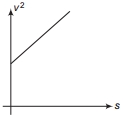
The $v^2$ versus $s$ graph of a particle moving in a straight line is shown in the figure. From the graph,some conclusions are drawn. State which statement is wrong?
A
The given graph shows a uniformly accelerated motion
B
Initial velocity of the particle is zero
C
Corresponding $s-t$ graph will be a parabola
D
None of the above
Solution
(B) The correct answer is $B$.
For uniformly accelerated motion,the equation of motion is $v^2 = u^2 + 2as$,where $v$ is final velocity,$u$ is initial velocity,$a$ is acceleration,and $s$ is displacement.
Comparing this with the equation of a straight line $y = mx + c$,where $y = v^2$,$x = s$,$m = 2a$ (slope),and $c = u^2$ (intercept on the $v^2$ axis).
Since the graph is a straight line,it represents uniformly accelerated motion. This makes statement $A$ correct.
Since the graph has a non-zero intercept on the $v^2$ axis,$u^2 \neq 0$,which implies the initial velocity $u \neq 0$. Therefore,statement $B$ is wrong.
For uniformly accelerated motion,$s = ut + \frac{1}{2}at^2$,which is a quadratic equation in $t$,representing a parabola in the $s-t$ graph. Therefore,statement $C$ is correct.
Since statement $B$ is wrong,the correct choice is $B$.
For uniformly accelerated motion,the equation of motion is $v^2 = u^2 + 2as$,where $v$ is final velocity,$u$ is initial velocity,$a$ is acceleration,and $s$ is displacement.
Comparing this with the equation of a straight line $y = mx + c$,where $y = v^2$,$x = s$,$m = 2a$ (slope),and $c = u^2$ (intercept on the $v^2$ axis).
Since the graph is a straight line,it represents uniformly accelerated motion. This makes statement $A$ correct.
Since the graph has a non-zero intercept on the $v^2$ axis,$u^2 \neq 0$,which implies the initial velocity $u \neq 0$. Therefore,statement $B$ is wrong.
For uniformly accelerated motion,$s = ut + \frac{1}{2}at^2$,which is a quadratic equation in $t$,representing a parabola in the $s-t$ graph. Therefore,statement $C$ is correct.
Since statement $B$ is wrong,the correct choice is $B$.
0 likes
View Solution153
MediumMCQ
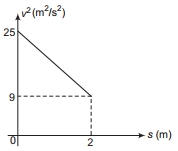
$A$ graph between the square of the velocity of a particle and the distance $s$ moved by the particle is shown in the figure. The acceleration of the particle is $...........m/s^2$.
A
$-8$
B
$-25$
C
$-16$
D
$-4$
Solution
(D) From the third equation of motion,we have $v^2 = u^2 + 2as$,which can be rewritten as $v^2 = 2as + u^2$.
Comparing this with the equation of a straight line $y = mx + c$,where $y = v^2$ and $x = s$,the slope of the graph is $m = 2a$.
From the given graph,the initial value of $v^2$ at $s = 0$ is $25 \, m^2/s^2$,and at $s = 2 \, m$,the value of $v^2$ is $9 \, m^2/s^2$.
The slope of the line is calculated as:
$\text{Slope} = \frac{v_2^2 - v_1^2}{s_2 - s_1} = \frac{9 - 25}{2 - 0} = \frac{-16}{2} = -8 \, m/s^2$.
Since the slope is equal to $2a$,we have:
$2a = -8 \, m/s^2$
$a = -4 \, m/s^2$.
Therefore,the acceleration of the particle is $-4 \, m/s^2$.
Comparing this with the equation of a straight line $y = mx + c$,where $y = v^2$ and $x = s$,the slope of the graph is $m = 2a$.
From the given graph,the initial value of $v^2$ at $s = 0$ is $25 \, m^2/s^2$,and at $s = 2 \, m$,the value of $v^2$ is $9 \, m^2/s^2$.
The slope of the line is calculated as:
$\text{Slope} = \frac{v_2^2 - v_1^2}{s_2 - s_1} = \frac{9 - 25}{2 - 0} = \frac{-16}{2} = -8 \, m/s^2$.
Since the slope is equal to $2a$,we have:
$2a = -8 \, m/s^2$
$a = -4 \, m/s^2$.
Therefore,the acceleration of the particle is $-4 \, m/s^2$.
0 likes
View Solution154
MediumMCQ
$A$ body starts from rest with uniform acceleration $a$. Its velocity after $n \ s$ is $v$. The displacement of the body in the last $3 \ s$ is: (Assume total time of journey is $n \ s$)
A
$\frac{v(6n - 9)}{2n}$
B
$\frac{2v(6n - 9)}{n}$
C
$\frac{2v(2n + 1)}{n}$
D
$\frac{2v(n - 1)}{n}$
Solution
(A) Given that the body starts from rest,initial velocity $u = 0$.
Using the first equation of motion,$v = u + at$,we get $v = 0 + an$,which implies $a = \frac{v}{n}$.
The total displacement in $n \ s$ is $S_n = \frac{1}{2}an^2$.
The displacement in the first $(n-3) \ s$ is $S_{n-3} = \frac{1}{2}a(n-3)^2$.
The displacement in the last $3 \ s$ is given by $\Delta S = S_n - S_{n-3}$.
Substituting the values: $\Delta S = \frac{1}{2}a[n^2 - (n-3)^2]$.
Expanding the term: $\Delta S = \frac{1}{2}a[n^2 - (n^2 - 6n + 9)] = \frac{1}{2}a(6n - 9)$.
Substituting $a = \frac{v}{n}$: $\Delta S = \frac{1}{2} \cdot \frac{v}{n} \cdot (6n - 9) = \frac{v(6n - 9)}{2n}$.
Using the first equation of motion,$v = u + at$,we get $v = 0 + an$,which implies $a = \frac{v}{n}$.
The total displacement in $n \ s$ is $S_n = \frac{1}{2}an^2$.
The displacement in the first $(n-3) \ s$ is $S_{n-3} = \frac{1}{2}a(n-3)^2$.
The displacement in the last $3 \ s$ is given by $\Delta S = S_n - S_{n-3}$.
Substituting the values: $\Delta S = \frac{1}{2}a[n^2 - (n-3)^2]$.
Expanding the term: $\Delta S = \frac{1}{2}a[n^2 - (n^2 - 6n + 9)] = \frac{1}{2}a(6n - 9)$.
Substituting $a = \frac{v}{n}$: $\Delta S = \frac{1}{2} \cdot \frac{v}{n} \cdot (6n - 9) = \frac{v(6n - 9)}{2n}$.
0 likes
View Solution155
MediumMCQ
If the velocity $v$ of a particle moving along a straight line decreases linearly with its displacement $s$ from $20 \ m/s$ to a value approaching zero at $s=30 \ m$,then the acceleration of the particle at $s=15 \ m$ is $........$
A
$2/3 \ m/s^2$
B
$-2/3 \ m/s^2$
C
$20/3 \ m/s^2$
D
$-20/3 \ m/s^2$
Solution
(D) The velocity $v$ decreases linearly with displacement $s$. The equation of a straight line is $v = ms + c$.
At $s=0$,$v=20 \ m/s$,so $c=20$.
At $s=30 \ m$,$v=0$,so $0 = m(30) + 20$,which gives $m = -20/30 = -2/3$.
Thus,the velocity function is $v = -\frac{2}{3}s + 20$.
The acceleration $a$ is given by $a = v \frac{dv}{ds}$.
First,find $\frac{dv}{ds} = \frac{d}{ds}(-\frac{2}{3}s + 20) = -\frac{2}{3}$.
At $s=15 \ m$,the velocity is $v = -\frac{2}{3}(15) + 20 = -10 + 20 = 10 \ m/s$.
Therefore,the acceleration $a = (10)(-\frac{2}{3}) = -\frac{20}{3} \ m/s^2$.
At $s=0$,$v=20 \ m/s$,so $c=20$.
At $s=30 \ m$,$v=0$,so $0 = m(30) + 20$,which gives $m = -20/30 = -2/3$.
Thus,the velocity function is $v = -\frac{2}{3}s + 20$.
The acceleration $a$ is given by $a = v \frac{dv}{ds}$.
First,find $\frac{dv}{ds} = \frac{d}{ds}(-\frac{2}{3}s + 20) = -\frac{2}{3}$.
At $s=15 \ m$,the velocity is $v = -\frac{2}{3}(15) + 20 = -10 + 20 = 10 \ m/s$.
Therefore,the acceleration $a = (10)(-\frac{2}{3}) = -\frac{20}{3} \ m/s^2$.
0 likes
View Solution156
MediumMCQ
The velocity of a train increases uniformly from $20 \; km/h$ to $60 \; km/h$ in $4 \; hours$. The distance travelled by the train during this period is .......... $km$.
A
$160$
B
$180$
C
$100$
D
$120$
Solution
(A) Given: Initial velocity $u = 20 \; km/h$,final velocity $v = 60 \; km/h$,and time $t = 4 \; h$.
First,we calculate the acceleration $a$ using the equation $v = u + at$:
$60 = 20 + (a \times 4)$
$40 = 4a$
$a = 10 \; km/h^2$.
Now,we calculate the distance $d$ using the equation $d = ut + \frac{1}{2}at^2$:
$d = (20 \times 4) + \frac{1}{2} \times 10 \times (4)^2$
$d = 80 + 5 \times 16$
$d = 80 + 80 = 160 \; km$.
First,we calculate the acceleration $a$ using the equation $v = u + at$:
$60 = 20 + (a \times 4)$
$40 = 4a$
$a = 10 \; km/h^2$.
Now,we calculate the distance $d$ using the equation $d = ut + \frac{1}{2}at^2$:
$d = (20 \times 4) + \frac{1}{2} \times 10 \times (4)^2$
$d = 80 + 5 \times 16$
$d = 80 + 80 = 160 \; km$.
0 likes
View Solution157
DifficultMCQ
Displacement $(x)$ of a particle is related to time $(t)$ as: $x = at + bt^2 - ct^3$,where $a, b$,and $c$ are constants of the motion. The velocity of the particle when its acceleration is zero is given by:
A
$a + \frac{b^2}{c}$
B
$a + \frac{b^2}{2c}$
C
$a + \frac{b^2}{3c}$
D
$a + \frac{b^2}{4c}$
Solution
(C) The displacement is given by $x = at + bt^2 - ct^3$.
Velocity $(v)$ is the first derivative of displacement with respect to time: $v = \frac{dx}{dt} = a + 2bt - 3ct^2$.
Acceleration $(a_{acc})$ is the derivative of velocity with respect to time: $a_{acc} = \frac{dv}{dt} = 2b - 6ct$.
Setting acceleration to zero: $2b - 6ct = 0 \implies t = \frac{2b}{6c} = \frac{b}{3c}$.
Now,substitute $t = \frac{b}{3c}$ into the velocity equation:
$v = a + 2b(\frac{b}{3c}) - 3c(\frac{b}{3c})^2$
$v = a + \frac{2b^2}{3c} - 3c(\frac{b^2}{9c^2})$
$v = a + \frac{2b^2}{3c} - \frac{b^2}{3c}$
$v = a + \frac{b^2}{3c}$.
Velocity $(v)$ is the first derivative of displacement with respect to time: $v = \frac{dx}{dt} = a + 2bt - 3ct^2$.
Acceleration $(a_{acc})$ is the derivative of velocity with respect to time: $a_{acc} = \frac{dv}{dt} = 2b - 6ct$.
Setting acceleration to zero: $2b - 6ct = 0 \implies t = \frac{2b}{6c} = \frac{b}{3c}$.
Now,substitute $t = \frac{b}{3c}$ into the velocity equation:
$v = a + 2b(\frac{b}{3c}) - 3c(\frac{b}{3c})^2$
$v = a + \frac{2b^2}{3c} - 3c(\frac{b^2}{9c^2})$
$v = a + \frac{2b^2}{3c} - \frac{b^2}{3c}$
$v = a + \frac{b^2}{3c}$.
0 likes
View Solution158
DifficultMCQ
Two points move in the same straight line starting at the same moment from the same point. The first moves with constant velocity $u$ and the second with constant acceleration $f$. During the time that elapses before the second catches the first,the greatest distance between the particles is $........$
A
$\frac{u}{f}$
B
$\frac{u^2}{2 f}$
C
$\frac{f}{2 u^2}$
D
$\frac{f}{u^2}$
Solution
(B) The distance between the two particles is given by $s = s_1 - s_2$,where $s_1 = ut$ and $s_2 = \frac{1}{2}ft^2$.
$s = ut - \frac{1}{2}ft^2$.
To find the maximum distance,we differentiate $s$ with respect to $t$ and set it to zero:
$\frac{ds}{dt} = u - ft = 0 \implies t = \frac{u}{f}$.
At this time $t = \frac{u}{f}$,the velocity of the second particle equals the velocity of the first particle.
Substituting $t = \frac{u}{f}$ into the expression for $s$:
$s_{\max} = u(\frac{u}{f}) - \frac{1}{2}f(\frac{u}{f})^2$
$s_{\max} = \frac{u^2}{f} - \frac{u^2}{2f} = \frac{u^2}{2f}$.
$s = ut - \frac{1}{2}ft^2$.
To find the maximum distance,we differentiate $s$ with respect to $t$ and set it to zero:
$\frac{ds}{dt} = u - ft = 0 \implies t = \frac{u}{f}$.
At this time $t = \frac{u}{f}$,the velocity of the second particle equals the velocity of the first particle.
Substituting $t = \frac{u}{f}$ into the expression for $s$:
$s_{\max} = u(\frac{u}{f}) - \frac{1}{2}f(\frac{u}{f})^2$
$s_{\max} = \frac{u^2}{f} - \frac{u^2}{2f} = \frac{u^2}{2f}$.
0 likes
View Solution159
MediumMCQ
Particle $A$ is moving along the $x$-axis. At time $t=0$,it has a velocity of $10\,m/s$ and an acceleration of $-4\,m/s^2$. Particle $B$ has a velocity of $20\,m/s$ and an acceleration of $-2\,m/s^2$. Initially,both particles are at the origin. At time $t=2\,s$,the distance between the two particles is $.............\,m$.
A
$24$
B
$36$
C
$20$
D
$42$
Solution
(A) The position of a particle moving with constant acceleration is given by the equation $x(t) = ut + \frac{1}{2}at^2$.
For particle $A$ at $t=2\,s$:
$x_A = (10)(2) + \frac{1}{2}(-4)(2)^2 = 20 - 8 = 12\,m$.
For particle $B$ at $t=2\,s$:
$x_B = (20)(2) + \frac{1}{2}(-2)(2)^2 = 40 - 4 = 36\,m$.
The distance between the two particles is $|x_B - x_A| = |36 - 12| = 24\,m$.
For particle $A$ at $t=2\,s$:
$x_A = (10)(2) + \frac{1}{2}(-4)(2)^2 = 20 - 8 = 12\,m$.
For particle $B$ at $t=2\,s$:
$x_B = (20)(2) + \frac{1}{2}(-2)(2)^2 = 40 - 4 = 36\,m$.
The distance between the two particles is $|x_B - x_A| = |36 - 12| = 24\,m$.
0 likes
View Solution160
DifficultMCQ
The velocity $u$ and displacement $r$ of a body are related as $u^2 = kr$,where $k$ is a constant. What will be the velocity after $1 \, s$? (Given that the displacement is zero at $t = 0$)
A
$\sqrt{kr}$
B
$k r^{3/2}$
C
$\frac{k}{2}$
D
Data is not sufficient
Solution
(C) Given the relation $u^2 = kr$,we have $u = \sqrt{k} \cdot r^{1/2}$.
Since $u = \frac{dr}{dt}$,we can write $\frac{dr}{dt} = \sqrt{k} \cdot r^{1/2}$.
Separating the variables,we get $r^{-1/2} \, dr = \sqrt{k} \, dt$.
Integrating both sides with the initial condition $r = 0$ at $t = 0$: $\int_{0}^{r} r^{-1/2} \, dr = \int_{0}^{t} \sqrt{k} \, dt$.
This gives $[2r^{1/2}]_{0}^{r} = \sqrt{k} \cdot t$,so $2\sqrt{r} = \sqrt{k} \cdot t$,which implies $\sqrt{r} = \frac{\sqrt{k}}{2} t$.
Substituting $\sqrt{r}$ back into the velocity equation $u = \sqrt{k} \cdot \sqrt{r}$:
$u = \sqrt{k} \cdot (\frac{\sqrt{k}}{2} t) = \frac{k}{2} t$.
At $t = 1 \, s$,the velocity $u = \frac{k}{2} (1) = \frac{k}{2}$.
Since $u = \frac{dr}{dt}$,we can write $\frac{dr}{dt} = \sqrt{k} \cdot r^{1/2}$.
Separating the variables,we get $r^{-1/2} \, dr = \sqrt{k} \, dt$.
Integrating both sides with the initial condition $r = 0$ at $t = 0$: $\int_{0}^{r} r^{-1/2} \, dr = \int_{0}^{t} \sqrt{k} \, dt$.
This gives $[2r^{1/2}]_{0}^{r} = \sqrt{k} \cdot t$,so $2\sqrt{r} = \sqrt{k} \cdot t$,which implies $\sqrt{r} = \frac{\sqrt{k}}{2} t$.
Substituting $\sqrt{r}$ back into the velocity equation $u = \sqrt{k} \cdot \sqrt{r}$:
$u = \sqrt{k} \cdot (\frac{\sqrt{k}}{2} t) = \frac{k}{2} t$.
At $t = 1 \, s$,the velocity $u = \frac{k}{2} (1) = \frac{k}{2}$.
0 likes
View Solution161
MediumMCQ
$A$ body of mass $1\,kg$ crosses a point $O$ with a velocity $60\,ms^{-1}$. $A$ force of $10\,N$ directed towards $O$ begins to act on it. It will again cross $O$ in ......... $\sec$.
A
$24$
B
$12$
C
$6$
D
will never return to $O$
Solution
(B) Given: mass $m = 1\,kg$,initial velocity $u = 60\,ms^{-1}$,force $F = -10\,N$ (directed towards $O$,opposite to motion).
Acceleration $a = \frac{F}{m} = \frac{-10}{1} = -10\,ms^{-2}$.
To find the time taken to return to point $O$,the displacement $s$ must be $0$.
Using the equation of motion $s = ut + \frac{1}{2}at^2$:
$0 = 60t + \frac{1}{2}(-10)t^2$
$0 = 60t - 5t^2$
$5t^2 = 60t$
Since $t \neq 0$,we divide by $5t$:
$t = \frac{60}{5} = 12\,s$.
Thus,the body will again cross $O$ in $12\,s$.
Acceleration $a = \frac{F}{m} = \frac{-10}{1} = -10\,ms^{-2}$.
To find the time taken to return to point $O$,the displacement $s$ must be $0$.
Using the equation of motion $s = ut + \frac{1}{2}at^2$:
$0 = 60t + \frac{1}{2}(-10)t^2$
$0 = 60t - 5t^2$
$5t^2 = 60t$
Since $t \neq 0$,we divide by $5t$:
$t = \frac{60}{5} = 12\,s$.
Thus,the body will again cross $O$ in $12\,s$.
0 likes
View Solution162
DifficultMCQ
$A$ body starts with an initial velocity of $10\,m/s$ and moves along a straight line with constant acceleration. When the velocity of the particle is $50\,m/s$,the acceleration is reversed in direction. The velocity of the particle when it again reaches the starting point is $............\,m/s$.
A
$70$
B
$60$
C
$10$
D
$30$
Solution
(A) Let the initial velocity be $u = 10\,m/s$ and the acceleration be $a$. Let the displacement when the velocity becomes $v_1 = 50\,m/s$ be $s$.
Using the equation of motion $v^2 = u^2 + 2as$:
$(50)^2 = (10)^2 + 2as$
$2500 = 100 + 2as$
$2as = 2400$
Now,the acceleration is reversed,so the new acceleration is $-a$. The particle travels from the point where $v = 50\,m/s$ back to the starting point,covering a displacement of $-s$.
Using the equation of motion $v_f^2 = v_i^2 + 2a's'$:
$v_f^2 = (50)^2 + 2(-a)(-s)$
$v_f^2 = 2500 + 2as$
Substitute $2as = 2400$ into the equation:
$v_f^2 = 2500 + 2400 = 4900$
$v_f = \sqrt{4900} = 70\,m/s$.
Using the equation of motion $v^2 = u^2 + 2as$:
$(50)^2 = (10)^2 + 2as$
$2500 = 100 + 2as$
$2as = 2400$
Now,the acceleration is reversed,so the new acceleration is $-a$. The particle travels from the point where $v = 50\,m/s$ back to the starting point,covering a displacement of $-s$.
Using the equation of motion $v_f^2 = v_i^2 + 2a's'$:
$v_f^2 = (50)^2 + 2(-a)(-s)$
$v_f^2 = 2500 + 2as$
Substitute $2as = 2400$ into the equation:
$v_f^2 = 2500 + 2400 = 4900$
$v_f = \sqrt{4900} = 70\,m/s$.
0 likes
View Solution163
MediumMCQ
The distance travelled by a particle is directly proportional to $t^{1/2}$,where $t =$ time elapsed. What is the nature of motion?
A
Increasing acceleration
B
Decreasing acceleration
C
Increasing retardation
D
Decreasing retardation
Solution
(D) Given that the distance $s$ is proportional to $t^{1/2}$,we can write $s = k t^{1/2}$,where $k$ is a constant.
The velocity $v$ is the first derivative of displacement with respect to time: $v = \frac{ds}{dt} = \frac{d}{dt}(k t^{1/2}) = \frac{1}{2} k t^{-1/2}$.
The acceleration $a$ is the second derivative of displacement with respect to time: $a = \frac{dv}{dt} = \frac{d}{dt}(\frac{1}{2} k t^{-1/2}) = -\frac{1}{4} k t^{-3/2}$.
The negative sign indicates that the acceleration is in the opposite direction of motion,which represents retardation (deceleration).
As time $t$ increases,the magnitude of acceleration $|a| = \frac{k}{4 t^{3/2}}$ decreases.
Therefore,the motion is characterized by decreasing retardation.
The velocity $v$ is the first derivative of displacement with respect to time: $v = \frac{ds}{dt} = \frac{d}{dt}(k t^{1/2}) = \frac{1}{2} k t^{-1/2}$.
The acceleration $a$ is the second derivative of displacement with respect to time: $a = \frac{dv}{dt} = \frac{d}{dt}(\frac{1}{2} k t^{-1/2}) = -\frac{1}{4} k t^{-3/2}$.
The negative sign indicates that the acceleration is in the opposite direction of motion,which represents retardation (deceleration).
As time $t$ increases,the magnitude of acceleration $|a| = \frac{k}{4 t^{3/2}}$ decreases.
Therefore,the motion is characterized by decreasing retardation.
0 likes
View Solution164
AdvancedMCQ
$A$ lift performs the first part of its ascent with uniform acceleration $a$ and the remaining with uniform retardation $2a$. If $t$ is the total time of ascent,find the total height of the shaft.
A
$\frac{a t^2}{4}$
B
$\frac{a t^2}{3}$
C
$\frac{a t^2}{2}$
D
$\frac{a t^2}{8}$
Solution
(B) Let $t_1$ be the time of acceleration and $t_2$ be the time of retardation. The maximum velocity reached is $v = a t_1$.
Since the lift comes to rest,$v = (2a) t_2$. Thus,$a t_1 = 2a t_2$,which implies $t_1 = 2 t_2$.
Given the total time $t = t_1 + t_2$,we substitute $t_1 = 2 t_2$ to get $t = 2 t_2 + t_2 = 3 t_2$. Therefore,$t_2 = \frac{t}{3}$ and $t_1 = \frac{2t}{3}$.
The total height $h$ is the sum of the distances covered during acceleration and retardation:
$h = \frac{1}{2} a t_1^2 + (v t_2 - \frac{1}{2} (2a) t_2^2)$
Substituting $v = a t_1 = 2a t_2$:
$h = \frac{1}{2} a (2 t_2)^2 + (2a t_2 \cdot t_2 - a t_2^2) = 2 a t_2^2 + a t_2^2 = 3 a t_2^2$.
Substituting $t_2 = \frac{t}{3}$:
$h = 3 a (\frac{t}{3})^2 = 3 a (\frac{t^2}{9}) = \frac{a t^2}{3}$.
Since the lift comes to rest,$v = (2a) t_2$. Thus,$a t_1 = 2a t_2$,which implies $t_1 = 2 t_2$.
Given the total time $t = t_1 + t_2$,we substitute $t_1 = 2 t_2$ to get $t = 2 t_2 + t_2 = 3 t_2$. Therefore,$t_2 = \frac{t}{3}$ and $t_1 = \frac{2t}{3}$.
The total height $h$ is the sum of the distances covered during acceleration and retardation:
$h = \frac{1}{2} a t_1^2 + (v t_2 - \frac{1}{2} (2a) t_2^2)$
Substituting $v = a t_1 = 2a t_2$:
$h = \frac{1}{2} a (2 t_2)^2 + (2a t_2 \cdot t_2 - a t_2^2) = 2 a t_2^2 + a t_2^2 = 3 a t_2^2$.
Substituting $t_2 = \frac{t}{3}$:
$h = 3 a (\frac{t}{3})^2 = 3 a (\frac{t^2}{9}) = \frac{a t^2}{3}$.
0 likes
View Solution165
DifficultMCQ
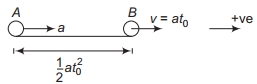
$A$ particle starts moving from rest in a straight line with constant acceleration. After time $t_0$,the acceleration changes its sign (becomes exactly opposite to the initial direction),while remaining the same in magnitude. Determine the time from the beginning of the motion at which the particle returns to its initial position.
A
$2 t_0$
B
$(2+\sqrt{2}) t_0$
C
$3 t_0$
D
$(2-\sqrt{2}) t_0$
Solution
(B) Let the initial position be $x=0$. The particle starts from rest $(u=0)$ with acceleration $a$ for time $t_0$.
At $t=t_0$,the displacement is $s_1 = \frac{1}{2} a t_0^2$ and the velocity is $v_1 = a t_0$.
After $t_0$,the acceleration becomes $-a$. Let the particle return to the initial position $(x=0)$ at a total time $T = t_0 + t$,where $t$ is the time elapsed after the acceleration change.
The displacement equation for the second phase is $s = u t + \frac{1}{2} a t^2$. Here,the initial velocity is $v_1 = a t_0$ and acceleration is $-a$. We want the total displacement from the start to be zero,so the displacement in the second phase must be $-s_1 = -\frac{1}{2} a t_0^2$.
Thus,$-\frac{1}{2} a t_0^2 = (a t_0) t - \frac{1}{2} a t^2$.
Dividing by $-\frac{1}{2} a$,we get $t_0^2 = -2 t_0 t + t^2$,which rearranges to $t^2 - 2 t_0 t - t_0^2 = 0$.
Using the quadratic formula $t = \frac{-b \pm \sqrt{b^2 - 4ac}}{2a}$,we get $t = \frac{2 t_0 \pm \sqrt{4 t_0^2 + 4 t_0^2}}{2} = t_0 \pm \sqrt{2} t_0$.
Since $t > 0$,we take $t = (1 + \sqrt{2}) t_0$.
The total time is $T = t_0 + t = t_0 + (1 + \sqrt{2}) t_0 = (2 + \sqrt{2}) t_0$.
At $t=t_0$,the displacement is $s_1 = \frac{1}{2} a t_0^2$ and the velocity is $v_1 = a t_0$.
After $t_0$,the acceleration becomes $-a$. Let the particle return to the initial position $(x=0)$ at a total time $T = t_0 + t$,where $t$ is the time elapsed after the acceleration change.
The displacement equation for the second phase is $s = u t + \frac{1}{2} a t^2$. Here,the initial velocity is $v_1 = a t_0$ and acceleration is $-a$. We want the total displacement from the start to be zero,so the displacement in the second phase must be $-s_1 = -\frac{1}{2} a t_0^2$.
Thus,$-\frac{1}{2} a t_0^2 = (a t_0) t - \frac{1}{2} a t^2$.
Dividing by $-\frac{1}{2} a$,we get $t_0^2 = -2 t_0 t + t^2$,which rearranges to $t^2 - 2 t_0 t - t_0^2 = 0$.
Using the quadratic formula $t = \frac{-b \pm \sqrt{b^2 - 4ac}}{2a}$,we get $t = \frac{2 t_0 \pm \sqrt{4 t_0^2 + 4 t_0^2}}{2} = t_0 \pm \sqrt{2} t_0$.
Since $t > 0$,we take $t = (1 + \sqrt{2}) t_0$.
The total time is $T = t_0 + t = t_0 + (1 + \sqrt{2}) t_0 = (2 + \sqrt{2}) t_0$.
0 likes
View Solution166
MediumMCQ
$A$ particle moves along a straight line such that its displacement at any time $t$ is given by $s = (t^3 - 6t^2 + 3t + 4) \ m$. Find the velocity of the particle in $m/s$ when its acceleration is zero.
A
$-3$
B
$-9$
C
$-6$
D
$-12$
Solution
(B) The displacement of the particle is given by $s = t^3 - 6t^2 + 3t + 4$.
Velocity $v$ is the first derivative of displacement with respect to time: $v = \frac{ds}{dt} = 3t^2 - 12t + 3$.
Acceleration $a$ is the derivative of velocity with respect to time: $a = \frac{dv}{dt} = 6t - 12$.
To find the time when acceleration is zero,set $a = 0$: $6t - 12 = 0 \implies t = 2 \ s$.
Now,substitute $t = 2 \ s$ into the velocity equation: $v = 3(2)^2 - 12(2) + 3 = 3(4) - 24 + 3 = 12 - 24 + 3 = -9 \ m/s$.
Velocity $v$ is the first derivative of displacement with respect to time: $v = \frac{ds}{dt} = 3t^2 - 12t + 3$.
Acceleration $a$ is the derivative of velocity with respect to time: $a = \frac{dv}{dt} = 6t - 12$.
To find the time when acceleration is zero,set $a = 0$: $6t - 12 = 0 \implies t = 2 \ s$.
Now,substitute $t = 2 \ s$ into the velocity equation: $v = 3(2)^2 - 12(2) + 3 = 3(4) - 24 + 3 = 12 - 24 + 3 = -9 \ m/s$.
0 likes
View Solution167
DifficultMCQ
$A$ particle starting from rest and moving with a uniform acceleration along a straight line covers distances $a$ and $b$ in successive intervals of $p$ and $q$ seconds. The acceleration of the particle is
A
$\frac{a+b}{2(p+q)}$
B
$\frac{2(bq - ap)}{pq(p+q)}$
C
$\frac{2(bp - aq)}{pq(p+q)}$
D
$\frac{2(bq + ap)}{pq(p+q)}$
Solution
(B) Let the acceleration of the particle be $x$ and the initial velocity be $u=0$.
For the first interval of time $p$,the distance covered is $a = \frac{1}{2} x p^2$.
For the total time $(p+q)$,the total distance covered is $a+b = \frac{1}{2} x (p+q)^2$.
From the first equation,$x = \frac{2a}{p^2}$.
Substituting this into the second equation: $a+b = \frac{1}{2} (\frac{2a}{p^2}) (p+q)^2 = a \frac{(p+q)^2}{p^2}$.
This approach is complex. Let's use the average velocity method.
Velocity at time $p$ is $v_1 = xp$.
Distance $a = \frac{1}{2} xp^2$.
Distance $b$ is covered in time $q$ starting with velocity $v_1$. So,$b = v_1 q + \frac{1}{2} x q^2 = (xp)q + \frac{1}{2} x q^2 = xpq + \frac{1}{2} x q^2$.
We have $a = \frac{1}{2} xp^2 \implies x = \frac{2a}{p^2}$.
Substitute $x$ in $b$: $b = (\frac{2a}{p^2})pq + \frac{1}{2} (\frac{2a}{p^2}) q^2 = \frac{2aq}{p} + \frac{aq^2}{p^2} = \frac{2aqp + aq^2}{p^2} = \frac{aq(2p+q)}{p^2}$.
Thus,$x = \frac{2(bp - aq)}{pq(p+q)}$ is not the standard form. Let's re-evaluate: $b = \frac{1}{2}x(p+q)^2 - \frac{1}{2}xp^2 = \frac{1}{2}x(q^2+2pq)$.
$x = \frac{2b}{q^2+2pq} = \frac{2b}{q(q+2p)}$.
For the first interval of time $p$,the distance covered is $a = \frac{1}{2} x p^2$.
For the total time $(p+q)$,the total distance covered is $a+b = \frac{1}{2} x (p+q)^2$.
From the first equation,$x = \frac{2a}{p^2}$.
Substituting this into the second equation: $a+b = \frac{1}{2} (\frac{2a}{p^2}) (p+q)^2 = a \frac{(p+q)^2}{p^2}$.
This approach is complex. Let's use the average velocity method.
Velocity at time $p$ is $v_1 = xp$.
Distance $a = \frac{1}{2} xp^2$.
Distance $b$ is covered in time $q$ starting with velocity $v_1$. So,$b = v_1 q + \frac{1}{2} x q^2 = (xp)q + \frac{1}{2} x q^2 = xpq + \frac{1}{2} x q^2$.
We have $a = \frac{1}{2} xp^2 \implies x = \frac{2a}{p^2}$.
Substitute $x$ in $b$: $b = (\frac{2a}{p^2})pq + \frac{1}{2} (\frac{2a}{p^2}) q^2 = \frac{2aq}{p} + \frac{aq^2}{p^2} = \frac{2aqp + aq^2}{p^2} = \frac{aq(2p+q)}{p^2}$.
Thus,$x = \frac{2(bp - aq)}{pq(p+q)}$ is not the standard form. Let's re-evaluate: $b = \frac{1}{2}x(p+q)^2 - \frac{1}{2}xp^2 = \frac{1}{2}x(q^2+2pq)$.
$x = \frac{2b}{q^2+2pq} = \frac{2b}{q(q+2p)}$.
0 likes
View Solution168
MediumMCQ
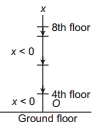
$A$ lift is coming down from the $8^{th}$ floor and is just about to reach the $4^{th}$ floor. Taking the ground floor as the origin and the upward direction as positive for all quantities,which one of the following is correct?
A
$x > 0, v < 0, a > 0$
B
$x > 0, v < 0, a < 0$
C
$x < 0, v < 0, a > 0$
D
$x > 0, v > 0, a < 0$
Solution
(A) The ground floor is the origin $(x = 0)$,and the upward direction is positive. Since the lift is between the ground floor and the $8^{th}$ floor,its position $x$ is positive $(x > 0)$.
As the lift is moving downwards,its velocity $v$ is in the negative direction,so $v < 0$.
Since the lift is about to stop at the $4^{th}$ floor,it must be decelerating (retarding). For a downward-moving object,deceleration means the acceleration $a$ must be in the opposite direction to the velocity,i.e.,in the upward (positive) direction. Therefore,$a > 0$.
Thus,the correct signs are $x > 0, v < 0, a > 0$.
As the lift is moving downwards,its velocity $v$ is in the negative direction,so $v < 0$.
Since the lift is about to stop at the $4^{th}$ floor,it must be decelerating (retarding). For a downward-moving object,deceleration means the acceleration $a$ must be in the opposite direction to the velocity,i.e.,in the upward (positive) direction. Therefore,$a > 0$.
Thus,the correct signs are $x > 0, v < 0, a > 0$.
0 likes
View Solution169
DifficultMCQ
The distance $x$ covered by a particle in one-dimensional motion varies with time $t$ as $x^{2}=at^{2}+2bt+c$. If the acceleration of the particle depends on $x$ as $x^{-n}$,where $n$ is an integer,the value of $n$ is
A
$9$
B
$6$
C
$4$
D
$3$
Solution
(D) Given $x^{2} = at^{2} + 2bt + c$.
Differentiating with respect to $t$:
$2x \frac{dx}{dt} = 2at + 2b$
$x v = at + b$,where $v = \frac{dx}{dt}$.
Differentiating again with respect to $t$:
$v \frac{dx}{dt} + x \frac{dv}{dt} = a$
$v^{2} + x a' = a$,where $a' = \frac{dv}{dt}$ is the acceleration.
From $x v = at + b$,we have $v = \frac{at+b}{x}$.
Substituting $v$ into the equation:
$x a' = a - v^{2} = a - \left(\frac{at+b}{x}\right)^{2}$
$x a' = \frac{ax^{2} - (at+b)^{2}}{x^{2}}$
Substitute $x^{2} = at^{2} + 2bt + c$:
$x a' = \frac{a(at^{2} + 2bt + c) - (a^{2}t^{2} + 2abt + b^{2})}{x^{2}}$
$x a' = \frac{a^{2}t^{2} + 2abt + ac - a^{2}t^{2} - 2abt - b^{2}}{x^{2}}$
$x a' = \frac{ac - b^{2}}{x^{2}}$
$a' = \frac{ac - b^{2}}{x^{3}}$
Thus,$a' \propto x^{-3}$. Comparing with $x^{-n}$,we get $n = 3$.
Differentiating with respect to $t$:
$2x \frac{dx}{dt} = 2at + 2b$
$x v = at + b$,where $v = \frac{dx}{dt}$.
Differentiating again with respect to $t$:
$v \frac{dx}{dt} + x \frac{dv}{dt} = a$
$v^{2} + x a' = a$,where $a' = \frac{dv}{dt}$ is the acceleration.
From $x v = at + b$,we have $v = \frac{at+b}{x}$.
Substituting $v$ into the equation:
$x a' = a - v^{2} = a - \left(\frac{at+b}{x}\right)^{2}$
$x a' = \frac{ax^{2} - (at+b)^{2}}{x^{2}}$
Substitute $x^{2} = at^{2} + 2bt + c$:
$x a' = \frac{a(at^{2} + 2bt + c) - (a^{2}t^{2} + 2abt + b^{2})}{x^{2}}$
$x a' = \frac{a^{2}t^{2} + 2abt + ac - a^{2}t^{2} - 2abt - b^{2}}{x^{2}}$
$x a' = \frac{ac - b^{2}}{x^{2}}$
$a' = \frac{ac - b^{2}}{x^{3}}$
Thus,$a' \propto x^{-3}$. Comparing with $x^{-n}$,we get $n = 3$.
0 likes
View Solution170
Medium
Derive the equations of motion for constant acceleration using the method of calculus.
Solution
(N/A) By definition,acceleration is $a = \frac{dv}{dt}$.
Rearranging gives $dv = a dt$.
Integrating both sides from initial velocity $v_0$ at $t=0$ to $v$ at time $t$:
$\int_{v_0}^{v} dv = \int_{0}^{t} a dt = a \int_{0}^{t} dt$
$v - v_0 = at \implies v = v_0 + at$.
Since $v = \frac{dx}{dt}$,we have $dx = v dt = (v_0 + at) dt$.
Integrating both sides from initial position $x_0$ at $t=0$ to $x$ at time $t$:
$\int_{x_0}^{x} dx = \int_{0}^{t} (v_0 + at) dt$
$x - x_0 = v_0 t + \frac{1}{2} at^2 \implies x = x_0 + v_0 t + \frac{1}{2} at^2$.
Using the chain rule,$a = \frac{dv}{dt} = \frac{dv}{dx} \frac{dx}{dt} = v \frac{dv}{dx}$.
Thus,$v dv = a dx$.
Integrating both sides from $v_0$ to $v$ and $x_0$ to $x$:
$\int_{v_0}^{v} v dv = \int_{x_0}^{x} a dx$
$\frac{v^2 - v_0^2}{2} = a(x - x_0)$
$v^2 = v_0^2 + 2a(x - x_0)$.
Rearranging gives $dv = a dt$.
Integrating both sides from initial velocity $v_0$ at $t=0$ to $v$ at time $t$:
$\int_{v_0}^{v} dv = \int_{0}^{t} a dt = a \int_{0}^{t} dt$
$v - v_0 = at \implies v = v_0 + at$.
Since $v = \frac{dx}{dt}$,we have $dx = v dt = (v_0 + at) dt$.
Integrating both sides from initial position $x_0$ at $t=0$ to $x$ at time $t$:
$\int_{x_0}^{x} dx = \int_{0}^{t} (v_0 + at) dt$
$x - x_0 = v_0 t + \frac{1}{2} at^2 \implies x = x_0 + v_0 t + \frac{1}{2} at^2$.
Using the chain rule,$a = \frac{dv}{dt} = \frac{dv}{dx} \frac{dx}{dt} = v \frac{dv}{dx}$.
Thus,$v dv = a dx$.
Integrating both sides from $v_0$ to $v$ and $x_0$ to $x$:
$\int_{v_0}^{v} v dv = \int_{x_0}^{x} a dx$
$\frac{v^2 - v_0^2}{2} = a(x - x_0)$
$v^2 = v_0^2 + 2a(x - x_0)$.
0 likes
View Solution171
Easy
Stopping distance of vehicles: When brakes are applied to a moving vehicle,the distance it travels before stopping is called stopping distance. It is an important factor for road safety and depends on the initial velocity $(v_0)$ and the braking capacity,or deceleration,$-a$ that is caused by the braking. Derive an expression for stopping distance of a vehicle in terms of $v_0$ and $a$.
Solution
(N/A) Let the distance travelled by the vehicle before it stops be $d_{s}$.
Using the third equation of motion,$v^{2} = v_{0}^{2} + 2ax$,where $v$ is the final velocity,$v_{0}$ is the initial velocity,$a$ is the acceleration (which is negative in this case,i.e.,$-a$),and $x$ is the displacement.
At the point where the vehicle stops,the final velocity $v = 0$.
Substituting these values into the equation: $0^{2} = v_{0}^{2} + 2(-a)d_{s}$.
Rearranging the terms to solve for $d_{s}$:
$2ad_{s} = v_{0}^{2}$
$d_{s} = \frac{v_{0}^{2}}{2a}$.
Thus,the stopping distance is directly proportional to the square of the initial velocity $(d_{s} \propto v_{0}^{2})$.
Using the third equation of motion,$v^{2} = v_{0}^{2} + 2ax$,where $v$ is the final velocity,$v_{0}$ is the initial velocity,$a$ is the acceleration (which is negative in this case,i.e.,$-a$),and $x$ is the displacement.
At the point where the vehicle stops,the final velocity $v = 0$.
Substituting these values into the equation: $0^{2} = v_{0}^{2} + 2(-a)d_{s}$.
Rearranging the terms to solve for $d_{s}$:
$2ad_{s} = v_{0}^{2}$
$d_{s} = \frac{v_{0}^{2}}{2a}$.
Thus,the stopping distance is directly proportional to the square of the initial velocity $(d_{s} \propto v_{0}^{2})$.
0 likes
View Solution172
MediumMCQ
$A$ car moving along a straight highway with a speed of $126 \; km/h$ is brought to a stop within a distance of $200 \; m$. How long (in $seconds$) does it take for the car to stop?
A
$8.5$
B
$12.9$
C
$14.1$
D
$11.4$
Solution
(D) First,convert the initial velocity from $km/h$ to $m/s$:
$u = 126 \times \frac{5}{18} = 35 \; m/s$.
Since the car comes to a stop,the final velocity $v = 0 \; m/s$ and the distance covered $s = 200 \; m$.
Using the third equation of motion,$v^2 - u^2 = 2as$:
$0^2 - (35)^2 = 2 \times a \times 200$.
$-1225 = 400a$.
$a = -3.0625 \; m/s^2$.
Now,use the first equation of motion,$v = u + at$,to find the time $t$:
$0 = 35 + (-3.0625)t$.
$t = \frac{35}{3.0625} \approx 11.4 \; s$.
$u = 126 \times \frac{5}{18} = 35 \; m/s$.
Since the car comes to a stop,the final velocity $v = 0 \; m/s$ and the distance covered $s = 200 \; m$.
Using the third equation of motion,$v^2 - u^2 = 2as$:
$0^2 - (35)^2 = 2 \times a \times 200$.
$-1225 = 400a$.
$a = -3.0625 \; m/s^2$.
Now,use the first equation of motion,$v = u + at$,to find the time $t$:
$0 = 35 + (-3.0625)t$.
$t = \frac{35}{3.0625} \approx 11.4 \; s$.
0 likes
View Solution173
MediumMCQ
$A$ car moving along a straight highway with a speed of $126 \; km/h$ is brought to a stop within a distance of $200 \; m$. What is the retardation of the car (assumed uniform in $m/s^2$)?
A
$6.150$
B
$3.0625$
C
$1.5312$
D
$1.4141$
Solution
(B) First,convert the initial velocity from $km/h$ to $m/s$:
$u = 126 \; km/h = 126 \times \frac{5}{18} \; m/s = 35 \; m/s$.
Since the car comes to a stop,the final velocity $v = 0 \; m/s$.
The distance covered $s = 200 \; m$.
Using the third equation of motion: $v^2 - u^2 = 2as$.
Substituting the values: $0^2 - (35)^2 = 2 \times a \times 200$.
$-1225 = 400a$.
$a = -\frac{1225}{400} = -3.0625 \; m/s^2$.
The retardation is the magnitude of negative acceleration,which is $3.0625 \; m/s^2$.
$u = 126 \; km/h = 126 \times \frac{5}{18} \; m/s = 35 \; m/s$.
Since the car comes to a stop,the final velocity $v = 0 \; m/s$.
The distance covered $s = 200 \; m$.
Using the third equation of motion: $v^2 - u^2 = 2as$.
Substituting the values: $0^2 - (35)^2 = 2 \times a \times 200$.
$-1225 = 400a$.
$a = -\frac{1225}{400} = -3.0625 \; m/s^2$.
The retardation is the magnitude of negative acceleration,which is $3.0625 \; m/s^2$.
0 likes
View Solution174
Medium
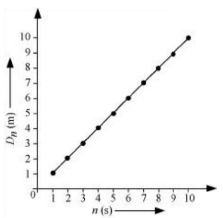
$A$ three-wheeler starts from rest,accelerates uniformly with $1\; m/s^{2}$ on a straight road for $10\; s$,and then moves with uniform velocity. Plot the distance covered by the vehicle during the $n^{\text{th}}$ second $(n = 1, 2, 3, \ldots)$ versus $n$. What do you expect this plot to be during accelerated motion: a straight line or a parabola?
Solution
(A) The plot is a straight line.
The distance covered by a body in the $n^{\text{th}}$ second is given by the formula:
$D_{n} = u + \frac{a}{2}(2n - 1) \quad \dots(i)$
Where:
$u = \text{Initial velocity}$
$a = \text{Acceleration}$
$n = \text{Time interval in seconds}$
In the given case,$u = 0$ and $a = 1\; m/s^{2}$. Substituting these values into equation $(i)$:
$D_{n} = 0 + \frac{1}{2}(2n - 1) = n - 0.5$
This relation $D_{n} = n - 0.5$ shows that $D_{n}$ is a linear function of $n$. Therefore,the plot of $D_{n}$ versus $n$ is a straight line.
Substituting different values of $n$ from $1$ to $10$:
Since the three-wheeler moves with uniform velocity after $10\; s$,the acceleration becomes zero. For $n > 10$,the distance covered in each subsequent second remains constant,so the plot becomes a horizontal line parallel to the $n$-axis.
The distance covered by a body in the $n^{\text{th}}$ second is given by the formula:
$D_{n} = u + \frac{a}{2}(2n - 1) \quad \dots(i)$
Where:
$u = \text{Initial velocity}$
$a = \text{Acceleration}$
$n = \text{Time interval in seconds}$
In the given case,$u = 0$ and $a = 1\; m/s^{2}$. Substituting these values into equation $(i)$:
$D_{n} = 0 + \frac{1}{2}(2n - 1) = n - 0.5$
This relation $D_{n} = n - 0.5$ shows that $D_{n}$ is a linear function of $n$. Therefore,the plot of $D_{n}$ versus $n$ is a straight line.
Substituting different values of $n$ from $1$ to $10$:
| $n$ | $1$ | $2$ | $3$ | $4$ | $5$ | $6$ | $7$ | $8$ | $9$ | $10$ |
| $D_{n}$ | $0.5$ | $1.5$ | $2.5$ | $3.5$ | $4.5$ | $5.5$ | $6.5$ | $7.5$ | $8.5$ | $9.5$ |
Since the three-wheeler moves with uniform velocity after $10\; s$,the acceleration becomes zero. For $n > 10$,the distance covered in each subsequent second remains constant,so the plot becomes a horizontal line parallel to the $n$-axis.
0 likes
View Solution175
EasyMCQ
If the decrease in velocity is the same in equal intervals of time,then describe the $x-t$ graph.
A
$A$ straight line with positive slope
B
$A$ straight line with negative slope
C
$A$ parabola opening downwards
D
$A$ parabola opening upwards
Solution
(C) If the decrease in velocity is the same in equal intervals of time,the acceleration $a$ is constant and negative $(a < 0)$.
Since $v = u + at$,the velocity decreases linearly with time.
The position $x$ is given by the kinematic equation $x(t) = ut + \frac{1}{2}at^2$.
Since $a$ is negative,the $x-t$ graph is a parabola that opens downwards.
This represents a particle undergoing uniform retardation.
Since $v = u + at$,the velocity decreases linearly with time.
The position $x$ is given by the kinematic equation $x(t) = ut + \frac{1}{2}at^2$.
Since $a$ is negative,the $x-t$ graph is a parabola that opens downwards.
This represents a particle undergoing uniform retardation.
0 likes
View Solution176
MediumMCQ
If average and instantaneous velocities are same,then what is the type of motion?
A
Uniform motion
B
Uniformly accelerated motion
C
Non-uniformly accelerated motion
D
Circular motion
Solution
(A) The average velocity is defined as the total displacement divided by the total time interval,$v_{avg} = \frac{\Delta x}{\Delta t}$.
The instantaneous velocity is defined as the velocity at a specific instant of time,$v = \frac{dx}{dt}$.
If the velocity of an object remains constant over a time interval,then the rate of change of position is constant.
In this case,the displacement $\Delta x$ in time $\Delta t$ is given by $\Delta x = v \cdot \Delta t$.
Therefore,$v_{avg} = \frac{v \cdot \Delta t}{\Delta t} = v$.
This condition implies that the velocity does not change with time,which is the definition of uniform motion.
The instantaneous velocity is defined as the velocity at a specific instant of time,$v = \frac{dx}{dt}$.
If the velocity of an object remains constant over a time interval,then the rate of change of position is constant.
In this case,the displacement $\Delta x$ in time $\Delta t$ is given by $\Delta x = v \cdot \Delta t$.
Therefore,$v_{avg} = \frac{v \cdot \Delta t}{\Delta t} = v$.
This condition implies that the velocity does not change with time,which is the definition of uniform motion.
0 likes
View Solution177
Medium
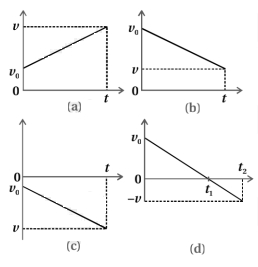
Draw and explain the $v-t$ graphs for uniformly accelerated motion.
Solution
(N/A) The velocity-time $(v-t)$ graphs for motion with constant acceleration are as follows:
$(a)$ An object is moving in a positive direction with a positive acceleration.
$(b)$ An object is moving in a positive direction with a negative acceleration (deceleration).
$(c)$ An object is moving in a negative direction with a negative acceleration.
$(d)$ An object is moving in a positive direction until time $t_{1}$,then it turns back and moves with the same negative acceleration.
An interesting feature of a velocity-time graph for any moving object is that the area under the curve represents the displacement over a given time interval.
$(a)$ An object is moving in a positive direction with a positive acceleration.
$(b)$ An object is moving in a positive direction with a negative acceleration (deceleration).
$(c)$ An object is moving in a negative direction with a negative acceleration.
$(d)$ An object is moving in a positive direction until time $t_{1}$,then it turns back and moves with the same negative acceleration.
An interesting feature of a velocity-time graph for any moving object is that the area under the curve represents the displacement over a given time interval.
0 likes
View Solution178
EasyMCQ
Draw the $x-t$ graph for negative acceleration.
A
$A$ straight line with positive slope
B
$A$ parabola opening upwards
C
$A$ parabola opening downwards
D
$A$ horizontal line
Solution
(C) For motion with constant negative acceleration $(a < 0)$,the position-time equation is given by the kinematic formula: $x(t) = x_0 + v_0t + \frac{1}{2}at^2$.
Since the acceleration $a$ is negative,the coefficient of the $t^2$ term is negative.
This equation represents a quadratic function in $t$,which graphically corresponds to a parabola.
Because the coefficient of $t^2$ is negative,the parabola opens downwards.
Therefore,the $x-t$ graph for negative acceleration is a downward-opening parabola.
Since the acceleration $a$ is negative,the coefficient of the $t^2$ term is negative.
This equation represents a quadratic function in $t$,which graphically corresponds to a parabola.
Because the coefficient of $t^2$ is negative,the parabola opens downwards.
Therefore,the $x-t$ graph for negative acceleration is a downward-opening parabola.
0 likes
View Solution179
Difficult
Derive the equations of uniformly accelerated motion by the graphical method.
Solution
(N/A) Let the velocity of the particle at $t=0$ be $v_{0}$ and at time $t$ be $v$.
$1$. First Equation of Motion $(v = v_{0} + at)$:
The acceleration $a$ is the slope of the velocity-time graph line $AB$.
$a = \text{slope} = \frac{v - v_{0}}{t - 0} = \frac{v - v_{0}}{t}$
$\therefore v = v_{0} + at$.
$2$. Second Equation of Motion $(x = v_{0}t + \frac{1}{2}at^{2})$:
The displacement $x$ is the area under the $v-t$ graph (trapezium $OABD$).
$x = \text{Area of rectangle } OACD + \text{Area of } \Delta ACB$
$x = (v_{0} \times t) + \frac{1}{2} \times (t) \times (v - v_{0})$
Since $(v - v_{0}) = at$,we get:
$x = v_{0}t + \frac{1}{2}at^{2}$.
$3$. Third Equation of Motion $(v^{2} - v_{0}^{2} = 2ax)$:
The displacement $x$ is the area of the trapezium $OABD$.
$x = \frac{1}{2} \times (\text{sum of parallel sides}) \times \text{height}$
$x = \frac{1}{2} (v_{0} + v) \times t$
Since $t = \frac{v - v_{0}}{a}$,we substitute $t$:
$x = \frac{1}{2} (v + v_{0}) \times \frac{(v - v_{0})}{a}$
$2ax = v^{2} - v_{0}^{2}$
$\therefore v^{2} = v_{0}^{2} + 2ax$.
$1$. First Equation of Motion $(v = v_{0} + at)$:
The acceleration $a$ is the slope of the velocity-time graph line $AB$.
$a = \text{slope} = \frac{v - v_{0}}{t - 0} = \frac{v - v_{0}}{t}$
$\therefore v = v_{0} + at$.
$2$. Second Equation of Motion $(x = v_{0}t + \frac{1}{2}at^{2})$:
The displacement $x$ is the area under the $v-t$ graph (trapezium $OABD$).
$x = \text{Area of rectangle } OACD + \text{Area of } \Delta ACB$
$x = (v_{0} \times t) + \frac{1}{2} \times (t) \times (v - v_{0})$
Since $(v - v_{0}) = at$,we get:
$x = v_{0}t + \frac{1}{2}at^{2}$.
$3$. Third Equation of Motion $(v^{2} - v_{0}^{2} = 2ax)$:
The displacement $x$ is the area of the trapezium $OABD$.
$x = \frac{1}{2} \times (\text{sum of parallel sides}) \times \text{height}$
$x = \frac{1}{2} (v_{0} + v) \times t$
Since $t = \frac{v - v_{0}}{a}$,we substitute $t$:
$x = \frac{1}{2} (v + v_{0}) \times \frac{(v - v_{0})}{a}$
$2ax = v^{2} - v_{0}^{2}$
$\therefore v^{2} = v_{0}^{2} + 2ax$.
0 likes
View Solution180
DifficultMCQ
$A$ particle with initial velocity $v_0$ moves with constant acceleration $a$ in a straight line. Find the distance travelled in the $n^{th}$ second.
A
$v_0 + \frac{a}{2}(2n-1)$
B
$v_0 + \frac{a}{2}(2n+1)$
C
$v_0 + a(2n-1)$
D
$v_0 + a(2n+1)$
Solution
(A) The distance travelled in the $n^{th}$ second is defined as the difference between the total distance covered in $n$ seconds and the total distance covered in $(n-1)$ seconds.
Using the kinematic equation $s = v_0 t + \frac{1}{2} a t^2$:
$d_n = s_n - s_{n-1}$
$d_n = (v_0 n + \frac{1}{2} a n^2) - [v_0 (n-1) + \frac{1}{2} a (n-1)^2]$
$d_n = v_0 n + \frac{1}{2} a n^2 - [v_0 n - v_0 + \frac{1}{2} a (n^2 - 2n + 1)]$
$d_n = v_0 n + \frac{1}{2} a n^2 - v_0 n + v_0 - \frac{1}{2} a n^2 + a n - \frac{1}{2} a$
$d_n = v_0 + a n - \frac{1}{2} a$
$d_n = v_0 + \frac{a}{2} (2n - 1)$
Using the kinematic equation $s = v_0 t + \frac{1}{2} a t^2$:
$d_n = s_n - s_{n-1}$
$d_n = (v_0 n + \frac{1}{2} a n^2) - [v_0 (n-1) + \frac{1}{2} a (n-1)^2]$
$d_n = v_0 n + \frac{1}{2} a n^2 - [v_0 n - v_0 + \frac{1}{2} a (n^2 - 2n + 1)]$
$d_n = v_0 n + \frac{1}{2} a n^2 - v_0 n + v_0 - \frac{1}{2} a n^2 + a n - \frac{1}{2} a$
$d_n = v_0 + a n - \frac{1}{2} a$
$d_n = v_0 + \frac{a}{2} (2n - 1)$
0 likes
View Solution181
Difficult
What is stopping distance for a vehicle? What will be the stopping distance if the initial velocity is doubled?
Solution
(N/A) When brakes are applied to a moving vehicle,the distance it travels before coming to a complete stop is called the stopping distance.
Suppose the initial velocity of the moving vehicle is $v_{0}$. After applying brakes,the retardation is $-a$.
Let the distance covered be $d_{s}$ (stopping distance) and the final velocity be $v = 0$.
Using the kinematic equation $v^{2} - v_{0}^{2} = 2as$:
$0 - v_{0}^{2} = 2(-a)(d_{s})$
$v_{0}^{2} = 2ad_{s}$
$d_{s} = \frac{v_{0}^{2}}{2a}$
Here,$a$ is the magnitude of retardation,which is constant.
Thus,the stopping distance is proportional to the square of the initial velocity: $d_{s} \propto v_{0}^{2}$.
If the initial velocity is doubled,i.e.,$(v_{0})_{2} = 2(v_{0})_{1}$,then:
$\frac{(d_{s})_{2}}{(d_{s})_{1}} = \frac{(v_{0})_{2}^{2}}{(v_{0})_{1}^{2}} = (2)^{2} = 4$.
Therefore,the stopping distance becomes $4$ times the original distance.
Suppose the initial velocity of the moving vehicle is $v_{0}$. After applying brakes,the retardation is $-a$.
Let the distance covered be $d_{s}$ (stopping distance) and the final velocity be $v = 0$.
Using the kinematic equation $v^{2} - v_{0}^{2} = 2as$:
$0 - v_{0}^{2} = 2(-a)(d_{s})$
$v_{0}^{2} = 2ad_{s}$
$d_{s} = \frac{v_{0}^{2}}{2a}$
Here,$a$ is the magnitude of retardation,which is constant.
Thus,the stopping distance is proportional to the square of the initial velocity: $d_{s} \propto v_{0}^{2}$.
If the initial velocity is doubled,i.e.,$(v_{0})_{2} = 2(v_{0})_{1}$,then:
$\frac{(d_{s})_{2}}{(d_{s})_{1}} = \frac{(v_{0})_{2}^{2}}{(v_{0})_{1}^{2}} = (2)^{2} = 4$.
Therefore,the stopping distance becomes $4$ times the original distance.
0 likes
View Solution182
Medium
On what factors does the stopping distance depend?
Solution
(N/A) The stopping distance of a vehicle is the distance it travels before coming to a complete rest after the brakes are applied. It depends on the following factors:
$1$. Initial velocity $(v_0)$ of the vehicle: The stopping distance is directly proportional to the square of the initial velocity $(d \propto v_0^2)$.
$2$. Deceleration capacity: It depends on the braking efficiency or the maximum deceleration $(a)$ that the vehicle can achieve,which is determined by the friction between the tires and the road surface.
$1$. Initial velocity $(v_0)$ of the vehicle: The stopping distance is directly proportional to the square of the initial velocity $(d \propto v_0^2)$.
$2$. Deceleration capacity: It depends on the braking efficiency or the maximum deceleration $(a)$ that the vehicle can achieve,which is determined by the friction between the tires and the road surface.
0 likes
View Solution183
MediumMCQ
When are the acceleration and average acceleration equal for a moving object?
A
When the object moves with uniform velocity.
B
When the object moves with uniform acceleration.
C
When the object moves with variable acceleration.
D
When the object moves with zero acceleration.
Solution
(B) The average acceleration $a_{avg}$ over a time interval $\Delta t$ is defined as the change in velocity divided by the time interval: $a_{avg} = \frac{\Delta v}{\Delta t}$.
The instantaneous acceleration $a$ is defined as the limit of the average acceleration as $\Delta t$ approaches zero: $a = \lim_{\Delta t \to 0} \frac{\Delta v}{\Delta t}$.
For the instantaneous acceleration to be equal to the average acceleration at any time,the acceleration must be constant (uniform acceleration).
If the acceleration is constant,the rate of change of velocity is constant,making the average acceleration over any interval equal to the instantaneous acceleration at any point within that interval.
The instantaneous acceleration $a$ is defined as the limit of the average acceleration as $\Delta t$ approaches zero: $a = \lim_{\Delta t \to 0} \frac{\Delta v}{\Delta t}$.
For the instantaneous acceleration to be equal to the average acceleration at any time,the acceleration must be constant (uniform acceleration).
If the acceleration is constant,the rate of change of velocity is constant,making the average acceleration over any interval equal to the instantaneous acceleration at any point within that interval.
0 likes
View Solution184
Easy
What is stopping distance?
Solution
(N/A) Stopping distance is the distance a vehicle travels after the brakes are applied until it comes to a complete stop.
It depends on the initial velocity $(v_0)$ of the vehicle and the deceleration $(a)$ produced by the brakes.
Using the third equation of motion,$v^2 = v_0^2 + 2as$,where $v$ is the final velocity $(0 \ m/s)$,$v_0$ is the initial velocity,$a$ is the negative acceleration (deceleration),and $s$ is the stopping distance.
Setting $v = 0$,we get $0 = v_0^2 - 2as$,which simplifies to $s = \frac{v_0^2}{2a}$.
It depends on the initial velocity $(v_0)$ of the vehicle and the deceleration $(a)$ produced by the brakes.
Using the third equation of motion,$v^2 = v_0^2 + 2as$,where $v$ is the final velocity $(0 \ m/s)$,$v_0$ is the initial velocity,$a$ is the negative acceleration (deceleration),and $s$ is the stopping distance.
Setting $v = 0$,we get $0 = v_0^2 - 2as$,which simplifies to $s = \frac{v_0^2}{2a}$.
0 likes
View Solution185
EasyMCQ
$A$ car starts from rest and moves with uniform acceleration. Describe the shapes of the $(i)$ $x-t$, $(ii)$ $v-t$, and $(iii)$ $a-t$ graphs for this motion.
A
Parabolic, Linear, Constant
B
Linear, Parabolic, Constant
C
Parabolic, Constant, Linear
D
Linear, Linear, Parabolic
Solution
(A) Given that the car starts from rest $(u = 0)$ and moves with uniform acceleration $(a = \text{constant})$.
$(i)$ For $x-t$ graph: Using the equation of motion $x = ut + \frac{1}{2}at^2$, since $u=0$, we get $x = \frac{1}{2}at^2$. This represents a parabola passing through the origin.
$(ii)$ For $v-t$ graph: Using the equation $v = u + at$, since $u=0$, we get $v = at$. This represents a straight line passing through the origin with a positive slope.
$(iii)$ For $a-t$ graph: Since the acceleration is uniform, $a$ remains constant with respect to time. This represents a straight line parallel to the time axis.
$(i)$ For $x-t$ graph: Using the equation of motion $x = ut + \frac{1}{2}at^2$, since $u=0$, we get $x = \frac{1}{2}at^2$. This represents a parabola passing through the origin.
$(ii)$ For $v-t$ graph: Using the equation $v = u + at$, since $u=0$, we get $v = at$. This represents a straight line passing through the origin with a positive slope.
$(iii)$ For $a-t$ graph: Since the acceleration is uniform, $a$ remains constant with respect to time. This represents a straight line parallel to the time axis.
0 likes
View Solution186
MediumMCQ
When will the average acceleration and instantaneous acceleration of a particle be equal over any time interval?
A
When the acceleration is constant.
B
When the velocity is constant.
C
When the displacement is constant.
D
When the speed is constant.
Solution
(A) The average acceleration over a time interval $\Delta t$ is defined as $a_{avg} = \frac{\Delta v}{\Delta t}$.
The instantaneous acceleration is defined as $a = \lim_{\Delta t \to 0} \frac{\Delta v}{\Delta t} = \frac{dv}{dt}$.
For the average acceleration to be equal to the instantaneous acceleration at any time,the rate of change of velocity must be constant.
Therefore,the acceleration must be constant.
The instantaneous acceleration is defined as $a = \lim_{\Delta t \to 0} \frac{\Delta v}{\Delta t} = \frac{dv}{dt}$.
For the average acceleration to be equal to the instantaneous acceleration at any time,the rate of change of velocity must be constant.
Therefore,the acceleration must be constant.
0 likes
View Solution187
EasyMCQ
The stopping distance of a vehicle moving with a given acceleration is proportional to the ....... of its speed.
A
square
B
cube
C
square root
D
linear power
Solution
(A) Using the third equation of motion: $v^2 - u^2 = 2as$.
Here,the final velocity $v = 0$ (as the vehicle stops).
Let the initial velocity be $u$ and the acceleration be $a = -|a|$ (retardation).
Substituting these values: $0^2 - u^2 = 2(-|a|)s$.
$-u^2 = -2|a|s$.
$s = \frac{u^2}{2|a|}$.
Since $2|a|$ is constant for a given acceleration,the stopping distance $s$ is proportional to the square of the initial speed $(s \propto u^2)$.
Here,the final velocity $v = 0$ (as the vehicle stops).
Let the initial velocity be $u$ and the acceleration be $a = -|a|$ (retardation).
Substituting these values: $0^2 - u^2 = 2(-|a|)s$.
$-u^2 = -2|a|s$.
$s = \frac{u^2}{2|a|}$.
Since $2|a|$ is constant for a given acceleration,the stopping distance $s$ is proportional to the square of the initial speed $(s \propto u^2)$.
0 likes
View Solution188
MediumMCQ
For a vehicle moving at $80 \, km/hr$, how many times is the stopping distance compared to a vehicle moving at $40 \, km/hr$, assuming both have the same deceleration (in $times$)?
A
$2$
B
$4$
C
$8$
D
$16$
Solution
(B) The stopping distance $d$ of a vehicle is given by the formula $d = \frac{v_0^2}{2|a|}$, where $v_0$ is the initial velocity and $a$ is the constant deceleration.
Since $d \propto v_0^2$, the ratio of the stopping distances for two vehicles with initial velocities $v_1 = 80 \, km/hr$ and $v_2 = 40 \, km/hr$ is:
$\frac{d_1}{d_2} = \left(\frac{v_1}{v_2}\right)^2 = \left(\frac{80}{40}\right)^2 = (2)^2 = 4$.
Therefore, the stopping distance for the vehicle moving at $80 \, km/hr$ is $4$ times that of the vehicle moving at $40 \, km/hr$.
Since $d \propto v_0^2$, the ratio of the stopping distances for two vehicles with initial velocities $v_1 = 80 \, km/hr$ and $v_2 = 40 \, km/hr$ is:
$\frac{d_1}{d_2} = \left(\frac{v_1}{v_2}\right)^2 = \left(\frac{80}{40}\right)^2 = (2)^2 = 4$.
Therefore, the stopping distance for the vehicle moving at $80 \, km/hr$ is $4$ times that of the vehicle moving at $40 \, km/hr$.
0 likes
View Solution189
MediumMCQ
When is the average velocity of an object equal to its instantaneous velocity?
A
When the object is at rest.
B
When the object moves with uniform velocity in a straight line.
C
When the object moves with variable velocity.
D
When the object moves in a circular path.
Solution
(B) The average velocity of an object is defined as the total displacement divided by the total time interval. The instantaneous velocity is the velocity at a specific instant of time. When an object moves with uniform velocity (constant velocity) in a straight line,its velocity does not change with time. Therefore,the velocity at any instant is equal to the average velocity over any time interval.
0 likes
View Solution190
EasyMCQ
What kind of motion is represented by the equation $\Delta S = v \Delta t$?
A
Uniform motion
B
Non-uniform motion
C
Uniformly accelerated motion
D
Non-uniformly accelerated motion
Solution
(A) The equation $\Delta S = v \Delta t$ represents motion with a constant velocity $(v)$.
Since the velocity $v$ is constant and does not change with time,the displacement $\Delta S$ is directly proportional to the time interval $\Delta t$.
This is the characteristic equation for uniform motion in a straight line.
Since the velocity $v$ is constant and does not change with time,the displacement $\Delta S$ is directly proportional to the time interval $\Delta t$.
This is the characteristic equation for uniform motion in a straight line.
0 likes
View Solution191
MediumMCQ
If the displacement of an object moving along a straight line is proportional to the square of the time elapsed,does the object have a constant velocity or a constant acceleration?
A
Constant velocity
B
Constant acceleration
C
Increasing acceleration
D
Decreasing acceleration
Solution
(B) Given that the displacement $x$ is proportional to the square of time $t$,we have $x = k t^{2}$,where $k$ is a constant.
The velocity $v$ is the first derivative of displacement with respect to time: $v = \frac{dx}{dt} = \frac{d}{dt}(k t^{2}) = 2kt$.
The acceleration $a$ is the derivative of velocity with respect to time: $a = \frac{dv}{dt} = \frac{d}{dt}(2kt) = 2k$.
Since $k$ is a constant,$2k$ is also a constant. Therefore,the object has a constant acceleration.
The velocity $v$ is the first derivative of displacement with respect to time: $v = \frac{dx}{dt} = \frac{d}{dt}(k t^{2}) = 2kt$.
The acceleration $a$ is the derivative of velocity with respect to time: $a = \frac{dv}{dt} = \frac{d}{dt}(2kt) = 2k$.
Since $k$ is a constant,$2k$ is also a constant. Therefore,the object has a constant acceleration.
0 likes
View Solution192
Medium
Give examples of a one-dimensional motion where:
$(a)$ The particle moving along positive $x$-direction comes to rest periodically and moves forward.
$(b)$ The particle moving along positive $x$-direction comes to rest periodically and moves backward.
$(a)$ The particle moving along positive $x$-direction comes to rest periodically and moves forward.
$(b)$ The particle moving along positive $x$-direction comes to rest periodically and moves backward.
Solution
(N/A) To represent periodic motion,we use trigonometric functions like $\sin t$ or $\cos t$.
$(a)$ Consider the motion $x(t) = t - \sin t$.
Velocity $v(t) = \frac{dx}{dt} = 1 - \cos t$.
At $t = 2n\pi$,$v = 1 - 1 = 0$,so the particle comes to rest. Since $v \ge 0$ for all $t$,the particle always moves in the positive $x$-direction.
$(b)$ Consider the motion $x(t) = \sin t$.
Velocity $v(t) = \frac{dx}{dt} = \cos t$.
At $t = \frac{\pi}{2}, \frac{3\pi}{2}, \dots$,the velocity $v = 0$,so the particle comes to rest. Since $\cos t$ alternates between positive and negative values,the particle moves forward and backward periodically.
$(a)$ Consider the motion $x(t) = t - \sin t$.
Velocity $v(t) = \frac{dx}{dt} = 1 - \cos t$.
At $t = 2n\pi$,$v = 1 - 1 = 0$,so the particle comes to rest. Since $v \ge 0$ for all $t$,the particle always moves in the positive $x$-direction.
$(b)$ Consider the motion $x(t) = \sin t$.
Velocity $v(t) = \frac{dx}{dt} = \cos t$.
At $t = \frac{\pi}{2}, \frac{3\pi}{2}, \dots$,the velocity $v = 0$,so the particle comes to rest. Since $\cos t$ alternates between positive and negative values,the particle moves forward and backward periodically.
0 likes
View Solution193
Difficult
Give an example of a motion where $x > 0$,$v < 0$,and $a > 0$ at a particular instant.
Solution
(N/A) Consider a particle moving in one dimension whose position is given by the function $x(t) = x_0 + A e^{-kt}$,where $x_0 > 0$,$A > 0$,and $k > 0$.
$1$. Position: $x(t) = x_0 + A e^{-kt}$. Since $x_0, A, k, t > 0$,the term $A e^{-kt}$ is positive,so $x(t) > 0$.
$2$. Velocity: $v(t) = \frac{dx}{dt} = -Ak e^{-kt}$. Since $A, k, e^{-kt} > 0$,the product $-Ak e^{-kt}$ is negative,so $v(t) < 0$.
$3$. Acceleration: $a(t) = \frac{dv}{dt} = Ak^2 e^{-kt}$. Since $A, k^2, e^{-kt} > 0$,the acceleration $a(t) > 0$.
An example of such motion is a particle moving towards the origin from the positive side of the $x$-axis,slowing down as it approaches a limiting position $x_0$.
$1$. Position: $x(t) = x_0 + A e^{-kt}$. Since $x_0, A, k, t > 0$,the term $A e^{-kt}$ is positive,so $x(t) > 0$.
$2$. Velocity: $v(t) = \frac{dx}{dt} = -Ak e^{-kt}$. Since $A, k, e^{-kt} > 0$,the product $-Ak e^{-kt}$ is negative,so $v(t) < 0$.
$3$. Acceleration: $a(t) = \frac{dv}{dt} = Ak^2 e^{-kt}$. Since $A, k^2, e^{-kt} > 0$,the acceleration $a(t) > 0$.
An example of such motion is a particle moving towards the origin from the positive side of the $x$-axis,slowing down as it approaches a limiting position $x_0$.
0 likes
View Solution194
Difficult
$A$ particle executes the motion described by $x(t) = x_0 (1 - e^{-\gamma t})$ for $t \geqslant 0$ and $x_0 > 0$.
$(a)$ Where does the particle start and with what velocity?
$(b)$ Find the maximum and minimum values of $x(t)$,$v(t)$,and $a(t)$. Show that $x(t)$ increases with time,$v(t)$ decreases with time,and $a(t)$ increases with time.
$(a)$ Where does the particle start and with what velocity?
$(b)$ Find the maximum and minimum values of $x(t)$,$v(t)$,and $a(t)$. Show that $x(t)$ increases with time,$v(t)$ decreases with time,and $a(t)$ increases with time.
Solution
(N/A) Given,$x(t) = x_0 (1 - e^{-\gamma t})$.
Velocity $v(t) = \frac{dx}{dt} = x_0 \gamma e^{-\gamma t}$.
Acceleration $a(t) = \frac{dv}{dt} = -x_0 \gamma^2 e^{-\gamma t}$.
$(a)$ At $t = 0$,$x(0) = x_0(1 - e^0) = 0$. The particle starts at the origin.
Velocity at $t = 0$ is $v(0) = x_0 \gamma e^0 = x_0 \gamma$.
$(b)$
$x(t)$: As $t \to \infty$,$x(t) \to x_0$ (maximum). At $t = 0$,$x(t) = 0$ (minimum). Since $\frac{dx}{dt} > 0$,$x(t)$ increases with time.
$v(t)$: At $t = 0$,$v(0) = x_0 \gamma$ (maximum). As $t \to \infty$,$v(t) \to 0$ (minimum). Since $\frac{dv}{dt} < 0$,$v(t)$ decreases with time.
$a(t)$: At $t = 0$,$a(0) = -x_0 \gamma^2$ (minimum). As $t \to \infty$,$a(t) \to 0$ (maximum). Since $\frac{da}{dt} = x_0 \gamma^3 e^{-\gamma t} > 0$,$a(t)$ increases with time.
Velocity $v(t) = \frac{dx}{dt} = x_0 \gamma e^{-\gamma t}$.
Acceleration $a(t) = \frac{dv}{dt} = -x_0 \gamma^2 e^{-\gamma t}$.
$(a)$ At $t = 0$,$x(0) = x_0(1 - e^0) = 0$. The particle starts at the origin.
Velocity at $t = 0$ is $v(0) = x_0 \gamma e^0 = x_0 \gamma$.
$(b)$
$x(t)$: As $t \to \infty$,$x(t) \to x_0$ (maximum). At $t = 0$,$x(t) = 0$ (minimum). Since $\frac{dx}{dt} > 0$,$x(t)$ increases with time.
$v(t)$: At $t = 0$,$v(0) = x_0 \gamma$ (maximum). As $t \to \infty$,$v(t) \to 0$ (minimum). Since $\frac{dv}{dt} < 0$,$v(t)$ decreases with time.
$a(t)$: At $t = 0$,$a(0) = -x_0 \gamma^2$ (minimum). As $t \to \infty$,$a(t) \to 0$ (maximum). Since $\frac{da}{dt} = x_0 \gamma^3 e^{-\gamma t} > 0$,$a(t)$ increases with time.
0 likes
View Solution195
Easy
Match the relations in Column-$I$ with the equations in Column-$II$ for uniformly accelerated motion.
| Column-$I$ | Column-$II$ |
|---|---|
| $(1)$ Velocity-time relation | $(a)$ $v = v_0 + at$ |
| $(2)$ Velocity-displacement relation | $(b)$ $S = v_0t + \frac{1}{2}at^2$ |
| $(c)$ $v^2 = v_0^2 + 2as$ |
Solution
(A) The equations of motion for constant acceleration are:
$1$. Velocity-time relation: $v = v_0 + at$. Thus,$(1) \to (a)$.
$2$. Position-time relation: $S = v_0t + \frac{1}{2}at^2$.
$3$. Velocity-displacement relation: $v^2 = v_0^2 + 2as$. Thus,$(2) \to (c)$.
Therefore,the correct matching is $(1-a, 2-c)$.
$1$. Velocity-time relation: $v = v_0 + at$. Thus,$(1) \to (a)$.
$2$. Position-time relation: $S = v_0t + \frac{1}{2}at^2$.
$3$. Velocity-displacement relation: $v^2 = v_0^2 + 2as$. Thus,$(2) \to (c)$.
Therefore,the correct matching is $(1-a, 2-c)$.
0 likes
View Solution196
MediumMCQ
$A$ body $A$ starts from rest with an acceleration $a_{1}$. After two seconds,another body $B$ starts from rest with an acceleration $a_{2}$. If they travel equal distances in the fifth second after the start of $A$,the ratio $a_{1}: a_{2}$ will be equal to:
A
$9: 5$
B
$5: 7$
C
$5: 9$
D
$7: 9$
Solution
(C) The distance covered by a body in the $n^{\text{th}}$ second is given by $S_{n} = u + \frac{a}{2}(2n - 1)$.
For body $A$,starting from rest $(u=0)$ at $t=0$,the distance covered in the $5^{\text{th}}$ second is:
$S_{A, 5} = 0 + \frac{a_{1}}{2}(2 \times 5 - 1) = \frac{9a_{1}}{2}$.
Body $B$ starts $2$ seconds after $A$. Therefore,the $5^{\text{th}}$ second after the start of $A$ corresponds to the $(5-2) = 3^{\text{rd}}$ second of motion for body $B$.
For body $B$,starting from rest $(u=0)$,the distance covered in its $3^{\text{rd}}$ second is:
$S_{B, 3} = 0 + \frac{a_{2}}{2}(2 \times 3 - 1) = \frac{5a_{2}}{2}$.
Given that $S_{A, 5} = S_{B, 3}$,we have:
$\frac{9a_{1}}{2} = \frac{5a_{2}}{2}$.
Thus,$\frac{a_{1}}{a_{2}} = \frac{5}{9}$.
For body $A$,starting from rest $(u=0)$ at $t=0$,the distance covered in the $5^{\text{th}}$ second is:
$S_{A, 5} = 0 + \frac{a_{1}}{2}(2 \times 5 - 1) = \frac{9a_{1}}{2}$.
Body $B$ starts $2$ seconds after $A$. Therefore,the $5^{\text{th}}$ second after the start of $A$ corresponds to the $(5-2) = 3^{\text{rd}}$ second of motion for body $B$.
For body $B$,starting from rest $(u=0)$,the distance covered in its $3^{\text{rd}}$ second is:
$S_{B, 3} = 0 + \frac{a_{2}}{2}(2 \times 3 - 1) = \frac{5a_{2}}{2}$.
Given that $S_{A, 5} = S_{B, 3}$,we have:
$\frac{9a_{1}}{2} = \frac{5a_{2}}{2}$.
Thus,$\frac{a_{1}}{a_{2}} = \frac{5}{9}$.
0 likes
View Solution197
EasyMCQ
The velocity of a particle is $v = v_{0} + gt + Ft^{2}$. Its position is $x = 0$ at $t = 0$; then its displacement after time $t = 1$ is:
A
$v_{0} + g + F$
B
$v_{0} + \frac{g}{2} + \frac{F}{3}$
C
$v_{0} + \frac{g}{2} + F$
D
$v_{0} + 2g + 3F$
Solution
(B) The velocity is given by $v = \frac{dx}{dt} = v_{0} + gt + Ft^{2}$.
To find the displacement $s$ at $t = 1$,we integrate the velocity with respect to time from $t = 0$ to $t = 1$:
$s = \int_{0}^{1} v dt = \int_{0}^{1} (v_{0} + gt + Ft^{2}) dt$
$s = [v_{0}t + \frac{gt^{2}}{2} + \frac{Ft^{3}}{3}]_{0}^{1}$
Substituting the limits $t = 0$ and $t = 1$:
$s = (v_{0}(1) + \frac{g(1)^{2}}{2} + \frac{F(1)^{3}}{3}) - (0)$
$s = v_{0} + \frac{g}{2} + \frac{F}{3}$
To find the displacement $s$ at $t = 1$,we integrate the velocity with respect to time from $t = 0$ to $t = 1$:
$s = \int_{0}^{1} v dt = \int_{0}^{1} (v_{0} + gt + Ft^{2}) dt$
$s = [v_{0}t + \frac{gt^{2}}{2} + \frac{Ft^{3}}{3}]_{0}^{1}$
Substituting the limits $t = 0$ and $t = 1$:
$s = (v_{0}(1) + \frac{g(1)^{2}}{2} + \frac{F(1)^{3}}{3}) - (0)$
$s = v_{0} + \frac{g}{2} + \frac{F}{3}$
0 likes
View Solution198
MediumMCQ
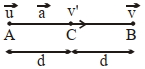
An engine of a train,moving with uniform acceleration,passes a signal post with velocity $u$ and the last compartment passes the same signal post with velocity $v$. The velocity with which the middle point of the train passes the signal post is
A
$\sqrt{\frac{v^{2}+u^{2}}{2}}$
B
$\frac{v-u}{2}$
C
$\frac{u+v}{2}$
D
$\sqrt{\frac{v^{2}-u^{2}}{2}}$
Solution
(A) Let the total length of the train be $L = 2d$,where $d$ is the distance from the engine to the middle point,and also from the middle point to the last compartment.
Let $a$ be the uniform acceleration of the train.
When the engine passes the signal post,its velocity is $u$. When the middle point passes the signal post,let its velocity be $v^{\prime}$.
Using the equation of motion $v_f^2 = v_i^2 + 2as$:
For the first half of the train (from engine to middle point),we have:
$(v^{\prime})^2 = u^2 + 2ad$ --- $(1)$
For the second half of the train (from middle point to last compartment),we have:
$v^2 = (v^{\prime})^2 + 2ad$ --- $(2)$
From equation $(1)$,$2ad = (v^{\prime})^2 - u^2$.
Substituting this into equation $(2)$:
$v^2 = (v^{\prime})^2 + ((v^{\prime})^2 - u^2)$
$v^2 = 2(v^{\prime})^2 - u^2$
$2(v^{\prime})^2 = v^2 + u^2$
$(v^{\prime})^2 = \frac{v^2 + u^2}{2}$
$v^{\prime} = \sqrt{\frac{v^2 + u^2}{2}}$
Let $a$ be the uniform acceleration of the train.
When the engine passes the signal post,its velocity is $u$. When the middle point passes the signal post,let its velocity be $v^{\prime}$.
Using the equation of motion $v_f^2 = v_i^2 + 2as$:
For the first half of the train (from engine to middle point),we have:
$(v^{\prime})^2 = u^2 + 2ad$ --- $(1)$
For the second half of the train (from middle point to last compartment),we have:
$v^2 = (v^{\prime})^2 + 2ad$ --- $(2)$
From equation $(1)$,$2ad = (v^{\prime})^2 - u^2$.
Substituting this into equation $(2)$:
$v^2 = (v^{\prime})^2 + ((v^{\prime})^2 - u^2)$
$v^2 = 2(v^{\prime})^2 - u^2$
$2(v^{\prime})^2 = v^2 + u^2$
$(v^{\prime})^2 = \frac{v^2 + u^2}{2}$
$v^{\prime} = \sqrt{\frac{v^2 + u^2}{2}}$
0 likes
View Solution199
DifficultMCQ
If the velocity of a body related to displacement $x$ is given by $v = \sqrt{5000 + 24x} \; \text{m/s}$,then the acceleration of the body is $\dots \dots \; \text{m/s}^2$.
A
$12$
B
$16$
C
$8$
D
$24$
Solution
(A) Given the velocity function: $v = \sqrt{5000 + 24x}$.
We know that acceleration $a$ is given by $a = v \frac{dv}{dx}$.
First,differentiate $v$ with respect to $x$:
$\frac{dv}{dx} = \frac{d}{dx} (5000 + 24x)^{1/2} = \frac{1}{2} (5000 + 24x)^{-1/2} \times 24 = \frac{12}{\sqrt{5000 + 24x}}$.
Now,substitute $v$ and $\frac{dv}{dx}$ into the acceleration formula:
$a = \sqrt{5000 + 24x} \times \frac{12}{\sqrt{5000 + 24x}}$.
$a = 12 \; \text{m/s}^2$.
We know that acceleration $a$ is given by $a = v \frac{dv}{dx}$.
First,differentiate $v$ with respect to $x$:
$\frac{dv}{dx} = \frac{d}{dx} (5000 + 24x)^{1/2} = \frac{1}{2} (5000 + 24x)^{-1/2} \times 24 = \frac{12}{\sqrt{5000 + 24x}}$.
Now,substitute $v$ and $\frac{dv}{dx}$ into the acceleration formula:
$a = \sqrt{5000 + 24x} \times \frac{12}{\sqrt{5000 + 24x}}$.
$a = 12 \; \text{m/s}^2$.
0 likes
View Solution200
DifficultMCQ
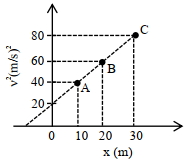
$A$ particle is moving with constant acceleration $a$. The following graph shows the $v^{2}$ versus $x$ (displacement) plot. The acceleration of the particle is $...... \text{m/s}^{2}$.
A
$100$
B
$20$
C
$14$
D
$1$
Solution
(D) From the equation of motion,$v^{2} = u^{2} + 2ax$,which is of the form $y = mx + c$,where $y = v^{2}$ and $x$ is the displacement.
Comparing this with the graph,the slope of the $v^{2}$ versus $x$ line is $2a$.
From the graph,we can calculate the slope $m$ using two points,for example,$(10, 40)$ and $(20, 60)$:
$m = \frac{v_{2}^{2} - v_{1}^{2}}{x_{2} - x_{1}} = \frac{60 - 40}{20 - 10} = \frac{20}{10} = 2 \text{ m/s}^{2}$.
Since the slope $m = 2a$,we have $2a = 2$.
Therefore,the acceleration $a = 1 \text{ m/s}^{2}$.
Comparing this with the graph,the slope of the $v^{2}$ versus $x$ line is $2a$.
From the graph,we can calculate the slope $m$ using two points,for example,$(10, 40)$ and $(20, 60)$:
$m = \frac{v_{2}^{2} - v_{1}^{2}}{x_{2} - x_{1}} = \frac{60 - 40}{20 - 10} = \frac{20}{10} = 2 \text{ m/s}^{2}$.
Since the slope $m = 2a$,we have $2a = 2$.
Therefore,the acceleration $a = 1 \text{ m/s}^{2}$.
0 likes
View SolutionMotion in Straight Line — Uniformly Accelerated Motion · Frequently Asked Questions
1Are these Motion in Straight Line questions useful for JEE and NEET?
Yes. All questions in this section are mapped to JEE Main and NEET exam patterns. Previous year questions from JEE Main, NEET, GUJCET and state-level exams are included with full solutions.
2Can I switch to Hindi or Gujarati for these questions?
Yes. Use the language tabs in the hero section or the sidebar to view the same questions and solutions in English, Hindi or Gujarati.
3How do I generate a question paper from this subtopic?
Use the Vedclass Exam Paper Generator — select the chapter and subtopic, set difficulty, and generate Sets A, B, C, D automatically. First 3 chapters of every subject are free.
Vedclass Products
For Students
Vedclass Test Series
Mock tests in real JEE/NEET style with performance analysis. 5-day free trial.
Start Free TrialFor Teachers
Exam Paper Generator
Generate Set A/B/C/D papers from this chapter in 2 minutes. 3 chapters free.
Try FreeFor Institutes
Online Exam Module
Live online exams with unlimited students, 360° analytics & white-label branding.
See DemoFor Teachers & Institutes
Generate a Motion in Straight Line Exam Paper in 2 Minutes
Select subtopic & difficulty — Sets A, B, C, D auto-generated with No Repeat logic.
First 3 chapters of every subject are free — no payment required.