
A English
Acceleration and its graph Questions in English
Class 11 Physics · Motion in Straight Line · Acceleration and its graph
76+
Questions
English
Language
100%
With Solutions
Showing 50 of 76 questions in English
1
EasyMCQ
The velocity of a body depends on time according to the equation $v = 20 + 0.1t^2$. The body is undergoing
A
Uniform acceleration
B
Uniform retardation
C
Non-uniform acceleration
D
Zero acceleration
Solution
(C) The velocity of the body is given by $v = 20 + 0.1t^2$.
Acceleration $a$ is defined as the rate of change of velocity with respect to time,$a = \frac{dv}{dt}$.
$a = \frac{d}{dt}(20 + 0.1t^2) = 0 + 0.1 \times 2t = 0.2t$.
Since the acceleration $a = 0.2t$ depends on time $t$,it is not constant.
Therefore,the body is undergoing non-uniform acceleration.
Acceleration $a$ is defined as the rate of change of velocity with respect to time,$a = \frac{dv}{dt}$.
$a = \frac{d}{dt}(20 + 0.1t^2) = 0 + 0.1 \times 2t = 0.2t$.
Since the acceleration $a = 0.2t$ depends on time $t$,it is not constant.
Therefore,the body is undergoing non-uniform acceleration.
0 likes
View Solution2
EasyMCQ
The displacement is given by $x = 2t^2 + t + 5$,the acceleration at $t = 2 \ s$ is ......... $m/s^2$.
A
$4$
B
$8$
C
$10$
D
$15$
Solution
(A) Given displacement $x = 2t^2 + t + 5$.
Velocity $v$ is the first derivative of displacement with respect to time: $v = \frac{dx}{dt} = \frac{d}{dt}(2t^2 + t + 5) = 4t + 1$.
Acceleration $a$ is the derivative of velocity with respect to time: $a = \frac{dv}{dt} = \frac{d}{dt}(4t + 1) = 4$.
Since the acceleration is constant,at $t = 2 \ s$,the acceleration remains $4 \ m/s^2$.
Velocity $v$ is the first derivative of displacement with respect to time: $v = \frac{dx}{dt} = \frac{d}{dt}(2t^2 + t + 5) = 4t + 1$.
Acceleration $a$ is the derivative of velocity with respect to time: $a = \frac{dv}{dt} = \frac{d}{dt}(4t + 1) = 4$.
Since the acceleration is constant,at $t = 2 \ s$,the acceleration remains $4 \ m/s^2$.
1 likes
View Solution3
MediumMCQ
The position $x$ of a particle varies with time $t$ as $x = at^2 - bt^3$. The acceleration of the particle will be zero at time $t$ equal to
A
$a/b$
B
$2a/3b$
C
$a/3b$
D
Zero
Solution
(C) The velocity $v$ is the first derivative of position $x$ with respect to time $t$:
$v = \frac{dx}{dt} = \frac{d}{dt}(at^2 - bt^3) = 2at - 3bt^2$
The acceleration $a_{acc}$ is the derivative of velocity $v$ with respect to time $t$:
$a_{acc} = \frac{dv}{dt} = \frac{d}{dt}(2at - 3bt^2) = 2a - 6bt$
To find the time when acceleration is zero,set $a_{acc} = 0$:
$2a - 6bt = 0$
$6bt = 2a$
$t = \frac{2a}{6b} = \frac{a}{3b}$
$v = \frac{dx}{dt} = \frac{d}{dt}(at^2 - bt^3) = 2at - 3bt^2$
The acceleration $a_{acc}$ is the derivative of velocity $v$ with respect to time $t$:
$a_{acc} = \frac{dv}{dt} = \frac{d}{dt}(2at - 3bt^2) = 2a - 6bt$
To find the time when acceleration is zero,set $a_{acc} = 0$:
$2a - 6bt = 0$
$6bt = 2a$
$t = \frac{2a}{6b} = \frac{a}{3b}$
0 likes
View Solution4
EasyMCQ
$A$ body is moving according to the equation $x = at + bt^2 - ct^3$,where $x$ is displacement and $a, b,$ and $c$ are constants. The acceleration of the body is:
A
$a + 2bt$
B
$2b + 6ct$
C
$2b - 6ct$
D
$3b - 6ct^2$
Solution
(C) The displacement of the body is given by the equation: $x = at + bt^2 - ct^3$.
To find the velocity $(v)$,we differentiate the displacement with respect to time $(t)$:
$v = \frac{dx}{dt} = \frac{d}{dt}(at + bt^2 - ct^3) = a + 2bt - 3ct^2$.
To find the acceleration $(a_{acc})$,we differentiate the velocity with respect to time $(t)$:
$a_{acc} = \frac{dv}{dt} = \frac{d}{dt}(a + 2bt - 3ct^2) = 0 + 2b - 6ct$.
Therefore,the acceleration of the body is $2b - 6ct$.
To find the velocity $(v)$,we differentiate the displacement with respect to time $(t)$:
$v = \frac{dx}{dt} = \frac{d}{dt}(at + bt^2 - ct^3) = a + 2bt - 3ct^2$.
To find the acceleration $(a_{acc})$,we differentiate the velocity with respect to time $(t)$:
$a_{acc} = \frac{dv}{dt} = \frac{d}{dt}(a + 2bt - 3ct^2) = 0 + 2b - 6ct$.
Therefore,the acceleration of the body is $2b - 6ct$.
0 likes
View Solution5
EasyMCQ
Acceleration of a particle changes when:
A
Direction of velocity changes
B
Magnitude of velocity changes
C
Both of the above
D
Speed changes
Solution
(C) Acceleration is defined as the rate of change of velocity with respect to time,given by $\vec{a} = \frac{d\vec{v}}{dt}$.
Since velocity $\vec{v}$ is a vector quantity,it has both magnitude (speed) and direction.
If the magnitude of velocity changes,the particle undergoes acceleration.
If the direction of velocity changes,the particle also undergoes acceleration (e.g.,in uniform circular motion).
Therefore,if either the magnitude or the direction of velocity changes,the acceleration of the particle changes.
Thus,the correct option is $(c)$.
Since velocity $\vec{v}$ is a vector quantity,it has both magnitude (speed) and direction.
If the magnitude of velocity changes,the particle undergoes acceleration.
If the direction of velocity changes,the particle also undergoes acceleration (e.g.,in uniform circular motion).
Therefore,if either the magnitude or the direction of velocity changes,the acceleration of the particle changes.
Thus,the correct option is $(c)$.
0 likes
View Solution6
EasyMCQ
The displacement equation for a particle is $s = 3t^3 + 7t^2 + 14t + 8 \ m$. Its acceleration at time $t = 1 \ s$ is ....... $m/s^2$.
A
$10$
B
$16$
C
$25$
D
$32$
Solution
(D) The displacement is given by $s = 3t^3 + 7t^2 + 14t + 8$.
To find the velocity $v$,we differentiate $s$ with respect to time $t$:
$v = \frac{ds}{dt} = \frac{d}{dt}(3t^3 + 7t^2 + 14t + 8) = 9t^2 + 14t + 14$.
To find the acceleration $a$,we differentiate the velocity $v$ with respect to time $t$:
$a = \frac{dv}{dt} = \frac{d}{dt}(9t^2 + 14t + 14) = 18t + 14$.
At time $t = 1 \ s$,the acceleration is:
$a = 18(1) + 14 = 18 + 14 = 32 \ m/s^2$.
To find the velocity $v$,we differentiate $s$ with respect to time $t$:
$v = \frac{ds}{dt} = \frac{d}{dt}(3t^3 + 7t^2 + 14t + 8) = 9t^2 + 14t + 14$.
To find the acceleration $a$,we differentiate the velocity $v$ with respect to time $t$:
$a = \frac{dv}{dt} = \frac{d}{dt}(9t^2 + 14t + 14) = 18t + 14$.
At time $t = 1 \ s$,the acceleration is:
$a = 18(1) + 14 = 18 + 14 = 32 \ m/s^2$.
0 likes
View Solution7
MediumMCQ
The position of a particle moving along the $X-$axis at certain times is given below. Which of the following describes the motion correctly?
| $t (s)$ | $0$ | $1$ | $2$ | $3$ |
| $x (m)$ | $-2$ | $0$ | $6$ | $16$ |
A
Uniform,accelerated
B
Uniform,decelerated
C
Non-uniform,accelerated
D
There is not enough data for generalization
Solution
(C) The instantaneous velocity is given by $v = \frac{\Delta x}{\Delta t}$.
Using the data from the table:
For the interval $t = 0$ to $t = 1 \ s$: $v_1 = \frac{0 - (-2)}{1} = 2 \ m/s$.
For the interval $t = 1$ to $t = 2 \ s$: $v_2 = \frac{6 - 0}{1} = 6 \ m/s$.
For the interval $t = 2$ to $t = 3 \ s$: $v_3 = \frac{16 - 6}{1} = 10 \ m/s$.
Since the velocity is changing with time $(2 \ m/s, 6 \ m/s, 10 \ m/s)$,the motion is non-uniform.
Since the velocity is increasing,the motion is accelerated. Thus,the motion is non-uniform and accelerated.
Using the data from the table:
For the interval $t = 0$ to $t = 1 \ s$: $v_1 = \frac{0 - (-2)}{1} = 2 \ m/s$.
For the interval $t = 1$ to $t = 2 \ s$: $v_2 = \frac{6 - 0}{1} = 6 \ m/s$.
For the interval $t = 2$ to $t = 3 \ s$: $v_3 = \frac{16 - 6}{1} = 10 \ m/s$.
Since the velocity is changing with time $(2 \ m/s, 6 \ m/s, 10 \ m/s)$,the motion is non-uniform.
Since the velocity is increasing,the motion is accelerated. Thus,the motion is non-uniform and accelerated.
0 likes
View Solution8
EasyMCQ
The displacement of a particle,moving in a straight line,is given by $s = 2t^2 + 2t + 4$,where $s$ is in metres and $t$ is in seconds. The acceleration of the particle is ........ $m/s^2$.
A
$2$
B
$4$
C
$6$
D
$8$
Solution
(B) The displacement of the particle is given by the equation $s = 2t^2 + 2t + 4$.
To find the velocity $v$,we differentiate the displacement $s$ with respect to time $t$:
$v = \frac{ds}{dt} = \frac{d}{dt}(2t^2 + 2t + 4) = 4t + 2$.
To find the acceleration $a$,we differentiate the velocity $v$ with respect to time $t$:
$a = \frac{dv}{dt} = \frac{d}{dt}(4t + 2) = 4$.
Thus,the acceleration of the particle is $4 \ m/s^2$.
To find the velocity $v$,we differentiate the displacement $s$ with respect to time $t$:
$v = \frac{ds}{dt} = \frac{d}{dt}(2t^2 + 2t + 4) = 4t + 2$.
To find the acceleration $a$,we differentiate the velocity $v$ with respect to time $t$:
$a = \frac{dv}{dt} = \frac{d}{dt}(4t + 2) = 4$.
Thus,the acceleration of the particle is $4 \ m/s^2$.
0 likes
View Solution9
MediumMCQ
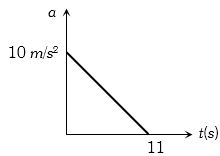
$A$ particle starts from rest. Its acceleration $(a)$ versus time $(t)$ graph is as shown in the figure. The maximum speed of the particle will be.....$m/s$.
A
$110$
B
$55$
C
$550$
D
$660$
Solution
(B) The area under the acceleration-time graph gives the change in velocity of the particle.
Since the particle starts from rest,its initial velocity $u = 0$.
The maximum velocity is achieved at $t = 11 \, s$,where the acceleration becomes zero.
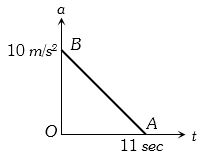
Thus,the maximum velocity $v_{\max}$ is equal to the area of the triangle $OAB$ in the given graph.
$v_{\max} = \text{Area of } \Delta OAB = \frac{1}{2} \times \text{base} \times \text{height}$
$v_{\max} = \frac{1}{2} \times 11 \, s \times 10 \, m/s^2 = 55 \, m/s$.
Therefore,the maximum speed of the particle is $55 \, m/s$.
Since the particle starts from rest,its initial velocity $u = 0$.
The maximum velocity is achieved at $t = 11 \, s$,where the acceleration becomes zero.
Thus,the maximum velocity $v_{\max}$ is equal to the area of the triangle $OAB$ in the given graph.
$v_{\max} = \text{Area of } \Delta OAB = \frac{1}{2} \times \text{base} \times \text{height}$
$v_{\max} = \frac{1}{2} \times 11 \, s \times 10 \, m/s^2 = 55 \, m/s$.
Therefore,the maximum speed of the particle is $55 \, m/s$.
0 likes
View Solution10
EasyMCQ
An object with a mass $10 \, kg$ moves at a constant velocity of $10 \, m/s$. $A$ constant force then acts for $4 \, s$ on the object and gives it a speed of $2 \, m/s$ in the opposite direction. The acceleration produced in it is ........ $m/s^2$.
A
$3$
B
$-3$
C
$0.3$
D
$-0.3$
Solution
(B) Given:
Initial velocity $\vec{v_1} = +10 \, m/s$ (taking the direction of motion as positive).
Final velocity $\vec{v_2} = -2 \, m/s$ (since it is in the opposite direction).
Time interval $t = 4 \, s$.
Acceleration $\vec{a}$ is defined as the rate of change of velocity:
$\vec{a} = \frac{\vec{v_2} - \vec{v_1}}{t}$
Substituting the values:
$\vec{a} = \frac{-2 - 10}{4} = \frac{-12}{4} = -3 \, m/s^2$.
Thus,the acceleration produced is $-3 \, m/s^2$.
Initial velocity $\vec{v_1} = +10 \, m/s$ (taking the direction of motion as positive).
Final velocity $\vec{v_2} = -2 \, m/s$ (since it is in the opposite direction).
Time interval $t = 4 \, s$.
Acceleration $\vec{a}$ is defined as the rate of change of velocity:
$\vec{a} = \frac{\vec{v_2} - \vec{v_1}}{t}$
Substituting the values:
$\vec{a} = \frac{-2 - 10}{4} = \frac{-12}{4} = -3 \, m/s^2$.
Thus,the acceleration produced is $-3 \, m/s^2$.
0 likes
View Solution11
MediumMCQ
If the velocity of a particle is $(10 + 2t^2) \ m/s$,then the average acceleration of the particle between $2 \ s$ and $5 \ s$ is..........$m/s^2$.
A
$2$
B
$4$
C
$12$
D
$14$
Solution
(D) Average acceleration is defined as the change in velocity divided by the time interval.
$a_{avg} = \frac{v(t_2) - v(t_1)}{t_2 - t_1}$
Given $v(t) = 10 + 2t^2$,$t_1 = 2 \ s$,and $t_2 = 5 \ s$.
Calculate velocity at $t_1 = 2 \ s$: $v(2) = 10 + 2(2)^2 = 10 + 8 = 18 \ m/s$.
Calculate velocity at $t_2 = 5 \ s$: $v(5) = 10 + 2(5)^2 = 10 + 50 = 60 \ m/s$.
Now,calculate average acceleration:
$a_{avg} = \frac{60 - 18}{5 - 2} = \frac{42}{3} = 14 \ m/s^2$.
$a_{avg} = \frac{v(t_2) - v(t_1)}{t_2 - t_1}$
Given $v(t) = 10 + 2t^2$,$t_1 = 2 \ s$,and $t_2 = 5 \ s$.
Calculate velocity at $t_1 = 2 \ s$: $v(2) = 10 + 2(2)^2 = 10 + 8 = 18 \ m/s$.
Calculate velocity at $t_2 = 5 \ s$: $v(5) = 10 + 2(5)^2 = 10 + 50 = 60 \ m/s$.
Now,calculate average acceleration:
$a_{avg} = \frac{60 - 18}{5 - 2} = \frac{42}{3} = 14 \ m/s^2$.
0 likes
View Solution12
DifficultMCQ
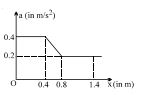
The acceleration of a particle which moves along the positive $x$-axis varies with its position as shown in the graph. If the velocity of the particle is $0.8 \ m/s$ at $x = 0$,find the velocity of the particle at $x = 1.4 \ m$ (in $m/s$).
A
$1.6$
B
$1.2$
C
$1.4$
D
none of these
Solution
(B) The relationship between acceleration $a$ and velocity $v$ is given by $a = v \frac{dv}{dx}$,which implies $\int_{u}^{v} v \ dv = \int_{0}^{x} a \ dx$.
This means $\frac{v^2 - u^2}{2} = \text{Area under the } a-x \text{ graph}$.
Given $u = 0.8 \ m/s$ at $x = 0$.
The area under the $a-x$ graph from $x = 0$ to $x = 1.4$ consists of a rectangle and a trapezoid:
Area $1$ (from $x=0$ to $x=0.4$): $0.4 \times 0.4 = 0.16 \ m^2/s^2$.
Area $2$ (from $x=0.4$ to $x=0.8$): $\frac{1}{2} \times (0.4 + 0.2) \times 0.4 = 0.12 \ m^2/s^2$.
Area $3$ (from $x=0.8$ to $x=1.4$): $0.2 \times (1.4 - 0.8) = 0.2 \times 0.6 = 0.12 \ m^2/s^2$.
Total Area $= 0.16 + 0.12 + 0.12 = 0.40 \ m^2/s^2$.
Using the formula: $\frac{v^2 - (0.8)^2}{2} = 0.40$.
$v^2 - 0.64 = 0.80$.
$v^2 = 1.44$.
$v = 1.2 \ m/s$.
This means $\frac{v^2 - u^2}{2} = \text{Area under the } a-x \text{ graph}$.
Given $u = 0.8 \ m/s$ at $x = 0$.
The area under the $a-x$ graph from $x = 0$ to $x = 1.4$ consists of a rectangle and a trapezoid:
Area $1$ (from $x=0$ to $x=0.4$): $0.4 \times 0.4 = 0.16 \ m^2/s^2$.
Area $2$ (from $x=0.4$ to $x=0.8$): $\frac{1}{2} \times (0.4 + 0.2) \times 0.4 = 0.12 \ m^2/s^2$.
Area $3$ (from $x=0.8$ to $x=1.4$): $0.2 \times (1.4 - 0.8) = 0.2 \times 0.6 = 0.12 \ m^2/s^2$.
Total Area $= 0.16 + 0.12 + 0.12 = 0.40 \ m^2/s^2$.
Using the formula: $\frac{v^2 - (0.8)^2}{2} = 0.40$.
$v^2 - 0.64 = 0.80$.
$v^2 = 1.44$.
$v = 1.2 \ m/s$.
0 likes
View Solution13
DifficultMCQ
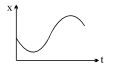
The graph of position $x$ versus time $t$ represents the motion of a particle. The curve is a parabola opening upwards. If the equation of motion is given by $x = a + bt - ct^2$ where $b$ and $c$ are positive constants,which of the following expressions best describes the acceleration $a_{acc}$ of the particle?
A
$a_{acc} = b - ct$
B
$a_{acc} = +b$
C
$a_{acc} = -2c$
D
$a_{acc} = b + ct$
Solution
(C) The position of the particle is given by the equation $x(t) = a + bt - ct^2$.
To find the velocity $v(t)$,we take the first derivative of position with respect to time:
$v(t) = \frac{dx}{dt} = \frac{d}{dt}(a + bt - ct^2) = b - 2ct$.
To find the acceleration $a_{acc}(t)$,we take the derivative of velocity with respect to time:
$a_{acc}(t) = \frac{dv}{dt} = \frac{d}{dt}(b - 2ct) = -2c$.
Since $c$ is a positive constant,the acceleration is a constant negative value. Thus,the correct expression is $a_{acc} = -2c$.
To find the velocity $v(t)$,we take the first derivative of position with respect to time:
$v(t) = \frac{dx}{dt} = \frac{d}{dt}(a + bt - ct^2) = b - 2ct$.
To find the acceleration $a_{acc}(t)$,we take the derivative of velocity with respect to time:
$a_{acc}(t) = \frac{dv}{dt} = \frac{d}{dt}(b - 2ct) = -2c$.
Since $c$ is a positive constant,the acceleration is a constant negative value. Thus,the correct expression is $a_{acc} = -2c$.
0 likes
View Solution14
MediumMCQ
Let $\vec v$ and $\vec a$ denote the velocity and acceleration respectively of a body in one-dimensional motion. Which of the following statements is correct regarding the speed of the body?
A
$|\vec v|$ must decrease when $\vec a < 0$
B
Speed will decrease when $\vec v > 0$ and $\vec a < 0$
C
Speed will increase when both $\vec v < 0$ and $\vec a < 0$
D
Both $(B)$ and $(C)$
Solution
(D) Speed is defined as the magnitude of velocity,i.e.,$|\vec v|$.
$1$. If $\vec v$ and $\vec a$ have the same sign (both positive or both negative),the speed of the body increases.
$2$. If $\vec v$ and $\vec a$ have opposite signs,the speed of the body decreases.
In option $(B)$,$\vec v > 0$ and $\vec a < 0$ (opposite signs),so speed decreases. This is correct.
In option $(C)$,$\vec v < 0$ and $\vec a < 0$ (same signs),so speed increases. This is correct.
Therefore,both $(B)$ and $(C)$ are correct.
$1$. If $\vec v$ and $\vec a$ have the same sign (both positive or both negative),the speed of the body increases.
$2$. If $\vec v$ and $\vec a$ have opposite signs,the speed of the body decreases.
In option $(B)$,$\vec v > 0$ and $\vec a < 0$ (opposite signs),so speed decreases. This is correct.
In option $(C)$,$\vec v < 0$ and $\vec a < 0$ (same signs),so speed increases. This is correct.
Therefore,both $(B)$ and $(C)$ are correct.
0 likes
View Solution15
MediumMCQ
If $v = x^2 - 5x + 4$,find the acceleration of the particle when the velocity of the particle is zero.
A
$4$
B
$1$
C
$3$
D
$0$
Solution
(D) The acceleration $a$ of a particle is given by the relation $a = v \frac{dv}{dx}$.
Given the velocity $v = x^2 - 5x + 4$.
First,calculate the derivative of $v$ with respect to $x$:
$\frac{dv}{dx} = \frac{d}{dx}(x^2 - 5x + 4) = 2x - 5$.
Now,substitute $v$ and $\frac{dv}{dx}$ into the acceleration formula:
$a = (x^2 - 5x + 4)(2x - 5)$.
We need to find the acceleration when the velocity $v = 0$:
$x^2 - 5x + 4 = 0$
$(x - 1)(x - 4) = 0$
So,$x = 1$ or $x = 4$.
If $x = 1$,$a = (0)(2(1) - 5) = 0$.
If $x = 4$,$a = (0)(2(4) - 5) = 0$.
Therefore,when the velocity is zero,the acceleration is $0$.
Given the velocity $v = x^2 - 5x + 4$.
First,calculate the derivative of $v$ with respect to $x$:
$\frac{dv}{dx} = \frac{d}{dx}(x^2 - 5x + 4) = 2x - 5$.
Now,substitute $v$ and $\frac{dv}{dx}$ into the acceleration formula:
$a = (x^2 - 5x + 4)(2x - 5)$.
We need to find the acceleration when the velocity $v = 0$:
$x^2 - 5x + 4 = 0$
$(x - 1)(x - 4) = 0$
So,$x = 1$ or $x = 4$.
If $x = 1$,$a = (0)(2(1) - 5) = 0$.
If $x = 4$,$a = (0)(2(4) - 5) = 0$.
Therefore,when the velocity is zero,the acceleration is $0$.
0 likes
View Solution16
MediumMCQ
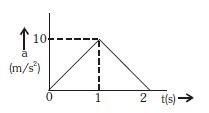
The acceleration-time graph is given. If the initial velocity is $5\,m/s$,then the velocity after $2\,s$ is.......$m/s$.
A
$10$
B
$15$
C
$20$
D
$0$
Solution
(B) The change in velocity $\Delta v$ is equal to the area under the acceleration-time $(a-t)$ graph.
The area of the triangle in the $(a-t)$ graph is given by:
$\text{Area} = \frac{1}{2} \times \text{base} \times \text{height}$
$\text{Area} = \frac{1}{2} \times 2\,s \times 10\,m/s^2 = 10\,m/s$
We know that $\Delta v = v_f - v_i$,where $v_f$ is the final velocity and $v_i$ is the initial velocity.
$v_f - 5\,m/s = 10\,m/s$
$v_f = 15\,m/s$
Thus,the velocity after $2\,s$ is $15\,m/s$.
The area of the triangle in the $(a-t)$ graph is given by:
$\text{Area} = \frac{1}{2} \times \text{base} \times \text{height}$
$\text{Area} = \frac{1}{2} \times 2\,s \times 10\,m/s^2 = 10\,m/s$
We know that $\Delta v = v_f - v_i$,where $v_f$ is the final velocity and $v_i$ is the initial velocity.
$v_f - 5\,m/s = 10\,m/s$
$v_f = 15\,m/s$
Thus,the velocity after $2\,s$ is $15\,m/s$.
0 likes
View Solution17
MediumMCQ
$A$ particle moves along a straight line such that its displacement at any time $t$ is given by $s = (t^3 - 3t^2 + 2) \, m$. The displacement when the acceleration becomes zero is ........ $m$.
A
$0$
B
$2$
C
$3$
D
$-2$
Solution
(A) The displacement is given by $s = t^3 - 3t^2 + 2$.
The velocity $v$ is the first derivative of displacement with respect to time: $v = \frac{ds}{dt} = 3t^2 - 6t$.
The acceleration $a$ is the derivative of velocity with respect to time: $a = \frac{dv}{dt} = \frac{d^2s}{dt^2} = 6t - 6$.
Set the acceleration to zero to find the time $t$:
$6t - 6 = 0 \implies t = 1 \, s$.
Now,substitute $t = 1 \, s$ into the displacement equation to find the displacement at that instant:
$s = (1)^3 - 3(1)^2 + 2 = 1 - 3 + 2 = 0 \, m$.
The velocity $v$ is the first derivative of displacement with respect to time: $v = \frac{ds}{dt} = 3t^2 - 6t$.
The acceleration $a$ is the derivative of velocity with respect to time: $a = \frac{dv}{dt} = \frac{d^2s}{dt^2} = 6t - 6$.
Set the acceleration to zero to find the time $t$:
$6t - 6 = 0 \implies t = 1 \, s$.
Now,substitute $t = 1 \, s$ into the displacement equation to find the displacement at that instant:
$s = (1)^3 - 3(1)^2 + 2 = 1 - 3 + 2 = 0 \, m$.
0 likes
View Solution18
MediumMCQ
The distance travelled by a body moving along a line in time $t$ is proportional to $t^3$. The acceleration-time $(a, t)$ graph for the motion of the body will be
A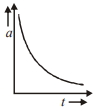
B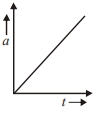
C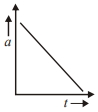
D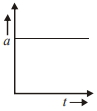
Solution
(B) Given that the distance (or displacement) $s$ is proportional to $t^3$,we can write:
$s = k t^3$ (where $k$ is a constant).
To find the velocity $v$,we differentiate $s$ with respect to time $t$:
$v = \frac{ds}{dt} = \frac{d}{dt}(k t^3) = 3k t^2$.
To find the acceleration $a$,we differentiate the velocity $v$ with respect to time $t$:
$a = \frac{dv}{dt} = \frac{d}{dt}(3k t^2) = 6k t$.
Since $a = 6k t$,it implies that $a \propto t$.
This represents a linear relationship passing through the origin,which corresponds to a straight line graph starting from the origin.
Looking at the provided options,the graph that shows $a$ increasing linearly with $t$ is Graph $B$.
$s = k t^3$ (where $k$ is a constant).
To find the velocity $v$,we differentiate $s$ with respect to time $t$:
$v = \frac{ds}{dt} = \frac{d}{dt}(k t^3) = 3k t^2$.
To find the acceleration $a$,we differentiate the velocity $v$ with respect to time $t$:
$a = \frac{dv}{dt} = \frac{d}{dt}(3k t^2) = 6k t$.
Since $a = 6k t$,it implies that $a \propto t$.
This represents a linear relationship passing through the origin,which corresponds to a straight line graph starting from the origin.
Looking at the provided options,the graph that shows $a$ increasing linearly with $t$ is Graph $B$.
0 likes
View Solution19
MediumMCQ
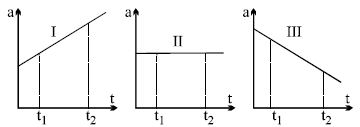
Each of the three graphs represents acceleration versus time for an object that already has a positive velocity at time $t_1$. Which graphs show an object whose speed is increasing for the entire time interval between $t_1$ and $t_2$?
A
graph $I$,only
B
graphs $I$ and $II$,only
C
graphs $I$ and $III$,only
D
graphs $I, II$ and $III$
Solution
(D) Speed increases when the velocity and acceleration have the same sign.
Given that the object has a positive velocity at $t_1$,its speed will increase if the acceleration remains positive throughout the interval from $t_1$ to $t_2$.
In graph $I$,the acceleration $a$ is positive and increasing,so the velocity continues to increase,and the speed increases.
In graph $II$,the acceleration $a$ is constant and positive,so the velocity increases linearly,and the speed increases.
In graph $III$,the acceleration $a$ is positive throughout the interval $[t_1, t_2]$,although it is decreasing. Since $a > 0$,the velocity continues to increase,and therefore the speed increases.
Thus,in all three graphs,the acceleration is positive,which means the velocity increases,and consequently,the speed increases for the entire interval.
Given that the object has a positive velocity at $t_1$,its speed will increase if the acceleration remains positive throughout the interval from $t_1$ to $t_2$.
In graph $I$,the acceleration $a$ is positive and increasing,so the velocity continues to increase,and the speed increases.
In graph $II$,the acceleration $a$ is constant and positive,so the velocity increases linearly,and the speed increases.
In graph $III$,the acceleration $a$ is positive throughout the interval $[t_1, t_2]$,although it is decreasing. Since $a > 0$,the velocity continues to increase,and therefore the speed increases.
Thus,in all three graphs,the acceleration is positive,which means the velocity increases,and consequently,the speed increases for the entire interval.
0 likes
View Solution20
MediumMCQ
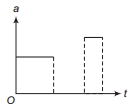
The acceleration versus time graph of a body starting from rest is shown in the figure. The velocity versus time graph of the body is given by:
A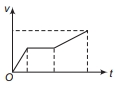
B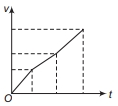
C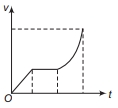
D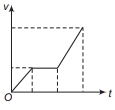
Solution
(D) The acceleration-time $(a-t)$ graph shows three distinct regions:
$1$. In the first region,acceleration is constant and positive,which means velocity increases linearly with time (slope is constant and positive).
$2$. In the second region,acceleration is zero,which means velocity remains constant (a horizontal line on the $v-t$ graph).
$3$. In the third region,acceleration is constant and positive,but its magnitude is greater than in the first region. This means velocity increases linearly with time again,but with a steeper slope compared to the first region.
Therefore,the velocity-time graph should show a linear increase,followed by a horizontal line,and then a steeper linear increase. This matches the graph in option $(D)$.
$1$. In the first region,acceleration is constant and positive,which means velocity increases linearly with time (slope is constant and positive).
$2$. In the second region,acceleration is zero,which means velocity remains constant (a horizontal line on the $v-t$ graph).
$3$. In the third region,acceleration is constant and positive,but its magnitude is greater than in the first region. This means velocity increases linearly with time again,but with a steeper slope compared to the first region.
Therefore,the velocity-time graph should show a linear increase,followed by a horizontal line,and then a steeper linear increase. This matches the graph in option $(D)$.
0 likes
View Solution21
MediumMCQ
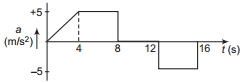
The acceleration of a train between two stations is shown in the figure. The maximum speed of the train is $............\,m/s$.
A
$60$
B
$30$
C
$120$
D
$90$
Solution
(B) The change in velocity $\Delta v$ is equal to the area under the acceleration-time $(a-t)$ graph.
Assuming the train starts from rest $(v_0 = 0)$,the velocity at any time $t$ is given by $v(t) = \int_{0}^{t} a(t) \, dt$.
The maximum speed occurs when the acceleration changes from positive to zero,which is at $t = 8\,s$.
Area under the $a-t$ graph from $t = 0$ to $t = 8\,s$:
Area = (Area of triangle from $0$ to $4\,s$) + (Area of rectangle from $4$ to $8\,s$)
Area = $\frac{1}{2} \times 4\,s \times 5\,m/s^2 + (8\,s - 4\,s) \times 5\,m/s^2$
Area = $10\,m/s + 20\,m/s = 30\,m/s$.
Therefore,the maximum speed of the train is $30\,m/s$.
Assuming the train starts from rest $(v_0 = 0)$,the velocity at any time $t$ is given by $v(t) = \int_{0}^{t} a(t) \, dt$.
The maximum speed occurs when the acceleration changes from positive to zero,which is at $t = 8\,s$.
Area under the $a-t$ graph from $t = 0$ to $t = 8\,s$:
Area = (Area of triangle from $0$ to $4\,s$) + (Area of rectangle from $4$ to $8\,s$)
Area = $\frac{1}{2} \times 4\,s \times 5\,m/s^2 + (8\,s - 4\,s) \times 5\,m/s^2$
Area = $10\,m/s + 20\,m/s = 30\,m/s$.
Therefore,the maximum speed of the train is $30\,m/s$.
0 likes
View Solution22
MediumMCQ
The distance-time graph of a particle at time $t$ makes an angle of $45^{\circ}$ with the time axis. After one second,it makes an angle of $60^{\circ}$ with the time axis. What is the average acceleration of the particle?
A
$\sqrt{3}-1$
B
$\sqrt{3}+1$
C
$\sqrt{3}$
D
$1$
Solution
(A) The slope of the distance-time $(s-t)$ graph represents the velocity of the particle.
Initial velocity at time $t$ is $v_i = \tan(45^{\circ}) = 1 \, m/s$.
Final velocity after one second is $v_f = \tan(60^{\circ}) = \sqrt{3} \, m/s$.
The average acceleration is defined as the change in velocity divided by the time interval:
$a_{av} = \frac{v_f - v_i}{\Delta t}$.
Substituting the values:
$a_{av} = \frac{\sqrt{3} - 1}{1} = (\sqrt{3} - 1) \, m/s^2$.
Initial velocity at time $t$ is $v_i = \tan(45^{\circ}) = 1 \, m/s$.
Final velocity after one second is $v_f = \tan(60^{\circ}) = \sqrt{3} \, m/s$.
The average acceleration is defined as the change in velocity divided by the time interval:
$a_{av} = \frac{v_f - v_i}{\Delta t}$.
Substituting the values:
$a_{av} = \frac{\sqrt{3} - 1}{1} = (\sqrt{3} - 1) \, m/s^2$.
0 likes
View Solution23
DifficultMCQ
$A$ point moves in a straight line so that its displacement $x \ m$ at time $t \ s$ is given by $x^2 = 1 + t^2$. Its acceleration in $m/s^2$ at a time $t \ s$ is
A
$1/x^3$
B
$-t/x^3$
C
$\frac{1}{x} - \frac{t^2}{x^3}$
D
$\frac{1}{x} - \frac{1}{x^2}$
Solution
(C) Given the displacement equation: $x^2 = 1 + t^2$.
Differentiating both sides with respect to $t$:
$2x \frac{dx}{dt} = 2t$
$\frac{dx}{dt} = \frac{t}{x} = v$ (velocity).
Now,differentiate velocity $v$ with respect to $t$ to find acceleration $a$:
$a = \frac{dv}{dt} = \frac{d}{dt} \left( \frac{t}{x} \right)$
Using the quotient rule $\frac{d}{dt} (u/v) = \frac{v(du/dt) - u(dv/dt)}{v^2}$:
$a = \frac{x(1) - t(\frac{dx}{dt})}{x^2}$
Substitute $\frac{dx}{dt} = \frac{t}{x}$ into the equation:
$a = \frac{x - t(\frac{t}{x})}{x^2}$
$a = \frac{x - \frac{t^2}{x}}{x^2}$
$a = \frac{x}{x^2} - \frac{t^2}{x^3}$
$a = \frac{1}{x} - \frac{t^2}{x^3}$.
Differentiating both sides with respect to $t$:
$2x \frac{dx}{dt} = 2t$
$\frac{dx}{dt} = \frac{t}{x} = v$ (velocity).
Now,differentiate velocity $v$ with respect to $t$ to find acceleration $a$:
$a = \frac{dv}{dt} = \frac{d}{dt} \left( \frac{t}{x} \right)$
Using the quotient rule $\frac{d}{dt} (u/v) = \frac{v(du/dt) - u(dv/dt)}{v^2}$:
$a = \frac{x(1) - t(\frac{dx}{dt})}{x^2}$
Substitute $\frac{dx}{dt} = \frac{t}{x}$ into the equation:
$a = \frac{x - t(\frac{t}{x})}{x^2}$
$a = \frac{x - \frac{t^2}{x}}{x^2}$
$a = \frac{x}{x^2} - \frac{t^2}{x^3}$
$a = \frac{1}{x} - \frac{t^2}{x^3}$.
0 likes
View Solution24
MediumMCQ
Let $v$ and $a$ denote the velocity and acceleration respectively of a particle in one-dimensional motion. Which of the following statements is correct?
A
The speed of the particle decreases when $v \cdot a < 0$.
B
The speed of the particle increases when $v \times a > 0$.
C
Both $(a)$ and $(b)$ are correct.
D
The speed of the particle decreases when $|a| < 0$.
Solution
(A) The speed of a particle is the magnitude of its velocity vector $v$. The rate of change of speed is given by the tangential component of acceleration,$a_t = \frac{dv}{dt} = \frac{a \cdot v}{|v|}$.
$1$. If $v \cdot a > 0$,the angle between velocity and acceleration is acute $(0^\circ \le \theta < 90^\circ)$,so the tangential acceleration is positive,and the speed increases.
$2$. If $v \cdot a < 0$,the angle between velocity and acceleration is obtuse $(90^\circ < \theta \le 180^\circ)$,so the tangential acceleration is negative,and the speed decreases.
$3$. The cross product $v \times a$ relates to the change in direction of velocity (centripetal acceleration),not the change in speed in one-dimensional motion. Thus,option $(a)$ is correct.
$1$. If $v \cdot a > 0$,the angle between velocity and acceleration is acute $(0^\circ \le \theta < 90^\circ)$,so the tangential acceleration is positive,and the speed increases.
$2$. If $v \cdot a < 0$,the angle between velocity and acceleration is obtuse $(90^\circ < \theta \le 180^\circ)$,so the tangential acceleration is negative,and the speed decreases.
$3$. The cross product $v \times a$ relates to the change in direction of velocity (centripetal acceleration),not the change in speed in one-dimensional motion. Thus,option $(a)$ is correct.
0 likes
View Solution25
EasyMCQ
Match the following columns.
| Column $I$ | Column $II$ |
| $(A)$ $\frac{dv}{dt}$ | $(p)$ Acceleration |
| $(B)$ $\frac{d|v|}{dt}$ | $(q)$ Magnitude of acceleration |
| $(C)$ $\frac{dr}{dt}$ | $(r)$ Velocity |
| $(D)$ $\left|\frac{dr}{dt}\right|$ | $(s)$ Magnitude of velocity |
A
$(A \rightarrow p, B \rightarrow q, C \rightarrow r, D \rightarrow s)$
B
$(A \rightarrow q, B \rightarrow p, C \rightarrow r, D \rightarrow s)$
C
$(A \rightarrow r, B \rightarrow q, C \rightarrow p, D \rightarrow s)$
D
$(A \rightarrow s, B \rightarrow q, C \rightarrow r, D \rightarrow p)$
Solution
(A) $\frac{dv}{dt}$ is the definition of acceleration, which is the rate of change of velocity vector. Thus, $(A \rightarrow p)$.
$(B)$ $\frac{d|v|}{dt}$ represents the rate of change of the magnitude of velocity, which is the tangential acceleration or the rate of change of speed. Thus, $(B \rightarrow q)$.
$(C)$ $\frac{dr}{dt}$ is the definition of velocity, which is the rate of change of the position vector. Thus, $(C \rightarrow r)$.
$(D)$ $\left|\frac{dr}{dt}\right|$ is the magnitude of the velocity vector, which is the speed of the particle. Thus, $(D \rightarrow s)$.
$(B)$ $\frac{d|v|}{dt}$ represents the rate of change of the magnitude of velocity, which is the tangential acceleration or the rate of change of speed. Thus, $(B \rightarrow q)$.
$(C)$ $\frac{dr}{dt}$ is the definition of velocity, which is the rate of change of the position vector. Thus, $(C \rightarrow r)$.
$(D)$ $\left|\frac{dr}{dt}\right|$ is the magnitude of the velocity vector, which is the speed of the particle. Thus, $(D \rightarrow s)$.
0 likes
View Solution26
MediumMCQ
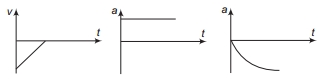
$A$ particle has a velocity in the negative direction and a constant acceleration in the positive direction. Match the following columns:
| Column $I$ | Column $II$ |
|---|---|
| $(A)$ Velocity-time graph | $(p)$ Slope $\rightarrow$ negative |
| $(B)$ Acceleration-time graph | $(q)$ Slope $\rightarrow$ positive |
| $(C)$ Displacement-time graph | $(r)$ Slope $\rightarrow$ zero |
| $(s)$ $|\text{Slope}| \rightarrow$ increasing | |
| $(t)$ $|\text{Slope}| \rightarrow$ decreasing | |
| $(u)$ $|\text{Slope}| \rightarrow$ constant |
A
$(A) \rightarrow Q, T; (B) \rightarrow Q, S; (C) \rightarrow P, T$
B
$(A) \rightarrow Q, U; (B) \rightarrow R, U; (C) \rightarrow P, T$
C
$(A) \rightarrow P, T; (B) \rightarrow R, U; (C) \rightarrow Q, S$
D
$(A) \rightarrow P, T; (B) \rightarrow Q, U; (C) \rightarrow Q, T$
Solution
(B) Given: Initial velocity $v_0 < 0$ and acceleration $a > 0$ (constant).
$(A)$ Velocity-time graph: $v(t) = v_0 + at$. The slope is $\frac{dv}{dt} = a > 0$ (positive). As $v$ goes from negative to zero,its magnitude $|v|$ decreases. Thus,$(A) \rightarrow Q, T$.
$(B)$ Acceleration-time graph: Since acceleration is constant and positive,the slope of the $a-t$ graph is zero. Thus,$(B) \rightarrow R, U$.
$(C)$ Displacement-time graph: $s(t) = s_0 + v_0t + \frac{1}{2}at^2$. The slope is $\frac{ds}{dt} = v(t)$. Since $v$ is negative,the slope is negative. As $t$ increases,$v$ becomes less negative (approaching zero),so the magnitude of the slope $|v|$ decreases. Thus,$(C) \rightarrow P, T$.
Therefore,the correct matching is $(A) \rightarrow Q, T; (B) \rightarrow R, U; (C) \rightarrow P, T$. Note: Option $(B)$ is the closest match provided in the choices.
$(A)$ Velocity-time graph: $v(t) = v_0 + at$. The slope is $\frac{dv}{dt} = a > 0$ (positive). As $v$ goes from negative to zero,its magnitude $|v|$ decreases. Thus,$(A) \rightarrow Q, T$.
$(B)$ Acceleration-time graph: Since acceleration is constant and positive,the slope of the $a-t$ graph is zero. Thus,$(B) \rightarrow R, U$.
$(C)$ Displacement-time graph: $s(t) = s_0 + v_0t + \frac{1}{2}at^2$. The slope is $\frac{ds}{dt} = v(t)$. Since $v$ is negative,the slope is negative. As $t$ increases,$v$ becomes less negative (approaching zero),so the magnitude of the slope $|v|$ decreases. Thus,$(C) \rightarrow P, T$.
Therefore,the correct matching is $(A) \rightarrow Q, T; (B) \rightarrow R, U; (C) \rightarrow P, T$. Note: Option $(B)$ is the closest match provided in the choices.
0 likes
View Solution27
EasyMCQ
$Assertion$ : Retardation is directly opposite to the velocity.
$Reason$ : Retardation is equal to the time rate of decrease of speed.
$Reason$ : Retardation is equal to the time rate of decrease of speed.
A
If both $Assertion$ and $Reason$ are correct and the $Reason$ is a correct explanation of the $Assertion$.
B
If both $Assertion$ and $Reason$ are correct but $Reason$ is not a correct explanation of the $Assertion$.
C
If the $Assertion$ is correct but $Reason$ is incorrect.
D
If both the $Assertion$ and $Reason$ are incorrect.
Solution
(A) Retardation is defined as the negative acceleration,which means the acceleration vector is directed opposite to the velocity vector. This causes a decrease in the magnitude of velocity (speed) over time.
The $Assertion$ is correct because retardation,by definition,acts in the direction opposite to the velocity to reduce it.
The $Reason$ is also correct because retardation is indeed the time rate of decrease of speed.
Since the decrease in speed is caused by the acceleration acting opposite to the velocity,the $Reason$ correctly explains why retardation is defined as it is in the $Assertion$.
The $Assertion$ is correct because retardation,by definition,acts in the direction opposite to the velocity to reduce it.
The $Reason$ is also correct because retardation is indeed the time rate of decrease of speed.
Since the decrease in speed is caused by the acceleration acting opposite to the velocity,the $Reason$ correctly explains why retardation is defined as it is in the $Assertion$.
0 likes
View Solution28
Easy
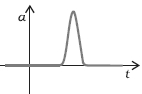
Suggest a suitable physical situation for the following $a-t$ graph.
Solution
(N/A) The given $a-t$ graph shows that initially,the body is moving with a constant velocity (acceleration is zero).
Then,for a short interval of time,the acceleration increases to a maximum value and then decreases back to zero.
Finally,the body continues to move with a constant velocity again.
$A$ suitable physical situation for this graph is a hammer moving with a uniform velocity striking a nail. During the impact,the hammer experiences a brief period of high acceleration (deceleration) before continuing its motion or coming to rest.
Then,for a short interval of time,the acceleration increases to a maximum value and then decreases back to zero.
Finally,the body continues to move with a constant velocity again.
$A$ suitable physical situation for this graph is a hammer moving with a uniform velocity striking a nail. During the impact,the hammer experiences a brief period of high acceleration (deceleration) before continuing its motion or coming to rest.
0 likes
View Solution29
Easy
Explain the acceleration.
Solution
(N/A) The time rate of change of velocity is called acceleration.
Let a particle be moving in a straight line and at time $t_{1}$ and $t_{2}$ its velocities are $v_{1}$ and $v_{2}$ respectively.
Thus,the change in velocity of the particle in time interval $\Delta t = t_{2} - t_{1}$ is $\Delta v = v_{2} - v_{1}$.
According to the definition of average acceleration:
$\text{Average acceleration} = \frac{\text{change in velocity}}{\text{time interval}}$
$\langle a \rangle = \frac{v_{2} - v_{1}}{t_{2} - t_{1}} = \frac{\Delta v}{\Delta t}$
Average acceleration is a vector quantity,and its direction is the same as the direction of the change in velocity $(\Delta v)$.
The $SI$ unit of acceleration is $m/s^{2}$.
To understand how the velocity changes at a specific instant,we define instantaneous acceleration by taking the limit $\Delta t \rightarrow 0$:
$a = \lim_{\Delta t \rightarrow 0} \frac{\Delta v}{\Delta t} = \frac{dv}{dt}$
Since velocity $v = \frac{dx}{dt}$,we can write acceleration as the second derivative of position with respect to time:
$a = \frac{d}{dt} \left( \frac{dx}{dt} \right) = \frac{d^{2}x}{dt^{2}}$
If $\frac{dv}{dt} > 0$,the acceleration is in the direction of the positive $X$-axis,and if $\frac{dv}{dt} < 0$,the acceleration is in the direction of the negative $X$-axis.
Let a particle be moving in a straight line and at time $t_{1}$ and $t_{2}$ its velocities are $v_{1}$ and $v_{2}$ respectively.
Thus,the change in velocity of the particle in time interval $\Delta t = t_{2} - t_{1}$ is $\Delta v = v_{2} - v_{1}$.
According to the definition of average acceleration:
$\text{Average acceleration} = \frac{\text{change in velocity}}{\text{time interval}}$
$\langle a \rangle = \frac{v_{2} - v_{1}}{t_{2} - t_{1}} = \frac{\Delta v}{\Delta t}$
Average acceleration is a vector quantity,and its direction is the same as the direction of the change in velocity $(\Delta v)$.
The $SI$ unit of acceleration is $m/s^{2}$.
To understand how the velocity changes at a specific instant,we define instantaneous acceleration by taking the limit $\Delta t \rightarrow 0$:
$a = \lim_{\Delta t \rightarrow 0} \frac{\Delta v}{\Delta t} = \frac{dv}{dt}$
Since velocity $v = \frac{dx}{dt}$,we can write acceleration as the second derivative of position with respect to time:
$a = \frac{d}{dt} \left( \frac{dx}{dt} \right) = \frac{d^{2}x}{dt^{2}}$
If $\frac{dv}{dt} > 0$,the acceleration is in the direction of the positive $X$-axis,and if $\frac{dv}{dt} < 0$,the acceleration is in the direction of the negative $X$-axis.
0 likes
View Solution30
Medium
In what different ways can velocity be changed?
Solution
(N/A) Velocity is a vector quantity,meaning it has both magnitude (speed) and direction. Therefore,velocity can be changed in the following ways:
$(1)$ By changing only the magnitude of velocity (speed).
$(2)$ By changing only the direction of velocity.
$(3)$ By changing both the magnitude and the direction of velocity.
Since acceleration is defined as the rate of change of velocity,any of these changes will result in the production of acceleration.
$(1)$ By changing only the magnitude of velocity (speed).
$(2)$ By changing only the direction of velocity.
$(3)$ By changing both the magnitude and the direction of velocity.
Since acceleration is defined as the rate of change of velocity,any of these changes will result in the production of acceleration.
0 likes
View Solution31
Medium
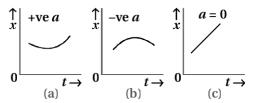
Draw the $x-t$ graphs for positive,negative,and zero acceleration.
Solution
(N/A) The $x-t$ (position-time) graph represents the motion of an object. The slope of the $x-t$ graph gives the velocity of the object. The curvature of the graph indicates the acceleration.
$(a)$ For positive acceleration $(a > 0)$: The graph is concave upwards (like a parabola opening upwards). The velocity increases with time.
$(b)$ For negative acceleration $(a < 0)$: The graph is concave downwards (like a parabola opening downwards). The velocity decreases with time.
$(c)$ For zero acceleration $(a = 0)$: The graph is a straight line with a constant slope,indicating constant velocity.
$(a)$ For positive acceleration $(a > 0)$: The graph is concave upwards (like a parabola opening upwards). The velocity increases with time.
$(b)$ For negative acceleration $(a < 0)$: The graph is concave downwards (like a parabola opening downwards). The velocity decreases with time.
$(c)$ For zero acceleration $(a = 0)$: The graph is a straight line with a constant slope,indicating constant velocity.
0 likes
View Solution32
Difficult
Define acceleration,average acceleration,and instantaneous acceleration.
Solution
(N/A) Acceleration is defined as the time rate of change of velocity.
Average acceleration is the change in velocity divided by the time interval during which the change occurs. If a particle has velocities $v_{1}$ and $v_{2}$ at times $t_{1}$ and $t_{2}$ respectively,the average acceleration $\langle a \rangle$ is given by:
$\langle a \rangle = \frac{v_{2} - v_{1}}{t_{2} - t_{1}} = \frac{\Delta v}{\Delta t}$
Average acceleration is a vector quantity,and its direction is the same as the direction of the change in velocity $\Delta v$.
Instantaneous acceleration $a$ is defined as the limit of the average acceleration as the time interval $\Delta t$ approaches zero:
$a = \lim_{\Delta t \to 0} \frac{\Delta v}{\Delta t} = \frac{dv}{dt}$
It represents the acceleration of an object at a specific instant of time.
Average acceleration is the change in velocity divided by the time interval during which the change occurs. If a particle has velocities $v_{1}$ and $v_{2}$ at times $t_{1}$ and $t_{2}$ respectively,the average acceleration $\langle a \rangle$ is given by:
$\langle a \rangle = \frac{v_{2} - v_{1}}{t_{2} - t_{1}} = \frac{\Delta v}{\Delta t}$
Average acceleration is a vector quantity,and its direction is the same as the direction of the change in velocity $\Delta v$.
Instantaneous acceleration $a$ is defined as the limit of the average acceleration as the time interval $\Delta t$ approaches zero:
$a = \lim_{\Delta t \to 0} \frac{\Delta v}{\Delta t} = \frac{dv}{dt}$
It represents the acceleration of an object at a specific instant of time.
0 likes
View Solution33
MediumMCQ
What will be the change in the speed of a moving object if both speed and acceleration are positive or both are negative?
A
Speed will increase
B
Speed will decrease
C
Speed will remain constant
D
Speed will become zero
Solution
(A) When the velocity (speed in a specific direction) and acceleration have the same sign,the acceleration acts in the direction of motion.
If both are positive,the object is moving in the positive direction and accelerating in the same direction,causing the speed to increase.
If both are negative,the object is moving in the negative direction and accelerating in the negative direction,which also causes the magnitude of the velocity (speed) to increase.
Therefore,in both cases,the speed of the object increases.
If both are positive,the object is moving in the positive direction and accelerating in the same direction,causing the speed to increase.
If both are negative,the object is moving in the negative direction and accelerating in the negative direction,which also causes the magnitude of the velocity (speed) to increase.
Therefore,in both cases,the speed of the object increases.
0 likes
View Solution34
MediumMCQ
If the speed of a moving object decreases,what are the directions of its velocity and acceleration?
A
Velocity and acceleration are in the same direction.
B
Velocity and acceleration are in opposite directions.
C
Acceleration is perpendicular to velocity.
D
Acceleration is zero.
Solution
(B) When an object is moving,its velocity vector points in the direction of motion.
If the speed of the object is decreasing,it means the object is undergoing retardation or deceleration.
In physics,deceleration occurs when the acceleration vector acts in the direction opposite to the velocity vector.
Therefore,for a moving object with decreasing speed,the direction of acceleration is opposite to the direction of velocity.
If the speed of the object is decreasing,it means the object is undergoing retardation or deceleration.
In physics,deceleration occurs when the acceleration vector acts in the direction opposite to the velocity vector.
Therefore,for a moving object with decreasing speed,the direction of acceleration is opposite to the direction of velocity.
0 likes
View Solution35
Easy
What is retardation?
Solution
(N/A) When the velocity of an object decreases with respect to time,it is termed as retardation or deceleration.
In reality,negative acceleration is commonly called retardation.
Its $SI$ unit is $m/s^2$.
In reality,negative acceleration is commonly called retardation.
Its $SI$ unit is $m/s^2$.
0 likes
View Solution36
MediumMCQ
Will the acceleration increase or decrease with an increase in velocity?
A
It will increase.
B
It will decrease.
C
It will remain constant.
D
It depends on the nature of the motion.
Solution
(D) Acceleration is defined as the rate of change of velocity with respect to time,given by $a = \frac{dv}{dt}$.
An increase in velocity does not necessarily imply an increase in acceleration.
If the velocity increases at a constant rate,the acceleration remains constant (e.g.,uniform acceleration).
If the velocity increases at an increasing rate,the acceleration increases.
If the velocity increases at a decreasing rate,the acceleration decreases.
Therefore,the change in acceleration depends entirely on the nature of the motion,specifically how the velocity changes over time.
An increase in velocity does not necessarily imply an increase in acceleration.
If the velocity increases at a constant rate,the acceleration remains constant (e.g.,uniform acceleration).
If the velocity increases at an increasing rate,the acceleration increases.
If the velocity increases at a decreasing rate,the acceleration decreases.
Therefore,the change in acceleration depends entirely on the nature of the motion,specifically how the velocity changes over time.
0 likes
View Solution37
MediumMCQ
Match the items in Column-$I$ with the items in Column-$II$ correctly.
| Column-$I$ | Column-$II$ |
|---|---|
| $(1)$ Acceleration is positive | $(a)$ Speed of the particle decreases |
| $(2)$ Acceleration is negative | $(b)$ Speed of the particle increases |
| $(c)$ Speed of the particle keeps changing |
A
$1-b, 2-a$
B
$1-a, 2-b$
C
$1-c, 2-a$
D
$1-b, 2-c$
Solution
(A) The speed of a particle increases if the velocity and acceleration are in the same direction. If the velocity is positive,a positive acceleration $(a > 0)$ increases the speed. Thus,$(1)$ matches with $(b)$.
The speed of a particle decreases if the velocity and acceleration are in opposite directions. If the velocity is positive,a negative acceleration $(a < 0)$ decreases the speed. Thus,$(2)$ matches with $(a)$.
Therefore,the correct matching is $1-b$ and $2-a$.
The speed of a particle decreases if the velocity and acceleration are in opposite directions. If the velocity is positive,a negative acceleration $(a < 0)$ decreases the speed. Thus,$(2)$ matches with $(a)$.
Therefore,the correct matching is $1-b$ and $2-a$.
0 likes
View Solution38
Medium
What is acceleration? What is its direction,and state its $SI$ unit.
Solution
(N/A) Acceleration is defined as the rate of change of velocity with respect to time.
Its direction is the same as the direction of the change in velocity.
The $SI$ unit of acceleration is $m/s^2$ or $m s^{-2}$.
Its direction is the same as the direction of the change in velocity.
The $SI$ unit of acceleration is $m/s^2$ or $m s^{-2}$.
0 likes
View Solution39
Easy
What is retardation? What is its direction?
Solution
(N/A) Retardation is defined as the time rate of decrease in velocity or speed. Its direction is always opposite to the direction of velocity or speed.
0 likes
View Solution40
EasyMCQ
When does a particle experience retardation (deceleration)?
A
When velocity and acceleration are in the same direction.
B
When velocity and acceleration are in opposite directions.
C
When velocity is zero but acceleration is non-zero.
D
When acceleration is zero.
Solution
(B) particle experiences retardation or deceleration when its velocity and acceleration vectors point in opposite directions.
Mathematically,if the velocity $v$ and acceleration $a$ have opposite signs (i.e.,$v \cdot a < 0$),the speed of the particle decreases over time,which is defined as retardation.
Mathematically,if the velocity $v$ and acceleration $a$ have opposite signs (i.e.,$v \cdot a < 0$),the speed of the particle decreases over time,which is defined as retardation.
0 likes
View Solution41
MediumMCQ
If velocity and acceleration are in opposite directions in one-dimensional motion,what happens to the magnitude of velocity?
A
It increases
B
It decreases
C
It remains constant
D
It becomes zero
Solution
(B) In one-dimensional motion,if the velocity $(v)$ and acceleration $(a)$ are in opposite directions,the acceleration acts as a retardation (deceleration).
This means the acceleration opposes the motion of the object.
As a result,the magnitude of the velocity decreases over time.
Therefore,the correct answer is that the magnitude of velocity decreases.
This means the acceleration opposes the motion of the object.
As a result,the magnitude of the velocity decreases over time.
Therefore,the correct answer is that the magnitude of velocity decreases.
0 likes
View Solution42
EasyMCQ
Which physical quantity can be found by first differentiation and second differentiation of position vector?
A
Velocity and Acceleration
B
Acceleration and Velocity
C
Displacement and Velocity
D
Speed and Distance
Solution
(A) Let the position vector of a particle be $\vec{r}(t)$.
$1$. The first differentiation of the position vector with respect to time $t$ gives the velocity vector:
$\vec{v} = \frac{d\vec{r}}{dt}$
$2$. The second differentiation of the position vector with respect to time $t$ (or the first differentiation of velocity) gives the acceleration vector:
$\vec{a} = \frac{d\vec{v}}{dt} = \frac{d^2\vec{r}}{dt^2}$
Therefore,the first differentiation gives velocity and the second differentiation gives acceleration.
$1$. The first differentiation of the position vector with respect to time $t$ gives the velocity vector:
$\vec{v} = \frac{d\vec{r}}{dt}$
$2$. The second differentiation of the position vector with respect to time $t$ (or the first differentiation of velocity) gives the acceleration vector:
$\vec{a} = \frac{d\vec{v}}{dt} = \frac{d^2\vec{r}}{dt^2}$
Therefore,the first differentiation gives velocity and the second differentiation gives acceleration.
1 likes
View Solution43
Easy
What can be the angle between velocity and acceleration for the motion on a straight line? Explain with an example.
Solution
(N/A) For motion in a straight line,the angle between velocity and acceleration can only be $0^{\circ}$ or $180^{\circ}$.
$1$. If the angle is $0^{\circ}$,the velocity and acceleration are in the same direction,which means the speed of the object increases (accelerated motion).
Example: $A$ car starting from rest and speeding up in a straight path.
$2$. If the angle is $180^{\circ}$,the velocity and acceleration are in opposite directions,which means the speed of the object decreases (retarded motion).
Example: $A$ car applying brakes while moving in a straight line.
$1$. If the angle is $0^{\circ}$,the velocity and acceleration are in the same direction,which means the speed of the object increases (accelerated motion).
Example: $A$ car starting from rest and speeding up in a straight path.
$2$. If the angle is $180^{\circ}$,the velocity and acceleration are in opposite directions,which means the speed of the object decreases (retarded motion).
Example: $A$ car applying brakes while moving in a straight line.
0 likes
View Solution44
EasyMCQ
When are the average and instantaneous accelerations equal?
A
When the acceleration is constant.
B
When the velocity is constant.
C
When the acceleration is zero.
D
When the motion is circular.
Solution
(A) The average acceleration over a time interval $\Delta t$ is defined as $\vec{a}_{avg} = \frac{\Delta \vec{v}}{\Delta t}$.
The instantaneous acceleration is defined as $\vec{a} = \lim_{\Delta t \to 0} \frac{\Delta \vec{v}}{\Delta t} = \frac{d\vec{v}}{dt}$.
If the acceleration is constant,then the rate of change of velocity is uniform at every instant.
Therefore,the average acceleration over any time interval is equal to the instantaneous acceleration at any point within that interval.
The instantaneous acceleration is defined as $\vec{a} = \lim_{\Delta t \to 0} \frac{\Delta \vec{v}}{\Delta t} = \frac{d\vec{v}}{dt}$.
If the acceleration is constant,then the rate of change of velocity is uniform at every instant.
Therefore,the average acceleration over any time interval is equal to the instantaneous acceleration at any point within that interval.
0 likes
View Solution45
MediumMCQ
The position,velocity,and acceleration of a particle moving with a constant acceleration can be represented by:
A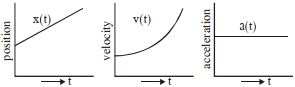
B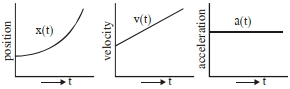
C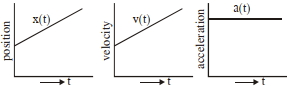
D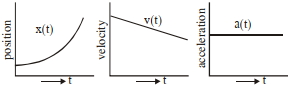
Solution
(B) For a particle moving with constant acceleration $a$:
$1$. The acceleration-time graph is a horizontal line,as $a$ is constant.
$2$. The velocity-time relation is given by $v(t) = u + at$,which represents a straight line with a non-zero slope.
$3$. The position-time relation is given by $x(t) = x_0 + ut + \frac{1}{2}at^2$,which represents a parabola.
Comparing these characteristics with the given options,the second set of graphs (represented by image $981-$b614) correctly shows a constant acceleration,a linearly increasing velocity,and a parabolic position-time graph.
$1$. The acceleration-time graph is a horizontal line,as $a$ is constant.
$2$. The velocity-time relation is given by $v(t) = u + at$,which represents a straight line with a non-zero slope.
$3$. The position-time relation is given by $x(t) = x_0 + ut + \frac{1}{2}at^2$,which represents a parabola.
Comparing these characteristics with the given options,the second set of graphs (represented by image $981-$b614) correctly shows a constant acceleration,a linearly increasing velocity,and a parabolic position-time graph.
0 likes
View Solution46
MediumMCQ
$A$ particle is moving in a straight line such that its velocity is increasing at $5\,m/s$ per meter. The acceleration of the particle is .......... $m/s^2$ at a point where its velocity is $20\,m/s$.
A
$100$
B
$101$
C
$99$
D
$103$
Solution
(A) The velocity $v$ is given as a function of position $s$,where the rate of change of velocity with respect to position is $\frac{dv}{ds} = 5\,m^{-1}$.
We know that acceleration $a$ is defined as $a = v \frac{dv}{ds}$.
Given $v = 20\,m/s$ and $\frac{dv}{ds} = 5\,m^{-1}$.
Substituting these values,we get $a = 20 \times 5 = 100\,m/s^2$.
We know that acceleration $a$ is defined as $a = v \frac{dv}{ds}$.
Given $v = 20\,m/s$ and $\frac{dv}{ds} = 5\,m^{-1}$.
Substituting these values,we get $a = 20 \times 5 = 100\,m/s^2$.
0 likes
View Solution47
EasyMCQ
$A$ body in one-dimensional motion has zero speed at an instant. At that instant,it must have:
A
Zero velocity
B
Zero acceleration
C
Non-zero velocity
D
Non-zero acceleration
Solution
(A) The magnitude of velocity is defined as speed.
Mathematically,$v = |\vec{v}|$,where $v$ is speed and $\vec{v}$ is velocity.
If the speed $v = 0$ at an instant,then the magnitude of the velocity must also be zero.
Therefore,the velocity $\vec{v}$ must be zero at that instant.
Note that the acceleration does not necessarily have to be zero; for example,a ball thrown vertically upward has zero velocity and zero speed at its highest point,but it still experiences a constant acceleration due to gravity $(g = 9.8 \ m/s^2)$.
Mathematically,$v = |\vec{v}|$,where $v$ is speed and $\vec{v}$ is velocity.
If the speed $v = 0$ at an instant,then the magnitude of the velocity must also be zero.
Therefore,the velocity $\vec{v}$ must be zero at that instant.
Note that the acceleration does not necessarily have to be zero; for example,a ball thrown vertically upward has zero velocity and zero speed at its highest point,but it still experiences a constant acceleration due to gravity $(g = 9.8 \ m/s^2)$.
0 likes
View Solution48
EasyMCQ
If a particle is moving along a straight line with increasing speed,then:
A
Its acceleration is negative
B
Its acceleration may be decreasing
C
Its acceleration is positive
D
Both $(b)$ and $(c)$
Solution
(B) If the speed of a body is increasing,the acceleration must be in the same direction as the velocity.
However,the magnitude of acceleration does not necessarily have to be constant or positive.
For example,if a particle moves in the positive direction with velocity $v > 0$,and its acceleration $a$ is positive and decreasing (e.g.,$a = 2 - t$),the speed will still increase as long as $a > 0$.
Similarly,if a particle moves in the negative direction with velocity $v < 0$,and its acceleration $a$ is negative and its magnitude is decreasing (e.g.,$a = -2 + t$),the speed $|v|$ will still increase.
Therefore,the acceleration can be positive or negative,and its magnitude can be decreasing while the speed is increasing.
However,the magnitude of acceleration does not necessarily have to be constant or positive.
For example,if a particle moves in the positive direction with velocity $v > 0$,and its acceleration $a$ is positive and decreasing (e.g.,$a = 2 - t$),the speed will still increase as long as $a > 0$.
Similarly,if a particle moves in the negative direction with velocity $v < 0$,and its acceleration $a$ is negative and its magnitude is decreasing (e.g.,$a = -2 + t$),the speed $|v|$ will still increase.
Therefore,the acceleration can be positive or negative,and its magnitude can be decreasing while the speed is increasing.
0 likes
View Solution49
EasyMCQ
At any instant,the velocity and acceleration of a particle moving along a straight line are $v$ and $a$. The speed of the particle is increasing if
A
$v > 0, a > 0$
B
$v < 0, a < 0$
C
$v > 0, a < 0$
D
$v < 0, a > 0$
Solution
(A) The speed of a particle is defined as the magnitude of its velocity,$|v|$.
For the speed to increase,the acceleration must act in the same direction as the velocity.
If the velocity $v$ is positive $(v > 0)$,the acceleration $a$ must also be positive $(a > 0)$ to increase the speed.
If the velocity $v$ is negative $(v < 0)$,the acceleration $a$ must also be negative $(a < 0)$ to increase the magnitude of the velocity.
Therefore,the speed increases when the product of velocity and acceleration is positive,i.e.,$v \cdot a > 0$.
Among the given options,$v > 0, a > 0$ (Option $A$) and $v < 0, a < 0$ (Option $B$) satisfy this condition. However,typically in such multiple-choice questions,the primary condition is that they have the same sign.
For the speed to increase,the acceleration must act in the same direction as the velocity.
If the velocity $v$ is positive $(v > 0)$,the acceleration $a$ must also be positive $(a > 0)$ to increase the speed.
If the velocity $v$ is negative $(v < 0)$,the acceleration $a$ must also be negative $(a < 0)$ to increase the magnitude of the velocity.
Therefore,the speed increases when the product of velocity and acceleration is positive,i.e.,$v \cdot a > 0$.
Among the given options,$v > 0, a > 0$ (Option $A$) and $v < 0, a < 0$ (Option $B$) satisfy this condition. However,typically in such multiple-choice questions,the primary condition is that they have the same sign.
0 likes
View Solution50
EasyMCQ
If $v$ is the velocity of a body moving along the $x$-axis,then the acceleration of the body is .........
A
$\frac{dv}{dx}$
B
$v \frac{dv}{dx}$
C
$x \frac{du}{dx}$
D
$v \frac{dx}{dv}$
Solution
(B) The acceleration $a$ is defined as the rate of change of velocity with respect to time,$a = \frac{dv}{dt}$.
Using the chain rule,we can express this in terms of position $x$:
$a = \frac{dv}{dx} \cdot \frac{dx}{dt}$.
Since velocity $v = \frac{dx}{dt}$,we substitute this into the equation:
$a = \frac{dv}{dx} \cdot v = v \frac{dv}{dx}$.
Therefore,the correct option is $B$.
Using the chain rule,we can express this in terms of position $x$:
$a = \frac{dv}{dx} \cdot \frac{dx}{dt}$.
Since velocity $v = \frac{dx}{dt}$,we substitute this into the equation:
$a = \frac{dv}{dx} \cdot v = v \frac{dv}{dx}$.
Therefore,the correct option is $B$.
0 likes
View SolutionMotion in Straight Line — Acceleration and its graph · Frequently Asked Questions
1Are these Motion in Straight Line questions useful for JEE and NEET?
Yes. All questions in this section are mapped to JEE Main and NEET exam patterns. Previous year questions from JEE Main, NEET, GUJCET and state-level exams are included with full solutions.
2Can I switch to Hindi or Gujarati for these questions?
Yes. Use the language tabs in the hero section or the sidebar to view the same questions and solutions in English, Hindi or Gujarati.
3How do I generate a question paper from this subtopic?
Use the Vedclass Exam Paper Generator — select the chapter and subtopic, set difficulty, and generate Sets A, B, C, D automatically. First 3 chapters of every subject are free.
Vedclass Products
For Students
Vedclass Test Series
Mock tests in real JEE/NEET style with performance analysis. 5-day free trial.
Start Free TrialFor Teachers
Exam Paper Generator
Generate Set A/B/C/D papers from this chapter in 2 minutes. 3 chapters free.
Try FreeFor Institutes
Online Exam Module
Live online exams with unlimited students, 360° analytics & white-label branding.
See DemoFor Teachers & Institutes
Generate a Motion in Straight Line Exam Paper in 2 Minutes
Select subtopic & difficulty — Sets A, B, C, D auto-generated with No Repeat logic.
First 3 chapters of every subject are free — no payment required.