
A English
Position, Path Length and Displacement Questions in English
Class 11 Physics · Motion in Straight Line · Position, Path Length and Displacement
48+
Questions
English
Language
100%
With Solutions
Showing 48 of 48 questions in English
1
MediumMCQ
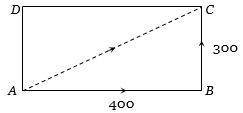
$A$ boy walks uniformly along the sides of a rectangular park of size $400 \, m \times 300 \, m$,starting from one corner to the diagonally opposite corner. Which of the following statements is incorrect?
A
He has travelled a distance of $700 \, m$.
B
His displacement is $700 \, m$.
C
His displacement is $500 \, m$.
D
His velocity is not uniform throughout the walk.
Solution
(B) The boy moves from corner $A$ to $B$ and then to $C$.
Distance travelled is the actual path length: $Distance = AB + BC = 400 \, m + 300 \, m = 700 \, m$.
Displacement is the shortest distance between the initial point $A$ and final point $C$:
$\vec{AC} = \vec{AB} + \vec{BC}$
$|\vec{AC}| = \sqrt{(AB)^2 + (BC)^2} = \sqrt{(400)^2 + (300)^2} = \sqrt{160000 + 90000} = \sqrt{250000} = 500 \, m$.
Since the boy changes direction at corner $B$,his velocity vector changes,meaning his velocity is not uniform.
Therefore,the statement 'His displacement is $700 \, m$' is incorrect.
Distance travelled is the actual path length: $Distance = AB + BC = 400 \, m + 300 \, m = 700 \, m$.
Displacement is the shortest distance between the initial point $A$ and final point $C$:
$\vec{AC} = \vec{AB} + \vec{BC}$
$|\vec{AC}| = \sqrt{(AB)^2 + (BC)^2} = \sqrt{(400)^2 + (300)^2} = \sqrt{160000 + 90000} = \sqrt{250000} = 500 \, m$.
Since the boy changes direction at corner $B$,his velocity vector changes,meaning his velocity is not uniform.
Therefore,the statement 'His displacement is $700 \, m$' is incorrect.
0 likes
View Solution2
MediumMCQ
The position vector of a particle is given by the expression $\vec{r} = 3t^2 \hat{i} + 4t^2 \hat{j} + 7 \hat{k}$. The distance traversed in the first $10 \, s$ is ......... $m$.
A
$500$
B
$300$
C
$150$
D
$100$
Solution
(A) The position vector is given by $\vec{r}(t) = 3t^2 \hat{i} + 4t^2 \hat{j} + 7 \hat{k}$.
At $t = 0 \, s$,the initial position is $\vec{r}_1 = 3(0)^2 \hat{i} + 4(0)^2 \hat{j} + 7 \hat{k} = 7 \hat{k}$.
At $t = 10 \, s$,the final position is $\vec{r}_2 = 3(10)^2 \hat{i} + 4(10)^2 \hat{j} + 7 \hat{k} = 300 \hat{i} + 400 \hat{j} + 7 \hat{k}$.
The displacement vector is $\Delta \vec{r} = \vec{r}_2 - \vec{r}_1 = (300 \hat{i} + 400 \hat{j} + 7 \hat{k}) - (7 \hat{k}) = 300 \hat{i} + 400 \hat{j}$.
Since the particle moves in a straight line (the ratio of components $x$ and $y$ is constant),the distance traversed is equal to the magnitude of the displacement.
Distance $= |\Delta \vec{r}| = \sqrt{(300)^2 + (400)^2} = \sqrt{90000 + 160000} = \sqrt{250000} = 500 \, m$.
At $t = 0 \, s$,the initial position is $\vec{r}_1 = 3(0)^2 \hat{i} + 4(0)^2 \hat{j} + 7 \hat{k} = 7 \hat{k}$.
At $t = 10 \, s$,the final position is $\vec{r}_2 = 3(10)^2 \hat{i} + 4(10)^2 \hat{j} + 7 \hat{k} = 300 \hat{i} + 400 \hat{j} + 7 \hat{k}$.
The displacement vector is $\Delta \vec{r} = \vec{r}_2 - \vec{r}_1 = (300 \hat{i} + 400 \hat{j} + 7 \hat{k}) - (7 \hat{k}) = 300 \hat{i} + 400 \hat{j}$.
Since the particle moves in a straight line (the ratio of components $x$ and $y$ is constant),the distance traversed is equal to the magnitude of the displacement.
Distance $= |\Delta \vec{r}| = \sqrt{(300)^2 + (400)^2} = \sqrt{90000 + 160000} = \sqrt{250000} = 500 \, m$.
0 likes
View Solution3
EasyMCQ
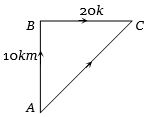
$A$ person travels $10\, km$ north and $20\, km$ east. What will be the displacement from the initial point in $km$?
A
$22.36$
B
$2$
C
$5$
D
$20$
Solution
(A) Let the initial point be $A$,the point after traveling north be $B$,and the final point after traveling east be $C$.
The displacement is the straight-line distance from the initial point $A$ to the final point $C$,which is the hypotenuse of the right-angled triangle $ABC$.
Using the Pythagorean theorem:
$AC = \sqrt{AB^2 + BC^2}$
Given $AB = 10\, km$ and $BC = 20\, km$.
$AC = \sqrt{10^2 + 20^2} = \sqrt{100 + 400} = \sqrt{500}$
$AC = 10\sqrt{5} \approx 22.36\, km$.
The displacement is the straight-line distance from the initial point $A$ to the final point $C$,which is the hypotenuse of the right-angled triangle $ABC$.
Using the Pythagorean theorem:
$AC = \sqrt{AB^2 + BC^2}$
Given $AB = 10\, km$ and $BC = 20\, km$.
$AC = \sqrt{10^2 + 20^2} = \sqrt{100 + 400} = \sqrt{500}$
$AC = 10\sqrt{5} \approx 22.36\, km$.
0 likes
View Solution4
EasyMCQ
Which of the following is a one-dimensional motion?
A
Landing of an aircraft
B
Earth revolving around the sun
C
Motion of wheels of a moving train
D
Train running on a straight track
Solution
(D) one-dimensional motion is defined as the motion of an object along a single straight line,where only one coordinate is required to specify its position at any time.
$1$. Landing of an aircraft involves motion in three dimensions.
$2$. Earth revolving around the sun is a two-dimensional motion (orbital motion).
$3$. The motion of the wheels of a moving train involves both translational and rotational motion,which is complex and multi-dimensional.
$4$. $A$ train running on a straight track moves along a single axis,making it a one-dimensional motion.
$1$. Landing of an aircraft involves motion in three dimensions.
$2$. Earth revolving around the sun is a two-dimensional motion (orbital motion).
$3$. The motion of the wheels of a moving train involves both translational and rotational motion,which is complex and multi-dimensional.
$4$. $A$ train running on a straight track moves along a single axis,making it a one-dimensional motion.
0 likes
View Solution5
EasyMCQ
The numerical ratio of displacement to the distance covered is always
A
Less than one
B
Equal to one
C
Equal to or less than one
D
Equal to or greater than one
Solution
(C) Displacement is defined as the shortest path between the initial and final positions,while distance is the total path length covered by an object.
Since the shortest path between two points is a straight line,the magnitude of displacement is always less than or equal to the total distance covered $(|\text{displacement}| \le \text{distance})$.
Therefore,the ratio of displacement to distance is always $\le 1$.
Since the shortest path between two points is a straight line,the magnitude of displacement is always less than or equal to the total distance covered $(|\text{displacement}| \le \text{distance})$.
Therefore,the ratio of displacement to distance is always $\le 1$.
0 likes
View Solution6
EasyMCQ
$A$ particle moves a distance of $5 \ m$ in the $+x$ direction. Find its displacement.
A
$5 \hat{j}$
B
$5 \hat{i}$
C
$-5 \hat{j}$
D
$5 \hat{k}$
Solution
(B) Displacement is a vector quantity defined as the change in position of an object.
Given that the particle moves $5 \ m$ in the $+x$ direction,its initial position can be taken as the origin $(0, 0, 0)$ and its final position as $(5, 0, 0)$.
The displacement vector $\vec{d}$ is given by $\vec{r}_f - \vec{r}_i = (5 \hat{i} + 0 \hat{j} + 0 \hat{k}) - (0 \hat{i} + 0 \hat{j} + 0 \hat{k}) = 5 \hat{i} \ m$.
Therefore,the correct option is $B$.
Given that the particle moves $5 \ m$ in the $+x$ direction,its initial position can be taken as the origin $(0, 0, 0)$ and its final position as $(5, 0, 0)$.
The displacement vector $\vec{d}$ is given by $\vec{r}_f - \vec{r}_i = (5 \hat{i} + 0 \hat{j} + 0 \hat{k}) - (0 \hat{i} + 0 \hat{j} + 0 \hat{k}) = 5 \hat{i} \ m$.
Therefore,the correct option is $B$.
0 likes
View Solution7
MediumMCQ
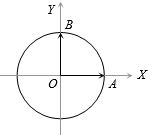
$A$ particle moves along the circumference of a circle of radius $r$ from point $A$ to point $B$ as shown in the figure. What are the path length and displacement?
A
$\frac{\pi r}{2}, r\sqrt{2}$
B
$\frac{\pi r}{4}, r$
C
$\pi r, \frac{r}{\sqrt{2}}$
D
$\pi r, r$
Solution
(A) The particle moves from point $A(r, 0)$ to point $B(0, r)$ along the circular arc.
Path length is the distance covered along the circumference. Since the angle subtended at the center is $90^\circ$ (or $\frac{\pi}{2}$ radians),the path length is $s = r\theta = r \times \frac{\pi}{2} = \frac{\pi r}{2}$.
Displacement is the straight-line distance between the initial point $A$ and final point $B$. Using the distance formula or vector subtraction:
$\vec{r}_A = r\hat{i}$
$\vec{r}_B = r\hat{j}$
Displacement $\vec{d} = \vec{r}_B - \vec{r}_A = r\hat{j} - r\hat{i}$.
The magnitude of displacement is $|\vec{d}| = \sqrt{(-r)^2 + (r)^2} = \sqrt{2r^2} = r\sqrt{2}$.
Thus,the path length is $\frac{\pi r}{2}$ and the displacement is $r\sqrt{2}$.
Path length is the distance covered along the circumference. Since the angle subtended at the center is $90^\circ$ (or $\frac{\pi}{2}$ radians),the path length is $s = r\theta = r \times \frac{\pi}{2} = \frac{\pi r}{2}$.
Displacement is the straight-line distance between the initial point $A$ and final point $B$. Using the distance formula or vector subtraction:
$\vec{r}_A = r\hat{i}$
$\vec{r}_B = r\hat{j}$
Displacement $\vec{d} = \vec{r}_B - \vec{r}_A = r\hat{j} - r\hat{i}$.
The magnitude of displacement is $|\vec{d}| = \sqrt{(-r)^2 + (r)^2} = \sqrt{2r^2} = r\sqrt{2}$.
Thus,the path length is $\frac{\pi r}{2}$ and the displacement is $r\sqrt{2}$.
0 likes
View Solution8
MediumMCQ
Your friend driving his car overtakes your car on the highway. Which of the following statements must be true at the instant he is passing you? Assume the cars as point particles.
A
Your speed and his speed are the same.
B
Your acceleration and his acceleration are the same.
C
Your position on the highway is the same as his position on the highway.
D
He also observes that you overtake his car.
Solution
(C) When one car overtakes another,at the specific instant of passing,both cars occupy the exact same coordinate on the highway.
Since the cars are modeled as point particles,their positions $x_1$ and $x_2$ must satisfy $x_1 = x_2$ at that instant.
Speed and acceleration are independent variables that depend on the dynamics of the vehicles and do not need to be equal for an overtake to occur.
Therefore,the only statement that must be true is that their positions are identical at that moment.
Since the cars are modeled as point particles,their positions $x_1$ and $x_2$ must satisfy $x_1 = x_2$ at that instant.
Speed and acceleration are independent variables that depend on the dynamics of the vehicles and do not need to be equal for an overtake to occur.
Therefore,the only statement that must be true is that their positions are identical at that moment.
0 likes
View Solution9
EasyMCQ
Mark the wrong statement :-
A
Nothing is in the state of absolute rest or state of absolute motion.
B
Magnitude of displacement is always equal to the distance travelled.
C
Magnitude of displacement can never be greater than the distance travelled.
D
Magnitude of instantaneous velocity is equal to the instantaneous speed.
Solution
(B) $1$. The concept of absolute rest or motion is relative to the observer's frame of reference,so option $A$ is correct.
$2$. Distance is the total path length covered,while displacement is the shortest distance between the initial and final positions. For a straight-line path without turning back,distance equals the magnitude of displacement. However,if the object changes direction,the distance is greater than the magnitude of displacement. Therefore,the statement that displacement is 'always' equal to distance is incorrect.
$3$. The magnitude of displacement is always less than or equal to the distance travelled $(|displacement| \leq distance)$,making option $C$ correct.
$4$. Instantaneous speed is the magnitude of instantaneous velocity,making option $D$ correct.
$5$. Thus,the wrong statement is $B$.
$2$. Distance is the total path length covered,while displacement is the shortest distance between the initial and final positions. For a straight-line path without turning back,distance equals the magnitude of displacement. However,if the object changes direction,the distance is greater than the magnitude of displacement. Therefore,the statement that displacement is 'always' equal to distance is incorrect.
$3$. The magnitude of displacement is always less than or equal to the distance travelled $(|displacement| \leq distance)$,making option $C$ correct.
$4$. Instantaneous speed is the magnitude of instantaneous velocity,making option $D$ correct.
$5$. Thus,the wrong statement is $B$.
0 likes
View Solution10
MediumMCQ
The position vector of a moving particle at time $t$ is $r = 3 \hat{i} + 4t \hat{j} - t \hat{k}$. Its displacement during the time interval $t = 1 \ s$ to $t = 3 \ s$ is
A
$8 \hat{j} - 2 \hat{k}$
B
$3 \hat{i} + 4 \hat{j} - \hat{k}$
C
$9 \hat{i} + 36 \hat{j} - 27 \hat{k}$
D
None of these
Solution
(D) The displacement $\Delta r$ is given by the difference between the final position vector $r_f$ and the initial position vector $r_i$.
Given $r(t) = 3 \hat{i} + 4t \hat{j} - t \hat{k}$.
At $t = 1 \ s$,$r_1 = 3 \hat{i} + 4(1) \hat{j} - (1) \hat{k} = 3 \hat{i} + 4 \hat{j} - \hat{k}$.
At $t = 3 \ s$,$r_3 = 3 \hat{i} + 4(3) \hat{j} - (3) \hat{k} = 3 \hat{i} + 12 \hat{j} - 3 \hat{k}$.
Displacement $\Delta r = r_3 - r_1 = (3 \hat{i} + 12 \hat{j} - 3 \hat{k}) - (3 \hat{i} + 4 \hat{j} - \hat{k})$.
$\Delta r = (3-3) \hat{i} + (12-4) \hat{j} + (-3 - (-1)) \hat{k} = 0 \hat{i} + 8 \hat{j} - 2 \hat{k}$.
Since $8 \hat{j} - 2 \hat{k}$ is not among the options $A, B,$ or $C$,the correct choice is $D$.
Given $r(t) = 3 \hat{i} + 4t \hat{j} - t \hat{k}$.
At $t = 1 \ s$,$r_1 = 3 \hat{i} + 4(1) \hat{j} - (1) \hat{k} = 3 \hat{i} + 4 \hat{j} - \hat{k}$.
At $t = 3 \ s$,$r_3 = 3 \hat{i} + 4(3) \hat{j} - (3) \hat{k} = 3 \hat{i} + 12 \hat{j} - 3 \hat{k}$.
Displacement $\Delta r = r_3 - r_1 = (3 \hat{i} + 12 \hat{j} - 3 \hat{k}) - (3 \hat{i} + 4 \hat{j} - \hat{k})$.
$\Delta r = (3-3) \hat{i} + (12-4) \hat{j} + (-3 - (-1)) \hat{k} = 0 \hat{i} + 8 \hat{j} - 2 \hat{k}$.
Since $8 \hat{j} - 2 \hat{k}$ is not among the options $A, B,$ or $C$,the correct choice is $D$.
0 likes
View Solution11
DifficultMCQ
The position of a particle along the $x$-axis at time $t$ is given by $x = 2 + t - 3t^2$. The displacement and the distance travelled in the interval $t = 0$ to $t = 1$ are respectively:
A
$2, 2$
B
$-2, 2.5$
C
$0, 2$
D
$-2, 2.1$
Solution
(D) The position of the particle is given by $x(t) = 2 + t - 3t^2$.
$1$. Displacement:
The displacement $\Delta x$ in the interval $t = 0$ to $t = 1$ is given by $x(1) - x(0)$.
$x(1) = 2 + 1 - 3(1)^2 = 0 \, m$.
$x(0) = 2 + 0 - 3(0)^2 = 2 \, m$.
Displacement $\Delta x = 0 - 2 = -2 \, m$.
$2$. Distance:
The velocity of the particle is $v(t) = \frac{dx}{dt} = 1 - 6t$.
The particle changes direction when $v(t) = 0$,which occurs at $t = \frac{1}{6} \, s$.
Since $t = \frac{1}{6} \, s$ lies within the interval $[0, 1]$,the total distance is the sum of the absolute displacements in the intervals $[0, 1/6]$ and $[1/6, 1]$.
Distance $d = |x(1/6) - x(0)| + |x(1) - x(1/6)|$.
$x(1/6) = 2 + 1/6 - 3(1/6)^2 = 2 + 1/6 - 3/36 = 2 + 1/6 - 1/12 = 2 + 1/12 = 25/12 \, m$.
$|x(1/6) - x(0)| = |25/12 - 2| = |1/12| = 1/12 \, m$.
$|x(1) - x(1/6)| = |0 - 25/12| = 25/12 \, m$.
Total distance $d = 1/12 + 25/12 = 26/12 = 13/6 \approx 2.167 \, m$.
Rounding to the nearest provided option,the distance is $2.1 \, m$.
Thus,the displacement is $-2 \, m$ and the distance is $2.1 \, m$.
$1$. Displacement:
The displacement $\Delta x$ in the interval $t = 0$ to $t = 1$ is given by $x(1) - x(0)$.
$x(1) = 2 + 1 - 3(1)^2 = 0 \, m$.
$x(0) = 2 + 0 - 3(0)^2 = 2 \, m$.
Displacement $\Delta x = 0 - 2 = -2 \, m$.
$2$. Distance:
The velocity of the particle is $v(t) = \frac{dx}{dt} = 1 - 6t$.
The particle changes direction when $v(t) = 0$,which occurs at $t = \frac{1}{6} \, s$.
Since $t = \frac{1}{6} \, s$ lies within the interval $[0, 1]$,the total distance is the sum of the absolute displacements in the intervals $[0, 1/6]$ and $[1/6, 1]$.
Distance $d = |x(1/6) - x(0)| + |x(1) - x(1/6)|$.
$x(1/6) = 2 + 1/6 - 3(1/6)^2 = 2 + 1/6 - 3/36 = 2 + 1/6 - 1/12 = 2 + 1/12 = 25/12 \, m$.
$|x(1/6) - x(0)| = |25/12 - 2| = |1/12| = 1/12 \, m$.
$|x(1) - x(1/6)| = |0 - 25/12| = 25/12 \, m$.
Total distance $d = 1/12 + 25/12 = 26/12 = 13/6 \approx 2.167 \, m$.
Rounding to the nearest provided option,the distance is $2.1 \, m$.
Thus,the displacement is $-2 \, m$ and the distance is $2.1 \, m$.
0 likes
View Solution12
EasyMCQ
The magnitude of the displacement is equal to the distance covered in a given interval of time if the particle
A
moves with constant acceleration
B
moves with constant speed
C
moves with constant velocity
D
none of the above
Solution
(C) The distance covered is the total path length traveled by the particle,while the magnitude of displacement is the shortest distance between the initial and final positions.
For the distance to be equal to the magnitude of displacement,the particle must move in a straight line without changing its direction.
If the particle moves with constant velocity,it implies both constant speed and a constant direction (straight line motion).
Therefore,the particle must move with constant velocity for the distance to equal the magnitude of displacement.
For the distance to be equal to the magnitude of displacement,the particle must move in a straight line without changing its direction.
If the particle moves with constant velocity,it implies both constant speed and a constant direction (straight line motion).
Therefore,the particle must move with constant velocity for the distance to equal the magnitude of displacement.
0 likes
View Solution13
Medium
In which of the following examples of motion can the body be considered approximately a point object:
$(a)$ $A$ railway carriage moving without jerks between two stations.
$(b)$ $A$ monkey sitting on top of a man cycling smoothly on a circular track.
$(c)$ $A$ spinning cricket ball that turns sharply on hitting the ground.
$(d)$ $A$ tumbling beaker that has slipped off the edge of a table.
$(a)$ $A$ railway carriage moving without jerks between two stations.
$(b)$ $A$ monkey sitting on top of a man cycling smoothly on a circular track.
$(c)$ $A$ spinning cricket ball that turns sharply on hitting the ground.
$(d)$ $A$ tumbling beaker that has slipped off the edge of a table.
Solution
(A, B) The size of a railway carriage is very small compared to the distance between two stations. Therefore,the carriage can be treated as a point-sized object.
$(b)$ The size of a monkey is very small compared to the size of a circular track. Therefore,the monkey can be considered as a point-sized object on the track.
$(c)$ The size of a spinning cricket ball is comparable to the distance through which it turns sharply on hitting the ground. Hence,the cricket ball cannot be considered as a point object.
$(d)$ The size of a beaker is comparable to the height of the table from which it slipped. Hence,the beaker cannot be considered as a point object.
$(b)$ The size of a monkey is very small compared to the size of a circular track. Therefore,the monkey can be considered as a point-sized object on the track.
$(c)$ The size of a spinning cricket ball is comparable to the distance through which it turns sharply on hitting the ground. Hence,the cricket ball cannot be considered as a point object.
$(d)$ The size of a beaker is comparable to the height of the table from which it slipped. Hence,the beaker cannot be considered as a point object.
0 likes
View Solution14
Medium
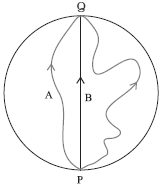
Three girls skating on a circular ice ground of radius $200 \; m$ start from a point $P$ on the edge of the ground and reach a point $Q$ diametrically opposite to $P$ following different paths as shown in the figure. What is the magnitude of the displacement vector for each? For which girl is this equal to the actual length of the path skated?
Solution
(B) Displacement is defined as the minimum distance between the initial and final positions of a particle.
In the given case,all three girls start from point $P$ and reach point $Q$.
Since $P$ and $Q$ are diametrically opposite points on a circular ground of radius $R = 200 \; m$,the displacement for each girl is equal to the diameter of the circle.
Magnitude of displacement $= 2 \times R = 2 \times 200 \; m = 400 \; m$.
Since the displacement is the shortest straight-line distance between two points,it is equal to the actual path length only when the path taken is a straight line.
Looking at the figure,girl $B$ follows a straight-line path from $P$ to $Q$.
Therefore,for girl $B$,the magnitude of the displacement is equal to the actual length of the path skated.
In the given case,all three girls start from point $P$ and reach point $Q$.
Since $P$ and $Q$ are diametrically opposite points on a circular ground of radius $R = 200 \; m$,the displacement for each girl is equal to the diameter of the circle.
Magnitude of displacement $= 2 \times R = 2 \times 200 \; m = 400 \; m$.
Since the displacement is the shortest straight-line distance between two points,it is equal to the actual path length only when the path taken is a straight line.
Looking at the figure,girl $B$ follows a straight-line path from $P$ to $Q$.
Therefore,for girl $B$,the magnitude of the displacement is equal to the actual length of the path skated.
0 likes
View Solution15
Medium
On an open ground,a motorist follows a track that turns to his left by an angle of $60^{\circ}$ after every $500\; m$. Starting from a given turn,specify the displacement of the motorist at the third,sixth and eighth turn. Compare the magnitude of the displacement with the total path length covered by the motorist in each case.
Solution
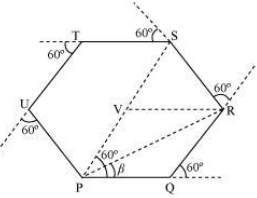
(N/A) The path followed by the motorist is a regular hexagon with side $500\; m$,as shown in the figure.
Let the motorist start from point $P$. The motorist takes the third turn at $S$.
$\therefore$ Magnitude of displacement $= PS = PV + VS = 500 + 500 = 1000\; m$.
Total path length $= PQ + QR + RS = 500 + 500 + 500 = 1500\; m$.
The motorist takes the sixth turn at point $P$,which is the starting point.
$\therefore$ Magnitude of displacement $= 0$.
Total path length $= PQ + QR + RS + ST + TU + UP = 6 \times 500 = 3000\; m$.
The motorist takes the eighth turn at point $R$.
$\therefore$ Magnitude of displacement $= PR = \sqrt{PQ^2 + QR^2 + 2(PQ)(QR) \cos 60^{\circ}}$.
$= \sqrt{500^2 + 500^2 + (2 \times 500 \times 500 \times 0.5)} = \sqrt{250000 + 250000 + 250000} = \sqrt{750000} \approx 866.03\; m$.
The angle $\beta$ with $PQ$ is given by $\tan \beta = \frac{500 \sin 60^{\circ}}{500 + 500 \cos 60^{\circ}} = \frac{\sqrt{3}/2}{1 + 1/2} = \frac{\sqrt{3}}{3} = \frac{1}{\sqrt{3}}$,so $\beta = 30^{\circ}$.
Total path length $= 8 \times 500 = 4000\; m$.
Let the motorist start from point $P$. The motorist takes the third turn at $S$.
$\therefore$ Magnitude of displacement $= PS = PV + VS = 500 + 500 = 1000\; m$.
Total path length $= PQ + QR + RS = 500 + 500 + 500 = 1500\; m$.
The motorist takes the sixth turn at point $P$,which is the starting point.
$\therefore$ Magnitude of displacement $= 0$.
Total path length $= PQ + QR + RS + ST + TU + UP = 6 \times 500 = 3000\; m$.
The motorist takes the eighth turn at point $R$.
$\therefore$ Magnitude of displacement $= PR = \sqrt{PQ^2 + QR^2 + 2(PQ)(QR) \cos 60^{\circ}}$.
$= \sqrt{500^2 + 500^2 + (2 \times 500 \times 500 \times 0.5)} = \sqrt{250000 + 250000 + 250000} = \sqrt{750000} \approx 866.03\; m$.
The angle $\beta$ with $PQ$ is given by $\tan \beta = \frac{500 \sin 60^{\circ}}{500 + 500 \cos 60^{\circ}} = \frac{\sqrt{3}/2}{1 + 1/2} = \frac{\sqrt{3}}{3} = \frac{1}{\sqrt{3}}$,so $\beta = 30^{\circ}$.
Total path length $= 8 \times 500 = 4000\; m$.
| Turn | Magnitude of displacement | Total path length |
| Third | $1000\; m$ | $1500\; m$ |
| Sixth | $0\; m$ | $3000\; m$ |
| Eighth | $866.03\; m$ at $30^{\circ}$ | $4000\; m$ |
0 likes
View Solution16
Easy
What is motion? Mention different types of motions.
Solution
(N/A) When a body changes its position with respect to time relative to another body,the body is said to be in motion with respect to that body.
Following are the various types of motions:
$(1)$ Rectilinear (straight line) motion,
$(2)$ Projectile motion,
$(3)$ Periodic motion,
$(4)$ Oscillatory motion,
$(5)$ Simple harmonic motion,
$(6)$ Uniform motion,
$(7)$ Non-uniform motion.
Following are the various types of motions:
$(1)$ Rectilinear (straight line) motion,
$(2)$ Projectile motion,
$(3)$ Periodic motion,
$(4)$ Oscillatory motion,
$(5)$ Simple harmonic motion,
$(6)$ Uniform motion,
$(7)$ Non-uniform motion.
0 likes
View Solution17
MediumMCQ
What is motion?
A
$A$ change in the position of an object with respect to time.
B
The state of being at rest.
C
The total distance traveled by an object.
D
The speed of an object.
Solution
(A) Motion is defined as the change in the position of an object with respect to time and a reference point (observer). If a body does not change its position relative to its surroundings over time,it is said to be at rest. If it does change its position,it is said to be in motion.
0 likes
View Solution18
Easy
Give some examples of motion.
Solution
(N/A) Motion is common to everything in the universe. We walk,run,and ride a bicycle. Even when we are sleeping,air moves into and out of our lungs,and blood flows in arteries and veins. We see leaves falling from trees and water flowing down a dam. Automobiles and planes carry people from one place to another. The Earth rotates once every $24$ hours and revolves around the Sun once in a year. The Sun itself is in motion in the Milky Way,which is again moving within its local group of galaxies.
0 likes
View Solution19
Medium
How can we determine whether an object is at rest or not?
Solution
(N/A) If an object changes its position with respect to another object (the observer or a reference frame),it is said to be in motion with respect to that object; otherwise,it is said to be at rest.
For example,if you are traveling in a bus moving with constant velocity and a book is placed beside you,the book is stationary with respect to you.
However,the same book is in motion with respect to a stationary observer standing on the road.
Thus,the motion of any object is a combined property of the object and the observer. There is no absolute motion without a defined observation position or reference frame.
For example,if you are traveling in a bus moving with constant velocity and a book is placed beside you,the book is stationary with respect to you.
However,the same book is in motion with respect to a stationary observer standing on the road.
Thus,the motion of any object is a combined property of the object and the observer. There is no absolute motion without a defined observation position or reference frame.
1 likes
View Solution20
EasyMCQ
When is an object said to be a particle?
A
When it is very small.
B
When its size is negligible compared to the distance it travels.
C
When it is moving in a circle.
D
When it has no mass.
Solution
(B) The concept of a particle is fundamental in mechanics.
$1$. $A$ particle is defined as a point-like object that possesses mass but has no dimensions (size).
$2$. Since it is dimensionless,it is an idealized concept and does not exist in reality.
$3$. $A$ particle can only undergo translational (linear) motion.
$4$. An object can be considered a particle in the following cases:
- $(i)$ When an object moves in a straight line such that all its constituent parts cover the same distance in the same time.
- $(ii)$ When the dimensions of an object are negligible compared to the distance it travels or the distance between it and another object.
Example: The Earth and the Sun are treated as particles when calculating the gravitational force between them because the distance between them is vast compared to their sizes.
$1$. $A$ particle is defined as a point-like object that possesses mass but has no dimensions (size).
$2$. Since it is dimensionless,it is an idealized concept and does not exist in reality.
$3$. $A$ particle can only undergo translational (linear) motion.
$4$. An object can be considered a particle in the following cases:
- $(i)$ When an object moves in a straight line such that all its constituent parts cover the same distance in the same time.
- $(ii)$ When the dimensions of an object are negligible compared to the distance it travels or the distance between it and another object.
Example: The Earth and the Sun are treated as particles when calculating the gravitational force between them because the distance between them is vast compared to their sizes.
0 likes
View Solution21
Easy
What is mechanics? Give definitions of its sub-branches.
Solution
(N/A) Mechanics: The branch of physics which studies and deals with the motion of objects is called mechanics. It is broadly divided into two sub-branches:
$(1)$ Kinematics: The branch of mechanics that describes the motion of objects without considering the causes of that motion (i.e.,forces) is known as kinematics.
$(2)$ Dynamics: The branch of mechanics that describes the motion of objects by considering the causes of that motion (i.e.,forces) is known as dynamics.
$(1)$ Kinematics: The branch of mechanics that describes the motion of objects without considering the causes of that motion (i.e.,forces) is known as kinematics.
$(2)$ Dynamics: The branch of mechanics that describes the motion of objects by considering the causes of that motion (i.e.,forces) is known as dynamics.
0 likes
View Solution22
EasyMCQ
How can we determine if an object is stationary or moving?
A
By observing its color
B
By measuring its mass
C
By observing its position with respect to a reference point
D
By measuring its temperature
Solution
(C) An object is said to be in motion if it changes its position with respect to a reference point (observer) over time.
If the position of an object remains constant with respect to a reference point,it is said to be at rest.
For example,if you are sitting in a moving bus,a book placed next to you is stationary with respect to you.
However,the same book is in motion with respect to an observer standing on the road.
Thus,motion is a relative concept,and it depends on the frame of reference of the observer.
If the position of an object remains constant with respect to a reference point,it is said to be at rest.
For example,if you are sitting in a moving bus,a book placed next to you is stationary with respect to you.
However,the same book is in motion with respect to an observer standing on the road.
Thus,motion is a relative concept,and it depends on the frame of reference of the observer.
0 likes
View Solution23
Medium
What is a particle? How can we consider an object as a particle?
Solution
(N/A) The concept of a particle is fundamental in mechanics.
$A$ particle is defined as a point-like object that possesses mass but has no dimensions (size).
Since a particle is dimensionless,it is an idealized concept and does not exist in reality.
$A$ particle can only undergo translational (linear) motion.
An object can be considered a particle in the following cases:
$(1)$ An object is treated as a particle if it moves in such a way that all its constituent parts cover the same distance in the same time interval (pure translational motion).
$(2)$ When the dimensions of an object are negligible compared to the distance it travels or the distance between it and another object,it can be treated as a particle.
Example: The Earth and the Sun are considered particles when calculating the gravitational force between them because the distance between them is vast compared to their sizes.
$A$ particle is defined as a point-like object that possesses mass but has no dimensions (size).
Since a particle is dimensionless,it is an idealized concept and does not exist in reality.
$A$ particle can only undergo translational (linear) motion.
An object can be considered a particle in the following cases:
$(1)$ An object is treated as a particle if it moves in such a way that all its constituent parts cover the same distance in the same time interval (pure translational motion).
$(2)$ When the dimensions of an object are negligible compared to the distance it travels or the distance between it and another object,it can be treated as a particle.
Example: The Earth and the Sun are considered particles when calculating the gravitational force between them because the distance between them is vast compared to their sizes.
0 likes
View Solution24
Easy
What is kinematics?
Solution
(N/A) Kinematics is the branch of mechanics that describes the motion of objects without considering the forces or causes that produce the motion. It focuses on parameters such as position,velocity,acceleration,and time.
0 likes
View Solution25
Easy
Explain frame of reference.
Solution
(N/A) In order to specify the position of an object,we need a reference point and a set of axes. It is convenient to choose a rectangular coordinate system consisting of three mutually perpendicular axes,labelled $X$,$Y$,and $Z$-axes.
The point of intersection of these three axes is called the origin $(O)$ and serves as the reference point.
The coordinates $(x, y, z)$ of an object describe its position with respect to this coordinate system.
To measure time,we position a clock in this system.
If one or more coordinates of an object change with time,we say that the object is in motion. Otherwise,the object is said to be at rest with respect to this frame of reference.
The choice of a set of axes in a frame of reference depends upon the situation. For example,for describing motion in one dimension,we need only one axis. To describe motion in two or three dimensions,we need a set of two or three axes.
To describe motion along a straight line,we can choose an axis,say the $X$-axis,so that it coincides with the path of the object.
We then measure the position of the object with reference to a conveniently chosen origin,say $O$,as shown in the figure. Positions to the right of $O$ are taken as positive and to the left of $O$ as negative.
The position coordinates of points $P$ and $Q$ in the figure are $+360 \ m$ and $+240 \ m$. Similarly,the position coordinate of point $R$ is $-120 \ m$.
The point of intersection of these three axes is called the origin $(O)$ and serves as the reference point.
The coordinates $(x, y, z)$ of an object describe its position with respect to this coordinate system.
To measure time,we position a clock in this system.
If one or more coordinates of an object change with time,we say that the object is in motion. Otherwise,the object is said to be at rest with respect to this frame of reference.
The choice of a set of axes in a frame of reference depends upon the situation. For example,for describing motion in one dimension,we need only one axis. To describe motion in two or three dimensions,we need a set of two or three axes.
To describe motion along a straight line,we can choose an axis,say the $X$-axis,so that it coincides with the path of the object.
We then measure the position of the object with reference to a conveniently chosen origin,say $O$,as shown in the figure. Positions to the right of $O$ are taken as positive and to the left of $O$ as negative.
The position coordinates of points $P$ and $Q$ in the figure are $+360 \ m$ and $+240 \ m$. Similarly,the position coordinate of point $R$ is $-120 \ m$.

0 likes
View Solution26
Easy
Explain path length.
Solution
(N/A) Consider the motion of a car along a straight line.
Let the origin of the axis be the point from where the car started moving,i.e.,the car was at $x=0$ at $t=0$. Let $P, Q,$ and $R$ represent the positions of the car at different instants of time.
Consider two cases of motion:
Case $1$: The car moves from $O$ to $P$. The distance moved by the car is $OP = 360 \ m$.
This distance is called the path length.
Case $2$: The car moves from $O$ to $P$ and then moves back from $P$ to $Q$. During this course of motion,the path length traversed is $OP + PQ = 360 \ m + 120 \ m = 480 \ m$.
Path length is a scalar quantity,which means it has magnitude only and no direction.
Let the origin of the axis be the point from where the car started moving,i.e.,the car was at $x=0$ at $t=0$. Let $P, Q,$ and $R$ represent the positions of the car at different instants of time.
Consider two cases of motion:
Case $1$: The car moves from $O$ to $P$. The distance moved by the car is $OP = 360 \ m$.
This distance is called the path length.
Case $2$: The car moves from $O$ to $P$ and then moves back from $P$ to $Q$. During this course of motion,the path length traversed is $OP + PQ = 360 \ m + 120 \ m = 480 \ m$.
Path length is a scalar quantity,which means it has magnitude only and no direction.
0 likes
View Solution27
Medium
Define and explain displacement.
Solution
(N/A) The change in position of a particle in a particular interval of time is called displacement. Let $x_{1}$ and $x_{2}$ be the positions of an object at time $t_{1}$ and $t_{2}$.
Its displacement,denoted by $\Delta x$ in time $\Delta t = (t_{2} - t_{1})$,is given by the difference between the final and initial positions.
$\Delta x = x_{2} - x_{1}$
We use the Greek letter delta $(\Delta)$ to denote the change in a quantity.
If $x_{2} > x_{1}$,$\Delta x$ is positive; and if $x_{2} < x_{1}$,then $\Delta x$ is negative.
Displacement has both magnitude and direction.
In one-dimensional motion,there are only two directions (backward and forward,upward and downward) in which an object can move.
These two directions can easily be specified by $+$ and $-$ signs.
For example,the displacement of the car in moving from $O$ to $P$ is:
$\Delta x = x_{2} - x_{1} = (+360 \ m) - 0 \ m = +360 \ m$
The displacement has a magnitude of $360 \ m$ and is directed in the positive $x$-direction as indicated by the $+$ sign.
Similarly,the displacement of the car from $P$ to $Q$ is $240 \ m - 360 \ m = -120 \ m$. The negative sign indicates the direction of displacement.
Its displacement,denoted by $\Delta x$ in time $\Delta t = (t_{2} - t_{1})$,is given by the difference between the final and initial positions.
$\Delta x = x_{2} - x_{1}$
We use the Greek letter delta $(\Delta)$ to denote the change in a quantity.
If $x_{2} > x_{1}$,$\Delta x$ is positive; and if $x_{2} < x_{1}$,then $\Delta x$ is negative.
Displacement has both magnitude and direction.
In one-dimensional motion,there are only two directions (backward and forward,upward and downward) in which an object can move.
These two directions can easily be specified by $+$ and $-$ signs.
For example,the displacement of the car in moving from $O$ to $P$ is:
$\Delta x = x_{2} - x_{1} = (+360 \ m) - 0 \ m = +360 \ m$
The displacement has a magnitude of $360 \ m$ and is directed in the positive $x$-direction as indicated by the $+$ sign.
Similarly,the displacement of the car from $P$ to $Q$ is $240 \ m - 360 \ m = -120 \ m$. The negative sign indicates the direction of displacement.
0 likes
View Solution28
Medium
"The magnitude of displacement may or may not be equal to the path length traversed by an object." Explain this statement with an example.
Solution
For motion of the car from $O$ to $P$, the path length is $360 \text{ m}$ and the displacement is $360 \text{ m}$.
In this case, the magnitude of displacement is equal to the path length.
Consider the motion of the car from $O$ to $P$ and back to $Q$. In this case, the path length is the total distance covered: $360 \text{ m} + 120 \text{ m} = 480 \text{ m}$.
The displacement is the change in position: $240 \text{ m} - 0 \text{ m} = 240 \text{ m}$.
Thus, the magnitude of displacement $(240 \text{ m})$ is not equal to the path length $(480 \text{ m})$.
In this case, the magnitude of displacement is equal to the path length.
Consider the motion of the car from $O$ to $P$ and back to $Q$. In this case, the path length is the total distance covered: $360 \text{ m} + 120 \text{ m} = 480 \text{ m}$.
The displacement is the change in position: $240 \text{ m} - 0 \text{ m} = 240 \text{ m}$.
Thus, the magnitude of displacement $(240 \text{ m})$ is not equal to the path length $(480 \text{ m})$.
0 likes
View Solution29
Medium
Explain with an example that the magnitude of displacement may be zero but the corresponding path length is not zero.
Solution
(N/A) Consider a car starting from the origin $O$ $(0 \ m)$,moving to point $P$ $(360 \ m)$,and then returning to the origin $O$.
In this case,the initial position is $x_i = 0 \ m$ and the final position is $x_f = 0 \ m$.
The displacement is defined as $\Delta x = x_f - x_i = 0 \ m - 0 \ m = 0 \ m$.
However,the total path length covered is the sum of the distances of the two segments: $OP + PO = 360 \ m + 360 \ m = 720 \ m$.
Thus,it is demonstrated that the magnitude of displacement can be zero while the path length is non-zero.
In this case,the initial position is $x_i = 0 \ m$ and the final position is $x_f = 0 \ m$.
The displacement is defined as $\Delta x = x_f - x_i = 0 \ m - 0 \ m = 0 \ m$.
However,the total path length covered is the sum of the distances of the two segments: $OP + PO = 360 \ m + 360 \ m = 720 \ m$.
Thus,it is demonstrated that the magnitude of displacement can be zero while the path length is non-zero.
0 likes
View Solution30
Easy
Distinguish between path length and displacement.
Solution
(N/A)
| Path length | Displacement |
| $(1)$ The total distance covered by the moving object is called path length. | $(1)$ The shortest distance between the initial and final position is called displacement. |
| $(2)$ It is always positive. | $(2)$ It may be positive,negative,or zero. |
| $(3)$ It is a scalar quantity. | $(3)$ It is a vector quantity. |
| $(4)$ It can never be zero for any moving object. | $(4)$ It can be zero for a moving object if it returns to the starting point. |
| $(5)$ If motion is not linear,then path length > displacement. | $(5)$ If motion is not linear,then displacement < path length. |
| $(6)$ Final position cannot be determined from path length. | $(6)$ Final position can be determined from displacement if the initial position is known. |
1 likes
View Solution31
Easy
Why is a frame of reference required?
Solution
(N/A) In order to specify the position of an object,we need to use a reference point and a set of axes. It is convenient to choose a rectangular coordinate system consisting of three mutually perpendicular axes,labeled $X$,$Y$,and $Z$-axes.
The point of intersection of these three axes is called the origin $(O)$ and serves as the reference point.
The coordinates $(x, y, z)$ of an object describe the position of the object with respect to this coordinate system.
To measure time,we position a clock in this system.
If one or more coordinates of an object change with time,we say that the object is in motion. Otherwise,the object is said to be at rest with respect to this frame of reference. The choice of a set of axes in a frame of reference depends upon the situation. For example,for describing motion in one dimension,we need only one axis. To describe motion in two or three dimensions,we need a set of two or three axes.
The point of intersection of these three axes is called the origin $(O)$ and serves as the reference point.
The coordinates $(x, y, z)$ of an object describe the position of the object with respect to this coordinate system.
To measure time,we position a clock in this system.
If one or more coordinates of an object change with time,we say that the object is in motion. Otherwise,the object is said to be at rest with respect to this frame of reference. The choice of a set of axes in a frame of reference depends upon the situation. For example,for describing motion in one dimension,we need only one axis. To describe motion in two or three dimensions,we need a set of two or three axes.
0 likes
View Solution32
EasyMCQ
When is an object said to be in motion?
A
When its position changes with time.
B
When its position remains constant with time.
C
When it is at rest.
D
When it has zero velocity.
Solution
(A) An object is said to be in motion if its position changes continuously with respect to its surroundings or a reference point as time passes.
If the position of an object does not change with time,it is said to be at rest.
If the position of an object does not change with time,it is said to be at rest.
0 likes
View Solution33
Easy
What is path length? What is displacement?
Solution
(N/A) Path length is the total distance covered by an object during its motion between two points. It is a scalar quantity,meaning it has magnitude but no direction.
Displacement is the change in the position of an object in a particular interval of time. It is defined as the difference between the final position $(x_2)$ and the initial position $(x_1)$: $\Delta x = x_2 - x_1$. Displacement is a vector quantity,as it has both magnitude and direction.
Example: Consider a car moving from origin $O$ $(x=0)$ to point $P$ $(x=360 \ m)$ and then back to point $Q$ $(x=240 \ m)$.
$1$. Path length: The total distance covered is $OP + PQ = 360 \ m + (360 \ m - 240 \ m) = 360 \ m + 120 \ m = 480 \ m$.
$2$. Displacement: The displacement is the final position minus the initial position: $\Delta x = x_Q - x_O = 240 \ m - 0 \ m = +240 \ m$. The positive sign indicates the direction is along the positive $x$-axis.
Displacement is the change in the position of an object in a particular interval of time. It is defined as the difference between the final position $(x_2)$ and the initial position $(x_1)$: $\Delta x = x_2 - x_1$. Displacement is a vector quantity,as it has both magnitude and direction.
Example: Consider a car moving from origin $O$ $(x=0)$ to point $P$ $(x=360 \ m)$ and then back to point $Q$ $(x=240 \ m)$.
$1$. Path length: The total distance covered is $OP + PQ = 360 \ m + (360 \ m - 240 \ m) = 360 \ m + 120 \ m = 480 \ m$.
$2$. Displacement: The displacement is the final position minus the initial position: $\Delta x = x_Q - x_O = 240 \ m - 0 \ m = +240 \ m$. The positive sign indicates the direction is along the positive $x$-axis.
0 likes
View Solution34
Medium
When are the path length and the magnitude of displacement the same?
Solution
(N/A) The path length and the magnitude of displacement are the same when an object moves in a straight line in a single direction without changing its direction of motion.
For example,based on the provided number line,consider the motion of a car from $O$ to $P$:
- The path length is $360 \ m$.
- The displacement is $360 \ m$.
In this case,the magnitude of displacement is equal to the path length.
However,consider the motion of the car from $O$ to $P$ and then back to $Q$:
- The path length = $(360 \ m) + (120 \ m) = 480 \ m$.
- The displacement = $(240 \ m) - (0 \ m) = 240 \ m$.
In this case,the magnitude of displacement $(240 \ m)$ is not equal to the path length $(480 \ m)$.
For example,based on the provided number line,consider the motion of a car from $O$ to $P$:
- The path length is $360 \ m$.
- The displacement is $360 \ m$.
In this case,the magnitude of displacement is equal to the path length.
However,consider the motion of the car from $O$ to $P$ and then back to $Q$:
- The path length = $(360 \ m) + (120 \ m) = 480 \ m$.
- The displacement = $(240 \ m) - (0 \ m) = 240 \ m$.
In this case,the magnitude of displacement $(240 \ m)$ is not equal to the path length $(480 \ m)$.
0 likes
View Solution35
EasyMCQ
Which among path length and displacement cannot be zero for a moving object?
A
Path length
B
Displacement
C
Both
D
None
Solution
(A) For a moving object,the path length is the total distance covered,which is always positive.
If an object starts from point $O$,moves to point $P$ $(360 \ m)$,and returns to $O$,the final position coincides with the initial position.
In this case,the displacement is $0 \ m$ because the change in position is zero.
However,the path length is $OP + PO = 360 \ m + 360 \ m = 720 \ m$.
Therefore,for a moving object,the path length cannot be zero,while displacement can be zero.
If an object starts from point $O$,moves to point $P$ $(360 \ m)$,and returns to $O$,the final position coincides with the initial position.
In this case,the displacement is $0 \ m$ because the change in position is zero.
However,the path length is $OP + PO = 360 \ m + 360 \ m = 720 \ m$.
Therefore,for a moving object,the path length cannot be zero,while displacement can be zero.
0 likes
View Solution36
EasyMCQ
How can the resultant effect of motion be known?
A
By calculating the total path length.
B
By calculating the displacement.
C
By calculating the average speed.
D
By calculating the instantaneous velocity.
Solution
(B) The resultant effect of motion refers to the net change in the position of an object from its initial point to its final point. This is defined as displacement.
Displacement is a vector quantity that represents the shortest distance between the initial and final positions of an object,given by $\vec{s} = \vec{x}_f - \vec{x}_i$.
Unlike path length,which depends on the actual route taken,displacement only considers the start and end points,making it the correct measure for the resultant effect of motion.
Displacement is a vector quantity that represents the shortest distance between the initial and final positions of an object,given by $\vec{s} = \vec{x}_f - \vec{x}_i$.
Unlike path length,which depends on the actual route taken,displacement only considers the start and end points,making it the correct measure for the resultant effect of motion.
0 likes
View Solution37
MediumMCQ
Are motion and position relative or not?
A
Yes,both are relative.
B
No,both are absolute.
C
Only motion is relative.
D
Only position is relative.
Solution
(A) In physics,the concepts of position and motion are defined with respect to a frame of reference.
To describe the position of an object,we need a coordinate system or a reference point (origin).
Similarly,motion is defined as the change in position of an object with respect to time and a chosen frame of reference.
Since both depend on the observer's frame of reference,they are considered relative quantities.
To describe the position of an object,we need a coordinate system or a reference point (origin).
Similarly,motion is defined as the change in position of an object with respect to time and a chosen frame of reference.
Since both depend on the observer's frame of reference,they are considered relative quantities.
0 likes
View Solution38
Medium
When is an object said to be in motion? What is meant by the description of an object's motion?
Solution
(N/A) Motion is relative. An object is said to be in motion with respect to another object if its position changes with time with respect to that object.
The motion of an object can be described by determining its displacement,velocity,and acceleration at different points in time.
The motion of an object can be described by determining its displacement,velocity,and acceleration at different points in time.
0 likes
View Solution39
MediumMCQ
What is the relationship between the displacement and the path length of a moving object?
A
Path length > Displacement
B
Path length < Displacement
C
Path length $\geq$ Displacement
D
Path length $\leq$ Displacement
Solution
(C) The path length is the total distance covered by an object along its actual path.
Displacement is the shortest distance between the initial and final positions of an object.
Since the shortest distance between two points is a straight line,the path length is always greater than or equal to the magnitude of the displacement.
Therefore,the relationship is: $\text{Path length} \geq \text{Displacement}$.
Displacement is the shortest distance between the initial and final positions of an object.
Since the shortest distance between two points is a straight line,the path length is always greater than or equal to the magnitude of the displacement.
Therefore,the relationship is: $\text{Path length} \geq \text{Displacement}$.
0 likes
View Solution40
EasyMCQ
Does the displacement of an object depend on the choice of the origin of the coordinate system?
A
Yes
B
No
C
Depends on the motion
D
Depends on the time interval
Solution
(B) Displacement is defined as the change in position of an object,given by $\Delta x = x_f - x_i$,where $x_f$ is the final position and $x_i$ is the initial position.
If the origin of the coordinate system is shifted by a distance $d$,the new coordinates become $x'_f = x_f - d$ and $x'_i = x_i - d$.
The new displacement is $\Delta x' = x'_f - x'_i = (x_f - d) - (x_i - d) = x_f - x_i = \Delta x$.
Since the displacement remains the same regardless of the shift in the origin,it does not depend on the choice of the origin.
If the origin of the coordinate system is shifted by a distance $d$,the new coordinates become $x'_f = x_f - d$ and $x'_i = x_i - d$.
The new displacement is $\Delta x' = x'_f - x'_i = (x_f - d) - (x_i - d) = x_f - x_i = \Delta x$.
Since the displacement remains the same regardless of the shift in the origin,it does not depend on the choice of the origin.
0 likes
View Solution41
MediumMCQ
Under what condition is the magnitude of distance covered by an object equal to its displacement?
A
When the object moves in a circular path.
B
When the object moves in a straight line without changing its direction.
C
When the object moves in a straight line and returns to its starting point.
D
When the object moves with a constant velocity.
Solution
(B) The magnitude of distance and displacement are equal when an object moves along a straight-line path in a single,fixed direction.
In this case,the path length (distance) is exactly equal to the straight-line distance between the initial and final positions (displacement).
In this case,the path length (distance) is exactly equal to the straight-line distance between the initial and final positions (displacement).
0 likes
View Solution42
DifficultMCQ
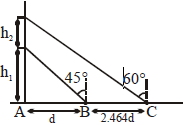
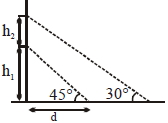
$A$ balloon is moving up in air vertically above a point $A$ on the ground. When it is at a height $h_{1}$,a girl standing at a distance $d$ (point $B$) from $A$ sees it at an angle $45^{\circ}$ with respect to the vertical. When the balloon climbs up a further height $h_{2}$,it is seen at an angle $60^{\circ}$ with respect to the vertical if the girl moves further by a distance $2.464d$ (point $C$). Then the height $h_{2}$ is (given $\tan 30^{\circ} = 0.5774$):
A
$d$
B
$0.732d$
C
$1.464d$
D
$0.464d$
Solution
(A) From the first position at point $B$,the angle with the vertical is $45^{\circ}$. Thus,the angle with the ground is $90^{\circ} - 45^{\circ} = 45^{\circ}$.
$\tan 45^{\circ} = \frac{h_{1}}{d} \Rightarrow 1 = \frac{h_{1}}{d} \Rightarrow h_{1} = d$.
When the balloon is at height $h_{1} + h_{2}$,the girl is at point $C$. The distance from $A$ to $C$ is $d + 2.464d = 3.464d$. The angle with the vertical is $60^{\circ}$,so the angle with the ground is $90^{\circ} - 60^{\circ} = 30^{\circ}$.
$\tan 30^{\circ} = \frac{h_{1} + h_{2}}{3.464d}$.
Given $\tan 30^{\circ} = 0.5774$,we have $0.5774 = \frac{d + h_{2}}{3.464d}$.
$d + h_{2} = 0.5774 \times 3.464d \approx 2d$.
$h_{2} = 2d - d = d$.
$\tan 45^{\circ} = \frac{h_{1}}{d} \Rightarrow 1 = \frac{h_{1}}{d} \Rightarrow h_{1} = d$.
When the balloon is at height $h_{1} + h_{2}$,the girl is at point $C$. The distance from $A$ to $C$ is $d + 2.464d = 3.464d$. The angle with the vertical is $60^{\circ}$,so the angle with the ground is $90^{\circ} - 60^{\circ} = 30^{\circ}$.
$\tan 30^{\circ} = \frac{h_{1} + h_{2}}{3.464d}$.
Given $\tan 30^{\circ} = 0.5774$,we have $0.5774 = \frac{d + h_{2}}{3.464d}$.
$d + h_{2} = 0.5774 \times 3.464d \approx 2d$.
$h_{2} = 2d - d = d$.
0 likes
View Solution43
DifficultMCQ
The position of a body moving along the $x$-axis at time $t$ is given by $x = (t^2 - 4t + 6) \, m$. The distance travelled by the body in the time interval $t = 0$ to $t = 3 \, s$ is ...... $m$.
A
$5$
B
$7$
C
$4$
D
$3$
Solution
(A) Given position: $x(t) = t^2 - 4t + 6$.
Velocity $v(t) = \frac{dx}{dt} = 2t - 4$.
The body comes to rest when $v(t) = 0$,which gives $2t - 4 = 0$,so $t = 2 \, s$.
Since the motion reverses at $t = 2 \, s$,we calculate the distance in two parts: from $t = 0$ to $t = 2 \, s$ and from $t = 2 \, s$ to $t = 3 \, s$.
At $t = 0 \, s$: $x(0) = 0^2 - 4(0) + 6 = 6 \, m$.
At $t = 2 \, s$: $x(2) = 2^2 - 4(2) + 6 = 4 - 8 + 6 = 2 \, m$.
At $t = 3 \, s$: $x(3) = 3^2 - 4(3) + 6 = 9 - 12 + 6 = 3 \, m$.
Distance from $t = 0$ to $t = 2 \, s$ is $|x(2) - x(0)| = |2 - 6| = 4 \, m$.
Distance from $t = 2$ to $t = 3 \, s$ is $|x(3) - x(2)| = |3 - 2| = 1 \, m$.
Total distance = $4 \, m + 1 \, m = 5 \, m$.
Velocity $v(t) = \frac{dx}{dt} = 2t - 4$.
The body comes to rest when $v(t) = 0$,which gives $2t - 4 = 0$,so $t = 2 \, s$.
Since the motion reverses at $t = 2 \, s$,we calculate the distance in two parts: from $t = 0$ to $t = 2 \, s$ and from $t = 2 \, s$ to $t = 3 \, s$.
At $t = 0 \, s$: $x(0) = 0^2 - 4(0) + 6 = 6 \, m$.
At $t = 2 \, s$: $x(2) = 2^2 - 4(2) + 6 = 4 - 8 + 6 = 2 \, m$.
At $t = 3 \, s$: $x(3) = 3^2 - 4(3) + 6 = 9 - 12 + 6 = 3 \, m$.
Distance from $t = 0$ to $t = 2 \, s$ is $|x(2) - x(0)| = |2 - 6| = 4 \, m$.
Distance from $t = 2$ to $t = 3 \, s$ is $|x(3) - x(2)| = |3 - 2| = 1 \, m$.
Total distance = $4 \, m + 1 \, m = 5 \, m$.
0 likes
View Solution44
EasyMCQ
If the magnitude of average speed and average velocity over a time interval are the same, then:
A
The particle must move with zero acceleration
B
The particle must move with non-zero acceleration
C
The particle must be at rest
D
The particle must move in a straight line without turning back
Solution
(D) The magnitude of average speed is defined as $\frac{\text{Total Distance}}{\text{Total Time}}$.
The magnitude of average velocity is defined as $\frac{|\text{Total Displacement}|}{\text{Total Time}}$.
For these two quantities to be equal, the total distance traveled must be equal to the magnitude of the total displacement.
This condition is satisfied if and only if the particle moves in a straight line without changing its direction of motion.
Therefore, the correct option is $D$.
The magnitude of average velocity is defined as $\frac{|\text{Total Displacement}|}{\text{Total Time}}$.
For these two quantities to be equal, the total distance traveled must be equal to the magnitude of the total displacement.
This condition is satisfied if and only if the particle moves in a straight line without changing its direction of motion.
Therefore, the correct option is $D$.
0 likes
View Solution45
EasyMCQ
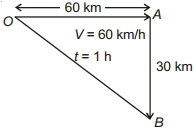
$A$ car moves with a speed of $60 \, km/h$ for $1 \, h$ in the east direction and with the same speed for $30 \, min$ in the south direction. The displacement of the car from the initial position is ......... $km$.
A
$60$
B
$30 \sqrt{3}$
C
$30 \sqrt{5}$
D
$60 \sqrt{2}$
Solution
(C) The car travels in the east direction for $1 \, h$ at a speed of $60 \, km/h$. The distance covered in the east direction is $d_1 = 60 \, km/h \times 1 \, h = 60 \, km$.
The car then travels in the south direction for $30 \, min$ $(0.5 \, h)$ at the same speed of $60 \, km/h$. The distance covered in the south direction is $d_2 = 60 \, km/h \times 0.5 \, h = 30 \, km$.
Since the east and south directions are perpendicular to each other,the displacement is the hypotenuse of a right-angled triangle with sides $60 \, km$ and $30 \, km$.
Displacement $= \sqrt{d_1^2 + d_2^2} = \sqrt{60^2 + 30^2} = \sqrt{3600 + 900} = \sqrt{4500} = \sqrt{900 \times 5} = 30 \sqrt{5} \, km$.
The car then travels in the south direction for $30 \, min$ $(0.5 \, h)$ at the same speed of $60 \, km/h$. The distance covered in the south direction is $d_2 = 60 \, km/h \times 0.5 \, h = 30 \, km$.
Since the east and south directions are perpendicular to each other,the displacement is the hypotenuse of a right-angled triangle with sides $60 \, km$ and $30 \, km$.
Displacement $= \sqrt{d_1^2 + d_2^2} = \sqrt{60^2 + 30^2} = \sqrt{3600 + 900} = \sqrt{4500} = \sqrt{900 \times 5} = 30 \sqrt{5} \, km$.
0 likes
View Solution46
DifficultMCQ
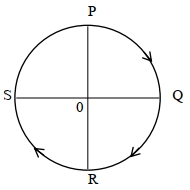
$A$ cyclist starts from the point $P$ of a circular ground of radius $2 \,km$ and travels along its circumference to the point $S$. The displacement of a cyclist is:
A
$6 \,km$
B
$\sqrt{8} \,km$
C
$4 \,km$
D
$8 \,km$
Solution
(B) The cyclist moves along the circumference from point $P$ to point $S$.
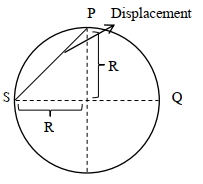
Since the path is circular, the points $P, O, S$ form a right-angled triangle where $O$ is the center of the circle.
The displacement is the straight-line distance between the initial point $P$ and the final point $S$.
Using the Pythagorean theorem in $\triangle POS$, the displacement $d$ is given by:
$d = \sqrt{OP^2 + OS^2}$
Given the radius $R = 2 \,km$, we have $OP = OS = R = 2 \,km$.
$d = \sqrt{R^2 + R^2} = \sqrt{2R^2} = R\sqrt{2}$
Substituting the value of $R$:
$d = 2\sqrt{2} \,km = \sqrt{4 \times 2} \,km = \sqrt{8} \,km$.
Since the path is circular, the points $P, O, S$ form a right-angled triangle where $O$ is the center of the circle.
The displacement is the straight-line distance between the initial point $P$ and the final point $S$.
Using the Pythagorean theorem in $\triangle POS$, the displacement $d$ is given by:
$d = \sqrt{OP^2 + OS^2}$
Given the radius $R = 2 \,km$, we have $OP = OS = R = 2 \,km$.
$d = \sqrt{R^2 + R^2} = \sqrt{2R^2} = R\sqrt{2}$
Substituting the value of $R$:
$d = 2\sqrt{2} \,km = \sqrt{4 \times 2} \,km = \sqrt{8} \,km$.
0 likes
View Solution47
EasyMCQ
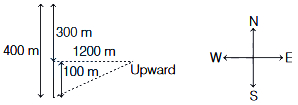
An airplane flies $400 \,m$ north and $300 \,m$ south and flies $1200 \,m$ upwards,then the net displacement is (in $\,m$)
A
$1400$
B
$1500$
C
$1200$
D
$1100$
Solution
(C) Let the starting point be the origin $(0, 0, 0)$.
The airplane flies $400 \,m$ north,so its position is $(0, 400, 0)$.
Then it flies $300 \,m$ south,so its new position is $(0, 400-300, 0) = (0, 100, 0)$.
Finally,it flies $1200 \,m$ upwards,so its final position is $(0, 100, 1200)$.
The net displacement is the distance from the origin to the final position:
$d = \sqrt{0^2 + 100^2 + 1200^2}$
$d = \sqrt{10000 + 1440000}$
$d = \sqrt{1450000}$
$d = 100 \sqrt{145} \approx 100 \times 12.04 = 1204.16 \,m$.
Rounding to the nearest given option,the net displacement is approximately $1200 \,m$.
The airplane flies $400 \,m$ north,so its position is $(0, 400, 0)$.
Then it flies $300 \,m$ south,so its new position is $(0, 400-300, 0) = (0, 100, 0)$.
Finally,it flies $1200 \,m$ upwards,so its final position is $(0, 100, 1200)$.
The net displacement is the distance from the origin to the final position:
$d = \sqrt{0^2 + 100^2 + 1200^2}$
$d = \sqrt{10000 + 1440000}$
$d = \sqrt{1450000}$
$d = 100 \sqrt{145} \approx 100 \times 12.04 = 1204.16 \,m$.
Rounding to the nearest given option,the net displacement is approximately $1200 \,m$.
0 likes
View Solution48
EasyMCQ
The ratio of displacement to distance for a moving particle is
A
always less than one
B
always greater than one
C
always one
D
one or less than one
Solution
(D) Distance is the total path length covered by an object,while displacement is the shortest distance between the initial and final positions.
For any motion,the magnitude of displacement is always less than or equal to the distance covered $(|\text{displacement}| \le \text{distance})$.
When the body moves along a straight line without changing direction,the distance and displacement are equal,so the ratio is $1$.
When the body moves along a curved path or changes direction,the displacement is strictly less than the distance,so the ratio is less than $1$.
Therefore,the ratio of displacement to distance is always $1$ or less than $1$.
For any motion,the magnitude of displacement is always less than or equal to the distance covered $(|\text{displacement}| \le \text{distance})$.
When the body moves along a straight line without changing direction,the distance and displacement are equal,so the ratio is $1$.
When the body moves along a curved path or changes direction,the displacement is strictly less than the distance,so the ratio is less than $1$.
Therefore,the ratio of displacement to distance is always $1$ or less than $1$.
0 likes
View SolutionMotion in Straight Line — Position, Path Length and Displacement · Frequently Asked Questions
1Are these Motion in Straight Line questions useful for JEE and NEET?
Yes. All questions in this section are mapped to JEE Main and NEET exam patterns. Previous year questions from JEE Main, NEET, GUJCET and state-level exams are included with full solutions.
2Can I switch to Hindi or Gujarati for these questions?
Yes. Use the language tabs in the hero section or the sidebar to view the same questions and solutions in English, Hindi or Gujarati.
3How do I generate a question paper from this subtopic?
Use the Vedclass Exam Paper Generator — select the chapter and subtopic, set difficulty, and generate Sets A, B, C, D automatically. First 3 chapters of every subject are free.
Vedclass Products
For Students
Vedclass Test Series
Mock tests in real JEE/NEET style with performance analysis. 5-day free trial.
Start Free TrialFor Teachers
Exam Paper Generator
Generate Set A/B/C/D papers from this chapter in 2 minutes. 3 chapters free.
Try FreeFor Institutes
Online Exam Module
Live online exams with unlimited students, 360° analytics & white-label branding.
See DemoFor Teachers & Institutes
Generate a Motion in Straight Line Exam Paper in 2 Minutes
Select subtopic & difficulty — Sets A, B, C, D auto-generated with No Repeat logic.
First 3 chapters of every subject are free — no payment required.