
A English
Uniformly Accelerated Motion Questions in English
Class 11 Physics · Motion in Straight Line · Uniformly Accelerated Motion
304+
Questions
English
Language
100%
With Solutions
Showing 48 of 304 questions in English
201
MediumMCQ
$A$ small block slides down on a smooth inclined plane,starting from rest at time $t=0$. Let $S_{n}$ be the distance travelled by the block in the interval $t=n-1$ to $t=n$. Then,the ratio $\frac{S_{n}}{S_{n+1}}$ is
A
$\frac{2n-1}{2n}$
B
$\frac{2n-1}{2n+1}$
C
$\frac{2n+1}{2n-1}$
D
$\frac{2n}{2n-1}$
Solution
(B) The distance travelled by an object in the $n^{th}$ second starting from rest is given by the formula $S_n = u + \frac{a}{2}(2n-1)$.
Since the block starts from rest,the initial velocity $u = 0$.
Therefore,the distance travelled in the $n^{th}$ interval is $S_n = \frac{a}{2}(2n-1)$.
Similarly,the distance travelled in the $(n+1)^{th}$ interval is $S_{n+1} = \frac{a}{2}(2(n+1)-1) = \frac{a}{2}(2n+2-1) = \frac{a}{2}(2n+1)$.
Now,calculating the ratio $\frac{S_n}{S_{n+1}}$:
$\frac{S_n}{S_{n+1}} = \frac{\frac{a}{2}(2n-1)}{\frac{a}{2}(2n+1)} = \frac{2n-1}{2n+1}$.
Since the block starts from rest,the initial velocity $u = 0$.
Therefore,the distance travelled in the $n^{th}$ interval is $S_n = \frac{a}{2}(2n-1)$.
Similarly,the distance travelled in the $(n+1)^{th}$ interval is $S_{n+1} = \frac{a}{2}(2(n+1)-1) = \frac{a}{2}(2n+2-1) = \frac{a}{2}(2n+1)$.
Now,calculating the ratio $\frac{S_n}{S_{n+1}}$:
$\frac{S_n}{S_{n+1}} = \frac{\frac{a}{2}(2n-1)}{\frac{a}{2}(2n+1)} = \frac{2n-1}{2n+1}$.
0 likes
View Solution202
DifficultMCQ
The relation between time $t$ and distance $x$ for a moving body is given as $t = m x^{2} + n x$,where $m$ and $n$ are constants. The retardation of the motion is:
A
$2 n^{2} v^{3}$
B
$2 m v^{3}$
C
$2 n v^{3}$
D
$2 m n v^{3}$
Solution
(B) Given the relation: $t = m x^{2} + n x$.
Differentiating with respect to $x$:
$\frac{dt}{dx} = 2mx + n$.
Since velocity $v = \frac{dx}{dt}$,we have $\frac{1}{v} = \frac{dt}{dx} = 2mx + n$.
Thus,$v = (2mx + n)^{-1}$.
Now,differentiate $v$ with respect to $t$ to find acceleration $a$:
$a = \frac{dv}{dt} = \frac{dv}{dx} \cdot \frac{dx}{dt} = v \cdot \frac{dv}{dx}$.
$\frac{dv}{dx} = -1(2mx + n)^{-2} \cdot (2m) = -2m(2mx + n)^{-2}$.
Since $(2mx + n) = \frac{1}{v}$,then $(2mx + n)^{-2} = v^{2}$.
Therefore,$a = v \cdot (-2m \cdot v^{2}) = -2mv^{3}$.
Retardation is the negative of acceleration,so retardation $= 2mv^{3}$.
Differentiating with respect to $x$:
$\frac{dt}{dx} = 2mx + n$.
Since velocity $v = \frac{dx}{dt}$,we have $\frac{1}{v} = \frac{dt}{dx} = 2mx + n$.
Thus,$v = (2mx + n)^{-1}$.
Now,differentiate $v$ with respect to $t$ to find acceleration $a$:
$a = \frac{dv}{dt} = \frac{dv}{dx} \cdot \frac{dx}{dt} = v \cdot \frac{dv}{dx}$.
$\frac{dv}{dx} = -1(2mx + n)^{-2} \cdot (2m) = -2m(2mx + n)^{-2}$.
Since $(2mx + n) = \frac{1}{v}$,then $(2mx + n)^{-2} = v^{2}$.
Therefore,$a = v \cdot (-2m \cdot v^{2}) = -2mv^{3}$.
Retardation is the negative of acceleration,so retardation $= 2mv^{3}$.
1 likes
View Solution203
MediumMCQ
$A$ small toy starts moving from the position of rest under a constant acceleration. If it travels a distance of $10 \, m$ in $t \, s$,the distance travelled by the toy in the next $t \, s$ will be ......... $m$.
A
$10$
B
$20$
C
$30$
D
$40$
Solution
(C) Given: Initial velocity $u = 0$. Let the constant acceleration be $a$.
For the first time interval $t$,the distance travelled is $s_1 = 10 \, m$.
Using the equation of motion $s = ut + \frac{1}{2}at^2$:
$10 = 0(t) + \frac{1}{2}at^2 \implies 10 = \frac{1}{2}at^2$ --- (Equation $1$)
For the total time interval $2t$,let the total distance travelled be $s_2 = 10 + x$,where $x$ is the distance travelled in the next $t \, s$.
$10 + x = 0(2t) + \frac{1}{2}a(2t)^2$
$10 + x = \frac{1}{2}a(4t^2) = 4 \left( \frac{1}{2}at^2 \right)$ --- (Equation $2$)
Substituting Equation $1$ into Equation $2$:
$10 + x = 4(10)$
$10 + x = 40$
$x = 30 \, m$.
For the first time interval $t$,the distance travelled is $s_1 = 10 \, m$.
Using the equation of motion $s = ut + \frac{1}{2}at^2$:
$10 = 0(t) + \frac{1}{2}at^2 \implies 10 = \frac{1}{2}at^2$ --- (Equation $1$)
For the total time interval $2t$,let the total distance travelled be $s_2 = 10 + x$,where $x$ is the distance travelled in the next $t \, s$.
$10 + x = 0(2t) + \frac{1}{2}a(2t)^2$
$10 + x = \frac{1}{2}a(4t^2) = 4 \left( \frac{1}{2}at^2 \right)$ --- (Equation $2$)
Substituting Equation $1$ into Equation $2$:
$10 + x = 4(10)$
$10 + x = 40$
$x = 30 \, m$.
0 likes
View Solution204
MediumMCQ
$A$ car is moving with a speed of $150 \ km/h$ and after applying the brakes,it travels $27 \ m$ before it stops. If the same car is moving with a speed of one-third of the initial speed,then it will stop after traveling how many meters?
A
$2$
B
$1$
C
$4$
D
$3$
Solution
(D) The stopping distance $d$ is given by the formula $d = \frac{v^2}{2a}$,where $v$ is the initial velocity and $a$ is the magnitude of deceleration.
Since the braking acceleration $a$ remains constant,the stopping distance is directly proportional to the square of the initial velocity: $d \propto v^2$.
Let the initial speed be $v_1 = 150 \ km/h$ and the initial stopping distance be $d_1 = 27 \ m$.
The new speed is $v_2 = \frac{1}{3} v_1$.
Therefore,the new stopping distance $d_2$ is given by $d_2 = (\frac{1}{3})^2 \times d_1 = \frac{1}{9} \times 27 \ m = 3 \ m$.
Since the braking acceleration $a$ remains constant,the stopping distance is directly proportional to the square of the initial velocity: $d \propto v^2$.
Let the initial speed be $v_1 = 150 \ km/h$ and the initial stopping distance be $d_1 = 27 \ m$.
The new speed is $v_2 = \frac{1}{3} v_1$.
Therefore,the new stopping distance $d_2$ is given by $d_2 = (\frac{1}{3})^2 \times d_1 = \frac{1}{9} \times 27 \ m = 3 \ m$.
0 likes
View Solution205
AdvancedMCQ
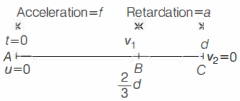
$A$ particle starts moving along a line from zero initial velocity and comes to rest after moving a distance $d$. During its motion,it has a constant acceleration $f$ over $2/3$ of the distance and covers the rest of the distance with constant retardation. The total time taken to cover the distance is
A
$\sqrt{2d/3f}$
B
$2\sqrt{d/3f}$
C
$\sqrt{3d/f}$
D
$\sqrt{3d/2f}$
Solution
(C) Let the particle start from point $A$ with initial velocity $u=0$. It accelerates with $f$ for a distance $s_1 = \frac{2}{3}d$ to reach point $B$ with velocity $v_1$.
Using the equation $v^2 - u^2 = 2as$,we have:
$v_1^2 - 0^2 = 2f(\frac{2}{3}d) \Rightarrow v_1^2 = \frac{4}{3}fd \Rightarrow v_1 = 2\sqrt{\frac{fd}{3}}$.
Time taken for the first part $t_1$ is given by $v = u + at$:
$v_1 = 0 + ft_1 \Rightarrow t_1 = \frac{v_1}{f} = \frac{2}{f}\sqrt{\frac{fd}{3}} = 2\sqrt{\frac{d}{3f}}$.
For the second part of the journey from $B$ to $C$,the distance is $s_2 = \frac{1}{3}d$,initial velocity is $v_1$,and final velocity is $v_2 = 0$. Let the retardation be $a'$.
Using $v_2^2 - v_1^2 = 2a's_2$:
$0 - \frac{4}{3}fd = 2a'(\frac{1}{3}d) \Rightarrow a' = -2f$.
The time taken for the second part $t_2$ is given by $v_2 = v_1 + a't_2$:
$0 = v_1 - 2ft_2 \Rightarrow t_2 = \frac{v_1}{2f} = \frac{2\sqrt{fd/3}}{2f} = \sqrt{\frac{d}{3f}}$.
The total time $t = t_1 + t_2 = 2\sqrt{\frac{d}{3f}} + \sqrt{\frac{d}{3f}} = 3\sqrt{\frac{d}{3f}} = \sqrt{\frac{9d}{3f}} = \sqrt{\frac{3d}{f}}$.
Using the equation $v^2 - u^2 = 2as$,we have:
$v_1^2 - 0^2 = 2f(\frac{2}{3}d) \Rightarrow v_1^2 = \frac{4}{3}fd \Rightarrow v_1 = 2\sqrt{\frac{fd}{3}}$.
Time taken for the first part $t_1$ is given by $v = u + at$:
$v_1 = 0 + ft_1 \Rightarrow t_1 = \frac{v_1}{f} = \frac{2}{f}\sqrt{\frac{fd}{3}} = 2\sqrt{\frac{d}{3f}}$.
For the second part of the journey from $B$ to $C$,the distance is $s_2 = \frac{1}{3}d$,initial velocity is $v_1$,and final velocity is $v_2 = 0$. Let the retardation be $a'$.
Using $v_2^2 - v_1^2 = 2a's_2$:
$0 - \frac{4}{3}fd = 2a'(\frac{1}{3}d) \Rightarrow a' = -2f$.
The time taken for the second part $t_2$ is given by $v_2 = v_1 + a't_2$:
$0 = v_1 - 2ft_2 \Rightarrow t_2 = \frac{v_1}{2f} = \frac{2\sqrt{fd/3}}{2f} = \sqrt{\frac{d}{3f}}$.
The total time $t = t_1 + t_2 = 2\sqrt{\frac{d}{3f}} + \sqrt{\frac{d}{3f}} = 3\sqrt{\frac{d}{3f}} = \sqrt{\frac{9d}{3f}} = \sqrt{\frac{3d}{f}}$.
0 likes
View Solution206
AdvancedMCQ
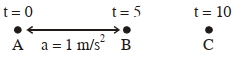
$A$ particle starts from rest at $x=0 \, m$ with an acceleration of $1 \, m/s^2$. At $t = 5 \, s$,it receives an additional acceleration in the same direction as its motion. At $t = 10 \, s$,its speed and position are $v$ and $x$,respectively. Had the additional acceleration not been provided,its speed and position would have been $v_0$ and $x_0$,respectively. It is found that $x - x_0 = 12.5 \, m$. Then one can conclude that $v - v_0$ is .............. $m/s$.
A
$5$
B
$10$
C
$15$
D
$20$
Solution
(A) At $t = 5 \, s$,the velocity of the particle is $v_B = u + at = 0 + (1)(5) = 5 \, m/s$ and its position is $x_B = ut + \frac{1}{2}at^2 = 0 + \frac{1}{2}(1)(5)^2 = 12.5 \, m$.
Let the additional acceleration be $a'$. The total acceleration for $t > 5 \, s$ is $(1 + a')$.
For the case with additional acceleration,at $t = 10 \, s$ (which is $5 \, s$ after the change):
$v = v_B + (1 + a')(5) = 5 + 5 + 5a' = 10 + 5a'$
$x = x_B + v_B(5) + \frac{1}{2}(1 + a')(5)^2 = 12.5 + 5(5) + 12.5(1 + a') = 12.5 + 25 + 12.5 + 12.5a' = 50 + 12.5a'$
If the additional acceleration had not been provided,$a' = 0$:
$v_0 = 5 + (1)(5) = 10 \, m/s$
$x_0 = 12.5 + 5(5) + \frac{1}{2}(1)(5)^2 = 12.5 + 25 + 12.5 = 50 \, m$
Given $x - x_0 = 12.5 \, m$:
$(50 + 12.5a') - 50 = 12.5 \implies 12.5a' = 12.5 \implies a' = 1 \, m/s^2$.
Then,$v - v_0 = (10 + 5a') - 10 = 5a' = 5(1) = 5 \, m/s$.
Let the additional acceleration be $a'$. The total acceleration for $t > 5 \, s$ is $(1 + a')$.
For the case with additional acceleration,at $t = 10 \, s$ (which is $5 \, s$ after the change):
$v = v_B + (1 + a')(5) = 5 + 5 + 5a' = 10 + 5a'$
$x = x_B + v_B(5) + \frac{1}{2}(1 + a')(5)^2 = 12.5 + 5(5) + 12.5(1 + a') = 12.5 + 25 + 12.5 + 12.5a' = 50 + 12.5a'$
If the additional acceleration had not been provided,$a' = 0$:
$v_0 = 5 + (1)(5) = 10 \, m/s$
$x_0 = 12.5 + 5(5) + \frac{1}{2}(1)(5)^2 = 12.5 + 25 + 12.5 = 50 \, m$
Given $x - x_0 = 12.5 \, m$:
$(50 + 12.5a') - 50 = 12.5 \implies 12.5a' = 12.5 \implies a' = 1 \, m/s^2$.
Then,$v - v_0 = (10 + 5a') - 10 = 5a' = 5(1) = 5 \, m/s$.
0 likes
View Solution207
MediumMCQ
$A$ particle is moving in a straight line with initial velocity $u$ and uniform acceleration $a$. If the sum of the distance travelled in the $t^{\text{th}}$ and $(t+1)^{\text{th}}$ seconds is $100 \text{ cm}$,then its velocity after $t$ seconds,in $\text{cm/s}$,is:
A
$80$
B
$50$
C
$20$
D
$30$
Solution
(B) The distance travelled by a particle in the $n^{\text{th}}$ second is given by $S_n = u + \frac{a}{2}(2n - 1)$.
Given that the sum of the distance travelled in the $t^{\text{th}}$ and $(t+1)^{\text{th}}$ seconds is $100 \text{ cm}$.
$S_t + S_{t+1} = 100$
$[u + \frac{a}{2}(2t - 1)] + [u + \frac{a}{2}(2(t+1) - 1)] = 100$
$2u + \frac{a}{2}(2t - 1 + 2t + 2 - 1) = 100$
$2u + \frac{a}{2}(4t) = 100$
$2u + 2at = 100$
$u + at = 50$
Since the velocity after $t$ seconds is given by $v = u + at$,we have $v = 50 \text{ cm/s}$.
Given that the sum of the distance travelled in the $t^{\text{th}}$ and $(t+1)^{\text{th}}$ seconds is $100 \text{ cm}$.
$S_t + S_{t+1} = 100$
$[u + \frac{a}{2}(2t - 1)] + [u + \frac{a}{2}(2(t+1) - 1)] = 100$
$2u + \frac{a}{2}(2t - 1 + 2t + 2 - 1) = 100$
$2u + \frac{a}{2}(4t) = 100$
$2u + 2at = 100$
$u + at = 50$
Since the velocity after $t$ seconds is given by $v = u + at$,we have $v = 50 \text{ cm/s}$.
0 likes
View Solution208
EasyMCQ
The velocity acquired by a body moving with uniform acceleration is $30 \ m/s$ in $2 \ s$ and $60 \ m/s$ in $4 \ s$. The initial velocity is $............. \ m/s$.
A
$4$
B
$0$
C
$2$
D
$10$
Solution
(B) Using the first equation of motion,$v = u + at$,where $v$ is the final velocity,$u$ is the initial velocity,$a$ is the acceleration,and $t$ is the time.
For $t = 2 \ s$,$v = 30 \ m/s$: $30 = u + 2a$ --- (Equation $1$)
For $t = 4 \ s$,$v = 60 \ m/s$: $60 = u + 4a$ --- (Equation $2$)
Subtracting Equation $1$ from Equation $2$:
$(60 - 30) = (u + 4a) - (u + 2a)$
$30 = 2a$
$a = 15 \ m/s^2$
Substituting $a = 15 \ m/s^2$ into Equation $1$:
$30 = u + 2(15)$
$30 = u + 30$
$u = 0 \ m/s$
Therefore,the initial velocity is $0 \ m/s$.
For $t = 2 \ s$,$v = 30 \ m/s$: $30 = u + 2a$ --- (Equation $1$)
For $t = 4 \ s$,$v = 60 \ m/s$: $60 = u + 4a$ --- (Equation $2$)
Subtracting Equation $1$ from Equation $2$:
$(60 - 30) = (u + 4a) - (u + 2a)$
$30 = 2a$
$a = 15 \ m/s^2$
Substituting $a = 15 \ m/s^2$ into Equation $1$:
$30 = u + 2(15)$
$30 = u + 30$
$u = 0 \ m/s$
Therefore,the initial velocity is $0 \ m/s$.
0 likes
View Solution209
MediumMCQ
If the displacement of a particle varies with time as $\sqrt{x} = t + 7$,then
A
Velocity of the particle is inversely proportional to $t$
B
Velocity of the particle is proportional to $t^2$
C
Velocity of the particle is proportional to $\sqrt{t}$
D
The particle moves with constant acceleration
Solution
(D) Given the displacement equation: $\sqrt{x} = t + 7$.
Squaring both sides,we get: $x = (t + 7)^2 = t^2 + 14t + 49$.
The velocity $v$ is the rate of change of displacement with respect to time: $v = \frac{dx}{dt} = \frac{d}{dt}(t^2 + 14t + 49) = 2t + 14$.
The acceleration $a$ is the rate of change of velocity with respect to time: $a = \frac{dv}{dt} = \frac{d}{dt}(2t + 14) = 2 \, m/s^2$.
Since the acceleration $a = 2 \, m/s^2$ is a constant value,the particle moves with constant acceleration.
Squaring both sides,we get: $x = (t + 7)^2 = t^2 + 14t + 49$.
The velocity $v$ is the rate of change of displacement with respect to time: $v = \frac{dx}{dt} = \frac{d}{dt}(t^2 + 14t + 49) = 2t + 14$.
The acceleration $a$ is the rate of change of velocity with respect to time: $a = \frac{dv}{dt} = \frac{d}{dt}(2t + 14) = 2 \, m/s^2$.
Since the acceleration $a = 2 \, m/s^2$ is a constant value,the particle moves with constant acceleration.
0 likes
View Solution210
DifficultMCQ
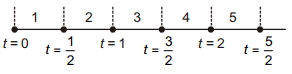
$A$ particle starts moving with acceleration $2 \, m/s^2$. The distance travelled by it in the $5^{\text{th}}$ half-second is ....... $m$. (in $.25$)
A
$1$
B
$2$
C
$6$
D
$30$
Solution
(B) The particle starts from rest,so initial velocity $u = 0$. The acceleration is $a = 2 \, m/s^2$.
To find the distance travelled in the $5^{\text{th}}$ half-second,we calculate the difference between the total distance covered in $2.5 \, s$ and the distance covered in $2 \, s$.
The distance formula is $S = ut + \frac{1}{2}at^2$.
For $t = 2.5 \, s$: $S_{2.5} = 0 + \frac{1}{2} \times 2 \times (2.5)^2 = 6.25 \, m$.
For $t = 2 \, s$: $S_2 = 0 + \frac{1}{2} \times 2 \times (2)^2 = 4 \, m$.
Distance in the $5^{\text{th}}$ half-second = $S_{2.5} - S_2 = 6.25 - 4 = 2.25 \, m$.
To find the distance travelled in the $5^{\text{th}}$ half-second,we calculate the difference between the total distance covered in $2.5 \, s$ and the distance covered in $2 \, s$.
The distance formula is $S = ut + \frac{1}{2}at^2$.
For $t = 2.5 \, s$: $S_{2.5} = 0 + \frac{1}{2} \times 2 \times (2.5)^2 = 6.25 \, m$.
For $t = 2 \, s$: $S_2 = 0 + \frac{1}{2} \times 2 \times (2)^2 = 4 \, m$.
Distance in the $5^{\text{th}}$ half-second = $S_{2.5} - S_2 = 6.25 - 4 = 2.25 \, m$.
0 likes
View Solution211
DifficultMCQ
The two ends of a train moving with constant acceleration pass a certain point with velocities $u$ and $3u$. The velocity with which the middle point of the train passes the same point is ........... $u$.
A
$2$
B
$\frac{3}{2}$
C
$\sqrt{5}$
D
$\sqrt{10}$
Solution
(C) Let the length of the train be $L$ and its constant acceleration be $a$.
Let the velocity at the first end be $v_1 = u$ and at the second end be $v_2 = 3u$.
Using the equation of motion $v^2 = u^2 + 2as$,for the entire length of the train:
$(3u)^2 = u^2 + 2aL$
$9u^2 = u^2 + 2aL$
$8u^2 = 2aL \implies aL = 4u^2$.
Now,let the velocity at the midpoint be $v_m$. The distance covered by the midpoint from the first end is $L/2$.
Using the equation of motion $v_m^2 = u^2 + 2a(L/2)$:
$v_m^2 = u^2 + aL$
Substitute $aL = 4u^2$ into the equation:
$v_m^2 = u^2 + 4u^2 = 5u^2$
$v_m = \sqrt{5}u$.
Thus,the velocity of the middle point is $\sqrt{5}u$.
Let the velocity at the first end be $v_1 = u$ and at the second end be $v_2 = 3u$.
Using the equation of motion $v^2 = u^2 + 2as$,for the entire length of the train:
$(3u)^2 = u^2 + 2aL$
$9u^2 = u^2 + 2aL$
$8u^2 = 2aL \implies aL = 4u^2$.
Now,let the velocity at the midpoint be $v_m$. The distance covered by the midpoint from the first end is $L/2$.
Using the equation of motion $v_m^2 = u^2 + 2a(L/2)$:
$v_m^2 = u^2 + aL$
Substitute $aL = 4u^2$ into the equation:
$v_m^2 = u^2 + 4u^2 = 5u^2$
$v_m = \sqrt{5}u$.
Thus,the velocity of the middle point is $\sqrt{5}u$.
0 likes
View Solution212
MediumMCQ
The initial velocity of a particle is $u$ at $t=0$ and the acceleration $a$ is given by $a = \alpha t^{3/2}$. Which of the following relations is valid?
A
$v=u+\alpha t^{3/2}$
B
$v=u+\frac{3}{2}\alpha t^3$
C
$v=u+\frac{2}{5}\alpha t^{5/2}$
D
$v=u+\alpha t^{5/2}$
Solution
(C) Given,acceleration $a = \frac{dv}{dt} = \alpha t^{3/2}$.
Integrating both sides with respect to time $t$ from $0$ to $t$:
$\int_{u}^{v} dv = \int_{0}^{t} a dt$
$\int_{u}^{v} dv = \int_{0}^{t} \alpha t^{3/2} dt$
$[v]_{u}^{v} = \alpha \left[ \frac{t^{3/2 + 1}}{3/2 + 1} \right]_{0}^{t}$
$v - u = \alpha \left[ \frac{t^{5/2}}{5/2} \right]_{0}^{t}$
$v - u = \frac{2}{5} \alpha t^{5/2}$
$v = u + \frac{2}{5} \alpha t^{5/2}$
Integrating both sides with respect to time $t$ from $0$ to $t$:
$\int_{u}^{v} dv = \int_{0}^{t} a dt$
$\int_{u}^{v} dv = \int_{0}^{t} \alpha t^{3/2} dt$
$[v]_{u}^{v} = \alpha \left[ \frac{t^{3/2 + 1}}{3/2 + 1} \right]_{0}^{t}$
$v - u = \alpha \left[ \frac{t^{5/2}}{5/2} \right]_{0}^{t}$
$v - u = \frac{2}{5} \alpha t^{5/2}$
$v = u + \frac{2}{5} \alpha t^{5/2}$
0 likes
View Solution213
MediumMCQ
$A$ particle moves in a straight line and its position $x$ at time $t$ is given by $x^2 = 2 + t$. Its acceleration is given by
A
$\frac{-2}{x^3}$
B
$-\frac{1}{4x^3}$
C
$-\frac{1}{4x^2}$
D
$\frac{1}{x^2}$
Solution
(B) Given the position equation: $x^2 = t + 2$.
Differentiating both sides with respect to time $t$:
$2x \frac{dx}{dt} = 1 \Rightarrow \frac{dx}{dt} = \frac{1}{2x}$.
Now,differentiate the velocity $v = \frac{dx}{dt} = \frac{1}{2} x^{-1}$ with respect to time $t$ to find acceleration $a$:
$a = \frac{dv}{dt} = \frac{d}{dt} (\frac{1}{2} x^{-1}) = \frac{1}{2} (-1) x^{-2} \frac{dx}{dt}$.
Substitute $\frac{dx}{dt} = \frac{1}{2x}$ into the equation:
$a = -\frac{1}{2x^2} \times \frac{1}{2x} = -\frac{1}{4x^3}$.
Differentiating both sides with respect to time $t$:
$2x \frac{dx}{dt} = 1 \Rightarrow \frac{dx}{dt} = \frac{1}{2x}$.
Now,differentiate the velocity $v = \frac{dx}{dt} = \frac{1}{2} x^{-1}$ with respect to time $t$ to find acceleration $a$:
$a = \frac{dv}{dt} = \frac{d}{dt} (\frac{1}{2} x^{-1}) = \frac{1}{2} (-1) x^{-2} \frac{dx}{dt}$.
Substitute $\frac{dx}{dt} = \frac{1}{2x}$ into the equation:
$a = -\frac{1}{2x^2} \times \frac{1}{2x} = -\frac{1}{4x^3}$.
0 likes
View Solution214
MediumMCQ
The position of a particle moving along the $x$-axis is given by $x = (-2t^3 + 3t^2 + 5) \ m$. The acceleration of the particle at the instant its velocity becomes zero is ....... $m/s^2$.
A
$12$
B
$-12$
C
$-6$
D
$0$
Solution
(C) Given the position function: $x = -2t^3 + 3t^2 + 5$.
Velocity $v$ is the first derivative of position with respect to time: $v = \frac{dx}{dt} = \frac{d}{dt}(-2t^3 + 3t^2 + 5) = -6t^2 + 6t$.
Set the velocity to zero to find the time $t$: $-6t^2 + 6t = 0 \Rightarrow 6t(1 - t) = 0$. This gives $t = 0 \ s$ or $t = 1 \ s$. Since the particle is moving,we consider $t = 1 \ s$.
Acceleration $a$ is the derivative of velocity with respect to time: $a = \frac{dv}{dt} = \frac{d}{dt}(-6t^2 + 6t) = -12t + 6$.
Substitute $t = 1 \ s$ into the acceleration equation: $a = -12(1) + 6 = -6 \ m/s^2$.
Velocity $v$ is the first derivative of position with respect to time: $v = \frac{dx}{dt} = \frac{d}{dt}(-2t^3 + 3t^2 + 5) = -6t^2 + 6t$.
Set the velocity to zero to find the time $t$: $-6t^2 + 6t = 0 \Rightarrow 6t(1 - t) = 0$. This gives $t = 0 \ s$ or $t = 1 \ s$. Since the particle is moving,we consider $t = 1 \ s$.
Acceleration $a$ is the derivative of velocity with respect to time: $a = \frac{dv}{dt} = \frac{d}{dt}(-6t^2 + 6t) = -12t + 6$.
Substitute $t = 1 \ s$ into the acceleration equation: $a = -12(1) + 6 = -6 \ m/s^2$.
0 likes
View Solution215
EasyMCQ
For a body moving with uniform acceleration along a straight line, the variation of its velocity $(v)$ with position $(x)$ is best represented by:
A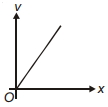
B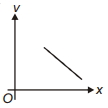
C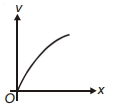
D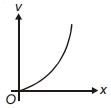
Solution
(D) For a body moving with uniform acceleration $(a = \text{constant})$, the relationship between velocity $(v)$ and position $(x)$ is given by the third equation of motion:
$v^2 = u^2 + 2ax$
Assuming the body starts from rest $(u = 0)$, the equation simplifies to:
$v^2 = 2ax$
Since $2a$ is a constant, we have $v^2 \propto x$, which implies $v \propto \sqrt{x}$.
The graph of $v = k\sqrt{x}$ (where $k$ is a constant) is a parabola opening along the positive $x$-axis. Among the given options, the curve that represents this relationship is shown in option $(D)$.
$v^2 = u^2 + 2ax$
Assuming the body starts from rest $(u = 0)$, the equation simplifies to:
$v^2 = 2ax$
Since $2a$ is a constant, we have $v^2 \propto x$, which implies $v \propto \sqrt{x}$.
The graph of $v = k\sqrt{x}$ (where $k$ is a constant) is a parabola opening along the positive $x$-axis. Among the given options, the curve that represents this relationship is shown in option $(D)$.
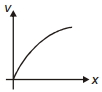
0 likes
View Solution216
MediumMCQ
The initial velocity of a particle moving along the $x$-axis is $u$ (at $t=0$ and $x=0$) and its acceleration $a$ is given by $a=kx$. Which of the following equations is correct for its velocity $(v)$ and position $(x)$?
A
$v^2-u^2=2kx$
B
$v^2=u^2+2kx^2$
C
$v^2=u^2+kx^2$
D
$v^2+u^2=2kx$
Solution
(C) Given that acceleration $a = kx$.
We know that acceleration can be expressed as $a = v \frac{dv}{dx}$.
Substituting the given expression for $a$:
$v \frac{dv}{dx} = kx$
Rearranging the terms to integrate:
$v \, dv = kx \, dx$
Integrating both sides with initial conditions $v=u$ at $x=0$ and final velocity $v$ at position $x$:
$\int_{u}^{v} v \, dv = \int_{0}^{x} kx \, dx$
Evaluating the integrals:
$\left[ \frac{v^2}{2} \right]_{u}^{v} = k \left[ \frac{x^2}{2} \right]_{0}^{x}$
$\frac{v^2 - u^2}{2} = \frac{kx^2}{2}$
Multiplying by $2$ on both sides:
$v^2 - u^2 = kx^2$
Therefore,$v^2 = u^2 + kx^2$.
We know that acceleration can be expressed as $a = v \frac{dv}{dx}$.
Substituting the given expression for $a$:
$v \frac{dv}{dx} = kx$
Rearranging the terms to integrate:
$v \, dv = kx \, dx$
Integrating both sides with initial conditions $v=u$ at $x=0$ and final velocity $v$ at position $x$:
$\int_{u}^{v} v \, dv = \int_{0}^{x} kx \, dx$
Evaluating the integrals:
$\left[ \frac{v^2}{2} \right]_{u}^{v} = k \left[ \frac{x^2}{2} \right]_{0}^{x}$
$\frac{v^2 - u^2}{2} = \frac{kx^2}{2}$
Multiplying by $2$ on both sides:
$v^2 - u^2 = kx^2$
Therefore,$v^2 = u^2 + kx^2$.
0 likes
View Solution217
DifficultMCQ
The relation between position $(x)$ and time $(t)$ is given below for a particle moving along a straight line. Which of the following equations represents uniformly accelerated motion? [where $\alpha$ and $\beta$ are positive constants]
A
$\beta x = \alpha t + \alpha \beta$
B
$\alpha x = \beta + t$
C
$x t = \alpha \beta$
D
$\alpha t = \sqrt{\beta + x}$
Solution
(D) For uniformly accelerated motion,the position $(x)$ as a function of time $(t)$ must be a quadratic equation of the form $x = ut + \frac{1}{2}at^2$,where $u$ is the initial velocity and $a$ is the constant acceleration.
Let us analyze option $(d)$:
$\alpha t = \sqrt{\beta + x}$
Squaring both sides:
$(\alpha t)^2 = \beta + x$
$\alpha^2 t^2 = \beta + x$
$x = \alpha^2 t^2 - \beta$
Comparing this with the standard kinematic equation $x = ut + \frac{1}{2}at^2$,we see that the position $x$ is a quadratic function of time $t$ (with $u = 0$ and $a = 2\alpha^2$).
Since the acceleration $a = 2\alpha^2$ is a constant,this equation represents uniformly accelerated motion.
Therefore,the correct option is $(d)$.
Let us analyze option $(d)$:
$\alpha t = \sqrt{\beta + x}$
Squaring both sides:
$(\alpha t)^2 = \beta + x$
$\alpha^2 t^2 = \beta + x$
$x = \alpha^2 t^2 - \beta$
Comparing this with the standard kinematic equation $x = ut + \frac{1}{2}at^2$,we see that the position $x$ is a quadratic function of time $t$ (with $u = 0$ and $a = 2\alpha^2$).
Since the acceleration $a = 2\alpha^2$ is a constant,this equation represents uniformly accelerated motion.
Therefore,the correct option is $(d)$.
0 likes
View Solution218
MediumMCQ
The velocity $v$ of a particle moving along the $x$-axis varies with its position $x$ as $v = \alpha \sqrt{x}$,where $\alpha$ is a constant. Which of the following graphs represents the variation of its acceleration $a$ with time $t$?
A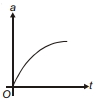
B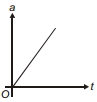
C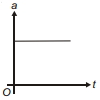
D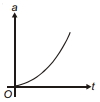
Solution
(C) Given the velocity $v = \alpha \sqrt{x}$.
We know that acceleration $a = v \frac{dv}{dx}$.
First,find $\frac{dv}{dx}$:
$\frac{dv}{dx} = \alpha \cdot \frac{1}{2\sqrt{x}} = \frac{\alpha}{2\sqrt{x}}$.
Now,substitute $v$ and $\frac{dv}{dx}$ into the acceleration formula:
$a = (\alpha \sqrt{x}) \cdot \left( \frac{\alpha}{2\sqrt{x}} \right) = \frac{\alpha^2}{2}$.
Since $\alpha$ is a constant,the acceleration $a = \frac{\alpha^2}{2}$ is also a constant.
Therefore,the graph of acceleration $a$ versus time $t$ is a horizontal straight line parallel to the time axis,which corresponds to option $C$.
We know that acceleration $a = v \frac{dv}{dx}$.
First,find $\frac{dv}{dx}$:
$\frac{dv}{dx} = \alpha \cdot \frac{1}{2\sqrt{x}} = \frac{\alpha}{2\sqrt{x}}$.
Now,substitute $v$ and $\frac{dv}{dx}$ into the acceleration formula:
$a = (\alpha \sqrt{x}) \cdot \left( \frac{\alpha}{2\sqrt{x}} \right) = \frac{\alpha^2}{2}$.
Since $\alpha$ is a constant,the acceleration $a = \frac{\alpha^2}{2}$ is also a constant.
Therefore,the graph of acceleration $a$ versus time $t$ is a horizontal straight line parallel to the time axis,which corresponds to option $C$.

0 likes
View Solution219
DifficultMCQ
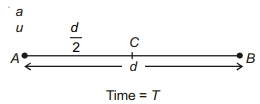
$A$ particle starts with an initial speed $u$ and retardation $a$ to come to rest in time $T$. The time taken to cover the first half of the total path travelled is .......
A
$\frac{T}{\sqrt{2}}$
B
$T\left(1-\frac{1}{\sqrt{2}}\right)$
C
$\frac{T}{2}$
D
$\frac{3 T}{4}$
Solution
(B) Let the total distance covered be $d$.
For the total journey:
Initial velocity $= u$,final velocity $= 0$,acceleration $= -a$,time $= T$.
Using $v = u + at$:
$0 = u - aT \Rightarrow u = aT$
Total distance $d = uT - \frac{1}{2}aT^2 = (aT)T - \frac{1}{2}aT^2 = \frac{1}{2}aT^2$.
For the first half of the journey:
Distance $= \frac{d}{2} = \frac{1}{4}aT^2$.
Let the time taken be $t$.
Using $s = ut - \frac{1}{2}at^2$:
$\frac{1}{4}aT^2 = (aT)t - \frac{1}{2}at^2$
Dividing by $a$:
$\frac{T^2}{4} = Tt - \frac{t^2}{2}$
$T^2 = 4Tt - 2t^2 \Rightarrow 2t^2 - 4Tt + T^2 = 0$.
Using the quadratic formula $t = \frac{-b \pm \sqrt{b^2 - 4ac}}{2a}$:
$t = \frac{4T \pm \sqrt{16T^2 - 8T^2}}{4} = \frac{4T \pm \sqrt{8T^2}}{4} = \frac{4T \pm 2\sqrt{2}T}{4} = T \pm \frac{T}{\sqrt{2}}$.
Since $t < T$,we take $t = T(1 - \frac{1}{\sqrt{2}})$.
Thus,the correct option is $(b)$.
For the total journey:
Initial velocity $= u$,final velocity $= 0$,acceleration $= -a$,time $= T$.
Using $v = u + at$:
$0 = u - aT \Rightarrow u = aT$
Total distance $d = uT - \frac{1}{2}aT^2 = (aT)T - \frac{1}{2}aT^2 = \frac{1}{2}aT^2$.
For the first half of the journey:
Distance $= \frac{d}{2} = \frac{1}{4}aT^2$.
Let the time taken be $t$.
Using $s = ut - \frac{1}{2}at^2$:
$\frac{1}{4}aT^2 = (aT)t - \frac{1}{2}at^2$
Dividing by $a$:
$\frac{T^2}{4} = Tt - \frac{t^2}{2}$
$T^2 = 4Tt - 2t^2 \Rightarrow 2t^2 - 4Tt + T^2 = 0$.
Using the quadratic formula $t = \frac{-b \pm \sqrt{b^2 - 4ac}}{2a}$:
$t = \frac{4T \pm \sqrt{16T^2 - 8T^2}}{4} = \frac{4T \pm \sqrt{8T^2}}{4} = \frac{4T \pm 2\sqrt{2}T}{4} = T \pm \frac{T}{\sqrt{2}}$.
Since $t < T$,we take $t = T(1 - \frac{1}{\sqrt{2}})$.
Thus,the correct option is $(b)$.
0 likes
View Solution220
MediumMCQ
$A$ body lying initially at point $(3,7)$ starts moving with a constant acceleration of $4 \hat{i}$. Its position after $3 \,s$ is given by the coordinates ..........
A
$(7,3)$
B
$(7,18)$
C
$(21,7)$
D
$(3,7)$
Solution
(C) The initial position of the particle is $(x_0, y_0) = (3, 7)$.
The initial velocity is $u = 0$ as the body starts from rest.
The acceleration is given as $\vec{a} = 4 \hat{i}$,which means $a_x = 4$ and $a_y = 0$.
Using the equation of motion $s = s_0 + ut + \frac{1}{2}at^2$ for both axes:
For the $x$-coordinate:
$x = x_0 + u_x t + \frac{1}{2} a_x t^2$
$x = 3 + (0)(3) + \frac{1}{2} \times 4 \times (3)^2$
$x = 3 + 0 + 2 \times 9 = 3 + 18 = 21$.
For the $y$-coordinate:
$y = y_0 + u_y t + \frac{1}{2} a_y t^2$
$y = 7 + (0)(3) + \frac{1}{2} \times 0 \times (3)^2$
$y = 7 + 0 + 0 = 7$.
Thus,the final coordinates after $3 \,s$ are $(21, 7)$.
The initial velocity is $u = 0$ as the body starts from rest.
The acceleration is given as $\vec{a} = 4 \hat{i}$,which means $a_x = 4$ and $a_y = 0$.
Using the equation of motion $s = s_0 + ut + \frac{1}{2}at^2$ for both axes:
For the $x$-coordinate:
$x = x_0 + u_x t + \frac{1}{2} a_x t^2$
$x = 3 + (0)(3) + \frac{1}{2} \times 4 \times (3)^2$
$x = 3 + 0 + 2 \times 9 = 3 + 18 = 21$.
For the $y$-coordinate:
$y = y_0 + u_y t + \frac{1}{2} a_y t^2$
$y = 7 + (0)(3) + \frac{1}{2} \times 0 \times (3)^2$
$y = 7 + 0 + 0 = 7$.
Thus,the final coordinates after $3 \,s$ are $(21, 7)$.
0 likes
View Solution221
MediumMCQ
$A$ lift of mass $M = 500 \, kg$ is descending with a speed of $2 \, ms^{-1}$. Its supporting cable begins to slip,thus allowing it to fall with a constant acceleration of $2 \, ms^{-2}$. The kinetic energy of the lift at the end of a fall through a distance of $6 \, m$ will be $........... \, kJ$.
A
$7$
B
$5$
C
$4$
D
$3$
Solution
(A) Given: Mass $M = 500 \, kg$,initial velocity $u = 2 \, ms^{-1}$,acceleration $a = 2 \, ms^{-2}$,and distance $s = 6 \, m$.
Using the kinematic equation $v^2 = u^2 + 2as$ to find the final velocity $v$:
$v^2 = (2)^2 + 2(2)(6)$
$v^2 = 4 + 24 = 28 \, m^2s^{-2}$.
The kinetic energy $KE$ is given by the formula $KE = \frac{1}{2} Mv^2$.
Substituting the values:
$KE = \frac{1}{2} \times 500 \times 28$
$KE = 250 \times 28 = 7000 \, J$.
Converting to kilojoules: $7000 \, J = 7 \, kJ$.
Using the kinematic equation $v^2 = u^2 + 2as$ to find the final velocity $v$:
$v^2 = (2)^2 + 2(2)(6)$
$v^2 = 4 + 24 = 28 \, m^2s^{-2}$.
The kinetic energy $KE$ is given by the formula $KE = \frac{1}{2} Mv^2$.
Substituting the values:
$KE = \frac{1}{2} \times 500 \times 28$
$KE = 250 \times 28 = 7000 \, J$.
Converting to kilojoules: $7000 \, J = 7 \, kJ$.
0 likes
View Solution222
MediumMCQ
For a train engine moving with a speed of $20 \; m/s$,the driver must apply brakes at a distance of $500 \; m$ before the station for the train to come to rest at the station. If the brakes were applied at half of this distance,the train engine would cross the station with a speed of $\sqrt{x} \; m/s$. The value of $x$ is $..............$ (Assuming the same retardation is produced by the brakes).
A
$100$
B
$101$
C
$520$
D
$200$
Solution
(D) Initial velocity $u = 20 \; m/s$. Final velocity $v = 0$. Distance $S_1 = 500 \; m$.
Using the third equation of motion,$v^2 = u^2 - 2aS_1$:
$0 = (20)^2 - 2 \cdot a \cdot 500$
$1000a = 400 \Rightarrow a = 0.4 \; m/s^2$.
Now,if the brakes are applied at half the distance,$S_2 = 250 \; m$:
$v^2 = u^2 - 2aS_2$
$v^2 = (20)^2 - 2 \cdot 0.4 \cdot 250$
$v^2 = 400 - 200 = 200$
$v = \sqrt{200} \; m/s$.
Comparing with $\sqrt{x} \; m/s$,we get $x = 200$.
Using the third equation of motion,$v^2 = u^2 - 2aS_1$:
$0 = (20)^2 - 2 \cdot a \cdot 500$
$1000a = 400 \Rightarrow a = 0.4 \; m/s^2$.
Now,if the brakes are applied at half the distance,$S_2 = 250 \; m$:
$v^2 = u^2 - 2aS_2$
$v^2 = (20)^2 - 2 \cdot 0.4 \cdot 250$
$v^2 = 400 - 200 = 200$
$v = \sqrt{200} \; m/s$.
Comparing with $\sqrt{x} \; m/s$,we get $x = 200$.
2 likes
View Solution223
MediumMCQ
The distance covered by a body of mass $5\,g$ having linear momentum $0.3\,kg\,m/s$ in $5\,s$ is $..........\,m$.
A
$300$
B
$30$
C
$3$
D
$0.3$
Solution
(A) Given: Mass $m = 5\,g = 0.005\,kg$,Linear momentum $p = 0.3\,kg\,m/s$,Time $t = 5\,s$.
We know that linear momentum $p = mv$,where $v$ is the velocity.
Substituting the values: $0.005 \times v = 0.3$.
Solving for velocity: $v = \frac{0.3}{0.005} = \frac{300}{5} = 60\,m/s$.
Assuming the body moves with constant velocity,the distance covered $d = v \times t$.
$d = 60\,m/s \times 5\,s = 300\,m$.
We know that linear momentum $p = mv$,where $v$ is the velocity.
Substituting the values: $0.005 \times v = 0.3$.
Solving for velocity: $v = \frac{0.3}{0.005} = \frac{300}{5} = 60\,m/s$.
Assuming the body moves with constant velocity,the distance covered $d = v \times t$.
$d = 60\,m/s \times 5\,s = 300\,m$.
0 likes
View Solution224
EasyMCQ
$A$ particle starts with an initial velocity of $10.0 \, m/s$ along the $x$-direction and accelerates uniformly at the rate of $2.0 \, m/s^2$. The time taken by the particle to reach the velocity of $60.0 \, m/s$ is $....... \, s$.
A
$6$
B
$3$
C
$30$
D
$25$
Solution
(D) Given:
Initial velocity $u = 10.0 \, m/s$
Final velocity $v = 60.0 \, m/s$
Acceleration $a = 2.0 \, m/s^2$
Using the first equation of motion:
$v = u + at$
Substituting the values:
$60.0 = 10.0 + (2.0)t$
$60.0 - 10.0 = 2.0t$
$50.0 = 2.0t$
$t = \frac{50.0}{2.0} = 25.0 \, s$
Therefore,the time taken is $25 \, s$.
Initial velocity $u = 10.0 \, m/s$
Final velocity $v = 60.0 \, m/s$
Acceleration $a = 2.0 \, m/s^2$
Using the first equation of motion:
$v = u + at$
Substituting the values:
$60.0 = 10.0 + (2.0)t$
$60.0 - 10.0 = 2.0t$
$50.0 = 2.0t$
$t = \frac{50.0}{2.0} = 25.0 \, s$
Therefore,the time taken is $25 \, s$.
3 likes
View Solution225
MediumMCQ
$A$ bullet from a gun is fired into a rectangular wooden block with velocity $u$. When the bullet travels $24\,cm$ through the block along its length horizontally,the velocity of the bullet becomes $\frac{u}{3}$. It then further penetrates into the block in the same direction before coming to rest exactly at the other end of the block. The total length of the block is $........\,cm$.
A
$30$
B
$27$
C
$24$
D
$28$
Solution
(B) Let the retardation produced by the wooden block be $a$. Using the equation of motion $v^2 = u^2 + 2as$:
For the first $24\,cm$ $(s_1 = 24\,cm)$:
$(\frac{u}{3})^2 = u^2 - 2a(24)$
$\frac{u^2}{9} = u^2 - 48a$
$48a = u^2 - \frac{u^2}{9} = \frac{8u^2}{9}$
$a = \frac{8u^2}{9 \times 48} = \frac{u^2}{54}.........(1)$
Now,let the total length of the block be $L$. For the entire motion until the bullet comes to rest $(v=0)$:
$0^2 = u^2 - 2aL$
$2aL = u^2$
$L = \frac{u^2}{2a}.........(2)$
Substituting the value of $a$ from $(1)$ into $(2)$:
$L = \frac{u^2}{2 \times (u^2/54)} = \frac{54}{2} = 27\,cm$.
For the first $24\,cm$ $(s_1 = 24\,cm)$:
$(\frac{u}{3})^2 = u^2 - 2a(24)$
$\frac{u^2}{9} = u^2 - 48a$
$48a = u^2 - \frac{u^2}{9} = \frac{8u^2}{9}$
$a = \frac{8u^2}{9 \times 48} = \frac{u^2}{54}.........(1)$
Now,let the total length of the block be $L$. For the entire motion until the bullet comes to rest $(v=0)$:
$0^2 = u^2 - 2aL$
$2aL = u^2$
$L = \frac{u^2}{2a}.........(2)$
Substituting the value of $a$ from $(1)$ into $(2)$:
$L = \frac{u^2}{2 \times (u^2/54)} = \frac{54}{2} = 27\,cm$.
3 likes
View Solution226
MediumMCQ
$A$ bullet is fired into a fixed target and loses one-third of its velocity after traveling $4 \ cm$. It penetrates a further $D \times 10^{-3} \ m$ before coming to rest. The value of $D$ is:
A
$2$
B
$5$
C
$32$
D
$4$
Solution
(C) Let the initial velocity be $u$ and the constant retardation be $a$. Using the equation of motion $v^2 - u^2 = 2aS$:
After traveling $S_1 = 4 \ cm = 4 \times 10^{-2} \ m$,the velocity becomes $v_1 = u - \frac{1}{3}u = \frac{2}{3}u$.
Substituting into the equation: $(\frac{2}{3}u)^2 - u^2 = 2(-a)(4 \times 10^{-2})$
$\frac{4}{9}u^2 - u^2 = -8a \times 10^{-2}$
$-\frac{5}{9}u^2 = -8a \times 10^{-2} \implies a = \frac{5u^2}{72 \times 10^{-2}} \dots(1)$
Now,for the remaining distance $x = D \times 10^{-3} \ m$,the initial velocity is $\frac{2}{3}u$ and the final velocity is $0$:
$0^2 - (\frac{2}{3}u)^2 = 2(-a)(x)$
$-\frac{4}{9}u^2 = -2ax \implies x = \frac{4u^2}{18a} = \frac{2u^2}{9a} \dots(2)$
Substituting $a$ from $(1)$ into $(2)$:
$x = \frac{2u^2}{9} \times \frac{72 \times 10^{-2}}{5u^2} = \frac{2 \times 8 \times 10^{-2}}{5} = \frac{16}{5} \times 10^{-2} = 3.2 \times 10^{-2} \ m = 32 \times 10^{-3} \ m$.
Comparing with $D \times 10^{-3} \ m$,we get $D = 32$.
After traveling $S_1 = 4 \ cm = 4 \times 10^{-2} \ m$,the velocity becomes $v_1 = u - \frac{1}{3}u = \frac{2}{3}u$.
Substituting into the equation: $(\frac{2}{3}u)^2 - u^2 = 2(-a)(4 \times 10^{-2})$
$\frac{4}{9}u^2 - u^2 = -8a \times 10^{-2}$
$-\frac{5}{9}u^2 = -8a \times 10^{-2} \implies a = \frac{5u^2}{72 \times 10^{-2}} \dots(1)$
Now,for the remaining distance $x = D \times 10^{-3} \ m$,the initial velocity is $\frac{2}{3}u$ and the final velocity is $0$:
$0^2 - (\frac{2}{3}u)^2 = 2(-a)(x)$
$-\frac{4}{9}u^2 = -2ax \implies x = \frac{4u^2}{18a} = \frac{2u^2}{9a} \dots(2)$
Substituting $a$ from $(1)$ into $(2)$:
$x = \frac{2u^2}{9} \times \frac{72 \times 10^{-2}}{5u^2} = \frac{2 \times 8 \times 10^{-2}}{5} = \frac{16}{5} \times 10^{-2} = 3.2 \times 10^{-2} \ m = 32 \times 10^{-3} \ m$.
Comparing with $D \times 10^{-3} \ m$,we get $D = 32$.
0 likes
View Solution227
DifficultMCQ
$A$ body starts moving from rest with constant acceleration. It covers a displacement $S_1$ in the first $(p-1)$ seconds and $S_2$ in the first $p$ seconds. The total displacement $S_1+S_2$ will be covered in time:
A
$(2p+1) \ s$
B
$\sqrt{2p^2-2p+1} \ s$
C
$(2p-1) \ s$
D
$(2p^2-2p+1) \ s$
Solution
(B) Given that the body starts from rest,the initial velocity $u = 0$. The displacement $S$ covered in time $t$ with constant acceleration $a$ is given by $S = \frac{1}{2}at^2$.
For the first $(p-1)$ seconds,the displacement is $S_1 = \frac{1}{2}a(p-1)^2$.
For the first $p$ seconds,the displacement is $S_2 = \frac{1}{2}ap^2$.
We need to find the time $t$ such that the total displacement is $S_1 + S_2 = \frac{1}{2}at^2$.
Substituting the expressions for $S_1$ and $S_2$:
$\frac{1}{2}a(p-1)^2 + \frac{1}{2}ap^2 = \frac{1}{2}at^2$
Dividing both sides by $\frac{1}{2}a$:
$(p-1)^2 + p^2 = t^2$
$p^2 - 2p + 1 + p^2 = t^2$
$2p^2 - 2p + 1 = t^2$
$t = \sqrt{2p^2 - 2p + 1} \ s$.
For the first $(p-1)$ seconds,the displacement is $S_1 = \frac{1}{2}a(p-1)^2$.
For the first $p$ seconds,the displacement is $S_2 = \frac{1}{2}ap^2$.
We need to find the time $t$ such that the total displacement is $S_1 + S_2 = \frac{1}{2}at^2$.
Substituting the expressions for $S_1$ and $S_2$:
$\frac{1}{2}a(p-1)^2 + \frac{1}{2}ap^2 = \frac{1}{2}at^2$
Dividing both sides by $\frac{1}{2}a$:
$(p-1)^2 + p^2 = t^2$
$p^2 - 2p + 1 + p^2 = t^2$
$2p^2 - 2p + 1 = t^2$
$t = \sqrt{2p^2 - 2p + 1} \ s$.
0 likes
View Solution228
DifficultMCQ
$A$ particle is moving in a straight line. The variation of position $x$ as a function of time $t$ is given as $x = (t^3 - 6t^2 + 20t + 15) \ m$. The velocity of the body when its acceleration becomes zero is ........... $m/s$.
A
$4$
B
$8$
C
$10$
D
$6$
Solution
(B) Given position: $x = t^3 - 6t^2 + 20t + 15 \ m$.
Velocity $v$ is the first derivative of position with respect to time: $v = \frac{dx}{dt} = 3t^2 - 12t + 20 \ m/s$.
Acceleration $a$ is the derivative of velocity with respect to time: $a = \frac{dv}{dt} = 6t - 12 \ m/s^2$.
Set acceleration to zero to find the time: $6t - 12 = 0 \implies t = 2 \ s$.
Substitute $t = 2 \ s$ into the velocity equation: $v = 3(2)^2 - 12(2) + 20 = 12 - 24 + 20 = 8 \ m/s$.
Velocity $v$ is the first derivative of position with respect to time: $v = \frac{dx}{dt} = 3t^2 - 12t + 20 \ m/s$.
Acceleration $a$ is the derivative of velocity with respect to time: $a = \frac{dv}{dt} = 6t - 12 \ m/s^2$.
Set acceleration to zero to find the time: $6t - 12 = 0 \implies t = 2 \ s$.
Substitute $t = 2 \ s$ into the velocity equation: $v = 3(2)^2 - 12(2) + 20 = 12 - 24 + 20 = 8 \ m/s$.
0 likes
View Solution229
DifficultMCQ
The displacement and the increase in the velocity of a moving particle in the time interval of $t$ to $(t+1) s$ are $125 \ m$ and $50 \ m/s$,respectively. The distance travelled by the particle in $(t+2)^{th} s$ is . . . . . . $m$.
A
$24$
B
$175$
C
$458$
D
$157$
Solution
(B) Let the initial velocity at time $t$ be $u$ and acceleration be $a$.
Given that the increase in velocity in $1 \ s$ is $50 \ m/s$,we have $v = u + a(1) = u + 50$.
Thus,$a = 50 \ m/s^2$.
The displacement in the interval $t$ to $t+1$ is given by $s = ut + \frac{1}{2}at^2$. For the interval of $1 \ s$ starting at $t$,the displacement is $s = u(1) + \frac{1}{2}a(1)^2 = 125$.
Substituting $a = 50$,we get $u + 25 = 125$,which implies $u = 100 \ m/s$.
The distance travelled in the $(t+2)^{th}$ second is given by $S_n = u + \frac{a}{2}(2n - 1)$,where $n = t+2$.
However,the question asks for the distance in the $(t+2)^{th}$ second relative to the start of the motion. Since $u$ is the velocity at time $t$,the distance in the next second (the $(t+1)^{th}$ second) is $125 \ m$. The distance in the $(t+2)^{th}$ second is $S = (u+a) + \frac{a}{2} = 100 + 50 + 25 = 175 \ m$.
Given that the increase in velocity in $1 \ s$ is $50 \ m/s$,we have $v = u + a(1) = u + 50$.
Thus,$a = 50 \ m/s^2$.
The displacement in the interval $t$ to $t+1$ is given by $s = ut + \frac{1}{2}at^2$. For the interval of $1 \ s$ starting at $t$,the displacement is $s = u(1) + \frac{1}{2}a(1)^2 = 125$.
Substituting $a = 50$,we get $u + 25 = 125$,which implies $u = 100 \ m/s$.
The distance travelled in the $(t+2)^{th}$ second is given by $S_n = u + \frac{a}{2}(2n - 1)$,where $n = t+2$.
However,the question asks for the distance in the $(t+2)^{th}$ second relative to the start of the motion. Since $u$ is the velocity at time $t$,the distance in the next second (the $(t+1)^{th}$ second) is $125 \ m$. The distance in the $(t+2)^{th}$ second is $S = (u+a) + \frac{a}{2} = 100 + 50 + 25 = 175 \ m$.
0 likes
View Solution230
DifficultMCQ
$A$ particle initially at rest starts moving from reference point $x=0$ along the $x$-axis,with velocity $v$ that varies as $v=4 \sqrt{x} \ m/s$. The acceleration of the particle is . . . . . . $m/s^2$.
A
$7$
B
$8$
C
$9$
D
$10$
Solution
(B) Given the velocity of the particle as a function of position: $v = 4\sqrt{x}$.
Acceleration $a$ can be expressed in terms of position $x$ using the formula: $a = v \frac{dv}{dx}$.
First,differentiate $v$ with respect to $x$: $\frac{dv}{dx} = \frac{d}{dx}(4x^{1/2}) = 4 \cdot \frac{1}{2} x^{-1/2} = 2x^{-1/2} = \frac{2}{\sqrt{x}}$.
Now,substitute $v$ and $\frac{dv}{dx}$ into the acceleration formula:
$a = (4\sqrt{x}) \cdot (\frac{2}{\sqrt{x}})$.
$a = 4 \cdot 2 = 8 \ m/s^2$.
Thus,the acceleration of the particle is constant at $8 \ m/s^2$.
Acceleration $a$ can be expressed in terms of position $x$ using the formula: $a = v \frac{dv}{dx}$.
First,differentiate $v$ with respect to $x$: $\frac{dv}{dx} = \frac{d}{dx}(4x^{1/2}) = 4 \cdot \frac{1}{2} x^{-1/2} = 2x^{-1/2} = \frac{2}{\sqrt{x}}$.
Now,substitute $v$ and $\frac{dv}{dx}$ into the acceleration formula:
$a = (4\sqrt{x}) \cdot (\frac{2}{\sqrt{x}})$.
$a = 4 \cdot 2 = 8 \ m/s^2$.
Thus,the acceleration of the particle is constant at $8 \ m/s^2$.
0 likes
View Solution231
DifficultMCQ
$A$ body travels $102.5 \ m$ in the $n^{\text{th}}$ second and $115.0 \ m$ in the $(n+2)^{\text{th}}$ second. The acceleration is: (in $m/s^2$)
A
$9$
B
$6.25$
C
$12.5$
D
$5$
Solution
(B) The distance traveled by a body in the $n^{\text{th}}$ second is given by the formula $S_n = u + \frac{a}{2}(2n - 1)$.
For the $n^{\text{th}}$ second: $102.5 = u + \frac{a}{2}(2n - 1) \quad \dots(1)$
For the $(n+2)^{\text{th}}$ second: $115.0 = u + \frac{a}{2}(2(n+2) - 1) = u + \frac{a}{2}(2n + 3) \quad \dots(2)$
Subtracting equation $(1)$ from equation $(2)$:
$115.0 - 102.5 = [u + \frac{a}{2}(2n + 3)] - [u + \frac{a}{2}(2n - 1)]$
$12.5 = \frac{a}{2} (2n + 3 - 2n + 1)$
$12.5 = \frac{a}{2} (4)$
$12.5 = 2a$
$a = \frac{12.5}{2} = 6.25 \ m/s^2$.
Therefore,the acceleration is $6.25 \ m/s^2$.
For the $n^{\text{th}}$ second: $102.5 = u + \frac{a}{2}(2n - 1) \quad \dots(1)$
For the $(n+2)^{\text{th}}$ second: $115.0 = u + \frac{a}{2}(2(n+2) - 1) = u + \frac{a}{2}(2n + 3) \quad \dots(2)$
Subtracting equation $(1)$ from equation $(2)$:
$115.0 - 102.5 = [u + \frac{a}{2}(2n + 3)] - [u + \frac{a}{2}(2n - 1)]$
$12.5 = \frac{a}{2} (2n + 3 - 2n + 1)$
$12.5 = \frac{a}{2} (4)$
$12.5 = 2a$
$a = \frac{12.5}{2} = 6.25 \ m/s^2$.
Therefore,the acceleration is $6.25 \ m/s^2$.
0 likes
View Solution232
DifficultMCQ
$A$ bus moving along a straight highway with a speed of $72 \,km/h$ is brought to a halt within $4 \,s$ after applying the brakes. The distance travelled by the bus during this time (assume the retardation is uniform) is . . . . . . $m$.
A
$30$
B
$40$
C
$60$
D
$70$
Solution
(B) Initial velocity $u = 72 \,km/h = 72 \times \frac{5}{18} \,m/s = 20 \,m/s$.
Final velocity $v = 0 \,m/s$ (as the bus comes to a halt).
Time $t = 4 \,s$.
Using the first equation of motion, $v = u + at$, we find the acceleration:
$0 = 20 + a(4) \Rightarrow 4a = -20 \Rightarrow a = -5 \,m/s^2$.
The distance $s$ travelled can be calculated using the second equation of motion, $s = ut + \frac{1}{2}at^2$:
$s = (20)(4) + \frac{1}{2}(-5)(4)^2$
$s = 80 - \frac{1}{2}(5)(16)$
$s = 80 - 40 = 40 \,m$.
Final velocity $v = 0 \,m/s$ (as the bus comes to a halt).
Time $t = 4 \,s$.
Using the first equation of motion, $v = u + at$, we find the acceleration:
$0 = 20 + a(4) \Rightarrow 4a = -20 \Rightarrow a = -5 \,m/s^2$.
The distance $s$ travelled can be calculated using the second equation of motion, $s = ut + \frac{1}{2}at^2$:
$s = (20)(4) + \frac{1}{2}(-5)(4)^2$
$s = 80 - \frac{1}{2}(5)(16)$
$s = 80 - 40 = 40 \,m$.
0 likes
View Solution233
DifficultMCQ
$A$ body moves on a frictionless plane starting from rest. If $S_{n}$ is the distance moved between $t=n-1$ and $t=n$,and $S_{n-1}$ is the distance moved between $t=n-2$ and $t=n-1$,then the ratio $\frac{S_{n-1}}{S_n}$ is $\left(1-\frac{2}{x}\right)$ for $n=10$. The value of $x$ is:
A
$18$
B
$19$
C
$20$
D
$21$
Solution
(B) The distance traveled by an object in the $n^{th}$ second is given by the formula $S_n = u + \frac{a}{2}(2n-1)$.
Since the body starts from rest,$u = 0$,so $S_n = \frac{a}{2}(2n-1)$.
For $n=10$,$S_{10} = \frac{a}{2}(2(10)-1) = \frac{19a}{2}$.
For $n-1=9$,$S_{9} = \frac{a}{2}(2(9)-1) = \frac{17a}{2}$.
The ratio is $\frac{S_{n-1}}{S_n} = \frac{17a/2}{19a/2} = \frac{17}{19}$.
Given the ratio is $1 - \frac{2}{x}$,we have $1 - \frac{2}{x} = \frac{17}{19}$.
This implies $\frac{2}{x} = 1 - \frac{17}{19} = \frac{2}{19}$.
Therefore,$x = 19$.
Since the body starts from rest,$u = 0$,so $S_n = \frac{a}{2}(2n-1)$.
For $n=10$,$S_{10} = \frac{a}{2}(2(10)-1) = \frac{19a}{2}$.
For $n-1=9$,$S_{9} = \frac{a}{2}(2(9)-1) = \frac{17a}{2}$.
The ratio is $\frac{S_{n-1}}{S_n} = \frac{17a/2}{19a/2} = \frac{17}{19}$.
Given the ratio is $1 - \frac{2}{x}$,we have $1 - \frac{2}{x} = \frac{17}{19}$.
This implies $\frac{2}{x} = 1 - \frac{17}{19} = \frac{2}{19}$.
Therefore,$x = 19$.
2 likes
View Solution234
DifficultMCQ
$A$ particle moves in a straight line so that its displacement $x$ at any time $t$ is given by $x^2 = 1 + t^2$. Its acceleration at any time $t$ is $x^{-n}$ where $n = . . . . .$
A
$5$
B
$2$
C
$3$
D
$1$
Solution
(C) Given the displacement equation: $x^2 = 1 + t^2$.
Differentiating both sides with respect to $t$: $2x \frac{dx}{dt} = 2t$,which simplifies to $x v = t$,where $v$ is the velocity.
Differentiating $x v = t$ with respect to $t$ using the product rule: $x \frac{dv}{dt} + v \frac{dx}{dt} = 1$.
Since $\frac{dv}{dt} = a$ (acceleration) and $\frac{dx}{dt} = v$,we get $x a + v^2 = 1$.
Substituting $v = \frac{t}{x}$ into the equation: $x a + (\frac{t}{x})^2 = 1$.
$x a = 1 - \frac{t^2}{x^2} = \frac{x^2 - t^2}{x^2}$.
Since $x^2 - t^2 = 1$ from the original equation,we have $x a = \frac{1}{x^2}$.
Therefore,$a = \frac{1}{x^3} = x^{-3}$.
Comparing this with $x^{-n}$,we find $n = 3$.
Differentiating both sides with respect to $t$: $2x \frac{dx}{dt} = 2t$,which simplifies to $x v = t$,where $v$ is the velocity.
Differentiating $x v = t$ with respect to $t$ using the product rule: $x \frac{dv}{dt} + v \frac{dx}{dt} = 1$.
Since $\frac{dv}{dt} = a$ (acceleration) and $\frac{dx}{dt} = v$,we get $x a + v^2 = 1$.
Substituting $v = \frac{t}{x}$ into the equation: $x a + (\frac{t}{x})^2 = 1$.
$x a = 1 - \frac{t^2}{x^2} = \frac{x^2 - t^2}{x^2}$.
Since $x^2 - t^2 = 1$ from the original equation,we have $x a = \frac{1}{x^2}$.
Therefore,$a = \frac{1}{x^3} = x^{-3}$.
Comparing this with $x^{-n}$,we find $n = 3$.
0 likes
View Solution235
DifficultMCQ
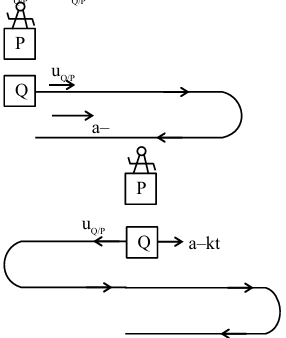
Two cars $P$ and $Q$ are moving on a road in the same direction. The acceleration of car $P$ increases linearly with time,whereas car $Q$ moves with a constant acceleration. Both cars cross each other at time $t = 0$ for the first time. The maximum possible number of crossings (including the crossing at $t = 0$) is . . . . . . .
A
$3$
B
$4$
C
$5$
D
$6$
Solution
(A) Let the acceleration of car $P$ be $a_P = kt$,where $k$ is a constant.
Let the acceleration of car $Q$ be $a_Q = a$,where $a$ is a constant.
The relative acceleration of $Q$ with respect to $P$ is $a_{QP} = a_Q - a_P = a - kt$.
The relative velocity $v_{QP}$ is the integral of relative acceleration: $v_{QP} = u_{QP} + at - \frac{1}{2}kt^2$.
The relative displacement $s_{QP}$ is the integral of relative velocity: $s_{QP} = u_{QP}t + \frac{1}{2}at^2 - \frac{1}{6}kt^3$.
For the cars to cross,the relative displacement $s_{QP}$ must be zero.
Setting $s_{QP} = 0$ gives $t(u_{QP} + \frac{1}{2}at - \frac{1}{6}kt^2) = 0$.
One solution is $t = 0$ (given).
The other crossings occur when the quadratic equation $u_{QP} + \frac{1}{2}at - \frac{1}{6}kt^2 = 0$ has real roots for $t > 0$.
$A$ quadratic equation can have at most $2$ positive roots.
Therefore,the total number of crossings is $1$ (at $t=0$) $+ 2$ (from the quadratic) $= 3$.
Let the acceleration of car $Q$ be $a_Q = a$,where $a$ is a constant.
The relative acceleration of $Q$ with respect to $P$ is $a_{QP} = a_Q - a_P = a - kt$.
The relative velocity $v_{QP}$ is the integral of relative acceleration: $v_{QP} = u_{QP} + at - \frac{1}{2}kt^2$.
The relative displacement $s_{QP}$ is the integral of relative velocity: $s_{QP} = u_{QP}t + \frac{1}{2}at^2 - \frac{1}{6}kt^3$.
For the cars to cross,the relative displacement $s_{QP}$ must be zero.
Setting $s_{QP} = 0$ gives $t(u_{QP} + \frac{1}{2}at - \frac{1}{6}kt^2) = 0$.
One solution is $t = 0$ (given).
The other crossings occur when the quadratic equation $u_{QP} + \frac{1}{2}at - \frac{1}{6}kt^2 = 0$ has real roots for $t > 0$.
$A$ quadratic equation can have at most $2$ positive roots.
Therefore,the total number of crossings is $1$ (at $t=0$) $+ 2$ (from the quadratic) $= 3$.
0 likes
View Solution236
DifficultMCQ
In some appropriate units,the time $(t)$ and position $(x)$ relation of a moving particle is given by $t = x^2 + x$. The acceleration of the particle is
A
$-\frac{2}{(x+2)^3}$
B
$-\frac{2}{(2x+1)^3}$
C
$+\frac{2}{(x+1)^3}$
D
$+\frac{2}{2x+1}$
Solution
(B) Given the relation: $t = x^2 + x$.
Differentiating both sides with respect to $x$: $\frac{dt}{dx} = 2x + 1$.
Since velocity $v = \frac{dx}{dt}$,we have $\frac{1}{v} = 2x + 1$,which implies $v = (2x + 1)^{-1}$.
Acceleration $a$ is given by $a = v \frac{dv}{dx}$.
Differentiating $v$ with respect to $x$: $\frac{dv}{dx} = -1(2x + 1)^{-2} \times 2 = -2(2x + 1)^{-2}$.
Substituting $v$ and $\frac{dv}{dx}$ into the acceleration formula: $a = (2x + 1)^{-1} \times [-2(2x + 1)^{-2}]$.
Therefore,$a = -2(2x + 1)^{-3} = -\frac{2}{(2x + 1)^3}$.
Differentiating both sides with respect to $x$: $\frac{dt}{dx} = 2x + 1$.
Since velocity $v = \frac{dx}{dt}$,we have $\frac{1}{v} = 2x + 1$,which implies $v = (2x + 1)^{-1}$.
Acceleration $a$ is given by $a = v \frac{dv}{dx}$.
Differentiating $v$ with respect to $x$: $\frac{dv}{dx} = -1(2x + 1)^{-2} \times 2 = -2(2x + 1)^{-2}$.
Substituting $v$ and $\frac{dv}{dx}$ into the acceleration formula: $a = (2x + 1)^{-1} \times [-2(2x + 1)^{-2}]$.
Therefore,$a = -2(2x + 1)^{-3} = -\frac{2}{(2x + 1)^3}$.
0 likes
View Solution237
DifficultMCQ
The position of a particle moving along the $x$ axis is given by the equation $x = (10 + 6t - 3t^2) \ m$. The distance travelled by the particle from $t = 1 \ s$ to $t = 4 \ s$ is: (in $m$)
A
$13$
B
$14$
C
$27$
D
$1$
Solution
(C) The position of the particle is given by $x(t) = 10 + 6t - 3t^2$.
To find the velocity,we differentiate the position with respect to time: $v(t) = \frac{dx}{dt} = 6 - 6t$.
Setting $v(t) = 0$,we find the particle stops at $t = 1 \ s$.
Since the interval given is $t = 1 \ s$ to $t = 4 \ s$,the particle moves in only one direction (negative direction) after $t = 1 \ s$.
At $t = 1 \ s$,the position is $x(1) = 10 + 6(1) - 3(1)^2 = 10 + 6 - 3 = 13 \ m$.
At $t = 4 \ s$,the position is $x(4) = 10 + 6(4) - 3(4)^2 = 10 + 24 - 48 = -14 \ m$.
The distance travelled is the magnitude of the displacement: $d = |x(4) - x(1)| = |-14 - 13| = |-27| = 27 \ m$.
To find the velocity,we differentiate the position with respect to time: $v(t) = \frac{dx}{dt} = 6 - 6t$.
Setting $v(t) = 0$,we find the particle stops at $t = 1 \ s$.
Since the interval given is $t = 1 \ s$ to $t = 4 \ s$,the particle moves in only one direction (negative direction) after $t = 1 \ s$.
At $t = 1 \ s$,the position is $x(1) = 10 + 6(1) - 3(1)^2 = 10 + 6 - 3 = 13 \ m$.
At $t = 4 \ s$,the position is $x(4) = 10 + 6(4) - 3(4)^2 = 10 + 24 - 48 = -14 \ m$.
The distance travelled is the magnitude of the displacement: $d = |x(4) - x(1)| = |-14 - 13| = |-27| = 27 \ m$.
0 likes
View Solution238
MediumMCQ
$A$ car accelerates from rest at a constant rate of $2 \ m/s^2$ for some time. Then it retards at a constant rate of $4 \ m/s^2$ and comes to rest. If it remains in motion for $3 \ s$,then the total displacement covered by it is $.... \ m$.
A
$4$
B
$6$
C
$8$
D
$10$
Solution
(B) Let the acceleration be $\alpha = 2 \ m/s^2$ and retardation be $\beta = 4 \ m/s^2$. The total time is $t = 3 \ s$.
Let $t_1$ be the time of acceleration and $t_2$ be the time of retardation. Then $t_1 + t_2 = 3$.
Since the car starts from rest and comes to rest,the maximum velocity $v$ reached is $v = \alpha t_1 = \beta t_2$.
Substituting the values,$2t_1 = 4t_2$,which implies $t_1 = 2t_2$.
Substituting into the time equation: $2t_2 + t_2 = 3$,so $3t_2 = 3$,which gives $t_2 = 1 \ s$ and $t_1 = 2 \ s$.
The maximum velocity is $v = 2 \times 2 = 4 \ m/s$.
The total displacement $d$ is the area under the velocity-time graph,which is a triangle: $d = \frac{1}{2} \times \text{base} \times \text{height} = \frac{1}{2} \times 3 \times 4 = 6 \ m$.
Let $t_1$ be the time of acceleration and $t_2$ be the time of retardation. Then $t_1 + t_2 = 3$.
Since the car starts from rest and comes to rest,the maximum velocity $v$ reached is $v = \alpha t_1 = \beta t_2$.
Substituting the values,$2t_1 = 4t_2$,which implies $t_1 = 2t_2$.
Substituting into the time equation: $2t_2 + t_2 = 3$,so $3t_2 = 3$,which gives $t_2 = 1 \ s$ and $t_1 = 2 \ s$.
The maximum velocity is $v = 2 \times 2 = 4 \ m/s$.
The total displacement $d$ is the area under the velocity-time graph,which is a triangle: $d = \frac{1}{2} \times \text{base} \times \text{height} = \frac{1}{2} \times 3 \times 4 = 6 \ m$.
0 likes
View Solution239
EasyMCQ
The velocity of a car accelerating uniformly increases from $20 \ m/s$ to $80 \ m/s$ while covering a distance of $200 \ m$. The time taken is $.... \ s$.
A
$2$
B
$4$
C
$8$
D
$12$
Solution
(B) Given:
Initial velocity $u = 20 \ m/s$
Final velocity $v = 80 \ m/s$
Distance $s = 200 \ m$
For uniform acceleration,the average velocity is given by $\frac{u+v}{2}$.
The distance covered is $s = \text{average velocity} \times t$.
$s = \left(\frac{u+v}{2}\right) t$
$200 = \left(\frac{20+80}{2}\right) t$
$200 = \left(\frac{100}{2}\right) t$
$200 = 50t$
$t = \frac{200}{50} = 4 \ s$.
Initial velocity $u = 20 \ m/s$
Final velocity $v = 80 \ m/s$
Distance $s = 200 \ m$
For uniform acceleration,the average velocity is given by $\frac{u+v}{2}$.
The distance covered is $s = \text{average velocity} \times t$.
$s = \left(\frac{u+v}{2}\right) t$
$200 = \left(\frac{20+80}{2}\right) t$
$200 = \left(\frac{100}{2}\right) t$
$200 = 50t$
$t = \frac{200}{50} = 4 \ s$.
0 likes
View Solution240
MediumMCQ
$A$ vehicle moving with $15 \,km/hr$ comes to rest by covering $5 \,m$ distance by applying brakes. If the same vehicle moves at $45 \,km/hr$, then by applying brakes, it will come to rest by covering a distance of: (in $\,m$)
A
$15$
B
$45$
C
$60$
D
$30$
Solution
(B) Using the third equation of motion, $v^2 = u^2 + 2as$. Since the vehicle comes to rest, $v = 0$, so $0 = u^2 - 2as$, which gives $s = \frac{u^2}{2a}$.
Since the retardation $a$ is constant for the same vehicle, $s \propto u^2$.
Given $u_1 = 15 \,km/hr$ and $s_1 = 5 \,m$.
Given $u_2 = 45 \,km/hr = 3 \times u_1$.
Therefore, the new distance $s_2$ is given by $s_2 = s_1 \times (\frac{u_2}{u_1})^2$.
$s_2 = 5 \,m \times (3)^2 = 5 \,m \times 9 = 45 \,m$.
Since the retardation $a$ is constant for the same vehicle, $s \propto u^2$.
Given $u_1 = 15 \,km/hr$ and $s_1 = 5 \,m$.
Given $u_2 = 45 \,km/hr = 3 \times u_1$.
Therefore, the new distance $s_2$ is given by $s_2 = s_1 \times (\frac{u_2}{u_1})^2$.
$s_2 = 5 \,m \times (3)^2 = 5 \,m \times 9 = 45 \,m$.
0 likes
View Solution241
MediumMCQ
Two bodies $A$ and $B$ move in the same straight line starting from the same position. Body $A$ moves with a constant velocity $u$ and body $B$ moves with a constant acceleration $a$ starting from rest. When their velocities become equal,the distance between them is:
A
$\frac{u}{2a}$
B
$\frac{u^2}{4a}$
C
$\frac{u^2}{a}$
D
$\frac{u^2}{2a}$
Solution
(D) Let the velocity of body $A$ be $v_A = u$ (constant).
Let the velocity of body $B$ be $v_B = at$ (starting from rest with acceleration $a$).
Their velocities become equal when $v_A = v_B$,which implies $u = at$. Thus,the time taken is $t = \frac{u}{a}$.
The distance covered by body $A$ in time $t$ is $s_A = u \cdot t = u \left( \frac{u}{a} \right) = \frac{u^2}{a}$.
The distance covered by body $B$ in time $t$ is $s_B = \frac{1}{2} a t^2 = \frac{1}{2} a \left( \frac{u}{a} \right)^2 = \frac{u^2}{2a}$.
The distance between them is $d = s_A - s_B = \frac{u^2}{a} - \frac{u^2}{2a} = \frac{u^2}{2a}$.
Let the velocity of body $B$ be $v_B = at$ (starting from rest with acceleration $a$).
Their velocities become equal when $v_A = v_B$,which implies $u = at$. Thus,the time taken is $t = \frac{u}{a}$.
The distance covered by body $A$ in time $t$ is $s_A = u \cdot t = u \left( \frac{u}{a} \right) = \frac{u^2}{a}$.
The distance covered by body $B$ in time $t$ is $s_B = \frac{1}{2} a t^2 = \frac{1}{2} a \left( \frac{u}{a} \right)^2 = \frac{u^2}{2a}$.
The distance between them is $d = s_A - s_B = \frac{u^2}{a} - \frac{u^2}{2a} = \frac{u^2}{2a}$.
0 likes
View Solution242
MediumMCQ
$A$ body starts from rest and moves with a uniform acceleration. The ratio of the distance covered by the body in the $n^{\text{th}}$ second of its motion to the total distance travelled in $n$ seconds is
A
$\frac{2}{n^2}-\frac{1}{n}$
B
$\frac{1}{n}-\frac{1}{n^2}$
C
$\frac{2}{n}-\frac{1}{n^2}$
D
$\frac{2}{n^2}+\frac{1}{n}$
Solution
(C) Let the initial velocity be $u = 0$ and uniform acceleration be $a$.
The distance covered in the $n^{\text{th}}$ second is given by the formula: $S_n = u + \frac{a}{2}(2n - 1)$.
Since $u = 0$,$S_n = \frac{a}{2}(2n - 1)$.
The total distance travelled in $n$ seconds is given by: $S_{total} = ut + \frac{1}{2}at^2 = 0 + \frac{1}{2}an^2 = \frac{1}{2}an^2$.
The ratio of the distance covered in the $n^{\text{th}}$ second to the total distance in $n$ seconds is:
Ratio $= \frac{S_n}{S_{total}} = \frac{\frac{a}{2}(2n - 1)}{\frac{1}{2}an^2} = \frac{2n - 1}{n^2} = \frac{2n}{n^2} - \frac{1}{n^2} = \frac{2}{n} - \frac{1}{n^2}$.
Thus,the correct option is $C$.
The distance covered in the $n^{\text{th}}$ second is given by the formula: $S_n = u + \frac{a}{2}(2n - 1)$.
Since $u = 0$,$S_n = \frac{a}{2}(2n - 1)$.
The total distance travelled in $n$ seconds is given by: $S_{total} = ut + \frac{1}{2}at^2 = 0 + \frac{1}{2}an^2 = \frac{1}{2}an^2$.
The ratio of the distance covered in the $n^{\text{th}}$ second to the total distance in $n$ seconds is:
Ratio $= \frac{S_n}{S_{total}} = \frac{\frac{a}{2}(2n - 1)}{\frac{1}{2}an^2} = \frac{2n - 1}{n^2} = \frac{2n}{n^2} - \frac{1}{n^2} = \frac{2}{n} - \frac{1}{n^2}$.
Thus,the correct option is $C$.
0 likes
View Solution243
MediumMCQ
$A$ car moving at a speed $V$ is stopped in a certain distance $s$ when the brakes produce a deceleration $a$. If the speed of the car is $nV$,what must be the deceleration of the car to stop it in the same distance $s$ and in the same time $t$?
A
$\sqrt{n} \cdot a$
B
$n \cdot a$
C
$n^2 \cdot a$
D
$n^3 \cdot a$
Solution
(B) Let the initial speed be $V$ and the final speed be $0$. The distance covered is $s$ and the deceleration is $a$. Using the equation of motion $v^2 = u^2 + 2as$,we have $0 = V^2 - 2as$,which gives $s = \frac{V^2}{2a}$.
Also,using $v = u + at$,we have $0 = V - at$,which gives $t = \frac{V}{a}$.
Now,for the new case,the initial speed is $u' = nV$,final speed $v' = 0$,distance $s' = s$,and time $t' = t$. Let the new deceleration be $a'$.
From $v' = u' - a't'$,we have $0 = nV - a't$. Substituting $t = \frac{V}{a}$,we get $0 = nV - a'(\frac{V}{a})$,which implies $a' = na$.
Checking with the distance condition: $s' = u't' - \frac{1}{2}a't'^2$. Substituting $s' = s = \frac{V^2}{2a}$,$u' = nV$,$t' = t = \frac{V}{a}$,and $a' = na$,we get $\frac{V^2}{2a} = (nV)(\frac{V}{a}) - \frac{1}{2}(na)(\frac{V}{a})^2 = \frac{nV^2}{a} - \frac{nV^2}{2a} = \frac{nV^2}{2a}$.
For this to equal $\frac{V^2}{2a}$,we must have $n = 1$. However,the question asks for the deceleration required to satisfy both conditions. Given the constraints,the deceleration must be $n \cdot a$ to satisfy the time condition.
Also,using $v = u + at$,we have $0 = V - at$,which gives $t = \frac{V}{a}$.
Now,for the new case,the initial speed is $u' = nV$,final speed $v' = 0$,distance $s' = s$,and time $t' = t$. Let the new deceleration be $a'$.
From $v' = u' - a't'$,we have $0 = nV - a't$. Substituting $t = \frac{V}{a}$,we get $0 = nV - a'(\frac{V}{a})$,which implies $a' = na$.
Checking with the distance condition: $s' = u't' - \frac{1}{2}a't'^2$. Substituting $s' = s = \frac{V^2}{2a}$,$u' = nV$,$t' = t = \frac{V}{a}$,and $a' = na$,we get $\frac{V^2}{2a} = (nV)(\frac{V}{a}) - \frac{1}{2}(na)(\frac{V}{a})^2 = \frac{nV^2}{a} - \frac{nV^2}{2a} = \frac{nV^2}{2a}$.
For this to equal $\frac{V^2}{2a}$,we must have $n = 1$. However,the question asks for the deceleration required to satisfy both conditions. Given the constraints,the deceleration must be $n \cdot a$ to satisfy the time condition.
0 likes
View Solution244
EasyMCQ
$A$ driver applies the brakes on seeing the red traffic signal $400 \ m$ ahead. At the time of applying brakes,the vehicle was moving with $15 \ m/s$ and retarding at $0.3 \ m/s^2$. The distance of the vehicle from the traffic light one minute after the application of brakes is: (in $m$)
A
$375$
B
$360$
C
$40$
D
$25$
Solution
(D) Initial velocity $u = 15 \ m/s$,retardation $a = -0.3 \ m/s^2$,and final velocity $v = 0 \ m/s$ (when it stops).
First,calculate the time taken to stop: $t = \frac{v-u}{a} = \frac{0-15}{-0.3} = 50 \ s$.
Since the vehicle stops in $50 \ s$,which is less than $60 \ s$ (one minute),the displacement after $60 \ s$ is the same as the displacement after $50 \ s$.
Using the equation of motion $s = ut + \frac{1}{2}at^2$:
$s = (15 \times 50) + \frac{1}{2} \times (-0.3) \times (50)^2$
$s = 750 - 0.15 \times 2500 = 750 - 375 = 375 \ m$.
The initial distance from the traffic light was $400 \ m$.
Therefore,the distance from the traffic light after one minute is $400 \ m - 375 \ m = 25 \ m$.
First,calculate the time taken to stop: $t = \frac{v-u}{a} = \frac{0-15}{-0.3} = 50 \ s$.
Since the vehicle stops in $50 \ s$,which is less than $60 \ s$ (one minute),the displacement after $60 \ s$ is the same as the displacement after $50 \ s$.
Using the equation of motion $s = ut + \frac{1}{2}at^2$:
$s = (15 \times 50) + \frac{1}{2} \times (-0.3) \times (50)^2$
$s = 750 - 0.15 \times 2500 = 750 - 375 = 375 \ m$.
The initial distance from the traffic light was $400 \ m$.
Therefore,the distance from the traffic light after one minute is $400 \ m - 375 \ m = 25 \ m$.
0 likes
View Solution245
EasyMCQ
$A$ body travelling with uniform acceleration crosses two points $A$ and $B$ with velocities $20 \,m/s$ and $30 \,m/s$ respectively. The speed of the body at the midpoint of $A$ and $B$ is (nearly)
A
$25 \,m/s$
B
$25.5 \,m/s$
C
$24 \,m/s$
D
$10 \sqrt{6} \,m/s$
Solution
(B) Let the acceleration of the body be $a$ and the distance between points $A$ and $B$ be $d$.
Using the equation of motion $v^2 = u^2 + 2as$:
For the path from $A$ to $B$:
$(30)^2 = (20)^2 + 2ad$
$900 = 400 + 2ad$
$2ad = 500$
$ad = 250$
Let $v_m$ be the velocity at the midpoint of $AB$. The distance from $A$ to the midpoint is $d/2$.
Using the equation of motion for the path from $A$ to the midpoint:
$v_m^2 = (20)^2 + 2a(d/2)$
$v_m^2 = 400 + ad$
Substituting $ad = 250$:
$v_m^2 = 400 + 250 = 650$
$v_m = \sqrt{650} \approx 25.495 \,m/s \approx 25.5 \,m/s$.
Using the equation of motion $v^2 = u^2 + 2as$:
For the path from $A$ to $B$:
$(30)^2 = (20)^2 + 2ad$
$900 = 400 + 2ad$
$2ad = 500$
$ad = 250$
Let $v_m$ be the velocity at the midpoint of $AB$. The distance from $A$ to the midpoint is $d/2$.
Using the equation of motion for the path from $A$ to the midpoint:
$v_m^2 = (20)^2 + 2a(d/2)$
$v_m^2 = 400 + ad$
Substituting $ad = 250$:
$v_m^2 = 400 + 250 = 650$
$v_m = \sqrt{650} \approx 25.495 \,m/s \approx 25.5 \,m/s$.
0 likes
View Solution246
EasyMCQ
Two bodies $A$ and $B$ start from the same point at the same instant and move along a straight line. Body $A$ moves with uniform acceleration $a$ and body $B$ moves with uniform velocity $V$. They meet after time $t$. The value of $t$ is
A
$\frac{2V}{a}$
B
$\frac{a}{2V}$
C
$\frac{V}{2a}$
D
$\sqrt{\frac{V}{a}}$
Solution
(A) For body $A$ starting from rest (initial velocity $u=0$):
$S_A = ut + \frac{1}{2}at^2 = 0 + \frac{1}{2}at^2 = \frac{1}{2}at^2$
For body $B$ moving with uniform velocity $V$:
$S_B = Vt$
Since they meet at the same point after time $t$,their displacements must be equal:
$S_A = S_B$
$\frac{1}{2}at^2 = Vt$
Dividing both sides by $t$ (assuming $t \neq 0$):
$\frac{1}{2}at = V$
$t = \frac{2V}{a}$
$S_A = ut + \frac{1}{2}at^2 = 0 + \frac{1}{2}at^2 = \frac{1}{2}at^2$
For body $B$ moving with uniform velocity $V$:
$S_B = Vt$
Since they meet at the same point after time $t$,their displacements must be equal:
$S_A = S_B$
$\frac{1}{2}at^2 = Vt$
Dividing both sides by $t$ (assuming $t \neq 0$):
$\frac{1}{2}at = V$
$t = \frac{2V}{a}$
0 likes
View Solution247
EasyMCQ
$A$ moving body is covering distances which are proportional to the square of the time. Then the acceleration of the body is
A
decreasing.
B
Constant but not Zero
C
Zero
D
Increasing
Solution
(B) Given that the distance $s$ is proportional to the square of the time $t$,we have $s \propto t^{2}$.
This can be written as $s = k t^{2}$,where $k$ is a constant.
The velocity $v$ is the first derivative of distance with respect to time: $v = \frac{ds}{dt} = \frac{d}{dt}(k t^{2}) = 2kt$.
The acceleration $a$ is the derivative of velocity with respect to time: $a = \frac{dv}{dt} = \frac{d}{dt}(2kt) = 2k$.
Since $k$ is a constant,$2k$ is also a constant and is not equal to zero.
Therefore,the acceleration of the body is constant but not zero.
This can be written as $s = k t^{2}$,where $k$ is a constant.
The velocity $v$ is the first derivative of distance with respect to time: $v = \frac{ds}{dt} = \frac{d}{dt}(k t^{2}) = 2kt$.
The acceleration $a$ is the derivative of velocity with respect to time: $a = \frac{dv}{dt} = \frac{d}{dt}(2kt) = 2k$.
Since $k$ is a constant,$2k$ is also a constant and is not equal to zero.
Therefore,the acceleration of the body is constant but not zero.
0 likes
View Solution248
EasyMCQ
The distance $x$ covered in time $t$ by a body having initial velocity $u$ and having constant acceleration $a$ is given by $x=ut+\frac{1}{2}at^2$. This result follows from
A
Newton's first law
B
Newton's second law
C
Newton's third law
D
None of the above
Solution
(D) The kinematic equation $x=ut+\frac{1}{2}at^2$ describes the motion of an object under constant acceleration.
This equation is derived from the definitions of velocity and acceleration using calculus or graphical methods.
It is a kinematic relationship and does not directly follow from Newton's laws of motion,which relate force,mass,and acceleration $(F=ma)$.
Therefore,the correct option is $D$.
This equation is derived from the definitions of velocity and acceleration using calculus or graphical methods.
It is a kinematic relationship and does not directly follow from Newton's laws of motion,which relate force,mass,and acceleration $(F=ma)$.
Therefore,the correct option is $D$.
0 likes
View SolutionMotion in Straight Line — Uniformly Accelerated Motion · Frequently Asked Questions
1Are these Motion in Straight Line questions useful for JEE and NEET?
Yes. All questions in this section are mapped to JEE Main and NEET exam patterns. Previous year questions from JEE Main, NEET, GUJCET and state-level exams are included with full solutions.
2Can I switch to Hindi or Gujarati for these questions?
Yes. Use the language tabs in the hero section or the sidebar to view the same questions and solutions in English, Hindi or Gujarati.
3How do I generate a question paper from this subtopic?
Use the Vedclass Exam Paper Generator — select the chapter and subtopic, set difficulty, and generate Sets A, B, C, D automatically. First 3 chapters of every subject are free.
Vedclass Products
For Students
Vedclass Test Series
Mock tests in real JEE/NEET style with performance analysis. 5-day free trial.
Start Free TrialFor Teachers
Exam Paper Generator
Generate Set A/B/C/D papers from this chapter in 2 minutes. 3 chapters free.
Try FreeFor Institutes
Online Exam Module
Live online exams with unlimited students, 360° analytics & white-label branding.
See DemoFor Teachers & Institutes
Generate a Motion in Straight Line Exam Paper in 2 Minutes
Select subtopic & difficulty — Sets A, B, C, D auto-generated with No Repeat logic.
First 3 chapters of every subject are free — no payment required.