
A English
Uniformly Accelerated Motion Questions in English
Class 11 Physics · Motion in Straight Line · Uniformly Accelerated Motion
304+
Questions
English
Language
100%
With Solutions
Showing 48 of 304 questions in English
51
DifficultMCQ
$A$ body falling for $2 \, s$ covers a distance $S$ equal to that covered in the next second. Taking $g = 10 \, m/s^2$,$S = .......... m$
A
$30$
B
$10$
C
$60$
D
$20$
Solution
(A) Let $u$ be the initial velocity of the body.
Distance covered in $2 \, s$ is given by $S = ut + \frac{1}{2}gt^2$.
$S = u(2) + \frac{1}{2}(10)(2)^2 = 2u + 20$ ... $(i)$
Distance covered in the $3^{rd}$ second is given by $S_{3^{rd}} = u + \frac{g}{2}(2n - 1)$,where $n = 3$.
$S_{3^{rd}} = u + \frac{10}{2}(2 \times 3 - 1) = u + 5(5) = u + 25$ ... (ii)
According to the problem,the distance covered in $2 \, s$ is equal to the distance covered in the $3^{rd}$ second,so $S = S_{3^{rd}}$.
$2u + 20 = u + 25 \Rightarrow u = 5 \, m/s$.
Substituting $u = 5$ into equation $(i)$:
$S = 2(5) + 20 = 10 + 20 = 30 \, m$.
Distance covered in $2 \, s$ is given by $S = ut + \frac{1}{2}gt^2$.
$S = u(2) + \frac{1}{2}(10)(2)^2 = 2u + 20$ ... $(i)$
Distance covered in the $3^{rd}$ second is given by $S_{3^{rd}} = u + \frac{g}{2}(2n - 1)$,where $n = 3$.
$S_{3^{rd}} = u + \frac{10}{2}(2 \times 3 - 1) = u + 5(5) = u + 25$ ... (ii)
According to the problem,the distance covered in $2 \, s$ is equal to the distance covered in the $3^{rd}$ second,so $S = S_{3^{rd}}$.
$2u + 20 = u + 25 \Rightarrow u = 5 \, m/s$.
Substituting $u = 5$ into equation $(i)$:
$S = 2(5) + 20 = 10 + 20 = 30 \, m$.
3 likes
View Solution52
MediumMCQ
The acceleration of a particle is increasing linearly with time $t$ as $bt$. The particle starts from the origin with an initial velocity ${v_0}$. The distance travelled by the particle in time $t$ will be
A
${v_0}t + \frac{1}{3}b{t^2}$
B
${v_0}t + \frac{1}{3}b{t^3}$
C
${v_0}t + \frac{1}{6}b{t^3}$
D
${v_0}t + \frac{1}{2}b{t^2}$
Solution
(C) Given acceleration $a = \frac{dv}{dt} = bt$.
Integrating with respect to time $t$:
$\int dv = \int bt \, dt \Rightarrow v = \frac{1}{2}bt^2 + C_1$.
At $t = 0$,$v = v_0$,so $C_1 = v_0$.
Thus,the velocity is $v = \frac{1}{2}bt^2 + v_0$.
Since $v = \frac{dx}{dt}$,we have $\frac{dx}{dt} = \frac{1}{2}bt^2 + v_0$.
Integrating with respect to time $t$:
$x = \int (\frac{1}{2}bt^2 + v_0) dt = \frac{1}{2}b(\frac{t^3}{3}) + v_0t + C_2$.
At $t = 0$,$x = 0$,so $C_2 = 0$.
Therefore,the distance travelled is $x = v_0t + \frac{1}{6}bt^3$.
Integrating with respect to time $t$:
$\int dv = \int bt \, dt \Rightarrow v = \frac{1}{2}bt^2 + C_1$.
At $t = 0$,$v = v_0$,so $C_1 = v_0$.
Thus,the velocity is $v = \frac{1}{2}bt^2 + v_0$.
Since $v = \frac{dx}{dt}$,we have $\frac{dx}{dt} = \frac{1}{2}bt^2 + v_0$.
Integrating with respect to time $t$:
$x = \int (\frac{1}{2}bt^2 + v_0) dt = \frac{1}{2}b(\frac{t^3}{3}) + v_0t + C_2$.
At $t = 0$,$x = 0$,so $C_2 = 0$.
Therefore,the distance travelled is $x = v_0t + \frac{1}{6}bt^3$.
0 likes
View Solution53
DifficultMCQ
The motion of a body is given by the equation $\frac{dv(t)}{dt} = 6.0 - 3v(t)$,where $v(t)$ is speed in $m/s$ and $t$ is in $s$. If the body was at rest at $t = 0$,which of the following statements is correct?
A
The terminal speed is $2.0 \, m/s$.
B
The speed varies with time as $v(t) = 2(1 - e^{-3t}) \, m/s$.
C
The magnitude of the initial acceleration is $6.0 \, m/s^2$.
D
All of the above.
Solution
(D) Given the differential equation: $\frac{dv}{dt} = 6 - 3v$.
Rearranging the terms: $\frac{dv}{6 - 3v} = dt$.
Integrating both sides: $\int \frac{dv}{6 - 3v} = \int dt$.
This yields: $-\frac{1}{3} \ln(6 - 3v) = t + C$.
$\ln(6 - 3v) = -3t + C'$.
At $t = 0$,$v = 0$,so $\ln(6) = C'$.
Substituting $C'$: $\ln(6 - 3v) = -3t + \ln(6) \Rightarrow \ln(\frac{6 - 3v}{6}) = -3t$.
Taking the exponential: $\frac{6 - 3v}{6} = e^{-3t} \Rightarrow 1 - 0.5v = e^{-3t} \Rightarrow v(t) = 2(1 - e^{-3t}) \, m/s$.
Terminal speed $(t \to \infty)$: $v = 2(1 - 0) = 2.0 \, m/s$.
Initial acceleration $(t = 0)$: $a = \frac{dv}{dt} = 6 - 3(0) = 6.0 \, m/s^2$.
Since all statements are correct,the answer is $(d)$.
Rearranging the terms: $\frac{dv}{6 - 3v} = dt$.
Integrating both sides: $\int \frac{dv}{6 - 3v} = \int dt$.
This yields: $-\frac{1}{3} \ln(6 - 3v) = t + C$.
$\ln(6 - 3v) = -3t + C'$.
At $t = 0$,$v = 0$,so $\ln(6) = C'$.
Substituting $C'$: $\ln(6 - 3v) = -3t + \ln(6) \Rightarrow \ln(\frac{6 - 3v}{6}) = -3t$.
Taking the exponential: $\frac{6 - 3v}{6} = e^{-3t} \Rightarrow 1 - 0.5v = e^{-3t} \Rightarrow v(t) = 2(1 - e^{-3t}) \, m/s$.
Terminal speed $(t \to \infty)$: $v = 2(1 - 0) = 2.0 \, m/s$.
Initial acceleration $(t = 0)$: $a = \frac{dv}{dt} = 6 - 3(0) = 6.0 \, m/s^2$.
Since all statements are correct,the answer is $(d)$.
0 likes
View Solution54
DifficultMCQ
$A$ car accelerates from rest at a constant rate $\alpha$ for some time,after which it decelerates at a constant rate $\beta$ and comes to rest. If the total time elapsed is $t$,then the maximum velocity acquired by the car is
A
$\left( \frac{\alpha^2 + \beta^2}{\alpha \beta} \right) t$
B
$\left( \frac{\alpha^2 - \beta^2}{\alpha \beta} \right) t$
C
$\frac{(\alpha + \beta) t}{\alpha \beta}$
D
$\frac{\alpha \beta t}{\alpha + \beta}$
Solution
(D) Let the car accelerate at a constant rate $\alpha$ for time $t_1$. The maximum velocity $v$ attained is given by $v = u + \alpha t_1$. Since it starts from rest,$u = 0$,so $v = \alpha t_1$.
Next,the car decelerates at a constant rate $\beta$ for the remaining time $(t - t_1)$ until it comes to rest. Using the equation $v = u + at$ for the deceleration phase,we have $0 = v - \beta(t - t_1)$.
Substituting $v = \alpha t_1$ into the equation,we get $0 = \alpha t_1 - \beta t + \beta t_1$.
Rearranging the terms,we get $(\alpha + \beta) t_1 = \beta t$,which gives $t_1 = \frac{\beta}{\alpha + \beta} t$.
Substituting $t_1$ back into the expression for $v$,we get $v = \alpha \left( \frac{\beta}{\alpha + \beta} t \right) = \frac{\alpha \beta}{\alpha + \beta} t$.
Next,the car decelerates at a constant rate $\beta$ for the remaining time $(t - t_1)$ until it comes to rest. Using the equation $v = u + at$ for the deceleration phase,we have $0 = v - \beta(t - t_1)$.
Substituting $v = \alpha t_1$ into the equation,we get $0 = \alpha t_1 - \beta t + \beta t_1$.
Rearranging the terms,we get $(\alpha + \beta) t_1 = \beta t$,which gives $t_1 = \frac{\beta}{\alpha + \beta} t$.
Substituting $t_1$ back into the expression for $v$,we get $v = \alpha \left( \frac{\beta}{\alpha + \beta} t \right) = \frac{\alpha \beta}{\alpha + \beta} t$.
0 likes
View Solution55
MediumMCQ
An automobile travelling with a speed of $60\,km/h$ can brake to stop within a distance of $20\,m$. If the car is going twice as fast,i.e.,$120\,km/h$,the stopping distance will be ........... $m$.
A
$20$
B
$40$
C
$60$
D
$80$
Solution
(D) The stopping distance $S$ of a vehicle is given by the relation $v^2 = u^2 + 2as$. Since the final velocity $v = 0$,we have $0 = u^2 - 2a|S|$,which implies $S = \frac{u^2}{2|a|}$.
Since the deceleration $a$ is constant,the stopping distance is directly proportional to the square of the initial velocity: $S \propto u^2$.
Given $S_1 = 20\,m$ at $u_1 = 60\,km/h$ and $u_2 = 120\,km/h$.
Using the ratio: $\frac{S_2}{S_1} = \left(\frac{u_2}{u_1}\right)^2 = \left(\frac{120}{60}\right)^2 = (2)^2 = 4$.
Therefore,$S_2 = 4 \times S_1 = 4 \times 20\,m = 80\,m$.
Since the deceleration $a$ is constant,the stopping distance is directly proportional to the square of the initial velocity: $S \propto u^2$.
Given $S_1 = 20\,m$ at $u_1 = 60\,km/h$ and $u_2 = 120\,km/h$.
Using the ratio: $\frac{S_2}{S_1} = \left(\frac{u_2}{u_1}\right)^2 = \left(\frac{120}{60}\right)^2 = (2)^2 = 4$.
Therefore,$S_2 = 4 \times S_1 = 4 \times 20\,m = 80\,m$.
1 likes
View Solution56
DifficultMCQ
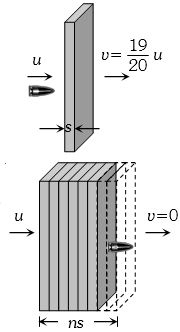
$A$ rifle bullet loses $(1/20)^{th}$ of its velocity in passing through a plank. The least number of such planks required just to stop the bullet is
A
$5$
B
$10$
C
$11$
D
$20$
Solution
(C) Let the thickness of one plank be $s$. If the bullet enters with velocity $u$,then it leaves with velocity $v = u - \frac{u}{20} = \frac{19}{20}u$.
Using the equation of motion $v^2 = u^2 - 2as$,where $a$ is the retardation:
$(\frac{19}{20}u)^2 = u^2 - 2as$
$\frac{361}{400}u^2 = u^2 - 2as$
$2as = u^2 - \frac{361}{400}u^2 = \frac{39}{400}u^2$
$\frac{u^2}{2as} = \frac{400}{39} \approx 10.25$
Now,if $n$ planks are required to stop the bullet,the final velocity $v_f = 0$ after traveling a total distance $ns$:
$0^2 = u^2 - 2a(ns)$
$u^2 = 2ans$
$n = \frac{u^2}{2as} = \frac{400}{39} \approx 10.25$
Since the number of planks must be an integer and $10$ planks are not enough to stop the bullet,we need $11$ planks.
Using the equation of motion $v^2 = u^2 - 2as$,where $a$ is the retardation:
$(\frac{19}{20}u)^2 = u^2 - 2as$
$\frac{361}{400}u^2 = u^2 - 2as$
$2as = u^2 - \frac{361}{400}u^2 = \frac{39}{400}u^2$
$\frac{u^2}{2as} = \frac{400}{39} \approx 10.25$
Now,if $n$ planks are required to stop the bullet,the final velocity $v_f = 0$ after traveling a total distance $ns$:
$0^2 = u^2 - 2a(ns)$
$u^2 = 2ans$
$n = \frac{u^2}{2as} = \frac{400}{39} \approx 10.25$
Since the number of planks must be an integer and $10$ planks are not enough to stop the bullet,we need $11$ planks.
0 likes
View Solution57
EasyMCQ
Tripling the speed of the motor car multiplies the distance needed for stopping it by
A
$3$
B
$6$
C
$9$
D
Some other number
Solution
(C) The stopping distance $s$ of a vehicle is given by the formula $s = \frac{u^2}{2a}$,where $u$ is the initial speed and $a$ is the magnitude of deceleration.
From this relation,we can see that the stopping distance is directly proportional to the square of the initial speed,i.e.,$s \propto u^2$.
If the speed is tripled,the new speed becomes $u' = 3u$.
The new stopping distance $s'$ will be $s' \propto (3u)^2 = 9u^2$.
Therefore,$s' = 9s$.
Thus,tripling the speed increases the stopping distance by a factor of $9$.
From this relation,we can see that the stopping distance is directly proportional to the square of the initial speed,i.e.,$s \propto u^2$.
If the speed is tripled,the new speed becomes $u' = 3u$.
The new stopping distance $s'$ will be $s' \propto (3u)^2 = 9u^2$.
Therefore,$s' = 9s$.
Thus,tripling the speed increases the stopping distance by a factor of $9$.
0 likes
View Solution58
MediumMCQ
If a body loses half of its velocity on penetrating $3 \, cm$ in a wooden block,then how much will it penetrate more before coming to rest? (in $cm$)
A
$1$
B
$2$
C
$3$
D
$4$
Solution
(A) Let the initial velocity be $u$. After penetrating $s_1 = 3 \, cm$,the velocity becomes $v_1 = u/2$.
Using the equation of motion $v^2 = u^2 + 2as$:
$(u/2)^2 = u^2 + 2a(3)$
$u^2/4 = u^2 + 6a$
$6a = -3u^2/4$
$a = -u^2/8$
Now,for the second part,the initial velocity is $u/2$ and the final velocity is $0$. Let the additional distance covered be $x$.
$0^2 = (u/2)^2 + 2ax$
$0 = u^2/4 + 2(-u^2/8)x$
$u^2/4 = (u^2/4)x$
$x = 1 \, cm$.
Using the equation of motion $v^2 = u^2 + 2as$:
$(u/2)^2 = u^2 + 2a(3)$
$u^2/4 = u^2 + 6a$
$6a = -3u^2/4$
$a = -u^2/8$
Now,for the second part,the initial velocity is $u/2$ and the final velocity is $0$. Let the additional distance covered be $x$.
$0^2 = (u/2)^2 + 2ax$
$0 = u^2/4 + 2(-u^2/8)x$
$u^2/4 = (u^2/4)x$
$x = 1 \, cm$.
0 likes
View Solution59
MediumMCQ
The relation between the position $x$ and time $t$ of a particle moving in one dimension is given by $t = \sqrt{x} + 3$,where $x$ is in meters and $t$ is in seconds. When the velocity of the particle becomes zero,the displacement of the particle is ........ $m$.
A
$0$
B
$3$
C
$-3$
D
$-9$
Solution
(D) Given the relation: $t = \sqrt{x} + 3$.
Rearranging for $x$: $\sqrt{x} = t - 3$.
Squaring both sides: $x = (t - 3)^2$.
Velocity $v$ is the derivative of position with respect to time: $v = \frac{dx}{dt} = \frac{d}{dt}(t - 3)^2 = 2(t - 3)$.
When the velocity is zero: $2(t - 3) = 0$,which gives $t = 3 \ s$.
Initial position at $t = 0 \ s$: $x_i = (0 - 3)^2 = 9 \ m$.
Final position at $t = 3 \ s$: $x_f = (3 - 3)^2 = 0 \ m$.
Displacement is defined as the change in position: $\Delta x = x_f - x_i = 0 - 9 = -9 \ m$.
Rearranging for $x$: $\sqrt{x} = t - 3$.
Squaring both sides: $x = (t - 3)^2$.
Velocity $v$ is the derivative of position with respect to time: $v = \frac{dx}{dt} = \frac{d}{dt}(t - 3)^2 = 2(t - 3)$.
When the velocity is zero: $2(t - 3) = 0$,which gives $t = 3 \ s$.
Initial position at $t = 0 \ s$: $x_i = (0 - 3)^2 = 9 \ m$.
Final position at $t = 3 \ s$: $x_f = (3 - 3)^2 = 0 \ m$.
Displacement is defined as the change in position: $\Delta x = x_f - x_i = 0 - 9 = -9 \ m$.
0 likes
View Solution60
DifficultMCQ
$A$ bullet loses $1/20$ of its velocity after passing through a wooden plank. What is the minimum number of such planks required to stop the bullet completely?
A
$11$
B
$5$
C
$14$
D
$7$
Solution
(A) Let the initial velocity be $u$ and the thickness of one plank be $s$. After passing through one plank,the velocity becomes $v = u - (1/20)u = (19/20)u$.
Using the equation of motion $v^2 = u^2 + 2as$:
$(19/20u)^2 = u^2 + 2as$
$2as = (361/400)u^2 - u^2 = -(39/400)u^2$.
Let $n$ be the minimum number of planks required to stop the bullet. For the final velocity to be $0$ after passing through $n$ planks,the total distance covered is $ns$:
$0^2 = u^2 + 2a(ns)$
$0 = u^2 + n(2as)$
Substituting $2as = -(39/400)u^2$:
$0 = u^2 + n(-(39/400)u^2)$
$n(39/400) = 1$
$n = 400/39 \approx 10.26$.
Since the number of planks must be an integer,the minimum number of planks required to stop the bullet is $11$.
Using the equation of motion $v^2 = u^2 + 2as$:
$(19/20u)^2 = u^2 + 2as$
$2as = (361/400)u^2 - u^2 = -(39/400)u^2$.
Let $n$ be the minimum number of planks required to stop the bullet. For the final velocity to be $0$ after passing through $n$ planks,the total distance covered is $ns$:
$0^2 = u^2 + 2a(ns)$
$0 = u^2 + n(2as)$
Substituting $2as = -(39/400)u^2$:
$0 = u^2 + n(-(39/400)u^2)$
$n(39/400) = 1$
$n = 400/39 \approx 10.26$.
Since the number of planks must be an integer,the minimum number of planks required to stop the bullet is $11$.
0 likes
View Solution61
MediumMCQ
$A$ particle moves according to the equation $x = at^2 - bt^3$. At what time will its acceleration be zero?
A
$\frac{a}{b}$
B
$\frac{2a}{3b}$
C
$\frac{a}{3b}$
D
Zero
Solution
(C) The position of the particle is given by $x = at^2 - bt^3$.
The velocity $v$ is the first derivative of position with respect to time:
$v = \frac{dx}{dt} = \frac{d}{dt}(at^2 - bt^3) = 2at - 3bt^2$.
The acceleration $a_{acc}$ is the derivative of velocity with respect to time:
$a_{acc} = \frac{dv}{dt} = \frac{d}{dt}(2at - 3bt^2) = 2a - 6bt$.
To find the time when acceleration is zero,set $a_{acc} = 0$:
$2a - 6bt = 0$
$2a = 6bt$
$t = \frac{2a}{6b} = \frac{a}{3b}$.
The velocity $v$ is the first derivative of position with respect to time:
$v = \frac{dx}{dt} = \frac{d}{dt}(at^2 - bt^3) = 2at - 3bt^2$.
The acceleration $a_{acc}$ is the derivative of velocity with respect to time:
$a_{acc} = \frac{dv}{dt} = \frac{d}{dt}(2at - 3bt^2) = 2a - 6bt$.
To find the time when acceleration is zero,set $a_{acc} = 0$:
$2a - 6bt = 0$
$2a = 6bt$
$t = \frac{2a}{6b} = \frac{a}{3b}$.
0 likes
View Solution62
MediumMCQ
$A$ particle moves according to the equation $y = a + bt + ct^2 - dt^4$. What are the initial velocity and initial acceleration of the particle?
A
$b, -4d$
B
$-b, 2c$
C
$b, 2c$
D
$2c, -4d$
Solution
(C) The position of the particle is given by $y = a + bt + ct^2 - dt^4$.
The velocity $v$ is the first derivative of position with respect to time $t$:
$v = \frac{dy}{dt} = \frac{d}{dt}(a + bt + ct^2 - dt^4) = 0 + b + 2ct - 4dt^3$.
At the initial time $t = 0$,the initial velocity $v_{initial}$ is:
$v_{initial} = b + 2c(0) - 4d(0)^3 = b$.
The acceleration $a_{acc}$ is the derivative of velocity with respect to time $t$:
$a_{acc} = \frac{dv}{dt} = \frac{d}{dt}(b + 2ct - 4dt^3) = 0 + 2c - 12dt^2$.
At the initial time $t = 0$,the initial acceleration $a_{initial}$ is:
$a_{initial} = 2c - 12d(0)^2 = 2c$.
Thus,the initial velocity is $b$ and the initial acceleration is $2c$.
The velocity $v$ is the first derivative of position with respect to time $t$:
$v = \frac{dy}{dt} = \frac{d}{dt}(a + bt + ct^2 - dt^4) = 0 + b + 2ct - 4dt^3$.
At the initial time $t = 0$,the initial velocity $v_{initial}$ is:
$v_{initial} = b + 2c(0) - 4d(0)^3 = b$.
The acceleration $a_{acc}$ is the derivative of velocity with respect to time $t$:
$a_{acc} = \frac{dv}{dt} = \frac{d}{dt}(b + 2ct - 4dt^3) = 0 + 2c - 12dt^2$.
At the initial time $t = 0$,the initial acceleration $a_{initial}$ is:
$a_{initial} = 2c - 12d(0)^2 = 2c$.
Thus,the initial velocity is $b$ and the initial acceleration is $2c$.
0 likes
View Solution63
DifficultMCQ
The relation between time $t$ and distance $x$ is given by $t = \alpha x^2 + \beta x$,where $\alpha$ and $\beta$ are constants. If $v$ is the velocity,then what is the retardation?
A
$2\alpha v^3$
B
$2\beta v^3$
C
$2\alpha \beta v^3$
D
$2\beta^2 v^3$
Solution
(A) Given the relation: $t = \alpha x^2 + \beta x$.
Differentiating with respect to $x$: $\frac{dt}{dx} = 2\alpha x + \beta$.
Since velocity $v = \frac{dx}{dt}$,we have $v = \frac{1}{2\alpha x + \beta}$.
Acceleration $a = \frac{dv}{dt} = \frac{dv}{dx} \cdot \frac{dx}{dt} = v \frac{dv}{dx}$.
Differentiating $v = (2\alpha x + \beta)^{-1}$ with respect to $x$: $\frac{dv}{dx} = -1(2\alpha x + \beta)^{-2} \cdot (2\alpha) = -\frac{2\alpha}{(2\alpha x + \beta)^2}$.
Substituting this into the acceleration formula: $a = v \cdot \left( -\frac{2\alpha}{(2\alpha x + \beta)^2} \right)$.
Since $v = \frac{1}{2\alpha x + \beta}$,then $v^2 = \frac{1}{(2\alpha x + \beta)^2}$.
Therefore,$a = v \cdot (-2\alpha \cdot v^2) = -2\alpha v^3$.
The retardation is the magnitude of negative acceleration,which is $2\alpha v^3$.
Differentiating with respect to $x$: $\frac{dt}{dx} = 2\alpha x + \beta$.
Since velocity $v = \frac{dx}{dt}$,we have $v = \frac{1}{2\alpha x + \beta}$.
Acceleration $a = \frac{dv}{dt} = \frac{dv}{dx} \cdot \frac{dx}{dt} = v \frac{dv}{dx}$.
Differentiating $v = (2\alpha x + \beta)^{-1}$ with respect to $x$: $\frac{dv}{dx} = -1(2\alpha x + \beta)^{-2} \cdot (2\alpha) = -\frac{2\alpha}{(2\alpha x + \beta)^2}$.
Substituting this into the acceleration formula: $a = v \cdot \left( -\frac{2\alpha}{(2\alpha x + \beta)^2} \right)$.
Since $v = \frac{1}{2\alpha x + \beta}$,then $v^2 = \frac{1}{(2\alpha x + \beta)^2}$.
Therefore,$a = v \cdot (-2\alpha \cdot v^2) = -2\alpha v^3$.
The retardation is the magnitude of negative acceleration,which is $2\alpha v^3$.
0 likes
View Solution64
MediumMCQ
Object $A$ starts from rest with a constant acceleration $a$. Object $B$ starts from the same position and moves in the same direction as $A$ with a constant velocity $v$. If both meet after time $t$,then $t =$
A
$2v/a$
B
$v/a$
C
$v/(2a)$
D
$\sqrt{v/(2a)}$
Solution
(A) Let $s_A$ be the displacement of object $A$ and $s_B$ be the displacement of object $B$ at time $t$.
For object $A$,initial velocity $u_A = 0$ and acceleration is $a$. Using the equation of motion $s = ut + (1/2)at^2$,we get $s_A = (1/2)at^2$.
For object $B$,velocity is constant $v$. Thus,$s_B = vt$.
Since both objects meet at the same position at time $t$,their displacements must be equal: $s_A = s_B$.
Therefore,$(1/2)at^2 = vt$.
Dividing both sides by $t$ (assuming $t \neq 0$),we get $(1/2)at = v$.
Solving for $t$,we find $t = 2v/a$.
For object $A$,initial velocity $u_A = 0$ and acceleration is $a$. Using the equation of motion $s = ut + (1/2)at^2$,we get $s_A = (1/2)at^2$.
For object $B$,velocity is constant $v$. Thus,$s_B = vt$.
Since both objects meet at the same position at time $t$,their displacements must be equal: $s_A = s_B$.
Therefore,$(1/2)at^2 = vt$.
Dividing both sides by $t$ (assuming $t \neq 0$),we get $(1/2)at = v$.
Solving for $t$,we find $t = 2v/a$.
0 likes
View Solution65
DifficultMCQ
$A$ car moving at a speed of $50 \, km/hr$ stops after covering a distance of $6 \, m$ upon applying brakes. If the same car is moving at a speed of $100 \, km/hr$,what distance (in $m$) will it cover after applying the brakes?
A
$6$
B
$12$
C
$18$
D
$24$
Solution
(D) Using the equation of motion $v^2 = u^2 + 2as$,where $v = 0$ (final velocity),$u$ is initial velocity,$a$ is retardation,and $s$ is the stopping distance.
Since $0 = u^2 - 2as$,we get $s = \frac{u^2}{2a}$.
Assuming the retardation $a$ is constant,the stopping distance $s$ is directly proportional to the square of the initial velocity: $s \propto u^2$.
Therefore,$\frac{s_2}{s_1} = \left( \frac{u_2}{u_1} \right)^2$.
Given $u_1 = 50 \, km/hr$,$s_1 = 6 \, m$,and $u_2 = 100 \, km/hr$.
$\frac{s_2}{6} = \left( \frac{100}{50} \right)^2 = (2)^2 = 4$.
$s_2 = 4 \times 6 = 24 \, m$.
Since $0 = u^2 - 2as$,we get $s = \frac{u^2}{2a}$.
Assuming the retardation $a$ is constant,the stopping distance $s$ is directly proportional to the square of the initial velocity: $s \propto u^2$.
Therefore,$\frac{s_2}{s_1} = \left( \frac{u_2}{u_1} \right)^2$.
Given $u_1 = 50 \, km/hr$,$s_1 = 6 \, m$,and $u_2 = 100 \, km/hr$.
$\frac{s_2}{6} = \left( \frac{100}{50} \right)^2 = (2)^2 = 4$.
$s_2 = 4 \times 6 = 24 \, m$.
0 likes
View Solution66
DifficultMCQ
The velocity of a bullet is reduced from $200\; m/s$ to $100\; m/s$ while travelling through a wooden block of thickness $10\; cm$. The retardation,assuming it to be uniform,will be ........... $\times 10^4\; m/s^2$.
A
$10$
B
$12$
C
$13.5$
D
$15$
Solution
(D) Given:
Initial velocity $u = 200\; m/s$
Final velocity $v = 100\; m/s$
Distance $s = 10\; cm = 0.1\; m$
Using the third equation of motion: $v^2 = u^2 + 2as$
$a = \frac{v^2 - u^2}{2s}$
$a = \frac{(100)^2 - (200)^2}{2 \times 0.1}$
$a = \frac{10000 - 40000}{0.2} = \frac{-30000}{0.2} = -150000\; m/s^2$
Retardation is the magnitude of negative acceleration,so retardation $= 15 \times 10^4\; m/s^2$.
Initial velocity $u = 200\; m/s$
Final velocity $v = 100\; m/s$
Distance $s = 10\; cm = 0.1\; m$
Using the third equation of motion: $v^2 = u^2 + 2as$
$a = \frac{v^2 - u^2}{2s}$
$a = \frac{(100)^2 - (200)^2}{2 \times 0.1}$
$a = \frac{10000 - 40000}{0.2} = \frac{-30000}{0.2} = -150000\; m/s^2$
Retardation is the magnitude of negative acceleration,so retardation $= 15 \times 10^4\; m/s^2$.
0 likes
View Solution67
EasyMCQ
$A$ body starts from rest with an acceleration of $8\,m/s^2$. What distance will it cover in the $5^{th}$ second?
A
$36$
B
$40$
C
$100$
D
$0$
Solution
(A) The distance covered by an object in the $n^{th}$ second is given by the formula: $S_n = u + \frac{a}{2}(2n - 1)$.
Given that the body starts from rest,the initial velocity $u = 0\,m/s$.
The acceleration $a = 8\,m/s^2$ and the time $n = 5$.
Substituting these values into the formula:
$S_5 = 0 + \frac{8}{2}(2 \times 5 - 1)$
$S_5 = 4 \times (10 - 1)$
$S_5 = 4 \times 9 = 36\,m$.
Therefore,the distance covered in the $5^{th}$ second is $36\,m$.
Given that the body starts from rest,the initial velocity $u = 0\,m/s$.
The acceleration $a = 8\,m/s^2$ and the time $n = 5$.
Substituting these values into the formula:
$S_5 = 0 + \frac{8}{2}(2 \times 5 - 1)$
$S_5 = 4 \times (10 - 1)$
$S_5 = 4 \times 9 = 36\,m$.
Therefore,the distance covered in the $5^{th}$ second is $36\,m$.
0 likes
View Solution68
EasyMCQ
$A$ car is moving with velocity $V$. It stops after applying brakes at a distance of $20 \ m$. If the velocity of the car is doubled,then what distance will it cover after applying the brakes (in $m$)?
A
$160$
B
$320$
C
$80$
D
$40$
Solution
(C) Using the third equation of motion: $v^2 = u^2 - 2as$.
Since the car stops,the final velocity $v = 0$.
Therefore,$0 = u^2 - 2as$,which gives $s = \frac{u^2}{2a}$.
This implies that the stopping distance $s$ is directly proportional to the square of the initial velocity,i.e.,$s \propto u^2$.
Let the initial velocity be $u_1 = V$ and the stopping distance be $s_1 = 20 \ m$.
When the velocity is doubled,$u_2 = 2V$.
Then,$\frac{s_2}{s_1} = \left( \frac{u_2}{u_1} \right)^2 = \left( \frac{2V}{V} \right)^2 = 4$.
Thus,$s_2 = 4 \times s_1 = 4 \times 20 \ m = 80 \ m$.
Since the car stops,the final velocity $v = 0$.
Therefore,$0 = u^2 - 2as$,which gives $s = \frac{u^2}{2a}$.
This implies that the stopping distance $s$ is directly proportional to the square of the initial velocity,i.e.,$s \propto u^2$.
Let the initial velocity be $u_1 = V$ and the stopping distance be $s_1 = 20 \ m$.
When the velocity is doubled,$u_2 = 2V$.
Then,$\frac{s_2}{s_1} = \left( \frac{u_2}{u_1} \right)^2 = \left( \frac{2V}{V} \right)^2 = 4$.
Thus,$s_2 = 4 \times s_1 = 4 \times 20 \ m = 80 \ m$.
0 likes
View Solution69
DifficultMCQ
The velocity of an object is given by $v = kt$,where $k = 2 \, m/s^2$. What distance (in $m$) will it cover in the first $3 \, s$?
A
$9$
B
$16$
C
$27$
D
$36$
Solution
(A) The distance $x$ covered by an object is given by the integral of velocity with respect to time: $x = \int_{t_1}^{t_2} v \, dt$.
Given $v = kt$ and $k = 2 \, m/s^2$,we integrate from $t = 0$ to $t = 3 \, s$.
$x = \int_{0}^{3} 2t \, dt$.
$x = 2 \left[ \frac{t^2}{2} \right]_0^3$.
$x = [t^2]_0^3 = 3^2 - 0^2 = 9 \, m$.
Thus,the distance covered is $9 \, m$.
Given $v = kt$ and $k = 2 \, m/s^2$,we integrate from $t = 0$ to $t = 3 \, s$.
$x = \int_{0}^{3} 2t \, dt$.
$x = 2 \left[ \frac{t^2}{2} \right]_0^3$.
$x = [t^2]_0^3 = 3^2 - 0^2 = 9 \, m$.
Thus,the distance covered is $9 \, m$.
0 likes
View Solution70
DifficultMCQ
The acceleration of an object increases with time as $a = bt$. The object starts from the origin with an initial velocity $v_0$. Find the distance traveled by the object in time $t$.
A
$v_0t + \frac{1}{3}bt^2$
B
$v_0t + \frac{1}{3}bt^3$
C
$v_0t + \frac{1}{6}bt^3$
D
$v_0t + \frac{1}{2}bt^2$
Solution
(C) Given acceleration $a = \frac{dv}{dt} = bt$.
Integrating with respect to time to find velocity $v$:
$\int_{v_0}^{v} dv = \int_{0}^{t} bt \, dt$
$v - v_0 = \frac{1}{2}bt^2$
$v = v_0 + \frac{1}{2}bt^2$
Now,since $v = \frac{ds}{dt}$,we integrate to find displacement $s$:
$\int_{0}^{s} ds = \int_{0}^{t} (v_0 + \frac{1}{2}bt^2) dt$
$s = [v_0t + \frac{1}{2}b \cdot \frac{t^3}{3}]_0^t$
$s = v_0t + \frac{1}{6}bt^3$.
Integrating with respect to time to find velocity $v$:
$\int_{v_0}^{v} dv = \int_{0}^{t} bt \, dt$
$v - v_0 = \frac{1}{2}bt^2$
$v = v_0 + \frac{1}{2}bt^2$
Now,since $v = \frac{ds}{dt}$,we integrate to find displacement $s$:
$\int_{0}^{s} ds = \int_{0}^{t} (v_0 + \frac{1}{2}bt^2) dt$
$s = [v_0t + \frac{1}{2}b \cdot \frac{t^3}{3}]_0^t$
$s = v_0t + \frac{1}{6}bt^3$.
0 likes
View Solution71
DifficultMCQ
If a particle moves according to the equation $v = at$,what distance will it cover in the first $4 \, s$ (in $a$)?
A
$4$
B
$12$
C
$6$
D
$8$
Solution
(D) The velocity of the particle is given by $v = \frac{ds}{dt} = at$.
To find the distance $s$ covered in the first $4 \, s$,we integrate the velocity with respect to time from $t = 0$ to $t = 4 \, s$:
$s = \int_{0}^{4} v \, dt = \int_{0}^{4} at \, dt$
$s = a \left[ \frac{t^2}{2} \right]_{0}^{4}$
$s = a \left( \frac{4^2}{2} - \frac{0^2}{2} \right) = a \left( \frac{16}{2} \right) = 8a$.
Thus,the distance covered is $8a$.
To find the distance $s$ covered in the first $4 \, s$,we integrate the velocity with respect to time from $t = 0$ to $t = 4 \, s$:
$s = \int_{0}^{4} v \, dt = \int_{0}^{4} at \, dt$
$s = a \left[ \frac{t^2}{2} \right]_{0}^{4}$
$s = a \left( \frac{4^2}{2} - \frac{0^2}{2} \right) = a \left( \frac{16}{2} \right) = 8a$.
Thus,the distance covered is $8a$.
0 likes
View Solution72
MediumMCQ
$A$ car moving at a speed of $30 \, km/hr$ comes to a stop after traveling $8 \, m$ when the brakes are applied. If the same car is moving at a speed of $60 \, km/hr$,what distance (in $m$) will it travel before coming to a stop after the brakes are applied?
A
$8$
B
$16$
C
$24$
D
$32$
Solution
(D) Using the third equation of motion: $v^2 = u^2 + 2as$.
Since the final velocity $v = 0$,we have $0 = u^2 - 2as$,which implies $s = \frac{u^2}{2a}$.
Assuming the deceleration $a$ is constant,the stopping distance $s$ is directly proportional to the square of the initial velocity: $s \propto u^2$.
Therefore,$\frac{s_2}{s_1} = \left( \frac{u_2}{u_1} \right)^2$.
Given $u_1 = 30 \, km/hr$,$s_1 = 8 \, m$,and $u_2 = 60 \, km/hr$:
$\frac{s_2}{8} = \left( \frac{60}{30} \right)^2 = (2)^2 = 4$.
$s_2 = 4 \times 8 = 32 \, m$.
Since the final velocity $v = 0$,we have $0 = u^2 - 2as$,which implies $s = \frac{u^2}{2a}$.
Assuming the deceleration $a$ is constant,the stopping distance $s$ is directly proportional to the square of the initial velocity: $s \propto u^2$.
Therefore,$\frac{s_2}{s_1} = \left( \frac{u_2}{u_1} \right)^2$.
Given $u_1 = 30 \, km/hr$,$s_1 = 8 \, m$,and $u_2 = 60 \, km/hr$:
$\frac{s_2}{8} = \left( \frac{60}{30} \right)^2 = (2)^2 = 4$.
$s_2 = 4 \times 8 = 32 \, m$.
0 likes
View Solution73
MediumMCQ
$A$ particle moves along a straight line $OX$. At a time $t$ (in seconds),the distance $x$ (in metres) of the particle from $O$ is given by $x = 40 + 12t - t^3$. How long would the particle travel before coming to rest?
A
$16$
B
$24$
C
$40$
D
$56$
Solution
(A) The position of the particle is given by $x = 40 + 12t - t^3$.
Velocity $v$ is the rate of change of position with respect to time: $v = \frac{dx}{dt} = \frac{d}{dt}(40 + 12t - t^3) = 12 - 3t^2$.
For the particle to come to rest,its velocity must be zero: $v = 0$.
$12 - 3t^2 = 0 \implies 3t^2 = 12 \implies t^2 = 4 \implies t = 2 \text{ s}$ (since time cannot be negative).
The distance traveled by the particle from $t = 0$ to $t = 2$ is given by the change in position:
$x(0) = 40 + 12(0) - (0)^3 = 40 \text{ m}$.
$x(2) = 40 + 12(2) - (2)^3 = 40 + 24 - 8 = 56 \text{ m}$.
Distance traveled = $x(2) - x(0) = 56 - 40 = 16 \text{ m}$.
Velocity $v$ is the rate of change of position with respect to time: $v = \frac{dx}{dt} = \frac{d}{dt}(40 + 12t - t^3) = 12 - 3t^2$.
For the particle to come to rest,its velocity must be zero: $v = 0$.
$12 - 3t^2 = 0 \implies 3t^2 = 12 \implies t^2 = 4 \implies t = 2 \text{ s}$ (since time cannot be negative).
The distance traveled by the particle from $t = 0$ to $t = 2$ is given by the change in position:
$x(0) = 40 + 12(0) - (0)^3 = 40 \text{ m}$.
$x(2) = 40 + 12(2) - (2)^3 = 40 + 24 - 8 = 56 \text{ m}$.
Distance traveled = $x(2) - x(0) = 56 - 40 = 16 \text{ m}$.
0 likes
View Solution74
DifficultMCQ
$A$ particle moving along the $x-$axis has acceleration $f$ at time $t$,given by $f = f_0(1 - t/T)$,where $f_0$ and $T$ are constants. The particle at $t = 0$ has zero velocity. In the time interval between $t = 0$ and the instant when $f = 0$,the particle's velocity $(v_x)$ is:
A
$\frac{1}{2}f_0 t^2$
B
$f_0 T^2$
C
$\frac{1}{2}f_0 T$
D
$f_0 T$
Solution
(C) Given: At time $t = 0$,velocity $v = 0$.
Acceleration $f = f_0(1 - t/T)$.
At the instant when $f = 0$,we have $0 = f_0(1 - t/T)$. Since $f_0$ is a constant,$1 - t/T = 0$,which implies $t = T$.
We know that acceleration $f = \frac{dv}{dt}$,so $dv = f dt$.
Integrating both sides from $t = 0$ to $t = T$:
$\int_{0}^{v_x} dv = \int_{0}^{T} f_0(1 - t/T) dt$
$v_x = f_0 \left[ t - \frac{t^2}{2T} \right]_{0}^{T}$
$v_x = f_0 \left( T - \frac{T^2}{2T} \right) = f_0 \left( T - \frac{T}{2} \right) = \frac{1}{2} f_0 T$.
Acceleration $f = f_0(1 - t/T)$.
At the instant when $f = 0$,we have $0 = f_0(1 - t/T)$. Since $f_0$ is a constant,$1 - t/T = 0$,which implies $t = T$.
We know that acceleration $f = \frac{dv}{dt}$,so $dv = f dt$.
Integrating both sides from $t = 0$ to $t = T$:
$\int_{0}^{v_x} dv = \int_{0}^{T} f_0(1 - t/T) dt$
$v_x = f_0 \left[ t - \frac{t^2}{2T} \right]_{0}^{T}$
$v_x = f_0 \left( T - \frac{T^2}{2T} \right) = f_0 \left( T - \frac{T}{2} \right) = \frac{1}{2} f_0 T$.
0 likes
View Solution75
MediumMCQ
$A$ particle starts its motion from rest under the action of a constant force. If the distance covered in the first $10 \ s$ is $S_1$ and that covered in the first $20 \ s$ is $S_2$,then:
A
$S_2 = 2S_1$
B
$S_2 = 3S_1$
C
$S_2 = 4S_1$
D
$S_2 = S_1$
Solution
(C) Given that the particle starts from rest,the initial velocity $u = 0$.
Since the force is constant,the acceleration $a$ is also constant.
The distance $S$ covered in time $t$ is given by the equation of motion: $S = ut + \frac{1}{2}at^2$.
For $t = 10 \ s$,the distance $S_1 = 0(10) + \frac{1}{2}a(10)^2 = 50a$.
For $t = 20 \ s$,the distance $S_2 = 0(20) + \frac{1}{2}a(20)^2 = 200a$.
Comparing the two,$S_2 = 200a = 4(50a) = 4S_1$.
Therefore,$S_2 = 4S_1$.
Since the force is constant,the acceleration $a$ is also constant.
The distance $S$ covered in time $t$ is given by the equation of motion: $S = ut + \frac{1}{2}at^2$.
For $t = 10 \ s$,the distance $S_1 = 0(10) + \frac{1}{2}a(10)^2 = 50a$.
For $t = 20 \ s$,the distance $S_2 = 0(20) + \frac{1}{2}a(20)^2 = 200a$.
Comparing the two,$S_2 = 200a = 4(50a) = 4S_1$.
Therefore,$S_2 = 4S_1$.
0 likes
View Solution76
MediumMCQ
$A$ particle moves in a straight line with a constant acceleration. It changes its velocity from $10 \, m/s$ to $20 \, m/s$ while passing through a distance of $135 \, m$ in $t$ seconds. The value of $t$ is..........$s$.
A
$12$
B
$9$
C
$10$
D
$1.8$
Solution
(B) Given: Initial velocity $u = 10 \, m/s$,final velocity $v = 20 \, m/s$,and distance $s = 135 \, m$.
Using the equation of motion $v^2 - u^2 = 2as$:
$(20)^2 - (10)^2 = 2 \times a \times 135$
$400 - 100 = 270a$
$300 = 270a$
$a = \frac{300}{270} = \frac{10}{9} \, m/s^2$.
Now,using the equation $v = u + at$ to find $t$:
$20 = 10 + (\frac{10}{9})t$
$10 = (\frac{10}{9})t$
$t = 9 \, s$.
Using the equation of motion $v^2 - u^2 = 2as$:
$(20)^2 - (10)^2 = 2 \times a \times 135$
$400 - 100 = 270a$
$300 = 270a$
$a = \frac{300}{270} = \frac{10}{9} \, m/s^2$.
Now,using the equation $v = u + at$ to find $t$:
$20 = 10 + (\frac{10}{9})t$
$10 = (\frac{10}{9})t$
$t = 9 \, s$.
1 likes
View Solution77
EasyMCQ
The distance travelled by a particle starting from rest and moving with an acceleration $\frac{4}{3} \ m/s^2$ in the third second is:
A
$\frac{10}{3} \ m$
B
$\frac{19}{3} \ m$
C
$6 \ m$
D
$4 \ m$
Solution
(A) The distance travelled by a particle in the $n^{th}$ second is given by the formula: $S_n = u + \frac{a}{2}(2n - 1)$.
Given,initial velocity $u = 0 \ m/s$,acceleration $a = \frac{4}{3} \ m/s^2$,and time $n = 3 \ s$.
Substituting these values into the formula:
$S_3 = 0 + \frac{4/3}{2}(2(3) - 1)$
$S_3 = \frac{4}{6}(6 - 1)$
$S_3 = \frac{2}{3}(5)$
$S_3 = \frac{10}{3} \ m$.
Therefore,the distance travelled in the third second is $\frac{10}{3} \ m$.
Given,initial velocity $u = 0 \ m/s$,acceleration $a = \frac{4}{3} \ m/s^2$,and time $n = 3 \ s$.
Substituting these values into the formula:
$S_3 = 0 + \frac{4/3}{2}(2(3) - 1)$
$S_3 = \frac{4}{6}(6 - 1)$
$S_3 = \frac{2}{3}(5)$
$S_3 = \frac{10}{3} \ m$.
Therefore,the distance travelled in the third second is $\frac{10}{3} \ m$.
0 likes
View Solution78
MediumMCQ
$A$ particle moves a distance $x$ in time $t$ according to the equation $x = (t + 5)^{-1}$. The acceleration of the particle is proportional to:
A
$(velocity)^{3/2}$
B
$(x)^2$
C
$(x)^{-2}$
D
$(velocity)^{2/3}$
Solution
(A) Given the position equation: $x = (t + 5)^{-1}$ ... $(i)$
Velocity $v = \frac{dx}{dt} = \frac{d}{dt}(t + 5)^{-1} = -(t + 5)^{-2}$ ... (ii)
Acceleration $a = \frac{dv}{dt} = \frac{d}{dt}[-(t + 5)^{-2}] = 2(t + 5)^{-3}$ ... (iii)
From equation (ii),we have $v = -(t + 5)^{-2}$,which implies $v^{3/2} = [-(t + 5)^{-2}]^{3/2} = -(t + 5)^{-3}$ (taking magnitude or considering the relation).
Substituting this into equation (iii),we get $a = -2v^{3/2}$.
Thus,the acceleration is proportional to $(velocity)^{3/2}$.
Velocity $v = \frac{dx}{dt} = \frac{d}{dt}(t + 5)^{-1} = -(t + 5)^{-2}$ ... (ii)
Acceleration $a = \frac{dv}{dt} = \frac{d}{dt}[-(t + 5)^{-2}] = 2(t + 5)^{-3}$ ... (iii)
From equation (ii),we have $v = -(t + 5)^{-2}$,which implies $v^{3/2} = [-(t + 5)^{-2}]^{3/2} = -(t + 5)^{-3}$ (taking magnitude or considering the relation).
Substituting this into equation (iii),we get $a = -2v^{3/2}$.
Thus,the acceleration is proportional to $(velocity)^{3/2}$.
1 likes
View Solution79
MediumMCQ
The motion of a particle along a straight line is described by the equation $x = 8 + 12t - t^3$,where $x$ is in meters and $t$ is in seconds. The retardation of the particle when its velocity becomes zero is .......... $m/s^2$.
A
$24$
B
$0$
C
$6$
D
$12$
Solution
(D) Given the position equation: $x = 8 + 12t - t^3$.
Velocity $v$ is the derivative of position with respect to time: $v = \frac{dx}{dt} = \frac{d}{dt}(8 + 12t - t^3) = 12 - 3t^2$.
When the velocity becomes zero: $12 - 3t^2 = 0 \implies 3t^2 = 12 \implies t^2 = 4 \implies t = 2 \, s$.
Acceleration $a$ is the derivative of velocity with respect to time: $a = \frac{dv}{dt} = \frac{d}{dt}(12 - 3t^2) = -6t$.
At $t = 2 \, s$,the acceleration is $a = -6(2) = -12 \, m/s^2$.
Retardation is the magnitude of negative acceleration,so retardation = $12 \, m/s^2$.
Velocity $v$ is the derivative of position with respect to time: $v = \frac{dx}{dt} = \frac{d}{dt}(8 + 12t - t^3) = 12 - 3t^2$.
When the velocity becomes zero: $12 - 3t^2 = 0 \implies 3t^2 = 12 \implies t^2 = 4 \implies t = 2 \, s$.
Acceleration $a$ is the derivative of velocity with respect to time: $a = \frac{dv}{dt} = \frac{d}{dt}(12 - 3t^2) = -6t$.
At $t = 2 \, s$,the acceleration is $a = -6(2) = -12 \, m/s^2$.
Retardation is the magnitude of negative acceleration,so retardation = $12 \, m/s^2$.
0 likes
View Solution80
MediumMCQ
If the velocity of a particle is $v = At + Bt^2$,where $A$ and $B$ are constants,then the distance travelled by it between $1 \ s$ and $2 \ s$ is
A
$3A + 7B$
B
$\frac{3}{2}A + \frac{7}{3}B$
C
$\frac{A}{2} + \frac{B}{3}$
D
$\frac{3}{2}A + 4B$
Solution
(B) The velocity of the particle is given by $v = At + Bt^2$.
Since $v = \frac{ds}{dt}$,we have $ds = (At + Bt^2) dt$.
To find the distance travelled between $t = 1 \ s$ and $t = 2 \ s$,we integrate the velocity with respect to time:
$s = \int_{1}^{2} (At + Bt^2) dt$
$s = \left[ \frac{At^2}{2} + \frac{Bt^3}{3} \right]_{1}^{2}$
$s = \left( \frac{A(2)^2}{2} + \frac{B(2)^3}{3} \right) - \left( \frac{A(1)^2}{2} + \frac{B(1)^3}{3} \right)$
$s = \left( 2A + \frac{8B}{3} \right) - \left( \frac{A}{2} + \frac{B}{3} \right)$
$s = (2A - \frac{A}{2}) + (\frac{8B}{3} - \frac{B}{3})$
$s = \frac{3}{2}A + \frac{7}{3}B$
Since the velocity does not change sign in the interval $[1, 2]$,the distance is equal to the magnitude of displacement.
Since $v = \frac{ds}{dt}$,we have $ds = (At + Bt^2) dt$.
To find the distance travelled between $t = 1 \ s$ and $t = 2 \ s$,we integrate the velocity with respect to time:
$s = \int_{1}^{2} (At + Bt^2) dt$
$s = \left[ \frac{At^2}{2} + \frac{Bt^3}{3} \right]_{1}^{2}$
$s = \left( \frac{A(2)^2}{2} + \frac{B(2)^3}{3} \right) - \left( \frac{A(1)^2}{2} + \frac{B(1)^3}{3} \right)$
$s = \left( 2A + \frac{8B}{3} \right) - \left( \frac{A}{2} + \frac{B}{3} \right)$
$s = (2A - \frac{A}{2}) + (\frac{8B}{3} - \frac{B}{3})$
$s = \frac{3}{2}A + \frac{7}{3}B$
Since the velocity does not change sign in the interval $[1, 2]$,the distance is equal to the magnitude of displacement.
1 likes
View Solution81
MediumMCQ
$A$ bullet moving with a velocity of $200 \, cm/s$ penetrates a wooden block and comes to rest after traversing $4 \, cm$ inside it. What velocity is needed for travelling a distance of $9 \, cm$ in the same block? (in $cm/s$)
A
$100$
B
$136.2$
C
$300$
D
$250$
Solution
(C) Using the equation of motion $v^2 = u^2 - 2as$,where $v$ is the final velocity,$u$ is the initial velocity,$a$ is the retardation,and $s$ is the distance.
Since the bullet comes to rest,$v = 0$.
Therefore,$0 = u^2 - 2as$,which implies $u^2 = 2as$.
Assuming the retardation $a$ is constant for the same block,we get $u^2 \propto s$.
This gives the ratio: $\frac{u_2^2}{u_1^2} = \frac{s_2}{s_1}$.
Given $u_1 = 200 \, cm/s$,$s_1 = 4 \, cm$,and $s_2 = 9 \, cm$.
Substituting the values: $\frac{u_2^2}{200^2} = \frac{9}{4}$.
Taking the square root on both sides: $\frac{u_2}{200} = \sqrt{\frac{9}{4}} = \frac{3}{2}$.
$u_2 = 200 \times \frac{3}{2} = 300 \, cm/s$.
Since the bullet comes to rest,$v = 0$.
Therefore,$0 = u^2 - 2as$,which implies $u^2 = 2as$.
Assuming the retardation $a$ is constant for the same block,we get $u^2 \propto s$.
This gives the ratio: $\frac{u_2^2}{u_1^2} = \frac{s_2}{s_1}$.
Given $u_1 = 200 \, cm/s$,$s_1 = 4 \, cm$,and $s_2 = 9 \, cm$.
Substituting the values: $\frac{u_2^2}{200^2} = \frac{9}{4}$.
Taking the square root on both sides: $\frac{u_2}{200} = \sqrt{\frac{9}{4}} = \frac{3}{2}$.
$u_2 = 200 \times \frac{3}{2} = 300 \, cm/s$.
0 likes
View Solution82
DifficultMCQ
The speed of a body moving with uniform acceleration is $u$. This speed is doubled while covering a distance $S$. When it covers an additional distance $S$,its speed would become
A
$\sqrt{3} u$
B
$\sqrt{5} u$
C
$\sqrt{11} u$
D
$\sqrt{7} u$
Solution
(D) Using the equation of motion $v^2 = u^2 + 2as$:
For the first distance $S$,the final velocity is $2u$:
$(2u)^2 = u^2 + 2aS \Rightarrow 4u^2 = u^2 + 2aS \Rightarrow 2aS = 3u^2$.
Now,for the total distance $2S$,let the final velocity be $v'$:
$(v')^2 = u^2 + 2a(2S) = u^2 + 2(2aS)$.
Substituting $2aS = 3u^2$ into the equation:
$(v')^2 = u^2 + 2(3u^2) = u^2 + 6u^2 = 7u^2$.
Therefore,$v' = \sqrt{7} u$.
For the first distance $S$,the final velocity is $2u$:
$(2u)^2 = u^2 + 2aS \Rightarrow 4u^2 = u^2 + 2aS \Rightarrow 2aS = 3u^2$.
Now,for the total distance $2S$,let the final velocity be $v'$:
$(v')^2 = u^2 + 2a(2S) = u^2 + 2(2aS)$.
Substituting $2aS = 3u^2$ into the equation:
$(v')^2 = u^2 + 2(3u^2) = u^2 + 6u^2 = 7u^2$.
Therefore,$v' = \sqrt{7} u$.
0 likes
View Solution83
DifficultMCQ
$A$ body starts from rest with uniform acceleration. If its velocity after $n$ seconds is $\upsilon$,then its displacement in the last two seconds is
A
$\frac{2\upsilon(n + 1)}{n}$
B
$\frac{\upsilon(n + 1)}{n}$
C
$\frac{\upsilon(n - 1)}{n}$
D
$\frac{2\upsilon(n - 1)}{n}$
Solution
(D) Given that the body starts from rest,initial velocity $u = 0$.
Let the uniform acceleration be $a$.
After $n$ seconds,the velocity is $\upsilon = u + an = 0 + an$,so $a = \frac{\upsilon}{n}$.
The displacement in $n$ seconds is $S_n = \frac{1}{2}an^2$.
The displacement in $(n - 2)$ seconds is $S_{n-2} = \frac{1}{2}a(n - 2)^2$.
The displacement in the last two seconds is $\Delta S = S_n - S_{n-2}$.
$\Delta S = \frac{1}{2}an^2 - \frac{1}{2}a(n - 2)^2 = \frac{a}{2}[n^2 - (n - 2)^2]$.
Using the identity $x^2 - y^2 = (x - y)(x + y)$:
$\Delta S = \frac{a}{2}[n - (n - 2)][n + (n - 2)] = \frac{a}{2}[2][2n - 2] = a(2n - 2)$.
Substituting $a = \frac{\upsilon}{n}$:
$\Delta S = \frac{\upsilon}{n}(2n - 2) = \frac{2\upsilon(n - 1)}{n}$.
Let the uniform acceleration be $a$.
After $n$ seconds,the velocity is $\upsilon = u + an = 0 + an$,so $a = \frac{\upsilon}{n}$.
The displacement in $n$ seconds is $S_n = \frac{1}{2}an^2$.
The displacement in $(n - 2)$ seconds is $S_{n-2} = \frac{1}{2}a(n - 2)^2$.
The displacement in the last two seconds is $\Delta S = S_n - S_{n-2}$.
$\Delta S = \frac{1}{2}an^2 - \frac{1}{2}a(n - 2)^2 = \frac{a}{2}[n^2 - (n - 2)^2]$.
Using the identity $x^2 - y^2 = (x - y)(x + y)$:
$\Delta S = \frac{a}{2}[n - (n - 2)][n + (n - 2)] = \frac{a}{2}[2][2n - 2] = a(2n - 2)$.
Substituting $a = \frac{\upsilon}{n}$:
$\Delta S = \frac{\upsilon}{n}(2n - 2) = \frac{2\upsilon(n - 1)}{n}$.
0 likes
View Solution84
DifficultMCQ
$A$ point starts moving in a straight line with a certain acceleration. At a time $t$ after the beginning of motion,the acceleration suddenly becomes a retardation of the same value. The time in which the point returns to the initial point is:
A
$\sqrt{2}t$
B
$(2 + \sqrt{2})t$
C
$\frac{t}{\sqrt{2}}$
D
Cannot be predicted unless acceleration is given
Solution
(B) Let the acceleration be $a$. The point starts from rest at $A$ and moves with acceleration $a$ for time $t$ to reach point $B$.
Velocity at $B$ is $v = at$.
Distance $S_{AB} = \frac{1}{2}at^2$.
At $B$,the acceleration becomes $-a$. The point continues to move until its velocity becomes zero at point $C$.
Using $v_C = v_B + (-a)t'$,where $v_C = 0$ and $v_B = at$,we get $0 = at - at'$,so $t' = t$.
Distance $S_{BC} = v_B t' - \frac{1}{2}at'^2 = (at)t - \frac{1}{2}at^2 = \frac{1}{2}at^2$.
Total distance $S_{AC} = S_{AB} + S_{BC} = \frac{1}{2}at^2 + \frac{1}{2}at^2 = at^2$.
Total time to reach $C$ is $t + t = 2t$.
Now,the point returns from $C$ to $A$ under constant acceleration $a$ starting from rest at $C$.
$S_{AC} = \frac{1}{2}at_1^2$,where $t_1$ is the time taken to return.
$at^2 = \frac{1}{2}at_1^2 \implies t_1^2 = 2t^2 \implies t_1 = \sqrt{2}t$.
Total time $T = 2t + t_1 = 2t + \sqrt{2}t = (2 + \sqrt{2})t$.
Velocity at $B$ is $v = at$.
Distance $S_{AB} = \frac{1}{2}at^2$.
At $B$,the acceleration becomes $-a$. The point continues to move until its velocity becomes zero at point $C$.
Using $v_C = v_B + (-a)t'$,where $v_C = 0$ and $v_B = at$,we get $0 = at - at'$,so $t' = t$.
Distance $S_{BC} = v_B t' - \frac{1}{2}at'^2 = (at)t - \frac{1}{2}at^2 = \frac{1}{2}at^2$.
Total distance $S_{AC} = S_{AB} + S_{BC} = \frac{1}{2}at^2 + \frac{1}{2}at^2 = at^2$.
Total time to reach $C$ is $t + t = 2t$.
Now,the point returns from $C$ to $A$ under constant acceleration $a$ starting from rest at $C$.
$S_{AC} = \frac{1}{2}at_1^2$,where $t_1$ is the time taken to return.
$at^2 = \frac{1}{2}at_1^2 \implies t_1^2 = 2t^2 \implies t_1 = \sqrt{2}t$.
Total time $T = 2t + t_1 = 2t + \sqrt{2}t = (2 + \sqrt{2})t$.

0 likes
View Solution85
DifficultMCQ
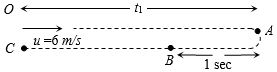
$A$ particle is moving in a straight line and passes through a point $O$ with a velocity of $6\;m/s$. The particle moves with a constant retardation of $2\;m/s^2$ for $4\;s$ and thereafter moves with constant velocity. How long after leaving $O$ does the particle return to $O$?
A
$3\;s$
B
$8\;s$
C
Never
D
$4\;s$
Solution
(B) Let the particle move toward the right with velocity $u = 6\;m/s$. Due to retardation $a = 2\;m/s^2$,its velocity becomes zero after time $t_1$.
From $v = u - at$,we have $0 = 6 - 2t_1$,which gives $t_1 = 3\;s$.
Since the retardation acts for $4\;s$,the particle continues to accelerate in the opposite direction for the remaining $1\;s$ $(4\;s - 3\;s = 1\;s)$.
Distance covered in the first $3\;s$ (from $O$ to $A$): $S_{OA} = ut_1 - \frac{1}{2}at_1^2 = 6(3) - \frac{1}{2}(2)(3)^2 = 18 - 9 = 9\;m$.
Distance covered in the next $1\;s$ (from $A$ to $B$): $S_{AB} = \frac{1}{2}at^2 = \frac{1}{2}(2)(1)^2 = 1\;m$.
Position of $B$ relative to $O$: $S_{OB} = S_{OA} - S_{AB} = 9 - 1 = 8\;m$.
Velocity at $B$ (in return journey): $v_B = at = 2(1) = 2\;m/s$.
From $B$ onwards,the particle moves with a constant velocity of $2\;m/s$ to cover the distance $S_{OB} = 8\;m$.
Time taken to travel from $B$ to $O$: $t_{BO} = \frac{S_{OB}}{v_B} = \frac{8}{2} = 4\;s$.
Total time taken to return to $O$: $T = t_{OA} + t_{AB} + t_{BO} = 3 + 1 + 4 = 8\;s$.
From $v = u - at$,we have $0 = 6 - 2t_1$,which gives $t_1 = 3\;s$.
Since the retardation acts for $4\;s$,the particle continues to accelerate in the opposite direction for the remaining $1\;s$ $(4\;s - 3\;s = 1\;s)$.
Distance covered in the first $3\;s$ (from $O$ to $A$): $S_{OA} = ut_1 - \frac{1}{2}at_1^2 = 6(3) - \frac{1}{2}(2)(3)^2 = 18 - 9 = 9\;m$.
Distance covered in the next $1\;s$ (from $A$ to $B$): $S_{AB} = \frac{1}{2}at^2 = \frac{1}{2}(2)(1)^2 = 1\;m$.
Position of $B$ relative to $O$: $S_{OB} = S_{OA} - S_{AB} = 9 - 1 = 8\;m$.
Velocity at $B$ (in return journey): $v_B = at = 2(1) = 2\;m/s$.
From $B$ onwards,the particle moves with a constant velocity of $2\;m/s$ to cover the distance $S_{OB} = 8\;m$.
Time taken to travel from $B$ to $O$: $t_{BO} = \frac{S_{OB}}{v_B} = \frac{8}{2} = 4\;s$.
Total time taken to return to $O$: $T = t_{OA} + t_{AB} + t_{BO} = 3 + 1 + 4 = 8\;s$.
0 likes
View Solution86
DifficultMCQ
$A$ particle is projected with velocity $v_0$ along the $x$-axis. The deceleration of the particle is proportional to the square of the distance from the origin,i.e.,$a = -\alpha x^2$. The distance at which the particle stops is:
A
$\sqrt{\frac{3v_0}{2\alpha}}$
B
$(\frac{3v_0}{2\alpha})^{1/3}$
C
$\sqrt{\frac{3v_0^2}{2\alpha}}$
D
$(\frac{3v_0^2}{2\alpha})^{1/3}$
Solution
(D) Given that the deceleration $a = -\alpha x^2$. We know that $a = v \frac{dv}{dx}$.
Substituting this into the equation,we get $v \frac{dv}{dx} = -\alpha x^2$.
Separating the variables,we have $v \, dv = -\alpha x^2 \, dx$.
Integrating both sides with limits from initial velocity $v_0$ to final velocity $0$ and position from $0$ to $S$:
$\int_{v_0}^{0} v \, dv = -\alpha \int_{0}^{S} x^2 \, dx$.
Evaluating the integrals:
$[\frac{v^2}{2}]_{v_0}^{0} = -\alpha [\frac{x^3}{3}]_{0}^{S}$.
$0 - \frac{v_0^2}{2} = -\alpha (\frac{S^3}{3})$.
$\frac{v_0^2}{2} = \frac{\alpha S^3}{3}$.
Solving for $S$,we get $S^3 = \frac{3v_0^2}{2\alpha}$,which implies $S = (\frac{3v_0^2}{2\alpha})^{1/3}$.
Substituting this into the equation,we get $v \frac{dv}{dx} = -\alpha x^2$.
Separating the variables,we have $v \, dv = -\alpha x^2 \, dx$.
Integrating both sides with limits from initial velocity $v_0$ to final velocity $0$ and position from $0$ to $S$:
$\int_{v_0}^{0} v \, dv = -\alpha \int_{0}^{S} x^2 \, dx$.
Evaluating the integrals:
$[\frac{v^2}{2}]_{v_0}^{0} = -\alpha [\frac{x^3}{3}]_{0}^{S}$.
$0 - \frac{v_0^2}{2} = -\alpha (\frac{S^3}{3})$.
$\frac{v_0^2}{2} = \frac{\alpha S^3}{3}$.
Solving for $S$,we get $S^3 = \frac{3v_0^2}{2\alpha}$,which implies $S = (\frac{3v_0^2}{2\alpha})^{1/3}$.
0 likes
View Solution87
AdvancedMCQ
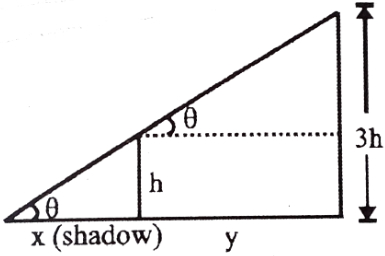
$A$ man of height $h$ is walking away from a street lamp with a constant speed $v$. The height of the street lamp is $3h$. The rate at which the length of the man's shadow is increasing when he is at a distance $10h$ from the base of the street lamp is:
A
$v/2$
B
$v/3$
C
$2v$
D
$v/6$
Solution
(A) Let $y$ be the distance of the man from the base of the street lamp and $x$ be the length of his shadow.
Using similar triangles,the ratio of the height of the lamp to the total distance from the base is equal to the ratio of the man's height to the length of his shadow:
$\frac{3h}{x + y} = \frac{h}{x}$
$3x = x + y$
$2x = y$
Differentiating both sides with respect to time $t$:
$2 \frac{dx}{dt} = \frac{dy}{dt}$
Given that the man is walking away at a constant speed $v$,we have $\frac{dy}{dt} = v$.
Therefore,$\frac{dx}{dt} = \frac{v}{2}$.
The rate of increase of the shadow length is independent of the distance from the lamp,so at $10h$,it is still $v/2$.
Using similar triangles,the ratio of the height of the lamp to the total distance from the base is equal to the ratio of the man's height to the length of his shadow:
$\frac{3h}{x + y} = \frac{h}{x}$
$3x = x + y$
$2x = y$
Differentiating both sides with respect to time $t$:
$2 \frac{dx}{dt} = \frac{dy}{dt}$
Given that the man is walking away at a constant speed $v$,we have $\frac{dy}{dt} = v$.
Therefore,$\frac{dx}{dt} = \frac{v}{2}$.
The rate of increase of the shadow length is independent of the distance from the lamp,so at $10h$,it is still $v/2$.
0 likes
View Solution88
AdvancedMCQ
$A$ particle moves along a straight line in such a way that its acceleration is increasing at the rate of $2 m/s^3$. Its initial acceleration and velocity were $0$. The distance covered by it in $t = 3 s$ is ........ $m$.
A
$27$
B
$9$
C
$3$
D
$1$
Solution
(B) Given that the rate of change of acceleration is constant: $\frac{da}{dt} = 2 m/s^3$.
Integrating with respect to time $t$ with initial conditions $a(0) = 0$:
$a = \int 2 dt = 2t$.
Since acceleration $a = \frac{dv}{dt}$,we have $\frac{dv}{dt} = 2t$.
Integrating with respect to time $t$ with initial velocity $v(0) = 0$:
$v = \int 2t dt = t^2$.
Since velocity $v = \frac{dx}{dt}$,we have $\frac{dx}{dt} = t^2$.
Integrating to find the distance $x$ covered from $t = 0$ to $t = 3 s$:
$x = \int_{0}^{3} t^2 dt = \left[ \frac{t^3}{3} \right]_{0}^{3} = \frac{3^3}{3} - 0 = \frac{27}{3} = 9 m$.
Integrating with respect to time $t$ with initial conditions $a(0) = 0$:
$a = \int 2 dt = 2t$.
Since acceleration $a = \frac{dv}{dt}$,we have $\frac{dv}{dt} = 2t$.
Integrating with respect to time $t$ with initial velocity $v(0) = 0$:
$v = \int 2t dt = t^2$.
Since velocity $v = \frac{dx}{dt}$,we have $\frac{dx}{dt} = t^2$.
Integrating to find the distance $x$ covered from $t = 0$ to $t = 3 s$:
$x = \int_{0}^{3} t^2 dt = \left[ \frac{t^3}{3} \right]_{0}^{3} = \frac{3^3}{3} - 0 = \frac{27}{3} = 9 m$.
0 likes
View Solution89
DifficultMCQ
$A$ particle starts moving rectilinearly at time $t = 0$ such that its velocity $v$ changes with time $t$ according to the equation $v = t^2 - t$,where $t$ is in seconds and $v$ is in $m/s$. The time interval for which the particle retards is
A
$t < 1/2$
B
$1/2 < t < 1$
C
$t > 1$
D
$t < 1/2$ and $t > 1$
Solution
(B) The acceleration of the particle is given by $a = \frac{dv}{dt} = \frac{d}{dt}(t^2 - t) = 2t - 1$.
$A$ particle retards when its acceleration and velocity are in opposite directions,i.e.,$a \cdot v < 0$.
Substituting the expressions for $v$ and $a$:
$(2t - 1)(t^2 - t) < 0$
$(2t - 1)t(t - 1) < 0$
Since $t \ge 0$,we analyze the sign of the expression $t(2t - 1)(t - 1) < 0$ for $t > 0$:
$1$. For $0 < t < 1/2$: $t > 0$,$(2t - 1) < 0$,and $(t - 1) < 0$. The product is $(+)(-)(-) = (+)$,which is $> 0$.
$2$. For $1/2 < t < 1$: $t > 0$,$(2t - 1) > 0$,and $(t - 1) < 0$. The product is $(+)(+)(-) = (-)$,which is $< 0$.
$3$. For $t > 1$: $t > 0$,$(2t - 1) > 0$,and $(t - 1) > 0$. The product is $(+)(+)(+) = (+)$,which is $> 0$.
Therefore,the particle retards in the interval $1/2 < t < 1$.
$A$ particle retards when its acceleration and velocity are in opposite directions,i.e.,$a \cdot v < 0$.
Substituting the expressions for $v$ and $a$:
$(2t - 1)(t^2 - t) < 0$
$(2t - 1)t(t - 1) < 0$
Since $t \ge 0$,we analyze the sign of the expression $t(2t - 1)(t - 1) < 0$ for $t > 0$:
$1$. For $0 < t < 1/2$: $t > 0$,$(2t - 1) < 0$,and $(t - 1) < 0$. The product is $(+)(-)(-) = (+)$,which is $> 0$.
$2$. For $1/2 < t < 1$: $t > 0$,$(2t - 1) > 0$,and $(t - 1) < 0$. The product is $(+)(+)(-) = (-)$,which is $< 0$.
$3$. For $t > 1$: $t > 0$,$(2t - 1) > 0$,and $(t - 1) > 0$. The product is $(+)(+)(+) = (+)$,which is $> 0$.
Therefore,the particle retards in the interval $1/2 < t < 1$.
0 likes
View Solution90
AdvancedMCQ
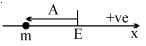
$A$ particle of mass $m$ is constrained to move on the $x$-axis. $A$ force $F$ acts on the particle. $F$ always points toward the position labeled $E$. For example,when the particle is to the left of $E$,$F$ points to the right. The magnitude of $F$ is a constant $F$ except at point $E$ where it is zero. The system is horizontal. $F$ is the net force acting on the particle. The particle is displaced a distance $A$ towards the left from the equilibrium position $E$ and released from rest at $t = 0$. What is the period of the motion?
A
$4\sqrt{\frac{2Am}{F}}$
B
$2\sqrt{\frac{2Am}{F}}$
C
$\sqrt{\frac{2Am}{F}}$
D
None
Solution
(A) The particle moves under a constant force $F$ directed towards the equilibrium position $E$. This is a case of constant acceleration motion,not simple harmonic motion.
When the particle is at a distance $A$ from $E$,its acceleration is $a = \frac{F}{m}$.
The time taken to reach $E$ from the starting position is calculated using the kinematic equation $s = ut + \frac{1}{2}at^2$. Here,$s = A$,$u = 0$,and $a = \frac{F}{m}$.
$A = 0 + \frac{1}{2} \left(\frac{F}{m}\right) t_1^2 \implies t_1^2 = \frac{2Am}{F} \implies t_1 = \sqrt{\frac{2Am}{F}}$.
This is the time taken to travel from the extreme position to the equilibrium position $E$. Due to symmetry,the particle will travel the same distance $A$ on the other side of $E$ and return to $E$ in the same time $t_1$,and then return to the starting position in another $2t_1$.
The total time period $T$ is $4 \times t_1 = 4\sqrt{\frac{2Am}{F}}$.
When the particle is at a distance $A$ from $E$,its acceleration is $a = \frac{F}{m}$.
The time taken to reach $E$ from the starting position is calculated using the kinematic equation $s = ut + \frac{1}{2}at^2$. Here,$s = A$,$u = 0$,and $a = \frac{F}{m}$.
$A = 0 + \frac{1}{2} \left(\frac{F}{m}\right) t_1^2 \implies t_1^2 = \frac{2Am}{F} \implies t_1 = \sqrt{\frac{2Am}{F}}$.
This is the time taken to travel from the extreme position to the equilibrium position $E$. Due to symmetry,the particle will travel the same distance $A$ on the other side of $E$ and return to $E$ in the same time $t_1$,and then return to the starting position in another $2t_1$.
The total time period $T$ is $4 \times t_1 = 4\sqrt{\frac{2Am}{F}}$.
0 likes
View Solution91
AdvancedMCQ
$m$ mass particle is constrained to move on the $x$-axis. $A$ force $F$ acts on the particle,always pointing toward the equilibrium position $E$. The magnitude of $F$ is constant except at $E$ where it is zero. The particle is displaced a distance $A$ to the left of $E$ and released from rest at $t = 0$. Find the minimum time taken to reach from $x = -A/2$ to $x = 0$.
A
$\frac{3}{2}\sqrt{\frac{mA}{F}}(\sqrt{2}-1)$
B
$\sqrt{\frac{mA}{F}}(\sqrt{2}-1)$
C
$2\sqrt{\frac{mA}{F}}(\sqrt{2}-1)$
D
None
Solution
(D) The particle moves under a constant force $F$ directed toward $E$. Let $E$ be at $x = 0$. The force is $F = -F$ for $x > 0$ and $F = +F$ for $x < 0$.
Starting from $x = -A$ with initial velocity $v = 0$,the acceleration is $a = F/m$.
The equation of motion is $x(t) = -A + \frac{1}{2}at^2 = -A + \frac{F}{2m}t^2$.
At $x = -A/2$,we have $-A/2 = -A + \frac{F}{2m}t_1^2$,which gives $\frac{A}{2} = \frac{F}{2m}t_1^2$,so $t_1 = \sqrt{\frac{mA}{F}}$.
The velocity at $x = -A/2$ is $v_1 = at_1 = \frac{F}{m} \sqrt{\frac{mA}{F}} = \sqrt{\frac{FA}{m}}$.
From $x = -A/2$ to $x = 0$,the particle moves with initial velocity $v_1$ and acceleration $a = F/m$.
Using $x = v_1 t_2 + \frac{1}{2}at_2^2$,we have $A/2 = \sqrt{\frac{FA}{m}} t_2 + \frac{F}{2m}t_2^2$.
Let $k = \sqrt{\frac{mA}{F}}$. Then $A/2 = \frac{A}{k} t_2 + \frac{A}{2k^2}t_2^2$.
Dividing by $A/2$,we get $1 = \frac{2}{k} t_2 + \frac{1}{k^2}t_2^2$,or $t_2^2 + 2kt_2 - k^2 = 0$.
Solving for $t_2$,$t_2 = \frac{-2k \pm \sqrt{4k^2 + 4k^2}}{2} = k(\sqrt{2}-1)$.
The total time is $t = t_1 + t_2 = k + k(\sqrt{2}-1) = k\sqrt{2} = \sqrt{\frac{2mA}{F}}$.
Since this result is not in the options,the correct answer is $D$.
Starting from $x = -A$ with initial velocity $v = 0$,the acceleration is $a = F/m$.
The equation of motion is $x(t) = -A + \frac{1}{2}at^2 = -A + \frac{F}{2m}t^2$.
At $x = -A/2$,we have $-A/2 = -A + \frac{F}{2m}t_1^2$,which gives $\frac{A}{2} = \frac{F}{2m}t_1^2$,so $t_1 = \sqrt{\frac{mA}{F}}$.
The velocity at $x = -A/2$ is $v_1 = at_1 = \frac{F}{m} \sqrt{\frac{mA}{F}} = \sqrt{\frac{FA}{m}}$.
From $x = -A/2$ to $x = 0$,the particle moves with initial velocity $v_1$ and acceleration $a = F/m$.
Using $x = v_1 t_2 + \frac{1}{2}at_2^2$,we have $A/2 = \sqrt{\frac{FA}{m}} t_2 + \frac{F}{2m}t_2^2$.
Let $k = \sqrt{\frac{mA}{F}}$. Then $A/2 = \frac{A}{k} t_2 + \frac{A}{2k^2}t_2^2$.
Dividing by $A/2$,we get $1 = \frac{2}{k} t_2 + \frac{1}{k^2}t_2^2$,or $t_2^2 + 2kt_2 - k^2 = 0$.
Solving for $t_2$,$t_2 = \frac{-2k \pm \sqrt{4k^2 + 4k^2}}{2} = k(\sqrt{2}-1)$.
The total time is $t = t_1 + t_2 = k + k(\sqrt{2}-1) = k\sqrt{2} = \sqrt{\frac{2mA}{F}}$.
Since this result is not in the options,the correct answer is $D$.
0 likes
View Solution92
MediumMCQ
$A$ particle located at $x= 0$ at time $t= 0$ starts moving along the positive $x-$direction with a velocity $v$ that varies as $v = \alpha \sqrt{x}$. The displacement of the particle varies with time as:
A
$t^3$
B
$t^2$
C
$t$
D
$t^{1/2}$
Solution
(B) Given the velocity $v = \frac{dx}{dt} = \alpha \sqrt{x}$.
Rearranging the terms to separate the variables,we get:
$\frac{dx}{\sqrt{x}} = \alpha dt$.
Integrating both sides with the initial condition $x=0$ at $t=0$:
$\int_{0}^{x} x^{-1/2} dx = \int_{0}^{t} \alpha dt$.
Solving the integral:
$[2x^{1/2}]_{0}^{x} = \alpha [t]_{0}^{t}$.
This simplifies to:
$2\sqrt{x} = \alpha t$.
Squaring both sides:
$4x = \alpha^2 t^2$.
Therefore,the displacement $x$ is proportional to $t^2$:
$x \propto t^2$.
Rearranging the terms to separate the variables,we get:
$\frac{dx}{\sqrt{x}} = \alpha dt$.
Integrating both sides with the initial condition $x=0$ at $t=0$:
$\int_{0}^{x} x^{-1/2} dx = \int_{0}^{t} \alpha dt$.
Solving the integral:
$[2x^{1/2}]_{0}^{x} = \alpha [t]_{0}^{t}$.
This simplifies to:
$2\sqrt{x} = \alpha t$.
Squaring both sides:
$4x = \alpha^2 t^2$.
Therefore,the displacement $x$ is proportional to $t^2$:
$x \propto t^2$.
0 likes
View Solution93
MediumMCQ
The velocity of a particle is $v = v_0 + gt + ft^2$. If its position is $x = 0$ at $t = 0$,then its displacement after unit time $(t = 1)$ is
A
$v_0 + \frac{g}{2} + f$
B
$v_0 + 2g + 3f$
C
$v_0 + \frac{g}{2} + \frac{f}{3}$
D
$v_0 + g + f$
Solution
(C) We know that velocity $v = \frac{dx}{dt}$,which implies $dx = v \, dt$.
Integrating both sides with initial condition $x = 0$ at $t = 0$:
$x = \int_{0}^{t} v \, dt = \int_{0}^{t} (v_0 + gt + ft^2) \, dt$.
Performing the integration:
$x = \left[ v_0 t + \frac{gt^2}{2} + \frac{ft^3}{3} \right]_{0}^{t} = v_0 t + \frac{gt^2}{2} + \frac{ft^3}{3}$.
To find the displacement at unit time $(t = 1)$,substitute $t = 1$ into the expression:
$x = v_0(1) + \frac{g(1)^2}{2} + \frac{f(1)^3}{3} = v_0 + \frac{g}{2} + \frac{f}{3}$.
Integrating both sides with initial condition $x = 0$ at $t = 0$:
$x = \int_{0}^{t} v \, dt = \int_{0}^{t} (v_0 + gt + ft^2) \, dt$.
Performing the integration:
$x = \left[ v_0 t + \frac{gt^2}{2} + \frac{ft^3}{3} \right]_{0}^{t} = v_0 t + \frac{gt^2}{2} + \frac{ft^3}{3}$.
To find the displacement at unit time $(t = 1)$,substitute $t = 1$ into the expression:
$x = v_0(1) + \frac{g(1)^2}{2} + \frac{f(1)^3}{3} = v_0 + \frac{g}{2} + \frac{f}{3}$.
0 likes
View Solution94
MediumMCQ
An object,moving with a speed of $6.25 \ m/s$,is decelerated at a rate given by: $\frac{dv}{dt} = - 2.5\sqrt{v}$,where $v$ is the instantaneous speed. The time taken by the object to come to rest would be ........ $s$.
A
$8$
B
$1$
C
$2$
D
$4$
Solution
(C) Given the deceleration equation: $\frac{dv}{dt} = - 2.5\sqrt{v}$.
Separating the variables,we get: $\frac{dv}{\sqrt{v}} = - 2.5 \ dt$.
Integrating both sides from the initial speed $v = 6.25 \ m/s$ to final speed $v = 0 \ m/s$ over time $t$:
$\int_{6.25}^{0} v^{-1/2} \ dv = \int_{0}^{t} - 2.5 \ dt$.
Evaluating the integral:
$[2\sqrt{v}]_{6.25}^{0} = - 2.5t$.
Substituting the limits:
$2(\sqrt{0} - \sqrt{6.25}) = - 2.5t$.
$2(0 - 2.5) = - 2.5t$.
$-5 = - 2.5t$.
$t = \frac{5}{2.5} = 2 \ s$.
Separating the variables,we get: $\frac{dv}{\sqrt{v}} = - 2.5 \ dt$.
Integrating both sides from the initial speed $v = 6.25 \ m/s$ to final speed $v = 0 \ m/s$ over time $t$:
$\int_{6.25}^{0} v^{-1/2} \ dv = \int_{0}^{t} - 2.5 \ dt$.
Evaluating the integral:
$[2\sqrt{v}]_{6.25}^{0} = - 2.5t$.
Substituting the limits:
$2(\sqrt{0} - \sqrt{6.25}) = - 2.5t$.
$2(0 - 2.5) = - 2.5t$.
$-5 = - 2.5t$.
$t = \frac{5}{2.5} = 2 \ s$.
0 likes
View Solution95
MediumMCQ
Two trains travelling on the same track are approaching each other with equal speeds of $40\ m/s$. The drivers of the trains begin to decelerate simultaneously when they are just $2.0\ km$ apart. Assuming the decelerations to be uniform and equal,the value of the deceleration to barely avoid collision should be..........$m/s^2$.
A
$11.8$
B
$11$
C
$2.1$
D
$0.8$
Solution
(D) Let the speed of each train be $u = 40\ m/s$. The total distance between them is $d = 2.0\ km = 2000\ m$.
To barely avoid a collision,each train must come to rest after covering a distance of $s = d/2 = 1000\ m$.
Using the kinematic equation $v^2 = u^2 + 2as$,where $v = 0$ (final velocity),$u = 40\ m/s$,and $s = 1000\ m$:
$0 = (40)^2 + 2a(1000)$
$0 = 1600 + 2000a$
$2000a = -1600$
$a = -1600 / 2000 = -0.8\ m/s^2$.
The magnitude of the deceleration is $0.8\ m/s^2$.
To barely avoid a collision,each train must come to rest after covering a distance of $s = d/2 = 1000\ m$.
Using the kinematic equation $v^2 = u^2 + 2as$,where $v = 0$ (final velocity),$u = 40\ m/s$,and $s = 1000\ m$:
$0 = (40)^2 + 2a(1000)$
$0 = 1600 + 2000a$
$2000a = -1600$
$a = -1600 / 2000 = -0.8\ m/s^2$.
The magnitude of the deceleration is $0.8\ m/s^2$.
0 likes
View Solution96
MediumMCQ
$A$ point moves such that its displacement as a function of time is given by $x^3 = t^3 + 1$. Its acceleration as a function of time $t$ will be
A
$\frac{2}{x^5}$
B
$\frac{2t}{x^5}$
C
$\frac{2t}{x^4}$
D
$\frac{2t^2}{x^5}$
Solution
(B) Given the displacement equation: $x^3 = t^3 + 1$.
Differentiating both sides with respect to time $t$:
$3x^2 \frac{dx}{dt} = 3t^2$
$x^2 v = t^2$,where $v = \frac{dx}{dt}$ is the velocity.
$v = \frac{t^2}{x^2}$.
Differentiating $x^2 v = t^2$ with respect to time $t$ using the product rule:
$2x \frac{dx}{dt} v + x^2 \frac{dv}{dt} = 2t$
Since $a = \frac{dv}{dt}$,we have:
$2x v^2 + x^2 a = 2t$
Substitute $v = \frac{t^2}{x^2}$:
$2x (\frac{t^2}{x^2})^2 + x^2 a = 2t$
$2x \frac{t^4}{x^4} + x^2 a = 2t$
$x^2 a = 2t - \frac{2t^4}{x^3}$
Since $x^3 = t^3 + 1$,we have $t^3 = x^3 - 1$:
$x^2 a = 2t - \frac{2t(t^3)}{x^3} = 2t - \frac{2t(x^3 - 1)}{x^3} = 2t - 2t + \frac{2t}{x^3} = \frac{2t}{x^3}$
$a = \frac{2t}{x^3 \cdot x^2} = \frac{2t}{x^5}$.
Differentiating both sides with respect to time $t$:
$3x^2 \frac{dx}{dt} = 3t^2$
$x^2 v = t^2$,where $v = \frac{dx}{dt}$ is the velocity.
$v = \frac{t^2}{x^2}$.
Differentiating $x^2 v = t^2$ with respect to time $t$ using the product rule:
$2x \frac{dx}{dt} v + x^2 \frac{dv}{dt} = 2t$
Since $a = \frac{dv}{dt}$,we have:
$2x v^2 + x^2 a = 2t$
Substitute $v = \frac{t^2}{x^2}$:
$2x (\frac{t^2}{x^2})^2 + x^2 a = 2t$
$2x \frac{t^4}{x^4} + x^2 a = 2t$
$x^2 a = 2t - \frac{2t^4}{x^3}$
Since $x^3 = t^3 + 1$,we have $t^3 = x^3 - 1$:
$x^2 a = 2t - \frac{2t(t^3)}{x^3} = 2t - \frac{2t(x^3 - 1)}{x^3} = 2t - 2t + \frac{2t}{x^3} = \frac{2t}{x^3}$
$a = \frac{2t}{x^3 \cdot x^2} = \frac{2t}{x^5}$.
0 likes
View Solution97
DifficultMCQ
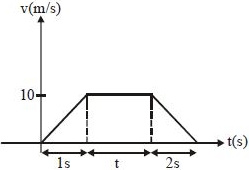
The maximum possible acceleration of a train moving on a straight track is $10 \ m/s^2$ and maximum possible retardation is $5 \ m/s^2$. If the maximum achievable speed of the train is $10 \ m/s$,then the minimum time in which the train can complete a journey of $135 \ m$ starting from rest and ending at rest is ......... $s$.
A
$15$
B
$18$
C
$12$
D
$20$
Solution
(A) To minimize the total time,the train must accelerate at its maximum rate $(a_1 = 10 \ m/s^2)$ to reach the maximum speed $(v_{max} = 10 \ m/s)$ and decelerate at its maximum rate $(a_2 = 5 \ m/s^2)$ to come to rest.
Time taken to accelerate $(t_1)$: $v = u + a_1 t_1 \implies 10 = 0 + 10 t_1 \implies t_1 = 1 \ s$.
Distance covered during acceleration $(d_1)$: $d_1 = \frac{1}{2} a_1 t_1^2 = \frac{1}{2} \times 10 \times (1)^2 = 5 \ m$.
Time taken to decelerate $(t_2)$: $v = u - a_2 t_2 \implies 0 = 10 - 5 t_2 \implies t_2 = 2 \ s$.
Distance covered during deceleration $(d_2)$: $d_2 = v_{max} t_2 - \frac{1}{2} a_2 t_2^2 = 10 \times 2 - \frac{1}{2} \times 5 \times (2)^2 = 20 - 10 = 10 \ m$.
Remaining distance to be covered at constant speed $(d_3)$: $d_3 = 135 - (d_1 + d_2) = 135 - (5 + 10) = 120 \ m$.
Time taken at constant speed $(t_3)$: $t_3 = \frac{d_3}{v_{max}} = \frac{120}{10} = 12 \ s$.
Total time $(T)$: $T = t_1 + t_2 + t_3 = 1 + 2 + 12 = 15 \ s$.
Time taken to accelerate $(t_1)$: $v = u + a_1 t_1 \implies 10 = 0 + 10 t_1 \implies t_1 = 1 \ s$.
Distance covered during acceleration $(d_1)$: $d_1 = \frac{1}{2} a_1 t_1^2 = \frac{1}{2} \times 10 \times (1)^2 = 5 \ m$.
Time taken to decelerate $(t_2)$: $v = u - a_2 t_2 \implies 0 = 10 - 5 t_2 \implies t_2 = 2 \ s$.
Distance covered during deceleration $(d_2)$: $d_2 = v_{max} t_2 - \frac{1}{2} a_2 t_2^2 = 10 \times 2 - \frac{1}{2} \times 5 \times (2)^2 = 20 - 10 = 10 \ m$.
Remaining distance to be covered at constant speed $(d_3)$: $d_3 = 135 - (d_1 + d_2) = 135 - (5 + 10) = 120 \ m$.
Time taken at constant speed $(t_3)$: $t_3 = \frac{d_3}{v_{max}} = \frac{120}{10} = 12 \ s$.
Total time $(T)$: $T = t_1 + t_2 + t_3 = 1 + 2 + 12 = 15 \ s$.
0 likes
View Solution98
MediumMCQ
The displacement of a particle after time $t$ is given by $x = (k/b^2)(1 - e^{-bt})$ where $b$ is a constant. What is the acceleration of the particle?
A
$k e^{-bt}$
B
$-k e^{-bt}$
C
$\frac{k}{b^2} e^{-bt}$
D
$\frac{-k}{b^2} e^{-bt}$
Solution
(B) The displacement is given by $x = \frac{k}{b^2}(1 - e^{-bt})$.
To find the velocity $v$,we differentiate $x$ with respect to time $t$:
$v = \frac{dx}{dt} = \frac{d}{dt} [\frac{k}{b^2}(1 - e^{-bt})] = \frac{k}{b^2} [0 - (-b)e^{-bt}] = \frac{k}{b^2} (b e^{-bt}) = \frac{k}{b} e^{-bt}$.
To find the acceleration $a$,we differentiate the velocity $v$ with respect to time $t$:
$a = \frac{dv}{dt} = \frac{d}{dt} [\frac{k}{b} e^{-bt}] = \frac{k}{b} (-b) e^{-bt} = -k e^{-bt}$.
Thus,the acceleration of the particle is $-k e^{-bt}$.
To find the velocity $v$,we differentiate $x$ with respect to time $t$:
$v = \frac{dx}{dt} = \frac{d}{dt} [\frac{k}{b^2}(1 - e^{-bt})] = \frac{k}{b^2} [0 - (-b)e^{-bt}] = \frac{k}{b^2} (b e^{-bt}) = \frac{k}{b} e^{-bt}$.
To find the acceleration $a$,we differentiate the velocity $v$ with respect to time $t$:
$a = \frac{dv}{dt} = \frac{d}{dt} [\frac{k}{b} e^{-bt}] = \frac{k}{b} (-b) e^{-bt} = -k e^{-bt}$.
Thus,the acceleration of the particle is $-k e^{-bt}$.
0 likes
View SolutionMotion in Straight Line — Uniformly Accelerated Motion · Frequently Asked Questions
1Are these Motion in Straight Line questions useful for JEE and NEET?
Yes. All questions in this section are mapped to JEE Main and NEET exam patterns. Previous year questions from JEE Main, NEET, GUJCET and state-level exams are included with full solutions.
2Can I switch to Hindi or Gujarati for these questions?
Yes. Use the language tabs in the hero section or the sidebar to view the same questions and solutions in English, Hindi or Gujarati.
3How do I generate a question paper from this subtopic?
Use the Vedclass Exam Paper Generator — select the chapter and subtopic, set difficulty, and generate Sets A, B, C, D automatically. First 3 chapters of every subject are free.
Vedclass Products
For Students
Vedclass Test Series
Mock tests in real JEE/NEET style with performance analysis. 5-day free trial.
Start Free TrialFor Teachers
Exam Paper Generator
Generate Set A/B/C/D papers from this chapter in 2 minutes. 3 chapters free.
Try FreeFor Institutes
Online Exam Module
Live online exams with unlimited students, 360° analytics & white-label branding.
See DemoFor Teachers & Institutes
Generate a Motion in Straight Line Exam Paper in 2 Minutes
Select subtopic & difficulty — Sets A, B, C, D auto-generated with No Repeat logic.
First 3 chapters of every subject are free — no payment required.