
A English
Uniformly Accelerated Motion Questions in English
Class 11 Physics · Motion in Straight Line · Uniformly Accelerated Motion
304+
Questions
English
Language
100%
With Solutions
Showing 50 of 304 questions in English
1
MediumMCQ
$A$ $150 \,m$ long train is moving with a uniform velocity of $45 \,km/h$. The time taken by the train to cross a bridge of length $850 \,m$ is..........$sec$.
A
$56$
B
$68$
C
$80$
D
$92$
Solution
(C) Total distance to be covered for crossing the bridge $=$ length of train $+$ length of bridge.
Total distance $= 150 \,m + 850 \,m = 1000 \,m$.
Convert the velocity from $km/h$ to $m/s$: $45 \times \frac{5}{18} = 12.5 \,m/s$.
Time taken $= \frac{\text{Total distance}}{\text{Velocity}} = \frac{1000 \,m}{12.5 \,m/s} = 80 \,sec$.
Total distance $= 150 \,m + 850 \,m = 1000 \,m$.
Convert the velocity from $km/h$ to $m/s$: $45 \times \frac{5}{18} = 12.5 \,m/s$.
Time taken $= \frac{\text{Total distance}}{\text{Velocity}} = \frac{1000 \,m}{12.5 \,m/s} = 80 \,sec$.
0 likes
View Solution2
MediumMCQ
$A$ $100\, m$ long train is moving with a uniform velocity of $45\, km/hr$. The time taken by the train to cross a bridge of length $1\, km$ is.........$s$
A
$58$
B
$68$
C
$78$
D
$88$
Solution
(D) Length of the train $= 100\, m$.
Velocity of the train $= 45\, km/hr = 45 \times \frac{5}{18} = 12.5\, m/s$.
Length of the bridge $= 1\, km = 1000\, m$.
To cross the bridge completely,the train must cover a total distance equal to the sum of the length of the train and the length of the bridge.
Total distance $= 100\, m + 1000\, m = 1100\, m$.
Time taken $= \frac{\text{Total distance}}{\text{Velocity}} = \frac{1100\, m}{12.5\, m/s} = 88\, s$.
Velocity of the train $= 45\, km/hr = 45 \times \frac{5}{18} = 12.5\, m/s$.
Length of the bridge $= 1\, km = 1000\, m$.
To cross the bridge completely,the train must cover a total distance equal to the sum of the length of the train and the length of the bridge.
Total distance $= 100\, m + 1000\, m = 1100\, m$.
Time taken $= \frac{\text{Total distance}}{\text{Velocity}} = \frac{1100\, m}{12.5\, m/s} = 88\, s$.
0 likes
View Solution3
DifficultMCQ
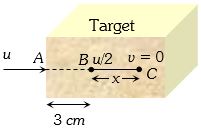
$A$ bullet fired into a fixed target loses half of its velocity after penetrating $3\,cm$. How much further will it penetrate before coming to rest,assuming that it faces constant resistance to motion? (in $cm$)
A
$1.5$
B
$1$
C
$3$
D
$2$
Solution
(B) Let the initial velocity of the bullet be $u$.
After penetrating $3\,cm$,its velocity becomes $u/2$.
Using the equation of motion $v^2 = u^2 - 2as$:
$(u/2)^2 = u^2 - 2a(3)$
$u^2/4 = u^2 - 6a$
$6a = 3u^2/4$
$a = u^2/8$
Let the bullet penetrate an additional distance $x$ before coming to rest.
For this motion,initial velocity is $u/2$,final velocity is $0$,and acceleration is $-a = -u^2/8$.
Using $v^2 = u^2 - 2as$:
$0^2 = (u/2)^2 - 2(u^2/8)x$
$0 = u^2/4 - (u^2/4)x$
$u^2/4 = (u^2/4)x$
$x = 1\,cm$.
After penetrating $3\,cm$,its velocity becomes $u/2$.
Using the equation of motion $v^2 = u^2 - 2as$:
$(u/2)^2 = u^2 - 2a(3)$
$u^2/4 = u^2 - 6a$
$6a = 3u^2/4$
$a = u^2/8$
Let the bullet penetrate an additional distance $x$ before coming to rest.
For this motion,initial velocity is $u/2$,final velocity is $0$,and acceleration is $-a = -u^2/8$.
Using $v^2 = u^2 - 2as$:
$0^2 = (u/2)^2 - 2(u^2/8)x$
$0 = u^2/4 - (u^2/4)x$
$u^2/4 = (u^2/4)x$
$x = 1\,cm$.
0 likes
View Solution4
MediumMCQ
$A$ particle experiences a constant acceleration for $20 \,s$ after starting from rest. If it travels a distance ${S_1}$ in the first $10 \,s$ and a distance ${S_2}$ in the next $10 \,s$,then:
A
${S_1} = {S_2}$
B
${S_1} = {S_2}/3$
C
${S_1} = {S_2}/2$
D
${S_1} = {S_2}/4$
Solution
(B) Given that the particle starts from rest,initial velocity $u = 0$. Let the constant acceleration be $a$.
For the first $10 \,s$ $(t_1 = 10 \,s)$:
Using the equation of motion $S = ut + \frac{1}{2}at^2$,we get:
${S_1} = 0 \times 10 + \frac{1}{2}a(10)^2 = 50a$ .....$(i)$
To find the distance in the next $10 \,s$,we first find the velocity at $t = 10 \,s$:
$v = u + at = 0 + a(10) = 10a$.
For the next $10 \,s$ $(t_2 = 10 \,s)$,the initial velocity is $10a$:
${S_2} = (10a)(10) + \frac{1}{2}a(10)^2$
${S_2} = 100a + 50a = 150a$ .....(ii)
Comparing equations $(i)$ and (ii):
${S_1} = 50a$ and ${S_2} = 150a$
Therefore,${S_2} = 3{S_1}$,which implies ${S_1} = {S_2}/3$.
For the first $10 \,s$ $(t_1 = 10 \,s)$:
Using the equation of motion $S = ut + \frac{1}{2}at^2$,we get:
${S_1} = 0 \times 10 + \frac{1}{2}a(10)^2 = 50a$ .....$(i)$
To find the distance in the next $10 \,s$,we first find the velocity at $t = 10 \,s$:
$v = u + at = 0 + a(10) = 10a$.
For the next $10 \,s$ $(t_2 = 10 \,s)$,the initial velocity is $10a$:
${S_2} = (10a)(10) + \frac{1}{2}a(10)^2$
${S_2} = 100a + 50a = 150a$ .....(ii)
Comparing equations $(i)$ and (ii):
${S_1} = 50a$ and ${S_2} = 150a$
Therefore,${S_2} = 3{S_1}$,which implies ${S_1} = {S_2}/3$.
0 likes
View Solution5
EasyMCQ
The displacement $x$ of a particle along a straight line at time $t$ is given by $x = a_0 + a_1t + a_2t^2$. The acceleration of the particle is
A
$a_0$
B
$a_1$
C
$2a_2$
D
$a_2$
Solution
(C) The displacement of the particle is given by the equation: $x = a_0 + a_1t + a_2t^2$.
To find the velocity $v$,we differentiate the displacement $x$ with respect to time $t$:
$v = \frac{dx}{dt} = \frac{d}{dt}(a_0 + a_1t + a_2t^2) = 0 + a_1 + 2a_2t$.
To find the acceleration $a$,we differentiate the velocity $v$ with respect to time $t$:
$a = \frac{dv}{dt} = \frac{d}{dt}(a_1 + 2a_2t) = 0 + 2a_2 = 2a_2$.
Thus,the acceleration of the particle is $2a_2$.
To find the velocity $v$,we differentiate the displacement $x$ with respect to time $t$:
$v = \frac{dx}{dt} = \frac{d}{dt}(a_0 + a_1t + a_2t^2) = 0 + a_1 + 2a_2t$.
To find the acceleration $a$,we differentiate the velocity $v$ with respect to time $t$:
$a = \frac{dv}{dt} = \frac{d}{dt}(a_1 + 2a_2t) = 0 + 2a_2 = 2a_2$.
Thus,the acceleration of the particle is $2a_2$.
0 likes
View Solution6
MediumMCQ
An electron starting from rest has a velocity that increases linearly with time,given by $v = kt$,where $k = 2 \, m/s^2$. The distance travelled in the first $3 \, s$ will be ........... $m$.
A
$9$
B
$16$
C
$27$
D
$36$
Solution
(A) Given that the velocity $v$ is a function of time $t$ as $v = kt$,where $k = 2 \, m/s^2$.
To find the distance $S$ travelled in the first $3 \, s$,we integrate the velocity with respect to time from $t = 0$ to $t = 3$.
$S = \int_{0}^{3} v \, dt = \int_{0}^{3} kt \, dt$.
Substituting the value of $k = 2$,we get:
$S = \int_{0}^{3} 2t \, dt = [t^2]_{0}^{3}$.
$S = (3)^2 - (0)^2 = 9 \, m$.
Therefore,the distance travelled is $9 \, m$.
To find the distance $S$ travelled in the first $3 \, s$,we integrate the velocity with respect to time from $t = 0$ to $t = 3$.
$S = \int_{0}^{3} v \, dt = \int_{0}^{3} kt \, dt$.
Substituting the value of $k = 2$,we get:
$S = \int_{0}^{3} 2t \, dt = [t^2]_{0}^{3}$.
$S = (3)^2 - (0)^2 = 9 \, m$.
Therefore,the distance travelled is $9 \, m$.
0 likes
View Solution7
MediumMCQ
The displacement of a body is given to be proportional to the cube of time elapsed. The magnitude of the acceleration of the body is
A
Increasing with time
B
Decreasing with time
C
Constant but not zero
D
Zero
Solution
(A) Given that the displacement $S$ is proportional to the cube of time $t$,we can write $S = kt^3$,where $k$ is a constant.
To find the velocity $v$,we differentiate $S$ with respect to time $t$:
$v = \frac{dS}{dt} = \frac{d}{dt}(kt^3) = 3kt^2$.
To find the acceleration $a$,we differentiate the velocity $v$ with respect to time $t$:
$a = \frac{dv}{dt} = \frac{d}{dt}(3kt^2) = 6kt$.
Since $a = 6kt$,the acceleration $a$ is directly proportional to time $t$ $(a \propto t)$.
Therefore,the magnitude of the acceleration increases with time.
To find the velocity $v$,we differentiate $S$ with respect to time $t$:
$v = \frac{dS}{dt} = \frac{d}{dt}(kt^3) = 3kt^2$.
To find the acceleration $a$,we differentiate the velocity $v$ with respect to time $t$:
$a = \frac{dv}{dt} = \frac{d}{dt}(3kt^2) = 6kt$.
Since $a = 6kt$,the acceleration $a$ is directly proportional to time $t$ $(a \propto t)$.
Therefore,the magnitude of the acceleration increases with time.
0 likes
View Solution8
DifficultMCQ
$A$ body is moving from rest under constant acceleration. Let $S_1$ be the displacement in the first $(p - 1) \ s$ and $S_2$ be the displacement in the first $p \ s$. The displacement in the $(p^2 - p + 1)^{th} \ s$ will be:
A
$S_1 + S_2$
B
$S_1 S_2$
C
$S_1 - S_2$
D
$S_1 / S_2$
Solution
(A) Given that the body starts from rest,so initial velocity $u = 0$.
Using the equation of motion $S = ut + \frac{1}{2}at^2$,we have:
$S_1 = \frac{1}{2}a(p - 1)^2$
$S_2 = \frac{1}{2}ap^2$
Adding these two displacements:
$S_1 + S_2 = \frac{1}{2}a(p^2 - 2p + 1) + \frac{1}{2}ap^2 = \frac{1}{2}a(2p^2 - 2p + 1)$
Now,the displacement in the $n^{th}$ second is given by $S_n = u + \frac{a}{2}(2n - 1)$.
For $n = (p^2 - p + 1)$,the displacement is:
$S_{(p^2 - p + 1)^{th}} = 0 + \frac{a}{2}[2(p^2 - p + 1) - 1] = \frac{a}{2}[2p^2 - 2p + 2 - 1] = \frac{a}{2}(2p^2 - 2p + 1)$.
Comparing the results,we find that the displacement in the $(p^2 - p + 1)^{th}$ second is equal to $S_1 + S_2$.
Using the equation of motion $S = ut + \frac{1}{2}at^2$,we have:
$S_1 = \frac{1}{2}a(p - 1)^2$
$S_2 = \frac{1}{2}ap^2$
Adding these two displacements:
$S_1 + S_2 = \frac{1}{2}a(p^2 - 2p + 1) + \frac{1}{2}ap^2 = \frac{1}{2}a(2p^2 - 2p + 1)$
Now,the displacement in the $n^{th}$ second is given by $S_n = u + \frac{a}{2}(2n - 1)$.
For $n = (p^2 - p + 1)$,the displacement is:
$S_{(p^2 - p + 1)^{th}} = 0 + \frac{a}{2}[2(p^2 - p + 1) - 1] = \frac{a}{2}[2p^2 - 2p + 2 - 1] = \frac{a}{2}(2p^2 - 2p + 1)$.
Comparing the results,we find that the displacement in the $(p^2 - p + 1)^{th}$ second is equal to $S_1 + S_2$.
1 likes
View Solution9
DifficultMCQ
$A$ body starts from the origin and moves along the $X$-axis such that the velocity at any instant is given by $v = (4t^3 - 2t)$,where $t$ is in $s$ and velocity is in $m/s$. What is the acceleration of the particle when it is $2\, m$ from the origin? (in $m/s^2$)
A
$28$
B
$22$
C
$12$
D
$10$
Solution
(B) Given velocity $v = 4t^3 - 2t$.
Acceleration $a = \frac{dv}{dt} = \frac{d}{dt}(4t^3 - 2t) = 12t^2 - 2$.
Position $x = \int v\,dt = \int (4t^3 - 2t)\,dt = t^4 - t^2$ (assuming $x=0$ at $t=0$).
When the particle is at $x = 2\, m$,we have $t^4 - t^2 = 2$,or $t^4 - t^2 - 2 = 0$.
Let $u = t^2$,then $u^2 - u - 2 = 0$,which factors as $(u - 2)(u + 1) = 0$.
Since $t^2$ must be positive,$t^2 = 2$,so $t = \sqrt{2}\,s$.
Substituting $t^2 = 2$ into the acceleration equation: $a = 12(2) - 2 = 24 - 2 = 22\,m/s^2$.
Acceleration $a = \frac{dv}{dt} = \frac{d}{dt}(4t^3 - 2t) = 12t^2 - 2$.
Position $x = \int v\,dt = \int (4t^3 - 2t)\,dt = t^4 - t^2$ (assuming $x=0$ at $t=0$).
When the particle is at $x = 2\, m$,we have $t^4 - t^2 = 2$,or $t^4 - t^2 - 2 = 0$.
Let $u = t^2$,then $u^2 - u - 2 = 0$,which factors as $(u - 2)(u + 1) = 0$.
Since $t^2$ must be positive,$t^2 = 2$,so $t = \sqrt{2}\,s$.
Substituting $t^2 = 2$ into the acceleration equation: $a = 12(2) - 2 = 24 - 2 = 22\,m/s^2$.
0 likes
View Solution10
DifficultMCQ
$A$ point moves with uniform acceleration and $v_1, v_2$ and $v_3$ denote the average velocities in the three successive intervals of time $t_1, t_2$ and $t_3$. Which of the following relations is correct?
A
$(v_1 - v_2) : (v_2 - v_3) = (t_1 - t_2) : (t_2 + t_3)$
B
$(v_1 - v_2) : (v_2 - v_3) = (t_1 + t_2) : (t_2 + t_3)$
C
$(v_1 - v_2) : (v_2 - v_3) = (t_1 - t_2) : (t_1 - t_3)$
D
$(v_1 - v_2) : (v_2 - v_3) = (t_1 - t_2) : (t_2 - t_3)$
Solution
(B) Let $u_1, u_2, u_3$ and $u_4$ be the velocities at times $t = 0, t_1, (t_1 + t_2)$ and $(t_1 + t_2 + t_3)$ respectively,and let $a$ be the uniform acceleration.
The average velocities are given by:
$v_1 = \frac{u_1 + u_2}{2}, v_2 = \frac{u_2 + u_3}{2}, v_3 = \frac{u_3 + u_4}{2}$
Using the equation of motion $v = u + at$,we have:
$u_2 = u_1 + at_1$
$u_3 = u_1 + a(t_1 + t_2)$
$u_4 = u_1 + a(t_1 + t_2 + t_3)$
Now,calculate the differences:
$v_1 - v_2 = \frac{u_1 + u_2 - u_2 - u_3}{2} = \frac{u_1 - u_3}{2} = \frac{u_1 - (u_1 + a(t_1 + t_2))}{2} = -\frac{a(t_1 + t_2)}{2}$
$v_2 - v_3 = \frac{u_2 + u_3 - u_3 - u_4}{2} = \frac{u_2 - u_4}{2} = \frac{(u_1 + at_1) - (u_1 + a(t_1 + t_2 + t_3))}{2} = -\frac{a(t_2 + t_3)}{2}$
Taking the ratio:
$\frac{v_1 - v_2}{v_2 - v_3} = \frac{-a(t_1 + t_2) / 2}{-a(t_2 + t_3) / 2} = \frac{t_1 + t_2}{t_2 + t_3}$
Thus,$(v_1 - v_2) : (v_2 - v_3) = (t_1 + t_2) : (t_2 + t_3)$.
The average velocities are given by:
$v_1 = \frac{u_1 + u_2}{2}, v_2 = \frac{u_2 + u_3}{2}, v_3 = \frac{u_3 + u_4}{2}$
Using the equation of motion $v = u + at$,we have:
$u_2 = u_1 + at_1$
$u_3 = u_1 + a(t_1 + t_2)$
$u_4 = u_1 + a(t_1 + t_2 + t_3)$
Now,calculate the differences:
$v_1 - v_2 = \frac{u_1 + u_2 - u_2 - u_3}{2} = \frac{u_1 - u_3}{2} = \frac{u_1 - (u_1 + a(t_1 + t_2))}{2} = -\frac{a(t_1 + t_2)}{2}$
$v_2 - v_3 = \frac{u_2 + u_3 - u_3 - u_4}{2} = \frac{u_2 - u_4}{2} = \frac{(u_1 + at_1) - (u_1 + a(t_1 + t_2 + t_3))}{2} = -\frac{a(t_2 + t_3)}{2}$
Taking the ratio:
$\frac{v_1 - v_2}{v_2 - v_3} = \frac{-a(t_1 + t_2) / 2}{-a(t_2 + t_3) / 2} = \frac{t_1 + t_2}{t_2 + t_3}$
Thus,$(v_1 - v_2) : (v_2 - v_3) = (t_1 + t_2) : (t_2 + t_3)$.
0 likes
View Solution11
EasyMCQ
The initial velocity of a particle is $u$ (at $t = 0$) and the acceleration is given by $a(t) = at$. Which of the following relations is valid?
A
$v = u + at^2$
B
$v = u + \frac{at^2}{2}$
C
$v = u + at$
D
$v = u$
Solution
(B) Given that the acceleration $a(t) = at$ is a function of time.
We know that acceleration is the rate of change of velocity,$a = \frac{dv}{dt}$.
Therefore,$dv = a(t) \, dt$.
Integrating both sides from initial velocity $u$ at $t = 0$ to final velocity $v$ at time $t$:
$\int_{u}^{v} dv = \int_{0}^{t} (at) \, dt$.
$[v]_{u}^{v} = a \left[ \frac{t^2}{2} \right]_{0}^{t}$.
$v - u = \frac{at^2}{2}$.
$v = u + \frac{at^2}{2}$.
Thus,the correct relation is $v = u + \frac{at^2}{2}$.
We know that acceleration is the rate of change of velocity,$a = \frac{dv}{dt}$.
Therefore,$dv = a(t) \, dt$.
Integrating both sides from initial velocity $u$ at $t = 0$ to final velocity $v$ at time $t$:
$\int_{u}^{v} dv = \int_{0}^{t} (at) \, dt$.
$[v]_{u}^{v} = a \left[ \frac{t^2}{2} \right]_{0}^{t}$.
$v - u = \frac{at^2}{2}$.
$v = u + \frac{at^2}{2}$.
Thus,the correct relation is $v = u + \frac{at^2}{2}$.
0 likes
View Solution12
EasyMCQ
The initial velocity of the particle is $10 \ m/s$ and its retardation is $2 \ m/s^2$. The distance moved by the particle in the $5^{th}$ second of its motion is .......... $m$.
A
$1$
B
$19$
C
$50$
D
$75$
Solution
(A) The distance traveled by a particle in the $n^{th}$ second is given by the formula: $S_n = u + \frac{a}{2}(2n - 1)$.
Here,the initial velocity $u = 10 \ m/s$,the acceleration $a = -2 \ m/s^2$ (since it is retardation),and $n = 5$.
Substituting these values into the formula:
$S_5 = 10 + \frac{-2}{2}(2 \times 5 - 1)$
$S_5 = 10 - 1(10 - 1)$
$S_5 = 10 - 9 = 1 \ m$.
Therefore,the distance moved by the particle in the $5^{th}$ second is $1 \ m$.
Here,the initial velocity $u = 10 \ m/s$,the acceleration $a = -2 \ m/s^2$ (since it is retardation),and $n = 5$.
Substituting these values into the formula:
$S_5 = 10 + \frac{-2}{2}(2 \times 5 - 1)$
$S_5 = 10 - 1(10 - 1)$
$S_5 = 10 - 9 = 1 \ m$.
Therefore,the distance moved by the particle in the $5^{th}$ second is $1 \ m$.
0 likes
View Solution13
EasyMCQ
$A$ motor car moving with a uniform speed of $20\,m/s$ comes to a stop on the application of brakes after travelling a distance of $10\,m$. Its acceleration is .......... $m/s^2$.
A
$20$
B
$-20$
C
$-40$
D
$+2$
Solution
(B) Given: Initial velocity $u = 20\,m/s$,Final velocity $v = 0\,m/s$,Distance $S = 10\,m$.
Using the third equation of motion: $v^2 = u^2 + 2aS$.
Substituting the values: $0^2 = (20)^2 + 2 \times a \times 10$.
$0 = 400 + 20a$.
$20a = -400$.
$a = -20\,m/s^2$.
Thus,the acceleration is $-20\,m/s^2$.
Using the third equation of motion: $v^2 = u^2 + 2aS$.
Substituting the values: $0^2 = (20)^2 + 2 \times a \times 10$.
$0 = 400 + 20a$.
$20a = -400$.
$a = -20\,m/s^2$.
Thus,the acceleration is $-20\,m/s^2$.
0 likes
View Solution14
EasyMCQ
The velocity of a body moving with a uniform acceleration of $2\,m/s^2$ is $10\,m/s$. Its velocity after an interval of $4\,s$ is...........$m/s$.
A
$12$
B
$14$
C
$16$
D
$18$
Solution
(D) Given:
Initial velocity $(u)$ = $10\,m/s$
Uniform acceleration $(a)$ = $2\,m/s^2$
Time interval $(t)$ = $4\,s$
Using the first equation of motion:
$v = u + at$
Substituting the values:
$v = 10 + (2 \times 4)$
$v = 10 + 8$
$v = 18\,m/s$
Therefore,the velocity after $4\,s$ is $18\,m/s$.
Initial velocity $(u)$ = $10\,m/s$
Uniform acceleration $(a)$ = $2\,m/s^2$
Time interval $(t)$ = $4\,s$
Using the first equation of motion:
$v = u + at$
Substituting the values:
$v = 10 + (2 \times 4)$
$v = 10 + 8$
$v = 18\,m/s$
Therefore,the velocity after $4\,s$ is $18\,m/s$.
0 likes
View Solution15
MediumMCQ
$A$ particle starting from rest and moving with constant acceleration travels a distance $x$ in the first $2$ seconds and a distance $y$ in the next $2$ seconds. Then:
A
$y = x$
B
$y = 2x$
C
$y = 3x$
D
$y = 4x$
Solution
(C) Given that the particle starts from rest,so initial velocity $u = 0$.
Let the constant acceleration be $a$.
The distance covered in time $t$ is given by $s = ut + \frac{1}{2}at^2$.
For the first $2$ seconds ($t = 2$ s),the distance $x$ is:
$x = 0(2) + \frac{1}{2}a(2)^2 = 2a$.
For the first $4$ seconds ($t = 4$ s),the total distance covered is $x + y$:
$x + y = 0(4) + \frac{1}{2}a(4)^2 = 8a$.
Substituting $x = 2a$ into the equation:
$2a + y = 8a$
$y = 6a$.
Now,comparing $x$ and $y$:
$\frac{y}{x} = \frac{6a}{2a} = 3$.
Therefore,$y = 3x$.
Let the constant acceleration be $a$.
The distance covered in time $t$ is given by $s = ut + \frac{1}{2}at^2$.
For the first $2$ seconds ($t = 2$ s),the distance $x$ is:
$x = 0(2) + \frac{1}{2}a(2)^2 = 2a$.
For the first $4$ seconds ($t = 4$ s),the total distance covered is $x + y$:
$x + y = 0(4) + \frac{1}{2}a(4)^2 = 8a$.
Substituting $x = 2a$ into the equation:
$2a + y = 8a$
$y = 6a$.
Now,comparing $x$ and $y$:
$\frac{y}{x} = \frac{6a}{2a} = 3$.
Therefore,$y = 3x$.
0 likes
View Solution16
EasyMCQ
The initial velocity of a body moving along a straight line is $7 \, m/s$. It has a uniform acceleration of $4 \, m/s^2$. The distance covered by the body in the $5^{th}$ second of its motion is .......... $m$.
A
$25$
B
$35$
C
$50$
D
$85$
Solution
(A) The distance covered by a body in the $n^{th}$ second is given by the formula: $S_n = u + \frac{a}{2}(2n - 1)$.
Here,the initial velocity $u = 7 \, m/s$,acceleration $a = 4 \, m/s^2$,and the time $n = 5 \, s$.
Substituting these values into the formula:
$S_5 = 7 + \frac{4}{2}(2 \times 5 - 1)$
$S_5 = 7 + 2(10 - 1)$
$S_5 = 7 + 2(9)$
$S_5 = 7 + 18 = 25 \, m$.
Therefore,the distance covered in the $5^{th}$ second is $25 \, m$.
Here,the initial velocity $u = 7 \, m/s$,acceleration $a = 4 \, m/s^2$,and the time $n = 5 \, s$.
Substituting these values into the formula:
$S_5 = 7 + \frac{4}{2}(2 \times 5 - 1)$
$S_5 = 7 + 2(10 - 1)$
$S_5 = 7 + 2(9)$
$S_5 = 7 + 18 = 25 \, m$.
Therefore,the distance covered in the $5^{th}$ second is $25 \, m$.
0 likes
View Solution17
EasyMCQ
If a body having initial velocity zero is moving with uniform acceleration $8\,m/s^2$,the distance travelled by it in the fifth second will be.........$m$.
A
$36$
B
$40$
C
$100$
D
$0$
Solution
(A) The formula for the distance travelled by a body in the $n^{th}$ second is given by: $S_n = u + \frac{a}{2}(2n - 1)$.
Given:
Initial velocity $u = 0\,m/s$.
Acceleration $a = 8\,m/s^2$.
Time $n = 5^{th}$ second.
Substituting the values into the formula:
$S_5 = 0 + \frac{8}{2}(2 \times 5 - 1)$
$S_5 = 4(10 - 1)$
$S_5 = 4 \times 9$
$S_5 = 36\,m$.
Therefore,the distance travelled in the fifth second is $36\,m$.
Given:
Initial velocity $u = 0\,m/s$.
Acceleration $a = 8\,m/s^2$.
Time $n = 5^{th}$ second.
Substituting the values into the formula:
$S_5 = 0 + \frac{8}{2}(2 \times 5 - 1)$
$S_5 = 4(10 - 1)$
$S_5 = 4 \times 9$
$S_5 = 36\,m$.
Therefore,the distance travelled in the fifth second is $36\,m$.
0 likes
View Solution18
MediumMCQ
An alpha particle enters a hollow tube of $4 \, m$ length with an initial speed of $1 \, km/s$. It is accelerated in the tube and comes out of it with a speed of $9 \, km/s$. The time for which it remains inside the tube is
A
$8 \times 10^{-3} \, s$
B
$80 \times 10^{-3} \, s$
C
$800 \times 10^{-3} \, s$
D
$8 \times 10^{-4} \, s$
Solution
(D) Given: Initial velocity $u = 1 \, km/s = 1000 \, m/s$,Final velocity $v = 9 \, km/s = 9000 \, m/s$,Distance $s = 4 \, m$.
Using the equation of motion $v^2 = u^2 + 2as$:
$(9000)^2 = (1000)^2 + 2 \times a \times 4$
$81,000,000 - 1,000,000 = 8a$
$80,000,000 = 8a$
$a = 10^7 \, m/s^2$.
Now,using $v = u + at$:
$9000 = 1000 + 10^7 \times t$
$8000 = 10^7 \times t$
$t = \frac{8000}{10^7} = 8 \times 10^{-4} \, s$.
Using the equation of motion $v^2 = u^2 + 2as$:
$(9000)^2 = (1000)^2 + 2 \times a \times 4$
$81,000,000 - 1,000,000 = 8a$
$80,000,000 = 8a$
$a = 10^7 \, m/s^2$.
Now,using $v = u + at$:
$9000 = 1000 + 10^7 \times t$
$8000 = 10^7 \times t$
$t = \frac{8000}{10^7} = 8 \times 10^{-4} \, s$.
0 likes
View Solution19
EasyMCQ
$A$ body of mass $10 \, kg$ is moving with a constant velocity of $10 \, m/s$. When a constant force acts for $4 \, s$ on it,it moves with a velocity of $2 \, m/s$ in the opposite direction. The acceleration produced in it is .......... $m/s^2$.
A
$3$
B
$-3$
C
$0.3$
D
$-0.3$
Solution
(B) Given:
Initial velocity $u = 10 \, m/s$
Final velocity $v = -2 \, m/s$ (since it is in the opposite direction)
Time $t = 4 \, s$
Using the first equation of motion: $v = u + at$
Substituting the values: $-2 = 10 + a \times 4$
$-2 - 10 = 4a$
$-12 = 4a$
$a = -3 \, m/s^2$
Therefore,the acceleration produced is $-3 \, m/s^2$.
Initial velocity $u = 10 \, m/s$
Final velocity $v = -2 \, m/s$ (since it is in the opposite direction)
Time $t = 4 \, s$
Using the first equation of motion: $v = u + at$
Substituting the values: $-2 = 10 + a \times 4$
$-2 - 10 = 4a$
$-12 = 4a$
$a = -3 \, m/s^2$
Therefore,the acceleration produced is $-3 \, m/s^2$.
0 likes
View Solution20
MediumMCQ
The displacement of a particle is given by $y = a + bt + ct^2 - dt^4$. The initial velocity and acceleration are respectively
A
$b, -4d$
B
$-b, 2c$
C
$b, 2c$
D
$2c, -4d$
Solution
(C) The displacement of the particle is given by the equation $y = a + bt + ct^2 - dt^4$.
To find the velocity $v$,we differentiate the displacement $y$ with respect to time $t$:
$v = \frac{dy}{dt} = \frac{d}{dt}(a + bt + ct^2 - dt^4) = b + 2ct - 4dt^3$.
To find the acceleration $a_{acc}$,we differentiate the velocity $v$ with respect to time $t$:
$a_{acc} = \frac{dv}{dt} = \frac{d}{dt}(b + 2ct - 4dt^3) = 2c - 12dt^2$.
At the initial time $t = 0$:
Initial velocity $v_{initial} = b + 2c(0) - 4d(0)^3 = b$.
Initial acceleration $a_{initial} = 2c - 12d(0)^2 = 2c$.
Therefore,the initial velocity is $b$ and the initial acceleration is $2c$.
To find the velocity $v$,we differentiate the displacement $y$ with respect to time $t$:
$v = \frac{dy}{dt} = \frac{d}{dt}(a + bt + ct^2 - dt^4) = b + 2ct - 4dt^3$.
To find the acceleration $a_{acc}$,we differentiate the velocity $v$ with respect to time $t$:
$a_{acc} = \frac{dv}{dt} = \frac{d}{dt}(b + 2ct - 4dt^3) = 2c - 12dt^2$.
At the initial time $t = 0$:
Initial velocity $v_{initial} = b + 2c(0) - 4d(0)^3 = b$.
Initial acceleration $a_{initial} = 2c - 12d(0)^2 = 2c$.
Therefore,the initial velocity is $b$ and the initial acceleration is $2c$.
0 likes
View Solution21
MediumMCQ
$A$ car moving with a speed of $40 \, km/h$ can be stopped by applying brakes after at least $2 \, m$. If the same car is moving with a speed of $80 \, km/h$,what is the minimum stopping distance in meters?
A
$8$
B
$2$
C
$4$
D
$6$
Solution
(A) The stopping distance $S$ of a vehicle is given by the formula $S = \frac{u^2}{2a}$,where $u$ is the initial velocity and $a$ is the magnitude of deceleration.
Since $a$ is constant for the same car and same braking force,we have $S \propto u^2$.
Given $u_1 = 40 \, km/h$ and $S_1 = 2 \, m$.
For $u_2 = 80 \, km/h$,we have the ratio $\frac{S_2}{S_1} = \left( \frac{u_2}{u_1} \right)^2$.
Substituting the values: $\frac{S_2}{2} = \left( \frac{80}{40} \right)^2 = (2)^2 = 4$.
Therefore,$S_2 = 2 \times 4 = 8 \, m$.
Since $a$ is constant for the same car and same braking force,we have $S \propto u^2$.
Given $u_1 = 40 \, km/h$ and $S_1 = 2 \, m$.
For $u_2 = 80 \, km/h$,we have the ratio $\frac{S_2}{S_1} = \left( \frac{u_2}{u_1} \right)^2$.
Substituting the values: $\frac{S_2}{2} = \left( \frac{80}{40} \right)^2 = (2)^2 = 4$.
Therefore,$S_2 = 2 \times 4 = 8 \, m$.
0 likes
View Solution22
EasyMCQ
$A$ body moves from rest with a constant acceleration of $5\,m/s^2$. Its instantaneous speed (in $m/s$) at the end of $10\,s$ is:
A
$50$
B
$5$
C
$2$
D
$0.5$
Solution
(A) Given:
Initial velocity,$u = 0\,m/s$ (since the body starts from rest).
Acceleration,$a = 5\,m/s^2$.
Time,$t = 10\,s$.
Using the first equation of motion:
$v = u + at$
Substituting the values:
$v = 0 + (5\,m/s^2 \times 10\,s)$
$v = 50\,m/s$.
Therefore,the instantaneous speed at the end of $10\,s$ is $50\,m/s$.
Initial velocity,$u = 0\,m/s$ (since the body starts from rest).
Acceleration,$a = 5\,m/s^2$.
Time,$t = 10\,s$.
Using the first equation of motion:
$v = u + at$
Substituting the values:
$v = 0 + (5\,m/s^2 \times 10\,s)$
$v = 50\,m/s$.
Therefore,the instantaneous speed at the end of $10\,s$ is $50\,m/s$.
0 likes
View Solution23
MediumMCQ
$A$ body starts from rest. What is the ratio of the distance travelled by the body during the $4^{th}$ and $3^{rd}$ second?
A
$\frac{7}{5}$
B
$\frac{5}{7}$
C
$\frac{7}{3}$
D
$\frac{3}{7}$
Solution
(A) The distance travelled by a body in the $n^{th}$ second is given by the formula: $S_n = u + \frac{a}{2}(2n - 1)$.
Since the body starts from rest,the initial velocity $u = 0$.
Therefore,the distance travelled in the $n^{th}$ second is $S_n = \frac{a}{2}(2n - 1)$.
For the $4^{th}$ second $(n = 4)$: $S_4 = \frac{a}{2}(2 \times 4 - 1) = \frac{a}{2}(7) = \frac{7a}{2}$.
For the $3^{rd}$ second $(n = 3)$: $S_3 = \frac{a}{2}(2 \times 3 - 1) = \frac{a}{2}(5) = \frac{5a}{2}$.
The ratio of the distance travelled in the $4^{th}$ second to the $3^{rd}$ second is: $\frac{S_4}{S_3} = \frac{7a/2}{5a/2} = \frac{7}{5}$.
Since the body starts from rest,the initial velocity $u = 0$.
Therefore,the distance travelled in the $n^{th}$ second is $S_n = \frac{a}{2}(2n - 1)$.
For the $4^{th}$ second $(n = 4)$: $S_4 = \frac{a}{2}(2 \times 4 - 1) = \frac{a}{2}(7) = \frac{7a}{2}$.
For the $3^{rd}$ second $(n = 3)$: $S_3 = \frac{a}{2}(2 \times 3 - 1) = \frac{a}{2}(5) = \frac{5a}{2}$.
The ratio of the distance travelled in the $4^{th}$ second to the $3^{rd}$ second is: $\frac{S_4}{S_3} = \frac{7a/2}{5a/2} = \frac{7}{5}$.
0 likes
View Solution24
MediumMCQ
The acceleration $a$ in $m/s^2$ of a particle is given by $a = 3t^2 + 2t + 2$,where $t$ is the time. If the particle starts with an initial velocity $u = 2\,m/s$ at $t = 0$,then the velocity at the end of $2\,s$ is:
A
$12$
B
$18$
C
$27$
D
$36$
Solution
(B) The relationship between acceleration $a$ and velocity $v$ is given by $a = \frac{dv}{dt}$,which implies $dv = a\,dt$.
Integrating both sides,we get $v = \int a\,dt + C$.
Given $a = 3t^2 + 2t + 2$,we integrate with respect to $t$:
$v = \int (3t^2 + 2t + 2) dt = t^3 + t^2 + 2t + C$.
At $t = 0$,the initial velocity $u = 2\,m/s$,so $2 = (0)^3 + (0)^2 + 2(0) + C$,which gives $C = 2$.
Thus,the velocity function is $v(t) = t^3 + t^2 + 2t + 2$.
At $t = 2\,s$,the velocity is $v(2) = (2)^3 + (2)^2 + 2(2) + 2 = 8 + 4 + 4 + 2 = 18\,m/s$.
Integrating both sides,we get $v = \int a\,dt + C$.
Given $a = 3t^2 + 2t + 2$,we integrate with respect to $t$:
$v = \int (3t^2 + 2t + 2) dt = t^3 + t^2 + 2t + C$.
At $t = 0$,the initial velocity $u = 2\,m/s$,so $2 = (0)^3 + (0)^2 + 2(0) + C$,which gives $C = 2$.
Thus,the velocity function is $v(t) = t^3 + t^2 + 2t + 2$.
At $t = 2\,s$,the velocity is $v(2) = (2)^3 + (2)^2 + 2(2) + 2 = 8 + 4 + 4 + 2 = 18\,m/s$.
0 likes
View Solution25
MediumMCQ
$A$ particle moves along a straight line such that its displacement at any time $t$ is given by $s = t^3 - 6t^2 + 3t + 4$ meters. The velocity when the acceleration is zero is ........ $m s^{-1}$.
A
$3$
B
$-12$
C
$42$
D
$-9$
Solution
(D) The displacement is given by $s = t^3 - 6t^2 + 3t + 4$.
Velocity $v$ is the first derivative of displacement with respect to time: $v = \frac{ds}{dt} = 3t^2 - 12t + 3$.
Acceleration $a$ is the derivative of velocity with respect to time: $a = \frac{dv}{dt} = 6t - 12$.
To find the time when acceleration is zero,set $a = 0$:
$6t - 12 = 0 \implies t = 2 \ s$.
Now,substitute $t = 2$ into the velocity equation:
$v = 3(2)^2 - 12(2) + 3 = 3(4) - 24 + 3 = 12 - 24 + 3 = -9 \ m s^{-1}$.
Velocity $v$ is the first derivative of displacement with respect to time: $v = \frac{ds}{dt} = 3t^2 - 12t + 3$.
Acceleration $a$ is the derivative of velocity with respect to time: $a = \frac{dv}{dt} = 6t - 12$.
To find the time when acceleration is zero,set $a = 0$:
$6t - 12 = 0 \implies t = 2 \ s$.
Now,substitute $t = 2$ into the velocity equation:
$v = 3(2)^2 - 12(2) + 3 = 3(4) - 24 + 3 = 12 - 24 + 3 = -9 \ m s^{-1}$.
0 likes
View Solution26
MediumMCQ
For a moving body at any instant of time,which of the following statements is correct?
A
If the body is not moving,the acceleration is necessarily zero.
B
If the body is slowing down,the retardation is negative.
C
If the body is slowing down,the distance is negative.
D
If displacement,velocity,and acceleration at that instant are known,we can find the displacement at any given time in the future.
Solution
(D) is incorrect: Consider a ball thrown vertically upward. At the highest point,it is at momentary rest $(v = 0)$,but the acceleration due to gravity $(g)$ still acts downwards.
$B$ is incorrect: $A$ slowing body has positive retardation (deceleration).
$C$ is incorrect: Distance traveled is always a positive scalar quantity,regardless of the direction of motion.
$D$ is correct: From the second equation of kinematics,$x = x_0 + ut + \frac{1}{2}at^2$. By knowing the initial position $(x_0)$,initial velocity $(u)$,and constant acceleration $(a)$ at instant $t = 0$,we can determine the displacement $(x)$ at any future time $t$.
$B$ is incorrect: $A$ slowing body has positive retardation (deceleration).
$C$ is incorrect: Distance traveled is always a positive scalar quantity,regardless of the direction of motion.
$D$ is correct: From the second equation of kinematics,$x = x_0 + ut + \frac{1}{2}at^2$. By knowing the initial position $(x_0)$,initial velocity $(u)$,and constant acceleration $(a)$ at instant $t = 0$,we can determine the displacement $(x)$ at any future time $t$.
0 likes
View Solution27
MediumMCQ
If a body starts from rest and travels $120 \,cm$ in the $6^{th}$ second,what is the acceleration in $m/s^2$?
A
$0.20$
B
$0.027$
C
$0.22$
D
$0.03$
Solution
(C) The distance traveled by an object in the $n^{th}$ second is given by the formula: $S_n = u + \frac{a}{2}(2n - 1)$.
Given that the body starts from rest,the initial velocity $u = 0 \,m/s$.
The distance traveled in the $6^{th}$ second is $S_6 = 120 \,cm = 1.2 \,m$.
Substituting the values into the formula:
$1.2 = 0 + \frac{a}{2}(2 \times 6 - 1)$
$1.2 = \frac{a}{2}(11)$
$a = \frac{1.2 \times 2}{11} = \frac{2.4}{11} \approx 0.218 \,m/s^2$.
Rounding to two decimal places,we get $a \approx 0.22 \,m/s^2$.
Given that the body starts from rest,the initial velocity $u = 0 \,m/s$.
The distance traveled in the $6^{th}$ second is $S_6 = 120 \,cm = 1.2 \,m$.
Substituting the values into the formula:
$1.2 = 0 + \frac{a}{2}(2 \times 6 - 1)$
$1.2 = \frac{a}{2}(11)$
$a = \frac{1.2 \times 2}{11} = \frac{2.4}{11} \approx 0.218 \,m/s^2$.
Rounding to two decimal places,we get $a \approx 0.22 \,m/s^2$.
0 likes
View Solution28
MediumMCQ
If a car at rest accelerates uniformly to a speed of $144 \, km/h$ in $20 \, s$,then it covers a distance of ........ $m$.
A
$20$
B
$400$
C
$1440$
D
$2880$
Solution
(B) Given: Initial velocity $u = 0 \, m/s$,final velocity $v = 144 \, km/h = 144 \times \frac{5}{18} \, m/s = 40 \, m/s$,and time $t = 20 \, s$.
Using the first equation of motion,$v = u + at$:
$40 = 0 + a \times 20 \Rightarrow a = 2 \, m/s^2$.
Now,using the second equation of motion,$s = ut + \frac{1}{2}at^2$:
$s = 0 \times 20 + \frac{1}{2} \times 2 \times (20)^2 = 400 \, m$.
Therefore,the distance covered is $400 \, m$.
Using the first equation of motion,$v = u + at$:
$40 = 0 + a \times 20 \Rightarrow a = 2 \, m/s^2$.
Now,using the second equation of motion,$s = ut + \frac{1}{2}at^2$:
$s = 0 \times 20 + \frac{1}{2} \times 2 \times (20)^2 = 400 \, m$.
Therefore,the distance covered is $400 \, m$.
0 likes
View Solution29
EasyMCQ
If a train travelling at $72 \text{ km/h}$ is to be brought to rest in a distance of $200 \text{ m}$,then its retardation should be ............ $\text{m/s}^2$.
A
$20$
B
$10$
C
$2$
D
$1$
Solution
(D) Given: Initial velocity $u = 72 \text{ km/h} = 72 \times \frac{5}{18} \text{ m/s} = 20 \text{ m/s}$.
Final velocity $v = 0 \text{ m/s}$ (as the train comes to rest).
Distance $s = 200 \text{ m}$.
Using the third equation of motion: $v^2 = u^2 - 2as$,where $a$ is the retardation.
$0^2 = (20)^2 - 2 \times a \times 200$.
$0 = 400 - 400a$.
$400a = 400$.
$a = 1 \text{ m/s}^2$.
Therefore,the retardation is $1 \text{ m/s}^2$.
Final velocity $v = 0 \text{ m/s}$ (as the train comes to rest).
Distance $s = 200 \text{ m}$.
Using the third equation of motion: $v^2 = u^2 - 2as$,where $a$ is the retardation.
$0^2 = (20)^2 - 2 \times a \times 200$.
$0 = 400 - 400a$.
$400a = 400$.
$a = 1 \text{ m/s}^2$.
Therefore,the retardation is $1 \text{ m/s}^2$.
0 likes
View Solution30
EasyMCQ
What is the relation between displacement,time,and acceleration for a body undergoing uniform acceleration?
A
$S = ut + \frac{1}{2}at^2$
B
$S = (u + a)t$
C
$S = v^2 - 2as$
D
None of these
Solution
(A) For a body moving with uniform acceleration $a$,the displacement $S$ after time $t$ is given by the second equation of motion.
According to the kinematic equations for uniform acceleration:
$v = u + at$
$S = ut + \frac{1}{2}at^2$
$v^2 = u^2 + 2aS$
Where $u$ is the initial velocity,$v$ is the final velocity,$a$ is the acceleration,$t$ is the time,and $S$ is the displacement.
Comparing this with the given options,the correct relation is $S = ut + \frac{1}{2}at^2$.
According to the kinematic equations for uniform acceleration:
$v = u + at$
$S = ut + \frac{1}{2}at^2$
$v^2 = u^2 + 2aS$
Where $u$ is the initial velocity,$v$ is the final velocity,$a$ is the acceleration,$t$ is the time,and $S$ is the displacement.
Comparing this with the given options,the correct relation is $S = ut + \frac{1}{2}at^2$.
0 likes
View Solution31
MediumMCQ
Two cars $A$ and $B$ are initially at rest at the same point. If car $A$ starts with a uniform velocity of $40\, m/s$ and car $B$ starts in the same direction with a constant acceleration of $4\, m/s^2$,then after how much time will car $B$ catch car $A$?
A
$10$
B
$20$
C
$30$
D
$35$
Solution
(B) Let the cars $A$ and $B$ meet after time $t$ seconds. At the point of meeting,the distance traveled by both cars must be equal.
For car $A$ moving with uniform velocity: $S_A = v_A \times t = 40t$.
For car $B$ starting from rest with constant acceleration: $S_B = u_B t + \frac{1}{2} a_B t^2 = 0 + \frac{1}{2} \times 4 \times t^2 = 2t^2$.
Since $S_A = S_B$,we have $40t = 2t^2$.
Dividing both sides by $2t$ (assuming $t \neq 0$),we get $t = 20\, s$.
For car $A$ moving with uniform velocity: $S_A = v_A \times t = 40t$.
For car $B$ starting from rest with constant acceleration: $S_B = u_B t + \frac{1}{2} a_B t^2 = 0 + \frac{1}{2} \times 4 \times t^2 = 2t^2$.
Since $S_A = S_B$,we have $40t = 2t^2$.
Dividing both sides by $2t$ (assuming $t \neq 0$),we get $t = 20\, s$.
0 likes
View Solution32
DifficultMCQ
$A$ body travels for $15\, s$ starting from rest with constant acceleration. If it travels distances ${S_1}$,${S_2}$,and ${S_3}$ in the first $5\, s$,the second $5\, s$,and the next $5\, s$ respectively,the relation between ${S_1}$,${S_2}$,and ${S_3}$ is:
A
${S_1} = {S_2} = {S_3}$
B
$5{S_1} = 3{S_2} = {S_3}$
C
${S_1} = \frac{1}{3}{S_2} = \frac{1}{5}{S_3}$
D
${S_1} = \frac{1}{5}{S_2} = \frac{1}{3}{S_3}$
Solution
(C) For a body starting from rest $(u = 0)$ with constant acceleration $(a)$,the distance traveled in time $t$ is given by $S = \frac{1}{2}at^2$.
Let the time interval be $T = 5\, s$.
Distance in the first $5\, s$ $(t=T)$: ${S_1} = \frac{1}{2}aT^2$.
Distance in the first $10\, s$ $(t=2T)$: ${S_1} + {S_2} = \frac{1}{2}a(2T)^2 = 4 \times (\frac{1}{2}aT^2) = 4{S_1}$. Thus,${S_2} = 3{S_1}$.
Distance in the first $15\, s$ $(t=3T)$: ${S_1} + {S_2} + {S_3} = \frac{1}{2}a(3T)^2 = 9 \times (\frac{1}{2}aT^2) = 9{S_1}$. Thus,${S_3} = 9{S_1} - ({S_1} + {S_2}) = 9{S_1} - 4{S_1} = 5{S_1}$.
Therefore,the ratio is ${S_1}:{S_2}:{S_3} = 1:3:5$.
This implies ${S_1} = \frac{1}{3}{S_2} = \frac{1}{5}{S_3}$.
Let the time interval be $T = 5\, s$.
Distance in the first $5\, s$ $(t=T)$: ${S_1} = \frac{1}{2}aT^2$.
Distance in the first $10\, s$ $(t=2T)$: ${S_1} + {S_2} = \frac{1}{2}a(2T)^2 = 4 \times (\frac{1}{2}aT^2) = 4{S_1}$. Thus,${S_2} = 3{S_1}$.
Distance in the first $15\, s$ $(t=3T)$: ${S_1} + {S_2} + {S_3} = \frac{1}{2}a(3T)^2 = 9 \times (\frac{1}{2}aT^2) = 9{S_1}$. Thus,${S_3} = 9{S_1} - ({S_1} + {S_2}) = 9{S_1} - 4{S_1} = 5{S_1}$.
Therefore,the ratio is ${S_1}:{S_2}:{S_3} = 1:3:5$.
This implies ${S_1} = \frac{1}{3}{S_2} = \frac{1}{5}{S_3}$.
0 likes
View Solution33
DifficultMCQ
$A$ particle travels $10\,m$ in the first $5\,s$ and $10\,m$ in the next $3\,s$. Assuming constant acceleration,what is the distance travelled in the next $2\,s$ (in $m$)?
A
$8.3$
B
$9.3$
C
$10.3$
D
None of the above
Solution
(A) Let the initial velocity at $t = 0$ be $u$ and constant acceleration be $a$.
For the first $5\,s$,distance $s_5 = 10\,m$:
$s = ut + \frac{1}{2}at^2 \Rightarrow 10 = 5u + \frac{1}{2}a(5)^2 \Rightarrow 10 = 5u + 12.5a \Rightarrow 2u + 5a = 4$ ...$(i)$
For the first $8\,s$ $(5\,s + 3\,s)$,distance $s_8 = 10\,m + 10\,m = 20\,m$:
$20 = 8u + \frac{1}{2}a(8)^2 \Rightarrow 20 = 8u + 32a \Rightarrow 2u + 8a = 5$ ...(ii)
Subtracting $(i)$ from (ii): $(2u + 8a) - (2u + 5a) = 5 - 4 \Rightarrow 3a = 1 \Rightarrow a = \frac{1}{3}\,m/s^2$.
Substituting $a$ in $(i)$: $2u + 5(\frac{1}{3}) = 4 \Rightarrow 2u = 4 - \frac{5}{3} = \frac{7}{3} \Rightarrow u = \frac{7}{6}\,m/s$.
Now,distance in total $10\,s$ $(s_{10})$:
$s_{10} = u(10) + \frac{1}{2}a(10)^2 = (\frac{7}{6})(10) + \frac{1}{2}(\frac{1}{3})(100) = \frac{70}{6} + \frac{50}{3} = \frac{70 + 100}{6} = \frac{170}{6} \approx 28.33\,m$.
Distance in the next $2\,s$ is $s_{10} - s_8 = 28.33 - 20 = 8.33\,m \approx 8.3\,m$.
For the first $5\,s$,distance $s_5 = 10\,m$:
$s = ut + \frac{1}{2}at^2 \Rightarrow 10 = 5u + \frac{1}{2}a(5)^2 \Rightarrow 10 = 5u + 12.5a \Rightarrow 2u + 5a = 4$ ...$(i)$
For the first $8\,s$ $(5\,s + 3\,s)$,distance $s_8 = 10\,m + 10\,m = 20\,m$:
$20 = 8u + \frac{1}{2}a(8)^2 \Rightarrow 20 = 8u + 32a \Rightarrow 2u + 8a = 5$ ...(ii)
Subtracting $(i)$ from (ii): $(2u + 8a) - (2u + 5a) = 5 - 4 \Rightarrow 3a = 1 \Rightarrow a = \frac{1}{3}\,m/s^2$.
Substituting $a$ in $(i)$: $2u + 5(\frac{1}{3}) = 4 \Rightarrow 2u = 4 - \frac{5}{3} = \frac{7}{3} \Rightarrow u = \frac{7}{6}\,m/s$.
Now,distance in total $10\,s$ $(s_{10})$:
$s_{10} = u(10) + \frac{1}{2}a(10)^2 = (\frac{7}{6})(10) + \frac{1}{2}(\frac{1}{3})(100) = \frac{70}{6} + \frac{50}{3} = \frac{70 + 100}{6} = \frac{170}{6} \approx 28.33\,m$.
Distance in the next $2\,s$ is $s_{10} - s_8 = 28.33 - 20 = 8.33\,m \approx 8.3\,m$.
0 likes
View Solution34
EasyMCQ
The distance travelled by a particle is proportional to the square of time. Then,the particle travels with:
A
Uniform acceleration
B
Uniform velocity
C
Increasing acceleration
D
Decreasing velocity
Solution
(A) Given that the distance $s$ is proportional to the square of time $t$,we have $s \propto t^2$.
This can be written as $s = kt^2$,where $k$ is a constant.
The velocity $v$ is the first derivative of displacement with respect to time: $v = \frac{ds}{dt} = \frac{d}{dt}(kt^2) = 2kt$.
The acceleration $a$ is the derivative of velocity with respect to time: $a = \frac{dv}{dt} = \frac{d}{dt}(2kt) = 2k$.
Since $k$ is a constant,the acceleration $a = 2k$ is also a constant. Therefore,the particle travels with uniform acceleration.
This can be written as $s = kt^2$,where $k$ is a constant.
The velocity $v$ is the first derivative of displacement with respect to time: $v = \frac{ds}{dt} = \frac{d}{dt}(kt^2) = 2kt$.
The acceleration $a$ is the derivative of velocity with respect to time: $a = \frac{dv}{dt} = \frac{d}{dt}(2kt) = 2k$.
Since $k$ is a constant,the acceleration $a = 2k$ is also a constant. Therefore,the particle travels with uniform acceleration.
0 likes
View Solution35
EasyMCQ
The motion of a particle is described by the equation $v = at$. The distance travelled by the particle in the first $4 \ s$ is: (in $a$)
A
$4$
B
$12$
C
$6$
D
$8$
Solution
(D) Given the velocity equation: $v = at$.
We know that distance $x$ is the integral of velocity with respect to time: $x = \int v \ dt$.
Substituting the given equation: $x = \int (at) \ dt = \frac{1}{2}at^2$.
To find the distance travelled in the first $4 \ s$,we substitute $t = 4 \ s$ into the expression:
$x = \frac{1}{2} \times a \times (4)^2 = \frac{1}{2} \times a \times 16 = 8a$.
Therefore,the distance travelled is $8a$.
We know that distance $x$ is the integral of velocity with respect to time: $x = \int v \ dt$.
Substituting the given equation: $x = \int (at) \ dt = \frac{1}{2}at^2$.
To find the distance travelled in the first $4 \ s$,we substitute $t = 4 \ s$ into the expression:
$x = \frac{1}{2} \times a \times (4)^2 = \frac{1}{2} \times a \times 16 = 8a$.
Therefore,the distance travelled is $8a$.
0 likes
View Solution36
MediumMCQ
The average velocity of a body moving with uniform acceleration travelling a distance of $3.06 \ m$ is $0.34 \ ms^{-1}$. If the change in velocity of the body is $0.18 \ ms^{-1}$ during this time,its uniform acceleration is ......... $ms^{-2}$.
A
$0.01$
B
$0.02$
C
$0.03$
D
$0.04$
Solution
(B) Given: Distance $(s)$ = $3.06 \ m$,Average velocity $(v_{avg})$ = $0.34 \ ms^{-1}$,Change in velocity $(\Delta v)$ = $0.18 \ ms^{-1}$.
First,calculate the time taken $(t)$ using the formula: $t = \frac{s}{v_{avg}} = \frac{3.06}{0.34} = 9 \ s$.
Now,calculate the uniform acceleration $(a)$ using the formula: $a = \frac{\Delta v}{t} = \frac{0.18}{9} = 0.02 \ ms^{-2}$.
First,calculate the time taken $(t)$ using the formula: $t = \frac{s}{v_{avg}} = \frac{3.06}{0.34} = 9 \ s$.
Now,calculate the uniform acceleration $(a)$ using the formula: $a = \frac{\Delta v}{t} = \frac{0.18}{9} = 0.02 \ ms^{-2}$.
0 likes
View Solution37
MediumMCQ
$A$ body $A$ starts from rest with an acceleration $a_1$. After $2$ seconds,another body $B$ starts from rest with an acceleration $a_2$. If they travel equal distances in the $5$th second after the start of $A$,then the ratio $a_1:a_2$ is equal to
A
$5:9$
B
$5:7$
C
$9:5$
D
$9:7$
Solution
(A) The distance traveled by an object in the $n$th second is given by $S_n = u + \frac{a}{2}(2n - 1)$.
For body $A$,the distance traveled in the $5$th second is $S_{A,5} = 0 + \frac{a_1}{2}(2 \times 5 - 1) = \frac{9a_1}{2}$.
Body $B$ starts $2$ seconds after $A$. Therefore,the $5$th second after the start of $A$ corresponds to the $(5 - 2) = 3$rd second of motion for body $B$.
The distance traveled by body $B$ in its $3$rd second is $S_{B,3} = 0 + \frac{a_2}{2}(2 \times 3 - 1) = \frac{5a_2}{2}$.
Given that these distances are equal: $\frac{9a_1}{2} = \frac{5a_2}{2}$.
Simplifying this,we get $9a_1 = 5a_2$,which implies $\frac{a_1}{a_2} = \frac{5}{9}$.
For body $A$,the distance traveled in the $5$th second is $S_{A,5} = 0 + \frac{a_1}{2}(2 \times 5 - 1) = \frac{9a_1}{2}$.
Body $B$ starts $2$ seconds after $A$. Therefore,the $5$th second after the start of $A$ corresponds to the $(5 - 2) = 3$rd second of motion for body $B$.
The distance traveled by body $B$ in its $3$rd second is $S_{B,3} = 0 + \frac{a_2}{2}(2 \times 3 - 1) = \frac{5a_2}{2}$.
Given that these distances are equal: $\frac{9a_1}{2} = \frac{5a_2}{2}$.
Simplifying this,we get $9a_1 = 5a_2$,which implies $\frac{a_1}{a_2} = \frac{5}{9}$.
1 likes
View Solution38
EasyMCQ
The velocity of a bullet is reduced from $200\,m/s$ to $100\,m/s$ while travelling through a wooden block of thickness $10\,cm$. Assuming the retardation to be uniform,the retardation will be:
A
$10 \times 10^4\,m/s^2$
B
$12 \times 10^4\,m/s^2$
C
$13.5 \times 10^4\,m/s^2$
D
$15 \times 10^4\,m/s^2$
Solution
(D) Given: Initial velocity $u = 200\,m/s$,Final velocity $v = 100\,m/s$,Displacement $s = 10\,cm = 0.1\,m$.
Using the third equation of motion: $v^2 = u^2 + 2as$.
Substituting the values: $(100)^2 = (200)^2 + 2 \times a \times 0.1$.
$10000 = 40000 + 0.2a$.
$0.2a = 10000 - 40000 = -30000$.
$a = -30000 / 0.2 = -150000\,m/s^2 = -15 \times 10^4\,m/s^2$.
The retardation is the magnitude of negative acceleration,which is $15 \times 10^4\,m/s^2$.
Using the third equation of motion: $v^2 = u^2 + 2as$.
Substituting the values: $(100)^2 = (200)^2 + 2 \times a \times 0.1$.
$10000 = 40000 + 0.2a$.
$0.2a = 10000 - 40000 = -30000$.
$a = -30000 / 0.2 = -150000\,m/s^2 = -15 \times 10^4\,m/s^2$.
The retardation is the magnitude of negative acceleration,which is $15 \times 10^4\,m/s^2$.
0 likes
View Solution39
EasyMCQ
The path of a particle moving under the influence of a force that is fixed in magnitude and direction is:
A
Straight line
B
Circle
C
Parabola
D
Ellipse
Solution
(A) According to Newton's second law of motion,$F = ma$. If the force $F$ is fixed in both magnitude and direction,the acceleration $a = F/m$ is also constant in magnitude and direction.
If the particle starts from rest or moves in the direction of the force,the velocity will change only in magnitude along the same line.
If the particle has an initial velocity not parallel to the force,the path is a parabola (like projectile motion).
However,in the context of a force fixed in magnitude and direction acting on a particle,if we consider the simplest case where the force is the only influence,the particle moves in a straight line if the initial velocity is zero or parallel to the force. Given the standard interpretation of this physics problem,the motion is a straight line.
If the particle starts from rest or moves in the direction of the force,the velocity will change only in magnitude along the same line.
If the particle has an initial velocity not parallel to the force,the path is a parabola (like projectile motion).
However,in the context of a force fixed in magnitude and direction acting on a particle,if we consider the simplest case where the force is the only influence,the particle moves in a straight line if the initial velocity is zero or parallel to the force. Given the standard interpretation of this physics problem,the motion is a straight line.
0 likes
View Solution40
EasyMCQ
$A$ car,moving with a speed of $50 \,km/hr$,can be stopped by brakes after at least $6 \,m$. If the same car is moving at a speed of $100 \,km/hr$,the minimum stopping distance is..........$m$
A
$6$
B
$12$
C
$18$
D
$24$
Solution
(D) Using the equation of motion $v^2 - u^2 = 2as$,where $v = 0$ (final velocity),$u$ is the initial velocity,$a$ is the retardation,and $s$ is the stopping distance.
Since $v = 0$,we have $-u^2 = 2as$,which implies $s = \frac{u^2}{2|a|}$.
This shows that the stopping distance $s \propto u^2$.
Given $u_1 = 50 \,km/hr$ and $s_1 = 6 \,m$.
For $u_2 = 100 \,km/hr$,the ratio is $\frac{s_2}{s_1} = \left(\frac{u_2}{u_1}\right)^2$.
$\frac{s_2}{6} = \left(\frac{100}{50}\right)^2 = (2)^2 = 4$.
Therefore,$s_2 = 4 \times 6 = 24 \,m$.
Since $v = 0$,we have $-u^2 = 2as$,which implies $s = \frac{u^2}{2|a|}$.
This shows that the stopping distance $s \propto u^2$.
Given $u_1 = 50 \,km/hr$ and $s_1 = 6 \,m$.
For $u_2 = 100 \,km/hr$,the ratio is $\frac{s_2}{s_1} = \left(\frac{u_2}{u_1}\right)^2$.
$\frac{s_2}{6} = \left(\frac{100}{50}\right)^2 = (2)^2 = 4$.
Therefore,$s_2 = 4 \times 6 = 24 \,m$.
0 likes
View Solution41
EasyMCQ
$A$ body $A$ moves with a uniform acceleration $a$ and zero initial velocity. Another body $B$ starts from the same point and moves in the same direction with a constant velocity $v$. The two bodies meet after a time $t$. The value of $t$ is:
A
$2v/a$
B
$v/a$
C
$v/(2a)$
D
$\sqrt{v/(2a)}$
Solution
(A) For body $A$,the distance covered in time $t$ with initial velocity $u = 0$ and acceleration $a$ is given by the equation of motion: $s_A = ut + \frac{1}{2}at^2 = 0 + \frac{1}{2}at^2 = \frac{1}{2}at^2$.
For body $B$,the distance covered in time $t$ with constant velocity $v$ is: $s_B = vt$.
Since both bodies start from the same point and meet after time $t$,their displacements must be equal: $s_A = s_B$.
Equating the two expressions: $\frac{1}{2}at^2 = vt$.
Dividing both sides by $t$ (assuming $t \neq 0$): $\frac{1}{2}at = v$.
Solving for $t$,we get: $t = \frac{2v}{a}$.
For body $B$,the distance covered in time $t$ with constant velocity $v$ is: $s_B = vt$.
Since both bodies start from the same point and meet after time $t$,their displacements must be equal: $s_A = s_B$.
Equating the two expressions: $\frac{1}{2}at^2 = vt$.
Dividing both sides by $t$ (assuming $t \neq 0$): $\frac{1}{2}at = v$.
Solving for $t$,we get: $t = \frac{2v}{a}$.
0 likes
View Solution42
MediumMCQ
An object accelerates from rest to a velocity $27.5 \,m/s$ in $10 \,s$. Find the distance covered by the object in the next $10 \,s$ (in $m$).
A
$550$
B
$137.5$
C
$412.5$
D
$275$
Solution
(C) Given: Initial velocity $u = 0$,final velocity $v = 27.5 \,m/s$ at time $t = 10 \,s$.
First,calculate the acceleration $a$:
$a = \frac{v - u}{t} = \frac{27.5 - 0}{10} = 2.75 \,m/s^2$.
For the next $10 \,s$,the initial velocity is the velocity at the end of the first $10 \,s$,which is $u' = 27.5 \,m/s$.
Using the equation of motion $S = u't + \frac{1}{2}at^2$ for the next $10 \,s$:
$S = (27.5 \times 10) + \frac{1}{2} \times 2.75 \times (10)^2$
$S = 275 + \frac{1}{2} \times 2.75 \times 100$
$S = 275 + 137.5 = 412.5 \,m$.
First,calculate the acceleration $a$:
$a = \frac{v - u}{t} = \frac{27.5 - 0}{10} = 2.75 \,m/s^2$.
For the next $10 \,s$,the initial velocity is the velocity at the end of the first $10 \,s$,which is $u' = 27.5 \,m/s$.
Using the equation of motion $S = u't + \frac{1}{2}at^2$ for the next $10 \,s$:
$S = (27.5 \times 10) + \frac{1}{2} \times 2.75 \times (10)^2$
$S = 275 + \frac{1}{2} \times 2.75 \times 100$
$S = 275 + 137.5 = 412.5 \,m$.
0 likes
View Solution43
DifficultMCQ
If the velocity of a particle is given by $v = (180 - 16x)^{1/2} \text{ m/s}$,then its acceleration will be ....... $\text{m/s}^2$.
A
$0$
B
$8$
C
$-8$
D
$4$
Solution
(C) Given the velocity of the particle as $v = (180 - 16x)^{1/2}$.
We know that acceleration $a$ is defined as $a = \frac{dv}{dt}$.
Using the chain rule,we can write $a = \frac{dv}{dx} \cdot \frac{dx}{dt}$.
Since $\frac{dx}{dt} = v$,we have $a = v \cdot \frac{dv}{dx}$.
First,differentiate $v$ with respect to $x$:
$\frac{dv}{dx} = \frac{1}{2}(180 - 16x)^{-1/2} \cdot (-16) = -8(180 - 16x)^{-1/2}$.
Now,substitute $v$ and $\frac{dv}{dx}$ into the acceleration formula:
$a = (180 - 16x)^{1/2} \cdot [-8(180 - 16x)^{-1/2}]$.
$a = -8 \cdot (180 - 16x)^{1/2 - 1/2} = -8 \cdot (180 - 16x)^0$.
$a = -8 \cdot 1 = -8 \text{ m/s}^2$.
We know that acceleration $a$ is defined as $a = \frac{dv}{dt}$.
Using the chain rule,we can write $a = \frac{dv}{dx} \cdot \frac{dx}{dt}$.
Since $\frac{dx}{dt} = v$,we have $a = v \cdot \frac{dv}{dx}$.
First,differentiate $v$ with respect to $x$:
$\frac{dv}{dx} = \frac{1}{2}(180 - 16x)^{-1/2} \cdot (-16) = -8(180 - 16x)^{-1/2}$.
Now,substitute $v$ and $\frac{dv}{dx}$ into the acceleration formula:
$a = (180 - 16x)^{1/2} \cdot [-8(180 - 16x)^{-1/2}]$.
$a = -8 \cdot (180 - 16x)^{1/2 - 1/2} = -8 \cdot (180 - 16x)^0$.
$a = -8 \cdot 1 = -8 \text{ m/s}^2$.
0 likes
View Solution44
EasyMCQ
The displacement of a particle is proportional to the cube of time elapsed. How does the acceleration of the particle depend on time?
A
$a \propto t^2$
B
$a \propto 2t$
C
$a \propto t^3$
D
$a \propto t$
Solution
(D) Given that the displacement $x$ is proportional to the cube of time $t$,we can write:
$x = K t^3$,where $K$ is a constant.
To find the velocity $v$,we differentiate the displacement with respect to time:
$v = \frac{dx}{dt} = \frac{d}{dt}(K t^3) = 3 K t^2$.
To find the acceleration $a$,we differentiate the velocity with respect to time:
$a = \frac{dv}{dt} = \frac{d}{dt}(3 K t^2) = 6 K t$.
Since $6$ and $K$ are constants,we have $a \propto t$.
Therefore,the acceleration of the particle is directly proportional to time.
$x = K t^3$,where $K$ is a constant.
To find the velocity $v$,we differentiate the displacement with respect to time:
$v = \frac{dx}{dt} = \frac{d}{dt}(K t^3) = 3 K t^2$.
To find the acceleration $a$,we differentiate the velocity with respect to time:
$a = \frac{dv}{dt} = \frac{d}{dt}(3 K t^2) = 6 K t$.
Since $6$ and $K$ are constants,we have $a \propto t$.
Therefore,the acceleration of the particle is directly proportional to time.
0 likes
View Solution45
MediumMCQ
Starting from rest,the acceleration of a particle is given by $a = 2(t - 1)$. The velocity of the particle at $t = 5 \, s$ is ......... $m/s$.
A
$15$
B
$25$
C
$5$
D
$3$
Solution
(A) Given that the particle starts from rest,the initial velocity $u = 0$ at $t = 0$.
The acceleration is $a = \frac{dv}{dt} = 2(t - 1)$.
To find the velocity $v$,we integrate the acceleration with respect to time:
$dv = 2(t - 1) \, dt$
Integrating both sides from $t = 0$ to $t = 5$:
$v = \int_{0}^{5} 2(t - 1) \, dt$
$v = 2 \left[ \frac{t^2}{2} - t \right]_{0}^{5}$
$v = 2 \left[ \left( \frac{5^2}{2} - 5 \right) - (0 - 0) \right]$
$v = 2 \left( \frac{25}{2} - 5 \right) = 2 \left( 12.5 - 5 \right) = 2(7.5) = 15 \, m/s$.
The acceleration is $a = \frac{dv}{dt} = 2(t - 1)$.
To find the velocity $v$,we integrate the acceleration with respect to time:
$dv = 2(t - 1) \, dt$
Integrating both sides from $t = 0$ to $t = 5$:
$v = \int_{0}^{5} 2(t - 1) \, dt$
$v = 2 \left[ \frac{t^2}{2} - t \right]_{0}^{5}$
$v = 2 \left[ \left( \frac{5^2}{2} - 5 \right) - (0 - 0) \right]$
$v = 2 \left( \frac{25}{2} - 5 \right) = 2 \left( 12.5 - 5 \right) = 2(7.5) = 15 \, m/s$.
0 likes
View Solution46
DifficultMCQ
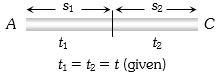
$A$ body is moving with uniform acceleration,describing $40 \, m$ in the first $5 \, s$ and $65 \, m$ in the next $5 \, s$. Its initial velocity will be . . . . . . $m/s$.
A
$4$
B
$2.5$
C
$5.5$
D
$11$
Solution
(C) Given: Distance in first $5 \, s$ $(S_1)$ = $40 \, m$,time $(t)$ = $5 \, s$. Distance in next $5 \, s$ $(S_2)$ = $65 \, m$.
Using the equation of motion $S = ut + \frac{1}{2}at^2$:
For the first $5 \, s$: $40 = 5u + \frac{1}{2}a(5)^2$ $\Rightarrow 40 = 5u + 12.5a$ ... $(i)$
For the total $10 \, s$: $S_1 + S_2 = u(10) + \frac{1}{2}a(10)^2$ $\Rightarrow 40 + 65 = 10u + 50a$ $\Rightarrow 105 = 10u + 50a$ ... (ii)
Multiply equation $(i)$ by $2$: $80 = 10u + 25a$ ... (iii)
Subtracting (iii) from (ii): $(105 - 80) = (10u - 10u) + (50a - 25a)$ $\Rightarrow 25 = 25a$ $\Rightarrow a = 1 \, m/s^2$.
Substitute $a = 1$ in equation $(i)$: $40 = 5u + 12.5(1)$ $\Rightarrow 5u = 40 - 12.5 = 27.5$ $\Rightarrow u = 5.5 \, m/s$.
Using the equation of motion $S = ut + \frac{1}{2}at^2$:
For the first $5 \, s$: $40 = 5u + \frac{1}{2}a(5)^2$ $\Rightarrow 40 = 5u + 12.5a$ ... $(i)$
For the total $10 \, s$: $S_1 + S_2 = u(10) + \frac{1}{2}a(10)^2$ $\Rightarrow 40 + 65 = 10u + 50a$ $\Rightarrow 105 = 10u + 50a$ ... (ii)
Multiply equation $(i)$ by $2$: $80 = 10u + 25a$ ... (iii)
Subtracting (iii) from (ii): $(105 - 80) = (10u - 10u) + (50a - 25a)$ $\Rightarrow 25 = 25a$ $\Rightarrow a = 1 \, m/s^2$.
Substitute $a = 1$ in equation $(i)$: $40 = 5u + 12.5(1)$ $\Rightarrow 5u = 40 - 12.5 = 27.5$ $\Rightarrow u = 5.5 \, m/s$.
0 likes
View Solution47
EasyMCQ
The speeds of two identical cars are $u$ and $4u$ at a specific instant. The ratio of the respective distances in which the two cars are stopped from that instant is
A
$1:1$
B
$1:4$
C
$1:8$
D
$1:16$
Solution
(D) Using the third equation of motion,$v^2 = u^2 + 2as$. Since the cars are brought to a stop,the final velocity $v = 0$.
Therefore,$0 = u^2 - 2as$,which gives the stopping distance $s = \frac{u^2}{2a}$.
Since both cars are identical and are stopped under the same braking force,the deceleration $a$ is the same for both.
Thus,$s \propto u^2$.
The ratio of the distances is $\frac{s_1}{s_2} = \left( \frac{u_1}{u_2} \right)^2 = \left( \frac{u}{4u} \right)^2 = \left( \frac{1}{4} \right)^2 = \frac{1}{16}$.
Hence,the ratio is $1:16$.
Therefore,$0 = u^2 - 2as$,which gives the stopping distance $s = \frac{u^2}{2a}$.
Since both cars are identical and are stopped under the same braking force,the deceleration $a$ is the same for both.
Thus,$s \propto u^2$.
The ratio of the distances is $\frac{s_1}{s_2} = \left( \frac{u_1}{u_2} \right)^2 = \left( \frac{u}{4u} \right)^2 = \left( \frac{1}{4} \right)^2 = \frac{1}{16}$.
Hence,the ratio is $1:16$.
0 likes
View Solution48
DifficultMCQ
$A$ car,starting from rest,accelerates at the rate $f$ through a distance $S$,then continues at constant speed for time $t$,and then decelerates at the rate $\frac{f}{2}$ to come to rest. If the total distance traversed is $15S$,then:
A
$S = \frac{1}{2}f{t^2}$
B
$S = \frac{1}{4}f{t^2}$
C
$S = \frac{1}{72}f{t^2}$
D
$S = \frac{1}{6}f{t^2}$
Solution
(C) Let the car start from point $A$ from rest and move up to point $B$ with acceleration $f$ over distance $S$.
The velocity of the car at point $B$ is $v = \sqrt{2fS}$ (using $v^2 = u^2 + 2as$).
The car moves distance $BC = x$ with this constant velocity $v$ in time $t$,so $x = vt = \sqrt{2fS} \cdot t$ ... $(i)$.
At point $C$,the car begins to decelerate at rate $a' = \frac{f}{2}$ until it comes to rest at point $D$. Let the distance $CD = y$.
Using $v^2 = u^2 - 2a'y$,where final velocity is $0$: $0 = v^2 - 2(\frac{f}{2})y \implies y = \frac{v^2}{f} = \frac{2fS}{f} = 2S$ ... (ii).
The total distance $AD = AB + BC + CD = S + x + 2S = 15S$.
$3S + x = 15S \implies x = 12S$.
Substituting $x = 12S$ into equation $(i)$: $12S = \sqrt{2fS} \cdot t$.
Squaring both sides: $144S^2 = 2fS \cdot t^2$.
Dividing by $2S$: $72S = f \cdot t^2 \implies S = \frac{1}{72}ft^2$.
The velocity of the car at point $B$ is $v = \sqrt{2fS}$ (using $v^2 = u^2 + 2as$).
The car moves distance $BC = x$ with this constant velocity $v$ in time $t$,so $x = vt = \sqrt{2fS} \cdot t$ ... $(i)$.
At point $C$,the car begins to decelerate at rate $a' = \frac{f}{2}$ until it comes to rest at point $D$. Let the distance $CD = y$.
Using $v^2 = u^2 - 2a'y$,where final velocity is $0$: $0 = v^2 - 2(\frac{f}{2})y \implies y = \frac{v^2}{f} = \frac{2fS}{f} = 2S$ ... (ii).
The total distance $AD = AB + BC + CD = S + x + 2S = 15S$.
$3S + x = 15S \implies x = 12S$.
Substituting $x = 12S$ into equation $(i)$: $12S = \sqrt{2fS} \cdot t$.
Squaring both sides: $144S^2 = 2fS \cdot t^2$.
Dividing by $2S$: $72S = f \cdot t^2 \implies S = \frac{1}{72}ft^2$.
0 likes
View Solution49
MediumMCQ
$A$ particle moves along $X-$axis as $x = 4(t - 2) + a(t - 2)^2$. Which of the following is true?
A
The initial velocity of the particle is $4$.
B
The acceleration of the particle is $2a$.
C
The particle is at the origin at $t = 0$.
D
None of these.
Solution
(B) Given the position equation: $x = 4(t - 2) + a(t - 2)^2$.
To find the velocity,we differentiate $x$ with respect to time $t$:
$v = \frac{dx}{dt} = \frac{d}{dt}[4(t - 2) + a(t - 2)^2] = 4 + 2a(t - 2)$.
To find the acceleration,we differentiate the velocity with respect to time $t$:
$a_{acc} = \frac{dv}{dt} = \frac{d}{dt}[4 + 2a(t - 2)] = 2a$.
Checking the options:
$(a)$ Initial velocity at $t = 0$ is $v = 4 + 2a(0 - 2) = 4 - 4a$,which is not $4$ unless $a = 0$.
$(b)$ The acceleration is $2a$,which is constant and matches the derived result.
$(c)$ At $t = 0$,$x = 4(0 - 2) + a(0 - 2)^2 = -8 + 4a$,which is not $0$ unless $a = 2$.
Therefore,option $(b)$ is correct.
To find the velocity,we differentiate $x$ with respect to time $t$:
$v = \frac{dx}{dt} = \frac{d}{dt}[4(t - 2) + a(t - 2)^2] = 4 + 2a(t - 2)$.
To find the acceleration,we differentiate the velocity with respect to time $t$:
$a_{acc} = \frac{dv}{dt} = \frac{d}{dt}[4 + 2a(t - 2)] = 2a$.
Checking the options:
$(a)$ Initial velocity at $t = 0$ is $v = 4 + 2a(0 - 2) = 4 - 4a$,which is not $4$ unless $a = 0$.
$(b)$ The acceleration is $2a$,which is constant and matches the derived result.
$(c)$ At $t = 0$,$x = 4(0 - 2) + a(0 - 2)^2 = -8 + 4a$,which is not $0$ unless $a = 2$.
Therefore,option $(b)$ is correct.
0 likes
View Solution50
MediumMCQ
$A$ body starting from rest moves with constant acceleration. The ratio of distance covered by the body during the $5^{th}$ second to that covered in $5$ seconds is
A
$9/25$
B
$3/5$
C
$25/9$
D
$1/25$
Solution
(A) The distance covered by an object in the $n^{th}$ second is given by $S_n = u + \frac{a}{2}(2n - 1)$.
Since the body starts from rest,$u = 0$.
For the $5^{th}$ second $(n = 5)$:
$S_{5^{th}} = 0 + \frac{a}{2}(2 \times 5 - 1) = \frac{9a}{2}$.
The distance covered in $t$ seconds is given by $S = ut + \frac{1}{2}at^2$.
For $t = 5$ seconds:
$S_5 = 0 + \frac{1}{2} \times a \times (5)^2 = \frac{25a}{2}$.
The ratio is $\frac{S_{5^{th}}}{S_5} = \frac{9a/2}{25a/2} = \frac{9}{25}$.
Since the body starts from rest,$u = 0$.
For the $5^{th}$ second $(n = 5)$:
$S_{5^{th}} = 0 + \frac{a}{2}(2 \times 5 - 1) = \frac{9a}{2}$.
The distance covered in $t$ seconds is given by $S = ut + \frac{1}{2}at^2$.
For $t = 5$ seconds:
$S_5 = 0 + \frac{1}{2} \times a \times (5)^2 = \frac{25a}{2}$.
The ratio is $\frac{S_{5^{th}}}{S_5} = \frac{9a/2}{25a/2} = \frac{9}{25}$.
0 likes
View SolutionMotion in Straight Line — Uniformly Accelerated Motion · Frequently Asked Questions
1Are these Motion in Straight Line questions useful for JEE and NEET?
Yes. All questions in this section are mapped to JEE Main and NEET exam patterns. Previous year questions from JEE Main, NEET, GUJCET and state-level exams are included with full solutions.
2Can I switch to Hindi or Gujarati for these questions?
Yes. Use the language tabs in the hero section or the sidebar to view the same questions and solutions in English, Hindi or Gujarati.
3How do I generate a question paper from this subtopic?
Use the Vedclass Exam Paper Generator — select the chapter and subtopic, set difficulty, and generate Sets A, B, C, D automatically. First 3 chapters of every subject are free.
Vedclass Products
For Students
Vedclass Test Series
Mock tests in real JEE/NEET style with performance analysis. 5-day free trial.
Start Free TrialFor Teachers
Exam Paper Generator
Generate Set A/B/C/D papers from this chapter in 2 minutes. 3 chapters free.
Try FreeFor Institutes
Online Exam Module
Live online exams with unlimited students, 360° analytics & white-label branding.
See DemoFor Teachers & Institutes
Generate a Motion in Straight Line Exam Paper in 2 Minutes
Select subtopic & difficulty — Sets A, B, C, D auto-generated with No Repeat logic.
First 3 chapters of every subject are free — no payment required.