
A English
Acceleration Due to Gravity and its Variation Questions in English
Class 11 Physics · Gravitation · Acceleration Due to Gravity and its Variation
430+
Questions
English
Language
100%
With Solutions
Showing 48 of 430 questions in English
351
EasyMCQ
$A$ body weighs $W$ newton on the surface of the earth. Its weight at a height equal to half the radius of the earth will be:
A
$\frac{W}{2}$
B
$\frac{2W}{3}$
C
$\frac{4W}{9}$
D
$\frac{8W}{27}$
Solution
(C) The weight of a body at the surface of the earth is $W = mg_0$,where $g_0 = \frac{GM}{R^2}$.
At a height $h = \frac{R}{2}$,the acceleration due to gravity $g'$ is given by:
$g' = \frac{GM}{(R+h)^2} = \frac{GM}{(R + R/2)^2} = \frac{GM}{(3R/2)^2} = \frac{GM}{9R^2/4} = \frac{4}{9} \left( \frac{GM}{R^2} \right) = \frac{4}{9} g_0$.
Therefore,the weight at height $h$ is $W' = mg' = m \left( \frac{4}{9} g_0 \right) = \frac{4}{9} W$.
At a height $h = \frac{R}{2}$,the acceleration due to gravity $g'$ is given by:
$g' = \frac{GM}{(R+h)^2} = \frac{GM}{(R + R/2)^2} = \frac{GM}{(3R/2)^2} = \frac{GM}{9R^2/4} = \frac{4}{9} \left( \frac{GM}{R^2} \right) = \frac{4}{9} g_0$.
Therefore,the weight at height $h$ is $W' = mg' = m \left( \frac{4}{9} g_0 \right) = \frac{4}{9} W$.
0 likes
View Solution352
MediumMCQ
The depth below the earth's surface at which the acceleration due to gravity '$g$' becomes $\frac{g}{n}$ is ($R=$ radius of the earth,$n$ is an integer,$n>1$).
A
$\frac{R(n+1)}{n}$
B
$\frac{R(n-1)}{n}$
C
$\frac{Rn}{(n+1)}$
D
$\frac{R}{n}$
Solution
(B) The acceleration due to gravity at the surface of the earth is given by $g = \frac{GM}{R^2}$,where $G$ is the universal gravitational constant,$M$ is the mass of the earth,and $R$ is the radius of the earth.
At a depth $h$ below the surface,the acceleration due to gravity $g'$ is given by the formula $g' = g(1 - \frac{h}{R})$.
According to the problem,$g' = \frac{g}{n}$.
Substituting this into the formula: $\frac{g}{n} = g(1 - \frac{h}{R})$.
Dividing both sides by $g$: $\frac{1}{n} = 1 - \frac{h}{R}$.
Rearranging the terms to solve for $h$: $\frac{h}{R} = 1 - \frac{1}{n} = \frac{n-1}{n}$.
Therefore,$h = \frac{R(n-1)}{n}$.
At a depth $h$ below the surface,the acceleration due to gravity $g'$ is given by the formula $g' = g(1 - \frac{h}{R})$.
According to the problem,$g' = \frac{g}{n}$.
Substituting this into the formula: $\frac{g}{n} = g(1 - \frac{h}{R})$.
Dividing both sides by $g$: $\frac{1}{n} = 1 - \frac{h}{R}$.
Rearranging the terms to solve for $h$: $\frac{h}{R} = 1 - \frac{1}{n} = \frac{n-1}{n}$.
Therefore,$h = \frac{R(n-1)}{n}$.
0 likes
View Solution353
MediumMCQ
Consider Earth to be a sphere of radius $R_e$ rotating about its own axis with angular speed $\omega$. If $g_{E}$ and $g_{P}$ are the accelerations due to gravity at the equator and the poles respectively,then $(g_{P}-g_{E})$ is given by $\left[\cos (0^{\circ})=\sin (\frac{\pi}{2})=1, \sin (0^{\circ})=\cos (\frac{\pi}{2})=0\right]$
A
$\frac{R_{E}}{\omega^2}$
B
$R_{E} \omega^2$
C
$R_{E} \omega$
D
$R_{E}^2 \omega^2$
Solution
(B) The acceleration due to gravity at a latitude $\lambda$ due to the rotation of the Earth is given by the formula:
$g^{\prime} = g - R_{E} \omega^2 \cos^2 \lambda$
At the equator,the latitude $\lambda = 0^{\circ}$. Since $\cos(0^{\circ}) = 1$,we have:
$g_E = g - R_{E} \omega^2 (1)^2 = g - R_{E} \omega^2$
At the poles,the latitude $\lambda = 90^{\circ}$. Since $\cos(90^{\circ}) = 0$,we have:
$g_P = g - R_{E} \omega^2 (0)^2 = g$
Now,calculating the difference $(g_P - g_E)$:
$g_P - g_E = g - (g - R_E \omega^2) = R_E \omega^2$
$g^{\prime} = g - R_{E} \omega^2 \cos^2 \lambda$
At the equator,the latitude $\lambda = 0^{\circ}$. Since $\cos(0^{\circ}) = 1$,we have:
$g_E = g - R_{E} \omega^2 (1)^2 = g - R_{E} \omega^2$
At the poles,the latitude $\lambda = 90^{\circ}$. Since $\cos(90^{\circ}) = 0$,we have:
$g_P = g - R_{E} \omega^2 (0)^2 = g$
Now,calculating the difference $(g_P - g_E)$:
$g_P - g_E = g - (g - R_E \omega^2) = R_E \omega^2$
0 likes
View Solution354
MediumMCQ
$A$ body weighs $500 \,N$ on the surface of the earth. At what distance below the surface of the earth will it weigh $250 \,N$ (in $\,km$)? (Radius of earth, $R = 6400 \,km$)
A
$800$
B
$3200$
C
$1600$
D
$6400$
Solution
(B) The value of acceleration due to gravity decreases as we go below the surface of the earth. The weight $(W)$ of a body is defined as the product of its mass $(m)$ and the acceleration due to gravity $(g)$, i.e., $W = mg$.
At a depth $h$ below the surface of the earth, the acceleration due to gravity $g'$ is given by the formula:
$g' = g \left(1 - \frac{h}{R}\right)$
Multiplying both sides by mass $m$, we get the weight at depth $h$:
$W' = W \left(1 - \frac{h}{R}\right)$
Given that $W' = 250 \,N$, $W = 500 \,N$, and $R = 6400 \,km$:
$250 = 500 \left(1 - \frac{h}{6400}\right)$
$0.5 = 1 - \frac{h}{6400}$
$\frac{h}{6400} = 0.5$
$h = 0.5 \times 6400 = 3200 \,km$.
At a depth $h$ below the surface of the earth, the acceleration due to gravity $g'$ is given by the formula:
$g' = g \left(1 - \frac{h}{R}\right)$
Multiplying both sides by mass $m$, we get the weight at depth $h$:
$W' = W \left(1 - \frac{h}{R}\right)$
Given that $W' = 250 \,N$, $W = 500 \,N$, and $R = 6400 \,km$:
$250 = 500 \left(1 - \frac{h}{6400}\right)$
$0.5 = 1 - \frac{h}{6400}$
$\frac{h}{6400} = 0.5$
$h = 0.5 \times 6400 = 3200 \,km$.
0 likes
View Solution355
EasyMCQ
The height above the surface of the earth where acceleration due to gravity becomes $\frac{g}{9}$ is ( $R$ is the radius of the earth,$g$ is the acceleration due to gravity at the surface).
A
$2R$
B
$\frac{R}{3}$
C
$\frac{R}{\sqrt{2}}$
D
$\sqrt{2} R$
Solution
(A) The acceleration due to gravity at a height $h$ above the surface of the earth is given by the formula: $g' = g \left(1 + \frac{h}{R}\right)^{-2}$.
Given that $g' = \frac{g}{9}$,we substitute this into the equation:
$\frac{g}{9} = \frac{g}{(1 + \frac{h}{R})^2}$.
Canceling $g$ from both sides,we get: $\frac{1}{9} = \frac{1}{(1 + \frac{h}{R})^2}$.
Taking the square root of both sides: $\frac{1}{3} = \frac{1}{1 + \frac{h}{R}}$.
This implies: $1 + \frac{h}{R} = 3$.
Solving for $h$: $\frac{h}{R} = 2$,which gives $h = 2R$.
Given that $g' = \frac{g}{9}$,we substitute this into the equation:
$\frac{g}{9} = \frac{g}{(1 + \frac{h}{R})^2}$.
Canceling $g$ from both sides,we get: $\frac{1}{9} = \frac{1}{(1 + \frac{h}{R})^2}$.
Taking the square root of both sides: $\frac{1}{3} = \frac{1}{1 + \frac{h}{R}}$.
This implies: $1 + \frac{h}{R} = 3$.
Solving for $h$: $\frac{h}{R} = 2$,which gives $h = 2R$.
0 likes
View Solution356
EasyMCQ
The depth at which acceleration due to gravity becomes $\frac{g}{n}$ is [ $R$ = radius of earth,$g$ = acceleration due to gravity,$n=$ integer].
A
$\frac{R(n-1)}{n}$
B
$\frac{(n-1)}{nR}$
C
$\frac{Rn}{(n-1)}$
D
$\frac{n}{R(n-1)}$
Solution
(A) The acceleration due to gravity at a depth $d$ below the surface of the Earth is given by the formula:
$g^{\prime} = g \left(1 - \frac{d}{R}\right)$
Given that the acceleration due to gravity at depth $d$ is $\frac{g}{n}$,we substitute this into the equation:
$\frac{g}{n} = g \left(1 - \frac{d}{R}\right)$
Dividing both sides by $g$:
$\frac{1}{n} = 1 - \frac{d}{R}$
Rearranging the terms to solve for $d$:
$\frac{d}{R} = 1 - \frac{1}{n}$
$\frac{d}{R} = \frac{n-1}{n}$
$d = \frac{R(n-1)}{n}$
$g^{\prime} = g \left(1 - \frac{d}{R}\right)$
Given that the acceleration due to gravity at depth $d$ is $\frac{g}{n}$,we substitute this into the equation:
$\frac{g}{n} = g \left(1 - \frac{d}{R}\right)$
Dividing both sides by $g$:
$\frac{1}{n} = 1 - \frac{d}{R}$
Rearranging the terms to solve for $d$:
$\frac{d}{R} = 1 - \frac{1}{n}$
$\frac{d}{R} = \frac{n-1}{n}$
$d = \frac{R(n-1)}{n}$
0 likes
View Solution357
EasyMCQ
The depth $d$ below the surface of the earth where the value of acceleration due to gravity becomes $\left(\frac{1}{n}\right)$ times the value at the surface of the earth is ($R$ = radius of the earth).
A
$R\left(\frac{n-1}{n}\right)$
B
$R\left(\frac{n}{n+1}\right)$
C
$\frac{R}{n}$
D
$\frac{R}{n^2}$
Solution
(A) The acceleration due to gravity at a depth $d$ below the surface of the earth is given by the formula: $g' = g\left(1 - \frac{d}{R}\right)$.
According to the problem,the value of acceleration due to gravity at depth $d$ is $\frac{1}{n}$ times the value at the surface,so $g' = \frac{g}{n}$.
Substituting this into the formula: $\frac{g}{n} = g\left(1 - \frac{d}{R}\right)$.
Dividing both sides by $g$: $\frac{1}{n} = 1 - \frac{d}{R}$.
Rearranging the terms to solve for $d$: $\frac{d}{R} = 1 - \frac{1}{n} = \frac{n-1}{n}$.
Therefore,$d = R\left(\frac{n-1}{n}\right)$.
According to the problem,the value of acceleration due to gravity at depth $d$ is $\frac{1}{n}$ times the value at the surface,so $g' = \frac{g}{n}$.
Substituting this into the formula: $\frac{g}{n} = g\left(1 - \frac{d}{R}\right)$.
Dividing both sides by $g$: $\frac{1}{n} = 1 - \frac{d}{R}$.
Rearranging the terms to solve for $d$: $\frac{d}{R} = 1 - \frac{1}{n} = \frac{n-1}{n}$.
Therefore,$d = R\left(\frac{n-1}{n}\right)$.
0 likes
View Solution358
EasyMCQ
When the value of acceleration due to gravity '$g$' becomes $\frac{g}{3}$ above the surface of the Earth at height '$h$',then the relation between '$h$' and '$R$' is $(R = \text{radius of Earth})$:
A
$h=\frac{R}{\sqrt{3}-1}$
B
$h=\frac{\sqrt{3}}{R}$
C
$h=(\sqrt{2}-1) R$
D
$h=(\sqrt{3}-1) R$
Solution
(D) The acceleration due to gravity at a height '$h$' above the Earth's surface is given by the formula: $g' = g \left( \frac{R}{R+h} \right)^2$.
Given that $g' = \frac{g}{3}$,we substitute this into the equation:
$\frac{g}{3} = g \left( \frac{R}{R+h} \right)^2$.
Dividing both sides by '$g$',we get:
$\frac{1}{3} = \left( \frac{R}{R+h} \right)^2$.
Taking the square root on both sides:
$\frac{1}{\sqrt{3}} = \frac{R}{R+h}$.
Cross-multiplying gives:
$R + h = \sqrt{3} R$.
Rearranging for '$h$':
$h = \sqrt{3} R - R = (\sqrt{3} - 1) R$.
Given that $g' = \frac{g}{3}$,we substitute this into the equation:
$\frac{g}{3} = g \left( \frac{R}{R+h} \right)^2$.
Dividing both sides by '$g$',we get:
$\frac{1}{3} = \left( \frac{R}{R+h} \right)^2$.
Taking the square root on both sides:
$\frac{1}{\sqrt{3}} = \frac{R}{R+h}$.
Cross-multiplying gives:
$R + h = \sqrt{3} R$.
Rearranging for '$h$':
$h = \sqrt{3} R - R = (\sqrt{3} - 1) R$.
0 likes
View Solution359
MediumMCQ
For a body of mass $m$,the acceleration due to gravity at a distance $R$ from the surface of the earth is $\frac{g}{4}$. Its value at a distance $\frac{R}{2}$ from the surface of the earth is ($R = \text{radius of the earth}$,$g = \text{acceleration due to gravity at the surface}$)
A
$\frac{g}{8}$
B
$\frac{9g}{4}$
C
$\frac{4g}{9}$
D
$\frac{g}{2}$
Solution
(C) The acceleration due to gravity at a distance $r$ from the center of the earth is given by $g' = \frac{GM}{r^2}$.
In the first case,the distance from the surface is $R$,so the distance from the center is $r_1 = R + R = 2R$. Given $g_1 = \frac{g}{4}$.
In the second case,the distance from the surface is $\frac{R}{2}$,so the distance from the center is $r_2 = R + \frac{R}{2} = \frac{3R}{2}$.
Using the ratio: $\frac{g_2}{g_1} = \left(\frac{r_1}{r_2}\right)^2 = \left(\frac{2R}{3R/2}\right)^2 = \left(\frac{4}{3}\right)^2 = \frac{16}{9}$.
Therefore,$g_2 = \frac{16}{9} \times g_1 = \frac{16}{9} \times \frac{g}{4} = \frac{4g}{9}$.
In the first case,the distance from the surface is $R$,so the distance from the center is $r_1 = R + R = 2R$. Given $g_1 = \frac{g}{4}$.
In the second case,the distance from the surface is $\frac{R}{2}$,so the distance from the center is $r_2 = R + \frac{R}{2} = \frac{3R}{2}$.
Using the ratio: $\frac{g_2}{g_1} = \left(\frac{r_1}{r_2}\right)^2 = \left(\frac{2R}{3R/2}\right)^2 = \left(\frac{4}{3}\right)^2 = \frac{16}{9}$.
Therefore,$g_2 = \frac{16}{9} \times g_1 = \frac{16}{9} \times \frac{g}{4} = \frac{4g}{9}$.
0 likes
View Solution360
EasyMCQ
At a height $R$ above the earth's surface,the gravitational acceleration is ($R$ = radius of earth,$g$ = acceleration due to gravity on earth's surface).
A
$g$
B
$\frac{g}{8}$
C
$\frac{g}{4}$
D
$\frac{g}{2}$
Solution
(C) The acceleration due to gravity $g'$ at a height $h$ above the earth's surface is given by the formula:
$g' = g \left( \frac{R}{R+h} \right)^2$
Given that the height $h = R$,we substitute this into the formula:
$g' = g \left( \frac{R}{R+R} \right)^2$
$g' = g \left( \frac{R}{2R} \right)^2$
$g' = g \left( \frac{1}{2} \right)^2$
$g' = \frac{g}{4}$
Therefore,the gravitational acceleration at a height $R$ above the earth's surface is $\frac{g}{4}$.
$g' = g \left( \frac{R}{R+h} \right)^2$
Given that the height $h = R$,we substitute this into the formula:
$g' = g \left( \frac{R}{R+R} \right)^2$
$g' = g \left( \frac{R}{2R} \right)^2$
$g' = g \left( \frac{1}{2} \right)^2$
$g' = \frac{g}{4}$
Therefore,the gravitational acceleration at a height $R$ above the earth's surface is $\frac{g}{4}$.
0 likes
View Solution361
EasyMCQ
The depth from the surface of the earth of radius $R$,at which the acceleration due to gravity will be $60 \%$ of its value on the earth's surface,is:
A
$\frac{2 R}{3}$
B
$\frac{2 R}{5}$
C
$\frac{3 R}{5}$
D
$\frac{5 R}{3}$
Solution
(B) The acceleration due to gravity at a depth $d$ below the surface of the earth is given by the formula:
$g' = g(1 - \frac{d}{R})$
where $g$ is the acceleration due to gravity at the surface and $R$ is the radius of the earth.
Given that $g' = 60\% \text{ of } g$,we have:
$g' = 0.6g$
Substituting this into the formula:
$0.6g = g(1 - \frac{d}{R})$
$0.6 = 1 - \frac{d}{R}$
Rearranging the terms to solve for $d$:
$\frac{d}{R} = 1 - 0.6$
$\frac{d}{R} = 0.4$
$\frac{d}{R} = \frac{4}{10} = \frac{2}{5}$
Therefore,$d = \frac{2}{5}R$.
$g' = g(1 - \frac{d}{R})$
where $g$ is the acceleration due to gravity at the surface and $R$ is the radius of the earth.
Given that $g' = 60\% \text{ of } g$,we have:
$g' = 0.6g$
Substituting this into the formula:
$0.6g = g(1 - \frac{d}{R})$
$0.6 = 1 - \frac{d}{R}$
Rearranging the terms to solve for $d$:
$\frac{d}{R} = 1 - 0.6$
$\frac{d}{R} = 0.4$
$\frac{d}{R} = \frac{4}{10} = \frac{2}{5}$
Therefore,$d = \frac{2}{5}R$.
0 likes
View Solution362
EasyMCQ
As we go from the equator of the earth to the pole of the earth,the value of acceleration due to gravity
A
decreases
B
remains same.
C
decreases up to latitude of $45^{\circ}$ and increases thereafter.
D
increases.
Solution
(D) The acceleration due to gravity $g$ at a latitude $\phi$ is given by the formula: $g_{\phi} = g - \omega^2 R \cos^2 \phi$,where $g$ is the acceleration due to gravity at the poles,$\omega$ is the angular velocity of the earth,and $R$ is the radius of the earth.
At the equator,$\phi = 0^{\circ}$,so $\cos 0^{\circ} = 1$,which gives $g_{eq} = g - \omega^2 R$ (minimum value).
At the poles,$\phi = 90^{\circ}$,so $\cos 90^{\circ} = 0$,which gives $g_{pole} = g$ (maximum value).
Additionally,the earth is an oblate spheroid,meaning the radius at the equator is greater than the radius at the poles $(R_{eq} > R_{pole})$.
Since $g = \frac{GM}{R^2}$,a smaller radius at the poles results in a higher value of $g$.
Therefore,as we move from the equator to the poles,the value of acceleration due to gravity increases.
At the equator,$\phi = 0^{\circ}$,so $\cos 0^{\circ} = 1$,which gives $g_{eq} = g - \omega^2 R$ (minimum value).
At the poles,$\phi = 90^{\circ}$,so $\cos 90^{\circ} = 0$,which gives $g_{pole} = g$ (maximum value).
Additionally,the earth is an oblate spheroid,meaning the radius at the equator is greater than the radius at the poles $(R_{eq} > R_{pole})$.
Since $g = \frac{GM}{R^2}$,a smaller radius at the poles results in a higher value of $g$.
Therefore,as we move from the equator to the poles,the value of acceleration due to gravity increases.
0 likes
View Solution363
MediumMCQ
When the value of acceleration due to gravity '$g$' becomes $\frac{g}{3}$ above the earth's surface at height '$h$',then the relation between '$h$' and '$R$' is: [$R$ = radius of the earth]
A
$h=R(\sqrt{3}-1)$
B
$h=R$
C
$h=R(\sqrt{2}-1)$
D
$h=2R$
Solution
(A) The acceleration due to gravity at the surface of the earth is given by $g = \frac{GM}{R^2}$.
At a height '$h$' above the surface,the acceleration due to gravity '$g_h$' is given by $g_h = \frac{GM}{(R+h)^2}$.
Given that $g_h = \frac{g}{3}$,we substitute the expressions:
$\frac{g}{3} = \frac{GM}{(R+h)^2}$.
Substituting $g = \frac{GM}{R^2}$ into the equation:
$\frac{1}{3} \left( \frac{GM}{R^2} \right) = \frac{GM}{(R+h)^2}$.
$\frac{1}{3R^2} = \frac{1}{(R+h)^2}$.
Taking the square root on both sides:
$\frac{1}{\sqrt{3}R} = \frac{1}{R+h}$.
$R+h = \sqrt{3}R$.
$h = \sqrt{3}R - R$.
$h = R(\sqrt{3}-1)$.
At a height '$h$' above the surface,the acceleration due to gravity '$g_h$' is given by $g_h = \frac{GM}{(R+h)^2}$.
Given that $g_h = \frac{g}{3}$,we substitute the expressions:
$\frac{g}{3} = \frac{GM}{(R+h)^2}$.
Substituting $g = \frac{GM}{R^2}$ into the equation:
$\frac{1}{3} \left( \frac{GM}{R^2} \right) = \frac{GM}{(R+h)^2}$.
$\frac{1}{3R^2} = \frac{1}{(R+h)^2}$.
Taking the square root on both sides:
$\frac{1}{\sqrt{3}R} = \frac{1}{R+h}$.
$R+h = \sqrt{3}R$.
$h = \sqrt{3}R - R$.
$h = R(\sqrt{3}-1)$.
0 likes
View Solution364
MediumMCQ
$A$ hole is drilled halfway to the center of the Earth. $A$ body weighs $300 \ N$ on the surface of the Earth. How much will it weigh at the bottom of the hole (in $N$)?
A
$200$
B
$250$
C
$120$
D
$150$
Solution
(D) Given,the distance of the bottom of the hole from the surface of the Earth is $d = \frac{R_e}{2}$,where $R_e$ is the radius of the Earth.
On the surface of the Earth,the weight of the body is $W = mg = 300 \ N$.
The acceleration due to gravity at a depth $d$ below the surface is given by the formula $g' = g(1 - \frac{d}{R_e})$.
Substituting $d = \frac{R_e}{2}$ into the formula:
$g' = g(1 - \frac{R_e/2}{R_e}) = g(1 - \frac{1}{2}) = \frac{g}{2}$.
The weight of the body at the bottom of the hole is $W' = mg' = m(\frac{g}{2}) = \frac{mg}{2}$.
Substituting $mg = 300 \ N$:
$W' = \frac{300}{2} = 150 \ N$.
On the surface of the Earth,the weight of the body is $W = mg = 300 \ N$.
The acceleration due to gravity at a depth $d$ below the surface is given by the formula $g' = g(1 - \frac{d}{R_e})$.
Substituting $d = \frac{R_e}{2}$ into the formula:
$g' = g(1 - \frac{R_e/2}{R_e}) = g(1 - \frac{1}{2}) = \frac{g}{2}$.
The weight of the body at the bottom of the hole is $W' = mg' = m(\frac{g}{2}) = \frac{mg}{2}$.
Substituting $mg = 300 \ N$:
$W' = \frac{300}{2} = 150 \ N$.
0 likes
View Solution365
DifficultMCQ
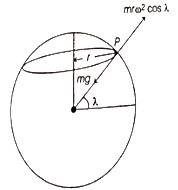
Consider a particle of mass $m$ suspended by a string at the equator. Let $R$ and $M$ denote the radius and mass of the Earth. If $\omega$ is the angular velocity of rotation of the Earth about its own axis,then the tension on the string will be $(\cos 0^{\circ}=1)$
A
$\frac{G M m}{R^2}$
B
$\frac{G M m}{2 R^2}$
C
$\frac{G M m}{2 R^2}+m \omega^2 R$
D
$\frac{G M m}{R^2}-m \omega^2 R$
Solution
(D) When a body is suspended by a string at a position $P$ with latitude $\lambda$,the body rotates with the angular velocity $\omega$ of the Earth. The effective force acting on the body is the gravitational force minus the centripetal force required for circular motion.
The tension $T$ in the string is given by:
$T = mg - mr\omega^2 \cos \lambda$
Since $g = \frac{GM}{R^2}$ and the radius of the circular path at latitude $\lambda$ is $r = R \cos \lambda$,we substitute these into the equation:
$T = m \left( \frac{GM}{R^2} \right) - m(R \cos \lambda) \omega^2 \cos \lambda$
$T = \frac{GMm}{R^2} - mR\omega^2 \cos^2 \lambda$
At the equator,the latitude $\lambda = 0^{\circ}$.
Substituting $\lambda = 0^{\circ}$ and $\cos 0^{\circ} = 1$:
$T = \frac{GMm}{R^2} - mR\omega^2 (1)^2$
$T = \frac{GMm}{R^2} - mR\omega^2$
The tension $T$ in the string is given by:
$T = mg - mr\omega^2 \cos \lambda$
Since $g = \frac{GM}{R^2}$ and the radius of the circular path at latitude $\lambda$ is $r = R \cos \lambda$,we substitute these into the equation:
$T = m \left( \frac{GM}{R^2} \right) - m(R \cos \lambda) \omega^2 \cos \lambda$
$T = \frac{GMm}{R^2} - mR\omega^2 \cos^2 \lambda$
At the equator,the latitude $\lambda = 0^{\circ}$.
Substituting $\lambda = 0^{\circ}$ and $\cos 0^{\circ} = 1$:
$T = \frac{GMm}{R^2} - mR\omega^2 (1)^2$
$T = \frac{GMm}{R^2} - mR\omega^2$
0 likes
View Solution366
MediumMCQ
If the change in the value of $g$ at a height $h$ above the surface of the earth is the same as at a depth $x$ below it,then (both $x$ and $h$ being much smaller than the radius of the earth)
A
$x=h$
B
$x=2h$
C
$x=\frac{h}{2}$
D
$x=h^2$
Solution
(B) The value of $g$ at a height $h$ above the surface of the Earth is given by $g_h = g(1 - \frac{2h}{R})$.
Thus,the change in $g$ is $\Delta g_h = g - g_h = g(\frac{2h}{R})$.
The value of $g$ at a depth $x$ below the surface of the Earth is given by $g_x = g(1 - \frac{x}{R})$.
Thus,the change in $g$ is $\Delta g_x = g - g_x = g(\frac{x}{R})$.
Given that the change in $g$ is the same at height $h$ and depth $x$,we equate the two expressions:
$g(\frac{2h}{R}) = g(\frac{x}{R})$.
Solving for $x$,we get $x = 2h$.
Thus,the change in $g$ is $\Delta g_h = g - g_h = g(\frac{2h}{R})$.
The value of $g$ at a depth $x$ below the surface of the Earth is given by $g_x = g(1 - \frac{x}{R})$.
Thus,the change in $g$ is $\Delta g_x = g - g_x = g(\frac{x}{R})$.
Given that the change in $g$ is the same at height $h$ and depth $x$,we equate the two expressions:
$g(\frac{2h}{R}) = g(\frac{x}{R})$.
Solving for $x$,we get $x = 2h$.
0 likes
View Solution367
MediumMCQ
The depth $d$ at which the value of acceleration due to gravity becomes $\frac{1}{n}$ times the value at the earth's surface is $(R = \text{radius of the earth})$
A
$d=R\left(\frac{n}{n-1}\right)$
B
$d=R\left(\frac{n-1}{2n}\right)$
C
$d=R\left(\frac{n-1}{n}\right)$
D
$d=R^2\left(\frac{n-1}{n}\right)$
Solution
(C) The acceleration due to gravity at a depth $d$ below the surface of the earth is given by the formula:
$g' = g\left(1 - \frac{d}{R}\right)$
Given that the acceleration due to gravity at depth $d$ is $\frac{1}{n}$ times the value at the surface,we have:
$g' = \frac{g}{n}$
Substituting this into the formula:
$\frac{g}{n} = g\left(1 - \frac{d}{R}\right)$
Dividing both sides by $g$:
$\frac{1}{n} = 1 - \frac{d}{R}$
Rearranging the terms to solve for $d$:
$\frac{d}{R} = 1 - \frac{1}{n}$
$\frac{d}{R} = \frac{n-1}{n}$
$d = R\left(\frac{n-1}{n}\right)$
$g' = g\left(1 - \frac{d}{R}\right)$
Given that the acceleration due to gravity at depth $d$ is $\frac{1}{n}$ times the value at the surface,we have:
$g' = \frac{g}{n}$
Substituting this into the formula:
$\frac{g}{n} = g\left(1 - \frac{d}{R}\right)$
Dividing both sides by $g$:
$\frac{1}{n} = 1 - \frac{d}{R}$
Rearranging the terms to solve for $d$:
$\frac{d}{R} = 1 - \frac{1}{n}$
$\frac{d}{R} = \frac{n-1}{n}$
$d = R\left(\frac{n-1}{n}\right)$
0 likes
View Solution368
MediumMCQ
The value of gravitational acceleration $g'$ at a height $h$ above the earth's surface is $\frac{g}{4}$. Then,what is the value of $h$ in terms of the earth's radius $R$?
A
$h=R$
B
$h=\frac{R}{2}$
C
$h=\frac{R}{3}$
D
$h=\frac{R}{4}$
Solution
(A) The formula for gravitational acceleration at a height $h$ above the earth's surface is given by $g' = g \left( \frac{R}{R+h} \right)^2$.
Given that $g' = \frac{g}{4}$,we substitute this into the equation:
$\frac{g}{4} = g \left( \frac{R}{R+h} \right)^2$.
Dividing both sides by $g$,we get $\frac{1}{4} = \left( \frac{R}{R+h} \right)^2$.
Taking the square root of both sides,we obtain $\frac{1}{2} = \frac{R}{R+h}$.
Cross-multiplying gives $R + h = 2R$.
Therefore,$h = 2R - R = R$.
Given that $g' = \frac{g}{4}$,we substitute this into the equation:
$\frac{g}{4} = g \left( \frac{R}{R+h} \right)^2$.
Dividing both sides by $g$,we get $\frac{1}{4} = \left( \frac{R}{R+h} \right)^2$.
Taking the square root of both sides,we obtain $\frac{1}{2} = \frac{R}{R+h}$.
Cross-multiplying gives $R + h = 2R$.
Therefore,$h = 2R - R = R$.
0 likes
View Solution369
MediumMCQ
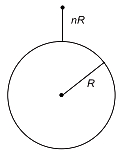
$A$ body is taken to a height of $n R$ from the surface of the earth. The ratio of the acceleration due to gravity on the surface to that at the altitude is
A
$(n+1)^{2}$
B
$(n+1)^{-2}$
C
$(n+1)^{-1}$
D
$(n+1)$
Solution
(A) The acceleration due to gravity at a height $h$ above the earth's surface is given by the formula:
$g^{\prime} = g \left( \frac{R}{R+h} \right)^{2}$
Given that the height $h = nR$,we substitute this into the equation:
$g^{\prime} = g \left( \frac{R}{R+nR} \right)^{2}$
$g^{\prime} = g \left( \frac{R}{R(1+n)} \right)^{2}$
$g^{\prime} = g \left( \frac{1}{1+n} \right)^{2}$
Now,we find the ratio of the acceleration due to gravity on the surface $(g)$ to that at the altitude $(g^{\prime})$:
$\frac{g}{g^{\prime}} = \frac{g}{g \left( \frac{1}{1+n} \right)^{2}}$
$\frac{g}{g^{\prime}} = (1+n)^{2}$
Therefore,the ratio is $(n+1)^{2}$.
$g^{\prime} = g \left( \frac{R}{R+h} \right)^{2}$
Given that the height $h = nR$,we substitute this into the equation:
$g^{\prime} = g \left( \frac{R}{R+nR} \right)^{2}$
$g^{\prime} = g \left( \frac{R}{R(1+n)} \right)^{2}$
$g^{\prime} = g \left( \frac{1}{1+n} \right)^{2}$
Now,we find the ratio of the acceleration due to gravity on the surface $(g)$ to that at the altitude $(g^{\prime})$:
$\frac{g}{g^{\prime}} = \frac{g}{g \left( \frac{1}{1+n} \right)^{2}}$
$\frac{g}{g^{\prime}} = (1+n)^{2}$
Therefore,the ratio is $(n+1)^{2}$.
0 likes
View Solution370
EasyMCQ
If $R$ is the radius of the Earth and $g$ is the acceleration due to gravity on the Earth's surface,then the mean density of the Earth is:
A
$\frac{4 \pi G}{3 g R}$
B
$\frac{3 \pi R}{4 g G}$
C
$\frac{3 g}{4 \pi R G}$
D
$\frac{\pi R G}{12 g}$
Solution
(C) The mass of the Earth $M$ can be expressed in terms of its volume $V$ and mean density $\rho$ as:
$M = V \rho = \frac{4}{3} \pi R^3 \rho$ ... $(i)$
The acceleration due to gravity $g$ on the surface of the Earth is given by:
$g = \frac{GM}{R^2}$ ... $(ii)$
Substituting the expression for $M$ from equation $(i)$ into equation $(ii)$:
$g = \frac{G}{R^2} \times \left( \frac{4}{3} \pi R^3 \rho \right)$
$g = \frac{4}{3} \pi R G \rho$
Rearranging the equation to solve for the mean density $\rho$:
$\rho = \frac{3 g}{4 \pi R G}$
$M = V \rho = \frac{4}{3} \pi R^3 \rho$ ... $(i)$
The acceleration due to gravity $g$ on the surface of the Earth is given by:
$g = \frac{GM}{R^2}$ ... $(ii)$
Substituting the expression for $M$ from equation $(i)$ into equation $(ii)$:
$g = \frac{G}{R^2} \times \left( \frac{4}{3} \pi R^3 \rho \right)$
$g = \frac{4}{3} \pi R G \rho$
Rearranging the equation to solve for the mean density $\rho$:
$\rho = \frac{3 g}{4 \pi R G}$
0 likes
View Solution371
EasyMCQ
The average density of the Earth is [ $g$ is acceleration due to gravity]:
A
inversely proportional to $g^2$
B
directly proportional to $g$
C
inversely proportional to $g$
D
directly proportional to $g^2$
Solution
(B) The acceleration due to gravity $g$ on the surface of the Earth is given by the formula $g = \frac{GM}{R^2}$.
Substituting the mass of the Earth $M = \rho \cdot V = \rho \cdot \frac{4}{3} \pi R^3$,where $\rho$ is the average density and $R$ is the radius of the Earth:
$g = \frac{G}{R^2} \cdot \left( \frac{4}{3} \pi R^3 \rho \right) = \frac{4}{3} \pi G R \rho$.
Since $G$,$\pi$,and $R$ are constants for the Earth,we have $g \propto \rho$.
Therefore,the average density $\rho$ is directly proportional to the acceleration due to gravity $g$.
Substituting the mass of the Earth $M = \rho \cdot V = \rho \cdot \frac{4}{3} \pi R^3$,where $\rho$ is the average density and $R$ is the radius of the Earth:
$g = \frac{G}{R^2} \cdot \left( \frac{4}{3} \pi R^3 \rho \right) = \frac{4}{3} \pi G R \rho$.
Since $G$,$\pi$,and $R$ are constants for the Earth,we have $g \propto \rho$.
Therefore,the average density $\rho$ is directly proportional to the acceleration due to gravity $g$.
0 likes
View Solution372
MediumMCQ
If the density of a small planet is the same as that of earth, while the radius of the planet is $0.2$ times that of the earth, the gravitational acceleration on the surface of that planet is (in $\,g$)
A
$0.2$
B
$0.4$
C
$2$
D
$4$
Solution
(A) The gravitational acceleration $g$ on the surface of a planet is given by the formula: $g = \frac{4}{3} \pi G R \rho$, where $G$ is the gravitational constant, $R$ is the radius, and $\rho$ is the density.
Since the density $\rho$ is the same for both the planet and the earth, we have $g \propto R$.
Let $g$ be the acceleration on earth and $g^{\prime}$ be the acceleration on the planet.
Given $R^{\prime} = 0.2 R$, we have:
$\frac{g^{\prime}}{g} = \frac{R^{\prime}}{R} = 0.2$
Therefore, $g^{\prime} = 0.2 g$.
Since the density $\rho$ is the same for both the planet and the earth, we have $g \propto R$.
Let $g$ be the acceleration on earth and $g^{\prime}$ be the acceleration on the planet.
Given $R^{\prime} = 0.2 R$, we have:
$\frac{g^{\prime}}{g} = \frac{R^{\prime}}{R} = 0.2$
Therefore, $g^{\prime} = 0.2 g$.
0 likes
View Solution373
DifficultMCQ
If the density of the earth is doubled keeping the radius constant,find the new acceleration due to gravity (in $m/s^2$)? $(g = 9.8 \ m/s^2)$
A
$9.8$
B
$19.6$
C
$4.9$
D
$39.2$
Solution
(B) The acceleration due to gravity $g$ on the surface of the Earth is given by the formula: $g = \frac{GM}{R^2}$.
Since mass $M = \text{density} (\rho) \times \text{volume} (V) = \rho \times \frac{4}{3} \pi R^3$,we can substitute this into the formula for $g$:
$g = \frac{G (\rho \cdot \frac{4}{3} \pi R^3)}{R^2} = \frac{4}{3} \pi \rho G R$.
From this expression,it is clear that $g \propto \rho$ when the radius $R$ is kept constant.
Therefore,$\frac{g_2}{g_1} = \frac{\rho_2}{\rho_1}$.
Given that the density is doubled,$\rho_2 = 2\rho_1$.
Thus,$g_2 = 2 \times g_1 = 2 \times 9.8 \ m/s^2 = 19.6 \ m/s^2$.
Since mass $M = \text{density} (\rho) \times \text{volume} (V) = \rho \times \frac{4}{3} \pi R^3$,we can substitute this into the formula for $g$:
$g = \frac{G (\rho \cdot \frac{4}{3} \pi R^3)}{R^2} = \frac{4}{3} \pi \rho G R$.
From this expression,it is clear that $g \propto \rho$ when the radius $R$ is kept constant.
Therefore,$\frac{g_2}{g_1} = \frac{\rho_2}{\rho_1}$.
Given that the density is doubled,$\rho_2 = 2\rho_1$.
Thus,$g_2 = 2 \times g_1 = 2 \times 9.8 \ m/s^2 = 19.6 \ m/s^2$.
0 likes
View Solution374
EasyMCQ
The mass of a spherical planet is $4$ times the mass of the earth, but its radius $(R)$ is the same as that of the earth. How much work is done in lifting a body of mass $5 \,kg$ through a distance of $2 \,m$ on the planet (in $\,J$)? (Take $g = 10 \,ms^{-2}$ for Earth)
A
$400$
B
$200$
C
$800$
D
$300$
Solution
(A) The acceleration due to gravity on Earth is given by $g = \frac{GM}{R^2}$.
For the planet, the mass is $M' = 4M$ and the radius is $R' = R$.
Therefore, the acceleration due to gravity on the planet is $g' = \frac{GM'}{R'^2} = \frac{G(4M)}{R^2} = 4g$.
Given $g = 10 \,ms^{-2}$, the acceleration due to gravity on the planet is $g' = 4 \times 10 = 40 \,ms^{-2}$.
The work done in lifting a body of mass $m = 5 \,kg$ through a height $h = 2 \,m$ is given by $W = m g' h$.
Substituting the values, $W = 5 \,kg \times 40 \,ms^{-2} \times 2 \,m = 400 \,J$.
For the planet, the mass is $M' = 4M$ and the radius is $R' = R$.
Therefore, the acceleration due to gravity on the planet is $g' = \frac{GM'}{R'^2} = \frac{G(4M)}{R^2} = 4g$.
Given $g = 10 \,ms^{-2}$, the acceleration due to gravity on the planet is $g' = 4 \times 10 = 40 \,ms^{-2}$.
The work done in lifting a body of mass $m = 5 \,kg$ through a height $h = 2 \,m$ is given by $W = m g' h$.
Substituting the values, $W = 5 \,kg \times 40 \,ms^{-2} \times 2 \,m = 400 \,J$.
0 likes
View Solution375
MediumMCQ
The radius of the Earth is $6400 \,km$ and the acceleration due to gravity is $g=10 \,ms^{-2}$. For the weight of a body of mass $5 \,kg$ to be zero at the equator,the rotational angular velocity of the Earth must be (in $rad/s$):
A
$\frac{1}{80}$
B
$\frac{1}{400}$
C
$\frac{1}{800}$
D
$\frac{1}{1600}$
Solution
(C) At the equator,the effective acceleration due to gravity $g'$ is given by $g' = g - R\omega^2$.
For the weight of the body to be zero,the effective gravity must be zero,which means $g' = 0$.
Therefore,$g - R\omega^2 = 0$.
This implies $R\omega^2 = g$.
Solving for $\omega$:
$\omega^2 = \frac{g}{R}$
$\omega = \sqrt{\frac{g}{R}}$
Given $g = 10 \,ms^{-2}$ and $R = 6400 \,km = 6.4 \times 10^6 \,m$.
$\omega = \sqrt{\frac{10}{6.4 \times 10^6}}$
$\omega = \sqrt{\frac{10}{64 \times 10^5}} = \sqrt{\frac{1}{64 \times 10^4}}$
$\omega = \frac{1}{8 \times 10^2} = \frac{1}{800} \,rad/s$.
For the weight of the body to be zero,the effective gravity must be zero,which means $g' = 0$.
Therefore,$g - R\omega^2 = 0$.
This implies $R\omega^2 = g$.
Solving for $\omega$:
$\omega^2 = \frac{g}{R}$
$\omega = \sqrt{\frac{g}{R}}$
Given $g = 10 \,ms^{-2}$ and $R = 6400 \,km = 6.4 \times 10^6 \,m$.
$\omega = \sqrt{\frac{10}{6.4 \times 10^6}}$
$\omega = \sqrt{\frac{10}{64 \times 10^5}} = \sqrt{\frac{1}{64 \times 10^4}}$
$\omega = \frac{1}{8 \times 10^2} = \frac{1}{800} \,rad/s$.
0 likes
View Solution376
MediumMCQ
The gravitational pull of the moon is $(1/6)^{\text{th}}$ of the earth and the mass of the moon is $(1/8)^{\text{th}}$ of the earth. This implies that the:
A
radius of the moon is $(1/4)^{\text{th}}$ of the earth's radius.
B
radius of the earth is $(\sqrt{4/3})^{\text{th}}$ of the moon's radius.
C
moon's radius is half that of the earth.
D
radius of the earth is $(4/3)^{\text{th}}$ of the moon's radius.
Solution
(B) The acceleration due to gravity $g$ is given by $g = \frac{GM}{R^2}$.
Let $g_m, M_m, R_m$ be the gravity,mass,and radius of the moon,and $g_e, M_e, R_e$ be those of the earth.
Given: $g_m = \frac{1}{6} g_e$ and $M_m = \frac{1}{8} M_e$.
We have the ratio: $\frac{g_m}{g_e} = \frac{M_m}{M_e} \times \left(\frac{R_e}{R_m}\right)^2$.
Substituting the given values: $\frac{1}{6} = \frac{1}{8} \times \left(\frac{R_e}{R_m}\right)^2$.
Rearranging gives: $\left(\frac{R_e}{R_m}\right)^2 = \frac{8}{6} = \frac{4}{3}$.
Taking the square root: $\frac{R_e}{R_m} = \sqrt{\frac{4}{3}}$.
Thus,the radius of the earth is $\sqrt{4/3}$ times the radius of the moon.
Let $g_m, M_m, R_m$ be the gravity,mass,and radius of the moon,and $g_e, M_e, R_e$ be those of the earth.
Given: $g_m = \frac{1}{6} g_e$ and $M_m = \frac{1}{8} M_e$.
We have the ratio: $\frac{g_m}{g_e} = \frac{M_m}{M_e} \times \left(\frac{R_e}{R_m}\right)^2$.
Substituting the given values: $\frac{1}{6} = \frac{1}{8} \times \left(\frac{R_e}{R_m}\right)^2$.
Rearranging gives: $\left(\frac{R_e}{R_m}\right)^2 = \frac{8}{6} = \frac{4}{3}$.
Taking the square root: $\frac{R_e}{R_m} = \sqrt{\frac{4}{3}}$.
Thus,the radius of the earth is $\sqrt{4/3}$ times the radius of the moon.
0 likes
View Solution377
MediumMCQ
What should be the angular velocity of the Earth due to rotation about its own axis so that the weight at the equator becomes $\left(\frac{3}{5}\right)$ of its initial value? (Radius of Earth at the equator $R = 6400 \ km$,$g = 10 \ m/s^2$,$\cos 0^{\circ} = 1$)
A
$3.5 \times 10^{-4} \ rad/s$
B
$7.91 \times 10^{-4} \ rad/s$
C
$6.5 \times 10^{-4} \ rad/s$
D
$2.5 \times 10^{-4} \ rad/s$
Solution
(B) The effective acceleration due to gravity at the equator is given by $g' = g - \omega^2 R$,where $g$ is the acceleration due to gravity at the poles (or without rotation),$\omega$ is the angular velocity,and $R$ is the radius of the Earth.
Given that the weight at the equator becomes $\frac{3}{5}$ of its initial value,we have $g' = \frac{3}{5}g$.
Substituting this into the equation: $\frac{3}{5}g = g - \omega^2 R$.
Rearranging the terms: $\omega^2 R = g - \frac{3}{5}g = \frac{2}{5}g$.
Thus,$\omega = \sqrt{\frac{2g}{5R}}$.
Given $g = 10 \ m/s^2$ and $R = 6400 \ km = 6.4 \times 10^6 \ m$.
$\omega = \sqrt{\frac{2 \times 10}{5 \times 6.4 \times 10^6}} = \sqrt{\frac{20}{32 \times 10^6}} = \sqrt{\frac{1}{1.6 \times 10^6}} = \sqrt{0.625 \times 10^{-6}} \approx 0.791 \times 10^{-3} \ rad/s = 7.91 \times 10^{-4} \ rad/s$.
Given that the weight at the equator becomes $\frac{3}{5}$ of its initial value,we have $g' = \frac{3}{5}g$.
Substituting this into the equation: $\frac{3}{5}g = g - \omega^2 R$.
Rearranging the terms: $\omega^2 R = g - \frac{3}{5}g = \frac{2}{5}g$.
Thus,$\omega = \sqrt{\frac{2g}{5R}}$.
Given $g = 10 \ m/s^2$ and $R = 6400 \ km = 6.4 \times 10^6 \ m$.
$\omega = \sqrt{\frac{2 \times 10}{5 \times 6.4 \times 10^6}} = \sqrt{\frac{20}{32 \times 10^6}} = \sqrt{\frac{1}{1.6 \times 10^6}} = \sqrt{0.625 \times 10^{-6}} \approx 0.791 \times 10^{-3} \ rad/s = 7.91 \times 10^{-4} \ rad/s$.
0 likes
View Solution378
EasyMCQ
The time period of a simple pendulum on the earth's surface is '$T$'. Its time period becomes '$xT$' when taken to a height '$R$' (equal to the earth's radius) above the earth's surface. Then the value of '$x$' will be
A
$4$
B
$2$
C
$\frac{1}{2}$
D
$\frac{1}{4}$
Solution
(B) The time period of a simple pendulum is given by $T = 2\pi \sqrt{\frac{l}{g}}$.
At a height $h = R$ from the earth's surface,the new time period is $T' = xT$.
The acceleration due to gravity at height $h$ is $g_h = \frac{GM}{(R+h)^2}$.
Since $h = R$,$g_h = \frac{GM}{(R+R)^2} = \frac{GM}{(2R)^2} = \frac{GM}{4R^2} = \frac{g}{4}$.
Now,the ratio of time periods is $\frac{T'}{T} = \frac{2\pi \sqrt{l/g_h}}{2\pi \sqrt{l/g}} = \sqrt{\frac{g}{g_h}}$.
Substituting $g_h = \frac{g}{4}$,we get $x = \sqrt{\frac{g}{g/4}} = \sqrt{4} = 2$.
At a height $h = R$ from the earth's surface,the new time period is $T' = xT$.
The acceleration due to gravity at height $h$ is $g_h = \frac{GM}{(R+h)^2}$.
Since $h = R$,$g_h = \frac{GM}{(R+R)^2} = \frac{GM}{(2R)^2} = \frac{GM}{4R^2} = \frac{g}{4}$.
Now,the ratio of time periods is $\frac{T'}{T} = \frac{2\pi \sqrt{l/g_h}}{2\pi \sqrt{l/g}} = \sqrt{\frac{g}{g_h}}$.
Substituting $g_h = \frac{g}{4}$,we get $x = \sqrt{\frac{g}{g/4}} = \sqrt{4} = 2$.
0 likes
View Solution379
MediumMCQ
$A$ simple pendulum is oscillating with frequency $F$ on the surface of the earth. It is taken to a depth $R/3$ below the surface of the earth ($R =$ radius of earth). The frequency of oscillation at depth $R/3$ is
A
$\frac{2F}{3}$
B
$\frac{F}{\sqrt{1.5}}$
C
$F$
D
$\frac{F}{3}$
Solution
(B) The frequency of a simple pendulum is given by $f = \frac{1}{2\pi} \sqrt{\frac{g}{l}}$.
At the surface of the earth,$f = F = \frac{1}{2\pi} \sqrt{\frac{g}{l}}$.
At a depth $d$ below the surface,the effective acceleration due to gravity is $g_d = g(1 - \frac{d}{R})$.
Given $d = \frac{R}{3}$,the effective gravity becomes $g_d = g(1 - \frac{R/3}{R}) = g(1 - \frac{1}{3}) = \frac{2g}{3}$.
The frequency at depth $d$ is $f_d = \frac{1}{2\pi} \sqrt{\frac{g_d}{l}} = \frac{1}{2\pi} \sqrt{\frac{2g}{3l}}$.
Comparing this with the frequency at the surface:
$f_d = \sqrt{\frac{2}{3}} \times \left( \frac{1}{2\pi} \sqrt{\frac{g}{l}} \right) = \sqrt{\frac{2}{3}} F$.
Since $\sqrt{\frac{2}{3}} = \sqrt{\frac{1}{1.5}} = \frac{1}{\sqrt{1.5}}$,the frequency is $\frac{F}{\sqrt{1.5}}$.
At the surface of the earth,$f = F = \frac{1}{2\pi} \sqrt{\frac{g}{l}}$.
At a depth $d$ below the surface,the effective acceleration due to gravity is $g_d = g(1 - \frac{d}{R})$.
Given $d = \frac{R}{3}$,the effective gravity becomes $g_d = g(1 - \frac{R/3}{R}) = g(1 - \frac{1}{3}) = \frac{2g}{3}$.
The frequency at depth $d$ is $f_d = \frac{1}{2\pi} \sqrt{\frac{g_d}{l}} = \frac{1}{2\pi} \sqrt{\frac{2g}{3l}}$.
Comparing this with the frequency at the surface:
$f_d = \sqrt{\frac{2}{3}} \times \left( \frac{1}{2\pi} \sqrt{\frac{g}{l}} \right) = \sqrt{\frac{2}{3}} F$.
Since $\sqrt{\frac{2}{3}} = \sqrt{\frac{1}{1.5}} = \frac{1}{\sqrt{1.5}}$,the frequency is $\frac{F}{\sqrt{1.5}}$.
0 likes
View Solution380
EasyMCQ
The acceleration due to gravity on the planet $A$ is $9$ times the acceleration due to gravity on planet $B$. $A$ man jumps to a height of $2 \,m$ on the surface of $A$. What is the height of jump by the same person on the planet $B$?
A
$6 \,m$
B
$\frac{2}{3} \,m$
C
$2/9 \,m$
D
$18 \,m$
Solution
(D) Given that the acceleration due to gravity on planet $A$ is $9$ times that on planet $B$:
$g_{A} = 9g_{B}$ $(i)$
Using the third equation of motion, $v^2 = u^2 + 2gh$. Since the initial velocity $u$ is the same for the jump on both planets and the final velocity $v$ at the maximum height is $0$, we have $u^2 = 2gh$, or $h = \frac{u^2}{2g}$.
Since $u$ is constant for the same person,
$h \propto \frac{1}{g}$
Therefore, $\frac{h_{B}}{h_{A}} = \frac{g_{A}}{g_{B}}$
Substituting the given values:
$\frac{h_{B}}{2} = \frac{9g_{B}}{g_{B}} = 9$
$h_{B} = 9 \times 2 = 18 \,m$.
$g_{A} = 9g_{B}$ $(i)$
Using the third equation of motion, $v^2 = u^2 + 2gh$. Since the initial velocity $u$ is the same for the jump on both planets and the final velocity $v$ at the maximum height is $0$, we have $u^2 = 2gh$, or $h = \frac{u^2}{2g}$.
Since $u$ is constant for the same person,
$h \propto \frac{1}{g}$
Therefore, $\frac{h_{B}}{h_{A}} = \frac{g_{A}}{g_{B}}$
Substituting the given values:
$\frac{h_{B}}{2} = \frac{9g_{B}}{g_{B}} = 9$
$h_{B} = 9 \times 2 = 18 \,m$.
0 likes
View Solution381
MediumMCQ
The period of oscillation of a second's pendulum on a planet whose mass and radius are twice that of Earth will be:
A
$2 \sqrt{2} \ s$
B
$2 \ s$
C
$\sqrt{2} \ s$
D
$4 \ s$
Solution
(A) The gravitational acceleration on the surface of a planet with mass $M$ and radius $R$ is given by $g = \frac{GM}{R^2}$.
For the given planet,the mass $M_p = 2M_e$ and the radius $R_p = 2R_e$.
Therefore,the gravitational acceleration on the planet $g_p$ is:
$g_p = \frac{G(2M_e)}{(2R_e)^2} = \frac{2GM_e}{4R_e^2} = \frac{1}{2} g_e$.
The time period of a pendulum is given by $T = 2\pi \sqrt{\frac{l}{g}}$.
For a second's pendulum on Earth,$T_e = 2 \ s$ with acceleration $g_e$.
On the planet,the new time period $T_p$ is:
$T_p = 2\pi \sqrt{\frac{l}{g_p}} = 2\pi \sqrt{\frac{l}{g_e/2}} = \sqrt{2} \times (2\pi \sqrt{\frac{l}{g_e}}) = \sqrt{2} \times T_e$.
Substituting $T_e = 2 \ s$,we get $T_p = 2\sqrt{2} \ s$.
For the given planet,the mass $M_p = 2M_e$ and the radius $R_p = 2R_e$.
Therefore,the gravitational acceleration on the planet $g_p$ is:
$g_p = \frac{G(2M_e)}{(2R_e)^2} = \frac{2GM_e}{4R_e^2} = \frac{1}{2} g_e$.
The time period of a pendulum is given by $T = 2\pi \sqrt{\frac{l}{g}}$.
For a second's pendulum on Earth,$T_e = 2 \ s$ with acceleration $g_e$.
On the planet,the new time period $T_p$ is:
$T_p = 2\pi \sqrt{\frac{l}{g_p}} = 2\pi \sqrt{\frac{l}{g_e/2}} = \sqrt{2} \times (2\pi \sqrt{\frac{l}{g_e}}) = \sqrt{2} \times T_e$.
Substituting $T_e = 2 \ s$,we get $T_p = 2\sqrt{2} \ s$.
0 likes
View Solution382
MediumMCQ
The period of a seconds pendulum on a planet,whose mass and radius are three times that of Earth,is
A
$3 \sqrt{2}$ seconds
B
$\sqrt{3}$ seconds
C
$2 \sqrt{3}$ seconds
D
$2 \sqrt{2}$ seconds
Solution
(C) The time period of a simple pendulum is given by $T = 2\pi \sqrt{\frac{L}{g}}$.
For a seconds pendulum on Earth,$T = 2 \text{ s}$.
The acceleration due to gravity on a planet is $g' = \frac{GM'}{R'^2}$.
Given $M' = 3M$ and $R' = 3R$,we have:
$\frac{g'}{g} = \frac{M'}{M} \cdot \frac{R^2}{R'^2} = 3 \cdot \frac{1}{3^2} = \frac{3}{9} = \frac{1}{3}$.
The time period on the planet is $T' = 2\pi \sqrt{\frac{L}{g'}}$.
Thus,$\frac{T'}{T} = \sqrt{\frac{g}{g'}} = \sqrt{3}$.
$T' = T \cdot \sqrt{3} = 2 \sqrt{3} \text{ seconds}$.
For a seconds pendulum on Earth,$T = 2 \text{ s}$.
The acceleration due to gravity on a planet is $g' = \frac{GM'}{R'^2}$.
Given $M' = 3M$ and $R' = 3R$,we have:
$\frac{g'}{g} = \frac{M'}{M} \cdot \frac{R^2}{R'^2} = 3 \cdot \frac{1}{3^2} = \frac{3}{9} = \frac{1}{3}$.
The time period on the planet is $T' = 2\pi \sqrt{\frac{L}{g'}}$.
Thus,$\frac{T'}{T} = \sqrt{\frac{g}{g'}} = \sqrt{3}$.
$T' = T \cdot \sqrt{3} = 2 \sqrt{3} \text{ seconds}$.
0 likes
View Solution383
MediumMCQ
$A$ pendulum is oscillating with frequency $n$ on the surface of the Earth. If it is taken to a depth $d = \frac{R}{2}$ below the surface of the Earth,where $R$ is the radius of the Earth,what is the new frequency of oscillations at this depth?
A
$\frac{n}{\sqrt{2}}$
B
$n$
C
$\frac{n}{\sqrt{3}}$
D
$2n$
Solution
(A) The frequency of a simple pendulum is given by $n = \frac{1}{2\pi} \sqrt{\frac{g}{l}}$.
At the surface of the Earth,$n = \frac{1}{2\pi} \sqrt{\frac{g}{l}}$.
At a depth $d$ below the surface,the acceleration due to gravity $g'$ is given by $g' = g(1 - \frac{d}{R})$.
Given $d = \frac{R}{2}$,we have $g' = g(1 - \frac{R/2}{R}) = g(1 - \frac{1}{2}) = \frac{g}{2}$.
The new frequency $n'$ at depth $d$ is $n' = \frac{1}{2\pi} \sqrt{\frac{g'}{l}}$.
Substituting $g' = \frac{g}{2}$,we get $n' = \frac{1}{2\pi} \sqrt{\frac{g/2}{l}} = \frac{1}{\sqrt{2}} \left( \frac{1}{2\pi} \sqrt{\frac{g}{l}} \right)$.
Therefore,$n' = \frac{n}{\sqrt{2}}$.
At the surface of the Earth,$n = \frac{1}{2\pi} \sqrt{\frac{g}{l}}$.
At a depth $d$ below the surface,the acceleration due to gravity $g'$ is given by $g' = g(1 - \frac{d}{R})$.
Given $d = \frac{R}{2}$,we have $g' = g(1 - \frac{R/2}{R}) = g(1 - \frac{1}{2}) = \frac{g}{2}$.
The new frequency $n'$ at depth $d$ is $n' = \frac{1}{2\pi} \sqrt{\frac{g'}{l}}$.
Substituting $g' = \frac{g}{2}$,we get $n' = \frac{1}{2\pi} \sqrt{\frac{g/2}{l}} = \frac{1}{\sqrt{2}} \left( \frac{1}{2\pi} \sqrt{\frac{g}{l}} \right)$.
Therefore,$n' = \frac{n}{\sqrt{2}}$.
0 likes
View Solution384
MediumMCQ
The value of acceleration due to gravity at a depth of $ 1600 \,km $ is equal to: (Radius of Earth $ = 6400 \,km $) (in $\,ms^{-2}$)
A
$9.8$
B
$4.9$
C
$19.6$
D
$7.35$
Solution
(D) The acceleration due to gravity $ g_d $ at a depth $ d $ below the Earth's surface is given by the formula:
$ g_d = g \left( 1 - \frac{d}{R} \right) $
Where $ g $ is the acceleration due to gravity at the surface $( 9.8 \,ms^{-2} )$,$ d $ is the depth $( 1600 \,km )$,and $ R $ is the radius of the Earth $( 6400 \,km )$.
Substituting the values:
$ g_d = 9.8 \left( 1 - \frac{1600}{6400} \right) $
$ g_d = 9.8 \left( 1 - \frac{1}{4} \right) $
$ g_d = 9.8 \times \frac{3}{4} $
$ g_d = 7.35 \,ms^{-2} $
Therefore,the acceleration due to gravity at a depth of $ 1600 \,km $ is $ 7.35 \,ms^{-2} $.
$ g_d = g \left( 1 - \frac{d}{R} \right) $
Where $ g $ is the acceleration due to gravity at the surface $( 9.8 \,ms^{-2} )$,$ d $ is the depth $( 1600 \,km )$,and $ R $ is the radius of the Earth $( 6400 \,km )$.
Substituting the values:
$ g_d = 9.8 \left( 1 - \frac{1600}{6400} \right) $
$ g_d = 9.8 \left( 1 - \frac{1}{4} \right) $
$ g_d = 9.8 \times \frac{3}{4} $
$ g_d = 7.35 \,ms^{-2} $
Therefore,the acceleration due to gravity at a depth of $ 1600 \,km $ is $ 7.35 \,ms^{-2} $.
0 likes
View Solution385
MediumMCQ
What is the value of acceleration due to gravity at a height equal to half the radius of the Earth,from its surface?
A
$4.4 \ m/s^2$
B
$6.5 \ m/s^2$
C
Zero
D
$9.8 \ m/s^2$
Solution
(A) The acceleration due to gravity at a height $h$ above the Earth's surface is given by the formula: $g_h = \frac{g}{(1 + \frac{h}{R})^2}$.
Given that the height $h = \frac{R}{2}$,where $R$ is the radius of the Earth.
Substituting the value of $h$ into the formula:
$g_h = \frac{g}{(1 + \frac{R/2}{R})^2} = \frac{g}{(1 + \frac{1}{2})^2} = \frac{g}{(\frac{3}{2})^2}$.
$g_h = \frac{g}{9/4} = \frac{4}{9}g$.
Using $g = 9.8 \ m/s^2$:
$g_h = \frac{4}{9} \times 9.8 \approx 4.355 \ m/s^2 \approx 4.4 \ m/s^2$.
Given that the height $h = \frac{R}{2}$,where $R$ is the radius of the Earth.
Substituting the value of $h$ into the formula:
$g_h = \frac{g}{(1 + \frac{R/2}{R})^2} = \frac{g}{(1 + \frac{1}{2})^2} = \frac{g}{(\frac{3}{2})^2}$.
$g_h = \frac{g}{9/4} = \frac{4}{9}g$.
Using $g = 9.8 \ m/s^2$:
$g_h = \frac{4}{9} \times 9.8 \approx 4.355 \ m/s^2 \approx 4.4 \ m/s^2$.
0 likes
View Solution386
MediumMCQ
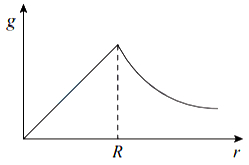
The variation of acceleration due to gravity $g$ with distance $x$ from the centre of the Earth is best represented by ($R \rightarrow$ Radius of the Earth):
A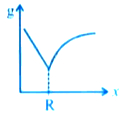
B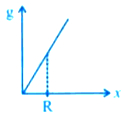
C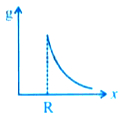
D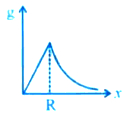
Solution
(D) The acceleration due to gravity $g$ at a distance $x$ from the centre of the Earth is given by:
$1$. Inside the Earth $(x < R)$: $g = \frac{GMx}{R^3}$,which implies $g \propto x$. This is a linear relationship.
$2$. Outside the Earth $(x \ge R)$: $g = \frac{GM}{x^2}$,which implies $g \propto \frac{1}{x^2}$. This is an inverse square relationship.
Thus,the graph starts from the origin $(0,0)$,increases linearly until $x = R$,and then decreases following an inverse square law for $x > R$.
$1$. Inside the Earth $(x < R)$: $g = \frac{GMx}{R^3}$,which implies $g \propto x$. This is a linear relationship.
$2$. Outside the Earth $(x \ge R)$: $g = \frac{GM}{x^2}$,which implies $g \propto \frac{1}{x^2}$. This is an inverse square relationship.
Thus,the graph starts from the origin $(0,0)$,increases linearly until $x = R$,and then decreases following an inverse square law for $x > R$.
0 likes
View Solution387
EasyMCQ
An astronaut on a strange planet finds that the acceleration due to gravity is twice that on the surface of the Earth. Which of the following could explain this?
A
Both the mass and radius of the planet are half that of Earth
B
Radius of the planet is half that of Earth,but the mass is the same as that of Earth
C
Both the mass and radius of the planet are twice that of Earth
D
Mass of the planet is half that of Earth,but radius is the same as that of Earth
Solution
(A) The acceleration due to gravity on the surface of a planet is given by $g = \frac{GM}{R^2}$.
Let $M_e$ and $R_e$ be the mass and radius of the Earth,and $g_e = \frac{GM_e}{R_e^2}$ be the acceleration due to gravity on Earth.
For the strange planet,we are given $g_p = 2g_e$.
Checking option $A$: If $M_p = \frac{M_e}{2}$ and $R_p = \frac{R_e}{2}$,then $g_p = \frac{G(M_e/2)}{(R_e/2)^2} = \frac{GM_e/2}{R_e^2/4} = 2 \frac{GM_e}{R_e^2} = 2g_e$.
Thus,option $A$ is correct.
Let $M_e$ and $R_e$ be the mass and radius of the Earth,and $g_e = \frac{GM_e}{R_e^2}$ be the acceleration due to gravity on Earth.
For the strange planet,we are given $g_p = 2g_e$.
Checking option $A$: If $M_p = \frac{M_e}{2}$ and $R_p = \frac{R_e}{2}$,then $g_p = \frac{G(M_e/2)}{(R_e/2)^2} = \frac{GM_e/2}{R_e^2/4} = 2 \frac{GM_e}{R_e^2} = 2g_e$.
Thus,option $A$ is correct.
0 likes
View Solution388
EasyMCQ
The acceleration due to gravity becomes $\left(\frac{g}{2}\right)$ ($g =$ acceleration due to gravity on the surface of the earth) at a height equal to
A
$4 R$
B
$(\sqrt{2}-1) R$
C
$2 R$
D
$\frac{R}{2}$
Solution
(B) The acceleration due to gravity at the surface of the earth is $g = \frac{GM}{R^2}$.
At a height $h$ above the surface,the acceleration due to gravity $g'$ is given by $g' = \frac{GM}{(R+h)^2}$.
Dividing the two expressions,we get $\frac{g'}{g} = \left(\frac{R}{R+h}\right)^2$.
Given that $g' = \frac{g}{2}$,we substitute this into the equation:
$\frac{1}{2} = \left(\frac{R}{R+h}\right)^2$.
Taking the square root on both sides:
$\frac{1}{\sqrt{2}} = \frac{R}{R+h}$.
Rearranging the terms:
$R+h = R\sqrt{2}$.
$h = R(\sqrt{2}-1)$.
At a height $h$ above the surface,the acceleration due to gravity $g'$ is given by $g' = \frac{GM}{(R+h)^2}$.
Dividing the two expressions,we get $\frac{g'}{g} = \left(\frac{R}{R+h}\right)^2$.
Given that $g' = \frac{g}{2}$,we substitute this into the equation:
$\frac{1}{2} = \left(\frac{R}{R+h}\right)^2$.
Taking the square root on both sides:
$\frac{1}{\sqrt{2}} = \frac{R}{R+h}$.
Rearranging the terms:
$R+h = R\sqrt{2}$.
$h = R(\sqrt{2}-1)$.
0 likes
View Solution389
EasyMCQ
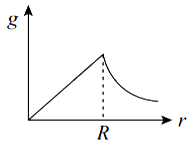
Which of the following graphs correctly represents the value of acceleration due to gravity '$g$' on the Earth as a function of distance '$r$' from the center?
A
B
C
D
Solution
(B) The acceleration due to gravity '$g$' at a distance '$r$' from the center of the Earth is given by:
$1$. Inside the Earth $(r < R)$: $g = \frac{GMr}{R^3}$,which implies $g \propto r$. This is a linear relationship.
$2$. Outside the Earth $(r \geq R)$: $g = \frac{GM}{r^2}$,which implies $g \propto \frac{1}{r^2}$. This is a non-linear,inverse-square decay.
Therefore,the graph shows a linear increase from the center $(r=0)$ to the surface $(r=R)$,and a non-linear decrease for distances greater than the radius of the Earth $(r > R)$. Graph $B$ correctly represents this behavior.
$1$. Inside the Earth $(r < R)$: $g = \frac{GMr}{R^3}$,which implies $g \propto r$. This is a linear relationship.
$2$. Outside the Earth $(r \geq R)$: $g = \frac{GM}{r^2}$,which implies $g \propto \frac{1}{r^2}$. This is a non-linear,inverse-square decay.
Therefore,the graph shows a linear increase from the center $(r=0)$ to the surface $(r=R)$,and a non-linear decrease for distances greater than the radius of the Earth $(r > R)$. Graph $B$ correctly represents this behavior.
0 likes
View Solution390
MediumMCQ
The value of acceleration due to gravity at a height of $10 \,km$ from the surface of the Earth is $x$. At what depth inside the Earth is the value of the acceleration due to gravity the same value $x$ (in $\,km$)?
A
$5$
B
$20$
C
$10$
D
$15$
Solution
(B) The value of acceleration due to gravity at height $h = 10 \,km$ is given by $g_h = g(1 - \frac{2h}{R_e}) = x$,where $R_e$ is the radius of the Earth.
At a depth $d$ below the surface,the acceleration due to gravity is given by $g_d = g(1 - \frac{d}{R_e}) = x$.
Equating the two expressions for $x$:
$g(1 - \frac{2h}{R_e}) = g(1 - \frac{d}{R_e})$
$1 - \frac{2h}{R_e} = 1 - \frac{d}{R_e}$
$\frac{2h}{R_e} = \frac{d}{R_e}$
$d = 2h$.
Given $h = 10 \,km$,we get $d = 2 \times 10 \,km = 20 \,km$.
At a depth $d$ below the surface,the acceleration due to gravity is given by $g_d = g(1 - \frac{d}{R_e}) = x$.
Equating the two expressions for $x$:
$g(1 - \frac{2h}{R_e}) = g(1 - \frac{d}{R_e})$
$1 - \frac{2h}{R_e} = 1 - \frac{d}{R_e}$
$\frac{2h}{R_e} = \frac{d}{R_e}$
$d = 2h$.
Given $h = 10 \,km$,we get $d = 2 \times 10 \,km = 20 \,km$.
0 likes
View Solution391
MediumMCQ
The time period of a simple pendulum on the surface of the earth is $T$. If the pendulum is taken to a height equal to half of the radius of the earth,then its time period is
A
$T/2$
B
$3T/2$
C
$2T$
D
$3T$
Solution
(B) The time period of a simple pendulum is given by $T = 2\pi \sqrt{\frac{l}{g}}$.
On the surface of the earth,$T = 2\pi \sqrt{\frac{l}{g}}$,where $g = \frac{GM}{R^2}$.
At a height $h = R/2$,the acceleration due to gravity $g'$ is given by $g' = g \left( \frac{R}{R+h} \right)^2$.
Substituting $h = R/2$,we get $g' = g \left( \frac{R}{R + R/2} \right)^2 = g \left( \frac{R}{3R/2} \right)^2 = g \left( \frac{2}{3} \right)^2 = \frac{4}{9}g$.
The new time period $T'$ is $T' = 2\pi \sqrt{\frac{l}{g'}} = 2\pi \sqrt{\frac{l}{(4/9)g}} = \frac{3}{2} \left( 2\pi \sqrt{\frac{l}{g}} \right) = \frac{3}{2}T$.
On the surface of the earth,$T = 2\pi \sqrt{\frac{l}{g}}$,where $g = \frac{GM}{R^2}$.
At a height $h = R/2$,the acceleration due to gravity $g'$ is given by $g' = g \left( \frac{R}{R+h} \right)^2$.
Substituting $h = R/2$,we get $g' = g \left( \frac{R}{R + R/2} \right)^2 = g \left( \frac{R}{3R/2} \right)^2 = g \left( \frac{2}{3} \right)^2 = \frac{4}{9}g$.
The new time period $T'$ is $T' = 2\pi \sqrt{\frac{l}{g'}} = 2\pi \sqrt{\frac{l}{(4/9)g}} = \frac{3}{2} \left( 2\pi \sqrt{\frac{l}{g}} \right) = \frac{3}{2}T$.
0 likes
View Solution392
MediumMCQ
The acceleration due to gravity at a height of $(\sqrt{2}-1) R$ from the surface of the earth is (Acceleration due to gravity on the surface of the earth $= 10 \ m \ s^{-2}$ and $R$ is radius of the earth). (in $m \ s^{-2}$)
A
$2.5$
B
$7.5$
C
$5$
D
$10$
Solution
(C) The acceleration due to gravity $g'$ at a height $h$ from the surface of the earth is given by the formula: $g' = g \left( \frac{R}{R+h} \right)^2$,where $g$ is the acceleration due to gravity on the surface of the earth and $R$ is the radius of the earth.
Given: $h = (\sqrt{2}-1)R$ and $g = 10 \ m \ s^{-2}$.
Substituting the value of $h$ in the formula:
$g' = g \left( \frac{R}{R + (\sqrt{2}-1)R} \right)^2$
$g' = g \left( \frac{R}{R + \sqrt{2}R - R} \right)^2$
$g' = g \left( \frac{R}{\sqrt{2}R} \right)^2$
$g' = g \left( \frac{1}{\sqrt{2}} \right)^2$
$g' = g \times \frac{1}{2}$
$g' = \frac{10}{2} = 5 \ m \ s^{-2}$.
Given: $h = (\sqrt{2}-1)R$ and $g = 10 \ m \ s^{-2}$.
Substituting the value of $h$ in the formula:
$g' = g \left( \frac{R}{R + (\sqrt{2}-1)R} \right)^2$
$g' = g \left( \frac{R}{R + \sqrt{2}R - R} \right)^2$
$g' = g \left( \frac{R}{\sqrt{2}R} \right)^2$
$g' = g \left( \frac{1}{\sqrt{2}} \right)^2$
$g' = g \times \frac{1}{2}$
$g' = \frac{10}{2} = 5 \ m \ s^{-2}$.
0 likes
View Solution393
EasyMCQ
The acceleration due to gravity at a height of $6400 \,km$ from the surface of the earth is $2.5 \,ms^{-2}$. The acceleration due to gravity at a height of $12800 \,km$ from the surface of the earth is (Radius of the earth $= 6400 \,km$) (in $\,ms^{-2}$)
A
$1.11$
B
$1.5$
C
$2.22$
D
$1.25$
Solution
(A) Given: $g_1 = 2.5 \,ms^{-2}$ at height $h_1 = 6400 \,km$. Radius of earth $R = 6400 \,km$.
The acceleration due to gravity at height $h$ is given by $g = \frac{GM}{(R+h)^2}$.
This implies $g \propto \frac{1}{(R+h)^2}$.
For height $h_1 = 6400 \,km$, distance from center is $r_1 = R + h_1 = 6400 + 6400 = 12800 \,km = 2R$.
For height $h_2 = 12800 \,km$, distance from center is $r_2 = R + h_2 = 6400 + 12800 = 19200 \,km = 3R$.
Taking the ratio: $\frac{g_2}{g_1} = \left( \frac{r_1}{r_2} \right)^2 = \left( \frac{2R}{3R} \right)^2 = \left( \frac{2}{3} \right)^2 = \frac{4}{9}$.
Therefore, $g_2 = \frac{4}{9} \times g_1 = \frac{4}{9} \times 2.5 = \frac{10}{9} \approx 1.11 \,ms^{-2}$.
The acceleration due to gravity at height $h$ is given by $g = \frac{GM}{(R+h)^2}$.
This implies $g \propto \frac{1}{(R+h)^2}$.
For height $h_1 = 6400 \,km$, distance from center is $r_1 = R + h_1 = 6400 + 6400 = 12800 \,km = 2R$.
For height $h_2 = 12800 \,km$, distance from center is $r_2 = R + h_2 = 6400 + 12800 = 19200 \,km = 3R$.
Taking the ratio: $\frac{g_2}{g_1} = \left( \frac{r_1}{r_2} \right)^2 = \left( \frac{2R}{3R} \right)^2 = \left( \frac{2}{3} \right)^2 = \frac{4}{9}$.
Therefore, $g_2 = \frac{4}{9} \times g_1 = \frac{4}{9} \times 2.5 = \frac{10}{9} \approx 1.11 \,ms^{-2}$.
0 likes
View Solution394
EasyMCQ
What is the height from the surface of earth,where acceleration due to gravity will be $\frac{1}{4}$ of that of the earth (in $km$)? $(R_E = 6400 \ km)$
A
$6400$
B
$3200$
C
$1600$
D
$640$
Solution
(A) The acceleration due to gravity at a height $h$ above the surface of the earth is given by the formula $g_h = g \left( \frac{R_E}{R_E + h} \right)^2$,where $g$ is the acceleration due to gravity at the surface and $R_E$ is the radius of the earth.
Given that $g_h = \frac{g}{4}$,we substitute this into the equation:
$\frac{g}{4} = g \left( \frac{R_E}{R_E + h} \right)^2$
$\frac{1}{4} = \left( \frac{R_E}{R_E + h} \right)^2$
Taking the square root of both sides:
$\frac{1}{2} = \frac{R_E}{R_E + h}$
$R_E + h = 2R_E$
$h = R_E$
Given $R_E = 6400 \ km$,therefore $h = 6400 \ km$.
Given that $g_h = \frac{g}{4}$,we substitute this into the equation:
$\frac{g}{4} = g \left( \frac{R_E}{R_E + h} \right)^2$
$\frac{1}{4} = \left( \frac{R_E}{R_E + h} \right)^2$
Taking the square root of both sides:
$\frac{1}{2} = \frac{R_E}{R_E + h}$
$R_E + h = 2R_E$
$h = R_E$
Given $R_E = 6400 \ km$,therefore $h = 6400 \ km$.
0 likes
View Solution395
EasyMCQ
The value of acceleration due to gravity at a height of $4 R_E$ from the surface of the Earth is (where $R_E$ is the radius of the Earth and acceleration due to gravity on the surface of the Earth $g = 10 \,ms^{-2}$): (in $\,ms^{-2}$)
A
$0.2$
B
$0.3$
C
$0.4$
D
$3$
Solution
(C) The acceleration due to gravity $g'$ at a height $h$ above the Earth's surface is given by the formula:
$g' = g \left( \frac{R_E}{R_E + h} \right)^2$
Given that the height $h = 4 R_E$ and the acceleration due to gravity on the surface $g = 10 \,ms^{-2}$.
Substituting the values into the formula:
$g' = 10 \left( \frac{R_E}{R_E + 4 R_E} \right)^2$
$g' = 10 \left( \frac{R_E}{5 R_E} \right)^2$
$g' = 10 \left( \frac{1}{5} \right)^2$
$g' = 10 \times \frac{1}{25} = \frac{10}{25} = 0.4 \,ms^{-2}$
$g' = g \left( \frac{R_E}{R_E + h} \right)^2$
Given that the height $h = 4 R_E$ and the acceleration due to gravity on the surface $g = 10 \,ms^{-2}$.
Substituting the values into the formula:
$g' = 10 \left( \frac{R_E}{R_E + 4 R_E} \right)^2$
$g' = 10 \left( \frac{R_E}{5 R_E} \right)^2$
$g' = 10 \left( \frac{1}{5} \right)^2$
$g' = 10 \times \frac{1}{25} = \frac{10}{25} = 0.4 \,ms^{-2}$
0 likes
View Solution396
EasyMCQ
Which of the following statements are true about the acceleration due to gravity,$g$?
$A$. $g$ is greater at the poles.
$B$. The value of $g$ decreases with height.
$C$. The value of $g$ is the same all over the Earth.
$D$. The value of $g$ is maximum at the center of the Earth.
$A$. $g$ is greater at the poles.
$B$. The value of $g$ decreases with height.
$C$. The value of $g$ is the same all over the Earth.
$D$. The value of $g$ is maximum at the center of the Earth.
A
$A$ and $B$
B
$A$ and $D$
C
$B$ and $C$
D
$C$ and $D$
Solution
(A) The acceleration due to gravity at the surface of the Earth is given by $g = \frac{GM}{R^2}$,where $G$ is the gravitational constant,$M$ is the mass of the Earth,and $R$ is the radius of the Earth.
Since the Earth is an oblate spheroid,its radius $R$ is minimum at the poles and maximum at the equator. Because $g \propto \frac{1}{R^2}$,$g$ is greater at the poles.
As we move to a height $h$ above the surface,the acceleration due to gravity $g^{\prime}$ is given by $g^{\prime} = \frac{g}{(1 + h/R)^2}$. As $h$ increases,$g^{\prime}$ decreases.
At the center of the Earth,the effective acceleration due to gravity is zero.
Therefore,statements $A$ and $B$ are correct.
Since the Earth is an oblate spheroid,its radius $R$ is minimum at the poles and maximum at the equator. Because $g \propto \frac{1}{R^2}$,$g$ is greater at the poles.
As we move to a height $h$ above the surface,the acceleration due to gravity $g^{\prime}$ is given by $g^{\prime} = \frac{g}{(1 + h/R)^2}$. As $h$ increases,$g^{\prime}$ decreases.
At the center of the Earth,the effective acceleration due to gravity is zero.
Therefore,statements $A$ and $B$ are correct.
0 likes
View Solution397
DifficultMCQ
$A$ uniform solid sphere of radius $R$ produces a gravitational acceleration of $a_o$ on its surface. The distance of the point from the centre of the sphere where the gravitational acceleration becomes $\frac{a_o}{4}$ is,
A
$4 R$
B
$\frac{3}{2} R$
C
$2 R$
D
$3 R$
Solution
(C) The gravitational acceleration $g$ at a distance $r$ from the centre of a uniform solid sphere of mass $M$ and radius $R$ (where $r \ge R$) is given by $g = \frac{GM}{r^2}$.
On the surface,$r = R$,so $a_o = \frac{GM}{R^2}$.
We want to find the distance $r$ where the acceleration becomes $a = \frac{a_o}{4}$.
Substituting the expressions,we get $\frac{GM}{r^2} = \frac{1}{4} \left( \frac{GM}{R^2} \right)$.
Canceling $GM$ from both sides,we get $\frac{1}{r^2} = \frac{1}{4R^2}$.
Taking the square root of both sides,$r^2 = 4R^2$,which gives $r = 2R$.
Thus,the distance from the centre of the sphere is $2R$.
On the surface,$r = R$,so $a_o = \frac{GM}{R^2}$.
We want to find the distance $r$ where the acceleration becomes $a = \frac{a_o}{4}$.
Substituting the expressions,we get $\frac{GM}{r^2} = \frac{1}{4} \left( \frac{GM}{R^2} \right)$.
Canceling $GM$ from both sides,we get $\frac{1}{r^2} = \frac{1}{4R^2}$.
Taking the square root of both sides,$r^2 = 4R^2$,which gives $r = 2R$.
Thus,the distance from the centre of the sphere is $2R$.
0 likes
View Solution398
EasyMCQ
There is a planet which is $8$ times more massive and $27$ times denser than the Earth. If $g^{\prime}$ and $g$ are the accelerations due to gravity on the surfaces of the planet and the Earth respectively,then:
A
$g^{\prime} = 8g$
B
$g^{\prime} = 27g$
C
$g^{\prime} = 18g$
D
$g^{\prime} = \frac{9}{4}g$
Solution
(C) The acceleration due to gravity $g$ on the surface of a planet is given by $g = \frac{GM}{R^2}$.
Since density $\rho = \frac{M}{V} = \frac{M}{\frac{4}{3}\pi R^3}$,we can express the radius $R$ as $R = \left( \frac{3M}{4\pi \rho} \right)^{1/3}$.
Substituting $R$ into the formula for $g$:
$g = \frac{GM}{(\frac{3M}{4\pi \rho})^{2/3}} = G M^{1/3} (\frac{4\pi \rho}{3})^{2/3}$.
This shows that $g \propto M^{1/3} \rho^{2/3}$.
Given for the planet: $M^{\prime} = 8M$ and $\rho^{\prime} = 27\rho$.
Taking the ratio:
$\frac{g^{\prime}}{g} = \left( \frac{M^{\prime}}{M} \right)^{1/3} \left( \frac{\rho^{\prime}}{\rho} \right)^{2/3}$.
$\frac{g^{\prime}}{g} = (8)^{1/3} \times (27)^{2/3} = 2 \times (3^3)^{2/3} = 2 \times 3^2 = 2 \times 9 = 18$.
Therefore,$g^{\prime} = 18g$.
Since density $\rho = \frac{M}{V} = \frac{M}{\frac{4}{3}\pi R^3}$,we can express the radius $R$ as $R = \left( \frac{3M}{4\pi \rho} \right)^{1/3}$.
Substituting $R$ into the formula for $g$:
$g = \frac{GM}{(\frac{3M}{4\pi \rho})^{2/3}} = G M^{1/3} (\frac{4\pi \rho}{3})^{2/3}$.
This shows that $g \propto M^{1/3} \rho^{2/3}$.
Given for the planet: $M^{\prime} = 8M$ and $\rho^{\prime} = 27\rho$.
Taking the ratio:
$\frac{g^{\prime}}{g} = \left( \frac{M^{\prime}}{M} \right)^{1/3} \left( \frac{\rho^{\prime}}{\rho} \right)^{2/3}$.
$\frac{g^{\prime}}{g} = (8)^{1/3} \times (27)^{2/3} = 2 \times (3^3)^{2/3} = 2 \times 3^2 = 2 \times 9 = 18$.
Therefore,$g^{\prime} = 18g$.
0 likes
View SolutionGravitation — Acceleration Due to Gravity and its Variation · Frequently Asked Questions
1Are these Gravitation questions useful for JEE and NEET?
Yes. All questions in this section are mapped to JEE Main and NEET exam patterns. Previous year questions from JEE Main, NEET, GUJCET and state-level exams are included with full solutions.
2Can I switch to Hindi or Gujarati for these questions?
Yes. Use the language tabs in the hero section or the sidebar to view the same questions and solutions in English, Hindi or Gujarati.
3How do I generate a question paper from this subtopic?
Use the Vedclass Exam Paper Generator — select the chapter and subtopic, set difficulty, and generate Sets A, B, C, D automatically. First 3 chapters of every subject are free.
Vedclass Products
For Students
Vedclass Test Series
Mock tests in real JEE/NEET style with performance analysis. 5-day free trial.
Start Free TrialFor Teachers
Exam Paper Generator
Generate Set A/B/C/D papers from this chapter in 2 minutes. 3 chapters free.
Try FreeFor Institutes
Online Exam Module
Live online exams with unlimited students, 360° analytics & white-label branding.
See DemoFor Teachers & Institutes
Generate a Gravitation Exam Paper in 2 Minutes
Select subtopic & difficulty — Sets A, B, C, D auto-generated with No Repeat logic.
First 3 chapters of every subject are free — no payment required.