
A English
Horizontal Projectile Motion Questions in English
Class 11 Physics · 3-2.Motion in Plane · Horizontal Projectile Motion
492+
Questions
English
Language
100%
With Solutions
Showing 50 of 492 questions in English
251
DifficultMCQ
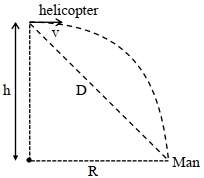
$A$ helicopter is flying horizontally with a speed $v$ at an altitude $h$ and has to drop a food packet for a man on the ground. What is the distance of the helicopter from the man when the food packet is dropped?
A
$\sqrt{\frac{2ghv^{2}+1}{h^{2}}}$
B
$\sqrt{2ghv^{2}+h^{2}}$
C
$\sqrt{\frac{2v^{2}h}{g}+h^{2}}$
D
$\sqrt{\frac{2gh}{v^{2}}}+h^{2}$
Solution
(C) The time taken by the food packet to reach the ground is given by $t = \sqrt{\frac{2h}{g}}$.
The horizontal distance (range) covered by the packet during this time is $R = v \cdot t = v \sqrt{\frac{2h}{g}}$.
When the packet is dropped,the helicopter is at a horizontal distance $R$ and vertical distance $h$ from the man.
The distance $D$ of the helicopter from the man is the hypotenuse of the right-angled triangle formed by $R$ and $h$:
$D = \sqrt{R^{2} + h^{2}}$
Substituting the value of $R$:
$D = \sqrt{\left(v \sqrt{\frac{2h}{g}}\right)^{2} + h^{2}}$
$D = \sqrt{\frac{2v^{2}h}{g} + h^{2}}$
The horizontal distance (range) covered by the packet during this time is $R = v \cdot t = v \sqrt{\frac{2h}{g}}$.
When the packet is dropped,the helicopter is at a horizontal distance $R$ and vertical distance $h$ from the man.
The distance $D$ of the helicopter from the man is the hypotenuse of the right-angled triangle formed by $R$ and $h$:
$D = \sqrt{R^{2} + h^{2}}$
Substituting the value of $R$:
$D = \sqrt{\left(v \sqrt{\frac{2h}{g}}\right)^{2} + h^{2}}$
$D = \sqrt{\frac{2v^{2}h}{g} + h^{2}}$
0 likes
View Solution252
DifficultMCQ
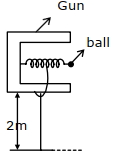
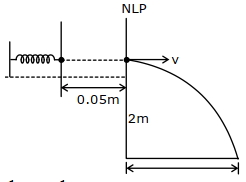
In a spring gun having a spring constant $k = 100\, \text{N/m}$,a small ball $B$ of mass $m = 100\, \text{g}$ is placed in its barrel (as shown in the figure) by compressing the spring by $x = 0.05\, \text{m}$. $A$ box is placed at a distance $d$ on the ground so that the ball falls into it. If the ball leaves the gun horizontally at a height of $h = 2\, \text{m}$ above the ground,find the value of $d$ in meters. (Take $g = 10\, \text{m/s}^2$)
A
$5$
B
$2$
C
$1$
D
$0.5$
Solution
(C) $1$. First,calculate the velocity $v$ of the ball as it leaves the spring gun using the principle of conservation of mechanical energy:
$\frac{1}{2} k x^2 = \frac{1}{2} m v^2$
Given $k = 100\, \text{N/m}$,$x = 0.05\, \text{m}$,and $m = 100\, \text{g} = 0.1\, \text{kg}$.
$100 \times (0.05)^2 = 0.1 \times v^2$
$100 \times 0.0025 = 0.1 \times v^2$
$0.25 = 0.1 \times v^2$
$v^2 = 2.5$
$v = \sqrt{2.5}\, \text{m/s}$.
$2$. Next,calculate the time $t$ taken by the ball to reach the ground from a height $h = 2\, \text{m}$ using the equation of motion for horizontal projection:
$h = \frac{1}{2} g t^2$
$2 = \frac{1}{2} \times 10 \times t^2$
$2 = 5 t^2$
$t^2 = 0.4$
$t = \sqrt{0.4}\, \text{s}$.
$3$. Finally,calculate the horizontal distance $d$:
$d = v \times t$
$d = \sqrt{2.5} \times \sqrt{0.4}$
$d = \sqrt{2.5 \times 0.4}$
$d = \sqrt{1} = 1\, \text{m}$.
Thus,the value of $d$ is $1\, \text{m}$.
$\frac{1}{2} k x^2 = \frac{1}{2} m v^2$
Given $k = 100\, \text{N/m}$,$x = 0.05\, \text{m}$,and $m = 100\, \text{g} = 0.1\, \text{kg}$.
$100 \times (0.05)^2 = 0.1 \times v^2$
$100 \times 0.0025 = 0.1 \times v^2$
$0.25 = 0.1 \times v^2$
$v^2 = 2.5$
$v = \sqrt{2.5}\, \text{m/s}$.
$2$. Next,calculate the time $t$ taken by the ball to reach the ground from a height $h = 2\, \text{m}$ using the equation of motion for horizontal projection:
$h = \frac{1}{2} g t^2$
$2 = \frac{1}{2} \times 10 \times t^2$
$2 = 5 t^2$
$t^2 = 0.4$
$t = \sqrt{0.4}\, \text{s}$.
$3$. Finally,calculate the horizontal distance $d$:
$d = v \times t$
$d = \sqrt{2.5} \times \sqrt{0.4}$
$d = \sqrt{2.5 \times 0.4}$
$d = \sqrt{1} = 1\, \text{m}$.
Thus,the value of $d$ is $1\, \text{m}$.
1 likes
View Solution253
MediumMCQ
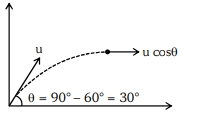
$A$ ball is projected with a velocity of $10 \ ms^{-1}$ at an angle of $60^{\circ}$ with the vertical direction. Its speed at the highest point of its trajectory will be $............... \ ms^{-1}$.
A
$5 \sqrt{3}$
B
$5$
C
$10$
D
Zero
Solution
(A) The angle of projection with the horizontal is $\theta = 90^{\circ} - 60^{\circ} = 30^{\circ}$.
At the highest point of the trajectory,the vertical component of velocity becomes zero,and only the horizontal component of velocity remains.
The horizontal component of velocity is given by $v_x = u \cos \theta$.
Given $u = 10 \ ms^{-1}$ and $\theta = 30^{\circ}$,we have:
$v_x = 10 \cos 30^{\circ} = 10 \times \frac{\sqrt{3}}{2} = 5 \sqrt{3} \ ms^{-1}$.
Thus,the speed at the highest point is $5 \sqrt{3} \ ms^{-1}$.
At the highest point of the trajectory,the vertical component of velocity becomes zero,and only the horizontal component of velocity remains.
The horizontal component of velocity is given by $v_x = u \cos \theta$.
Given $u = 10 \ ms^{-1}$ and $\theta = 30^{\circ}$,we have:
$v_x = 10 \cos 30^{\circ} = 10 \times \frac{\sqrt{3}}{2} = 5 \sqrt{3} \ ms^{-1}$.
Thus,the speed at the highest point is $5 \sqrt{3} \ ms^{-1}$.
0 likes
View Solution254
DifficultMCQ
$A$ body is projected from the ground at an angle of $45^{\circ}$ with the horizontal. Its velocity after $2 \, s$ is $20 \, m/s$. The maximum height reached by the body during its motion is $m$. (use $g = 10 \, m/s^2$)
A
$20$
B
$25$
C
$29$
D
$200$
Solution
(A) Let the initial velocity be $u$. The horizontal and vertical components of velocity at any time $t$ are given by:
$v_x = u \cos 45^{\circ} = \frac{u}{\sqrt{2}}$
$v_y = u \sin 45^{\circ} - gt = \frac{u}{\sqrt{2}} - 10(2) = \frac{u}{\sqrt{2}} - 20$
Given that the resultant velocity at $t = 2 \, s$ is $20 \, m/s$,we have:
$v^2 = v_x^2 + v_y^2$
$20^2 = \left(\frac{u}{\sqrt{2}}\right)^2 + \left(\frac{u}{\sqrt{2}} - 20\right)^2$
$400 = \frac{u^2}{2} + \frac{u^2}{2} - 20\sqrt{2}u + 400$
$0 = u^2 - 20\sqrt{2}u$
Since $u \neq 0$,we get $u = 20\sqrt{2} \, m/s$.
The maximum height $H$ is given by:
$H = \frac{u^2 \sin^2 45^{\circ}}{2g} = \frac{(20\sqrt{2})^2 \times (1/2)}{2 \times 10} = \frac{800 \times 0.5}{20} = \frac{400}{20} = 20 \, m$.
$v_x = u \cos 45^{\circ} = \frac{u}{\sqrt{2}}$
$v_y = u \sin 45^{\circ} - gt = \frac{u}{\sqrt{2}} - 10(2) = \frac{u}{\sqrt{2}} - 20$
Given that the resultant velocity at $t = 2 \, s$ is $20 \, m/s$,we have:
$v^2 = v_x^2 + v_y^2$
$20^2 = \left(\frac{u}{\sqrt{2}}\right)^2 + \left(\frac{u}{\sqrt{2}} - 20\right)^2$
$400 = \frac{u^2}{2} + \frac{u^2}{2} - 20\sqrt{2}u + 400$
$0 = u^2 - 20\sqrt{2}u$
Since $u \neq 0$,we get $u = 20\sqrt{2} \, m/s$.
The maximum height $H$ is given by:
$H = \frac{u^2 \sin^2 45^{\circ}}{2g} = \frac{(20\sqrt{2})^2 \times (1/2)}{2 \times 10} = \frac{800 \times 0.5}{20} = \frac{400}{20} = 20 \, m$.
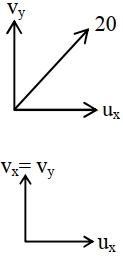
0 likes
View Solution255
DifficultMCQ
$A$ projectile is projected with a velocity of $25 \, m/s$ at an angle $\theta$ with the horizontal. After $t$ seconds,its inclination with the horizontal becomes zero. If $R$ represents the horizontal range of the projectile,the value of $\theta$ will be: [use $g = 10 \, m/s^2$]
A
$\frac{1}{2} \sin^{-1}\left(\frac{5t^2}{4R}\right)$
B
$\frac{1}{2} \sin^{-1}\left(\frac{4R}{5t^2}\right)$
C
$\tan^{-1}\left(\frac{4t^2}{5R}\right)$
D
$\cot^{-1}\left(\frac{R}{20t^2}\right)$
Solution
(D) The horizontal range $R$ is given by $R = \frac{V^2 \sin(2\theta)}{g} = \frac{2V^2 \sin\theta \cos\theta}{g}$.
The time taken to reach the highest point (where inclination is zero) is $t = \frac{V \sin\theta}{g}$.
From this,$V \sin\theta = gt$,so $V = \frac{gt}{\sin\theta}$.
Substitute $V$ into the range formula: $R = \frac{2(gt/\sin\theta)^2 \sin\theta \cos\theta}{g} = \frac{2g^2 t^2 \sin\theta \cos\theta}{g \sin^2\theta} = \frac{2gt^2 \cos\theta}{\sin\theta} = \frac{2gt^2}{\tan\theta}$.
Given $g = 10 \, m/s^2$,we have $R = \frac{2(10)t^2}{\tan\theta} = \frac{20t^2}{\tan\theta}$.
Rearranging for $\theta$,we get $\tan\theta = \frac{20t^2}{R}$,which implies $\cot\theta = \frac{R}{20t^2}$.
Therefore,$\theta = \cot^{-1}\left(\frac{R}{20t^2}\right)$.
The time taken to reach the highest point (where inclination is zero) is $t = \frac{V \sin\theta}{g}$.
From this,$V \sin\theta = gt$,so $V = \frac{gt}{\sin\theta}$.
Substitute $V$ into the range formula: $R = \frac{2(gt/\sin\theta)^2 \sin\theta \cos\theta}{g} = \frac{2g^2 t^2 \sin\theta \cos\theta}{g \sin^2\theta} = \frac{2gt^2 \cos\theta}{\sin\theta} = \frac{2gt^2}{\tan\theta}$.
Given $g = 10 \, m/s^2$,we have $R = \frac{2(10)t^2}{\tan\theta} = \frac{20t^2}{\tan\theta}$.
Rearranging for $\theta$,we get $\tan\theta = \frac{20t^2}{R}$,which implies $\cot\theta = \frac{R}{20t^2}$.
Therefore,$\theta = \cot^{-1}\left(\frac{R}{20t^2}\right)$.
0 likes
View Solution256
MediumMCQ
Given below are two statements. One is labelled as Assertion $A$ and the other is labelled as Reason $R$.
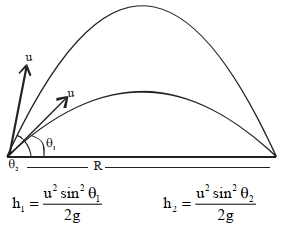
Assertion $A$: Two identical balls $A$ and $B$ thrown with the same velocity '$u$' at two different angles with the horizontal attain the same range $R$. If $A$ and $B$ reach maximum heights $h_{1}$ and $h_{2}$ respectively,then $R = 4 \sqrt{h_{1} h_{2}}$.
Reason $R$: The product of the said heights is $h_{1} h_{2} = \left(\frac{u^{2} \sin^{2} \theta}{2g}\right) \cdot \left(\frac{u^{2} \cos^{2} \theta}{2g}\right)$.
Choose the $CORRECT$ answer.
Assertion $A$: Two identical balls $A$ and $B$ thrown with the same velocity '$u$' at two different angles with the horizontal attain the same range $R$. If $A$ and $B$ reach maximum heights $h_{1}$ and $h_{2}$ respectively,then $R = 4 \sqrt{h_{1} h_{2}}$.
Reason $R$: The product of the said heights is $h_{1} h_{2} = \left(\frac{u^{2} \sin^{2} \theta}{2g}\right) \cdot \left(\frac{u^{2} \cos^{2} \theta}{2g}\right)$.
Choose the $CORRECT$ answer.
A
Both $A$ and $R$ are true and $R$ is the correct explanation of $A$.
B
Both $A$ and $R$ are true but $R$ is $NOT$ the correct explanation of $A$.
C
$A$ is true but $R$ is false.
D
$A$ is false but $R$ is true.
Solution
(A) For the same range,the angles of projection must satisfy $\theta_{1} + \theta_{2} = 90^{\circ}$,which means $\theta_{2} = 90^{\circ} - \theta_{1}$.
The maximum heights are given by $h_{1} = \frac{u^{2} \sin^{2} \theta_{1}}{2g}$ and $h_{2} = \frac{u^{2} \sin^{2} \theta_{2}}{2g} = \frac{u^{2} \cos^{2} \theta_{1}}{2g}$.
Multiplying these heights,we get $h_{1} h_{2} = \left(\frac{u^{2} \sin^{2} \theta_{1}}{2g}\right) \cdot \left(\frac{u^{2} \cos^{2} \theta_{1}}{2g}\right)$.
This can be rewritten as $h_{1} h_{2} = \frac{u^{4} \sin^{2} \theta_{1} \cos^{2} \theta_{1}}{4g^{2}} = \left(\frac{u^{2} \cdot 2 \sin \theta_{1} \cos \theta_{1}}{4g}\right)^{2} = \left(\frac{u^{2} \sin(2\theta_{1})}{4g}\right)^{2}$.
Since the range $R = \frac{u^{2} \sin(2\theta_{1})}{g}$,we have $h_{1} h_{2} = \left(\frac{R}{4}\right)^{2} = \frac{R^{2}}{16}$.
Therefore,$R^{2} = 16 h_{1} h_{2}$,which implies $R = 4 \sqrt{h_{1} h_{2}}$.
Both Assertion $A$ and Reason $R$ are true,and $R$ provides the correct mathematical derivation for $A$.
The maximum heights are given by $h_{1} = \frac{u^{2} \sin^{2} \theta_{1}}{2g}$ and $h_{2} = \frac{u^{2} \sin^{2} \theta_{2}}{2g} = \frac{u^{2} \cos^{2} \theta_{1}}{2g}$.
Multiplying these heights,we get $h_{1} h_{2} = \left(\frac{u^{2} \sin^{2} \theta_{1}}{2g}\right) \cdot \left(\frac{u^{2} \cos^{2} \theta_{1}}{2g}\right)$.
This can be rewritten as $h_{1} h_{2} = \frac{u^{4} \sin^{2} \theta_{1} \cos^{2} \theta_{1}}{4g^{2}} = \left(\frac{u^{2} \cdot 2 \sin \theta_{1} \cos \theta_{1}}{4g}\right)^{2} = \left(\frac{u^{2} \sin(2\theta_{1})}{4g}\right)^{2}$.
Since the range $R = \frac{u^{2} \sin(2\theta_{1})}{g}$,we have $h_{1} h_{2} = \left(\frac{R}{4}\right)^{2} = \frac{R^{2}}{16}$.
Therefore,$R^{2} = 16 h_{1} h_{2}$,which implies $R = 4 \sqrt{h_{1} h_{2}}$.
Both Assertion $A$ and Reason $R$ are true,and $R$ provides the correct mathematical derivation for $A$.
0 likes
View Solution257
MediumMCQ
$A$ fighter jet is flying horizontally at a certain altitude with a speed of $200 \; m/s$. When it passes directly overhead an anti-aircraft gun,a bullet is fired from the gun at an angle $\theta$ with the horizontal to hit the jet. If the bullet speed is $400 \; m/s$,the value of $\theta$ will be $\dots \; ^\circ$.
A
$40$
B
$50$
C
$60$
D
$70$
Solution
(C) For the bullet to hit the fighter jet,the horizontal component of the bullet's velocity must be equal to the horizontal velocity of the jet so that the bullet stays directly under the jet throughout its flight.
Let $v_j = 200 \; m/s$ be the speed of the jet and $v_b = 400 \; m/s$ be the speed of the bullet.
The horizontal component of the bullet's velocity is given by $v_{bx} = v_b \cos \theta$.
Equating the horizontal components: $v_j = v_b \cos \theta$.
Substituting the values: $200 = 400 \cos \theta$.
Therefore,$\cos \theta = \frac{200}{400} = 0.5$.
Thus,$\theta = \cos^{-1}(0.5) = 60^\circ$.
Let $v_j = 200 \; m/s$ be the speed of the jet and $v_b = 400 \; m/s$ be the speed of the bullet.
The horizontal component of the bullet's velocity is given by $v_{bx} = v_b \cos \theta$.
Equating the horizontal components: $v_j = v_b \cos \theta$.
Substituting the values: $200 = 400 \cos \theta$.
Therefore,$\cos \theta = \frac{200}{400} = 0.5$.
Thus,$\theta = \cos^{-1}(0.5) = 60^\circ$.
0 likes
View Solution258
MediumMCQ
$A$ person can throw a ball up to a maximum range of $100 \, m$. How high above the ground can he throw the same ball (in $, m$)?
A
$25$
B
$50$
C
$100$
D
$200$
Solution
(B) The maximum horizontal range $R_{\max}$ of a projectile is given by the formula $R_{\max} = \frac{u^2}{g}$,where $u$ is the initial velocity and $g$ is the acceleration due to gravity.
Given $R_{\max} = 100 \, m$,we have $\frac{u^2}{g} = 100 \, m$.
The maximum height $H_{\max}$ reached by a projectile when thrown vertically upwards is given by $H_{\max} = \frac{u^2}{2g}$.
Substituting the value of $\frac{u^2}{g}$ into the height formula:
$H_{\max} = \frac{1}{2} \times \left(\frac{u^2}{g}\right) = \frac{1}{2} \times 100 \, m = 50 \, m$.
Therefore,the person can throw the ball to a maximum height of $50 \, m$.
Given $R_{\max} = 100 \, m$,we have $\frac{u^2}{g} = 100 \, m$.
The maximum height $H_{\max}$ reached by a projectile when thrown vertically upwards is given by $H_{\max} = \frac{u^2}{2g}$.
Substituting the value of $\frac{u^2}{g}$ into the height formula:
$H_{\max} = \frac{1}{2} \times \left(\frac{u^2}{g}\right) = \frac{1}{2} \times 100 \, m = 50 \, m$.
Therefore,the person can throw the ball to a maximum height of $50 \, m$.
1 likes
View Solution259
MediumMCQ
$A$ ball is projected from the ground with a speed $15 \, m/s$ at an angle $\theta$ with the horizontal such that its range and maximum height are equal. Then,$\tan \theta$ will be equal to:
A
$1/4$
B
$1/2$
C
$2$
D
$4$
Solution
(D) The horizontal range $R$ of a projectile is given by $R = \frac{u^2 \sin(2\theta)}{g} = \frac{2u^2 \sin\theta \cos\theta}{g}$.
The maximum height $H$ of a projectile is given by $H = \frac{u^2 \sin^2\theta}{2g}$.
According to the problem,the range is equal to the maximum height,so $R = H$.
Substituting the formulas: $\frac{2u^2 \sin\theta \cos\theta}{g} = \frac{u^2 \sin^2\theta}{2g}$.
Canceling $u^2/g$ from both sides: $2 \sin\theta \cos\theta = \frac{\sin^2\theta}{2}$.
Dividing both sides by $\sin\theta$ (assuming $\sin\theta \neq 0$): $2 \cos\theta = \frac{\sin\theta}{2}$.
Rearranging to solve for $\tan\theta = \frac{\sin\theta}{\cos\theta}$: $\tan\theta = 4$.
The maximum height $H$ of a projectile is given by $H = \frac{u^2 \sin^2\theta}{2g}$.
According to the problem,the range is equal to the maximum height,so $R = H$.
Substituting the formulas: $\frac{2u^2 \sin\theta \cos\theta}{g} = \frac{u^2 \sin^2\theta}{2g}$.
Canceling $u^2/g$ from both sides: $2 \sin\theta \cos\theta = \frac{\sin^2\theta}{2}$.
Dividing both sides by $\sin\theta$ (assuming $\sin\theta \neq 0$): $2 \cos\theta = \frac{\sin\theta}{2}$.
Rearranging to solve for $\tan\theta = \frac{\sin\theta}{\cos\theta}$: $\tan\theta = 4$.
0 likes
View Solution260
EasyMCQ
Two projectiles are thrown with the same initial velocity making an angle of $45^{\circ}$ and $30^{\circ}$ with the horizontal,respectively. The ratio of their respective ranges will be:
A
$1: \sqrt{2}$
B
$\sqrt{2}: 1$
C
$2: \sqrt{3}$
D
$\sqrt{3}: 2$
Solution
(C) The horizontal range $R$ of a projectile is given by the formula $R = \frac{u^2 \sin(2\theta)}{g}$,where $u$ is the initial velocity,$\theta$ is the angle of projection,and $g$ is the acceleration due to gravity.
Given $u$ is the same for both projectiles,the ratio of their ranges is $\frac{R_1}{R_2} = \frac{\sin(2\theta_1)}{\sin(2\theta_2)}$.
For $\theta_1 = 45^{\circ}$,$2\theta_1 = 90^{\circ}$,so $\sin(90^{\circ}) = 1$.
For $\theta_2 = 30^{\circ}$,$2\theta_2 = 60^{\circ}$,so $\sin(60^{\circ}) = \frac{\sqrt{3}}{2}$.
Therefore,$\frac{R_1}{R_2} = \frac{1}{\sqrt{3}/2} = \frac{2}{\sqrt{3}}$.
Thus,the ratio is $2: \sqrt{3}$.
Given $u$ is the same for both projectiles,the ratio of their ranges is $\frac{R_1}{R_2} = \frac{\sin(2\theta_1)}{\sin(2\theta_2)}$.
For $\theta_1 = 45^{\circ}$,$2\theta_1 = 90^{\circ}$,so $\sin(90^{\circ}) = 1$.
For $\theta_2 = 30^{\circ}$,$2\theta_2 = 60^{\circ}$,so $\sin(60^{\circ}) = \frac{\sqrt{3}}{2}$.
Therefore,$\frac{R_1}{R_2} = \frac{1}{\sqrt{3}/2} = \frac{2}{\sqrt{3}}$.
Thus,the ratio is $2: \sqrt{3}$.
0 likes
View Solution261
MediumMCQ
Two projectiles thrown at $30^{\circ}$ and $45^{\circ}$ with the horizontal respectively,reach the maximum height in the same time. The ratio of their initial velocities is
A
$1: \sqrt{2}$
B
$2: 1$
C
$\sqrt{2}: 1$
D
$1: 2$
Solution
(C) The time taken to reach the maximum height for a projectile is given by the formula:
$t = \frac{u \sin \theta}{g}$
Given that both projectiles reach the maximum height in the same time,we have:
$t_1 = t_2$
$\frac{u_1 \sin \theta_1}{g} = \frac{u_2 \sin \theta_2}{g}$
Substituting the given angles $\theta_1 = 30^{\circ}$ and $\theta_2 = 45^{\circ}$:
$u_1 \sin 30^{\circ} = u_2 \sin 45^{\circ}$
$u_1 \left( \frac{1}{2} \right) = u_2 \left( \frac{1}{\sqrt{2}} \right)$
Rearranging to find the ratio $\frac{u_1}{u_2}$:
$\frac{u_1}{u_2} = \frac{1/\sqrt{2}}{1/2} = \frac{2}{\sqrt{2}} = \sqrt{2}$
Therefore,the ratio of their initial velocities is $\sqrt{2}: 1$.
$t = \frac{u \sin \theta}{g}$
Given that both projectiles reach the maximum height in the same time,we have:
$t_1 = t_2$
$\frac{u_1 \sin \theta_1}{g} = \frac{u_2 \sin \theta_2}{g}$
Substituting the given angles $\theta_1 = 30^{\circ}$ and $\theta_2 = 45^{\circ}$:
$u_1 \sin 30^{\circ} = u_2 \sin 45^{\circ}$
$u_1 \left( \frac{1}{2} \right) = u_2 \left( \frac{1}{\sqrt{2}} \right)$
Rearranging to find the ratio $\frac{u_1}{u_2}$:
$\frac{u_1}{u_2} = \frac{1/\sqrt{2}}{1/2} = \frac{2}{\sqrt{2}} = \sqrt{2}$
Therefore,the ratio of their initial velocities is $\sqrt{2}: 1$.
0 likes
View Solution262
MediumMCQ
If the initial velocity in the horizontal direction of a projectile is the unit vector $\hat{i}$ and the equation of the trajectory is $y = 5x(1 - x)$,find the $y$-component vector of the initial velocity. (Take $g = 10\,m/s^2$) (in $,\hat{j}$)
A
$4$
B
$3$
C
$5$
D
$8$
Solution
(C) The initial horizontal velocity is given as $u_x = 1\,m/s$.
The equation of the trajectory is $y = 5x - 5x^2$.
Differentiating the equation with respect to time $t$,we get the vertical velocity component $v_y = \frac{dy}{dt} = \frac{dy}{dx} \cdot \frac{dx}{dt}$.
First,find $\frac{dy}{dx} = \frac{d}{dx}(5x - 5x^2) = 5 - 10x$.
Since $v_x = \frac{dx}{dt} = u_x = 1$ (assuming constant horizontal velocity),we have $v_y = (5 - 10x) \cdot 1$.
At the initial point,$x = 0$.
Therefore,the initial vertical velocity $u_y = (5 - 10(0)) = 5\,m/s$.
Thus,the $y$-component vector of the initial velocity is $5\,\hat{j}$.
The equation of the trajectory is $y = 5x - 5x^2$.
Differentiating the equation with respect to time $t$,we get the vertical velocity component $v_y = \frac{dy}{dt} = \frac{dy}{dx} \cdot \frac{dx}{dt}$.
First,find $\frac{dy}{dx} = \frac{d}{dx}(5x - 5x^2) = 5 - 10x$.
Since $v_x = \frac{dx}{dt} = u_x = 1$ (assuming constant horizontal velocity),we have $v_y = (5 - 10x) \cdot 1$.
At the initial point,$x = 0$.
Therefore,the initial vertical velocity $u_y = (5 - 10(0)) = 5\,m/s$.
Thus,the $y$-component vector of the initial velocity is $5\,\hat{j}$.
1 likes
View Solution263
DifficultMCQ
$A$ body of mass $10 \ kg$ is projected at an angle of $45^{\circ}$ with the horizontal. The trajectory of the body is observed to pass through a point $(20, 10)$. If $T$ is the time of flight,then its momentum vector,at time $t = \frac{T}{\sqrt{2}}$,is. [Take $g = 10 \ m/s^2$]
A
$100 \hat{i} + (100\sqrt{2} - 200) \hat{j}$
B
$100\sqrt{2} \hat{i} + (100 - 200\sqrt{2}) \hat{j}$
C
$100 \hat{i} + (100 - 200\sqrt{2}) \hat{j}$
D
$100\sqrt{2} \hat{i} + (100\sqrt{2} - 200) \hat{j}$
Solution
(D) The equation of trajectory is $y = x \tan \theta - \frac{gx^2}{2u^2 \cos^2 \theta}$.
Given $\theta = 45^{\circ}$,$x = 20$,$y = 10$,and $g = 10 \ m/s^2$.
$10 = 20(1) - \frac{10(20)^2}{2u^2(1/2)} \Rightarrow 10 = 20 - \frac{4000}{u^2} \Rightarrow \frac{4000}{u^2} = 10 \Rightarrow u^2 = 400 \Rightarrow u = 20 \ m/s$.
The time of flight $T = \frac{2u \sin \theta}{g} = \frac{2(20)(1/\sqrt{2})}{10} = 2\sqrt{2} \ s$.
At time $t = \frac{T}{\sqrt{2}} = \frac{2\sqrt{2}}{\sqrt{2}} = 2 \ s$.
The velocity components are $v_x = u \cos \theta = 20(1/\sqrt{2}) = 10\sqrt{2} \ m/s$ and $v_y = u \sin \theta - gt = 20(1/\sqrt{2}) - 10(2) = 10\sqrt{2} - 20 \ m/s$.
The momentum vector $\vec{p} = m\vec{v} = 10(10\sqrt{2} \hat{i} + (10\sqrt{2} - 20) \hat{j}) = 100\sqrt{2} \hat{i} + (100\sqrt{2} - 200) \hat{j} \ kg \cdot m/s$.
Given $\theta = 45^{\circ}$,$x = 20$,$y = 10$,and $g = 10 \ m/s^2$.
$10 = 20(1) - \frac{10(20)^2}{2u^2(1/2)} \Rightarrow 10 = 20 - \frac{4000}{u^2} \Rightarrow \frac{4000}{u^2} = 10 \Rightarrow u^2 = 400 \Rightarrow u = 20 \ m/s$.
The time of flight $T = \frac{2u \sin \theta}{g} = \frac{2(20)(1/\sqrt{2})}{10} = 2\sqrt{2} \ s$.
At time $t = \frac{T}{\sqrt{2}} = \frac{2\sqrt{2}}{\sqrt{2}} = 2 \ s$.
The velocity components are $v_x = u \cos \theta = 20(1/\sqrt{2}) = 10\sqrt{2} \ m/s$ and $v_y = u \sin \theta - gt = 20(1/\sqrt{2}) - 10(2) = 10\sqrt{2} - 20 \ m/s$.
The momentum vector $\vec{p} = m\vec{v} = 10(10\sqrt{2} \hat{i} + (10\sqrt{2} - 20) \hat{j}) = 100\sqrt{2} \hat{i} + (100\sqrt{2} - 200) \hat{j} \ kg \cdot m/s$.
0 likes
View Solution264
MediumMCQ
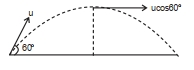
$A$ ball is projected with kinetic energy $E$, at an angle of $60^{\circ}$ to the horizontal. The kinetic energy of this ball at the highest point of its flight will be:
A
$\text{Zero}$
B
$\frac{E}{2}$
C
$\frac{E}{4}$
D
$E$
Solution
(C) The initial kinetic energy of the ball is given by $E = \frac{1}{2} mu^2$, where $u$ is the initial velocity.
At the highest point of the trajectory, the vertical component of velocity becomes zero, and the ball only possesses the horizontal component of velocity.
The horizontal component of velocity at the highest point is $v_x = u \cos 60^{\circ} = u \times \frac{1}{2} = \frac{u}{2}$.
Therefore, the kinetic energy at the highest point is $E' = \frac{1}{2} m v_x^2 = \frac{1}{2} m \left(\frac{u}{2}\right)^2$.
$E' = \frac{1}{2} m \frac{u^2}{4} = \frac{1}{4} \left(\frac{1}{2} mu^2\right) = \frac{E}{4}$.
At the highest point of the trajectory, the vertical component of velocity becomes zero, and the ball only possesses the horizontal component of velocity.
The horizontal component of velocity at the highest point is $v_x = u \cos 60^{\circ} = u \times \frac{1}{2} = \frac{u}{2}$.
Therefore, the kinetic energy at the highest point is $E' = \frac{1}{2} m v_x^2 = \frac{1}{2} m \left(\frac{u}{2}\right)^2$.
$E' = \frac{1}{2} m \frac{u^2}{4} = \frac{1}{4} \left(\frac{1}{2} mu^2\right) = \frac{E}{4}$.
0 likes
View Solution265
MediumMCQ
An object is projected in the air with initial velocity $u$ at an angle $\theta$. The projectile motion is such that the horizontal range $R$ is maximum. Another object is projected in the air with a horizontal range half of the range of the first object. The initial velocity remains the same in both cases. The value of the angle of projection,at which the second object is projected,will be $.......$ degrees.
A
$85$
B
$80$
C
$15$ or $75$
D
$70$
Solution
(C) The horizontal range $R$ is given by $R = \frac{u^2 \sin 2\theta}{g}$.
For maximum range,$\theta = 45^{\circ}$,so $R_{\max} = \frac{u^2}{g}$.
For the second object,the range is $R' = \frac{R_{\max}}{2} = \frac{u^2}{2g}$.
Equating the range formula for the second object: $\frac{u^2 \sin 2\theta'}{g} = \frac{u^2}{2g}$.
This simplifies to $\sin 2\theta' = \frac{1}{2}$.
Therefore,$2\theta' = 30^{\circ}$ or $2\theta' = 150^{\circ}$.
Solving for $\theta'$,we get $\theta' = 15^{\circ}$ or $\theta' = 75^{\circ}$.
For maximum range,$\theta = 45^{\circ}$,so $R_{\max} = \frac{u^2}{g}$.
For the second object,the range is $R' = \frac{R_{\max}}{2} = \frac{u^2}{2g}$.
Equating the range formula for the second object: $\frac{u^2 \sin 2\theta'}{g} = \frac{u^2}{2g}$.
This simplifies to $\sin 2\theta' = \frac{1}{2}$.
Therefore,$2\theta' = 30^{\circ}$ or $2\theta' = 150^{\circ}$.
Solving for $\theta'$,we get $\theta' = 15^{\circ}$ or $\theta' = 75^{\circ}$.
0 likes
View Solution266
MediumMCQ
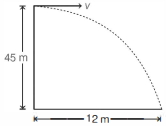
$A$ mouse jumps off from the $15$th floor of a high-rise building and lands $12 \, m$ from the building. Assume that each floor is of $3 \, m$ height. The horizontal speed with which the mouse jumps is closest to ............... $km/h$.
A
$0$
B
$5$
C
$10$
D
$15$
Solution
(D) Given,distance of landing from the building,$s = 12 \, m$.
Height of each floor,$h = 3 \, m$.
Total height of the building,$H = 15 \times 3 = 45 \, m$.
Using the second equation of motion for vertical motion under gravity (with initial vertical velocity $u_y = 0$):
$H = u_y t + \frac{1}{2} g t^2$
$45 = 0 + \frac{1}{2} \times 10 \times t^2$
$45 = 5 t^2$
$t^2 = 9 \Rightarrow t = 3 \, s$.
Now,for horizontal motion with constant speed $v$:
$s = v \times t$
$12 = v \times 3$
$v = 4 \, m/s$.
To convert $m/s$ to $km/h$,multiply by $\frac{18}{5}$:
$v = 4 \times \frac{18}{5} = \frac{72}{5} = 14.4 \, km/h$.
Rounding to the nearest integer,the speed is $15 \, km/h$.
Height of each floor,$h = 3 \, m$.
Total height of the building,$H = 15 \times 3 = 45 \, m$.
Using the second equation of motion for vertical motion under gravity (with initial vertical velocity $u_y = 0$):
$H = u_y t + \frac{1}{2} g t^2$
$45 = 0 + \frac{1}{2} \times 10 \times t^2$
$45 = 5 t^2$
$t^2 = 9 \Rightarrow t = 3 \, s$.
Now,for horizontal motion with constant speed $v$:
$s = v \times t$
$12 = v \times 3$
$v = 4 \, m/s$.
To convert $m/s$ to $km/h$,multiply by $\frac{18}{5}$:
$v = 4 \times \frac{18}{5} = \frac{72}{5} = 14.4 \, km/h$.
Rounding to the nearest integer,the speed is $15 \, km/h$.
0 likes
View Solution267
DifficultMCQ
Two balls are projected with the same velocity but with different angles with the horizontal. Their ranges are equal. If the angle of projection of one is $30^{\circ}$ and its maximum height is $h$,then the maximum height of the other will be
A
$h$
B
$3h$
C
$6h$
D
$10h$
Solution
(B) Since the ranges are equal for the same projection velocity,the angles of projection must be complementary.
Let the angles be $\theta_1$ and $\theta_2$. Then $\theta_1 + \theta_2 = 90^{\circ}$.
Given $\theta_1 = 30^{\circ}$,therefore $\theta_2 = 90^{\circ} - 30^{\circ} = 60^{\circ}$.
The formula for the maximum height of a projectile is $H = \frac{u^2 \sin^2 \theta}{2g}$.
For the first ball,$h = \frac{u^2 \sin^2(30^{\circ})}{2g} = \frac{u^2}{2g} \left(\frac{1}{2}\right)^2 = \frac{u^2}{8g}$.
For the second ball,$H_2 = \frac{u^2 \sin^2(60^{\circ})}{2g} = \frac{u^2}{2g} \left(\frac{\sqrt{3}}{2}\right)^2 = \frac{u^2}{2g} \cdot \frac{3}{4} = \frac{3u^2}{8g}$.
Comparing the two,$H_2 = 3 \left(\frac{u^2}{8g}\right) = 3h$.
Let the angles be $\theta_1$ and $\theta_2$. Then $\theta_1 + \theta_2 = 90^{\circ}$.
Given $\theta_1 = 30^{\circ}$,therefore $\theta_2 = 90^{\circ} - 30^{\circ} = 60^{\circ}$.
The formula for the maximum height of a projectile is $H = \frac{u^2 \sin^2 \theta}{2g}$.
For the first ball,$h = \frac{u^2 \sin^2(30^{\circ})}{2g} = \frac{u^2}{2g} \left(\frac{1}{2}\right)^2 = \frac{u^2}{8g}$.
For the second ball,$H_2 = \frac{u^2 \sin^2(60^{\circ})}{2g} = \frac{u^2}{2g} \left(\frac{\sqrt{3}}{2}\right)^2 = \frac{u^2}{2g} \cdot \frac{3}{4} = \frac{3u^2}{8g}$.
Comparing the two,$H_2 = 3 \left(\frac{u^2}{8g}\right) = 3h$.
0 likes
View Solution268
DifficultMCQ
According to the quantum theory,a photon of electromagnetic radiation of frequency $v$ has energy $E = h v$,where $h$ is known as Planck's constant. According to the theory of relativity,a particle of mass $m$ has equivalent energy $E = m c^2$,where $c$ is the speed of light. Thus,a photon can be treated as a particle having effective mass $m = \frac{h v}{c^2}$. If a flash of light is sent horizontally in the Earth's gravitational field,then photons while travelling a horizontal distance $d$ would fall through a vertical distance given by:
A
$\frac{g d^2}{2 c^2}$
B
$\frac{h}{m c}$
C
$\frac{m c d^2}{h}$
D
zero
Solution
(A) In time $t$,a particle of mass $m$ falls by a vertical distance $h$ under gravity,given by the equation of motion:
$h = \frac{1}{2} g t^2$
Now,the distance covered horizontally is $d$ and the speed of the photon in the horizontal direction is $c$. The time taken to travel this horizontal distance $d$ is:
$t = \frac{d}{c}$
Substituting the value of $t$ into the equation for vertical fall $h$,we get:
$h = \frac{1}{2} g \left( \frac{d}{c} \right)^2$
$h = \frac{g d^2}{2 c^2}$
Thus,the photon falls through a vertical distance of $\frac{g d^2}{2 c^2}$.
$h = \frac{1}{2} g t^2$
Now,the distance covered horizontally is $d$ and the speed of the photon in the horizontal direction is $c$. The time taken to travel this horizontal distance $d$ is:
$t = \frac{d}{c}$
Substituting the value of $t$ into the equation for vertical fall $h$,we get:
$h = \frac{1}{2} g \left( \frac{d}{c} \right)^2$
$h = \frac{g d^2}{2 c^2}$
Thus,the photon falls through a vertical distance of $\frac{g d^2}{2 c^2}$.
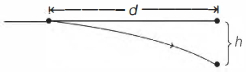
0 likes
View Solution269
EasyMCQ
If a stone projected from the ground takes $4 \, s$ to reach the topmost point of its trajectory,then the time of flight is .......... $s$.
A
$4$
B
$8$
C
$2$
D
$10$
Solution
(B) The time taken to reach the maximum height is known as the time of ascent $(t_a = 4 \, s)$.
For a projectile motion under gravity,the time of descent $(t_d)$ is equal to the time of ascent $(t_a)$ if the point of projection and the point of landing are at the same horizontal level.
Therefore,$t_d = 4 \, s$.
The total time of flight $(T)$ is the sum of the time of ascent and the time of descent:
$T = t_a + t_d = 4 \, s + 4 \, s = 8 \, s$.
For a projectile motion under gravity,the time of descent $(t_d)$ is equal to the time of ascent $(t_a)$ if the point of projection and the point of landing are at the same horizontal level.
Therefore,$t_d = 4 \, s$.
The total time of flight $(T)$ is the sum of the time of ascent and the time of descent:
$T = t_a + t_d = 4 \, s + 4 \, s = 8 \, s$.
0 likes
View Solution270
EasyMCQ
The time of flight of an object projected with speed $20 \, m/s$ at an angle $30^{\circ}$ with the horizontal is .... $s$.
A
$1$
B
$4$
C
$2$
D
$6$
Solution
(C) The formula for the time of flight $T$ of a projectile is given by $T = \frac{2v \sin \theta}{g}$.
Given: Initial speed $v = 20 \, m/s$,angle of projection $\theta = 30^{\circ}$,and acceleration due to gravity $g = 10 \, m/s^2$.
Substituting the values into the formula:
$T = \frac{2 \times 20 \times \sin 30^{\circ}}{10}$
Since $\sin 30^{\circ} = 0.5$ or $\frac{1}{2}$:
$T = \frac{2 \times 20 \times 0.5}{10} = \frac{20}{10} = 2 \, s$.
Therefore,the correct option is $C$.
Given: Initial speed $v = 20 \, m/s$,angle of projection $\theta = 30^{\circ}$,and acceleration due to gravity $g = 10 \, m/s^2$.
Substituting the values into the formula:
$T = \frac{2 \times 20 \times \sin 30^{\circ}}{10}$
Since $\sin 30^{\circ} = 0.5$ or $\frac{1}{2}$:
$T = \frac{2 \times 20 \times 0.5}{10} = \frac{20}{10} = 2 \, s$.
Therefore,the correct option is $C$.
0 likes
View Solution271
EasyMCQ
At what angle of elevation should a projectile be projected with a velocity of $20 \, m/s$ to reach a maximum height of $10 \, m$ (in $^{\circ}$)?
A
$0$
B
$90$
C
$45$
D
$60$
Solution
(C) The formula for the maximum height $H$ of a projectile is given by $H = \frac{u^2 \sin^2 \theta}{2g}$.
Given: $u = 20 \, m/s$,$H = 10 \, m$,and taking $g = 10 \, m/s^2$.
Substituting the values into the formula:
$10 = \frac{(20)^2 \sin^2 \theta}{2 \times 10}$
$10 = \frac{400 \sin^2 \theta}{20}$
$10 = 20 \sin^2 \theta$
$\sin^2 \theta = \frac{10}{20} = \frac{1}{2}$
$\sin \theta = \sqrt{\frac{1}{2}} = \frac{1}{\sqrt{2}}$
Therefore,$\theta = 45^{\circ}$.
Given: $u = 20 \, m/s$,$H = 10 \, m$,and taking $g = 10 \, m/s^2$.
Substituting the values into the formula:
$10 = \frac{(20)^2 \sin^2 \theta}{2 \times 10}$
$10 = \frac{400 \sin^2 \theta}{20}$
$10 = 20 \sin^2 \theta$
$\sin^2 \theta = \frac{10}{20} = \frac{1}{2}$
$\sin \theta = \sqrt{\frac{1}{2}} = \frac{1}{\sqrt{2}}$
Therefore,$\theta = 45^{\circ}$.
0 likes
View Solution272
DifficultMCQ
$A$ body of mass $1 \, kg$ is projected from the ground at an angle of $30^{\circ}$ with the horizontal on level ground at a speed of $50 \, m/s$. The magnitude of the change in momentum of the body during its entire flight is ....... $kg \cdot m/s$ $(g = 10 \, m/s^2)$.
A
$50$
B
$100$
C
$25$
D
$0$
Solution
(A) The initial velocity of the body is $\vec{u} = u \cos \theta \hat{i} + u \sin \theta \hat{j}$.
At the end of the flight (when it returns to the ground),the velocity is $\vec{v} = u \cos \theta \hat{i} - u \sin \theta \hat{j}$.
The change in momentum is $\Delta \vec{p} = m\vec{v} - m\vec{u} = m(\vec{v} - \vec{u})$.
$\Delta \vec{p} = m(u \cos \theta \hat{i} - u \sin \theta \hat{j} - (u \cos \theta \hat{i} + u \sin \theta \hat{j}))$.
$\Delta \vec{p} = m(-2u \sin \theta \hat{j})$.
The magnitude of the change in momentum is $|\Delta \vec{p}| = 2mu \sin \theta$.
Given $m = 1 \, kg$,$u = 50 \, m/s$,and $\theta = 30^{\circ}$.
$|\Delta \vec{p}| = 2 \times 1 \times 50 \times \sin 30^{\circ} = 100 \times 0.5 = 50 \, kg \cdot m/s$.
At the end of the flight (when it returns to the ground),the velocity is $\vec{v} = u \cos \theta \hat{i} - u \sin \theta \hat{j}$.
The change in momentum is $\Delta \vec{p} = m\vec{v} - m\vec{u} = m(\vec{v} - \vec{u})$.
$\Delta \vec{p} = m(u \cos \theta \hat{i} - u \sin \theta \hat{j} - (u \cos \theta \hat{i} + u \sin \theta \hat{j}))$.
$\Delta \vec{p} = m(-2u \sin \theta \hat{j})$.
The magnitude of the change in momentum is $|\Delta \vec{p}| = 2mu \sin \theta$.
Given $m = 1 \, kg$,$u = 50 \, m/s$,and $\theta = 30^{\circ}$.
$|\Delta \vec{p}| = 2 \times 1 \times 50 \times \sin 30^{\circ} = 100 \times 0.5 = 50 \, kg \cdot m/s$.
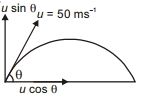
0 likes
View Solution273
DifficultMCQ
$A$ shell is fired vertically upwards with a velocity $v_1$ from a trolley moving horizontally with velocity $v_2$. $A$ person on the ground observes the motion of the shell as a parabola,whose horizontal range is ....
A
$\frac{2 v_1^2 v_2}{g}$
B
$\frac{2 v_1^2}{g}$
C
$\frac{2 v_2^2}{g}$
D
$\frac{2 v_1 v_2}{g}$
Solution
(D) The shell is fired vertically upwards with velocity $v_1$ from a trolley moving horizontally with velocity $v_2$. Therefore,the initial velocity of the shell relative to the ground has a horizontal component $u_x = v_2$ and a vertical component $u_y = v_1$.
In the horizontal direction,there is no acceleration $(a_x = 0)$.
In the vertical direction,the acceleration is due to gravity $(a_y = -g)$.
The time of flight $T$ is determined by the vertical motion. The shell returns to the level of the trolley when the vertical displacement is zero:
$y = u_y T - \frac{1}{2} g T^2 = 0$
$v_1 T - \frac{1}{2} g T^2 = 0$
$T = \frac{2 v_1}{g}$
The horizontal range $R$ is the horizontal distance covered during the time of flight $T$:
$R = u_x \times T$
$R = v_2 \times \frac{2 v_1}{g} = \frac{2 v_1 v_2}{g}$
Thus,the correct option is $(d)$.
In the horizontal direction,there is no acceleration $(a_x = 0)$.
In the vertical direction,the acceleration is due to gravity $(a_y = -g)$.
The time of flight $T$ is determined by the vertical motion. The shell returns to the level of the trolley when the vertical displacement is zero:
$y = u_y T - \frac{1}{2} g T^2 = 0$
$v_1 T - \frac{1}{2} g T^2 = 0$
$T = \frac{2 v_1}{g}$
The horizontal range $R$ is the horizontal distance covered during the time of flight $T$:
$R = u_x \times T$
$R = v_2 \times \frac{2 v_1}{g} = \frac{2 v_1 v_2}{g}$
Thus,the correct option is $(d)$.
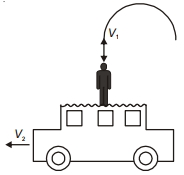
0 likes
View Solution274
DifficultMCQ
$A$ particle is projected from the ground with a speed of $80 \,m/s$ at an angle of $30^{\circ}$ with the horizontal. The magnitude of the average velocity of the particle in the time interval $t=2 \,s$ to $t=6 \,s$ is ....... $m/s$. (Take $g=10 \,m/s^2$)
A
$40 \sqrt{2}$
B
$40$
C
$0$
D
$40 \sqrt{3}$
Solution
(D) The initial velocity components are $u_x = u \cos \theta = 80 \cos 30^{\circ} = 80 \times \frac{\sqrt{3}}{2} = 40 \sqrt{3} \,m/s$ and $u_y = u \sin \theta = 80 \sin 30^{\circ} = 80 \times \frac{1}{2} = 40 \,m/s$.
The position of the particle at any time $t$ is given by $x(t) = u_x t$ and $y(t) = u_y t - \frac{1}{2} g t^2$.
At $t_1 = 2 \,s$:
$x_1 = (40 \sqrt{3}) \times 2 = 80 \sqrt{3} \,m$
$y_1 = 40 \times 2 - \frac{1}{2} \times 10 \times (2)^2 = 80 - 20 = 60 \,m$
At $t_2 = 6 \,s$:
$x_2 = (40 \sqrt{3}) \times 6 = 240 \sqrt{3} \,m$
$y_2 = 40 \times 6 - \frac{1}{2} \times 10 \times (6)^2 = 240 - 180 = 60 \,m$
Since $y_1 = y_2$,the displacement vector is $\Delta \vec{r} = (x_2 - x_1) \hat{i} + (y_2 - y_1) \hat{j} = (240 \sqrt{3} - 80 \sqrt{3}) \hat{i} + 0 \hat{j} = 160 \sqrt{3} \hat{i} \,m$.
The time interval is $\Delta t = 6 - 2 = 4 \,s$.
The average velocity is $\vec{v}_{avg} = \frac{\Delta \vec{r}}{\Delta t} = \frac{160 \sqrt{3}}{4} \hat{i} = 40 \sqrt{3} \hat{i} \,m/s$.
The magnitude of the average velocity is $40 \sqrt{3} \,m/s$.
The position of the particle at any time $t$ is given by $x(t) = u_x t$ and $y(t) = u_y t - \frac{1}{2} g t^2$.
At $t_1 = 2 \,s$:
$x_1 = (40 \sqrt{3}) \times 2 = 80 \sqrt{3} \,m$
$y_1 = 40 \times 2 - \frac{1}{2} \times 10 \times (2)^2 = 80 - 20 = 60 \,m$
At $t_2 = 6 \,s$:
$x_2 = (40 \sqrt{3}) \times 6 = 240 \sqrt{3} \,m$
$y_2 = 40 \times 6 - \frac{1}{2} \times 10 \times (6)^2 = 240 - 180 = 60 \,m$
Since $y_1 = y_2$,the displacement vector is $\Delta \vec{r} = (x_2 - x_1) \hat{i} + (y_2 - y_1) \hat{j} = (240 \sqrt{3} - 80 \sqrt{3}) \hat{i} + 0 \hat{j} = 160 \sqrt{3} \hat{i} \,m$.
The time interval is $\Delta t = 6 - 2 = 4 \,s$.
The average velocity is $\vec{v}_{avg} = \frac{\Delta \vec{r}}{\Delta t} = \frac{160 \sqrt{3}}{4} \hat{i} = 40 \sqrt{3} \hat{i} \,m/s$.
The magnitude of the average velocity is $40 \sqrt{3} \,m/s$.
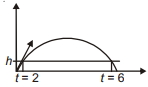
0 likes
View Solution275
MediumMCQ
Two objects are thrown up at angles of $45^{\circ}$ and $60^{\circ}$ respectively,with the horizontal. If both objects attain the same vertical height,then the ratio of the magnitude of velocities with which these are projected is .........
A
$\sqrt{\frac{5}{3}}$
B
$\sqrt{\frac{3}{5}}$
C
$\sqrt{\frac{2}{3}}$
D
$\sqrt{\frac{3}{2}}$
Solution
(D) The maximum vertical height $H$ attained by a projectile is given by the formula $H = \frac{u^2 \sin^2 \theta}{2g}$.
Given that both objects attain the same vertical height,we have $H_1 = H_2$.
Substituting the formula,we get $\frac{u_1^2 \sin^2 \theta_1}{2g} = \frac{u_2^2 \sin^2 \theta_2}{2g}$.
Canceling $2g$ from both sides,we get $u_1^2 \sin^2 \theta_1 = u_2^2 \sin^2 \theta_2$.
Given $\theta_1 = 45^{\circ}$ and $\theta_2 = 60^{\circ}$,we have $u_1^2 \sin^2 45^{\circ} = u_2^2 \sin^2 60^{\circ}$.
Substituting the values $\sin 45^{\circ} = \frac{1}{\sqrt{2}}$ and $\sin 60^{\circ} = \frac{\sqrt{3}}{2}$,we get $u_1^2 \left(\frac{1}{\sqrt{2}}\right)^2 = u_2^2 \left(\frac{\sqrt{3}}{2}\right)^2$.
This simplifies to $u_1^2 \left(\frac{1}{2}\right) = u_2^2 \left(\frac{3}{4}\right)$.
Rearranging for the ratio $\frac{u_1^2}{u_2^2}$,we get $\frac{u_1^2}{u_2^2} = \frac{3/4}{1/2} = \frac{3}{4} \times 2 = \frac{3}{2}$.
Taking the square root on both sides,the ratio of the velocities is $\frac{u_1}{u_2} = \sqrt{\frac{3}{2}}$.
Given that both objects attain the same vertical height,we have $H_1 = H_2$.
Substituting the formula,we get $\frac{u_1^2 \sin^2 \theta_1}{2g} = \frac{u_2^2 \sin^2 \theta_2}{2g}$.
Canceling $2g$ from both sides,we get $u_1^2 \sin^2 \theta_1 = u_2^2 \sin^2 \theta_2$.
Given $\theta_1 = 45^{\circ}$ and $\theta_2 = 60^{\circ}$,we have $u_1^2 \sin^2 45^{\circ} = u_2^2 \sin^2 60^{\circ}$.
Substituting the values $\sin 45^{\circ} = \frac{1}{\sqrt{2}}$ and $\sin 60^{\circ} = \frac{\sqrt{3}}{2}$,we get $u_1^2 \left(\frac{1}{\sqrt{2}}\right)^2 = u_2^2 \left(\frac{\sqrt{3}}{2}\right)^2$.
This simplifies to $u_1^2 \left(\frac{1}{2}\right) = u_2^2 \left(\frac{3}{4}\right)$.
Rearranging for the ratio $\frac{u_1^2}{u_2^2}$,we get $\frac{u_1^2}{u_2^2} = \frac{3/4}{1/2} = \frac{3}{4} \times 2 = \frac{3}{2}$.
Taking the square root on both sides,the ratio of the velocities is $\frac{u_1}{u_2} = \sqrt{\frac{3}{2}}$.
0 likes
View Solution276
DifficultMCQ
For an object projected from the ground with speed $u$,the horizontal range is two times the maximum height attained by it. The horizontal range of the object is ..........
A
$\frac{2 u^2}{3 g}$
B
$\frac{3 u^2}{4 g}$
C
$\frac{3 u^2}{2 g}$
D
$\frac{4 u^2}{5 g}$
Solution
(D) Given that the horizontal range $R$ is twice the maximum height $H$,so $R = 2H$.
We know the formulas for horizontal range and maximum height are $R = \frac{u^2 \sin(2\theta)}{g}$ and $H = \frac{u^2 \sin^2 \theta}{2g}$.
Substituting these into the given condition $R = 2H$:
$\frac{u^2 (2 \sin \theta \cos \theta)}{g} = 2 \left( \frac{u^2 \sin^2 \theta}{2g} \right)$
$2 \sin \theta \cos \theta = \sin^2 \theta$
Dividing both sides by $\sin \theta$ (assuming $\sin \theta \neq 0$):
$2 \cos \theta = \sin \theta \Rightarrow \tan \theta = 2$.
From the triangle with $\tan \theta = \frac{\text{Perpendicular}}{\text{Base}} = \frac{2}{1}$,the hypotenuse is $\sqrt{2^2 + 1^2} = \sqrt{5}$.
Thus,$\sin \theta = \frac{2}{\sqrt{5}}$ and $\cos \theta = \frac{1}{\sqrt{5}}$.
Now,calculate the range $R$:
$R = \frac{2 u^2 \sin \theta \cos \theta}{g} = \frac{2 u^2}{g} \left( \frac{2}{\sqrt{5}} \right) \left( \frac{1}{\sqrt{5}} \right) = \frac{4 u^2}{5g}$.
We know the formulas for horizontal range and maximum height are $R = \frac{u^2 \sin(2\theta)}{g}$ and $H = \frac{u^2 \sin^2 \theta}{2g}$.
Substituting these into the given condition $R = 2H$:
$\frac{u^2 (2 \sin \theta \cos \theta)}{g} = 2 \left( \frac{u^2 \sin^2 \theta}{2g} \right)$
$2 \sin \theta \cos \theta = \sin^2 \theta$
Dividing both sides by $\sin \theta$ (assuming $\sin \theta \neq 0$):
$2 \cos \theta = \sin \theta \Rightarrow \tan \theta = 2$.
From the triangle with $\tan \theta = \frac{\text{Perpendicular}}{\text{Base}} = \frac{2}{1}$,the hypotenuse is $\sqrt{2^2 + 1^2} = \sqrt{5}$.
Thus,$\sin \theta = \frac{2}{\sqrt{5}}$ and $\cos \theta = \frac{1}{\sqrt{5}}$.
Now,calculate the range $R$:
$R = \frac{2 u^2 \sin \theta \cos \theta}{g} = \frac{2 u^2}{g} \left( \frac{2}{\sqrt{5}} \right) \left( \frac{1}{\sqrt{5}} \right) = \frac{4 u^2}{5g}$.

1 likes
View Solution277
MediumMCQ
The velocity at the maximum height of a projectile is $\frac{\sqrt{3}}{2}$ times its initial velocity of projection $(u)$. Its range on the horizontal plane is .............
A
$\frac{\sqrt{3} u^2}{2 g}$
B
$\frac{3 u^2}{2 g}$
C
$\frac{3 u^2}{g}$
D
$\frac{u^2}{2 g}$
Solution
(A) At the maximum height,the vertical component of velocity is zero,so the velocity of the projectile is equal to its horizontal component,$v = u \cos \theta$.
Given that the velocity at the maximum height is $\frac{\sqrt{3}}{2}$ times the initial velocity $u$,we have:
$u \cos \theta = \frac{\sqrt{3}}{2} u$
$\cos \theta = \frac{\sqrt{3}}{2}$
$\theta = 30^{\circ}$
The horizontal range $R$ of a projectile is given by the formula:
$R = \frac{u^2 \sin 2\theta}{g}$
Substituting $\theta = 30^{\circ}$ into the formula:
$R = \frac{u^2 \sin(2 \times 30^{\circ})}{g} = \frac{u^2 \sin 60^{\circ}}{g}$
Since $\sin 60^{\circ} = \frac{\sqrt{3}}{2}$,we get:
$R = \frac{u^2 \times \frac{\sqrt{3}}{2}}{g} = \frac{\sqrt{3} u^2}{2 g}$
Thus,the correct option is $A$.
Given that the velocity at the maximum height is $\frac{\sqrt{3}}{2}$ times the initial velocity $u$,we have:
$u \cos \theta = \frac{\sqrt{3}}{2} u$
$\cos \theta = \frac{\sqrt{3}}{2}$
$\theta = 30^{\circ}$
The horizontal range $R$ of a projectile is given by the formula:
$R = \frac{u^2 \sin 2\theta}{g}$
Substituting $\theta = 30^{\circ}$ into the formula:
$R = \frac{u^2 \sin(2 \times 30^{\circ})}{g} = \frac{u^2 \sin 60^{\circ}}{g}$
Since $\sin 60^{\circ} = \frac{\sqrt{3}}{2}$,we get:
$R = \frac{u^2 \times \frac{\sqrt{3}}{2}}{g} = \frac{\sqrt{3} u^2}{2 g}$
Thus,the correct option is $A$.
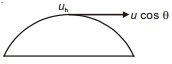
0 likes
View Solution278
MediumMCQ
$A$ projectile is thrown into space so as to have a maximum possible horizontal range of $400 \, m$. Taking the point of projection as the origin,the coordinates of the point where the velocity of the projectile is minimum are
A
$(400, 100)$
B
$(200, 100)$
C
$(400, 200)$
D
$(200, 200)$
Solution
(B) For a projectile,the maximum horizontal range $R_{\max}$ is given by $R_{\max} = \frac{u^2}{g}$.
Given $R_{\max} = 400 \, m$.
The velocity of a projectile is minimum at its highest point.
At the highest point,the horizontal distance covered is $x = \frac{R}{2} = \frac{400}{2} = 200 \, m$.
The maximum height $H$ is given by $H = \frac{u^2 \sin^2 \theta}{2g}$. For maximum range,$\theta = 45^\circ$,so $H = \frac{u^2 \sin^2 45^\circ}{2g} = \frac{u^2 (1/2)}{2g} = \frac{u^2}{4g} = \frac{R_{\max}}{4}$.
$H = \frac{400}{4} = 100 \, m$.
Thus,the coordinates of the highest point are $(x, H) = (200, 100) \, m$.
Given $R_{\max} = 400 \, m$.
The velocity of a projectile is minimum at its highest point.
At the highest point,the horizontal distance covered is $x = \frac{R}{2} = \frac{400}{2} = 200 \, m$.
The maximum height $H$ is given by $H = \frac{u^2 \sin^2 \theta}{2g}$. For maximum range,$\theta = 45^\circ$,so $H = \frac{u^2 \sin^2 45^\circ}{2g} = \frac{u^2 (1/2)}{2g} = \frac{u^2}{4g} = \frac{R_{\max}}{4}$.
$H = \frac{400}{4} = 100 \, m$.
Thus,the coordinates of the highest point are $(x, H) = (200, 100) \, m$.
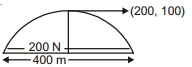
0 likes
View Solution279
MediumMCQ
If the time of flight of a bullet over a horizontal range $R$ is $T$,then the angle of projection with the horizontal is ......
A
$\tan^{-1}\left(\frac{g T^2}{2 R}\right)$
B
$\tan^{-1}\left(\frac{2 R^2}{g T}\right)$
C
$\tan^{-1}\left(\frac{2 R}{g^2 T}\right)$
D
$\tan^{-1}\left(\frac{2 R}{g T}\right)$
Solution
(A) The time of flight $T$ for a projectile is given by $T = \frac{2 u \sin \theta}{g}$,where $u$ is the initial velocity and $\theta$ is the angle of projection.
From this,we can express the initial velocity as $u = \frac{g T}{2 \sin \theta}$.
The horizontal range $R$ is given by $R = \frac{u^2 \sin(2 \theta)}{g} = \frac{2 u^2 \sin \theta \cos \theta}{g}$.
Substituting $u$ into the range formula: $R = \frac{2}{g} \left(\frac{g T}{2 \sin \theta}\right)^2 \sin \theta \cos \theta$.
Simplifying the expression: $R = \frac{2}{g} \cdot \frac{g^2 T^2}{4 \sin^2 \theta} \cdot \sin \theta \cos \theta$.
$R = \frac{g T^2}{2} \cdot \frac{\cos \theta}{\sin \theta} = \frac{g T^2}{2 \tan \theta}$.
Rearranging for $\tan \theta$: $\tan \theta = \frac{g T^2}{2 R}$.
Therefore,the angle of projection is $\theta = \tan^{-1}\left(\frac{g T^2}{2 R}\right)$.
From this,we can express the initial velocity as $u = \frac{g T}{2 \sin \theta}$.
The horizontal range $R$ is given by $R = \frac{u^2 \sin(2 \theta)}{g} = \frac{2 u^2 \sin \theta \cos \theta}{g}$.
Substituting $u$ into the range formula: $R = \frac{2}{g} \left(\frac{g T}{2 \sin \theta}\right)^2 \sin \theta \cos \theta$.
Simplifying the expression: $R = \frac{2}{g} \cdot \frac{g^2 T^2}{4 \sin^2 \theta} \cdot \sin \theta \cos \theta$.
$R = \frac{g T^2}{2} \cdot \frac{\cos \theta}{\sin \theta} = \frac{g T^2}{2 \tan \theta}$.
Rearranging for $\tan \theta$: $\tan \theta = \frac{g T^2}{2 R}$.
Therefore,the angle of projection is $\theta = \tan^{-1}\left(\frac{g T^2}{2 R}\right)$.
0 likes
View Solution280
EasyMCQ
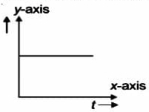
In the graph shown in the figure, which quantity associated with projectile motion is plotted along the $y$-axis?
A
Kinetic energy
B
Momentum
C
Horizontal velocity
D
None of these
Solution
(C) The graph shows a constant value over time $t$.
In projectile motion, the horizontal component of velocity $(v_x)$ remains constant throughout the motion because there is no acceleration in the horizontal direction $(a_x = 0)$.
Therefore, $v_x = u_x = \text{constant}$.
Other quantities like kinetic energy, momentum, and vertical velocity change with time.
Thus, the quantity plotted along the $y$-axis is the horizontal velocity.
In projectile motion, the horizontal component of velocity $(v_x)$ remains constant throughout the motion because there is no acceleration in the horizontal direction $(a_x = 0)$.
Therefore, $v_x = u_x = \text{constant}$.
Other quantities like kinetic energy, momentum, and vertical velocity change with time.
Thus, the quantity plotted along the $y$-axis is the horizontal velocity.
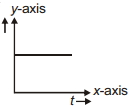
0 likes
View Solution281
MediumMCQ
The equation of a projectile is $y = ax - bx^2$. Its horizontal range is ......
A
$\frac{a}{b}$
B
$\frac{b}{a}$
C
$a + b$
D
$b - a$
Solution
(A) The equation of the trajectory of a projectile is given by $y = ax - bx^2$.
When the projectile lands on the horizontal plane,its vertical displacement $y$ becomes $0$.
At this point,the horizontal distance $x$ is equal to the horizontal range $R$.
Substituting $y = 0$ and $x = R$ into the equation,we get:
$0 = aR - bR^2$
$aR = bR^2$
Since $R \neq 0$ (as it is the range),we can divide both sides by $R$:
$a = bR$
$R = \frac{a}{b}$
Thus,the horizontal range is $\frac{a}{b}$.
When the projectile lands on the horizontal plane,its vertical displacement $y$ becomes $0$.
At this point,the horizontal distance $x$ is equal to the horizontal range $R$.
Substituting $y = 0$ and $x = R$ into the equation,we get:
$0 = aR - bR^2$
$aR = bR^2$
Since $R \neq 0$ (as it is the range),we can divide both sides by $R$:
$a = bR$
$R = \frac{a}{b}$
Thus,the horizontal range is $\frac{a}{b}$.
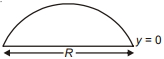
0 likes
View Solution282
MediumMCQ
$A$ projectile is thrown with velocity $v$ at an angle $\theta$ with the horizontal. When the projectile is at a height equal to half of the maximum height,the vertical component of the velocity of the projectile is ...........
A
$v \sin \theta \times 3$
B
$\frac{v \sin \theta}{3}$
C
$\frac{v \sin \theta}{\sqrt{2}}$
D
$\frac{v \sin \theta}{\sqrt{3}}$
Solution
(C) The maximum height of a projectile is given by $H = \frac{v^2 \sin^2 \theta}{2g}$.
We are looking for the vertical component of velocity $v_y$ at a height $h = \frac{H}{2} = \frac{v^2 \sin^2 \theta}{4g}$.
Using the kinematic equation $v_y^2 = u_y^2 - 2gh$,where $u_y = v \sin \theta$ is the initial vertical velocity:
$v_y^2 = (v \sin \theta)^2 - 2g \left( \frac{v^2 \sin^2 \theta}{4g} \right)$
$v_y^2 = v^2 \sin^2 \theta - \frac{v^2 \sin^2 \theta}{2}$
$v_y^2 = \frac{v^2 \sin^2 \theta}{2}$
Taking the square root of both sides,we get:
$v_y = \frac{v \sin \theta}{\sqrt{2}}$
Thus,the correct option is $(C)$.
We are looking for the vertical component of velocity $v_y$ at a height $h = \frac{H}{2} = \frac{v^2 \sin^2 \theta}{4g}$.
Using the kinematic equation $v_y^2 = u_y^2 - 2gh$,where $u_y = v \sin \theta$ is the initial vertical velocity:
$v_y^2 = (v \sin \theta)^2 - 2g \left( \frac{v^2 \sin^2 \theta}{4g} \right)$
$v_y^2 = v^2 \sin^2 \theta - \frac{v^2 \sin^2 \theta}{2}$
$v_y^2 = \frac{v^2 \sin^2 \theta}{2}$
Taking the square root of both sides,we get:
$v_y = \frac{v \sin \theta}{\sqrt{2}}$
Thus,the correct option is $(C)$.
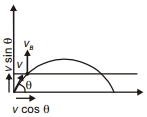
0 likes
View Solution283
DifficultMCQ
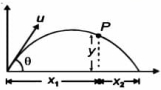
In the given figure for a projectile,find the relation for $y$ in terms of $x_1, x_2$ and $\theta$.
A
$y=\left[\frac{x_1 x_2}{x_1-x_2}\right] \tan \theta$
B
$y=\left[\frac{x_1 x_2}{x_1+x_2}\right] \tan \theta$
C
$y=\left[\frac{2 x_1 x_2}{x_1+x_2}\right] \cos \theta$
D
$y=\left[\frac{2 x_1 x_2}{x_1+x_2}\right] \tan \theta$
Solution
(B) The equation of the trajectory of a projectile is given by:
$y = x \tan \theta \left(1 - \frac{x}{R}\right)$
where $R$ is the horizontal range.
From the figure,the total range $R = x_1 + x_2$.
At point $P$,the horizontal distance is $x = x_1$.
Substituting these values into the trajectory equation:
$y = x_1 \tan \theta \left(1 - \frac{x_1}{x_1 + x_2}\right)$
$y = x_1 \tan \theta \left(\frac{x_1 + x_2 - x_1}{x_1 + x_2}\right)$
$y = x_1 \tan \theta \left(\frac{x_2}{x_1 + x_2}\right)$
$y = \left[\frac{x_1 x_2}{x_1 + x_2}\right] \tan \theta$
Thus,the correct option is $B$.
$y = x \tan \theta \left(1 - \frac{x}{R}\right)$
where $R$ is the horizontal range.
From the figure,the total range $R = x_1 + x_2$.
At point $P$,the horizontal distance is $x = x_1$.
Substituting these values into the trajectory equation:
$y = x_1 \tan \theta \left(1 - \frac{x_1}{x_1 + x_2}\right)$
$y = x_1 \tan \theta \left(\frac{x_1 + x_2 - x_1}{x_1 + x_2}\right)$
$y = x_1 \tan \theta \left(\frac{x_2}{x_1 + x_2}\right)$
$y = \left[\frac{x_1 x_2}{x_1 + x_2}\right] \tan \theta$
Thus,the correct option is $B$.
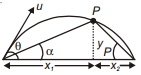
0 likes
View Solution284
MediumMCQ
Two paper screens $A$ and $B$ are separated by a distance of $100 \,m$. $A$ bullet penetrates $A$ and $B$ at points $P$ and $Q$ respectively,where $Q$ is $10 \,cm$ below $P$. If the bullet is travelling horizontally at the time of hitting $A$,the velocity of the bullet at $A$ is nearly .......... $m/s$.
A
$100$
B
$200$
C
$600$
D
$700$
Solution
(D) Given:
Horizontal distance $x = 100 \,m$
Vertical displacement $y = 10 \,cm = 0.1 \,m$
Initial vertical velocity $u_y = 0$
Acceleration due to gravity $g = 10 \,m/s^2$
For horizontal projectile motion,the vertical displacement $y$ is given by:
$y = \frac{1}{2} g t^2$
$0.1 = \frac{1}{2} \times 10 \times t^2$
$0.1 = 5 t^2$
$t^2 = 0.02$
$t = \sqrt{0.02} \,s$
The horizontal distance $x$ is covered with constant horizontal velocity $u$:
$x = u \times t$
$100 = u \times \sqrt{0.02}$
$u = \frac{100}{\sqrt{0.02}} = \frac{100}{\sqrt{2 \times 10^{-2}}} = \frac{100}{0.1414} \approx 707 \,m/s$
Thus,the velocity of the bullet at $A$ is nearly $700 \,m/s$.
Horizontal distance $x = 100 \,m$
Vertical displacement $y = 10 \,cm = 0.1 \,m$
Initial vertical velocity $u_y = 0$
Acceleration due to gravity $g = 10 \,m/s^2$
For horizontal projectile motion,the vertical displacement $y$ is given by:
$y = \frac{1}{2} g t^2$
$0.1 = \frac{1}{2} \times 10 \times t^2$
$0.1 = 5 t^2$
$t^2 = 0.02$
$t = \sqrt{0.02} \,s$
The horizontal distance $x$ is covered with constant horizontal velocity $u$:
$x = u \times t$
$100 = u \times \sqrt{0.02}$
$u = \frac{100}{\sqrt{0.02}} = \frac{100}{\sqrt{2 \times 10^{-2}}} = \frac{100}{0.1414} \approx 707 \,m/s$
Thus,the velocity of the bullet at $A$ is nearly $700 \,m/s$.
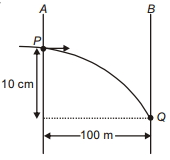
0 likes
View Solution285
MediumMCQ
An object is projected from the ground with speed $u$ at an angle $\theta$ with the horizontal. The radius of curvature of its trajectory at the maximum height from the ground is ..........
A
$\frac{u^2 \sin 2 \theta}{g}$
B
$\frac{u^2 \cos ^2 \theta}{g}$
C
$\frac{u^2 \sin ^2 \theta}{g}$
D
$\frac{u^2 \sin ^2 \theta}{2 g}$
Solution
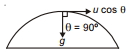
(B) At the maximum height,the vertical component of velocity is zero,and the horizontal component of velocity is $v = u \cos \theta$.
The acceleration acting on the object at this point is the acceleration due to gravity,$g$,which acts vertically downwards.
The centripetal acceleration $a_c$ is given by $a_c = \frac{v^2}{R}$,where $R$ is the radius of curvature.
At the maximum height,the acceleration $g$ is perpendicular to the velocity $v$. Thus,$g$ acts as the centripetal acceleration.
Therefore,$g = \frac{(u \cos \theta)^2}{R}$.
Rearranging for $R$,we get $R = \frac{u^2 \cos^2 \theta}{g}$.
The acceleration acting on the object at this point is the acceleration due to gravity,$g$,which acts vertically downwards.
The centripetal acceleration $a_c$ is given by $a_c = \frac{v^2}{R}$,where $R$ is the radius of curvature.
At the maximum height,the acceleration $g$ is perpendicular to the velocity $v$. Thus,$g$ acts as the centripetal acceleration.
Therefore,$g = \frac{(u \cos \theta)^2}{R}$.
Rearranging for $R$,we get $R = \frac{u^2 \cos^2 \theta}{g}$.
0 likes
View Solution286
MediumMCQ
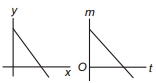
$A$ particle is projected at an angle $\theta$ with the horizontal from the ground. The slope $(m)$ of the trajectory of the particle varies with time $(t)$ as:
A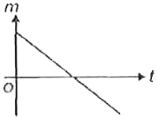
B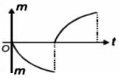
C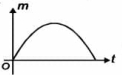
D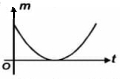
Solution
(A) The slope $(m)$ of the trajectory at any time $(t)$ is given by the tangent of the angle $\phi$ that the velocity vector makes with the horizontal.
The velocity components at time $(t)$ are $v_x = u \cos \theta$ and $v_y = u \sin \theta - g t$.
The slope $(m)$ is given by:
$m = \tan \phi = \frac{v_y}{v_x} = \frac{u \sin \theta - g t}{u \cos \theta}$
Simplifying this expression:
$m = \frac{u \sin \theta}{u \cos \theta} - \frac{g t}{u \cos \theta}$
$m = \tan \theta - \left( \frac{g}{u \cos \theta} \right) t$
This equation is of the form $m = c - k t$,where $c = \tan \theta$ (a constant) and $k = \frac{g}{u \cos \theta}$ (a positive constant).
This represents a straight line with a positive $y$-intercept $(\tan \theta)$ and a negative slope $(-k)$. Therefore,the graph of $m$ versus $t$ is a straight line with a negative slope.
The velocity components at time $(t)$ are $v_x = u \cos \theta$ and $v_y = u \sin \theta - g t$.
The slope $(m)$ is given by:
$m = \tan \phi = \frac{v_y}{v_x} = \frac{u \sin \theta - g t}{u \cos \theta}$
Simplifying this expression:
$m = \frac{u \sin \theta}{u \cos \theta} - \frac{g t}{u \cos \theta}$
$m = \tan \theta - \left( \frac{g}{u \cos \theta} \right) t$
This equation is of the form $m = c - k t$,where $c = \tan \theta$ (a constant) and $k = \frac{g}{u \cos \theta}$ (a positive constant).
This represents a straight line with a positive $y$-intercept $(\tan \theta)$ and a negative slope $(-k)$. Therefore,the graph of $m$ versus $t$ is a straight line with a negative slope.
0 likes
View Solution287
DifficultMCQ
If $R$ and $H$ are the horizontal range and maximum height attained by a projectile,then its speed of projection is ..........
A
$\sqrt{2 g R+\frac{4 R^2}{g H}}$
B
$\sqrt{2 g H+\frac{R^2 g}{8 H}}$
C
$\sqrt{2 g H+\frac{8 H}{R g}}$
D
$\sqrt{2 g H+\frac{R^2}{H}}$
Solution
(B) The maximum height $H$ is given by $H = \frac{u^2 \sin^2 \theta}{2g}$,which implies $\sin \theta = \sqrt{\frac{2gH}{u^2}}$.
The horizontal range $R$ is given by $R = \frac{2u^2 \sin \theta \cos \theta}{g}$.
Substituting $\sin \theta$ and $\cos \theta = \sqrt{1 - \sin^2 \theta} = \sqrt{1 - \frac{2gH}{u^2}}$ into the range formula:
$R = \frac{2u^2}{g} \cdot \sqrt{\frac{2gH}{u^2}} \cdot \sqrt{1 - \frac{2gH}{u^2}} = \frac{2u^2}{g} \cdot \frac{\sqrt{2gH}}{u} \cdot \sqrt{\frac{u^2 - 2gH}{u^2}}$.
Simplifying this,we get $R = \frac{2}{g} \cdot \sqrt{2gH} \cdot \sqrt{u^2 - 2gH}$.
Squaring both sides:
$R^2 = \frac{4}{g^2} \cdot 2gH \cdot (u^2 - 2gH) = \frac{8H}{g} (u^2 - 2gH)$.
Rearranging for $u^2$:
$u^2 - 2gH = \frac{R^2 g}{8H} \Rightarrow u^2 = 2gH + \frac{R^2 g}{8H}$.
Thus,the speed of projection is $u = \sqrt{2gH + \frac{R^2 g}{8H}}$.
The horizontal range $R$ is given by $R = \frac{2u^2 \sin \theta \cos \theta}{g}$.
Substituting $\sin \theta$ and $\cos \theta = \sqrt{1 - \sin^2 \theta} = \sqrt{1 - \frac{2gH}{u^2}}$ into the range formula:
$R = \frac{2u^2}{g} \cdot \sqrt{\frac{2gH}{u^2}} \cdot \sqrt{1 - \frac{2gH}{u^2}} = \frac{2u^2}{g} \cdot \frac{\sqrt{2gH}}{u} \cdot \sqrt{\frac{u^2 - 2gH}{u^2}}$.
Simplifying this,we get $R = \frac{2}{g} \cdot \sqrt{2gH} \cdot \sqrt{u^2 - 2gH}$.
Squaring both sides:
$R^2 = \frac{4}{g^2} \cdot 2gH \cdot (u^2 - 2gH) = \frac{8H}{g} (u^2 - 2gH)$.
Rearranging for $u^2$:
$u^2 - 2gH = \frac{R^2 g}{8H} \Rightarrow u^2 = 2gH + \frac{R^2 g}{8H}$.
Thus,the speed of projection is $u = \sqrt{2gH + \frac{R^2 g}{8H}}$.
0 likes
View Solution288
DifficultMCQ
$A$ particle projected from the ground moves at an angle of $45^{\circ}$ with the horizontal one second after projection,and its speed is minimum two seconds after the projection. What is the angle of projection of the particle? [Neglect the effect of air resistance]
A
$\tan^{-1}(3)$
B
$\tan^{-1}(2)$
C
$\tan^{-1}(\sqrt{2})$
D
$\tan^{-1}(4)$
Solution
(B) Let the initial velocity be $u$ and the angle of projection be $\theta$.
The horizontal component of velocity is $v_x = u \cos \theta$ (constant).
The vertical component of velocity at time $t$ is $v_y = u \sin \theta - gt$.
Given that at $t = 1 \, s$,the angle with the horizontal is $45^{\circ}$:
$\tan 45^{\circ} = \frac{v_y}{v_x} = \frac{u \sin \theta - g(1)}{u \cos \theta} = 1$
$u \sin \theta - g = u \cos \theta \implies u \sin \theta - u \cos \theta = g \quad \dots (1)$
Given that the speed is minimum at $t = 2 \, s$. The speed of a projectile is minimum at the highest point where the vertical component of velocity is zero $(v_y = 0)$:
$u \sin \theta - g(2) = 0 \implies u \sin \theta = 2g \quad \dots (2)$
Substitute $(2)$ into $(1)$:
$2g - u \cos \theta = g \implies u \cos \theta = g \quad \dots (3)$
Dividing $(2)$ by $(3)$:
$\frac{u \sin \theta}{u \cos \theta} = \frac{2g}{g} \implies \tan \theta = 2$
$\theta = \tan^{-1}(2)$.
The horizontal component of velocity is $v_x = u \cos \theta$ (constant).
The vertical component of velocity at time $t$ is $v_y = u \sin \theta - gt$.
Given that at $t = 1 \, s$,the angle with the horizontal is $45^{\circ}$:
$\tan 45^{\circ} = \frac{v_y}{v_x} = \frac{u \sin \theta - g(1)}{u \cos \theta} = 1$
$u \sin \theta - g = u \cos \theta \implies u \sin \theta - u \cos \theta = g \quad \dots (1)$
Given that the speed is minimum at $t = 2 \, s$. The speed of a projectile is minimum at the highest point where the vertical component of velocity is zero $(v_y = 0)$:
$u \sin \theta - g(2) = 0 \implies u \sin \theta = 2g \quad \dots (2)$
Substitute $(2)$ into $(1)$:
$2g - u \cos \theta = g \implies u \cos \theta = g \quad \dots (3)$
Dividing $(2)$ by $(3)$:
$\frac{u \sin \theta}{u \cos \theta} = \frac{2g}{g} \implies \tan \theta = 2$
$\theta = \tan^{-1}(2)$.
0 likes
View Solution289
DifficultMCQ
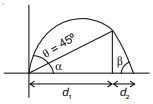
$A$ ball is projected from the ground at an angle of $45^{\circ}$ with the horizontal from a distance $d_1$ from the foot of a pole. It just touches the top of the pole and then falls on the ground at a distance $d_2$ from the pole on the other side. The height of the pole is ...........
A
$2 \sqrt{d_1 d_2}$
B
$\frac{d_1+d_2}{4}$
C
$\frac{2 d_1 d_2}{d_1+d_2}$
D
$\frac{d_1 d_2}{d_1+d_2}$
Solution
(D) Let the height of the pole be $h$. The ball is projected at an angle $\theta = 45^{\circ}$.
Let $\alpha$ be the angle of elevation of the top of the pole from the point of projection,and $\beta$ be the angle of depression of the point where the ball lands from the top of the pole.
From the geometry of the trajectory,we have $\tan \alpha = \frac{h}{d_1}$ and $\tan \beta = \frac{h}{d_2}$.
For a projectile passing through a point $(x, y)$,the equation of trajectory is $y = x \tan \theta \left(1 - \frac{x}{R}\right)$,where $R$ is the range.
Alternatively,using the property of projectile motion,$\tan \theta = \tan \alpha + \tan \beta$.
Substituting the values: $\tan 45^{\circ} = \frac{h}{d_1} + \frac{h}{d_2}$.
Since $\tan 45^{\circ} = 1$,we have $1 = h \left(\frac{1}{d_1} + \frac{1}{d_2}\right) = h \left(\frac{d_1 + d_2}{d_1 d_2}\right)$.
Therefore,the height of the pole is $h = \frac{d_1 d_2}{d_1 + d_2}$.
Let $\alpha$ be the angle of elevation of the top of the pole from the point of projection,and $\beta$ be the angle of depression of the point where the ball lands from the top of the pole.
From the geometry of the trajectory,we have $\tan \alpha = \frac{h}{d_1}$ and $\tan \beta = \frac{h}{d_2}$.
For a projectile passing through a point $(x, y)$,the equation of trajectory is $y = x \tan \theta \left(1 - \frac{x}{R}\right)$,where $R$ is the range.
Alternatively,using the property of projectile motion,$\tan \theta = \tan \alpha + \tan \beta$.
Substituting the values: $\tan 45^{\circ} = \frac{h}{d_1} + \frac{h}{d_2}$.
Since $\tan 45^{\circ} = 1$,we have $1 = h \left(\frac{1}{d_1} + \frac{1}{d_2}\right) = h \left(\frac{d_1 + d_2}{d_1 d_2}\right)$.
Therefore,the height of the pole is $h = \frac{d_1 d_2}{d_1 + d_2}$.
0 likes
View Solution290
MediumMCQ
$A$ particle is projected with speed $u$ at an angle $\theta$ with the horizontal from the ground. If it is at the same height from the ground at times $t_1$ and $t_2$,then its average velocity in the time interval $t_1$ to $t_2$ is .........
A
Zero
B
$u \sin \theta$
C
$u \cos \theta$
D
$\frac{1}{2}[u \cos \theta]$
Solution
(C) The vertical displacement of the projectile between times $t_1$ and $t_2$ is zero because the particle is at the same height at both times.
Average velocity is defined as the total displacement divided by the total time interval.
Average velocity $\vec{v}_{avg} = \frac{\Delta \vec{r}}{\Delta t} = \frac{\Delta x \hat{i} + \Delta y \hat{j}}{t_2 - t_1}$.
Since the height is the same,$\Delta y = 0$.
The horizontal displacement $\Delta x$ is given by $v_x \times (t_2 - t_1)$,where $v_x = u \cos \theta$.
Thus,$\Delta x = (u \cos \theta)(t_2 - t_1)$.
Substituting this into the average velocity formula: $\vec{v}_{avg} = \frac{(u \cos \theta)(t_2 - t_1) \hat{i} + 0 \hat{j}}{t_2 - t_1} = u \cos \theta \hat{i}$.
Therefore,the magnitude of the average velocity is $u \cos \theta$.
Average velocity is defined as the total displacement divided by the total time interval.
Average velocity $\vec{v}_{avg} = \frac{\Delta \vec{r}}{\Delta t} = \frac{\Delta x \hat{i} + \Delta y \hat{j}}{t_2 - t_1}$.
Since the height is the same,$\Delta y = 0$.
The horizontal displacement $\Delta x$ is given by $v_x \times (t_2 - t_1)$,where $v_x = u \cos \theta$.
Thus,$\Delta x = (u \cos \theta)(t_2 - t_1)$.
Substituting this into the average velocity formula: $\vec{v}_{avg} = \frac{(u \cos \theta)(t_2 - t_1) \hat{i} + 0 \hat{j}}{t_2 - t_1} = u \cos \theta \hat{i}$.
Therefore,the magnitude of the average velocity is $u \cos \theta$.
0 likes
View Solution291
MediumMCQ
An object is projected from the ground with a speed of $20 \, m/s$ at an angle of $30^{\circ}$ with the horizontal. Its centripetal acceleration one second after the projection is .......... $m/s^2$ [Take $g = 10 \, m/s^2$].
A
$10$
B
$0$
C
$5$
D
$12$
Solution
(A) The time of flight $T$ is given by $T = \frac{2u \sin \theta}{g}$.
Substituting the values: $T = \frac{2 \times 20 \times \sin(30^{\circ})}{10} = \frac{2 \times 20 \times 0.5}{10} = 2 \, s$.
The time at which we need to find the centripetal acceleration is $t = 1 \, s$.
Since the total time of flight is $2 \, s$,the object reaches its highest point at $t = \frac{T}{2} = 1 \, s$.
At the highest point of a projectile's trajectory,the velocity is purely horizontal,and the acceleration is purely vertical (equal to $g$).
The centripetal acceleration $a_c$ is defined as $a_c = \frac{v^2}{R}$. At the highest point,the radius of curvature $R$ is given by $R = \frac{v_x^2}{g}$.
Substituting $R$ into the formula for $a_c$,we get $a_c = \frac{v_x^2}{(v_x^2/g)} = g$.
Therefore,the centripetal acceleration at the highest point is $g = 10 \, m/s^2$.
Substituting the values: $T = \frac{2 \times 20 \times \sin(30^{\circ})}{10} = \frac{2 \times 20 \times 0.5}{10} = 2 \, s$.
The time at which we need to find the centripetal acceleration is $t = 1 \, s$.
Since the total time of flight is $2 \, s$,the object reaches its highest point at $t = \frac{T}{2} = 1 \, s$.
At the highest point of a projectile's trajectory,the velocity is purely horizontal,and the acceleration is purely vertical (equal to $g$).
The centripetal acceleration $a_c$ is defined as $a_c = \frac{v^2}{R}$. At the highest point,the radius of curvature $R$ is given by $R = \frac{v_x^2}{g}$.
Substituting $R$ into the formula for $a_c$,we get $a_c = \frac{v_x^2}{(v_x^2/g)} = g$.
Therefore,the centripetal acceleration at the highest point is $g = 10 \, m/s^2$.
0 likes
View Solution292
EasyMCQ
What is the path followed by a moving body,on which a constant force acts in a direction other than the initial velocity (i.e.,excluding parallel and antiparallel directions)?
A
Straight line
B
Parabolic
C
Circular
D
Elliptical
Solution
(B) When a constant force acts on a moving body in a direction that is not parallel or antiparallel to its initial velocity,the body experiences a constant acceleration in that direction.
Let the initial velocity be $\vec{u}$ and the constant acceleration be $\vec{a}$.
The position of the body at any time $t$ is given by $\vec{r}(t) = \vec{u}t + \frac{1}{2}\vec{a}t^2$.
This equation represents a quadratic relationship between displacement and time,which is the characteristic equation of a parabola.
Therefore,the path followed by the body is parabolic.
Let the initial velocity be $\vec{u}$ and the constant acceleration be $\vec{a}$.
The position of the body at any time $t$ is given by $\vec{r}(t) = \vec{u}t + \frac{1}{2}\vec{a}t^2$.
This equation represents a quadratic relationship between displacement and time,which is the characteristic equation of a parabola.
Therefore,the path followed by the body is parabolic.
0 likes
View Solution293
DifficultMCQ
Two stones are thrown with the same speed $u$ at different angles from the ground into the air. If both stones have the same range and the heights attained by them are $h_1$ and $h_2$,then $h_1 + h_2$ is equal to .......
A
$\frac{u^2}{g}$
B
$\frac{u^2}{2g}$
C
$\frac{u^2}{3g}$
D
$\frac{u^2}{4g}$
Solution
(B) If the range is the same for two projectiles thrown with the same speed,the angles of projection must be complementary,i.e.,$\theta$ and $(90^\circ - \theta)$.
The maximum height attained by a projectile is given by the formula $h = \frac{u^2 \sin^2 \theta}{2g}$.
For the first stone,$h_1 = \frac{u^2 \sin^2 \theta}{2g}$.
For the second stone,$h_2 = \frac{u^2 \sin^2(90^\circ - \theta)}{2g} = \frac{u^2 \cos^2 \theta}{2g}$.
Adding the two heights:
$h_1 + h_2 = \frac{u^2 \sin^2 \theta}{2g} + \frac{u^2 \cos^2 \theta}{2g}$
$h_1 + h_2 = \frac{u^2}{2g} (\sin^2 \theta + \cos^2 \theta)$
Since $\sin^2 \theta + \cos^2 \theta = 1$,we get:
$h_1 + h_2 = \frac{u^2}{2g}$.
The maximum height attained by a projectile is given by the formula $h = \frac{u^2 \sin^2 \theta}{2g}$.
For the first stone,$h_1 = \frac{u^2 \sin^2 \theta}{2g}$.
For the second stone,$h_2 = \frac{u^2 \sin^2(90^\circ - \theta)}{2g} = \frac{u^2 \cos^2 \theta}{2g}$.
Adding the two heights:
$h_1 + h_2 = \frac{u^2 \sin^2 \theta}{2g} + \frac{u^2 \cos^2 \theta}{2g}$
$h_1 + h_2 = \frac{u^2}{2g} (\sin^2 \theta + \cos^2 \theta)$
Since $\sin^2 \theta + \cos^2 \theta = 1$,we get:
$h_1 + h_2 = \frac{u^2}{2g}$.
0 likes
View Solution294
EasyMCQ
$A$ projectile is projected with speed $u$ at an angle $\theta$ with the horizontal. The average velocity of the projectile between the instants it crosses the same level is ............
A
$u \cos \theta$
B
$u \sin \theta$
C
$u \cot \theta$
D
$u \tan \theta$
Solution
(A) The projectile is projected with speed $u$ at an angle $\theta$ with the horizontal.
Let the projectile cross the same level at times $t_1$ and $t_2$.
The horizontal component of velocity is $v_x = u \cos \theta$,which remains constant throughout the motion.
The vertical component of velocity is $v_y = u \sin \theta - gt$.
At the same level,the vertical displacement is zero,so the vertical velocity components at $t_1$ and $t_2$ are equal in magnitude but opposite in direction.
The horizontal displacement between these two instants is $\Delta x = (u \cos \theta) \times \Delta t$,where $\Delta t = t_2 - t_1$.
The average velocity is defined as $\vec{v}_{avg} = \frac{\Delta \vec{r}}{\Delta t}$.
Since the vertical displacement is zero,the average velocity is purely horizontal: $\vec{v}_{avg} = \frac{\Delta x}{\Delta t} = \frac{(u \cos \theta) \Delta t}{\Delta t} = u \cos \theta$.
Let the projectile cross the same level at times $t_1$ and $t_2$.
The horizontal component of velocity is $v_x = u \cos \theta$,which remains constant throughout the motion.
The vertical component of velocity is $v_y = u \sin \theta - gt$.
At the same level,the vertical displacement is zero,so the vertical velocity components at $t_1$ and $t_2$ are equal in magnitude but opposite in direction.
The horizontal displacement between these two instants is $\Delta x = (u \cos \theta) \times \Delta t$,where $\Delta t = t_2 - t_1$.
The average velocity is defined as $\vec{v}_{avg} = \frac{\Delta \vec{r}}{\Delta t}$.
Since the vertical displacement is zero,the average velocity is purely horizontal: $\vec{v}_{avg} = \frac{\Delta x}{\Delta t} = \frac{(u \cos \theta) \Delta t}{\Delta t} = u \cos \theta$.
0 likes
View Solution295
MediumMCQ
$A$ ball is thrown at an angle $\theta$ with the horizontal. Its horizontal range is equal to its maximum height. This is possible only when the value of $\tan \theta$ is ..........
A
$4$
B
$2$
C
$1$
D
$0.5$
Solution
(A) The horizontal range $R$ of a projectile is given by $R = \frac{u^2 \sin(2\theta)}{g} = \frac{2u^2 \sin \theta \cos \theta}{g}$.
The maximum height $H$ of a projectile is given by $H = \frac{u^2 \sin^2 \theta}{2g}$.
According to the problem,the horizontal range is equal to the maximum height,so $R = H$.
Substituting the formulas: $\frac{2u^2 \sin \theta \cos \theta}{g} = \frac{u^2 \sin^2 \theta}{2g}$.
Canceling common terms $(u^2/g)$: $2 \sin \theta \cos \theta = \frac{\sin^2 \theta}{2}$.
Rearranging the terms: $4 \sin \theta \cos \theta = \sin^2 \theta$.
Dividing both sides by $\sin \theta \cos \theta$ (assuming $\theta \neq 0$): $4 = \frac{\sin \theta}{\cos \theta}$.
Therefore,$\tan \theta = 4$.
The maximum height $H$ of a projectile is given by $H = \frac{u^2 \sin^2 \theta}{2g}$.
According to the problem,the horizontal range is equal to the maximum height,so $R = H$.
Substituting the formulas: $\frac{2u^2 \sin \theta \cos \theta}{g} = \frac{u^2 \sin^2 \theta}{2g}$.
Canceling common terms $(u^2/g)$: $2 \sin \theta \cos \theta = \frac{\sin^2 \theta}{2}$.
Rearranging the terms: $4 \sin \theta \cos \theta = \sin^2 \theta$.
Dividing both sides by $\sin \theta \cos \theta$ (assuming $\theta \neq 0$): $4 = \frac{\sin \theta}{\cos \theta}$.
Therefore,$\tan \theta = 4$.
0 likes
View Solution296
MediumMCQ
$A$ particle is thrown with a velocity of $u \, m/s$ at an angle of $30^{\circ}$ with the horizontal. It passes through points $A$ and $B$ at the same vertical height at times $t_1 = 1 \, s$ and $t_2 = 3 \, s$ respectively,as shown in the figure. The value of $u$ is ....... $m/s$ (take $g = 10 \, m/s^2$).
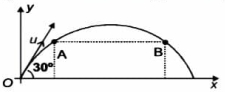
A
$20$
B
$10$
C
$40$
D
$5$
Solution
(C) The vertical displacement $y$ of a projectile at any time $t$ is given by $y = (u \sin \theta)t - \frac{1}{2}gt^2$.
Since the particle is at the same height at times $t_1$ and $t_2$,we have:
$(u \sin \theta)t_1 - \frac{1}{2}gt_1^2 = (u \sin \theta)t_2 - \frac{1}{2}gt_2^2$
$(u \sin \theta)(t_2 - t_1) = \frac{1}{2}g(t_2^2 - t_1^2)$
$u \sin \theta = \frac{g(t_1 + t_2)}{2}$
Given $t_1 = 1 \, s$,$t_2 = 3 \, s$,$\theta = 30^{\circ}$,and $g = 10 \, m/s^2$:
$u \sin 30^{\circ} = \frac{10(1 + 3)}{2}$
$u \times 0.5 = \frac{10 \times 4}{2}$
$0.5u = 20$
$u = 40 \, m/s$.
Since the particle is at the same height at times $t_1$ and $t_2$,we have:
$(u \sin \theta)t_1 - \frac{1}{2}gt_1^2 = (u \sin \theta)t_2 - \frac{1}{2}gt_2^2$
$(u \sin \theta)(t_2 - t_1) = \frac{1}{2}g(t_2^2 - t_1^2)$
$u \sin \theta = \frac{g(t_1 + t_2)}{2}$
Given $t_1 = 1 \, s$,$t_2 = 3 \, s$,$\theta = 30^{\circ}$,and $g = 10 \, m/s^2$:
$u \sin 30^{\circ} = \frac{10(1 + 3)}{2}$
$u \times 0.5 = \frac{10 \times 4}{2}$
$0.5u = 20$
$u = 40 \, m/s$.
0 likes
View Solution297
EasyMCQ
Which one of the following statements is not true about the motion of a projectile?
A
The time of flight of a projectile is proportional to the speed with which it is projected at a given angle of projection.
B
The horizontal range of a projectile is proportional to the square root of the speed with which it is projected.
C
For a given speed of projection,the angle of projection for maximum range is $45^{\circ}$.
D
At maximum height,the acceleration due to gravity is perpendicular to the velocity of the projectile.
Solution
(B) The horizontal range $R$ of a projectile is given by the formula $R = \frac{u^2 \sin 2\theta}{g}$.
From this expression,it is clear that $R \propto u^2$,meaning the range is proportional to the square of the speed of projection,not the square root.
Therefore,statement $(B)$ is incorrect.
Statement $(A)$ is true because time of flight $T = \frac{2u \sin \theta}{g}$,so $T \propto u$.
Statement $(C)$ is true because $\sin 2\theta$ is maximum at $2\theta = 90^{\circ}$,so $\theta = 45^{\circ}$.
Statement $(D)$ is true because at maximum height,velocity is purely horizontal,while acceleration due to gravity is purely vertical,making them perpendicular.
From this expression,it is clear that $R \propto u^2$,meaning the range is proportional to the square of the speed of projection,not the square root.
Therefore,statement $(B)$ is incorrect.
Statement $(A)$ is true because time of flight $T = \frac{2u \sin \theta}{g}$,so $T \propto u$.
Statement $(C)$ is true because $\sin 2\theta$ is maximum at $2\theta = 90^{\circ}$,so $\theta = 45^{\circ}$.
Statement $(D)$ is true because at maximum height,velocity is purely horizontal,while acceleration due to gravity is purely vertical,making them perpendicular.
0 likes
View Solution298
MediumMCQ
$A$ projectile is thrown with speed $40 \, m/s$ at an angle $\theta$ from the horizontal. It is found that the projectile is at the same height at $1 \, s$ and $3 \, s$. What is the angle of projection?
A
$\tan^{-1}\left(\frac{1}{\sqrt{2}}\right)$
B
$\tan^{-1}\left(\frac{1}{\sqrt{3}}\right)$
C
$\tan^{-1}(\sqrt{3})$
D
$\tan^{-1}(\sqrt{2})$
Solution
(B) The vertical displacement of a projectile is given by $y = (u \sin \theta)t - \frac{1}{2}gt^2$.
Since the projectile is at the same height at $t_1 = 1 \, s$ and $t_2 = 3 \, s$,the sum of these times is equal to the time taken to reach the maximum height multiplied by $2$,which is the total time of flight for that specific height level.
Specifically,$t_1 + t_2 = \frac{2u \sin \theta}{g}$.
Given $u = 40 \, m/s$,$g = 10 \, m/s^2$,$t_1 = 1 \, s$,and $t_2 = 3 \, s$:
$1 + 3 = \frac{2 \times 40 \times \sin \theta}{10}$.
$4 = 8 \sin \theta$.
$\sin \theta = \frac{4}{8} = \frac{1}{2}$.
Therefore,$\theta = 30^{\circ}$.
The angle of projection is $\theta = \tan^{-1}(\tan 30^{\circ}) = \tan^{-1}\left(\frac{1}{\sqrt{3}}\right)$.
Since the projectile is at the same height at $t_1 = 1 \, s$ and $t_2 = 3 \, s$,the sum of these times is equal to the time taken to reach the maximum height multiplied by $2$,which is the total time of flight for that specific height level.
Specifically,$t_1 + t_2 = \frac{2u \sin \theta}{g}$.
Given $u = 40 \, m/s$,$g = 10 \, m/s^2$,$t_1 = 1 \, s$,and $t_2 = 3 \, s$:
$1 + 3 = \frac{2 \times 40 \times \sin \theta}{10}$.
$4 = 8 \sin \theta$.
$\sin \theta = \frac{4}{8} = \frac{1}{2}$.
Therefore,$\theta = 30^{\circ}$.
The angle of projection is $\theta = \tan^{-1}(\tan 30^{\circ}) = \tan^{-1}\left(\frac{1}{\sqrt{3}}\right)$.
0 likes
View Solution299
EasyMCQ
$A$ body is projected from the ground obliquely. During its downward motion,the power delivered by gravity to it:
A
Increases
B
Decreases
C
Remains constant
D
First decreases and then becomes constant
Solution
(A) The power delivered by a force is given by the formula $P = \vec{F} \cdot \vec{v} = Fv cos \theta$,where $F$ is the force,$v$ is the velocity,and $ \theta$ is the angle between the force and velocity vectors.
In this case,the force is gravity,which acts vertically downwards $(F = mg)$.
During the downward motion of a projectile,the velocity vector $\vec{v}$ is directed downwards,making an angle $ \theta$ with the vertical force vector $\vec{F}$.
As the body moves downwards,its speed $v$ increases due to the acceleration of gravity.
Since the force of gravity is constant and the angle $ \theta$ between the downward force and the downward velocity is $0^{\circ}$ (or decreasing towards $0^{\circ}$),the product $Fv cos \theta$ increases.
Therefore,the power delivered by gravity increases during the downward motion.
In this case,the force is gravity,which acts vertically downwards $(F = mg)$.
During the downward motion of a projectile,the velocity vector $\vec{v}$ is directed downwards,making an angle $ \theta$ with the vertical force vector $\vec{F}$.
As the body moves downwards,its speed $v$ increases due to the acceleration of gravity.
Since the force of gravity is constant and the angle $ \theta$ between the downward force and the downward velocity is $0^{\circ}$ (or decreasing towards $0^{\circ}$),the product $Fv cos \theta$ increases.
Therefore,the power delivered by gravity increases during the downward motion.
0 likes
View Solution300
EasyMCQ
$A$ bomb of mass $m$ is projected from the ground with speed $v$ at an angle $\theta$ with the horizontal. At the maximum height from the ground,it explodes into two fragments of equal mass. If one fragment comes to rest immediately after the explosion,then the horizontal range of the centre of mass is ..............
A
$\frac{v^2 \sin^2 \theta}{g}$
B
$\frac{v^2 \sin \theta}{g}$
C
$\frac{v^2 \sin \theta}{2g}$
D
$\frac{v^2 \sin 2\theta}{g}$
Solution
(D) The motion of the centre of mass of a system is determined only by external forces acting on the system.
In this case,the explosion is caused by internal forces,which do not affect the trajectory of the centre of mass.
Therefore,the centre of mass continues to follow the original parabolic path it would have taken if no explosion had occurred.
The horizontal range of a projectile is given by the formula $R = \frac{v^2 \sin 2\theta}{g}$.
Thus,the horizontal range of the centre of mass remains $\frac{v^2 \sin 2\theta}{g}$.
In this case,the explosion is caused by internal forces,which do not affect the trajectory of the centre of mass.
Therefore,the centre of mass continues to follow the original parabolic path it would have taken if no explosion had occurred.
The horizontal range of a projectile is given by the formula $R = \frac{v^2 \sin 2\theta}{g}$.
Thus,the horizontal range of the centre of mass remains $\frac{v^2 \sin 2\theta}{g}$.
0 likes
View Solution3-2.Motion in Plane — Horizontal Projectile Motion · Frequently Asked Questions
1Are these 3-2.Motion in Plane questions useful for JEE and NEET?
Yes. All questions in this section are mapped to JEE Main and NEET exam patterns. Previous year questions from JEE Main, NEET, GUJCET and state-level exams are included with full solutions.
2Can I switch to Hindi or Gujarati for these questions?
Yes. Use the language tabs in the hero section or the sidebar to view the same questions and solutions in English, Hindi or Gujarati.
3How do I generate a question paper from this subtopic?
Use the Vedclass Exam Paper Generator — select the chapter and subtopic, set difficulty, and generate Sets A, B, C, D automatically. First 3 chapters of every subject are free.
Vedclass Products
For Students
Vedclass Test Series
Mock tests in real JEE/NEET style with performance analysis. 5-day free trial.
Start Free TrialFor Teachers
Exam Paper Generator
Generate Set A/B/C/D papers from this chapter in 2 minutes. 3 chapters free.
Try FreeFor Institutes
Online Exam Module
Live online exams with unlimited students, 360° analytics & white-label branding.
See DemoFor Teachers & Institutes
Generate a 3-2.Motion in Plane Exam Paper in 2 Minutes
Select subtopic & difficulty — Sets A, B, C, D auto-generated with No Repeat logic.
First 3 chapters of every subject are free — no payment required.