
A English
Fundamentals of Vectors Questions in English
Class 11 Physics · 3-1.Vectors · Fundamentals of Vectors
159+
Questions
English
Language
100%
With Solutions
Showing 50 of 159 questions in English
51
EasyMCQ
What is the position vector of a particle located at $(3, 2, 5)$?
A
$3\hat{i} + 5\hat{j} + 2\hat{k}$
B
$3\hat{i} + 2\hat{j} + 5\hat{k}$
C
$5\hat{i} + 3\hat{j} + 2\hat{k}$
D
None of these
Solution
(B) The position vector $\vec{r}$ of a point $P(x, y, z)$ in a Cartesian coordinate system is given by the formula $\vec{r} = x\hat{i} + y\hat{j} + z\hat{k}$.
Given the coordinates of the particle are $(3, 2, 5)$,where $x = 3$,$y = 2$,and $z = 5$.
Substituting these values into the formula,we get $\vec{r} = 3\hat{i} + 2\hat{j} + 5\hat{k}$.
Given the coordinates of the particle are $(3, 2, 5)$,where $x = 3$,$y = 2$,and $z = 5$.
Substituting these values into the formula,we get $\vec{r} = 3\hat{i} + 2\hat{j} + 5\hat{k}$.
0 likes
View Solution52
MediumMCQ
$A$ particle moves from point $P (2, 3, 5)$ to point $Q (3, 4, 5)$. The displacement vector is:
A
$\hat{i} + \hat{j} + 10\hat{k}$
B
$\hat{i} + \hat{j} + 5\hat{k}$
C
$\hat{i} + \hat{j}$
D
$2\hat{i} + 4\hat{j} + 6\hat{k}$
Solution
(C) The displacement vector $\vec{d}$ is given by the difference between the position vector of the final point $Q$ and the initial point $P$.
Position vector of $P$ is $\vec{r}_P = 2\hat{i} + 3\hat{j} + 5\hat{k}$.
Position vector of $Q$ is $\vec{r}_Q = 3\hat{i} + 4\hat{j} + 5\hat{k}$.
Displacement vector $\vec{d} = \vec{r}_Q - \vec{r}_P$.
$\vec{d} = (3 - 2)\hat{i} + (4 - 3)\hat{j} + (5 - 5)\hat{k}$.
$\vec{d} = 1\hat{i} + 1\hat{j} + 0\hat{k} = \hat{i} + \hat{j}$.
Position vector of $P$ is $\vec{r}_P = 2\hat{i} + 3\hat{j} + 5\hat{k}$.
Position vector of $Q$ is $\vec{r}_Q = 3\hat{i} + 4\hat{j} + 5\hat{k}$.
Displacement vector $\vec{d} = \vec{r}_Q - \vec{r}_P$.
$\vec{d} = (3 - 2)\hat{i} + (4 - 3)\hat{j} + (5 - 5)\hat{k}$.
$\vec{d} = 1\hat{i} + 1\hat{j} + 0\hat{k} = \hat{i} + \hat{j}$.
0 likes
View Solution53
DifficultMCQ
Given $A = 3\hat{i} + 4\hat{j}$ and $B = 7\hat{i} + 24\hat{j}$,find a vector that has the same magnitude as $B$ and is parallel to $A$.
A
$5\hat{i} + 20\hat{j}$
B
$15\hat{i} + 10\hat{j}$
C
$20\hat{i} + 15\hat{j}$
D
$15\hat{i} + 20\hat{j}$
Solution
(D) First,calculate the magnitude of vector $B$:
$|B| = \sqrt{7^2 + 24^2} = \sqrt{49 + 576} = \sqrt{625} = 25$.
Next,find the unit vector of $A$ to determine its direction:
$|A| = \sqrt{3^2 + 4^2} = \sqrt{9 + 16} = 5$.
$\hat{A} = \frac{A}{|A|} = \frac{3\hat{i} + 4\hat{j}}{5}$.
The required vector $V$ has magnitude $|B|$ and direction $\hat{A}$:
$V = |B| \cdot \hat{A} = 25 \cdot \left( \frac{3\hat{i} + 4\hat{j}}{5} \right)$.
$V = 5 \cdot (3\hat{i} + 4\hat{j}) = 15\hat{i} + 20\hat{j}$.
$|B| = \sqrt{7^2 + 24^2} = \sqrt{49 + 576} = \sqrt{625} = 25$.
Next,find the unit vector of $A$ to determine its direction:
$|A| = \sqrt{3^2 + 4^2} = \sqrt{9 + 16} = 5$.
$\hat{A} = \frac{A}{|A|} = \frac{3\hat{i} + 4\hat{j}}{5}$.
The required vector $V$ has magnitude $|B|$ and direction $\hat{A}$:
$V = |B| \cdot \hat{A} = 25 \cdot \left( \frac{3\hat{i} + 4\hat{j}}{5} \right)$.
$V = 5 \cdot (3\hat{i} + 4\hat{j}) = 15\hat{i} + 20\hat{j}$.
0 likes
View Solution54
MediumMCQ
If the vector $\overrightarrow{A} = 2\hat{i} + 4\hat{j} - 5\hat{k}$,find its direction cosines.
A
$\frac{2}{\sqrt{45}}, \frac{4}{\sqrt{45}}, \text{and } \frac{-5}{\sqrt{45}}$
B
$\frac{1}{\sqrt{45}}, \frac{2}{\sqrt{45}}, \text{and } \frac{3}{\sqrt{45}}$
C
$\frac{4}{\sqrt{45}}, 0, \text{and } \frac{4}{\sqrt{45}}$
D
$\frac{3}{\sqrt{45}}, \frac{2}{\sqrt{45}}, \text{and } \frac{5}{\sqrt{45}}$
Solution
(A) The magnitude of the vector $\overrightarrow{A} = 2\hat{i} + 4\hat{j} - 5\hat{k}$ is given by:
$|\overrightarrow{A}| = \sqrt{(2)^2 + (4)^2 + (-5)^2} = \sqrt{4 + 16 + 25} = \sqrt{45}$.
The direction cosines $(l, m, n)$ are defined as the ratios of the components of the vector to its magnitude:
$l = \cos \alpha = \frac{A_x}{|\overrightarrow{A}|} = \frac{2}{\sqrt{45}}$
$m = \cos \beta = \frac{A_y}{|\overrightarrow{A}|} = \frac{4}{\sqrt{45}}$
$n = \cos \gamma = \frac{A_z}{|\overrightarrow{A}|} = \frac{-5}{\sqrt{45}}$
Thus,the direction cosines are $\frac{2}{\sqrt{45}}, \frac{4}{\sqrt{45}}, \text{and } \frac{-5}{\sqrt{45}}$.
$|\overrightarrow{A}| = \sqrt{(2)^2 + (4)^2 + (-5)^2} = \sqrt{4 + 16 + 25} = \sqrt{45}$.
The direction cosines $(l, m, n)$ are defined as the ratios of the components of the vector to its magnitude:
$l = \cos \alpha = \frac{A_x}{|\overrightarrow{A}|} = \frac{2}{\sqrt{45}}$
$m = \cos \beta = \frac{A_y}{|\overrightarrow{A}|} = \frac{4}{\sqrt{45}}$
$n = \cos \gamma = \frac{A_z}{|\overrightarrow{A}|} = \frac{-5}{\sqrt{45}}$
Thus,the direction cosines are $\frac{2}{\sqrt{45}}, \frac{4}{\sqrt{45}}, \text{and } \frac{-5}{\sqrt{45}}$.
0 likes
View Solution55
MediumMCQ
The resultant of two vectors $A$ and $B$ makes an angle $\alpha$ with $A$ and $\beta$ with $B$. Which of the following is correct?
A
$\alpha < \beta$
B
$\alpha > \beta$ if $A < B$
C
$\alpha < \beta$ if $A = B$
D
$\alpha < \beta$ if $A < B$
Solution
(B) The resultant vector $R = A + B$ is always closer to the vector with the larger magnitude.
If $A > B$,the resultant is closer to $A$,meaning the angle $\alpha$ with $A$ is smaller than the angle $\beta$ with $B$ (i.e.,$\alpha < \beta$).
If $A < B$,the resultant is closer to $B$,meaning the angle $\beta$ with $B$ is smaller than the angle $\alpha$ with $A$ (i.e.,$\beta < \alpha$,or $\alpha > \beta$).
If $A = B$,the resultant bisects the angle between them,so $\alpha = \beta$.
Therefore,the statement $\alpha > \beta$ if $A < B$ is correct.
If $A > B$,the resultant is closer to $A$,meaning the angle $\alpha$ with $A$ is smaller than the angle $\beta$ with $B$ (i.e.,$\alpha < \beta$).
If $A < B$,the resultant is closer to $B$,meaning the angle $\beta$ with $B$ is smaller than the angle $\alpha$ with $A$ (i.e.,$\beta < \alpha$,or $\alpha > \beta$).
If $A = B$,the resultant bisects the angle between them,so $\alpha = \beta$.
Therefore,the statement $\alpha > \beta$ if $A < B$ is correct.
0 likes
View Solution56
MediumMCQ
At what angle should the two forces $2P$ and $\sqrt{2}P$ act so that the resultant force is $P\sqrt{10}$ (in $^{\circ}$)?
A
$45$
B
$60$
C
$90$
D
$120$
Solution
(A) The resultant force $R$ of two vectors $A$ and $B$ acting at an angle $\theta$ is given by $R = \sqrt{A^2 + B^2 + 2AB \cos \theta}$.
Given $A = 2P$,$B = \sqrt{2}P$,and $R = P\sqrt{10}$.
Substituting these values into the formula:
$P\sqrt{10} = \sqrt{(2P)^2 + (\sqrt{2}P)^2 + 2(2P)(\sqrt{2}P) \cos \theta}$.
Squaring both sides:
$10P^2 = 4P^2 + 2P^2 + 4\sqrt{2}P^2 \cos \theta$.
$10P^2 = 6P^2 + 4\sqrt{2}P^2 \cos \theta$.
$4P^2 = 4\sqrt{2}P^2 \cos \theta$.
$1 = \sqrt{2} \cos \theta$.
$\cos \theta = \frac{1}{\sqrt{2}}$.
Therefore,$\theta = 45^{\circ}$.
Given $A = 2P$,$B = \sqrt{2}P$,and $R = P\sqrt{10}$.
Substituting these values into the formula:
$P\sqrt{10} = \sqrt{(2P)^2 + (\sqrt{2}P)^2 + 2(2P)(\sqrt{2}P) \cos \theta}$.
Squaring both sides:
$10P^2 = 4P^2 + 2P^2 + 4\sqrt{2}P^2 \cos \theta$.
$10P^2 = 6P^2 + 4\sqrt{2}P^2 \cos \theta$.
$4P^2 = 4\sqrt{2}P^2 \cos \theta$.
$1 = \sqrt{2} \cos \theta$.
$\cos \theta = \frac{1}{\sqrt{2}}$.
Therefore,$\theta = 45^{\circ}$.
0 likes
View Solution57
EasyMCQ
$0.4\hat i + 0.8\hat j + c\hat k$ represents a unit vector when $c$ is
A
$-0.2$
B
$\sqrt{0.2}$
C
$\sqrt{0.8}$
D
$0$
Solution
(B) vector $\vec{A} = a_x\hat{i} + a_y\hat{j} + a_z\hat{k}$ is a unit vector if its magnitude is $1$,i.e.,$|\vec{A}| = \sqrt{a_x^2 + a_y^2 + a_z^2} = 1$.
Given vector is $\vec{A} = 0.4\hat{i} + 0.8\hat{j} + c\hat{k}$.
Calculating the magnitude: $\sqrt{(0.4)^2 + (0.8)^2 + c^2} = 1$.
Squaring both sides: $(0.4)^2 + (0.8)^2 + c^2 = 1^2$.
$0.16 + 0.64 + c^2 = 1$.
$0.80 + c^2 = 1$.
$c^2 = 1 - 0.80 = 0.20$.
Therefore,$c = \sqrt{0.2}$.
Given vector is $\vec{A} = 0.4\hat{i} + 0.8\hat{j} + c\hat{k}$.
Calculating the magnitude: $\sqrt{(0.4)^2 + (0.8)^2 + c^2} = 1$.
Squaring both sides: $(0.4)^2 + (0.8)^2 + c^2 = 1^2$.
$0.16 + 0.64 + c^2 = 1$.
$0.80 + c^2 = 1$.
$c^2 = 1 - 0.80 = 0.20$.
Therefore,$c = \sqrt{0.2}$.
0 likes
View Solution58
MediumMCQ
The angles which a vector $\hat{i} + \hat{j} + \sqrt{2} \hat{k}$ makes with $X, Y$ and $Z$ axes respectively are
A
$60^\circ, 60^\circ, 60^\circ$
B
$45^\circ, 45^\circ, 45^\circ$
C
$60^\circ, 60^\circ, 45^\circ$
D
$45^\circ, 45^\circ, 60^\circ$
Solution
(C) Let the vector be $\vec{R} = \hat{i} + \hat{j} + \sqrt{2} \hat{k}$.
Comparing this with $\vec{R} = R_x \hat{i} + R_y \hat{j} + R_z \hat{k}$,we get $R_x = 1, R_y = 1, R_z = \sqrt{2}$.
The magnitude of the vector is $|\vec{R}| = \sqrt{R_x^2 + R_y^2 + R_z^2} = \sqrt{1^2 + 1^2 + (\sqrt{2})^2} = \sqrt{1 + 1 + 2} = \sqrt{4} = 2$.
The direction cosines are given by $\cos \alpha = \frac{R_x}{|\vec{R}|}, \cos \beta = \frac{R_y}{|\vec{R}|}, \cos \gamma = \frac{R_z}{|\vec{R}|}$.
For the $X$-axis: $\cos \alpha = \frac{1}{2} \Rightarrow \alpha = 60^\circ$.
For the $Y$-axis: $\cos \beta = \frac{1}{2} \Rightarrow \beta = 60^\circ$.
For the $Z$-axis: $\cos \gamma = \frac{\sqrt{2}}{2} = \frac{1}{\sqrt{2}} \Rightarrow \gamma = 45^\circ$.
Thus,the angles are $60^\circ, 60^\circ, 45^\circ$.
Comparing this with $\vec{R} = R_x \hat{i} + R_y \hat{j} + R_z \hat{k}$,we get $R_x = 1, R_y = 1, R_z = \sqrt{2}$.
The magnitude of the vector is $|\vec{R}| = \sqrt{R_x^2 + R_y^2 + R_z^2} = \sqrt{1^2 + 1^2 + (\sqrt{2})^2} = \sqrt{1 + 1 + 2} = \sqrt{4} = 2$.
The direction cosines are given by $\cos \alpha = \frac{R_x}{|\vec{R}|}, \cos \beta = \frac{R_y}{|\vec{R}|}, \cos \gamma = \frac{R_z}{|\vec{R}|}$.
For the $X$-axis: $\cos \alpha = \frac{1}{2} \Rightarrow \alpha = 60^\circ$.
For the $Y$-axis: $\cos \beta = \frac{1}{2} \Rightarrow \beta = 60^\circ$.
For the $Z$-axis: $\cos \gamma = \frac{\sqrt{2}}{2} = \frac{1}{\sqrt{2}} \Rightarrow \gamma = 45^\circ$.
Thus,the angles are $60^\circ, 60^\circ, 45^\circ$.
0 likes
View Solution59
EasyMCQ
The value of a unit vector in the direction of vector $\vec A = 5\hat i - 12\hat j$ is:
A
$\hat i$
B
$\hat j$
C
$(\hat i + \hat j)/13$
D
$(5\hat i - 12\hat j)/13$
Solution
(D) The given vector is $\vec A = 5\hat i - 12\hat j$.
The magnitude of the vector $\vec A$ is calculated as $|\vec A| = \sqrt{(5)^2 + (-12)^2} = \sqrt{25 + 144} = \sqrt{169} = 13$.
$A$ unit vector $\hat A$ in the direction of $\vec A$ is defined as $\hat A = \frac{\vec A}{|\vec A|}$.
Substituting the values,we get $\hat A = \frac{5\hat i - 12\hat j}{13}$.
The magnitude of the vector $\vec A$ is calculated as $|\vec A| = \sqrt{(5)^2 + (-12)^2} = \sqrt{25 + 144} = \sqrt{169} = 13$.
$A$ unit vector $\hat A$ in the direction of $\vec A$ is defined as $\hat A = \frac{\vec A}{|\vec A|}$.
Substituting the values,we get $\hat A = \frac{5\hat i - 12\hat j}{13}$.
0 likes
View Solution60
EasyMCQ
Which of the following is independent of the choice of coordinate system?
A
$\vec{P} + \vec{Q} + \vec{R}$
B
$({P_x} + {Q_x} + {R_x})\hat{i}$
C
${P_x}\hat{i} + {Q_y}\hat{j} + {R_z}\hat{k}$
D
None of these
Solution
(A) vector is a physical quantity that has both magnitude and direction.
When we represent a vector as $\vec{A} = A_x\hat{i} + A_y\hat{j} + A_z\hat{k}$,the components $(A_x, A_y, A_z)$ depend on the orientation of the coordinate axes.
However,the vector sum $\vec{P} + \vec{Q} + \vec{R}$ represents a resultant vector,which is a physical entity independent of the coordinate system used to describe it.
Options $B$ and $C$ represent components or partial sums that change if the axes are rotated.
Therefore,the vector sum $\vec{P} + \vec{Q} + \vec{R}$ is invariant under coordinate transformation.
When we represent a vector as $\vec{A} = A_x\hat{i} + A_y\hat{j} + A_z\hat{k}$,the components $(A_x, A_y, A_z)$ depend on the orientation of the coordinate axes.
However,the vector sum $\vec{P} + \vec{Q} + \vec{R}$ represents a resultant vector,which is a physical entity independent of the coordinate system used to describe it.
Options $B$ and $C$ represent components or partial sums that change if the axes are rotated.
Therefore,the vector sum $\vec{P} + \vec{Q} + \vec{R}$ is invariant under coordinate transformation.
0 likes
View Solution61
DifficultMCQ
Given that $\overrightarrow A + \overrightarrow B + \overrightarrow C = 0$. Out of three vectors,two are equal in magnitude and the magnitude of the third vector is $\sqrt{2}$ times that of either of the two having equal magnitude. Then the angles between the vectors are given by:
A
$30^{\circ}, 60^{\circ}, 90^{\circ}$
B
$45^{\circ}, 45^{\circ}, 90^{\circ}$
C
$45^{\circ}, 60^{\circ}, 90^{\circ}$
D
$90^{\circ}, 135^{\circ}, 135^{\circ}$
Solution
(D) Let the magnitudes of the vectors be $|A| = x$,$|B| = x$,and $|C| = \sqrt{2}x$.
Since $\overrightarrow A + \overrightarrow B + \overrightarrow C = 0$,these three vectors form a closed triangle.
According to the law of cosines for a triangle with sides $x, x, \sqrt{2}x$,we observe that $x^2 + x^2 = (\sqrt{2}x)^2$,which satisfies the Pythagorean theorem.
Thus,the vectors form a right-angled isosceles triangle.
To find the angles between the vectors,we place them head-to-tail.
The angle between $\overrightarrow A$ and $\overrightarrow B$ is $90^{\circ}$ (as they are the legs of the right triangle).
The angle between $\overrightarrow B$ and $\overrightarrow C$ is $180^{\circ} - 45^{\circ} = 135^{\circ}$.
The angle between $\overrightarrow A$ and $\overrightarrow C$ is $180^{\circ} - 45^{\circ} = 135^{\circ}$.
Therefore,the angles are $90^{\circ}, 135^{\circ}, 135^{\circ}$.
Since $\overrightarrow A + \overrightarrow B + \overrightarrow C = 0$,these three vectors form a closed triangle.
According to the law of cosines for a triangle with sides $x, x, \sqrt{2}x$,we observe that $x^2 + x^2 = (\sqrt{2}x)^2$,which satisfies the Pythagorean theorem.
Thus,the vectors form a right-angled isosceles triangle.
To find the angles between the vectors,we place them head-to-tail.
The angle between $\overrightarrow A$ and $\overrightarrow B$ is $90^{\circ}$ (as they are the legs of the right triangle).
The angle between $\overrightarrow B$ and $\overrightarrow C$ is $180^{\circ} - 45^{\circ} = 135^{\circ}$.
The angle between $\overrightarrow A$ and $\overrightarrow C$ is $180^{\circ} - 45^{\circ} = 135^{\circ}$.
Therefore,the angles are $90^{\circ}, 135^{\circ}, 135^{\circ}$.
0 likes
View Solution62
EasyMCQ
Two forces $F_1 = 1\,N$ and $F_2 = 2\,N$ act along the lines $x = 0$ and $y = 0$ respectively. Then the resultant of forces would be
A
$\hat{i} + 2\hat{j}$
B
$\hat{i} + \hat{j}$
C
$3\hat{i} + 2\hat{j}$
D
$2\hat{i} + \hat{j}$
Solution
(D) The line $x = 0$ represents the $y$-axis. Since the force $F_1 = 1\,N$ acts along this line,it can be represented as $\vec{F}_1 = 1\hat{j} = \hat{j}$.
The line $y = 0$ represents the $x$-axis. Since the force $F_2 = 2\,N$ acts along this line,it can be represented as $\vec{F}_2 = 2\hat{i}$.
The resultant force $\vec{F}$ is the vector sum of $\vec{F}_1$ and $\vec{F}_2$.
Therefore,$\vec{F} = \vec{F}_1 + \vec{F}_2 = 2\hat{i} + \hat{j}$.
The line $y = 0$ represents the $x$-axis. Since the force $F_2 = 2\,N$ acts along this line,it can be represented as $\vec{F}_2 = 2\hat{i}$.
The resultant force $\vec{F}$ is the vector sum of $\vec{F}_1$ and $\vec{F}_2$.
Therefore,$\vec{F} = \vec{F}_1 + \vec{F}_2 = 2\hat{i} + \hat{j}$.
0 likes
View Solution63
MediumMCQ
Two vectors $P = 2\hat{i} + b\hat{j} + 2\hat{k}$ and $Q = \hat{i} + \hat{j} + \hat{k}$ will be parallel if $b=$ ........
A
$0$
B
$1$
C
$2$
D
$-4$
Solution
(C) Two vectors $P = A_1\hat{i} + B_1\hat{j} + C_1\hat{k}$ and $Q = A_2\hat{i} + B_2\hat{j} + C_2\hat{k}$ are parallel if their components are proportional,i.e.,$\frac{A_1}{A_2} = \frac{B_1}{B_2} = \frac{C_1}{C_2}$.
Given $P = 2\hat{i} + b\hat{j} + 2\hat{k}$ and $Q = 1\hat{i} + 1\hat{j} + 1\hat{k}$.
Comparing the components,we get $\frac{2}{1} = \frac{b}{1} = \frac{2}{1}$.
From the middle term,we find $b = 2$.
Given $P = 2\hat{i} + b\hat{j} + 2\hat{k}$ and $Q = 1\hat{i} + 1\hat{j} + 1\hat{k}$.
Comparing the components,we get $\frac{2}{1} = \frac{b}{1} = \frac{2}{1}$.
From the middle term,we find $b = 2$.
0 likes
View Solution64
MediumMCQ
Two vectors $A$ and $B$ are inclined at an angle $\theta$. Their resultant $R$ makes an angle $\phi$ with vector $A$. If the directions of $A$ and $B$ are interchanged,the resultant will have the same:
A
magnitude
B
direction
C
magnitude as well as direction
D
neither
Solution
(A) The magnitude of the resultant $R$ of two vectors $A$ and $B$ inclined at an angle $\theta$ is given by $R = \sqrt{A^2 + B^2 + 2AB \cos \theta}$.
Since the magnitudes of $A$ and $B$ and the angle $\theta$ between them remain unchanged when their directions are interchanged,the magnitude of the resultant $R$ remains the same.
However,the direction of the resultant vector is given by $\tan \phi = \frac{B \sin \theta}{A + B \cos \theta}$.
When $A$ and $B$ are interchanged,the new angle $\phi'$ becomes $\tan \phi' = \frac{A \sin \theta}{B + A \cos \theta}$.
Since $\phi \neq \phi'$,the direction of the resultant changes.
Therefore,only the magnitude remains the same.
Since the magnitudes of $A$ and $B$ and the angle $\theta$ between them remain unchanged when their directions are interchanged,the magnitude of the resultant $R$ remains the same.
However,the direction of the resultant vector is given by $\tan \phi = \frac{B \sin \theta}{A + B \cos \theta}$.
When $A$ and $B$ are interchanged,the new angle $\phi'$ becomes $\tan \phi' = \frac{A \sin \theta}{B + A \cos \theta}$.
Since $\phi \neq \phi'$,the direction of the resultant changes.
Therefore,only the magnitude remains the same.
0 likes
View Solution65
EasyMCQ
Which of the following relations is correct for vectors $a$ and $b$?
A
$| a - b | = | a | - | b |$
B
$| a - b | \leq | a | - | b |$
C
$| a - b | \geq | a | - | b |$
D
$| a - b | > | a | - | b |$
Solution
(C) The correct option is $C$.
According to the triangle inequality for vectors,for any two vectors $a$ and $b$,the magnitude of their difference satisfies the inequality $| a - b | \geq | | a | - | b | |$.
Since $| | a | - | b | | \geq | a | - | b |$ is always true for any real numbers $| a |$ and $| b |$,it follows that $| a - b | \geq | a | - | b |$.
This represents the lower bound of the magnitude of the resultant vector when subtracting two vectors.
According to the triangle inequality for vectors,for any two vectors $a$ and $b$,the magnitude of their difference satisfies the inequality $| a - b | \geq | | a | - | b | |$.
Since $| | a | - | b | | \geq | a | - | b |$ is always true for any real numbers $| a |$ and $| b |$,it follows that $| a - b | \geq | a | - | b |$.
This represents the lower bound of the magnitude of the resultant vector when subtracting two vectors.
0 likes
View Solution66
EasyMCQ
Mark the correct statement :-
A
$| \vec{a} + \vec{b} | \geq | \vec{a} | + | \vec{b} |$
B
$| \vec{a} + \vec{b} | \leq | \vec{a} | + | \vec{b} |$
C
$| \vec{a} - \vec{b} | \geq | \vec{a} | + | \vec{b} |$
D
All of the above
Solution
(B) According to the triangle inequality for vectors,the magnitude of the sum of two vectors is always less than or equal to the sum of their individual magnitudes.
Mathematically,this is expressed as $| \vec{a} + \vec{b} | \leq | \vec{a} | + | \vec{b} |$.
This equality holds when the two vectors are in the same direction (parallel).
Therefore,option $B$ is the correct statement.
Mathematically,this is expressed as $| \vec{a} + \vec{b} | \leq | \vec{a} | + | \vec{b} |$.
This equality holds when the two vectors are in the same direction (parallel).
Therefore,option $B$ is the correct statement.
0 likes
View Solution67
MediumMCQ
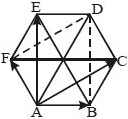
$ABCDEF$ is a regular hexagon and forces represented in magnitude and direction by $\overrightarrow{AB}, \overrightarrow{AC}, \overrightarrow{AD}, \overrightarrow{AE}$ and $\overrightarrow{AF}$ act at point $A$. Their resultant is:
A
$6\, \overrightarrow{AD}$
B
$4\, \overrightarrow{AD}$
C
$3\, \overrightarrow{AD}$
D
$2\, \overrightarrow{AD}$
Solution
(C) Let the resultant force be $\vec{R} = \overrightarrow{AB} + \overrightarrow{AC} + \overrightarrow{AD} + \overrightarrow{AE} + \overrightarrow{AF}$.
In a regular hexagon $ABCDEF$,the center $O$ is the midpoint of the diagonals $AD$,$BE$,and $CF$. Thus,$\overrightarrow{AB} + \overrightarrow{AE} = 2\overrightarrow{AO} = \overrightarrow{AD}$ (since $\overrightarrow{AD} = 2\overrightarrow{AO}$).
Similarly,$\overrightarrow{AC} + \overrightarrow{AF} = 2\overrightarrow{AO} = \overrightarrow{AD}$.
Substituting these into the expression for $\vec{R}$:
$\vec{R} = (\overrightarrow{AB} + \overrightarrow{AE}) + (\overrightarrow{AC} + \overrightarrow{AF}) + \overrightarrow{AD}$
$\vec{R} = \overrightarrow{AD} + \overrightarrow{AD} + \overrightarrow{AD} = 3\overrightarrow{AD}$.
In a regular hexagon $ABCDEF$,the center $O$ is the midpoint of the diagonals $AD$,$BE$,and $CF$. Thus,$\overrightarrow{AB} + \overrightarrow{AE} = 2\overrightarrow{AO} = \overrightarrow{AD}$ (since $\overrightarrow{AD} = 2\overrightarrow{AO}$).
Similarly,$\overrightarrow{AC} + \overrightarrow{AF} = 2\overrightarrow{AO} = \overrightarrow{AD}$.
Substituting these into the expression for $\vec{R}$:
$\vec{R} = (\overrightarrow{AB} + \overrightarrow{AE}) + (\overrightarrow{AC} + \overrightarrow{AF}) + \overrightarrow{AD}$
$\vec{R} = \overrightarrow{AD} + \overrightarrow{AD} + \overrightarrow{AD} = 3\overrightarrow{AD}$.
0 likes
View Solution68
MediumMCQ
If $A$ and $B$ are two vectors such that $|A + B| = 2|A - B|$,the angle between vectors $A$ and $B$ is:
A
$45^{\circ}$
B
$60^{\circ}$
C
$30^{\circ}$
D
Data insufficient
Solution
(D) Given the condition: $|A + B| = 2|A - B|$.
Squaring both sides,we get: $|A + B|^2 = 4|A - B|^2$.
Using the vector identity $|u \pm v|^2 = |u|^2 + |v|^2 \pm 2|u||v| \cos \theta$,we have:
$A^2 + B^2 + 2AB \cos \theta = 4(A^2 + B^2 - 2AB \cos \theta)$.
$A^2 + B^2 + 2AB \cos \theta = 4A^2 + 4B^2 - 8AB \cos \theta$.
$10AB \cos \theta = 3A^2 + 3B^2$.
$\cos \theta = \frac{3(A^2 + B^2)}{10AB}$.
Since the value of $\cos \theta$ depends on the magnitudes of $A$ and $B$,and they are not provided,the angle $\theta$ cannot be uniquely determined. Thus,the data is insufficient.
Squaring both sides,we get: $|A + B|^2 = 4|A - B|^2$.
Using the vector identity $|u \pm v|^2 = |u|^2 + |v|^2 \pm 2|u||v| \cos \theta$,we have:
$A^2 + B^2 + 2AB \cos \theta = 4(A^2 + B^2 - 2AB \cos \theta)$.
$A^2 + B^2 + 2AB \cos \theta = 4A^2 + 4B^2 - 8AB \cos \theta$.
$10AB \cos \theta = 3A^2 + 3B^2$.
$\cos \theta = \frac{3(A^2 + B^2)}{10AB}$.
Since the value of $\cos \theta$ depends on the magnitudes of $A$ and $B$,and they are not provided,the angle $\theta$ cannot be uniquely determined. Thus,the data is insufficient.
0 likes
View Solution69
EasyMCQ
The vectors $\overrightarrow{A}$ and $\overrightarrow{B}$ lie in a plane. Another vector $\overrightarrow{C}$ lies outside this plane. The resultant $\overrightarrow{R} = \overrightarrow{A} + \overrightarrow{B} + \overrightarrow{C}$ of these three vectors:
A
can be zero
B
cannot be zero
C
lies in the plane of $\overrightarrow{A}$ and $\overrightarrow{B}$
D
lies in the plane of $\overrightarrow{A}$ and $\overrightarrow{A} + \overrightarrow{B}$
Solution
(B) Let the plane containing $\overrightarrow{A}$ and $\overrightarrow{B}$ be the $xy$-plane. Thus,$\overrightarrow{A} = A_x \hat{i} + A_y \hat{j}$ and $\overrightarrow{B} = B_x \hat{i} + B_y \hat{j}$.
Since $\overrightarrow{C}$ lies outside this plane,it must have a non-zero component in the $z$-direction: $\overrightarrow{C} = C_x \hat{i} + C_y \hat{j} + C_z \hat{k}$,where $C_z \neq 0$.
The resultant vector is $\overrightarrow{R} = \overrightarrow{A} + \overrightarrow{B} + \overrightarrow{C} = (A_x + B_x + C_x) \hat{i} + (A_y + B_y + C_y) \hat{j} + C_z \hat{k}$.
For the resultant to be zero,all components must be zero. However,the $z$-component is $C_z$,which is given as non-zero.
Therefore,the resultant $\overrightarrow{R}$ cannot be zero.
Since $\overrightarrow{C}$ lies outside this plane,it must have a non-zero component in the $z$-direction: $\overrightarrow{C} = C_x \hat{i} + C_y \hat{j} + C_z \hat{k}$,where $C_z \neq 0$.
The resultant vector is $\overrightarrow{R} = \overrightarrow{A} + \overrightarrow{B} + \overrightarrow{C} = (A_x + B_x + C_x) \hat{i} + (A_y + B_y + C_y) \hat{j} + C_z \hat{k}$.
For the resultant to be zero,all components must be zero. However,the $z$-component is $C_z$,which is given as non-zero.
Therefore,the resultant $\overrightarrow{R}$ cannot be zero.
0 likes
View Solution70
MediumMCQ
If the angle between $\hat{a}$ and $\hat{b}$ is $60^{\circ}$,then which of the following vector$(s)$ have magnitude one?
A
Only $C, D$
B
Only $B, C, D$
C
Only $A, C, D$
D
All
Solution
(C) Given that $\hat{a}$ and $\hat{b}$ are unit vectors,so $|\hat{a}| = 1$ and $|\hat{b}| = 1$.
For option $(A)$: $|\frac{\hat{a} + \hat{b}}{\sqrt{3}}| = \frac{1}{\sqrt{3}} \sqrt{|\hat{a}|^2 + |\hat{b}|^2 + 2|\hat{a}||\hat{b}| \cos 60^{\circ}} = \frac{1}{\sqrt{3}} \sqrt{1 + 1 + 2(1)(1)(0.5)} = \frac{1}{\sqrt{3}} \sqrt{3} = 1$.
For option $(B)$: $|\hat{a} + \hat{b}| = \sqrt{1 + 1 + 2(1)(1)(0.5)} = \sqrt{3} \neq 1$.
For option $(C)$: $|\hat{a}| = 1$.
For option $(D)$: $|\hat{b}| = 1$.
Thus,vectors in $(A), (C),$ and $(D)$ have magnitude one.
For option $(A)$: $|\frac{\hat{a} + \hat{b}}{\sqrt{3}}| = \frac{1}{\sqrt{3}} \sqrt{|\hat{a}|^2 + |\hat{b}|^2 + 2|\hat{a}||\hat{b}| \cos 60^{\circ}} = \frac{1}{\sqrt{3}} \sqrt{1 + 1 + 2(1)(1)(0.5)} = \frac{1}{\sqrt{3}} \sqrt{3} = 1$.
For option $(B)$: $|\hat{a} + \hat{b}| = \sqrt{1 + 1 + 2(1)(1)(0.5)} = \sqrt{3} \neq 1$.
For option $(C)$: $|\hat{a}| = 1$.
For option $(D)$: $|\hat{b}| = 1$.
Thus,vectors in $(A), (C),$ and $(D)$ have magnitude one.
0 likes
View Solution71
EasyMCQ
The condition $( a \cdot b )^2 = a^2 b^2$ is satisfied when
A
$a$ is parallel to $b$
B
$a \neq b$
C
$a \cdot b = 1$
D
$a \perp b$
Solution
(A) The dot product of two vectors $a$ and $b$ is defined as $a \cdot b = |a| |b| \cos \theta$,where $\theta$ is the angle between the vectors.
Squaring both sides,we get $(a \cdot b)^2 = |a|^2 |b|^2 \cos^2 \theta$.
Given the condition $(a \cdot b)^2 = a^2 b^2$,we substitute the expression:
$|a|^2 |b|^2 \cos^2 \theta = |a|^2 |b|^2$.
Assuming $a$ and $b$ are non-zero vectors,we divide by $|a|^2 |b|^2$ to get $\cos^2 \theta = 1$.
This implies $\cos \theta = \pm 1$,which means $\theta = 0^{\circ}$ or $\theta = 180^{\circ}$.
In both cases,the vectors $a$ and $b$ are parallel (or anti-parallel). Thus,the condition is satisfied when $a$ is parallel to $b$.
Squaring both sides,we get $(a \cdot b)^2 = |a|^2 |b|^2 \cos^2 \theta$.
Given the condition $(a \cdot b)^2 = a^2 b^2$,we substitute the expression:
$|a|^2 |b|^2 \cos^2 \theta = |a|^2 |b|^2$.
Assuming $a$ and $b$ are non-zero vectors,we divide by $|a|^2 |b|^2$ to get $\cos^2 \theta = 1$.
This implies $\cos \theta = \pm 1$,which means $\theta = 0^{\circ}$ or $\theta = 180^{\circ}$.
In both cases,the vectors $a$ and $b$ are parallel (or anti-parallel). Thus,the condition is satisfied when $a$ is parallel to $b$.
0 likes
View Solution72
MediumMCQ
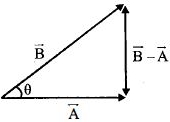
$A$ vector $\vec{A}$ is rotated by a small angle $\Delta \theta$ radian $(\Delta \theta \ll 1)$ to get a new vector $\vec{B}$. In that case,$|\vec{B} - \vec{A}|$ is
A
$|\vec{A}| \Delta \theta$
B
$|\vec{B}| \Delta \theta - |\vec{A}|$
C
$|\vec{A}| (1 - \frac{\Delta \theta^2}{2})$
D
$0$
Solution
(A) When a vector $\vec{A}$ is rotated by a small angle $\Delta \theta$,the magnitude of the vector remains unchanged,so $|\vec{A}| = |\vec{B}| = A$.
The difference vector $\vec{B} - \vec{A}$ represents the chord length between the tips of the two vectors.
For a very small angle $\Delta \theta$,the chord length is approximately equal to the arc length of the circle traced by the tip of the vector.
Using the relation $\text{Arc length} = \text{radius} \times \text{angle}$,we have:
$|\vec{B} - \vec{A}| \approx |\vec{A}| \Delta \theta$.
The difference vector $\vec{B} - \vec{A}$ represents the chord length between the tips of the two vectors.
For a very small angle $\Delta \theta$,the chord length is approximately equal to the arc length of the circle traced by the tip of the vector.
Using the relation $\text{Arc length} = \text{radius} \times \text{angle}$,we have:
$|\vec{B} - \vec{A}| \approx |\vec{A}| \Delta \theta$.
0 likes
View Solution73
EasyMCQ
Which of the following is a unit vector?
A
$\hat{i} + \hat{j}$
B
$\cos \theta \hat{i} - \sin \theta \hat{j}$
C
$\sin \theta \hat{i} + 2 \cos \theta \hat{j}$
D
$\frac{1}{\sqrt{3}}(\hat{i} + \hat{j})$
Solution
(B) unit vector is defined as a vector whose magnitude is equal to $1$.
Let us check the magnitude of the given options:
For option $A$: $|\hat{i} + \hat{j}| = \sqrt{1^2 + 1^2} = \sqrt{2} \neq 1$.
For option $B$: $|\cos \theta \hat{i} - \sin \theta \hat{j}| = \sqrt{\cos^2 \theta + (-\sin \theta)^2} = \sqrt{\cos^2 \theta + \sin^2 \theta} = \sqrt{1} = 1$.
For option $C$: $|\sin \theta \hat{i} + 2 \cos \theta \hat{j}| = \sqrt{\sin^2 \theta + 4 \cos^2 \theta} \neq 1$.
For option $D$: $|\frac{1}{\sqrt{3}}(\hat{i} + \hat{j})| = \frac{1}{\sqrt{3}} \sqrt{1^2 + 1^2} = \frac{\sqrt{2}}{\sqrt{3}} \neq 1$.
Therefore,the vector in option $B$ is a unit vector.
Let us check the magnitude of the given options:
For option $A$: $|\hat{i} + \hat{j}| = \sqrt{1^2 + 1^2} = \sqrt{2} \neq 1$.
For option $B$: $|\cos \theta \hat{i} - \sin \theta \hat{j}| = \sqrt{\cos^2 \theta + (-\sin \theta)^2} = \sqrt{\cos^2 \theta + \sin^2 \theta} = \sqrt{1} = 1$.
For option $C$: $|\sin \theta \hat{i} + 2 \cos \theta \hat{j}| = \sqrt{\sin^2 \theta + 4 \cos^2 \theta} \neq 1$.
For option $D$: $|\frac{1}{\sqrt{3}}(\hat{i} + \hat{j})| = \frac{1}{\sqrt{3}} \sqrt{1^2 + 1^2} = \frac{\sqrt{2}}{\sqrt{3}} \neq 1$.
Therefore,the vector in option $B$ is a unit vector.
0 likes
View Solution74
MediumMCQ
The component of a vector $\vec{A}$ along a direction making an angle $\theta$ with it is given by $A \cos \theta$. What can be said about the magnitude of this component?
A
Always less than or equal to its magnitude
B
Always greater than its magnitude
C
Always equal to its magnitude
D
None of the above
Solution
(A) The component of a vector $\vec{A}$ along a direction making an angle $\theta$ with it is $A_\theta = A \cos \theta$.
Since the range of the cosine function is $-1 \le \cos \theta \le 1$,the magnitude of the component is $|A \cos \theta| = |A| |\cos \theta|$.
Because $|\cos \theta| \le 1$,it follows that $|A \cos \theta| \le |A|$.
Therefore,the component of a vector along any direction is always less than or equal to its magnitude.
Since the range of the cosine function is $-1 \le \cos \theta \le 1$,the magnitude of the component is $|A \cos \theta| = |A| |\cos \theta|$.
Because $|\cos \theta| \le 1$,it follows that $|A \cos \theta| \le |A|$.
Therefore,the component of a vector along any direction is always less than or equal to its magnitude.
0 likes
View Solution75
MediumMCQ
If three vectors along coordinate axes represent the adjacent sides of a cube of length $b$,then the unit vector along its diagonal passing through the origin will be
A
$\frac{\hat{i}+\hat{j}+\hat{k}}{\sqrt{2}}$
B
$\frac{\hat{i}+\hat{j}+\hat{k}}{\sqrt{36}}$
C
$\hat{i}+\hat{j}+\hat{k}$
D
$\frac{\hat{i}+\hat{j}+\hat{k}}{\sqrt{3}}$
Solution
(D) The three vectors along the coordinate axes representing the adjacent sides of a cube of length $b$ are $b\hat{i}$,$b\hat{j}$,and $b\hat{k}$.
The diagonal vector $\vec{A}$ passing through the origin is the resultant of these three vectors: $\vec{A} = b\hat{i} + b\hat{j} + b\hat{k}$.
The magnitude of this diagonal vector is $|\vec{A}| = \sqrt{b^2 + b^2 + b^2} = \sqrt{3b^2} = b\sqrt{3}$.
The unit vector $\hat{A}$ along the diagonal is given by $\hat{A} = \frac{\vec{A}}{|\vec{A}|} = \frac{b\hat{i} + b\hat{j} + b\hat{k}}{b\sqrt{3}} = \frac{\hat{i} + \hat{j} + \hat{k}}{\sqrt{3}}$.
The diagonal vector $\vec{A}$ passing through the origin is the resultant of these three vectors: $\vec{A} = b\hat{i} + b\hat{j} + b\hat{k}$.
The magnitude of this diagonal vector is $|\vec{A}| = \sqrt{b^2 + b^2 + b^2} = \sqrt{3b^2} = b\sqrt{3}$.
The unit vector $\hat{A}$ along the diagonal is given by $\hat{A} = \frac{\vec{A}}{|\vec{A}|} = \frac{b\hat{i} + b\hat{j} + b\hat{k}}{b\sqrt{3}} = \frac{\hat{i} + \hat{j} + \hat{k}}{\sqrt{3}}$.
0 likes
View Solution76
MediumMCQ
The values of $x$ and $y$ for which vectors $\vec{A} = (6\hat{i} + x\hat{j} - 2\hat{k})$ and $\vec{B} = (5\hat{i} - 6\hat{j} - y\hat{k})$ may be parallel are
A
$x = 0, y = \frac{2}{3}$
B
$x = -\frac{36}{5}, y = \frac{5}{3}$
C
$x = -\frac{15}{3}, y = \frac{23}{5}$
D
$x = \frac{36}{5}, y = \frac{15}{4}$
Solution
(B) Two vectors $\vec{A} = A_x\hat{i} + A_y\hat{j} + A_z\hat{k}$ and $\vec{B} = B_x\hat{i} + B_y\hat{j} + B_z\hat{k}$ are parallel if their components are proportional,i.e.,$\frac{A_x}{B_x} = \frac{A_y}{B_y} = \frac{A_z}{B_z}$.
Given $\vec{A} = 6\hat{i} + x\hat{j} - 2\hat{k}$ and $\vec{B} = 5\hat{i} - 6\hat{j} - y\hat{k}$.
Equating the ratios: $\frac{6}{5} = \frac{x}{-6} = \frac{-2}{-y}$.
First,solve for $x$: $\frac{6}{5} = \frac{x}{-6} \implies x = \frac{6 \times (-6)}{5} = -\frac{36}{5}$.
Next,solve for $y$: $\frac{6}{5} = \frac{-2}{-y} \implies \frac{6}{5} = \frac{2}{y} \implies 6y = 10 \implies y = \frac{10}{6} = \frac{5}{3}$.
Thus,$x = -\frac{36}{5}$ and $y = \frac{5}{3}$.
Given $\vec{A} = 6\hat{i} + x\hat{j} - 2\hat{k}$ and $\vec{B} = 5\hat{i} - 6\hat{j} - y\hat{k}$.
Equating the ratios: $\frac{6}{5} = \frac{x}{-6} = \frac{-2}{-y}$.
First,solve for $x$: $\frac{6}{5} = \frac{x}{-6} \implies x = \frac{6 \times (-6)}{5} = -\frac{36}{5}$.
Next,solve for $y$: $\frac{6}{5} = \frac{-2}{-y} \implies \frac{6}{5} = \frac{2}{y} \implies 6y = 10 \implies y = \frac{10}{6} = \frac{5}{3}$.
Thus,$x = -\frac{36}{5}$ and $y = \frac{5}{3}$.
0 likes
View Solution77
MediumMCQ
Two vectors $\vec{A}$ and $\vec{B}$ are parallel to each other if one is a scalar multiple of the other,i.e.,$\vec{A} = k\vec{B}$. Which of the following pairs of vectors are parallel?
A
$\vec{A} = 3\hat{i} + 6\hat{j} + 9\hat{k}$,$\vec{B} = \hat{i} + 2\hat{j} + 3\hat{k}$
B
$\vec{A} = 3\hat{i} - 6\hat{j} + 9\hat{k}$,$\vec{B} = \hat{i} + 2\hat{j} + 3\hat{k}$
C
$\vec{A} = 2\hat{i} + 6\hat{j} - 9\hat{k}$,$\vec{B} = \hat{i} + 2\hat{j} - 3\hat{k}$
D
$\vec{A} = 2\hat{i} + 3\hat{j} + 3\hat{k}$,$\vec{B} = \hat{i} - 2\hat{j} - 3\hat{k}$
Solution
(A) Two vectors $\vec{A}$ and $\vec{B}$ are parallel if their components are proportional,meaning $\frac{A_x}{B_x} = \frac{A_y}{B_y} = \frac{A_z}{B_z} = k$.
For option $A$: $\frac{3}{1} = 3$,$\frac{6}{2} = 3$,$\frac{9}{3} = 3$. Since all ratios are equal to $3$,$\vec{A} = 3\vec{B}$,so they are parallel.
For option $B$: $\frac{3}{1} = 3$,$\frac{-6}{2} = -3$. Ratios are not equal.
For option $C$: $\frac{2}{1} = 2$,$\frac{6}{2} = 3$. Ratios are not equal.
For option $D$: $\frac{2}{1} = 2$,$\frac{3}{-2} = -1.5$. Ratios are not equal.
Thus,the correct option is $A$.
For option $A$: $\frac{3}{1} = 3$,$\frac{6}{2} = 3$,$\frac{9}{3} = 3$. Since all ratios are equal to $3$,$\vec{A} = 3\vec{B}$,so they are parallel.
For option $B$: $\frac{3}{1} = 3$,$\frac{-6}{2} = -3$. Ratios are not equal.
For option $C$: $\frac{2}{1} = 2$,$\frac{6}{2} = 3$. Ratios are not equal.
For option $D$: $\frac{2}{1} = 2$,$\frac{3}{-2} = -1.5$. Ratios are not equal.
Thus,the correct option is $A$.
0 likes
View Solution78
EasyMCQ
If $|\vec{v}_1 + \vec{v}_2| = |\vec{v}_1 - \vec{v}_2|$ and $\vec{v}_1$ and $\vec{v}_2$ are finite,then:
A
$\vec{v}_1$ is parallel to $\vec{v}_2$
B
$\vec{v}_1 = \vec{v}_2$
C
$|\vec{v}_1| = |\vec{v}_2|$
D
$\vec{v}_1$ and $\vec{v}_2$ are mutually perpendicular
Solution
(D) Given the equation $|\vec{v}_1 + \vec{v}_2| = |\vec{v}_1 - \vec{v}_2|$.
Squaring both sides,we get $|\vec{v}_1 + \vec{v}_2|^2 = |\vec{v}_1 - \vec{v}_2|^2$.
Using the property $|\vec{a}|^2 = \vec{a} \cdot \vec{a}$,we expand the terms:
$(\vec{v}_1 + \vec{v}_2) \cdot (\vec{v}_1 + \vec{v}_2) = (\vec{v}_1 - \vec{v}_2) \cdot (\vec{v}_1 - \vec{v}_2)$.
$|\vec{v}_1|^2 + |\vec{v}_2|^2 + 2(\vec{v}_1 \cdot \vec{v}_2) = |\vec{v}_1|^2 + |\vec{v}_2|^2 - 2(\vec{v}_1 \cdot \vec{v}_2)$.
Subtracting $|\vec{v}_1|^2 + |\vec{v}_2|^2$ from both sides,we get $2(\vec{v}_1 \cdot \vec{v}_2) = -2(\vec{v}_1 \cdot \vec{v}_2)$.
This implies $4(\vec{v}_1 \cdot \vec{v}_2) = 0$,which means $\vec{v}_1 \cdot \vec{v}_2 = 0$.
Since the dot product of two non-zero vectors is zero,they must be mutually perpendicular.
Squaring both sides,we get $|\vec{v}_1 + \vec{v}_2|^2 = |\vec{v}_1 - \vec{v}_2|^2$.
Using the property $|\vec{a}|^2 = \vec{a} \cdot \vec{a}$,we expand the terms:
$(\vec{v}_1 + \vec{v}_2) \cdot (\vec{v}_1 + \vec{v}_2) = (\vec{v}_1 - \vec{v}_2) \cdot (\vec{v}_1 - \vec{v}_2)$.
$|\vec{v}_1|^2 + |\vec{v}_2|^2 + 2(\vec{v}_1 \cdot \vec{v}_2) = |\vec{v}_1|^2 + |\vec{v}_2|^2 - 2(\vec{v}_1 \cdot \vec{v}_2)$.
Subtracting $|\vec{v}_1|^2 + |\vec{v}_2|^2$ from both sides,we get $2(\vec{v}_1 \cdot \vec{v}_2) = -2(\vec{v}_1 \cdot \vec{v}_2)$.
This implies $4(\vec{v}_1 \cdot \vec{v}_2) = 0$,which means $\vec{v}_1 \cdot \vec{v}_2 = 0$.
Since the dot product of two non-zero vectors is zero,they must be mutually perpendicular.
0 likes
View Solution79
MediumMCQ
$A$ physical quantity which has a direction:
A
must be a vector
B
may be a vector
C
may be both scalar and vector
D
none of the above
Solution
(B) physical quantity is defined as a vector only if it possesses both magnitude and direction $AND$ follows the laws of vector addition (e.g.,the parallelogram law).
Physical quantities like time,pressure,surface tension,and electric current possess a specific direction but do not follow the laws of vector addition.
Therefore,a physical quantity having a direction does not necessarily have to be a vector; it may or may not be a vector.
Physical quantities like time,pressure,surface tension,and electric current possess a specific direction but do not follow the laws of vector addition.
Therefore,a physical quantity having a direction does not necessarily have to be a vector; it may or may not be a vector.
0 likes
View Solution80
MediumMCQ
Given: $\vec{A} = 2\hat{i} + p\hat{j} + q\hat{k}$ and $\vec{B} = 5\hat{i} + 7\hat{j} + 3\hat{k}$. If $\vec{A} \parallel \vec{B}$,then the values of $p$ and $q$ are,respectively:
A
$\frac{14}{5}$ and $\frac{6}{5}$
B
$\frac{14}{3}$ and $\frac{6}{5}$
C
$\frac{6}{5}$ and $\frac{1}{3}$
D
$\frac{3}{4}$ and $\frac{1}{4}$
Solution
(A) Two vectors $\vec{A} = A_x\hat{i} + A_y\hat{j} + A_z\hat{k}$ and $\vec{B} = B_x\hat{i} + B_y\hat{j} + B_z\hat{k}$ are parallel if their components are proportional,i.e.,$\frac{A_x}{B_x} = \frac{A_y}{B_y} = \frac{A_z}{B_z}$.
Given $\vec{A} = 2\hat{i} + p\hat{j} + q\hat{k}$ and $\vec{B} = 5\hat{i} + 7\hat{j} + 3\hat{k}$.
Equating the ratios of the components: $\frac{2}{5} = \frac{p}{7} = \frac{q}{3}$.
For $p$: $\frac{2}{5} = \frac{p}{7} \Rightarrow p = \frac{2 \times 7}{5} = \frac{14}{5}$.
For $q$: $\frac{2}{5} = \frac{q}{3} \Rightarrow q = \frac{2 \times 3}{5} = \frac{6}{5}$.
Thus,the values are $p = \frac{14}{5}$ and $q = \frac{6}{5}$.
Given $\vec{A} = 2\hat{i} + p\hat{j} + q\hat{k}$ and $\vec{B} = 5\hat{i} + 7\hat{j} + 3\hat{k}$.
Equating the ratios of the components: $\frac{2}{5} = \frac{p}{7} = \frac{q}{3}$.
For $p$: $\frac{2}{5} = \frac{p}{7} \Rightarrow p = \frac{2 \times 7}{5} = \frac{14}{5}$.
For $q$: $\frac{2}{5} = \frac{q}{3} \Rightarrow q = \frac{2 \times 3}{5} = \frac{6}{5}$.
Thus,the values are $p = \frac{14}{5}$ and $q = \frac{6}{5}$.
0 likes
View Solution81
MediumMCQ
The values of $x$ and $y$ for which vectors $\vec{A} = (6 \hat{i} + x \hat{j} - 2 \hat{k})$ and $\vec{B} = (5 \hat{i} + 6 \hat{j} - y \hat{k})$ are parallel are
A
$x = 0, y = \frac{2}{3}$
B
$x = \frac{36}{5}, y = \frac{5}{3}$
C
$x = -\frac{15}{3}, y = \frac{23}{5}$
D
$x = -\frac{36}{5}, y = \frac{15}{4}$
Solution
(B) Two vectors $\vec{A} = A_x \hat{i} + A_y \hat{j} + A_z \hat{k}$ and $\vec{B} = B_x \hat{i} + B_y \hat{j} + B_z \hat{k}$ are parallel if their components are proportional,i.e.,$\frac{A_x}{B_x} = \frac{A_y}{B_y} = \frac{A_z}{B_z}$.
Given $\vec{A} = 6 \hat{i} + x \hat{j} - 2 \hat{k}$ and $\vec{B} = 5 \hat{i} + 6 \hat{j} - y \hat{k}$.
Equating the ratios: $\frac{6}{5} = \frac{x}{6} = \frac{-2}{-y}$.
First,solve for $x$: $\frac{6}{5} = \frac{x}{6} \implies x = \frac{6 \times 6}{5} = \frac{36}{5}$.
Next,solve for $y$: $\frac{6}{5} = \frac{-2}{-y} \implies \frac{6}{5} = \frac{2}{y} \implies 6y = 10 \implies y = \frac{10}{6} = \frac{5}{3}$.
Thus,the values are $x = \frac{36}{5}$ and $y = \frac{5}{3}$.
Given $\vec{A} = 6 \hat{i} + x \hat{j} - 2 \hat{k}$ and $\vec{B} = 5 \hat{i} + 6 \hat{j} - y \hat{k}$.
Equating the ratios: $\frac{6}{5} = \frac{x}{6} = \frac{-2}{-y}$.
First,solve for $x$: $\frac{6}{5} = \frac{x}{6} \implies x = \frac{6 \times 6}{5} = \frac{36}{5}$.
Next,solve for $y$: $\frac{6}{5} = \frac{-2}{-y} \implies \frac{6}{5} = \frac{2}{y} \implies 6y = 10 \implies y = \frac{10}{6} = \frac{5}{3}$.
Thus,the values are $x = \frac{36}{5}$ and $y = \frac{5}{3}$.
0 likes
View Solution82
EasyMCQ
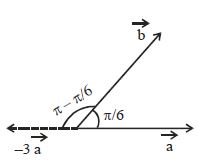
The angle between vectors $\vec a$ and $\vec b$ is $\frac{\pi }{6}$. The angle between vectors $-3\vec a$ and $2\vec b$ is
A
$\frac{\pi }{3}$
B
$\frac{\pi }{2}$
C
$\frac{7\pi }{6}$
D
$\frac{5\pi }{6}$
Solution
(D) The angle between two vectors $\vec A$ and $\vec B$ is defined as the angle between their directions.
Multiplying a vector by a positive scalar does not change its direction.
Multiplying a vector by a negative scalar reverses its direction (i.e.,rotates it by $\pi$ radians or $180^\circ$).
Given the angle between $\vec a$ and $\vec b$ is $\theta = \frac{\pi }{6}$.
The vector $-3\vec a$ is in the opposite direction to $\vec a$.
The vector $2\vec b$ is in the same direction as $\vec b$.
Therefore,the angle between $-3\vec a$ and $2\vec b$ is $\pi - \theta = \pi - \frac{\pi }{6} = \frac{5\pi }{6}$.
Multiplying a vector by a positive scalar does not change its direction.
Multiplying a vector by a negative scalar reverses its direction (i.e.,rotates it by $\pi$ radians or $180^\circ$).
Given the angle between $\vec a$ and $\vec b$ is $\theta = \frac{\pi }{6}$.
The vector $-3\vec a$ is in the opposite direction to $\vec a$.
The vector $2\vec b$ is in the same direction as $\vec b$.
Therefore,the angle between $-3\vec a$ and $2\vec b$ is $\pi - \theta = \pi - \frac{\pi }{6} = \frac{5\pi }{6}$.
0 likes
View Solution83
EasyMCQ
Which of the following statement$(s)$ is/are correct?
A
If the resultant of three forces is zero,then the vectors must be of equal magnitude.
B
If the resultant of four non-zero forces is zero,then the vectors must be coplanar.
C
If the resultant of three non-zero vectors is zero,then the vectors must be coplanar.
D
All of these.
Solution
(C) For three vectors to have a resultant of zero,they must form a closed triangle. $A$ triangle is a planar figure,so the vectors must be coplanar. This makes statement $(C)$ correct.
Statement $(A)$ is incorrect because three vectors of different magnitudes can also sum to zero (e.g.,sides of a $3-4-5$ triangle).
Statement $(B)$ is incorrect because four non-zero forces can sum to zero in three dimensions (e.g.,the four vectors pointing from the center of a regular tetrahedron to its vertices).
Therefore,only statement $(C)$ is correct.
Statement $(A)$ is incorrect because three vectors of different magnitudes can also sum to zero (e.g.,sides of a $3-4-5$ triangle).
Statement $(B)$ is incorrect because four non-zero forces can sum to zero in three dimensions (e.g.,the four vectors pointing from the center of a regular tetrahedron to its vertices).
Therefore,only statement $(C)$ is correct.
0 likes
View Solution84
MediumMCQ
Find the angle between $\vec{A} = 3\hat{i} - \hat{j} + 4\hat{k}$ and the $Z$-axis.
A
$\tan^{-1}\left(\frac{\sqrt{22}}{4}\right)$
B
$\tan^{-1}\left(\frac{\sqrt{10}}{4}\right)$
C
$\sin^{-1}\left(\frac{\sqrt{10}}{4}\right)$
D
$\sin^{-1}\left(\frac{4}{\sqrt{26}}\right)$
Solution
(B) The unit vector along the $Z$-axis is $\hat{k} = 0\hat{i} + 0\hat{j} + 1\hat{k}$.
Let $\theta$ be the angle between $\vec{A}$ and the $Z$-axis.
The dot product formula is $\vec{A} \cdot \hat{k} = |\vec{A}| |\hat{k}| \cos \theta$.
Calculating the dot product: $\vec{A} \cdot \hat{k} = (3)(0) + (-1)(0) + (4)(1) = 4$.
The magnitude of $\vec{A}$ is $|\vec{A}| = \sqrt{3^2 + (-1)^2 + 4^2} = \sqrt{9 + 1 + 16} = \sqrt{26}$.
The magnitude of $\hat{k}$ is $1$.
Thus,$\cos \theta = \frac{4}{\sqrt{26} \times 1} = \frac{4}{\sqrt{26}}$.
Using the identity $\sin^2 \theta + \cos^2 \theta = 1$,we find $\sin \theta = \sqrt{1 - \left(\frac{4}{\sqrt{26}}\right)^2} = \sqrt{1 - \frac{16}{26}} = \sqrt{\frac{10}{26}} = \frac{\sqrt{10}}{\sqrt{26}}$.
Therefore,$\tan \theta = \frac{\sin \theta}{\cos \theta} = \frac{\sqrt{10}/\sqrt{26}}{4/\sqrt{26}} = \frac{\sqrt{10}}{4}$.
Hence,$\theta = \tan^{-1}\left(\frac{\sqrt{10}}{4}\right)$.
Let $\theta$ be the angle between $\vec{A}$ and the $Z$-axis.
The dot product formula is $\vec{A} \cdot \hat{k} = |\vec{A}| |\hat{k}| \cos \theta$.
Calculating the dot product: $\vec{A} \cdot \hat{k} = (3)(0) + (-1)(0) + (4)(1) = 4$.
The magnitude of $\vec{A}$ is $|\vec{A}| = \sqrt{3^2 + (-1)^2 + 4^2} = \sqrt{9 + 1 + 16} = \sqrt{26}$.
The magnitude of $\hat{k}$ is $1$.
Thus,$\cos \theta = \frac{4}{\sqrt{26} \times 1} = \frac{4}{\sqrt{26}}$.
Using the identity $\sin^2 \theta + \cos^2 \theta = 1$,we find $\sin \theta = \sqrt{1 - \left(\frac{4}{\sqrt{26}}\right)^2} = \sqrt{1 - \frac{16}{26}} = \sqrt{\frac{10}{26}} = \frac{\sqrt{10}}{\sqrt{26}}$.
Therefore,$\tan \theta = \frac{\sin \theta}{\cos \theta} = \frac{\sqrt{10}/\sqrt{26}}{4/\sqrt{26}} = \frac{\sqrt{10}}{4}$.
Hence,$\theta = \tan^{-1}\left(\frac{\sqrt{10}}{4}\right)$.
0 likes
View Solution85
MediumMCQ
$A$ particle is moving with speed $6 \, m/s$ along the direction of $\vec{A} = 2\hat{i} + 2\hat{j} - \hat{k}$. What is its velocity vector?
A
$(4\hat{i} + 2\hat{j} - 4\hat{k}) \, m/s$
B
$(4\hat{i} + 4\hat{j} - 2\hat{k}) \, m/s$
C
$(4\hat{i} + 4\hat{j} - 4\hat{k}) \, m/s$
D
$(2\hat{i} + 4\hat{j} - 2\hat{k}) \, m/s$
Solution
(B) The velocity vector $\vec{v}$ is given by the product of its speed and the unit vector in the direction of motion.
First,find the unit vector $\hat{A}$ in the direction of $\vec{A} = 2\hat{i} + 2\hat{j} - \hat{k}$:
$|\vec{A}| = \sqrt{2^2 + 2^2 + (-1)^2} = \sqrt{4 + 4 + 1} = \sqrt{9} = 3$.
Thus,$\hat{A} = \frac{\vec{A}}{|\vec{A}|} = \frac{2\hat{i} + 2\hat{j} - \hat{k}}{3}$.
The velocity vector is $\vec{v} = |\vec{v}| \hat{A} = 6 \left( \frac{2\hat{i} + 2\hat{j} - \hat{k}}{3} \right)$.
Simplifying the expression:
$\vec{v} = 2(2\hat{i} + 2\hat{j} - \hat{k}) = 4\hat{i} + 4\hat{j} - 2\hat{k} \, m/s$.
First,find the unit vector $\hat{A}$ in the direction of $\vec{A} = 2\hat{i} + 2\hat{j} - \hat{k}$:
$|\vec{A}| = \sqrt{2^2 + 2^2 + (-1)^2} = \sqrt{4 + 4 + 1} = \sqrt{9} = 3$.
Thus,$\hat{A} = \frac{\vec{A}}{|\vec{A}|} = \frac{2\hat{i} + 2\hat{j} - \hat{k}}{3}$.
The velocity vector is $\vec{v} = |\vec{v}| \hat{A} = 6 \left( \frac{2\hat{i} + 2\hat{j} - \hat{k}}{3} \right)$.
Simplifying the expression:
$\vec{v} = 2(2\hat{i} + 2\hat{j} - \hat{k}) = 4\hat{i} + 4\hat{j} - 2\hat{k} \, m/s$.
0 likes
View Solution86
EasyMCQ
The resultant of $\vec{A}$ and $\vec{B}$ makes an angle $\alpha$ with $\vec{A}$ and $\beta$ with $\vec{B}$. Which of the following is correct?
A
$\alpha < \beta$
B
$\alpha < \beta$ if $A < B$
C
$\alpha < \beta$ if $A > B$
D
$\alpha < \beta$ if $A = B$
Solution
(C) Let the resultant vector be $\vec{R} = \vec{A} + \vec{B}$.
From the triangle law of vector addition,the angle $\alpha$ between $\vec{R}$ and $\vec{A}$ is given by $\tan \alpha = \frac{B \sin \theta}{A + B \cos \theta}$,where $\theta$ is the angle between $\vec{A}$ and $\vec{B}$.
Similarly,the angle $\beta$ between $\vec{R}$ and $\vec{B}$ is given by $\tan \beta = \frac{A \sin \theta}{B + A \cos \theta}$.
Geometrically,the resultant vector $\vec{R}$ is always closer to the vector with the larger magnitude.
If $A > B$,then the resultant $\vec{R}$ will be closer to $\vec{A}$,which means the angle $\alpha$ will be smaller than the angle $\beta$ (i.e.,$\alpha < \beta$).
Conversely,if $A < B$,then $\alpha > \beta$.
Therefore,$\alpha < \beta$ if $A > B$.
From the triangle law of vector addition,the angle $\alpha$ between $\vec{R}$ and $\vec{A}$ is given by $\tan \alpha = \frac{B \sin \theta}{A + B \cos \theta}$,where $\theta$ is the angle between $\vec{A}$ and $\vec{B}$.
Similarly,the angle $\beta$ between $\vec{R}$ and $\vec{B}$ is given by $\tan \beta = \frac{A \sin \theta}{B + A \cos \theta}$.
Geometrically,the resultant vector $\vec{R}$ is always closer to the vector with the larger magnitude.
If $A > B$,then the resultant $\vec{R}$ will be closer to $\vec{A}$,which means the angle $\alpha$ will be smaller than the angle $\beta$ (i.e.,$\alpha < \beta$).
Conversely,if $A < B$,then $\alpha > \beta$.
Therefore,$\alpha < \beta$ if $A > B$.
0 likes
View Solution87
MediumMCQ
For the components of a vector $\vec{A} = (3 \hat{i} + 4 \hat{j} - 5 \hat{k})$,match the following columns.
| Column $I$ | Column $II$ |
|---|---|
| $(A)$ Component along $x$-axis | $(p)$ $5 \text{ unit}$ |
| $(B)$ Component along vector $(2 \hat{i} + \hat{j} + 2 \hat{k})$ | $(q)$ $4 \text{ unit}$ |
| $(C)$ Component along $(6 \hat{i} + 8 \hat{j} - 10 \hat{k})$ | $(r)$ $0$ |
| $(D)$ Component along $(-3 \hat{i} - 4 \hat{j} + 5 \hat{k})$ | $(s)$ None |
A
$(A \rightarrow q, B \rightarrow r, C \rightarrow s, D \rightarrow s)$
B
$(A \rightarrow p, B \rightarrow r, C \rightarrow s, D \rightarrow s)$
C
$(A \rightarrow r, B \rightarrow q, C \rightarrow s, D \rightarrow s)$
D
$(A \rightarrow q, B \rightarrow r, C \rightarrow s, D \rightarrow p)$
Solution
(A) The component of a vector $\vec{A}$ along a direction defined by unit vector $\hat{n}$ is given by $\vec{A} \cdot \hat{n}$.
$(A)$ Component along $x$-axis: $\vec{A} \cdot \hat{i} = (3 \hat{i} + 4 \hat{j} - 5 \hat{k}) \cdot \hat{i} = 3$. This is not in the options,so $(A \rightarrow s)$.
$(B)$ Component along $\vec{B} = (2 \hat{i} + \hat{j} + 2 \hat{k})$: $\vec{A} \cdot \frac{\vec{B}}{|B|} = \frac{(3)(2) + (4)(1) + (-5)(2)}{\sqrt{2^2 + 1^2 + 2^2}} = \frac{6 + 4 - 10}{3} = 0$. Thus,$(B \rightarrow r)$.
$(C)$ Component along $\vec{C} = (6 \hat{i} + 8 \hat{j} - 10 \hat{k}) = 2\vec{A}$. Since it is parallel,the component is the magnitude $|\vec{A}| = \sqrt{3^2 + 4^2 + (-5)^2} = \sqrt{50} = 5\sqrt{2}$. This is not in the options,so $(C \rightarrow s)$.
$(D)$ Component along $\vec{D} = (-3 \hat{i} - 4 \hat{j} + 5 \hat{k}) = -\vec{A}$. Since it is anti-parallel,the component is $-|\vec{A}| = -5\sqrt{2}$. This is not in the options,so $(D \rightarrow s)$.
Therefore,the correct matching is $(A \rightarrow s, B \rightarrow r, C \rightarrow s, D \rightarrow s)$.
$(A)$ Component along $x$-axis: $\vec{A} \cdot \hat{i} = (3 \hat{i} + 4 \hat{j} - 5 \hat{k}) \cdot \hat{i} = 3$. This is not in the options,so $(A \rightarrow s)$.
$(B)$ Component along $\vec{B} = (2 \hat{i} + \hat{j} + 2 \hat{k})$: $\vec{A} \cdot \frac{\vec{B}}{|B|} = \frac{(3)(2) + (4)(1) + (-5)(2)}{\sqrt{2^2 + 1^2 + 2^2}} = \frac{6 + 4 - 10}{3} = 0$. Thus,$(B \rightarrow r)$.
$(C)$ Component along $\vec{C} = (6 \hat{i} + 8 \hat{j} - 10 \hat{k}) = 2\vec{A}$. Since it is parallel,the component is the magnitude $|\vec{A}| = \sqrt{3^2 + 4^2 + (-5)^2} = \sqrt{50} = 5\sqrt{2}$. This is not in the options,so $(C \rightarrow s)$.
$(D)$ Component along $\vec{D} = (-3 \hat{i} - 4 \hat{j} + 5 \hat{k}) = -\vec{A}$. Since it is anti-parallel,the component is $-|\vec{A}| = -5\sqrt{2}$. This is not in the options,so $(D \rightarrow s)$.
Therefore,the correct matching is $(A \rightarrow s, B \rightarrow r, C \rightarrow s, D \rightarrow s)$.
0 likes
View Solution88
MediumMCQ
The component of vector $\vec{A} = 2\hat{i} + 3\hat{j}$ along the vector $\vec{B} = \hat{i} + \hat{j}$ is:
A
$\frac{5}{\sqrt{2}}$
B
$10\sqrt{2}$
C
$5\sqrt{2}$
D
$5$
Solution
(A) The component of a vector $\vec{A}$ along the direction of a vector $\vec{B}$ is given by the scalar projection multiplied by the unit vector of $\vec{B}$,or simply the scalar projection if only the magnitude is asked. The question asks for the component (magnitude) of $\vec{A}$ along $\vec{B}$.
Given $\vec{A} = 2\hat{i} + 3\hat{j}$ and $\vec{B} = \hat{i} + \hat{j}$.
The scalar projection of $\vec{A}$ along $\vec{B}$ is given by $\frac{\vec{A} \cdot \vec{B}}{|\vec{B}|}$.
Calculate the dot product: $\vec{A} \cdot \vec{B} = (2)(1) + (3)(1) = 2 + 3 = 5$.
Calculate the magnitude of $\vec{B}$: $|\vec{B}| = \sqrt{1^2 + 1^2} = \sqrt{2}$.
Therefore,the component of $\vec{A}$ along $\vec{B}$ is $\frac{5}{\sqrt{2}}$.
Given $\vec{A} = 2\hat{i} + 3\hat{j}$ and $\vec{B} = \hat{i} + \hat{j}$.
The scalar projection of $\vec{A}$ along $\vec{B}$ is given by $\frac{\vec{A} \cdot \vec{B}}{|\vec{B}|}$.
Calculate the dot product: $\vec{A} \cdot \vec{B} = (2)(1) + (3)(1) = 2 + 3 = 5$.
Calculate the magnitude of $\vec{B}$: $|\vec{B}| = \sqrt{1^2 + 1^2} = \sqrt{2}$.
Therefore,the component of $\vec{A}$ along $\vec{B}$ is $\frac{5}{\sqrt{2}}$.
0 likes
View Solution89
MediumMCQ
If $\vec{A}$ and $\vec{B}$ are two non-zero vectors such that $|\vec{A} + \vec{B}| = \frac{|\vec{A} - \vec{B}|}{2}$ and $|\vec{A}| = 2|\vec{B}|$,then the angle between $\vec{A}$ and $\vec{B}$ is
A
$37^\circ$
B
$53^\circ$
C
$\cos^{-1}(-3/4)$
D
$\cos^{-1}(-4/3)$
Solution
(C) Given: $|\vec{A} + \vec{B}| = \frac{1}{2} |\vec{A} - \vec{B}|$ and $|\vec{A}| = 2|\vec{B}|$.
Squaring both sides of the first equation:
$|\vec{A} + \vec{B}|^2 = \frac{1}{4} |\vec{A} - \vec{B}|^2$
$A^2 + B^2 + 2AB \cos \theta = \frac{1}{4} (A^2 + B^2 - 2AB \cos \theta)$
$4(A^2 + B^2 + 2AB \cos \theta) = A^2 + B^2 - 2AB \cos \theta$
$4A^2 + 4B^2 + 8AB \cos \theta = A^2 + B^2 - 2AB \cos \theta$
$3A^2 + 3B^2 + 10AB \cos \theta = 0$
Substitute $A = 2B$ into the equation:
$3(2B)^2 + 3B^2 + 10(2B)(B) \cos \theta = 0$
$3(4B^2) + 3B^2 + 20B^2 \cos \theta = 0$
$12B^2 + 3B^2 + 20B^2 \cos \theta = 0$
$15B^2 + 20B^2 \cos \theta = 0$
$20B^2 \cos \theta = -15B^2$
$\cos \theta = -\frac{15}{20} = -\frac{3}{4}$
$\theta = \cos^{-1}\left(-\frac{3}{4}\right)$
Squaring both sides of the first equation:
$|\vec{A} + \vec{B}|^2 = \frac{1}{4} |\vec{A} - \vec{B}|^2$
$A^2 + B^2 + 2AB \cos \theta = \frac{1}{4} (A^2 + B^2 - 2AB \cos \theta)$
$4(A^2 + B^2 + 2AB \cos \theta) = A^2 + B^2 - 2AB \cos \theta$
$4A^2 + 4B^2 + 8AB \cos \theta = A^2 + B^2 - 2AB \cos \theta$
$3A^2 + 3B^2 + 10AB \cos \theta = 0$
Substitute $A = 2B$ into the equation:
$3(2B)^2 + 3B^2 + 10(2B)(B) \cos \theta = 0$
$3(4B^2) + 3B^2 + 20B^2 \cos \theta = 0$
$12B^2 + 3B^2 + 20B^2 \cos \theta = 0$
$15B^2 + 20B^2 \cos \theta = 0$
$20B^2 \cos \theta = -15B^2$
$\cos \theta = -\frac{15}{20} = -\frac{3}{4}$
$\theta = \cos^{-1}\left(-\frac{3}{4}\right)$
0 likes
View Solution90
MediumMCQ
$A$ vector has a magnitude $x$. If it is rotated by an angle $\theta$, then the magnitude of the change in the vector is $nx$. Match the following two columns:
| Column $I$ | Column $II$ |
| $(A)$ $\theta=60^{\circ}$ | $(p)$ $n=\sqrt{3}$ |
| $(B)$ $\theta=90^{\circ}$ | $(q)$ $n=1$ |
| $(C)$ $\theta=120^{\circ}$ | $(r)$ $n=\sqrt{2}$ |
| $(D)$ $\theta=180^{\circ}$ | $(s)$ $n=2$ |
A
$(A \rightarrow q, B \rightarrow r, C \rightarrow p, D \rightarrow s)$
B
$(A \rightarrow s, B \rightarrow r, C \rightarrow p, D \rightarrow q)$
C
$(A \rightarrow q, B \rightarrow p, C \rightarrow r, D \rightarrow s)$
D
$(A \rightarrow p, B \rightarrow r, C \rightarrow q, D \rightarrow s)$
Solution
(A) The magnitude of the change in a vector $\vec{A}$ of magnitude $x$ when rotated by an angle $\theta$ is given by $|\Delta \vec{A}| = |\vec{A}' - \vec{A}| = 2x \sin(\theta/2)$.
Given $|\Delta \vec{A}| = nx$, we have $nx = 2x \sin(\theta/2)$, which implies $n = 2 \sin(\theta/2)$.
For $(A)$ $\theta=60^{\circ}$: $n = 2 \sin(30^{\circ}) = 2(1/2) = 1$. Thus, $(A \rightarrow q)$.
For $(B)$ $\theta=90^{\circ}$: $n = 2 \sin(45^{\circ}) = 2(1/\sqrt{2}) = \sqrt{2}$. Thus, $(B \rightarrow r)$.
For $(C)$ $\theta=120^{\circ}$: $n = 2 \sin(60^{\circ}) = 2(\sqrt{3}/2) = \sqrt{3}$. Thus, $(C \rightarrow p)$.
For $(D)$ $\theta=180^{\circ}$: $n = 2 \sin(90^{\circ}) = 2(1) = 2$. Thus, $(D \rightarrow s)$.
Therefore, the correct matching is $(A \rightarrow q, B \rightarrow r, C \rightarrow p, D \rightarrow s)$.
Given $|\Delta \vec{A}| = nx$, we have $nx = 2x \sin(\theta/2)$, which implies $n = 2 \sin(\theta/2)$.
For $(A)$ $\theta=60^{\circ}$: $n = 2 \sin(30^{\circ}) = 2(1/2) = 1$. Thus, $(A \rightarrow q)$.
For $(B)$ $\theta=90^{\circ}$: $n = 2 \sin(45^{\circ}) = 2(1/\sqrt{2}) = \sqrt{2}$. Thus, $(B \rightarrow r)$.
For $(C)$ $\theta=120^{\circ}$: $n = 2 \sin(60^{\circ}) = 2(\sqrt{3}/2) = \sqrt{3}$. Thus, $(C \rightarrow p)$.
For $(D)$ $\theta=180^{\circ}$: $n = 2 \sin(90^{\circ}) = 2(1) = 2$. Thus, $(D \rightarrow s)$.
Therefore, the correct matching is $(A \rightarrow q, B \rightarrow r, C \rightarrow p, D \rightarrow s)$.
0 likes
View Solution91
Medium
State with reasons,whether the following algebraic operations with scalar and vector physical quantities are meaningful:
$(a)$ adding any two scalars,
$(b)$ adding a scalar to a vector of the same dimensions,
$(c)$ multiplying any vector by any scalar,
$(d)$ multiplying any two scalars,
$(e)$ adding any two vectors,
$(f)$ adding a component of a vector to the same vector.
$(a)$ adding any two scalars,
$(b)$ adding a scalar to a vector of the same dimensions,
$(c)$ multiplying any vector by any scalar,
$(d)$ multiplying any two scalars,
$(e)$ adding any two vectors,
$(f)$ adding a component of a vector to the same vector.
Solution
(N/A) Meaningful: The addition of two scalar quantities is meaningful only if they both represent the same physical quantity.
$(b)$ Not Meaningful: The addition of a vector quantity with a scalar quantity is not meaningful because they represent different types of physical entities.
$(c)$ Meaningful: $A$ scalar can be multiplied with a vector. For example,force is multiplied with time to give impulse $(I = F \cdot \Delta t)$.
$(d)$ Meaningful: $A$ scalar,irrespective of the physical quantity it represents,can be multiplied with another scalar having the same or different dimensions.
$(e)$ Meaningful: The addition of two vector quantities is meaningful only if they both represent the same physical quantity.
$(f)$ Meaningful: $A$ component of a vector can be added to the same vector as they both have the same dimensions and represent the same physical quantity.
$(b)$ Not Meaningful: The addition of a vector quantity with a scalar quantity is not meaningful because they represent different types of physical entities.
$(c)$ Meaningful: $A$ scalar can be multiplied with a vector. For example,force is multiplied with time to give impulse $(I = F \cdot \Delta t)$.
$(d)$ Meaningful: $A$ scalar,irrespective of the physical quantity it represents,can be multiplied with another scalar having the same or different dimensions.
$(e)$ Meaningful: The addition of two vector quantities is meaningful only if they both represent the same physical quantity.
$(f)$ Meaningful: $A$ component of a vector can be added to the same vector as they both have the same dimensions and represent the same physical quantity.
0 likes
View Solution92
Medium
Read each statement below carefully and state with reasons,if it is true or false:
$(a)$ The magnitude of a vector is always a scalar.
$(b)$ Each component of a vector is always a scalar.
$(c)$ The total path length is always equal to the magnitude of the displacement vector of a particle.
$(d)$ The average speed of a particle (defined as total path length divided by the time taken to cover the path) is either greater or equal to the magnitude of average velocity of the particle over the same interval of time.
$(e)$ Three vectors not lying in a plane can never add up to give a null vector.
$(a)$ The magnitude of a vector is always a scalar.
$(b)$ Each component of a vector is always a scalar.
$(c)$ The total path length is always equal to the magnitude of the displacement vector of a particle.
$(d)$ The average speed of a particle (defined as total path length divided by the time taken to cover the path) is either greater or equal to the magnitude of average velocity of the particle over the same interval of time.
$(e)$ Three vectors not lying in a plane can never add up to give a null vector.
Solution
(A) True: The magnitude of a vector is a real number representing its length. Hence,it is a scalar.
$(b)$ False: Each component of a vector is a vector quantity directed along the coordinate axes.
$(c)$ False: Total path length is the actual distance traveled,which is a scalar,while the magnitude of displacement is the shortest distance between the initial and final positions. Total path length is greater than or equal to the magnitude of displacement.
$(d)$ True: Since total path length is always greater than or equal to the magnitude of displacement,dividing both by the same time interval leads to the average speed being greater than or equal to the magnitude of average velocity.
$(e)$ True: Three vectors not lying in a plane cannot form a closed triangle,which is a necessary condition for their sum to be a null vector.
$(b)$ False: Each component of a vector is a vector quantity directed along the coordinate axes.
$(c)$ False: Total path length is the actual distance traveled,which is a scalar,while the magnitude of displacement is the shortest distance between the initial and final positions. Total path length is greater than or equal to the magnitude of displacement.
$(d)$ True: Since total path length is always greater than or equal to the magnitude of displacement,dividing both by the same time interval leads to the average speed being greater than or equal to the magnitude of average velocity.
$(e)$ True: Three vectors not lying in a plane cannot form a closed triangle,which is a necessary condition for their sum to be a null vector.
0 likes
View Solution93
Medium
Establish the following vector inequalities geometrically or otherwise:
$(a) \quad |\vec{a} + \vec{b}| \leq |\vec{a}| + |\vec{b}|$
$(b) \quad |\vec{a} + \vec{b}| \geq ||\vec{a}| - |\vec{b}||$
$(c) \quad |\vec{a} - \vec{b}| \leq |\vec{a}| + |\vec{b}|$
$(d) \quad |\vec{a} - \vec{b}| \geq ||\vec{a}| - |\vec{b}||$
When does the equality sign apply in each case?
$(a) \quad |\vec{a} + \vec{b}| \leq |\vec{a}| + |\vec{b}|$
$(b) \quad |\vec{a} + \vec{b}| \geq ||\vec{a}| - |\vec{b}||$
$(c) \quad |\vec{a} - \vec{b}| \leq |\vec{a}| + |\vec{b}|$
$(d) \quad |\vec{a} - \vec{b}| \geq ||\vec{a}| - |\vec{b}||$
When does the equality sign apply in each case?
Solution
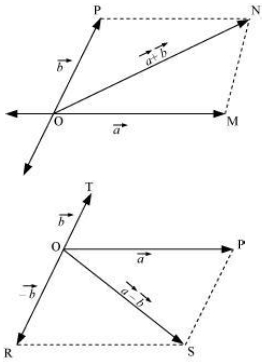
(N/A) Let two vectors $\vec{a}$ and $\vec{b}$ be represented by the adjacent sides of a parallelogram $OMNP$. In $\Delta OMN$,the side $ON$ represents $\vec{a} + \vec{b}$. By the triangle inequality,the length of any side is less than or equal to the sum of the lengths of the other two sides: $|\vec{a} + \vec{b}| \leq |\vec{a}| + |\vec{b}|$. Equality holds when $\vec{a}$ and $\vec{b}$ are in the same direction.
$(b)$ In $\Delta OMN$,the difference of two sides is less than or equal to the third side: $|\vec{a} + \vec{b}| \geq ||\vec{a}| - |\vec{b}||$. Equality holds when $\vec{a}$ and $\vec{b}$ are in the same direction.
$(c)$ Similarly,for the vector difference $\vec{a} - \vec{b}$,using the triangle formed by $\vec{a}$ and $-\vec{b}$,we get $|\vec{a} - \vec{b}| \leq |\vec{a}| + |-\vec{b}| = |\vec{a}| + |\vec{b}|$. Equality holds when $\vec{a}$ and $\vec{b}$ are in opposite directions.
$(d)$ Using the triangle inequality for the difference,we have $|\vec{a} - \vec{b}| \geq ||\vec{a}| - |\vec{b}||$. Equality holds when $\vec{a}$ and $\vec{b}$ are in opposite directions.
$(b)$ In $\Delta OMN$,the difference of two sides is less than or equal to the third side: $|\vec{a} + \vec{b}| \geq ||\vec{a}| - |\vec{b}||$. Equality holds when $\vec{a}$ and $\vec{b}$ are in the same direction.
$(c)$ Similarly,for the vector difference $\vec{a} - \vec{b}$,using the triangle formed by $\vec{a}$ and $-\vec{b}$,we get $|\vec{a} - \vec{b}| \leq |\vec{a}| + |-\vec{b}| = |\vec{a}| + |\vec{b}|$. Equality holds when $\vec{a}$ and $\vec{b}$ are in opposite directions.
$(d)$ Using the triangle inequality for the difference,we have $|\vec{a} - \vec{b}| \geq ||\vec{a}| - |\vec{b}||$. Equality holds when $\vec{a}$ and $\vec{b}$ are in opposite directions.
0 likes
View Solution94
Medium
Given $a+b+c+d=0,$ which of the following statements are correct:
$(a)$ $a, b, c,$ and $d$ must each be a null vector.
$(b)$ The magnitude of $(a+c)$ equals the magnitude of $(b+d)$.
$(c)$ The magnitude of $a$ can never be greater than the sum of the magnitudes of $b, c,$ and $d$.
$(d)$ $(b+c)$ must lie in the plane of $a$ and $d$ if $a$ and $d$ are not collinear,and in the line of $a$ and $d$ if they are collinear.
$(a)$ $a, b, c,$ and $d$ must each be a null vector.
$(b)$ The magnitude of $(a+c)$ equals the magnitude of $(b+d)$.
$(c)$ The magnitude of $a$ can never be greater than the sum of the magnitudes of $b, c,$ and $d$.
$(d)$ $(b+c)$ must lie in the plane of $a$ and $d$ if $a$ and $d$ are not collinear,and in the line of $a$ and $d$ if they are collinear.
Solution
(B, C, D) Incorrect: To satisfy $a+b+c+d=0,$ it is not necessary for all four vectors to be null vectors. Many other combinations can result in a zero sum.
$(b)$ Correct: Given $a+b+c+d=0,$ we can write $a+c = -(b+d).$ Taking the magnitude on both sides,$|a+c| = |-(b+d)| = |b+d|.$ Thus,the magnitude of $(a+c)$ equals the magnitude of $(b+d).$
$(c)$ Correct: From $a+b+c+d=0,$ we have $a = -(b+c+d).$ Taking the magnitude on both sides,$|a| = |-(b+c+d)| = |b+c+d|.$ By the triangle inequality,$|b+c+d| \leq |b| + |c| + |d|.$ Therefore,$|a| \leq |b| + |c| + |d|,$ meaning the magnitude of $a$ can never be greater than the sum of the magnitudes of $b, c,$ and $d.$
$(d)$ Correct: For $a+b+c+d=0,$ we can write $(b+c) = -(a+d).$ This implies that the vector $(b+c)$ is equal and opposite to the resultant of $a$ and $d.$ If $a$ and $d$ are not collinear,they define a plane,and $(b+c)$ must lie in that plane. If $a$ and $d$ are collinear,$(b+c)$ must lie along the same line to satisfy the equilibrium condition.
$(b)$ Correct: Given $a+b+c+d=0,$ we can write $a+c = -(b+d).$ Taking the magnitude on both sides,$|a+c| = |-(b+d)| = |b+d|.$ Thus,the magnitude of $(a+c)$ equals the magnitude of $(b+d).$
$(c)$ Correct: From $a+b+c+d=0,$ we have $a = -(b+c+d).$ Taking the magnitude on both sides,$|a| = |-(b+c+d)| = |b+c+d|.$ By the triangle inequality,$|b+c+d| \leq |b| + |c| + |d|.$ Therefore,$|a| \leq |b| + |c| + |d|,$ meaning the magnitude of $a$ can never be greater than the sum of the magnitudes of $b, c,$ and $d.$
$(d)$ Correct: For $a+b+c+d=0,$ we can write $(b+c) = -(a+d).$ This implies that the vector $(b+c)$ is equal and opposite to the resultant of $a$ and $d.$ If $a$ and $d$ are not collinear,they define a plane,and $(b+c)$ must lie in that plane. If $a$ and $d$ are collinear,$(b+c)$ must lie along the same line to satisfy the equilibrium condition.
0 likes
View Solution95
Medium
$A$ vector has magnitude and direction. Does it have a location in space? Can it vary with time? Will two equal vectors $a$ and $b$ at different locations in space necessarily have identical physical effects? Give examples in support of your answer.
Solution
(N/A) No; Yes; No.
Generally speaking,a vector does not have a definite location in space. This is because a vector remains invariant when displaced in such a way that its magnitude and direction remain the same. However,a position vector has a definite location in space.
$A$ vector can vary with time. For example,the displacement vector of a particle moving with a certain velocity varies with time.
Two equal vectors located at different locations in space need not produce the same physical effect. For example,two equal forces acting on an object at different points can cause the body to rotate,whereas their combination might produce a different turning effect (torque) depending on the point of application.
Generally speaking,a vector does not have a definite location in space. This is because a vector remains invariant when displaced in such a way that its magnitude and direction remain the same. However,a position vector has a definite location in space.
$A$ vector can vary with time. For example,the displacement vector of a particle moving with a certain velocity varies with time.
Two equal vectors located at different locations in space need not produce the same physical effect. For example,two equal forces acting on an object at different points can cause the body to rotate,whereas their combination might produce a different turning effect (torque) depending on the point of application.
0 likes
View Solution96
Medium
$A$ vector has both magnitude and direction. Does it mean that anything that has magnitude and direction is necessarily a vector? The rotation of a body can be specified by the direction of the axis of rotation,and the angle of rotation about the axis. Does that make any rotation a vector?
Solution
(N/A) No; No.
$A$ physical quantity having both magnitude and direction is not necessarily a vector. For example,electric current has both magnitude and direction but is a scalar quantity because it does not follow the laws of vector addition.
Similarly,the rotation of a body about an axis is specified by the direction of the axis and the angle of rotation. However,finite rotations do not follow the commutative law of vector addition (i.e.,$\vec{A} + \vec{B} \neq \vec{B} + \vec{A}$ for finite rotations). Therefore,finite rotations are not vectors. Only infinitesimal rotations follow the laws of vector addition and are considered vectors.
$A$ physical quantity having both magnitude and direction is not necessarily a vector. For example,electric current has both magnitude and direction but is a scalar quantity because it does not follow the laws of vector addition.
Similarly,the rotation of a body about an axis is specified by the direction of the axis and the angle of rotation. However,finite rotations do not follow the commutative law of vector addition (i.e.,$\vec{A} + \vec{B} \neq \vec{B} + \vec{A}$ for finite rotations). Therefore,finite rotations are not vectors. Only infinitesimal rotations follow the laws of vector addition and are considered vectors.
0 likes
View Solution97
Medium
Can you associate vectors with $(a)$ the length of a wire bent into a loop,$(b)$ a plane area,$(c)$ a sphere? Explain.
Solution
(A) No; Yes; No.
$(a)$ The length of a wire bent into a loop is a scalar quantity. It has magnitude but no specific direction associated with it,so it cannot be represented as a vector.
$(b)$ $A$ plane area can be associated with a vector. The magnitude of the area vector is equal to the area of the plane,and its direction is defined as normal to the surface (either inward or outward).
$(c)$ $A$ sphere is a three-dimensional object defined by its volume,which is a scalar. Therefore,one cannot associate a vector with the volume of a sphere. However,an area vector can be associated with the surface area of a sphere at any specific point,directed radially outward.
$(a)$ The length of a wire bent into a loop is a scalar quantity. It has magnitude but no specific direction associated with it,so it cannot be represented as a vector.
$(b)$ $A$ plane area can be associated with a vector. The magnitude of the area vector is equal to the area of the plane,and its direction is defined as normal to the surface (either inward or outward).
$(c)$ $A$ sphere is a three-dimensional object defined by its volume,which is a scalar. Therefore,one cannot associate a vector with the volume of a sphere. However,an area vector can be associated with the surface area of a sphere at any specific point,directed radially outward.
0 likes
View Solution98
Easy
Define scalar and vector physical quantities with their examples.
Solution
(N/A) Scalar physical quantity: $A$ physical quantity that requires only magnitude to be fully described is called a scalar physical quantity.
Examples: $Mass$, $distance$, $time$, $density$, $temperature$, $power$, etc.
Vector physical quantity: $A$ physical quantity that requires both magnitude and direction to be fully described is called a vector physical quantity.
Examples: $Displacement$, $velocity$, $acceleration$, $force$, etc.
Examples: $Mass$, $distance$, $time$, $density$, $temperature$, $power$, etc.
Vector physical quantity: $A$ physical quantity that requires both magnitude and direction to be fully described is called a vector physical quantity.
Examples: $Displacement$, $velocity$, $acceleration$, $force$, etc.
0 likes
View Solution99
Medium
Distinguish between a vector quantity and a scalar quantity.
Solution
(A)
| Vector Quantities | Scalar Quantities |
|---|---|
| $(1)$ Physical quantities that require both magnitude and direction for their complete specification are called vector quantities. | $(1)$ Physical quantities that can be described by their magnitude only are called scalar quantities. |
| $(2)$ Examples: velocity,acceleration,force,weight,displacement,momentum,etc. | $(2)$ Examples: speed,mass,volume,size,temperature,amount of substance,power,work done,pressure,time,etc. |
| $(3)$ While representing these quantities,both magnitude and direction must be stated. | $(3)$ While representing these quantities,only their magnitude is required,i.e.,the numerical value with units. |
| $(4)$ These quantities cannot be added algebraically; they follow vector addition laws. | $(4)$ These quantities are added or subtracted using simple algebraic rules. |
0 likes
View Solution100
EasyMCQ
How can we represent a vector quantity?
A
By using a scalar symbol.
B
By using a bold letter or an arrow above the symbol.
C
By using only the magnitude.
D
By using a coordinate system only.
Solution
(B) vector quantity is represented by a symbol in boldface (e.g.,$v$ for velocity).
Practically,to represent a vector quantity,an arrow sign is placed above the symbol.
For example,$\vec{v}$ represents velocity,where the arrow indicates the direction of the vector.
Practically,to represent a vector quantity,an arrow sign is placed above the symbol.
For example,$\vec{v}$ represents velocity,where the arrow indicates the direction of the vector.
0 likes
View Solution3-1.Vectors — Fundamentals of Vectors · Frequently Asked Questions
1Are these 3-1.Vectors questions useful for JEE and NEET?
Yes. All questions in this section are mapped to JEE Main and NEET exam patterns. Previous year questions from JEE Main, NEET, GUJCET and state-level exams are included with full solutions.
2Can I switch to Hindi or Gujarati for these questions?
Yes. Use the language tabs in the hero section or the sidebar to view the same questions and solutions in English, Hindi or Gujarati.
3How do I generate a question paper from this subtopic?
Use the Vedclass Exam Paper Generator — select the chapter and subtopic, set difficulty, and generate Sets A, B, C, D automatically. First 3 chapters of every subject are free.
Vedclass Products
For Students
Vedclass Test Series
Mock tests in real JEE/NEET style with performance analysis. 5-day free trial.
Start Free TrialFor Teachers
Exam Paper Generator
Generate Set A/B/C/D papers from this chapter in 2 minutes. 3 chapters free.
Try FreeFor Institutes
Online Exam Module
Live online exams with unlimited students, 360° analytics & white-label branding.
See DemoFor Teachers & Institutes
Generate a 3-1.Vectors Exam Paper in 2 Minutes
Select subtopic & difficulty — Sets A, B, C, D auto-generated with No Repeat logic.
First 3 chapters of every subject are free — no payment required.