
A English
Fundamentals of Vectors Questions in English
Class 11 Physics · 3-1.Vectors · Fundamentals of Vectors
159+
Questions
English
Language
100%
With Solutions
Showing 50 of 159 questions in English
1
EasyMCQ
The vector projection of a vector $3\hat i + 4\hat k$ on the $Y$-axis is
A
$5$
B
$4$
C
$3$
D
$0$
Solution
(D) The vector is given by $\vec{A} = 3\hat{i} + 0\hat{j} + 4\hat{k}$.
To find the projection of a vector $\vec{A}$ on a unit vector $\hat{n}$,we use the dot product $\vec{A} \cdot \hat{n}$.
The $Y$-axis is represented by the unit vector $\hat{j}$.
Therefore,the projection is $(3\hat{i} + 0\hat{j} + 4\hat{k}) \cdot \hat{j} = 3(\hat{i} \cdot \hat{j}) + 0(\hat{j} \cdot \hat{j}) + 4(\hat{k} \cdot \hat{j})$.
Since $\hat{i} \cdot \hat{j} = 0$,$\hat{j} \cdot \hat{j} = 1$,and $\hat{k} \cdot \hat{j} = 0$,the projection is $0 + 0 + 0 = 0$.
To find the projection of a vector $\vec{A}$ on a unit vector $\hat{n}$,we use the dot product $\vec{A} \cdot \hat{n}$.
The $Y$-axis is represented by the unit vector $\hat{j}$.
Therefore,the projection is $(3\hat{i} + 0\hat{j} + 4\hat{k}) \cdot \hat{j} = 3(\hat{i} \cdot \hat{j}) + 0(\hat{j} \cdot \hat{j}) + 4(\hat{k} \cdot \hat{j})$.
Since $\hat{i} \cdot \hat{j} = 0$,$\hat{j} \cdot \hat{j} = 1$,and $\hat{k} \cdot \hat{j} = 0$,the projection is $0 + 0 + 0 = 0$.
1 likes
View Solution2
EasyMCQ
The position of a particle in a rectangular coordinate system is $(3, 2, 5)$. Then its position vector will be
A
$3\hat{i} + 5\hat{j} + 2\hat{k}$
B
$3\hat{i} + 2\hat{j} + 5\hat{k}$
C
$5\hat{i} + 3\hat{j} + 2\hat{k}$
D
None of these
Solution
(B) The position vector $\vec{r}$ of a point $P(x, y, z)$ in a three-dimensional Cartesian coordinate system is given by the formula: $\vec{r} = x\hat{i} + y\hat{j} + z\hat{k}$.
Given the coordinates of the particle are $(3, 2, 5)$,where $x = 3$,$y = 2$,and $z = 5$.
Substituting these values into the formula,we get the position vector: $\vec{r} = 3\hat{i} + 2\hat{j} + 5\hat{k}$.
Therefore,the correct option is $B$.
Given the coordinates of the particle are $(3, 2, 5)$,where $x = 3$,$y = 2$,and $z = 5$.
Substituting these values into the formula,we get the position vector: $\vec{r} = 3\hat{i} + 2\hat{j} + 5\hat{k}$.
Therefore,the correct option is $B$.
0 likes
View Solution3
EasyMCQ
If a particle moves from point $P (2, 3, 5)$ to point $Q (3, 4, 5)$,its displacement vector is:
A
$\hat{i} + \hat{j} + 10\hat{k}$
B
$\hat{i} + \hat{j} + 5\hat{k}$
C
$\hat{i} + \hat{j}$
D
$2\hat{i} + 4\hat{j} + 6\hat{k}$
Solution
(C) The displacement vector $\vec{d}$ is defined as the difference between the final position vector $\vec{r}_Q$ and the initial position vector $\vec{r}_P$.
Given $P = (2, 3, 5)$ and $Q = (3, 4, 5)$.
$\vec{r}_P = 2\hat{i} + 3\hat{j} + 5\hat{k}$
$\vec{r}_Q = 3\hat{i} + 4\hat{j} + 5\hat{k}$
Displacement vector $\vec{d} = \vec{r}_Q - \vec{r}_P = (3 - 2)\hat{i} + (4 - 3)\hat{j} + (5 - 5)\hat{k}$
$\vec{d} = 1\hat{i} + 1\hat{j} + 0\hat{k} = \hat{i} + \hat{j}$.
Given $P = (2, 3, 5)$ and $Q = (3, 4, 5)$.
$\vec{r}_P = 2\hat{i} + 3\hat{j} + 5\hat{k}$
$\vec{r}_Q = 3\hat{i} + 4\hat{j} + 5\hat{k}$
Displacement vector $\vec{d} = \vec{r}_Q - \vec{r}_P = (3 - 2)\hat{i} + (4 - 3)\hat{j} + (5 - 5)\hat{k}$
$\vec{d} = 1\hat{i} + 1\hat{j} + 0\hat{k} = \hat{i} + \hat{j}$.
0 likes
View Solution4
MediumMCQ
If $A = 3\hat i + 4\hat j$ and $B = 7\hat i + 24\hat j,$ the vector having the same magnitude as $B$ and parallel to $A$ is
A
$5\hat i + 20\hat j$
B
$15\hat i + 10\hat j$
C
$20\hat i + 15\hat j$
D
$15\hat i + 20\hat j$
Solution
(D) First,calculate the magnitude of vector $B$:
$|B| = \sqrt{7^2 + 24^2} = \sqrt{49 + 576} = \sqrt{625} = 25$.
Next,find the unit vector in the direction of $A$:
$|A| = \sqrt{3^2 + 4^2} = \sqrt{9 + 16} = 5$.
$\hat A = \frac{A}{|A|} = \frac{3\hat i + 4\hat j}{5}$.
The required vector has the same magnitude as $B$ $(25)$ and is parallel to $A$ (in the direction of $\hat A$):
$\text{Required Vector} = |B| \cdot \hat A = 25 \cdot \left( \frac{3\hat i + 4\hat j}{5} \right) = 5(3\hat i + 4\hat j) = 15\hat i + 20\hat j$.
$|B| = \sqrt{7^2 + 24^2} = \sqrt{49 + 576} = \sqrt{625} = 25$.
Next,find the unit vector in the direction of $A$:
$|A| = \sqrt{3^2 + 4^2} = \sqrt{9 + 16} = 5$.
$\hat A = \frac{A}{|A|} = \frac{3\hat i + 4\hat j}{5}$.
The required vector has the same magnitude as $B$ $(25)$ and is parallel to $A$ (in the direction of $\hat A$):
$\text{Required Vector} = |B| \cdot \hat A = 25 \cdot \left( \frac{3\hat i + 4\hat j}{5} \right) = 5(3\hat i + 4\hat j) = 15\hat i + 20\hat j$.
0 likes
View Solution5
DifficultMCQ
Vector $\overrightarrow{A}$ makes equal angles with $x, y,$ and $z$ axes. The value of its components (in terms of the magnitude of $\overrightarrow{A}$) will be:
A
$\frac{A}{\sqrt{3}}$
B
$\frac{A}{\sqrt{2}}$
C
$\sqrt{3}A$
D
$\frac{\sqrt{3}}{A}$
Solution
(A) Let the components of $\overrightarrow{A}$ make angles $\alpha, \beta,$ and $\gamma$ with the $x, y,$ and $z$ axes respectively.
Given that the vector makes equal angles with all axes,we have $\alpha = \beta = \gamma$.
The direction cosines satisfy the relation $\cos^2 \alpha + \cos^2 \beta + \cos^2 \gamma = 1$.
Substituting $\alpha = \beta = \gamma$,we get $3 \cos^2 \alpha = 1$,which implies $\cos \alpha = \frac{1}{\sqrt{3}}$.
The components of the vector are given by $A_x = A \cos \alpha$,$A_y = A \cos \beta$,and $A_z = A \cos \gamma$.
Therefore,$A_x = A_y = A_z = A \left( \frac{1}{\sqrt{3}} \right) = \frac{A}{\sqrt{3}}$.
Given that the vector makes equal angles with all axes,we have $\alpha = \beta = \gamma$.
The direction cosines satisfy the relation $\cos^2 \alpha + \cos^2 \beta + \cos^2 \gamma = 1$.
Substituting $\alpha = \beta = \gamma$,we get $3 \cos^2 \alpha = 1$,which implies $\cos \alpha = \frac{1}{\sqrt{3}}$.
The components of the vector are given by $A_x = A \cos \alpha$,$A_y = A \cos \beta$,and $A_z = A \cos \gamma$.
Therefore,$A_x = A_y = A_z = A \left( \frac{1}{\sqrt{3}} \right) = \frac{A}{\sqrt{3}}$.
0 likes
View Solution6
MediumMCQ
If $\overrightarrow A = 2\hat i + 4\hat j - 5\hat k$,the direction cosines of the vector $\overrightarrow A$ are:
A
$\frac{2}{\sqrt{45}}, \frac{4}{\sqrt{45}}, \text{and } \frac{-5}{\sqrt{45}}$
B
$\frac{1}{\sqrt{45}}, \frac{2}{\sqrt{45}}, \text{and } \frac{3}{\sqrt{45}}$
C
$\frac{4}{\sqrt{45}}, 0, \text{and } \frac{4}{\sqrt{45}}$
D
$\frac{3}{\sqrt{45}}, \frac{2}{\sqrt{45}}, \text{and } \frac{5}{\sqrt{45}}$
Solution
(A) Given vector $\overrightarrow A = 2\hat i + 4\hat j - 5\hat k$.
First,calculate the magnitude of the vector $\overrightarrow A$:
$|\overrightarrow A| = \sqrt{(2)^2 + (4)^2 + (-5)^2} = \sqrt{4 + 16 + 25} = \sqrt{45}$.
The direction cosines $(l, m, n)$ are given by the ratios of the components to the magnitude:
$l = \cos \alpha = \frac{A_x}{|\overrightarrow A|} = \frac{2}{\sqrt{45}}$
$m = \cos \beta = \frac{A_y}{|\overrightarrow A|} = \frac{4}{\sqrt{45}}$
$n = \cos \gamma = \frac{A_z}{|\overrightarrow A|} = \frac{-5}{\sqrt{45}}$
Thus,the direction cosines are $\frac{2}{\sqrt{45}}, \frac{4}{\sqrt{45}}, \text{and } \frac{-5}{\sqrt{45}}$.
First,calculate the magnitude of the vector $\overrightarrow A$:
$|\overrightarrow A| = \sqrt{(2)^2 + (4)^2 + (-5)^2} = \sqrt{4 + 16 + 25} = \sqrt{45}$.
The direction cosines $(l, m, n)$ are given by the ratios of the components to the magnitude:
$l = \cos \alpha = \frac{A_x}{|\overrightarrow A|} = \frac{2}{\sqrt{45}}$
$m = \cos \beta = \frac{A_y}{|\overrightarrow A|} = \frac{4}{\sqrt{45}}$
$n = \cos \gamma = \frac{A_z}{|\overrightarrow A|} = \frac{-5}{\sqrt{45}}$
Thus,the direction cosines are $\frac{2}{\sqrt{45}}, \frac{4}{\sqrt{45}}, \text{and } \frac{-5}{\sqrt{45}}$.
0 likes
View Solution7
EasyMCQ
The magnitude of a given vector with end points $(4, -4, 0)$ and $(-2, -2, 0)$ is:
A
$6$
B
$5\sqrt{2}$
C
$4$
D
$2\sqrt{10}$
Solution
(D) Let the initial point be $P(4, -4, 0)$ and the terminal point be $Q(-2, -2, 0)$.
The vector $\vec{r}$ is given by $\vec{r} = \vec{Q} - \vec{P}$.
$\vec{r} = (-2 - 4)\hat{i} + (-2 - (-4))\hat{j} + (0 - 0)\hat{k}$.
$\vec{r} = -6\hat{i} + 2\hat{j} + 0\hat{k}$.
The magnitude of the vector is $|\vec{r}| = \sqrt{(-6)^2 + (2)^2 + (0)^2}$.
$|\vec{r}| = \sqrt{36 + 4} = \sqrt{40}$.
$|\vec{r}| = \sqrt{4 \times 10} = 2\sqrt{10}$.
The vector $\vec{r}$ is given by $\vec{r} = \vec{Q} - \vec{P}$.
$\vec{r} = (-2 - 4)\hat{i} + (-2 - (-4))\hat{j} + (0 - 0)\hat{k}$.
$\vec{r} = -6\hat{i} + 2\hat{j} + 0\hat{k}$.
The magnitude of the vector is $|\vec{r}| = \sqrt{(-6)^2 + (2)^2 + (0)^2}$.
$|\vec{r}| = \sqrt{36 + 4} = \sqrt{40}$.
$|\vec{r}| = \sqrt{4 \times 10} = 2\sqrt{10}$.
0 likes
View Solution8
EasyMCQ
The expression $\left( \frac{1}{\sqrt{2}}\hat{i} + \frac{1}{\sqrt{2}}\hat{j} \right)$ is a
A
Unit vector
B
Null vector
C
Vector of magnitude $\sqrt{2}$
D
Scalar
Solution
(A) Let the given vector be $\vec{P} = \frac{1}{\sqrt{2}}\hat{i} + \frac{1}{\sqrt{2}}\hat{j}$.
The magnitude of a vector $\vec{A} = x\hat{i} + y\hat{j}$ is given by $|\vec{A}| = \sqrt{x^2 + y^2}$.
Substituting the values,we get $|\vec{P}| = \sqrt{\left( \frac{1}{\sqrt{2}} \right)^2 + \left( \frac{1}{\sqrt{2}} \right)^2}$.
$|\vec{P}| = \sqrt{\frac{1}{2} + \frac{1}{2}} = \sqrt{1} = 1$.
Since the magnitude of the vector is $1$,it is a unit vector.
The magnitude of a vector $\vec{A} = x\hat{i} + y\hat{j}$ is given by $|\vec{A}| = \sqrt{x^2 + y^2}$.
Substituting the values,we get $|\vec{P}| = \sqrt{\left( \frac{1}{\sqrt{2}} \right)^2 + \left( \frac{1}{\sqrt{2}} \right)^2}$.
$|\vec{P}| = \sqrt{\frac{1}{2} + \frac{1}{2}} = \sqrt{1} = 1$.
Since the magnitude of the vector is $1$,it is a unit vector.
0 likes
View Solution9
EasyMCQ
The unit vector along $\hat{i} + \hat{j}$ is
A
$\hat{k}$
B
$\hat{i} + \hat{j}$
C
$\frac{\hat{i} + \hat{j}}{\sqrt{2}}$
D
$\frac{\hat{i} + \hat{j}}{2}$
Solution
(C) unit vector $\hat{u}$ in the direction of a vector $\vec{A}$ is given by the formula $\hat{u} = \frac{\vec{A}}{|\vec{A}|}$.
Given the vector $\vec{A} = \hat{i} + \hat{j}$.
The magnitude of the vector is $|\vec{A}| = \sqrt{(1)^2 + (1)^2} = \sqrt{1 + 1} = \sqrt{2}$.
Therefore,the unit vector is $\hat{u} = \frac{\hat{i} + \hat{j}}{\sqrt{2}}$.
Given the vector $\vec{A} = \hat{i} + \hat{j}$.
The magnitude of the vector is $|\vec{A}| = \sqrt{(1)^2 + (1)^2} = \sqrt{1 + 1} = \sqrt{2}$.
Therefore,the unit vector is $\hat{u} = \frac{\hat{i} + \hat{j}}{\sqrt{2}}$.
0 likes
View Solution10
EasyMCQ
Which of the following is a vector quantity?
A
Pressure
B
Surface tension
C
Moment of inertia
D
None of these
Solution
(D) vector quantity is a physical quantity that has both magnitude and direction,and follows the laws of vector addition.
Pressure is defined as force per unit area. Although force is a vector,pressure is a scalar quantity because it acts equally in all directions at a point in a fluid.
Surface tension is defined as force per unit length,but it is a scalar quantity.
Moment of inertia is a tensor quantity (specifically a second-rank tensor) that describes the resistance of an object to rotational motion.
Since none of the given options are vector quantities,the correct answer is $D$.
Pressure is defined as force per unit area. Although force is a vector,pressure is a scalar quantity because it acts equally in all directions at a point in a fluid.
Surface tension is defined as force per unit length,but it is a scalar quantity.
Moment of inertia is a tensor quantity (specifically a second-rank tensor) that describes the resistance of an object to rotational motion.
Since none of the given options are vector quantities,the correct answer is $D$.
0 likes
View Solution11
EasyMCQ
If $\vec P = \vec Q$,then which of the following is $NOT$ correct?
A
$\hat P = \hat Q$
B
$|\vec P| = |\vec Q|$
C
$P\hat Q = Q\hat P$
D
$\vec P + \vec Q = \hat P + \hat Q$
Solution
(D) Given $\vec P = \vec Q$.
$A$. $\hat P = \hat Q$: Since the vectors are equal,they have the same direction,so their unit vectors are equal. This is correct.
$B$. $|\vec P| = |\vec Q|$: Equal vectors must have the same magnitude. This is correct.
$C$. $P\hat Q = Q\hat P$: Since $\vec P = \vec Q$,we have $P = Q$ and $\hat P = \hat Q$. Thus,$P\hat Q = Q\hat P$ is equivalent to $\vec P = \vec Q$. This is correct.
$D$. $\vec P + \vec Q = \hat P + \hat Q$: The left side is a vector of magnitude $2P$,while the right side is a vector of magnitude $2$ (since the sum of two unit vectors has a magnitude between $0$ and $2$). These are generally not equal unless $P = 1$. Therefore,this is $NOT$ correct.
$A$. $\hat P = \hat Q$: Since the vectors are equal,they have the same direction,so their unit vectors are equal. This is correct.
$B$. $|\vec P| = |\vec Q|$: Equal vectors must have the same magnitude. This is correct.
$C$. $P\hat Q = Q\hat P$: Since $\vec P = \vec Q$,we have $P = Q$ and $\hat P = \hat Q$. Thus,$P\hat Q = Q\hat P$ is equivalent to $\vec P = \vec Q$. This is correct.
$D$. $\vec P + \vec Q = \hat P + \hat Q$: The left side is a vector of magnitude $2P$,while the right side is a vector of magnitude $2$ (since the sum of two unit vectors has a magnitude between $0$ and $2$). These are generally not equal unless $P = 1$. Therefore,this is $NOT$ correct.
0 likes
View Solution12
MediumMCQ
If a unit vector is represented by $0.5\hat i + 0.8\hat j + c\hat k$,then the value of $c$ is
A
$1$
B
$\sqrt{0.11}$
C
$\sqrt{0.01}$
D
$\sqrt{0.39}$
Solution
(B) unit vector has a magnitude of $1$.
Given vector $\vec{A} = 0.5\hat i + 0.8\hat j + c\hat k$.
The magnitude is given by $|\vec{A}| = \sqrt{(0.5)^2 + (0.8)^2 + c^2} = 1$.
Squaring both sides,we get $(0.5)^2 + (0.8)^2 + c^2 = 1^2$.
$0.25 + 0.64 + c^2 = 1$.
$0.89 + c^2 = 1$.
$c^2 = 1 - 0.89 = 0.11$.
Therefore,$c = \sqrt{0.11}$.
Given vector $\vec{A} = 0.5\hat i + 0.8\hat j + c\hat k$.
The magnitude is given by $|\vec{A}| = \sqrt{(0.5)^2 + (0.8)^2 + c^2} = 1$.
Squaring both sides,we get $(0.5)^2 + (0.8)^2 + c^2 = 1^2$.
$0.25 + 0.64 + c^2 = 1$.
$0.89 + c^2 = 1$.
$c^2 = 1 - 0.89 = 0.11$.
Therefore,$c = \sqrt{0.11}$.
0 likes
View Solution13
EasyMCQ
Surface area is
A
Scalar
B
Vector
C
Neither scalar nor vector
D
Both scalar and vector
Solution
(B) In physics,surface area is considered a vector quantity. The magnitude of the area vector is equal to the surface area,and its direction is defined as being normal (perpendicular) to the surface. Therefore,it is a vector.
0 likes
View Solution14
EasyMCQ
The angle between the two vectors $\vec A = 3\hat i + 4\hat j + 5\hat k$ and $\vec B = 3\hat i + 4\hat j + 5\hat k$ is ....... $^o$
A
$60$
B
$0$
C
$90$
D
None of these
Solution
(B) The angle $\theta$ between two vectors $\vec A$ and $\vec B$ is given by the formula: $\cos \theta = \frac{\vec A \cdot \vec B}{|A||B|}$.
Since $\vec A = 3\hat i + 4\hat j + 5\hat k$ and $\vec B = 3\hat i + 4\hat j + 5\hat k$,we see that $\vec A = \vec B$.
The dot product is $\vec A \cdot \vec B = (3)(3) + (4)(4) + (5)(5) = 9 + 16 + 25 = 50$.
The magnitudes are $|A| = \sqrt{3^2 + 4^2 + 5^2} = \sqrt{9 + 16 + 25} = \sqrt{50}$ and $|B| = \sqrt{3^2 + 4^2 + 5^2} = \sqrt{50}$.
Substituting these values into the formula: $\cos \theta = \frac{50}{\sqrt{50} \cdot \sqrt{50}} = \frac{50}{50} = 1$.
Since $\cos \theta = 1$,the angle $\theta = \cos^{-1}(1) = 0^o$.
Since $\vec A = 3\hat i + 4\hat j + 5\hat k$ and $\vec B = 3\hat i + 4\hat j + 5\hat k$,we see that $\vec A = \vec B$.
The dot product is $\vec A \cdot \vec B = (3)(3) + (4)(4) + (5)(5) = 9 + 16 + 25 = 50$.
The magnitudes are $|A| = \sqrt{3^2 + 4^2 + 5^2} = \sqrt{9 + 16 + 25} = \sqrt{50}$ and $|B| = \sqrt{3^2 + 4^2 + 5^2} = \sqrt{50}$.
Substituting these values into the formula: $\cos \theta = \frac{50}{\sqrt{50} \cdot \sqrt{50}} = \frac{50}{50} = 1$.
Since $\cos \theta = 1$,the angle $\theta = \cos^{-1}(1) = 0^o$.
0 likes
View Solution15
EasyMCQ
For the resultant of two vectors to be maximum,what must be the angle between them? $(^o)$
A
$0$
B
$60$
C
$90$
D
$180$
Solution
(A) The resultant $R$ of two vectors $\vec{A}$ and $\vec{B}$ is given by $R = \sqrt{A^2 + B^2 + 2AB \cos \theta}$,where $\theta$ is the angle between the vectors.
For the resultant $R$ to be maximum,the value of $\cos \theta$ must be maximum.
The maximum value of $\cos \theta$ is $1$,which occurs when $\theta = 0^o$.
Therefore,the angle between the two vectors must be $0^o$ for their resultant to be maximum.
For the resultant $R$ to be maximum,the value of $\cos \theta$ must be maximum.
The maximum value of $\cos \theta$ is $1$,which occurs when $\theta = 0^o$.
Therefore,the angle between the two vectors must be $0^o$ for their resultant to be maximum.
0 likes
View Solution16
EasyMCQ
Two vectors $\overrightarrow{A}$ and $\overrightarrow{B}$ lie in a plane,and another vector $\overrightarrow{C}$ lies outside this plane. Then,the resultant of these three vectors,i.e.,$\overrightarrow{A} + \overrightarrow{B} + \overrightarrow{C}$:
A
Can be zero
B
Cannot be zero
C
Lies in the plane containing $\overrightarrow{A} + \overrightarrow{B}$
D
Lies in the plane containing $\overrightarrow{C}$
Solution
(B) Let the plane containing $\overrightarrow{A}$ and $\overrightarrow{B}$ be the $xy$-plane. Thus,$\overrightarrow{A} + \overrightarrow{B}$ also lies in the $xy$-plane.
Since $\overrightarrow{C}$ lies outside this plane,it must have a non-zero component perpendicular to the $xy$-plane (i.e.,along the $z$-axis).
Let $\overrightarrow{R} = \overrightarrow{A} + \overrightarrow{B} + \overrightarrow{C}$.
For the resultant $\overrightarrow{R}$ to be zero,the sum of the components along the $z$-axis must be zero.
Since $\overrightarrow{A}$ and $\overrightarrow{B}$ have zero components along the $z$-axis,the $z$-component of the resultant is equal to the $z$-component of $\overrightarrow{C}$.
Because $\overrightarrow{C}$ is outside the plane,its $z$-component is non-zero,so the resultant $\overrightarrow{R}$ cannot be zero.
Since $\overrightarrow{C}$ lies outside this plane,it must have a non-zero component perpendicular to the $xy$-plane (i.e.,along the $z$-axis).
Let $\overrightarrow{R} = \overrightarrow{A} + \overrightarrow{B} + \overrightarrow{C}$.
For the resultant $\overrightarrow{R}$ to be zero,the sum of the components along the $z$-axis must be zero.
Since $\overrightarrow{A}$ and $\overrightarrow{B}$ have zero components along the $z$-axis,the $z$-component of the resultant is equal to the $z$-component of $\overrightarrow{C}$.
Because $\overrightarrow{C}$ is outside the plane,its $z$-component is non-zero,so the resultant $\overrightarrow{R}$ cannot be zero.
0 likes
View Solution17
MediumMCQ
If $|\vec{A} + \vec{B}| = |\vec{A}| + |\vec{B}|$,the angle between $\vec{A}$ and $\vec{B}$ is ....... $^o$.
A
$0$
B
$60$
C
$120$
D
$90$
Solution
(A) For two vectors $\vec{A}$ and $\vec{B}$,let the angle between them be $\theta$. The magnitude of the resultant vector $\vec{R} = \vec{A} + \vec{B}$ is given by:
$|\vec{A} + \vec{B}| = \sqrt{|\vec{A}|^2 + |\vec{B}|^2 + 2|\vec{A}||\vec{B}| \cos \theta}$
Given the condition $|\vec{A} + \vec{B}| = |\vec{A}| + |\vec{B}|$,we square both sides:
$|\vec{A} + \vec{B}|^2 = (|\vec{A}| + |\vec{B}|)^2$
$|\vec{A}|^2 + |\vec{B}|^2 + 2|\vec{A}||\vec{B}| \cos \theta = |\vec{A}|^2 + |\vec{B}|^2 + 2|\vec{A}||\vec{B}|$
Subtracting $|\vec{A}|^2 + |\vec{B}|^2$ from both sides:
$2|\vec{A}||\vec{B}| \cos \theta = 2|\vec{A}||\vec{B}|$
Assuming $\vec{A}$ and $\vec{B}$ are non-zero vectors,we divide by $2|\vec{A}||\vec{B}|$:
$\cos \theta = 1$
Since $\cos \theta = 1$,the angle $\theta = 0^o$.
$|\vec{A} + \vec{B}| = \sqrt{|\vec{A}|^2 + |\vec{B}|^2 + 2|\vec{A}||\vec{B}| \cos \theta}$
Given the condition $|\vec{A} + \vec{B}| = |\vec{A}| + |\vec{B}|$,we square both sides:
$|\vec{A} + \vec{B}|^2 = (|\vec{A}| + |\vec{B}|)^2$
$|\vec{A}|^2 + |\vec{B}|^2 + 2|\vec{A}||\vec{B}| \cos \theta = |\vec{A}|^2 + |\vec{B}|^2 + 2|\vec{A}||\vec{B}|$
Subtracting $|\vec{A}|^2 + |\vec{B}|^2$ from both sides:
$2|\vec{A}||\vec{B}| \cos \theta = 2|\vec{A}||\vec{B}|$
Assuming $\vec{A}$ and $\vec{B}$ are non-zero vectors,we divide by $2|\vec{A}||\vec{B}|$:
$\cos \theta = 1$
Since $\cos \theta = 1$,the angle $\theta = 0^o$.
0 likes
View Solution18
EasyMCQ
$A$ particle has a displacement of $12 \, m$ towards east,$5 \, m$ towards north,and $6 \, m$ vertically upward. The magnitude of the resultant displacement is ......... $m$.
A
$12$
B
$10.04$
C
$14.31$
D
None of these
Solution
(C) The displacement vector can be represented as $\vec{r} = 12\hat{i} + 5\hat{j} + 6\hat{k}$.
The magnitude of the resultant displacement $R$ is given by the formula $R = \sqrt{x^2 + y^2 + z^2}$.
Substituting the values: $R = \sqrt{12^2 + 5^2 + 6^2}$.
$R = \sqrt{144 + 25 + 36}$.
$R = \sqrt{205}$.
$R \approx 14.31 \, m$.
The magnitude of the resultant displacement $R$ is given by the formula $R = \sqrt{x^2 + y^2 + z^2}$.
Substituting the values: $R = \sqrt{12^2 + 5^2 + 6^2}$.
$R = \sqrt{144 + 25 + 36}$.
$R = \sqrt{205}$.
$R \approx 14.31 \, m$.
0 likes
View Solution19
MediumMCQ
If $|\vec A + \vec B| = |\vec A| + |\vec B|$,then the angle between $\vec A$ and $\vec B$ will be ....... $^o$.
A
$90$
B
$120$
C
$0$
D
$60$
Solution
(C) The magnitude of the resultant of two vectors $\vec A$ and $\vec B$ is given by the formula:
$|\vec R| = |\vec A + \vec B| = \sqrt{A^2 + B^2 + 2AB \cos \theta}$,where $\theta$ is the angle between the two vectors.
Given the condition $|\vec A + \vec B| = |\vec A| + |\vec B|$,we substitute the magnitude formula:
$\sqrt{A^2 + B^2 + 2AB \cos \theta} = A + B$
Squaring both sides:
$A^2 + B^2 + 2AB \cos \theta = (A + B)^2$
$A^2 + B^2 + 2AB \cos \theta = A^2 + B^2 + 2AB$
$2AB \cos \theta = 2AB$
$\cos \theta = 1$
Therefore,$\theta = 0^o$.
$|\vec R| = |\vec A + \vec B| = \sqrt{A^2 + B^2 + 2AB \cos \theta}$,where $\theta$ is the angle between the two vectors.
Given the condition $|\vec A + \vec B| = |\vec A| + |\vec B|$,we substitute the magnitude formula:
$\sqrt{A^2 + B^2 + 2AB \cos \theta} = A + B$
Squaring both sides:
$A^2 + B^2 + 2AB \cos \theta = (A + B)^2$
$A^2 + B^2 + 2AB \cos \theta = A^2 + B^2 + 2AB$
$2AB \cos \theta = 2AB$
$\cos \theta = 1$
Therefore,$\theta = 0^o$.
0 likes
View Solution20
MediumMCQ
If two vectors $2\hat{i} + 3\hat{j} - \hat{k}$ and $-4\hat{i} - 6\hat{j} + \lambda\hat{k}$ are parallel to each other,then the value of $\lambda$ is:
A
$0$
B
$2$
C
$3$
D
$4$
Solution
(B) Let $\vec{A} = 2\hat{i} + 3\hat{j} - \hat{k}$ and $\vec{B} = -4\hat{i} - 6\hat{j} + \lambda\hat{k}$.
If two vectors $\vec{A} = a_1\hat{i} + a_2\hat{j} + a_3\hat{k}$ and $\vec{B} = b_1\hat{i} + b_2\hat{j} + b_3\hat{k}$ are parallel,then their components must be proportional:
$\frac{a_1}{b_1} = \frac{a_2}{b_2} = \frac{a_3}{b_3}$.
Substituting the given values:
$\frac{2}{-4} = \frac{3}{-6} = \frac{-1}{\lambda}$.
Simplifying the ratios:
$-\frac{1}{2} = -\frac{1}{2} = -\frac{1}{\lambda}$.
Equating the last two parts:
$-\frac{1}{2} = -\frac{1}{\lambda} \implies \lambda = 2$.
If two vectors $\vec{A} = a_1\hat{i} + a_2\hat{j} + a_3\hat{k}$ and $\vec{B} = b_1\hat{i} + b_2\hat{j} + b_3\hat{k}$ are parallel,then their components must be proportional:
$\frac{a_1}{b_1} = \frac{a_2}{b_2} = \frac{a_3}{b_3}$.
Substituting the given values:
$\frac{2}{-4} = \frac{3}{-6} = \frac{-1}{\lambda}$.
Simplifying the ratios:
$-\frac{1}{2} = -\frac{1}{2} = -\frac{1}{\lambda}$.
Equating the last two parts:
$-\frac{1}{2} = -\frac{1}{\lambda} \implies \lambda = 2$.
0 likes
View Solution21
MediumMCQ
Let $\overrightarrow{A} = \hat{i}A\cos\theta + \hat{j}A\sin\theta$ be any vector. Another vector $\overrightarrow{B}$ which is normal to $\overrightarrow{A}$ is
A
$\hat{i}B\cos\theta + \hat{j}B\sin\theta$
B
$\hat{i}B\sin\theta + \hat{j}B\cos\theta$
C
$\hat{i}B\sin\theta - \hat{j}B\cos\theta$
D
$\hat{i}B\cos\theta - \hat{j}B\sin\theta$
Solution
(C) Two vectors are normal (perpendicular) to each other if their dot product is zero.
Let $\overrightarrow{B} = \hat{i}B_x + \hat{j}B_y$.
For $\overrightarrow{A} \cdot \overrightarrow{B} = 0$:
$(A\cos\theta)(B_x) + (A\sin\theta)(B_y) = 0$.
If we choose $\overrightarrow{B} = B(\hat{i}\sin\theta - \hat{j}\cos\theta)$,then:
$\overrightarrow{A} \cdot \overrightarrow{B} = (A\cos\theta)(B\sin\theta) + (A\sin\theta)(-B\cos\theta) = AB\sin\theta\cos\theta - AB\sin\theta\cos\theta = 0$.
Thus,the vector $\hat{i}B\sin\theta - \hat{j}B\cos\theta$ is normal to $\overrightarrow{A}$.
Let $\overrightarrow{B} = \hat{i}B_x + \hat{j}B_y$.
For $\overrightarrow{A} \cdot \overrightarrow{B} = 0$:
$(A\cos\theta)(B_x) + (A\sin\theta)(B_y) = 0$.
If we choose $\overrightarrow{B} = B(\hat{i}\sin\theta - \hat{j}\cos\theta)$,then:
$\overrightarrow{A} \cdot \overrightarrow{B} = (A\cos\theta)(B\sin\theta) + (A\sin\theta)(-B\cos\theta) = AB\sin\theta\cos\theta - AB\sin\theta\cos\theta = 0$.
Thus,the vector $\hat{i}B\sin\theta - \hat{j}B\cos\theta$ is normal to $\overrightarrow{A}$.
0 likes
View Solution22
MediumMCQ
The position vectors of points $A, B, C$ and $D$ are $A = 3\hat{i} + 4\hat{j} + 5\hat{k}$,$B = 4\hat{i} + 5\hat{j} + 6\hat{k}$,$C = 7\hat{i} + 9\hat{j} + 3\hat{k}$ and $D = 4\hat{i} + 6\hat{j}$. Then the displacement vectors $\overrightarrow{AB}$ and $\overrightarrow{CD}$ are:
A
Perpendicular
B
Antiparallel
C
Parallel
D
Inclined at an angle of $60^{\circ}$
Solution
(B) The displacement vector $\overrightarrow{AB}$ is calculated as: $\overrightarrow{AB} = \vec{B} - \vec{A} = (4\hat{i} + 5\hat{j} + 6\hat{k}) - (3\hat{i} + 4\hat{j} + 5\hat{k}) = \hat{i} + \hat{j} + \hat{k}$.
The displacement vector $\overrightarrow{CD}$ is calculated as: $\overrightarrow{CD} = \vec{D} - \vec{C} = (4\hat{i} + 6\hat{j}) - (7\hat{i} + 9\hat{j} + 3\hat{k}) = -3\hat{i} - 3\hat{j} - 3\hat{k}$.
We can rewrite $\overrightarrow{CD}$ as: $\overrightarrow{CD} = -3(\hat{i} + \hat{j} + \hat{k}) = -3\overrightarrow{AB}$.
Since $\overrightarrow{CD} = k\overrightarrow{AB}$ where $k = -3$ (a negative scalar),the vectors $\overrightarrow{AB}$ and $\overrightarrow{CD}$ are antiparallel.
The displacement vector $\overrightarrow{CD}$ is calculated as: $\overrightarrow{CD} = \vec{D} - \vec{C} = (4\hat{i} + 6\hat{j}) - (7\hat{i} + 9\hat{j} + 3\hat{k}) = -3\hat{i} - 3\hat{j} - 3\hat{k}$.
We can rewrite $\overrightarrow{CD}$ as: $\overrightarrow{CD} = -3(\hat{i} + \hat{j} + \hat{k}) = -3\overrightarrow{AB}$.
Since $\overrightarrow{CD} = k\overrightarrow{AB}$ where $k = -3$ (a negative scalar),the vectors $\overrightarrow{AB}$ and $\overrightarrow{CD}$ are antiparallel.
0 likes
View Solution23
EasyMCQ
When $\vec A \cdot \vec B = - |A||B|$,then
A
$\vec A$ and $\vec B$ are perpendicular to each other
B
$\vec A$ and $\vec B$ act in the same direction
C
$\vec A$ and $\vec B$ act in the opposite direction
D
$\vec A$ and $\vec B$ can act in any direction
Solution
(C) The dot product of two vectors is defined as $\vec A \cdot \vec B = |A||B| \cos \theta$,where $\theta$ is the angle between the vectors.
Given that $\vec A \cdot \vec B = - |A||B|$,we can equate the two expressions:
$|A||B| \cos \theta = - |A||B|$
Dividing both sides by $|A||B|$ (assuming non-zero vectors),we get:
$\cos \theta = - 1$
This implies that $\theta = 180^\circ$.
Therefore,the vectors $\vec A$ and $\vec B$ act in the opposite direction.
Given that $\vec A \cdot \vec B = - |A||B|$,we can equate the two expressions:
$|A||B| \cos \theta = - |A||B|$
Dividing both sides by $|A||B|$ (assuming non-zero vectors),we get:
$\cos \theta = - 1$
This implies that $\theta = 180^\circ$.
Therefore,the vectors $\vec A$ and $\vec B$ act in the opposite direction.
0 likes
View Solution24
EasyMCQ
What is the minimum number of non-zero vectors in different planes that can be added to give a zero resultant?
A
$2$
B
$3$
C
$4$
D
$5$
Solution
(C) To obtain a zero resultant,the vectors must form a closed polygon.
If vectors are in the same plane,the minimum number of vectors required is $3$ (forming a triangle).
However,the question specifies that the vectors are in different planes.
If we have $3$ vectors in different planes,their resultant cannot be zero because the resultant of any two vectors lies in the plane containing them,and the third vector (being in a different plane) cannot cancel this resultant.
Therefore,we need at least $4$ vectors. For example,consider a tetrahedron where the four vectors represent the four faces; their sum is zero. Thus,the minimum number of non-zero vectors in different planes required to give a zero resultant is $4$.
If vectors are in the same plane,the minimum number of vectors required is $3$ (forming a triangle).
However,the question specifies that the vectors are in different planes.
If we have $3$ vectors in different planes,their resultant cannot be zero because the resultant of any two vectors lies in the plane containing them,and the third vector (being in a different plane) cannot cancel this resultant.
Therefore,we need at least $4$ vectors. For example,consider a tetrahedron where the four vectors represent the four faces; their sum is zero. Thus,the minimum number of non-zero vectors in different planes required to give a zero resultant is $4$.
0 likes
View Solution25
DifficultMCQ
If a vector $\overrightarrow{P}$ makes angles $\alpha, \beta,$ and $\gamma$ with the $X, Y,$ and $Z$ axes respectively,then $\sin^2 \alpha + \sin^2 \beta + \sin^2 \gamma = $
A
$0$
B
$1$
C
$2$
D
$3$
Solution
(C) For any vector,the direction cosines satisfy the relation $\cos^2 \alpha + \cos^2 \beta + \cos^2 \gamma = 1$.
We know the trigonometric identity $\sin^2 \theta = 1 - \cos^2 \theta$.
Substituting this into the expression:
$\sin^2 \alpha + \sin^2 \beta + \sin^2 \gamma = (1 - \cos^2 \alpha) + (1 - \cos^2 \beta) + (1 - \cos^2 \gamma)$
$= 3 - (\cos^2 \alpha + \cos^2 \beta + \cos^2 \gamma)$
$= 3 - 1$
$= 2$
We know the trigonometric identity $\sin^2 \theta = 1 - \cos^2 \theta$.
Substituting this into the expression:
$\sin^2 \alpha + \sin^2 \beta + \sin^2 \gamma = (1 - \cos^2 \alpha) + (1 - \cos^2 \beta) + (1 - \cos^2 \gamma)$
$= 3 - (\cos^2 \alpha + \cos^2 \beta + \cos^2 \gamma)$
$= 3 - 1$
$= 2$
0 likes
View Solution26
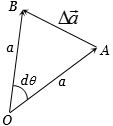
MediumMCQ
$A$ vector $\overrightarrow{a}$ is turned without a change in its length through a small angle $d\theta$. The values of $|\Delta \overrightarrow{a}|$ and $\Delta a$ are respectively:
A
$0, a\,d\theta$
B
$a\,d\theta, 0$
C
$0, 0$
D
None of these
Solution
(B) From the figure,let the initial vector be $\overrightarrow{OA}$ and the final vector be $\overrightarrow{OB}$. Since the length does not change,$|\overrightarrow{OA}| = |\overrightarrow{OB}| = a$.
By the triangle law of vector addition,$\overrightarrow{OB} = \overrightarrow{OA} + \Delta \overrightarrow{a}$,which implies $\Delta \overrightarrow{a} = \overrightarrow{OB} - \overrightarrow{OA}$.
The magnitude $|\Delta \overrightarrow{a}|$ represents the length of the chord $AB$ in the circular arc of radius $a$ subtending an angle $d\theta$ at the center $O$. For a small angle $d\theta$,the chord length is approximately equal to the arc length.
Using the relation $\text{angle} = \frac{\text{arc}}{\text{radius}}$,we have $d\theta = \frac{AB}{a}$,which gives $AB = a\,d\theta$.
Therefore,$|\Delta \overrightarrow{a}| = a\,d\theta$.
$\Delta a$ represents the change in the magnitude of the vector,which is $\Delta a = |\overrightarrow{OB}| - |\overrightarrow{OA}| = a - a = 0$.
Thus,the values are $a\,d\theta$ and $0$ respectively.
By the triangle law of vector addition,$\overrightarrow{OB} = \overrightarrow{OA} + \Delta \overrightarrow{a}$,which implies $\Delta \overrightarrow{a} = \overrightarrow{OB} - \overrightarrow{OA}$.
The magnitude $|\Delta \overrightarrow{a}|$ represents the length of the chord $AB$ in the circular arc of radius $a$ subtending an angle $d\theta$ at the center $O$. For a small angle $d\theta$,the chord length is approximately equal to the arc length.
Using the relation $\text{angle} = \frac{\text{arc}}{\text{radius}}$,we have $d\theta = \frac{AB}{a}$,which gives $AB = a\,d\theta$.
Therefore,$|\Delta \overrightarrow{a}| = a\,d\theta$.
$\Delta a$ represents the change in the magnitude of the vector,which is $\Delta a = |\overrightarrow{OB}| - |\overrightarrow{OA}| = a - a = 0$.
Thus,the values are $a\,d\theta$ and $0$ respectively.
0 likes
View Solution27
DifficultMCQ
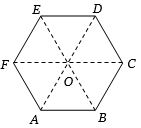
The figure shows $ABCDEF$ as a regular hexagon. What is the value of $\overrightarrow {AB} + \overrightarrow {AC} + \overrightarrow {AD} + \overrightarrow {AE} + \overrightarrow {AF}$ in terms of $\overrightarrow {AO}$?
A
$\overrightarrow {AO}$
B
$2\overrightarrow {AO}$
C
$4\overrightarrow {AO}$
D
$6\overrightarrow {AO}$
Solution
(D) In a regular hexagon $ABCDEF$ with center $O$,we have the following properties:
$\overrightarrow{AB} + \overrightarrow{AF} = \overrightarrow{AO}$ (by triangle law in $\triangle AOF$ is not correct,rather consider the vectors from center $O$)
Alternatively,using the property of the center $O$:
$\overrightarrow{AB} + \overrightarrow{AC} + \overrightarrow{AD} + \overrightarrow{AE} + \overrightarrow{AF} = (\overrightarrow{AO} + \overrightarrow{OB}) + (\overrightarrow{AO} + \overrightarrow{OC}) + (\overrightarrow{AO} + \overrightarrow{OD}) + (\overrightarrow{AO} + \overrightarrow{OE}) + (\overrightarrow{AO} + \overrightarrow{OF})$
$= 5\overrightarrow{AO} + (\overrightarrow{OB} + \overrightarrow{OC} + \overrightarrow{OD} + \overrightarrow{OE} + \overrightarrow{OF})$
Since $O$ is the center of the regular hexagon,the sum of vectors from the center to the vertices is zero: $\overrightarrow{OA} + \overrightarrow{OB} + \overrightarrow{OC} + \overrightarrow{OD} + \overrightarrow{OE} + \overrightarrow{OF} = 0$.
Therefore,$\overrightarrow{OB} + \overrightarrow{OC} + \overrightarrow{OD} + \overrightarrow{OE} + \overrightarrow{OF} = -\overrightarrow{OA} = \overrightarrow{AO}$.
Substituting this back:
$= 5\overrightarrow{AO} + \overrightarrow{AO} = 6\overrightarrow{AO}$.
$\overrightarrow{AB} + \overrightarrow{AF} = \overrightarrow{AO}$ (by triangle law in $\triangle AOF$ is not correct,rather consider the vectors from center $O$)
Alternatively,using the property of the center $O$:
$\overrightarrow{AB} + \overrightarrow{AC} + \overrightarrow{AD} + \overrightarrow{AE} + \overrightarrow{AF} = (\overrightarrow{AO} + \overrightarrow{OB}) + (\overrightarrow{AO} + \overrightarrow{OC}) + (\overrightarrow{AO} + \overrightarrow{OD}) + (\overrightarrow{AO} + \overrightarrow{OE}) + (\overrightarrow{AO} + \overrightarrow{OF})$
$= 5\overrightarrow{AO} + (\overrightarrow{OB} + \overrightarrow{OC} + \overrightarrow{OD} + \overrightarrow{OE} + \overrightarrow{OF})$
Since $O$ is the center of the regular hexagon,the sum of vectors from the center to the vertices is zero: $\overrightarrow{OA} + \overrightarrow{OB} + \overrightarrow{OC} + \overrightarrow{OD} + \overrightarrow{OE} + \overrightarrow{OF} = 0$.
Therefore,$\overrightarrow{OB} + \overrightarrow{OC} + \overrightarrow{OD} + \overrightarrow{OE} + \overrightarrow{OF} = -\overrightarrow{OA} = \overrightarrow{AO}$.
Substituting this back:
$= 5\overrightarrow{AO} + \overrightarrow{AO} = 6\overrightarrow{AO}$.
0 likes
View Solution28
EasyMCQ
$A$ man goes $10\,m$ towards North,then $20\,m$ towards East. The displacement is ........ $m$.
A
$22.36$
B
$25$
C
$25.5$
D
$30$
Solution
(A) The man moves $10\,m$ along the North direction (y-axis) and $20\,m$ along the East direction (x-axis).
Let the initial position be the origin $(0,0)$.
The final position vector is $\vec{r} = 20\hat{i} + 10\hat{j}$.
The magnitude of displacement is given by $r = |\vec{r}| = \sqrt{x^2 + y^2}$.
$r = \sqrt{20^2 + 10^2} = \sqrt{400 + 100} = \sqrt{500}$.
$r = 10\sqrt{5} \approx 10 \times 2.236 = 22.36\,m$.
Let the initial position be the origin $(0,0)$.
The final position vector is $\vec{r} = 20\hat{i} + 10\hat{j}$.
The magnitude of displacement is given by $r = |\vec{r}| = \sqrt{x^2 + y^2}$.
$r = \sqrt{20^2 + 10^2} = \sqrt{400 + 100} = \sqrt{500}$.
$r = 10\sqrt{5} \approx 10 \times 2.236 = 22.36\,m$.
0 likes
View Solution29
EasyMCQ
An object is subjected to a force in the north-east direction. To balance this force,a second force should be applied in the direction:
A
North-East
B
South
C
South-West
D
West
Solution
(C) For an object to be in equilibrium,the net force acting on it must be zero.
If a force $\vec{F}_1$ acts in the north-east direction,a second force $\vec{F}_2$ must be equal in magnitude and opposite in direction to balance it.
Mathematically,$\vec{F}_1 + \vec{F}_2 = 0$,which implies $\vec{F}_2 = -\vec{F}_1$.
The opposite direction of north-east is south-west.
Therefore,the second force should be applied in the south-west direction.
If a force $\vec{F}_1$ acts in the north-east direction,a second force $\vec{F}_2$ must be equal in magnitude and opposite in direction to balance it.
Mathematically,$\vec{F}_1 + \vec{F}_2 = 0$,which implies $\vec{F}_2 = -\vec{F}_1$.
The opposite direction of north-east is south-west.
Therefore,the second force should be applied in the south-west direction.
0 likes
View Solution30
MediumMCQ
$A$ vector $\vec{P}$ makes angles $\alpha, \beta,$ and $\gamma$ with the $X, Y,$ and $Z$ axes respectively. Then $\sin^2 \alpha + \sin^2 \beta + \sin^2 \gamma = $
A
$0$
B
$1$
C
$2$
D
$3$
Solution
(C) For any vector,the direction cosines satisfy the relation: $\cos^2 \alpha + \cos^2 \beta + \cos^2 \gamma = 1$.
Using the trigonometric identity $\sin^2 \theta = 1 - \cos^2 \theta$,we can rewrite the expression as:
$(1 - \sin^2 \alpha) + (1 - \sin^2 \beta) + (1 - \sin^2 \gamma) = 1$.
Rearranging the terms:
$3 - (\sin^2 \alpha + \sin^2 \beta + \sin^2 \gamma) = 1$.
Therefore,$\sin^2 \alpha + \sin^2 \beta + \sin^2 \gamma = 3 - 1 = 2$.
Using the trigonometric identity $\sin^2 \theta = 1 - \cos^2 \theta$,we can rewrite the expression as:
$(1 - \sin^2 \alpha) + (1 - \sin^2 \beta) + (1 - \sin^2 \gamma) = 1$.
Rearranging the terms:
$3 - (\sin^2 \alpha + \sin^2 \beta + \sin^2 \gamma) = 1$.
Therefore,$\sin^2 \alpha + \sin^2 \beta + \sin^2 \gamma = 3 - 1 = 2$.
0 likes
View Solution31
MediumMCQ
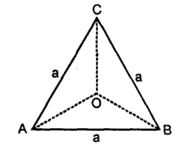
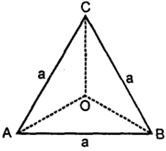
$ABC$ is an equilateral triangle. The length of each side is $a$ and the centroid is point $O$. Find $\overrightarrow{AB} + \overrightarrow{BC} + \overrightarrow{CA} = \ldots \ldots$.
A
$0$
B
$1$
C
$2$
D
$3$
Solution
(A) The vectors $\overrightarrow{AB}$,$\overrightarrow{BC}$,and $\overrightarrow{CA}$ represent the sides of a triangle taken in the same cyclic order.
According to the polygon law of vector addition,the sum of vectors forming a closed loop is zero.
Therefore,$\overrightarrow{AB} + \overrightarrow{BC} + \overrightarrow{CA} = \overrightarrow{0}$.
According to the polygon law of vector addition,the sum of vectors forming a closed loop is zero.
Therefore,$\overrightarrow{AB} + \overrightarrow{BC} + \overrightarrow{CA} = \overrightarrow{0}$.
0 likes
View Solution32
MediumMCQ
The resultant of two vectors $\vec{A}$ and $\vec{B}$ makes an angle $\alpha$ with $\vec{A}$ and an angle $\beta$ with $\vec{B}$. Which of the following is true?
A
$\alpha < \beta$
B
$\alpha < \beta$ if $A < B$
C
$\alpha < \beta$ if $A > B$
D
$\alpha < \beta$ if $A = B$
Solution
(C) Let the resultant vector be $\vec{R} = \vec{A} + \vec{B}$.
By the law of sines in the triangle formed by vectors $\vec{A}$,$\vec{B}$,and $\vec{R}$,we have $\frac{A}{\sin \beta} = \frac{B}{\sin \alpha}$.
This implies $\frac{\sin \alpha}{\sin \beta} = \frac{B}{A}$.
If $A > B$,then $\frac{B}{A} < 1$,which means $\sin \alpha < \sin \beta$.
Since $\alpha$ and $\beta$ are angles within a triangle,$\sin \alpha < \sin \beta$ implies $\alpha < \beta$.
Therefore,the resultant vector is closer to the vector with the larger magnitude. Thus,if $A > B$,then $\alpha < \beta$.
By the law of sines in the triangle formed by vectors $\vec{A}$,$\vec{B}$,and $\vec{R}$,we have $\frac{A}{\sin \beta} = \frac{B}{\sin \alpha}$.
This implies $\frac{\sin \alpha}{\sin \beta} = \frac{B}{A}$.
If $A > B$,then $\frac{B}{A} < 1$,which means $\sin \alpha < \sin \beta$.
Since $\alpha$ and $\beta$ are angles within a triangle,$\sin \alpha < \sin \beta$ implies $\alpha < \beta$.
Therefore,the resultant vector is closer to the vector with the larger magnitude. Thus,if $A > B$,then $\alpha < \beta$.
0 likes
View Solution33
MediumMCQ
The direction cosines of the vector $\hat{i} + \hat{j} + \sqrt{2}\hat{k}$ are:
A
$\frac{1}{2}, \frac{1}{2}, 1$
B
$\frac{1}{\sqrt{2}}, \frac{1}{\sqrt{2}}, \frac{1}{2}$
C
$\frac{1}{2}, \frac{1}{2}, \frac{1}{\sqrt{2}}$
D
$\frac{1}{\sqrt{2}}, \frac{1}{\sqrt{2}}, \frac{1}{\sqrt{2}}$
Solution
(C) The direction cosines of a vector $\vec{A} = a\hat{i} + b\hat{j} + c\hat{k}$ are given by the formula:
$l = \frac{a}{|\vec{A}|}, m = \frac{b}{|\vec{A}|}, n = \frac{c}{|\vec{A}|}$
where $|\vec{A}| = \sqrt{a^2 + b^2 + c^2}$.
For the given vector $\vec{A} = 1\hat{i} + 1\hat{j} + \sqrt{2}\hat{k}$,the magnitude is:
$|\vec{A}| = \sqrt{1^2 + 1^2 + (\sqrt{2})^2} = \sqrt{1 + 1 + 2} = \sqrt{4} = 2$.
Now,calculating the direction cosines:
$l = \frac{1}{2}$
$m = \frac{1}{2}$
$n = \frac{\sqrt{2}}{2} = \frac{1}{\sqrt{2}}$
Thus,the direction cosines are $\frac{1}{2}, \frac{1}{2}, \frac{1}{\sqrt{2}}$.
$l = \frac{a}{|\vec{A}|}, m = \frac{b}{|\vec{A}|}, n = \frac{c}{|\vec{A}|}$
where $|\vec{A}| = \sqrt{a^2 + b^2 + c^2}$.
For the given vector $\vec{A} = 1\hat{i} + 1\hat{j} + \sqrt{2}\hat{k}$,the magnitude is:
$|\vec{A}| = \sqrt{1^2 + 1^2 + (\sqrt{2})^2} = \sqrt{1 + 1 + 2} = \sqrt{4} = 2$.
Now,calculating the direction cosines:
$l = \frac{1}{2}$
$m = \frac{1}{2}$
$n = \frac{\sqrt{2}}{2} = \frac{1}{\sqrt{2}}$
Thus,the direction cosines are $\frac{1}{2}, \frac{1}{2}, \frac{1}{\sqrt{2}}$.
0 likes
View Solution34
EasyMCQ
Given $\vec{P} + \vec{Q} = \vec{P} - \vec{Q}$. Under what condition is this true?
A
$\vec{P} = \vec{Q}$
B
$\vec{Q}$ is a null vector.
C
$\vec{P}$ or $\vec{Q}$ is a null vector.
D
$\vec{P}$ is perpendicular to $\vec{Q}$.
Solution
(B) Given the equation: $\vec{P} + \vec{Q} = \vec{P} - \vec{Q}$.
Subtracting $\vec{P}$ from both sides,we get: $\vec{Q} = -\vec{Q}$.
Adding $\vec{Q}$ to both sides,we get: $2\vec{Q} = 0$.
This implies that $\vec{Q} = 0$,which means $\vec{Q}$ is a null vector.
Subtracting $\vec{P}$ from both sides,we get: $\vec{Q} = -\vec{Q}$.
Adding $\vec{Q}$ to both sides,we get: $2\vec{Q} = 0$.
This implies that $\vec{Q} = 0$,which means $\vec{Q}$ is a null vector.
0 likes
View Solution35
EasyMCQ
The projection of vector $\vec{A}$ on $\vec{B}$ is:
A
$\vec{A} \cdot \vec{B}$
B
$\vec{A} \cdot \hat{B}$
C
$\vec{B} \cdot \vec{A}$
D
$\hat{A} \cdot \hat{B}$
Solution
(B) The projection of a vector $\vec{A}$ onto another vector $\vec{B}$ represents the scalar component of $\vec{A}$ along the direction of $\vec{B}$.
Mathematically,the projection of $\vec{A}$ on $\vec{B}$ is given by the dot product of $\vec{A}$ with the unit vector in the direction of $\vec{B}$.
Since the unit vector $\hat{B} = \frac{\vec{B}}{|\vec{B}|}$,the projection is $\vec{A} \cdot \hat{B} = \frac{\vec{A} \cdot \vec{B}}{|\vec{B}|}$.
Mathematically,the projection of $\vec{A}$ on $\vec{B}$ is given by the dot product of $\vec{A}$ with the unit vector in the direction of $\vec{B}$.
Since the unit vector $\hat{B} = \frac{\vec{B}}{|\vec{B}|}$,the projection is $\vec{A} \cdot \hat{B} = \frac{\vec{A} \cdot \vec{B}}{|\vec{B}|}$.
0 likes
View Solution36
EasyMCQ
Which of the following relations is correct?
A
$\hat{j} \times \hat{k} = \hat{i}$
B
$\hat{i} \cdot \hat{i} = 0$
C
$\hat{j} \times \hat{j} = 1$
D
$\hat{k} \cdot \hat{i} = 1$
Solution
(A) In vector algebra,for unit vectors $\hat{i}, \hat{j}, \hat{k}$ along the $x, y, z$ axes respectively:
$1$. Cross product properties: $\hat{i} \times \hat{j} = \hat{k}$,$\hat{j} \times \hat{k} = \hat{i}$,and $\hat{k} \times \hat{i} = \hat{j}$. Also,$\hat{i} \times \hat{i} = \hat{j} \times \hat{j} = \hat{k} \times \hat{k} = 0$.
$2$. Dot product properties: $\hat{i} \cdot \hat{i} = \hat{j} \cdot \hat{j} = \hat{k} \cdot \hat{k} = 1$ and $\hat{i} \cdot \hat{j} = \hat{j} \cdot \hat{k} = \hat{k} \cdot \hat{i} = 0$.
Comparing these with the options:
Option $A$: $\hat{j} \times \hat{k} = \hat{i}$ is correct.
Option $B$: $\hat{i} \cdot \hat{i} = 1$ (given $0$,so incorrect).
Option $C$: $\hat{j} \times \hat{j} = 0$ (given $1$,so incorrect).
Option $D$: $\hat{k} \cdot \hat{i} = 0$ (given $1$,so incorrect).
Therefore,the correct relation is $\hat{j} \times \hat{k} = \hat{i}$.
$1$. Cross product properties: $\hat{i} \times \hat{j} = \hat{k}$,$\hat{j} \times \hat{k} = \hat{i}$,and $\hat{k} \times \hat{i} = \hat{j}$. Also,$\hat{i} \times \hat{i} = \hat{j} \times \hat{j} = \hat{k} \times \hat{k} = 0$.
$2$. Dot product properties: $\hat{i} \cdot \hat{i} = \hat{j} \cdot \hat{j} = \hat{k} \cdot \hat{k} = 1$ and $\hat{i} \cdot \hat{j} = \hat{j} \cdot \hat{k} = \hat{k} \cdot \hat{i} = 0$.
Comparing these with the options:
Option $A$: $\hat{j} \times \hat{k} = \hat{i}$ is correct.
Option $B$: $\hat{i} \cdot \hat{i} = 1$ (given $0$,so incorrect).
Option $C$: $\hat{j} \times \hat{j} = 0$ (given $1$,so incorrect).
Option $D$: $\hat{k} \cdot \hat{i} = 0$ (given $1$,so incorrect).
Therefore,the correct relation is $\hat{j} \times \hat{k} = \hat{i}$.
0 likes
View Solution37
EasyMCQ
The angle made by the vector $(\hat{i} + \hat{j})$ with the $x$-axis and $y$-axis is:
A
$45^\circ, 60^\circ$
B
$60^\circ, 60^\circ$
C
$45^\circ, 45^\circ$
D
$60^\circ, 45^\circ$
Solution
(C) Let the vector be $\vec{A} = \hat{i} + \hat{j}$.
Here,the components are $A_x = 1$ and $A_y = 1$.
The magnitude of the vector is $A = \sqrt{A_x^2 + A_y^2} = \sqrt{1^2 + 1^2} = \sqrt{2}$.
The angle $\alpha$ with the $x$-axis is given by $\cos \alpha = \frac{A_x}{A} = \frac{1}{\sqrt{2}}$.
Therefore,$\alpha = 45^\circ$.
The angle $\beta$ with the $y$-axis is given by $\cos \beta = \frac{A_y}{A} = \frac{1}{\sqrt{2}}$.
Therefore,$\beta = 45^\circ$.
Here,the components are $A_x = 1$ and $A_y = 1$.
The magnitude of the vector is $A = \sqrt{A_x^2 + A_y^2} = \sqrt{1^2 + 1^2} = \sqrt{2}$.
The angle $\alpha$ with the $x$-axis is given by $\cos \alpha = \frac{A_x}{A} = \frac{1}{\sqrt{2}}$.
Therefore,$\alpha = 45^\circ$.
The angle $\beta$ with the $y$-axis is given by $\cos \beta = \frac{A_y}{A} = \frac{1}{\sqrt{2}}$.
Therefore,$\beta = 45^\circ$.
0 likes
View Solution38
MediumMCQ
If $|\vec{A} + \vec{B}| = |\vec{A} - \vec{B}|$,then the angle between $\vec{A}$ and $\vec{B}$ is ........ $^\circ$.
A
$35$
B
$45$
C
$60$
D
$90$
Solution
(D) Given that $|\vec{A} + \vec{B}| = |\vec{A} - \vec{B}|$.
Squaring both sides,we get:
$|\vec{A} + \vec{B}|^2 = |\vec{A} - \vec{B}|^2$
Using the property $|\vec{V}|^2 = \vec{V} \cdot \vec{V}$,we have:
$(\vec{A} + \vec{B}) \cdot (\vec{A} + \vec{B}) = (\vec{A} - \vec{B}) \cdot (\vec{A} - \vec{B})$
$A^2 + B^2 + 2\vec{A} \cdot \vec{B} = A^2 + B^2 - 2\vec{A} \cdot \vec{B}$
$4\vec{A} \cdot \vec{B} = 0$
Since $\vec{A} \cdot \vec{B} = AB \cos \theta$,we have:
$4AB \cos \theta = 0$
Assuming $A \neq 0$ and $B \neq 0$,we get $\cos \theta = 0$.
Therefore,$\theta = 90^\circ$.
Squaring both sides,we get:
$|\vec{A} + \vec{B}|^2 = |\vec{A} - \vec{B}|^2$
Using the property $|\vec{V}|^2 = \vec{V} \cdot \vec{V}$,we have:
$(\vec{A} + \vec{B}) \cdot (\vec{A} + \vec{B}) = (\vec{A} - \vec{B}) \cdot (\vec{A} - \vec{B})$
$A^2 + B^2 + 2\vec{A} \cdot \vec{B} = A^2 + B^2 - 2\vec{A} \cdot \vec{B}$
$4\vec{A} \cdot \vec{B} = 0$
Since $\vec{A} \cdot \vec{B} = AB \cos \theta$,we have:
$4AB \cos \theta = 0$
Assuming $A \neq 0$ and $B \neq 0$,we get $\cos \theta = 0$.
Therefore,$\theta = 90^\circ$.
0 likes
View Solution39
EasyMCQ
The magnitude of the vector $|2\hat{i} - \hat{j} - 5\hat{k}|$ is .....
A
$\sqrt{30}$
B
$\sqrt{38}$
C
$\sqrt{42}$
D
$\sqrt{35}$
Solution
(A) The magnitude of a vector $\vec{A} = A_x\hat{i} + A_y\hat{j} + A_z\hat{k}$ is given by $|\vec{A}| = \sqrt{A_x^2 + A_y^2 + A_z^2}$.
Given vector is $\vec{A} = 2\hat{i} - 1\hat{j} - 5\hat{k}$.
Here,$A_x = 2$,$A_y = -1$,and $A_z = -5$.
Substituting these values into the formula:
$|\vec{A}| = \sqrt{(2)^2 + (-1)^2 + (-5)^2}$
$|\vec{A}| = \sqrt{4 + 1 + 25}$
$|\vec{A}| = \sqrt{30}$.
Given vector is $\vec{A} = 2\hat{i} - 1\hat{j} - 5\hat{k}$.
Here,$A_x = 2$,$A_y = -1$,and $A_z = -5$.
Substituting these values into the formula:
$|\vec{A}| = \sqrt{(2)^2 + (-1)^2 + (-5)^2}$
$|\vec{A}| = \sqrt{4 + 1 + 25}$
$|\vec{A}| = \sqrt{30}$.
0 likes
View Solution40
DifficultMCQ
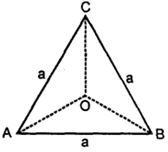
$ABC$ is an equilateral triangle. The length of each side is $a$ and the centroid is point $O$. If $\overrightarrow{AB} + \overrightarrow{AC} = n \overrightarrow{AO}$,then find the value of $n$.
A
$0$
B
$1$
C
$2$
D
$3$
Solution
(D) We know that for any triangle $ABC$ with centroid $O$,the vector sum $\overrightarrow{OA} + \overrightarrow{OB} + \overrightarrow{OC} = \overrightarrow{0}$.
We can express the vectors $\overrightarrow{AB}$ and $\overrightarrow{AC}$ in terms of the position vectors relative to the centroid $O$:
$\overrightarrow{AB} = \overrightarrow{OB} - \overrightarrow{OA} = \overrightarrow{AO} + \overrightarrow{OB}$
$\overrightarrow{AC} = \overrightarrow{OC} - \overrightarrow{OA} = \overrightarrow{AO} + \overrightarrow{OC}$
Adding these two equations:
$\overrightarrow{AB} + \overrightarrow{AC} = (\overrightarrow{AO} + \overrightarrow{OB}) + (\overrightarrow{AO} + \overrightarrow{OC})$
$\overrightarrow{AB} + \overrightarrow{AC} = 2\overrightarrow{AO} + (\overrightarrow{OB} + \overrightarrow{OC})$
From the centroid property $\overrightarrow{OA} + \overrightarrow{OB} + \overrightarrow{OC} = \overrightarrow{0}$,we have:
$\overrightarrow{OB} + \overrightarrow{OC} = -\overrightarrow{OA} = \overrightarrow{AO}$
Substituting this into the sum:
$\overrightarrow{AB} + \overrightarrow{AC} = 2\overrightarrow{AO} + \overrightarrow{AO} = 3\overrightarrow{AO}$
Comparing this with $\overrightarrow{AB} + \overrightarrow{AC} = n\overrightarrow{AO}$,we get $n = 3$.
We can express the vectors $\overrightarrow{AB}$ and $\overrightarrow{AC}$ in terms of the position vectors relative to the centroid $O$:
$\overrightarrow{AB} = \overrightarrow{OB} - \overrightarrow{OA} = \overrightarrow{AO} + \overrightarrow{OB}$
$\overrightarrow{AC} = \overrightarrow{OC} - \overrightarrow{OA} = \overrightarrow{AO} + \overrightarrow{OC}$
Adding these two equations:
$\overrightarrow{AB} + \overrightarrow{AC} = (\overrightarrow{AO} + \overrightarrow{OB}) + (\overrightarrow{AO} + \overrightarrow{OC})$
$\overrightarrow{AB} + \overrightarrow{AC} = 2\overrightarrow{AO} + (\overrightarrow{OB} + \overrightarrow{OC})$
From the centroid property $\overrightarrow{OA} + \overrightarrow{OB} + \overrightarrow{OC} = \overrightarrow{0}$,we have:
$\overrightarrow{OB} + \overrightarrow{OC} = -\overrightarrow{OA} = \overrightarrow{AO}$
Substituting this into the sum:
$\overrightarrow{AB} + \overrightarrow{AC} = 2\overrightarrow{AO} + \overrightarrow{AO} = 3\overrightarrow{AO}$
Comparing this with $\overrightarrow{AB} + \overrightarrow{AC} = n\overrightarrow{AO}$,we get $n = 3$.
0 likes
View Solution41
EasyMCQ
If the vector $\vec{P} = 3\hat{i} + 4\hat{j} + 12\hat{k}$,then the magnitude of the vector $\vec{P}$ is ......
A
$11$
B
$12$
C
$13$
D
$14$
Solution
(C) The magnitude of a vector $\vec{P} = P_x\hat{i} + P_y\hat{j} + P_z\hat{k}$ is given by the formula $|\vec{P}| = \sqrt{P_x^2 + P_y^2 + P_z^2}$.
Given $\vec{P} = 3\hat{i} + 4\hat{j} + 12\hat{k}$,we have $P_x = 3$,$P_y = 4$,and $P_z = 12$.
Substituting these values into the formula:
$|\vec{P}| = \sqrt{3^2 + 4^2 + 12^2}$
$|\vec{P}| = \sqrt{9 + 16 + 144}$
$|\vec{P}| = \sqrt{169}$
$|\vec{P}| = 13$.
Given $\vec{P} = 3\hat{i} + 4\hat{j} + 12\hat{k}$,we have $P_x = 3$,$P_y = 4$,and $P_z = 12$.
Substituting these values into the formula:
$|\vec{P}| = \sqrt{3^2 + 4^2 + 12^2}$
$|\vec{P}| = \sqrt{9 + 16 + 144}$
$|\vec{P}| = \sqrt{169}$
$|\vec{P}| = 13$.
0 likes
View Solution42
MediumMCQ
If $\vec{A} + \vec{B} = \vec{C}$ and $|\vec{A}| = |\vec{B}| = |\vec{C}|$,then the angle between $\vec{A}$ and $\vec{B}$ is ....... $^o$.
A
$45$
B
$60$
C
$90$
D
$120$
Solution
(D) Given that $\vec{A} + \vec{B} = \vec{C}$ and $|\vec{A}| = |\vec{B}| = |\vec{C}| = A$ (let).
Squaring both sides of the vector equation $\vec{A} + \vec{B} = \vec{C}$,we get:
$|\vec{A} + \vec{B}|^2 = |\vec{C}|^2$
$|\vec{A}|^2 + |\vec{B}|^2 + 2|\vec{A}||\vec{B}| \cos \theta = |\vec{C}|^2$,where $\theta$ is the angle between $\vec{A}$ and $\vec{B}$.
Substituting the magnitudes: $A^2 + A^2 + 2A^2 \cos \theta = A^2$.
$2A^2 + 2A^2 \cos \theta = A^2$.
$2A^2 \cos \theta = A^2 - 2A^2 = -A^2$.
$\cos \theta = -A^2 / 2A^2 = -1/2$.
Since $\cos \theta = -1/2$,the angle $\theta = 120^o$.
Squaring both sides of the vector equation $\vec{A} + \vec{B} = \vec{C}$,we get:
$|\vec{A} + \vec{B}|^2 = |\vec{C}|^2$
$|\vec{A}|^2 + |\vec{B}|^2 + 2|\vec{A}||\vec{B}| \cos \theta = |\vec{C}|^2$,where $\theta$ is the angle between $\vec{A}$ and $\vec{B}$.
Substituting the magnitudes: $A^2 + A^2 + 2A^2 \cos \theta = A^2$.
$2A^2 + 2A^2 \cos \theta = A^2$.
$2A^2 \cos \theta = A^2 - 2A^2 = -A^2$.
$\cos \theta = -A^2 / 2A^2 = -1/2$.
Since $\cos \theta = -1/2$,the angle $\theta = 120^o$.
0 likes
View Solution43
EasyMCQ
$ABC$ is an equilateral triangle. The length of each side is $a$ and the centroid is point $O$. Then $\overrightarrow{OA} + \overrightarrow{OB} + \overrightarrow{OC} = \dots$
A
$0$
B
$1$
C
$2$
D
$3$
Solution
(A) In an equilateral triangle $ABC$,the centroid $O$ is the point where the medians intersect.
Since the triangle is equilateral,the vectors $\overrightarrow{OA}$,$\overrightarrow{OB}$,and $\overrightarrow{OC}$ have equal magnitudes and are directed from the centroid to the vertices.
The angles between these vectors are $120^{\circ}$ each.
According to the principle of vector addition for symmetric systems,the resultant of three vectors of equal magnitude separated by $120^{\circ}$ is zero.
Therefore,$\overrightarrow{OA} + \overrightarrow{OB} + \overrightarrow{OC} = \vec{0}$.
Since the triangle is equilateral,the vectors $\overrightarrow{OA}$,$\overrightarrow{OB}$,and $\overrightarrow{OC}$ have equal magnitudes and are directed from the centroid to the vertices.
The angles between these vectors are $120^{\circ}$ each.
According to the principle of vector addition for symmetric systems,the resultant of three vectors of equal magnitude separated by $120^{\circ}$ is zero.
Therefore,$\overrightarrow{OA} + \overrightarrow{OB} + \overrightarrow{OC} = \vec{0}$.
0 likes
View Solution44
MediumMCQ
The cosine values of the angles made by the vector $\vec{A} = \hat{i} + \hat{j} + \hat{k}$ with the $X$,$Y$,and $Z$ axes respectively are:
A
$\frac{1}{\sqrt{3}}, \frac{1}{\sqrt{3}}, \frac{1}{\sqrt{3}}$
B
$\frac{1}{\sqrt{3}}, \frac{2}{\sqrt{3}}, \frac{3}{\sqrt{3}}$
C
$\frac{1}{\sqrt{3}}, \frac{1}{\sqrt{2}}, \frac{1}{\sqrt{2}}$
D
$\frac{1}{\sqrt{2}}, \frac{1}{\sqrt{3}}, \frac{2}{\sqrt{3}}$
Solution
(A) Given vector $\vec{A} = \hat{i} + \hat{j} + \hat{k}$.
Comparing with $\vec{A} = A_x\hat{i} + A_y\hat{j} + A_z\hat{k}$,we get $A_x = 1, A_y = 1, A_z = 1$.
The magnitude of the vector is $|\vec{A}| = \sqrt{A_x^2 + A_y^2 + A_z^2} = \sqrt{1^2 + 1^2 + 1^2} = \sqrt{3}$.
The direction cosines are given by $\cos \alpha = \frac{A_x}{|\vec{A}|} = \frac{1}{\sqrt{3}}$,$\cos \beta = \frac{A_y}{|\vec{A}|} = \frac{1}{\sqrt{3}}$,and $\cos \gamma = \frac{A_z}{|\vec{A}|} = \frac{1}{\sqrt{3}}$.
Thus,the cosine values are $\frac{1}{\sqrt{3}}, \frac{1}{\sqrt{3}}, \frac{1}{\sqrt{3}}$.
Comparing with $\vec{A} = A_x\hat{i} + A_y\hat{j} + A_z\hat{k}$,we get $A_x = 1, A_y = 1, A_z = 1$.
The magnitude of the vector is $|\vec{A}| = \sqrt{A_x^2 + A_y^2 + A_z^2} = \sqrt{1^2 + 1^2 + 1^2} = \sqrt{3}$.
The direction cosines are given by $\cos \alpha = \frac{A_x}{|\vec{A}|} = \frac{1}{\sqrt{3}}$,$\cos \beta = \frac{A_y}{|\vec{A}|} = \frac{1}{\sqrt{3}}$,and $\cos \gamma = \frac{A_z}{|\vec{A}|} = \frac{1}{\sqrt{3}}$.
Thus,the cosine values are $\frac{1}{\sqrt{3}}, \frac{1}{\sqrt{3}}, \frac{1}{\sqrt{3}}$.
0 likes
View Solution45
MediumMCQ
What is the minimum number of coplanar vectors of different magnitudes whose sum can be zero?
A
$2$
B
$3$
C
$4$
D
$5$
Solution
(B) For the sum of vectors to be zero,they must form a closed polygon when placed head-to-tail.
If there are only $2$ vectors of different magnitudes,say $\vec{A}$ and $\vec{B}$,their sum $\vec{A} + \vec{B} = 0$ implies $\vec{A} = -\vec{B}$. This means they must have the same magnitude and opposite directions,which contradicts the condition that they have different magnitudes.
If there are $3$ vectors of different magnitudes,they can form a triangle (a closed polygon) if the sum of the lengths of any two sides is greater than the third side. For example,vectors of magnitudes $3, 4,$ and $5$ can form a triangle and their sum can be zero.
Therefore,the minimum number of coplanar vectors of different magnitudes required to have a zero resultant is $3$.
If there are only $2$ vectors of different magnitudes,say $\vec{A}$ and $\vec{B}$,their sum $\vec{A} + \vec{B} = 0$ implies $\vec{A} = -\vec{B}$. This means they must have the same magnitude and opposite directions,which contradicts the condition that they have different magnitudes.
If there are $3$ vectors of different magnitudes,they can form a triangle (a closed polygon) if the sum of the lengths of any two sides is greater than the third side. For example,vectors of magnitudes $3, 4,$ and $5$ can form a triangle and their sum can be zero.
Therefore,the minimum number of coplanar vectors of different magnitudes required to have a zero resultant is $3$.
0 likes
View Solution46
MediumMCQ
Three forces of $3 \ N$,$4 \ N$,and $12 \ N$ act on a point in mutually perpendicular directions. The magnitude of the resultant force is ........ $N$.
A
$19$
B
$13$
C
$11$
D
$5$
Solution
(B) Since the forces are mutually perpendicular,we can represent them as vectors along the $x$,$y$,and $z$ axes:
$\vec{F}_1 = 3\hat{i} \ N$,$\vec{F}_2 = 4\hat{j} \ N$,and $\vec{F}_3 = 12\hat{k} \ N$.
The resultant force vector is given by the sum of these vectors:
$\vec{F} = \vec{F}_1 + \vec{F}_2 + \vec{F}_3 = 3\hat{i} + 4\hat{j} + 12\hat{k}$.
The magnitude of the resultant force is calculated using the formula $F = \sqrt{F_x^2 + F_y^2 + F_z^2}$:
$F = \sqrt{3^2 + 4^2 + 12^2} = \sqrt{9 + 16 + 144} = \sqrt{169} = 13 \ N$.
$\vec{F}_1 = 3\hat{i} \ N$,$\vec{F}_2 = 4\hat{j} \ N$,and $\vec{F}_3 = 12\hat{k} \ N$.
The resultant force vector is given by the sum of these vectors:
$\vec{F} = \vec{F}_1 + \vec{F}_2 + \vec{F}_3 = 3\hat{i} + 4\hat{j} + 12\hat{k}$.
The magnitude of the resultant force is calculated using the formula $F = \sqrt{F_x^2 + F_y^2 + F_z^2}$:
$F = \sqrt{3^2 + 4^2 + 12^2} = \sqrt{9 + 16 + 144} = \sqrt{169} = 13 \ N$.
0 likes
View Solution47
EasyMCQ
Given two vectors $\vec{A}$ and $\vec{B}$,such that $\vec{A} + \vec{B} = \vec{C}$ and $A^2 + B^2 = C^2$. Which of the following statements is true?
A
$\vec{A}$ is parallel to $\vec{B}$.
B
$\vec{A}$ is anti-parallel to $\vec{B}$.
C
$\vec{A}$ is perpendicular to $\vec{B}$.
D
The magnitudes of $\vec{A}$ and $\vec{B}$ are equal.
Solution
(C) The magnitude of the resultant vector $\vec{C} = \vec{A} + \vec{B}$ is given by $C^2 = A^2 + B^2 + 2AB \cos \theta$,where $\theta$ is the angle between $\vec{A}$ and $\vec{B}$.
Given that $C^2 = A^2 + B^2$,we substitute this into the equation:
$A^2 + B^2 = A^2 + B^2 + 2AB \cos \theta$.
Subtracting $A^2 + B^2$ from both sides,we get:
$0 = 2AB \cos \theta$.
Since the magnitudes $A$ and $B$ are non-zero,we must have $\cos \theta = 0$.
This implies $\theta = 90^\circ$.
Therefore,$\vec{A}$ is perpendicular to $\vec{B}$.
Given that $C^2 = A^2 + B^2$,we substitute this into the equation:
$A^2 + B^2 = A^2 + B^2 + 2AB \cos \theta$.
Subtracting $A^2 + B^2$ from both sides,we get:
$0 = 2AB \cos \theta$.
Since the magnitudes $A$ and $B$ are non-zero,we must have $\cos \theta = 0$.
This implies $\theta = 90^\circ$.
Therefore,$\vec{A}$ is perpendicular to $\vec{B}$.
0 likes
View Solution48
MediumMCQ
$A$ physical quantity that has a direction is called...
A
Always a vector.
B
Can be called a vector.
C
Always a scalar.
D
None of the above.
Solution
(B) physical quantity is defined as a vector only if it possesses both magnitude and direction $AND$ follows the laws of vector addition (e.g.,the parallelogram law).
For example,current has both magnitude and direction but is a scalar because it does not follow the laws of vector addition.
Therefore,having a direction is a necessary but not sufficient condition for a quantity to be a vector.
Thus,a physical quantity with a direction 'can be called' a vector,but it is not necessarily a vector.
For example,current has both magnitude and direction but is a scalar because it does not follow the laws of vector addition.
Therefore,having a direction is a necessary but not sufficient condition for a quantity to be a vector.
Thus,a physical quantity with a direction 'can be called' a vector,but it is not necessarily a vector.
0 likes
View Solution49
MediumMCQ
Three forces of $3 \ N$,$4 \ N$,and $12 \ N$ act at a point in mutually perpendicular directions. Find the magnitude of the resultant force in $N$.
A
$19$
B
$13$
C
$11$
D
$5$
Solution
(B) Since the three forces are mutually perpendicular,they can be represented along the $x$,$y$,and $z$ axes as vectors $\vec{F_1} = 3\hat{i}$,$\vec{F_2} = 4\hat{j}$,and $\vec{F_3} = 12\hat{k}$.
The resultant force vector is $\vec{F} = 3\hat{i} + 4\hat{j} + 12\hat{k}$.
The magnitude of the resultant force is given by $|\vec{F}| = \sqrt{F_x^2 + F_y^2 + F_z^2}$.
Substituting the values: $|\vec{F}| = \sqrt{3^2 + 4^2 + 12^2} = \sqrt{9 + 16 + 144} = \sqrt{169}$.
Therefore,the magnitude of the resultant force is $13 \ N$.
The resultant force vector is $\vec{F} = 3\hat{i} + 4\hat{j} + 12\hat{k}$.
The magnitude of the resultant force is given by $|\vec{F}| = \sqrt{F_x^2 + F_y^2 + F_z^2}$.
Substituting the values: $|\vec{F}| = \sqrt{3^2 + 4^2 + 12^2} = \sqrt{9 + 16 + 144} = \sqrt{169}$.
Therefore,the magnitude of the resultant force is $13 \ N$.
0 likes
View Solution50
MediumMCQ
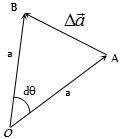
Find $|\Delta \overrightarrow{a}|$ and $\Delta a$ when a vector $\overrightarrow{a}$ is rotated by an angle $d\theta$.
A
$0, a\,d\theta$
B
$a\,d\theta, 0$
C
$0, 0$
D
None of these
Solution
(B) Let the initial vector be $\overrightarrow{OA}$ and the final vector after rotation be $\overrightarrow{OB}$.
Given that the magnitude of the vector remains constant,$|\overrightarrow{OA}| = |\overrightarrow{OB}| = a$.
The change in the vector is defined as $\Delta \overrightarrow{a} = \overrightarrow{OB} - \overrightarrow{OA}$.
From the geometry of the triangle $OAB$,the magnitude of the change in the vector is the length of the chord $AB$.
For a small angle $d\theta$,the arc length $AB$ is given by $AB = a \cdot d\theta$.
Therefore,$|\Delta \overrightarrow{a}| = a \cdot d\theta$.
Now,consider the change in the magnitude of the vector,$\Delta a = |\overrightarrow{OB}| - |\overrightarrow{OA}|$.
Since the magnitude is constant,$\Delta a = a - a = 0$.
Thus,$|\Delta \overrightarrow{a}| = a \cdot d\theta$ and $\Delta a = 0$.
Given that the magnitude of the vector remains constant,$|\overrightarrow{OA}| = |\overrightarrow{OB}| = a$.
The change in the vector is defined as $\Delta \overrightarrow{a} = \overrightarrow{OB} - \overrightarrow{OA}$.
From the geometry of the triangle $OAB$,the magnitude of the change in the vector is the length of the chord $AB$.
For a small angle $d\theta$,the arc length $AB$ is given by $AB = a \cdot d\theta$.
Therefore,$|\Delta \overrightarrow{a}| = a \cdot d\theta$.
Now,consider the change in the magnitude of the vector,$\Delta a = |\overrightarrow{OB}| - |\overrightarrow{OA}|$.
Since the magnitude is constant,$\Delta a = a - a = 0$.
Thus,$|\Delta \overrightarrow{a}| = a \cdot d\theta$ and $\Delta a = 0$.
0 likes
View Solution3-1.Vectors — Fundamentals of Vectors · Frequently Asked Questions
1Are these 3-1.Vectors questions useful for JEE and NEET?
Yes. All questions in this section are mapped to JEE Main and NEET exam patterns. Previous year questions from JEE Main, NEET, GUJCET and state-level exams are included with full solutions.
2Can I switch to Hindi or Gujarati for these questions?
Yes. Use the language tabs in the hero section or the sidebar to view the same questions and solutions in English, Hindi or Gujarati.
3How do I generate a question paper from this subtopic?
Use the Vedclass Exam Paper Generator — select the chapter and subtopic, set difficulty, and generate Sets A, B, C, D automatically. First 3 chapters of every subject are free.
Vedclass Products
For Students
Vedclass Test Series
Mock tests in real JEE/NEET style with performance analysis. 5-day free trial.
Start Free TrialFor Teachers
Exam Paper Generator
Generate Set A/B/C/D papers from this chapter in 2 minutes. 3 chapters free.
Try FreeFor Institutes
Online Exam Module
Live online exams with unlimited students, 360° analytics & white-label branding.
See DemoFor Teachers & Institutes
Generate a 3-1.Vectors Exam Paper in 2 Minutes
Select subtopic & difficulty — Sets A, B, C, D auto-generated with No Repeat logic.
First 3 chapters of every subject are free — no payment required.