
A English
Fundamentals of Vectors Questions in English
Class 11 Physics · 3-1.Vectors · Fundamentals of Vectors
159+
Questions
English
Language
100%
With Solutions
Showing 50 of 159 questions in English
101
MediumMCQ
How is the magnitude of a vector quantity represented?
A
By using an arrow sign over the symbol.
B
By writing the symbol without an arrow or by placing the symbol inside modulus bars.
C
By adding a negative sign to the symbol.
D
By squaring the vector symbol.
Solution
(B) The magnitude of a vector quantity represents its size or length,which is a scalar value.
It can be represented by writing the symbol of the vector quantity without the arrow sign on top.
Alternatively,it can be represented by placing the vector symbol within modulus bars (absolute value notation).
For example,if $\vec{F}$ is a force vector,its magnitude is represented as $F$ or $|\vec{F}|$.
If the magnitude of the force is $5 \ N$,then $|\vec{F}| = F = 5 \ N$.
It can be represented by writing the symbol of the vector quantity without the arrow sign on top.
Alternatively,it can be represented by placing the vector symbol within modulus bars (absolute value notation).
For example,if $\vec{F}$ is a force vector,its magnitude is represented as $F$ or $|\vec{F}|$.
If the magnitude of the force is $5 \ N$,then $|\vec{F}| = F = 5 \ N$.
0 likes
View Solution102
Easy
What is a vector? How can it be represented?
Solution
(N/A) vector is a physical quantity that has both magnitude and direction.
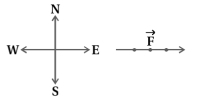
$A$ vector is represented by a directed line segment. The end of the line segment with an arrow is called the 'head' of the vector,and the end without the arrow is called the 'tail' of the vector. The length of the vector is drawn proportional to the magnitude of the physical quantity.
Example: $A$ force of $4 \ N$ is acting in the East direction. Suppose we choose a scale where $1 \ cm$ corresponds to $1 \ N$ of force. Therefore,a vector of length $4 \ cm$ pointing towards the East can represent this $4 \ N$ force.
$A$ vector is represented by a directed line segment. The end of the line segment with an arrow is called the 'head' of the vector,and the end without the arrow is called the 'tail' of the vector. The length of the vector is drawn proportional to the magnitude of the physical quantity.
Example: $A$ force of $4 \ N$ is acting in the East direction. Suppose we choose a scale where $1 \ cm$ corresponds to $1 \ N$ of force. Therefore,a vector of length $4 \ cm$ pointing towards the East can represent this $4 \ N$ force.
0 likes
View Solution103
Medium
Explain position and displacement vectors. How is the magnitude of a vector quantity represented?
Solution
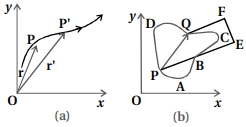
(N/A) Position vector: To describe the position of an object moving in a plane,we need to choose a convenient point,say $O$,as the origin.
Let $P$ and $P^{\prime}$ be the positions of the object at time $t$ and $t^{\prime}$,respectively,as shown in figure $(a)$. $\overrightarrow{OP}$ is the position vector of the object at time $t$. It is represented by the symbol $\vec{r}$.
Point $P^{\prime}$ is represented by another position vector,$\overrightarrow{OP^{\prime}}$,denoted by $\vec{r}^{\prime}$.
The length of the vector $\vec{r}$ represents the magnitude of the vector,and its direction is the direction in which $P$ lies as seen from $O$.
Displacement vector: If the object moves from $P$ to $P^{\prime}$,the vector $\overrightarrow{PP^{\prime}}$ (with the tail at $P$ and the tip at $P^{\prime}$) is called the displacement vector corresponding to the motion from point $P$ (at time $t$) to point $P^{\prime}$ (at time $t^{\prime}$).
Important notes:
$(1)$ The displacement vector is the straight line joining the initial and final positions.
$(2)$ It does not depend on the actual path taken by the object between the two positions. For example,in figure $(b)$,given the initial and final positions as $P$ and $Q$,the displacement vector is the same $\overrightarrow{PQ}$ for different paths of the journey,such as $PABCQ$,$PDQ$,and $PBEFQ$.
$(3)$ Therefore,the magnitude of displacement is always less than or equal to the path length of an object between two points.
Let $P$ and $P^{\prime}$ be the positions of the object at time $t$ and $t^{\prime}$,respectively,as shown in figure $(a)$. $\overrightarrow{OP}$ is the position vector of the object at time $t$. It is represented by the symbol $\vec{r}$.
Point $P^{\prime}$ is represented by another position vector,$\overrightarrow{OP^{\prime}}$,denoted by $\vec{r}^{\prime}$.
The length of the vector $\vec{r}$ represents the magnitude of the vector,and its direction is the direction in which $P$ lies as seen from $O$.
Displacement vector: If the object moves from $P$ to $P^{\prime}$,the vector $\overrightarrow{PP^{\prime}}$ (with the tail at $P$ and the tip at $P^{\prime}$) is called the displacement vector corresponding to the motion from point $P$ (at time $t$) to point $P^{\prime}$ (at time $t^{\prime}$).
Important notes:
$(1)$ The displacement vector is the straight line joining the initial and final positions.
$(2)$ It does not depend on the actual path taken by the object between the two positions. For example,in figure $(b)$,given the initial and final positions as $P$ and $Q$,the displacement vector is the same $\overrightarrow{PQ}$ for different paths of the journey,such as $PABCQ$,$PDQ$,and $PBEFQ$.
$(3)$ Therefore,the magnitude of displacement is always less than or equal to the path length of an object between two points.
0 likes
View Solution104
Medium
What is a position vector? What is a displacement vector? Explain the equality of vectors.
Solution
(N/A) Position vector: To describe the position of an object moving in a plane,we need to choose a convenient point,say $O$,as the origin.
Let $P$ and $P^{\prime}$ be the positions of the object at time $t$ and $t^{\prime}$,respectively. $\overrightarrow{OP}$ is the position vector of the object at time $t$. It is represented by the symbol $\vec{r}$.
Point $P^{\prime}$ is represented by another position vector $\overrightarrow{OP^{\prime}}$,denoted by $\vec{r}^{\prime}$.
The length of the vector $\vec{r}$ represents the magnitude of the vector,and its direction is the direction in which $P$ lies as seen from $O$.
Displacement vector: If the object moves from $P$ to $P^{\prime}$,the vector $\overrightarrow{PP^{\prime}}$ (with the tail at $P$ and the tip at $P^{\prime}$) is called the displacement vector corresponding to the motion from point $P$ (at time $t$) to point $P^{\prime}$ (at time $t^{\prime}$).
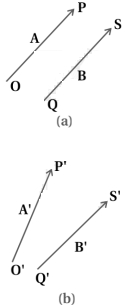
Equality of vectors: Two vectors $\vec{A}$ and $\vec{B}$ are said to be equal if and only if they have the same magnitude and the same direction.
Figure $(a)$ shows two equal vectors $\vec{A}$ and $\vec{B}$. We can easily check their equality by shifting $\vec{B}$ parallel to itself until its tail $Q$ coincides with that of $\vec{A}$ (i.e.,$Q$ coincides with $O$). Then,their tips $S$ and $P$ also coincide. The two vectors are then said to be equal,denoted as $\vec{A} = \vec{B}$.
Let $P$ and $P^{\prime}$ be the positions of the object at time $t$ and $t^{\prime}$,respectively. $\overrightarrow{OP}$ is the position vector of the object at time $t$. It is represented by the symbol $\vec{r}$.
Point $P^{\prime}$ is represented by another position vector $\overrightarrow{OP^{\prime}}$,denoted by $\vec{r}^{\prime}$.
The length of the vector $\vec{r}$ represents the magnitude of the vector,and its direction is the direction in which $P$ lies as seen from $O$.
Displacement vector: If the object moves from $P$ to $P^{\prime}$,the vector $\overrightarrow{PP^{\prime}}$ (with the tail at $P$ and the tip at $P^{\prime}$) is called the displacement vector corresponding to the motion from point $P$ (at time $t$) to point $P^{\prime}$ (at time $t^{\prime}$).
Equality of vectors: Two vectors $\vec{A}$ and $\vec{B}$ are said to be equal if and only if they have the same magnitude and the same direction.
Figure $(a)$ shows two equal vectors $\vec{A}$ and $\vec{B}$. We can easily check their equality by shifting $\vec{B}$ parallel to itself until its tail $Q$ coincides with that of $\vec{A}$ (i.e.,$Q$ coincides with $O$). Then,their tips $S$ and $P$ also coincide. The two vectors are then said to be equal,denoted as $\vec{A} = \vec{B}$.
0 likes
View Solution105
MediumMCQ
What is the magnitude of a new vector obtained by multiplying a vector $\vec{A}$ by $-\frac{3}{2}$?
A
The magnitude becomes $\frac{3}{2}$ times the original magnitude.
B
The magnitude becomes $-\frac{3}{2}$ times the original magnitude.
C
The magnitude becomes $\frac{2}{3}$ times the original magnitude.
D
The magnitude becomes $0$.
Solution
(A) When a vector $\vec{A}$ is multiplied by a scalar $k$,the new vector is $\vec{A}' = k\vec{A}$.
The magnitude of the new vector is given by $|\vec{A}'| = |k| \cdot |\vec{A}|$.
Here,$k = -\frac{3}{2}$.
Therefore,the magnitude is $|-\frac{3}{2}| \cdot |\vec{A}| = \frac{3}{2} |\vec{A}|$.
Thus,the magnitude of the new vector is $\frac{3}{2}$ times the magnitude of the original vector.
The magnitude of the new vector is given by $|\vec{A}'| = |k| \cdot |\vec{A}|$.
Here,$k = -\frac{3}{2}$.
Therefore,the magnitude is $|-\frac{3}{2}| \cdot |\vec{A}| = \frac{3}{2} |\vec{A}|$.
Thus,the magnitude of the new vector is $\frac{3}{2}$ times the magnitude of the original vector.
0 likes
View Solution106
Easy
Explain the null vector. Explain the physical significance of the null vector.
Solution
(N/A) Null vector: $A$ vector having zero magnitude and an indeterminate direction is called a null vector or zero vector. It is represented by $\vec{0}$.
Mathematical definition: If a vector $\vec{A}$ is subtracted from itself,the result is a null vector: $\vec{A} - \vec{A} = \vec{0}$.
Properties of a null vector:
$(i)$ $\vec{A} + \vec{0} = \vec{A}$
(ii) $\lambda \vec{0} = \vec{0}$ (where $\lambda$ is a scalar)
(iii) $0 \cdot \vec{A} = \vec{0}$
Physical Significance:
The null vector is essential to ensure that the result of vector operations remains a vector. For example,the displacement of a particle that returns to its starting point is a null vector.
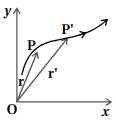
As shown in the figure,a particle is at position $P$ at time $t=0$ with position vector $\vec{r}$. At time $t$,it moves to position $P'$ with position vector $\vec{r}'$. If the particle returns to $P$,the displacement $\Delta \vec{r} = \vec{r} - \vec{r} = \vec{0}$,which is a null vector.
Mathematical definition: If a vector $\vec{A}$ is subtracted from itself,the result is a null vector: $\vec{A} - \vec{A} = \vec{0}$.
Properties of a null vector:
$(i)$ $\vec{A} + \vec{0} = \vec{A}$
(ii) $\lambda \vec{0} = \vec{0}$ (where $\lambda$ is a scalar)
(iii) $0 \cdot \vec{A} = \vec{0}$
Physical Significance:
The null vector is essential to ensure that the result of vector operations remains a vector. For example,the displacement of a particle that returns to its starting point is a null vector.
As shown in the figure,a particle is at position $P$ at time $t=0$ with position vector $\vec{r}$. At time $t$,it moves to position $P'$ with position vector $\vec{r}'$. If the particle returns to $P$,the displacement $\Delta \vec{r} = \vec{r} - \vec{r} = \vec{0}$,which is a null vector.
0 likes
View Solution107
Easy
If $\overrightarrow{A}$ is a vector with magnitude $(3, 4)$,show that the magnitude of its unit vector is $1$.
Solution
(N/A) The vector is given as $\overrightarrow{A} = 3\hat{i} + 4\hat{j}$.
The magnitude of $\overrightarrow{A}$ is $|\overrightarrow{A}| = \sqrt{3^2 + 4^2} = \sqrt{9 + 16} = \sqrt{25} = 5$.
The unit vector $\hat{A}$ is defined as $\hat{A} = \frac{\overrightarrow{A}}{|\overrightarrow{A}|} = \frac{3\hat{i} + 4\hat{j}}{5} = \frac{3}{5}\hat{i} + \frac{4}{5}\hat{j}$.
The magnitude of the unit vector is $|\hat{A}| = \sqrt{(\frac{3}{5})^2 + (\frac{4}{5})^2} = \sqrt{\frac{9}{25} + \frac{16}{25}} = \sqrt{\frac{25}{25}} = \sqrt{1} = 1$.
Thus,the magnitude of the unit vector is $1$.
The magnitude of $\overrightarrow{A}$ is $|\overrightarrow{A}| = \sqrt{3^2 + 4^2} = \sqrt{9 + 16} = \sqrt{25} = 5$.
The unit vector $\hat{A}$ is defined as $\hat{A} = \frac{\overrightarrow{A}}{|\overrightarrow{A}|} = \frac{3\hat{i} + 4\hat{j}}{5} = \frac{3}{5}\hat{i} + \frac{4}{5}\hat{j}$.
The magnitude of the unit vector is $|\hat{A}| = \sqrt{(\frac{3}{5})^2 + (\frac{4}{5})^2} = \sqrt{\frac{9}{25} + \frac{16}{25}} = \sqrt{\frac{25}{25}} = \sqrt{1} = 1$.
Thus,the magnitude of the unit vector is $1$.
0 likes
View Solution108
EasyMCQ
Find the unit vector of a vector whose coordinates are $(8, 6)$.
A
$0.8 \hat{i} + 0.6 \hat{j}$
B
$0.6 \hat{i} + 0.8 \hat{j}$
C
$8 \hat{i} + 6 \hat{j}$
D
$0.4 \hat{i} + 0.3 \hat{j}$
Solution
(A) Let the vector be $\vec{A} = 8 \hat{i} + 6 \hat{j}$.
First,calculate the magnitude of the vector: $|\vec{A}| = \sqrt{8^2 + 6^2} = \sqrt{64 + 36} = \sqrt{100} = 10$.
The unit vector $\hat{A}$ is defined as $\hat{A} = \frac{\vec{A}}{|\vec{A}|}$.
Substituting the values,$\hat{A} = \frac{8 \hat{i} + 6 \hat{j}}{10} = 0.8 \hat{i} + 0.6 \hat{j}$.
First,calculate the magnitude of the vector: $|\vec{A}| = \sqrt{8^2 + 6^2} = \sqrt{64 + 36} = \sqrt{100} = 10$.
The unit vector $\hat{A}$ is defined as $\hat{A} = \frac{\vec{A}}{|\vec{A}|}$.
Substituting the values,$\hat{A} = \frac{8 \hat{i} + 6 \hat{j}}{10} = 0.8 \hat{i} + 0.6 \hat{j}$.
0 likes
View Solution109
EasyMCQ
State the important condition for the addition of vectors.
A
Vectors must be in the same direction.
B
Vectors must represent the same physical quantity.
C
Vectors must have the same magnitude.
D
Vectors must be coplanar.
Solution
(B) The fundamental condition for the addition of vectors is that the vectors must represent the same physical quantity.
For example,a force vector can only be added to another force vector,not to a velocity vector.
This is because physical laws and dimensions must be consistent for the resultant to have a meaningful physical interpretation.
For example,a force vector can only be added to another force vector,not to a velocity vector.
This is because physical laws and dimensions must be consistent for the resultant to have a meaningful physical interpretation.
0 likes
View Solution110
EasyMCQ
What should be the angle $\theta$ between two vectors $\vec{A}$ and $\vec{B}$ so that the magnitude of the resultant vector $\vec{R}$ is maximum (in $^{\circ}$)?
A
$0$
B
$90$
C
$180$
D
$270$
Solution
(A) The magnitude of the resultant vector $\vec{R}$ of two vectors $\vec{A}$ and $\vec{B}$ is given by the formula:
$R = \sqrt{A^2 + B^2 + 2AB \cos \theta}$
For the magnitude $R$ to be maximum,the term $\cos \theta$ must be maximum.
The maximum value of $\cos \theta$ is $1$,which occurs when $\theta = 0^{\circ}$.
Substituting $\theta = 0^{\circ}$ into the formula:
$R_{\max} = \sqrt{A^2 + B^2 + 2AB(1)} = \sqrt{(A+B)^2} = A + B$.
Therefore,the angle $\theta$ must be $0^{\circ}$.
$R = \sqrt{A^2 + B^2 + 2AB \cos \theta}$
For the magnitude $R$ to be maximum,the term $\cos \theta$ must be maximum.
The maximum value of $\cos \theta$ is $1$,which occurs when $\theta = 0^{\circ}$.
Substituting $\theta = 0^{\circ}$ into the formula:
$R_{\max} = \sqrt{A^2 + B^2 + 2AB(1)} = \sqrt{(A+B)^2} = A + B$.
Therefore,the angle $\theta$ must be $0^{\circ}$.
0 likes
View Solution111
MediumMCQ
Can the resultant of three vectors of unequal magnitudes be a zero vector?
A
Yes
B
No
C
Only if they are collinear
D
Only if they are perpendicular
Solution
(A) Yes,the resultant of three vectors of unequal magnitudes can be a zero vector.
If three vectors of unequal magnitudes form a closed triangle when placed head-to-tail,their vector sum is zero.
For example,if the magnitudes of the three vectors are $3, 4,$ and $5$ units,they can form a right-angled triangle,and their resultant will be zero.
If three vectors of unequal magnitudes form a closed triangle when placed head-to-tail,their vector sum is zero.
For example,if the magnitudes of the three vectors are $3, 4,$ and $5$ units,they can form a right-angled triangle,and their resultant will be zero.
0 likes
View Solution112
MediumMCQ
If $\vec{A} + \vec{B} = \vec{C}$ and $|\vec{A}| + |\vec{B}| = |\vec{C}|$,what can be said about the direction of these vectors?
A
They are in opposite directions.
B
They are in the same direction.
C
They are perpendicular to each other.
D
They are at an angle of $60^{\circ}$ to each other.
Solution
(B) The magnitude of the resultant vector $\vec{C}$ is given by $|\vec{C}| = \sqrt{|\vec{A}|^2 + |\vec{B}|^2 + 2|\vec{A}||\vec{B}| \cos \theta}$,where $\theta$ is the angle between $\vec{A}$ and $\vec{B}$.
Given that $|\vec{A}| + |\vec{B}| = |\vec{C}|$,we square both sides: $(|\vec{A}| + |\vec{B}|)^2 = |\vec{C}|^2$.
$|\vec{A}|^2 + |\vec{B}|^2 + 2|\vec{A}||\vec{B}| = |\vec{A}|^2 + |\vec{B}|^2 + 2|\vec{A}||\vec{B}| \cos \theta$.
This simplifies to $2|\vec{A}||\vec{B}| = 2|\vec{A}||\vec{B}| \cos \theta$,which implies $\cos \theta = 1$.
Therefore,$\theta = 0^{\circ}$,meaning $\vec{A}$ and $\vec{B}$ are in the same direction.
Given that $|\vec{A}| + |\vec{B}| = |\vec{C}|$,we square both sides: $(|\vec{A}| + |\vec{B}|)^2 = |\vec{C}|^2$.
$|\vec{A}|^2 + |\vec{B}|^2 + 2|\vec{A}||\vec{B}| = |\vec{A}|^2 + |\vec{B}|^2 + 2|\vec{A}||\vec{B}| \cos \theta$.
This simplifies to $2|\vec{A}||\vec{B}| = 2|\vec{A}||\vec{B}| \cos \theta$,which implies $\cos \theta = 1$.
Therefore,$\theta = 0^{\circ}$,meaning $\vec{A}$ and $\vec{B}$ are in the same direction.
0 likes
View Solution113
Easy
If the magnitude of a physical quantity is zero,can it be a vector? Give a suitable example.
Solution
(A) Yes,a physical quantity can be a vector even if its magnitude is zero. Such a vector is called a null vector or zero vector.
For example,if a ball is thrown vertically upwards and returns to the thrower's hand,the displacement of the ball is zero. Since displacement is a vector quantity,this zero displacement is represented as a null vector.
For example,if a ball is thrown vertically upwards and returns to the thrower's hand,the displacement of the ball is zero. Since displacement is a vector quantity,this zero displacement is represented as a null vector.
0 likes
View Solution114
EasyMCQ
Find the unit vector in the direction of $2\hat{i} + 3\hat{j} + 4\hat{k}$.
A
$\frac{2\hat{i} + 3\hat{j} + 4\hat{k}}{\sqrt{29}}$
B
$\frac{2\hat{i} + 3\hat{j} + 4\hat{k}}{29}$
C
$\frac{2\hat{i} + 3\hat{j} + 4\hat{k}}{\sqrt{9}}$
D
$\frac{2\hat{i} + 3\hat{j} + 4\hat{k}}{9}$
Solution
(A) Let the vector be $\vec{A} = 2\hat{i} + 3\hat{j} + 4\hat{k}$.
The magnitude of the vector is given by $|\vec{A}| = \sqrt{2^2 + 3^2 + 4^2}$.
$|\vec{A}| = \sqrt{4 + 9 + 16} = \sqrt{29}$.
The unit vector $\hat{A}$ in the direction of $\vec{A}$ is defined as $\hat{A} = \frac{\vec{A}}{|\vec{A}|}$.
Therefore,$\hat{A} = \frac{2\hat{i} + 3\hat{j} + 4\hat{k}}{\sqrt{29}}$.
The magnitude of the vector is given by $|\vec{A}| = \sqrt{2^2 + 3^2 + 4^2}$.
$|\vec{A}| = \sqrt{4 + 9 + 16} = \sqrt{29}$.
The unit vector $\hat{A}$ in the direction of $\vec{A}$ is defined as $\hat{A} = \frac{\vec{A}}{|\vec{A}|}$.
Therefore,$\hat{A} = \frac{2\hat{i} + 3\hat{j} + 4\hat{k}}{\sqrt{29}}$.
0 likes
View Solution115
EasyMCQ
The unit vector is given by $a\hat{i} + b\hat{j} + c\hat{k}$. If the values of $a$ and $b$ are $0.6$ and $0.8$ respectively,find the value of $c$.
A
$0.5$
B
$0.4$
C
$0$
D
$0.2$
Solution
(C) unit vector $\hat{n}$ has a magnitude of $1$.
Given $\hat{n} = a\hat{i} + b\hat{j} + c\hat{k} = 0.6\hat{i} + 0.8\hat{j} + c\hat{k}$.
The magnitude is defined as $|\hat{n}| = \sqrt{a^2 + b^2 + c^2} = 1$.
Substituting the given values: $\sqrt{(0.6)^2 + (0.8)^2 + c^2} = 1$.
Squaring both sides: $(0.6)^2 + (0.8)^2 + c^2 = 1^2$.
$0.36 + 0.64 + c^2 = 1$.
$1.00 + c^2 = 1$.
$c^2 = 1 - 1 = 0$.
Therefore,$c = 0$.
Given $\hat{n} = a\hat{i} + b\hat{j} + c\hat{k} = 0.6\hat{i} + 0.8\hat{j} + c\hat{k}$.
The magnitude is defined as $|\hat{n}| = \sqrt{a^2 + b^2 + c^2} = 1$.
Substituting the given values: $\sqrt{(0.6)^2 + (0.8)^2 + c^2} = 1$.
Squaring both sides: $(0.6)^2 + (0.8)^2 + c^2 = 1^2$.
$0.36 + 0.64 + c^2 = 1$.
$1.00 + c^2 = 1$.
$c^2 = 1 - 1 = 0$.
Therefore,$c = 0$.
0 likes
View Solution116
EasyMCQ
What is the result of multiplying a vector $\overrightarrow{A}$ by a positive real number $\lambda$?
A
$A$ new vector with the same direction as $\overrightarrow{A}$ and magnitude $\lambda |\overrightarrow{A}|$.
B
$A$ new vector with the opposite direction to $\overrightarrow{A}$ and magnitude $\lambda |\overrightarrow{A}|$.
C
$A$ new vector with the same direction as $\overrightarrow{A}$ and magnitude $|\overrightarrow{A}|/\lambda$.
D
$A$ scalar quantity equal to $\lambda |\overrightarrow{A}|$.
Solution
(A) When a vector $\overrightarrow{A}$ is multiplied by a positive real number $\lambda$,the resulting vector $\overrightarrow{B} = \lambda \overrightarrow{A}$ has the following properties:
$1$. The magnitude of the new vector is $\lambda$ times the magnitude of the original vector,i.e.,$|\overrightarrow{B}| = \lambda |\overrightarrow{A}|$.
$2$. Since $\lambda$ is positive,the direction of the new vector $\overrightarrow{B}$ remains the same as the direction of the original vector $\overrightarrow{A}$.
Therefore,the correct option is $A$.
$1$. The magnitude of the new vector is $\lambda$ times the magnitude of the original vector,i.e.,$|\overrightarrow{B}| = \lambda |\overrightarrow{A}|$.
$2$. Since $\lambda$ is positive,the direction of the new vector $\overrightarrow{B}$ remains the same as the direction of the original vector $\overrightarrow{A}$.
Therefore,the correct option is $A$.
0 likes
View Solution117
MediumMCQ
Find the magnitude and direction of the vector $\vec{A} = \hat{i} + \hat{j}$.
A
Magnitude = $\sqrt{2}$,Direction = $45^{\circ}$ with $x$-axis
B
Magnitude = $2$,Direction = $30^{\circ}$ with $x$-axis
C
Magnitude = $\sqrt{2}$,Direction = $90^{\circ}$ with $x$-axis
D
Magnitude = $1$,Direction = $45^{\circ}$ with $x$-axis
Solution
(A) The magnitude of the vector $\vec{A} = \hat{i} + \hat{j}$ is given by $|\vec{A}| = \sqrt{(1)^2 + (1)^2} = \sqrt{1 + 1} = \sqrt{2}$.
The direction $\theta$ with the $x$-axis is given by $\tan \theta = \frac{A_y}{A_x} = \frac{1}{1} = 1$.
Therefore,$\theta = \tan^{-1}(1) = 45^{\circ}$ with the $x$-axis.
The direction $\theta$ with the $x$-axis is given by $\tan \theta = \frac{A_y}{A_x} = \frac{1}{1} = 1$.
Therefore,$\theta = \tan^{-1}(1) = 45^{\circ}$ with the $x$-axis.
0 likes
View Solution118
EasyMCQ
If $\vec{P} \cdot \vec{Q} = 0$ and $\vec{P} \times \vec{Q} = PQ$,then what is the angle between $\vec{P}$ and $\vec{Q}$ (in $^{\circ}$)?
A
$0$
B
$45$
C
$90$
D
$180$
Solution
(C) Given: $\vec{P} \cdot \vec{Q} = 0$. This implies that $\vec{P}$ and $\vec{Q}$ are perpendicular to each other,so the angle $\theta = 90^{\circ}$.
Also given: $|\vec{P} \times \vec{Q}| = PQ$. The magnitude of the cross product is given by $|\vec{P} \times \vec{Q}| = PQ \sin \theta$.
Substituting the value of $\theta = 90^{\circ}$,we get $|\vec{P} \times \vec{Q}| = PQ \sin(90^{\circ}) = PQ(1) = PQ$.
Since both conditions are satisfied at $\theta = 90^{\circ}$,the angle between $\vec{P}$ and $\vec{Q}$ is $90^{\circ}$.
Also given: $|\vec{P} \times \vec{Q}| = PQ$. The magnitude of the cross product is given by $|\vec{P} \times \vec{Q}| = PQ \sin \theta$.
Substituting the value of $\theta = 90^{\circ}$,we get $|\vec{P} \times \vec{Q}| = PQ \sin(90^{\circ}) = PQ(1) = PQ$.
Since both conditions are satisfied at $\theta = 90^{\circ}$,the angle between $\vec{P}$ and $\vec{Q}$ is $90^{\circ}$.
0 likes
View Solution119
Medium
Write the distributive law for the product of two vectors.
Solution
The distributive law for the scalar product (dot product) of a vector $\vec{A}$ with the sum of two vectors $\vec{B}$ and $\vec{C}$ is given by:
$\vec{A} \cdot (\vec{B} + \vec{C}) = \vec{A} \cdot \vec{B} + \vec{A} \cdot \vec{C}$
Similarly,for the vector product (cross product):
$\vec{A} \times (\vec{B} + \vec{C}) = \vec{A} \times \vec{B} + \vec{A} \times \vec{C}$
This law states that the product of a vector with the sum of two other vectors is equal to the sum of the individual products of the vector with each of the other two vectors.
$\vec{A} \cdot (\vec{B} + \vec{C}) = \vec{A} \cdot \vec{B} + \vec{A} \cdot \vec{C}$
Similarly,for the vector product (cross product):
$\vec{A} \times (\vec{B} + \vec{C}) = \vec{A} \times \vec{B} + \vec{A} \times \vec{C}$
This law states that the product of a vector with the sum of two other vectors is equal to the sum of the individual products of the vector with each of the other two vectors.
0 likes
View Solution120
Difficult
Give three properties which have different magnitudes and also have different directions.
Solution
(N/A) The three properties that exhibit different magnitudes and different directions are:
$1$. Thermal conductivity: In anisotropic materials,the flow of heat depends on the direction of the temperature gradient.
$2$. Electrical conductivity: In crystalline materials,the flow of electric current varies depending on the orientation of the crystal lattice.
$3$. Elastic modulus (or compressibility): In anisotropic solids,the deformation resulting from an applied stress depends on the direction of the force relative to the crystal axes.
$1$. Thermal conductivity: In anisotropic materials,the flow of heat depends on the direction of the temperature gradient.
$2$. Electrical conductivity: In crystalline materials,the flow of electric current varies depending on the orientation of the crystal lattice.
$3$. Elastic modulus (or compressibility): In anisotropic solids,the deformation resulting from an applied stress depends on the direction of the force relative to the crystal axes.
0 likes
View Solution121
MediumMCQ
State whether the following statements are true or false:
$(a)$ The unit vectors ${\hat i}$ and ${\hat j}$ along the $x$ and $y$-axes change with time.
$(b)$ If the angle between $\overrightarrow A$ and $\overrightarrow B$ is ${\theta _1}$ and the angle between $\overrightarrow A$ and $\overrightarrow C$ is ${\theta _2}$,then $\overrightarrow A \cdot \overrightarrow B = \overrightarrow A \cdot \overrightarrow C$ implies $\overrightarrow B = \overrightarrow C$.
$(c)$ The resultant vector of two coplanar vectors is also a coplanar vector.
$(a)$ The unit vectors ${\hat i}$ and ${\hat j}$ along the $x$ and $y$-axes change with time.
$(b)$ If the angle between $\overrightarrow A$ and $\overrightarrow B$ is ${\theta _1}$ and the angle between $\overrightarrow A$ and $\overrightarrow C$ is ${\theta _2}$,then $\overrightarrow A \cdot \overrightarrow B = \overrightarrow A \cdot \overrightarrow C$ implies $\overrightarrow B = \overrightarrow C$.
$(c)$ The resultant vector of two coplanar vectors is also a coplanar vector.
A
True
B
False
C
True
Solution
(B) False: The unit vectors ${\hat i}$ and ${\hat j}$ are constant in both magnitude and direction in a Cartesian coordinate system,so they do not change with time.
$(b)$ False: The dot product $\overrightarrow A \cdot \overrightarrow B = |A||B|\cos{\theta _1}$ and $\overrightarrow A \cdot \overrightarrow C = |A||C|\cos{\theta _2}$. Even if the dot products are equal,it does not imply $\overrightarrow B = \overrightarrow C$ because the magnitudes and angles can vary independently.
$(c)$ True: By the parallelogram law of vector addition,the resultant of two vectors lying in a plane must also lie in the same plane.
$(b)$ False: The dot product $\overrightarrow A \cdot \overrightarrow B = |A||B|\cos{\theta _1}$ and $\overrightarrow A \cdot \overrightarrow C = |A||C|\cos{\theta _2}$. Even if the dot products are equal,it does not imply $\overrightarrow B = \overrightarrow C$ because the magnitudes and angles can vary independently.
$(c)$ True: By the parallelogram law of vector addition,the resultant of two vectors lying in a plane must also lie in the same plane.
0 likes
View Solution122
EasyMCQ
Match Column $-I$ with Column $-II$.
| Column $-I$ | Column $-II$ |
| $(1)$ Angular momentum | $(a)$ Scalar |
| $(2)$ Potential energy | $(b)$ Vector |
| $(c)$ Unit vector |
A
$(1-b), (2-a)$
B
$(1-a), (2-b)$
C
$(1-b), (2-c)$
D
$(1-c), (2-a)$
Solution
(A) Angular momentum is defined as the cross product of position vector and linear momentum,i.e.,$\vec{L} = \vec{r} \times \vec{p}$. Since it is a cross product,it is a vector quantity. Thus,$(1)$ matches with $(b)$.
Potential energy is a form of energy,and all forms of energy are scalar quantities because they only have magnitude and no direction. Thus,$(2)$ matches with $(a)$.
Therefore,the correct matching is $(1-b), (2-a)$.
Potential energy is a form of energy,and all forms of energy are scalar quantities because they only have magnitude and no direction. Thus,$(2)$ matches with $(a)$.
Therefore,the correct matching is $(1-b), (2-a)$.
0 likes
View Solution123
Easy
What is a unit vector? Explain.
Solution
(N/A) vector whose magnitude is $1$ unit is called a unit vector.
It represents the direction of a vector.
It does not have any unit or dimensions.
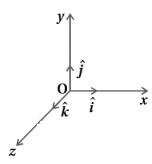
In a Cartesian coordinate system,the unit vectors along the $x, y,$ and $z$ axes are denoted by $\hat{i}, \hat{j},$ and $\hat{k}$ respectively.
Since the magnitude of a unit vector is $1$,we have:
$|\hat{i}| = |\hat{j}| = |\hat{k}| = 1$
These vectors are mutually perpendicular to each other.
$A$ unit vector can be obtained by dividing a vector by its magnitude.
Example: If the unit vector of $\vec{A}$ is $\hat{n}$,then:
$\hat{n} = \frac{\vec{A}}{|\vec{A}|} = \frac{\vec{A}}{A} = \frac{\text{vector}}{\text{magnitude of vector}}$
According to this equation,$\vec{A} = |\vec{A}| \cdot \hat{n}$
Vector $=$ (Magnitude of vector) $\times$ (Its unit vector)
Example: $A$ force of $5 \text{ N}$ acting along the $X$-axis can be represented as: $\vec{F} = 5\hat{i} \text{ N}$.
It represents the direction of a vector.
It does not have any unit or dimensions.
In a Cartesian coordinate system,the unit vectors along the $x, y,$ and $z$ axes are denoted by $\hat{i}, \hat{j},$ and $\hat{k}$ respectively.
Since the magnitude of a unit vector is $1$,we have:
$|\hat{i}| = |\hat{j}| = |\hat{k}| = 1$
These vectors are mutually perpendicular to each other.
$A$ unit vector can be obtained by dividing a vector by its magnitude.
Example: If the unit vector of $\vec{A}$ is $\hat{n}$,then:
$\hat{n} = \frac{\vec{A}}{|\vec{A}|} = \frac{\vec{A}}{A} = \frac{\text{vector}}{\text{magnitude of vector}}$
According to this equation,$\vec{A} = |\vec{A}| \cdot \hat{n}$
Vector $=$ (Magnitude of vector) $\times$ (Its unit vector)
Example: $A$ force of $5 \text{ N}$ acting along the $X$-axis can be represented as: $\vec{F} = 5\hat{i} \text{ N}$.
0 likes
View Solution124
DifficultMCQ
$A$ mosquito is moving with a velocity $\overrightarrow{v} = 0.5t^2 \hat{i} + 3t \hat{j} + 9 \hat{k} \, m/s$. What will be the direction of the mosquito after $t = 2 \, s$?
A
$\tan^{-1}\left(\frac{2}{3}\right)$ from $x$-axis
B
None of these
C
$\tan^{-1}\left(\frac{5}{2}\right)$ from $y$-axis
D
$\tan^{-1}\left(\frac{5}{2}\right)$ from $x$-axis
Solution
(B) Given velocity vector: $\overrightarrow{v} = 0.5t^2 \hat{i} + 3t \hat{j} + 9 \hat{k}$.
At $t = 2 \, s$,the velocity is $\overrightarrow{v} = 0.5(2)^2 \hat{i} + 3(2) \hat{j} + 9 \hat{k} = 2 \hat{i} + 6 \hat{j} + 9 \hat{k} \, m/s$.
The magnitude of the velocity is $|\overrightarrow{v}| = \sqrt{2^2 + 6^2 + 9^2} = \sqrt{4 + 36 + 81} = \sqrt{121} = 11 \, m/s$.
The direction cosines are $\cos \alpha = \frac{v_x}{|v|} = \frac{2}{11}$,$\cos \beta = \frac{v_y}{|v|} = \frac{6}{11}$,and $\cos \gamma = \frac{v_z}{|v|} = \frac{9}{11}$.
The angle with the $x$-axis is $\alpha = \cos^{-1}(\frac{2}{11})$.
The angle with the $y$-axis is $\beta = \cos^{-1}(\frac{6}{11})$.
The angle with the $z$-axis is $\gamma = \cos^{-1}(\frac{9}{11})$.
None of the given options match these values. Therefore,the correct choice is $B$.
At $t = 2 \, s$,the velocity is $\overrightarrow{v} = 0.5(2)^2 \hat{i} + 3(2) \hat{j} + 9 \hat{k} = 2 \hat{i} + 6 \hat{j} + 9 \hat{k} \, m/s$.
The magnitude of the velocity is $|\overrightarrow{v}| = \sqrt{2^2 + 6^2 + 9^2} = \sqrt{4 + 36 + 81} = \sqrt{121} = 11 \, m/s$.
The direction cosines are $\cos \alpha = \frac{v_x}{|v|} = \frac{2}{11}$,$\cos \beta = \frac{v_y}{|v|} = \frac{6}{11}$,and $\cos \gamma = \frac{v_z}{|v|} = \frac{9}{11}$.
The angle with the $x$-axis is $\alpha = \cos^{-1}(\frac{2}{11})$.
The angle with the $y$-axis is $\beta = \cos^{-1}(\frac{6}{11})$.
The angle with the $z$-axis is $\gamma = \cos^{-1}(\frac{9}{11})$.
None of the given options match these values. Therefore,the correct choice is $B$.
0 likes
View Solution125
DifficultMCQ
In a regular octagon $ABCDEFGH$ with center $O$,what is the sum of $\overrightarrow{ AB }+\overrightarrow{ AC }+\overrightarrow{ AD }+\overrightarrow{ AE }+\overrightarrow{ AF }+\overrightarrow{ AG }+\overrightarrow{ AH }$ if $\overrightarrow{ AO }=2 \hat{ i }+3 \hat{ j }-4 \hat{ k }$?

A
$-16 \hat{i}-24 \hat{j}+32 \hat{k}$
B
$16 \hat{i}+24 \hat{j}-32 \hat{k}$
C
$16 \hat{i}+24 \hat{j}+32 \hat{k}$
D
$16 \hat{i}-24 \hat{j}+32 \hat{k}$
Solution
(B) For a regular polygon with center $O$,the sum of vectors from the center to the vertices is zero:
$\overrightarrow{ OA }+\overrightarrow{ OB }+\overrightarrow{ OC }+\overrightarrow{ OD }+\overrightarrow{ OE }+\overrightarrow{ OF }+\overrightarrow{ OG }+\overrightarrow{ OH }=\overrightarrow{0}$
Using the triangle law of vector addition,we can express each vector $\overrightarrow{ AX }$ as $\overrightarrow{ AO }+\overrightarrow{ OX }$:
$\overrightarrow{ AB }=\overrightarrow{ AO }+\overrightarrow{ OB }$
$\overrightarrow{ AC }=\overrightarrow{ AO }+\overrightarrow{ OC }$
$\overrightarrow{ AD }=\overrightarrow{ AO }+\overrightarrow{ OD }$
$\overrightarrow{ AE }=\overrightarrow{ AO }+\overrightarrow{ OE }$
$\overrightarrow{ AF }=\overrightarrow{ AO }+\overrightarrow{ OF }$
$\overrightarrow{ AG }=\overrightarrow{ AO }+\overrightarrow{ OG }$
$\overrightarrow{ AH }=\overrightarrow{ AO }+\overrightarrow{ OH }$
Summing these seven vectors:
$\sum = 7 \overrightarrow{ AO } + (\overrightarrow{ OB }+\overrightarrow{ OC }+\overrightarrow{ OD }+\overrightarrow{ OE }+\overrightarrow{ OF }+\overrightarrow{ OG }+\overrightarrow{ OH })$
From the initial property,the sum in the parenthesis is equal to $-\overrightarrow{ OA }$,which is $\overrightarrow{ AO }$:
$\sum = 7 \overrightarrow{ AO } + \overrightarrow{ AO } = 8 \overrightarrow{ AO }$
Given $\overrightarrow{ AO }=2 \hat{ i }+3 \hat{ j }-4 \hat{ k }$,we have:
$\sum = 8(2 \hat{ i }+3 \hat{ j }-4 \hat{ k }) = 16 \hat{i}+24 \hat{j}-32 \hat{k}$
$\overrightarrow{ OA }+\overrightarrow{ OB }+\overrightarrow{ OC }+\overrightarrow{ OD }+\overrightarrow{ OE }+\overrightarrow{ OF }+\overrightarrow{ OG }+\overrightarrow{ OH }=\overrightarrow{0}$
Using the triangle law of vector addition,we can express each vector $\overrightarrow{ AX }$ as $\overrightarrow{ AO }+\overrightarrow{ OX }$:
$\overrightarrow{ AB }=\overrightarrow{ AO }+\overrightarrow{ OB }$
$\overrightarrow{ AC }=\overrightarrow{ AO }+\overrightarrow{ OC }$
$\overrightarrow{ AD }=\overrightarrow{ AO }+\overrightarrow{ OD }$
$\overrightarrow{ AE }=\overrightarrow{ AO }+\overrightarrow{ OE }$
$\overrightarrow{ AF }=\overrightarrow{ AO }+\overrightarrow{ OF }$
$\overrightarrow{ AG }=\overrightarrow{ AO }+\overrightarrow{ OG }$
$\overrightarrow{ AH }=\overrightarrow{ AO }+\overrightarrow{ OH }$
Summing these seven vectors:
$\sum = 7 \overrightarrow{ AO } + (\overrightarrow{ OB }+\overrightarrow{ OC }+\overrightarrow{ OD }+\overrightarrow{ OE }+\overrightarrow{ OF }+\overrightarrow{ OG }+\overrightarrow{ OH })$
From the initial property,the sum in the parenthesis is equal to $-\overrightarrow{ OA }$,which is $\overrightarrow{ AO }$:
$\sum = 7 \overrightarrow{ AO } + \overrightarrow{ AO } = 8 \overrightarrow{ AO }$
Given $\overrightarrow{ AO }=2 \hat{ i }+3 \hat{ j }-4 \hat{ k }$,we have:
$\sum = 8(2 \hat{ i }+3 \hat{ j }-4 \hat{ k }) = 16 \hat{i}+24 \hat{j}-32 \hat{k}$
0 likes
View Solution126
DifficultMCQ
Two vectors $\overrightarrow{X}$ and $\overrightarrow{Y}$ have equal magnitude. The magnitude of $(\overrightarrow{X}-\overrightarrow{Y})$ is $n$ times the magnitude of $(\overrightarrow{X}+\overrightarrow{Y})$. The angle between $\overrightarrow{X}$ and $\overrightarrow{Y}$ is:
A
$\cos^{-1}\left(\frac{n^{2}+1}{-n^{2}-1}\right)$
B
$\cos^{-1}\left(\frac{n^{2}-1}{-n^{2}-1}\right)$
C
$\cos^{-1}\left(\frac{-n^{2}-1}{n^{2}-1}\right)$
D
$\cos^{-1}\left(\frac{n^{2}+1}{n^{2}-1}\right)$
Solution
(B) Let the magnitude of vectors be $X = Y = A$.
The magnitude of the difference vector is $|\overrightarrow{X} - \overrightarrow{Y}| = \sqrt{A^2 + A^2 - 2A^2 \cos \theta} = \sqrt{2A^2(1 - \cos \theta)}$.
The magnitude of the sum vector is $|\overrightarrow{X} + \overrightarrow{Y}| = \sqrt{A^2 + A^2 + 2A^2 \cos \theta} = \sqrt{2A^2(1 + \cos \theta)}$.
According to the problem,$|\overrightarrow{X} - \overrightarrow{Y}| = n |\overrightarrow{X} + \overrightarrow{Y}|$.
Substituting the expressions: $\sqrt{2A^2(1 - \cos \theta)} = n \sqrt{2A^2(1 + \cos \theta)}$.
Squaring both sides: $2A^2(1 - \cos \theta) = n^2 \cdot 2A^2(1 + \cos \theta)$.
$1 - \cos \theta = n^2(1 + \cos \theta)$.
$1 - \cos \theta = n^2 + n^2 \cos \theta$.
$1 - n^2 = \cos \theta(1 + n^2)$.
$\cos \theta = \frac{1 - n^2}{1 + n^2} = \frac{n^2 - 1}{-n^2 - 1}$.
Therefore,$\theta = \cos^{-1}\left(\frac{n^2 - 1}{-n^2 - 1}\right)$.
The magnitude of the difference vector is $|\overrightarrow{X} - \overrightarrow{Y}| = \sqrt{A^2 + A^2 - 2A^2 \cos \theta} = \sqrt{2A^2(1 - \cos \theta)}$.
The magnitude of the sum vector is $|\overrightarrow{X} + \overrightarrow{Y}| = \sqrt{A^2 + A^2 + 2A^2 \cos \theta} = \sqrt{2A^2(1 + \cos \theta)}$.
According to the problem,$|\overrightarrow{X} - \overrightarrow{Y}| = n |\overrightarrow{X} + \overrightarrow{Y}|$.
Substituting the expressions: $\sqrt{2A^2(1 - \cos \theta)} = n \sqrt{2A^2(1 + \cos \theta)}$.
Squaring both sides: $2A^2(1 - \cos \theta) = n^2 \cdot 2A^2(1 + \cos \theta)$.
$1 - \cos \theta = n^2(1 + \cos \theta)$.
$1 - \cos \theta = n^2 + n^2 \cos \theta$.
$1 - n^2 = \cos \theta(1 + n^2)$.
$\cos \theta = \frac{1 - n^2}{1 + n^2} = \frac{n^2 - 1}{-n^2 - 1}$.
Therefore,$\theta = \cos^{-1}\left(\frac{n^2 - 1}{-n^2 - 1}\right)$.
0 likes
View Solution127
DifficultMCQ
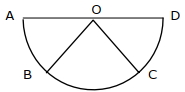
Assertion $A$: If $A, B, C, D$ are four points on a semi-circular arc with centre at $O$ such that $|\overrightarrow{AB}|=|\overrightarrow{BC}|=|\overrightarrow{CD}|$,then $\overrightarrow{AB}+\overrightarrow{AC}+\overrightarrow{AD}=4\overrightarrow{AO}+\overrightarrow{OB}+\overrightarrow{OC}$.
Reason $R$: Polygon law of vector addition yields $\overrightarrow{AB}+\overrightarrow{BC}+\overrightarrow{CD}+\overrightarrow{AD}=2\overrightarrow{AO}$.
In the light of the above statements,choose the most appropriate answer from the options given below.
Reason $R$: Polygon law of vector addition yields $\overrightarrow{AB}+\overrightarrow{BC}+\overrightarrow{CD}+\overrightarrow{AD}=2\overrightarrow{AO}$.
In the light of the above statements,choose the most appropriate answer from the options given below.
A
Both $A$ and $R$ are correct and $R$ is the correct explanation of $A$.
B
$A$ is not correct but $R$ is correct.
C
Both $A$ and $R$ are correct but $R$ is not the correct explanation of $A$.
D
$A$ is correct but $R$ is not correct.
Solution
(D) Given that $A, B, C, D$ are points on a semi-circular arc with center $O$. Since $O$ is the center,$|\overrightarrow{OA}| = |\overrightarrow{OB}| = |\overrightarrow{OC}| = |\overrightarrow{OD}| = R$ (radius).
Using the triangle law of vector addition:
$\overrightarrow{AB} = \overrightarrow{AO} + \overrightarrow{OB}$
$\overrightarrow{AC} = \overrightarrow{AO} + \overrightarrow{OC}$
$\overrightarrow{AD} = \overrightarrow{AO} + \overrightarrow{OD}$
Adding these three equations:
$\overrightarrow{AB} + \overrightarrow{AC} + \overrightarrow{AD} = 3\overrightarrow{AO} + \overrightarrow{OB} + \overrightarrow{OC} + \overrightarrow{OD}$
Since $A, O, D$ are collinear and $O$ is the midpoint of $AD$ (as $AD$ is the diameter of the semi-circle),$\overrightarrow{OD} = -\overrightarrow{OA} = \overrightarrow{AO}$.
Thus,$\overrightarrow{AB} + \overrightarrow{AC} + \overrightarrow{AD} = 3\overrightarrow{AO} + \overrightarrow{OB} + \overrightarrow{OC} + \overrightarrow{AO} = 4\overrightarrow{AO} + \overrightarrow{OB} + \overrightarrow{OC}$.
So,Assertion $A$ is correct.
Regarding Reason $R$: The polygon law states that the sum of vectors forming a closed polygon is zero. The expression $\overrightarrow{AB}+\overrightarrow{BC}+\overrightarrow{CD}+\overrightarrow{AD}=2\overrightarrow{AO}$ is not a standard result of the polygon law and is mathematically incorrect for the given geometry. Thus,Reason $R$ is incorrect.
Therefore,$A$ is correct but $R$ is not correct.
Using the triangle law of vector addition:
$\overrightarrow{AB} = \overrightarrow{AO} + \overrightarrow{OB}$
$\overrightarrow{AC} = \overrightarrow{AO} + \overrightarrow{OC}$
$\overrightarrow{AD} = \overrightarrow{AO} + \overrightarrow{OD}$
Adding these three equations:
$\overrightarrow{AB} + \overrightarrow{AC} + \overrightarrow{AD} = 3\overrightarrow{AO} + \overrightarrow{OB} + \overrightarrow{OC} + \overrightarrow{OD}$
Since $A, O, D$ are collinear and $O$ is the midpoint of $AD$ (as $AD$ is the diameter of the semi-circle),$\overrightarrow{OD} = -\overrightarrow{OA} = \overrightarrow{AO}$.
Thus,$\overrightarrow{AB} + \overrightarrow{AC} + \overrightarrow{AD} = 3\overrightarrow{AO} + \overrightarrow{OB} + \overrightarrow{OC} + \overrightarrow{AO} = 4\overrightarrow{AO} + \overrightarrow{OB} + \overrightarrow{OC}$.
So,Assertion $A$ is correct.
Regarding Reason $R$: The polygon law states that the sum of vectors forming a closed polygon is zero. The expression $\overrightarrow{AB}+\overrightarrow{BC}+\overrightarrow{CD}+\overrightarrow{AD}=2\overrightarrow{AO}$ is not a standard result of the polygon law and is mathematically incorrect for the given geometry. Thus,Reason $R$ is incorrect.
Therefore,$A$ is correct but $R$ is not correct.
0 likes
View Solution128
MediumMCQ
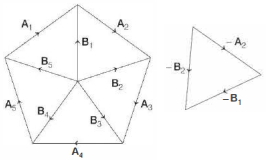
The five sides of a regular pentagon are represented by vectors $A_1, A_2, A_3, A_4$ and $A_5$ in cyclic order as shown in the figure. Corresponding vertices are represented by vectors $B_1, B_2, B_3, B_4$ and $B_5$,drawn from the center of the pentagon. Then,$B_2 + B_3 + B_4 + B_5$ is equal to:
A
$A_1$
B
$-A_1$
C
$B_1$
D
$-B_1$
Solution
(D) From the polygon law of vector addition,for a closed polygon,the sum of vectors taken in cyclic order is zero.
For the outer sides of the pentagon: $A_1 + A_2 + A_3 + A_4 + A_5 = 0$.
Therefore,$A_3 + A_4 + A_5 + A_1 = -A_2$.
From the triangle law of vector addition applied to the triangles formed by the center and the sides:
$B_1 + A_1 = B_2$
$B_2 + A_2 = B_3$
$B_3 + A_3 = B_4$
$B_4 + A_4 = B_5$
$B_5 + A_5 = B_1$
Summing these equations:
$(B_1 + B_2 + B_3 + B_4 + B_5) + (A_1 + A_2 + A_3 + A_4 + A_5) = (B_2 + B_3 + B_4 + B_5 + B_1)$
Since the sum of $A_i$ is zero,we confirm the consistency.
Alternatively,consider the sum $S = B_2 + B_3 + B_4 + B_5$.
From the geometry,$B_2 + A_3 = B_3$,$B_3 + A_4 = B_4$,$B_4 + A_5 = B_5$,and $B_5 + A_1 = B_1$.
Adding these: $B_2 + (A_3 + A_4 + A_5 + A_1) = B_1$.
Since $A_1 + A_2 + A_3 + A_4 + A_5 = 0$,we have $A_3 + A_4 + A_5 + A_1 = -A_2$.
Substituting this: $B_2 - A_2 = B_1$.
From the triangle formed by the center and side $A_2$,we have $B_2 + A_2 = B_3$ is incorrect based on the diagram orientation; rather $B_1 + A_1 = B_2$,$B_2 + A_2 = B_3$,etc.
Actually,$B_1 + A_1 = B_2 \implies A_1 = B_2 - B_1$.
Summing $B_2 + B_3 + B_4 + B_5 = (B_1 + A_1) + (B_2 + A_2) + (B_3 + A_3) + (B_4 + A_4) - (A_1 + A_2 + A_3 + A_4) = B_1 + B_2 + B_3 + B_4 + B_5 - (A_1 + A_2 + A_3 + A_4)$.
Given the symmetry and the closed loop $B_1 + A_1 + (-B_2) = 0$,the correct result is $-B_1$.
For the outer sides of the pentagon: $A_1 + A_2 + A_3 + A_4 + A_5 = 0$.
Therefore,$A_3 + A_4 + A_5 + A_1 = -A_2$.
From the triangle law of vector addition applied to the triangles formed by the center and the sides:
$B_1 + A_1 = B_2$
$B_2 + A_2 = B_3$
$B_3 + A_3 = B_4$
$B_4 + A_4 = B_5$
$B_5 + A_5 = B_1$
Summing these equations:
$(B_1 + B_2 + B_3 + B_4 + B_5) + (A_1 + A_2 + A_3 + A_4 + A_5) = (B_2 + B_3 + B_4 + B_5 + B_1)$
Since the sum of $A_i$ is zero,we confirm the consistency.
Alternatively,consider the sum $S = B_2 + B_3 + B_4 + B_5$.
From the geometry,$B_2 + A_3 = B_3$,$B_3 + A_4 = B_4$,$B_4 + A_5 = B_5$,and $B_5 + A_1 = B_1$.
Adding these: $B_2 + (A_3 + A_4 + A_5 + A_1) = B_1$.
Since $A_1 + A_2 + A_3 + A_4 + A_5 = 0$,we have $A_3 + A_4 + A_5 + A_1 = -A_2$.
Substituting this: $B_2 - A_2 = B_1$.
From the triangle formed by the center and side $A_2$,we have $B_2 + A_2 = B_3$ is incorrect based on the diagram orientation; rather $B_1 + A_1 = B_2$,$B_2 + A_2 = B_3$,etc.
Actually,$B_1 + A_1 = B_2 \implies A_1 = B_2 - B_1$.
Summing $B_2 + B_3 + B_4 + B_5 = (B_1 + A_1) + (B_2 + A_2) + (B_3 + A_3) + (B_4 + A_4) - (A_1 + A_2 + A_3 + A_4) = B_1 + B_2 + B_3 + B_4 + B_5 - (A_1 + A_2 + A_3 + A_4)$.
Given the symmetry and the closed loop $B_1 + A_1 + (-B_2) = 0$,the correct result is $-B_1$.
0 likes
View Solution129
EasyMCQ
Which of the following quantity/quantities are dependent on the choice of orientation of the co-ordinate axes?
$(a)$ $\vec{a}+\vec{b}$
$(b)$ $3a_x+2b_y$
$(c)$ $(\vec{a}+\vec{b}-\vec{c})$
$(a)$ $\vec{a}+\vec{b}$
$(b)$ $3a_x+2b_y$
$(c)$ $(\vec{a}+\vec{b}-\vec{c})$
A
Only $(b)$
B
Both $(a)$ and $(b)$
C
Both $(a)$ and $(c)$
D
Both $(b)$ and $(c)$
Solution
(A) vector quantity is independent of the choice of the coordinate system. The sum or difference of vectors,such as $\vec{a}+\vec{b}$ or $(\vec{a}+\vec{b}-\vec{c})$,results in a new vector,which is a physical quantity independent of the coordinate axes orientation.
However,components of a vector (like $a_x$ or $b_y$) depend on the orientation of the coordinate axes. Therefore,the expression $3a_x+2b_y$ involves specific components and will change if the axes are rotated.
Thus,only $(b)$ is dependent on the choice of orientation of the coordinate axes.
However,components of a vector (like $a_x$ or $b_y$) depend on the orientation of the coordinate axes. Therefore,the expression $3a_x+2b_y$ involves specific components and will change if the axes are rotated.
Thus,only $(b)$ is dependent on the choice of orientation of the coordinate axes.
0 likes
View Solution130
EasyMCQ
$A$ vector is added to an equal and opposite vector of similar nature,it forms a ........
A
Unit vector
B
Position vector
C
Null vector
D
Displacement vector
Solution
(C) When a vector $\vec{A}$ is added to its equal and opposite vector $-\vec{A}$,the resultant vector is $\vec{R} = \vec{A} + (-\vec{A}) = 0$.
This resultant vector has a magnitude of $0$ and an arbitrary direction,which is defined as a null vector or zero vector.
Therefore,the correct option is $C$.
This resultant vector has a magnitude of $0$ and an arbitrary direction,which is defined as a null vector or zero vector.
Therefore,the correct option is $C$.
0 likes
View Solution131
EasyMCQ
$A$ unit vector does not have any .......
A
Direction
B
Magnitude
C
Unit
D
All of these
Solution
(C) unit vector is defined as a vector that has a magnitude of $1$ and is used to specify a direction in space.
Since the magnitude of a unit vector is $1$ (a dimensionless number),it does not possess any physical units.
Therefore,the correct option is $C$.
Since the magnitude of a unit vector is $1$ (a dimensionless number),it does not possess any physical units.
Therefore,the correct option is $C$.
0 likes
View Solution132
EasyMCQ
The change in a vector may occur due to .....
A
Rotation of frame of reference
B
Translation of frame of reference
C
Rotation of vector
D
Both $(a)$ and $(c)$
Solution
(C) vector is defined by its magnitude and direction. $A$ change in a vector occurs if either its magnitude or its direction changes.
$1$. If the vector itself is rotated,its direction changes,which results in a change in the vector.
$2$. The rotation of the frame of reference only changes the components of the vector (the coordinates),but the vector itself remains invariant (unchanged) in space.
Therefore,the change in a vector occurs due to the rotation of the vector itself.
$1$. If the vector itself is rotated,its direction changes,which results in a change in the vector.
$2$. The rotation of the frame of reference only changes the components of the vector (the coordinates),but the vector itself remains invariant (unchanged) in space.
Therefore,the change in a vector occurs due to the rotation of the vector itself.
0 likes
View Solution133
EasyMCQ
Let $\theta$ be the angle between vectors $\vec{A}$ and $\vec{B}$. Which of the following figures correctly represents the angle $\theta$?
A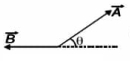
B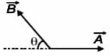
C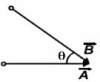
D
Solution
(C) The angle $\theta$ between two vectors $\vec{A}$ and $\vec{B}$ is defined as the smaller angle between them when they are placed tail-to-tail.
In figure $(C)$,both vectors $\vec{A}$ and $\vec{B}$ are joined at their tails. Therefore,this figure correctly represents the angle $\theta$ between the two vectors.
In figure $(C)$,both vectors $\vec{A}$ and $\vec{B}$ are joined at their tails. Therefore,this figure correctly represents the angle $\theta$ between the two vectors.
0 likes
View Solution134
EasyMCQ
$\vec{A}$ is a vector of magnitude $2.7$ units due east. What is the magnitude and direction of vector $4 \vec{A}$?
A
$4$ units due east
B
$4$ units due west
C
$2.7$ units due east
D
$10.8$ units due east
Solution
(D) Given that vector $\vec{A}$ has a magnitude of $2.7$ units and is directed due east.
Let the unit vector in the east direction be $\hat{i}$. Then,$\vec{A} = 2.7 \hat{i}$.
We need to find the vector $4 \vec{A}$.
$4 \vec{A} = 4 \times (2.7 \hat{i}) = 10.8 \hat{i}$.
The magnitude of the new vector is $10.8$ units,and since the direction is $\hat{i}$,it is directed due east.
Let the unit vector in the east direction be $\hat{i}$. Then,$\vec{A} = 2.7 \hat{i}$.
We need to find the vector $4 \vec{A}$.
$4 \vec{A} = 4 \times (2.7 \hat{i}) = 10.8 \hat{i}$.
The magnitude of the new vector is $10.8$ units,and since the direction is $\hat{i}$,it is directed due east.
0 likes
View Solution135
MediumMCQ
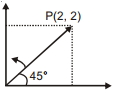
The vector $\overrightarrow{OA}$ where $O$ is the origin is given by $\overrightarrow{OA} = 2\hat{i} + 2\hat{j}$. If it is rotated by $45^{\circ}$ in the anticlockwise direction about $O$,what will be the new vector?
A
$2\sqrt{2}\hat{j}$
B
$2\hat{j}$
C
$2\hat{i}$
D
$2\sqrt{2}\hat{i}$
Solution
(A) The initial vector is $\overrightarrow{OA} = 2\hat{i} + 2\hat{j}$.
The magnitude of the vector is $|\overrightarrow{OA}| = \sqrt{2^2 + 2^2} = \sqrt{4 + 4} = \sqrt{8} = 2\sqrt{2}$.
The angle $\theta$ that the vector makes with the positive $x$-axis is given by $\tan \theta = \frac{y}{x} = \frac{2}{2} = 1$,which means $\theta = 45^{\circ}$.
When the vector is rotated by $45^{\circ}$ in the anticlockwise direction,the new angle with the positive $x$-axis becomes $45^{\circ} + 45^{\circ} = 90^{\circ}$.
$A$ vector with magnitude $2\sqrt{2}$ at an angle of $90^{\circ}$ with the positive $x$-axis lies entirely along the positive $y$-axis.
Therefore,the new vector is $2\sqrt{2}\hat{j}$.
The magnitude of the vector is $|\overrightarrow{OA}| = \sqrt{2^2 + 2^2} = \sqrt{4 + 4} = \sqrt{8} = 2\sqrt{2}$.
The angle $\theta$ that the vector makes with the positive $x$-axis is given by $\tan \theta = \frac{y}{x} = \frac{2}{2} = 1$,which means $\theta = 45^{\circ}$.
When the vector is rotated by $45^{\circ}$ in the anticlockwise direction,the new angle with the positive $x$-axis becomes $45^{\circ} + 45^{\circ} = 90^{\circ}$.
$A$ vector with magnitude $2\sqrt{2}$ at an angle of $90^{\circ}$ with the positive $x$-axis lies entirely along the positive $y$-axis.
Therefore,the new vector is $2\sqrt{2}\hat{j}$.
0 likes
View Solution136
EasyMCQ
$\overrightarrow{A} = 4\hat{i} + 3\hat{j}$ and $\overrightarrow{B} = 4\hat{i} + 2\hat{j}$. Find a vector parallel to $\overrightarrow{A}$ but with a magnitude five times that of $\overrightarrow{B}$.
A
$\sqrt{20}(2\hat{i} + 3\hat{j})$
B
$4\hat{i} + 3\hat{j}$
C
$20(4\hat{i} + 3\hat{j})$
D
$5\sqrt{20}(4\hat{i} + 3\hat{j})$
Solution
(B) First,find the magnitude of vector $\overrightarrow{B}$:
$|\overrightarrow{B}| = \sqrt{4^2 + 2^2} = \sqrt{16 + 4} = \sqrt{20}$.
Next,find the unit vector in the direction of $\overrightarrow{A}$:
$|\overrightarrow{A}| = \sqrt{4^2 + 3^2} = \sqrt{16 + 9} = 5$.
$\hat{A} = \frac{\overrightarrow{A}}{|\overrightarrow{A}|} = \frac{4\hat{i} + 3\hat{j}}{5}$.
The required vector $\overrightarrow{R}$ is parallel to $\overrightarrow{A}$ and has magnitude $5|\overrightarrow{B}| = 5\sqrt{20}$.
Thus,$\overrightarrow{R} = (5|\overrightarrow{B}|) \hat{A} = (5\sqrt{20}) \left( \frac{4\hat{i} + 3\hat{j}}{5} \right) = \sqrt{20}(4\hat{i} + 3\hat{j})$.
$|\overrightarrow{B}| = \sqrt{4^2 + 2^2} = \sqrt{16 + 4} = \sqrt{20}$.
Next,find the unit vector in the direction of $\overrightarrow{A}$:
$|\overrightarrow{A}| = \sqrt{4^2 + 3^2} = \sqrt{16 + 9} = 5$.
$\hat{A} = \frac{\overrightarrow{A}}{|\overrightarrow{A}|} = \frac{4\hat{i} + 3\hat{j}}{5}$.
The required vector $\overrightarrow{R}$ is parallel to $\overrightarrow{A}$ and has magnitude $5|\overrightarrow{B}| = 5\sqrt{20}$.
Thus,$\overrightarrow{R} = (5|\overrightarrow{B}|) \hat{A} = (5\sqrt{20}) \left( \frac{4\hat{i} + 3\hat{j}}{5} \right) = \sqrt{20}(4\hat{i} + 3\hat{j})$.
0 likes
View Solution137
MediumMCQ
$A$ vector has a magnitude the same as that of $\overrightarrow{A} = 3 \hat{i} + 4 \hat{j}$ and is parallel to $\overrightarrow{B} = 4 \hat{i} + 3 \hat{j}$. The $x$ and $y$ components of this vector in the first quadrant are $X$ and $3$ respectively,where $X = $ . . . . . . .
A
$4$
B
$5$
C
$6$
D
$7$
Solution
(A) First,calculate the magnitude of vector $\overrightarrow{A} = 3 \hat{i} + 4 \hat{j}$.
$|\overrightarrow{A}| = \sqrt{3^2 + 4^2} = \sqrt{9 + 16} = \sqrt{25} = 5$.
Next,find the unit vector in the direction of $\overrightarrow{B} = 4 \hat{i} + 3 \hat{j}$.
$|\overrightarrow{B}| = \sqrt{4^2 + 3^2} = \sqrt{16 + 9} = 5$.
$\hat{B} = \frac{\overrightarrow{B}}{|\overrightarrow{B}|} = \frac{4 \hat{i} + 3 \hat{j}}{5}$.
The required vector $\overrightarrow{V}$ has magnitude $5$ and is parallel to $\overrightarrow{B}$,so $\overrightarrow{V} = |\overrightarrow{A}| \hat{B} = 5 \times \frac{4 \hat{i} + 3 \hat{j}}{5} = 4 \hat{i} + 3 \hat{j}$.
Comparing this with the given components $X \hat{i} + 3 \hat{j}$,we find $X = 4$.
$|\overrightarrow{A}| = \sqrt{3^2 + 4^2} = \sqrt{9 + 16} = \sqrt{25} = 5$.
Next,find the unit vector in the direction of $\overrightarrow{B} = 4 \hat{i} + 3 \hat{j}$.
$|\overrightarrow{B}| = \sqrt{4^2 + 3^2} = \sqrt{16 + 9} = 5$.
$\hat{B} = \frac{\overrightarrow{B}}{|\overrightarrow{B}|} = \frac{4 \hat{i} + 3 \hat{j}}{5}$.
The required vector $\overrightarrow{V}$ has magnitude $5$ and is parallel to $\overrightarrow{B}$,so $\overrightarrow{V} = |\overrightarrow{A}| \hat{B} = 5 \times \frac{4 \hat{i} + 3 \hat{j}}{5} = 4 \hat{i} + 3 \hat{j}$.
Comparing this with the given components $X \hat{i} + 3 \hat{j}$,we find $X = 4$.
0 likes
View Solution138
DifficultMCQ
$A$ vector makes $45^{\circ}$ and $60^{\circ}$ angles with the $x$ and $y$ axes respectively. The unit vector along the given vector is:
A
$\frac{1}{\sqrt{2}} \hat{i} + \frac{1}{2} \hat{j}$
B
$\frac{1}{\sqrt{2}} \hat{i} + \frac{1}{2} \hat{j} + \frac{1}{2} \hat{k}$
C
$\frac{1}{\sqrt{2}} \hat{i} + \frac{1}{2} \hat{j} + \frac{\sqrt{3}}{2} \hat{k}$
D
$\frac{1}{\sqrt{2}} \hat{i} + \frac{\sqrt{3}}{2} \hat{j} + \frac{1}{2} \hat{k}$
Solution
(B) The direction cosines of a vector satisfy the relation $\cos^2 \alpha + \cos^2 \beta + \cos^2 \gamma = 1$,where $\alpha, \beta, \gamma$ are the angles made with the $x, y, z$ axes respectively.
Given $\alpha = 45^{\circ}$ and $\beta = 60^{\circ}$.
Substituting these values: $\cos^2 45^{\circ} + \cos^2 60^{\circ} + \cos^2 \gamma = 1$.
$(\frac{1}{\sqrt{2}})^2 + (\frac{1}{2})^2 + \cos^2 \gamma = 1$.
$\frac{1}{2} + \frac{1}{4} + \cos^2 \gamma = 1$.
$\frac{3}{4} + \cos^2 \gamma = 1 \Rightarrow \cos^2 \gamma = \frac{1}{4} \Rightarrow \cos \gamma = \frac{1}{2}$.
The unit vector $\hat{n}$ is given by $\hat{n} = \cos \alpha \hat{i} + \cos \beta \hat{j} + \cos \gamma \hat{k}$.
Therefore,$\hat{n} = \frac{1}{\sqrt{2}} \hat{i} + \frac{1}{2} \hat{j} + \frac{1}{2} \hat{k}$.
Given $\alpha = 45^{\circ}$ and $\beta = 60^{\circ}$.
Substituting these values: $\cos^2 45^{\circ} + \cos^2 60^{\circ} + \cos^2 \gamma = 1$.
$(\frac{1}{\sqrt{2}})^2 + (\frac{1}{2})^2 + \cos^2 \gamma = 1$.
$\frac{1}{2} + \frac{1}{4} + \cos^2 \gamma = 1$.
$\frac{3}{4} + \cos^2 \gamma = 1 \Rightarrow \cos^2 \gamma = \frac{1}{4} \Rightarrow \cos \gamma = \frac{1}{2}$.
The unit vector $\hat{n}$ is given by $\hat{n} = \cos \alpha \hat{i} + \cos \beta \hat{j} + \cos \gamma \hat{k}$.
Therefore,$\hat{n} = \frac{1}{\sqrt{2}} \hat{i} + \frac{1}{2} \hat{j} + \frac{1}{2} \hat{k}$.
0 likes
View Solution139
MediumMCQ
Find the length of the component of $\vec{a}$ along $\vec{b}$,where $\vec{a} = 4 \hat{i} + 5 \hat{j}$ and $\vec{b} = -\hat{i} + \hat{j}$.
A
$\frac{1}{\sqrt{2}}$
B
$\frac{7}{\sqrt{2}}$
C
$\sqrt{2}$
D
$\frac{2}{7}$
Solution
(A) The component of vector $\vec{a}$ along vector $\vec{b}$ is given by the projection formula: $\text{Component} = \frac{\vec{a} \cdot \vec{b}}{|\vec{b}|}$.
First,calculate the dot product: $\vec{a} \cdot \vec{b} = (4 \hat{i} + 5 \hat{j}) \cdot (-\hat{i} + \hat{j}) = (4)(-1) + (5)(1) = -4 + 5 = 1$.
Next,calculate the magnitude of vector $\vec{b}$: $|\vec{b}| = \sqrt{(-1)^2 + (1)^2} = \sqrt{1 + 1} = \sqrt{2}$.
Therefore,the length of the component is $\frac{1}{\sqrt{2}}$.
First,calculate the dot product: $\vec{a} \cdot \vec{b} = (4 \hat{i} + 5 \hat{j}) \cdot (-\hat{i} + \hat{j}) = (4)(-1) + (5)(1) = -4 + 5 = 1$.
Next,calculate the magnitude of vector $\vec{b}$: $|\vec{b}| = \sqrt{(-1)^2 + (1)^2} = \sqrt{1 + 1} = \sqrt{2}$.
Therefore,the length of the component is $\frac{1}{\sqrt{2}}$.
0 likes
View Solution140
MediumMCQ
If $|\vec{A}+\vec{B}|=|\vec{A}-\vec{B}|$,then the angle between vector $\vec{A}$ and $\vec{B}$ is: (in $^{\circ}$)
A
$0$
B
$45$
C
$90$
D
$180$
Solution
(C) Given the condition: $|\vec{A}+\vec{B}| = |\vec{A}-\vec{B}|$.
Squaring both sides,we get: $|\vec{A}+\vec{B}|^2 = |\vec{A}-\vec{B}|^2$.
Using the property $|\vec{V}|^2 = \vec{V} \cdot \vec{V}$,we expand the terms:
$A^2 + B^2 + 2AB \cos \theta = A^2 + B^2 - 2AB \cos \theta$.
Subtracting $A^2 + B^2$ from both sides:
$2AB \cos \theta = -2AB \cos \theta$.
$4AB \cos \theta = 0$.
Since $A$ and $B$ are non-zero vectors,$\cos \theta = 0$.
Therefore,$\theta = 90^{\circ}$.
Squaring both sides,we get: $|\vec{A}+\vec{B}|^2 = |\vec{A}-\vec{B}|^2$.
Using the property $|\vec{V}|^2 = \vec{V} \cdot \vec{V}$,we expand the terms:
$A^2 + B^2 + 2AB \cos \theta = A^2 + B^2 - 2AB \cos \theta$.
Subtracting $A^2 + B^2$ from both sides:
$2AB \cos \theta = -2AB \cos \theta$.
$4AB \cos \theta = 0$.
Since $A$ and $B$ are non-zero vectors,$\cos \theta = 0$.
Therefore,$\theta = 90^{\circ}$.
0 likes
View Solution141
EasyMCQ
The angle made by a vector $\vec{B} = 3 \hat{i} + 2 \hat{j} + 4 \hat{k}$ with the $y$-axis is:
A
$\cos^{-1}\left(\frac{5}{\sqrt{23}}\right)$
B
$\cos^{-1}\left(\frac{4}{\sqrt{11}}\right)$
C
$\cos^{-1}\left(\frac{3}{\sqrt{17}}\right)$
D
$\cos^{-1}\left(\frac{2}{\sqrt{29}}\right)$
Solution
(D) Given vector $\vec{B} = 3 \hat{i} + 2 \hat{j} + 4 \hat{k}$.
The unit vector along the $y$-axis is $\hat{j} = 0 \hat{i} + 1 \hat{j} + 0 \hat{k}$.
The angle $\theta$ between a vector $\vec{B}$ and the $y$-axis is given by the formula $\cos \theta = \frac{\vec{B} \cdot \hat{j}}{|\vec{B}| |\hat{j}|}$.
First,calculate the magnitude of $\vec{B}$: $|\vec{B}| = \sqrt{3^2 + 2^2 + 4^2} = \sqrt{9 + 4 + 16} = \sqrt{29}$.
The magnitude of $\hat{j}$ is $1$.
The dot product $\vec{B} \cdot \hat{j} = (3 \hat{i} + 2 \hat{j} + 4 \hat{k}) \cdot (0 \hat{i} + 1 \hat{j} + 0 \hat{k}) = 2$.
Therefore,$\cos \theta = \frac{2}{\sqrt{29} \times 1} = \frac{2}{\sqrt{29}}$.
Thus,$\theta = \cos^{-1}\left(\frac{2}{\sqrt{29}}\right)$.
The unit vector along the $y$-axis is $\hat{j} = 0 \hat{i} + 1 \hat{j} + 0 \hat{k}$.
The angle $\theta$ between a vector $\vec{B}$ and the $y$-axis is given by the formula $\cos \theta = \frac{\vec{B} \cdot \hat{j}}{|\vec{B}| |\hat{j}|}$.
First,calculate the magnitude of $\vec{B}$: $|\vec{B}| = \sqrt{3^2 + 2^2 + 4^2} = \sqrt{9 + 4 + 16} = \sqrt{29}$.
The magnitude of $\hat{j}$ is $1$.
The dot product $\vec{B} \cdot \hat{j} = (3 \hat{i} + 2 \hat{j} + 4 \hat{k}) \cdot (0 \hat{i} + 1 \hat{j} + 0 \hat{k}) = 2$.
Therefore,$\cos \theta = \frac{2}{\sqrt{29} \times 1} = \frac{2}{\sqrt{29}}$.
Thus,$\theta = \cos^{-1}\left(\frac{2}{\sqrt{29}}\right)$.
0 likes
View Solution142
EasyMCQ
The angle subtended by the vector $\vec{A} = 4 \hat{i} + 3 \hat{j} + 12 \hat{k}$ with the $x$-axis is
A
$\sin^{-1}(\frac{4}{13})$
B
$\cos^{-1}(\frac{3}{13})$
C
$\cos^{-1}(\frac{4}{13})$
D
$\sin^{-1}(\frac{3}{13})$
Solution
(C) The vector is given by $\vec{A} = 4 \hat{i} + 3 \hat{j} + 12 \hat{k}$.
The magnitude of the vector $\vec{A}$ is $|\vec{A}| = \sqrt{4^2 + 3^2 + 12^2} = \sqrt{16 + 9 + 144} = \sqrt{169} = 13$.
The unit vector along the $x$-axis is $\hat{i} = 1 \hat{i} + 0 \hat{j} + 0 \hat{k}$.
The angle $\theta$ between the vector $\vec{A}$ and the $x$-axis is given by the dot product formula: $\cos \theta = \frac{\vec{A} \cdot \hat{i}}{|\vec{A}| |\hat{i}|}$.
Calculating the dot product: $\vec{A} \cdot \hat{i} = (4 \times 1) + (3 \times 0) + (12 \times 0) = 4$.
Substituting the values: $\cos \theta = \frac{4}{13 \times 1} = \frac{4}{13}$.
Therefore,$\theta = \cos^{-1}(\frac{4}{13})$.
The magnitude of the vector $\vec{A}$ is $|\vec{A}| = \sqrt{4^2 + 3^2 + 12^2} = \sqrt{16 + 9 + 144} = \sqrt{169} = 13$.
The unit vector along the $x$-axis is $\hat{i} = 1 \hat{i} + 0 \hat{j} + 0 \hat{k}$.
The angle $\theta$ between the vector $\vec{A}$ and the $x$-axis is given by the dot product formula: $\cos \theta = \frac{\vec{A} \cdot \hat{i}}{|\vec{A}| |\hat{i}|}$.
Calculating the dot product: $\vec{A} \cdot \hat{i} = (4 \times 1) + (3 \times 0) + (12 \times 0) = 4$.
Substituting the values: $\cos \theta = \frac{4}{13 \times 1} = \frac{4}{13}$.
Therefore,$\theta = \cos^{-1}(\frac{4}{13})$.
0 likes
View Solution143
EasyMCQ
If a unit vector is represented as $\overrightarrow{u} = 0.4 \hat{i} + 0.7 \hat{j} + c \hat{k}$,then the value of '$c$' is
A
$\sqrt{0.11}$
B
$\sqrt{0.25}$
C
$\sqrt{0.65}$
D
$\sqrt{0.35}$
Solution
(D) unit vector has a magnitude of $1$.
Given $\overrightarrow{u} = 0.4 \hat{i} + 0.7 \hat{j} + c \hat{k}$.
The magnitude is given by $|\overrightarrow{u}| = \sqrt{(0.4)^2 + (0.7)^2 + c^2} = 1$.
Squaring both sides,we get $0.16 + 0.49 + c^2 = 1$.
$0.65 + c^2 = 1$.
$c^2 = 1 - 0.65 = 0.35$.
Therefore,$c = \sqrt{0.35}$.
Given $\overrightarrow{u} = 0.4 \hat{i} + 0.7 \hat{j} + c \hat{k}$.
The magnitude is given by $|\overrightarrow{u}| = \sqrt{(0.4)^2 + (0.7)^2 + c^2} = 1$.
Squaring both sides,we get $0.16 + 0.49 + c^2 = 1$.
$0.65 + c^2 = 1$.
$c^2 = 1 - 0.65 = 0.35$.
Therefore,$c = \sqrt{0.35}$.
0 likes
View Solution144
EasyMCQ
$A$ unit vector is represented as $(0.8 \hat{i} + b \hat{j} + 0.4 \hat{k})$. Hence,the value of $b$ must be:
A
$0.4$
B
$\sqrt{0.6}$
C
$0.2$
D
$\sqrt{0.2}$
Solution
(D) unit vector has a magnitude of $1$. The magnitude of a vector $\vec{A} = A_x \hat{i} + A_y \hat{j} + A_z \hat{k}$ is given by $|\vec{A}| = \sqrt{A_x^2 + A_y^2 + A_z^2}$.
Given the vector is $(0.8 \hat{i} + b \hat{j} + 0.4 \hat{k})$,we set its magnitude to $1$:
$\sqrt{(0.8)^2 + b^2 + (0.4)^2} = 1$
Squaring both sides:
$(0.8)^2 + b^2 + (0.4)^2 = 1^2$
$0.64 + b^2 + 0.16 = 1$
$0.80 + b^2 = 1$
$b^2 = 1 - 0.80$
$b^2 = 0.2$
$b = \sqrt{0.2}$
Given the vector is $(0.8 \hat{i} + b \hat{j} + 0.4 \hat{k})$,we set its magnitude to $1$:
$\sqrt{(0.8)^2 + b^2 + (0.4)^2} = 1$
Squaring both sides:
$(0.8)^2 + b^2 + (0.4)^2 = 1^2$
$0.64 + b^2 + 0.16 = 1$
$0.80 + b^2 = 1$
$b^2 = 1 - 0.80$
$b^2 = 0.2$
$b = \sqrt{0.2}$
0 likes
View Solution145
MediumMCQ
The vector sum of two forces $\vec{A}$ and $\vec{B}$ is perpendicular to their vector difference. Hence,the forces $\vec{A}$ and $\vec{B}$ are
A
perpendicular to each other.
B
parallel to each other.
C
unequal in magnitude.
D
equal in magnitude.
Solution
(D) Let the two forces be $\vec{A}$ and $\vec{B}$.
The vector sum is $(\vec{A} + \vec{B})$ and the vector difference is $(\vec{A} - \vec{B})$.
Given that the sum is perpendicular to the difference,their dot product must be zero:
$(\vec{A} + \vec{B}) \cdot (\vec{A} - \vec{B}) = 0$
Expanding the dot product:
$\vec{A} \cdot \vec{A} - \vec{A} \cdot \vec{B} + \vec{B} \cdot \vec{A} - \vec{B} \cdot \vec{B} = 0$
Since the dot product is commutative,$\vec{A} \cdot \vec{B} = \vec{B} \cdot \vec{A}$,so the terms cancel out:
$|\vec{A}|^2 - |\vec{B}|^2 = 0$
$|\vec{A}|^2 = |\vec{B}|^2$
$|\vec{A}| = |\vec{B}|$
Therefore,the forces are equal in magnitude.
The vector sum is $(\vec{A} + \vec{B})$ and the vector difference is $(\vec{A} - \vec{B})$.
Given that the sum is perpendicular to the difference,their dot product must be zero:
$(\vec{A} + \vec{B}) \cdot (\vec{A} - \vec{B}) = 0$
Expanding the dot product:
$\vec{A} \cdot \vec{A} - \vec{A} \cdot \vec{B} + \vec{B} \cdot \vec{A} - \vec{B} \cdot \vec{B} = 0$
Since the dot product is commutative,$\vec{A} \cdot \vec{B} = \vec{B} \cdot \vec{A}$,so the terms cancel out:
$|\vec{A}|^2 - |\vec{B}|^2 = 0$
$|\vec{A}|^2 = |\vec{B}|^2$
$|\vec{A}| = |\vec{B}|$
Therefore,the forces are equal in magnitude.
0 likes
View Solution146
MediumMCQ
The unit vector $(a \hat{\imath} + b \hat{\jmath})$ is perpendicular to $(\hat{\imath} + \hat{\jmath})$. The value of $b$ is
A
$+\frac{1}{\sqrt{2}}$
B
$+\frac{1}{\sqrt{3}}$
C
$+\frac{1}{2}$
D
$-\frac{1}{\sqrt{2}}$
Solution
(D) Let the unit vector be $\hat{n} = a \hat{\imath} + b \hat{\jmath}$ and the given vector be $\vec{r} = \hat{\imath} + \hat{\jmath}$.
Since $\hat{n}$ is perpendicular to $\vec{r}$,their dot product must be zero: $\hat{n} \cdot \vec{r} = 0$.
$(a \hat{\imath} + b \hat{\jmath}) \cdot (\hat{\imath} + \hat{\jmath}) = a + b = 0$,which implies $b = -a$.
Since $\hat{n}$ is a unit vector,its magnitude is $1$: $\sqrt{a^2 + b^2} = 1$.
Substituting $b = -a$,we get $\sqrt{a^2 + (-a)^2} = 1$,which simplifies to $\sqrt{2a^2} = 1$,or $|a|\sqrt{2} = 1$.
Thus,$a = \pm \frac{1}{\sqrt{2}}$.
If $a = \frac{1}{\sqrt{2}}$,then $b = -\frac{1}{\sqrt{2}}$.
If $a = -\frac{1}{\sqrt{2}}$,then $b = \frac{1}{\sqrt{2}}$.
Comparing with the given options,the value $b = -\frac{1}{\sqrt{2}}$ is present as option $D$.
Since $\hat{n}$ is perpendicular to $\vec{r}$,their dot product must be zero: $\hat{n} \cdot \vec{r} = 0$.
$(a \hat{\imath} + b \hat{\jmath}) \cdot (\hat{\imath} + \hat{\jmath}) = a + b = 0$,which implies $b = -a$.
Since $\hat{n}$ is a unit vector,its magnitude is $1$: $\sqrt{a^2 + b^2} = 1$.
Substituting $b = -a$,we get $\sqrt{a^2 + (-a)^2} = 1$,which simplifies to $\sqrt{2a^2} = 1$,or $|a|\sqrt{2} = 1$.
Thus,$a = \pm \frac{1}{\sqrt{2}}$.
If $a = \frac{1}{\sqrt{2}}$,then $b = -\frac{1}{\sqrt{2}}$.
If $a = -\frac{1}{\sqrt{2}}$,then $b = \frac{1}{\sqrt{2}}$.
Comparing with the given options,the value $b = -\frac{1}{\sqrt{2}}$ is present as option $D$.
0 likes
View Solution147
EasyMCQ
$\vec{A}$ and $\vec{B}$ are two non-zero vectors inclined at an angle $\theta$. $\hat{a}$ and $\hat{b}$ are unit vectors along $\vec{A}$ and $\vec{B}$ respectively. The component of $\vec{A}$ in the direction of $\vec{B}$ is
A
$\frac{\vec{A} \cdot \vec{B}}{B}$
B
$\frac{\vec{A} \times \vec{B}}{A}$
C
$\hat{a} \cdot \vec{B}$
D
$\vec{A} \cdot \hat{b}$
Solution
(D) The component of a vector $\vec{A}$ along the direction of another vector $\vec{B}$ is given by the projection of $\vec{A}$ onto the unit vector in the direction of $\vec{B}$.
Let $\hat{b}$ be the unit vector along $\vec{B}$.
The component of $\vec{A}$ in the direction of $\vec{B}$ is defined as $\vec{A} \cdot \hat{b}$.
Since $\hat{b} = \frac{\vec{B}}{|B|}$,this can also be written as $\frac{\vec{A} \cdot \vec{B}}{|B|}$.
Let $\hat{b}$ be the unit vector along $\vec{B}$.
The component of $\vec{A}$ in the direction of $\vec{B}$ is defined as $\vec{A} \cdot \hat{b}$.
Since $\hat{b} = \frac{\vec{B}}{|B|}$,this can also be written as $\frac{\vec{A} \cdot \vec{B}}{|B|}$.
0 likes
View Solution148
EasyMCQ
The vectors $(A + B)$ and $(A - B)$ are at right angles to each other. This is possible under the condition
A
$|A|=|B|$
B
$A \cdot B=0$
C
$A \cdot B=1$
D
$A \times B=0$
Solution
(A) Given that the vectors $(A + B)$ and $(A - B)$ are at right angles to each other,their dot product must be zero.
$(A + B) \cdot (A - B) = 0$
Expanding the dot product:
$A \cdot A - A \cdot B + B \cdot A - B \cdot B = 0$
Since the dot product is commutative $(A \cdot B = B \cdot A)$,the terms $-A \cdot B$ and $B \cdot A$ cancel out.
$|A|^2 - |B|^2 = 0$
$|A|^2 = |B|^2$
Taking the square root on both sides,we get:
$|A| = |B|$
Thus,the condition is that the magnitudes of the two vectors must be equal.
$(A + B) \cdot (A - B) = 0$
Expanding the dot product:
$A \cdot A - A \cdot B + B \cdot A - B \cdot B = 0$
Since the dot product is commutative $(A \cdot B = B \cdot A)$,the terms $-A \cdot B$ and $B \cdot A$ cancel out.
$|A|^2 - |B|^2 = 0$
$|A|^2 = |B|^2$
Taking the square root on both sides,we get:
$|A| = |B|$
Thus,the condition is that the magnitudes of the two vectors must be equal.
0 likes
View Solution149
MediumMCQ
Which of the following is not a vector quantity?
A
Weight
B
Nuclear spin
C
Momentum
D
Potential energy
Solution
(D) vector quantity is defined as a physical quantity that possesses both magnitude and direction.
Conversely,a scalar quantity is defined as a physical quantity that possesses only magnitude and no direction.
$1$. Weight is the force of gravity acting on an object,which has both magnitude and direction (downward),making it a vector.
$2$. Nuclear spin is an intrinsic angular momentum of a nucleus,which is a vector quantity.
$3$. Momentum is defined as the product of mass and velocity $(p = mv)$. Since velocity is a vector,momentum is also a vector.
$4$. Potential energy is a scalar quantity because it represents the energy stored in an object due to its position or configuration,which does not have a specific direction.
Therefore,potential energy is not a vector quantity.
Conversely,a scalar quantity is defined as a physical quantity that possesses only magnitude and no direction.
$1$. Weight is the force of gravity acting on an object,which has both magnitude and direction (downward),making it a vector.
$2$. Nuclear spin is an intrinsic angular momentum of a nucleus,which is a vector quantity.
$3$. Momentum is defined as the product of mass and velocity $(p = mv)$. Since velocity is a vector,momentum is also a vector.
$4$. Potential energy is a scalar quantity because it represents the energy stored in an object due to its position or configuration,which does not have a specific direction.
Therefore,potential energy is not a vector quantity.
0 likes
View Solution150
EasyMCQ
If $|\vec{P}+\vec{Q}|=|\vec{P}|=|\vec{Q}|$,then the angle between $\vec{P}$ and $\vec{Q}$ is: (in $^{\circ}$)
A
$0$
B
$120$
C
$60$
D
$90$
Solution
(B) Given that $|\vec{P}+\vec{Q}|=|\vec{P}|=|\vec{Q}|$. Let $|\vec{P}|=|\vec{Q}|=P$.
Using the vector addition formula,$|\vec{P}+\vec{Q}| = \sqrt{P^2+Q^2+2PQ \cos \theta}$.
Since $|\vec{P}+\vec{Q}|=P$,we have $P = \sqrt{P^2+P^2+2P^2 \cos \theta}$.
Squaring both sides,$P^2 = 2P^2 + 2P^2 \cos \theta$.
Dividing by $P^2$,$1 = 2 + 2 \cos \theta$.
$2 \cos \theta = -1 \Rightarrow \cos \theta = -\frac{1}{2}$.
Therefore,$\theta = 120^{\circ}$.
Using the vector addition formula,$|\vec{P}+\vec{Q}| = \sqrt{P^2+Q^2+2PQ \cos \theta}$.
Since $|\vec{P}+\vec{Q}|=P$,we have $P = \sqrt{P^2+P^2+2P^2 \cos \theta}$.
Squaring both sides,$P^2 = 2P^2 + 2P^2 \cos \theta$.
Dividing by $P^2$,$1 = 2 + 2 \cos \theta$.
$2 \cos \theta = -1 \Rightarrow \cos \theta = -\frac{1}{2}$.
Therefore,$\theta = 120^{\circ}$.
0 likes
View Solution3-1.Vectors — Fundamentals of Vectors · Frequently Asked Questions
1Are these 3-1.Vectors questions useful for JEE and NEET?
Yes. All questions in this section are mapped to JEE Main and NEET exam patterns. Previous year questions from JEE Main, NEET, GUJCET and state-level exams are included with full solutions.
2Can I switch to Hindi or Gujarati for these questions?
Yes. Use the language tabs in the hero section or the sidebar to view the same questions and solutions in English, Hindi or Gujarati.
3How do I generate a question paper from this subtopic?
Use the Vedclass Exam Paper Generator — select the chapter and subtopic, set difficulty, and generate Sets A, B, C, D automatically. First 3 chapters of every subject are free.
Vedclass Products
For Students
Vedclass Test Series
Mock tests in real JEE/NEET style with performance analysis. 5-day free trial.
Start Free TrialFor Teachers
Exam Paper Generator
Generate Set A/B/C/D papers from this chapter in 2 minutes. 3 chapters free.
Try FreeFor Institutes
Online Exam Module
Live online exams with unlimited students, 360° analytics & white-label branding.
See DemoFor Teachers & Institutes
Generate a 3-1.Vectors Exam Paper in 2 Minutes
Select subtopic & difficulty — Sets A, B, C, D auto-generated with No Repeat logic.
First 3 chapters of every subject are free — no payment required.