
A English
Radiation (General, Kirchoff's law, Black body, Prevost's Theory) Questions in English
Class 11 Physics · 10-2.Heat Transfer · Radiation (General, Kirchoff's law, Black body, Prevost's Theory)
128+
Questions
English
Language
100%
With Solutions
Showing 50 of 128 questions in English
51
EasyMCQ
Which of the following is closest to a black body?
A
Black board paint
B
Green leaves
C
Black holes
D
Red roses
Solution
(C) black body is an idealized physical body that absorbs all incident electromagnetic radiation,regardless of frequency or angle of incidence.
$1$. $A$ black body has an absorptivity of $1$ and a reflectivity of $0$.
$2$. It has zero transmittance.
$3$. Among the given options,a black hole is the most perfect approximation of a black body because it absorbs all radiation (including light) that falls within its event horizon,reflecting nothing back.
$4$. While black paint is a good absorber,it still reflects a small fraction of light,making black holes the closest physical realization of an ideal black body.
$1$. $A$ black body has an absorptivity of $1$ and a reflectivity of $0$.
$2$. It has zero transmittance.
$3$. Among the given options,a black hole is the most perfect approximation of a black body because it absorbs all radiation (including light) that falls within its event horizon,reflecting nothing back.
$4$. While black paint is a good absorber,it still reflects a small fraction of light,making black holes the closest physical realization of an ideal black body.
0 likes
View Solution52
EasyMCQ
Compared to a white-skinned person,what does a dark-skinned person experience?
A
Less heat and more cold
B
More heat and more cold
C
More heat and less cold
D
Less heat and less cold
Solution
(B) According to the principles of heat radiation,black surfaces are better absorbers and better emitters of heat compared to white or light-colored surfaces.
Because a dark-skinned person absorbs more solar radiation,they experience more heat.
Conversely,because they are also better emitters,they lose heat more rapidly,leading them to experience more cold in colder environments.
Therefore,a dark-skinned person experiences both more heat and more cold compared to a white-skinned person.
Because a dark-skinned person absorbs more solar radiation,they experience more heat.
Conversely,because they are also better emitters,they lose heat more rapidly,leading them to experience more cold in colder environments.
Therefore,a dark-skinned person experiences both more heat and more cold compared to a white-skinned person.
0 likes
View Solution53
EasyMCQ
$A$ perfect black body is ........
A
$A$ piece of coal heated to a high temperature
B
$A$ glass surface coated with coal tar
C
$A$ metal surface
D
$A$ hollow enclosure with its inner surface blackened and having a small hole
Solution
(D) hollow enclosure blackened inside and having a small hole is a very good example of a black body.
When light enters through the small hole,it undergoes multiple reflections within the cavity.
Since the inner surface is blackened,a significant fraction of the incident radiation is absorbed at each reflection.
Because the hole is very small,the probability of the radiation escaping back out is extremely low.
Consequently,almost all incident radiation is absorbed,making it an ideal black body.
When light enters through the small hole,it undergoes multiple reflections within the cavity.
Since the inner surface is blackened,a significant fraction of the incident radiation is absorbed at each reflection.
Because the hole is very small,the probability of the radiation escaping back out is extremely low.
Consequently,almost all incident radiation is absorbed,making it an ideal black body.
0 likes
View Solution54
EasyMCQ
If a vessel with black spots is heated to a very high temperature and then taken into a dark room,then:
A
The vessel and the spots will both shine.
B
Only the spots will shine.
C
Only the vessel will shine.
D
Neither the vessel nor the spots will shine.
Solution
(B) According to Kirchhoff's law of radiation,good absorbers of radiation are also good emitters of radiation at a given temperature.
Black spots are good absorbers of heat radiation,so they will also be good emitters.
When the vessel is heated to a high temperature and placed in a dark room,the black spots will emit more radiation compared to the polished or metallic surface of the vessel.
Therefore,the black spots will appear to shine brightly,while the rest of the vessel will appear relatively dull or invisible.
Black spots are good absorbers of heat radiation,so they will also be good emitters.
When the vessel is heated to a high temperature and placed in a dark room,the black spots will emit more radiation compared to the polished or metallic surface of the vessel.
Therefore,the black spots will appear to shine brightly,while the rest of the vessel will appear relatively dull or invisible.
1 likes
View Solution55
MediumMCQ
$A$ perfectly black body is placed in an enclosure (furnace) at room temperature. Then:
A
It will remain a black body forever.
B
It will become a white body.
C
It will not be distinguishable from the surroundings.
D
It will be a black body initially and then it will not be distinguishable.
Solution
(C) perfectly black body is an ideal absorber and emitter of radiation.
According to Kirchhoff's law of radiation,the ratio of emissive power to absorptive power for any body is equal to the emissive power of a perfectly black body at the same temperature.
When a black body is placed in an enclosure at the same temperature,it reaches thermal equilibrium with the surroundings.
At thermal equilibrium,the rate of energy absorbed by the black body is equal to the rate of energy emitted by it.
Consequently,the black body becomes indistinguishable from the surroundings because the intensity of radiation emitted by the body matches the intensity of radiation emitted by the walls of the enclosure.
According to Kirchhoff's law of radiation,the ratio of emissive power to absorptive power for any body is equal to the emissive power of a perfectly black body at the same temperature.
When a black body is placed in an enclosure at the same temperature,it reaches thermal equilibrium with the surroundings.
At thermal equilibrium,the rate of energy absorbed by the black body is equal to the rate of energy emitted by it.
Consequently,the black body becomes indistinguishable from the surroundings because the intensity of radiation emitted by the body matches the intensity of radiation emitted by the walls of the enclosure.
0 likes
View Solution56
EasyMCQ
Which of the following is best close to an ideal black body?
A
black lamp
B
platinum black
C
a lump of charcoal heated to high temperature
D
cavity maintained at constant temperature
Solution
(D) An ideal black body is defined as a body that absorbs all incident radiation falling on it,regardless of the frequency or angle of incidence.
$A$ cavity maintained at a constant temperature,often called a Fery's black body,is the closest physical approximation to an ideal black body.
In this setup,any radiation entering the small hole of the cavity undergoes multiple internal reflections. At each reflection,a portion of the radiation is absorbed by the walls. After many such reflections,almost all of the incident radiation is absorbed,making it an excellent black body.
$A$ cavity maintained at a constant temperature,often called a Fery's black body,is the closest physical approximation to an ideal black body.
In this setup,any radiation entering the small hole of the cavity undergoes multiple internal reflections. At each reflection,a portion of the radiation is absorbed by the walls. After many such reflections,almost all of the incident radiation is absorbed,making it an excellent black body.
0 likes
View Solution57
MediumMCQ
At a high temperature,a body emits radiation of wavelengths $\lambda_1, \lambda_2, \lambda_3,$ and $\lambda_4$ only. At a lower temperature,which of the following wavelengths will it absorb?
A
$\lambda_1$
B
$\lambda_2$
C
$\lambda_1$ and $\lambda_2$
D
$\lambda_1, \lambda_2, \lambda_3,$ and $\lambda_4$
Solution
(D) According to Kirchhoff's law of radiation,a body is a good absorber of those wavelengths which it emits at a given temperature.
Since the body emits radiation of wavelengths $\lambda_1, \lambda_2, \lambda_3,$ and $\lambda_4$ at a high temperature,it will also absorb the same wavelengths when radiation of these wavelengths falls on it at a lower temperature.
Therefore,the body will absorb all the wavelengths $\lambda_1, \lambda_2, \lambda_3,$ and $\lambda_4$.
Since the body emits radiation of wavelengths $\lambda_1, \lambda_2, \lambda_3,$ and $\lambda_4$ at a high temperature,it will also absorb the same wavelengths when radiation of these wavelengths falls on it at a lower temperature.
Therefore,the body will absorb all the wavelengths $\lambda_1, \lambda_2, \lambda_3,$ and $\lambda_4$.
0 likes
View Solution58
MediumMCQ
The graph shows the blackbody radiation curves at temperatures $T_1$ and $T_2$. Which of the following is correct? $(T_2 > T_1)$
A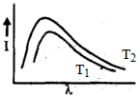
B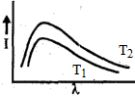
C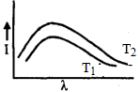
D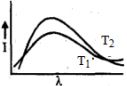
Solution
(A) According to Wien's displacement law,the wavelength $\lambda_m$ corresponding to the maximum intensity of radiation is inversely proportional to the absolute temperature $T$,i.e.,$\lambda_m \propto \frac{1}{T}$.
Given $T_2 > T_1$,it follows that $\lambda_{m2} < \lambda_{m1}$.
This means the peak of the radiation curve for $T_2$ must shift towards a shorter wavelength (left) compared to the peak for $T_1$.
Additionally,according to the Stefan-Boltzmann law,the total intensity (area under the curve) is proportional to $T^4$. Since $T_2 > T_1$,the curve for $T_2$ must lie entirely above the curve for $T_1$.
Comparing the given options,the graph in option $A$ correctly shows the peak for $T_2$ shifted to the left (smaller $\lambda_m$) and the entire curve for $T_2$ lying above the curve for $T_1$.
Given $T_2 > T_1$,it follows that $\lambda_{m2} < \lambda_{m1}$.
This means the peak of the radiation curve for $T_2$ must shift towards a shorter wavelength (left) compared to the peak for $T_1$.
Additionally,according to the Stefan-Boltzmann law,the total intensity (area under the curve) is proportional to $T^4$. Since $T_2 > T_1$,the curve for $T_2$ must lie entirely above the curve for $T_1$.
Comparing the given options,the graph in option $A$ correctly shows the peak for $T_2$ shifted to the left (smaller $\lambda_m$) and the entire curve for $T_2$ lying above the curve for $T_1$.
0 likes
View Solution59
EasyMCQ
If $e_\lambda$ and $a_\lambda$ are the emissive power and absorptive power of a body respectively,and $E_\lambda$ is the emissive power of a perfectly black body,what is the relation according to Kirchhoff's law?
A
$a_\lambda = \frac{E_\lambda}{e_\lambda}$
B
$\frac{a_\lambda}{e_\lambda} = E_\lambda$
C
$\frac{e_\lambda}{a_\lambda} = E_\lambda$
D
$e_\lambda = \frac{E_\lambda}{a_\lambda}$
Solution
(C) Kirchhoff's law of thermal radiation states that for an arbitrary body emitting and absorbing thermal radiation in thermodynamic equilibrium,the emissivity is equal to the absorptivity.
Mathematically,the ratio of the emissive power $(e_\lambda)$ of a body to its absorptive power $(a_\lambda)$ at a given wavelength and temperature is equal to the emissive power $(E_\lambda)$ of a perfectly black body at the same wavelength and temperature.
Therefore,the relation is given by: $\frac{e_\lambda}{a_\lambda} = E_\lambda$.
Mathematically,the ratio of the emissive power $(e_\lambda)$ of a body to its absorptive power $(a_\lambda)$ at a given wavelength and temperature is equal to the emissive power $(E_\lambda)$ of a perfectly black body at the same wavelength and temperature.
Therefore,the relation is given by: $\frac{e_\lambda}{a_\lambda} = E_\lambda$.
0 likes
View Solution60
EasyMCQ
Which of the following statements is true for a perfectly black body?
A
It absorbs only visible light radiation.
B
It absorbs only infrared radiation.
C
It absorbs half of the radiation and reflects half.
D
It absorbs radiation of all wavelengths.
Solution
(D) perfectly black body is defined as an ideal body that absorbs all incident electromagnetic radiation,regardless of frequency or angle of incidence.
Since it absorbs all incident radiation,its absorptivity $(a)$ is equal to $1$.
Therefore,it absorbs radiation of all wavelengths falling upon it.
Since it absorbs all incident radiation,its absorptivity $(a)$ is equal to $1$.
Therefore,it absorbs radiation of all wavelengths falling upon it.
0 likes
View Solution61
EasyMCQ
$A$ total radiation of $400 \ J$ is incident on a body. If $20\%$ of the radiation is reflected and $120 \ J$ is absorbed,find the percentage of the transmittive power.
A
$50$
B
$45$
C
$38$
D
$42$
Solution
(A) The total incident radiation $Q = 400 \ J$.
The reflected radiation $Q_r = 20\% \text{ of } 400 \ J = 0.20 \times 400 = 80 \ J$.
The absorbed radiation $Q_a = 120 \ J$.
According to the law of conservation of energy,$Q = Q_r + Q_a + Q_t$,where $Q_t$ is the transmitted radiation.
Substituting the values: $400 = 80 + 120 + Q_t$.
$400 = 200 + Q_t \implies Q_t = 200 \ J$.
The percentage of transmittive power is given by $\frac{Q_t}{Q} \times 100 = \frac{200}{400} \times 100 = 50\%$.
The reflected radiation $Q_r = 20\% \text{ of } 400 \ J = 0.20 \times 400 = 80 \ J$.
The absorbed radiation $Q_a = 120 \ J$.
According to the law of conservation of energy,$Q = Q_r + Q_a + Q_t$,where $Q_t$ is the transmitted radiation.
Substituting the values: $400 = 80 + 120 + Q_t$.
$400 = 200 + Q_t \implies Q_t = 200 \ J$.
The percentage of transmittive power is given by $\frac{Q_t}{Q} \times 100 = \frac{200}{400} \times 100 = 50\%$.
0 likes
View Solution62
DifficultMCQ
If $25\%$ of the total incident radiation $Q = 500 \, J$ is absorbed and $105 \, cal$ is transmitted,calculate the percentage of reflected power.
A
$50$
B
$45$
C
$38$
D
$54$
Solution
(D) The total incident radiation is $Q = 500 \, J$.
Given that $25\%$ of the radiation is absorbed: $Q_a = 0.25 \times 500 \, J = 125 \, J$.
Given that $105 \, cal$ is transmitted: $Q_t = 105 \, cal$. Converting to Joules $(1 \, cal = 4.2 \, J)$: $Q_t = 105 \times 4.2 \, J = 441 \, J$.
However,assuming the question implies $105 \, J$ is transmitted (as $105 \, cal$ exceeds the total energy $500 \, J$): Let $Q_t = 105 \, J$.
The energy balance equation is $Q = Q_a + Q_t + Q_r$,where $Q_r$ is the reflected energy.
$500 = 125 + 105 + Q_r$.
$Q_r = 500 - 230 = 270 \, J$.
The percentage of reflected power is $\frac{Q_r}{Q} \times 100 = \frac{270}{500} \times 100 = 54\%$.
Given that $25\%$ of the radiation is absorbed: $Q_a = 0.25 \times 500 \, J = 125 \, J$.
Given that $105 \, cal$ is transmitted: $Q_t = 105 \, cal$. Converting to Joules $(1 \, cal = 4.2 \, J)$: $Q_t = 105 \times 4.2 \, J = 441 \, J$.
However,assuming the question implies $105 \, J$ is transmitted (as $105 \, cal$ exceeds the total energy $500 \, J$): Let $Q_t = 105 \, J$.
The energy balance equation is $Q = Q_a + Q_t + Q_r$,where $Q_r$ is the reflected energy.
$500 = 125 + 105 + Q_r$.
$Q_r = 500 - 230 = 270 \, J$.
The percentage of reflected power is $\frac{Q_r}{Q} \times 100 = \frac{270}{500} \times 100 = 54\%$.
0 likes
View Solution63
MediumMCQ
The surface of a thermos flask is kept shiny because:
A
To make it attractive
B
To make it durable
C
To absorb all external radiation
D
To reflect all external radiation
Solution
(D) thermos flask is designed to minimize heat transfer by conduction,convection,and radiation.
Shiny surfaces are poor absorbers and excellent reflectors of thermal radiation.
By keeping the surface shiny,the flask reflects incoming external radiation away from the contents,preventing heat gain from the surroundings.
Similarly,it prevents heat loss from the inside by reflecting internal radiation back into the flask.
Therefore,the correct reason is to reflect all external radiation.
Shiny surfaces are poor absorbers and excellent reflectors of thermal radiation.
By keeping the surface shiny,the flask reflects incoming external radiation away from the contents,preventing heat gain from the surroundings.
Similarly,it prevents heat loss from the inside by reflecting internal radiation back into the flask.
Therefore,the correct reason is to reflect all external radiation.
0 likes
View Solution64
EasyMCQ
The rate of emission of a body doubles when its temperature is increased by $10^{\circ}C$. If the temperature of the body is increased from $10^{\circ}C$ to $100^{\circ}C$,the rate of emission increases by a factor of:
A
$112$
B
$512$
C
$400$
D
$614$
Solution
(B) The temperature is increased from $10^{\circ}C$ to $100^{\circ}C$. The total change in temperature is $\Delta T = 100^{\circ}C - 10^{\circ}C = 90^{\circ}C$.
Since the rate of emission doubles for every $10^{\circ}C$ increase,we calculate the number of such intervals as $n = \frac{90^{\circ}C}{10^{\circ}C} = 9$.
Given that the rate of emission doubles for each interval,the new rate of emission relative to the initial rate is given by $2^n$.
Substituting $n = 9$,we get $2^9 = 512$.
Therefore,the rate of emission increases by a factor of $512$.
Since the rate of emission doubles for every $10^{\circ}C$ increase,we calculate the number of such intervals as $n = \frac{90^{\circ}C}{10^{\circ}C} = 9$.
Given that the rate of emission doubles for each interval,the new rate of emission relative to the initial rate is given by $2^n$.
Substituting $n = 9$,we get $2^9 = 512$.
Therefore,the rate of emission increases by a factor of $512$.
0 likes
View Solution65
DifficultMCQ
The Sun emits radiation in all directions. The Earth receives approximately $1.4 \ kW/m^2$ of radiation per second. The distance between the Sun and the Earth is $1.5 \times 10^{11} \ m$. How much mass does the Sun lose per day? $(1 \ \text{day} = 86400 \ s)$
A
$4.4 \times 10^9 \ kg$
B
$3.8 \times 10^{14} \ kg$
C
$3.8 \times 10^{12} \ kg$
D
$7.6 \times 10^{14} \ kg$
Solution
(B) The intensity of radiation at Earth is $I = 1.4 \times 10^3 \ W/m^2$.
Total power emitted by the Sun is $P = I \times A = I \times (4\pi r^2)$.
$P = 1.4 \times 10^3 \times 4 \times 3.14 \times (1.5 \times 10^{11})^2$.
$P = 1.4 \times 10^3 \times 4 \times 3.14 \times 2.25 \times 10^{22} \approx 3.956 \times 10^{26} \ J/s$.
Using Einstein's mass-energy equivalence $E = \Delta m c^2$, the rate of mass loss is $\frac{\Delta m}{t} = \frac{P}{c^2}$.
$\frac{\Delta m}{t} = \frac{3.956 \times 10^{26}}{(3 \times 10^8)^2} = \frac{3.956 \times 10^{26}}{9 \times 10^{16}} \approx 4.395 \times 10^9 \ kg/s$.
Mass lost per day = $\frac{\Delta m}{t} \times 86400 \ s$.
Mass lost per day = $4.395 \times 10^9 \times 86400 \approx 3.8 \times 10^{14} \ kg$.
Total power emitted by the Sun is $P = I \times A = I \times (4\pi r^2)$.
$P = 1.4 \times 10^3 \times 4 \times 3.14 \times (1.5 \times 10^{11})^2$.
$P = 1.4 \times 10^3 \times 4 \times 3.14 \times 2.25 \times 10^{22} \approx 3.956 \times 10^{26} \ J/s$.
Using Einstein's mass-energy equivalence $E = \Delta m c^2$, the rate of mass loss is $\frac{\Delta m}{t} = \frac{P}{c^2}$.
$\frac{\Delta m}{t} = \frac{3.956 \times 10^{26}}{(3 \times 10^8)^2} = \frac{3.956 \times 10^{26}}{9 \times 10^{16}} \approx 4.395 \times 10^9 \ kg/s$.
Mass lost per day = $\frac{\Delta m}{t} \times 86400 \ s$.
Mass lost per day = $4.395 \times 10^9 \times 86400 \approx 3.8 \times 10^{14} \ kg$.
0 likes
View Solution66
EasyMCQ
Which instrument is used to detect infrared rays?
A
Spectrometer
B
Pyrometer
C
Nanometer
D
Photometer
Solution
(B) Infrared rays produce a thermal effect. They can be detected using a pyrometer,which measures the thermal radiation emitted by an object.
0 likes
View Solution67
EasyMCQ
If there were no atmosphere on Earth,its temperature would be ...... .
A
Lower
B
Higher
C
Constant
D
None of the above
Solution
(A) The atmosphere acts as a blanket for the Earth due to the presence of greenhouse gases like $CO_2$ and water vapor,which trap infrared radiation emitted by the Earth's surface.
If there were no atmosphere,these greenhouse gases would be absent.
Consequently,the heat absorbed from the Sun would escape back into space,and the Earth would lose its ability to retain heat.
Therefore,the average temperature of the Earth would decrease significantly,potentially turning it into a frozen planet.
If there were no atmosphere,these greenhouse gases would be absent.
Consequently,the heat absorbed from the Sun would escape back into space,and the Earth would lose its ability to retain heat.
Therefore,the average temperature of the Earth would decrease significantly,potentially turning it into a frozen planet.
0 likes
View Solution68
EasyMCQ
Thermal radiation travels at the speed of . . . . . . .
A
$\alpha -$ rays
B
$\beta -$ rays
C
light rays
D
sound waves
Solution
(C) Thermal radiations are a form of electromagnetic waves (specifically infrared radiation).
All electromagnetic waves travel through a vacuum at the speed of light,denoted by $c$,which is approximately $3 \times 10^8 \ m/s$.
Therefore,thermal radiation travels at the speed of light.
All electromagnetic waves travel through a vacuum at the speed of light,denoted by $c$,which is approximately $3 \times 10^8 \ m/s$.
Therefore,thermal radiation travels at the speed of light.
0 likes
View Solution69
MediumMCQ
$A$ body has a transmission power of $1/6$ and a reflection power of $1/3$. Find its absorption power.
A
$0.33$
B
$0.5$
C
$0.167$
D
$0.08$
Solution
(B) The sum of the absorption power $(a)$,reflection power $(r)$,and transmission power $(t)$ of a body is equal to $1$,i.e.,$a + r + t = 1$.
Given: $t = 1/6$ and $r = 1/3$.
Substituting these values into the equation:
$a + 1/3 + 1/6 = 1$
$a + (2/6 + 1/6) = 1$
$a + 3/6 = 1$
$a + 1/2 = 1$
$a = 1 - 1/2 = 1/2 = 0.5$.
Thus,the absorption power is $0.5$.
Given: $t = 1/6$ and $r = 1/3$.
Substituting these values into the equation:
$a + 1/3 + 1/6 = 1$
$a + (2/6 + 1/6) = 1$
$a + 3/6 = 1$
$a + 1/2 = 1$
$a = 1 - 1/2 = 1/2 = 0.5$.
Thus,the absorption power is $0.5$.
0 likes
View Solution70
MediumMCQ
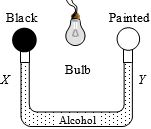
When the bulb is switched on,what happens to the level of alcohol on the $X$ side?
A
Increases
B
Decreases
C
Remains constant
D
Decreases on both sides
Solution
(B) The bulb emits thermal radiation. The black-painted surface on the $X$ side is a better absorber of radiation compared to the white/shiny surface on the $Y$ side.
As the black surface absorbs more heat,the air inside the $X$ bulb expands more due to the increase in temperature.
This increased pressure pushes the alcohol level down on the $X$ side and up on the $Y$ side.
Therefore,the level of alcohol on the $X$ side decreases.
As the black surface absorbs more heat,the air inside the $X$ bulb expands more due to the increase in temperature.
This increased pressure pushes the alcohol level down on the $X$ side and up on the $Y$ side.
Therefore,the level of alcohol on the $X$ side decreases.
0 likes
View Solution71
EasyMCQ
What is the speed of heat radiation equal to?
A
$A$. $\alpha$-rays
B
$B$. $\beta$-rays
C
$C$. Light waves
D
$D$. Sound waves
Solution
(C) Heat radiations are electromagnetic waves.
All electromagnetic waves travel at the speed of light $(c \approx 3 \times 10^8 \ m/s)$.
Therefore,heat radiations also travel at the speed of light.
All electromagnetic waves travel at the speed of light $(c \approx 3 \times 10^8 \ m/s)$.
Therefore,heat radiations also travel at the speed of light.
0 likes
View Solution72
MediumMCQ
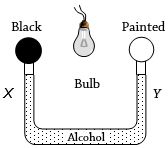
The following figure shows two air-filled bulbs connected by a $U$-tube partly filled with alcohol. One bulb is painted black and the other is painted white (or silver/shiny). What happens to the levels of alcohol in the limbs $X$ and $Y$ when an electric bulb placed midway between the two bulbs is lighted?
A
The level of alcohol in limb $X$ falls while that in limb $Y$ rises.
B
The level of alcohol in limb $X$ rises while that in limb $Y$ falls.
C
The level of alcohol falls in both limbs.
D
There is no change in the levels of alcohol in the two limbs.
Solution
(A) black surface is a better absorber of thermal radiation compared to a white or shiny surface.
When the electric bulb is lighted,it emits thermal radiation in all directions.
The black bulb absorbs more heat energy from this radiation than the white bulb.
As a result,the air inside the black bulb expands more significantly due to the higher temperature increase.
This increased pressure pushes the alcohol level down in limb $X$.
Consequently,the alcohol level in limb $Y$ rises.
Therefore,the correct observation is that the level of alcohol in limb $X$ falls while that in limb $Y$ rises.
When the electric bulb is lighted,it emits thermal radiation in all directions.
The black bulb absorbs more heat energy from this radiation than the white bulb.
As a result,the air inside the black bulb expands more significantly due to the higher temperature increase.
This increased pressure pushes the alcohol level down in limb $X$.
Consequently,the alcohol level in limb $Y$ rises.
Therefore,the correct observation is that the level of alcohol in limb $X$ falls while that in limb $Y$ rises.
0 likes
View Solution73
EasyMCQ
The spectrum of black body radiation is a
A
Line spectrum
B
Band spectrum
C
Continuous spectrum
D
Line and band spectrum both
Solution
(C) black body is an idealized physical body that absorbs all incident electromagnetic radiation,regardless of frequency or angle of incidence.
According to Planck's law of black body radiation,the energy emitted by a black body is distributed over a continuous range of wavelengths.
Therefore,the spectrum of black body radiation is a continuous spectrum,meaning it contains all possible wavelengths at a given temperature.
According to Planck's law of black body radiation,the energy emitted by a black body is distributed over a continuous range of wavelengths.
Therefore,the spectrum of black body radiation is a continuous spectrum,meaning it contains all possible wavelengths at a given temperature.
0 likes
View Solution74
MediumMCQ
Inside a closed furnace held at a temperature of $400\, K,$ we have a black body. $A$ hole of area $10\, cm^2$ is opened in the furnace so that sunlight starts falling on the black body. The intensity of sunlight is $2000\, W/m^2.$ In the steady state:
A
The black body and furnace cannot be distinguished
B
The black body will appear darker than the furnace
C
The black body will appear brighter than the furnace
D
Information insufficient
Solution
(C) The emissive power of the black body at temperature $T = 400\, K$ is given by the Stefan-Boltzmann law: $E = \sigma T^4$.
Substituting the values: $E = 5.67 \times 10^{-8} \times (400)^4$.
$E = 5.67 \times 10^{-8} \times 2.56 \times 10^{10} = 5.67 \times 256 = 1451.52\, W/m^2$.
However,the intensity of the incident sunlight is $I = 2000\, W/m^2$.
Since the incident intensity $I$ is greater than the emissive power $E$ of the black body at $400\, K$,the black body will absorb more energy from the sunlight than it emits at its current temperature.
In the steady state,the black body will reach a higher temperature than the furnace to balance the energy,making it appear brighter than the furnace.
Substituting the values: $E = 5.67 \times 10^{-8} \times (400)^4$.
$E = 5.67 \times 10^{-8} \times 2.56 \times 10^{10} = 5.67 \times 256 = 1451.52\, W/m^2$.
However,the intensity of the incident sunlight is $I = 2000\, W/m^2$.
Since the incident intensity $I$ is greater than the emissive power $E$ of the black body at $400\, K$,the black body will absorb more energy from the sunlight than it emits at its current temperature.
In the steady state,the black body will reach a higher temperature than the furnace to balance the energy,making it appear brighter than the furnace.
0 likes
View Solution75
MediumMCQ
The sun radiates electromagnetic energy at the rate of $3.9 \times 10^{26} \ W$. Its radius is $6.96 \times 10^8 \ m$. The intensity of sunlight at the solar surface will be (in $W/m^2$):
A
$1.4 \times 10^4$
B
$2.8 \times 10^5$
C
$4.2 \times 10^6$
D
$6.4 \times 10^7$
Solution
(D) The intensity $I$ is defined as the power radiated per unit surface area.
$I = \frac{P}{A} = \frac{P}{4 \pi R^2}$
Given:
Power $P = 3.9 \times 10^{26} \ W$
Radius $R \approx 7.0 \times 10^8 \ m$
$I = \frac{3.9 \times 10^{26}}{4 \times 3.14 \times (7.0 \times 10^8)^2}$
$I = \frac{3.9 \times 10^{26}}{12.56 \times 49 \times 10^{16}}$
$I = \frac{3.9 \times 10^{10}}{615.44} \approx 0.00633 \times 10^{10} \approx 6.33 \times 10^7 \ W/m^2$
Rounding to the nearest option,we get $6.4 \times 10^7 \ W/m^2$.
$I = \frac{P}{A} = \frac{P}{4 \pi R^2}$
Given:
Power $P = 3.9 \times 10^{26} \ W$
Radius $R \approx 7.0 \times 10^8 \ m$
$I = \frac{3.9 \times 10^{26}}{4 \times 3.14 \times (7.0 \times 10^8)^2}$
$I = \frac{3.9 \times 10^{26}}{12.56 \times 49 \times 10^{16}}$
$I = \frac{3.9 \times 10^{10}}{615.44} \approx 0.00633 \times 10^{10} \approx 6.33 \times 10^7 \ W/m^2$
Rounding to the nearest option,we get $6.4 \times 10^7 \ W/m^2$.
0 likes
View Solution76
EasyMCQ
If the absorption and reflection coefficients of a surface of a body are $0.4$ and $0.6$ respectively,then
A
Body is translucent
B
Body is fully transparent
C
Body is opaque
D
It is a real body
Solution
(C) The sum of the absorption coefficient $(\alpha)$,reflection coefficient $(\rho)$,and transmission coefficient $(\tau)$ is always equal to $1$,i.e.,$\alpha + \rho + \tau = 1$.
Given,$\alpha = 0.4$ and $\rho = 0.6$.
Substituting these values in the equation: $0.4 + 0.6 + \tau = 1$.
$1 + \tau = 1$.
$\Rightarrow \tau = 0$.
Since the transmission coefficient is $0$,no heat is transmitted through the body. Therefore,the body is opaque.
Given,$\alpha = 0.4$ and $\rho = 0.6$.
Substituting these values in the equation: $0.4 + 0.6 + \tau = 1$.
$1 + \tau = 1$.
$\Rightarrow \tau = 0$.
Since the transmission coefficient is $0$,no heat is transmitted through the body. Therefore,the body is opaque.
0 likes
View Solution77
DifficultMCQ
$A$ spherical body of emissivity $e = 0.6$ placed inside a perfect black body is maintained at temperature $T$. The energy radiated per second by the body will be:
A
$E = 0.6 \sigma A T^4$
B
$E = 0.4 \sigma A T^4$
C
$E = 0.8 \sigma A T^4$
D
$E = 1.0 \sigma A T^4$
Solution
(D) According to the Stefan-Boltzmann law,the energy radiated by a body is given by $E = e \sigma A T^4$.
However,when a body is placed inside a perfect black body cavity (or enclosure) maintained at the same temperature,the net energy exchange is governed by the absorption properties.
If the body is in thermal equilibrium inside a black body enclosure,it acts as a black body itself because the radiation incident on it from the surroundings is fully absorbed and re-emitted.
For a perfect black body,the emissivity $e = 1$.
Therefore,the energy radiated per second by the body in this specific condition is $E = 1.0 \sigma A T^4$.
However,when a body is placed inside a perfect black body cavity (or enclosure) maintained at the same temperature,the net energy exchange is governed by the absorption properties.
If the body is in thermal equilibrium inside a black body enclosure,it acts as a black body itself because the radiation incident on it from the surroundings is fully absorbed and re-emitted.
For a perfect black body,the emissivity $e = 1$.
Therefore,the energy radiated per second by the body in this specific condition is $E = 1.0 \sigma A T^4$.
0 likes
View Solution78
EasyMCQ
According to Kirchhoff's law,the ratio of emissive power to absorptive power for all bodies is:
A
Different for all bodies.
B
Equal to the emissive power of a black body at the same temperature.
C
Equal to the emissive power of a white body.
D
Equal to the emissive power of a black body at any temperature.
Solution
(B) Kirchhoff's law of radiation states that for an arbitrary body emitting and absorbing thermal radiation in thermodynamic equilibrium,the ratio of its emissive power $(E)$ to its absorptive power $(a)$ is equal to the emissive power of a perfect black body $(E_b)$ at the same temperature.
Mathematically,this is expressed as: $\frac{E}{a} = E_b$.
Therefore,the ratio is equal to the emissive power of a black body at the same temperature.
Mathematically,this is expressed as: $\frac{E}{a} = E_b$.
Therefore,the ratio is equal to the emissive power of a black body at the same temperature.
0 likes
View Solution79
EasyMCQ
$Assertion$ : The Earth without an atmosphere would be inhospitably cold.
$Reason$ : All heat would escape in the absence of an atmosphere.
$Reason$ : All heat would escape in the absence of an atmosphere.
A
If both $Assertion$ and $Reason$ are correct but $Reason$ is not a correct explanation of the $Assertion$.
B
If both $Assertion$ and $Reason$ are correct and the $Reason$ is a correct explanation of the $Assertion$.
C
If the $Assertion$ is correct but $Reason$ is incorrect.
D
If both the $Assertion$ and $Reason$ are incorrect.
Solution
(B) The Earth's atmosphere acts as a blanket that traps heat through the greenhouse effect.
In the absence of an atmosphere,there would be no mechanism to trap the infrared radiation emitted by the Earth's surface.
Consequently,all the heat would escape into space,causing the surface temperature to drop significantly,making the Earth inhospitably cold.
Therefore,the $Reason$ correctly explains the $Assertion$.
In the absence of an atmosphere,there would be no mechanism to trap the infrared radiation emitted by the Earth's surface.
Consequently,all the heat would escape into space,causing the surface temperature to drop significantly,making the Earth inhospitably cold.
Therefore,the $Reason$ correctly explains the $Assertion$.
0 likes
View Solution80
EasyMCQ
Three objects colored black,gray,and white can withstand hostile conditions up to $2800\,^oC$. These objects are thrown into a furnace where each of them attains a temperature of $2000\,^oC$. Which object will glow brightest?
A
the white object
B
the black object
C
all glow with equal brightness
D
gray object
Solution
(B) According to Kirchhoff's law of radiation,good absorbers are also good emitters.
Black surfaces have the highest emissivity and absorptivity compared to gray or white surfaces.
Since all objects are at the same temperature of $2000\,^oC$,the object with the highest emissivity will emit the maximum amount of radiation per unit area.
Therefore,the black object will glow the brightest.
Black surfaces have the highest emissivity and absorptivity compared to gray or white surfaces.
Since all objects are at the same temperature of $2000\,^oC$,the object with the highest emissivity will emit the maximum amount of radiation per unit area.
Therefore,the black object will glow the brightest.
0 likes
View Solution81
EasyMCQ
$Assertion :$ $A$ body that is a good radiator is also a good absorber of radiation at a given wavelength.
$Reason :$ According to Kirchhoff's law,the absorptivity of a body is equal to its emissivity at a given wavelength.
$Reason :$ According to Kirchhoff's law,the absorptivity of a body is equal to its emissivity at a given wavelength.
A
If both Assertion and Reason are correct and the Reason is a correct explanation of the Assertion.
B
If both Assertion and Reason are correct but Reason is not a correct explanation of the Assertion.
C
If the Assertion is correct but Reason is incorrect.
D
If both the Assertion and Reason are incorrect.
Solution
(A) According to Kirchhoff's law of radiation,for an arbitrary body,the ratio of its emissive power $(e_{\lambda})$ to its absorptivity $(a_{\lambda})$ at a given wavelength and temperature is equal to the emissive power $(E_{\lambda})$ of a perfectly black body at the same wavelength and temperature.
Mathematically,$\frac{e_{\lambda}}{a_{\lambda}} = E_{\lambda}$.
Since $E_{\lambda}$ is a constant for a given wavelength and temperature,it follows that $e_{\lambda} \propto a_{\lambda}$.
This implies that a body with high emissivity (good radiator) must also have high absorptivity (good absorber) at that specific wavelength. Thus,both the Assertion and the Reason are correct,and the Reason is the correct explanation of the Assertion.
Mathematically,$\frac{e_{\lambda}}{a_{\lambda}} = E_{\lambda}$.
Since $E_{\lambda}$ is a constant for a given wavelength and temperature,it follows that $e_{\lambda} \propto a_{\lambda}$.
This implies that a body with high emissivity (good radiator) must also have high absorptivity (good absorber) at that specific wavelength. Thus,both the Assertion and the Reason are correct,and the Reason is the correct explanation of the Assertion.
0 likes
View Solution82
EasyMCQ
$Assertion :$ $A$ hollow metallic closed container maintained at a uniform temperature can act as a source of black body radiation.
$Reason :$ All metals act as black bodies.
$Reason :$ All metals act as black bodies.
A
If both $Assertion$ and $Reason$ are correct and the $Reason$ is a correct explanation of the $Assertion$.
B
If both $Assertion$ and $Reason$ are correct but $Reason$ is not a correct explanation of the $Assertion$.
C
If the $Assertion$ is correct but $Reason$ is incorrect.
D
If both the $Assertion$ and $Reason$ are incorrect.
Solution
(C) hollow metallic container with a small hole acts as a black body because any radiation entering the hole undergoes multiple reflections inside and is eventually absorbed. This is known as $Fery's$ black body. Thus,the $Assertion$ is correct.
However,the $Reason$ states that all metals act as black bodies,which is false. Metals are generally good reflectors and poor absorbers of radiation. Therefore,the $Reason$ is incorrect.
$\therefore$ The correct option is $C$.
However,the $Reason$ states that all metals act as black bodies,which is false. Metals are generally good reflectors and poor absorbers of radiation. Therefore,the $Reason$ is incorrect.
$\therefore$ The correct option is $C$.
0 likes
View Solution83
Medium
Define thermal radiation and radiant energy and explain Prevost's theory of heat exchange.
Solution
(N/A) Thermal radiation: All substances emit electromagnetic waves of certain definite frequencies depending on their temperature. This radiation is called thermal radiation.
Radiant energy: The energy associated with the electromagnetic waves in thermal radiation is called radiant energy.
Prevost's theory of heat exchange: According to this theory,every body at any temperature (above $0 \ K$) continuously emits thermal radiation to its surroundings and simultaneously absorbs radiation from its surroundings.
$1$. The rate of emission of thermal radiation depends on the temperature of the body. As the temperature increases,the rate of emission increases.
$2$. If the rate of emission is greater than the rate of absorption,the temperature of the body decreases.
$3$. If the rate of emission is less than the rate of absorption,the temperature of the body increases.
$4$. When the body reaches thermal equilibrium with its surroundings,the rate of emission becomes equal to the rate of absorption,and the temperature of the body remains constant.
Radiant energy: The energy associated with the electromagnetic waves in thermal radiation is called radiant energy.
Prevost's theory of heat exchange: According to this theory,every body at any temperature (above $0 \ K$) continuously emits thermal radiation to its surroundings and simultaneously absorbs radiation from its surroundings.
$1$. The rate of emission of thermal radiation depends on the temperature of the body. As the temperature increases,the rate of emission increases.
$2$. If the rate of emission is greater than the rate of absorption,the temperature of the body decreases.
$3$. If the rate of emission is less than the rate of absorption,the temperature of the body increases.
$4$. When the body reaches thermal equilibrium with its surroundings,the rate of emission becomes equal to the rate of absorption,and the temperature of the body remains constant.
0 likes
View Solution84
Easy
Why do we wear white or light-coloured clothes in summer and dark-coloured clothes in winter?
Solution
(N/A) Substances of dark or black colour are better absorbers and emitters of thermal radiation compared to light-coloured substances.
In summer,light-coloured clothes absorb less heat and reflect most of the solar radiation,which helps in keeping the body cool.
In winter,dark-coloured clothes absorb more heat from the surroundings and the sun,which helps in keeping the body warm.
In summer,light-coloured clothes absorb less heat and reflect most of the solar radiation,which helps in keeping the body cool.
In winter,dark-coloured clothes absorb more heat from the surroundings and the sun,which helps in keeping the body warm.
0 likes
View Solution85
Medium
Why are the bottom layers of cooking vessels kept black in color?
Solution
(N/A) The bottom layers of cooking vessels are kept black in color because black surfaces are excellent absorbers of heat radiation. By absorbing maximum heat from the gas-stove flame,the vessel transfers more thermal energy to the food in a shorter amount of time,which makes the cooking process faster.
0 likes
View Solution86
Easy
Write a short note on the Greenhouse Effect.
Solution
(N/A) The Earth's surface and substances on it absorb energy from the Sun and become hot based on their absorptivity.
These hot substances emit infrared rays. Due to their long wavelengths,these rays cannot easily escape the Earth's atmosphere.
These radiations are primarily absorbed by greenhouse gases such as carbon dioxide $(CO_{2})$,methane $(CH_{4})$,nitrous oxide $(N_{2}O)$,chlorofluorocarbons $(CFCs)$,and tropospheric ozone $(O_{3})$,which then heat up.
These heated greenhouse gases re-emit infrared radiation,returning energy to the Earth's surface. As a result,the Earth's surface remains warm,and the temperature stays relatively constant.
This cycle continues,trapping heat within the atmosphere. This phenomenon is known as the greenhouse effect. Infrared rays are also called heat rays because they carry thermal energy. This is why the atmosphere feels warmer on cloudy nights in winter compared to clear nights.
Without the greenhouse effect,the Earth's average temperature would be approximately $-18^{\circ}C$.
Due to human activities,the concentration of greenhouse gases has increased,causing the Earth to become hotter. Consequently,the global average temperature has risen by $0.3^{\circ}C$ to $0.6^{\circ}C$.
It is projected that in the next half-century,the Earth's temperature could be $1^{\circ}C$ to $3^{\circ}C$ higher than it is today. This global warming poses significant challenges for humanity,plants,and animals.
As a result of global warming,pollution levels are increasing,leading to the rapid melting of polar ice caps. This causes sea levels to rise and alters global climate patterns.
Many coastal cities face the risk of being submerged,and desertification may increase due to intensified greenhouse effects. Global cooperation is essential to mitigate the impacts of global warming.
These hot substances emit infrared rays. Due to their long wavelengths,these rays cannot easily escape the Earth's atmosphere.
These radiations are primarily absorbed by greenhouse gases such as carbon dioxide $(CO_{2})$,methane $(CH_{4})$,nitrous oxide $(N_{2}O)$,chlorofluorocarbons $(CFCs)$,and tropospheric ozone $(O_{3})$,which then heat up.
These heated greenhouse gases re-emit infrared radiation,returning energy to the Earth's surface. As a result,the Earth's surface remains warm,and the temperature stays relatively constant.
This cycle continues,trapping heat within the atmosphere. This phenomenon is known as the greenhouse effect. Infrared rays are also called heat rays because they carry thermal energy. This is why the atmosphere feels warmer on cloudy nights in winter compared to clear nights.
Without the greenhouse effect,the Earth's average temperature would be approximately $-18^{\circ}C$.
Due to human activities,the concentration of greenhouse gases has increased,causing the Earth to become hotter. Consequently,the global average temperature has risen by $0.3^{\circ}C$ to $0.6^{\circ}C$.
It is projected that in the next half-century,the Earth's temperature could be $1^{\circ}C$ to $3^{\circ}C$ higher than it is today. This global warming poses significant challenges for humanity,plants,and animals.
As a result of global warming,pollution levels are increasing,leading to the rapid melting of polar ice caps. This causes sea levels to rise and alters global climate patterns.
Many coastal cities face the risk of being submerged,and desertification may increase due to intensified greenhouse effects. Global cooperation is essential to mitigate the impacts of global warming.
0 likes
View Solution87
Easy
What is radiation and radiant energy?
Solution
(N/A) Radiation is the process of heat transfer in which energy is emitted by a body in the form of electromagnetic waves,which can travel through a vacuum without the need for any material medium.
Radiant energy is the energy carried by these electromagnetic waves. When this energy falls on a body,it is partially absorbed,reflected,or transmitted. The part that is absorbed increases the internal energy of the body,thereby raising its temperature.
Radiant energy is the energy carried by these electromagnetic waves. When this energy falls on a body,it is partially absorbed,reflected,or transmitted. The part that is absorbed increases the internal energy of the body,thereby raising its temperature.
0 likes
View Solution88
Easy
What is a perfect black body? Give examples.
Solution
(N/A) perfect black body is defined as an ideal body that absorbs all the incident electromagnetic radiation of any wavelength falling on it,regardless of the angle of incidence or the frequency of the radiation.
It does not reflect or transmit any radiation.
When heated,a perfect black body emits radiation of all possible wavelengths,which is known as black body radiation.
Examples of a perfect black body include:
$1$. Lampblack: It absorbs about $96\%$ to $98\%$ of the incident radiation.
$2$. Platinum black: It absorbs about $98\%$ of the incident radiation.
$3$. Fery's black body: $A$ practical realization of a perfect black body using a hollow enclosure with a small aperture.
It does not reflect or transmit any radiation.
When heated,a perfect black body emits radiation of all possible wavelengths,which is known as black body radiation.
Examples of a perfect black body include:
$1$. Lampblack: It absorbs about $96\%$ to $98\%$ of the incident radiation.
$2$. Platinum black: It absorbs about $98\%$ of the incident radiation.
$3$. Fery's black body: $A$ practical realization of a perfect black body using a hollow enclosure with a small aperture.
0 likes
View Solution89
Medium
Define emissivity and absorptivity and give their values for a perfect black body.
Solution
(N/A) $1$. Absorptivity $(a)$: It is defined as the ratio of the amount of radiant energy absorbed by a body to the total amount of radiant energy incident on it. For a perfect black body,$a = 1$.
$2$. Emissivity $(e)$: It is defined as the ratio of the radiant energy emitted by a body at a given temperature to the radiant energy emitted by a perfect black body at the same temperature. For a perfect black body,$e = 1$.
$2$. Emissivity $(e)$: It is defined as the ratio of the radiant energy emitted by a body at a given temperature to the radiant energy emitted by a perfect black body at the same temperature. For a perfect black body,$e = 1$.
0 likes
View Solution90
Medium
What are heat rays?
Solution
(N/A) Heat rays,also known as thermal radiation,are electromagnetic waves emitted by an object due to its temperature.
These rays are primarily in the infrared region of the electromagnetic spectrum,typically with wavelengths ranging from $700 \ nm$ to $1 \ mm$.
Unlike conduction and convection,heat rays do not require a material medium for propagation and can travel through a vacuum at the speed of light $(c \approx 3 \times 10^8 \ m/s)$.
All objects at a temperature above absolute zero $(0 \ K)$ emit these rays.
These rays are primarily in the infrared region of the electromagnetic spectrum,typically with wavelengths ranging from $700 \ nm$ to $1 \ mm$.
Unlike conduction and convection,heat rays do not require a material medium for propagation and can travel through a vacuum at the speed of light $(c \approx 3 \times 10^8 \ m/s)$.
All objects at a temperature above absolute zero $(0 \ K)$ emit these rays.
0 likes
View Solution91
MediumMCQ
What would happen if the greenhouse effect were not present?
A
The Earth would become extremely hot.
B
The Earth's average temperature would drop to about $-18^{\circ}C$.
C
The Earth's average temperature would remain the same.
D
The Earth would become completely dark.
Solution
(B) The greenhouse effect is a natural process that warms the Earth's surface. When the Sun's energy reaches the Earth's atmosphere,some of it is reflected back to space and the rest is absorbed and re-radiated by greenhouse gases.
Without the greenhouse effect,the heat absorbed by the Earth would escape back into space,causing the planet's average surface temperature to drop significantly.
Calculations suggest that without this effect,the average temperature of the Earth would be approximately $-18^{\circ}C$,compared to the current average of about $+15^{\circ}C$.
Therefore,the Earth would become much colder,making it difficult for life as we know it to survive.
Without the greenhouse effect,the heat absorbed by the Earth would escape back into space,causing the planet's average surface temperature to drop significantly.
Calculations suggest that without this effect,the average temperature of the Earth would be approximately $-18^{\circ}C$,compared to the current average of about $+15^{\circ}C$.
Therefore,the Earth would become much colder,making it difficult for life as we know it to survive.
0 likes
View Solution92
EasyMCQ
''$A$ perfect black body is black in colour.'' Is this statement true or false?
A
True
B
False
Solution
(B) The statement is false. $A$ perfect black body is defined as an object that absorbs all incident electromagnetic radiation,regardless of frequency or angle of incidence. While it appears black at room temperature because it does not reflect any light,a perfect black body at a high temperature will emit radiation across all wavelengths,making it glow (e.g.,a star or a heated metal object). Therefore,its appearance depends on its temperature,not just its ability to absorb light.
0 likes
View Solution93
Medium
Why is the Sun considered a perfect black body?
Solution
(N/A) perfect black body is defined as an object that absorbs all incident radiation and emits all wavelengths of the electromagnetic spectrum. The Sun emits radiation across a continuous range of wavelengths,covering the entire spectrum from ultraviolet to infrared. Because it emits all possible wavelengths of radiation,it is considered a perfect black body.
0 likes
View Solution94
MediumMCQ
Nearly $10 \%$ of the power of a $110\,W$ light bulb is converted to visible radiation. The change in average intensities of visible radiation,at a distance of $1\,m$ from the bulb to a distance of $5\,m$ is $a \times 10^{-2}\,W/m^2$. The value of '$a$' will be.
A
$80$
B
$29$
C
$54$
D
$84$
Solution
(D) The power of the visible radiation emitted by the bulb is $P' = 10\% \text{ of } 110\,W = 0.10 \times 110\,W = 11\,W$.
The intensity $I$ at a distance $r$ from a point source is given by $I = \frac{P'}{4\pi r^2}$.
The intensity at $r_1 = 1\,m$ is $I_1 = \frac{11}{4\pi(1)^2} = \frac{11}{4\pi}$.
The intensity at $r_2 = 5\,m$ is $I_2 = \frac{11}{4\pi(5)^2} = \frac{11}{100\pi}$.
The change in intensity is $\Delta I = I_1 - I_2 = \frac{11}{4\pi} - \frac{11}{100\pi} = \frac{11}{\pi} \left( \frac{1}{4} - \frac{1}{100} \right)$.
$\Delta I = \frac{11}{\pi} \left( \frac{25 - 1}{100} \right) = \frac{11}{\pi} \times \frac{24}{100} = \frac{264}{100\pi} = \frac{2.64}{\pi} \approx \frac{2.64}{3.14} \approx 0.84\,W/m^2$.
Given $\Delta I = a \times 10^{-2}\,W/m^2$,we have $0.84 = a \times 10^{-2}$,which implies $a = 84$.
The intensity $I$ at a distance $r$ from a point source is given by $I = \frac{P'}{4\pi r^2}$.
The intensity at $r_1 = 1\,m$ is $I_1 = \frac{11}{4\pi(1)^2} = \frac{11}{4\pi}$.
The intensity at $r_2 = 5\,m$ is $I_2 = \frac{11}{4\pi(5)^2} = \frac{11}{100\pi}$.
The change in intensity is $\Delta I = I_1 - I_2 = \frac{11}{4\pi} - \frac{11}{100\pi} = \frac{11}{\pi} \left( \frac{1}{4} - \frac{1}{100} \right)$.
$\Delta I = \frac{11}{\pi} \left( \frac{25 - 1}{100} \right) = \frac{11}{\pi} \times \frac{24}{100} = \frac{264}{100\pi} = \frac{2.64}{\pi} \approx \frac{2.64}{3.14} \approx 0.84\,W/m^2$.
Given $\Delta I = a \times 10^{-2}\,W/m^2$,we have $0.84 = a \times 10^{-2}$,which implies $a = 84$.
0 likes
View Solution95
EasyMCQ
$A$ body,which emits radiations of all possible wavelengths,is known as ...........
A
Good conductor
B
Partial radiator
C
Absorber of photons
D
Perfectly black body
Solution
(D) The correct answer is $(d)$.
$A$ perfectly black body is defined as an ideal body that absorbs all incident radiation of any wavelength falling on it.
According to Kirchhoff's law of radiation,a good absorber is also a good emitter.
Therefore,a perfectly black body is also the best emitter of radiation,meaning it emits radiation of all possible wavelengths at a given temperature.
$A$ perfectly black body is defined as an ideal body that absorbs all incident radiation of any wavelength falling on it.
According to Kirchhoff's law of radiation,a good absorber is also a good emitter.
Therefore,a perfectly black body is also the best emitter of radiation,meaning it emits radiation of all possible wavelengths at a given temperature.
0 likes
View Solution96
EasyMCQ
$A$ hot and a cold body are kept in vacuum separated from each other. Which of the following causes a decrease in the temperature of the hot body?
A
Radiation
B
Convection
C
Conduction
D
Temperature remains the same
Solution
(A) There are three primary modes of heat transfer:
$1$. Conduction: This requires physical contact between bodies.
$2$. Convection: This requires a material medium (liquid or gas) to transfer heat.
$3$. Radiation: This involves the emission of electromagnetic waves and does not require any material medium.
Since the bodies are kept in a vacuum,conduction and convection cannot occur. Therefore,the hot body loses heat to the cold body through radiation,causing its temperature to decrease.
$1$. Conduction: This requires physical contact between bodies.
$2$. Convection: This requires a material medium (liquid or gas) to transfer heat.
$3$. Radiation: This involves the emission of electromagnetic waves and does not require any material medium.
Since the bodies are kept in a vacuum,conduction and convection cannot occur. Therefore,the hot body loses heat to the cold body through radiation,causing its temperature to decrease.
0 likes
View Solution97
EasyMCQ
Select the incorrect statement.
A
$A$ body radiates at all temperatures except $0 \,K$.
B
$A$ good reflector is a bad radiator.
C
$A$ colder body can radiate heat to the hotter surroundings.
D
$A$ body does not radiate when its temperature is below $0^{\circ} C$.
Solution
(D) According to Prevost's theory of heat exchange,all bodies at temperatures above absolute zero $(0 \,K)$ emit thermal radiation.
$0^{\circ} C$ is equal to $273.15 \,K$,which is significantly higher than absolute zero.
Therefore,a body at $0^{\circ} C$ will continue to radiate heat.
Statement $(d)$ is incorrect because it claims that radiation stops below $0^{\circ} C$,which is physically false.
$0^{\circ} C$ is equal to $273.15 \,K$,which is significantly higher than absolute zero.
Therefore,a body at $0^{\circ} C$ will continue to radiate heat.
Statement $(d)$ is incorrect because it claims that radiation stops below $0^{\circ} C$,which is physically false.
0 likes
View Solution98
EasyMCQ
The rate of radiation of energy from a hot object is maximum,if its surface is ...........
A
White and smooth
B
Black and rough
C
Black and smooth
D
White and rough
Solution
(B) According to Kirchhoff's law of radiation,good absorbers of radiation are also good emitters of radiation.
$A$ perfectly black body is the best absorber of radiation,and therefore,it is also the best emitter of radiation.
Rough surfaces have a higher effective surface area for emission compared to smooth surfaces.
Therefore,a surface that is black and rough will have the maximum rate of energy radiation.
$A$ perfectly black body is the best absorber of radiation,and therefore,it is also the best emitter of radiation.
Rough surfaces have a higher effective surface area for emission compared to smooth surfaces.
Therefore,a surface that is black and rough will have the maximum rate of energy radiation.
0 likes
View Solution99
EasyMCQ
If the transmission power of a surface is $\frac{1}{9}$ and the reflective power is $\frac{1}{6}$,then what is its absorptive power?
A
$\frac{18}{13}$
B
$\frac{13}{18}$
C
$\frac{3}{15}$
D
$\frac{15}{3}$
Solution
(B) For any surface,the sum of the transmission power $(t)$,reflective power $(r)$,and absorptive power $(a)$ is equal to $1$.
$t + r + a = 1$
Given that $t = \frac{1}{9}$ and $r = \frac{1}{6}$,we can substitute these values into the equation:
$a = 1 - (t + r)$
$a = 1 - \left(\frac{1}{9} + \frac{1}{6}\right)$
To add the fractions,find the least common multiple of $9$ and $6$,which is $18$:
$a = 1 - \left(\frac{2}{18} + \frac{3}{18}\right)$
$a = 1 - \frac{5}{18}$
$a = \frac{18 - 5}{18} = \frac{13}{18}$
$t + r + a = 1$
Given that $t = \frac{1}{9}$ and $r = \frac{1}{6}$,we can substitute these values into the equation:
$a = 1 - (t + r)$
$a = 1 - \left(\frac{1}{9} + \frac{1}{6}\right)$
To add the fractions,find the least common multiple of $9$ and $6$,which is $18$:
$a = 1 - \left(\frac{2}{18} + \frac{3}{18}\right)$
$a = 1 - \frac{5}{18}$
$a = \frac{18 - 5}{18} = \frac{13}{18}$
0 likes
View Solution100
MediumMCQ
$A$ solid cylinder of length $L$ and radius $r$ is heated up to the same temperature as that of a cube of edge length $a$. If both have the same material,volume,and are allowed to cool under similar conditions,then the ratio of the amount of radiation emitted will be (Neglect radiation emitted from the flat surfaces of the cylinder).
A
$\frac{a}{3r}$
B
$\frac{2a}{rL}$
C
$\frac{a^2}{rL}$
D
$\frac{\pi a^2}{2\pi L}$
Solution
(A) Since both objects have the same volume,we have $a^3 = \pi r^2 L$ --- $(1)$.
The amount of radiation emitted $Q$ is proportional to the surface area $A$ of the object,given that the temperature and material are the same for both $(Q = \sigma A e T^4 t)$.
For the cylinder,the curved surface area is $A_{\text{cyl}} = 2\pi r L$ (neglecting flat ends).
For the cube,the total surface area is $A_{\text{cube}} = 6a^2$.
The ratio of radiation is $\frac{R_{\text{cyl}}}{R_{\text{cube}}} = \frac{2\pi r L}{6a^2}$.
From equation $(1)$,we know $\pi r^2 L = a^3$,so $L = \frac{a^3}{\pi r^2}$.
Substituting $L$ into the ratio: $\frac{R_{\text{cyl}}}{R_{\text{cube}}} = \frac{2\pi r (a^3 / \pi r^2)}{6a^2} = \frac{2a^3 / r}{6a^2} = \frac{2a}{6r} = \frac{a}{3r}$.
The amount of radiation emitted $Q$ is proportional to the surface area $A$ of the object,given that the temperature and material are the same for both $(Q = \sigma A e T^4 t)$.
For the cylinder,the curved surface area is $A_{\text{cyl}} = 2\pi r L$ (neglecting flat ends).
For the cube,the total surface area is $A_{\text{cube}} = 6a^2$.
The ratio of radiation is $\frac{R_{\text{cyl}}}{R_{\text{cube}}} = \frac{2\pi r L}{6a^2}$.
From equation $(1)$,we know $\pi r^2 L = a^3$,so $L = \frac{a^3}{\pi r^2}$.
Substituting $L$ into the ratio: $\frac{R_{\text{cyl}}}{R_{\text{cube}}} = \frac{2\pi r (a^3 / \pi r^2)}{6a^2} = \frac{2a^3 / r}{6a^2} = \frac{2a}{6r} = \frac{a}{3r}$.
0 likes
View Solution10-2.Heat Transfer — Radiation (General, Kirchoff's law, Black body, Prevost's Theory) · Frequently Asked Questions
1Are these 10-2.Heat Transfer questions useful for JEE and NEET?
Yes. All questions in this section are mapped to JEE Main and NEET exam patterns. Previous year questions from JEE Main, NEET, GUJCET and state-level exams are included with full solutions.
2Can I switch to Hindi or Gujarati for these questions?
Yes. Use the language tabs in the hero section or the sidebar to view the same questions and solutions in English, Hindi or Gujarati.
3How do I generate a question paper from this subtopic?
Use the Vedclass Exam Paper Generator — select the chapter and subtopic, set difficulty, and generate Sets A, B, C, D automatically. First 3 chapters of every subject are free.
Vedclass Products
For Students
Vedclass Test Series
Mock tests in real JEE/NEET style with performance analysis. 5-day free trial.
Start Free TrialFor Teachers
Exam Paper Generator
Generate Set A/B/C/D papers from this chapter in 2 minutes. 3 chapters free.
Try FreeFor Institutes
Online Exam Module
Live online exams with unlimited students, 360° analytics & white-label branding.
See DemoFor Teachers & Institutes
Generate a 10-2.Heat Transfer Exam Paper in 2 Minutes
Select subtopic & difficulty — Sets A, B, C, D auto-generated with No Repeat logic.
First 3 chapters of every subject are free — no payment required.