
A English
Radiation (General, Kirchoff's law, Black body, Prevost's Theory) Questions in English
Class 11 Physics · 10-2.Heat Transfer · Radiation (General, Kirchoff's law, Black body, Prevost's Theory)
128+
Questions
English
Language
100%
With Solutions
Showing 26 of 128 questions in English
101
AdvancedMCQ
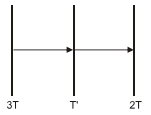
Three very large plates of the same area are kept parallel and close to each other. They are considered as ideal black surfaces and have very high thermal conductivity. The first and third plates are maintained at temperatures $2\ T$ and $3\ T$ respectively. The temperature of the middle (i.e.,second) plate under steady-state condition is
A
$\left(\frac{65}{2}\right)^{\frac{1}{4}} \ T$
B
$\left(\frac{97}{4}\right)^{\frac{1}{4}} \ T$
C
$\left(\frac{97}{2}\right)^{\frac{1}{4}} \ T$
D
$\left(97\right)^{\frac{1}{4}} \ T$
Solution
(C) In the steady state,the energy absorbed by the middle plate is equal to the energy released by the middle plate.
Let the temperature of the middle plate be $T'$.
The radiation energy incident on the middle plate from the first plate (at $3T$) is $\sigma A (3T)^4$.
The radiation energy emitted by the middle plate towards the first plate is $\sigma A (T')^4$.
The net energy absorbed from the first plate is $\sigma A (3T)^4 - \sigma A (T')^4$.
The radiation energy incident on the middle plate from the third plate (at $2T$) is $\sigma A (2T)^4$.
The radiation energy emitted by the middle plate towards the third plate is $\sigma A (T')^4$.
The net energy released to the third plate is $\sigma A (T')^4 - \sigma A (2T)^4$.
Equating the net energy absorbed and released:
$\sigma A (3T)^4 - \sigma A (T')^4 = \sigma A (T')^4 - \sigma A (2T)^4$
$(3T)^4 - (T')^4 = (T')^4 - (2T)^4$
$81T^4 + 16T^4 = 2(T')^4$
$97T^4 = 2(T')^4$
$(T')^4 = \frac{97}{2} T^4$
$T' = \left(\frac{97}{2}\right)^{\frac{1}{4}} T$
Let the temperature of the middle plate be $T'$.
The radiation energy incident on the middle plate from the first plate (at $3T$) is $\sigma A (3T)^4$.
The radiation energy emitted by the middle plate towards the first plate is $\sigma A (T')^4$.
The net energy absorbed from the first plate is $\sigma A (3T)^4 - \sigma A (T')^4$.
The radiation energy incident on the middle plate from the third plate (at $2T$) is $\sigma A (2T)^4$.
The radiation energy emitted by the middle plate towards the third plate is $\sigma A (T')^4$.
The net energy released to the third plate is $\sigma A (T')^4 - \sigma A (2T)^4$.
Equating the net energy absorbed and released:
$\sigma A (3T)^4 - \sigma A (T')^4 = \sigma A (T')^4 - \sigma A (2T)^4$
$(3T)^4 - (T')^4 = (T')^4 - (2T)^4$
$81T^4 + 16T^4 = 2(T')^4$
$97T^4 = 2(T')^4$
$(T')^4 = \frac{97}{2} T^4$
$T' = \left(\frac{97}{2}\right)^{\frac{1}{4}} T$
0 likes
View Solution102
MediumMCQ
The filament of a light bulb has a surface area of $64 \ mm^2$. The filament can be considered as a black body at a temperature of $2500 \ K$,emitting radiation like a point source when viewed from afar. At night,the light bulb is observed from a distance of $100 \ m$. Assume the pupil of the observer's eye to be circular with a radius of $3 \ mm$. Then:
(Take Stefan-Boltzmann constant $= 5.67 \times 10^{-8} \ W \ m^{-2} \ K^{-4}$,Wien's displacement constant $= 2.90 \times 10^{-3} \ m \ K$,Planck's constant $= 6.63 \times 10^{-34} \ J \ s$,speed of light in vacuum $= 3.00 \times 10^8 \ m \ s^{-1}$)
$(A)$ The power radiated by the filament is in the range $642 \ W$ to $645 \ W$.
$(B)$ The radiated power entering into one eye of the observer is in the range $3.15 \times 10^{-8} \ W$ to $3.25 \times 10^{-8} \ W$.
$(C)$ The wavelength corresponding to the maximum intensity of light is $1160 \ nm$.
$(D)$ Taking the average wavelength of emitted radiation to be $1740 \ nm$,the total number of photons entering per second into one eye of the observer is in the range $2.75 \times 10^{11}$ to $2.85 \times 10^{11}$.
(Take Stefan-Boltzmann constant $= 5.67 \times 10^{-8} \ W \ m^{-2} \ K^{-4}$,Wien's displacement constant $= 2.90 \times 10^{-3} \ m \ K$,Planck's constant $= 6.63 \times 10^{-34} \ J \ s$,speed of light in vacuum $= 3.00 \times 10^8 \ m \ s^{-1}$)
$(A)$ The power radiated by the filament is in the range $642 \ W$ to $645 \ W$.
$(B)$ The radiated power entering into one eye of the observer is in the range $3.15 \times 10^{-8} \ W$ to $3.25 \times 10^{-8} \ W$.
$(C)$ The wavelength corresponding to the maximum intensity of light is $1160 \ nm$.
$(D)$ Taking the average wavelength of emitted radiation to be $1740 \ nm$,the total number of photons entering per second into one eye of the observer is in the range $2.75 \times 10^{11}$ to $2.85 \times 10^{11}$.
A
$A, B, C$
B
$A, B, D$
C
$A, C$
D
$B, C, D$
Solution
(D) Given: Surface area $A = 64 \ mm^2 = 64 \times 10^{-6} \ m^2$,Temperature $T = 2500 \ K$,Distance $d = 100 \ m$,Pupil radius $R_e = 3 \ mm = 3 \times 10^{-3} \ m$.
$(A)$ Power radiated by the filament $P = \sigma A e T^4$. For a black body,emissivity $e = 1$.
$P = (5.67 \times 10^{-8}) \times (64 \times 10^{-6}) \times 1 \times (2500)^4 = 141.75 \ W$.
Thus,option $(A)$ is incorrect.
$(B)$ Power reaching the eye $P_{eye} = \frac{P}{4 \pi d^2} \times (\pi R_e^2) = \frac{141.75}{4 \times (100)^2} \times (3 \times 10^{-3})^2 = 3.189 \times 10^{-8} \ W$.
This is in the range $3.15 \times 10^{-8} \ W$ to $3.25 \times 10^{-8} \ W$. Thus,option $(B)$ is correct.
$(C)$ Using Wien's displacement law: $\lambda_m T = b$.
$\lambda_m = \frac{2.90 \times 10^{-3}}{2500} = 1.16 \times 10^{-6} \ m = 1160 \ nm$.
Thus,option $(C)$ is correct.
$(D)$ Power $P_{eye} = \dot{N} \frac{hc}{\lambda_{avg}}$,where $\dot{N}$ is the number of photons per second.
$\dot{N} = \frac{P_{eye} \lambda_{avg}}{hc} = \frac{3.189 \times 10^{-8} \times 1740 \times 10^{-9}}{6.63 \times 10^{-34} \times 3.00 \times 10^8} \approx 2.79 \times 10^{11}$.
This is in the range $2.75 \times 10^{11}$ to $2.85 \times 10^{11}$. Thus,option $(D)$ is correct.
Conclusion: Options $(B, C, D)$ are correct.
$(A)$ Power radiated by the filament $P = \sigma A e T^4$. For a black body,emissivity $e = 1$.
$P = (5.67 \times 10^{-8}) \times (64 \times 10^{-6}) \times 1 \times (2500)^4 = 141.75 \ W$.
Thus,option $(A)$ is incorrect.
$(B)$ Power reaching the eye $P_{eye} = \frac{P}{4 \pi d^2} \times (\pi R_e^2) = \frac{141.75}{4 \times (100)^2} \times (3 \times 10^{-3})^2 = 3.189 \times 10^{-8} \ W$.
This is in the range $3.15 \times 10^{-8} \ W$ to $3.25 \times 10^{-8} \ W$. Thus,option $(B)$ is correct.
$(C)$ Using Wien's displacement law: $\lambda_m T = b$.
$\lambda_m = \frac{2.90 \times 10^{-3}}{2500} = 1.16 \times 10^{-6} \ m = 1160 \ nm$.
Thus,option $(C)$ is correct.
$(D)$ Power $P_{eye} = \dot{N} \frac{hc}{\lambda_{avg}}$,where $\dot{N}$ is the number of photons per second.
$\dot{N} = \frac{P_{eye} \lambda_{avg}}{hc} = \frac{3.189 \times 10^{-8} \times 1740 \times 10^{-9}}{6.63 \times 10^{-34} \times 3.00 \times 10^8} \approx 2.79 \times 10^{11}$.
This is in the range $2.75 \times 10^{11}$ to $2.85 \times 10^{11}$. Thus,option $(D)$ is correct.
Conclusion: Options $(B, C, D)$ are correct.
0 likes
View Solution103
EasyMCQ
$A$ sphere,a cube,and a thin circular plate,all made of the same material and having the same mass,are heated to the same temperature of $200^{\circ} C$. When these are left in a room,which one reaches room temperature the fastest?
A
the sphere reaches room temperature fast
B
the cube reaches room temperature fast
C
the circular plate reaches room temperature fast
D
all will reach the room temperature simultaneously
Solution
(C) Density is given by $\rho = \frac{M}{V}$. Since all objects are made of the same material,$\rho$ is the same. Given that the mass $M$ is also the same,the volume $V$ of all objects must be the same.
For a constant volume,the surface area $A$ of a thin circular plate is the maximum among a sphere,a cube,and a plate.
According to Stefan-Boltzmann law,the rate of heat loss is $\frac{dQ}{dt} \propto A(T^4 - T_0^4)$.
Since the surface area $A_{\text{plate}}$ is the largest,the rate of cooling is highest for the plate.
Therefore,the circular plate will reach room temperature the fastest.
For a constant volume,the surface area $A$ of a thin circular plate is the maximum among a sphere,a cube,and a plate.
According to Stefan-Boltzmann law,the rate of heat loss is $\frac{dQ}{dt} \propto A(T^4 - T_0^4)$.
Since the surface area $A_{\text{plate}}$ is the largest,the rate of cooling is highest for the plate.
Therefore,the circular plate will reach room temperature the fastest.
0 likes
View Solution104
MediumMCQ
Heat energy is incident on the surface of a material at the rate of $1000 \ J \ min^{-1}$. If the coefficient of absorption is $0.8$ and the coefficient of reflection is $0.1$,then the amount of heat energy transmitted through the material in $5$ minutes is: (in $J$)
A
$100$
B
$500$
C
$700$
D
$900$
Solution
(B) The total incident heat energy rate is $P_i = 1000 \ J \ min^{-1}$.
According to the law of conservation of energy for heat radiation,the sum of the coefficients of reflection $(r)$,absorption $(a)$,and transmission $(t)$ is equal to $1$,i.e.,$r + a + t = 1$.
Given $r = 0.1$ and $a = 0.8$,we can find the coefficient of transmission $(t)$:
$t = 1 - (r + a) = 1 - (0.1 + 0.8) = 1 - 0.9 = 0.1$.
The rate of transmitted heat energy is $P_t = t \times P_i = 0.1 \times 1000 \ J \ min^{-1} = 100 \ J \ min^{-1}$.
For a time duration of $5 \ minutes$,the total transmitted heat energy $(Q_t)$ is:
$Q_t = P_t \times \text{time} = 100 \ J \ min^{-1} \times 5 \ min = 500 \ J$.
According to the law of conservation of energy for heat radiation,the sum of the coefficients of reflection $(r)$,absorption $(a)$,and transmission $(t)$ is equal to $1$,i.e.,$r + a + t = 1$.
Given $r = 0.1$ and $a = 0.8$,we can find the coefficient of transmission $(t)$:
$t = 1 - (r + a) = 1 - (0.1 + 0.8) = 1 - 0.9 = 0.1$.
The rate of transmitted heat energy is $P_t = t \times P_i = 0.1 \times 1000 \ J \ min^{-1} = 100 \ J \ min^{-1}$.
For a time duration of $5 \ minutes$,the total transmitted heat energy $(Q_t)$ is:
$Q_t = P_t \times \text{time} = 100 \ J \ min^{-1} \times 5 \ min = 500 \ J$.
0 likes
View Solution105
EasyMCQ
The coefficient of absorption $(a)$ and the coefficient of reflection $(r)$ of a thin uniform plate are $0.77$ and $0.17$ respectively. If $250 \ kcal$ of heat is incident on the surface of the plate,the quantity of heat transmitted $(t)$ is: (in $kcal$)
A
$7$
B
$12$
C
$15$
D
$22$
Solution
(C) For any surface,the sum of the coefficient of absorption $(a)$,the coefficient of reflection $(r)$,and the coefficient of transmission $(t)$ is equal to $1$.
$a + r + t = 1$
Given: $a = 0.77$,$r = 0.17$.
Substituting these values: $0.77 + 0.17 + t = 1$
$0.94 + t = 1$
$t = 1 - 0.94 = 0.06$
The quantity of heat transmitted is given by the product of the incident heat $(Q)$ and the coefficient of transmission $(t)$.
$Q_{\text{transmitted}} = Q \times t$
$Q_{\text{transmitted}} = 250 \ kcal \times 0.06$
$Q_{\text{transmitted}} = 15 \ kcal$
Therefore,the correct option is $C$.
$a + r + t = 1$
Given: $a = 0.77$,$r = 0.17$.
Substituting these values: $0.77 + 0.17 + t = 1$
$0.94 + t = 1$
$t = 1 - 0.94 = 0.06$
The quantity of heat transmitted is given by the product of the incident heat $(Q)$ and the coefficient of transmission $(t)$.
$Q_{\text{transmitted}} = Q \times t$
$Q_{\text{transmitted}} = 250 \ kcal \times 0.06$
$Q_{\text{transmitted}} = 15 \ kcal$
Therefore,the correct option is $C$.
0 likes
View Solution106
EasyMCQ
For a perfectly black body,the coefficient of emission (emissivity) is:
A
zero.
B
unity.
C
less than one (non-zero).
D
infinity.
Solution
(B) perfectly black body is defined as an object that absorbs all incident radiation of any wavelength. According to Kirchhoff's law of thermal radiation,for an arbitrary body in thermal equilibrium with its surroundings,the emissivity is equal to its absorptivity. Since a perfectly black body has an absorptivity of $1$,its emissivity (coefficient of emission) must also be $1$,which is referred to as unity.
0 likes
View Solution107
MediumMCQ
If a black body at $400 \ K$ surrounded by atmosphere at $300 \ K$ has a rate of cooling '$R_0$',the same body at $900 \ K$,surrounded by the same atmosphere,will have a rate of cooling nearly:
A
$4 R_0$
B
$16 R_0$
C
$36 R_0$
D
$\frac{81 R_0}{16}$
Solution
(C) According to Stefan-Boltzmann law,the rate of cooling $R$ of a body is given by $R \propto (T^4 - T_0^4)$,where $T$ is the temperature of the body and $T_0$ is the temperature of the surroundings.
For the first case: $R_0 = k(400^4 - 300^4) = k(256 \times 10^8 - 81 \times 10^8) = k(175 \times 10^8)$.
For the second case: $R' = k(900^4 - 300^4) = k(6561 \times 10^8 - 81 \times 10^8) = k(6480 \times 10^8)$.
Taking the ratio: $\frac{R'}{R_0} = \frac{6480}{175} \approx 37.02$.
Comparing this with the given options,the closest value is $36 R_0$.
For the first case: $R_0 = k(400^4 - 300^4) = k(256 \times 10^8 - 81 \times 10^8) = k(175 \times 10^8)$.
For the second case: $R' = k(900^4 - 300^4) = k(6561 \times 10^8 - 81 \times 10^8) = k(6480 \times 10^8)$.
Taking the ratio: $\frac{R'}{R_0} = \frac{6480}{175} \approx 37.02$.
Comparing this with the given options,the closest value is $36 R_0$.
0 likes
View Solution108
EasyMCQ
Given that '$x$' joule of heat is incident on a body. Out of that,total heat reflected and transmitted is '$y$' joule. The absorption coefficient of the body is-
A
$\frac{x}{y}$
B
$\frac{y}{x}$
C
$\frac{x-y}{x}$
D
$\frac{y-x}{x}$
Solution
(C) Let the total heat incident on the body be $Q = x$ joule.
Let the heat reflected be $Q_r$ and the heat transmitted be $Q_t$.
Given that the sum of reflected and transmitted heat is $Q_r + Q_t = y$ joule.
The total incident heat is the sum of absorbed heat $(Q_a)$,reflected heat $(Q_r)$,and transmitted heat $(Q_t)$:
$Q = Q_a + Q_r + Q_t$
Substituting the given values:
$x = Q_a + y$
Therefore,the absorbed heat is $Q_a = x - y$.
The absorption coefficient $(a)$ is defined as the ratio of absorbed heat to the total incident heat:
$a = \frac{Q_a}{Q} = \frac{x - y}{x}$.
Let the heat reflected be $Q_r$ and the heat transmitted be $Q_t$.
Given that the sum of reflected and transmitted heat is $Q_r + Q_t = y$ joule.
The total incident heat is the sum of absorbed heat $(Q_a)$,reflected heat $(Q_r)$,and transmitted heat $(Q_t)$:
$Q = Q_a + Q_r + Q_t$
Substituting the given values:
$x = Q_a + y$
Therefore,the absorbed heat is $Q_a = x - y$.
The absorption coefficient $(a)$ is defined as the ratio of absorbed heat to the total incident heat:
$a = \frac{Q_a}{Q} = \frac{x - y}{x}$.
0 likes
View Solution109
MediumMCQ
Three identical metal spheres (of same surface area) have red,black,and white colors and they are heated up to the same temperature. They are allowed to cool. Arrange them from maximum rate of cooling to minimum rate of cooling.
A
black,red,white
B
white,red,black
C
red,black,white
D
red,white,black
Solution
(A) According to Stefan-Boltzmann Law,the rate of heat loss by radiation is given by $dQ/dt = e \sigma A (T^4 - T_0^4)$,where $e$ is the emissivity of the surface.
For a given temperature and surface area,the rate of cooling is directly proportional to the emissivity $(e)$ of the surface.
Black surfaces have the highest emissivity (close to $1$),followed by dark colors like red,while white or polished surfaces have the lowest emissivity.
Therefore,the order of cooling rate from maximum to minimum is: black > red > white.
For a given temperature and surface area,the rate of cooling is directly proportional to the emissivity $(e)$ of the surface.
Black surfaces have the highest emissivity (close to $1$),followed by dark colors like red,while white or polished surfaces have the lowest emissivity.
Therefore,the order of cooling rate from maximum to minimum is: black > red > white.
0 likes
View Solution110
EasyMCQ
About black body radiation,which of the following is the wrong statement?
A
For all wavelengths,intensity is same.
B
For shorter wavelengths,intensity is more.
C
For longer wavelengths,intensity is less.
D
All wavelengths are emitted by a black body.
Solution
(A) black body is an ideal body that absorbs and emits all incident electromagnetic radiation. According to Planck's Law of black body radiation,the intensity of radiation emitted by a black body depends on the wavelength and temperature.
$1$. The intensity is not the same for all wavelengths; it follows a specific distribution curve (Planck's curve) that peaks at a particular wavelength depending on the temperature.
$2$. Therefore,the statement 'For all wavelengths,intensity is same' is incorrect.
$3$. As temperature increases,the peak intensity shifts towards shorter wavelengths,but the intensity varies continuously across the spectrum.
$1$. The intensity is not the same for all wavelengths; it follows a specific distribution curve (Planck's curve) that peaks at a particular wavelength depending on the temperature.
$2$. Therefore,the statement 'For all wavelengths,intensity is same' is incorrect.
$3$. As temperature increases,the peak intensity shifts towards shorter wavelengths,but the intensity varies continuously across the spectrum.
0 likes
View Solution111
MediumMCQ
$A$ body is said to be opaque to the radiation if ($a$,$r$,and $t$ are the coefficients of absorption,reflection,and transmission,respectively).
A
$t=0$ and $a+r=1$
B
$a=r=t$
C
$t \neq 0$
D
$a=0, r=1, t=1$
Solution
(A) For any body,the sum of the coefficients of absorption $(a)$,reflection $(r)$,and transmission $(t)$ is always equal to $1$,i.e.,$a + r + t = 1$.
An opaque body is defined as a body that does not allow any radiation to pass through it.
Therefore,the transmission coefficient $t$ for an opaque body is $0$.
Substituting $t=0$ into the equation $a + r + t = 1$,we get $a + r = 1$.
Thus,for an opaque body,$t=0$ and $a+r=1$.
An opaque body is defined as a body that does not allow any radiation to pass through it.
Therefore,the transmission coefficient $t$ for an opaque body is $0$.
Substituting $t=0$ into the equation $a + r + t = 1$,we get $a + r = 1$.
Thus,for an opaque body,$t=0$ and $a+r=1$.
0 likes
View Solution112
EasyMCQ
Regarding black body radiation,which one of the following is the $WRONG$ statement?
A
All wavelengths are emitted by a black body.
B
For longer wavelengths,intensity is less.
C
For shorter wavelengths,intensity is more.
D
For all wavelengths,intensity is the same.
Solution
(D) black body is an idealized physical body that absorbs all incident electromagnetic radiation.
According to Planck's law of black body radiation,the intensity of radiation emitted by a black body varies with wavelength.
The emission spectrum is continuous,meaning it emits radiation across all wavelengths.
However,the intensity is not constant for all wavelengths; it follows a specific distribution curve (Planck's distribution) that depends on the temperature of the body.
Therefore,the statement that intensity is the same for all wavelengths is incorrect.
According to Planck's law of black body radiation,the intensity of radiation emitted by a black body varies with wavelength.
The emission spectrum is continuous,meaning it emits radiation across all wavelengths.
However,the intensity is not constant for all wavelengths; it follows a specific distribution curve (Planck's distribution) that depends on the temperature of the body.
Therefore,the statement that intensity is the same for all wavelengths is incorrect.
0 likes
View Solution113
EasyMCQ
About black body radiation,which one of the following is a '$WRONG$' statement?
A
For all wavelengths,intensity is same.
B
All wavelengths are emitted by a black body.
C
For longer wavelengths,intensity is less.
D
For shorter wavelengths,intensity is more.
Solution
(A) black body is an ideal body that emits and absorbs all frequencies of radiation. According to Planck's law of black body radiation,the intensity of radiation emitted by a black body depends on the wavelength and temperature. The intensity distribution is not uniform for all wavelengths; it follows a specific curve (Planck's curve) where intensity varies with wavelength. Therefore,the statement that 'intensity is same for all wavelengths' is incorrect. Additionally,the intensity does not strictly increase or decrease monotonically for all ranges; it peaks at a specific wavelength determined by Wien's displacement law. However,among the given options,the statement that intensity is the same for all wavelengths is fundamentally wrong.
0 likes
View Solution114
EasyMCQ
For athermanous substances,the coefficient of transmission is
A
less than one but greater than zero.
B
zero.
C
equal to one.
D
greater than one.
Solution
(B) The coefficient of transmission $(T)$ is defined as the ratio of the radiant energy transmitted through a substance to the total radiant energy incident upon it.
An athermanous substance is a material that does not allow thermal radiation to pass through it.
Since no radiant energy is transmitted through an athermanous substance,the transmitted energy is $0$.
Therefore,the coefficient of transmission $T = 0$.
An athermanous substance is a material that does not allow thermal radiation to pass through it.
Since no radiant energy is transmitted through an athermanous substance,the transmitted energy is $0$.
Therefore,the coefficient of transmission $T = 0$.
0 likes
View Solution115
EasyMCQ
We consider the radiation emitted by the human body,which of the following statements is true?
A
The radiation is emitted only during the day.
B
The radiation is emitted during the summers and absorbed during the winters.
C
The radiation emitted lies in the ultraviolet region and hence is not visible.
D
The radiation emitted is in the infrared region.
Solution
(D) Every body at all times,at all temperatures,emits electromagnetic radiation.
For a human body at a normal temperature of approximately $37^{\circ}C$ $(310 \ K)$,the peak wavelength of the emitted radiation falls within the infrared region of the electromagnetic spectrum.
Therefore,the radiation emitted by the human body is in the infrared region.
For a human body at a normal temperature of approximately $37^{\circ}C$ $(310 \ K)$,the peak wavelength of the emitted radiation falls within the infrared region of the electromagnetic spectrum.
Therefore,the radiation emitted by the human body is in the infrared region.
0 likes
View Solution116
EasyMCQ
For an opaque body,the coefficient of transmission is:
A
zero
B
$1$
C
$0.5$
D
$\infty$
Solution
(A) An opaque body does not transmit any radiation.
By definition,the coefficient of transmission $(t)$ is the ratio of the transmitted energy to the incident energy.
Since no radiation passes through an opaque body,the transmitted energy is $0$.
Therefore,the coefficient of transmission for an opaque body is $0$.
By definition,the coefficient of transmission $(t)$ is the ratio of the transmitted energy to the incident energy.
Since no radiation passes through an opaque body,the transmitted energy is $0$.
Therefore,the coefficient of transmission for an opaque body is $0$.
0 likes
View Solution117
DifficultMCQ
If $150 \,J$ of energy is incident on an area of $2 \,m^{2}$. If $Q_{r}=15 \,J$ and the coefficient of absorption is $0.6$,then the amount of energy transmitted is: (in $\,J$)
A
$50$
B
$45$
C
$40$
D
$30$
Solution
(B) When thermal radiation $(Q)$ falls on a body,it is partly reflected $(Q_{r})$,partly absorbed $(Q_{a})$,and partly transmitted $(Q_{t})$.
The total energy incident is given by $Q = Q_{a} + Q_{r} + Q_{t}$.
Dividing by $Q$,we get the relation: $a + r + t = 1$,where $a$ is the coefficient of absorption,$r$ is the coefficient of reflection,and $t$ is the coefficient of transmission.
Given: $Q = 150 \,J$,$Q_{r} = 15 \,J$,and $a = 0.6$.
The coefficient of reflection $r = \frac{Q_{r}}{Q} = \frac{15}{150} = 0.1$.
Using the relation $a + r + t = 1$:
$0.6 + 0.1 + t = 1$
$0.7 + t = 1$
$t = 0.3$.
The energy transmitted $Q_{t} = t \times Q = 0.3 \times 150 \,J = 45 \,J$.
The total energy incident is given by $Q = Q_{a} + Q_{r} + Q_{t}$.
Dividing by $Q$,we get the relation: $a + r + t = 1$,where $a$ is the coefficient of absorption,$r$ is the coefficient of reflection,and $t$ is the coefficient of transmission.
Given: $Q = 150 \,J$,$Q_{r} = 15 \,J$,and $a = 0.6$.
The coefficient of reflection $r = \frac{Q_{r}}{Q} = \frac{15}{150} = 0.1$.
Using the relation $a + r + t = 1$:
$0.6 + 0.1 + t = 1$
$0.7 + t = 1$
$t = 0.3$.
The energy transmitted $Q_{t} = t \times Q = 0.3 \times 150 \,J = 45 \,J$.
0 likes
View Solution118
EasyMCQ
The absorption coefficient of an open window is:
A
zero
B
$0.5$
C
$1$
D
$0.25$
Solution
(C) An open window acts as a perfectly black body because any radiation entering it is absorbed by the interior of the room and does not escape.
For a perfectly black body,the absorption coefficient is defined as $1$.
For a perfectly black body,the absorption coefficient is defined as $1$.
0 likes
View Solution119
EasyMCQ
If Earth did not have an atmosphere,the temperature would be . . . . . . .
A
none
B
less
C
more
D
same
Solution
(B) The Earth's atmosphere acts as a blanket that traps heat through the greenhouse effect,primarily due to gases like $CO_2$ and water vapor.
Without an atmosphere,the heat received from the Sun during the day would radiate back into space at night without being trapped.
Consequently,the average surface temperature of the Earth would be significantly lower than it is currently.
Therefore,the correct option is $B$.
Without an atmosphere,the heat received from the Sun during the day would radiate back into space at night without being trapped.
Consequently,the average surface temperature of the Earth would be significantly lower than it is currently.
Therefore,the correct option is $B$.
0 likes
View Solution120
MediumMCQ
Which of the following statements does not hold good for thermal radiation?
A
The wavelength changes when it travels from one medium to another.
B
The frequency changes when it travels from one medium to another.
C
The speed changes when it travels from one medium to another.
D
They travel in a straight line in a given medium.
Solution
(B) Thermal radiation consists of electromagnetic waves,which behave similarly to light.
When electromagnetic radiation travels from one medium to another,its speed and wavelength change due to the change in the refractive index of the medium.
However,the frequency of the radiation is a property of the source and remains constant regardless of the medium through which it travels.
Therefore,the statement that frequency changes is incorrect.
When electromagnetic radiation travels from one medium to another,its speed and wavelength change due to the change in the refractive index of the medium.
However,the frequency of the radiation is a property of the source and remains constant regardless of the medium through which it travels.
Therefore,the statement that frequency changes is incorrect.
0 likes
View Solution121
EasyMCQ
The absorption coefficient value of a perfect black body is
A
Zero
B
$< 1$
C
$> 1$
D
$1$
Solution
(D) perfect black body is defined as an ideal body that absorbs all the incident radiation falling on it,regardless of the frequency or angle of incidence.
By definition,the absorption coefficient $\alpha$ is the ratio of the energy absorbed to the total energy incident on the body.
Since a perfect black body absorbs all incident radiation,the energy absorbed equals the total incident energy.
Therefore,the absorption coefficient $\alpha = 1$.
By definition,the absorption coefficient $\alpha$ is the ratio of the energy absorbed to the total energy incident on the body.
Since a perfect black body absorbs all incident radiation,the energy absorbed equals the total incident energy.
Therefore,the absorption coefficient $\alpha = 1$.
0 likes
View Solution122
EasyMCQ
For a perfect black body,the absorption coefficient is
A
$a=1$
B
$a < 1$
C
$a>1$
D
$a=0$
Solution
(A) perfectly black body absorbs $100 \%$ of the radiation incident on it. Therefore,the absorption coefficient $(a_r)$ is defined as the ratio of the amount of absorbed radiation $(Q_a)$ to the amount of incident radiation $(Q_i)$.
Since for a perfect black body,$Q_a = Q_i$,we have:
$a_r = \frac{Q_a}{Q_i} = \frac{Q_a}{Q_a} = 1$.
Since for a perfect black body,$Q_a = Q_i$,we have:
$a_r = \frac{Q_a}{Q_i} = \frac{Q_a}{Q_a} = 1$.
0 likes
View Solution123
EasyMCQ
$A$ thermopile bolometer is used to detect:
A
Ultraviolet radiation
B
$X-$rays
C
Gamma radiation
D
Infrared radiation
Solution
(D) thermopile is a device that converts thermal energy into electrical energy. It is based on the thermoelectric effect (Seebeck effect),where a voltage is generated due to a temperature difference between two dissimilar metals. Because it is highly sensitive to heat,it is primarily used to detect infrared radiation.
0 likes
View Solution124
EasyMCQ
In which of the following phenomena do heat waves travel along straight lines with the speed of light?
A
Thermal conduction
B
Forced convection
C
Natural convection
D
Thermal radiation
Solution
(D) Thermal radiation is the process of heat transfer in the form of electromagnetic waves.
These waves travel in straight lines at the speed of light $(c \approx 3 \times 10^8 \ m/s)$ and do not require a material medium for propagation.
These waves travel in straight lines at the speed of light $(c \approx 3 \times 10^8 \ m/s)$ and do not require a material medium for propagation.
0 likes
View Solution125
EasyMCQ
The temperature of a blackbody radiation enclosed in a container of volume $V$ is increased from $100^{\circ} C$ to $1000^{\circ} C$. The heat required in the process is
A
$4.79 \times 10^{-4} \text{ cal}$
B
$9.21 \times 10^{-5} \text{ cal}$
C
$2.17 \times 10^{-4} \text{ cal}$
D
Information not sufficient
Solution
(D) The energy density $u$ of blackbody radiation at temperature $T$ is given by $u = aT^4$,where $a$ is the radiation constant.
The total energy $E$ in a container of volume $V$ is $E = uV = aVT^4$.
The heat required to increase the temperature from $T_1$ to $T_2$ is $\Delta E = aV(T_2^4 - T_1^4)$.
Since the volume $V$ of the container is not provided in the problem statement,it is impossible to calculate the exact numerical value of the heat required.
Therefore,the information provided is insufficient.
The total energy $E$ in a container of volume $V$ is $E = uV = aVT^4$.
The heat required to increase the temperature from $T_1$ to $T_2$ is $\Delta E = aV(T_2^4 - T_1^4)$.
Since the volume $V$ of the container is not provided in the problem statement,it is impossible to calculate the exact numerical value of the heat required.
Therefore,the information provided is insufficient.
0 likes
View Solution126
MediumMCQ
Consider black body radiation in a cubical box at absolute temperature $T$. If the length of each side of the box is doubled and the temperature of the walls of the box and that of the radiation is halved,then the total energy
A
halves
B
doubles
C
quadruples
D
remains the same
Solution
(A) The energy density $u$ of black body radiation in a cavity at temperature $T$ is given by $u = aT^4$,where $a$ is the radiation constant.
The total energy $E$ contained in the box is the product of energy density $u$ and the volume $V$ of the box.
$E = u \times V = aT^4 \times V$.
Initially,the side length is $L$,so the volume $V_1 = L^3$. The energy is $E_1 = aT^4 L^3$.
Finally,the side length is doubled,so $L' = 2L$,and the new volume $V_2 = (2L)^3 = 8L^3$.
The temperature is halved,so $T' = T/2$.
The new total energy $E_2 = a(T')^4 V_2 = a(T/2)^4 (8L^3)$.
$E_2 = a(T^4 / 16) (8L^3) = (8/16) aT^4 L^3 = (1/2) aT^4 L^3$.
$E_2 = E_1 / 2$.
Therefore,the total energy halves.
The total energy $E$ contained in the box is the product of energy density $u$ and the volume $V$ of the box.
$E = u \times V = aT^4 \times V$.
Initially,the side length is $L$,so the volume $V_1 = L^3$. The energy is $E_1 = aT^4 L^3$.
Finally,the side length is doubled,so $L' = 2L$,and the new volume $V_2 = (2L)^3 = 8L^3$.
The temperature is halved,so $T' = T/2$.
The new total energy $E_2 = a(T')^4 V_2 = a(T/2)^4 (8L^3)$.
$E_2 = a(T^4 / 16) (8L^3) = (8/16) aT^4 L^3 = (1/2) aT^4 L^3$.
$E_2 = E_1 / 2$.
Therefore,the total energy halves.
0 likes
View Solution10-2.Heat Transfer — Radiation (General, Kirchoff's law, Black body, Prevost's Theory) · Frequently Asked Questions
1Are these 10-2.Heat Transfer questions useful for JEE and NEET?
Yes. All questions in this section are mapped to JEE Main and NEET exam patterns. Previous year questions from JEE Main, NEET, GUJCET and state-level exams are included with full solutions.
2Can I switch to Hindi or Gujarati for these questions?
Yes. Use the language tabs in the hero section or the sidebar to view the same questions and solutions in English, Hindi or Gujarati.
3How do I generate a question paper from this subtopic?
Use the Vedclass Exam Paper Generator — select the chapter and subtopic, set difficulty, and generate Sets A, B, C, D automatically. First 3 chapters of every subject are free.
Vedclass Products
For Students
Vedclass Test Series
Mock tests in real JEE/NEET style with performance analysis. 5-day free trial.
Start Free TrialFor Teachers
Exam Paper Generator
Generate Set A/B/C/D papers from this chapter in 2 minutes. 3 chapters free.
Try FreeFor Institutes
Online Exam Module
Live online exams with unlimited students, 360° analytics & white-label branding.
See DemoFor Teachers & Institutes
Generate a 10-2.Heat Transfer Exam Paper in 2 Minutes
Select subtopic & difficulty — Sets A, B, C, D auto-generated with No Repeat logic.
First 3 chapters of every subject are free — no payment required.