
A English
Heat Conduction and Thermal Conductivity Questions in English
Class 11 Physics · 10-2.Heat Transfer · Heat Conduction and Thermal Conductivity
223+
Questions
English
Language
100%
With Solutions
Showing 50 of 223 questions in English
151
MediumMCQ
On which factor does the thermal conductivity depend?
A
Mass of the material
B
Volume of the material
C
Type of material and temperature
D
Shape of the material
Solution
(C) Thermal conductivity $(k)$ is an intrinsic property of a material that measures its ability to conduct heat.
It primarily depends on the nature of the material (atomic structure,density,and bonding) and the temperature of the material.
As temperature changes,the vibrational energy of the atoms and the movement of free electrons (in metals) change,which affects the rate of heat transfer.
Therefore,thermal conductivity depends on the type of material and the temperature.
It primarily depends on the nature of the material (atomic structure,density,and bonding) and the temperature of the material.
As temperature changes,the vibrational energy of the atoms and the movement of free electrons (in metals) change,which affects the rate of heat transfer.
Therefore,thermal conductivity depends on the type of material and the temperature.
0 likes
View Solution152
Easy
Why does a metal bar appear hotter than a wooden bar at the same temperature? Equivalently,it also appears cooler than a wooden bar if they are both colder than room temperature.
Solution
(N/A) The sensation of hotness or coldness depends on the rate of heat transfer between our skin and the object.
Thermal conductivity of metal is significantly higher than that of wood.
When we touch a metal bar at a temperature higher than our body temperature,heat flows from the metal to our fingers very rapidly due to its high thermal conductivity,making it feel hotter.
Conversely,when both objects are at a temperature lower than our body temperature,heat flows from our fingers to the metal very rapidly,making it feel colder than the wooden bar,which transfers heat much more slowly.
Thermal conductivity of metal is significantly higher than that of wood.
When we touch a metal bar at a temperature higher than our body temperature,heat flows from the metal to our fingers very rapidly due to its high thermal conductivity,making it feel hotter.
Conversely,when both objects are at a temperature lower than our body temperature,heat flows from our fingers to the metal very rapidly,making it feel colder than the wooden bar,which transfers heat much more slowly.
0 likes
View Solution153
Difficult
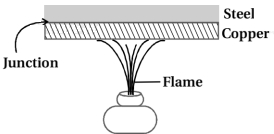
These days,people use steel utensils with copper bottoms. This is considered good for uniform heating of food. Explain this effect using the fact that copper is a better conductor of heat.
Solution
Copper is a much better conductor of heat than steel. When a copper layer is provided at the bottom of a steel vessel,it absorbs heat from the flame very quickly due to its high thermal conductivity.
Because copper spreads the heat rapidly across the entire base,it ensures uniform heating of the food inside the vessel.
This prevents the formation of hot spots and allows the food to be cooked more efficiently and quickly.
Because copper spreads the heat rapidly across the entire base,it ensures uniform heating of the food inside the vessel.
This prevents the formation of hot spots and allows the food to be cooked more efficiently and quickly.
0 likes
View Solution154
MediumMCQ
Dimensional formula for thermal conductivity is (here $K$ denotes the temperature)
A
$MLT^{-3}K$
B
$MLT^{-2}K$
C
$MLT^{-2}K^{-2}$
D
$MLT^{-3}K^{-1}$
Solution
(D) The rate of heat flow is given by the formula: $\frac{dQ}{dt} = kA \frac{dT}{dx}$
Where $k$ is the thermal conductivity,$A$ is the area,and $\frac{dT}{dx}$ is the temperature gradient.
Rearranging for $k$: $k = \frac{(dQ/dt)}{A(dT/dx)}$
Substituting the dimensions:
$[dQ/dt] = [ML^2T^{-3}]$ (Power)
$[A] = [L^2]$
$[dT/dx] = [KL^{-1}]$
$[k] = \frac{[ML^2T^{-3}]}{[L^2][KL^{-1}]} = [MLT^{-3}K^{-1}]$
Where $k$ is the thermal conductivity,$A$ is the area,and $\frac{dT}{dx}$ is the temperature gradient.
Rearranging for $k$: $k = \frac{(dQ/dt)}{A(dT/dx)}$
Substituting the dimensions:
$[dQ/dt] = [ML^2T^{-3}]$ (Power)
$[A] = [L^2]$
$[dT/dx] = [KL^{-1}]$
$[k] = \frac{[ML^2T^{-3}]}{[L^2][KL^{-1}]} = [MLT^{-3}K^{-1}]$
0 likes
View Solution155
DifficultMCQ
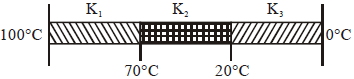
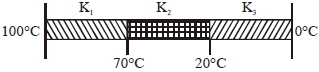
Three rods of identical cross-section and lengths are made of three different materials of thermal conductivity $K_{1}, K_{2},$ and $K_{3}$,respectively. They are joined together at their ends to make a long rod. One end of the long rod is maintained at $100^{\circ} C$ and the other at $0^{\circ} C$. If the joints of the rod are at $70^{\circ} C$ and $20^{\circ} C$ in steady state and there is no loss of energy from the surface of the rod,the correct relationship between $K_{1}, K_{2}$ and $K_{3}$ is:
A
$K_{1}: K_{3}=2: 3 ; K_{2}: K_{3}=2: 5$
B
$K_{1}< K_{2}< K_{3}$
C
$K_{1}: K_{2}=5: 2 ; K_{1}: K_{3}=3: 5$
D
$K_{1}> K_{2}> K_{3}$
Solution
(A) The rods are identical,meaning they have the same length $(\ell)$ and area of cross-section $(A)$.
Since the rods are joined in series,the rate of heat flow (heat current) is the same for all rods in a steady state.
Let the heat current be $H = \frac{\Delta Q}{\Delta t}$.
$H = \frac{K_{1} A (100 - 70)}{\ell} = \frac{K_{2} A (70 - 20)}{\ell} = \frac{K_{3} A (20 - 0)}{\ell}$
Simplifying the equation:
$30 K_{1} = 50 K_{2} = 20 K_{3}$
Dividing by $10$:
$3 K_{1} = 5 K_{2} = 2 K_{3}$
From $3 K_{1} = 2 K_{3}$,we get $\frac{K_{1}}{K_{3}} = \frac{2}{3}$ or $K_{1}: K_{3} = 2: 3$.
From $5 K_{2} = 2 K_{3}$,we get $\frac{K_{2}}{K_{3}} = \frac{2}{5}$ or $K_{2}: K_{3} = 2: 5$.
Thus,the correct relationship is $K_{1}: K_{3} = 2: 3$ and $K_{2}: K_{3} = 2: 5$.
Since the rods are joined in series,the rate of heat flow (heat current) is the same for all rods in a steady state.
Let the heat current be $H = \frac{\Delta Q}{\Delta t}$.
$H = \frac{K_{1} A (100 - 70)}{\ell} = \frac{K_{2} A (70 - 20)}{\ell} = \frac{K_{3} A (20 - 0)}{\ell}$
Simplifying the equation:
$30 K_{1} = 50 K_{2} = 20 K_{3}$
Dividing by $10$:
$3 K_{1} = 5 K_{2} = 2 K_{3}$
From $3 K_{1} = 2 K_{3}$,we get $\frac{K_{1}}{K_{3}} = \frac{2}{3}$ or $K_{1}: K_{3} = 2: 3$.
From $5 K_{2} = 2 K_{3}$,we get $\frac{K_{2}}{K_{3}} = \frac{2}{5}$ or $K_{2}: K_{3} = 2: 5$.
Thus,the correct relationship is $K_{1}: K_{3} = 2: 3$ and $K_{2}: K_{3} = 2: 5$.
0 likes
View Solution156
MediumMCQ
The two ends of a rod of length $L$ and a uniform cross-sectional area $A$ are kept at two temperatures $T_{1}$ and $T_{2}$ $(T_{1} > T_{2})$. The rate of heat transfer,$\frac{dQ}{dt}$ through the rod in a steady state is given by:
A
$\frac{dQ}{dt} = \frac{k(T_{1} - T_{2})}{LA}$
B
$\frac{dQ}{dt} = kLA(T_{1} - T_{2})$
C
$\frac{dQ}{dt} = \frac{kA(T_{1} - T_{2})}{L}$
D
$\frac{dQ}{dt} = \frac{kL(T_{1} - T_{2})}{A}$
Solution
(C) According to Fourier's law of heat conduction,the rate of heat transfer (heat current) through a material in a steady state is proportional to the cross-sectional area $A$ and the temperature difference $\Delta T = (T_{1} - T_{2})$,and inversely proportional to the length $L$ of the rod.
The formula is given by:
$\frac{dQ}{dt} = \frac{kA(T_{1} - T_{2})}{L}$
where $k$ is the thermal conductivity of the material.
The formula is given by:
$\frac{dQ}{dt} = \frac{kA(T_{1} - T_{2})}{L}$
where $k$ is the thermal conductivity of the material.
0 likes
View Solution157
DifficultMCQ
Two thin metallic spherical shells of radii $r_{1}$ and $r_{2}$ $(r_{1} < r_{2})$ are placed with their centres coinciding. $A$ material of thermal conductivity $K$ is filled in the space between the shells. The inner shell is maintained at temperature $\theta_{1}$ and the outer shell at temperature $\theta_{2}$ $(\theta_{1} < \theta_{2})$. The rate at which heat flows radially through the material is:
A
$\frac{4 \pi K r_{1} r_{2}(\theta_{2}-\theta_{1})}{r_{2}-r_{1}}$
B
$\frac{\pi r_{1} r_{2}(\theta_{2}-\theta_{1})}{r_{2}-r_{1}}$
C
$\frac{K(\theta_{2}-\theta_{1})}{r_{2}-r_{1}}$
D
$\frac{K(\theta_{2}-\theta_{1})(r_{2}-r_{1})}{4 \pi r_{1} r_{2}}$
Solution
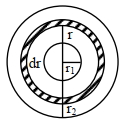
(A) Consider a thin spherical shell of radius $r$ and thickness $dr$ within the material.
The thermal resistance $dR$ of this thin shell is given by:
$dR = \frac{dr}{K(4 \pi r^{2})}$
To find the total thermal resistance $R$ between the shells,we integrate from $r_{1}$ to $r_{2}$:
$R = \int_{r_{1}}^{r_{2}} \frac{dr}{4 \pi K r^{2}} = \frac{1}{4 \pi K} \left[ -\frac{1}{r} \right]_{r_{1}}^{r_{2}}$
$R = \frac{1}{4 \pi K} \left( \frac{1}{r_{1}} - \frac{1}{r_{2}} \right) = \frac{1}{4 \pi K} \left( \frac{r_{2}-r_{1}}{r_{1} r_{2}} \right)$
The rate of heat flow (thermal current $i$) is given by:
$i = \frac{\theta_{2}-\theta_{1}}{R}$
Substituting the value of $R$:
$i = \frac{\theta_{2}-\theta_{1}}{\frac{1}{4 \pi K} \left( \frac{r_{2}-r_{1}}{r_{1} r_{2}} \right)} = \frac{4 \pi K r_{1} r_{2}(\theta_{2}-\theta_{1})}{r_{2}-r_{1}}$
The thermal resistance $dR$ of this thin shell is given by:
$dR = \frac{dr}{K(4 \pi r^{2})}$
To find the total thermal resistance $R$ between the shells,we integrate from $r_{1}$ to $r_{2}$:
$R = \int_{r_{1}}^{r_{2}} \frac{dr}{4 \pi K r^{2}} = \frac{1}{4 \pi K} \left[ -\frac{1}{r} \right]_{r_{1}}^{r_{2}}$
$R = \frac{1}{4 \pi K} \left( \frac{1}{r_{1}} - \frac{1}{r_{2}} \right) = \frac{1}{4 \pi K} \left( \frac{r_{2}-r_{1}}{r_{1} r_{2}} \right)$
The rate of heat flow (thermal current $i$) is given by:
$i = \frac{\theta_{2}-\theta_{1}}{R}$
Substituting the value of $R$:
$i = \frac{\theta_{2}-\theta_{1}}{\frac{1}{4 \pi K} \left( \frac{r_{2}-r_{1}}{r_{1} r_{2}} \right)} = \frac{4 \pi K r_{1} r_{2}(\theta_{2}-\theta_{1})}{r_{2}-r_{1}}$
0 likes
View Solution158
MediumMCQ
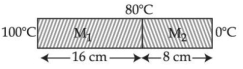
Two metallic blocks $M_{1}$ and $M_{2}$ of the same cross-sectional area are connected to each other as shown in the figure. If the thermal conductivity of $M_{2}$ is $K$,then the thermal conductivity of $M_{1}$ will be $xK$. Find the value of $x$. [Assume steady-state heat conduction]
A
$10$
B
$8$
C
$12.5$
D
$2$
Solution
(B) In steady-state heat conduction,the rate of heat flow $H$ through both blocks is the same.
$H = \frac{K_{1} A \Delta T_{1}}{\ell_{1}} = \frac{K_{2} A \Delta T_{2}}{\ell_{2}}$
Given: $\ell_{1} = 16 \text{ cm}$,$\ell_{2} = 8 \text{ cm}$,$K_{2} = K$,$K_{1} = xK$.
Temperature difference across $M_{1}$ is $\Delta T_{1} = 100^{\circ}C - 80^{\circ}C = 20^{\circ}C$.
Temperature difference across $M_{2}$ is $\Delta T_{2} = 80^{\circ}C - 0^{\circ}C = 80^{\circ}C$.
Since the area $A$ is the same,we have:
$\frac{K_{1} \Delta T_{1}}{\ell_{1}} = \frac{K_{2} \Delta T_{2}}{\ell_{2}}$
$\frac{(xK) \times 20}{16} = \frac{K \times 80}{8}$
$x \times \frac{20}{16} = 10$
$x = 10 \times \frac{16}{20} = 8$.
Thus,the thermal conductivity of $M_{1}$ is $8K$.
$H = \frac{K_{1} A \Delta T_{1}}{\ell_{1}} = \frac{K_{2} A \Delta T_{2}}{\ell_{2}}$
Given: $\ell_{1} = 16 \text{ cm}$,$\ell_{2} = 8 \text{ cm}$,$K_{2} = K$,$K_{1} = xK$.
Temperature difference across $M_{1}$ is $\Delta T_{1} = 100^{\circ}C - 80^{\circ}C = 20^{\circ}C$.
Temperature difference across $M_{2}$ is $\Delta T_{2} = 80^{\circ}C - 0^{\circ}C = 80^{\circ}C$.
Since the area $A$ is the same,we have:
$\frac{K_{1} \Delta T_{1}}{\ell_{1}} = \frac{K_{2} \Delta T_{2}}{\ell_{2}}$
$\frac{(xK) \times 20}{16} = \frac{K \times 80}{8}$
$x \times \frac{20}{16} = 10$
$x = 10 \times \frac{16}{20} = 8$.
Thus,the thermal conductivity of $M_{1}$ is $8K$.
0 likes
View Solution159
DifficultMCQ
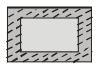
An ice cube of dimensions $60\,cm \times 50\,cm \times 20\,cm$ is placed in an insulation box of wall thickness $1\,cm$. The box keeping the ice cube at $0^{\circ}C$ temperature is brought to a room of temperature $40^{\circ}C$. The rate of melting of ice is approximately. (Latent heat of fusion of ice is $3.4 \times 10^{5}\,J\,kg^{-1}$ and thermal conductivity of insulation wall is $0.05\,W\,m^{-1\circ}C^{-1}$)
A
$61 \times 10^{-1}\,kg\,s^{-1}$
B
$61 \times 10^{-5}\,kg\,s^{-1}$
C
$208\,kg\,s^{-1}$
D
$30 \times 10^{-5}\,kg\,s^{-1}$
Solution
(B) The rate of heat flow is given by $\frac{dQ}{dt} = \frac{KA\Delta T}{\ell}$.
The surface area $A$ of the box is $2(0.6 \times 0.5 + 0.5 \times 0.2 + 0.2 \times 0.6) = 2(0.3 + 0.1 + 0.12) = 2(0.52) = 1.04\,m^2$.
Given thermal conductivity $K = 0.05\,W\,m^{-1\circ}C^{-1}$,thickness $\ell = 1\,cm = 0.01\,m$,and temperature difference $\Delta T = 40^{\circ}C - 0^{\circ}C = 40^{\circ}C$.
Substituting the values:
$\frac{dQ}{dt} = \frac{0.05 \times 1.04 \times 40}{0.01} = 0.05 \times 1.04 \times 4000 = 208\,J/s$.
The rate of melting of ice $m$ is given by $\frac{dQ}{dt} = m L_f$,where $L_f = 3.4 \times 10^5\,J/kg$.
$m = \frac{208}{3.4 \times 10^5} = \frac{208}{3.4} \times 10^{-5} \approx 61.17 \times 10^{-5}\,kg/s$.
Thus,the rate of melting is approximately $61 \times 10^{-5}\,kg/s$.
The surface area $A$ of the box is $2(0.6 \times 0.5 + 0.5 \times 0.2 + 0.2 \times 0.6) = 2(0.3 + 0.1 + 0.12) = 2(0.52) = 1.04\,m^2$.
Given thermal conductivity $K = 0.05\,W\,m^{-1\circ}C^{-1}$,thickness $\ell = 1\,cm = 0.01\,m$,and temperature difference $\Delta T = 40^{\circ}C - 0^{\circ}C = 40^{\circ}C$.
Substituting the values:
$\frac{dQ}{dt} = \frac{0.05 \times 1.04 \times 40}{0.01} = 0.05 \times 1.04 \times 4000 = 208\,J/s$.
The rate of melting of ice $m$ is given by $\frac{dQ}{dt} = m L_f$,where $L_f = 3.4 \times 10^5\,J/kg$.
$m = \frac{208}{3.4 \times 10^5} = \frac{208}{3.4} \times 10^{-5} \approx 61.17 \times 10^{-5}\,kg/s$.
Thus,the rate of melting is approximately $61 \times 10^{-5}\,kg/s$.
0 likes
View Solution160
MediumMCQ
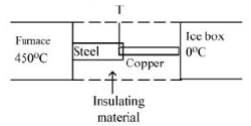
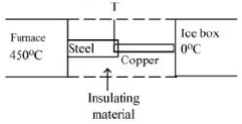
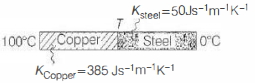
If $K_{1}$ and $K_{2}$ are the thermal conductivities,$L_{1}$ and $L_{2}$ are the lengths,and $A_{1}$ and $A_{2}$ are the cross-sectional areas of steel and copper rods respectively,such that $\frac{K_{2}}{K_{1}}=9$,$\frac{A_{1}}{A_{2}}=2$,and $\frac{L_{1}}{L_{2}}=2$. For the arrangement shown in the figure,the value of the temperature $T$ of the steel-copper junction in the steady state will be ........... $^{\circ}C$.
A
$18$
B
$14$
C
$45$
D
$150$
Solution
(C) In the steady state,the rate of heat flow through the steel rod must be equal to the rate of heat flow through the copper rod.
$\frac{dQ}{dt} = \frac{K_{1} A_{1} (T_{1} - T)}{L_{1}} = \frac{K_{2} A_{2} (T - T_{2})}{L_{2}}$
Given: $T_{1} = 450^{\circ}C$,$T_{2} = 0^{\circ}C$,$\frac{K_{2}}{K_{1}} = 9$,$\frac{A_{1}}{A_{2}} = 2$,$\frac{L_{1}}{L_{2}} = 2$.
Substituting these values into the equation:
$\frac{450 - T}{T - 0} = \frac{K_{2}}{K_{1}} \times \frac{A_{2}}{A_{1}} \times \frac{L_{1}}{L_{2}}$
$\frac{450 - T}{T} = 9 \times \frac{1}{2} \times 2 = 9$
$450 - T = 9T$
$10T = 450$
$T = 45^{\circ}C$
$\frac{dQ}{dt} = \frac{K_{1} A_{1} (T_{1} - T)}{L_{1}} = \frac{K_{2} A_{2} (T - T_{2})}{L_{2}}$
Given: $T_{1} = 450^{\circ}C$,$T_{2} = 0^{\circ}C$,$\frac{K_{2}}{K_{1}} = 9$,$\frac{A_{1}}{A_{2}} = 2$,$\frac{L_{1}}{L_{2}} = 2$.
Substituting these values into the equation:
$\frac{450 - T}{T - 0} = \frac{K_{2}}{K_{1}} \times \frac{A_{2}}{A_{1}} \times \frac{L_{1}}{L_{2}}$
$\frac{450 - T}{T} = 9 \times \frac{1}{2} \times 2 = 9$
$450 - T = 9T$
$10T = 450$
$T = 45^{\circ}C$
1 likes
View Solution161
AdvancedMCQ
In steady state heat conduction,the equations that determine the heat current $j(r)$ [heat flowing per unit time per unit area] and temperature $T(r)$ in space are exactly the same as those governing the electric field $E(r)$ and electrostatic potential $V(r)$ with the equivalence given in the table below.
We exploit this equivalence to predict the rate $\dot{Q}$ of total heat flowing by conduction from the surfaces of spheres of varying radii,all maintained at the same temperature. If $\dot{Q} \propto R^{n}$,where $R$ is the radius,then the value of $n$ is
| Heat flow | Electrostatics |
|---|---|
| $T(r)$ | $V(r)$ |
| $j(r)$ | $E(r)$ |
We exploit this equivalence to predict the rate $\dot{Q}$ of total heat flowing by conduction from the surfaces of spheres of varying radii,all maintained at the same temperature. If $\dot{Q} \propto R^{n}$,where $R$ is the radius,then the value of $n$ is
A
$2$
B
$1$
C
$-1$
D
$-2$
Solution
(B) In electrostatics,the electric field $E$ at a distance $R$ from a point charge $q$ is given by $E = \frac{1}{4\pi\epsilon_0} \frac{q}{R^2}$.
The potential $V$ is related to the electric field by $E = -\frac{dV}{dR}$.
By the given analogy,the heat current density $j$ is equivalent to the electric field $E$,and the temperature $T$ is equivalent to the potential $V$.
Thus,the heat current density $j$ at a distance $R$ from a source is proportional to $\frac{1}{R^2}$.
The total rate of heat flow $\dot{Q}$ through a spherical surface of radius $R$ is given by the product of the heat current density $j$ and the surface area $A = 4\pi R^2$.
Therefore,$\dot{Q} = j \cdot A \propto \left( \frac{1}{R^2} \right) \cdot R^2 = R^0$.
However,for a sphere maintained at a constant temperature difference relative to infinity,the heat flow rate $\dot{Q}$ is proportional to the capacitance of the sphere,which is proportional to $R$.
Specifically,$\dot{Q} = \frac{\Delta T}{R_{th}}$,where $R_{th} = \frac{1}{4\pi k R}$.
Thus,$\dot{Q} = 4\pi k R \Delta T \propto R^1$.
Therefore,$n = 1$.
The potential $V$ is related to the electric field by $E = -\frac{dV}{dR}$.
By the given analogy,the heat current density $j$ is equivalent to the electric field $E$,and the temperature $T$ is equivalent to the potential $V$.
Thus,the heat current density $j$ at a distance $R$ from a source is proportional to $\frac{1}{R^2}$.
The total rate of heat flow $\dot{Q}$ through a spherical surface of radius $R$ is given by the product of the heat current density $j$ and the surface area $A = 4\pi R^2$.
Therefore,$\dot{Q} = j \cdot A \propto \left( \frac{1}{R^2} \right) \cdot R^2 = R^0$.
However,for a sphere maintained at a constant temperature difference relative to infinity,the heat flow rate $\dot{Q}$ is proportional to the capacitance of the sphere,which is proportional to $R$.
Specifically,$\dot{Q} = \frac{\Delta T}{R_{th}}$,where $R_{th} = \frac{1}{4\pi k R}$.
Thus,$\dot{Q} = 4\pi k R \Delta T \propto R^1$.
Therefore,$n = 1$.
0 likes
View Solution162
MediumMCQ
$A$ cylindrical steel rod of length $0.10 \,m$ and thermal conductivity $50 \,Wm^{-1}K^{-1}$ is welded end to end to a copper rod of thermal conductivity $400 \,Wm^{-1}K^{-1}$ and of the same area of cross-section but $0.20 \,m$ long. The free end of the steel rod is maintained at $100^{\circ}C$ and that of the copper rod at $0^{\circ}C$. Assuming that the rods are perfectly insulated from the surroundings,the temperature at the junction of the two rods is ................... $^{\circ}C$.
A
$20$
B
$30$
C
$40$
D
$50$
Solution
(A) In steady state,the rate of heat flow through both rods is equal.
Let $T$ be the temperature at the junction.
$\left(\frac{kA(T_1 - T)}{l}\right)_{\text{steel}} = \left(\frac{kA(T - T_2)}{l}\right)_{\text{copper}}$
Since the area $A$ is the same for both rods,it cancels out:
$\frac{50(100 - T)}{0.1} = \frac{400(T - 0)}{0.2}$
$500(100 - T) = 2000(T)$
$100 - T = 4T$
$5T = 100$
$T = 20^{\circ}C$
Let $T$ be the temperature at the junction.
$\left(\frac{kA(T_1 - T)}{l}\right)_{\text{steel}} = \left(\frac{kA(T - T_2)}{l}\right)_{\text{copper}}$
Since the area $A$ is the same for both rods,it cancels out:
$\frac{50(100 - T)}{0.1} = \frac{400(T - 0)}{0.2}$
$500(100 - T) = 2000(T)$
$100 - T = 4T$
$5T = 100$
$T = 20^{\circ}C$

0 likes
View Solution163
MediumMCQ
Two rods,one made of copper and the other of steel,having the same length and cross-sectional area,are joined together. The thermal conductivity of copper is $385 \, J s^{-1} m^{-1} K^{-1}$ and that of steel is $50 \, J s^{-1} m^{-1} K^{-1}$. If the copper end is held at $100^{\circ} C$ and the steel end is held at $0^{\circ} C$,the junction temperature is ........... $^{\circ} C$ (Assuming no other heat losses).
A
$12$
B
$50$
C
$73$
D
$88$
Solution
(D) Let the junction temperature be $T^{\circ} C$.
In the steady state,the rate of heat flow through the copper rod must be equal to the rate of heat flow through the steel rod,assuming no heat loss from the sides.
The rate of heat flow $H$ is given by $H = \frac{KA(T_1 - T_2)}{l}$.
Equating the heat flow for both rods:
$\frac{K_{\text{copper}} A (100 - T)}{l} = \frac{K_{\text{steel}} A (T - 0)}{l}$
Since the length $l$ and cross-sectional area $A$ are the same for both rods,they cancel out:
$K_{\text{copper}} (100 - T) = K_{\text{steel}} T$
Substituting the given values $K_{\text{copper}} = 385$ and $K_{\text{steel}} = 50$:
$385(100 - T) = 50T$
$38500 - 385T = 50T$
$38500 = 435T$
$T = \frac{38500}{435} \approx 88.5^{\circ} C$.
Rounding to the nearest integer,the junction temperature is $88^{\circ} C$.
In the steady state,the rate of heat flow through the copper rod must be equal to the rate of heat flow through the steel rod,assuming no heat loss from the sides.
The rate of heat flow $H$ is given by $H = \frac{KA(T_1 - T_2)}{l}$.
Equating the heat flow for both rods:
$\frac{K_{\text{copper}} A (100 - T)}{l} = \frac{K_{\text{steel}} A (T - 0)}{l}$
Since the length $l$ and cross-sectional area $A$ are the same for both rods,they cancel out:
$K_{\text{copper}} (100 - T) = K_{\text{steel}} T$
Substituting the given values $K_{\text{copper}} = 385$ and $K_{\text{steel}} = 50$:
$385(100 - T) = 50T$
$38500 - 385T = 50T$
$38500 = 435T$
$T = \frac{38500}{435} \approx 88.5^{\circ} C$.
Rounding to the nearest integer,the junction temperature is $88^{\circ} C$.
0 likes
View Solution164
MediumMCQ
In the Arctic region,hemispherical houses called Igloos are made of ice. It is possible to maintain a temperature inside an Igloo as high as $20^{\circ} C$ because
A
ice has high thermal conductivity
B
ice has low thermal conductivity
C
ice has high specific heat
D
ice has higher density than water
Solution
(B) The correct answer is $(B)$.
Ice is a poor conductor of heat,meaning it has a very low thermal conductivity.
Because of this low thermal conductivity,the ice walls of the Igloo act as an insulator,preventing the heat generated inside (by the occupants or a small fire) from escaping to the cold external environment and preventing the cold from entering the interior.
This allows the temperature inside the Igloo to be maintained at a comfortable level,such as $20^{\circ} C$,even when the outside temperature is extremely low.
The thermal conductivity of ice is approximately $1.6 \, W m^{-1} K^{-1}$ (note: the value $16 \, W m^{-1} K^{-1}$ is often cited in simplified contexts,though the physical value is closer to $1.6 \, W m^{-1} K^{-1}$).
Ice is a poor conductor of heat,meaning it has a very low thermal conductivity.
Because of this low thermal conductivity,the ice walls of the Igloo act as an insulator,preventing the heat generated inside (by the occupants or a small fire) from escaping to the cold external environment and preventing the cold from entering the interior.
This allows the temperature inside the Igloo to be maintained at a comfortable level,such as $20^{\circ} C$,even when the outside temperature is extremely low.
The thermal conductivity of ice is approximately $1.6 \, W m^{-1} K^{-1}$ (note: the value $16 \, W m^{-1} K^{-1}$ is often cited in simplified contexts,though the physical value is closer to $1.6 \, W m^{-1} K^{-1}$).
0 likes
View Solution165
AdvancedMCQ
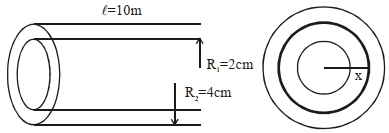
$A$ copper pipe of length $10 \,m$ carries steam at temperature $110^{\circ} C$. The outer surface of the pipe is maintained at a temperature $10^{\circ} C$. The inner and outer radii of the pipe are $2 \,cm$ and $4 \,cm$,respectively. The thermal conductivity of copper is $0.38 \,kW / m /^{\circ} C$. In the steady state,the rate at which heat flows radially outward through the pipe is closest to ............. $\,kW$.
A
$3245$
B
$3445$
C
$3645$
D
$3845$
Solution
(B) The heat current flows radially outward through the cylindrical pipe.
For a cylindrical shell of radius $x$ and thickness $dx$,the thermal resistance $dR_T$ is given by $dR_T = \frac{dx}{k(2\pi x \ell)}$.
Integrating from inner radius $R_1$ to outer radius $R_2$,the total thermal resistance $R_T$ is:
$R_T = \int_{R_1}^{R_2} \frac{dx}{2\pi k \ell x} = \frac{1}{2\pi k \ell} \ln\left(\frac{R_2}{R_1}\right)$.
The rate of heat flow is $\frac{dQ}{dt} = \frac{\Delta T}{R_T} = \frac{2\pi k \ell (T_1 - T_2)}{\ln(R_2/R_1)}$.
Given: $T_1 = 110^{\circ} C$,$T_2 = 10^{\circ} C$,$\Delta T = 100^{\circ} C$,$k = 0.38 \,kW/m/^{\circ} C$,$\ell = 10 \,m$,$R_1 = 2 \,cm$,$R_2 = 4 \,cm$.
Substituting the values:
$\frac{dQ}{dt} = \frac{2 \times 3.14159 \times 0.38 \times 10 \times 100}{\ln(4/2)} = \frac{2387.6}{0.6931} \approx 3444.6 \,kW$.
Thus,the rate of heat flow is approximately $3445 \,kW$.
For a cylindrical shell of radius $x$ and thickness $dx$,the thermal resistance $dR_T$ is given by $dR_T = \frac{dx}{k(2\pi x \ell)}$.
Integrating from inner radius $R_1$ to outer radius $R_2$,the total thermal resistance $R_T$ is:
$R_T = \int_{R_1}^{R_2} \frac{dx}{2\pi k \ell x} = \frac{1}{2\pi k \ell} \ln\left(\frac{R_2}{R_1}\right)$.
The rate of heat flow is $\frac{dQ}{dt} = \frac{\Delta T}{R_T} = \frac{2\pi k \ell (T_1 - T_2)}{\ln(R_2/R_1)}$.
Given: $T_1 = 110^{\circ} C$,$T_2 = 10^{\circ} C$,$\Delta T = 100^{\circ} C$,$k = 0.38 \,kW/m/^{\circ} C$,$\ell = 10 \,m$,$R_1 = 2 \,cm$,$R_2 = 4 \,cm$.
Substituting the values:
$\frac{dQ}{dt} = \frac{2 \times 3.14159 \times 0.38 \times 10 \times 100}{\ln(4/2)} = \frac{2387.6}{0.6931} \approx 3444.6 \,kW$.
Thus,the rate of heat flow is approximately $3445 \,kW$.
0 likes
View Solution166
EasyMCQ
The outer faces of a rectangular slab made of equal thickness of iron and brass are maintained at $100^{\circ} C$ and $0^{\circ} C$ respectively. The temperature at the interface is ........... $^{\circ} C$ (Thermal conductivity of iron and brass are $0.2$ and $0.3$ respectively.)
A
$100$
B
$40$
C
$50$
D
$70$
Solution
(B) In a steady state,the rate of heat flow through the iron slab must be equal to the rate of heat flow through the brass slab.
Let $T$ be the temperature at the interface.
The formula for the rate of heat flow is $H = \frac{KA(T_1 - T_2)}{l}$.
Since the thickness $l$ and the cross-sectional area $A$ are the same for both slabs,we have:
$K_{\text{iron}} \cdot A \cdot \frac{(100 - T)}{l} = K_{\text{brass}} \cdot A \cdot \frac{(T - 0)}{l}$
Substituting the given values $K_{\text{iron}} = 0.2$ and $K_{\text{brass}} = 0.3$:
$0.2(100 - T) = 0.3(T - 0)$
$20 - 0.2T = 0.3T$
$20 = 0.5T$
$T = \frac{20}{0.5} = 40^{\circ} C$
Therefore,the temperature at the interface is $40^{\circ} C$.
Let $T$ be the temperature at the interface.
The formula for the rate of heat flow is $H = \frac{KA(T_1 - T_2)}{l}$.
Since the thickness $l$ and the cross-sectional area $A$ are the same for both slabs,we have:
$K_{\text{iron}} \cdot A \cdot \frac{(100 - T)}{l} = K_{\text{brass}} \cdot A \cdot \frac{(T - 0)}{l}$
Substituting the given values $K_{\text{iron}} = 0.2$ and $K_{\text{brass}} = 0.3$:
$0.2(100 - T) = 0.3(T - 0)$
$20 - 0.2T = 0.3T$
$20 = 0.5T$
$T = \frac{20}{0.5} = 40^{\circ} C$
Therefore,the temperature at the interface is $40^{\circ} C$.
0 likes
View Solution167
MediumMCQ
Which of the following material properties is most suitable for a cooking utensil?
A
Low conductivity and low specific heat
B
High conductivity and low specific heat
C
Low conductivity and high specific heat
D
High conductivity and high specific heat
Solution
(B) The correct answer is $B$.
For a cooking utensil,we require high thermal conductivity so that heat can be transferred quickly from the source to the food.
Additionally,we require low specific heat capacity so that the utensil itself does not absorb a large amount of heat energy to reach the required temperature,allowing more energy to be utilized for cooking the food.
For a cooking utensil,we require high thermal conductivity so that heat can be transferred quickly from the source to the food.
Additionally,we require low specific heat capacity so that the utensil itself does not absorb a large amount of heat energy to reach the required temperature,allowing more energy to be utilized for cooking the food.
0 likes
View Solution168
EasyMCQ
Which of the following factors affect the thermal conductivity of a rod?
A
Area of cross-section
B
Length of rod
C
Material of rod
D
All of these
Solution
(C) The thermal conductivity $(k)$ of a material is an intrinsic property of the substance itself.
It depends on the nature of the material,such as its atomic structure and electronic configuration.
It does not depend on the geometric dimensions of the rod,such as its length $(L)$ or its cross-sectional area $(A)$.
Therefore,among the given options,only the material of the rod affects its thermal conductivity.
It depends on the nature of the material,such as its atomic structure and electronic configuration.
It does not depend on the geometric dimensions of the rod,such as its length $(L)$ or its cross-sectional area $(A)$.
Therefore,among the given options,only the material of the rod affects its thermal conductivity.
0 likes
View Solution169
MediumMCQ
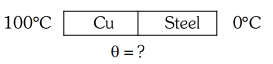
Two rods,one made of copper and the other made of steel,of the same length and same cross-sectional area,are joined together. The thermal conductivities of copper and steel are $385 \, W \, m^{-1} \, K^{-1}$ and $50 \, W \, m^{-1} \, K^{-1}$ respectively. The free ends of copper and steel are held at $100^{\circ} \, C$ and $0^{\circ} \, C$ respectively. The temperature at the junction is nearly $.......^{\circ} \, C$.
A
$12$
B
$50$
C
$73$
D
$88.5$
Solution
(D) In a steady state,the rate of heat flow through both rods must be equal.
Let $\theta$ be the temperature at the junction.
The rate of heat flow is given by $H = \frac{KA(T_1 - T_2)}{\ell}$.
Since the rods are in series,the heat current $H$ is the same for both.
$H_{Cu} = H_{Steel}$
$\frac{K_{Cu} A (100 - \theta)}{\ell} = \frac{K_{Steel} A (\theta - 0)}{\ell}$
Given $K_{Cu} = 385 \, W \, m^{-1} \, K^{-1}$ and $K_{Steel} = 50 \, W \, m^{-1} \, K^{-1}$.
$385(100 - \theta) = 50(\theta - 0)$
Divide by $5$:
$77(100 - \theta) = 10\theta$
$7700 - 77\theta = 10\theta$
$87\theta = 7700$
$\theta = \frac{7700}{87} \approx 88.5^{\circ} \, C$.
Let $\theta$ be the temperature at the junction.
The rate of heat flow is given by $H = \frac{KA(T_1 - T_2)}{\ell}$.
Since the rods are in series,the heat current $H$ is the same for both.
$H_{Cu} = H_{Steel}$
$\frac{K_{Cu} A (100 - \theta)}{\ell} = \frac{K_{Steel} A (\theta - 0)}{\ell}$
Given $K_{Cu} = 385 \, W \, m^{-1} \, K^{-1}$ and $K_{Steel} = 50 \, W \, m^{-1} \, K^{-1}$.
$385(100 - \theta) = 50(\theta - 0)$
Divide by $5$:
$77(100 - \theta) = 10\theta$
$7700 - 77\theta = 10\theta$
$87\theta = 7700$
$\theta = \frac{7700}{87} \approx 88.5^{\circ} \, C$.
1 likes
View Solution170
MediumMCQ
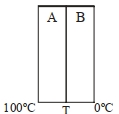
Two plates $A$ and $B$ have thermal conductivities $84 \, W m^{-1} K^{-1}$ and $126 \, W m^{-1} K^{-1}$ respectively. They have the same surface area and same thickness. They are placed in contact along their surfaces. If the temperatures of the outer surfaces of $A$ and $B$ are kept at $100^{\circ} C$ and $0^{\circ} C$ respectively,then the temperature of the surface of contact in steady state is $.......... \, ^{\circ} C$.
A
$20$
B
$40$
C
$60$
D
$80$
Solution
(B) In steady state,the rate of heat flow through plate $A$ must be equal to the rate of heat flow through plate $B$.
Let $T$ be the temperature of the contact surface.
The rate of heat flow $H$ is given by $H = \frac{KA(T_1 - T_2)}{L}$.
Since the area $A$ and thickness $L$ are the same for both plates,we have:
$H_A = H_B$
$\frac{K_A A(100 - T)}{L} = \frac{K_B A(T - 0)}{L}$
$K_A(100 - T) = K_B(T)$
Substituting the given values $K_A = 84 \, W m^{-1} K^{-1}$ and $K_B = 126 \, W m^{-1} K^{-1}$:
$84(100 - T) = 126T$
Divide both sides by $42$:
$2(100 - T) = 3T$
$200 - 2T = 3T$
$5T = 200$
$T = 40^{\circ} C$
Let $T$ be the temperature of the contact surface.
The rate of heat flow $H$ is given by $H = \frac{KA(T_1 - T_2)}{L}$.
Since the area $A$ and thickness $L$ are the same for both plates,we have:
$H_A = H_B$
$\frac{K_A A(100 - T)}{L} = \frac{K_B A(T - 0)}{L}$
$K_A(100 - T) = K_B(T)$
Substituting the given values $K_A = 84 \, W m^{-1} K^{-1}$ and $K_B = 126 \, W m^{-1} K^{-1}$:
$84(100 - T) = 126T$
Divide both sides by $42$:
$2(100 - T) = 3T$
$200 - 2T = 3T$
$5T = 200$
$T = 40^{\circ} C$
0 likes
View Solution171
MediumMCQ
The ends $Q$ and $R$ of two thin wires,$PQ$ and $RS$,are soldered (joined) together. Initially,each of the wires has a length of $1 \,m$ at $10^{\circ} C$. Now,the end $P$ is maintained at $10^{\circ} C$,while the end $S$ is heated and maintained at $400^{\circ} C$. The system is thermally insulated from its surroundings. If the thermal conductivity of wire $PQ$ is twice that of the wire $RS$ and the coefficient of linear thermal expansion of $PQ$ is $1.2 \times 10^{-5} \,K^{-1}$,the change in length of the wire $PQ$ is (in $\,mm$)
A
$0.78$
B
$0.90$
C
$1.56$
D
$2.34$
Solution
(A) Let the temperature of the junction be $T$.
Since the system is in steady state and thermally insulated,the rate of heat flow through $PQ$ equals the rate of heat flow through $RS$.
$\frac{d Q}{d t} = \frac{K_{PQ} A (T - 10)}{L} = \frac{K_{RS} A (400 - T)}{L}$
Given $K_{PQ} = 2 K_{RS}$,we have:
$2(T - 10) = 400 - T$
$2T - 20 = 400 - T$
$3T = 420 \Rightarrow T = 140^{\circ} C$
For wire $PQ$,the temperature gradient is $\frac{dT}{dx} = \frac{140 - 10}{1} = 130^{\circ} C/m$.
The temperature at a distance $x$ from $P$ is $T(x) = 10 + 130x$.
The change in length $dy$ of an element $dx$ is $dy = \alpha (T(x) - 10) dx = \alpha (130x) dx$.
Integrating from $x = 0$ to $x = 1$:
$\Delta L = \int_0^1 \alpha (130x) dx = 130 \alpha \left[ \frac{x^2}{2} \right]_0^1 = 65 \alpha$
$\Delta L = 65 \times 1.2 \times 10^{-5} = 78 \times 10^{-5} m = 0.78 \times 10^{-3} m = 0.78 \,mm$.
Since the system is in steady state and thermally insulated,the rate of heat flow through $PQ$ equals the rate of heat flow through $RS$.
$\frac{d Q}{d t} = \frac{K_{PQ} A (T - 10)}{L} = \frac{K_{RS} A (400 - T)}{L}$
Given $K_{PQ} = 2 K_{RS}$,we have:
$2(T - 10) = 400 - T$
$2T - 20 = 400 - T$
$3T = 420 \Rightarrow T = 140^{\circ} C$
For wire $PQ$,the temperature gradient is $\frac{dT}{dx} = \frac{140 - 10}{1} = 130^{\circ} C/m$.
The temperature at a distance $x$ from $P$ is $T(x) = 10 + 130x$.
The change in length $dy$ of an element $dx$ is $dy = \alpha (T(x) - 10) dx = \alpha (130x) dx$.
Integrating from $x = 0$ to $x = 1$:
$\Delta L = \int_0^1 \alpha (130x) dx = 130 \alpha \left[ \frac{x^2}{2} \right]_0^1 = 65 \alpha$
$\Delta L = 65 \times 1.2 \times 10^{-5} = 78 \times 10^{-5} m = 0.78 \times 10^{-3} m = 0.78 \,mm$.
0 likes
View Solution172
MediumMCQ
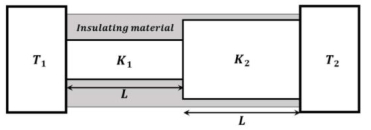
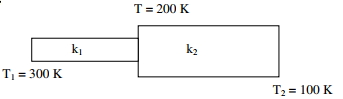
Two conducting cylinders of equal length but different radii are connected in series between two heat baths kept at temperatures $T_1=300 \ K$ and $T_2=100 \ K$,as shown in the figure. The radius of the bigger cylinder is twice that of the smaller one and the thermal conductivities of the materials of the smaller and the larger cylinders are $K_1$ and $K_2$ respectively. If the temperature at the junction of the two cylinders in the steady state is $200 \ K$,then $K_1 / K_2 = . . . . . .$
A
$4$
B
$8$
C
$9$
D
$10$
Solution
(A) In the steady state,the rate of heat flow through both cylinders is the same.
Let $r_1$ be the radius of the smaller cylinder and $r_2$ be the radius of the larger cylinder.
Given $r_2 = 2 r_1$,the cross-sectional areas are $A_1 = \pi r_1^2$ and $A_2 = \pi r_2^2 = \pi (2 r_1)^2 = 4 \pi r_1^2 = 4 A_1$.
The rate of heat flow is given by $\frac{dQ}{dt} = \frac{K A \Delta T}{L}$.
For the first cylinder: $\frac{dQ}{dt} = \frac{K_1 A_1 (300 - 200)}{L} = \frac{K_1 A_1 (100)}{L}$.
For the second cylinder: $\frac{dQ}{dt} = \frac{K_2 A_2 (200 - 100)}{L} = \frac{K_2 (4 A_1) (100)}{L}$.
Equating the two rates of heat flow:
$\frac{K_1 A_1 (100)}{L} = \frac{K_2 (4 A_1) (100)}{L}$.
$K_1 = 4 K_2$.
Therefore,$\frac{K_1}{K_2} = 4$.
Let $r_1$ be the radius of the smaller cylinder and $r_2$ be the radius of the larger cylinder.
Given $r_2 = 2 r_1$,the cross-sectional areas are $A_1 = \pi r_1^2$ and $A_2 = \pi r_2^2 = \pi (2 r_1)^2 = 4 \pi r_1^2 = 4 A_1$.
The rate of heat flow is given by $\frac{dQ}{dt} = \frac{K A \Delta T}{L}$.
For the first cylinder: $\frac{dQ}{dt} = \frac{K_1 A_1 (300 - 200)}{L} = \frac{K_1 A_1 (100)}{L}$.
For the second cylinder: $\frac{dQ}{dt} = \frac{K_2 A_2 (200 - 100)}{L} = \frac{K_2 (4 A_1) (100)}{L}$.
Equating the two rates of heat flow:
$\frac{K_1 A_1 (100)}{L} = \frac{K_2 (4 A_1) (100)}{L}$.
$K_1 = 4 K_2$.
Therefore,$\frac{K_1}{K_2} = 4$.
0 likes
View Solution173
DifficultMCQ
$A$ metal rod $AB$ of length $10x$ has its one end $A$ in ice at $0^{\circ}C$ and the other end $B$ in water at $100^{\circ}C$. If a point $P$ on the rod is maintained at $400^{\circ}C$,then it is found that equal amounts of water and ice evaporate and melt per unit time. The latent heat of evaporation of water is $540 \ cal/g$ and latent heat of melting of ice is $80 \ cal/g$. If the point $P$ is at a distance of $\lambda x$ from the ice end $A$,find the value of $\lambda$. (Neglect any heat loss to the surrounding.)
A
$4$
B
$9$
C
$5$
D
$2$
Solution
(B) Let $m$ be the mass of ice that melts and the mass of water that evaporates per unit time.
The heat flow rate required to melt ice at $A$ is $H_1 = m \times L_f = m \times 80$.
The heat flow rate required to evaporate water at $B$ is $H_2 = m \times L_v = m \times 540$.
Using the formula for heat conduction $H = \frac{KA \Delta T}{L}$,we have:
For segment $AP$: $H_1 = \frac{KA(400 - 0)}{\lambda x} = 80m \quad \dots(1)$
For segment $PB$: $H_2 = \frac{KA(400 - 100)}{(10 - \lambda)x} = 540m \quad \dots(2)$
Dividing equation $(1)$ by equation $(2)$:
$\frac{80m}{540m} = \frac{KA(400) / \lambda x}{KA(300) / (10 - \lambda)x}$
$\frac{8}{54} = \frac{400}{300} \times \frac{10 - \lambda}{\lambda}$
$\frac{4}{27} = \frac{4}{3} \times \frac{10 - \lambda}{\lambda}$
$\frac{1}{9} = \frac{10 - \lambda}{\lambda}$
$\lambda = 90 - 9\lambda$
$10\lambda = 90$
$\lambda = 9$.
The heat flow rate required to melt ice at $A$ is $H_1 = m \times L_f = m \times 80$.
The heat flow rate required to evaporate water at $B$ is $H_2 = m \times L_v = m \times 540$.
Using the formula for heat conduction $H = \frac{KA \Delta T}{L}$,we have:
For segment $AP$: $H_1 = \frac{KA(400 - 0)}{\lambda x} = 80m \quad \dots(1)$
For segment $PB$: $H_2 = \frac{KA(400 - 100)}{(10 - \lambda)x} = 540m \quad \dots(2)$
Dividing equation $(1)$ by equation $(2)$:
$\frac{80m}{540m} = \frac{KA(400) / \lambda x}{KA(300) / (10 - \lambda)x}$
$\frac{8}{54} = \frac{400}{300} \times \frac{10 - \lambda}{\lambda}$
$\frac{4}{27} = \frac{4}{3} \times \frac{10 - \lambda}{\lambda}$
$\frac{1}{9} = \frac{10 - \lambda}{\lambda}$
$\lambda = 90 - 9\lambda$
$10\lambda = 90$
$\lambda = 9$.
0 likes
View Solution174
AdvancedMCQ
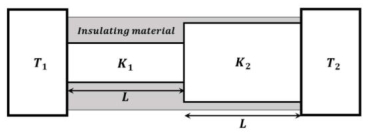
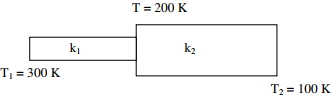
Two conducting cylinders of equal length but different radii are connected in series between two heat baths kept at temperatures $T_1 = 300 \ K$ and $T_2 = 100 \ K$,as shown in the figure. The radius of the bigger cylinder is twice that of the smaller one and the thermal conductivities of the materials of the smaller and the larger cylinders are $K_1$ and $K_2$ respectively. If the temperature at the junction of the two cylinders in the steady state is $200 \ K$,then $K_1 / K_2 = \dots$
A
$5$
B
$7$
C
$4$
D
$8$
Solution
(C) In the steady state,the rate of heat flow through both cylinders is the same.
Let $r_1$ be the radius of the smaller cylinder and $r_2$ be the radius of the larger cylinder.
Given $r_2 = 2r_1$.
The cross-sectional areas are $A_1 = \pi r_1^2$ and $A_2 = \pi r_2^2 = \pi (2r_1)^2 = 4\pi r_1^2 = 4A_1$.
The rate of heat flow is given by $\frac{dQ}{dt} = \frac{KA(T_{high} - T_{low})}{L}$.
For the first cylinder: $\frac{dQ}{dt} = \frac{K_1 A_1 (300 - 200)}{L} = \frac{K_1 A_1 (100)}{L}$.
For the second cylinder: $\frac{dQ}{dt} = \frac{K_2 A_2 (200 - 100)}{L} = \frac{K_2 (4A_1) (100)}{L}$.
Equating the rates of heat flow:
$\frac{K_1 A_1 (100)}{L} = \frac{K_2 (4A_1) (100)}{L}$.
$K_1 = 4K_2$.
Therefore,$K_1 / K_2 = 4$.
Let $r_1$ be the radius of the smaller cylinder and $r_2$ be the radius of the larger cylinder.
Given $r_2 = 2r_1$.
The cross-sectional areas are $A_1 = \pi r_1^2$ and $A_2 = \pi r_2^2 = \pi (2r_1)^2 = 4\pi r_1^2 = 4A_1$.
The rate of heat flow is given by $\frac{dQ}{dt} = \frac{KA(T_{high} - T_{low})}{L}$.
For the first cylinder: $\frac{dQ}{dt} = \frac{K_1 A_1 (300 - 200)}{L} = \frac{K_1 A_1 (100)}{L}$.
For the second cylinder: $\frac{dQ}{dt} = \frac{K_2 A_2 (200 - 100)}{L} = \frac{K_2 (4A_1) (100)}{L}$.
Equating the rates of heat flow:
$\frac{K_1 A_1 (100)}{L} = \frac{K_2 (4A_1) (100)}{L}$.
$K_1 = 4K_2$.
Therefore,$K_1 / K_2 = 4$.
0 likes
View Solution175
DifficultMCQ
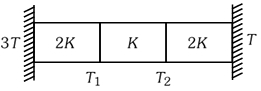
Three identical heat conducting rods are connected in series as shown in the figure. The rods on the sides have thermal conductivity $2K$ while that in the middle has thermal conductivity $K$. The left end of the combination is maintained at temperature $3T$ and the right end at $T$. The rods are thermally insulated from outside. In steady state,the temperature at the left junction is $T_1$ and that at the right junction is $T_2$. The ratio $T_1 / T_2$ is
A
$3/2$
B
$4/3$
C
$5/3$
D
$5/4$
Solution
(C) In steady state,the rate of heat flow through each rod is the same:
$\left(\frac{dQ}{dt}\right)_1 = \left(\frac{dQ}{dt}\right)_2 = \left(\frac{dQ}{dt}\right)_3$
Using the formula for heat conduction $\frac{dQ}{dt} = \frac{KA(T_H - T_L)}{L}$,we have:
$\frac{2KA(3T - T_1)}{L} = \frac{KA(T_1 - T_2)}{L} = \frac{2KA(T_2 - T)}{L}$
Simplifying by dividing by $KA/L$:
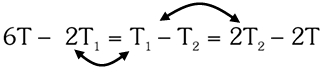
$2(3T - T_1) = (T_1 - T_2) = 2(T_2 - T)$
From the first equality:
$6T - 2T_1 = T_1 - T_2 \Rightarrow 3T_1 - T_2 = 6T$ --- $(1)$
From the second equality:
$T_1 - T_2 = 2T_2 - 2T \Rightarrow T_1 - 3T_2 = -2T$ --- $(2)$
Multiply equation $(2)$ by $3$:
$3T_1 - 9T_2 = -6T$ --- $(3)$
Subtracting $(3)$ from $(1)$:
$(3T_1 - T_2) - (3T_1 - 9T_2) = 6T - (-6T)$
$8T_2 = 12T \Rightarrow T_2 = 1.5T$
Substitute $T_2$ into $(2)$:
$T_1 - 3(1.5T) = -2T \Rightarrow T_1 - 4.5T = -2T \Rightarrow T_1 = 2.5T$
Therefore,the ratio $T_1 / T_2 = 2.5T / 1.5T = 5/3$.
$\left(\frac{dQ}{dt}\right)_1 = \left(\frac{dQ}{dt}\right)_2 = \left(\frac{dQ}{dt}\right)_3$
Using the formula for heat conduction $\frac{dQ}{dt} = \frac{KA(T_H - T_L)}{L}$,we have:
$\frac{2KA(3T - T_1)}{L} = \frac{KA(T_1 - T_2)}{L} = \frac{2KA(T_2 - T)}{L}$
Simplifying by dividing by $KA/L$:
$2(3T - T_1) = (T_1 - T_2) = 2(T_2 - T)$
From the first equality:
$6T - 2T_1 = T_1 - T_2 \Rightarrow 3T_1 - T_2 = 6T$ --- $(1)$
From the second equality:
$T_1 - T_2 = 2T_2 - 2T \Rightarrow T_1 - 3T_2 = -2T$ --- $(2)$
Multiply equation $(2)$ by $3$:
$3T_1 - 9T_2 = -6T$ --- $(3)$
Subtracting $(3)$ from $(1)$:
$(3T_1 - T_2) - (3T_1 - 9T_2) = 6T - (-6T)$
$8T_2 = 12T \Rightarrow T_2 = 1.5T$
Substitute $T_2$ into $(2)$:
$T_1 - 3(1.5T) = -2T \Rightarrow T_1 - 4.5T = -2T \Rightarrow T_1 = 2.5T$
Therefore,the ratio $T_1 / T_2 = 2.5T / 1.5T = 5/3$.
0 likes
View Solution176
DifficultMCQ
The thermal conductivity of a rod is $2$. What is its thermal resistivity?
A
$0.5$
B
$1$
C
$0.25$
D
$2$
Solution
(A) Key Idea: Thermal resistivity is the reciprocal of thermal conductivity.
Thermal resistivity = $\frac{1}{\text{Thermal conductivity}}$
Thermal resistivity = $\frac{1}{2} = 0.5$
Thermal resistivity = $\frac{1}{\text{Thermal conductivity}}$
Thermal resistivity = $\frac{1}{2} = 0.5$
0 likes
View Solution177
EasyMCQ
The two ends of a rod of length $x$ and uniform cross-sectional area $A$ are kept at temperatures $T_1$ and $T_2$ respectively $(T_1 > T_2)$. If the rate of heat transfer through the rod in steady state is $Q/t$,then the coefficient of thermal conductivity $K$ is:
A
$\frac{AQ}{tx(T_1-T_2)}$
B
$\frac{xQ}{tA(T_1-T_2)}$
C
$\frac{xAQ}{t(T_1-T_2)}$
D
$\frac{Q}{txA(T_1-T_2)}$
Solution
(B) The rate of heat transfer $H$ through a rod by conduction is given by the formula:
$H = \frac{Q}{t} = \frac{KA(T_1 - T_2)}{x}$
Where:
$Q/t$ is the rate of heat transfer,
$K$ is the coefficient of thermal conductivity,
$A$ is the cross-sectional area,
$x$ is the length of the rod,
$(T_1 - T_2)$ is the temperature difference.
Rearranging the formula to solve for $K$:
$K = \frac{(Q/t) \cdot x}{A(T_1 - T_2)}$
$K = \frac{xQ}{tA(T_1 - T_2)}$
Thus,the correct option is $B$.
$H = \frac{Q}{t} = \frac{KA(T_1 - T_2)}{x}$
Where:
$Q/t$ is the rate of heat transfer,
$K$ is the coefficient of thermal conductivity,
$A$ is the cross-sectional area,
$x$ is the length of the rod,
$(T_1 - T_2)$ is the temperature difference.
Rearranging the formula to solve for $K$:
$K = \frac{(Q/t) \cdot x}{A(T_1 - T_2)}$
$K = \frac{xQ}{tA(T_1 - T_2)}$
Thus,the correct option is $B$.
0 likes
View Solution178
EasyMCQ
Rate of flow of heat through a cylindrical rod is $H_1$. The temperatures at the ends of the rod are $T_1$ and $T_2$. If all the dimensions of the rod become double and the temperature difference remains the same,the rate of flow of heat becomes $H_2$. Then:
A
$H_2 = 4H_1$
B
$H_2 = 2H_1$
C
$H_2 = \frac{H_1}{2}$
D
$H_2 = \frac{H_1}{4}$
Solution
(B) The rate of heat flow $H$ through a cylindrical rod is given by the formula $H = \frac{kA(T_2 - T_1)}{l}$,where $k$ is the thermal conductivity,$A$ is the cross-sectional area,and $l$ is the length of the rod.
For the initial rod,$H_1 = \frac{kA_1(T_2 - T_1)}{l_1}$.
When all dimensions are doubled,the new length $l_2 = 2l_1$ and the new radius $r_2 = 2r_1$.
The new cross-sectional area $A_2 = \pi r_2^2 = \pi (2r_1)^2 = 4\pi r_1^2 = 4A_1$.
The new rate of heat flow is $H_2 = \frac{kA_2(T_2 - T_1)}{l_2}$.
Substituting the values of $A_2$ and $l_2$:
$H_2 = \frac{k(4A_1)(T_2 - T_1)}{2l_1} = 2 \left[ \frac{kA_1(T_2 - T_1)}{l_1} \right] = 2H_1$.
For the initial rod,$H_1 = \frac{kA_1(T_2 - T_1)}{l_1}$.
When all dimensions are doubled,the new length $l_2 = 2l_1$ and the new radius $r_2 = 2r_1$.
The new cross-sectional area $A_2 = \pi r_2^2 = \pi (2r_1)^2 = 4\pi r_1^2 = 4A_1$.
The new rate of heat flow is $H_2 = \frac{kA_2(T_2 - T_1)}{l_2}$.
Substituting the values of $A_2$ and $l_2$:
$H_2 = \frac{k(4A_1)(T_2 - T_1)}{2l_1} = 2 \left[ \frac{kA_1(T_2 - T_1)}{l_1} \right] = 2H_1$.
0 likes
View Solution179
MediumMCQ
$A$ cylindrical metallic rod in thermal contact with two heat reservoirs at its two ends conducts an amount of heat '$Q_1$' in time '$t$'. The metallic rod is melted and the material is formed into a rod of length four times the length of the original rod. The amount of heat conducted by the new rod when placed in thermal contact with the same two reservoirs in time '$t$' is '$Q_2$'. Then $\frac{Q_1}{Q_2}$ is:
A
$16$
B
$\frac{1}{16}$
C
$\frac{1}{4}$
D
$4$
Solution
(A) The rate of heat conduction is given by the formula: $\frac{Q}{t} = \frac{k A (T_1 - T_2)}{l}$.
Since the volume of the material remains constant during melting and reshaping,we have $A_1 l_1 = A_2 l_2$.
Given that the new length $l_2 = 4 l_1$,we substitute this into the volume equation: $A_1 l_1 = A_2 (4 l_1)$,which gives $A_2 = \frac{A_1}{4}$.
For the new rod,the heat conducted in time $t$ is $Q_2 = \frac{k A_2 (T_1 - T_2) t}{l_2}$.
Substituting $A_2 = \frac{A_1}{4}$ and $l_2 = 4 l_1$ into the equation for $Q_2$:
$Q_2 = \frac{k (A_1 / 4) (T_1 - T_2) t}{4 l_1} = \frac{1}{16} \frac{k A_1 (T_1 - T_2) t}{l_1}$.
Since $Q_1 = \frac{k A_1 (T_1 - T_2) t}{l_1}$,we get $Q_2 = \frac{1}{16} Q_1$.
Therefore,$\frac{Q_1}{Q_2} = 16$.
Since the volume of the material remains constant during melting and reshaping,we have $A_1 l_1 = A_2 l_2$.
Given that the new length $l_2 = 4 l_1$,we substitute this into the volume equation: $A_1 l_1 = A_2 (4 l_1)$,which gives $A_2 = \frac{A_1}{4}$.
For the new rod,the heat conducted in time $t$ is $Q_2 = \frac{k A_2 (T_1 - T_2) t}{l_2}$.
Substituting $A_2 = \frac{A_1}{4}$ and $l_2 = 4 l_1$ into the equation for $Q_2$:
$Q_2 = \frac{k (A_1 / 4) (T_1 - T_2) t}{4 l_1} = \frac{1}{16} \frac{k A_1 (T_1 - T_2) t}{l_1}$.
Since $Q_1 = \frac{k A_1 (T_1 - T_2) t}{l_1}$,we get $Q_2 = \frac{1}{16} Q_1$.
Therefore,$\frac{Q_1}{Q_2} = 16$.
0 likes
View Solution180
EasyMCQ
The coefficient of thermal conductivity of a rod depends on its
A
area of cross-section.
B
material of the rod.
C
length.
D
mass.
Solution
(B) The coefficient of thermal conductivity $(K)$ is an intrinsic property of the material of the rod.
It represents the ability of a material to conduct heat.
It does not depend on the physical dimensions such as the area of cross-section,length,or the mass of the rod.
Therefore,it only depends on the material of the rod.
It represents the ability of a material to conduct heat.
It does not depend on the physical dimensions such as the area of cross-section,length,or the mass of the rod.
Therefore,it only depends on the material of the rod.
0 likes
View Solution181
MediumMCQ
Two metal rods $P$ and $Q$ have the same length and the same temperature difference between their ends. Their thermal conductivities are $K_1$ and $K_2$,and their cross-sectional areas are $A_1$ and $A_2$ respectively. If the rate of flow of heat through rod $Q$ is three times that in rod $P$,then:
A
$K_1 A_1 = 3 K_2 A_2$
B
$3 K_1 A_1 = K_2 A_2$
C
$3 K_1 A_1 = 2 K_2 A_2$
D
$2 K_1 A_1 = 3 K_2 A_2$
Solution
(B) The rate of heat flow $\dot{Q}$ through a rod is given by the formula: $\dot{Q} = \frac{KA \Delta T}{l}$.
Here,$K$ is the thermal conductivity,$A$ is the cross-sectional area,$\Delta T$ is the temperature difference,and $l$ is the length of the rod.
Given that the length $l$ and temperature difference $\Delta T$ are the same for both rods $P$ and $Q$,the rate of heat flow is directly proportional to the product $KA$.
According to the problem,the rate of heat flow through rod $Q$ is three times that of rod $P$:
$(\dot{Q})_Q = 3 (\dot{Q})_P$
Substituting the formula:
$\frac{K_2 A_2 \Delta T}{l} = 3 \left( \frac{K_1 A_1 \Delta T}{l} \right)$
Since $l$ and $\Delta T$ are equal,they cancel out from both sides:
$K_2 A_2 = 3 K_1 A_1$ or $3 K_1 A_1 = K_2 A_2$.
Here,$K$ is the thermal conductivity,$A$ is the cross-sectional area,$\Delta T$ is the temperature difference,and $l$ is the length of the rod.
Given that the length $l$ and temperature difference $\Delta T$ are the same for both rods $P$ and $Q$,the rate of heat flow is directly proportional to the product $KA$.
According to the problem,the rate of heat flow through rod $Q$ is three times that of rod $P$:
$(\dot{Q})_Q = 3 (\dot{Q})_P$
Substituting the formula:
$\frac{K_2 A_2 \Delta T}{l} = 3 \left( \frac{K_1 A_1 \Delta T}{l} \right)$
Since $l$ and $\Delta T$ are equal,they cancel out from both sides:
$K_2 A_2 = 3 K_1 A_1$ or $3 K_1 A_1 = K_2 A_2$.
0 likes
View Solution182
EasyMCQ
$A$ conducting rod of length $1 \,m$ has an area of cross-section $10^{-3} \,m^2$. One end is immersed in boiling water $(100^{\circ} C)$ and the other end in ice $(0^{\circ} C)$. If the coefficient of thermal conductivity of the rod is $96 \,cal/(s \cdot m \cdot ^{\circ}C)$ and the latent heat of fusion for ice is $8 \times 10^4 \,cal/kg$,then the amount of ice that will melt in one minute is:
A
$5.4 \times 10^{-3} \,kg$
B
$7.2 \times 10^{-3} \,kg$
C
$1.8 \times 10^{-3} \,kg$
D
$3.6 \times 10^{-3} \,kg$
Solution
(B) The rate of heat flow through the rod is given by the formula: $Q = \frac{KA(\Delta \theta)t}{\ell}$.
This heat is used to melt the ice,so $Q = mL$,where $m$ is the mass of ice melted and $L$ is the latent heat of fusion.
Equating the two expressions: $mL = \frac{KA(\Delta \theta)t}{\ell}$.
Given values: $K = 96 \,cal/(s \cdot m \cdot ^{\circ}C)$,$A = 10^{-3} \,m^2$,$\Delta \theta = 100^{\circ}C - 0^{\circ}C = 100^{\circ}C$,$t = 60 \,s$,$\ell = 1 \,m$,and $L = 8 \times 10^4 \,cal/kg$.
Substituting these values into the equation:
$m = \frac{96 \times 10^{-3} \times 100 \times 60}{1 \times 8 \times 10^4}$.
$m = \frac{96 \times 10^{-1} \times 60}{8 \times 10^4} = \frac{576}{8 \times 10^5} = 72 \times 10^{-4} \,kg = 7.2 \times 10^{-3} \,kg$.
This heat is used to melt the ice,so $Q = mL$,where $m$ is the mass of ice melted and $L$ is the latent heat of fusion.
Equating the two expressions: $mL = \frac{KA(\Delta \theta)t}{\ell}$.
Given values: $K = 96 \,cal/(s \cdot m \cdot ^{\circ}C)$,$A = 10^{-3} \,m^2$,$\Delta \theta = 100^{\circ}C - 0^{\circ}C = 100^{\circ}C$,$t = 60 \,s$,$\ell = 1 \,m$,and $L = 8 \times 10^4 \,cal/kg$.
Substituting these values into the equation:
$m = \frac{96 \times 10^{-3} \times 100 \times 60}{1 \times 8 \times 10^4}$.
$m = \frac{96 \times 10^{-1} \times 60}{8 \times 10^4} = \frac{576}{8 \times 10^5} = 72 \times 10^{-4} \,kg = 7.2 \times 10^{-3} \,kg$.
0 likes
View Solution183
DifficultMCQ
The temperature difference between two sides of a metal plate,$3 \ cm$ thick,is $15^{\circ} C$. Heat is transmitted through the plate at the rate of $900 \ kcal$ per minute per $m^2$ at steady state. The thermal conductivity of the metal is:
A
$1.8 \times 10^{-2} \ \frac{kcal}{m \cdot s \cdot ^{\circ}C}$
B
$4.5 \times 10^{-2} \ \frac{kcal}{m \cdot s \cdot ^{\circ}C}$
C
$3 \times 10^{-2} \ \frac{kcal}{m \cdot s \cdot ^{\circ}C}$
D
$6 \times 10^{-2} \ \frac{kcal}{m \cdot s \cdot ^{\circ}C}$
Solution
(C) The rate of heat flow through a conductor is given by the formula: $\frac{Q}{t} = \frac{kA \Delta \theta}{d}$.
Rearranging for thermal conductivity $k$: $k = \frac{Q}{tA} \cdot \frac{d}{\Delta \theta}$.
Given: Heat flux $\frac{Q}{tA} = 900 \ kcal / (min \cdot m^2) = \frac{900}{60} \ kcal / (s \cdot m^2) = 15 \ kcal / (s \cdot m^2)$.
Thickness $d = 3 \ cm = 3 \times 10^{-2} \ m$.
Temperature difference $\Delta \theta = 15^{\circ} C$.
Substituting the values: $k = \frac{15 \times 3 \times 10^{-2}}{15} = 3 \times 10^{-2} \ kcal / (m \cdot s \cdot ^{\circ}C)$.
Rearranging for thermal conductivity $k$: $k = \frac{Q}{tA} \cdot \frac{d}{\Delta \theta}$.
Given: Heat flux $\frac{Q}{tA} = 900 \ kcal / (min \cdot m^2) = \frac{900}{60} \ kcal / (s \cdot m^2) = 15 \ kcal / (s \cdot m^2)$.
Thickness $d = 3 \ cm = 3 \times 10^{-2} \ m$.
Temperature difference $\Delta \theta = 15^{\circ} C$.
Substituting the values: $k = \frac{15 \times 3 \times 10^{-2}}{15} = 3 \times 10^{-2} \ kcal / (m \cdot s \cdot ^{\circ}C)$.
0 likes
View Solution184
EasyMCQ
$A$ cylindrical rod has temperatures $\theta_1$ and $\theta_2$ at its ends. The rate of heat flow is $Q \ J s^{-1}$. All the linear dimensions of the rod are doubled while keeping the temperatures constant. What is the new rate of flow of heat?
A
$\frac{Q}{2}$
B
$\frac{Q}{4}$
C
$2 Q$
D
$\frac{3 Q}{2}$
Solution
(C) The rate of heat flow through a rod is given by $Q = \frac{kA(\theta_1 - \theta_2)}{\ell}$,where $k$ is thermal conductivity,$A$ is the cross-sectional area,and $\ell$ is the length of the rod.
When all linear dimensions are doubled,the radius $r$ becomes $2r$ and the length $\ell$ becomes $2\ell$.
The new area $A' = \pi(2r)^2 = 4\pi r^2 = 4A$.
The new length $\ell' = 2\ell$.
The new rate of heat flow $Q'$ is given by $Q' = \frac{kA'(\theta_1 - \theta_2)}{\ell'}$.
Substituting the new values: $Q' = \frac{k(4A)(\theta_1 - \theta_2)}{2\ell} = 2 \left( \frac{kA(\theta_1 - \theta_2)}{\ell} \right) = 2Q$.
When all linear dimensions are doubled,the radius $r$ becomes $2r$ and the length $\ell$ becomes $2\ell$.
The new area $A' = \pi(2r)^2 = 4\pi r^2 = 4A$.
The new length $\ell' = 2\ell$.
The new rate of heat flow $Q'$ is given by $Q' = \frac{kA'(\theta_1 - \theta_2)}{\ell'}$.
Substituting the new values: $Q' = \frac{k(4A)(\theta_1 - \theta_2)}{2\ell} = 2 \left( \frac{kA(\theta_1 - \theta_2)}{\ell} \right) = 2Q$.
0 likes
View Solution185
MediumMCQ
The temperature difference between two sides of an iron plate,$1.8 \ cm$ thick is $9^{\circ} C$. Heat is transmitted through the plate at a rate of $10 \ kcal / (s \cdot m^2)$ at steady state. The thermal conductivity of iron is:
A
$0.02 \ kcal / (m \cdot s \cdot ^{\circ} C)$
B
$0.04 \ kcal / (m \cdot s \cdot ^{\circ} C)$
C
$0.05 \ kcal / (m \cdot s \cdot ^{\circ} C)$
D
$0.004 \ kcal / (m \cdot s \cdot ^{\circ} C)$
Solution
(A) The rate of heat flow per unit area is given by the formula: $\frac{Q}{At} = \frac{k \Delta \theta}{d}$.
Given:
Heat flux $\frac{Q}{At} = 10 \ kcal / (s \cdot m^2)$
Thickness $d = 1.8 \ cm = 1.8 \times 10^{-2} \ m$
Temperature difference $\Delta \theta = 9^{\circ} C$
Substituting the values into the formula:
$10 = k \times \frac{9}{1.8 \times 10^{-2}}$
$10 = k \times \frac{9}{0.018}$
$10 = k \times 500$
$k = \frac{10}{500} = \frac{1}{50} = 0.02 \ kcal / (m \cdot s \cdot ^{\circ} C)$.
Given:
Heat flux $\frac{Q}{At} = 10 \ kcal / (s \cdot m^2)$
Thickness $d = 1.8 \ cm = 1.8 \times 10^{-2} \ m$
Temperature difference $\Delta \theta = 9^{\circ} C$
Substituting the values into the formula:
$10 = k \times \frac{9}{1.8 \times 10^{-2}}$
$10 = k \times \frac{9}{0.018}$
$10 = k \times 500$
$k = \frac{10}{500} = \frac{1}{50} = 0.02 \ kcal / (m \cdot s \cdot ^{\circ} C)$.
0 likes
View Solution186
MediumMCQ
$A$ cylindrical rod has temperatures $T_1$ and $T_2$ at its ends. The rate of flow of heat is $Q_1 \text{ cal s}^{-1}$. If the length and radius of the rod are doubled while keeping the temperatures constant,then the new rate of flow of heat $Q_2$ will be:
A
$Q_2 = \frac{Q_1}{2}$
B
$Q_2 = \frac{Q_1}{4}$
C
$Q_2 = 4 Q_1$
D
$Q_2 = 2 Q_1$
Solution
(D) The rate of heat flow through a cylindrical rod is given by the formula: $Q = \frac{kA(T_1 - T_2)}{L}$,where $A = \pi r^2$.
Thus,$Q_1 = \frac{k \pi r_1^2 (T_1 - T_2)}{L_1}$.
When the length and radius are doubled,we have $L_2 = 2L_1$ and $r_2 = 2r_1$.
The new rate of heat flow is $Q_2 = \frac{k \pi r_2^2 (T_1 - T_2)}{L_2}$.
Taking the ratio: $\frac{Q_2}{Q_1} = \left( \frac{r_2}{r_1} \right)^2 \cdot \left( \frac{L_1}{L_2} \right)$.
Substituting the values: $\frac{Q_2}{Q_1} = (2)^2 \cdot \left( \frac{1}{2} \right) = 4 \cdot \frac{1}{2} = 2$.
Therefore,$Q_2 = 2 Q_1$.
Thus,$Q_1 = \frac{k \pi r_1^2 (T_1 - T_2)}{L_1}$.
When the length and radius are doubled,we have $L_2 = 2L_1$ and $r_2 = 2r_1$.
The new rate of heat flow is $Q_2 = \frac{k \pi r_2^2 (T_1 - T_2)}{L_2}$.
Taking the ratio: $\frac{Q_2}{Q_1} = \left( \frac{r_2}{r_1} \right)^2 \cdot \left( \frac{L_1}{L_2} \right)$.
Substituting the values: $\frac{Q_2}{Q_1} = (2)^2 \cdot \left( \frac{1}{2} \right) = 4 \cdot \frac{1}{2} = 2$.
Therefore,$Q_2 = 2 Q_1$.
0 likes
View Solution187
EasyMCQ
$A$ cylindrical rod has temperatures $\theta_1$ and $\theta_2$ at its ends. The rate of heat flow is $Q$. All the linear dimensions of the rod are doubled while keeping the temperatures constant. The new rate of flow of heat is
A
$4Q$
B
$2Q$
C
$\frac{Q}{2}$
D
$\frac{Q}{4}$
Solution
(B) The rate of heat flow through a cylindrical rod is given by the formula: $\frac{Q}{t} = \frac{KA(\theta_1 - \theta_2)}{\Delta x}$,where $A = \pi r^2$ is the cross-sectional area and $\Delta x$ is the length of the rod.
Thus,the rate of heat flow is proportional to $\frac{r^2}{\Delta x}$.
Let the initial radius be $r_1 = r$ and length be $\Delta x_1 = L$. The initial rate is $Q \propto \frac{r^2}{L}$.
When all linear dimensions are doubled,the new radius $r_2 = 2r$ and the new length $\Delta x_2 = 2L$.
The new rate of heat flow $Q'$ is proportional to $\frac{(2r)^2}{2L} = \frac{4r^2}{2L} = 2 \left( \frac{r^2}{L} \right)$.
Therefore,$Q' = 2Q$.
Thus,the rate of heat flow is proportional to $\frac{r^2}{\Delta x}$.
Let the initial radius be $r_1 = r$ and length be $\Delta x_1 = L$. The initial rate is $Q \propto \frac{r^2}{L}$.
When all linear dimensions are doubled,the new radius $r_2 = 2r$ and the new length $\Delta x_2 = 2L$.
The new rate of heat flow $Q'$ is proportional to $\frac{(2r)^2}{2L} = \frac{4r^2}{2L} = 2 \left( \frac{r^2}{L} \right)$.
Therefore,$Q' = 2Q$.
0 likes
View Solution188
MediumMCQ
Four rods with different radii $r$ and length $l$ are used to connect two heat reservoirs at different temperatures. Which one will conduct the most heat?
A
$r = 1 \text{ cm}, l = 1 \text{ m}$
B
$r = 1 \text{ cm}, l = 0.5 \text{ m}$
C
$r = 2 \text{ cm}, l = 2 \text{ m}$
D
$r = 2 \text{ cm}, l = 0.5 \text{ m}$
Solution
(D) The rate of heat conduction $H$ through a rod is given by the formula $H = \frac{kA \Delta T}{l}$,where $k$ is the thermal conductivity,$A$ is the cross-sectional area,$\Delta T$ is the temperature difference,and $l$ is the length.
Since $A = \pi r^2$,we have $H \propto \frac{r^2}{l}$.
To conduct the most heat,the ratio $\frac{r^2}{l}$ must be maximized.
Let's calculate the value of $\frac{r^2}{l}$ for each option:
$A: \frac{1^2}{1} = 1$
$B: \frac{1^2}{0.5} = 2$
$C: \frac{2^2}{2} = 2$
$D: \frac{2^2}{0.5} = 8$
Since option $D$ has the highest value,it will conduct the most heat.
Since $A = \pi r^2$,we have $H \propto \frac{r^2}{l}$.
To conduct the most heat,the ratio $\frac{r^2}{l}$ must be maximized.
Let's calculate the value of $\frac{r^2}{l}$ for each option:
$A: \frac{1^2}{1} = 1$
$B: \frac{1^2}{0.5} = 2$
$C: \frac{2^2}{2} = 2$
$D: \frac{2^2}{0.5} = 8$
Since option $D$ has the highest value,it will conduct the most heat.
0 likes
View Solution189
DifficultMCQ
$A$ solid cylinder of radius $R$ made of a material of thermal conductivity $K_{1}$ is surrounded by a cylindrical shell of inner radius $R$ and outer radius $2R$ made of a material of thermal conductivity $K_{2}$. The two ends of the combined system are maintained at two different temperatures. There is no loss of heat across the cylindrical surface and the system is in steady state. The effective thermal conductivity of the system is
A
$K_{1}+K_{2}$
B
$\frac{K_{1} K_{2}}{K_{1}+K_{2}}$
C
$\frac{2 K_{1}+K_{2}}{4}$
D
$\frac{K_{1}+3 K_{2}}{4}$
Solution
(D) The system consists of two parallel paths for heat flow: the inner solid cylinder and the outer cylindrical shell.
Since the system is in a steady state and there is no heat loss across the cylindrical surface,the total heat flow $Q_{\text{total}}$ is the sum of heat flows through the two parts: $Q_{\text{total}} = Q_{1} + Q_{2}$.
The rate of heat flow is given by $Q = \frac{KA \Delta \theta}{L}$.
For the inner cylinder,area $A_{1} = \pi R^{2}$.
For the outer shell,area $A_{2} = \pi (2R)^{2} - \pi R^{2} = 3\pi R^{2}$.
The total area is $A = A_{1} + A_{2} = 4\pi R^{2}$.
Equating the heat flow: $\frac{K(4\pi R^{2}) \Delta \theta}{L} = \frac{K_{1}(\pi R^{2}) \Delta \theta}{L} + \frac{K_{2}(3\pi R^{2}) \Delta \theta}{L}$.
Canceling common terms $\frac{\pi R^{2} \Delta \theta}{L}$ from both sides:
$4K = K_{1} + 3K_{2}$.
Therefore,the effective thermal conductivity is $K = \frac{K_{1} + 3K_{2}}{4}$.
Since the system is in a steady state and there is no heat loss across the cylindrical surface,the total heat flow $Q_{\text{total}}$ is the sum of heat flows through the two parts: $Q_{\text{total}} = Q_{1} + Q_{2}$.
The rate of heat flow is given by $Q = \frac{KA \Delta \theta}{L}$.
For the inner cylinder,area $A_{1} = \pi R^{2}$.
For the outer shell,area $A_{2} = \pi (2R)^{2} - \pi R^{2} = 3\pi R^{2}$.
The total area is $A = A_{1} + A_{2} = 4\pi R^{2}$.
Equating the heat flow: $\frac{K(4\pi R^{2}) \Delta \theta}{L} = \frac{K_{1}(\pi R^{2}) \Delta \theta}{L} + \frac{K_{2}(3\pi R^{2}) \Delta \theta}{L}$.
Canceling common terms $\frac{\pi R^{2} \Delta \theta}{L}$ from both sides:
$4K = K_{1} + 3K_{2}$.
Therefore,the effective thermal conductivity is $K = \frac{K_{1} + 3K_{2}}{4}$.
0 likes
View Solution190
DifficultMCQ
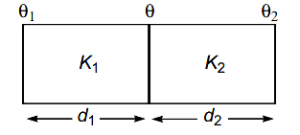
Two slabs have thicknesses $d_{1}$ and $d_{2}$. Their thermal conductivities are $K_{1}$ and $K_{2}$ respectively. They are in series. The free ends of the combination of these two slabs are kept at temperatures $\theta_{1}$ and $\theta_{2}$. Assume $\theta_{1} > \theta_{2}$. The temperature $\theta$ of their common junction is
A
$\frac{K_{1} \theta_{1} + K_{2} \theta_{2}}{\theta_{1} + \theta_{2}}$
B
$\frac{K_{1} \theta_{1} d_{1} + K_{2} \theta_{2} d_{2}}{K_{1} d_{2} + K_{2} d_{1}}$
C
$\frac{K_{1} \theta_{1} d_{2} + K_{2} \theta_{2} d_{1}}{K_{1} d_{2} + K_{2} d_{1}}$
D
$\frac{K_{1} \theta_{1} + K_{2} \theta_{2}}{K_{1} + K_{2}}$
Solution
(C) For the first slab,the heat current is $H_{1} = \frac{K_{1} A (\theta_{1} - \theta)}{d_{1}}$.
For the second slab,the heat current is $H_{2} = \frac{K_{2} A (\theta - \theta_{2})}{d_{2}}$.
Since the slabs are in series,the heat current through both must be equal in steady state,so $H_{1} = H_{2}$.
$\frac{K_{1} A (\theta_{1} - \theta)}{d_{1}} = \frac{K_{2} A (\theta - \theta_{2})}{d_{2}}$
$\frac{K_{1} (\theta_{1} - \theta)}{d_{1}} = \frac{K_{2} (\theta - \theta_{2})}{d_{2}}$
$K_{1} d_{2} (\theta_{1} - \theta) = K_{2} d_{1} (\theta - \theta_{2})$
$K_{1} d_{2} \theta_{1} - K_{1} d_{2} \theta = K_{2} d_{1} \theta - K_{2} d_{1} \theta_{2}$
$K_{1} d_{2} \theta_{1} + K_{2} d_{1} \theta_{2} = \theta (K_{1} d_{2} + K_{2} d_{1})$
$\theta = \frac{K_{1} \theta_{1} d_{2} + K_{2} \theta_{2} d_{1}}{K_{1} d_{2} + K_{2} d_{1}}$
For the second slab,the heat current is $H_{2} = \frac{K_{2} A (\theta - \theta_{2})}{d_{2}}$.
Since the slabs are in series,the heat current through both must be equal in steady state,so $H_{1} = H_{2}$.
$\frac{K_{1} A (\theta_{1} - \theta)}{d_{1}} = \frac{K_{2} A (\theta - \theta_{2})}{d_{2}}$
$\frac{K_{1} (\theta_{1} - \theta)}{d_{1}} = \frac{K_{2} (\theta - \theta_{2})}{d_{2}}$
$K_{1} d_{2} (\theta_{1} - \theta) = K_{2} d_{1} (\theta - \theta_{2})$
$K_{1} d_{2} \theta_{1} - K_{1} d_{2} \theta = K_{2} d_{1} \theta - K_{2} d_{1} \theta_{2}$
$K_{1} d_{2} \theta_{1} + K_{2} d_{1} \theta_{2} = \theta (K_{1} d_{2} + K_{2} d_{1})$
$\theta = \frac{K_{1} \theta_{1} d_{2} + K_{2} \theta_{2} d_{1}}{K_{1} d_{2} + K_{2} d_{1}}$
0 likes
View Solution191
MediumMCQ
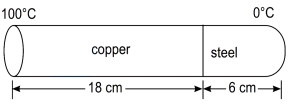
The coefficient of thermal conductivity of copper is $9$ times that of steel. In the composite cylindrical bar shown in the figure,what will be the temperature at the junction of copper and steel (in $^{\circ} C$)?
A
$75$
B
$67$
C
$25$
D
$33$
Solution
(D) Let the temperature at the junction be $\theta$. In steady state,the rate of heat flow through the copper rod must be equal to the rate of heat flow through the steel rod.
$H_{Cu} = H_{steel}$
$\frac{K_{Cu} A (100 - \theta)}{L_{Cu}} = \frac{K_{steel} A (\theta - 0)}{L_{steel}}$
Given that $K_{Cu} = 9 K_{steel}$,$L_{Cu} = 18 \text{ cm}$,and $L_{steel} = 6 \text{ cm}$.
Substituting the values:
$\frac{9 K_{steel} (100 - \theta)}{18} = \frac{K_{steel} (\theta - 0)}{6}$
$\frac{100 - \theta}{2} = \theta$
$100 - \theta = 2\theta$
$3\theta = 100$
$\theta = \frac{100}{3} \approx 33.3^{\circ} C$
Thus,the temperature at the junction is approximately $33^{\circ} C$.
$H_{Cu} = H_{steel}$
$\frac{K_{Cu} A (100 - \theta)}{L_{Cu}} = \frac{K_{steel} A (\theta - 0)}{L_{steel}}$
Given that $K_{Cu} = 9 K_{steel}$,$L_{Cu} = 18 \text{ cm}$,and $L_{steel} = 6 \text{ cm}$.
Substituting the values:
$\frac{9 K_{steel} (100 - \theta)}{18} = \frac{K_{steel} (\theta - 0)}{6}$
$\frac{100 - \theta}{2} = \theta$
$100 - \theta = 2\theta$
$3\theta = 100$
$\theta = \frac{100}{3} \approx 33.3^{\circ} C$
Thus,the temperature at the junction is approximately $33^{\circ} C$.
0 likes
View Solution192
MediumMCQ
Two identical rods $AC$ and $CB$ made of two different metals having thermal conductivities in the ratio $2:3$ are kept in contact with each other at the end $C$. $A$ is at $100^{\circ}C$ and $B$ is at $25^{\circ}C$. Then the junction $C$ is at: (in $^{\circ}C$)
A
$55$
B
$60$
C
$75$
D
$50$
Solution
(A) Let the temperature of the junction $C$ be $\theta$.
Since the rods are in series,the rate of heat flow through both rods must be equal in the steady state.
The rate of heat flow is given by $H = \frac{KA(\Delta T)}{L}$.
Since the rods are identical,$A$ and $L$ are the same for both.
Thus,$K_1(100 - \theta) = K_2(\theta - 25)$.
Rearranging,we get $\frac{K_1}{K_2} = \frac{\theta - 25}{100 - \theta}$.
Given $\frac{K_1}{K_2} = \frac{2}{3}$,we have $\frac{2}{3} = \frac{\theta - 25}{100 - \theta}$.
Cross-multiplying gives $2(100 - \theta) = 3(\theta - 25)$.
$200 - 2\theta = 3\theta - 75$.
$5\theta = 275$.
$\theta = 55^{\circ}C$.
Since the rods are in series,the rate of heat flow through both rods must be equal in the steady state.
The rate of heat flow is given by $H = \frac{KA(\Delta T)}{L}$.
Since the rods are identical,$A$ and $L$ are the same for both.
Thus,$K_1(100 - \theta) = K_2(\theta - 25)$.
Rearranging,we get $\frac{K_1}{K_2} = \frac{\theta - 25}{100 - \theta}$.
Given $\frac{K_1}{K_2} = \frac{2}{3}$,we have $\frac{2}{3} = \frac{\theta - 25}{100 - \theta}$.
Cross-multiplying gives $2(100 - \theta) = 3(\theta - 25)$.
$200 - 2\theta = 3\theta - 75$.
$5\theta = 275$.
$\theta = 55^{\circ}C$.
0 likes
View Solution193
MediumMCQ
The length of a metal bar is $20 \ cm$ and the area of cross-section is $4 \times 10^{-4} \ m^2$. If one end of the rod is kept in ice at $0^{\circ} C$ and the other end is kept in steam at $100^{\circ} C$,the mass of ice melted in one minute is $5 \ g$. The thermal conductivity of the metal in $W \ m^{-1} \ K^{-1}$ is (Latent heat of fusion $= 80 \ cal/g$):
A
$140$
B
$120$
C
$100$
D
$160$
Solution
(A) Given: Length $l = 20 \ cm = 0.2 \ m$,Area $A = 4 \times 10^{-4} \ m^2$,Temperature difference $\Delta \theta = 100^{\circ} C - 0^{\circ} C = 100 \ K$,Time $t = 60 \ s$,Mass of ice $m = 5 \ g$,Latent heat $L = 80 \ cal/g = 80 \times 4.2 \ J/g = 336 \ J/g = 336000 \ J/kg$.
Heat conducted through the rod $H = \frac{kA \Delta \theta}{l}$.
Heat required to melt ice $Q = mL$.
Equating the two: $\frac{kA \Delta \theta}{l} = \frac{mL}{t}$.
Substituting the values: $\frac{k \times 4 \times 10^{-4} \times 100}{0.2} = \frac{5 \times 10^{-3} \ kg \times 336000 \ J/kg}{60 \ s}$.
$k \times 0.2 = \frac{1680}{60} = 28$.
$k = \frac{28}{0.2} = 140 \ W \ m^{-1} \ K^{-1}$.
Heat conducted through the rod $H = \frac{kA \Delta \theta}{l}$.
Heat required to melt ice $Q = mL$.
Equating the two: $\frac{kA \Delta \theta}{l} = \frac{mL}{t}$.
Substituting the values: $\frac{k \times 4 \times 10^{-4} \times 100}{0.2} = \frac{5 \times 10^{-3} \ kg \times 336000 \ J/kg}{60 \ s}$.
$k \times 0.2 = \frac{1680}{60} = 28$.
$k = \frac{28}{0.2} = 140 \ W \ m^{-1} \ K^{-1}$.
0 likes
View Solution194
MediumMCQ
If $4 \, kg$ of ice is inside a closed cubical thermocol box of side length $20 \, cm$ and wall thickness $4 \, cm$, then the mass of the ice remaining after $10 \, hours$ is nearly. (Given: Outside temperature $= 50^{\circ}C$, Thermal conductivity of thermocol $K = 0.01 \, Js^{-1}m^{-1\circ}C^{-1}$, Latent heat of fusion of ice $L = 335 \times 10^3 \, Jkg^{-1}$) (in $ \, kg$)
A
$3.678$
B
$6.378$
C
$2.87$
D
$1.87$
Solution
(A) The rate of heat flow $dQ/dt$ through the walls of the box is given by $dQ/dt = (K \cdot A \cdot \Delta T) / d$.
Here, the surface area $A = 6 \times (side)^2 = 6 \times (0.2 \, m)^2 = 6 \times 0.04 = 0.24 \, m^2$.
The thickness $d = 0.04 \, m$ and temperature difference $\Delta T = 50^{\circ}C - 0^{\circ}C = 50^{\circ}C$.
So, $dQ/dt = (0.01 \times 0.24 \times 50) / 0.04 = 0.12 / 0.04 = 3 \, Js^{-1}$.
Total time $t = 10 \, hours = 10 \times 3600 = 36000 \, s$.
Total heat gained $Q = (dQ/dt) \times t = 3 \times 36000 = 108000 \, J$.
Mass of ice melted $m_{melted} = Q / L = 108000 / (335 \times 10^3) \approx 0.322 \, kg$.
Mass of ice remaining $= 4 \, kg - 0.322 \, kg = 3.678 \, kg$.
Here, the surface area $A = 6 \times (side)^2 = 6 \times (0.2 \, m)^2 = 6 \times 0.04 = 0.24 \, m^2$.
The thickness $d = 0.04 \, m$ and temperature difference $\Delta T = 50^{\circ}C - 0^{\circ}C = 50^{\circ}C$.
So, $dQ/dt = (0.01 \times 0.24 \times 50) / 0.04 = 0.12 / 0.04 = 3 \, Js^{-1}$.
Total time $t = 10 \, hours = 10 \times 3600 = 36000 \, s$.
Total heat gained $Q = (dQ/dt) \times t = 3 \times 36000 = 108000 \, J$.
Mass of ice melted $m_{melted} = Q / L = 108000 / (335 \times 10^3) \approx 0.322 \, kg$.
Mass of ice remaining $= 4 \, kg - 0.322 \, kg = 3.678 \, kg$.
0 likes
View Solution195
EasyMCQ
$A$ rectangular slab consists of two cubes of copper and brass of equal sides having thermal conductivities in the ratio $4: 1$. If the free face of brass is at $0^{\circ} C$ and that of copper is at $100^{\circ} C$,then the temperature of their interface is (in $^{\circ} C$)
A
$80$
B
$20$
C
$60$
D
$40$
Solution
(A) In a steady state,the rate of heat flow $(H)$ through the copper and brass slabs connected in series must be equal.
$H = \frac{K_1 A (T_1 - T)}{L} = \frac{K_2 A (T - T_2)}{L}$
Given that the sides are equal,the area $(A)$ and length $(L)$ of both cubes are the same.
Let $K_c$ be the thermal conductivity of copper and $K_b$ be the thermal conductivity of brass.
Given $K_c : K_b = 4 : 1$,so $K_c = 4K_b$.
Let $T$ be the temperature of the interface.
$4K_b (100 - T) = K_b (T - 0)$
$4(100 - T) = T$
$400 - 4T = T$
$5T = 400$
$T = 80^{\circ} C$.
$H = \frac{K_1 A (T_1 - T)}{L} = \frac{K_2 A (T - T_2)}{L}$
Given that the sides are equal,the area $(A)$ and length $(L)$ of both cubes are the same.
Let $K_c$ be the thermal conductivity of copper and $K_b$ be the thermal conductivity of brass.
Given $K_c : K_b = 4 : 1$,so $K_c = 4K_b$.
Let $T$ be the temperature of the interface.
$4K_b (100 - T) = K_b (T - 0)$
$4(100 - T) = T$
$400 - 4T = T$
$5T = 400$
$T = 80^{\circ} C$.
0 likes
View Solution196
MediumMCQ
$A$ slab consists of two identical plates of copper and brass. The free face of the brass is at $0^{\circ} C$ and that of copper at $100^{\circ} C$. If the thermal conductivities of brass and copper are in the ratio $1: 4$,then the temperature of the interface is (in $^{\circ} C$)
A
$20$
B
$40$
C
$60$
D
$80$
Solution
(D) Let $K_b$ and $K_c$ be the thermal conductivities of brass and copper respectively. Given $K_b : K_c = 1 : 4$.
Let $T$ be the temperature of the interface.
Since the plates are in series,the rate of heat flow $H$ through both plates must be the same in steady state.
$H = \frac{K_c A(100 - T)}{x} = \frac{K_b A(T - 0)}{x}$
Where $A$ is the area and $x$ is the thickness of each plate.
Canceling $A$ and $x$ from both sides,we get:
$K_c(100 - T) = K_b(T)$
$\frac{K_c}{K_b} = \frac{T}{100 - T}$
Since $\frac{K_b}{K_c} = \frac{1}{4}$,we have $\frac{K_c}{K_b} = 4$.
Substituting this value:
$4 = \frac{T}{100 - T}$
$4(100 - T) = T$
$400 - 4T = T$
$5T = 400$
$T = 80^{\circ} C$
Let $T$ be the temperature of the interface.
Since the plates are in series,the rate of heat flow $H$ through both plates must be the same in steady state.
$H = \frac{K_c A(100 - T)}{x} = \frac{K_b A(T - 0)}{x}$
Where $A$ is the area and $x$ is the thickness of each plate.
Canceling $A$ and $x$ from both sides,we get:
$K_c(100 - T) = K_b(T)$
$\frac{K_c}{K_b} = \frac{T}{100 - T}$
Since $\frac{K_b}{K_c} = \frac{1}{4}$,we have $\frac{K_c}{K_b} = 4$.
Substituting this value:
$4 = \frac{T}{100 - T}$
$4(100 - T) = T$
$400 - 4T = T$
$5T = 400$
$T = 80^{\circ} C$
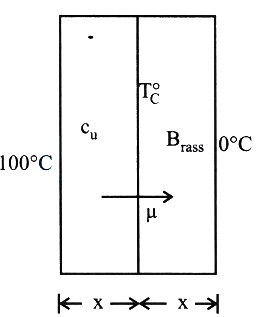
0 likes
View Solution197
MediumMCQ
Two plates of the same area are placed in contact. Their thicknesses as well as their thermal conductivities are in the ratio $2:3$. The outer surface of one plate is maintained at $10^{\circ} C$ and that of the other at $0^{\circ} C$. The temperature at the common surface is (in $^{\circ} C$)
A
$0$
B
$25$
C
$5$
D
$6.5$
Solution
(C) Given that two plates have the same surface area $A$.
Let $K_1, K_2$ be their thermal conductivities and $t_1, t_2$ be their thicknesses respectively.
According to the problem,the ratios are:
$\frac{K_1}{K_2} = \frac{2}{3}$ and $\frac{t_1}{t_2} = \frac{2}{3}$.
Since the plates are in series,the rate of heat flow through both plates must be the same in steady state:
$\frac{dQ}{dt} = \frac{K_1 A (T_1 - T)}{t_1} = \frac{K_2 A (T - T_2)}{t_2}$
Where $T$ is the temperature of the common surface.
Substituting the given values $T_1 = 10^{\circ} C$ and $T_2 = 0^{\circ} C$:
$\frac{K_1}{t_1} (10 - T) = \frac{K_2}{t_2} (T - 0)$
$\frac{K_1}{K_2} \cdot \frac{t_2}{t_1} (10 - T) = T$
Substituting the ratios $\frac{K_1}{K_2} = \frac{2}{3}$ and $\frac{t_2}{t_1} = \frac{3}{2}$:
$\left( \frac{2}{3} \right) \cdot \left( \frac{3}{2} \right) (10 - T) = T$
$1 \cdot (10 - T) = T$
$10 - T = T$
$2T = 10$
$T = 5^{\circ} C$
Let $K_1, K_2$ be their thermal conductivities and $t_1, t_2$ be their thicknesses respectively.
According to the problem,the ratios are:
$\frac{K_1}{K_2} = \frac{2}{3}$ and $\frac{t_1}{t_2} = \frac{2}{3}$.
Since the plates are in series,the rate of heat flow through both plates must be the same in steady state:
$\frac{dQ}{dt} = \frac{K_1 A (T_1 - T)}{t_1} = \frac{K_2 A (T - T_2)}{t_2}$
Where $T$ is the temperature of the common surface.
Substituting the given values $T_1 = 10^{\circ} C$ and $T_2 = 0^{\circ} C$:
$\frac{K_1}{t_1} (10 - T) = \frac{K_2}{t_2} (T - 0)$
$\frac{K_1}{K_2} \cdot \frac{t_2}{t_1} (10 - T) = T$
Substituting the ratios $\frac{K_1}{K_2} = \frac{2}{3}$ and $\frac{t_2}{t_1} = \frac{3}{2}$:
$\left( \frac{2}{3} \right) \cdot \left( \frac{3}{2} \right) (10 - T) = T$
$1 \cdot (10 - T) = T$
$10 - T = T$
$2T = 10$
$T = 5^{\circ} C$
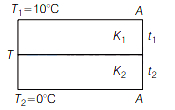
0 likes
View Solution198
DifficultMCQ
$A$ cylindrical copper rod of length $2 \,m$ and cross-sectional area $2 \,cm^2$ is insulated at its curved surface. One end of the rod is maintained in a steam chamber at $100^{\circ} C$ and the other is maintained in ice at $0^{\circ} C$. The thermal conductivity of copper is $386 \,Js^{-1} \,m^{-1} {}^{\circ} C^{-1}$. Find the temperature at a point which is at a distance of $120 \,cm$ from the colder end. (in $^{\circ} C$)
A
$80$
B
$50$
C
$60$
D
$70$
Solution
(C) Given:
Length of the rod $L = 2 \,m = 200 \,cm$.
Temperature at the hot end $\theta_1 = 100^{\circ} C$.
Temperature at the cold end $\theta_2 = 0^{\circ} C$.
Distance from the cold end $x_2 = 120 \,cm$.
Distance from the hot end $x_1 = L - x_2 = 200 \,cm - 120 \,cm = 80 \,cm$.
At steady state,the rate of heat flow $(dQ/dt)$ through any cross-section of the rod is constant.
Since $dQ/dt = KA(\Delta \theta / \Delta x)$,and $K$ and $A$ are constant for the rod,the temperature gradient $(\Delta \theta / \Delta x)$ must be constant throughout the rod.
Therefore,$\frac{\theta_1 - \theta}{x_1} = \frac{\theta - \theta_2}{x_2}$.
Substituting the values:
$\frac{100^{\circ} C - \theta}{80 \,cm} = \frac{\theta - 0^{\circ} C}{120 \,cm}$.
$120(100 - \theta) = 80\theta$.
$12000 - 120\theta = 80\theta$.
$200\theta = 12000$.
$\theta = \frac{12000}{200} = 60^{\circ} C$.
Thus,the temperature at the point is $60^{\circ} C$.
Length of the rod $L = 2 \,m = 200 \,cm$.
Temperature at the hot end $\theta_1 = 100^{\circ} C$.
Temperature at the cold end $\theta_2 = 0^{\circ} C$.
Distance from the cold end $x_2 = 120 \,cm$.
Distance from the hot end $x_1 = L - x_2 = 200 \,cm - 120 \,cm = 80 \,cm$.
At steady state,the rate of heat flow $(dQ/dt)$ through any cross-section of the rod is constant.
Since $dQ/dt = KA(\Delta \theta / \Delta x)$,and $K$ and $A$ are constant for the rod,the temperature gradient $(\Delta \theta / \Delta x)$ must be constant throughout the rod.
Therefore,$\frac{\theta_1 - \theta}{x_1} = \frac{\theta - \theta_2}{x_2}$.
Substituting the values:
$\frac{100^{\circ} C - \theta}{80 \,cm} = \frac{\theta - 0^{\circ} C}{120 \,cm}$.
$120(100 - \theta) = 80\theta$.
$12000 - 120\theta = 80\theta$.
$200\theta = 12000$.
$\theta = \frac{12000}{200} = 60^{\circ} C$.
Thus,the temperature at the point is $60^{\circ} C$.
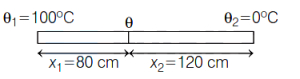
0 likes
View Solution199
DifficultMCQ
$A$ metal rod of length $10 \text{ cm}$ and area of cross-section $2.8 \times 10^{-4} \text{ m}^2$ is covered with a non-conducting substance. One end of it is maintained at $80^{\circ} \text{C}$,while the other end is put in ice at $0^{\circ} \text{C}$. It is found that $20 \text{ g}$ of ice melts in $5 \text{ min}$. The thermal conductivity of the metal in $\text{J s}^{-1} \text{ m}^{-1} \text{ K}^{-1}$ is (Latent heat of ice is $80 \text{ cal g}^{-1}$.)
A
$70$
B
$80$
C
$90$
D
$100$
Solution
(D) Given:
Length of rod,$l = 10 \text{ cm} = 0.1 \text{ m}$
Area of cross-section,$A = 2.8 \times 10^{-4} \text{ m}^2$
Temperature difference,$\Delta T = 80^{\circ} \text{C} - 0^{\circ} \text{C} = 80 \text{ K}$
Mass of melted ice,$m = 20 \text{ g}$
Time taken,$t = 5 \text{ min} = 300 \text{ s}$
Latent heat of ice,$L = 80 \text{ cal/g} = 80 \times 4.184 \text{ J/g} = 334.72 \text{ J/g}$
Heat required to melt ice,$Q = m \times L = 20 \text{ g} \times 334.72 \text{ J/g} = 6694.4 \text{ J}$
Rate of heat flow,$H = \frac{Q}{t} = \frac{6694.4 \text{ J}}{300 \text{ s}} \approx 22.314 \text{ W}$
Using the formula for thermal conduction,$H = \frac{k A \Delta T}{l}$
$22.314 = \frac{k \times (2.8 \times 10^{-4} \text{ m}^2) \times 80 \text{ K}}{0.1 \text{ m}}$
$22.314 = k \times 0.224$
$k = \frac{22.314}{0.224} \approx 99.61 \text{ J s}^{-1} \text{ m}^{-1} \text{ K}^{-1}$
Rounding to the nearest integer,$k \approx 100 \text{ J s}^{-1} \text{ m}^{-1} \text{ K}^{-1}$.
Length of rod,$l = 10 \text{ cm} = 0.1 \text{ m}$
Area of cross-section,$A = 2.8 \times 10^{-4} \text{ m}^2$
Temperature difference,$\Delta T = 80^{\circ} \text{C} - 0^{\circ} \text{C} = 80 \text{ K}$
Mass of melted ice,$m = 20 \text{ g}$
Time taken,$t = 5 \text{ min} = 300 \text{ s}$
Latent heat of ice,$L = 80 \text{ cal/g} = 80 \times 4.184 \text{ J/g} = 334.72 \text{ J/g}$
Heat required to melt ice,$Q = m \times L = 20 \text{ g} \times 334.72 \text{ J/g} = 6694.4 \text{ J}$
Rate of heat flow,$H = \frac{Q}{t} = \frac{6694.4 \text{ J}}{300 \text{ s}} \approx 22.314 \text{ W}$
Using the formula for thermal conduction,$H = \frac{k A \Delta T}{l}$
$22.314 = \frac{k \times (2.8 \times 10^{-4} \text{ m}^2) \times 80 \text{ K}}{0.1 \text{ m}}$
$22.314 = k \times 0.224$
$k = \frac{22.314}{0.224} \approx 99.61 \text{ J s}^{-1} \text{ m}^{-1} \text{ K}^{-1}$
Rounding to the nearest integer,$k \approx 100 \text{ J s}^{-1} \text{ m}^{-1} \text{ K}^{-1}$.
0 likes
View Solution200
DifficultMCQ
The walls of a closed cubical box of edge $60 \text{ cm}$ are made of material of thickness $1 \text{ mm}$ and thermal conductivity $4 \times 10^{-4} \text{ cal s}^{-1} \text{ cm}^{-1} {}^{\circ}\text{C}^{-1}$. The interior of the box is maintained $1000^{\circ}\text{C}$ above the outside temperature by a heater placed inside the box and connected across a $400 \text{ V}$ $DC$ supply. The resistance of the heater is: (in $Omega$)
A
$4.41$
B
$44.1$
C
$0.441$
D
$441$
Solution
(C) The rate of heat flow through the walls of the cube by conduction is given by: $\frac{dQ}{dt} = \frac{kA(T_1 - T_0)}{x}$.
Here,the total surface area $A = 6a^2 = 6 \times (60 \text{ cm})^2 = 6 \times 3600 = 21600 \text{ cm}^2$.
The thickness $x = 1 \text{ mm} = 0.1 \text{ cm}$.
The thermal conductivity $k = 4 \times 10^{-4} \text{ cal s}^{-1} \text{ cm}^{-1} {}^{\circ}\text{C}^{-1}$.
The temperature difference $\Delta T = 1000^{\circ}\text{C}$.
Converting the heat flow rate to $SI$ units (Watts),we multiply by $4.184 \text{ J/cal}$:
$P = \frac{k A \Delta T}{x} \times 4.184 = \frac{4 \times 10^{-4} \times 21600 \times 1000}{0.1} \times 4.184 \text{ W}$.
$P = (4 \times 21600) \times 4.184 = 86400 \times 4.184 \approx 361497.6 \text{ W}$ (Wait,recalculating: $4 \times 10^{-4} \times 21600 \times 1000 / 0.1 = 86400 \text{ cal/s}$. $86400 \times 4.184 = 361497.6 \text{ W}$).
Given $P = V^2/R$,then $R = V^2/P = (400)^2 / 361497.6 = 160000 / 361497.6 \approx 0.4426 \Omega$.
Rounding to the nearest option,the resistance is $0.441 \Omega$.
Here,the total surface area $A = 6a^2 = 6 \times (60 \text{ cm})^2 = 6 \times 3600 = 21600 \text{ cm}^2$.
The thickness $x = 1 \text{ mm} = 0.1 \text{ cm}$.
The thermal conductivity $k = 4 \times 10^{-4} \text{ cal s}^{-1} \text{ cm}^{-1} {}^{\circ}\text{C}^{-1}$.
The temperature difference $\Delta T = 1000^{\circ}\text{C}$.
Converting the heat flow rate to $SI$ units (Watts),we multiply by $4.184 \text{ J/cal}$:
$P = \frac{k A \Delta T}{x} \times 4.184 = \frac{4 \times 10^{-4} \times 21600 \times 1000}{0.1} \times 4.184 \text{ W}$.
$P = (4 \times 21600) \times 4.184 = 86400 \times 4.184 \approx 361497.6 \text{ W}$ (Wait,recalculating: $4 \times 10^{-4} \times 21600 \times 1000 / 0.1 = 86400 \text{ cal/s}$. $86400 \times 4.184 = 361497.6 \text{ W}$).
Given $P = V^2/R$,then $R = V^2/P = (400)^2 / 361497.6 = 160000 / 361497.6 \approx 0.4426 \Omega$.
Rounding to the nearest option,the resistance is $0.441 \Omega$.
0 likes
View Solution10-2.Heat Transfer — Heat Conduction and Thermal Conductivity · Frequently Asked Questions
1Are these 10-2.Heat Transfer questions useful for JEE and NEET?
Yes. All questions in this section are mapped to JEE Main and NEET exam patterns. Previous year questions from JEE Main, NEET, GUJCET and state-level exams are included with full solutions.
2Can I switch to Hindi or Gujarati for these questions?
Yes. Use the language tabs in the hero section or the sidebar to view the same questions and solutions in English, Hindi or Gujarati.
3How do I generate a question paper from this subtopic?
Use the Vedclass Exam Paper Generator — select the chapter and subtopic, set difficulty, and generate Sets A, B, C, D automatically. First 3 chapters of every subject are free.
Vedclass Products
For Students
Vedclass Test Series
Mock tests in real JEE/NEET style with performance analysis. 5-day free trial.
Start Free TrialFor Teachers
Exam Paper Generator
Generate Set A/B/C/D papers from this chapter in 2 minutes. 3 chapters free.
Try FreeFor Institutes
Online Exam Module
Live online exams with unlimited students, 360° analytics & white-label branding.
See DemoFor Teachers & Institutes
Generate a 10-2.Heat Transfer Exam Paper in 2 Minutes
Select subtopic & difficulty — Sets A, B, C, D auto-generated with No Repeat logic.
First 3 chapters of every subject are free — no payment required.