
A English
Heat Conduction and Thermal Conductivity Questions in English
Class 11 Physics · 10-2.Heat Transfer · Heat Conduction and Thermal Conductivity
223+
Questions
English
Language
100%
With Solutions
Showing 22 of 223 questions in English
201
DifficultMCQ
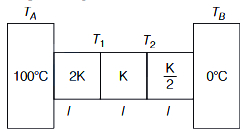
Three rods each of length $l$ and cross-sectional area $A$ are joined in series between two heat reservoirs as shown in the figure. Their thermal conductivities are $2K$,$K$,and $\frac{K}{2}$,respectively. Assuming that the conductors are insulated from the surroundings,the temperatures $T_1$ and $T_2$ of the junctions in the steady-state condition are,respectively:
A
$\frac{600}{7} {}^{\circ}C, \frac{400}{7} {}^{\circ}C$
B
$\frac{600}{7} {}^{\circ}C, \frac{700}{4} {}^{\circ}C$
C
$\frac{500}{6} {}^{\circ}C, \frac{600}{5} {}^{\circ}C$
D
$\frac{600}{4} {}^{\circ}C, \frac{400}{7} {}^{\circ}C$
Solution
(A) In a series combination of heat conductors,the rate of heat flow $(H)$ remains constant through each rod.
$H = \frac{dQ}{dt} = \frac{kA(T_{high} - T_{low})}{l}$
Since $A$ and $l$ are the same for all three rods,the heat current $H$ is proportional to $k \Delta T$.
Let $H$ be the steady heat current. Then:
$H = \frac{(2K)A(100 - T_1)}{l} = \frac{KA(T_1 - T_2)}{l} = \frac{(K/2)A(T_2 - 0)}{l}$
Canceling $\frac{KA}{l}$ from all parts:
$2(100 - T_1) = (T_1 - T_2) = 0.5 T_2$
From the second and third parts:
$T_1 - T_2 = 0.5 T_2 \Rightarrow T_1 = 1.5 T_2 = \frac{3}{2} T_2$
From the first and second parts:
$2(100 - T_1) = T_1 - T_2$
$200 - 2T_1 = T_1 - T_2$
$200 = 3T_1 - T_2$
Substitute $T_1 = \frac{3}{2} T_2$ into the equation:
$200 = 3(\frac{3}{2} T_2) - T_2$
$200 = \frac{9}{2} T_2 - T_2 = \frac{7}{2} T_2$
$T_2 = \frac{400}{7} {}^{\circ}C$
Now,find $T_1$:
$T_1 = \frac{3}{2} (\frac{400}{7}) = \frac{600}{7} {}^{\circ}C$
Thus,the temperatures are $T_1 = \frac{600}{7} {}^{\circ}C$ and $T_2 = \frac{400}{7} {}^{\circ}C$.
$H = \frac{dQ}{dt} = \frac{kA(T_{high} - T_{low})}{l}$
Since $A$ and $l$ are the same for all three rods,the heat current $H$ is proportional to $k \Delta T$.
Let $H$ be the steady heat current. Then:
$H = \frac{(2K)A(100 - T_1)}{l} = \frac{KA(T_1 - T_2)}{l} = \frac{(K/2)A(T_2 - 0)}{l}$
Canceling $\frac{KA}{l}$ from all parts:
$2(100 - T_1) = (T_1 - T_2) = 0.5 T_2$
From the second and third parts:
$T_1 - T_2 = 0.5 T_2 \Rightarrow T_1 = 1.5 T_2 = \frac{3}{2} T_2$
From the first and second parts:
$2(100 - T_1) = T_1 - T_2$
$200 - 2T_1 = T_1 - T_2$
$200 = 3T_1 - T_2$
Substitute $T_1 = \frac{3}{2} T_2$ into the equation:
$200 = 3(\frac{3}{2} T_2) - T_2$
$200 = \frac{9}{2} T_2 - T_2 = \frac{7}{2} T_2$
$T_2 = \frac{400}{7} {}^{\circ}C$
Now,find $T_1$:
$T_1 = \frac{3}{2} (\frac{400}{7}) = \frac{600}{7} {}^{\circ}C$
Thus,the temperatures are $T_1 = \frac{600}{7} {}^{\circ}C$ and $T_2 = \frac{400}{7} {}^{\circ}C$.

0 likes
View Solution202
DifficultMCQ
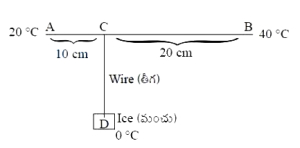
In the figure shown,$AB$ is a rod of length $30 \ cm$,area of cross-section $1 \ cm^2$ and thermal conductivity $336 \ SI$ units. The ends $A$ and $B$ are at constant temperatures $20^{\circ} C$ and $40^{\circ} C$ respectively. $A$ point $C$ of the rod is connected to ice at $0^{\circ} C$ in a thermally insulated box $D$ through a highly conducting wire of negligible heat capacity. The rate at which ice melts in the box is $\left(L_{ice}=80 \ cal \ g^{-1}\right)$.
A
$84 \ mg \ s^{-1}$
B
$84 \ g \ s^{-1}$
C
$20 \ mg \ s^{-1}$
D
$40 \ mg \ s^{-1}$
Solution
(D) Let the temperature of point $C$ be $T$. The heat current from $A$ to $C$ is $H_1 = \frac{KA(T_A - T)}{l_1} = \frac{336 \times 10^{-4} \times (20 - T)}{0.1}$.
The heat current from $B$ to $C$ is $H_2 = \frac{KA(T_B - T)}{l_2} = \frac{336 \times 10^{-4} \times (40 - T)}{0.2}$.
The heat current flowing into the ice box is $H = H_1 + H_2 = \frac{KA(T - 0)}{0} \rightarrow \infty$ (since the wire is highly conducting,$T$ must be $0^{\circ} C$).
Thus,$H = \frac{336 \times 10^{-4} \times 20}{0.1} + \frac{336 \times 10^{-4} \times 40}{0.2} = 0.0672 + 0.0672 = 0.1344 \ J/s = 0.1344 \ W$.
Converting to $cal/s$: $H = \frac{0.1344}{4.2} \approx 0.032 \ cal/s$.
Rate of melting $dm/dt = \frac{H}{L_{ice}} = \frac{0.032}{80} = 0.0004 \ g/s = 0.4 \ mg/s$.
Wait,re-evaluating: $H_1 = 336 \times 10^{-4} \times (20-0)/0.1 = 0.0672 \ W$. $H_2 = 336 \times 10^{-4} \times (40-0)/0.2 = 0.0672 \ W$. Total $H = 0.1344 \ W$. $0.1344 \ J/s = 0.1344/4.2 = 0.032 \ cal/s$. $dm/dt = 0.032/80 = 0.0004 \ g/s = 0.4 \ mg/s$. Given the options,there might be a unit conversion factor or value mismatch in the question source. Recalculating with $K=336$ in $W/mK$: $H = 0.0336 \times (20/0.1 + 40/0.2) = 0.0336 \times (200 + 200) = 13.44 \ W$. $H = 13.44/4.2 = 3.2 \ cal/s$. $dm/dt = 3.2/80 = 0.04 \ g/s = 40 \ mg/s$. Correct option is $D$.
The heat current from $B$ to $C$ is $H_2 = \frac{KA(T_B - T)}{l_2} = \frac{336 \times 10^{-4} \times (40 - T)}{0.2}$.
The heat current flowing into the ice box is $H = H_1 + H_2 = \frac{KA(T - 0)}{0} \rightarrow \infty$ (since the wire is highly conducting,$T$ must be $0^{\circ} C$).
Thus,$H = \frac{336 \times 10^{-4} \times 20}{0.1} + \frac{336 \times 10^{-4} \times 40}{0.2} = 0.0672 + 0.0672 = 0.1344 \ J/s = 0.1344 \ W$.
Converting to $cal/s$: $H = \frac{0.1344}{4.2} \approx 0.032 \ cal/s$.
Rate of melting $dm/dt = \frac{H}{L_{ice}} = \frac{0.032}{80} = 0.0004 \ g/s = 0.4 \ mg/s$.
Wait,re-evaluating: $H_1 = 336 \times 10^{-4} \times (20-0)/0.1 = 0.0672 \ W$. $H_2 = 336 \times 10^{-4} \times (40-0)/0.2 = 0.0672 \ W$. Total $H = 0.1344 \ W$. $0.1344 \ J/s = 0.1344/4.2 = 0.032 \ cal/s$. $dm/dt = 0.032/80 = 0.0004 \ g/s = 0.4 \ mg/s$. Given the options,there might be a unit conversion factor or value mismatch in the question source. Recalculating with $K=336$ in $W/mK$: $H = 0.0336 \times (20/0.1 + 40/0.2) = 0.0336 \times (200 + 200) = 13.44 \ W$. $H = 13.44/4.2 = 3.2 \ cal/s$. $dm/dt = 3.2/80 = 0.04 \ g/s = 40 \ mg/s$. Correct option is $D$.
0 likes
View Solution203
EasyMCQ
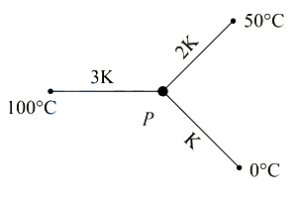
Three rods of same dimensions have thermal conductivities $3K, 2K$ and $K$. They are arranged as shown in the figure. In the steady state,the temperature of the junction $P$ is:
A
$\frac{200}{3}^{\circ}C$
B
$\frac{100}{3}^{\circ}C$
C
$75^{\circ}C$
D
$\frac{50}{3}^{\circ}C$
Solution
(A) The rate of heat flow through a rod is given by $Q = \frac{KA\Delta T}{L}$.
Since the rods have the same dimensions ($A$ and $L$ are constant),the heat current is proportional to the thermal conductivity $K$.
At the junction $P$,by the principle of conservation of energy in steady state,the heat flowing into the junction must equal the heat flowing out of the junction.
Let $T$ be the temperature at junction $P$.
Heat flowing from $100^{\circ}C$ to $P$ = Heat flowing from $P$ to $50^{\circ}C$ + Heat flowing from $P$ to $0^{\circ}C$.
$\frac{3K A (100 - T)}{L} = \frac{2K A (T - 50)}{L} + \frac{K A (T - 0)}{L}$
Canceling $\frac{KA}{L}$ from both sides:
$3(100 - T) = 2(T - 50) + T$
$300 - 3T = 2T - 100 + T$
$300 - 3T = 3T - 100$
$400 = 6T$
$T = \frac{400}{6} = \frac{200}{3}^{\circ}C$.
Since the rods have the same dimensions ($A$ and $L$ are constant),the heat current is proportional to the thermal conductivity $K$.
At the junction $P$,by the principle of conservation of energy in steady state,the heat flowing into the junction must equal the heat flowing out of the junction.
Let $T$ be the temperature at junction $P$.
Heat flowing from $100^{\circ}C$ to $P$ = Heat flowing from $P$ to $50^{\circ}C$ + Heat flowing from $P$ to $0^{\circ}C$.
$\frac{3K A (100 - T)}{L} = \frac{2K A (T - 50)}{L} + \frac{K A (T - 0)}{L}$
Canceling $\frac{KA}{L}$ from both sides:
$3(100 - T) = 2(T - 50) + T$
$300 - 3T = 2T - 100 + T$
$300 - 3T = 3T - 100$
$400 = 6T$
$T = \frac{400}{6} = \frac{200}{3}^{\circ}C$.
0 likes
View Solution204
MediumMCQ
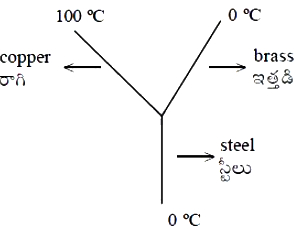
Three metal rods made of copper, brass, and steel, each with a cross-sectional area of $4 \,cm^2$, are joined as shown in the figure. Their lengths are $46 \,cm, 13 \,cm$, and $12 \,cm$ respectively. Their coefficients of thermal conductivity are $0.92, 0.26$, and $0.12$ respectively, all in $CGS$ units. The rods are thermally insulated from the surroundings except at the ends. The rate of flow of heat through the copper rod, in $cal \,s^{-1}$, is:
A
$2.4$
B
$6.0$
C
$4.8$
D
$8.2$
Solution
(C) Let the temperature of the junction be $T$. The rate of heat flow is given by $H = \frac{KA(T_1 - T_2)}{L}$.
Since the rods are joined at a junction, the sum of heat currents flowing away from the junction must be zero: $H_{Cu} + H_{Br} + H_{St} = 0$.
Given: $A = 4 \,cm^2$ for all rods.
$H_{Cu} = \frac{0.92 \times 4 \times (T - 100)}{46} = 0.08(T - 100)$
$H_{Br} = \frac{0.26 \times 4 \times (T - 0)}{13} = 0.08T$
$H_{St} = \frac{0.12 \times 4 \times (T - 0)}{12} = 0.04T$
Summing these: $0.08(T - 100) + 0.08T + 0.04T = 0$
$0.08T - 8 + 0.08T + 0.04T = 0$
$0.20T = 8 \implies T = 40 \,^{\circ}C$.
The rate of heat flow through the copper rod is $H_{Cu} = 0.08(40 - 100) = 0.08(-60) = -4.8 \,cal \,s^{-1}$.
The magnitude of the rate of heat flow is $4.8 \,cal \,s^{-1}$.
Since the rods are joined at a junction, the sum of heat currents flowing away from the junction must be zero: $H_{Cu} + H_{Br} + H_{St} = 0$.
Given: $A = 4 \,cm^2$ for all rods.
$H_{Cu} = \frac{0.92 \times 4 \times (T - 100)}{46} = 0.08(T - 100)$
$H_{Br} = \frac{0.26 \times 4 \times (T - 0)}{13} = 0.08T$
$H_{St} = \frac{0.12 \times 4 \times (T - 0)}{12} = 0.04T$
Summing these: $0.08(T - 100) + 0.08T + 0.04T = 0$
$0.08T - 8 + 0.08T + 0.04T = 0$
$0.20T = 8 \implies T = 40 \,^{\circ}C$.
The rate of heat flow through the copper rod is $H_{Cu} = 0.08(40 - 100) = 0.08(-60) = -4.8 \,cal \,s^{-1}$.
The magnitude of the rate of heat flow is $4.8 \,cal \,s^{-1}$.
0 likes
View Solution205
DifficultMCQ
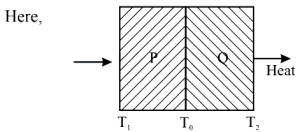
$A$ wall is made of equally thick layers $P$ and $Q$ of different materials. The thermal conductivity of $Q$ is half of that of $P$. In the steady state,if the temperature difference across the wall is $24^{\circ} C$,then the temperature difference across the layer $P$ is ............... . (in $^{\circ} C$)
A
$12$
B
$16$
C
$4$
D
$8$
Solution
(D) In the steady state,the rate of heat flow through layers $P$ and $Q$ is the same.
Let $K_P$ and $K_Q$ be the thermal conductivities,$x$ be the thickness of each layer,and $A$ be the cross-sectional area.
Given: $K_Q = \frac{K_P}{2} \Rightarrow K_P = 2K_Q$.
The rate of heat flow is given by $\frac{dQ}{dt} = \frac{KA \Delta T}{x}$.
Since the heat flow is the same: $\frac{K_P A (T_1 - T_0)}{x} = \frac{K_Q A (T_0 - T_2)}{x}$.
Substituting $K_P = 2K_Q$: $2K_Q (T_1 - T_0) = K_Q (T_0 - T_2)$.
$2(T_1 - T_0) = (T_0 - T_2) \Rightarrow T_0 - T_2 = 2(T_1 - T_0)$.
The total temperature difference across the wall is $(T_1 - T_2) = 24^{\circ} C$.
We can write $(T_1 - T_2) = (T_1 - T_0) + (T_0 - T_2) = 24^{\circ} C$.
Substituting $(T_0 - T_2) = 2(T_1 - T_0)$:
$(T_1 - T_0) + 2(T_1 - T_0) = 24^{\circ} C$.
$3(T_1 - T_0) = 24^{\circ} C$.
$(T_1 - T_0) = 8^{\circ} C$.
Thus,the temperature difference across layer $P$ is $8^{\circ} C$.
Let $K_P$ and $K_Q$ be the thermal conductivities,$x$ be the thickness of each layer,and $A$ be the cross-sectional area.
Given: $K_Q = \frac{K_P}{2} \Rightarrow K_P = 2K_Q$.
The rate of heat flow is given by $\frac{dQ}{dt} = \frac{KA \Delta T}{x}$.
Since the heat flow is the same: $\frac{K_P A (T_1 - T_0)}{x} = \frac{K_Q A (T_0 - T_2)}{x}$.
Substituting $K_P = 2K_Q$: $2K_Q (T_1 - T_0) = K_Q (T_0 - T_2)$.
$2(T_1 - T_0) = (T_0 - T_2) \Rightarrow T_0 - T_2 = 2(T_1 - T_0)$.
The total temperature difference across the wall is $(T_1 - T_2) = 24^{\circ} C$.
We can write $(T_1 - T_2) = (T_1 - T_0) + (T_0 - T_2) = 24^{\circ} C$.
Substituting $(T_0 - T_2) = 2(T_1 - T_0)$:
$(T_1 - T_0) + 2(T_1 - T_0) = 24^{\circ} C$.
$3(T_1 - T_0) = 24^{\circ} C$.
$(T_1 - T_0) = 8^{\circ} C$.
Thus,the temperature difference across layer $P$ is $8^{\circ} C$.
0 likes
View Solution206
DifficultMCQ
Two closed containers of same dimensions made of different materials are completely filled with ice. The ice in the first container takes $20 \ min$ and that in the second container takes $10 \ min$,respectively,for complete melting. The ratio of the thermal conductivities of the materials of the two containers is . . . . . . .
A
$1: 2$
B
$2: 1$
C
$3: 1$
D
$1: 3$
Solution
(A) The rate of heat flow $H$ through a material is given by $H = \frac{KA \Delta T}{d}$,where $K$ is the thermal conductivity,$A$ is the surface area,$\Delta T$ is the temperature difference,and $d$ is the thickness of the container wall.
Since the containers have the same dimensions,$A$ and $d$ are constant. Assuming the temperature difference $\Delta T$ is the same for both,the rate of heat flow is proportional to the thermal conductivity: $H \propto K$.
The total heat required to melt the ice is $Q = mL$,where $m$ is the mass of ice and $L$ is the latent heat of fusion. Since both containers are of the same dimensions and filled with ice,$m$ is the same for both.
The rate of heat flow is also $H = \frac{Q}{t} = \frac{mL}{t}$,so $H \propto \frac{1}{t}$.
Equating the two proportionalities,we get $K \propto \frac{1}{t}$.
Therefore,$\frac{K_1}{K_2} = \frac{t_2}{t_1}$.
Given $t_1 = 20 \ min$ and $t_2 = 10 \ min$,we have $\frac{K_1}{K_2} = \frac{10}{20} = \frac{1}{2}$.
The ratio of the thermal conductivities is $1: 2$.
Since the containers have the same dimensions,$A$ and $d$ are constant. Assuming the temperature difference $\Delta T$ is the same for both,the rate of heat flow is proportional to the thermal conductivity: $H \propto K$.
The total heat required to melt the ice is $Q = mL$,where $m$ is the mass of ice and $L$ is the latent heat of fusion. Since both containers are of the same dimensions and filled with ice,$m$ is the same for both.
The rate of heat flow is also $H = \frac{Q}{t} = \frac{mL}{t}$,so $H \propto \frac{1}{t}$.
Equating the two proportionalities,we get $K \propto \frac{1}{t}$.
Therefore,$\frac{K_1}{K_2} = \frac{t_2}{t_1}$.
Given $t_1 = 20 \ min$ and $t_2 = 10 \ min$,we have $\frac{K_1}{K_2} = \frac{10}{20} = \frac{1}{2}$.
The ratio of the thermal conductivities is $1: 2$.
0 likes
View Solution207
MediumMCQ
The temperature difference across two cylindrical rods $A$ and $B$ of the same material and same mass are $40^{\circ} C$ and $60^{\circ} C$ respectively. In steady state,if the rates of flow of heat through the rods $A$ and $B$ are in the ratio $3: 8$,the ratio of the lengths of the rods $A$ and $B$ is (in $: 3$)
A
$1$
B
$5$
C
$4$
D
$2$
Solution
(C) The rate of heat flow is given by $H = \frac{kA \Delta T}{l}$.
Given for rod $A$: $\Delta T_A = 40^{\circ} C$,and for rod $B$: $\Delta T_B = 60^{\circ} C$.
The ratio of heat flow rates is $\frac{H_A}{H_B} = \frac{3}{8}$.
Since the rods are of the same material,$k_A = k_B = k$.
Thus,$\frac{H_A}{H_B} = \frac{A_A \Delta T_A / l_A}{A_B \Delta T_B / l_B} = \frac{A_A}{A_B} \cdot \frac{l_B}{l_A} \cdot \frac{40}{60} = \frac{3}{8}$ ....$(i)$
Since the rods have the same mass and same material,their volumes are equal: $V_A = V_B \Rightarrow A_A l_A = A_B l_B \Rightarrow \frac{A_A}{A_B} = \frac{l_B}{l_A}$ ....(ii)
Substituting (ii) into $(i)$: $\left(\frac{l_B}{l_A}\right) \cdot \left(\frac{l_B}{l_A}\right) \cdot \left(\frac{40}{60}\right) = \frac{3}{8}$.
$\left(\frac{l_B}{l_A}\right)^2 \cdot \frac{2}{3} = \frac{3}{8} \Rightarrow \left(\frac{l_B}{l_A}\right)^2 = \frac{3}{8} \cdot \frac{3}{2} = \frac{9}{16}$.
Taking the square root,$\frac{l_B}{l_A} = \frac{3}{4}$.
Therefore,the ratio of lengths $l_A : l_B = 4 : 3$.
Given for rod $A$: $\Delta T_A = 40^{\circ} C$,and for rod $B$: $\Delta T_B = 60^{\circ} C$.
The ratio of heat flow rates is $\frac{H_A}{H_B} = \frac{3}{8}$.
Since the rods are of the same material,$k_A = k_B = k$.
Thus,$\frac{H_A}{H_B} = \frac{A_A \Delta T_A / l_A}{A_B \Delta T_B / l_B} = \frac{A_A}{A_B} \cdot \frac{l_B}{l_A} \cdot \frac{40}{60} = \frac{3}{8}$ ....$(i)$
Since the rods have the same mass and same material,their volumes are equal: $V_A = V_B \Rightarrow A_A l_A = A_B l_B \Rightarrow \frac{A_A}{A_B} = \frac{l_B}{l_A}$ ....(ii)
Substituting (ii) into $(i)$: $\left(\frac{l_B}{l_A}\right) \cdot \left(\frac{l_B}{l_A}\right) \cdot \left(\frac{40}{60}\right) = \frac{3}{8}$.
$\left(\frac{l_B}{l_A}\right)^2 \cdot \frac{2}{3} = \frac{3}{8} \Rightarrow \left(\frac{l_B}{l_A}\right)^2 = \frac{3}{8} \cdot \frac{3}{2} = \frac{9}{16}$.
Taking the square root,$\frac{l_B}{l_A} = \frac{3}{4}$.
Therefore,the ratio of lengths $l_A : l_B = 4 : 3$.
0 likes
View Solution208
MediumMCQ
$A$ rectangular ice box of total surface area of $1000 \,cm^2$ initially contains $1.5 \,kg$ of ice at $0^{\circ}C$. If the thickness of the walls of the box is $2 \,mm$ and the temperature outside the box is $42^{\circ}C$, then the mass of the ice remaining in the box after $160 \,minutes$ is (Thermal conductivity of the material of the box $= 10^{-2} \,W m^{-1} K^{-1}$ and latent heat of the fusion of ice $= 336 \times 10^3 \,J kg^{-1}$) (in $kg$)
A
$0.6$
B
$0.9$
C
$0.8$
D
$0.7$
Solution
(B) The rate of heat flow $dQ/dt$ through the walls is given by the formula: $dQ/dt = (K \cdot A \cdot \Delta T) / d$.
Here, $K = 10^{-2} \,W m^{-1} K^{-1}$, $A = 1000 \,cm^2 = 0.1 \,m^2$, $\Delta T = 42^{\circ}C - 0^{\circ}C = 42 \,K$, and $d = 2 \,mm = 2 \times 10^{-3} \,m$.
Substituting these values: $dQ/dt = (10^{-2} \times 0.1 \times 42) / (2 \times 10^{-3}) = (4.2 \times 10^{-2}) / (2 \times 10^{-3}) = 21 \,W$ (or $21 \,J/s$).
Total time $t = 160 \,minutes = 160 \times 60 \,s = 9600 \,s$.
Total heat transferred $Q = (dQ/dt) \times t = 21 \times 9600 = 201600 \,J$.
Mass of ice melted $m_{melted} = Q / L$, where $L = 336 \times 10^3 \,J/kg$.
$m_{melted} = 201600 / (336 \times 10^3) = 0.6 \,kg$.
Mass of ice remaining = Initial mass - Mass melted = $1.5 \,kg - 0.6 \,kg = 0.9 \,kg$.
Here, $K = 10^{-2} \,W m^{-1} K^{-1}$, $A = 1000 \,cm^2 = 0.1 \,m^2$, $\Delta T = 42^{\circ}C - 0^{\circ}C = 42 \,K$, and $d = 2 \,mm = 2 \times 10^{-3} \,m$.
Substituting these values: $dQ/dt = (10^{-2} \times 0.1 \times 42) / (2 \times 10^{-3}) = (4.2 \times 10^{-2}) / (2 \times 10^{-3}) = 21 \,W$ (or $21 \,J/s$).
Total time $t = 160 \,minutes = 160 \times 60 \,s = 9600 \,s$.
Total heat transferred $Q = (dQ/dt) \times t = 21 \times 9600 = 201600 \,J$.
Mass of ice melted $m_{melted} = Q / L$, where $L = 336 \times 10^3 \,J/kg$.
$m_{melted} = 201600 / (336 \times 10^3) = 0.6 \,kg$.
Mass of ice remaining = Initial mass - Mass melted = $1.5 \,kg - 0.6 \,kg = 0.9 \,kg$.
0 likes
View Solution209
MediumMCQ
The length of a metal rod is $20 \ cm$ and its area of cross-section is $4 \ cm^2$. If one end of the rod is kept at a temperature of $100^{\circ} C$ and the other end is kept in ice at $0^{\circ} C$,then the mass of the ice melted in $7 \ minutes$ is (Thermal conductivity of the metal $= 90 \ W \ m^{-1} \ K^{-1}$ and latent heat of fusion of ice $= 336 \times 10^3 \ J \ kg^{-1}$) (in $g$)
A
$20$
B
$67.5$
C
$22.5$
D
$45$
Solution
(C) The rate of heat flow $H$ through the rod is given by the formula: $H = \frac{KA(T_1 - T_2)}{L}$.
Given: $K = 90 \ W \ m^{-1} \ K^{-1}$,$A = 4 \ cm^2 = 4 \times 10^{-4} \ m^2$,$L = 20 \ cm = 0.2 \ m$,$T_1 = 100^{\circ} C$,$T_2 = 0^{\circ} C$.
Substituting the values: $H = \frac{90 \times 4 \times 10^{-4} \times (100 - 0)}{0.2} = \frac{90 \times 4 \times 10^{-4} \times 100}{0.2} = \frac{3.6}{0.2} = 18 \ J/s$.
Total heat $Q$ transferred in time $t = 7 \ minutes = 7 \times 60 = 420 \ s$ is: $Q = H \times t = 18 \times 420 = 7560 \ J$.
The mass of ice melted $m$ is given by $Q = mL_f$,where $L_f = 336 \times 10^3 \ J/kg$.
$m = \frac{Q}{L_f} = \frac{7560}{336 \times 10^3} = 0.0225 \ kg = 22.5 \ g$.
Given: $K = 90 \ W \ m^{-1} \ K^{-1}$,$A = 4 \ cm^2 = 4 \times 10^{-4} \ m^2$,$L = 20 \ cm = 0.2 \ m$,$T_1 = 100^{\circ} C$,$T_2 = 0^{\circ} C$.
Substituting the values: $H = \frac{90 \times 4 \times 10^{-4} \times (100 - 0)}{0.2} = \frac{90 \times 4 \times 10^{-4} \times 100}{0.2} = \frac{3.6}{0.2} = 18 \ J/s$.
Total heat $Q$ transferred in time $t = 7 \ minutes = 7 \times 60 = 420 \ s$ is: $Q = H \times t = 18 \times 420 = 7560 \ J$.
The mass of ice melted $m$ is given by $Q = mL_f$,where $L_f = 336 \times 10^3 \ J/kg$.
$m = \frac{Q}{L_f} = \frac{7560}{336 \times 10^3} = 0.0225 \ kg = 22.5 \ g$.
0 likes
View Solution210
EasyMCQ
The thickness of a uniform rectangular metal plate is $5 \ mm$ and the area of each surface is $5 \ cm^2$. In steady state,the temperature difference between the two surfaces of the plate is $14^{\circ} C$. If the heat flowing through the plate in one second from one surface to the other surface is $42 \ J$,then the thermal conductivity of the metal is
A
$90 \ W \ m^{-1} \ K^{-1}$
B
$30 \ W \ m^{-1} \ K^{-1}$
C
$45 \ W \ m^{-1} \ K^{-1}$
D
$60 \ W \ m^{-1} \ K^{-1}$
Solution
(B) Given: Thickness $\Delta x = 5 \ mm = 5 \times 10^{-3} \ m$,Area $A = 5 \ cm^2 = 5 \times 10^{-4} \ m^2$,Temperature difference $\Delta T = 14^{\circ} C$,Heat flow rate $Q = 42 \ J/s = 42 \ W$.
The formula for heat conduction in steady state is $Q = \frac{K A \Delta T}{\Delta x}$.
Rearranging for thermal conductivity $K$: $K = \frac{Q \Delta x}{A \Delta T}$.
Substituting the values: $K = \frac{42 \times 5 \times 10^{-3}}{5 \times 10^{-4} \times 14}$.
Simplifying the expression: $K = \frac{42 \times 10^{-3}}{10^{-4} \times 14} = \frac{3 \times 10^{-3}}{10^{-4}} = 3 \times 10 = 30 \ W \ m^{-1} \ K^{-1}$.
The formula for heat conduction in steady state is $Q = \frac{K A \Delta T}{\Delta x}$.
Rearranging for thermal conductivity $K$: $K = \frac{Q \Delta x}{A \Delta T}$.
Substituting the values: $K = \frac{42 \times 5 \times 10^{-3}}{5 \times 10^{-4} \times 14}$.
Simplifying the expression: $K = \frac{42 \times 10^{-3}}{10^{-4} \times 14} = \frac{3 \times 10^{-3}}{10^{-4}} = 3 \times 10 = 30 \ W \ m^{-1} \ K^{-1}$.
0 likes
View Solution211
EasyMCQ
$A$ metal cooking pot has a base area of $0.2 \,m^2$ and a thickness of $2.0 \,cm$. It boils water at a rate of $3.0 \,kg/min$ when placed on a hot plate. What is the temperature of the part of the hot plate in contact with the pot (in $^{\circ} C$)? [Thermal conductivity of metal is $120 \,J s^{-1} m^{-1} K^{-1}$,latent heat of vaporisation of water is $2 \times 10^6 \,J/kg$]
A
$246$
B
$183$
C
$162$
D
$214$
Solution
(B) Given: Area $A = 0.2 \,m^2$,thickness $d = 2.0 \,cm = 0.02 \,m$,thermal conductivity $K = 120 \,J s^{-1} m^{-1} K^{-1}$,latent heat $L = 2 \times 10^6 \,J/kg$,and rate of boiling $dm/dt = 3.0 \,kg/min = 3.0/60 \,kg/s = 0.05 \,kg/s$.
The rate of heat transfer through the base of the pot is given by the conduction formula: $\frac{dQ}{dt} = \frac{KA(T - T_{water})}{d}$.
The rate of heat required to boil water is: $\frac{dQ}{dt} = L \frac{dm}{dt}$.
Equating the two: $\frac{KA}{d} (T - 100) = L \frac{dm}{dt}$.
Substituting the values: $\frac{120 \times 0.2}{0.02} (T - 100) = (2 \times 10^6) \times 0.05$.
$1200 (T - 100) = 100,000$.
$T - 100 = \frac{100,000}{1200} = 83.33$.
$T \approx 183.33^{\circ} C$. Thus,the temperature is approximately $183^{\circ} C$.
The rate of heat transfer through the base of the pot is given by the conduction formula: $\frac{dQ}{dt} = \frac{KA(T - T_{water})}{d}$.
The rate of heat required to boil water is: $\frac{dQ}{dt} = L \frac{dm}{dt}$.
Equating the two: $\frac{KA}{d} (T - 100) = L \frac{dm}{dt}$.
Substituting the values: $\frac{120 \times 0.2}{0.02} (T - 100) = (2 \times 10^6) \times 0.05$.
$1200 (T - 100) = 100,000$.
$T - 100 = \frac{100,000}{1200} = 83.33$.
$T \approx 183.33^{\circ} C$. Thus,the temperature is approximately $183^{\circ} C$.
0 likes
View Solution212
MediumMCQ
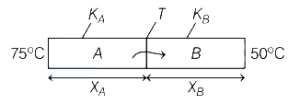
$A$ composite slab is prepared with two different materials $A$ and $B$. The relation between their coefficients of thermal conductivity and thickness is given as $K_A = \frac{K_B}{2}$ and $X_A = 2 X_B$,respectively. If the temperatures of the outer faces of $A$ and $B$ are $75^{\circ} C$ and $50^{\circ} C$ respectively,what will be the temperature of the common surface (in $^{\circ} C$)?
A
$75$
B
$50$
C
$55$
D
$125$
Solution
(C) In a steady state,the rate of heat flow through materials $A$ and $B$ must be equal.
Let $T$ be the temperature of the common surface.
The rate of heat flow $Q$ is given by $Q = \frac{KA \Delta T}{X}$. Assuming the cross-sectional area $A$ is the same for both slabs,we have:
$Q_A = Q_B$
$\frac{K_A (75^{\circ} C - T)}{X_A} = \frac{K_B (T - 50^{\circ} C)}{X_B}$
Given $K_A = \frac{K_B}{2}$ and $X_A = 2 X_B$,we substitute these values into the equation:
$\frac{(K_B / 2) (75^{\circ} C - T)}{2 X_B} = \frac{K_B (T - 50^{\circ} C)}{X_B}$
$\frac{75^{\circ} C - T}{4} = T - 50^{\circ} C$
$75^{\circ} C - T = 4T - 200^{\circ} C$
$5T = 275^{\circ} C$
$T = 55^{\circ} C$
Thus,the temperature of the common surface is $55^{\circ} C$.
Let $T$ be the temperature of the common surface.
The rate of heat flow $Q$ is given by $Q = \frac{KA \Delta T}{X}$. Assuming the cross-sectional area $A$ is the same for both slabs,we have:
$Q_A = Q_B$
$\frac{K_A (75^{\circ} C - T)}{X_A} = \frac{K_B (T - 50^{\circ} C)}{X_B}$
Given $K_A = \frac{K_B}{2}$ and $X_A = 2 X_B$,we substitute these values into the equation:
$\frac{(K_B / 2) (75^{\circ} C - T)}{2 X_B} = \frac{K_B (T - 50^{\circ} C)}{X_B}$
$\frac{75^{\circ} C - T}{4} = T - 50^{\circ} C$
$75^{\circ} C - T = 4T - 200^{\circ} C$
$5T = 275^{\circ} C$
$T = 55^{\circ} C$
Thus,the temperature of the common surface is $55^{\circ} C$.
0 likes
View Solution213
EasyMCQ
Two identical long bars $A$ and $B$ made of different materials are coated with wax and have one end immersed in a hot oil bath. When the steady state is reached,the lengths for which the wax melts are $l_A$ and $l_B$. If $k_A$ and $k_B$ are the thermal conductivities of the materials,then:
A
$\frac{k_A}{k_B} = \sqrt{\frac{l_A}{l_B}}$
B
$\frac{k_A}{k_B} = \frac{l_B}{l_A}$
C
$\frac{k_A}{k_B} = \frac{l_A^2}{l_B^2}$
D
$\frac{k_A}{k_B} = \frac{l_B^2}{l_A^2}$
Solution
(C) In the steady state,the heat conducted through the bar is lost to the surroundings through the surface of the bar by convection and radiation. Let $P$ be the perimeter of the bars and $h$ be the heat transfer coefficient. The heat flow rate at a distance $x$ from the hot end is $q = -kA \frac{dT}{dx}$.
The heat lost by the element $dx$ to the surroundings is $dQ = hP(T - T_0) dx$.
In steady state,the heat balance equation is $-kA \frac{d^2T}{dx^2} = hP(T - T_0)$.
Let $\theta = T - T_0$,then $\frac{d^2\theta}{dx^2} = \frac{hP}{kA} \theta$. The solution is $\theta = \theta_0 e^{-mx}$,where $m = \sqrt{\frac{hP}{kA}}$.
The wax melts up to a length $l$ where the temperature $\theta$ reaches the melting point $\theta_m$. Thus,$\theta_m = \theta_0 e^{-ml}$.
Since $\theta_m, \theta_0, h,$ and $P$ are the same for both bars,$ml$ must be constant. Therefore,$l \propto \frac{1}{\sqrt{m^2}} \propto \sqrt{k}$.
Thus,$\frac{l_A}{l_B} = \sqrt{\frac{k_A}{k_B}}$,which implies $\frac{k_A}{k_B} = \frac{l_A^2}{l_B^2}$.
The heat lost by the element $dx$ to the surroundings is $dQ = hP(T - T_0) dx$.
In steady state,the heat balance equation is $-kA \frac{d^2T}{dx^2} = hP(T - T_0)$.
Let $\theta = T - T_0$,then $\frac{d^2\theta}{dx^2} = \frac{hP}{kA} \theta$. The solution is $\theta = \theta_0 e^{-mx}$,where $m = \sqrt{\frac{hP}{kA}}$.
The wax melts up to a length $l$ where the temperature $\theta$ reaches the melting point $\theta_m$. Thus,$\theta_m = \theta_0 e^{-ml}$.
Since $\theta_m, \theta_0, h,$ and $P$ are the same for both bars,$ml$ must be constant. Therefore,$l \propto \frac{1}{\sqrt{m^2}} \propto \sqrt{k}$.
Thus,$\frac{l_A}{l_B} = \sqrt{\frac{k_A}{k_B}}$,which implies $\frac{k_A}{k_B} = \frac{l_A^2}{l_B^2}$.
0 likes
View Solution214
DifficultMCQ
Two thin metallic spherical shells of radii $20 \text{ cm}$ and $30 \text{ cm}$,respectively,are placed with their centers coinciding. $A$ material of thermal conductivity $\alpha$ is filled in the space between the shells. The inner shell is maintained at $300 \text{ K}$ and the outer shell at $310 \text{ K}$. If the rate at which heat flows radially through the material is $40 \text{ W}$,find the value of $\alpha$ (in units of $\text{J s}^{-1} \text{ m}^{-1} \text{ K}^{-1}$).
A
$\frac{3}{\pi}$
B
$\frac{4 \pi}{3}$
C
$\frac{5}{3 \pi}$
D
$\frac{\pi}{2}$
Solution
(C) Given,radii of two thin metallic spherical shells are $r_1 = 20 \text{ cm} = 0.2 \text{ m}$ and $r_2 = 30 \text{ cm} = 0.3 \text{ m}$.
Temperature of inner shell $T_1 = 300 \text{ K}$,temperature of outer shell $T_2 = 310 \text{ K}$,and rate of heat flow $H = 40 \text{ W}$.
The radial rate of flow of heat through the shell in the steady state is given by Fourier's law of heat conduction:
$H = \frac{dQ}{dt} = \alpha A \frac{dT}{dr} = \alpha (4 \pi r^2) \frac{dT}{dr}$
Rearranging the terms for integration:
$\frac{dr}{r^2} = \frac{4 \pi \alpha}{H} dT$
Integrating both sides from $r_1$ to $r_2$ and $T_1$ to $T_2$:
$\int_{r_1}^{r_2} \frac{dr}{r^2} = \frac{4 \pi \alpha}{H} \int_{T_1}^{T_2} dT$
$[-\frac{1}{r}]_{r_1}^{r_2} = \frac{4 \pi \alpha}{H} (T_2 - T_1)$
$\frac{1}{r_1} - \frac{1}{r_2} = \frac{4 \pi \alpha (T_2 - T_1)}{H}$
$\frac{r_2 - r_1}{r_1 r_2} = \frac{4 \pi \alpha (T_2 - T_1)}{H}$
Solving for $\alpha$:
$\alpha = \frac{H(r_2 - r_1)}{4 \pi r_1 r_2 (T_2 - T_1)}$
Substituting the given values:
$\alpha = \frac{40 \times (0.3 - 0.2)}{4 \pi \times 0.3 \times 0.2 \times (310 - 300)}$
$\alpha = \frac{40 \times 0.1}{4 \pi \times 0.06 \times 10} = \frac{4}{2.4 \pi} = \frac{40}{24 \pi} = \frac{5}{3 \pi}$
Thus,the value of $\alpha$ is $\frac{5}{3 \pi} \text{ J s}^{-1} \text{ m}^{-1} \text{ K}^{-1}$.
Temperature of inner shell $T_1 = 300 \text{ K}$,temperature of outer shell $T_2 = 310 \text{ K}$,and rate of heat flow $H = 40 \text{ W}$.
The radial rate of flow of heat through the shell in the steady state is given by Fourier's law of heat conduction:
$H = \frac{dQ}{dt} = \alpha A \frac{dT}{dr} = \alpha (4 \pi r^2) \frac{dT}{dr}$
Rearranging the terms for integration:
$\frac{dr}{r^2} = \frac{4 \pi \alpha}{H} dT$
Integrating both sides from $r_1$ to $r_2$ and $T_1$ to $T_2$:
$\int_{r_1}^{r_2} \frac{dr}{r^2} = \frac{4 \pi \alpha}{H} \int_{T_1}^{T_2} dT$
$[-\frac{1}{r}]_{r_1}^{r_2} = \frac{4 \pi \alpha}{H} (T_2 - T_1)$
$\frac{1}{r_1} - \frac{1}{r_2} = \frac{4 \pi \alpha (T_2 - T_1)}{H}$
$\frac{r_2 - r_1}{r_1 r_2} = \frac{4 \pi \alpha (T_2 - T_1)}{H}$
Solving for $\alpha$:
$\alpha = \frac{H(r_2 - r_1)}{4 \pi r_1 r_2 (T_2 - T_1)}$
Substituting the given values:
$\alpha = \frac{40 \times (0.3 - 0.2)}{4 \pi \times 0.3 \times 0.2 \times (310 - 300)}$
$\alpha = \frac{40 \times 0.1}{4 \pi \times 0.06 \times 10} = \frac{4}{2.4 \pi} = \frac{40}{24 \pi} = \frac{5}{3 \pi}$
Thus,the value of $\alpha$ is $\frac{5}{3 \pi} \text{ J s}^{-1} \text{ m}^{-1} \text{ K}^{-1}$.
0 likes
View Solution215
MediumMCQ
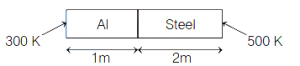
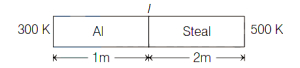
An aluminium rod of length $1 \,m$ and a steel rod of length $2 \,m$, both having the same cross-sectional area, are soldered together end-to-end. The thermal conductivity of the aluminium rod and the steel rod is $200 \,Js^{-1} \,m^{-1} \,K^{-1}$ and $50 \,Js^{-1} \,m^{-1} \,K^{-1}$ respectively. The temperatures of the free ends are maintained at $300 \,K$ and $500 \,K$. What is the temperature of the junction (in $\,K$)?
A
$322$
B
$350$
C
$367$
D
$400$
Solution
(A) Let the junction temperature be $T \,K$. In the steady state, the rate of heat flow is the same through both rods.
Using the formula for heat conduction, $\frac{Q}{t} = \frac{kA(T_2 - T_1)}{l}$, we have:
$\frac{Q}{t} = \frac{k_{steel} A (500 - T)}{2} = \frac{k_{Al} A (T - 300)}{1}$
Since the cross-sectional areas $A$ are the same, we can cancel them out:
$\frac{50(500 - T)}{2} = \frac{200(T - 300)}{1}$
$25(500 - T) = 200(T - 300)$
$12500 - 25T = 200T - 60000$
$225T = 72500$
$T = \frac{72500}{225} \approx 322.2 \,K$
Thus, the junction temperature is approximately $322 \,K$.
Using the formula for heat conduction, $\frac{Q}{t} = \frac{kA(T_2 - T_1)}{l}$, we have:
$\frac{Q}{t} = \frac{k_{steel} A (500 - T)}{2} = \frac{k_{Al} A (T - 300)}{1}$
Since the cross-sectional areas $A$ are the same, we can cancel them out:
$\frac{50(500 - T)}{2} = \frac{200(T - 300)}{1}$
$25(500 - T) = 200(T - 300)$
$12500 - 25T = 200T - 60000$
$225T = 72500$
$T = \frac{72500}{225} \approx 322.2 \,K$
Thus, the junction temperature is approximately $322 \,K$.
0 likes
View Solution216
DifficultMCQ
$A$ thermocol box has a total wall area (including the lid) of $1.0 \,m^2$ and wall thickness of $3 \,cm$. It is filled with ice at $0^{\circ} C$. If the average temperature outside the box is $30^{\circ} C$ throughout the day, the amount of ice that melts in one day is (Given: $K_{\text{thermocol}} = 0.03 \,W/mK$, $L_{\text{fusion(ice)}} = 3.00 \times 10^5 \,J/kg$) (in $\,kg$)
A
$1$
B
$2.88$
C
$25.92$
D
$8.64$
Solution
(D) Given: Area $A = 1.0 \,m^2$, Thickness $l = 3 \,cm = 0.03 \,m$, Temperature difference $\Delta \theta = 30^{\circ} C - 0^{\circ} C = 30^{\circ} C$, Thermal conductivity $K = 0.03 \,W/mK$, Latent heat $L = 3.00 \times 10^5 \,J/kg$, Time $t = 24 \times 3600 \,s = 86400 \,s$.
Using the heat conduction formula: $Q = \frac{K A \Delta \theta t}{l}$.
Since $Q = m L$, we have $m = \frac{K A \Delta \theta t}{L l}$.
Substituting the values: $m = \frac{0.03 \times 1.0 \times 30 \times 86400}{3.00 \times 10^5 \times 0.03}$.
$m = \frac{0.9 \times 86400}{9000} = \frac{77760}{9000} = 8.64 \,kg$.
Using the heat conduction formula: $Q = \frac{K A \Delta \theta t}{l}$.
Since $Q = m L$, we have $m = \frac{K A \Delta \theta t}{L l}$.
Substituting the values: $m = \frac{0.03 \times 1.0 \times 30 \times 86400}{3.00 \times 10^5 \times 0.03}$.
$m = \frac{0.9 \times 86400}{9000} = \frac{77760}{9000} = 8.64 \,kg$.
0 likes
View Solution217
MediumMCQ
$A$ slab of stone of area $3600 \, cm^2$ and thickness $10 \, cm$ is exposed on the lower surface to steam at $100^{\circ} C$. $A$ block of ice at $0^{\circ} C$ rests on the upper surface of the slab. In one hour, $4.8 \, kg$ of ice is melted. The thermal conductivity of the stone in $J \, s^{-1} \, m^{-1} \, K^{-1}$ is (Latent heat of ice $= 3.36 \times 10^5 \, J/kg$)
A
$12$
B
$10.5$
C
$1.02$
D
$1.24$
Solution
(D) Given: Area of slab $(A) = 3600 \, cm^2 = 0.36 \, m^2$.
Thickness $(d) = 10 \, cm = 0.1 \, m$.
Temperature difference $(\Delta \theta) = 100^{\circ} C - 0^{\circ} C = 100 \, K$.
Time $(t) = 1 \, hour = 3600 \, s$.
Mass of ice melted $(m) = 4.8 \, kg$.
Latent heat of fusion $(L) = 3.36 \times 10^5 \, J/kg$.
The heat required to melt the ice is $Q = m \times L = 4.8 \times 3.36 \times 10^5 \, J$.
The rate of heat flow is given by $\frac{Q}{t} = \frac{K A \Delta \theta}{d}$.
Substituting the values:
$\frac{4.8 \times 3.36 \times 10^5}{3600} = \frac{K \times 0.36 \times 100}{0.1}$.
$\frac{1612800}{3600} = K \times 360$.
$448 = K \times 360$.
$K = \frac{448}{360} \approx 1.24 \, J \, s^{-1} \, m^{-1} \, K^{-1}$.
Thickness $(d) = 10 \, cm = 0.1 \, m$.
Temperature difference $(\Delta \theta) = 100^{\circ} C - 0^{\circ} C = 100 \, K$.
Time $(t) = 1 \, hour = 3600 \, s$.
Mass of ice melted $(m) = 4.8 \, kg$.
Latent heat of fusion $(L) = 3.36 \times 10^5 \, J/kg$.
The heat required to melt the ice is $Q = m \times L = 4.8 \times 3.36 \times 10^5 \, J$.
The rate of heat flow is given by $\frac{Q}{t} = \frac{K A \Delta \theta}{d}$.
Substituting the values:
$\frac{4.8 \times 3.36 \times 10^5}{3600} = \frac{K \times 0.36 \times 100}{0.1}$.
$\frac{1612800}{3600} = K \times 360$.
$448 = K \times 360$.
$K = \frac{448}{360} \approx 1.24 \, J \, s^{-1} \, m^{-1} \, K^{-1}$.
0 likes
View Solution218
DifficultMCQ
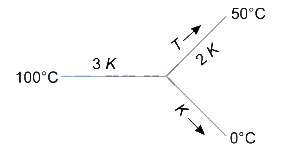
Three rods of the same dimensions have thermal conductivities $3K, 2K$,and $K$. They are arranged as shown in the figure. The temperature of the junction in the steady state is:
A
$\frac{200}{3}^{\circ} C$
B
$\frac{100}{3}^{\circ} C$
C
$75^{\circ} C$
D
$\frac{50}{3}^{\circ} C$
Solution
(A) In the steady state,the heat current flowing into the junction must equal the heat current flowing out of the junction. Let $T$ be the temperature of the junction. The rate of heat flow (heat current) is given by $H = \frac{KA(T_1 - T_2)}{l}$.
Since the dimensions (length $l$ and area $A$) are the same for all rods,the heat current equation at the junction is:
$H_{in} = H_{out1} + H_{out2}$
$\frac{3KA(100 - T)}{l} = \frac{2KA(T - 50)}{l} + \frac{KA(T - 0)}{l}$
Canceling $\frac{KA}{l}$ from both sides:
$3(100 - T) = 2(T - 50) + (T - 0)$
$300 - 3T = 2T - 100 + T$
$300 - 3T = 3T - 100$
$6T = 400$
$T = \frac{400}{6} = \frac{200}{3}^{\circ} C$
Since the dimensions (length $l$ and area $A$) are the same for all rods,the heat current equation at the junction is:
$H_{in} = H_{out1} + H_{out2}$
$\frac{3KA(100 - T)}{l} = \frac{2KA(T - 50)}{l} + \frac{KA(T - 0)}{l}$
Canceling $\frac{KA}{l}$ from both sides:
$3(100 - T) = 2(T - 50) + (T - 0)$
$300 - 3T = 2T - 100 + T$
$300 - 3T = 3T - 100$
$6T = 400$
$T = \frac{400}{6} = \frac{200}{3}^{\circ} C$
0 likes
View Solution219
MediumMCQ
The temperature difference between the ends of two cylindrical rods $A$ and $B$ of the same material is $2: 3$. In steady state,the ratio of the rates of flow of heat through the rods $A$ and $B$ is $5: 9$. If the radii of the rods $A$ and $B$ are in the ratio $1: 2$,then the ratio of lengths of the rods $A$ and $B$ is
A
$2: 7$
B
$3: 7$
C
$2: 5$
D
$3: 10$
Solution
(D) The rate of heat flow $H$ through a cylindrical rod is given by $H = \frac{kA \Delta \theta}{\ell}$,where $k$ is thermal conductivity,$A = \pi r^2$ is the cross-sectional area,$\Delta \theta$ is the temperature difference,and $\ell$ is the length.
Since the material is the same,$k_A = k_B$.
Given: $\frac{\Delta \theta_A}{\Delta \theta_B} = \frac{2}{3}$,$\frac{H_A}{H_B} = \frac{5}{9}$,and $\frac{r_A}{r_B} = \frac{1}{2}$.
Using the formula $\frac{H_A}{H_B} = \left( \frac{r_A}{r_B} \right)^2 \left( \frac{\Delta \theta_A}{\Delta \theta_B} \right) \left( \frac{\ell_B}{\ell_A} \right)$:
$\frac{5}{9} = \left( \frac{1}{2} \right)^2 \left( \frac{2}{3} \right) \left( \frac{\ell_B}{\ell_A} \right)$
$\frac{5}{9} = \left( \frac{1}{4} \right) \left( \frac{2}{3} \right) \left( \frac{\ell_B}{\ell_A} \right)$
$\frac{5}{9} = \frac{2}{12} \left( \frac{\ell_B}{\ell_A} \right) = \frac{1}{6} \left( \frac{\ell_B}{\ell_A} \right)$
$\frac{\ell_B}{\ell_A} = \frac{5}{9} \times 6 = \frac{30}{9} = \frac{10}{3}$
Therefore,$\frac{\ell_A}{\ell_B} = \frac{3}{10}$.
Since the material is the same,$k_A = k_B$.
Given: $\frac{\Delta \theta_A}{\Delta \theta_B} = \frac{2}{3}$,$\frac{H_A}{H_B} = \frac{5}{9}$,and $\frac{r_A}{r_B} = \frac{1}{2}$.
Using the formula $\frac{H_A}{H_B} = \left( \frac{r_A}{r_B} \right)^2 \left( \frac{\Delta \theta_A}{\Delta \theta_B} \right) \left( \frac{\ell_B}{\ell_A} \right)$:
$\frac{5}{9} = \left( \frac{1}{2} \right)^2 \left( \frac{2}{3} \right) \left( \frac{\ell_B}{\ell_A} \right)$
$\frac{5}{9} = \left( \frac{1}{4} \right) \left( \frac{2}{3} \right) \left( \frac{\ell_B}{\ell_A} \right)$
$\frac{5}{9} = \frac{2}{12} \left( \frac{\ell_B}{\ell_A} \right) = \frac{1}{6} \left( \frac{\ell_B}{\ell_A} \right)$
$\frac{\ell_B}{\ell_A} = \frac{5}{9} \times 6 = \frac{30}{9} = \frac{10}{3}$
Therefore,$\frac{\ell_A}{\ell_B} = \frac{3}{10}$.
0 likes
View Solution220
MediumMCQ
Same quantity of ice is filled in each of the two metal containers $P$ and $Q$ having the same size,shape,and wall thickness but made of different materials. The containers are kept in identical surroundings. The ice in $P$ melts completely in time $t_{1}$ whereas in $Q$ it takes a time $t_{2}$. The ratio of thermal conductivities of the materials of $P$ and $Q$ is
A
$t_{2}: t_{1}$
B
$t_{1}: t_{2}$
C
$t_{1}^{2}: t_{2}^{2}$
D
$t_{2}^{2}: t_{1}^{2}$
Solution
(A) The rate of heat flow through a material is given by the formula: $\frac{dQ}{dt} = \frac{KA(\Delta T)}{x}$,where $K$ is the thermal conductivity,$A$ is the surface area,$\Delta T$ is the temperature difference,and $x$ is the wall thickness.
Since the containers have the same size,shape,and wall thickness,$A$ and $x$ are constant. The surroundings are identical,so $\Delta T$ is also constant.
For a given mass of ice $m$,the total heat required to melt it is $Q = mL$,where $L$ is the latent heat of fusion. Thus,$Q$ is constant for both containers.
The rate of heat flow is inversely proportional to the time taken to melt the ice: $\frac{dQ}{dt} \propto \frac{1}{t}$.
Therefore,$K \propto \frac{1}{t}$,which implies $K_P t_1 = K_Q t_2$.
Rearranging this gives the ratio of thermal conductivities: $\frac{K_P}{K_Q} = \frac{t_2}{t_1}$.
Since the containers have the same size,shape,and wall thickness,$A$ and $x$ are constant. The surroundings are identical,so $\Delta T$ is also constant.
For a given mass of ice $m$,the total heat required to melt it is $Q = mL$,where $L$ is the latent heat of fusion. Thus,$Q$ is constant for both containers.
The rate of heat flow is inversely proportional to the time taken to melt the ice: $\frac{dQ}{dt} \propto \frac{1}{t}$.
Therefore,$K \propto \frac{1}{t}$,which implies $K_P t_1 = K_Q t_2$.
Rearranging this gives the ratio of thermal conductivities: $\frac{K_P}{K_Q} = \frac{t_2}{t_1}$.
0 likes
View Solution221
DifficultMCQ
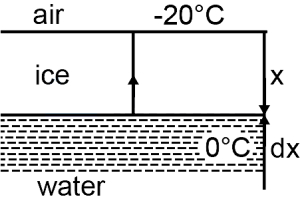
The temperature of the water of a pond is $0^{\circ} C$ while that of the surrounding atmosphere is $-20^{\circ} C$. If the density of ice is $\rho$,the coefficient of thermal conductivity is $k$,and the latent heat of melting is $L$,then the thickness $Z$ of the ice layer formed increases as a function of time $t$ as:
A
$Z^{2}=\frac{60 k}{\rho L} t$
B
$Z=\sqrt{\frac{40 k}{\rho L} t}$
C
$Z^{2}=\frac{40 k}{\rho L} \sqrt{t}$
D
$Z^{2}=\frac{40 k}{\rho L} t$
Solution
(D) Let $A$ be the surface area of the pond and $x$ be the thickness of the ice layer at any time $t$. The temperature difference across the ice layer is $\Delta T = 0^{\circ} C - (-20^{\circ} C) = 20^{\circ} C$.
The rate of heat flow through the ice layer is given by conduction: $\frac{dQ}{dt} = \frac{kA \Delta T}{x} = \frac{kA(20)}{x}$.
As the ice layer thickens by $dx$ in time $dt$,the heat released is $dQ = L dm = L(\rho A dx)$.
Equating the two expressions for $\frac{dQ}{dt}$:
$\rho A L \frac{dx}{dt} = \frac{20 k A}{x}$
$\int_{0}^{Z} x dx = \int_{0}^{t} \frac{20 k}{\rho L} dt$
$\frac{Z^2}{2} = \frac{20 k}{\rho L} t$
$Z^2 = \frac{40 k}{\rho L} t$.
The rate of heat flow through the ice layer is given by conduction: $\frac{dQ}{dt} = \frac{kA \Delta T}{x} = \frac{kA(20)}{x}$.
As the ice layer thickens by $dx$ in time $dt$,the heat released is $dQ = L dm = L(\rho A dx)$.
Equating the two expressions for $\frac{dQ}{dt}$:
$\rho A L \frac{dx}{dt} = \frac{20 k A}{x}$
$\int_{0}^{Z} x dx = \int_{0}^{t} \frac{20 k}{\rho L} dt$
$\frac{Z^2}{2} = \frac{20 k}{\rho L} t$
$Z^2 = \frac{40 k}{\rho L} t$.
0 likes
View Solution222
DifficultMCQ
$1.56 \times 10^5 \ J$ of heat is conducted through a $2 \ m^2$ wall of $12 \ cm$ thickness in one hour. The temperature difference between the two sides of the wall is $20^{\circ} C$. The thermal conductivity of the material of the wall is (in $W \ m^{-1} \ K^{-1}$):
A
$0.11$
B
$0.13$
C
$0.15$
D
$1.2$
Solution
(B) The rate of heat conduction is given by the formula: $\frac{dQ}{dt} = \frac{KA \Delta T}{x}$
Given:
Heat $Q = 1.56 \times 10^5 \ J$
Area $A = 2 \ m^2$
Thickness $x = 12 \ cm = 0.12 \ m$
Time $t = 1 \ hour = 3600 \ s$
Temperature difference $\Delta T = 20^{\circ} C$
Substituting the values:
$\frac{1.56 \times 10^5}{3600} = \frac{K \times 2 \times 20}{0.12}$
$K = \frac{1.56 \times 10^5 \times 0.12}{3600 \times 40}$
$K = \frac{1.56 \times 10^5 \times 12 \times 10^{-2}}{3600 \times 40}$
$K = \frac{1.56 \times 10^3 \times 12}{3600 \times 40} = \frac{1.56 \times 12000}{144000} = \frac{1.56}{12} = 0.13 \ W \ m^{-1} \ K^{-1}$
Given:
Heat $Q = 1.56 \times 10^5 \ J$
Area $A = 2 \ m^2$
Thickness $x = 12 \ cm = 0.12 \ m$
Time $t = 1 \ hour = 3600 \ s$
Temperature difference $\Delta T = 20^{\circ} C$
Substituting the values:
$\frac{1.56 \times 10^5}{3600} = \frac{K \times 2 \times 20}{0.12}$
$K = \frac{1.56 \times 10^5 \times 0.12}{3600 \times 40}$
$K = \frac{1.56 \times 10^5 \times 12 \times 10^{-2}}{3600 \times 40}$
$K = \frac{1.56 \times 10^3 \times 12}{3600 \times 40} = \frac{1.56 \times 12000}{144000} = \frac{1.56}{12} = 0.13 \ W \ m^{-1} \ K^{-1}$
0 likes
View Solution10-2.Heat Transfer — Heat Conduction and Thermal Conductivity · Frequently Asked Questions
1Are these 10-2.Heat Transfer questions useful for JEE and NEET?
Yes. All questions in this section are mapped to JEE Main and NEET exam patterns. Previous year questions from JEE Main, NEET, GUJCET and state-level exams are included with full solutions.
2Can I switch to Hindi or Gujarati for these questions?
Yes. Use the language tabs in the hero section or the sidebar to view the same questions and solutions in English, Hindi or Gujarati.
3How do I generate a question paper from this subtopic?
Use the Vedclass Exam Paper Generator — select the chapter and subtopic, set difficulty, and generate Sets A, B, C, D automatically. First 3 chapters of every subject are free.
Vedclass Products
For Students
Vedclass Test Series
Mock tests in real JEE/NEET style with performance analysis. 5-day free trial.
Start Free TrialFor Teachers
Exam Paper Generator
Generate Set A/B/C/D papers from this chapter in 2 minutes. 3 chapters free.
Try FreeFor Institutes
Online Exam Module
Live online exams with unlimited students, 360° analytics & white-label branding.
See DemoFor Teachers & Institutes
Generate a 10-2.Heat Transfer Exam Paper in 2 Minutes
Select subtopic & difficulty — Sets A, B, C, D auto-generated with No Repeat logic.
First 3 chapters of every subject are free — no payment required.