
A English
Odds in favor and odds against, Addition theorem on probability Questions in English
Class 11 Mathematics · Probability · Odds in favor and odds against, Addition theorem on probability
127+
Questions
English
Language
100%
With Solutions
Showing 49 of 127 questions in English
1
EasyMCQ
If $P(A) = 2/3$,$P(B) = 1/2$ and $P(A \cup B) = 5/6$,then events $A$ and $B$ are
A
Mutually exclusive
B
Independent as well as mutually exhaustive
C
Independent
D
Dependent only on $A$
Solution
(C) We use the addition theorem of probability: $P(A \cup B) = P(A) + P(B) - P(A \cap B)$.
Substituting the given values: $\frac{5}{6} = \frac{2}{3} + \frac{1}{2} - P(A \cap B)$.
Calculating the sum: $\frac{2}{3} + \frac{1}{2} = \frac{4+3}{6} = \frac{7}{6}$.
Thus,$\frac{5}{6} = \frac{7}{6} - P(A \cap B)$,which implies $P(A \cap B) = \frac{7}{6} - \frac{5}{6} = \frac{2}{6} = \frac{1}{3}$.
Since $P(A \cap B) \neq 0$,the events are not mutually exclusive.
Now,check for independence: $P(A) \times P(B) = \frac{2}{3} \times \frac{1}{2} = \frac{1}{3}$.
Since $P(A \cap B) = P(A) \times P(B) = \frac{1}{3}$,the events $A$ and $B$ are independent.
Substituting the given values: $\frac{5}{6} = \frac{2}{3} + \frac{1}{2} - P(A \cap B)$.
Calculating the sum: $\frac{2}{3} + \frac{1}{2} = \frac{4+3}{6} = \frac{7}{6}$.
Thus,$\frac{5}{6} = \frac{7}{6} - P(A \cap B)$,which implies $P(A \cap B) = \frac{7}{6} - \frac{5}{6} = \frac{2}{6} = \frac{1}{3}$.
Since $P(A \cap B) \neq 0$,the events are not mutually exclusive.
Now,check for independence: $P(A) \times P(B) = \frac{2}{3} \times \frac{1}{2} = \frac{1}{3}$.
Since $P(A \cap B) = P(A) \times P(B) = \frac{1}{3}$,the events $A$ and $B$ are independent.
0 likes
View Solution2
MediumMCQ
If $A$ and $B$ are mutually exclusive events,then the value of $P(A \cup B)$ is
A
$0$
B
$P(A) + P(B)$
C
$1$
D
None of these
Solution
(B) Two events $A$ and $B$ are said to be mutually exclusive if they cannot occur simultaneously,which means $A \cap B = \phi$.
By the addition theorem of probability,$P(A \cup B) = P(A) + P(B) - P(A \cap B)$.
Since $A$ and $B$ are mutually exclusive,$P(A \cap B) = 0$.
Therefore,$P(A \cup B) = P(A) + P(B)$.
By the addition theorem of probability,$P(A \cup B) = P(A) + P(B) - P(A \cap B)$.
Since $A$ and $B$ are mutually exclusive,$P(A \cap B) = 0$.
Therefore,$P(A \cup B) = P(A) + P(B)$.
0 likes
View Solution3
EasyMCQ
One card is drawn from a pack of $52$ cards. The probability that it is a king or a diamond is
A
$\frac{1}{26}$
B
$\frac{3}{26}$
C
$\frac{4}{13}$
D
$\frac{3}{13}$
Solution
(C) Total number of cards $n(S) = 52$.
Let $A$ be the event that the card is a king and $B$ be the event that the card is a diamond.
Number of kings $n(A) = 4$.
Number of diamonds $n(B) = 13$.
The king of diamonds is common to both,so $n(A \cap B) = 1$.
Using the addition theorem of probability: $P(A \cup B) = P(A) + P(B) - P(A \cap B)$.
$P(A \cup B) = \frac{4}{52} + \frac{13}{52} - \frac{1}{52} = \frac{16}{52}$.
Simplifying the fraction: $\frac{16}{52} = \frac{4}{13}$.
Let $A$ be the event that the card is a king and $B$ be the event that the card is a diamond.
Number of kings $n(A) = 4$.
Number of diamonds $n(B) = 13$.
The king of diamonds is common to both,so $n(A \cap B) = 1$.
Using the addition theorem of probability: $P(A \cup B) = P(A) + P(B) - P(A \cap B)$.
$P(A \cup B) = \frac{4}{52} + \frac{13}{52} - \frac{1}{52} = \frac{16}{52}$.
Simplifying the fraction: $\frac{16}{52} = \frac{4}{13}$.
0 likes
View Solution4
MediumMCQ
The probability that a leap year will have $53$ Fridays or $53$ Saturdays is
A
$\frac{2}{7}$
B
$\frac{3}{7}$
C
$\frac{4}{7}$
D
$\frac{1}{7}$
Solution
(B) leap year has $366$ days,which consists of $52$ weeks and $2$ extra days.
The possible combinations for these $2$ days are: (Sunday,Monday),(Monday,Tuesday),(Tuesday,Wednesday),(Wednesday,Thursday),(Thursday,Friday),(Friday,Saturday),and (Saturday,Sunday).
There are $7$ total possible outcomes.
Let $A$ be the event of having $53$ Fridays and $B$ be the event of having $53$ Saturdays.
$P(A) = \frac{2}{7}$ (since Friday occurs in (Thursday,Friday) and (Friday,Saturday)).
$P(B) = \frac{2}{7}$ (since Saturday occurs in (Friday,Saturday) and (Saturday,Sunday)).
$P(A \cap B) = \frac{1}{7}$ (since (Friday,Saturday) is the only common outcome).
Using the addition theorem of probability,$P(A \cup B) = P(A) + P(B) - P(A \cap B)$.
$P(A \cup B) = \frac{2}{7} + \frac{2}{7} - \frac{1}{7} = \frac{3}{7}$.
The possible combinations for these $2$ days are: (Sunday,Monday),(Monday,Tuesday),(Tuesday,Wednesday),(Wednesday,Thursday),(Thursday,Friday),(Friday,Saturday),and (Saturday,Sunday).
There are $7$ total possible outcomes.
Let $A$ be the event of having $53$ Fridays and $B$ be the event of having $53$ Saturdays.
$P(A) = \frac{2}{7}$ (since Friday occurs in (Thursday,Friday) and (Friday,Saturday)).
$P(B) = \frac{2}{7}$ (since Saturday occurs in (Friday,Saturday) and (Saturday,Sunday)).
$P(A \cap B) = \frac{1}{7}$ (since (Friday,Saturday) is the only common outcome).
Using the addition theorem of probability,$P(A \cup B) = P(A) + P(B) - P(A \cap B)$.
$P(A \cup B) = \frac{2}{7} + \frac{2}{7} - \frac{1}{7} = \frac{3}{7}$.
0 likes
View Solution5
MediumMCQ
The probability that $A$ speaks the truth is $\frac{4}{5}$,while the probability that $B$ speaks the truth is $\frac{3}{4}$. What is the probability that they contradict each other when asked to speak on a fact?
A
$\frac{4}{5}$
B
$\frac{1}{5}$
C
$\frac{7}{20}$
D
$\frac{3}{20}$
Solution
(C) Let $P(A)$ be the probability that $A$ speaks the truth and $P(B)$ be the probability that $B$ speaks the truth.
Given: $P(A) = \frac{4}{5}$ and $P(B) = \frac{3}{4}$.
Then,the probability that $A$ lies is $P(\bar{A}) = 1 - \frac{4}{5} = \frac{1}{5}$.
The probability that $B$ lies is $P(\bar{B}) = 1 - \frac{3}{4} = \frac{1}{4}$.
They contradict each other if ($A$ speaks the truth and $B$ lies) $OR$ ($A$ lies and $B$ speaks the truth).
Required probability $= P(A) \times P(\bar{B}) + P(\bar{A}) \times P(B)$.
$= (\frac{4}{5} \times \frac{1}{4}) + (\frac{1}{5} \times \frac{3}{4})$.
$= \frac{4}{20} + \frac{3}{20} = \frac{7}{20}$.
Given: $P(A) = \frac{4}{5}$ and $P(B) = \frac{3}{4}$.
Then,the probability that $A$ lies is $P(\bar{A}) = 1 - \frac{4}{5} = \frac{1}{5}$.
The probability that $B$ lies is $P(\bar{B}) = 1 - \frac{3}{4} = \frac{1}{4}$.
They contradict each other if ($A$ speaks the truth and $B$ lies) $OR$ ($A$ lies and $B$ speaks the truth).
Required probability $= P(A) \times P(\bar{B}) + P(\bar{A}) \times P(B)$.
$= (\frac{4}{5} \times \frac{1}{4}) + (\frac{1}{5} \times \frac{3}{4})$.
$= \frac{4}{20} + \frac{3}{20} = \frac{7}{20}$.
0 likes
View Solution6
EasyMCQ
If the odds against an event be $2 : 3$,then the probability of its occurrence is
A
$\frac{1}{5}$
B
$\frac{2}{5}$
C
$\frac{3}{5}$
D
$1$
Solution
(C) Given that the odds against an event are $2 : 3$.
This means the number of unfavorable outcomes is $2$ and the number of favorable outcomes is $3$.
Total outcomes = $2 + 3 = 5$.
The probability of the occurrence of the event is given by the ratio of favorable outcomes to the total number of outcomes.
Probability $P(E) = \frac{\text{Favorable outcomes}}{\text{Total outcomes}} = \frac{3}{5}$.
This means the number of unfavorable outcomes is $2$ and the number of favorable outcomes is $3$.
Total outcomes = $2 + 3 = 5$.
The probability of the occurrence of the event is given by the ratio of favorable outcomes to the total number of outcomes.
Probability $P(E) = \frac{\text{Favorable outcomes}}{\text{Total outcomes}} = \frac{3}{5}$.
0 likes
View Solution7
EasyMCQ
If the odds in favour of an event be $3 : 5$,then the probability of non-occurrence of the event is
A
$\frac{3}{5}$
B
$\frac{5}{3}$
C
$\frac{3}{8}$
D
$\frac{5}{8}$
Solution
(D) Given the odds in favour of an event are $3 : 5$.
Let the number of favourable outcomes be $3x$ and the number of unfavourable outcomes be $5x$.
The total number of outcomes is $3x + 5x = 8x$.
The probability of occurrence of the event $P(E) = \frac{3x}{8x} = \frac{3}{8}$.
The probability of non-occurrence of the event $P(E') = 1 - P(E) = 1 - \frac{3}{8} = \frac{5}{8}$.
Let the number of favourable outcomes be $3x$ and the number of unfavourable outcomes be $5x$.
The total number of outcomes is $3x + 5x = 8x$.
The probability of occurrence of the event $P(E) = \frac{3x}{8x} = \frac{3}{8}$.
The probability of non-occurrence of the event $P(E') = 1 - P(E) = 1 - \frac{3}{8} = \frac{5}{8}$.
0 likes
View Solution8
EasyMCQ
$A$ card is drawn from a pack of $52$ cards. $A$ gambler bets that it is a spade or an ace. What are the odds against his winning this bet?
A
$17:52$
B
$52:17$
C
$9:4$
D
$5:8$
Solution
(C) Total number of cards = $52$.
Number of spades = $13$.
Number of aces = $4$.
Since one card is an ace of spades,the number of favorable outcomes (spade or ace) = $13 + 4 - 1 = 16$.
Probability of winning $P(E) = \frac{16}{52} = \frac{4}{13}$.
Probability of losing $P(E') = 1 - \frac{4}{13} = \frac{9}{13}$.
Odds in favor = $P(E) : P(E') = \frac{4}{13} : \frac{9}{13} = 4 : 9$.
Odds against winning = $P(E') : P(E) = 9 : 4$.
Number of spades = $13$.
Number of aces = $4$.
Since one card is an ace of spades,the number of favorable outcomes (spade or ace) = $13 + 4 - 1 = 16$.
Probability of winning $P(E) = \frac{16}{52} = \frac{4}{13}$.
Probability of losing $P(E') = 1 - \frac{4}{13} = \frac{9}{13}$.
Odds in favor = $P(E) : P(E') = \frac{4}{13} : \frac{9}{13} = 4 : 9$.
Odds against winning = $P(E') : P(E) = 9 : 4$.
0 likes
View Solution9
EasyMCQ
An event has odds in favour $4 : 5$. Then,the probability that the event occurs is:
A
$\frac{1}{5}$
B
$\frac{4}{5}$
C
$\frac{4}{9}$
D
$\frac{5}{9}$
Solution
(C) The odds in favour of an event are given as $a : b = 4 : 5$.
The probability $P(E)$ of the event occurring is given by the formula $P(E) = \frac{a}{a + b}$.
Substituting the values,we get $P(E) = \frac{4}{4 + 5} = \frac{4}{9}$.
Therefore,the correct option is $C$.
The probability $P(E)$ of the event occurring is given by the formula $P(E) = \frac{a}{a + b}$.
Substituting the values,we get $P(E) = \frac{4}{4 + 5} = \frac{4}{9}$.
Therefore,the correct option is $C$.
0 likes
View Solution10
EasyMCQ
For an event,the odds against are $6 : 5$. The probability that the event does not occur is
A
$\frac{5}{6}$
B
$\frac{6}{11}$
C
$\frac{5}{11}$
D
$\frac{1}{6}$
Solution
(B) Given that the odds against an event are $a : b = 6 : 5$.
If the odds against an event are $a : b$,then the probability that the event does not occur is given by $P(E') = \frac{a}{a + b}$.
Here,$a = 6$ and $b = 5$.
Therefore,the probability that the event does not occur is $P(E') = \frac{6}{6 + 5} = \frac{6}{11}$.
If the odds against an event are $a : b$,then the probability that the event does not occur is given by $P(E') = \frac{a}{a + b}$.
Here,$a = 6$ and $b = 5$.
Therefore,the probability that the event does not occur is $P(E') = \frac{6}{6 + 5} = \frac{6}{11}$.
0 likes
View Solution11
MediumMCQ
In a horse race,the odds in favour of three horses are $1:2$,$1:3$,and $1:4$. The probability that one of the horses will win the race is
A
$\frac{37}{60}$
B
$\frac{47}{60}$
C
$\frac{1}{4}$
D
$\frac{3}{4}$
Solution
(B) The odds in favour of the three horses are $1:2$,$1:3$,and $1:4$.
The probabilities of winning for the three horses are $P(A) = \frac{1}{1+2} = \frac{1}{3}$,$P(B) = \frac{1}{1+3} = \frac{1}{4}$,and $P(C) = \frac{1}{1+4} = \frac{1}{5}$.
Since these are mutually exclusive events (only one horse can win),the probability that one of the horses will win is the sum of their individual probabilities:
$P(A \cup B \cup C) = P(A) + P(B) + P(C) = \frac{1}{3} + \frac{1}{4} + \frac{1}{5}$.
Taking the least common multiple of $3, 4, 5$,which is $60$:
$P = \frac{20 + 15 + 12}{60} = \frac{47}{60}$.
The probabilities of winning for the three horses are $P(A) = \frac{1}{1+2} = \frac{1}{3}$,$P(B) = \frac{1}{1+3} = \frac{1}{4}$,and $P(C) = \frac{1}{1+4} = \frac{1}{5}$.
Since these are mutually exclusive events (only one horse can win),the probability that one of the horses will win is the sum of their individual probabilities:
$P(A \cup B \cup C) = P(A) + P(B) + P(C) = \frac{1}{3} + \frac{1}{4} + \frac{1}{5}$.
Taking the least common multiple of $3, 4, 5$,which is $60$:
$P = \frac{20 + 15 + 12}{60} = \frac{47}{60}$.
0 likes
View Solution12
MediumMCQ
The odds against a certain event is $5 : 2$ and the odds in favour of another event is $6 : 5$. If both the events are independent,then the probability that at least one of the events will happen is
A
$\frac{50}{77}$
B
$\frac{52}{77}$
C
$\frac{25}{88}$
D
$\frac{63}{88}$
Solution
(B) Let $A$ and $B$ be two independent events.
The odds against $A$ are $5 : 2$,so the probability of $A$ occurring is $P(A) = \frac{2}{5 + 2} = \frac{2}{7}$.
Thus,$P(\bar{A}) = 1 - \frac{2}{7} = \frac{5}{7}$.
The odds in favour of $B$ are $6 : 5$,so the probability of $B$ occurring is $P(B) = \frac{6}{6 + 5} = \frac{6}{11}$.
Thus,$P(\bar{B}) = 1 - \frac{6}{11} = \frac{5}{11}$.
The probability that at least one of the events will happen is $P(A \cup B) = 1 - P(\bar{A}) \times P(\bar{B})$.
$P(A \cup B) = 1 - (\frac{5}{7} \times \frac{5}{11}) = 1 - \frac{25}{77} = \frac{77 - 25}{77} = \frac{52}{77}$.
The odds against $A$ are $5 : 2$,so the probability of $A$ occurring is $P(A) = \frac{2}{5 + 2} = \frac{2}{7}$.
Thus,$P(\bar{A}) = 1 - \frac{2}{7} = \frac{5}{7}$.
The odds in favour of $B$ are $6 : 5$,so the probability of $B$ occurring is $P(B) = \frac{6}{6 + 5} = \frac{6}{11}$.
Thus,$P(\bar{B}) = 1 - \frac{6}{11} = \frac{5}{11}$.
The probability that at least one of the events will happen is $P(A \cup B) = 1 - P(\bar{A}) \times P(\bar{B})$.
$P(A \cup B) = 1 - (\frac{5}{7} \times \frac{5}{11}) = 1 - \frac{25}{77} = \frac{77 - 25}{77} = \frac{52}{77}$.
0 likes
View Solution13
MediumMCQ
If the odds against solving a question by three students are $2:1$,$5:2$,and $5:3$ respectively,then the probability that the question is solved by only one student is
A
$\frac{31}{56}$
B
$\frac{24}{56}$
C
$\frac{25}{56}$
D
None of these
Solution
(C) Let $A, B, C$ be the events that the three students solve the question respectively.
Given odds against are $2:1, 5:2, 5:3$.
Therefore,the probabilities of solving the question are:
$P(A) = \frac{1}{1+2} = \frac{1}{3}$,$P(\bar{A}) = \frac{2}{3}$
$P(B) = \frac{2}{2+5} = \frac{2}{7}$,$P(\bar{B}) = \frac{5}{7}$
$P(C) = \frac{3}{3+5} = \frac{3}{8}$,$P(\bar{C}) = \frac{5}{8}$
The probability that the question is solved by only one student is given by:
$P = P(A \cap \bar{B} \cap \bar{C}) + P(\bar{A} \cap B \cap \bar{C}) + P(\bar{A} \cap \bar{B} \cap C)$
$P = (\frac{1}{3} \times \frac{5}{7} \times \frac{5}{8}) + (\frac{2}{3} \times \frac{2}{7} \times \frac{5}{8}) + (\frac{2}{3} \times \frac{5}{7} \times \frac{3}{8})$
$P = \frac{25}{168} + \frac{20}{168} + \frac{30}{168}$
$P = \frac{75}{168} = \frac{25}{56}$.
Given odds against are $2:1, 5:2, 5:3$.
Therefore,the probabilities of solving the question are:
$P(A) = \frac{1}{1+2} = \frac{1}{3}$,$P(\bar{A}) = \frac{2}{3}$
$P(B) = \frac{2}{2+5} = \frac{2}{7}$,$P(\bar{B}) = \frac{5}{7}$
$P(C) = \frac{3}{3+5} = \frac{3}{8}$,$P(\bar{C}) = \frac{5}{8}$
The probability that the question is solved by only one student is given by:
$P = P(A \cap \bar{B} \cap \bar{C}) + P(\bar{A} \cap B \cap \bar{C}) + P(\bar{A} \cap \bar{B} \cap C)$
$P = (\frac{1}{3} \times \frac{5}{7} \times \frac{5}{8}) + (\frac{2}{3} \times \frac{2}{7} \times \frac{5}{8}) + (\frac{2}{3} \times \frac{5}{7} \times \frac{3}{8})$
$P = \frac{25}{168} + \frac{20}{168} + \frac{30}{168}$
$P = \frac{75}{168} = \frac{25}{56}$.
0 likes
View Solution14
MediumMCQ
Three ships $A, B$ and $C$ sail from England to India. If the ratio of their arriving safely are $2 : 5, 3 : 7$ and $6 : 11$ respectively,then the probability of all the ships arriving safely is:
A
$\frac{18}{595}$
B
$\frac{6}{17}$
C
$\frac{3}{10}$
D
$\frac{2}{7}$
Solution
(A) The probabilities of ships $A, B$ and $C$ arriving safely are calculated from the given odds in favor.
For ship $A$,the probability $P(A) = \frac{2}{2 + 5} = \frac{2}{7}$.
For ship $B$,the probability $P(B) = \frac{3}{3 + 7} = \frac{3}{10}$.
For ship $C$,the probability $P(C) = \frac{6}{6 + 11} = \frac{6}{17}$.
Since the events are independent,the probability of all ships arriving safely is $P(A \cap B \cap C) = P(A) \times P(B) \times P(C)$.
$P(A \cap B \cap C) = \frac{2}{7} \times \frac{3}{10} \times \frac{6}{17} = \frac{36}{1190} = \frac{18}{595}$.
For ship $A$,the probability $P(A) = \frac{2}{2 + 5} = \frac{2}{7}$.
For ship $B$,the probability $P(B) = \frac{3}{3 + 7} = \frac{3}{10}$.
For ship $C$,the probability $P(C) = \frac{6}{6 + 11} = \frac{6}{17}$.
Since the events are independent,the probability of all ships arriving safely is $P(A \cap B \cap C) = P(A) \times P(B) \times P(C)$.
$P(A \cap B \cap C) = \frac{2}{7} \times \frac{3}{10} \times \frac{6}{17} = \frac{36}{1190} = \frac{18}{595}$.
0 likes
View Solution15
EasyMCQ
$A$ party of $23$ persons take their seats at a round table. The odds against two specific persons sitting together are
A
$10:1$
B
$1:11$
C
$9:10$
D
None of these
Solution
(A) The total number of ways to arrange $23$ persons at a round table is $(23-1)! = 22!$.
To find the number of ways two specific persons sit together,we treat them as a single unit. Now we have $22$ units to arrange in a circle,which can be done in $(22-1)! = 21!$ ways. The two persons can be arranged among themselves in $2!$ ways.
So,the number of favorable ways for them to sit together is $21! \times 2!$.
The probability $P$ that they sit together is $\frac{21! \times 2!}{22!} = \frac{2}{22} = \frac{1}{11}$.
The probability that they do not sit together is $1 - \frac{1}{11} = \frac{10}{11}$.
The odds against them sitting together are given by the ratio of the probability of not sitting together to the probability of sitting together,which is $\frac{10}{11} : \frac{1}{11} = 10 : 1$.
To find the number of ways two specific persons sit together,we treat them as a single unit. Now we have $22$ units to arrange in a circle,which can be done in $(22-1)! = 21!$ ways. The two persons can be arranged among themselves in $2!$ ways.
So,the number of favorable ways for them to sit together is $21! \times 2!$.
The probability $P$ that they sit together is $\frac{21! \times 2!}{22!} = \frac{2}{22} = \frac{1}{11}$.
The probability that they do not sit together is $1 - \frac{1}{11} = \frac{10}{11}$.
The odds against them sitting together are given by the ratio of the probability of not sitting together to the probability of sitting together,which is $\frac{10}{11} : \frac{1}{11} = 10 : 1$.
0 likes
View Solution16
EasyMCQ
The probabilities of three mutually exclusive events are $\frac{2}{3}$,$\frac{1}{4}$,and $\frac{1}{6}$. The statement is:
A
$1$
B
Wrong
C
Could be either
D
Do not know
Solution
(B) For mutually exclusive events $A, B$,and $C$,the sum of their probabilities must be less than or equal to $1$.
Calculate the sum: $P(A \cup B \cup C) = P(A) + P(B) + P(C) = \frac{2}{3} + \frac{1}{4} + \frac{1}{6}$.
Find a common denominator: $\frac{8}{12} + \frac{3}{12} + \frac{2}{12} = \frac{13}{12}$.
Since $\frac{13}{12} > 1$,the given probabilities cannot represent mutually exclusive events.
Therefore,the statement is wrong.
Calculate the sum: $P(A \cup B \cup C) = P(A) + P(B) + P(C) = \frac{2}{3} + \frac{1}{4} + \frac{1}{6}$.
Find a common denominator: $\frac{8}{12} + \frac{3}{12} + \frac{2}{12} = \frac{13}{12}$.
Since $\frac{13}{12} > 1$,the given probabilities cannot represent mutually exclusive events.
Therefore,the statement is wrong.
0 likes
View Solution17
EasyMCQ
If $A$ and $B$ are two events such that $P(A) = 0.4$,$P(A \cup B) = 0.7$ and $P(A \cap B) = 0.2$,then $P(B) = $
A
$0.1$
B
$0.3$
C
$0.5$
D
None of these
Solution
(C) We use the addition theorem of probability: $P(A \cup B) = P(A) + P(B) - P(A \cap B)$.
Given values are $P(A) = 0.4$,$P(A \cup B) = 0.7$,and $P(A \cap B) = 0.2$.
Substituting these values into the formula:
$0.7 = 0.4 + P(B) - 0.2$
$0.7 = 0.2 + P(B)$
$P(B) = 0.7 - 0.2 = 0.5$.
Thus,the correct option is $C$.
Given values are $P(A) = 0.4$,$P(A \cup B) = 0.7$,and $P(A \cap B) = 0.2$.
Substituting these values into the formula:
$0.7 = 0.4 + P(B) - 0.2$
$0.7 = 0.2 + P(B)$
$P(B) = 0.7 - 0.2 = 0.5$.
Thus,the correct option is $C$.
0 likes
View Solution18
EasyMCQ
Suppose that $A, B, C$ are events such that $P(A) = P(B) = P(C) = \frac{1}{4}$,$P(AB) = P(CB) = 0$,and $P(AC) = \frac{1}{8}$. Then find $P(A \cup B)$.
A
$0.125$
B
$0.25$
C
$0.375$
D
$0.5$
Solution
(D) The probability of the union of two events $A$ and $B$ is given by the addition theorem of probability:
$P(A \cup B) = P(A) + P(B) - P(A \cap B)$
Given that $P(A) = \frac{1}{4}$,$P(B) = \frac{1}{4}$,and $P(AB) = 0$:
$P(A \cup B) = \frac{1}{4} + \frac{1}{4} - 0$
$P(A \cup B) = \frac{2}{4} = \frac{1}{2} = 0.5$
Thus,the correct option is $D$.
$P(A \cup B) = P(A) + P(B) - P(A \cap B)$
Given that $P(A) = \frac{1}{4}$,$P(B) = \frac{1}{4}$,and $P(AB) = 0$:
$P(A \cup B) = \frac{1}{4} + \frac{1}{4} - 0$
$P(A \cup B) = \frac{2}{4} = \frac{1}{2} = 0.5$
Thus,the correct option is $D$.
0 likes
View Solution19
EasyMCQ
$A$ card is drawn at random from a pack of $52$ cards. The probability of this card being a red card or a queen is:
A
$\frac{1}{13}$
B
$\frac{1}{26}$
C
$\frac{1}{2}$
D
$\frac{7}{13}$
Solution
(D) Total number of cards = $52$.
Let $A$ be the event of drawing a red card and $B$ be the event of drawing a queen.
Number of red cards $n(A) = 26$.
Number of queens $n(B) = 4$.
Number of red queens $n(A \cap B) = 2$.
Using the addition theorem of probability: $P(A \cup B) = P(A) + P(B) - P(A \cap B)$.
$P(A \cup B) = \frac{26}{52} + \frac{4}{52} - \frac{2}{52}$.
$P(A \cup B) = \frac{28}{52} = \frac{7}{13}$.
Let $A$ be the event of drawing a red card and $B$ be the event of drawing a queen.
Number of red cards $n(A) = 26$.
Number of queens $n(B) = 4$.
Number of red queens $n(A \cap B) = 2$.
Using the addition theorem of probability: $P(A \cup B) = P(A) + P(B) - P(A \cap B)$.
$P(A \cup B) = \frac{26}{52} + \frac{4}{52} - \frac{2}{52}$.
$P(A \cup B) = \frac{28}{52} = \frac{7}{13}$.
0 likes
View Solution20
MediumMCQ
If the probability of $X$ to fail in the examination is $0.3$ and that for $Y$ is $0.2$,then the probability that either $X$ or $Y$ fail in the examination is
A
$0.5$
B
$0.44$
C
$0.6$
D
None of these
Solution
(B) Given,$P(X) = 0.3$ and $P(Y) = 0.2$.
Since the events are independent,the probability that both $X$ and $Y$ fail is $P(X \cap Y) = P(X) \times P(Y) = 0.3 \times 0.2 = 0.06$.
The probability that either $X$ or $Y$ fails is given by the addition theorem of probability:
$P(X \cup Y) = P(X) + P(Y) - P(X \cap Y)$
Substituting the values:
$P(X \cup Y) = 0.3 + 0.2 - 0.06 = 0.44$.
Since the events are independent,the probability that both $X$ and $Y$ fail is $P(X \cap Y) = P(X) \times P(Y) = 0.3 \times 0.2 = 0.06$.
The probability that either $X$ or $Y$ fails is given by the addition theorem of probability:
$P(X \cup Y) = P(X) + P(Y) - P(X \cap Y)$
Substituting the values:
$P(X \cup Y) = 0.3 + 0.2 - 0.06 = 0.44$.
0 likes
View Solution21
MediumMCQ
If $P(A) = 0.4$,$P(B) = x$,$P(A \cup B) = 0.7$ and the events $A$ and $B$ are independent,then $x =$
A
$1/3$
B
$1/2$
C
$2/3$
D
None of these
Solution
(B) Given that events $A$ and $B$ are independent,we have $P(A \cap B) = P(A) \times P(B) = 0.4x$.
Using the addition theorem of probability: $P(A \cup B) = P(A) + P(B) - P(A \cap B)$.
Substituting the given values: $0.7 = 0.4 + x - 0.4x$.
$0.7 - 0.4 = x(1 - 0.4)$.
$0.3 = 0.6x$.
$x = \frac{0.3}{0.6} = \frac{1}{2}$.
Using the addition theorem of probability: $P(A \cup B) = P(A) + P(B) - P(A \cap B)$.
Substituting the given values: $0.7 = 0.4 + x - 0.4x$.
$0.7 - 0.4 = x(1 - 0.4)$.
$0.3 = 0.6x$.
$x = \frac{0.3}{0.6} = \frac{1}{2}$.
0 likes
View Solution22
EasyMCQ
If $P(A) = 0.4$,$P(B) = x$,$P(A \cup B) = 0.7$ and the events $A$ and $B$ are mutually exclusive,then $x = $
A
$3/10$
B
$1/2$
C
$2/5$
D
$1/5$
Solution
(A) Since events $A$ and $B$ are mutually exclusive,the probability of their intersection is $P(A \cap B) = 0$.
By the addition theorem of probability,$P(A \cup B) = P(A) + P(B) - P(A \cap B)$.
Substituting the given values,we get $0.7 = 0.4 + x - 0$.
Therefore,$x = 0.7 - 0.4 = 0.3$.
Thus,$x = 3/10$.
By the addition theorem of probability,$P(A \cup B) = P(A) + P(B) - P(A \cap B)$.
Substituting the given values,we get $0.7 = 0.4 + x - 0$.
Therefore,$x = 0.7 - 0.4 = 0.3$.
Thus,$x = 3/10$.
0 likes
View Solution23
EasyMCQ
$A$ coin is tossed twice. If events $A$ and $B$ are defined as: $A = \text{head on first toss}$,$B = \text{head on second toss}$. Then the probability of $A \cup B = $
A
$\frac{1}{4}$
B
$\frac{1}{2}$
C
$\frac{1}{8}$
D
$\frac{3}{4}$
Solution
(D) The sample space for tossing a coin twice is $S = \{(HH, HT, TH, TT)\}$.
Event $A$ (head on first toss) $= \{(HH, HT)\}$,so $P(A) = \frac{2}{4} = \frac{1}{2}$.
Event $B$ (head on second toss) $= \{(HH, TH)\}$,so $P(B) = \frac{2}{4} = \frac{1}{2}$.
Event $A \cap B$ (head on both tosses) $= \{(HH)\}$,so $P(A \cap B) = \frac{1}{4}$.
Using the addition theorem of probability:
$P(A \cup B) = P(A) + P(B) - P(A \cap B)$
$P(A \cup B) = \frac{1}{2} + \frac{1}{2} - \frac{1}{4} = 1 - \frac{1}{4} = \frac{3}{4}$.
Event $A$ (head on first toss) $= \{(HH, HT)\}$,so $P(A) = \frac{2}{4} = \frac{1}{2}$.
Event $B$ (head on second toss) $= \{(HH, TH)\}$,so $P(B) = \frac{2}{4} = \frac{1}{2}$.
Event $A \cap B$ (head on both tosses) $= \{(HH)\}$,so $P(A \cap B) = \frac{1}{4}$.
Using the addition theorem of probability:
$P(A \cup B) = P(A) + P(B) - P(A \cap B)$
$P(A \cup B) = \frac{1}{2} + \frac{1}{2} - \frac{1}{4} = 1 - \frac{1}{4} = \frac{3}{4}$.
0 likes
View Solution24
MediumMCQ
If $A$ and $B$ are two mutually exclusive events,then $P(A \cup B) = $
A
$P(A) + P(B) - P(A \cap B)$
B
$P(A) - P(B)$
C
$P(A) + P(B)$
D
$P(A) + P(B) + P(A \cap B)$
Solution
(C) For any two events $A$ and $B$,the addition theorem of probability states that $P(A \cup B) = P(A) + P(B) - P(A \cap B)$.
Since $A$ and $B$ are mutually exclusive events,they cannot occur simultaneously,which means $A \cap B = \emptyset$.
Therefore,$P(A \cap B) = 0$.
Substituting this into the formula,we get $P(A \cup B) = P(A) + P(B)$.
Since $A$ and $B$ are mutually exclusive events,they cannot occur simultaneously,which means $A \cap B = \emptyset$.
Therefore,$P(A \cap B) = 0$.
Substituting this into the formula,we get $P(A \cup B) = P(A) + P(B)$.
0 likes
View Solution25
EasyMCQ
If $P(A) = \frac{1}{4}$,$P(B) = \frac{5}{8}$ and $P(A \cup B) = \frac{3}{4}$,then $P(A \cap B) = $
A
$\frac{1}{8}$
B
$0$
C
$\frac{3}{4}$
D
$1$
Solution
(A) We use the addition theorem of probability:
$P(A \cup B) = P(A) + P(B) - P(A \cap B)$
Substituting the given values:
$\frac{3}{4} = \frac{1}{4} + \frac{5}{8} - P(A \cap B)$
$\frac{6}{8} = \frac{2}{8} + \frac{5}{8} - P(A \cap B)$
$\frac{6}{8} = \frac{7}{8} - P(A \cap B)$
$P(A \cap B) = \frac{7}{8} - \frac{6}{8} = \frac{1}{8}$
$P(A \cup B) = P(A) + P(B) - P(A \cap B)$
Substituting the given values:
$\frac{3}{4} = \frac{1}{4} + \frac{5}{8} - P(A \cap B)$
$\frac{6}{8} = \frac{2}{8} + \frac{5}{8} - P(A \cap B)$
$\frac{6}{8} = \frac{7}{8} - P(A \cap B)$
$P(A \cap B) = \frac{7}{8} - \frac{6}{8} = \frac{1}{8}$
0 likes
View Solution26
MediumMCQ
If $A$ and $B$ are two independent events,then $P(A \cup B) = $
A
$P(A) + P(B) - P(A)P(B)$
B
$P(A) - P(B)$
C
$P(A) + P(B)$
D
$P(A) + P(B) + P(A)P(B)$
Solution
(A) For any two events $A$ and $B$,the addition theorem of probability states that $P(A \cup B) = P(A) + P(B) - P(A \cap B)$.
Since $A$ and $B$ are independent events,$P(A \cap B) = P(A)P(B)$.
Substituting this into the addition theorem,we get $P(A \cup B) = P(A) + P(B) - P(A)P(B)$.
Since $A$ and $B$ are independent events,$P(A \cap B) = P(A)P(B)$.
Substituting this into the addition theorem,we get $P(A \cup B) = P(A) + P(B) - P(A)P(B)$.
0 likes
View Solution27
MediumMCQ
If an integer is chosen at random from the first $100$ positive integers,then the probability that the chosen number is a multiple of $4$ or $6$ is:
A
$\frac{41}{100}$
B
$\frac{33}{100}$
C
$\frac{1}{10}$
D
None of these
Solution
(B) Let $A$ be the event that the chosen number is a multiple of $4$,and $B$ be the event that the chosen number is a multiple of $6$.
The number of multiples of $4$ in the first $100$ integers is $\frac{100}{4} = 25$. So,$P(A) = \frac{25}{100}$.
The number of multiples of $6$ in the first $100$ integers is $\lfloor \frac{100}{6} \rfloor = 16$. So,$P(B) = \frac{16}{100}$.
The multiples of both $4$ and $6$ are multiples of $\text{lcm}(4, 6) = 12$. The number of multiples of $12$ in the first $100$ integers is $\lfloor \frac{100}{12} \rfloor = 8$. So,$P(A \cap B) = \frac{8}{100}$.
Using the addition theorem of probability,the required probability is:
$P(A \cup B) = P(A) + P(B) - P(A \cap B)$
$P(A \cup B) = \frac{25}{100} + \frac{16}{100} - \frac{8}{100} = \frac{33}{100}$.
The number of multiples of $4$ in the first $100$ integers is $\frac{100}{4} = 25$. So,$P(A) = \frac{25}{100}$.
The number of multiples of $6$ in the first $100$ integers is $\lfloor \frac{100}{6} \rfloor = 16$. So,$P(B) = \frac{16}{100}$.
The multiples of both $4$ and $6$ are multiples of $\text{lcm}(4, 6) = 12$. The number of multiples of $12$ in the first $100$ integers is $\lfloor \frac{100}{12} \rfloor = 8$. So,$P(A \cap B) = \frac{8}{100}$.
Using the addition theorem of probability,the required probability is:
$P(A \cup B) = P(A) + P(B) - P(A \cap B)$
$P(A \cup B) = \frac{25}{100} + \frac{16}{100} - \frac{8}{100} = \frac{33}{100}$.
0 likes
View Solution28
EasyMCQ
If the probability of a horse $A$ winning a race is $1/4$ and the probability of a horse $B$ winning the same race is $1/5$,then the probability that either of them will win the race is (in $/20$)
A
$1$
B
$9$
C
$11$
D
$19$
Solution
(B) Let $P(A)$ be the probability that horse $A$ wins and $P(B)$ be the probability that horse $B$ wins.
Given $P(A) = 1/4$ and $P(B) = 1/5$.
Since only one horse can win the race,the events $A$ and $B$ are mutually exclusive.
Therefore,the probability that either of them wins is given by $P(A \cup B) = P(A) + P(B)$.
$P(A \cup B) = 1/4 + 1/5 = (5 + 4) / 20 = 9/20$.
Thus,the correct option is $B$.
Given $P(A) = 1/4$ and $P(B) = 1/5$.
Since only one horse can win the race,the events $A$ and $B$ are mutually exclusive.
Therefore,the probability that either of them wins is given by $P(A \cup B) = P(A) + P(B)$.
$P(A \cup B) = 1/4 + 1/5 = (5 + 4) / 20 = 9/20$.
Thus,the correct option is $B$.
0 likes
View Solution29
EasyMCQ
If $A$ and $B$ are two events such that $P(A \cup B) = \frac{5}{6}$,$P(A \cap B) = \frac{1}{3}$ and $P(\bar{B}) = \frac{1}{3}$,then $P(A) = $
A
$\frac{1}{4}$
B
$\frac{1}{3}$
C
$\frac{1}{2}$
D
$\frac{2}{3}$
Solution
(C) Given that $P(A \cup B) = \frac{5}{6}$,$P(A \cap B) = \frac{1}{3}$,and $P(\bar{B}) = \frac{1}{3}$.
Since $P(B) = 1 - P(\bar{B})$,we have $P(B) = 1 - \frac{1}{3} = \frac{2}{3}$.
Using the addition theorem of probability: $P(A \cup B) = P(A) + P(B) - P(A \cap B)$.
Substituting the values: $\frac{5}{6} = P(A) + \frac{2}{3} - \frac{1}{3}$.
$\frac{5}{6} = P(A) + \frac{1}{3}$.
$P(A) = \frac{5}{6} - \frac{1}{3} = \frac{5-2}{6} = \frac{3}{6} = \frac{1}{2}$.
Since $P(B) = 1 - P(\bar{B})$,we have $P(B) = 1 - \frac{1}{3} = \frac{2}{3}$.
Using the addition theorem of probability: $P(A \cup B) = P(A) + P(B) - P(A \cap B)$.
Substituting the values: $\frac{5}{6} = P(A) + \frac{2}{3} - \frac{1}{3}$.
$\frac{5}{6} = P(A) + \frac{1}{3}$.
$P(A) = \frac{5}{6} - \frac{1}{3} = \frac{5-2}{6} = \frac{3}{6} = \frac{1}{2}$.
0 likes
View Solution30
MediumMCQ
If $A$ and $B$ are two events such that $P(A \cup B) + P(A \cap B) = \frac{7}{8}$ and $P(A) = 2P(B)$,then $P(A) = $
A
$\frac{7}{12}$
B
$\frac{7}{24}$
C
$\frac{5}{12}$
D
$\frac{17}{24}$
Solution
(A) We know that for any two events $A$ and $B$,the addition theorem of probability states that $P(A \cup B) = P(A) + P(B) - P(A \cap B)$.
Rearranging this,we get $P(A \cup B) + P(A \cap B) = P(A) + P(B)$.
Given that $P(A \cup B) + P(A \cap B) = \frac{7}{8}$ and $P(A) = 2P(B)$,which implies $P(B) = \frac{P(A)}{2}$.
Substituting these into the equation: $\frac{7}{8} = P(A) + \frac{P(A)}{2}$.
$\frac{7}{8} = \frac{3P(A)}{2}$.
$P(A) = \frac{7}{8} \times \frac{2}{3} = \frac{14}{24} = \frac{7}{12}$.
Rearranging this,we get $P(A \cup B) + P(A \cap B) = P(A) + P(B)$.
Given that $P(A \cup B) + P(A \cap B) = \frac{7}{8}$ and $P(A) = 2P(B)$,which implies $P(B) = \frac{P(A)}{2}$.
Substituting these into the equation: $\frac{7}{8} = P(A) + \frac{P(A)}{2}$.
$\frac{7}{8} = \frac{3P(A)}{2}$.
$P(A) = \frac{7}{8} \times \frac{2}{3} = \frac{14}{24} = \frac{7}{12}$.
0 likes
View Solution31
EasyMCQ
Let $A$ and $B$ be two events such that $P(A) = 0.3$ and $P(A \cup B) = 0.8$. If $A$ and $B$ are independent events,then $P(B) = $
A
$\frac{5}{6}$
B
$\frac{5}{7}$
C
$\frac{3}{5}$
D
$\frac{2}{5}$
Solution
(B) Given that $A$ and $B$ are independent events,we have $P(A \cap B) = P(A) \times P(B)$.
Using the addition theorem of probability: $P(A \cup B) = P(A) + P(B) - P(A \cap B)$.
Let $P(B) = x$. Substituting the given values:
$0.8 = 0.3 + x - (0.3 \times x)$
$0.8 - 0.3 = x - 0.3x$
$0.5 = 0.7x$
$x = \frac{0.5}{0.7} = \frac{5}{7}$.
Therefore,$P(B) = \frac{5}{7}$.
Using the addition theorem of probability: $P(A \cup B) = P(A) + P(B) - P(A \cap B)$.
Let $P(B) = x$. Substituting the given values:
$0.8 = 0.3 + x - (0.3 \times x)$
$0.8 - 0.3 = x - 0.3x$
$0.5 = 0.7x$
$x = \frac{0.5}{0.7} = \frac{5}{7}$.
Therefore,$P(B) = \frac{5}{7}$.
0 likes
View Solution32
DifficultMCQ
For two given events $A$ and $B$,$P(A \cap B)$ is:
A
Not less than $P(A) + P(B) - 1$
B
Not greater than $P(A) + P(B)$
C
Equal to $P(A) + P(B) - P(A \cup B)$
D
All of the above
Solution
(D) The addition theorem of probability states that $P(A \cup B) = P(A) + P(B) - P(A \cap B)$.
Rearranging this gives $P(A \cap B) = P(A) + P(B) - P(A \cup B)$,which matches option $C$.
Since $0 \leq P(A \cup B) \leq 1$,we have $P(A \cup B) \leq 1 \implies P(A) + P(B) - P(A \cap B) \leq 1 \implies P(A \cap B) \geq P(A) + P(B) - 1$,which matches option $A$.
Also,since $P(A \cup B) \geq 0$,we have $P(A) + P(B) - P(A \cap B) \geq 0 \implies P(A \cap B) \leq P(A) + P(B)$,which matches option $B$.
Since options $A$,$B$,and $C$ are all mathematically correct,the correct choice is $D$.
Rearranging this gives $P(A \cap B) = P(A) + P(B) - P(A \cup B)$,which matches option $C$.
Since $0 \leq P(A \cup B) \leq 1$,we have $P(A \cup B) \leq 1 \implies P(A) + P(B) - P(A \cap B) \leq 1 \implies P(A \cap B) \geq P(A) + P(B) - 1$,which matches option $A$.
Also,since $P(A \cup B) \geq 0$,we have $P(A) + P(B) - P(A \cap B) \geq 0 \implies P(A \cap B) \leq P(A) + P(B)$,which matches option $B$.
Since options $A$,$B$,and $C$ are all mathematically correct,the correct choice is $D$.
0 likes
View Solution33
DifficultMCQ
$P(A \cup B) = P(A \cap B)$ if and only if the relation between $P(A)$ and $P(B)$ is
A
$P(A) = P(\bar{A})$
B
$P(A \cap B) = P(A' \cap B')$
C
$P(A) = P(B)$
D
None of these
Solution
(C) We know that the addition theorem of probability states that $P(A \cup B) = P(A) + P(B) - P(A \cap B)$.
Given the condition $P(A \cup B) = P(A \cap B)$,we substitute this into the formula:
$P(A \cap B) = P(A) + P(B) - P(A \cap B)$.
Rearranging the terms,we get $2P(A \cap B) = P(A) + P(B)$.
However,for the specific case where $P(A \cup B) = P(A \cap B)$,it implies that $P(A \setminus B) = 0$ and $P(B \setminus A) = 0$,which means $P(A) = P(A \cap B) = P(B)$.
Therefore,the correct relation is $P(A) = P(B)$.
Given the condition $P(A \cup B) = P(A \cap B)$,we substitute this into the formula:
$P(A \cap B) = P(A) + P(B) - P(A \cap B)$.
Rearranging the terms,we get $2P(A \cap B) = P(A) + P(B)$.
However,for the specific case where $P(A \cup B) = P(A \cap B)$,it implies that $P(A \setminus B) = 0$ and $P(B \setminus A) = 0$,which means $P(A) = P(A \cap B) = P(B)$.
Therefore,the correct relation is $P(A) = P(B)$.
0 likes
View Solution34
EasyMCQ
The two events $A$ and $B$ have probabilities $0.25$ and $0.50$ respectively. The probability that both $A$ and $B$ occur simultaneously is $0.14$. Then the probability that neither $A$ nor $B$ occurs is
A
$0.39$
B
$0.25$
C
$0.904$
D
None of these
Solution
(A) Given: $P(A) = 0.25$,$P(B) = 0.50$,and $P(A \cap B) = 0.14$.
We need to find the probability that neither $A$ nor $B$ occurs,which is $P(A^c \cap B^c)$.
By De Morgan's Law,$P(A^c \cap B^c) = P((A \cup B)^c) = 1 - P(A \cup B)$.
Using the Addition Theorem of Probability,$P(A \cup B) = P(A) + P(B) - P(A \cap B)$.
$P(A \cup B) = 0.25 + 0.50 - 0.14 = 0.61$.
Therefore,$P(A^c \cap B^c) = 1 - 0.61 = 0.39$.
We need to find the probability that neither $A$ nor $B$ occurs,which is $P(A^c \cap B^c)$.
By De Morgan's Law,$P(A^c \cap B^c) = P((A \cup B)^c) = 1 - P(A \cup B)$.
Using the Addition Theorem of Probability,$P(A \cup B) = P(A) + P(B) - P(A \cap B)$.
$P(A \cup B) = 0.25 + 0.50 - 0.14 = 0.61$.
Therefore,$P(A^c \cap B^c) = 1 - 0.61 = 0.39$.
0 likes
View Solution35
EasyMCQ
Twelve tickets are numbered $1$ to $12$. One ticket is drawn at random,then the probability of the number being divisible by $2$ or $3$ is:
A
$\frac{2}{3}$
B
$\frac{7}{12}$
C
$\frac{5}{6}$
D
$\frac{3}{4}$
Solution
(A) The total number of outcomes is $n(S) = 12$.
Let $A$ be the event that the number is divisible by $2$. The numbers are ${2, 4, 6, 8, 10, 12}$,so $n(A) = 6$.
Let $B$ be the event that the number is divisible by $3$. The numbers are ${3, 6, 9, 12}$,so $n(B) = 4$.
The event $A \cap B$ is the set of numbers divisible by both $2$ and $3$ (i.e.,divisible by $6$). The numbers are ${6, 12}$,so $n(A \cap B) = 2$.
Using the addition theorem of probability: $P(A \cup B) = P(A) + P(B) - P(A \cap B)$.
$P(A \cup B) = \frac{6}{12} + \frac{4}{12} - \frac{2}{12} = \frac{8}{12} = \frac{2}{3}$.
Let $A$ be the event that the number is divisible by $2$. The numbers are ${2, 4, 6, 8, 10, 12}$,so $n(A) = 6$.
Let $B$ be the event that the number is divisible by $3$. The numbers are ${3, 6, 9, 12}$,so $n(B) = 4$.
The event $A \cap B$ is the set of numbers divisible by both $2$ and $3$ (i.e.,divisible by $6$). The numbers are ${6, 12}$,so $n(A \cap B) = 2$.
Using the addition theorem of probability: $P(A \cup B) = P(A) + P(B) - P(A \cap B)$.
$P(A \cup B) = \frac{6}{12} + \frac{4}{12} - \frac{2}{12} = \frac{8}{12} = \frac{2}{3}$.
0 likes
View Solution36
MediumMCQ
The probability that a man will be alive in $20$ years is $\frac{3}{5}$ and the probability that his wife will be alive in $20$ years is $\frac{2}{3}$. Then the probability that at least one will be alive in $20$ years is:
A
$\frac{13}{15}$
B
$\frac{7}{15}$
C
$\frac{4}{15}$
D
None of these
Solution
(A) Let $A$ be the event that the husband will be alive in $20$ years and $B$ be the event that the wife will be alive in $20$ years.
Given $P(A) = \frac{3}{5}$ and $P(B) = \frac{2}{3}$.
Since $A$ and $B$ are independent events,the probability that at least one of them will be alive is given by $P(A \cup B) = P(A) + P(B) - P(A \cap B)$.
Since $A$ and $B$ are independent,$P(A \cap B) = P(A) \times P(B) = \frac{3}{5} \times \frac{2}{3} = \frac{6}{15} = \frac{2}{5}$.
Therefore,$P(A \cup B) = \frac{3}{5} + \frac{2}{3} - \frac{6}{15} = \frac{9 + 10 - 6}{15} = \frac{13}{15}$.
Alternatively,the probability that at least one is alive is $1 - P(\text{both die}) = 1 - (1 - P(A))(1 - P(B)) = 1 - (\frac{2}{5} \times \frac{1}{3}) = 1 - \frac{2}{15} = \frac{13}{15}$.
Given $P(A) = \frac{3}{5}$ and $P(B) = \frac{2}{3}$.
Since $A$ and $B$ are independent events,the probability that at least one of them will be alive is given by $P(A \cup B) = P(A) + P(B) - P(A \cap B)$.
Since $A$ and $B$ are independent,$P(A \cap B) = P(A) \times P(B) = \frac{3}{5} \times \frac{2}{3} = \frac{6}{15} = \frac{2}{5}$.
Therefore,$P(A \cup B) = \frac{3}{5} + \frac{2}{3} - \frac{6}{15} = \frac{9 + 10 - 6}{15} = \frac{13}{15}$.
Alternatively,the probability that at least one is alive is $1 - P(\text{both die}) = 1 - (1 - P(A))(1 - P(B)) = 1 - (\frac{2}{5} \times \frac{1}{3}) = 1 - \frac{2}{15} = \frac{13}{15}$.
0 likes
View Solution37
EasyMCQ
Given two mutually exclusive events $A$ and $B$ such that $P(A) = 0.45$ and $P(B) = 0.35,$ then $P(A \text{ or } B) =$
A
$0.1$
B
$0.25$
C
$0.15$
D
$0.8$
Solution
(D) For two mutually exclusive events $A$ and $B$,the probability of $A$ or $B$ occurring is given by the addition theorem:
$P(A \cup B) = P(A) + P(B)$
Substituting the given values:
$P(A \cup B) = 0.45 + 0.35 = 0.8$
Thus,the correct option is $D$.
$P(A \cup B) = P(A) + P(B)$
Substituting the given values:
$P(A \cup B) = 0.45 + 0.35 = 0.8$
Thus,the correct option is $D$.
0 likes
View Solution38
MediumMCQ
If ${A_1}, {A_2}, ..., {A_n}$ are any $n$ events,then:
A
$P({A_1} \cup {A_2} \cup ... \cup {A_n}) = P({A_1}) + P({A_2}) + ... + P({A_n})$
B
$P({A_1} \cup {A_2} \cup ... \cup {A_n}) > P({A_1}) + P({A_2}) + ... + P({A_n})$
C
$P({A_1} \cup {A_2} \cup ... \cup {A_n}) \le P({A_1}) + P({A_2}) + ... + P({A_n})$
D
None of these
Solution
(C) For any two events $A$ and $B$,we have the addition theorem of probability:
$P(A \cup B) = P(A) + P(B) - P(A \cap B)$
Since $P(A \cap B) \ge 0$,it follows that $P(A \cup B) \le P(A) + P(B)$.
By the principle of mathematical induction,this inequality can be generalized for $n$ events as:
$P\left( \bigcup_{i=1}^{n} A_i \right) \le \sum_{i=1}^{n} P(A_i)$.
$P(A \cup B) = P(A) + P(B) - P(A \cap B)$
Since $P(A \cap B) \ge 0$,it follows that $P(A \cup B) \le P(A) + P(B)$.
By the principle of mathematical induction,this inequality can be generalized for $n$ events as:
$P\left( \bigcup_{i=1}^{n} A_i \right) \le \sum_{i=1}^{n} P(A_i)$.
0 likes
View Solution39
MediumMCQ
One card is drawn from a pack of $52$ cards. The probability that it is a queen or a heart is
A
$\frac{1}{26}$
B
$\frac{3}{26}$
C
$\frac{4}{13}$
D
$\frac{3}{13}$
Solution
(C) Let $A$ be the event of drawing a queen and $B$ be the event of drawing a heart.
Total number of cards = $52$.
Number of queens $n(A) = 4$,so $P(A) = \frac{4}{52} = \frac{1}{13}$.
Number of hearts $n(B) = 13$,so $P(B) = \frac{13}{52} = \frac{1}{4}$.
The card that is both a queen and a heart is the queen of hearts,so $n(A \cap B) = 1$,which means $P(A \cap B) = \frac{1}{52}$.
Using the addition theorem of probability,$P(A \cup B) = P(A) + P(B) - P(A \cap B)$.
$P(A \cup B) = \frac{4}{52} + \frac{13}{52} - \frac{1}{52} = \frac{16}{52} = \frac{4}{13}$.
Total number of cards = $52$.
Number of queens $n(A) = 4$,so $P(A) = \frac{4}{52} = \frac{1}{13}$.
Number of hearts $n(B) = 13$,so $P(B) = \frac{13}{52} = \frac{1}{4}$.
The card that is both a queen and a heart is the queen of hearts,so $n(A \cap B) = 1$,which means $P(A \cap B) = \frac{1}{52}$.
Using the addition theorem of probability,$P(A \cup B) = P(A) + P(B) - P(A \cap B)$.
$P(A \cup B) = \frac{4}{52} + \frac{13}{52} - \frac{1}{52} = \frac{16}{52} = \frac{4}{13}$.
0 likes
View Solution40
MediumMCQ
The probabilities of occurrence of two events are respectively $0.21$ and $0.49$. The probability that both occur simultaneously is $0.16$. Then the probability that none of the two occurs is
A
$0.3$
B
$0.46$
C
$0.14$
D
None of these
Solution
(B) Let $A$ and $B$ be the two events.
Given $P(A) = 0.21$,$P(B) = 0.49$,and $P(A \cap B) = 0.16$.
Using the addition theorem of probability:
$P(A \cup B) = P(A) + P(B) - P(A \cap B)$
$P(A \cup B) = 0.21 + 0.49 - 0.16 = 0.54$.
The probability that none of the two events occurs is given by $P(A^c \cap B^c) = 1 - P(A \cup B)$.
$P(A^c \cap B^c) = 1 - 0.54 = 0.46$.
Given $P(A) = 0.21$,$P(B) = 0.49$,and $P(A \cap B) = 0.16$.
Using the addition theorem of probability:
$P(A \cup B) = P(A) + P(B) - P(A \cap B)$
$P(A \cup B) = 0.21 + 0.49 - 0.16 = 0.54$.
The probability that none of the two events occurs is given by $P(A^c \cap B^c) = 1 - P(A \cup B)$.
$P(A^c \cap B^c) = 1 - 0.54 = 0.46$.
0 likes
View Solution41
DifficultMCQ
Let $A$ and $B$ be two independent events. The probability that both $A$ and $B$ occur together is $1/6$ and the probability that neither of them occurs is $1/3$. The probability of occurrence of $A$ is
A
$0$ or $1$
B
$\frac{1}{2}$ or $\frac{1}{3}$
C
$\frac{1}{2}$ or $\frac{1}{4}$
D
$\frac{1}{3}$ or $\frac{1}{4}$
Solution
(B) Given $P(A \cap B) = \frac{1}{6}$ and $P(A^c \cap B^c) = \frac{1}{3}$.
Since $P(A^c \cap B^c) = P((A \cup B)^c) = 1 - P(A \cup B) = \frac{1}{3}$,we have $P(A \cup B) = \frac{2}{3}$.
Using the addition theorem,$P(A \cup B) = P(A) + P(B) - P(A \cap B) = \frac{2}{3}$.
Thus,$P(A) + P(B) = \frac{2}{3} + \frac{1}{6} = \frac{5}{6}$.
Since $A$ and $B$ are independent,$P(A \cap B) = P(A)P(B) = \frac{1}{6}$.
Let $x = P(A)$ and $y = P(B)$. Then $x + y = \frac{5}{6}$ and $xy = \frac{1}{6}$.
These are roots of the quadratic equation $t^2 - (x+y)t + xy = 0$,which is $t^2 - \frac{5}{6}t + \frac{1}{6} = 0$.
Multiplying by $6$,we get $6t^2 - 5t + 1 = 0$.
$(2t - 1)(3t - 1) = 0$,so $t = \frac{1}{2}$ or $t = \frac{1}{3}$.
Therefore,$P(A)$ is $\frac{1}{2}$ or $\frac{1}{3}$.
Since $P(A^c \cap B^c) = P((A \cup B)^c) = 1 - P(A \cup B) = \frac{1}{3}$,we have $P(A \cup B) = \frac{2}{3}$.
Using the addition theorem,$P(A \cup B) = P(A) + P(B) - P(A \cap B) = \frac{2}{3}$.
Thus,$P(A) + P(B) = \frac{2}{3} + \frac{1}{6} = \frac{5}{6}$.
Since $A$ and $B$ are independent,$P(A \cap B) = P(A)P(B) = \frac{1}{6}$.
Let $x = P(A)$ and $y = P(B)$. Then $x + y = \frac{5}{6}$ and $xy = \frac{1}{6}$.
These are roots of the quadratic equation $t^2 - (x+y)t + xy = 0$,which is $t^2 - \frac{5}{6}t + \frac{1}{6} = 0$.
Multiplying by $6$,we get $6t^2 - 5t + 1 = 0$.
$(2t - 1)(3t - 1) = 0$,so $t = \frac{1}{2}$ or $t = \frac{1}{3}$.
Therefore,$P(A)$ is $\frac{1}{2}$ or $\frac{1}{3}$.
0 likes
View Solution42
MediumMCQ
One card is drawn randomly from a pack of $52$ cards. The probability that it is a king or a spade is:
A
$\frac{1}{26}$
B
$\frac{3}{26}$
C
$\frac{4}{13}$
D
$\frac{3}{13}$
Solution
(C) Let $A$ be the event of drawing a king and $B$ be the event of drawing a spade.
Total number of cards $= 52$.
Number of kings $n(A) = 4$,so $P(A) = \frac{4}{52} = \frac{1}{13}$.
Number of spades $n(B) = 13$,so $P(B) = \frac{13}{52} = \frac{1}{4}$.
The card that is both a king and a spade is the king of spades,so $n(A \cap B) = 1$,and $P(A \cap B) = \frac{1}{52}$.
Using the addition theorem of probability,$P(A \cup B) = P(A) + P(B) - P(A \cap B)$.
$P(A \cup B) = \frac{4}{52} + \frac{13}{52} - \frac{1}{52} = \frac{16}{52} = \frac{4}{13}$.
Total number of cards $= 52$.
Number of kings $n(A) = 4$,so $P(A) = \frac{4}{52} = \frac{1}{13}$.
Number of spades $n(B) = 13$,so $P(B) = \frac{13}{52} = \frac{1}{4}$.
The card that is both a king and a spade is the king of spades,so $n(A \cap B) = 1$,and $P(A \cap B) = \frac{1}{52}$.
Using the addition theorem of probability,$P(A \cup B) = P(A) + P(B) - P(A \cap B)$.
$P(A \cup B) = \frac{4}{52} + \frac{13}{52} - \frac{1}{52} = \frac{16}{52} = \frac{4}{13}$.
0 likes
View Solution43
MediumMCQ
For two events $A$ and $B$,if $P(A \cup B) = 5/6$,$P(A^c) = 5/6$,and $P(B) = 2/3$,then $A$ and $B$ are
A
Independent
B
Mutually exclusive
C
Mutually exhaustive
D
Dependent
Solution
(B) Given $P(A^c) = 5/6$. Since $P(A) = 1 - P(A^c)$,we have $P(A) = 1 - 5/6 = 1/6$.
Using the addition theorem of probability: $P(A \cup B) = P(A) + P(B) - P(A \cap B)$.
Substituting the given values: $5/6 = 1/6 + 2/3 - P(A \cap B)$.
$5/6 = (1+4)/6 - P(A \cap B) = 5/6 - P(A \cap B)$.
This implies $P(A \cap B) = 0$.
Since the probability of the intersection of the two events is $0$,the events $A$ and $B$ are mutually exclusive.
Using the addition theorem of probability: $P(A \cup B) = P(A) + P(B) - P(A \cap B)$.
Substituting the given values: $5/6 = 1/6 + 2/3 - P(A \cap B)$.
$5/6 = (1+4)/6 - P(A \cap B) = 5/6 - P(A \cap B)$.
This implies $P(A \cap B) = 0$.
Since the probability of the intersection of the two events is $0$,the events $A$ and $B$ are mutually exclusive.
0 likes
View Solution44
MediumMCQ
If $A$ and $B$ are arbitrary events,then
A
$P(A \cap B) \ge P(A) + P(B)$
B
$P(A \cup B) \le P(A) + P(B)$
C
$P(A \cap B) = P(A) + P(B)$
D
None of these
Solution
(B) The addition theorem for probability states that for any two events $A$ and $B$,$P(A \cup B) = P(A) + P(B) - P(A \cap B)$.
Since the probability of any event is non-negative,we have $P(A \cap B) \ge 0$.
Therefore,$P(A \cup B) = P(A) + P(B) - P(A \cap B) \le P(A) + P(B)$.
Since the probability of any event is non-negative,we have $P(A \cap B) \ge 0$.
Therefore,$P(A \cup B) = P(A) + P(B) - P(A \cap B) \le P(A) + P(B)$.
0 likes
View Solution45
MediumMCQ
If $P(A \cup B) = 0.8$ and $P(A \cap B) = 0.3,$ then $P(\bar A) + P(\bar B) = $
A
$0.3$
B
$0.5$
C
$0.7$
D
$0.9$
Solution
(D) We know that $P(\bar{A}) = 1 - P(A)$ and $P(\bar{B}) = 1 - P(B).$
Therefore,$P(\bar{A}) + P(\bar{B}) = (1 - P(A)) + (1 - P(B)) = 2 - (P(A) + P(B)).$
Using the addition theorem of probability,$P(A \cup B) = P(A) + P(B) - P(A \cap B).$
Substituting the given values: $0.8 = P(A) + P(B) - 0.3.$
Thus,$P(A) + P(B) = 0.8 + 0.3 = 1.1.$
Finally,$P(\bar{A}) + P(\bar{B}) = 2 - 1.1 = 0.9.$
Therefore,$P(\bar{A}) + P(\bar{B}) = (1 - P(A)) + (1 - P(B)) = 2 - (P(A) + P(B)).$
Using the addition theorem of probability,$P(A \cup B) = P(A) + P(B) - P(A \cap B).$
Substituting the given values: $0.8 = P(A) + P(B) - 0.3.$
Thus,$P(A) + P(B) = 0.8 + 0.3 = 1.1.$
Finally,$P(\bar{A}) + P(\bar{B}) = 2 - 1.1 = 0.9.$
0 likes
View Solution46
EasyMCQ
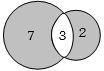
In a certain population,$10\%$ of the people are rich,$5\%$ are famous,and $3\%$ are both rich and famous. The probability that a person picked at random from the population is either famous or rich but not both,is equal to
A
$0.07$
B
$0.08$
C
$0.09$
D
$0.12$
Solution
(C) Let $R$ be the event that a person is rich and $F$ be the event that a person is famous.
Given: $P(R) = 10\% = 0.1$,$P(F) = 5\% = 0.05$,and $P(R \cap F) = 3\% = 0.03$.
We need to find the probability that a person is either rich or famous but not both,which is given by the symmetric difference $P(R \Delta F) = P(R \cup F) - P(R \cap F)$.
Alternatively,$P(R \Delta F) = P(R) + P(F) - 2P(R \cap F)$.
Substituting the values:
$P(R \Delta F) = 0.1 + 0.05 - 2(0.03)$
$P(R \Delta F) = 0.15 - 0.06 = 0.09$.
Given: $P(R) = 10\% = 0.1$,$P(F) = 5\% = 0.05$,and $P(R \cap F) = 3\% = 0.03$.
We need to find the probability that a person is either rich or famous but not both,which is given by the symmetric difference $P(R \Delta F) = P(R \cup F) - P(R \cap F)$.
Alternatively,$P(R \Delta F) = P(R) + P(F) - 2P(R \cap F)$.
Substituting the values:
$P(R \Delta F) = 0.1 + 0.05 - 2(0.03)$
$P(R \Delta F) = 0.15 - 0.06 = 0.09$.
0 likes
View Solution47
EasyMCQ
$A$ card is drawn from a pack of $52$ cards. Find the probability that the card will be a queen or a heart.
A
$\frac{4}{3}$
B
$\frac{16}{3}$
C
$\frac{4}{13}$
D
$\frac{5}{3}$
Solution
(C) Total number of cards = $52$.
Let $A$ be the event of drawing a queen and $B$ be the event of drawing a heart.
Number of queens $n(A) = 4$.
Number of hearts $n(B) = 13$.
Number of cards that are both a queen and a heart $n(A \cap B) = 1$.
Using the addition theorem of probability:
$P(A \cup B) = P(A) + P(B) - P(A \cap B)$
$P(A \cup B) = \frac{4}{52} + \frac{13}{52} - \frac{1}{52} = \frac{16}{52} = \frac{4}{13}$.
Let $A$ be the event of drawing a queen and $B$ be the event of drawing a heart.
Number of queens $n(A) = 4$.
Number of hearts $n(B) = 13$.
Number of cards that are both a queen and a heart $n(A \cap B) = 1$.
Using the addition theorem of probability:
$P(A \cup B) = P(A) + P(B) - P(A \cap B)$
$P(A \cup B) = \frac{4}{52} + \frac{13}{52} - \frac{1}{52} = \frac{16}{52} = \frac{4}{13}$.
0 likes
View Solution48
DifficultMCQ
The odds against a person who is $40$ years old living until he is $70$ are $8$ to $5$,and the odds against another person who is $50$ years old living until he is $80$ are $4$ to $3$. Find the probability that exactly one of them will be alive $30$ years from now.
A
$\frac{59}{91}$
B
$\frac{44}{91}$
C
$\frac{51}{91}$
D
$\frac{32}{91}$
Solution
(B) Let $A$ be the event that the first person is alive after $30$ years and $B$ be the event that the second person is alive after $30$ years.
Given the odds against $A$ are $8:5$,the probability that the first person dies is $P(\bar{A}) = \frac{8}{8+5} = \frac{8}{13}$.
Thus,the probability that the first person is alive is $P(A) = 1 - \frac{8}{13} = \frac{5}{13}$.
Given the odds against $B$ are $4:3$,the probability that the second person dies is $P(\bar{B}) = \frac{4}{4+3} = \frac{4}{7}$.
Thus,the probability that the second person is alive is $P(B) = 1 - \frac{4}{7} = \frac{3}{7}$.
The event that exactly one of them is alive is $(\bar{A} \cap B) \cup (A \cap \bar{B})$.
Since these events are independent,the probability is $P(\bar{A})P(B) + P(A)P(\bar{B})$.
$= (\frac{8}{13} \times \frac{3}{7}) + (\frac{5}{13} \times \frac{4}{7})$
$= \frac{24}{91} + \frac{20}{91} = \frac{44}{91}$.
Given the odds against $A$ are $8:5$,the probability that the first person dies is $P(\bar{A}) = \frac{8}{8+5} = \frac{8}{13}$.
Thus,the probability that the first person is alive is $P(A) = 1 - \frac{8}{13} = \frac{5}{13}$.
Given the odds against $B$ are $4:3$,the probability that the second person dies is $P(\bar{B}) = \frac{4}{4+3} = \frac{4}{7}$.
Thus,the probability that the second person is alive is $P(B) = 1 - \frac{4}{7} = \frac{3}{7}$.
The event that exactly one of them is alive is $(\bar{A} \cap B) \cup (A \cap \bar{B})$.
Since these events are independent,the probability is $P(\bar{A})P(B) + P(A)P(\bar{B})$.
$= (\frac{8}{13} \times \frac{3}{7}) + (\frac{5}{13} \times \frac{4}{7})$
$= \frac{24}{91} + \frac{20}{91} = \frac{44}{91}$.
0 likes
View Solution49
DifficultMCQ
The probability that a student will succeed in the $IIT$ entrance test is $0.2$ and the probability that he will succeed in the Roorkee entrance test is $0.5$. If the probability that he will be successful at both places is $0.3$,then the probability that he does not succeed at either place is:
A
$0.4$
B
$0.3$
C
$0.2$
D
$0.6$
Solution
(D) Let $A$ be the event that the student is selected in the $IIT$ entrance test and $B$ be the event that the student is selected in the Roorkee entrance test.
Given: $P(A) = 0.2$,$P(B) = 0.5$,and $P(A \cap B) = 0.3$.
We need to find the probability that he does not succeed at either place,which is $P(\overline{A} \cap \overline{B})$.
By De Morgan's Law,$P(\overline{A} \cap \overline{B}) = P(\overline{A \cup B}) = 1 - P(A \cup B)$.
Using the Addition Theorem: $P(A \cup B) = P(A) + P(B) - P(A \cap B)$.
$P(A \cup B) = 0.2 + 0.5 - 0.3 = 0.4$.
Therefore,$P(\overline{A} \cap \overline{B}) = 1 - 0.4 = 0.6$.
Given: $P(A) = 0.2$,$P(B) = 0.5$,and $P(A \cap B) = 0.3$.
We need to find the probability that he does not succeed at either place,which is $P(\overline{A} \cap \overline{B})$.
By De Morgan's Law,$P(\overline{A} \cap \overline{B}) = P(\overline{A \cup B}) = 1 - P(A \cup B)$.
Using the Addition Theorem: $P(A \cup B) = P(A) + P(B) - P(A \cap B)$.
$P(A \cup B) = 0.2 + 0.5 - 0.3 = 0.4$.
Therefore,$P(\overline{A} \cap \overline{B}) = 1 - 0.4 = 0.6$.
0 likes
View SolutionProbability — Odds in favor and odds against, Addition theorem on probability · Frequently Asked Questions
1Are these Probability questions useful for JEE and NEET?
Yes. All questions in this section are mapped to JEE Main and NEET exam patterns. Previous year questions from JEE Main, NEET, GUJCET and state-level exams are included with full solutions.
2Can I switch to Hindi or Gujarati for these questions?
Yes. Use the language tabs in the hero section or the sidebar to view the same questions and solutions in English, Hindi or Gujarati.
3How do I generate a question paper from this subtopic?
Use the Vedclass Exam Paper Generator — select the chapter and subtopic, set difficulty, and generate Sets A, B, C, D automatically. First 3 chapters of every subject are free.
Vedclass Products
For Students
Vedclass Test Series
Mock tests in real JEE/NEET style with performance analysis. 5-day free trial.
Start Free TrialFor Teachers
Exam Paper Generator
Generate Set A/B/C/D papers from this chapter in 2 minutes. 3 chapters free.
Try FreeFor Institutes
Online Exam Module
Live online exams with unlimited students, 360° analytics & white-label branding.
See DemoFor Teachers & Institutes
Generate a Probability Exam Paper in 2 Minutes
Select subtopic & difficulty — Sets A, B, C, D auto-generated with No Repeat logic.
First 3 chapters of every subject are free — no payment required.