
A English
Quantum number, Electronic configuration and Shape of orbitals Questions in English
Class 11 Chemistry · Structure of Atom · Quantum number, Electronic configuration and Shape of orbitals
1023+
Questions
English
Language
100%
With Solutions
Showing 50 of 1023 questions in English
501
EasyMCQ
The radial probability distribution curve for an orbital comprises of $3$ maxima. If the orbital has $3$ angular nodes as well,then the orbital can be:
A
$5f$
B
$7d$
C
$6f$
D
$7f$
Solution
(C) The number of maxima in the radial probability distribution curve is given by $(n - l)$.
Given,number of maxima $= 3$,so $n - l = 3$.
Also,the number of angular nodes is equal to the azimuthal quantum number,$l$.
Given,number of angular nodes $= 3$,so $l = 3$.
Substituting $l = 3$ into the first equation: $n - 3 = 3$,which gives $n = 6$.
Since $l = 3$ corresponds to the $f$ orbital,the orbital is $6f$.
Given,number of maxima $= 3$,so $n - l = 3$.
Also,the number of angular nodes is equal to the azimuthal quantum number,$l$.
Given,number of angular nodes $= 3$,so $l = 3$.
Substituting $l = 3$ into the first equation: $n - 3 = 3$,which gives $n = 6$.
Since $l = 3$ corresponds to the $f$ orbital,the orbital is $6f$.
0 likes
View Solution502
MediumMCQ
Which of the following notations of an orbital is incorrect considering the sign of the wave function?
A
B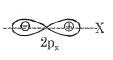
C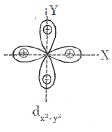
D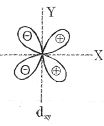
Solution
(C) The sign of the wave function $\psi$ for an orbital determines the phase of the electron wave.
For a $p$-orbital,the two lobes must have opposite signs (one positive,one negative) due to the presence of a nodal plane.
For a $d$-orbital,the lobes are arranged such that adjacent lobes have opposite signs.
In the $d_{x^2-y^2}$ orbital,the lobes lie along the $x$ and $y$ axes. The standard representation of a $d_{x^2-y^2}$ orbital shows the lobes along the $x$-axis having one sign (e.g.,positive) and the lobes along the $y$-axis having the opposite sign (e.g.,negative).
Option $C$ shows all four lobes of the $d_{x^2-y^2}$ orbital with a positive sign,which is incorrect as it violates the symmetry requirements of the wave function for this orbital.
For a $p$-orbital,the two lobes must have opposite signs (one positive,one negative) due to the presence of a nodal plane.
For a $d$-orbital,the lobes are arranged such that adjacent lobes have opposite signs.
In the $d_{x^2-y^2}$ orbital,the lobes lie along the $x$ and $y$ axes. The standard representation of a $d_{x^2-y^2}$ orbital shows the lobes along the $x$-axis having one sign (e.g.,positive) and the lobes along the $y$-axis having the opposite sign (e.g.,negative).
Option $C$ shows all four lobes of the $d_{x^2-y^2}$ orbital with a positive sign,which is incorrect as it violates the symmetry requirements of the wave function for this orbital.
0 likes
View Solution503
MediumMCQ
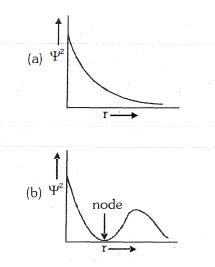
In the following two plots,$\psi^2$ is plotted against the distance '$r$' from the nucleus. Select the correct statement.
A
$'a'$ is for $1s$ and $'b'$ for $2s$
B
$'a'$ is for $2s$ and $'b'$ for $1s$
C
$'a'$ is for $2s$ and $'b'$ for $2p$
D
$'a'$ is for $2p$ and $'b'$ for $2s$
Solution
(A) The number of radial nodes in an orbital is given by the formula $(n - l - 1)$.
For the $1s$ orbital,$n=1$ and $l=0$,so the number of radial nodes is $(1 - 0 - 1) = 0$.
For the $2s$ orbital,$n=2$ and $l=0$,so the number of radial nodes is $(2 - 0 - 1) = 1$.
Plot $(a)$ shows no nodes,which corresponds to the $1s$ orbital.
Plot $(b)$ shows one radial node,which corresponds to the $2s$ orbital.
Therefore,$'a'$ is for $1s$ and $'b'$ is for $2s$.
For the $1s$ orbital,$n=1$ and $l=0$,so the number of radial nodes is $(1 - 0 - 1) = 0$.
For the $2s$ orbital,$n=2$ and $l=0$,so the number of radial nodes is $(2 - 0 - 1) = 1$.
Plot $(a)$ shows no nodes,which corresponds to the $1s$ orbital.
Plot $(b)$ shows one radial node,which corresponds to the $2s$ orbital.
Therefore,$'a'$ is for $1s$ and $'b'$ is for $2s$.
0 likes
View Solution504
EasyMCQ
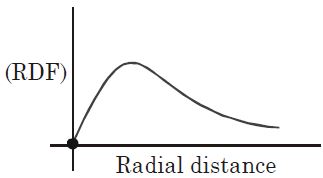
For a single electron system,the following graph is drawn for the radial distribution function $(RDF)$ versus radial distance. The correct statement regarding the graph is:
A
The graph must be representing $1s$ orbital
B
The graph must be representing $2p$ orbital
C
The graph must be representing $3d$ orbital
D
The graph must be representing an orbital different from $2s$
Solution
(D) The number of radial nodes in an orbital is given by the formula $(n - l - 1)$.
For $1s$ orbital: $n=1, l=0$,radial nodes $= 1 - 0 - 1 = 0$.
For $2p$ orbital: $n=2, l=1$,radial nodes $= 2 - 1 - 1 = 0$.
For $3d$ orbital: $n=3, l=2$,radial nodes $= 3 - 2 - 1 = 0$.
The given graph shows zero radial nodes because the $RDF$ curve touches the x-axis only at $r=0$ and $r=\infty$.
Since all $1s, 2p,$ and $3d$ orbitals have zero radial nodes,the graph could represent any of these orbitals.
However,looking at the options,$A, B,$ and $C$ are specific,while $D$ states it is different from $2s$ (which has $1$ radial node). Since the graph has $0$ radial nodes,it is indeed different from $2s$. Given the nature of such questions,if multiple options are technically correct,we look for the most encompassing one. However,usually,these questions have a single best fit. Since $1s, 2p, 3d$ all have $0$ nodes,they all fit the graph. Option $D$ is a true statement as the graph cannot be $2s$.
For $1s$ orbital: $n=1, l=0$,radial nodes $= 1 - 0 - 1 = 0$.
For $2p$ orbital: $n=2, l=1$,radial nodes $= 2 - 1 - 1 = 0$.
For $3d$ orbital: $n=3, l=2$,radial nodes $= 3 - 2 - 1 = 0$.
The given graph shows zero radial nodes because the $RDF$ curve touches the x-axis only at $r=0$ and $r=\infty$.
Since all $1s, 2p,$ and $3d$ orbitals have zero radial nodes,the graph could represent any of these orbitals.
However,looking at the options,$A, B,$ and $C$ are specific,while $D$ states it is different from $2s$ (which has $1$ radial node). Since the graph has $0$ radial nodes,it is indeed different from $2s$. Given the nature of such questions,if multiple options are technically correct,we look for the most encompassing one. However,usually,these questions have a single best fit. Since $1s, 2p, 3d$ all have $0$ nodes,they all fit the graph. Option $D$ is a true statement as the graph cannot be $2s$.
0 likes
View Solution505
DifficultMCQ
Select the correct statements for quantum numbers.
$(i)$ Magnetic quantum number $(m_l)$ gives information about the spatial orientation of orbitals with respect to the standard set of coordinate axes.
$(ii)$ Electron spin quantum number is represented by '$s$' and has values of $\pm \frac{1}{2}$.
$(iii)$ Principal quantum number $(n)$ determines the size of the orbitals and also,to a large extent,the energy of the orbitals.
$(i)$ Magnetic quantum number $(m_l)$ gives information about the spatial orientation of orbitals with respect to the standard set of coordinate axes.
$(ii)$ Electron spin quantum number is represented by '$s$' and has values of $\pm \frac{1}{2}$.
$(iii)$ Principal quantum number $(n)$ determines the size of the orbitals and also,to a large extent,the energy of the orbitals.
A
Only $(i)$,$(iii)$
B
Only $(iii)$
C
Only $(i)$
D
$(i)$,$(ii)$,$(iii)$
Solution
(A) Statement $(i)$ is correct: The magnetic quantum number $(m_l)$ describes the orientation of the orbital in space relative to the coordinate axes.
Statement $(ii)$ is incorrect: The electron spin quantum number is represented by '$m_s$' (or sometimes '$s$') and can have values of $+\frac{1}{2}$ or $-\frac{1}{2}$,not just $\frac{1}{2}$.
Statement $(iii)$ is correct: The principal quantum number $(n)$ determines the shell,which dictates the size of the orbital and significantly influences its energy.
Therefore,statements $(i)$ and $(iii)$ are correct.
Statement $(ii)$ is incorrect: The electron spin quantum number is represented by '$m_s$' (or sometimes '$s$') and can have values of $+\frac{1}{2}$ or $-\frac{1}{2}$,not just $\frac{1}{2}$.
Statement $(iii)$ is correct: The principal quantum number $(n)$ determines the shell,which dictates the size of the orbital and significantly influences its energy.
Therefore,statements $(i)$ and $(iii)$ are correct.
0 likes
View Solution506
MediumMCQ
The electronic configurations of four elements are given in brackets:
$L(1s^2, 2s^2\ 2p^1);$ $M(1s^2, 2s^2\ 2p^5)$
$Q(1s^2, 2s^2\ 2p^6, 3s^1);$ $R(1s^2, 2s^2\ 2p^2)$
The element that would most readily form a diatomic molecule is:
$L(1s^2, 2s^2\ 2p^1);$ $M(1s^2, 2s^2\ 2p^5)$
$Q(1s^2, 2s^2\ 2p^6, 3s^1);$ $R(1s^2, 2s^2\ 2p^2)$
The element that would most readily form a diatomic molecule is:
A
$Q$
B
$M$
C
$R$
D
$L$
Solution
(B) Non-metals readily form diatomic molecules by sharing electrons to complete their octet.
Element $M$ $(1s^2, 2s^2\ 2p^5)$ has seven electrons in its valence shell and needs one more electron to complete its octet.
Therefore,two atoms of $M$ share one electron each to form a diatomic molecule $(M_2)$,similar to the formation of $F_2$ from fluorine atoms.
Element $M$ $(1s^2, 2s^2\ 2p^5)$ has seven electrons in its valence shell and needs one more electron to complete its octet.
Therefore,two atoms of $M$ share one electron each to form a diatomic molecule $(M_2)$,similar to the formation of $F_2$ from fluorine atoms.
0 likes
View Solution507
MediumMCQ
If the atomic number of element $X$ is $7,$ the best electron dot symbol for the element is
A
$X.$
B
$\cdot X.$
C
$\cdot \dot{X}:$
D
$:\ddot{X}:$
Solution
(C) The atomic number of element $X$ is $7.$
Its electronic configuration is $1s^2 2s^2 2p^3,$ which means it has $5$ valence electrons.
According to Lewis dot structure rules,the valence electrons are represented by dots around the symbol.
For $5$ valence electrons,the symbol is represented as $\cdot \dot{X}:$
Its electronic configuration is $1s^2 2s^2 2p^3,$ which means it has $5$ valence electrons.
According to Lewis dot structure rules,the valence electrons are represented by dots around the symbol.
For $5$ valence electrons,the symbol is represented as $\cdot \dot{X}:$
0 likes
View Solution508
MediumMCQ
The correct order of energy for orbitals in a multi-electron atom is:
A
$ns < (n-2)f < (n-1)d < np$
B
$ns < (n-1)d < (n-2)f < np$
C
$ns < (n-2)f < np < (n-1)d$
D
$ns < np < (n-1)d < (n-2)f$
Solution
(D) According to the $(n+l)$ rule,the energy of an orbital increases as the value of $(n+l)$ increases.
For a given value of $(n+l)$,the orbital with a lower value of $n$ has lower energy.
Comparing the orbitals:
$ns$: $(n+0) = n$
$np$: $(n+1)$
$(n-1)d$: $(n-1+2) = n+1$
$(n-2)f$: $(n-2+3) = n+1$
Among orbitals with the same $(n+l)$ value of $(n+1)$,the order of increasing energy is $np < (n-1)d < (n-2)f$ because the principal quantum number $n$ increases in that order.
Thus,the overall energy order is $ns < np < (n-1)d < (n-2)f$.
For a given value of $(n+l)$,the orbital with a lower value of $n$ has lower energy.
Comparing the orbitals:
$ns$: $(n+0) = n$
$np$: $(n+1)$
$(n-1)d$: $(n-1+2) = n+1$
$(n-2)f$: $(n-2+3) = n+1$
Among orbitals with the same $(n+l)$ value of $(n+1)$,the order of increasing energy is $np < (n-1)d < (n-2)f$ because the principal quantum number $n$ increases in that order.
Thus,the overall energy order is $ns < np < (n-1)d < (n-2)f$.
0 likes
View Solution509
MediumMCQ
Which of the following orbitals represents $3d_{z^2}$ orbitals?
A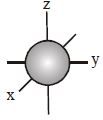
B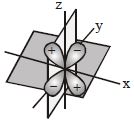
C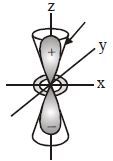
D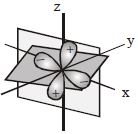
Solution
(C) The $d_{z^2}$ orbital is unique among the five $d$-orbitals because it has a different shape. It consists of two lobes along the $z$-axis and a ring of electron density in the $xy$-plane. This is represented by the image in option $C$.
0 likes
View Solution510
DifficultMCQ
For a $d$-electron,the orbital angular momentum is:
A
$\sqrt{6} \frac{h}{2\pi}$
B
$\sqrt{2} \frac{h}{2\pi}$
C
$\frac{h}{2\pi}$
D
$2 \frac{h}{2\pi}$
Solution
(A) The orbital angular momentum of an electron is given by the formula: $L = \sqrt{l(l+1)} \frac{h}{2\pi}$.
For a $d$-orbital,the azimuthal quantum number $l = 2$.
Substituting the value of $l$ into the formula:
$L = \sqrt{2(2+1)} \frac{h}{2\pi} = \sqrt{2(3)} \frac{h}{2\pi} = \sqrt{6} \frac{h}{2\pi}$.
Therefore,the correct option is $A$.
For a $d$-orbital,the azimuthal quantum number $l = 2$.
Substituting the value of $l$ into the formula:
$L = \sqrt{2(2+1)} \frac{h}{2\pi} = \sqrt{2(3)} \frac{h}{2\pi} = \sqrt{6} \frac{h}{2\pi}$.
Therefore,the correct option is $A$.
0 likes
View Solution511
MediumMCQ
The plot of $r^2 \Psi^2$ versus $r$ for $2s$ orbital of hydrogen atom exhibits :-
A
one maxima
B
two maxima
C
no maxima
D
three maxima
Solution
(B) For an orbital,the radial probability density is given by $4\pi r^2 \Psi^2$. The plot of $r^2 \Psi^2$ versus $r$ represents the radial probability distribution function.
For the $2s$ orbital,the principal quantum number $n = 2$ and the azimuthal quantum number $l = 0$.
The number of radial nodes is given by the formula $n - l - 1 = 2 - 0 - 1 = 1$.
$A$ radial node is a point where the probability density is zero.
For the $2s$ orbital,the radial probability distribution curve starts from the origin,increases to a maximum,drops to zero at the radial node $(r > 0)$,and then increases to a second,smaller maximum before approaching zero as $r$ approaches infinity.
Thus,the plot exhibits two maxima.
For the $2s$ orbital,the principal quantum number $n = 2$ and the azimuthal quantum number $l = 0$.
The number of radial nodes is given by the formula $n - l - 1 = 2 - 0 - 1 = 1$.
$A$ radial node is a point where the probability density is zero.
For the $2s$ orbital,the radial probability distribution curve starts from the origin,increases to a maximum,drops to zero at the radial node $(r > 0)$,and then increases to a second,smaller maximum before approaching zero as $r$ approaches infinity.
Thus,the plot exhibits two maxima.
0 likes
View Solution512
DifficultMCQ
The wave function $R_{2,0}$ for hydrogen atom is $R_{2,0} = K(2 - r/a_0) \exp(-r/2a_0)$,where $K$ is a constant. The distance $r$ at which $R_{2,0}$ exhibits a nodal point is at:
A
$a_0$
B
$2a_0$
C
$3a_0$
D
$4a_0$
Solution
(B) nodal point (or radial node) occurs where the radial wave function $R_{n,l}(r)$ becomes zero.
Given the wave function: $R_{2,0} = K(2 - r/a_0) \exp(-r/2a_0)$.
For a node,$R_{2,0} = 0$.
Since $K \neq 0$ and $\exp(-r/2a_0) \neq 0$ for any finite $r$,we must have $(2 - r/a_0) = 0$.
Solving for $r$: $2 = r/a_0$,which gives $r = 2a_0$.
Therefore,the nodal point is at $r = 2a_0$.
Given the wave function: $R_{2,0} = K(2 - r/a_0) \exp(-r/2a_0)$.
For a node,$R_{2,0} = 0$.
Since $K \neq 0$ and $\exp(-r/2a_0) \neq 0$ for any finite $r$,we must have $(2 - r/a_0) = 0$.
Solving for $r$: $2 = r/a_0$,which gives $r = 2a_0$.
Therefore,the nodal point is at $r = 2a_0$.
0 likes
View Solution513
EasyMCQ
Which of the following pairs of orbitals possess two nodal planes?
A
$p_{xy}, d_{x^2-y^2}$
B
$d_{xy}, d_{zx}$
C
$p_{yz}, d_{z^2}$
D
$d_{z^2}, d_{x^2-y^2}$
Solution
(B) The number of nodal planes in an orbital is given by the azimuthal quantum number $l$.
For $p$-orbitals $(l=1)$,there is $1$ nodal plane.
For $d$-orbitals $(l=2)$,there are $2$ nodal planes,except for the $d_{z^2}$ orbital.
The $d_{z^2}$ orbital has $0$ nodal planes but possesses $2$ nodal cones.
Therefore,the pair $d_{xy}$ and $d_{zx}$ both possess $2$ nodal planes.
For $p$-orbitals $(l=1)$,there is $1$ nodal plane.
For $d$-orbitals $(l=2)$,there are $2$ nodal planes,except for the $d_{z^2}$ orbital.
The $d_{z^2}$ orbital has $0$ nodal planes but possesses $2$ nodal cones.
Therefore,the pair $d_{xy}$ and $d_{zx}$ both possess $2$ nodal planes.
0 likes
View Solution514
MediumMCQ
If $n$ and $l$ are principal and azimuthal quantum numbers respectively,then the expression for calculating the total number of electrons in any energy level is:
A
$\sum\limits_{l = 0}^{l = n} {2(2l + 1)} $
B
$\sum\limits_{l = 1}^{l = n - 1} {2(2l + 1)} $
C
$\sum\limits_{l = 0}^{l = n + 1} {2(2l + 1)} $
D
$\sum\limits_{l = 0}^{l = n - 1} {2(2l + 1)} $
Solution
(D) For a given principal quantum number $n$,the azimuthal quantum number $l$ ranges from $0$ to $n-1$.
The number of electrons in a subshell with a given $l$ is $2(2l+1)$.
To find the total number of electrons in an energy level $n$,we sum the electrons in all subshells from $l=0$ to $l=n-1$.
Thus,the expression is $\sum_{l=0}^{n-1} 2(2l+1)$.
Therefore,the correct option is $D$.
The number of electrons in a subshell with a given $l$ is $2(2l+1)$.
To find the total number of electrons in an energy level $n$,we sum the electrons in all subshells from $l=0$ to $l=n-1$.
Thus,the expression is $\sum_{l=0}^{n-1} 2(2l+1)$.
Therefore,the correct option is $D$.
0 likes
View Solution515
EasyMCQ
For hydrogen-like atoms,the average distance of an electron from the nucleus for the orbitals belonging to the $4^{th}$ orbit is minimum for:
A
$4s$
B
$4p$
C
$4d$
D
$4f$
Solution
(D) The average distance of an electron from the nucleus in a hydrogen-like atom is given by the formula: $\langle r \rangle = \frac{a_0 n^2}{Z} \left[ 1 + \frac{1}{2} \left( 1 - \frac{l(l+1)}{n^2} \right) \right]$.
For a fixed orbit $n$,the average distance $\langle r \rangle$ depends on the azimuthal quantum number $l$.
As $l$ increases,the term $\frac{l(l+1)}{n^2}$ increases,which makes the term in the bracket $\left[ 1 + \frac{1}{2} \left( 1 - \frac{l(l+1)}{n^2} \right) \right]$ decrease.
Therefore,for a constant $n$,the average distance $\langle r \rangle$ is minimum for the orbital with the highest value of $l$.
For the $4^{th}$ orbit $(n=4)$,the possible values of $l$ are $0, 1, 2, 3$ corresponding to $4s, 4p, 4d, 4f$ orbitals respectively.
Since $l$ is maximum for the $4f$ orbital $(l=3)$,the average distance is minimum for $4f$.
For a fixed orbit $n$,the average distance $\langle r \rangle$ depends on the azimuthal quantum number $l$.
As $l$ increases,the term $\frac{l(l+1)}{n^2}$ increases,which makes the term in the bracket $\left[ 1 + \frac{1}{2} \left( 1 - \frac{l(l+1)}{n^2} \right) \right]$ decrease.
Therefore,for a constant $n$,the average distance $\langle r \rangle$ is minimum for the orbital with the highest value of $l$.
For the $4^{th}$ orbit $(n=4)$,the possible values of $l$ are $0, 1, 2, 3$ corresponding to $4s, 4p, 4d, 4f$ orbitals respectively.
Since $l$ is maximum for the $4f$ orbital $(l=3)$,the average distance is minimum for $4f$.
0 likes
View Solution516
MediumMCQ
Which statement is not true regarding the $2s$ orbital?
A
Number of radial nodes is greater than zero
B
Angular nodes is equal to zero
C
$\Psi \left( \theta, \phi \right) = \text{constant}$
D
Probability density is zero at the nucleus
Solution
(D) For an $ns$ orbital,the number of radial nodes is given by the formula $(n - l - 1)$.
For $2s$ orbital,$n = 2$ and $l = 0$,so radial nodes $= 2 - 0 - 1 = 1$,which is greater than zero. Thus,option $A$ is true.
For any $s$ orbital,the angular momentum quantum number $l = 0$,so the number of angular nodes is $l = 0$. Thus,option $B$ is true.
The wave function $\Psi$ for an $s$ orbital is spherically symmetric,meaning it depends only on the radial distance $r$ and is independent of the angular coordinates $\theta$ and $\phi$. Therefore,$\Psi \left( \theta, \phi \right) = \text{constant}$ is true.
The probability density is given by $|\Psi|^2$. For $s$ orbitals,the electron density is maximum at the nucleus $(r = 0)$. Therefore,the statement that probability density is zero at the nucleus is false.
For $2s$ orbital,$n = 2$ and $l = 0$,so radial nodes $= 2 - 0 - 1 = 1$,which is greater than zero. Thus,option $A$ is true.
For any $s$ orbital,the angular momentum quantum number $l = 0$,so the number of angular nodes is $l = 0$. Thus,option $B$ is true.
The wave function $\Psi$ for an $s$ orbital is spherically symmetric,meaning it depends only on the radial distance $r$ and is independent of the angular coordinates $\theta$ and $\phi$. Therefore,$\Psi \left( \theta, \phi \right) = \text{constant}$ is true.
The probability density is given by $|\Psi|^2$. For $s$ orbitals,the electron density is maximum at the nucleus $(r = 0)$. Therefore,the statement that probability density is zero at the nucleus is false.
0 likes
View Solution517
EasyMCQ
In a multi-electron system,the energy of an electron of $2p_y$ orbital is :-
A
Greater than $2p_x$ orbital
B
Less than $2p_x$ orbital
C
Equal to $2s$ orbital
D
Same as that of $2p_x$ and $2p_z$ orbital
Solution
(D) In a multi-electron system,orbitals belonging to the same subshell (having the same principal quantum number $n$ and azimuthal quantum number $l$) are degenerate in the absence of an external magnetic or electric field.
Since $2p_x$,$2p_y$,and $2p_z$ all belong to the $2p$ subshell $(n=2, l=1)$,they have the same energy.
Therefore,$E(2p_x) = E(2p_y) = E(2p_z)$.
Since $2p_x$,$2p_y$,and $2p_z$ all belong to the $2p$ subshell $(n=2, l=1)$,they have the same energy.
Therefore,$E(2p_x) = E(2p_y) = E(2p_z)$.
0 likes
View Solution518
EasyMCQ
Which of the following sets of quantum numbers is impossible for an electron?
A
$n = 1, l = 0, m_l = 0, m_s = +\frac{1}{2}$
B
$n = 9, l = 7, m_l = -6, m_s = -\frac{1}{2}$
C
$n = 2, l = 1, m_l = 0, m_s = +\frac{1}{2}$
D
$n = 3, l = 2, m_l = -3, m_s = +\frac{1}{2}$
Solution
(D) For a given value of azimuthal quantum number $l$,the magnetic quantum number $m_l$ can only take values in the range $-l$ to $+l$ (including zero).
In option $D$,$l = 2$,so the possible values for $m_l$ are $-2, -1, 0, +1, +2$.
Since $m_l = -3$ is outside this range,this set of quantum numbers is impossible.
In option $D$,$l = 2$,so the possible values for $m_l$ are $-2, -1, 0, +1, +2$.
Since $m_l = -3$ is outside this range,this set of quantum numbers is impossible.
0 likes
View Solution519
EasyMCQ
Which of the following configurations follows Hund's rule?
A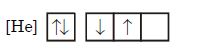
B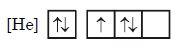
C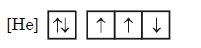
D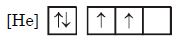
Solution
(D) Hund's rule of maximum multiplicity states that for a given electron configuration,the term with maximum multiplicity has the lowest energy. Therefore,in degenerate orbitals (like $p$-orbitals),electrons fill each orbital singly with parallel spins before pairing begins.
Option $A$ violates the rule because the spins are not parallel in the singly occupied orbitals.
Option $B$ violates the rule because pairing occurs before all orbitals are singly occupied.
Option $C$ violates the rule because the third electron is paired with an opposite spin before the second orbital is singly occupied.
Option $D$ correctly shows two electrons in separate $p$-orbitals with parallel spins,which is in accordance with Hund's rule.
Option $A$ violates the rule because the spins are not parallel in the singly occupied orbitals.
Option $B$ violates the rule because pairing occurs before all orbitals are singly occupied.
Option $C$ violates the rule because the third electron is paired with an opposite spin before the second orbital is singly occupied.
Option $D$ correctly shows two electrons in separate $p$-orbitals with parallel spins,which is in accordance with Hund's rule.
0 likes
View Solution520
EasyMCQ
Two electrons $A$ and $B$ in an atom have the following set of quantum numbers:
$A: n=3, l=2, m_l=-2, m_s=+1/2$
$B: n=3, l=0, m_l=0, m_s=+1/2$
What is true for $A$ and $B$?
$A: n=3, l=2, m_l=-2, m_s=+1/2$
$B: n=3, l=0, m_l=0, m_s=+1/2$
What is true for $A$ and $B$?
A
$A$ and $B$ have same energy
B
$A$ has more energy than $B$
C
$B$ has more energy than $A$
D
$A$ and $B$ represent same electron
Solution
(B) For electron $A$,$n=3$ and $l=2$,which corresponds to the $3d$ subshell.
For electron $B$,$n=3$ and $l=0$,which corresponds to the $3s$ subshell.
According to the $(n+l)$ rule,the energy of an orbital increases with the $(n+l)$ value.
For $A$,$(n+l) = 3+2 = 5$.
For $B$,$(n+l) = 3+0 = 3$.
Since the $(n+l)$ value for $A$ is greater than that for $B$,electron $A$ has higher energy than electron $B$.
For electron $B$,$n=3$ and $l=0$,which corresponds to the $3s$ subshell.
According to the $(n+l)$ rule,the energy of an orbital increases with the $(n+l)$ value.
For $A$,$(n+l) = 3+2 = 5$.
For $B$,$(n+l) = 3+0 = 3$.
Since the $(n+l)$ value for $A$ is greater than that for $B$,electron $A$ has higher energy than electron $B$.
0 likes
View Solution521
EasyMCQ
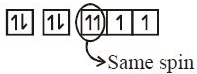
For the configuration shown,which rule is violated?

A
Aufbau principle
B
$(n + l)$ Rule
C
Pauli's exclusion principle
D
Hund's rule
Solution
(C) According to Pauli's exclusion principle,an orbital can contain a maximum of $2$ electrons,and these electrons must have opposite spins.
In the given configuration,one orbital contains $2$ electrons with the same spin (both pointing upwards),which violates Pauli's exclusion principle.
In the given configuration,one orbital contains $2$ electrons with the same spin (both pointing upwards),which violates Pauli's exclusion principle.
0 likes
View Solution522
EasyMCQ
Which of the following is the correct electronic configuration?
A
$_{21}Sc = [Ar] \, 3d^1 \, 4s^2$
B
$_{89}Ac = [Rn] \, 5f^0 \, 6d^1 \, 7s^2$
C
$_{29}Cu = [Ar] \, 3d^{10} \, 4s^1$
D
All are correct
Solution
(D) $1$. For $_{21}Sc$: The atomic number is $21$. The configuration is $[Ar] \, 3d^1 \, 4s^2$,which is correct.
$2$. For $_{89}Ac$: The atomic number is $89$. The configuration is $[Rn] \, 5f^0 \, 6d^1 \, 7s^2$,which is correct.
$3$. For $_{29}Cu$: The atomic number is $29$. Due to the stability of the fully filled $d$-subshell,the configuration is $[Ar] \, 3d^{10} \, 4s^1$,which is correct.
$4$. Since all the given options are correct,the correct answer is $D$.
$2$. For $_{89}Ac$: The atomic number is $89$. The configuration is $[Rn] \, 5f^0 \, 6d^1 \, 7s^2$,which is correct.
$3$. For $_{29}Cu$: The atomic number is $29$. Due to the stability of the fully filled $d$-subshell,the configuration is $[Ar] \, 3d^{10} \, 4s^1$,which is correct.
$4$. Since all the given options are correct,the correct answer is $D$.
0 likes
View Solution523
EasyMCQ
Which of the following is violating Hund's rule?
A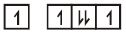
B
C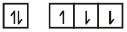
D
All of the above
Solution
(D) Hund's rule of maximum multiplicity states that for a given electron configuration,the lowest energy term is the one with the greatest value of spin multiplicity. This means that electrons must occupy all available degenerate orbitals singly with parallel spins before pairing begins.
In option $A$,the $2p^4$ configuration is shown as $(\uparrow)(\uparrow\downarrow)(\uparrow)$. This is a valid configuration as it follows the rule of filling orbitals singly before pairing.
In option $B$,the $2p^2$ configuration is shown as $(\uparrow\downarrow)(\text{empty})(\text{empty})$. This violates Hund's rule because the electrons should have occupied separate orbitals with parallel spins $(\uparrow)(\uparrow)(\text{empty})$ instead of pairing in the first orbital.
In option $C$,the $2p^3$ configuration is shown as $(\uparrow)(\downarrow)(\uparrow)$. This violates Hund's rule because the electrons should have parallel spins $(\uparrow)(\uparrow)(\uparrow)$ when occupying degenerate orbitals singly.
Since both $B$ and $C$ violate Hund's rule,the correct answer is $D$.
In option $A$,the $2p^4$ configuration is shown as $(\uparrow)(\uparrow\downarrow)(\uparrow)$. This is a valid configuration as it follows the rule of filling orbitals singly before pairing.
In option $B$,the $2p^2$ configuration is shown as $(\uparrow\downarrow)(\text{empty})(\text{empty})$. This violates Hund's rule because the electrons should have occupied separate orbitals with parallel spins $(\uparrow)(\uparrow)(\text{empty})$ instead of pairing in the first orbital.
In option $C$,the $2p^3$ configuration is shown as $(\uparrow)(\downarrow)(\uparrow)$. This violates Hund's rule because the electrons should have parallel spins $(\uparrow)(\uparrow)(\uparrow)$ when occupying degenerate orbitals singly.
Since both $B$ and $C$ violate Hund's rule,the correct answer is $D$.
0 likes
View Solution524
EasyMCQ
What is the meaning of degenerate orbitals?
A
Orbitals having the same energy
B
Orbitals having different wave functions
C
Orbitals having different energy and different wave functions
D
None of these
Solution
(A) Orbitals that possess the same energy level are referred to as degenerate orbitals. For example,in a hydrogen atom,the $2p_x$,$2p_y$,and $2p_z$ orbitals have the same energy.
0 likes
View Solution525
MediumMCQ
Few statements are given regarding nodes in the orbitals. Mark the statement which is not correct.
A
In case of $p_z-$orbital,$xy$ plane is a nodal plane.
B
$ns-$orbital has $(n + 1)$ nodes.
C
The number of angular nodes is given by $l$.
D
The total number of nodes is given by $(n - 1)$.
Solution
(B) For any orbital,the total number of nodes is calculated as $(n - 1)$.
Angular nodes are given by the azimuthal quantum number $l$.
Radial nodes are given by $(n - l - 1)$.
Total nodes $=$ Radial nodes $+$ Angular nodes $= (n - l - 1) + l = n - 1$.
For $p_z-$orbital,the electron density is zero in the $xy-$plane,so it is a nodal plane.
Therefore,the statement that $ns-$orbital has $(n + 1)$ nodes is incorrect,as it should be $(n - 1)$ nodes.
Angular nodes are given by the azimuthal quantum number $l$.
Radial nodes are given by $(n - l - 1)$.
Total nodes $=$ Radial nodes $+$ Angular nodes $= (n - l - 1) + l = n - 1$.
For $p_z-$orbital,the electron density is zero in the $xy-$plane,so it is a nodal plane.
Therefore,the statement that $ns-$orbital has $(n + 1)$ nodes is incorrect,as it should be $(n - 1)$ nodes.
0 likes
View Solution526
EasyMCQ
The probability of finding electrons in $d_{xy}$ orbital is
A
along $x$ and $y$ axis
B
along $x$ and $z$ axis
C
along $y$ and $z$ axis
D
at an angle of $45^{\circ}$ with $x$ axis
Solution
(D) The $d_{xy}$ orbital has four lobes that lie in the $xy$-plane.
These lobes are oriented between the $x$ and $y$ axes,specifically at an angle of $45^{\circ}$ with respect to the $x$-axis.
Therefore,the maximum probability of finding electrons in the $d_{xy}$ orbital is at an angle of $45^{\circ}$ with the $x$-axis.
These lobes are oriented between the $x$ and $y$ axes,specifically at an angle of $45^{\circ}$ with respect to the $x$-axis.
Therefore,the maximum probability of finding electrons in the $d_{xy}$ orbital is at an angle of $45^{\circ}$ with the $x$-axis.
0 likes
View Solution527
EasyMCQ
The orbital diagram in which both the Pauli's exclusion principle and Hund's rule are violated is
A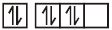
B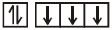
C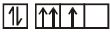
D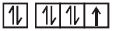
Solution
(C) $Pauli's$ exclusion principle states that no two electrons in an atom can have the same set of four quantum numbers. This means an orbital can hold a maximum of two electrons with opposite spins.
$Hund's$ rule of maximum multiplicity states that electron pairing in $p, d,$ and $f$ orbitals cannot occur until each orbital of a given subshell contains one electron each (singly occupied).
In option $C$,the first orbital of the $p$-subshell contains two electrons with the same spin,which violates $Pauli's$ exclusion principle. Furthermore,the second orbital is empty while the first is paired,which violates $Hund's$ rule.
$Hund's$ rule of maximum multiplicity states that electron pairing in $p, d,$ and $f$ orbitals cannot occur until each orbital of a given subshell contains one electron each (singly occupied).
In option $C$,the first orbital of the $p$-subshell contains two electrons with the same spin,which violates $Pauli's$ exclusion principle. Furthermore,the second orbital is empty while the first is paired,which violates $Hund's$ rule.
0 likes
View Solution528
EasyMCQ
Which of the following electronic configurations is not possible according to Hund's rule?
A
$1s^2 \, 2s^2$
B
$1s^2 \, 2s^1$
C
$1s^2 \, 2s^2 \, 2p_x^1 \, 2p_y^1 \, 2p_z^1$
D
$1s^2 \, 2s^2 \, 2p_x^2$
Solution
(D) According to Hund's rule of maximum multiplicity,pairing of electrons in the orbitals of a given subshell ($p$,$d$,or $f$) does not occur until each orbital of that subshell is singly occupied.
In the configuration $1s^2 \, 2s^2 \, 2p_x^2$,the $2p_x$ orbital is paired while $2p_y$ and $2p_z$ are empty,which violates this rule.
In the configuration $1s^2 \, 2s^2 \, 2p_x^2$,the $2p_x$ orbital is paired while $2p_y$ and $2p_z$ are empty,which violates this rule.
0 likes
View Solution529
MediumMCQ
For which of the following sets of quantum numbers,an electron will have the highest energy?
A
$n=3, l=2, m=1, s=-1/2$
B
$n=4, l=3, m=-1, s=+1/2$
C
$n=4, l=1, m=-1, s=+1/2$
D
$n=5, l=0, m=0, s=-1/2$
Solution
(B) According to the $(n+l)$ rule,the energy of an orbital is determined by the sum of the principal quantum number $(n)$ and the azimuthal quantum number $(l)$.
For option $(A): n+l = 3+2 = 5$.
For option $(B): n+l = 4+3 = 7$.
For option $(C): n+l = 4+1 = 5$.
For option $(D): n+l = 5+0 = 5$.
Since the $(n+l)$ value is highest for option $(B)$,the electron in this set has the highest energy.
For option $(A): n+l = 3+2 = 5$.
For option $(B): n+l = 4+3 = 7$.
For option $(C): n+l = 4+1 = 5$.
For option $(D): n+l = 5+0 = 5$.
Since the $(n+l)$ value is highest for option $(B)$,the electron in this set has the highest energy.
0 likes
View Solution530
EasyMCQ
What will be the maximum number of electrons in any atom having quantum numbers $n = 4, l = 2, m = -2$?
A
$2$
B
$10$
C
$1$
D
$6$
Solution
(A) The quantum numbers $n = 4$,$l = 2$,and $m = -2$ uniquely define a single orbital ($4d_{xy}$ or similar depending on convention).
According to the Pauli Exclusion Principle,any single orbital can accommodate a maximum of $2$ electrons with opposite spins ($m_s = +1/2$ and $m_s = -1/2$).
According to the Pauli Exclusion Principle,any single orbital can accommodate a maximum of $2$ electrons with opposite spins ($m_s = +1/2$ and $m_s = -1/2$).
0 likes
View Solution531
MediumMCQ
Which of the following sets of quantum numbers is not possible?
A
$n=3, \ell=2, m=0, s=-1/2$
B
$n=3, \ell=2, m=-2, s=-1/2$
C
$n=3, \ell=3, m=-3, s=-1/2$
D
$n=3, \ell=0, m=0, s=-1/2$
Solution
(C) For a given principal quantum number $n$,the azimuthal quantum number $\ell$ can have values from $0$ to $n-1$.
For a given $\ell$,the magnetic quantum number $m$ can have values from $-\ell$ to $+\ell$.
In all given options,$n=3$.
Therefore,for $n=3$,the possible values for $\ell$ are $0, 1, \text{or } 2$.
In option $C$,$\ell=3$,which is not possible for $n=3$ because $\ell$ must be less than $n$.
Thus,the set of quantum numbers in option $C$ is invalid.
For a given $\ell$,the magnetic quantum number $m$ can have values from $-\ell$ to $+\ell$.
In all given options,$n=3$.
Therefore,for $n=3$,the possible values for $\ell$ are $0, 1, \text{or } 2$.
In option $C$,$\ell=3$,which is not possible for $n=3$ because $\ell$ must be less than $n$.
Thus,the set of quantum numbers in option $C$ is invalid.
0 likes
View Solution532
EasyMCQ
The total value of magnetic quantum number for $n = 4$ is:
A
$9$
B
$16$
C
$12$
D
None of these
Solution
(B) The total number of orbitals in a shell is given by the formula $n^2$,where $n$ is the principal quantum number.
For $n = 4$,the total number of orbitals is $4^2 = 16$.
Since each orbital corresponds to a specific value of the magnetic quantum number $(m_l)$,the total number of values for the magnetic quantum number is equal to the total number of orbitals.
Therefore,the total value is $16$.
For $n = 4$,the total number of orbitals is $4^2 = 16$.
Since each orbital corresponds to a specific value of the magnetic quantum number $(m_l)$,the total number of values for the magnetic quantum number is equal to the total number of orbitals.
Therefore,the total value is $16$.
0 likes
View Solution533
MediumMCQ
In $Cu$ (Atomic number $Z = 29$),which of the following statements regarding the electron spin is correct?
A
$13$ electrons have spin in one direction and $16$ electrons in other direction.
B
$14$ electrons have spin in one direction and $15$ electrons in other direction.
C
One electron can have spin only in clockwise direction.
D
None of the above is correct.
Solution
(B) The electronic configuration of $Cu$ $(Z = 29)$ is $[Ar] 3d^{10} 4s^1$.
Total number of electrons = $29$.
In a filled orbital,there are $2$ electrons with opposite spins ($+1/2$ and $-1/2$).
In $Cu$,there are $14$ fully filled orbitals $(1s, 2s, 2p_x, 2p_y, 2p_z, 3s, 3p_x, 3p_y, 3p_z, 3d_{xy}, 3d_{yz}, 3d_{zx}, 3d_{x^2-y^2}, 3d_{z^2})$ containing $28$ electrons.
These $28$ electrons consist of $14$ electrons with spin $+1/2$ and $14$ electrons with spin $-1/2$.
The remaining $1$ electron is in the $4s$ orbital,which can have either spin $+1/2$ or $-1/2$.
If the $4s$ electron has spin $+1/2$,then total electrons with spin $+1/2$ are $14 + 1 = 15$ and spin $-1/2$ are $14$.
If the $4s$ electron has spin $-1/2$,then total electrons with spin $-1/2$ are $14 + 1 = 15$ and spin $+1/2$ are $14$.
Thus,$15$ electrons have spin in one direction and $14$ electrons in the other direction.
Since this matches option $B$ (rearranged),the correct statement is that $14$ electrons have spin in one direction and $15$ electrons in the other.
Total number of electrons = $29$.
In a filled orbital,there are $2$ electrons with opposite spins ($+1/2$ and $-1/2$).
In $Cu$,there are $14$ fully filled orbitals $(1s, 2s, 2p_x, 2p_y, 2p_z, 3s, 3p_x, 3p_y, 3p_z, 3d_{xy}, 3d_{yz}, 3d_{zx}, 3d_{x^2-y^2}, 3d_{z^2})$ containing $28$ electrons.
These $28$ electrons consist of $14$ electrons with spin $+1/2$ and $14$ electrons with spin $-1/2$.
The remaining $1$ electron is in the $4s$ orbital,which can have either spin $+1/2$ or $-1/2$.
If the $4s$ electron has spin $+1/2$,then total electrons with spin $+1/2$ are $14 + 1 = 15$ and spin $-1/2$ are $14$.
If the $4s$ electron has spin $-1/2$,then total electrons with spin $-1/2$ are $14 + 1 = 15$ and spin $+1/2$ are $14$.
Thus,$15$ electrons have spin in one direction and $14$ electrons in the other direction.
Since this matches option $B$ (rearranged),the correct statement is that $14$ electrons have spin in one direction and $15$ electrons in the other.
0 likes
View Solution534
MediumMCQ
Arrange the energy of the $2s$ orbital in the following atoms in decreasing order: $H, Li, Na, K$.
A
$E_{2s(H)} < E_{2s(Li)} < E_{2s(Na)} < E_{2s(K)}$
B
$E_{2s(H)} = E_{2s(Li)} = E_{2s(Na)} = E_{2s(K)}$
C
$E_{2s(H)} > E_{2s(Li)} > E_{2s(Na)} > E_{2s(K)}$
D
$E_{2s(H)} > E_{2s(Li)} > E_{2s(Na)} = E_{2s(K)}$
Solution
(C) The energy of an orbital in a multi-electron atom depends on the effective nuclear charge $(Z_{eff})$ and the principal quantum number $(n)$.
For a given orbital like $2s$,as the atomic number $(Z)$ increases,the effective nuclear charge experienced by the electron increases due to the shielding effect of inner electrons.
However,in hydrogen $(H)$,there is only one electron and no shielding,making the $2s$ orbital energy higher compared to multi-electron atoms where the electron is more tightly bound to the nucleus.
As we move down the group $IA$ ($Li$ to $K$),the atomic size increases and the screening effect increases,which stabilizes the $2s$ orbital,thereby decreasing its energy.
Therefore,the correct decreasing order of energy is $E_{2s(H)} > E_{2s(Li)} > E_{2s(Na)} > E_{2s(K)}$.
For a given orbital like $2s$,as the atomic number $(Z)$ increases,the effective nuclear charge experienced by the electron increases due to the shielding effect of inner electrons.
However,in hydrogen $(H)$,there is only one electron and no shielding,making the $2s$ orbital energy higher compared to multi-electron atoms where the electron is more tightly bound to the nucleus.
As we move down the group $IA$ ($Li$ to $K$),the atomic size increases and the screening effect increases,which stabilizes the $2s$ orbital,thereby decreasing its energy.
Therefore,the correct decreasing order of energy is $E_{2s(H)} > E_{2s(Li)} > E_{2s(Na)} > E_{2s(K)}$.
0 likes
View Solution535
MediumMCQ
If the sum of $(n + l)$ is $6$,how many electrons would have clockwise spin associated with this energy level?
A
$18$
B
$9$
C
$6$
D
$32$
Solution
(B) For a given energy level where $(n + l) = 6$,the possible values for $(n, l)$ are:
$1$. If $n = 6, l = 0$ ($6s$ orbital)
$2$. If $n = 5, l = 1$ ($5p$ orbital)
$3$. If $n = 4, l = 2$ ($4d$ orbital)
$4$. If $n = 3, l = 3$ ($3f$ orbital - not possible as $l < n$)
Thus,the possible orbitals are $6s$,$5p$,and $4d$.
Total number of orbitals = $1$ $(6s)$ + $3$ $(5p)$ + $5$ $(4d)$ = $9$ orbitals.
Each orbital can hold a maximum of $2$ electrons,but only one electron in each orbital has a clockwise spin (usually represented as $m_s = +1/2$).
Therefore,the number of electrons with clockwise spin = $9$.
$1$. If $n = 6, l = 0$ ($6s$ orbital)
$2$. If $n = 5, l = 1$ ($5p$ orbital)
$3$. If $n = 4, l = 2$ ($4d$ orbital)
$4$. If $n = 3, l = 3$ ($3f$ orbital - not possible as $l < n$)
Thus,the possible orbitals are $6s$,$5p$,and $4d$.
Total number of orbitals = $1$ $(6s)$ + $3$ $(5p)$ + $5$ $(4d)$ = $9$ orbitals.
Each orbital can hold a maximum of $2$ electrons,but only one electron in each orbital has a clockwise spin (usually represented as $m_s = +1/2$).
Therefore,the number of electrons with clockwise spin = $9$.
0 likes
View Solution536
MediumMCQ
The orbital angular momentum of a $3p$ electron is
A
$\sqrt{3} h$
B
$\sqrt{6} h$
C
zero
D
$\sqrt{2} \frac{h}{2\pi}$
Solution
(D) The orbital angular momentum of an electron is given by the formula: $L = \sqrt{l(l+1)} \frac{h}{2\pi}$.
For a $3p$ electron,the azimuthal quantum number $l = 1$.
Substituting the value of $l$ into the formula:
$L = \sqrt{1(1+1)} \frac{h}{2\pi} = \sqrt{2} \frac{h}{2\pi}$.
Therefore,the correct option is $D$.
For a $3p$ electron,the azimuthal quantum number $l = 1$.
Substituting the value of $l$ into the formula:
$L = \sqrt{1(1+1)} \frac{h}{2\pi} = \sqrt{2} \frac{h}{2\pi}$.
Therefore,the correct option is $D$.
0 likes
View Solution537
EasyMCQ
Arrange the orbitals of $H$ atom in the increasing order of their energy:
$3p_x, 2s, 4d_{xy}, 3s, 4p_z, 3p_y, 4s$
$3p_x, 2s, 4d_{xy}, 3s, 4p_z, 3p_y, 4s$
A
$2s < 3s = 3p_x = 3p_y < 4s = 4p_z = 4d_{xy}$
B
$2s < 3s < 3p_x = 3p_y < 4s = 4p_z = 4d_{xy}$
C
$2s < 3s < 3p_x = 3p_y < 4s = 4p_z < 4d_{xy}$
D
$2s < 3s < 3p_x = 3p_y < 4s < 4p_z < 4d_{xy}$
Solution
(A) For a single-electron species like the $H$ atom,the energy of an orbital depends only on the principal quantum number $(n)$.
Orbitals with the same value of $n$ have the same energy (degenerate orbitals).
Comparing the given orbitals:
- For $2s$,$n = 2$.
- For $3s, 3p_x, 3p_y$,$n = 3$.
- For $4s, 4p_z, 4d_{xy}$,$n = 4$.
Therefore,the increasing order of energy is: $2s < 3s = 3p_x = 3p_y < 4s = 4p_z = 4d_{xy}$.
Orbitals with the same value of $n$ have the same energy (degenerate orbitals).
Comparing the given orbitals:
- For $2s$,$n = 2$.
- For $3s, 3p_x, 3p_y$,$n = 3$.
- For $4s, 4p_z, 4d_{xy}$,$n = 4$.
Therefore,the increasing order of energy is: $2s < 3s = 3p_x = 3p_y < 4s = 4p_z = 4d_{xy}$.
0 likes
View Solution538
EasyMCQ
The total number of orbitals associated with the principal quantum number $n = 5$ is
A
$20$
B
$25$
C
$10$
D
$5$
Solution
(B) The total number of orbitals in a shell is given by the formula $n^2$,where $n$ is the principal quantum number.
For $n = 5$,the number of orbitals $= (5)^2 = 25$.
For $n = 5$,the number of orbitals $= (5)^2 = 25$.
0 likes
View Solution539
MediumMCQ
Aqueous solution of which salt will not contain ions with the electronic configuration $1s^2 \, 2s^2 \, 2p^6 \, 3s^2 \, 3p^6$?
A
$NaF$
B
$KBr$
C
$NaCl$
D
$CaI_2$
Solution
(A) The electronic configuration $1s^2 \, 2s^2 \, 2p^6 \, 3s^2 \, 3p^6$ corresponds to the $Ar$ (Argon) noble gas core,which has $18$ electrons.
In $NaF$,the ions are $Na^+$ ($10$ electrons: $1s^2 \, 2s^2 \, 2p^6$) and $F^-$ ($10$ electrons: $1s^2 \, 2s^2 \, 2p^6$). Neither ion has the $18$-electron configuration.
In $KBr$,$K^+$ ($18$ electrons) and $Br^-$ ($36$ electrons) are present. $K^+$ has the $18$-electron configuration.
In $NaCl$,$Cl^-$ ($18$ electrons) is present.
In $CaI_2$,$Ca^{2+}$ ($18$ electrons) is present.
Therefore,the aqueous solution of $NaF$ does not contain any ions with the $1s^2 \, 2s^2 \, 2p^6 \, 3s^2 \, 3p^6$ configuration.
In $NaF$,the ions are $Na^+$ ($10$ electrons: $1s^2 \, 2s^2 \, 2p^6$) and $F^-$ ($10$ electrons: $1s^2 \, 2s^2 \, 2p^6$). Neither ion has the $18$-electron configuration.
In $KBr$,$K^+$ ($18$ electrons) and $Br^-$ ($36$ electrons) are present. $K^+$ has the $18$-electron configuration.
In $NaCl$,$Cl^-$ ($18$ electrons) is present.
In $CaI_2$,$Ca^{2+}$ ($18$ electrons) is present.
Therefore,the aqueous solution of $NaF$ does not contain any ions with the $1s^2 \, 2s^2 \, 2p^6 \, 3s^2 \, 3p^6$ configuration.
0 likes
View Solution540
DifficultMCQ
If the principal quantum number $n=6,$ the correct sequence of filling of electrons will be
A
$ns \to (n-2)f \to np \to (n-1)d$
B
$ns \to (n-2)f \to (n-1)d \to np$
C
$ns \to np \to (n-1)d \to (n-2)f$
D
$ns \to (n-1)d \to (n-2)f \to np$
Solution
(B) According to the $(n+l)$ rule,electrons fill orbitals in order of increasing $(n+l)$ values.
For $n=6$:
$6s: n+l = 6+0 = 6$
$4f: n+l = 4+3 = 7$
$5d: n+l = 5+2 = 7$
$6p: n+l = 6+1 = 7$
Comparing the orbitals with the same $(n+l)$ value,the one with the lower $n$ value fills first.
Thus,the order is $6s \to 4f \to 5d \to 6p$,which corresponds to $ns \to (n-2)f \to (n-1)d \to np$.
For $n=6$:
$6s: n+l = 6+0 = 6$
$4f: n+l = 4+3 = 7$
$5d: n+l = 5+2 = 7$
$6p: n+l = 6+1 = 7$
Comparing the orbitals with the same $(n+l)$ value,the one with the lower $n$ value fills first.
Thus,the order is $6s \to 4f \to 5d \to 6p$,which corresponds to $ns \to (n-2)f \to (n-1)d \to np$.
0 likes
View Solution541
MediumMCQ
In an atom,how many orbital$(s)$ will have the quantum numbers $n = 3, l = 2$ and $m_l = +2$?
A
$5$
B
$3$
C
$1$
D
$7$
Solution
(C) The given quantum numbers are $n = 3$ and $l = 2$,which corresponds to the $3d$ subshell.
For a given subshell,the magnetic quantum number $m_l$ can take values from $-l$ to $+l$.
For $l = 2$,the possible values of $m_l$ are $-2, -1, 0, +1, +2$.
Each specific value of $m_l$ corresponds to exactly one orbital.
Therefore,for $m_l = +2$,there is only $1$ orbital.
For a given subshell,the magnetic quantum number $m_l$ can take values from $-l$ to $+l$.
For $l = 2$,the possible values of $m_l$ are $-2, -1, 0, +1, +2$.
Each specific value of $m_l$ corresponds to exactly one orbital.
Therefore,for $m_l = +2$,there is only $1$ orbital.
0 likes
View Solution542
MediumMCQ
Given:
$(A)\ n = 5, m_l = +1$
$(B)\ n = 2, l = 1, m_l = -1, m_s = -1/2$
The maximum number of electron$(s)$ in an atom that can have the quantum numbers as given in $(A)$ and $(B)$ are respectively:
$(A)\ n = 5, m_l = +1$
$(B)\ n = 2, l = 1, m_l = -1, m_s = -1/2$
The maximum number of electron$(s)$ in an atom that can have the quantum numbers as given in $(A)$ and $(B)$ are respectively:
A
$25$ and $1$
B
$8$ and $1$
C
$2$ and $4$
D
$4$ and $1$
Solution
(B) $(A)\ n = 5$ implies $l$ can be $0, 1, 2, 3, 4$ ($s, p, d, f, g$ orbitals).
For a given $m_l = +1$,the orbitals that can have this value are $p$ $(l=1)$,$d$ $(l=2)$,$f$ $(l=3)$,and $g$ $(l=4)$.
Each orbital can hold $2$ electrons $(m_s = +1/2, -1/2)$.
Total electrons $= 2 (p) + 2 (d) + 2 (f) + 2 (g) = 8$ electrons.
$(B)\ n = 2, l = 1, m_l = -1, m_s = -1/2$ represents a specific electron in the $2p$ orbital.
Since all four quantum numbers are specified,it corresponds to exactly $1$ electron.
For a given $m_l = +1$,the orbitals that can have this value are $p$ $(l=1)$,$d$ $(l=2)$,$f$ $(l=3)$,and $g$ $(l=4)$.
Each orbital can hold $2$ electrons $(m_s = +1/2, -1/2)$.
Total electrons $= 2 (p) + 2 (d) + 2 (f) + 2 (g) = 8$ electrons.
$(B)\ n = 2, l = 1, m_l = -1, m_s = -1/2$ represents a specific electron in the $2p$ orbital.
Since all four quantum numbers are specified,it corresponds to exactly $1$ electron.
0 likes
View Solution543
MediumMCQ
The following sets of quantum numbers represent four electrons in an atom:
$(i)$ $n = 4, l = 1$ $(ii)$ $n = 4, l = 0$
$(iii)$ $n = 3, l = 2$ $(iv)$ $n = 3, l = 1$
The sequence representing the increasing order of energy is:
$(i)$ $n = 4, l = 1$ $(ii)$ $n = 4, l = 0$
$(iii)$ $n = 3, l = 2$ $(iv)$ $n = 3, l = 1$
The sequence representing the increasing order of energy is:
A
$(iii) < (i) < (iv) < (ii)$
B
$(iv) < (ii) < (iii) < (i)$
C
$(i) < (iii) < (ii) < (iv)$
D
$(ii) < (iv) < (i) < (iii)$
Solution
(B) First,identify the orbitals based on the given quantum numbers:
$(i)$ $n = 4, l = 1$ corresponds to $4p$ orbital. $(n+l) = 4 + 1 = 5$.
$(ii)$ $n = 4, l = 0$ corresponds to $4s$ orbital. $(n+l) = 4 + 0 = 4$.
$(iii)$ $n = 3, l = 2$ corresponds to $3d$ orbital. $(n+l) = 3 + 2 = 5$.
$(iv)$ $n = 3, l = 1$ corresponds to $3p$ orbital. $(n+l) = 3 + 1 = 4$.
According to the $(n+l)$ rule,energy increases as the $(n+l)$ value increases.
For $(iv)$ and $(ii)$,both have $(n+l) = 4$. Since $(iv)$ has a lower $n$ value $(n=3)$ than $(ii)$ $(n=4)$,$(iv)$ has lower energy.
For $(iii)$ and $(i)$,both have $(n+l) = 5$. Since $(iii)$ has a lower $n$ value $(n=3)$ than $(i)$ $(n=4)$,$(iii)$ has lower energy.
Thus,the increasing order of energy is: $(iv) < (ii) < (iii) < (i)$.
$(i)$ $n = 4, l = 1$ corresponds to $4p$ orbital. $(n+l) = 4 + 1 = 5$.
$(ii)$ $n = 4, l = 0$ corresponds to $4s$ orbital. $(n+l) = 4 + 0 = 4$.
$(iii)$ $n = 3, l = 2$ corresponds to $3d$ orbital. $(n+l) = 3 + 2 = 5$.
$(iv)$ $n = 3, l = 1$ corresponds to $3p$ orbital. $(n+l) = 3 + 1 = 4$.
According to the $(n+l)$ rule,energy increases as the $(n+l)$ value increases.
For $(iv)$ and $(ii)$,both have $(n+l) = 4$. Since $(iv)$ has a lower $n$ value $(n=3)$ than $(ii)$ $(n=4)$,$(iv)$ has lower energy.
For $(iii)$ and $(i)$,both have $(n+l) = 5$. Since $(iii)$ has a lower $n$ value $(n=3)$ than $(i)$ $(n=4)$,$(iii)$ has lower energy.
Thus,the increasing order of energy is: $(iv) < (ii) < (iii) < (i)$.
0 likes
View Solution544
DifficultMCQ
Which of the following combination of statements is true regarding the interpretation of the atomic orbitals?
$1$. An electron in an orbital of high angular momentum stays further away from the nucleus than an electron in an orbital of lower angular momentum.
$2$. For a given value of the principal quantum number,the size of the orbit is inversely proportional to the azimuthal quantum number.
$3$. According to wave mechanics,the ground state angular momentum is equal to $\frac{h}{2\pi}$.
$4$. The plot of $\Psi$ vs $r$ for various azimuthal quantum numbers shows peak shifting towards higher $r$ values.
$1$. An electron in an orbital of high angular momentum stays further away from the nucleus than an electron in an orbital of lower angular momentum.
$2$. For a given value of the principal quantum number,the size of the orbit is inversely proportional to the azimuthal quantum number.
$3$. According to wave mechanics,the ground state angular momentum is equal to $\frac{h}{2\pi}$.
$4$. The plot of $\Psi$ vs $r$ for various azimuthal quantum numbers shows peak shifting towards higher $r$ values.
A
$1, 3$
B
$1, 2$
C
$1, 4$
D
$2, 3$
Solution
(A) Statement $1$ is true: Electrons in orbitals with higher angular momentum $(l)$ experience more shielding and are generally found further from the nucleus.
Statement $2$ is false: The size of the orbital depends primarily on the principal quantum number $(n)$,not the azimuthal quantum number $(l)$.
Statement $3$ is true: According to the Bohr model,the angular momentum of an electron in the ground state $(n=1)$ is $mvr = \frac{h}{2\pi}$.
Statement $4$ is false: The radial probability distribution plots show that as $l$ increases,the electron density shifts further from the nucleus,but the statement regarding $\Psi$ vs $r$ is not a standard interpretation of orbital size trends.
Therefore,the correct combination is $1$ and $3$.
Statement $2$ is false: The size of the orbital depends primarily on the principal quantum number $(n)$,not the azimuthal quantum number $(l)$.
Statement $3$ is true: According to the Bohr model,the angular momentum of an electron in the ground state $(n=1)$ is $mvr = \frac{h}{2\pi}$.
Statement $4$ is false: The radial probability distribution plots show that as $l$ increases,the electron density shifts further from the nucleus,but the statement regarding $\Psi$ vs $r$ is not a standard interpretation of orbital size trends.
Therefore,the correct combination is $1$ and $3$.
0 likes
View Solution545
MediumMCQ
The $71^{st}$ electron of an element $X$ with an atomic number of $71$ enters into the orbital:
A
$6p$
B
$4f$
C
$5d$
D
$6s$
Solution
(C) The atomic number of element $X$ is $71$. The electronic configuration of this element (Lutetium) is $[Xe]4f^{14} 5d^1 6s^2$.
According to the Aufbau principle,the electrons fill orbitals in increasing order of energy.
For $Z = 71$,the configuration is $1s^2 2s^2 2p^6 3s^2 3p^6 4s^2 3d^{10} 4p^6 5s^2 4d^{10} 5p^6 6s^2 4f^{14} 5d^1$.
The last electron ($71^{st}$ electron) enters the $5d$ orbital.
According to the Aufbau principle,the electrons fill orbitals in increasing order of energy.
For $Z = 71$,the configuration is $1s^2 2s^2 2p^6 3s^2 3p^6 4s^2 3d^{10} 4p^6 5s^2 4d^{10} 5p^6 6s^2 4f^{14} 5d^1$.
The last electron ($71^{st}$ electron) enters the $5d$ orbital.
0 likes
View Solution546
DifficultMCQ
The quantum numbers of four electrons are given below:
$I. \ n = 4, l = 2, m_l = -2, m_s = -1/2$
$II. \ n = 3, l = 2, m_l = 1, m_s = +1/2$
$III. \ n = 4, l = 1, m_l = 0, m_s = +1/2$
$IV. \ n = 3, l = 1, m_l = 1, m_s = -1/2$
The correct order of their increasing energies will be:
$I. \ n = 4, l = 2, m_l = -2, m_s = -1/2$
$II. \ n = 3, l = 2, m_l = 1, m_s = +1/2$
$III. \ n = 4, l = 1, m_l = 0, m_s = +1/2$
$IV. \ n = 3, l = 1, m_l = 1, m_s = -1/2$
The correct order of their increasing energies will be:
A
$I < III < II < IV$
B
$I < II < III < IV$
C
$IV < II < III < I$
D
$IV < III < II < I$
Solution
(C) The energy of an orbital is determined by the $(n + l)$ rule.
For $I: n = 4, l = 2, (n + l) = 4 + 2 = 6$ ($4d$ orbital).
For $II: n = 3, l = 2, (n + l) = 3 + 2 = 5$ ($3d$ orbital).
For $III: n = 4, l = 1, (n + l) = 4 + 1 = 5$ ($4p$ orbital).
For $IV: n = 3, l = 1, (n + l) = 3 + 1 = 4$ ($3p$ orbital).
According to the $(n + l)$ rule,lower $(n + l)$ value means lower energy. If $(n + l)$ values are equal,the orbital with lower $n$ has lower energy.
Comparing the values: $IV (4) < II (5, n=3) < III (5, n=4) < I (6)$.
Thus,the increasing order of energy is $IV < II < III < I$.
For $I: n = 4, l = 2, (n + l) = 4 + 2 = 6$ ($4d$ orbital).
For $II: n = 3, l = 2, (n + l) = 3 + 2 = 5$ ($3d$ orbital).
For $III: n = 4, l = 1, (n + l) = 4 + 1 = 5$ ($4p$ orbital).
For $IV: n = 3, l = 1, (n + l) = 3 + 1 = 4$ ($3p$ orbital).
According to the $(n + l)$ rule,lower $(n + l)$ value means lower energy. If $(n + l)$ values are equal,the orbital with lower $n$ has lower energy.
Comparing the values: $IV (4) < II (5, n=3) < III (5, n=4) < I (6)$.
Thus,the increasing order of energy is $IV < II < III < I$.
0 likes
View Solution547
MediumMCQ
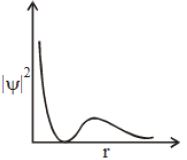
The graph between $|\psi|^2$ and $r$ (radial distance) is shown below. This represents
A
$1s$ orbital
B
$3s$ orbital
C
$2s$ orbital
D
$2p$ orbital
Solution
(C) For an $s$-orbital,the probability density $|\psi|^2$ is maximum at the nucleus $(r=0)$.
The number of radial nodes is given by the formula $n-l-1$.
For the $2s$ orbital,the number of radial nodes is $2-0-1 = 1$.
The graph shows one radial node (where the curve touches the $r$-axis),which is characteristic of the $2s$ orbital.
Therefore,the graph represents the $2s$ orbital.
The number of radial nodes is given by the formula $n-l-1$.
For the $2s$ orbital,the number of radial nodes is $2-0-1 = 1$.
The graph shows one radial node (where the curve touches the $r$-axis),which is characteristic of the $2s$ orbital.
Therefore,the graph represents the $2s$ orbital.
0 likes
View Solution548
EasyMCQ
Which of the following electronic configurations is incorrect?
A
$1s^2\, 2s^2\, 2p_x^2\, 2p_y^2\, 2p_z^0$
B
$1s^2\, 2s^2\, 2p_x^1\, 2p_y^1$
C
$1s^2\, 2s^2\, 2p_x^1\, 2p_y^1\, 2p_z^1$
D
$1s^2\, 2s^2\, 2p^6\, 3s^2\, 3p^6\, 3d^5\, 4s^1$
Solution
(B) According to Hund's rule of maximum multiplicity,electrons fill degenerate orbitals (like $2p_x, 2p_y, 2p_z$) singly before pairing begins.
Option $B$ $(1s^2\, 2s^2\, 2p_x^1\, 2p_y^1)$ is incorrect because it represents a state where the $2p$ subshell is partially filled without following the correct order of orbital occupancy or stability,and it violates the principle of filling orbitals in a way that minimizes energy.
Option $B$ $(1s^2\, 2s^2\, 2p_x^1\, 2p_y^1)$ is incorrect because it represents a state where the $2p$ subshell is partially filled without following the correct order of orbital occupancy or stability,and it violates the principle of filling orbitals in a way that minimizes energy.
0 likes
View Solution549
MediumMCQ
Which of the following sets of quantum numbers is not possible?
A
$n = 4, l = 1, m = 0, s = +1/2$
B
$n = 4, l = 3, m = -3, s = -1/2$
C
$n = 4, l = -1, m = +2, s = -1/2$
D
$n = 4, l = 1, m = 0, s = -1/2$
Solution
(C) According to the rules of quantum numbers:
$1$. The principal quantum number $n$ can be any positive integer $(1, 2, 3, \dots)$.
$2$. The azimuthal quantum number $l$ can have values from $0$ to $n-1$.
$3$. The magnetic quantum number $m$ can have values from $-l$ to $+l$.
$4$. The spin quantum number $s$ can only be $+1/2$ or $-1/2$.
In option $C$,$l = -1$,which is not possible because $l$ cannot be negative. Therefore,this set of quantum numbers is invalid.
$1$. The principal quantum number $n$ can be any positive integer $(1, 2, 3, \dots)$.
$2$. The azimuthal quantum number $l$ can have values from $0$ to $n-1$.
$3$. The magnetic quantum number $m$ can have values from $-l$ to $+l$.
$4$. The spin quantum number $s$ can only be $+1/2$ or $-1/2$.
In option $C$,$l = -1$,which is not possible because $l$ cannot be negative. Therefore,this set of quantum numbers is invalid.
0 likes
View Solution550
EasyMCQ
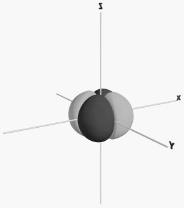
The number of nodal planes (planes of zero electron density) in the $d_{xy}$ orbital is:
A
$1$
B
$2$
C
$0$
D
$4$
Solution
(B) The number of nodal planes for an orbital is given by the azimuthal quantum number,$l$.
For a $d$-orbital,$l = 2$,so the number of nodal planes is $2$.
Specifically,for the $d_{xy}$ orbital,the electron density is concentrated in the $xy$-plane between the $x$ and $y$ axes.
The two nodal planes are the $xz$-plane and the $yz$-plane,where the probability of finding an electron is zero.
For a $d$-orbital,$l = 2$,so the number of nodal planes is $2$.
Specifically,for the $d_{xy}$ orbital,the electron density is concentrated in the $xy$-plane between the $x$ and $y$ axes.
The two nodal planes are the $xz$-plane and the $yz$-plane,where the probability of finding an electron is zero.
0 likes
View SolutionStructure of Atom — Quantum number, Electronic configuration and Shape of orbitals · Frequently Asked Questions
1Are these Structure of Atom questions useful for JEE and NEET?
Yes. All questions in this section are mapped to JEE Main and NEET exam patterns. Previous year questions from JEE Main, NEET, GUJCET and state-level exams are included with full solutions.
2Can I switch to Hindi or Gujarati for these questions?
Yes. Use the language tabs in the hero section or the sidebar to view the same questions and solutions in English, Hindi or Gujarati.
3How do I generate a question paper from this subtopic?
Use the Vedclass Exam Paper Generator — select the chapter and subtopic, set difficulty, and generate Sets A, B, C, D automatically. First 3 chapters of every subject are free.
Vedclass Products
For Students
Vedclass Test Series
Mock tests in real JEE/NEET style with performance analysis. 5-day free trial.
Start Free TrialFor Teachers
Exam Paper Generator
Generate Set A/B/C/D papers from this chapter in 2 minutes. 3 chapters free.
Try FreeFor Institutes
Online Exam Module
Live online exams with unlimited students, 360° analytics & white-label branding.
See DemoFor Teachers & Institutes
Generate a Structure of Atom Exam Paper in 2 Minutes
Select subtopic & difficulty — Sets A, B, C, D auto-generated with No Repeat logic.
First 3 chapters of every subject are free — no payment required.