
A English
Quantum number, Electronic configuration and Shape of orbitals Questions in English
Class 11 Chemistry · Structure of Atom · Quantum number, Electronic configuration and Shape of orbitals
1023+
Questions
English
Language
100%
With Solutions
Showing 50 of 1023 questions in English
401
MediumMCQ
The electrons identified by quantum numbers $n$ and $l$ :
$A. n=4, l=1$ $B. n=4, l=0$
$C. n=3, l=2$ $D. n=3, l=1$
can be placed in order of increasing energy as :
$A. n=4, l=1$ $B. n=4, l=0$
$C. n=3, l=2$ $D. n=3, l=1$
can be placed in order of increasing energy as :
A
$D < B < C < A$
B
$D < C < B < A$
C
$B < D < A < C$
D
$A < C < B < D$
Solution
(A) To determine the energy order,we use the $(n+l)$ rule:
$A. n=4, l=1 \implies n+l = 4+1 = 5$ ($4p$ orbital)
$B. n=4, l=0 \implies n+l = 4+0 = 4$ ($4s$ orbital)
$C. n=3, l=2 \implies n+l = 3+2 = 5$ ($3d$ orbital)
$D. n=3, l=1 \implies n+l = 3+1 = 4$ ($3p$ orbital)
According to the $(n+l)$ rule,orbitals with lower $(n+l)$ values have lower energy.
If $(n+l)$ values are equal,the orbital with the lower $n$ value has lower energy.
Comparing the values:
$D (n+l=4, n=3) < B (n+l=4, n=4) < C (n+l=5, n=3) < A (n+l=5, n=4)$
Thus,the order of increasing energy is $D < B < C < A$.
$A. n=4, l=1 \implies n+l = 4+1 = 5$ ($4p$ orbital)
$B. n=4, l=0 \implies n+l = 4+0 = 4$ ($4s$ orbital)
$C. n=3, l=2 \implies n+l = 3+2 = 5$ ($3d$ orbital)
$D. n=3, l=1 \implies n+l = 3+1 = 4$ ($3p$ orbital)
According to the $(n+l)$ rule,orbitals with lower $(n+l)$ values have lower energy.
If $(n+l)$ values are equal,the orbital with the lower $n$ value has lower energy.
Comparing the values:
$D (n+l=4, n=3) < B (n+l=4, n=4) < C (n+l=5, n=3) < A (n+l=5, n=4)$
Thus,the order of increasing energy is $D < B < C < A$.
0 likes
View Solution402
MediumMCQ
The correct set of four quantum numbers for the valence electron of rubidium atom $(Z=37)$ is:
A
$n=5, l=0, m=0, s=+1/2$
B
$n=5, l=1, m=0, s=+1/2$
C
$n=5, l=1, m=1, s=+1/2$
D
$n=5, l=0, m=1, s=+1/2$
Solution
(A) The electronic configuration of Rubidium $(Z=37)$ is $1s^2 2s^2 2p^6 3s^2 3p^6 4s^2 3d^{10} 4p^6 5s^1$.
The valence electron is present in the $5s$ orbital.
For the $5s$ orbital,the principal quantum number $n=5$.
Since it is an $s$-orbital,the azimuthal quantum number $l=0$.
For $l=0$,the magnetic quantum number $m=0$.
The spin quantum number $s$ can be $+1/2$ or $-1/2$. Thus,the set is $(5, 0, 0, +1/2)$.
The valence electron is present in the $5s$ orbital.
For the $5s$ orbital,the principal quantum number $n=5$.
Since it is an $s$-orbital,the azimuthal quantum number $l=0$.
For $l=0$,the magnetic quantum number $m=0$.
The spin quantum number $s$ can be $+1/2$ or $-1/2$. Thus,the set is $(5, 0, 0, +1/2)$.
0 likes
View Solution403
MediumMCQ
Which set of quantum numbers is not possible for the last electron of $Al$ $(Z = 13)$:- value of $n, l, m, s$ respectively?
A
$3, 1, -1, -\frac{1}{2}$
B
$3, 0, 0, +\frac{1}{2}$
C
$3, 1, 0, +\frac{1}{2}$
D
$3, 1, 1, -\frac{1}{2}$
Solution
(B) The electronic configuration of $Al$ $(Z = 13)$ is $1s^2 2s^2 2p^6 3s^2 3p^1$.
The last electron enters the $3p$ orbital.
For the $3p$ orbital,the quantum numbers are:
Principal quantum number $(n)$ = $3$.
Azimuthal quantum number $(l)$ = $1$.
Magnetic quantum number $(m)$ can be $-1, 0, +1$.
Spin quantum number $(s)$ can be $+\frac{1}{2}$ or $-\frac{1}{2}$.
Option $B$ represents the quantum numbers for an electron in the $3s$ orbital $(n=3, l=0, m=0, s=+\frac{1}{2})$,which is not the last electron of $Al$. Therefore,this set is not possible for the last electron.
The last electron enters the $3p$ orbital.
For the $3p$ orbital,the quantum numbers are:
Principal quantum number $(n)$ = $3$.
Azimuthal quantum number $(l)$ = $1$.
Magnetic quantum number $(m)$ can be $-1, 0, +1$.
Spin quantum number $(s)$ can be $+\frac{1}{2}$ or $-\frac{1}{2}$.
Option $B$ represents the quantum numbers for an electron in the $3s$ orbital $(n=3, l=0, m=0, s=+\frac{1}{2})$,which is not the last electron of $Al$. Therefore,this set is not possible for the last electron.
0 likes
View Solution404
MediumMCQ
Find the number of electrons in the ground state of $Pd$ $(Z = 46)$ with $l = 2$.
A
$18$
B
$20$
C
$8$
D
$10$
Solution
(D) The atomic number of Palladium $(Pd)$ is $46$.
The electronic configuration of $Pd$ in its ground state is $[Kr] 4d^{10} 5s^0$.
The value $l = 2$ corresponds to the $d$-subshell.
In the $4d^{10}$ configuration,there are $10$ electrons in the $d$-subshell.
Therefore,the number of electrons with $l = 2$ is $10$.
The electronic configuration of $Pd$ in its ground state is $[Kr] 4d^{10} 5s^0$.
The value $l = 2$ corresponds to the $d$-subshell.
In the $4d^{10}$ configuration,there are $10$ electrons in the $d$-subshell.
Therefore,the number of electrons with $l = 2$ is $10$.
0 likes
View Solution405
MediumMCQ
The angular part of the wave function for an orbital is given by $\psi_{(\theta, \phi)} = \left( \frac{15}{4\pi} \right)^{1/2} \sin \theta \cos \theta \sin \phi$,where $\theta$ is the angle from the $z$-axis. The angular node$(s)$ are:
A
$XY$ plane only
B
$YZ$ plane only
C
$XY$ and $XZ$ planes only
D
$XY$,$YZ$,and $ZX$ planes
Solution
(C) The given angular wave function is $\psi_{(\theta, \phi)} = \left( \frac{15}{4\pi} \right)^{1/2} \sin \theta \cos \theta \sin \phi$.
This corresponds to the $d_{yz}$ orbital.
In spherical coordinates,$y = r \sin \theta \sin \phi$ and $z = r \cos \theta$.
The product $yz$ is proportional to $\sin \theta \sin \phi \cos \theta$,which matches the angular part provided.
The nodal planes for a $d_{yz}$ orbital are the $XY$ plane $(z=0)$ and the $XZ$ plane $(y=0)$,where the probability of finding the electron is zero.
Therefore,the correct option is $C$.
This corresponds to the $d_{yz}$ orbital.
In spherical coordinates,$y = r \sin \theta \sin \phi$ and $z = r \cos \theta$.
The product $yz$ is proportional to $\sin \theta \sin \phi \cos \theta$,which matches the angular part provided.
The nodal planes for a $d_{yz}$ orbital are the $XY$ plane $(z=0)$ and the $XZ$ plane $(y=0)$,where the probability of finding the electron is zero.
Therefore,the correct option is $C$.
0 likes
View Solution406
EasyMCQ
Total number of electrons in $Cu$ atom having $m_l = 0$.
A
$9$
B
$13$
C
$10$
D
$6$
Solution
(B) The electronic configuration of $Cu$ $(Z=29)$ is $1s^2 \ 2s^2 \ 2p^6 \ 3s^2 \ 3p^6 \ 4s^1 \ 3d^{10}$.
For $s$-orbitals $(l=0)$,$m_l$ is always $0$. There are $2$ electrons in $1s$,$2$ in $2s$,$2$ in $3s$,and $1$ in $4s$.
For $p$-orbitals $(l=1)$,$m_l$ values are $-1, 0, +1$. Each $p$-subshell has $6$ electrons,so $2$ electrons have $m_l=0$ in each ($2p$ and $3p$).
For $d$-orbitals $(l=2)$,$m_l$ values are $-2, -1, 0, +1, +2$. In a filled $3d^{10}$ subshell,$2$ electrons have $m_l=0$.
Total electrons with $m_l = 0$ are: $2 (1s) + 2 (2s) + 2 (2p) + 2 (3s) + 2 (3p) + 1 (4s) + 2 (3d) = 13$.
For $s$-orbitals $(l=0)$,$m_l$ is always $0$. There are $2$ electrons in $1s$,$2$ in $2s$,$2$ in $3s$,and $1$ in $4s$.
For $p$-orbitals $(l=1)$,$m_l$ values are $-1, 0, +1$. Each $p$-subshell has $6$ electrons,so $2$ electrons have $m_l=0$ in each ($2p$ and $3p$).
For $d$-orbitals $(l=2)$,$m_l$ values are $-2, -1, 0, +1, +2$. In a filled $3d^{10}$ subshell,$2$ electrons have $m_l=0$.
Total electrons with $m_l = 0$ are: $2 (1s) + 2 (2s) + 2 (2p) + 2 (3s) + 2 (3p) + 1 (4s) + 2 (3d) = 13$.
0 likes
View Solution407
MediumMCQ
Which of the following plots of radial probability function $4\pi r^2 \Psi ^2$ is incorrectly labelled?
A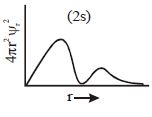
B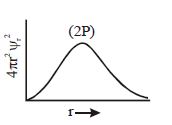
C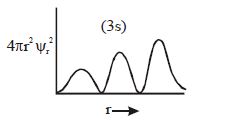
D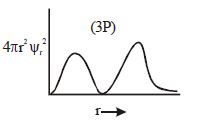
Solution
(D) The number of radial nodes in an orbital is given by the formula $n - l - 1$.
For a $2s$ orbital $(n=2, l=0)$,radial nodes $= 2 - 0 - 1 = 1$. The plot should show $1$ node.
For a $2p$ orbital $(n=2, l=1)$,radial nodes $= 2 - 1 - 1 = 0$. The plot should show $0$ nodes.
For a $3s$ orbital $(n=3, l=0)$,radial nodes $= 3 - 0 - 1 = 2$. The plot should show $2$ nodes.
For a $3p$ orbital $(n=3, l=1)$,radial nodes $= 3 - 1 - 1 = 1$. The plot should show $1$ node.
Looking at the provided plots:
- Plot $A$ $(2s)$ shows $1$ node (Correct).
- Plot $B$ $(2p)$ shows $0$ nodes (Correct).
- Plot $C$ $(3s)$ shows $2$ nodes (Correct).
- Plot $D$ $(3p)$ shows $1$ node,but the label is $3p$. Wait,let's re-examine the plots. Plot $D$ shows $1$ node,which is correct for $3p$. However,looking closely at the options provided in standard chemistry problems of this type,the plot for $2p$ should have $0$ nodes,and the plot for $3p$ should have $1$ node. All plots appear to match their labels based on the radial node formula. Let's re-evaluate the question. If all are correct,there might be a subtle error in the provided image or the question expects identifying the one that is commonly mislabeled in textbooks. Actually,the $2p$ plot $(B)$ shows $0$ nodes,which is correct. The $3p$ plot $(D)$ shows $1$ node,which is correct. The $3s$ plot $(C)$ shows $2$ nodes,which is correct. The $2s$ plot $(A)$ shows $1$ node,which is correct. Given the options,if one must be incorrect,we re-verify the $3p$ plot. The $3p$ plot should have $1$ radial node. The image $D$ shows $1$ node. It seems all are correctly labeled. However,often in such questions,the $2p$ plot is incorrectly shown with a node. Since all are correct,the question might be flawed,but based on standard curriculum,all are correctly labeled.
For a $2s$ orbital $(n=2, l=0)$,radial nodes $= 2 - 0 - 1 = 1$. The plot should show $1$ node.
For a $2p$ orbital $(n=2, l=1)$,radial nodes $= 2 - 1 - 1 = 0$. The plot should show $0$ nodes.
For a $3s$ orbital $(n=3, l=0)$,radial nodes $= 3 - 0 - 1 = 2$. The plot should show $2$ nodes.
For a $3p$ orbital $(n=3, l=1)$,radial nodes $= 3 - 1 - 1 = 1$. The plot should show $1$ node.
Looking at the provided plots:
- Plot $A$ $(2s)$ shows $1$ node (Correct).
- Plot $B$ $(2p)$ shows $0$ nodes (Correct).
- Plot $C$ $(3s)$ shows $2$ nodes (Correct).
- Plot $D$ $(3p)$ shows $1$ node,but the label is $3p$. Wait,let's re-examine the plots. Plot $D$ shows $1$ node,which is correct for $3p$. However,looking closely at the options provided in standard chemistry problems of this type,the plot for $2p$ should have $0$ nodes,and the plot for $3p$ should have $1$ node. All plots appear to match their labels based on the radial node formula. Let's re-evaluate the question. If all are correct,there might be a subtle error in the provided image or the question expects identifying the one that is commonly mislabeled in textbooks. Actually,the $2p$ plot $(B)$ shows $0$ nodes,which is correct. The $3p$ plot $(D)$ shows $1$ node,which is correct. The $3s$ plot $(C)$ shows $2$ nodes,which is correct. The $2s$ plot $(A)$ shows $1$ node,which is correct. Given the options,if one must be incorrect,we re-verify the $3p$ plot. The $3p$ plot should have $1$ radial node. The image $D$ shows $1$ node. It seems all are correctly labeled. However,often in such questions,the $2p$ plot is incorrectly shown with a node. Since all are correct,the question might be flawed,but based on standard curriculum,all are correctly labeled.
0 likes
View Solution408
MediumMCQ
Select the set of quantum numbers which is $NOT$ associated with any electron in $Cr$ $(Z = 24)$.
A
$n = 4, l = 1, m = 0, s = +\frac{1}{2}$
B
$n = 4, l = 0, m = 0, s = -\frac{1}{2}$
C
$n = 3, l = 2, m = -2, s = +\frac{1}{2}$
D
$n = 3, l = 1, m = +1, s = -\frac{1}{2}$
Solution
(A) The electronic configuration of $Cr$ $(Z = 24)$ is $[Ar] 3d^5 4s^1$.
In this configuration,the electrons are present in the $1s, 2s, 2p, 3s, 3p, 3d,$ and $4s$ orbitals.
Option $A$ corresponds to $n = 4, l = 1$,which represents a $4p$ orbital.
Since there are no electrons in the $4p$ orbital for a chromium atom in its ground state,this set of quantum numbers is not associated with any electron in $Cr$.
In this configuration,the electrons are present in the $1s, 2s, 2p, 3s, 3p, 3d,$ and $4s$ orbitals.
Option $A$ corresponds to $n = 4, l = 1$,which represents a $4p$ orbital.
Since there are no electrons in the $4p$ orbital for a chromium atom in its ground state,this set of quantum numbers is not associated with any electron in $Cr$.
0 likes
View Solution409
MediumMCQ
Which of the following sets of species has the $3^{rd}$ principal energy level $(n=3)$ completely filled?
A
$Ar, Zn$
B
$Cu, Zn$
C
$Cu^{+2}, Zn^{+2}$
D
$Cl^{-}, Ar$
Solution
(B) The $3^{rd}$ principal energy level $(n=3)$ consists of $3s$,$3p$,and $3d$ subshells. For this level to be completely filled,it must contain $2 + 6 + 10 = 18$ electrons.
In $Ar$ $(Z=18)$,the configuration is $1s^2 2s^2 2p^6 3s^2 3p^6$. Here,the $3d$ subshell is empty,so the $3^{rd}$ level is not completely filled.
In $Zn$ $(Z=30)$,the configuration is $[Ar] 3d^{10} 4s^2$. The $3^{rd}$ level $(3s^2 3p^6 3d^{10})$ contains $18$ electrons and is completely filled.
In $Cu$ $(Z=29)$,the configuration is $[Ar] 3d^{10} 4s^1$. The $3^{rd}$ level is completely filled.
In $Cu^{+2}$ $(Z=29)$,the configuration is $[Ar] 3d^9$. The $3^{rd}$ level is not completely filled.
In $Zn^{+2}$ $(Z=30)$,the configuration is $[Ar] 3d^{10}$. The $3^{rd}$ level is completely filled.
Comparing the options,both $Cu$ and $Zn$ have a completely filled $3^{rd}$ principal energy level.
In $Ar$ $(Z=18)$,the configuration is $1s^2 2s^2 2p^6 3s^2 3p^6$. Here,the $3d$ subshell is empty,so the $3^{rd}$ level is not completely filled.
In $Zn$ $(Z=30)$,the configuration is $[Ar] 3d^{10} 4s^2$. The $3^{rd}$ level $(3s^2 3p^6 3d^{10})$ contains $18$ electrons and is completely filled.
In $Cu$ $(Z=29)$,the configuration is $[Ar] 3d^{10} 4s^1$. The $3^{rd}$ level is completely filled.
In $Cu^{+2}$ $(Z=29)$,the configuration is $[Ar] 3d^9$. The $3^{rd}$ level is not completely filled.
In $Zn^{+2}$ $(Z=30)$,the configuration is $[Ar] 3d^{10}$. The $3^{rd}$ level is completely filled.
Comparing the options,both $Cu$ and $Zn$ have a completely filled $3^{rd}$ principal energy level.
0 likes
View Solution410
EasyMCQ
Which one represents an impossible arrangement of quantum numbers $(n, l, m, s)$?
A
$n=3, l=2, m=-2, s=1/2$
B
$n=4, l=0, m=0, s=1/2$
C
$n=3, l=2, m=-3, s=1/2$
D
$n=5, l=3, m=0, s=1/2$
Solution
(C) For any given orbital,the magnetic quantum number $m$ must satisfy the condition $-l \leqslant m \leqslant +l$.
In option $C$,$l=2$,so the possible values for $m$ are $-2, -1, 0, 1, 2$.
The value $m=-3$ is not possible for $l=2$.
Therefore,the arrangement $n=3, l=2, m=-3, s=1/2$ is impossible.
In option $C$,$l=2$,so the possible values for $m$ are $-2, -1, 0, 1, 2$.
The value $m=-3$ is not possible for $l=2$.
Therefore,the arrangement $n=3, l=2, m=-3, s=1/2$ is impossible.
0 likes
View Solution411
MediumMCQ
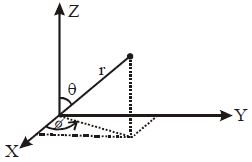
The angular wave function $A(\theta, \phi)$ for a given atomic orbital is $\frac{1}{2}\sqrt{\frac{3}{\pi}}\cos \theta$ in the polar coordinate system. Identify the orbital.
A
$2s$
B
$2p_x$
C
$2p_y$
D
$2p_z$
Solution
(D) The angular wave function for $p$-orbitals is given by:
$A(\theta, \phi) = \sqrt{\frac{3}{4\pi}} \cos \theta$ for $p_z$ orbital.
Given expression is $\frac{1}{2}\sqrt{\frac{3}{\pi}}\cos \theta = \sqrt{\frac{1}{4}} \cdot \sqrt{\frac{3}{\pi}} \cos \theta = \sqrt{\frac{3}{4\pi}} \cos \theta$.
Since the angular part depends only on $\theta$ and involves $\cos \theta$,it corresponds to the $p_z$ orbital,which is oriented along the $Z$-axis.
For $p_z$ orbital,the nodal plane is the $XY$ plane,where $\theta = 90^{\circ}$ and $\cos 90^{\circ} = 0$.
$A(\theta, \phi) = \sqrt{\frac{3}{4\pi}} \cos \theta$ for $p_z$ orbital.
Given expression is $\frac{1}{2}\sqrt{\frac{3}{\pi}}\cos \theta = \sqrt{\frac{1}{4}} \cdot \sqrt{\frac{3}{\pi}} \cos \theta = \sqrt{\frac{3}{4\pi}} \cos \theta$.
Since the angular part depends only on $\theta$ and involves $\cos \theta$,it corresponds to the $p_z$ orbital,which is oriented along the $Z$-axis.
For $p_z$ orbital,the nodal plane is the $XY$ plane,where $\theta = 90^{\circ}$ and $\cos 90^{\circ} = 0$.
0 likes
View Solution412
MediumMCQ
For an electron with $n = 3$,there is only one radial node. The orbital angular momentum of the electron will be
A
$0$
B
$\sqrt{6} \frac{h}{2\pi}$
C
$\sqrt{2} \frac{h}{2\pi}$
D
$3 \left(\frac{h}{2\pi}\right)$
Solution
(C) The number of radial nodes is given by the formula: $n - \ell - 1 = 1$.
Given $n = 3$,we substitute the value: $3 - \ell - 1 = 1$.
Solving for $\ell$: $2 - \ell = 1$,which gives $\ell = 1$.
The orbital angular momentum is calculated using the formula: $\sqrt{\ell(\ell+1)} \frac{h}{2\pi}$.
Substituting $\ell = 1$: $\sqrt{1(1+1)} \frac{h}{2\pi} = \sqrt{2} \frac{h}{2\pi}$.
Given $n = 3$,we substitute the value: $3 - \ell - 1 = 1$.
Solving for $\ell$: $2 - \ell = 1$,which gives $\ell = 1$.
The orbital angular momentum is calculated using the formula: $\sqrt{\ell(\ell+1)} \frac{h}{2\pi}$.
Substituting $\ell = 1$: $\sqrt{1(1+1)} \frac{h}{2\pi} = \sqrt{2} \frac{h}{2\pi}$.
0 likes
View Solution413
MediumMCQ
Which of the following statements is $FALSE$?
A
Number of spherical nodes for $4d$ orbital is $3$.
B
For $p_y$ orbital,$xz$ plane is an angular node.
C
For $s$ orbital,$\psi^2$ is maximum at the nucleus.
D
Angular wave function of $p_z$ orbital is proportional to $\cos \theta$ (Given: $\theta$ is the angle from $z$-axis).
Solution
(A) $1$. For a $4d$ orbital,the number of spherical (radial) nodes is given by the formula $n - l - 1$. Here,$n = 4$ and $l = 2$. So,$4 - 2 - 1 = 1$. The statement saying it is $3$ is $FALSE$.
$2$. For $p_y$ orbital,the electron density is zero in the $xz$ plane,so it acts as an angular node. This is $TRUE$.
$3$. For $s$ orbitals,the probability density $\psi^2$ is maximum at the nucleus $(r = 0)$. This is $TRUE$.
$4$. The angular wave function for $p_z$ is proportional to $\cos \theta$,where $\theta$ is the angle with the $z$-axis. This is $TRUE$.
$2$. For $p_y$ orbital,the electron density is zero in the $xz$ plane,so it acts as an angular node. This is $TRUE$.
$3$. For $s$ orbitals,the probability density $\psi^2$ is maximum at the nucleus $(r = 0)$. This is $TRUE$.
$4$. The angular wave function for $p_z$ is proportional to $\cos \theta$,where $\theta$ is the angle with the $z$-axis. This is $TRUE$.
0 likes
View Solution414
MediumMCQ
Which of the following electronic configurations has the least energy?
A
B
C
D
Solution
(A) According to Hund's rule of maximum multiplicity,the most stable configuration (lowest energy) is the one with the maximum number of unpaired electrons with parallel spins.
In the given options,the configuration with three electrons in three separate orbitals (as shown in option $A$) represents the half-filled state,which is more stable and has lower energy compared to the configurations where electrons are paired in the same orbital,as pairing electrons requires overcoming inter-electronic repulsion.
In the given options,the configuration with three electrons in three separate orbitals (as shown in option $A$) represents the half-filled state,which is more stable and has lower energy compared to the configurations where electrons are paired in the same orbital,as pairing electrons requires overcoming inter-electronic repulsion.
0 likes
View Solution415
MediumMCQ
What is the value of azimuthal quantum number for '$g$' subshell?
A
$3$
B
$4$
C
$6$
D
$5$
Solution
(B) The azimuthal quantum number $(l)$ determines the shape of the orbital and the subshell.
The values of $l$ correspond to subshells as follows:
$l = 0$ for $s$-subshell
$l = 1$ for $p$-subshell
$l = 2$ for $d$-subshell
$l = 3$ for $f$-subshell
$l = 4$ for $g$-subshell
Therefore,for the $g$-subshell,the value of the azimuthal quantum number is $4$.
The values of $l$ correspond to subshells as follows:
$l = 0$ for $s$-subshell
$l = 1$ for $p$-subshell
$l = 2$ for $d$-subshell
$l = 3$ for $f$-subshell
$l = 4$ for $g$-subshell
Therefore,for the $g$-subshell,the value of the azimuthal quantum number is $4$.
0 likes
View Solution416
MediumMCQ
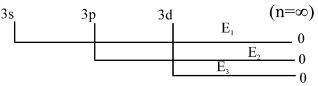
For $H^{-}$ atom,the energy required for the removal of an electron from various sub-shells is given as under:
The order of the energies would be:
The order of the energies would be:
A
$E_1 > E_2 > E_3$
B
$E_3 > E_2 > E_1$
C
$E_1 = E_2 = E_3$
D
None of these
Solution
(C) For hydrogen-like species (single electron systems),the energy of an electron depends only on the principal quantum number $n$.
The energy of an orbital is given by the formula:
$E_n = -13.6 \times \frac{Z^2}{n^2} \ eV$
In the given question,the sub-shells $3s$,$3p$,and $3d$ all belong to the same principal shell $(n=3)$.
Since they have the same value of $n$,they are degenerate,meaning they have the same energy.
Therefore,the energy required to remove an electron from these sub-shells is equal.
$E_1 = E_2 = E_3$
Thus,option $C$ is correct.
The energy of an orbital is given by the formula:
$E_n = -13.6 \times \frac{Z^2}{n^2} \ eV$
In the given question,the sub-shells $3s$,$3p$,and $3d$ all belong to the same principal shell $(n=3)$.
Since they have the same value of $n$,they are degenerate,meaning they have the same energy.
Therefore,the energy required to remove an electron from these sub-shells is equal.
$E_1 = E_2 = E_3$
Thus,option $C$ is correct.
0 likes
View Solution417
MediumMCQ
Although no currently known element contains electrons in $g$ orbitals in the ground state,it is possible that such an element will be found or that electrons in excited states of known elements could be in $g$ orbitals. For $g$ orbitals,$l = 4$. What is the lowest value of $n$ for which $g$ orbitals could exist? What are the possible values of $m_l$? How many electrons could a set of $g$ orbitals hold?
A
$n = 6, m_l = -4$ to $+4$,no. of electrons $= 18$
B
$n = 5, m_l = -2$ to $+4$,no. of electrons $= 9$
C
$n = 5, m_l = -3$ to $+3$,no. of electrons $= 9$
D
$n = 5, m_l = -4$ to $+4$,no. of electrons $= 18$
Solution
(D) For any orbital,the principal quantum number $n$ must be greater than the azimuthal quantum number $l$. Since $l = 4$ for $g$ orbitals,the lowest possible value for $n$ is $n = l + 1 = 4 + 1 = 5$.
The magnetic quantum number $m_l$ ranges from $-l$ to $+l$. For $l = 4$,$m_l$ can take values $\{-4, -3, -2, -1, 0, +1, +2, +3, +4\}$.
The number of orbitals in a subshell is given by $2l + 1$. For $l = 4$,there are $2(4) + 1 = 9$ orbitals.
Each orbital can hold a maximum of $2$ electrons,so the total number of electrons is $9 \times 2 = 18$.
The magnetic quantum number $m_l$ ranges from $-l$ to $+l$. For $l = 4$,$m_l$ can take values $\{-4, -3, -2, -1, 0, +1, +2, +3, +4\}$.
The number of orbitals in a subshell is given by $2l + 1$. For $l = 4$,there are $2(4) + 1 = 9$ orbitals.
Each orbital can hold a maximum of $2$ electrons,so the total number of electrons is $9 \times 2 = 18$.
0 likes
View Solution418
MediumMCQ
Arrange the electrons represented by the following sets of quantum numbers in the decreasing order of energy.
$(i) \ n = 4, l = 0, m_l = 0, m_s = +\frac{1}{2}$
$(ii) \ n = 3, l = 1, m_l = 1, m_s = -\frac{1}{2}$
$(iii) \ n = 3, l = 2, m_l = 0, m_s = +\frac{1}{2}$
$(iv) \ n = 3, l = 0, m_l = 0, m_s = -\frac{1}{2}$
$(i) \ n = 4, l = 0, m_l = 0, m_s = +\frac{1}{2}$
$(ii) \ n = 3, l = 1, m_l = 1, m_s = -\frac{1}{2}$
$(iii) \ n = 3, l = 2, m_l = 0, m_s = +\frac{1}{2}$
$(iv) \ n = 3, l = 0, m_l = 0, m_s = -\frac{1}{2}$
A
$(ii) < (i) < (iii) < (iv)$
B
$(iii) < (i) < (ii) < (iv)$
C
$(iii) > (i) > (ii) > (iv)$
D
$(iv) > (ii) > (i) > (iii)$
Solution
(C) The energy of an orbital is determined by the $(n + l)$ rule.
For $(i): n = 4, l = 0 \implies n + l = 4 + 0 = 4 \ (4s \text{ orbital})$.
For $(ii): n = 3, l = 1 \implies n + l = 3 + 1 = 4 \ (3p \text{ orbital})$.
For $(iii): n = 3, l = 2 \implies n + l = 3 + 2 = 5 \ (3d \text{ orbital})$.
For $(iv): n = 3, l = 0 \implies n + l = 3 + 0 = 3 \ (3s \text{ orbital})$.
According to the $(n + l)$ rule,if $(n + l)$ values are different,the orbital with the higher $(n + l)$ value has higher energy.
If $(n + l)$ values are the same,the orbital with the higher $n$ value has higher energy.
Comparing the values: $(iii) \ (5) > (i) \ (4, n=4) > (ii) \ (4, n=3) > (iv) \ (3)$.
Thus,the decreasing order of energy is $(iii) > (i) > (ii) > (iv)$.
For $(i): n = 4, l = 0 \implies n + l = 4 + 0 = 4 \ (4s \text{ orbital})$.
For $(ii): n = 3, l = 1 \implies n + l = 3 + 1 = 4 \ (3p \text{ orbital})$.
For $(iii): n = 3, l = 2 \implies n + l = 3 + 2 = 5 \ (3d \text{ orbital})$.
For $(iv): n = 3, l = 0 \implies n + l = 3 + 0 = 3 \ (3s \text{ orbital})$.
According to the $(n + l)$ rule,if $(n + l)$ values are different,the orbital with the higher $(n + l)$ value has higher energy.
If $(n + l)$ values are the same,the orbital with the higher $n$ value has higher energy.
Comparing the values: $(iii) \ (5) > (i) \ (4, n=4) > (ii) \ (4, n=3) > (iv) \ (3)$.
Thus,the decreasing order of energy is $(iii) > (i) > (ii) > (iv)$.
0 likes
View Solution419
EasyMCQ
Which of the following orbitals has a dumbbell shape?
A
$s$
B
$p$
C
$d$
D
$f$
Solution
(B) $p$ orbital is dumbbell-shaped.
The electrons present in a $p$ orbital can have any one of three values of magnetic quantum numbers: $0, +1$,or $-1$.
The electrons present in a $p$ orbital can have any one of three values of magnetic quantum numbers: $0, +1$,or $-1$.
0 likes
View Solution420
EasyMCQ
Which of the following orbitals is non-directional?
A
$s$
B
$p$
C
$d$
D
$f$
Solution
(A) The $s$-orbital has a spherical shape,which means the probability of finding an electron is the same in all directions around the nucleus. Therefore,the $s$-orbital is considered non-directional. In contrast,$p$,$d$,and $f$ orbitals have specific directional orientations in space.
0 likes
View Solution421
EasyMCQ
Degenerate atomic orbitals have
A
equal energy
B
nearly equal energy
C
different energy
D
none of above
Solution
(A) The orbitals having the same energy but different in orientation are called degenerate orbitals.
For example,the $3d$-orbitals have $l = 2$,which gives $m = -2, -1, 0, +1, +2$.
This means there are five different orientations represented by $d_{xy}, d_{yz}, d_{zx}, d_{x^2-y^2}$,and $d_{z^2}$,all of which possess the same energy.
For example,the $3d$-orbitals have $l = 2$,which gives $m = -2, -1, 0, +1, +2$.
This means there are five different orientations represented by $d_{xy}, d_{yz}, d_{zx}, d_{x^2-y^2}$,and $d_{z^2}$,all of which possess the same energy.
0 likes
View Solution422
EasyMCQ
The orbital occupied by an electron with quantum numbers $n = 4, l = 3, m = 0$ and $s = -\frac{1}{2}$ is called
A
$1s$ subshell
B
$4d$ orbital
C
$4f$ subshell
D
$3s$ subshell
Solution
(C) The principal quantum number $n = 4$ indicates the shell is the $4^{th}$ shell.
The azimuthal quantum number $l = 3$ corresponds to the $f$ subshell ($l=0$ is $s$,$l=1$ is $p$,$l=2$ is $d$,$l=3$ is $f$).
Combining these,the electron occupies the $4f$ subshell.
Therefore,the correct option is $C$.
The azimuthal quantum number $l = 3$ corresponds to the $f$ subshell ($l=0$ is $s$,$l=1$ is $p$,$l=2$ is $d$,$l=3$ is $f$).
Combining these,the electron occupies the $4f$ subshell.
Therefore,the correct option is $C$.
0 likes
View Solution423
MediumMCQ
Which of the following sets of quantum numbers is not possible?
A
$n = 2, l = 1, m = -1, s = -1/2$
B
$n = 3, l = 2, m = -3, s = +1/2$
C
$n = 2, l = 0, m = 0, s = +1/2$
D
$n = 3, l = 2, m = -2, s = +1/2$
Solution
(B) The rules for quantum numbers are as follows:
$1$. $n$ (principal quantum number) can be any positive integer $(1, 2, 3, \dots)$.
$2$. $l$ (azimuthal quantum number) can range from $0$ to $n-1$.
$3$. $m$ (magnetic quantum number) can range from $-l$ to $+l$,including $0$.
$4$. $s$ (spin quantum number) can be $+1/2$ or $-1/2$.
Evaluating the options:
- Option $A$: $n=2, l=1, m=-1, s=-1/2$. Here $l < n$ and $|m| \le l$. This is possible.
- Option $B$: $n=3, l=2, m=-3, s=+1/2$. Here $l < n$,but $m$ must be between $-2$ and $+2$. Since $|m| = 3 > l$,this set is not possible.
- Option $C$: $n=2, l=0, m=0, s=+1/2$. Here $l < n$ and $|m| \le l$. This is possible.
- Option $D$: $n=3, l=2, m=-2, s=+1/2$. Here $l < n$ and $|m| \le l$. This is possible.
Therefore,the set in option $B$ is not possible.
$1$. $n$ (principal quantum number) can be any positive integer $(1, 2, 3, \dots)$.
$2$. $l$ (azimuthal quantum number) can range from $0$ to $n-1$.
$3$. $m$ (magnetic quantum number) can range from $-l$ to $+l$,including $0$.
$4$. $s$ (spin quantum number) can be $+1/2$ or $-1/2$.
Evaluating the options:
- Option $A$: $n=2, l=1, m=-1, s=-1/2$. Here $l < n$ and $|m| \le l$. This is possible.
- Option $B$: $n=3, l=2, m=-3, s=+1/2$. Here $l < n$,but $m$ must be between $-2$ and $+2$. Since $|m| = 3 > l$,this set is not possible.
- Option $C$: $n=2, l=0, m=0, s=+1/2$. Here $l < n$ and $|m| \le l$. This is possible.
- Option $D$: $n=3, l=2, m=-2, s=+1/2$. Here $l < n$ and $|m| \le l$. This is possible.
Therefore,the set in option $B$ is not possible.
0 likes
View Solution424
MediumMCQ
Which of the following sets of quantum numbers is not correct?
A
$n = 2, l = 0, m = 0, s = +\frac{1}{2}$
B
$n = 4, l = 3, m = +2, s = +\frac{1}{2}$
C
$n = 2, l = 2, m = 0, s = -\frac{1}{2}$
D
None of these
Solution
(C) For any principal quantum number $n$,the azimuthal quantum number $l$ can have values from $0$ to $n-1$.
In option $A$,$n=2$,so $l$ can be $0$ or $1$. Since $l=0$,this is correct.
In option $B$,$n=4$,so $l$ can be $0, 1, 2, 3$. Since $l=3$,this is correct.
In option $C$,$n=2$,so $l$ can only be $0$ or $1$. The value $l=2$ is not possible for $n=2$.
Therefore,the set of quantum numbers in option $C$ is incorrect.
In option $A$,$n=2$,so $l$ can be $0$ or $1$. Since $l=0$,this is correct.
In option $B$,$n=4$,so $l$ can be $0, 1, 2, 3$. Since $l=3$,this is correct.
In option $C$,$n=2$,so $l$ can only be $0$ or $1$. The value $l=2$ is not possible for $n=2$.
Therefore,the set of quantum numbers in option $C$ is incorrect.
0 likes
View Solution425
EasyMCQ
Which of the following sets of quantum numbers is correctly matched?
A
$n = 5, l = 2, m = +2, s = -1/2$
B
$n = 5, l = 5, m = -2, s = +1/2$
C
$n = 3, l = 2, m = +2, s = 0$
D
$n = 3, l = 2, m = +3, s = +1/2$
Solution
(A) For a valid set of quantum numbers,the following rules must be satisfied:
$1$. $n$ is a positive integer $(1, 2, 3, \dots)$.
$2$. $l$ can have values from $0$ to $n-1$.
$3$. $m$ can have values from $-l$ to $+l$ (including $0$).
$4$. $s$ can only be $+1/2$ or $-1/2$.
Evaluating the options:
Option $A$: $n=5, l=2, m=+2, s=-1/2$. Here $l < n$ $(2 < 5)$ and $|m| \le l$ $(2 \le 2)$. This is a valid set.
Option $B$: $n=5, l=5$. This is invalid because $l$ must be less than $n$.
Option $C$: $s=0$. This is invalid because $s$ must be $\pm 1/2$.
Option $D$: $m=+3, l=2$. This is invalid because $|m|$ cannot exceed $l$ $(3 > 2)$.
$1$. $n$ is a positive integer $(1, 2, 3, \dots)$.
$2$. $l$ can have values from $0$ to $n-1$.
$3$. $m$ can have values from $-l$ to $+l$ (including $0$).
$4$. $s$ can only be $+1/2$ or $-1/2$.
Evaluating the options:
Option $A$: $n=5, l=2, m=+2, s=-1/2$. Here $l < n$ $(2 < 5)$ and $|m| \le l$ $(2 \le 2)$. This is a valid set.
Option $B$: $n=5, l=5$. This is invalid because $l$ must be less than $n$.
Option $C$: $s=0$. This is invalid because $s$ must be $\pm 1/2$.
Option $D$: $m=+3, l=2$. This is invalid because $|m|$ cannot exceed $l$ $(3 > 2)$.
0 likes
View Solution426
EasyMCQ
In the $n^{th}$ quantum level,the number of electronic subshells is
A
$n$
B
$2n^2$
C
$2n$
D
$2 \times (2l + 1)$
Solution
(A) The principal quantum number $n$ determines the number of subshells present in a given energy level.
For any principal quantum level $n$,the number of subshells is equal to $n$.
For example,if $n = 1$,there is $1$ subshell $(1s)$.
If $n = 2$,there are $2$ subshells ($2s$ and $2p$).
Therefore,the number of subshells in the $n^{th}$ quantum level is $n$.
For any principal quantum level $n$,the number of subshells is equal to $n$.
For example,if $n = 1$,there is $1$ subshell $(1s)$.
If $n = 2$,there are $2$ subshells ($2s$ and $2p$).
Therefore,the number of subshells in the $n^{th}$ quantum level is $n$.
0 likes
View Solution427
EasyMCQ
For the energy level with the principal quantum number $n = 3,$ the number of possible orbitals is
A
$1$
B
$4$
C
$3$
D
$9$
Solution
(D) The number of orbitals in a given energy level with principal quantum number $n$ is given by the formula $n^2$.
For $n = 3,$ the number of orbitals is $3^2 = 9$.
These $9$ orbitals consist of $1$ orbital in the $3s$ subshell,$3$ orbitals in the $3p$ subshell,and $5$ orbitals in the $3d$ subshell $(1 + 3 + 5 = 9)$.
For $n = 3,$ the number of orbitals is $3^2 = 9$.
These $9$ orbitals consist of $1$ orbital in the $3s$ subshell,$3$ orbitals in the $3p$ subshell,and $5$ orbitals in the $3d$ subshell $(1 + 3 + 5 = 9)$.
0 likes
View Solution428
EasyMCQ
For electrons having principal quantum number $n = 3$,the number of $(i)$ subshells and $(ii)$ orbitals would be respectively:
A
$3$ and $5$
B
$3$ and $7$
C
$3$ and $9$
D
$2$ and $5$
Solution
(C) For a given principal quantum number $n$,the number of subshells is equal to $n$. Therefore,for $n = 3$,the number of subshells is $3$ (which are $3s, 3p, 3d$).
The total number of orbitals in a shell is given by the formula $n^2$. Therefore,for $n = 3$,the number of orbitals is $3^2 = 9$.
The total number of orbitals in a shell is given by the formula $n^2$. Therefore,for $n = 3$,the number of orbitals is $3^2 = 9$.
0 likes
View Solution429
EasyMCQ
The magnetic quantum number $m_l$ is determined by the azimuthal quantum number $l$. If $l = 2$,what are the type and number of orbitals indicated?
A
$f, 7$
B
$d, 5$
C
$p, 3$
D
$s, 1$
Solution
(B) The azimuthal quantum number $l$ determines the subshell type:
$l = 0$ corresponds to $s$-orbital,
$l = 1$ corresponds to $p$-orbital,
$l = 2$ corresponds to $d$-orbital,
$l = 3$ corresponds to $f$-orbital.
Given $l = 2$,the orbital type is $d$.
The number of orbitals in a subshell is given by the formula $(2l + 1)$.
For $l = 2$,the number of orbitals $= 2(2) + 1 = 5$.
Thus,for $l = 2$,there are $5$ orbitals of type $d$.
$l = 0$ corresponds to $s$-orbital,
$l = 1$ corresponds to $p$-orbital,
$l = 2$ corresponds to $d$-orbital,
$l = 3$ corresponds to $f$-orbital.
Given $l = 2$,the orbital type is $d$.
The number of orbitals in a subshell is given by the formula $(2l + 1)$.
For $l = 2$,the number of orbitals $= 2(2) + 1 = 5$.
Thus,for $l = 2$,there are $5$ orbitals of type $d$.
0 likes
View Solution430
MediumMCQ
The maximum probability of finding an electron in the $d_{xy}$ orbital is
A
along the $x-$ axis
B
along the $y-$ axis
C
at an angle of $45^o$ from the $x$ and $y$ axes
D
at an angle of $90^o$
Solution
(C) The $d_{xy}$ orbital has four lobes that lie in the $xy-$ plane.
These lobes are oriented between the $x$ and $y$ axes.
The maximum electron density (probability) for the $d_{xy}$ orbital is located at an angle of $45^o$ from both the $x$ and $y$ axes,which corresponds to the bisectors of the axes.
These lobes are oriented between the $x$ and $y$ axes.
The maximum electron density (probability) for the $d_{xy}$ orbital is located at an angle of $45^o$ from both the $x$ and $y$ axes,which corresponds to the bisectors of the axes.
0 likes
View Solution431
MediumMCQ
The quantum numbers $+1/2$ and $-1/2$ for the electron spin represent
A
rotation of the electron in clockwise and anticlockwise direction respectively
B
rotation of the electron in anticlockwise and clockwise direction respectively
C
magnetic moment of the electron pointing up and down respectively
D
two quantum mechanical spin states which have no classical analogue
Solution
(D) The electron spin quantum number $(m_s)$ describes the intrinsic angular momentum of an electron.
While it is often visualized as the electron spinning on its axis,this is a simplified model.
In quantum mechanics,the values $+1/2$ and $-1/2$ represent two distinct quantum mechanical spin states that do not have a direct classical analogue.
While it is often visualized as the electron spinning on its axis,this is a simplified model.
In quantum mechanics,the values $+1/2$ and $-1/2$ represent two distinct quantum mechanical spin states that do not have a direct classical analogue.
0 likes
View Solution432
MediumMCQ
An electron has a magnetic quantum number of $-3$. Its principal quantum number can be
A
$1$
B
$2$
C
$3$
D
$4$
Solution
(D) For a given value of $n$,the azimuthal quantum number $l$ can have values from $0$ to $(n-1)$.
The magnetic quantum number $m$ can have values from $-l$ to $+l$.
Given $m = -3$,the minimum value of $l$ must be $3$ (since $|m| \leq l$).
If $l = 3$,then the principal quantum number $n$ must be at least $n = l + 1 = 3 + 1 = 4$.
Therefore,the principal quantum number $n$ can be $4$ or higher. Among the given options,$4$ is the correct value.
The magnetic quantum number $m$ can have values from $-l$ to $+l$.
Given $m = -3$,the minimum value of $l$ must be $3$ (since $|m| \leq l$).
If $l = 3$,then the principal quantum number $n$ must be at least $n = l + 1 = 3 + 1 = 4$.
Therefore,the principal quantum number $n$ can be $4$ or higher. Among the given options,$4$ is the correct value.
0 likes
View Solution433
MediumMCQ
Magnetic and spin quantum number of an electron are $-1$ and $+1/2$ respectively. This electron cannot be in
A
$s$ orbital
B
$p$ orbital
C
$d$ orbital
D
$f$ orbital
Solution
(A) For a given azimuthal quantum number $l$,the magnetic quantum number $m$ ranges from $-l$ to $+l$.
For $s$ orbital,$l = 0$,so $m$ can only be $0$.
For $p$ orbital,$l = 1$,so $m$ can be $-1, 0, +1$.
For $d$ orbital,$l = 2$,so $m$ can be $-2, -1, 0, +1, +2$.
For $f$ orbital,$l = 3$,so $m$ can be $-3, -2, -1, 0, +1, +2, +3$.
Since the given magnetic quantum number is $m = -1$,it is impossible for the electron to be in an $s$ orbital because $m$ must be $0$ for $l = 0$.
For $s$ orbital,$l = 0$,so $m$ can only be $0$.
For $p$ orbital,$l = 1$,so $m$ can be $-1, 0, +1$.
For $d$ orbital,$l = 2$,so $m$ can be $-2, -1, 0, +1, +2$.
For $f$ orbital,$l = 3$,so $m$ can be $-3, -2, -1, 0, +1, +2, +3$.
Since the given magnetic quantum number is $m = -1$,it is impossible for the electron to be in an $s$ orbital because $m$ must be $0$ for $l = 0$.
0 likes
View Solution434
EasyMCQ
Which of the following statements is not correct for an electron that has the quantum numbers $n = 4$ and $m_l = 2$?
A
The electron may have the quantum number $s = +1/2$.
B
The electron may have the quantum number $l = 2$.
C
The electron may have the quantum number $l = 3$.
D
The electron may have the quantum number $l = 0, 1, 2, \text{ or } 3$.
Solution
(D) For a given orbital,the magnetic quantum number $m_l$ depends on the azimuthal quantum number $l$ such that $m_l$ ranges from $-l$ to $+l$.
Given $m_l = 2$,the possible values for $l$ must satisfy the condition $l \ge |m_l|$.
Therefore,$l$ must be at least $2$ (i.e.,$l = 2$ or $l = 3$ for $n = 4$).
Option $D$ states that $l$ can be $0, 1, 2, \text{ or } 3$,which is incorrect because $l$ cannot be $0$ or $1$ when $m_l = 2$.
Given $m_l = 2$,the possible values for $l$ must satisfy the condition $l \ge |m_l|$.
Therefore,$l$ must be at least $2$ (i.e.,$l = 2$ or $l = 3$ for $n = 4$).
Option $D$ states that $l$ can be $0, 1, 2, \text{ or } 3$,which is incorrect because $l$ cannot be $0$ or $1$ when $m_l = 2$.
0 likes
View Solution435
MediumMCQ
Which one of the following sets of quantum numbers is incorrect?
| Principal quantum number $(n)$ | Azimuthal quantum number $(l)$ | Magnetic quantum number $(m)$ |
|---|
A
| $n=1, l=0, m=0$ |
B
| $n=2, l=0, 1; m=0, 0, \pm 1$ |
C
| $n=3, l=0, 1, 2; m=0, 0, \pm 1, 0, \pm 1, \pm 2$ |
D
None of the above
Solution
(D) The rules for quantum numbers are as follows:
$1$. The principal quantum number $(n)$ can be any positive integer $(1, 2, 3, \dots)$.
$2$. For a given $n$,the azimuthal quantum number $(l)$ can have values from $0$ to $(n-1)$.
$3$. For a given $l$,the magnetic quantum number $(m)$ can have values from $-l$ to $+l$,including $0$.
Evaluating the options:
- Option $A$: For $n=1$,$l$ can be $0$. For $l=0$,$m$ can be $0$. This set is correct.
- Option $B$: For $n=2$,$l$ can be $0$ or $1$. If $l=0$,$m=0$. If $l=1$,$m=-1, 0, +1$. This set is correct.
- Option $C$: For $n=3$,$l$ can be $0, 1, 2$. If $l=0$,$m=0$. If $l=1$,$m=-1, 0, +1$. If $l=2$,$m=-2, -1, 0, +1, +2$. This set is correct.
Since all provided sets follow the rules of quantum mechanics,the correct answer is $D$.
$1$. The principal quantum number $(n)$ can be any positive integer $(1, 2, 3, \dots)$.
$2$. For a given $n$,the azimuthal quantum number $(l)$ can have values from $0$ to $(n-1)$.
$3$. For a given $l$,the magnetic quantum number $(m)$ can have values from $-l$ to $+l$,including $0$.
Evaluating the options:
- Option $A$: For $n=1$,$l$ can be $0$. For $l=0$,$m$ can be $0$. This set is correct.
- Option $B$: For $n=2$,$l$ can be $0$ or $1$. If $l=0$,$m=0$. If $l=1$,$m=-1, 0, +1$. This set is correct.
- Option $C$: For $n=3$,$l$ can be $0, 1, 2$. If $l=0$,$m=0$. If $l=1$,$m=-1, 0, +1$. If $l=2$,$m=-2, -1, 0, +1, +2$. This set is correct.
Since all provided sets follow the rules of quantum mechanics,the correct answer is $D$.
0 likes
View Solution436
MediumMCQ
Which of the following is not possible?
A
Two electrons of an atom may have identical values of $n, l$ and $m$.
B
$A$ $4d$ electron may have $n = 4$ and $l = 3$.
C
Two electrons of equal energy occupying $p-$orbitals of an atom may have parallel spin.
D
Two electrons of equal energy occupying $p-$orbitals of an atom may have opposite spin.
Solution
(B) According to the Pauli Exclusion Principle,no two electrons in an atom can have the same set of all four quantum numbers $(n, l, m_l, m_s)$.
Option $A$ states that two electrons may have identical values of $n, l,$ and $m$. This is possible if they have different spin quantum numbers ($m_s = +1/2$ and $-1/2$).
Option $B$ states a $4d$ electron has $n = 4$ and $l = 3$. For a $d-$orbital,the azimuthal quantum number $l$ must be $2$. Therefore,$l = 3$ corresponds to an $f-$orbital,making this statement impossible.
Option $C$ and $D$ are possible according to Hund's Rule and the Pauli Exclusion Principle for electrons in different $p-$orbitals or the same orbital.
Option $A$ states that two electrons may have identical values of $n, l,$ and $m$. This is possible if they have different spin quantum numbers ($m_s = +1/2$ and $-1/2$).
Option $B$ states a $4d$ electron has $n = 4$ and $l = 3$. For a $d-$orbital,the azimuthal quantum number $l$ must be $2$. Therefore,$l = 3$ corresponds to an $f-$orbital,making this statement impossible.
Option $C$ and $D$ are possible according to Hund's Rule and the Pauli Exclusion Principle for electrons in different $p-$orbitals or the same orbital.
0 likes
View Solution437
MediumMCQ
The orbital angular momentum of an electron in $2s$ orbitals is
A
$+\frac{1}{2} \cdot \frac{h}{2\pi}$
B
$0$
C
$\frac{h}{2\pi}$
D
$\sqrt{2} \cdot \frac{h}{2\pi}$
Solution
(B) The orbital angular momentum of an electron in the $2s$-orbital is zero.
For a given subshell with azimuthal quantum number $l$,the orbital angular momentum is given by the expression:
$L = \frac{h}{2\pi} \sqrt{l(l+1)}$
For $2s$ orbital,the azimuthal quantum number $l = 0$.
Substituting the value of $l$ in the formula:
$L = \frac{h}{2\pi} \sqrt{0(0+1)} = 0$
For a given subshell with azimuthal quantum number $l$,the orbital angular momentum is given by the expression:
$L = \frac{h}{2\pi} \sqrt{l(l+1)}$
For $2s$ orbital,the azimuthal quantum number $l = 0$.
Substituting the value of $l$ in the formula:
$L = \frac{h}{2\pi} \sqrt{0(0+1)} = 0$
0 likes
View Solution438
MediumMCQ
The orbital angular momentum of an electron in an $s$ orbital is
A
$1$
B
$0$
C
$\frac{\sqrt{2} h}{2 \pi}$
D
all of these
Solution
(B) The formula for orbital angular momentum is given by $\frac{h}{2 \pi} \sqrt{\ell(\ell+1)}$.
For an $s$ orbital,the azimuthal quantum number $\ell = 0$.
Substituting $\ell = 0$ into the formula: $\text{Angular momentum} = \frac{h}{2 \pi} \sqrt{0(0+1)} = 0$.
For an $s$ orbital,the azimuthal quantum number $\ell = 0$.
Substituting $\ell = 0$ into the formula: $\text{Angular momentum} = \frac{h}{2 \pi} \sqrt{0(0+1)} = 0$.
0 likes
View Solution439
MediumMCQ
For a $d$ electron,the orbital angular momentum is
A
$\sqrt{6} \hbar$
B
$\sqrt{2} \hbar$
C
$\hbar$
D
$2\hbar$
Solution
(A) The orbital angular momentum $(L)$ is given by the formula $L = \sqrt{l(l+1)} \hbar$.
For a $d$ electron,the azimuthal quantum number $(l)$ is $2$.
Substituting the value of $l$ into the formula:
$L = \sqrt{2(2+1)} \hbar = \sqrt{2 \times 3} \hbar = \sqrt{6} \hbar$.
Therefore,the orbital angular momentum for a $d$ electron is $\sqrt{6} \hbar$.
For a $d$ electron,the azimuthal quantum number $(l)$ is $2$.
Substituting the value of $l$ into the formula:
$L = \sqrt{2(2+1)} \hbar = \sqrt{2 \times 3} \hbar = \sqrt{6} \hbar$.
Therefore,the orbital angular momentum for a $d$ electron is $\sqrt{6} \hbar$.
0 likes
View Solution440
EasyMCQ
The quantum number/s needed to describe an electron fully in an atom is/are:
A
$1$
B
$2$
C
$3$
D
$4$
Solution
(D) To completely describe an electron in an atom,we require $4$ quantum numbers: the principal quantum number $(n)$,the azimuthal quantum number $(l)$,the magnetic quantum number $(m_l)$,and the spin quantum number $(m_s)$.
This is consistent with Pauli's exclusion principle,which states that no two electrons in an atom can have the same set of all $4$ quantum numbers.
This is consistent with Pauli's exclusion principle,which states that no two electrons in an atom can have the same set of all $4$ quantum numbers.
0 likes
View Solution441
EasyMCQ
The principal quantum number of an atom is related to the:
A
orientation of the orbital in space
B
orbital angular momentum
C
spin angular momentum
D
size of the orbital
Solution
(D) The principal quantum number $(n)$ determines the main energy level or shell of an electron in an atom.
It is primarily related to the size of the orbital and the average distance of the electron from the nucleus.
As the value of $n$ increases,the size and energy of the orbital increase.
It is primarily related to the size of the orbital and the average distance of the electron from the nucleus.
As the value of $n$ increases,the size and energy of the orbital increase.
0 likes
View Solution442
EasyMCQ
The magnetic quantum number is related to:
A
size
B
shape
C
orientation
D
spin
Solution
(C) The magnetic quantum number $(m_l)$ is related to the orientation of orbitals in space.
It determines the preferred spatial orientation of orbitals.
It specifies the number of orbitals in a subshell.
It also explains the splitting of spectral lines in the presence of magnetic ($Zeeman$ effect) and electric ($Stark$ effect) fields.
It determines the preferred spatial orientation of orbitals.
It specifies the number of orbitals in a subshell.
It also explains the splitting of spectral lines in the presence of magnetic ($Zeeman$ effect) and electric ($Stark$ effect) fields.
0 likes
View Solution443
EasyMCQ
The principal quantum number represents:
A
shape of an orbital
B
number of electrons in an orbit
C
distance of electron from nucleus
D
number of orbitals in an orbit
Solution
(C) The principal quantum number,denoted by $n$,determines the main energy level or shell in which an electron resides.
It provides information about the size of the orbital and the average distance of the electron from the nucleus.
As the value of $n$ increases,the electron is,on average,further away from the nucleus.
It provides information about the size of the orbital and the average distance of the electron from the nucleus.
As the value of $n$ increases,the electron is,on average,further away from the nucleus.
0 likes
View Solution444
MediumMCQ
The atomic orbital is:
A
the circular path of the electron
B
elliptical shaped orbit
C
three-dimensional field around nucleus
D
the region in which there is maximum probability of finding an electron
Solution
(D) Atomic orbitals are defined as the regions of space around the nucleus of an atom where the probability of finding an electron is maximum.
Unlike the Bohr orbits which are circular paths,atomic orbitals represent the wave function of an electron in a three-dimensional space.
Unlike the Bohr orbits which are circular paths,atomic orbitals represent the wave function of an electron in a three-dimensional space.
0 likes
View Solution445
EasyMCQ
Any $p-$ orbital can accommodate up to:
A
$4$ electrons
B
$2$ electrons with parallel spins
C
$6$ electrons
D
$2$ electrons with opposite spins
Solution
(D) According to the Pauli Exclusion Principle,any single orbital can accommodate a maximum of $2$ electrons,and these electrons must have opposite spins.
Therefore,any $p-$ orbital can accommodate a maximum of $2$ electrons with opposite spins.
Therefore,any $p-$ orbital can accommodate a maximum of $2$ electrons with opposite spins.
0 likes
View Solution446
EasyMCQ
Which orbital is dumb-bell shaped?
A
$s$-orbital
B
$p$-orbital
C
$d$-orbital
D
$f$-orbital
Solution
(B) The $p$-orbital is dumb-bell shaped.
Electrons present in the $p$-orbital can have any one of three values of the magnetic quantum number: $0, +1$,or $-1$.
Electrons present in the $p$-orbital can have any one of three values of the magnetic quantum number: $0, +1$,or $-1$.
0 likes
View Solution447
EasyMCQ
The maximum number of electrons that can be accommodated in $f-$ shell is:
A
$2$
B
$8$
C
$18$
D
$14$
Solution
(D) For any subshell,the number of orbitals is given by $(2l + 1)$.
For an $f-$ subshell,the azimuthal quantum number $l = 3$.
Number of orbitals $= 2(3) + 1 = 7$.
Since each orbital can accommodate a maximum of $2$ electrons,the maximum number of electrons in the $f-$ subshell is $7 \times 2 = 14$.
For an $f-$ subshell,the azimuthal quantum number $l = 3$.
Number of orbitals $= 2(3) + 1 = 7$.
Since each orbital can accommodate a maximum of $2$ electrons,the maximum number of electrons in the $f-$ subshell is $7 \times 2 = 14$.
0 likes
View Solution448
MediumMCQ
Which one of the following represents an impossible arrangement of quantum numbers?
A
$n=3, l=2, m=-2, s=1/2$
B
$n=4, l=0, m=0, s=1/2$
C
$n=3, l=2, m=-3, s=1/2$
D
$n=5, l=3, m=0, s=1/2$
Solution
(C) For any given principal quantum number $n$,the azimuthal quantum number $l$ can have values from $0$ to $n-1$.
For a given $l$,the magnetic quantum number $m$ can have values from $-l$ to $+l$ including zero.
In option $C$,$n=3$ and $l=2$. The allowed values for $m$ are $-2, -1, 0, +1, +2$.
Since $m=-3$ is outside the range of allowed values for $l=2$,this arrangement is impossible.
For a given $l$,the magnetic quantum number $m$ can have values from $-l$ to $+l$ including zero.
In option $C$,$n=3$ and $l=2$. The allowed values for $m$ are $-2, -1, 0, +1, +2$.
Since $m=-3$ is outside the range of allowed values for $l=2$,this arrangement is impossible.
0 likes
View Solution449
EasyMCQ
Which of the following is correct for $2p$-orbitals?
A
$n = 1, l = 2$
B
$n = 1, l = 0$
C
$n = 2, l = 0$
D
$n = 2, l = 1$
Solution
(D) For any orbital,the principal quantum number $n$ is given by the coefficient of the orbital symbol. For $2p$,$n = 2$.
The azimuthal quantum number $l$ represents the subshell type. For $s$-orbitals,$l = 0$; for $p$-orbitals,$l = 1$; for $d$-orbitals,$l = 2$; and for $f$-orbitals,$l = 3$.
Therefore,for $2p$-orbitals,$n = 2$ and $l = 1$.
The azimuthal quantum number $l$ represents the subshell type. For $s$-orbitals,$l = 0$; for $p$-orbitals,$l = 1$; for $d$-orbitals,$l = 2$; and for $f$-orbitals,$l = 3$.
Therefore,for $2p$-orbitals,$n = 2$ and $l = 1$.
0 likes
View Solution450
EasyMCQ
Which of the following represents the correct set of four quantum numbers for a $4d$ electron?
A
$n=4, l=3, m=2, s=+1/2$
B
$n=4, l=2, m=1, s=0$
C
$n=4, l=3, m=-2, s=+1/2$
D
$n=4, l=2, m=1, s=-1/2$
Solution
(D) For a $4d$ electron,the principal quantum number $n = 4$.
For a $d$-orbital,the azimuthal quantum number $l = 2$.
The magnetic quantum number $m$ can have any integer value from $-l$ to $+l$,i.e.,$-2, -1, 0, +1, +2$.
The spin quantum number $s$ can be either $+1/2$ or $-1/2$.
Comparing this with the given options,option $D$ $(n=4, l=2, m=1, s=-1/2)$ satisfies all the conditions for a $4d$ electron.
For a $d$-orbital,the azimuthal quantum number $l = 2$.
The magnetic quantum number $m$ can have any integer value from $-l$ to $+l$,i.e.,$-2, -1, 0, +1, +2$.
The spin quantum number $s$ can be either $+1/2$ or $-1/2$.
Comparing this with the given options,option $D$ $(n=4, l=2, m=1, s=-1/2)$ satisfies all the conditions for a $4d$ electron.
0 likes
View SolutionStructure of Atom — Quantum number, Electronic configuration and Shape of orbitals · Frequently Asked Questions
1Are these Structure of Atom questions useful for JEE and NEET?
Yes. All questions in this section are mapped to JEE Main and NEET exam patterns. Previous year questions from JEE Main, NEET, GUJCET and state-level exams are included with full solutions.
2Can I switch to Hindi or Gujarati for these questions?
Yes. Use the language tabs in the hero section or the sidebar to view the same questions and solutions in English, Hindi or Gujarati.
3How do I generate a question paper from this subtopic?
Use the Vedclass Exam Paper Generator — select the chapter and subtopic, set difficulty, and generate Sets A, B, C, D automatically. First 3 chapters of every subject are free.
Vedclass Products
For Students
Vedclass Test Series
Mock tests in real JEE/NEET style with performance analysis. 5-day free trial.
Start Free TrialFor Teachers
Exam Paper Generator
Generate Set A/B/C/D papers from this chapter in 2 minutes. 3 chapters free.
Try FreeFor Institutes
Online Exam Module
Live online exams with unlimited students, 360° analytics & white-label branding.
See DemoFor Teachers & Institutes
Generate a Structure of Atom Exam Paper in 2 Minutes
Select subtopic & difficulty — Sets A, B, C, D auto-generated with No Repeat logic.
First 3 chapters of every subject are free — no payment required.