
A English
Quantum number, Electronic configuration and Shape of orbitals Questions in English
Class 11 Chemistry · Structure of Atom · Quantum number, Electronic configuration and Shape of orbitals
1023+
Questions
English
Language
100%
With Solutions
Showing 49 of 1023 questions in English
601
DifficultMCQ
Which of the following has non-spherical electron orbitals?
A
$He$
B
$Be$
C
$Li^{+}$
D
$B$
Solution
(D) The shape of an orbital depends on the azimuthal quantum number $(l)$.
For $s$-orbitals $(l=0)$,the shape is spherical.
For $p$-orbitals $(l=1)$,the shape is non-spherical (dumbbell-shaped).
Let us examine the electronic configurations:
$He$ $(Z=2)$: $1s^2$ (only $s$-orbitals,spherical).
$Be$ $(Z=4)$: $1s^2 2s^2$ (only $s$-orbitals,spherical).
$Li^{+}$ ($Z=3$,$2$ electrons): $1s^2$ (only $s$-orbitals,spherical).
$B$ $(Z=5)$: $1s^2 2s^2 2p^1$ (contains $p$-orbitals,which are non-spherical).
Therefore,$B$ has non-spherical electron orbitals.
For $s$-orbitals $(l=0)$,the shape is spherical.
For $p$-orbitals $(l=1)$,the shape is non-spherical (dumbbell-shaped).
Let us examine the electronic configurations:
$He$ $(Z=2)$: $1s^2$ (only $s$-orbitals,spherical).
$Be$ $(Z=4)$: $1s^2 2s^2$ (only $s$-orbitals,spherical).
$Li^{+}$ ($Z=3$,$2$ electrons): $1s^2$ (only $s$-orbitals,spherical).
$B$ $(Z=5)$: $1s^2 2s^2 2p^1$ (contains $p$-orbitals,which are non-spherical).
Therefore,$B$ has non-spherical electron orbitals.
0 likes
View Solution602
DifficultMCQ
The value of the azimuthal quantum number $(l)$ for a dumbbell-shaped orbital is ....
A
$0$
B
$1$
C
$2$
D
$3$
Solution
(B) The shape of an orbital is determined by the azimuthal quantum number $(l)$.
For $l = 0$,the orbital is spherical ($s$-orbital).
For $l = 1$,the orbital is dumbbell-shaped ($p$-orbital).
For $l = 2$,the orbital is double dumbbell-shaped ($d$-orbital).
Therefore,the value of the azimuthal quantum number for a dumbbell-shaped orbital is $1$.
For $l = 0$,the orbital is spherical ($s$-orbital).
For $l = 1$,the orbital is dumbbell-shaped ($p$-orbital).
For $l = 2$,the orbital is double dumbbell-shaped ($d$-orbital).
Therefore,the value of the azimuthal quantum number for a dumbbell-shaped orbital is $1$.
0 likes
View Solution603
DifficultMCQ
The energy of orbitals in a hydrogen atom can be determined by which of the following quantum numbers?
A
$l + m$
B
$n + l$
C
$n + m$
D
Only $n$
Solution
(D) In a hydrogen atom,the energy of an orbital depends only on the principal quantum number $(n)$.
This is because the hydrogen atom has only one electron,and there is no electron-electron repulsion to cause energy splitting based on the azimuthal quantum number $(l)$.
Therefore,the energy levels are given by $E_n = -\frac{13.6}{n^2} \text{ eV}$.
This is because the hydrogen atom has only one electron,and there is no electron-electron repulsion to cause energy splitting based on the azimuthal quantum number $(l)$.
Therefore,the energy levels are given by $E_n = -\frac{13.6}{n^2} \text{ eV}$.
0 likes
View Solution604
DifficultMCQ
Which of the following sets represents degenerate orbitals?
A
$3p_x, 4p_x, 5p_x$
B
$4p_x, 4d_{xy}, 4d_{xz}$
C
$3p_x, 3p_y, 3p_z$
D
$3d_{xy}, 4d_{xy}, 5d_{xy}$
Solution
(C) Degenerate orbitals are orbitals that have the same energy level.
For a hydrogen-like atom,energy depends only on the principal quantum number $n$.
However,for multi-electron atoms,orbitals in the same subshell (having the same $n$ and $l$ values) are degenerate.
In the set $3p_x, 3p_y, 3p_z$,all three orbitals belong to the same principal shell $(n=3)$ and the same subshell $(l=1)$.
Therefore,they have identical energy and are degenerate.
For a hydrogen-like atom,energy depends only on the principal quantum number $n$.
However,for multi-electron atoms,orbitals in the same subshell (having the same $n$ and $l$ values) are degenerate.
In the set $3p_x, 3p_y, 3p_z$,all three orbitals belong to the same principal shell $(n=3)$ and the same subshell $(l=1)$.
Therefore,they have identical energy and are degenerate.
0 likes
View Solution605
DifficultMCQ
Which of the following represents the correct order of energy for the orbitals?
A
$5p < 4f < 6s < 5d$
B
$5p < 6s < 4f < 5d$
C
$4f < 5d < 5p < 6s$
D
$5p < 5d < 4f < 6s$
Solution
(B) The energy of an orbital is determined by the $(n + l)$ rule.
For $5p$: $n=5, l=1$,so $(n + l) = 6$.
For $4f$: $n=4, l=3$,so $(n + l) = 7$.
For $6s$: $n=6, l=0$,so $(n + l) = 6$.
For $5d$: $n=5, l=2$,so $(n + l) = 7$.
Comparing $(n + l)$ values,$5p$ and $6s$ have the same value $(6)$,and $4f$ and $5d$ have the same value $(7)$.
When $(n + l)$ values are equal,the orbital with the lower $n$ value has lower energy.
Thus,$5p < 6s$ and $4f < 5d$.
Combining these,the order is $5p < 6s < 4f < 5d$.
For $5p$: $n=5, l=1$,so $(n + l) = 6$.
For $4f$: $n=4, l=3$,so $(n + l) = 7$.
For $6s$: $n=6, l=0$,so $(n + l) = 6$.
For $5d$: $n=5, l=2$,so $(n + l) = 7$.
Comparing $(n + l)$ values,$5p$ and $6s$ have the same value $(6)$,and $4f$ and $5d$ have the same value $(7)$.
When $(n + l)$ values are equal,the orbital with the lower $n$ value has lower energy.
Thus,$5p < 6s$ and $4f < 5d$.
Combining these,the order is $5p < 6s < 4f < 5d$.
0 likes
View Solution606
DifficultMCQ
What is the maximum number of electrons that can be accommodated in a single $p$ orbital?
A
$6$
B
$4$
C
$2$
D
$10$
Solution
(C) According to the Pauli Exclusion Principle,an orbital can hold a maximum of $2$ electrons with opposite spins.
Since a $p$ subshell consists of three orbitals $(p_x, p_y, p_z)$,each individual $p$ orbital can accommodate only $2$ electrons.
Since a $p$ subshell consists of three orbitals $(p_x, p_y, p_z)$,each individual $p$ orbital can accommodate only $2$ electrons.
0 likes
View Solution607
DifficultMCQ
What is the maximum number of electrons with the same spin that can be accommodated in a shell with principal quantum number $n$?
A
$2n^2$
B
$2n$
C
$n^2$
D
$n^2/2$
Solution
(C) For a given shell with principal quantum number $n$,the total number of orbitals is $n^2$.
Each orbital can hold a maximum of $2$ electrons,one with spin $+1/2$ and one with spin $-1/2$.
Therefore,the number of electrons with the same spin (e.g.,only $+1/2$ or only $-1/2$) in a shell is equal to the total number of orbitals,which is $n^2$.
Each orbital can hold a maximum of $2$ electrons,one with spin $+1/2$ and one with spin $-1/2$.
Therefore,the number of electrons with the same spin (e.g.,only $+1/2$ or only $-1/2$) in a shell is equal to the total number of orbitals,which is $n^2$.
0 likes
View Solution608
DifficultMCQ
After the $np$ orbital is completely filled,in which orbital does the next electron enter?
A
$(n + 1)s$
B
$(n + 1)p$
C
$(n - 1)d$
D
$nd$
Solution
(A) According to the $Aufbau$ principle,electrons fill orbitals in the order of increasing energy.
After the $np$ orbital is completely filled,the next electron enters the orbital with the next higher energy level.
For a given principal quantum number $n$,the energy order follows the $(n+l)$ rule.
After $np$,the next orbital to be filled is the $(n+1)s$ orbital.
After the $np$ orbital is completely filled,the next electron enters the orbital with the next higher energy level.
For a given principal quantum number $n$,the energy order follows the $(n+l)$ rule.
After $np$,the next orbital to be filled is the $(n+1)s$ orbital.
0 likes
View Solution609
DifficultMCQ
According to the Aufbau principle,which orbital is filled with electrons immediately after the $5f$ orbital?
A
$6d$
B
$7s$
C
$5d$
D
$7p$
Solution
(A) According to the Aufbau principle,the order of filling of orbitals is determined by the $(n+l)$ rule.
For $5f$ orbital,$n=5$ and $l=3$,so $(n+l) = 5+3 = 8$.
For $6d$ orbital,$n=6$ and $l=2$,so $(n+l) = 6+2 = 8$.
Since the $(n+l)$ values are equal,the orbital with the lower $n$ value is filled first.
After $5f$ $(n=5, l=3)$ and $6d$ $(n=6, l=2)$,the next orbital in the sequence is $7p$ $(n=7, l=1)$ or $7s$ $(n=7, l=0)$.
Following the energy sequence $1s, 2s, 2p, 3s, 3p, 4s, 3d, 4p, 5s, 4d, 5p, 6s, 4f, 5d, 6p, 7s, 5f, 6d, 7p$,the orbital filled immediately after $5f$ is $6d$.
For $5f$ orbital,$n=5$ and $l=3$,so $(n+l) = 5+3 = 8$.
For $6d$ orbital,$n=6$ and $l=2$,so $(n+l) = 6+2 = 8$.
Since the $(n+l)$ values are equal,the orbital with the lower $n$ value is filled first.
After $5f$ $(n=5, l=3)$ and $6d$ $(n=6, l=2)$,the next orbital in the sequence is $7p$ $(n=7, l=1)$ or $7s$ $(n=7, l=0)$.
Following the energy sequence $1s, 2s, 2p, 3s, 3p, 4s, 3d, 4p, 5s, 4d, 5p, 6s, 4f, 5d, 6p, 7s, 5f, 6d, 7p$,the orbital filled immediately after $5f$ is $6d$.
0 likes
View Solution610
DifficultMCQ
If the electronic configuration of a nitrogen atom were $1s^7$,its energy would be lower than that of the ground state configuration $1s^2\,2s^2\,2p^3$ due to being closer to the nucleus. However,the $1s^7$ configuration is not observed because it violates which of the following rules?
A
Heisenberg's uncertainty principle
B
Hund's rule
C
Pauli's exclusion principle
D
Bohr's stationary orbit postulate
Solution
(C) The $1s$ orbital can accommodate a maximum of $2$ electrons according to Pauli's exclusion principle,which states that no two electrons in an atom can have the same set of all four quantum numbers. Since an orbital is defined by $n$,$l$,and $m_l$,the only way to distinguish two electrons in the same orbital is by their spin quantum number ($m_s = +1/2$ or $-1/2$). Therefore,a configuration like $1s^7$ is impossible as it attempts to place $7$ electrons in a single orbital.
0 likes
View Solution611
DifficultMCQ
Which rule describes the arrangement of electrons in subshells of the same energy?
A
Aufbau principle
B
Pauli exclusion principle
C
Hund's rule
D
Octet rule
Solution
(C) Hund's rule of maximum multiplicity states that for degenerate orbitals (orbitals having the same energy),electron pairing will not take place until each orbital is singly occupied. This ensures the most stable arrangement of electrons.
0 likes
View Solution612
DifficultMCQ
How many orbitals in a $Cr$ atom have $l = 0$?
A
$4$
B
$5$
C
$7$
D
$3$
Solution
(A) The atomic number of $Cr$ is $24$. The electronic configuration is $[Ar] 3d^5 4s^1$.
The orbitals with $l = 0$ are the $s$-orbitals.
These are $1s, 2s, 3s,$ and $4s$.
Each $s$-orbital has $1$ orbital.
Total number of $s$-orbitals = $1 (1s) + 1 (2s) + 1 (3s) + 1 (4s) = 4$ orbitals.
Therefore,there are $4$ orbitals with $l = 0$.
The orbitals with $l = 0$ are the $s$-orbitals.
These are $1s, 2s, 3s,$ and $4s$.
Each $s$-orbital has $1$ orbital.
Total number of $s$-orbitals = $1 (1s) + 1 (2s) + 1 (3s) + 1 (4s) = 4$ orbitals.
Therefore,there are $4$ orbitals with $l = 0$.
0 likes
View Solution613
DifficultMCQ
What is the number of electrons in a $Na$ atom for which $l + m = 0$?
A
$7$
B
$4$
C
$6$
D
$5$
Solution
(A) The atomic number of $Na$ is $11$. The electronic configuration is $1s^2 2s^2 2p^6 3s^1$.
We need to find electrons where $l + m = 0$.
For $s$-orbitals,$l = 0$ and $m = 0$. Thus,$l + m = 0 + 0 = 0$.
For $p$-orbitals,$l = 1$ and $m = -1, 0, +1$.
- For $m = -1$,$l + m = 1 + (-1) = 0$.
- For $m = 0$,$l + m = 1 + 0 = 1$.
- For $m = +1$,$l + m = 1 + 1 = 2$.
Counting electrons with $l + m = 0$:
- $1s^2$: Both electrons have $l=0, m=0$,so $l+m=0$. ($2$ electrons)
- $2s^2$: Both electrons have $l=0, m=0$,so $l+m=0$. ($2$ electrons)
- $2p^6$: Only the $2p_y$ orbital (where $m=-1$) satisfies $l+m=0$. There are $2$ electrons in this orbital. ($2$ electrons)
- $3s^1$: The electron has $l=0, m=0$,so $l+m=0$. ($1$ electron)
Total electrons = $2 + 2 + 2 + 1 = 7$.
We need to find electrons where $l + m = 0$.
For $s$-orbitals,$l = 0$ and $m = 0$. Thus,$l + m = 0 + 0 = 0$.
For $p$-orbitals,$l = 1$ and $m = -1, 0, +1$.
- For $m = -1$,$l + m = 1 + (-1) = 0$.
- For $m = 0$,$l + m = 1 + 0 = 1$.
- For $m = +1$,$l + m = 1 + 1 = 2$.
Counting electrons with $l + m = 0$:
- $1s^2$: Both electrons have $l=0, m=0$,so $l+m=0$. ($2$ electrons)
- $2s^2$: Both electrons have $l=0, m=0$,so $l+m=0$. ($2$ electrons)
- $2p^6$: Only the $2p_y$ orbital (where $m=-1$) satisfies $l+m=0$. There are $2$ electrons in this orbital. ($2$ electrons)
- $3s^1$: The electron has $l=0, m=0$,so $l+m=0$. ($1$ electron)
Total electrons = $2 + 2 + 2 + 1 = 7$.
0 likes
View Solution614
DifficultMCQ
For how many electrons in an atom is $n = 3, m_l = 1$ possible?
A
$4$
B
$10$
C
$1$
D
$8$
Solution
(A) For a given principal quantum number $n = 3$,the possible values of the azimuthal quantum number $l$ are $0, 1, 2$.
For $l = 0$ ($3s$ orbital),$m_l = 0$.
For $l = 1$ ($3p$ orbital),$m_l = -1, 0, +1$.
For $l = 2$ ($3d$ orbital),$m_l = -2, -1, 0, +1, +2$.
The condition $m_l = 1$ is satisfied by the $3p$ orbital $(m_l = 1)$ and the $3d$ orbital $(m_l = 1)$.
Each orbital can hold a maximum of $2$ electrons with opposite spins.
Therefore,the $3p$ orbital with $m_l = 1$ can hold $2$ electrons,and the $3d$ orbital with $m_l = 1$ can hold $2$ electrons.
Total number of electrons = $2 + 2 = 4$.
For $l = 0$ ($3s$ orbital),$m_l = 0$.
For $l = 1$ ($3p$ orbital),$m_l = -1, 0, +1$.
For $l = 2$ ($3d$ orbital),$m_l = -2, -1, 0, +1, +2$.
The condition $m_l = 1$ is satisfied by the $3p$ orbital $(m_l = 1)$ and the $3d$ orbital $(m_l = 1)$.
Each orbital can hold a maximum of $2$ electrons with opposite spins.
Therefore,the $3p$ orbital with $m_l = 1$ can hold $2$ electrons,and the $3d$ orbital with $m_l = 1$ can hold $2$ electrons.
Total number of electrons = $2 + 2 = 4$.
0 likes
View Solution615
DifficultMCQ
The total spin of an iron $(Fe)$ atom is .......
A
$\pm 3$
B
$\pm 4$
C
$\pm 2$
D
$\pm 5$
Solution
(C) The atomic number of iron $(Fe)$ is $26$.
The electronic configuration of $Fe$ is $[Ar] 3d^6 4s^2$.
In the $3d$ subshell,there are $6$ electrons. According to Hund's rule,the distribution is: $1, 1, 1, 1, 1$ (singly occupied) and $1$ (doubly occupied).
Number of unpaired electrons $(n)$ = $4$.
The total spin $(S)$ is calculated as $n \times \frac{1}{2} = 4 \times \frac{1}{2} = 2$.
Therefore,the total spin is $\pm 2$.
The electronic configuration of $Fe$ is $[Ar] 3d^6 4s^2$.
In the $3d$ subshell,there are $6$ electrons. According to Hund's rule,the distribution is: $1, 1, 1, 1, 1$ (singly occupied) and $1$ (doubly occupied).
Number of unpaired electrons $(n)$ = $4$.
The total spin $(S)$ is calculated as $n \times \frac{1}{2} = 4 \times \frac{1}{2} = 2$.
Therefore,the total spin is $\pm 2$.
0 likes
View Solution616
DifficultMCQ
The number of unpaired electrons in the excited state of carbon is equal to the number of unpaired electrons in which of the following?
A
$Cr$
B
$Fe$
C
$Fe^{2+}$
D
Both $B$ and $C$
0 likes
View Solution617
DifficultMCQ
What is the maximum number of electrons that can have a spin quantum number of $-1/2$ in the $4s$ orbital?
A
$4$
B
$7$
C
$1$
D
$2$
Solution
(C) The $4s$ orbital is a single orbital within the $n=4$ shell.
According to the Pauli Exclusion Principle,an orbital can hold a maximum of $2$ electrons,one with spin $+1/2$ and one with spin $-1/2$.
Therefore,in the $4s$ orbital,there is only $1$ electron that can have a spin quantum number of $-1/2$.
According to the Pauli Exclusion Principle,an orbital can hold a maximum of $2$ electrons,one with spin $+1/2$ and one with spin $-1/2$.
Therefore,in the $4s$ orbital,there is only $1$ electron that can have a spin quantum number of $-1/2$.
0 likes
View Solution618
DifficultMCQ
If the quantum number values for the valence shell electron of an atom are $n = 4, l = 0, m = 0$,then the atomic number of the element could be .........
A
$11$
B
$12$
C
Only $19$
D
$19$ or $20$
Solution
(D) The given quantum numbers $n = 4, l = 0, m = 0$ correspond to the $4s$ orbital.
This indicates that the valence electron is in the $4s$ subshell.
The electronic configuration of the atom must end in $4s^1$ or $4s^2$.
If the configuration ends in $4s^1$,the element is Potassium $(K)$,which has an atomic number of $19$.
If the configuration ends in $4s^2$,the element is Calcium $(Ca)$,which has an atomic number of $20$.
Therefore,the atomic number can be $19$ or $20$.
This indicates that the valence electron is in the $4s$ subshell.
The electronic configuration of the atom must end in $4s^1$ or $4s^2$.
If the configuration ends in $4s^1$,the element is Potassium $(K)$,which has an atomic number of $19$.
If the configuration ends in $4s^2$,the element is Calcium $(Ca)$,which has an atomic number of $20$.
Therefore,the atomic number can be $19$ or $20$.
0 likes
View Solution619
DifficultMCQ
An atom with atomic number $15$ contains:
A
$2$ unpaired electrons
B
$3$ unpaired electrons
C
Spin multiplicity value of $4$
D
Both $B$ and $C$
0 likes
View Solution620
DifficultMCQ
Which of the following ions has $18$ electrons in its outermost shell?
A
$Cu^{+}$
B
$K^{+}$
C
$Cs^{+}$
D
$Cl^{-}$
Solution
(A) To determine the number of electrons in the outermost shell,we write the electronic configuration of each ion:
$1$. $Cu^{+}$ $(Z=29)$: The configuration is $[Ar] 3d^{10}$. The outermost shell is the $3rd$ shell,which contains $18$ electrons ($3s^2 3p^6 3d^{10} = 18$ electrons).
$2$. $K^{+}$ $(Z=19)$: The configuration is $[Ne] 3s^2 3p^6$. The outermost shell is the $3rd$ shell,which contains $8$ electrons.
$3$. $Cs^{+}$ $(Z=55)$: The configuration is $[Xe] 6s^0$. The outermost shell is the $5th$ shell,which contains $18$ electrons ($5s^2 5p^6 5d^{10} = 18$ electrons).
$4$. $Cl^{-}$ $(Z=17)$: The configuration is $[Ne] 3s^2 3p^6$. The outermost shell is the $3rd$ shell,which contains $8$ electrons.
Both $Cu^{+}$ and $Cs^{+}$ satisfy the condition of having $18$ electrons in the outermost shell. However,in the context of standard chemistry problems,$Cu^{+}$ is the most common answer for this specific configuration.
$1$. $Cu^{+}$ $(Z=29)$: The configuration is $[Ar] 3d^{10}$. The outermost shell is the $3rd$ shell,which contains $18$ electrons ($3s^2 3p^6 3d^{10} = 18$ electrons).
$2$. $K^{+}$ $(Z=19)$: The configuration is $[Ne] 3s^2 3p^6$. The outermost shell is the $3rd$ shell,which contains $8$ electrons.
$3$. $Cs^{+}$ $(Z=55)$: The configuration is $[Xe] 6s^0$. The outermost shell is the $5th$ shell,which contains $18$ electrons ($5s^2 5p^6 5d^{10} = 18$ electrons).
$4$. $Cl^{-}$ $(Z=17)$: The configuration is $[Ne] 3s^2 3p^6$. The outermost shell is the $3rd$ shell,which contains $8$ electrons.
Both $Cu^{+}$ and $Cs^{+}$ satisfy the condition of having $18$ electrons in the outermost shell. However,in the context of standard chemistry problems,$Cu^{+}$ is the most common answer for this specific configuration.
0 likes
View Solution621
DifficultMCQ
Identify the nodal plane present in the $p_y$ orbital.
A
$xy$
B
$yz$
C
$zx$
D
All of these
Solution
(C) The $p_y$ orbital has its electron density concentrated along the $y$-axis.
$A$ nodal plane is a plane where the probability of finding an electron is zero.
For the $p_y$ orbital,the electron density is zero in the $xz$-plane.
Therefore,the $xz$ (or $zx$) plane is the nodal plane for the $p_y$ orbital.
$A$ nodal plane is a plane where the probability of finding an electron is zero.
For the $p_y$ orbital,the electron density is zero in the $xz$-plane.
Therefore,the $xz$ (or $zx$) plane is the nodal plane for the $p_y$ orbital.
0 likes
View Solution622
DifficultMCQ
Which of the following orbitals has two angular nodes?
A
$p-$ orbital
B
$s-$ orbital
C
$f-$ orbital
D
$d-$ orbital
Solution
(D) The number of angular nodes in an orbital is given by the azimuthal quantum number,$l$.
For $s-$ orbital,$l = 0$ (number of angular nodes = $0$).
For $p-$ orbital,$l = 1$ (number of angular nodes = $1$).
For $d-$ orbital,$l = 2$ (number of angular nodes = $2$).
For $f-$ orbital,$l = 3$ (number of angular nodes = $3$).
Therefore,the $d-$ orbital has two angular nodes.
For $s-$ orbital,$l = 0$ (number of angular nodes = $0$).
For $p-$ orbital,$l = 1$ (number of angular nodes = $1$).
For $d-$ orbital,$l = 2$ (number of angular nodes = $2$).
For $f-$ orbital,$l = 3$ (number of angular nodes = $3$).
Therefore,the $d-$ orbital has two angular nodes.
0 likes
View Solution623
DifficultMCQ
The number of radial (spherical) nodes in a $4p$ orbital is $....$.
A
$4$
B
$2$
C
$9$
D
$3$
Solution
(B) The number of radial nodes in an orbital is given by the formula: $n - l - 1$.
For a $4p$ orbital,the principal quantum number $n = 4$ and the azimuthal quantum number $l = 1$.
Substituting these values into the formula:
$\text{Radial nodes} = 4 - 1 - 1 = 2$.
Therefore,the number of radial nodes is $2$.
For a $4p$ orbital,the principal quantum number $n = 4$ and the azimuthal quantum number $l = 1$.
Substituting these values into the formula:
$\text{Radial nodes} = 4 - 1 - 1 = 2$.
Therefore,the number of radial nodes is $2$.
0 likes
View Solution624
DifficultMCQ
How many nodal planes are present in a $d$-orbital?
A
$0$
B
$2$
C
$3$
D
$4$
Solution
(B) The number of nodal planes in an orbital is given by the value of the azimuthal quantum number,$l$.
For a $d$-orbital,the value of $l = 2$.
Therefore,the number of nodal planes is equal to $l = 2$.
For a $d$-orbital,the value of $l = 2$.
Therefore,the number of nodal planes is equal to $l = 2$.
0 likes
View Solution625
DifficultMCQ
The number of radial nodes in a $2s$ orbital is equal to that in a ........ orbital.
A
$3d$
B
$5s$
C
$5f$
D
$2p$
Solution
(C) The number of radial nodes in an orbital is given by the formula: $\text{Radial nodes} = n - l - 1$.
For a $2s$ orbital,$n = 2$ and $l = 0$.
$\text{Radial nodes} = 2 - 0 - 1 = 1$.
Now,let's calculate the radial nodes for the given options:
$(A)$ $3d$: $n = 3, l = 2 \implies 3 - 2 - 1 = 0$.
$(B)$ $5s$: $n = 5, l = 0 \implies 5 - 0 - 1 = 4$.
$(C)$ $5f$: $n = 5, l = 3 \implies 5 - 3 - 1 = 1$.
$(D)$ $2p$: $n = 2, l = 1 \implies 2 - 1 - 1 = 0$.
Since the $2s$ orbital has $1$ radial node and the $5f$ orbital also has $1$ radial node,the correct option is $C$.
For a $2s$ orbital,$n = 2$ and $l = 0$.
$\text{Radial nodes} = 2 - 0 - 1 = 1$.
Now,let's calculate the radial nodes for the given options:
$(A)$ $3d$: $n = 3, l = 2 \implies 3 - 2 - 1 = 0$.
$(B)$ $5s$: $n = 5, l = 0 \implies 5 - 0 - 1 = 4$.
$(C)$ $5f$: $n = 5, l = 3 \implies 5 - 3 - 1 = 1$.
$(D)$ $2p$: $n = 2, l = 1 \implies 2 - 1 - 1 = 0$.
Since the $2s$ orbital has $1$ radial node and the $5f$ orbital also has $1$ radial node,the correct option is $C$.
0 likes
View Solution626
DifficultMCQ
If the number of radial nodes in an $s$-orbital is $(n - 1)$,and the question asks for the orbital where the number of nodes is $(n - 1)$,which orbital corresponds to the given expression $(n - 1)$?
A
$ns$
B
$(n+1)s$
C
$(n+2)s$
D
$(n-1)s$
Solution
(A) For an $s$-orbital,the number of radial nodes is given by the formula $(n - 1)$,where $n$ is the principal quantum number.
Given that the number of nodes is $(n - 1)$,this directly corresponds to the $ns$ orbital.
Therefore,the correct option is $A$.
Given that the number of nodes is $(n - 1)$,this directly corresponds to the $ns$ orbital.
Therefore,the correct option is $A$.
1 likes
View Solution627
DifficultMCQ
How many exchange pairs are possible for a $3d^5$ electronic configuration?
A
$3$
B
$5$
C
$10$
D
$15$
Solution
(C) The number of exchange pairs for a given electronic configuration is calculated using the formula: $N = \frac{n(n-1)}{2}$,where $n$ is the number of electrons with parallel spins.
For a $3d^5$ configuration,all $5$ electrons have parallel spins according to Hund's rule.
Substituting $n = 5$ into the formula:
$N = \frac{5(5-1)}{2} = \frac{5 \times 4}{2} = \frac{20}{2} = 10$.
Thus,there are $10$ possible exchange pairs.
For a $3d^5$ configuration,all $5$ electrons have parallel spins according to Hund's rule.
Substituting $n = 5$ into the formula:
$N = \frac{5(5-1)}{2} = \frac{5 \times 4}{2} = \frac{20}{2} = 10$.
Thus,there are $10$ possible exchange pairs.
0 likes
View Solution628
EasyMCQ
The correct order of the penetration effect of different orbitals is ..........
A
$s > p > d > f$
B
$f = d = p = s$
C
$s < p < d < f$
D
$p > s > d > f$
Solution
(A) The penetration effect refers to the ability of an orbital to get closer to the nucleus.
Electrons in orbitals with lower angular momentum quantum number $(l)$ are more strongly attracted by the nucleus because they spend more time near it.
The value of $l$ for $s, p, d,$ and $f$ orbitals are $0, 1, 2,$ and $3$ respectively.
Therefore,the penetration power follows the order $s > p > d > f$.
Electrons in orbitals with lower angular momentum quantum number $(l)$ are more strongly attracted by the nucleus because they spend more time near it.
The value of $l$ for $s, p, d,$ and $f$ orbitals are $0, 1, 2,$ and $3$ respectively.
Therefore,the penetration power follows the order $s > p > d > f$.
0 likes
View Solution629
EasyMCQ
If other factors remain the same,the ionization energy required to remove an electron from which of the following orbitals will be the highest?
A
$s$-orbital
B
$p$-orbital
C
$d$-orbital
D
$f$-orbital
Solution
(A) The ionization energy depends on the penetration power of the orbitals.
Electrons in orbitals closer to the nucleus are more strongly attracted by the nucleus.
The order of penetration power of orbitals is $s > p > d > f$.
Since the $s$-orbital is closest to the nucleus,it has the highest penetration power,making it the most difficult to remove an electron from.
Therefore,the ionization energy is highest for the $s$-orbital.
Electrons in orbitals closer to the nucleus are more strongly attracted by the nucleus.
The order of penetration power of orbitals is $s > p > d > f$.
Since the $s$-orbital is closest to the nucleus,it has the highest penetration power,making it the most difficult to remove an electron from.
Therefore,the ionization energy is highest for the $s$-orbital.
0 likes
View Solution630
MediumMCQ
If there are $2$ nodal surfaces in the third excited state,find the orbital angular momentum.
A
$\sqrt{3} \, \hbar$
B
$\sqrt{2} \, \hbar$
C
$4 \, \hbar$
D
$\frac{1}{\sqrt{2}} \, \hbar$
Solution
(B) The third excited state corresponds to the principal quantum number $n = 4$.
The number of radial nodes is given by the formula $n - \ell - 1 = 2$.
Substituting $n = 4$ into the equation: $4 - \ell - 1 = 2$.
Solving for $\ell$: $3 - \ell = 2$,which gives $\ell = 1$.
The orbital angular momentum is calculated using the formula $\sqrt{\ell(\ell + 1)} \, \hbar$.
Substituting $\ell = 1$: $\sqrt{1(1 + 1)} \, \hbar = \sqrt{2} \, \hbar$.
The number of radial nodes is given by the formula $n - \ell - 1 = 2$.
Substituting $n = 4$ into the equation: $4 - \ell - 1 = 2$.
Solving for $\ell$: $3 - \ell = 2$,which gives $\ell = 1$.
The orbital angular momentum is calculated using the formula $\sqrt{\ell(\ell + 1)} \, \hbar$.
Substituting $\ell = 1$: $\sqrt{1(1 + 1)} \, \hbar = \sqrt{2} \, \hbar$.
0 likes
View Solution631
MediumMCQ
Which of the following is not a permissible arrangement of electrons in an atom?
A
$n = 3, l = 2, m = -2, s = -\frac{1}{2}$
B
$n = 4, l = 0, m = 0, s = -\frac{1}{2}$
C
$n = 5, l = 3, m = 0, s = +\frac{1}{2}$
D
$n = 3, l = 2, m = -3, s = -\frac{1}{2}$
Solution
(D) For any given value of the azimuthal quantum number $l$,the magnetic quantum number $m$ can take values ranging from $-l$ to $+l$ including zero.
In option $D$,$l = 2$,so the possible values for $m$ are $-2, -1, 0, +1, +2$.
Since $m = -3$ is outside this range,the arrangement $n = 3, l = 2, m = -3, s = -\frac{1}{2}$ is not permissible.
In option $D$,$l = 2$,so the possible values for $m$ are $-2, -1, 0, +1, +2$.
Since $m = -3$ is outside this range,the arrangement $n = 3, l = 2, m = -3, s = -\frac{1}{2}$ is not permissible.
0 likes
View Solution632
EasyMCQ
In which of the following orbital diagrams are both Pauli's exclusion principle and Hund's rule violated?
A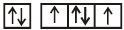
B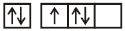
C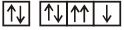
D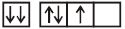
Solution
(D) $Pauli's$ exclusion principle states that no two electrons in an atom can have the same set of four quantum numbers,which implies that an orbital can hold a maximum of two electrons with opposite spins.
$Hund's$ rule of maximum multiplicity states that electron pairing in degenerate orbitals (like $p$,$d$,$f$) does not take place until each orbital is singly occupied.
In option $d$,the first orbital shows two electrons with the same spin (violating $Pauli's$ exclusion principle),and the second set of orbitals shows pairing before all orbitals are singly occupied (violating $Hund's$ rule).
$Hund's$ rule of maximum multiplicity states that electron pairing in degenerate orbitals (like $p$,$d$,$f$) does not take place until each orbital is singly occupied.
In option $d$,the first orbital shows two electrons with the same spin (violating $Pauli's$ exclusion principle),and the second set of orbitals shows pairing before all orbitals are singly occupied (violating $Hund's$ rule).
0 likes
View Solution633
MediumMCQ
The number of waves made by a Bohr electron in an orbit of maximum magnetic quantum number $3$ is
A
$3$
B
$4$
C
$2$
D
$1$
Solution
(B) The magnetic quantum number $m_l$ ranges from $-l$ to $+l$. For a given subshell,the maximum value of $m_l$ is equal to $l$. Given $m_l = 3$,we have $l = 3$.
The azimuthal quantum number $l$ ranges from $0$ to $n-1$. For the maximum value of $l$ in a given orbit $n$,$l = n-1$.
Substituting $l = 3$,we get $3 = n - 1$,which implies $n = 4$.
According to the Bohr model,the number of waves made by an electron in an orbit is equal to the principal quantum number $n$.
Therefore,the number of waves $= n = 4$.
Thus,the correct option is $B$.
The azimuthal quantum number $l$ ranges from $0$ to $n-1$. For the maximum value of $l$ in a given orbit $n$,$l = n-1$.
Substituting $l = 3$,we get $3 = n - 1$,which implies $n = 4$.
According to the Bohr model,the number of waves made by an electron in an orbit is equal to the principal quantum number $n$.
Therefore,the number of waves $= n = 4$.
Thus,the correct option is $B$.
0 likes
View Solution634
MediumMCQ
Which of the following set of quantum numbers represents the highest energy of an atom?
A
$n = 3, l = 0, m = 0, s = +1/2$
B
$n = 3, l = 1, m = 1, s = +1/2$
C
$n = 3, l = 2, m = 1, s = +1/2$
D
$n = 4, l = 0, m = 0, s = +1/2$
Solution
(C) The energy of an orbital is determined by the $(n + l)$ rule.
For $A$: $n = 3, l = 0$,so $(n + l) = 3 + 0 = 3$ ($3s$ orbital).
For $B$: $n = 3, l = 1$,so $(n + l) = 3 + 1 = 4$ ($3p$ orbital).
For $C$: $n = 3, l = 2$,so $(n + l) = 3 + 2 = 5$ ($3d$ orbital).
For $D$: $n = 4, l = 0$,so $(n + l) = 4 + 0 = 4$ ($4s$ orbital).
Comparing the $(n + l)$ values,$5$ is the highest value.
Therefore,the set of quantum numbers $n = 3, l = 2, m = 1, s = +1/2$ represents the highest energy.
For $A$: $n = 3, l = 0$,so $(n + l) = 3 + 0 = 3$ ($3s$ orbital).
For $B$: $n = 3, l = 1$,so $(n + l) = 3 + 1 = 4$ ($3p$ orbital).
For $C$: $n = 3, l = 2$,so $(n + l) = 3 + 2 = 5$ ($3d$ orbital).
For $D$: $n = 4, l = 0$,so $(n + l) = 4 + 0 = 4$ ($4s$ orbital).
Comparing the $(n + l)$ values,$5$ is the highest value.
Therefore,the set of quantum numbers $n = 3, l = 2, m = 1, s = +1/2$ represents the highest energy.
0 likes
View Solution635
EasyMCQ
Which orbital notation does not have a spherical node?
A
$n = 2, l = 0$
B
$n = 3, l = 1$
C
$n = 3, l = 0$
D
$n = 1, l = 0$
Solution
(D) The number of spherical (or radial) nodes in an orbital is given by the formula: $\text{Number of spherical nodes} = n - l - 1$.
For option $A$ $(n = 2, l = 0)$: $\text{Nodes} = 2 - 0 - 1 = 1$.
For option $B$ $(n = 3, l = 1)$: $\text{Nodes} = 3 - 1 - 1 = 1$.
For option $C$ $(n = 3, l = 0)$: $\text{Nodes} = 3 - 0 - 1 = 2$.
For option $D$ $(n = 1, l = 0)$: $\text{Nodes} = 1 - 0 - 1 = 0$.
Since the number of spherical nodes is $0$ for $n = 1, l = 0$ (which corresponds to the $1s$ orbital),this is the correct answer.
For option $A$ $(n = 2, l = 0)$: $\text{Nodes} = 2 - 0 - 1 = 1$.
For option $B$ $(n = 3, l = 1)$: $\text{Nodes} = 3 - 1 - 1 = 1$.
For option $C$ $(n = 3, l = 0)$: $\text{Nodes} = 3 - 0 - 1 = 2$.
For option $D$ $(n = 1, l = 0)$: $\text{Nodes} = 1 - 0 - 1 = 0$.
Since the number of spherical nodes is $0$ for $n = 1, l = 0$ (which corresponds to the $1s$ orbital),this is the correct answer.
0 likes
View Solution636
EasyMCQ
There is no difference between a $2p$ and $3p$ orbital regarding ?
A
Shape
B
Size
C
Energy
D
Value of $n$
Solution
(A) The shape of an orbital is determined by the azimuthal quantum number $(l)$.
For both $2p$ and $3p$ orbitals,the azimuthal quantum number is $l = 1$,which corresponds to a $p$-orbital shape.
Therefore,there is no difference in the shape of $2p$ and $3p$ orbitals.
For both $2p$ and $3p$ orbitals,the azimuthal quantum number is $l = 1$,which corresponds to a $p$-orbital shape.
Therefore,there is no difference in the shape of $2p$ and $3p$ orbitals.
0 likes
View Solution637
MediumMCQ
Which one of the following sets of quantum numbers represents an impossible arrangement?
A
$n = 3, l = 2, m_l = -2, m_s = +1/2$
B
$n = 4, l = 0, m_l = 0, m_s = +1/2$
C
$n = 3, l = 2, m_l = -3, m_s = +1/2$
D
$n = 5, l = 3, m_l = 0, m_s = -1/2$
Solution
(C) The magnetic quantum number $m_l$ can only take integer values ranging from $-l$ to $+l$ including zero.
For option $C$,$n = 3$ and $l = 2$. Therefore,$m_l$ can only be $-2, -1, 0, +1, +2$.
The value $m_l = -3$ is not possible for $l = 2$ because $|m_l|$ cannot be greater than $l$.
For option $C$,$n = 3$ and $l = 2$. Therefore,$m_l$ can only be $-2, -1, 0, +1, +2$.
The value $m_l = -3$ is not possible for $l = 2$ because $|m_l|$ cannot be greater than $l$.
0 likes
View Solution638
EasyMCQ
The portion of orbital diagrams representing the electronic configuration of certain elements is shown below. Which of them violate Pauli's Exclusion principle?
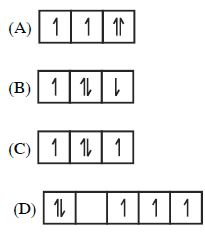
A
Only $A$
B
Only $C$
C
$B$ and $D$
D
$A, B$ and $D$
Solution
(B) Pauli's Exclusion Principle states that no two electrons in an atom can have the same set of all four quantum numbers. This implies that an orbital can hold a maximum of two electrons,and if it does,they must have opposite spins (represented by arrows pointing in opposite directions).
Analyzing the given diagrams:
- $(A)$: All orbitals follow the rule. The third orbital has two electrons with opposite spins.
- $(B)$: The third orbital has two electrons with the same spin (both pointing down). This violates Pauli's Exclusion Principle.
- $(C)$: All orbitals follow the rule.
- $(D)$: The first orbital has two electrons with opposite spins. The other orbitals are correctly filled according to Hund's rule. This does not violate Pauli's Exclusion Principle.
Therefore,only diagram $(B)$ violates Pauli's Exclusion Principle. However,looking at the provided options,there might be a misinterpretation of the diagram $(B)$'s third box or $(D)$'s first box. Re-evaluating: In $(B)$,the third box shows two electrons with the same spin (both down),which is a violation. In $(D)$,the first box shows two electrons with opposite spins,which is correct. Thus,only $(B)$ violates the principle. Given the options,if $(B)$ is the only violator,the question might be flawed or the options provided are limited. Based on standard interpretation,only $(B)$ violates the principle.
Analyzing the given diagrams:
- $(A)$: All orbitals follow the rule. The third orbital has two electrons with opposite spins.
- $(B)$: The third orbital has two electrons with the same spin (both pointing down). This violates Pauli's Exclusion Principle.
- $(C)$: All orbitals follow the rule.
- $(D)$: The first orbital has two electrons with opposite spins. The other orbitals are correctly filled according to Hund's rule. This does not violate Pauli's Exclusion Principle.
Therefore,only diagram $(B)$ violates Pauli's Exclusion Principle. However,looking at the provided options,there might be a misinterpretation of the diagram $(B)$'s third box or $(D)$'s first box. Re-evaluating: In $(B)$,the third box shows two electrons with the same spin (both down),which is a violation. In $(D)$,the first box shows two electrons with opposite spins,which is correct. Thus,only $(B)$ violates the principle. Given the options,if $(B)$ is the only violator,the question might be flawed or the options provided are limited. Based on standard interpretation,only $(B)$ violates the principle.
0 likes
View Solution639
EasyMCQ
Arrange the orbitals of $H$-atom in the increasing order of their energy:
$3p_x, 2s, 4d_{xy}, 3s, 4p_z, 3p_y, 4s$
$3p_x, 2s, 4d_{xy}, 3s, 4p_z, 3p_y, 4s$
A
$2s < 3s < 3p_x = 3p_y < 4s < 4p_z < 4d_{xy}$
B
$2s < 3s = 3p_x = 3p_y < 4s = 4p_z = 4d_{xy}$
C
$2s < 3s = 3p_x = 3p_y < 4s = 4p_z = 4d_{xy}$
D
$2s < 3p_x = 3p_y < 3s < 4s = 4p_z < 4d_{xy}$
Solution
(C) For a single-electron system like the $H$-atom,the energy of an orbital depends only on the principal quantum number $(n)$.
Orbitals with the same $n$ value have the same energy (degenerate).
The given orbitals have the following $n$ values:
$2s: n=2$
$3s, 3p_x, 3p_y: n=3$
$4s, 4p_z, 4d_{xy}: n=4$
Therefore,the energy order is:
$2s < (3s = 3p_x = 3p_y) < (4s = 4p_z = 4d_{xy})$.
Orbitals with the same $n$ value have the same energy (degenerate).
The given orbitals have the following $n$ values:
$2s: n=2$
$3s, 3p_x, 3p_y: n=3$
$4s, 4p_z, 4d_{xy}: n=4$
Therefore,the energy order is:
$2s < (3s = 3p_x = 3p_y) < (4s = 4p_z = 4d_{xy})$.
0 likes
View Solution640
MediumMCQ
The number of waves made by an electron moving in an orbit having a maximum magnetic quantum number $(m_l) = 3$ is:
A
$3$
B
$4$
C
$5$
D
$6$
Solution
(B) The maximum value of the magnetic quantum number $(m_l)$ is given as $3$.
For a given subshell,the magnetic quantum number ranges from $-l$ to $+l$.
Thus,$l = 3$,which corresponds to an $f$-orbital.
The principal quantum number $(n)$ is related to the orbital angular momentum quantum number $(l)$ by the relation $n = l + 1$ for the first occurrence of that subshell.
Therefore,$n = 3 + 1 = 4$.
According to the Bohr-Sommerfeld theory,the number of waves made by an electron in an orbit is equal to the principal quantum number $(n)$.
Hence,the number of waves is $4$.
For a given subshell,the magnetic quantum number ranges from $-l$ to $+l$.
Thus,$l = 3$,which corresponds to an $f$-orbital.
The principal quantum number $(n)$ is related to the orbital angular momentum quantum number $(l)$ by the relation $n = l + 1$ for the first occurrence of that subshell.
Therefore,$n = 3 + 1 = 4$.
According to the Bohr-Sommerfeld theory,the number of waves made by an electron in an orbit is equal to the principal quantum number $(n)$.
Hence,the number of waves is $4$.
0 likes
View Solution641
EasyMCQ
Which of the following shows half-filled configuration?
A
$Cr^{+3}_{(aq)}$
B
$Mn^{+2}_{(aq)}$
C
$Fe^{+3}_{(aq)}$
D
All
Solution
(B, C) The electronic configuration of the given ions are as follows:
$1$. $Cr^{+3}$ $(Z=24)$: The ground state configuration is $[Ar] 3d^5 4s^1$. After losing $3$ electrons,it becomes $[Ar] 3d^3$.
$2$. $Mn^{+2}$ $(Z=25)$: The ground state configuration is $[Ar] 3d^5 4s^2$. After losing $2$ electrons,it becomes $[Ar] 3d^5$. This is a half-filled $d$-orbital configuration.
$3$. $Fe^{+3}$ $(Z=26)$: The ground state configuration is $[Ar] 3d^6 4s^2$. After losing $3$ electrons,it becomes $[Ar] 3d^5$. This is a half-filled $d$-orbital configuration.
Since both $Mn^{+2}$ and $Fe^{+3}$ show half-filled configurations,and the question asks for which of the following shows half-filled configuration,the option 'All' is technically incorrect as $Cr^{+3}$ does not. However,based on standard multiple-choice patterns,if the question implies 'which of these',and $Mn^{+2}$ and $Fe^{+3}$ are both correct,the most appropriate answer is $B$ and $C$. Given the provided options,if we must choose one,$Mn^{+2}$ and $Fe^{+3}$ are both valid. Assuming the question intended to include both,we select $B$ and $C$ as valid examples.
$1$. $Cr^{+3}$ $(Z=24)$: The ground state configuration is $[Ar] 3d^5 4s^1$. After losing $3$ electrons,it becomes $[Ar] 3d^3$.
$2$. $Mn^{+2}$ $(Z=25)$: The ground state configuration is $[Ar] 3d^5 4s^2$. After losing $2$ electrons,it becomes $[Ar] 3d^5$. This is a half-filled $d$-orbital configuration.
$3$. $Fe^{+3}$ $(Z=26)$: The ground state configuration is $[Ar] 3d^6 4s^2$. After losing $3$ electrons,it becomes $[Ar] 3d^5$. This is a half-filled $d$-orbital configuration.
Since both $Mn^{+2}$ and $Fe^{+3}$ show half-filled configurations,and the question asks for which of the following shows half-filled configuration,the option 'All' is technically incorrect as $Cr^{+3}$ does not. However,based on standard multiple-choice patterns,if the question implies 'which of these',and $Mn^{+2}$ and $Fe^{+3}$ are both correct,the most appropriate answer is $B$ and $C$. Given the provided options,if we must choose one,$Mn^{+2}$ and $Fe^{+3}$ are both valid. Assuming the question intended to include both,we select $B$ and $C$ as valid examples.
0 likes
View Solution642
EasyMCQ
In a chromium atom,the number of electrons which have $n = 2$ and $l = 1$ is:
A
$6$
B
$4$
C
$2$
D
$1$
Solution
(A) The electronic configuration of a chromium atom $(Z = 24)$ is $1s^2 2s^2 2p^6 3s^2 3p^6 3d^5 4s^1$.
For the condition $n = 2$ and $l = 1$,we are looking for the electrons in the $2p$ subshell.
The $2p$ subshell contains $6$ electrons.
Therefore,the number of electrons with $n = 2$ and $l = 1$ is $6$.
For the condition $n = 2$ and $l = 1$,we are looking for the electrons in the $2p$ subshell.
The $2p$ subshell contains $6$ electrons.
Therefore,the number of electrons with $n = 2$ and $l = 1$ is $6$.
0 likes
View Solution643
MediumMCQ
Five valence electrons of $P^{15}$ are labelled as $\boxed{AB}_{3s} \,\boxed{X|Y|Z}_{3p}$. If the spin quantum numbers of $B$ and $Z$ are $+\frac{1}{2}$,the group of electrons with three of the quantum numbers $(n, l, m)$ the same are:
A
$AB, XYZ, BY$
B
$AB$
C
$XYZ, AZ$
D
$AB, XYZ$
Solution
(B) The electronic configuration of $P$ $(Z=15)$ is $1s^2 2s^2 2p^6 3s^2 3p^3$.
The five valence electrons are in $3s^2$ and $3p^3$.
For $3s$ orbital: $n=3, l=0, m=0$. Both electrons $A$ and $B$ have the same $(n, l, m)$ values.
For $3p$ orbitals: $n=3, l=1$. The three electrons $X, Y, Z$ are in different $m$ values ($m=-1, 0, +1$ respectively).
Since $B$ has spin $+\frac{1}{2}$,$A$ must have spin $-\frac{1}{2}$.
Since $Z$ has spin $+\frac{1}{2}$,and by Hund's rule,$X, Y, Z$ all have spin $+\frac{1}{2}$.
Electrons with the same $(n, l, m)$ are those in the same orbital.
$A$ and $B$ are in the same $3s$ orbital,so they share $(n, l, m)$.
$X, Y, Z$ are in different $3p$ orbitals,so they do not share $(n, l, m)$ with each other.
Therefore,the group of electrons with the same $(n, l, m)$ is $AB$.
The five valence electrons are in $3s^2$ and $3p^3$.
For $3s$ orbital: $n=3, l=0, m=0$. Both electrons $A$ and $B$ have the same $(n, l, m)$ values.
For $3p$ orbitals: $n=3, l=1$. The three electrons $X, Y, Z$ are in different $m$ values ($m=-1, 0, +1$ respectively).
Since $B$ has spin $+\frac{1}{2}$,$A$ must have spin $-\frac{1}{2}$.
Since $Z$ has spin $+\frac{1}{2}$,and by Hund's rule,$X, Y, Z$ all have spin $+\frac{1}{2}$.
Electrons with the same $(n, l, m)$ are those in the same orbital.
$A$ and $B$ are in the same $3s$ orbital,so they share $(n, l, m)$.
$X, Y, Z$ are in different $3p$ orbitals,so they do not share $(n, l, m)$ with each other.
Therefore,the group of electrons with the same $(n, l, m)$ is $AB$.
0 likes
View Solution644
MediumMCQ
An atom has $35$ nucleons and an atomic number equal to $17$. The number of electrons with $n = 2$ and $m = 0$ in it is:
A
$2$
B
$4$
C
$6$
D
$3$
Solution
(B) The atomic number $Z = 17$. The electronic configuration is $1s^2 2s^2 2p^6 3s^2 3p^5$.
For $n = 2$,the subshells are $2s$ and $2p$.
In $2s$ subshell,$l = 0$,so $m = 0$. There are $2$ electrons in $2s$ orbital $(m = 0)$.
In $2p$ subshell,$l = 1$,so $m = -1, 0, +1$. There are $6$ electrons in $2p$ subshell,with $2$ electrons in each orbital $(m = -1, 0, +1)$.
Thus,the $2p$ orbital with $m = 0$ contains $2$ electrons.
Total number of electrons with $n = 2$ and $m = 0$ is $2$ (from $2s$) $+ 2$ (from $2p$) $= 4$.
For $n = 2$,the subshells are $2s$ and $2p$.
In $2s$ subshell,$l = 0$,so $m = 0$. There are $2$ electrons in $2s$ orbital $(m = 0)$.
In $2p$ subshell,$l = 1$,so $m = -1, 0, +1$. There are $6$ electrons in $2p$ subshell,with $2$ electrons in each orbital $(m = -1, 0, +1)$.
Thus,the $2p$ orbital with $m = 0$ contains $2$ electrons.
Total number of electrons with $n = 2$ and $m = 0$ is $2$ (from $2s$) $+ 2$ (from $2p$) $= 4$.
0 likes
View Solution645
MediumMCQ
Which electron is associated with the least energy?
A
$n = 3, l = 2, m = -2, s = +1/2$
B
$n = 4, l = 0, m = 0, s = +1/2$
C
$n = 4, l = 1, m = +1, s = +1/2$
D
$n = 5, l = 0, m = 0, s = +1/2$
Solution
(B) The energy of an electron in an orbital is determined by the $(n+l)$ rule (also known as the $Aufbau$ principle).
$I$. The energy of an orbital increases as the sum of the principal quantum number $(n)$ and the azimuthal quantum number $(l)$ increases.
$II$. If two orbitals have the same $(n+l)$ value,the one with the lower $n$ value has lower energy.
$III$. Calculating $(n+l)$ for each option:
$(A)$ $n=3, l=2 \implies n+l = 3+2 = 5$
$(B)$ $n=4, l=0 \implies n+l = 4+0 = 4$
$(C)$ $n=4, l=1 \implies n+l = 4+1 = 5$
$(D)$ $n=5, l=0 \implies n+l = 5+0 = 5$
Since option $(B)$ has the lowest $(n+l)$ value of $4$,it corresponds to the electron with the least energy.
$I$. The energy of an orbital increases as the sum of the principal quantum number $(n)$ and the azimuthal quantum number $(l)$ increases.
$II$. If two orbitals have the same $(n+l)$ value,the one with the lower $n$ value has lower energy.
$III$. Calculating $(n+l)$ for each option:
$(A)$ $n=3, l=2 \implies n+l = 3+2 = 5$
$(B)$ $n=4, l=0 \implies n+l = 4+0 = 4$
$(C)$ $n=4, l=1 \implies n+l = 4+1 = 5$
$(D)$ $n=5, l=0 \implies n+l = 5+0 = 5$
Since option $(B)$ has the lowest $(n+l)$ value of $4$,it corresponds to the electron with the least energy.
0 likes
View Solution646
EasyMCQ
Paramagnetic substances must contain .....
A
Unpaired electrons
B
Paired electrons
C
Positive charge
D
Negative charge
Solution
(A) Paramagnetism arises due to the presence of one or more unpaired electrons which are attracted by the magnetic field. Therefore,paramagnetic substances must contain at least one unpaired electron.
0 likes
View Solution647
EasyMCQ
How does the orbital energy change as the nuclear charge increases from $Ne$ to $Ca$?
A
Increases
B
Increases very rapidly
C
Increases very slowly
D
Decreases
Solution
(D) As the nuclear charge $(Z)$ increases from $Ne$ $(Z=10)$ to $Ca$ $(Z=20)$,the electrostatic attraction between the nucleus and the electrons increases.
This leads to a decrease in the energy of the orbitals (i.e.,the orbitals become more stable and their energy becomes more negative).
Therefore,the orbital energy decreases as the nuclear charge increases.
This leads to a decrease in the energy of the orbitals (i.e.,the orbitals become more stable and their energy becomes more negative).
Therefore,the orbital energy decreases as the nuclear charge increases.
0 likes
View Solution648
EasyMCQ
Which of the following combinations of quantum numbers is allowed?
A
$n = 3, l = 2, m = 1, m_s = 0$
B
$n = 2, l = 0, m = 0, m_s = -\frac{1}{2}$
C
$n = 3, l = -3, m = -2, m_s = +\frac{1}{2}$
D
$n = 1, l = 0, m = 1, m_s = +\frac{1}{2}$
Solution
(B) For a set of quantum numbers to be allowed,they must satisfy the following conditions:
$1$. $n$ must be a positive integer $(1, 2, 3, ...)$.
$2$. $l$ must be an integer ranging from $0$ to $n-1$.
$3$. $m$ must be an integer ranging from $-l$ to $+l$.
$4$. $m_s$ must be either $+\frac{1}{2}$ or $-\frac{1}{2}$.
Evaluating the options:
Option $A$: $m_s = 0$ is not allowed,as $m_s$ can only be $\pm\frac{1}{2}$.
Option $B$: $n=2, l=0, m=0, m_s = -\frac{1}{2}$. All values satisfy the conditions ($l < n$ and $|m| \le l$). This is allowed.
Option $C$: $l = -3$ is not allowed,as $l$ must be $\ge 0$.
Option $D$: $m = 1$ is not allowed when $l = 0$,as $|m| \le l$ must hold.
$1$. $n$ must be a positive integer $(1, 2, 3, ...)$.
$2$. $l$ must be an integer ranging from $0$ to $n-1$.
$3$. $m$ must be an integer ranging from $-l$ to $+l$.
$4$. $m_s$ must be either $+\frac{1}{2}$ or $-\frac{1}{2}$.
Evaluating the options:
Option $A$: $m_s = 0$ is not allowed,as $m_s$ can only be $\pm\frac{1}{2}$.
Option $B$: $n=2, l=0, m=0, m_s = -\frac{1}{2}$. All values satisfy the conditions ($l < n$ and $|m| \le l$). This is allowed.
Option $C$: $l = -3$ is not allowed,as $l$ must be $\ge 0$.
Option $D$: $m = 1$ is not allowed when $l = 0$,as $|m| \le l$ must hold.
0 likes
View Solution649
MediumMCQ
The electrons,identified by quantum numbers $n$ and $l$ as $(i) n = 4, l = 1$,$(ii) n = 4, l = 0$,$(iii) n = 3, l = 2$,$(iv) n = 3, l = 1$,can be placed in order of increasing energy,from the lowest to highest,as:
A
$(iv) < (ii) < (iii) < (i)$
B
$(ii) < (iv) < (i) < (iii)$
C
$(i) < (iii) < (ii) < (iv)$
D
$(iii) < (i) < (iv) < (ii)$
Solution
(A) According to the $(n+l)$ rule,the higher the value of $(n+l)$,the higher is the energy of the orbital.
If the $(n+l)$ values are the same,the orbital with the lower value of $n$ has lower energy.
Calculating $(n+l)$ values:
$(i) n=4, l=1 \implies n+l = 5$
$(ii) n=4, l=0 \implies n+l = 4$
$(iii) n=3, l=2 \implies n+l = 5$
$(iv) n=3, l=1 \implies n+l = 4$
Comparing the values:
For $(iv)$ and $(ii)$,both have $(n+l) = 4$. Since $n=3 < n=4$,$(iv) < (ii)$.
For $(i)$ and $(iii)$,both have $(n+l) = 5$. Since $n=3 < n=4$,$(iii) < (i)$.
Combining these,the order of increasing energy is $(iv) < (ii) < (iii) < (i)$.
If the $(n+l)$ values are the same,the orbital with the lower value of $n$ has lower energy.
Calculating $(n+l)$ values:
$(i) n=4, l=1 \implies n+l = 5$
$(ii) n=4, l=0 \implies n+l = 4$
$(iii) n=3, l=2 \implies n+l = 5$
$(iv) n=3, l=1 \implies n+l = 4$
Comparing the values:
For $(iv)$ and $(ii)$,both have $(n+l) = 4$. Since $n=3 < n=4$,$(iv) < (ii)$.
For $(i)$ and $(iii)$,both have $(n+l) = 5$. Since $n=3 < n=4$,$(iii) < (i)$.
Combining these,the order of increasing energy is $(iv) < (ii) < (iii) < (i)$.
0 likes
View SolutionStructure of Atom — Quantum number, Electronic configuration and Shape of orbitals · Frequently Asked Questions
1Are these Structure of Atom questions useful for JEE and NEET?
Yes. All questions in this section are mapped to JEE Main and NEET exam patterns. Previous year questions from JEE Main, NEET, GUJCET and state-level exams are included with full solutions.
2Can I switch to Hindi or Gujarati for these questions?
Yes. Use the language tabs in the hero section or the sidebar to view the same questions and solutions in English, Hindi or Gujarati.
3How do I generate a question paper from this subtopic?
Use the Vedclass Exam Paper Generator — select the chapter and subtopic, set difficulty, and generate Sets A, B, C, D automatically. First 3 chapters of every subject are free.
Vedclass Products
For Students
Vedclass Test Series
Mock tests in real JEE/NEET style with performance analysis. 5-day free trial.
Start Free TrialFor Teachers
Exam Paper Generator
Generate Set A/B/C/D papers from this chapter in 2 minutes. 3 chapters free.
Try FreeFor Institutes
Online Exam Module
Live online exams with unlimited students, 360° analytics & white-label branding.
See DemoFor Teachers & Institutes
Generate a Structure of Atom Exam Paper in 2 Minutes
Select subtopic & difficulty — Sets A, B, C, D auto-generated with No Repeat logic.
First 3 chapters of every subject are free — no payment required.