
A English
Mix Examples-Structure of atom Questions in English
Class 11 Chemistry · Structure of Atom · Mix Examples-Structure of atom
34+
Questions
English
Language
100%
With Solutions
Showing 34 of 34 questions in English
1
EasyMCQ
Which of the following graphs represents one node?
A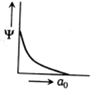
B
C
D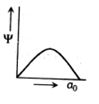
Solution
(B) node is a region where the probability of finding an electron is zero,which corresponds to the point where the wave function $\Psi$ crosses the axis (i.e.,$\Psi = 0$).
In graph $B$,the wave function $\Psi$ crosses the axis once,indicating one node.
Graph $A$ has no nodes.
Graph $C$ has two nodes.
Graph $D$ has no nodes (it represents a probability density or a different orbital function).
In graph $B$,the wave function $\Psi$ crosses the axis once,indicating one node.
Graph $A$ has no nodes.
Graph $C$ has two nodes.
Graph $D$ has no nodes (it represents a probability density or a different orbital function).
0 likes
View Solution2
MediumMCQ
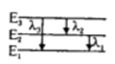
For the given electronic transitions,which of the following statements is correct?
A
$E_{3-1} = E_{3-2} - E_{2-1}$
B
$\lambda_3 = \lambda_1 + \lambda_2$
C
$\nu_3 = \nu_2 + \nu_1$
D
All of the above
Solution
(C) From the energy level diagram,the energy of the transition from $E_3$ to $E_1$ is the sum of the energies of the transitions from $E_3$ to $E_2$ and $E_2$ to $E_1$.
$E_{3-1} = E_{3-2} + E_{2-1}$
Since $E = h\nu = \frac{hc}{\lambda}$,we have $h\nu_3 = h\nu_2 + h\nu_1$,which simplifies to $\nu_3 = \nu_2 + \nu_1$.
$E_{3-1} = E_{3-2} + E_{2-1}$
Since $E = h\nu = \frac{hc}{\lambda}$,we have $h\nu_3 = h\nu_2 + h\nu_1$,which simplifies to $\nu_3 = \nu_2 + \nu_1$.
0 likes
View Solution3
MediumMCQ
In which of the following transitions is one quantum of energy emitted?
A
$n = 4 \rightarrow n = 2$
B
$n = 3 \rightarrow n = 1$
C
$n = 4 \rightarrow n = 1$
D
All of the above
Solution
(D) quantum of energy is emitted when an electron transitions from a higher energy level to a lower energy level.
In all the given transitions ($n = 4 \rightarrow n = 2$,$n = 3 \rightarrow n = 1$,and $n = 4 \rightarrow n = 1$),the electron moves from a higher principal quantum number to a lower one,resulting in the emission of energy in the form of a photon (quantum).
Therefore,all the given transitions involve the emission of one quantum of energy.
In all the given transitions ($n = 4 \rightarrow n = 2$,$n = 3 \rightarrow n = 1$,and $n = 4 \rightarrow n = 1$),the electron moves from a higher principal quantum number to a lower one,resulting in the emission of energy in the form of a photon (quantum).
Therefore,all the given transitions involve the emission of one quantum of energy.
0 likes
View Solution4
DifficultMCQ
Match the following items:
| $A$. Energy of ground state of $He^+$ | $i$. $+6.04 \text{ eV}$ |
| $B$. Potential energy of $I$ orbit of $H$ atom | $ii$. $-27.2 \text{ eV}$ |
| $C$. Kinetic energy of $II$ excited state of $He^+$ | $iii$. $8.72 \times 10^{-18} \text{ J}$ |
| $D$. Ionization potential of $He^+$ | $iv$. $-54.4 \text{ eV}$ |
A
$A-i, B-ii, C-iii, D-iv$
B
$A-iv, B-iii, C-ii, D-i$
C
$A-iv, B-ii, C-i, D-iii$
D
$A-ii, B-iii, C-i, D-iv$
Solution
(C) For $He^+$ $(Z=2)$:
$(A)$ Ground state energy $(n=1)$: $E_n = -13.6 \times (Z^2/n^2) \text{ eV} = -13.6 \times (4/1) = -54.4 \text{ eV}$. Thus,$A-iv$.
$(B)$ Potential energy of $H$ atom $(Z=1)$ in $I$ orbit $(n=1)$: $PE = 2 \times E_n = 2 \times (-13.6 \text{ eV}) = -27.2 \text{ eV}$. Thus,$B-ii$.
$(C)$ Kinetic energy of $II$ excited state $(n=3)$ of $He^+$: $KE = |E_n| = 13.6 \times (Z^2/n^2) = 13.6 \times (4/9) \approx 6.04 \text{ eV}$. Thus,$C-i$.
$(D)$ Ionization potential of $He^+$: Energy required to remove electron from $n=1$ to $\infty$,which is $54.4 \text{ eV}$. Converting to Joules: $54.4 \times 1.602 \times 10^{-19} \text{ J} \approx 8.72 \times 10^{-18} \text{ J}$. Thus,$D-iii$.
Therefore,the correct match is $A-iv, B-ii, C-i, D-iii$.
$(A)$ Ground state energy $(n=1)$: $E_n = -13.6 \times (Z^2/n^2) \text{ eV} = -13.6 \times (4/1) = -54.4 \text{ eV}$. Thus,$A-iv$.
$(B)$ Potential energy of $H$ atom $(Z=1)$ in $I$ orbit $(n=1)$: $PE = 2 \times E_n = 2 \times (-13.6 \text{ eV}) = -27.2 \text{ eV}$. Thus,$B-ii$.
$(C)$ Kinetic energy of $II$ excited state $(n=3)$ of $He^+$: $KE = |E_n| = 13.6 \times (Z^2/n^2) = 13.6 \times (4/9) \approx 6.04 \text{ eV}$. Thus,$C-i$.
$(D)$ Ionization potential of $He^+$: Energy required to remove electron from $n=1$ to $\infty$,which is $54.4 \text{ eV}$. Converting to Joules: $54.4 \times 1.602 \times 10^{-19} \text{ J} \approx 8.72 \times 10^{-18} \text{ J}$. Thus,$D-iii$.
Therefore,the correct match is $A-iv, B-ii, C-i, D-iii$.
0 likes
View Solution5
MediumMCQ
Which of the following graphs is correct for the kinetic energy $(K.E.)$ of an electron in the $n^{th}$ orbit of a hydrogen-like atom?
A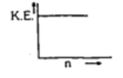
B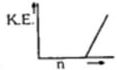
C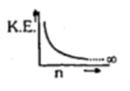
D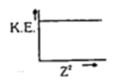
Solution
(C) The kinetic energy $(K.E.)$ of an electron in the $n^{th}$ orbit of a hydrogen-like atom is given by the formula:
$K.E. = \frac{13.6 \times Z^2}{n^2} \text{ eV}$
Where $Z$ is the atomic number and $n$ is the principal quantum number.
From this relation,we can see that $K.E. \propto \frac{1}{n^2}$.
As $n$ increases,$K.E.$ decreases rapidly.
Graph $(C)$ shows the variation of $K.E.$ with $n$,where $K.E.$ is inversely proportional to $n^2$,which matches the curve shown in option $(C)$.
$K.E. = \frac{13.6 \times Z^2}{n^2} \text{ eV}$
Where $Z$ is the atomic number and $n$ is the principal quantum number.
From this relation,we can see that $K.E. \propto \frac{1}{n^2}$.
As $n$ increases,$K.E.$ decreases rapidly.
Graph $(C)$ shows the variation of $K.E.$ with $n$,where $K.E.$ is inversely proportional to $n^2$,which matches the curve shown in option $(C)$.
0 likes
View Solution6
MediumMCQ
Which of the following statement$(s)$ is (are) correct?
A
The electronic configuration of $Cr$ is $[Ar] \ 3d^5 4s^1$ (Atomic no. of $Cr = 24$)
B
The magnetic quantum number may have a negative value
C
In silver atom,$23$ electrons have a spin of one type and $24$ of the opposite type (Atomic no. of $Ag = 47$)
D
All of the above
Solution
(D) : The electronic configuration of $Cr$ $(Z=24)$ is $[Ar] \ 3d^5 4s^1$ due to the extra stability of half-filled $d$-orbitals. This is correct.
$B$: The magnetic quantum number $(m_l)$ ranges from $-l$ to $+l$,including zero,so it can have negative values. This is correct.
$C$: For $Ag$ $(Z=47)$,the configuration is $[Kr] \ 4d^{10} 5s^1$. The $4d^{10}$ subshell has $5$ pairs of electrons (total $10$ electrons,$5$ spin up,$5$ spin down). The $5s^1$ has $1$ electron. In the filled inner shells ($[Kr]$ has $36$ electrons,$18$ up,$18$ down),we have $18$ up and $18$ down. Adding the $4d^{10}$ ($5$ up,$5$ down) and $5s^1$ ($1$ up),we get $18+5+1 = 24$ electrons of one spin and $18+5 = 23$ of the opposite spin. This is correct.
Therefore,all statements are correct.
$B$: The magnetic quantum number $(m_l)$ ranges from $-l$ to $+l$,including zero,so it can have negative values. This is correct.
$C$: For $Ag$ $(Z=47)$,the configuration is $[Kr] \ 4d^{10} 5s^1$. The $4d^{10}$ subshell has $5$ pairs of electrons (total $10$ electrons,$5$ spin up,$5$ spin down). The $5s^1$ has $1$ electron. In the filled inner shells ($[Kr]$ has $36$ electrons,$18$ up,$18$ down),we have $18$ up and $18$ down. Adding the $4d^{10}$ ($5$ up,$5$ down) and $5s^1$ ($1$ up),we get $18+5+1 = 24$ electrons of one spin and $18+5 = 23$ of the opposite spin. This is correct.
Therefore,all statements are correct.
0 likes
View Solution7
DifficultMCQ
Which one is the wrong statement?
A
The uncertainty principle is $\Delta E \times \Delta t \geq \frac{h}{4\pi}$
B
Half-filled and fully-filled orbitals have greater stability due to greater exchange energy,greater symmetry,and more balanced arrangement.
C
The energy of $2s$ orbital is less than the energy of $2p$ orbital in case of hydrogen-like atoms.
D
de-Broglie's wavelength is given by $\lambda = \frac{h}{mv}$,where $m =$ mass of the particle,$v =$ group velocity of the particle.
Solution
(C) For hydrogen-like atoms (single-electron species),the energy of orbitals depends only on the principal quantum number $n$.
Therefore,the energy of $2s$ orbital is equal to the energy of $2p$ orbital $(E_{2s} = E_{2p})$.
Thus,the statement that the energy of $2s$ orbital is less than $2p$ orbital is incorrect.
Therefore,the energy of $2s$ orbital is equal to the energy of $2p$ orbital $(E_{2s} = E_{2p})$.
Thus,the statement that the energy of $2s$ orbital is less than $2p$ orbital is incorrect.
0 likes
View Solution8
MediumMCQ
Which of the following statements is $CORRECT$ :
$(I)$ Where orbitals are available in degenerate sets,maximum spin multiplicity is observed.
$(II)$ Where two electrons occupy the same shell,they may have same spins.
$(III)$ All noble gases do not have the same valence shell electronic configuration.
$(I)$ Where orbitals are available in degenerate sets,maximum spin multiplicity is observed.
$(II)$ Where two electrons occupy the same shell,they may have same spins.
$(III)$ All noble gases do not have the same valence shell electronic configuration.
A
Only $I$ and $III$
B
Only $II$ and $III$
C
Only $I$ and $II$
D
$I, II$ and $III$
Solution
(D) Statement $(I)$ is $CORRECT$ according to Hund's Rule of Maximum Multiplicity,which states that for a given electron configuration,the term with the maximum multiplicity has the lowest energy.
Statement $(II)$ is $CORRECT$ because the Pauli Exclusion Principle only states that no two electrons in an atom can have the same set of four quantum numbers. If two electrons are in different orbitals within the same shell,they can have the same spin.
Statement $(III)$ is $CORRECT$ because $He$ has a valence configuration of $1s^2$,while other noble gases like $Ne, Ar, Kr, Xe$ have $ns^2 np^6$ configurations.
Therefore,all three statements are correct.
Statement $(II)$ is $CORRECT$ because the Pauli Exclusion Principle only states that no two electrons in an atom can have the same set of four quantum numbers. If two electrons are in different orbitals within the same shell,they can have the same spin.
Statement $(III)$ is $CORRECT$ because $He$ has a valence configuration of $1s^2$,while other noble gases like $Ne, Ar, Kr, Xe$ have $ns^2 np^6$ configurations.
Therefore,all three statements are correct.
0 likes
View Solution9
MediumMCQ
Which of the following statements is $CORRECT$?
A
Out of four quantum numbers,the azimuthal quantum number may have the highest numerical value for a particular subshell.
B
On increasing electronegativity,ionisation energy decreases generally.
C
If the intermolecular axis is $x$-axis,then $d_{xy}$ will form a pi $(\pi)$ bond with $p_x$ orbital.
D
None of these
Solution
(D) Let us analyze each statement:
$1$. For a given subshell,the principal quantum number $n$ is always greater than the azimuthal quantum number $l$ $(n > l)$. Thus,the azimuthal quantum number cannot have the highest numerical value.
$2$. Generally,as electronegativity increases,the effective nuclear charge increases,which makes it harder to remove an electron,thus increasing the ionisation energy. Therefore,the statement that it decreases is incorrect.
$3$. If the intermolecular axis is the $x$-axis,the $p_x$ orbital can only form a sigma $(\sigma)$ bond due to head-on overlap. $A$ $d_{xy}$ orbital has lobes in the $xy$ plane; it cannot form a $\pi$ bond with $p_x$ along the $x$-axis because the symmetry does not allow for lateral overlap.
$4$. Since all statements are incorrect,the correct option is $D$.
$1$. For a given subshell,the principal quantum number $n$ is always greater than the azimuthal quantum number $l$ $(n > l)$. Thus,the azimuthal quantum number cannot have the highest numerical value.
$2$. Generally,as electronegativity increases,the effective nuclear charge increases,which makes it harder to remove an electron,thus increasing the ionisation energy. Therefore,the statement that it decreases is incorrect.
$3$. If the intermolecular axis is the $x$-axis,the $p_x$ orbital can only form a sigma $(\sigma)$ bond due to head-on overlap. $A$ $d_{xy}$ orbital has lobes in the $xy$ plane; it cannot form a $\pi$ bond with $p_x$ along the $x$-axis because the symmetry does not allow for lateral overlap.
$4$. Since all statements are incorrect,the correct option is $D$.
0 likes
View Solution10
EasyMCQ
Which of the following arrangements of electrons is most likely to be stable?
A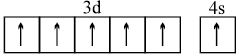
B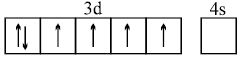
C
D
0 likes
View Solution11
DifficultMCQ
What is the ratio of time periods in the $3^{rd}$ orbit of $H^{-}$ atom to the $2^{nd}$ orbit of $He^{+}$ ion?
A
$32 : 27$
B
$27 : 2$
C
$2 : 27$
D
$27 : 32$
Solution
(B) The time period $T$ of an electron in the $n^{th}$ orbit is given by the formula $T \propto \frac{n^3}{Z^2}$.
For the $3^{rd}$ orbit of $H^{-}$ atom $(n_1 = 3, Z_1 = 1)$:
$T_1 \propto \frac{3^3}{1^2} = 27$.
For the $2^{nd}$ orbit of $He^{+}$ ion $(n_2 = 2, Z_2 = 2)$:
$T_2 \propto \frac{2^3}{2^2} = \frac{8}{4} = 2$.
The ratio of time periods is $\frac{T_1}{T_2} = \frac{27}{2}$.
For the $3^{rd}$ orbit of $H^{-}$ atom $(n_1 = 3, Z_1 = 1)$:
$T_1 \propto \frac{3^3}{1^2} = 27$.
For the $2^{nd}$ orbit of $He^{+}$ ion $(n_2 = 2, Z_2 = 2)$:
$T_2 \propto \frac{2^3}{2^2} = \frac{8}{4} = 2$.
The ratio of time periods is $\frac{T_1}{T_2} = \frac{27}{2}$.
0 likes
View Solution12
MediumMCQ
In the transition of an electron in an atom,its kinetic energy changes from $y$ to $y/4$. The change in $P.E.$ will be
A
$-\frac{3}{4} \ y$
B
$\frac{3}{4} \ y$
C
$-\frac{3}{8} \ y$
D
$\frac{3}{2} \ y$
Solution
(D) For an electron in a hydrogen-like atom,the relationship between potential energy $(PE)$ and kinetic energy $(KE)$ is given by $PE = -2 \ KE$.
Initially,$KE_1 = y$,so $PE_1 = -2 \ y$.
Finally,$KE_2 = y/4$,so $PE_2 = -2 \ (y/4) = -y/2$.
Change in potential energy $\Delta PE = PE_2 - PE_1 = -y/2 - (-2 \ y) = -y/2 + 2 \ y = \frac{3 \ y}{2}$.
Initially,$KE_1 = y$,so $PE_1 = -2 \ y$.
Finally,$KE_2 = y/4$,so $PE_2 = -2 \ (y/4) = -y/2$.
Change in potential energy $\Delta PE = PE_2 - PE_1 = -y/2 - (-2 \ y) = -y/2 + 2 \ y = \frac{3 \ y}{2}$.
0 likes
View Solution13
DifficultMCQ
Consider the following statements:
$(a)$ Photon is a positively charged nuclear particle
$(b)$ Size of nucleus is very small as compared to the size of atom
$(c)$ Photoelectric effect and diffraction show particle nature of light
$(d)$ Planck's constant has same dimensions as angular momentum
The correct statements is/are:
$(a)$ Photon is a positively charged nuclear particle
$(b)$ Size of nucleus is very small as compared to the size of atom
$(c)$ Photoelectric effect and diffraction show particle nature of light
$(d)$ Planck's constant has same dimensions as angular momentum
The correct statements is/are:
A
$a, b, d$
B
$b, d$
C
$a, d$
D
$b, c, d$
Solution
(B) Statement $(a)$ is incorrect because a photon is a massless,neutral particle of light.
Statement $(b)$ is correct; the nucleus is extremely small $(10^{-15} \ m)$ compared to the atom $(10^{-10} \ m)$.
Statement $(c)$ is incorrect because diffraction demonstrates the wave nature of light,while the photoelectric effect demonstrates the particle nature.
Statement $(d)$ is correct; the dimensions of Planck's constant $(h)$ are $[ML^2T^{-1}]$,which are the same as the dimensions of angular momentum $(L = mvr = [M][LT^{-1}][L] = [ML^2T^{-1}])$.
Therefore,the correct statements are $(b)$ and $(d)$.
Statement $(b)$ is correct; the nucleus is extremely small $(10^{-15} \ m)$ compared to the atom $(10^{-10} \ m)$.
Statement $(c)$ is incorrect because diffraction demonstrates the wave nature of light,while the photoelectric effect demonstrates the particle nature.
Statement $(d)$ is correct; the dimensions of Planck's constant $(h)$ are $[ML^2T^{-1}]$,which are the same as the dimensions of angular momentum $(L = mvr = [M][LT^{-1}][L] = [ML^2T^{-1}])$.
Therefore,the correct statements are $(b)$ and $(d)$.
0 likes
View Solution14
MediumMCQ
In $H$ atom,an orbit has a diameter of about $16.92 \ \mathring{A}$. What is the maximum number of electrons that can be accommodated in this orbit?
A
$16$
B
$32$
C
$64$
D
$8$
Solution
(B) The radius of the orbit $r$ is given by $r = 0.529 \times n^2 \ \mathring{A}$ for a hydrogen atom.
Given diameter $= 16.92 \ \mathring{A}$,so radius $r = 8.46 \ \mathring{A}$.
Equating the two: $0.529 \times n^2 = 8.46$.
$n^2 = \frac{8.46}{0.529} \approx 16$.
Thus,$n = 4$.
The maximum number of electrons in an orbit is given by the formula $2n^2$.
Number of electrons $= 2 \times (4)^2 = 2 \times 16 = 32$.
Given diameter $= 16.92 \ \mathring{A}$,so radius $r = 8.46 \ \mathring{A}$.
Equating the two: $0.529 \times n^2 = 8.46$.
$n^2 = \frac{8.46}{0.529} \approx 16$.
Thus,$n = 4$.
The maximum number of electrons in an orbit is given by the formula $2n^2$.
Number of electrons $= 2 \times (4)^2 = 2 \times 16 = 32$.
0 likes
View Solution15
DifficultMCQ
The shape of the probability distribution curve for the $2s$ orbital is .........
A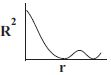
B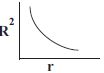
C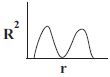
D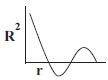
Solution
(A) For the $2s$ orbital,the radial probability density function $R^2(r)$ (or $4\pi r^2 \psi^2$) represents the probability of finding the electron at a distance $r$ from the nucleus.
For an $s$-orbital,the probability density is maximum at the nucleus $(r=0)$.
As $r$ increases,the probability density decreases,reaches a node (where probability is zero) at a certain distance,and then increases to a smaller secondary peak before decreasing again.
Therefore,the graph starts at a maximum value at $r=0$,touches the $r$-axis at the node,and then shows a smaller peak,which matches the curve in option $A$.
For an $s$-orbital,the probability density is maximum at the nucleus $(r=0)$.
As $r$ increases,the probability density decreases,reaches a node (where probability is zero) at a certain distance,and then increases to a smaller secondary peak before decreasing again.
Therefore,the graph starts at a maximum value at $r=0$,touches the $r$-axis at the node,and then shows a smaller peak,which matches the curve in option $A$.
0 likes
View Solution16
DifficultMCQ
Which of the following violates the Aufbau principle and Hund's rule?
A
B
C
D
Solution
(D) The Aufbau principle states that electrons fill lower energy orbitals first.
According to Hund's rule,pairing of electrons in degenerate orbitals (like $2p$) only occurs after each orbital is singly occupied.
Option $A$ shows a correctly filled $2s$ and $2p$ orbital for Nitrogen $(1s^2 2s^2 2p^3)$.
Option $B$ violates the Aufbau principle because the $2s$ orbital is not fully filled before electrons enter the $2p$ orbital.
Option $C$ follows both rules for Carbon $(1s^2 2s^2 2p^2)$.
Option $D$ violates Hund's rule because electrons are paired in the first $2p$ orbital before the second $2p$ orbital is singly occupied.
According to Hund's rule,pairing of electrons in degenerate orbitals (like $2p$) only occurs after each orbital is singly occupied.
Option $A$ shows a correctly filled $2s$ and $2p$ orbital for Nitrogen $(1s^2 2s^2 2p^3)$.
Option $B$ violates the Aufbau principle because the $2s$ orbital is not fully filled before electrons enter the $2p$ orbital.
Option $C$ follows both rules for Carbon $(1s^2 2s^2 2p^2)$.
Option $D$ violates Hund's rule because electrons are paired in the first $2p$ orbital before the second $2p$ orbital is singly occupied.
0 likes
View Solution17
MediumMCQ
Assertion : $A$ spectral line will be observed for a $2p_x - 2p_y$ transition.
Reason : The energy is released in the form of a wave of light when an electron drops from $2p_x$ to $2p_y$ orbital.
Reason : The energy is released in the form of a wave of light when an electron drops from $2p_x$ to $2p_y$ orbital.
A
If both Assertion and Reason are correct and the Reason is a correct explanation of the Assertion.
B
If both Assertion and Reason are correct but Reason is not a correct explanation of the Assertion.
C
If the Assertion is correct but Reason is incorrect.
D
If both the Assertion and Reason are incorrect.
Solution
(D) Both the assertion and the reason are false.
$2p_x$ and $2p_y$ orbitals are degenerate,meaning they have the same energy.
Since there is no energy difference between these orbitals,no electronic transition occurs.
Consequently,no energy is released,and no spectral line is observed.
$2p_x$ and $2p_y$ orbitals are degenerate,meaning they have the same energy.
Since there is no energy difference between these orbitals,no electronic transition occurs.
Consequently,no energy is released,and no spectral line is observed.
0 likes
View Solution18
Medium
Match the equations given in List-$I$ with their names in List-$II$.
| List-$I$ | List-$II$ |
| $(1)$ $\Delta x \cdot \Delta p \ge \frac{h}{4\pi}$ | $(A)$ De Broglie equation |
| $(2)$ $mvr \ge \frac{nh}{2\pi}$ | $(B)$ Uncertainty principle |
| $(3)$ $\lambda = \frac{h}{\sqrt{2m(KE)}}$ | $(C)$ Frequency equation of $H$-spectrum |
| $(4)$ $\nu = 3.29 \times 10^{15} \left( \frac{1}{n_i^2} - \frac{1}{n_f^2} \right)$ | $(D)$ Angular momentum is quantized |
Solution
(B) The correct matches are:
$(1)$ $\Delta x \cdot \Delta p \ge \frac{h}{4\pi}$ is the Heisenberg Uncertainty Principle $(B)$.
$(2)$ $mvr = \frac{nh}{2\pi}$ represents the quantization of angular momentum $(D)$.
$(3)$ $\lambda = \frac{h}{\sqrt{2m(KE)}}$ is the De Broglie equation relating wavelength to kinetic energy $(A)$.
$(4)$ $\nu = 3.29 \times 10^{15} \left( \frac{1}{n_i^2} - \frac{1}{n_f^2} \right)$ is the Rydberg frequency equation for the $H$-spectrum $(C)$.
Therefore,the correct sequence is $(1-B, 2-D, 3-A, 4-C)$.
$(1)$ $\Delta x \cdot \Delta p \ge \frac{h}{4\pi}$ is the Heisenberg Uncertainty Principle $(B)$.
$(2)$ $mvr = \frac{nh}{2\pi}$ represents the quantization of angular momentum $(D)$.
$(3)$ $\lambda = \frac{h}{\sqrt{2m(KE)}}$ is the De Broglie equation relating wavelength to kinetic energy $(A)$.
$(4)$ $\nu = 3.29 \times 10^{15} \left( \frac{1}{n_i^2} - \frac{1}{n_f^2} \right)$ is the Rydberg frequency equation for the $H$-spectrum $(C)$.
Therefore,the correct sequence is $(1-B, 2-D, 3-A, 4-C)$.
0 likes
View Solution19
Easy
Match the items in Column-$A$ with the items in Column-$B$.
| Column-$A$ | Column-$B$ |
| $(1)$ Dalton | $(A)$ Photoelectric effect |
| $(2)$ Maxwell | $(B)$ Wave theory |
| $(3)$ Huygens | $(C)$ Atomic theory |
| $(D)$ Electromagnetic radiation |
Solution
(C) The correct matches are:
$(1)$ Dalton proposed the $(C)$ Atomic theory.
$(2)$ Maxwell proposed the $(D)$ Electromagnetic radiation theory.
$(3)$ Huygens proposed the $(B)$ Wave theory.
Therefore,the correct sequence is $(1-C, 2-D, 3-B)$.
$(1)$ Dalton proposed the $(C)$ Atomic theory.
$(2)$ Maxwell proposed the $(D)$ Electromagnetic radiation theory.
$(3)$ Huygens proposed the $(B)$ Wave theory.
Therefore,the correct sequence is $(1-C, 2-D, 3-B)$.
0 likes
View Solution20
Medium
Match the following laws with their correct statements:
| Laws | Statements |
|---|---|
| $(1)$ Hund's Rule | $(A)$ No two electrons in an atom can have the same set of all four quantum numbers. |
| $(2)$ Aufbau Principle | $(B)$ Half-filled and fully-filled orbitals have greater stability. |
| $(3)$ Pauli Exclusion Principle | $(C)$ Electrons prefer to remain unpaired in degenerate orbitals first. |
| $(4)$ Heisenberg's Uncertainty Principle | $(D)$ It is impossible to determine simultaneously the exact position and exact momentum of an electron. |
| $(E)$ In the ground state of atoms,orbitals are filled in the order of increasing energy. |
Solution
(C) The correct matching is: $(1-C, 2-E, 3-A, 4-D)$.
$(1)$ Hund's Rule states that in degenerate orbitals,electrons prefer to remain unpaired with parallel spins as much as possible.
$(2)$ Aufbau Principle states that in the ground state of atoms,electrons fill orbitals in the order of increasing energy.
$(3)$ Pauli Exclusion Principle states that no two electrons in an atom can have the same set of all four quantum numbers.
$(4)$ Heisenberg's Uncertainty Principle states that it is impossible to determine simultaneously the exact position and exact momentum of a microscopic particle like an electron.
$(1)$ Hund's Rule states that in degenerate orbitals,electrons prefer to remain unpaired with parallel spins as much as possible.
$(2)$ Aufbau Principle states that in the ground state of atoms,electrons fill orbitals in the order of increasing energy.
$(3)$ Pauli Exclusion Principle states that no two electrons in an atom can have the same set of all four quantum numbers.
$(4)$ Heisenberg's Uncertainty Principle states that it is impossible to determine simultaneously the exact position and exact momentum of a microscopic particle like an electron.
0 likes
View Solution21
Medium
Match the following columns:
| Column-$I$ | Column-$II$ |
|---|---|
| $(1)$ Photon | $(A)$ Value of $4$ for $N$ shell |
| $(2)$ Electron | $(B)$ Probability density |
| $(3)$ $\psi^2$ | $(C)$ Always $+$ value |
| $(4)$ Principal quantum number $(n)$ | $(D)$ Represents wavelength and momentum |
Solution
(D) The correct matching is: $(1-D, 2-D, 3-B, 3-C, 4-A)$.
$(1)$ Photon exhibits wave-particle duality,thus it is associated with wavelength and momentum.
$(2)$ Electron also exhibits wave-particle duality,thus it is associated with wavelength and momentum.
$(3)$ $\psi^2$ represents the probability density of finding an electron and is always a positive value.
$(4)$ The principal quantum number $(n)$ for the $N$ shell is $4$.
$(1)$ Photon exhibits wave-particle duality,thus it is associated with wavelength and momentum.
$(2)$ Electron also exhibits wave-particle duality,thus it is associated with wavelength and momentum.
$(3)$ $\psi^2$ represents the probability density of finding an electron and is always a positive value.
$(4)$ The principal quantum number $(n)$ for the $N$ shell is $4$.
0 likes
View Solution22
MediumMCQ
Given below are two statements:
Statement $I$: Rutherford's gold foil experiment cannot explain the line spectrum of hydrogen atom.
Statement $II$: Bohr's model of hydrogen atom contradicts Heisenberg's uncertainty principle.
In the light of the above statements,choose the most appropriate answer from the options given below:
Statement $I$: Rutherford's gold foil experiment cannot explain the line spectrum of hydrogen atom.
Statement $II$: Bohr's model of hydrogen atom contradicts Heisenberg's uncertainty principle.
In the light of the above statements,choose the most appropriate answer from the options given below:
A
Statement $I$ is false but statement $II$ is true.
B
Both statement $I$ and statement $II$ are false.
C
Statement $I$ is true but statement $II$ is false.
D
Both statement $I$ and statement $II$ are true.
Solution
(D) Statement $I$ is true: Rutherford's model could not explain the stability of the atom or the origin of the line spectrum of hydrogen.
Statement $II$ is true: Bohr's model assumes that electrons move in well-defined circular orbits with fixed radii and velocities,which directly contradicts Heisenberg's uncertainty principle,which states that it is impossible to determine both the position and momentum of a subatomic particle simultaneously with absolute precision.
Therefore,both statements are true.
Statement $II$ is true: Bohr's model assumes that electrons move in well-defined circular orbits with fixed radii and velocities,which directly contradicts Heisenberg's uncertainty principle,which states that it is impossible to determine both the position and momentum of a subatomic particle simultaneously with absolute precision.
Therefore,both statements are true.
0 likes
View Solution23
MediumMCQ
When the excited electron of a $H$ atom from $n=5$ drops to the ground state,the maximum number of emission lines observed are $.......$
A
$15$
B
$16$
C
$10$
D
$8$
Solution
(C) The maximum number of emission lines produced when an electron drops from an excited state $n$ to the ground state is calculated using the formula:
$\text{Number of lines} = \frac{n(n-1)}{2}$
Given $n = 5$,substituting the value into the formula:
$\text{Number of lines} = \frac{5(5-1)}{2} = \frac{5 \times 4}{2} = \frac{20}{2} = 10 \text{ lines.}$
$\text{Number of lines} = \frac{n(n-1)}{2}$
Given $n = 5$,substituting the value into the formula:
$\text{Number of lines} = \frac{5(5-1)}{2} = \frac{5 \times 4}{2} = \frac{20}{2} = 10 \text{ lines.}$
0 likes
View Solution24
DifficultMCQ
If the wavelength for an electron emitted from $H$ atom is $3.3 \times 10^{-10} \ m$,then energy absorbed by the electron in its ground state compared to minimum energy required for its escape from the atom,is $.......$ times. (Nearest integer).
[Given $: h = 6.626 \times 10^{-34} \ Js$,Mass of electron $= 9.1 \times 10^{-31} \ kg$ ]
[Given $: h = 6.626 \times 10^{-34} \ Js$,Mass of electron $= 9.1 \times 10^{-31} \ kg$ ]
A
$1$
B
$3$
C
$2$
D
$0$
Solution
(C) The kinetic energy $K$ of the emitted electron is given by the de Broglie wavelength formula: $\lambda = \frac{h}{\sqrt{2mK}}$.
Rearranging for $K$: $K = \frac{h^2}{2m\lambda^2}$.
Substituting the given values: $K = \frac{(6.626 \times 10^{-34})^2}{2 \times 9.1 \times 10^{-31} \times (3.3 \times 10^{-10})^2} \approx 2.215 \times 10^{-18} \ J$.
The minimum energy required to escape from the ground state of $H$ atom is the ionization energy: $E_{req} = 13.6 \ eV = 13.6 \times 1.602 \times 10^{-19} \ J \approx 2.179 \times 10^{-18} \ J$.
The total energy absorbed is $E_{abs} = E_{req} + K$.
The ratio is $\frac{E_{abs}}{E_{req}} = 1 + \frac{K}{E_{req}} = 1 + \frac{2.215 \times 10^{-18}}{2.179 \times 10^{-18}} \approx 1 + 1.016 = 2.016$.
Rounding to the nearest integer,the value is $2$.
Rearranging for $K$: $K = \frac{h^2}{2m\lambda^2}$.
Substituting the given values: $K = \frac{(6.626 \times 10^{-34})^2}{2 \times 9.1 \times 10^{-31} \times (3.3 \times 10^{-10})^2} \approx 2.215 \times 10^{-18} \ J$.
The minimum energy required to escape from the ground state of $H$ atom is the ionization energy: $E_{req} = 13.6 \ eV = 13.6 \times 1.602 \times 10^{-19} \ J \approx 2.179 \times 10^{-18} \ J$.
The total energy absorbed is $E_{abs} = E_{req} + K$.
The ratio is $\frac{E_{abs}}{E_{req}} = 1 + \frac{K}{E_{req}} = 1 + \frac{2.215 \times 10^{-18}}{2.179 \times 10^{-18}} \approx 1 + 1.016 = 2.016$.
Rounding to the nearest integer,the value is $2$.
0 likes
View Solution25
DifficultMCQ
Select the correct statements from the following:
$A$. Atoms of all elements are composed of two fundamental particles.
$B$. The mass of the electron is $9.10939 \times 10^{-31} \ kg$.
$C$. All the isotopes of a given element show same chemical properties.
$D$. Protons and electrons are collectively known as nucleons.
$E$. Dalton's atomic theory regarded the atom as an ultimate particle of matter.
Choose the correct answer from the options given below:
$A$. Atoms of all elements are composed of two fundamental particles.
$B$. The mass of the electron is $9.10939 \times 10^{-31} \ kg$.
$C$. All the isotopes of a given element show same chemical properties.
$D$. Protons and electrons are collectively known as nucleons.
$E$. Dalton's atomic theory regarded the atom as an ultimate particle of matter.
Choose the correct answer from the options given below:
A
$B, C$ and $E$ only
B
$A, B$ and $C$ only
C
$C, D$ and $E$ only
D
$A$ and $E$ only
Solution
(A) - Atoms consist of three fundamental particles: electrons,protons,and neutrons. Statement $A$ is incorrect.
- The mass of the electron is $9.10939 \times 10^{-31} \ kg$. Statement $B$ is correct.
- All isotopes of a given element have the same number of electrons and protons,thus they show the same chemical properties. Statement $C$ is correct.
- Protons and neutrons present in the nucleus are collectively called nucleons. Statement $D$ is incorrect.
- Dalton's atomic theory regarded the atom as the ultimate particle of matter. Statement $E$ is correct.
Therefore,the correct statements are $B, C,$ and $E$.
- The mass of the electron is $9.10939 \times 10^{-31} \ kg$. Statement $B$ is correct.
- All isotopes of a given element have the same number of electrons and protons,thus they show the same chemical properties. Statement $C$ is correct.
- Protons and neutrons present in the nucleus are collectively called nucleons. Statement $D$ is incorrect.
- Dalton's atomic theory regarded the atom as the ultimate particle of matter. Statement $E$ is correct.
Therefore,the correct statements are $B, C,$ and $E$.
1 likes
View Solution26
Advanced
The wave function $\psi_{n, l, m_l}$ is a mathematical function whose value depends upon spherical polar coordinates $(r, \theta, \phi)$ of the electron and is characterized by the quantum numbers $n, l$ and $m_l$. Here $r$ is the distance from the nucleus,$\theta$ is the colatitude,and $\phi$ is the azimuth. In the mathematical functions given in the Table,$Z$ is the atomic number and $a_0$ is the Bohr radius.
$1$. For the given orbital in Column-$I$,the only $CORRECT$ combination for any hydrogen-like species is:
$[A] (IV)(iv)(R)$ $[B] (II)(ii)(P)$ $[C] (III)(iii)(P)$ $[D] (I)(ii)(S)$
$2$. For $He^{+}$ ion,the only $INCORRECT$ combination is:
$[A] (II)(ii)(Q)$ $[B] (I)(i)(S)$ $[C] (I)(i)(R)$ $[D] (I)(iii)(R)$
$3$. For the hydrogen atom,the only $CORRECT$ combination is:
$[A] (I)(iv)(R)$ $[B] (I)(i)(P)$ $[C] (II)(i)(Q)$ $[D] (I)(i)(S)$
| Column-$I$ | Column-$II$ | Column-$III$ |
|---|---|---|
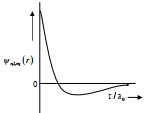
| $I$. $1s$ orbital | $i$. $\psi_{n, l, m_l} \propto (\frac{Z}{a_0})^{3/2} e^{-(Zr/a_0)}$ | $P$. (Graph shown) |
| $II$. $2s$ orbital | $ii$. One radial node | $Q$. Probability density at nucleus $\propto 1/a_0^3$ |
| $III$. $2p_z$ orbital | $iii$. $\psi_{n, l, m_l} \propto (\frac{Z}{a_0})^{5/2} r e^{-(Zr/2a_0)} \cos \theta$ | $R$. Probability density is maximum at nucleus |
| $IV$. $3d_{z^2}$ orbital | $iv$. $xy$-plane is a nodal plane | $S$. Energy needed to excite electron from $n=2$ state to $n=4$ state is $27/32$ times the energy needed to excite electron from $n=2$ state to $n=6$ state |
$1$. For the given orbital in Column-$I$,the only $CORRECT$ combination for any hydrogen-like species is:
$[A] (IV)(iv)(R)$ $[B] (II)(ii)(P)$ $[C] (III)(iii)(P)$ $[D] (I)(ii)(S)$
$2$. For $He^{+}$ ion,the only $INCORRECT$ combination is:
$[A] (II)(ii)(Q)$ $[B] (I)(i)(S)$ $[C] (I)(i)(R)$ $[D] (I)(iii)(R)$
$3$. For the hydrogen atom,the only $CORRECT$ combination is:
$[A] (I)(iv)(R)$ $[B] (I)(i)(P)$ $[C] (II)(i)(Q)$ $[D] (I)(i)(S)$
Solution
(B, D, D) $1$. For $2s$ orbital $(n=2, l=0)$,the number of radial nodes is $(n-l-1) = (2-0-1) = 1$. The graph $(P)$ represents the radial wave function of $2s$ orbital,which has one radial node. Thus,$(II)(ii)(P)$ is correct.
$2$. For $He^{+}$ ion,$1s$ orbital is $\psi \propto (\frac{Z}{a_0})^{3/2} e^{-(Zr/a_0)}$. Option $(D)$ is incorrect because $1s$ orbital has no angular dependence (no $\theta$ function),and $(R)$ is incorrect because the probability density for $1s$ is maximum at the nucleus,but the combination $(I)$(iii)$(R)$ is fundamentally wrong due to the angular function $(iii)$.
$3$. For the hydrogen atom,$1s$ orbital is $\psi \propto (\frac{Z}{a_0})^{3/2} e^{-(Zr/a_0)}$. The energy required for $n=2 \to n=4$ is $E_4 - E_2 = -13.6 Z^2(\frac{1}{16} - \frac{1}{4}) = 13.6 Z^2(\frac{3}{16})$. The energy for $n=2 \to n=6$ is $E_6 - E_2 = -13.6 Z^2(\frac{1}{36} - \frac{1}{4}) = 13.6 Z^2(\frac{8}{36}) = 13.6 Z^2(\frac{2}{9})$. The ratio is $\frac{3/16}{2/9} = \frac{27}{32}$. Thus,$(I)(i)(S)$ is correct.
$2$. For $He^{+}$ ion,$1s$ orbital is $\psi \propto (\frac{Z}{a_0})^{3/2} e^{-(Zr/a_0)}$. Option $(D)$ is incorrect because $1s$ orbital has no angular dependence (no $\theta$ function),and $(R)$ is incorrect because the probability density for $1s$ is maximum at the nucleus,but the combination $(I)$(iii)$(R)$ is fundamentally wrong due to the angular function $(iii)$.
$3$. For the hydrogen atom,$1s$ orbital is $\psi \propto (\frac{Z}{a_0})^{3/2} e^{-(Zr/a_0)}$. The energy required for $n=2 \to n=4$ is $E_4 - E_2 = -13.6 Z^2(\frac{1}{16} - \frac{1}{4}) = 13.6 Z^2(\frac{3}{16})$. The energy for $n=2 \to n=6$ is $E_6 - E_2 = -13.6 Z^2(\frac{1}{36} - \frac{1}{4}) = 13.6 Z^2(\frac{8}{36}) = 13.6 Z^2(\frac{2}{9})$. The ratio is $\frac{3/16}{2/9} = \frac{27}{32}$. Thus,$(I)(i)(S)$ is correct.
0 likes
View Solution27
MediumMCQ
Among the following,the correct statement$(s)$ for electrons in an atom is(are):
$A$. Uncertainty principle rules out the existence of definite paths for electrons.
$B$. The energy of an electron in $2s$ orbital of an atom is lower than the energy of an electron that is infinitely far away from the nucleus.
$C$. According to Bohr's model,the most negative energy value for an electron is given by $n=1$,which corresponds to the most stable orbit.
$D$. According to Bohr's model,the magnitude of velocity of electrons increases with increase in values of $n$.
$A$. Uncertainty principle rules out the existence of definite paths for electrons.
$B$. The energy of an electron in $2s$ orbital of an atom is lower than the energy of an electron that is infinitely far away from the nucleus.
$C$. According to Bohr's model,the most negative energy value for an electron is given by $n=1$,which corresponds to the most stable orbit.
$D$. According to Bohr's model,the magnitude of velocity of electrons increases with increase in values of $n$.
A
$A, B, C$
B
$A, B, D$
C
$A, B$
D
$A, C$
Solution
(A) . Heisenberg's uncertainty principle states that it is impossible to determine simultaneously the exact position and momentum of an electron,thus ruling out definite paths.
$B$. Electrons in orbitals have negative potential energy due to attraction by the nucleus. An electron at infinite distance has zero energy. Since negative values are lower than zero,the statement is correct.
$C$. The energy of an electron is given by $E_n = -13.6 \times \frac{Z^2}{n^2} \ eV$. For $n=1$,the energy is most negative,indicating the most stable state.
$D$. The velocity of an electron in Bohr's model is given by $V_n = 2.19 \times 10^6 \times \frac{Z}{n} \ m/s$. As $n$ increases,the velocity $V_n$ decreases,not increases.
$B$. Electrons in orbitals have negative potential energy due to attraction by the nucleus. An electron at infinite distance has zero energy. Since negative values are lower than zero,the statement is correct.
$C$. The energy of an electron is given by $E_n = -13.6 \times \frac{Z^2}{n^2} \ eV$. For $n=1$,the energy is most negative,indicating the most stable state.
$D$. The velocity of an electron in Bohr's model is given by $V_n = 2.19 \times 10^6 \times \frac{Z}{n} \ m/s$. As $n$ increases,the velocity $V_n$ decreases,not increases.
0 likes
View Solution28
DifficultMCQ
Which one of the following about an electron occupying the $1s$ orbital in a hydrogen atom is incorrect? (Bohr's radius is represented by $a_0$)
A
The probability density of finding the electron is maximum at the nucleus
B
The electron can be found at a distance $2a_0$ from the nucleus
C
The $1s$ orbital is spherically symmetrical
D
The total energy of the electron is maximum when it is at a distance $a_0$ from the nucleus
Solution
(D) The wave function for the $1s$ orbital of a hydrogen atom is given by $\Psi_{1s} = \frac{1}{\sqrt{\pi a_0^3}} e^{-r/a_0}$.
$A.$ The probability density $\Psi^2$ is proportional to $e^{-2r/a_0}$. At $r = 0$ (nucleus),$\Psi^2$ is maximum. This statement is correct.
$B.$ The electron has a non-zero probability of being found at any distance $r$ from the nucleus,including $2a_0$. This statement is correct.
$C.$ The $1s$ orbital has no angular dependence,making it spherically symmetrical. This statement is correct.
$D.$ The total energy of an electron in a hydrogen atom is given by $E_n = -\frac{13.6 \ eV}{n^2}$. This energy is constant for a given orbital and does not depend on the distance $r$ from the nucleus. The energy is maximum (zero) at $r = \infty$. Therefore,this statement is incorrect.
$A.$ The probability density $\Psi^2$ is proportional to $e^{-2r/a_0}$. At $r = 0$ (nucleus),$\Psi^2$ is maximum. This statement is correct.
$B.$ The electron has a non-zero probability of being found at any distance $r$ from the nucleus,including $2a_0$. This statement is correct.
$C.$ The $1s$ orbital has no angular dependence,making it spherically symmetrical. This statement is correct.
$D.$ The total energy of an electron in a hydrogen atom is given by $E_n = -\frac{13.6 \ eV}{n^2}$. This energy is constant for a given orbital and does not depend on the distance $r$ from the nucleus. The energy is maximum (zero) at $r = \infty$. Therefore,this statement is incorrect.
0 likes
View Solution29
MediumMCQ
The orbital diagram in which both the Pauli's exclusion principle and Hund's rule are violated is:
A
B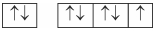
C
D
Solution
(B) $1$. Pauli's exclusion principle states that no two electrons in an atom can have the same set of four quantum numbers. This implies that an orbital can hold a maximum of two electrons with opposite spins.
$2$. Hund's rule of maximum multiplicity states that electron pairing in degenerate orbitals (like $p, d, f$) does not occur until each orbital is singly occupied.
$3$. In option $B$,the first orbital contains two electrons with the same spin (violates Pauli's principle),and the second orbital also contains two electrons with the same spin (violates Pauli's principle). Furthermore,pairing occurs before all orbitals are singly occupied (violates Hund's rule).
$4$. Therefore,option $B$ violates both principles.
$2$. Hund's rule of maximum multiplicity states that electron pairing in degenerate orbitals (like $p, d, f$) does not occur until each orbital is singly occupied.
$3$. In option $B$,the first orbital contains two electrons with the same spin (violates Pauli's principle),and the second orbital also contains two electrons with the same spin (violates Pauli's principle). Furthermore,pairing occurs before all orbitals are singly occupied (violates Hund's rule).
$4$. Therefore,option $B$ violates both principles.
0 likes
View Solution30
MediumMCQ
The statement that is $NOT$ correct is:
A
Energies of stationary states in hydrogen-like atoms are inversely proportional to the square of the principal quantum number.
B
The radius of the first orbit of $He^{+}$ is half that of the first orbit of the hydrogen atom.
C
Angular quantum number signifies the shape of the orbital.
D
Total number of nodes for $3s$ orbital is three.
Solution
(D) The energy of stationary states in hydrogen-like atoms is given by $E_n = -13.6 \times \frac{Z^2}{n^2} \ eV$,which is inversely proportional to $n^2$. Thus,option $A$ is correct.
The radius of the $n^{th}$ orbit is given by $r_n = 0.529 \times \frac{n^2}{Z} \ \mathring{A}$. For $H$ $(Z=1, n=1)$,$r_1 = 0.529 \ \mathring{A}$. For $He^{+}$ $(Z=2, n=1)$,$r_1 = 0.529 \times \frac{1^2}{2} = 0.2645 \ \mathring{A}$. Since $0.2645$ is half of $0.529$,option $B$ is correct.
The angular quantum number $(l)$ determines the shape of the orbital. Thus,option $C$ is correct.
The total number of nodes in an orbital is given by $n - 1$. For the $3s$ orbital,$n = 3$,so the total number of nodes is $3 - 1 = 2$. Option $D$ states the number of nodes is $3$,which is incorrect.
The radius of the $n^{th}$ orbit is given by $r_n = 0.529 \times \frac{n^2}{Z} \ \mathring{A}$. For $H$ $(Z=1, n=1)$,$r_1 = 0.529 \ \mathring{A}$. For $He^{+}$ $(Z=2, n=1)$,$r_1 = 0.529 \times \frac{1^2}{2} = 0.2645 \ \mathring{A}$. Since $0.2645$ is half of $0.529$,option $B$ is correct.
The angular quantum number $(l)$ determines the shape of the orbital. Thus,option $C$ is correct.
The total number of nodes in an orbital is given by $n - 1$. For the $3s$ orbital,$n = 3$,so the total number of nodes is $3 - 1 = 2$. Option $D$ states the number of nodes is $3$,which is incorrect.
0 likes
View Solution31
MediumMCQ
Consider the following:
$I$. The electron spin quantum number describes the orientation of the spin of the nucleus with respect to the magnetic field.
$II$. The orbitals represented by the quantum numbers $n=3, l=2, m=+2$ and $n=3, l=2, m=-2$ have the same energy.
$III$. The energy of a photon is directly proportional to wavelength but inversely proportional to wave number.
$IV$. Lyman series of lines appear in ultra-violet region.
The correct statements are:
$I$. The electron spin quantum number describes the orientation of the spin of the nucleus with respect to the magnetic field.
$II$. The orbitals represented by the quantum numbers $n=3, l=2, m=+2$ and $n=3, l=2, m=-2$ have the same energy.
$III$. The energy of a photon is directly proportional to wavelength but inversely proportional to wave number.
$IV$. Lyman series of lines appear in ultra-violet region.
The correct statements are:
A
$II$ $\&$ $IV$ only
B
$I$ $\&$ $II$ only
C
$II, III$ $\&$ $IV$ only
D
$I, III$ $\&$ $IV$ only
Solution
(A) Statement $I$ is incorrect because the electron spin quantum number describes the orientation of the spin of the electron,not the nucleus.
Statement $II$ is correct because orbitals with the same $n$ and $l$ values (degenerate orbitals) have the same energy in the absence of an external magnetic field.
Statement $III$ is incorrect because the energy of a photon $(E = h\nu = \frac{hc}{\lambda})$ is inversely proportional to the wavelength $(\lambda)$ and directly proportional to the wave number $(\bar{\nu} = \frac{1}{\lambda})$.
Statement $IV$ is correct because the Lyman series corresponds to electronic transitions to the $n=1$ energy level,which emits radiation in the ultra-violet region.
Therefore,statements $II$ and $IV$ are correct.
Statement $II$ is correct because orbitals with the same $n$ and $l$ values (degenerate orbitals) have the same energy in the absence of an external magnetic field.
Statement $III$ is incorrect because the energy of a photon $(E = h\nu = \frac{hc}{\lambda})$ is inversely proportional to the wavelength $(\lambda)$ and directly proportional to the wave number $(\bar{\nu} = \frac{1}{\lambda})$.
Statement $IV$ is correct because the Lyman series corresponds to electronic transitions to the $n=1$ energy level,which emits radiation in the ultra-violet region.
Therefore,statements $II$ and $IV$ are correct.
0 likes
View Solution32
MediumMCQ
Match the items in List-$I$ with the items in List-$II$.
| List-$I$ | List-$II$ |
|---|---|
| $A$. Nodes | $I$. Three dimensional shape of the orbital |
| $B$. Subsidiary quantum number | $II$. Significant only for motion of microscopic objects |
| $C$. White light | $III$. $|\psi|^2$ is zero |
| $D$. Heisenberg uncertainty principle | $IV$. Spin state of electron |
| $V$. Continuous spectrum |
A
$A-III, B-I, C-V, D-II$
B
$A-III, B-I, C-V, D-IV$
C
$A-I, B-III, C-V, D-II$
D
$A-III, B-I, C-II, D-V$
Solution
(A) . Nodes $(III)$ $|\psi|^2$ is zero,as $|\psi|^2$ represents the region where the probability of finding an electron is zero.
$B$. Subsidiary Quantum Number $(I)$ determines the three-dimensional shape of the orbital. It is also called the azimuthal quantum number.
$C$. White Light $(V)$ produces a continuous spectrum because it contains all wavelengths of visible light,appearing as a continuous pattern.
$D$. Heisenberg's Uncertainty Principle $(II)$ is significant only for the motion of microscopic objects,as it states that it is impossible to determine simultaneously the exact position and exact momentum of a subatomic particle.
Therefore,the correct matching is $A-III, B-I, C-V, D-II$.
$B$. Subsidiary Quantum Number $(I)$ determines the three-dimensional shape of the orbital. It is also called the azimuthal quantum number.
$C$. White Light $(V)$ produces a continuous spectrum because it contains all wavelengths of visible light,appearing as a continuous pattern.
$D$. Heisenberg's Uncertainty Principle $(II)$ is significant only for the motion of microscopic objects,as it states that it is impossible to determine simultaneously the exact position and exact momentum of a subatomic particle.
Therefore,the correct matching is $A-III, B-I, C-V, D-II$.
0 likes
View Solution33
DifficultMCQ
Identify the $INCORRECT$ statements from the following:
$A.$ Notation ${}_{12}^{24}Mg$ represents $24$ protons and $12$ neutrons.
$B.$ Wavelength of a radiation of frequency $4.5 \times 10^{15} \ s^{-1}$ is $6.7 \times 10^{-8} \ m$.
$C.$ One radiation has wavelength $\lambda_1 = 900 \ nm$ and energy $E_1$. Other radiation has wavelength $\lambda_2 = 300 \ nm$ and energy $E_2$. $E_1 : E_2 = 3 : 1$.
$D.$ Number of photons of light of wavelength $2000 \ pm$ that provides $1 \ J$ of energy is $1.006 \times 10^{16}$.
Choose the correct answer from the options given below:
$A.$ Notation ${}_{12}^{24}Mg$ represents $24$ protons and $12$ neutrons.
$B.$ Wavelength of a radiation of frequency $4.5 \times 10^{15} \ s^{-1}$ is $6.7 \times 10^{-8} \ m$.
$C.$ One radiation has wavelength $\lambda_1 = 900 \ nm$ and energy $E_1$. Other radiation has wavelength $\lambda_2 = 300 \ nm$ and energy $E_2$. $E_1 : E_2 = 3 : 1$.
$D.$ Number of photons of light of wavelength $2000 \ pm$ that provides $1 \ J$ of energy is $1.006 \times 10^{16}$.
Choose the correct answer from the options given below:
A
$A$ and $D$ only
B
$A$ and $C$ only
C
$A$ and $B$ only
D
$B$ and $C$ only
Solution
(B) Statement $A$ is incorrect because the notation ${}_{12}^{24}Mg$ represents $12$ protons (atomic number $Z=12$) and $12$ neutrons $(A-Z = 24-12=12)$.
Statement $C$ is incorrect because energy $E$ is inversely proportional to wavelength $\lambda$ $(E = hc/\lambda)$. Therefore, $E_1/E_2 = \lambda_2/\lambda_1 = 300/900 = 1/3$, which means $E_1 : E_2 = 1 : 3$.
Statement $B$ is correct: $\lambda = c/\nu = (3 \times 10^8 \ m/s) / (4.5 \times 10^{15} \ s^{-1}) = 6.67 \times 10^{-8} \ m \approx 6.7 \times 10^{-8} \ m$.
Statement $D$ is correct: $n = E\lambda / hc = (1 \ J \times 2000 \times 10^{-12} \ m) / (6.626 \times 10^{-34} \ J \cdot s \times 3 \times 10^8 \ m/s) \approx 1.006 \times 10^{16}$.
Statement $C$ is incorrect because energy $E$ is inversely proportional to wavelength $\lambda$ $(E = hc/\lambda)$. Therefore, $E_1/E_2 = \lambda_2/\lambda_1 = 300/900 = 1/3$, which means $E_1 : E_2 = 1 : 3$.
Statement $B$ is correct: $\lambda = c/\nu = (3 \times 10^8 \ m/s) / (4.5 \times 10^{15} \ s^{-1}) = 6.67 \times 10^{-8} \ m \approx 6.7 \times 10^{-8} \ m$.
Statement $D$ is correct: $n = E\lambda / hc = (1 \ J \times 2000 \times 10^{-12} \ m) / (6.626 \times 10^{-34} \ J \cdot s \times 3 \times 10^8 \ m/s) \approx 1.006 \times 10^{16}$.
0 likes
View Solution34
MediumMCQ
Identify the correct statements from the following:
$A$. Heisenberg uncertainty principle is applicable to electrons.
$B$. The size of $2p_x$ orbital is less than the size of $3p_x$ orbital.
$C$. The energy of $2s$ orbital of $H$ atom is equal to the energy of $2s$ orbital of $Li$.
$D$. The electronic configuration of $Cr$ is $[Ar]3d^5 4s^1$.
$A$. Heisenberg uncertainty principle is applicable to electrons.
$B$. The size of $2p_x$ orbital is less than the size of $3p_x$ orbital.
$C$. The energy of $2s$ orbital of $H$ atom is equal to the energy of $2s$ orbital of $Li$.
$D$. The electronic configuration of $Cr$ is $[Ar]3d^5 4s^1$.
A
$A, B$ and $C$ Only
B
$A, B$ and $D$ Only
C
$B, C$ and $D$ Only
D
$A, C$ and $D$ Only
Solution
(B) is correct: Heisenberg uncertainty principle applies to microscopic particles like electrons.
$B$ is correct: The size of an orbital increases with an increase in the principal quantum number $(n)$. Since $n=3 > n=2$,the size of $3p_x$ is greater than $2p_x$.
$C$ is incorrect: For multi-electron atoms,the energy of an orbital depends on both $n$ and $l$. For hydrogen-like species,energy depends on $Z^2$. Since $H$ $(Z=1)$ and $Li$ $(Z=3)$ have different atomic numbers,their $2s$ orbitals have different energies.
$D$ is correct: The electronic configuration of $Cr$ $(Z=24)$ is an exception to the Aufbau principle,resulting in $[Ar] 3d^5 4s^1$ due to the extra stability of half-filled $d$-orbitals.
$B$ is correct: The size of an orbital increases with an increase in the principal quantum number $(n)$. Since $n=3 > n=2$,the size of $3p_x$ is greater than $2p_x$.
$C$ is incorrect: For multi-electron atoms,the energy of an orbital depends on both $n$ and $l$. For hydrogen-like species,energy depends on $Z^2$. Since $H$ $(Z=1)$ and $Li$ $(Z=3)$ have different atomic numbers,their $2s$ orbitals have different energies.
$D$ is correct: The electronic configuration of $Cr$ $(Z=24)$ is an exception to the Aufbau principle,resulting in $[Ar] 3d^5 4s^1$ due to the extra stability of half-filled $d$-orbitals.
0 likes
View SolutionStructure of Atom — Mix Examples-Structure of atom · Frequently Asked Questions
1Are these Structure of Atom questions useful for JEE and NEET?
Yes. All questions in this section are mapped to JEE Main and NEET exam patterns. Previous year questions from JEE Main, NEET, GUJCET and state-level exams are included with full solutions.
2Can I switch to Hindi or Gujarati for these questions?
Yes. Use the language tabs in the hero section or the sidebar to view the same questions and solutions in English, Hindi or Gujarati.
3How do I generate a question paper from this subtopic?
Use the Vedclass Exam Paper Generator — select the chapter and subtopic, set difficulty, and generate Sets A, B, C, D automatically. First 3 chapters of every subject are free.
Vedclass Products
For Students
Vedclass Test Series
Mock tests in real JEE/NEET style with performance analysis. 5-day free trial.
Start Free TrialFor Teachers
Exam Paper Generator
Generate Set A/B/C/D papers from this chapter in 2 minutes. 3 chapters free.
Try FreeFor Institutes
Online Exam Module
Live online exams with unlimited students, 360° analytics & white-label branding.
See DemoFor Teachers & Institutes
Generate a Structure of Atom Exam Paper in 2 Minutes
Select subtopic & difficulty — Sets A, B, C, D auto-generated with No Repeat logic.
First 3 chapters of every subject are free — no payment required.