
A English
Ideal gas equation and Related gas laws Questions in English
Class 11 Chemistry · States of Matter · Ideal gas equation and Related gas laws
568+
Questions
English
Language
100%
With Solutions
Showing 50 of 568 questions in English
401
EasyMCQ
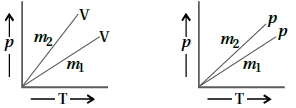
Two graphs for an ideal gas are given below. Determine which value,$m_1$ or $m_2$,is greater.
A
$m_1 > m_2$
B
$m_2 > m_1$
C
$m_1 = m_2$
D
Cannot be determined
Solution
(B) From the ideal gas equation,$pV = nRT = \frac{w}{M} RT$.
For the first graph ($p$ vs $T$ at constant $V$): $p = (\frac{wR}{MV}) T$. The slope $m = \frac{wR}{MV}$. Since $V$ is constant,$m \propto w$. As the slope of $m_2$ is greater than $m_1$,$m_2 > m_1$.
For the second graph ($p$ vs $T$ at constant $V$): Similarly,the slope $m$ is proportional to the mass $w$ of the gas. Thus,$m_2 > m_1$.
For the first graph ($p$ vs $T$ at constant $V$): $p = (\frac{wR}{MV}) T$. The slope $m = \frac{wR}{MV}$. Since $V$ is constant,$m \propto w$. As the slope of $m_2$ is greater than $m_1$,$m_2 > m_1$.
For the second graph ($p$ vs $T$ at constant $V$): Similarly,the slope $m$ is proportional to the mass $w$ of the gas. Thus,$m_2 > m_1$.
0 likes
View Solution402
Medium
Match the laws given in List-$I$ with their mathematical forms given in List-$II$.
| List-$I$ | List-$II$ |
| $(1)$ Boyle's Law | $(A)$ $p \propto T$ |
| $(2)$ Charles's Law | $(B)$ $V \propto n$ |
| $(3)$ Gay-Lussac's Law | $(C)$ $p \propto \frac{1}{V}$ |
| $(4)$ Avogadro's Law | $(D)$ $pV = nRT$ |
| $(5)$ Ideal Gas Equation | $(E)$ $V = k_2T$ |
Solution
(A-D) The correct matches are as follows:
$(1)$ Boyle's Law: $p \propto \frac{1}{V}$ $(C)$
$(2)$ Charles's Law: $V \propto T$ or $V = k_2T$ $(E)$
$(3)$ Gay-Lussac's Law: $p \propto T$ $(A)$
$(4)$ Avogadro's Law: $V \propto n$ $(B)$
$(5)$ Ideal Gas Equation: $pV = nRT$ $(D)$
Therefore,the correct sequence is $(1-C, 2-E, 3-A, 4-B, 5-D)$.
$(1)$ Boyle's Law: $p \propto \frac{1}{V}$ $(C)$
$(2)$ Charles's Law: $V \propto T$ or $V = k_2T$ $(E)$
$(3)$ Gay-Lussac's Law: $p \propto T$ $(A)$
$(4)$ Avogadro's Law: $V \propto n$ $(B)$
$(5)$ Ideal Gas Equation: $pV = nRT$ $(D)$
Therefore,the correct sequence is $(1-C, 2-E, 3-A, 4-B, 5-D)$.
0 likes
View Solution403
MediumMCQ
Match the following graphs with their correct names:
A
$A$. $p$ vs $T$ at constant volume
B
$B$. $p$ vs $V$ at constant temperature
C
$C$. $V$ vs $T$ at constant pressure
D
$D$. $p$ vs $T$ at constant pressure
Solution
(A) The graph of $p$ vs $T$ at constant volume is called an isochore.
$(B)$ The graph of $p$ vs $V$ at constant temperature is called an isotherm.
$(C)$ The graph of $V$ vs $T$ at constant pressure is called an isobar.
$(B)$ The graph of $p$ vs $V$ at constant temperature is called an isotherm.
$(C)$ The graph of $V$ vs $T$ at constant pressure is called an isobar.
0 likes
View Solution404
EasyMCQ
Match the following gas laws with their respective equations.
A
$A$. Boyle's Law
B
$B$. Charles's Law
C
$C$. Dalton's Law
D
$D$. Avogadro's Law
Solution
(A) Boyle's Law: $p \propto \frac{1}{V}$ at constant $T$ and $n$.
$(B)$ Charles's Law: $V \propto T$ at constant $p$ and $n$.
$(C)$ Dalton's Law: $P_{total} = p_1 + p_2 + p_3 + \dots$ at constant $T$ and $V$.
$(D)$ Avogadro's Law: $V \propto n$ at constant $T$ and $p$.
$(B)$ Charles's Law: $V \propto T$ at constant $p$ and $n$.
$(C)$ Dalton's Law: $P_{total} = p_1 + p_2 + p_3 + \dots$ at constant $T$ and $V$.
$(D)$ Avogadro's Law: $V \propto n$ at constant $T$ and $p$.
0 likes
View Solution405
Medium
Match the following graphs of an ideal gas with their respective axes ($X$ and $Y$).
$(A)$ $P$ vs $V$ (at constant $T$)
$(B)$ $V$ vs $T$ (at constant $P$)
$(C)$ $P$ vs $T$ (at constant $V$)
List-$I$:
$(1)$ $P$ on $Y$-axis,$T$ on $X$-axis
$(2)$ $P$ on $Y$-axis,$1/V$ on $X$-axis
$(3)$ $V$ on $Y$-axis,$T$ on $X$-axis
$(A)$ $P$ vs $V$ (at constant $T$)
$(B)$ $V$ vs $T$ (at constant $P$)
$(C)$ $P$ vs $T$ (at constant $V$)
List-$I$:
$(1)$ $P$ on $Y$-axis,$T$ on $X$-axis
$(2)$ $P$ on $Y$-axis,$1/V$ on $X$-axis
$(3)$ $V$ on $Y$-axis,$T$ on $X$-axis
Solution
(A-2, B-3, C-1) For an ideal gas,$PV = nRT$:
$(A)$ $P$ vs $V$ at constant $T$ gives a rectangular hyperbola. However,if we plot $P$ vs $1/V$,we get a straight line passing through the origin. Thus,$(A-2)$.
$(B)$ $V$ vs $T$ at constant $P$ gives a straight line passing through the origin $(V \propto T)$. Thus,$(B-3)$.
$(C)$ $P$ vs $T$ at constant $V$ gives a straight line passing through the origin $(P \propto T)$. Thus,$(C-1)$.
Therefore,the correct match is $(A-2, B-3, C-1)$.
$(A)$ $P$ vs $V$ at constant $T$ gives a rectangular hyperbola. However,if we plot $P$ vs $1/V$,we get a straight line passing through the origin. Thus,$(A-2)$.
$(B)$ $V$ vs $T$ at constant $P$ gives a straight line passing through the origin $(V \propto T)$. Thus,$(B-3)$.
$(C)$ $P$ vs $T$ at constant $V$ gives a straight line passing through the origin $(P \propto T)$. Thus,$(C-1)$.
Therefore,the correct match is $(A-2, B-3, C-1)$.
0 likes
View Solution406
EasyMCQ
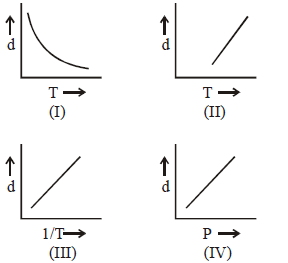
Which one of the following graphs is not correct for an ideal gas?
$d =$ Density,$P =$ Pressure,$T =$ Temperature
$d =$ Density,$P =$ Pressure,$T =$ Temperature
A
$II$
B
$III$
C
$I$
D
$IV$
Solution
(A) The ideal gas equation is $PV = nRT$.
Since $n = \frac{m}{M}$,we have $PV = \frac{m}{M}RT$.
Rearranging gives $PM = \frac{m}{V}RT = dRT$,where $d$ is density.
Thus,$d = \frac{PM}{RT}$.
For a constant pressure $P$,$d \propto \frac{1}{T}$.
Graph $(I)$ shows $d$ vs $T$ as an inverse relationship,which is correct.
Graph $(II)$ shows $d$ vs $T$ as a direct linear relationship,which is incorrect.
Graph $(III)$ shows $d$ vs $\frac{1}{T}$ as a direct linear relationship,which is correct.
Graph $(IV)$ shows $d$ vs $P$ as a direct linear relationship (at constant $T$),which is correct.
Therefore,graph $(II)$ is not correct.
Since $n = \frac{m}{M}$,we have $PV = \frac{m}{M}RT$.
Rearranging gives $PM = \frac{m}{V}RT = dRT$,where $d$ is density.
Thus,$d = \frac{PM}{RT}$.
For a constant pressure $P$,$d \propto \frac{1}{T}$.
Graph $(I)$ shows $d$ vs $T$ as an inverse relationship,which is correct.
Graph $(II)$ shows $d$ vs $T$ as a direct linear relationship,which is incorrect.
Graph $(III)$ shows $d$ vs $\frac{1}{T}$ as a direct linear relationship,which is correct.
Graph $(IV)$ shows $d$ vs $P$ as a direct linear relationship (at constant $T$),which is correct.
Therefore,graph $(II)$ is not correct.
0 likes
View Solution407
MediumMCQ
$A$ spherical balloon of radius $3 \ cm$ containing helium gas has a pressure of $48 \times 10^{-3} \ bar$. At the same temperature,the pressure of a spherical balloon of radius $12 \ cm$ containing the same amount of gas will be........ $\times 10^{-6} \ bar$.
A
$765$
B
$700$
C
$750$
D
$740$
Solution
(C) According to the ideal gas equation,$PV = nRT$. Since $n$,$R$,and $T$ are constant,$PV = \text{constant}$,so $P_1V_1 = P_2V_2$.
Volume of a sphere is $V = \frac{4}{3} \pi r^3$.
Given $r_1 = 3 \ cm$,$P_1 = 48 \times 10^{-3} \ bar$,$r_2 = 12 \ cm$.
$P_1 \times \frac{4}{3} \pi (r_1)^3 = P_2 \times \frac{4}{3} \pi (r_2)^3$.
$P_2 = P_1 \times (\frac{r_1}{r_2})^3 = 48 \times 10^{-3} \times (\frac{3}{12})^3$.
$P_2 = 48 \times 10^{-3} \times (\frac{1}{4})^3 = 48 \times 10^{-3} \times \frac{1}{64}$.
$P_2 = \frac{48}{64} \times 10^{-3} = 0.75 \times 10^{-3} \ bar$.
$P_2 = 750 \times 10^{-6} \ bar$.
Volume of a sphere is $V = \frac{4}{3} \pi r^3$.
Given $r_1 = 3 \ cm$,$P_1 = 48 \times 10^{-3} \ bar$,$r_2 = 12 \ cm$.
$P_1 \times \frac{4}{3} \pi (r_1)^3 = P_2 \times \frac{4}{3} \pi (r_2)^3$.
$P_2 = P_1 \times (\frac{r_1}{r_2})^3 = 48 \times 10^{-3} \times (\frac{3}{12})^3$.
$P_2 = 48 \times 10^{-3} \times (\frac{1}{4})^3 = 48 \times 10^{-3} \times \frac{1}{64}$.
$P_2 = \frac{48}{64} \times 10^{-3} = 0.75 \times 10^{-3} \ bar$.
$P_2 = 750 \times 10^{-6} \ bar$.
0 likes
View Solution408
MediumMCQ
The minimum pressure required to compress $600 \; dm^{3}$ of a gas at $1 \; bar$ to $150 \; dm^{3}$ at $40^{\circ} C$ is ......... $bar$.
A
$2.5$
B
$4$
C
$0.2$
D
$1$
Solution
(B) According to Boyle's Law,for a fixed amount of gas at a constant temperature,the product of pressure and volume is constant: $P_{1}V_{1} = P_{2}V_{2}$.
Given:
$P_{1} = 1 \; bar$
$V_{1} = 600 \; dm^{3}$
$V_{2} = 150 \; dm^{3}$
Substituting the values into the equation:
$(1 \; bar) \times (600 \; dm^{3}) = P_{2} \times (150 \; dm^{3})$
$P_{2} = \frac{600 \; bar \cdot dm^{3}}{150 \; dm^{3}}$
$P_{2} = 4 \; bar$.
Given:
$P_{1} = 1 \; bar$
$V_{1} = 600 \; dm^{3}$
$V_{2} = 150 \; dm^{3}$
Substituting the values into the equation:
$(1 \; bar) \times (600 \; dm^{3}) = P_{2} \times (150 \; dm^{3})$
$P_{2} = \frac{600 \; bar \cdot dm^{3}}{150 \; dm^{3}}$
$P_{2} = 4 \; bar$.
0 likes
View Solution409
MediumMCQ
The pressure exerted by a non-reactive gaseous mixture of $6.4 \ g$ of methane and $8.8 \ g$ of carbon dioxide in a $10 \ L$ vessel at $27^{\circ} C$ is .............$kPa$.
(Round off to the Nearest Integer).
[Assume gases are ideal,$R = 8.314 \ J \ mol^{-1} K^{-1}$
Atomic masses $: C = 12.0 \ u, H = 1.0 \ u, O = 16.0 \ u]$
(Round off to the Nearest Integer).
[Assume gases are ideal,$R = 8.314 \ J \ mol^{-1} K^{-1}$
Atomic masses $: C = 12.0 \ u, H = 1.0 \ u, O = 16.0 \ u]$
A
$125$
B
$130$
C
$145$
D
$150$
Solution
(D) First,calculate the number of moles of each gas:
$n_{CH_4} = \frac{6.4 \ g}{16 \ g \ mol^{-1}} = 0.4 \ mol$
$n_{CO_2} = \frac{8.8 \ g}{44 \ g \ mol^{-1}} = 0.2 \ mol$
Total moles,$n = 0.4 + 0.2 = 0.6 \ mol$
Convert volume to $m^3$:
$V = 10 \ L = 10 \times 10^{-3} \ m^3 = 0.01 \ m^3$
Convert temperature to Kelvin:
$T = 27 + 273 = 300 \ K$
Using the ideal gas equation $PV = nRT$:
$P = \frac{nRT}{V} = \frac{0.6 \ mol \times 8.314 \ J \ mol^{-1} K^{-1} \times 300 \ K}{0.01 \ m^3}$
$P = 149652 \ Pa = 149.652 \ kPa$
Rounding to the nearest integer,we get $150 \ kPa$.
$n_{CH_4} = \frac{6.4 \ g}{16 \ g \ mol^{-1}} = 0.4 \ mol$
$n_{CO_2} = \frac{8.8 \ g}{44 \ g \ mol^{-1}} = 0.2 \ mol$
Total moles,$n = 0.4 + 0.2 = 0.6 \ mol$
Convert volume to $m^3$:
$V = 10 \ L = 10 \times 10^{-3} \ m^3 = 0.01 \ m^3$
Convert temperature to Kelvin:
$T = 27 + 273 = 300 \ K$
Using the ideal gas equation $PV = nRT$:
$P = \frac{nRT}{V} = \frac{0.6 \ mol \times 8.314 \ J \ mol^{-1} K^{-1} \times 300 \ K}{0.01 \ m^3}$
$P = 149652 \ Pa = 149.652 \ kPa$
Rounding to the nearest integer,we get $150 \ kPa$.
0 likes
View Solution410
DifficultMCQ
$A$ car tyre is filled with nitrogen gas at $35 \ psi$ at $27^{\circ} C$. It will burst if pressure exceeds $40 \ psi$. The temperature in $^{\circ} C$ at which the car tyre will burst is ............ (Rounded-off to the nearest integer)
A
$60$
B
$80$
C
$75$
D
$70$
Solution
(D) Assuming the volume of the tyre remains constant, according to Gay-Lussac's Law, $P \propto T$ (where $T$ is in Kelvin).
Given: $P_1 = 35 \ psi$, $T_1 = 27 + 273 = 300 \ K$, $P_2 = 40 \ psi$.
Using the formula $\frac{P_2}{P_1} = \frac{T_2}{T_1}$:
$\frac{40}{35} = \frac{T_2}{300}$
$T_2 = \frac{40 \times 300}{35} = \frac{12000}{35} \approx 342.86 \ K$.
Converting back to Celsius: $T_2(^{\circ} C) = 342.86 - 273 = 69.86^{\circ} C$.
Rounding to the nearest integer, we get $70^{\circ} C$.
Given: $P_1 = 35 \ psi$, $T_1 = 27 + 273 = 300 \ K$, $P_2 = 40 \ psi$.
Using the formula $\frac{P_2}{P_1} = \frac{T_2}{T_1}$:
$\frac{40}{35} = \frac{T_2}{300}$
$T_2 = \frac{40 \times 300}{35} = \frac{12000}{35} \approx 342.86 \ K$.
Converting back to Celsius: $T_2(^{\circ} C) = 342.86 - 273 = 69.86^{\circ} C$.
Rounding to the nearest integer, we get $70^{\circ} C$.
0 likes
View Solution411
MediumMCQ
The volume occupied by $4.75 \, g$ of acetylene gas at $50^{\circ} C$ and $740 \, mm \, Hg$ pressure is ....... $L$.
(Rounded off to the nearest integer)
$[$ Given $R = 0.0826 \, L \, atm \, K^{-1} \, mol^{-1} ]$
(Rounded off to the nearest integer)
$[$ Given $R = 0.0826 \, L \, atm \, K^{-1} \, mol^{-1} ]$
A
$5$
B
$9$
C
$14$
D
$22$
Solution
(A) The molar mass of acetylene $(C_2H_2)$ is $26 \, g \, mol^{-1}$.
Number of moles $(n)$ $= \frac{4.75 \, g}{26 \, g \, mol^{-1}} \approx 0.1827 \, mol$.
Temperature $(T)$ $= 50 + 273 = 323 \, K$.
Pressure $(P)$ $= \frac{740}{760} \, atm \approx 0.9737 \, atm$.
Using the ideal gas equation $PV = nRT$,we get $V = \frac{nRT}{P}$.
$V = \frac{0.1827 \times 0.0826 \times 323}{0.9737} \approx 5.0059 \, L$.
Rounding off to the nearest integer,we get $5 \, L$.
Number of moles $(n)$ $= \frac{4.75 \, g}{26 \, g \, mol^{-1}} \approx 0.1827 \, mol$.
Temperature $(T)$ $= 50 + 273 = 323 \, K$.
Pressure $(P)$ $= \frac{740}{760} \, atm \approx 0.9737 \, atm$.
Using the ideal gas equation $PV = nRT$,we get $V = \frac{nRT}{P}$.
$V = \frac{0.1827 \times 0.0826 \times 323}{0.9737} \approx 5.0059 \, L$.
Rounding off to the nearest integer,we get $5 \, L$.
0 likes
View Solution412
EasyMCQ
Which one of the following is the correct $PV$ vs $P$ plot at constant temperature for an ideal gas? ($P$ and $V$ stand for pressure and volume of the gas respectively)
A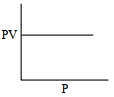
B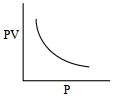
C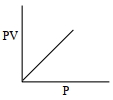
D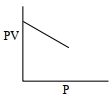
Solution
(A) For an ideal gas,the ideal gas equation is $PV = nRT$.
At constant temperature $(T)$ and for a fixed amount of gas $(n)$,the product $nRT$ is a constant.
Therefore,$PV = \text{constant}$.
This means that the value of $PV$ does not change with a change in pressure $(P)$.
Thus,the plot of $PV$ versus $P$ is a straight line parallel to the $P$-axis.
At constant temperature $(T)$ and for a fixed amount of gas $(n)$,the product $nRT$ is a constant.
Therefore,$PV = \text{constant}$.
This means that the value of $PV$ does not change with a change in pressure $(P)$.
Thus,the plot of $PV$ versus $P$ is a straight line parallel to the $P$-axis.
0 likes
View Solution413
EasyMCQ
Choose the correct option for the graphical representation of Boyle's law,which shows a graph of pressure vs. volume of a gas at different temperatures:
A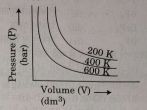
B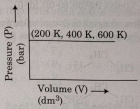
C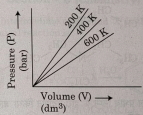
D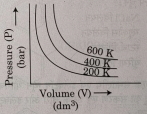
Solution
(D) According to the ideal gas equation,$PV = nRT$.
For a fixed amount of gas,$P = \frac{nRT}{V}$.
At a constant volume $V$,$P \propto T$.
This means that for a given volume,the pressure is higher at a higher temperature.
Therefore,if $T_1 > T_2 > T_3$,then the corresponding pressures at a constant volume will be $P_1 > P_2 > P_3$.
Looking at the graphs,the curve for the highest temperature $(600 \ K)$ must be the uppermost curve,followed by $400 \ K$ and then $200 \ K$ at the bottom.
This matches the representation where the curve for $600 \ K$ is above the curve for $400 \ K$,which is above the curve for $200 \ K$.
For a fixed amount of gas,$P = \frac{nRT}{V}$.
At a constant volume $V$,$P \propto T$.
This means that for a given volume,the pressure is higher at a higher temperature.
Therefore,if $T_1 > T_2 > T_3$,then the corresponding pressures at a constant volume will be $P_1 > P_2 > P_3$.
Looking at the graphs,the curve for the highest temperature $(600 \ K)$ must be the uppermost curve,followed by $400 \ K$ and then $200 \ K$ at the bottom.
This matches the representation where the curve for $600 \ K$ is above the curve for $400 \ K$,which is above the curve for $200 \ K$.
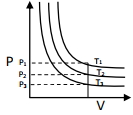
0 likes
View Solution414
MediumMCQ
Choose the correct option for the total pressure (in $atm$) in a mixture of $4 \ g$ $O_2$ and $2 \ g$ $H_2$ confined in a total volume of $1 \ L$ at $0^{\circ} C$ is :
$\left[ \text{Given } R = 0.082 \ L \ atm \ mol^{-1} \ K^{-1}, T = 273 \ K \right]$
$\left[ \text{Given } R = 0.082 \ L \ atm \ mol^{-1} \ K^{-1}, T = 273 \ K \right]$
A
$2.518$
B
$2.602$
C
$25.18$
D
$26.02$
Solution
(C) The total pressure is calculated using the ideal gas equation: $PV = n_{total}RT$.
First,calculate the number of moles of each gas:
$n_{O_2} = \frac{4 \ g}{32 \ g/mol} = 0.125 \ mol$
$n_{H_2} = \frac{2 \ g}{2 \ g/mol} = 1.0 \ mol$
Total moles $n_{total} = 0.125 + 1.0 = 1.125 \ mol$.
Using $PV = nRT$ with $V = 1 \ L$,$R = 0.082 \ L \ atm \ mol^{-1} \ K^{-1}$,and $T = 273 \ K$:
$P \times 1 = 1.125 \times 0.082 \times 273$
$P = 25.18 \ atm$.
First,calculate the number of moles of each gas:
$n_{O_2} = \frac{4 \ g}{32 \ g/mol} = 0.125 \ mol$
$n_{H_2} = \frac{2 \ g}{2 \ g/mol} = 1.0 \ mol$
Total moles $n_{total} = 0.125 + 1.0 = 1.125 \ mol$.
Using $PV = nRT$ with $V = 1 \ L$,$R = 0.082 \ L \ atm \ mol^{-1} \ K^{-1}$,and $T = 273 \ K$:
$P \times 1 = 1.125 \times 0.082 \times 273$
$P = 25.18 \ atm$.
0 likes
View Solution415
MediumMCQ
$A$ home owner uses $4.00 \times 10^{3} \ m^{3}$ of methane $(CH_{4})$ gas (assume $CH_{4}$ is an ideal gas) in a year to heat his home. Under the pressure of $1.0 \ atm$ and $300 \ K$,the mass of gas used is $X \times 10^{5} \ g$. The value of $X$ is $.......$ (Nearest integer).
(Given $R = 0.083 \ L \ atm \ K^{-1} \ mol^{-1}$)
(Given $R = 0.083 \ L \ atm \ K^{-1} \ mol^{-1}$)
A
$24$
B
$25$
C
$26$
D
$27$
Solution
(C) Given:
Volume $V = 4.00 \times 10^{3} \ m^{3} = 4.00 \times 10^{3} \times 10^{3} \ L = 4.00 \times 10^{6} \ L$
Pressure $P = 1.0 \ atm$
Temperature $T = 300 \ K$
Gas constant $R = 0.083 \ L \ atm \ K^{-1} \ mol^{-1}$
Using the ideal gas equation $PV = nRT$,where $n = \frac{mass (m)}{Molar \ mass (M)}$:
$n = \frac{PV}{RT} = \frac{1.0 \times 4.00 \times 10^{6}}{0.083 \times 300} \ mol$
$n = \frac{4.00 \times 10^{6}}{24.9} \ mol \approx 1.6064 \times 10^{5} \ mol$
Molar mass of $CH_{4} = 12 + 4 \times 1 = 16 \ g \ mol^{-1}$
Mass $m = n \times M = 1.6064 \times 10^{5} \times 16 \ g$
$m = 25.7024 \times 10^{5} \ g$
Comparing with $X \times 10^{5} \ g$,we get $X = 25.7024$.
Rounding to the nearest integer,$X = 26$.
Volume $V = 4.00 \times 10^{3} \ m^{3} = 4.00 \times 10^{3} \times 10^{3} \ L = 4.00 \times 10^{6} \ L$
Pressure $P = 1.0 \ atm$
Temperature $T = 300 \ K$
Gas constant $R = 0.083 \ L \ atm \ K^{-1} \ mol^{-1}$
Using the ideal gas equation $PV = nRT$,where $n = \frac{mass (m)}{Molar \ mass (M)}$:
$n = \frac{PV}{RT} = \frac{1.0 \times 4.00 \times 10^{6}}{0.083 \times 300} \ mol$
$n = \frac{4.00 \times 10^{6}}{24.9} \ mol \approx 1.6064 \times 10^{5} \ mol$
Molar mass of $CH_{4} = 12 + 4 \times 1 = 16 \ g \ mol^{-1}$
Mass $m = n \times M = 1.6064 \times 10^{5} \times 16 \ g$
$m = 25.7024 \times 10^{5} \ g$
Comparing with $X \times 10^{5} \ g$,we get $X = 25.7024$.
Rounding to the nearest integer,$X = 26$.
0 likes
View Solution416
MediumMCQ
An $LPG$ cylinder contains gas at a pressure of $300 \ kPa$ at $27^{\circ} C$. The cylinder can withstand a pressure of $1.2 \times 10^{6} \ Pa$. The room in which the cylinder is kept catches fire. The minimum temperature at which the bursting of the cylinder will take place is $.....^{\circ} C$. (Nearest integer)
A
$505$
B
$624$
C
$927$
D
$891$
Solution
(C) According to Gay-Lussac's Law,for a fixed volume of gas,pressure is directly proportional to temperature: $\frac{P_{1}}{T_{1}} = \frac{P_{2}}{T_{2}}$.
Given: $P_{1} = 300 \ kPa = 300 \times 10^{3} \ Pa$,$T_{1} = 27 + 273 = 300 \ K$,$P_{2} = 1.2 \times 10^{6} \ Pa$.
Substituting the values: $\frac{300 \times 10^{3}}{300} = \frac{1.2 \times 10^{6}}{T_{2}}$.
$1000 = \frac{1.2 \times 10^{6}}{T_{2}} \Rightarrow T_{2} = \frac{1.2 \times 10^{6}}{1000} = 1200 \ K$.
Converting to Celsius: $T(^{\circ} C) = 1200 - 273 = 927^{\circ} C$.
Given: $P_{1} = 300 \ kPa = 300 \times 10^{3} \ Pa$,$T_{1} = 27 + 273 = 300 \ K$,$P_{2} = 1.2 \times 10^{6} \ Pa$.
Substituting the values: $\frac{300 \times 10^{3}}{300} = \frac{1.2 \times 10^{6}}{T_{2}}$.
$1000 = \frac{1.2 \times 10^{6}}{T_{2}} \Rightarrow T_{2} = \frac{1.2 \times 10^{6}}{1000} = 1200 \ K$.
Converting to Celsius: $T(^{\circ} C) = 1200 - 273 = 927^{\circ} C$.
0 likes
View Solution417
EasyMCQ
$A$ $10.0 \, L$ flask contains $64 \, g$ of oxygen at $27^{\circ} C$. (Assume $O_2$ gas is behaving ideally). The pressure inside the flask in bar is $.....$
(Given $R = 0.0831 \, L \, bar \, K^{-1} \, mol^{-1}$)
(Given $R = 0.0831 \, L \, bar \, K^{-1} \, mol^{-1}$)
A
$498.6$
B
$49.8$
C
$4.9$
D
$2.5$
Solution
(C) Given:
Volume $V = 10.0 \, L$
Mass of $O_2$ $(W)$ = $64 \, g$
Molar mass of $O_2$ $(M)$ = $32 \, g \, mol^{-1}$
Temperature $T = 27^{\circ} C = 27 + 273 = 300 \, K$
Gas constant $R = 0.0831 \, L \, bar \, K^{-1} \, mol^{-1}$
Step $1$: Calculate the number of moles $(n)$:
$n = \frac{W}{M} = \frac{64 \, g}{32 \, g \, mol^{-1}} = 2 \, mol$
Step $2$: Use the ideal gas equation $PV = nRT$ to find pressure $(P)$:
$P = \frac{nRT}{V}$
$P = \frac{2 \, mol \times 0.0831 \, L \, bar \, K^{-1} \, mol^{-1} \times 300 \, K}{10.0 \, L}$
$P = \frac{49.86}{10} \, bar = 4.986 \, bar \approx 4.9 \, bar$
Volume $V = 10.0 \, L$
Mass of $O_2$ $(W)$ = $64 \, g$
Molar mass of $O_2$ $(M)$ = $32 \, g \, mol^{-1}$
Temperature $T = 27^{\circ} C = 27 + 273 = 300 \, K$
Gas constant $R = 0.0831 \, L \, bar \, K^{-1} \, mol^{-1}$
Step $1$: Calculate the number of moles $(n)$:
$n = \frac{W}{M} = \frac{64 \, g}{32 \, g \, mol^{-1}} = 2 \, mol$
Step $2$: Use the ideal gas equation $PV = nRT$ to find pressure $(P)$:
$P = \frac{nRT}{V}$
$P = \frac{2 \, mol \times 0.0831 \, L \, bar \, K^{-1} \, mol^{-1} \times 300 \, K}{10.0 \, L}$
$P = \frac{49.86}{10} \, bar = 4.986 \, bar \approx 4.9 \, bar$
0 likes
View Solution418
DifficultMCQ
At $300 \ K$,a sample of $3.0 \ g$ of gas $A$ occupies the same volume as $0.2 \ g$ of hydrogen $(H_2)$ at $200 \ K$ at the same pressure. The molar mass of gas $A$ is $...... \ g \ mol^{-1}$ (nearest integer). Assume that the gases behave as ideal gases.
A
$55$
B
$105$
C
$60$
D
$45$
Solution
(D) Given: Ideal gas $A$ and $H_2$ gas are at the same pressure $(P)$ and volume $(V)$.
From the ideal gas equation,$PV = nRT$,we have $n = \frac{PV}{RT}$.
Since $P$ and $V$ are the same for both gases,$n_A T_A = n_{H_2} T_{H_2}$.
Here,$n_A = \frac{3.0}{M_A}$ and $n_{H_2} = \frac{0.2}{2.0} = 0.1 \ mol$.
Substituting the values: $\frac{3.0}{M_A} \times 300 = 0.1 \times 200$.
$\frac{900}{M_A} = 20$.
$M_A = \frac{900}{20} = 45 \ g \ mol^{-1}$.
From the ideal gas equation,$PV = nRT$,we have $n = \frac{PV}{RT}$.
Since $P$ and $V$ are the same for both gases,$n_A T_A = n_{H_2} T_{H_2}$.
Here,$n_A = \frac{3.0}{M_A}$ and $n_{H_2} = \frac{0.2}{2.0} = 0.1 \ mol$.
Substituting the values: $\frac{3.0}{M_A} \times 300 = 0.1 \times 200$.
$\frac{900}{M_A} = 20$.
$M_A = \frac{900}{20} = 45 \ g \ mol^{-1}$.
0 likes
View Solution419
MediumMCQ
$A$ rigid nitrogen tank stored inside a laboratory has a pressure of $30 \ atm$ at $06:00 \ am$ when the temperature is $27^{\circ} C$. At $03:00 \ pm$, when the temperature is $45^{\circ} C$, the pressure in the tank will be $...... \ atm.$ [nearest integer]
A
$32$
B
$320$
C
$3.2$
D
$16$
Solution
(A) Since the tank is rigid, the volume $V$ remains constant. According to Gay-Lussac's Law, for a fixed amount of gas at constant volume, the pressure is directly proportional to the absolute temperature: $\frac{P_1}{T_1} = \frac{P_2}{T_2}$.
Given:
$P_1 = 30 \ atm$
$T_1 = 27^{\circ} C = 27 + 273 = 300 \ K$
$T_2 = 45^{\circ} C = 45 + 273 = 318 \ K$
Substituting the values into the equation:
$\frac{30}{300} = \frac{P_2}{318}$
$0.1 = \frac{P_2}{318}$
$P_2 = 0.1 \times 318 = 31.8 \ atm$.
Rounding to the nearest integer, we get $P_2 = 32 \ atm$.
Given:
$P_1 = 30 \ atm$
$T_1 = 27^{\circ} C = 27 + 273 = 300 \ K$
$T_2 = 45^{\circ} C = 45 + 273 = 318 \ K$
Substituting the values into the equation:
$\frac{30}{300} = \frac{P_2}{318}$
$0.1 = \frac{P_2}{318}$
$P_2 = 0.1 \times 318 = 31.8 \ atm$.
Rounding to the nearest integer, we get $P_2 = 32 \ atm$.
0 likes
View Solution420
EasyMCQ
An evacuated glass vessel weighs $40.0 \ g$ when empty,$135.0 \ g$ when filled with a liquid of density $0.95 \ g \ mL^{-1}$ and $40.5 \ g$ when filled with an ideal gas at $0.82 \ atm$ at $250 \ K$. The molar mass of the gas in $g \ mol^{-1}$ is .... .
(Given : $R = 0.082 \ L \ atm \ K^{-1} \ mol^{-1}$ )
(Given : $R = 0.082 \ L \ atm \ K^{-1} \ mol^{-1}$ )
A
$35$
B
$50$
C
$75$
D
$125$
Solution
(D) Mass of liquid $= 135.0 - 40.0 = 95.0 \ g$
Volume of the vessel $= \frac{\text{mass of liquid}}{\text{density of liquid}} = \frac{95.0 \ g}{0.95 \ g \ mL^{-1}} = 100 \ mL = 0.1 \ L$
Mass of ideal gas $= 40.5 - 40.0 = 0.5 \ g$
Using the ideal gas equation $PV = nRT$,where $n = \frac{w}{M}$:
$PV = \frac{w}{M} RT$
$0.82 \ atm \times 0.1 \ L = \frac{0.5 \ g}{M} \times 0.082 \ L \ atm \ K^{-1} \ mol^{-1} \times 250 \ K$
$0.082 = \frac{0.5 \times 0.082 \times 250}{M}$
$M = \frac{0.5 \times 0.082 \times 250}{0.082} = 0.5 \times 250 = 125 \ g \ mol^{-1}$
Volume of the vessel $= \frac{\text{mass of liquid}}{\text{density of liquid}} = \frac{95.0 \ g}{0.95 \ g \ mL^{-1}} = 100 \ mL = 0.1 \ L$
Mass of ideal gas $= 40.5 - 40.0 = 0.5 \ g$
Using the ideal gas equation $PV = nRT$,where $n = \frac{w}{M}$:
$PV = \frac{w}{M} RT$
$0.82 \ atm \times 0.1 \ L = \frac{0.5 \ g}{M} \times 0.082 \ L \ atm \ K^{-1} \ mol^{-1} \times 250 \ K$
$0.082 = \frac{0.5 \times 0.082 \times 250}{M}$
$M = \frac{0.5 \times 0.082 \times 250}{0.082} = 0.5 \times 250 = 125 \ g \ mol^{-1}$
0 likes
View Solution421
MediumMCQ
Which amongst the given plots is the correct plot for pressure $(p)$ $vs$ density $(d)$ for an ideal gas?
A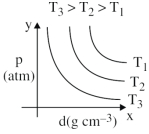
B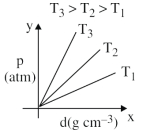
C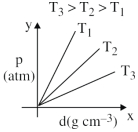
D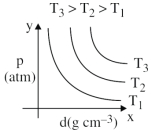
Solution
(B) For an ideal gas,the ideal gas equation is $pV = nRT$.
Since $n = \frac{m}{M}$,where $m$ is the mass and $M$ is the molar mass,we have $pV = \frac{m}{M} RT$.
Rearranging this gives $p = \left( \frac{RT}{M} \right) \left( \frac{m}{V} \right)$.
Since density $d = \frac{m}{V}$,the equation becomes $p = \left( \frac{RT}{M} \right) d$.
This is in the form of a straight line $y = mx$,where the slope is $\frac{RT}{M}$.
Since the slope is directly proportional to temperature $(T)$,a higher temperature will result in a steeper slope.
Given $T_3 > T_2 > T_1$,the slope order will be $T_3 > T_2 > T_1$.
Therefore,the plot with the steepest line for $T_3$ and the least steep for $T_1$ is correct.
Since $n = \frac{m}{M}$,where $m$ is the mass and $M$ is the molar mass,we have $pV = \frac{m}{M} RT$.
Rearranging this gives $p = \left( \frac{RT}{M} \right) \left( \frac{m}{V} \right)$.
Since density $d = \frac{m}{V}$,the equation becomes $p = \left( \frac{RT}{M} \right) d$.
This is in the form of a straight line $y = mx$,where the slope is $\frac{RT}{M}$.
Since the slope is directly proportional to temperature $(T)$,a higher temperature will result in a steeper slope.
Given $T_3 > T_2 > T_1$,the slope order will be $T_3 > T_2 > T_1$.
Therefore,the plot with the steepest line for $T_3$ and the least steep for $T_1$ is correct.
0 likes
View Solution422
EasyMCQ
$100 \, g$ of an ideal gas is kept in a cylinder of $416 \, L$ volume at $27^{\circ} C$ under $1.5 \, bar$ pressure. The molar mass of the gas is $.... \, g \, mol^{-1}$. (Nearest integer) (Given : $R = 0.083 \, L \, bar \, K^{-1} \, mol^{-1}$)
A
$3$
B
$4$
C
$2$
D
$1$
Solution
(B) The ideal gas equation is $PV = nRT$,where $n = \frac{m}{M}$.
Given: $P = 1.5 \, bar$,$V = 416 \, L$,$m = 100 \, g$,$T = 27 + 273 = 300 \, K$,and $R = 0.083 \, L \, bar \, K^{-1} \, mol^{-1}$.
Substituting the values: $1.5 \times 416 = \frac{100}{M} \times 0.083 \times 300$.
$624 = \frac{2490}{M}$.
$M = \frac{2490}{624} \approx 3.99 \, g \, mol^{-1}$.
Rounding to the nearest integer,we get $M = 4 \, g \, mol^{-1}$.
Given: $P = 1.5 \, bar$,$V = 416 \, L$,$m = 100 \, g$,$T = 27 + 273 = 300 \, K$,and $R = 0.083 \, L \, bar \, K^{-1} \, mol^{-1}$.
Substituting the values: $1.5 \times 416 = \frac{100}{M} \times 0.083 \times 300$.
$624 = \frac{2490}{M}$.
$M = \frac{2490}{624} \approx 3.99 \, g \, mol^{-1}$.
Rounding to the nearest integer,we get $M = 4 \, g \, mol^{-1}$.
0 likes
View Solution423
EasyMCQ
$A$ box contains $0.90 \ g$ of liquid water in equilibrium with water vapour at $27^{\circ} C$. The equilibrium vapour pressure of water at $27^{\circ} C$ is $32.0 \ Torr$. When the volume of the box is increased,some of the liquid water evaporates to maintain the equilibrium pressure. If all the liquid water evaporates,then the volume of the box must be $.... \ litre$. [nearest integer]
(Given $R = 0.082 \ L \ atm \ K^{-1} \ mol^{-1}$)
(Ignore the volume of the liquid water and assume water vapours behave as an ideal gas.)
(Given $R = 0.082 \ L \ atm \ K^{-1} \ mol^{-1}$)
(Ignore the volume of the liquid water and assume water vapours behave as an ideal gas.)
A
$75$
B
$12$
C
$96$
D
$29$
Solution
(D) The number of moles of water $(n)$ is calculated as: $n = \frac{\text{mass}}{\text{molar mass}} = \frac{0.90 \ g}{18 \ g \ mol^{-1}} = 0.05 \ mol$.
The temperature $(T)$ is $27 + 273 = 300 \ K$.
The pressure $(P)$ in $atm$ is $\frac{32.0 \ Torr}{760 \ Torr \ atm^{-1}} = \frac{32}{760} \ atm$.
Using the ideal gas equation $PV = nRT$,we find the volume $(V)$:
$V = \frac{nRT}{P} = \frac{0.05 \times 0.082 \times 300}{32 / 760} = \frac{0.05 \times 0.082 \times 300 \times 760}{32} = 29.21 \ L$.
The nearest integer is $29$.
The temperature $(T)$ is $27 + 273 = 300 \ K$.
The pressure $(P)$ in $atm$ is $\frac{32.0 \ Torr}{760 \ Torr \ atm^{-1}} = \frac{32}{760} \ atm$.
Using the ideal gas equation $PV = nRT$,we find the volume $(V)$:
$V = \frac{nRT}{P} = \frac{0.05 \times 0.082 \times 300}{32 / 760} = \frac{0.05 \times 0.082 \times 300 \times 760}{32} = 29.21 \ L$.
The nearest integer is $29$.
0 likes
View Solution424
MediumMCQ
Geraniol,a volatile organic compound,is a component of rose oil. The density of the vapour is $0.46 \, g \, L^{-1}$ at $257^{\circ} C$ and $100 \, mm \, Hg$. The molar mass of geraniol is $....$ (Nearest Integer) [Given $R = 0.082 \, L \, atm \, K^{-1} \, mol^{-1}$]
A
$89$
B
$152$
C
$741$
D
$236$
Solution
(B) Using the ideal gas equation $PV = nRT$,where $n = \frac{m}{M}$ and $d = \frac{m}{V}$,we get $P = \frac{dRT}{M}$.
Rearranging for molar mass: $M = \frac{dRT}{P}$.
Given values:
$d = 0.46 \, g \, L^{-1}$
$R = 0.082 \, L \, atm \, K^{-1} \, mol^{-1}$
$T = 257 + 273 = 530 \, K$
$P = \frac{100}{760} \, atm$
Substituting these values:
$M = \frac{0.46 \times 0.082 \times 530 \times 760}{100}$
$M = 151.93 \, g \, mol^{-1}$.
Rounding to the nearest integer,we get $152$.
Rearranging for molar mass: $M = \frac{dRT}{P}$.
Given values:
$d = 0.46 \, g \, L^{-1}$
$R = 0.082 \, L \, atm \, K^{-1} \, mol^{-1}$
$T = 257 + 273 = 530 \, K$
$P = \frac{100}{760} \, atm$
Substituting these values:
$M = \frac{0.46 \times 0.082 \times 530 \times 760}{100}$
$M = 151.93 \, g \, mol^{-1}$.
Rounding to the nearest integer,we get $152$.
0 likes
View Solution425
MediumMCQ
$A$ sealed flask with a capacity of $2 \, dm^{3}$ contains $11 \, g$ of propane gas. The flask is so weak that it will burst if the pressure becomes $2 \, MPa$. The minimum temperature at which the flask will burst is $....... \, ^{\circ}C$. [Nearest integer] (Given: $R = 8.3 \, J \, K^{-1} \, mol^{-1}$. Atomic masses of $C$ and $H$ are $12 \, u$ and $1 \, u$ respectively.) (Assume that propane behaves as an ideal gas.)
A
$1666$
B
$1565$
C
$1655$
D
$1654$
Solution
(C) $1$. Calculate the number of moles of propane $(C_{3}H_{8})$:
Molar mass of $C_{3}H_{8} = (3 \times 12) + (8 \times 1) = 44 \, g \, mol^{-1}$.
Moles $(n)$ = $\frac{11 \, g}{44 \, g \, mol^{-1}} = 0.25 \, mol$.
$2$. Use the ideal gas equation $PV = nRT$:
Given $P = 2 \, MPa = 2 \times 10^{6} \, Pa$,$V = 2 \, dm^{3} = 2 \times 10^{-3} \, m^{3}$,$n = 0.25 \, mol$,$R = 8.3 \, J \, K^{-1} \, mol^{-1}$.
$2 \times 10^{6} \times 2 \times 10^{-3} = 0.25 \times 8.3 \times T$.
$4000 = 2.075 \times T$.
$T = \frac{4000}{2.075} \approx 1927.71 \, K$.
$3$. Convert temperature to Celsius:
$T(^{\circ}C) = T(K) - 273.15 = 1927.71 - 273.15 = 1654.56 \, ^{\circ}C$.
Rounding to the nearest integer,we get $1655 \, ^{\circ}C$.
Molar mass of $C_{3}H_{8} = (3 \times 12) + (8 \times 1) = 44 \, g \, mol^{-1}$.
Moles $(n)$ = $\frac{11 \, g}{44 \, g \, mol^{-1}} = 0.25 \, mol$.
$2$. Use the ideal gas equation $PV = nRT$:
Given $P = 2 \, MPa = 2 \times 10^{6} \, Pa$,$V = 2 \, dm^{3} = 2 \times 10^{-3} \, m^{3}$,$n = 0.25 \, mol$,$R = 8.3 \, J \, K^{-1} \, mol^{-1}$.
$2 \times 10^{6} \times 2 \times 10^{-3} = 0.25 \times 8.3 \times T$.
$4000 = 2.075 \times T$.
$T = \frac{4000}{2.075} \approx 1927.71 \, K$.
$3$. Convert temperature to Celsius:
$T(^{\circ}C) = T(K) - 273.15 = 1927.71 - 273.15 = 1654.56 \, ^{\circ}C$.
Rounding to the nearest integer,we get $1655 \, ^{\circ}C$.
0 likes
View Solution426
DifficultMCQ
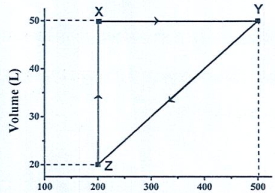
The volume versus temperature graph of $1 \ mole$ of an ideal gas is given below. The pressure of the gas (in $atm$) at $X, Y$ and $Z$,respectively,are
A
$0.328, 0.820, 0.820$
B
$3.28, 8.20, 3.28$
C
$0.238, 0.280, 0.280$
D
$32.8, 0.280, 82.0$
Solution
(A) According to the ideal gas equation,$pV = nRT$.
For $1 \ mole$ of gas,$n = 1$,so $pV = RT$ or $p = \frac{RT}{V}$.
Taking $R = 0.0821 \ L \ atm \ K^{-1} \ mol^{-1}$.
For point $X$: $V = 50 \ L, T = 200 \ K$.
$p_X = \frac{0.0821 \times 200}{50} = 0.3284 \ atm \approx 0.328 \ atm$.
For point $Y$: $V = 50 \ L, T = 500 \ K$.
$p_Y = \frac{0.0821 \times 500}{50} = 0.821 \ atm \approx 0.820 \ atm$.
For point $Z$: $V = 20 \ L, T = 200 \ K$.
$p_Z = \frac{0.0821 \times 200}{20} = 0.821 \ atm \approx 0.820 \ atm$.
Thus,the pressures at $X, Y, Z$ are $0.328 \ atm, 0.820 \ atm, 0.820 \ atm$ respectively.
For $1 \ mole$ of gas,$n = 1$,so $pV = RT$ or $p = \frac{RT}{V}$.
Taking $R = 0.0821 \ L \ atm \ K^{-1} \ mol^{-1}$.
For point $X$: $V = 50 \ L, T = 200 \ K$.
$p_X = \frac{0.0821 \times 200}{50} = 0.3284 \ atm \approx 0.328 \ atm$.
For point $Y$: $V = 50 \ L, T = 500 \ K$.
$p_Y = \frac{0.0821 \times 500}{50} = 0.821 \ atm \approx 0.820 \ atm$.
For point $Z$: $V = 20 \ L, T = 200 \ K$.
$p_Z = \frac{0.0821 \times 200}{20} = 0.821 \ atm \approx 0.820 \ atm$.
Thus,the pressures at $X, Y, Z$ are $0.328 \ atm, 0.820 \ atm, 0.820 \ atm$ respectively.
0 likes
View Solution427
MediumMCQ
The density of acetic acid vapor at $300 \ K$ and $1 \ atm$ is $5 \ mg \ cm^{-3}$. The number of acetic acid molecules in the cluster that is formed in the gas phase is closest to
A
$5$
B
$2$
C
$3$
D
$4$
Solution
(B) The density of the gas is $\rho = 5 \ mg \ cm^{-3} = 5 \ g \ L^{-1}$.
Using the ideal gas equation $pV = nRT$,where $n = \frac{w}{M}$,we have $p = \frac{wRT}{MV} = \frac{\rho RT}{M}$.
Rearranging for the molar mass $M$ of the vapor cluster: $M = \frac{\rho RT}{p}$.
Given $\rho = 5 \ g \ L^{-1}$,$R = 0.0821 \ L \ atm \ K^{-1} \ mol^{-1}$,$T = 300 \ K$,and $p = 1 \ atm$:
$M = \frac{5 \times 0.0821 \times 300}{1} = 123.15 \ g \ mol^{-1}$.
The molar mass of a single acetic acid molecule $(CH_3COOH)$ is $60 \ g \ mol^{-1}$.
The number of molecules in the cluster is $n = \frac{M_{cluster}}{M_{monomer}} = \frac{123.15}{60} \approx 2.05$.
Thus,the number of molecules is closest to $2$.
Using the ideal gas equation $pV = nRT$,where $n = \frac{w}{M}$,we have $p = \frac{wRT}{MV} = \frac{\rho RT}{M}$.
Rearranging for the molar mass $M$ of the vapor cluster: $M = \frac{\rho RT}{p}$.
Given $\rho = 5 \ g \ L^{-1}$,$R = 0.0821 \ L \ atm \ K^{-1} \ mol^{-1}$,$T = 300 \ K$,and $p = 1 \ atm$:
$M = \frac{5 \times 0.0821 \times 300}{1} = 123.15 \ g \ mol^{-1}$.
The molar mass of a single acetic acid molecule $(CH_3COOH)$ is $60 \ g \ mol^{-1}$.
The number of molecules in the cluster is $n = \frac{M_{cluster}}{M_{monomer}} = \frac{123.15}{60} \approx 2.05$.
Thus,the number of molecules is closest to $2$.
0 likes
View Solution428
MediumMCQ
$A$ container of volume $2.24 \, L$ can withstand a maximum pressure of $2 \, atm$ at $298 \, K$ before exploding. The maximum amount of nitrogen (in $g$) that can be safely put in this container at this temperature is closest to
A
$2.8$
B
$5.6$
C
$1.4$
D
$4.2$
Solution
(D) Using the ideal gas equation $pV = nRT$,where $p = 2 \, atm$,$V = 2.24 \, L$,$R = 0.0821 \, L \cdot atm \cdot K^{-1} \cdot mol^{-1}$,and $T = 298 \, K$.
$n = \frac{pV}{RT} = \frac{2 \times 2.24}{0.0821 \times 298} \approx 0.183 \, mol$.
The molar mass of $N_2$ is $28 \, g/mol$.
The maximum mass of $N_2$ is $m = n \times M = 0.183 \times 28 \approx 5.124 \, g$.
Since the container explodes at $2 \, atm$,the safe amount must be slightly less than $5.124 \, g$. Among the given options,$4.2 \, g$ is the closest value that ensures safety.
$n = \frac{pV}{RT} = \frac{2 \times 2.24}{0.0821 \times 298} \approx 0.183 \, mol$.
The molar mass of $N_2$ is $28 \, g/mol$.
The maximum mass of $N_2$ is $m = n \times M = 0.183 \times 28 \approx 5.124 \, g$.
Since the container explodes at $2 \, atm$,the safe amount must be slightly less than $5.124 \, g$. Among the given options,$4.2 \, g$ is the closest value that ensures safety.
0 likes
View Solution429
MediumMCQ
At a constant pressure $p$,the plot of volume $(V)$ as a function of temperature $(T)$ for $2 \, mol$ of an ideal gas gives a straight line with a slope $0.328 \, L \, K^{-1}$. The value of $p$ (in $atm$) is closest to
[Gas constant,$R=0.0821 \, L \, atm \, mol^{-1} \, K^{-1}$ ]
[Gas constant,$R=0.0821 \, L \, atm \, mol^{-1} \, K^{-1}$ ]
A
$0.25$
B
$0.5$
C
$1.0$
D
$2.0$
Solution
(B) According to the ideal gas equation,$p V = n R T$.
Rearranging for the volume as a function of temperature,we get $V = (\frac{n R}{p}) T$.
The slope of the plot of $V$ versus $T$ is given by $\text{slope} = \frac{n R}{p}$.
Given: $\text{slope} = 0.328 \, L \, K^{-1}$,$n = 2 \, mol$,and $R = 0.0821 \, L \, atm \, mol^{-1} \, K^{-1}$.
Substituting the values: $0.328 = \frac{2 \times 0.0821}{p}$.
Solving for $p$: $p = \frac{2 \times 0.0821}{0.328} = \frac{0.1642}{0.328} = 0.5 \, atm$.
Rearranging for the volume as a function of temperature,we get $V = (\frac{n R}{p}) T$.
The slope of the plot of $V$ versus $T$ is given by $\text{slope} = \frac{n R}{p}$.
Given: $\text{slope} = 0.328 \, L \, K^{-1}$,$n = 2 \, mol$,and $R = 0.0821 \, L \, atm \, mol^{-1} \, K^{-1}$.
Substituting the values: $0.328 = \frac{2 \times 0.0821}{p}$.
Solving for $p$: $p = \frac{2 \times 0.0821}{0.328} = \frac{0.1642}{0.328} = 0.5 \, atm$.
0 likes
View Solution430
MediumMCQ
In a closed vessel,an ideal gas at $1 \, atm$ is heated from $27^{\circ} C$ to $327^{\circ} C$. The final pressure of the gas will approximately be $..... \, atm$
A
$3$
B
$0.5$
C
$2$
D
$12$
Solution
(C) According to the ideal gas equation,$pV = nRT$.
Since the vessel is closed,the volume $(V)$ and the number of moles $(n)$ remain constant.
Therefore,$p \propto T$,which implies $\frac{p_1}{T_1} = \frac{p_2}{T_2}$.
Given: $p_1 = 1 \, atm$,$T_1 = 27^{\circ} C = 27 + 273 = 300 \, K$,and $T_2 = 327^{\circ} C = 327 + 273 = 600 \, K$.
Substituting the values: $\frac{1}{300} = \frac{p_2}{600}$.
$p_2 = \frac{600}{300} = 2 \, atm$.
Since the vessel is closed,the volume $(V)$ and the number of moles $(n)$ remain constant.
Therefore,$p \propto T$,which implies $\frac{p_1}{T_1} = \frac{p_2}{T_2}$.
Given: $p_1 = 1 \, atm$,$T_1 = 27^{\circ} C = 27 + 273 = 300 \, K$,and $T_2 = 327^{\circ} C = 327 + 273 = 600 \, K$.
Substituting the values: $\frac{1}{300} = \frac{p_2}{600}$.
$p_2 = \frac{600}{300} = 2 \, atm$.
0 likes
View Solution431
MediumMCQ
The graph that does not represent the behaviour of an ideal gas is
A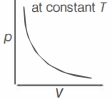
B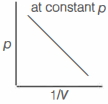
C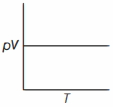
D
$B$ and $C$ both
Solution
(D) The ideal gas equation is $pV = nRT$.
$(A)$ At constant $T$,$p = \frac{nRT}{V}$,so $p \propto \frac{1}{V}$. This is a rectangular hyperbola,which is correct for an ideal gas.
$(B)$ The graph of $p$ versus $1/V$ at constant $p$ is incorrect because $p$ cannot be constant while $1/V$ varies in an ideal gas equation unless $T$ also changes proportionally. Furthermore,for an ideal gas at constant $T$,$p$ is directly proportional to $1/V$,not constant.
$(C)$ The graph of $pV$ versus $T$ should be a straight line passing through the origin with a slope of $nR$,not a constant horizontal line. Thus,this graph is also incorrect.
Therefore,both graphs $B$ and $C$ do not represent the behaviour of an ideal gas.
$(A)$ At constant $T$,$p = \frac{nRT}{V}$,so $p \propto \frac{1}{V}$. This is a rectangular hyperbola,which is correct for an ideal gas.
$(B)$ The graph of $p$ versus $1/V$ at constant $p$ is incorrect because $p$ cannot be constant while $1/V$ varies in an ideal gas equation unless $T$ also changes proportionally. Furthermore,for an ideal gas at constant $T$,$p$ is directly proportional to $1/V$,not constant.
$(C)$ The graph of $pV$ versus $T$ should be a straight line passing through the origin with a slope of $nR$,not a constant horizontal line. Thus,this graph is also incorrect.
Therefore,both graphs $B$ and $C$ do not represent the behaviour of an ideal gas.
0 likes
View Solution432
MediumMCQ
For an ideal gas,Boyle's law is best described by which of the following graphs?
A
B
C
D
Solution
(C) According to Boyle's law,the pressure $(p)$ of a given mass of an ideal gas is inversely proportional to its volume $(V)$ at a constant temperature.
$\therefore p \propto \frac{1}{V}$ or $pV = \text{constant}$.
This relationship represents a rectangular hyperbola when $p$ is plotted against $V$.
Therefore,the graph showing an inverse relationship between $p$ and $V$ is the correct representation of Boyle's law.
$\therefore p \propto \frac{1}{V}$ or $pV = \text{constant}$.
This relationship represents a rectangular hyperbola when $p$ is plotted against $V$.
Therefore,the graph showing an inverse relationship between $p$ and $V$ is the correct representation of Boyle's law.
0 likes
View Solution433
MediumMCQ
One mole of an ideal gas at $300 \ K$ is expanded isothermally from $1 \ L$ to $10 \ L$ volume. $\Delta U$ for this process is $....... \ J$ (Use $R = 8.314 \ J \ K^{-1} \ mol^{-1}$)
A
$1260$
B
$2520$
C
$5040$
D
$0$
Solution
(D) For an ideal gas,the internal energy $U$ is a function of temperature only,i.e.,$U = f(T)$.
Since the process is isothermal,the temperature remains constant $(T_2 = T_1 = 300 \ K)$.
Therefore,the change in internal energy $\Delta U = nC_v(T_2 - T_1) = 0$.
Since the process is isothermal,the temperature remains constant $(T_2 = T_1 = 300 \ K)$.
Therefore,the change in internal energy $\Delta U = nC_v(T_2 - T_1) = 0$.
0 likes
View Solution434
MediumMCQ
$A$ vessel contains $3.2 \ g$ of dioxygen gas at $STP$ ($273.15 \ K$ and $1 \ atm$ pressure). The gas is now transferred to another vessel at constant temperature,where pressure becomes one third of the original pressure. The volume of the new vessel in $L$ is $........$ (Given: molar volume at $STP$ is $22.4 \ L$)
A
$6.72$
B
$2.24$
C
$22.4$
D
$67.2$
Solution
(A) Moles of dioxygen gas $(O_2)$ $= \frac{3.2 \ g}{32 \ g \ mol^{-1}} = 0.1 \ mol$.
Volume of dioxygen gas at $STP$ $(V_1)$ $= 0.1 \ mol \times 22.4 \ L \ mol^{-1} = 2.24 \ L$.
According to Boyle's Law,at constant temperature,$P_1V_1 = P_2V_2$.
Given $P_2 = \frac{1}{3}P_1$,so $P_1 \times 2.24 = (\frac{1}{3}P_1) \times V_2$.
$V_2 = 2.24 \times 3 = 6.72 \ L$.
Volume of dioxygen gas at $STP$ $(V_1)$ $= 0.1 \ mol \times 22.4 \ L \ mol^{-1} = 2.24 \ L$.
According to Boyle's Law,at constant temperature,$P_1V_1 = P_2V_2$.
Given $P_2 = \frac{1}{3}P_1$,so $P_1 \times 2.24 = (\frac{1}{3}P_1) \times V_2$.
$V_2 = 2.24 \times 3 = 6.72 \ L$.
0 likes
View Solution435
MediumMCQ
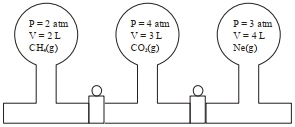
Three bulbs are filled with $CH_4$,$CO_2$,and $Ne$ as shown in the picture. The bulbs are connected through pipes of zero volume. When the stopcocks are opened and the temperature is kept constant throughout,the pressure of the system is found to be $...... \ atm$. (Nearest integer)
A
$2$
B
$3$
C
$4$
D
$1$
Solution
(B) Using the ideal gas equation $PV = nRT$,since $T$ is constant,$n = \frac{PV}{RT}$.
For $CH_4$: $n_1 = \frac{2 \times 2}{RT} = \frac{4}{RT}$.
For $CO_2$: $n_2 = \frac{4 \times 3}{RT} = \frac{12}{RT}$.
For $Ne$: $n_3 = \frac{3 \times 4}{RT} = \frac{12}{RT}$.
Total moles $n_T = n_1 + n_2 + n_3 = \frac{4 + 12 + 12}{RT} = \frac{28}{RT}$.
Total volume $V_T = 2 + 3 + 4 = 9 \ L$.
Final pressure $P_T = \frac{n_T RT}{V_T} = \frac{28}{RT} \times \frac{RT}{9} = \frac{28}{9} \approx 3.11 \ atm$.
The nearest integer is $3$.
For $CH_4$: $n_1 = \frac{2 \times 2}{RT} = \frac{4}{RT}$.
For $CO_2$: $n_2 = \frac{4 \times 3}{RT} = \frac{12}{RT}$.
For $Ne$: $n_3 = \frac{3 \times 4}{RT} = \frac{12}{RT}$.
Total moles $n_T = n_1 + n_2 + n_3 = \frac{4 + 12 + 12}{RT} = \frac{28}{RT}$.
Total volume $V_T = 2 + 3 + 4 = 9 \ L$.
Final pressure $P_T = \frac{n_T RT}{V_T} = \frac{28}{RT} \times \frac{RT}{9} = \frac{28}{9} \approx 3.11 \ atm$.
The nearest integer is $3$.
0 likes
View Solution436
MediumMCQ
At constant temperature,a gas is at a pressure of $940.3 \, mm \, Hg$. The pressure at which its volume decreases by $40 \%$ is $......... \, mm \, Hg$. (Nearest Integer)
A
$1566$
B
$1567$
C
$1568$
D
$1569$
Solution
(B) According to Boyle's Law,at constant temperature,$P_1 V_1 = P_2 V_2$.
Let the initial volume $V_1 = 100 \, units$.
Since the volume decreases by $40 \%$,the final volume $V_2 = 100 - 40 = 60 \, units$.
Given $P_1 = 940.3 \, mm \, Hg$.
Substituting the values: $940.3 \times 100 = P_2 \times 60$.
$P_2 = \frac{94030}{60} = 1567.16 \, mm \, Hg$.
The nearest integer is $1567 \, mm \, Hg$.
Let the initial volume $V_1 = 100 \, units$.
Since the volume decreases by $40 \%$,the final volume $V_2 = 100 - 40 = 60 \, units$.
Given $P_1 = 940.3 \, mm \, Hg$.
Substituting the values: $940.3 \times 100 = P_2 \times 60$.
$P_2 = \frac{94030}{60} = 1567.16 \, mm \, Hg$.
The nearest integer is $1567 \, mm \, Hg$.
0 likes
View Solution437
MediumMCQ
Which amongst the following options is the correct graphical representation of Boyle's law?
A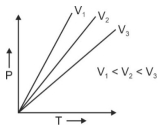
B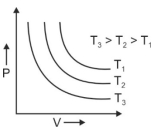
C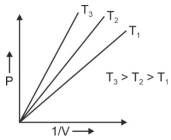
D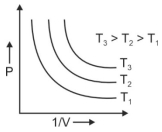
Solution
(C) According to Boyle's law,for a fixed amount of gas at a constant temperature,the pressure is inversely proportional to the volume $(P \propto \frac{1}{V})$.
Using the ideal gas equation,$PV = nRT$,we can rearrange it as:
$P = (nRT) \times (\frac{1}{V})$
This equation is in the form of $y = mx$,where $y = P$,$x = \frac{1}{V}$,and the slope $m = nRT$.
Since the slope $(nRT)$ is directly proportional to the temperature $(T)$,a graph of $P$ versus $\frac{1}{V}$ will yield a straight line passing through the origin for each temperature. As the temperature increases,the slope $(nRT)$ also increases. Therefore,for $T_3 > T_2 > T_1$,the slope of the line for $T_3$ will be the steepest,followed by $T_2$ and then $T_1$.
Using the ideal gas equation,$PV = nRT$,we can rearrange it as:
$P = (nRT) \times (\frac{1}{V})$
This equation is in the form of $y = mx$,where $y = P$,$x = \frac{1}{V}$,and the slope $m = nRT$.
Since the slope $(nRT)$ is directly proportional to the temperature $(T)$,a graph of $P$ versus $\frac{1}{V}$ will yield a straight line passing through the origin for each temperature. As the temperature increases,the slope $(nRT)$ also increases. Therefore,for $T_3 > T_2 > T_1$,the slope of the line for $T_3$ will be the steepest,followed by $T_2$ and then $T_1$.
0 likes
View Solution438
DifficultMCQ
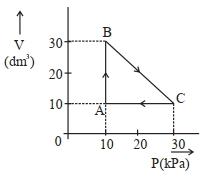
An ideal gas undergoes a cyclic transformation starting from the point $A$ and coming back to the same point by tracing the path $A$ $\rightarrow B$ $\rightarrow C$ $\rightarrow A$ as shown in the diagram. The total work done in the process is . . . . . . $J$.
A
$100$
B
$150$
C
$200$
D
$250$
Solution
(C) The work done in a cyclic process is equal to the area enclosed by the cycle in the $P-V$ diagram.
For a $V$ vs $P$ graph,the area enclosed is given by the formula for the area of a triangle: $Area = \frac{1}{2} \times \text{base} \times \text{height}$.
Here,the base along the $P$-axis is $(30 - 10) \ kPa = 20 \ kPa = 20 \times 10^3 \ Pa$.
The height along the $V$-axis is $(30 - 10) \ dm^3 = 20 \ dm^3 = 20 \times 10^{-3} \ m^3$.
Since the cycle $A$ $\rightarrow B$ $\rightarrow C$ $\rightarrow A$ is clockwise in a $V$ vs $P$ graph,the work done is positive.
$W = \frac{1}{2} \times (20 \times 10^3 \ Pa) \times (20 \times 10^{-3} \ m^3) = \frac{1}{2} \times 20 \times 20 \ J = 200 \ J$.
For a $V$ vs $P$ graph,the area enclosed is given by the formula for the area of a triangle: $Area = \frac{1}{2} \times \text{base} \times \text{height}$.
Here,the base along the $P$-axis is $(30 - 10) \ kPa = 20 \ kPa = 20 \times 10^3 \ Pa$.
The height along the $V$-axis is $(30 - 10) \ dm^3 = 20 \ dm^3 = 20 \times 10^{-3} \ m^3$.
Since the cycle $A$ $\rightarrow B$ $\rightarrow C$ $\rightarrow A$ is clockwise in a $V$ vs $P$ graph,the work done is positive.
$W = \frac{1}{2} \times (20 \times 10^3 \ Pa) \times (20 \times 10^{-3} \ m^3) = \frac{1}{2} \times 20 \times 20 \ J = 200 \ J$.
0 likes
View Solution439
MediumMCQ
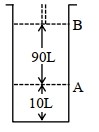
Consider the figure provided. $1 \ mol$ of an ideal gas is kept in a cylinder,fitted with a piston,at the position $A$,at $18^{\circ} C$. If the piston is moved to position $B$,keeping the temperature unchanged,then '$x$' $L \ atm$ work is done in this reversible process. $x=$ . . . . . . $L \ atm$. (nearest integer) [Given : Absolute temperature $=^{\circ} C + 273.15$,$R=0.08206 \ L \ atm \ mol^{-1} \ K^{-1}$]
A
$50$
B
$55$
C
$60$
D
$65$
Solution
(B) For a reversible isothermal expansion,the work done by the system is given by: $\omega = -nRT \ln \left(\frac{V_2}{V_1}\right)$.
Given:
$n = 1 \ mol$
$T = 18 + 273.15 = 291.15 \ K$
$V_1 = 10 \ L$
$V_2 = 10 + 90 = 100 \ L$
$R = 0.08206 \ L \ atm \ mol^{-1} \ K^{-1}$
Substituting the values:
$\omega = -1 \times 0.08206 \times 291.15 \times \ln \left(\frac{100}{10}\right)$
$\omega = -23.887 \times \ln(10)$
$\omega = -23.887 \times 2.303$
$\omega \approx -55.01 \ L \ atm$
The magnitude of work done by the system is $55 \ L \ atm$.
Given:
$n = 1 \ mol$
$T = 18 + 273.15 = 291.15 \ K$
$V_1 = 10 \ L$
$V_2 = 10 + 90 = 100 \ L$
$R = 0.08206 \ L \ atm \ mol^{-1} \ K^{-1}$
Substituting the values:
$\omega = -1 \times 0.08206 \times 291.15 \times \ln \left(\frac{100}{10}\right)$
$\omega = -23.887 \times \ln(10)$
$\omega = -23.887 \times 2.303$
$\omega \approx -55.01 \ L \ atm$
The magnitude of work done by the system is $55 \ L \ atm$.
0 likes
View Solution440
DifficultMCQ
To an evacuated vessel with a movable piston under an external pressure of $1 \ atm$,$0.1 \ mol$ of $He$ and $1.0 \ mol$ of an unknown compound (vapour pressure $0.68 \ atm$ at $0^{\circ} C$) are introduced. Considering ideal gas behaviour,the total volume (in litres) of the gases at $0^{\circ} C$ is close to:
A
$6$
B
$7$
C
$3$
D
$4$
Solution
(B) The total pressure inside the vessel is equal to the external pressure,which is $P_{total} = 1 \ atm$.
The unknown compound exerts a vapour pressure of $0.68 \ atm$. Since it is in equilibrium with its vapour,the partial pressure of the unknown compound is $P_{unknown} = 0.68 \ atm$.
The partial pressure of $He$ is $P_{He} = P_{total} - P_{unknown} = 1 \ atm - 0.68 \ atm = 0.32 \ atm$.
Using the ideal gas law for $He$: $PV = nRT$.
$0.32 \ atm \times V = 0.1 \ mol \times 0.0821 \ L \cdot atm \cdot K^{-1} \cdot mol^{-1} \times 273 \ K$.
$0.32 \times V = 2.24133$.
$V = \frac{2.24133}{0.32} \approx 7.004 \ L$.
Thus,the total volume is close to $7 \ L$.
The unknown compound exerts a vapour pressure of $0.68 \ atm$. Since it is in equilibrium with its vapour,the partial pressure of the unknown compound is $P_{unknown} = 0.68 \ atm$.
The partial pressure of $He$ is $P_{He} = P_{total} - P_{unknown} = 1 \ atm - 0.68 \ atm = 0.32 \ atm$.
Using the ideal gas law for $He$: $PV = nRT$.
$0.32 \ atm \times V = 0.1 \ mol \times 0.0821 \ L \cdot atm \cdot K^{-1} \cdot mol^{-1} \times 273 \ K$.
$0.32 \times V = 2.24133$.
$V = \frac{2.24133}{0.32} \approx 7.004 \ L$.
Thus,the total volume is close to $7 \ L$.
0 likes
View Solution441
AdvancedMCQ
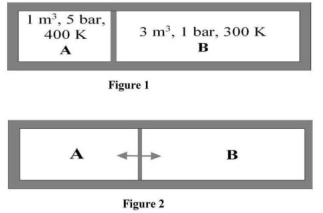
$A$ closed tank has two compartments $A$ and $B$,both filled with oxygen (assumed to be ideal gas). The partition separating the two compartments is fixed and is a perfect heat insulator (Figure $1$). If the old partition is replaced by a new partition which can slide and conduct heat but does $NOT$ allow the gas to leak across (Figure $2$),the volume (in $m^3$) of the compartment $A$ after the system attains equilibrium is. . . . . . . .
A
$2.22$
B
$2.23$
C
$2.24$
D
$2.25$
Solution
(A) Initial moles in compartment $A$ $(n_A)$: $n_A = \frac{P_A V_A}{R T_A} = \frac{5 \times 1}{R \times 400} = \frac{1}{80R}$
Initial moles in compartment $B$ $(n_B)$: $n_B = \frac{P_B V_B}{R T_B} = \frac{1 \times 3}{R \times 300} = \frac{1}{100R}$
Total moles $(n_{total})$ = $n_A + n_B = \frac{1}{80R} + \frac{1}{100R} = \frac{5+4}{400R} = \frac{9}{400R}$
At equilibrium,the partition is conducting and movable,so both compartments will have the same pressure $(P)$ and temperature $(T)$.
Let $V_A'$ and $V_B'$ be the new volumes. $V_A' + V_B' = 1 + 3 = 4 \ m^3$.
Using the ideal gas law for the total system: $P(V_A' + V_B') = n_{total} R T$
$P(4) = (\frac{9}{400R}) R T \implies P = \frac{9T}{1600}$
For compartment $A$: $P V_A' = n_A R T \implies (\frac{9T}{1600}) V_A' = (\frac{1}{80R}) R T$
$V_A' = \frac{1}{80} \times \frac{1600}{9} = \frac{20}{9} \approx 2.22 \ m^3$.
Initial moles in compartment $B$ $(n_B)$: $n_B = \frac{P_B V_B}{R T_B} = \frac{1 \times 3}{R \times 300} = \frac{1}{100R}$
Total moles $(n_{total})$ = $n_A + n_B = \frac{1}{80R} + \frac{1}{100R} = \frac{5+4}{400R} = \frac{9}{400R}$
At equilibrium,the partition is conducting and movable,so both compartments will have the same pressure $(P)$ and temperature $(T)$.
Let $V_A'$ and $V_B'$ be the new volumes. $V_A' + V_B' = 1 + 3 = 4 \ m^3$.
Using the ideal gas law for the total system: $P(V_A' + V_B') = n_{total} R T$
$P(4) = (\frac{9}{400R}) R T \implies P = \frac{9T}{1600}$
For compartment $A$: $P V_A' = n_A R T \implies (\frac{9T}{1600}) V_A' = (\frac{1}{80R}) R T$
$V_A' = \frac{1}{80} \times \frac{1600}{9} = \frac{20}{9} \approx 2.22 \ m^3$.
0 likes
View Solution442
MediumMCQ
An ideal gas is heated in a rigid container so its temperature rises. Which is incorrect for this process?
A
$W=0$
B
Absorbed heat will increase its internal energy
C
It is isobaric process
D
It is isochoric process
Solution
(C) In a rigid container,the volume of the gas remains constant,which means $\Delta V = 0$.
Since work done $W = -P_{ext} \Delta V$,it follows that $W = 0$.
This type of process is known as an isochoric process.
According to the first law of thermodynamics,$\Delta U = q + W$. Since $W = 0$,$\Delta U = q$,meaning the absorbed heat increases the internal energy of the system.
An isobaric process is one where pressure remains constant,which is not the case here.
Therefore,the statement that it is an isobaric process is incorrect.
Since work done $W = -P_{ext} \Delta V$,it follows that $W = 0$.
This type of process is known as an isochoric process.
According to the first law of thermodynamics,$\Delta U = q + W$. Since $W = 0$,$\Delta U = q$,meaning the absorbed heat increases the internal energy of the system.
An isobaric process is one where pressure remains constant,which is not the case here.
Therefore,the statement that it is an isobaric process is incorrect.
0 likes
View Solution443
EasyMCQ
Two separate identical containers contain Gas $A$ $(Mw = 40 \ g \ mol^{-1})$ and gas $B$ $(Mw = x \ g \ mol^{-1})$ in the mass ratio $5 : 8$ under similar conditions of temperature and pressure. The value of $x$ is $:-$
A
$60$
B
$64$
C
$70$
D
$72$
Solution
(B) According to Avogadro's law,under similar conditions of temperature and pressure,equal volumes of gases contain an equal number of moles. Since the containers are identical,the volume is the same,so $n_A = n_B$.
The number of moles is given by $n = \frac{w}{Mw}$,where $w$ is the mass and $Mw$ is the molar mass.
Therefore,$\frac{w_A}{40} = \frac{w_B}{x}$.
Rearranging the terms,we get $\frac{w_A}{w_B} = \frac{40}{x}$.
Given the mass ratio $\frac{w_A}{w_B} = \frac{5}{8}$,we substitute this into the equation:
$\frac{5}{8} = \frac{40}{x}$.
Solving for $x$: $x = \frac{40 \times 8}{5} = 8 \times 8 = 64$.
The number of moles is given by $n = \frac{w}{Mw}$,where $w$ is the mass and $Mw$ is the molar mass.
Therefore,$\frac{w_A}{40} = \frac{w_B}{x}$.
Rearranging the terms,we get $\frac{w_A}{w_B} = \frac{40}{x}$.
Given the mass ratio $\frac{w_A}{w_B} = \frac{5}{8}$,we substitute this into the equation:
$\frac{5}{8} = \frac{40}{x}$.
Solving for $x$: $x = \frac{40 \times 8}{5} = 8 \times 8 = 64$.
0 likes
View Solution444
EasyMCQ
Four vessels of same volume consist of equal moles of four gases $H_2$,$Cl_2$,$N_2$,and $O_2$ separately at the same temperature. The pressure exerted by the gas is maximum for -
A
$H_2$
B
$Cl_2$
C
$N_2$
D
$O_2$
Solution
(A) According to the ideal gas equation,$PV = nRT$,where $P$ is pressure,$V$ is volume,$n$ is the number of moles,$R$ is the universal gas constant,and $T$ is temperature.
Since $V$,$n$,and $T$ are constant for all four gases,the pressure $P$ is given by $P = \frac{nRT}{V}$.
Since $n$,$R$,$T$,and $V$ are identical for all gases,the pressure exerted by each gas will be the same.
However,in real gas behavior,the pressure exerted depends on the compressibility factor and intermolecular forces. For ideal gases,the pressure is equal. If the question implies real gases,the pressure exerted by a gas is influenced by the van der Waals equation: $(P + \frac{an^2}{V^2})(V - nb) = nRT$.
For gases with smaller molecular size and weaker intermolecular forces (like $H_2$),the deviation from ideal behavior is minimal,and they exert pressure closest to the ideal value. Given the options and the standard context of such problems,if all are treated as ideal,the pressure is the same. If the question implies which gas behaves most ideally or exerts the highest pressure due to lower attractive forces,$H_2$ is the correct choice.
Since $V$,$n$,and $T$ are constant for all four gases,the pressure $P$ is given by $P = \frac{nRT}{V}$.
Since $n$,$R$,$T$,and $V$ are identical for all gases,the pressure exerted by each gas will be the same.
However,in real gas behavior,the pressure exerted depends on the compressibility factor and intermolecular forces. For ideal gases,the pressure is equal. If the question implies real gases,the pressure exerted by a gas is influenced by the van der Waals equation: $(P + \frac{an^2}{V^2})(V - nb) = nRT$.
For gases with smaller molecular size and weaker intermolecular forces (like $H_2$),the deviation from ideal behavior is minimal,and they exert pressure closest to the ideal value. Given the options and the standard context of such problems,if all are treated as ideal,the pressure is the same. If the question implies which gas behaves most ideally or exerts the highest pressure due to lower attractive forces,$H_2$ is the correct choice.
0 likes
View Solution445
EasyMCQ
Which of the following is true according to Gay-Lussac's law?
A
$\frac{V}{T} = \text{constant}$ at constant pressure and for a fixed mass of gas.
B
$\frac{p}{d} = \text{constant}$ at constant temperature and fixed mass of gas.
C
$\frac{P}{T} = \text{constant}$ at constant volume and fixed mass of gas.
D
$P \times V = \text{constant}$ at constant temperature and for a fixed mass of gas.
Solution
(C) Gay-Lussac's law states that the pressure of a given mass of a gas is directly proportional to its absolute temperature,provided the volume remains constant.
Mathematically,this is expressed as $P \propto T$ or $\frac{P}{T} = \text{constant}$ at constant volume $(V)$ and fixed mass $(n)$.
Mathematically,this is expressed as $P \propto T$ or $\frac{P}{T} = \text{constant}$ at constant volume $(V)$ and fixed mass $(n)$.
0 likes
View Solution446
EasyMCQ
Which of the following equations is true for $8.8 \times 10^{-2} \ kg$ of carbon dioxide gas?
A
$PV = 1.5 \ RT$
B
$PV = RT$
C
$PV = 2 \ RT$
D
$PV = 3 \ RT$
Solution
(C) Given mass of $CO_2 = 8.8 \times 10^{-2} \ kg = 88 \ g$.
The molar mass of $CO_2$ is $44 \ g \ mol^{-1}$.
The number of moles $n$ is calculated as $n = \frac{\text{mass}}{\text{molar mass}} = \frac{88 \ g}{44 \ g \ mol^{-1}} = 2 \ mol$.
According to the ideal gas equation,$PV = nRT$.
Substituting $n = 2$,we get $PV = 2 \ RT$.
The molar mass of $CO_2$ is $44 \ g \ mol^{-1}$.
The number of moles $n$ is calculated as $n = \frac{\text{mass}}{\text{molar mass}} = \frac{88 \ g}{44 \ g \ mol^{-1}} = 2 \ mol$.
According to the ideal gas equation,$PV = nRT$.
Substituting $n = 2$,we get $PV = 2 \ RT$.
0 likes
View Solution447
EasyMCQ
How many moles of dioxygen are present in $8.314 \times 10^{-3} \ m^3$ of it at $318 \ K$ having pressure $3.18 \times 10^5 \ N \ m^{-2}$ (in $mole$)? $(R=8.314 \ J \ K^{-1} \ mol^{-1})$
A
$0.1$
B
$1.0$
C
$1.5$
D
$2.0$
Solution
(B) Using the ideal gas equation: $PV = nRT$
Rearranging for $n$: $n = \frac{PV}{RT}$
Given values: $P = 3.18 \times 10^5 \ N \ m^{-2}$,$V = 8.314 \times 10^{-3} \ m^3$,$T = 318 \ K$,$R = 8.314 \ J \ K^{-1} \ mol^{-1}$
Substituting the values: $n = \frac{(3.18 \times 10^5) \times (8.314 \times 10^{-3})}{8.314 \times 318}$
$n = \frac{3.18 \times 10^2}{318} = \frac{318}{318} = 1 \ mole$
Rearranging for $n$: $n = \frac{PV}{RT}$
Given values: $P = 3.18 \times 10^5 \ N \ m^{-2}$,$V = 8.314 \times 10^{-3} \ m^3$,$T = 318 \ K$,$R = 8.314 \ J \ K^{-1} \ mol^{-1}$
Substituting the values: $n = \frac{(3.18 \times 10^5) \times (8.314 \times 10^{-3})}{8.314 \times 318}$
$n = \frac{3.18 \times 10^2}{318} = \frac{318}{318} = 1 \ mole$
0 likes
View Solution448
EasyMCQ
Which of the following graphs explains Boyle's law?
A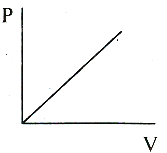
B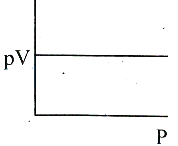
C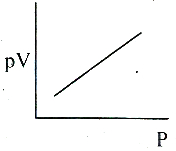
D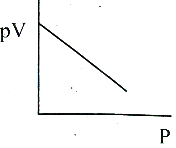
Solution
(B) According to Boyle's law,for a fixed amount of an ideal gas at constant temperature,the pressure $P$ is inversely proportional to the volume $V$,i.e.,$P \propto \frac{1}{V}$.
This implies that $PV = k$,where $k$ is a constant.
Therefore,if we plot $PV$ on the y-axis and $P$ on the x-axis,the value of $PV$ remains constant regardless of the change in pressure $P$.
This results in a horizontal straight line parallel to the pressure axis.
This implies that $PV = k$,where $k$ is a constant.
Therefore,if we plot $PV$ on the y-axis and $P$ on the x-axis,the value of $PV$ remains constant regardless of the change in pressure $P$.
This results in a horizontal straight line parallel to the pressure axis.
0 likes
View Solution449
EasyMCQ
Calculate the volume of gas at $1.25 \ atm$,if the volume occupied by the gas at $1 \ atm$ and at the same temperature is $25 \ mL$. (in $mL$)
A
$15$
B
$20$
C
$25$
D
$35$
Solution
(B) According to Boyle's law,at constant temperature and amount of gas:
$P_1 V_1 = P_2 V_2$
Given:
$P_1 = 1 \ atm$,$V_1 = 25 \ mL$
$P_2 = 1.25 \ atm$,$V_2 = ?$
Substituting the values:
$1 \ atm \times 25 \ mL = 1.25 \ atm \times V_2$
$V_2 = \frac{1 \ atm \times 25 \ mL}{1.25 \ atm} = 20 \ mL$
$P_1 V_1 = P_2 V_2$
Given:
$P_1 = 1 \ atm$,$V_1 = 25 \ mL$
$P_2 = 1.25 \ atm$,$V_2 = ?$
Substituting the values:
$1 \ atm \times 25 \ mL = 1.25 \ atm \times V_2$
$V_2 = \frac{1 \ atm \times 25 \ mL}{1.25 \ atm} = 20 \ mL$
0 likes
View Solution450
EasyMCQ
$A$ gas occupies $11.2 \ dm^3$ at $105 \ kPa$. What is the volume if pressure is increased to $210 \ kPa$ (in $dm^3$)?
A
$5.6$
B
$16.8$
C
$22.4$
D
$33.6$
Solution
(A) According to Boyle's law,at constant temperature,the product of pressure and volume is constant.
$P_1 V_1 = P_2 V_2$
Given:
$P_1 = 105 \ kPa$,$V_1 = 11.2 \ dm^3$
$P_2 = 210 \ kPa$,$V_2 = ?$
Substituting the values:
$V_2 = \frac{P_1 V_1}{P_2} = \frac{105 \ kPa \times 11.2 \ dm^3}{210 \ kPa} = 5.6 \ dm^3$
$P_1 V_1 = P_2 V_2$
Given:
$P_1 = 105 \ kPa$,$V_1 = 11.2 \ dm^3$
$P_2 = 210 \ kPa$,$V_2 = ?$
Substituting the values:
$V_2 = \frac{P_1 V_1}{P_2} = \frac{105 \ kPa \times 11.2 \ dm^3}{210 \ kPa} = 5.6 \ dm^3$
0 likes
View SolutionStates of Matter — Ideal gas equation and Related gas laws · Frequently Asked Questions
1Are these States of Matter questions useful for JEE and NEET?
Yes. All questions in this section are mapped to JEE Main and NEET exam patterns. Previous year questions from JEE Main, NEET, GUJCET and state-level exams are included with full solutions.
2Can I switch to Hindi or Gujarati for these questions?
Yes. Use the language tabs in the hero section or the sidebar to view the same questions and solutions in English, Hindi or Gujarati.
3How do I generate a question paper from this subtopic?
Use the Vedclass Exam Paper Generator — select the chapter and subtopic, set difficulty, and generate Sets A, B, C, D automatically. First 3 chapters of every subject are free.
Vedclass Products
For Students
Vedclass Test Series
Mock tests in real JEE/NEET style with performance analysis. 5-day free trial.
Start Free TrialFor Teachers
Exam Paper Generator
Generate Set A/B/C/D papers from this chapter in 2 minutes. 3 chapters free.
Try FreeFor Institutes
Online Exam Module
Live online exams with unlimited students, 360° analytics & white-label branding.
See DemoFor Teachers & Institutes
Generate a States of Matter Exam Paper in 2 Minutes
Select subtopic & difficulty — Sets A, B, C, D auto-generated with No Repeat logic.
First 3 chapters of every subject are free — no payment required.