
A English
Ideal gas equation and Related gas laws Questions in English
Class 11 Chemistry · States of Matter · Ideal gas equation and Related gas laws
568+
Questions
English
Language
100%
With Solutions
Showing 49 of 568 questions in English
501
MediumMCQ
At $T \ (K)$ for one mole of an ideal gas,the graph of $P$ (on $y$-axis) and $V^{-1}$ (on $x$-axis) gave a straight line with a slope of $32.8 \ L \ atm \ mol^{-1}$. What is the temperature (in $K$)? $\left(R=0.082 \ L \ atm \ K^{-1} \ mol^{-1}\right)$
A
$600$
B
$200$
C
$800$
D
$400$
Solution
(D) The ideal gas equation is $PV = nRT$.
For $n = 1 \ mol$,the equation becomes $P = (RT) \times (V^{-1})$.
Comparing this with the equation of a straight line $y = mx + c$,where $y = P$ and $x = V^{-1}$,we get the slope $m = RT$.
Given that the slope $m = 32.8 \ L \ atm \ mol^{-1}$ and $R = 0.082 \ L \ atm \ K^{-1} \ mol^{-1}$.
Therefore,$RT = 32.8 \ L \ atm \ mol^{-1}$.
$T = \frac{32.8 \ L \ atm \ mol^{-1}}{0.082 \ L \ atm \ K^{-1} \ mol^{-1}} = 400 \ K$.
For $n = 1 \ mol$,the equation becomes $P = (RT) \times (V^{-1})$.
Comparing this with the equation of a straight line $y = mx + c$,where $y = P$ and $x = V^{-1}$,we get the slope $m = RT$.
Given that the slope $m = 32.8 \ L \ atm \ mol^{-1}$ and $R = 0.082 \ L \ atm \ K^{-1} \ mol^{-1}$.
Therefore,$RT = 32.8 \ L \ atm \ mol^{-1}$.
$T = \frac{32.8 \ L \ atm \ mol^{-1}}{0.082 \ L \ atm \ K^{-1} \ mol^{-1}} = 400 \ K$.
0 likes
View Solution502
MediumMCQ
An ideal gas $(X)$ present in a vessel of volume $V \ L$ exerted a pressure of $16.4 \ atm$ at $200 \ K$. What is its concentration in $mol \ L^{-1}$? (Given $R=0.082 \ L \ atm \ mol^{-1} \ K^{-1}$)
A
$0.5$
B
$0.25$
C
$1$
D
$1.5$
Solution
(C) The ideal gas equation is given by $PV = nRT$.
Since concentration $C = \frac{n}{V}$,we can rewrite the equation as $P = CRT$.
Therefore,$C = \frac{P}{RT}$.
Substituting the given values: $C = \frac{16.4 \ atm}{0.082 \ L \ atm \ mol^{-1} \ K^{-1} \times 200 \ K}$.
$C = \frac{16.4}{16.4} = 1.00 \ mol \ L^{-1}$.
Since concentration $C = \frac{n}{V}$,we can rewrite the equation as $P = CRT$.
Therefore,$C = \frac{P}{RT}$.
Substituting the given values: $C = \frac{16.4 \ atm}{0.082 \ L \ atm \ mol^{-1} \ K^{-1} \times 200 \ K}$.
$C = \frac{16.4}{16.4} = 1.00 \ mol \ L^{-1}$.
0 likes
View Solution503
EasyMCQ
At a given temperature,the density of an ideal gas is proportional to $(P = \text{pressure of ideal gas})$
A
$\frac{1}{P}$
B
$P$
C
$P^2$
D
$\sqrt{P}$
Solution
(B) From the ideal gas equation,$PV = nRT$.
Since $n = \frac{m}{M}$,we have $PV = \frac{m}{M} RT$.
Rearranging for density $d = \frac{m}{V}$,we get $d = \frac{PM}{RT}$.
At a constant temperature $T$ and for a specific gas with molar mass $M$,the term $\frac{M}{RT}$ is constant.
Therefore,$d \propto P$.
Since $n = \frac{m}{M}$,we have $PV = \frac{m}{M} RT$.
Rearranging for density $d = \frac{m}{V}$,we get $d = \frac{PM}{RT}$.
At a constant temperature $T$ and for a specific gas with molar mass $M$,the term $\frac{M}{RT}$ is constant.
Therefore,$d \propto P$.
0 likes
View Solution504
MediumMCQ
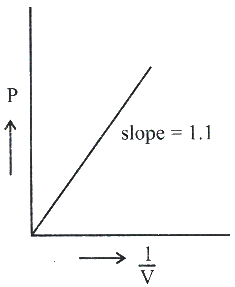
At $300 \ K$,the following graph is obtained for one mole of an ideal gas. If its pressure is $10 \ atm$,then its volume (in $L$) will be
A
$0.11$
B
$1.1$
C
$2.0$
D
$4.0$
Solution
(A) The ideal gas equation is $PV = nRT$.
Rearranging this for the graph of $P$ versus $\frac{1}{V}$,we get $P = (nRT) \times \frac{1}{V}$.
Comparing this with the equation of a straight line $y = mx$,where $y = P$,$x = \frac{1}{V}$,and $m = nRT$.
Given that the slope $m = 1.1$.
Thus,$nRT = 1.1$.
We are given $P = 10 \ atm$.
Using $PV = nRT$,we have $V = \frac{nRT}{P}$.
Substituting the values,$V = \frac{1.1}{10} = 0.11 \ L$.
Rearranging this for the graph of $P$ versus $\frac{1}{V}$,we get $P = (nRT) \times \frac{1}{V}$.
Comparing this with the equation of a straight line $y = mx$,where $y = P$,$x = \frac{1}{V}$,and $m = nRT$.
Given that the slope $m = 1.1$.
Thus,$nRT = 1.1$.
We are given $P = 10 \ atm$.
Using $PV = nRT$,we have $V = \frac{nRT}{P}$.
Substituting the values,$V = \frac{1.1}{10} = 0.11 \ L$.
0 likes
View Solution505
MediumMCQ
At $T$ $K$,an ideal gas $(Z)$ present in $V$ $L$ flask exerted a pressure of $16.4$ $atm$. Its concentration is $1$ $mol$ $L^{-1}$. What is the value of $T$ in $K$?
A
$100$
B
$400$
C
$300$
D
$200$
Solution
(D) The ideal gas equation is $pV = nRT$.
Dividing both sides by $V$,we get $p = (n/V)RT = CRT$,where $C$ is the concentration in $mol$ $L^{-1}$.
Given $p = 16.4$ $atm$,$C = 1$ $mol$ $L^{-1}$,and $R = 0.082$ $L$ $atm$ $mol^{-1}$ $K^{-1}$.
Substituting these values into the equation: $16.4 = 1 \times 0.082 \times T$.
$T = 16.4 / 0.082 = 200$ $K$.
Dividing both sides by $V$,we get $p = (n/V)RT = CRT$,where $C$ is the concentration in $mol$ $L^{-1}$.
Given $p = 16.4$ $atm$,$C = 1$ $mol$ $L^{-1}$,and $R = 0.082$ $L$ $atm$ $mol^{-1}$ $K^{-1}$.
Substituting these values into the equation: $16.4 = 1 \times 0.082 \times T$.
$T = 16.4 / 0.082 = 200$ $K$.
0 likes
View Solution506
EasyMCQ
$A$ gas obeys Charles's law in the temperature range $0-500 \ K$ at a given pressure. Its volume changes to zero at a temperature of:
A
$273.15^{\circ} C$
B
$0^{\circ} C$
C
$-273.15^{\circ} C$
D
$500 \ K$
Solution
(C) According to Charles's law,the volume of a gas is directly proportional to its absolute temperature $(V \propto T)$.
As the temperature decreases,the volume decreases.
Theoretically,the volume of a gas becomes zero at absolute zero,which is $0 \ K$.
Converting this to the Celsius scale: $T(^{\circ}C) = T(K) - 273.15$.
Therefore,$0 \ K = -273.15^{\circ} C$.
As the temperature decreases,the volume decreases.
Theoretically,the volume of a gas becomes zero at absolute zero,which is $0 \ K$.
Converting this to the Celsius scale: $T(^{\circ}C) = T(K) - 273.15$.
Therefore,$0 \ K = -273.15^{\circ} C$.
0 likes
View Solution507
MediumMCQ
The following data is obtained for $1 \ mole$ of a gas. The gas behaves as an ideal gas in the pressure range (in $bar$):
| $P \ (bar)$ | $\frac{PV}{RT}$ |
|---|---|
| $1$ | $1$ |
| $2$ | $1$ |
| $3$ | $1$ |
| $4$ | $1.5$ |
| $5$ | $2.0$ |
A
$1$ to $3$
B
$1$ to $5$
C
$4$ to $5$
D
Above $5$
Solution
(A) For an ideal gas,the compressibility factor $Z = \frac{PV}{RT} = 1$.
From the given data table,we observe that for $P = 1, 2, \text{ and } 3 \ bar$,the value of $\frac{PV}{RT}$ is $1$.
For $P = 4 \ bar$ and $P = 5 \ bar$,the value of $\frac{PV}{RT}$ deviates from $1$ ($1.5$ and $2.0$ respectively).
Therefore,the gas behaves as an ideal gas in the pressure range of $1$ to $3 \ bar$.
From the given data table,we observe that for $P = 1, 2, \text{ and } 3 \ bar$,the value of $\frac{PV}{RT}$ is $1$.
For $P = 4 \ bar$ and $P = 5 \ bar$,the value of $\frac{PV}{RT}$ deviates from $1$ ($1.5$ and $2.0$ respectively).
Therefore,the gas behaves as an ideal gas in the pressure range of $1$ to $3 \ bar$.
0 likes
View Solution508
MediumMCQ
At $200 \ K$,an ideal gas $(X)$ present in a $1 \ L$ flask has a concentration of $1 \ mol \ L^{-1}$. At the same temperature,$0.1 \ mol$ of $X$ is added into the vessel. What is the final pressure of the gas in $atm$?
(Given $R = 0.082 \ L \ atm \ mol^{-1} \ K^{-1}$)
(Given $R = 0.082 \ L \ atm \ mol^{-1} \ K^{-1}$)
A
$18.04$
B
$16.4$
C
$8.2$
D
$9.02$
Solution
(A) Initial concentration of gas $(X)$ is $1 \ mol \ L^{-1}$ in a $1 \ L$ flask,so initial moles $(n_1) = 1 \ mol$.
Using the ideal gas equation $PV = nRT$,the initial pressure $(P_1)$ is:
$P_1 = \frac{n_1 RT}{V} = \frac{1 \times 0.082 \times 200}{1} = 16.4 \ atm$.
After adding $0.1 \ mol$ of $X$,the new number of moles $(n_2) = 1 + 0.1 = 1.1 \ mol$.
Since temperature $(T)$ and volume $(V)$ remain constant,the pressure is directly proportional to the number of moles $(P \propto n)$.
Therefore,$\frac{P_1}{n_1} = \frac{P_2}{n_2}$.
$P_2 = P_1 \times \frac{n_2}{n_1} = 16.4 \times \frac{1.1}{1} = 18.04 \ atm$.
Using the ideal gas equation $PV = nRT$,the initial pressure $(P_1)$ is:
$P_1 = \frac{n_1 RT}{V} = \frac{1 \times 0.082 \times 200}{1} = 16.4 \ atm$.
After adding $0.1 \ mol$ of $X$,the new number of moles $(n_2) = 1 + 0.1 = 1.1 \ mol$.
Since temperature $(T)$ and volume $(V)$ remain constant,the pressure is directly proportional to the number of moles $(P \propto n)$.
Therefore,$\frac{P_1}{n_1} = \frac{P_2}{n_2}$.
$P_2 = P_1 \times \frac{n_2}{n_1} = 16.4 \times \frac{1.1}{1} = 18.04 \ atm$.
0 likes
View Solution509
EasyMCQ
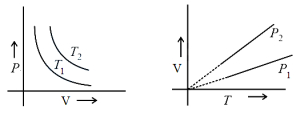
From the following plots,find the correct option.
A
$T_1 > T_2 ; P_1 > P_2$
B
$T_1 > T_2 ; P_2 > P_1$
C
$T_2 > T_1 ; P_2 > P_1$
D
$T_2 > T_1 ; P_1 > P_2$
Solution
(C) For the $P-V$ graph,draw a line parallel to the $V$-axis (constant $P$). At a constant pressure,the volume $V$ is directly proportional to the temperature $T$ $(V \propto T)$. Since the curve for $T_2$ is at a higher volume than $T_1$ for the same pressure,we have $T_2 > T_1$.
For the $V-T$ graph,the equation is $V = (\frac{nR}{P})T$. The slope of the line is $\frac{nR}{P}$,which is inversely proportional to the pressure $P$. Since the slope of the line for $P_1$ is smaller than the slope of the line for $P_2$,it follows that $P_1 > P_2$.
For the $V-T$ graph,the equation is $V = (\frac{nR}{P})T$. The slope of the line is $\frac{nR}{P}$,which is inversely proportional to the pressure $P$. Since the slope of the line for $P_1$ is smaller than the slope of the line for $P_2$,it follows that $P_1 > P_2$.
0 likes
View Solution510
MediumMCQ
What is the density of one mole of $He$ (molar mass $= 4 \ g \ mol^{-1}$) at $300 \ K$ and a pressure of $0.82 \ atm$? $(R = 0.082 \ L \ atm \ mol^{-1} \ K^{-1})$
A
$1.33 \times 10^{-2} \ g \ mL^{-1}$
B
$1.33 \times 10^{-2} \ g \ L^{-1}$
C
$1.33 \times 10^{-1} \ g \ L^{-1}$
D
$1.33 \times 10^{-1} \ g \ mL^{-1}$
Solution
(C) From the ideal gas equation,$PV = nRT$.
Since $n = \frac{m}{M}$,we have $PV = \frac{m}{M} RT$.
Rearranging for density $d = \frac{m}{V}$,we get $d = \frac{PM}{RT}$.
Given: $P = 0.82 \ atm$,$M = 4 \ g \ mol^{-1}$,$R = 0.082 \ L \ atm \ mol^{-1} \ K^{-1}$,and $T = 300 \ K$.
Substituting the values: $d = \frac{0.82 \times 4}{0.082 \times 300} = \frac{4}{30} = 0.1333 \ g \ L^{-1} = 1.33 \times 10^{-1} \ g \ L^{-1}$.
Since $n = \frac{m}{M}$,we have $PV = \frac{m}{M} RT$.
Rearranging for density $d = \frac{m}{V}$,we get $d = \frac{PM}{RT}$.
Given: $P = 0.82 \ atm$,$M = 4 \ g \ mol^{-1}$,$R = 0.082 \ L \ atm \ mol^{-1} \ K^{-1}$,and $T = 300 \ K$.
Substituting the values: $d = \frac{0.82 \times 4}{0.082 \times 300} = \frac{4}{30} = 0.1333 \ g \ L^{-1} = 1.33 \times 10^{-1} \ g \ L^{-1}$.
0 likes
View Solution511
EasyMCQ
The density of an ideal gas can be given by where $P$,$V$,$M$,$T$ and $R$ respectively denote pressure,volume,molar mass,temperature and universal gas constant.
A
$\frac{PM}{RT}$
B
$\frac{PV}{RT}$
C
$\frac{RT}{PM}$
D
$\frac{RT}{PV}$
Solution
(A) According to the ideal gas equation,we have:
$PV = nRT$
Since the number of moles $n = \frac{m}{M}$,where $m$ is the mass and $M$ is the molar mass,we can substitute this into the equation:
$PV = \frac{m}{M} RT$
Rearranging the terms to solve for density $\rho = \frac{m}{V}$:
$P = \frac{m}{V} \times \frac{RT}{M}$
$P = \rho \times \frac{RT}{M}$
Therefore,the density $\rho$ is given by:
$\rho = \frac{PM}{RT}$
$PV = nRT$
Since the number of moles $n = \frac{m}{M}$,where $m$ is the mass and $M$ is the molar mass,we can substitute this into the equation:
$PV = \frac{m}{M} RT$
Rearranging the terms to solve for density $\rho = \frac{m}{V}$:
$P = \frac{m}{V} \times \frac{RT}{M}$
$P = \rho \times \frac{RT}{M}$
Therefore,the density $\rho$ is given by:
$\rho = \frac{PM}{RT}$
0 likes
View Solution512
EasyMCQ
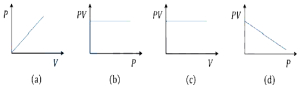
Which of the following graphs correctly represents Boyle's Law?
A
$a$,$b$ $\&$ $c$ only
B
$b$ $\&$ $c$ only
C
$c$ $\&$ $d$ only
D
$b$ $\&$ $d$ only
Solution
(B) According to Boyle's Law,for a fixed amount of gas at a constant temperature,the pressure $(P)$ is inversely proportional to the volume $(V)$ of the gas: $P \propto \frac{1}{V}$ or $PV = \text{constant}$.
$1$. Graph $(b)$: Represents $PV$ vs $P$. Since $PV$ is constant,the graph is a horizontal line parallel to the $P$-axis.
$2$. Graph $(c)$: Represents $PV$ vs $V$. Since $PV$ is constant,the graph is a horizontal line parallel to the $V$-axis.
Both graphs $(b)$ and $(c)$ correctly represent the constant product of $PV$ as dictated by Boyle's Law.
$1$. Graph $(b)$: Represents $PV$ vs $P$. Since $PV$ is constant,the graph is a horizontal line parallel to the $P$-axis.
$2$. Graph $(c)$: Represents $PV$ vs $V$. Since $PV$ is constant,the graph is a horizontal line parallel to the $V$-axis.
Both graphs $(b)$ and $(c)$ correctly represent the constant product of $PV$ as dictated by Boyle's Law.
0 likes
View Solution513
EasyMCQ
The density of oxygen gas at $5 \text{ atm}$ and $127^{\circ} C$ will be (in $\text{ g/L}$)
A
$2.80$
B
$4.88$
C
$1.49$
D
$5.60$
Solution
(B) The density $(d)$ of a gas is given by the formula: $d = \frac{pM}{RT}$
Given:
Pressure $(p)$ = $5 \text{ atm}$
Molar mass of $O_2$ $(M)$ = $32 \text{ g mol}^{-1}$
Gas constant $(R)$ = $0.082 \text{ L atm K}^{-1} \text{ mol}^{-1}$
Temperature $(T)$ = $127 + 273 = 400 \text{ K}$
Substituting the values:
$d = \frac{5 \times 32}{0.082 \times 400}$
$d = \frac{160}{32.8} \approx 4.878 \text{ g L}^{-1}$
Thus,the density is approximately $4.88 \text{ g L}^{-1}$.
Given:
Pressure $(p)$ = $5 \text{ atm}$
Molar mass of $O_2$ $(M)$ = $32 \text{ g mol}^{-1}$
Gas constant $(R)$ = $0.082 \text{ L atm K}^{-1} \text{ mol}^{-1}$
Temperature $(T)$ = $127 + 273 = 400 \text{ K}$
Substituting the values:
$d = \frac{5 \times 32}{0.082 \times 400}$
$d = \frac{160}{32.8} \approx 4.878 \text{ g L}^{-1}$
Thus,the density is approximately $4.88 \text{ g L}^{-1}$.
0 likes
View Solution514
EasyMCQ
The temperature at which $4 \ mol$ of a gas occupies $5 \ dm^3$ volume at $3.32 \ bar$ pressure is:
A
$50 \ K$
B
$50^{\circ} C$
C
$27^{\circ} C$
D
$100 \ K$
Solution
(A) Using the ideal gas equation,$PV = nRT$,the temperature $T$ is given by $T = \frac{PV}{nR}$.
Given values are $P = 3.32 \ bar$,$V = 5 \ dm^3 = 5 \ L$,$n = 4 \ mol$,and the gas constant $R = 0.08314 \ bar \ L \ K^{-1} \ mol^{-1}$.
Substituting these values into the equation:
$T = \frac{3.32 \times 5}{4 \times 0.08314} = \frac{16.6}{0.33256} \approx 49.91 \ K$.
Rounding to the nearest whole number,we get $T \approx 50 \ K$.
Given values are $P = 3.32 \ bar$,$V = 5 \ dm^3 = 5 \ L$,$n = 4 \ mol$,and the gas constant $R = 0.08314 \ bar \ L \ K^{-1} \ mol^{-1}$.
Substituting these values into the equation:
$T = \frac{3.32 \times 5}{4 \times 0.08314} = \frac{16.6}{0.33256} \approx 49.91 \ K$.
Rounding to the nearest whole number,we get $T \approx 50 \ K$.
0 likes
View Solution515
EasyMCQ
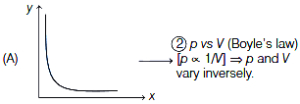
Match the following graphs of a gas with their corresponding $y$ and $x$ coordinates:
| Graph | Coordinates ($y$ vs $x$) |
| $(A)$ Hyperbola | $1. \ y = PV, x = V$ |
| $(B)$ Straight line passing through origin | $2. \ y = P, x = V$ |
| $(C)$ Horizontal line parallel to $x$-axis | $3. \ y = P, x = 1/V$ |
A
$A-2, B-3, C-1$
B
$A-1, B-3, C-2$
C
$A-2, B-1, C-3$
D
$A-1, B-2, C-3$
Solution
(A) According to Boyle's law,at constant temperature,$PV = k$.
$1.$ For $y = P$ and $x = V$,the relation $P = k/V$ represents a hyperbola. Thus,$(A)$ matches $2$.
$2.$ For $y = P$ and $x = 1/V$,the relation $P = k(1/V)$ represents a straight line passing through the origin. Thus,$(B)$ matches $3$.
$3.$ For $y = PV$ and $x = P$,the relation $PV = k$ represents a horizontal line parallel to the $x$-axis. Thus,$(C)$ matches $1$.
$1.$ For $y = P$ and $x = V$,the relation $P = k/V$ represents a hyperbola. Thus,$(A)$ matches $2$.
$2.$ For $y = P$ and $x = 1/V$,the relation $P = k(1/V)$ represents a straight line passing through the origin. Thus,$(B)$ matches $3$.
$3.$ For $y = PV$ and $x = P$,the relation $PV = k$ represents a horizontal line parallel to the $x$-axis. Thus,$(C)$ matches $1$.
0 likes
View Solution516
EasyMCQ
What is the temperature of $4$ moles of a gas occupying $5 \ L$ volume at $3.32 \ bar$ (in $K$)? $\left(R=0.083 \ bar \ L \ K^{-1} \ mol^{-1}\right)$
A
$5$
B
$50$
C
$500$
D
$0.5$
Solution
(B) Given: $n = 4 \ mol$,$V = 5 \ L$,$P = 3.32 \ bar$,$R = 0.083 \ bar \ L \ K^{-1} \ mol^{-1}$.
Using the ideal gas equation: $PV = nRT$.
Rearranging for temperature: $T = \frac{PV}{nR}$.
Substituting the values: $T = \frac{3.32 \times 5}{4 \times 0.083}$.
$T = \frac{16.6}{0.332} = 50 \ K$.
Therefore,the correct option is $B$.
Using the ideal gas equation: $PV = nRT$.
Rearranging for temperature: $T = \frac{PV}{nR}$.
Substituting the values: $T = \frac{3.32 \times 5}{4 \times 0.083}$.
$T = \frac{16.6}{0.332} = 50 \ K$.
Therefore,the correct option is $B$.
0 likes
View Solution517
EasyMCQ
The volume of a given mass of a gas is directly proportional to its Kelvin temperature at constant pressure. The above statement is known as . . . . . .
A
Boyle's law
B
vant Hoff's law
C
Charles's law
D
Dalton's law of partial pressures
Solution
(C) The variation in the volume of a gas with temperature was first studied by Jacques Charles $(1787)$ and is known as Charles's law.
Charles's law states that,"The volume of a given mass of a gas is directly proportional to its absolute temperature at constant pressure."
Mathematically,$V \propto T$ or $\frac{V}{T} = k$ at constant pressure.
Hence,the correct option is $(C)$.
Charles's law states that,"The volume of a given mass of a gas is directly proportional to its absolute temperature at constant pressure."
Mathematically,$V \propto T$ or $\frac{V}{T} = k$ at constant pressure.
Hence,the correct option is $(C)$.
0 likes
View Solution518
EasyMCQ
In order to increase the volume of a gas by $10 \%$ at constant temperature,the pressure of the gas should be:
A
increased by $10 \%$
B
increased by $1 \%$
C
decreased by $1 \%$
D
decreased by $10 \%$
Solution
(D) According to Boyle's law,at constant temperature,$P_1V_1 = P_2V_2$.
Let the initial volume be $V_1 = V$.
The new volume $V_2 = V + 0.10V = 1.10V$.
Substituting into the equation: $P_1V = P_2(1.10V)$.
$P_2 = P_1 / 1.10 \approx 0.9091 P_1$.
The change in pressure is $P_2 - P_1 = 0.9091 P_1 - P_1 = -0.0909 P_1$.
This represents a decrease of approximately $9.09 \%$.
Given the options provided,the closest value is a decrease of $10 \%$,which corresponds to option $(D)$.
Let the initial volume be $V_1 = V$.
The new volume $V_2 = V + 0.10V = 1.10V$.
Substituting into the equation: $P_1V = P_2(1.10V)$.
$P_2 = P_1 / 1.10 \approx 0.9091 P_1$.
The change in pressure is $P_2 - P_1 = 0.9091 P_1 - P_1 = -0.0909 P_1$.
This represents a decrease of approximately $9.09 \%$.
Given the options provided,the closest value is a decrease of $10 \%$,which corresponds to option $(D)$.
0 likes
View Solution519
EasyMCQ
Which of the following laws gives the relation between volume and temperature?
A
Boyle's law
B
Charles' law
C
Gay-Lussac's law
D
Avogadro's law
Solution
(B) Charles' law states that the volume of a fixed mass of an ideal gas is directly proportional to its absolute temperature at constant pressure.
At constant pressure,$V \propto T$.
Or,$\frac{V_1}{T_1} = \frac{V_2}{T_2}$.
Hence,the correct option is $(B)$.
At constant pressure,$V \propto T$.
Or,$\frac{V_1}{T_1} = \frac{V_2}{T_2}$.
Hence,the correct option is $(B)$.
0 likes
View Solution520
EasyMCQ
The temperature of $4.0 \ mol$ of a gas occupying $5 \ dm^3$ at $3.32 \ bar$ is $(R = 0.083 \ bar \ dm^3 \ K^{-1} \ mol^{-1})$. (in $K$)
A
$25$
B
$50$
C
$75$
D
$100$
Solution
(B) Given: Amount of gas $n = 4.0 \ mol$,Volume $V = 5 \ dm^3$,Pressure $p = 3.32 \ bar$,and Gas constant $R = 0.083 \ bar \ dm^3 \ K^{-1} \ mol^{-1}$.
Using the ideal gas equation $p \ V = n \ R \ T$,we can solve for temperature $T$:
$T = \frac{p \ V}{n \ R}$
Substituting the values:
$T = \frac{3.32 \times 5}{4.0 \times 0.083}$
$T = \frac{16.6}{0.332} = 50 \ K$.
Therefore,the temperature of the gas is $50 \ K$.
Using the ideal gas equation $p \ V = n \ R \ T$,we can solve for temperature $T$:
$T = \frac{p \ V}{n \ R}$
Substituting the values:
$T = \frac{3.32 \times 5}{4.0 \times 0.083}$
$T = \frac{16.6}{0.332} = 50 \ K$.
Therefore,the temperature of the gas is $50 \ K$.
0 likes
View Solution521
MediumMCQ
When $2 \ g$ of a gaseous substance $A$ is introduced into an initially evacuated flask at $25^{\circ} C$,the pressure is found to be $1 \ atm$. $3 \ g$ of another gaseous substance $B$ is added to it at the same temperature and pressure. The final pressure is found to be $1.5 \ atm$. Assuming ideal gas behaviour,the ratio of molar masses of $A$ and $B$ is:
A
$1: 3$
B
$3: 1$
C
$2: 3$
D
$3: 2$
Solution
(A) Using the ideal gas equation $PV = nRT$,where $n = \frac{w}{M}$.
For gas $A$: $P_A V = \frac{w_A}{M_A} RT \implies 1 \times V = \frac{2}{M_A} RT \implies V = \frac{2RT}{M_A} \quad (1)$.
When gas $B$ is added,the total pressure $P_{total} = P_A + P_B = 1.5 \ atm$. Since $P_A = 1 \ atm$,then $P_B = 0.5 \ atm$.
For gas $B$: $P_B V = \frac{w_B}{M_B} RT \implies 0.5 \times V = \frac{3}{M_B} RT \implies V = \frac{6RT}{M_B} \quad (2)$.
Equating $(1)$ and $(2)$: $\frac{2RT}{M_A} = \frac{6RT}{M_B}$.
$\frac{2}{M_A} = \frac{6}{M_B} \implies \frac{M_A}{M_B} = \frac{2}{6} = \frac{1}{3}$.
Thus,the ratio of molar masses $M_A : M_B$ is $1: 3$.
For gas $A$: $P_A V = \frac{w_A}{M_A} RT \implies 1 \times V = \frac{2}{M_A} RT \implies V = \frac{2RT}{M_A} \quad (1)$.
When gas $B$ is added,the total pressure $P_{total} = P_A + P_B = 1.5 \ atm$. Since $P_A = 1 \ atm$,then $P_B = 0.5 \ atm$.
For gas $B$: $P_B V = \frac{w_B}{M_B} RT \implies 0.5 \times V = \frac{3}{M_B} RT \implies V = \frac{6RT}{M_B} \quad (2)$.
Equating $(1)$ and $(2)$: $\frac{2RT}{M_A} = \frac{6RT}{M_B}$.
$\frac{2}{M_A} = \frac{6}{M_B} \implies \frac{M_A}{M_B} = \frac{2}{6} = \frac{1}{3}$.
Thus,the ratio of molar masses $M_A : M_B$ is $1: 3$.
0 likes
View Solution522
MediumMCQ
At $27^{\circ} C$,$1 \ L$ of $H_2$ with a pressure of $1 \ bar$ is mixed with $2 \ L$ of $O_2$ with a pressure of $2 \ bar$ in a $10 \ L$ flask. What is the pressure exerted by the gaseous mixture in $bar$? (Assume $H_2$ and $O_2$ as ideal gases)
A
$0.5$
B
$0.4$
C
$1.0$
D
$0.1$
Solution
(A) Using the ideal gas law $PV = nRT$,we find the moles of each gas at constant temperature $T = 300 \ K$.
For $H_2$: $n_1 = \frac{P_1 V_1}{RT} = \frac{1 \ bar \times 1 \ L}{RT} = \frac{1}{RT}$.
For $O_2$: $n_2 = \frac{P_2 V_2}{RT} = \frac{2 \ bar \times 2 \ L}{RT} = \frac{4}{RT}$.
Total moles $n_{total} = n_1 + n_2 = \frac{1+4}{RT} = \frac{5}{RT}$.
In the $10 \ L$ flask,the total pressure $P_{total}$ is given by $P_{total} = \frac{n_{total} RT}{V_{final}}$.
$P_{total} = \frac{(5/RT) \times RT}{10 \ L} = \frac{5}{10} \ bar = 0.5 \ bar$.
For $H_2$: $n_1 = \frac{P_1 V_1}{RT} = \frac{1 \ bar \times 1 \ L}{RT} = \frac{1}{RT}$.
For $O_2$: $n_2 = \frac{P_2 V_2}{RT} = \frac{2 \ bar \times 2 \ L}{RT} = \frac{4}{RT}$.
Total moles $n_{total} = n_1 + n_2 = \frac{1+4}{RT} = \frac{5}{RT}$.
In the $10 \ L$ flask,the total pressure $P_{total}$ is given by $P_{total} = \frac{n_{total} RT}{V_{final}}$.
$P_{total} = \frac{(5/RT) \times RT}{10 \ L} = \frac{5}{10} \ bar = 0.5 \ bar$.
0 likes
View Solution523
MediumMCQ
$A$ and $B$ are ideal gases. At $T(K)$,$2 \ L$ of $A$ with a pressure of $1 \ bar$ is mixed with $4 \ L$ of $B$ with a pressure $p_B \ bar$ in a $100 \ L$ flask. The pressure exerted by the gaseous mixture is $0.1 \ bar$. What is the value of $p_B$ in $bar$?
A
$2$
B
$0.04$
C
$0.02$
D
$1$
Solution
(A) For an ideal gas,the product of pressure and volume $(PV)$ is proportional to the number of moles $(n)$ at a constant temperature $(T)$.
Using the principle of conservation of moles,the total pressure of the mixture $(P_{mix})$ in the final volume $(V_{final} = 100 \ L)$ is given by the sum of the partial pressures of $A$ and $B$.
Initial state of $A$: $P_1 = 1 \ bar$,$V_1 = 2 \ L$.
Initial state of $B$: $P_2 = p_B \ bar$,$V_2 = 4 \ L$.
Final state of mixture: $P_{mix} = 0.1 \ bar$,$V_{final} = 100 \ L$.
According to Boyle's Law $(P_1V_1 + P_2V_2 = P_{mix}V_{final})$:
$(1 \ bar \times 2 \ L) + (p_B \ bar \times 4 \ L) = 0.1 \ bar \times 100 \ L$
$2 + 4p_B = 10$
$4p_B = 10 - 2$
$4p_B = 8$
$p_B = 2 \ bar$.
Therefore,the value of $p_B$ is $2$.
Using the principle of conservation of moles,the total pressure of the mixture $(P_{mix})$ in the final volume $(V_{final} = 100 \ L)$ is given by the sum of the partial pressures of $A$ and $B$.
Initial state of $A$: $P_1 = 1 \ bar$,$V_1 = 2 \ L$.
Initial state of $B$: $P_2 = p_B \ bar$,$V_2 = 4 \ L$.
Final state of mixture: $P_{mix} = 0.1 \ bar$,$V_{final} = 100 \ L$.
According to Boyle's Law $(P_1V_1 + P_2V_2 = P_{mix}V_{final})$:
$(1 \ bar \times 2 \ L) + (p_B \ bar \times 4 \ L) = 0.1 \ bar \times 100 \ L$
$2 + 4p_B = 10$
$4p_B = 10 - 2$
$4p_B = 8$
$p_B = 2 \ bar$.
Therefore,the value of $p_B$ is $2$.
0 likes
View Solution524
MediumMCQ
The density of methane is maximum under which conditions?
A
$0^{\circ} C$,$2 \ bar$
B
$273^{\circ} C$,$1 \ bar$
C
$273^{\circ} C$,$2 \ bar$
D
$0^{\circ} C$,$3 \ bar$
Solution
(D) The density $(d)$ of an ideal gas is given by the formula $d = \frac{PM}{RT}$,where $P$ is pressure,$M$ is molar mass,$R$ is the gas constant,and $T$ is temperature in Kelvin.
From this relation,$d \propto \frac{P}{T}$.
To maximize density,we need the highest pressure $(P)$ and the lowest temperature $(T)$.
Comparing the options:
$A$: $T = 273 \ K, P = 2 \ bar \implies \frac{P}{T} = \frac{2}{273} \approx 0.0073$
$B$: $T = 546 \ K, P = 1 \ bar \implies \frac{P}{T} = \frac{1}{546} \approx 0.0018$
$C$: $T = 546 \ K, P = 2 \ bar \implies \frac{P}{T} = \frac{2}{546} \approx 0.0036$
$D$: $T = 273 \ K, P = 3 \ bar \implies \frac{P}{T} = \frac{3}{273} \approx 0.0109$
Thus,the density is maximum at $0^{\circ} C$ and $3 \ bar$.
From this relation,$d \propto \frac{P}{T}$.
To maximize density,we need the highest pressure $(P)$ and the lowest temperature $(T)$.
Comparing the options:
$A$: $T = 273 \ K, P = 2 \ bar \implies \frac{P}{T} = \frac{2}{273} \approx 0.0073$
$B$: $T = 546 \ K, P = 1 \ bar \implies \frac{P}{T} = \frac{1}{546} \approx 0.0018$
$C$: $T = 546 \ K, P = 2 \ bar \implies \frac{P}{T} = \frac{2}{546} \approx 0.0036$
$D$: $T = 273 \ K, P = 3 \ bar \implies \frac{P}{T} = \frac{3}{273} \approx 0.0109$
Thus,the density is maximum at $0^{\circ} C$ and $3 \ bar$.
0 likes
View Solution525
MediumMCQ
Three flasks of equal volumes contain $CH_4$,$CO_2$,and $Cl_2$ gases respectively. They will contain equal number of molecules if
A
The mass of all the gases is same
B
The mass of all the gases is same but Temperature is different
C
Temperature $\&$ Pressure of all the flasks are same
D
Temperature,Pressure $\&$ Masses same in the flasks
Solution
(C) According to the ideal gas equation,$PV = nRT$,where $n$ is the number of moles.
Since the number of molecules is directly proportional to the number of moles $(n = \frac{N}{N_A})$,the number of molecules will be equal if the number of moles is equal.
For equal volumes $(V)$ of different gases,the number of moles $(n)$ will be equal if the temperature $(T)$ and pressure $(P)$ of all the flasks are the same.
Therefore,the correct condition is that the temperature and pressure of all the flasks are the same.
Since the number of molecules is directly proportional to the number of moles $(n = \frac{N}{N_A})$,the number of molecules will be equal if the number of moles is equal.
For equal volumes $(V)$ of different gases,the number of moles $(n)$ will be equal if the temperature $(T)$ and pressure $(P)$ of all the flasks are the same.
Therefore,the correct condition is that the temperature and pressure of all the flasks are the same.
0 likes
View Solution526
EasyMCQ
Pressure of $1 \ g$ ideal gas $X$ at $300 \ K$ is $2 \ atm$. When $2 \ g$ of another gas $Y$ is introduced in the same vessel at the same temperature,the total pressure becomes $3 \ atm$. The correct relationship between molar masses of $X$ and $Y$ is:
A
$M_Y = 2M_X$
B
$M_Y = 4M_X$
C
$M_X = 4M_Y$
D
$M_X = 5M_Y$
Solution
(B) For gas $X$: $P_X V = \frac{m_X}{M_X} RT \Rightarrow 2V = \frac{1}{M_X} RT$ ...$(i)$
For gas $Y$: $P_Y V = \frac{m_Y}{M_Y} RT$
Given total pressure $P_{total} = 3 \ atm$,so $P_Y = P_{total} - P_X = 3 - 2 = 1 \ atm$.
Substituting values for gas $Y$: $1 \cdot V = \frac{2}{M_Y} RT$ ...$(ii)$
Dividing equation $(i)$ by $(ii)$: $\frac{2}{1} = \frac{1/M_X}{2/M_Y} = \frac{M_Y}{2M_X}$
$4M_X = M_Y$ or $M_Y = 4M_X$.
For gas $Y$: $P_Y V = \frac{m_Y}{M_Y} RT$
Given total pressure $P_{total} = 3 \ atm$,so $P_Y = P_{total} - P_X = 3 - 2 = 1 \ atm$.
Substituting values for gas $Y$: $1 \cdot V = \frac{2}{M_Y} RT$ ...$(ii)$
Dividing equation $(i)$ by $(ii)$: $\frac{2}{1} = \frac{1/M_X}{2/M_Y} = \frac{M_Y}{2M_X}$
$4M_X = M_Y$ or $M_Y = 4M_X$.
0 likes
View Solution527
MediumMCQ
Find the gas,if its density at $273 \ K$ temperature and $76 \ cm \ Hg$ pressure is $1.94 \ g / dm^3$.
A
$CH_4$
B
$C_2H_6$
C
$CO_2$
D
$Xe$
Solution
(C) The ideal gas equation is $PV = nRT$,which can be written as $PV = (m/M)RT$.
Rearranging for density $(d = m/V)$,we get $d = (PM) / (RT)$.
Given $P = 76 \ cm \ Hg = 1 \ atm$,$T = 273 \ K$,$d = 1.94 \ g/dm^3$ (which is $1.94 \ g/L$),and $R = 0.0821 \ L \cdot atm \cdot K^{-1} \cdot mol^{-1}$.
Substituting the values: $1.94 = (1 \times M) / (0.0821 \times 273)$.
$M = 1.94 \times 0.0821 \times 273 \approx 43.5 \ g/mol$.
The molar mass of $CO_2$ is $12 + 2 \times 16 = 44 \ g/mol$.
Thus,the gas is $CO_2$.
Rearranging for density $(d = m/V)$,we get $d = (PM) / (RT)$.
Given $P = 76 \ cm \ Hg = 1 \ atm$,$T = 273 \ K$,$d = 1.94 \ g/dm^3$ (which is $1.94 \ g/L$),and $R = 0.0821 \ L \cdot atm \cdot K^{-1} \cdot mol^{-1}$.
Substituting the values: $1.94 = (1 \times M) / (0.0821 \times 273)$.
$M = 1.94 \times 0.0821 \times 273 \approx 43.5 \ g/mol$.
The molar mass of $CO_2$ is $12 + 2 \times 16 = 44 \ g/mol$.
Thus,the gas is $CO_2$.
0 likes
View Solution528
MediumMCQ
At $27^{\circ} C$ in a $10 \ L$ flask,$4.0 \ g$ of an ideal gaseous mixture containing $He$ (molar mass $4.0 \ g \ mol^{-1}$) and $Ne$ (molar mass $20 \ g \ mol^{-1}$) has a pressure of $1.23 \ atm$. What is the mass $\%$ of neon? $(R = 0.082 \ L \ atm \ K^{-1} \ mol^{-1})$
A
$25.2$
B
$62.5$
C
$84.2$
D
$74.2$
Solution
(B) Given:
$T = 27 + 273 = 300 \ K$
$V = 10 \ L$
$Molar mass (He) = 4 \ g \ mol^{-1}$
$Molar mass (Ne) = 20 \ g \ mol^{-1}$
$P = 1.23 \ atm$
$R = 0.082 \ L \ atm \ K^{-1} \ mol^{-1}$
Using the ideal gas equation $PV = nRT$,where $n = n_{He} + n_{Ne} = \frac{W_{He}}{M_{He}} + \frac{W_{Ne}}{M_{Ne}}$:
$PV = (\frac{W_{He}}{4} + \frac{W_{Ne}}{20})RT$
$1.23 \times 10 = (\frac{W_{He}}{4} + \frac{W_{Ne}}{20}) \times 0.082 \times 300$
$12.3 = (\frac{W_{He}}{4} + \frac{W_{Ne}}{20}) \times 24.6$
$\frac{W_{He}}{4} + \frac{W_{Ne}}{20} = \frac{12.3}{24.6} = 0.5$
Multiplying by $20$:
$5W_{He} + W_{Ne} = 10$ (Equation $i$)
We are given the total mass:
$W_{He} + W_{Ne} = 4$ (Equation $ii$)
Subtracting Equation $ii$ from Equation $i$:
$(5W_{He} + W_{Ne}) - (W_{He} + W_{Ne}) = 10 - 4$
$4W_{He} = 6 \Rightarrow W_{He} = 1.5 \ g$
$W_{Ne} = 4 - 1.5 = 2.5 \ g$
Mass $\%$ of neon $= \frac{W_{Ne}}{\text{Total mass}} \times 100 = \frac{2.5}{4} \times 100 = 62.5 \%$
$T = 27 + 273 = 300 \ K$
$V = 10 \ L$
$Molar mass (He) = 4 \ g \ mol^{-1}$
$Molar mass (Ne) = 20 \ g \ mol^{-1}$
$P = 1.23 \ atm$
$R = 0.082 \ L \ atm \ K^{-1} \ mol^{-1}$
Using the ideal gas equation $PV = nRT$,where $n = n_{He} + n_{Ne} = \frac{W_{He}}{M_{He}} + \frac{W_{Ne}}{M_{Ne}}$:
$PV = (\frac{W_{He}}{4} + \frac{W_{Ne}}{20})RT$
$1.23 \times 10 = (\frac{W_{He}}{4} + \frac{W_{Ne}}{20}) \times 0.082 \times 300$
$12.3 = (\frac{W_{He}}{4} + \frac{W_{Ne}}{20}) \times 24.6$
$\frac{W_{He}}{4} + \frac{W_{Ne}}{20} = \frac{12.3}{24.6} = 0.5$
Multiplying by $20$:
$5W_{He} + W_{Ne} = 10$ (Equation $i$)
We are given the total mass:
$W_{He} + W_{Ne} = 4$ (Equation $ii$)
Subtracting Equation $ii$ from Equation $i$:
$(5W_{He} + W_{Ne}) - (W_{He} + W_{Ne}) = 10 - 4$
$4W_{He} = 6 \Rightarrow W_{He} = 1.5 \ g$
$W_{Ne} = 4 - 1.5 = 2.5 \ g$
Mass $\%$ of neon $= \frac{W_{Ne}}{\text{Total mass}} \times 100 = \frac{2.5}{4} \times 100 = 62.5 \%$
0 likes
View Solution529
EasyMCQ
At $240.55 \ K$,for one mole of an ideal gas,a graph of $P$ (on $y$-axis) and $V^{-1}$ (on $x$-axis) gave a straight line passing through the origin. Its slope $(m)$ is $2000 \ J \ mol^{-1}$. What is the kinetic energy (in $J \ mol^{-1}$) of the ideal gas?
A
$2000$
B
$3000$
C
$6000$
D
$1500$
Solution
(B) For an ideal gas,the kinetic energy $(KE)$ is given by $KE = \frac{3}{2} PV$.
Since the graph of $P$ versus $V^{-1}$ is a straight line passing through the origin,we have $P = m \times V^{-1}$,where $m$ is the slope.
Comparing this with the ideal gas equation $PV = RT$,we get $P = RT \times V^{-1}$,so the slope $m = RT$.
However,the problem defines the slope $m$ in terms of $KE$ as $P = \frac{2 \ KE}{3} \times V^{-1}$.
Thus,the slope $m = \frac{2 \ KE}{3} = 2000 \ J \ mol^{-1}$.
Solving for $KE$: $KE = \frac{2000 \times 3}{2} = 3000 \ J \ mol^{-1}$.
Since the graph of $P$ versus $V^{-1}$ is a straight line passing through the origin,we have $P = m \times V^{-1}$,where $m$ is the slope.
Comparing this with the ideal gas equation $PV = RT$,we get $P = RT \times V^{-1}$,so the slope $m = RT$.
However,the problem defines the slope $m$ in terms of $KE$ as $P = \frac{2 \ KE}{3} \times V^{-1}$.
Thus,the slope $m = \frac{2 \ KE}{3} = 2000 \ J \ mol^{-1}$.
Solving for $KE$: $KE = \frac{2000 \times 3}{2} = 3000 \ J \ mol^{-1}$.
0 likes
View Solution530
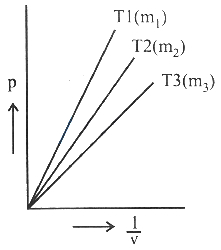
MediumMCQ
The isotherms of an ideal gas at $T_1, T_2, T_3$ along with their slopes $(m)$ are shown in the graph. If $T_1 > T_2 > T_3$,then the correct order of slopes of these isotherms is:
A
$m_2 > m_1 > m_3$
B
$m_3 > m_2 > m_1$
C
$m_2 > m_3 > m_1$
D
$m_1 > m_2 > m_3$
Solution
(D) For an ideal gas,the equation is $PV = nRT$,which can be rearranged as $P = (nRT) \times (\frac{1}{V})$.
Comparing this with the equation of a straight line $y = mx + c$,where $y = P$,$x = \frac{1}{V}$,and $c = 0$,the slope $m$ is equal to $nRT$.
Since $n$ and $R$ are constants,the slope $m$ is directly proportional to the temperature $T$ $(m \propto T)$.
Given the condition $T_1 > T_2 > T_3$,it follows that the slopes must satisfy the order $m_1 > m_2 > m_3$.
Comparing this with the equation of a straight line $y = mx + c$,where $y = P$,$x = \frac{1}{V}$,and $c = 0$,the slope $m$ is equal to $nRT$.
Since $n$ and $R$ are constants,the slope $m$ is directly proportional to the temperature $T$ $(m \propto T)$.
Given the condition $T_1 > T_2 > T_3$,it follows that the slopes must satisfy the order $m_1 > m_2 > m_3$.
0 likes
View Solution531
MediumMCQ
$n$ moles of an ideal gas at temperature $T$ (in kelvin) occupy $V \ L$ of volume,exerting a pressure of $P$ atmospheres. What is the concentration (in $mol / L$)?
A
$\frac{P}{RT}$
B
$\frac{PT}{R}$
C
$\frac{RT}{P}$
D
$\frac{R}{PT}$
Solution
(A) The ideal gas equation is given by $PV = nRT$.
Concentration is defined as the number of moles per unit volume,i.e.,$C = \frac{n}{V}$.
From the ideal gas equation,we can rearrange the terms to find $\frac{n}{V}$:
$\frac{n}{V} = \frac{P}{RT}$.
Therefore,the concentration is $\frac{P}{RT} \ mol/L$.
Concentration is defined as the number of moles per unit volume,i.e.,$C = \frac{n}{V}$.
From the ideal gas equation,we can rearrange the terms to find $\frac{n}{V}$:
$\frac{n}{V} = \frac{P}{RT}$.
Therefore,the concentration is $\frac{P}{RT} \ mol/L$.
0 likes
View Solution532
MediumMCQ
The isobars of one mole of an ideal gas were obtained at three different pressures ($p_1$,$p_2$ and $p_3$). The slopes of these isobars are $m_1$,$m_2$ and $m_3$ respectively. If $p_1 < p_2 < p_3$,then the correct relation of the slopes is
A
$m_1 > m_2 > m_3$
B
$m_1 < m_2 < m_3$
C
$m_1 > m_3 > m_2$
D
$m_1 = m_2 = m_3$
Solution
(A) For one mole of an ideal gas,the ideal gas equation is $pV = RT$,which can be rearranged as $V = (R/p)T$.
Comparing this with the equation of a straight line $y = mx + c$,where $y = V$ and $x = T$,the slope $m$ is given by $m = R/p$.
Since $R$ is a constant,the slope $m$ is inversely proportional to the pressure $p$ $(m \propto 1/p)$.
Given the condition $p_1 < p_2 < p_3$,it follows that $1/p_1 > 1/p_2 > 1/p_3$.
Therefore,the relation between the slopes is $m_1 > m_2 > m_3$.
Comparing this with the equation of a straight line $y = mx + c$,where $y = V$ and $x = T$,the slope $m$ is given by $m = R/p$.
Since $R$ is a constant,the slope $m$ is inversely proportional to the pressure $p$ $(m \propto 1/p)$.
Given the condition $p_1 < p_2 < p_3$,it follows that $1/p_1 > 1/p_2 > 1/p_3$.
Therefore,the relation between the slopes is $m_1 > m_2 > m_3$.
0 likes
View Solution533
MediumMCQ
An open vessel containing air was heated from $27^{\circ} C$ to $727^{\circ} C$. Some air was expelled. What is the fraction of air remaining in the vessel? (Assume air as an ideal gas)
A
$\frac{1}{10}$
B
$\frac{7}{10}$
C
$\frac{3}{10}$
D
$\frac{9}{10}$
Solution
(C) For an open vessel,the pressure $P$ and volume $V$ remain constant. According to the ideal gas equation $PV = nRT$,we have $n \propto \frac{1}{T}$.
Therefore,$n_1 T_1 = n_2 T_2$.
Given: $T_1 = 27 + 273 = 300 \ K$ and $T_2 = 727 + 273 = 1000 \ K$.
The fraction of air remaining is $\frac{n_2}{n_1} = \frac{T_1}{T_2}$.
Substituting the values: $\frac{n_2}{n_1} = \frac{300}{1000} = \frac{3}{10}$.
Therefore,$n_1 T_1 = n_2 T_2$.
Given: $T_1 = 27 + 273 = 300 \ K$ and $T_2 = 727 + 273 = 1000 \ K$.
The fraction of air remaining is $\frac{n_2}{n_1} = \frac{T_1}{T_2}$.
Substituting the values: $\frac{n_2}{n_1} = \frac{300}{1000} = \frac{3}{10}$.
0 likes
View Solution534
DifficultMCQ
The variation of volume of an ideal gas with its number of moles $(n)$ is obtained as a graph at $300 \ K$ and $1 \ atm$ pressure. What is the slope of the graph?
A
$24.6 \ L$
B
$24.6 \ L \ mol^{-1}$
C
$\frac{1}{24.6} \ L \ mol^{-1}$
D
$24.6 \ L^{-1} \ mol$
Solution
(B) For an ideal gas,the equation is $PV = nRT$.
Rearranging for volume $V$ as a function of moles $n$: $V = n \times (\frac{RT}{P})$.
Comparing this with the equation of a straight line $Y = mx + C$,where $Y = V$ and $x = n$,the slope $m$ is given by $\frac{RT}{P}$.
Given $R = 0.0821 \ L \ atm \ K^{-1} \ mol^{-1}$,$T = 300 \ K$,and $P = 1 \ atm$.
$\text{Slope} = \frac{0.0821 \times 300}{1} = 24.6 \ L \ mol^{-1}$.
Rearranging for volume $V$ as a function of moles $n$: $V = n \times (\frac{RT}{P})$.
Comparing this with the equation of a straight line $Y = mx + C$,where $Y = V$ and $x = n$,the slope $m$ is given by $\frac{RT}{P}$.
Given $R = 0.0821 \ L \ atm \ K^{-1} \ mol^{-1}$,$T = 300 \ K$,and $P = 1 \ atm$.
$\text{Slope} = \frac{0.0821 \times 300}{1} = 24.6 \ L \ mol^{-1}$.
0 likes
View Solution535
MediumMCQ
$4 \ g$ of an ideal gas $A$ (molar mass $= M_A$) present in a vessel of a volume $V \ L$ exerted a pressure of $5 \ atm$ at $300 \ K$. When $16 \ g$ of another ideal gas $B$ (molar mass $= M_B$) was introduced into this vessel at the same temperature,the pressure increased to $10 \ atm$. What is the correct relationship between $M_A$ and $M_B$?
A
$M_A = 4 M_B$
B
$M_A = M_B$
C
$M_A = 2 M_B$
D
$4 M_A = M_B$
Solution
(D) Using the ideal gas equation $PV = nRT = \frac{wRT}{M}$,we have $n = \frac{PV}{RT}$.
For gas $A$: $n_A = \frac{5V}{RT} = \frac{4}{M_A} \implies M_A = \frac{4RT}{5V}$.
When gas $B$ is added,the total pressure becomes $10 \ atm$. The partial pressure of gas $B$ is $P_B = P_{total} - P_A = 10 \ atm - 5 \ atm = 5 \ atm$.
For gas $B$: $n_B = \frac{5V}{RT} = \frac{16}{M_B} \implies M_B = \frac{16RT}{5V}$.
Taking the ratio: $\frac{M_A}{M_B} = \frac{4RT/5V}{16RT/5V} = \frac{4}{16} = \frac{1}{4}$.
Therefore,$4 M_A = M_B$.
For gas $A$: $n_A = \frac{5V}{RT} = \frac{4}{M_A} \implies M_A = \frac{4RT}{5V}$.
When gas $B$ is added,the total pressure becomes $10 \ atm$. The partial pressure of gas $B$ is $P_B = P_{total} - P_A = 10 \ atm - 5 \ atm = 5 \ atm$.
For gas $B$: $n_B = \frac{5V}{RT} = \frac{16}{M_B} \implies M_B = \frac{16RT}{5V}$.
Taking the ratio: $\frac{M_A}{M_B} = \frac{4RT/5V}{16RT/5V} = \frac{4}{16} = \frac{1}{4}$.
Therefore,$4 M_A = M_B$.
0 likes
View Solution536
MediumMCQ
Two containers $A$ and $B$ contain $CO_2$ gas. Pressure,volume,and absolute temperature of the gas in $A$ are $4$ times more compared to that in $B$. If the mass of the gas in $B$ is $x \ g$,then the mass of the gas in $A$ will be:
A
$\frac{x}{2} \ g$
B
$4x \ g$
C
$2x \ g$
D
$16x \ g$
Solution
(B) Using the ideal gas equation: $PV = nRT = \frac{m}{M} RT$
$\therefore m = \frac{PVM}{RT}$
Since both containers contain the same gas $(CO_2)$,the molar mass $(M)$ is constant.
Therefore,$\frac{m_A}{m_B} = \frac{P_A V_A}{P_B V_B} \times \frac{T_B}{T_A}$
Given: $P_A = 4P_B$,$V_A = 4V_B$,$T_A = 4T_B$,and $m_B = x \ g$.
Substituting these values: $\frac{m_A}{x} = \frac{(4P_B)(4V_B)}{P_B V_B} \times \frac{T_B}{4T_B}$
$\frac{m_A}{x} = 16 \times \frac{1}{4} = 4$
$m_A = 4x \ g$
$\therefore m = \frac{PVM}{RT}$
Since both containers contain the same gas $(CO_2)$,the molar mass $(M)$ is constant.
Therefore,$\frac{m_A}{m_B} = \frac{P_A V_A}{P_B V_B} \times \frac{T_B}{T_A}$
Given: $P_A = 4P_B$,$V_A = 4V_B$,$T_A = 4T_B$,and $m_B = x \ g$.
Substituting these values: $\frac{m_A}{x} = \frac{(4P_B)(4V_B)}{P_B V_B} \times \frac{T_B}{4T_B}$
$\frac{m_A}{x} = 16 \times \frac{1}{4} = 4$
$m_A = 4x \ g$
0 likes
View Solution537
MediumMCQ
$1 \ L$ closed flask contains a mixture of $4 \ g$ of methane and $4.4 \ g$ of carbon dioxide. The pressure inside the flask at $27^{\circ} C$ is [Assume ideal behaviour of gases] (in $atm$)
A
$8.6$
B
$2.2$
C
$4.2$
D
$6.1$
Solution
(A) Step $1$: Calculate the number of moles of each gas.
$n_{CH_4} = \frac{4 \ g}{16 \ g/mol} = 0.25 \ mol$
$n_{CO_2} = \frac{4.4 \ g}{44 \ g/mol} = 0.1 \ mol$
Step $2$: Calculate the total number of moles $(n_T)$.
$n_T = 0.25 \ mol + 0.1 \ mol = 0.35 \ mol$
Step $3$: Use the ideal gas equation $PV = nRT$ to find the pressure.
Given: $V = 1 \ L$,$T = 27 + 273 = 300 \ K$,$R = 0.082 \ L \ atm \ K^{-1} \ mol^{-1}$.
$P = \frac{n_T RT}{V} = \frac{0.35 \times 0.082 \times 300}{1} = 8.61 \ atm \approx 8.6 \ atm$.
$n_{CH_4} = \frac{4 \ g}{16 \ g/mol} = 0.25 \ mol$
$n_{CO_2} = \frac{4.4 \ g}{44 \ g/mol} = 0.1 \ mol$
Step $2$: Calculate the total number of moles $(n_T)$.
$n_T = 0.25 \ mol + 0.1 \ mol = 0.35 \ mol$
Step $3$: Use the ideal gas equation $PV = nRT$ to find the pressure.
Given: $V = 1 \ L$,$T = 27 + 273 = 300 \ K$,$R = 0.082 \ L \ atm \ K^{-1} \ mol^{-1}$.
$P = \frac{n_T RT}{V} = \frac{0.35 \times 0.082 \times 300}{1} = 8.61 \ atm \approx 8.6 \ atm$.
0 likes
View Solution538
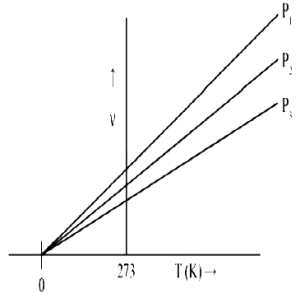
EasyMCQ
$A$ plot of volume $(V)$ of the gas versus temperature ($T$ in $K$) is shown below. Which of the following options is correct for the plot?
A
$P_1 < P_2 < P_3$
B
$P_3 < P_2 < P_1$
C
$P_1 = P_2 \neq P_3$
D
$P_1 = P_2 = P_3 = 0$ at $273 \ K$
Solution
(A) According to the ideal gas equation,$PV = nRT$,which can be rearranged as $V = (\frac{nR}{P})T$.
This equation represents a straight line passing through the origin $(V = mT)$,where the slope $(m)$ is equal to $\frac{nR}{P}$.
Since the slope is inversely proportional to pressure $(P)$,a line with a steeper slope corresponds to a lower pressure.
In the given plot,the slope of the line for $P_1$ is the highest,followed by $P_2$,and then $P_3$ (which has the lowest slope).
Therefore,the order of pressure is $P_3 > P_2 > P_1$,or $P_1 < P_2 < P_3$.
This equation represents a straight line passing through the origin $(V = mT)$,where the slope $(m)$ is equal to $\frac{nR}{P}$.
Since the slope is inversely proportional to pressure $(P)$,a line with a steeper slope corresponds to a lower pressure.
In the given plot,the slope of the line for $P_1$ is the highest,followed by $P_2$,and then $P_3$ (which has the lowest slope).
Therefore,the order of pressure is $P_3 > P_2 > P_1$,or $P_1 < P_2 < P_3$.
0 likes
View Solution539
MediumMCQ
Which gas has a density of $1.24 \ g/L$ at $0^{\circ} C$ and $1 \ atm$ pressure?
A
$O_2$
B
$CH_4$
C
$CO$
D
$CO_2$
Solution
(C) The ideal gas equation is given by $PM = dRT$.
Here,$P = 1 \ atm$,$d = 1.24 \ g/L$,$R = 0.0821 \ L \ atm \ K^{-1} \ mol^{-1}$,and $T = 273 \ K$.
Rearranging the formula to solve for molar mass $(M)$:
$M = \frac{dRT}{P} = \frac{1.24 \times 0.0821 \times 273}{1} \approx 28 \ g/mol$.
The molar mass of $CO$ is $12 + 16 = 28 \ g/mol$.
Therefore,the gas is $CO$.
Here,$P = 1 \ atm$,$d = 1.24 \ g/L$,$R = 0.0821 \ L \ atm \ K^{-1} \ mol^{-1}$,and $T = 273 \ K$.
Rearranging the formula to solve for molar mass $(M)$:
$M = \frac{dRT}{P} = \frac{1.24 \times 0.0821 \times 273}{1} \approx 28 \ g/mol$.
The molar mass of $CO$ is $12 + 16 = 28 \ g/mol$.
Therefore,the gas is $CO$.
0 likes
View Solution540
EasyMCQ
$A$ balloon filled with an air sample occupies $3 \,L$ volume at $35^{\circ} C$. On lowering the temperature to $T$, the volume decreases to $2.5 \,L$. The temperature $T$ is (in $^{\circ} C$)? [Assume $p$-constant]
A
$16$
B
$-16$
C
$24$
D
$-20$
Solution
(B) According to Charle's law, at constant pressure, $V \propto T$ or $\frac{V_1}{T_1} = \frac{V_2}{T_2}$.
Given: $V_1 = 3 \,L$, $T_1 = 35 + 273 = 308 \,K$.
$V_2 = 2.5 \,L$, $T_2 = T$.
Substituting the values: $\frac{3}{308} = \frac{2.5}{T_2}$.
$T_2 = \frac{2.5 \times 308}{3} = 256.67 \,K$.
Converting to Celsius: $T(^{\circ}C) = 256.67 - 273 = -16.33^{\circ} C$.
Rounding to the nearest option, $T \approx -16^{\circ} C$.
Given: $V_1 = 3 \,L$, $T_1 = 35 + 273 = 308 \,K$.
$V_2 = 2.5 \,L$, $T_2 = T$.
Substituting the values: $\frac{3}{308} = \frac{2.5}{T_2}$.
$T_2 = \frac{2.5 \times 308}{3} = 256.67 \,K$.
Converting to Celsius: $T(^{\circ}C) = 256.67 - 273 = -16.33^{\circ} C$.
Rounding to the nearest option, $T \approx -16^{\circ} C$.
0 likes
View Solution541
EasyMCQ
$4.4 \ g$ of a gas at $0^{\circ} C$ and $0.82 \ atm$ pressure occupies a volume of $2.73 \ L$. The gas can be:
A
$O_2$
B
$CO$
C
$NO_2$
D
$CO_2$
Solution
(D) Using the ideal gas equation: $PV = nRT = \frac{w}{M} RT$
Where $M$ is the molar mass of the gas.
Given: $w = 4.4 \ g$,$T = 0^{\circ} C = 273 \ K$,$R = 0.082 \ L \cdot atm \cdot K^{-1} \cdot mol^{-1}$,$P = 0.82 \ atm$,$V = 2.73 \ L$.
Substituting the values: $0.82 \times 2.73 = \frac{4.4}{M} \times 0.082 \times 273$
$M = \frac{4.4 \times 0.082 \times 273}{0.82 \times 2.73}$
$M = \frac{4.4 \times 22.386}{2.2386} = 44 \ g/mol$.
The molar mass of $CO_2$ is $12 + 2 \times 16 = 44 \ g/mol$.
Therefore,the gas is $CO_2$.
Where $M$ is the molar mass of the gas.
Given: $w = 4.4 \ g$,$T = 0^{\circ} C = 273 \ K$,$R = 0.082 \ L \cdot atm \cdot K^{-1} \cdot mol^{-1}$,$P = 0.82 \ atm$,$V = 2.73 \ L$.
Substituting the values: $0.82 \times 2.73 = \frac{4.4}{M} \times 0.082 \times 273$
$M = \frac{4.4 \times 0.082 \times 273}{0.82 \times 2.73}$
$M = \frac{4.4 \times 22.386}{2.2386} = 44 \ g/mol$.
The molar mass of $CO_2$ is $12 + 2 \times 16 = 44 \ g/mol$.
Therefore,the gas is $CO_2$.
0 likes
View Solution542
EasyMCQ
One mole of an ideal gas occupies $12 \ L$ at $297^{\circ} C$. What is the pressure of the gas?
A
$207 \ kPa$
B
$395 \ kPa$
C
$395 \ Pa$
D
$207 \ Pa$
Solution
(B) Using the ideal gas equation $PV = nRT$.
Given: $n = 1 \ mol$,$V = 12 \ L = 12 \times 10^{-3} \ m^3$,$T = 297 + 273 = 570 \ K$,$R = 8.314 \ J \ K^{-1} \ mol^{-1}$.
$P = \frac{nRT}{V} = \frac{1 \times 8.314 \times 570}{12 \times 10^{-3}} \ Pa$.
$P = \frac{4738.98}{0.012} \ Pa = 394915 \ Pa \approx 395 \ kPa$.
Given: $n = 1 \ mol$,$V = 12 \ L = 12 \times 10^{-3} \ m^3$,$T = 297 + 273 = 570 \ K$,$R = 8.314 \ J \ K^{-1} \ mol^{-1}$.
$P = \frac{nRT}{V} = \frac{1 \times 8.314 \times 570}{12 \times 10^{-3}} \ Pa$.
$P = \frac{4738.98}{0.012} \ Pa = 394915 \ Pa \approx 395 \ kPa$.
0 likes
View Solution543
EasyMCQ
$A$ gas is present at a pressure of $2 \,atm$. What should be the increase in pressure, so that the volume of the gas can be decreased to $\frac{1}{4}$ of the initial volume at constant temperature (in $\,atm$)?
A
$2$
B
$4$
C
$6$
D
$8$
Solution
(C) According to Boyle's Law, at constant temperature, $P_1V_1 = P_2V_2$.
Given: $P_1 = 2 \,atm$, $V_1 = V$, $V_2 = \frac{V}{4}$.
Substituting the values: $2 \times V = P_2 \times \frac{V}{4}$.
$P_2 = 2 \times 4 = 8 \,atm$.
The final pressure is $8 \,atm$.
The increase in pressure $= P_2 - P_1 = 8 \,atm - 2 \,atm = 6 \,atm$.
Given: $P_1 = 2 \,atm$, $V_1 = V$, $V_2 = \frac{V}{4}$.
Substituting the values: $2 \times V = P_2 \times \frac{V}{4}$.
$P_2 = 2 \times 4 = 8 \,atm$.
The final pressure is $8 \,atm$.
The increase in pressure $= P_2 - P_1 = 8 \,atm - 2 \,atm = 6 \,atm$.
0 likes
View Solution544
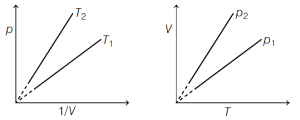
MediumMCQ
Identify the correct observation with respect to the given graphs.
A
$T_1 > T_2$ and $p_1 > p_2$
B
$T_2 > T_1$ and $p_1 > p_2$
C
$T_1 > T_2$ and $p_2 > p_1$
D
$T_2 > T_1$ and $p_2 > p_1$
Solution
(B) For the first graph ($p$ vs $1/V$): According to the ideal gas equation $pV = nRT$,we have $p = (nRT) \times (1/V)$. The slope of the line is $nRT$. Since the slope for $T_2$ is greater than the slope for $T_1$,it follows that $T_2 > T_1$.
For the second graph ($V$ vs $T$): According to Charles' law $V = (nR/p) \times T$. The slope of the line is $nR/p$. Since the slope for $p_2$ is greater than the slope for $p_1$,and the slope is inversely proportional to pressure,it follows that $p_1 > p_2$.
Therefore,the correct observation is $T_2 > T_1$ and $p_1 > p_2$.
For the second graph ($V$ vs $T$): According to Charles' law $V = (nR/p) \times T$. The slope of the line is $nR/p$. Since the slope for $p_2$ is greater than the slope for $p_1$,and the slope is inversely proportional to pressure,it follows that $p_1 > p_2$.
Therefore,the correct observation is $T_2 > T_1$ and $p_1 > p_2$.
0 likes
View Solution545
EasyMCQ
Which among the following graphs correctly represents Boyle's Law?
A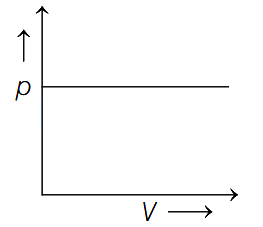
B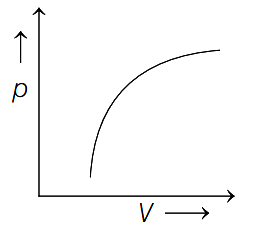
C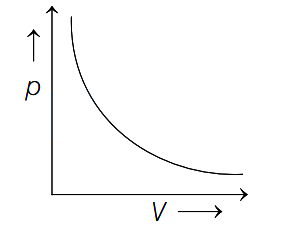
D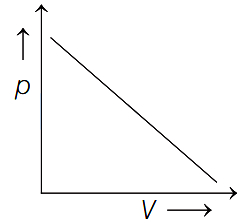
Solution
(C) Boyle's Law states that for a given mass of an ideal gas at constant temperature,the pressure $(p)$ is inversely proportional to its volume $(V)$.
Mathematically,this is expressed as:
$p \propto \frac{1}{V}$
$p \cdot V = k$ (where $k$ is a constant)
This relationship represents a rectangular hyperbola when plotting pressure $(p)$ on the $y$-axis against volume $(V)$ on the $x$-axis.
Therefore,the graph that correctly represents Boyle's Law is the one showing a hyperbolic curve where $p$ decreases as $V$ increases.
Mathematically,this is expressed as:
$p \propto \frac{1}{V}$
$p \cdot V = k$ (where $k$ is a constant)
This relationship represents a rectangular hyperbola when plotting pressure $(p)$ on the $y$-axis against volume $(V)$ on the $x$-axis.
Therefore,the graph that correctly represents Boyle's Law is the one showing a hyperbolic curve where $p$ decreases as $V$ increases.
0 likes
View Solution546
EasyMCQ
The volume of a given amount of gas at $27^{\circ} C$ at constant pressure is $420 \ cm^3$. If the temperature is reduced by $20^{\circ} C$ at constant pressure,what will be the volume of the gas (in $cm^3$)?
A
$350$
B
$392$
C
$450$
D
$480$
Solution
(B) According to Charles' law,$\frac{V_1}{T_1} = \frac{V_2}{T_2}$ at constant pressure.
Given: $V_1 = 420 \ cm^3$,$T_1 = 27 + 273 = 300 \ K$.
The temperature is reduced by $20^{\circ} C$,so $T_2 = 300 \ K - 20 \ K = 280 \ K$.
Using the formula $V_2 = \frac{V_1 \times T_2}{T_1}$:
$V_2 = \frac{420 \ cm^3 \times 280 \ K}{300 \ K} = 392 \ cm^3$.
Given: $V_1 = 420 \ cm^3$,$T_1 = 27 + 273 = 300 \ K$.
The temperature is reduced by $20^{\circ} C$,so $T_2 = 300 \ K - 20 \ K = 280 \ K$.
Using the formula $V_2 = \frac{V_1 \times T_2}{T_1}$:
$V_2 = \frac{420 \ cm^3 \times 280 \ K}{300 \ K} = 392 \ cm^3$.
0 likes
View Solution547
MediumMCQ
Equal amounts of gases are kept in two separate containers. If the densities of the two gases are in $1:2$ ratio and their temperatures are in $2:1$ ratio,calculate the ratio of their respective pressures.
A
$1:1$
B
$1:2$
C
$2:1$
D
$4:1$
Solution
(A) The ideal gas equation is $PV = nRT$. Since $n = \frac{m}{M}$,we have $PV = \frac{m}{M}RT$,which rearranges to $P = \frac{m}{V} \times \frac{RT}{M} = \frac{dRT}{M}$.
For equal amounts of the same gas,the molar mass $M$ is constant,so $P \propto d \times T$.
Therefore,the ratio of pressures is $\frac{P_1}{P_2} = \frac{d_1}{d_2} \times \frac{T_1}{T_2}$.
Given $\frac{d_1}{d_2} = \frac{1}{2}$ and $\frac{T_1}{T_2} = \frac{2}{1}$.
Substituting these values: $\frac{P_1}{P_2} = \frac{1}{2} \times \frac{2}{1} = \frac{1}{1}$.
Thus,the ratio of their pressures is $1:1$.
For equal amounts of the same gas,the molar mass $M$ is constant,so $P \propto d \times T$.
Therefore,the ratio of pressures is $\frac{P_1}{P_2} = \frac{d_1}{d_2} \times \frac{T_1}{T_2}$.
Given $\frac{d_1}{d_2} = \frac{1}{2}$ and $\frac{T_1}{T_2} = \frac{2}{1}$.
Substituting these values: $\frac{P_1}{P_2} = \frac{1}{2} \times \frac{2}{1} = \frac{1}{1}$.
Thus,the ratio of their pressures is $1:1$.
0 likes
View Solution548
EasyMCQ
The nitrogen gas pressure inside a container of volume $2.6 \ cm^3$ is $2.3 \ atm$ at $27^{\circ} C$. The approximate number of moles of nitrogen present in the container is $[R=0.0821 \ L \ atm \ mol^{-1} \ K^{-1}]$
A
$4 \times 10^{-3}$
B
$1.7 \times 10^{-4}$
C
$4 \times 10^{-4}$
D
$2 \times 10^{-4}$
Solution
(D) Given:
Pressure of $N_2$ gas $(P) = 2.3 \ atm$
Volume $(V) = 2.6 \ cm^3 = 2.6 \times 10^{-3} \ L$
Temperature $(T) = 27^{\circ} C + 273 = 300 \ K$
Gas constant $(R) = 0.0821 \ L \ atm \ mol^{-1} \ K^{-1}$
Using the ideal gas equation: $PV = nRT$
$n = \frac{PV}{RT}$
$n = \frac{2.3 \ atm \times 2.6 \times 10^{-3} \ L}{0.0821 \ L \ atm \ mol^{-1} \ K^{-1} \times 300 \ K}$
$n = \frac{5.98 \times 10^{-3}}{24.63} \ mol$
$n \approx 2.42 \times 10^{-4} \ mol$
Rounding to the nearest provided option,the value is $2 \times 10^{-4} \ mol$.
Pressure of $N_2$ gas $(P) = 2.3 \ atm$
Volume $(V) = 2.6 \ cm^3 = 2.6 \times 10^{-3} \ L$
Temperature $(T) = 27^{\circ} C + 273 = 300 \ K$
Gas constant $(R) = 0.0821 \ L \ atm \ mol^{-1} \ K^{-1}$
Using the ideal gas equation: $PV = nRT$
$n = \frac{PV}{RT}$
$n = \frac{2.3 \ atm \times 2.6 \times 10^{-3} \ L}{0.0821 \ L \ atm \ mol^{-1} \ K^{-1} \times 300 \ K}$
$n = \frac{5.98 \times 10^{-3}}{24.63} \ mol$
$n \approx 2.42 \times 10^{-4} \ mol$
Rounding to the nearest provided option,the value is $2 \times 10^{-4} \ mol$.
0 likes
View Solution549
EasyMCQ
Which of the following plots is/are correct for Boyle's law?
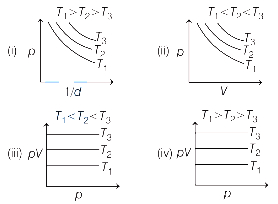
A
$(iv)$
B
$(ii), (iv)$
C
$(i), (iv)$
D
$(ii), (iii)$
Solution
(B) Boyle's law states that at constant temperature $(T)$ and amount of gas $(n)$,the pressure $(p)$ of a fixed amount of gas is inversely proportional to its volume $(V)$:
$p \propto \frac{1}{V} \implies pV = \text{constant} \quad (k)$
$1$. Plot $(ii)$: Shows $p$ vs $V$ at different temperatures. Since $pV = nRT$,$p = \frac{nRT}{V}$. For a given $V$,$p$ increases as $T$ increases. Thus,for $T_3 > T_2 > T_1$,the curve for $T_3$ should be above $T_2$,which is above $T_1$. The plot $(ii)$ shows $T_1 < T_2 < T_3$ with curves correctly ordered,making it a correct representation of Boyle's law isotherms.
$2$. Plot $(iv)$: Shows $pV$ vs $p$. Since $pV = nRT$,for a fixed $T$,$pV$ is constant. As $T$ increases,the value of the constant $nRT$ increases. Thus,$pV$ should be higher for higher temperatures. The plot $(iv)$ shows $T_1 < T_2 < T_3$ with $pV$ values increasing accordingly,which is correct.
Plots $(i)$ and $(iii)$ do not correctly represent the relationship between the variables at different temperatures based on the ideal gas equation.
Therefore,plots $(ii)$ and $(iv)$ are correct.
$p \propto \frac{1}{V} \implies pV = \text{constant} \quad (k)$
$1$. Plot $(ii)$: Shows $p$ vs $V$ at different temperatures. Since $pV = nRT$,$p = \frac{nRT}{V}$. For a given $V$,$p$ increases as $T$ increases. Thus,for $T_3 > T_2 > T_1$,the curve for $T_3$ should be above $T_2$,which is above $T_1$. The plot $(ii)$ shows $T_1 < T_2 < T_3$ with curves correctly ordered,making it a correct representation of Boyle's law isotherms.
$2$. Plot $(iv)$: Shows $pV$ vs $p$. Since $pV = nRT$,for a fixed $T$,$pV$ is constant. As $T$ increases,the value of the constant $nRT$ increases. Thus,$pV$ should be higher for higher temperatures. The plot $(iv)$ shows $T_1 < T_2 < T_3$ with $pV$ values increasing accordingly,which is correct.
Plots $(i)$ and $(iii)$ do not correctly represent the relationship between the variables at different temperatures based on the ideal gas equation.
Therefore,plots $(ii)$ and $(iv)$ are correct.
0 likes
View SolutionStates of Matter — Ideal gas equation and Related gas laws · Frequently Asked Questions
1Are these States of Matter questions useful for JEE and NEET?
Yes. All questions in this section are mapped to JEE Main and NEET exam patterns. Previous year questions from JEE Main, NEET, GUJCET and state-level exams are included with full solutions.
2Can I switch to Hindi or Gujarati for these questions?
Yes. Use the language tabs in the hero section or the sidebar to view the same questions and solutions in English, Hindi or Gujarati.
3How do I generate a question paper from this subtopic?
Use the Vedclass Exam Paper Generator — select the chapter and subtopic, set difficulty, and generate Sets A, B, C, D automatically. First 3 chapters of every subject are free.
Vedclass Products
For Students
Vedclass Test Series
Mock tests in real JEE/NEET style with performance analysis. 5-day free trial.
Start Free TrialFor Teachers
Exam Paper Generator
Generate Set A/B/C/D papers from this chapter in 2 minutes. 3 chapters free.
Try FreeFor Institutes
Online Exam Module
Live online exams with unlimited students, 360° analytics & white-label branding.
See DemoFor Teachers & Institutes
Generate a States of Matter Exam Paper in 2 Minutes
Select subtopic & difficulty — Sets A, B, C, D auto-generated with No Repeat logic.
First 3 chapters of every subject are free — no payment required.