
A English
Aromatic hydrocarbon Questions in English
Class 11 Chemistry · Hydrocarbons · Aromatic hydrocarbon
872+
Questions
English
Language
100%
With Solutions
Showing 49 of 872 questions in English
501
DifficultMCQ
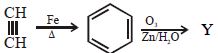
Glyoxal is:
A
$HO-CH_2-CH_2-OH$
B
$CH_3-CH_2-OH$
C
$CH_3-COOH$
D
$OHC-CHO$
Solution
(D) Glyoxal is the simplest dialdehyde with the chemical formula $OHC-CHO$. It can be prepared by the ozonolysis of benzene followed by reductive workup with $Zn/H_2O$.
0 likes
View Solution502
MediumMCQ
Which of the following is an aromatic compound?
A
Cyclopentadiene
B
Cyclobutadiene radical cation
C
Cyclopentadienyl anion
D
Cyclobutadiene radical anion
Solution
(C) According to $H$ückel's rule,a compound is aromatic if it is cyclic,planar,fully conjugated,and contains $(4n + 2) \pi$ electrons,where $n = 0, 1, 2, ...$.
$(A)$ Cyclopentadiene: Not fully conjugated (has an $sp^3$ carbon).
$(B)$ Cyclobutadiene radical cation: Contains $3 \pi$ electrons (not $4n+2$).
$(C)$ Cyclopentadienyl anion: Contains $6 \pi$ electrons $(n=1)$,is cyclic,planar,and fully conjugated. Thus,it is aromatic.
$(D)$ Cyclobutadiene radical anion: Contains $5 \pi$ electrons (not $4n+2$).
$(A)$ Cyclopentadiene: Not fully conjugated (has an $sp^3$ carbon).
$(B)$ Cyclobutadiene radical cation: Contains $3 \pi$ electrons (not $4n+2$).
$(C)$ Cyclopentadienyl anion: Contains $6 \pi$ electrons $(n=1)$,is cyclic,planar,and fully conjugated. Thus,it is aromatic.
$(D)$ Cyclobutadiene radical anion: Contains $5 \pi$ electrons (not $4n+2$).
0 likes
View Solution503
MediumMCQ
The reaction of benzene with $CH_2Cl_2$ in the presence of $AlCl_3$ gives product $A$. Identify $A$.
A
Benzyl chloride
B
Benzal chloride
C
Diphenylmethane
D
Benzene
Solution
(C) The reaction of benzene with dichloromethane $(CH_2Cl_2)$ in the presence of a Lewis acid catalyst like $AlCl_3$ is a Friedel-Crafts alkylation reaction.
Since $CH_2Cl_2$ has two chlorine atoms,it can react with two molecules of benzene to form diphenylmethane $(C_6H_5-CH_2-C_6H_5)$ as the final product.
The balanced chemical equation is:
$2C_6H_6 + CH_2Cl_2 \xrightarrow{AlCl_3} C_6H_5-CH_2-C_6H_5 + 2HCl$
Therefore,the product $A$ is diphenylmethane.
Since $CH_2Cl_2$ has two chlorine atoms,it can react with two molecules of benzene to form diphenylmethane $(C_6H_5-CH_2-C_6H_5)$ as the final product.
The balanced chemical equation is:
$2C_6H_6 + CH_2Cl_2 \xrightarrow{AlCl_3} C_6H_5-CH_2-C_6H_5 + 2HCl$
Therefore,the product $A$ is diphenylmethane.
0 likes
View Solution504
DifficultMCQ
Which of the following represents a Friedel-Crafts reaction?
A
$C_6H_6 + C_2H_5-Cl \xrightarrow{AlCl_3} C_6H_5-C_2H_5 + HCl$
B
$C_6H_5-OH + HCl \xrightarrow{ZnCl_2} C_6H_5Cl + H_2O$
C
$C_6H_5-Cl + CH_3COCl \xrightarrow{AlCl_3} C_6H_5COCH_3 + Cl_2$
D
$C_2H_5-Br + Mg \xrightarrow{ether} C_2H_5MgBr$
Solution
(A) The Friedel-Crafts reaction involves the electrophilic substitution of an aromatic ring with an alkyl or acyl group in the presence of a Lewis acid catalyst like $AlCl_3$.
Option $(A)$ represents Friedel-Crafts alkylation,where benzene reacts with ethyl chloride in the presence of anhydrous $AlCl_3$ to form ethylbenzene.
Therefore,the correct option is $(A)$.
Option $(A)$ represents Friedel-Crafts alkylation,where benzene reacts with ethyl chloride in the presence of anhydrous $AlCl_3$ to form ethylbenzene.
Therefore,the correct option is $(A)$.
0 likes
View Solution505
MediumMCQ
Find the decreasing order of reactivity towards electrophilic substitution reaction for the following compounds:
$I$: Toluene $(C_6H_5CH_3)$
$II$: Benzene $(C_6H_6)$
$III$: Anisole $(C_6H_5OCH_3)$
$IV$: Trifluoromethylbenzene $(C_6H_5CF_3)$
$I$: Toluene $(C_6H_5CH_3)$
$II$: Benzene $(C_6H_6)$
$III$: Anisole $(C_6H_5OCH_3)$
$IV$: Trifluoromethylbenzene $(C_6H_5CF_3)$
A
$II > I > III > IV$
B
$III > I > II > IV$
C
$III > I > IV > II$
D
$II > I > IV > III$
Solution
(B) The reactivity towards electrophilic aromatic substitution depends on the electron density of the benzene ring.
$1$. The $-OCH_3$ group in $III$ (Anisole) is a strong electron-donating group by resonance ($+R$ effect),which significantly increases the electron density of the ring.
$2$. The $-CH_3$ group in $I$ (Toluene) is an electron-donating group by hyperconjugation and inductive effect ($+I$ effect),which increases the electron density of the ring,but less effectively than the $-OCH_3$ group.
$3$. $II$ (Benzene) has no substituent,so it has standard electron density.
$4$. The $-CF_3$ group in $IV$ (Trifluoromethylbenzene) is a strong electron-withdrawing group by inductive effect ($-I$ effect),which significantly decreases the electron density of the ring.
Therefore,the decreasing order of reactivity is $III > I > II > IV$.
$1$. The $-OCH_3$ group in $III$ (Anisole) is a strong electron-donating group by resonance ($+R$ effect),which significantly increases the electron density of the ring.
$2$. The $-CH_3$ group in $I$ (Toluene) is an electron-donating group by hyperconjugation and inductive effect ($+I$ effect),which increases the electron density of the ring,but less effectively than the $-OCH_3$ group.
$3$. $II$ (Benzene) has no substituent,so it has standard electron density.
$4$. The $-CF_3$ group in $IV$ (Trifluoromethylbenzene) is a strong electron-withdrawing group by inductive effect ($-I$ effect),which significantly decreases the electron density of the ring.
Therefore,the decreasing order of reactivity is $III > I > II > IV$.
0 likes
View Solution506
MediumMCQ
$C_6H_5-CH_3$ $\xrightarrow{KMnO_4} A$ $\xrightarrow[\Delta]{NaOH + CaO} B$, product $B$ is
A
$C_6H_5OH$
B
$C_6H_5ONa$
C
$C_6H_6$
D
$C_6H_5COONa$
Solution
(C) Step $1$: Oxidation of toluene $(C_6H_5-CH_3)$ with alkaline $KMnO_4$ gives benzoic acid $(C_6H_5COOH)$ as product $A$.
Step $2$: Decarboxylation of sodium benzoate $(C_6H_5COONa)$ with soda lime $(NaOH + CaO)$ at high temperature $(\Delta)$ yields benzene $(C_6H_6)$ as product $B$.
Reaction sequence: $C_6H_5-CH_3$ $\xrightarrow{KMnO_4} C_6H_5COOH$ $\xrightarrow{NaOH} C_6H_5COONa$ $\xrightarrow{NaOH + CaO, \Delta} C_6H_6$.
Step $2$: Decarboxylation of sodium benzoate $(C_6H_5COONa)$ with soda lime $(NaOH + CaO)$ at high temperature $(\Delta)$ yields benzene $(C_6H_6)$ as product $B$.
Reaction sequence: $C_6H_5-CH_3$ $\xrightarrow{KMnO_4} C_6H_5COOH$ $\xrightarrow{NaOH} C_6H_5COONa$ $\xrightarrow{NaOH + CaO, \Delta} C_6H_6$.
0 likes
View Solution507
DifficultMCQ
What is the major product of the following reaction?
$1$-ethyl-$4$-methylbenzene $\xrightarrow{KMnO_4 + H^+}$ ?
$1$-ethyl-$4$-methylbenzene $\xrightarrow{KMnO_4 + H^+}$ ?
A
$4-$ethylbenzoic acid
B
$4-$methylbenzoic acid
C
benzene$-1,4-$dicarboxylic acid (terephthalic acid)
D
$4-$ethylbenzoic acid methyl ester
Solution
(C) The reaction involves the oxidation of alkylbenzenes using strong oxidizing agents like $KMnO_4$ in an acidic medium.
Any alkyl group attached to the benzene ring,provided it has at least one benzylic hydrogen atom,is oxidized to a carboxylic acid group $(-COOH)$ regardless of the length of the alkyl chain.
In the given reactant,$1$-ethyl-$4$-methylbenzene,both the methyl group $(-CH_3)$ and the ethyl group $(-CH_2CH_3)$ have benzylic hydrogen atoms.
Therefore,both alkyl groups are oxidized to carboxylic acid groups,resulting in the formation of benzene-$1,4$-dicarboxylic acid,also known as terephthalic acid.
The correct option is $C$.
Any alkyl group attached to the benzene ring,provided it has at least one benzylic hydrogen atom,is oxidized to a carboxylic acid group $(-COOH)$ regardless of the length of the alkyl chain.
In the given reactant,$1$-ethyl-$4$-methylbenzene,both the methyl group $(-CH_3)$ and the ethyl group $(-CH_2CH_3)$ have benzylic hydrogen atoms.
Therefore,both alkyl groups are oxidized to carboxylic acid groups,resulting in the formation of benzene-$1,4$-dicarboxylic acid,also known as terephthalic acid.
The correct option is $C$.
0 likes
View Solution508
DifficultMCQ
Benzene $ + (CH_3)_3C-CH_2Cl \xrightarrow{AlCl_3} \text{Major product}$
A
tert-Butylbenzene
B
Neopentylbenzene
C
Isobutylbenzene
D
tert-Pentylbenzene
Solution
(D) The reaction is a Friedel-Crafts alkylation. The alkyl halide is $(CH_3)_3C-CH_2Cl$ (neopentyl chloride).
When $AlCl_3$ acts on this primary alkyl halide,it forms a carbocation intermediate.
Initially,a primary carbocation $(CH_3)_3C-CH_2^+$ is formed,which is highly unstable.
It immediately undergoes a $1,2-$methyl shift to form a more stable tertiary carbocation $(CH_3)_2C^+-CH_2-CH_3$.
This tertiary carbocation then attacks the benzene ring to form the major product,which is tert-pentylbenzene ($2$-methyl$-2-$phenylbutane).
When $AlCl_3$ acts on this primary alkyl halide,it forms a carbocation intermediate.
Initially,a primary carbocation $(CH_3)_3C-CH_2^+$ is formed,which is highly unstable.
It immediately undergoes a $1,2-$methyl shift to form a more stable tertiary carbocation $(CH_3)_2C^+-CH_2-CH_3$.
This tertiary carbocation then attacks the benzene ring to form the major product,which is tert-pentylbenzene ($2$-methyl$-2-$phenylbutane).
0 likes
View Solution509
MediumMCQ
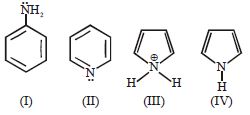
Which of the following are aromatic compounds?
A
$I$,$II$ and $IV$
B
$II$,$III$ and $IV$
C
$I$,$II$,$III$
D
All compounds are aromatic
Solution
(A) To be aromatic,a compound must follow $H$ückel's rule: it must be cyclic,planar,fully conjugated,and contain $(4n+2) \pi$ electrons.
$I$ (Aniline): It is cyclic,planar,and has $6 \pi$ electrons (fully conjugated). It is aromatic.
$II$ (Pyridine): It is cyclic,planar,and has $6 \pi$ electrons (the lone pair on $N$ is in an $sp^2$ orbital and not part of the $\pi$ system). It is aromatic.
$III$ (Pyrrolium cation): The nitrogen atom is $sp^3$ hybridized,making the ring non-planar. It is not aromatic.
$IV$ (Pyrrole): It is cyclic,planar,and has $6 \pi$ electrons (the lone pair on $N$ participates in conjugation). It is aromatic.
Thus,$I$,$II$,and $IV$ are aromatic.
$I$ (Aniline): It is cyclic,planar,and has $6 \pi$ electrons (fully conjugated). It is aromatic.
$II$ (Pyridine): It is cyclic,planar,and has $6 \pi$ electrons (the lone pair on $N$ is in an $sp^2$ orbital and not part of the $\pi$ system). It is aromatic.
$III$ (Pyrrolium cation): The nitrogen atom is $sp^3$ hybridized,making the ring non-planar. It is not aromatic.
$IV$ (Pyrrole): It is cyclic,planar,and has $6 \pi$ electrons (the lone pair on $N$ participates in conjugation). It is aromatic.
Thus,$I$,$II$,and $IV$ are aromatic.
0 likes
View Solution510
DifficultMCQ
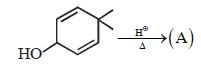
Product $(A)$ is
A
Ethylbenzene
B
o-Xylene
C
Isopropylbenzene
D
m-Xylene
Solution
(B) The reaction proceeds through the following steps:
$1$. Protonation of the hydroxyl group: The $-OH$ group is protonated by $H^{\oplus}$ to form a good leaving group $-OH_2^{\oplus}$.
$2$. Formation of carbocation: Loss of water molecule generates a carbocation.
$3$. Rearrangement: $A$ $1,2-CH_3$ shift occurs to stabilize the carbocation and form a more stable intermediate.
$4$. Deprotonation: Loss of a proton $(-H^{\oplus})$ leads to the formation of the aromatic product,$o$-xylene ($1,2$-dimethylbenzene).
$1$. Protonation of the hydroxyl group: The $-OH$ group is protonated by $H^{\oplus}$ to form a good leaving group $-OH_2^{\oplus}$.
$2$. Formation of carbocation: Loss of water molecule generates a carbocation.
$3$. Rearrangement: $A$ $1,2-CH_3$ shift occurs to stabilize the carbocation and form a more stable intermediate.
$4$. Deprotonation: Loss of a proton $(-H^{\oplus})$ leads to the formation of the aromatic product,$o$-xylene ($1,2$-dimethylbenzene).
0 likes
View Solution511
AdvancedMCQ
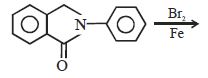
In the reaction,the major product formed is:
A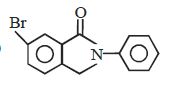
B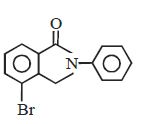
C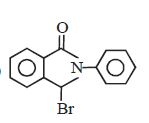
D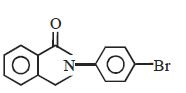
Solution
(D) The reaction involves the electrophilic aromatic substitution of $N$-phenyl-substituted amide (specifically,$N$-phenyl-dihydroisoquinolinone).
In the $N$-phenyl group,the nitrogen atom is attached to the phenyl ring. The nitrogen atom has a lone pair,but it is involved in resonance with the adjacent carbonyl group $(C=O)$,which makes the nitrogen atom less electron-donating to the phenyl ring compared to a free amine. However,the nitrogen still acts as an ortho/para-directing group.
Due to steric hindrance caused by the bulky dihydroisoquinolinone group attached to the nitrogen,the electrophilic substitution (bromination using $Br_2/Fe$) occurs primarily at the para-position of the $N$-phenyl ring.
Therefore,the major product is the para-bromo derivative.
In the $N$-phenyl group,the nitrogen atom is attached to the phenyl ring. The nitrogen atom has a lone pair,but it is involved in resonance with the adjacent carbonyl group $(C=O)$,which makes the nitrogen atom less electron-donating to the phenyl ring compared to a free amine. However,the nitrogen still acts as an ortho/para-directing group.
Due to steric hindrance caused by the bulky dihydroisoquinolinone group attached to the nitrogen,the electrophilic substitution (bromination using $Br_2/Fe$) occurs primarily at the para-position of the $N$-phenyl ring.
Therefore,the major product is the para-bromo derivative.
0 likes
View Solution512
DifficultMCQ
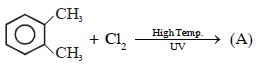
The product $(A)$ formed in the following reaction is:
A
$1-$chloro$-2,3-$dimethylbenzene
B
$4,5-$dichloro$-1,2-$dimethylbenzene
C
$1,2-$bis(trichloromethyl)benzene
D
$1,2,3,4-$tetrachloro$-5,6-$bis(trichloromethyl)benzene
Solution
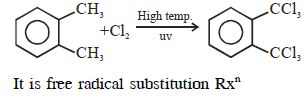
(C) The reaction of $o$-xylene ($1$,$2$-dimethylbenzene) with $Cl_2$ in the presence of $UV$ light and high temperature is a free radical substitution reaction.
In this reaction,the hydrogen atoms of the side-chain methyl groups are replaced by chlorine atoms.
Since the reaction occurs under high temperature and $UV$ light,all the hydrogen atoms of the methyl groups are substituted by chlorine atoms,resulting in the formation of $1,2$-bis(trichloromethyl)benzene.
In this reaction,the hydrogen atoms of the side-chain methyl groups are replaced by chlorine atoms.
Since the reaction occurs under high temperature and $UV$ light,all the hydrogen atoms of the methyl groups are substituted by chlorine atoms,resulting in the formation of $1,2$-bis(trichloromethyl)benzene.
0 likes
View Solution513
MediumMCQ
$Benzene$ $\xrightarrow[H_2SO_4]{HNO_3} (A)$ $\xrightarrow[FeCl_3]{Cl_2} (B)$
The major product $(B)$ is
The major product $(B)$ is
A
B
C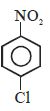
D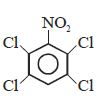
Solution
(A) $1$. The reaction of $Benzene$ with $HNO_3$ in the presence of $H_2SO_4$ is a nitration reaction,which yields $Nitrobenzene$ as product $(A)$.
$2$. $Nitrobenzene$ contains a $-NO_2$ group,which is a strongly deactivating and meta-directing group.
$3$. When $(A)$ $(Nitrobenzene)$ reacts with $Cl_2$ in the presence of a Lewis acid catalyst like $FeCl_3$,electrophilic aromatic substitution occurs.
$4$. Due to the meta-directing nature of the $-NO_2$ group,the incoming chlorine atom attaches to the meta position relative to the $-NO_2$ group.
$5$. Thus,the major product $(B)$ is $m-Chloronitrobenzene$.
$2$. $Nitrobenzene$ contains a $-NO_2$ group,which is a strongly deactivating and meta-directing group.
$3$. When $(A)$ $(Nitrobenzene)$ reacts with $Cl_2$ in the presence of a Lewis acid catalyst like $FeCl_3$,electrophilic aromatic substitution occurs.
$4$. Due to the meta-directing nature of the $-NO_2$ group,the incoming chlorine atom attaches to the meta position relative to the $-NO_2$ group.
$5$. Thus,the major product $(B)$ is $m-Chloronitrobenzene$.
0 likes
View Solution514
MediumMCQ
Which of the following is aromatic?
A
Cyclopentadiene
B
4H-Pyran
C
Borabenzene derivative (Borepin)
D
Naphthalene
Solution
(D) Aromatic compounds must follow $H$ückel's rule,which states that the molecule must be cyclic,planar,fully conjugated,and contain $(4n+2) \pi$ electrons,where $n$ is an integer $(n=0, 1, 2, ...)$.
$A$. Cyclopentadiene is non-aromatic because it has an $sp^3$ hybridized carbon atom.
$B$. $4H$-Pyran is non-aromatic due to the presence of an $sp^3$ hybridized carbon atom.
$C$. The structure shown is a borabenzene derivative or a related cyclic system that does not satisfy the $(4n+2) \pi$ electron rule for aromaticity.
$D$. Naphthalene is a polycyclic aromatic hydrocarbon. It is planar,fully conjugated,and contains $10 \pi$ electrons,which satisfies the $(4n+2) \pi$ rule for $n=2$ $(4(2)+2 = 10)$.
Therefore,naphthalene is aromatic.
$A$. Cyclopentadiene is non-aromatic because it has an $sp^3$ hybridized carbon atom.
$B$. $4H$-Pyran is non-aromatic due to the presence of an $sp^3$ hybridized carbon atom.
$C$. The structure shown is a borabenzene derivative or a related cyclic system that does not satisfy the $(4n+2) \pi$ electron rule for aromaticity.
$D$. Naphthalene is a polycyclic aromatic hydrocarbon. It is planar,fully conjugated,and contains $10 \pi$ electrons,which satisfies the $(4n+2) \pi$ rule for $n=2$ $(4(2)+2 = 10)$.
Therefore,naphthalene is aromatic.
0 likes
View Solution515
MediumMCQ
The compound obtained by passing $C_2H_2$ through a red-hot tube is ...........
A
Ethylene
B
Benzene
C
Ethane
D
Methane
Solution
(B) When acetylene $(C_2H_2)$ is passed through a red-hot iron or copper tube at $873 \ K$,it undergoes cyclic polymerization to form benzene $(C_6H_6)$.
The reaction is: $3C_2H_2 \xrightarrow{\text{Red hot tube}} C_6H_6$.
The reaction is: $3C_2H_2 \xrightarrow{\text{Red hot tube}} C_6H_6$.
0 likes
View Solution516
DifficultMCQ
The final product of the following reaction is ................
$C_6H_6 + 3Cl_2 \xrightarrow{\text{Sunlight}} ?$
$C_6H_6 + 3Cl_2 \xrightarrow{\text{Sunlight}} ?$
A
$C_6H_5Cl$
B
$o-C_6H_4Cl_2$
C
$C_6H_6Cl_6$
D
$p-C_6H_4Cl_2$
Solution
(C) The reaction of benzene $(C_6H_6)$ with chlorine $(Cl_2)$ in the presence of sunlight ($UV$ light) is an addition reaction.
In this reaction,three molecules of chlorine add across the double bonds of the benzene ring.
The final product formed is benzene hexachloride $(C_6H_6Cl_6)$,also known as gammaxene or lindane.
The chemical equation is: $C_6H_6 + 3Cl_2 \xrightarrow{\text{Sunlight}} C_6H_6Cl_6$.
In this reaction,three molecules of chlorine add across the double bonds of the benzene ring.
The final product formed is benzene hexachloride $(C_6H_6Cl_6)$,also known as gammaxene or lindane.
The chemical equation is: $C_6H_6 + 3Cl_2 \xrightarrow{\text{Sunlight}} C_6H_6Cl_6$.
0 likes
View Solution517
DifficultMCQ
Which of the following statements is incorrect regarding the nitration of aromatic compounds?
A
The rate of nitration of benzene is approximately equal to the rate of nitration of hexadeuterobenzene.
B
The rate of nitration of toluene is higher than the rate of nitration of benzene.
C
The rate of nitration of benzene is higher than the rate of nitration of hexadeuterobenzene.
D
Nitration is an electrophilic substitution reaction.
Solution
(C) The nitration of benzene is an electrophilic aromatic substitution reaction where the rate-determining step is the formation of the sigma complex (arenium ion).
Since the $C-H$ or $C-D$ bond cleavage occurs after the rate-determining step,there is no primary kinetic isotope effect.
Therefore,the rate of nitration of benzene $(C_6H_6)$ and hexadeuterobenzene $(C_6D_6)$ is approximately the same.
Statement $C$ claims that the rate of nitration of benzene is higher than that of hexadeuterobenzene,which is incorrect.
Since the $C-H$ or $C-D$ bond cleavage occurs after the rate-determining step,there is no primary kinetic isotope effect.
Therefore,the rate of nitration of benzene $(C_6H_6)$ and hexadeuterobenzene $(C_6D_6)$ is approximately the same.
Statement $C$ claims that the rate of nitration of benzene is higher than that of hexadeuterobenzene,which is incorrect.
0 likes
View Solution518
DifficultMCQ
The reaction of benzene with $CH_3COCl$ in the presence of $AlCl_3$ yields ...........
A
$C_6H_5Cl$
B
$C_6H_5COCl$
C
$C_6H_5CH_3$
D
$C_6H_5COCH_3$
Solution
(D) This reaction is a classic example of Friedel-Crafts acylation.
When benzene reacts with acetyl chloride $(CH_3COCl)$ in the presence of a Lewis acid catalyst like anhydrous aluminum chloride $(AlCl_3)$,an acetyl group $(-COCH_3)$ is introduced into the benzene ring.
The chemical equation is: $C_6H_6 + CH_3COCl \xrightarrow{AlCl_3} C_6H_5COCH_3 + HCl$.
The product formed is acetophenone $(C_6H_5COCH_3)$.
When benzene reacts with acetyl chloride $(CH_3COCl)$ in the presence of a Lewis acid catalyst like anhydrous aluminum chloride $(AlCl_3)$,an acetyl group $(-COCH_3)$ is introduced into the benzene ring.
The chemical equation is: $C_6H_6 + CH_3COCl \xrightarrow{AlCl_3} C_6H_5COCH_3 + HCl$.
The product formed is acetophenone $(C_6H_5COCH_3)$.
0 likes
View Solution519
DifficultMCQ
The conversion of benzene to toluene is carried out by .........
A
Friedel-Crafts reaction
B
Grignard reaction
C
Wurtz reaction
D
Perkin reaction
Solution
(A) The conversion of benzene to toluene is an example of the Friedel-Crafts alkylation reaction. $C_6H_6 + CH_3Cl \xrightarrow{AlCl_3} C_6H_5CH_3 + HCl$. In this reaction,benzene reacts with methyl chloride in the presence of an anhydrous Lewis acid catalyst like $AlCl_3$ to form toluene.
0 likes
View Solution520
MediumMCQ
Which species is generated during the chlorination of an aromatic ring?
A
$Cl$
B
$Cl^+$
C
$Cl^-$
D
$Cl^{\bullet}$
Solution
(B) The chlorination of an aromatic ring is an electrophilic aromatic substitution reaction.
In the presence of a Lewis acid catalyst like $FeCl_3$ or $AlCl_3$,chlorine $(Cl_2)$ reacts to form the electrophile,chloronium ion $(Cl^+)$.
The reaction is: $Cl_2 + FeCl_3 \rightarrow Cl^+ + [FeCl_4]^-$.
Thus,the active electrophilic species generated is $Cl^+$.
In the presence of a Lewis acid catalyst like $FeCl_3$ or $AlCl_3$,chlorine $(Cl_2)$ reacts to form the electrophile,chloronium ion $(Cl^+)$.
The reaction is: $Cl_2 + FeCl_3 \rightarrow Cl^+ + [FeCl_4]^-$.
Thus,the active electrophilic species generated is $Cl^+$.
0 likes
View Solution521
MediumMCQ
In the nitration mixture,concentrated sulfuric acid $(H_2SO_4)$ is used as:
A
$A$ sulfonating agent
B
$A$ dehydrating agent
C
$A$ catalyst to generate the nitronium ion $(NO_2^+)$
D
$A$ solvent
Solution
(C) In the nitration of aromatic compounds,a mixture of concentrated nitric acid $(HNO_3)$ and concentrated sulfuric acid $(H_2SO_4)$ is used.
Concentrated $H_2SO_4$ acts as a catalyst and facilitates the formation of the electrophile,the nitronium ion $(NO_2^+)$,by protonating the nitric acid molecule.
The reaction is: $HNO_3 + 2H_2SO_4 \rightleftharpoons NO_2^+ + H_3O^+ + 2HSO_4^-$.
Thus,its primary role is to generate the nitronium ion.
Concentrated $H_2SO_4$ acts as a catalyst and facilitates the formation of the electrophile,the nitronium ion $(NO_2^+)$,by protonating the nitric acid molecule.
The reaction is: $HNO_3 + 2H_2SO_4 \rightleftharpoons NO_2^+ + H_3O^+ + 2HSO_4^-$.
Thus,its primary role is to generate the nitronium ion.
0 likes
View Solution522
DifficultMCQ
In the $Friedel-Crafts$ reaction,anhydrous $AlCl_3$ is used because it is ............
A
electron-rich
B
soluble in ether
C
ionizes into chloride and aluminum ions
D
an electron-deficient molecule
Solution
(D) In the $Friedel-Crafts$ reaction,anhydrous $AlCl_3$ acts as a Lewis acid.
It is an electron-deficient molecule because the central $Al$ atom has only $6$ electrons in its valence shell.
It accepts a lone pair of electrons from the attacking reagent to form a carbocation electrophile,which then attacks the aromatic ring.
It is an electron-deficient molecule because the central $Al$ atom has only $6$ electrons in its valence shell.
It accepts a lone pair of electrons from the attacking reagent to form a carbocation electrophile,which then attacks the aromatic ring.
0 likes
View Solution523
MediumMCQ
The reaction of benzene with $n$-propyl chloride in the presence of anhydrous $AlCl_3$ mainly yields ..........
A
iso-propyl benzene
B
no reaction
C
$n$-propyl benzene
D
$3$-propyl-$1$-chlorobenzene
Solution
(A) The reaction of benzene with $n$-propyl chloride in the presence of anhydrous $AlCl_3$ is a Friedel-Crafts alkylation reaction.
During this reaction,the $n$-propyl carbocation $(CH_3CH_2CH_2^+)$ formed initially undergoes a $1,2$-hydride shift to form a more stable secondary carbocation $(CH_3CH^+CH_3)$.
This secondary carbocation then attacks the benzene ring to form iso-propyl benzene (cumene) as the major product.
During this reaction,the $n$-propyl carbocation $(CH_3CH_2CH_2^+)$ formed initially undergoes a $1,2$-hydride shift to form a more stable secondary carbocation $(CH_3CH^+CH_3)$.
This secondary carbocation then attacks the benzene ring to form iso-propyl benzene (cumene) as the major product.
0 likes
View Solution524
MediumMCQ
What will be $C$ in the following reaction?
$C_6H_5CH_3$ $\xrightarrow{\text{Oxidation}} A$ $\xrightarrow{NaOH} B$ $\xrightarrow[\Delta]{\text{sodalime}} C$
$C_6H_5CH_3$ $\xrightarrow{\text{Oxidation}} A$ $\xrightarrow{NaOH} B$ $\xrightarrow[\Delta]{\text{sodalime}} C$
A
$C_6H_5OH$
B
$C_6H_6$
C
$C_6H_5COONa$
D
$C_6H_5ONa$
Solution
(B) $1$. Oxidation of toluene $(C_6H_5CH_3)$ gives benzoic acid $(A = C_6H_5COOH)$.
$2$. Reaction of benzoic acid with $NaOH$ gives sodium benzoate $(B = C_6H_5COONa)$.
$3$. Decarboxylation of sodium benzoate with sodalime $(NaOH + CaO)$ gives benzene $(C = C_6H_6)$.
$2$. Reaction of benzoic acid with $NaOH$ gives sodium benzoate $(B = C_6H_5COONa)$.
$3$. Decarboxylation of sodium benzoate with sodalime $(NaOH + CaO)$ gives benzene $(C = C_6H_6)$.
0 likes
View Solution525
DifficultMCQ
The reaction of benzene with a mixture of concentrated $HNO_3$ and concentrated $H_2SO_4$,followed by treatment with $Cl_2 / FeCl_3$,gives:
A
$3-$chloro$-1-$nitrobenzene
B
$2-$chloro$-1-$nitrobenzene
C
$4-$chloro$-1-$nitrobenzene
D
$A$ mixture of $2-$chloro and $4-$chloro$-1-$nitrobenzene
Solution
(A) $1$. Benzene reacts with a mixture of concentrated $HNO_3$ and $H_2SO_4$ (nitrating mixture) to undergo electrophilic aromatic substitution,forming nitrobenzene.
$2$. The nitro group $(-NO_2)$ is a deactivating and meta-directing group.
$3$. When nitrobenzene is treated with $Cl_2 / FeCl_3$ (chlorination),the incoming chlorine atom is directed to the meta-position by the $-NO_2$ group.
$4$. Therefore,the major product formed is $3-$chloro$-1-$nitrobenzene (or $m-$chloronitrobenzene).
$2$. The nitro group $(-NO_2)$ is a deactivating and meta-directing group.
$3$. When nitrobenzene is treated with $Cl_2 / FeCl_3$ (chlorination),the incoming chlorine atom is directed to the meta-position by the $-NO_2$ group.
$4$. Therefore,the major product formed is $3-$chloro$-1-$nitrobenzene (or $m-$chloronitrobenzene).
0 likes
View Solution526
MediumMCQ
When benzene vapor is passed through a tube at $700 - 800\,^oC$ or over molten lead,it yields ........
A
Diphenyl
B
Phenol
C
Toluene
D
Benzaldehyde
Solution
(A) When benzene vapor is passed through a red-hot tube or over molten lead at $700 - 800\,^oC$,it undergoes dehydrocondensation to form diphenyl $(C_6H_5-C_6H_5)$.
0 likes
View Solution527
MediumMCQ
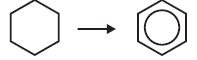
Which catalyst is used in the following reaction?
A
$Cr_2O_3$
B
$Al_2O_3$
C
$Zn$ dust
D
$Cr_2O_3$ and $Al_2O_3$
Solution
(D) The reaction shown is the aromatization of cyclohexane to benzene.
This process involves the catalytic dehydrogenation of alkanes.
The catalyst used for this transformation is a mixture of $Cr_2O_3$ and $Al_2O_3$ at high temperature and pressure.
Therefore,the correct option is $D$.
This process involves the catalytic dehydrogenation of alkanes.
The catalyst used for this transformation is a mixture of $Cr_2O_3$ and $Al_2O_3$ at high temperature and pressure.
Therefore,the correct option is $D$.
0 likes
View Solution528
MediumMCQ
Ozonolysis of $1 \ mol$ of benzene gives .............
A
$1 \ mol$ of glyoxal
B
$2 \ mol$ of glyoxal
C
$3 \ mol$ of glyoxal
D
None of these
Solution
(C) The ozonolysis of benzene $(C_6H_6)$ involves the reaction with $O_3$ followed by reductive hydrolysis with $Zn/H_2O$.
Benzene reacts with $3 \ mol$ of ozone to form benzene triozonide.
Upon hydrolysis,the benzene triozonide breaks down to produce $3 \ mol$ of glyoxal $(CHO-CHO)$.
The reaction is: $C_6H_6 + 3O_3$ $\rightarrow C_6H_6O_9$ $\xrightarrow{Zn/H_2O} 3CHO-CHO$.
Benzene reacts with $3 \ mol$ of ozone to form benzene triozonide.
Upon hydrolysis,the benzene triozonide breaks down to produce $3 \ mol$ of glyoxal $(CHO-CHO)$.
The reaction is: $C_6H_6 + 3O_3$ $\rightarrow C_6H_6O_9$ $\xrightarrow{Zn/H_2O} 3CHO-CHO$.
0 likes
View Solution529
MediumMCQ
Alkyl groups are $o-$ and $p-$ directing due to ..........
A
Resonance effect
B
Inductive effect
C
Resonance effect through hyperconjugation
D
All of the above
Solution
(C) Alkyl groups (like $-CH_3$) are electron-donating groups.
They exhibit the inductive effect ($+I$ effect) and hyperconjugation.
Hyperconjugation involves the delocalization of $\sigma$-electrons of the $C-H$ bond into the $\pi$-system of the benzene ring.
This increases the electron density at the ortho $(o-)$ and para $(p-)$ positions,making them $o-$ and $p-$ directing.
They exhibit the inductive effect ($+I$ effect) and hyperconjugation.
Hyperconjugation involves the delocalization of $\sigma$-electrons of the $C-H$ bond into the $\pi$-system of the benzene ring.
This increases the electron density at the ortho $(o-)$ and para $(p-)$ positions,making them $o-$ and $p-$ directing.
0 likes
View Solution530
MediumMCQ
Which of the following compounds reacts slower than benzene in electrophilic bromination?
A
$C_6H_5NO_2$
B
$C_6H_5NH_2$
C
$C_6H_5OH$
D
$C_6H_5CH_3$
Solution
(A) Electrophilic aromatic substitution is facilitated by electron-donating groups (activating groups) and hindered by electron-withdrawing groups (deactivating groups).
$C_6H_5NH_2$,$C_6H_5OH$,and $C_6H_5CH_3$ contain groups ($-NH_2$,$-OH$,$-CH_3$) that increase electron density in the benzene ring,making them more reactive than benzene.
$C_6H_5NO_2$ contains a nitro group $(-NO_2)$,which is a strong electron-withdrawing group due to its $-I$ and $-M$ effects.
This decreases the electron density of the benzene ring,making it less reactive towards electrophiles compared to benzene.
Therefore,$C_6H_5NO_2$ reacts slower than benzene.
$C_6H_5NH_2$,$C_6H_5OH$,and $C_6H_5CH_3$ contain groups ($-NH_2$,$-OH$,$-CH_3$) that increase electron density in the benzene ring,making them more reactive than benzene.
$C_6H_5NO_2$ contains a nitro group $(-NO_2)$,which is a strong electron-withdrawing group due to its $-I$ and $-M$ effects.
This decreases the electron density of the benzene ring,making it less reactive towards electrophiles compared to benzene.
Therefore,$C_6H_5NO_2$ reacts slower than benzene.
0 likes
View Solution531
MediumMCQ
Catalytic oxidation of benzene at $500\,^oC$ in the presence of $V_2O_5$ gives ..........
A
Maleic anhydride
B
Acetylene
C
Maleic acid
D
None of these
Solution
(A) The catalytic oxidation of benzene is carried out by passing benzene vapor and air over vanadium pentoxide $(V_2O_5)$ catalyst at $500\,^oC$.
This reaction results in the formation of maleic anhydride.
The chemical equation is: $C_6H_6 + 4.5O_2 \xrightarrow{V_2O_5, 500\,^oC} C_4H_2O_3 + 2CO_2 + 2H_2O$.
This reaction results in the formation of maleic anhydride.
The chemical equation is: $C_6H_6 + 4.5O_2 \xrightarrow{V_2O_5, 500\,^oC} C_4H_2O_3 + 2CO_2 + 2H_2O$.
0 likes
View Solution532
DifficultMCQ
Benzene is obtained by $........$.
A
Condensation of three $C_2H_2$ molecules
B
Polymerization of three $C_2H_2$ molecules
C
Addition reaction of three $C_2H_2$ molecules
D
Substitution of three $C_2H_2$ molecules
Solution
(B) Benzene is prepared by the cyclic polymerization of ethyne $(C_2H_2)$.
When ethyne gas is passed through a red-hot iron tube at $873 \ K$,it undergoes cyclic polymerization to form benzene $(C_6H_6)$.
The reaction is: $3C_2H_2 \xrightarrow{873 \ K, \text{Fe tube}} C_6H_6$.
When ethyne gas is passed through a red-hot iron tube at $873 \ K$,it undergoes cyclic polymerization to form benzene $(C_6H_6)$.
The reaction is: $3C_2H_2 \xrightarrow{873 \ K, \text{Fe tube}} C_6H_6$.
0 likes
View Solution533
MediumMCQ
Which of the following cannot be used in the Friedel-Crafts reaction?
A
$FeCl_3$
B
$BF_3$
C
$AlCl_3$
D
$NaCl$
Solution
(D) The Friedel-Crafts reaction involves the use of a Lewis acid as a catalyst to generate an electrophile.
$FeCl_3$,$BF_3$,and $AlCl_3$ are all well-known Lewis acids that can accept a lone pair of electrons.
$NaCl$ is an ionic salt and does not act as a Lewis acid.
Therefore,$NaCl$ cannot be used as a catalyst in the Friedel-Crafts reaction.
$FeCl_3$,$BF_3$,and $AlCl_3$ are all well-known Lewis acids that can accept a lone pair of electrons.
$NaCl$ is an ionic salt and does not act as a Lewis acid.
Therefore,$NaCl$ cannot be used as a catalyst in the Friedel-Crafts reaction.
0 likes
View Solution534
MediumMCQ
The correct order of reactivity of $(I)$ Aniline,$(II)$ Benzene,and $(III)$ Nitrobenzene towards electrophilic substitution reaction is .....
A
$I > II > III$
B
$III > II > I$
C
$II > III > I$
D
$I < II > III$
Solution
(A) The reactivity of an aromatic ring towards electrophilic substitution depends on the electron density on the ring.
Aniline ($-NH_2$ group) is a strong electron-donating group due to its $+M$ effect,which increases the electron density on the benzene ring,making it highly reactive.
Benzene has no substituent,so it has moderate reactivity.
Nitrobenzene ($-NO_2$ group) is a strong electron-withdrawing group due to its $-M$ and $-I$ effects,which significantly decrease the electron density on the benzene ring,making it the least reactive.
Therefore,the order of reactivity is $Aniline (I) > Benzene (II) > Nitrobenzene (III)$.
Aniline ($-NH_2$ group) is a strong electron-donating group due to its $+M$ effect,which increases the electron density on the benzene ring,making it highly reactive.
Benzene has no substituent,so it has moderate reactivity.
Nitrobenzene ($-NO_2$ group) is a strong electron-withdrawing group due to its $-M$ and $-I$ effects,which significantly decrease the electron density on the benzene ring,making it the least reactive.
Therefore,the order of reactivity is $Aniline (I) > Benzene (II) > Nitrobenzene (III)$.
0 likes
View Solution535
DifficultMCQ
Which of the following is an $o-/p-$ directing group?
A
$-COOH$
B
$-CN$
C
$-COCH_3$
D
$-NHCOCH_3$
Solution
(D) Groups that increase the electron density of the benzene ring through resonance are $o-/p-$ directing groups.
$-NHCOCH_3$ (acetamido group) has a lone pair of electrons on the nitrogen atom which is donated to the benzene ring via resonance,thereby increasing the electron density at the ortho and para positions.
$-COOH$,$-CN$,and $-COCH_3$ are electron-withdrawing groups that decrease electron density and are meta-directing.
$-NHCOCH_3$ (acetamido group) has a lone pair of electrons on the nitrogen atom which is donated to the benzene ring via resonance,thereby increasing the electron density at the ortho and para positions.
$-COOH$,$-CN$,and $-COCH_3$ are electron-withdrawing groups that decrease electron density and are meta-directing.
0 likes
View Solution536
DifficultMCQ
Benzene does not undergo addition reactions easily because ...............
A
It has a cyclic structure
B
The double bonds are very strong
C
It possesses resonance stability
D
It contains six hydrogen atoms
Solution
(C) Benzene is an aromatic compound that exhibits resonance.
Due to the delocalization of $\pi$-electrons over the entire ring,benzene gains extra stability known as resonance energy.
Addition reactions would involve breaking the aromatic sextet and destroying this resonance stability,which is energetically unfavorable.
Therefore,benzene prefers substitution reactions over addition reactions to maintain its aromatic character.
Due to the delocalization of $\pi$-electrons over the entire ring,benzene gains extra stability known as resonance energy.
Addition reactions would involve breaking the aromatic sextet and destroying this resonance stability,which is energetically unfavorable.
Therefore,benzene prefers substitution reactions over addition reactions to maintain its aromatic character.
0 likes
View Solution537
MediumMCQ
What is the characteristic chemical reaction of benzene?
A
Electrophilic addition reaction
B
Nucleophilic substitution reaction
C
Electrophilic substitution reaction
D
Nucleophilic addition reaction
Solution
(C) Benzene $(C_6H_6)$ is an aromatic compound characterized by a stable delocalized $\pi$-electron cloud.
Due to this stability,it resists addition reactions that would destroy the aromaticity.
Instead,it undergoes electrophilic substitution reactions where an electrophile replaces a hydrogen atom on the ring,preserving the aromatic system.
Due to this stability,it resists addition reactions that would destroy the aromaticity.
Instead,it undergoes electrophilic substitution reactions where an electrophile replaces a hydrogen atom on the ring,preserving the aromatic system.
0 likes
View Solution538
MediumMCQ
Which active species is involved in the nitration of benzene with concentrated nitric acid and concentrated sulfuric acid?
A
Nitrite ion
B
Nitrate ion
C
Nitronium ion
D
Nitric oxide
Solution
(C) The nitration of benzene involves the reaction of benzene with a mixture of concentrated $HNO_3$ and concentrated $H_2SO_4$.
The sulfuric acid acts as a catalyst and protonates the nitric acid,which then loses a water molecule to form the electrophile,the nitronium ion $(NO_2^+)$.
The reaction is: $HNO_3 + 2H_2SO_4 \rightleftharpoons NO_2^+ + H_3O^+ + 2HSO_4^-$.
Thus,the active species involved is the nitronium ion $(NO_2^+)$.
The sulfuric acid acts as a catalyst and protonates the nitric acid,which then loses a water molecule to form the electrophile,the nitronium ion $(NO_2^+)$.
The reaction is: $HNO_3 + 2H_2SO_4 \rightleftharpoons NO_2^+ + H_3O^+ + 2HSO_4^-$.
Thus,the active species involved is the nitronium ion $(NO_2^+)$.
0 likes
View Solution539
DifficultMCQ
How many isomers are formed when a disubstituted benzene is produced from a monosubstituted benzene?
A
$3$
B
$4$
C
$5$
D
$6$
Solution
(A) When a monosubstituted benzene (e.g.,$C_6H_5X$) undergoes further substitution,the incoming group can occupy the ortho,meta,or para positions relative to the existing substituent.
These three positions result in three distinct structural isomers: $ortho$ ($1$,$2$-disubstituted),$meta$ ($1$,$3$-disubstituted),and $para$ ($1$,$4$-disubstituted).
Therefore,a total of $3$ isomers are formed.
These three positions result in three distinct structural isomers: $ortho$ ($1$,$2$-disubstituted),$meta$ ($1$,$3$-disubstituted),and $para$ ($1$,$4$-disubstituted).
Therefore,a total of $3$ isomers are formed.
0 likes
View Solution540
DifficultMCQ
Which of the following is a free radical substitution reaction?
A
$CH_3CHO + HCN \to CH_3CH(OH)CN$
B
Benzene + $CH_3Cl \xrightarrow{Anhy. AlCl_3}$ Toluene
C
Benzyl chloride + $AgNO_2 \to$ Benzyl nitrite
D
Toluene + $Cl_2 \xrightarrow{Boiling}$ Benzyl chloride
Solution
(D) free radical substitution reaction involves the formation of free radicals as intermediates.
In the reaction of toluene with $Cl_2$ under boiling conditions (or $UV$ light),the reaction proceeds via a free radical mechanism to form benzyl chloride $(C_6H_5CH_2Cl)$.
Option $A$ is a nucleophilic addition reaction.
Option $B$ is an electrophilic aromatic substitution (Friedel-Crafts alkylation).
Option $C$ is a nucleophilic substitution $(S_N2)$ reaction.
Therefore,the correct option is $D$.
In the reaction of toluene with $Cl_2$ under boiling conditions (or $UV$ light),the reaction proceeds via a free radical mechanism to form benzyl chloride $(C_6H_5CH_2Cl)$.
Option $A$ is a nucleophilic addition reaction.
Option $B$ is an electrophilic aromatic substitution (Friedel-Crafts alkylation).
Option $C$ is a nucleophilic substitution $(S_N2)$ reaction.
Therefore,the correct option is $D$.
0 likes
View Solution541
DifficultMCQ
The product obtained when chloroform reacts with benzene in the presence of anhydrous $AlCl_3$ is ............. .
A
Chlorobenzene
B
Toluene
C
Mixed $(o-$ and $p-)$ chlorotoluene
D
Triphenylmethane
Solution
(D) The reaction of benzene with chloroform $(CHCl_3)$ in the presence of anhydrous $AlCl_3$ is a Friedel-Crafts alkylation reaction.
$3C_6H_6 + CHCl_3 \xrightarrow{AlCl_3} (C_6H_5)_3CH + 3HCl$.
This reaction leads to the formation of triphenylmethane as the final product.
$3C_6H_6 + CHCl_3 \xrightarrow{AlCl_3} (C_6H_5)_3CH + 3HCl$.
This reaction leads to the formation of triphenylmethane as the final product.
0 likes
View Solution542
MediumMCQ
Benzene $ + Cl_{2(excess)} \xrightarrow[\Delta ]{AlCl_3} x$
$x$ is
$x$ is
A
Hexachlorobenzene
B
Hexachlorocyclohexane
C
$1,3-$Dichlorobenzene
D
$1,4-$Dichlorobenzene
Solution
(A) When benzene reacts with excess chlorine in the presence of anhydrous $AlCl_3$ (a Lewis acid catalyst) and heat,it undergoes electrophilic aromatic substitution to replace all six hydrogen atoms with chlorine atoms,resulting in the formation of hexachlorobenzene $(C_6Cl_6)$.
0 likes
View Solution543
DifficultMCQ
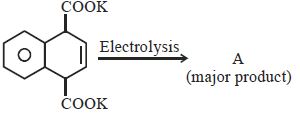
Identify the major product $A$ formed in the following Kolbe's electrolysis reaction:
A
Bicyclo[$2.2$.$2$]octa$-2,5-$diene
B
Anthracene
C
Naphthalene
D
o-Xylene
Solution
(C) The given reaction is an example of Kolbe's electrolysis of a dicarboxylic acid salt.
In this reaction,the carboxylate groups $(-COOK)$ are removed as $CO_2$ at the anode,and a new bond is formed between the carbon atoms where the carboxylate groups were attached.
The starting material is a derivative of $1,4$-dihydro-naphthalene$-1,4-$dicarboxylic acid.
Upon electrolysis,the two carboxylate groups are eliminated,and a double bond is formed between the $C_1$ and $C_4$ positions,leading to the formation of $1,4$-dihydronaphthalene,which then aromatizes to form naphthalene $(C_{10}H_8)$ as the stable major product.
In this reaction,the carboxylate groups $(-COOK)$ are removed as $CO_2$ at the anode,and a new bond is formed between the carbon atoms where the carboxylate groups were attached.
The starting material is a derivative of $1,4$-dihydro-naphthalene$-1,4-$dicarboxylic acid.
Upon electrolysis,the two carboxylate groups are eliminated,and a double bond is formed between the $C_1$ and $C_4$ positions,leading to the formation of $1,4$-dihydronaphthalene,which then aromatizes to form naphthalene $(C_{10}H_8)$ as the stable major product.
0 likes
View Solution544
MediumMCQ
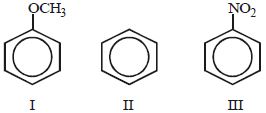
Among the following compounds $(I-III)$,the correct order of reactivity towards electrophilic substitution reaction is:
A
$I > II > III$
B
$II > III > I$
C
$III < I < II$
D
$I = II > III$
Solution
(A) Electrophilic substitution reaction is favored by the presence of electron-donating groups on the benzene ring,which increase the electron density and activate the ring. Conversely,electron-withdrawing groups decrease the electron density and deactivate the ring.
$I$: Anisole $(C_6H_5OCH_3)$ contains a $-OCH_3$ group,which is a strong electron-donating group due to the resonance effect ($+R$ effect),making it highly reactive.
$II$: Benzene $(C_6H_6)$ has no substituent,serving as the reference.
$III$: Nitrobenzene $(C_6H_5NO_2)$ contains a $-NO_2$ group,which is a strong electron-withdrawing group due to the $-R$ and $-I$ effects,making it the least reactive.
Therefore,the order of reactivity is $I > II > III$.
$I$: Anisole $(C_6H_5OCH_3)$ contains a $-OCH_3$ group,which is a strong electron-donating group due to the resonance effect ($+R$ effect),making it highly reactive.
$II$: Benzene $(C_6H_6)$ has no substituent,serving as the reference.
$III$: Nitrobenzene $(C_6H_5NO_2)$ contains a $-NO_2$ group,which is a strong electron-withdrawing group due to the $-R$ and $-I$ effects,making it the least reactive.
Therefore,the order of reactivity is $I > II > III$.
0 likes
View Solution545
MediumMCQ
Which of the following species participates in the sulphonation of the benzene ring?
A
$H_2SO_4$
B
$SO_3$
C
$HSO_3^-$
D
$SO_2^-$
Solution
(B) In the sulphonation of benzene,concentrated $H_2SO_4$ (or fuming sulphuric acid,$H_2SO_4 + SO_3$) is used.
The electrophile that attacks the benzene ring is sulphur trioxide,$SO_3$.
Even in concentrated $H_2SO_4$,the active electrophilic species is $SO_3$.
The electrophile that attacks the benzene ring is sulphur trioxide,$SO_3$.
Even in concentrated $H_2SO_4$,the active electrophilic species is $SO_3$.
0 likes
View Solution546
MediumMCQ
The chemical system that is non-aromatic is
A
Benzene
B
Naphthalene
C
Cyclopropenyl cation
D
Azulene
Solution
(D) system is non-aromatic if it is not planar or does not have a continuous cyclic conjugation of $p$-orbitals.
$A$. Benzene is planar and has $6\pi$ electrons,so it is aromatic.
$B$. Naphthalene is planar and has $10\pi$ electrons,so it is aromatic.
$C$. The cyclopropenyl cation is planar and has $2\pi$ electrons ($n=0$ in $4n+2$),so it is aromatic.
$D$. Azulene is a fused bicyclic system. While it has $10\pi$ electrons,the structure is often considered to have non-aromatic character in certain contexts due to the lack of perfect planarity or specific electronic distribution,but in standard textbook problems,cyclooctatetraene (non-planar,tub-shaped) is the classic example of a non-aromatic system. Given the options provided,if we evaluate the planarity,all others are planar. However,if the question implies a specific structure like cyclooctatetraene (not listed),we must re-evaluate. Based on standard chemistry,all listed options $A, B, C$ are aromatic. If $D$ is meant to be a non-planar system,it is the answer.
$A$. Benzene is planar and has $6\pi$ electrons,so it is aromatic.
$B$. Naphthalene is planar and has $10\pi$ electrons,so it is aromatic.
$C$. The cyclopropenyl cation is planar and has $2\pi$ electrons ($n=0$ in $4n+2$),so it is aromatic.
$D$. Azulene is a fused bicyclic system. While it has $10\pi$ electrons,the structure is often considered to have non-aromatic character in certain contexts due to the lack of perfect planarity or specific electronic distribution,but in standard textbook problems,cyclooctatetraene (non-planar,tub-shaped) is the classic example of a non-aromatic system. Given the options provided,if we evaluate the planarity,all others are planar. However,if the question implies a specific structure like cyclooctatetraene (not listed),we must re-evaluate. Based on standard chemistry,all listed options $A, B, C$ are aromatic. If $D$ is meant to be a non-planar system,it is the answer.
0 likes
View Solution547
MediumMCQ
Assertion : Rates of nitration of benzene and hexadeuterobenzene are different.
Reason : $C-H$ bond is stronger than $C-D$ bond.
Reason : $C-H$ bond is stronger than $C-D$ bond.
A
If both Assertion and Reason are correct and the Reason is a correct explanation of the Assertion.
B
If both Assertion and Reason are correct but Reason is not a correct explanation of the Assertion.
C
If the Assertion is correct but Reason is incorrect.
D
If both the Assertion and Reason are incorrect.
Solution
(D) The rate of nitration of benzene and hexadeuterobenzene is the same because the rate-determining step (formation of the sigma complex or carbocation) is the same in both cases.
This step does not involve the cleavage of the $C-H$ or $C-D$ bond,which occurs in the subsequent fast step.
Furthermore,the $C-D$ bond is actually stronger than the $C-H$ bond due to lower zero-point energy,making the Reason statement also incorrect.
Therefore,both the Assertion and the Reason are incorrect.
This step does not involve the cleavage of the $C-H$ or $C-D$ bond,which occurs in the subsequent fast step.
Furthermore,the $C-D$ bond is actually stronger than the $C-H$ bond due to lower zero-point energy,making the Reason statement also incorrect.
Therefore,both the Assertion and the Reason are incorrect.
0 likes
View Solution548
MediumMCQ
Assertion : Cyclopentadienyl anion is much more stable than allyl anion.
Reason : Cyclopentadienyl anion is aromatic in character.
Reason : Cyclopentadienyl anion is aromatic in character.
A
If both Assertion and Reason are correct and the Reason is a correct explanation of the Assertion.
B
If both Assertion and Reason are correct but Reason is not a correct explanation of the Assertion.
C
If the Assertion is correct but Reason is incorrect.
D
If both the Assertion and Reason are incorrect.
Solution
(A) The cyclopentadienyl anion contains $6\pi$ electrons ($4n+2$ where $n=1$),which satisfies $H$ückel's rule for aromaticity. It is planar,cyclic,and fully conjugated,making it highly stable due to aromaticity.
The allyl anion $(CH_2=CH-CH_2^-)$ is stabilized by resonance but is not aromatic.
Since the cyclopentadienyl anion is aromatic,it is significantly more stable than the non-aromatic allyl anion. Thus,both the Assertion and the Reason are correct,and the Reason correctly explains the Assertion.
The allyl anion $(CH_2=CH-CH_2^-)$ is stabilized by resonance but is not aromatic.
Since the cyclopentadienyl anion is aromatic,it is significantly more stable than the non-aromatic allyl anion. Thus,both the Assertion and the Reason are correct,and the Reason correctly explains the Assertion.
0 likes
View Solution549
DifficultMCQ
Assertion : Benzene removes a butter stain from a table cloth.
Reason : Butter has an affinity towards benzene.
Reason : Butter has an affinity towards benzene.
A
If both Assertion and Reason are correct and the Reason is a correct explanation of the Assertion.
B
If both Assertion and Reason are correct but Reason is not a correct explanation of the Assertion.
C
If the Assertion is correct but Reason is incorrect.
D
If both the Assertion and Reason are incorrect.
Solution
(A) Benzene is a non-polar solvent.
Butter consists of fats and oils,which are organic compounds with low polarity.
According to the principle of 'like dissolves like',non-polar solutes dissolve in non-polar solvents.
Therefore,butter dissolves in benzene,making the assertion correct and the reason a valid explanation.
Butter consists of fats and oils,which are organic compounds with low polarity.
According to the principle of 'like dissolves like',non-polar solutes dissolve in non-polar solvents.
Therefore,butter dissolves in benzene,making the assertion correct and the reason a valid explanation.
0 likes
View SolutionHydrocarbons — Aromatic hydrocarbon · Frequently Asked Questions
1Are these Hydrocarbons questions useful for JEE and NEET?
Yes. All questions in this section are mapped to JEE Main and NEET exam patterns. Previous year questions from JEE Main, NEET, GUJCET and state-level exams are included with full solutions.
2Can I switch to Hindi or Gujarati for these questions?
Yes. Use the language tabs in the hero section or the sidebar to view the same questions and solutions in English, Hindi or Gujarati.
3How do I generate a question paper from this subtopic?
Use the Vedclass Exam Paper Generator — select the chapter and subtopic, set difficulty, and generate Sets A, B, C, D automatically. First 3 chapters of every subject are free.
Vedclass Products
For Students
Vedclass Test Series
Mock tests in real JEE/NEET style with performance analysis. 5-day free trial.
Start Free TrialFor Teachers
Exam Paper Generator
Generate Set A/B/C/D papers from this chapter in 2 minutes. 3 chapters free.
Try FreeFor Institutes
Online Exam Module
Live online exams with unlimited students, 360° analytics & white-label branding.
See DemoFor Teachers & Institutes
Generate a Hydrocarbons Exam Paper in 2 Minutes
Select subtopic & difficulty — Sets A, B, C, D auto-generated with No Repeat logic.
First 3 chapters of every subject are free — no payment required.