
A English
Aromatic hydrocarbon Questions in English
Class 11 Chemistry · Hydrocarbons · Aromatic hydrocarbon
872+
Questions
English
Language
100%
With Solutions
Showing 50 of 872 questions in English
601
Medium
What do you mean by ortho and para directing groups? Explain the ortho and para directing effect by taking the example of any group.
Solution
(N/A) Definition: In a monosubstituted benzene,if an incoming electrophile attacks the ortho and para positions with respect to the first substituent group $(Z)$,then the first group $(Z)$ is called an ortho and para directing group.
Examples: $-OH, -OCH_3, -NH_2, -CH_3, -C_2H_5, -NHCH_3, -NHR, -NHCOCH_3, -NHCOR$ etc.,are ortho and para directing groups.
$(b)$ Explanation of the directing properties of the $-OH$ group: The $-OH$ group (hydroxyl group) is ortho and para directing. This can be explained by the resonance structures of phenol,as shown below:
[Resonance structures of phenol showing increased electron density at ortho and para positions]
Due to the $+R$ effect of the $-OH$ group,the electron density increases at the ortho and para positions of the benzene ring. Consequently,an electrophile $(E^+)$ is more likely to attack these electron-rich positions,leading to ortho and para substitution products.
Examples: $-OH, -OCH_3, -NH_2, -CH_3, -C_2H_5, -NHCH_3, -NHR, -NHCOCH_3, -NHCOR$ etc.,are ortho and para directing groups.
$(b)$ Explanation of the directing properties of the $-OH$ group: The $-OH$ group (hydroxyl group) is ortho and para directing. This can be explained by the resonance structures of phenol,as shown below:
[Resonance structures of phenol showing increased electron density at ortho and para positions]
Due to the $+R$ effect of the $-OH$ group,the electron density increases at the ortho and para positions of the benzene ring. Consequently,an electrophile $(E^+)$ is more likely to attack these electron-rich positions,leading to ortho and para substitution products.
0 likes
View Solution602
Medium
What is meant by a meta-directing group? Give examples of it and explain the meta-directing effect of $-NO_2$.
Solution
(N/A) Definition: $A$ group attached to a benzene ring is called a meta-directing group if it directs the incoming electrophile to the meta-position during electrophilic aromatic substitution.
$(b)$ Examples: $-NO_2$,$-COOH$,$-SO_3H$,$-CHO$,$-COCH_3$,$-COCl$,$-COR$,$-COOR$ etc.,are meta-directing groups.
$(c)$ Meta-directing effect of $-NO_2$: The $-NO_2$ group is strongly electron-withdrawing due to its $-I$ and $-M$ effects. This withdraws electron density from the benzene ring,specifically from the ortho and para positions,creating a partial positive charge $(+\delta)$ at these positions. The meta position remains relatively more electron-rich compared to the ortho and para positions. Consequently,an incoming electrophile is directed to the meta position. The resonance structures $(I-V)$ and the hybrid structure $(VI)$ illustrate this electron deficiency at the ortho and para positions.
$(b)$ Examples: $-NO_2$,$-COOH$,$-SO_3H$,$-CHO$,$-COCH_3$,$-COCl$,$-COR$,$-COOR$ etc.,are meta-directing groups.
$(c)$ Meta-directing effect of $-NO_2$: The $-NO_2$ group is strongly electron-withdrawing due to its $-I$ and $-M$ effects. This withdraws electron density from the benzene ring,specifically from the ortho and para positions,creating a partial positive charge $(+\delta)$ at these positions. The meta position remains relatively more electron-rich compared to the ortho and para positions. Consequently,an incoming electrophile is directed to the meta position. The resonance structures $(I-V)$ and the hybrid structure $(VI)$ illustrate this electron deficiency at the ortho and para positions.
0 likes
View Solution603
Medium
What is meant by activating groups? Explain with suitable examples.
Solution
(N/A) Definition: Groups that are attached to the benzene ring and increase the electron density of the ring,thereby making it more reactive towards electrophilic aromatic substitution compared to benzene,are known as activating groups.
Examples: Groups like $-OH$,$-OR$,$-NH_{2}$,$-NHR$,and $-NHCOR$ are strong activating groups. They are ortho-para directing.
Explanation: Activating groups donate their electron density towards the benzene ring through resonance ($+M$ effect) or inductive effect ($+I$ effect). This increases the electron density in the ring,which facilitates the attack of an electrophile.
For example,alkyl groups $(R-)$ donate electrons via the inductive effect ($+I$ effect),while groups with lone pairs donate electrons via resonance ($+M$ effect).
Note: While halogens ($-Cl$,$-Br$) are ortho-para directing,they are deactivating groups because their strong $-I$ effect outweighs their $+M$ effect.
Examples: Groups like $-OH$,$-OR$,$-NH_{2}$,$-NHR$,and $-NHCOR$ are strong activating groups. They are ortho-para directing.
Explanation: Activating groups donate their electron density towards the benzene ring through resonance ($+M$ effect) or inductive effect ($+I$ effect). This increases the electron density in the ring,which facilitates the attack of an electrophile.
For example,alkyl groups $(R-)$ donate electrons via the inductive effect ($+I$ effect),while groups with lone pairs donate electrons via resonance ($+M$ effect).
Note: While halogens ($-Cl$,$-Br$) are ortho-para directing,they are deactivating groups because their strong $-I$ effect outweighs their $+M$ effect.
0 likes
View Solution604
Medium
What is meant by deactivating groups? Explain with suitable examples.
Solution
(N/A) Definition: Groups that,when attached to a benzene ring,make the subsequent electrophilic aromatic substitution reaction slower than that of benzene are known as deactivating groups.
Examples: Most meta-directing groups are deactivating groups,such as $-COOH$,$-NO_2$,$-SO_3H$,$-COCl$,$-COR$,$-COOR$,and $-CN$.
Explanation:
$(a)$ Resonance effect: In meta-directing groups,the $\pi$-electron density of the benzene ring is delocalized towards the substituent group due to resonance. This reduces the electron density within the ring,making it less susceptible to electrophilic attack.
$(b)$ Inductive effect: Most of these groups exert a strong electron-withdrawing inductive effect ($-I$ effect),which pulls electron density away from the ring,further decreasing the electron density and thus deactivating the ring towards electrophilic substitution.
Examples: Most meta-directing groups are deactivating groups,such as $-COOH$,$-NO_2$,$-SO_3H$,$-COCl$,$-COR$,$-COOR$,and $-CN$.
Explanation:
$(a)$ Resonance effect: In meta-directing groups,the $\pi$-electron density of the benzene ring is delocalized towards the substituent group due to resonance. This reduces the electron density within the ring,making it less susceptible to electrophilic attack.
$(b)$ Inductive effect: Most of these groups exert a strong electron-withdrawing inductive effect ($-I$ effect),which pulls electron density away from the ring,further decreasing the electron density and thus deactivating the ring towards electrophilic substitution.
0 likes
View Solution605
Medium
Why does benzene undergo electrophilic substitution reactions easily and nucleophilic substitutions with difficulty?
Solution
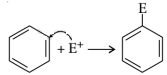
(N/A) $Benzene$ is a planar molecule having delocalized $\pi$-electrons above and below the plane of the ring.
Hence,it is electron-rich. As a result,it is highly attractive to electron-deficient species,i.e.,electrophiles $(E^+)$.
Therefore,it undergoes electrophilic substitution reactions very easily.
Nucleophiles are electron-rich species. Hence,they are repelled by the electron-rich $\pi$-cloud of benzene. Consequently,benzene undergoes nucleophilic substitutions with difficulty.
Hence,it is electron-rich. As a result,it is highly attractive to electron-deficient species,i.e.,electrophiles $(E^+)$.
Therefore,it undergoes electrophilic substitution reactions very easily.
Nucleophiles are electron-rich species. Hence,they are repelled by the electron-rich $\pi$-cloud of benzene. Consequently,benzene undergoes nucleophilic substitutions with difficulty.
0 likes
View Solution606
Medium
How would you convert the following compounds into benzene?
$(i)$ Ethyne $(ii)$ Ethene $(iii)$ Hexane
$(i)$ Ethyne $(ii)$ Ethene $(iii)$ Hexane
Solution
(N/A) $(i)$ Benzene from ethyne:
$3CH \equiv CH \xrightarrow[\text{Polymerisation}]{\text{Red hot Fe, } 873 \ K} \text{Benzene}$
$(ii)$ Benzene from ethene:
$CH_2=CH_2$ $\xrightarrow[\text{Bromination}]{\text{Br}_2(\text{CCl}_4)} CH_2Br-CH_2Br$ $\xrightarrow[\text{Dehydrobromination}]{\Delta, \text{KOH (alc.)}} CH_2=CHBr$ $\xrightarrow[\text{NaNH}_2, \text{NH}_3(l)]{196 \ K} HC \equiv CH$ $\xrightarrow[\text{Polymerisation}]{\text{Red hot Fe, } 873 \ K} \text{Benzene}$
$(iii)$ Benzene from hexane:
$CH_3CH_2CH_2CH_2CH_2CH_3$ $\xrightarrow[\text{Cyclization, H}_2]{\text{Cr}_2\text{O}_3/\text{Mo}_2\text{O}_3/\text{V}_2\text{O}_5, 773 \ K, 10-20 \ \text{atm.}} \text{Cyclohexane}$ $\xrightarrow[\text{-3H}_2]{\text{Aromatization}} \text{Benzene}$
$3CH \equiv CH \xrightarrow[\text{Polymerisation}]{\text{Red hot Fe, } 873 \ K} \text{Benzene}$
$(ii)$ Benzene from ethene:
$CH_2=CH_2$ $\xrightarrow[\text{Bromination}]{\text{Br}_2(\text{CCl}_4)} CH_2Br-CH_2Br$ $\xrightarrow[\text{Dehydrobromination}]{\Delta, \text{KOH (alc.)}} CH_2=CHBr$ $\xrightarrow[\text{NaNH}_2, \text{NH}_3(l)]{196 \ K} HC \equiv CH$ $\xrightarrow[\text{Polymerisation}]{\text{Red hot Fe, } 873 \ K} \text{Benzene}$
$(iii)$ Benzene from hexane:
$CH_3CH_2CH_2CH_2CH_2CH_3$ $\xrightarrow[\text{Cyclization, H}_2]{\text{Cr}_2\text{O}_3/\text{Mo}_2\text{O}_3/\text{V}_2\text{O}_5, 773 \ K, 10-20 \ \text{atm.}} \text{Cyclohexane}$ $\xrightarrow[\text{-3H}_2]{\text{Aromatization}} \text{Benzene}$
0 likes
View Solution607
Difficult
Write down the products of ozonolysis of $1, 2-$dimethylbenzene ($o-$xylene). How does the result support the Kekul\text{é} structure for benzene?
Solution
(N/A) The ozonolysis of $o-$xylene ($1, 2-$dimethylbenzene) yields three products: methylglyoxal,$1, 2-$dimethylglyoxal,and glyoxal.
$o-$Xylene exists as a resonance hybrid of two Kekul\text{é} structures,labeled as $(I)$ and $(II)$.
Structure $(I)$ on ozonolysis gives $2$ moles of methylglyoxal $(CH_3COCHO)$ and $1$ mole of glyoxal $(CHOCHO)$.
Structure $(II)$ on ozonolysis gives $1$ mole of $1, 2-$dimethylglyoxal $(CH_3COCOCH_3)$ and $2$ moles of glyoxal $(CHOCHO)$.
Since the experimental mixture contains all three products (methylglyoxal,$1, 2-$dimethylglyoxal,and glyoxal),it confirms that $o-$xylene is a resonance hybrid of the two Kekul\text{é} structures $(I)$ and $(II)$.
$o-$Xylene exists as a resonance hybrid of two Kekul\text{é} structures,labeled as $(I)$ and $(II)$.
Structure $(I)$ on ozonolysis gives $2$ moles of methylglyoxal $(CH_3COCHO)$ and $1$ mole of glyoxal $(CHOCHO)$.
Structure $(II)$ on ozonolysis gives $1$ mole of $1, 2-$dimethylglyoxal $(CH_3COCOCH_3)$ and $2$ moles of glyoxal $(CHOCHO)$.
Since the experimental mixture contains all three products (methylglyoxal,$1, 2-$dimethylglyoxal,and glyoxal),it confirms that $o-$xylene is a resonance hybrid of the two Kekul\text{é} structures $(I)$ and $(II)$.
0 likes
View Solution608
Medium
Suggest the name of a Lewis acid other than anhydrous aluminium chloride which can be used during the ethylation of benzene.
Solution
(N/A) The ethylation of benzene is a type of Friedel-Crafts alkylation reaction.
This reaction requires a Lewis acid catalyst to generate the electrophile.
Apart from anhydrous $AlCl_3$,other common Lewis acids that can be used include anhydrous $FeCl_3$,$SnCl_4$,or $BF_3$.
This reaction requires a Lewis acid catalyst to generate the electrophile.
Apart from anhydrous $AlCl_3$,other common Lewis acids that can be used include anhydrous $FeCl_3$,$SnCl_4$,or $BF_3$.
0 likes
View Solution609
Difficult
Explain why the following systems are not aromatic?
Solution
(N/A) $(i)$ For the given compound,the number of $\pi$-electrons is $6$.
By Huckel's rule,$4n+2=6$,$4n=4$,$n=1$. Since '$n$' is an integer,the compound is aromatic.
$(ii)$ For the given compound,the number of $\pi$-electrons is $4$.
By Huckel's rule,$4n+2=4$,$4n=2$,$n=0.5$. Since '$n$' is not an integer,the compound is not aromatic.
$(iii)$ For the given compound,the number of $\pi$-electrons is $8$.
By Huckel's rule,$4n+2=8$,$4n=6$,$n=1.5$. Since '$n$' is not an integer,the compound is not aromatic.
By Huckel's rule,$4n+2=6$,$4n=4$,$n=1$. Since '$n$' is an integer,the compound is aromatic.
$(ii)$ For the given compound,the number of $\pi$-electrons is $4$.
By Huckel's rule,$4n+2=4$,$4n=2$,$n=0.5$. Since '$n$' is not an integer,the compound is not aromatic.
$(iii)$ For the given compound,the number of $\pi$-electrons is $8$.
By Huckel's rule,$4n+2=8$,$4n=6$,$n=1.5$. Since '$n$' is not an integer,the compound is not aromatic.
0 likes
View Solution610
Medium
Out of benzene,$m$-dinitrobenzene and toluene,which will undergo nitration most easily and why?
Solution
(N/A) Nitration is an electrophilic aromatic substitution reaction where the rate depends on the electron density of the aromatic ring. The nitronium ion $(NO_2^+)$ acts as an electrophile.
$1$. The $-CH_3$ group in toluene is an electron-donating group ($+I$ effect and hyperconjugation),which increases the electron density of the benzene ring,making it more reactive towards electrophilic substitution than benzene.
$2$. The $-NO_2$ group in $m$-dinitrobenzene is a strongly electron-withdrawing group ($-I$ and $-M$ effects),which significantly decreases the electron density of the benzene ring,making it the least reactive.
$3$. Benzene has intermediate reactivity compared to toluene and $m$-dinitrobenzene.
Therefore,toluene undergoes nitration most easily because the methyl group activates the ring towards electrophilic attack.
$1$. The $-CH_3$ group in toluene is an electron-donating group ($+I$ effect and hyperconjugation),which increases the electron density of the benzene ring,making it more reactive towards electrophilic substitution than benzene.
$2$. The $-NO_2$ group in $m$-dinitrobenzene is a strongly electron-withdrawing group ($-I$ and $-M$ effects),which significantly decreases the electron density of the benzene ring,making it the least reactive.
$3$. Benzene has intermediate reactivity compared to toluene and $m$-dinitrobenzene.
Therefore,toluene undergoes nitration most easily because the methyl group activates the ring towards electrophilic attack.
0 likes
View Solution611
Medium
How will you convert benzene into:
$I$. $p$-nitrotoluene
$II$. acetophenone
$I$. $p$-nitrotoluene
$II$. acetophenone
Solution
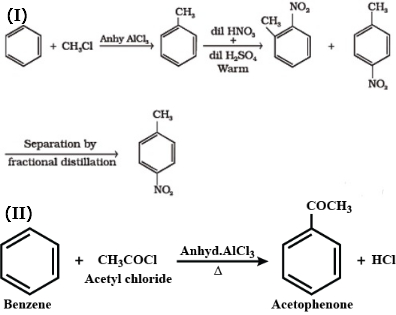
(N/A) $I$. Friedel-Crafts alkylation of benzene with methyl chloride $(CH_3Cl)$ in the presence of anhydrous aluminium chloride $(AlCl_3)$ gives toluene. Nitration of toluene with a mixture of conc. nitric acid $(HNO_3)$ and conc. sulphuric acid $(H_2SO_4)$ gives a mixture of ortho and para nitrotoluene,which are separated by fractional distillation.
$II$. Friedel-Crafts acylation of benzene with acetyl chloride $(CH_3COCl)$ in the presence of anhydrous aluminium chloride $(AlCl_3)$ gives acetophenone.
$II$. Friedel-Crafts acylation of benzene with acetyl chloride $(CH_3COCl)$ in the presence of anhydrous aluminium chloride $(AlCl_3)$ gives acetophenone.
0 likes
View Solution612
Medium
Give the chemical reaction for the following conversions:
$(1)$ $m$-Nitrobenzene sulphonic acid from benzene
$(2)$ $TNT$ from toluene
$(1)$ $m$-Nitrobenzene sulphonic acid from benzene
$(2)$ $TNT$ from toluene
Solution
(N/A) $(1)$ Conversion of benzene to $m$-nitrobenzene sulphonic acid:
Benzene undergoes nitration with a mixture of conc. $HNO_3$ and conc. $H_2SO_4$ to form nitrobenzene. Nitrobenzene is then subjected to sulphonation using oleum $(H_2S_2O_7)$ at high temperature to yield $m$-nitrobenzene sulphonic acid.
$(2)$ Conversion of toluene to $TNT$ ($2,4,6$-trinitrotoluene):
Toluene undergoes nitration with a mixture of conc. $HNO_3$ and conc. $H_2SO_4$ in steps. First,it forms a mixture of $o$-nitrotoluene and $p$-nitrotoluene. Further nitration of these products leads to $2,4$-dinitrotoluene,and finally,vigorous nitration at higher temperatures yields $2,4,6$-trinitrotoluene $(TNT)$.
Benzene undergoes nitration with a mixture of conc. $HNO_3$ and conc. $H_2SO_4$ to form nitrobenzene. Nitrobenzene is then subjected to sulphonation using oleum $(H_2S_2O_7)$ at high temperature to yield $m$-nitrobenzene sulphonic acid.
$(2)$ Conversion of toluene to $TNT$ ($2,4,6$-trinitrotoluene):
Toluene undergoes nitration with a mixture of conc. $HNO_3$ and conc. $H_2SO_4$ in steps. First,it forms a mixture of $o$-nitrotoluene and $p$-nitrotoluene. Further nitration of these products leads to $2,4$-dinitrotoluene,and finally,vigorous nitration at higher temperatures yields $2,4,6$-trinitrotoluene $(TNT)$.
0 likes
View Solution613
Easy
Give the name and structure of the aromatic compound with the molecular formula $C_{10}H_8$. Also,determine the number of $\sigma$ and $\pi$ bonds present in the structure.
Solution
(N/A) The aromatic compound with molecular formula $C_{10}H_8$ is naphthalene.
The structure consists of two fused benzene rings.
To calculate the number of $\sigma$ bonds:
There are $11$ $C-C$ $\sigma$ bonds and $8$ $C-H$ $\sigma$ bonds,resulting in a total of $19$ $\sigma$ bonds.
To calculate the number of $\pi$ bonds:
There are $5$ double bonds in the structure,so there are $5$ $\pi$ bonds.
Thus,the compound is naphthalene,containing $19$ $\sigma$ bonds and $5$ $\pi$ bonds.
The structure consists of two fused benzene rings.
To calculate the number of $\sigma$ bonds:
There are $11$ $C-C$ $\sigma$ bonds and $8$ $C-H$ $\sigma$ bonds,resulting in a total of $19$ $\sigma$ bonds.
To calculate the number of $\pi$ bonds:
There are $5$ double bonds in the structure,so there are $5$ $\pi$ bonds.
Thus,the compound is naphthalene,containing $19$ $\sigma$ bonds and $5$ $\pi$ bonds.
0 likes
View Solution614
Medium
Give the name and structure of an aromatic hydrocarbon with the molecular formula $C_{12}H_{10}$ which contains two benzene rings.
Solution
(N/A) The molecular formula $C_{12}H_{10}$ corresponds to the compound Biphenyl.
It consists of two phenyl groups $(C_{6}H_{5}-)$ linked together by a single bond.
The structure is represented as $C_{6}H_{5}-C_{6}H_{5}$ or two benzene rings connected by a single bond.
It consists of two phenyl groups $(C_{6}H_{5}-)$ linked together by a single bond.
The structure is represented as $C_{6}H_{5}-C_{6}H_{5}$ or two benzene rings connected by a single bond.
0 likes
View Solution615
Medium
Why is benzene extraordinarily stable even though it contains three double bonds?
Solution
(N/A) Benzene is a hybrid of resonating structures as shown in the figure.
All six carbon atoms in benzene are $sp^{2}$ hybridized.
The two $sp^{2}$ hybrid orbitals of each carbon atom overlap with the $sp^{2}$ hybrid orbitals of adjacent carbon atoms to form six $C-C$ sigma bonds in the hexagonal plane.
The remaining $sp^{2}$ hybrid orbital on each carbon atom overlaps with the $s$-orbital of hydrogen to form six $C-H$ sigma bonds.
The remaining unhybridized $p$-orbital of each carbon atom overlaps laterally to form a continuous $\pi$-electron cloud above and below the plane of the ring.
The six $\pi$-electrons are delocalized over the entire ring,which provides extra stability to the benzene molecule. This delocalization is the reason why benzene is extraordinarily stable despite having three double bonds.
All six carbon atoms in benzene are $sp^{2}$ hybridized.
The two $sp^{2}$ hybrid orbitals of each carbon atom overlap with the $sp^{2}$ hybrid orbitals of adjacent carbon atoms to form six $C-C$ sigma bonds in the hexagonal plane.
The remaining $sp^{2}$ hybrid orbital on each carbon atom overlaps with the $s$-orbital of hydrogen to form six $C-H$ sigma bonds.
The remaining unhybridized $p$-orbital of each carbon atom overlaps laterally to form a continuous $\pi$-electron cloud above and below the plane of the ring.
The six $\pi$-electrons are delocalized over the entire ring,which provides extra stability to the benzene molecule. This delocalization is the reason why benzene is extraordinarily stable despite having three double bonds.
0 likes
View Solution616
Medium
What are the necessary conditions for any system to be aromatic?
Solution
(N/A) compound is said to be aromatic if it satisfies the following three conditions:
$(i)$ The molecule must be cyclic and planar.
$(ii)$ The $\pi$-electrons of the compound must be completely delocalized within the ring.
$(iii)$ The total number of $\pi$-electrons present in the ring must follow $H$ückel's rule,which is $(4n + 2)$ $\pi$-electrons,where $n$ is an integer $(n = 0, 1, 2, \dots)$.
$(i)$ The molecule must be cyclic and planar.
$(ii)$ The $\pi$-electrons of the compound must be completely delocalized within the ring.
$(iii)$ The total number of $\pi$-electrons present in the ring must follow $H$ückel's rule,which is $(4n + 2)$ $\pi$-electrons,where $n$ is an integer $(n = 0, 1, 2, \dots)$.
0 likes
View Solution617
Medium
Write down the conditions for a compound to possess aromaticity.
Solution
(N/A) For a compound to be aromatic,it must satisfy the following conditions based on $H$ückel's rule:
$1$. The molecule must be cyclic.
$2$. The molecule must be planar,allowing for continuous overlap of $p$-orbitals.
$3$. The molecule must be completely conjugated,meaning every atom in the ring must have an unhybridized $p$-orbital.
$4$. The molecule must contain $(4n + 2)$ $\pi$-electrons,where $n$ is an integer $(n = 0, 1, 2, \dots)$.
$1$. The molecule must be cyclic.
$2$. The molecule must be planar,allowing for continuous overlap of $p$-orbitals.
$3$. The molecule must be completely conjugated,meaning every atom in the ring must have an unhybridized $p$-orbital.
$4$. The molecule must contain $(4n + 2)$ $\pi$-electrons,where $n$ is an integer $(n = 0, 1, 2, \dots)$.
0 likes
View Solution618
Medium
Write $H$ückel rule and give a suitable example.
Solution
(N/A) $H$ückel rule states that for a planar,cyclic,conjugated molecule to be aromatic,it must contain $(4n + 2) \ \pi$-electrons,where $n$ is an integer $(n = 0, 1, 2, ...)$.
Example: Benzene $(C_6H_6)$ contains $6 \ \pi$-electrons,which follows the $(4n + 2)$ rule for $n = 1$.
Example: Benzene $(C_6H_6)$ contains $6 \ \pi$-electrons,which follows the $(4n + 2)$ rule for $n = 1$.
0 likes
View Solution619
Easy
Explain: Benzene and Naphthalene are aromatic in nature.
Solution
(N/A) compound is considered aromatic if it follows $H$ückel's rule,which states that the molecule must be cyclic,planar,fully conjugated,and contain $(4n + 2) \pi$ electrons,where $n$ is an integer $(n = 0, 1, 2, ...)$.
$1$. Benzene $(C_6H_6)$: It is a cyclic,planar molecule with a continuous ring of $p$-orbitals. It contains $3$ double bonds,resulting in $6 \pi$ electrons. Applying $H$ückel's rule: $4n + 2 = 6$,which gives $n = 1$. Since $n$ is an integer,benzene is aromatic.
$2$. Naphthalene $(C_{10}H_8)$: It consists of two fused benzene rings. It is cyclic,planar,and fully conjugated. It contains $5$ double bonds,resulting in $10 \pi$ electrons. Applying $H$ückel's rule: $4n + 2 = 10$,which gives $4n = 8$ or $n = 2$. Since $n$ is an integer,naphthalene is aromatic.
$1$. Benzene $(C_6H_6)$: It is a cyclic,planar molecule with a continuous ring of $p$-orbitals. It contains $3$ double bonds,resulting in $6 \pi$ electrons. Applying $H$ückel's rule: $4n + 2 = 6$,which gives $n = 1$. Since $n$ is an integer,benzene is aromatic.
$2$. Naphthalene $(C_{10}H_8)$: It consists of two fused benzene rings. It is cyclic,planar,and fully conjugated. It contains $5$ double bonds,resulting in $10 \pi$ electrons. Applying $H$ückel's rule: $4n + 2 = 10$,which gives $4n = 8$ or $n = 2$. Since $n$ is an integer,naphthalene is aromatic.
0 likes
View Solution620
Medium
Explain: $Anthracene$ and $Phenanthrene$ are aromatic in nature.
Solution
(N/A) compound is considered aromatic if it follows $Huckel's$ rule,which states that the molecule must be planar,cyclic,and contain $(4n + 2) \pi$ electrons,where $n$ is an integer $(n = 0, 1, 2, ...)$.
$1$. $Anthracene$ $(C_{14}H_{10})$: It consists of three fused benzene rings in a linear arrangement. It has $14$ $\pi$ electrons. According to $Huckel's$ rule,$4n + 2 = 14$,which gives $4n = 12$,so $n = 3$. Since $n$ is an integer,$Anthracene$ is aromatic.
$2$. $Phenanthrene$ $(C_{14}H_{10})$: It consists of three fused benzene rings in an angular arrangement. It also has $14$ $\pi$ electrons. Similarly,$4n + 2 = 14$ results in $n = 3$. Since $n$ is an integer,$Phenanthrene$ is also aromatic.
$1$. $Anthracene$ $(C_{14}H_{10})$: It consists of three fused benzene rings in a linear arrangement. It has $14$ $\pi$ electrons. According to $Huckel's$ rule,$4n + 2 = 14$,which gives $4n = 12$,so $n = 3$. Since $n$ is an integer,$Anthracene$ is aromatic.
$2$. $Phenanthrene$ $(C_{14}H_{10})$: It consists of three fused benzene rings in an angular arrangement. It also has $14$ $\pi$ electrons. Similarly,$4n + 2 = 14$ results in $n = 3$. Since $n$ is an integer,$Phenanthrene$ is also aromatic.
0 likes
View Solution621
Difficult
Give suitable examples of negative ions and positive ions having aromatic nature.
Solution
(N/A) Aromatic ions must follow $H$ückel's rule,which states that a planar,cyclic,conjugated system with $(4n + 2) \pi$ electrons is aromatic.
$1$. Negative ion: Cyclopentadienyl anion $(C_5H_5^-)$. It has $6 \pi$ electrons $(n=1)$,making it aromatic.
$2$. Positive ion: Cycloheptatrienyl cation $(C_7H_7^+)$,also known as the tropylium ion. It has $6 \pi$ electrons $(n=1)$,making it aromatic.
$1$. Negative ion: Cyclopentadienyl anion $(C_5H_5^-)$. It has $6 \pi$ electrons $(n=1)$,making it aromatic.
$2$. Positive ion: Cycloheptatrienyl cation $(C_7H_7^+)$,also known as the tropylium ion. It has $6 \pi$ electrons $(n=1)$,making it aromatic.
0 likes
View Solution622
MediumMCQ
Which aromatic compound has two double bonds and a five-membered ring?
A
Cyclopentadiene
B
Cyclopentadienyl anion
C
Cyclopentadienyl cation
D
Cyclopentane
Solution
(B) For a compound to be aromatic,it must follow $H$ückel's rule,which states that the compound must have $(4n + 2) \pi$ electrons,where $n$ is an integer $(0, 1, 2, \dots)$.
In a five-membered ring,to achieve aromaticity,the system must have $6 \pi$ electrons $(n=1)$.
Cyclopentadiene has $4 \pi$ electrons and is non-aromatic.
Cyclopentadienyl anion $(C_5H_5^-)$ has $2$ double bonds ($4 \pi$ electrons) and a lone pair on the $sp^3$ carbon,which participates in resonance,providing a total of $6 \pi$ electrons. This makes it aromatic.
Therefore,the cyclopentadienyl anion is the correct aromatic species.
In a five-membered ring,to achieve aromaticity,the system must have $6 \pi$ electrons $(n=1)$.
Cyclopentadiene has $4 \pi$ electrons and is non-aromatic.
Cyclopentadienyl anion $(C_5H_5^-)$ has $2$ double bonds ($4 \pi$ electrons) and a lone pair on the $sp^3$ carbon,which participates in resonance,providing a total of $6 \pi$ electrons. This makes it aromatic.
Therefore,the cyclopentadienyl anion is the correct aromatic species.
0 likes
View Solution623
MediumMCQ
Which aromatic compound possesses a seven-membered ring?
A
Benzene
B
Tropylium cation
C
Naphthalene
D
Anthracene
Solution
(B) The $Tropylium$ $cation$ $(C_7H_7^+)$ is a well-known aromatic species that contains a seven-membered carbon ring.
According to $Huckel's$ rule,it is planar,cyclic,and possesses $(4n+2)$ $\pi$ electrons (where $n=1$,total $6$ $\pi$ electrons),which makes it aromatic.
According to $Huckel's$ rule,it is planar,cyclic,and possesses $(4n+2)$ $\pi$ electrons (where $n=1$,total $6$ $\pi$ electrons),which makes it aromatic.
0 likes
View Solution624
MediumMCQ
Give the reaction for $n$-hexane reacting in the presence of a catalyst (aromatization).
A
$n$-Hexane $\xrightarrow{Cr_2O_3/V_2O_5/Mo_2O_3, 773 \ K, 10-20 \ atm}$ Benzene
B
$n$-Hexane $\xrightarrow{Cr_2O_3/V_2O_5/Mo_2O_3, 773 \ K, 10-20 \ atm}$ Toluene
C
$n$-Hexane $\xrightarrow{Cr_2O_3/V_2O_5/Mo_2O_3, 773 \ K, 10-20 \ atm}$ Cyclohexane
D
$n$-Hexane $\xrightarrow{Cr_2O_3/V_2O_5/Mo_2O_3, 773 \ K, 10-20 \ atm}$ Hexene
Solution
(A) When $n$-hexane is heated to $773 \ K$ under $10-20 \ atm$ pressure in the presence of oxides of vanadium $(V_2O_5)$,chromium $(Cr_2O_3)$,or molybdenum $(Mo_2O_3)$ supported over alumina,it undergoes cyclization and dehydrogenation to form benzene. This process is known as aromatization or reforming. The reaction is: $CH_3(CH_2)_4CH_3 \xrightarrow{Cr_2O_3/V_2O_5/Mo_2O_3, 773 \ K, 10-20 \ atm} C_6H_6 + 4H_2$.
0 likes
View Solution625
EasyMCQ
Give the reaction for the nitration of benzene.
A
Benzene + $HNO_3$ (conc.) $\xrightarrow{H_2SO_4}$ Nitrobenzene + $H_2O$
B
Benzene + $HNO_3$ (conc.) $\xrightarrow{FeCl_3}$ Nitrobenzene + $H_2O$
C
Benzene + $NO_2$ $\xrightarrow{H_2SO_4}$ Nitrobenzene
D
Benzene + $HNO_3$ (conc.) $\xrightarrow{AlCl_3}$ Nitrobenzene + $H_2O$
Solution
(A) The nitration of benzene is an electrophilic aromatic substitution reaction.
Benzene reacts with a mixture of concentrated nitric acid $(HNO_3)$ and concentrated sulfuric acid $(H_2SO_4)$ at a temperature of $50-60 \ ^\circ C$.
The reaction is: $C_6H_6 + HNO_3 \xrightarrow{conc. H_2SO_4, 50-60 \ ^\circ C} C_6H_5NO_2 + H_2O$.
Here,$H_2SO_4$ acts as a catalyst to generate the electrophile $NO_2^+$ (nitronium ion).
Benzene reacts with a mixture of concentrated nitric acid $(HNO_3)$ and concentrated sulfuric acid $(H_2SO_4)$ at a temperature of $50-60 \ ^\circ C$.
The reaction is: $C_6H_6 + HNO_3 \xrightarrow{conc. H_2SO_4, 50-60 \ ^\circ C} C_6H_5NO_2 + H_2O$.
Here,$H_2SO_4$ acts as a catalyst to generate the electrophile $NO_2^+$ (nitronium ion).
0 likes
View Solution626
Easy
Explain the mechanism for the nitration of benzene.
Solution
(N/A) The nitration of benzene is an electrophilic aromatic substitution reaction. The mechanism involves three main steps:
$1$. Generation of the electrophile: The reaction between concentrated $HNO_3$ and concentrated $H_2SO_4$ generates the nitronium ion $(NO_2^+)$,which acts as the electrophile.
$HNO_3 + 2H_2SO_4 \rightarrow NO_2^+ + H_3O^+ + 2HSO_4^-$
$2$. Formation of the carbocation intermediate (arenium ion): The electrophile $(NO_2^+)$ attacks the benzene ring to form a resonance-stabilized carbocation,known as the sigma complex or arenium ion.
$3$. Removal of the proton: The base $(HSO_4^-)$ removes a proton from the $sp^3$ hybridized carbon of the arenium ion to restore the aromaticity of the ring,resulting in the formation of nitrobenzene.
$1$. Generation of the electrophile: The reaction between concentrated $HNO_3$ and concentrated $H_2SO_4$ generates the nitronium ion $(NO_2^+)$,which acts as the electrophile.
$HNO_3 + 2H_2SO_4 \rightarrow NO_2^+ + H_3O^+ + 2HSO_4^-$
$2$. Formation of the carbocation intermediate (arenium ion): The electrophile $(NO_2^+)$ attacks the benzene ring to form a resonance-stabilized carbocation,known as the sigma complex or arenium ion.
$3$. Removal of the proton: The base $(HSO_4^-)$ removes a proton from the $sp^3$ hybridized carbon of the arenium ion to restore the aromaticity of the ring,resulting in the formation of nitrobenzene.
0 likes
View Solution627
Medium
Give the resonance structures of the $\sigma$-complex formed during the electrophilic aromatic substitution of benzene. Explain the stability of the $\sigma$-complex.
Solution
(N/A) The $\sigma$-complex (also known as the arenium ion) is formed when an electrophile $(E^+)$ attacks the benzene ring.
$1$. Resonance structures: The positive charge is delocalized over the ortho and para positions relative to the site of electrophilic attack. The three resonance structures are:
$(i)$ The positive charge is at the ortho position.
(ii) The positive charge is at the para position.
(iii) The positive charge is at the other ortho position.
$2$. Stability: The $\sigma$-complex is stabilized by resonance,which delocalizes the positive charge over the ring carbons. However,the aromaticity of the benzene ring is lost during the formation of the $\sigma$-complex,making it a high-energy intermediate. The resonance energy of the benzene ring is significantly higher than the stabilization energy gained by the delocalization of the positive charge in the $\sigma$-complex.
$1$. Resonance structures: The positive charge is delocalized over the ortho and para positions relative to the site of electrophilic attack. The three resonance structures are:
$(i)$ The positive charge is at the ortho position.
(ii) The positive charge is at the para position.
(iii) The positive charge is at the other ortho position.
$2$. Stability: The $\sigma$-complex is stabilized by resonance,which delocalizes the positive charge over the ring carbons. However,the aromaticity of the benzene ring is lost during the formation of the $\sigma$-complex,making it a high-energy intermediate. The resonance energy of the benzene ring is significantly higher than the stabilization energy gained by the delocalization of the positive charge in the $\sigma$-complex.
0 likes
View Solution628
Medium
Give the reaction for the formation of $m$-dinitrobenzene from benzene.
Solution
(N/A) The formation of $m$-dinitrobenzene from benzene involves two steps of electrophilic aromatic substitution (nitration):
$1$. First,benzene reacts with a mixture of concentrated $HNO_3$ and concentrated $H_2SO_4$ at $323-333 \ K$ to form nitrobenzene: $C_6H_6 + HNO_3 \xrightarrow{conc. H_2SO_4} C_6H_5NO_2 + H_2O$.
$2$. Second,nitrobenzene is further nitrated using fuming $HNO_3$ and concentrated $H_2SO_4$ at $373 \ K$. Since the $-NO_2$ group is meta-directing,the second nitro group enters the meta-position: $C_6H_5NO_2 + HNO_3 \xrightarrow{conc. H_2SO_4, 373 \ K} C_6H_4(NO_2)_2 + H_2O$.
$1$. First,benzene reacts with a mixture of concentrated $HNO_3$ and concentrated $H_2SO_4$ at $323-333 \ K$ to form nitrobenzene: $C_6H_6 + HNO_3 \xrightarrow{conc. H_2SO_4} C_6H_5NO_2 + H_2O$.
$2$. Second,nitrobenzene is further nitrated using fuming $HNO_3$ and concentrated $H_2SO_4$ at $373 \ K$. Since the $-NO_2$ group is meta-directing,the second nitro group enters the meta-position: $C_6H_5NO_2 + HNO_3 \xrightarrow{conc. H_2SO_4, 373 \ K} C_6H_4(NO_2)_2 + H_2O$.
0 likes
View Solution629
Medium
Discuss the formation of cancer-causing polynuclear hydrocarbons and explain how they cause cancer.
Solution
(N/A) Polynuclear hydrocarbons are formed by the incomplete combustion of organic materials such as tobacco,coal,and petroleum.
Once these compounds enter the human body,they undergo various metabolic biochemical reactions.
These metabolites interact with and damage $DNA$,leading to mutations that cause cancer.
Once these compounds enter the human body,they undergo various metabolic biochemical reactions.
These metabolites interact with and damage $DNA$,leading to mutations that cause cancer.
0 likes
View Solution630
Medium
Give the names and structures of some cancer-causing hydrocarbons.
Solution
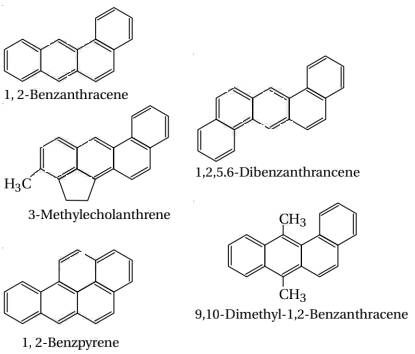
(N/A) Certain polycyclic aromatic hydrocarbons (PAHs) are known to be carcinogenic. These are formed by the incomplete combustion of organic materials like tobacco,coal,and petroleum. Examples include:
$1$. $1,2$-Benzanthracene
$2$. $1,2,5,6$-Dibenzanthracene
$3$. $3$-Methylcholanthrene
$4$. $1,2$-Benzpyrene
$5$. $9,10$-Dimethyl-$1,2$-benzanthracene
$1$. $1,2$-Benzanthracene
$2$. $1,2,5,6$-Dibenzanthracene
$3$. $3$-Methylcholanthrene
$4$. $1,2$-Benzpyrene
$5$. $9,10$-Dimethyl-$1,2$-benzanthracene
0 likes
View Solution631
Medium
On attachment of $H$ and $Br$ from the $HBr$ to $C_6H_5$ free radical,what can be formed?
Solution
(A) $(i) \ C_6H_5^{\bullet} + H-Br \rightarrow C_6H_6 + Br^{\bullet}$ (more stable)
$(ii) \ C_6H_5^{\bullet} + H-Br \rightarrow C_6H_5Br + H^{\bullet}$ (least stable)
Reaction $(i)$ proceeds to form the $Br$ free radical,while reaction $(ii)$ is energetically unfavorable and does not occur.
$(ii) \ C_6H_5^{\bullet} + H-Br \rightarrow C_6H_5Br + H^{\bullet}$ (least stable)
Reaction $(i)$ proceeds to form the $Br$ free radical,while reaction $(ii)$ is energetically unfavorable and does not occur.
0 likes
View Solution632
Medium
Answer the following question: $(i)$ Give the isomers of the aromatic hydrocarbon having the molecular formula $C_8H_{10}$.
Solution
(N/A) The aromatic hydrocarbon with the molecular formula $C_8H_{10}$ has four isomers:
$1$. $o$-xylene ($1$,$2$-dimethylbenzene)
$2$. $m$-xylene ($1$,$3$-dimethylbenzene)
$3$. $p$-xylene ($1$,$4$-dimethylbenzene)
$4$. Ethylbenzene
$1$. $o$-xylene ($1$,$2$-dimethylbenzene)
$2$. $m$-xylene ($1$,$3$-dimethylbenzene)
$3$. $p$-xylene ($1$,$4$-dimethylbenzene)
$4$. Ethylbenzene
0 likes
View Solution633
EasyMCQ
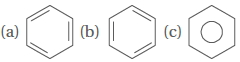
Are the given structures representations of $Benzene$?
A
$a$
B
$b$
C
$c$
Solution
(A) Yes,all three structures $(a)$,$(b)$,and $(c)$ represent $Benzene$ $(C_6H_6)$.
Structures $(a)$ and $(b)$ are the two Kekulé resonance structures of $Benzene$,showing the alternating double bonds.
Structure $(c)$ represents the resonance hybrid of $Benzene$,where the circle inside the hexagon indicates the delocalization of $\pi$-electrons over the entire ring.
Structures $(a)$ and $(b)$ are the two Kekulé resonance structures of $Benzene$,showing the alternating double bonds.
Structure $(c)$ represents the resonance hybrid of $Benzene$,where the circle inside the hexagon indicates the delocalization of $\pi$-electrons over the entire ring.
0 likes
View Solution634
MediumMCQ
What type of difference is observed in the hybridization of carbon in benzene during nitration and the formation of the $\sigma$-complex?
A
$sp^2$ to $sp^3$
B
$sp^3$ to $sp^2$
C
$sp$ to $sp^2$
D
$sp^2$ to $sp$
Solution
(A) In benzene,all carbon atoms are $sp^2$ hybridized. During the formation of the $\sigma$-complex (arenium ion) in nitration,the electrophile $(NO_2^+)$ attacks one of the carbon atoms. This carbon atom changes its hybridization from $sp^2$ to $sp^3$ to accommodate the incoming group,while the remaining five carbon atoms retain their $sp^2$ hybridization.
0 likes
View Solution635
Medium
Give reason: Nitration of benzene is not possible with only $HNO_3$.
Solution
(N/A) Benzene possesses characteristic aromatic stability due to delocalized $\pi$-electrons.
To initiate nitration,a strong electrophile is required to attack the stable $\pi$-electron cloud.
$HNO_3$ alone does not generate a sufficiently strong electrophile $(NO_2^+)$ in high enough concentration to overcome the resonance energy of benzene.
Therefore,a mixture of concentrated $HNO_3$ and concentrated $H_2SO_4$ is used to generate the strong electrophile $NO_2^+$.
To initiate nitration,a strong electrophile is required to attack the stable $\pi$-electron cloud.
$HNO_3$ alone does not generate a sufficiently strong electrophile $(NO_2^+)$ in high enough concentration to overcome the resonance energy of benzene.
Therefore,a mixture of concentrated $HNO_3$ and concentrated $H_2SO_4$ is used to generate the strong electrophile $NO_2^+$.
0 likes
View Solution636
Medium
Which of the following groups have an activating effect on the benzene ring?
$-OH, -COCH_3, -NO_2, -NH_2, -Cl, -Br, -NHCOCH_3, -COOH$
$-OH, -COCH_3, -NO_2, -NH_2, -Cl, -Br, -NHCOCH_3, -COOH$
Solution
(A) Groups that increase the electron density of the benzene ring through resonance ($+R$ or $+M$ effect) are known as activating groups.
Among the given groups,$-OH$,$-NH_2$,and $-NHCOCH_3$ are activating groups because they donate electron density to the ring via their lone pairs.
Therefore,the activating groups are: $-OH, -NH_2, -NHCOCH_3$.
Among the given groups,$-OH$,$-NH_2$,and $-NHCOCH_3$ are activating groups because they donate electron density to the ring via their lone pairs.
Therefore,the activating groups are: $-OH, -NH_2, -NHCOCH_3$.
0 likes
View Solution637
MediumMCQ
Arrange the following compounds in decreasing order of their reactivity towards electrophilic substitution $(E^{+})$:
$C_6H_5NH_2$,$C_6H_5NHCOCH_3$,$C_6H_6$,$C_6H_5SO_3H$
$C_6H_5NH_2$,$C_6H_5NHCOCH_3$,$C_6H_6$,$C_6H_5SO_3H$
A
$C_6H_5NH_2 > C_6H_5NHCOCH_3 > C_6H_6 > C_6H_5SO_3H$
B
$C_6H_5NH_2 > C_6H_6 > C_6H_5NHCOCH_3 > C_6H_5SO_3H$
C
$C_6H_5NHCOCH_3 > C_6H_5NH_2 > C_6H_6 > C_6H_5SO_3H$
D
$C_6H_5SO_3H > C_6H_6 > C_6H_5NHCOCH_3 > C_6H_5NH_2$
Solution
(A) The reactivity of aromatic compounds towards electrophilic substitution $(E^{+})$ depends on the electron density of the benzene ring. Groups that donate electrons by resonance ($+R$ or $+M$ effect) increase reactivity,while groups that withdraw electrons ($-R$ or $-I$ effect) decrease it.
$1$. $C_6H_5NH_2$: The $-NH_2$ group is a strong activating group due to its lone pair,which is donated to the ring via resonance ($+R$ effect).
$2$. $C_6H_5NHCOCH_3$: The $-NHCOCH_3$ group is also activating,but less so than $-NH_2$ because the lone pair on nitrogen is delocalized towards the carbonyl group $(C=O)$,reducing its availability for the ring.
$3$. $C_6H_6$: Benzene is the reference compound with no substituents.
$4$. $C_6H_5SO_3H$: The $-SO_3H$ group is a strong deactivating group due to its strong electron-withdrawing effect ($-I$ and $-R$ effects).
Therefore,the decreasing order of reactivity is: $C_6H_5NH_2 > C_6H_5NHCOCH_3 > C_6H_6 > C_6H_5SO_3H$.
$1$. $C_6H_5NH_2$: The $-NH_2$ group is a strong activating group due to its lone pair,which is donated to the ring via resonance ($+R$ effect).
$2$. $C_6H_5NHCOCH_3$: The $-NHCOCH_3$ group is also activating,but less so than $-NH_2$ because the lone pair on nitrogen is delocalized towards the carbonyl group $(C=O)$,reducing its availability for the ring.
$3$. $C_6H_6$: Benzene is the reference compound with no substituents.
$4$. $C_6H_5SO_3H$: The $-SO_3H$ group is a strong deactivating group due to its strong electron-withdrawing effect ($-I$ and $-R$ effects).
Therefore,the decreasing order of reactivity is: $C_6H_5NH_2 > C_6H_5NHCOCH_3 > C_6H_6 > C_6H_5SO_3H$.
0 likes
View Solution638
MediumMCQ
Which of the following groups possess $m-$directional effect?
$-OH, -O^{-}, -CH_3, -Cl, -NO_2, -COOH, -NHCOCH_3, -SO_3H, -Br, -COCH_3$
$-OH, -O^{-}, -CH_3, -Cl, -NO_2, -COOH, -NHCOCH_3, -SO_3H, -Br, -COCH_3$
A
$-NO_2, -COOH, -SO_3H, -COCH_3$
B
$-OH, -O^{-}, -CH_3, -Cl$
C
$-NHCOCH_3, -Br, -CH_3, -OH$
D
$-O^{-}, -Cl, -Br, -NO_2$
Solution
(A) The groups that possess $m-$directional effect (meta-directing groups) are those that withdraw electrons from the benzene ring through resonance or inductive effects.
These groups are: $-NO_2, -COOH, -SO_3H, -COCH_3$.
The other groups listed $(-OH, -O^{-}, -CH_3, -Cl, -NHCOCH_3, -Br)$ are ortho/para-directing groups.
These groups are: $-NO_2, -COOH, -SO_3H, -COCH_3$.
The other groups listed $(-OH, -O^{-}, -CH_3, -Cl, -NHCOCH_3, -Br)$ are ortho/para-directing groups.
0 likes
View Solution639
Medium
Are all $ortho$ and $para$ directing groups activators? Give examples.
Solution
(N/A) No,all $ortho$ and $para$ directing groups are not activators. While most $ortho$ and $para$ directing groups (like $-OH, -NH_2, -CH_3$) are activating groups,halogen atoms $(X = F, Cl, Br, I)$ are $ortho$ and $para$ directing but act as deactivating groups due to their strong $-I$ effect.
0 likes
View Solution640
AdvancedMCQ
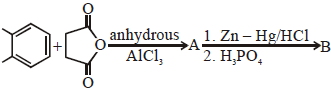
In the following reaction sequence,the major products $A$ and $B$ are:
A
$A$ = $4-$($3$,$4$-dimethylphenyl)$-4-$oxobutanoic acid; $B$ = $6,7-$dimethyl$-3,4-$dihydronaphthalen-$1$(2H)-one
B
$A$ = $4-$($3$,$4$-dimethylphenyl)$-4-$oxobutanoic acid; $B$ = $6,7-$dimethyl$-1,2,3,4-$tetrahydronaphthalene
C
$A$ = $4-$($2$,$3$-dimethylphenyl)$-4-$oxobutanoic acid; $B$ = $5,6-$dimethyl$-3,4-$dihydronaphthalen-$1$(2H)-one
D
$A$ = $4-$($2$,$3$-dimethylphenyl)$-4-$oxobutanoic acid; $B$ = $5,6-$dimethyl$-3,4-$dihydronaphthalen-$1$(2H)-one
Solution
(A) The reaction of $o$-xylene with succinic anhydride in the presence of anhydrous $AlCl_3$ is a Friedel-Crafts acylation reaction. The electrophile attacks the more electron-rich position of the benzene ring. For $o$-xylene,the para position relative to one methyl group is the most reactive,leading to the formation of $4-(3,4-\text{dimethylphenyl})-4-\text{oxobutanoic acid}$ as product $A$.
Next,the Clemmensen reduction $(Zn-Hg/HCl)$ reduces the ketone group to a methylene group,forming $4-(3,4-\text{dimethylphenyl})butanoic acid$.
Finally,treatment with $H_3PO_4$ causes intramolecular cyclization (Friedel-Crafts acylation) to form the cyclic ketone,$6,7-\text{dimethyl}-3,4-\text{dihydronaphthalen}-1(2H)-\text{one}$ as product $B$.
Next,the Clemmensen reduction $(Zn-Hg/HCl)$ reduces the ketone group to a methylene group,forming $4-(3,4-\text{dimethylphenyl})butanoic acid$.
Finally,treatment with $H_3PO_4$ causes intramolecular cyclization (Friedel-Crafts acylation) to form the cyclic ketone,$6,7-\text{dimethyl}-3,4-\text{dihydronaphthalen}-1(2H)-\text{one}$ as product $B$.
0 likes
View Solution641
MediumMCQ
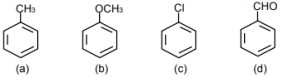
The correct order of reactivity towards electrophilic substitution reaction is:
A
$a > b > c > d$
B
$d > b > a > c$
C
$b > a > c > d$
D
$b > a > d > c$
Solution
(C) Electrophilic substitution reactivity depends on the electron density of the aromatic ring.
Electron donating groups $(EDG)$ increase electron density,while electron withdrawing groups $(EWG)$ decrease it.
$(a)$ Toluene $(-CH_3)$: $+I$ and hyperconjugation effect (activating).
$(b)$ Anisole $(-OCH_3)$: $+M$ effect is very strong (strongly activating).
$(c)$ Chlorobenzene $(-Cl)$: $-I$ effect dominates over $+M$ effect (deactivating).
$(d)$ Benzaldehyde $(-CHO)$: $-M$ and $-I$ effects (strongly deactivating).
The order of activation is: Anisole $(b)$ > Toluene $(a)$ > Chlorobenzene $(c)$ > Benzaldehyde $(d)$.
Therefore,the correct order is $b > a > c > d$.
Electron donating groups $(EDG)$ increase electron density,while electron withdrawing groups $(EWG)$ decrease it.
$(a)$ Toluene $(-CH_3)$: $+I$ and hyperconjugation effect (activating).
$(b)$ Anisole $(-OCH_3)$: $+M$ effect is very strong (strongly activating).
$(c)$ Chlorobenzene $(-Cl)$: $-I$ effect dominates over $+M$ effect (deactivating).
$(d)$ Benzaldehyde $(-CHO)$: $-M$ and $-I$ effects (strongly deactivating).
The order of activation is: Anisole $(b)$ > Toluene $(a)$ > Chlorobenzene $(c)$ > Benzaldehyde $(d)$.
Therefore,the correct order is $b > a > c > d$.
0 likes
View Solution642
MediumMCQ
Among the following,the aromatic compounds are:
$(A)$ Heptafulvene
$(B)$ Benzene
$(C)$ Cyclopentadienyl anion
$(D)$ Cyclopentadienyl cation
Choose the correct answer from the following options:
$(A)$ Heptafulvene
$(B)$ Benzene
$(C)$ Cyclopentadienyl anion
$(D)$ Cyclopentadienyl cation
Choose the correct answer from the following options:
A
$A$ and $B$ only
B
$B$ and $C$ only
C
$B$,$C$ and $D$ only
D
$A$,$B$ and $C$ only
Solution
(B) To determine aromaticity,we use $H$ückel's rule ($4n+2$ $\pi$ electrons,planar,cyclic,conjugated):
$A$. Heptafulvene: It is non-aromatic because it is not fully conjugated in a way that satisfies the $4n+2$ rule for the entire ring system.
$B$. Benzene: It is aromatic ($6$ $\pi$ electrons,$n=1$,planar,cyclic,fully conjugated).
$C$. Cyclopentadienyl anion: It is aromatic ($6$ $\pi$ electrons,$n=1$,planar,cyclic,fully conjugated).
$D$. Cyclopentadienyl cation: It is anti-aromatic ($4$ $\pi$ electrons,$n=1$,planar,cyclic,fully conjugated).
Therefore,compounds $B$ and $C$ are aromatic.
$A$. Heptafulvene: It is non-aromatic because it is not fully conjugated in a way that satisfies the $4n+2$ rule for the entire ring system.
$B$. Benzene: It is aromatic ($6$ $\pi$ electrons,$n=1$,planar,cyclic,fully conjugated).
$C$. Cyclopentadienyl anion: It is aromatic ($6$ $\pi$ electrons,$n=1$,planar,cyclic,fully conjugated).
$D$. Cyclopentadienyl cation: It is anti-aromatic ($4$ $\pi$ electrons,$n=1$,planar,cyclic,fully conjugated).
Therefore,compounds $B$ and $C$ are aromatic.
0 likes
View Solution643
MediumMCQ
Which of the following is an aromatic compound?
A
B
C
D
Solution
(A) For a compound to be aromatic,it must follow $H$ückel's rule: it must be cyclic,planar,fully conjugated,and contain $(4n + 2) \pi$ electrons.
$A$. The cyclopentadienyl anion $(C_5H_5^-)$ has $6 \pi$ electrons (two from each of the two double bonds and two from the lone pair on the negatively charged carbon). It is cyclic,planar,and fully conjugated. Thus,it is aromatic.
$B$. Cyclopentadiene is not fully conjugated because it contains an $sp^3$ hybridized carbon atom.
$C$. The cyclopentadienyl dianion has $8 \pi$ electrons,which follows the $4n$ rule,making it anti-aromatic.
$D$. The cyclopentadienyl cation has $4 \pi$ electrons,which follows the $4n$ rule,making it anti-aromatic.
Therefore,the cyclopentadienyl anion is the aromatic compound.
$A$. The cyclopentadienyl anion $(C_5H_5^-)$ has $6 \pi$ electrons (two from each of the two double bonds and two from the lone pair on the negatively charged carbon). It is cyclic,planar,and fully conjugated. Thus,it is aromatic.
$B$. Cyclopentadiene is not fully conjugated because it contains an $sp^3$ hybridized carbon atom.
$C$. The cyclopentadienyl dianion has $8 \pi$ electrons,which follows the $4n$ rule,making it anti-aromatic.
$D$. The cyclopentadienyl cation has $4 \pi$ electrons,which follows the $4n$ rule,making it anti-aromatic.
Therefore,the cyclopentadienyl anion is the aromatic compound.
0 likes
View Solution644
MediumMCQ
For the given reaction:
$CH_{3}-CH=CHBr \xrightarrow[2. \text{Red hot iron tube}, 873 \text{ K}]{1. \text{NaNH}_{2}} A$ (major product)
Identify the major product $A$.
$CH_{3}-CH=CHBr \xrightarrow[2. \text{Red hot iron tube}, 873 \text{ K}]{1. \text{NaNH}_{2}} A$ (major product)
Identify the major product $A$.
A
$CH_{3}CH_{2}CH_{2}NH_{2}$
B
$CH_{3}-C(CH_{3})=CH-NH_{2}$
C
Benzene
D
$1,3,5-$Trimethylbenzene
Solution
(D) Step $1$: Dehydrohalogenation of $CH_{3}-CH=CHBr$ with $NaNH_{2}$ removes $HBr$ to form propyne $(CH_{3}-C \equiv CH)$.
Step $2$: Cyclic polymerization of $3$ moles of propyne in the presence of a red hot iron tube at $873 \text{ K}$ yields $1,3,5$-trimethylbenzene (mesitylene).
Therefore,the major product $A$ is $1,3,5$-trimethylbenzene.
Step $2$: Cyclic polymerization of $3$ moles of propyne in the presence of a red hot iron tube at $873 \text{ K}$ yields $1,3,5$-trimethylbenzene (mesitylene).
Therefore,the major product $A$ is $1,3,5$-trimethylbenzene.
0 likes
View Solution645
EasyMCQ
Which one of the following compounds is nonaromatic?
A
Cyclooctatetraene
B
Furan
C
Cyclobutadiene dication
D
Anthracene
Solution
(A) To determine the aromaticity of a compound,we use $H$ückel's rule,which states that a planar,cyclic,fully conjugated system with $(4n+2) \pi$ electrons is aromatic,while one with $4n \pi$ electrons is antiaromatic. Nonaromatic compounds are those that do not satisfy these conditions (e.g.,they may not be planar or fully conjugated).
$1$. Cyclooctatetraene: It has $8 \pi$ electrons. It is not planar (it adopts a tub-shaped conformation) to avoid antiaromaticity,making it nonaromatic.
$2$. Furan: It is a cyclic,planar,fully conjugated system with $6 \pi$ electrons (including the lone pair on oxygen),making it aromatic.
$3$. Cyclobutadiene dication: It has $2 \pi$ electrons $(n=0)$,making it aromatic.
$4$. Anthracene: It is a polycyclic aromatic hydrocarbon with $14 \pi$ electrons,making it aromatic.
Therefore,cyclooctatetraene is nonaromatic.
$1$. Cyclooctatetraene: It has $8 \pi$ electrons. It is not planar (it adopts a tub-shaped conformation) to avoid antiaromaticity,making it nonaromatic.
$2$. Furan: It is a cyclic,planar,fully conjugated system with $6 \pi$ electrons (including the lone pair on oxygen),making it aromatic.
$3$. Cyclobutadiene dication: It has $2 \pi$ electrons $(n=0)$,making it aromatic.
$4$. Anthracene: It is a polycyclic aromatic hydrocarbon with $14 \pi$ electrons,making it aromatic.
Therefore,cyclooctatetraene is nonaromatic.
0 likes
View Solution646
EasyMCQ
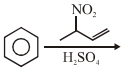
The major product of the following reaction is:
A
$3-$nitro$-2-$phenylbutane
B
$2-$nitro$-3-$phenylbutane
C
$1-$nitro$-3-$phenylbutane
D
$2-$methyl$-2-$nitro$-1-$phenylbutane
Solution
(B) The reaction involves the electrophilic addition of benzene to the alkene $CH_3-CH(NO_2)-CH=CH_2$ in the presence of an acid catalyst $(H_2SO_4)$.
$1$. The acid protonates the alkene to form a carbocation intermediate.
$2$. The most stable carbocation is formed,which is the secondary carbocation at the carbon adjacent to the $NO_2$ group due to resonance stabilization or inductive effects.
$3$. Benzene acts as a nucleophile and attacks the carbocation to form the final product,which is $2-nitro-3-phenylbutane$.
$1$. The acid protonates the alkene to form a carbocation intermediate.
$2$. The most stable carbocation is formed,which is the secondary carbocation at the carbon adjacent to the $NO_2$ group due to resonance stabilization or inductive effects.
$3$. Benzene acts as a nucleophile and attacks the carbocation to form the final product,which is $2-nitro-3-phenylbutane$.
0 likes
View Solution647
MediumMCQ
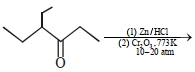
Considering the reaction shown below,identify the major product:
A
Ethylbenzene
B
Propylbenzene
C
o-Xylene
D
Propiophenone
Solution
(A) The given reaction involves two steps:
$1$. Clemmensen reduction: The ketone group $(C=O)$ is reduced to a methylene group $(-CH_2-)$ using $Zn-Hg/HCl$. The reactant is $3-ethylhexan-3-one$ (or a similar ketone structure). The reduction converts the carbonyl group into a methylene group,resulting in an alkane chain.
$2$. Dehydrocyclization (Aromatization): The resulting alkane is treated with $Cr_2O_3$ at $773 \ K$ and $10-20 \ atm$. This is a standard industrial process for the aromatization of alkanes to form aromatic hydrocarbons.
Given the structure,the alkane formed is $3-ethylhexane$. Upon aromatization,it cyclizes to form ethylbenzene.
$1$. Clemmensen reduction: The ketone group $(C=O)$ is reduced to a methylene group $(-CH_2-)$ using $Zn-Hg/HCl$. The reactant is $3-ethylhexan-3-one$ (or a similar ketone structure). The reduction converts the carbonyl group into a methylene group,resulting in an alkane chain.
$2$. Dehydrocyclization (Aromatization): The resulting alkane is treated with $Cr_2O_3$ at $773 \ K$ and $10-20 \ atm$. This is a standard industrial process for the aromatization of alkanes to form aromatic hydrocarbons.
Given the structure,the alkane formed is $3-ethylhexane$. Upon aromatization,it cyclizes to form ethylbenzene.
0 likes
View Solution648
EasyMCQ
Which one of the following compounds is not aromatic?
A
Cycloheptatrienyl anion
B
Cyclopentadienyl anion
C
Cyclooctatetraene
D
Phenol
Solution
(C) To determine if a compound is aromatic,it must satisfy $H$ückel's rule: it must be cyclic,planar,fully conjugated,and have $(4n + 2) \pi$ electrons.
$A$. Cycloheptatrienyl anion: It has $8 \pi$ electrons (anti-aromatic) or is non-planar,but in many contexts,it is considered non-aromatic due to lack of planarity or anti-aromaticity.
$B$. Cyclopentadienyl anion: It has $6 \pi$ electrons $(n=1)$,is cyclic,planar,and fully conjugated. It is aromatic.
$C$. Cyclooctatetraene: It has $8 \pi$ electrons ($4n$ system). It is non-planar (tub-shaped) to avoid anti-aromaticity,making it non-aromatic.
$D$. Phenol: It is a benzene derivative,which is aromatic.
Comparing the options,Cyclooctatetraene is the most classic example of a non-aromatic compound due to its non-planar structure.
$A$. Cycloheptatrienyl anion: It has $8 \pi$ electrons (anti-aromatic) or is non-planar,but in many contexts,it is considered non-aromatic due to lack of planarity or anti-aromaticity.
$B$. Cyclopentadienyl anion: It has $6 \pi$ electrons $(n=1)$,is cyclic,planar,and fully conjugated. It is aromatic.
$C$. Cyclooctatetraene: It has $8 \pi$ electrons ($4n$ system). It is non-planar (tub-shaped) to avoid anti-aromaticity,making it non-aromatic.
$D$. Phenol: It is a benzene derivative,which is aromatic.
Comparing the options,Cyclooctatetraene is the most classic example of a non-aromatic compound due to its non-planar structure.
0 likes
View Solution649
MediumMCQ
The structures of $A$ and $B$ formed in the following reaction are : $[Ph = -C_6H_5]$
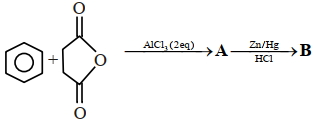
A
$A = Ph-CO-CH_2-CH_2-COOH, B = Ph-CH_2-CH_2-CH_2-COOH$
B
$A = Ph-CO-CH_2-CH_3, B = Ph-CH(OH)-CH_2-CH_3$
C
$A = Ph-CO-CH_2-CH_2-COOH, B = Ph-CH_2-CH_2-CH_2-OH$
D
$A = Ph-CO-CH_2-CH_3, B = Ph-CH_2-CH_2-CH_3$
Solution
(A) The reaction of benzene with succinic anhydride in the presence of $AlCl_3$ is a Friedel-Crafts acylation reaction.
This reaction yields $4-$oxo$-4-$phenylbutanoic acid as product $A$ $(Ph-CO-CH_2-CH_2-COOH)$.
The subsequent reaction with $Zn-Hg/HCl$ is a Clemmensen reduction,which reduces the carbonyl group $(C=O)$ to a methylene group $(-CH_2-)$.
Therefore,the product $B$ is $4-$phenylbutanoic acid $(Ph-CH_2-CH_2-CH_2-COOH)$.
This reaction yields $4-$oxo$-4-$phenylbutanoic acid as product $A$ $(Ph-CO-CH_2-CH_2-COOH)$.
The subsequent reaction with $Zn-Hg/HCl$ is a Clemmensen reduction,which reduces the carbonyl group $(C=O)$ to a methylene group $(-CH_2-)$.
Therefore,the product $B$ is $4-$phenylbutanoic acid $(Ph-CH_2-CH_2-CH_2-COOH)$.
0 likes
View Solution650
DifficultMCQ
Which one of the following compounds is aromatic in nature?
A
Acenaphthene
B
Cyclobutadiene
C
$1-$Methylcyclopentadienyl cation
D
Cyclopentadienyl anion
Solution
(D) To determine aromaticity,we apply $H$ückel's rule ($4n+2$ $\pi$ electrons in a planar cyclic system).
$1$. Acenaphthene: It has $10$ $\pi$ electrons in a cyclic conjugated system,making it aromatic.
$2$. Cyclobutadiene: It has $4$ $\pi$ electrons in a cyclic conjugated system,making it anti-aromatic.
$3$. $1$-Methylcyclopentadienyl cation: It has $4$ $\pi$ electrons in the ring,making it anti-aromatic.
$4$. Cyclopentadienyl anion: It has $6$ $\pi$ electrons in a cyclic conjugated system,making it aromatic.
Note: Both $1$ and $4$ are aromatic. Based on standard multiple-choice conventions for this specific question,the cyclopentadienyl anion is the most classic example of an aromatic ion.
$1$. Acenaphthene: It has $10$ $\pi$ electrons in a cyclic conjugated system,making it aromatic.
$2$. Cyclobutadiene: It has $4$ $\pi$ electrons in a cyclic conjugated system,making it anti-aromatic.
$3$. $1$-Methylcyclopentadienyl cation: It has $4$ $\pi$ electrons in the ring,making it anti-aromatic.
$4$. Cyclopentadienyl anion: It has $6$ $\pi$ electrons in a cyclic conjugated system,making it aromatic.
Note: Both $1$ and $4$ are aromatic. Based on standard multiple-choice conventions for this specific question,the cyclopentadienyl anion is the most classic example of an aromatic ion.
0 likes
View SolutionHydrocarbons — Aromatic hydrocarbon · Frequently Asked Questions
1Are these Hydrocarbons questions useful for JEE and NEET?
Yes. All questions in this section are mapped to JEE Main and NEET exam patterns. Previous year questions from JEE Main, NEET, GUJCET and state-level exams are included with full solutions.
2Can I switch to Hindi or Gujarati for these questions?
Yes. Use the language tabs in the hero section or the sidebar to view the same questions and solutions in English, Hindi or Gujarati.
3How do I generate a question paper from this subtopic?
Use the Vedclass Exam Paper Generator — select the chapter and subtopic, set difficulty, and generate Sets A, B, C, D automatically. First 3 chapters of every subject are free.
Vedclass Products
For Students
Vedclass Test Series
Mock tests in real JEE/NEET style with performance analysis. 5-day free trial.
Start Free TrialFor Teachers
Exam Paper Generator
Generate Set A/B/C/D papers from this chapter in 2 minutes. 3 chapters free.
Try FreeFor Institutes
Online Exam Module
Live online exams with unlimited students, 360° analytics & white-label branding.
See DemoFor Teachers & Institutes
Generate a Hydrocarbons Exam Paper in 2 Minutes
Select subtopic & difficulty — Sets A, B, C, D auto-generated with No Repeat logic.
First 3 chapters of every subject are free — no payment required.