
A English
Aromatic hydrocarbon Questions in English
Class 11 Chemistry · Hydrocarbons · Aromatic hydrocarbon
872+
Questions
English
Language
100%
With Solutions
Showing 49 of 872 questions in English
551
MediumMCQ
Assertion : Nitrating mixture used for carrying out nitration of benzene consists of conc. $HNO_3 +$ conc. $H_2SO_4$.
Reason : In presence of $H_2SO_4$,$HNO_3$ acts as a base and produces $NO_2^+$ ions.
Reason : In presence of $H_2SO_4$,$HNO_3$ acts as a base and produces $NO_2^+$ ions.
A
If both Assertion and Reason are correct and the Reason is a correct explanation of the Assertion.
B
If both Assertion and Reason are correct but Reason is not a correct explanation of the Assertion.
C
If the Assertion is correct but Reason is incorrect.
D
If both the Assertion and Reason are incorrect.
Solution
(A) The nitrating mixture for benzene is a mixture of concentrated $HNO_3$ and concentrated $H_2SO_4$.
In this mixture,$H_2SO_4$ acts as a strong acid and $HNO_3$ acts as a base.
The reaction is: $HNO_3 + 2H_2SO_4 \rightleftharpoons NO_2^+ + H_3O^+ + 2HSO_4^-$.
The electrophile $NO_2^+$ (nitronium ion) is generated,which then attacks the benzene ring.
Thus,both the Assertion and the Reason are correct,and the Reason is the correct explanation of the Assertion.
In this mixture,$H_2SO_4$ acts as a strong acid and $HNO_3$ acts as a base.
The reaction is: $HNO_3 + 2H_2SO_4 \rightleftharpoons NO_2^+ + H_3O^+ + 2HSO_4^-$.
The electrophile $NO_2^+$ (nitronium ion) is generated,which then attacks the benzene ring.
Thus,both the Assertion and the Reason are correct,and the Reason is the correct explanation of the Assertion.
0 likes
View Solution552
MediumMCQ
Assertion : Tropylium cation is aromatic in nature.
Reason : The only property that determines its aromatic behaviour is its planar structure.
Reason : The only property that determines its aromatic behaviour is its planar structure.

A
If both Assertion and Reason are correct and the Reason is a correct explanation of the Assertion.
B
If both Assertion and Reason are correct but Reason is not a correct explanation of the Assertion.
C
If the Assertion is correct but Reason is incorrect.
D
If both the Assertion and Reason are incorrect.
Solution
(C) The Tropylium cation $(C_7H_7^+)$ is a seven-membered ring with $6\pi$ electrons ($n=1$ in $H$ückel's rule $(4n+2)\pi$).
It is planar and fully conjugated,making it aromatic.
Therefore,the Assertion is correct.
However,the Reason is incorrect because aromaticity is determined by multiple factors,including cyclic structure,planarity,complete conjugation,and the presence of $(4n+2)\pi$ electrons,not just planarity alone.
It is planar and fully conjugated,making it aromatic.
Therefore,the Assertion is correct.
However,the Reason is incorrect because aromaticity is determined by multiple factors,including cyclic structure,planarity,complete conjugation,and the presence of $(4n+2)\pi$ electrons,not just planarity alone.
0 likes
View Solution553
MediumMCQ
Assertion : Benzene exhibits two different bond lengths, due to $C-C$ single and $C=C$ double bonds.
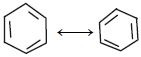
Reason : Actual structure of benzene is a hybrid of the following two structures.
Reason : Actual structure of benzene is a hybrid of the following two structures.
A
If both Assertion and Reason are correct and the Reason is a correct explanation of the Assertion.
B
If both Assertion and Reason are correct but Reason is not a correct explanation of the Assertion.
C
If the Assertion is correct but Reason is incorrect.
D
If both the Assertion and Reason are incorrect.
Solution
(D) The Assertion is incorrect because benzene does not exhibit two different bond lengths; all $C-C$ bonds in benzene are equivalent due to resonance.
The Reason is correct because the actual structure of benzene is a resonance hybrid of the two Kekulé structures shown.
Benzene has a uniform $C-C$ bond distance of $139 \ pm$, which is an intermediate value between the $C-C$ single bond $(154 \ pm)$ and $C=C$ double bond $(134 \ pm)$ lengths.
The Reason is correct because the actual structure of benzene is a resonance hybrid of the two Kekulé structures shown.
Benzene has a uniform $C-C$ bond distance of $139 \ pm$, which is an intermediate value between the $C-C$ single bond $(154 \ pm)$ and $C=C$ double bond $(134 \ pm)$ lengths.
0 likes
View Solution554
MediumMCQ
In the following reaction,
$CH_3-C \equiv CH \xrightarrow[873 \ K]{\text{red hot iron tube}} A$
the number of sigma$(\sigma)$ bonds present in the product $A$ is
$CH_3-C \equiv CH \xrightarrow[873 \ K]{\text{red hot iron tube}} A$
the number of sigma$(\sigma)$ bonds present in the product $A$ is
A
$21$
B
$9$
C
$24$
D
$18$
Solution
(A) The reaction of propyne $(CH_3-C \equiv CH)$ with a red hot iron tube at $873 \ K$ is a cyclic polymerization reaction.
Three molecules of propyne undergo cyclization to form $1,3,5$-trimethylbenzene (mesitylene) as the product $A$.
The structure of $1,3,5$-trimethylbenzene is a benzene ring with three methyl groups at positions $1, 3,$ and $5$.
To calculate the number of $\sigma$ bonds in $1,3,5$-trimethylbenzene $(C_9H_{12})$:
- There are $6$ $\sigma$ bonds in the benzene ring ($C$-$C$ bonds).
- There are $3$ $\sigma$ bonds between the ring carbons and the methyl carbons.
- Each of the $3$ methyl groups has $3$ $C$-$H$ $\sigma$ bonds,totaling $3 \times 3 = 9$ $\sigma$ bonds.
- There are $3$ $\sigma$ bonds between the ring carbons and the remaining $3$ hydrogens,totaling $3$ $\sigma$ bonds.
Total $\sigma$ bonds = $6 \text{ (ring C-C)} + 3 \text{ (ring-methyl C-C)} + 9 \text{ (methyl C-H)} + 3 \text{ (ring C-H)} = 21$.
Thus,the product $A$ contains $21$ $\sigma$ bonds.
Three molecules of propyne undergo cyclization to form $1,3,5$-trimethylbenzene (mesitylene) as the product $A$.
The structure of $1,3,5$-trimethylbenzene is a benzene ring with three methyl groups at positions $1, 3,$ and $5$.
To calculate the number of $\sigma$ bonds in $1,3,5$-trimethylbenzene $(C_9H_{12})$:
- There are $6$ $\sigma$ bonds in the benzene ring ($C$-$C$ bonds).
- There are $3$ $\sigma$ bonds between the ring carbons and the methyl carbons.
- Each of the $3$ methyl groups has $3$ $C$-$H$ $\sigma$ bonds,totaling $3 \times 3 = 9$ $\sigma$ bonds.
- There are $3$ $\sigma$ bonds between the ring carbons and the remaining $3$ hydrogens,totaling $3$ $\sigma$ bonds.
Total $\sigma$ bonds = $6 \text{ (ring C-C)} + 3 \text{ (ring-methyl C-C)} + 9 \text{ (methyl C-H)} + 3 \text{ (ring C-H)} = 21$.
Thus,the product $A$ contains $21$ $\sigma$ bonds.
0 likes
View Solution555
DifficultMCQ
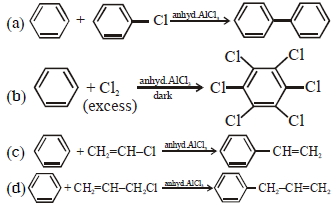
Which of the following reactions is correct?
A
$a$ and $d$
B
$b$ and $d$
C
$a$ and $b$
D
$b, c$ and $d$
Solution
(B) Let us analyze each reaction:
$(a)$ Benzene + Chlorobenzene in the presence of anhydrous $AlCl_3$ does not undergo Friedel-Crafts alkylation or arylation because the $C-Cl$ bond in chlorobenzene is very strong due to resonance,making it unreactive towards electrophilic substitution.
$(b)$ Benzene reacts with excess $Cl_2$ in the presence of anhydrous $AlCl_3$ in the dark to form hexachlorobenzene via electrophilic aromatic substitution.
$(c)$ Benzene + Vinyl chloride $(CH_2=CH-Cl)$ in the presence of anhydrous $AlCl_3$ does not react because the $C-Cl$ bond in vinyl chloride has partial double bond character due to resonance,making it inert.
$(d)$ Benzene + Allyl chloride $(CH_2=CH-CH_2Cl)$ in the presence of anhydrous $AlCl_3$ undergoes Friedel-Crafts alkylation to form allylbenzene $(C_6H_5-CH_2-CH=CH_2)$.
Thus,reactions $(b)$ and $(d)$ are correct.
$(a)$ Benzene + Chlorobenzene in the presence of anhydrous $AlCl_3$ does not undergo Friedel-Crafts alkylation or arylation because the $C-Cl$ bond in chlorobenzene is very strong due to resonance,making it unreactive towards electrophilic substitution.
$(b)$ Benzene reacts with excess $Cl_2$ in the presence of anhydrous $AlCl_3$ in the dark to form hexachlorobenzene via electrophilic aromatic substitution.
$(c)$ Benzene + Vinyl chloride $(CH_2=CH-Cl)$ in the presence of anhydrous $AlCl_3$ does not react because the $C-Cl$ bond in vinyl chloride has partial double bond character due to resonance,making it inert.
$(d)$ Benzene + Allyl chloride $(CH_2=CH-CH_2Cl)$ in the presence of anhydrous $AlCl_3$ undergoes Friedel-Crafts alkylation to form allylbenzene $(C_6H_5-CH_2-CH=CH_2)$.
Thus,reactions $(b)$ and $(d)$ are correct.
0 likes
View Solution556
AdvancedMCQ
In the following sequence of reactions,the maximum number of atoms present in molecule $C$ in one plane is:
$A$ $\xrightarrow[Cu \text{ tube}]{\text{Red hot}} B$ $\xrightarrow[\text{Anhydrous } AlCl_3]{CH_3Cl (1 \text{ eq})} C$
($A$ is the lowest molecular weight alkyne)
$A$ $\xrightarrow[Cu \text{ tube}]{\text{Red hot}} B$ $\xrightarrow[\text{Anhydrous } AlCl_3]{CH_3Cl (1 \text{ eq})} C$
($A$ is the lowest molecular weight alkyne)
A
$13$
B
$15$
C
$11$
D
$9$
Solution
(A) is ethyne $(C_2H_2)$.
Cyclic trimerization of ethyne over red hot $Cu$ tube gives $B$,which is benzene $(C_6H_6)$.
Friedel-Crafts alkylation of benzene with $CH_3Cl$ in the presence of anhydrous $AlCl_3$ gives $C$,which is toluene $(C_6H_5CH_3)$.
In toluene,the benzene ring is planar. The carbon atom of the methyl group is $sp^3$ hybridized,meaning the three hydrogen atoms of the methyl group are not in the same plane as the benzene ring.
However,one hydrogen atom of the methyl group can rotate into the plane of the benzene ring.
Thus,the atoms in the same plane are: $6$ carbons of the ring,$5$ hydrogens of the ring,$1$ carbon of the methyl group,and $1$ hydrogen of the methyl group.
Total atoms in one plane = $6 + 5 + 1 + 1 = 13$.
Cyclic trimerization of ethyne over red hot $Cu$ tube gives $B$,which is benzene $(C_6H_6)$.
Friedel-Crafts alkylation of benzene with $CH_3Cl$ in the presence of anhydrous $AlCl_3$ gives $C$,which is toluene $(C_6H_5CH_3)$.
In toluene,the benzene ring is planar. The carbon atom of the methyl group is $sp^3$ hybridized,meaning the three hydrogen atoms of the methyl group are not in the same plane as the benzene ring.
However,one hydrogen atom of the methyl group can rotate into the plane of the benzene ring.
Thus,the atoms in the same plane are: $6$ carbons of the ring,$5$ hydrogens of the ring,$1$ carbon of the methyl group,and $1$ hydrogen of the methyl group.
Total atoms in one plane = $6 + 5 + 1 + 1 = 13$.
0 likes
View Solution557
DifficultMCQ
Which of these will produce the highest yield in a Friedel-Crafts reaction?
A
Benzamide
B
Aniline
C
Chlorobenzene
D
Phenol
Solution
(C) The Friedel-Crafts reaction is an electrophilic aromatic substitution. It requires an activated or moderately deactivated aromatic ring.
$1$. $Benzamide$ has a strongly electron-withdrawing $-CONH_2$ group,which deactivates the ring.
$2$. $Aniline$ $(-NH_2)$ and $Phenol$ $(-OH)$ contain lone pairs that react with the Lewis acid catalyst $(AlCl_3)$ to form a complex,which strongly deactivates the ring and prevents the reaction.
$3$. $Chlorobenzene$ is a deactivated ring due to the $-I$ effect of the chlorine atom,but it is still capable of undergoing Friedel-Crafts reactions,unlike the other options which are either strongly deactivated or form complexes with the catalyst. Therefore,among the given choices,$Chlorobenzene$ will produce the highest yield.
$1$. $Benzamide$ has a strongly electron-withdrawing $-CONH_2$ group,which deactivates the ring.
$2$. $Aniline$ $(-NH_2)$ and $Phenol$ $(-OH)$ contain lone pairs that react with the Lewis acid catalyst $(AlCl_3)$ to form a complex,which strongly deactivates the ring and prevents the reaction.
$3$. $Chlorobenzene$ is a deactivated ring due to the $-I$ effect of the chlorine atom,but it is still capable of undergoing Friedel-Crafts reactions,unlike the other options which are either strongly deactivated or form complexes with the catalyst. Therefore,among the given choices,$Chlorobenzene$ will produce the highest yield.
0 likes
View Solution558
Medium
How will you convert ethanoic acid into benzene?
Solution
(N/A) $CH_3COOH$ $\xrightarrow{NaOH_{(aq)}} CH_3COONa$ $\xrightarrow[\Delta]{Soda\ lime} CH_4$ $\xrightarrow[hv]{Cl_2} CH_3Cl$ $\xrightarrow[Wurtz\ reaction]{Na/dry\ ether} C_2H_6$ $\xrightarrow{Cl_2} C_2H_5Cl$ $\xrightarrow{alc. KOH} CH_2=CH_2$ $\xrightarrow{Br_2} CH_2Br-CH_2Br$ $\xrightarrow{alc. KOH} CH_2=CHBr$ $\xrightarrow{NaNH_2} CH \equiv CH$ $\xrightarrow[873\ K]{Red\ hot\ iron\ tube} C_6H_6$ (Benzene)
0 likes
View Solution559
Medium
What are the necessary conditions for any system to be aromatic?
Solution
(N/A) compound is said to be aromatic if it satisfies the following three conditions:
$(i)$ It should have a planar structure.
$(ii)$ The $\pi-$ electrons of the compound must be completely delocalized in the ring.
$(iii)$ The total number of $\pi-$ electrons present in the ring should be equal to $(4n+2)$,where $n = 0, 1, 2, \ldots$ This is known as Huckel's rule.
$(i)$ It should have a planar structure.
$(ii)$ The $\pi-$ electrons of the compound must be completely delocalized in the ring.
$(iii)$ The total number of $\pi-$ electrons present in the ring should be equal to $(4n+2)$,where $n = 0, 1, 2, \ldots$ This is known as Huckel's rule.
0 likes
View Solution560
Medium
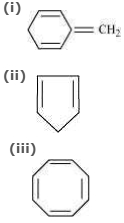
Explain why the following systems are not aromatic?
Solution
(N/A) For a compound to be aromatic,it must satisfy the following conditions: $(1)$ It must be cyclic,$(2)$ It must be planar,$(3)$ It must have a complete conjugation of $\pi-$electrons,and $(4)$ It must follow Huckel's rule,i.e.,it must have $(4n+2)$ $\pi-$electrons,where $n$ is an integer $(n = 0, 1, 2, \dots)$.
$(i)$ The compound is heptafulvene. It is not aromatic because the $sp^3$ hybridized carbon atom at the exocyclic double bond breaks the continuous conjugation of the ring.
$(ii)$ The compound is cyclopentadiene. It is not aromatic because it has a $sp^3$ hybridized carbon atom in the ring,which prevents the continuous conjugation of $\pi-$electrons. Additionally,it has $4$ $\pi-$electrons,which does not satisfy Huckel's rule $(4n+2)$.
$(iii)$ The compound is cyclooctatetraene. It is not aromatic because it is non-planar (it adopts a tub-shaped conformation) and it has $8$ $\pi-$electrons,which does not satisfy Huckel's rule $(4n+2)$.
$(i)$ The compound is heptafulvene. It is not aromatic because the $sp^3$ hybridized carbon atom at the exocyclic double bond breaks the continuous conjugation of the ring.
$(ii)$ The compound is cyclopentadiene. It is not aromatic because it has a $sp^3$ hybridized carbon atom in the ring,which prevents the continuous conjugation of $\pi-$electrons. Additionally,it has $4$ $\pi-$electrons,which does not satisfy Huckel's rule $(4n+2)$.
$(iii)$ The compound is cyclooctatetraene. It is not aromatic because it is non-planar (it adopts a tub-shaped conformation) and it has $8$ $\pi-$electrons,which does not satisfy Huckel's rule $(4n+2)$.
0 likes
View Solution561
Medium
Write down the products of ozonolysis of $1,2-$dimethylbenzene ($o-$xylene). How does the result support the Kekul\text{é} structure for benzene?
Solution
(N/A) The ozonolysis of $o-$xylene ($1,2-$dimethylbenzene) yields three products: methylglyoxal $(CH_3COCHO)$,$1,2-$dimethylglyoxal $(CH_3COCOCH_3)$,and glyoxal $(CHOCHO)$.
Structure $(I)$ on ozonolysis gives $2$ moles of methylglyoxal and $1$ mole of glyoxal.
Structure $(II)$ on ozonolysis gives $1$ mole of $1,2-$dimethylglyoxal and $2$ moles of glyoxal.
Since all three products are obtained experimentally,it confirms that $o-$xylene exists as a resonance hybrid of the two Kekul\text{é} structures ($I$ and $II$).
Structure $(I)$ on ozonolysis gives $2$ moles of methylglyoxal and $1$ mole of glyoxal.
Structure $(II)$ on ozonolysis gives $1$ mole of $1,2-$dimethylglyoxal and $2$ moles of glyoxal.
Since all three products are obtained experimentally,it confirms that $o-$xylene exists as a resonance hybrid of the two Kekul\text{é} structures ($I$ and $II$).
0 likes
View Solution562
Easy
Why does benzene undergo electrophilic substitution reactions easily and nucleophilic substitutions with difficulty?
Solution
(N/A) Benzene is a planar molecule having delocalized $\pi$ electrons above and below the plane of the ring.
Hence,it is electron-rich.
As a result,it is highly attractive to electron-deficient species,i.e.,electrophiles.
Therefore,it undergoes electrophilic substitution reactions very easily.
Nucleophiles are electron-rich species.
Hence,they are repelled by the electron-rich benzene ring.
Consequently,benzene undergoes nucleophilic substitutions with difficulty.
Hence,it is electron-rich.
As a result,it is highly attractive to electron-deficient species,i.e.,electrophiles.
Therefore,it undergoes electrophilic substitution reactions very easily.
Nucleophiles are electron-rich species.
Hence,they are repelled by the electron-rich benzene ring.
Consequently,benzene undergoes nucleophilic substitutions with difficulty.
0 likes
View Solution563
Difficult
How would you convert the following compounds into benzene?
$(i)$ Ethyne
$(ii)$ Ethene
$(iii)$ Hexane
$(i)$ Ethyne
$(ii)$ Ethene
$(iii)$ Hexane
Solution
(N/A) $(i)$ Benzene from Ethyne: $3CH \equiv CH \xrightarrow{\text{Red hot Fe}, 873 \ K} \text{Benzene}$
$(ii)$ Benzene from Ethene: $CH_2=CH_2$ $\xrightarrow{Br_2/CCl_4} Br-CH_2-CH_2-Br$ $\xrightarrow{\text{alc. KOH}, \Delta} CH_2=CHBr$ $\xrightarrow{NaNH_2/\text{liq. } NH_3, 196 \ K} HC \equiv CH$ $\xrightarrow{\text{Red hot Fe}, 873 \ K} \text{Benzene}$
$(iii)$ Hexane to Benzene: $\text{Hexane}$ $\xrightarrow{Cr_2O_3, \text{Cyclization}} \text{Cyclohexane}$ $\xrightarrow{\text{Aromatization}} \text{Benzene}$
$(ii)$ Benzene from Ethene: $CH_2=CH_2$ $\xrightarrow{Br_2/CCl_4} Br-CH_2-CH_2-Br$ $\xrightarrow{\text{alc. KOH}, \Delta} CH_2=CHBr$ $\xrightarrow{NaNH_2/\text{liq. } NH_3, 196 \ K} HC \equiv CH$ $\xrightarrow{\text{Red hot Fe}, 873 \ K} \text{Benzene}$
$(iii)$ Hexane to Benzene: $\text{Hexane}$ $\xrightarrow{Cr_2O_3, \text{Cyclization}} \text{Cyclohexane}$ $\xrightarrow{\text{Aromatization}} \text{Benzene}$
0 likes
View Solution564
Medium
Out of benzene,$m$-dinitrobenzene and toluene,which will undergo nitration most easily and why?
Solution
(N/A) The ease of nitration depends on the electron density of the aromatic ring. Nitration is an electrophilic aromatic substitution reaction where the electrophile,nitronium ion $(NO_2^+)$,attacks the electron-rich ring.
$1$. The $CH_3$ group in toluene is an electron-donating group ($+I$ effect and hyperconjugation),which increases the electron density of the benzene ring,making it more reactive towards electrophilic substitution than benzene.
$2$. The $NO_2$ group in $m$-dinitrobenzene is a strong electron-withdrawing group ($-I$ and $-M$ effects),which significantly decreases the electron density of the benzene ring,making it the least reactive.
$3$. Benzene has intermediate reactivity.
Therefore,toluene undergoes nitration most easily. The increasing order of reactivity towards nitration is: $m$-dinitrobenzene < benzene < toluene.
$1$. The $CH_3$ group in toluene is an electron-donating group ($+I$ effect and hyperconjugation),which increases the electron density of the benzene ring,making it more reactive towards electrophilic substitution than benzene.
$2$. The $NO_2$ group in $m$-dinitrobenzene is a strong electron-withdrawing group ($-I$ and $-M$ effects),which significantly decreases the electron density of the benzene ring,making it the least reactive.
$3$. Benzene has intermediate reactivity.
Therefore,toluene undergoes nitration most easily. The increasing order of reactivity towards nitration is: $m$-dinitrobenzene < benzene < toluene.
0 likes
View Solution565
Easy
Suggest the name of a Lewis acid other than anhydrous aluminium chloride which can be used during ethylation of benzene.
Solution
(N/A) The ethylation reaction of benzene involves the addition of an ethyl group to the benzene ring. This reaction is a type of Friedel-Crafts alkylation reaction.
Friedel-Crafts alkylation requires a Lewis acid catalyst to generate the electrophile. Other than anhydrous $AlCl_3$,Lewis acids such as anhydrous $FeCl_3$,$SnCl_4$,or $BF_3$ can also be used for this purpose.
Friedel-Crafts alkylation requires a Lewis acid catalyst to generate the electrophile. Other than anhydrous $AlCl_3$,Lewis acids such as anhydrous $FeCl_3$,$SnCl_4$,or $BF_3$ can also be used for this purpose.
0 likes
View Solution566
Medium
Provide basic information and examples of aromatic compounds.
Solution
(N/A) Aromatic compounds are cyclic compounds in which $(4n + 2)$ $\pi$ electrons are delocalized over the ring atoms,following $H$ückel's rule. They are classified into two main types:
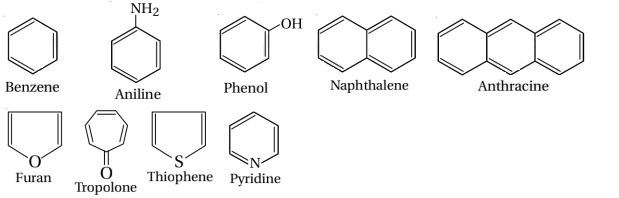
$(a)$ Benzenoid compounds: These compounds contain at least one benzene ring in their structure. Examples include Benzene,Aniline,Phenol,Naphthalene,and Anthracene.
$(b)$ Non-benzenoid compounds: These aromatic compounds do not contain a benzene ring. If they contain a heteroatom $(N, O, S)$ in the ring,they are called heterocyclic aromatic compounds. Examples include Furan,Thiophene,Pyridine,and Tropolone.
$(a)$ Benzenoid compounds: These compounds contain at least one benzene ring in their structure. Examples include Benzene,Aniline,Phenol,Naphthalene,and Anthracene.
$(b)$ Non-benzenoid compounds: These aromatic compounds do not contain a benzene ring. If they contain a heteroatom $(N, O, S)$ in the ring,they are called heterocyclic aromatic compounds. Examples include Furan,Thiophene,Pyridine,and Tropolone.
0 likes
View Solution567
Medium
Nitration is an example of aromatic electrophilic substitution reaction and its rate depends upon the group already present in the benzene ring. Out of benzene and phenol,which one is more easily nitrated?
Solution
(B) Phenol is more easily nitrated because of the presence of the $-OH$ group. The $-OH$ group increases the electron density on the benzene ring due to its $+M$ (mesomeric) effect. Consequently,the electrophile,nitronium ion $(NO_2^+)$,attacks the phenol ring much more readily than the benzene ring.
0 likes
View Solution568
Medium
Name the electrophile produced in the reaction of benzene with benzoyl chloride in the presence of anhydrous $AlCl_3$. Name the reaction also.
Solution
(N/A) The electrophile produced is the benzoylium cation $(C_6H_5CO^{+})$.
The reaction is known as the Friedel-Crafts acylation reaction.
The reaction is known as the Friedel-Crafts acylation reaction.
0 likes
View Solution569
MediumMCQ
What is the role of $HNO_3$ in the nitrating mixture used for the nitration of benzene?
A
It acts as a base.
B
It acts as an acid.
C
It acts as an oxidizing agent.
D
It acts as a reducing agent.
Solution
(A) In the nitration of benzene,a mixture of concentrated $HNO_3$ and concentrated $H_2SO_4$ is used.
In this mixture,$H_2SO_4$ acts as a strong acid and protonates $HNO_3$.
$HNO_3 + H_2SO_4 \rightleftharpoons H_2NO_3^+ + HSO_4^-$.
The protonated nitric acid $(H_2NO_3^+)$ then loses water to form the nitronium ion $(NO_2^+)$,which is the electrophile.
$H_2NO_3^+ \rightleftharpoons NO_2^+ + H_2O$.
Since $HNO_3$ accepts a proton from $H_2SO_4$ to form the nitronium ion,it acts as a base in this reaction.
In this mixture,$H_2SO_4$ acts as a strong acid and protonates $HNO_3$.
$HNO_3 + H_2SO_4 \rightleftharpoons H_2NO_3^+ + HSO_4^-$.
The protonated nitric acid $(H_2NO_3^+)$ then loses water to form the nitronium ion $(NO_2^+)$,which is the electrophile.
$H_2NO_3^+ \rightleftharpoons NO_2^+ + H_2O$.
Since $HNO_3$ accepts a proton from $H_2SO_4$ to form the nitronium ion,it acts as a base in this reaction.
0 likes
View Solution570
Difficult
Provide basic information about aromatic hydrocarbons. Explain and give examples of the following: $(i)$ Aromatic compounds $(ii)$ Arenes $(iii)$ Benzenoid compounds $(iv)$ Non-benzenoid compounds.
Solution
(N/A) Aromatic hydrocarbons are also known as 'arenes'. Since most of them possess a pleasant odour (Greek; aroma meaning pleasant smelling),this class of compounds was named as 'aromatic compounds'.
$(i)$ Aromatic compounds: These are cyclic,planar compounds that follow $H$ückel's rule (possess $(4n+2) \pi$ electrons,where $n = 0, 1, 2, ...$).
$(ii)$ Arenes: These are aromatic hydrocarbons,typically containing at least one benzene ring.
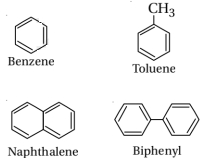
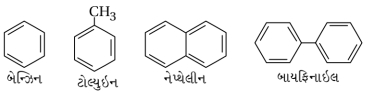
$(iii)$ Benzenoid compounds: These are aromatic compounds that contain at least one benzene ring in their structure. Examples include benzene,toluene,naphthalene,and biphenyl.
$(iv)$ Non-benzenoid compounds: These are aromatic compounds that do not contain a benzene ring in their structure. An example is azulene.
$(i)$ Aromatic compounds: These are cyclic,planar compounds that follow $H$ückel's rule (possess $(4n+2) \pi$ electrons,where $n = 0, 1, 2, ...$).
$(ii)$ Arenes: These are aromatic hydrocarbons,typically containing at least one benzene ring.
$(iii)$ Benzenoid compounds: These are aromatic compounds that contain at least one benzene ring in their structure. Examples include benzene,toluene,naphthalene,and biphenyl.
$(iv)$ Non-benzenoid compounds: These are aromatic compounds that do not contain a benzene ring in their structure. An example is azulene.
0 likes
View Solution571
Medium
Explain why only one mono-substitution product is possible in benzene. Provide examples of its structure and name.
Solution
(N/A) Benzene $(C_6H_6)$ consists of a planar hexagonal ring of $6$ carbon atoms,each attached to one hydrogen atom.
All $6$ hydrogen atoms in benzene are equivalent due to the resonance-stabilized structure,meaning they occupy identical chemical environments.
Therefore,the replacement of any one of these $6$ hydrogen atoms by a substituent group $(A)$ results in the formation of only one unique mono-substituted benzene product.
Examples include:
$1$. Methylbenzene (Toluene): $C_6H_5CH_3$
$2$. Nitrobenzene: $C_6H_5NO_2$
$3$. Chlorobenzene: $C_6H_5Cl$
$4$. Bromobenzene: $C_6H_5Br$
$5$. Ethylbenzene: $C_6H_5CH_2CH_3$
$6$. Hydroxybenzene (Phenol): $C_6H_5OH$
All $6$ hydrogen atoms in benzene are equivalent due to the resonance-stabilized structure,meaning they occupy identical chemical environments.
Therefore,the replacement of any one of these $6$ hydrogen atoms by a substituent group $(A)$ results in the formation of only one unique mono-substituted benzene product.
Examples include:
$1$. Methylbenzene (Toluene): $C_6H_5CH_3$
$2$. Nitrobenzene: $C_6H_5NO_2$
$3$. Chlorobenzene: $C_6H_5Cl$
$4$. Bromobenzene: $C_6H_5Br$
$5$. Ethylbenzene: $C_6H_5CH_2CH_3$
$6$. Hydroxybenzene (Phenol): $C_6H_5OH$
0 likes
View Solution572
Medium
How many products are obtained by the substitution of two hydrogen atoms in a benzene ring? Provide examples.
Solution
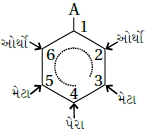
(N/A) When two hydrogen atoms are substituted in a benzene ring,the number of possible isomers is $3$.
These are $1,2-$disubstituted (ortho),$1,3-$disubstituted (meta),and $1,4-$disubstituted (para).
Examples include:
$1,2-$Dimethylbenzene ($o-$xylene)
$1,3-$Dimethylbenzene ($m-$xylene)
$1,4-$Dimethylbenzene ($p-$xylene)
$o-$Nitrotoluene
$m-$Nitrotoluene
$p-$Nitrotoluene
These are $1,2-$disubstituted (ortho),$1,3-$disubstituted (meta),and $1,4-$disubstituted (para).
Examples include:
$1,2-$Dimethylbenzene ($o-$xylene)
$1,3-$Dimethylbenzene ($m-$xylene)
$1,4-$Dimethylbenzene ($p-$xylene)
$o-$Nitrotoluene
$m-$Nitrotoluene
$p-$Nitrotoluene
0 likes
View Solution573
Medium
Write a detailed note on the structure of benzene.
Solution
(N/A) Benzene was isolated by Michael Faraday in $1825$. The empirical formula of benzene is $CH$,the molecular mass is $78$,and the molecular formula of benzene is $C_{6}H_{6}$.
$\rightarrow$ Benzene possesses a high degree of unsaturation. This molecular formula did not account for its relationship to corresponding alkanes,alkenes,and alkynes. Due to its unique properties and unusual stability,it took several years to assign its structure.
$\rightarrow$ On the addition of three moles of $H_{2}$,it forms $C_{6}H_{12}$; with three moles of $Cl_{2}$,it forms $C_{6}H_{6}Cl_{6}$. Also,benzene was found to be a stable molecule and forms a triozonide,which indicates the presence of three double bonds.
$-$ Benzene was further found to produce one and only one monosubstituted derivative,which indicated that all six carbon and six hydrogen atoms of benzene are identical.
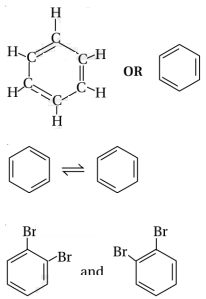
On the basis of this observation,August Kekulé in $1865$ proposed the following structure for benzene,having a cyclic arrangement of six carbon atoms with alternate single and double bonds and one hydrogen atom attached to each carbon atom.
$-$ The Kekulé structure indicates the possibility of two isomeric $1,2-$dibromobenzenes. In one of the isomers,the bromine atoms are attached to the doubly bonded carbon atoms,whereas in the other,they are attached to the singly bonded carbons.
$-$ However,benzene was found to form only one ortho-disubstituted product. This problem was overcome by Kekulé by suggesting the concept of the oscillating nature of double bonds in benzene.
$\rightarrow$ Benzene possesses a high degree of unsaturation. This molecular formula did not account for its relationship to corresponding alkanes,alkenes,and alkynes. Due to its unique properties and unusual stability,it took several years to assign its structure.
$\rightarrow$ On the addition of three moles of $H_{2}$,it forms $C_{6}H_{12}$; with three moles of $Cl_{2}$,it forms $C_{6}H_{6}Cl_{6}$. Also,benzene was found to be a stable molecule and forms a triozonide,which indicates the presence of three double bonds.
$-$ Benzene was further found to produce one and only one monosubstituted derivative,which indicated that all six carbon and six hydrogen atoms of benzene are identical.
On the basis of this observation,August Kekulé in $1865$ proposed the following structure for benzene,having a cyclic arrangement of six carbon atoms with alternate single and double bonds and one hydrogen atom attached to each carbon atom.
$-$ The Kekulé structure indicates the possibility of two isomeric $1,2-$dibromobenzenes. In one of the isomers,the bromine atoms are attached to the doubly bonded carbon atoms,whereas in the other,they are attached to the singly bonded carbons.
$-$ However,benzene was found to form only one ortho-disubstituted product. This problem was overcome by Kekulé by suggesting the concept of the oscillating nature of double bonds in benzene.
0 likes
View Solution574
Medium
Write the conditions which prove the exceptional stability of benzene.
Solution
(N/A) The following conditions prove the exceptional stability of benzene:
$i$. Benzene resists addition reactions compared to alkenes.
$ii$. Despite having a lower ratio of hydrogen atoms to carbon atoms, benzene readily undergoes electrophilic substitution reactions rather than addition reactions.
$iii$. The bond length in benzene is $139 \ pm$, which is intermediate between the $C-C$ single bond length $(154 \ pm)$ and the $C=C$ double bond length $(133 \ pm)$, indicating delocalization.
$iv$. Benzene has a very low enthalpy of hydrogenation, which is $36 \ kcal \ mol^{-1}$ less than the expected value for a hypothetical cyclohexatriene. This difference represents the resonance energy of benzene.
$v$. Benzene is exceptionally stable due to its aromatic character, which follows Hückel's rule ($4n+2 \ \pi$ electrons).
$i$. Benzene resists addition reactions compared to alkenes.
$ii$. Despite having a lower ratio of hydrogen atoms to carbon atoms, benzene readily undergoes electrophilic substitution reactions rather than addition reactions.
$iii$. The bond length in benzene is $139 \ pm$, which is intermediate between the $C-C$ single bond length $(154 \ pm)$ and the $C=C$ double bond length $(133 \ pm)$, indicating delocalization.
$iv$. Benzene has a very low enthalpy of hydrogenation, which is $36 \ kcal \ mol^{-1}$ less than the expected value for a hypothetical cyclohexatriene. This difference represents the resonance energy of benzene.
$v$. Benzene is exceptionally stable due to its aromatic character, which follows Hückel's rule ($4n+2 \ \pi$ electrons).
0 likes
View Solution575
Difficult
What is aromaticity? Explain with suitable examples. State the Huckel rule and explain it with a suitable example. Write the requirements for aromatic character in a compound. Show aromatic structures having $1$,$2$,and $3$ rings with suitable examples.
Solution
(N/A) Aromaticity is a property of cyclic,planar,conjugated systems that exhibit extra stability due to the delocalization of $\pi$ electrons.
$(a)$ Requirements for aromatic character in a compound:
$(i)$ The compound must have a cyclic structure.
$(ii)$ The cyclic compound must be planar.
$(iii)$ There must be complete delocalization of $\pi$ electrons in the ring.
$(iv)$ The ring must contain $(4n+2) \pi$ electrons,where $n$ is an integer $(n=0, 1, 2, \dots)$. This is known as the Huckel rule.
$(b)$ Huckel's rule: $A$ planar,cyclic,fully conjugated system is aromatic if it contains $(4n+2) \pi$ electrons.
$(c)$ Examples:
$(i)$ $1$ ring: Benzene $(C_6H_6)$. It is cyclic,planar,and has $6 \pi$ electrons ($n=1$,$4(1)+2=6$).
$(ii)$ $2$ rings: Naphthalene $(C_{10}H_8)$. It is cyclic,planar,and has $10 \pi$ electrons ($n=2$,$4(2)+2=10$).
$(iii)$ $3$ rings: Anthracene $(C_{14}H_{10})$. It is cyclic,planar,and has $14 \pi$ electrons ($n=3$,$4(3)+2=14$).
Cyclopentadienyl anion is also aromatic as it has $6 \pi$ electrons ($4$ from two double bonds and $2$ from the lone pair on the carbon atom).
$(a)$ Requirements for aromatic character in a compound:
$(i)$ The compound must have a cyclic structure.
$(ii)$ The cyclic compound must be planar.
$(iii)$ There must be complete delocalization of $\pi$ electrons in the ring.
$(iv)$ The ring must contain $(4n+2) \pi$ electrons,where $n$ is an integer $(n=0, 1, 2, \dots)$. This is known as the Huckel rule.
$(b)$ Huckel's rule: $A$ planar,cyclic,fully conjugated system is aromatic if it contains $(4n+2) \pi$ electrons.
$(c)$ Examples:
$(i)$ $1$ ring: Benzene $(C_6H_6)$. It is cyclic,planar,and has $6 \pi$ electrons ($n=1$,$4(1)+2=6$).
$(ii)$ $2$ rings: Naphthalene $(C_{10}H_8)$. It is cyclic,planar,and has $10 \pi$ electrons ($n=2$,$4(2)+2=10$).
$(iii)$ $3$ rings: Anthracene $(C_{14}H_{10})$. It is cyclic,planar,and has $14 \pi$ electrons ($n=3$,$4(3)+2=14$).
Cyclopentadienyl anion is also aromatic as it has $6 \pi$ electrons ($4$ from two double bonds and $2$ from the lone pair on the carbon atom).
0 likes
View Solution576
Medium
Give methods of preparation for benzene.
Solution
(N/A) Industrially,benzene is prepared from coal tar. In laboratory,it is prepared by the following methods:
$(i)$ Cyclic polymerisation of ethyne: $3CH \equiv CH \xrightarrow{\text{Red hot iron tube}, 873 \ K} C_6H_6$ (Benzene)
(ii) Cyclisation of $n$-hexane: $n-C_6H_{14} \xrightarrow{Cr_2O_3/V_2O_5/Mo_2O_3, 773 \ K, 10-20 \ atm} C_6H_6 + 4H_2$
(iii) Decarboxylation of benzoic acid: Sodium benzoate on heating with soda lime $(NaOH + CaO)$ gives benzene: $C_6H_5COONa + NaOH \xrightarrow{\Delta} C_6H_6 + Na_2CO_3$
(iv) Reduction of phenol: Phenol is reduced to benzene by passing its vapours over heated zinc dust: $C_6H_5OH + Zn \xrightarrow{\Delta} C_6H_6 + ZnO$
$(i)$ Cyclic polymerisation of ethyne: $3CH \equiv CH \xrightarrow{\text{Red hot iron tube}, 873 \ K} C_6H_6$ (Benzene)
(ii) Cyclisation of $n$-hexane: $n-C_6H_{14} \xrightarrow{Cr_2O_3/V_2O_5/Mo_2O_3, 773 \ K, 10-20 \ atm} C_6H_6 + 4H_2$
(iii) Decarboxylation of benzoic acid: Sodium benzoate on heating with soda lime $(NaOH + CaO)$ gives benzene: $C_6H_5COONa + NaOH \xrightarrow{\Delta} C_6H_6 + Na_2CO_3$
(iv) Reduction of phenol: Phenol is reduced to benzene by passing its vapours over heated zinc dust: $C_6H_5OH + Zn \xrightarrow{\Delta} C_6H_6 + ZnO$
0 likes
View Solution577
Medium
Draw the structure of the compound having molecular formula $C_7H_8$ and determine the number of $\sigma$ and $\pi$ bonds.
Solution
(N/A) The compound with molecular formula $C_7H_8$ is toluene $(C_6H_5CH_3)$.
Structure analysis:
$1$. The benzene ring contains $3$ $\pi$-bonds.
$2$. The benzene ring has $6$ $C-C$ $\sigma$-bonds and $6$ $C-H$ $\sigma$-bonds.
$3$. The methyl group $(CH_3)$ attached to the ring has $1$ $C-C$ $\sigma$-bond and $3$ $C-H$ $\sigma$-bonds.
Total $\sigma$-bonds = $6$ (ring $C-C$) + $6$ (ring $C-H$) + $1$ (exocyclic $C-C$) + $3$ (methyl $C-H$) = $15$ $\sigma$-bonds.
Total $\pi$-bonds = $3$ $\pi$-bonds.
Structure analysis:
$1$. The benzene ring contains $3$ $\pi$-bonds.
$2$. The benzene ring has $6$ $C-C$ $\sigma$-bonds and $6$ $C-H$ $\sigma$-bonds.
$3$. The methyl group $(CH_3)$ attached to the ring has $1$ $C-C$ $\sigma$-bond and $3$ $C-H$ $\sigma$-bonds.
Total $\sigma$-bonds = $6$ (ring $C-C$) + $6$ (ring $C-H$) + $1$ (exocyclic $C-C$) + $3$ (methyl $C-H$) = $15$ $\sigma$-bonds.
Total $\pi$-bonds = $3$ $\pi$-bonds.
0 likes
View Solution578
Medium
Write about the physical properties of benzene.
Solution
(N/A) $1$. Odour: Benzene has a characteristic aromatic odour.
$2$. Solubility: Benzene is non-polar,therefore it is insoluble in water but miscible with organic solvents.
$3$. Colour: Benzene is a colourless liquid.
$4$. Physical state: Benzene exists as a liquid at room temperature.
$5$. Combustion: Benzene is highly combustible and burns with a sooty flame due to its high carbon content.
$2$. Solubility: Benzene is non-polar,therefore it is insoluble in water but miscible with organic solvents.
$3$. Colour: Benzene is a colourless liquid.
$4$. Physical state: Benzene exists as a liquid at room temperature.
$5$. Combustion: Benzene is highly combustible and burns with a sooty flame due to its high carbon content.
0 likes
View Solution579
Medium
Which type of chemical reactions are given by arene compounds? Give their suitable examples and reactions.
Solution
(A) Arene compounds (aromatic hydrocarbons) primarily undergo electrophilic substitution reactions due to their stable aromatic ring. They can also undergo addition and oxidation reactions under specific conditions.
$A$. Electrophilic substitution reactions: These are the characteristic reactions of benzene.
$i$. Nitration: Benzene reacts with a nitrating mixture (conc. $HNO_{3}$ + conc. $H_{2}SO_{4}$) at $323-333 \ K$ to form nitrobenzene.
$ii$. Sulphonation: Benzene reacts with fuming $H_{2}SO_{4}$ (oleum) at $353 \ K$ to form benzene sulphonic acid.
$iii$. Halogenation: Benzene reacts with $Cl_{2}$ or $Br_{2}$ in the presence of a Lewis acid (e.g.,anhydrous $FeCl_{3}$ or $FeBr_{3}$) to form chlorobenzene or bromobenzene.
$iv$. Friedel-Crafts alkylation: Benzene reacts with alkyl halides $(R-X)$ in the presence of anhydrous $AlCl_{3}$ to form alkylbenzene.
$v$. Friedel-Crafts acylation: Benzene reacts with acyl halides $(RCOCl)$ or acid anhydrides in the presence of anhydrous $AlCl_{3}$ to form acylbenzene.
$B$. Electrophilic addition reactions: These occur under vigorous conditions.
$i$. Hydrogenation: Benzene reacts with $H_{2}$ at high temperature and pressure in the presence of $Ni$ catalyst to form cyclohexane.
$ii$. Chlorination: Benzene reacts with $Cl_{2}$ in the presence of $UV$ light to form benzene hexachloride $(C_{6}H_{6}Cl_{6})$.
$C$. Oxidation reactions:
$i$. Combustion: Arenes burn in air to produce $CO_{2}$ and $H_{2}O$ according to the general equation: $C_{x}H_{y} + (x + \frac{y}{4}) O_{2} \longrightarrow x CO_{2} + \frac{y}{2} H_{2}O$.
$A$. Electrophilic substitution reactions: These are the characteristic reactions of benzene.
$i$. Nitration: Benzene reacts with a nitrating mixture (conc. $HNO_{3}$ + conc. $H_{2}SO_{4}$) at $323-333 \ K$ to form nitrobenzene.
$ii$. Sulphonation: Benzene reacts with fuming $H_{2}SO_{4}$ (oleum) at $353 \ K$ to form benzene sulphonic acid.
$iii$. Halogenation: Benzene reacts with $Cl_{2}$ or $Br_{2}$ in the presence of a Lewis acid (e.g.,anhydrous $FeCl_{3}$ or $FeBr_{3}$) to form chlorobenzene or bromobenzene.
$iv$. Friedel-Crafts alkylation: Benzene reacts with alkyl halides $(R-X)$ in the presence of anhydrous $AlCl_{3}$ to form alkylbenzene.
$v$. Friedel-Crafts acylation: Benzene reacts with acyl halides $(RCOCl)$ or acid anhydrides in the presence of anhydrous $AlCl_{3}$ to form acylbenzene.
$B$. Electrophilic addition reactions: These occur under vigorous conditions.
$i$. Hydrogenation: Benzene reacts with $H_{2}$ at high temperature and pressure in the presence of $Ni$ catalyst to form cyclohexane.
$ii$. Chlorination: Benzene reacts with $Cl_{2}$ in the presence of $UV$ light to form benzene hexachloride $(C_{6}H_{6}Cl_{6})$.
$C$. Oxidation reactions:
$i$. Combustion: Arenes burn in air to produce $CO_{2}$ and $H_{2}O$ according to the general equation: $C_{x}H_{y} + (x + \frac{y}{4}) O_{2} \longrightarrow x CO_{2} + \frac{y}{2} H_{2}O$.
0 likes
View Solution580
Medium
Describe the addition reactions of benzene with chemical equations.
Solution
(N/A) Benzene possesses unique stability; however,under vigorous conditions,benzene undergoes addition reactions. In these reactions,$3$ molecules of the reactant react with $1$ mole of benzene,which reflects the presence of three double bonds $(\pi)$ in the benzene structure.
$(i)$ Hydrogenation of benzene: Under vigorous conditions,i.e.,at high temperature and/or pressure in the presence of a nickel catalyst,the hydrogenation of benzene yields cyclohexane.
$C_{6}H_{6} + 3H_{2} \xrightarrow{Ni, \Delta, \text{Pressure}} C_{6}H_{12} \text{ (Cyclohexane)}$
$(ii)$ Chlorination of benzene: Under ultra-violet light,three chlorine molecules add to benzene to produce benzene hexachloride,$C_{6}H_{6}Cl_{6}$,which is also known as gammaxane or $BHC$.
$C_{6}H_{6} + 3Cl_{2} \xrightarrow{uv, 500 \ K} C_{6}H_{6}Cl_{6} \text{ (BHC/Gammaxane)}$
Note: Initially,Gammaxane was used as a domestic insecticide,but it is now banned.
$(i)$ Hydrogenation of benzene: Under vigorous conditions,i.e.,at high temperature and/or pressure in the presence of a nickel catalyst,the hydrogenation of benzene yields cyclohexane.
$C_{6}H_{6} + 3H_{2} \xrightarrow{Ni, \Delta, \text{Pressure}} C_{6}H_{12} \text{ (Cyclohexane)}$
$(ii)$ Chlorination of benzene: Under ultra-violet light,three chlorine molecules add to benzene to produce benzene hexachloride,$C_{6}H_{6}Cl_{6}$,which is also known as gammaxane or $BHC$.
$C_{6}H_{6} + 3Cl_{2} \xrightarrow{uv, 500 \ K} C_{6}H_{6}Cl_{6} \text{ (BHC/Gammaxane)}$
Note: Initially,Gammaxane was used as a domestic insecticide,but it is now banned.
0 likes
View Solution581
Medium
Describe various oxidation reactions of benzene.
Solution
(N/A) Baeyer's test: Benzene does not undergo Baeyer's reaction due to its characteristic stability. It does not show an unsaturation test and does not decolorize $KMnO_{4}$ solution.
$\text{Benzene} + \text{dilute, cold } KMnO_{4} \longrightarrow \text{No reaction}$
$(b)$ Complete combustion of benzene: The combustion of benzene is carried out in a burner in the presence of air. It burns with a sooty flame and produces $CO_{2}$ and $H_{2}O$.
$C_{6}H_{6} + \frac{15}{2} O_{2} \stackrel{\Delta}{\longrightarrow} 6CO_{2} + 3H_{2}O_{(g)}$
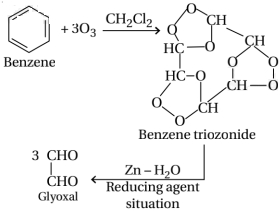
$(c)$ Reductive ozonolysis of benzene: Benzene reacts with three molecules of ozone to form benzene triozonide. This confirms the presence of three double bonds in benzene. Benzene triozonide,upon reductive cleavage in the presence of $(Zn + H_{2}O)$,yields three molecules of glyoxal.
$\text{Benzene} + \text{dilute, cold } KMnO_{4} \longrightarrow \text{No reaction}$
$(b)$ Complete combustion of benzene: The combustion of benzene is carried out in a burner in the presence of air. It burns with a sooty flame and produces $CO_{2}$ and $H_{2}O$.
$C_{6}H_{6} + \frac{15}{2} O_{2} \stackrel{\Delta}{\longrightarrow} 6CO_{2} + 3H_{2}O_{(g)}$
$(c)$ Reductive ozonolysis of benzene: Benzene reacts with three molecules of ozone to form benzene triozonide. This confirms the presence of three double bonds in benzene. Benzene triozonide,upon reductive cleavage in the presence of $(Zn + H_{2}O)$,yields three molecules of glyoxal.
0 likes
View Solution582
Medium
Write about the nitration reaction of benzene.
Solution
(N/A) . Chemical reaction for nitration: When benzene is treated with a mixture of concentrated nitric acid $(HNO_{3})$ and concentrated sulfuric acid $(H_{2}SO_{4})$ at $323 \ K$ to $333 \ K$,it undergoes nitration to form nitrobenzene.
$C_{6}H_{6} + HNO_{3} \xrightarrow{conc. H_{2}SO_{4}, 323-333 \ K} C_{6}H_{5}NO_{2} + H_{2}O$
$b$. Mechanism of formation of the nitronium ion $(NO_{2}^{+})$:
Step-$I$:
$H_{2}SO_{4} + HNO_{3} \rightleftharpoons H_{2}NO_{3}^{+} + HSO_{4}^{-}$
Step-$II$:
$H_{2}NO_{3}^{+} \rightleftharpoons H_{2}O + NO_{2}^{+}$
Overall reaction for the generation of the electrophile:
$H_{2}SO_{4} + HNO_{3} \rightleftharpoons NO_{2}^{+} + HSO_{4}^{-} + H_{2}O$
In this reaction,$H_{2}SO_{4}$ acts as a proton donor (acid) and $HNO_{3}$ acts as a proton acceptor (base),facilitating the formation of the electrophilic nitronium ion $(NO_{2}^{+})$.
$C_{6}H_{6} + HNO_{3} \xrightarrow{conc. H_{2}SO_{4}, 323-333 \ K} C_{6}H_{5}NO_{2} + H_{2}O$
$b$. Mechanism of formation of the nitronium ion $(NO_{2}^{+})$:
Step-$I$:
$H_{2}SO_{4} + HNO_{3} \rightleftharpoons H_{2}NO_{3}^{+} + HSO_{4}^{-}$
Step-$II$:
$H_{2}NO_{3}^{+} \rightleftharpoons H_{2}O + NO_{2}^{+}$
Overall reaction for the generation of the electrophile:
$H_{2}SO_{4} + HNO_{3} \rightleftharpoons NO_{2}^{+} + HSO_{4}^{-} + H_{2}O$
In this reaction,$H_{2}SO_{4}$ acts as a proton donor (acid) and $HNO_{3}$ acts as a proton acceptor (base),facilitating the formation of the electrophilic nitronium ion $(NO_{2}^{+})$.
0 likes
View Solution583
Medium
Explain the halogenation of benzene with the example of chlorination.
Solution
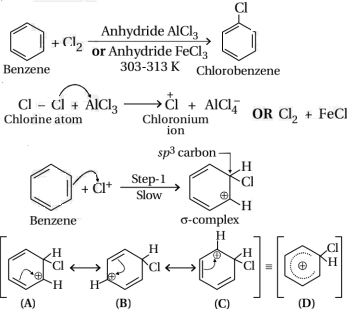
(D) Benzene reacts with chlorine in the presence of a Lewis acid catalyst like anhydrous $FeCl_3$ or $AlCl_3$ to form chlorobenzene. This is an electrophilic aromatic substitution reaction.
Reaction: $C_6H_6 + Cl_2 \xrightarrow{FeCl_3} C_6H_5Cl + HCl$
Mechanism:
$1.$ Generation of electrophile: The Lewis acid reacts with the halogen to produce the electrophile $Cl^{+}$.
$Cl-Cl + FeCl_3 \rightarrow Cl^{+} + [FeCl_4]^{-}$
$2.$ The electrophile $Cl^{+}$ attacks the benzene ring to form a sigma complex (carbocation).
$3.$ Loss of a proton from the sigma complex to $[FeCl_4]^{-}$ restores the aromaticity,yielding chlorobenzene and $HCl$.
Reaction: $C_6H_6 + Cl_2 \xrightarrow{FeCl_3} C_6H_5Cl + HCl$
Mechanism:
$1.$ Generation of electrophile: The Lewis acid reacts with the halogen to produce the electrophile $Cl^{+}$.
$Cl-Cl + FeCl_3 \rightarrow Cl^{+} + [FeCl_4]^{-}$
$2.$ The electrophile $Cl^{+}$ attacks the benzene ring to form a sigma complex (carbocation).
$3.$ Loss of a proton from the sigma complex to $[FeCl_4]^{-}$ restores the aromaticity,yielding chlorobenzene and $HCl$.
0 likes
View Solution584
Medium
Explain the bromination of benzene with its mechanism.
Solution
(N/A) The substitution of an $H$-atom of benzene by a $-Br$ group is known as bromination. In this reaction,$FeBr_3$ acts as a Lewis acid catalyst and $Br_2$ acts as the reagent.
$1$. Generation of Electrophile: The catalyst $FeBr_3$ reacts with $Br_2$ to generate the electrophile,bromonium ion $(Br^+)$.
$FeBr_3 + Br-Br \rightleftharpoons Br^+ + FeBr_4^-$
$2$. Mechanism: The reaction proceeds via electrophilic aromatic substitution in two steps:
Step $1$ (Slow step): The electrophile $Br^+$ attacks the benzene ring to form a carbocation intermediate known as a $\sigma$-complex or arenium ion. In this step,the carbon atom at the site of attack changes its hybridization from $sp^2$ to $sp^3$. This step is slow because the aromaticity of the benzene ring is temporarily lost.
The $\sigma$-complex is stabilized by resonance,as shown by structures $(A)$,$(B)$,and $(C)$,with $(D)$ representing the hybrid structure.
Step $2$ (Fast step): The $\sigma$-complex loses a proton $(H^+)$ to the $FeBr_4^-$ ion to restore aromaticity,forming bromobenzene and regenerating the catalyst $FeBr_3$ along with $HBr$.
$1$. Generation of Electrophile: The catalyst $FeBr_3$ reacts with $Br_2$ to generate the electrophile,bromonium ion $(Br^+)$.
$FeBr_3 + Br-Br \rightleftharpoons Br^+ + FeBr_4^-$
$2$. Mechanism: The reaction proceeds via electrophilic aromatic substitution in two steps:
Step $1$ (Slow step): The electrophile $Br^+$ attacks the benzene ring to form a carbocation intermediate known as a $\sigma$-complex or arenium ion. In this step,the carbon atom at the site of attack changes its hybridization from $sp^2$ to $sp^3$. This step is slow because the aromaticity of the benzene ring is temporarily lost.
The $\sigma$-complex is stabilized by resonance,as shown by structures $(A)$,$(B)$,and $(C)$,with $(D)$ representing the hybrid structure.
Step $2$ (Fast step): The $\sigma$-complex loses a proton $(H^+)$ to the $FeBr_4^-$ ion to restore aromaticity,forming bromobenzene and regenerating the catalyst $FeBr_3$ along with $HBr$.
0 likes
View Solution585
Medium
Give examples of Friedel-Crafts alkylation.
Solution
(N/A) Friedel-Crafts alkylation is the reaction of benzene with an alkyl halide in the presence of an anhydrous $AlCl_3$ catalyst to form alkylbenzene.
Examples:
$(i) \ C_6H_6 + CH_3Cl \xrightarrow{\text{anhydrous } AlCl_3, 373 \ K} C_6H_5CH_3 + HCl \text{ (Toluene)}$
$(ii) \ C_6H_6 + C_2H_5Cl$ $\xrightarrow{\text{anhydrous } AlCl_3, \Delta, 373 \ K} C_6H_5C_2H_5 + HCl \text{ (Ethylbenzene)}$
Examples:
$(i) \ C_6H_6 + CH_3Cl \xrightarrow{\text{anhydrous } AlCl_3, 373 \ K} C_6H_5CH_3 + HCl \text{ (Toluene)}$
$(ii) \ C_6H_6 + C_2H_5Cl$ $\xrightarrow{\text{anhydrous } AlCl_3, \Delta, 373 \ K} C_6H_5C_2H_5 + HCl \text{ (Ethylbenzene)}$
0 likes
View Solution586
Easy
Answer the following questions: Which catalyst is used in the Friedel-Crafts alkylation reaction? And what is its function?
Solution
(N/A) Anhydrous $AlCl_{3}$ is used as a catalyst in the Friedel-Crafts alkylation reaction.
This catalyst acts as a Lewis acid. Its function is to accept a chloride ion $(Cl^{-})$ from the alkyl halide $(R-Cl)$ to form an $AlCl_{4}^{-}$ complex,thereby generating a carbocation $(R^{+})$,which acts as a strong electrophile.
The reactions are as follows:
$CH_{3}Cl + AlCl_{3} \longrightarrow AlCl_{4}^{-} + CH_{3}^{+}$
$CH_{3}CH_{2}Cl + AlCl_{3} \longrightarrow AlCl_{4}^{-} + CH_{3}CH_{2}^{+}$
This catalyst acts as a Lewis acid. Its function is to accept a chloride ion $(Cl^{-})$ from the alkyl halide $(R-Cl)$ to form an $AlCl_{4}^{-}$ complex,thereby generating a carbocation $(R^{+})$,which acts as a strong electrophile.
The reactions are as follows:
$CH_{3}Cl + AlCl_{3} \longrightarrow AlCl_{4}^{-} + CH_{3}^{+}$
$CH_{3}CH_{2}Cl + AlCl_{3} \longrightarrow AlCl_{4}^{-} + CH_{3}CH_{2}^{+}$
0 likes
View Solution587
Medium
Answer the following question: Explain which type of mechanism is involved in the alkylation of benzene?
Solution
(N/A) The alkylation of benzene is an example of an electrophilic aromatic substitution reaction.
The mechanism proceeds in two main steps:
Step-$1$: This is the rate-determining step (slow step). The electrophile (carbocation,$R^+$) attacks the benzene ring to form a resonance-stabilized carbocation intermediate known as the $\sigma$-complex (arenium ion).
Step-$2$: This is a fast step. The $\sigma$-complex loses a proton $(H^+)$ to a base (like $AlCl_4^-$) to restore the aromaticity of the ring,resulting in the formation of alkylbenzene.
The resonance structures of the $\sigma$-complex are represented by $(A)$,$(B)$,and $(C)$,and the hybrid structure is $(D)$.
The mechanism proceeds in two main steps:
Step-$1$: This is the rate-determining step (slow step). The electrophile (carbocation,$R^+$) attacks the benzene ring to form a resonance-stabilized carbocation intermediate known as the $\sigma$-complex (arenium ion).
Step-$2$: This is a fast step. The $\sigma$-complex loses a proton $(H^+)$ to a base (like $AlCl_4^-$) to restore the aromaticity of the ring,resulting in the formation of alkylbenzene.
The resonance structures of the $\sigma$-complex are represented by $(A)$,$(B)$,and $(C)$,and the hybrid structure is $(D)$.
0 likes
View Solution588
Medium
Answer the following questions: Which product is obtained when benzene is heated with $CH_3Cl$ in the presence of $AlCl_3$? Why?
Solution
(N/A) When benzene is heated with $CH_3Cl$ in the presence of anhydrous $AlCl_3$,the primary product formed is toluene $(C_6H_5CH_3)$ via the Friedel-Crafts alkylation reaction.
The reaction is as follows:
$C_6H_6 + CH_3Cl \xrightarrow{AlCl_3} C_6H_5CH_3 + HCl$
Why:
$1$. The $-CH_3$ group is an electron-donating group,which activates the benzene ring towards further electrophilic substitution.
$2$. Because the $-CH_3$ group is ortho- and para-directing,the newly introduced methyl group will preferentially occupy the ortho and para positions of the toluene ring,leading to the formation of $o$-xylene and $p$-xylene if excess $CH_3Cl$ is present.
The reaction is as follows:
$C_6H_6 + CH_3Cl \xrightarrow{AlCl_3} C_6H_5CH_3 + HCl$
Why:
$1$. The $-CH_3$ group is an electron-donating group,which activates the benzene ring towards further electrophilic substitution.
$2$. Because the $-CH_3$ group is ortho- and para-directing,the newly introduced methyl group will preferentially occupy the ortho and para positions of the toluene ring,leading to the formation of $o$-xylene and $p$-xylene if excess $CH_3Cl$ is present.
0 likes
View Solution589
Medium
Explain the reaction of benzene with $n$-propyl chloride.
Solution
(N/A) The reaction of benzene with $n$-propyl chloride in the presence of anhydrous $AlCl_3$ is a Friedel-Crafts alkylation reaction.
The reaction proceeds via the formation of a carbocation intermediate.
$CH_3CH_2CH_2Cl + AlCl_3 \rightarrow CH_3CH_2CH_2^+ + AlCl_4^-$
The initially formed $1^{\circ}$-carbocation $(CH_3CH_2CH_2^+)$ is less stable and undergoes a $1,2$-hydride shift to form a more stable $2^{\circ}$-carbocation $(CH_3CH^+CH_3)$.
Consequently,the major product formed is isopropylbenzene (cumene),while $n$-propylbenzene is formed as a minor product due to the direct attack of the $1^{\circ}$-carbocation before rearrangement.
The reaction proceeds via the formation of a carbocation intermediate.
$CH_3CH_2CH_2Cl + AlCl_3 \rightarrow CH_3CH_2CH_2^+ + AlCl_4^-$
The initially formed $1^{\circ}$-carbocation $(CH_3CH_2CH_2^+)$ is less stable and undergoes a $1,2$-hydride shift to form a more stable $2^{\circ}$-carbocation $(CH_3CH^+CH_3)$.
Consequently,the major product formed is isopropylbenzene (cumene),while $n$-propylbenzene is formed as a minor product due to the direct attack of the $1^{\circ}$-carbocation before rearrangement.
0 likes
View Solution590
Medium
Identify the main product of the reaction between benzene and $1$-chloropropane in the presence of $AlCl_3$.
Solution
(D) The reaction of benzene with $1$-chloropropane in the presence of $AlCl_3$ is a Friedel-Crafts alkylation.
The initial carbocation formed is the $1^{\circ}$-propyl carbocation $(CH_3CH_2CH_2^+)$.
This $1^{\circ}$-carbocation is unstable and undergoes a $1,2$-hydride shift to form a more stable $2^{\circ}$-isopropyl carbocation $(CH_3CH^+CH_3)$.
The $2^{\circ}$-carbocation then attacks the benzene ring to form isopropylbenzene (cumene) as the major product.
Therefore,the main product is isopropylbenzene.
The initial carbocation formed is the $1^{\circ}$-propyl carbocation $(CH_3CH_2CH_2^+)$.
This $1^{\circ}$-carbocation is unstable and undergoes a $1,2$-hydride shift to form a more stable $2^{\circ}$-isopropyl carbocation $(CH_3CH^+CH_3)$.
The $2^{\circ}$-carbocation then attacks the benzene ring to form isopropylbenzene (cumene) as the major product.
Therefore,the main product is isopropylbenzene.
0 likes
View Solution591
Medium
Give the reaction for the acylation of benzene and its mechanism.
Solution
(N/A) The substitution of a hydrogen atom in the benzene ring with an acyl group $(-COR)$ is known as the acylation of benzene. These reactions are known as Friedel-Crafts acylation. For example,the formation of acetophenone from benzene is shown below:
$C_6H_6 + CH_3COCl \xrightarrow{Anhydrous \ AlCl_3, \Delta, \ 353K} C_6H_5COCH_3 + HCl$
$C_6H_6 + (CH_3CO)_2O \xrightarrow{Anhydrous \ AlCl_3} C_6H_5COCH_3 + CH_3COOH$
This reaction proceeds in three steps:
$(i)$ Formation of the electrophile $CH_3CO^+$:
$CH_3-CO-Cl + AlCl_3 \rightarrow CH_3-C^+O + AlCl_4^-$
$(ii)$ The electrophile $CH_3CO^+$ attacks the benzene ring to form a carbocation intermediate (arenium ion).
$(iii)$ Loss of a proton from the carbocation intermediate restores the aromaticity of the ring to form acetophenone.
$C_6H_6 + CH_3COCl \xrightarrow{Anhydrous \ AlCl_3, \Delta, \ 353K} C_6H_5COCH_3 + HCl$
$C_6H_6 + (CH_3CO)_2O \xrightarrow{Anhydrous \ AlCl_3} C_6H_5COCH_3 + CH_3COOH$
This reaction proceeds in three steps:
$(i)$ Formation of the electrophile $CH_3CO^+$:
$CH_3-CO-Cl + AlCl_3 \rightarrow CH_3-C^+O + AlCl_4^-$
$(ii)$ The electrophile $CH_3CO^+$ attacks the benzene ring to form a carbocation intermediate (arenium ion).
$(iii)$ Loss of a proton from the carbocation intermediate restores the aromaticity of the ring to form acetophenone.
0 likes
View Solution592
Medium
Write the sulphonation reactions of benzene.
Solution
(N/A) Sulphonation of benzene involves the replacement of a hydrogen atom by a sulphonic acid group $(-SO_3H)$.
$1$. When benzene is heated with fuming sulphuric acid ($H_2SO_4 + SO_3$ or oleum) at $353 \ K$,it gives benzene sulphonic acid.
$2$. Further heating of benzene sulphonic acid with oleum at $573 \ K$ leads to the formation of benzene $m$-disulphonic acid.
$1$. When benzene is heated with fuming sulphuric acid ($H_2SO_4 + SO_3$ or oleum) at $353 \ K$,it gives benzene sulphonic acid.
$2$. Further heating of benzene sulphonic acid with oleum at $573 \ K$ leads to the formation of benzene $m$-disulphonic acid.
0 likes
View Solution593
Difficult
Answer the following questions: What is the electrophile in the sulphonation reaction of benzene? And how is it obtained?
Solution
(N/A) The electrophile in the sulphonation of benzene is sulphur trioxide $(SO_3)$.
It is obtained by the reaction of concentrated sulphuric acid $(H_2SO_4)$ as follows:
$2H_2SO_4 \rightleftharpoons H_3O^{+} + HSO_4^{-} + SO_3$
It is obtained by the reaction of concentrated sulphuric acid $(H_2SO_4)$ as follows:
$2H_2SO_4 \rightleftharpoons H_3O^{+} + HSO_4^{-} + SO_3$
0 likes
View Solution594
Medium
Answer the following questions: Write in brief about the reaction steps of the sulphonation reaction of benzene and its mechanism.
Solution
(N/A) The sulphonation of benzene involves the following steps:
$1$. Formation of the electrophile: $2 H_{2}SO_{4} \rightleftharpoons SO_{3} + HSO_{4}^{-} + H_{3}O^{+}$.
$2$. Formation of the $\sigma$-complex: The electrophile $SO_{3}$ attacks the benzene ring to form an unstable $\sigma$-complex (carbocation). This is the slow,rate-determining step.
$3$. Loss of proton: The $\sigma$-complex loses a proton to $HSO_{4}^{-}$ to form the benzene sulphonate ion $(C_{6}H_{5}SO_{3}^{-})$ and $H_{2}SO_{4}$.
$4$. Protonation: The benzene sulphonate ion accepts a proton from $H_{3}O^{+}$ to form benzene sulphonic acid $(C_{6}H_{5}SO_{3}H)$.
$1$. Formation of the electrophile: $2 H_{2}SO_{4} \rightleftharpoons SO_{3} + HSO_{4}^{-} + H_{3}O^{+}$.
$2$. Formation of the $\sigma$-complex: The electrophile $SO_{3}$ attacks the benzene ring to form an unstable $\sigma$-complex (carbocation). This is the slow,rate-determining step.
$3$. Loss of proton: The $\sigma$-complex loses a proton to $HSO_{4}^{-}$ to form the benzene sulphonate ion $(C_{6}H_{5}SO_{3}^{-})$ and $H_{2}SO_{4}$.
$4$. Protonation: The benzene sulphonate ion accepts a proton from $H_{3}O^{+}$ to form benzene sulphonic acid $(C_{6}H_{5}SO_{3}H)$.
0 likes
View Solution595
Difficult
Enumerate different aromatic electrophilic substitution reactions and provide the reactions that show how the electrophiles $(E^{+})$ are formed.
Solution
(N/A) Aromatic compounds like benzene undergo various electrophilic substitution reactions. The types of reactions,along with the generation of their respective electrophiles $(E^{+})$ using appropriate reagents and catalysts,are summarized in the table below:
| Reaction | Electrophile Formation |
|---|---|
| $(1)$ Chlorination | $Cl_2 + FeCl_3 \to Cl^{+} + FeCl_4^-$ |
| $(2)$ Bromination | $Br_2 + FeBr_3 \to Br^{+} + FeBr_4^-$ |
| $(3)$ Nitration | $HNO_3 + 2H_2SO_4 \to NO_2^+ + H_3O^{+} + 2HSO_4^-$ |
| $(4)$ Sulphonation | $2H_2SO_4 \to SO_3 + H_3O^{+} + HSO_4^-$ |
| $(5)$ Friedel-Crafts Alkylation | $R-Cl + AlCl_3 \to R^{+} + AlCl_4^-$ |
| $(6)$ Friedel-Crafts Acylation | $RCOCl + AlCl_3 \to RCO^{+} + AlCl_4^-$ |
0 likes
View Solution596
Medium
Explain the mechanism of the first and second steps of the general electrophilic substitution reaction for benzene.
Solution
(N/A) The mechanism of electrophilic substitution in benzene occurs in two main steps:
Step $1$: Generation of the $\sigma$-complex (arenium ion).
In this step,the electrophile $(E^+)$ attacks the benzene ring,leading to the destruction of the stable $\pi$-electron cloud. This forms a carbocation intermediate known as the $\sigma$-complex or arenium ion. Since this step involves the loss of aromaticity and requires significant energy,it is the slow,rate-determining step. One carbon atom in the $\sigma$-complex becomes $sp^3$ hybridized,making the intermediate non-aromatic. The positive charge is delocalized over the ring through resonance,as shown by structures $A$,$B$,and $C$,with $D$ representing the resonance hybrid.
Step $2$: Loss of a proton to restore aromaticity.
In this fast step,the $\sigma$-complex loses a proton $(H^+)$ from the $sp^3$ hybridized carbon to a base. This restores the aromaticity of the ring,resulting in the final substituted benzene product.
Step $1$: Generation of the $\sigma$-complex (arenium ion).
In this step,the electrophile $(E^+)$ attacks the benzene ring,leading to the destruction of the stable $\pi$-electron cloud. This forms a carbocation intermediate known as the $\sigma$-complex or arenium ion. Since this step involves the loss of aromaticity and requires significant energy,it is the slow,rate-determining step. One carbon atom in the $\sigma$-complex becomes $sp^3$ hybridized,making the intermediate non-aromatic. The positive charge is delocalized over the ring through resonance,as shown by structures $A$,$B$,and $C$,with $D$ representing the resonance hybrid.
Step $2$: Loss of a proton to restore aromaticity.
In this fast step,the $\sigma$-complex loses a proton $(H^+)$ from the $sp^3$ hybridized carbon to a base. This restores the aromaticity of the ring,resulting in the final substituted benzene product.
0 likes
View Solution597
Medium
Discuss the step that involves the liberation of a proton from the $\sigma$-complex.
Solution
(N/A) In the first slow step,an electrophile $(E^+)$ attacks the benzene ring to form a $\sigma$-complex (arenium ion),which is a resonance-stabilized carbocation.
In the second step,which is a fast step,the $\sigma$-complex loses a proton $(H^+)$ to a base (the anion $A^-$ formed from the catalyst).
The reaction is represented as:
$\sigma\text{-complex} + A^- \longrightarrow \text{Substituted product} + H^+A^-$
This step restores the aromaticity of the ring,as the $sp^3$ hybridized carbon atom in the $\sigma$-complex is converted back to an $sp^2$ hybridized carbon atom in the final substituted product.
Examples:
$FeCl_4^- + H^+ \longrightarrow HCl + FeCl_3 + C_6H_5Cl$
$FeBr_4^- + H^+ \longrightarrow HBr + FeBr_3 + C_6H_5Br$
Since this step is fast,it is not the rate-determining step of the reaction.
In the second step,which is a fast step,the $\sigma$-complex loses a proton $(H^+)$ to a base (the anion $A^-$ formed from the catalyst).
The reaction is represented as:
$\sigma\text{-complex} + A^- \longrightarrow \text{Substituted product} + H^+A^-$
This step restores the aromaticity of the ring,as the $sp^3$ hybridized carbon atom in the $\sigma$-complex is converted back to an $sp^2$ hybridized carbon atom in the final substituted product.
Examples:
$FeCl_4^- + H^+ \longrightarrow HCl + FeCl_3 + C_6H_5Cl$
$FeBr_4^- + H^+ \longrightarrow HBr + FeBr_3 + C_6H_5Br$
Since this step is fast,it is not the rate-determining step of the reaction.
0 likes
View Solution598
Medium
What are the various steps of electrophilic substitution of benzene?
Solution
(N/A) Electrophilic $(E)$ substitution $(S)$ reactions of benzene are known as aromatic $S_E$ reactions.
Aromatic $S_E$ reactions occur in three steps:
$(i)$ Generation of the electrophile: The electrophile $(E^+)$ is generated from the reagent.
$(ii)$ Formation of the carbocation intermediate ($\sigma$-complex): The electrophile attacks the benzene ring to form a resonance-stabilized carbocation intermediate. This is the slow,rate-determining step.
$(iii)$ Removal of the proton: $A$ base removes a proton from the $sp^3$ hybridized carbon of the $\sigma$-complex to restore the aromaticity of the benzene ring. This step is fast.
Aromatic $S_E$ reactions occur in three steps:
$(i)$ Generation of the electrophile: The electrophile $(E^+)$ is generated from the reagent.
$(ii)$ Formation of the carbocation intermediate ($\sigma$-complex): The electrophile attacks the benzene ring to form a resonance-stabilized carbocation intermediate. This is the slow,rate-determining step.
$(iii)$ Removal of the proton: $A$ base removes a proton from the $sp^3$ hybridized carbon of the $\sigma$-complex to restore the aromaticity of the benzene ring. This step is fast.
0 likes
View Solution599
Medium
Explain the position directional properties of groups in mono-substituted benzene with suitable examples.
Solution
(N/A) When a second substitution is carried out in mono-substituted benzene,the position of the incoming group is directed by the group already attached to the benzene ring. This phenomenon is known as the directive influence of the first group.
The position of the second substitution depends on the nature of the first substituent already present on the benzene ring,not on the nature of the incoming group.
There are two types of directive influences observed in benzene:
$(a)$ Ortho-para directing groups: These groups increase the electron density at the ortho and para positions,making them more reactive towards electrophilic substitution. Examples include $-OH, -NH_{2}, -NHR, -NHCOCH_{3}, -OCH_{3}, -R (\text{e.g., } -CH_{3}, -C_{2}H_{5}), -Cl, -F, -I, -Br$.
$(b)$ Meta directing groups: These groups decrease the electron density at the ortho and para positions,making the meta position relatively more favorable for electrophilic substitution. Examples include $-NO_{2}, -CN, -CHO, -COOH, -COR, -SO_{3}H, -COOR, -\stackrel{+}{NH}_{3}$.
If a meta-directing group is already present on the benzene ring,the incoming electrophile $(E^{+})$ will attach at the meta position.
The position of the second substitution depends on the nature of the first substituent already present on the benzene ring,not on the nature of the incoming group.
There are two types of directive influences observed in benzene:
$(a)$ Ortho-para directing groups: These groups increase the electron density at the ortho and para positions,making them more reactive towards electrophilic substitution. Examples include $-OH, -NH_{2}, -NHR, -NHCOCH_{3}, -OCH_{3}, -R (\text{e.g., } -CH_{3}, -C_{2}H_{5}), -Cl, -F, -I, -Br$.
$(b)$ Meta directing groups: These groups decrease the electron density at the ortho and para positions,making the meta position relatively more favorable for electrophilic substitution. Examples include $-NO_{2}, -CN, -CHO, -COOH, -COR, -SO_{3}H, -COOR, -\stackrel{+}{NH}_{3}$.
If a meta-directing group is already present on the benzene ring,the incoming electrophile $(E^{+})$ will attach at the meta position.
0 likes
View SolutionHydrocarbons — Aromatic hydrocarbon · Frequently Asked Questions
1Are these Hydrocarbons questions useful for JEE and NEET?
Yes. All questions in this section are mapped to JEE Main and NEET exam patterns. Previous year questions from JEE Main, NEET, GUJCET and state-level exams are included with full solutions.
2Can I switch to Hindi or Gujarati for these questions?
Yes. Use the language tabs in the hero section or the sidebar to view the same questions and solutions in English, Hindi or Gujarati.
3How do I generate a question paper from this subtopic?
Use the Vedclass Exam Paper Generator — select the chapter and subtopic, set difficulty, and generate Sets A, B, C, D automatically. First 3 chapters of every subject are free.
Vedclass Products
For Students
Vedclass Test Series
Mock tests in real JEE/NEET style with performance analysis. 5-day free trial.
Start Free TrialFor Teachers
Exam Paper Generator
Generate Set A/B/C/D papers from this chapter in 2 minutes. 3 chapters free.
Try FreeFor Institutes
Online Exam Module
Live online exams with unlimited students, 360° analytics & white-label branding.
See DemoFor Teachers & Institutes
Generate a Hydrocarbons Exam Paper in 2 Minutes
Select subtopic & difficulty — Sets A, B, C, D auto-generated with No Repeat logic.
First 3 chapters of every subject are free — no payment required.