
A English
Aromatic hydrocarbon Questions in English
Class 11 Chemistry · Hydrocarbons · Aromatic hydrocarbon
872+
Questions
English
Language
100%
With Solutions
Showing 50 of 872 questions in English
451
DifficultMCQ
Which of the following compounds is most reactive to an aqueous solution of sodium carbonate $?$ (The structures correspond to cyclic hydrocarbons with varying degrees of unsaturation).
A
Cyclopropene
B
Cyclobutene
C
$1,3-$Cyclohexadiene
D
$1,3-$Cyclopentadiene
Solution
(D) The reactivity of a compound toward an aqueous solution of sodium carbonate $(Na_2CO_3)$ depends on its acidity. Compounds that are sufficiently acidic to donate a proton to the carbonate ion $(CO_3^{2-})$ or bicarbonate ion $(HCO_3^-)$ will react.
In this case,we evaluate the acidity of the hydrocarbons by looking at the stability of their conjugate bases (the corresponding carbanions formed after deprotonation).
$(a)$ Cyclopropene: Forms an antiaromatic $(4\pi e^-)$ carbanion,which is highly unstable.
$(b)$ Cyclobutene: Forms an antiaromatic $(4\pi e^-)$ carbanion,which is highly unstable.
$(c)$ $1,3-$Cyclohexadiene: Forms a homoaromatic carbanion,which is unstable due to the lack of continuous delocalization.
$(d)$ $1,3-$Cyclopentadiene: Upon losing a proton,it forms the cyclopentadienyl anion,which is aromatic $(6\pi e^-)$ and highly stable.
Because the conjugate base of $1,3-$cyclopentadiene is aromatic and exceptionally stable,$1$,$3$-cyclopentadiene is the most acidic among the given options and thus the most reactive toward an aqueous solution of sodium carbonate.
In this case,we evaluate the acidity of the hydrocarbons by looking at the stability of their conjugate bases (the corresponding carbanions formed after deprotonation).
$(a)$ Cyclopropene: Forms an antiaromatic $(4\pi e^-)$ carbanion,which is highly unstable.
$(b)$ Cyclobutene: Forms an antiaromatic $(4\pi e^-)$ carbanion,which is highly unstable.
$(c)$ $1,3-$Cyclohexadiene: Forms a homoaromatic carbanion,which is unstable due to the lack of continuous delocalization.
$(d)$ $1,3-$Cyclopentadiene: Upon losing a proton,it forms the cyclopentadienyl anion,which is aromatic $(6\pi e^-)$ and highly stable.
Because the conjugate base of $1,3-$cyclopentadiene is aromatic and exceptionally stable,$1$,$3$-cyclopentadiene is the most acidic among the given options and thus the most reactive toward an aqueous solution of sodium carbonate.
0 likes
View Solution452
DifficultMCQ
Consider the reaction sequence below:
Anisole $\xrightarrow[AlCl_3]{\text{Succinic anhydride}} A$ $\xrightarrow[\text{Clemmensen's reduction}]{\text{Cyclization}} X$
Identify $X$.
Anisole $\xrightarrow[AlCl_3]{\text{Succinic anhydride}} A$ $\xrightarrow[\text{Clemmensen's reduction}]{\text{Cyclization}} X$
Identify $X$.
A
$6-$methoxy$-1-$tetralone derivative
B
$7-$methoxy$-1-$tetralone derivative
C
$6-$methoxytetralin
D
$5-$methoxytetralin
Solution
(C) $1$. The reaction of anisole with succinic anhydride in the presence of $AlCl_3$ (Friedel-Crafts acylation) occurs primarily at the para-position due to the activating and ortho/para-directing nature of the $-OCH_3$ group. This yields $4-(4-methoxyphenyl)-4-oxobutanoic$ acid as intermediate $A$.
$2$. Clemmensen's reduction $(Zn-Hg/conc. HCl)$ reduces the ketone group to a methylene group,yielding $4-(4-methoxyphenyl)butanoic$ acid.
$3$. Subsequent cyclization (often using $PCl_5$ followed by $AlCl_3$ or polyphosphoric acid) leads to the formation of $6-methoxytetralone$. Further reduction of the ketone gives $6-methoxytetralin$.
$4$. Based on the provided options and the final structure in the solution image,the product $X$ is $6-methoxytetralin$.
$2$. Clemmensen's reduction $(Zn-Hg/conc. HCl)$ reduces the ketone group to a methylene group,yielding $4-(4-methoxyphenyl)butanoic$ acid.
$3$. Subsequent cyclization (often using $PCl_5$ followed by $AlCl_3$ or polyphosphoric acid) leads to the formation of $6-methoxytetralone$. Further reduction of the ketone gives $6-methoxytetralin$.
$4$. Based on the provided options and the final structure in the solution image,the product $X$ is $6-methoxytetralin$.
0 likes
View Solution453
DifficultMCQ
The following reaction is given:
$\xrightarrow{\text{Electrolysis}} A$
$A$ is
$\xrightarrow{\text{Electrolysis}} A$
$A$ is
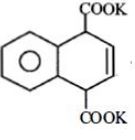
A
B
C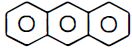
D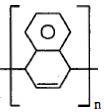
Solution
(B) The reaction is an example of Kolbe's electrolysis of a dicarboxylic acid salt.
$1$. Upon electrolysis,the carboxylate ions $(R-COO^-)$ lose electrons at the anode to form carboxyl radicals $(R-COO^{\bullet})$.
$2$. These radicals undergo decarboxylation to release $CO_2$ and form alkyl radicals $(R^{\bullet})$.
$3$. In this specific case,the two radical centers formed on the cyclohexane ring combine to form a double bond,resulting in the formation of naphthalene,which is stable due to its aromatic character.
Therefore,the product $A$ is naphthalene.
$1$. Upon electrolysis,the carboxylate ions $(R-COO^-)$ lose electrons at the anode to form carboxyl radicals $(R-COO^{\bullet})$.
$2$. These radicals undergo decarboxylation to release $CO_2$ and form alkyl radicals $(R^{\bullet})$.
$3$. In this specific case,the two radical centers formed on the cyclohexane ring combine to form a double bond,resulting in the formation of naphthalene,which is stable due to its aromatic character.
Therefore,the product $A$ is naphthalene.
0 likes
View Solution454
DifficultMCQ
In the given compounds,the correct order of reactivity in electrophilic substitution reactions will be:
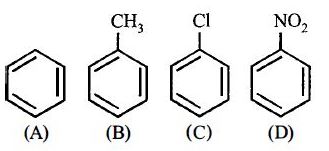
A
$B > A > C > D$
B
$D > C > B > A$
C
$A > B > C > D$
D
$B > C > A > D$
Solution
(A) The reactivity of benzene derivatives towards electrophilic substitution depends on the electron density of the ring.
Groups that increase electron density (activating groups) increase reactivity,while groups that decrease electron density (deactivating groups) decrease reactivity.
$1$. $-CH_3$ (in $B$) is an electron-donating group due to the $+I$ effect and hyperconjugation,making it more reactive than benzene $(A)$.
$2$. Benzene $(A)$ is the reference compound.
$3$. $-Cl$ (in $C$) is deactivating due to its strong $-I$ effect,which outweighs its $+M$ effect,making it less reactive than benzene.
$4$. $-NO_2$ (in $D$) is a strongly deactivating group due to both $-I$ and $-M$ effects,making it the least reactive.
Therefore,the correct order of reactivity is $B > A > C > D$.
Groups that increase electron density (activating groups) increase reactivity,while groups that decrease electron density (deactivating groups) decrease reactivity.
$1$. $-CH_3$ (in $B$) is an electron-donating group due to the $+I$ effect and hyperconjugation,making it more reactive than benzene $(A)$.
$2$. Benzene $(A)$ is the reference compound.
$3$. $-Cl$ (in $C$) is deactivating due to its strong $-I$ effect,which outweighs its $+M$ effect,making it less reactive than benzene.
$4$. $-NO_2$ (in $D$) is a strongly deactivating group due to both $-I$ and $-M$ effects,making it the least reactive.
Therefore,the correct order of reactivity is $B > A > C > D$.
0 likes
View Solution455
DifficultMCQ
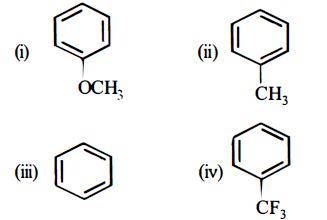
In the below mentioned compounds,the decreasing order of reactivity towards electrophilic substitution is:
A
$(i) > (ii) > (iii) > (iv)$
B
$(ii) > (iii) > (i) > (iv)$
C
$(iii) > (i) > (iv) > (ii)$
D
$(iv) > (i) > (ii) > (iii)$
Solution
(A) The reactivity of benzene derivatives towards electrophilic substitution depends on the electron density of the benzene ring. Electron-donating groups increase the electron density (activating groups),while electron-withdrawing groups decrease it (deactivating groups).
$(i)$ $-OCH_3$: This group exerts a strong $+M$ (mesomeric) effect,which significantly increases the electron density on the benzene ring,making it highly reactive.
(ii) $-CH_3$: This group exerts a $+I$ (inductive) effect and hyperconjugation,which increases the electron density,but less effectively than the $+M$ effect of $-OCH_3$.
(iii) Benzene: This is the reference compound with no substituents.
(iv) $-CF_3$: This group exerts a strong $-I$ effect,which significantly decreases the electron density on the benzene ring,making it the least reactive.
Therefore,the decreasing order of reactivity is $(i) > (ii) > (iii) > (iv)$.
$(i)$ $-OCH_3$: This group exerts a strong $+M$ (mesomeric) effect,which significantly increases the electron density on the benzene ring,making it highly reactive.
(ii) $-CH_3$: This group exerts a $+I$ (inductive) effect and hyperconjugation,which increases the electron density,but less effectively than the $+M$ effect of $-OCH_3$.
(iii) Benzene: This is the reference compound with no substituents.
(iv) $-CF_3$: This group exerts a strong $-I$ effect,which significantly decreases the electron density on the benzene ring,making it the least reactive.
Therefore,the decreasing order of reactivity is $(i) > (ii) > (iii) > (iv)$.
0 likes
View Solution456
DifficultMCQ
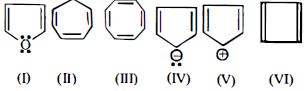
Which of the following compounds are antiaromatic?
A
$I$ and $V$
B
$II$ and $V$
C
$I$ and $IV$
D
$V$ and $VI$
Solution
(D) compound is antiaromatic if it is cyclic,planar,fully conjugated,and contains $4n \pi$ electrons (where $n = 1, 2, ...$).
$(I)$ Furan: $6 \pi$ electrons (aromatic).
$(II)$ Cycloheptatriene: Not fully conjugated (non-aromatic).
$(III)$ Cyclooctatetraene: Non-planar tub-shaped (non-aromatic).
$(IV)$ Cyclopentadienyl anion: $6 \pi$ electrons (aromatic).
$(V)$ Cyclopentadienyl cation: $4 \pi$ electrons,planar,fully conjugated (antiaromatic).
$(VI)$ Cyclobutadiene: $4 \pi$ electrons,planar,fully conjugated (antiaromatic).
Therefore,compounds $(V)$ and $(VI)$ are antiaromatic.
$(I)$ Furan: $6 \pi$ electrons (aromatic).
$(II)$ Cycloheptatriene: Not fully conjugated (non-aromatic).
$(III)$ Cyclooctatetraene: Non-planar tub-shaped (non-aromatic).
$(IV)$ Cyclopentadienyl anion: $6 \pi$ electrons (aromatic).
$(V)$ Cyclopentadienyl cation: $4 \pi$ electrons,planar,fully conjugated (antiaromatic).
$(VI)$ Cyclobutadiene: $4 \pi$ electrons,planar,fully conjugated (antiaromatic).
Therefore,compounds $(V)$ and $(VI)$ are antiaromatic.
0 likes
View Solution457
DifficultMCQ
Which of the following compounds is not aromatic?
A
Cyclopentadienyl cation
B
Pyrrole
C
Pyridine
D
Cyclopentadienyl anion
Solution
(A) To determine aromaticity,we use $H$ückel's rule: a compound must be cyclic,planar,fully conjugated,and have $(4n + 2) \pi$ electrons.
$A$. Cyclopentadienyl cation: It has $4 \pi$ electrons. According to $H$ückel's rule,it is anti-aromatic.
$B$. Pyrrole: It has $6 \pi$ electrons ($4$ from double bonds + $2$ from the lone pair on $N$). It is aromatic.
$C$. Pyridine: It has $6 \pi$ electrons. It is aromatic.
$D$. Cyclopentadienyl anion: It has $6 \pi$ electrons ($4$ from double bonds + $2$ from the negative charge). It is aromatic.
Therefore,the cyclopentadienyl cation is not aromatic (it is anti-aromatic).
$A$. Cyclopentadienyl cation: It has $4 \pi$ electrons. According to $H$ückel's rule,it is anti-aromatic.
$B$. Pyrrole: It has $6 \pi$ electrons ($4$ from double bonds + $2$ from the lone pair on $N$). It is aromatic.
$C$. Pyridine: It has $6 \pi$ electrons. It is aromatic.
$D$. Cyclopentadienyl anion: It has $6 \pi$ electrons ($4$ from double bonds + $2$ from the negative charge). It is aromatic.
Therefore,the cyclopentadienyl cation is not aromatic (it is anti-aromatic).
0 likes
View Solution458
DifficultMCQ
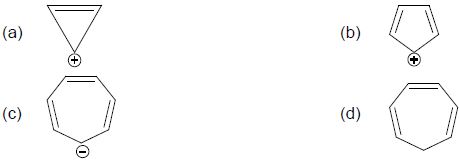
Which of the following compounds is/are not aromatic?
A
$b$,$c$ and $d$
B
$c$ and $d$
C
$b$
D
$b$ and $d$
Solution
(A) To determine aromaticity,we check for cyclic,planar,fully conjugated systems with $(4n+2) \pi$ electrons.
$(a)$ Cyclopropenyl cation: $2 \pi$ electrons $(n=0)$,cyclic,planar,conjugated. It is aromatic.
$(b)$ Cyclopentadienyl cation: $4 \pi$ electrons ($n=1$ for antiaromatic),cyclic,planar,conjugated. It is antiaromatic.
$(c)$ Cycloheptatrienyl anion: $8 \pi$ electrons (wait,let's re-evaluate: $6 \pi$ electrons in the ring + $2$ from anion = $8 \pi$ electrons). Actually,the cycloheptatrienyl anion $(C_7H_7^-)$ has $8 \pi$ electrons,making it antiaromatic.
$(d)$ Cycloheptatriene: It has an $sp^3$ hybridized carbon atom,so it is non-aromatic due to the lack of continuous cyclic conjugation.
Therefore,$(b)$,$(c)$,and $(d)$ are not aromatic.
$(a)$ Cyclopropenyl cation: $2 \pi$ electrons $(n=0)$,cyclic,planar,conjugated. It is aromatic.
$(b)$ Cyclopentadienyl cation: $4 \pi$ electrons ($n=1$ for antiaromatic),cyclic,planar,conjugated. It is antiaromatic.
$(c)$ Cycloheptatrienyl anion: $8 \pi$ electrons (wait,let's re-evaluate: $6 \pi$ electrons in the ring + $2$ from anion = $8 \pi$ electrons). Actually,the cycloheptatrienyl anion $(C_7H_7^-)$ has $8 \pi$ electrons,making it antiaromatic.
$(d)$ Cycloheptatriene: It has an $sp^3$ hybridized carbon atom,so it is non-aromatic due to the lack of continuous cyclic conjugation.
Therefore,$(b)$,$(c)$,and $(d)$ are not aromatic.
0 likes
View Solution459
DifficultMCQ
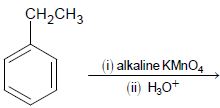
The major product of the following reaction is:
A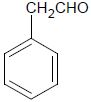
B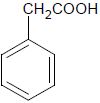
C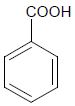
D
Solution
(D) The reaction of alkylbenzenes with alkaline $KMnO_4$ followed by acidification $(H_3O^+)$ is a standard oxidation reaction.
Regardless of the length of the alkyl side chain,as long as there is at least one benzylic hydrogen atom,the entire side chain is oxidized to a carboxylic acid group $(-COOH)$ attached to the benzene ring.
In this case,ethylbenzene $(C_6H_5-CH_2CH_3)$ undergoes oxidation to form benzoic acid $(C_6H_5COOH)$.
Regardless of the length of the alkyl side chain,as long as there is at least one benzylic hydrogen atom,the entire side chain is oxidized to a carboxylic acid group $(-COOH)$ attached to the benzene ring.
In this case,ethylbenzene $(C_6H_5-CH_2CH_3)$ undergoes oxidation to form benzoic acid $(C_6H_5COOH)$.
0 likes
View Solution460
DifficultMCQ
The increasing order of reactivity of the following compounds towards aromatic electrophilic substitution reaction is:
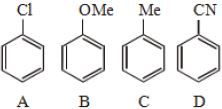
A
$D < A < C < B$
B
$A < B < C < D$
C
$D < C < A < B$
D
$B < C < A < D$
Solution
(A) The reactivity of aromatic compounds towards electrophilic substitution depends on the electron density of the benzene ring. Electron-donating groups $(EDG)$ increase reactivity,while electron-withdrawing groups $(EWG)$ decrease it.
$A$: Chlorobenzene ($-Cl$ group has $-I$ effect and $+R$ effect; overall,it is deactivating but ortho/para directing).
$B$: Anisole ($-OMe$ group has strong $+R$ effect,making it highly activating).
$C$: Toluene ($-Me$ group has $+I$ and hyperconjugation effect,making it activating).
$D$: Benzonitrile ($-CN$ group has strong $-R$ and $-I$ effects,making it strongly deactivating).
Comparing the effects:
$B$ (strong $+R$) > $C$ (hyperconjugation) > $A$ (deactivating $-I > +R$) > $D$ (strong $-R$ and $-I$).
Thus,the increasing order of reactivity is $D < A < C < B$.
$A$: Chlorobenzene ($-Cl$ group has $-I$ effect and $+R$ effect; overall,it is deactivating but ortho/para directing).
$B$: Anisole ($-OMe$ group has strong $+R$ effect,making it highly activating).
$C$: Toluene ($-Me$ group has $+I$ and hyperconjugation effect,making it activating).
$D$: Benzonitrile ($-CN$ group has strong $-R$ and $-I$ effects,making it strongly deactivating).
Comparing the effects:
$B$ (strong $+R$) > $C$ (hyperconjugation) > $A$ (deactivating $-I > +R$) > $D$ (strong $-R$ and $-I$).
Thus,the increasing order of reactivity is $D < A < C < B$.
0 likes
View Solution461
DifficultMCQ
The increasing order of the reactivity of the following compounds towards electrophilic aromatic substitution reaction is:
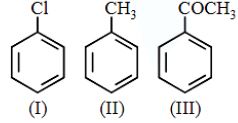
A
$III < I < II$
B
$III < II < I$
C
$II < I < III$
D
$I < III < II$
Solution
(A) The reactivity of aromatic compounds towards electrophilic aromatic substitution depends on the electron density of the benzene ring. Electron-donating groups increase reactivity,while electron-withdrawing groups decrease it.
$I$: Chlorobenzene ($Cl$ is a deactivating group due to its strong $-I$ effect,though it is ortho/para directing).
$II$: Toluene ($-CH_3$ is an activating group due to $+I$ and hyperconjugation).
$III$: Acetophenone ($-COCH_3$ is a strongly deactivating group due to $-I$ and $-M$ effects).
Comparing the effects:
$II$ (activating) > $I$ (weakly deactivating) > $III$ (strongly deactivating).
Therefore,the increasing order of reactivity is $III < I < II$.
$I$: Chlorobenzene ($Cl$ is a deactivating group due to its strong $-I$ effect,though it is ortho/para directing).
$II$: Toluene ($-CH_3$ is an activating group due to $+I$ and hyperconjugation).
$III$: Acetophenone ($-COCH_3$ is a strongly deactivating group due to $-I$ and $-M$ effects).
Comparing the effects:
$II$ (activating) > $I$ (weakly deactivating) > $III$ (strongly deactivating).
Therefore,the increasing order of reactivity is $III < I < II$.
0 likes
View Solution462
MediumMCQ
Which of the following compounds is/are aromatic?
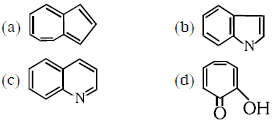
A
Only $a$
B
$b, c$
C
$a, b, c$
D
All of the above $(a, b, c, d)$
Solution
(D) compound is aromatic if it is cyclic,planar,fully conjugated,and follows $H$ückel's rule ($4n+2$ $\pi$ electrons,where $n=0, 1, 2, ...$).
$(a)$ Azulene: It is a bicyclic aromatic hydrocarbon with $10$ $\pi$ electrons $(n=2)$.
$(b)$ Indole: It is a bicyclic heterocyclic compound with $10$ $\pi$ electrons $(n=2)$.
$(c)$ Quinoline: It is a bicyclic heterocyclic compound with $10$ $\pi$ electrons $(n=2)$.
$(d)$ Tropolone: It is a cyclic,planar,conjugated system with $6$ $\pi$ electrons $(n=1)$.
Since all the given compounds satisfy the conditions for aromaticity,the correct option is $D$.
$(a)$ Azulene: It is a bicyclic aromatic hydrocarbon with $10$ $\pi$ electrons $(n=2)$.
$(b)$ Indole: It is a bicyclic heterocyclic compound with $10$ $\pi$ electrons $(n=2)$.
$(c)$ Quinoline: It is a bicyclic heterocyclic compound with $10$ $\pi$ electrons $(n=2)$.
$(d)$ Tropolone: It is a cyclic,planar,conjugated system with $6$ $\pi$ electrons $(n=1)$.
Since all the given compounds satisfy the conditions for aromaticity,the correct option is $D$.
0 likes
View Solution463
DifficultMCQ
The correct order of reactivity towards Electrophilic Substitution Reaction $(E.S.R.)$ for the following compounds is:
$(i)$ Toluene
(ii) $m$-Methoxytoluene
(iii) Benzaldehyde
(iv) $p$-Nitrobenzaldehyde
$(i)$ Toluene
(ii) $m$-Methoxytoluene
(iii) Benzaldehyde
(iv) $p$-Nitrobenzaldehyde
A
$i > ii > iii > iv$
B
$ii > i > iii > iv$
C
$i > iv > iii > ii$
D
$iv > ii > iii > i$
Solution
(B) Reactivity towards $E.S.R.$ depends on the electron density of the benzene ring. Electron Donating Groups $(EDG)$ increase reactivity,while Electron Withdrawing Groups $(EWG)$ decrease it.
$(i)$ Toluene: Contains a $-CH_3$ group,which is a weak $EDG$ ($+I$ and hyperconjugation).
(ii) $m$-Methoxytoluene: Contains a $-OCH_3$ group (strong $EDG$ via $+M$) and a $-CH_3$ group (weak $EDG$). This is the most reactive.
(iii) Benzaldehyde: Contains a $-CHO$ group,which is a strong $EWG$ ($-M$ and $-I$).
(iv) $p$-Nitrobenzaldehyde: Contains both $-CHO$ and $-NO_2$ groups,both of which are strong $EWG$s. This is the least reactive.
Thus,the order of reactivity is $(ii) > (i) > (iii) > (iv)$.
$(i)$ Toluene: Contains a $-CH_3$ group,which is a weak $EDG$ ($+I$ and hyperconjugation).
(ii) $m$-Methoxytoluene: Contains a $-OCH_3$ group (strong $EDG$ via $+M$) and a $-CH_3$ group (weak $EDG$). This is the most reactive.
(iii) Benzaldehyde: Contains a $-CHO$ group,which is a strong $EWG$ ($-M$ and $-I$).
(iv) $p$-Nitrobenzaldehyde: Contains both $-CHO$ and $-NO_2$ groups,both of which are strong $EWG$s. This is the least reactive.
Thus,the order of reactivity is $(ii) > (i) > (iii) > (iv)$.
0 likes
View Solution464
MediumMCQ
Identify the number of aromatic compounds from the following structures:
$(i)$ $1,2,4$-triazole
(ii) $2$-pyrone
(iii) Benzimidazole
(iv) Pyrazole
$(v)$ Cyclooctatetraene dianion
(vi) Pyrrolidinium cation
(vii) Cyclopentadienyl cation
$(i)$ $1,2,4$-triazole
(ii) $2$-pyrone
(iii) Benzimidazole
(iv) Pyrazole
$(v)$ Cyclooctatetraene dianion
(vi) Pyrrolidinium cation
(vii) Cyclopentadienyl cation
A
$4$
B
$5$
C
$6$
D
$3$
Solution
(A) To determine aromaticity,a compound must be cyclic,planar,fully conjugated,and follow $H$ückel's rule ($4n+2$ $\pi$ electrons).
$(i)$ $1,2,4$-triazole: Planar,cyclic,$6$ $\pi$ electrons ($4$ from double bonds,$2$ from lone pair on $N$ at position $1$). Aromatic.
(ii) $2$-pyrone: The oxygen atom is $sp^3$ hybridized at the carbonyl position,breaking conjugation. Non-aromatic.
(iii) Benzimidazole: Planar,cyclic,$10$ $\pi$ electrons. Aromatic.
(iv) Pyrazole: Planar,cyclic,$6$ $\pi$ electrons. Aromatic.
$(v)$ Cyclooctatetraene dianion: Planar,cyclic,$10$ $\pi$ electrons. Aromatic.
(vi) Pyrrolidinium cation: The nitrogen is $sp^3$ hybridized,breaking conjugation. Non-aromatic.
(vii) Cyclopentadienyl cation: Planar,cyclic,$4$ $\pi$ electrons ($4n$ rule). Anti-aromatic.
Thus,the aromatic compounds are $(i)$,(iii),(iv),and $(v)$. The total number is $4$.
$(i)$ $1,2,4$-triazole: Planar,cyclic,$6$ $\pi$ electrons ($4$ from double bonds,$2$ from lone pair on $N$ at position $1$). Aromatic.
(ii) $2$-pyrone: The oxygen atom is $sp^3$ hybridized at the carbonyl position,breaking conjugation. Non-aromatic.
(iii) Benzimidazole: Planar,cyclic,$10$ $\pi$ electrons. Aromatic.
(iv) Pyrazole: Planar,cyclic,$6$ $\pi$ electrons. Aromatic.
$(v)$ Cyclooctatetraene dianion: Planar,cyclic,$10$ $\pi$ electrons. Aromatic.
(vi) Pyrrolidinium cation: The nitrogen is $sp^3$ hybridized,breaking conjugation. Non-aromatic.
(vii) Cyclopentadienyl cation: Planar,cyclic,$4$ $\pi$ electrons ($4n$ rule). Anti-aromatic.
Thus,the aromatic compounds are $(i)$,(iii),(iv),and $(v)$. The total number is $4$.
0 likes
View Solution465
MediumMCQ
Which of the following statements is wrong for the given molecule?
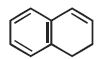
A
The given molecule is aromatic
B
This molecule has $6\pi$ delocalized electrons.
C
This molecule has eight parallel pure $p-$ orbitals
D
This molecule is not planar
Solution
(A) The given molecule is $1,2-dihydronaphthalene$.
$1$. It is not aromatic because it does not satisfy $H$ückel's rule ($4n+2$ $\pi$ electrons in a planar cyclic conjugated system).
$2$. It has $4$ $\pi$ electrons in the conjugated system (two double bonds),not $6$.
$3$. The molecule is not planar because the saturated carbon atoms ($sp^3$ hybridized) disrupt the planarity of the ring system.
$4$. Since the molecule is not fully conjugated,it does not have eight parallel pure $p-$ orbitals.
Comparing the options,statement $D$ is correct (the molecule is not planar),but statement $A$ is definitely wrong as it is not aromatic. Statement $B$ is also wrong as it has $4$ $\pi$ electrons. However,in the context of typical multiple-choice questions for this specific structure,the most fundamentally incorrect statement regarding its aromaticity is $A$.
$1$. It is not aromatic because it does not satisfy $H$ückel's rule ($4n+2$ $\pi$ electrons in a planar cyclic conjugated system).
$2$. It has $4$ $\pi$ electrons in the conjugated system (two double bonds),not $6$.
$3$. The molecule is not planar because the saturated carbon atoms ($sp^3$ hybridized) disrupt the planarity of the ring system.
$4$. Since the molecule is not fully conjugated,it does not have eight parallel pure $p-$ orbitals.
Comparing the options,statement $D$ is correct (the molecule is not planar),but statement $A$ is definitely wrong as it is not aromatic. Statement $B$ is also wrong as it has $4$ $\pi$ electrons. However,in the context of typical multiple-choice questions for this specific structure,the most fundamentally incorrect statement regarding its aromaticity is $A$.
0 likes
View Solution466
AdvancedMCQ
The main product of the following reaction will be
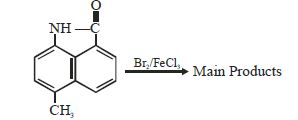
A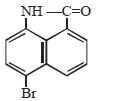
B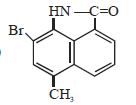
C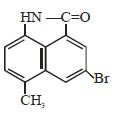
D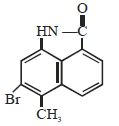
Solution
(C) The starting material is a bicyclic aromatic system containing an amide group $(-NH-CO-)$. The $-NH-$ group is an activating group (ortho/para directing) due to the lone pair on nitrogen,while the $-CO-$ group is a deactivating group (meta directing).
In the given structure,the $-NH-$ group is attached to the ring. The position ortho to the $-NH-$ group is the most activated position for electrophilic aromatic substitution.
Therefore,the electrophile $Br^+$ (generated from $Br_2/FeCl_3$) will attack the position ortho to the $-NH-$ group.
Comparing the options,the structure in option $C$ shows the bromine atom at the position ortho to the $-NH-$ group.
In the given structure,the $-NH-$ group is attached to the ring. The position ortho to the $-NH-$ group is the most activated position for electrophilic aromatic substitution.
Therefore,the electrophile $Br^+$ (generated from $Br_2/FeCl_3$) will attack the position ortho to the $-NH-$ group.
Comparing the options,the structure in option $C$ shows the bromine atom at the position ortho to the $-NH-$ group.
0 likes
View Solution467
DifficultMCQ
Which of the following compounds is most reactive toward an electrophilic substitution reaction?
A
$1,3$-dinitrobenzene
B
$3$-nitrophenol
C
Nitrobenzene
D
$3$-methoxyphenol
Solution
(D) The reactivity of a benzene ring toward electrophilic substitution reactions $(ESR)$ depends on the electron density of the ring. Electron-donating groups (EDGs) increase the electron density and thus increase reactivity,while electron-withdrawing groups (EWGs) decrease it.
$A$. $1,3$-dinitrobenzene: Contains two $-NO_2$ groups,which are strong EWGs. This significantly deactivates the ring.
$B$. $3$-nitrophenol: Contains one $-OH$ group $(EDG)$ and one $-NO_2$ group $(EWG)$. The net effect is deactivation compared to phenol.
$C$. Nitrobenzene: Contains one $-NO_2$ group $(EWG)$,which deactivates the ring.
$D$. $3$-methoxyphenol: Contains two electron-donating groups: $-OH$ and $-OCH_3$. Both groups exert a $+M$ (mesomeric) effect,which increases the electron density of the benzene ring significantly,making it the most reactive toward $ESR$.
$A$. $1,3$-dinitrobenzene: Contains two $-NO_2$ groups,which are strong EWGs. This significantly deactivates the ring.
$B$. $3$-nitrophenol: Contains one $-OH$ group $(EDG)$ and one $-NO_2$ group $(EWG)$. The net effect is deactivation compared to phenol.
$C$. Nitrobenzene: Contains one $-NO_2$ group $(EWG)$,which deactivates the ring.
$D$. $3$-methoxyphenol: Contains two electron-donating groups: $-OH$ and $-OCH_3$. Both groups exert a $+M$ (mesomeric) effect,which increases the electron density of the benzene ring significantly,making it the most reactive toward $ESR$.
0 likes
View Solution468
EasyMCQ
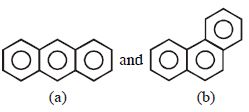
Which of the following is anthracene?
A
$a$
B
$b$
C
Both
D
None
Solution
(A) Anthracene is a polycyclic aromatic hydrocarbon consisting of three fused benzene rings in a linear arrangement.
Structure $(a)$ represents anthracene.
Structure $(b)$ represents phenanthrene,which has an angular arrangement of three fused benzene rings.
Therefore,the correct option is $A$.
Structure $(a)$ represents anthracene.
Structure $(b)$ represents phenanthrene,which has an angular arrangement of three fused benzene rings.
Therefore,the correct option is $A$.
0 likes
View Solution469
DifficultMCQ
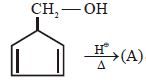
Product $(A)$ is
A
Cyclopentadiene with a methylene group $(=CH_2)$
B
Benzene
C
Toluene
D
Cyclopentadiene
Solution
(A) The reaction involves the acid-catalyzed dehydration of an alcohol. The starting material is cyclopentadienylmethanol.
Upon treatment with $H^{\oplus}$ and heat,the hydroxyl group is protonated to form a good leaving group $(-OH_2^+)$.
Loss of water generates a carbocation at the exocyclic carbon.
This carbocation is highly stabilized by resonance with the cyclopentadiene ring,leading to the formation of a fulvene derivative or,through rearrangement/isomerization,potentially leading to more stable aromatic or conjugated systems.
However,in the context of standard textbook problems of this type,the dehydration of this specific allylic alcohol typically leads to the formation of the exocyclic double bond product,which is methylenecyclopentadiene.
Upon treatment with $H^{\oplus}$ and heat,the hydroxyl group is protonated to form a good leaving group $(-OH_2^+)$.
Loss of water generates a carbocation at the exocyclic carbon.
This carbocation is highly stabilized by resonance with the cyclopentadiene ring,leading to the formation of a fulvene derivative or,through rearrangement/isomerization,potentially leading to more stable aromatic or conjugated systems.
However,in the context of standard textbook problems of this type,the dehydration of this specific allylic alcohol typically leads to the formation of the exocyclic double bond product,which is methylenecyclopentadiene.
0 likes
View Solution470
DifficultMCQ
$CH_3-CH_2-CH_2-Cl$ $\xrightarrow{Na, \text{Dry ether}} P$ $\xrightarrow[V_2O_5, Al_2O_3]{\Delta} Q$. $Q$ is
A
$1-$Methylcyclopenta$-1,3-$diene
B
$1-$Methylenecyclopenta$-2,4-$diene
C
Benzene
D
Toluene
Solution
(C) $1$. The reaction $CH_3-CH_2-CH_2-Cl \xrightarrow{Na, \text{Dry ether}}$ is a Wurtz reaction. However,with $n$-propyl chloride,it primarily yields $n$-hexane $(CH_3-CH_2-CH_2-CH_2-CH_2-CH_3)$ as $P$.
$2$. The second step involves the aromatization of $n$-hexane using $V_2O_5$ and $Al_2O_3$ at high temperature $(\Delta)$.
$3$. $n$-Hexane undergoes cyclization and dehydrogenation to form benzene $(C_6H_6)$ as $Q$.
$4$. Therefore,$Q$ is benzene.
$2$. The second step involves the aromatization of $n$-hexane using $V_2O_5$ and $Al_2O_3$ at high temperature $(\Delta)$.
$3$. $n$-Hexane undergoes cyclization and dehydrogenation to form benzene $(C_6H_6)$ as $Q$.
$4$. Therefore,$Q$ is benzene.
0 likes
View Solution471
MediumMCQ
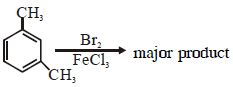
What is the major product of the following reaction?
A
B
C
D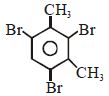
Solution
(B) The reaction is an electrophilic aromatic substitution (bromination) of $m$-xylene ($1$,$3$-dimethylbenzene) using $Br_2$ in the presence of a Lewis acid catalyst $(FeCl_3)$.
$1$. The methyl groups $(-CH_3)$ are ortho/para directing and activating groups.
$2$. In $m$-xylene,the positions $2$,$4$,and $6$ are available for substitution.
$3$. Position $2$ is sterically hindered due to the presence of two methyl groups at positions $1$ and $3$.
$4$. Positions $4$ and $6$ are equivalent and are less sterically hindered than position $2$.
$5$. Therefore,the electrophile $(Br^+)$ attacks the $4$-position (or $6$-position) to form the major product,which is $4$-bromo-$1,3$-dimethylbenzene.
$1$. The methyl groups $(-CH_3)$ are ortho/para directing and activating groups.
$2$. In $m$-xylene,the positions $2$,$4$,and $6$ are available for substitution.
$3$. Position $2$ is sterically hindered due to the presence of two methyl groups at positions $1$ and $3$.
$4$. Positions $4$ and $6$ are equivalent and are less sterically hindered than position $2$.
$5$. Therefore,the electrophile $(Br^+)$ attacks the $4$-position (or $6$-position) to form the major product,which is $4$-bromo-$1,3$-dimethylbenzene.
0 likes
View Solution472
MediumMCQ
Aromaticity is present in
A
Cyclopropenyl anion
B
Pyrrole cation
C
Indene
D
Cyclooctatetraene
Solution
(C) To determine aromaticity,a molecule must follow $H$ückel's rule: it must be cyclic,planar,fully conjugated,and contain $(4n + 2) \pi$ electrons,where $n$ is an integer $(n = 0, 1, 2, ...)$.
$A$. Cyclopropenyl anion: It has $4 \pi$ electrons ($2$ from the double bond and $2$ from the lone pair on the carbon atom). This follows $4n$ rule,making it anti-aromatic.
$B$. Pyrrole cation: The nitrogen atom is $sp^2$ hybridized. The $\pi$ system consists of $4$ electrons from the two double bonds. Total $\pi$ electrons = $4$. This is anti-aromatic.
$C$. Indene: It is a bicyclic compound consisting of a benzene ring fused to a cyclopentadiene ring. The benzene part is aromatic,and the overall molecule exhibits aromatic character due to the $6 \pi$ electron system in the benzene ring.
$D$. Cyclooctatetraene: It has $8 \pi$ electrons. It is non-planar (tub-shaped) to avoid anti-aromaticity,hence it is non-aromatic.
Therefore,aromaticity is present in Indene.
$A$. Cyclopropenyl anion: It has $4 \pi$ electrons ($2$ from the double bond and $2$ from the lone pair on the carbon atom). This follows $4n$ rule,making it anti-aromatic.
$B$. Pyrrole cation: The nitrogen atom is $sp^2$ hybridized. The $\pi$ system consists of $4$ electrons from the two double bonds. Total $\pi$ electrons = $4$. This is anti-aromatic.
$C$. Indene: It is a bicyclic compound consisting of a benzene ring fused to a cyclopentadiene ring. The benzene part is aromatic,and the overall molecule exhibits aromatic character due to the $6 \pi$ electron system in the benzene ring.
$D$. Cyclooctatetraene: It has $8 \pi$ electrons. It is non-planar (tub-shaped) to avoid anti-aromaticity,hence it is non-aromatic.
Therefore,aromaticity is present in Indene.
0 likes
View Solution473
DifficultMCQ
To convert cyclononatetraene into an aromatic ion,the process needed is
A
Addition of one more $\pi$ bond
B
Addition of two more $\pi$ bond
C
Loss of $H^{+}$ from $sp^3$ hybridised carbon
D
Loss of $H^{+}$ from $sp^2$ hybridised carbon
Solution
(C) Cyclononatetraene has $9$ carbon atoms and $4$ $\pi$ bonds.
To be aromatic,it must follow $H$ückel's rule,which states that a planar,cyclic,conjugated system must have $(4n + 2)$ $\pi$ electrons.
For $n = 2$,the system requires $10$ $\pi$ electrons.
Cyclononatetraene has $8$ $\pi$ electrons.
If we remove a proton $(H^+)$ from the $sp^3$ hybridized carbon (the methylene bridge),the carbon becomes $sp^2$ hybridized and carries a negative charge (a lone pair).
This lone pair contributes $2$ electrons to the $\pi$ system,resulting in a total of $8 + 2 = 10$ $\pi$ electrons.
Thus,the cyclononatetraenyl anion is aromatic.
To be aromatic,it must follow $H$ückel's rule,which states that a planar,cyclic,conjugated system must have $(4n + 2)$ $\pi$ electrons.
For $n = 2$,the system requires $10$ $\pi$ electrons.
Cyclononatetraene has $8$ $\pi$ electrons.
If we remove a proton $(H^+)$ from the $sp^3$ hybridized carbon (the methylene bridge),the carbon becomes $sp^2$ hybridized and carries a negative charge (a lone pair).
This lone pair contributes $2$ electrons to the $\pi$ system,resulting in a total of $8 + 2 = 10$ $\pi$ electrons.
Thus,the cyclononatetraenyl anion is aromatic.
0 likes
View Solution474
MediumMCQ
Rank in order of increasing rate of reaction towards $EAS$ with bromine in the presence of $FeBr_3$.
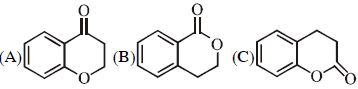
A
$B < A < C$
B
$B < C < A$
C
$A < B < C$
D
$A < C < B$
Solution
(A) The rate of Electrophilic Aromatic Substitution $(EAS)$ depends on the electron density of the benzene ring. Electron-donating groups $(EDG)$ activate the ring,while electron-withdrawing groups $(EWG)$ deactivate it.
In structure $(C)$,the oxygen atom is directly attached to the benzene ring and acts as a strong $EDG$ through resonance,making the ring highly activated.
In structure $(A)$,the oxygen atom is attached to the ring,but the carbonyl group $(C=O)$ is also present,which exerts an electron-withdrawing effect,making it less activated than $(C)$.
In structure $(B)$,the carbonyl group is directly attached to the benzene ring,which is a strong $EWG$,making the ring the most deactivated among the three.
Therefore,the order of increasing rate of reaction is $B < A < C$.
In structure $(C)$,the oxygen atom is directly attached to the benzene ring and acts as a strong $EDG$ through resonance,making the ring highly activated.
In structure $(A)$,the oxygen atom is attached to the ring,but the carbonyl group $(C=O)$ is also present,which exerts an electron-withdrawing effect,making it less activated than $(C)$.
In structure $(B)$,the carbonyl group is directly attached to the benzene ring,which is a strong $EWG$,making the ring the most deactivated among the three.
Therefore,the order of increasing rate of reaction is $B < A < C$.
0 likes
View Solution475
DifficultMCQ
Product $(A)$ is
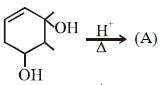
A
$1,2-$dimethylbenzene
B
$1,2-$dimethylcyclohexene
C
$1,2-$dimethylbenzene (o-xylene)
D
$1,4-$dimethylbenzene
Solution
(C) The starting material is $1,2$-dimethylcyclohex-$3$-ene-$1,2$-diol.
Upon treatment with $H^+$ and heating,the diol undergoes acid-catalyzed dehydration followed by rearrangement to form an aromatic compound.
The reaction involves the loss of two water molecules and the shifting of double bonds to achieve aromaticity,resulting in the formation of $1,2$-dimethylbenzene (o-xylene).
Upon treatment with $H^+$ and heating,the diol undergoes acid-catalyzed dehydration followed by rearrangement to form an aromatic compound.
The reaction involves the loss of two water molecules and the shifting of double bonds to achieve aromaticity,resulting in the formation of $1,2$-dimethylbenzene (o-xylene).
0 likes
View Solution476
MediumMCQ
What is the major product of the following reaction?
$1,4-dichlorocyclohexa-1,4-diene \xrightarrow{Na, \text{dry ether}} ?$
$1,4-dichlorocyclohexa-1,4-diene \xrightarrow{Na, \text{dry ether}} ?$
A
Benzene
B
Cyclohexa$-1,3-$diene
C
Cyclohexa$-1,4-$diene
D
Cyclohexane
Solution
(A) The reaction of $1,4-dichlorocyclohexa-1,4-diene$ with $Na$ in dry ether is an intramolecular $Wurtz$ reaction.
The two chlorine atoms are removed,and a new $C-C$ bond is formed between the $C-1$ and $C-4$ positions.
This results in the formation of benzene as the final aromatic product,as it is highly stable.
The two chlorine atoms are removed,and a new $C-C$ bond is formed between the $C-1$ and $C-4$ positions.
This results in the formation of benzene as the final aromatic product,as it is highly stable.
0 likes
View Solution477
DifficultMCQ
$n-hexane$ $\xrightarrow{\text{catalyst}}$ benzene
The catalyst is:
The catalyst is:
A
$AlCl_3$
B
$SiO_2-Al_2O_3$
C
$Cr_2O_3-Al_2O_3$
D
$MnO_2$
Solution
(C) The reaction is known as aromatization or dehydrocyclization.
It involves the conversion of $n-hexane$ to benzene in the presence of oxides of $Cr, Mo,$ or $V$ supported on $Al_2O_3$ at high temperature and pressure.
Therefore,the correct catalyst is $Cr_2O_3-Al_2O_3$.
It involves the conversion of $n-hexane$ to benzene in the presence of oxides of $Cr, Mo,$ or $V$ supported on $Al_2O_3$ at high temperature and pressure.
Therefore,the correct catalyst is $Cr_2O_3-Al_2O_3$.
0 likes
View Solution478
DifficultMCQ
Which is the correct order for the rate of sulphonation of benzene?
A
$K_{C_6H_6} > K_{C_6D_6} > K_{C_6T_6}$
B
$K_{C_6H_6} < K_{C_6D_6} < K_{C_6T_6}$
C
$K_{C_6H_6} = K_{C_6D_6} = K_{C_6T_6}$
D
$K_{C_6H_6} > K_{C_6D_6} < K_{C_6T_6}$
Solution
(A) The sulphonation of benzene is a reversible reaction where the rate-determining step involves the cleavage of the $C-H$ (or $C-D$ or $C-T$) bond.
Due to the primary kinetic isotope effect,the $C-H$ bond is easier to break than the $C-D$ bond,which in turn is easier to break than the $C-T$ bond.
Since the $C-H$ bond is the weakest and the $C-T$ bond is the strongest,the rate of reaction follows the order: $K_{C_6H_6} > K_{C_6D_6} > K_{C_6T_6}$.
Due to the primary kinetic isotope effect,the $C-H$ bond is easier to break than the $C-D$ bond,which in turn is easier to break than the $C-T$ bond.
Since the $C-H$ bond is the weakest and the $C-T$ bond is the strongest,the rate of reaction follows the order: $K_{C_6H_6} > K_{C_6D_6} > K_{C_6T_6}$.
0 likes
View Solution479
MediumMCQ
During the mixed acid nitration of benzene,concentrated $HNO_3$ behaves like:
A
Acid
B
Base
C
Catalyst
D
Electrophile
Solution
(B) In the nitration of benzene using a mixture of concentrated $HNO_3$ and concentrated $H_2SO_4$,the sulfuric acid acts as a strong acid and protonates the nitric acid. The reaction is as follows: $HNO_3 + H_2SO_4$ $\rightarrow H_2NO_3^+ + HSO_4^-$ $\rightarrow H_2O + NO_2^+ + HSO_4^-$. In this process,$HNO_3$ accepts a proton $(H^+)$ from $H_2SO_4$,and according to the Brønsted-Lowry theory,a substance that accepts a proton acts as a base.
0 likes
View Solution480
MediumMCQ
Which of the following reactions is correct?
A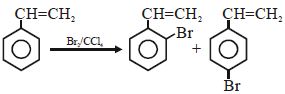
B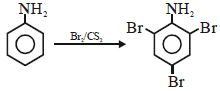
C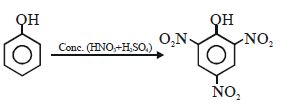
D
All of the above.
Solution
(C) Let us analyze each reaction:
$1$. Styrene $(C_6H_5CH=CH_2)$ reacts with $Br_2/CCl_4$ via electrophilic addition to the double bond,not electrophilic aromatic substitution. The product should be $1,2-$dibromoethylbenzene. Thus,option $A$ is incorrect.
$2$. Aniline is highly activated. Reaction with $Br_2$ in a non-polar solvent like $CS_2$ at low temperature yields mono-substitution (ortho or para),not $2,4,6-$tribromoaniline. Thus,option $B$ is incorrect.
$3$. Phenol reacts with concentrated $HNO_3$ in the presence of concentrated $H_2SO_4$ to undergo nitration at the ortho and para positions,yielding $2,4,6-$trinitrophenol (picric acid). This reaction is correct.
Since only option $C$ is chemically accurate,the question likely intended to ask for the correct reaction among the choices provided. Given the options,$C$ is the only scientifically correct transformation.
$1$. Styrene $(C_6H_5CH=CH_2)$ reacts with $Br_2/CCl_4$ via electrophilic addition to the double bond,not electrophilic aromatic substitution. The product should be $1,2-$dibromoethylbenzene. Thus,option $A$ is incorrect.
$2$. Aniline is highly activated. Reaction with $Br_2$ in a non-polar solvent like $CS_2$ at low temperature yields mono-substitution (ortho or para),not $2,4,6-$tribromoaniline. Thus,option $B$ is incorrect.
$3$. Phenol reacts with concentrated $HNO_3$ in the presence of concentrated $H_2SO_4$ to undergo nitration at the ortho and para positions,yielding $2,4,6-$trinitrophenol (picric acid). This reaction is correct.
Since only option $C$ is chemically accurate,the question likely intended to ask for the correct reaction among the choices provided. Given the options,$C$ is the only scientifically correct transformation.
0 likes
View Solution481
DifficultMCQ
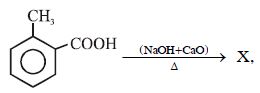
$X$ can be prepared by which of the following reactions,except?
A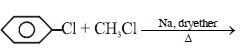
B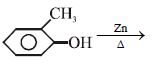
C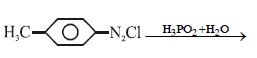
D
$CH_3-C \equiv CH \xrightarrow[Red \ hot]{Fe \ tube}$
Solution
(D) The product $X$ in the given reactions is toluene $(C_6H_5CH_3)$.
$A$: Decarboxylation of $2$-methylbenzoic acid with sodalime $(NaOH + CaO)$ yields toluene.
$B$: The Wurtz-Fittig reaction of chlorobenzene with methyl chloride $(CH_3Cl)$ in the presence of $Na$ and dry ether yields toluene.
$C$: Reduction of $o$-cresol ($2$-methylphenol) with $Zn$ dust yields toluene.
$D$: The trimerization of propyne $(CH_3-C \equiv CH)$ over a red-hot $Fe$ tube yields $1,3,5$-trimethylbenzene (mesitylene),not toluene.
Therefore,$X$ cannot be prepared by reaction $D$.
$A$: Decarboxylation of $2$-methylbenzoic acid with sodalime $(NaOH + CaO)$ yields toluene.
$B$: The Wurtz-Fittig reaction of chlorobenzene with methyl chloride $(CH_3Cl)$ in the presence of $Na$ and dry ether yields toluene.
$C$: Reduction of $o$-cresol ($2$-methylphenol) with $Zn$ dust yields toluene.
$D$: The trimerization of propyne $(CH_3-C \equiv CH)$ over a red-hot $Fe$ tube yields $1,3,5$-trimethylbenzene (mesitylene),not toluene.
Therefore,$X$ cannot be prepared by reaction $D$.
0 likes
View Solution482
DifficultMCQ
Identify products $A$ and $B$ in the following reaction scheme:
Reaction $1$: Benzene + $Cl_2$ (excess) $\xrightarrow{FeCl_3}$ $A$
Reaction $2$: Benzene + $Cl_2$ (excess) $\xrightarrow{h\nu}$ $B$
Reaction $1$: Benzene + $Cl_2$ (excess) $\xrightarrow{FeCl_3}$ $A$
Reaction $2$: Benzene + $Cl_2$ (excess) $\xrightarrow{h\nu}$ $B$
A
$BHC$ and $HCB$
B
$HCB$ and $BHC$
C
$HCB$ and $HCB$
D
$BHC$ and $BHC$
Solution
(B) $1$. In the presence of a Lewis acid like $FeCl_3$,benzene undergoes electrophilic aromatic substitution with excess $Cl_2$ to form hexachlorobenzene $(C_6Cl_6)$. Thus,$A$ is $HCB$ (hexachlorobenzene).
$2$. In the presence of ultraviolet light $(h\nu)$,benzene undergoes free-radical addition with excess $Cl_2$ to form benzene hexachloride $(C_6H_6Cl_6)$,commonly known as $BHC$ or gammaxene. Thus,$B$ is $BHC$ (benzene hexachloride).
$3$. Therefore,$A$ is $HCB$ and $B$ is $BHC$.
$2$. In the presence of ultraviolet light $(h\nu)$,benzene undergoes free-radical addition with excess $Cl_2$ to form benzene hexachloride $(C_6H_6Cl_6)$,commonly known as $BHC$ or gammaxene. Thus,$B$ is $BHC$ (benzene hexachloride).
$3$. Therefore,$A$ is $HCB$ and $B$ is $BHC$.
0 likes
View Solution483
MediumMCQ
$n$-heptane $\xrightarrow[600\ {}^oC]{Cr_2O_3/V_2O_5}$ ?
A
Benzene
B
Toluene
C
Ethylbenzene
D
o-Xylene
Solution
(B) The reaction of $n$-heptane with $Cr_2O_3/V_2O_5$ at $600\ {}^oC$ is an example of aromatization (or catalytic reforming).
In this process,an alkane with $6$ or more carbon atoms undergoes cyclization followed by dehydrogenation to form an aromatic hydrocarbon.
For $n$-heptane $(CH_3-CH_2-CH_2-CH_2-CH_2-CH_2-CH_3)$,the cyclization leads to methylcyclohexane,which then loses $3$ molecules of $H_2$ to form toluene $(C_6H_5CH_3)$.
In this process,an alkane with $6$ or more carbon atoms undergoes cyclization followed by dehydrogenation to form an aromatic hydrocarbon.
For $n$-heptane $(CH_3-CH_2-CH_2-CH_2-CH_2-CH_2-CH_3)$,the cyclization leads to methylcyclohexane,which then loses $3$ molecules of $H_2$ to form toluene $(C_6H_5CH_3)$.
0 likes
View Solution484
MediumMCQ
Identify the product $X$ in the following reaction:
$\text{Benzene} + Cl_{2(\text{excess})} \xrightarrow{AlCl_3, \Delta} X$
$\text{Benzene} + Cl_{2(\text{excess})} \xrightarrow{AlCl_3, \Delta} X$
A
Hexachlorobenzene
B
Hexachlorocyclohexane
C
$1,3-$Dichlorobenzene
D
$1,4-$Dichlorobenzene
Solution
(A) The reaction of benzene with chlorine in the presence of a Lewis acid catalyst like $AlCl_3$ and heat is an electrophilic aromatic substitution reaction.
Since $Cl_2$ is in excess,all the hydrogen atoms on the benzene ring are replaced by chlorine atoms.
This leads to the formation of hexachlorobenzene $(C_6Cl_6)$.
Since $Cl_2$ is in excess,all the hydrogen atoms on the benzene ring are replaced by chlorine atoms.
This leads to the formation of hexachlorobenzene $(C_6Cl_6)$.
0 likes
View Solution485
EasyMCQ
The number of $sp^2-s$ sigma bonds in benzene are
A
$3$
B
$6$
C
$12$
D
none of these
Solution
(B) Benzene has the molecular formula $C_6H_6$.
In benzene,each carbon atom is $sp^2$ hybridized.
Each carbon atom forms one $sp^2-s$ sigma bond with a hydrogen atom.
Since there are $6$ carbon atoms in the benzene ring,there are $6$ $sp^2-s$ sigma bonds.
In benzene,each carbon atom is $sp^2$ hybridized.
Each carbon atom forms one $sp^2-s$ sigma bond with a hydrogen atom.
Since there are $6$ carbon atoms in the benzene ring,there are $6$ $sp^2-s$ sigma bonds.
0 likes
View Solution486
MediumMCQ
Which of the following reactions is not an example of an addition reaction?
A
Benzene + $3H_2 \xrightarrow{Ni/\Delta}$ Cyclohexane
B
Benzene + $Cl_2$ (excess) $\xrightarrow{AlCl_3, \text{Dark}}$ Hexachlorobenzene
C
Benzene + $3O_2 \rightarrow$ Benzene triozonide
D
Benzene + $3Cl_2 \xrightarrow{h\nu/\Delta}$ Benzene hexachloride $(BHC)$
Solution
(B) An addition reaction involves the combination of two or more molecules to form a larger molecule without the loss of any atoms.
$A$. Hydrogenation of benzene is an addition reaction where $3$ moles of $H_2$ add to the benzene ring.
$B$. The reaction of benzene with $Cl_2$ in the presence of a Lewis acid catalyst like $AlCl_3$ in the dark is an electrophilic substitution reaction,not an addition reaction. In this process,hydrogen atoms on the benzene ring are replaced by chlorine atoms.
$C$. Ozonolysis of benzene is an addition reaction.
$D$. Chlorination of benzene in the presence of sunlight $(h\nu)$ is a free-radical addition reaction.
Therefore,option $B$ is not an addition reaction.
$A$. Hydrogenation of benzene is an addition reaction where $3$ moles of $H_2$ add to the benzene ring.
$B$. The reaction of benzene with $Cl_2$ in the presence of a Lewis acid catalyst like $AlCl_3$ in the dark is an electrophilic substitution reaction,not an addition reaction. In this process,hydrogen atoms on the benzene ring are replaced by chlorine atoms.
$C$. Ozonolysis of benzene is an addition reaction.
$D$. Chlorination of benzene in the presence of sunlight $(h\nu)$ is a free-radical addition reaction.
Therefore,option $B$ is not an addition reaction.
0 likes
View Solution487
MediumMCQ
Which of the following compounds is most reactive toward electrophilic substitution reaction?
A
m-Dinitrobenzene
B
p-Dinitrobenzene
C
o-Dinitrobenzene
D
All are equally reactive
Solution
(D) Electrophilic substitution reactions are favored by electron-donating groups $(EDG)$ and hindered by electron-withdrawing groups $(EWG)$.
$NO_2$ is a strong electron-withdrawing group due to both $-I$ and $-M$ effects.
In all three isomers ($m-$,$p-$,and $o-$ dinitrobenzene),there are two $NO_2$ groups attached to the benzene ring,which significantly deactivate the ring toward electrophilic attack.
However,the reactivity depends on the net electron density on the ring. In $m-dinitrobenzene$,the $NO_2$ groups are at positions $1$ and $3$. In $p-dinitrobenzene$,they are at $1$ and $4$,and in $o-dinitrobenzene$,they are at $1$ and $2$.
Since all three compounds are highly deactivated by two strong EWGs,they are all extremely unreactive toward electrophilic substitution. In the context of standard chemistry problems,when comparing these specific isomers,they are often considered to have negligible reactivity compared to benzene or substituted benzenes with EDGs. Given the options,they are effectively equally unreactive.
$NO_2$ is a strong electron-withdrawing group due to both $-I$ and $-M$ effects.
In all three isomers ($m-$,$p-$,and $o-$ dinitrobenzene),there are two $NO_2$ groups attached to the benzene ring,which significantly deactivate the ring toward electrophilic attack.
However,the reactivity depends on the net electron density on the ring. In $m-dinitrobenzene$,the $NO_2$ groups are at positions $1$ and $3$. In $p-dinitrobenzene$,they are at $1$ and $4$,and in $o-dinitrobenzene$,they are at $1$ and $2$.
Since all three compounds are highly deactivated by two strong EWGs,they are all extremely unreactive toward electrophilic substitution. In the context of standard chemistry problems,when comparing these specific isomers,they are often considered to have negligible reactivity compared to benzene or substituted benzenes with EDGs. Given the options,they are effectively equally unreactive.
0 likes
View Solution488
MediumMCQ
Benzene + $CH_3-CH_2-CH_2-Cl$ $\xrightarrow{AlCl_3}$ the product is:
A
Chlorobenzene
B
Propylbenzene
C
Isopropylbenzene
D
$1-$Ethyl$-4-$methylbenzene
Solution
(C) The reaction of benzene with $n$-propyl chloride in the presence of anhydrous $AlCl_3$ is a Friedel-Crafts alkylation reaction.
In this reaction,the primary carbocation $(CH_3-CH_2-CH_2^+)$ formed initially is unstable and undergoes a $1,2-$hydride shift to form a more stable secondary carbocation $(CH_3-CH^+-CH_3)$.
This secondary carbocation then attacks the benzene ring to form isopropylbenzene (cumene) as the major product.
Therefore,the correct option is $C$.
In this reaction,the primary carbocation $(CH_3-CH_2-CH_2^+)$ formed initially is unstable and undergoes a $1,2-$hydride shift to form a more stable secondary carbocation $(CH_3-CH^+-CH_3)$.
This secondary carbocation then attacks the benzene ring to form isopropylbenzene (cumene) as the major product.
Therefore,the correct option is $C$.
0 likes
View Solution489
MediumMCQ
Which of the following is aromatic?
A
Cyclopropenyl anion
B
Cyclopentadienyl cation
C
Pyridine
D
Pyrylium cation
Solution
(D) compound is aromatic if it is cyclic,planar,fully conjugated,and follows $H$ückel's rule ($4n+2$ $\pi$ electrons).
$A$. Cyclopropenyl anion has $4$ $\pi$ electrons ($2$ from the double bond and $2$ from the lone pair on the carbon atom),which is anti-aromatic.
$B$. Cyclopentadienyl cation has $4$ $\pi$ electrons,which is anti-aromatic.
$C$. Pyridine is a heterocyclic aromatic compound with $6$ $\pi$ electrons.
$D$. Pyrylium cation is a heterocyclic aromatic compound with $6$ $\pi$ electrons.
Both $C$ and $D$ are aromatic. However,based on the provided solution image,the question specifically highlights the pyrylium cation structure.
$A$. Cyclopropenyl anion has $4$ $\pi$ electrons ($2$ from the double bond and $2$ from the lone pair on the carbon atom),which is anti-aromatic.
$B$. Cyclopentadienyl cation has $4$ $\pi$ electrons,which is anti-aromatic.
$C$. Pyridine is a heterocyclic aromatic compound with $6$ $\pi$ electrons.
$D$. Pyrylium cation is a heterocyclic aromatic compound with $6$ $\pi$ electrons.
Both $C$ and $D$ are aromatic. However,based on the provided solution image,the question specifically highlights the pyrylium cation structure.
0 likes
View Solution490
MediumMCQ
Which of the following compounds undergoes the Friedel-Crafts reaction?
A
Nitrobenzene
B
Benzaldehyde
C
Aniline
D
Chlorobenzene
Solution
(D) The Friedel-Crafts reaction involves electrophilic aromatic substitution,which requires an electron-rich benzene ring to react with an electrophile.
$1$. Nitrobenzene $(-NO_2)$ and Benzaldehyde $(-CHO)$ are strongly deactivating groups due to their electron-withdrawing nature,making the ring electron-deficient and thus unreactive towards Friedel-Crafts alkylation or acylation.
$2$. Aniline $(-NH_2)$ forms a complex with the Lewis acid catalyst (e.g.,$AlCl_3$),which makes the nitrogen atom positively charged $(-NH_2-AlCl_3^+)$,acting as a strongly deactivating group,thereby inhibiting the reaction.
$3$. Chlorobenzene $(-Cl)$ is a weakly deactivating group but is still capable of undergoing Friedel-Crafts reactions,although at a slower rate compared to benzene,due to the ortho/para-directing nature of the chlorine atom.
$1$. Nitrobenzene $(-NO_2)$ and Benzaldehyde $(-CHO)$ are strongly deactivating groups due to their electron-withdrawing nature,making the ring electron-deficient and thus unreactive towards Friedel-Crafts alkylation or acylation.
$2$. Aniline $(-NH_2)$ forms a complex with the Lewis acid catalyst (e.g.,$AlCl_3$),which makes the nitrogen atom positively charged $(-NH_2-AlCl_3^+)$,acting as a strongly deactivating group,thereby inhibiting the reaction.
$3$. Chlorobenzene $(-Cl)$ is a weakly deactivating group but is still capable of undergoing Friedel-Crafts reactions,although at a slower rate compared to benzene,due to the ortho/para-directing nature of the chlorine atom.
0 likes
View Solution491
MediumMCQ
Arrange the following compounds in their correct order of reactivity towards electrophilic substitution reaction:
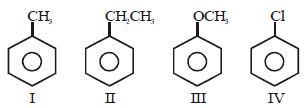
A
$IV > III > II > I$
B
$III > I > II > IV$
C
$III > IV > II > I$
D
$III > II > I > IV$
Solution
(B) The reactivity of benzene derivatives towards electrophilic substitution depends on the nature of the substituent group attached to the benzene ring.
Groups that donate electron density to the ring (via $+M$ or $+H$ effects) increase reactivity,while groups that withdraw electron density (via $-I$ or $-M$ effects) decrease reactivity.
$III$ $(OCH_3)$: The methoxy group exerts a strong $+M$ effect,which significantly increases the electron density of the ring,making it the most reactive.
$I$ $(CH_3)$ and $II$ $(CH_2CH_3)$: Both are alkyl groups that donate electron density via the $+H$ (hyperconjugation) effect. The $+H$ effect is stronger in $CH_3$ than in $CH_2CH_3$ due to the number of $\alpha$-hydrogens available for hyperconjugation ($3$ in $CH_3$ vs $2$ in $CH_2CH_3$). Thus,$I > II$.
$IV$ $(Cl)$: The chlorine atom exerts a strong $-I$ effect,which withdraws electron density from the ring,making it the least reactive among the given compounds.
Therefore,the correct order of reactivity is $III > I > II > IV$.
Groups that donate electron density to the ring (via $+M$ or $+H$ effects) increase reactivity,while groups that withdraw electron density (via $-I$ or $-M$ effects) decrease reactivity.
$III$ $(OCH_3)$: The methoxy group exerts a strong $+M$ effect,which significantly increases the electron density of the ring,making it the most reactive.
$I$ $(CH_3)$ and $II$ $(CH_2CH_3)$: Both are alkyl groups that donate electron density via the $+H$ (hyperconjugation) effect. The $+H$ effect is stronger in $CH_3$ than in $CH_2CH_3$ due to the number of $\alpha$-hydrogens available for hyperconjugation ($3$ in $CH_3$ vs $2$ in $CH_2CH_3$). Thus,$I > II$.
$IV$ $(Cl)$: The chlorine atom exerts a strong $-I$ effect,which withdraws electron density from the ring,making it the least reactive among the given compounds.
Therefore,the correct order of reactivity is $III > I > II > IV$.
0 likes
View Solution492
MediumMCQ
$ClCH_2-CH_2Cl$ $\xrightarrow[(ii) NaNH_2]{(i) Alc. KOH}$ $A$ $\xrightarrow{\text{Red hot Fe tube}}$ $B$
Identify product $B$ in the above reaction sequence.
Identify product $B$ in the above reaction sequence.
A
$HC \equiv CH$
B
Benzene
C
$CH_3-CH_3$
D
$CH_2=CH_2$
Solution
(B) $1$. The starting material $ClCH_2-CH_2Cl$ ($1$,$2$-dichloroethane) undergoes dehydrohalogenation with alcoholic $KOH$ followed by $NaNH_2$ to form $A$,which is ethyne $(HC \equiv CH)$.
$2$. When ethyne is passed through a red hot iron tube,it undergoes cyclic polymerization to form $B$,which is benzene $(C_6H_6)$.
$2$. When ethyne is passed through a red hot iron tube,it undergoes cyclic polymerization to form $B$,which is benzene $(C_6H_6)$.
0 likes
View Solution493
MediumMCQ
Chlorination of $Benzene$ in the presence of sunlight gives
A
Hexachlorobenzene
B
Benzene Hexachloride
C
Chlorobenzene
D
$1, 3, 5-$trichlorocyclohexane
Solution
(B) When $Benzene$ reacts with $Cl_2$ in the presence of sunlight $(hv)$,it undergoes an addition reaction rather than substitution.
This reaction results in the formation of $Benzene \ Hexachloride$ $(C_6H_6Cl_6)$,also known as $BHC$ or $Gammaxene$ or $Lindane$.
This reaction results in the formation of $Benzene \ Hexachloride$ $(C_6H_6Cl_6)$,also known as $BHC$ or $Gammaxene$ or $Lindane$.
0 likes
View Solution494
MediumMCQ
Which among the following statements is not correct for the reaction shown in the image?
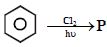
A
Product $P$ is known as Benzene Hexachloride.
B
Product $P$ is aromatic.
C
Product $P$ is used as an insecticide.
D
The above reaction is an example of a Free radical Addition Reaction.
Solution
(B) The reaction of benzene with $Cl_2$ in the presence of ultraviolet light $(h\nu)$ is an electrophilic addition reaction (specifically,a free radical addition) that results in the formation of $1,2,3,4,5,6$-hexachlorocyclohexane $(C_6H_6Cl_6)$,commonly known as Benzene Hexachloride $(BHC)$ or Gammaxene.
$1$. $BHC$ is indeed known as Benzene Hexachloride.
$2$. The product $P$ $(C_6H_6Cl_6)$ is a saturated cyclic compound (cyclohexane derivative) and is non-aromatic,as it lacks the delocalized $\pi$-electron system present in benzene.
$3$. $BHC$ is widely used as an insecticide.
$4$. The reaction involves the addition of $Cl_2$ across the double bonds of benzene via a free radical mechanism.
Therefore,the statement that $P$ is aromatic is incorrect.
$1$. $BHC$ is indeed known as Benzene Hexachloride.
$2$. The product $P$ $(C_6H_6Cl_6)$ is a saturated cyclic compound (cyclohexane derivative) and is non-aromatic,as it lacks the delocalized $\pi$-electron system present in benzene.
$3$. $BHC$ is widely used as an insecticide.
$4$. The reaction involves the addition of $Cl_2$ across the double bonds of benzene via a free radical mechanism.
Therefore,the statement that $P$ is aromatic is incorrect.
0 likes
View Solution495
DifficultMCQ
The enthalpy of hydrogenation of benzene is $\Delta H_1$ and for cyclohexene is $\Delta H_2$. Then the resonance energy of benzene is:
A
$3\Delta H_2 - \Delta H_1$
B
$\Delta H_1 - 3\Delta H_2$
C
$3\Delta H_1 + \Delta H_2$
D
$\Delta H_1 - 2\Delta H_2$
Solution
(A) The enthalpy of hydrogenation of cyclohexene is $\Delta H_2$.
Since benzene has three double bonds,the expected enthalpy of hydrogenation for a hypothetical $1,3,5-$cyclohexatriene (without resonance) would be $3 \times \Delta H_2$.
The actual enthalpy of hydrogenation of benzene is given as $\Delta H_1$.
Resonance energy is defined as the difference between the expected enthalpy of hydrogenation and the actual enthalpy of hydrogenation:
$\text{Resonance Energy} = \text{Expected } \Delta H - \text{Actual } \Delta H$
$\text{Resonance Energy} = 3\Delta H_2 - \Delta H_1$.
Since benzene has three double bonds,the expected enthalpy of hydrogenation for a hypothetical $1,3,5-$cyclohexatriene (without resonance) would be $3 \times \Delta H_2$.
The actual enthalpy of hydrogenation of benzene is given as $\Delta H_1$.
Resonance energy is defined as the difference between the expected enthalpy of hydrogenation and the actual enthalpy of hydrogenation:
$\text{Resonance Energy} = \text{Expected } \Delta H - \text{Actual } \Delta H$
$\text{Resonance Energy} = 3\Delta H_2 - \Delta H_1$.
0 likes
View Solution496
MediumMCQ
Which of the following species is not aromatic?
A
Cyclopentadienyl anion $(C_5H_5^-)$
B
Cyclopentadienyl cation $(C_5H_5^+)$
C
Cyclopropenyl cation $(C_3H_3^+)$
D
Tropylium cation $(C_7H_7^+)$
Solution
(B) To determine if a species is aromatic,it must follow $H$ückel's rule: it must be cyclic,planar,fully conjugated,and contain $(4n + 2) \pi$ electrons,where $n = 0, 1, 2, ...$.
$A$. Cyclopentadienyl anion $(C_5H_5^-)$: It has $6 \pi$ electrons ($4$ from double bonds + $2$ from the lone pair),which follows $(4n + 2)$ with $n = 1$. It is aromatic.
$B$. Cyclopentadienyl cation $(C_5H_5^+)$: It has $4 \pi$ electrons. According to $H$ückel's rule,species with $4n \pi$ electrons are anti-aromatic. Thus,it is not aromatic.
$C$. Cyclopropenyl cation $(C_3H_3^+)$: It has $2 \pi$ electrons,which follows $(4n + 2)$ with $n = 0$. It is aromatic.
$D$. Tropylium cation $(C_7H_7^+)$: It has $6 \pi$ electrons,which follows $(4n + 2)$ with $n = 1$. It is aromatic.
Therefore,the cyclopentadienyl cation is not aromatic.
$A$. Cyclopentadienyl anion $(C_5H_5^-)$: It has $6 \pi$ electrons ($4$ from double bonds + $2$ from the lone pair),which follows $(4n + 2)$ with $n = 1$. It is aromatic.
$B$. Cyclopentadienyl cation $(C_5H_5^+)$: It has $4 \pi$ electrons. According to $H$ückel's rule,species with $4n \pi$ electrons are anti-aromatic. Thus,it is not aromatic.
$C$. Cyclopropenyl cation $(C_3H_3^+)$: It has $2 \pi$ electrons,which follows $(4n + 2)$ with $n = 0$. It is aromatic.
$D$. Tropylium cation $(C_7H_7^+)$: It has $6 \pi$ electrons,which follows $(4n + 2)$ with $n = 1$. It is aromatic.
Therefore,the cyclopentadienyl cation is not aromatic.
0 likes
View Solution497
MediumMCQ
Which of the following species is not aromatic?
A
$A. \text{ Cyclopentadienyl anion}$
B
$B. \text{ Cyclopentadienyl cation}$
C
$C. \text{ Cyclopentadienyl radical}$
D
$D. \text{ Benzene}$
Solution
(B) To determine aromaticity,a species must be cyclic,planar,fully conjugated,and follow $H$ückel's rule ($4n+2$ $\pi$ electrons).
$A.$ The $Cyclopentadienyl$ anion has $6$ $\pi$ electrons $(n=1)$,which follows $H$ückel's rule and is aromatic.
$B.$ The $Cyclopentadienyl$ cation has $4$ $\pi$ electrons $(n=1)$,which follows the $4n$ rule and is anti-aromatic.
$C.$ The $Cyclopentadienyl$ radical has $5$ $\pi$ electrons,which is non-aromatic as it is not fully conjugated (the $sp^3$ carbon breaks conjugation).
$D.$ $Benzene$ has $6$ $\pi$ electrons $(n=1)$ and is aromatic.
Given the options,$B$ is anti-aromatic and $C$ is non-aromatic. However,in standard textbook contexts for this specific question,$B$ is the intended answer as it is anti-aromatic.
$A.$ The $Cyclopentadienyl$ anion has $6$ $\pi$ electrons $(n=1)$,which follows $H$ückel's rule and is aromatic.
$B.$ The $Cyclopentadienyl$ cation has $4$ $\pi$ electrons $(n=1)$,which follows the $4n$ rule and is anti-aromatic.
$C.$ The $Cyclopentadienyl$ radical has $5$ $\pi$ electrons,which is non-aromatic as it is not fully conjugated (the $sp^3$ carbon breaks conjugation).
$D.$ $Benzene$ has $6$ $\pi$ electrons $(n=1)$ and is aromatic.
Given the options,$B$ is anti-aromatic and $C$ is non-aromatic. However,in standard textbook contexts for this specific question,$B$ is the intended answer as it is anti-aromatic.
0 likes
View Solution498
DifficultMCQ
In which of the following compounds does the $C-H$ bond exhibit the lowest bond dissociation energy?
A
Toluene
B
Benzene
C
$n-$Pentane
D
$2,2-$Dimethylpropane
Solution
(A) The bond dissociation energy of a $C-H$ bond depends on the stability of the radical formed after the homolytic cleavage of the bond.
Greater the stability of the resulting radical,lower is the bond dissociation energy.
In $Toluene$ $(C_6H_5CH_3)$,the cleavage of a $C-H$ bond from the methyl group produces a benzyl radical $(C_6H_5CH_2^{\bullet})$,which is highly stabilized by resonance with the benzene ring.
In $Benzene$,the $C-H$ bond is $sp^2$ hybridized and the radical is less stable.
In $n-$Pentane and $2,2-$Dimethylpropane,the radicals formed are alkyl radicals,which are less stable than the resonance-stabilized benzyl radical.
Therefore,the $C-H$ bond in the methyl group of $Toluene$ has the lowest bond dissociation energy.
Greater the stability of the resulting radical,lower is the bond dissociation energy.
In $Toluene$ $(C_6H_5CH_3)$,the cleavage of a $C-H$ bond from the methyl group produces a benzyl radical $(C_6H_5CH_2^{\bullet})$,which is highly stabilized by resonance with the benzene ring.
In $Benzene$,the $C-H$ bond is $sp^2$ hybridized and the radical is less stable.
In $n-$Pentane and $2,2-$Dimethylpropane,the radicals formed are alkyl radicals,which are less stable than the resonance-stabilized benzyl radical.
Therefore,the $C-H$ bond in the methyl group of $Toluene$ has the lowest bond dissociation energy.
0 likes
View Solution499
MediumMCQ
Which of the following can not react with Bayer's reagent?
A
Benzene
B
Allyl chloride
C
Acetylene
D
$A$ and $B$ Both
Solution
(A) Bayer's reagent is a cold,dilute,alkaline solution of $KMnO_4$,which is used as a test for unsaturation (alkenes and alkynes).
$1$. Benzene is an aromatic compound and does not undergo addition reactions with Bayer's reagent under normal conditions due to its resonance stability.
$2$. Allyl chloride $(CH_2=CH-CH_2Cl)$ contains a carbon-carbon double bond,so it reacts with Bayer's reagent.
$3$. Acetylene $(HC \equiv CH)$ is an alkyne and reacts with Bayer's reagent to form oxalic acid.
Therefore,only Benzene does not react with Bayer's reagent.
$1$. Benzene is an aromatic compound and does not undergo addition reactions with Bayer's reagent under normal conditions due to its resonance stability.
$2$. Allyl chloride $(CH_2=CH-CH_2Cl)$ contains a carbon-carbon double bond,so it reacts with Bayer's reagent.
$3$. Acetylene $(HC \equiv CH)$ is an alkyne and reacts with Bayer's reagent to form oxalic acid.
Therefore,only Benzene does not react with Bayer's reagent.
0 likes
View Solution500
MediumMCQ
The total number of benzene derivatives with the molecular formula $C_6H_3Cl_3$ is:
A
$2$
B
$3$
C
$4$
D
$5$
Solution
(B) The molecular formula $C_6H_3Cl_3$ corresponds to trichlorobenzene isomers.
There are $3$ possible isomers for this formula:
$1$. $1,2,3$-trichlorobenzene (vicinal isomer)
$2$. $1,2,4$-trichlorobenzene (asymmetric isomer)
$3$. $1,3,5$-trichlorobenzene (symmetric isomer)
Therefore,the total number of benzene derivatives is $3$.
There are $3$ possible isomers for this formula:
$1$. $1,2,3$-trichlorobenzene (vicinal isomer)
$2$. $1,2,4$-trichlorobenzene (asymmetric isomer)
$3$. $1,3,5$-trichlorobenzene (symmetric isomer)
Therefore,the total number of benzene derivatives is $3$.
0 likes
View SolutionHydrocarbons — Aromatic hydrocarbon · Frequently Asked Questions
1Are these Hydrocarbons questions useful for JEE and NEET?
Yes. All questions in this section are mapped to JEE Main and NEET exam patterns. Previous year questions from JEE Main, NEET, GUJCET and state-level exams are included with full solutions.
2Can I switch to Hindi or Gujarati for these questions?
Yes. Use the language tabs in the hero section or the sidebar to view the same questions and solutions in English, Hindi or Gujarati.
3How do I generate a question paper from this subtopic?
Use the Vedclass Exam Paper Generator — select the chapter and subtopic, set difficulty, and generate Sets A, B, C, D automatically. First 3 chapters of every subject are free.
Vedclass Products
For Students
Vedclass Test Series
Mock tests in real JEE/NEET style with performance analysis. 5-day free trial.
Start Free TrialFor Teachers
Exam Paper Generator
Generate Set A/B/C/D papers from this chapter in 2 minutes. 3 chapters free.
Try FreeFor Institutes
Online Exam Module
Live online exams with unlimited students, 360° analytics & white-label branding.
See DemoFor Teachers & Institutes
Generate a Hydrocarbons Exam Paper in 2 Minutes
Select subtopic & difficulty — Sets A, B, C, D auto-generated with No Repeat logic.
First 3 chapters of every subject are free — no payment required.