
A English
Alkyne Questions in English
Class 11 Chemistry · Hydrocarbons · Alkyne
545+
Questions
English
Language
100%
With Solutions
Showing 50 of 545 questions in English
301
MediumMCQ
$CH_3-CH_2-CH_2-C\equiv CH + LiNH_2 \to (A) \xrightarrow{(CH_3)_2SO_4} (B)$
Give the structural formula of compound $(B)$.
Give the structural formula of compound $(B)$.
A
$CH_3-(CH_2)_2-C\equiv C-SO_3H$
B
$CH_3-(CH_2)_2-C\equiv C-CH_3$
C
$CH_3-(CH_2)_2-C\equiv C-CH_2-O-SO_2-OH$
D
$CH_3-CH_2-C\equiv C-CH_2$
Solution
(B) $1$. The reaction of $CH_3-CH_2-CH_2-C\equiv CH$ with $LiNH_2$ is an acid-base reaction where the terminal alkyne proton is removed to form the lithium acetylide intermediate $(A)$,which is $CH_3-CH_2-CH_2-C\equiv C^-Li^+$.
$2$. The intermediate $(A)$ then reacts with dimethyl sulfate $(CH_3)_2SO_4$ in a nucleophilic substitution reaction $(S_N2)$.
$3$. The acetylide ion acts as a nucleophile and attacks the methyl group of $(CH_3)_2SO_4$,resulting in the methylation of the alkyne.
$4$. The final product $(B)$ is $CH_3-CH_2-CH_2-C\equiv C-CH_3$ (pent$-2-$yne).
$2$. The intermediate $(A)$ then reacts with dimethyl sulfate $(CH_3)_2SO_4$ in a nucleophilic substitution reaction $(S_N2)$.
$3$. The acetylide ion acts as a nucleophile and attacks the methyl group of $(CH_3)_2SO_4$,resulting in the methylation of the alkyne.
$4$. The final product $(B)$ is $CH_3-CH_2-CH_2-C\equiv C-CH_3$ (pent$-2-$yne).
0 likes
View Solution302
MediumMCQ
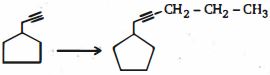
This conversion can be achieved by:
A
$NaNH_2, CH_3CHO$
B
$NaNH_2, CH_3-CH_2-CH_2-Br$
C
$KOH, CH_3-CH_2-Br$
D
$KOH, Br-CH_2-CH_2-Br$
Solution
(B) The conversion involves the alkylation of a terminal alkyne.
First,$NaNH_2$ (sodium amide) acts as a strong base to deprotonate the terminal alkyne,forming a nucleophilic sodium alkynide salt.
Second,this alkynide ion undergoes an $S_N2$ reaction with a primary alkyl halide,such as $CH_3-CH_2-CH_2-Br$ (propyl bromide),to extend the carbon chain and form the desired internal alkyne product.
First,$NaNH_2$ (sodium amide) acts as a strong base to deprotonate the terminal alkyne,forming a nucleophilic sodium alkynide salt.
Second,this alkynide ion undergoes an $S_N2$ reaction with a primary alkyl halide,such as $CH_3-CH_2-CH_2-Br$ (propyl bromide),to extend the carbon chain and form the desired internal alkyne product.

0 likes
View Solution303
MediumMCQ
Which alkyne will give $3$-ethylhexane on catalytic hydrogenation?
A
$3-$ethylhex$-1-$yne
B
$4-$ethylhex$-1-$yne
C
$3-$ethylhex$-3-$yne
D
All of these
Solution
(D) Catalytic hydrogenation of an alkyne involves the addition of hydrogen across the triple bond to form the corresponding alkane.
$3$-ethylhexane has the molecular formula $C_8H_{18}$.
All the given alkynes ($3$-ethylhex-$1$-yne,$4$-ethylhex-$1$-yne,and $3$-ethylhex-$3$-yne) have the same carbon skeleton as $3$-ethylhexane.
Therefore,upon complete catalytic hydrogenation,all of them will yield $3$-ethylhexane as the final product.
Thus,the correct option is $D$.
$3$-ethylhexane has the molecular formula $C_8H_{18}$.
All the given alkynes ($3$-ethylhex-$1$-yne,$4$-ethylhex-$1$-yne,and $3$-ethylhex-$3$-yne) have the same carbon skeleton as $3$-ethylhexane.
Therefore,upon complete catalytic hydrogenation,all of them will yield $3$-ethylhexane as the final product.
Thus,the correct option is $D$.
0 likes
View Solution304
MediumMCQ
Reactant $P$ (an alkyne) gives products $Q$ (trans-alkene) or $R$ (cis-alkene).
The possible reagents are:
$(I) \ 2Na/liq. NH_3$
$(II) \ H_2/Pd/CaCO_3$ (quinoline)
$(III) \ 2H_2/Pd/C$
Which of the following statements is/are correct with respect to the above conversion?
The possible reagents are:
$(I) \ 2Na/liq. NH_3$
$(II) \ H_2/Pd/CaCO_3$ (quinoline)
$(III) \ 2H_2/Pd/C$
Which of the following statements is/are correct with respect to the above conversion?
A
$Q$ is obtained on treatment with reagent $(I)$
B
$R$ and $Q$ are obtained on treatment with reagent $(II)$
C
$R$ is obtained on treatment with reagent $(I)$
D
$R$ is obtained on treatment with reagent $(II)$
Solution
(A, D) Reagent $(I)$ $(2Na/liq. NH_3)$ is a dissolving metal reduction that converts an alkyne into a $trans$-alkene $(Q)$.
Reagent $(II)$ ($H_2/Pd/CaCO_3$ with quinoline,also known as Lindlar's catalyst) is a partial hydrogenation that converts an alkyne into a $cis$-alkene $(R)$.
Reagent $(III)$ $(2H_2/Pd/C)$ is a complete hydrogenation that converts an alkyne into an alkane.
Therefore,statement $(a)$ is correct as $Q$ is the $trans$-product,and statement $(d)$ is correct as $R$ is the $cis$-product.
Reagent $(II)$ ($H_2/Pd/CaCO_3$ with quinoline,also known as Lindlar's catalyst) is a partial hydrogenation that converts an alkyne into a $cis$-alkene $(R)$.
Reagent $(III)$ $(2H_2/Pd/C)$ is a complete hydrogenation that converts an alkyne into an alkane.
Therefore,statement $(a)$ is correct as $Q$ is the $trans$-product,and statement $(d)$ is correct as $R$ is the $cis$-product.
0 likes
View Solution305
MediumMCQ
The reaction sequence is: $Br-(CH_2)_{12}-C\equiv CH$ $\xrightarrow{NaNH_2} (A)$ $\xrightarrow[Catalyst]{Lindlar} (B)$. The product $(B)$ is:
A
$A$ cyclic alkene with a trans-double bond.
B
$A$ cyclic alkene with a cis-double bond.
C
$A$ cyclic alkane.
D
$A$ linear alkyne.
Solution
(B) $1$. The terminal alkyne $Br-(CH_2)_{12}-C\equiv CH$ reacts with $NaNH_2$ to form an acetylide ion,which then undergoes intramolecular nucleophilic substitution to form a cyclic alkyne $(A)$.
$2$. The partial hydrogenation of the cyclic alkyne $(A)$ using $Lindlar$ catalyst ($Pd/CaCO_3$ poisoned with $PbO$ or quinoline) specifically yields the $cis$-alkene $(B)$.
$2$. The partial hydrogenation of the cyclic alkyne $(A)$ using $Lindlar$ catalyst ($Pd/CaCO_3$ poisoned with $PbO$ or quinoline) specifically yields the $cis$-alkene $(B)$.
0 likes
View Solution306
MediumMCQ
$Ph-C \equiv CH \xrightarrow[MeOH]{MeO^{-}}$ The major product of the reaction is:
A
$Ph-CH=CH_2$
B
$Ph-CH=CH-OMe$
C
$Ph-C \equiv C-OMe$
D
$Ph-C(OMe)=CH_2$
Solution
(B) The reaction involves the nucleophilic addition of the methoxide ion $(MeO^{-})$ to the alkyne.
Since the terminal alkyne $(Ph-C \equiv CH)$ is not acidic enough to be deprotonated by $MeO^{-}$ to a significant extent,the methoxide ion acts as a nucleophile.
The $MeO^{-}$ attacks the electrophilic carbon of the triple bond,followed by protonation by the solvent $(MeOH)$ to yield the enol ether.
The reaction proceeds as follows:
$Ph-C \equiv CH + MeO^{-} \rightarrow Ph-C^{-}=CH-OMe$
$Ph-C^{-}=CH-OMe + MeOH \rightarrow Ph-CH=CH-OMe + MeO^{-}$
Thus,the major product is $Ph-CH=CH-OMe$.
Since the terminal alkyne $(Ph-C \equiv CH)$ is not acidic enough to be deprotonated by $MeO^{-}$ to a significant extent,the methoxide ion acts as a nucleophile.
The $MeO^{-}$ attacks the electrophilic carbon of the triple bond,followed by protonation by the solvent $(MeOH)$ to yield the enol ether.
The reaction proceeds as follows:
$Ph-C \equiv CH + MeO^{-} \rightarrow Ph-C^{-}=CH-OMe$
$Ph-C^{-}=CH-OMe + MeOH \rightarrow Ph-CH=CH-OMe + MeO^{-}$
Thus,the major product is $Ph-CH=CH-OMe$.
0 likes
View Solution307
MediumMCQ
$Ph-CCl_2-CH_3 \xrightarrow{3NaNH_2} \text{Product } (A)$; Product $(A)$ is
A
$Ph-CH=CH_2$
B
$Ph-C \equiv CH$
C
$Ph-CH_2-CH_3$
D
$Ph-C \equiv C^{\Theta} Na^{\oplus}$
Solution
(D) The reaction of $Ph-CCl_2-CH_3$ with $2$ equivalents of $NaNH_2$ undergoes dehydrohalogenation to form the alkyne $Ph-C \equiv CH$.
Since $3$ equivalents of $NaNH_2$ are provided,the third equivalent acts as a strong base to abstract the acidic acetylenic proton from $Ph-C \equiv CH$.
This results in the formation of the sodium acetylide salt: $Ph-C \equiv C^{\Theta} Na^{\oplus} (A)$.
Since $3$ equivalents of $NaNH_2$ are provided,the third equivalent acts as a strong base to abstract the acidic acetylenic proton from $Ph-C \equiv CH$.
This results in the formation of the sodium acetylide salt: $Ph-C \equiv C^{\Theta} Na^{\oplus} (A)$.
0 likes
View Solution308
MediumMCQ
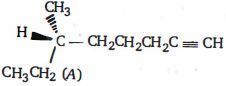
Which combination is best for the preparation of the compound $(A)$ shown below?
A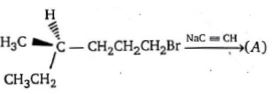
B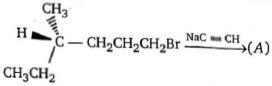
C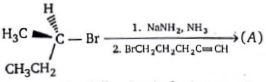
D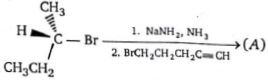
Solution
(C) The target compound $(A)$ is a chiral alkyne. To synthesize it,we need to perform an $S_N2$ reaction between a chiral alkyl halide and a nucleophile. The reaction involves the nucleophilic attack of the acetylide ion on the primary carbon of the alkyl bromide. The stereocenter remains unaffected because the reaction occurs at the terminal primary carbon. The correct approach is to use the chiral alkyl bromide $(S)-2\text{-bromobutane}$ derivative to maintain the configuration at the chiral center. Option $(C)$ correctly represents the sequence where the chiral center is preserved and the alkyne chain is extended.
0 likes
View Solution309
MediumMCQ
To carry out the above conversion,$(A)$ and $(B)$ respectively are:

A
$NaNH_2$,$Cl-CH_2-CH_2-CH_2-Br$
B
$NaNH_2$,$F-CH_2-CH_2-CH_2-Br$
C
$NaNH_2$,$I-CH_2-CH_2-CH_2-Br$
D
$NaNH_2$,$I-CH_2-CH_2-CH_2-I$
Solution
(C) The reaction involves the alkylation of a terminal alkyne.
Step $A$: The terminal alkyne is treated with a strong base like $NaNH_2$ to form an acetylide ion.
Step $B$: The acetylide ion acts as a nucleophile and undergoes an $S_N2$ reaction with an alkyl halide.
To ensure the reaction occurs selectively at the $Br$ end,we use an alkyl halide with a better leaving group on the other side,such as $I-CH_2-CH_2-CH_2-Br$. Since $I^-$ is a better leaving group than $Br^-$,the nucleophilic attack occurs at the carbon attached to the iodine atom.
Therefore,$(A) = NaNH_2$ and $(B) = I-CH_2-CH_2-CH_2-Br$.
Step $A$: The terminal alkyne is treated with a strong base like $NaNH_2$ to form an acetylide ion.
Step $B$: The acetylide ion acts as a nucleophile and undergoes an $S_N2$ reaction with an alkyl halide.
To ensure the reaction occurs selectively at the $Br$ end,we use an alkyl halide with a better leaving group on the other side,such as $I-CH_2-CH_2-CH_2-Br$. Since $I^-$ is a better leaving group than $Br^-$,the nucleophilic attack occurs at the carbon attached to the iodine atom.
Therefore,$(A) = NaNH_2$ and $(B) = I-CH_2-CH_2-CH_2-Br$.
0 likes
View Solution310
MediumMCQ
The product obtained in this reaction is:
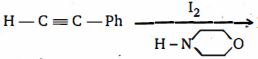
A
$Ph-C \equiv C-I$
B
$Ph-CH=C(I)_2$
C
$Ph-C(I)=CH-I$
D
$I-C \equiv C-H$
Solution
(A) The reaction involves the terminal alkyne $Ph-C \equiv C-H$ reacting with $I_2$ in the presence of a base (morpholine).
$1$. The base (morpholine) abstracts the acidic terminal proton from the alkyne to form an acetylide anion: $Ph-C \equiv C^-$.
$2$. The acetylide anion then acts as a nucleophile and attacks the iodine molecule $(I-I)$,displacing an iodide ion $(I^-)$.
$3$. This results in the formation of the iodoalkyne product: $Ph-C \equiv C-I$.
$1$. The base (morpholine) abstracts the acidic terminal proton from the alkyne to form an acetylide anion: $Ph-C \equiv C^-$.
$2$. The acetylide anion then acts as a nucleophile and attacks the iodine molecule $(I-I)$,displacing an iodide ion $(I^-)$.
$3$. This results in the formation of the iodoalkyne product: $Ph-C \equiv C-I$.
0 likes
View Solution311
MediumMCQ
The product $(B)$ is:

A
$1-$(cyclohex$-1-$en$-1-$yl)prop$-1-$yne
B
$1-$(cyclohex$-1-$en$-1-$yl)prop$-1-$ene (trans isomer)
C
$1-$(cyclohex$-1-$en$-1-$yl)prop$-1-$ene (cis isomer)
D
$1-$(cyclohex$-1-$en$-1-$yl)ethene
Solution
(C) Step $1$: The terminal alkyne reacts with $NaNH_2$ in $NH_3$ to form a sodium acetylide intermediate,which then undergoes an $S_N2$ reaction with $CH_3Br$ to form the methylated alkyne $(A)$,which is $1-(cyclohex-1-en-1-yl)prop-1-yne$.
Step $2$: The hydrogenation of the alkyne $(A)$ using Lindlar catalyst $(H_2/Pd/BaSO_4)$ is a stereoselective reaction that adds hydrogen across the triple bond in a $syn$-fashion,resulting in the formation of the $cis$-alkene $(B)$,which is $1-(cyclohex-1-en-1-yl)prop-1-ene$ (cis isomer).
Step $2$: The hydrogenation of the alkyne $(A)$ using Lindlar catalyst $(H_2/Pd/BaSO_4)$ is a stereoselective reaction that adds hydrogen across the triple bond in a $syn$-fashion,resulting in the formation of the $cis$-alkene $(B)$,which is $1-(cyclohex-1-en-1-yl)prop-1-ene$ (cis isomer).
0 likes
View Solution312
MediumMCQ
Which of the following alkynes,upon treatment with $H_2$ $(2 \ mole)$ / $Pt$,gives an optically inactive compound?
A
$3-$Methyl-$1-$pentyne
B
$4-$Methyl-$1-$hexyne
C
$3-$Methyl-$1-$heptyne
D
None of the above
Solution
(D) The hydrogenation of an alkyne with $2 \ mole$ of $H_2$ in the presence of $Pt$ catalyst results in the corresponding alkane.
For a compound to be optically active,it must contain a chiral center (a carbon atom bonded to four different groups).
Let's analyze the products:
$A$) $3-$Methyl-$1-$pentyne $(CH_3CH_2CH(CH_3)C \equiv CH)$ on hydrogenation gives $3-$methylpentane $(CH_3CH_2CH(CH_3)CH_2CH_3)$. This molecule has a chiral center at $C-3$ $(CH_3CH_2-CH(CH_3)-CH_2CH_3)$,so it is optically active.
$B$) $4-$Methyl-$1-$hexyne $(CH_3CH_2CH(CH_3)CH_2C \equiv CH)$ on hydrogenation gives $3-$methylhexane $(CH_3CH_2CH(CH_3)CH_2CH_2CH_3)$. This molecule has a chiral center at $C-3$,so it is optically active.
$C$) $3-$Methyl-$1-$heptyne $(CH_3CH_2CH_2CH_2CH(CH_3)C \equiv CH)$ on hydrogenation gives $3-$methylheptane $(CH_3CH_2CH_2CH_2CH(CH_3)CH_2CH_3)$. This molecule has a chiral center at $C-3$,so it is optically active.
Since all the given options result in optically active alkanes,the correct answer is $D$.
For a compound to be optically active,it must contain a chiral center (a carbon atom bonded to four different groups).
Let's analyze the products:
$A$) $3-$Methyl-$1-$pentyne $(CH_3CH_2CH(CH_3)C \equiv CH)$ on hydrogenation gives $3-$methylpentane $(CH_3CH_2CH(CH_3)CH_2CH_3)$. This molecule has a chiral center at $C-3$ $(CH_3CH_2-CH(CH_3)-CH_2CH_3)$,so it is optically active.
$B$) $4-$Methyl-$1-$hexyne $(CH_3CH_2CH(CH_3)CH_2C \equiv CH)$ on hydrogenation gives $3-$methylhexane $(CH_3CH_2CH(CH_3)CH_2CH_2CH_3)$. This molecule has a chiral center at $C-3$,so it is optically active.
$C$) $3-$Methyl-$1-$heptyne $(CH_3CH_2CH_2CH_2CH(CH_3)C \equiv CH)$ on hydrogenation gives $3-$methylheptane $(CH_3CH_2CH_2CH_2CH(CH_3)CH_2CH_3)$. This molecule has a chiral center at $C-3$,so it is optically active.
Since all the given options result in optically active alkanes,the correct answer is $D$.
0 likes
View Solution313
MediumMCQ
$\underset{(\text{Calcium carbide})}{CaC_2}$ $\xrightarrow{H_2O} (A)$ $\xrightarrow{\text{Red hot Cu tube}} (B)$. The product $(B)$ of the reaction is:
A
Toluene
B
Ethyl-benzene
C
Benzene
D
Butyne
Solution
(C) $1$. Calcium carbide $(CaC_2)$ reacts with water $(H_2O)$ to produce acetylene $(C_2H_2)$,which is compound $(A)$.
$CaC_2 + 2H_2O \rightarrow Ca(OH)_2 + C_2H_2 (A)$
$2$. When acetylene $(C_2H_2)$ is passed through a red-hot copper tube at high temperature,it undergoes cyclic polymerization to form benzene $(C_6H_6)$,which is compound $(B)$.
$3C_2H_2 \xrightarrow{\text{Red hot Cu tube}} C_6H_6 (B)$
$3$. Therefore,the product $(B)$ is Benzene.
$CaC_2 + 2H_2O \rightarrow Ca(OH)_2 + C_2H_2 (A)$
$2$. When acetylene $(C_2H_2)$ is passed through a red-hot copper tube at high temperature,it undergoes cyclic polymerization to form benzene $(C_6H_6)$,which is compound $(B)$.
$3C_2H_2 \xrightarrow{\text{Red hot Cu tube}} C_6H_6 (B)$
$3$. Therefore,the product $(B)$ is Benzene.
0 likes
View Solution314
MediumMCQ
What is the final product,$C$ of the following reaction sequence?
$CH_3CH_2-C \equiv CH$ $\xrightarrow[2. CH_3CH_2Br]{1. NaNH_2} A$ $\xrightarrow{Na, NH_3(liq.)} B$ $\xrightarrow{Br_2, CH_2Cl_2} C$
$CH_3CH_2-C \equiv CH$ $\xrightarrow[2. CH_3CH_2Br]{1. NaNH_2} A$ $\xrightarrow{Na, NH_3(liq.)} B$ $\xrightarrow{Br_2, CH_2Cl_2} C$
A
$CH_3CH_2CH(Br)CH(Br)CH_2CH_3$
B
$CH_3CH_2CH(Br)CH_2CH_2CH_3$
C
$CH_3CH_2CH(Br)CH(NH_2)CH_2CH_3$
D
$CH_3CH_2C(Br)=C(Br)CH_2CH_3$
Solution
(A) Step $1$: The terminal alkyne $CH_3CH_2-C \equiv CH$ reacts with $NaNH_2$ to form an acetylide ion,which then undergoes an $S_N2$ reaction with $CH_3CH_2Br$ to yield $A$ ($hex-3-yne$,$CH_3CH_2-C \equiv C-CH_2CH_3$).
Step $2$: The reduction of $hex-3-yne$ $(A)$ with $Na$ in liquid $NH_3$ (Birch reduction) is a stereoselective reaction that produces $trans-hex-3-ene$ $(B)$.
Step $3$: The addition of $Br_2$ in $CH_2Cl_2$ to $trans-hex-3-ene$ $(B)$ is an anti-addition reaction,which results in the formation of $3,4-dibromohexane$ $(C)$.
Thus,the final product $C$ is $CH_3CH_2CH(Br)CH(Br)CH_2CH_3$.
Step $2$: The reduction of $hex-3-yne$ $(A)$ with $Na$ in liquid $NH_3$ (Birch reduction) is a stereoselective reaction that produces $trans-hex-3-ene$ $(B)$.
Step $3$: The addition of $Br_2$ in $CH_2Cl_2$ to $trans-hex-3-ene$ $(B)$ is an anti-addition reaction,which results in the formation of $3,4-dibromohexane$ $(C)$.
Thus,the final product $C$ is $CH_3CH_2CH(Br)CH(Br)CH_2CH_3$.
0 likes
View Solution315
MediumMCQ
Choose the sequence of steps that describes the best synthesis of but$-1$-ene from ethanol.
A
$1. NaC \equiv CH; 2. H_2$,Lindlar $Pd$
B
$1. NaC \equiv CH; 2. Na, NH_3$
C
$1. HBr$,heat; $2. NaC \equiv CH; 3. H_2$,Lindlar $Pd$
D
$1. HBr$,heat; $2. KOC(CH_3)_3, DMSO; 3. NaC \equiv CH; 4. H_2$,Lindlar catalyst
Solution
(C) The synthesis of but$-1$-ene from ethanol $(CH_3CH_2OH)$ involves the following steps:
$1$. Conversion of ethanol to bromoethane: $CH_3CH_2OH + HBr \rightarrow CH_3CH_2Br + H_2O$.
$2$. Nucleophilic substitution with sodium acetylide: $CH_3CH_2Br + NaC \equiv CH \rightarrow CH_3CH_2C \equiv CH$ (but$-1$-yne).
$3$. Partial hydrogenation of the alkyne to an alkene using Lindlar catalyst: $CH_3CH_2C \equiv CH + H_2 \xrightarrow{Lindlar \ Pd} CH_3CH_2CH=CH_2$ (but$-1$-ene).
Therefore,the correct sequence is $1. HBr$,heat; $2. NaC \equiv CH; 3. H_2$,Lindlar $Pd$.
$1$. Conversion of ethanol to bromoethane: $CH_3CH_2OH + HBr \rightarrow CH_3CH_2Br + H_2O$.
$2$. Nucleophilic substitution with sodium acetylide: $CH_3CH_2Br + NaC \equiv CH \rightarrow CH_3CH_2C \equiv CH$ (but$-1$-yne).
$3$. Partial hydrogenation of the alkyne to an alkene using Lindlar catalyst: $CH_3CH_2C \equiv CH + H_2 \xrightarrow{Lindlar \ Pd} CH_3CH_2CH=CH_2$ (but$-1$-ene).
Therefore,the correct sequence is $1. HBr$,heat; $2. NaC \equiv CH; 3. H_2$,Lindlar $Pd$.
0 likes
View Solution316
MediumMCQ
Which alkyne yields butanoic acid $(CH_3CH_2CH_2CO_2H)$ as the only organic product on treatment with ozone followed by the hydrolysis?
A
$1-$Butyne
B
$4-$Octyne
C
$1-$Pentyne
D
$2-$Hexyne
Solution
(B) Ozonolysis of an internal alkyne $(R-C \equiv C-R')$ followed by hydrolysis yields carboxylic acids $(RCOOH + R'COOH)$.
For the product to be only butanoic acid $(CH_3CH_2CH_2COOH)$,the alkyne must be symmetrical with a four-carbon chain on each side of the triple bond.
Thus,the alkyne is $CH_3CH_2CH_2-C \equiv C-CH_2CH_2CH_3$,which is $4-$octyne.
Reaction: $CH_3CH_2CH_2-C \equiv C-CH_2CH_2CH_3 \xrightarrow{O_3, H_2O} 2CH_3CH_2CH_2COOH$.
For the product to be only butanoic acid $(CH_3CH_2CH_2COOH)$,the alkyne must be symmetrical with a four-carbon chain on each side of the triple bond.
Thus,the alkyne is $CH_3CH_2CH_2-C \equiv C-CH_2CH_2CH_3$,which is $4-$octyne.
Reaction: $CH_3CH_2CH_2-C \equiv C-CH_2CH_2CH_3 \xrightarrow{O_3, H_2O} 2CH_3CH_2CH_2COOH$.
0 likes
View Solution317
MediumMCQ
The product $(C)$ of the above reaction is:
Maleic anhydride $\xrightarrow{H_3O^+}$ $(A)$ $\xrightarrow{NaOH}$ $(B)$ $\xrightarrow{\text{Kolbe electrolysis}}$ $(C)$
Maleic anhydride $\xrightarrow{H_3O^+}$ $(A)$ $\xrightarrow{NaOH}$ $(B)$ $\xrightarrow{\text{Kolbe electrolysis}}$ $(C)$
A
$H_2C = CH_2$
B
$CH_3 - C \equiv C - CH_3$
C
$HC \equiv CH$
D
$CH_3 - CH = CH - CH_3$
Solution
(C) $1$. Hydrolysis of maleic anhydride with $H_3O^+$ yields maleic acid $(A)$,which is $cis$-but$-2-$enedioic acid.
$2$. Reaction of maleic acid with $NaOH$ gives the sodium salt of maleic acid $(B)$,which is sodium maleate.
$3$. Kolbe electrolysis of sodium maleate involves the decarboxylation of the carboxylate ions at the anode,leading to the formation of a triple bond between the carbons that were originally attached to the carboxylate groups.
$4$. The reaction is: $cis-NaOOC-CH=CH-COONa \xrightarrow{\text{electrolysis}} HC \equiv CH + 2CO_2 + H_2 + 2NaOH$.
$5$. Thus,the final product $(C)$ is ethyne $(HC \equiv CH)$.
$2$. Reaction of maleic acid with $NaOH$ gives the sodium salt of maleic acid $(B)$,which is sodium maleate.
$3$. Kolbe electrolysis of sodium maleate involves the decarboxylation of the carboxylate ions at the anode,leading to the formation of a triple bond between the carbons that were originally attached to the carboxylate groups.
$4$. The reaction is: $cis-NaOOC-CH=CH-COONa \xrightarrow{\text{electrolysis}} HC \equiv CH + 2CO_2 + H_2 + 2NaOH$.
$5$. Thus,the final product $(C)$ is ethyne $(HC \equiv CH)$.
0 likes
View Solution318
MediumMCQ
To convert $1$-butyne to $1-D$-butanal,one would carry out the following steps :
$(I)$ Sodium amide,then $D_2O$
$(II)$ Disiamylborane,then hydrogen peroxide/sodium hydroxide
$(III)$ The transformation can not be carried out with the indicated reagents.
$(I)$ Sodium amide,then $D_2O$
$(II)$ Disiamylborane,then hydrogen peroxide/sodium hydroxide
$(III)$ The transformation can not be carried out with the indicated reagents.
A
$I$,followed by $II$
B
$II$,followed by $I$
C
$III$
D
$II$
Solution
(C) The conversion of $1$-butyne $(CH_3CH_2C \equiv CH)$ to $1-D$-butanal $(CH_3CH_2CH_2CDO)$ requires the introduction of a deuterium atom at the $C-1$ position and the conversion of the alkyne to an aldehyde.
Step $I$ (Sodium amide,then $D_2O$) would produce $1-D$-butyne $(CH_3CH_2C \equiv CD)$.
Step $II$ (Hydroboration-oxidation using disiamylborane followed by $H_2O_2/NaOH$) converts $1$-butyne to butanal $(CH_3CH_2CH_2CHO)$.
To obtain $1-D$-butanal,one would need to perform hydroboration-oxidation on $1-D$-butyne using $D_2O_2/NaOD$ instead of $H_2O_2/NaOH$.
Since the provided reagents in $I$ and $II$ do not lead to the desired product $1-D$-butanal,option $III$ is correct.
Step $I$ (Sodium amide,then $D_2O$) would produce $1-D$-butyne $(CH_3CH_2C \equiv CD)$.
Step $II$ (Hydroboration-oxidation using disiamylborane followed by $H_2O_2/NaOH$) converts $1$-butyne to butanal $(CH_3CH_2CH_2CHO)$.
To obtain $1-D$-butanal,one would need to perform hydroboration-oxidation on $1-D$-butyne using $D_2O_2/NaOD$ instead of $H_2O_2/NaOH$.
Since the provided reagents in $I$ and $II$ do not lead to the desired product $1-D$-butanal,option $III$ is correct.
0 likes
View Solution319
MediumMCQ
An unknown compound $(A)$ has a molecular formula $C_4H_6$. When $(A)$ is treated with excess of $Br_2$, a new substance $(B)$ with formula $C_4H_6Br_4$ is formed. $(A)$ forms a white precipitate with ammoniacal silver nitrate solution. $(A)$ may be:
A
but-$1$-yne
B
but-$2$-yne
C
but-$1$-ene
D
but-$2$-ene
Solution
$(A)$ The molecular formula $C_4H_6$ corresponds to the general formula $C_nH_{2n-2}$, which indicates an alkyne or a diene.
Since $(A)$ reacts with excess $Br_2$ to form $C_4H_6Br_4$, it indicates the presence of two double bonds or one triple bond.
Terminal alkynes react with ammoniacal silver nitrate $(\text{Tollens' reagent})$ to form a white precipitate of silver acetylide.
But-$1$-yne $(CH_3-CH_2-C \equiv CH)$ is a terminal alkyne, whereas but-$2$-yne $(CH_3-C \equiv C-CH_3)$ is a non-terminal alkyne.
Therefore, $(A)$ is but-$1$-yne.
Since $(A)$ reacts with excess $Br_2$ to form $C_4H_6Br_4$, it indicates the presence of two double bonds or one triple bond.
Terminal alkynes react with ammoniacal silver nitrate $(\text{Tollens' reagent})$ to form a white precipitate of silver acetylide.
But-$1$-yne $(CH_3-CH_2-C \equiv CH)$ is a terminal alkyne, whereas but-$2$-yne $(CH_3-C \equiv C-CH_3)$ is a non-terminal alkyne.
Therefore, $(A)$ is but-$1$-yne.
0 likes
View Solution320
MediumMCQ
One mole of $1,2$-dibromopropane on treatment with $X$ moles of $NaNH_2$ followed by treatment with ethyl bromide gave a pentyne. The value of $X$ is
A
$1$
B
$2$
C
$3$
D
$4$
Solution
(C) The reaction proceeds in two main stages:
$1$. Dehydrohalogenation: $1,2$-dibromopropane $(CH_3-CH(Br)-CH_2Br)$ reacts with $2$ moles of $NaNH_2$ to undergo double dehydrohalogenation,forming propyne $(CH_3-C \equiv CH)$.
$2$. Alkylation: The terminal alkyne (propyne) reacts with another $1$ mole of $NaNH_2$ to form the sodium acetylide intermediate $(CH_3-C \equiv C^-Na^+)$,which then reacts with ethyl bromide $(CH_3-CH_2Br)$ via an $S_N2$ mechanism to form pentyne $(CH_3-C \equiv C-CH_2-CH_3)$.
Thus,the total number of moles of $NaNH_2$ required is $2 + 1 = 3$ moles. Therefore,$X = 3$.
$1$. Dehydrohalogenation: $1,2$-dibromopropane $(CH_3-CH(Br)-CH_2Br)$ reacts with $2$ moles of $NaNH_2$ to undergo double dehydrohalogenation,forming propyne $(CH_3-C \equiv CH)$.
$2$. Alkylation: The terminal alkyne (propyne) reacts with another $1$ mole of $NaNH_2$ to form the sodium acetylide intermediate $(CH_3-C \equiv C^-Na^+)$,which then reacts with ethyl bromide $(CH_3-CH_2Br)$ via an $S_N2$ mechanism to form pentyne $(CH_3-C \equiv C-CH_2-CH_3)$.
Thus,the total number of moles of $NaNH_2$ required is $2 + 1 = 3$ moles. Therefore,$X = 3$.
0 likes
View Solution321
MediumMCQ
$CH_3-CH(CH_3)-C \equiv CH \xrightarrow{excess \ HBr}$
The product of the above reaction is
The product of the above reaction is
A
$CH_3-CH(CH_3)-CH(Br)-CH_2Br$
B
$CH_3-CH(CH_3)-C(Br)=CH_2$
C
$CH_3-CH(CH_3)-C(Br)_2-CH_3$
D
$CH_3-CH(CH_3)-CH_2-CH(Br)_2$
Solution
(C) The addition of $HBr$ to alkynes follows Markovnikov's rule.
In the presence of excess $HBr$,two molecules of $HBr$ add to the triple bond to form a geminal dihalide.
Step $1$: $CH_3-CH(CH_3)-C \equiv CH + HBr \rightarrow CH_3-CH(CH_3)-C(Br)=CH_2$
Step $2$: $CH_3-CH(CH_3)-C(Br)=CH_2 + HBr \rightarrow CH_3-CH(CH_3)-C(Br)_2-CH_3$ ($2,2$-dibromo-$3$-methylbutane).
In the presence of excess $HBr$,two molecules of $HBr$ add to the triple bond to form a geminal dihalide.
Step $1$: $CH_3-CH(CH_3)-C \equiv CH + HBr \rightarrow CH_3-CH(CH_3)-C(Br)=CH_2$
Step $2$: $CH_3-CH(CH_3)-C(Br)=CH_2 + HBr \rightarrow CH_3-CH(CH_3)-C(Br)_2-CH_3$ ($2,2$-dibromo-$3$-methylbutane).
0 likes
View Solution322
MediumMCQ
$CH_3-C \equiv C-CH_3 \xrightarrow{\text{Cold } KMnO_4} (A)$
Product $(A)$ is:
Product $(A)$ is:
A
$CH_3-CH_2-C(=O)-CHO$
B
$CH_3-C(=O)-C(=O)-CH_3$
C
$CH_3-CH(OH)-CH(OH)-CH_3$
D
$OHC-CH_2-CH_2-CHO$
Solution
(B) Cold $KMnO_4$ (Baeyer's reagent) acts as an oxidizing agent for alkynes.
It oxidizes internal alkynes to form vicinal diketones ($1,2$-diketones).
The reaction is: $CH_3-C \equiv C-CH_3 \xrightarrow{\text{Cold } KMnO_4} CH_3-C(=O)-C(=O)-CH_3$ (Butane-$2,3$-dione).
It oxidizes internal alkynes to form vicinal diketones ($1,2$-diketones).
The reaction is: $CH_3-C \equiv C-CH_3 \xrightarrow{\text{Cold } KMnO_4} CH_3-C(=O)-C(=O)-CH_3$ (Butane-$2,3$-dione).
0 likes
View Solution323
MediumMCQ
In which reaction is the final product $Ph-C \equiv CH$?
A
$Ph-C(Br)_2-CH_3$ $\xrightarrow[\text{Mineral oil, heat}]{2NaNH_2}$ $\xrightarrow{NH_4Cl}$
B
$C_6H_5-CH=CH_2$ $\xrightarrow[CCl_4]{Br_2}$ $\xrightarrow[\text{Mineral oil, heat}]{3NaNH_2}$ $\xrightarrow{NH_4Cl}$
C
$C_6H_5-C(=O)-CH_3$ $\xrightarrow{PCl_5}$ $\xrightarrow[\text{Mineral oil, heat}]{3NaNH_2}$ $\xrightarrow{NH_4Cl}$
D
All of these
Solution
(D) All the given reactions result in the formation of phenylacetylene $(Ph-C \equiv CH)$.
$(a)$ Geminal dihalide $Ph-C(Br)_2-CH_3$ undergoes double dehydrohalogenation with $NaNH_2$ to form the alkyne.
$(b)$ Styrene $(C_6H_5-CH=CH_2)$ reacts with $Br_2$ to form a vicinal dihalide,which then undergoes double dehydrohalogenation.
$(c)$ Acetophenone $(C_6H_5-C(=O)-CH_3)$ reacts with $PCl_5$ to form a geminal dichloride,which then undergoes double dehydrohalogenation.
In all cases,$NH_4Cl$ is used for the protonation of the acetylide ion formed.
$(a)$ Geminal dihalide $Ph-C(Br)_2-CH_3$ undergoes double dehydrohalogenation with $NaNH_2$ to form the alkyne.
$(b)$ Styrene $(C_6H_5-CH=CH_2)$ reacts with $Br_2$ to form a vicinal dihalide,which then undergoes double dehydrohalogenation.
$(c)$ Acetophenone $(C_6H_5-C(=O)-CH_3)$ reacts with $PCl_5$ to form a geminal dichloride,which then undergoes double dehydrohalogenation.
In all cases,$NH_4Cl$ is used for the protonation of the acetylide ion formed.
0 likes
View Solution324
MediumMCQ
Predict the product of the following reaction sequence:
$HC \equiv CH$ $\xrightarrow[\begin{smallmatrix} (2) \text{ excess } I-CH_2-(CH_2)_2-CH_3 \\ (3) \text{ } H^{\oplus} \end{smallmatrix}]{(1) \text{ excess } NaNH_2}$
$HC \equiv CH$ $\xrightarrow[\begin{smallmatrix} (2) \text{ excess } I-CH_2-(CH_2)_2-CH_3 \\ (3) \text{ } H^{\oplus} \end{smallmatrix}]{(1) \text{ excess } NaNH_2}$
A
$6$-iodo-$1$-hexyne
B
$1$-hexyne
C
$5$-decyne
D
$1$-iodo-$1$-hexene
Solution
(C) Step $1$: Ethyne $(HC \equiv CH)$ reacts with excess $NaNH_2$ (a strong base) to remove both acidic protons,forming the disodium acetylide intermediate,$Na^{\oplus} [C \equiv C]^{2-} Na^{\oplus}$.
Step $2$: The disodium acetylide acts as a nucleophile and undergoes an $S_N2$ reaction with excess $I-CH_2-CH_2-CH_2-CH_3$ (butyl iodide). Each carbon of the acetylide attacks a butyl group,displacing the iodide ion.
Step $3$: The final product formed is $CH_3-CH_2-CH_2-CH_2-C \equiv C-CH_2-CH_2-CH_2-CH_3$,which is $5$-decyne.
Step $2$: The disodium acetylide acts as a nucleophile and undergoes an $S_N2$ reaction with excess $I-CH_2-CH_2-CH_2-CH_3$ (butyl iodide). Each carbon of the acetylide attacks a butyl group,displacing the iodide ion.
Step $3$: The final product formed is $CH_3-CH_2-CH_2-CH_2-C \equiv C-CH_2-CH_2-CH_2-CH_3$,which is $5$-decyne.
0 likes
View Solution325
MediumMCQ
The best sequence of reactions to prepare $2$-heptanone is
A
$propyne$ $\xrightarrow{NaNH_{2}} X$ $\xrightarrow{n-C_{4}H_{9}Br} Y$ $\xrightarrow{H_{2}O, H_{2}SO_{4}, Hg^{2+}}$
B
$ethyne$ $\xrightarrow{NaNH_{2}} X$ $\xrightarrow{n-C_{5}H_{11}Br} Y$ $\xrightarrow{H_{2}O, H_{2}SO_{4}, Hg^{2+}}$
C
$1$-hexyne $\xrightarrow{NaNH_{2}} X$ $\xrightarrow{CH_{3}Br} Y$ $\xrightarrow{H_{2}O, H_{2}SO_{4}, Hg^{2+}}$
D
$1$-pentyne $\xrightarrow{NaNH_{2}} X$ $\xrightarrow{C_{2}H_{5}Br} Y$ $\xrightarrow{H_{2}O, H_{2}SO_{4}, Hg^{2+}}$
Solution
(C) To prepare $2$-heptanone $(CH_{3}COCH_{2}CH_{2}CH_{2}CH_{2}CH_{3})$,we need a terminal alkyne that,upon hydration,yields the ketone at the $C-2$ position.
$1$-hexyne $(CH_{3}CH_{2}CH_{2}CH_{2}C \equiv CH)$ reacts with $NaNH_{2}$ to form the acetylide ion $(CH_{3}CH_{2}CH_{2}CH_{2}C \equiv C^-)$.
This ion reacts with $CH_{3}Br$ via an $S_{N}2$ mechanism to form $2$-heptyne $(CH_{3}CH_{2}CH_{2}CH_{2}C \equiv C-CH_{3})$.
Finally,the acid-catalyzed hydration of $2$-heptyne using $H_{2}O, H_{2}SO_{4}, Hg^{2+}$ follows Markovnikov's rule to produce $2$-heptanone.
Thus,option $C$ is the correct sequence.
$1$-hexyne $(CH_{3}CH_{2}CH_{2}CH_{2}C \equiv CH)$ reacts with $NaNH_{2}$ to form the acetylide ion $(CH_{3}CH_{2}CH_{2}CH_{2}C \equiv C^-)$.
This ion reacts with $CH_{3}Br$ via an $S_{N}2$ mechanism to form $2$-heptyne $(CH_{3}CH_{2}CH_{2}CH_{2}C \equiv C-CH_{3})$.
Finally,the acid-catalyzed hydration of $2$-heptyne using $H_{2}O, H_{2}SO_{4}, Hg^{2+}$ follows Markovnikov's rule to produce $2$-heptanone.
Thus,option $C$ is the correct sequence.
0 likes
View Solution326
MediumMCQ
The major product $(A)$ is:

A
$C_6H_5-CO-CH_2-(C_6H_4)-OCH_3$
B
$C_6H_5-C(OH)=CH-(C_6H_4)-OCH_3$
C
$C_6H_5-CH_2-CO-(C_6H_4)-OCH_3$
D
$C_6H_5-CH_2-CH(OH)-(C_6H_4)-OCH_3$
Solution
(C) The reaction is the hydration of an alkyne using $HgSO_4$ and $dil. H_2SO_4$ (Kucherov reaction).
Step $-I$: The $Hg^{2+}$ ion acts as an electrophile and forms a non-classical carbocation intermediate with the triple bond.
Step $-II$: Water (nucleophile) attacks the more substituted carbon atom to form a stable carbocation intermediate,which eventually leads to the formation of an enol.
Step $-III$: The unstable enol undergoes tautomerization to form the more stable ketone.
In the given substrate $C_6H_5-C \equiv C-(C_6H_4)-OCH_3$,the attack of water occurs such that the carbonyl group is formed on the carbon closer to the electron-donating $-OCH_3$ group,resulting in $C_6H_5-CH_2-CO-(C_6H_4)-OCH_3$ as the major product.
Step $-I$: The $Hg^{2+}$ ion acts as an electrophile and forms a non-classical carbocation intermediate with the triple bond.
Step $-II$: Water (nucleophile) attacks the more substituted carbon atom to form a stable carbocation intermediate,which eventually leads to the formation of an enol.
Step $-III$: The unstable enol undergoes tautomerization to form the more stable ketone.
In the given substrate $C_6H_5-C \equiv C-(C_6H_4)-OCH_3$,the attack of water occurs such that the carbonyl group is formed on the carbon closer to the electron-donating $-OCH_3$ group,resulting in $C_6H_5-CH_2-CO-(C_6H_4)-OCH_3$ as the major product.
0 likes
View Solution327
MediumMCQ
$CH_3-C \equiv CH \xrightarrow[dil. H_2SO_4]{HgSO_4} (A)$
$CH_3-C \equiv CH \xrightarrow[(1) BH_3.THF]{(2) H_2O_2/HO^{-}} (B)$
Products $(A)$ and $(B)$ can be differentiated by:
$CH_3-C \equiv CH \xrightarrow[(1) BH_3.THF]{(2) H_2O_2/HO^{-}} (B)$
Products $(A)$ and $(B)$ can be differentiated by:
A
$2,4-DNP$
B
$NaOI$
C
$Na$-metal
D
$NaHSO_3$
Solution
(B) In reaction $1$,the hydration of propyne with $HgSO_4/dil. H_2SO_4$ follows Markovnikov's rule to form acetone $(CH_3-CO-CH_3)$.
In reaction $2$,hydroboration-oxidation follows anti-Markovnikov's rule to form propanal $(CH_3-CH_2-CHO)$.
Acetone,being a methyl ketone,gives a positive iodoform test with $NaOI$ (forming a yellow precipitate of $CHI_3$),while propanal does not.
Therefore,they can be differentiated using $NaOI$.
In reaction $2$,hydroboration-oxidation follows anti-Markovnikov's rule to form propanal $(CH_3-CH_2-CHO)$.
Acetone,being a methyl ketone,gives a positive iodoform test with $NaOI$ (forming a yellow precipitate of $CHI_3$),while propanal does not.
Therefore,they can be differentiated using $NaOI$.
0 likes
View Solution328
DifficultMCQ
$(A)$ $\xrightarrow[dil. H_2SO_4]{HgSO_4} (B)$ $\xrightarrow{LiAlH_4} \underset{\text{racemic mixture}}{(C)}$
$\therefore$ reactant $(A)$ is
$\therefore$ reactant $(A)$ is
A
$CH_3-C \equiv CH$
B
$HC \equiv CH$
C
$CH_3-C \equiv C-CH_3$
D
$Ph-CH=CH_2$
Solution
(C) The reaction sequence is as follows:
$1$. The hydration of an alkyne $(A)$ in the presence of $HgSO_4$ and $dil. H_2SO_4$ yields a ketone $(B)$.
$2$. The reduction of ketone $(B)$ with $LiAlH_4$ yields a secondary alcohol $(C)$.
$3$. For the product $(C)$ to be a racemic mixture,it must contain a chiral center. This implies that the ketone $(B)$ must be an unsymmetrical ketone such that its reduction creates a chiral carbon.
$4$. Looking at the options,$CH_3-C \equiv C-CH_3$ (but$-2-$yne) is symmetrical and would yield butan$-2-$one,which upon reduction gives a racemic mixture of butan$-2-$ol.
$5$. However,the provided image shows the reaction of but$-2-$yne $(CH_3-C \equiv C-CH_3)$ to form butan$-2-$one,which is then reduced to a racemic mixture of butan$-2-$ol.
$6$. Therefore,reactant $(A)$ is $CH_3-C \equiv C-CH_3$.
$1$. The hydration of an alkyne $(A)$ in the presence of $HgSO_4$ and $dil. H_2SO_4$ yields a ketone $(B)$.
$2$. The reduction of ketone $(B)$ with $LiAlH_4$ yields a secondary alcohol $(C)$.
$3$. For the product $(C)$ to be a racemic mixture,it must contain a chiral center. This implies that the ketone $(B)$ must be an unsymmetrical ketone such that its reduction creates a chiral carbon.
$4$. Looking at the options,$CH_3-C \equiv C-CH_3$ (but$-2-$yne) is symmetrical and would yield butan$-2-$one,which upon reduction gives a racemic mixture of butan$-2-$ol.
$5$. However,the provided image shows the reaction of but$-2-$yne $(CH_3-C \equiv C-CH_3)$ to form butan$-2-$one,which is then reduced to a racemic mixture of butan$-2-$ol.
$6$. Therefore,reactant $(A)$ is $CH_3-C \equiv C-CH_3$.
0 likes
View Solution329
AdvancedMCQ
Predict the product $(A)$ for the following reaction:
$Ph-C^*(=CHBr)-C_6H_4-Br \xrightarrow{K^+ \, ^-OC(CH_3)_3, \text{ Heat}} (A)$(Note: $C^* = ^{14}C$)
$Ph-C^*(=CHBr)-C_6H_4-Br \xrightarrow{K^+ \, ^-OC(CH_3)_3, \text{ Heat}} (A)$(Note: $C^* = ^{14}C$)
A
Ph-$C^* \equiv C-C_6H_4-Br$
B
Ph-$C \equiv C^*-C_6H_4-Br$
C
Ph-$C \equiv C-C_6H_5$
D
Ph-$C \equiv C-C_6H_4-Br$
Solution
(A) The reaction is an elimination reaction (dehydrohalogenation) using a strong base,potassium tert-butoxide $(K^+ \, ^-OC(CH_3)_3)$.
This reaction proceeds via an $E2$ mechanism.
In the $E2$ elimination of vinyl halides,the base removes the proton $(H^+)$ and the leaving group $(Br^-)$ must be in an anti-periplanar orientation.
The starting material is $Ph-C^*(=CHBr)-C_6H_4-Br$.
The proton $(H)$ on the terminal carbon and the bromine $(Br)$ on the internal carbon are eliminated to form an alkyne.
Since the $H$ is on the terminal carbon and the $Br$ is on the carbon attached to the phenyl ring,the triple bond forms between the two carbons.
The carbon marked with the asterisk $(C^*)$ is the one attached to the phenyl group $(Ph)$.
Following the anti-elimination,the product is $Ph-C^* \equiv C-C_6H_4-Br$.
This reaction proceeds via an $E2$ mechanism.
In the $E2$ elimination of vinyl halides,the base removes the proton $(H^+)$ and the leaving group $(Br^-)$ must be in an anti-periplanar orientation.
The starting material is $Ph-C^*(=CHBr)-C_6H_4-Br$.
The proton $(H)$ on the terminal carbon and the bromine $(Br)$ on the internal carbon are eliminated to form an alkyne.
Since the $H$ is on the terminal carbon and the $Br$ is on the carbon attached to the phenyl ring,the triple bond forms between the two carbons.
The carbon marked with the asterisk $(C^*)$ is the one attached to the phenyl group $(Ph)$.
Following the anti-elimination,the product is $Ph-C^* \equiv C-C_6H_4-Br$.
0 likes
View Solution330
DifficultMCQ
Which one of the following classes of compounds is obtained by the cyclic polymerization of acetylene?
A
Poly-yne
B
Poly-ene
C
Poly-ester
D
Poly-amine
Solution
(B) The cyclic polymerization of acetylene $(CH \equiv CH)$ at high temperature (red hot iron tube) yields benzene $(C_6H_6)$,which is a poly-ene (a compound with multiple double bonds in a ring structure).
$3CH \equiv CH \xrightarrow{\Delta, \text{Fe tube}} C_6H_6$ (Benzene).
Similarly,propyne undergoes cyclic polymerization to form $1,3,5$-trimethylbenzene.
$3CH \equiv CH \xrightarrow{\Delta, \text{Fe tube}} C_6H_6$ (Benzene).
Similarly,propyne undergoes cyclic polymerization to form $1,3,5$-trimethylbenzene.
0 likes
View Solution331
DifficultMCQ
The reagent needed for converting $Ph-C \equiv C-Ph$ to trans-stilbene is:
A
Catalytic Hydrogenation
B
$H_2 / \text{Lindlar Catalyst}$
C
$Li / NH_3(l)$
D
$LiAlH_4$
Solution
(C) The reduction of an internal alkyne to a trans-alkene is achieved using dissolving metal reduction,typically with sodium or lithium in liquid ammonia $(NH_3(l))$.
$Ph-C \equiv C-Ph \xrightarrow{Li / NH_3(l)} \text{trans-}Ph-CH=CH-Ph$
Catalytic hydrogenation with $H_2 / \text{Lindlar catalyst}$ yields the cis-alkene,while complete catalytic hydrogenation yields the alkane. $LiAlH_4$ does not reduce alkynes to alkenes.
$Ph-C \equiv C-Ph \xrightarrow{Li / NH_3(l)} \text{trans-}Ph-CH=CH-Ph$
Catalytic hydrogenation with $H_2 / \text{Lindlar catalyst}$ yields the cis-alkene,while complete catalytic hydrogenation yields the alkane. $LiAlH_4$ does not reduce alkynes to alkenes.
0 likes
View Solution332
DifficultMCQ
In the given reaction,
$Ph-C \equiv C-CH_3 \xrightarrow{H^{+}/Hg^{2+}} A$
the product $A$ is
$Ph-C \equiv C-CH_3 \xrightarrow{H^{+}/Hg^{2+}} A$
the product $A$ is
A
$Ph-CH=C(OH)-CH_3$
B
$HO-C(Ph)=CH-CH_3$
C
$Ph-CO-CH_2CH_3$
D
$Ph-CH_2-CO-CH_3$
Solution
(C) The reaction of an alkyne with $H^{+}/Hg^{2+}$ (mercuric sulfate in dilute sulfuric acid) is a hydration reaction that follows Markovnikov's rule.
$Ph-C \equiv C-CH_3 + H_2O \xrightarrow{H^{+}/Hg^{2+}} Ph-C(OH)=CH-CH_3$ (enol intermediate).
The enol intermediate undergoes tautomerization to form the more stable ketone.
$Ph-C(OH)=CH-CH_3 \rightleftharpoons Ph-CO-CH_2CH_3$ (propiophenone).
Thus,the final product $A$ is $Ph-CO-CH_2CH_3$.
$Ph-C \equiv C-CH_3 + H_2O \xrightarrow{H^{+}/Hg^{2+}} Ph-C(OH)=CH-CH_3$ (enol intermediate).
The enol intermediate undergoes tautomerization to form the more stable ketone.
$Ph-C(OH)=CH-CH_3 \rightleftharpoons Ph-CO-CH_2CH_3$ (propiophenone).
Thus,the final product $A$ is $Ph-CO-CH_2CH_3$.
0 likes
View Solution333
DifficultMCQ
The hydration of propyne results in the formation of:
A
Acetone
B
Propanol-$1$
C
Propene
D
Propanal
Solution
(A) The hydration of propyne $(CH_3-C\equiv CH)$ in the presence of $H_2SO_4$ and $HgSO_4$ follows Markovnikov's addition.
First,an unstable enol intermediate,$CH_3-C(OH)=CH_2$ (prop-$1$-en-$2$-ol),is formed.
This enol undergoes tautomerization to form the stable ketone,$CH_3-CO-CH_3$ (propan-$2$-one or acetone).
Reaction: $CH_3-C\equiv CH + H_2O$ $\xrightarrow[HgSO_4]{H_2SO_4} [CH_3-C(OH)=CH_2]$ $\rightarrow CH_3-CO-CH_3$.
First,an unstable enol intermediate,$CH_3-C(OH)=CH_2$ (prop-$1$-en-$2$-ol),is formed.
This enol undergoes tautomerization to form the stable ketone,$CH_3-CO-CH_3$ (propan-$2$-one or acetone).
Reaction: $CH_3-C\equiv CH + H_2O$ $\xrightarrow[HgSO_4]{H_2SO_4} [CH_3-C(OH)=CH_2]$ $\rightarrow CH_3-CO-CH_3$.
0 likes
View Solution334
MediumMCQ
The correct order for acid strength of compounds $CH \equiv CH$,$CH_3 - C \equiv CH$,and $CH_2 = CH_2$ is as follows:
A
$CH \equiv CH > CH_2 = CH_2 > CH_3 - C \equiv CH$
B
$CH_3 - C \equiv CH > CH \equiv CH > CH_2 = CH_2$
C
$CH_3 - C \equiv CH > CH_2 = CH_2 > CH \equiv CH$
D
$CH \equiv CH > CH_3 - C \equiv CH > CH_2 = CH_2$
Solution
(D) Acidic strength is directly proportional to the stability of the conjugate base.
Stability of the conjugate base depends on the electronegativity of the carbon atom bearing the negative charge.
The electronegativity order is $sp$ carbon ($50\% \ s$-character) > $sp^2$ carbon ($33.3\% \ s$-character) > $sp^3$ carbon ($25\% \ s$-character).
$1$. $CH \equiv CH$ (ethyne) has $sp$ hybridized carbons.
$2$. $CH_3 - C \equiv CH$ (propyne) has one $sp$ hybridized carbon,but the methyl group $(CH_3)$ is electron-donating ($+I$ effect),which destabilizes the conjugate base compared to ethyne.
$3$. $CH_2 = CH_2$ (ethene) has $sp^2$ hybridized carbons,which are less electronegative than $sp$ carbons.
Therefore,the correct order of acidic strength is $CH \equiv CH > CH_3 - C \equiv CH > CH_2 = CH_2$.
Stability of the conjugate base depends on the electronegativity of the carbon atom bearing the negative charge.
The electronegativity order is $sp$ carbon ($50\% \ s$-character) > $sp^2$ carbon ($33.3\% \ s$-character) > $sp^3$ carbon ($25\% \ s$-character).
$1$. $CH \equiv CH$ (ethyne) has $sp$ hybridized carbons.
$2$. $CH_3 - C \equiv CH$ (propyne) has one $sp$ hybridized carbon,but the methyl group $(CH_3)$ is electron-donating ($+I$ effect),which destabilizes the conjugate base compared to ethyne.
$3$. $CH_2 = CH_2$ (ethene) has $sp^2$ hybridized carbons,which are less electronegative than $sp$ carbons.
Therefore,the correct order of acidic strength is $CH \equiv CH > CH_3 - C \equiv CH > CH_2 = CH_2$.
0 likes
View Solution335
DifficultMCQ
The major product of the following reaction is: $CH_3-CH_2-CH(Br)-CH_2-Br \xrightarrow[(ii) NaNH_2 \text{ in liq. } NH_3]{(i) KOH \text{ alc.}}$
A
$CH_3-CH=C=CH_2$
B
$CH_3-CH_2-CH(NH_2)-CH_2-NH_2$
C
$CH_3-CH=CH-CH_2-NH_2$
D
$CH_3-CH_2-C \equiv CH$
Solution
(D) The reaction of a vicinal dihalide with alcoholic $KOH$ followed by $NaNH_2$ results in double dehydrohalogenation to form an alkyne.
Step $1$: $CH_3-CH_2-CH(Br)-CH_2-Br \xrightarrow{KOH(alc)} CH_3-CH_2-CH=CHBr$ (Vinyl halide).
Step $2$: $CH_3-CH_2-CH=CHBr \xrightarrow{NaNH_2/liq. NH_3} CH_3-CH_2-C \equiv CH$ (But$-1-$yne).
The major product is but$-1-$yne.
Step $1$: $CH_3-CH_2-CH(Br)-CH_2-Br \xrightarrow{KOH(alc)} CH_3-CH_2-CH=CHBr$ (Vinyl halide).
Step $2$: $CH_3-CH_2-CH=CHBr \xrightarrow{NaNH_2/liq. NH_3} CH_3-CH_2-C \equiv CH$ (But$-1-$yne).
The major product is but$-1-$yne.

0 likes
View Solution336
DifficultMCQ
The major product of the following reaction is $CH_3-C\equiv CH \xrightarrow[(ii) \ DI]{(i) \ DCl \ (1 \ equiv)}$
A
$CH_3CD(I)CHD(Cl)$
B
$CH_3C(I)(Cl)CHD_2$
C
$CH_3CD_2CH(Cl)(I)$
D
$CH_3CD(Cl)CHD(I)$
Solution
(B) The reaction proceeds via electrophilic addition to the alkyne.
Step $1$: The addition of $DCl$ $(1 \ equiv)$ to $CH_3-C\equiv CH$ follows Markovnikov's rule. The electrophile $D^+$ adds to the terminal carbon to form the more stable secondary carbocation, followed by the attack of $Cl^-$. This yields $CH_3-C(Cl)=CHD$.
Step $2$: The addition of $DI$ to the alkene $CH_3-C(Cl)=CHD$ follows Markovnikov's rule. The electrophile $D^+$ adds to the carbon already bearing the deuterium (to form a stable carbocation adjacent to the chlorine atom), followed by the attack of $I^-$. This results in the geminal dihalo-dideutero product $CH_3-C(I)(Cl)-CHD_2$.
Step $1$: The addition of $DCl$ $(1 \ equiv)$ to $CH_3-C\equiv CH$ follows Markovnikov's rule. The electrophile $D^+$ adds to the terminal carbon to form the more stable secondary carbocation, followed by the attack of $Cl^-$. This yields $CH_3-C(Cl)=CHD$.
Step $2$: The addition of $DI$ to the alkene $CH_3-C(Cl)=CHD$ follows Markovnikov's rule. The electrophile $D^+$ adds to the carbon already bearing the deuterium (to form a stable carbocation adjacent to the chlorine atom), followed by the attack of $I^-$. This results in the geminal dihalo-dideutero product $CH_3-C(I)(Cl)-CHD_2$.
0 likes
View Solution337
DifficultMCQ
$A \xrightarrow{Ag_2O} \text{ppt}$
$A$ $\xrightarrow{Hg^{2+} / H^{+}} B$ $\xrightarrow{NaBH_4} C$ $\xrightarrow{conc. HCl / ZnCl_2} \text{Turbidity within 5 minutes}$.
Consider the following reactions,'$A$' is:
$A$ $\xrightarrow{Hg^{2+} / H^{+}} B$ $\xrightarrow{NaBH_4} C$ $\xrightarrow{conc. HCl / ZnCl_2} \text{Turbidity within 5 minutes}$.
Consider the following reactions,'$A$' is:
A
$CH_2=CH_2$
B
$CH_3-C \equiv CH$
C
$CH \equiv CH$
D
$CH_3-C \equiv C-CH_3$
Solution
(B) reacts with $Ag_2O$ to give a precipitate,indicating it is a terminal alkyne.
$A$ undergoes hydration $(Hg^{2+}/H^{+})$ to form $B$,which is reduced by $NaBH_4$ to $C$.
$C$ gives turbidity with Lucas reagent $(conc. HCl / ZnCl_2)$ within $5 \text{ minutes}$,indicating $C$ is a secondary alcohol.
$CH_3-C \equiv CH (A) \xrightarrow{Ag_2O} CH_3-C \equiv CAg \downarrow (\text{ppt})$
$CH_3-C \equiv CH (A)$ $\xrightarrow{Hg^{2+}/H^{+}} CH_3-COCH_3 (B)$ $\xrightarrow{NaBH_4} CH_3-CH(OH)-CH_3 (C)$
$CH_3-CH(OH)-CH_3 (C) \xrightarrow{conc. HCl / ZnCl_2} CH_3-CH(Cl)-CH_3 + H_2O$ (Turbidity within $5 \text{ minutes}$).
$A$ undergoes hydration $(Hg^{2+}/H^{+})$ to form $B$,which is reduced by $NaBH_4$ to $C$.
$C$ gives turbidity with Lucas reagent $(conc. HCl / ZnCl_2)$ within $5 \text{ minutes}$,indicating $C$ is a secondary alcohol.
$CH_3-C \equiv CH (A) \xrightarrow{Ag_2O} CH_3-C \equiv CAg \downarrow (\text{ppt})$
$CH_3-C \equiv CH (A)$ $\xrightarrow{Hg^{2+}/H^{+}} CH_3-COCH_3 (B)$ $\xrightarrow{NaBH_4} CH_3-CH(OH)-CH_3 (C)$
$CH_3-CH(OH)-CH_3 (C) \xrightarrow{conc. HCl / ZnCl_2} CH_3-CH(Cl)-CH_3 + H_2O$ (Turbidity within $5 \text{ minutes}$).
0 likes
View Solution338
MediumMCQ
$1$-Alkyne and $2$-alkyne can be distinguished by
A
Tollen's reagent
B
Baeyer's reagent
C
$Br_2 / CCl_4$
D
Hydrogenation over $Ni$
Solution
(A) $1$-Alkynes (terminal alkynes) contain an acidic hydrogen atom attached to the $sp$-hybridized carbon $(R-C \equiv C-H)$.
When treated with Tollen's reagent (ammoniacal silver nitrate,$AgNO_3 + NH_4OH$),terminal alkynes form a white precipitate of silver acetylide $(R-C \equiv C-Ag)$.
$2$-Alkynes (internal alkynes) do not have an acidic hydrogen atom and therefore do not react with Tollen's reagent to form a precipitate.
Thus,Tollen's reagent is used to distinguish between $1$-alkyne and $2$-alkyne.
When treated with Tollen's reagent (ammoniacal silver nitrate,$AgNO_3 + NH_4OH$),terminal alkynes form a white precipitate of silver acetylide $(R-C \equiv C-Ag)$.
$2$-Alkynes (internal alkynes) do not have an acidic hydrogen atom and therefore do not react with Tollen's reagent to form a precipitate.
Thus,Tollen's reagent is used to distinguish between $1$-alkyne and $2$-alkyne.
0 likes
View Solution339
MediumMCQ
Acetylene reacts with a $42\% H_2SO_4$ solution containing $1\% HgSO_4$ to give
A
$C_2H_5HSO_4$
B
$CH_2=CH_2$
C
$CH_3CHO$
D
$HCHO$
Solution
(C) Acetylene $(HC \equiv CH)$ undergoes hydration in the presence of $HgSO_4$ and $H_2SO_4$ to form vinyl alcohol,which tautomerizes to acetaldehyde $(CH_3CHO)$.
$HC \equiv CH + H_2O$ $\xrightarrow{HgSO_4/H_2SO_4} [CH_2=CH-OH]$ $\rightarrow CH_3CHO$
$HC \equiv CH + H_2O$ $\xrightarrow{HgSO_4/H_2SO_4} [CH_2=CH-OH]$ $\rightarrow CH_3CHO$
0 likes
View Solution340
MediumMCQ
$CH_3-C \equiv C-CH_3$ $\xrightarrow{H^{+}/KMnO_4, \Delta} A$ $\xrightarrow{(1) LiAlH_4, (2) H^{+}} B$
$B$ will be
$B$ will be
A
$CH_3-COOH$
B
$CH_3-CH_2-OH$
C
$CH_3-CHO$
D
$CH_3-CO-CO-CH_3$
Solution
(B) The reaction of $CH_3-C \equiv C-CH_3$ with acidic $KMnO_4$ under heating conditions causes oxidative cleavage of the alkyne to form two molecules of acetic acid $(A)$:
$CH_3-C \equiv C-CH_3 \xrightarrow{H^{+}/KMnO_4, \Delta} 2 CH_3-COOH$
Next,the reduction of acetic acid $(CH_3-COOH)$ using $LiAlH_4$ followed by acidic workup $(H^{+})$ yields ethanol $(B)$:
$CH_3-COOH \xrightarrow{(1) LiAlH_4, (2) H^{+}} CH_3-CH_2-OH$
$CH_3-C \equiv C-CH_3 \xrightarrow{H^{+}/KMnO_4, \Delta} 2 CH_3-COOH$
Next,the reduction of acetic acid $(CH_3-COOH)$ using $LiAlH_4$ followed by acidic workup $(H^{+})$ yields ethanol $(B)$:
$CH_3-COOH \xrightarrow{(1) LiAlH_4, (2) H^{+}} CH_3-CH_2-OH$
0 likes
View Solution341
MediumMCQ
Which of the following compounds on hydration (addition of $H_2O$) with $H_2SO_4/HgSO_4/H_2O$ gives an aldehyde as the major product?
A
$CH_3-CH_2-C \equiv CH$
B
$CH_3-C \equiv CH$
C
$CH \equiv CH$
D
$CH_3-C \equiv C-CH_3$
Solution
(C) The hydration of alkynes in the presence of $H_2SO_4$ and $HgSO_4$ is known as Kucherov's reaction.
Ethyne $(CH \equiv CH)$ is the only alkyne that produces an aldehyde ($CH_3CHO$,acetaldehyde) upon hydration.
All other terminal alkynes produce ketones due to the formation of a more stable carbocation intermediate or the specific tautomerization of the enol form.
For $CH \equiv CH + H_2O$ $\xrightarrow{H_2SO_4/HgSO_4} [CH_2=CH-OH]$ $\rightarrow CH_3-CHO$.
Ethyne $(CH \equiv CH)$ is the only alkyne that produces an aldehyde ($CH_3CHO$,acetaldehyde) upon hydration.
All other terminal alkynes produce ketones due to the formation of a more stable carbocation intermediate or the specific tautomerization of the enol form.
For $CH \equiv CH + H_2O$ $\xrightarrow{H_2SO_4/HgSO_4} [CH_2=CH-OH]$ $\rightarrow CH_3-CHO$.
0 likes
View Solution342
DifficultMCQ
$A$ $\xrightarrow[1\% \ HgSO_4]{20\% \ H_2SO_4} B$ $\xrightarrow{I_2 + NaOH} C + C_6H_5COONa$. The reactant $A$ is
A
Phenylacetylene
B
Styrene
C
Phenylacetaldehyde
D
Acetophenone
Solution
(A) The reaction sequence is as follows:
$1$. The hydration of an alkyne $A$ in the presence of $HgSO_4$ and $H_2SO_4$ yields a ketone $B$. For phenylacetylene $(C_6H_5-C \equiv CH)$,hydration follows Markovnikov's rule to give acetophenone $(C_6H_5-CO-CH_3)$ as the product $B$.
$2$. Acetophenone $(C_6H_5-CO-CH_3)$ contains a methyl ketone group,which undergoes the iodoform reaction with $I_2$ and $NaOH$ to produce iodoform ($CHI_3$,product $C$) and sodium benzoate $(C_6H_5COONa)$.
$3$. Therefore,the reactant $A$ is phenylacetylene.
$1$. The hydration of an alkyne $A$ in the presence of $HgSO_4$ and $H_2SO_4$ yields a ketone $B$. For phenylacetylene $(C_6H_5-C \equiv CH)$,hydration follows Markovnikov's rule to give acetophenone $(C_6H_5-CO-CH_3)$ as the product $B$.
$2$. Acetophenone $(C_6H_5-CO-CH_3)$ contains a methyl ketone group,which undergoes the iodoform reaction with $I_2$ and $NaOH$ to produce iodoform ($CHI_3$,product $C$) and sodium benzoate $(C_6H_5COONa)$.
$3$. Therefore,the reactant $A$ is phenylacetylene.
0 likes
View Solution343
DifficultMCQ
The most acidic hydrogen is present in:
A
Ethyne
B
Ethene
C
Ethane
D
Benzene
Solution
(A) The acidity of hydrocarbons depends on the hybridization of the carbon atom to which the hydrogen is attached. The acidity order is: terminal alkynes ($sp$ hybridized) > alkenes ($sp^2$ hybridized) > alkanes ($sp^3$ hybridized).
$1$. In ethyne $(HC\equiv CH)$,the carbon is $sp$ hybridized,which has $50\%$ $s$-character. This makes the $C-H$ bond more polar and the conjugate base (acetylide ion) more stable.
$2$. In ethene $(CH_2=CH_2)$,the carbon is $sp^2$ hybridized ($33.3\%$ $s$-character).
$3$. In ethane $(CH_3-CH_3)$,the carbon is $sp^3$ hybridized ($25\%$ $s$-character).
$4$. In benzene $(C_6H_6)$,the carbon is $sp^2$ hybridized.
Therefore,ethyne contains the most acidic hydrogen.
$1$. In ethyne $(HC\equiv CH)$,the carbon is $sp$ hybridized,which has $50\%$ $s$-character. This makes the $C-H$ bond more polar and the conjugate base (acetylide ion) more stable.
$2$. In ethene $(CH_2=CH_2)$,the carbon is $sp^2$ hybridized ($33.3\%$ $s$-character).
$3$. In ethane $(CH_3-CH_3)$,the carbon is $sp^3$ hybridized ($25\%$ $s$-character).
$4$. In benzene $(C_6H_6)$,the carbon is $sp^2$ hybridized.
Therefore,ethyne contains the most acidic hydrogen.
0 likes
View Solution344
MediumMCQ
The number of possible structural alkynes with molecular formula $C_5H_8$ is
A
$2$
B
$3$
C
$4$
D
$5$
Solution
(B) For the molecular formula $C_5H_8$,the degree of unsaturation is $2$. Since we are looking for alkynes,each structure must contain one triple bond.
The possible structural isomers are:
$1.$ $CH \equiv C-CH_2-CH_2-CH_3$ ($1$-pentyne)
$2.$ $CH_3-C \equiv C-CH_2-CH_3$ ($2$-pentyne)
$3.$ $CH \equiv C-CH(CH_3)_2$ ($3$-methyl-$1$-butyne)
Therefore,there are $3$ possible structural alkynes.
The possible structural isomers are:
$1.$ $CH \equiv C-CH_2-CH_2-CH_3$ ($1$-pentyne)
$2.$ $CH_3-C \equiv C-CH_2-CH_3$ ($2$-pentyne)
$3.$ $CH \equiv C-CH(CH_3)_2$ ($3$-methyl-$1$-butyne)
Therefore,there are $3$ possible structural alkynes.
0 likes
View Solution345
MediumMCQ
$CH_3-C \equiv C-O-CH_3 \xrightarrow{dil. H_2SO_4, HgSO_4} \text{major product}$
A
Methyl propionate $(CH_3CH_2COOCH_3)$
B
Methyl pyruvate $(CH_3COCOOCH_3)$
C
Methoxyacetone $(CH_3COCH_2OCH_3)$
D
$1-$methoxypropan$-2-$ol $(CH_3CH(OH)CH_2OCH_3)$
Solution
(A) The reaction of an alkyne with water in the presence of $dil. H_2SO_4$ and $HgSO_4$ is a hydration reaction.
For the given substrate $CH_3-C \equiv C-O-CH_3$,the hydration follows Markovnikov's rule.
The $OH^-$ group attacks the more substituted carbon (or the carbon attached to the electron-donating group) to form an enol intermediate.
However,in the presence of an alkoxy group $(-OCH_3)$,the reaction proceeds to form an ester.
The hydration of the alkyne $CH_3-C \equiv C-O-CH_3$ leads to the formation of methyl propionate $(CH_3CH_2COOCH_3)$ as the major product.
For the given substrate $CH_3-C \equiv C-O-CH_3$,the hydration follows Markovnikov's rule.
The $OH^-$ group attacks the more substituted carbon (or the carbon attached to the electron-donating group) to form an enol intermediate.
However,in the presence of an alkoxy group $(-OCH_3)$,the reaction proceeds to form an ester.
The hydration of the alkyne $CH_3-C \equiv C-O-CH_3$ leads to the formation of methyl propionate $(CH_3CH_2COOCH_3)$ as the major product.
0 likes
View Solution346
MediumMCQ
The number of structural isomers of alkyne possible for the molecular formula $C_6H_{10}$ are
A
$9$
B
$7$
C
$5$
D
$6$
Solution
(B) The molecular formula $C_6H_{10}$ corresponds to an alkyne (general formula $C_nH_{2n-2}$). The structural isomers are as follows:
$1$. Hex$-1-$yne: $CH_3-CH_2-CH_2-CH_2-C \equiv CH$
$2$. Hex$-2-$yne: $CH_3-CH_2-CH_2-C \equiv C-CH_3$
$3$. Hex$-3-$yne: $CH_3-CH_2-C \equiv C-CH_2-CH_3$
$4$. $3-$Methylpent$-1-$yne: $CH_3-CH_2-CH(CH_3)-C \equiv CH$
$5$. $4-$Methylpent$-1-$yne: $CH_3-CH(CH_3)-CH_2-C \equiv CH$
$6$. $4-$Methylpent$-2-$yne: $CH_3-CH(CH_3)-C \equiv C-CH_3$
$7$. $3,3-$Dimethylbut$-1-$yne: $(CH_3)_3C-C \equiv CH$
There are a total of $7$ structural isomers.
$1$. Hex$-1-$yne: $CH_3-CH_2-CH_2-CH_2-C \equiv CH$
$2$. Hex$-2-$yne: $CH_3-CH_2-CH_2-C \equiv C-CH_3$
$3$. Hex$-3-$yne: $CH_3-CH_2-C \equiv C-CH_2-CH_3$
$4$. $3-$Methylpent$-1-$yne: $CH_3-CH_2-CH(CH_3)-C \equiv CH$
$5$. $4-$Methylpent$-1-$yne: $CH_3-CH(CH_3)-CH_2-C \equiv CH$
$6$. $4-$Methylpent$-2-$yne: $CH_3-CH(CH_3)-C \equiv C-CH_3$
$7$. $3,3-$Dimethylbut$-1-$yne: $(CH_3)_3C-C \equiv CH$
There are a total of $7$ structural isomers.
0 likes
View Solution347
MediumMCQ
$CH_3-C \equiv CH$ $\xrightarrow{Na} X$ $\xrightarrow{CH_3-Cl} Y$,$Y$ is
A
$CH_3-CH_2-C \equiv CH$
B
$CH_3-C \equiv C-CH_3$
C
$CH_3-CH_2-CH=CH_2$
D
$CH_3-CH=CH-CH_3$
Solution
(B) Step $1$: $CH_3-C \equiv CH$ reacts with $Na$ to form sodium propyne,$X$ $(CH_3-C \equiv C^-Na^+)$.
Step $2$: Sodium propyne $(X)$ reacts with methyl chloride $(CH_3-Cl)$ via an $S_N2$ mechanism to form but$-2-$yne $(Y)$,which is $CH_3-C \equiv C-CH_3$.
Step $2$: Sodium propyne $(X)$ reacts with methyl chloride $(CH_3-Cl)$ via an $S_N2$ mechanism to form but$-2-$yne $(Y)$,which is $CH_3-C \equiv C-CH_3$.
0 likes
View Solution348
EasyMCQ
What is obtained when $N_2$ reacts with calcium carbide?
A
Calcium cyanate
B
Calcium acetate
C
Calcium cyanamide
D
Calcium carbonate
Solution
(C) The reaction between calcium carbide $(CaC_2)$ and nitrogen $(N_2)$ at high temperatures is given by:
$CaC_2 + N_2 \to CaCN_2 + C$
The product formed is calcium cyanamide $(CaCN_2)$.
$CaC_2 + N_2 \to CaCN_2 + C$
The product formed is calcium cyanamide $(CaCN_2)$.
0 likes
View Solution349
MediumMCQ
$H_3C-C \equiv CH$ $\xrightarrow{NaNH_2} A$ $\xrightarrow{CH_3CH_2Br} B$ $\xrightarrow{H_2/Pd, BaSO_4} C$
Identify product $(C)$?
Identify product $(C)$?
A
$2,3-$dimethylbut$-2-$ene
B
trans-pent$-2-$ene
C
pent$-2-$ene
D
cis-pent$-2-$ene
Solution
(D) $1$. The reaction starts with propyne $(H_3C-C \equiv CH)$.
$2$. Treatment with $NaNH_2$ removes the acidic terminal proton to form the sodium acetylide intermediate $(A)$: $H_3C-C \equiv C^- Na^+$.
$3$. This intermediate undergoes an $S_N2$ reaction with bromoethane $(CH_3CH_2Br)$ to form pent$-2-$yne $(B)$: $H_3C-C \equiv C-CH_2CH_3$.
$4$. Finally,hydrogenation with Lindlar's catalyst $(H_2/Pd, BaSO_4)$ reduces the internal alkyne to a $cis$-alkene.
$5$. Therefore,the product $(C)$ is $cis$-pent$-2-$ene.
$2$. Treatment with $NaNH_2$ removes the acidic terminal proton to form the sodium acetylide intermediate $(A)$: $H_3C-C \equiv C^- Na^+$.
$3$. This intermediate undergoes an $S_N2$ reaction with bromoethane $(CH_3CH_2Br)$ to form pent$-2-$yne $(B)$: $H_3C-C \equiv C-CH_2CH_3$.
$4$. Finally,hydrogenation with Lindlar's catalyst $(H_2/Pd, BaSO_4)$ reduces the internal alkyne to a $cis$-alkene.
$5$. Therefore,the product $(C)$ is $cis$-pent$-2-$ene.
0 likes
View Solution350
DifficultMCQ
$2CaC_2$ $\xrightarrow{H_2O} X$ $\xrightarrow{Cu_2Cl_2 + NH_4Cl} Y$ ; $Y$ is
A
$CH \equiv CCu$
B
$CuC \equiv CCu$
C
$CH \equiv C - C \equiv CH$
D
$CH_2 = CH - C \equiv CH$
Solution
(D) The reaction of $CaC_2$ with $H_2O$ produces Acetylene $(X = HC \equiv CH)$.
When Acetylene is passed through a solution of $Cu_2Cl_2$ and $NH_4Cl$,it undergoes linear dimerization to form Vinylacetylene $(Y = CH_2 = CH - C \equiv CH)$.
When Acetylene is passed through a solution of $Cu_2Cl_2$ and $NH_4Cl$,it undergoes linear dimerization to form Vinylacetylene $(Y = CH_2 = CH - C \equiv CH)$.
0 likes
View SolutionHydrocarbons — Alkyne · Frequently Asked Questions
1Are these Hydrocarbons questions useful for JEE and NEET?
Yes. All questions in this section are mapped to JEE Main and NEET exam patterns. Previous year questions from JEE Main, NEET, GUJCET and state-level exams are included with full solutions.
2Can I switch to Hindi or Gujarati for these questions?
Yes. Use the language tabs in the hero section or the sidebar to view the same questions and solutions in English, Hindi or Gujarati.
3How do I generate a question paper from this subtopic?
Use the Vedclass Exam Paper Generator — select the chapter and subtopic, set difficulty, and generate Sets A, B, C, D automatically. First 3 chapters of every subject are free.
Vedclass Products
For Students
Vedclass Test Series
Mock tests in real JEE/NEET style with performance analysis. 5-day free trial.
Start Free TrialFor Teachers
Exam Paper Generator
Generate Set A/B/C/D papers from this chapter in 2 minutes. 3 chapters free.
Try FreeFor Institutes
Online Exam Module
Live online exams with unlimited students, 360° analytics & white-label branding.
See DemoFor Teachers & Institutes
Generate a Hydrocarbons Exam Paper in 2 Minutes
Select subtopic & difficulty — Sets A, B, C, D auto-generated with No Repeat logic.
First 3 chapters of every subject are free — no payment required.