
A English
Alkene Questions in English
Class 11 Chemistry · Hydrocarbons · Alkene
1080+
Questions
English
Language
100%
With Solutions
Showing 50 of 1080 questions in English
651
AdvancedMCQ
Which reaction among the following is correct?
A
$CH_2=CH_2 \xrightarrow{Br_2} HO-CH_2-CH_2-Br$
B
$CH_3-CH=CH_2 \xrightarrow[R_2O_2]{HBr} CH_3-CH(Br)-CH_3$
C
$CH_3-CH=CH_2 \xrightarrow[H_2O_2/OH^{-}]{BH_3.THF} CH_3-CH_2-CH_2-OH$
D
$CH_3-CH=CH_2 \xrightarrow{HBr} CH_3-CH_2-CH_2-Br$
Solution
(C) Hydroboration-oxidation of propene follows Anti-Markovnikov's rule to give propan$-1-$ol. The reaction is: $CH_3-CH=CH_2 \xrightarrow[H_2O_2/OH^{-}]{BH_3.THF} CH_3-CH_2-CH_2-OH$.
0 likes
View Solution652
DifficultMCQ
Identify the product formed when $cis-but-2-ene$ reacts with $Baeyer's$ reagent (cold,dilute alkaline $KMnO_4$ solution).
A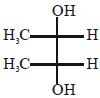
B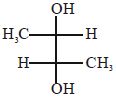
C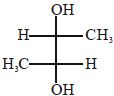
D
$(B)$ and $(C)$ both
Solution
(A) The reaction of $cis-but-2-ene$ with $Baeyer's$ reagent (cold,dilute alkaline $KMnO_4$) is a $syn-hydroxylation$ reaction.
This reaction adds two hydroxyl $(-OH)$ groups to the same side of the double bond.
For $cis-but-2-ene$,the $syn-addition$ of two $-OH$ groups results in the formation of $meso-butane-2,3-diol$ because the molecule has a plane of symmetry.
Therefore,the correct product is $meso-butane-2,3-diol$.
This reaction adds two hydroxyl $(-OH)$ groups to the same side of the double bond.
For $cis-but-2-ene$,the $syn-addition$ of two $-OH$ groups results in the formation of $meso-butane-2,3-diol$ because the molecule has a plane of symmetry.
Therefore,the correct product is $meso-butane-2,3-diol$.
0 likes
View Solution653
DifficultMCQ
$CH_3-C(CH_3)=CH_2$ $\xrightarrow[R_2O_2]{HBr} X$ $\xrightarrow{CH_3ONa} Y$; $X$ and $Y$ are:
A
$X = CH_3-CH(CH_3)-CH_2-Br, Y = CH_3-CH(CH_3)-CH_2-OCH_3$
B
$X = CH_3-C(Br)(CH_3)-CH_3, Y = CH_3-C(CH_3)=CH_2$
C
$X = CH_3-CH(CH_3)-CH_2-Br, Y = CH_3-C(CH_3)=CH_2$
D
$X = CH_3-C(Br)(CH_3)-CH_3, Y = CH_3-C(OCH_3)(CH_3)-CH_3$
Solution
(A) $1$. The reaction of $CH_3-C(CH_3)=CH_2$ with $HBr$ in the presence of peroxide $(R_2O_2)$ follows the Anti-Markovnikov addition (Kharasch effect). The $Br$ atom attaches to the less substituted carbon,yielding $X = CH_3-CH(CH_3)-CH_2-Br$ (isobutyl bromide).
$2$. The reaction of the primary alkyl halide $(X)$ with sodium methoxide $(CH_3ONa)$ proceeds via an $S_N2$ mechanism to form an ether,$Y = CH_3-CH(CH_3)-CH_2-OCH_3$ (methyl isobutyl ether).
$2$. The reaction of the primary alkyl halide $(X)$ with sodium methoxide $(CH_3ONa)$ proceeds via an $S_N2$ mechanism to form an ether,$Y = CH_3-CH(CH_3)-CH_2-OCH_3$ (methyl isobutyl ether).
0 likes
View Solution654
DifficultMCQ
$CH_3-CH=CH_2 \xrightarrow{IBr} \text{Product } (A) \text{ is}$
A
$CH_3-CH(Br)-CH_2I$
B
$CH_3-CH(I)-CH_2Br$
C
$CH_3-CH(Cl)-CH_2Br$
D
$CH_3-CH(Br)-CH_2Br$
Solution
(A) The reaction of an alkene with an interhalogen compound like $IBr$ follows Markovnikov's rule.
In $IBr$,the electronegativity of $Br$ $(2.96)$ is higher than that of $I$ $(2.66)$,so the bond is polarized as $I^{\delta+} - Br^{\delta-}$.
The electrophilic part is $I^{\delta+}$,which attacks the double bond to form a more stable carbocation.
$CH_3-CH=CH_2 + I^{\delta+} \rightarrow CH_3-CH^+-CH_2I$.
Then,the nucleophilic $Br^{\delta-}$ attacks the carbocation to form the final product: $CH_3-CH(Br)-CH_2I$.
In $IBr$,the electronegativity of $Br$ $(2.96)$ is higher than that of $I$ $(2.66)$,so the bond is polarized as $I^{\delta+} - Br^{\delta-}$.
The electrophilic part is $I^{\delta+}$,which attacks the double bond to form a more stable carbocation.
$CH_3-CH=CH_2 + I^{\delta+} \rightarrow CH_3-CH^+-CH_2I$.
Then,the nucleophilic $Br^{\delta-}$ attacks the carbocation to form the final product: $CH_3-CH(Br)-CH_2I$.
0 likes
View Solution655
DifficultMCQ
What is the major product of the following reaction?
$1\text{-methylcyclohexene} + Br_2 \xrightarrow{H_2O} ?$
$1\text{-methylcyclohexene} + Br_2 \xrightarrow{H_2O} ?$
A
$2\text{-bromo-1-methylcyclohexanol}$
B
$1\text{-bromo-2-methylcyclohexanol}$
C
$1\text{-methylcyclohexanol}$
D
$1,2\text{-dibromo-1-methylcyclohexane}$
Solution
(A) The reaction of an alkene with $Br_2$ in the presence of water $(H_2O)$ is a halohydrin formation reaction.
In this reaction,the alkene undergoes electrophilic addition.
The $Br_2$ molecule forms a cyclic bromonium ion intermediate with the double bond.
Water,being a nucleophile,attacks the more substituted carbon atom of the bromonium ion due to its greater partial positive charge character (Markovnikov-like regioselectivity).
For $1\text{-methylcyclohexene}$,the $OH$ group attaches to the $C_1$ position (the more substituted carbon) and the $Br$ atom attaches to the $C_2$ position.
Thus,the major product is $2\text{-bromo-1-methylcyclohexanol}$.
In this reaction,the alkene undergoes electrophilic addition.
The $Br_2$ molecule forms a cyclic bromonium ion intermediate with the double bond.
Water,being a nucleophile,attacks the more substituted carbon atom of the bromonium ion due to its greater partial positive charge character (Markovnikov-like regioselectivity).
For $1\text{-methylcyclohexene}$,the $OH$ group attaches to the $C_1$ position (the more substituted carbon) and the $Br$ atom attaches to the $C_2$ position.
Thus,the major product is $2\text{-bromo-1-methylcyclohexanol}$.
0 likes
View Solution656
DifficultMCQ
Alkene $X$ $\xrightarrow[\Delta]{KMnO_4}$ (Butan$-2-$one) $+$ (Pentanoic acid). $X$ is
A
$3-$methylhept$-3-$ene
B
$3-$methylhept$-2-$ene
C
$2-$methylhept$-2-$ene
D
$3-$methylhept$-3-$ene (isomer)
Solution
(A) The oxidative cleavage of an alkene with hot alkaline $KMnO_4$ breaks the double bond.
Each carbon atom of the double bond is oxidized to a carbonyl compound.
If the carbon is disubstituted $(R_2C=)$,it forms a ketone $(R_2C=O)$.
If the carbon is monosubstituted $(RCH=)$,it forms a carboxylic acid $(RCOOH)$.
The products are Butan$-2-$one $(CH_3CH_2COCH_3)$ and Pentanoic acid $(CH_3CH_2CH_2CH_2COOH)$.
Combining these fragments at the double bond:
$CH_3CH_2-C(CH_3)=CH-CH_2CH_2CH_2CH_3$.
This corresponds to $3-$methylhept$-3-$ene.
Each carbon atom of the double bond is oxidized to a carbonyl compound.
If the carbon is disubstituted $(R_2C=)$,it forms a ketone $(R_2C=O)$.
If the carbon is monosubstituted $(RCH=)$,it forms a carboxylic acid $(RCOOH)$.
The products are Butan$-2-$one $(CH_3CH_2COCH_3)$ and Pentanoic acid $(CH_3CH_2CH_2CH_2COOH)$.
Combining these fragments at the double bond:
$CH_3CH_2-C(CH_3)=CH-CH_2CH_2CH_2CH_3$.
This corresponds to $3-$methylhept$-3-$ene.
0 likes
View Solution657
MediumMCQ
The reaction $CH_2 = CH_2 + H_2 \xrightarrow[{250 - 300 \, ^oC}]{{Ni}} CH_3 - CH_3$ is known as:
A
Wurtz reaction
B
Kolbe reaction
C
Sabatier and Senderens reaction
D
Carbylamine reaction
Solution
(C) The given reaction is the catalytic hydrogenation of ethene to ethane using nickel as a catalyst at $250 - 300 \, ^oC$.
This specific method of hydrogenation of alkenes using finely divided nickel catalyst is known as the $Sabatier \, and \, Senderens \, reaction$.
This specific method of hydrogenation of alkenes using finely divided nickel catalyst is known as the $Sabatier \, and \, Senderens \, reaction$.
0 likes
View Solution658
MediumMCQ
Electrolysis of an aqueous solution of .......... gives ethylene.
A
Sodium acetate
B
Sodium succinate
C
Sodium fumarate
D
Sodium propionate
Solution
(B) The electrolysis of an aqueous solution of sodium succinate (Kolbe's electrolysis) yields ethylene $(CH_2=CH_2)$.
The reaction is: $CH_2COONa-CH_2COONa + 2H_2O \rightarrow CH_2=CH_2 + 2CO_2 + H_2 + 2NaOH$.
Sodium succinate undergoes decarboxylation at the anode to form ethylene.
The reaction is: $CH_2COONa-CH_2COONa + 2H_2O \rightarrow CH_2=CH_2 + 2CO_2 + H_2 + 2NaOH$.
Sodium succinate undergoes decarboxylation at the anode to form ethylene.
0 likes
View Solution659
MediumMCQ
The reaction of propene with methylene iodide $(CH_2I_2)$ in the presence of $Zn-Cu$ couple yields .............
A
Cyclopropane
B
Cyclopropene
C
Methylcyclopropane
D
Cyclobutene
Solution
(C) The reaction of an alkene with methylene iodide $(CH_2I_2)$ in the presence of a $Zn-Cu$ couple is known as the Simmons-Smith reaction.
In this reaction,a carbenoid species $(ICH_2ZnI)$ is formed,which acts as a methylene $(CH_2)$ donor.
When propene $(CH_3-CH=CH_2)$ reacts with this carbenoid,the methylene group adds across the double bond to form a cyclopropane ring.
Since the starting material is propene,the product formed is methylcyclopropane.
In this reaction,a carbenoid species $(ICH_2ZnI)$ is formed,which acts as a methylene $(CH_2)$ donor.
When propene $(CH_3-CH=CH_2)$ reacts with this carbenoid,the methylene group adds across the double bond to form a cyclopropane ring.
Since the starting material is propene,the product formed is methylcyclopropane.
0 likes
View Solution660
MediumMCQ
The reaction of cyclopentene with alkaline $KMnO_4$ yields ................
A
Cyclopentanol
B
trans-$1,2$-cyclopentanediol
C
cis-$1,2$-cyclopentanediol
D
$A$ $1:1$ mixture of cis- and trans-$1,2$-cyclopentanediol
Solution
(C) The reaction of an alkene with cold,dilute alkaline $KMnO_4$ (Baeyer's reagent) is a syn-hydroxylation reaction.
In this reaction,two hydroxyl $(-OH)$ groups are added to the same side of the double bond.
For cyclopentene,this process results in the formation of cis-$1,2$-cyclopentanediol.
In this reaction,two hydroxyl $(-OH)$ groups are added to the same side of the double bond.
For cyclopentene,this process results in the formation of cis-$1,2$-cyclopentanediol.
0 likes
View Solution661
DifficultMCQ
The alkene that gives only acetone upon ozonolysis is .......
A
$CH_2 = CH_2$
B
$CH_3CH = CH_2$
C
$(CH_3)_2C = C(CH_3)_2$
D
$CH_3 - CH = CH - CH_3$
Solution
(C) Ozonolysis of an alkene involves the cleavage of the $C=C$ double bond and the addition of oxygen atoms to each carbon atom to form carbonyl compounds.
For an alkene to yield only acetone $(CH_3COCH_3)$ upon ozonolysis, the structure must be $2,3\text{-dimethylbut-2-ene}$, which is $(CH_3)_2C=C(CH_3)_2$.
When $(CH_3)_2C=C(CH_3)_2$ undergoes ozonolysis, the double bond breaks to form two molecules of acetone: $(CH_3)_2C=O + O=C(CH_3)_2$.
For an alkene to yield only acetone $(CH_3COCH_3)$ upon ozonolysis, the structure must be $2,3\text{-dimethylbut-2-ene}$, which is $(CH_3)_2C=C(CH_3)_2$.
When $(CH_3)_2C=C(CH_3)_2$ undergoes ozonolysis, the double bond breaks to form two molecules of acetone: $(CH_3)_2C=O + O=C(CH_3)_2$.
0 likes
View Solution662
MediumMCQ
The reaction of propene with $Cl_2$ at $400-600\,^oC$ gives...........
A
$1, 2-$dichloropropane
B
Allyl chloride
C
Polyvinyl chloride
D
No reaction
Solution
(B) At high temperatures $(400-600\,^oC)$,the reaction of propene with $Cl_2$ proceeds via free radical substitution at the allylic position rather than electrophilic addition to the double bond.
Propene $(CH_3-CH=CH_2)$ reacts with $Cl_2$ at high temperature to form $3-$chloroprop$-1-$ene,which is commonly known as allyl chloride $(CH_2Cl-CH=CH_2)$.
Propene $(CH_3-CH=CH_2)$ reacts with $Cl_2$ at high temperature to form $3-$chloroprop$-1-$ene,which is commonly known as allyl chloride $(CH_2Cl-CH=CH_2)$.
0 likes
View Solution663
DifficultMCQ
Ozonolysis of the given compound yields:
A
Cyclopentanone + Formaldehyde
B
Cyclopentanecarbaldehyde
C
Acetylcyclopentane
D
None of these
Solution
(A) The given compound is methylenecyclopentane.
Ozonolysis of an alkene involves the cleavage of the $C=C$ double bond to form carbonyl compounds.
For a terminal methylene group $(=CH_2)$,ozonolysis produces formaldehyde $(HCHO)$ and the corresponding ketone or aldehyde from the rest of the molecule.
In this case,the $C=C$ bond breaks to form cyclopentanone and formaldehyde $(HCHO)$.
Therefore,the reaction is: $\text{Methylenecyclopentane} + O_3 \xrightarrow{Zn/H_2O} \text{Cyclopentanone} + HCHO$.
Ozonolysis of an alkene involves the cleavage of the $C=C$ double bond to form carbonyl compounds.
For a terminal methylene group $(=CH_2)$,ozonolysis produces formaldehyde $(HCHO)$ and the corresponding ketone or aldehyde from the rest of the molecule.
In this case,the $C=C$ bond breaks to form cyclopentanone and formaldehyde $(HCHO)$.
Therefore,the reaction is: $\text{Methylenecyclopentane} + O_3 \xrightarrow{Zn/H_2O} \text{Cyclopentanone} + HCHO$.
0 likes
View Solution664
MediumMCQ
$A$ hydrocarbon with molecular formula $C_6H_{10}$ absorbs only one molecule of $H_2$ upon hydrogenation. Ozonolysis of the hydrocarbon yields $OHC-CH_2-CH_2-CH_2-CH_2-CHO$. The hydrocarbon is:
A
Cyclohexane
B
Benzene
C
Cyclohexene
D
Cyclobutane
Solution
(C) $1$. The molecular formula $C_6H_{10}$ corresponds to the general formula $C_nH_{2n-2}$,which indicates the presence of either one triple bond or two double bonds or a ring with one double bond.
$2$. The hydrocarbon absorbs only one molecule of $H_2$,which means it contains only one double bond.
$3$. Ozonolysis of the hydrocarbon yields $OHC-CH_2-CH_2-CH_2-CH_2-CHO$,which is hexanedial $(CHO-(CH_2)_4-CHO)$.
$4$. Since the product is a straight-chain dialdehyde with $6$ carbon atoms,the original hydrocarbon must be a cyclic compound with $6$ carbon atoms and one double bond.
$5$. Therefore,the hydrocarbon is cyclohexene.
$2$. The hydrocarbon absorbs only one molecule of $H_2$,which means it contains only one double bond.
$3$. Ozonolysis of the hydrocarbon yields $OHC-CH_2-CH_2-CH_2-CH_2-CHO$,which is hexanedial $(CHO-(CH_2)_4-CHO)$.
$4$. Since the product is a straight-chain dialdehyde with $6$ carbon atoms,the original hydrocarbon must be a cyclic compound with $6$ carbon atoms and one double bond.
$5$. Therefore,the hydrocarbon is cyclohexene.
0 likes
View Solution665
DifficultMCQ
Ethylene reacts with ..... to form ethylene chlorohydrin.
A
Dry chlorine gas
B
Dry hydrogen chloride gas
C
Chlorine water
D
Dilute hydrochloric acid
Solution
(C) Ethylene $(CH_2=CH_2)$ reacts with chlorine water $(Cl_2 + H_2O)$ to form ethylene chlorohydrin $(Cl-CH_2-CH_2-OH)$.
This is an electrophilic addition reaction where $HOCl$ (hypochlorous acid) adds across the double bond.
The reaction is: $CH_2=CH_2 + Cl_2 + H_2O \rightarrow Cl-CH_2-CH_2-OH + HCl$.
This is an electrophilic addition reaction where $HOCl$ (hypochlorous acid) adds across the double bond.
The reaction is: $CH_2=CH_2 + Cl_2 + H_2O \rightarrow Cl-CH_2-CH_2-OH + HCl$.
0 likes
View Solution666
MediumMCQ
Ozonolysis of which olefin yields $CH_3CH_2CHO$ and $CH_3CHO$?
A
$1-$Butene
B
$2-$Butene
C
$1-$Pentene
D
$2-$Pentene
Solution
(D) Ozonolysis of an alkene involves the cleavage of the $C=C$ double bond to form carbonyl compounds.
The products given are propanal $(CH_3CH_2CHO)$ and ethanal $(CH_3CHO)$.
By removing the oxygen atoms from these products and joining the carbonyl carbons with a double bond,we get the structure of the original alkene:
$CH_3CH_2CH=O + O=CHCH_3 \rightarrow CH_3CH_2CH=CHCH_3$.
The resulting alkene is $pent-2-ene$ $(CH_3CH_2CH=CHCH_3)$.
Therefore,the correct option is $D$.
The products given are propanal $(CH_3CH_2CHO)$ and ethanal $(CH_3CHO)$.
By removing the oxygen atoms from these products and joining the carbonyl carbons with a double bond,we get the structure of the original alkene:
$CH_3CH_2CH=O + O=CHCH_3 \rightarrow CH_3CH_2CH=CHCH_3$.
The resulting alkene is $pent-2-ene$ $(CH_3CH_2CH=CHCH_3)$.
Therefore,the correct option is $D$.
0 likes
View Solution667
MediumMCQ
Which reaction will yield $CH_2 = C = CH_2$?
A
$CH_2Br - CBr = CH_2 \xrightarrow{Zn / CH_3OH}$
B
$CH \equiv C - CH_2 - COOH \xrightarrow{K_2CO_{3(aq)}}$
C
$2 CH_2 = CH - CH_2I \xrightarrow{2Na}$
D
None of these
Solution
(A) The reaction $CH_2Br - CBr = CH_2 \xrightarrow{Zn / CH_3OH}$ is a debromination reaction.
Zinc $(Zn)$ removes two bromine atoms from the adjacent carbons,leading to the formation of an allene structure.
Specifically,$CH_2Br - CBr = CH_2 + Zn \rightarrow CH_2 = C = CH_2 + ZnBr_2$.
Thus,option $A$ is the correct reaction to produce allene $(CH_2 = C = CH_2)$.
Zinc $(Zn)$ removes two bromine atoms from the adjacent carbons,leading to the formation of an allene structure.
Specifically,$CH_2Br - CBr = CH_2 + Zn \rightarrow CH_2 = C = CH_2 + ZnBr_2$.
Thus,option $A$ is the correct reaction to produce allene $(CH_2 = C = CH_2)$.
0 likes
View Solution668
MediumMCQ
The reaction $R-CH=CH_2 \xrightarrow{Na/NH_3, C_2H_5OH} R-CH_2CH_3$ is known as:
A
Clemmensen reduction
B
Fischer-Speier reduction
C
Birch reduction
D
Arndt-Eistert reduction
Solution
(C) The reaction $R-CH=CH_2 \xrightarrow{Na/NH_3, C_2H_5OH} R-CH_2CH_3$ involves the reduction of an alkene to an alkane using sodium metal in liquid ammonia and ethanol. This specific method of dissolving metal reduction is commonly referred to as Birch reduction,which typically reduces aromatic rings or conjugated systems,but in the context of specific alkene reductions under these conditions,it is classified as such.
0 likes
View Solution669
DifficultMCQ
For the reaction $CH_2 = CH_2 + Br_2 \xrightarrow{NaI_{(aq)}}$,which of the following statements is $NOT$ correct?
A
The products formed are $CH_2Br-CH_2Br$ and $CH_2Br-CH_2I$.
B
The reaction proceeds through a polar mechanism.
C
The reaction occurs rapidly in solution and is catalyzed by inorganic halides.
D
Only $CH_2I-CH_2I$ is formed.
Solution
(D) The reaction of ethene with bromine in the presence of aqueous $NaI$ is an electrophilic addition reaction.
$Br_2$ adds to the double bond to form a cyclic bromonium ion intermediate.
In the presence of $I^-$ ions (from $NaI$),the intermediate can be attacked by either $Br^-$ or $I^-$.
Thus,the products formed are $CH_2Br-CH_2Br$ ($1$,$2$-dibromoethane) and $CH_2Br-CH_2I$ ($1$-bromo$-2-$iodoethane).
Statement $D$ is incorrect because $CH_2I-CH_2I$ is not the primary product of this reaction.
$Br_2$ adds to the double bond to form a cyclic bromonium ion intermediate.
In the presence of $I^-$ ions (from $NaI$),the intermediate can be attacked by either $Br^-$ or $I^-$.
Thus,the products formed are $CH_2Br-CH_2Br$ ($1$,$2$-dibromoethane) and $CH_2Br-CH_2I$ ($1$-bromo$-2-$iodoethane).
Statement $D$ is incorrect because $CH_2I-CH_2I$ is not the primary product of this reaction.
0 likes
View Solution670
DifficultMCQ
During the ozonolysis of $CH_2 = CH_2$,if hydrolysis is performed in the absence of $Zn$ dust,the product obtained will be ...............
A
$HCHO$
B
$HCOOH$
C
$CH_3OH$
D
$CH_2OH - CH_2OH$
Solution
(B) Ozonolysis of ethene $(CH_2 = CH_2)$ initially forms an ozonide intermediate.
In the presence of water $(H_2O)$ without a reducing agent like $Zn$ dust,the intermediate undergoes oxidative cleavage.
The primary product formed is formaldehyde $(HCHO)$.
Since $Zn$ is absent,$HCHO$ is further oxidized to formic acid $(HCOOH)$.
In the presence of water $(H_2O)$ without a reducing agent like $Zn$ dust,the intermediate undergoes oxidative cleavage.
The primary product formed is formaldehyde $(HCHO)$.
Since $Zn$ is absent,$HCHO$ is further oxidized to formic acid $(HCOOH)$.
0 likes
View Solution671
DifficultMCQ
What is the product obtained when the ozonolysis of $CH_2 = CH_2$ is followed by reduction with $LiAlH_4$?
A
$HCHO$
B
$HCOOH$
C
$CH_3OH$
D
$CH_2OH - CH_2OH$
0 likes
View Solution672
MediumMCQ
The reaction of ethene with oxygen in the presence of a silver catalyst gives ....................
A
Ethylene glycol
B
Ethylene oxide
C
Glyoxal
D
Acetaldehyde
Solution
(B) The catalytic oxidation of ethene with oxygen in the presence of a silver catalyst at $523 \ K$ leads to the formation of ethylene oxide (epoxyethane).
The chemical equation is: $2CH_2=CH_2 + O_2 \xrightarrow{Ag, 523 \ K} 2C_2H_4O$ (ethylene oxide).
The chemical equation is: $2CH_2=CH_2 + O_2 \xrightarrow{Ag, 523 \ K} 2C_2H_4O$ (ethylene oxide).
0 likes
View Solution673
DifficultMCQ
Ozonolysis of the given compound yields:
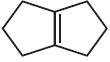
A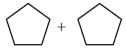
B
C
Decanedial
D
None of these
Solution
(D) The given compound is bicyclo[$3.3$.$0$]oct$-1-$ene. Ozonolysis involves the cleavage of the carbon-carbon double bond $(C=C)$ followed by oxidation to form carbonyl compounds. In this case,the double bond is at the bridgehead position. Upon ozonolysis,the ring opens to form a $1,6$-dicarbonyl compound,specifically $1,6$-cyclodecanedione.
0 likes
View Solution674
DifficultMCQ
What product is formed when $Br_2$ is added to ethylene in the presence of aqueous $NaCl$?
A
$CH_2Br - CH_2Br$
B
$CH_2Br - CH_2Cl$
C
$CH_2Cl - CH_2Cl$
D
Both $(A)$ and $(B)$
Solution
(D) The reaction of ethylene $(CH_2=CH_2)$ with $Br_2$ in the presence of water or aqueous $NaCl$ involves the formation of a cyclic bromonium ion intermediate.
In the presence of $NaCl$ (aqueous),the nucleophile can be either $Br^-$ or $Cl^-$.
$1$. If $Br^-$ attacks the bromonium ion,the product is $CH_2Br-CH_2Br$ ($1$,$2$-dibromoethane).
$2$. If $Cl^-$ attacks the bromonium ion,the product is $CH_2Br-CH_2Cl$ ($1$-bromo$-2-$chloroethane).
Since both nucleophiles are present in the reaction medium,both products are formed.
In the presence of $NaCl$ (aqueous),the nucleophile can be either $Br^-$ or $Cl^-$.
$1$. If $Br^-$ attacks the bromonium ion,the product is $CH_2Br-CH_2Br$ ($1$,$2$-dibromoethane).
$2$. If $Cl^-$ attacks the bromonium ion,the product is $CH_2Br-CH_2Cl$ ($1$-bromo$-2-$chloroethane).
Since both nucleophiles are present in the reaction medium,both products are formed.
0 likes
View Solution675
MediumMCQ
The reaction of propene with diazomethane in the presence of $UV$ radiation yields ........................
A
Cyclopropane
B
Methylcyclopropane
C
Butane
D
Butene
Solution
(B) When propene $(CH_3-CH=CH_2)$ reacts with diazomethane $(CH_2N_2)$ in the presence of $UV$ radiation,the diazomethane undergoes photolysis to generate a carbene intermediate $(:CH_2)$.
This carbene adds across the double bond of the propene molecule to form a three-membered ring.
The product formed is methylcyclopropane.
This carbene adds across the double bond of the propene molecule to form a three-membered ring.
The product formed is methylcyclopropane.
0 likes
View Solution676
MediumMCQ
Unsaturation in organic compounds is detected by ...........
A
Schiff's reagent
B
Tollens' reagent
C
Fehling's reagent
D
Baeyer's reagent
Solution
(D) Unsaturation in organic compounds (like alkenes and alkynes) is detected using $1\%$ alkaline potassium permanganate $(KMnO_4)$ solution,which is known as Baeyer's reagent.
During the reaction,the purple color of $KMnO_4$ disappears,and a brown precipitate of manganese dioxide $(MnO_2)$ is formed,indicating the presence of a double or triple bond.
During the reaction,the purple color of $KMnO_4$ disappears,and a brown precipitate of manganese dioxide $(MnO_2)$ is formed,indicating the presence of a double or triple bond.
0 likes
View Solution677
MediumMCQ
In the reaction $CH_2 = CH_2$ $\xrightarrow[\text{acid}]{\text{Hypochlorous}} M$ $\xrightarrow{R} \begin{array}{c} CH_2OH \\ | \\ CH_2OH \end{array}$,$M$ and $R$ are respectively:
A
$CH_2Cl-CH_2OH$ and $NaOH(aq)$
B
$CH_2Cl-CH_2OH$ and $NaHCO_3$
C
$CH_3CH_2OH$ and $HCl$
D
Ethylene oxide and heat
Solution
(A) $1$. The reaction of ethene $(CH_2=CH_2)$ with hypochlorous acid $(HOCl)$ follows electrophilic addition to form $2$-chloroethanol $(M = CH_2Cl-CH_2OH)$.
$2$. $2$-chloroethanol $(CH_2Cl-CH_2OH)$ reacts with aqueous sodium hydroxide $(NaOH)$ via an intramolecular nucleophilic substitution reaction (or hydrolysis) to form ethylene glycol $(CH_2OH-CH_2OH)$.
$3$. Therefore,$M$ is $CH_2Cl-CH_2OH$ and $R$ is $NaOH(aq)$.
$2$. $2$-chloroethanol $(CH_2Cl-CH_2OH)$ reacts with aqueous sodium hydroxide $(NaOH)$ via an intramolecular nucleophilic substitution reaction (or hydrolysis) to form ethylene glycol $(CH_2OH-CH_2OH)$.
$3$. Therefore,$M$ is $CH_2Cl-CH_2OH$ and $R$ is $NaOH(aq)$.
0 likes
View Solution678
DifficultMCQ
What is the major product of the reaction $CH_2 = CH-(CH_2)_8COOH + HBr \xrightarrow{\text{Peroxide}} \dots$?
A
$CH_3-CHBr-(CH_2)_8COOH$
B
$CH_2 = CH-(CH_2)_8COBr$
C
$CH_2Br-(CH_2)_9COOH$
D
$CH_2 = CH-(CH_2)_7CHBr-COOH$
Solution
(C) The reaction of an alkene with $HBr$ in the presence of peroxide follows the anti-Markovnikov addition rule (Kharasch effect or peroxide effect).
In this reaction,the $Br^-$ radical adds to the carbon atom of the double bond that has more hydrogen atoms.
The reaction is: $CH_2 = CH-(CH_2)_8COOH + HBr \xrightarrow{\text{Peroxide}} CH_2Br-CH_2-(CH_2)_8COOH$.
Simplifying the product,we get $CH_2Br-(CH_2)_9COOH$.
In this reaction,the $Br^-$ radical adds to the carbon atom of the double bond that has more hydrogen atoms.
The reaction is: $CH_2 = CH-(CH_2)_8COOH + HBr \xrightarrow{\text{Peroxide}} CH_2Br-CH_2-(CH_2)_8COOH$.
Simplifying the product,we get $CH_2Br-(CH_2)_9COOH$.
0 likes
View Solution679
DifficultMCQ
Arrange the following compounds in the order of their reactivity towards electrophilic addition reaction with $HBr$.
A
$CH_2 = CH_2 < R - CH = CH - R < R_2C = CH - R < R_2C = CR_2$
B
$R_2C = CH - R < R - CH = CH - R < CH_2 = CH_2 < R_2C = CR_2$
C
$R - CH = CH - R < R_2C = CR_2 < R_2C = CH - R < CH_2 = CH_2$
D
$R_2C = CR_2 < R_2C = CHR < RCH = CHR < CH_2 = CH_2$
Solution
(A) The reactivity of alkenes towards electrophilic addition reaction with $HBr$ depends on the stability of the carbocation intermediate formed during the reaction.
Greater the number of electron-donating alkyl groups attached to the double-bonded carbons,the more stable the resulting carbocation will be due to the inductive effect and hyperconjugation.
The order of stability of carbocations is: $3^\circ > 2^\circ > 1^\circ > \text{methyl}$.
Therefore,the reactivity order is: $CH_2 = CH_2 < R - CH = CH - R < R_2C = CH - R < R_2C = CR_2$.
Greater the number of electron-donating alkyl groups attached to the double-bonded carbons,the more stable the resulting carbocation will be due to the inductive effect and hyperconjugation.
The order of stability of carbocations is: $3^\circ > 2^\circ > 1^\circ > \text{methyl}$.
Therefore,the reactivity order is: $CH_2 = CH_2 < R - CH = CH - R < R_2C = CH - R < R_2C = CR_2$.
0 likes
View Solution680
MediumMCQ
Ozonolysis of an alkene with molecular formula $C_9H_{18}$ yields $2, 2-$ dimethylpropanal and $2-$ butanone. The alkene is ....................
A
$2, 2, 4-$ trimethyl $-3-$ hexene
B
$2, 2, 6-$ trimethyl $-3-$ hexene
C
$2, 3, 4-$ trimethyl $-2-$ hexene
D
$2, 2, 4-$ trimethyl $-2-$ hexene
Solution
(A) The ozonolysis of an alkene involves the cleavage of the $C=C$ double bond to form two carbonyl compounds.
To find the original alkene,we join the two carbonyl products by removing the oxygen atoms and forming a double bond between the carbon atoms of the carbonyl groups.
The products are $2, 2-$ dimethylpropanal $(CH_3)_3C-CHO$ and $2-$ butanone $CH_3-CO-CH_2-CH_3$.
Joining these: $(CH_3)_3C-CH=C(CH_3)-CH_2-CH_3$.
Counting the carbons: $5$ (from the aldehyde part) $+ 4$ (from the ketone part) $= 9$ carbons.
The structure is $2, 2, 4-$ trimethyl $-3-$ hexene.
Thus,the correct option is $A$.
To find the original alkene,we join the two carbonyl products by removing the oxygen atoms and forming a double bond between the carbon atoms of the carbonyl groups.
The products are $2, 2-$ dimethylpropanal $(CH_3)_3C-CHO$ and $2-$ butanone $CH_3-CO-CH_2-CH_3$.
Joining these: $(CH_3)_3C-CH=C(CH_3)-CH_2-CH_3$.
Counting the carbons: $5$ (from the aldehyde part) $+ 4$ (from the ketone part) $= 9$ carbons.
The structure is $2, 2, 4-$ trimethyl $-3-$ hexene.
Thus,the correct option is $A$.
0 likes
View Solution681
MediumMCQ
The reaction of a hydrocarbon with hypochlorous acid $(HOCl)$ gives $2-$chloroethanol. The hydrocarbon is .........
A
Ethylene
B
Methane
C
Ethane
D
Acetylene
Solution
(A) The reaction of an alkene with hypochlorous acid $(HOCl)$ is an electrophilic addition reaction.
When ethylene $(CH_2=CH_2)$ reacts with $HOCl$,it undergoes addition across the double bond to form $2-$chloroethanol $(Cl-CH_2-CH_2-OH)$.
The chemical equation is: $CH_2=CH_2 + HOCl \rightarrow Cl-CH_2-CH_2-OH$.
When ethylene $(CH_2=CH_2)$ reacts with $HOCl$,it undergoes addition across the double bond to form $2-$chloroethanol $(Cl-CH_2-CH_2-OH)$.
The chemical equation is: $CH_2=CH_2 + HOCl \rightarrow Cl-CH_2-CH_2-OH$.
0 likes
View Solution682
MediumMCQ
Ozonolysis of a compound with molecular formula $C_7H_{14}$ yields $2-$methyl$-3-$pentanone. The compound is ...........
A
$2-$ethyl$-3-$methyl$-1-$butene
B
$3-$ethyl$-2-$methyl$-2-$butene
C
$2,5-$dimethyl$-3,4-$dimethylhex$-3-$ene
D
$3-$ethyl$-2-$methyl$-1-$butene
Solution
(B) The molecular formula $C_7H_{14}$ corresponds to an alkene with the general formula $C_nH_{2n}$.
Ozonolysis of an alkene involves the cleavage of the $C=C$ double bond to form carbonyl compounds.
The product given is $2-$methyl$-3-$pentanone,which is a ketone with the structure $CH_3-CH(CH_3)-C(=O)-CH_2-CH_3$.
Since ozonolysis of an alkene yields two carbonyl fragments,and only one is mentioned,we look for an alkene that produces this ketone upon cleavage.
If the alkene is $3-$ethyl$-2-$methyl$-2-$butene $(CH_3-C(CH_3)=C(C_2H_5)-CH_3)$,its ozonolysis yields $2-$methyl$-3-$pentanone and formaldehyde $(HCHO)$ is not possible here.
However,checking the structure $3-$ethyl$-2-$methyl$-2-$pentene or similar isomers,we find that $3-$ethyl$-2-$methyl$-2-$pentene $(C_8H_{16})$ is not the one.
Re-evaluating the product $2-$methyl$-3-$pentanone $(C_6H_{12}O)$,the original alkene must be $C_7H_{14}$. The cleavage of $3-$ethyl$-2-$methyl$-2-$pentene would yield $2-$methyl$-3-$pentanone and formaldehyde.
Given the options,$3-$ethyl$-2-$methyl$-2-$pentene is not listed,but $3-$ethyl$-2-$methyl$-2-$butene is $C_7H_{14}$. Its ozonolysis yields $2-$methyl$-3-$pentanone and formaldehyde.
Ozonolysis of an alkene involves the cleavage of the $C=C$ double bond to form carbonyl compounds.
The product given is $2-$methyl$-3-$pentanone,which is a ketone with the structure $CH_3-CH(CH_3)-C(=O)-CH_2-CH_3$.
Since ozonolysis of an alkene yields two carbonyl fragments,and only one is mentioned,we look for an alkene that produces this ketone upon cleavage.
If the alkene is $3-$ethyl$-2-$methyl$-2-$butene $(CH_3-C(CH_3)=C(C_2H_5)-CH_3)$,its ozonolysis yields $2-$methyl$-3-$pentanone and formaldehyde $(HCHO)$ is not possible here.
However,checking the structure $3-$ethyl$-2-$methyl$-2-$pentene or similar isomers,we find that $3-$ethyl$-2-$methyl$-2-$pentene $(C_8H_{16})$ is not the one.
Re-evaluating the product $2-$methyl$-3-$pentanone $(C_6H_{12}O)$,the original alkene must be $C_7H_{14}$. The cleavage of $3-$ethyl$-2-$methyl$-2-$pentene would yield $2-$methyl$-3-$pentanone and formaldehyde.
Given the options,$3-$ethyl$-2-$methyl$-2-$pentene is not listed,but $3-$ethyl$-2-$methyl$-2-$butene is $C_7H_{14}$. Its ozonolysis yields $2-$methyl$-3-$pentanone and formaldehyde.
0 likes
View Solution683
MediumMCQ
Ozonolysis of an alkene with molecular formula $C_{7}H_{14}$ in the presence of $Zn$ dust gives a mixture of acetone and $butan-2-one$. The $IUPAC$ name of the alkene is ..........
A
$3, 4-dimethylpent-3-ene$
B
$2, 4-dimethylpent-2-ene$
C
$2, 3-dimethylpent-3-ene$
D
$2, 3-dimethylpent-2-ene$
Solution
(D) Ozonolysis involves the cleavage of the $C=C$ double bond.
Acetone is $CH_3-CO-CH_3$ and $butan-2-one$ is $CH_3-CO-CH_2-CH_3$.
To find the original alkene,remove the oxygen atoms from the carbonyl groups and join the carbon atoms with a double bond:
$(CH_3)_2C=O + O=C(CH_3)CH_2CH_3 \rightarrow (CH_3)_2C=C(CH_3)CH_2CH_3$.
The structure is $CH_3-C(CH_3)=C(CH_3)-CH_2-CH_3$.
The longest chain has $5$ carbons (pentene).
Numbering from the right gives the double bond at position $2$ and methyl groups at positions $2$ and $3$.
Thus,the $IUPAC$ name is $2, 3-dimethylpent-2-ene$.
Acetone is $CH_3-CO-CH_3$ and $butan-2-one$ is $CH_3-CO-CH_2-CH_3$.
To find the original alkene,remove the oxygen atoms from the carbonyl groups and join the carbon atoms with a double bond:
$(CH_3)_2C=O + O=C(CH_3)CH_2CH_3 \rightarrow (CH_3)_2C=C(CH_3)CH_2CH_3$.
The structure is $CH_3-C(CH_3)=C(CH_3)-CH_2-CH_3$.
The longest chain has $5$ carbons (pentene).
Numbering from the right gives the double bond at position $2$ and methyl groups at positions $2$ and $3$.
Thus,the $IUPAC$ name is $2, 3-dimethylpent-2-ene$.
0 likes
View Solution684
MediumMCQ
Ozonolysis of $but-1-ene$ followed by hydrolysis gives:
A
Only $ethylene$
B
$Acetaldehyde$ and $formaldehyde$
C
$Propionaldehyde$ and $formaldehyde$
D
Only $acetaldehyde$
Solution
(C) The ozonolysis of $but-1-ene$ $(CH_3-CH_2-CH=CH_2)$ involves the formation of an ozonide intermediate.
Upon reductive hydrolysis (using $Zn/H_2O$),the $C=C$ bond breaks to form two carbonyl compounds.
$CH_3-CH_2-CH=CH_2 + O_3$ $\rightarrow \text{Ozonide}$ $\xrightarrow{Zn/H_2O} CH_3-CH_2-CHO + HCHO$.
The products formed are $propanal$ $(propionaldehyde)$ and $methanal$ $(formaldehyde)$.
Upon reductive hydrolysis (using $Zn/H_2O$),the $C=C$ bond breaks to form two carbonyl compounds.
$CH_3-CH_2-CH=CH_2 + O_3$ $\rightarrow \text{Ozonide}$ $\xrightarrow{Zn/H_2O} CH_3-CH_2-CHO + HCHO$.
The products formed are $propanal$ $(propionaldehyde)$ and $methanal$ $(formaldehyde)$.
0 likes
View Solution685
DifficultMCQ
The reaction of the compound $(CH_3)_2C = CH-CH_3$ with $NaIO_4$ in the presence of $KMnO_4$ yields:
A
$CH_3CHO + CO_2$
B
$CH_3COCH_3$
C
$CH_3COCH_3 + CH_3COOH$
D
$CH_3COCH_3 + CH_3CHO$
Solution
(D) The reaction of an alkene with $KMnO_4$ and $NaIO_4$ (Lemieux-Johnson reagent or oxidative cleavage conditions) results in the cleavage of the double bond.
For the alkene $(CH_3)_2C = CH-CH_3$:
$1$. The double bond breaks between the two carbons.
$2$. The $(CH_3)_2C=$ part is oxidized to acetone,$CH_3COCH_3$.
$3$. The $=CH-CH_3$ part is oxidized to acetaldehyde,$CH_3CHO$.
Therefore,the products are $CH_3COCH_3$ and $CH_3CHO$.
For the alkene $(CH_3)_2C = CH-CH_3$:
$1$. The double bond breaks between the two carbons.
$2$. The $(CH_3)_2C=$ part is oxidized to acetone,$CH_3COCH_3$.
$3$. The $=CH-CH_3$ part is oxidized to acetaldehyde,$CH_3CHO$.
Therefore,the products are $CH_3COCH_3$ and $CH_3CHO$.
0 likes
View Solution686
DifficultMCQ
The reaction of ethene with $Cl_2$ in a saturated solution of $KBr$ yields:
A
$ClCH_2CH_2Cl + ClCH_2CH_2Br$
B
$ClCH_2CH_2Cl$
C
$ClCH_2CH_2Cl + BrCH_2CH_2Br$
D
$ClCH_2CH_2Cl + BrCH_2CH_2Br + ClCH_2CH_2Br$
Solution
(A) When ethene $(CH_2=CH_2)$ reacts with $Cl_2$ in the presence of a saturated solution of $KBr$,the reaction proceeds via the formation of a cyclic chloronium ion intermediate.
In the presence of $Cl^-$ and $Br^-$ ions,the nucleophilic attack on the cyclic intermediate can occur by either $Cl^-$ or $Br^-$.
$1$. Attack by $Cl^-$ leads to the formation of $1,2$-dichloroethane $(ClCH_2CH_2Cl)$.
$2$. Attack by $Br^-$ leads to the formation of $1$-bromo-$2$-chloroethane $(ClCH_2CH_2Br)$.
Therefore,the reaction yields a mixture of $ClCH_2CH_2Cl$ and $ClCH_2CH_2Br$.
In the presence of $Cl^-$ and $Br^-$ ions,the nucleophilic attack on the cyclic intermediate can occur by either $Cl^-$ or $Br^-$.
$1$. Attack by $Cl^-$ leads to the formation of $1,2$-dichloroethane $(ClCH_2CH_2Cl)$.
$2$. Attack by $Br^-$ leads to the formation of $1$-bromo-$2$-chloroethane $(ClCH_2CH_2Br)$.
Therefore,the reaction yields a mixture of $ClCH_2CH_2Cl$ and $ClCH_2CH_2Br$.
0 likes
View Solution687
DifficultMCQ
The reaction of ethylene with bromine in a methanol solution yields $1, 2-$dibromoethane as well as $BrCH_2CH_2OCH_3$. This is because ......
A
The intermediate carbocation can react with either $Br^-$ or $CH_3OH$.
B
Methyl alcohol solvates the bromine.
C
The reaction follows Markovnikov's rule.
D
It is a free radical mechanism.
Solution
(A) The reaction of ethylene with $Br_2$ proceeds via the formation of a cyclic bromonium ion intermediate.
In the presence of a nucleophilic solvent like methanol $(CH_3OH)$,the solvent can attack the electrophilic carbon of the bromonium ion.
This leads to the formation of the bromo-methoxy product $(BrCH_2CH_2OCH_3)$ alongside the standard $1, 2-$dibromoethane formed by the attack of $Br^-$.
In the presence of a nucleophilic solvent like methanol $(CH_3OH)$,the solvent can attack the electrophilic carbon of the bromonium ion.
This leads to the formation of the bromo-methoxy product $(BrCH_2CH_2OCH_3)$ alongside the standard $1, 2-$dibromoethane formed by the attack of $Br^-$.
0 likes
View Solution688
MediumMCQ
The addition of $HI$ to the double bond of propene gives isopropyl iodide as the major product because the addition proceeds through:
A
More stable carbocation
B
More stable carbanion
C
More stable free radical
D
Homolysis
Solution
(A) The reaction of $HI$ with propene $(CH_3-CH=CH_2)$ follows Markovnikov's rule.
In the first step,the electrophile $H^+$ attacks the double bond to form a carbocation intermediate.
Two possible carbocations can be formed: $CH_3-CH^+-CH_3$ (secondary carbocation) and $CH_3-CH_2-CH_2^+$ (primary carbocation).
The secondary carbocation is more stable due to the inductive effect and hyperconjugation of the two adjacent methyl groups.
Therefore,the reaction proceeds through the more stable carbocation to form isopropyl iodide $(CH_3-CH(I)-CH_3)$ as the major product.
In the first step,the electrophile $H^+$ attacks the double bond to form a carbocation intermediate.
Two possible carbocations can be formed: $CH_3-CH^+-CH_3$ (secondary carbocation) and $CH_3-CH_2-CH_2^+$ (primary carbocation).
The secondary carbocation is more stable due to the inductive effect and hyperconjugation of the two adjacent methyl groups.
Therefore,the reaction proceeds through the more stable carbocation to form isopropyl iodide $(CH_3-CH(I)-CH_3)$ as the major product.
0 likes
View Solution689
MediumMCQ
For the preparation of alkenes,an aqueous concentrated solution of sodium or potassium salts of carboxylic acids is subjected to ........
A
Hydrolysis
B
Oxidation
C
Hydrogenation
D
Electrolysis
Solution
(D) The preparation of alkenes from the sodium or potassium salts of carboxylic acids is known as $Kolbe's$ electrolysis. In this process,an aqueous concentrated solution of the salt is subjected to electrolysis. At the anode,the carboxylate ion loses an electron to form a radical,which then loses $CO_2$ to form an alkyl radical. Two alkyl radicals combine to form an alkene (or alkane depending on the starting material). Thus,the correct process is electrolysis.
0 likes
View Solution690
MediumMCQ
The gas used for artificial ripening of fruits is .......... .
A
$C_2H_6$
B
$C_2H_2$
C
$C_2H_4$
D
Marsh gas
Solution
(C) The gas used for the artificial ripening of fruits is ethylene $(C_2H_4)$.
Ethylene is a natural plant hormone that promotes fruit ripening.
Acetylene $(C_2H_2)$ is also used commercially for this purpose,but ethylene is the naturally occurring hormone.
Ethylene is a natural plant hormone that promotes fruit ripening.
Acetylene $(C_2H_2)$ is also used commercially for this purpose,but ethylene is the naturally occurring hormone.
0 likes
View Solution691
DifficultMCQ
$A$ hydrocarbon has a molecular mass of $84 \ g/mol$. What is the number of its structural chain isomers?
A
$4$
B
$5$
C
$6$
D
$7$
Solution
(C) The general formula for an alkane is $C_nH_{2n+2}$ and for a cycloalkane or alkene is $C_nH_{2n}$.
Given molecular mass = $84 \ g/mol$.
For $C_nH_{2n}$,the mass is $12n + 2n = 14n$.
$14n = 84 \implies n = 6$.
The hydrocarbon is $C_6H_{12}$.
Structural chain isomers for $C_6H_{12}$ (alkenes) are:
$1$. $Hex-1-ene$
$2$. $2-methylpent-1-ene$
$3$. $3-methylpent-1-ene$
$4$. $2,3-dimethylbut-1-ene$
$5$. $3,3-dimethylbut-1-ene$
$6$. $2-ethylbut-1-ene$
There are $6$ structural chain isomers for the alkene $C_6H_{12}$.
Given molecular mass = $84 \ g/mol$.
For $C_nH_{2n}$,the mass is $12n + 2n = 14n$.
$14n = 84 \implies n = 6$.
The hydrocarbon is $C_6H_{12}$.
Structural chain isomers for $C_6H_{12}$ (alkenes) are:
$1$. $Hex-1-ene$
$2$. $2-methylpent-1-ene$
$3$. $3-methylpent-1-ene$
$4$. $2,3-dimethylbut-1-ene$
$5$. $3,3-dimethylbut-1-ene$
$6$. $2-ethylbut-1-ene$
There are $6$ structural chain isomers for the alkene $C_6H_{12}$.
0 likes
View Solution692
MediumMCQ
The number of alkene isomers with the molecular formula $C_4H_8$ is ....
A
$2$
B
$3$
C
$4$
D
$5$
Solution
(B) The molecular formula $C_4H_8$ corresponds to the general formula $C_nH_{2n}$,which indicates an alkene or a cycloalkane.
For alkenes,the possible structural isomers are:
$1$. $CH_3-CH_2-CH=CH_2$ $(But-1-ene)$
$2$. $CH_3-CH=CH-CH_3$ $(But-2-ene)$
$3$. $CH_3-C(CH_3)=CH_2$ $(2-Methylprop-1-ene)$
Thus,there are $3$ structural isomers for the alkene $C_4H_8$.
For alkenes,the possible structural isomers are:
$1$. $CH_3-CH_2-CH=CH_2$ $(But-1-ene)$
$2$. $CH_3-CH=CH-CH_3$ $(But-2-ene)$
$3$. $CH_3-C(CH_3)=CH_2$ $(2-Methylprop-1-ene)$
Thus,there are $3$ structural isomers for the alkene $C_4H_8$.
0 likes
View Solution693
DifficultMCQ
Addition of $Br_2$ to $cis-2-butene$ yields ...........
A
$A$ racemic mixture of $2,3-dibromobutane$
B
$A$ meso form of $2,3-dibromobutane$
C
$A$ dextro form of $2,3-dibromobutane$
D
$A$ levo form of $2,3-dibromobutane$
Solution
(B) The addition of $Br_2$ to an alkene is an anti-addition reaction.
For $cis-2-butene$,the anti-addition of bromine atoms across the double bond results in the formation of a meso compound.
This is because the molecule possesses a plane of symmetry due to the specific stereochemistry of the starting material and the anti-addition mechanism.
For $cis-2-butene$,the anti-addition of bromine atoms across the double bond results in the formation of a meso compound.
This is because the molecule possesses a plane of symmetry due to the specific stereochemistry of the starting material and the anti-addition mechanism.
0 likes
View Solution694
MediumMCQ
How many optical isomers are possible for the compound obtained by the hydrogenation of $(CH_3)_2C = CH-CH_3$?
A
$0$
B
$1$
C
$2$
D
$3$
Solution
(A) The hydrogenation of $(CH_3)_2C = CH-CH_3$ ($2$-methylbut$-2-$ene) involves the addition of $H_2$ across the double bond.
The product formed is $(CH_3)_2CH-CH_2-CH_3$,which is $2$-methylbutane.
In $2$-methylbutane,the structure is $CH_3-CH(CH_3)-CH_2-CH_3$.
This molecule does not contain any chiral carbon atom (a carbon atom bonded to four different groups).
Since there is no chiral center,the compound does not exhibit optical isomerism.
Therefore,the number of optical isomers possible is $0$.
The product formed is $(CH_3)_2CH-CH_2-CH_3$,which is $2$-methylbutane.
In $2$-methylbutane,the structure is $CH_3-CH(CH_3)-CH_2-CH_3$.
This molecule does not contain any chiral carbon atom (a carbon atom bonded to four different groups).
Since there is no chiral center,the compound does not exhibit optical isomerism.
Therefore,the number of optical isomers possible is $0$.
0 likes
View Solution695
DifficultMCQ
What is produced when chlorine is passed through propene at $400\,^oC$?
A
Allyl chloride
B
$PVC$
C
Vinyl chloride
D
$1, 2-$ Dichloroethane
Solution
(A) When propene $(CH_3-CH=CH_2)$ reacts with chlorine $(Cl_2)$ at high temperatures ($400\,^oC$ to $600\,^oC$),substitution occurs at the allylic position rather than addition across the double bond.
This is a free-radical substitution reaction.
The product formed is $3-$chloroprop$-1-$ene,commonly known as allyl chloride $(CH_2=CH-CH_2Cl)$.
This is a free-radical substitution reaction.
The product formed is $3-$chloroprop$-1-$ene,commonly known as allyl chloride $(CH_2=CH-CH_2Cl)$.
0 likes
View Solution696
DifficultMCQ
What is the product of the following reaction?
$H_2C=C_6H_{10}=CH_2 + HBr \xrightarrow{\text{peroxide}} ?$
$H_2C=C_6H_{10}=CH_2 + HBr \xrightarrow{\text{peroxide}} ?$
A
$1-$(bromomethyl)$-1-$methylcyclohexane
B
$1,1-$dibromo$-4-$methylcyclohexane
C
$4,5-$dibromo$-1,2-$dimethylcyclohexane
D
$1,4-$bis(bromomethyl)cyclohexane
Solution
(D) The reaction of an alkene with $HBr$ in the presence of peroxide follows the anti-Markovnikov addition rule.
In this reaction,the $H$ atom adds to the carbon with fewer hydrogen atoms (or the more substituted carbon),and the $Br$ atom adds to the carbon with more hydrogen atoms.
Given the reactant $H_2C=C_6H_{10}=CH_2$ (which is $1,4-$dimethylenecyclohexane),the addition of $HBr$ occurs at both terminal double bonds.
Applying the anti-Markovnikov rule to both sides,the $Br$ atom attaches to the terminal $CH_2$ group,converting it into a $CH_2Br$ group.
Thus,the product formed is $BrCH_2-C_6H_{10}-CH_2Br$,which is $1,4-$bis(bromomethyl)cyclohexane.
In this reaction,the $H$ atom adds to the carbon with fewer hydrogen atoms (or the more substituted carbon),and the $Br$ atom adds to the carbon with more hydrogen atoms.
Given the reactant $H_2C=C_6H_{10}=CH_2$ (which is $1,4-$dimethylenecyclohexane),the addition of $HBr$ occurs at both terminal double bonds.
Applying the anti-Markovnikov rule to both sides,the $Br$ atom attaches to the terminal $CH_2$ group,converting it into a $CH_2Br$ group.
Thus,the product formed is $BrCH_2-C_6H_{10}-CH_2Br$,which is $1,4-$bis(bromomethyl)cyclohexane.
0 likes
View Solution697
DifficultMCQ
Identify the product $C$ in the following reaction sequence:
$CH_3CH_2C \equiv CH + HCl \to B \xrightarrow{HI} C$
$CH_3CH_2C \equiv CH + HCl \to B \xrightarrow{HI} C$
A
$CH_3CH_2CCl=CH_2$
B
$CH_3CH_2CH_2CHClI$
C
$CH_3CH_2CCl(I)CH_3$
D
$CH_3CH_2CH(Cl)CH_2I$
Solution
(C) Step $1$: The reaction of $CH_3CH_2C \equiv CH$ (but$-1-$yne) with $HCl$ follows Markovnikov's rule. The $H^+$ adds to the terminal carbon,and $Cl^-$ adds to the internal carbon,forming $B$ ($CH_3CH_2CCl=CH_2$,$2$-chlorobut$-1-$ene).
Step $2$: The reaction of $CH_3CH_2CCl=CH_2$ with $HI$ also follows Markovnikov's rule. The $H^+$ adds to the terminal carbon $(CH_2)$,and $I^-$ adds to the carbon already bonded to $Cl$ (the more substituted carbon),resulting in the geminal dihalide $C$ ($CH_3CH_2CCl(I)CH_3$,$2$-chloro$-2-$iodobutane).
Step $2$: The reaction of $CH_3CH_2CCl=CH_2$ with $HI$ also follows Markovnikov's rule. The $H^+$ adds to the terminal carbon $(CH_2)$,and $I^-$ adds to the carbon already bonded to $Cl$ (the more substituted carbon),resulting in the geminal dihalide $C$ ($CH_3CH_2CCl(I)CH_3$,$2$-chloro$-2-$iodobutane).
0 likes
View Solution698
DifficultMCQ
The conversion of $2,3-$dibromobutane to $2-$butene using $Zn$ and alcohol is a/an .... reaction.
A
$\beta -$elimination
B
Redox
C
Both $\beta -$elimination and redox
D
$\alpha -$elimination
Solution
(C) The reaction of $2,3-$dibromobutane $(CH_3-CHBr-CHBr-CH_3)$ with $Zn$ dust in alcohol is a debromination reaction.
In this reaction,two bromine atoms are removed from adjacent carbon atoms,leading to the formation of a double bond between them.
This process is classified as a $\beta -$elimination reaction because the leaving groups are on adjacent carbons.
Additionally,the oxidation state of $Zn$ changes from $0$ to $+2$ (oxidation) and the bromine atoms in the organic molecule are reduced (reduction),making it a redox reaction as well.
Therefore,it is both a $\beta -$elimination and a redox reaction.
In this reaction,two bromine atoms are removed from adjacent carbon atoms,leading to the formation of a double bond between them.
This process is classified as a $\beta -$elimination reaction because the leaving groups are on adjacent carbons.
Additionally,the oxidation state of $Zn$ changes from $0$ to $+2$ (oxidation) and the bromine atoms in the organic molecule are reduced (reduction),making it a redox reaction as well.
Therefore,it is both a $\beta -$elimination and a redox reaction.
0 likes
View Solution699
DifficultMCQ
What is obtained by the dehydrohalogenation of allyl chloride?
A
Propylene
B
Acetone
C
Propadiene
D
Allyl alcohol
Solution
(C) Allyl chloride is $CH_2=CH-CH_2Cl$.
Dehydrohalogenation involves the removal of a hydrogen atom and a halogen atom from adjacent carbon atoms.
However,in the case of allyl chloride,the removal of $HCl$ leads to the formation of a conjugated system.
Specifically,the dehydrohalogenation of allyl chloride $(CH_2=CH-CH_2Cl)$ results in the formation of propadiene $(CH_2=C=CH_2)$.
Dehydrohalogenation involves the removal of a hydrogen atom and a halogen atom from adjacent carbon atoms.
However,in the case of allyl chloride,the removal of $HCl$ leads to the formation of a conjugated system.
Specifically,the dehydrohalogenation of allyl chloride $(CH_2=CH-CH_2Cl)$ results in the formation of propadiene $(CH_2=C=CH_2)$.
0 likes
View Solution700
MediumMCQ
Identify $Z$ in the following reaction sequence:
${C_2}{H_5}I$ $\xrightarrow{Alc. KOH} X$ $\xrightarrow{Br_2} Y$ $\xrightarrow{KCN} Z$
${C_2}{H_5}I$ $\xrightarrow{Alc. KOH} X$ $\xrightarrow{Br_2} Y$ $\xrightarrow{KCN} Z$
A
$NC-CH_2-CH_2-CN$
B
$CH_3-CH_2-CN$
C
$Br-CH_2-CH_2-CN$
D
$Br-CH=CH-CN$
Solution
(A) Step $1$: ${C_2}{H_5}I$ reacts with alcoholic $KOH$ (dehydrohalogenation) to form ethene $(X = CH_2=CH_2)$.
Step $2$: Ethene reacts with $Br_2$ (electrophilic addition) to form $1,2$-dibromoethane $(Y = Br-CH_2-CH_2-Br)$.
Step $3$: $1,2$-dibromoethane reacts with $KCN$ (nucleophilic substitution) to form succinonitrile $(Z = NC-CH_2-CH_2-CN)$.
Step $2$: Ethene reacts with $Br_2$ (electrophilic addition) to form $1,2$-dibromoethane $(Y = Br-CH_2-CH_2-Br)$.
Step $3$: $1,2$-dibromoethane reacts with $KCN$ (nucleophilic substitution) to form succinonitrile $(Z = NC-CH_2-CH_2-CN)$.
0 likes
View SolutionHydrocarbons — Alkene · Frequently Asked Questions
1Are these Hydrocarbons questions useful for JEE and NEET?
Yes. All questions in this section are mapped to JEE Main and NEET exam patterns. Previous year questions from JEE Main, NEET, GUJCET and state-level exams are included with full solutions.
2Can I switch to Hindi or Gujarati for these questions?
Yes. Use the language tabs in the hero section or the sidebar to view the same questions and solutions in English, Hindi or Gujarati.
3How do I generate a question paper from this subtopic?
Use the Vedclass Exam Paper Generator — select the chapter and subtopic, set difficulty, and generate Sets A, B, C, D automatically. First 3 chapters of every subject are free.
Vedclass Products
For Students
Vedclass Test Series
Mock tests in real JEE/NEET style with performance analysis. 5-day free trial.
Start Free TrialFor Teachers
Exam Paper Generator
Generate Set A/B/C/D papers from this chapter in 2 minutes. 3 chapters free.
Try FreeFor Institutes
Online Exam Module
Live online exams with unlimited students, 360° analytics & white-label branding.
See DemoFor Teachers & Institutes
Generate a Hydrocarbons Exam Paper in 2 Minutes
Select subtopic & difficulty — Sets A, B, C, D auto-generated with No Repeat logic.
First 3 chapters of every subject are free — no payment required.