
A English
Alkene Questions in English
Class 11 Chemistry · Hydrocarbons · Alkene
1080+
Questions
English
Language
100%
With Solutions
Showing 50 of 1080 questions in English
601
DifficultMCQ
$Propanal$ and $pentan-3-one$ are ozonolysis products of:
A
$CH_3-CH_2-CH=C(CH_2CH_3)-CH_2CH_3$
B
$CH_3-CH=C(CH_2CH_3)-CH_2CH_3$
C
$CH_3-CH=C(CH_3)-C(CH_3)=CH_2$
D
$CH_3-CH=CH-CH(CH_3)-CH_2-CH_2-CH_3$
Solution
(A) Ozonolysis of an alkene involves the cleavage of the $C=C$ bond and the addition of an oxygen atom to each carbon atom of the double bond.
$Propanal$ is $CH_3-CH_2-CHO$ and $pentan-3-one$ is $CH_3-CH_2-CO-CH_2-CH_3$.
By removing the oxygen atoms from the carbonyl groups and joining the carbonyl carbons with a double bond,we get the starting alkene: $CH_3-CH_2-CH=C(CH_2CH_3)-CH_2CH_3$.
$Propanal$ is $CH_3-CH_2-CHO$ and $pentan-3-one$ is $CH_3-CH_2-CO-CH_2-CH_3$.
By removing the oxygen atoms from the carbonyl groups and joining the carbonyl carbons with a double bond,we get the starting alkene: $CH_3-CH_2-CH=C(CH_2CH_3)-CH_2CH_3$.
0 likes
View Solution602
AdvancedMCQ
Aqueous solution of sodium salt of $2-$methylbutanedioic acid on Kolbe's electrolysis gives:
A
Propyne
B
Propane
C
Propene
D
$2-$Butene
Solution
(C) Kolbe's electrolysis of the sodium salt of $2-$methylbutanedioic acid $(CH_3-CH(COONa)-CH_2-COONa)$ results in the formation of propene through decarboxylation.
$CH_3-CH(COONa)-CH_2-COONa + 2H_2O \rightarrow CH_3-CH=CH_2 + 2CO_2 + H_2 + 2NaOH$
$CH_3-CH(COONa)-CH_2-COONa + 2H_2O \rightarrow CH_3-CH=CH_2 + 2CO_2 + H_2 + 2NaOH$
0 likes
View Solution603
MediumMCQ
What is the product of the reaction of cyclohexene with Baeyer's reagent?
A
cis-cyclohexane$-1,2-$diol
B
trans-cyclohexane$-1,2-$diol
C
cyclohexane$-1,2-$diol (other isomer)
D
cyclohexene oxide
Solution
(A) Baeyer's reagent is an alkaline solution of cold potassium permanganate $(KMnO_4)$.
It acts as an oxidizing agent and performs a $syn$-hydroxylation of alkenes.
In the reaction with cyclohexene,both hydroxyl $(-OH)$ groups are added to the same side of the double bond,resulting in the formation of $cis$-cyclohexane$-1,2-$diol.
It acts as an oxidizing agent and performs a $syn$-hydroxylation of alkenes.
In the reaction with cyclohexene,both hydroxyl $(-OH)$ groups are added to the same side of the double bond,resulting in the formation of $cis$-cyclohexane$-1,2-$diol.
0 likes
View Solution604
MediumMCQ
Which of the following compounds on ozonolysis gives a product that gives a silver mirror with Tollen's reagent?
A
$1,2-$dimethylcyclohexene
B
$2,3-$dimethylbut$-2-$ene
C
but$-2-$ene
D
isopropylidenecyclohexane
Solution
(C) Ozonolysis of an alkene involves the cleavage of the $C=C$ double bond to form carbonyl compounds (aldehydes or ketones).
Aldehydes give a positive silver mirror test with Tollen's reagent,whereas ketones do not.
For an aldehyde to be formed,at least one hydrogen atom must be attached to the carbon atoms of the $C=C$ double bond.
Let's analyze the options:
$(A)$ $1,2$-dimethylcyclohexene: Ozonolysis yields a diketone (hexane$-2,5-$dione),which does not react with Tollen's reagent.
$(B)$ $2,3$-dimethylbut$-2-$ene: Ozonolysis yields two molecules of acetone (propanone),which is a ketone and does not react with Tollen's reagent.
$(C)$ $but-2-ene$: Ozonolysis yields two molecules of acetaldehyde $(CH_3CHO)$,which is an aldehyde and gives a positive silver mirror test with Tollen's reagent.
$(D)$ $isopropylidenecyclohexane$: Ozonolysis yields cyclohexanone and acetone,both of which are ketones and do not react with Tollen's reagent.
Therefore,the correct option is $C$.
Aldehydes give a positive silver mirror test with Tollen's reagent,whereas ketones do not.
For an aldehyde to be formed,at least one hydrogen atom must be attached to the carbon atoms of the $C=C$ double bond.
Let's analyze the options:
$(A)$ $1,2$-dimethylcyclohexene: Ozonolysis yields a diketone (hexane$-2,5-$dione),which does not react with Tollen's reagent.
$(B)$ $2,3$-dimethylbut$-2-$ene: Ozonolysis yields two molecules of acetone (propanone),which is a ketone and does not react with Tollen's reagent.
$(C)$ $but-2-ene$: Ozonolysis yields two molecules of acetaldehyde $(CH_3CHO)$,which is an aldehyde and gives a positive silver mirror test with Tollen's reagent.
$(D)$ $isopropylidenecyclohexane$: Ozonolysis yields cyclohexanone and acetone,both of which are ketones and do not react with Tollen's reagent.
Therefore,the correct option is $C$.
0 likes
View Solution605
DifficultMCQ
Which of the following reactions does not involve a carbocation as an intermediate?
A
$CH_3-CH=CH_2 \xrightarrow{HBr, H_2O_2} CH_3-CH_2-CH_2Br$
B
$CH_3-CH=CH_2 \xrightarrow{HCl} CH_3-CHCl-CH_3$
C
$(CH_3)_3C-OH \xrightarrow{H^+, \Delta} (CH_3)_2C=CH_2 + H_2O$
D
$C_6H_6 + CH_3Cl \xrightarrow{AlCl_3} C_6H_5-CH_3 + HCl$
Solution
(A) In the reaction $CH_3-CH=CH_2 \xrightarrow{HBr, H_2O_2} CH_3-CH_2-CH_2Br$,the mechanism involves a free radical intermediate (peroxide effect or Kharasch effect),not a carbocation.
In $CH_3-CH=CH_2 \xrightarrow{HCl} CH_3-CHCl-CH_3$,the mechanism involves the formation of a secondary carbocation intermediate.
In $(CH_3)_3C-OH \xrightarrow{H^+, \Delta} (CH_3)_2C=CH_2 + H_2O$,the dehydration of alcohol involves the formation of a tertiary carbocation intermediate.
In $C_6H_6 + CH_3Cl \xrightarrow{AlCl_3} C_6H_5-CH_3 + HCl$,the Friedel-Crafts alkylation involves the formation of an electrophilic carbocation $(CH_3^+)$ intermediate.
Therefore,the reaction that does not involve a carbocation is the anti-Markovnikov addition of $HBr$ in the presence of peroxide.
In $CH_3-CH=CH_2 \xrightarrow{HCl} CH_3-CHCl-CH_3$,the mechanism involves the formation of a secondary carbocation intermediate.
In $(CH_3)_3C-OH \xrightarrow{H^+, \Delta} (CH_3)_2C=CH_2 + H_2O$,the dehydration of alcohol involves the formation of a tertiary carbocation intermediate.
In $C_6H_6 + CH_3Cl \xrightarrow{AlCl_3} C_6H_5-CH_3 + HCl$,the Friedel-Crafts alkylation involves the formation of an electrophilic carbocation $(CH_3^+)$ intermediate.
Therefore,the reaction that does not involve a carbocation is the anti-Markovnikov addition of $HBr$ in the presence of peroxide.
0 likes
View Solution606
DifficultMCQ
Suppose the following reaction sequence: $CH \equiv CH$ $\xrightarrow[\text{excess}]{NaNH_2 / \text{liq. } NH_3} A$ $\xrightarrow{2 CH_3 - I} B$ $\xrightarrow{H_2 / Pd - BaSO_4, \text{ quinoline}} C$ and $C$ $\xrightarrow{H_2 / Pd - BaSO_4, \text{ quinoline}}$ $\xrightarrow{NaNH_2 / \text{liq. } NH_3} D$. How are $C$ and $D$ related?
A
Geometrical isomer
B
Diastereomers
C
Enantiomer
D
All of these
Solution
(A) $1$. $CH \equiv CH + NaNH_2 \rightarrow CH \equiv C^- Na^+ (A)$.
$2$. $CH \equiv C^- Na^+ + 2 CH_3 - I \rightarrow CH_3 - C \equiv C - CH_3 (B)$ (But$-2-$yne).
$3$. $CH_3 - C \equiv C - CH_3 + H_2 / Pd - BaSO_4 \rightarrow \text{cis-but-2-ene} (C)$.
$4$. The reaction $C \xrightarrow{H_2 / Pd - BaSO_4} \dots$ is redundant or implies further reduction,but the final step $NaNH_2 / \text{liq. } NH_3$ is typically used for dehydrohalogenation. Assuming the sequence leads to different isomers of butene or related structures,$C$ (cis-but$-2-$ene) and $D$ (trans-but$-2-$ene) are geometrical isomers.
$2$. $CH \equiv C^- Na^+ + 2 CH_3 - I \rightarrow CH_3 - C \equiv C - CH_3 (B)$ (But$-2-$yne).
$3$. $CH_3 - C \equiv C - CH_3 + H_2 / Pd - BaSO_4 \rightarrow \text{cis-but-2-ene} (C)$.
$4$. The reaction $C \xrightarrow{H_2 / Pd - BaSO_4} \dots$ is redundant or implies further reduction,but the final step $NaNH_2 / \text{liq. } NH_3$ is typically used for dehydrohalogenation. Assuming the sequence leads to different isomers of butene or related structures,$C$ (cis-but$-2-$ene) and $D$ (trans-but$-2-$ene) are geometrical isomers.
0 likes
View Solution607
DifficultMCQ
What is the product of the following reaction?
Methylenecyclopentane $\xrightarrow{HBr, R_2O_2}$ Product is
Methylenecyclopentane $\xrightarrow{HBr, R_2O_2}$ Product is
A
Cyclopentylmethyl bromide
B
$1-$Bromomethylcyclopentane
C
$1-$Bromo$-1-$methylcyclopentane
D
Bromocyclopentane
Solution
(A) The reaction of methylenecyclopentane with $HBr$ in the presence of a peroxide $(R_2O_2)$ follows the anti-Markovnikov addition mechanism (peroxide effect or Kharasch effect).
In this reaction,the $Br^\bullet$ radical attacks the less substituted carbon of the double bond to form a more stable radical intermediate.
The terminal carbon $(CH_2)$ of the exocyclic double bond is less substituted than the ring carbon,so the bromine atom attaches to the terminal $CH_2$ group.
Thus,the product formed is $1$-(bromomethyl)cyclopentane,which is also known as cyclopentylmethyl bromide.
In this reaction,the $Br^\bullet$ radical attacks the less substituted carbon of the double bond to form a more stable radical intermediate.
The terminal carbon $(CH_2)$ of the exocyclic double bond is less substituted than the ring carbon,so the bromine atom attaches to the terminal $CH_2$ group.
Thus,the product formed is $1$-(bromomethyl)cyclopentane,which is also known as cyclopentylmethyl bromide.
0 likes
View Solution608
DifficultMCQ
What is the total number of alkenes obtained in the following reaction?
$CH_3CH_2CH_2CH(OH)CH_3 \xrightarrow{H^+, \Delta} \text{Products}$
$CH_3CH_2CH_2CH(OH)CH_3 \xrightarrow{H^+, \Delta} \text{Products}$
A
$2$
B
$4$
C
$1$
D
$3$
Solution
(D) The reaction is the acid-catalyzed dehydration of $pentan-2-ol$.
$1$. Protonation of the $-OH$ group occurs,followed by the loss of a water molecule to form a secondary carbocation: $CH_3CH_2CH_2CH^+CH_3$.
$2$. Elimination of a proton $(H^+)$ can occur from adjacent carbons to form alkenes.
$3$. Removal of a proton from $C_1$ gives $pent-1-ene$ $(CH_3CH_2CH_2CH=CH_2)$.
$4$. Removal of a proton from $C_3$ gives $pent-2-ene$ $(CH_3CH_2CH=CHCH_3)$.
$5$. $Pent-2-ene$ exhibits geometrical isomerism,existing as both $cis-pent-2-ene$ and $trans-pent-2-ene$.
$6$. Therefore,the total number of alkenes obtained is $3$ ($pent-1-ene$,$cis-pent-2-ene$,and $trans-pent-2-ene$).
$1$. Protonation of the $-OH$ group occurs,followed by the loss of a water molecule to form a secondary carbocation: $CH_3CH_2CH_2CH^+CH_3$.
$2$. Elimination of a proton $(H^+)$ can occur from adjacent carbons to form alkenes.
$3$. Removal of a proton from $C_1$ gives $pent-1-ene$ $(CH_3CH_2CH_2CH=CH_2)$.
$4$. Removal of a proton from $C_3$ gives $pent-2-ene$ $(CH_3CH_2CH=CHCH_3)$.
$5$. $Pent-2-ene$ exhibits geometrical isomerism,existing as both $cis-pent-2-ene$ and $trans-pent-2-ene$.
$6$. Therefore,the total number of alkenes obtained is $3$ ($pent-1-ene$,$cis-pent-2-ene$,and $trans-pent-2-ene$).
0 likes
View Solution609
DifficultMCQ
Select the incorrect option based on the given reactions:
Reaction $1$: Methylenecyclohexane + $dil. H_2SO_4 \rightarrow (P)$ (major product)
Reaction $2$: $1-$Methylcyclohexanol + $dil. H_2SO_4 \rightarrow (Q)$ (major product)
Reaction $1$: Methylenecyclohexane + $dil. H_2SO_4 \rightarrow (P)$ (major product)
Reaction $2$: $1-$Methylcyclohexanol + $dil. H_2SO_4 \rightarrow (Q)$ (major product)
A
$(P)$ and $(Q)$ are same
B
$(P)$ and $(Q)$ are positional isomers
C
Formation of $(Q)$ involves hydride migration
D
Formation of $(P)$ is electrophilic addition
Solution
(A) $1$. In Reaction $1$,methylenecyclohexane reacts with $dil. H_2SO_4$ (acid-catalyzed hydration). The electrophile $H^+$ attacks the double bond to form a stable tertiary carbocation at the ring carbon. Water then attacks this carbocation to form $1-$methylcyclohexanol $(P)$.
$2$. In Reaction $2,1-$methylcyclohexanol reacts with $dil. H_2SO_4$ (acid-catalyzed dehydration). The hydroxyl group is protonated to form a good leaving group $(-OH_2^+)$,which leaves to form a tertiary carbocation. Since this is already a stable tertiary carbocation,it undergoes elimination to form the most stable alkene,which is $1-$methylcyclohexene $(Q)$.
$3$. Comparing $(P)$ ($1$-methylcyclohexanol) and $(Q)$ ($1$-methylcyclohexene),they are different compounds (an alcohol and an alkene). Therefore,option $(A)$ is incorrect as they are not the same. Option $(B)$ is incorrect because they are not isomers of each other. However,in the context of identifying the 'incorrect' statement,$(A)$ is the most fundamentally incorrect statement.
$2$. In Reaction $2,1-$methylcyclohexanol reacts with $dil. H_2SO_4$ (acid-catalyzed dehydration). The hydroxyl group is protonated to form a good leaving group $(-OH_2^+)$,which leaves to form a tertiary carbocation. Since this is already a stable tertiary carbocation,it undergoes elimination to form the most stable alkene,which is $1-$methylcyclohexene $(Q)$.
$3$. Comparing $(P)$ ($1$-methylcyclohexanol) and $(Q)$ ($1$-methylcyclohexene),they are different compounds (an alcohol and an alkene). Therefore,option $(A)$ is incorrect as they are not the same. Option $(B)$ is incorrect because they are not isomers of each other. However,in the context of identifying the 'incorrect' statement,$(A)$ is the most fundamentally incorrect statement.
0 likes
View Solution610
DifficultMCQ
Find out the major product of the following reaction:
$2 \text{ mole } CH_2=CH-CH_2Br \xrightarrow{Mg, T.H.F.} \text{?}$
$2 \text{ mole } CH_2=CH-CH_2Br \xrightarrow{Mg, T.H.F.} \text{?}$
A
$CH_2=CH-CH_2-CH_2-CH=CH_2$
B
$CH_3-CH=CH-CH_3$
C
$CH_2=CH-CH_2-CH_3$
D
$CH_3-CH=CH-CH=CH-CH_3$
Solution
(A) The reaction involves the formation of a Grignard reagent from an allyl bromide followed by a Wurtz-type coupling reaction.
$1$. $CH_2=CH-CH_2Br + Mg \xrightarrow{T.H.F.} CH_2=CH-CH_2MgBr$ (Allylmagnesium bromide).
$2$. The Grignard reagent reacts with another molecule of allyl bromide: $CH_2=CH-CH_2MgBr + CH_2=CH-CH_2Br \rightarrow CH_2=CH-CH_2-CH_2-CH=CH_2 + MgBr_2$.
This is a coupling reaction resulting in the formation of $1,5-hexadiene$.
$1$. $CH_2=CH-CH_2Br + Mg \xrightarrow{T.H.F.} CH_2=CH-CH_2MgBr$ (Allylmagnesium bromide).
$2$. The Grignard reagent reacts with another molecule of allyl bromide: $CH_2=CH-CH_2MgBr + CH_2=CH-CH_2Br \rightarrow CH_2=CH-CH_2-CH_2-CH=CH_2 + MgBr_2$.
This is a coupling reaction resulting in the formation of $1,5-hexadiene$.
0 likes
View Solution611
DifficultMCQ
Identify the major product of the following reaction:
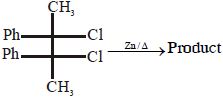
A
The product is $Ph-C(Me)=C(Ph)-Me$ (trans-isomer).
B
The product is $Ph-C(Me)=C(Me)-Ph$ (cis-isomer).
C
The product is $Ph-C(Ph)=C(Me)-Me$.
D
None of these.
Solution
(A) The reaction of a vicinal dihalide with $Zn$ dust in the presence of heat $(\Delta)$ is a dehalogenation reaction that leads to the formation of an alkene.
In the given reactant,the two $Cl$ atoms are on adjacent carbons. The stereochemistry of the starting material is such that the two $Ph$ groups are on the same side (cis-like) and the two $Me$ groups are on the same side (cis-like) relative to the $C-C$ bond.
When $Zn$ removes the two $Cl$ atoms,the $C-C$ bond rotates to form the most stable alkene product.
The product formed is $1,2-diphenyl-1,2-dimethylethene$. Given the steric hindrance between the two bulky $Ph$ groups,the trans-isomer ($Ph$ groups on opposite sides) is more stable than the cis-isomer.
Therefore,the major product is the trans-isomer: $Ph-C(Me)=C(Ph)-Me$.
In the given reactant,the two $Cl$ atoms are on adjacent carbons. The stereochemistry of the starting material is such that the two $Ph$ groups are on the same side (cis-like) and the two $Me$ groups are on the same side (cis-like) relative to the $C-C$ bond.
When $Zn$ removes the two $Cl$ atoms,the $C-C$ bond rotates to form the most stable alkene product.
The product formed is $1,2-diphenyl-1,2-dimethylethene$. Given the steric hindrance between the two bulky $Ph$ groups,the trans-isomer ($Ph$ groups on opposite sides) is more stable than the cis-isomer.
Therefore,the major product is the trans-isomer: $Ph-C(Me)=C(Ph)-Me$.
0 likes
View Solution612
MediumMCQ
Number of structural isomeric alkenes (molecular formula $= C_6H_{12}$) which all give $n$-hexane on hydrogenation in the presence of a metal catalyst.
A
$2$
B
$3$
C
$4$
D
$5$
Solution
(B) The molecular formula $C_6H_{12}$ corresponds to an alkene with one double bond. For an alkene to yield $n$-hexane $(CH_3-CH_2-CH_2-CH_2-CH_2-CH_3)$ upon hydrogenation,the carbon skeleton must be a straight chain of $6$ carbons.
Possible structural isomers of hexene with a straight chain are:
$1$. $Hex-1-ene$ $(CH_2=CH-CH_2-CH_2-CH_2-CH_3)$
$2$. $Hex-2-ene$ $(CH_3-CH=CH-CH_2-CH_2-CH_3)$
$3$. $Hex-3-ene$ $(CH_3-CH_2-CH=CH-CH_2-CH_3)$
All these three structural isomers have a straight chain of $6$ carbon atoms and will produce $n$-hexane upon hydrogenation.
Therefore,the total number of such structural isomers is $3$.
Possible structural isomers of hexene with a straight chain are:
$1$. $Hex-1-ene$ $(CH_2=CH-CH_2-CH_2-CH_2-CH_3)$
$2$. $Hex-2-ene$ $(CH_3-CH=CH-CH_2-CH_2-CH_3)$
$3$. $Hex-3-ene$ $(CH_3-CH_2-CH=CH-CH_2-CH_3)$
All these three structural isomers have a straight chain of $6$ carbon atoms and will produce $n$-hexane upon hydrogenation.
Therefore,the total number of such structural isomers is $3$.
0 likes
View Solution613
DifficultMCQ
Ozonolysis of an organic compound $A$ produces acetone and propionaldehyde in an equimolar mixture. Identify $A$ from the following compounds:
A
$2-$methyl$-1-$pentene
B
$1-$pentene
C
$2-$pentene
D
$2-$Methyl$-2-$pentene
Solution
(D) Ozonolysis of an alkene involves the cleavage of the $C=C$ double bond to form carbonyl compounds.
Acetone is $CH_3COCH_3$ and propionaldehyde (propanal) is $CH_3CH_2CHO$.
Combining these fragments by removing the oxygen atoms and joining the carbonyl carbons with a double bond gives:
$CH_3CH_2CH=C(CH_3)_2$.
This structure is $2-$methylpent$-2-$ene.
The reaction is:
$CH_3CH_2CH=C(CH_3)_2 + O_3$ $\rightarrow \text{ozonide}$ $\xrightarrow{Zn/H_2O} CH_3CH_2CHO + CH_3COCH_3$.
Acetone is $CH_3COCH_3$ and propionaldehyde (propanal) is $CH_3CH_2CHO$.
Combining these fragments by removing the oxygen atoms and joining the carbonyl carbons with a double bond gives:
$CH_3CH_2CH=C(CH_3)_2$.
This structure is $2-$methylpent$-2-$ene.
The reaction is:
$CH_3CH_2CH=C(CH_3)_2 + O_3$ $\rightarrow \text{ozonide}$ $\xrightarrow{Zn/H_2O} CH_3CH_2CHO + CH_3COCH_3$.
0 likes
View Solution614
DifficultMCQ
In the reaction
$CH_3-CH=CH_2$ $\xrightarrow{Cl_2/500\,^{\circ}C} A$ $\xrightarrow{Na/\text{dry ether}} B$
$B$ is
$CH_3-CH=CH_2$ $\xrightarrow{Cl_2/500\,^{\circ}C} A$ $\xrightarrow{Na/\text{dry ether}} B$
$B$ is
A
$CH_3CH=CH-OH$
B
$HOCH_2CH=CH_2$
C
$CH_2=CH-CH_2-CH_2-CH=CH_2$
D
Cyclohexene
Solution
(C) $1$. The reaction of propene with $Cl_2$ at $500\,^{\circ}C$ is an allylic substitution reaction (Wurtz-like conditions for radical substitution).
$2$. $CH_3-CH=CH_2 + Cl_2 \xrightarrow{500\,^{\circ}C} CH_2Cl-CH=CH_2 + HCl$. Thus,$A$ is allyl chloride $(CH_2Cl-CH=CH_2)$.
$3$. The reaction of allyl chloride with $Na$ in dry ether is a Wurtz coupling reaction.
$4$. $2 CH_2=CH-CH_2Cl + 2Na \xrightarrow{\text{dry ether}} CH_2=CH-CH_2-CH_2-CH=CH_2 + 2NaCl$.
$5$. The product $B$ is $1,5$-hexadiene.
$2$. $CH_3-CH=CH_2 + Cl_2 \xrightarrow{500\,^{\circ}C} CH_2Cl-CH=CH_2 + HCl$. Thus,$A$ is allyl chloride $(CH_2Cl-CH=CH_2)$.
$3$. The reaction of allyl chloride with $Na$ in dry ether is a Wurtz coupling reaction.
$4$. $2 CH_2=CH-CH_2Cl + 2Na \xrightarrow{\text{dry ether}} CH_2=CH-CH_2-CH_2-CH=CH_2 + 2NaCl$.
$5$. The product $B$ is $1,5$-hexadiene.
0 likes
View Solution615
DifficultMCQ
The major product in the reaction is
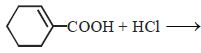
A
Cyclohexanecarboxylic acid
B
$1-$chlorocyclohexanecarboxylic acid
C
Cyclohexanecarbonyl chloride
D
$2-$chlorocyclohexanecarboxylic acid
Solution
(D) The reaction is the electrophilic addition of $HCl$ to cyclohex$-1-$ene$-1-$carboxylic acid. The $-COOH$ group is an electron-withdrawing group ($-I$ and $-M$ effect). Due to this,the double bond is polarized. The addition of $HCl$ follows the anti-Markovnikov rule in this specific case due to the electronic effects of the substituent,leading to the formation of $2$-chlorocyclohexanecarboxylic acid as the major product.
0 likes
View Solution616
MediumMCQ
The product of the following reaction is:
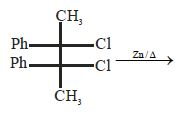
A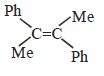
B
C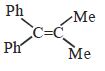
D
None
Solution
(A) The reaction is a dehalogenation of a vicinal dihalide using zinc dust $(Zn/\Delta)$.
This reaction proceeds via an anti-elimination mechanism.
In the given reactant,the two chlorine atoms are on adjacent carbons.
Looking at the Fischer projection or the given structure,the two $Ph$ groups are on the same side and the two $Me$ groups are on the same side (erythro-like configuration).
Upon anti-elimination of $Cl_2$ by $Zn$,the groups that are anti to each other will end up on opposite sides of the resulting double bond.
Specifically,the $Ph$ group on one carbon and the $Me$ group on the other carbon are anti to each other,and the $Ph$ group on the other carbon and the $Me$ group on the first carbon are anti to each other.
Therefore,the resulting alkene will have the $Ph$ and $Me$ groups on opposite sides,forming the trans-isomer (or the $E$-isomer).
This corresponds to the structure where $Ph$ and $Me$ are trans to each other across the $C=C$ bond.
This reaction proceeds via an anti-elimination mechanism.
In the given reactant,the two chlorine atoms are on adjacent carbons.
Looking at the Fischer projection or the given structure,the two $Ph$ groups are on the same side and the two $Me$ groups are on the same side (erythro-like configuration).
Upon anti-elimination of $Cl_2$ by $Zn$,the groups that are anti to each other will end up on opposite sides of the resulting double bond.
Specifically,the $Ph$ group on one carbon and the $Me$ group on the other carbon are anti to each other,and the $Ph$ group on the other carbon and the $Me$ group on the first carbon are anti to each other.
Therefore,the resulting alkene will have the $Ph$ and $Me$ groups on opposite sides,forming the trans-isomer (or the $E$-isomer).
This corresponds to the structure where $Ph$ and $Me$ are trans to each other across the $C=C$ bond.
0 likes
View Solution617
MediumMCQ
${\text{Glycerol}}$ $\xrightarrow{KHSO_4} (A)$ $\xrightarrow{LiAlH_4} (B)$; $(A)$ and $(B)$ are respectively:
A
acrolein,allyl alcohol
B
glyceryl sulphate,acrylic acid
C
allyl alcohol,acrolein
D
none
Solution
(A) When glycerol is heated with potassium bisulphate $(KHSO_4)$,it undergoes dehydration to form acrolein $(CH_2=CH-CHO)$,which is compound $(A)$.
When acrolein $(CH_2=CH-CHO)$ is reduced using lithium aluminium hydride $(LiAlH_4)$,the aldehyde group is reduced to a primary alcohol group,resulting in the formation of allyl alcohol $(CH_2=CH-CH_2OH)$,which is compound $(B)$.
When acrolein $(CH_2=CH-CHO)$ is reduced using lithium aluminium hydride $(LiAlH_4)$,the aldehyde group is reduced to a primary alcohol group,resulting in the formation of allyl alcohol $(CH_2=CH-CH_2OH)$,which is compound $(B)$.
0 likes
View Solution618
DifficultMCQ
$Ph-CH_2-CH(Br)-CH_2-CH_3 \xrightarrow{NaNH_2} (A)$
Total number of elimination products are (includes stereoisomers):
Total number of elimination products are (includes stereoisomers):
A
$2$
B
$4$
C
$6$
D
$8$
Solution
(B) The reaction is a dehydrohalogenation ($E2$ elimination) using a strong base $NaNH_2$.
The reactant is $Ph-CH_2-CH(Br)-CH_2-CH_3$.
There are two types of $\beta$-hydrogens available for elimination:
$1.$ Elimination involving $\beta$-hydrogen from the $CH_2$ group adjacent to the phenyl ring $(C1)$ gives $Ph-CH=CH-CH_2-CH_3$ ($1$-phenylbut-$1$-ene). This alkene can exist as two stereoisomers: $E$ (trans) and $Z$ (cis).
$2.$ Elimination involving $\beta$-hydrogen from the $CH_2$ group on the other side $(C3)$ gives $Ph-CH_2-CH=CH-CH_3$ ($1$-phenylbut-$2$-ene). This alkene can also exist as two stereoisomers: $E$ (trans) and $Z$ (cis).
Therefore,the total number of elimination products including stereoisomers is $2 + 2 = 4$.
The reactant is $Ph-CH_2-CH(Br)-CH_2-CH_3$.
There are two types of $\beta$-hydrogens available for elimination:
$1.$ Elimination involving $\beta$-hydrogen from the $CH_2$ group adjacent to the phenyl ring $(C1)$ gives $Ph-CH=CH-CH_2-CH_3$ ($1$-phenylbut-$1$-ene). This alkene can exist as two stereoisomers: $E$ (trans) and $Z$ (cis).
$2.$ Elimination involving $\beta$-hydrogen from the $CH_2$ group on the other side $(C3)$ gives $Ph-CH_2-CH=CH-CH_3$ ($1$-phenylbut-$2$-ene). This alkene can also exist as two stereoisomers: $E$ (trans) and $Z$ (cis).
Therefore,the total number of elimination products including stereoisomers is $2 + 2 = 4$.
0 likes
View Solution619
AdvancedMCQ
Which of the following is the major product in the following reaction?
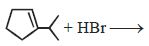
A
$1-$bromo$-2-$isopropylcyclopentane
B
$1-$bromo$-1-$isopropylcyclopentane
C
$3-$bromo$-1-$isopropylcyclopentane
D
$1-$bromo$-1-$methylcyclohexane
Solution
(B) The reaction is an electrophilic addition of $HBr$ to an alkene.
$1$. The proton $(H^+)$ from $HBr$ attacks the double bond to form the most stable carbocation.
$2$. The alkene is $1$-isopropylcyclopentene.
$3$. Protonation at the $C_2$ position (the carbon without the isopropyl group) creates a tertiary carbocation at the $C_1$ position,which is stabilized by the isopropyl group and the ring.
$4$. The bromide ion $(Br^-)$ then attacks this tertiary carbocation to form $1$-bromo-$1$-isopropylcyclopentane.
$5$. This follows Markovnikov's rule,where the nucleophile $(Br^-)$ attaches to the more substituted carbon.
$1$. The proton $(H^+)$ from $HBr$ attacks the double bond to form the most stable carbocation.
$2$. The alkene is $1$-isopropylcyclopentene.
$3$. Protonation at the $C_2$ position (the carbon without the isopropyl group) creates a tertiary carbocation at the $C_1$ position,which is stabilized by the isopropyl group and the ring.
$4$. The bromide ion $(Br^-)$ then attacks this tertiary carbocation to form $1$-bromo-$1$-isopropylcyclopentane.
$5$. This follows Markovnikov's rule,where the nucleophile $(Br^-)$ attaches to the more substituted carbon.
0 likes
View Solution620
MediumMCQ
$CH_3-CH(CH_3)-CH=CH_2 \xrightarrow{DBr} \text{Product (Major)}$. The product will be:
A
$CH_3-C(Br)(CH_3)-CH(D)-CH_3$
B
$CH_3-CH(CH_3)-CH(Br)-CH_2D$
C
$CH_3-C(Br)(CH_3)-CH_2-CH_2D$
D
$Br-CH_2-CH(CH_3)-CH_2D$
Solution
(C) The reaction follows an electrophilic addition mechanism involving a carbocation intermediate.
First,the electrophile $D^+$ adds to the terminal carbon of the double bond in $CH_3-CH(CH_3)-CH=CH_2$ to form a secondary carbocation: $CH_3-CH(CH_3)-C^+H-CH_2D$.
Next,a $1,2$-hydride shift occurs to convert the secondary carbocation into a more stable tertiary carbocation: $CH_3-C^+(CH_3)-CH_2-CH_2D$.
Finally,the nucleophile $Br^-$ attacks the tertiary carbocation to form the major product: $CH_3-C(Br)(CH_3)-CH_2-CH_2D$.
First,the electrophile $D^+$ adds to the terminal carbon of the double bond in $CH_3-CH(CH_3)-CH=CH_2$ to form a secondary carbocation: $CH_3-CH(CH_3)-C^+H-CH_2D$.
Next,a $1,2$-hydride shift occurs to convert the secondary carbocation into a more stable tertiary carbocation: $CH_3-C^+(CH_3)-CH_2-CH_2D$.
Finally,the nucleophile $Br^-$ attacks the tertiary carbocation to form the major product: $CH_3-C(Br)(CH_3)-CH_2-CH_2D$.
0 likes
View Solution621
MediumMCQ
$CH_2=CH-CH_2-CH_3 \xrightarrow{H^{+}/\Delta} \text{Major product}$. Identify the major product in the above reaction.
A
$CH_3-C(CH_3)=CH_2$
B
$CH_3-CH=CH-CH_3$
C
$CH_3-CH_2-CH_2-CH_3$
D
$CH_3-CH_2-CH=CH_2$
Solution
(B) The reaction involves the acid-catalyzed isomerization of $But-1-ene$.
Protonation of $CH_2=CH-CH_2-CH_3$ follows Markovnikov's rule to give a secondary carbocation,$CH_3-C^{+}H-CH_2-CH_3$.
Loss of a proton from the $C3$ carbon leads to the formation of the more stable alkene,$But-2-ene$ $(CH_3-CH=CH-CH_3)$,according to Saytzeff's rule.
$CH_2=CH-CH_2-CH_3$ $\xrightarrow{H^{+}} CH_3-C^{+}H-CH_2-CH_3$ $\xrightarrow{-H^{+}} CH_3-CH=CH-CH_3$.
Protonation of $CH_2=CH-CH_2-CH_3$ follows Markovnikov's rule to give a secondary carbocation,$CH_3-C^{+}H-CH_2-CH_3$.
Loss of a proton from the $C3$ carbon leads to the formation of the more stable alkene,$But-2-ene$ $(CH_3-CH=CH-CH_3)$,according to Saytzeff's rule.
$CH_2=CH-CH_2-CH_3$ $\xrightarrow{H^{+}} CH_3-C^{+}H-CH_2-CH_3$ $\xrightarrow{-H^{+}} CH_3-CH=CH-CH_3$.
0 likes
View Solution622
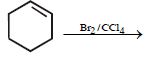
DifficultMCQ
The major product of the following reaction is:
A
trans$-1,2-$dibromocyclohexane
B
cis$-1,2-$dibromocyclohexane
C
$1,1-$dibromocyclohexane
D
$1,3-$dibromocyclohexane
Solution
(A) The reaction of cyclohexene with $Br_2$ in $CCl_4$ is an electrophilic addition reaction.
This reaction proceeds through the formation of a cyclic bromonium ion intermediate.
The bromide ion $(Br^-)$ then attacks the bromonium ion from the side opposite to the bromine bridge,resulting in anti-addition.
Therefore,the product formed is trans$-1,2-$dibromocyclohexane.
This reaction proceeds through the formation of a cyclic bromonium ion intermediate.
The bromide ion $(Br^-)$ then attacks the bromonium ion from the side opposite to the bromine bridge,resulting in anti-addition.
Therefore,the product formed is trans$-1,2-$dibromocyclohexane.
0 likes
View Solution623
DifficultMCQ
$CH_3-C(CH_3)=CH-CH_3 \xrightarrow[KMnO_4/\Delta]{NaIO_4}$ Product will be
A
$CH_3-COOH + CH_3-CH_2-COOH$
B
$CH_3-CHO + CH_3-CH_2-COOH$
C
$CH_3-CHO + CH_3-C(=O)-CH_3$
D
$CH_3-COOH + CH_3-C(=O)-CH_3$
Solution
(D) The reaction of $2$-methylbut-$2$-ene $(CH_3-C(CH_3)=CH-CH_3)$ with $NaIO_4/KMnO_4$ involves the oxidative cleavage of the double bond.
In this process,the $=CH-CH_3$ part is oxidized to ethanoic acid $(CH_3-COOH)$,and the $CH_3-C(CH_3)=$ part is oxidized to propanone $(CH_3-C(=O)-CH_3)$.
Therefore,the products are acetic acid and acetone.
In this process,the $=CH-CH_3$ part is oxidized to ethanoic acid $(CH_3-COOH)$,and the $CH_3-C(CH_3)=$ part is oxidized to propanone $(CH_3-C(=O)-CH_3)$.
Therefore,the products are acetic acid and acetone.
0 likes
View Solution624
DifficultMCQ
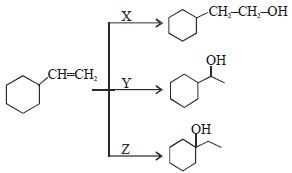
Identify the reactions $X$,$Y$,and $Z$ respectively for the conversion of vinylcyclohexane as shown in the figure.
A
Simple hydration reaction
B
Hydroboration oxidation,hydration and oxymercuration demercuration
C
Hydroboration oxidation,oxymercuration demercuration and hydration
D
Oxymercuration demercuration,hydroboration oxidation and hydration
Solution
(C) $X$ represents Hydroboration-oxidation,which is an anti-Markovnikov addition of water,resulting in the primary alcohol.
$Y$ represents Oxymercuration-demercuration,which is a Markovnikov addition of water without rearrangement,resulting in the secondary alcohol.
$Z$ represents Acid-catalyzed hydration,which is a Markovnikov addition of water that can involve carbocation rearrangement,resulting in the tertiary alcohol.
$Y$ represents Oxymercuration-demercuration,which is a Markovnikov addition of water without rearrangement,resulting in the secondary alcohol.
$Z$ represents Acid-catalyzed hydration,which is a Markovnikov addition of water that can involve carbocation rearrangement,resulting in the tertiary alcohol.
0 likes
View Solution625
MediumMCQ
Identify the major product $X$ in the following reaction:
$C_6H_5-CH_2-CH=CH_2 \xrightarrow{HBr, R_2O_2} X$
$C_6H_5-CH_2-CH=CH_2 \xrightarrow{HBr, R_2O_2} X$
A
$C_6H_5-CH(Br)-CH_2-CH_3$
B
$C_6H_5-CH_2-CH(Br)-CH_3$
C
$C_6H_5-CH_2-CH_2-CH_2Br$
D
$Br-C_6H_4-CH_2-CH_2-CH_3$
Solution
(C) The reaction of an alkene with $HBr$ in the presence of a peroxide $(R_2O_2)$ follows the anti-Markovnikov addition rule.
In this reaction,the electrophile $H^+$ adds to the carbon atom of the double bond that has more hydrogen atoms,and the nucleophile $Br^-$ adds to the other carbon atom.
For the reactant $C_6H_5-CH_2-CH=CH_2$,the double bond is between $C_2$ and $C_3$ of the allyl chain.
The $CH_2$ group has two hydrogen atoms,while the $CH$ group has one.
According to the anti-Markovnikov rule,the $Br$ atom will attach to the terminal $CH_2$ carbon,and the $H$ atom will attach to the $CH$ carbon.
Thus,the major product is $C_6H_5-CH_2-CH_2-CH_2Br$.
In this reaction,the electrophile $H^+$ adds to the carbon atom of the double bond that has more hydrogen atoms,and the nucleophile $Br^-$ adds to the other carbon atom.
For the reactant $C_6H_5-CH_2-CH=CH_2$,the double bond is between $C_2$ and $C_3$ of the allyl chain.
The $CH_2$ group has two hydrogen atoms,while the $CH$ group has one.
According to the anti-Markovnikov rule,the $Br$ atom will attach to the terminal $CH_2$ carbon,and the $H$ atom will attach to the $CH$ carbon.
Thus,the major product is $C_6H_5-CH_2-CH_2-CH_2Br$.
0 likes
View Solution626
MediumMCQ
Predict the major product for the following reaction:
$CH_2=CH-CH_2-I \xrightarrow{HI \text{ (Excess)}} ?$
$CH_2=CH-CH_2-I \xrightarrow{HI \text{ (Excess)}} ?$
A
$CH_3-CHI-CH_2-I$
B
$CH_3-CH_2-CH_2-I$
C
$CH_3-CH_2-CH_2-I_2$
D
$CH_2I-CH_2-CH_2-I$
Solution
(A) The reaction involves the electrophilic addition of $HI$ to the alkene $CH_2=CH-CH_2-I$.
According to Markovnikov's rule,the proton $(H^+)$ adds to the carbon atom with more hydrogen atoms,and the iodide ion $(I^-)$ adds to the more substituted carbon atom.
Step $1$: The double bond attacks the $H^+$ of $HI$ to form the more stable carbocation,$CH_3-CH^+-CH_2-I$.
Step $2$: The iodide ion $(I^-)$ then attacks the carbocation to form $CH_3-CHI-CH_2-I$.
Since $HI$ is in excess,the reaction stops at the geminal diiodide product,$CH_3-CHI-CH_2-I$.
According to Markovnikov's rule,the proton $(H^+)$ adds to the carbon atom with more hydrogen atoms,and the iodide ion $(I^-)$ adds to the more substituted carbon atom.
Step $1$: The double bond attacks the $H^+$ of $HI$ to form the more stable carbocation,$CH_3-CH^+-CH_2-I$.
Step $2$: The iodide ion $(I^-)$ then attacks the carbocation to form $CH_3-CHI-CH_2-I$.
Since $HI$ is in excess,the reaction stops at the geminal diiodide product,$CH_3-CHI-CH_2-I$.
0 likes
View Solution627
MediumMCQ
Arrange the following alkenes in increasing order of their enthalpy of hydrogenation $(-\Delta H)$:
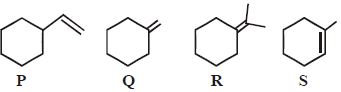
A
$R < S < Q < P$
B
$R < S < P < Q$
C
$P < Q < R < S$
D
$P < Q < S < R$
Solution
(A) The enthalpy of hydrogenation $(-\Delta H)$ is inversely proportional to the stability of the alkene. More substituted alkenes are more stable due to hyperconjugation and inductive effects.
Let's analyze the substitution of the double bond in each alkene:
$P$: Vinylcyclohexane (monosubstituted alkene).
$Q$: Methylenecyclohexane (disubstituted alkene).
$R$: $1-$isopropylidenecyclohexane (tetrasubstituted alkene).
$S$: $1-$methylcyclohexene (trisubstituted alkene).
Stability order: $P < Q < S < R$.
Since enthalpy of hydrogenation is inversely proportional to stability,the increasing order of $(-\Delta H)$ is: $R < S < Q < P$.
Let's analyze the substitution of the double bond in each alkene:
$P$: Vinylcyclohexane (monosubstituted alkene).
$Q$: Methylenecyclohexane (disubstituted alkene).
$R$: $1-$isopropylidenecyclohexane (tetrasubstituted alkene).
$S$: $1-$methylcyclohexene (trisubstituted alkene).
Stability order: $P < Q < S < R$.
Since enthalpy of hydrogenation is inversely proportional to stability,the increasing order of $(-\Delta H)$ is: $R < S < Q < P$.
0 likes
View Solution628
MediumMCQ
How many propenyl radicals are possible from propene?
A
$1$
B
$2$
C
$3$
D
$4$
Solution
(C) Propene $(CH_3-CH=CH_2)$ has three types of hydrogen atoms that can be removed to form a radical:
$1$. Removal of a hydrogen from the terminal $CH_2$ group gives the $CH_3-CH=CH-$ radical (propen$-1-$yl).
$2$. Removal of a hydrogen from the central $CH$ group gives the $CH_3-C^{\bullet}=CH_2$ radical (propen$-2-$yl).
$3$. Removal of a hydrogen from the terminal $CH_3$ group gives the $^{\bullet}CH_2-CH=CH_2$ radical (allyl radical).
Thus,there are $3$ possible propenyl-type radicals.
$1$. Removal of a hydrogen from the terminal $CH_2$ group gives the $CH_3-CH=CH-$ radical (propen$-1-$yl).
$2$. Removal of a hydrogen from the central $CH$ group gives the $CH_3-C^{\bullet}=CH_2$ radical (propen$-2-$yl).
$3$. Removal of a hydrogen from the terminal $CH_3$ group gives the $^{\bullet}CH_2-CH=CH_2$ radical (allyl radical).
Thus,there are $3$ possible propenyl-type radicals.
0 likes
View Solution629
MediumMCQ
Reaction of isobutylene with concentrated $H_2SO_4 + SO_3$ (oleum) gives:
A
$2-$Methylpropane$-2-$sulphonic acid
B
$t-$Butylsulphonic acid
C
Both
D
None
Solution
(C) Isobutylene is $(CH_3)_2C=CH_2$.
When isobutylene reacts with concentrated $H_2SO_4 + SO_3$ (oleum),it undergoes electrophilic addition.
The $SO_3$ acts as the electrophile,attacking the double bond to form a carbocation intermediate.
This leads to the formation of $t-$butylsulphonic acid,which is chemically identical to $2-$methylpropane$-2-$sulphonic acid.
Therefore,both names refer to the same product.
When isobutylene reacts with concentrated $H_2SO_4 + SO_3$ (oleum),it undergoes electrophilic addition.
The $SO_3$ acts as the electrophile,attacking the double bond to form a carbocation intermediate.
This leads to the formation of $t-$butylsulphonic acid,which is chemically identical to $2-$methylpropane$-2-$sulphonic acid.
Therefore,both names refer to the same product.
0 likes
View Solution630
MediumMCQ
The intermediate during the addition of $HCl$ to propene in the presence of peroxide is
A
$CH_3-CH^{\bullet}-CH_2Cl$
B
$CH_3-CH^{+}-CH_3$
C
$CH_3-CH_2-CH_2^+$
D
$CH_3-CH^{\bullet}-CH_3$
Solution
(B) The addition of $HCl$ to propene follows Markovnikov's rule,even in the presence of peroxide,because the peroxide effect (Kharasch effect) is only applicable to $HBr$.
In the reaction,the electrophile $H^+$ attacks the double bond to form the more stable secondary carbocation,$CH_3-CH^{+}-CH_3$.
Since the secondary carbocation is more stable than the primary carbocation $(CH_3-CH_2-CH_2^+)$,it acts as the reaction intermediate.
In the reaction,the electrophile $H^+$ attacks the double bond to form the more stable secondary carbocation,$CH_3-CH^{+}-CH_3$.
Since the secondary carbocation is more stable than the primary carbocation $(CH_3-CH_2-CH_2^+)$,it acts as the reaction intermediate.
0 likes
View Solution631
DifficultMCQ
Ozonolysis of which one of the following compounds produces acetone and $2-$pentanone?
A
$CH_3-CH=C(CH_3)-CH_2-CH_3$
B
$(CH_3)_2C=C(CH_3)-CH_2-CH_2-CH_3$
C
$(CH_3)_2C=C(CH_3)-CH_3$
D
$(CH_3)_2C=CH-CH_3$
Solution
(B) Ozonolysis of an alkene involves the cleavage of the double bond and the addition of an oxygen atom to each carbon atom of the double bond.
The reaction for the given compound is:
$(CH_3)_2C=C(CH_3)-CH_2-CH_2-CH_3 \xrightarrow{O_3, Zn/H_2O} (CH_3)_2C=O + CH_3-CO-CH_2-CH_2-CH_3$.
The products are acetone,$(CH_3)_2C=O$,and $2-$pentanone,$CH_3-CO-CH_2-CH_2-CH_3$.
The reaction for the given compound is:
$(CH_3)_2C=C(CH_3)-CH_2-CH_2-CH_3 \xrightarrow{O_3, Zn/H_2O} (CH_3)_2C=O + CH_3-CO-CH_2-CH_2-CH_3$.
The products are acetone,$(CH_3)_2C=O$,and $2-$pentanone,$CH_3-CO-CH_2-CH_2-CH_3$.
0 likes
View Solution632
MediumMCQ
Propene when heated with chlorine at about $500 \, ^oC$ forms
A
$Cl-CH_2-CH=CH_2$
B
$CH_3-CHCl-CH_2Cl$
C
$CH_2Cl-CHCl-CH_2Cl$
D
All of these
Solution
(A) The reaction of propene with chlorine at high temperature $(500 \, ^oC)$ is an example of allylic substitution.
$CH_3-CH=CH_2 + Cl_2 \xrightarrow{500 \, ^oC} Cl-CH_2-CH=CH_2 + HCl$
In this reaction,the chlorine atom replaces a hydrogen atom at the allylic position (the carbon atom adjacent to the double bond) rather than undergoing addition across the double bond.
$CH_3-CH=CH_2 + Cl_2 \xrightarrow{500 \, ^oC} Cl-CH_2-CH=CH_2 + HCl$
In this reaction,the chlorine atom replaces a hydrogen atom at the allylic position (the carbon atom adjacent to the double bond) rather than undergoing addition across the double bond.
0 likes
View Solution633
AdvancedMCQ
Ozonolysis of which compound gives $OHC-CH_2-CH(CH_3)-CH_2-CHO$?
A
$1,2-dimethylcyclopentene$
B
$1,1-dimethylcyclopentene$
C
$1,2-dimethylcyclopent-1-ene$
D
$3,4-dimethylcyclopentene$
Solution
(A) Ozonolysis of an alkene involves the cleavage of the $C=C$ double bond and the addition of oxygen atoms to each carbon atom to form carbonyl compounds. The given product is $OHC-CH_2-CH(CH_3)-CH_2-CHO$,which is a dialdehyde with a total of $6$ carbon atoms. This indicates that the starting material must be a cyclic alkene with $6$ carbon atoms in the ring,specifically a $1,2-dimethylcyclopentene$ derivative. By analyzing the structure of $1,2-dimethylcyclopentene$,the double bond cleavage results in a linear chain with the given structure. Therefore,the correct compound is $1,2-dimethylcyclopentene$.
0 likes
View Solution634
AdvancedMCQ
Consider the following reaction:
$Alkene (A) \xrightarrow{KMnO_4, \Delta} CH_3CH_2COCH_3 + CH_3CH_2CH_2CH_2COOH$
$A$ is:
$Alkene (A) \xrightarrow{KMnO_4, \Delta} CH_3CH_2COCH_3 + CH_3CH_2CH_2CH_2COOH$
$A$ is:
A
$3-$methylhept$-3-$ene
B
$2-$methylhept$-2-$ene
C
$3-$methylhept$-2-$ene
D
$4-$methylhept$-3-$ene
Solution
(A) The reaction of an alkene with hot alkaline $KMnO_4$ leads to oxidative cleavage of the double bond.
The products formed are $CH_3CH_2COCH_3$ (butanone) and $CH_3CH_2CH_2CH_2COOH$ (pentanoic acid).
To find the structure of the original alkene,we join the carbonyl carbon of the ketone and the carboxyl carbon of the carboxylic acid with a double bond:
$CH_3CH_2-C(CH_3)=CH-CH_2CH_2CH_2CH_3$
This structure corresponds to $3-methylhept-3-ene$.
The products formed are $CH_3CH_2COCH_3$ (butanone) and $CH_3CH_2CH_2CH_2COOH$ (pentanoic acid).
To find the structure of the original alkene,we join the carbonyl carbon of the ketone and the carboxyl carbon of the carboxylic acid with a double bond:
$CH_3CH_2-C(CH_3)=CH-CH_2CH_2CH_2CH_3$
This structure corresponds to $3-methylhept-3-ene$.
0 likes
View Solution635
DifficultMCQ
Which alkene undergoes ozonolysis to produce $2,6-$heptanedione?
A
$1-$methylcyclohexene
B
$3-$methylcyclohexene
C
$1,2-$dimethylcyclopentene
D
$1,2-$dimethylcyclohexene
Solution
(D) Ozonolysis of an alkene involves the cleavage of the $C=C$ double bond to form carbonyl compounds.
For a cyclic alkene,ozonolysis results in an open-chain dicarbonyl compound.
$2,6-$heptanedione is a $7-$carbon chain with ketone groups at positions $2$ and $6$.
The structure is $CH_3-CO-CH_2-CH_2-CH_2-CO-CH_3$.
This indicates that the original alkene was a cyclic compound with a $7-$carbon ring containing a double bond,specifically $1,2-$dimethylcyclohexene,where the double bond is between the carbons bearing the methyl groups. Upon ozonolysis,the $C=C$ bond breaks,and the ring opens to form the $7-$carbon chain with carbonyls at the ends of the original double bond positions.
For a cyclic alkene,ozonolysis results in an open-chain dicarbonyl compound.
$2,6-$heptanedione is a $7-$carbon chain with ketone groups at positions $2$ and $6$.
The structure is $CH_3-CO-CH_2-CH_2-CH_2-CO-CH_3$.
This indicates that the original alkene was a cyclic compound with a $7-$carbon ring containing a double bond,specifically $1,2-$dimethylcyclohexene,where the double bond is between the carbons bearing the methyl groups. Upon ozonolysis,the $C=C$ bond breaks,and the ring opens to form the $7-$carbon chain with carbonyls at the ends of the original double bond positions.
0 likes
View Solution636
MediumMCQ
$Ph-CH=C(CH_3)_2 \xleftarrow{HBr} A$ and $Ph-CH=C(CH_3)_2 \xrightarrow[\text{Peroxide}]{HBr} B$. Identify $A$ and $B$.
A
$A = Ph-CH(Br)-CH(CH_3)_2$ and $B = Ph-CH(Br)-CH(CH_3)_2$
B
$A = Ph-CH(Br)-CH(CH_3)_2$ and $B = Ph-CH_2-C(Br)(CH_3)_2$
C
$A = Ph-CH_2-C(Br)(CH_3)_2$ and $B = Ph-CH(Br)-CH(CH_3)_2$
D
$A = Ph-CH_2-C(Br)(CH_3)_2$ and $B = Ph-CH_2-C(Br)(CH_3)_2$
Solution
(B) The reaction of $Ph-CH=C(CH_3)_2$ with $HBr$ follows Markovnikov's rule. The electrophilic $H^+$ adds to the carbon with more hydrogens,forming a stable benzylic carbocation,which then reacts with $Br^-$ to give $A = Ph-CH(Br)-CH(CH_3)_2$.
In the presence of peroxide,the reaction follows the Anti-Markovnikov rule (Kharasch effect) via a free radical mechanism. The bromine radical adds to the terminal carbon to form a stable benzylic radical,which then abstracts a hydrogen atom to give $B = Ph-CH_2-C(Br)(CH_3)_2$.
In the presence of peroxide,the reaction follows the Anti-Markovnikov rule (Kharasch effect) via a free radical mechanism. The bromine radical adds to the terminal carbon to form a stable benzylic radical,which then abstracts a hydrogen atom to give $B = Ph-CH_2-C(Br)(CH_3)_2$.
0 likes
View Solution637
MediumMCQ
Ethylene reacts with $Br_2$ to give $1,2\text{-dibromoethane}$. The intermediate of the reaction is:
A
$Br^{-}CH_2-C^{+}H_2$
B
C
$Br^{-}CH=C^{+}H$
D
Solution
(B) The reaction of ethylene $(CH_2=CH_2)$ with $Br_2$ follows an electrophilic addition mechanism.
The $\pi$ electrons of the double bond attack the bromine molecule,leading to the formation of a cyclic bromonium ion as a stable intermediate.
This is followed by the nucleophilic attack of the bromide ion $(Br^{-})$ from the opposite side to yield $1,2\text{-dibromoethane}$.
The structure of the cyclic bromonium ion is a three-membered ring containing two carbon atoms and one bromine atom with a positive charge.
The $\pi$ electrons of the double bond attack the bromine molecule,leading to the formation of a cyclic bromonium ion as a stable intermediate.
This is followed by the nucleophilic attack of the bromide ion $(Br^{-})$ from the opposite side to yield $1,2\text{-dibromoethane}$.
The structure of the cyclic bromonium ion is a three-membered ring containing two carbon atoms and one bromine atom with a positive charge.
0 likes
View Solution638
MediumMCQ
Diborane reacts with terminal alkenes to form trialkylboranes. These react with alkaline hydrogen peroxide to form:
A
Primary alcohol
B
Secondary alcohol
C
Tertiary alcohol
D
Isobutyl alcohol
Solution
(A) The reaction of diborane $(B_2H_6)$ with terminal alkenes is known as hydroboration-oxidation.
In the first step,the alkene undergoes hydroboration to form a trialkylborane.
In the second step,the trialkylborane reacts with alkaline hydrogen peroxide $(H_2O_2/OH^-)$ to undergo oxidation.
This process results in the anti-Markovnikov addition of water across the double bond,yielding a primary alcohol as the major product.
In the first step,the alkene undergoes hydroboration to form a trialkylborane.
In the second step,the trialkylborane reacts with alkaline hydrogen peroxide $(H_2O_2/OH^-)$ to undergo oxidation.
This process results in the anti-Markovnikov addition of water across the double bond,yielding a primary alcohol as the major product.
0 likes
View Solution639
MediumMCQ
Identify the wrong statement for the following reactions:
$R-C\equiv C-R \xrightarrow{Pd/BaSO_4} A$
$R-C\equiv C-R \xrightarrow{Na/Liq. NH_3} B$
$R-C\equiv C-R \xrightarrow{Pd/BaSO_4} A$
$R-C\equiv C-R \xrightarrow{Na/Liq. NH_3} B$
A
$\vec{\mu}(A) > \vec{\mu}(B)$
B
Boiling point $(A) >$ boiling point $(B)$
C
Stability $(A) < $ stability $(B)$
D
Melting point $(A) >$ melting point $(B)$
Solution
(D) The reaction of an alkyne with $Pd/BaSO_4$ (Lindlar's catalyst) produces a $cis$-alkene $(A)$.
The reaction of an alkyne with $Na/Liq. NH_3$ (Birch reduction) produces a $trans$-alkene $(B)$.
$1$. Dipole moment: $cis$-alkenes $(A)$ have a non-zero dipole moment,while $trans$-alkenes $(B)$ have a dipole moment of nearly zero. Thus,$\vec{\mu}(A) > \vec{\mu}(B)$ is correct.
$2$. Boiling point: $cis$-alkenes $(A)$ are more polar than $trans$-alkenes $(B)$,so $A$ has a higher boiling point. Thus,boiling point $(A) >$ boiling point $(B)$ is correct.
$3$. Stability: $trans$-alkenes $(B)$ are more stable than $cis$-alkenes $(A)$ due to less steric hindrance. Thus,stability $(A) <$ stability $(B)$ is correct.
$4$. Melting point: $trans$-alkenes $(B)$ have a more symmetrical structure,allowing for better packing in the crystal lattice compared to $cis$-alkenes $(A)$. Therefore,the melting point of $B$ is higher than $A$. The statement melting point $(A) >$ melting point $(B)$ is incorrect.
The reaction of an alkyne with $Na/Liq. NH_3$ (Birch reduction) produces a $trans$-alkene $(B)$.
$1$. Dipole moment: $cis$-alkenes $(A)$ have a non-zero dipole moment,while $trans$-alkenes $(B)$ have a dipole moment of nearly zero. Thus,$\vec{\mu}(A) > \vec{\mu}(B)$ is correct.
$2$. Boiling point: $cis$-alkenes $(A)$ are more polar than $trans$-alkenes $(B)$,so $A$ has a higher boiling point. Thus,boiling point $(A) >$ boiling point $(B)$ is correct.
$3$. Stability: $trans$-alkenes $(B)$ are more stable than $cis$-alkenes $(A)$ due to less steric hindrance. Thus,stability $(A) <$ stability $(B)$ is correct.
$4$. Melting point: $trans$-alkenes $(B)$ have a more symmetrical structure,allowing for better packing in the crystal lattice compared to $cis$-alkenes $(A)$. Therefore,the melting point of $B$ is higher than $A$. The statement melting point $(A) >$ melting point $(B)$ is incorrect.
0 likes
View Solution640
DifficultMCQ
Identify the wrong statement for the following reactions:
$CH_3-CH(CH_3)-CH=CH_2 \xrightarrow{HBr} A$
$CH_3-CH(CH_3)-CH=CH_2 \xrightarrow{HBr + ROOR} B$
$CH_3-CH(CH_3)-CH=CH_2 \xrightarrow{NBS} C$
$CH_3-CH(CH_3)-CH=CH_2 \xrightarrow{HBr} A$
$CH_3-CH(CH_3)-CH=CH_2 \xrightarrow{HBr + ROOR} B$
$CH_3-CH(CH_3)-CH=CH_2 \xrightarrow{NBS} C$
A
$A$ and $C$ both products are $3^\circ$ halides.
B
$A$ and $C$ both products are saturated compounds.
C
$A$ and $B$ are positional isomers.
D
Formation of $B$ and $C$ both follow free radical mechanism.
Solution
(B) Reaction $A$ is an electrophilic addition of $HBr$ to $3$-methyl-$1$-butene,which involves a $1,2$-hydride shift to form a more stable $3^\circ$ carbocation,resulting in $2$-bromo-$2$-methylbutane ($3^\circ$ halide,saturated).
Reaction $B$ is a free radical addition of $HBr$ in the presence of peroxide (Anti-Markovnikov),forming $1$-bromo-$3$-methylbutane ($1^\circ$ halide,saturated).
Reaction $C$ is an allylic bromination using $NBS$,which follows a free radical substitution mechanism to form $3$-bromo-$3$-methyl-$1$-butene ($3^\circ$ halide,unsaturated).
Since $C$ is an unsaturated compound (contains a double bond),statement $(b)$ is incorrect.
Reaction $B$ is a free radical addition of $HBr$ in the presence of peroxide (Anti-Markovnikov),forming $1$-bromo-$3$-methylbutane ($1^\circ$ halide,saturated).
Reaction $C$ is an allylic bromination using $NBS$,which follows a free radical substitution mechanism to form $3$-bromo-$3$-methyl-$1$-butene ($3^\circ$ halide,unsaturated).
Since $C$ is an unsaturated compound (contains a double bond),statement $(b)$ is incorrect.
0 likes
View Solution641
DifficultMCQ
$CH_3-CHCl-CHCl-CH_3$ $\xrightarrow[dry \ ether]{Na} X$ $\xrightarrow[(1) \ BH_3, THF; (2) \ H_2O_2, OH^-_{(aq)}] Y$; $Y$ is:
A
$CH_3-CH_2-CH(OH)-CH_3$
B
$CH_3-CH_2-CH_2-CH_3$
C
$CH_3-CH_2-CH_2-CH_2-OH$
D
$CH_3-CH_2-CH(CH_3)-OH$
Solution
(A) $1$. The reaction of $2,3-dichlorobutane$ with $Na$ in dry ether is a dehalogenation reaction (Wurtz-like elimination),which yields $X = CH_3-CH=CH-CH_3$ $(But-2-ene)$.
$2$. The subsequent hydroboration-oxidation of $But-2-ene$ follows anti-Markovnikov addition of water across the double bond.
$3$. Since $But-2-ene$ is a symmetric alkene,the addition of $OH$ group to either carbon $2$ or $3$ results in the same product,$Y = CH_3-CH_2-CH(OH)-CH_3$ $(Butan-2-ol)$.
$2$. The subsequent hydroboration-oxidation of $But-2-ene$ follows anti-Markovnikov addition of water across the double bond.
$3$. Since $But-2-ene$ is a symmetric alkene,the addition of $OH$ group to either carbon $2$ or $3$ results in the same product,$Y = CH_3-CH_2-CH(OH)-CH_3$ $(Butan-2-ol)$.
0 likes
View Solution642
MediumMCQ
Which alkene is most stable?
A
$2$-methylprop-$1$-ene: $CH_2=C(CH_3)_2$
B
$2$-methylbut-$2$-ene: $(CH_3)_2C=CHCH_3$
C
$2,3$-dimethylbut-$2$-ene: $(CH_3)_2C=C(CH_3)_2$
D
trans-but-$2$-ene: $CH_3CH=CHCH_3$
Solution
(C) The stability of an alkene is directly proportional to the number of alkyl groups attached to the doubly bonded carbon atoms (hyperconjugation effect).
Let us analyze the number of alpha-hydrogens for each option:
$A$) $2$-methylprop-$1$-ene: $6$ $\alpha$-hydrogens.
$B$) $2$-methylbut-$2$-ene: $9$ $\alpha$-hydrogens.
$C$) $2,3$-dimethylbut-$2$-ene: $12$ $\alpha$-hydrogens.
$D$) trans-but-$2$-ene: $6$ $\alpha$-hydrogens.
Since $2,3$-dimethylbut-$2$-ene has the highest number of $\alpha$-hydrogens $(12)$,it is the most stable alkene among the given options.
Let us analyze the number of alpha-hydrogens for each option:
$A$) $2$-methylprop-$1$-ene: $6$ $\alpha$-hydrogens.
$B$) $2$-methylbut-$2$-ene: $9$ $\alpha$-hydrogens.
$C$) $2,3$-dimethylbut-$2$-ene: $12$ $\alpha$-hydrogens.
$D$) trans-but-$2$-ene: $6$ $\alpha$-hydrogens.
Since $2,3$-dimethylbut-$2$-ene has the highest number of $\alpha$-hydrogens $(12)$,it is the most stable alkene among the given options.
0 likes
View Solution643
MediumMCQ
The reaction of $CH_3-CH=C(CH_3)-CH=CH_2$ with $(1) \ O_3$ followed by $(2) \ H_2O, Zn$ gives which products?
A
$CH_3-CH=O, CH_3-CO-CHO, H_2C=O$
B
$CH_3-COOH, CH_3-CO-COOH, HCOOH$
C
$CH_3-COOH, CH_3-COOH, 2HCOOH$
D
$CH_3-COOH, CH_3-CO-COOH, CO_2, H_2O$
Solution
(A) The reaction is reductive ozonolysis of the given alkene,$CH_3-CH=C(CH_3)-CH=CH_2$.
In reductive ozonolysis,the $C=C$ double bonds are cleaved,and each carbon atom of the double bond is converted into a carbonyl group $(C=O)$.
$1$. The first double bond $CH_3-CH=C...$ cleaves to form $CH_3-CHO$ (acetaldehyde) and the fragment $O=C(CH_3)-CH=CH_2$.
$2$. The second double bond $...-C(CH_3)-CH=CH_2$ cleaves to form the fragment $CH_3-CO-CHO$ (methylglyoxal) and $H_2C=O$ (formaldehyde).
Thus,the products are $CH_3-CHO, CH_3-CO-CHO$,and $H_2C=O$.
In reductive ozonolysis,the $C=C$ double bonds are cleaved,and each carbon atom of the double bond is converted into a carbonyl group $(C=O)$.
$1$. The first double bond $CH_3-CH=C...$ cleaves to form $CH_3-CHO$ (acetaldehyde) and the fragment $O=C(CH_3)-CH=CH_2$.
$2$. The second double bond $...-C(CH_3)-CH=CH_2$ cleaves to form the fragment $CH_3-CO-CHO$ (methylglyoxal) and $H_2C=O$ (formaldehyde).
Thus,the products are $CH_3-CHO, CH_3-CO-CHO$,and $H_2C=O$.
0 likes
View Solution644
DifficultMCQ
Reaction of $tert.-$butyl alcohol with hot $Cu$ at $350 \, ^oC$ produces
A
Butanol
B
Butanal
C
$2-$Butene
D
$2-$methyl propene
Solution
(D) When $tert.-$butyl alcohol $((CH_3)_3COH)$ is passed over hot copper $(Cu)$ catalyst at $350 \, ^oC$,it undergoes dehydration rather than dehydrogenation because it lacks an $\alpha-$hydrogen atom required for oxidation to a ketone.
The reaction is: $(CH_3)_3COH \xrightarrow{Cu, 350 \, ^oC} CH_2=C(CH_3)_2 + H_2O$.
The product formed is $2-$methyl propene (isobutylene).
The reaction is: $(CH_3)_3COH \xrightarrow{Cu, 350 \, ^oC} CH_2=C(CH_3)_2 + H_2O$.
The product formed is $2-$methyl propene (isobutylene).
0 likes
View Solution645
DifficultMCQ
Alkene $(x) \xrightarrow[\Delta]{KMnO_4/H^+} \text{Products}$. Identify the alkene $(x)$ from the given products:
A
$3-$methylhept$-2-$ene
B
$2-$methylhept$-2-$ene
C
$2-$methylhept$-3-$ene
D
$6-$methylhept$-2-$ene
Solution
(B) The reaction of an alkene with hot acidic $KMnO_4$ (oxidative cleavage) breaks the double bond.
Each carbon of the double bond is oxidized to a carbonyl compound.
If the carbon is disubstituted $(R_2C=)$,it forms a ketone $(R_2C=O)$.
If the carbon is monosubstituted $(RCH=)$,it forms a carboxylic acid $(RCOOH)$.
The products are butan$-2-$one $(CH_3COCH_2CH_3)$ and $4-$methylpentanoic acid $((CH_3)_2CHCH_2CH_2COOH)$.
By joining the carbonyl carbons of these two products,we reconstruct the original alkene:
$(CH_3)_2CHCH_2CH_2-C(CH_3)=CHCH_2CH_3$.
This corresponds to $2,6-$dimethylhept$-3-$ene,but looking at the provided options,the structure matching the cleavage products is $2-$methylhept$-2-$ene (specifically $2,6-$dimethylhept$-2-$ene structure).
Based on the provided image,the correct alkene is $2,6-$dimethylhept$-2-$ene.
Each carbon of the double bond is oxidized to a carbonyl compound.
If the carbon is disubstituted $(R_2C=)$,it forms a ketone $(R_2C=O)$.
If the carbon is monosubstituted $(RCH=)$,it forms a carboxylic acid $(RCOOH)$.
The products are butan$-2-$one $(CH_3COCH_2CH_3)$ and $4-$methylpentanoic acid $((CH_3)_2CHCH_2CH_2COOH)$.
By joining the carbonyl carbons of these two products,we reconstruct the original alkene:
$(CH_3)_2CHCH_2CH_2-C(CH_3)=CHCH_2CH_3$.
This corresponds to $2,6-$dimethylhept$-3-$ene,but looking at the provided options,the structure matching the cleavage products is $2-$methylhept$-2-$ene (specifically $2,6-$dimethylhept$-2-$ene structure).
Based on the provided image,the correct alkene is $2,6-$dimethylhept$-2-$ene.
0 likes
View Solution646
DifficultMCQ
$But-1-ene \xrightarrow[(ii) NaBH_4]{(i) (CH_3COO)_2Hg/H_2O} ?$
The product in the above reaction is:
The product in the above reaction is:
A
$CH_3-CH_2-CH_2-CH_2-OH$
B
$CH_3-CH_2-CH(OH)-CH_3$
C
$CH_3=CH_2-CH(OH)-CH_3$
D
$CH_3-CH_2=C(OH)-CH_3$
Solution
(B) The given reaction is $Oxymercuration-Demercuration$.
This reaction involves the addition of water across the double bond according to $Markovnikov's$ rule without any carbocation rearrangement.
$CH_3-CH_2-CH=CH_2 \xrightarrow[(ii) NaBH_4]{(i) (CH_3COO)_2Hg/H_2O} CH_3-CH_2-CH(OH)-CH_3$ (Butan-$2$-ol).
This reaction involves the addition of water across the double bond according to $Markovnikov's$ rule without any carbocation rearrangement.
$CH_3-CH_2-CH=CH_2 \xrightarrow[(ii) NaBH_4]{(i) (CH_3COO)_2Hg/H_2O} CH_3-CH_2-CH(OH)-CH_3$ (Butan-$2$-ol).
0 likes
View Solution647
AdvancedMCQ
$CH_3-CH_2-CH_2-Br$ $\xrightarrow{\text{alk. KOH}} A$ $\xrightarrow[(ii) H_2O_2/OH^{-}]{(i) BD_3/THF} B$; $B$ is:
A
$CH_3-CH(OH)-CH_2D$
B
$CH_3-CH(OD)-CH_3$
C
$CH_3-CH(D)-CH_2OH$
D
$CH_3-CH_2-CH_2-OD$
Solution
(C) $CH_3-CH_2-CH_2-Br \xrightarrow{\text{alk. KOH}} CH_3-CH=CH_2$ $(A)$.
$CH_3-CH=CH_2 \xrightarrow[(ii) H_2O_2/OH^{-}]{(i) BD_3/THF} CH_3-CH(D)-CH_2OH$ $(B)$.
Hydroboration-oxidation involves syn-addition.
$D$ from $BD_3$ adds to the less substituted carbon $(C1)$ and $OH$ from $H_2O_2$ adds to the more substituted carbon $(C2)$ is incorrect; actually,in hydroboration-oxidation,$B$ (from $BD_3$) adds to the less substituted carbon $(C1)$ and $H$ (or $D$) adds to the more substituted carbon $(C2)$ following Anti-Markovnikov regioselectivity.
Thus,the product is $CH_3-CH(D)-CH_2OH$.
$CH_3-CH=CH_2 \xrightarrow[(ii) H_2O_2/OH^{-}]{(i) BD_3/THF} CH_3-CH(D)-CH_2OH$ $(B)$.
Hydroboration-oxidation involves syn-addition.
$D$ from $BD_3$ adds to the less substituted carbon $(C1)$ and $OH$ from $H_2O_2$ adds to the more substituted carbon $(C2)$ is incorrect; actually,in hydroboration-oxidation,$B$ (from $BD_3$) adds to the less substituted carbon $(C1)$ and $H$ (or $D$) adds to the more substituted carbon $(C2)$ following Anti-Markovnikov regioselectivity.
Thus,the product is $CH_3-CH(D)-CH_2OH$.
0 likes
View Solution648
MediumMCQ
Which compound on reductive ozonolysis produces at least one mole of $CO_2$?
A
$CH_3-CH=CH-CH=CH-C_6H_5$
B
o-Xylene
C
$CH_2=C=CH_2$
D
$CH_3CH=C(CH_3)_2$
Solution
(C) Reductive ozonolysis of an alkene involves the cleavage of the $C=C$ double bond to form carbonyl compounds ($aldehydes$ or $ketones$).
If the alkene has a terminal $CH_2$ group (i.e.,$R-CH=CH_2$),it produces formaldehyde $(HCHO)$.
If the alkene has a $C=C$ bond where the carbon is bonded to two other groups,it produces ketones.
Specifically,for allene $(CH_2=C=CH_2)$,the central carbon atom is bonded to two double bonds. Upon ozonolysis,the central carbon is oxidized to $CO_2$ because it is bonded to two terminal $CH_2$ groups which become formaldehyde $(HCHO)$.
The reaction is: $CH_2=C=CH_2 + 2O_3$ $\rightarrow \text{ozonide intermediate}$ $\xrightarrow{Zn/H_2O} 2HCHO + CO_2$.
Thus,$CH_2=C=CH_2$ produces $CO_2$.
If the alkene has a terminal $CH_2$ group (i.e.,$R-CH=CH_2$),it produces formaldehyde $(HCHO)$.
If the alkene has a $C=C$ bond where the carbon is bonded to two other groups,it produces ketones.
Specifically,for allene $(CH_2=C=CH_2)$,the central carbon atom is bonded to two double bonds. Upon ozonolysis,the central carbon is oxidized to $CO_2$ because it is bonded to two terminal $CH_2$ groups which become formaldehyde $(HCHO)$.
The reaction is: $CH_2=C=CH_2 + 2O_3$ $\rightarrow \text{ozonide intermediate}$ $\xrightarrow{Zn/H_2O} 2HCHO + CO_2$.
Thus,$CH_2=C=CH_2$ produces $CO_2$.
0 likes
View Solution649
MediumMCQ
Which of the following is most reactive for electrophilic addition reaction?
A
$CH_3-C \equiv CH$
B
$CH_3-CH=CH_2$
C
benzene
D
$CH \equiv CH$
Solution
(B) Electrophilic addition reactions involve the attack of an electrophile on a $\pi$-bond.
Alkenes are generally more reactive than alkynes toward electrophilic addition because the carbocation intermediate formed from an alkene is more stable than the vinylic carbocation formed from an alkyne.
Among the given options,$CH_3-CH=CH_2$ is an alkene,while the others are alkynes or an aromatic ring (benzene),which undergoes electrophilic substitution rather than addition.
Therefore,$CH_3-CH=CH_2$ is the most reactive.
Alkenes are generally more reactive than alkynes toward electrophilic addition because the carbocation intermediate formed from an alkene is more stable than the vinylic carbocation formed from an alkyne.
Among the given options,$CH_3-CH=CH_2$ is an alkene,while the others are alkynes or an aromatic ring (benzene),which undergoes electrophilic substitution rather than addition.
Therefore,$CH_3-CH=CH_2$ is the most reactive.
0 likes
View Solution650
DifficultMCQ
Write the major product of the following reaction: $Ph-CH_2-CH=CH_2 \xrightarrow{HBr, \text{Peroxide}}$
A
$Ph-CH_2-CH_2-CH_2-Br$
B
$Ph-CH_2-CH_2-Br$
C
$Ph-CH(Br)-CH_2-CH_3$
D
$Ph-CH_2-CH(Br)-CH_3$
Solution
(A) The reaction of allylbenzene $(Ph-CH_2-CH=CH_2)$ with $HBr$ in the presence of peroxide follows the Anti-Markovnikov rule via a free radical mechanism (Kharasch effect).
In this mechanism,the bromine radical adds to the terminal carbon atom of the double bond to form a more stable radical intermediate.
This intermediate then abstracts a hydrogen atom from $HBr$ to yield $Ph-CH_2-CH_2-CH_2-Br$ as the major product.
In this mechanism,the bromine radical adds to the terminal carbon atom of the double bond to form a more stable radical intermediate.
This intermediate then abstracts a hydrogen atom from $HBr$ to yield $Ph-CH_2-CH_2-CH_2-Br$ as the major product.
0 likes
View SolutionHydrocarbons — Alkene · Frequently Asked Questions
1Are these Hydrocarbons questions useful for JEE and NEET?
Yes. All questions in this section are mapped to JEE Main and NEET exam patterns. Previous year questions from JEE Main, NEET, GUJCET and state-level exams are included with full solutions.
2Can I switch to Hindi or Gujarati for these questions?
Yes. Use the language tabs in the hero section or the sidebar to view the same questions and solutions in English, Hindi or Gujarati.
3How do I generate a question paper from this subtopic?
Use the Vedclass Exam Paper Generator — select the chapter and subtopic, set difficulty, and generate Sets A, B, C, D automatically. First 3 chapters of every subject are free.
Vedclass Products
For Students
Vedclass Test Series
Mock tests in real JEE/NEET style with performance analysis. 5-day free trial.
Start Free TrialFor Teachers
Exam Paper Generator
Generate Set A/B/C/D papers from this chapter in 2 minutes. 3 chapters free.
Try FreeFor Institutes
Online Exam Module
Live online exams with unlimited students, 360° analytics & white-label branding.
See DemoFor Teachers & Institutes
Generate a Hydrocarbons Exam Paper in 2 Minutes
Select subtopic & difficulty — Sets A, B, C, D auto-generated with No Repeat logic.
First 3 chapters of every subject are free — no payment required.