
A English
Alkene Questions in English
Class 11 Chemistry · Hydrocarbons · Alkene
1080+
Questions
English
Language
100%
With Solutions
Showing 50 of 1080 questions in English
501
MediumMCQ
The major product of the reaction is:
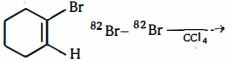
A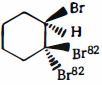
$1$-bromo-$2,2$-dibromo-$^{82}$-cyclohexane
B
$1,2$-dibromo-$^{82}$-$1$-bromocyclohexane
C
$1,2$-dibromo-$^{82}$-$2$-bromocyclohexane
D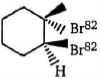
$1,2$-dibromo-$^{82}$-$1$-bromocyclohexane (different stereoisomer)
Solution
(B) The reaction of an alkene with bromine $(Br_2)$ in the presence of $CCl_4$ is a classic electrophilic addition reaction.
This reaction proceeds via the formation of a cyclic bromonium ion intermediate.
The bromide ion $(Br^-)$ then attacks the cyclic bromonium ion from the side opposite to the bromonium bridge, which results in anti-addition.
Given the reactant is $1$-bromocyclohexene and the reagent is $^{82}Br-^{82}Br$, the anti-addition of the two $^{82}Br$ atoms across the double bond leads to the formation of $1$-bromo-$1,2$-bis$(^{82}Br)$cyclohexane with the bromine atoms in a trans configuration.
This reaction proceeds via the formation of a cyclic bromonium ion intermediate.
The bromide ion $(Br^-)$ then attacks the cyclic bromonium ion from the side opposite to the bromonium bridge, which results in anti-addition.
Given the reactant is $1$-bromocyclohexene and the reagent is $^{82}Br-^{82}Br$, the anti-addition of the two $^{82}Br$ atoms across the double bond leads to the formation of $1$-bromo-$1,2$-bis$(^{82}Br)$cyclohexane with the bromine atoms in a trans configuration.
0 likes
View Solution502
MediumMCQ
The stereochemistry of the product formed in the following reaction is:
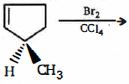
A
Diastereomers
B
Racemic mixture
C
Meso
D
Pure Enantiomers
Solution
(A) The reaction of $3$-methylcyclopentene with $Br_2$ in $CCl_4$ involves the anti-addition of bromine across the double bond.
Since the starting material already contains a chiral center at the $C_3$ position,the addition of $Br_2$ creates two new chiral centers at $C_1$ and $C_2$.
The existing chiral center at $C_3$ remains unchanged throughout the reaction.
Because the addition of $Br_2$ can occur from either face of the alkene,and the existing chiral center is fixed,the resulting products are diastereomers of each other.
Since the starting material already contains a chiral center at the $C_3$ position,the addition of $Br_2$ creates two new chiral centers at $C_1$ and $C_2$.
The existing chiral center at $C_3$ remains unchanged throughout the reaction.
Because the addition of $Br_2$ can occur from either face of the alkene,and the existing chiral center is fixed,the resulting products are diastereomers of each other.
0 likes
View Solution503
MediumMCQ
Predict the product$(s)$ obtained for the following reaction:
$3$-methylcyclopentene + $Br_2 / CCl_4 \rightarrow ?$
$3$-methylcyclopentene + $Br_2 / CCl_4 \rightarrow ?$
A
Diastereomers
B
Racemic mixture
C
Meso compound
D
Optically pure enantiomers
Solution
(A) The reaction of $3$-methylcyclopentene with $Br_2$ in $CCl_4$ is an electrophilic addition reaction.
The $Br_2$ adds across the double bond via a cyclic bromonium ion intermediate.
Since the starting material ($3$-methylcyclopentene) is chiral,the addition of $Br_2$ creates two new chiral centers at the carbons of the double bond.
This results in the formation of a mixture of diastereomers,as the relative stereochemistry of the new bromine atoms with respect to the existing methyl group can vary.
However,in the context of standard multiple-choice questions regarding this specific substrate,the product is a mixture of diastereomers,which are not enantiomers of each other.
The $Br_2$ adds across the double bond via a cyclic bromonium ion intermediate.
Since the starting material ($3$-methylcyclopentene) is chiral,the addition of $Br_2$ creates two new chiral centers at the carbons of the double bond.
This results in the formation of a mixture of diastereomers,as the relative stereochemistry of the new bromine atoms with respect to the existing methyl group can vary.
However,in the context of standard multiple-choice questions regarding this specific substrate,the product is a mixture of diastereomers,which are not enantiomers of each other.
0 likes
View Solution504
MediumMCQ
$CH_3-CH_2-CH_2-CH_2-C(CH_3)_2-CH_2-OH \xrightarrow[\Delta]{H^{+}} (A) \text{ (major)}$. Product $(A)$ is
A
$CH_3-CH_2-CH_2-CH_2-C(CH_3)=CH-CH_3$
B
$CH_3-CH_2-CH_2-CH_2-C(=CH_2)-CH_2-CH_3$
C
$CH_3-CH_2-CH_2-CH_2-CH=C(CH_3)_2$
D
$CH_3-CH_2-CH(CH_3)-CH_2-C(=CH_2)-CH_3$
Solution
(C) The reaction is an acid-catalyzed dehydration of an alcohol. The mechanism involves the following steps:
$1$. Protonation of the hydroxyl group to form a good leaving group $(-OH_2^+)$.
$2$. Loss of water to form a primary carbocation: $CH_3-CH_2-CH_2-CH_2-C(CH_3)_2-CH_2^+$.
$3$. Rearrangement: To form a more stable carbocation,an $n$-butyl shift occurs,resulting in a tertiary carbocation: $(CH_3)_2C^+-CH_2-CH_2-CH_2-CH_2-CH_3$.
$4$. Elimination: Loss of a proton from the adjacent carbon leads to the formation of the most stable alkene (major product) according to Saytzeff's rule.
$5$. The major product is $CH_3-CH_2-CH_2-CH_2-CH=C(CH_3)_2$.
$1$. Protonation of the hydroxyl group to form a good leaving group $(-OH_2^+)$.
$2$. Loss of water to form a primary carbocation: $CH_3-CH_2-CH_2-CH_2-C(CH_3)_2-CH_2^+$.
$3$. Rearrangement: To form a more stable carbocation,an $n$-butyl shift occurs,resulting in a tertiary carbocation: $(CH_3)_2C^+-CH_2-CH_2-CH_2-CH_2-CH_3$.
$4$. Elimination: Loss of a proton from the adjacent carbon leads to the formation of the most stable alkene (major product) according to Saytzeff's rule.
$5$. The major product is $CH_3-CH_2-CH_2-CH_2-CH=C(CH_3)_2$.
0 likes
View Solution505
MediumMCQ
$CH_3-CH=CH-CH_3 \xrightarrow[R_2O_2, \Delta]{HBr} \text{ (Anti-Markownikoff's addition)}$
Comment on the optical activity of the products.
Comment on the optical activity of the products.
A
Racemic
B
Diastereomer
C
Meso
D
Optically pure enantiomer
Solution
(A) The reaction proceeds via a free radical mechanism.
In the first step,the bromine radical $(Br^{\bullet})$ attacks the $sp^2$-hybridized carbon atom of the symmetric alkene $CH_3-CH=CH-CH_3$.
This attack results in the formation of a planar radical intermediate,$CH_3-\dot{C}H-CH(Br)-CH_3$.
In the subsequent step,the hydrogen atom from $HBr$ can attack either face of the planar radical with equal probability.
This leads to the formation of both enantiomers of $2-bromobutane$ in equal amounts,resulting in a racemic mixture.
In the first step,the bromine radical $(Br^{\bullet})$ attacks the $sp^2$-hybridized carbon atom of the symmetric alkene $CH_3-CH=CH-CH_3$.
This attack results in the formation of a planar radical intermediate,$CH_3-\dot{C}H-CH(Br)-CH_3$.
In the subsequent step,the hydrogen atom from $HBr$ can attack either face of the planar radical with equal probability.
This leads to the formation of both enantiomers of $2-bromobutane$ in equal amounts,resulting in a racemic mixture.
0 likes
View Solution506
MediumMCQ
Alkene $(A)$ will be:
$\mathop A\limits_{(\text{alkene})} \xrightarrow{RCO_3H, H_2O} \text{Racemic mixture}$
$\mathop A\limits_{(\text{alkene})} \xrightarrow{\text{Cold dil. } KMnO_4} \text{Meso-compound}$
$\mathop A\limits_{(\text{alkene})} \xrightarrow{RCO_3H, H_2O} \text{Racemic mixture}$
$\mathop A\limits_{(\text{alkene})} \xrightarrow{\text{Cold dil. } KMnO_4} \text{Meso-compound}$
A
$cis-2-\text{pentene}$
B
$cis-2-\text{hexene}$
C
$cis-4-\text{octene}$
D
$trans-2-\text{hexene}$
Solution
(C) The reaction with $RCO_3H$ followed by $H_2O$ involves anti-dihydroxylation,which produces a racemic mixture from a $cis$-alkene.
The reaction with cold dilute $KMnO_4$ involves syn-dihydroxylation,which produces a meso-compound from a $cis$-alkene.
For the product to be a meso-compound via syn-addition,the alkene must be symmetrical.
$cis-4-\text{octene}$ is a symmetrical alkene $(CH_3CH_2CH_2CH=CHCH_2CH_2CH_3)$.
Therefore,$cis-4-\text{octene}$ satisfies both conditions.
The reaction with cold dilute $KMnO_4$ involves syn-dihydroxylation,which produces a meso-compound from a $cis$-alkene.
For the product to be a meso-compound via syn-addition,the alkene must be symmetrical.
$cis-4-\text{octene}$ is a symmetrical alkene $(CH_3CH_2CH_2CH=CHCH_2CH_2CH_3)$.
Therefore,$cis-4-\text{octene}$ satisfies both conditions.
0 likes
View Solution507
MediumMCQ
The product $(A)$ is:
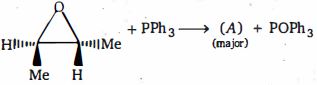
A
$trans-2-butene$
B
$cis-2-butene$
C
$1-butene$
D
$Iso-butene$
Solution
(B) The reaction of an epoxide with triphenylphosphine $(PPh_3)$ is a stereospecific deoxygenation reaction.
When $trans-2,3-epoxybutane$ reacts with $PPh_3$,the reaction proceeds with retention of configuration,leading to the formation of $cis-2-butene$ as the major product.
This occurs because the ring-opening and subsequent elimination of triphenylphosphine oxide $(O=PPh_3)$ involves a concerted mechanism that preserves the relative orientation of the substituents on the double bond.
When $trans-2,3-epoxybutane$ reacts with $PPh_3$,the reaction proceeds with retention of configuration,leading to the formation of $cis-2-butene$ as the major product.
This occurs because the ring-opening and subsequent elimination of triphenylphosphine oxide $(O=PPh_3)$ involves a concerted mechanism that preserves the relative orientation of the substituents on the double bond.
0 likes
View Solution508
MediumMCQ
The product $(A)$ of the given alkoxymercuration-demercuration reaction is:
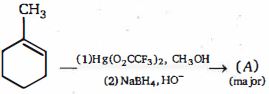
A
$1-$methoxy$-1-$methylcyclohexane
B
$2-$methoxy$-1-$methylcyclohexane
C
$1-$methylcyclohexanol
D
$1-$methoxy$-2-$methylcyclohexane
Solution
(A) The reaction is an alkoxymercuration-demercuration of $1$-methylcyclohexene.
This reaction proceeds via the formation of a mercurinium ion intermediate,followed by the nucleophilic attack of the alcohol $(CH_3OH)$ at the more substituted carbon atom (Markovnikov addition).
Finally,demercuration with $NaBH_4$ replaces the mercury group with a hydrogen atom.
Thus,the methoxy group $(-OCH_3)$ attaches to the more substituted carbon (the carbon already bearing the methyl group),resulting in $1$-methoxy-$1$-methylcyclohexane.
This reaction proceeds via the formation of a mercurinium ion intermediate,followed by the nucleophilic attack of the alcohol $(CH_3OH)$ at the more substituted carbon atom (Markovnikov addition).
Finally,demercuration with $NaBH_4$ replaces the mercury group with a hydrogen atom.
Thus,the methoxy group $(-OCH_3)$ attaches to the more substituted carbon (the carbon already bearing the methyl group),resulting in $1$-methoxy-$1$-methylcyclohexane.
0 likes
View Solution509
MediumMCQ
Major product of the given reaction is $CH_2=CH-CH_2-I \xrightarrow[CCl_4]{HI(excess)}$
A
$CH_3-CHI-CH_2-I$
B
$CH_3-CHI-CH_3$
C
$CH_3-CH_2-CH_2-I$
D
$I-CH_2-CH_2-CH_2-I$
Solution
(B) The reaction of allyl iodide with excess $HI$ proceeds as follows:
$CH_2=CH-CH_2-I + HI \rightarrow CH_3-CHI-CH_2-I$.
Vicinal diiodides are unstable and undergo deiodination to form propene:
$CH_3-CHI-CH_2-I \rightarrow CH_3-CH=CH_2 + I_2$.
Propene then reacts with $HI$ according to Markovnikov's rule to give $2$-iodopropane as the major product:
$CH_3-CH=CH_2 + HI \rightarrow CH_3-CHI-CH_3$.
$CH_2=CH-CH_2-I + HI \rightarrow CH_3-CHI-CH_2-I$.
Vicinal diiodides are unstable and undergo deiodination to form propene:
$CH_3-CHI-CH_2-I \rightarrow CH_3-CH=CH_2 + I_2$.
Propene then reacts with $HI$ according to Markovnikov's rule to give $2$-iodopropane as the major product:
$CH_3-CH=CH_2 + HI \rightarrow CH_3-CHI-CH_3$.
0 likes
View Solution510
MediumMCQ
In the given reaction,only one alkene undergoes preferential oxidation by electrophilic ozone. Identify the product $(P)$ of the given reaction.

A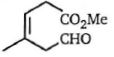
B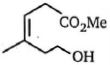
C
$CH_3-C(=O)-CH_2-CH=C(OMe)-CH_2-CHO$
D
$CH_3-CH(OH)-CH_2-CH=C(OMe)-CH_2-CH_2-OH$
Solution
(B) The reaction involves the ozonolysis of a diene. Ozone $(O_3)$ is an electrophile and preferentially attacks the double bond with higher electron density. In the given molecule,the double bond conjugated with the $-OMe$ group has higher electron density due to the $+R$ effect of the methoxy group.
$1$. Ozonolysis $(O_3, Me_2S)$ of this double bond cleaves the ring to form an aldehyde and a ketone group.
$2$. Subsequent treatment with $NaBH_4$ selectively reduces the aldehyde group to a primary alcohol while leaving the ketone (or ester-like carbonyl) unaffected in this specific context,leading to the final product $(P)$ as shown in the solution image.
$1$. Ozonolysis $(O_3, Me_2S)$ of this double bond cleaves the ring to form an aldehyde and a ketone group.
$2$. Subsequent treatment with $NaBH_4$ selectively reduces the aldehyde group to a primary alcohol while leaving the ketone (or ester-like carbonyl) unaffected in this specific context,leading to the final product $(P)$ as shown in the solution image.
0 likes
View Solution511
MediumMCQ
Isobutene,in the presence of $H_2SO_4$,forms a mixture of two isomeric alkenes $(C_8H_{16})$. The major alkene is
A
$CH_3-C(CH_3)_2-CH=C(CH_3)_2$
B
$CH_3-C(CH_3)_2-CH_2-C(CH_3)=CH_2$
C
$CH_3-CH(CH_3)-CH=CH-CH(CH_3)-CH_3$
D
$CH_2=C(CH_3)-CH_2-CH_2-CH(CH_3)-CH_3$
Solution
(B) The dimerization of isobutene in the presence of $H_2SO_4$ proceeds via the formation of a tert-butyl carbocation.
This carbocation attacks another molecule of isobutene to form a larger carbocation intermediate: $(CH_3)_3C-CH_2-C^+(CH_3)_2$.
This intermediate can lose a proton to form two isomeric alkenes.
Due to the steric hindrance caused by the bulky tert-butyl group,the removal of a proton from the terminal methyl group is favored,leading to the formation of the less substituted (Hoffmann) alkene as the major product.
The major product is $2,4,4-trimethylpent-1-ene$,which is represented by the structure $CH_3-C(CH_3)_2-CH_2-C(CH_3)=CH_2$.
This carbocation attacks another molecule of isobutene to form a larger carbocation intermediate: $(CH_3)_3C-CH_2-C^+(CH_3)_2$.
This intermediate can lose a proton to form two isomeric alkenes.
Due to the steric hindrance caused by the bulky tert-butyl group,the removal of a proton from the terminal methyl group is favored,leading to the formation of the less substituted (Hoffmann) alkene as the major product.
The major product is $2,4,4-trimethylpent-1-ene$,which is represented by the structure $CH_3-C(CH_3)_2-CH_2-C(CH_3)=CH_2$.
0 likes
View Solution512
MediumMCQ
An unknown alkene $(A)$ reacts with $3 \ mole$ of $H_2$ gas in the presence of a platinum catalyst to form $1$-isopropyl-$4$-methylcyclohexane. When the unknown alkene $(A)$ is ozonized and reduced,the following products are obtained:
$HCHO$,$OHC-CH_2-CO-CO-CH_3$,and $CH_3-CO-CH_2-CHO$
What is the structure of alkene $(A)$?
$HCHO$,$OHC-CH_2-CO-CO-CH_3$,and $CH_3-CO-CH_2-CHO$
What is the structure of alkene $(A)$?
A
Limonene ($1$-methyl$-4-$(prop$-1-$en$-2-$yl)cyclohex$-1-$ene)
B
$1-$methyl$-4-$(prop$-1-$en$-2-$yl)cyclohex$-1,3-$diene
C
$1-$isopropylidene$-4-$methylcyclohexa$-2,5-$diene
D
$4-$methylene$-1-$(prop$-1-$en$-2-$yl)cyclohex$-1-$ene
Solution
(B) The reaction of alkene $(A)$ with $3 \ mole$ of $H_2$ indicates that $(A)$ contains three degrees of unsaturation (likely three double bonds).
Ozonolysis of $(A)$ yields $HCHO$ (formaldehyde),$OHC-CH_2-CO-CO-CH_3$ (a tri-carbonyl compound),and $CH_3-CO-CH_2-CHO$ (a dicarbonyl compound).
By reconstructing the structure from these fragments,we identify that the alkene $(A)$ is $1$-methyl-$4$-(prop-$1$-en-$2$-yl)cyclohex-$1,3$-diene.
Specifically,the ozonolysis of the double bonds in the ring and the exocyclic double bond accounts for the formation of the observed carbonyl products.
Therefore,the correct structure corresponds to option $(B)$.
Ozonolysis of $(A)$ yields $HCHO$ (formaldehyde),$OHC-CH_2-CO-CO-CH_3$ (a tri-carbonyl compound),and $CH_3-CO-CH_2-CHO$ (a dicarbonyl compound).
By reconstructing the structure from these fragments,we identify that the alkene $(A)$ is $1$-methyl-$4$-(prop-$1$-en-$2$-yl)cyclohex-$1,3$-diene.
Specifically,the ozonolysis of the double bonds in the ring and the exocyclic double bond accounts for the formation of the observed carbonyl products.
Therefore,the correct structure corresponds to option $(B)$.
0 likes
View Solution513
MediumMCQ
The reaction is given as:
$(CH_3)_2C=C(CH_3)_2 + (CH_3)_3N^{+}-O^{-} + H_2O \xrightarrow{OsO_4 (10^{-4} \text{ mole})} A + (CH_3)_3N$
Product $(A)$ is:
$(CH_3)_2C=C(CH_3)_2 + (CH_3)_3N^{+}-O^{-} + H_2O \xrightarrow{OsO_4 (10^{-4} \text{ mole})} A + (CH_3)_3N$
Product $(A)$ is:
A
$2,3-$dimethyl$-2,3-$epoxybutane
B
$CH_3-C(CH_3)(OH)-C(CH_3)(OH)-CH_3$
C
$CH_3-CO-CH_3$
D
$CH_3-CO-C(CH_3)_3$
Solution
(B) The reaction of an alkene with $OsO_4$ in the presence of an amine oxide (like $TMAO$) is a catalytic dihydroxylation reaction.
$OsO_4$ acts as a catalyst to convert the alkene into a vicinal diol (syn-dihydroxylation).
The amine oxide acts as the terminal oxidant to re-oxidize the reduced $Os$ species back to $OsO_4$.
Therefore,$2$,$3$-dimethyl$-2-$butene reacts to form $2,3-$dimethylbutane$-2,3-$diol.
The product $(A)$ is $CH_3-C(CH_3)(OH)-C(CH_3)(OH)-CH_3$.
$OsO_4$ acts as a catalyst to convert the alkene into a vicinal diol (syn-dihydroxylation).
The amine oxide acts as the terminal oxidant to re-oxidize the reduced $Os$ species back to $OsO_4$.
Therefore,$2$,$3$-dimethyl$-2-$butene reacts to form $2,3-$dimethylbutane$-2,3-$diol.
The product $(A)$ is $CH_3-C(CH_3)(OH)-C(CH_3)(OH)-CH_3$.
0 likes
View Solution514
MediumMCQ
Which reaction has the lowest $\Delta G^{\ddagger}$ (Activation Energy)?
A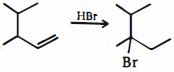
B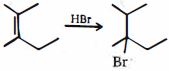
C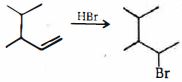
D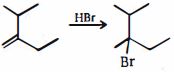
Solution
(B) The activation energy $\Delta G^{\ddagger}$ is inversely related to the stability of the transition state,which is closely related to the stability of the intermediate carbocation formed during the electrophilic addition of $HBr$ to an alkene.
More substituted alkenes generally form more stable carbocations,which lowers the activation energy of the rate-determining step.
Comparing the given alkenes:
$A$: $3,4$-dimethylpent-$1$-ene (monosubstituted alkene)
$B$: $2,3$-dimethylpent-$2$-ene (tetrasubstituted alkene)
$C$: $3,4$-dimethylpent-$2$-ene (disubstituted alkene)
$D$: $2,3$-dimethylbut-$1$-ene (disubstituted alkene)
$2,3$-dimethylpent-$2$-ene is the most substituted alkene among the choices,and its protonation leads to a highly stable tertiary carbocation. Therefore,it has the lowest activation energy $\Delta G^{\ddagger}$.
More substituted alkenes generally form more stable carbocations,which lowers the activation energy of the rate-determining step.
Comparing the given alkenes:
$A$: $3,4$-dimethylpent-$1$-ene (monosubstituted alkene)
$B$: $2,3$-dimethylpent-$2$-ene (tetrasubstituted alkene)
$C$: $3,4$-dimethylpent-$2$-ene (disubstituted alkene)
$D$: $2,3$-dimethylbut-$1$-ene (disubstituted alkene)
$2,3$-dimethylpent-$2$-ene is the most substituted alkene among the choices,and its protonation leads to a highly stable tertiary carbocation. Therefore,it has the lowest activation energy $\Delta G^{\ddagger}$.
0 likes
View Solution515
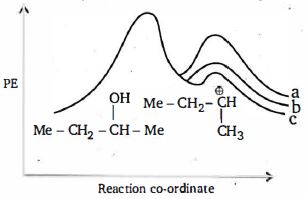
MediumMCQ
The energy profile diagram for the dehydration of $2-$butanol using concentrated $H_2SO_4$ is given below. The product $(b)$ of the above reaction is:
A
$1-$butene
B
$cis-2-$butene
C
$trans-2-$butene
D
$iso-$butene
Solution
(B) The dehydration of $2-$butanol proceeds via the formation of a secondary carbocation.
Elimination of a proton from the carbocation can lead to three different alkenes: $1-$butene,$cis-2-$butene,and $trans-2-$butene.
According to the energy profile diagram,the activation energy for the formation of the products follows the order: $E_a(a) > E_a(b) > E_a(c)$.
Since the stability of the alkenes follows the order: $trans-2-$butene > $cis-2-$butene > $1-$butene,the product with the lowest activation energy corresponds to the most stable alkene,which is $trans-2-$butene (product $c$).
The product with the highest activation energy corresponds to the least stable alkene,which is $1-$butene (product $a$).
Therefore,product $(b)$ corresponds to the intermediate stability alkene,which is $cis-2-$butene.
Elimination of a proton from the carbocation can lead to three different alkenes: $1-$butene,$cis-2-$butene,and $trans-2-$butene.
According to the energy profile diagram,the activation energy for the formation of the products follows the order: $E_a(a) > E_a(b) > E_a(c)$.
Since the stability of the alkenes follows the order: $trans-2-$butene > $cis-2-$butene > $1-$butene,the product with the lowest activation energy corresponds to the most stable alkene,which is $trans-2-$butene (product $c$).
The product with the highest activation energy corresponds to the least stable alkene,which is $1-$butene (product $a$).
Therefore,product $(b)$ corresponds to the intermediate stability alkene,which is $cis-2-$butene.
0 likes
View Solution516
MediumMCQ
How many alkenes on catalytic hydrogenation give isopentane as a product?
A
$2$
B
$3$
C
$4$
D
$5$
Solution
(B) Isopentane is $2$-methylbutane,which has the molecular formula $C_5H_{12}$.
Catalytic hydrogenation of an alkene adds $H_2$ across the double bond,so the starting alkene must have the molecular formula $C_5H_{10}$.
The isomers of $C_5H_{10}$ that yield $2$-methylbutane upon hydrogenation are:
$1$. $3$-methylbut-$1$-ene: $(CH_3)_2CH-CH=CH_2 + H_2 \xrightarrow{Pt} (CH_3)_2CH-CH_2-CH_3$
$2$. $2$-methylbut-$2$-ene: $(CH_3)_2C=CH-CH_3 + H_2 \xrightarrow{Pt} (CH_3)_2CH-CH_2-CH_3$
$3$. $2$-methylbut-$1$-ene: $CH_2=C(CH_3)-CH_2-CH_3 + H_2 \xrightarrow{Pt} CH_3-CH(CH_3)-CH_2-CH_3$
Thus,there are $3$ such alkenes.
Catalytic hydrogenation of an alkene adds $H_2$ across the double bond,so the starting alkene must have the molecular formula $C_5H_{10}$.
The isomers of $C_5H_{10}$ that yield $2$-methylbutane upon hydrogenation are:
$1$. $3$-methylbut-$1$-ene: $(CH_3)_2CH-CH=CH_2 + H_2 \xrightarrow{Pt} (CH_3)_2CH-CH_2-CH_3$
$2$. $2$-methylbut-$2$-ene: $(CH_3)_2C=CH-CH_3 + H_2 \xrightarrow{Pt} (CH_3)_2CH-CH_2-CH_3$
$3$. $2$-methylbut-$1$-ene: $CH_2=C(CH_3)-CH_2-CH_3 + H_2 \xrightarrow{Pt} CH_3-CH(CH_3)-CH_2-CH_3$
Thus,there are $3$ such alkenes.
0 likes
View Solution517
MediumMCQ
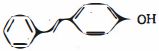
The reaction of $HBr$ with the following compound would produce:
A
$1-$($4$-hydroxyphenyl)$-1-$bromo$-2-$phenylethane
B
$1-$($4$-hydroxyphenyl)$-2-$bromo$-2-$phenylethane
C
$1-$($4$-bromophenyl)$-1-$bromo$-2-$phenylethane
D
$1-$($4$-bromophenyl)$-2-$bromo$-2-$phenylethane
Solution
(A) The reaction of $HBr$ with $4-hydroxystilbene$ $(Ph-CH=CH-C_6H_4-OH)$ follows Markovnikov's rule.
$1$. The double bond attacks the $H^+$ from $HBr$ to form the most stable carbocation.
$2$. The carbocation formed at the benzylic position adjacent to the $4-hydroxyphenyl$ ring is more stable due to resonance stabilization from both the phenyl ring and the lone pair on the oxygen atom of the $-OH$ group.
$3$. The bromide ion $(Br^-)$ then attacks this stable carbocation to form $1-(4-hydroxyphenyl)-1-bromo-2-phenylethane$.
$1$. The double bond attacks the $H^+$ from $HBr$ to form the most stable carbocation.
$2$. The carbocation formed at the benzylic position adjacent to the $4-hydroxyphenyl$ ring is more stable due to resonance stabilization from both the phenyl ring and the lone pair on the oxygen atom of the $-OH$ group.
$3$. The bromide ion $(Br^-)$ then attacks this stable carbocation to form $1-(4-hydroxyphenyl)-1-bromo-2-phenylethane$.
0 likes
View Solution518
MediumMCQ
The reaction shown below is an example of:
$Cyclohexene + Br_2 \rightarrow 1,2-dibromocyclohexane$
$Cyclohexene + Br_2 \rightarrow 1,2-dibromocyclohexane$
A
Nucleophilic addition
B
Nucleophilic substitution
C
Electrophilic addition
D
Electrophilic substitution
Solution
(C) The reaction of an alkene (cyclohexene) with bromine $(Br_2)$ is a classic example of an electrophilic addition reaction.
$1$. The $\pi$ electrons of the double bond in cyclohexene act as a nucleophile and attack the bromine molecule $(Br_2)$,leading to the formation of a cyclic bromonium ion intermediate.
$2$. The bromide ion $(Br^-)$ then attacks the cyclic bromonium ion from the opposite side,resulting in the anti-addition of two bromine atoms across the double bond.
$3$. Since the reaction involves the addition of an electrophile $(Br^+)$ to the double bond,it is classified as an electrophilic addition reaction.
$1$. The $\pi$ electrons of the double bond in cyclohexene act as a nucleophile and attack the bromine molecule $(Br_2)$,leading to the formation of a cyclic bromonium ion intermediate.
$2$. The bromide ion $(Br^-)$ then attacks the cyclic bromonium ion from the opposite side,resulting in the anti-addition of two bromine atoms across the double bond.
$3$. Since the reaction involves the addition of an electrophile $(Br^+)$ to the double bond,it is classified as an electrophilic addition reaction.
0 likes
View Solution519
MediumMCQ
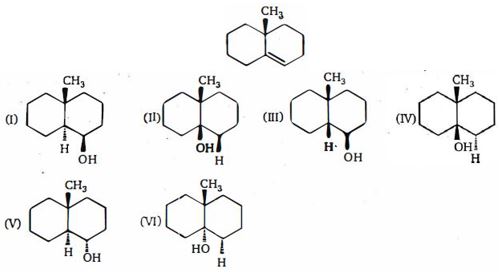
What are the products obtained on hydroboration-oxidation of the given alkene?
A
$I$ and $III$
B
$II$ and $IV$
C
$II$ and $VI$
D
$III$ and $V$
Solution
(C) Hydroboration-oxidation of an alkene is a $syn$-addition reaction where $H$ and $OH$ are added across the double bond in a $syn$ fashion.
In the given bicyclic alkene ($1$-methylcyclohexene derivative),the $CH_3$ group at the bridgehead position sterically hinders the approach of the borane reagent from the top face.
Therefore,the reagent approaches from the less hindered bottom face.
This leads to the addition of $H$ and $OH$ from the same side (bottom face) of the double bond.
Structure $(II)$ shows $OH$ and $H$ on the bottom face (cis to each other),and structure $(VI)$ shows the same configuration relative to the bridgehead $CH_3$ group.
Thus,the products obtained are $(II)$ and $(VI)$.
In the given bicyclic alkene ($1$-methylcyclohexene derivative),the $CH_3$ group at the bridgehead position sterically hinders the approach of the borane reagent from the top face.
Therefore,the reagent approaches from the less hindered bottom face.
This leads to the addition of $H$ and $OH$ from the same side (bottom face) of the double bond.
Structure $(II)$ shows $OH$ and $H$ on the bottom face (cis to each other),and structure $(VI)$ shows the same configuration relative to the bridgehead $CH_3$ group.
Thus,the products obtained are $(II)$ and $(VI)$.
0 likes
View Solution520
MediumMCQ
The major product of the reaction of $2-$butene with cold alkaline $KMnO_4$ is:
A
but$-2-$ene$-2,3-$diol
B
butane$-2,3-$dione
C
butanoic acid
D
butane$-2,3-$diol
Solution
(D) The reaction of an alkene with cold alkaline $KMnO_4$ (Baeyer's reagent) results in the $syn-$hydroxylation of the double bond to form a vicinal diol.
For $2-$butene $(CH_3-CH=CH-CH_3)$,the reaction with cold alkaline $KMnO_4$ adds two hydroxyl groups across the double bond to form butane$-2,3-$diol $(CH_3-CH(OH)-CH(OH)-CH_3)$.
For $2-$butene $(CH_3-CH=CH-CH_3)$,the reaction with cold alkaline $KMnO_4$ adds two hydroxyl groups across the double bond to form butane$-2,3-$diol $(CH_3-CH(OH)-CH(OH)-CH_3)$.
0 likes
View Solution521
MediumMCQ
What is the product of the following reaction?

A
Only $1$
B
Only $2$
C
$1 : 1$ mixture of $2$ and $3$
D
$1 : 1 : 1$ mixture of $1, 2,$ and $3$
Solution
(A) The reaction shown is the syn-dihydroxylation of $cis-2-butene$ using $OsO_4$ as a catalyst.
Syn-addition of $OH$ groups to $cis-2-butene$ results in the formation of a meso compound.
Structure $1$ represents the meso-butane$-2,3-$diol,which is the achiral product formed due to the internal plane of symmetry.
Structures $2$ and $3$ are enantiomers of each other,which would be formed if the addition were anti.
Therefore,the correct product is only $1$.
Syn-addition of $OH$ groups to $cis-2-butene$ results in the formation of a meso compound.
Structure $1$ represents the meso-butane$-2,3-$diol,which is the achiral product formed due to the internal plane of symmetry.
Structures $2$ and $3$ are enantiomers of each other,which would be formed if the addition were anti.
Therefore,the correct product is only $1$.
0 likes
View Solution522
MediumMCQ
The product $(P)$ in the given reaction is:

A
Cyclohexylmethanol
B
$1-$Methylcyclohexanol
C
Cyclohexanone
D
Cyclohexanecarboxylic acid
Solution
(A) The reaction involves the hydroboration-oxidation of methylenecyclohexane.
$(i)$ The first step is the addition of borane $(BH_3)_2$ across the double bond,which follows anti-Markovnikov addition.
(ii) The second step is the oxidation with $H_2O_2$ in the presence of $OH^-$,which replaces the boron atom with a hydroxyl group $(-OH)$.
This process results in the formation of a primary alcohol.
Thus,methylenecyclohexane reacts to form cyclohexylmethanol.
$(i)$ The first step is the addition of borane $(BH_3)_2$ across the double bond,which follows anti-Markovnikov addition.
(ii) The second step is the oxidation with $H_2O_2$ in the presence of $OH^-$,which replaces the boron atom with a hydroxyl group $(-OH)$.
This process results in the formation of a primary alcohol.
Thus,methylenecyclohexane reacts to form cyclohexylmethanol.
0 likes
View Solution523
MediumMCQ
Hydration of $3$-phenylbut$-1$-ene in dil. $H_2SO_4$ will give mainly
A
$3$-Phenylbutan-$1$-ol
B
$3$-Phenylbutan-$2$-ol
C
$2$-Phenylbutan-$2$-ol
D
$2$-Phenylbutan-$1$-ol
Solution
(C) The hydration of $3$-phenylbut$-1$-ene in dilute $H_2SO_4$ proceeds via the formation of a carbocation intermediate.
$1$. Protonation of the double bond occurs to form a $2^{\circ}$ carbocation: $CH_3-CH(C_6H_5)-CH^+-CH_3$.
$2$. This $2^{\circ}$ carbocation undergoes a $1,2$-hydride shift to form a more stable $3^{\circ}$ benzylic carbocation: $CH_3-CH_2-C^+(C_6H_5)-CH_3$.
$3$. Finally,the nucleophilic attack of $H_2O$ on the $3^{\circ}$ carbocation followed by deprotonation yields $2$-phenylbutan-$2$-ol as the major product.
$1$. Protonation of the double bond occurs to form a $2^{\circ}$ carbocation: $CH_3-CH(C_6H_5)-CH^+-CH_3$.
$2$. This $2^{\circ}$ carbocation undergoes a $1,2$-hydride shift to form a more stable $3^{\circ}$ benzylic carbocation: $CH_3-CH_2-C^+(C_6H_5)-CH_3$.
$3$. Finally,the nucleophilic attack of $H_2O$ on the $3^{\circ}$ carbocation followed by deprotonation yields $2$-phenylbutan-$2$-ol as the major product.
0 likes
View Solution524
DifficultMCQ
Reaction $(1): CH_3-CH=CH-CH_3$ $\xrightarrow{\text{Cold } KMnO_4} (A)$ $\xrightarrow{NaIO_4} (B)$ ($2$ moles)
Reaction $(2): CH_3-CH=CH-CH_3 \xrightarrow{KMnO_4/NaIO_4} (C)$ ($2$ moles)
Product $(B)$ and $(C)$ respectively are:
Reaction $(2): CH_3-CH=CH-CH_3 \xrightarrow{KMnO_4/NaIO_4} (C)$ ($2$ moles)
Product $(B)$ and $(C)$ respectively are:
A
$CH_3CHO, CH_3CO_2H$
B
$CH_3CO_2H, CH_3CHO$
C
$CH_3CHO$ in both reactions
D
$CH_3CO_2H$ in both reactions
Solution
(A) In Reaction $(1)$,cold $KMnO_4$ (Baeyer's reagent) converts but$-2-$ene into butane$-2,3-$diol $(A)$ via syn-hydroxylation.
$NaIO_4$ then oxidatively cleaves this vicinal diol to produce $2$ moles of acetaldehyde $(B)$.
$CH_3-CH=CH-CH_3$ $\xrightarrow{\text{Cold } KMnO_4} CH_3-CH(OH)-CH(OH)-CH_3 (A)$ $\xrightarrow{NaIO_4} 2CH_3CHO (B)$.
In Reaction $(2)$,the $KMnO_4/NaIO_4$ reagent (Lemieux-von Rudloff reagent) oxidatively cleaves the alkene directly to form carboxylic acids.
$CH_3-CH=CH-CH_3 \xrightarrow{KMnO_4/NaIO_4} 2CH_3CO_2H (C)$.
Therefore,$(B)$ is $CH_3CHO$ and $(C)$ is $CH_3CO_2H$.
$NaIO_4$ then oxidatively cleaves this vicinal diol to produce $2$ moles of acetaldehyde $(B)$.
$CH_3-CH=CH-CH_3$ $\xrightarrow{\text{Cold } KMnO_4} CH_3-CH(OH)-CH(OH)-CH_3 (A)$ $\xrightarrow{NaIO_4} 2CH_3CHO (B)$.
In Reaction $(2)$,the $KMnO_4/NaIO_4$ reagent (Lemieux-von Rudloff reagent) oxidatively cleaves the alkene directly to form carboxylic acids.
$CH_3-CH=CH-CH_3 \xrightarrow{KMnO_4/NaIO_4} 2CH_3CO_2H (C)$.
Therefore,$(B)$ is $CH_3CHO$ and $(C)$ is $CH_3CO_2H$.
0 likes
View Solution525
DifficultMCQ
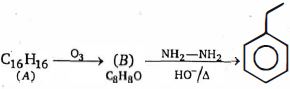
Reactant $(A)$ in this reaction is
A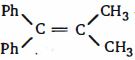
B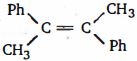
C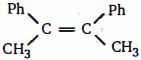
D
both $(b)$ and $(c)$
Solution
(D) The reaction sequence is as follows:
$1$. The final product is ethylbenzene,$Ph-CH_2-CH_3$.
$2$. The second step is the Wolff-Kishner reduction $(NH_2-NH_2, HO^-, \Delta)$,which reduces a carbonyl group $(C=O)$ to a methylene group $(-CH_2-)$.
$3$. Therefore,the intermediate $(B)$ must be acetophenone,$Ph-CO-CH_3$.
$4$. The first step is ozonolysis $(O_3)$ of an alkene $(A)$ to form $(B)$.
$5$. Ozonolysis of an alkene $R_1R_2C=CR_3R_4$ cleaves the double bond to form two carbonyl compounds.
$6$. For the alkene $(A)$ $(C_{16}H_{16})$ to yield two molecules of acetophenone $(Ph-CO-CH_3)$,the structure of $(A)$ must be $Ph-C(CH_3)=C(CH_3)-Ph$.
$7$. This alkene can exist as both $cis$ and $trans$ isomers,both of which will produce acetophenone upon ozonolysis.
$8$. Thus,both $(b)$ and $(c)$ represent the same chemical structure (cis and trans isomers of $2,3-$diphenylbut$-2-$ene).
$1$. The final product is ethylbenzene,$Ph-CH_2-CH_3$.
$2$. The second step is the Wolff-Kishner reduction $(NH_2-NH_2, HO^-, \Delta)$,which reduces a carbonyl group $(C=O)$ to a methylene group $(-CH_2-)$.
$3$. Therefore,the intermediate $(B)$ must be acetophenone,$Ph-CO-CH_3$.
$4$. The first step is ozonolysis $(O_3)$ of an alkene $(A)$ to form $(B)$.
$5$. Ozonolysis of an alkene $R_1R_2C=CR_3R_4$ cleaves the double bond to form two carbonyl compounds.
$6$. For the alkene $(A)$ $(C_{16}H_{16})$ to yield two molecules of acetophenone $(Ph-CO-CH_3)$,the structure of $(A)$ must be $Ph-C(CH_3)=C(CH_3)-Ph$.
$7$. This alkene can exist as both $cis$ and $trans$ isomers,both of which will produce acetophenone upon ozonolysis.
$8$. Thus,both $(b)$ and $(c)$ represent the same chemical structure (cis and trans isomers of $2,3-$diphenylbut$-2-$ene).
0 likes
View Solution526
DifficultMCQ
The presence of unsaturation in organic compounds can be tested with
A
Schiff's reagent
B
Tollens' reagent
C
Fehling's reagent
D
Baeyer's reagent
Solution
(D) Cold dilute alkaline $KMnO_4$ solution is known as Baeyer's reagent.
$(A)$ Schiff's reagent is used to detect the presence of aldehydes.
$(B)$ Tollens' reagent is used to detect the presence of aldehydes.
$(C)$ Fehling's reagent is used to detect the presence of aldehydes.
$(D)$ Baeyer's reagent is used to test for the presence of unsaturation (double or triple bonds) in organic compounds,as it undergoes a color change from purple to brown due to the formation of $MnO_2$.
$(A)$ Schiff's reagent is used to detect the presence of aldehydes.
$(B)$ Tollens' reagent is used to detect the presence of aldehydes.
$(C)$ Fehling's reagent is used to detect the presence of aldehydes.
$(D)$ Baeyer's reagent is used to test for the presence of unsaturation (double or triple bonds) in organic compounds,as it undergoes a color change from purple to brown due to the formation of $MnO_2$.
0 likes
View Solution527
AdvancedMCQ
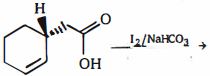
The following reaction was carried out.
The final product formed in the above reaction sequence is
The final product formed in the above reaction sequence is
A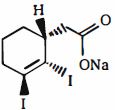
B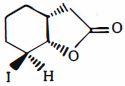
C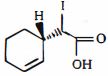
D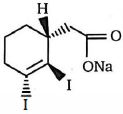
Solution
(C) The reaction of cyclohex$-3-$ene$-1-$carboxylic acid with $I_2$ in the presence of $NaHCO_3$ is an example of iodolactonization.
$1$. The $I_2$ molecule reacts with the double bond to form a cyclic iodonium ion (a non-classical carbocation).
$2$. The carboxylate group $(-COO^-)$,formed by the deprotonation of the carboxylic acid by $NaHCO_3$,acts as an internal nucleophile.
$3$. The carboxylate oxygen attacks the more substituted carbon of the iodonium ion from the opposite side (anti-addition),leading to the formation of a lactone ring.
$4$. This results in the formation of an iodolactone as the final product,which corresponds to structure $C$.
$1$. The $I_2$ molecule reacts with the double bond to form a cyclic iodonium ion (a non-classical carbocation).
$2$. The carboxylate group $(-COO^-)$,formed by the deprotonation of the carboxylic acid by $NaHCO_3$,acts as an internal nucleophile.
$3$. The carboxylate oxygen attacks the more substituted carbon of the iodonium ion from the opposite side (anti-addition),leading to the formation of a lactone ring.
$4$. This results in the formation of an iodolactone as the final product,which corresponds to structure $C$.
0 likes
View Solution528
DifficultMCQ
$CH_2=CH-CH_2-CH_2-C(OH)(CH_2OH)-CH_2-CH_3$ $\xrightarrow[TsOH]{(CH_3)_2CO}$ $(A)$ $\xrightarrow[{(CH_3)_2S}]{O_3}$ $(B) + HCHO$. Product $(B)$ is
A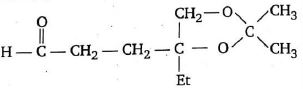
B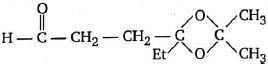
C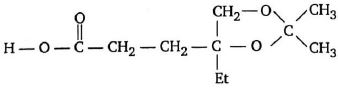
D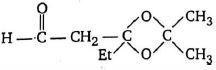
Solution
(A) $1$. The starting material is $CH_2=CH-CH_2-CH_2-C(OH)(CH_2OH)-CH_2-CH_3$.
$2$. Reaction with acetone $((CH_3)_2CO)$ in the presence of $TsOH$ (an acid catalyst) leads to the formation of an acetonide (a cyclic ketal) from the $1,2-$diol moiety. The product $(A)$ is $CH_2=CH-CH_2-CH_2-C(Et)(O-C(CH_3)_2-O-CH_2)$.
$3$. Ozonolysis of the terminal alkene $(CH_2=CH-)$ using $O_3$ followed by reductive workup with $(CH_3)_2S$ cleaves the double bond to form an aldehyde and formaldehyde $(HCHO)$.
$4$. The resulting product $(B)$ is $OHC-CH_2-CH_2-C(Et)(O-C(CH_3)_2-O-CH_2)$,which corresponds to the structure shown in option $A$.
$2$. Reaction with acetone $((CH_3)_2CO)$ in the presence of $TsOH$ (an acid catalyst) leads to the formation of an acetonide (a cyclic ketal) from the $1,2-$diol moiety. The product $(A)$ is $CH_2=CH-CH_2-CH_2-C(Et)(O-C(CH_3)_2-O-CH_2)$.
$3$. Ozonolysis of the terminal alkene $(CH_2=CH-)$ using $O_3$ followed by reductive workup with $(CH_3)_2S$ cleaves the double bond to form an aldehyde and formaldehyde $(HCHO)$.
$4$. The resulting product $(B)$ is $OHC-CH_2-CH_2-C(Et)(O-C(CH_3)_2-O-CH_2)$,which corresponds to the structure shown in option $A$.
0 likes
View Solution529
MediumMCQ
$\underset{C_7H_{14}}{(A)} \xrightarrow[Zn/AcOH]{O_3} (B) + (C)$
Compound $(A)$ exists as geometrical isomers and $(B)$ gives the Cannizzaro reaction. $(A)$ will be:
Compound $(A)$ exists as geometrical isomers and $(B)$ gives the Cannizzaro reaction. $(A)$ will be:
A
$CH_3-CH(CH_3)-C(CH_3)=CH-CH_3$
B
$(CH_3)_3C-CH_2-CH=CH_2$
C
$(CH_3)_3C-CH=CH-CH_3$
D
$(CH_3)_3C-CH_2-CH_2-CH=CH_2$
Solution
(C) The ozonolysis of an alkene $(A)$ with formula $C_7H_{14}$ yields two products $(B)$ and $(C)$.
Given that $(B)$ gives the Cannizzaro reaction,it must be an aldehyde without an $\alpha$-hydrogen atom.
In the structure $(CH_3)_3C-CH=CH-CH_3$,ozonolysis produces $(CH_3)_3C-CHO$ (pivalaldehyde) and $CH_3CHO$ (acetaldehyde).
$(CH_3)_3C-CHO$ has no $\alpha$-hydrogen,so it undergoes the Cannizzaro reaction.
Also,$(CH_3)_3C-CH=CH-CH_3$ exhibits geometrical isomerism due to the restricted rotation around the $C=C$ double bond.
Given that $(B)$ gives the Cannizzaro reaction,it must be an aldehyde without an $\alpha$-hydrogen atom.
In the structure $(CH_3)_3C-CH=CH-CH_3$,ozonolysis produces $(CH_3)_3C-CHO$ (pivalaldehyde) and $CH_3CHO$ (acetaldehyde).
$(CH_3)_3C-CHO$ has no $\alpha$-hydrogen,so it undergoes the Cannizzaro reaction.
Also,$(CH_3)_3C-CH=CH-CH_3$ exhibits geometrical isomerism due to the restricted rotation around the $C=C$ double bond.
0 likes
View Solution530
MediumMCQ
Which of the following alkenes cannot be prepared by the deamination of $n-butylamine$ $(n-BuNH_2)$ with $NaNO_2/HCl$?
A
$1-butene$
B
$cis-2-butene$
C
$trans-2-butene$
D
$Iso-butene$
Solution
(D) The reaction of $n-butylamine$ $(CH_3-CH_2-CH_2-CH_2-NH_2)$ with $NaNO_2/HCl$ produces a diazonium salt,which loses $N_2$ to form a primary carbocation: $CH_3-CH_2-CH_2-CH_2^+$.
This primary carbocation undergoes a $1,2-hydride$ shift to form a more stable secondary carbocation: $CH_3-CH_2-CH^+-CH_3$.
Elimination of a proton from the primary carbocation yields $1-butene$.
Elimination of a proton from the secondary carbocation yields both $cis-2-butene$ and $trans-2-butene$.
$Iso-butene$ $(2-methylpropene)$ cannot be formed because it would require a carbon skeleton rearrangement (branching),which does not occur in this simple $1,2-hydride$ shift.
This primary carbocation undergoes a $1,2-hydride$ shift to form a more stable secondary carbocation: $CH_3-CH_2-CH^+-CH_3$.
Elimination of a proton from the primary carbocation yields $1-butene$.
Elimination of a proton from the secondary carbocation yields both $cis-2-butene$ and $trans-2-butene$.
$Iso-butene$ $(2-methylpropene)$ cannot be formed because it would require a carbon skeleton rearrangement (branching),which does not occur in this simple $1,2-hydride$ shift.
0 likes
View Solution531
AdvancedMCQ
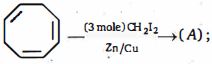
Compound $(A)$ is formed by the reaction of cyclooctatetraene with $(3 \text{ mole})$ of $CH_2I_2$ in the presence of $Zn/Cu$. Identify compound $(A)$.
A
B
C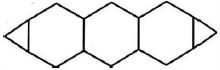
D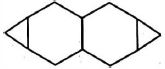
Solution
(A) The reaction of cyclooctatetraene with $CH_2I_2$ in the presence of $Zn/Cu$ is a Simmons-Smith reaction,which is a cyclopropanation reaction.
Cyclooctatetraene has four double bonds.
With $(3 \text{ mole})$ of $CH_2I_2$,three of the four double bonds undergo cyclopropanation.
The resulting structure $(A)$ contains an eight-membered ring with three fused cyclopropane rings,which corresponds to option $(A)$.
Cyclooctatetraene has four double bonds.
With $(3 \text{ mole})$ of $CH_2I_2$,three of the four double bonds undergo cyclopropanation.
The resulting structure $(A)$ contains an eight-membered ring with three fused cyclopropane rings,which corresponds to option $(A)$.
0 likes
View Solution532
DifficultMCQ
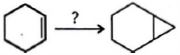
Select the suitable reagent for the conversion shown below:
A
$CH_2N_2 / \Delta$
B
$CBr_4 / RLi$
C
$H_2C = CH_2$
D
$t-BuOK$
Solution
(A) The reaction shows the cyclopropanation of cyclohexene to form bicyclo[$4.1$.$0$]heptane.
This conversion involves the addition of a methylene group $(-CH_2-)$ across the double bond.
$CH_2N_2$ (diazomethane) in the presence of heat $(\Delta)$ or light $(h\nu)$ decomposes to generate a carbene intermediate $(:CH_2)$.
This carbene adds to the alkene to form a cyclopropane ring.
This conversion involves the addition of a methylene group $(-CH_2-)$ across the double bond.
$CH_2N_2$ (diazomethane) in the presence of heat $(\Delta)$ or light $(h\nu)$ decomposes to generate a carbene intermediate $(:CH_2)$.
This carbene adds to the alkene to form a cyclopropane ring.
0 likes
View Solution533
AdvancedMCQ
Product $(A)$ will be

A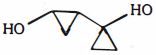
B
C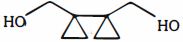
D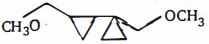
Solution
(C) The reaction is the Simmons-Smith reaction,which involves the cyclopropanation of an alkene using a carbenoid species generated from $CH_2I_2$ and a zinc-copper couple $(Zn(Cu))$.
This reaction is stereospecific and preserves the geometry of the double bond.
The given reactant is a conjugated diene with two hydroxyl groups at the ends.
Each double bond reacts with one equivalent of the carbenoid species to form a cyclopropane ring.
Since $2 \text{ moles}$ of $CH_2I_2$ are used,both double bonds are converted into cyclopropane rings.
The product $(A)$ is the structure where both double bonds of the original diene are replaced by cyclopropane rings,maintaining the original carbon skeleton and the hydroxyl groups at the terminal positions.
This reaction is stereospecific and preserves the geometry of the double bond.
The given reactant is a conjugated diene with two hydroxyl groups at the ends.
Each double bond reacts with one equivalent of the carbenoid species to form a cyclopropane ring.
Since $2 \text{ moles}$ of $CH_2I_2$ are used,both double bonds are converted into cyclopropane rings.
The product $(A)$ is the structure where both double bonds of the original diene are replaced by cyclopropane rings,maintaining the original carbon skeleton and the hydroxyl groups at the terminal positions.
0 likes
View Solution534
DifficultMCQ
The major product formed in the following reaction is:

A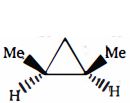
cis$-1,2-$dimethylcyclopropane
B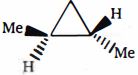
trans$-1,2-$dimethylcyclopropane
C
$50 : 50$ mixture of above two compounds
D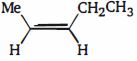
$1-$ethyl$-2-$methylcyclopropane
Solution
(A) The reaction of an alkene with a singlet carbene $(:CH_2)$ is a stereospecific syn-addition reaction.
Since the starting material is cis-but$-2-$ene,the addition of the singlet carbene occurs from the same face of the double bond,preserving the cis-stereochemistry of the methyl groups.
Therefore,the major product formed is cis$-1,2-$dimethylcyclopropane.
Since the starting material is cis-but$-2-$ene,the addition of the singlet carbene occurs from the same face of the double bond,preserving the cis-stereochemistry of the methyl groups.
Therefore,the major product formed is cis$-1,2-$dimethylcyclopropane.
0 likes
View Solution535
AdvancedMCQ
When $2-$butyne is treated with $H_2/$ Lindlar's catalyst,compound $X$ is produced as the major product and when treated with $Na/liq. NH_3$ it produces $Y$ as the major product. Which of the following statements is correct?
A
$Y$ will have higher dipole moment and higher boiling point than $X$
B
$Y$ will have higher dipole moment and lower boiling point than $X$
C
$X$ will have lower dipole moment and lower boiling point than $Y$
D
$X$ will have higher dipole moment and higher boiling point than $Y$
Solution
(D) When $2-$butyne is treated with $H_2/$ Lindlar's catalyst,compound $X$ (cis$-2-$butene) is produced as the major product.
When $2-$butyne is treated with $Na/liq. NH_3$,it produces $Y$ (trans$-2-$butene) as the major product.
Due to the polar nature of the cis isomer,$X$ (cis$-2-$butene) has a higher dipole moment than the trans isomer $Y$ (trans$-2-$butene).
Additionally,the cis isomer has a higher boiling point than the trans isomer due to stronger intermolecular dipole-dipole interactions.
Therefore,$X$ will have a higher dipole moment and higher boiling point than $Y$.
When $2-$butyne is treated with $Na/liq. NH_3$,it produces $Y$ (trans$-2-$butene) as the major product.
Due to the polar nature of the cis isomer,$X$ (cis$-2-$butene) has a higher dipole moment than the trans isomer $Y$ (trans$-2-$butene).
Additionally,the cis isomer has a higher boiling point than the trans isomer due to stronger intermolecular dipole-dipole interactions.
Therefore,$X$ will have a higher dipole moment and higher boiling point than $Y$.
0 likes
View Solution536
DifficultMCQ
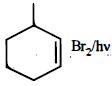
The major product of the following reaction is
A
$3-$bromocyclohex$-1-$ene derivative
B
$1-$bromo$-1-$methylcyclohex$-2-$ene
C
$3-$bromomethylcyclohex$-1-$ene
D
$1,2-$dibromo$-1-$methylcyclohexane
Solution
(B) The reaction of $1$-methylcyclohex-$1$-ene with $Br_2$ in the presence of light $(h\nu)$ is a free radical substitution reaction (allylic bromination).
In this reaction,the bromine radical $(Br^\bullet)$ abstracts a hydrogen atom from the allylic position.
The most stable free radical formed is the tertiary $(3^\circ)$ allylic radical at the $C-1$ position.
This radical then reacts with $Br_2$ to form $1$-bromo-$1$-methylcyclohex-$2$-ene as the major product.
In this reaction,the bromine radical $(Br^\bullet)$ abstracts a hydrogen atom from the allylic position.
The most stable free radical formed is the tertiary $(3^\circ)$ allylic radical at the $C-1$ position.
This radical then reacts with $Br_2$ to form $1$-bromo-$1$-methylcyclohex-$2$-ene as the major product.
0 likes
View Solution537
DifficultMCQ
The hydrocarbon with seven carbon atoms containing a neopentyl and a vinyl group is:
A
$2, 2-$dimethyl$-4-$pentene
B
$4, 4-$dimethyl$-1-$pentene
C
Isopropyl$-2-$butene
D
$2, 2-$dimethyl$-3-$pentene
Solution
(B) neopentyl group is $(CH_3)_3C-CH_2-$ and a vinyl group is $CH_2=CH-$.
Combining these two groups,we get the structure: $CH_2=CH-CH_2-C(CH_3)_3$.
According to $IUPAC$ rules,the numbering of the parent chain starts from the end closer to the double bond.
The longest chain contains $5$ carbon atoms.
Thus,the name is $4, 4-$dimethyl$-1-$pentene.
Combining these two groups,we get the structure: $CH_2=CH-CH_2-C(CH_3)_3$.
According to $IUPAC$ rules,the numbering of the parent chain starts from the end closer to the double bond.
The longest chain contains $5$ carbon atoms.
Thus,the name is $4, 4-$dimethyl$-1-$pentene.
0 likes
View Solution538
DifficultMCQ
Bromination of cyclohexene under the conditions given below yields:
Cyclohexene $\xrightarrow{Br_2/hv}$ ?
Cyclohexene $\xrightarrow{Br_2/hv}$ ?
A
$3-$Bromocyclohexene
B
$1,2-$Dibromocyclohexane
C
trans$-1,2-$Dibromocyclohexane
D
$1-$Bromocyclohexene
Solution
(A) In the presence of sunlight $(hv)$,alkenes undergo free radical substitution at the allylic position.
$1$. The $Br_2$ molecule undergoes homolytic cleavage to form bromine radicals $(Br\cdot)$.
$2$. The bromine radical abstracts an allylic hydrogen atom from cyclohexene to form an allylic radical.
$3$. The allylic radical then reacts with another $Br_2$ molecule to form $3-$bromocyclohexene.
Therefore,the product is $3-$bromocyclohexene.
$1$. The $Br_2$ molecule undergoes homolytic cleavage to form bromine radicals $(Br\cdot)$.
$2$. The bromine radical abstracts an allylic hydrogen atom from cyclohexene to form an allylic radical.
$3$. The allylic radical then reacts with another $Br_2$ molecule to form $3-$bromocyclohexene.
Therefore,the product is $3-$bromocyclohexene.
0 likes
View Solution539
DifficultMCQ
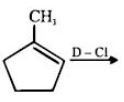
What is the major product expected from the following reaction?
Where $D$ is an isotope of hydrogen.
Where $D$ is an isotope of hydrogen.
A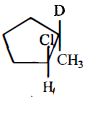
B
C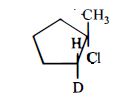
D
Both $(b)$ and $(c)$
Solution
(D) The reaction of $1$-methylcyclopentene with $D-Cl$ proceeds via an electrophilic addition mechanism.
$1$. The electrophile $D^+$ attacks the double bond to form the more stable tertiary carbocation at the $C-1$ position.
$2$. The resulting carbocation is $sp^2$ hybridized and planar.
$3$. The nucleophile $Cl^-$ can attack the planar carbocation from either the top or the bottom face with equal probability.
$4$. This leads to the formation of both possible stereoisomers (diastereomers) where the $Cl$ atom and the $CH_3$ group can be either cis or trans to each other relative to the $D$ atom.
$5$. Therefore,both products shown in $(b)$ and $(c)$ are formed.
$1$. The electrophile $D^+$ attacks the double bond to form the more stable tertiary carbocation at the $C-1$ position.
$2$. The resulting carbocation is $sp^2$ hybridized and planar.
$3$. The nucleophile $Cl^-$ can attack the planar carbocation from either the top or the bottom face with equal probability.
$4$. This leads to the formation of both possible stereoisomers (diastereomers) where the $Cl$ atom and the $CH_3$ group can be either cis or trans to each other relative to the $D$ atom.
$5$. Therefore,both products shown in $(b)$ and $(c)$ are formed.
0 likes
View Solution540
DifficultMCQ
In the hydroboration-oxidation reaction of propene with diborane,$H_2O_2$,and $NaOH$,the organic compound formed is:
A
$CH_3CH_2OH$
B
$CH_3CHOHCH_3$
C
$CH_3CH_2CH_2OH$
D
$(CH_3)_3COH$
Solution
(C) The hydroboration-oxidation of propene follows anti-Markovnikov addition of water across the double bond.
$CH_3CH=CH_2 \xrightarrow{1. B_2H_6, 2. H_2O_2, NaOH} CH_3CH_2CH_2OH$
Thus,the product formed is propan$-1-$ol $(CH_3CH_2CH_2OH)$.
$CH_3CH=CH_2 \xrightarrow{1. B_2H_6, 2. H_2O_2, NaOH} CH_3CH_2CH_2OH$
Thus,the product formed is propan$-1-$ol $(CH_3CH_2CH_2OH)$.
0 likes
View Solution541
DifficultMCQ
The gas liberated at the anode by the electrolysis of a concentrated aqueous solution of dipotassium succinate is:
A
Ethane
B
Ethyne
C
Ethene
D
Propene
Solution
(C) The electrolysis of an aqueous solution of dipotassium succinate is an example of the Kolbe electrolysis reaction.
At the anode,the succinate ion undergoes oxidation to form ethene and carbon dioxide:
$CH_2COO^{-} - CH_2COO^{-} \xrightarrow{-2e^-} CH_2=CH_2 + 2CO_2$
At the cathode,water is reduced to produce hydrogen gas:
$2H_2O + 2e^- \to H_2 + 2OH^-$
Therefore,the gas liberated at the anode is ethene $(CH_2=CH_2)$.
At the anode,the succinate ion undergoes oxidation to form ethene and carbon dioxide:
$CH_2COO^{-} - CH_2COO^{-} \xrightarrow{-2e^-} CH_2=CH_2 + 2CO_2$
At the cathode,water is reduced to produce hydrogen gas:
$2H_2O + 2e^- \to H_2 + 2OH^-$
Therefore,the gas liberated at the anode is ethene $(CH_2=CH_2)$.
0 likes
View Solution542
DifficultMCQ
In the presence of peroxide,$HCl$ and $HI$ do not give anti-Markownikoff's addition to alkenes because
A
One of the steps is endothermic in $HCl$ and $HI$
B
Both $HCl$ and $HI$ are strong acids
C
$HCl$ is oxidizing and $HI$ is reducing
D
All the steps are exothermic in $HCl$ and $HI$
Solution
(A) Anti-Markownikoff addition (peroxide effect) is observed only with $HBr$.
In the mechanism,the addition of the halogen radical to the alkene is exothermic for all hydrogen halides.
However,the step involving the abstraction of a hydrogen atom from the hydrogen halide by the alkyl radical is crucial.
For $HBr$,this step is exothermic,making the overall reaction favorable.
For $HCl$,the $H-Cl$ bond is very strong,making this step endothermic.
For $HI$,the $I-I$ bond formation is exothermic,but the addition of the iodine radical to the alkene is endothermic,making the overall process unfavorable.
Therefore,$HCl$ and $HI$ do not undergo anti-Markownikoff's addition.
In the mechanism,the addition of the halogen radical to the alkene is exothermic for all hydrogen halides.
However,the step involving the abstraction of a hydrogen atom from the hydrogen halide by the alkyl radical is crucial.
For $HBr$,this step is exothermic,making the overall reaction favorable.
For $HCl$,the $H-Cl$ bond is very strong,making this step endothermic.
For $HI$,the $I-I$ bond formation is exothermic,but the addition of the iodine radical to the alkene is endothermic,making the overall process unfavorable.
Therefore,$HCl$ and $HI$ do not undergo anti-Markownikoff's addition.
0 likes
View Solution543
DifficultMCQ
What is the product $X$ in the following reaction?
$C_6H_5-CH_2-CH=CH_2 + HCl \rightarrow X$
$C_6H_5-CH_2-CH=CH_2 + HCl \rightarrow X$
A
$C_6H_5-CH_2-CH(Cl)-CH_3$
B
$C_6H_5-CH_2-CH_2-CH_2Cl$
C
$C_6H_5-CH(Cl)-CH_2-CH_3$
D
$C_6H_5(Cl)CH-CH=CH_2$
Solution
(C) The reaction of $C_6H_5-CH_2-CH=CH_2$ with $HCl$ follows electrophilic addition.
First,the proton $(H^+)$ from $HCl$ adds to the terminal carbon to form the most stable carbocation.
The intermediate formed is a benzylic carbocation,$C_6H_5-CH^+-CH_2-CH_3$,which is highly stable due to resonance with the phenyl ring.
Finally,the chloride ion $(Cl^-)$ attacks this carbocation to form the product $X$,which is $C_6H_5-CH(Cl)-CH_2-CH_3$.
First,the proton $(H^+)$ from $HCl$ adds to the terminal carbon to form the most stable carbocation.
The intermediate formed is a benzylic carbocation,$C_6H_5-CH^+-CH_2-CH_3$,which is highly stable due to resonance with the phenyl ring.
Finally,the chloride ion $(Cl^-)$ attacks this carbocation to form the product $X$,which is $C_6H_5-CH(Cl)-CH_2-CH_3$.
0 likes
View Solution544
DifficultMCQ
The addition of $HI$ in the presence of peroxide catalyst does not follow anti-Markovnikov's rule because
A
$HI$ is a strong reducing agent
B
$H-I$ bond is too strong to be broken homolytically
C
$I$ atom combines with $H$ atom to give back $HI$
D
Iodine atom is not reactive enough to add across a double bond
Solution
(D) The peroxide effect (anti-Markovnikov addition) is observed only with $HBr$.
For $HI$,the $H-I$ bond dissociation energy is low,allowing for homolytic cleavage to form $I^{\bullet}$ radicals.
However,the iodine radical $(I^{\bullet})$ is not reactive enough to add across the double bond of an alkene.
Instead,two iodine radicals recombine to form $I_2$ molecules,thus preventing the chain propagation step required for anti-Markovnikov addition.
For $HI$,the $H-I$ bond dissociation energy is low,allowing for homolytic cleavage to form $I^{\bullet}$ radicals.
However,the iodine radical $(I^{\bullet})$ is not reactive enough to add across the double bond of an alkene.
Instead,two iodine radicals recombine to form $I_2$ molecules,thus preventing the chain propagation step required for anti-Markovnikov addition.
0 likes
View Solution545
DifficultMCQ
$6 \ L$ of an alkene require $27 \ L$ of oxygen at constant temperature and pressure for complete combustion. The alkene is.....
A
Ethene
B
$2-$Butene
C
$1-$Butene
D
Propene
Solution
(D) The general combustion reaction for an alkene $(C_nH_{2n})$ is given by:
$C_nH_{2n} + \frac{3n}{2} O_2 \rightarrow n CO_2 + n H_2O$
According to Avogadro's Law,at constant temperature and pressure,the volume ratio is equal to the stoichiometric coefficient ratio.
Given: Volume of alkene = $6 \ L$,Volume of $O_2$ = $27 \ L$.
Ratio = $\frac{27}{6} = 4.5$.
From the equation,the ratio of $O_2$ to alkene is $\frac{3n}{2}$.
So,$\frac{3n}{2} = 4.5$.
$3n = 9$.
$n = 3$.
The alkene with $n = 3$ is propene $(C_3H_6)$.
$C_nH_{2n} + \frac{3n}{2} O_2 \rightarrow n CO_2 + n H_2O$
According to Avogadro's Law,at constant temperature and pressure,the volume ratio is equal to the stoichiometric coefficient ratio.
Given: Volume of alkene = $6 \ L$,Volume of $O_2$ = $27 \ L$.
Ratio = $\frac{27}{6} = 4.5$.
From the equation,the ratio of $O_2$ to alkene is $\frac{3n}{2}$.
So,$\frac{3n}{2} = 4.5$.
$3n = 9$.
$n = 3$.
The alkene with $n = 3$ is propene $(C_3H_6)$.
0 likes
View Solution546
DifficultMCQ
Consider the following sequence of reactions: $CH_3-CH=CH_2$ $\xrightarrow[700\,K]{Cl_2} A$ $\xrightarrow[420\,K, 12\,atm]{Na_2CO_3} B$ $\xrightarrow[(ii) NaOH]{(i) HOCl} C$. Compound $C$ is:
A
$CH_2(OH)-CH(OH)-CH_2(OH)$
B
$CH_3-CH(OH)-COONa$
C
$HO-CH_2-CH=CH_2$
D
$CH_3-CH(OH)-COCl$
Solution
(A) The reaction sequence is as follows:
$1.$ Allylic chlorination: $CH_3-CH=CH_2 + Cl_2 \xrightarrow{700\,K} Cl-CH_2-CH=CH_2 (A) + HCl$
$2.$ Hydrolysis: $Cl-CH_2-CH=CH_2 \xrightarrow[420\,K, 12\,atm]{Na_2CO_3, H_2O} HO-CH_2-CH=CH_2 (B)$
$3.$ Chlorohydrination and hydrolysis: $HO-CH_2-CH=CH_2$ $\xrightarrow{HOCl} HO-CH_2-CH(OH)-CH_2Cl$ $\xrightarrow{NaOH} HO-CH_2-CH(OH)-CH_2OH (C)$.
Compound $C$ is Glycerol.
$1.$ Allylic chlorination: $CH_3-CH=CH_2 + Cl_2 \xrightarrow{700\,K} Cl-CH_2-CH=CH_2 (A) + HCl$
$2.$ Hydrolysis: $Cl-CH_2-CH=CH_2 \xrightarrow[420\,K, 12\,atm]{Na_2CO_3, H_2O} HO-CH_2-CH=CH_2 (B)$
$3.$ Chlorohydrination and hydrolysis: $HO-CH_2-CH=CH_2$ $\xrightarrow{HOCl} HO-CH_2-CH(OH)-CH_2Cl$ $\xrightarrow{NaOH} HO-CH_2-CH(OH)-CH_2OH (C)$.
Compound $C$ is Glycerol.
0 likes
View Solution547
DifficultMCQ
The major product of the following reaction is:
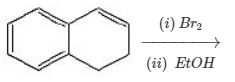
A
$1-$ethoxy$-2-$bromo$-1,2,3,4-$tetrahydronaphthalene
B
$1,2-$dihydronaphthalene
C
$2-$ethoxy$-1-$bromo$-1,2,3,4-$tetrahydronaphthalene
D
$1,2-$diethoxy$-1,2,3,4-$tetrahydronaphthalene
Solution
(A) The reaction of $1,2$-dihydronaphthalene with $Br_2$ proceeds via the formation of a cyclic bromonium ion intermediate.
In the presence of a nucleophilic solvent like ethanol $(EtOH)$,the solvent attacks the more substituted carbon of the bromonium ion to form the major product.
The benzylic position is more stable for the development of partial positive charge,leading to the formation of $1$-ethoxy-$2$-bromo-$1,2,3,4$-tetrahydronaphthalene as the major product.
In the presence of a nucleophilic solvent like ethanol $(EtOH)$,the solvent attacks the more substituted carbon of the bromonium ion to form the major product.
The benzylic position is more stable for the development of partial positive charge,leading to the formation of $1$-ethoxy-$2$-bromo-$1,2,3,4$-tetrahydronaphthalene as the major product.
0 likes
View Solution548
DifficultMCQ
Which hydrogen in compound $(E)$ is easily replaceable during bromination reaction in the presence of light?
$CH_3 - CH_2 - CH = CH_2$
$(E)$
$CH_3 - CH_2 - CH = CH_2$
$(E)$
A
$\alpha$-hydrogen
B
$\gamma$-hydrogen
C
$\delta$-hydrogen
D
$\beta$-hydrogen
Solution
(A) In the presence of light,bromination of alkenes occurs via a free radical mechanism.
The hydrogen atoms attached to the carbon atom adjacent to the double bond (allylic position) are the most easily replaceable because the resulting allylic radical is stabilized by resonance.
In the structure $CH_3 - CH_2 - CH = CH_2$,the carbon atom adjacent to the double bond is the $CH_2$ group.
The hydrogen atoms on this $CH_2$ group are known as the $\alpha$-hydrogens relative to the double bond.
Therefore,the $\alpha$-hydrogen is the most easily replaceable.
The hydrogen atoms attached to the carbon atom adjacent to the double bond (allylic position) are the most easily replaceable because the resulting allylic radical is stabilized by resonance.
In the structure $CH_3 - CH_2 - CH = CH_2$,the carbon atom adjacent to the double bond is the $CH_2$ group.
The hydrogen atoms on this $CH_2$ group are known as the $\alpha$-hydrogens relative to the double bond.
Therefore,the $\alpha$-hydrogen is the most easily replaceable.
0 likes
View Solution549
DifficultMCQ
Which one of the following alkenes when treated with $HCl$ yields majorly an anti-Markovnikov product?
A
$H_2N-CH=CH_2$
B
$F_3C-CH=CH_2$
C
$CH_3O-CH=CH_2$
D
$Cl-CH=CH_2$
Solution
(B) The reaction of $HCl$ with an alkene typically follows Markovnikov's rule,where the proton adds to the carbon with more hydrogen atoms to form the more stable carbocation.
However,if an electron-withdrawing group $(EWG)$ like $-CF_3$ is attached to the double bond,it destabilizes the carbocation formed at the adjacent carbon.
In the case of $F_3C-CH=CH_2$,the formation of a carbocation at the carbon attached to the $-CF_3$ group $(F_3C-CH^+-CH_3)$ is highly unstable due to the strong inductive effect of the three fluorine atoms.
Therefore,the proton adds to the carbon attached to the $-CF_3$ group,leading to the formation of the more stable carbocation at the terminal carbon $(F_3C-CH_2-CH_2^+)$.
Subsequent attack by the chloride ion $(Cl^-)$ results in the anti-Markovnikov product,$F_3C-CH_2-CH_2Cl$.
However,if an electron-withdrawing group $(EWG)$ like $-CF_3$ is attached to the double bond,it destabilizes the carbocation formed at the adjacent carbon.
In the case of $F_3C-CH=CH_2$,the formation of a carbocation at the carbon attached to the $-CF_3$ group $(F_3C-CH^+-CH_3)$ is highly unstable due to the strong inductive effect of the three fluorine atoms.
Therefore,the proton adds to the carbon attached to the $-CF_3$ group,leading to the formation of the more stable carbocation at the terminal carbon $(F_3C-CH_2-CH_2^+)$.
Subsequent attack by the chloride ion $(Cl^-)$ results in the anti-Markovnikov product,$F_3C-CH_2-CH_2Cl$.
0 likes
View Solution550
MediumMCQ
The major product of the following addition reaction is: $CH_3-CH=CH_2 \xrightarrow{Cl_2/H_2O}$
A
$CH_3-CH(Cl)-CH_2-OH$
B
$CH_3-CH(OH)-CH_2-Cl$
C
$CH_3-CO-CH_3$
D
$CH_3-CH-CH_2-O$ (epoxide)
Solution
(B) In the addition of chlorine water $(Cl_2/H_2O)$ to an alkene (halohydrin formation),the reaction proceeds via a cyclic chloronium ion intermediate.
The nucleophile $(H_2O)$ then attacks the more substituted carbon atom because it carries a greater partial positive charge in the transition state.
This results in the formation of $1$-chloropropan-$2$-ol as the major product.
$CH_3-CH=CH_2 + Cl_2 + H_2O \rightarrow CH_3-CH(OH)-CH_2-Cl + HCl$
The nucleophile $(H_2O)$ then attacks the more substituted carbon atom because it carries a greater partial positive charge in the transition state.
This results in the formation of $1$-chloropropan-$2$-ol as the major product.
$CH_3-CH=CH_2 + Cl_2 + H_2O \rightarrow CH_3-CH(OH)-CH_2-Cl + HCl$
0 likes
View SolutionHydrocarbons — Alkene · Frequently Asked Questions
1Are these Hydrocarbons questions useful for JEE and NEET?
Yes. All questions in this section are mapped to JEE Main and NEET exam patterns. Previous year questions from JEE Main, NEET, GUJCET and state-level exams are included with full solutions.
2Can I switch to Hindi or Gujarati for these questions?
Yes. Use the language tabs in the hero section or the sidebar to view the same questions and solutions in English, Hindi or Gujarati.
3How do I generate a question paper from this subtopic?
Use the Vedclass Exam Paper Generator — select the chapter and subtopic, set difficulty, and generate Sets A, B, C, D automatically. First 3 chapters of every subject are free.
Vedclass Products
For Students
Vedclass Test Series
Mock tests in real JEE/NEET style with performance analysis. 5-day free trial.
Start Free TrialFor Teachers
Exam Paper Generator
Generate Set A/B/C/D papers from this chapter in 2 minutes. 3 chapters free.
Try FreeFor Institutes
Online Exam Module
Live online exams with unlimited students, 360° analytics & white-label branding.
See DemoFor Teachers & Institutes
Generate a Hydrocarbons Exam Paper in 2 Minutes
Select subtopic & difficulty — Sets A, B, C, D auto-generated with No Repeat logic.
First 3 chapters of every subject are free — no payment required.