
A English
Blood and Blood Group Questions in English
Class 11 Biology · Body Fluids and Circulations · Blood and Blood Group
639+
Questions
English
Language
100%
With Solutions
Showing 50 of 639 questions in English
501
MediumMCQ
Erythroblastosis foetalis can be prevented in subsequent pregnancies of $Rh^+$ husband and $Rh^-$ wife by:
A
Administering anti-Rh antibody to the mother just after the delivery of the $1^{st}$ child
B
Transfusion of blood to the $2^{nd}$ baby just after the birth
C
Giving anti-Rh antibody to the $2^{nd}$ baby just after the birth
D
All of the above
Solution
(A) Erythroblastosis foetalis occurs when an $Rh^-$ mother carries an $Rh^+$ fetus. During the first delivery,fetal blood may mix with maternal blood,causing the mother to develop anti-Rh antibodies.
To prevent this in subsequent pregnancies,the mother is administered anti-Rh antibodies (RhoGAM) immediately after the delivery of the first $Rh^+$ child.
These injected antibodies destroy any fetal red blood cells that entered the mother's circulation before her immune system can recognize them and produce its own antibodies.
This process is known as passive immunization,which prevents the mother from becoming sensitized to the $Rh$ antigen.
To prevent this in subsequent pregnancies,the mother is administered anti-Rh antibodies (RhoGAM) immediately after the delivery of the first $Rh^+$ child.
These injected antibodies destroy any fetal red blood cells that entered the mother's circulation before her immune system can recognize them and produce its own antibodies.
This process is known as passive immunization,which prevents the mother from becoming sensitized to the $Rh$ antigen.
0 likes
View Solution502
MediumMCQ
Choose the correct statements regarding human blood:
$I$. The volume of blood in an adult is $5 \; L$.
$II$. It constitutes $30-35 \; \%$ of the total extracellular fluid.
$III$. Glucose concentration in the blood is $50 \; mg / 100 \; mL$.
$IV$. Cholesterol concentration in the blood is less than $200 \; mg / 100 \; mL$.
$V$. Urea level in the blood is $10 \; mg / 100 \; mL$.
The option with correct statements is:
$I$. The volume of blood in an adult is $5 \; L$.
$II$. It constitutes $30-35 \; \%$ of the total extracellular fluid.
$III$. Glucose concentration in the blood is $50 \; mg / 100 \; mL$.
$IV$. Cholesterol concentration in the blood is less than $200 \; mg / 100 \; mL$.
$V$. Urea level in the blood is $10 \; mg / 100 \; mL$.
The option with correct statements is:
A
$I, II$ and $III$
B
$I, II$ and $IV$
C
$II, IV$ and $V$
D
$III, IV$ and $V$
Solution
(B) $1$. The volume of blood in an adult is approximately $5-5.5 \; L$,which constitutes $30-35 \; \%$ of the total extracellular fluid. Thus,statements $I$ and $II$ are correct.
$2$. The normal fasting blood glucose level is $80-100 \; mg / 100 \; mL$. Thus,statement $III$ is incorrect.
$3$. The normal cholesterol level in the blood is $50-180 \; mg / 100 \; mL$,which is less than $200 \; mg / 100 \; mL$. Thus,statement $IV$ is correct.
$4$. The normal urea level in the blood is $17-30 \; mg / 100 \; mL$. Thus,statement $V$ is incorrect.
Therefore,the correct statements are $I, II,$ and $IV$.
$2$. The normal fasting blood glucose level is $80-100 \; mg / 100 \; mL$. Thus,statement $III$ is incorrect.
$3$. The normal cholesterol level in the blood is $50-180 \; mg / 100 \; mL$,which is less than $200 \; mg / 100 \; mL$. Thus,statement $IV$ is correct.
$4$. The normal urea level in the blood is $17-30 \; mg / 100 \; mL$. Thus,statement $V$ is incorrect.
Therefore,the correct statements are $I, II,$ and $IV$.
0 likes
View Solution503
MediumMCQ
Fluid exuding from the clotted blood is
A
Plasma with most of the formed elements
B
Plasma without clotting factors
C
Serum
D
Both $(b) \& (c)$
Solution
(D) The fluid that exudes from clotted blood is known as serum.
Serum is essentially plasma from which the clotting factors (such as fibrinogen) have been removed during the process of coagulation.
When blood clots,the formed elements (red blood cells,white blood cells,and platelets) become trapped within the fibrin mesh,leaving behind the clear,yellowish fluid called serum.
Serum is essentially plasma from which the clotting factors (such as fibrinogen) have been removed during the process of coagulation.
When blood clots,the formed elements (red blood cells,white blood cells,and platelets) become trapped within the fibrin mesh,leaving behind the clear,yellowish fluid called serum.
0 likes
View Solution504
EasyMCQ
In adults,erythropoiesis occurs in
A
Liver
B
Red bone marrow
C
Spleen
D
Yellow bone marrow
Solution
(B) The process of formation of red blood cells $(RBCs)$ is known as erythropoiesis.
In adults,this process primarily takes place in the red bone marrow,which is found in the flat bones such as the pelvis,ribs,sternum,and the ends of long bones.
In adults,this process primarily takes place in the red bone marrow,which is found in the flat bones such as the pelvis,ribs,sternum,and the ends of long bones.
0 likes
View Solution505
MediumMCQ
Granulocytes are formed in
A
Thymus
B
Bone marrow
C
Kidney
D
Liver
Solution
(B) Granulocytes are a type of white blood cells $(WBCs)$. The process of formation of white blood cells is known as leucopoiesis. In adults,the primary site for the production of granulocytes (neutrophils,eosinophils,and basophils) is the bone marrow.
0 likes
View Solution506
EasyMCQ
Immunity is provided by
A
Erythrocytes
B
Lymphocytes
C
Megakaryocytes
D
Thrombocytes
Solution
(B) Lymphocytes are agranulocytes $WBC$s,which exist in two main forms,$B$-lymphocytes and $T$-lymphocytes,and these are responsible for the immune response of the body.
Erythrocytes: These are also known as $RBC$s,which help in the transportation of respiratory gases,$O_{2}$ and $CO_{2}$.
Thrombocytes: These are also called platelets and are formed from megakaryocytes (large cells of bone marrow) and are involved in blood clotting.
Erythrocytes: These are also known as $RBC$s,which help in the transportation of respiratory gases,$O_{2}$ and $CO_{2}$.
Thrombocytes: These are also called platelets and are formed from megakaryocytes (large cells of bone marrow) and are involved in blood clotting.
0 likes
View Solution507
EasyMCQ
Diapedesis is the characteristic feature of
A
Monocytes
B
$B$-lymphocytes
C
$T$-lymphocytes
D
All of these
Solution
(A) Diapedesis is the process by which white blood cells (leukocytes) squeeze through the capillary walls to enter the surrounding tissues to fight infection.
This process is primarily characteristic of phagocytic cells such as neutrophils and monocytes.
Since monocytes are the only cells listed that perform diapedesis,the correct answer is $A$.
This process is primarily characteristic of phagocytic cells such as neutrophils and monocytes.
Since monocytes are the only cells listed that perform diapedesis,the correct answer is $A$.
0 likes
View Solution508
MediumMCQ
$Thrombocytes$ are cell fragments rather than true cells.
A
Erythrocytes
B
Granulocytes
C
Thrombocytes
D
Agranulocytes
Solution
(C) $Thrombocytes$,also known as blood platelets,are not true cells but are cell fragments. They are produced from large precursor cells in the bone marrow called $megakaryocytes$. These fragments are small,colourless,and enucleated (lack a nucleus),playing a crucial role in the process of blood clotting.
0 likes
View Solution509
MediumMCQ
Which of the following formed elements activates the plasma clotting factors?
A
Erythrocytes
B
Monocytes
C
Lymphocytes
D
Thrombocytes
Solution
(D) Blood platelets,also known as thrombocytes,play a crucial role in the process of blood coagulation. Upon injury to a blood vessel,platelets adhere to the site of damage and undergo disintegration. During this process,they release various substances,including thromboplastin (also known as platelet factor $3$). This factor initiates the cascade of enzymatic reactions that lead to the formation of a blood clot.
0 likes
View Solution510
MediumMCQ
Blood group $AB$ has
A
No antigen
B
No antibody
C
Neither antigen nor antibody
D
Both antigen and antibody
Solution
(B) Individuals with blood group $AB$ possess both antigen $A$ and antigen $B$ on the surface of their red blood cells.
However,they do not have any anti-$A$ or anti-$B$ antibodies in their plasma.
Because they lack these antibodies,they can receive blood from any blood group,which is why they are referred to as universal recipients.
However,they do not have any anti-$A$ or anti-$B$ antibodies in their plasma.
Because they lack these antibodies,they can receive blood from any blood group,which is why they are referred to as universal recipients.
0 likes
View Solution511
MediumMCQ
In the $ABO$ system of blood grouping,blood transfusion is not possible from:
A
$A$ to $AB$
B
$B$ to $AB$
C
$O$ to $O$
D
$A$ to $O$
Solution
(D) In the $ABO$ blood grouping system,individuals with blood group $O$ possess both anti-$A$ and anti-$B$ antibodies in their plasma.
They lack both $A$ and $B$ antigens on the surface of their red blood cells,which makes them universal donors.
However,because they have both anti-$A$ and anti-$B$ antibodies,they can only receive blood from other individuals with blood group $O$.
If a person with blood group $A$ (who has $A$ antigens) donates blood to a person with blood group $O$ (who has anti-$A$ antibodies),the anti-$A$ antibodies will react with the $A$ antigens,leading to agglutination (clumping) of the red blood cells.
Therefore,transfusion from $A$ to $O$ is not possible.
They lack both $A$ and $B$ antigens on the surface of their red blood cells,which makes them universal donors.
However,because they have both anti-$A$ and anti-$B$ antibodies,they can only receive blood from other individuals with blood group $O$.
If a person with blood group $A$ (who has $A$ antigens) donates blood to a person with blood group $O$ (who has anti-$A$ antibodies),the anti-$A$ antibodies will react with the $A$ antigens,leading to agglutination (clumping) of the red blood cells.
Therefore,transfusion from $A$ to $O$ is not possible.
0 likes
View Solution512
MediumMCQ
Erythroblastosis foetalis can occur if
A
Mother is $Rh^{-}$ve and foetus is $Rh^{+}$ve
B
Both mother and foetus are $Rh^{-}$ve
C
Mother is $Rh^{+}$ve and foetus is $Rh^{-}$ve
D
Both mother and foetus are $Rh^{+}$ve
Solution
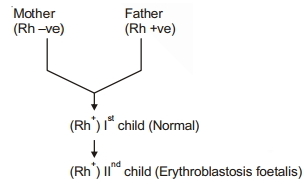
(A) Erythroblastosis foetalis occurs when there is an $Rh$ incompatibility between the mother and the foetus.
Specifically,it happens when the mother is $Rh^{-}$ve and the foetus is $Rh^{+}$ve.
During the first pregnancy,the mother's blood is exposed to the $Rh$ antigens of the foetus during delivery,leading to the production of anti-$Rh$ antibodies in the mother's blood.
In subsequent pregnancies with an $Rh^{+}$ve foetus,these maternal antibodies can cross the placenta and destroy the foetal $RBCs$,causing severe anaemia and jaundice,a condition known as erythroblastosis foetalis.
Specifically,it happens when the mother is $Rh^{-}$ve and the foetus is $Rh^{+}$ve.
During the first pregnancy,the mother's blood is exposed to the $Rh$ antigens of the foetus during delivery,leading to the production of anti-$Rh$ antibodies in the mother's blood.
In subsequent pregnancies with an $Rh^{+}$ve foetus,these maternal antibodies can cross the placenta and destroy the foetal $RBCs$,causing severe anaemia and jaundice,a condition known as erythroblastosis foetalis.
0 likes
View Solution513
EasyMCQ
Blood platelets release
A
Fibrinogens
B
Prothrombins
C
Hemoglobin
D
Thromboplastins
Solution
(D) Blood platelets,upon disintegration,release thromboplastin (platelet factor $3$),which initiates the cascade of blood clotting reactions.
0 likes
View Solution514
MediumMCQ
Prothrombin,which helps in the clotting of blood,is present in:
A
Blood plasma
B
Blood corpuscles
C
Blood platelets
D
Serum
Solution
(A) Prothrombin is an inactive plasma protein synthesized by the liver. It circulates in the blood plasma and is converted into thrombin during the process of blood coagulation to facilitate the formation of a fibrin clot.
0 likes
View Solution515
MediumMCQ
Prothrombin is a
A
Protein
B
Lipid
C
Nucleotide
D
Carbohydrate
Solution
(A) Prothrombin is an inactive plasma protein synthesized by the liver.
It plays a crucial role in the blood coagulation cascade.
During the process of blood clotting,prothrombin is converted into its active form,thrombin,by the enzyme thrombokinase.
It plays a crucial role in the blood coagulation cascade.
During the process of blood clotting,prothrombin is converted into its active form,thrombin,by the enzyme thrombokinase.
0 likes
View Solution516
EasyMCQ
Which of the following prevent$(s)$ blood clotting in uninjured blood vessels?
A
Albumins
B
Histamine
C
Heparin
D
Globulins
Solution
(C) Heparin is a natural anticoagulant produced by mast cells and basophils.
It functions by inhibiting the activity of thrombin and other clotting factors in the blood.
This prevents the formation of blood clots within uninjured blood vessels,ensuring smooth blood flow throughout the circulatory system.
It functions by inhibiting the activity of thrombin and other clotting factors in the blood.
This prevents the formation of blood clots within uninjured blood vessels,ensuring smooth blood flow throughout the circulatory system.
0 likes
View Solution517
MediumMCQ
The granulocyte to arrive first at the site of an infection is
A
Neutrophil
B
Eosinophil
C
Basophil
D
All of these
Solution
(A) Neutrophils: These are the most abundant leucocytes $(60-65\;\%)$,which possess a phagocytic nature,meaning they engulf harmful germs and are the first to arrive at the site of an infection.
Eosinophils: These constitute $(2-3\;\%)$ of total leucocytes. They are non-phagocytic and their numbers increase during allergic conditions such as asthma or hay fever.
Basophils: These make up $(0-1\;\%)$ of total leucocytes (the least abundant). They release heparin,serotonin,and histamine.
Eosinophils: These constitute $(2-3\;\%)$ of total leucocytes. They are non-phagocytic and their numbers increase during allergic conditions such as asthma or hay fever.
Basophils: These make up $(0-1\;\%)$ of total leucocytes (the least abundant). They release heparin,serotonin,and histamine.
0 likes
View Solution518
MediumMCQ
$A$ person with blood group $O$ will have . . . . . . antibody/antibodies in plasma.
A
$anti-A$ and $anti-B$
B
$anti-A$
C
$anti-B$
D
nil
Solution
(A) Individuals with blood group $O$ possess neither $A$ nor $B$ antigens on the surface of their red blood cells.
Consequently,their plasma contains both $anti-A$ and $anti-B$ antibodies to protect against foreign antigens.
Therefore,the correct answer is $anti-A$ and $anti-B$.
Consequently,their plasma contains both $anti-A$ and $anti-B$ antibodies to protect against foreign antigens.
Therefore,the correct answer is $anti-A$ and $anti-B$.
0 likes
View Solution519
MediumMCQ
Clotting of blood involves
A
Hemolysis of $RBCs$
B
Denaturation of albumins by thrombin
C
Inactivation of plasma clotting factors
D
Change of fibrinogen to fibrin by thrombin
Solution
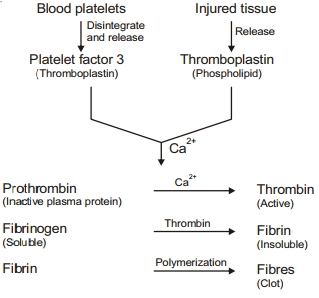
(D) Blood clotting (coagulation) is a complex process involving a cascade of reactions.
When an injury occurs,platelets and injured tissues release factors that lead to the formation of an enzyme complex called thrombokinase.
This enzyme converts the inactive protein prothrombin present in the plasma into active thrombin in the presence of $Ca^{2+}$ ions.
Subsequently,the active thrombin converts the inactive,soluble fibrinogen present in the plasma into active,insoluble fibrin threads.
These fibrin threads form a network that traps blood cells to form a clot.
Therefore,the conversion of fibrinogen to fibrin by thrombin is a key step in blood clotting.
When an injury occurs,platelets and injured tissues release factors that lead to the formation of an enzyme complex called thrombokinase.
This enzyme converts the inactive protein prothrombin present in the plasma into active thrombin in the presence of $Ca^{2+}$ ions.
Subsequently,the active thrombin converts the inactive,soluble fibrinogen present in the plasma into active,insoluble fibrin threads.
These fibrin threads form a network that traps blood cells to form a clot.
Therefore,the conversion of fibrinogen to fibrin by thrombin is a key step in blood clotting.
0 likes
View Solution520
MediumMCQ
If one litre of blood is drawn out of $5 \; \text{litres}$ from the body of a man, how much blood would be left by the next day?
A
$5 \; \text{litres}$
B
$4.5 \; \text{litres}$
C
$4 \; \text{litres}$
D
$3 \; \text{litres}$
Solution
(A) When blood is lost from the body, the homeostatic mechanisms of the human body are activated to restore blood volume.
$1$. The liquid component (plasma) is rapidly replenished by the absorption of fluids from the interstitial spaces and the intake of water.
$2$. The cellular components (like $RBCs$) are gradually replaced by the bone marrow through the process of erythropoiesis.
$3$. By the next day, the body's regulatory systems, including the release of stored blood from the spleen and fluid shifts, effectively restore the total blood volume back to its normal level of $5 \; \text{litres}$.
$1$. The liquid component (plasma) is rapidly replenished by the absorption of fluids from the interstitial spaces and the intake of water.
$2$. The cellular components (like $RBCs$) are gradually replaced by the bone marrow through the process of erythropoiesis.
$3$. By the next day, the body's regulatory systems, including the release of stored blood from the spleen and fluid shifts, effectively restore the total blood volume back to its normal level of $5 \; \text{litres}$.
0 likes
View Solution521
MediumMCQ
If $RBCs$ are placed in distilled water,the corpuscles will
A
Burst
B
Increase in number
C
Shrink
D
Stick to each other
Solution
(A) When $RBCs$ are placed in distilled water,the surrounding environment is hypotonic relative to the cytoplasm of the $RBC$.
Due to the process of endosmosis,water molecules move from the surrounding into the $RBC$.
This influx of water causes the $RBC$ to swell and eventually burst because they lack a rigid cell wall to withstand the internal osmotic pressure.
Due to the process of endosmosis,water molecules move from the surrounding into the $RBC$.
This influx of water causes the $RBC$ to swell and eventually burst because they lack a rigid cell wall to withstand the internal osmotic pressure.
0 likes
View Solution522
EasyMCQ
The universal recipient blood group is
A
$A^{+}$
B
$AB^{+}$
C
$B^{+}$
D
$O^{+}$
Solution
(B) The $AB^{+}$ blood group is considered the universal recipient.
This is because individuals with $AB^{+}$ blood possess both $A$ and $B$ antigens on the surface of their red blood cells and have the $Rh$ factor present.
Consequently,their plasma does not contain anti-$A$ or anti-$B$ antibodies,nor does it contain anti-$Rh$ antibodies.
Therefore,they can receive blood from any other blood group without triggering an immune reaction.
This is because individuals with $AB^{+}$ blood possess both $A$ and $B$ antigens on the surface of their red blood cells and have the $Rh$ factor present.
Consequently,their plasma does not contain anti-$A$ or anti-$B$ antibodies,nor does it contain anti-$Rh$ antibodies.
Therefore,they can receive blood from any other blood group without triggering an immune reaction.
0 likes
View Solution523
MediumMCQ
$A$ person with antigen $A$ in $RBC$ and antibody $b$ in plasma belongs to blood group
A
$A$
B
$B$
C
$O$
D
$AB$
Solution
(A) The $ABO$ blood grouping system is based on the presence or absence of two surface antigens on the $RBC$s,namely $A$ and $B$.
Individuals with blood group $A$ possess antigen $A$ on their $RBC$s and antibody $b$ (anti-$B$) in their plasma.
Individuals with blood group $B$ possess antigen $B$ on their $RBC$s and antibody $a$ (anti-$A$) in their plasma.
Individuals with blood group $AB$ possess both antigens $A$ and $B$ but no antibodies in their plasma.
Individuals with blood group $O$ possess neither antigen $A$ nor $B$ but have both antibodies $a$ and $b$ in their plasma.
Therefore,a person with antigen $A$ and antibody $b$ belongs to blood group $A$.
Individuals with blood group $A$ possess antigen $A$ on their $RBC$s and antibody $b$ (anti-$B$) in their plasma.
Individuals with blood group $B$ possess antigen $B$ on their $RBC$s and antibody $a$ (anti-$A$) in their plasma.
Individuals with blood group $AB$ possess both antigens $A$ and $B$ but no antibodies in their plasma.
Individuals with blood group $O$ possess neither antigen $A$ nor $B$ but have both antibodies $a$ and $b$ in their plasma.
Therefore,a person with antigen $A$ and antibody $b$ belongs to blood group $A$.
0 likes
View Solution524
MediumMCQ
$A$ person with an unknown blood group under the $ABO$ system has suffered significant blood loss in an accident and requires an immediate blood transfusion. $A$ friend,who has a valid certificate of their own blood type,offers to donate blood without delay. What would be the blood group of the donor friend?
A
Type $AB$
B
Type $O$
C
Type $A$
D
Type $B$
Solution
(B) The blood type $O$ does not possess any antigens ($A$ or $B$) on the surface of its red blood cells,but it contains both anti-$A$ and anti-$B$ antibodies in the plasma.
Because individuals with blood type $O$ lack both $A$ and $B$ antigens,their blood will not trigger an immune reaction (agglutination) when transfused into a recipient of any blood group.
Therefore,a person with blood type $O$ is considered a universal donor,making it the safest choice for an emergency transfusion when the recipient's blood type is unknown.
Because individuals with blood type $O$ lack both $A$ and $B$ antigens,their blood will not trigger an immune reaction (agglutination) when transfused into a recipient of any blood group.
Therefore,a person with blood type $O$ is considered a universal donor,making it the safest choice for an emergency transfusion when the recipient's blood type is unknown.
0 likes
View Solution525
MediumMCQ
Which disease can be caused by the $Rh$ factor?
A
$AIDS$
B
Turner's syndrome
C
Erythroblastosis foetalis
D
Sickle-cell anaemia
Solution
(C) Erythroblastosis foetalis is a haemolytic disease of the newborn.
It occurs when an $Rh$-negative mother carries an $Rh$-positive fetus.
During the first pregnancy,the mother's blood is exposed to $Rh$ antigens from the fetus,leading to the production of anti-$Rh$ antibodies.
In subsequent pregnancies,these antibodies can cross the placenta and destroy the fetal red blood cells,causing severe anaemia and jaundice,a condition known as Erythroblastosis foetalis.
It occurs when an $Rh$-negative mother carries an $Rh$-positive fetus.
During the first pregnancy,the mother's blood is exposed to $Rh$ antigens from the fetus,leading to the production of anti-$Rh$ antibodies.
In subsequent pregnancies,these antibodies can cross the placenta and destroy the fetal red blood cells,causing severe anaemia and jaundice,a condition known as Erythroblastosis foetalis.
0 likes
View Solution526
MediumMCQ
If the foetus is $Rh^+$ and the mother is $Rh^-$,then:
A
Foetus will transmit antigen to mother's blood at the time of birth.
B
Foetus will transmit antibody to mother's blood.
C
Foetus is attacked by antibodies of its own blood.
D
Foetus is attacked by antigen to mother's blood.
Solution
(A) The $Rh$ factor causes erythroblastosis foetalis. When an $Rh^-$ woman marries an $Rh^+$ man,the first child (if $Rh^+$) is usually safe because the mother's blood is exposed to the foetal $Rh$ antigens only during the delivery of the first child.
During this process,the mother's immune system develops antibodies against the $Rh$ antigen.
In subsequent pregnancies,these $Rh$ antibodies can cross the placenta and destroy the foetal red blood cells,leading to severe anaemia or jaundice in the foetus.
During this process,the mother's immune system develops antibodies against the $Rh$ antigen.
In subsequent pregnancies,these $Rh$ antibodies can cross the placenta and destroy the foetal red blood cells,leading to severe anaemia or jaundice in the foetus.
0 likes
View Solution527
MediumMCQ
$A$ person with type $A$ blood group may safely receive a transfusion of
A
Type $AB$
B
Type $A$ and type $O$
C
Type $A$ and type $AB$
D
Type $AB$ and type $O$
Solution
(B) person with blood group $A$ has $A$ antigens on their red blood cells and anti-$B$ antibodies in their plasma. Therefore,they can receive blood from donors with the same blood group $(A)$ or from donors with no antigens on their red blood cells ($O$ group,which is the universal donor). Thus,they can safely receive blood of type $A$ and type $O$.
0 likes
View Solution528
MediumMCQ
After examining the blood groups of a husband and wife,the doctor advised them not to have more than one child. The blood groups of the couple are likely to be:
A
Male $Rh^{-}$,Female $Rh^{+}$
B
Female $Rh^{-}$,Male $Rh^{+}$
C
Male and female $Rh^{+}$
D
Male and female $Rh^{-}$
Solution
(B) The condition described is Erythroblastosis fetalis,which occurs due to $Rh$ incompatibility.
This happens when an $Rh^{-}$ mother carries an $Rh^{+}$ fetus.
During the first pregnancy,the mother's blood is exposed to the $Rh^{+}$ antigens of the fetus,leading to the production of anti-$Rh$ antibodies in the mother's blood.
While the first child is usually unaffected,these antibodies persist in the mother's system.
In subsequent pregnancies,if the fetus is again $Rh^{+}$,these maternal antibodies can cross the placenta and destroy the fetal red blood cells,leading to severe anemia or death.
Therefore,the doctor advises against further pregnancies if the mother is $Rh^{-}$ and the father is $Rh^{+}$.
This happens when an $Rh^{-}$ mother carries an $Rh^{+}$ fetus.
During the first pregnancy,the mother's blood is exposed to the $Rh^{+}$ antigens of the fetus,leading to the production of anti-$Rh$ antibodies in the mother's blood.
While the first child is usually unaffected,these antibodies persist in the mother's system.
In subsequent pregnancies,if the fetus is again $Rh^{+}$,these maternal antibodies can cross the placenta and destroy the fetal red blood cells,leading to severe anemia or death.
Therefore,the doctor advises against further pregnancies if the mother is $Rh^{-}$ and the father is $Rh^{+}$.
0 likes
View Solution529
MediumMCQ
In a medicolegal case of accidental interchange between two babies in a hospital,the baby of blood group $A$ could not be rightly given to a couple with:
A
Husband of $O$ group and wife of $AB$ group
B
Husband of $A$ group and wife of $O$ group
C
Husband of $B$ group and wife of $O$ group
D
Husband of $AB$ group and wife of $A$ group
Solution
(C) To determine the possible blood groups of offspring,we analyze the genotypes of the parents.
For a couple with husband of blood group $B$ (genotype $I^B I^B$ or $I^B i$) and wife of blood group $O$ (genotype $ii$):
$1$. If the father is $I^B I^B$,the offspring will have genotypes $I^B i$ (blood group $B$).
$2$. If the father is $I^B i$,the offspring will have genotypes $I^B i$ (blood group $B$) or $ii$ (blood group $O$).
In neither case can an offspring with blood group $A$ (genotype $I^A I^A$ or $I^A i$) be produced,as the father does not possess the $I^A$ allele.
For a couple with husband of blood group $B$ (genotype $I^B I^B$ or $I^B i$) and wife of blood group $O$ (genotype $ii$):
$1$. If the father is $I^B I^B$,the offspring will have genotypes $I^B i$ (blood group $B$).
$2$. If the father is $I^B i$,the offspring will have genotypes $I^B i$ (blood group $B$) or $ii$ (blood group $O$).
In neither case can an offspring with blood group $A$ (genotype $I^A I^A$ or $I^A i$) be produced,as the father does not possess the $I^A$ allele.
0 likes
View Solution530
EasyMCQ
$A$ person with blood group-$A$ has:
A
Antigen-$A$ and Anti-$B$ antibodies
B
Antigen-$B$ and Anti-$A$ antibodies
C
Both antibodies
D
No antibody and no antigen
Solution
(A) Individuals with blood group-$A$ possess antigen-$A$ on the surface of their $RBCs$ (red blood cells).
Because the immune system recognizes antigen-$A$ as 'self',it produces antibodies against the foreign antigen-$B$,known as Anti-$B$ antibodies.
Because the immune system recognizes antigen-$A$ as 'self',it produces antibodies against the foreign antigen-$B$,known as Anti-$B$ antibodies.
0 likes
View Solution531
MediumMCQ
The universal donor is
A
$O Rh^+$
B
$O Rh^-$
C
$AB Rh^+$
D
$AB Rh^-$
Solution
(B) In the context of blood transfusions,individuals with $O Rh^-$ blood type are considered universal donors because their red blood cells lack $A$,$B$,and $Rh$ antigens,which prevents an immune reaction in the recipient.
Conversely,individuals with $AB Rh^+$ blood are considered universal recipients because their blood contains all these antigens,meaning they do not produce antibodies against them.
Conversely,individuals with $AB Rh^+$ blood are considered universal recipients because their blood contains all these antigens,meaning they do not produce antibodies against them.
0 likes
View Solution532
MediumMCQ
Which of the following blood groups' person cannot donate blood to others?
A
$AB$ blood group
B
$O$ blood group
C
$A$ blood group
D
$B$ blood group
Solution
(A) person with $AB$ blood group cannot donate blood to others (except those with $AB$ blood group) because their red blood cells contain both $A$ and $B$ antigens,and their plasma lacks both anti-$A$ and anti-$B$ antibodies. However,they can receive blood from all blood groups,which is why they are called universal recipients.
0 likes
View Solution533
MediumMCQ
$A$ person with blood group $AB$ has
A
$A$ and $B$ antigens
B
$a$ and $b$ antibodies
C
no antigen
D
antibody-$a$
Solution
(A) Persons with blood group $AB$ are called universal recipients because both antigens $A$ and $B$ are present on the surface of their red blood cells,and both antibodies $a$ and $b$ are absent in their plasma.
Therefore,such individuals can receive blood from all other blood groups ($A, B, AB,$ and $O$).
Therefore,such individuals can receive blood from all other blood groups ($A, B, AB,$ and $O$).
0 likes
View Solution534
MediumMCQ
Which one of the following is necessary to start the clotting of blood?
A
Heparin
B
Serotonin
C
Thromboplastin and $Ca^{2+}$
D
Fibrinogen and prothrombin
Solution
(C) The process of blood clotting begins with the release of $Thromboplastin$ from injured tissues or platelets.
$Thromboplastin$ acts as a catalyst in the presence of $Ca^{2+}$ ions to convert inactive prothrombin into active thrombin.
This thrombin then converts soluble fibrinogen into insoluble fibrin threads,which form the clot.
Therefore,$Thromboplastin$ and $Ca^{2+}$ are essential to initiate the coagulation cascade.
$Thromboplastin$ acts as a catalyst in the presence of $Ca^{2+}$ ions to convert inactive prothrombin into active thrombin.
This thrombin then converts soluble fibrinogen into insoluble fibrin threads,which form the clot.
Therefore,$Thromboplastin$ and $Ca^{2+}$ are essential to initiate the coagulation cascade.
0 likes
View Solution535
MediumMCQ
$A$ woman is married for the second time. Her first husband was $ABO$ blood type $A,$ and her child by that marriage was type $O.$ Her new husband is type $B$ and their child is type $AB.$ What is the woman's $ABO$ genotype and blood type?
A
$I^{A} I^{O};$ Blood type $A$
B
$I^{A} I^{B};$ Blood type $AB$
C
$I^{B} I^{O};$ Blood type $B$
D
$I^{O} I^{O};$ Blood type $O$
Solution
(A) $1$. The woman's first child is type $O$,which means the child's genotype is $I^{O} I^{O}$. Since the child inherits one $I^{O}$ allele from each parent,the woman must possess at least one $I^{O}$ allele.
$2$. The woman's second child is type $AB$,which means the child's genotype is $I^{A} I^{B}$. This child must inherit one $I^{A}$ allele from one parent and one $I^{B}$ allele from the other.
$3$. The second husband is type $B$. If he is homozygous $(I^{B} I^{B})$,he contributes $I^{B}$ to the child. If he is heterozygous $(I^{B} I^{O})$,he could contribute either $I^{B}$ or $I^{O}$.
$4$. Since the child is $I^{A} I^{B}$,the $I^{A}$ allele must have come from the mother.
$5$. Combining these facts: The mother must have an $I^{O}$ allele (from the first child) and an $I^{A}$ allele (from the second child). Therefore,her genotype is $I^{A} I^{O}$,which corresponds to blood type $A$.
$2$. The woman's second child is type $AB$,which means the child's genotype is $I^{A} I^{B}$. This child must inherit one $I^{A}$ allele from one parent and one $I^{B}$ allele from the other.
$3$. The second husband is type $B$. If he is homozygous $(I^{B} I^{B})$,he contributes $I^{B}$ to the child. If he is heterozygous $(I^{B} I^{O})$,he could contribute either $I^{B}$ or $I^{O}$.
$4$. Since the child is $I^{A} I^{B}$,the $I^{A}$ allele must have come from the mother.
$5$. Combining these facts: The mother must have an $I^{O}$ allele (from the first child) and an $I^{A}$ allele (from the second child). Therefore,her genotype is $I^{A} I^{O}$,which corresponds to blood type $A$.
0 likes
View Solution536
MediumMCQ
Blood cells involved in inflammatory reactions are
A
Basophils
B
Neutrophils
C
Eosinophils
D
Monocytes
Solution
(A) Basophils: These cells release chemicals such as histamine,serotonin,and heparin. They are primarily involved in inflammatory reactions and allergic responses.
Neutrophils: These are phagocytic cells that engulf and destroy pathogens.
Eosinophils: These cells are primarily involved in allergic reactions and resistance to parasitic infections.
Monocytes: These cells differentiate into macrophages at the site of infection to perform phagocytosis and elicit an immune response.
Neutrophils: These are phagocytic cells that engulf and destroy pathogens.
Eosinophils: These cells are primarily involved in allergic reactions and resistance to parasitic infections.
Monocytes: These cells differentiate into macrophages at the site of infection to perform phagocytosis and elicit an immune response.
0 likes
View Solution537
MediumMCQ
$A$: Blood group phenotype is controlled by the presence or absence of antigens present on the surface coating of $RBC$.
$R$: These antigens are of three types and are found in the oligosaccharide-rich head regions of a glycophorin.
$R$: These antigens are of three types and are found in the oligosaccharide-rich head regions of a glycophorin.
A
Assertion and Reason both are correct and Reason is the correct explanation of Assertion.
B
Assertion and Reason both are correct but Reason is not the correct explanation of Assertion.
C
Assertion is correct,but Reason is incorrect.
D
Both Assertion and Reason are incorrect.
Solution
(C) The Assertion is correct because the $ABO$ blood group phenotype is determined by the presence or absence of specific antigens ($A$ and $B$) on the surface of $RBCs$.
The Reason is incorrect because these antigens are not found on glycophorin. Instead,they are attached to the lipid bilayer of the $RBC$ membrane via glycolipids or glycoproteins. Glycophorin is a specific membrane protein,but it is not the primary carrier for $ABO$ blood group antigens.
The Reason is incorrect because these antigens are not found on glycophorin. Instead,they are attached to the lipid bilayer of the $RBC$ membrane via glycolipids or glycoproteins. Glycophorin is a specific membrane protein,but it is not the primary carrier for $ABO$ blood group antigens.
0 likes
View Solution538
EasyMCQ
Which enzyme is responsible for the conversion of inactive fibrinogens to fibrins?
A
Thrombin
B
Renin
C
Epinephrine
D
Thrombokinase
Solution
(A) During the process of blood coagulation,an injury or trauma stimulates the release of factors that activate a cascade of reactions.
$1$. The enzyme $Thrombin$ is formed from inactive $Prothrombin$ in the presence of the enzyme complex $Thrombokinase$.
$2$. $Thrombin$ then acts as a catalyst to convert the inactive,soluble plasma protein $Fibrinogen$ into insoluble $Fibrin$ threads.
$3$. These $Fibrin$ threads form a network that traps blood cells to form a clot.
Therefore,the correct enzyme responsible for the conversion of $Fibrinogen$ to $Fibrin$ is $Thrombin$.
$1$. The enzyme $Thrombin$ is formed from inactive $Prothrombin$ in the presence of the enzyme complex $Thrombokinase$.
$2$. $Thrombin$ then acts as a catalyst to convert the inactive,soluble plasma protein $Fibrinogen$ into insoluble $Fibrin$ threads.
$3$. These $Fibrin$ threads form a network that traps blood cells to form a clot.
Therefore,the correct enzyme responsible for the conversion of $Fibrinogen$ to $Fibrin$ is $Thrombin$.
0 likes
View Solution539
EasyMCQ
Persons with $AB$ blood group are called as "Universal recipients". This is due to:
A
Absence of antigens $A$ and $B$ on the surface of $RBCs$
B
Absence of antigens $A$ and $B$ in plasma
C
Presence of antibodies, anti-$A$ and anti-$B$, on $RBCs$
D
Absence of antibodies, anti-$A$ and anti-$B$, in plasma
Solution
(D) In the $ABO$ blood grouping system, individuals with $AB$ blood group possess both $A$ and $B$ antigens on the surface of their $RBCs$.
Because their own immune system recognizes both $A$ and $B$ antigens as 'self', they do not produce anti-$A$ or anti-$B$ antibodies in their blood plasma.
Consequently, they can receive blood from individuals with $A$, $B$, $AB$, or $O$ blood types without triggering an immune reaction (agglutination).
Therefore, they are known as "Universal recipients" due to the absence of anti-$A$ and anti-$B$ antibodies in their plasma.
Because their own immune system recognizes both $A$ and $B$ antigens as 'self', they do not produce anti-$A$ or anti-$B$ antibodies in their blood plasma.
Consequently, they can receive blood from individuals with $A$, $B$, $AB$, or $O$ blood types without triggering an immune reaction (agglutination).
Therefore, they are known as "Universal recipients" due to the absence of anti-$A$ and anti-$B$ antibodies in their plasma.
0 likes
View Solution540
Easy
Mention the types of white blood cells $(WBCs)$.
Solution
(N/A) White blood cells $(WBCs)$ are broadly classified into two main categories based on the presence or absence of granules in their cytoplasm:
$1$. Granulocytes: These contain granules in their cytoplasm and include neutrophils,eosinophils,and basophils.
$2$. Agranulocytes: These lack granules in their cytoplasm and include lymphocytes and monocytes.
$1$. Granulocytes: These contain granules in their cytoplasm and include neutrophils,eosinophils,and basophils.
$2$. Agranulocytes: These lack granules in their cytoplasm and include lymphocytes and monocytes.
0 likes
View Solution541
MediumMCQ
Name the blood component which is a viscous and straw-coloured fluid.
A
Plasma
B
Serum
C
Platelets
D
Erythrocytes
Solution
(A) Plasma is a straw-coloured,viscous fluid that constitutes approximately $55$ percent of the blood. It serves as the liquid matrix of the blood,containing water,proteins,electrolytes,and other dissolved substances.
0 likes
View Solution542
EasyMCQ
State the functions of the following in blood.
$(a)$ Fibrinogen
$(b)$ Globulin
$(c)$ Neutrophils
$(d)$ Lymphocytes
$(a)$ Fibrinogen
$(b)$ Globulin
$(c)$ Neutrophils
$(d)$ Lymphocytes
A
Fibrinogen
B
Globulin
C
Neutrophils
D
Lymphocytes
Solution
(N/A) Fibrinogen: It is a plasma protein essential for blood clotting. It is converted into insoluble fibrin threads by the enzyme thrombin during the coagulation process.
$(b)$ Globulin: These are plasma proteins primarily involved in defense mechanisms of the body,such as the production of antibodies for immunity.
$(c)$ Neutrophils: These are the most abundant phagocytic white blood cells that destroy foreign microorganisms like bacteria by engulfing them.
$(d)$ Lymphocytes: These are specialized white blood cells responsible for the immune response,including the production of antibodies and the destruction of infected cells.
$(b)$ Globulin: These are plasma proteins primarily involved in defense mechanisms of the body,such as the production of antibodies for immunity.
$(c)$ Neutrophils: These are the most abundant phagocytic white blood cells that destroy foreign microorganisms like bacteria by engulfing them.
$(d)$ Lymphocytes: These are specialized white blood cells responsible for the immune response,including the production of antibodies and the destruction of infected cells.
0 likes
View Solution543
MediumMCQ
What physiological circumstances lead to erythroblastosis foetalis?
A
Mother is $Rh^{+ve}$ and foetus is $Rh^{-ve}$
B
Mother is $Rh^{-ve}$ and foetus is $Rh^{+ve}$
C
Both mother and foetus are $Rh^{+ve}$
D
Both mother and foetus are $Rh^{-ve}$
Solution
(B) Erythroblastosis foetalis occurs due to $Rh$ incompatibility between an $Rh^{-ve}$ mother and an $Rh^{+ve}$ foetus.
During the first pregnancy,the mother's blood is exposed to the $Rh$ antigens of the foetus,leading to the formation of anti-$Rh$ antibodies in the mother's blood.
In subsequent pregnancies,these antibodies can cross the placenta and enter the foetal circulation.
These antibodies destroy the foetal $RBCs$,leading to severe anaemia and jaundice,a condition known as erythroblastosis foetalis.
During the first pregnancy,the mother's blood is exposed to the $Rh$ antigens of the foetus,leading to the formation of anti-$Rh$ antibodies in the mother's blood.
In subsequent pregnancies,these antibodies can cross the placenta and enter the foetal circulation.
These antibodies destroy the foetal $RBCs$,leading to severe anaemia and jaundice,a condition known as erythroblastosis foetalis.
0 likes
View Solution544
Medium
Explain the consequences of a situation in which blood does not coagulate.
Solution
(N/A) Blood coagulation is a vital physiological process that occurs in response to an injury or trauma to prevent excessive blood loss.
If blood fails to coagulate,the body cannot seal the damaged blood vessels.
This leads to continuous and uncontrolled bleeding (hemorrhage) from the wound.
Such a situation can result in a significant drop in blood pressure,hypovolemic shock,and can ultimately be fatal due to the massive loss of blood volume.
If blood fails to coagulate,the body cannot seal the damaged blood vessels.
This leads to continuous and uncontrolled bleeding (hemorrhage) from the wound.
Such a situation can result in a significant drop in blood pressure,hypovolemic shock,and can ultimately be fatal due to the massive loss of blood volume.
0 likes
View Solution545
EasyMCQ
What is the full form of $PTA$ in the context of blood coagulation?
A
Plasma Thromboplastin Antecedent
B
Prothrombin Activation
C
Platelet Thromboplastin Activity
D
Plasma Tissue Activator
Solution
(A) $PTA$ stands for Plasma Thromboplastin Antecedent.
It is also known as Clotting Factor $XI$.
It plays a crucial role in the intrinsic pathway of the blood coagulation cascade.
It is also known as Clotting Factor $XI$.
It plays a crucial role in the intrinsic pathway of the blood coagulation cascade.
0 likes
View Solution546
EasyMCQ
What is the full form of $RBC$?
A
Red Blood Cells
B
Rapid Blood Cells
C
Red Body Cells
D
Rare Blood Cells
Solution
(A) The full form of $RBC$ is $Red$ $Blood$ $Cells$.
These are the most common type of blood cells and the vertebrate's principal means of delivering oxygen to the body tissues via the blood flow through the circulatory system.
These are the most common type of blood cells and the vertebrate's principal means of delivering oxygen to the body tissues via the blood flow through the circulatory system.
0 likes
View Solution547
MediumMCQ
Given below are two statements:
Statement $I$:
The coagulum is formed of a network of threads called thrombins.
Statement $II$:
Spleen is the graveyard of erythrocytes.
In the light of the above statements,choose the most appropriate answer from the options given below:
Statement $I$:
The coagulum is formed of a network of threads called thrombins.
Statement $II$:
Spleen is the graveyard of erythrocytes.
In the light of the above statements,choose the most appropriate answer from the options given below:
A
Both Statement $I$ and Statement $II$ are incorrect.
B
Statement $I$ is correct but Statement $II$ is incorrect.
C
Statement $I$ is incorrect but Statement $II$ is correct.
D
Both Statement $I$ and Statement $II$ are correct.
Solution
(C) Statement $I$ is incorrect because the network of threads formed during blood coagulation is called fibrin,not thrombin. Thrombin is an enzyme that converts soluble fibrinogen into insoluble fibrin.
Statement $II$ is correct because the spleen acts as the graveyard of erythrocytes (red blood cells),where old and damaged red blood cells are destroyed and recycled.
Statement $II$ is correct because the spleen acts as the graveyard of erythrocytes (red blood cells),where old and damaged red blood cells are destroyed and recycled.
0 likes
View Solution548
EasyMCQ
Which of the following is known as a fluid connective tissue?
A
Blood
B
Bone
C
Cartilage
D
All of the above
Solution
(A) Blood is a specialized connective tissue that consists of a fluid matrix,plasma,and formed elements. Because it flows through the circulatory system and acts as a transport medium,it is classified as a fluid connective tissue. Bone and cartilage are specialized connective tissues but are skeletal (solid) in nature,not fluid.
0 likes
View Solution549
MediumMCQ
Blood = $.....$
A
Fluid matrix + Formed elements
B
Only fluid matrix
C
Only formed elements
D
Fluid matrix + Lymph
Solution
(A) Blood is a specialized connective tissue consisting of a fluid matrix,plasma,and formed elements. The formed elements include red blood cells (erythrocytes),white blood cells (leukocytes),and platelets (thrombocytes). Therefore,blood is composed of a fluid matrix and formed elements.
0 likes
View Solution550
MediumMCQ
Which of the following is incorrect regarding blood plasma?
A
Light yellow colored fluid
B
Viscous fluid
C
Constitutes approximately $45\, \%$ of blood
D
The maximum part of blood plasma is made up of water
Solution
(C) Blood plasma is a straw-colored,viscous fluid that constitutes the matrix of the blood.
It makes up about $55\, \%$ of the total blood volume,while the formed elements (cells) make up the remaining $45\, \%$.
Water constitutes $90-92\, \%$ of plasma,and proteins contribute $6-8\, \%$ of it.
Therefore,the statement that plasma constitutes $45\, \%$ of blood is incorrect,as it actually constitutes $55\, \%$.
It makes up about $55\, \%$ of the total blood volume,while the formed elements (cells) make up the remaining $45\, \%$.
Water constitutes $90-92\, \%$ of plasma,and proteins contribute $6-8\, \%$ of it.
Therefore,the statement that plasma constitutes $45\, \%$ of blood is incorrect,as it actually constitutes $55\, \%$.
0 likes
View SolutionBody Fluids and Circulations — Blood and Blood Group · Frequently Asked Questions
1Are these Body Fluids and Circulations questions useful for JEE and NEET?
Yes. All questions in this section are mapped to JEE Main and NEET exam patterns. Previous year questions from JEE Main, NEET, GUJCET and state-level exams are included with full solutions.
2Can I switch to Hindi or Gujarati for these questions?
Yes. Use the language tabs in the hero section or the sidebar to view the same questions and solutions in English, Hindi or Gujarati.
3How do I generate a question paper from this subtopic?
Use the Vedclass Exam Paper Generator — select the chapter and subtopic, set difficulty, and generate Sets A, B, C, D automatically. First 3 chapters of every subject are free.
Vedclass Products
For Students
Vedclass Test Series
Mock tests in real JEE/NEET style with performance analysis. 5-day free trial.
Start Free TrialFor Teachers
Exam Paper Generator
Generate Set A/B/C/D papers from this chapter in 2 minutes. 3 chapters free.
Try FreeFor Institutes
Online Exam Module
Live online exams with unlimited students, 360° analytics & white-label branding.
See DemoFor Teachers & Institutes
Generate a Body Fluids and Circulations Exam Paper in 2 Minutes
Select subtopic & difficulty — Sets A, B, C, D auto-generated with No Repeat logic.
First 3 chapters of every subject are free — no payment required.