
A English
Blood and Blood Group Questions in English
Class 11 Biology · Body Fluids and Circulations · Blood and Blood Group
639+
Questions
English
Language
100%
With Solutions
Showing 39 of 639 questions in English
601
EasyMCQ
In the child of which one of the following couples,Erythroblastosis fetalis is likely to occur?
A
B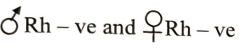
C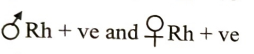
D
Solution
(D) Erythroblastosis fetalis is a condition that occurs when there is an incompatibility between the blood types of the mother and the fetus.
Specifically,it happens when an $Rh$-negative mother carries an $Rh$-positive fetus.
During the first pregnancy,the mother's immune system may be exposed to the $Rh$ antigens from the fetus during delivery,leading to the production of anti-$Rh$ antibodies.
In subsequent pregnancies,if the fetus is again $Rh$-positive,these maternal anti-$Rh$ antibodies can cross the placenta and destroy the fetal red blood cells,causing severe anemia and jaundice,a condition known as Erythroblastosis fetalis.
Therefore,this condition is likely to occur in the child of a couple where the father is $Rh$-positive and the mother is $Rh$-negative.
Specifically,it happens when an $Rh$-negative mother carries an $Rh$-positive fetus.
During the first pregnancy,the mother's immune system may be exposed to the $Rh$ antigens from the fetus during delivery,leading to the production of anti-$Rh$ antibodies.
In subsequent pregnancies,if the fetus is again $Rh$-positive,these maternal anti-$Rh$ antibodies can cross the placenta and destroy the fetal red blood cells,causing severe anemia and jaundice,a condition known as Erythroblastosis fetalis.
Therefore,this condition is likely to occur in the child of a couple where the father is $Rh$-positive and the mother is $Rh$-negative.
0 likes
View Solution602
EasyMCQ
Which of the following blood corpuscles secrete serotonin?
$I$. Basophils $\quad$ $II$. Eosinophils
$III$. Thrombocytes $\quad$ $IV$. Lymphocytes
$V$. Monocytes
Select the correct option from the following:
$I$. Basophils $\quad$ $II$. Eosinophils
$III$. Thrombocytes $\quad$ $IV$. Lymphocytes
$V$. Monocytes
Select the correct option from the following:
A
$I$ and $III$ only
B
$II$ and $IV$ only
C
$III$ and $V$ only
D
$I$ and $IV$ only
Solution
(A) Serotonin is a chemical messenger that acts as a vasoconstrictor.
In the human body,serotonin is secreted by:
$1$. Basophils: These are granulocytes that release histamine,heparin,and serotonin during inflammatory responses.
$2$. Thrombocytes (Blood Platelets): These cell fragments release serotonin to help in the process of blood clotting (hemostasis) by constricting blood vessels at the site of injury.
Therefore,both Basophils $(I)$ and Thrombocytes $(III)$ are responsible for the secretion of serotonin.
The correct option is $A$.
In the human body,serotonin is secreted by:
$1$. Basophils: These are granulocytes that release histamine,heparin,and serotonin during inflammatory responses.
$2$. Thrombocytes (Blood Platelets): These cell fragments release serotonin to help in the process of blood clotting (hemostasis) by constricting blood vessels at the site of injury.
Therefore,both Basophils $(I)$ and Thrombocytes $(III)$ are responsible for the secretion of serotonin.
The correct option is $A$.
0 likes
View Solution603
EasyMCQ
Which of the following give rise to macrophages?
A
Lymphocytes
B
Acidophils
C
Monocytes
D
Cyanophils
Solution
(C) Monocytes are a type of white blood cell $(WBC)$ that circulate in the blood.
When they migrate from the bloodstream into the tissues,they differentiate and enlarge to become macrophages.
Macrophages are phagocytic cells that play a crucial role in the immune system by engulfing and digesting cellular debris,foreign substances,microbes,and cancer cells.
When they migrate from the bloodstream into the tissues,they differentiate and enlarge to become macrophages.
Macrophages are phagocytic cells that play a crucial role in the immune system by engulfing and digesting cellular debris,foreign substances,microbes,and cancer cells.
0 likes
View Solution604
EasyMCQ
In a normal healthy person,if the total number of $WBCs$ is about $9000 / mm^3$,then the number of Agranulocytes is about . . . . . . $/ mm^3$ of blood.
A
$90$
B
$450$
C
$2520$
D
$6300$
Solution
(C) The total number of $WBCs$ (Leukocytes) is $9000 / mm^3$.
$WBCs$ are classified into Granulocytes $(60-70 \%)$ and Agranulocytes $(20-30 \%)$.
Taking the average value for Agranulocytes as $28 \%$:
Number of Agranulocytes = $28 \% \text{ of } 9000$
$= \frac{28}{100} \times 9000$
$= 2520 / mm^3$ of blood.
$WBCs$ are classified into Granulocytes $(60-70 \%)$ and Agranulocytes $(20-30 \%)$.
Taking the average value for Agranulocytes as $28 \%$:
Number of Agranulocytes = $28 \% \text{ of } 9000$
$= \frac{28}{100} \times 9000$
$= 2520 / mm^3$ of blood.
0 likes
View Solution605
EasyMCQ
Match the Column $I$ (blood corpuscles) and Column $II$ (stem cells/precursors from which they are formed).
Choose the correct option given below.
| Column $I$ (Blood corpuscles) | Column $II$ (Stem cells/precursors) |
| $i$. Thrombocytes | $a$. Lymphoid stem cells |
| $ii$. Granulocytes | $b$. Megakaryocytes |
| $iii$. Erythrocytes | $c$. Myeloid stem cells |
| $iv$. Agranulocytes | $d$. Reticulocytes |
A
$i-c, ii-b, iii-a, iv-d$
B
$i-b, ii-c, iii-a, iv-d$
C
$i-b, ii-c, iii-d, iv-a$
D
$i-c, ii-b, iii-d, iv-a$
Solution
(C) The correct matching is as follows:
$i$. Thrombocytes are cell fragments derived from large bone marrow cells called megakaryocytes $(i-b)$.
$ii$. Granulocytes (neutrophils,eosinophils,basophils) are derived from myeloid stem cells $(ii-c)$.
$iii$. Erythrocytes (RBCs) are formed from reticulocytes,which are immature red blood cells $(iii-d)$.
$iv$. Agranulocytes (lymphocytes and monocytes) are derived from lymphoid stem cells $(iv-a)$.
Therefore,the correct sequence is $i-b, ii-c, iii-d, iv-a$.
$i$. Thrombocytes are cell fragments derived from large bone marrow cells called megakaryocytes $(i-b)$.
$ii$. Granulocytes (neutrophils,eosinophils,basophils) are derived from myeloid stem cells $(ii-c)$.
$iii$. Erythrocytes (RBCs) are formed from reticulocytes,which are immature red blood cells $(iii-d)$.
$iv$. Agranulocytes (lymphocytes and monocytes) are derived from lymphoid stem cells $(iv-a)$.
Therefore,the correct sequence is $i-b, ii-c, iii-d, iv-a$.
0 likes
View Solution606
EasyMCQ
Match the Column $I$ (Blood corpuscles) with Column $II$ (functions).
| $i$. Neutrophils | $b$. Phagocytosis |
| $ii$. Basophils | $c$. Secretion of histamines |
| $iii$. Acidophils (Eosinophils) | $d$. Antihistaminic |
| $iv$. Lymphocytes | $a$. Immunity |
A
$i-b, ii-c, iii-a, iv-d$
B
$i-b, ii-c, iii-d, iv-a$
C
$i-c, ii-b, iii-a, iv-d$
D
$i-d, ii-a, iii-b, iv-c$
Solution
(B) The correct matching is as follows:
$i$. Neutrophils: These are phagocytic cells that destroy foreign organisms entering the body.
$ii$. Basophils: These cells secrete histamine,serotonin,and heparin,and are involved in inflammatory reactions.
$iii$. Acidophils (Eosinophils): These cells resist infections and are associated with allergic reactions; they have antihistaminic properties.
$iv$. Lymphocytes: These cells are responsible for the immune responses of the body.
Therefore,the correct match is $i-b, ii-c, iii-d, iv-a$.
$i$. Neutrophils: These are phagocytic cells that destroy foreign organisms entering the body.
$ii$. Basophils: These cells secrete histamine,serotonin,and heparin,and are involved in inflammatory reactions.
$iii$. Acidophils (Eosinophils): These cells resist infections and are associated with allergic reactions; they have antihistaminic properties.
$iv$. Lymphocytes: These cells are responsible for the immune responses of the body.
Therefore,the correct match is $i-b, ii-c, iii-d, iv-a$.
0 likes
View Solution607
EasyMCQ
By using the stain methylene blue,the . . . . . . can be differentiated from other corpuscles.
A
acidophils
B
cyanophils
C
neutrophils
D
monocytes
Solution
(C) Methylene blue is a basic stain that binds to acidic components within a cell.
Among the white blood cells,neutrophils have granules that show a specific affinity for neutral dyes,but they can also be distinguished by their characteristic multi-lobed nucleus and the staining properties of their cytoplasm when treated with specific dyes like methylene blue.
However,in the context of differential staining of blood corpuscles,methylene blue is often used to identify and distinguish neutrophils due to their specific staining characteristics compared to other leukocytes.
Among the white blood cells,neutrophils have granules that show a specific affinity for neutral dyes,but they can also be distinguished by their characteristic multi-lobed nucleus and the staining properties of their cytoplasm when treated with specific dyes like methylene blue.
However,in the context of differential staining of blood corpuscles,methylene blue is often used to identify and distinguish neutrophils due to their specific staining characteristics compared to other leukocytes.
0 likes
View Solution608
EasyMCQ
The erythropoietic organs of a foetus are . . . . . . and . . . . . . .
A
spleen; kidneys
B
liver; spleen
C
kidneys; yellow bone marrow
D
lymph nodes; kidneys
Solution
(B) The process of formation of $RBCs$ is called erythropoiesis.
In the early stages of fetal development,the liver and spleen serve as the primary sites for erythropoiesis.
As the fetus develops and matures,the site of erythropoiesis shifts to the red bone marrow,which remains the primary site in adults.
In the early stages of fetal development,the liver and spleen serve as the primary sites for erythropoiesis.
As the fetus develops and matures,the site of erythropoiesis shifts to the red bone marrow,which remains the primary site in adults.
0 likes
View Solution609
EasyMCQ
Which one of the following cells secrete heparin,histamine and serotonin?
A
Lymphocytes
B
Basophils
C
Eosinophils
D
Thrombocytes
Solution
(B) $Basophils$ are a type of white blood cell $(WBC)$ that play a crucial role in the inflammatory response.
They contain granules that store and release chemical mediators such as $heparin$ (an anticoagulant),$histamine$ (a vasodilator),and $serotonin$ (a neurotransmitter and vasoconstrictor).
These substances are released during allergic reactions and inflammatory processes to regulate blood flow and immune responses.
Therefore,the correct option is $B$.
They contain granules that store and release chemical mediators such as $heparin$ (an anticoagulant),$histamine$ (a vasodilator),and $serotonin$ (a neurotransmitter and vasoconstrictor).
These substances are released during allergic reactions and inflammatory processes to regulate blood flow and immune responses.
Therefore,the correct option is $B$.
0 likes
View Solution610
EasyMCQ
Mature erythrocytes are enucleated in the following animals $EXCEPT$:
i. Rat
ii. Monkey
iii. Llama
iv. Camel
v. Elephant
Choose the correct answer from the options given below.
i. Rat
ii. Monkey
iii. Llama
iv. Camel
v. Elephant
Choose the correct answer from the options given below.
A
i and ii only
B
iii,iv and v only
C
iii and iv only
D
v only
Solution
(C) In most mammals,mature erythrocytes (red blood cells) are enucleated (lack a nucleus) to provide more space for hemoglobin,which increases the oxygen-carrying capacity of the blood.
However,members of the family Camelidae,such as camels $(iv)$ and llamas $(iii)$,are notable exceptions as they possess nucleated erythrocytes even in their mature state.
Rat $(i)$,monkey $(ii)$,and elephant $(v)$ are mammals that follow the general rule of having enucleated mature erythrocytes.
Therefore,the animals that are exceptions (i.e.,they have nucleated erythrocytes) are $iii$ and $iv$.
However,members of the family Camelidae,such as camels $(iv)$ and llamas $(iii)$,are notable exceptions as they possess nucleated erythrocytes even in their mature state.
Rat $(i)$,monkey $(ii)$,and elephant $(v)$ are mammals that follow the general rule of having enucleated mature erythrocytes.
Therefore,the animals that are exceptions (i.e.,they have nucleated erythrocytes) are $iii$ and $iv$.
0 likes
View Solution611
EasyMCQ
Match the type of blood cells in Column $I$ with their respective structure in Column $II$ and function in Column $III$ and select the correct option given below.
| Column $I$ | Column $II$ $\&$ $III$ |
| $I$. Erythrocytes | $D$. Enucleated,biconcave circular in shape; $N$. Transport of gases $O_2$ and $CO_2$. |
| $II$. Neutrophils | $A$. Spherical large cells,nucleus with many lobes; $O$. Phagocytic in function. |
| $III$. Lymphocytes | $C$. Spherical nucleus,agranular cytoplasm; $M$. Humoral and cell-mediated immunity. |
| $IV$. Thrombocytes | $B$. Cellular fragments small,oval shaped; $L$. Clotting of blood. |
A
$I-D-L, II-C-N, III-A-O, IV-B-M$
B
$I-A-O, II-C-N, III-B-L, IV-D-M$
C
$I-D-N, II-A-O, III-C-M, IV-B-L$
D
$I-B-O, II-D-M, III-C-N, IV-A-L$
Solution
(C) The correct matching is as follows:
$1$. $I$. Erythrocytes: These are enucleated,biconcave,circular cells $(D)$ responsible for the transport of gases $O_2$ and $CO_2$ $(N)$.
$2$. $II$. Neutrophils: These are spherical large cells with a multi-lobed nucleus $(A)$ and perform phagocytosis $(O)$.
$3$. $III$. Lymphocytes: These have a large spherical nucleus and agranular cytoplasm $(C)$ and are responsible for humoral and cell-mediated immunity $(M)$.
$4$. $IV$. Thrombocytes: These are small,oval-shaped cellular fragments $(B)$ that help in the clotting of blood $(L)$.
Therefore,the correct sequence is $I-D-N, II-A-O, III-C-M, IV-B-L$.
$1$. $I$. Erythrocytes: These are enucleated,biconcave,circular cells $(D)$ responsible for the transport of gases $O_2$ and $CO_2$ $(N)$.
$2$. $II$. Neutrophils: These are spherical large cells with a multi-lobed nucleus $(A)$ and perform phagocytosis $(O)$.
$3$. $III$. Lymphocytes: These have a large spherical nucleus and agranular cytoplasm $(C)$ and are responsible for humoral and cell-mediated immunity $(M)$.
$4$. $IV$. Thrombocytes: These are small,oval-shaped cellular fragments $(B)$ that help in the clotting of blood $(L)$.
Therefore,the correct sequence is $I-D-N, II-A-O, III-C-M, IV-B-L$.
0 likes
View Solution612
EasyMCQ
Which of the following blood corpuscles are least in number,in human beings?
A
Lymphocytes
B
Neutrophils
C
Eosinophils
D
Basophils
Solution
(D) The white blood cells $(WBCs)$ are classified based on their percentage in the total $WBC$ count. The relative abundance of different types of $WBCs$ is as follows:
As shown in the table,Basophils are the least abundant among all white blood corpuscles in human beings.
| Type of $WBC$ | % of total $WBC$ |
| Neutrophils | $60-65\%$ |
| Lymphocytes | $20-25\%$ |
| Monocytes | $6-8\%$ |
| Eosinophils | $2-3\%$ |
| Basophils | $0.5-1\%$ |
As shown in the table,Basophils are the least abundant among all white blood corpuscles in human beings.
0 likes
View Solution613
EasyMCQ
pH of human blood is . . . . . . .
A
$7.6$
B
$7.2$
C
$7.4$
D
$7.7$
Solution
(C) The $pH$ of human blood is slightly alkaline,typically ranging between $7.35$ and $7.45$.
Among the given options,$7.4$ is the standard physiological value representing the average $pH$ of human blood.
Among the given options,$7.4$ is the standard physiological value representing the average $pH$ of human blood.
0 likes
View Solution614
EasyMCQ
The average life span of $RBCs$ is . . . . . . days.
A
$80$
B
$160$
C
$50$
D
$120$
Solution
(D) The average life span of human red blood cells $(RBCs)$ or erythrocytes is approximately $120$ days.
After this period,they are destroyed in the spleen,which is often referred to as the 'graveyard of $RBCs$'.
After this period,they are destroyed in the spleen,which is often referred to as the 'graveyard of $RBCs$'.
0 likes
View Solution615
EasyMCQ
The smallest $WBC$ is . . . . . . .
A
basophil.
B
monocyte.
C
lymphocyte.
D
neutrophil.
Solution
(C) The $WBCs$ (White Blood Cells) or leukocytes are classified into granulocytes and agranulocytes.
Among all $WBCs$,lymphocytes are the smallest in size,typically ranging from $6 \ \mu m$ to $9 \ \mu m$ in diameter.
Monocytes are the largest $WBCs$.
Therefore,the correct option is $C$.
Among all $WBCs$,lymphocytes are the smallest in size,typically ranging from $6 \ \mu m$ to $9 \ \mu m$ in diameter.
Monocytes are the largest $WBCs$.
Therefore,the correct option is $C$.
0 likes
View Solution616
EasyMCQ
Match the terms in Column-$I$ with their explanation in Column-$II$:
| Column-$I$ | Column-$II$ |
| $A$. Polycythemia | $I$. Decrease in number of WBCs |
| $B$. Erythrocytopenia | $II$. Increase in number of RBCs |
| $C$. Leukemia | $III$. Decrease in number of RBCs |
| $D$. Leucopenia | $IV$. Uncontrolled increase in number of WBCs |
A
$A-II, B-III, C-IV, D-I$
B
$A-I, B-II, C-III, D-IV$
C
$A-IV, B-II, C-I, D-III$
D
$A-III, B-IV, C-II, D-I$
Solution
(A) The correct matches are as follows:
$A$. Polycythemia: It refers to an abnormal increase in the number of RBCs $(II)$.
$B$. Erythrocytopenia: It refers to a decrease in the number of RBCs $(III)$.
$C$. Leukemia: It is a type of blood cancer characterized by an uncontrolled increase in the number of WBCs $(IV)$.
$D$. Leucopenia: It refers to a decrease in the number of WBCs $(I)$.
Therefore,the correct matching is $A-II, B-III, C-IV, D-I$.
$A$. Polycythemia: It refers to an abnormal increase in the number of RBCs $(II)$.
$B$. Erythrocytopenia: It refers to a decrease in the number of RBCs $(III)$.
$C$. Leukemia: It is a type of blood cancer characterized by an uncontrolled increase in the number of WBCs $(IV)$.
$D$. Leucopenia: It refers to a decrease in the number of WBCs $(I)$.
Therefore,the correct matching is $A-II, B-III, C-IV, D-I$.
0 likes
View Solution617
EasyMCQ
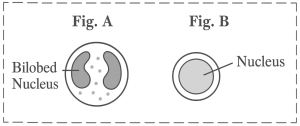
Identify the cells and their functions based on the provided figure:
$(a)$ Fig. $A$ - Megakaryocyte - formation of platelets
$(b)$ Fig. $B$ - Lymphocyte - synthesis of antibodies
$(c)$ Fig. $A$ - Eosinophil - secrete antihistamine
$(d)$ Fig. $A$ - Neutrophil - secrete heparin
$(a)$ Fig. $A$ - Megakaryocyte - formation of platelets
$(b)$ Fig. $B$ - Lymphocyte - synthesis of antibodies
$(c)$ Fig. $A$ - Eosinophil - secrete antihistamine
$(d)$ Fig. $A$ - Neutrophil - secrete heparin
A
$c$ and $d$
B
$a$ and $b$
C
$a$ and $d$
D
$b$ and $c$
Solution
(D) Fig. $A$ shows a cell with a bilobed nucleus,which is characteristic of an Eosinophil. Eosinophils are involved in resisting infections and are associated with allergic reactions,as they secrete antihistamines.
Fig. $B$ shows a cell with a large,spherical nucleus and very little cytoplasm,which is characteristic of a Lymphocyte. Lymphocytes are responsible for the immune response of the body by synthesizing antibodies.
Therefore,statements $(b)$ and $(c)$ are correct.
Fig. $B$ shows a cell with a large,spherical nucleus and very little cytoplasm,which is characteristic of a Lymphocyte. Lymphocytes are responsible for the immune response of the body by synthesizing antibodies.
Therefore,statements $(b)$ and $(c)$ are correct.
0 likes
View Solution618
EasyMCQ
Following are classified as plasma proteins $EXCEPT$ . . . . . . .
A
albumin
B
prothrombin
C
thromboplastin
D
fibrinogen
Solution
(C) Plasma proteins are proteins present in the blood plasma. The major plasma proteins include albumin,globulins,fibrinogen,and prothrombin.
$1$. Albumin helps in osmotic balance.
$2$. Fibrinogen and prothrombin are clotting factors present in the plasma.
$3$. Thromboplastin is a lipoprotein complex that is released from injured tissues or platelets during the process of blood coagulation. It is not a plasma protein; rather,it is a factor involved in the extrinsic or intrinsic pathway of blood clotting.
Therefore,the correct answer is $C$.
$1$. Albumin helps in osmotic balance.
$2$. Fibrinogen and prothrombin are clotting factors present in the plasma.
$3$. Thromboplastin is a lipoprotein complex that is released from injured tissues or platelets during the process of blood coagulation. It is not a plasma protein; rather,it is a factor involved in the extrinsic or intrinsic pathway of blood clotting.
Therefore,the correct answer is $C$.
0 likes
View Solution619
EasyMCQ
Decrease and increase in the number of RBCs is respectively termed as
A
Polycythemia and erythrocytopenia
B
Erythrocytopenia and polycythemia
C
Erythrocytopenia and erythropoiesis
D
Polycythemia and erythropoiesis
Solution
(B) The term $Erythrocytopenia$ refers to a decrease in the number of red blood cells $(RBCs)$ in the blood.
Conversely,$Polycythemia$ refers to an increase in the number of $RBCs$ in the blood.
$Erythropoiesis$ is the process of formation of $RBCs$.
Therefore,a decrease in $RBCs$ is $Erythrocytopenia$ and an increase in $RBCs$ is $Polycythemia$.
Conversely,$Polycythemia$ refers to an increase in the number of $RBCs$ in the blood.
$Erythropoiesis$ is the process of formation of $RBCs$.
Therefore,a decrease in $RBCs$ is $Erythrocytopenia$ and an increase in $RBCs$ is $Polycythemia$.
0 likes
View Solution620
EasyMCQ
Which of the following is correct?
A
Plasma = Blood + Lymphocytes
B
Blood = Plasma + RBCs + WBCs + Blood platelets
C
Lymph = Plasma + RBCs + WBCs
D
Serum = Blood + fibrinogen
Solution
(B) Blood is a specialized connective tissue consisting of a fluid matrix, plasma, and formed elements.
Formed elements include red blood cells $(RBCs)$, white blood cells $(WBCs)$, and platelets.
Therefore, the composition of blood is $Blood = Plasma + RBCs + WBCs + \text{Blood platelets}$.
Plasma is the liquid component of blood, not blood plus lymphocytes.
Lymph is essentially blood plasma minus large proteins and red blood cells.
Serum is blood plasma from which clotting factors like fibrinogen have been removed $(Serum = Plasma - \text{clotting factors})$.
Formed elements include red blood cells $(RBCs)$, white blood cells $(WBCs)$, and platelets.
Therefore, the composition of blood is $Blood = Plasma + RBCs + WBCs + \text{Blood platelets}$.
Plasma is the liquid component of blood, not blood plus lymphocytes.
Lymph is essentially blood plasma minus large proteins and red blood cells.
Serum is blood plasma from which clotting factors like fibrinogen have been removed $(Serum = Plasma - \text{clotting factors})$.
0 likes
View Solution621
EasyMCQ
In which one of the following human organs are the old and worn-out RBCs destroyed?
A
Red bone marrow
B
Liver
C
Lymph node
D
Kidney
Solution
(B) The lifespan of a human red blood cell $(RBC)$ is approximately $120$ days.
After this period,the old and worn-out $RBCs$ are removed from the circulation and destroyed primarily in the spleen,which is often referred to as the 'graveyard of $RBCs$'.
However,the liver also plays a significant role in the breakdown of these cells by processing the hemoglobin released from them.
Among the given options,the liver is the correct organ involved in this process.
After this period,the old and worn-out $RBCs$ are removed from the circulation and destroyed primarily in the spleen,which is often referred to as the 'graveyard of $RBCs$'.
However,the liver also plays a significant role in the breakdown of these cells by processing the hemoglobin released from them.
Among the given options,the liver is the correct organ involved in this process.
0 likes
View Solution622
EasyMCQ
Select the $CORRECT$ match:
| Column-$I$ | Column-$II$ | Column-$III$ |
|---|---|---|
| $i$. Monocyte | $d$. Kidney shaped nucleus | $n$. Phagocytic |
| $ii$. Lymphocyte | $a$. Large round nucleus | $o$. Produce antibodies |
| $iii$. Basophil | $b$. Twisted nucleus | $m$. Release heparin |
| $iv$. Eosinophil | $c$. Bilobed nucleus | $l$. Antihistamine property |
A
$i-d-n, ii-a-o, iii-b-m, iv-c-l$
B
$i-b-m, ii-a-l, iii-c-n, iv-d-o$
C
$i-c-n, ii-b-o, iii-d-m, iv-a-l$
D
$i-a-o, ii-d-m, iii-c-l, iv-b-n$
Solution
(A) The correct matches are as follows:
$1$. Monocyte $(i)$: Possesses a kidney-shaped nucleus $(d)$ and is phagocytic in nature $(n)$.
$2$. Lymphocyte $(ii)$: Possesses a large round nucleus $(a)$ and is involved in the production of antibodies $(o)$.
$3$. Basophil $(iii)$: Possesses a twisted or lobed nucleus $(b)$ and releases heparin $(m)$.
$4$. Eosinophil $(iv)$: Possesses a bilobed nucleus $(c)$ and has antihistamine properties $(l)$.
Therefore,the correct sequence is $i-d-n, ii-a-o, iii-b-m, iv-c-l$.
$1$. Monocyte $(i)$: Possesses a kidney-shaped nucleus $(d)$ and is phagocytic in nature $(n)$.
$2$. Lymphocyte $(ii)$: Possesses a large round nucleus $(a)$ and is involved in the production of antibodies $(o)$.
$3$. Basophil $(iii)$: Possesses a twisted or lobed nucleus $(b)$ and releases heparin $(m)$.
$4$. Eosinophil $(iv)$: Possesses a bilobed nucleus $(c)$ and has antihistamine properties $(l)$.
Therefore,the correct sequence is $i-d-n, ii-a-o, iii-b-m, iv-c-l$.
0 likes
View Solution623
EasyMCQ
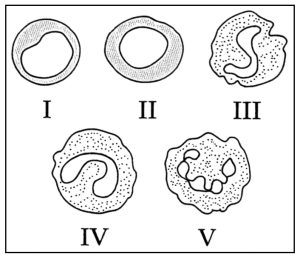
Which are the phagocytic cells from the given diagram?
A
$I$ and $V$
B
$I$ and $III$
C
$I$ and $IV$
D
$I$ and $II$
Solution
(A) Based on the provided diagram,the cells are identified as follows:
$I$ - Monocyte
$II$ - Lymphocyte
$III$ - Basophil
$IV$ - Eosinophil
$V$ - Neutrophil
Among the white blood cells (leukocytes),Monocytes $(I)$ and Neutrophils $(V)$ are the primary phagocytic cells that destroy foreign organisms entering the body. Therefore,the correct option is $I$ and $V$.
$I$ - Monocyte
$II$ - Lymphocyte
$III$ - Basophil
$IV$ - Eosinophil
$V$ - Neutrophil
Among the white blood cells (leukocytes),Monocytes $(I)$ and Neutrophils $(V)$ are the primary phagocytic cells that destroy foreign organisms entering the body. Therefore,the correct option is $I$ and $V$.
0 likes
View Solution624
EasyMCQ
Large reservoir of erythrocytes is . . . . . . .
A
Spleen
B
Liver
C
Appendix
D
Thymus gland
Solution
(A) The $Spleen$ is known as the 'graveyard of erythrocytes' because it removes old and damaged red blood cells from circulation. Additionally, it acts as a large reservoir of erythrocytes, storing them and releasing them into the bloodstream when the body requires an increased oxygen-carrying capacity, such as during exercise or hemorrhage.
0 likes
View Solution625
EasyMCQ
. . . . . . is a major storehouse of erythrocytes.
A
Liver
B
The spleen
C
Kidney
D
Thymus
Solution
(B) The spleen is known as the 'graveyard of erythrocytes' because it removes old and damaged red blood cells from circulation. Additionally,it acts as a major reservoir or storehouse for erythrocytes,releasing them into the bloodstream when the body requires an increased oxygen-carrying capacity.
0 likes
View Solution626
EasyMCQ
The most abundant type of $WBC$ are
A
eosinophils
B
basophils
C
monocytes
D
neutrophils
Solution
(D) The correct answer is $D$ (neutrophils).
Neutrophils are the most abundant type of white blood cells $(WBCs)$,accounting for approximately $60-65\%$ of the total $WBC$ count in the human body.
Neutrophils are the most abundant type of white blood cells $(WBCs)$,accounting for approximately $60-65\%$ of the total $WBC$ count in the human body.
0 likes
View Solution627
EasyMCQ
Match the different types of leucocytes (Column-$I$) with their percentage of occurrence (Column-$II$) in a healthy adult and choose the correct answer.
| Column-$I$ | Column-$II$ |
|---|---|
| $A$. Neutrophils | $(i)$ $6-8\%$ |
| $B$. Lymphocytes | $(ii)$ $60-65\%$ |
| $C$. Monocytes | $(iii)$ $0.5-1\%$ |
| $D$. Basophils | $(iv)$ $2-3\%$ |
| $E$. Eosinophils | $(v)$ $20-25\%$ |
A
$(A)-(ii); (B)-(v); (C)-(i); (D)-(iii); (E)-(iv)$
B
$(A)-(ii); (B)-(iii); (C)-(iv); (D)-(v); (E)-(i)$
C
$(A)-(iii); (B)-(iv); (C)-(v); (D)-(i); (E)-(ii)$
D
$(A)-(ii); (B)-(v); (C)-(iii); (D)-(iv); (E)-(i)$
Solution
(A) The percentage distribution of different types of leucocytes (WBCs) in the blood of a healthy adult is as follows:
$1$. Neutrophils: $60-65\%$
$2$. Lymphocytes: $20-25\%$
$3$. Monocytes: $6-8\%$
$4$. Eosinophils: $2-3\%$
$5$. Basophils: $0.5-1\%$
Matching these with the given columns:
$A$. Neutrophils $\rightarrow (ii) 60-65\%$
$B$. Lymphocytes $\rightarrow (v) 20-25\%$
$C$. Monocytes $\rightarrow (i) 6-8\%$
$D$. Basophils $\rightarrow (iii) 0.5-1\%$
$E$. Eosinophils $\rightarrow (iv) 2-3\%$
Therefore, the correct matching is $(A)-(ii); (B)-(v); (C)-(i); (D)-(iii); (E)-(iv)$.
$1$. Neutrophils: $60-65\%$
$2$. Lymphocytes: $20-25\%$
$3$. Monocytes: $6-8\%$
$4$. Eosinophils: $2-3\%$
$5$. Basophils: $0.5-1\%$
Matching these with the given columns:
$A$. Neutrophils $\rightarrow (ii) 60-65\%$
$B$. Lymphocytes $\rightarrow (v) 20-25\%$
$C$. Monocytes $\rightarrow (i) 6-8\%$
$D$. Basophils $\rightarrow (iii) 0.5-1\%$
$E$. Eosinophils $\rightarrow (iv) 2-3\%$
Therefore, the correct matching is $(A)-(ii); (B)-(v); (C)-(i); (D)-(iii); (E)-(iv)$.
0 likes
View Solution628
EasyMCQ
Choose the correct statement from the following.
A
Erythroblastosis fetalis may result when fetus is $Rh$ negative and mother is $Rh$ positive.
B
Histamine,serotonin and heparin are secreted by basophils.
C
Atherosclerosis is often referred to as angina pectoris.
D
Person with blood group $AB$ can donate blood to person with blood group $A$.
Solution
(B) is the correct statement.
$1$. $Erythroblastosis$ $fetalis$ occurs when the mother is $Rh$ negative and the fetus is $Rh$ positive,leading to the formation of anti-$Rh$ antibodies in the mother.
$2$. Basophils are granulocytes that secrete histamine,serotonin,and heparin,which are involved in inflammatory reactions.
$3$. Atherosclerosis is a condition where plaque builds up in the arteries,whereas angina pectoris is chest pain due to reduced blood flow to the heart muscle.
$4$. $A$ person with blood group $AB$ is a universal recipient and can only donate blood to individuals with blood group $AB$.
$1$. $Erythroblastosis$ $fetalis$ occurs when the mother is $Rh$ negative and the fetus is $Rh$ positive,leading to the formation of anti-$Rh$ antibodies in the mother.
$2$. Basophils are granulocytes that secrete histamine,serotonin,and heparin,which are involved in inflammatory reactions.
$3$. Atherosclerosis is a condition where plaque builds up in the arteries,whereas angina pectoris is chest pain due to reduced blood flow to the heart muscle.
$4$. $A$ person with blood group $AB$ is a universal recipient and can only donate blood to individuals with blood group $AB$.
0 likes
View Solution629
EasyMCQ
Select the correct Rh-blood groups of the parents,whose child is affected with erythroblastosis fetalis.
A
Both father and mother are Rh+ ve
B
Mother is Rh + ve and father is Rh - ve
C
Both father and mother are Rh - ve
D
Father is Rh + ve and mother is Rh - ve
Solution
(D) Erythroblastosis fetalis is a condition that occurs when there is an Rh incompatibility between the mother and the fetus.
This condition typically arises when the mother is $Rh-$ (Rh-negative) and the father is $Rh+$ (Rh-positive).
If the fetus inherits the $Rh+$ antigen from the father,the mother's immune system may produce antibodies against the $Rh$ factor during the first pregnancy.
In subsequent pregnancies,if the fetus is again $Rh+$,these maternal antibodies can cross the placenta and destroy the fetal red blood cells,leading to erythroblastosis fetalis.
Therefore,the correct combination is that the father is $Rh+$ and the mother is $Rh-$.
This condition typically arises when the mother is $Rh-$ (Rh-negative) and the father is $Rh+$ (Rh-positive).
If the fetus inherits the $Rh+$ antigen from the father,the mother's immune system may produce antibodies against the $Rh$ factor during the first pregnancy.
In subsequent pregnancies,if the fetus is again $Rh+$,these maternal antibodies can cross the placenta and destroy the fetal red blood cells,leading to erythroblastosis fetalis.
Therefore,the correct combination is that the father is $Rh+$ and the mother is $Rh-$.
0 likes
View Solution630
EasyMCQ
The blood cell that secretes histamine,serotonin,and heparin is
A
neutrophil
B
$T$-lymphocyte
C
killer cell
D
basophil
Solution
(D) The correct answer is $D$.
Basophils are a type of granulocyte white blood cell.
They play a crucial role in inflammatory responses and allergic reactions.
They secrete chemical substances such as histamine (a vasodilator),serotonin (a neurotransmitter),and heparin (an anticoagulant) to modulate the immune response.
Basophils are a type of granulocyte white blood cell.
They play a crucial role in inflammatory responses and allergic reactions.
They secrete chemical substances such as histamine (a vasodilator),serotonin (a neurotransmitter),and heparin (an anticoagulant) to modulate the immune response.
0 likes
View Solution631
EasyMCQ
The condition of erythroblastosis fetalis occurs only when
A
the husband is $Rh^{+}$ and the wife is $Rh^{-}$
B
the husband is $Rh^{-}$ and the wife is $Rh^{+}$
C
the mother is $Rh^{+}$ and the father is $Rh^{-}$
D
the mother is $Rh^{-}$ and the father is $Rh^{+}$
Solution
(D) The correct answer is $D$.
Erythroblastosis fetalis is a hemolytic disease of the newborn that occurs when an $Rh^{-}$ mother carries an $Rh^{+}$ fetus.
During the first delivery,fetal blood containing $Rh$ antigens may enter the mother's circulation,causing her to produce anti-$Rh$ antibodies.
In subsequent pregnancies,these maternal antibodies can cross the placenta and destroy the red blood cells of the $Rh^{+}$ fetus,leading to severe anemia and jaundice.
Erythroblastosis fetalis is a hemolytic disease of the newborn that occurs when an $Rh^{-}$ mother carries an $Rh^{+}$ fetus.
During the first delivery,fetal blood containing $Rh$ antigens may enter the mother's circulation,causing her to produce anti-$Rh$ antibodies.
In subsequent pregnancies,these maternal antibodies can cross the placenta and destroy the red blood cells of the $Rh^{+}$ fetus,leading to severe anemia and jaundice.
0 likes
View Solution632
EasyMCQ
Study the diagram given below and identify the cells labelled as $A$, $B$, $C$ and $D$, and choose the correct option.
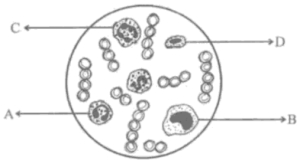
A
$A = \text{Eosinophil}, B = \text{Erythrocyte}, C = \text{Neutrophil} \text{ and } D = \text{Basophil}$
B
$A = \text{Eosinophil}, B = \text{Lymphocyte}, C = \text{Neutrophil} \text{ and } D = \text{Monocyte}$
C
$A = \text{Erythrocyte}, B = \text{Basophil}, C = \text{Neutrophil} \text{ and } D = \text{Lymphocyte}$
D
$A = \text{Eosinophil}, B = \text{Monocyte}, C = \text{Neutrophil} \text{ and } D = \text{Lymphocyte}$
Solution
(D) The correct option is $D$.
The given image shows the following blood cells:
• $A = \text{Eosinophil}$, characterized by its bilobed nucleus.
• $B = \text{Monocyte}$, identifiable by its large, kidney-shaped or bean-shaped nucleus and abundant cytoplasm.
• $C = \text{Neutrophil}$, identifiable by its multi-lobed nucleus.
• $D = \text{Lymphocyte}$, recognized by its large, round nucleus and minimal cytoplasm.
The given image shows the following blood cells:
• $A = \text{Eosinophil}$, characterized by its bilobed nucleus.
• $B = \text{Monocyte}$, identifiable by its large, kidney-shaped or bean-shaped nucleus and abundant cytoplasm.
• $C = \text{Neutrophil}$, identifiable by its multi-lobed nucleus.
• $D = \text{Lymphocyte}$, recognized by its large, round nucleus and minimal cytoplasm.
0 likes
View Solution633
EasyMCQ
In which of the following situations is there a risk factor for children of incurring erythroblastosis fetalis?
A
Mother is $Rh$ negative and father is $Rh$ negative
B
Mother is $Rh$ negative and father is $Rh$ positive
C
Mother is $Rh$ positive and father is $Rh$ positive
D
Mother is $Rh$ positive and father is $Rh$ negative
Solution
(B) The correct answer is $(B)$.
Erythroblastosis fetalis is a condition that occurs when an $Rh$-negative mother carries an $Rh$-positive fetus.
During the first pregnancy,the mother's blood is exposed to the $Rh$ antigens of the fetus during delivery,causing her to produce anti-$Rh$ antibodies.
In subsequent pregnancies,if the fetus is again $Rh$ positive,these maternal antibodies cross the placenta and destroy the fetal red blood cells (hemolysis).
This risk specifically arises when the mother is $Rh$ negative and the father is $Rh$ positive,as the fetus may inherit the $Rh$ positive trait.
Erythroblastosis fetalis is a condition that occurs when an $Rh$-negative mother carries an $Rh$-positive fetus.
During the first pregnancy,the mother's blood is exposed to the $Rh$ antigens of the fetus during delivery,causing her to produce anti-$Rh$ antibodies.
In subsequent pregnancies,if the fetus is again $Rh$ positive,these maternal antibodies cross the placenta and destroy the fetal red blood cells (hemolysis).
This risk specifically arises when the mother is $Rh$ negative and the father is $Rh$ positive,as the fetus may inherit the $Rh$ positive trait.
0 likes
View Solution634
EasyMCQ
When red blood corpuscles containing both $A$ and $B$ antigens are mixed with your blood serum,they agglutinate. Hence,your blood group is . . . . . . type.
A
$AB$
B
$O$
C
$A$
D
$B$
Solution
(B) The correct answer is $O$.
Blood group $O$ individuals do not have $A$ or $B$ antigens on the surface of their red blood cells $(RBCs)$.
However,their blood serum contains both anti-$A$ and anti-$B$ antibodies.
When $RBCs$ containing both $A$ and $B$ antigens (such as those from an $AB$ blood group individual) are mixed with serum containing anti-$A$ and anti-$B$ antibodies,the antibodies bind to the antigens,causing the cells to clump together,a process known as agglutination.
Therefore,if agglutination occurs,the serum must contain these antibodies,which is characteristic of blood group $O$.
Blood group $O$ individuals do not have $A$ or $B$ antigens on the surface of their red blood cells $(RBCs)$.
However,their blood serum contains both anti-$A$ and anti-$B$ antibodies.
When $RBCs$ containing both $A$ and $B$ antigens (such as those from an $AB$ blood group individual) are mixed with serum containing anti-$A$ and anti-$B$ antibodies,the antibodies bind to the antigens,causing the cells to clump together,a process known as agglutination.
Therefore,if agglutination occurs,the serum must contain these antibodies,which is characteristic of blood group $O$.
0 likes
View Solution635
EasyMCQ
Which of the following prevents the conversion of prothrombin to thrombin in an undamaged blood vessel?
A
Thromboplastin
B
Fibrinogen
C
Heparin
D
Calcium ions
Solution
(C) Heparin.
$Heparin$ is a natural anticoagulant present in the blood that prevents the conversion of $prothrombin$ to $thrombin$ in an undamaged blood vessel.
This action prevents unnecessary blood clot formation by blocking the $thrombin$-mediated conversion of $fibrinogen$ to $fibrin$,thereby maintaining smooth blood flow in healthy,undamaged vessels.
$Heparin$ is a natural anticoagulant present in the blood that prevents the conversion of $prothrombin$ to $thrombin$ in an undamaged blood vessel.
This action prevents unnecessary blood clot formation by blocking the $thrombin$-mediated conversion of $fibrinogen$ to $fibrin$,thereby maintaining smooth blood flow in healthy,undamaged vessels.
0 likes
View Solution636
EasyMCQ
With regard to the $ABO$ blood typing system,if a man who has type $B$ blood and a woman who has type $O$ blood were to have children,what blood types could the children have?
A
$A$ or $O$
B
$B$ or $O$
C
$AB$ or $O$
D
$A, B, AB$ or $O$
Solution
(B) The $ABO$ blood group system is determined by three alleles: $I^A, I^B$,and $i$.
Individuals with type $B$ blood can have the genotype $I^B I^B$ (homozygous) or $I^B i$ (heterozygous).
Individuals with type $O$ blood must have the genotype $ii$.
If the man is $I^B I^B$,the cross is $I^B I^B \times ii$,resulting in all offspring having the genotype $I^B i$ (Type $B$ blood).
If the man is $I^B i$,the cross is $I^B i \times ii$,resulting in offspring with genotypes $I^B i$ (Type $B$ blood) and $ii$ (Type $O$ blood).
Therefore,the children could have either Type $B$ or Type $O$ blood.
Individuals with type $B$ blood can have the genotype $I^B I^B$ (homozygous) or $I^B i$ (heterozygous).
Individuals with type $O$ blood must have the genotype $ii$.
If the man is $I^B I^B$,the cross is $I^B I^B \times ii$,resulting in all offspring having the genotype $I^B i$ (Type $B$ blood).
If the man is $I^B i$,the cross is $I^B i \times ii$,resulting in offspring with genotypes $I^B i$ (Type $B$ blood) and $ii$ (Type $O$ blood).
Therefore,the children could have either Type $B$ or Type $O$ blood.
0 likes
View Solution637
EasyMCQ
Four children belonging to the same parents have the following blood groups $A$,$B$,$AB$ and $O$. Hence,the genotypes of the two parents are:
A
Both parents are homozygous for $A$ group.
B
One parent is homozygous for $A$ group.
C
One parent is heterozygous for $A$ and the other parent is heterozygous for $B$.
D
Both parents are homozygous for $B$ group.
Solution
(C) The inheritance of $ABO$ blood groups is controlled by the gene $I$. The gene $I$ has three alleles: $I^A$,$I^B$,and $i$.
Since the children have blood groups $A$,$B$,$AB$,and $O$,the parents must be heterozygous.
For a child to have blood group $O$ (genotype $ii$),both parents must contribute an $i$ allele.
For a child to have blood group $AB$ (genotype $I^A I^B$),one parent must contribute $I^A$ and the other must contribute $I^B$.
Therefore,the genotypes of the parents must be $I^A i$ (Blood group $A$) and $I^B i$ (Blood group $B$).
This cross $(I^A i \times I^B i)$ results in offspring with genotypes $I^A I^B$ $(AB)$,$I^A i$ $(A)$,$I^B i$ $(B)$,and $ii$ $(O)$.
Thus,both parents are heterozygous for blood groups $A$ and $B$ respectively.
Since the children have blood groups $A$,$B$,$AB$,and $O$,the parents must be heterozygous.
For a child to have blood group $O$ (genotype $ii$),both parents must contribute an $i$ allele.
For a child to have blood group $AB$ (genotype $I^A I^B$),one parent must contribute $I^A$ and the other must contribute $I^B$.
Therefore,the genotypes of the parents must be $I^A i$ (Blood group $A$) and $I^B i$ (Blood group $B$).
This cross $(I^A i \times I^B i)$ results in offspring with genotypes $I^A I^B$ $(AB)$,$I^A i$ $(A)$,$I^B i$ $(B)$,and $ii$ $(O)$.
Thus,both parents are heterozygous for blood groups $A$ and $B$ respectively.
0 likes
View Solution638
DifficultMCQ
The $WBC$ count of a person's blood sample is $8000/cu.mm$. How many eosinophils and lymphocytes would be in the same blood sample approximately?
A
$300 - 500/cu.mm$ and $500 - 700/cu.mm$,respectively
B
$300 - 500/cu.mm$ and $1200 - 1500/cu.mm$,respectively
C
$100 - 120/cu.mm$ and $160 - 200/cu.mm$,respectively
D
$160 - 240/cu.mm$ and $1600 - 2000/cu.mm$,respectively
Solution
(D) The differential $WBC$ count percentages are as follows:
Eosinophils: $2-3\%$ of $8000 = 160-240/cu.mm$.
Lymphocytes: $20-25\%$ of $8000 = 1600-2000/cu.mm$.
Therefore,option $D$ matches these calculated values.
Eosinophils: $2-3\%$ of $8000 = 160-240/cu.mm$.
Lymphocytes: $20-25\%$ of $8000 = 1600-2000/cu.mm$.
Therefore,option $D$ matches these calculated values.
0 likes
View Solution639
MediumMCQ
Select the incorrect statements with reference to $Rh$ grouping.
$A$. Erythroblastosis foetalis is a condition observed having foetus with $Rh^{+ve}$ blood and mother with $Rh^{+ve}$ blood.
$B$. $Rh$ antigen is observed on $RBCs$ in the majority of human beings.
$C$. Before blood transfusion,$Rh$ group should also be matched.
$D$. $Rh$ incompatibility is observed when a pregnant mother is $Rh^{-ve}$ and the foetus is $Rh^{+ve}$.
$E$. Erythroblastosis foetalis can be avoided by administering anti-$Rh$ antibodies to the mother immediately after the delivery of the second child.
Choose the answer from the options given below:
$A$. Erythroblastosis foetalis is a condition observed having foetus with $Rh^{+ve}$ blood and mother with $Rh^{+ve}$ blood.
$B$. $Rh$ antigen is observed on $RBCs$ in the majority of human beings.
$C$. Before blood transfusion,$Rh$ group should also be matched.
$D$. $Rh$ incompatibility is observed when a pregnant mother is $Rh^{-ve}$ and the foetus is $Rh^{+ve}$.
$E$. Erythroblastosis foetalis can be avoided by administering anti-$Rh$ antibodies to the mother immediately after the delivery of the second child.
Choose the answer from the options given below:
A
$(1)$ $A$ and $B$ only
B
$(2)$ $C$ and $D$ only
C
$(3)$ $A$ and $E$ only
D
$(4)$ $B$ and $C$ only
Solution
(C) Statement $A$ is incorrect because Erythroblastosis foetalis occurs when the mother is $Rh^{-ve}$ and the foetus is $Rh^{+ve}$.
Statement $E$ is incorrect because anti-$Rh$ antibodies (anti-$D$) are administered to the mother immediately after the delivery of the first $Rh^{+ve}$ child to prevent sensitization in subsequent pregnancies.
Statement $E$ is incorrect because anti-$Rh$ antibodies (anti-$D$) are administered to the mother immediately after the delivery of the first $Rh^{+ve}$ child to prevent sensitization in subsequent pregnancies.
0 likes
View SolutionBody Fluids and Circulations — Blood and Blood Group · Frequently Asked Questions
1Are these Body Fluids and Circulations questions useful for JEE and NEET?
Yes. All questions in this section are mapped to JEE Main and NEET exam patterns. Previous year questions from JEE Main, NEET, GUJCET and state-level exams are included with full solutions.
2Can I switch to Hindi or Gujarati for these questions?
Yes. Use the language tabs in the hero section or the sidebar to view the same questions and solutions in English, Hindi or Gujarati.
3How do I generate a question paper from this subtopic?
Use the Vedclass Exam Paper Generator — select the chapter and subtopic, set difficulty, and generate Sets A, B, C, D automatically. First 3 chapters of every subject are free.
Vedclass Products
For Students
Vedclass Test Series
Mock tests in real JEE/NEET style with performance analysis. 5-day free trial.
Start Free TrialFor Teachers
Exam Paper Generator
Generate Set A/B/C/D papers from this chapter in 2 minutes. 3 chapters free.
Try FreeFor Institutes
Online Exam Module
Live online exams with unlimited students, 360° analytics & white-label branding.
See DemoFor Teachers & Institutes
Generate a Body Fluids and Circulations Exam Paper in 2 Minutes
Select subtopic & difficulty — Sets A, B, C, D auto-generated with No Repeat logic.
First 3 chapters of every subject are free — no payment required.