
A English
Double Circulation and Circulatory pathway Questions in English
Class 11 Biology · Body Fluids and Circulations · Double Circulation and Circulatory pathway
116+
Questions
English
Language
100%
With Solutions
Showing 50 of 116 questions in English
1
MediumMCQ
The portal system seen in all vertebrates is
A
Hepatic
B
Renal
C
Both $(a)$ and $(b)$
D
Pulmonary
Solution
(A) portal system is a system of blood vessels in which blood collected from one capillary bed is transported to another capillary bed before returning to the heart.
In all vertebrates,the hepatic portal system is present,which carries blood from the digestive tract to the liver.
The renal portal system is present in lower vertebrates like fishes,amphibians,and reptiles,but it is absent in birds and mammals.
Therefore,the hepatic portal system is the only one common to all vertebrate groups.
In all vertebrates,the hepatic portal system is present,which carries blood from the digestive tract to the liver.
The renal portal system is present in lower vertebrates like fishes,amphibians,and reptiles,but it is absent in birds and mammals.
Therefore,the hepatic portal system is the only one common to all vertebrate groups.
0 likes
View Solution2
MediumMCQ
Double circulatory heart is present in
A
Birds only
B
Mammals only
C
Reptilia only
D
Both $(a)$ and $(b)$
Solution
(D) double circulatory system involves the blood passing through the heart twice for each complete circuit of the body. This is a characteristic feature of birds and mammals,where the heart is four-chambered,ensuring complete separation of oxygenated and deoxygenated blood. Therefore,both birds and mammals exhibit a double circulatory system.
0 likes
View Solution3
MediumMCQ
Which of the following is not found in mammals?
A
Hepatic portal system
B
Hypophysial portal system
C
Renal portal system
D
Hepatic and Hypophysial portal system
Solution
(C) portal system is a system of blood vessels in which blood collected from one capillary bed is transported to another capillary bed before returning to the heart.
In mammals,the $Hepatic$ portal system (connecting the digestive tract to the liver) and the $Hypophysial$ portal system (connecting the hypothalamus to the anterior pituitary) are present.
However,the $Renal$ portal system,which carries blood from the hind limbs to the kidneys,is absent in mammals. It is typically found in lower vertebrates like amphibians and reptiles.
In mammals,the $Hepatic$ portal system (connecting the digestive tract to the liver) and the $Hypophysial$ portal system (connecting the hypothalamus to the anterior pituitary) are present.
However,the $Renal$ portal system,which carries blood from the hind limbs to the kidneys,is absent in mammals. It is typically found in lower vertebrates like amphibians and reptiles.
0 likes
View Solution4
EasyMCQ
Which of the following carries glucose from the digestive tract to the liver?
A
Hepatic artery
B
Pulmonary vein
C
Hepatic portal vein
D
Renal portal system
Solution
(C) The $Hepatic portal vein$ carries blood from the digestive tract to the liver.
This blood is rich in absorbed nutrients such as glucose and amino acids, which are transported directly to the liver for processing, storage, or distribution to the rest of the body.
This blood is rich in absorbed nutrients such as glucose and amino acids, which are transported directly to the liver for processing, storage, or distribution to the rest of the body.
0 likes
View Solution5
MediumMCQ
The blood returning to the heart from the lungs via the pulmonary vein has more:
A
$RBC$ per $ml$ of blood
B
Haemoglobin per $ml$ of blood
C
Oxygen per $ml$ of blood
D
Nutrient per $ml$ of blood
Solution
(C) The pulmonary vein carries oxygenated blood from the lungs to the left atrium of the heart.
During the process of pulmonary circulation,blood passes through the alveoli in the lungs where gas exchange occurs.
As a result,the blood becomes oxygenated,meaning it has a higher concentration of $O_2$ compared to the deoxygenated blood returning from the rest of the body.
Therefore,the blood returning via the pulmonary vein has more oxygen per $ml$ of blood.
During the process of pulmonary circulation,blood passes through the alveoli in the lungs where gas exchange occurs.
As a result,the blood becomes oxygenated,meaning it has a higher concentration of $O_2$ compared to the deoxygenated blood returning from the rest of the body.
Therefore,the blood returning via the pulmonary vein has more oxygen per $ml$ of blood.
0 likes
View Solution6
MediumMCQ
For reaching the left side of the heart,blood must pass through:
A
Liver
B
Kidneys
C
Lungs
D
Brain
Solution
(C) In the human circulatory system,blood follows a double circulation pattern. Deoxygenated blood from the body enters the right atrium,moves to the right ventricle,and is then pumped to the lungs via the pulmonary artery for oxygenation. After becoming oxygenated in the lungs,the blood returns to the left atrium of the heart via the pulmonary veins. Therefore,to reach the left side of the heart,blood must pass through the lungs.
0 likes
View Solution7
EasyMCQ
Which part of the circulatory system serves to supply blood to the heart muscle itself?
A
Coronary circulation
B
Portal circulation
C
Pulmonary circulation
D
Systemic circulation
Solution
(A) The $Coronary$ circulation is the specific part of the circulatory system that supplies oxygenated blood to the heart muscle (myocardium) itself.
$A$. $Coronary$ circulation: Supplies blood to the heart tissue.
$B$. $Portal$ circulation: Refers to blood flow between two capillary beds (e.g.,hepatic portal system).
$C$. $Pulmonary$ circulation: Refers to the flow of blood between the heart and the lungs for oxygenation.
$D$. $Systemic$ circulation: Refers to the flow of blood between the heart and the rest of the body tissues.
$A$. $Coronary$ circulation: Supplies blood to the heart tissue.
$B$. $Portal$ circulation: Refers to blood flow between two capillary beds (e.g.,hepatic portal system).
$C$. $Pulmonary$ circulation: Refers to the flow of blood between the heart and the lungs for oxygenation.
$D$. $Systemic$ circulation: Refers to the flow of blood between the heart and the rest of the body tissues.
0 likes
View Solution8
MediumMCQ
The blood vascular system of mammals is known as a double circulatory system because
A
$A$ group of veins carries oxygenated blood and another group carries deoxygenated blood.
B
Oxygenated blood passes through the heart twice in one complete cycle.
C
The systemic and pulmonary circulations are completely separated.
D
Blood passes through the heart twice in each complete cycle of the body.
Solution
(D) The blood vascular system of mammals is called a double circulatory system because blood passes through the heart twice for every one complete cycle of the body.
This involves two distinct circuits:
$1$. Pulmonary circulation: Deoxygenated blood is pumped from the right ventricle to the lungs for oxygenation and returns to the left atrium.
$2$. Systemic circulation: Oxygenated blood is pumped from the left ventricle to all body tissues and returns as deoxygenated blood to the right atrium.
Since the blood flows through the heart twice,it is termed double circulation.
This involves two distinct circuits:
$1$. Pulmonary circulation: Deoxygenated blood is pumped from the right ventricle to the lungs for oxygenation and returns to the left atrium.
$2$. Systemic circulation: Oxygenated blood is pumped from the left ventricle to all body tissues and returns as deoxygenated blood to the right atrium.
Since the blood flows through the heart twice,it is termed double circulation.
0 likes
View Solution9
MediumMCQ
Mammals are said to have a "double circulatory system". This means
A
That the blood vessels are paired
B
That there are two types of blood vessels attached to every organ; an artery and a vein
C
That there are two systems; one from the heart to the lungs and back to the heart and other to and from the rest of the body
D
That the blood circulates twice as quickly
Solution
(C) In mammals, the blood flows through the heart twice during each complete cycle of circulation through the body.
This process involves two distinct circuits:
$1$. Pulmonary circulation: Blood travels from the heart to the lungs for oxygenation and returns to the heart.
$2$. Systemic circulation: Oxygenated blood is pumped from the heart to the rest of the body tissues and deoxygenated blood returns to the heart.
Therefore, the correct description is that there are two systems: one from the heart to the lungs and back to the heart, and the other to and from the rest of the body.
This process involves two distinct circuits:
$1$. Pulmonary circulation: Blood travels from the heart to the lungs for oxygenation and returns to the heart.
$2$. Systemic circulation: Oxygenated blood is pumped from the heart to the rest of the body tissues and deoxygenated blood returns to the heart.
Therefore, the correct description is that there are two systems: one from the heart to the lungs and back to the heart, and the other to and from the rest of the body.
0 likes
View Solution10
MediumMCQ
Which one of the following veins breaks up into capillaries?
A
Renal vein
B
Hepatic portal vein
C
Pelvic vein
D
Pulmonary vein
Solution
(B) The hepatic portal vein is a unique venous system that carries blood from the digestive tract to the liver.
Unlike typical veins that carry blood directly to the heart, the hepatic portal vein enters the liver and branches into a network of capillaries known as hepatic sinusoids.
This allows the liver to process nutrients and detoxify substances absorbed from the gut before the blood enters the general systemic circulation.
Therefore, the correct option is $B$.
Unlike typical veins that carry blood directly to the heart, the hepatic portal vein enters the liver and branches into a network of capillaries known as hepatic sinusoids.
This allows the liver to process nutrients and detoxify substances absorbed from the gut before the blood enters the general systemic circulation.
Therefore, the correct option is $B$.
0 likes
View Solution11
EasyMCQ
William Harvey is known for the discovery of
A
Blood transfusion
B
Blood clotting
C
Blood circulation
D
Blood purification
Solution
(C) William Harvey was an English physician who made a monumental contribution to medical science by describing the systemic circulation and properties of blood being pumped to the body by the heart.
He published his findings in his work titled 'Exercitatio Anatomica de Motu Cordis et Sanguinis in Animalibus' in $1628$.
Therefore, he is famously known for the discovery of blood circulation.
He published his findings in his work titled 'Exercitatio Anatomica de Motu Cordis et Sanguinis in Animalibus' in $1628$.
Therefore, he is famously known for the discovery of blood circulation.
0 likes
View Solution12
MediumMCQ
$A$ portal system is a system in which
A
$A$ vein starts from an organ and ends up in the heart.
B
An artery breaks up in an organ and restarts by the union of its capillaries.
C
The blood from the gut is brought into the kidney before it is poured into the posterior vena cava.
D
$A$ vein breaks up in an organ into capillaries and restarts by their union as a new vein in the same organ.
Solution
(D) portal system is defined as a circulatory pathway where blood collected from one organ is transported via a vein to another organ before returning to the heart.
Specifically,a vein breaks up into capillaries within an organ and then reforms by the union of these capillaries to form a new vein that carries blood to a second organ.
An example is the hepatic portal system,where blood from the digestive tract is carried to the liver before entering the systemic circulation.
Specifically,a vein breaks up into capillaries within an organ and then reforms by the union of these capillaries to form a new vein that carries blood to a second organ.
An example is the hepatic portal system,where blood from the digestive tract is carried to the liver before entering the systemic circulation.
0 likes
View Solution13
MediumMCQ
The hepatic portal system starts from:
A
Digestive system to liver
B
Kidney to liver
C
Liver to heart
D
Liver to kidney
Solution
(A) The hepatic portal system is a unique vascular connection that exists between the digestive tract and the liver. It begins with capillaries in the digestive system (stomach,intestines,pancreas,and spleen) and ends with capillaries in the liver. This system carries nutrient-rich,deoxygenated blood from the digestive organs to the liver for processing and detoxification before it enters the systemic circulation.
0 likes
View Solution14
MediumMCQ
Blood circulation that starts in capillaries and ends in capillaries is called:
A
Portal circulation
B
Hepatic circulation
C
Cardiac circulation
D
None
Solution
(A) The blood circulation that begins in capillaries and ends in capillaries, without directly returning to the heart, is known as a $Portal \text{ circulation}$. In this system, blood collected from one organ is transported to another organ through a vein before returning to the heart. A classic example is the $Hepatic \text{ portal system}$ in humans.
0 likes
View Solution15
MediumMCQ
When a vein,instead of carrying blood directly into the heart,first carries it to an intermediate organ like the liver,it is known as:
A
Pulmonary artery
B
Renal portal vein
C
Hepatic portal vein
D
Pulmonary vein
Solution
(C) portal system is a circulatory arrangement where blood collected from one capillary bed is transported to another capillary bed through a vein before returning to the heart.
In the case of the liver,the vein that collects blood from the digestive tract and transports it to the liver for processing before it enters the systemic circulation is called the $Hepatic \ portal \ vein$.
This system is essential for filtering nutrients and toxins absorbed from the gut.
In the case of the liver,the vein that collects blood from the digestive tract and transports it to the liver for processing before it enters the systemic circulation is called the $Hepatic \ portal \ vein$.
This system is essential for filtering nutrients and toxins absorbed from the gut.
0 likes
View Solution16
MediumMCQ
Which of the following carries glucose from the digestive tract to the liver?
A
Hepatic artery
B
Hepatic portal vein
C
Pulmonary vein
D
None of these
Solution
(B) The $Hepatic$ $portal$ $vein$ is a unique vascular connection that exists between the digestive tract and the liver.
It carries blood rich in absorbed nutrients,such as glucose and amino acids,directly from the intestine to the liver for processing,storage,or distribution before the blood enters the systemic circulation.
It carries blood rich in absorbed nutrients,such as glucose and amino acids,directly from the intestine to the liver for processing,storage,or distribution before the blood enters the systemic circulation.
0 likes
View Solution17
MediumMCQ
The diagram below shows how substances are transported to and from the liver. They are labeled as $D, E$ and $F$. Which one of the following labelings is correct?
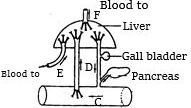
A
$D$ is the hepatic portal vein and $E$ is the hepatic vein.
B
$C$ is the intestine and $F$ is the hepatic portal vein.
C
$D$ is the hepatic portal vein and $F$ is the hepatic vein.
D
$B$ is the pancreatic artery and $E$ is the hepatic artery.
Solution
(C) Based on the anatomical structure of the hepatic portal system:
$1$. $D$ represents the hepatic portal vein,which carries nutrient-rich blood from the digestive tract (intestine) to the liver.
$2$. $E$ represents the hepatic artery,which supplies oxygenated blood to the liver.
$3$. $F$ represents the hepatic vein,which carries processed blood away from the liver to the inferior vena cava.
Therefore,$D$ is the hepatic portal vein and $F$ is the hepatic vein.
$1$. $D$ represents the hepatic portal vein,which carries nutrient-rich blood from the digestive tract (intestine) to the liver.
$2$. $E$ represents the hepatic artery,which supplies oxygenated blood to the liver.
$3$. $F$ represents the hepatic vein,which carries processed blood away from the liver to the inferior vena cava.
Therefore,$D$ is the hepatic portal vein and $F$ is the hepatic vein.
0 likes
View Solution18
EasyMCQ
William Harvey is known for the discovery of
A
Digestion
B
Respiration
C
Blood clotting
D
Blood circulation
Solution
(D) William Harvey was an English physician who made a monumental contribution to biology and medicine.
He is best known for his detailed description of the systemic circulation and properties of blood being pumped to the body by the heart.
His work,published in $1628$ titled $Exercitatio$ $Anatomica$ $de$ $Motu$ $Cordis$ $et$ $Sanguinis$ $in$ $Animalibus$,provided the first accurate account of the circulatory system in humans and other vertebrates.
He is best known for his detailed description of the systemic circulation and properties of blood being pumped to the body by the heart.
His work,published in $1628$ titled $Exercitatio$ $Anatomica$ $de$ $Motu$ $Cordis$ $et$ $Sanguinis$ $in$ $Animalibus$,provided the first accurate account of the circulatory system in humans and other vertebrates.
0 likes
View Solution19
EasyMCQ
Through which vessel does the completely digested food reach the liver?
A
Hepatic portal vein
B
Hepatic artery
C
Hepatic vein
D
All of the above
Solution
(A) The $Hepatic \text{ } portal \text{ } vein$ carries blood from the digestive tract (stomach, intestines, pancreas, and spleen) to the liver.
This blood is rich in nutrients absorbed from the digested food.
Therefore, the completely digested food reaches the liver primarily through the $Hepatic \text{ } portal \text{ } vein$ for processing, detoxification, and storage.
This blood is rich in nutrients absorbed from the digested food.
Therefore, the completely digested food reaches the liver primarily through the $Hepatic \text{ } portal \text{ } vein$ for processing, detoxification, and storage.
0 likes
View Solution20
MediumMCQ
What is the circulatory system called in which blood vessels begin and end in capillaries?
A
Portal system
B
Hepatic circulation
C
Cardiac arrest
D
None of these
Solution
(A) portal system is a part of the circulatory system where blood vessels begin and end in capillaries without passing through the heart in between.
In a typical circulatory system,blood flows from the heart to the tissues and back to the heart.
However,in a portal system,blood collected from one capillary bed is transported through a portal vein to another capillary bed before returning to the heart.
An example is the hepatic portal system,which carries blood from the digestive tract to the liver.
In a typical circulatory system,blood flows from the heart to the tissues and back to the heart.
However,in a portal system,blood collected from one capillary bed is transported through a portal vein to another capillary bed before returning to the heart.
An example is the hepatic portal system,which carries blood from the digestive tract to the liver.
0 likes
View Solution21
MediumMCQ
Blood flowing towards the lungs has more of ....... than the blood flowing away from the lungs.
A
Oxygen
B
$CO_2$
C
Hydrogen
D
None of these
Solution
(B) Blood flowing towards the lungs is deoxygenated blood,which is carried by the pulmonary artery from the right ventricle of the heart to the lungs.
This blood is rich in $CO_2$ and poor in $O_2$.
Conversely,blood flowing away from the lungs is oxygenated blood,which is carried by the pulmonary vein from the lungs to the left atrium of the heart.
This blood is rich in $O_2$ and poor in $CO_2$.
Therefore,blood flowing towards the lungs has a higher concentration of $CO_2$ compared to blood flowing away from the lungs.
This blood is rich in $CO_2$ and poor in $O_2$.
Conversely,blood flowing away from the lungs is oxygenated blood,which is carried by the pulmonary vein from the lungs to the left atrium of the heart.
This blood is rich in $O_2$ and poor in $CO_2$.
Therefore,blood flowing towards the lungs has a higher concentration of $CO_2$ compared to blood flowing away from the lungs.
0 likes
View Solution22
EasyMCQ
What type of circulatory system is present in humans?
A
Single and open
B
Double and open
C
Double and closed
D
Single and closed
Solution
(C) In humans,the circulatory system is classified as $Double$ and $Closed$.
$1$. $Double$ circulation: The blood passes through the heart twice in one complete cycle (pulmonary circulation and systemic circulation).
$2$. $Closed$ circulation: The blood flows entirely within a closed network of blood vessels (arteries,veins,and capillaries) and does not come into direct contact with the tissues.
$1$. $Double$ circulation: The blood passes through the heart twice in one complete cycle (pulmonary circulation and systemic circulation).
$2$. $Closed$ circulation: The blood flows entirely within a closed network of blood vessels (arteries,veins,and capillaries) and does not come into direct contact with the tissues.
0 likes
View Solution23
MediumMCQ
Which of the following represents the correct pathway of blood circulation in the human heart?
A
Left Atrium - Left Ventricle - Body - Right Atrium - Right Ventricle
B
Right Atrium - Left Ventricle
C
Left Atrium - Left Ventricle
D
None of the above
Solution
(A) The human circulatory system follows a double circulation pattern.
$1$. Oxygenated blood from the lungs enters the $Left \text{ } Atrium$ and moves into the $Left \text{ } Ventricle$.
$2$. The $Left \text{ } Ventricle$ pumps this oxygenated blood to the entire $Body$ through the aorta.
$3$. Deoxygenated blood from the $Body$ returns to the $Right \text{ } Atrium$ and then enters the $Right \text{ } Ventricle$.
$4$. Therefore, the correct pathway is: $Left \text{ } Atrium \rightarrow Left \text{ } Ventricle \rightarrow Body \rightarrow Right \text{ } Atrium \rightarrow Right \text{ } Ventricle$.
$1$. Oxygenated blood from the lungs enters the $Left \text{ } Atrium$ and moves into the $Left \text{ } Ventricle$.
$2$. The $Left \text{ } Ventricle$ pumps this oxygenated blood to the entire $Body$ through the aorta.
$3$. Deoxygenated blood from the $Body$ returns to the $Right \text{ } Atrium$ and then enters the $Right \text{ } Ventricle$.
$4$. Therefore, the correct pathway is: $Left \text{ } Atrium \rightarrow Left \text{ } Ventricle \rightarrow Body \rightarrow Right \text{ } Atrium \rightarrow Right \text{ } Ventricle$.
0 likes
View Solution24
EasyMCQ
What is the system called where blood vessels originate in capillaries and end in capillaries?
A
Portal system
B
Hepatic system
C
Cardiac arrest
D
None of these
Solution
(A) portal system is a circulatory system in which blood vessels originate in capillaries and end in capillaries,rather than returning directly to the heart. $A$ classic example is the hepatic portal system,where blood from the digestive tract is carried to the liver before entering the systemic circulation.
0 likes
View Solution25
MediumMCQ
Which of the following represents the correct pathway of the circulatory system?
A
Right ventricle $\rightarrow$ Pulmonary artery $\rightarrow$ Lungs $\rightarrow$ Pulmonary vein $\rightarrow$ Left atrium
B
Right atrium $\rightarrow$ Left ventricle $\rightarrow$ Aorta $\rightarrow$ Tissues $\rightarrow$ Veins $\rightarrow$ Right atrium
C
Left atrium $\rightarrow$ Left ventricle $\rightarrow$ Pulmonary artery $\rightarrow$ Tissues $\rightarrow$ Veins $\rightarrow$ Right atrium
D
Left atrium $\rightarrow$ Left ventricle $\rightarrow$ Aorta $\rightarrow$ Arteries $\rightarrow$ Tissues $\rightarrow$ Veins $\rightarrow$ Right atrium
Solution
(D) The systemic circulation pathway starts from the left atrium,where oxygenated blood enters from the pulmonary veins.
From the left atrium,blood flows into the left ventricle.
The left ventricle pumps oxygenated blood into the aorta.
The aorta branches into arteries,which supply oxygenated blood to the body tissues.
After gas exchange,deoxygenated blood is collected by veins and returned to the right atrium.
Therefore,the correct sequence is: Left atrium $\rightarrow$ Left ventricle $\rightarrow$ Aorta $\rightarrow$ Arteries $\rightarrow$ Tissues $\rightarrow$ Veins $\rightarrow$ Right atrium.
From the left atrium,blood flows into the left ventricle.
The left ventricle pumps oxygenated blood into the aorta.
The aorta branches into arteries,which supply oxygenated blood to the body tissues.
After gas exchange,deoxygenated blood is collected by veins and returned to the right atrium.
Therefore,the correct sequence is: Left atrium $\rightarrow$ Left ventricle $\rightarrow$ Aorta $\rightarrow$ Arteries $\rightarrow$ Tissues $\rightarrow$ Veins $\rightarrow$ Right atrium.
0 likes
View Solution26
MediumMCQ
Blood must pass through the ........ to reach the left side of the heart.
A
Haemocoel
B
Kidney
C
Liver
D
Lungs
Solution
(D) In the human circulatory system,deoxygenated blood is collected from the body and pumped by the right side of the heart to the lungs for oxygenation. After the exchange of gases in the lungs,the oxygenated blood returns to the left side of the heart via the pulmonary veins. Therefore,blood must pass through the lungs to reach the left side of the heart.
0 likes
View Solution27
MediumMCQ
In which of the following is a single circulation of blood observed?
A
Fish
B
Frog
C
Reptile
D
Human
Solution
(A) In a single circulation,blood passes through the heart only once during one complete cycle of the body.
This type of circulation is characteristic of fishes,where the heart pumps deoxygenated blood to the gills for oxygenation,and from there,it travels directly to the rest of the body.
In contrast,amphibians,reptiles,and humans exhibit double circulation,where blood passes through the heart twice during each cycle.
This type of circulation is characteristic of fishes,where the heart pumps deoxygenated blood to the gills for oxygenation,and from there,it travels directly to the rest of the body.
In contrast,amphibians,reptiles,and humans exhibit double circulation,where blood passes through the heart twice during each cycle.
0 likes
View Solution28
EasyMCQ
What is characteristic of birds $(Aves)$ and mammals?
A
Single and closed circulatory system
B
Double and open circulatory system
C
Double and closed circulatory system
D
Single and open circulatory system
Solution
(C) Birds $(Aves)$ and mammals possess a $4$-chambered heart.
In these organisms,the blood flows through the heart twice in one complete cycle,which is known as double circulation.
Furthermore,the blood remains confined within blood vessels (arteries,veins,and capillaries) throughout the circulation,which is defined as a closed circulatory system.
Therefore,birds and mammals exhibit a double and closed circulatory system.
In these organisms,the blood flows through the heart twice in one complete cycle,which is known as double circulation.
Furthermore,the blood remains confined within blood vessels (arteries,veins,and capillaries) throughout the circulation,which is defined as a closed circulatory system.
Therefore,birds and mammals exhibit a double and closed circulatory system.
0 likes
View Solution29
MediumMCQ
Which vessel carries sugars from the digestive system to the liver?
A
Hepatic artery
B
Hepatic portal vein
C
Pulmonary vein
D
None of the above
Solution
(B) The hepatic portal system is a unique vascular connection that exists between the digestive tract and the liver.
Deoxygenated blood,which is rich in nutrients like glucose (sugars) absorbed from the alimentary canal,is transported to the liver via the hepatic portal vein before it reaches the systemic circulation.
This allows the liver to process,store,or regulate the concentration of nutrients before they are distributed to the rest of the body.
Therefore,the correct vessel is the hepatic portal vein.
Deoxygenated blood,which is rich in nutrients like glucose (sugars) absorbed from the alimentary canal,is transported to the liver via the hepatic portal vein before it reaches the systemic circulation.
This allows the liver to process,store,or regulate the concentration of nutrients before they are distributed to the rest of the body.
Therefore,the correct vessel is the hepatic portal vein.
0 likes
View Solution30
MediumMCQ
$A$ portal system in humans is one in which:
A
$A$ vein starts from an organ and ends in the heart.
B
$A$ vein enters an organ other than the heart and breaks up into capillaries.
C
An artery divides in an organ and starts from the union of capillaries.
D
Blood from the intestine goes to the kidneys and then to the $IVC$.
Solution
(B) portal system is a part of the circulatory system where a vein,instead of going directly to the heart,enters another organ and breaks up into capillaries.
In humans,the hepatic portal system is the primary example,where veins from the digestive organs carry blood to the liver before it returns to the heart.
In humans,the hepatic portal system is the primary example,where veins from the digestive organs carry blood to the liver before it returns to the heart.
0 likes
View Solution31
MediumMCQ
Which of the following blood vessels in a rabbit begins as capillaries and ends as capillaries?
A
Pulmonary artery
B
Renal vein
C
Hepatic portal vein
D
Renal artery
Solution
(C) portal system is a system of blood vessels in which blood collected from one set of capillaries passes through a vein to another set of capillaries before returning to the heart.
In mammals,including rabbits,the hepatic portal system is a classic example.
The hepatic portal vein collects blood from the digestive tract (capillaries of the gut) and carries it to the liver,where it breaks down into another set of capillaries (hepatic sinusoids).
Thus,it begins as capillaries in the gut and ends as capillaries in the liver.
In mammals,including rabbits,the hepatic portal system is a classic example.
The hepatic portal vein collects blood from the digestive tract (capillaries of the gut) and carries it to the liver,where it breaks down into another set of capillaries (hepatic sinusoids).
Thus,it begins as capillaries in the gut and ends as capillaries in the liver.
0 likes
View Solution32
EasyMCQ
What type of circulatory system does a rabbit have?
A
Open type
B
Closed type
C
Semi-closed type
D
Semi-open type
Solution
(B) rabbit is a mammal,and all vertebrates,including mammals,possess a closed circulatory system. In a closed circulatory system,blood is confined within blood vessels (arteries,veins,and capillaries) and is pumped by a heart throughout the body. This allows for more efficient transport of nutrients,gases,and waste products compared to an open circulatory system.
0 likes
View Solution33
EasyMCQ
In which of the following is a single circulation of the heart observed?
A
Fishes
B
Frogs
C
Reptiles
D
Humans
Solution
(A) In a single circulation,the blood passes through the heart only once during each cycle of the body.
This type of circulation is characteristic of fishes,where the heart pumps deoxygenated blood to the gills for oxygenation,and from there,it travels directly to the rest of the body.
In contrast,amphibians,reptiles,and humans exhibit double circulation,where blood passes through the heart twice in one complete cycle.
This type of circulation is characteristic of fishes,where the heart pumps deoxygenated blood to the gills for oxygenation,and from there,it travels directly to the rest of the body.
In contrast,amphibians,reptiles,and humans exhibit double circulation,where blood passes through the heart twice in one complete cycle.
0 likes
View Solution34
MediumMCQ
In which of the following is incomplete double circulation observed?
A
Reptiles and Aves
B
Amphibians and Reptiles
C
Aves and Mammals
D
Fishes and Amphibians
Solution
(B) Incomplete double circulation is a type of circulatory system where oxygenated and deoxygenated blood mix in the single ventricle of the heart. This is characteristic of amphibians and most reptiles (except crocodiles). In this system,the heart has three chambers: two atria and one ventricle. The left atrium receives oxygenated blood from the lungs/gills/skin,while the right atrium receives deoxygenated blood from the body. Both types of blood mix in the single ventricle before being pumped out to the body and respiratory organs.
0 likes
View Solution35
MediumMCQ
Match Column-$I$ with Column-$II$ and select the correct option.
| Column-$I$ | Column-$II$ |
| $A$. Fish | $(I)$. $3$-chambered heart |
| $B$. Amphibians | $(II)$. Incomplete double circulation |
| $C$. Aves | $(III)$. $4$-chambered heart |
| $(IV)$. Single circulation | |
| $(V)$. $2$-chambered heart | |
| $(VI)$. Double circulation |
A
$A \rightarrow (I), (II); B \rightarrow (III), (VI); C \rightarrow (IV), (V)$
B
$A \rightarrow (I), (IV); B \rightarrow (V), (II); C \rightarrow (III), (VI)$
C
$A \rightarrow (V), (IV); B \rightarrow (I), (II); C \rightarrow (III), (VI)$
D
$A \rightarrow (III), (II); B \rightarrow (I), (IV); C \rightarrow (V), (VI)$
Solution
(C) The correct matching is as follows:
$1$. Fish $(A)$: Possess a $2$-chambered heart $(V)$ and exhibit single circulation $(IV)$, where blood passes through the heart only once during one complete cycle.
$2$. Amphibians $(B)$: Possess a $3$-chambered heart $(I)$ and exhibit incomplete double circulation $(II)$, where oxygenated and deoxygenated blood mix in the single ventricle.
$3$. Aves $(C)$: Possess a $4$-chambered heart $(III)$ and exhibit complete double circulation $(VI)$, where oxygenated and deoxygenated blood remain completely separated.
Therefore, the correct sequence is $A \rightarrow (V), (IV); B \rightarrow (I), (II); C \rightarrow (III), (VI)$.
$1$. Fish $(A)$: Possess a $2$-chambered heart $(V)$ and exhibit single circulation $(IV)$, where blood passes through the heart only once during one complete cycle.
$2$. Amphibians $(B)$: Possess a $3$-chambered heart $(I)$ and exhibit incomplete double circulation $(II)$, where oxygenated and deoxygenated blood mix in the single ventricle.
$3$. Aves $(C)$: Possess a $4$-chambered heart $(III)$ and exhibit complete double circulation $(VI)$, where oxygenated and deoxygenated blood remain completely separated.
Therefore, the correct sequence is $A \rightarrow (V), (IV); B \rightarrow (I), (II); C \rightarrow (III), (VI)$.
0 likes
View Solution36
MediumMCQ
Which of the following statements is correct regarding human circulation?
A
Arteries always carry oxygenated blood and veins carry deoxygenated blood.
B
Blood from the veins returns to the left atrium.
C
Arteries contain valves,whereas veins are devoid of valves.
D
Arteries always carry blood away from the heart.
Solution
(D) The correct statement is that arteries always carry blood away from the heart.
$1$. Option $A$ is incorrect because the pulmonary artery carries deoxygenated blood and the pulmonary vein carries oxygenated blood.
$2$. Option $B$ is incorrect because blood from the veins (vena cava) returns to the right atrium,not the left.
$3$. Option $C$ is incorrect because veins contain valves to prevent backflow,while arteries generally do not (except at the base of the aorta and pulmonary artery).
$4$. Option $D$ is correct as arteries are defined as vessels that transport blood away from the heart to various body tissues.
$1$. Option $A$ is incorrect because the pulmonary artery carries deoxygenated blood and the pulmonary vein carries oxygenated blood.
$2$. Option $B$ is incorrect because blood from the veins (vena cava) returns to the right atrium,not the left.
$3$. Option $C$ is incorrect because veins contain valves to prevent backflow,while arteries generally do not (except at the base of the aorta and pulmonary artery).
$4$. Option $D$ is correct as arteries are defined as vessels that transport blood away from the heart to various body tissues.
0 likes
View Solution37
MediumMCQ
Which of the following represents the correct pathway of blood circulation in the human body?
A
Right ventricle $\rightarrow$ Pulmonary artery $\rightarrow$ Lungs $\rightarrow$ Pulmonary vein $\rightarrow$ Left atrium
B
Right atrium $\rightarrow$ Left ventricle $\rightarrow$ Aorta $\rightarrow$ Tissues $\rightarrow$ Veins $\rightarrow$ Right atrium
C
Left atrium $\rightarrow$ Left ventricle $\rightarrow$ Pulmonary artery $\rightarrow$ Tissues $\rightarrow$ Veins $\rightarrow$ Right atrium
D
Left atrium $\rightarrow$ Left ventricle $\rightarrow$ Aorta $\rightarrow$ Arteries $\rightarrow$ Tissues $\rightarrow$ Veins $\rightarrow$ Right atrium
Solution
(D) The systemic circulation involves the transport of oxygenated blood from the left ventricle to the body tissues and the return of deoxygenated blood to the right atrium.
$1$. Oxygenated blood leaves the left atrium and enters the left ventricle.
$2$. From the left ventricle,it is pumped into the aorta.
$3$. The aorta branches into arteries that supply oxygenated blood to the body tissues.
$4$. Deoxygenated blood from the tissues is collected by veins and returned to the right atrium.
Therefore,the correct pathway is: Left atrium $\rightarrow$ Left ventricle $\rightarrow$ Aorta $\rightarrow$ Arteries $\rightarrow$ Tissues $\rightarrow$ Veins $\rightarrow$ Right atrium.
$1$. Oxygenated blood leaves the left atrium and enters the left ventricle.
$2$. From the left ventricle,it is pumped into the aorta.
$3$. The aorta branches into arteries that supply oxygenated blood to the body tissues.
$4$. Deoxygenated blood from the tissues is collected by veins and returned to the right atrium.
Therefore,the correct pathway is: Left atrium $\rightarrow$ Left ventricle $\rightarrow$ Aorta $\rightarrow$ Arteries $\rightarrow$ Tissues $\rightarrow$ Veins $\rightarrow$ Right atrium.
0 likes
View Solution38
MediumMCQ
Where does the hepatic portal system originate?
A
Digestive system to liver
B
Kidney to liver
C
Liver to heart
D
Liver to kidney
Solution
(A) The hepatic portal system is a unique vascular connection that exists between the digestive tract and the liver.
It carries deoxygenated,nutrient-rich blood from the gastrointestinal tract (stomach,intestines,spleen,and pancreas) to the liver for processing before it enters the systemic circulation.
Therefore,it originates from the digestive system and terminates in the liver.
It carries deoxygenated,nutrient-rich blood from the gastrointestinal tract (stomach,intestines,spleen,and pancreas) to the liver for processing before it enters the systemic circulation.
Therefore,it originates from the digestive system and terminates in the liver.
0 likes
View Solution39
MediumMCQ
What is a portal system?
A
$A$ vein that starts from an organ and ends in the heart.
B
An artery that divides in an organ and reforms from the union of its capillaries.
C
Blood entering the heart after passing from the digestive tract to the kidneys.
D
$A$ vein that starts as capillaries in one organ and ends as capillaries in another organ before returning to the heart.
Solution
(D) portal system is defined as a system in which a vein starts as capillaries in one organ and ends as capillaries in another organ before the blood returns to the heart.
In the human body,the most prominent example is the hepatic portal system,where blood from the digestive tract is carried to the liver via the hepatic portal vein before entering the systemic circulation.
In the human body,the most prominent example is the hepatic portal system,where blood from the digestive tract is carried to the liver via the hepatic portal vein before entering the systemic circulation.
0 likes
View Solution40
MediumMCQ
Which of the following vessels in a rabbit begins in capillaries and ends in capillaries?
A
Pulmonary artery
B
Renal vein
C
Hepatic portal vein
D
Renal artery
Solution
(C) portal system is defined as a system of blood vessels in which blood collected from one capillary bed is transported to another capillary bed before returning to the heart.
In mammals like rabbits,the hepatic portal system collects blood from the digestive tract (capillaries of the gut) and transports it to the liver (capillaries of the liver) via the hepatic portal vein.
Therefore,the hepatic portal vein begins in the capillaries of the digestive organs and ends in the capillaries of the liver.
In mammals like rabbits,the hepatic portal system collects blood from the digestive tract (capillaries of the gut) and transports it to the liver (capillaries of the liver) via the hepatic portal vein.
Therefore,the hepatic portal vein begins in the capillaries of the digestive organs and ends in the capillaries of the liver.
0 likes
View Solution41
MediumMCQ
What is present in birds and mammals?
A
Single and closed circulatory system
B
Double and open circulatory system
C
Double and closed circulatory system
D
Single and open circulatory system
Solution
(C) Birds and mammals exhibit a $4$-chambered heart ($2$ atria and $2$ ventricles).
This structure prevents the mixing of oxygenated and deoxygenated blood,which is a characteristic of a double circulatory system.
Furthermore,the blood flows through a series of vessels (arteries,veins,and capillaries),which defines a closed circulatory system.
Therefore,birds and mammals possess a double and closed circulatory system.
This structure prevents the mixing of oxygenated and deoxygenated blood,which is a characteristic of a double circulatory system.
Furthermore,the blood flows through a series of vessels (arteries,veins,and capillaries),which defines a closed circulatory system.
Therefore,birds and mammals possess a double and closed circulatory system.
0 likes
View Solution42
EasyMCQ
What is the circulatory system called that begins and ends in capillaries?
A
Renal circulation
B
Portal circulation
C
Hepatic circulation
D
Lymphatic circulation
Solution
(B) portal system is a circulatory pathway where blood from one capillary bed is collected into a vein and then distributed to another capillary bed before returning to the heart.
In this system,the blood does not go directly to the heart but passes through two sets of capillaries.
Examples include the hepatic portal system in humans,where blood from the digestive tract is transported to the liver before entering the systemic circulation.
In this system,the blood does not go directly to the heart but passes through two sets of capillaries.
Examples include the hepatic portal system in humans,where blood from the digestive tract is transported to the liver before entering the systemic circulation.
0 likes
View Solution43
MediumMCQ
The portal system in humans is defined as a system where:
A
$A$ vein starts from an organ and ends in the heart.
B
$A$ vein enters an organ other than the heart and breaks up into capillaries.
C
An artery divides in an organ and starts with the coordination of capillaries.
D
Blood from the intestine goes to the kidney and then into the $IVC$.
Solution
(B) portal system is a circulatory arrangement where blood collected from one capillary bed is transported through a portal vein to another capillary bed before returning to the heart. In humans,the hepatic portal system is the most prominent example,where blood from the digestive tract (intestine) is carried by the hepatic portal vein to the liver,where it breaks into a second capillary network (sinusoids) before draining into the hepatic veins and finally the $IVC$ (Inferior Vena Cava).
0 likes
View Solution44
EasyMCQ
In an open circulatory system,where does the blood flow into the body?
A
Digestive cavity
B
Blood sinuses
C
Air sacs
D
Cranial sinuses
Solution
(B) In an open circulatory system,the blood is pumped out of the heart into blood vessels that open into body cavities or spaces called sinuses.
These spaces are known as blood sinuses or haemocoel.
In this system,the tissues and organs are bathed in blood,which is not confined to vessels as in a closed circulatory system.
These spaces are known as blood sinuses or haemocoel.
In this system,the tissues and organs are bathed in blood,which is not confined to vessels as in a closed circulatory system.
0 likes
View Solution45
EasyMCQ
What is an open circulatory system?
A
Blood flows through arteries,veins,and capillaries.
B
The volume of blood is limited.
C
The body cavities are filled with blood.
D
Blood pressure is high and regular.
Solution
(C) In an open circulatory system,the blood is pumped out of the heart into blood vessels that open into body cavities or spaces called sinuses. The tissues and organs are bathed in this fluid,which is known as hemolymph. This is characteristic of arthropods and molluscs (except cephalopods). Therefore,the correct description is that the body cavities are filled with blood.
0 likes
View Solution46
MediumMCQ
In which of the following is the right systemic arch absent?
A
Reptiles
B
Birds
C
Mammals
D
None of these
Solution
(C) In vertebrates, the systemic arch is a major blood vessel that carries oxygenated blood from the heart to the body.
In $Mammals$, only the left systemic arch persists, while the right systemic arch is absent.
In $Birds$, only the right systemic arch persists, while the left systemic arch is absent.
In $Reptiles$, both left and right systemic arches are present.
Therefore, the right systemic arch is absent in $Mammals$.
In $Mammals$, only the left systemic arch persists, while the right systemic arch is absent.
In $Birds$, only the right systemic arch persists, while the left systemic arch is absent.
In $Reptiles$, both left and right systemic arches are present.
Therefore, the right systemic arch is absent in $Mammals$.
0 likes
View Solution47
MediumMCQ
Which type of circulatory system is shown in the given figure?
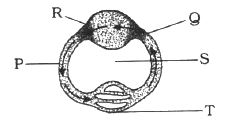
A
Open type
B
Closed type
C
Both $(A)$ and $(B)$
D
None of these
Solution
(B) The provided figure illustrates a closed circulatory system. In a closed circulatory system,blood is pumped by the heart and flows through a series of blood vessels (arteries,veins,and capillaries) to reach the tissues. The diagram shows a heart pumping blood into vessels that circulate through the body and return to the heart,which is characteristic of a closed system.
0 likes
View Solution48
EasyMCQ
Which of the following statements is incorrect regarding the open circulatory system?
A
Blood sinuses are present in the body.
B
The volume of blood is high.
C
Blood pressure is low and irregular.
D
This circulatory system is present in cephalopod mollusks.
Solution
(D) In an open circulatory system,blood is pumped out of the heart into blood sinuses (spaces) that bathe the tissues.
Key characteristics include:
$1$. Presence of blood sinuses (hemocoel).
$2$. Low and irregular blood pressure.
$3$. High volume of blood flow but slow speed.
Cephalopod mollusks (like octopus and squid) possess a closed circulatory system,not an open one. Therefore,statement $D$ is incorrect.
Key characteristics include:
$1$. Presence of blood sinuses (hemocoel).
$2$. Low and irregular blood pressure.
$3$. High volume of blood flow but slow speed.
Cephalopod mollusks (like octopus and squid) possess a closed circulatory system,not an open one. Therefore,statement $D$ is incorrect.
0 likes
View Solution49
EasyMCQ
Which of the following statements is inconsistent with a closed circulatory system?
A
It contains vessels like veins and capillaries.
B
Blood pressure in it is high and regulated.
C
The volume of blood in it is limited.
D
The heart contains valved ostia.
Solution
(D) closed circulatory system is characterized by blood flowing through a series of vessels (arteries,veins,and capillaries).
In this system,blood pressure is generally higher and more regulated compared to an open system.
The volume of blood is limited as it remains confined within the vessels.
Option $D$ states that the heart contains valved ostia; this is a characteristic feature of an open circulatory system (e.g.,in arthropods like insects),where blood flows into sinuses and enters the heart through these ostia. Therefore,this statement is inconsistent with a closed circulatory system.
In this system,blood pressure is generally higher and more regulated compared to an open system.
The volume of blood is limited as it remains confined within the vessels.
Option $D$ states that the heart contains valved ostia; this is a characteristic feature of an open circulatory system (e.g.,in arthropods like insects),where blood flows into sinuses and enters the heart through these ostia. Therefore,this statement is inconsistent with a closed circulatory system.
0 likes
View Solution50
EasyMCQ
The hepatic portal vein drains blood to the liver from:
A
heart
B
kidneys
C
liver
D
intestine
Solution
(D) : Blood enters the liver from two sources. The hepatic artery provides oxygenated blood,while the hepatic portal vein carries deoxygenated blood. The blood in the hepatic artery originates from the aorta. The blood in the hepatic portal vein comes directly from the digestive tract,including the intestine and stomach,containing newly absorbed nutrients.
0 likes
View SolutionBody Fluids and Circulations — Double Circulation and Circulatory pathway · Frequently Asked Questions
1Are these Body Fluids and Circulations questions useful for JEE and NEET?
Yes. All questions in this section are mapped to JEE Main and NEET exam patterns. Previous year questions from JEE Main, NEET, GUJCET and state-level exams are included with full solutions.
2Can I switch to Hindi or Gujarati for these questions?
Yes. Use the language tabs in the hero section or the sidebar to view the same questions and solutions in English, Hindi or Gujarati.
3How do I generate a question paper from this subtopic?
Use the Vedclass Exam Paper Generator — select the chapter and subtopic, set difficulty, and generate Sets A, B, C, D automatically. First 3 chapters of every subject are free.
Vedclass Products
For Students
Vedclass Test Series
Mock tests in real JEE/NEET style with performance analysis. 5-day free trial.
Start Free TrialFor Teachers
Exam Paper Generator
Generate Set A/B/C/D papers from this chapter in 2 minutes. 3 chapters free.
Try FreeFor Institutes
Online Exam Module
Live online exams with unlimited students, 360° analytics & white-label branding.
See DemoFor Teachers & Institutes
Generate a Body Fluids and Circulations Exam Paper in 2 Minutes
Select subtopic & difficulty — Sets A, B, C, D auto-generated with No Repeat logic.
First 3 chapters of every subject are free — no payment required.