
A English
Blood and Blood Group Questions in English
Class 11 Biology · Body Fluids and Circulations · Blood and Blood Group
639+
Questions
English
Language
100%
With Solutions
Showing 50 of 639 questions in English
451
Easy
Match the columns:
| Column-$I$ (Blood group) | Column-$II$ (Antigen present) |
|---|---|
| $A$. $A$ | $p$. $B$ |
| $B$. $B$ | $q$. $A$ |
| $C$. $AB$ | $r$. $A$ and $B$ |
| $D$. $O$ | $s$. $A, B$ and $O$ |
| $t$. $NIL$ |
Solution
(A-Q, B-P, C-R, D-T) The $ABO$ blood grouping system is based on the presence or absence of two surface antigens on the red blood cells,namely $A$ and $B$.
$1$. Blood group $A$ has antigen $A$ on the surface of RBCs.
$2$. Blood group $B$ has antigen $B$ on the surface of RBCs.
$3$. Blood group $AB$ has both antigens $A$ and $B$ on the surface of RBCs.
$4$. Blood group $O$ has no antigens $(NIL)$ on the surface of RBCs.
Therefore,the correct matching is: $(A-q), (B-p), (C-r), (D-t)$.
$1$. Blood group $A$ has antigen $A$ on the surface of RBCs.
$2$. Blood group $B$ has antigen $B$ on the surface of RBCs.
$3$. Blood group $AB$ has both antigens $A$ and $B$ on the surface of RBCs.
$4$. Blood group $O$ has no antigens $(NIL)$ on the surface of RBCs.
Therefore,the correct matching is: $(A-q), (B-p), (C-r), (D-t)$.
0 likes
View Solution452
Easy
Match the columns:
| Column-$I$ (Blood group) | Column-$II$ (Antibody) |
|---|---|
| $A$. $A$ | $P$. $b$ |
| $B$. $B$ | $Q$. $a$ |
| $C$. $AB$ | $R$. $nil$ |
| $D$. $O$ | $S$. $a$ and $b$ |
Solution
(A) The $ABO$ blood grouping system is based on the presence or absence of two surface antigens on the red blood cells ($A$ and $B$).
$1$. Individuals with blood group $A$ have antigen $A$ on their RBCs and antibody $b$ (anti-$B$) in their plasma.
$2$. Individuals with blood group $B$ have antigen $B$ on their RBCs and antibody $a$ (anti-$A$) in their plasma.
$3$. Individuals with blood group $AB$ have both antigens $A$ and $B$ on their RBCs and no antibodies $(nil)$ in their plasma.
$4$. Individuals with blood group $O$ have no antigens on their RBCs and both antibodies $a$ and $b$ (anti-$A$ and anti-$B$) in their plasma.
Therefore,the correct matching is: $A-P, B-Q, C-R, D-S$.
$1$. Individuals with blood group $A$ have antigen $A$ on their RBCs and antibody $b$ (anti-$B$) in their plasma.
$2$. Individuals with blood group $B$ have antigen $B$ on their RBCs and antibody $a$ (anti-$A$) in their plasma.
$3$. Individuals with blood group $AB$ have both antigens $A$ and $B$ on their RBCs and no antibodies $(nil)$ in their plasma.
$4$. Individuals with blood group $O$ have no antigens on their RBCs and both antibodies $a$ and $b$ (anti-$A$ and anti-$B$) in their plasma.
Therefore,the correct matching is: $A-P, B-Q, C-R, D-S$.
0 likes
View Solution453
MediumMCQ
If a child has blood group $O$ and the father has blood group $B$,which of the following blood groups cannot be the mother's?
A
$AB$
B
$B$
C
$A$
D
$O$
Solution
(A) The child has blood group $O$,which means the genotype is $ii$.
One $i$ allele is inherited from the father and one $i$ allele is inherited from the mother.
The father has blood group $B$,so his genotype must be $I^B i$ to provide an $i$ allele to the child.
Since the child must receive an $i$ allele from the mother,the mother's genotype must contain at least one $i$ allele.
Possible genotypes for the mother are $I^A i$ (blood group $A$),$I^B i$ (blood group $B$),or $ii$ (blood group $O$).
Blood group $AB$ has the genotype $I^A I^B$,which does not contain an $i$ allele.
Therefore,a mother with blood group $AB$ cannot produce a child with blood group $O$ when the father is blood group $B$.
One $i$ allele is inherited from the father and one $i$ allele is inherited from the mother.
The father has blood group $B$,so his genotype must be $I^B i$ to provide an $i$ allele to the child.
Since the child must receive an $i$ allele from the mother,the mother's genotype must contain at least one $i$ allele.
Possible genotypes for the mother are $I^A i$ (blood group $A$),$I^B i$ (blood group $B$),or $ii$ (blood group $O$).
Blood group $AB$ has the genotype $I^A I^B$,which does not contain an $i$ allele.
Therefore,a mother with blood group $AB$ cannot produce a child with blood group $O$ when the father is blood group $B$.
0 likes
View Solution454
MediumMCQ
If a child has $AB$ blood group and the father has $B$ blood group,which blood group cannot the mother have?
A
$A, O$
B
$B, O$
C
$AB, A$
D
$A, B, AB, O$
Solution
(B) The blood group of the child is $AB$,which means the genotype is $I^A I^B$.
One allele ($I^A$ or $I^B$) must be inherited from the father and the other from the mother.
The father has blood group $B$,so his genotype is either $I^B I^B$ or $I^B i$.
Since the child must receive the $I^A$ allele from the mother,the mother must possess at least one $I^A$ allele.
Therefore,the mother's genotype must contain $I^A$.
Possible genotypes for the mother are $I^A I^A$,$I^A I^B$,or $I^A i$.
This corresponds to blood groups $A$ or $AB$.
Consequently,the mother cannot have blood group $B$ or $O$ because neither of these contains the $I^A$ allele required for the child to have an $AB$ blood group.
One allele ($I^A$ or $I^B$) must be inherited from the father and the other from the mother.
The father has blood group $B$,so his genotype is either $I^B I^B$ or $I^B i$.
Since the child must receive the $I^A$ allele from the mother,the mother must possess at least one $I^A$ allele.
Therefore,the mother's genotype must contain $I^A$.
Possible genotypes for the mother are $I^A I^A$,$I^A I^B$,or $I^A i$.
This corresponds to blood groups $A$ or $AB$.
Consequently,the mother cannot have blood group $B$ or $O$ because neither of these contains the $I^A$ allele required for the child to have an $AB$ blood group.
0 likes
View Solution455
EasyMCQ
Which protein is responsible for the formation of antibodies?
A
$\alpha$-globulin
B
$\beta$-globulin
C
$\gamma$-globulin
D
Albumin
Solution
(C) Antibodies,also known as immunoglobulins $(Ig)$,are specialized proteins produced by plasma cells (differentiated $B$-lymphocytes) in response to antigens.
These proteins belong to the class of $\gamma$-globulins (gamma globulins) found in the blood plasma.
Therefore,the correct answer is $\gamma$-globulin.
These proteins belong to the class of $\gamma$-globulins (gamma globulins) found in the blood plasma.
Therefore,the correct answer is $\gamma$-globulin.
0 likes
View Solution456
EasyMCQ
Agglutinogen is .....
A
Antigen
B
Antibody producing substance
C
Pratijan
D
All of the above
Solution
(D) Agglutinogens are substances that induce an immune response in the body,specifically causing the clumping or agglutination of cells like red blood cells. In biological terminology,these are known as $Antigens$. Since 'Pratijan' is the Hindi/Gujarati term for 'Antigen',options $A$ and $C$ refer to the same concept. Therefore,an agglutinogen is an antigen,which is a substance that can stimulate the production of antibodies. Thus,all the given descriptions are correct.
0 likes
View Solution457
EasyMCQ
What is diapedesis?
A
The movement of blood cells (phagocytes) into the $E.C.F.$
B
The process of $phagocytosis$ performed by phagocytes
C
The production of antibodies by plasma cells
D
Both $A$ and $B$
Solution
(A) Diapedesis is the process by which white blood cells (leukocytes),particularly neutrophils and monocytes,squeeze through the pores of the capillary walls to enter the surrounding tissues or $E.C.F.$ (Extracellular Fluid) to reach the site of infection or injury. This is a crucial step in the inflammatory response and the immune system's ability to combat pathogens.
0 likes
View Solution458
EasyMCQ
Identify the most abundant phagocytic cells found in the blood.
A
Macrophages
B
Mast cells
C
Monocytes
D
Neutrophils
Solution
(D) Neutrophils are the most abundant type of white blood cells (leukocytes) in the human body,accounting for approximately $60-70\%$ of the total circulating leukocytes.
They are professional phagocytes that act as the first line of defense against bacterial infections by engulfing and destroying pathogens.
While monocytes can differentiate into macrophages,they are present in much lower numbers in the blood compared to neutrophils.
They are professional phagocytes that act as the first line of defense against bacterial infections by engulfing and destroying pathogens.
While monocytes can differentiate into macrophages,they are present in much lower numbers in the blood compared to neutrophils.
0 likes
View Solution459
EasyMCQ
Identify the largest agranulocytic leukocyte.
A
$B$-cells
B
$T$-cells
C
Monocyte
D
Both $A$ and $B$
Solution
(C) Leukocytes (white blood cells) are classified into granulocytes and agranulocytes.
$1$. Granulocytes include neutrophils,eosinophils,and basophils.
$2$. Agranulocytes include lymphocytes ($B$-cells and $T$-cells) and monocytes.
$3$. Among all leukocytes,monocytes are the largest in size,typically ranging from $12-20 \ \mu m$ in diameter.
$4$. Therefore,the monocyte is the largest agranulocytic leukocyte.
$1$. Granulocytes include neutrophils,eosinophils,and basophils.
$2$. Agranulocytes include lymphocytes ($B$-cells and $T$-cells) and monocytes.
$3$. Among all leukocytes,monocytes are the largest in size,typically ranging from $12-20 \ \mu m$ in diameter.
$4$. Therefore,the monocyte is the largest agranulocytic leukocyte.
0 likes
View Solution460
EasyMCQ
Which of the following conditions cause erythroblastosis foetalis?
A
Both mother and foetus $Rh^{+ve}$
B
Mother $Rh^{+ve}$ and foetus $Rh^{-ve}$
C
Mother $Rh^{-ve}$ and foetus $Rh^{+ve}$
D
Both mother and foetus $Rh^{-ve}$
Solution
(C) Option $C$ is the correct answer because Erythroblastosis foetalis occurs only when the foetus is $Rh^{+ve}$ and the mother is $Rh^{-ve}$.
During the first delivery,if $Rh^{+ve}$ foetal blood mixes with the mother's blood,antibodies are produced in the mother's body against the $Rh$ antigen.
These antibodies in successive pregnancies cross the placental barrier and reach the foetus,causing the clumping (agglutination) of $RBCs$ in the foetus.
During the first delivery,if $Rh^{+ve}$ foetal blood mixes with the mother's blood,antibodies are produced in the mother's body against the $Rh$ antigen.
These antibodies in successive pregnancies cross the placental barrier and reach the foetus,causing the clumping (agglutination) of $RBCs$ in the foetus.
0 likes
View Solution461
MediumMCQ
Activity of phagocytosis occurs through
A
Neutrophils and monocytes
B
Basophils and monocytes
C
Eosinophils and monocytes
D
Lymphocytes and neutrophils
Solution
(A) Phagocytosis is a cellular process where specialized cells engulf and digest pathogens or debris. In the human immune system,$Neutrophils$ and $Monocytes$ are the primary phagocytic white blood cells. $Neutrophils$ are the most abundant leukocytes and act as the first line of defense,while $Monocytes$ differentiate into macrophages to perform phagocytosis.
0 likes
View Solution462
MediumMCQ
Which of the following is involved in the production of new blood cells?
A
Adipose cell
B
Bone marrow
C
Liver
D
Matrix
Solution
(B) Bone marrow is the flexible tissue found in the interior of bones.
In humans,red blood cells are produced by the bone marrow located in the cavities of long bones through a process known as haematopoiesis.
Bone marrow is also a key component of the lymphatic system,as it produces lymphocytes that support the body's immune system.
In humans,red blood cells are produced by the bone marrow located in the cavities of long bones through a process known as haematopoiesis.
Bone marrow is also a key component of the lymphatic system,as it produces lymphocytes that support the body's immune system.
0 likes
View Solution463
MediumMCQ
Both $RBCs$ and $WBCs$ are formed in
A
Cartilage
B
Thyroid
C
Bone marrow
D
Plasma
Solution
(C) In long bones,a cavity called the bone marrow cavity is present.
This cavity is filled with soft and semi-solid fatty tissue termed as bone marrow.
The bone marrow in certain bones serves as the site for the production of blood cells,including $RBCs$,$WBCs$,and platelets.
This cavity is filled with soft and semi-solid fatty tissue termed as bone marrow.
The bone marrow in certain bones serves as the site for the production of blood cells,including $RBCs$,$WBCs$,and platelets.
0 likes
View Solution464
MediumMCQ
$A$: Yellow bone marrow is reserve erythropoietic tissue.
$R$: After severe bleeding,yellow marrow may convert to red marrow.
$R$: After severe bleeding,yellow marrow may convert to red marrow.
A
Assertion and Reason both are correct and Reason is the correct explanation of Assertion.
B
Assertion and Reason both are correct but Reason is not the correct explanation of Assertion.
C
Assertion is correct,but Reason is incorrect.
D
Both Assertion and Reason are incorrect.
Solution
(A) Assertion is true because yellow bone marrow acts as a reserve tissue that can produce blood cells when the body's demand increases.
Reason is also true because,in cases of severe blood loss (hemorrhage) or anemia,the body stimulates the conversion of inactive yellow bone marrow into active red bone marrow to accelerate erythropoiesis (the production of red blood cells).
Reason is also true because,in cases of severe blood loss (hemorrhage) or anemia,the body stimulates the conversion of inactive yellow bone marrow into active red bone marrow to accelerate erythropoiesis (the production of red blood cells).
0 likes
View Solution465
EasyMCQ
The red colouring matter of blood which transports oxygen contains an element in a system of rings. The element is:
A
Iron
B
Magnesium
C
Cobalt
D
Calcium
Solution
(A) Haemoglobin is the red-coloured respiratory pigment found in the $RBCs$ of most animals.
It consists of a protein called globin and a non-protein prosthetic group called heme.
The heme group contains an iron $(Fe^{2+})$ atom at the center of a porphyrin ring system.
This iron atom is responsible for the reversible binding and transport of oxygen from the lungs to the body tissues,and it also assists in the transport of $CO_{2}$ back to the lungs.
It consists of a protein called globin and a non-protein prosthetic group called heme.
The heme group contains an iron $(Fe^{2+})$ atom at the center of a porphyrin ring system.
This iron atom is responsible for the reversible binding and transport of oxygen from the lungs to the body tissues,and it also assists in the transport of $CO_{2}$ back to the lungs.
0 likes
View Solution466
EasyMCQ
Which of the following is a blood protein?
A
Albumin
B
Haemoglobin
C
Both $(A)$ and $(B)$
D
None of these
Solution
(C) Blood contains various proteins that perform essential functions.
$Albumin$ is a major plasma protein responsible for maintaining osmotic pressure.
$Haemoglobin$ is a conjugated protein found in red blood cells that transports oxygen.
Therefore,both $Albumin$ and $Haemoglobin$ are classified as blood proteins.
$Albumin$ is a major plasma protein responsible for maintaining osmotic pressure.
$Haemoglobin$ is a conjugated protein found in red blood cells that transports oxygen.
Therefore,both $Albumin$ and $Haemoglobin$ are classified as blood proteins.
0 likes
View Solution467
EasyMCQ
Granulocytes and agranulocytes are the two main categories of
A
$RBC$
B
$WBC$
C
Thrombocytes
D
Blood platelets
Solution
(B) White blood cells $(WBCs)$,also known as leukocytes,are classified into two main categories based on the presence or absence of granules in their cytoplasm:
$1$. Granulocytes: These contain granules in their cytoplasm and include neutrophils,eosinophils,and basophils.
$2$. Agranulocytes: These lack granules in their cytoplasm and include lymphocytes and monocytes.
Therefore,granulocytes and agranulocytes are the two main categories of $WBC$.
$1$. Granulocytes: These contain granules in their cytoplasm and include neutrophils,eosinophils,and basophils.
$2$. Agranulocytes: These lack granules in their cytoplasm and include lymphocytes and monocytes.
Therefore,granulocytes and agranulocytes are the two main categories of $WBC$.
0 likes
View Solution468
MediumMCQ
When is thromboplastin released in humans?
A
During hypertension
B
By the traumatised cell at the place of injury
C
In the condition of erythroblastosis foetalis
D
During anaemia
Solution
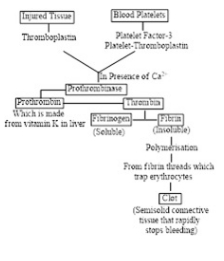
(B) Thromboplastin is a clotting factor released by traumatised or injured tissues at the site of an injury. It initiates the extrinsic pathway of the blood coagulation cascade. As shown in the process,injured tissue releases thromboplastin,which,along with platelet factors and $Ca^{2+}$ ions,leads to the formation of prothrombinase,eventually resulting in the formation of a blood clot.
0 likes
View Solution469
MediumMCQ
Grouping of $ABO$ blood is based on the
A
Surface antigens present on $RBCs$
B
Surface lipids present on the cell membrane
C
Nature of all constituents
D
Nature of $RBC$ and $WBC$
Solution
(A) $ABO$ blood grouping is based on the presence or absence of two surface antigens,$A$ and $B$,on the surface of $RBCs$.
These antigens are glycoproteins or glycolipids that determine the blood type of an individual.
These antigens are glycoproteins or glycolipids that determine the blood type of an individual.
0 likes
View Solution470
MediumMCQ
Which of the following plasma proteins is involved in the coagulation of blood?
A
Serum amylase
B
$A$ globulin
C
Fibrinogen
D
An albumin
Solution
(C) Fibrinogen (factor $I$) is a soluble plasma glycoprotein,synthesized by the liver.
It is converted by thrombin into fibrin during blood coagulation.
Fibrin is then cross-linked by factor $XIII$ to form a stable blood clot.
It is converted by thrombin into fibrin during blood coagulation.
Fibrin is then cross-linked by factor $XIII$ to form a stable blood clot.
0 likes
View Solution471
MediumMCQ
Which test tube from the given options is $NOT$ used for keeping blood in a non-coagulated state for the analysis of blood corpuscles?
A
Test tube with heparin
B
Test tube with calcium bicarbonate
C
Test tube with sodium oxalate
D
Test tube at room temperature
Solution
(B) To prevent the clotting of collected blood,anticoagulants or specific storage conditions are used.
$1$. Heparin is a natural anticoagulant that prevents blood clotting.
$2$. Sodium oxalate acts as a chelating agent by binding to calcium ions,which are essential for the coagulation cascade.
$3$. Calcium bicarbonate is not an anticoagulant; in fact,calcium ions are required for the blood clotting process. Therefore,adding calcium bicarbonate would promote rather than prevent clotting.
$4$. While low temperatures can slow down enzymatic reactions,simply keeping a test tube at room temperature without any anticoagulant will result in blood coagulation.
$1$. Heparin is a natural anticoagulant that prevents blood clotting.
$2$. Sodium oxalate acts as a chelating agent by binding to calcium ions,which are essential for the coagulation cascade.
$3$. Calcium bicarbonate is not an anticoagulant; in fact,calcium ions are required for the blood clotting process. Therefore,adding calcium bicarbonate would promote rather than prevent clotting.
$4$. While low temperatures can slow down enzymatic reactions,simply keeping a test tube at room temperature without any anticoagulant will result in blood coagulation.
0 likes
View Solution472
MediumMCQ
Platelets are
A
Also called thrombocytes
B
Cell fragments
C
Produced from megakaryocytes
D
All of the above
Solution
(D) Platelets,also known as thrombocytes,are cell fragments produced from large cells in the bone marrow called megakaryocytes.
They are non-nucleated,round or oval,and biconvex in shape.
They are significantly smaller than $RBCs$.
Platelets play a crucial role in the process of blood clotting by releasing substances like thromboplastin.
They are non-nucleated,round or oval,and biconvex in shape.
They are significantly smaller than $RBCs$.
Platelets play a crucial role in the process of blood clotting by releasing substances like thromboplastin.
0 likes
View Solution473
EasyMCQ
Which of the following can be considered as the blood bank of the human body?
A
Spleen
B
Heart
C
Liver
D
Lungs
Solution
(A) The $Spleen$ is the largest lymphoid organ in the human body.
It acts as a reservoir for blood, storing red blood cells and platelets.
In emergency situations, such as severe hemorrhage or trauma, the $Spleen$ releases this stored blood into the circulation to help maintain blood volume.
Therefore, it is commonly referred to as the blood bank of the human body.
It acts as a reservoir for blood, storing red blood cells and platelets.
In emergency situations, such as severe hemorrhage or trauma, the $Spleen$ releases this stored blood into the circulation to help maintain blood volume.
Therefore, it is commonly referred to as the blood bank of the human body.
0 likes
View Solution474
EasyMCQ
What is the principal cation in human blood?
A
Potassium
B
Sodium
C
Calcium
D
Manganese
Solution
(B) The primary inorganic constituents of human blood plasma are salts of sodium,chloride,and bicarbonate. Sodium $(Na^+)$ is the most abundant extracellular cation in the blood,playing a critical role in maintaining osmotic pressure and fluid balance. Therefore,sodium is the principal cation in human blood.
0 likes
View Solution475
MediumMCQ
Plasma is a straw-coloured,viscous fluid constituting nearly $A$ $\%$ of the blood,$B$ $\%$ of the plasma is water,and proteins constitute $C$ $\%$ of it. Choose the correct option for the blanks $A, B$,and $C$.
A
$A-55, B-90-92, C-6-8$
B
$A-45, B-70-80, C-6-8$
C
$A-35, B-90-92, C-6-8$
D
$A-45, B-90-92, C-6-8$
Solution
(A) Plasma is a straw-coloured,viscous fluid that makes up approximately $55$ $\%$ of the total blood volume.
It consists of $90-92$ $\%$ water,while proteins contribute about $6-8$ $\%$ of the plasma.
The remaining components include inorganic salts,glucose,amino acids,and lipids.
Therefore,the correct values are $A=55, B=90-92, C=6-8$.
It consists of $90-92$ $\%$ water,while proteins contribute about $6-8$ $\%$ of the plasma.
The remaining components include inorganic salts,glucose,amino acids,and lipids.
Therefore,the correct values are $A=55, B=90-92, C=6-8$.
0 likes
View Solution476
MediumMCQ
Find out the wrong match.
A
Eosinophils - Allergic response
B
Basophils - Secrete histamine and serotonin
C
Neutrophils - Phagocytic and destroy foreign organisms
D
Monocytes - Secrete heparin
Solution
(D) $Monocytes$ are the largest agranular leucocytes and are phagocytic in nature. They act as the body's defense by engulfing pathogens. Heparin is an anticoagulant that is primarily secreted by mast cells found in connective tissues, not by monocytes.
0 likes
View Solution477
MediumMCQ
Which of the following is a cell fragment?
A
Blood platelets
B
Bone cells
C
Lymphocytes
D
Leucocytes
Solution
(A) Blood platelets (thrombocytes) occur only in mammals.
They are non-nucleated and colourless cell fragments.
They are produced by the fragmentation of large cells called megakaryocytes found in the red bone marrow.
Because they are not complete cells but fragments of cytoplasm derived from megakaryocytes,they are referred to as cell fragments.
They play a crucial role in the process of blood clotting by releasing thromboplastin.
They are non-nucleated and colourless cell fragments.
They are produced by the fragmentation of large cells called megakaryocytes found in the red bone marrow.
Because they are not complete cells but fragments of cytoplasm derived from megakaryocytes,they are referred to as cell fragments.
They play a crucial role in the process of blood clotting by releasing thromboplastin.
0 likes
View Solution478
MediumMCQ
The source of thromboplastin in human blood is:
A
$WBC$
B
$RBC$
C
Blood platelets
D
Both $(b)$ and $(c)$
Solution
(C) At the site of an injury,blood platelets (thrombocytes) disintegrate and release a chemical substance known as thromboplastin. This substance initiates the blood clotting cascade (coagulation process) by converting prothrombin into thrombin.
0 likes
View Solution479
MediumMCQ
Universal donors and universal recipients are
A
$A, B$ and $O$ blood groups,respectively
B
$O$ and $AB$ blood groups,respectively
C
$O$ and $A$ blood groups,respectively
D
$AB$ and $O$ blood groups,respectively
Solution
(B) universal donor is an individual with blood group $O$ because their red blood cells lack both $A$ and $B$ antigens,preventing an immune reaction in the recipient.
$A$ universal recipient is an individual with blood group $AB$ because their plasma lacks both anti-$A$ and anti-$B$ antibodies,allowing them to receive blood from any $ABO$ blood group type.
$A$ universal recipient is an individual with blood group $AB$ because their plasma lacks both anti-$A$ and anti-$B$ antibodies,allowing them to receive blood from any $ABO$ blood group type.
0 likes
View Solution480
EasyMCQ
The graveyard of $RBC$ is:
A
Liver
B
Stomach
C
Spleen
D
Bone marrow
Solution
(C) The $RBC$s ($Red$ $Blood$ $Cells$) have an average lifespan of approximately $120$ days. After this period,they become fragile and are removed from the circulation. The spleen is the primary organ responsible for filtering and destroying old or damaged $RBC$s. Therefore,the spleen is known as the graveyard of $RBC$s.
0 likes
View Solution481
MediumMCQ
Serum is
A
Blood Plasma
B
Blood Plasma with corpuscles
C
Blood Plasma without fibrinogen
D
Blood Plasma with fibrinogen & corpuscles
Solution
(C) Serum is defined as the fluid portion of blood that remains after the clotting process has occurred.
When blood clots,the protein $Fibrinogen$ is converted into $Fibrin$ threads,which form the clot.
Therefore,serum is essentially blood plasma from which $Fibrinogen$ and other clotting factors have been removed.
When blood clots,the protein $Fibrinogen$ is converted into $Fibrin$ threads,which form the clot.
Therefore,serum is essentially blood plasma from which $Fibrinogen$ and other clotting factors have been removed.
0 likes
View Solution482
EasyMCQ
$RBCs$ have an average life span of (in $days$)
A
$90$
B
$100$
C
$120$
D
$140$
Solution
(C) The average life span of $RBCs$ (Red Blood Cells) is $120$ days.
After this period, they are broken down in the spleen or liver.
The breakdown product of haemoglobin is a yellow-colored pigment called bilirubin, which is normally excreted through bile.
Meanwhile, the iron-containing haeme component is recycled and transferred to the bone marrow for the production of new $RBCs$.
Retention of bilirubin in the body leads to a condition known as jaundice.
After this period, they are broken down in the spleen or liver.
The breakdown product of haemoglobin is a yellow-colored pigment called bilirubin, which is normally excreted through bile.
Meanwhile, the iron-containing haeme component is recycled and transferred to the bone marrow for the production of new $RBCs$.
Retention of bilirubin in the body leads to a condition known as jaundice.
0 likes
View Solution483
MediumMCQ
Erythroblastosis foetalis is a disease in which
A
Adult have severe anaemia and jaundice
B
Female have severe anaemia and jaundice
C
Male have severe anaemia and jaundice
D
Foetus have severe anaemia and jaundice
Solution
(D) Foetus have severe anaemia and jaundice.
$A$ special case of $Rh$ incompatibility has been observed between $Rh-ve$ blood of a pregnant mother and $Rh+ve$ blood of the foetus.
During the delivery of the first child,there is a possibility of exposure of the maternal blood to a small amount of $Rh+ve$ blood from the foetus.
In such cases,the mother starts preparing antibodies against $Rh$ antigen in her blood.
In the case of her subsequent pregnancies,the $Rh$ antibodies from the mother can leak into the blood of the foetus and destroy foetal $RBCs$.
This could be fatal to the foetus or could cause severe anaemia and jaundice to the foetus.
This condition is called erythroblastosis foetalis.
$A$ special case of $Rh$ incompatibility has been observed between $Rh-ve$ blood of a pregnant mother and $Rh+ve$ blood of the foetus.
During the delivery of the first child,there is a possibility of exposure of the maternal blood to a small amount of $Rh+ve$ blood from the foetus.
In such cases,the mother starts preparing antibodies against $Rh$ antigen in her blood.
In the case of her subsequent pregnancies,the $Rh$ antibodies from the mother can leak into the blood of the foetus and destroy foetal $RBCs$.
This could be fatal to the foetus or could cause severe anaemia and jaundice to the foetus.
This condition is called erythroblastosis foetalis.
0 likes
View Solution484
MediumMCQ
Example of $Rh$ incompatibility is
A
Mother $Rh-ve$ and father $Rh+ve$
B
Father $Rh-ve$ and Mother $Rh+ve$
C
Both $Rh-ve$
D
Both $Rh+ve$
Solution
(A) special case of $Rh$ incompatibility is observed between the $Rh-ve$ blood of a pregnant mother and the $Rh+ve$ blood of the foetus.
During the delivery of the first child,there is a possibility of exposure of the maternal blood to a small amount of $Rh+ve$ blood from the foetus.
In such cases,the mother starts preparing antibodies against the $Rh$ antigen in her blood.
In the case of her subsequent pregnancies,the $Rh$ antibodies from the mother can leak into the blood of the foetus and destroy the foetal $RBCs$.
This could be fatal to the foetus or could cause severe anaemia and jaundice to the foetus.
This condition is called erythroblastosis foetalis.
During the delivery of the first child,there is a possibility of exposure of the maternal blood to a small amount of $Rh+ve$ blood from the foetus.
In such cases,the mother starts preparing antibodies against the $Rh$ antigen in her blood.
In the case of her subsequent pregnancies,the $Rh$ antibodies from the mother can leak into the blood of the foetus and destroy the foetal $RBCs$.
This could be fatal to the foetus or could cause severe anaemia and jaundice to the foetus.
This condition is called erythroblastosis foetalis.
0 likes
View Solution485
EasyMCQ
Leucocytes are colourless due to
A
Lack of water
B
Lack of haemoglobin
C
Presence of extra water
D
Presence of haemoglobin
Solution
(B) Leucocytes,also known as white blood cells $(WBCs)$,are colourless because they lack the respiratory pigment haemoglobin,which is present in red blood cells $(RBCs)$.
Because they do not contain haemoglobin,they appear white or colourless under a microscope.
They are nucleated and are generally larger than $RBCs$.
The normal count of $WBCs$ in human blood is $6000-8000$ per $mm^3$.
$A$ decrease in their count is known as leukopenia,while an abnormal increase is often associated with conditions like leukaemia.
The average lifespan of $WBCs$ in humans ranges from $10$ to $30$ days.
Because they do not contain haemoglobin,they appear white or colourless under a microscope.
They are nucleated and are generally larger than $RBCs$.
The normal count of $WBCs$ in human blood is $6000-8000$ per $mm^3$.
$A$ decrease in their count is known as leukopenia,while an abnormal increase is often associated with conditions like leukaemia.
The average lifespan of $WBCs$ in humans ranges from $10$ to $30$ days.
0 likes
View Solution486
MediumMCQ
Lymphocytes ($20-25$ $\%$) are of two major types,$B$ and $T$ forms. They are responsible for
A
Blood coagulation
B
Thickness of blood
C
Immune responses
D
All of these
Solution
(C) Lymphocytes constitute about $20-25$ $\%$ of the total white blood cells.
They are characterized by a large,rounded nucleus and are non-motile and non-phagocytic.
They exist in two major forms: $B$-lymphocytes and $T$-lymphocytes.
These cells are essential for the immune response of the body,as they are responsible for the production of antibodies and the regulation of immune functions.
They are characterized by a large,rounded nucleus and are non-motile and non-phagocytic.
They exist in two major forms: $B$-lymphocytes and $T$-lymphocytes.
These cells are essential for the immune response of the body,as they are responsible for the production of antibodies and the regulation of immune functions.
0 likes
View Solution487
EasyMCQ
The name $Rh$ blood group is derived from
A
Chimpanzee
B
Monkey
C
Man
D
Primitive man
Solution
(B) Another antigen,the $Rh$ antigen,similar to the one present in the Rhesus monkey (hence,$Rh$),is also observed on the surface of $RBCs$ of the majority (nearly $80\%$) of humans.
Such individuals are called $Rh$ positive $(Rh^+)$ and those in whom this antigen is absent are called $Rh$ negative $(Rh^-)$.
Such individuals are called $Rh$ positive $(Rh^+)$ and those in whom this antigen is absent are called $Rh$ negative $(Rh^-)$.
0 likes
View Solution488
EasyMCQ
The largest $RBCs$ have been seen in
A
Elephant
B
Whale
C
Amphibians
D
Man
Solution
(C) The largest $RBCs$ among all vertebrates are found in amphibians,specifically in the genus $Amphiuma$,which measure approximately $70-80 \ \mu m$ in diameter.
In mammals,the largest $RBCs$ are found in the elephant,measuring about $9.4 \ \mu m$.
The $RBCs$ of a human are approximately $7.5-8 \ \mu m$ in size.
In mammals,the largest $RBCs$ are found in the elephant,measuring about $9.4 \ \mu m$.
The $RBCs$ of a human are approximately $7.5-8 \ \mu m$ in size.
0 likes
View Solution489
MediumMCQ
Prothrombinase is formed in the presence of
A
$Ca^{2+}$
B
$Mg^{2+}$
C
$Fe^{2+}$
D
$Fe^{3+}$
Solution
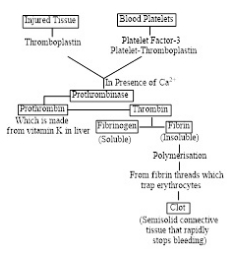
(A) During the process of blood coagulation,an injury or trauma stimulates the release of thromboplastin from injured tissues and platelet factors from blood platelets. These factors,along with other clotting factors present in the blood,combine to form the enzyme complex known as prothrombinase. This reaction is strictly dependent on the presence of calcium ions $(Ca^{2+})$. Once formed,prothrombinase converts inactive prothrombin into active thrombin.
0 likes
View Solution490
EasyMCQ
The $pH$ of blood is
A
Between $7-8$
B
Between $2-4$
C
Between $12-14$
D
Between $2-5$
Solution
(A) $pH$ is a measure of the concentration of hydrogen ions in a solution.
Blood is a type of fluid connective tissue.
Blood is slightly alkaline in nature,having an average $pH$ of $7.4$.
It consists of blood cells ($RBCs$,$WBCs$,etc.) and blood plasma.
Blood is a type of fluid connective tissue.
Blood is slightly alkaline in nature,having an average $pH$ of $7.4$.
It consists of blood cells ($RBCs$,$WBCs$,etc.) and blood plasma.
0 likes
View Solution491
MediumMCQ
Prothrombin is
A
Formed in liver
B
Formed by vitamins
C
Changed to thrombin by prothrombinase
D
All of the above
Solution
(D) Prothrombin is a plasma protein synthesized in the liver.
$Vitamin-K$ is essential for the liver to synthesize prothrombin normally.
During the process of blood coagulation,the enzyme prothrombinase converts inactive prothrombin into active thrombin.
Therefore,all the given statements are correct.
$Vitamin-K$ is essential for the liver to synthesize prothrombin normally.
During the process of blood coagulation,the enzyme prothrombinase converts inactive prothrombin into active thrombin.
Therefore,all the given statements are correct.
0 likes
View Solution492
MediumMCQ
Properties of human $RBCs$ are:
$I.$ Devoid of nucleus
$II.$ Formed in bone marrow
$III.$ Possess healing properties
$IV.$ Biconcave in shape
$V.$ Help in blood clotting
Choose the option with correct properties.
$I.$ Devoid of nucleus
$II.$ Formed in bone marrow
$III.$ Possess healing properties
$IV.$ Biconcave in shape
$V.$ Help in blood clotting
Choose the option with correct properties.
A
$I, II$ and $III$
B
$I, II$ and $IV$
C
$III, IV$ and $V$
D
$III, II$ and $IV$
Solution
(B) Human $RBCs$ (Red Blood Cells) are characterized by the following properties:
$1$. They are devoid of a nucleus (enucleated) in their mature state to provide more space for hemoglobin.
$2$. They are formed in the bone marrow (erythropoiesis).
$3$. They are biconcave in shape,which increases their surface area for efficient $O_2$ transport and allows them to pass through narrow capillaries.
Healing properties and blood clotting are functions associated with platelets and other plasma factors,not $RBCs$.
Therefore,the correct properties are $I, II,$ and $IV$.
$1$. They are devoid of a nucleus (enucleated) in their mature state to provide more space for hemoglobin.
$2$. They are formed in the bone marrow (erythropoiesis).
$3$. They are biconcave in shape,which increases their surface area for efficient $O_2$ transport and allows them to pass through narrow capillaries.
Healing properties and blood clotting are functions associated with platelets and other plasma factors,not $RBCs$.
Therefore,the correct properties are $I, II,$ and $IV$.
0 likes
View Solution493
MediumMCQ
What will happen if an $Rh^-$ person donates blood to an $Rh^+$ person for the first time?
A
The $Rh^-$ person will die.
B
The $Rh^+$ person will die.
C
Nothing will happen to either of them.
D
The $Rh^-$ person will live and the $Rh^+$ person will be affected.
Solution
(C) When an $Rh^-$ person donates blood to an $Rh^+$ person,the recipient's immune system already recognizes the $Rh$ antigen as 'self' because they possess the $Rh$ factor. Therefore,no anti-$Rh$ antibodies are produced against the donor's blood. This is a safe transfusion,and nothing will happen to either individual.
0 likes
View Solution494
MediumMCQ
If the husband is $Rh^+$ and the wife is $Rh^-$,then:
A
No problem with the first child
B
Second child would have anaemia (erythroblastosis foetalis)
C
Second child would be normal
D
Both $(a)$ and $(b)$
Solution
(D) special case of $Rh$ incompatibility is observed between the $Rh$-negative blood of a pregnant mother and the $Rh$-positive blood of the foetus.
During the delivery of the first child,there is a possibility of exposure of the maternal blood to a small amount of $Rh$-positive blood from the foetus.
In such cases,the mother starts preparing antibodies against the $Rh$ antigen in her blood.
In the case of her subsequent pregnancies,the $Rh$ antibodies from the mother can leak into the blood of the foetus and destroy the foetal $RBCs$.
This could be fatal to the foetus or could cause severe anaemia and jaundice. This condition is called erythroblastosis foetalis.
During the delivery of the first child,there is a possibility of exposure of the maternal blood to a small amount of $Rh$-positive blood from the foetus.
In such cases,the mother starts preparing antibodies against the $Rh$ antigen in her blood.
In the case of her subsequent pregnancies,the $Rh$ antibodies from the mother can leak into the blood of the foetus and destroy the foetal $RBCs$.
This could be fatal to the foetus or could cause severe anaemia and jaundice. This condition is called erythroblastosis foetalis.
0 likes
View Solution495
MediumMCQ
$A$ doctor suggested a couple not to have more than one child because:
A
Male is $Rh^{+}$ and female is $Rh^{-}$
B
Male is $Rh^{-}$ and female is $Rh^{+}$
C
Male is $Rh^{-}$ and female is $Rh^{-}$
D
Male is $Rh^{+}$ and female is $Rh^{+}$
Solution
(A) The doctor suggests this when the male is $Rh^{+}$ (Rh-positive) and the female is $Rh^{-}$ (Rh-negative). This condition leads to Erythroblastosis fetalis. If the mother is $Rh^{-}$ and the fetus is $Rh^{+}$,the mother's immune system may develop antibodies against the $Rh$ antigen during the first pregnancy. In subsequent pregnancies,these antibodies can cross the placenta and destroy the fetal red blood cells,causing severe anemia and jaundice.
0 likes
View Solution496
EasyMCQ
During the process of blood coagulation,vitamin-$K$ helps in the
A
Formation of prothrombin
B
Formation of thromboplastin
C
Conversion of fibrinogen into fibrin
D
Conversion of prothrombin into thrombin
Solution
(A) Vitamin-$K$,also known as the anti-haemorrhagic factor,is a fat-soluble vitamin. It is essential for the synthesis of prothrombin (clotting factor $II$) in the liver. Without adequate levels of vitamin-$K$,the liver cannot produce sufficient prothrombin,which impairs the blood coagulation process.
0 likes
View Solution497
MediumMCQ
Why does the $1^{st}$ child of an $Rh^+$ husband and an $Rh^-$ wife not have erythroblastosis foetalis?
A
Due to the absence of $Rh$ antigen in the mother's blood
B
Due to the presence of $Rh$ antibodies in the mother's blood
C
Due to the absence of $Rh$ antibodies in the mother's blood
D
Both $(a)$ and $(c)$
Solution
(D) The correct answer is $(d)$.
Erythroblastosis foetalis does not occur in the first child because the mother's blood initially lacks $Rh$ antibodies.
During the delivery of the first child,there is a possibility of exposure of the maternal blood to a small amount of $Rh^+$ blood from the foetus.
In such cases,the mother starts preparing $Rh$ antibodies against the $Rh$ antigen in her blood.
Since these antibodies are not present before or during the first pregnancy,the first child remains unaffected.
In subsequent pregnancies,the $Rh$ antibodies from the mother can leak into the blood of the foetus and destroy the foetal $RBCs$,leading to erythroblastosis foetalis.
Erythroblastosis foetalis does not occur in the first child because the mother's blood initially lacks $Rh$ antibodies.
During the delivery of the first child,there is a possibility of exposure of the maternal blood to a small amount of $Rh^+$ blood from the foetus.
In such cases,the mother starts preparing $Rh$ antibodies against the $Rh$ antigen in her blood.
Since these antibodies are not present before or during the first pregnancy,the first child remains unaffected.
In subsequent pregnancies,the $Rh$ antibodies from the mother can leak into the blood of the foetus and destroy the foetal $RBCs$,leading to erythroblastosis foetalis.
0 likes
View Solution498
MediumMCQ
Which of the following are erythropoietic organs?
$I$. Liver
$II$. Lymph node
$III$. Spleen
$IV$. White bone marrow
$V$. Red bone marrow
Choose the correct option.
$I$. Liver
$II$. Lymph node
$III$. Spleen
$IV$. White bone marrow
$V$. Red bone marrow
Choose the correct option.
A
All except $IV$
B
All except $II$
C
All except $I$
D
All except $V$
Solution
(A) The process of $RBC$ formation is known as erythropoiesis.
Erythropoietic organs in the foetus include the liver,lymph nodes,and spleen.
After birth,the primary site for erythropoiesis is the red bone marrow.
White bone marrow is not involved in the production of red blood cells.
Therefore,$I, II, III,$ and $V$ are erythropoietic organs,while $IV$ (white bone marrow) is not.
Erythropoietic organs in the foetus include the liver,lymph nodes,and spleen.
After birth,the primary site for erythropoiesis is the red bone marrow.
White bone marrow is not involved in the production of red blood cells.
Therefore,$I, II, III,$ and $V$ are erythropoietic organs,while $IV$ (white bone marrow) is not.
0 likes
View Solution499
MediumMCQ
Which of the given options is correct regarding blood groups and donor compatibility?
A
B
C
D
Solution
(B) In the $ABO$ blood grouping system,compatibility is determined by the presence of antigens on the surface of red blood cells and antibodies in the plasma.
$1$. Blood group $O$ has no antigens and can donate to $A, B, AB$,and $O$. It is the universal donor.
$2$. Blood group $A$ has antigen $A$ and can donate to $A$ and $AB$.
$3$. Blood group $B$ has antigen $B$ and can donate to $B$ and $AB$.
$4$. Blood group $AB$ has both antigens $A$ and $B$ and can donate only to $AB$. It is the universal recipient.
Option $B$ correctly represents these donor-recipient relationships.
$1$. Blood group $O$ has no antigens and can donate to $A, B, AB$,and $O$. It is the universal donor.
$2$. Blood group $A$ has antigen $A$ and can donate to $A$ and $AB$.
$3$. Blood group $B$ has antigen $B$ and can donate to $B$ and $AB$.
$4$. Blood group $AB$ has both antigens $A$ and $B$ and can donate only to $AB$. It is the universal recipient.
Option $B$ correctly represents these donor-recipient relationships.
0 likes
View Solution500
MediumMCQ
Properties of leucocytes are:
$I$. They are nucleated.
$II$. They are denucleated like $RBC$.
$III$. They are $6000-8000 \; mm^{-3}$ of blood.
$IV$. They are long-lived.
$V$. They are short-lived.
Choose the appropriate option with correct properties.
$I$. They are nucleated.
$II$. They are denucleated like $RBC$.
$III$. They are $6000-8000 \; mm^{-3}$ of blood.
$IV$. They are long-lived.
$V$. They are short-lived.
Choose the appropriate option with correct properties.
A
$I$,$III$ and $V$
B
$II$,$IV$ and $V$
C
$I$,$IV$ and $V$
D
$I$,$III$ and $IV$
Solution
(A) The correct properties of leucocytes are:
$I$. Leucocytes are nucleated cells.
$III$. Their normal count is $6000-8000 \; mm^{-3}$ of blood.
$V$. They are short-lived cells compared to $RBC$s,with a lifespan typically ranging from $10-30$ days.
Therefore,the correct combination is $I, III$ and $V$.
$I$. Leucocytes are nucleated cells.
$III$. Their normal count is $6000-8000 \; mm^{-3}$ of blood.
$V$. They are short-lived cells compared to $RBC$s,with a lifespan typically ranging from $10-30$ days.
Therefore,the correct combination is $I, III$ and $V$.
0 likes
View SolutionBody Fluids and Circulations — Blood and Blood Group · Frequently Asked Questions
1Are these Body Fluids and Circulations questions useful for JEE and NEET?
Yes. All questions in this section are mapped to JEE Main and NEET exam patterns. Previous year questions from JEE Main, NEET, GUJCET and state-level exams are included with full solutions.
2Can I switch to Hindi or Gujarati for these questions?
Yes. Use the language tabs in the hero section or the sidebar to view the same questions and solutions in English, Hindi or Gujarati.
3How do I generate a question paper from this subtopic?
Use the Vedclass Exam Paper Generator — select the chapter and subtopic, set difficulty, and generate Sets A, B, C, D automatically. First 3 chapters of every subject are free.
Vedclass Products
For Students
Vedclass Test Series
Mock tests in real JEE/NEET style with performance analysis. 5-day free trial.
Start Free TrialFor Teachers
Exam Paper Generator
Generate Set A/B/C/D papers from this chapter in 2 minutes. 3 chapters free.
Try FreeFor Institutes
Online Exam Module
Live online exams with unlimited students, 360° analytics & white-label branding.
See DemoFor Teachers & Institutes
Generate a Body Fluids and Circulations Exam Paper in 2 Minutes
Select subtopic & difficulty — Sets A, B, C, D auto-generated with No Repeat logic.
First 3 chapters of every subject are free — no payment required.