
A English
Mix Examples- Body Fluids and Circulations Questions in English
Class 11 Biology · Body Fluids and Circulations · Mix Examples- Body Fluids and Circulations
79+
Questions
English
Language
100%
With Solutions
Showing 48 of 79 questions in English
1
MediumMCQ
Which of the following is an incorrect combination?
A
Haemocyanin - Prawn
B
Haemoglobin in mammals - $RBC$
C
Haemoglobin in plasma - Pheretima
D
Haemozoin - Plasmodium cytoplasm
Solution
(D) The correct answer is $D$.
Haemozoin is a toxic substance produced by the parasite $Plasmodium$ during the digestion of haemoglobin in the host's $RBC$s.
It is released into the blood plasma upon the rupture of the infected $RBC$s,causing the characteristic chills and high fever associated with malaria.
Therefore,stating it is found in the $Plasmodium$ cytoplasm is incorrect.
Haemozoin is a toxic substance produced by the parasite $Plasmodium$ during the digestion of haemoglobin in the host's $RBC$s.
It is released into the blood plasma upon the rupture of the infected $RBC$s,causing the characteristic chills and high fever associated with malaria.
Therefore,stating it is found in the $Plasmodium$ cytoplasm is incorrect.
0 likes
View Solution2
MediumMCQ
Oedema is defined as:
A
An abnormal accumulation of tissue fluid in intercellular spaces
B
An abnormal accumulation of tissue fluid in epithelial tissue cells
C
An abnormal accumulation of extracellular fluid in intercellular spaces
D
An allergic disease of the skin
Solution
(A) Oedema (or edema) is the medical term for swelling caused by fluid trapped in your body's tissues. It occurs when there is an abnormal accumulation of tissue fluid (interstitial fluid) in the intercellular spaces. This fluid leaks out of blood vessels and builds up in the surrounding tissues,leading to swelling.
0 likes
View Solution3
MediumMCQ
Intracellular fluid and extracellular fluid constitute what percentage of total body weight,respectively?
A
$24\%$ and $40\%$ of body weight respectively
B
$40\%$ and $24\%$ of body weight respectively
C
$6-10\%$ of the body weight
D
$30-35\%$ of the body weight
Solution
(B) The total body water in an average adult human is approximately $60-65\%$ of the total body weight.
This total body water is divided into two main compartments:
$1$. Intracellular Fluid $(ICF)$: This is the fluid present inside the cells,which accounts for approximately $40\%$ of the total body weight.
$2$. Extracellular Fluid $(ECF)$: This is the fluid present outside the cells (including interstitial fluid,plasma,etc.),which accounts for approximately $20-24\%$ of the total body weight.
Therefore,the correct ratio for intracellular and extracellular fluid is $40\%$ and $24\%$ of body weight,respectively.
This total body water is divided into two main compartments:
$1$. Intracellular Fluid $(ICF)$: This is the fluid present inside the cells,which accounts for approximately $40\%$ of the total body weight.
$2$. Extracellular Fluid $(ECF)$: This is the fluid present outside the cells (including interstitial fluid,plasma,etc.),which accounts for approximately $20-24\%$ of the total body weight.
Therefore,the correct ratio for intracellular and extracellular fluid is $40\%$ and $24\%$ of body weight,respectively.
0 likes
View Solution4
MediumMCQ
Donnan effect is shown by
A
Blood
B
Lymph
C
Both $(a)$ and $(b)$
D
None of the above
Solution
(C) The $Donnan$ effect (or $Gibbs-Donnan$ effect) refers to the behavior of charged particles near a semi-permeable membrane that fails to distribute evenly across the two sides of the membrane due to the presence of charged substances (like proteins) that are unable to pass through the membrane.
In the human body,both blood and lymph contain plasma proteins which are large,negatively charged molecules that cannot cross the capillary endothelium. This creates an unequal distribution of diffusible ions across the membrane,which is the basis of the $Donnan$ effect. Therefore,both blood and lymph exhibit this phenomenon.
In the human body,both blood and lymph contain plasma proteins which are large,negatively charged molecules that cannot cross the capillary endothelium. This creates an unequal distribution of diffusible ions across the membrane,which is the basis of the $Donnan$ effect. Therefore,both blood and lymph exhibit this phenomenon.
0 likes
View Solution5
MediumMCQ
Match the following:
Types of leucocytes | Function
$A.$ Neutrophils | $1.$ Heparin and histamine secretion
$B.$ Basophils | $2.$ Antibodies formation
$C.$ Acidophils | $3.$ Scavenger
$D.$ Monocytes | $4.$ Phagocytes
$E.$ Lymphocytes | $5.$ Antiallergic and healing of wounds
The correct pairing sequence is:
Types of leucocytes | Function
$A.$ Neutrophils | $1.$ Heparin and histamine secretion
$B.$ Basophils | $2.$ Antibodies formation
$C.$ Acidophils | $3.$ Scavenger
$D.$ Monocytes | $4.$ Phagocytes
$E.$ Lymphocytes | $5.$ Antiallergic and healing of wounds
The correct pairing sequence is:
A
$A-4, B-1, C-5, D-3, E-2$
B
$A-4, B-1, C-5, D-2, E-3$
C
$A-3, B-2, C-1, D-4, E-5$
D
$A-2, B-3, C-1, D-4, E-5$
Solution
(A) $A.$ Neutrophils are phagocytic cells that engulf pathogens.
$B.$ Basophils secrete heparin,histamine,and serotonin.
$C.$ Acidophils (Eosinophils) are involved in antiallergic reactions and wound healing.
$D.$ Monocytes are large phagocytic cells that act as scavengers.
$E.$ Lymphocytes are responsible for the formation of antibodies.
Therefore,the correct matching is: $A-4, B-1, C-5, D-3, E-2$.
$B.$ Basophils secrete heparin,histamine,and serotonin.
$C.$ Acidophils (Eosinophils) are involved in antiallergic reactions and wound healing.
$D.$ Monocytes are large phagocytic cells that act as scavengers.
$E.$ Lymphocytes are responsible for the formation of antibodies.
Therefore,the correct matching is: $A-4, B-1, C-5, D-3, E-2$.
0 likes
View Solution6
MediumMCQ
Match the following:
Disease: Cause
$A.$ Diabetes: $6.$ Increase in blood sugar level
$B.$ Uraemia: $7.$ Urea is in excess in blood
$C.$ Anaemia: $5.$ Fall in $RBC$ count
$D.$ Polycythemia: $3.$ Rise in $RBC$ count
$E.$ Pernicious or Megaloblastic anaemia: $2.$ Deficiency of vitamin ${B_{12}}$
$F.$ Leukemia: $8.$ Pathological increase in $WBC$
$G.$ Thrombocytopenia: $9.$ Decrease in the number of platelets
$H.$ Leucopenia: $4.$ Fall of $WBC$ count
$I.$ Leucocytosis: $1.$ Rise in $WBC$ count
The correct matching sequence is:
Disease: Cause
$A.$ Diabetes: $6.$ Increase in blood sugar level
$B.$ Uraemia: $7.$ Urea is in excess in blood
$C.$ Anaemia: $5.$ Fall in $RBC$ count
$D.$ Polycythemia: $3.$ Rise in $RBC$ count
$E.$ Pernicious or Megaloblastic anaemia: $2.$ Deficiency of vitamin ${B_{12}}$
$F.$ Leukemia: $8.$ Pathological increase in $WBC$
$G.$ Thrombocytopenia: $9.$ Decrease in the number of platelets
$H.$ Leucopenia: $4.$ Fall of $WBC$ count
$I.$ Leucocytosis: $1.$ Rise in $WBC$ count
The correct matching sequence is:
A
$1, 3, 4, 2, 5, 6, 7, 9, 8$
B
$6, 7, 5, 3, 2, 8, 9, 4, 1$
C
$6, 7, 3, 5, 8, 2, 9, 1, 4$
D
$7, 6, 5, 3, 2, 9, 8, 4, 1$
Solution
(B) The correct matches are as follows:
$A$ (Diabetes) matches with $6$ (Increase in blood sugar level).
$B$ (Uraemia) matches with $7$ (Urea is in excess in blood).
$C$ (Anaemia) matches with $5$ (Fall in $RBC$ count).
$D$ (Polycythemia) matches with $3$ (Rise in $RBC$ count).
$E$ (Pernicious or Megaloblastic anaemia) matches with $2$ (Deficiency of vitamin ${B_{12}}$).
$F$ (Leukemia) matches with $8$ (Pathological increase in $WBC$).
$G$ (Thrombocytopenia) matches with $9$ (Decrease in the number of platelets).
$H$ (Leucopenia) matches with $4$ (Fall of $WBC$ count).
$I$ (Leucocytosis) matches with $1$ (Rise in $WBC$ count).
Therefore,the sequence is $6, 7, 5, 3, 2, 8, 9, 4, 1$.
$A$ (Diabetes) matches with $6$ (Increase in blood sugar level).
$B$ (Uraemia) matches with $7$ (Urea is in excess in blood).
$C$ (Anaemia) matches with $5$ (Fall in $RBC$ count).
$D$ (Polycythemia) matches with $3$ (Rise in $RBC$ count).
$E$ (Pernicious or Megaloblastic anaemia) matches with $2$ (Deficiency of vitamin ${B_{12}}$).
$F$ (Leukemia) matches with $8$ (Pathological increase in $WBC$).
$G$ (Thrombocytopenia) matches with $9$ (Decrease in the number of platelets).
$H$ (Leucopenia) matches with $4$ (Fall of $WBC$ count).
$I$ (Leucocytosis) matches with $1$ (Rise in $WBC$ count).
Therefore,the sequence is $6, 7, 5, 3, 2, 8, 9, 4, 1$.
0 likes
View Solution7
EasyMCQ
Alkalaemia is defined as:
A
Blood $pH$ less than $7$
B
Blood $pH$ between $7.3$ and $7.4$
C
Blood $pH$ more than $7.45$
D
Removal of inorganic salts from plasma
Solution
(C) Alkalaemia is a condition characterized by an increase in the $pH$ of the blood above the normal physiological range. The normal $pH$ of human blood is approximately $7.35$ to $7.45$. When the blood $pH$ exceeds $7.45$,it is referred to as alkalaemia.
0 likes
View Solution8
MediumMCQ
Which one of the following is a correctly matching pair of a certain body feature and its value/count in a normal human adult?
A
Urea $5-10 \text{ mg}/100 \text{ ml}$ of blood
B
Blood sugar $80-100 \text{ mg}/100 \text{ ml}$
C
Total blood volume $3-4 \text{ litres}$
D
$ESR$ in Wintrobe method $9-15 \text{ mm}$ per hour in males and $20-34 \text{ mm}$ per hour in females
Solution
(B) The correct option is $B$.
$1$. Normal blood sugar (fasting) in a healthy human adult is typically in the range of $70-110 \text{ mg}/100 \text{ ml}$ (often cited as $80-100 \text{ mg}/100 \text{ ml}$),making option $B$ the correct match.
$2$. Normal blood urea levels are typically $15-40 \text{ mg}/100 \text{ ml}$ of blood,so option $A$ is incorrect.
$3$. Total blood volume in an average adult is approximately $5-6 \text{ litres}$,not $3-4 \text{ litres}$,so option $C$ is incorrect.
$4$. The normal $ESR$ (Erythrocyte Sedimentation Rate) by the Wintrobe method is $0-9 \text{ mm}$ per hour for males and $0-20 \text{ mm}$ per hour for females,making option $D$ incorrect.
$1$. Normal blood sugar (fasting) in a healthy human adult is typically in the range of $70-110 \text{ mg}/100 \text{ ml}$ (often cited as $80-100 \text{ mg}/100 \text{ ml}$),making option $B$ the correct match.
$2$. Normal blood urea levels are typically $15-40 \text{ mg}/100 \text{ ml}$ of blood,so option $A$ is incorrect.
$3$. Total blood volume in an average adult is approximately $5-6 \text{ litres}$,not $3-4 \text{ litres}$,so option $C$ is incorrect.
$4$. The normal $ESR$ (Erythrocyte Sedimentation Rate) by the Wintrobe method is $0-9 \text{ mm}$ per hour for males and $0-20 \text{ mm}$ per hour for females,making option $D$ incorrect.
0 likes
View Solution9
MediumMCQ
Which of the following cardiac effects can be observed if the potassium concentration is increased two to three times the normal value?
A
Weakness of heart
B
Abnormal rhythm
C
Death
D
All the above
Solution
(D) The correct answer is $D$. When the extracellular potassium concentration increases to $2-3$ times the normal value,it causes a decrease in the resting membrane potential of cardiac muscle fibers. This depolarization makes the heart muscle weak,leads to abnormal rhythms (arrhythmias),and if the concentration remains high,it can eventually lead to cardiac arrest and death.
0 likes
View Solution10
MediumMCQ
All of the following are vasoconstrictor agents except:
A
Norepinephrine
B
Prostaglandins
C
Vasopressin
D
Angiotensin
Solution
(B) Vasoconstrictors are substances that cause the narrowing of blood vessels,which increases blood pressure.
$1$. $Norepinephrine$ is a potent vasoconstrictor released by the sympathetic nervous system.
$2$. $Vasopressin$ (also known as $Antidiuretic$ $Hormone$ or $ADH$) acts as a vasoconstrictor at high concentrations.
$3$. $Angiotensin$ $II$ is one of the most powerful vasoconstrictors known in the human body.
$4$. $Prostaglandins$ are a group of lipid compounds that have diverse effects; while some cause vasoconstriction,many others (like $PGI_2$ or $Prostacyclin$) are potent vasodilators. Therefore,among the given options,$Prostaglandins$ is the exception as it is not exclusively a vasoconstrictor.
$1$. $Norepinephrine$ is a potent vasoconstrictor released by the sympathetic nervous system.
$2$. $Vasopressin$ (also known as $Antidiuretic$ $Hormone$ or $ADH$) acts as a vasoconstrictor at high concentrations.
$3$. $Angiotensin$ $II$ is one of the most powerful vasoconstrictors known in the human body.
$4$. $Prostaglandins$ are a group of lipid compounds that have diverse effects; while some cause vasoconstriction,many others (like $PGI_2$ or $Prostacyclin$) are potent vasodilators. Therefore,among the given options,$Prostaglandins$ is the exception as it is not exclusively a vasoconstrictor.
0 likes
View Solution11
MediumMCQ
In connection with the circulatory system,where are valves present?
A
Not only in the heart and blood vessels of vertebrates and invertebrates,but in vertebrate lymphatics as well
B
Vertebrate heart only
C
Vertebrate heart and invertebrate hearts only
D
Vertebrate hearts,invertebrate hearts,and their blood vessels
Solution
(A) Valves are specialized structures that ensure the unidirectional flow of blood and lymph.
In the circulatory system,valves are found in the hearts of both vertebrates and invertebrates to prevent backflow during contraction.
Furthermore,they are present in the blood vessels (specifically veins) of many animals to assist in venous return against gravity.
Additionally,valves are present in the lymphatic vessels of vertebrates to maintain the unidirectional flow of lymph towards the venous system.
Therefore,option $A$ is the most comprehensive and accurate description.
In the circulatory system,valves are found in the hearts of both vertebrates and invertebrates to prevent backflow during contraction.
Furthermore,they are present in the blood vessels (specifically veins) of many animals to assist in venous return against gravity.
Additionally,valves are present in the lymphatic vessels of vertebrates to maintain the unidirectional flow of lymph towards the venous system.
Therefore,option $A$ is the most comprehensive and accurate description.
0 likes
View Solution12
MediumMCQ
The process of blood clot formation within the circulatory system is known as:
A
Thrombosis
B
Thrombocytes
C
Thrombin
D
Thrombocytopenia
Solution
(A) . Thrombosis is the process of formation of a blood clot (thrombus) inside a blood vessel,which obstructs the flow of blood through the circulatory system.
$B$. Thrombocytes are blood platelets involved in clotting,not the process itself.
$C$. Thrombin is an enzyme that converts fibrinogen to fibrin during the clotting cascade.
$D$. Thrombocytopenia is a condition characterized by an abnormally low level of platelets in the blood.
$B$. Thrombocytes are blood platelets involved in clotting,not the process itself.
$C$. Thrombin is an enzyme that converts fibrinogen to fibrin during the clotting cascade.
$D$. Thrombocytopenia is a condition characterized by an abnormally low level of platelets in the blood.
0 likes
View Solution13
MediumMCQ
The breakdown product of haemoglobin is
A
Iron
B
Bilirubin
C
Biliverdin
D
All the above
Solution
(D) When red blood cells are destroyed in the spleen,liver,and bone marrow,haemoglobin is broken down into its components.
Haemoglobin consists of a protein part (globin) and a prosthetic group (haem).
The haem group is further broken down into iron $(Fe^{2+})$ and a pigment called biliverdin.
Biliverdin is subsequently converted into bilirubin.
Therefore,iron,biliverdin,and bilirubin are all products of the breakdown of haemoglobin.
Haemoglobin consists of a protein part (globin) and a prosthetic group (haem).
The haem group is further broken down into iron $(Fe^{2+})$ and a pigment called biliverdin.
Biliverdin is subsequently converted into bilirubin.
Therefore,iron,biliverdin,and bilirubin are all products of the breakdown of haemoglobin.
0 likes
View Solution14
EasyMCQ
Cords of Billroth are blood-filled spaces found in which of the following organs?
A
Liver
B
Kidneys
C
Spleen
D
Tonsils
Solution
(C) The Cords of Billroth,also known as splenic cords,are structures found in the red pulp of the spleen.
These cords consist of a network of reticular fibers and connective tissue filled with blood cells,including red blood cells,macrophages,and lymphocytes.
They play a crucial role in the filtration of blood and the removal of aged or damaged red blood cells.
These cords consist of a network of reticular fibers and connective tissue filled with blood cells,including red blood cells,macrophages,and lymphocytes.
They play a crucial role in the filtration of blood and the removal of aged or damaged red blood cells.
0 likes
View Solution15
MediumMCQ
The $pH$ of blood in an artery and a vein is:
A
Same
B
More in an artery and less in a vein
C
More in a vein and less in an artery
D
Not definite
Solution
(B) The $pH$ of arterial blood is typically around $7.40$,while the $pH$ of venous blood is slightly lower,around $7.35$.
This difference occurs because veins carry blood that is rich in $CO_2$ (carbon dioxide).
$CO_2$ reacts with water in the blood to form carbonic acid $(H_2CO_3)$,which dissociates into bicarbonate $(HCO_3^-)$ and hydrogen ions $(H^+)$.
The increase in hydrogen ion concentration leads to a decrease in $pH$ in the venous blood compared to arterial blood.
This difference occurs because veins carry blood that is rich in $CO_2$ (carbon dioxide).
$CO_2$ reacts with water in the blood to form carbonic acid $(H_2CO_3)$,which dissociates into bicarbonate $(HCO_3^-)$ and hydrogen ions $(H^+)$.
The increase in hydrogen ion concentration leads to a decrease in $pH$ in the venous blood compared to arterial blood.
0 likes
View Solution16
EasyMCQ
Plethysmograph is used to measure
A
Velocity of blood
B
Mean volume flow
C
Excitability of heart
D
Conducting of stimuli in heart
Solution
(B) Plethysmograph is an airtight box equipped with devices for measuring various parameters such as lung volume,airway resistance,and the mean volume of pulmonary blood flow.
Therefore,it is used to measure the mean volume flow of blood.
Therefore,it is used to measure the mean volume flow of blood.
0 likes
View Solution17
EasyMCQ
The state of equilibrium in the body with respect to various functions and to the chemical composition of fluids and tissues is called
A
Haemostasis
B
Homeosis
C
Homology
D
Homeostasis
Solution
(D) Homeostasis is the physiological process by which a living organism maintains a stable internal environment despite changes in external conditions.
It involves the regulation of various bodily functions,such as temperature,pH,and the chemical composition of fluids and tissues,to ensure optimal cellular function.
Haemostasis refers to the process of stopping bleeding.
Homeosis refers to the transformation of one body part into another during development.
Homology refers to the similarity in structure due to common ancestry.
It involves the regulation of various bodily functions,such as temperature,pH,and the chemical composition of fluids and tissues,to ensure optimal cellular function.
Haemostasis refers to the process of stopping bleeding.
Homeosis refers to the transformation of one body part into another during development.
Homology refers to the similarity in structure due to common ancestry.
0 likes
View Solution18
EasyMCQ
Hypokalaemia means
A
High level of potassium in blood
B
High level of sodium in blood
C
Low level of potassium in blood
D
Low level of sodium in blood
Solution
(C) The term $Hypokalaemia$ is derived from three parts: $Hypo-$ (meaning low),$kal-$ (referring to potassium,from the Latin $kalium$),and $-aemia$ (referring to blood condition).
Therefore,$Hypokalaemia$ refers to a medical condition characterized by an abnormally low concentration of potassium ions $(K^+)$ in the blood serum.
This condition can lead to muscle weakness,fatigue,and cardiac arrhythmias.
Therefore,$Hypokalaemia$ refers to a medical condition characterized by an abnormally low concentration of potassium ions $(K^+)$ in the blood serum.
This condition can lead to muscle weakness,fatigue,and cardiac arrhythmias.
0 likes
View Solution19
EasyMCQ
The blood bank of the body or the reservoir where blood is stored and can be mobilized is:
A
Heart
B
Liver
C
Bone marrow
D
Spleen
Solution
(D) . Spleen acts as a significant reservoir of blood in the human body.
It is observed that the spleen can release approximately $150 \ ml$ of blood into the circulatory system during times of need,such as during exercise or hemorrhage.
It is observed that the spleen can release approximately $150 \ ml$ of blood into the circulatory system during times of need,such as during exercise or hemorrhage.
0 likes
View Solution20
MediumMCQ
Newborn babies generally do not shiver despite low temperatures because of:
A
The skin is not covered by hair
B
Brown fat,which has $20$ times greater heat value than white fat
C
White fat,which has $20$ times greater heat value than brown fat
D
The skeleton is not very strong
Solution
(B) Newborn babies do not shiver in response to cold because they possess a specialized tissue called 'brown fat' (or brown adipose tissue).
Brown fat is rich in mitochondria and has a dense supply of blood vessels and sympathetic adrenergic nerves.
When infants are exposed to cold,the metabolism of brown fat is activated,which generates heat through a process called non-shivering thermogenesis.
This tissue provides significantly more heat energy compared to white fat,helping the newborn maintain body temperature without the need for shivering.
Brown fat is rich in mitochondria and has a dense supply of blood vessels and sympathetic adrenergic nerves.
When infants are exposed to cold,the metabolism of brown fat is activated,which generates heat through a process called non-shivering thermogenesis.
This tissue provides significantly more heat energy compared to white fat,helping the newborn maintain body temperature without the need for shivering.
0 likes
View Solution21
MediumMCQ
Consider the following four statements regarding the human circulatory system:
$(a)$ Arteries have thick walls and a narrower lumen compared to veins.
$(b)$ Angina is a sudden chest pain.
$(c)$ In the $ABO$ blood grouping system,a person with blood group $AB$ can donate blood to anyone.
$(d)$ Calcium ions play a significant role in blood clotting.
Which two of the above statements are correct?
$(a)$ Arteries have thick walls and a narrower lumen compared to veins.
$(b)$ Angina is a sudden chest pain.
$(c)$ In the $ABO$ blood grouping system,a person with blood group $AB$ can donate blood to anyone.
$(d)$ Calcium ions play a significant role in blood clotting.
Which two of the above statements are correct?
A
$(a)$ and $(b)$
B
$(b)$ and $(c)$
C
$(c)$ and $(d)$
D
$(b)$ and $(d)$
Solution
(D) Statement $(a)$ is correct: Arteries have thick,elastic walls and a narrower lumen to maintain high blood pressure,whereas veins have thinner walls and a wider lumen.
Statement $(b)$ is correct: Angina pectoris is characterized by acute chest pain that occurs when not enough oxygen is reaching the heart muscle.
Statement $(c)$ is incorrect: $A$ person with blood group $AB$ is a universal recipient,not a universal donor. $A$ person with blood group $O$ is a universal donor.
Statement $(d)$ is correct: Calcium ions $(Ca^{2+})$ are essential cofactors in the coagulation cascade required for the conversion of prothrombin to thrombin and fibrinogen to fibrin.
Therefore,statements $(a)$,$(b)$,and $(d)$ are correct. Among the given options,$(b)$ and $(d)$ are both correct.
Statement $(b)$ is correct: Angina pectoris is characterized by acute chest pain that occurs when not enough oxygen is reaching the heart muscle.
Statement $(c)$ is incorrect: $A$ person with blood group $AB$ is a universal recipient,not a universal donor. $A$ person with blood group $O$ is a universal donor.
Statement $(d)$ is correct: Calcium ions $(Ca^{2+})$ are essential cofactors in the coagulation cascade required for the conversion of prothrombin to thrombin and fibrinogen to fibrin.
Therefore,statements $(a)$,$(b)$,and $(d)$ are correct. Among the given options,$(b)$ and $(d)$ are both correct.
0 likes
View Solution22
MediumMCQ
Cardiac output is determined by which of the following?
A
Heart rate
B
Stroke volume
C
Blood flow
D
Both $(a)$ and $(b)$
Solution
(D) Cardiac output is defined as the volume of blood pumped by each ventricle per minute.
It is calculated using the formula: $\text{Cardiac Output} = \text{Stroke Volume} \times \text{Heart Rate}$.
Stroke volume is the amount of blood pumped by the left ventricle in one beat (approximately $70 \text{ mL}$), and heart rate is the number of beats per minute (approximately $72 \text{ beats/min}$).
Therefore, both heart rate and stroke volume determine the cardiac output.
It is calculated using the formula: $\text{Cardiac Output} = \text{Stroke Volume} \times \text{Heart Rate}$.
Stroke volume is the amount of blood pumped by the left ventricle in one beat (approximately $70 \text{ mL}$), and heart rate is the number of beats per minute (approximately $72 \text{ beats/min}$).
Therefore, both heart rate and stroke volume determine the cardiac output.
0 likes
View Solution23
MediumMCQ
Which organ in an adult human causes the least damage if removed?
A
Spleen
B
Liver
C
Pancreas
D
Pituitary gland
Solution
(A) The $Spleen$ is often referred to as the 'graveyard of RBCs'. While it plays a role in filtering blood and immune function,it is not a vital organ for survival in adults. Other organs like the $Liver$,$Pancreas$,and $Pituitary$ gland are essential for metabolic regulation,digestion,and hormonal control,respectively. Therefore,removing the $Spleen$ causes the least physiological damage compared to the others.
0 likes
View Solution24
EasyMCQ
What is the study of the circulatory system called?
A
Angiology
B
Cardiology
C
Hematology
D
Osteology
Solution
(A) The study of the circulatory system,which includes the heart,blood vessels,and lymphatic system,is known as $Angiology$.
$Cardiology$ is the study of the heart specifically.
$Hematology$ is the study of blood.
$Osteology$ is the study of bones.
Therefore,the correct option is $A$.
$Cardiology$ is the study of the heart specifically.
$Hematology$ is the study of blood.
$Osteology$ is the study of bones.
Therefore,the correct option is $A$.
0 likes
View Solution25
EasyMCQ
Which organ is responsible for the storage of blood to be released during sudden blood loss?
A
Spleen
B
Heart
C
Liver
D
Lungs
Solution
(A) The $Spleen$ acts as a blood reservoir in the human body. It stores a significant volume of red blood cells and platelets. During conditions of sudden blood loss or hemorrhage,the $Spleen$ contracts to release this stored blood into the circulation to help maintain blood volume and pressure. Therefore,it is often referred to as the 'blood bank' of the body.
0 likes
View Solution26
MediumMCQ
What is the function of the human spleen?
A
Formation of blood cells during embryonic life.
B
Formation of lymphocytes,monocytes,and antibodies in adulthood.
C
Acting as a blood reservoir and regulating blood volume in adulthood.
D
All of the above.
Solution
(D) The spleen performs several vital functions throughout the human life cycle:
$1$. During embryonic development,the spleen acts as a primary site for hematopoiesis (formation of blood cells).
$2$. In adulthood,it serves as a secondary lymphoid organ,producing lymphocytes,monocytes,and antibodies to support the immune system.
$3$. It also functions as a blood reservoir,storing red blood cells and platelets,and helps in regulating blood volume by releasing these cells into circulation when needed.
$1$. During embryonic development,the spleen acts as a primary site for hematopoiesis (formation of blood cells).
$2$. In adulthood,it serves as a secondary lymphoid organ,producing lymphocytes,monocytes,and antibodies to support the immune system.
$3$. It also functions as a blood reservoir,storing red blood cells and platelets,and helps in regulating blood volume by releasing these cells into circulation when needed.
0 likes
View Solution27
EasyMCQ
What is the function of the spleen in humans?
A
Graveyard of $RBCs$
B
Blood reservoir
C
Blood organ
D
All of the above
Solution
(D) The spleen is a secondary lymphoid organ that performs several vital functions in the human body:
$1$. It acts as the 'Graveyard of $RBCs$' because it filters out old and damaged red blood cells.
$2$. It serves as a 'Blood reservoir',storing a significant volume of blood that can be released during emergencies like hemorrhage.
$3$. It is often referred to as a 'Blood organ' due to its role in hematopoiesis during fetal development and its role in immune surveillance.
Therefore,all the given options are correct.
$1$. It acts as the 'Graveyard of $RBCs$' because it filters out old and damaged red blood cells.
$2$. It serves as a 'Blood reservoir',storing a significant volume of blood that can be released during emergencies like hemorrhage.
$3$. It is often referred to as a 'Blood organ' due to its role in hematopoiesis during fetal development and its role in immune surveillance.
Therefore,all the given options are correct.
0 likes
View Solution28
MediumMCQ
Match the following columns:
| Column $- I$ | Column $- II$ |
| $a$. Bicuspid valve | $p$. Brain |
| $b$. Nephron | $q$. Liver |
| $c$. Alveoli | $r$. Heart |
| $d$. Cerebrum | $s$. Kidney |
| $t$. Lungs |
A
$a-s, b-r, c-p, d-t$
B
$a-r, b-t, c-s, d-p$
C
$a-r, b-s, c-t, d-p$
D
$a-s, b-q, c-p, d-t$
Solution
(C) The correct matches are as follows:
$a$. Bicuspid valve is present in the $r$. Heart (between the left atrium and left ventricle).
$b$. Nephron is the structural and functional unit of the $s$. Kidney.
$c$. Alveoli are the air sacs present in the $t$. Lungs for gaseous exchange.
$d$. Cerebrum is the main part of the $p$. Brain.
Therefore, the correct matching is $a-r, b-s, c-t, d-p$.
$a$. Bicuspid valve is present in the $r$. Heart (between the left atrium and left ventricle).
$b$. Nephron is the structural and functional unit of the $s$. Kidney.
$c$. Alveoli are the air sacs present in the $t$. Lungs for gaseous exchange.
$d$. Cerebrum is the main part of the $p$. Brain.
Therefore, the correct matching is $a-r, b-s, c-t, d-p$.
0 likes
View Solution29
MediumMCQ
Consider the following four statements regarding the human circulatory system:
$(a)$ Arteries have thick walls and have a smaller lumen compared to veins.
$(b)$ Angina is a sudden chest pain.
$(c)$ In the $ABO$ blood grouping system,a person with $AB$ blood group can donate blood to anyone.
$(d)$ Calcium ions play an important role in blood clotting.
Which two of the above statements are correct?
$(a)$ Arteries have thick walls and have a smaller lumen compared to veins.
$(b)$ Angina is a sudden chest pain.
$(c)$ In the $ABO$ blood grouping system,a person with $AB$ blood group can donate blood to anyone.
$(d)$ Calcium ions play an important role in blood clotting.
Which two of the above statements are correct?
A
$(a)$ and $(b)$
B
$(b)$ and $(c)$
C
$(c)$ and $(d)$
D
$(a)$ and $(d)$
Solution
(D) Statement $(a)$ is correct: Arteries have thick,elastic walls and a narrow lumen to maintain high blood pressure.
Statement $(b)$ is correct: Angina pectoris is a condition characterized by acute chest pain when not enough oxygen is reaching the heart muscle.
Statement $(c)$ is incorrect: $A$ person with $AB$ blood group is a universal recipient,not a universal donor. $A$ person with $O$ blood group is a universal donor.
Statement $(d)$ is correct: Calcium ions $(Ca^{2+})$ are essential cofactors in the coagulation cascade that leads to blood clotting.
Since statements $(a)$,$(b)$,and $(d)$ are correct,the combination $(a)$ and $(d)$ is a valid pair among the options provided.
Statement $(b)$ is correct: Angina pectoris is a condition characterized by acute chest pain when not enough oxygen is reaching the heart muscle.
Statement $(c)$ is incorrect: $A$ person with $AB$ blood group is a universal recipient,not a universal donor. $A$ person with $O$ blood group is a universal donor.
Statement $(d)$ is correct: Calcium ions $(Ca^{2+})$ are essential cofactors in the coagulation cascade that leads to blood clotting.
Since statements $(a)$,$(b)$,and $(d)$ are correct,the combination $(a)$ and $(d)$ is a valid pair among the options provided.
0 likes
View Solution30
MediumMCQ
Which of the following is a characteristic of pernicious anemia?
A
Increase in the size of $RBCs$
B
Deficiency of Vitamin $B_{12}$ in the body
C
Increased maturation time of erythroblasts
D
All of the above
Solution
(D) Pernicious anemia is a condition caused by a deficiency of Vitamin $B_{12}$ in the body.
In this condition,red blood cells $(RBCs)$ become larger than normal,which is also known as megaloblastic anemia.
The deficiency of Vitamin $B_{12}$ leads to an increased maturation time for erythroblasts (precursor cells of red blood cells),resulting in the presence of immature and abnormally large cells in the blood.
Therefore,all the given options are characteristics of pernicious anemia.
In this condition,red blood cells $(RBCs)$ become larger than normal,which is also known as megaloblastic anemia.
The deficiency of Vitamin $B_{12}$ leads to an increased maturation time for erythroblasts (precursor cells of red blood cells),resulting in the presence of immature and abnormally large cells in the blood.
Therefore,all the given options are characteristics of pernicious anemia.
0 likes
View Solution31
MediumMCQ
The $.....$ is the blood bank of the body.
A
Liver
B
Spleen
C
Heart
D
Bone marrow
Solution
(B) The $Spleen$ is known as the blood bank of the human body.
It acts as a reservoir for red blood cells and platelets.
In times of emergency, such as severe hemorrhage, the spleen releases these stored blood cells into the circulation to help maintain blood volume and oxygen-carrying capacity.
It acts as a reservoir for red blood cells and platelets.
In times of emergency, such as severe hemorrhage, the spleen releases these stored blood cells into the circulation to help maintain blood volume and oxygen-carrying capacity.
0 likes
View Solution32
MediumMCQ
Which of the following is the primary site for the breakdown of proteins and the formation of free amino acids?
A
Kidney
B
Spleen
C
Liver
D
Bone marrow
Solution
(C) The $Liver$ plays a central role in protein metabolism. It is the primary site for the deamination of amino acids,where the amino group is removed to form ammonia,which is then converted into urea. Additionally,the liver regulates the levels of amino acids in the blood by synthesizing various plasma proteins and breaking down excess amino acids into keto acids and urea. While digestion of proteins begins in the stomach and continues in the small intestine,the liver is the metabolic hub for processing these amino acids.
0 likes
View Solution33
MediumMCQ
Which organ remains functional for a few hours even after clinical death?
A
Heart
B
Eyes
C
Kidneys
D
All of the above
Solution
(D) Clinical death is defined as the cessation of heartbeat and breathing. However,certain organs and tissues remain viable and functional for a short period after the heart stops.
$1$. The eyes (cornea) can be harvested for transplantation within a few hours of death.
$2$. Kidneys can remain viable for a short duration if kept in a controlled environment.
$3$. The heart itself stops beating,but its tissues remain viable for a short window.
Therefore,in the context of organ donation and medical viability,all these organs can remain functional or viable for a short duration after clinical death.
$1$. The eyes (cornea) can be harvested for transplantation within a few hours of death.
$2$. Kidneys can remain viable for a short duration if kept in a controlled environment.
$3$. The heart itself stops beating,but its tissues remain viable for a short window.
Therefore,in the context of organ donation and medical viability,all these organs can remain functional or viable for a short duration after clinical death.
0 likes
View Solution34
MediumMCQ
Assertion $A$: In an open circulatory system,the blood volume is high,but the blood pressure is low and irregular.
Reason $R$: In a closed circulatory system,the blood volume is limited,and the blood pressure is high and regular.
Which option is correct for Assertion $A$ and Reason $R$?
Reason $R$: In a closed circulatory system,the blood volume is limited,and the blood pressure is high and regular.
Which option is correct for Assertion $A$ and Reason $R$?
A
$A$ and $R$ are both true and $R$ is the correct explanation of $A$.
B
$A$ and $R$ are both true but $R$ is not the correct explanation of $A$.
C
$A$ is true and $R$ is false.
D
$A$ is false and $R$ is true.
Solution
(A) In an open circulatory system (e.g.,arthropods and molluscs),blood is pumped out of the heart into body cavities called sinuses. Because the blood flows through large spaces rather than confined vessels,the blood volume is relatively high,but the pressure is low and irregular.
In a closed circulatory system (e.g.,annelids and chordates),blood is confined within a network of vessels. This confinement allows for a limited blood volume to be maintained under higher and more regular pressure,which is more efficient for rapid transport.
Both statements are scientifically accurate,and the reason correctly explains why the characteristics of the circulatory systems differ based on their structural confinement.
In a closed circulatory system (e.g.,annelids and chordates),blood is confined within a network of vessels. This confinement allows for a limited blood volume to be maintained under higher and more regular pressure,which is more efficient for rapid transport.
Both statements are scientifically accurate,and the reason correctly explains why the characteristics of the circulatory systems differ based on their structural confinement.
0 likes
View Solution35
MediumMCQ
Which of the following figures correctly represents the path of a closed circulatory system?
A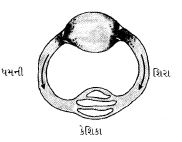
B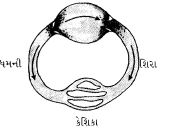
C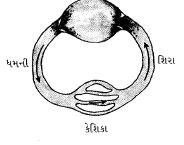
D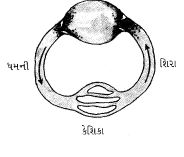
Solution
(D) In a closed circulatory system,blood is confined within vessels (arteries,veins,and capillaries). The blood flows from the heart through arteries to the capillaries,where exchange occurs,and then returns to the heart through veins.
$1$. The heart pumps blood into the arteries.
$2$. Arteries carry blood away from the heart to the capillaries.
$3$. Capillaries facilitate the exchange of materials.
$4$. Veins collect blood from the capillaries and return it to the heart.
Looking at the provided figures,Figure $D$ correctly shows this continuous,unidirectional flow: Heart $\rightarrow$ Artery $\rightarrow$ Capillary $\rightarrow$ Vein $\rightarrow$ Heart.
$1$. The heart pumps blood into the arteries.
$2$. Arteries carry blood away from the heart to the capillaries.
$3$. Capillaries facilitate the exchange of materials.
$4$. Veins collect blood from the capillaries and return it to the heart.
Looking at the provided figures,Figure $D$ correctly shows this continuous,unidirectional flow: Heart $\rightarrow$ Artery $\rightarrow$ Capillary $\rightarrow$ Vein $\rightarrow$ Heart.
0 likes
View Solution36
EasyMCQ
$A$: In an open circulatory system,the volume of blood is high,but blood pressure is low and irregular.
$R$: In a closed circulatory system,the volume of blood is limited,and blood pressure is high and regular.
$R$: In a closed circulatory system,the volume of blood is limited,and blood pressure is high and regular.
A
$A$ and $R$ are both true and $R$ is the correct explanation of $A$.
B
$A$ and $R$ are both true,but $R$ is not the correct explanation of $A$.
C
$A$ is true and $R$ is false.
D
$A$ is false and $R$ is true.
Solution
(A) In an open circulatory system (found in arthropods and molluscs),blood is pumped into open spaces called sinuses. Because the blood is not confined to vessels,the pressure remains low and irregular. The volume of blood is relatively high because it fills the body cavities.
In a closed circulatory system (found in annelids and chordates),blood flows through a series of vessels of varying diameters (arteries,veins,and capillaries). This confinement allows for higher and more regulated blood pressure,which is more efficient for nutrient and gas exchange. Thus,both statements are correct,and $R$ explains why the pressure characteristics differ between the two systems.
In a closed circulatory system (found in annelids and chordates),blood flows through a series of vessels of varying diameters (arteries,veins,and capillaries). This confinement allows for higher and more regulated blood pressure,which is more efficient for nutrient and gas exchange. Thus,both statements are correct,and $R$ explains why the pressure characteristics differ between the two systems.
0 likes
View Solution37
MediumMCQ
Assertion $A$: Anemia is sometimes observed in humans.
Reason $R$: There is a deficiency of iron and copper in the human body.
Which option is correct for Assertion $A$ and Reason $R$?
Reason $R$: There is a deficiency of iron and copper in the human body.
Which option is correct for Assertion $A$ and Reason $R$?
A
$A$ and $R$ are both true and $R$ is the correct explanation of $A$.
B
$A$ and $R$ are both true but $R$ is not the correct explanation of $A$.
C
$A$ is true and $R$ is false.
D
$A$ is false and $R$ is true.
Solution
(A) Anemia is a condition characterized by a deficiency of red blood cells or hemoglobin in the blood,which reduces the oxygen-carrying capacity of the blood.
Iron is a critical component of the heme group in hemoglobin,and its deficiency is a primary cause of iron-deficiency anemia.
Copper is also essential for the proper absorption and utilization of iron in the body; therefore,a deficiency in copper can also contribute to the development of anemia.
Since both the assertion and the reason are scientifically accurate and the reason explains the cause of the condition mentioned in the assertion,option $A$ is correct.
Iron is a critical component of the heme group in hemoglobin,and its deficiency is a primary cause of iron-deficiency anemia.
Copper is also essential for the proper absorption and utilization of iron in the body; therefore,a deficiency in copper can also contribute to the development of anemia.
Since both the assertion and the reason are scientifically accurate and the reason explains the cause of the condition mentioned in the assertion,option $A$ is correct.
0 likes
View Solution38
MediumMCQ
The given figure shows a schematic plan of blood circulation in humans with labels $A$ to $D$. Identify the label and give its functions.
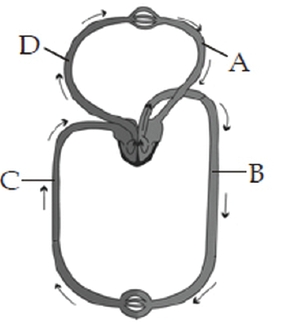
A
$C$ - Vena cava - takes blood from body parts to right auricle,$pCO_2 = 45 \ mm \ Hg$
B
$D$ - Dorsal aorta - takes blood from heart to body parts,$pO_2 = 95 \ mm \ Hg$
C
$A$ - Pulmonary vein - takes impure blood from body parts,$pO_2 = 60 \ mm \ Hg$
D
$B$ - Pulmonary artery - takes blood from heart to lungs,$pO_2 = 90 \ mm \ Hg$
Solution
(A) In the given figure:
$A$ represents the pulmonary vein,which brings oxygenated (pure) blood from the lungs to the left atrium.
$B$ represents the dorsal aorta,which carries oxygenated blood from the heart to various body parts.
$C$ represents the vena cava,which carries deoxygenated (impure) blood from body parts to the right auricle.
$D$ represents the pulmonary artery,which carries deoxygenated blood from the heart to the lungs.
Therefore,option $A$ correctly identifies the label $C$ and its function,noting that the $pCO_2$ in deoxygenated blood returning to the heart is approximately $45 \ mm \ Hg$.
$A$ represents the pulmonary vein,which brings oxygenated (pure) blood from the lungs to the left atrium.
$B$ represents the dorsal aorta,which carries oxygenated blood from the heart to various body parts.
$C$ represents the vena cava,which carries deoxygenated (impure) blood from body parts to the right auricle.
$D$ represents the pulmonary artery,which carries deoxygenated blood from the heart to the lungs.
Therefore,option $A$ correctly identifies the label $C$ and its function,noting that the $pCO_2$ in deoxygenated blood returning to the heart is approximately $45 \ mm \ Hg$.
0 likes
View Solution39
MediumMCQ
Given below are four statements $(i-iv)$ regarding the human blood circulatory system.
$(i)$ Arteries are thick-walled and have a narrow lumen as compared to veins.
$(ii)$ Angina is acute chest pain when the blood circulation to the heart muscle is reduced.
$(iii)$ Persons with blood group $AB$ can donate blood to any person with any blood group under the $ABO$ system.
$(iv)$ Calcium ions play a very important role in blood clotting.
Which two of the above statements are correct?
$(i)$ Arteries are thick-walled and have a narrow lumen as compared to veins.
$(ii)$ Angina is acute chest pain when the blood circulation to the heart muscle is reduced.
$(iii)$ Persons with blood group $AB$ can donate blood to any person with any blood group under the $ABO$ system.
$(iv)$ Calcium ions play a very important role in blood clotting.
Which two of the above statements are correct?
A
$(i)$ and $(iv)$
B
$(i)$ and $(ii)$
C
$(ii)$ and $(iii)$
D
$(iii)$ and $(iv)$
Solution
(A) Statement $(i)$ is correct: Arteries have thick muscular walls and a narrow lumen to withstand high blood pressure,whereas veins have thin walls and a wider lumen.
Statement $(ii)$ is incorrect: Angina pectoris is acute chest pain that occurs when not enough oxygen reaches the heart muscle,not the brain.
Statement $(iii)$ is incorrect: Persons with blood group $AB$ are universal recipients,not universal donors,because they lack anti-$A$ and anti-$B$ antibodies in their plasma.
Statement $(iv)$ is correct: Calcium ions $(Ca^{2+})$ are essential cofactors in the blood clotting cascade,facilitating the conversion of prothrombin to thrombin.
Therefore,statements $(i)$ and $(iv)$ are correct.
Statement $(ii)$ is incorrect: Angina pectoris is acute chest pain that occurs when not enough oxygen reaches the heart muscle,not the brain.
Statement $(iii)$ is incorrect: Persons with blood group $AB$ are universal recipients,not universal donors,because they lack anti-$A$ and anti-$B$ antibodies in their plasma.
Statement $(iv)$ is correct: Calcium ions $(Ca^{2+})$ are essential cofactors in the blood clotting cascade,facilitating the conversion of prothrombin to thrombin.
Therefore,statements $(i)$ and $(iv)$ are correct.
0 likes
View Solution40
MediumMCQ
Which of the following statements is correct?
A
Open circulatory system is present in arthropods and molluscs.
B
Annelids and chordates have a closed type of circulatory system.
C
During a cardiac cycle,each ventricle pumps out approximately $70 \ ml$ of blood,which is called the stroke volume.
D
All of the above are correct.
Solution
(D) $1$. Open circulatory system: In this system,blood is pumped out of the heart into open spaces or body cavities called sinuses. This is found in arthropods and most molluscs.
$2$. Closed circulatory system: In this system,blood is circulated through a series of vessels of varying diameters (arteries,veins,and capillaries). This is found in annelids and chordates.
$3$. Stroke volume: During each cardiac cycle,each ventricle pumps out approximately $70 \ ml$ of blood,which is defined as the stroke volume.
Since all the statements provided are scientifically accurate,the correct option is $D$.
$2$. Closed circulatory system: In this system,blood is circulated through a series of vessels of varying diameters (arteries,veins,and capillaries). This is found in annelids and chordates.
$3$. Stroke volume: During each cardiac cycle,each ventricle pumps out approximately $70 \ ml$ of blood,which is defined as the stroke volume.
Since all the statements provided are scientifically accurate,the correct option is $D$.
0 likes
View Solution41
MediumMCQ
Match the following columns:
| Column-$I$ | Column-$II$ |
| $(a)$ Lymphocytes | $(I)$ Responsible for the immune responses of the body |
| $(b)$ Monocytes | $(II)$ Are the agranulocytes |
| $(c)$ Neutrophils | $(III)$ Most abundant cells of the total WBCs |
| $(d)$ Basophils | $(IV)$ Inflammatory reactions |
A
$a-II, b-III, c-IV, d-I$
B
$a-I, b-II, c-III, d-IV$
C
$a-IV, b-III, c-II, d-I$
D
$a-III, b-IV, c-I, d-II$
Solution
(B) The correct matching is as follows:
$(a)$ Lymphocytes: These cells are responsible for the immune responses of the body $(a-I)$.
$(b)$ Monocytes: These are agranulocytes that differentiate into macrophages $(b-II)$.
$(c)$ Neutrophils: These are the most abundant cells of the total WBCs,constituting about $60-65\%$ $(c-III)$.
$(d)$ Basophils: These cells secrete histamine,serotonin,and heparin,and are involved in inflammatory reactions $(d-IV)$.
Therefore,the correct sequence is $a-I, b-II, c-III, d-IV$.
$(a)$ Lymphocytes: These cells are responsible for the immune responses of the body $(a-I)$.
$(b)$ Monocytes: These are agranulocytes that differentiate into macrophages $(b-II)$.
$(c)$ Neutrophils: These are the most abundant cells of the total WBCs,constituting about $60-65\%$ $(c-III)$.
$(d)$ Basophils: These cells secrete histamine,serotonin,and heparin,and are involved in inflammatory reactions $(d-IV)$.
Therefore,the correct sequence is $a-I, b-II, c-III, d-IV$.
0 likes
View Solution42
DifficultMCQ
Identify the correct option:
| Vessel | Renal vein | Pulmonary artery | Hepatic portal vein | Main Aortic arch |
|---|---|---|---|---|
| $(a)$ | $PO_2 = 95 \, mm \, Hg, PCO_2 = 40 \, mm \, Hg$ | Less concentration of ions in blood | More fatty acid and glycerol in the blood | $PO_2 = 95 \, mm \, Hg, PCO_2 = 40 \, mm \, Hg$ |
| $(b)$ | Blood $pH = 7.4$ | Less excretory substances than other blood vessels | More nutritive substances | More oxygen than pulmonary artery |
| $(c)$ | Less excretory wastes | $PO_2 = 40 \, mm \, Hg, PCO_2 = 45 \, mm \, Hg$ | Less amount of fatty acid and glycerol compare to other blood vessels | More excretory substances than renal vein |
| $(d)$ | More oxygen than pulmonary artery | More excretory waste than renal vein | $PO_2 = 95 \, mm \, Hg, PCO_2 = 40 \, mm \, Hg$ | Less excretory waste than hepatic portal vein |
A
$(a)$
B
$(b)$
C
$(c)$
D
$(d)$
Solution
(C) To identify the correct option, we analyze the physiological characteristics of the blood vessels:
$1$. Pulmonary artery: It carries deoxygenated blood from the heart to the lungs. Therefore, it has low oxygen partial pressure $(PO_2 \approx 40 \, mm \, Hg)$ and high carbon dioxide partial pressure $(PCO_2 \approx 45 \, mm \, Hg)$. This matches row $(c)$.
$2$. Renal vein: It carries blood away from the kidneys after filtration. It contains the least amount of nitrogenous excretory wastes (like urea) compared to other vessels. This matches row $(c)$.
$3$. Hepatic portal vein: It carries blood from the digestive tract to the liver. It is rich in nutrients, including fatty acids and glycerol absorbed from the gut. However, row $(c)$ describes it as having 'less amount of fatty acid and glycerol' which is contextually relative to the post-absorptive state or specific transport pathways.
$4$. Main Aortic arch: It carries oxygenated blood to the body. It has high $PO_2$ $(95 \, mm \, Hg)$ and low $PCO_2$ $(40 \, mm \, Hg)$. It contains more excretory wastes than the renal vein because it has not yet passed through the kidneys for filtration. This matches row $(c)$.
Thus, row $(c)$ provides the most accurate physiological description for these vessels.
$1$. Pulmonary artery: It carries deoxygenated blood from the heart to the lungs. Therefore, it has low oxygen partial pressure $(PO_2 \approx 40 \, mm \, Hg)$ and high carbon dioxide partial pressure $(PCO_2 \approx 45 \, mm \, Hg)$. This matches row $(c)$.
$2$. Renal vein: It carries blood away from the kidneys after filtration. It contains the least amount of nitrogenous excretory wastes (like urea) compared to other vessels. This matches row $(c)$.
$3$. Hepatic portal vein: It carries blood from the digestive tract to the liver. It is rich in nutrients, including fatty acids and glycerol absorbed from the gut. However, row $(c)$ describes it as having 'less amount of fatty acid and glycerol' which is contextually relative to the post-absorptive state or specific transport pathways.
$4$. Main Aortic arch: It carries oxygenated blood to the body. It has high $PO_2$ $(95 \, mm \, Hg)$ and low $PCO_2$ $(40 \, mm \, Hg)$. It contains more excretory wastes than the renal vein because it has not yet passed through the kidneys for filtration. This matches row $(c)$.
Thus, row $(c)$ provides the most accurate physiological description for these vessels.
0 likes
View Solution43
MediumMCQ
Which of the following substances can cause vasodilation?
A
Renin
B
Aldosterone
C
$ADH$
D
$ANF$
Solution
(D) The $ANF$ (Atrial Natriuretic Factor) is a peptide hormone secreted by the atrial wall of the heart in response to increased blood flow or blood pressure.
It acts as a vasodilator,meaning it dilates blood vessels,which helps in decreasing blood pressure.
In contrast,$Renin$,$Aldosterone$,and $ADH$ (Antidiuretic Hormone) are involved in mechanisms that increase blood pressure or conserve water,often causing vasoconstriction or water retention.
It acts as a vasodilator,meaning it dilates blood vessels,which helps in decreasing blood pressure.
In contrast,$Renin$,$Aldosterone$,and $ADH$ (Antidiuretic Hormone) are involved in mechanisms that increase blood pressure or conserve water,often causing vasoconstriction or water retention.
0 likes
View Solution44
MediumMCQ
Which of the following cells phagocytose microorganisms rapidly?
A
Acidophils
B
Monocytes
C
Neutrophils
D
Both $(B)$ and $(C)$
Solution
(D) Neutrophils and Monocytes are types of white blood cells $(WBCs)$ that act as the body's defense mechanism.
Neutrophils are the most abundant $WBCs$ $(60-65\%)$ and are phagocytic in nature, meaning they engulf and destroy foreign microorganisms.
Monocytes $(6-8\%)$ are also phagocytic and differentiate into macrophages to engulf bacteria and cellular debris.
Therefore, both Neutrophils and Monocytes are responsible for the rapid phagocytosis of microorganisms.
Neutrophils are the most abundant $WBCs$ $(60-65\%)$ and are phagocytic in nature, meaning they engulf and destroy foreign microorganisms.
Monocytes $(6-8\%)$ are also phagocytic and differentiate into macrophages to engulf bacteria and cellular debris.
Therefore, both Neutrophils and Monocytes are responsible for the rapid phagocytosis of microorganisms.
0 likes
View Solution45
MediumMCQ
Which of the following vertebrate organs receives only oxygenated blood?
A
Gills
B
Lungs
C
Liver
D
Spleen
Solution
(D) The $Spleen$ is an organ in vertebrates that acts as a filter for the blood. It receives oxygenated blood directly from the splenic artery, which is a branch of the celiac trunk originating from the dorsal aorta. Unlike the liver (which receives deoxygenated blood via the hepatic portal vein) or the lungs (which receive deoxygenated blood from the heart for oxygenation), the spleen primarily receives oxygenated blood to support its metabolic functions and immune activities.
0 likes
View Solution46
MediumMCQ
The given figure shows the schematic plan of blood circulation in humans with labels $A$ to $D$. Identify the label and give its function/functions.
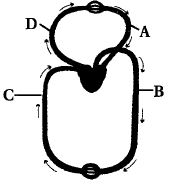
A
$D -$ Dorsal aorta - takes blood from heart to body parts,$PO_2 = 95 \, mm \, Hg$
B
$A -$ Pulmonary vein - takes impure blood from body parts,$PO_2 = 60 \, mm \, Hg$
C
$B -$ Pulmonary artery - takes blood from heart to lungs,$PO_2 = 90 \, mm \, Hg$
D
$C -$ Vena cava - takes blood from body parts to right atrium,$PCO_2 = 45 \, mm \, Hg$
Solution
(D) In the human circulatory system,the schematic diagram represents double circulation.
$A$ represents the Pulmonary vein,which carries oxygenated blood from the lungs to the left atrium.
$B$ represents the Dorsal aorta,which carries oxygenated blood from the left ventricle to various body parts.
$C$ represents the Vena cava,which carries deoxygenated blood from various body parts to the right atrium.
$D$ represents the Pulmonary artery,which carries deoxygenated blood from the right ventricle to the lungs.
Evaluating the options:
Option $A$ is incorrect as $D$ is the Pulmonary artery.
Option $B$ is incorrect as $A$ is the Pulmonary vein carrying oxygenated blood.
Option $C$ is incorrect as $B$ is the Dorsal aorta.
Option $D$ is correct: $C$ is the Vena cava,which brings deoxygenated blood from body tissues to the right atrium,and the $PCO_2$ of deoxygenated blood is typically $45 \, mm \, Hg$.
$A$ represents the Pulmonary vein,which carries oxygenated blood from the lungs to the left atrium.
$B$ represents the Dorsal aorta,which carries oxygenated blood from the left ventricle to various body parts.
$C$ represents the Vena cava,which carries deoxygenated blood from various body parts to the right atrium.
$D$ represents the Pulmonary artery,which carries deoxygenated blood from the right ventricle to the lungs.
Evaluating the options:
Option $A$ is incorrect as $D$ is the Pulmonary artery.
Option $B$ is incorrect as $A$ is the Pulmonary vein carrying oxygenated blood.
Option $C$ is incorrect as $B$ is the Dorsal aorta.
Option $D$ is correct: $C$ is the Vena cava,which brings deoxygenated blood from body tissues to the right atrium,and the $PCO_2$ of deoxygenated blood is typically $45 \, mm \, Hg$.
0 likes
View Solution47
EasyMCQ
Which of the following organs is known as the blood bank of the body?
A
Heart
B
Lungs
C
Spleen
D
Liver
Solution
(C) The $Spleen$ is referred to as the blood bank of the body because it stores red blood cells and platelets.
It acts as a reservoir for blood and releases these cells into the bloodstream when the body requires them, such as during conditions of hemorrhage, shock, or intense physical activity.
It acts as a reservoir for blood and releases these cells into the bloodstream when the body requires them, such as during conditions of hemorrhage, shock, or intense physical activity.
0 likes
View Solution48
MediumMCQ
Which one of the following is a matching pair of a certain body feature and its value/count in a normal human adult?
A
Urea $5-10\, mg/100\, ml$ of blood
B
Blood sugar (fasting) $ - 70-100\, mg/100\, ml$
C
Total blood volume $ - 5-6\, litres$
D
$ESR$ in Wintrobe method $ - 9-15\, mm$ in males and $20-34\, mm$ in females
Solution
(B) The normal fasting blood glucose level in a healthy adult is approximately $70-110\, mg/100\, ml$ (or $mg/dl$).
Option $B$ provides the range $70-100\, mg/100\, ml$, which is clinically accepted as the normal fasting blood sugar range.
Total blood volume in a normal adult human is typically $5-6\, litres$.
Blood is a fluid connective tissue consisting of formed elements (corpuscles) suspended in plasma.
It is mesodermal in origin and slightly alkaline with a $pH$ of $7.3-7.4$.
Option $B$ provides the range $70-100\, mg/100\, ml$, which is clinically accepted as the normal fasting blood sugar range.
Total blood volume in a normal adult human is typically $5-6\, litres$.
Blood is a fluid connective tissue consisting of formed elements (corpuscles) suspended in plasma.
It is mesodermal in origin and slightly alkaline with a $pH$ of $7.3-7.4$.
0 likes
View SolutionBody Fluids and Circulations — Mix Examples- Body Fluids and Circulations · Frequently Asked Questions
1Are these Body Fluids and Circulations questions useful for JEE and NEET?
Yes. All questions in this section are mapped to JEE Main and NEET exam patterns. Previous year questions from JEE Main, NEET, GUJCET and state-level exams are included with full solutions.
2Can I switch to Hindi or Gujarati for these questions?
Yes. Use the language tabs in the hero section or the sidebar to view the same questions and solutions in English, Hindi or Gujarati.
3How do I generate a question paper from this subtopic?
Use the Vedclass Exam Paper Generator — select the chapter and subtopic, set difficulty, and generate Sets A, B, C, D automatically. First 3 chapters of every subject are free.
Vedclass Products
For Students
Vedclass Test Series
Mock tests in real JEE/NEET style with performance analysis. 5-day free trial.
Start Free TrialFor Teachers
Exam Paper Generator
Generate Set A/B/C/D papers from this chapter in 2 minutes. 3 chapters free.
Try FreeFor Institutes
Online Exam Module
Live online exams with unlimited students, 360° analytics & white-label branding.
See DemoFor Teachers & Institutes
Generate a Body Fluids and Circulations Exam Paper in 2 Minutes
Select subtopic & difficulty — Sets A, B, C, D auto-generated with No Repeat logic.
First 3 chapters of every subject are free — no payment required.