
A English
Blood and Blood Group Questions in English
Class 11 Biology · Body Fluids and Circulations · Blood and Blood Group
639+
Questions
English
Language
100%
With Solutions
Showing 50 of 639 questions in English
401
EasyMCQ
Globulins contained in human blood plasma are primarily involved in:
A
Defense mechanisms of the body
B
Osmotic balance of body fluids
C
Oxygen transport in the blood
D
Blood clotting
Solution
(A) Blood plasma contains three major types of proteins: $1.$ Fibrinogen,$2.$ Globulins,and $3.$ Albumins.
$1.$ Fibrinogen is primarily involved in blood clotting.
$2.$ Globulins are primarily involved in the defense mechanisms of the body (as they form antibodies/immunoglobulins).
$3.$ Albumins help in maintaining the osmotic balance of body fluids.
Therefore,the correct option is $A$.
$1.$ Fibrinogen is primarily involved in blood clotting.
$2.$ Globulins are primarily involved in the defense mechanisms of the body (as they form antibodies/immunoglobulins).
$3.$ Albumins help in maintaining the osmotic balance of body fluids.
Therefore,the correct option is $A$.
0 likes
View Solution402
MediumMCQ
If you suspect an antibody deficiency in a person,which of the following would you look for as definitive evidence?
A
Serum globulins
B
Plasma fibrinogen
C
Serum albumin
D
Hemocytes
Solution
(A) Antibodies are proteins known as immunoglobulins,which belong to the class of proteins called globulins.
In the human body,antibodies are found in the serum fraction of the blood.
Therefore,a deficiency in antibodies is typically reflected by a decrease in the levels of serum globulins.
Serum albumin is a transport protein,plasma fibrinogen is involved in blood clotting,and hemocytes are blood cells,none of which are antibodies.
In the human body,antibodies are found in the serum fraction of the blood.
Therefore,a deficiency in antibodies is typically reflected by a decrease in the levels of serum globulins.
Serum albumin is a transport protein,plasma fibrinogen is involved in blood clotting,and hemocytes are blood cells,none of which are antibodies.
0 likes
View Solution403
MediumMCQ
Match the items given in Column $I$ with those in Column $II$ and select the correct option given below:
| Column $I$ | Column $II$ |
| $(a)$ Fibrinogen | $(i)$ Osmotic balance |
| $(b)$ Globulin | $(ii)$ Blood clotting |
| $(c)$ Albumin | $(iii)$ Defence mechanism |
A
$a-ii, b-iii, c-i$
B
$a-iii, b-ii, c-i$
C
$a-i, b-iii, c-ii$
D
$a-i, b-ii, c-iii$
Solution
(A) The plasma proteins play specific roles in the human body:
$1$. Fibrinogen: These are proteins needed for clotting or coagulation of blood. Thus, $(a)$ matches with $(ii)$.
$2$. Globulin: These are primarily involved in the defence mechanisms of the body (e.g., immunoglobulins/antibodies). Thus, $(b)$ matches with $(iii)$.
$3$. Albumin: These proteins help in maintaining the osmotic balance of the blood. Thus, $(c)$ matches with $(i)$.
Therefore, the correct matching is $a-ii, b-iii, c-i$.
$1$. Fibrinogen: These are proteins needed for clotting or coagulation of blood. Thus, $(a)$ matches with $(ii)$.
$2$. Globulin: These are primarily involved in the defence mechanisms of the body (e.g., immunoglobulins/antibodies). Thus, $(b)$ matches with $(iii)$.
$3$. Albumin: These proteins help in maintaining the osmotic balance of the blood. Thus, $(c)$ matches with $(i)$.
Therefore, the correct matching is $a-ii, b-iii, c-i$.
0 likes
View Solution404
MediumMCQ
The component of blood which prevents its coagulation in the blood vessels is
A
haemoglobin
B
plasma
C
thrombin
D
heparin
Solution
(D) Blood contains an anticoagulant called $heparin$,which prevents the activation of $prothrombin$.
$Prothrombin$ is an inactive plasma protein required during the process of blood coagulation.
$Heparin$ is a natural anticoagulant released from the mast-cell granules that prevents blood from clotting inside the intact blood vessels.
$Prothrombin$ is an inactive plasma protein required during the process of blood coagulation.
$Heparin$ is a natural anticoagulant released from the mast-cell granules that prevents blood from clotting inside the intact blood vessels.
0 likes
View Solution405
MediumMCQ
$A$ man whose blood group is not known meets with a serious accident and needs blood transfusion immediately. Which one of the blood groups readily available in the hospital will be safe for transfusion?
A
$O, Rh^+$
B
$O, Rh^-$
C
$AB, Rh^-$
D
$AB, Rh^+$
Solution
(B) Individuals with blood group $O, Rh^-$ are known as universal donors.
This is because their red blood cells lack both $A$ and $B$ antigens,and they also lack the $Rh$ antigen.
Consequently,their blood does not trigger an immune response (agglutination) when transfused into recipients of any other blood group.
Therefore,in emergency situations where the patient's blood group is unknown,$O, Rh^-$ blood is the safest choice for transfusion.
Thus,option $B$ is correct.
This is because their red blood cells lack both $A$ and $B$ antigens,and they also lack the $Rh$ antigen.
Consequently,their blood does not trigger an immune response (agglutination) when transfused into recipients of any other blood group.
Therefore,in emergency situations where the patient's blood group is unknown,$O, Rh^-$ blood is the safest choice for transfusion.
Thus,option $B$ is correct.
0 likes
View Solution406
MediumMCQ
With reference to the blood in a normal person,which one of the following statements is correct?
A
Compared to arteries,veins are less numerous and hold less of the body's blood at any given time.
B
Blood cells constitute about $70$ percent of the total volume of the blood.
C
White blood cells $(WBC)$ are made by lymph nodes only.
D
The blood has more platelets than $WBC$.
Solution
(D) In human blood,the count of blood platelets is approximately $1.5$ to $3.5$ lakhs per cubic mm,whereas the count of $WBCs$ is approximately $6000$ to $8000$ per cubic mm. Therefore,the blood has significantly more platelets than $WBCs$.
Veins and arteries are both types of blood vessels. Arteries carry blood away from the heart,while veins return blood to the heart. At any given time,the volume of blood in the venous system is generally higher than in the arterial system.
Blood consists of two main parts: Plasma,which constitutes about $55-60\%$ of the total blood volume,and the formed elements (cells),which constitute about $40-45\%$ of the total blood volume.
$WBCs$ are primarily produced in the red bone marrow,though some types are also produced in lymph nodes,the spleen,and the thymus.
Veins and arteries are both types of blood vessels. Arteries carry blood away from the heart,while veins return blood to the heart. At any given time,the volume of blood in the venous system is generally higher than in the arterial system.
Blood consists of two main parts: Plasma,which constitutes about $55-60\%$ of the total blood volume,and the formed elements (cells),which constitute about $40-45\%$ of the total blood volume.
$WBCs$ are primarily produced in the red bone marrow,though some types are also produced in lymph nodes,the spleen,and the thymus.
0 likes
View Solution407
MediumMCQ
Assertion: $WBCs$ accumulate at the site of wounds by diapedesis.
Reason: It is the squeezing of leucocytes from the endothelium.
Reason: It is the squeezing of leucocytes from the endothelium.
A
If both Assertion and Reason are correct and the Reason is a correct explanation of the Assertion.
B
If both Assertion and Reason are correct but Reason is not a correct explanation of the Assertion.
C
If the Assertion is correct but Reason is incorrect.
D
If both the Assertion and Reason are incorrect.
Solution
(A) $WBCs$ (leucocytes) are wandering cells that are capable of moving out of blood capillaries into the tissues through the capillary walls. This process of squeezing out of the blood vessels is known as diapedesis. Since the accumulation of $WBCs$ at the site of injury is directly facilitated by this process,the Reason correctly explains the Assertion.
0 likes
View Solution408
MediumMCQ
Assertion $(A)$: Blood coagulates in uninjured blood vessels.
Reason $(R)$: Uninjured blood vessels release an anticoagulant heparin.
Reason $(R)$: Uninjured blood vessels release an anticoagulant heparin.
A
If both Assertion and Reason are correct and the Reason is a correct explanation of the Assertion.
B
If both Assertion and Reason are correct but Reason is not a correct explanation of the Assertion.
C
If the Assertion is correct but Reason is incorrect.
D
If both the Assertion and Reason are incorrect.
Solution
(D) The Assertion $(A)$ is incorrect because blood does not coagulate in uninjured blood vessels under normal physiological conditions.
The Reason $(R)$ is correct because the endothelial lining of blood vessels secretes heparin,which is a natural anticoagulant that prevents the clotting of blood within the circulatory system.
Therefore,since the Assertion is false and the Reason is true,the correct option is $(D)$.
The Reason $(R)$ is correct because the endothelial lining of blood vessels secretes heparin,which is a natural anticoagulant that prevents the clotting of blood within the circulatory system.
Therefore,since the Assertion is false and the Reason is true,the correct option is $(D)$.
0 likes
View Solution409
MediumMCQ
Assertion: $Prothrombinase$ enzyme acts as an antiheparin.
Reason: $Heparin$ prevents the coagulation of blood in blood vessels.
Reason: $Heparin$ prevents the coagulation of blood in blood vessels.
A
If both Assertion and Reason are correct and the Reason is a correct explanation of the Assertion.
B
If both Assertion and Reason are correct but Reason is not a correct explanation of the Assertion.
C
If the Assertion is correct but Reason is incorrect.
D
If both the Assertion and Reason are incorrect.
Solution
(A) $Prothrombinase$ is a complex enzyme formed during the blood clotting process that converts $prothrombin$ into $thrombin$.
It functions as an antiheparin because it neutralizes the anticoagulant effect of $heparin$.
$Heparin$ is a naturally occurring anticoagulant produced by the liver and mast cells that prevents the clotting of blood within the intact blood vessels.
Since the $Prothrombinase$ enzyme neutralizes $heparin$ to allow the clotting cascade to proceed,the Reason correctly explains why the enzyme acts as an antiheparin.
It functions as an antiheparin because it neutralizes the anticoagulant effect of $heparin$.
$Heparin$ is a naturally occurring anticoagulant produced by the liver and mast cells that prevents the clotting of blood within the intact blood vessels.
Since the $Prothrombinase$ enzyme neutralizes $heparin$ to allow the clotting cascade to proceed,the Reason correctly explains why the enzyme acts as an antiheparin.
0 likes
View Solution410
EasyMCQ
The blood glucose level is commonly expressed as:
A
$mm$ of $Hg$
B
milligram per decilitre
C
parts per million
D
gram per litre
Solution
(B) The blood glucose level in the human body is clinically measured and commonly expressed in units of $mg/dL$ (milligram per decilitre). This unit represents the concentration of glucose present in a specific volume of blood plasma.
0 likes
View Solution411
MediumMCQ
Assertion: The regulation of $RBC$ production is accomplished by $FSH$.
Reason: Erythropoietin hormone circulates to red bone marrow where it increases stem cell mitosis and speeds up the development of $RBCs$.
Reason: Erythropoietin hormone circulates to red bone marrow where it increases stem cell mitosis and speeds up the development of $RBCs$.
A
If both Assertion and Reason are correct and the Reason is a correct explanation of the Assertion.
B
If both Assertion and Reason are correct but Reason is not a correct explanation of the Assertion.
C
If the Assertion is correct but Reason is incorrect.
D
If the Assertion is incorrect but the Reason is correct.
Solution
(D) The regulation of $RBC$ production (erythropoiesis) is accomplished by the hormone erythropoietin $(EPO)$.
Erythropoietin is a glycoprotein produced primarily by the kidneys in response to low oxygen levels in the blood.
It stimulates the red bone marrow to increase the rate of stem cell mitosis and accelerates the maturation of $RBCs$,thereby increasing the oxygen-carrying capacity of the blood.
Follicle-stimulating hormone $(FSH)$ is a gonadotropic hormone secreted by the anterior pituitary gland,which regulates gametogenesis and reproductive functions,not $RBC$ production.
Therefore,the Assertion is incorrect,and the Reason is correct.
Erythropoietin is a glycoprotein produced primarily by the kidneys in response to low oxygen levels in the blood.
It stimulates the red bone marrow to increase the rate of stem cell mitosis and accelerates the maturation of $RBCs$,thereby increasing the oxygen-carrying capacity of the blood.
Follicle-stimulating hormone $(FSH)$ is a gonadotropic hormone secreted by the anterior pituitary gland,which regulates gametogenesis and reproductive functions,not $RBC$ production.
Therefore,the Assertion is incorrect,and the Reason is correct.
0 likes
View Solution412
MediumMCQ
Three children in a family have blood types $O$,$AB$ and $B$ respectively. What are the genotypes of their parents?
A
$I^A i$ and $I^B i$
B
$I^A I^B$ and $i i$
C
$I^B I^B$ and $I^A I^A$
D
$I^A I^A$ and $I^B i$
Solution
(A) To have a child with blood type $O$ (genotype $ii$),both parents must contribute an $i$ allele. Therefore,both parents must be heterozygous.
To have a child with blood type $AB$ (genotype $I^A I^B$),one parent must contribute $I^A$ and the other must contribute $I^B$.
To have a child with blood type $B$ (genotype $I^B i$ or $I^B I^B$),the parents must possess the $I^B$ allele.
Combining these requirements,the parents must have genotypes $I^A i$ and $I^B i$.
- Parent $1$ $(I^A i)$ can produce gametes $I^A$ and $i$.
- Parent $2$ $(I^B i)$ can produce gametes $I^B$ and $i$.
- Possible offspring genotypes: $I^A I^B$ (Type $AB$),$I^A i$ (Type $A$),$I^B i$ (Type $B$),and $ii$ (Type $O$).
Thus,the parents' genotypes are $I^A i$ and $I^B i$.
To have a child with blood type $AB$ (genotype $I^A I^B$),one parent must contribute $I^A$ and the other must contribute $I^B$.
To have a child with blood type $B$ (genotype $I^B i$ or $I^B I^B$),the parents must possess the $I^B$ allele.
Combining these requirements,the parents must have genotypes $I^A i$ and $I^B i$.
- Parent $1$ $(I^A i)$ can produce gametes $I^A$ and $i$.
- Parent $2$ $(I^B i)$ can produce gametes $I^B$ and $i$.
- Possible offspring genotypes: $I^A I^B$ (Type $AB$),$I^A i$ (Type $A$),$I^B i$ (Type $B$),and $ii$ (Type $O$).
Thus,the parents' genotypes are $I^A i$ and $I^B i$.
0 likes
View Solution413
EasyMCQ
What are the cellular components of blood?
A
Plasma and serum
B
Erythrocytes,leucocytes,and thrombocytes
C
Hemoglobin and plasma proteins
D
Lymph and interstitial fluid
Solution
(B) The cellular components of blood are collectively known as formed elements. These include:
$1$. Erythrocytes $(RBCs)$: These are biconcave,non-nucleated cells in mammals that transport respiratory gases like $O_2$ and $CO_2$.
$2$. Leucocytes $(WBCs)$: These are nucleated cells involved in the immune response. They are categorized into granulocytes (neutrophils,eosinophils,and basophils) and agranulocytes (lymphocytes and monocytes).
$3$. Thrombocytes (platelets): These are cell fragments derived from megakaryocytes in the bone marrow and are essential for blood coagulation (clotting).
These formed elements constitute approximately $45 \%$ of the total blood volume,while the remaining $55 \%$ is the fluid matrix called plasma.
$1$. Erythrocytes $(RBCs)$: These are biconcave,non-nucleated cells in mammals that transport respiratory gases like $O_2$ and $CO_2$.
$2$. Leucocytes $(WBCs)$: These are nucleated cells involved in the immune response. They are categorized into granulocytes (neutrophils,eosinophils,and basophils) and agranulocytes (lymphocytes and monocytes).
$3$. Thrombocytes (platelets): These are cell fragments derived from megakaryocytes in the bone marrow and are essential for blood coagulation (clotting).
These formed elements constitute approximately $45 \%$ of the total blood volume,while the remaining $55 \%$ is the fluid matrix called plasma.
0 likes
View Solution414
Medium
Name the components of the formed elements in the blood and mention one major function of each of them.
Solution
(N/A) The formed elements in the blood are:
$(1)$ Erythrocytes (Red Blood Cells - $RBCs$):
They contain the red pigment haemoglobin,which is responsible for the transport of oxygen from the lungs to the tissues.
$(2)$ Leukocytes (White Blood Cells - $WBCs$):
These are colourless cells that lack haemoglobin. They are primarily involved in the body's immune defence mechanism. For example,neutrophils and monocytes are phagocytic,while lymphocytes are responsible for specific immune responses.
$(3)$ Platelets (Thrombocytes):
These are cell fragments produced from megakaryocytes. Their primary function is to release substances that promote blood coagulation (clotting) at the site of an injury.
$(1)$ Erythrocytes (Red Blood Cells - $RBCs$):
They contain the red pigment haemoglobin,which is responsible for the transport of oxygen from the lungs to the tissues.
$(2)$ Leukocytes (White Blood Cells - $WBCs$):
These are colourless cells that lack haemoglobin. They are primarily involved in the body's immune defence mechanism. For example,neutrophils and monocytes are phagocytic,while lymphocytes are responsible for specific immune responses.
$(3)$ Platelets (Thrombocytes):
These are cell fragments produced from megakaryocytes. Their primary function is to release substances that promote blood coagulation (clotting) at the site of an injury.
0 likes
View Solution415
Medium
What is the importance of plasma proteins?
Solution
(N/A) Plasma is the straw-coloured,viscous fluid constituting the matrix of blood. It makes up about $55\%$ of the blood volume.
Plasma proteins account for about $6-8\%$ of the plasma. The major plasma proteins are fibrinogens,globulins,and albumins.
$1$. Fibrinogens are needed for clotting or coagulation of blood.
$2$. Globulins are primarily involved in defense mechanisms of the body (e.g.,antibodies).
$3$. Albumins help in osmotic balance,which is essential for maintaining fluid volume within the vascular space.
Plasma proteins account for about $6-8\%$ of the plasma. The major plasma proteins are fibrinogens,globulins,and albumins.
$1$. Fibrinogens are needed for clotting or coagulation of blood.
$2$. Globulins are primarily involved in defense mechanisms of the body (e.g.,antibodies).
$3$. Albumins help in osmotic balance,which is essential for maintaining fluid volume within the vascular space.
0 likes
View Solution416
Medium
Why do we consider blood as a connective tissue?
Solution
(N/A) Connective tissues are characterized by cells scattered throughout an extracellular matrix. They serve to connect different body systems. Blood is classified as a type of connective tissue for the following reasons:
$1$. Like other connective tissues,blood is mesodermal in origin.
$2$. It connects various body systems by transporting oxygen,nutrients,and hormones to all parts of the body,while simultaneously removing metabolic waste products.
$3$. Blood contains an extracellular matrix known as plasma,in which cellular components such as red blood cells $(RBCs)$,white blood cells $(WBCs)$,and platelets are suspended.
$1$. Like other connective tissues,blood is mesodermal in origin.
$2$. It connects various body systems by transporting oxygen,nutrients,and hormones to all parts of the body,while simultaneously removing metabolic waste products.
$3$. Blood contains an extracellular matrix known as plasma,in which cellular components such as red blood cells $(RBCs)$,white blood cells $(WBCs)$,and platelets are suspended.
0 likes
View Solution417
Medium
What is the difference between lymph and blood?
Solution
(N/A)
| Lymph | Blood |
|---|---|
| $(1)$ It is a colourless fluid that does not contain $RBCs$. | $(1)$ It is a red-coloured fluid that contains $RBCs$. |
| $(2)$ It contains plasma and a lesser number of $WBCs$ and platelets. | $(2)$ It contains plasma,$RBCs$,$WBCs$,and platelets. |
| $(3)$ It helps in body defence and is a part of the immune system. | $(3)$ It is associated with the circulation of oxygen and carbon dioxide. |
| $(4)$ Its plasma lacks proteins. | $(4)$ Its plasma has proteins,calcium,and phosphorus. |
| $(5)$ It transports nutrients from the tissue cells to the blood,through lymphatic vessels. | $(5)$ It transports nutrients and oxygen from one organ to another. |
| $(6)$ The flow of lymph is slow. | $(6)$ The flow of blood in the blood vessels is fast. |
0 likes
View Solution418
Easy
Describe the composition of blood and provide brief information about its components.
Solution
(N/A) Blood is a specialized connective tissue consisting of a fluid matrix,plasma,and formed elements.
$1$. Plasma: It is a straw-colored,viscous fluid constituting nearly $55 \%$ of the blood. It contains water $(90-92 \%)$,proteins (fibrinogen,globulins,and albumins),glucose,amino acids,and lipids.
$2$. Formed Elements: These constitute nearly $45 \%$ of the blood and include:
- Erythrocytes $(RBCs)$: These are the most abundant cells in the blood,containing the red pigment hemoglobin,which transports $O_2$.
- Leucocytes $(WBCs)$: These are colorless cells that lack hemoglobin and are nucleated. They are responsible for the immune response of the body.
- Thrombocytes (Platelets): These are cell fragments produced from megakaryocytes. They play a crucial role in the blood coagulation process.
$1$. Plasma: It is a straw-colored,viscous fluid constituting nearly $55 \%$ of the blood. It contains water $(90-92 \%)$,proteins (fibrinogen,globulins,and albumins),glucose,amino acids,and lipids.
$2$. Formed Elements: These constitute nearly $45 \%$ of the blood and include:
- Erythrocytes $(RBCs)$: These are the most abundant cells in the blood,containing the red pigment hemoglobin,which transports $O_2$.
- Leucocytes $(WBCs)$: These are colorless cells that lack hemoglobin and are nucleated. They are responsible for the immune response of the body.
- Thrombocytes (Platelets): These are cell fragments produced from megakaryocytes. They play a crucial role in the blood coagulation process.
0 likes
View Solution419
Easy
Explain the composition and function of plasma in detail.
Solution
(N/A) Plasma is a straw-colored,viscous fluid constituting nearly $55 \%$ of the blood.
- Various elements present in it and their functions are as follows:
- Water: $90-92 \%$ of plasma is water,which acts as a solvent for suspended elements.
- Salts: $Na^{+}$,$Ca^{++}$,$Mg^{++}$,$K^{+}$,$Cl^{-}$,and $HCO_{3}^{-}$ (bicarbonate) are present. Their major functions include osmotic balance,maintenance of $pH$,and regulation of the permeability of the cytoplasmic membrane.
- Plasma Proteins: $6-8 \%$
- Albumin: Involved in osmotic regulation and $pH$ maintenance.
- Globulin: Involved in defense mechanisms and immunity.
- Fibrinogen: Essential for the coagulation of blood.
- Nutrients: Glucose,amino acids,and lipids are also present in the plasma as they are in transit throughout the body.
- Factors for the coagulation or clotting of blood are also present in plasma in an inactive form.
- Plasma without the clotting factors is called serum.
- Various elements present in it and their functions are as follows:
- Water: $90-92 \%$ of plasma is water,which acts as a solvent for suspended elements.
- Salts: $Na^{+}$,$Ca^{++}$,$Mg^{++}$,$K^{+}$,$Cl^{-}$,and $HCO_{3}^{-}$ (bicarbonate) are present. Their major functions include osmotic balance,maintenance of $pH$,and regulation of the permeability of the cytoplasmic membrane.
- Plasma Proteins: $6-8 \%$
- Albumin: Involved in osmotic regulation and $pH$ maintenance.
- Globulin: Involved in defense mechanisms and immunity.
- Fibrinogen: Essential for the coagulation of blood.
- Nutrients: Glucose,amino acids,and lipids are also present in the plasma as they are in transit throughout the body.
- Factors for the coagulation or clotting of blood are also present in plasma in an inactive form.
- Plasma without the clotting factors is called serum.
0 likes
View Solution420
Easy
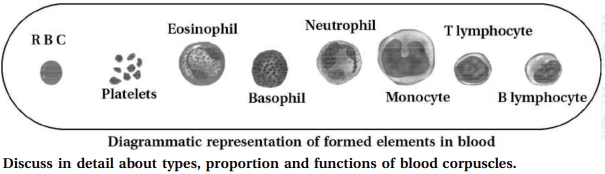
Blood Corpuscles. Discuss in detail about types,proportion and functions of blood corpuscles.
Solution
(N/A) Erythrocytes,Leucocytes,and Platelets are collectively called formed elements.
These elements constitute nearly $45 \%$ of the blood.
$(a)$ Erythrocytes / Red blood cells $(RBC)$ are the most abundant of all the cells in the blood.
$A$ healthy adult man has an average of $5$ million to $5.5$ million $RBCs$ per $mm^3$ of blood.
$RBCs$ are devoid of a nucleus in most mammals and are biconcave in shape.
They contain a red-coloured,iron-containing complex protein called haemoglobin.
$A$ healthy individual has $12-16 \ gm$ of haemoglobin in every $100 \ ml$ of blood.
Function: These molecules play a significant role in the transport of respiratory gases like $O_2$ and $CO_2$.
$RBCs$ are formed in the red bone marrow,have an average life span of $120$ days,and are destroyed in the spleen.
$(b)$ Leucocytes are colourless due to the lack of haemoglobin. They are relatively fewer in number,averaging $6000-8000 \ mm^{-3}$ of blood. They are nucleated and short-lived. Based on the presence of granules in the cytoplasm,they are classified into two types: $1$. Granulocytes and $2$. Agranulocytes.
$(c)$ Platelets: Also called Thrombocytes,these are cell fragments produced from megakaryocytes in the bone marrow. Blood contains $150,000-350,000$ platelets $mm^{-3}$. They release substances involved in blood coagulation. $A$ reduction in their number can lead to clotting disorders.
These elements constitute nearly $45 \%$ of the blood.
$(a)$ Erythrocytes / Red blood cells $(RBC)$ are the most abundant of all the cells in the blood.
$A$ healthy adult man has an average of $5$ million to $5.5$ million $RBCs$ per $mm^3$ of blood.
$RBCs$ are devoid of a nucleus in most mammals and are biconcave in shape.
They contain a red-coloured,iron-containing complex protein called haemoglobin.
$A$ healthy individual has $12-16 \ gm$ of haemoglobin in every $100 \ ml$ of blood.
Function: These molecules play a significant role in the transport of respiratory gases like $O_2$ and $CO_2$.
$RBCs$ are formed in the red bone marrow,have an average life span of $120$ days,and are destroyed in the spleen.
$(b)$ Leucocytes are colourless due to the lack of haemoglobin. They are relatively fewer in number,averaging $6000-8000 \ mm^{-3}$ of blood. They are nucleated and short-lived. Based on the presence of granules in the cytoplasm,they are classified into two types: $1$. Granulocytes and $2$. Agranulocytes.
| Type | Proportion | Function |
| Neutrophils | $60-65 \%$ | Phagocytic cells |
| Eosinophils | $2-3 \%$ | Resist infections,allergic reactions |
| Basophils | $0.5-1 \%$ | Secrete histamine,serotonin,heparin; involved in inflammatory reactions |
| Lymphocytes | $20-25 \%$ | Immune response |
| Monocytes | $6-8 \%$ | Phagocytic cells |
$(c)$ Platelets: Also called Thrombocytes,these are cell fragments produced from megakaryocytes in the bone marrow. Blood contains $150,000-350,000$ platelets $mm^{-3}$. They release substances involved in blood coagulation. $A$ reduction in their number can lead to clotting disorders.
0 likes
View Solution421
Easy
Write a short note on $ABO$ blood grouping.
Solution
(A) There are more than $30$ known $RBC$ antigens found in human beings,which classify the blood corpuscles of a particular person into different blood groups.
Among these,the two major types of blood groups are $ABO$ and $Rh$.
$ABO$ grouping is based on the presence or absence of two surface antigens (chemicals that can induce an immune response) on the $RBCs$,namely $A$ and $B$.
Similarly,the plasma of different individuals contains two natural antibodies. These are opposite to the antigens and are called anti-$A$ and anti-$B$.
Based on the presence of these antigens and antibodies,four blood groups,namely $A, B, AB,$ and $O$,are found in human beings.
The donor's compatibility is based on the antigens on the $RBCs$ and antibodies in the plasma,as shown in the table below:
During blood transfusion,any blood cannot be used; the blood of a donor must be carefully matched with the blood of a recipient.
Group $O$ blood can be donated to persons with any other blood group,and hence,$O$ group individuals are called universal donors.
Persons with $AB$ group can accept blood from persons with $AB$ as well as the other groups of blood. Therefore,such persons are called universal recipients.
Among these,the two major types of blood groups are $ABO$ and $Rh$.
$ABO$ grouping is based on the presence or absence of two surface antigens (chemicals that can induce an immune response) on the $RBCs$,namely $A$ and $B$.
Similarly,the plasma of different individuals contains two natural antibodies. These are opposite to the antigens and are called anti-$A$ and anti-$B$.
Based on the presence of these antigens and antibodies,four blood groups,namely $A, B, AB,$ and $O$,are found in human beings.
The donor's compatibility is based on the antigens on the $RBCs$ and antibodies in the plasma,as shown in the table below:
| Blood Group | Antigens on $RBCs$ | Antibodies in Plasma | Donor's Group |
| $A$ | $A$ | anti-$B$ | $A, O$ |
| $B$ | $B$ | anti-$A$ | $B, O$ |
| $AB$ | $A, B$ | nil | $AB, A, B, O$ |
| $O$ | nil | anti-$A, B$ | $O$ |
During blood transfusion,any blood cannot be used; the blood of a donor must be carefully matched with the blood of a recipient.
Group $O$ blood can be donated to persons with any other blood group,and hence,$O$ group individuals are called universal donors.
Persons with $AB$ group can accept blood from persons with $AB$ as well as the other groups of blood. Therefore,such persons are called universal recipients.
0 likes
View Solution422
Easy
Give information about $Rh$ blood group.
Solution
(A) The $Rh$ antigen was first discovered in $Rhesus$ monkeys,hence it is named the $Rh$ factor.
- This antigen is also observed on the surface of $RBCs$ in most humans. Individuals possessing this antigen are called $Rh$ positive $(Rh^+)$,while those lacking it are called $Rh$ negative $(Rh^-)$.
- Approximately $85\%$ of the human population is $Rh$ positive,and $15\%$ is $Rh$ negative.
- An $Rh^-$ person,if exposed to $Rh^+$ blood,will form specific antibodies against the $Rh$ antigens. Therefore,$Rh$ compatibility must be checked before blood transfusion.
- $A$ special case of $Rh$ incompatibility occurs between the $Rh^-$ blood of a pregnant mother and the $Rh^+$ blood of the foetus.
- During the first pregnancy,$Rh$ antigens of the foetus are not exposed to the mother's $Rh^-$ blood because the two blood supplies are separated by the placenta.
- However,during delivery,the mother may be exposed to the foetal $Rh^+$ blood,causing her to produce antibodies against the $Rh$ antigen.
- In subsequent pregnancies,these $Rh$ antibodies from the $Rh^-$ mother can cross the placenta and enter the $Rh^+$ foetal blood,destroying the foetal $RBCs$. This can be fatal to the foetus.
- This condition causes severe anaemia and jaundice in the baby and is known as erythroblastosis foetalis.
- This can be avoided by administering anti-$Rh$ antibodies to the mother immediately after the delivery of the first child.
- This antigen is also observed on the surface of $RBCs$ in most humans. Individuals possessing this antigen are called $Rh$ positive $(Rh^+)$,while those lacking it are called $Rh$ negative $(Rh^-)$.
- Approximately $85\%$ of the human population is $Rh$ positive,and $15\%$ is $Rh$ negative.
- An $Rh^-$ person,if exposed to $Rh^+$ blood,will form specific antibodies against the $Rh$ antigens. Therefore,$Rh$ compatibility must be checked before blood transfusion.
- $A$ special case of $Rh$ incompatibility occurs between the $Rh^-$ blood of a pregnant mother and the $Rh^+$ blood of the foetus.
- During the first pregnancy,$Rh$ antigens of the foetus are not exposed to the mother's $Rh^-$ blood because the two blood supplies are separated by the placenta.
- However,during delivery,the mother may be exposed to the foetal $Rh^+$ blood,causing her to produce antibodies against the $Rh$ antigen.
- In subsequent pregnancies,these $Rh$ antibodies from the $Rh^-$ mother can cross the placenta and enter the $Rh^+$ foetal blood,destroying the foetal $RBCs$. This can be fatal to the foetus.
- This condition causes severe anaemia and jaundice in the baby and is known as erythroblastosis foetalis.
- This can be avoided by administering anti-$Rh$ antibodies to the mother immediately after the delivery of the first child.
0 likes
View Solution423
Easy
Explain the process of coagulation of blood.
Solution
(N/A) Blood coagulation or clotting is a protective mechanism that occurs in response to an injury to prevent excessive blood loss.
The clot or coagulum is primarily composed of a network of thread-like proteins called $Fibrins$,in which dead and damaged formed elements of blood (cells) are trapped.
$Fibrins$ are formed by the conversion of inactive $Fibrinogens$ present in the plasma by the enzyme $Thrombin$.
$Thrombins$ are in turn formed from inactive $Prothrombin$ present in the plasma with the help of an enzyme complex called $Thrombokinase$.
The reaction sequence is as follows:
$Prothrombin \xrightarrow{Thrombokinase} Thrombin$
$Fibrinogen \xrightarrow{Thrombin} Fibrin$
This process involves a cascade of linked enzymatic reactions involving various clotting factors present in the plasma in an inactive state.
An injury or trauma stimulates the platelets in the blood to release certain factors which activate the coagulation mechanism.
$Calcium$ ions $(Ca^{2+})$ play a very important role in the clotting process.
The clot or coagulum is primarily composed of a network of thread-like proteins called $Fibrins$,in which dead and damaged formed elements of blood (cells) are trapped.
$Fibrins$ are formed by the conversion of inactive $Fibrinogens$ present in the plasma by the enzyme $Thrombin$.
$Thrombins$ are in turn formed from inactive $Prothrombin$ present in the plasma with the help of an enzyme complex called $Thrombokinase$.
The reaction sequence is as follows:
$Prothrombin \xrightarrow{Thrombokinase} Thrombin$
$Fibrinogen \xrightarrow{Thrombin} Fibrin$
This process involves a cascade of linked enzymatic reactions involving various clotting factors present in the plasma in an inactive state.
An injury or trauma stimulates the platelets in the blood to release certain factors which activate the coagulation mechanism.
$Calcium$ ions $(Ca^{2+})$ play a very important role in the clotting process.
0 likes
View Solution424
Easy
Give the differences between $RBCs$ and $WBCs$.
Solution
(N/A)
| $RBCs$ | $WBCs$ |
| $(1)$ They are red in colour due to the presence of the respiratory pigment $Hb$ (hemoglobin). | $(1)$ They are colourless as they lack respiratory pigments. |
| $(2)$ They are devoid of a nucleus in mature cells. | $(2)$ They possess a nucleus. |
| $(3)$ They participate in the transport of respiratory gases ($O_2$ and $CO_2$). | $(3)$ They provide a defense mechanism against pathogens. |
| $(4)$ Their count is approximately $5.0-5.5$ million/$mm^3$ of blood. | $(4)$ Their count is approximately $6000-8000$ cells/$mm^3$ of blood. |
0 likes
View Solution425
EasyMCQ
What is the medium of transport in higher organisms?
A
Blood and Lymph
B
Water
C
Plasma only
D
Interstitial fluid
Solution
(A) Different groups of animals have evolved different methods for transport.
$(i)$ Simple organisms like Sponges and Coelenterates circulate water from their surroundings through their body cavities to facilitate the exchange of substances by cells.
$(ii)$ More complex organisms use special body fluids to transport materials.
$(iii)$ In higher organisms,including humans,Blood and Lymph serve as the primary media of transport.
$(i)$ Simple organisms like Sponges and Coelenterates circulate water from their surroundings through their body cavities to facilitate the exchange of substances by cells.
$(ii)$ More complex organisms use special body fluids to transport materials.
$(iii)$ In higher organisms,including humans,Blood and Lymph serve as the primary media of transport.
0 likes
View Solution426
Easy
Provide the full names for the following abbreviations:
$(1)$ $Rh$ factor
$(2)$ $AHG$
$(1)$ $Rh$ factor
$(2)$ $AHG$
Solution
(N/A) $(1)$ $Rh$ factor stands for Rhesus factor,which is an antigen found on the surface of red blood cells.
$(2)$ $AHG$ stands for Anti-Hemophilic Globulin,also known as Factor $VIII$,which is essential for the blood clotting process.
$(2)$ $AHG$ stands for Anti-Hemophilic Globulin,also known as Factor $VIII$,which is essential for the blood clotting process.
0 likes
View Solution427
MediumMCQ
Does our blood have proteases and nucleases?
A
Yes,they are present to digest pathogens.
B
No,they are absent in human blood.
C
Yes,they are present in plasma.
D
Only nucleases are present.
Solution
(B) No,human blood does not contain the enzymes,nucleases and proteases.
In human beings,blood serum contains different types of protease inhibitors,which protect the blood proteins from being broken down by the action of proteases.
The enzyme,nucleases,which catalyses the hydrolysis of nucleic acids,is absent in blood.
In human beings,blood serum contains different types of protease inhibitors,which protect the blood proteins from being broken down by the action of proteases.
The enzyme,nucleases,which catalyses the hydrolysis of nucleic acids,is absent in blood.
0 likes
View Solution428
Easy
Differentiate between: Basophils and Eosinophils.
Solution
(N/A)
| Basophils | Eosinophils |
|---|---|
| $(1)$ They contain a lobed nucleus (often $S$-shaped). | $(1)$ They possess a bilobed nucleus. |
| $(2)$ They are stained by basic dyes (e.g.,Methylene blue). | $(2)$ They are stained by acidic dyes (e.g.,Eosin). |
| $(3)$ Their proportion is $0.5-1.0 \%$. | $(3)$ Their proportion is $2-3 \%$. |
| $(4)$ They secrete histamine,serotonin,and heparin. | $(4)$ They resist infections and are associated with allergic reactions. |
0 likes
View Solution429
Easy
Write the feature that distinguishes between the two: Plasma and Serum.
Solution
(N/A) Plasma: It is the straw-colored,viscous fluid matrix of blood that remains after removing blood cells. It contains all the clotting factors in their inactive form.
Serum: It is the fluid that remains after the blood has clotted. When blood clots,the clotting factors (like fibrinogen) are consumed to form a fibrin mesh,trapping the blood cells. The clear,yellowish fluid that separates from this clot is called serum. Therefore,serum is essentially plasma minus the clotting factors.
Serum: It is the fluid that remains after the blood has clotted. When blood clots,the clotting factors (like fibrinogen) are consumed to form a fibrin mesh,trapping the blood cells. The clear,yellowish fluid that separates from this clot is called serum. Therefore,serum is essentially plasma minus the clotting factors.
0 likes
View Solution430
Easy
Thrombocytes are essential for coagulation of blood. Comment.
Solution
(N/A) Thrombocytes,also known as platelets,are cell fragments produced from megakaryocytes in the bone marrow.
When a blood vessel is injured,platelets adhere to the site of damage and release factors such as thromboplastin.
This initiates the coagulation cascade,leading to the conversion of inactive fibrinogen into active,fibrous fibrin threads.
These fibrin threads form a mesh that traps blood cells,creating a clot that prevents further blood loss.
Therefore,thrombocytes are essential for the process of blood coagulation.
When a blood vessel is injured,platelets adhere to the site of damage and release factors such as thromboplastin.
This initiates the coagulation cascade,leading to the conversion of inactive fibrinogen into active,fibrous fibrin threads.
These fibrin threads form a mesh that traps blood cells,creating a clot that prevents further blood loss.
Therefore,thrombocytes are essential for the process of blood coagulation.
0 likes
View Solution431
EasyMCQ
Name the major site where $RBCs$ are formed.
A
Liver
B
Bone marrow
C
Spleen
D
Kidney
Solution
(B) The process of formation of $RBCs$ is known as erythropoiesis.
In adults,the major site for the formation of $RBCs$ is the red bone marrow,which is found in the flat bones like the sternum,ribs,and vertebrae.
In adults,the major site for the formation of $RBCs$ is the red bone marrow,which is found in the flat bones like the sternum,ribs,and vertebrae.
0 likes
View Solution432
Easy
Explain $Rh$-incompatibility in humans.
Solution
(N/A) $1$. $Rh$-incompatibility occurs when an $Rh$-negative mother carries an $Rh$-positive fetus.
$2$. During the first pregnancy,the mother's blood is exposed to the $Rh$ antigens of the fetus during delivery,leading to the formation of anti-$Rh$ antibodies in the mother's blood.
$3$. In subsequent pregnancies,these anti-$Rh$ antibodies can cross the placenta and destroy the $Rh$-positive fetal red blood cells,causing severe anemia and jaundice,a condition known as erythroblastosis fetalis.
$4$. This can be prevented by administering anti-$Rh$ antibodies (RhoGAM) to the mother immediately after the first delivery.
$2$. During the first pregnancy,the mother's blood is exposed to the $Rh$ antigens of the fetus during delivery,leading to the formation of anti-$Rh$ antibodies in the mother's blood.
$3$. In subsequent pregnancies,these anti-$Rh$ antibodies can cross the placenta and destroy the $Rh$-positive fetal red blood cells,causing severe anemia and jaundice,a condition known as erythroblastosis fetalis.
$4$. This can be prevented by administering anti-$Rh$ antibodies (RhoGAM) to the mother immediately after the first delivery.
0 likes
View Solution433
Easy
Explain different types of blood groups and donor compatibility by making a table.
Solution
(N/A) The $ABO$ blood grouping system is based on the presence or absence of two surface antigens on the red blood cells,namely $A$ and $B$. The plasma of individuals contains two natural antibodies,$anti-A$ and $anti-B$.
| Blood Group | Antigens on RBCs | Antibodies in Plasma | Donor Group |
| :--- | :--- | :--- | :--- |
| $A$ | $A$ | $anti-B$ | $A, O$ |
| $B$ | $B$ | $anti-A$ | $B, O$ |
| $AB$ | $A, B$ | $nil$ | $A, B, AB, O$ |
| $O$ | $nil$ | $anti-A, anti-B$ | $O$ |
$1$. Group $AB$ is known as the universal recipient because it can receive blood from all groups.
$2$. Group $O$ is known as the universal donor because it can donate blood to all groups.
| Blood Group | Antigens on RBCs | Antibodies in Plasma | Donor Group |
| :--- | :--- | :--- | :--- |
| $A$ | $A$ | $anti-B$ | $A, O$ |
| $B$ | $B$ | $anti-A$ | $B, O$ |
| $AB$ | $A, B$ | $nil$ | $A, B, AB, O$ |
| $O$ | $nil$ | $anti-A, anti-B$ | $O$ |
$1$. Group $AB$ is known as the universal recipient because it can receive blood from all groups.
$2$. Group $O$ is known as the universal donor because it can donate blood to all groups.
0 likes
View Solution434
EasyMCQ
Analogy type questions:
$(1)$ Human $RBCs$ : Enucleated : : $WBCs$ : ......
$(2)$ $'O'$ blood group : Universal donor : : $'AB'$ blood group : ......
$(1)$ Human $RBCs$ : Enucleated : : $WBCs$ : ......
$(2)$ $'O'$ blood group : Universal donor : : $'AB'$ blood group : ......
A
$(1)$ Nucleated,$(2)$ Universal recipient
B
$(1)$ Enucleated,$(2)$ Universal donor
C
$(1)$ Nucleated,$(2)$ Universal donor
D
$(1)$ Enucleated,$(2)$ Universal recipient
Solution
(A) $(1)$ Human $RBCs$ (Red Blood Cells) lack a nucleus in their mature state,hence they are called enucleated. In contrast,$WBCs$ (White Blood Cells) possess a nucleus,making them nucleated.
$(2)$ Individuals with blood group $'O'$ lack $A$ and $B$ antigens on their $RBC$ surface,making them universal donors. Individuals with blood group $'AB'$ lack both anti-$A$ and anti-$B$ antibodies in their plasma,making them universal recipients.
$(2)$ Individuals with blood group $'O'$ lack $A$ and $B$ antigens on their $RBC$ surface,making them universal donors. Individuals with blood group $'AB'$ lack both anti-$A$ and anti-$B$ antibodies in their plasma,making them universal recipients.
0 likes
View Solution435
Easy
Which salts are found in plasma? Give their functions.
Solution
(N/A) The plasma contains various inorganic salts,primarily $Na^{+}$,$Ca^{2+}$,$Mg^{2+}$,$HCO_{3}^{-}$,and $Cl^{-}$.
$1$. $Na^{+}$ and $Cl^{-}$: These ions are crucial for maintaining the osmotic pressure of the blood and regulating the water balance in the body.
$2$. $Ca^{2+}$: This ion plays a vital role in blood coagulation (clotting) and muscle contraction.
$3$. $HCO_{3}^{-}$: This ion acts as a buffer,helping to maintain the $pH$ of the blood within a narrow range (approximately $7.4$).
$1$. $Na^{+}$ and $Cl^{-}$: These ions are crucial for maintaining the osmotic pressure of the blood and regulating the water balance in the body.
$2$. $Ca^{2+}$: This ion plays a vital role in blood coagulation (clotting) and muscle contraction.
$3$. $HCO_{3}^{-}$: This ion acts as a buffer,helping to maintain the $pH$ of the blood within a narrow range (approximately $7.4$).
0 likes
View Solution436
EasyMCQ
What is the proportion of protein in plasma?
A
$2-4$ %
B
$6-8$ %
C
$10-12$ %
D
$1-2$ %
Solution
(B) Plasma is a straw-colored, viscous fluid constituting nearly $55 \%$ of the blood.
It contains water $(90-92 \%)$ and proteins $(6-8 \%)$.
The major proteins present in plasma are fibrinogen, globulins, and albumins.
It contains water $(90-92 \%)$ and proteins $(6-8 \%)$.
The major proteins present in plasma are fibrinogen, globulins, and albumins.
0 likes
View Solution437
Easy
What is the main function of proteins in plasma?
Solution
(N/A) Plasma proteins perform several critical functions:
$1$. $Albumin$: It is primarily responsible for maintaining the osmotic pressure of the blood,which helps in the regulation of water balance and $pH$ maintenance.
$2$. $Globulin$: These proteins are primarily involved in defense mechanisms,providing immunity and resistance against pathogens.
$3$. $Fibrinogen$: These are essential for the coagulation or clotting of blood,which prevents excessive blood loss during injury.
$1$. $Albumin$: It is primarily responsible for maintaining the osmotic pressure of the blood,which helps in the regulation of water balance and $pH$ maintenance.
$2$. $Globulin$: These proteins are primarily involved in defense mechanisms,providing immunity and resistance against pathogens.
$3$. $Fibrinogen$: These are essential for the coagulation or clotting of blood,which prevents excessive blood loss during injury.
0 likes
View Solution438
EasyMCQ
What are Formed Elements?
A
Plasma and proteins
B
Erythrocytes, Leucocytes and Platelets
C
Serum and clotting factors
D
Lymph and antibodies
Solution
(B) The blood consists of a fluid matrix called plasma and formed elements. Erythrocytes (Red Blood Cells), Leucocytes (White Blood Cells), and Platelets (Thrombocytes) are collectively referred to as formed elements. They constitute approximately $45\%$ of the blood volume.
0 likes
View Solution439
EasyMCQ
What is the primary function of Red Blood Cells (RBCs)?
A
To fight against pathogens
B
To transport respiratory gases like $O_{2}$ and $CO_{2}$
C
To help in blood clotting
D
To maintain body temperature
Solution
(B) Red Blood Cells (RBCs),also known as erythrocytes,contain a respiratory pigment called hemoglobin.
This hemoglobin binds with $O_{2}$ to form oxyhemoglobin,which facilitates the transport of $O_{2}$ from the lungs to the tissues.
Additionally,RBCs play a crucial role in the transport of $CO_{2}$ from the tissues back to the lungs for exhalation.
This hemoglobin binds with $O_{2}$ to form oxyhemoglobin,which facilitates the transport of $O_{2}$ from the lungs to the tissues.
Additionally,RBCs play a crucial role in the transport of $CO_{2}$ from the tissues back to the lungs for exhalation.
0 likes
View Solution440
MediumMCQ
Give the origin of Red blood cells.
A
Liver
B
Red bone marrow
C
Spleen
D
Kidney
Solution
(B) Red blood cells $(RBCs)$,also known as erythrocytes,are produced in the red bone marrow of adults.
This process of formation of blood cells is known as erythropoiesis.
In the red bone marrow,hematopoietic stem cells differentiate into mature $RBCs$.
This process of formation of blood cells is known as erythropoiesis.
In the red bone marrow,hematopoietic stem cells differentiate into mature $RBCs$.
0 likes
View Solution441
MediumMCQ
Mention the life span of Red blood cells. (in $days$)
A
$60$
B
$120$
C
$180$
D
$365$
Solution
(B) The average life span of human Red blood cells (RBCs) is approximately $120$ days.
After this period, they are broken down and removed from the circulation by the spleen, which is often referred to as the 'graveyard of RBCs'.
After this period, they are broken down and removed from the circulation by the spleen, which is often referred to as the 'graveyard of RBCs'.
0 likes
View Solution442
Easy
Explain the concentration of platelets in human blood.
Solution
(N/A) Platelets,also known as thrombocytes,are cell fragments produced from megakaryocytes in the bone marrow.
In a healthy human adult,the blood contains approximately $150,000$ to $350,000$ platelets per $mm^3$ of blood.
These cells play a crucial role in the process of blood coagulation (clotting) to prevent excessive blood loss during an injury.
In a healthy human adult,the blood contains approximately $150,000$ to $350,000$ platelets per $mm^3$ of blood.
These cells play a crucial role in the process of blood coagulation (clotting) to prevent excessive blood loss during an injury.
0 likes
View Solution443
EasyMCQ
Which major types of blood groups are found in human beings?
A
$ABO$ and $Rh$ blood groups
B
$ABO$ and $MN$ blood groups
C
$Rh$ and $MN$ blood groups
D
$ABO$ and $Kell$ blood groups
Solution
(A) The two major types of blood groups found in human beings are the $ABO$ blood grouping system and the $Rh$ blood grouping system.
These systems are based on the presence or absence of specific antigens on the surface of red blood cells $(RBCs)$.
These systems are based on the presence or absence of specific antigens on the surface of red blood cells $(RBCs)$.
0 likes
View Solution444
MediumMCQ
On what is the $ABO$ blood grouping based?
A
Presence or absence of two surface antigens on the $RBCs$
B
Presence or absence of antibodies in the plasma
C
Presence or absence of $Rh$ factor
D
Presence or absence of $WBCs$
Solution
(A) $ABO$ blood grouping is based on the presence or absence of two surface antigens on the surface of $RBCs$ (red blood cells),which are named as antigen $A$ and antigen $B$.
0 likes
View Solution445
EasyMCQ
Which are the main blood groups found in humans on the basis of antibodies and antigens?
A
$A$,$B$,$AB$,$O$
B
$A$,$B$,$AB$
C
$A$,$B$,$O$
D
$A$,$B$
Solution
(A) The $ABO$ blood grouping system in humans is based on the presence or absence of two surface antigens on the red blood cells,namely $A$ and $B$,and the corresponding antibodies present in the plasma.
Based on these,four main blood groups are identified in humans: $A$,$B$,$AB$,and $O$.
Based on these,four main blood groups are identified in humans: $A$,$B$,$AB$,and $O$.
0 likes
View Solution446
MediumMCQ
Which blood group is the universal donor and which is the universal recipient?
A
$O$ is universal donor,$AB$ is universal recipient
B
$AB$ is universal donor,$O$ is universal recipient
C
$A$ is universal donor,$B$ is universal recipient
D
$O$ is universal donor,$A$ is universal recipient
Solution
(A) Group $O$ blood lacks both $A$ and $B$ antigens on the surface of red blood cells,meaning it can be donated to individuals with any other blood group. Hence,$O$ group individuals are called universal donors.
Persons with $AB$ group possess both $A$ and $B$ antigens on their red blood cells and lack anti-$A$ and anti-$B$ antibodies in their plasma. Therefore,they can accept blood from persons with $A$,$B$,$AB$,and $O$ groups. Thus,such persons are called universal recipients.
Persons with $AB$ group possess both $A$ and $B$ antigens on their red blood cells and lack anti-$A$ and anti-$B$ antibodies in their plasma. Therefore,they can accept blood from persons with $A$,$B$,$AB$,and $O$ groups. Thus,such persons are called universal recipients.
0 likes
View Solution447
MediumMCQ
What is the proportion of $Rh$ $^{\text{+ve}}$ individuals in the human population?
A
Approximately $50 \%$
B
Approximately $85 \%$
C
Approximately $15 \%$
D
Approximately $95 \%$
Solution
(B) The $Rh$ antigen is similar to the one present in $Rhesus$ monkeys. About $85 \%$ of the human population is $Rh$ positive $(Rh^{\text{+ve}})$,meaning they possess the $Rh$ antigen on the surface of their red blood cells. The remaining $15 \%$ are $Rh$ negative $(Rh^{\text{-ve}})$.
0 likes
View Solution448
EasyMCQ
Why is testing of $Rh$ group necessary before blood transfusion?
A
To prevent blood clotting
B
To avoid immune response against $Rh$ antigens
C
To increase blood volume
D
To prevent infection
Solution
(B) An $Rh^{\text{-ve}}$ individual,if exposed to $Rh^{\text{+ve}}$ blood,will develop specific antibodies against the $Rh$ antigens present on the surface of the donor's red blood cells.
This immune response can lead to the destruction of the transfused blood cells (hemolysis) and cause severe complications.
Therefore,it is essential to match the $Rh$ blood group before any transfusion to ensure compatibility.
This immune response can lead to the destruction of the transfused blood cells (hemolysis) and cause severe complications.
Therefore,it is essential to match the $Rh$ blood group before any transfusion to ensure compatibility.
0 likes
View Solution449
EasyMCQ
Which substance does the clot formed in coagulation consist of?
A
Fibrin and trapped blood cells
B
Platelets and plasma proteins
C
Serum and white blood cells
D
Hemoglobin and red blood cells
Solution
(A) The clot or coagulum formed during blood coagulation consists mainly of a network of thread-like proteins called $fibrins$.
Within this network,dead and damaged formed elements of blood (such as red blood cells,white blood cells,and platelets) become trapped,effectively sealing the wound.
Within this network,dead and damaged formed elements of blood (such as red blood cells,white blood cells,and platelets) become trapped,effectively sealing the wound.
0 likes
View Solution450
EasyMCQ
Match the following columns and select the correct option.
| Column-$I$ | Column-$II$ |
| $(a)$ Eosinophils | $(i)$ Immune response |
| $(b)$ Basophils | $(ii)$ Phagocytosis |
| $(c)$ Neutrophils | $(iii)$ Release histaminase,destructive enzymes |
| $(d)$ Lymphocytes | $(iv)$ Release granules containing histamine |
A
$(ii), (i), (iii), (iv)$
B
$(iii), (iv), (ii), (i)$
C
$(iv), (i), (ii), (iii)$
D
$(i), (ii), (iv), (iii)$
Solution
(B) The correct matching is as follows:
$(a)$ Eosinophils: $(iii)$ Release histaminase and destructive enzymes,which help in resisting infections and allergic reactions.
$(b)$ Basophils: $(iv)$ Release granules containing histamine,serotonin,and heparin,which are involved in inflammatory reactions.
$(c)$ Neutrophils: $(ii)$ Phagocytosis,as they are the most abundant phagocytic cells that destroy foreign organisms.
$(d)$ Lymphocytes: $(i)$ Immune response,as they are responsible for the specific immune response of the body.
Therefore,the correct sequence is $(a)-(iii), (b)-(iv), (c)-(ii), (d)-(i)$.
$(a)$ Eosinophils: $(iii)$ Release histaminase and destructive enzymes,which help in resisting infections and allergic reactions.
$(b)$ Basophils: $(iv)$ Release granules containing histamine,serotonin,and heparin,which are involved in inflammatory reactions.
$(c)$ Neutrophils: $(ii)$ Phagocytosis,as they are the most abundant phagocytic cells that destroy foreign organisms.
$(d)$ Lymphocytes: $(i)$ Immune response,as they are responsible for the specific immune response of the body.
Therefore,the correct sequence is $(a)-(iii), (b)-(iv), (c)-(ii), (d)-(i)$.
0 likes
View SolutionBody Fluids and Circulations — Blood and Blood Group · Frequently Asked Questions
1Are these Body Fluids and Circulations questions useful for JEE and NEET?
Yes. All questions in this section are mapped to JEE Main and NEET exam patterns. Previous year questions from JEE Main, NEET, GUJCET and state-level exams are included with full solutions.
2Can I switch to Hindi or Gujarati for these questions?
Yes. Use the language tabs in the hero section or the sidebar to view the same questions and solutions in English, Hindi or Gujarati.
3How do I generate a question paper from this subtopic?
Use the Vedclass Exam Paper Generator — select the chapter and subtopic, set difficulty, and generate Sets A, B, C, D automatically. First 3 chapters of every subject are free.
Vedclass Products
For Students
Vedclass Test Series
Mock tests in real JEE/NEET style with performance analysis. 5-day free trial.
Start Free TrialFor Teachers
Exam Paper Generator
Generate Set A/B/C/D papers from this chapter in 2 minutes. 3 chapters free.
Try FreeFor Institutes
Online Exam Module
Live online exams with unlimited students, 360° analytics & white-label branding.
See DemoFor Teachers & Institutes
Generate a Body Fluids and Circulations Exam Paper in 2 Minutes
Select subtopic & difficulty — Sets A, B, C, D auto-generated with No Repeat logic.
First 3 chapters of every subject are free — no payment required.