
A English
Cardiac cycle Questions in English
Class 11 Biology · Body Fluids and Circulations · Cardiac cycle
47+
Questions
English
Language
100%
With Solutions
Showing 47 of 47 questions in English
1
MediumMCQ
During systole,what happens in the heart?
A
Auricles and ventricles contract simultaneously
B
Auricles and ventricles contract separately
C
Only auricles contract
D
Only ventricles contract
Solution
(B) Systole refers to the phase of contraction of the heart chambers.
In the cardiac cycle,the term 'systole' generally refers to ventricular systole,where the ventricles contract to pump blood into the aorta and pulmonary artery.
Auricles (atria) and ventricles do not contract simultaneously; they contract in a coordinated sequence to ensure efficient blood flow.
Therefore,the auricles and ventricles contract separately during the cardiac cycle.
In the cardiac cycle,the term 'systole' generally refers to ventricular systole,where the ventricles contract to pump blood into the aorta and pulmonary artery.
Auricles (atria) and ventricles do not contract simultaneously; they contract in a coordinated sequence to ensure efficient blood flow.
Therefore,the auricles and ventricles contract separately during the cardiac cycle.
0 likes
View Solution2
MediumMCQ
During ventricular diastole,
A
The auricles relax
B
The heart contracts
C
The heart pumps blood
D
The ventricles relax
Solution
(D) The term $diastole$ refers to the relaxation phase of the heart chambers. Therefore,$ventricular$ $diastole$ specifically refers to the period when the ventricles are in a state of relaxation. During this phase,the pressure inside the ventricles decreases,allowing them to fill with blood from the atria.
0 likes
View Solution3
MediumMCQ
Ventricular contraction is preceded by atrial contraction by what duration?
A
$1\,\text{second}$
B
$1/2\,\text{second}$
C
$1/10\,\text{second}$
D
$1/6\,\text{second}$
Solution
(C) The cardiac cycle involves a sequence of events where the atria contract first,followed by the ventricles. The atrial systole lasts for approximately $0.1\,\text{seconds}$. The electrical impulse generated by the $SA$ node causes atrial contraction,and there is a slight delay (about $0.1\,\text{seconds}$) at the $AV$ node before the impulse reaches the ventricles to initiate ventricular contraction. Therefore,ventricular contraction is preceded by atrial contraction by approximately $0.1\,\text{seconds}$.
0 likes
View Solution4
MediumMCQ
The Oxygen-Fick method is used to measure:
A
Blood pressure
B
Cardiac reserve
C
Cardiac output
D
Capillary blood flow
Solution
(C) The Fick principle states that the total uptake of (or release of) a substance by an organ is the product of the blood flow to the organ and the arteriovenous concentration difference of the substance.
In the case of oxygen,the Fick equation is used to calculate cardiac output $(CO)$:
$CO = \frac{\text{Oxygen consumption}}{\text{Arterial } O_2 \text{ content} - \text{Venous } O_2 \text{ content}}$.
Therefore,the Oxygen-Fick method is a standard clinical procedure used to measure cardiac output.
In the case of oxygen,the Fick equation is used to calculate cardiac output $(CO)$:
$CO = \frac{\text{Oxygen consumption}}{\text{Arterial } O_2 \text{ content} - \text{Venous } O_2 \text{ content}}$.
Therefore,the Oxygen-Fick method is a standard clinical procedure used to measure cardiac output.
0 likes
View Solution5
MediumMCQ
How much does the atrial pressure rise during atrial contraction in $mm\,Hg$?
A
$2-4$
B
$4-6$
C
$6-8$
D
Does not rise at all
Solution
(C) During the cardiac cycle,atrial contraction (atrial systole) occurs at the end of ventricular diastole. This contraction forces the remaining blood into the ventricles. The pressure in the atria increases by approximately $6-8 \, mm\,Hg$ during this phase to facilitate the final filling of the ventricles.
0 likes
View Solution6
EasyMCQ
What is the end diastolic volume $(EDV)$ of blood in a normal adult heart (in $,ml$)?
A
$50$
B
$70$
C
$90$
D
$120$
Solution
(D) The end diastolic volume $(EDV)$ is the volume of blood in the ventricles at the end of diastole (relaxation phase),just before contraction begins.
In a healthy adult,the $EDV$ is approximately $120\,ml$.
After the ventricular systole,the volume of blood remaining in the ventricles is called the end systolic volume $(ESV)$,which is approximately $50\,ml$.
The difference between $EDV$ and $ESV$ gives the stroke volume,which is $120\,ml - 50\,ml = 70\,ml$.
In a healthy adult,the $EDV$ is approximately $120\,ml$.
After the ventricular systole,the volume of blood remaining in the ventricles is called the end systolic volume $(ESV)$,which is approximately $50\,ml$.
The difference between $EDV$ and $ESV$ gives the stroke volume,which is $120\,ml - 50\,ml = 70\,ml$.
0 likes
View Solution7
MediumMCQ
What happens during diastole in the cardiac cycle?
A
Blood enters the lungs
B
Blood leaves the ventricle
C
Blood leaves the heart
D
Blood enters the heart
Solution
(D) Diastole refers to the relaxation phase of the heart chambers. During ventricular diastole,the ventricles relax,which allows the pressure inside them to decrease. This drop in pressure causes blood to flow from the atria into the ventricles. Simultaneously,during atrial diastole,blood from the vena cava and pulmonary veins enters the atria. Therefore,the primary event during diastole is the filling of the heart chambers with blood.
0 likes
View Solution8
MediumMCQ
The first heart sound is associated with which of the following?
A
Closure of the semilunar valves
B
Closure of the tricuspid and bicuspid valves
C
Opening of the semilunar valves
D
Opening of the Eustachian valve
Solution
(B) The cardiac cycle involves two primary heart sounds,commonly referred to as 'lub' and 'dub'.
$1$. The first heart sound,'$S_1$' or 'lub',is produced by the closure of the atrioventricular valves (tricuspid and bicuspid/mitral valves) at the beginning of ventricular systole.
$2$. The second heart sound,'$S_2$' or 'dub',is produced by the closure of the semilunar valves (aortic and pulmonary valves) at the end of ventricular systole.
Therefore,the first heart sound is associated with the closure of the tricuspid and bicuspid valves.
$1$. The first heart sound,'$S_1$' or 'lub',is produced by the closure of the atrioventricular valves (tricuspid and bicuspid/mitral valves) at the beginning of ventricular systole.
$2$. The second heart sound,'$S_2$' or 'dub',is produced by the closure of the semilunar valves (aortic and pulmonary valves) at the end of ventricular systole.
Therefore,the first heart sound is associated with the closure of the tricuspid and bicuspid valves.
0 likes
View Solution9
EasyMCQ
Identify the correct sequence of the cardiac cycle.
A
Atrial systole $\rightarrow$ Ventricular systole $\rightarrow$ Joint diastole
B
Joint diastole $\rightarrow$ Atrial diastole $\rightarrow$ Ventricular systole
C
Ventricular systole $\rightarrow$ Atrial systole $\rightarrow$ Joint diastole
D
Atrial systole $\rightarrow$ Joint diastole $\rightarrow$ Ventricular systole
Solution
(A) The cardiac cycle consists of a sequence of events that occur during one heartbeat.
$1$. Atrial systole: The atria contract,forcing blood into the ventricles.
$2$. Ventricular systole: The ventricles contract,pumping blood into the aorta and pulmonary artery.
$3$. Joint diastole: Both the atria and ventricles are in a relaxed state,allowing the heart to fill with blood again.
Therefore,the correct sequence is Atrial systole $\rightarrow$ Ventricular systole $\rightarrow$ Joint diastole.
$1$. Atrial systole: The atria contract,forcing blood into the ventricles.
$2$. Ventricular systole: The ventricles contract,pumping blood into the aorta and pulmonary artery.
$3$. Joint diastole: Both the atria and ventricles are in a relaxed state,allowing the heart to fill with blood again.
Therefore,the correct sequence is Atrial systole $\rightarrow$ Ventricular systole $\rightarrow$ Joint diastole.
0 likes
View Solution10
MediumMCQ
What is the cardiac output of blood?
A
Amount of blood received by the heart per minute.
B
Amount of blood pumped by the ventricles per second.
C
Amount of blood pumped by the left ventricle per minute.
D
Amount of blood pumped by the left ventricle per hour.
Solution
(C) Cardiac output is defined as the volume of blood pumped out by each ventricle per minute.
In a healthy adult, the stroke volume is approximately $70 \ mL$ and the heart rate is about $72$ beats per minute.
Therefore, Cardiac Output = Stroke Volume $\times$ Heart Rate.
Cardiac Output = $70 \ mL \times 72 \ \text{beats/min} \approx 5000 \ mL$ or $5 \ L$ per minute.
Thus, it refers to the volume of blood pumped by the left ventricle per minute.
In a healthy adult, the stroke volume is approximately $70 \ mL$ and the heart rate is about $72$ beats per minute.
Therefore, Cardiac Output = Stroke Volume $\times$ Heart Rate.
Cardiac Output = $70 \ mL \times 72 \ \text{beats/min} \approx 5000 \ mL$ or $5 \ L$ per minute.
Thus, it refers to the volume of blood pumped by the left ventricle per minute.
0 likes
View Solution11
EasyMCQ
Which of the following statements regarding the cardiac cycle is incorrect?
A
The average stroke volume is $70 \ mL$.
B
The product of stroke volume and heart rate represents the cardiac output.
C
It represents the volume of blood pumped out by each ventricle per minute.
D
The body has no ability to alter the cardiac output.
Solution
(D) The cardiac output is defined as the volume of blood pumped out by each ventricle per minute and is calculated as the product of stroke volume and heart rate ($70 \ mL \times 72 \ \text{beats/min} \approx 5000 \ mL$ or $5 \ L$).
Option $A$ is correct as the average stroke volume is $70 \ mL$.
Option $B$ is correct as cardiac output = stroke volume $\times$ heart rate.
Option $C$ is correct as this is the definition of cardiac output.
Option $D$ is incorrect because the body has the ability to alter the stroke volume as well as the heart rate, and thereby the cardiac output, to meet the physiological demands of the tissues.
Option $A$ is correct as the average stroke volume is $70 \ mL$.
Option $B$ is correct as cardiac output = stroke volume $\times$ heart rate.
Option $C$ is correct as this is the definition of cardiac output.
Option $D$ is incorrect because the body has the ability to alter the stroke volume as well as the heart rate, and thereby the cardiac output, to meet the physiological demands of the tissues.
0 likes
View Solution12
MediumMCQ
During ventricular diastole:
A
The tricuspid and bicuspid valves close.
B
Approximately $30$ percent of blood flows from the ventricles into the aorta.
C
The semilunar valves close.
D
Ventricular pressure decreases.
Solution
(C) Ventricular diastole is the phase of the cardiac cycle where the ventricles relax.
$1$. As the ventricles relax,the ventricular pressure drops significantly.
$2$. Due to the drop in pressure,the blood in the arteries (aorta and pulmonary artery) attempts to flow back into the ventricles.
$3$. This backflow causes the semilunar valves to close,which produces the second heart sound (dub).
$4$. Therefore,the closure of semilunar valves is a characteristic event during the early phase of ventricular diastole.
$1$. As the ventricles relax,the ventricular pressure drops significantly.
$2$. Due to the drop in pressure,the blood in the arteries (aorta and pulmonary artery) attempts to flow back into the ventricles.
$3$. This backflow causes the semilunar valves to close,which produces the second heart sound (dub).
$4$. Therefore,the closure of semilunar valves is a characteristic event during the early phase of ventricular diastole.
0 likes
View Solution13
EasyMCQ
What is the contraction of the heart called?
A
Systole
B
Diastole
C
Cardiac arrest
D
Arrhythmia
Solution
(A) The rhythmic contraction and relaxation of the heart constitute the cardiac cycle.
$1$. The contraction phase of the heart,specifically the ventricles or atria,is known as $Systole$.
$2$. The relaxation phase of the heart is known as $Diastole$.
Therefore,the contraction of the heart is called $Systole$.
$1$. The contraction phase of the heart,specifically the ventricles or atria,is known as $Systole$.
$2$. The relaxation phase of the heart is known as $Diastole$.
Therefore,the contraction of the heart is called $Systole$.
0 likes
View Solution14
MediumMCQ
During joint diastole,..........
A
Tricuspid and bicuspid valves open.
B
Semilunar valves close.
C
All four chambers of the heart are in a relaxed state.
D
All of the above.
Solution
(D) Joint diastole is the phase of the cardiac cycle where all four chambers of the heart (two atria and two ventricles) are in a relaxed state.
During this phase,the tricuspid and bicuspid (mitral) valves open,allowing blood to flow from the atria into the ventricles.
Simultaneously,the semilunar valves remain closed to prevent the backflow of blood from the arteries into the ventricles.
Therefore,all the given statements are correct.
During this phase,the tricuspid and bicuspid (mitral) valves open,allowing blood to flow from the atria into the ventricles.
Simultaneously,the semilunar valves remain closed to prevent the backflow of blood from the arteries into the ventricles.
Therefore,all the given statements are correct.
0 likes
View Solution15
MediumMCQ
Doctors use a stethoscope to hear the sounds produced during each cardiac cycle. The second heart sound is heard when:
A
$AV$ node receives a signal from the $SA$ node
B
$AV$ valves open up
C
Ventricular walls vibrate due to the gushing in of blood from the atria
D
Semilunar valves close down after the blood flows into vessels from the ventricles
Solution
(D) The cardiac cycle produces two main sounds,often described as 'lub' and 'dup'.
$1$. The first heart sound,'lub',is associated with the closure of the atrioventricular $(AV)$ valves.
$2$. The second heart sound,'dup',is associated with the closure of the semilunar valves.
$3$. This closure occurs at the end of ventricular systole,preventing the backflow of blood from the pulmonary artery and aorta into the ventricles.
Therefore,the correct option is $(d)$.
$1$. The first heart sound,'lub',is associated with the closure of the atrioventricular $(AV)$ valves.
$2$. The second heart sound,'dup',is associated with the closure of the semilunar valves.
$3$. This closure occurs at the end of ventricular systole,preventing the backflow of blood from the pulmonary artery and aorta into the ventricles.
Therefore,the correct option is $(d)$.
0 likes
View Solution16
MediumMCQ
In humans,the duration of a cardiac cycle is ......... seconds.
A
$0.70$
B
$0.72$
C
$0.80$
D
$0.90$
Solution
(C) The cardiac cycle refers to the sequence of events that occur during one complete heartbeat.
In a healthy human adult,the heart beats approximately $72$ times per minute.
To calculate the duration of one cardiac cycle,we divide $60$ seconds by the heart rate ($72$ beats per minute).
Duration $= 60 / 72 = 0.833$ seconds,which is approximately $0.8$ seconds.
Therefore,the correct duration of a cardiac cycle is $0.8$ seconds.
In a healthy human adult,the heart beats approximately $72$ times per minute.
To calculate the duration of one cardiac cycle,we divide $60$ seconds by the heart rate ($72$ beats per minute).
Duration $= 60 / 72 = 0.833$ seconds,which is approximately $0.8$ seconds.
Therefore,the correct duration of a cardiac cycle is $0.8$ seconds.
0 likes
View Solution17
MediumMCQ
$A$ doctor uses a stethoscope to hear the sounds produced during each cardiac cycle. When is the second heart sound heard?
A
When the $AV$ node receives signals from the $SA$ node.
B
When the $AV$ valves open.
C
When the ventricular walls vibrate as blood leaves the atria.
D
When the semilunar valves close as blood enters the arteries from the ventricles.
Solution
(D) During the cardiac cycle,two primary heart sounds are produced.
$1$. The first heart sound,'$Lubb$',is associated with the closure of the atrioventricular $(AV)$ valves.
$2$. The second heart sound,'$Dupp$',is produced when the semilunar valves close at the beginning of ventricular diastole.
This closure prevents the backflow of blood from the pulmonary artery and aorta into the ventricles,marking the end of ventricular systole.
$1$. The first heart sound,'$Lubb$',is associated with the closure of the atrioventricular $(AV)$ valves.
$2$. The second heart sound,'$Dupp$',is produced when the semilunar valves close at the beginning of ventricular diastole.
This closure prevents the backflow of blood from the pulmonary artery and aorta into the ventricles,marking the end of ventricular systole.
0 likes
View Solution18
DifficultMCQ
Which would be the heart rate of a person if the cardiac output is $5 \; L,$ blood volume in the ventricles at the end of diastole is $100 \; mL$ and at the end of ventricular systole is $50 \; mL?$
A
$50$ beats per minute
B
$75$ beats per minute
C
$100$ beats per minute
D
$125$ beats per minute
Solution
(C) Cardiac output is defined as the volume of blood pumped by each ventricle per minute. It is calculated as the product of stroke volume and heart rate.
Stroke volume is the amount of blood pumped by the ventricle in one beat,which is the difference between the end-diastolic volume $(EDV)$ and the end-systolic volume $(ESV)$.
Given: $EDV = 100 \; mL$,$ESV = 50 \; mL$.
Stroke volume = $EDV - ESV = 100 \; mL - 50 \; mL = 50 \; mL$.
Cardiac output = $5 \; L = 5000 \; mL$.
Formula: $\text{Cardiac output} = \text{Stroke volume} \times \text{Heart rate}$.
$5000 \; mL = 50 \; mL \times \text{Heart rate}$.
Heart rate = $5000 / 50 = 100$ beats per minute.
Stroke volume is the amount of blood pumped by the ventricle in one beat,which is the difference between the end-diastolic volume $(EDV)$ and the end-systolic volume $(ESV)$.
Given: $EDV = 100 \; mL$,$ESV = 50 \; mL$.
Stroke volume = $EDV - ESV = 100 \; mL - 50 \; mL = 50 \; mL$.
Cardiac output = $5 \; L = 5000 \; mL$.
Formula: $\text{Cardiac output} = \text{Stroke volume} \times \text{Heart rate}$.
$5000 \; mL = 50 \; mL \times \text{Heart rate}$.
Heart rate = $5000 / 50 = 100$ beats per minute.
0 likes
View Solution19
Medium
Define a cardiac cycle and the cardiac output.
Solution
(N/A) cardiac cycle is defined as the sequential events in the heart that occur from the beginning of one heartbeat to the beginning of the next. It consists of three main stages: atrial systole, ventricular systole, and joint diastole.
Cardiac output is defined as the volume of blood pumped out by each ventricle per minute. It is calculated by the product of stroke volume and heart rate ($Cardiac Output = Stroke Volume \times Heart Rate$).
Cardiac output is defined as the volume of blood pumped out by each ventricle per minute. It is calculated by the product of stroke volume and heart rate ($Cardiac Output = Stroke Volume \times Heart Rate$).
0 likes
View Solution20
Medium
Write the differences between: Systole and Diastole
Solution
(N/A) Systole and Diastole
| Systole | Diastole |
|---|---|
| $(1)$ It is the contraction of the heart chambers to drive blood into the aorta and the pulmonary artery. | $(1)$ It is the relaxation of the heart chambers between two contractions. During diastole, the chambers are filled with blood. |
| $(2)$ Systole decreases the volume of the heart chambers and forces the blood out of them. | $(2)$ Diastole brings the heart chambers back into their original sizes to receive more blood. |
0 likes
View Solution21
Medium
Describe the cardiac cycle.
Solution
(N/A) The heart beats about $72$ times in a minute. It acts as a pump, and its events show regular sequential patterns. This is called the cardiac cycle.
The contraction phase of the heart is called systole, and the relaxation phase is called diastole.
The following phases are observed during the cardiac cycle:
$(i)$ Initially, all four chambers are in a state of joint diastole.
$(ii)$ The tricuspid and bicuspid valves are open. Blood from the pulmonary veins and vena cava flows into the left and right ventricles, respectively.
$(iii)$ The semilunar valves are closed at this stage. The $SAN$ generates an action potential which stimulates both the atria to undergo simultaneous contraction (atrial systole). This increases the flow of blood into the ventricles by about $30\%$.
$(iv)$ The action potential is conducted to the ventricular side by the $AVN$ and $AV$ bundle, from where the bundle of $HIS$ transmits it through the entire ventricular musculature.
$(v)$ This causes ventricular muscles to contract (ventricular systole), while the atria undergo relaxation (diastole), coinciding with the ventricular systole. Ventricular systole causes the closure of tricuspid and bicuspid valves, which prevents the backflow of blood into the atria.
$(vi)$ As ventricular pressure increases further, the semilunar valves guarding the pulmonary artery and the aorta are forced open, allowing the blood in the ventricles to flow through these vessels into the circulatory pathways.
$(vii)$ The ventricles now relax (ventricular diastole), and the ventricular pressure falls, causing the closure of semilunar valves, which prevents the backflow of blood into the ventricles.
$(viii)$ Now, the bicuspid and tricuspid valves are pushed open by the pressure in the atria exerted by the blood which was being emptied into them by veins.
$(ix)$ The ventricles and atria are now again in a relaxed (joint diastole) state. This process repeats in this order continuously.
The heart beats $72$ times per minute. From this, it can be deduced that the duration of a cardiac cycle is $0.8 \, s$.
During a cardiac cycle, each ventricle pumps out approximately $70 \, ml$ of blood, which is called the stroke volume.
The stroke volume multiplied by the heart rate (number of beats per minute) gives the cardiac output. Therefore, the cardiac output is defined as the volume of blood pumped out by each ventricle per minute and averages $5000 \, ml$ or $5 \, L$ in a healthy person. The cardiac output of an athlete is much higher than that of an ordinary person.
The contraction phase of the heart is called systole, and the relaxation phase is called diastole.
The following phases are observed during the cardiac cycle:
$(i)$ Initially, all four chambers are in a state of joint diastole.
$(ii)$ The tricuspid and bicuspid valves are open. Blood from the pulmonary veins and vena cava flows into the left and right ventricles, respectively.
$(iii)$ The semilunar valves are closed at this stage. The $SAN$ generates an action potential which stimulates both the atria to undergo simultaneous contraction (atrial systole). This increases the flow of blood into the ventricles by about $30\%$.
$(iv)$ The action potential is conducted to the ventricular side by the $AVN$ and $AV$ bundle, from where the bundle of $HIS$ transmits it through the entire ventricular musculature.
$(v)$ This causes ventricular muscles to contract (ventricular systole), while the atria undergo relaxation (diastole), coinciding with the ventricular systole. Ventricular systole causes the closure of tricuspid and bicuspid valves, which prevents the backflow of blood into the atria.
$(vi)$ As ventricular pressure increases further, the semilunar valves guarding the pulmonary artery and the aorta are forced open, allowing the blood in the ventricles to flow through these vessels into the circulatory pathways.
$(vii)$ The ventricles now relax (ventricular diastole), and the ventricular pressure falls, causing the closure of semilunar valves, which prevents the backflow of blood into the ventricles.
$(viii)$ Now, the bicuspid and tricuspid valves are pushed open by the pressure in the atria exerted by the blood which was being emptied into them by veins.
$(ix)$ The ventricles and atria are now again in a relaxed (joint diastole) state. This process repeats in this order continuously.
| Time period | Atria | Ventricles |
| $0.10 \, s$ | Systole | Diastole |
| $0.30 \, s$ | Diastole | Systole |
| $0.40 \, s$ | Diastole | Diastole |
The heart beats $72$ times per minute. From this, it can be deduced that the duration of a cardiac cycle is $0.8 \, s$.
During a cardiac cycle, each ventricle pumps out approximately $70 \, ml$ of blood, which is called the stroke volume.
The stroke volume multiplied by the heart rate (number of beats per minute) gives the cardiac output. Therefore, the cardiac output is defined as the volume of blood pumped out by each ventricle per minute and averages $5000 \, ml$ or $5 \, L$ in a healthy person. The cardiac output of an athlete is much higher than that of an ordinary person.
0 likes
View Solution22
MediumMCQ
What do diagrams $A, B$ and $C$ indicate?
Choose the correct combination.
Choose the correct combination.
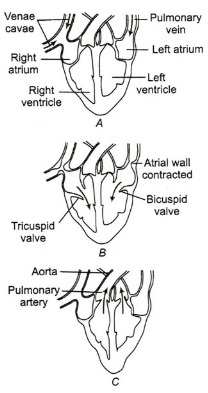
A
$A-$ Atrial diastole,$B-$ Atrial systole,$C-$ Ventricular systole
B
$A-$ Atrial systole,$B-$ Atrial diastole,$C-$ Ventricular systole
C
$A-$ Atrial diastole,$B-$ Atrial systole,$C-$ Ventricular diastole
D
$A-$ Atrial systole,$B-$ Atrial diastole,$C-$ Ventricular diastole
Solution
(A) Diagram $A$: The atria are filling with blood from the venae cavae and pulmonary veins,while the atrioventricular valves are closed. This indicates that the atria are in a relaxed state,known as atrial diastole.
Diagram $B$: The atria are contracted,and the bicuspid and tricuspid valves are open,allowing blood to flow into the ventricles. This state is called atrial systole.
Diagram $C$: The semilunar valves are open,and blood is being pumped into the pulmonary artery and aorta. This occurs due to the contraction of the ventricles,a state known as ventricular systole.
Diagram $B$: The atria are contracted,and the bicuspid and tricuspid valves are open,allowing blood to flow into the ventricles. This state is called atrial systole.
Diagram $C$: The semilunar valves are open,and blood is being pumped into the pulmonary artery and aorta. This occurs due to the contraction of the ventricles,a state known as ventricular systole.
0 likes
View Solution23
MediumMCQ
Cardiac output is defined as:
A
Stroke volume $\times$ Heart rate $= 60 \; mL/\text{beat} \times 72 \; \text{bpm}$
B
Stroke volume $\times$ Heart rate $= 70 \; mL/\text{beat} \times 72 \; \text{bpm}$
C
Stroke volume $\times$ Heart rate $= 80 \; mL/\text{beat} \times 72 \; \text{bpm}$
D
Stroke volume $\times$ Heart rate $= 90 \; mL/\text{beat} \times 72 \; \text{bpm}$
Solution
(B) Cardiac output is the volume of blood pumped by each ventricle per minute.
It is calculated by the formula: $\text{Cardiac output} = \text{Stroke volume} \times \text{Heart rate}$.
In a healthy individual,the stroke volume is approximately $70 \; mL$ per beat and the average heart rate is $72$ beats per minute.
Therefore,$\text{Cardiac output} = 70 \; mL/\text{beat} \times 72 \; \text{beats/minute} = 5040 \; mL/\text{minute}$,which is approximately $5 \; L/\text{minute}$.
It is calculated by the formula: $\text{Cardiac output} = \text{Stroke volume} \times \text{Heart rate}$.
In a healthy individual,the stroke volume is approximately $70 \; mL$ per beat and the average heart rate is $72$ beats per minute.
Therefore,$\text{Cardiac output} = 70 \; mL/\text{beat} \times 72 \; \text{beats/minute} = 5040 \; mL/\text{minute}$,which is approximately $5 \; L/\text{minute}$.
0 likes
View Solution24
EasyMCQ
The cardiac cycle in a normal person is about
A
$0.5$ second
B
$0.8$ second
C
$1.0$ second
D
$1.2$ second
Solution
(B) The cardiac cycle in a normal person takes about $0.8$ seconds.
This cycle consists of atrial systole ($0.1$ seconds), ventricular systole ($0.3$ seconds), and joint diastole ($0.4$ seconds).
Thus, the total duration of one complete cardiac cycle is $0.1 + 0.3 + 0.4 = 0.8$ seconds.
This cycle consists of atrial systole ($0.1$ seconds), ventricular systole ($0.3$ seconds), and joint diastole ($0.4$ seconds).
Thus, the total duration of one complete cardiac cycle is $0.1 + 0.3 + 0.4 = 0.8$ seconds.
0 likes
View Solution25
MediumMCQ
Cardiac cycle is a cyclic event that occurs in
A
Single beat
B
Double beat
C
Atrium
D
Ventricle
Solution
(A) The cycle of events which occurs in a single heartbeat is called the cardiac cycle. It involves the contraction and relaxation of the heart muscle.
$1$. Systole: When blood is ejected from the heart due to contraction.
$2$. Diastole: When the chambers of the heart are filled with blood. It is also called relaxation.
$1$. Systole: When blood is ejected from the heart due to contraction.
$2$. Diastole: When the chambers of the heart are filled with blood. It is also called relaxation.
0 likes
View Solution26
MediumMCQ
The first heart sound '$Lubb$' occurs in which phase of the cardiac cycle?
A
Isometric relaxation
B
Atrial diastole
C
Ventricular systole
D
Ventricular diastole
Solution
(C) The first heart sound '$Lubb$' is produced by the closure of the atrioventricular $(AV)$ valves.
This event occurs at the beginning of ventricular systole.
When the ventricles begin to contract,the intraventricular pressure rises rapidly,exceeding the atrial pressure.
This pressure difference forces the $AV$ valves (tricuspid and bicuspid) to close,preventing the backflow of blood into the atria.
The vibration caused by the sudden closure of these valves creates the low-pitched '$Lubb$' sound.
This event occurs at the beginning of ventricular systole.
When the ventricles begin to contract,the intraventricular pressure rises rapidly,exceeding the atrial pressure.
This pressure difference forces the $AV$ valves (tricuspid and bicuspid) to close,preventing the backflow of blood into the atria.
The vibration caused by the sudden closure of these valves creates the low-pitched '$Lubb$' sound.
0 likes
View Solution27
MediumMCQ
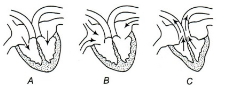
The accompanying diagram shows the three stages in the cardiac cycle. Which of the following is the correct sequence?
A
$B, A, C$
B
$B, C, A$
C
$C, A, B$
D
$C, B, A$
Solution
(A) The cardiac cycle begins with atrial systole (not shown),followed by ventricular filling,ventricular systole,and ventricular diastole.
Diagram $B$ shows atrial diastole and ventricular filling (blood flowing from atria to ventricles).
Diagram $A$ shows ventricular systole (ventricles contracting,blood being pumped into arteries).
Diagram $C$ shows ventricular diastole (ventricles relaxing,blood filling from atria).
The correct sequence of these stages in the cardiac cycle is $B$ (atrial diastole/ventricular filling) $\rightarrow$ $A$ (ventricular systole) $\rightarrow$ $C$ (ventricular diastole).
Therefore,the correct sequence is $B, A, C$.
Diagram $B$ shows atrial diastole and ventricular filling (blood flowing from atria to ventricles).
Diagram $A$ shows ventricular systole (ventricles contracting,blood being pumped into arteries).
Diagram $C$ shows ventricular diastole (ventricles relaxing,blood filling from atria).
The correct sequence of these stages in the cardiac cycle is $B$ (atrial diastole/ventricular filling) $\rightarrow$ $A$ (ventricular systole) $\rightarrow$ $C$ (ventricular diastole).
Therefore,the correct sequence is $B, A, C$.
0 likes
View Solution28
EasyMCQ
How many cardiac cycles are performed per minute in humans?
A
$1$
B
$12$
C
$27$
D
$72$
Solution
(D) The human heart beats approximately $72$ times per minute under normal resting conditions.
Since one heartbeat corresponds to one cardiac cycle, $72$ cardiac cycles are performed per minute.
To calculate the duration of one cardiac cycle: $60 \, \text{seconds} / 72 \, \text{beats} \approx 0.8 \, \text{seconds}$ per cycle.
Since one heartbeat corresponds to one cardiac cycle, $72$ cardiac cycles are performed per minute.
To calculate the duration of one cardiac cycle: $60 \, \text{seconds} / 72 \, \text{beats} \approx 0.8 \, \text{seconds}$ per cycle.
0 likes
View Solution29
MediumMCQ
In humans,the volume of blood pumped out by each ventricle per minute is
A
$1040 \; mL$
B
$1290 \; mL$
C
$2.5 \; L$
D
$5 \; L$
Solution
(D) During a cardiac cycle,each ventricle pumps out approximately $70 \; mL$ of blood,which is known as the stroke volume.
Cardiac output is defined as the volume of blood pumped by each ventricle per minute.
Cardiac output = Stroke volume $\times$ Heart rate (number of beats per minute).
Given that the average stroke volume is $70 \; mL$ and the average heart rate is $72$ beats per minute:
Cardiac output = $70 \; mL \times 72 = 5040 \; mL/min$,which is approximately $5 \; L/min$.
Cardiac output is defined as the volume of blood pumped by each ventricle per minute.
Cardiac output = Stroke volume $\times$ Heart rate (number of beats per minute).
Given that the average stroke volume is $70 \; mL$ and the average heart rate is $72$ beats per minute:
Cardiac output = $70 \; mL \times 72 = 5040 \; mL/min$,which is approximately $5 \; L/min$.
0 likes
View Solution30
MediumMCQ
Time interval between the closure of semilunar valve and closure of $AV$ valve is (in $; s$)
A
$0.3$
B
$0.5$
C
$0.1$
D
$0.7$
Solution
(B) The cardiac cycle lasts for $0.8$ seconds.
The closure of the semilunar valves marks the beginning of ventricular diastole.
The closure of the $AV$ valves marks the beginning of ventricular systole.
The time interval between the closure of the semilunar valves and the closure of the $AV$ valves represents the duration of ventricular diastole.
In a standard cardiac cycle,ventricular diastole lasts for $0.5$ seconds.
The closure of the semilunar valves marks the beginning of ventricular diastole.
The closure of the $AV$ valves marks the beginning of ventricular systole.
The time interval between the closure of the semilunar valves and the closure of the $AV$ valves represents the duration of ventricular diastole.
In a standard cardiac cycle,ventricular diastole lasts for $0.5$ seconds.
0 likes
View Solution31
MediumMCQ
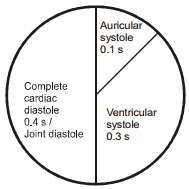
$A$ cardiac cycle involves
A
Joint diastole - ventricular systole - auricular systole
B
Auricular systole - ventricular systole - complete cardiac diastole
C
Auricular systole - joint diastole - ventricular systole
D
Auricular systole - ventricular diastole - joint diastole
Solution
(B) cardiac cycle consists of a sequential series of events in the heart.
Based on the provided diagram,the sequence of events is as follows:
$1$. Auricular systole $(0.1 \ s)$: The atria contract,forcing blood into the ventricles.
$2$. Ventricular systole $(0.3 \ s)$: The ventricles contract,pumping blood into the aorta and pulmonary artery.
$3$. Complete cardiac diastole or joint diastole $(0.4 \ s)$: Both the atria and ventricles are in a relaxed state,allowing the heart to fill with blood.
Therefore,the correct sequence is Auricular systole - Ventricular systole - Complete cardiac diastole.
Based on the provided diagram,the sequence of events is as follows:
$1$. Auricular systole $(0.1 \ s)$: The atria contract,forcing blood into the ventricles.
$2$. Ventricular systole $(0.3 \ s)$: The ventricles contract,pumping blood into the aorta and pulmonary artery.
$3$. Complete cardiac diastole or joint diastole $(0.4 \ s)$: Both the atria and ventricles are in a relaxed state,allowing the heart to fill with blood.
Therefore,the correct sequence is Auricular systole - Ventricular systole - Complete cardiac diastole.
0 likes
View Solution32
EasyMCQ
The duration of the ventricular diastole in a normal cardiac cycle is
A
$0.3 \; \text{second}$
B
$0.5 \; \text{second}$
C
$0.4 \; \text{second}$
D
$0.7 \; \text{second}$
Solution
(B) The total duration of a normal cardiac cycle is $0.8 \; \text{seconds}$.
Ventricular systole (contraction phase) lasts for $0.3 \; \text{seconds}$.
Ventricular diastole (relaxation phase) is calculated by subtracting the ventricular systole duration from the total cardiac cycle duration.
Therefore, ventricular diastole = $0.8 \; \text{seconds} - 0.3 \; \text{seconds} = 0.5 \; \text{seconds}$.
Ventricular systole (contraction phase) lasts for $0.3 \; \text{seconds}$.
Ventricular diastole (relaxation phase) is calculated by subtracting the ventricular systole duration from the total cardiac cycle duration.
Therefore, ventricular diastole = $0.8 \; \text{seconds} - 0.3 \; \text{seconds} = 0.5 \; \text{seconds}$.
0 likes
View Solution33
MediumMCQ
$A$: Isovolumetric systole of a normal cardiac cycle is responsible for the opening of semilunar valves causing the blood flow into aortic aorta and pulmonary aorta.
$R$: During isovolumetric systole,intraventricular pressure increases as semilunar and $AV$ valves are closed and ventricles are contracting.
$R$: During isovolumetric systole,intraventricular pressure increases as semilunar and $AV$ valves are closed and ventricles are contracting.
A
Assertion and Reason both are correct and also correct explanation.
B
Assertion and Reason both are correct but not explanation of assertion.
C
Assertion is correct,but Reason is incorrect.
D
Both Assertion and Reason are incorrect.
Solution
(C) The Assertion is incorrect because isovolumetric systole is the phase where the volume of blood in the ventricles remains constant,and it does not cause the opening of semilunar valves. The semilunar valves open only when the intraventricular pressure exceeds the pressure in the aorta and pulmonary artery,which occurs during the ventricular ejection phase,not the isovolumetric phase.
During isovolumetric systole,both the $AV$ valves (tricuspid and bicuspid) and the semilunar valves are closed. The ventricles contract,leading to a rapid increase in intraventricular pressure without any change in blood volume. Therefore,the Reason is correct.
During isovolumetric systole,both the $AV$ valves (tricuspid and bicuspid) and the semilunar valves are closed. The ventricles contract,leading to a rapid increase in intraventricular pressure without any change in blood volume. Therefore,the Reason is correct.
0 likes
View Solution34
Easy
What is meant by cardiac cycle?
Solution
(N/A) The cardiac cycle refers to the sequential events in the heart which are cyclically repeated. It includes the contraction (systole) and relaxation (diastole) of both the atria and the ventricles. The heart beats approximately $72$ times per minute,and each beat represents one complete cardiac cycle,which lasts for about $0.8$ seconds.
0 likes
View Solution35
MediumMCQ
Which one of the following statements is correct?
A
The tricuspid and the bicuspid valves open due to the pressure exerted by the simultaneous contraction of the atria.
B
Blood moves freely from atrium to the ventricle during joint diastole.
C
Increased ventricular pressure causes closing of the semilunar valves.
D
The atrio-ventricular node $(AVN)$ generates an action potential to stimulate atrial contraction.
Solution
(B) During joint diastole,all four chambers of the heart are in a relaxed state. In this phase,the tricuspid and bicuspid valves are open,allowing blood to flow freely from the atria into the ventricles.
Option $A$ is incorrect because the valves open due to the pressure gradient created by atrial relaxation and ventricular filling,not just contraction.
Option $C$ is incorrect because increased ventricular pressure causes the closing of the atrioventricular valves,while the semilunar valves open.
Option $D$ is incorrect because the $SA$ node,not the $AVN$,is the pacemaker that initiates the action potential for atrial contraction.
Option $A$ is incorrect because the valves open due to the pressure gradient created by atrial relaxation and ventricular filling,not just contraction.
Option $C$ is incorrect because increased ventricular pressure causes the closing of the atrioventricular valves,while the semilunar valves open.
Option $D$ is incorrect because the $SA$ node,not the $AVN$,is the pacemaker that initiates the action potential for atrial contraction.
0 likes
View Solution36
MediumMCQ
The flow of blood into the ventricles increases by $.........\,\%$ due to the simultaneous systole of the atria.
A
$20$
B
$30$
C
$40$
D
$50$
Solution
(B) During the cardiac cycle,the atria undergo contraction (atrial systole) while the ventricles are in diastole.
This atrial systole forces the remaining blood from the atria into the ventricles.
This process contributes an additional $30\%$ of blood flow into the ventricles,as $70\%$ of the blood flows passively into the ventricles before the atrial contraction occurs.
Therefore,the correct answer is $30\%$.
This atrial systole forces the remaining blood from the atria into the ventricles.
This process contributes an additional $30\%$ of blood flow into the ventricles,as $70\%$ of the blood flows passively into the ventricles before the atrial contraction occurs.
Therefore,the correct answer is $30\%$.
0 likes
View Solution37
MediumMCQ
Systole $= ....P.....,$ Diastole $= .....Q....$
$P \quad Q$
$P \quad Q$
A
Contraction $\quad$ Relaxation
B
Relaxation $\quad$ Relaxation
C
Contraction $\quad$ Contraction
D
Relaxation $\quad$ Contraction
Solution
(A) In the context of the cardiac cycle,the term $Systole$ refers to the phase of contraction of the heart muscles,specifically the atria or ventricles.
Conversely,the term $Diastole$ refers to the phase of relaxation of the heart muscles,allowing the chambers to fill with blood.
Therefore,$P$ corresponds to $Contraction$ and $Q$ corresponds to $Relaxation$.
Conversely,the term $Diastole$ refers to the phase of relaxation of the heart muscles,allowing the chambers to fill with blood.
Therefore,$P$ corresponds to $Contraction$ and $Q$ corresponds to $Relaxation$.
0 likes
View Solution38
MediumMCQ
What is the duration of a cardiac cycle?
A
$0.8$ seconds
B
$0.08$ seconds
C
$0.8$ microseconds
D
$0.08$ microseconds
Solution
(A) The cardiac cycle refers to the sequence of events that occur during one complete heartbeat.
In a healthy human adult,the heart beats approximately $72$ times per minute.
To calculate the duration of one cardiac cycle,we divide $60$ seconds by the heart rate ($72$ beats per minute).
Duration = $60 / 72 = 0.833$ seconds,which is approximately $0.8$ seconds.
In a healthy human adult,the heart beats approximately $72$ times per minute.
To calculate the duration of one cardiac cycle,we divide $60$ seconds by the heart rate ($72$ beats per minute).
Duration = $60 / 72 = 0.833$ seconds,which is approximately $0.8$ seconds.
0 likes
View Solution39
MediumMCQ
Stroke volume $= .......$
A
Volume of blood pumped out by the heart in one minute
B
Volume of blood pumped out by the heart during one cardiac cycle
C
Volume of blood entering the heart in one minute
D
Volume of blood entering the heart during one cardiac cycle
Solution
(B) Stroke volume is defined as the volume of blood pumped out by each ventricle of the heart during a single cardiac cycle.
On average, the stroke volume in a healthy human is approximately $70 \ mL$.
In contrast, the volume of blood pumped out by the heart in one minute is known as cardiac output, which is calculated as the product of stroke volume and heart rate ($70 \ mL \times 72 \ \text{beats/min} \approx 5000 \ mL$ or $5 \ L$).
On average, the stroke volume in a healthy human is approximately $70 \ mL$.
In contrast, the volume of blood pumped out by the heart in one minute is known as cardiac output, which is calculated as the product of stroke volume and heart rate ($70 \ mL \times 72 \ \text{beats/min} \approx 5000 \ mL$ or $5 \ L$).
0 likes
View Solution40
EasyMCQ
Which of the following stages in the cardiac cycle is of the longest duration $:-$
A
Atrial systole
B
Ventricular diastole
C
Joint diastole
D
Atrial diastole
Solution
(C) In a standard cardiac cycle of $0.8$ seconds,the durations of the various stages are as follows:
$1$. Atrial systole: $0.1$ seconds.
$2$. Ventricular systole: $0.3$ seconds.
$3$. Joint diastole (also known as ventricular diastole or relaxation phase): $0.4$ seconds.
Since $0.4$ seconds is the longest duration among these,the joint diastole stage is the longest.
$1$. Atrial systole: $0.1$ seconds.
$2$. Ventricular systole: $0.3$ seconds.
$3$. Joint diastole (also known as ventricular diastole or relaxation phase): $0.4$ seconds.
Since $0.4$ seconds is the longest duration among these,the joint diastole stage is the longest.
0 likes
View Solution41
DifficultMCQ
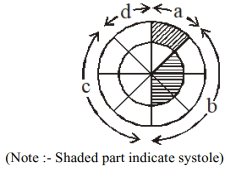
Which of the following statements is correct about the given diagram of the cardiac cycle?
A
'$a$' represents atrial systole, during which $25\%$ of blood moves from atria to ventricles actively.
B
$(a \rightarrow b \rightarrow c)$ represents $(Atrial \ systole \rightarrow Ventricular \ systole \rightarrow Joint \ diastole)$.
C
'$c$' and '$d$' together are called joint diastole, during which approximately $75\%$ of blood moves from atria to ventricles passively.
D
'$b$' represents the phase of ventricular systole.
Solution
(C) In the cardiac cycle diagram:
$1$. '$a$' represents atrial systole (contraction of atria), which contributes about $25\%$ of the blood to the ventricles.
$2$. '$b$' represents ventricular systole (contraction of ventricles).
$3$. '$c$' and '$d$' represent the joint diastole (relaxation of both atria and ventricles), during which about $75\%$ of the blood flows passively from the atria into the ventricles.
Therefore, option '$c$' is the correct statement.
$1$. '$a$' represents atrial systole (contraction of atria), which contributes about $25\%$ of the blood to the ventricles.
$2$. '$b$' represents ventricular systole (contraction of ventricles).
$3$. '$c$' and '$d$' represent the joint diastole (relaxation of both atria and ventricles), during which about $75\%$ of the blood flows passively from the atria into the ventricles.
Therefore, option '$c$' is the correct statement.
0 likes
View Solution42
EasyMCQ
In the human heart,how many double circulations are completed in $30$ seconds?
A
$18$
B
$72$
C
$90$
D
$36$
Solution
(D) The duration of one cardiac cycle in a healthy human heart is approximately $0.8$ seconds.
To find the number of cycles completed in $30$ seconds,we divide the total time by the duration of one cycle.
Number of cycles = $\frac{\text{Total time}}{\text{Duration of one cycle}} = \frac{30 \text{ s}}{0.8 \text{ s}} = 37.5$.
However,in standard biological calculations for heart rate,if we assume an average heart rate of $72$ beats per minute,then in $30$ seconds,the heart completes $36$ beats.
Thus,$36$ double circulations are completed in $30$ seconds.
To find the number of cycles completed in $30$ seconds,we divide the total time by the duration of one cycle.
Number of cycles = $\frac{\text{Total time}}{\text{Duration of one cycle}} = \frac{30 \text{ s}}{0.8 \text{ s}} = 37.5$.
However,in standard biological calculations for heart rate,if we assume an average heart rate of $72$ beats per minute,then in $30$ seconds,the heart completes $36$ beats.
Thus,$36$ double circulations are completed in $30$ seconds.
0 likes
View Solution43
EasyMCQ
The ventricular diastole has a duration of . . . . . . seconds.
A
$0.5$
B
$0.8$
C
$0.1$
D
$0.3$
Solution
(A) The total duration of a single cardiac cycle is $0.8$ seconds.
In a cardiac cycle,the ventricular systole lasts for $0.3$ seconds.
The ventricular diastole is the period during which the ventricles relax and fill with blood.
Therefore,the duration of ventricular diastole is calculated as: $0.8 \text{ s} - 0.3 \text{ s} = 0.5 \text{ s}$.
In a cardiac cycle,the ventricular systole lasts for $0.3$ seconds.
The ventricular diastole is the period during which the ventricles relax and fill with blood.
Therefore,the duration of ventricular diastole is calculated as: $0.8 \text{ s} - 0.3 \text{ s} = 0.5 \text{ s}$.
0 likes
View Solution44
EasyMCQ
Atrial systole lasts for . . . . . . in cardiac cycle.
A
$0.1$ second
B
$0.3$ second
C
$0.5$ second
D
$0.7$ second
Solution
(A) The duration of a single cardiac cycle is approximately $0.8$ seconds.
In this cycle, atrial systole (contraction of the atria) lasts for about $0.1$ seconds.
Following this, ventricular systole lasts for $0.3$ seconds, and the joint diastole (relaxation of both atria and ventricles) lasts for $0.4$ seconds.
Therefore, the correct duration for atrial systole is $0.1$ seconds.
In this cycle, atrial systole (contraction of the atria) lasts for about $0.1$ seconds.
Following this, ventricular systole lasts for $0.3$ seconds, and the joint diastole (relaxation of both atria and ventricles) lasts for $0.4$ seconds.
Therefore, the correct duration for atrial systole is $0.1$ seconds.
0 likes
View Solution45
EasyMCQ
Considering the stroke volume of an adult healthy human being is $70 \ mL$,identify the cardiac output in one hour from the following:
A
$302.4 \ L/hour$
B
$504.0 \ L/hour$
C
$50.40 \ L/hour$
D
$30.24 \ L/hour$
Solution
(A) Cardiac output is the volume of blood pumped by each ventricle per minute.
Formula: $\text{Cardiac Output} = \text{Stroke Volume} \times \text{Heart Rate}$.
Given: $\text{Stroke Volume} = 70 \ mL$,Average $\text{Heart Rate} = 72 \ \text{beats/minute}$.
Cardiac output per minute = $70 \ mL \times 72 = 5040 \ mL/minute = 5.04 \ L/minute$.
To find the cardiac output in one hour $(60 \ \text{minutes})$:
$\text{Cardiac Output per hour} = 5.04 \ L/minute \times 60 \ \text{minutes} = 302.4 \ L/hour$.
Therefore,the correct option is $A$.
Formula: $\text{Cardiac Output} = \text{Stroke Volume} \times \text{Heart Rate}$.
Given: $\text{Stroke Volume} = 70 \ mL$,Average $\text{Heart Rate} = 72 \ \text{beats/minute}$.
Cardiac output per minute = $70 \ mL \times 72 = 5040 \ mL/minute = 5.04 \ L/minute$.
To find the cardiac output in one hour $(60 \ \text{minutes})$:
$\text{Cardiac Output per hour} = 5.04 \ L/minute \times 60 \ \text{minutes} = 302.4 \ L/hour$.
Therefore,the correct option is $A$.
0 likes
View Solution46
EasyMCQ
Calculate the cardiac output of an individual having $70$ heart beats/min with a stroke volume of $55 \ mL$.
A
$3750 \ mL$
B
$125 \ mL$
C
$3850 \ mL$
D
None of above
Solution
(C) Cardiac output is defined as the volume of blood pumped by the heart per minute.
It is calculated by multiplying the stroke volume $(SV)$,which is the volume of blood ejected by the ventricle during each contraction,by the heart rate $(HR)$,which is the number of heart beats per minute.
The formula is: $\text{Cardiac Output} (CO) = SV \times HR$.
Given: Stroke volume $(SV)$ = $55 \ mL$ and Heart rate $(HR)$ = $70 \ \text{beats/min}$.
Therefore,$\text{Cardiac Output} = 55 \times 70 = 3850 \ mL$.
It is calculated by multiplying the stroke volume $(SV)$,which is the volume of blood ejected by the ventricle during each contraction,by the heart rate $(HR)$,which is the number of heart beats per minute.
The formula is: $\text{Cardiac Output} (CO) = SV \times HR$.
Given: Stroke volume $(SV)$ = $55 \ mL$ and Heart rate $(HR)$ = $70 \ \text{beats/min}$.
Therefore,$\text{Cardiac Output} = 55 \times 70 = 3850 \ mL$.
0 likes
View Solution47
EasyMCQ
In a typical heart,if $EDV$ is $120 \ mL$ of blood and $ESV$ is $50 \ mL$ of blood,the stroke volume $(SV)$ is:
A
$120 - 50 = 70 \ mL$
B
$120 + 50 = 170 \ mL$
C
$120 \times 50 = 6000 \ mL$
D
$120 \div 50 = 2.4 \ mL$
Solution
(A) The stroke volume $(SV)$ is the volume of blood pumped out by each ventricle during each cardiac cycle.
It is calculated using the formula: $SV = EDV - ESV$.
Given:
End-diastolic volume $(EDV)$ = $120 \ mL$
End-systolic volume $(ESV)$ = $50 \ mL$
Therefore,$SV = 120 \ mL - 50 \ mL = 70 \ mL$.
Thus,the correct option is $A$.
It is calculated using the formula: $SV = EDV - ESV$.
Given:
End-diastolic volume $(EDV)$ = $120 \ mL$
End-systolic volume $(ESV)$ = $50 \ mL$
Therefore,$SV = 120 \ mL - 50 \ mL = 70 \ mL$.
Thus,the correct option is $A$.
0 likes
View SolutionBody Fluids and Circulations — Cardiac cycle · Frequently Asked Questions
1Are these Body Fluids and Circulations questions useful for JEE and NEET?
Yes. All questions in this section are mapped to JEE Main and NEET exam patterns. Previous year questions from JEE Main, NEET, GUJCET and state-level exams are included with full solutions.
2Can I switch to Hindi or Gujarati for these questions?
Yes. Use the language tabs in the hero section or the sidebar to view the same questions and solutions in English, Hindi or Gujarati.
3How do I generate a question paper from this subtopic?
Use the Vedclass Exam Paper Generator — select the chapter and subtopic, set difficulty, and generate Sets A, B, C, D automatically. First 3 chapters of every subject are free.
Vedclass Products
For Students
Vedclass Test Series
Mock tests in real JEE/NEET style with performance analysis. 5-day free trial.
Start Free TrialFor Teachers
Exam Paper Generator
Generate Set A/B/C/D papers from this chapter in 2 minutes. 3 chapters free.
Try FreeFor Institutes
Online Exam Module
Live online exams with unlimited students, 360° analytics & white-label branding.
See DemoFor Teachers & Institutes
Generate a Body Fluids and Circulations Exam Paper in 2 Minutes
Select subtopic & difficulty — Sets A, B, C, D auto-generated with No Repeat logic.
First 3 chapters of every subject are free — no payment required.