
A English
Blood pressure, ECG Questions in English
Class 11 Biology · Body Fluids and Circulations · Blood pressure, ECG
87+
Questions
English
Language
100%
With Solutions
Showing 49 of 87 questions in English
1
MediumMCQ
Systolic pressure is higher than diastolic pressure because
A
Arteries are contracting during systole
B
Blood is pumped with a pressure in the arteries by the heart during systole but not during diastole.
C
Arteries resist during systole only.
D
Volume of blood is higher in systole than that of diastole in the heart
Solution
(B) Systolic pressure represents the maximum pressure exerted in the arteries during ventricular contraction (systole),when blood is actively pumped out of the heart into the aorta.
Diastolic pressure represents the minimum pressure in the arteries during ventricular relaxation (diastole),when the heart is filling with blood and not actively pumping.
Therefore,the pressure is significantly higher during systole due to the forceful ejection of blood from the heart.
Diastolic pressure represents the minimum pressure in the arteries during ventricular relaxation (diastole),when the heart is filling with blood and not actively pumping.
Therefore,the pressure is significantly higher during systole due to the forceful ejection of blood from the heart.
0 likes
View Solution2
EasyMCQ
What does a sphygmomanometer measure?
A
Nerve conduction rate
B
Heart beat rate
C
Blood pressure
D
Pulse rate
Solution
(C) Blood pressure is measured in $mm$ of mercury $(Hg)$ by an instrument known as a sphygmomanometer.
This instrument was invented by the Italian physician Scipione Riva-Rocci in $1896$.
This instrument was invented by the Italian physician Scipione Riva-Rocci in $1896$.
0 likes
View Solution3
MediumMCQ
$ECG$ records:
A
Electric current of the body
B
Potential differences
C
Pulse rate
D
Quantity of blood pumped per minute
Solution
(B) $ECG$ (Electrocardiogram) is a graphical representation of the electrical activity of the heart during a cardiac cycle. It records the changes in electrical potential generated by the heart muscle as it depolarizes and repolarizes during one heartbeat.
0 likes
View Solution4
MediumMCQ
$QRS$ complex is related to
A
Ventricular contraction or depolarization
B
Auricular contraction
C
Auricular relaxation
D
Cardiac cycle
Solution
(A) The $QRS$ complex represents the depolarization of the ventricles,which initiates ventricular contraction. It is also known as the ventricular complex. The $P$-wave represents atrial depolarization,while the $T$-wave represents ventricular repolarization.
0 likes
View Solution5
MediumMCQ
In a normal adult man,the blood pressure is
A
$100/80 \, mm \, Hg$
B
$120/80 \, mm \, Hg$
C
$100/120 \, mm \, Hg$
D
$100/100 \, mm \, Hg$
Solution
(B) The normal blood pressure of a healthy adult human is measured as $120/80 \, mm \, Hg$.
In this reading,$120 \, mm \, Hg$ represents the systolic pressure,which is the pressure exerted on the arterial walls during ventricular contraction.
$80 \, mm \, Hg$ represents the diastolic pressure,which is the pressure exerted on the arterial walls during ventricular relaxation.
In this reading,$120 \, mm \, Hg$ represents the systolic pressure,which is the pressure exerted on the arterial walls during ventricular contraction.
$80 \, mm \, Hg$ represents the diastolic pressure,which is the pressure exerted on the arterial walls during ventricular relaxation.
0 likes
View Solution6
MediumMCQ
Which of the following is a repolarization wave?
A
$P$
B
$T$
C
$QRS$
D
None of these
Solution
(B) In an electrocardiogram $(ECG)$,the $P$-wave represents the electrical excitation (depolarization) of the atria,which leads to the contraction of both the atria.
The $QRS$ complex represents the depolarization of the ventricles,which initiates the ventricular contraction.
The $T$-wave represents the return of the ventricles from an excited state to a normal state (repolarization). The end of the $T$-wave marks the end of systole.
Therefore,the $T$-wave is the repolarization wave.
The $QRS$ complex represents the depolarization of the ventricles,which initiates the ventricular contraction.
The $T$-wave represents the return of the ventricles from an excited state to a normal state (repolarization). The end of the $T$-wave marks the end of systole.
Therefore,the $T$-wave is the repolarization wave.
0 likes
View Solution7
MediumMCQ
Normal diastolic pressure in a young man is about (in $,\text{mm Hg}$)
A
$20$
B
$80$
C
$100$
D
$130$
Solution
(B) Blood pressure is measured as the ratio of systolic pressure to diastolic pressure.
In a healthy young adult,the normal blood pressure is typically $120/80\,\text{mm Hg}$.
Here,$120\,\text{mm Hg}$ represents the systolic pressure (pressure during ventricular contraction).
$80\,\text{mm Hg}$ represents the diastolic pressure (pressure during ventricular relaxation).
Therefore,the normal diastolic pressure is about $80\,\text{mm Hg}$.
In a healthy young adult,the normal blood pressure is typically $120/80\,\text{mm Hg}$.
Here,$120\,\text{mm Hg}$ represents the systolic pressure (pressure during ventricular contraction).
$80\,\text{mm Hg}$ represents the diastolic pressure (pressure during ventricular relaxation).
Therefore,the normal diastolic pressure is about $80\,\text{mm Hg}$.
0 likes
View Solution8
MediumMCQ
What is blood pressure?
A
The pressure of blood on the heart muscle
B
The pressure of blood exerted on the walls of arteries and veins
C
The pressure of blood on the walls of veins only
D
The pressure of blood on the walls of arteries only
Solution
(D) Blood pressure is defined as the lateral pressure exerted by the flowing blood on the walls of the arteries.
It is typically measured in the brachial artery of the arm.
While blood flows through the entire circulatory system,the term 'blood pressure' in clinical and physiological contexts specifically refers to the arterial blood pressure,as the pressure in the veins is significantly lower and negligible for standard diagnostic purposes.
It is typically measured in the brachial artery of the arm.
While blood flows through the entire circulatory system,the term 'blood pressure' in clinical and physiological contexts specifically refers to the arterial blood pressure,as the pressure in the veins is significantly lower and negligible for standard diagnostic purposes.
0 likes
View Solution9
MediumMCQ
In all the leads of $ECG$,all following are positive waves except
A
$P$
B
$Q$
C
$R$
D
$T$
Solution
(B) In an $ECG$ (Electrocardiogram),the $P$ wave represents atrial depolarization,the $QRS$ complex represents ventricular depolarization,and the $T$ wave represents ventricular repolarization.
In the standard $ECG$ leads,the $P$ wave,$R$ wave,and $T$ wave are typically recorded as positive deflections (upward waves).
The $Q$ wave is the first negative deflection of the $QRS$ complex,representing the depolarization of the interventricular septum.
Therefore,$Q$ is a negative wave.
In the standard $ECG$ leads,the $P$ wave,$R$ wave,and $T$ wave are typically recorded as positive deflections (upward waves).
The $Q$ wave is the first negative deflection of the $QRS$ complex,representing the depolarization of the interventricular septum.
Therefore,$Q$ is a negative wave.
0 likes
View Solution10
MediumMCQ
In an old man's $ECG$,$T$-waves shall be:
A
Flat
B
Inverted
C
Very prominent
D
Same as in adults
Solution
(A) The $T$-wave in an $ECG$ represents the ventricular repolarization. In elderly individuals,the $T$-wave often becomes flat or less prominent compared to younger adults due to age-related changes in the myocardium and conduction system. Therefore,the most appropriate clinical observation is that they appear flat.
0 likes
View Solution11
MediumMCQ
The systolic blood pressure in a healthy adult human is:
A
$120 \, mm \, Hg$
B
$120/80 \, mm \, Hg$
C
$150/120 \, mm \, Hg$
D
$80 \, mm \, Hg$
Solution
(A) In a healthy adult human,the blood pressure is typically measured as $120/80 \, mm \, Hg$.
Here,$120 \, mm \, Hg$ represents the systolic pressure,which is the pressure exerted by the blood against the arterial walls during ventricular systole (contraction).
The value $80 \, mm \, Hg$ represents the diastolic pressure,which is the pressure during ventricular diastole (relaxation).
Therefore,the systolic pressure is $120 \, mm \, Hg$.
Here,$120 \, mm \, Hg$ represents the systolic pressure,which is the pressure exerted by the blood against the arterial walls during ventricular systole (contraction).
The value $80 \, mm \, Hg$ represents the diastolic pressure,which is the pressure during ventricular diastole (relaxation).
Therefore,the systolic pressure is $120 \, mm \, Hg$.
0 likes
View Solution12
EasyMCQ
Which of the following values indicates hypertension?
A
$90/60$
B
$120/85$
C
$110/70$
D
$140/100$
Solution
(D) Hypertension is defined as a condition where the blood pressure is persistently higher than the normal range $(120/80 \text{ mmHg})$.
Blood pressure readings of $140/90 \text{ mmHg}$ or higher are generally considered to indicate hypertension.
Among the given options,$140/100 \text{ mmHg}$ is the only reading that exceeds the threshold for hypertension.
Blood pressure readings of $140/90 \text{ mmHg}$ or higher are generally considered to indicate hypertension.
Among the given options,$140/100 \text{ mmHg}$ is the only reading that exceeds the threshold for hypertension.
0 likes
View Solution13
MediumMCQ
Systolic pressure is higher than diastolic pressure because...
A
The volume of blood in the heart is higher during systole.
B
Arteries contract during systole.
C
Blood vessels stop the flow of blood during systole.
D
Blood is pumped into the arteries with force during systole.
Solution
(D) Systolic blood pressure represents the pressure in the arteries when the heart muscle contracts (systole) and pumps blood into the circulatory system. During ventricular systole,the heart ejects a large volume of blood into the aorta and pulmonary arteries with significant force. This rapid ejection causes a surge in pressure within the arterial walls. In contrast,diastolic pressure is the pressure in the arteries when the heart muscle is at rest (diastole) between beats,which is naturally lower. Therefore,systolic pressure is higher because blood is pumped into the arteries with force during systole.
0 likes
View Solution14
MediumMCQ
Which instrument is used to measure blood pressure?
A
Sphygmomanometer
B
Phonocardiogram
C
Electrocardiogram
D
Stethoscope
Solution
(A) The blood pressure of an individual is measured using an instrument called a $Sphygmomanometer$.
It typically consists of an inflatable cuff to restrict blood flow and a mercury or mechanical manometer to measure the pressure.
$Phonocardiogram$ is used to record heart sounds.
$Electrocardiogram$ $(ECG)$ is used to record the electrical activity of the heart.
$Stethoscope$ is used for auscultation or listening to the internal sounds of the body,such as the heart and lungs.
It typically consists of an inflatable cuff to restrict blood flow and a mercury or mechanical manometer to measure the pressure.
$Phonocardiogram$ is used to record heart sounds.
$Electrocardiogram$ $(ECG)$ is used to record the electrical activity of the heart.
$Stethoscope$ is used for auscultation or listening to the internal sounds of the body,such as the heart and lungs.
0 likes
View Solution15
EasyMCQ
What is the normal blood pressure in a healthy human?
A
$120/80 \ mm \ Hg$
B
$80/100 \ mm \ Hg$
C
$80/120 \ mm \ Hg$
D
$100/80 \ mm \ Hg$
Solution
(A) The normal blood pressure in a healthy adult human is $120/80 \ mm \ Hg$.
In this reading,$120 \ mm \ Hg$ represents the systolic pressure (the pressure during ventricular contraction).
$80 \ mm \ Hg$ represents the diastolic pressure (the pressure during ventricular relaxation).
Therefore,the correct option is $A$.
In this reading,$120 \ mm \ Hg$ represents the systolic pressure (the pressure during ventricular contraction).
$80 \ mm \ Hg$ represents the diastolic pressure (the pressure during ventricular relaxation).
Therefore,the correct option is $A$.
0 likes
View Solution16
MediumMCQ
What is the value of diastolic blood pressure?
A
$120 \ mm \ Hg$
B
$80 \ mm \ Hg$
C
$120/80 \ mm \ Hg$
D
$40 \ mm \ Hg$
Solution
(B) Blood pressure is measured using a sphygmomanometer.
It is expressed as two values: systolic pressure and diastolic pressure.
Systolic pressure is the pressure in the arteries during ventricular contraction,which is typically $120 \ mm \ Hg$.
Diastolic pressure is the pressure in the arteries during ventricular relaxation,which is typically $80 \ mm \ Hg$.
Therefore,the diastolic blood pressure is $80 \ mm \ Hg$.
It is expressed as two values: systolic pressure and diastolic pressure.
Systolic pressure is the pressure in the arteries during ventricular contraction,which is typically $120 \ mm \ Hg$.
Diastolic pressure is the pressure in the arteries during ventricular relaxation,which is typically $80 \ mm \ Hg$.
Therefore,the diastolic blood pressure is $80 \ mm \ Hg$.
0 likes
View Solution17
EasyMCQ
Blood pressure is measured by which of the following instruments?
A
Sphygmomanometer
B
Phonocardiogram
C
Electrocardiogram
D
Stethoscope
Solution
(A) Blood pressure is measured using an instrument called a $Sphygmomanometer$.
It typically consists of an inflatable cuff to restrict blood flow and a mercury or mechanical manometer to measure the pressure.
$Phonocardiogram$ is used to record heart sounds.
$Electrocardiogram$ $(ECG)$ records the electrical activity of the heart.
$Stethoscope$ is used for auscultation or listening to the internal sounds of the body.
It typically consists of an inflatable cuff to restrict blood flow and a mercury or mechanical manometer to measure the pressure.
$Phonocardiogram$ is used to record heart sounds.
$Electrocardiogram$ $(ECG)$ records the electrical activity of the heart.
$Stethoscope$ is used for auscultation or listening to the internal sounds of the body.
0 likes
View Solution18
EasyMCQ
What is the value of diastolic blood pressure in a healthy adult?
A
$120 \, mm \, Hg$
B
$80 \, mm \, Hg$
C
$120/80 \, mm \, Hg$
D
$40 \, mm \, Hg$
Solution
(B) Blood pressure is measured using a sphygmomanometer.
In a healthy adult,the systolic pressure is $120 \, mm \, Hg$ (ventricular contraction) and the diastolic pressure is $80 \, mm \, Hg$ (ventricular relaxation).
Therefore,the diastolic blood pressure is $80 \, mm \, Hg$.
In a healthy adult,the systolic pressure is $120 \, mm \, Hg$ (ventricular contraction) and the diastolic pressure is $80 \, mm \, Hg$ (ventricular relaxation).
Therefore,the diastolic blood pressure is $80 \, mm \, Hg$.
0 likes
View Solution19
MediumMCQ
Systolic blood pressure is higher than diastolic blood pressure because:
A
The volume of blood in the heart is higher during systole.
B
Arteries contract during systole.
C
Blood vessels stop the flow of blood during systole.
D
Blood is pumped into the arteries with force during systole.
Solution
(D) Systole refers to the contraction phase of the heart,specifically the ventricles. During ventricular systole,the heart muscle contracts,forcing blood out of the ventricles and into the arteries (like the aorta) under high pressure. This results in a peak pressure known as systolic blood pressure. Conversely,diastole is the relaxation phase where the heart fills with blood,resulting in a lower pressure known as diastolic blood pressure. Therefore,systolic pressure is higher because blood is actively and forcefully ejected into the arterial system.
0 likes
View Solution20
EasyMCQ
What is the normal blood pressure in a healthy human?
A
$120/80 \text{ mm of Hg}$
B
$80/100 \text{ mm of Hg}$
C
$80/120 \text{ mm of Hg}$
D
$100/80 \text{ mm of Hg}$
Solution
(A) In a healthy human,blood pressure is measured using a sphygmomanometer.
Normal systolic blood pressure is $120 \text{ mm of Hg}$ (ventricular contraction).
Normal diastolic blood pressure is $80 \text{ mm of Hg}$ (ventricular relaxation).
Therefore,the normal blood pressure is expressed as $120/80 \text{ mm of Hg}$.
Normal systolic blood pressure is $120 \text{ mm of Hg}$ (ventricular contraction).
Normal diastolic blood pressure is $80 \text{ mm of Hg}$ (ventricular relaxation).
Therefore,the normal blood pressure is expressed as $120/80 \text{ mm of Hg}$.
0 likes
View Solution21
MediumMCQ
What does an $ECG$ measure?
A
Heart rate
B
Electrical activity of the heart
C
Volume of blood pumped
D
Ventricular contraction
Solution
(B) An $ECG$ (Electrocardiograph) is a graphical representation of the electrical activity of the heart during a cardiac cycle.
It records the electrical impulses generated by the heart's conduction system,which are detected by electrodes placed on the skin.
Therefore,it measures the electrical changes occurring in the heart.
It records the electrical impulses generated by the heart's conduction system,which are detected by electrodes placed on the skin.
Therefore,it measures the electrical changes occurring in the heart.
0 likes
View Solution22
EasyMCQ
What is the normal pulse pressure?
A
$80\, mm\, Hg$
B
$40\, mm\, Hg$
C
$120\, mm\, Hg$
D
$320\, mm\, Hg$
Solution
(B) Pulse pressure is defined as the difference between the systolic blood pressure and the diastolic blood pressure.
In a healthy adult,the normal systolic blood pressure is approximately $120\, mm\, Hg$ and the normal diastolic blood pressure is approximately $80\, mm\, Hg$.
Therefore,the pulse pressure is calculated as: $120\, mm\, Hg - 80\, mm\, Hg = 40\, mm\, Hg$.
Thus,the correct answer is $40\, mm\, Hg$.
In a healthy adult,the normal systolic blood pressure is approximately $120\, mm\, Hg$ and the normal diastolic blood pressure is approximately $80\, mm\, Hg$.
Therefore,the pulse pressure is calculated as: $120\, mm\, Hg - 80\, mm\, Hg = 40\, mm\, Hg$.
Thus,the correct answer is $40\, mm\, Hg$.
0 likes
View Solution23
EasyMCQ
What does a sphygmomanometer measure?
A
Blood pressure
B
Pulse rate
C
Heart rate
D
All of the above
Solution
(A) sphygmomanometer is a medical instrument used to measure blood pressure. It consists of an inflatable cuff to restrict blood flow and a mercury or mechanical manometer to measure the pressure. While pulse rate and heart rate are related to cardiovascular health,they are measured using different methods (e.g.,palpation or $ECG$/stethoscope). Therefore,the correct option is $A$.
0 likes
View Solution24
MediumMCQ
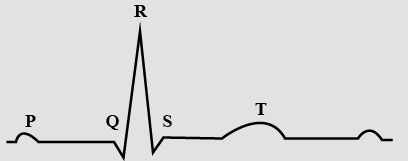
The diagram given here is the standard $ECG$ of a normal person. The $P$-wave represents the
A
contraction of both ventricles
B
end of ventricular contraction
C
contraction of both the atria
D
initiation of the ventricular contraction.
Solution
(C) The correct answer is $(C)$.
In the given diagram,the $P$-wave represents the electrical excitation (or depolarisation) of the atria,which leads to the contraction of both the atria.
The $QRS$ complex represents the depolarisation of the ventricles,which initiates the ventricular contraction.
The contraction starts shortly after $Q$ and marks the beginning of the systole.
The $T$-wave represents the return of the ventricles from an excited to a normal state (repolarisation).
The end of the $T$-wave marks the end of systole.
In the given diagram,the $P$-wave represents the electrical excitation (or depolarisation) of the atria,which leads to the contraction of both the atria.
The $QRS$ complex represents the depolarisation of the ventricles,which initiates the ventricular contraction.
The contraction starts shortly after $Q$ and marks the beginning of the systole.
The $T$-wave represents the return of the ventricles from an excited to a normal state (repolarisation).
The end of the $T$-wave marks the end of systole.
0 likes
View Solution25
MediumMCQ
Which one of the following statements is correct regarding blood pressure?
A
$130/90 \ mm \ Hg$ is considered high and requires treatment.
B
$100/55 \ mm \ Hg$ is considered an ideal blood pressure.
C
$105/50 \ mm \ Hg$ makes one very active.
D
$190/110 \ mm \ Hg$ may harm vital organs like brain and kidney.
Solution
(D) The correct statement is $(d)$.
Blood pressure is the pressure exerted by blood against the walls of the blood vessels.
Normal blood pressure is considered to be $120/80 \ mm \ Hg$.
If repeated checks of blood pressure of an individual show $140/90 \ mm \ Hg$ or higher,it indicates hypertension or high blood pressure.
Hypertension leads to heart diseases and also causes damage to vital organs like the brain and kidneys.
Blood pressure is the pressure exerted by blood against the walls of the blood vessels.
Normal blood pressure is considered to be $120/80 \ mm \ Hg$.
If repeated checks of blood pressure of an individual show $140/90 \ mm \ Hg$ or higher,it indicates hypertension or high blood pressure.
Hypertension leads to heart diseases and also causes damage to vital organs like the brain and kidneys.
0 likes
View Solution26
MediumMCQ
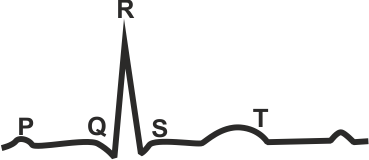
Given below is the $ECG$ of a normal human. Which one of its components is correctly interpreted below?
A
$QRS$ complex - one complete pulse
B
Peak $T$ - initiation of total cardiac contraction
C
Peak $P$ and peak $R$ together - systolic and diastolic blood pressures
D
Peak $P$ - initiation of left atrial contraction only
Solution
(A) The correct answer is $(A)$.
By counting the number of $QRS$ complexes that occur in a given time period,one can determine the heart beat rate (pulse) of an individual.
The $P$-wave represents the electrical excitation (depolarisation) of the atria,which leads to the contraction of both the atria.
The $QRS$ complex represents the depolarisation of the ventricles,which initiates the ventricular contraction.
The $T$-wave represents the return of the ventricles from an excited to a normal state (repolarisation). The end of the $T$-wave marks the end of systole.
By counting the number of $QRS$ complexes that occur in a given time period,one can determine the heart beat rate (pulse) of an individual.
The $P$-wave represents the electrical excitation (depolarisation) of the atria,which leads to the contraction of both the atria.
The $QRS$ complex represents the depolarisation of the ventricles,which initiates the ventricular contraction.
The $T$-wave represents the return of the ventricles from an excited to a normal state (repolarisation). The end of the $T$-wave marks the end of systole.
0 likes
View Solution27
MediumMCQ
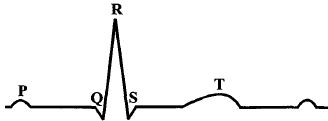
In a standard $ECG$,which one of the following alphabets is the correct representation of the respective activity of the human heart?
A
$S$ - start of systole
B
$T$ - end of diastole
C
$P$ - depolarisation of the atria
D
$R$ - repolarisation of ventricles
Solution
(C) The correct answer is $C$.
In a standard $ECG$:
$1$. The $P$-wave represents the electrical excitation (or depolarisation) of the atria,which leads to the contraction of both atria.
$2$. The $QRS$ complex represents the depolarisation of the ventricles,which initiates ventricular contraction. The contraction starts shortly after $Q$ and marks the beginning of the systole.
$3$. The $T$-wave represents the return of the ventricles from an excited state to a normal state (repolarisation). The end of the $T$-wave marks the end of systole.
In a standard $ECG$:
$1$. The $P$-wave represents the electrical excitation (or depolarisation) of the atria,which leads to the contraction of both atria.
$2$. The $QRS$ complex represents the depolarisation of the ventricles,which initiates ventricular contraction. The contraction starts shortly after $Q$ and marks the beginning of the systole.
$3$. The $T$-wave represents the return of the ventricles from an excited state to a normal state (repolarisation). The end of the $T$-wave marks the end of systole.
0 likes
View Solution28
MediumMCQ
$X-$ In $ECG,$ $P-$ wave represents the electrical excitation of the ventricle.
$Y -$ $QRS$ waves represent depolarization of atria.
$Y -$ $QRS$ waves represent depolarization of atria.
A
$X$ and $Y$ are correct.
B
$X$ and $Y$ are incorrect.
C
$X$ is correct,$Y$ is incorrect.
D
$X$ is incorrect,$Y$ is correct.
Solution
(B) In an $ECG$ (Electrocardiogram):
$1$. The $P-$ wave represents the electrical excitation (depolarization) of the atria,which leads to the contraction of both the atria.
$2$. The $QRS$ complex represents the depolarization of the ventricles,which initiates the ventricular contraction.
$3$. Therefore,statement $X$ is incorrect because the $P-$ wave represents atrial depolarization,not ventricular excitation.
$4$. Statement $Y$ is also incorrect because the $QRS$ complex represents ventricular depolarization,not atrial depolarization.
$5$. Thus,both $X$ and $Y$ are incorrect.
$1$. The $P-$ wave represents the electrical excitation (depolarization) of the atria,which leads to the contraction of both the atria.
$2$. The $QRS$ complex represents the depolarization of the ventricles,which initiates the ventricular contraction.
$3$. Therefore,statement $X$ is incorrect because the $P-$ wave represents atrial depolarization,not ventricular excitation.
$4$. Statement $Y$ is also incorrect because the $QRS$ complex represents ventricular depolarization,not atrial depolarization.
$5$. Thus,both $X$ and $Y$ are incorrect.
0 likes
View Solution29
MediumMCQ
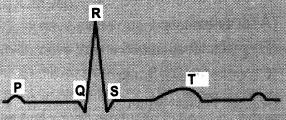
The diagram given here is the standard $ECG$ of a normal person. The $P$-wave represents the:
A
Initiation of the ventricular contraction
B
Beginning of the systole of all chambers
C
End of systole of all chambers
D
Contraction of both the atria
Solution
(D) In a standard $ECG$,the $P$-wave represents the electrical excitation or depolarization of the atria,which leads to the contraction of both the atria.
Following this,the $QRS$ complex represents the depolarization of the ventricles,which initiates ventricular contraction.
The $T$-wave represents the return of the ventricles from an excited to a normal state (repolarization).
Following this,the $QRS$ complex represents the depolarization of the ventricles,which initiates ventricular contraction.
The $T$-wave represents the return of the ventricles from an excited to a normal state (repolarization).
1 likes
View Solution30
MediumMCQ
In $ECG$,the $T$-wave represents:
A
Depolarization of ventricle
B
Repolarisation of atria
C
Repolarisation of ventricle
D
Depolarization of atria
Solution
(C) In an $ECG$ (Electrocardiogram),the electrical activity of the heart is represented by specific waves:
$1$. The $P$-wave represents the electrical excitation (or depolarization) of the atria,which leads to the contraction of both atria.
$2$. The $QRS$ complex represents the depolarization of the ventricles,which initiates ventricular contraction.
$3$. The $T$-wave represents the return of the ventricles from an excited state to a normal state (repolarization). The end of the $T$-wave marks the end of systole.
$1$. The $P$-wave represents the electrical excitation (or depolarization) of the atria,which leads to the contraction of both atria.
$2$. The $QRS$ complex represents the depolarization of the ventricles,which initiates ventricular contraction.
$3$. The $T$-wave represents the return of the ventricles from an excited state to a normal state (repolarization). The end of the $T$-wave marks the end of systole.
0 likes
View Solution31
MediumMCQ
If repeated checking of blood pressure of an individual shows systolic $140$ $mm$ $Hg$ and diastolic $90$ $mm$ $Hg$ or higher,it indicates hypertension.
A
$120$ and $90$
B
$130$ and $80$
C
$140$ and $100$
D
$140$ and $90$
Solution
(D) Hypertension,or high blood pressure,is a condition where the blood pressure is higher than normal.
According to medical standards,if the blood pressure of an individual is repeatedly measured as $140$ $mm$ $Hg$ (systolic) and $90$ $mm$ $Hg$ (diastolic) or higher,it is diagnosed as hypertension.
Therefore,the correct values are $140$ $mm$ $Hg$ and $90$ $mm$ $Hg$.
According to medical standards,if the blood pressure of an individual is repeatedly measured as $140$ $mm$ $Hg$ (systolic) and $90$ $mm$ $Hg$ (diastolic) or higher,it is diagnosed as hypertension.
Therefore,the correct values are $140$ $mm$ $Hg$ and $90$ $mm$ $Hg$.
0 likes
View Solution32
EasyMCQ
In $ECG,$ $T$-wave represents:
A
Depolarization of atrium
B
Repolarization of ventricle
C
Depolarization of ventricle
D
None of the above
Solution
(B) In an $ECG$ (Electrocardiogram),the electrical activity of the heart is represented by specific waves:
$1$. The $P$-wave represents the electrical excitation (or depolarization) of the atria,which leads to the contraction of both atria.
$2$. The $QRS$ complex represents the depolarization of the ventricles,which initiates the ventricular contraction.
$3$. The $T$-wave represents the return of the ventricles from an excited state to a normal state (repolarization). The end of the $T$-wave marks the end of systole.
$1$. The $P$-wave represents the electrical excitation (or depolarization) of the atria,which leads to the contraction of both atria.
$2$. The $QRS$ complex represents the depolarization of the ventricles,which initiates the ventricular contraction.
$3$. The $T$-wave represents the return of the ventricles from an excited state to a normal state (repolarization). The end of the $T$-wave marks the end of systole.
0 likes
View Solution33
EasyMCQ
$T$-wave represents:
A
Electrical excitation of atria.
B
Depolarization of ventricles.
C
Normal state of atria.
D
Repolarisation of ventricles.
Solution
(D) In an $ECG$ (Electrocardiogram),the $P$-wave represents the electrical excitation (or depolarization) of the atria,which leads to the contraction of both atria.
The $QRS$ complex represents the depolarization of the ventricles,which initiates the ventricular contraction.
The $T$-wave represents the return of the ventricles from an excited to a normal state,i.e.,repolarization of the ventricles. The end of the $T$-wave marks the end of systole.
The $QRS$ complex represents the depolarization of the ventricles,which initiates the ventricular contraction.
The $T$-wave represents the return of the ventricles from an excited to a normal state,i.e.,repolarization of the ventricles. The end of the $T$-wave marks the end of systole.
0 likes
View Solution34
MediumMCQ
In $ECG$,the $T$-wave represents:
A
Depolarisation of ventricle
B
Repolarisation of ventricle
C
Repolarisation of atria
D
Depolarisation of atria
Solution
(B) In an $ECG$ (Electrocardiogram),the electrical activity of the heart is recorded as a series of waves.
$1$. The $P$-wave represents the electrical excitation (or depolarisation) of the atria,which leads to the contraction of both the atria.
$2$. The $QRS$ complex represents the depolarisation of the ventricles,which initiates the ventricular contraction.
$3$. The $T$-wave represents the return of the ventricles from an excited to a normal state (repolarisation).
Therefore,the $T$-wave marks the end of the systole.
$1$. The $P$-wave represents the electrical excitation (or depolarisation) of the atria,which leads to the contraction of both the atria.
$2$. The $QRS$ complex represents the depolarisation of the ventricles,which initiates the ventricular contraction.
$3$. The $T$-wave represents the return of the ventricles from an excited to a normal state (repolarisation).
Therefore,the $T$-wave marks the end of the systole.
0 likes
View Solution35
MediumMCQ
What are the systolic and diastolic blood pressures of a healthy adult human?
A
$80 \, mm \, Hg$ and $80 \, mm \, Hg$
B
$70 \, mm \, Hg$ and $120 \, mm \, Hg$
C
$120 \, mm \, Hg$ and $80 \, mm \, Hg$
D
$50 \, mm \, Hg$ and $80 \, mm \, Hg$
Solution
(C) In a healthy adult human,the systolic blood pressure is the pressure exerted on the arterial walls during ventricular contraction,which is typically $120 \, mm \, Hg$.
The diastolic blood pressure is the pressure exerted during ventricular relaxation,which is typically $80 \, mm \, Hg$.
Therefore,the standard blood pressure reading is expressed as $120/80 \, mm \, Hg$.
The diastolic blood pressure is the pressure exerted during ventricular relaxation,which is typically $80 \, mm \, Hg$.
Therefore,the standard blood pressure reading is expressed as $120/80 \, mm \, Hg$.
0 likes
View Solution36
MediumMCQ
Which of the following statements regarding blood pressure is correct?
A
$130/90 \, mm \, Hg$ is considered high and requires treatment.
B
$100/55 \, mm \, Hg$ is considered an ideal blood pressure.
C
$105/50 \, mm \, Hg$ makes one very active.
D
$110/90 \, mm \, Hg$ causes damage to vital organs like the brain and kidneys.
Solution
(A) Blood pressure is measured as systolic/diastolic pressure. The normal blood pressure is $120/80 \, mm \, Hg$.
Hypertension (high blood pressure) is defined as a reading of $140/90 \, mm \, Hg$ or higher.
However,a reading of $130/90 \, mm \, Hg$ is often classified as Stage $1$ hypertension,which requires medical attention and lifestyle modifications to prevent further cardiovascular complications.
Options $B$ and $C$ represent low blood pressure (hypotension),and option $D$ is not a standard clinical definition for organ damage.
Hypertension (high blood pressure) is defined as a reading of $140/90 \, mm \, Hg$ or higher.
However,a reading of $130/90 \, mm \, Hg$ is often classified as Stage $1$ hypertension,which requires medical attention and lifestyle modifications to prevent further cardiovascular complications.
Options $B$ and $C$ represent low blood pressure (hypotension),and option $D$ is not a standard clinical definition for organ damage.
0 likes
View Solution37
EasyMCQ
The figure below shows a typical $ECG$ of a normal human. What does the $P$-wave represent?
A
End of systole
B
Contraction of both atria
C
Beginning of ventricular contraction
D
Beginning of systole
Solution
(B) In a typical $ECG$ (Electrocardiogram),the $P$-wave represents the electrical excitation (or depolarization) of the atria,which leads to the contraction of both atria.
$1$. The $P$-wave indicates atrial depolarization.
$2$. The $QRS$ complex represents ventricular depolarization.
$3$. The $T$-wave represents ventricular repolarization (the return of the ventricles from an excited to a normal state).
Therefore,the $P$-wave represents the contraction of both atria.
$1$. The $P$-wave indicates atrial depolarization.
$2$. The $QRS$ complex represents ventricular depolarization.
$3$. The $T$-wave represents ventricular repolarization (the return of the ventricles from an excited to a normal state).
Therefore,the $P$-wave represents the contraction of both atria.
0 likes
View Solution38
MediumMCQ
Match the Column $-I$ with Column $-II$.
Select the correct option:
$(a) \quad (b) \quad (c) \quad (d)$
| Column $-I$ | Column $-II$ |
| $(a) \; P-$wave | $(i) \; \text{Depolarisation of ventricles}$ |
| $(b) \; QRS$ complex | $(ii) \; \text{Repolarisation of ventricles}$ |
| $(c) \; T-$wave | $(iii) \; \text{Coronary ischemia}$ |
| $(d) \; \text{Reduction in the size of } T-$wave | $(iv) \; \text{Depolarisation of atria}$ |
| $(v) \; \text{Repolarisation of atria}$ |
Select the correct option:
$(a) \quad (b) \quad (c) \quad (d)$
A
$(iv) \quad (i) \quad (ii) \quad (iii)$
B
$(iv) \quad (i) \quad (ii) \quad (v)$
C
$(ii) \quad (i) \quad (v) \quad (iii)$
D
$(ii) \quad (iii) \quad (v) \quad (iv)$
Solution
(A) The Electrocardiogram $(ECG)$ is a graphical representation of the electrical activity of the heart during a cardiac cycle.
$1$. $(a) \; P-$wave represents the electrical excitation (or depolarisation) of the atria, which leads to the contraction of both the atria.
$2$. $(b) \; QRS$ complex represents the depolarisation of the ventricles, which initiates the ventricular contraction.
$3$. $(c) \; T-$wave represents the return of the ventricles from an excited to a normal state (repolarisation). The end of the $T-$wave marks the end of systole.
$4$. $(d) \; \text{Reduction in the size of } T-$wave is often associated with coronary ischemia, where the heart muscle does not receive enough oxygen.
Therefore, the correct matching is: $(a)-(iv), (b)-(i), (c)-(ii), (d)-(iii)$.
$1$. $(a) \; P-$wave represents the electrical excitation (or depolarisation) of the atria, which leads to the contraction of both the atria.
$2$. $(b) \; QRS$ complex represents the depolarisation of the ventricles, which initiates the ventricular contraction.
$3$. $(c) \; T-$wave represents the return of the ventricles from an excited to a normal state (repolarisation). The end of the $T-$wave marks the end of systole.
$4$. $(d) \; \text{Reduction in the size of } T-$wave is often associated with coronary ischemia, where the heart muscle does not receive enough oxygen.
Therefore, the correct matching is: $(a)-(iv), (b)-(i), (c)-(ii), (d)-(iii)$.
0 likes
View Solution39
EasyMCQ
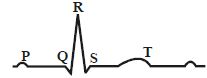
The diagram given here is the standard $ECG$ of a normal person. The $P-$ wave represents the:
A
Initiation of the ventricular contraction
B
Beginning of the systole
C
End of systole
D
Contraction of both the atria
Solution
(D) The $P-$ wave represents the electrical excitation (or depolarisation) of the atria,which leads to the contraction of both the atria.
The $QRS$ complex represents the depolarisation of the ventricles,which initiates the ventricular contraction.
The contraction of the ventricles starts shortly after $Q$ and marks the beginning of the ventricular systole.
The $QRS$ complex represents the depolarisation of the ventricles,which initiates the ventricular contraction.
The contraction of the ventricles starts shortly after $Q$ and marks the beginning of the ventricular systole.
0 likes
View Solution40
MediumMCQ
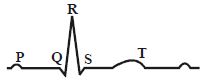
Given below is the $ECG$ of a normal human. Which one of its components is correctly interpreted below?
A
Peak $P$ and Peak $R$ together - systolic and diastolic blood pressures
B
Peak $P -$ Initiation of left atrial contraction only
C
Complex $QRS -$ One complete pulse
D
Peak $T -$ Initiation of total cardiac contraction
Solution
(C) The $P$-wave represents the electrical excitation (or depolarization) of the atria,which leads to the contraction of both the atria.
The $QRS$ complex represents the depolarization of the ventricles,which initiates the ventricular contraction. The contraction starts shortly after $Q$ and marks the beginning of the systole.
The $T$-wave represents the return of the ventricles from an excited to a normal state (repolarization). The end of the $T$-wave marks the end of systole.
Therefore,the $QRS$ complex corresponds to the depolarization of the ventricles,which initiates ventricular contraction,effectively representing one complete pulse or heartbeat cycle in terms of electrical activity.
The $QRS$ complex represents the depolarization of the ventricles,which initiates the ventricular contraction. The contraction starts shortly after $Q$ and marks the beginning of the systole.
The $T$-wave represents the return of the ventricles from an excited to a normal state (repolarization). The end of the $T$-wave marks the end of systole.
Therefore,the $QRS$ complex corresponds to the depolarization of the ventricles,which initiates ventricular contraction,effectively representing one complete pulse or heartbeat cycle in terms of electrical activity.
0 likes
View Solution41
MediumMCQ
Assertion : Blood pressure is arterial blood pressure.
Reason : Blood pressure is measured by a sphygmomanometer.
Reason : Blood pressure is measured by a sphygmomanometer.
A
If both Assertion and Reason are correct and the Reason is a correct explanation of the Assertion.
B
If both Assertion and Reason are correct but Reason is not a correct explanation of the Assertion.
C
If the Assertion is correct but Reason is incorrect.
D
If both the Assertion and Reason are incorrect.
Solution
(A) Blood pressure refers to the pressure exerted by blood against the walls of the arteries during each heartbeat.
It is typically measured using the brachial artery in the arm.
The instrument used to measure this pressure is called a sphygmomanometer.
Since blood pressure specifically refers to the pressure within the arteries,both the Assertion and the Reason are correct.
Furthermore,the Reason explains why we can define blood pressure as arterial pressure,as the standard clinical measurement is performed on arteries using this specific device.
It is typically measured using the brachial artery in the arm.
The instrument used to measure this pressure is called a sphygmomanometer.
Since blood pressure specifically refers to the pressure within the arteries,both the Assertion and the Reason are correct.
Furthermore,the Reason explains why we can define blood pressure as arterial pressure,as the standard clinical measurement is performed on arteries using this specific device.
0 likes
View Solution42
Difficult
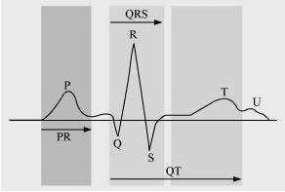
Draw a standard $ECG$ and explain the different segments in it.
Solution
(N/A) An Electrocardiogram $(ECG)$ is a graphical representation of the electrical activity of the heart during a cardiac cycle.
$A$ standard $ECG$ consists of a series of waves: $P, Q, R, S,$ and $T$.
$(a)$ The $P$-wave represents the electrical excitation (or depolarisation) of the atria,which leads to the contraction of both atria.
$(b)$ The $QRS$ complex represents the depolarisation of the ventricles,which initiates ventricular contraction. The contraction starts shortly after $Q$ and marks the beginning of the systole.
$(c)$ The $T$-wave represents the return of the ventricles from an excited to a normal state (repolarisation). The end of the $T$-wave marks the end of systole.
By counting the number of $QRS$ complexes that occur in a given time period,one can determine the heart rate of an individual.
$A$ standard $ECG$ consists of a series of waves: $P, Q, R, S,$ and $T$.
$(a)$ The $P$-wave represents the electrical excitation (or depolarisation) of the atria,which leads to the contraction of both atria.
$(b)$ The $QRS$ complex represents the depolarisation of the ventricles,which initiates ventricular contraction. The contraction starts shortly after $Q$ and marks the beginning of the systole.
$(c)$ The $T$-wave represents the return of the ventricles from an excited to a normal state (repolarisation). The end of the $T$-wave marks the end of systole.
By counting the number of $QRS$ complexes that occur in a given time period,one can determine the heart rate of an individual.
0 likes
View Solution43
Medium
Write the differences between $P$-wave and $T$-wave.
Solution
(N/A) The differences between the $P$-wave and $T$-wave in an electrocardiogram $(ECG)$ are as follows:
| $P$-wave | $T$-wave |
|---|---|
| $(1)$ The $P$-wave represents the electrical excitation (or depolarisation) of the atria. | $(1)$ The $T$-wave represents the return of the ventricles from an excited to a normal state (repolarisation). |
| $(2)$ It indicates the activation of the $SA$ node. | $(2)$ It indicates ventricular relaxation. |
| $(3)$ It is of atrial origin. | $(3)$ It is of ventricular origin. |
0 likes
View Solution44
Easy
Describe in detail: $ECG$.
Solution
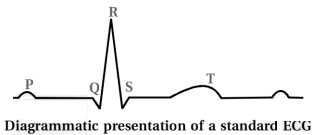
(N/A) $ECG$ is a graphical representation of the electrical activity of the heart during a cardiac cycle.
$A$ patient is connected to the machine with three electrical leads (one to each wrist and to the left ankle) that continuously monitor the heart activity.
Each peak in the $ECG$ is identified with a letter from $P$ to $T$ that corresponds to a specific electrical activity of the heart.
The $P$-wave represents the electrical excitation (or depolarisation) of the atria,which leads to the contraction of both the atria.
The $QRS$ complex represents the depolarisation of the ventricles,which initiates the ventricular contraction. The contraction starts shortly after $Q$ and marks the beginning of the systole.
The $T$-wave represents the return of the ventricles from an excited state to a normal state (repolarisation). The end of the $T$-wave marks the end of systole.
By counting the number of $QRS$ complexes that occur in a given time period,one can determine the heart beat rate of an individual.
Any deviation in the shape of the $ECG$ indicates a possible abnormality or disease. Hence,it is of great clinical importance.
$A$ patient is connected to the machine with three electrical leads (one to each wrist and to the left ankle) that continuously monitor the heart activity.
Each peak in the $ECG$ is identified with a letter from $P$ to $T$ that corresponds to a specific electrical activity of the heart.
The $P$-wave represents the electrical excitation (or depolarisation) of the atria,which leads to the contraction of both the atria.
The $QRS$ complex represents the depolarisation of the ventricles,which initiates the ventricular contraction. The contraction starts shortly after $Q$ and marks the beginning of the systole.
The $T$-wave represents the return of the ventricles from an excited state to a normal state (repolarisation). The end of the $T$-wave marks the end of systole.
By counting the number of $QRS$ complexes that occur in a given time period,one can determine the heart beat rate of an individual.
Any deviation in the shape of the $ECG$ indicates a possible abnormality or disease. Hence,it is of great clinical importance.
0 likes
View Solution45
Easy
Provide the full forms of the following abbreviations:
$(1)$ $FSF$
$(2)$ $ECG$
$(1)$ $FSF$
$(2)$ $ECG$
Solution
(N/A) $(1)$ $FSF$ stands for Fibrin Stabilizing Factor,which is a protein involved in the blood clotting process.
$(2)$ $ECG$ stands for Electrocardiogram,which is a test that records the electrical activity of the heart.
$(2)$ $ECG$ stands for Electrocardiogram,which is a test that records the electrical activity of the heart.
0 likes
View Solution46
EasyMCQ
The $QRS$ complex in a standard $ECG$ represents:
A
Repolarisation of ventricles
B
Repolarisation of auricles
C
Depolarisation of auricles
D
Depolarisation of ventricles
Solution
(D) In a standard $ECG$,the $P$-wave represents the electrical excitation or depolarisation of the atria (auricles),which leads to the contraction of both the atria.
The $QRS$ complex represents the depolarisation of the ventricles,which initiates the ventricular contraction.
The $T$-wave represents the return of the ventricles from an excited to a normal state,i.e.,repolarisation of the ventricles.
The $QRS$ complex represents the depolarisation of the ventricles,which initiates the ventricular contraction.
The $T$-wave represents the return of the ventricles from an excited to a normal state,i.e.,repolarisation of the ventricles.
0 likes
View Solution47
MediumMCQ
In a standard $ECG$,what does the $QRS$ complex represent?
A
Repolarization of the atria
B
Depolarization of the atria
C
Depolarization of the ventricles
D
Repolarization of the ventricles
Solution
(C) In a standard $ECG$ (Electrocardiogram),the $QRS$ complex represents the depolarization of the ventricles.
This electrical activity initiates the ventricular contraction (systole).
The $P$-wave represents the electrical excitation (or depolarization) of the atria,which leads to the contraction of both the atria.
The $T$-wave represents the return of the ventricles from an excited to a normal state (repolarization).
This electrical activity initiates the ventricular contraction (systole).
The $P$-wave represents the electrical excitation (or depolarization) of the atria,which leads to the contraction of both the atria.
The $T$-wave represents the return of the ventricles from an excited to a normal state (repolarization).
0 likes
View Solution48
MediumMCQ
Systolic pressure in a normal human is
A
$70\; mm\; Hg$
B
$80\; mm\; Hg$
C
$90\; mm\; Hg$
D
$120\; mm\; Hg$
Solution
(D) In a healthy adult,blood pressure is typically measured as $120/80\; mm\; Hg$.
Here,the numerator $120\; mm\; Hg$ represents the systolic pressure,which is the pressure exerted by the blood against the arterial walls during ventricular contraction (pumping phase).
The denominator $80\; mm\; Hg$ represents the diastolic pressure,which is the pressure during ventricular relaxation (resting phase).
Here,the numerator $120\; mm\; Hg$ represents the systolic pressure,which is the pressure exerted by the blood against the arterial walls during ventricular contraction (pumping phase).
The denominator $80\; mm\; Hg$ represents the diastolic pressure,which is the pressure during ventricular relaxation (resting phase).
0 likes
View Solution49
MediumMCQ
The difference between systolic and diastolic pressure in humans is
A
$120\; mm\; Hg$
B
$80\; mm\; Hg$
C
$40\; mm\; Hg$
D
$200\; mm\; Hg$
Solution
(C) Systolic blood pressure is $120\; mm\; Hg$.
Diastolic blood pressure is $80\; mm\; Hg$.
The difference between systolic and diastolic pressure is known as pulse pressure.
Pulse pressure $= 120\; mm\; Hg - 80\; mm\; Hg = 40\; mm\; Hg$.
Diastolic blood pressure is $80\; mm\; Hg$.
The difference between systolic and diastolic pressure is known as pulse pressure.
Pulse pressure $= 120\; mm\; Hg - 80\; mm\; Hg = 40\; mm\; Hg$.
0 likes
View SolutionBody Fluids and Circulations — Blood pressure, ECG · Frequently Asked Questions
1Are these Body Fluids and Circulations questions useful for JEE and NEET?
Yes. All questions in this section are mapped to JEE Main and NEET exam patterns. Previous year questions from JEE Main, NEET, GUJCET and state-level exams are included with full solutions.
2Can I switch to Hindi or Gujarati for these questions?
Yes. Use the language tabs in the hero section or the sidebar to view the same questions and solutions in English, Hindi or Gujarati.
3How do I generate a question paper from this subtopic?
Use the Vedclass Exam Paper Generator — select the chapter and subtopic, set difficulty, and generate Sets A, B, C, D automatically. First 3 chapters of every subject are free.
Vedclass Products
For Students
Vedclass Test Series
Mock tests in real JEE/NEET style with performance analysis. 5-day free trial.
Start Free TrialFor Teachers
Exam Paper Generator
Generate Set A/B/C/D papers from this chapter in 2 minutes. 3 chapters free.
Try FreeFor Institutes
Online Exam Module
Live online exams with unlimited students, 360° analytics & white-label branding.
See DemoFor Teachers & Institutes
Generate a Body Fluids and Circulations Exam Paper in 2 Minutes
Select subtopic & difficulty — Sets A, B, C, D auto-generated with No Repeat logic.
First 3 chapters of every subject are free — no payment required.