
A English
Disorder of circulatory system Questions in English
Class 11 Biology · Body Fluids and Circulations · Disorder of circulatory system
68+
Questions
English
Language
100%
With Solutions
Showing 50 of 68 questions in English
1
MediumMCQ
Hypochromic or macrocytic anaemia is due to
A
Iron deficiency
B
Vitamin $B_{12}$ deficiency
C
Chronic loss of blood
D
None of the above
Solution
(B) Macrocytic anaemia is primarily caused by a deficiency of Vitamin $B_{12}$ or Folic acid.
In this condition,the red blood cells are larger than normal (macrocytic) and often have a lower concentration of haemoglobin.
Iron deficiency typically leads to microcytic hypochromic anaemia,not macrocytic anaemia.
Therefore,Vitamin $B_{12}$ deficiency is the correct cause for macrocytic anaemia.
In this condition,the red blood cells are larger than normal (macrocytic) and often have a lower concentration of haemoglobin.
Iron deficiency typically leads to microcytic hypochromic anaemia,not macrocytic anaemia.
Therefore,Vitamin $B_{12}$ deficiency is the correct cause for macrocytic anaemia.
0 likes
View Solution2
MediumMCQ
The murmuring sound in the heart takes place due to
A
The defective and leaking valve
B
The thrombosis in coronary artery
C
Defect in $SA$ node
D
The arterial pulse
Solution
(A) heart murmur is an abnormal sound produced by the turbulent flow of blood through the heart. This turbulence is most commonly caused by defective,stenotic,or leaking heart valves that do not close properly or open fully,leading to vibrations in the heart structures.
0 likes
View Solution3
MediumMCQ
Wenckebach phenomenon is seen in
A
Complete heart block
B
Partial heart block
C
Ventricular fibrillation
D
Myocardial infarction
Solution
(B) The Wenckebach phenomenon (also known as Mobitz type $I$ second-degree $AV$ block) is a type of partial heart block.
In this condition,the $P-R$ interval progressively lengthens with each successive beat until a $P$ wave fails to be followed by a $QRS$ complex (a dropped beat).
This cycle then repeats itself.
In this condition,the $P-R$ interval progressively lengthens with each successive beat until a $P$ wave fails to be followed by a $QRS$ complex (a dropped beat).
This cycle then repeats itself.
0 likes
View Solution4
MediumMCQ
The thickening and hardening of the walls of arteries is called:
A
Arthritis
B
Aneurysm
C
Arteriosclerosis
D
Both $(a)$ and $(b)$
Solution
(C) The correct answer is $(c)$.
Arteriosclerosis refers to the thickening,hardening,and loss of elasticity of the arterial walls.
Atherosclerosis is a specific type of arteriosclerosis characterized by the deposition of fatty substances,especially cholesterol and triglycerides,in the tunica interna and smooth muscle of medium-sized and large arteries.
Arteriosclerosis refers to the thickening,hardening,and loss of elasticity of the arterial walls.
Atherosclerosis is a specific type of arteriosclerosis characterized by the deposition of fatty substances,especially cholesterol and triglycerides,in the tunica interna and smooth muscle of medium-sized and large arteries.
0 likes
View Solution5
MediumMCQ
Atherosclerosis refers to the ailment of
A
Lungs
B
Heart
C
Kidney
D
Liver
Solution
(B) $Atherosclerosis$ is a condition characterized by the narrowing of arteries and arterioles due to the deposition of fats,cholesterol,and other substances on their inner walls. This condition primarily affects the blood vessels supplying the heart,leading to cardiovascular complications. Therefore,it is considered an ailment related to the heart and the circulatory system.
0 likes
View Solution6
EasyMCQ
$A$ heart rate that is below the normal range is called:
A
Bradycardia
B
Tachycardia
C
Hyperpiesis
D
All of these
Solution
(A) The normal resting heart rate for an adult typically ranges from $60$ to $100$ beats per minute.
$1$. Bradycardia is defined as a heart rate that is slower than the normal range,typically less than $60$ beats per minute.
$2$. Tachycardia refers to a heart rate that is faster than the normal range,typically exceeding $100$ beats per minute.
$3$. Hyperpiesis is a term often used synonymously with high blood pressure or hypertension.
Therefore,a heart rate below the normal range is called Bradycardia.
$1$. Bradycardia is defined as a heart rate that is slower than the normal range,typically less than $60$ beats per minute.
$2$. Tachycardia refers to a heart rate that is faster than the normal range,typically exceeding $100$ beats per minute.
$3$. Hyperpiesis is a term often used synonymously with high blood pressure or hypertension.
Therefore,a heart rate below the normal range is called Bradycardia.
0 likes
View Solution7
MediumMCQ
Blocking of arteries due to the deposition of fats and calcium is called:
A
Arteriosclerosis
B
Atherosclerosis
C
Emphysema
D
Heart syndrome
Solution
(B) . The blocking of arteries due to the deposition of fats,cholesterol,and calcium is known as $Atherosclerosis$. This condition leads to the hardening and narrowing of the arterial walls. $Emphysema$ is a chronic respiratory condition characterized by the damage of air sacs in the lungs.
0 likes
View Solution8
AdvancedMCQ
Blood pressure increases and heart rate decreases in response to
A
Exercise
B
Hemorrhage
C
Exposure to high altitude
D
Increased intracranial pressure
Solution
(D) The correct answer is $D$.
When intracranial pressure increases,it leads to a condition known as the Cushing reflex.
This reflex is characterized by an increase in systemic blood pressure to maintain cerebral perfusion pressure against the elevated intracranial pressure.
Simultaneously,the stimulation of the baroreceptors and the vagus nerve in response to the high blood pressure causes a reflex bradycardia,which is a decrease in heart rate.
When intracranial pressure increases,it leads to a condition known as the Cushing reflex.
This reflex is characterized by an increase in systemic blood pressure to maintain cerebral perfusion pressure against the elevated intracranial pressure.
Simultaneously,the stimulation of the baroreceptors and the vagus nerve in response to the high blood pressure causes a reflex bradycardia,which is a decrease in heart rate.
0 likes
View Solution9
MediumMCQ
$A$ chemical that prevents blood clotting is most useful in the treatment of
A
Leukemia
B
Anemia
C
Coronary thrombosis
D
Haemophilia
Solution
(C) chemical that prevents blood clotting is known as an anticoagulant (e.g.,heparin or warfarin).
Coronary thrombosis is a condition where a blood clot (thrombus) forms inside a coronary artery,which supplies blood to the heart muscle.
By using an anticoagulant,the formation of these clots can be prevented or existing clots can be managed,making it the most useful treatment among the given options for coronary thrombosis.
Leukemia is a cancer of blood-forming tissues,anemia is a deficiency of red blood cells,and haemophilia is a genetic disorder where blood fails to clot properly,making anticoagulants inappropriate for these conditions.
Coronary thrombosis is a condition where a blood clot (thrombus) forms inside a coronary artery,which supplies blood to the heart muscle.
By using an anticoagulant,the formation of these clots can be prevented or existing clots can be managed,making it the most useful treatment among the given options for coronary thrombosis.
Leukemia is a cancer of blood-forming tissues,anemia is a deficiency of red blood cells,and haemophilia is a genetic disorder where blood fails to clot properly,making anticoagulants inappropriate for these conditions.
0 likes
View Solution10
MediumMCQ
Manifestation of an increase in the blood pressure of a person is called:
A
Hypertension
B
Atherosclerosis
C
Arteriosclerosis
D
None of these
Solution
(A) Hypertension is the term used to describe high blood pressure.
It is a condition where the force of the blood against the artery walls is consistently too high.
$120/80 \text{ mmHg}$ is considered a normal blood pressure reading.
If repeated checks of blood pressure of an individual is $140/90 \text{ mmHg}$ or higher,it shows hypertension.
It is a condition where the force of the blood against the artery walls is consistently too high.
$120/80 \text{ mmHg}$ is considered a normal blood pressure reading.
If repeated checks of blood pressure of an individual is $140/90 \text{ mmHg}$ or higher,it shows hypertension.
0 likes
View Solution11
EasyMCQ
The accumulation of excess fluid in tissue space is called
A
Hodgkin's disease
B
Parkinson's disease
C
Oedema
D
Cirrhosis
Solution
(C) The accumulation of excess fluid in the intercellular tissue spaces is known as $Oedema$ (or $Edema$).
This condition occurs when there is an imbalance in the forces that regulate fluid movement between the blood capillaries and the surrounding tissues,leading to swelling.
This condition occurs when there is an imbalance in the forces that regulate fluid movement between the blood capillaries and the surrounding tissues,leading to swelling.
0 likes
View Solution12
MediumMCQ
Blood cancer is the excess production of leucocytes. It is known as:
A
Haemorrhage
B
Haemolysis
C
Leukemia
D
Thrombosis
Solution
(C) Leukemia is a type of blood cancer characterized by the abnormal and uncontrolled increase in the number of leucocytes (white blood cells) in the body.
These leucocytes are typically immature and non-functional,which interferes with the normal production of healthy blood cells.
Therefore,the correct term for this condition is Leukemia.
These leucocytes are typically immature and non-functional,which interferes with the normal production of healthy blood cells.
Therefore,the correct term for this condition is Leukemia.
0 likes
View Solution13
EasyMCQ
What is a primary symptom of oedema?
A
Swelling of body parts,especially the legs
B
Pain in the chest
C
Common cold
D
Pain in the right leg
Solution
(A) Oedema is defined as the abnormal accumulation of fluid in the interstitial spaces of tissues.
This accumulation of fluid leads to swelling,which is most commonly observed in the lower extremities such as the legs and ankles due to the effect of gravity.
Therefore,swelling of body parts,especially the legs,is a characteristic symptom of oedema.
This accumulation of fluid leads to swelling,which is most commonly observed in the lower extremities such as the legs and ankles due to the effect of gravity.
Therefore,swelling of body parts,especially the legs,is a characteristic symptom of oedema.
0 likes
View Solution14
EasyMCQ
Dropsy means
A
Accumulation of the watery fluid in any part of the body
B
Accumulation of toxins in the body parts
C
Enlargement of kidney
D
Defective muscles of the eye
Solution
(A) Dropsy,historically known as edema,refers to the abnormal accumulation of serous or watery fluid in the tissues,cavities,or organs of the body. It is a clinical sign rather than a specific disease,often resulting from underlying conditions such as heart failure,kidney disease,or liver cirrhosis.
0 likes
View Solution15
EasyMCQ
What is the condition called when the heart rate is lower than normal?
A
Bradycardia
B
Tachycardia
C
Hypocardia
D
Nicocardia
Solution
(A) The normal resting heart rate for an adult typically ranges from $60$ to $100$ beats per minute.
When the heart rate falls below $60$ beats per minute,the condition is medically termed as $Bradycardia$.
Conversely,$Tachycardia$ refers to a heart rate that is faster than normal (above $100$ beats per minute).
When the heart rate falls below $60$ beats per minute,the condition is medically termed as $Bradycardia$.
Conversely,$Tachycardia$ refers to a heart rate that is faster than normal (above $100$ beats per minute).
0 likes
View Solution16
MediumMCQ
The state of the heart when it is not pumping blood effectively enough to meet the needs of the body is known as:
A
Heart attack
B
Cardiac arrest
C
Angina pectoris
D
Heart failure
Solution
(D) Heart failure is the state of the heart when it is not pumping blood effectively enough to meet the needs of the body. It is sometimes called congestive heart failure because congestion in the lungs is one of the main symptoms of this disease.
0 likes
View Solution17
MediumMCQ
In elderly people,the heart has to pump blood with more force due to.......
A
Increased elasticity of arteries
B
Decreased elasticity of arteries
C
Decreased efficiency of the heart
D
Increased efficiency of the heart
Solution
(B) As people age,the walls of the arteries undergo structural changes,primarily the loss of elastin fibers and the deposition of collagen.
This leads to a condition known as arteriosclerosis or hardening of the arteries.
Because the arteries become less elastic (stiff),they cannot expand and recoil effectively during the cardiac cycle.
Consequently,the heart must exert more force to push blood through these rigid vessels to maintain systemic blood pressure.
Therefore,the correct answer is $B$.
This leads to a condition known as arteriosclerosis or hardening of the arteries.
Because the arteries become less elastic (stiff),they cannot expand and recoil effectively during the cardiac cycle.
Consequently,the heart must exert more force to push blood through these rigid vessels to maintain systemic blood pressure.
Therefore,the correct answer is $B$.
0 likes
View Solution18
EasyMCQ
Pain in the heart muscle is known as........
A
Angina cardius
B
Angina pericardius
C
Angina pectoris
D
None of these
Solution
(C) Angina pectoris is a condition characterized by acute chest pain that occurs when not enough oxygen is reaching the heart muscle.
It is a common symptom of coronary artery disease,where the blood flow to the heart is reduced due to the narrowing of coronary arteries.
It is a common symptom of coronary artery disease,where the blood flow to the heart is reduced due to the narrowing of coronary arteries.
0 likes
View Solution19
MediumMCQ
What is the primary cause of coronary artery disease $(CAD)$?
A
Streptococci bacteria
B
Inflammation of the pericardium
C
Malfunctioning of heart valves
D
Inadequate blood supply to the heart muscles
Solution
(D) Coronary Artery Disease $(CAD)$,often referred to as atherosclerosis,affects the vessels that supply blood to the heart muscle.
It is caused by deposits of calcium,fat,cholesterol,and fibrous tissues,which make the lumen of the coronary arteries narrower.
This narrowing restricts the flow of blood,leading to an inadequate supply of oxygen and nutrients to the heart muscles,which is the defining characteristic of $CAD$.
It is caused by deposits of calcium,fat,cholesterol,and fibrous tissues,which make the lumen of the coronary arteries narrower.
This narrowing restricts the flow of blood,leading to an inadequate supply of oxygen and nutrients to the heart muscles,which is the defining characteristic of $CAD$.
0 likes
View Solution20
EasyMCQ
Tachycardia is defined as:
A
$A$ rapid heart rate
B
$A$ slow heart rate
C
$A$ stopped heart rate
D
$A$ normal heart rate
Solution
(A) Tachycardia is a medical term used to describe a heart rate that is faster than normal. In adults,this is typically defined as a resting heart rate of more than $100$ beats per minute. Conversely,a slow heart rate (less than $60$ beats per minute) is known as bradycardia.
0 likes
View Solution21
MediumMCQ
Atherosclerosis affects which of the following?
A
Lungs
B
Heart
C
Kidneys
D
Liver
Solution
(B) Atherosclerosis is a condition characterized by the deposition of calcium,fat,cholesterol,and fibrous tissues in the walls of the arteries. This leads to the narrowing of the arterial lumen,which restricts blood flow. Since this condition primarily affects the coronary arteries that supply blood to the heart muscle,it is a major disorder associated with the heart and the circulatory system.
0 likes
View Solution22
EasyMCQ
The state of the heart when it is not pumping blood effectively enough to meet the needs of the body is called:
A
Heart attack
B
Cardiac arrest
C
Angina pectoris
D
Heart failure
Solution
(D) Heart failure is the state of the heart when it is not pumping blood effectively enough to meet the needs of the body.
It is sometimes called congestive heart failure because congestion of the lungs is one of the main symptoms of this disease.
Heart attack is the damage to heart muscle due to inadequate blood supply.
Cardiac arrest is the state in which the heart stops beating.
Angina pectoris is a symptom of acute chest pain due to insufficient oxygen reaching the heart muscle.
It is sometimes called congestive heart failure because congestion of the lungs is one of the main symptoms of this disease.
Heart attack is the damage to heart muscle due to inadequate blood supply.
Cardiac arrest is the state in which the heart stops beating.
Angina pectoris is a symptom of acute chest pain due to insufficient oxygen reaching the heart muscle.
0 likes
View Solution23
MediumMCQ
In the elderly,the heart has to pump blood with more force due to.......
A
Increased elasticity of arteries
B
Decreased elasticity of arteries
C
Decreased efficiency of the heart
D
Increased efficiency of the heart
Solution
(B) As humans age,the walls of the arteries undergo structural changes,primarily the loss of elastin fibers and the deposition of collagen. This leads to a condition known as arteriosclerosis or hardening of the arteries. Because the arteries become less elastic (stiff),they cannot expand and recoil effectively during the cardiac cycle. Consequently,the heart must exert more force to pump blood through these rigid vessels,leading to increased blood pressure. Therefore,the correct answer is $B$.
0 likes
View Solution24
EasyMCQ
Chest pain due to inadequate oxygen supply to the heart muscle is called:
A
Angina pectoris
B
Angina pericarditis
C
Angina pectoris
D
None of these
Solution
(A) Angina pectoris is a condition characterized by chest pain or discomfort that occurs when the heart muscle does not receive enough oxygen-rich blood. This typically happens due to the narrowing of the coronary arteries,which supply blood to the heart muscle. It is a common symptom of coronary artery disease.
0 likes
View Solution25
MediumMCQ
Which of the following is a congenital heart disease?
A
Patent ductus arteriosus
B
Patent foramen ovale
C
Ventricular septal defect
D
All of the above
Solution
(D) Congenital heart disease refers to structural abnormalities of the heart or great vessels that are present at birth.
$A$. Patent ductus arteriosus $(PDA)$ is a condition where the ductus arteriosus fails to close after birth.
$B$. Patent foramen ovale $(PFO)$ is an opening between the left and right atria that fails to close after birth.
$C$. Ventricular septal defect $(VSD)$ is a hole in the wall (septum) that separates the two lower chambers (ventricles) of the heart.
Since all these conditions are structural defects present from birth,the correct answer is $D$.
$A$. Patent ductus arteriosus $(PDA)$ is a condition where the ductus arteriosus fails to close after birth.
$B$. Patent foramen ovale $(PFO)$ is an opening between the left and right atria that fails to close after birth.
$C$. Ventricular septal defect $(VSD)$ is a hole in the wall (septum) that separates the two lower chambers (ventricles) of the heart.
Since all these conditions are structural defects present from birth,the correct answer is $D$.
0 likes
View Solution26
MediumMCQ
Match List-$I$ with List-$II$ and select the correct option:
| List-$I$ | List-$II$ |
| $A$. Cardiac arrest | $(I)$. Heart not pumping blood effectively |
| $B$. Heart failure | $(II)$. Heart muscle is suddenly damaged |
| $C$. Heart attack | $(III)$. Acute chest pain |
| $D$. Angina | $(IV)$. Heart stops beating |
A
$A-(I), B-(II), C-(III), D-(IV)$
B
$A-(IV), B-(II), C-(I), D-(III)$
C
$A-(IV), B-(I), C-(II), D-(III)$
D
$A-(II), B-(III), C-(I), D-(IV)$
Solution
(C) The correct matches are as follows:
$A$. Cardiac arrest: $(IV)$. Heart stops beating.
$B$. Heart failure: $(I)$. Heart not pumping blood effectively.
$C$. Heart attack: $(II)$. Heart muscle is suddenly damaged by an inadequate blood supply.
$D$. Angina: $(III)$. Acute chest pain due to insufficient oxygen reaching the heart muscle.
Therefore, the correct sequence is $A-(IV), B-(I), C-(II), D-(III)$.
$A$. Cardiac arrest: $(IV)$. Heart stops beating.
$B$. Heart failure: $(I)$. Heart not pumping blood effectively.
$C$. Heart attack: $(II)$. Heart muscle is suddenly damaged by an inadequate blood supply.
$D$. Angina: $(III)$. Acute chest pain due to insufficient oxygen reaching the heart muscle.
Therefore, the correct sequence is $A-(IV), B-(I), C-(II), D-(III)$.
0 likes
View Solution27
MediumMCQ
Which organs are most damaged due to hypertension?
A
Tongue,salivary gland
B
Kidney,brain,heart
C
Lungs,ear
D
Brain,spleen
Solution
(B) Hypertension,commonly known as high blood pressure,refers to a condition where the blood pressure is higher than the normal range $(120/80 \ mmHg)$.
Chronic hypertension exerts excessive force on the walls of the arteries,leading to damage in vital organs.
The primary target organs affected by long-term hypertension are the heart (leading to heart failure or coronary artery disease),the brain (increasing the risk of stroke),and the kidneys (leading to chronic kidney disease).
Therefore,the correct answer is $B$.
Chronic hypertension exerts excessive force on the walls of the arteries,leading to damage in vital organs.
The primary target organs affected by long-term hypertension are the heart (leading to heart failure or coronary artery disease),the brain (increasing the risk of stroke),and the kidneys (leading to chronic kidney disease).
Therefore,the correct answer is $B$.
0 likes
View Solution28
MediumMCQ
Match Column-$I$ with Column-$II$.
| Column-$I$ | Column-$II$ |
| a. Hypertension | $1$. Chest pain |
| b. Atherosclerosis | $2$. Capacity of blood flow reduced from heart to body |
| c. Angina | $3$. Affect to the organs like brain and kidney |
| d. Heart failure | $4$. Cholesterol deposition in arteries |
A
$a-2, b-1, c-3, d-4$
B
$a-3, b-4, c-1, d-2$
C
$a-3, b-4, c-2, d-1$
D
$a-1, b-4, c-2, d-3$
Solution
(B) The correct matches are as follows:
$1$. Hypertension $(a-3)$: High blood pressure affects vital organs like the brain and kidneys.
$2$. Atherosclerosis $(b-4)$: This condition involves the deposition of calcium,fat,cholesterol,and fibrous tissues in the arteries,making them narrower.
$3$. Angina $(c-1)$: Also known as 'angina pectoris',it is characterized by acute chest pain due to an inadequate supply of oxygen to the heart muscle.
$4$. Heart failure $(d-2)$: This is the state of the heart when it is not pumping blood effectively enough to meet the needs of the body.
Therefore,the correct sequence is $a-3, b-4, c-1, d-2$.
$1$. Hypertension $(a-3)$: High blood pressure affects vital organs like the brain and kidneys.
$2$. Atherosclerosis $(b-4)$: This condition involves the deposition of calcium,fat,cholesterol,and fibrous tissues in the arteries,making them narrower.
$3$. Angina $(c-1)$: Also known as 'angina pectoris',it is characterized by acute chest pain due to an inadequate supply of oxygen to the heart muscle.
$4$. Heart failure $(d-2)$: This is the state of the heart when it is not pumping blood effectively enough to meet the needs of the body.
Therefore,the correct sequence is $a-3, b-4, c-1, d-2$.
0 likes
View Solution29
MediumMCQ
In which disease does acute chest pain appear when not enough oxygen is reaching the heart muscle?
A
Heart failure
B
Atherosclerosis
C
Hypertension
D
Angina
Solution
(D) Angina, also known as $Angina \text{ } pectoris$, is a condition characterized by acute chest pain.
This occurs when there is an inadequate supply of oxygen to the heart muscle $(myocardium)$.
It can occur in men and women of any age but is more common among the middle-aged and elderly.
It occurs due to conditions that affect blood flow to the heart.
This occurs when there is an inadequate supply of oxygen to the heart muscle $(myocardium)$.
It can occur in men and women of any age but is more common among the middle-aged and elderly.
It occurs due to conditions that affect blood flow to the heart.
0 likes
View Solution30
MediumMCQ
Match the following:
| Column-$I$ | Column-$II$ |
|---|---|
| $1$. $CAD$ | $a$. Condition that affects the blood flow |
| $2$. Angina | $b$. Heart is not pumping blood effectively |
| $3$. Heart failure | $c$. Atherosclerosis |
A
$(1-b), (2-a), (3-c)$
B
$(1-a), (2-b), (3-c)$
C
$(1-c), (2-a), (3-b)$
D
$(1-c), (2-b), (3-a)$
Solution
(C) $1$. $CAD$ (Coronary Artery Disease) is often referred to as atherosclerosis,which affects the vessels that supply blood to the heart muscle.
$2$. Angina is a condition characterized by acute chest pain when no enough oxygen is reaching the heart muscle,affecting blood flow.
$3$. Heart failure means the state of heart when it is not pumping blood effectively enough to meet the needs of the body.
Therefore,the correct matching is: $1-c, 2-a, 3-b$.
$2$. Angina is a condition characterized by acute chest pain when no enough oxygen is reaching the heart muscle,affecting blood flow.
$3$. Heart failure means the state of heart when it is not pumping blood effectively enough to meet the needs of the body.
Therefore,the correct matching is: $1-c, 2-a, 3-b$.
0 likes
View Solution31
EasyMCQ
Blood cancer is known as ..........
A
Leukemia
B
Thrombosis
C
Hemolysis
D
Hemophilia
Solution
(A) Blood cancer is medically known as $Leukemia$.
It is a type of cancer that affects the blood and bone marrow,characterized by the abnormal and uncontrolled production of white blood cells $(leukocytes)$.
$Thrombosis$ refers to the formation of a blood clot within a blood vessel.
$Hemolysis$ is the destruction of red blood cells.
$Hemophilia$ is a genetic disorder that impairs the body's ability to make blood clots.
It is a type of cancer that affects the blood and bone marrow,characterized by the abnormal and uncontrolled production of white blood cells $(leukocytes)$.
$Thrombosis$ refers to the formation of a blood clot within a blood vessel.
$Hemolysis$ is the destruction of red blood cells.
$Hemophilia$ is a genetic disorder that impairs the body's ability to make blood clots.
0 likes
View Solution32
MediumMCQ
Hardening of the arterial wall is called . . . . . . .
A
Arthritis
B
Atherosclerosis
C
Aneurysm
D
Both $(a)$ and $(c)$
Solution
(B) The hardening of the arterial wall due to the deposition of calcium,fats,cholesterol,and other substances is known as $Atherosclerosis$.
$Arthritis$ refers to the inflammation of joints.
$Aneurysm$ is a localized abnormal dilation of a blood vessel.
Therefore,the correct term for the hardening of the arterial wall is $Atherosclerosis$.
$Arthritis$ refers to the inflammation of joints.
$Aneurysm$ is a localized abnormal dilation of a blood vessel.
Therefore,the correct term for the hardening of the arterial wall is $Atherosclerosis$.
0 likes
View Solution33
MediumMCQ
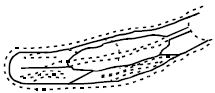
The figure below shows an angioplasty of the coronary blood vessel. Which one of the following statements correctly describes what is being done?
A
It is a coronary artery which has a cancerous growth that is being removed.
B
It is a coronary artery which is blocked by a plaque and the same is being cracked.
C
It is a coronary vein in which the defective valves are being opened.
D
It is a coronary vein blocked by a parasite (blood fluke) that is being removed.
Solution
(B) In this figure,coronary angioplasty is being performed.
During this procedure,an atherosclerotic plaque,which builds up and clogs the coronary arteries,is compressed against the vessel wall.
This is achieved by expanding a balloon-like device inserted through a catheter that has been threaded through the artery.
During this procedure,an atherosclerotic plaque,which builds up and clogs the coronary arteries,is compressed against the vessel wall.
This is achieved by expanding a balloon-like device inserted through a catheter that has been threaded through the artery.
0 likes
View Solution34
MediumMCQ
Thickening of arteries due to cholesterol deposition is known as:
A
arteriosclerosis
B
rheumatic heart
C
blood pressure
D
cardiac arrest
Solution
(A) high concentration of cholesterol in the blood leads to the deposition of cholesterol on the inner walls of the arteries.
This process causes the arteries to lose their elasticity and become stiffened.
This condition is medically termed as arteriosclerosis,which literally means the hardening of the arteries.
This process causes the arteries to lose their elasticity and become stiffened.
This condition is medically termed as arteriosclerosis,which literally means the hardening of the arteries.
0 likes
View Solution35
MediumMCQ
Assertion: Saline water is not given to patients of hypertension.
Reason: Saline water can cause vomiting and may drop blood pressure suddenly causing cardiac arrest.
Reason: Saline water can cause vomiting and may drop blood pressure suddenly causing cardiac arrest.
A
If both Assertion and Reason are correct and the Reason is a correct explanation of the Assertion.
B
If both Assertion and Reason are correct but Reason is not a correct explanation of the Assertion.
C
If the Assertion is correct but Reason is incorrect.
D
If both the Assertion and Reason are incorrect.
Solution
(C) The Assertion is correct because saline water contains $NaCl$ (sodium chloride). High intake of sodium increases water retention in the blood vessels,which leads to an increase in blood volume and consequently raises blood pressure,which is harmful to patients with hypertension.
However,the Reason is incorrect. Saline water does not drop blood pressure; rather,it increases blood pressure. Therefore,the statement provided in the Reason is scientifically false.
However,the Reason is incorrect. Saline water does not drop blood pressure; rather,it increases blood pressure. Therefore,the statement provided in the Reason is scientifically false.
0 likes
View Solution36
Easy
Give information about diseases related to blood circulation.
Solution
(N/A) The major disorders of the circulatory system include:
$(1)$ Hypertension: Hypertension is the term for blood pressure that is higher than normal $(120/80 \ mmHg)$. In this measurement,$120 \ mmHg$ is the systolic pressure and $80 \ mmHg$ is the diastolic pressure. If repeated checks of blood pressure of an individual show $140/90 \ mmHg$ or higher,it indicates hypertension. High blood pressure leads to heart diseases and also affects vital organs like the brain and kidneys.
$(2)$ Coronary Artery Disease $(CAD)$: Also referred to as atherosclerosis,it affects the vessels that supply blood to the heart muscle. It is caused by deposits of calcium,fat,cholesterol,and fibrous tissues,which make the lumen of the arteries narrower.
$(3)$ Angina Pectoris: This condition occurs when there is an inadequate supply of oxygen to the heart muscle,resulting in acute chest pain. It can occur in men and women of any age but is more common among middle-aged and elderly people.
$(4)$ Heart Failure: This refers to the state of the heart when it is not pumping blood effectively enough to meet the needs of the body. It is sometimes called congestive heart failure because congestion of the lungs is one of the main symptoms. Heart failure is not the same as cardiac arrest (when the heart stops beating) or a heart attack (when the heart muscle is suddenly damaged by an inadequate blood supply).
$(1)$ Hypertension: Hypertension is the term for blood pressure that is higher than normal $(120/80 \ mmHg)$. In this measurement,$120 \ mmHg$ is the systolic pressure and $80 \ mmHg$ is the diastolic pressure. If repeated checks of blood pressure of an individual show $140/90 \ mmHg$ or higher,it indicates hypertension. High blood pressure leads to heart diseases and also affects vital organs like the brain and kidneys.
$(2)$ Coronary Artery Disease $(CAD)$: Also referred to as atherosclerosis,it affects the vessels that supply blood to the heart muscle. It is caused by deposits of calcium,fat,cholesterol,and fibrous tissues,which make the lumen of the arteries narrower.
$(3)$ Angina Pectoris: This condition occurs when there is an inadequate supply of oxygen to the heart muscle,resulting in acute chest pain. It can occur in men and women of any age but is more common among middle-aged and elderly people.
$(4)$ Heart Failure: This refers to the state of the heart when it is not pumping blood effectively enough to meet the needs of the body. It is sometimes called congestive heart failure because congestion of the lungs is one of the main symptoms. Heart failure is not the same as cardiac arrest (when the heart stops beating) or a heart attack (when the heart muscle is suddenly damaged by an inadequate blood supply).
0 likes
View Solution37
Easy
Give scientific reasons:
$(1)$ Plaque stimulates/causes the formation of a blood clot on the wall of an artery.
$(2)$ Blood pressure and smoking have a direct relation with obesity.
$(1)$ Plaque stimulates/causes the formation of a blood clot on the wall of an artery.
$(2)$ Blood pressure and smoking have a direct relation with obesity.
Solution
(N/A) $(1)$ High blood pressure,smoking,and excessive fatty foods damage the endothelium. Plaque is built in such injured parts due to the deposition of fatty materials.
First,injured cells proliferate. Then,unstriated muscles beneath the endothelium associate with it.
Most lipids and cholesterol accumulate in this region. This plaque forms protrusions in the arteries,which provide resistance or obstruction to blood circulation,leading to clot formation.
$(2)$ During smoking,nicotine mixes into the blood,causing arterioles to contract,which increases blood pressure.
In the lungs,the capacity to transport oxygen decreases,causing blood pressure to rise. Carbon monoxide $(CO)$ produced during smoking decreases the oxygen-carrying capacity of hemoglobin,further increasing blood pressure.
In obese individuals,a larger volume of blood must be supplied to tissues,which increases the workload on the heart and consequently raises blood pressure.
First,injured cells proliferate. Then,unstriated muscles beneath the endothelium associate with it.
Most lipids and cholesterol accumulate in this region. This plaque forms protrusions in the arteries,which provide resistance or obstruction to blood circulation,leading to clot formation.
$(2)$ During smoking,nicotine mixes into the blood,causing arterioles to contract,which increases blood pressure.
In the lungs,the capacity to transport oxygen decreases,causing blood pressure to rise. Carbon monoxide $(CO)$ produced during smoking decreases the oxygen-carrying capacity of hemoglobin,further increasing blood pressure.
In obese individuals,a larger volume of blood must be supplied to tissues,which increases the workload on the heart and consequently raises blood pressure.
0 likes
View Solution38
Medium
Provide the definitions/explanations for the following terms:
$(1)$ Thrombus
$(2)$ Embolus
$(1)$ Thrombus
$(2)$ Embolus
Solution
(N/A) $(1)$ Thrombus: Fatty substances accumulate in the injured part of an artery and form a plaque. If this plaque remains attached to the arterial wall,it is called a thrombus.
$(2)$ Embolus: When a plaque formed on the wall of an artery breaks off from its original site and circulates through the bloodstream,it is referred to as an embolus.
$(2)$ Embolus: When a plaque formed on the wall of an artery breaks off from its original site and circulates through the bloodstream,it is referred to as an embolus.
0 likes
View Solution39
Easy
Briefly describe the following (Any four):
$(a)$ Anaemia $(b)$ Angina Pectoris $(c)$ Atherosclerosis $(d)$ Hypertension $(e)$ Heart failure $(f)$ Erythroblastosis foetalis
$(a)$ Anaemia $(b)$ Angina Pectoris $(c)$ Atherosclerosis $(d)$ Hypertension $(e)$ Heart failure $(f)$ Erythroblastosis foetalis
Solution
(N/A) Anaemia: $A$ condition characterized by a deficiency of haemoglobin or red blood cells,leading to reduced oxygen-carrying capacity of the blood.
$(b)$ Angina Pectoris: $A$ symptom of acute chest pain occurring when not enough oxygen is reaching the heart muscle.
$(c)$ Atherosclerosis: $A$ condition where the arteries become narrowed due to the deposition of calcium,fat,cholesterol,and fibrous tissues.
$(d)$ Hypertension: High blood pressure,where the pressure is consistently higher than $120/80 \text{ mmHg}$.
$(e)$ Heart failure: $A$ state where the heart is not pumping blood effectively enough to meet the needs of the body.
$(f)$ Erythroblastosis foetalis: $A$ condition occurring in the foetus when $Rh$-negative mother carries an $Rh$-positive foetus,leading to the destruction of foetal red blood cells by maternal antibodies.
$(b)$ Angina Pectoris: $A$ symptom of acute chest pain occurring when not enough oxygen is reaching the heart muscle.
$(c)$ Atherosclerosis: $A$ condition where the arteries become narrowed due to the deposition of calcium,fat,cholesterol,and fibrous tissues.
$(d)$ Hypertension: High blood pressure,where the pressure is consistently higher than $120/80 \text{ mmHg}$.
$(e)$ Heart failure: $A$ state where the heart is not pumping blood effectively enough to meet the needs of the body.
$(f)$ Erythroblastosis foetalis: $A$ condition occurring in the foetus when $Rh$-negative mother carries an $Rh$-positive foetus,leading to the destruction of foetal red blood cells by maternal antibodies.
0 likes
View Solution40
Easy
Write a short note on the following: $(a)$ Hypertension $(b)$ Coronary Artery Disease
Solution
(N/A) Hypertension: Hypertension is the term for blood pressure that is higher than normal $(120/80 \ mmHg)$. In this measurement,$120 \ mmHg$ represents the systolic pressure (pumping phase) and $80 \ mmHg$ represents the diastolic pressure (resting phase). If repeated checks of blood pressure of an individual is $140/90 \ mmHg$ or higher,it shows hypertension. High blood pressure leads to heart diseases and also affects vital organs like the brain and kidneys.
$(b)$ Coronary Artery Disease $(CAD)$: Often referred to as atherosclerosis,it affects the vessels that supply blood to the heart muscle. It is caused by deposits of calcium,fat,cholesterol,and fibrous tissues,which make the lumen of the arteries narrower.
$(b)$ Coronary Artery Disease $(CAD)$: Often referred to as atherosclerosis,it affects the vessels that supply blood to the heart muscle. It is caused by deposits of calcium,fat,cholesterol,and fibrous tissues,which make the lumen of the arteries narrower.
0 likes
View Solution41
MediumMCQ
Continued consumption of a diet rich in butter,red meat and eggs for a long period may lead to
A
Vitamin-$A$ toxicity
B
Kidney stones
C
Hypercholesterolemia
D
Urine laden with ketone bodies
Solution
(C) Excessive intake of saturated fats found in foods like butter,red meat,and eggs leads to an increase in blood cholesterol levels,a condition known as hypercholesterolemia.
High levels of cholesterol in the blood can lead to the deposition of plaques in the arteries (atherosclerosis),which increases the risk of high blood pressure and various cardiovascular disorders.
High levels of cholesterol in the blood can lead to the deposition of plaques in the arteries (atherosclerosis),which increases the risk of high blood pressure and various cardiovascular disorders.
0 likes
View Solution42
EasyMCQ
Tachycardia is
A
Fast heart rate
B
Slow heart rate
C
Stop heart rate
D
Normal heart rate
Solution
(A) The term tachycardia is used for a fast heart rate (pulse rate above $100$ beats/minute).
When the heart rate falls below $60$ beats/minute,it is referred to as bradycardia.
When the heart rate falls below $60$ beats/minute,it is referred to as bradycardia.
0 likes
View Solution43
MediumMCQ
$CAD$ stands for
A
Carotid Arterial Dysfunction
B
Cerebral Artery Dysfunction
C
Coronary Artery Disease
D
Calcium Activated Disease
Solution
(C) Coronary Artery Disease $(CAD)$ is a condition often referred to as atherosclerosis.
It is characterized by the deposition of calcium,fat,cholesterol,and fibrous tissues in the coronary arteries.
This leads to the hardening and loss of elasticity of the arterial walls,which reduces the blood supply to the heart muscle.
It is characterized by the deposition of calcium,fat,cholesterol,and fibrous tissues in the coronary arteries.
This leads to the hardening and loss of elasticity of the arterial walls,which reduces the blood supply to the heart muscle.
0 likes
View Solution44
MediumMCQ
Atherosclerosis is caused by the deposition of:
A
Calcium
B
Fat and cholesterol
C
Deposition of fibrous tissue
D
All of the above
Solution
(D) Coronary Artery Disease $(CAD)$,often referred to as atherosclerosis,affects the vessels that supply blood to the heart muscle.
It is caused by the deposition of fat,cholesterol,calcium,and fibrous tissue,which makes the lumen of the arteries narrower.
This narrowing restricts blood flow,potentially leading to heart-related complications.
It is caused by the deposition of fat,cholesterol,calcium,and fibrous tissue,which makes the lumen of the arteries narrower.
This narrowing restricts blood flow,potentially leading to heart-related complications.
0 likes
View Solution45
MediumMCQ
Coronary heart disease is due to
A
Streptococci bacteria
B
Inflammation of pericardium
C
Weakening of the heart valves
D
Insufficient blood supply to the heart muscles
Solution
(D) Coronary heart disease,often referred to as atherosclerosis,affects the vessels that supply blood to the heart muscle. It is caused by the deposition of calcium,fat,cholesterol,and fibrous tissues,which makes the lumen of the coronary arteries narrower. Consequently,this leads to an insufficient blood supply to the heart muscles.
0 likes
View Solution46
MediumMCQ
Congestion of the lungs is one of the main symptoms in
A
Hypotension
B
Coronary artery disease
C
Angina
D
Heart failure
Solution
(D) Heart failure refers to the state of the heart when it is not pumping blood effectively enough to meet the needs of the body.
It is sometimes called congestive heart failure because congestion of the lungs is one of the main symptoms of this condition.
Heart failure is not the same as cardiac arrest or a heart attack.
In cardiac arrest,the heart stops beating,while in a heart attack,the heart muscle is suddenly damaged by an inadequate blood supply.
It is sometimes called congestive heart failure because congestion of the lungs is one of the main symptoms of this condition.
Heart failure is not the same as cardiac arrest or a heart attack.
In cardiac arrest,the heart stops beating,while in a heart attack,the heart muscle is suddenly damaged by an inadequate blood supply.
0 likes
View Solution47
EasyMCQ
$A$ reduction in the number of blood platelets is called:
A
Thrombocytopenia
B
Hemophilia
C
Anaemia
D
Hypertension
Solution
(A) Thrombocytopenia: $A$ reduction in the number of blood platelets is known as thrombocytopenia,which can lead to excessive bleeding because the blood's ability to clot is compromised.
Hypertension: This refers to high blood pressure.
Anaemia: This is a condition characterized by low haemoglobin levels or a deficiency in $RBC$ count.
Haemophilia: This is a hereditary genetic disorder that impairs the body's ability to control blood clotting,which is essential to stop bleeding after an injury.
Hypertension: This refers to high blood pressure.
Anaemia: This is a condition characterized by low haemoglobin levels or a deficiency in $RBC$ count.
Haemophilia: This is a hereditary genetic disorder that impairs the body's ability to control blood clotting,which is essential to stop bleeding after an injury.
0 likes
View Solution48
EasyMCQ
Complete stoppage of heart beat is known as
A
Cardiac arrest
B
Myocardial infarction
C
Angina pectoris
D
Heart failure
Solution
(A) Cardiac arrest refers to the sudden and complete cessation of the heart's electrical and mechanical activity,leading to a total stoppage of the heartbeat.
Myocardial infarction,commonly known as a heart attack,occurs when blood flow to a part of the heart muscle is blocked,causing tissue damage.
Angina pectoris is characterized by chest pain or discomfort that occurs when the heart muscle does not receive enough oxygen-rich blood.
Heart failure is a condition where the heart is unable to pump blood efficiently enough to meet the body's metabolic demands,but it does not necessarily mean the heart has stopped beating completely.
Myocardial infarction,commonly known as a heart attack,occurs when blood flow to a part of the heart muscle is blocked,causing tissue damage.
Angina pectoris is characterized by chest pain or discomfort that occurs when the heart muscle does not receive enough oxygen-rich blood.
Heart failure is a condition where the heart is unable to pump blood efficiently enough to meet the body's metabolic demands,but it does not necessarily mean the heart has stopped beating completely.
0 likes
View Solution49
MediumMCQ
Which of the following diseases is also known as atherosclerosis?
A
Hypertension
B
Angina pectoris
C
Heart attack
D
Coronary artery disease $(CAD)$
Solution
(D) Hypertension refers to high blood pressure.
Angina pectoris is characterized by chest pain due to reduced oxygen supply to the heart muscle.
Heart attack is medically known as myocardial infarction.
Coronary Artery Disease $(CAD)$,often referred to as atherosclerosis,affects the vessels that supply blood to the heart muscle. It is caused by deposits of calcium,fat,cholesterol,and fibrous tissues,which make the lumen of the arteries narrower.
Angina pectoris is characterized by chest pain due to reduced oxygen supply to the heart muscle.
Heart attack is medically known as myocardial infarction.
Coronary Artery Disease $(CAD)$,often referred to as atherosclerosis,affects the vessels that supply blood to the heart muscle. It is caused by deposits of calcium,fat,cholesterol,and fibrous tissues,which make the lumen of the arteries narrower.
0 likes
View Solution50
EasyMCQ
The blood cancer is also known as
A
Haemolysis
B
Haemophilia
C
Leukaemia
D
Thrombosis
Solution
(C) Leukaemia is a type of blood cancer that involves the uncontrolled proliferation of white blood cells and their precursors in the bone marrow.
Haemolysis: This is the rupturing of erythrocytes (red blood cells) and the release of their contents into the surrounding fluid.
Haemophilia: This is a genetic disorder that impairs the body's ability to control blood clotting.
Thrombosis: This is the formation of a blood clot within a blood vessel.
Haemolysis: This is the rupturing of erythrocytes (red blood cells) and the release of their contents into the surrounding fluid.
Haemophilia: This is a genetic disorder that impairs the body's ability to control blood clotting.
Thrombosis: This is the formation of a blood clot within a blood vessel.
0 likes
View SolutionBody Fluids and Circulations — Disorder of circulatory system · Frequently Asked Questions
1Are these Body Fluids and Circulations questions useful for JEE and NEET?
Yes. All questions in this section are mapped to JEE Main and NEET exam patterns. Previous year questions from JEE Main, NEET, GUJCET and state-level exams are included with full solutions.
2Can I switch to Hindi or Gujarati for these questions?
Yes. Use the language tabs in the hero section or the sidebar to view the same questions and solutions in English, Hindi or Gujarati.
3How do I generate a question paper from this subtopic?
Use the Vedclass Exam Paper Generator — select the chapter and subtopic, set difficulty, and generate Sets A, B, C, D automatically. First 3 chapters of every subject are free.
Vedclass Products
For Students
Vedclass Test Series
Mock tests in real JEE/NEET style with performance analysis. 5-day free trial.
Start Free TrialFor Teachers
Exam Paper Generator
Generate Set A/B/C/D papers from this chapter in 2 minutes. 3 chapters free.
Try FreeFor Institutes
Online Exam Module
Live online exams with unlimited students, 360° analytics & white-label branding.
See DemoFor Teachers & Institutes
Generate a Body Fluids and Circulations Exam Paper in 2 Minutes
Select subtopic & difficulty — Sets A, B, C, D auto-generated with No Repeat logic.
First 3 chapters of every subject are free — no payment required.